I could get used to rooting for a winning hoops team

The Citadel 72, College of Charleston 63.  Whoa.

Even better, it was broadcast to a regional audience by SportSouth, with the legendary Whit Watson on play-by-play (plus shiny-domed analyst Nate Ross — I remember when Nate actually had some hair).  The Citadel doesn’t play too many televised basketball games (this was the last of three such appearances this season, not counting any potential SoCon tourney games).  Playing well and actually winning a TV game — well, that’s even more unusual.

First, the atmosphere.  From my vantage point in front of my TV (and by the way, it’s time for SportSouth to go all-HD all the time; I want to see my team play in crystal-clear high definition when it’s on the tube), the crowd seemed reasonably energetic, but a little cautious.  The corps looked okay, but I think it needed to be a bit more raucous.  (I do want a “McAlister Maniacs” t-shirt, though.  They didn’t have those back in the Dark Ages when I was in school.)  5107 is about the number of people I expected at the game.

In the game story in The Post and Courier, you’re going to read a lot of good things said about John Brown.  If you watched the game on TV, you listened to Nate Ross extol Brown’s virtues throughout the broadcast.  All of the accolades are completely justified.

Now, Brown does not appear to have any go-to offensive moves other than layups and dunks.  He’s only 6’4″.  He desperately needs a nickname.  However, he demonstrates that it’s possible for a player to have a huge effect on a game without being a scorer or what the late, great Al McGuire called an “aircraft carrier”.

Brown may not be that tall (although he has long arms), and he may not be that polished an offensive player, but he is an instinctive rebounder and defender, and an all-around hustler extraordinaire.  He finished with nine points (layups, dunks, a free throw), three steals (and numerous deflections), and twelve rebounds, with a lot of his boardwork coming during the critical stretch in the first half  when The Citadel built its lead (a 12-0 run).  I guess you could say it was a Rodmanesque performance, but that’s a description that doesn’t really work at The Citadel (and it’s hard to imagine Brown with dyed hair or wearing a dress).

Brown wasn’t the only Bulldog to have a good game.  Cosmo Morabbi continued his good run at three-point marksmanship.  Zach Urbanus had another solid day distributing the ball and making open shots from beyond the arc.  Five different Bulldogs made three-pointers, including two that I thought were bigger than “normal” made threes — Cameron Wells’ shot to tie the game at 10 when The Citadel was struggling to put the ball in the basket (despite getting good looks), and Austin Dahn’s second-half three under pressure from his defender and the shot clock, which effectively stopped a would-be College of Charleston rally.

Basically, it was a well-played game for The Citadel from about every vantage point.  When you shoot 8-15 from three and commit only eight turnovers against a pressing team, you’re probably going to have a good night.  The Bulldogs kept the possession total where they wanted it (63) and did a very good job of defending, leading to the Cougars’ poor shooting night (preventing transition baskets by avoiding turnovers and forced shots on the offensive end contributed to the College of Charleston’s offensive woes).

The negatives?  Free throw shooting (only 12-19; in particular, Bryan Streeter is struggling right now from the charity stripe) and (to a lesser extent) rebounding, for despite Brown’s prowess on the glass (which included five offensive boards), The Citadel was decisively outrebounded, although part of that is reflected by the CofC having more opportunities at offensive boards because it missed so many shots.  (It also reflects a fine effort in a losing cause by the Cougars’ Jermaine Johnson.)

I’m glad to see Demetrius Nelson finally get a win against the Cougars.  His coach can relate to waiting until his last season to beat the College of Charleston…

Speaking of Ed Conroy, the team looked well-prepared for the Cougar press.  The Citadel again had success with inbounds plays under the basket (this time Brown actually made the dunk).  I thought Conroy did a good job calling timeouts when appropriate.  I also noticed that for this game he shortened his rotation.  In past games he hasn’t hesitated to play eleven or twelve guys in a game (that’s not counting the standard clear-the-bench routine at the end of blowouts; fourteen players actually saw action against Western Carolina).  I think this game’s eight-man rotation tells you all you need to know about who he thinks is ready for big games against good, athletic teams.  Some of the underclassmen who didn’t play yesterday are going to be major contributors down the road, but aren’t quite ready yet for these types of games.

Against the College of Charleston, Conroy played three guys at two frontcourt spots (Nelson, Streeter, and Brown), rotating them accordingly, and played five guys in a three-guard setup, with Urbanus and Wells playing most of the game, and Morabbi and Dahn essentially splitting time at the other spot.  Jonathan Brick got a few minutes as well, long enough to sink a why-are-you-shooting-oh-that’s-why three-pointer.

The players don’t have much time to celebrate, though.  Monday night, the Bulldogs will play at Samford.  This is Samford’s first season in the SoCon, and the Birmingham Bulldogs have been very competitive, perhaps more competitive than expected.  Jimmy Tillette’s squad is, like The Citadel, 5-4 in the league, and has won four straight games.  Samford runs a “Princeton-style” offense and as such averages less than 60 possessions per game, which worries me a little, because the only time this season the Bulldogs faced an opponent that played an offensive style that was demonstrably “slower” than that of The Citadel was against Iowa.  In that game, the Bulldogs seemed to force the action too much and paid for it.  Samford spreads the wealth (no player averages more than 12.4 points per game, nor does any player average 30 minutes per game of playing time) and is a fairly good shooting team.  Samford has improved its turnover rate in conference play (the difference in turnovers in and out of conference is marked).

Defensively, Samford  employs a matchup zone.  This brings up the Birmingham Bulldogs’ greatest weakness, namely that they are a poor rebounding team without much in the way of a post presence.  The Citadel needs to be patient on offense, work to establish an inside game, and then hit open three-pointers.  Of course, you could say that about a lot of games.  The Citadel needs to emphasize (even more than usual) crashing the boards in this game.

On defense The Citadel must watch for backdoor cuts, of course, and be prepared to play defense for 35 seconds at a time.  How well is Samford’s offense working right now?  In three of its last four games Samford has recorded at least 17 assists, especially impressive when you consider that in those four games Samford averaged less than 25 made field goals per game.

We’ll see which team maintains its momentum on Monday night.

The last TV appearance of the hoops season, unless…

It’s not often I get to post about a 14-point victory in SoCon play, but last night The Citadel pummelled Western Carolina in the second half en route to a 66-52 victory.  It’s easy to win games by double digits when you shoot 70% from the field in a half. 


I thought the key to the run, though, was John Brown’s spirited play.  He seemed to get every rebound and loose ball during the second half.  He also just missed on what would have been a SportsCenter-worthy jam; I suspect he’ll get teased by his teammates (and Ed Conroy) for that.  Good effort all around, though.  17 assists on 26 made baskets is a very good ratio.  The pace was solid (62 possessions), and the Bulldogs outrebounded WCU, which was a bit of a surprise.  Jonathan Brick made two three-pointers; that’s as many as he had made all season.


Congrats to Demetrius Nelson for being the 25th member of the 1000-point club at The Citadel, which is a testament to his perseverance as much as it is to his talent. 


With the win The Citadel moved to 4-4 in league play.  It’s been six years since the Bulldogs had a .500 record or better in the conference after eight games.  (It’s also been six years since The Citadel won more than four conference games in a season.) 


The one negative was the large number of turnovers (18).  Most of them came in the first half and, in retrospect, kept the Catamounts in the game.  The Bulldogs have to avoid committing turnovers.  They aren’t going to shoot that well every night.  At least in this game they avoided the first half blues that had plagued them recently.


Speaking of that, The Citadel was coming off a tough loss at Wofford where the Bulldogs had trailed by as many as 16 points in the first half before mounting a furious comeback, actually taking the lead briefly.  The Citadel could not maintain the momentum, however, and eventually lost by three.   That was another 62-possession game, which I was glad to see (although Wofford doesn’t run-and-gun at all, so it was also an expected total).  The Citadel had struggled in the first half against Furman too, but recovered to win that game in OT (it helps that the Paladins are horrendous).


Wofford’s not a bad club at all, but last night Georgia Southern clubbed them in Statesboro.  I’m not sure what to make of that, other than Junior Salters must have done too much celebrating against The Citadel, because he went 3-14 from the field against GSU.  That means that third place in the SoCon South Division is a three-way tie, with The Citadel and Georgia Southern both 4-4 in league play and Wofford at 3-3.  Davidson leads the division, of course; sitting in second place is Bobby Cremins’ crew from the College of Charleston, which is 7-1 in the league (losing only to Davidson) and 15-3 overall, including a win over South Carolina. 


As it happens, The Citadel will host the CofC at McAlister Field House on Saturday afternoon.  It’s going to be televised by SportSouth, the third and final time the Bulldogs will be featured on TV this season, unless the Bulldogs were to advance to the Southern Conference tournament semi-finals for only the second time in the last 24 seasons.  That would be…different.


The Cougars are one of the country’s better offensive squads, averaging 1.113 points per possession (17th nationally).  They shoot well from the field, whether inside or outside (38% from three-land), and take good care of the basketball.  The only thing offensively that qualifies as a weakness is their free throw shooting (65.9%).  Currently five College of Charleston players are averaging double-figure scoring, led by guard Andrew Goudelock (who is shooting 48.5% from beyond the arc).


Defensively the Cougars aren’t nearly as impressive.  CofC opponents are shooting 46% from the field.  Also, the Cougars are not a good rebounding team.  The College of Charleston is averaging over four blocked shots per game, however, and leads the SoCon in that category.


I would guess that at least 5000 people will be in attendance at McAlister on Saturday, including a goodly number of cadets.  It should be a great atmosphere.  I just hope the game is as good.

Reviewing The Citadel’s last three basketball games

Boring title for a post, but it’s the best I can do.  When the temperature drops below 25 degrees, I get less imaginative…

The Citadel is now 8-9 overall, 3-3 in the Southern Conference, after last night’s thank-God-and-Zach Urbanus-we-won 74-69 OT throwdown with the less than mighty Purple Paladins.  Furman came into the game ranked 341st in the RPI, ahead of only Alcorn State and Southern.  (Maybe there should be a SoCon-SWAC challenge next December.)  However, for a half The Citadel played like the team that hadn’t won a Division I game all season.  Furman changed defenses and forced the confused Bulldogs to commit 11 turnovers in the first half.  The Citadel finally figured out things early in the second half (and the shorthanded Paladins wore down a bit).  However, not being able to stand prosperity, The Citadel somehow blew a seven-point lead in the final four minutes.  Credit to Furman’s players for not giving up; credit to The Citadel’s players for recovering to take control in overtime.

The stats bear out that turnovers were the sole reason Furman was really even in the game.  The Citadel isn’t going to win many games when it commits 15+ turnovers (17 last night), especially when it forces less than 10 from its opponent (Furman only had 9).  The Bulldogs outshot the Paladins, outrebounded them (by 13) and did a good job both getting to the foul line and making the shots when they got there.  The pace of play was about where The Citadel wanted it to be, perhaps a little fast, but not overly so.  Speaking of pace…

My concern with the team as it continues on this long stretch of hoops (the upcoming game against Wofford will be The Citadel’s fifth in ten days; it starts another five-in-ten run on Thursday) is that the possession rate per game has increased to a level higher than where it best suits the Bulldogs.  Before the Davidson game, here were the possession totals for The Citadel’s games against D-1 competition:  72, 54, 70, 55, 53, 60, 57, 63, 70, 70, 56.   Two of the three 70-possession games came against Michigan State and South Carolina; the other was the road win at Charleston Southern, and included a lot of late-game free throw shooting.  The 72-possession game came against VCU.  In other words, in games where The Citadel could control the pace of play, 60 possessions was about where it wanted to be.

Against Davidson, in front of a large crowd, and with an aggressive opponent (and with way too many fouls being called, on both teams), The Citadel wound up with 84 possessions.  That may have been understandable, but when I watched the Chattanooga game two days later, I felt the Bulldogs weren’t patient enough on offense and played the game the way Chattanooga wanted to play it.  Ultimately, it resulted in a tough loss, and it bugged me a little because, honestly, I think The Citadel should have won the game.  That was a missed opportunity.

That missed opportunity made the Furman game that much more important.  Furman may be really bad, but The Citadel can’t count on any victories, especially conference road victories, and I was afraid the Bulldogs had blown it by playing such a poor first half.  Winning it means the Bulldogs won’t be as likely to press, as a loss would have resulted in a three-game losing streak and all the old doubts and fears and “here we go again” talk.  Now, The Citadel has a .500 record in league play heading into Saturday night’s game at Wofford.

Wofford has had an interesting season thus far.  It is currently 112th in the RPI despite a 6-7 overall record.  The Terriers lost at Dayton by three in their season opener (Dayton is currently 15-2), and then got shelled by still-undefeated Clemson.  Wofford then won a holiday tournament hosted by Air Force, beat UNC-Asheville, lost its conference opener at home to Appalachian State, waxed a non-D1 team, and then totally blew a chance at a BCS scalp, losing on a last-second OT shot to Georgia, 74-73 (the conference as a whole would have really liked that one).  In the month of January the Terriers have lost at Navy (which is now 13-4 and a serious contender in the Patriot League) and at South Carolina, won two league road games (including a win at Chattanooga), and on Thursday night lost a tough game at home to the College of Charleston, 65-63.  Wofford is 2-2 in SoCon play, with the two losses at home and the two wins on the road.

This should be a slow-paced game, since Wofford is eleventh in the conference in total possessions, both in league play and overall.  The Citadel is tenth overall, but fifth in league play (as per my point above).   The Terriers do not shoot the ball particularly well, but are one of the nation’s better defensive rebounding teams.  They also foul a lot.

Wofford has also had some injury problems.  Junior Salters was averaging 17.2 points per game through the Georgia game, but hasn’t played since.  Corey Godzinski has a broken hand and is out for four weeks.  The Terriers do have Noah Dahlman, a 6’6″ sophomore forward averaging 16.8 points per game, who despite all the injuries is still coming off the bench.  Tim Johnson is a 6’5″ junior forward avering 9.9 points per game who went for 21 against the CofC.  Dahlman and Johnson combine to average over 17 rebounds per game.

Side note for all you gambling types:  following up on a brief blurb in Jeff Hartsell’s Bulldog Bites, in games involving The Citadel in which the “over-under” has been available for betting, the “over” is now 8-1.  Last night’s OT foiled the under-wanters and resulted in another victory for the over-hopers.

Another road win in league play would be a nice way to close out this five-pack of games and would set the Bulldogs up nicely for the next five-pack.  I would say that it will be a hot time in Spartanburg on Saturday night, except that it’s going to be really, really cold…

Taking names, and talking names

The Citadel 84, Georgia Southern 75.

I enjoyed watching this game.  I wish John Brown had made both of his last-second free throws, so The Citadel could have won by double digits, but considering the team has already won more games in this campaign than it did all of last season, it’s all good.

Speaking of John “Abolitionist of the Glass” Brown, where did he come from?  He started the season opener, played nine minutes, then played a total of five minutes until last Saturday, when he suddenly started the game against Bethune-Cookman and contributed solid defense and rebounding over 20 minutes.  Last night he came off the bench and snatched 11 boards in 26 minutes.  Brown is a long-armed 6’4″ redshirt freshman from Savannah who Jeff Hartsell had tipped on his blog during the preseason as a possible contributor, but I was not prepared for his productivity (and it was rather obvious that Georgia Southern wasn’t either).  If he turns out to be a rebounding maven who can play some D, which last night certainly appeared to be the case, Brown will fill a much-needed role for the Bulldogs.

Besides Brown’s performance, The Citadel got 38 combined points from the  two-headed post monster of Demetrius Nelson and Bryan Streeter, who combined to shoot 12-18 from the floor and also got to the line a gratifying 22 times (Streeter needs to shoot better than 50% from the stripe, though).  The Citadel never trailed after making a nice run at the end of the half, this despite a mediocre night from beyond the arc (6-19) and shooting only 43% from the field, all while playing at a much faster than normal pace (84 possessions, although part of that was due to the end-game fouling by GSU).

Defensively The Citadel held the Eagles to 41% shooting from the field, 29% from three-land, and outrebounded Georgia Southern by five.  The Bulldogs also committed one fewer turnover than GSU.

Also, I’m guessing that Ed Conroy had a chat with Austin Dahn after the game that went something like this:  “Austin, when we’re up nine with 1:11 to play and have the ball in the frontcourt, and there are 30 seconds left on the shotclock, do me a favor and don’t take a three-pointer, even if you’re open.”   I could be wrong, but I suspect that conversation happened.  I sincerely hope that conversation happened, anyway…

The Citadel’s two conference victories this season have come against teams that in four games last year outscored the Bulldogs by an average of 23 points per game, including two 30-point losses.

The Stephen Curry circus comes to town on Saturday.  It’s been almost 50 years since the Southern Conference had a star of Curry’s magnitude in the league.  Back then, it was Jerry West.  McAlister Field House was jammed to the rafters with people when The Citadel hosted West Virginia and its star, and I suspect that close to a full house (if not an actual sellout) will be on hand for Davidson and its main man.  Obviously if The Citadel were to somehow beat Davidson it would be one of the bigger wins in school history.  It’s hard to see that happening.  I think Davidson has a good chance of going 20-0 in the league for a second year in a row.

20-0 in the league would presumably mean that even a SoCon tourney stumble would not keep Davidson out of the NCAAs, but Wildcat fans should not count on an at-large bid being a given.  The last SoCon team to get an at-large berth in the NCAA Tournament was North Carolina State, in 1950.

Okay, I want to wrap up this post with one of my biggest pet peeves.  This is the first time I’m mentioning it on this blog, but you better believe that it won’t be the last.  Here is my plea to Larry Leckonby, all the coaches at The Citadel, General Rosa, anyone and everyone who has some say-so on matters pertaining to Bulldog athletics:

Get the name of the school right on the uniforms, for God’s sake!

If you look at the game notes for basketball, you will see a little blurb inserted by the good folks in the athletic media relations office that reads:

“DON’T FORGET THE … THE
We ask that when referring to the Bulldogs, please use The Citadel. We are The Military College of South Carolina,
but we are referred to as The Citadel. The the is part of our name. Thank you.”

I would like to personally thank whoever it was that put that in the notes.  I just wish whoever it was would remind our coaches and other administrators that the school is called The Citadel, because some of them seem unaware of it.

The Citadel, for such a tradition-laden place, has gone through a lot of uniform changes in a lot of its sports over the years.  (The football helmet design has been changed so often, it’s a joke — although the current design is one billion times better than the Ellis Johnson-era gray helmet disaster.)

Right now we are sporting football uniforms that say “Citadel” on the front instead of “The Citadel”, and basketball uniforms that say “Citadel” on the front instead of “The Citadel”.  Is it too much to ask that we get the name of the school right on our own jerseys?  Every time I see the ESPN “Bottom Line” sportsticker, it says “Citadel” on it, and I am momentarily annoyed with the network…and then I remember my own alma mater can’t get it right on its athletic uniforms, and I get even more annoyed with the school.

Fix this, and fix it now.  It drives me crazy.  I know that I’m not alone in complaining about it, either.

(And if anybody in the department needs some advice on a decent and at least semi-permanent football helmet design, drop me a line.  I have a couple of ideas.)

Verdict on the non-conference results: Not bad

After Saturday’s come-from-behind-then-almost-blowing-it-at-the-end 58-57 victory over Bethune-Cookman, The Citadel is 6-7 overall, with a 5-6 record in non-SoCon matchups.  For the rest of the year, the Bulldogs will only play Southern Conference foes, unless The Citadel receives an unprecedented bid to either the NCAAs or the NIT.  (Unprecedented doesn’t begin to describe that possibility, of course.)

Let’s compare this season’s non-conference results to non-conference games from the 2007-08 campaign…

Last season:

— Four home wins over non-D1 competition, including a near loss to Webber International (66-63); a 61-point loss at South Carolina; a televised beatdown at the hands of Washington State (67-45, and it was a lot worse than that); a 27-point home loss to Southern California (O.J. Mayo’s first college road game!); a 16-point loss in The Palestra to Penn; and a narrow home victory over Charleston Southern.  Nine non-conference games, a 5-4 record, but only 1-4 against Division I competition.

This season:

— Two home wins over non-D1 competition; a 14-point loss at South Carolina; a televised 14-point loss to Michigan State in which The Citadel held its own; a 22-point home loss to Iowa; a 23-point loss at Virginia Commonwealth; a split of two neutral site games in Cancun (loss to Central Arkansas, win over Grambling State); a dismal home loss to UC Davis; a road victory over Charleston Southern; and a one-point home win over Bethune-Cookman.  Eleven non-conference games, a 5-6 record (3-6 against Division I competition).

Not that it’s the resume of a Final Four team or anything, but this season’s non-conference results were much better than those from last year.  Only two of the games could be considered true disappointments (the home losses to Iowa and UC Davis).  Winning a road game of any kind would have bettered last season’s 0-fer away from home, and the Bulldogs already have two (one in conference play) plus a neutral-site win.  I think only having only two non-D1 games (instead of four) is also a plus.

So while last year’s team was 5-7 on this date in 2008, and this year’s team is 6-7, the improvement is obvious.  Last year’s 5-7 start included an 0-3 mark in SoCon play, while this year’s team is currently 1-1 in the league, with a win and a narrow loss, both on the road.  The Citadel is actually safely out of the 300s in the RPI right now (269).  Last year’s team, of course, would only win one more game the rest of the way and finished 6-24 (1-19), with an RPI of 334.

Total wins for The Citadel, last six seasons:  8, 6, 12, 10, 7, 6

This year the Bulldogs already have 6 wins with 18 games remaining (yes, SoCon teams are again playing 20 conference games, which is ridiculous).   According to Ken Pomeroy’s projection system, The Citadel is projected to win 7 of those 18 games.  That would result in 13 wins on the season for the Bulldogs, the most in seven years.  I wouldn’t mind if the team got a little greedier, though.

The next step in the pursuit of respectability comes Thursday at McAlister Field House, when the Bulldogs face a Georgia Southern squad that is already 2-0 in the conference, and which also has a neutral-site victory over Houston.

No hoops until next year for The Citadel

Of course, next year isn’t that far off.  The Citadel’s next game is another non-conference battle, at home against Bethune-Cookman on January 3.

The Citadel lost to Michigan State by 14, and lost to South Carolina by 14.  However, the Bulldogs played a much better game against the Spartans than they did against the Gamecocks.  South Carolina managed to increase the tempo to a faster pace than The Citadel would have liked (although not quite as fast as the Gamecocks would have preferred).  The Citadel could not take advantage of the helter-skelter play to knock down more open three-point shots.  To win the game the Bulldogs had to make several more threes than USC, and a 7-6 made 3FG advantage was never going to be enough.  It didn’t help that South Carolina was unexpectedly good at shooting free throws (28-33).

The officiating favored the Gamecocks’ defensive style, which is basically a version of the “five guys press and foul, the refs can’t call ’em all” system famously run by Rick Pitino at Kentucky, only Pitino had multiple future NBA players with which to work.  The Citadel never seemed able to adjust to this (even after USC sleepwalked through the game’s opening five minutes).  I would have liked to have seen some of the Bulldogs get more aggressive (I did appreciate Cosmo Morabbi’s approach in this respect).  A poster on The  Citadel’s message board made what I thought was a good point; the Bulldogs needed to set some backcourt picks to “punish” the Gamecocks as they continued to harass the man bringing the ball up the court.

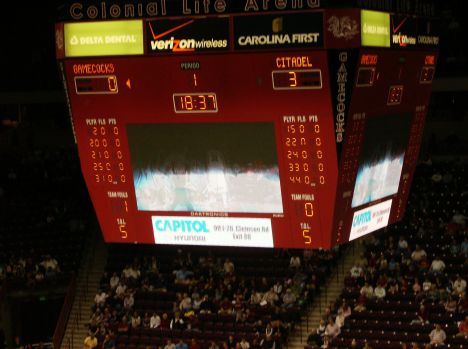
Still, it wasn’t a terrible effort by the Bulldogs, as opposed to the laughable “atmosphere” at Colonial Life Arena.  I wass amused to read that the reported attendance was 9493 (it was less than that by at least a third).  There wasn’t anything original about the Gamecocks’ pregame, from the intros (which featured a player introduced as a starter who actually didn’t start) to the band playing “Sweet Caroline” (this ongoing sports tribute to Neil Diamond must stop).  USC also cranks up Zombie Nation like every other school in North America.  It’s just so…tired.

There was nothing imaginative or innovative about any of it, the crowd was dead…that reminds me.  I honestly am not sure how many of the people at the game were rooting for either of the two schools, because I can’t believe that as much as 40% (or more) of the “crowd” was there for The Citadel, but that’s what it looked like with all the people who showed up wearing blue collared shirts.  Surely some of them were just Gamecock fans, but if you’re a Gamecock fan, shouldn’t you be wearing garnet and/or black?  It was really hard to get a read on the fan ratio because of this (along with all the empty seats).

I took a picture of the scoreboard when The Citadel first took the lead, just for posterity.  I took it quickly, just in case South Carolina scored before I could snap it (as it turned out, I need not have worried).  Here it is:

0032

The Citadel plays South Carolina in hoops for the 100th time

First, I want to comment on The Citadel’s game against Michigan State.  I don’t believe in moral victories, but I do believe in moral non-embarrassments, and the Bulldogs did well in that category.  I am used to watching The Citadel get annihilated when facing a quality opponent , especially on those rare occasions when the game is on TV.  Watching the Bulldogs play a reasonably competitive game against a ranked team was somewhat disorienting.

Speaking of TV, the game against MSU was one of just three contests The Citadel will play this season that will be televised.  (The second of the three will come Saturday against the Gamecocks.)  That needs to change.  With all the games that are televised these days, I think it is critical that The Citadel gets its fair share of exposure.  Three games per season is not going to cut it.  Recruits, even those who are considering a military school, want to play TV games.  I think it would also foster more alumni interest in the program.  Plus, Vegas would get more action on our games.  Okay, maybe that last one isn’t as big a deal.

I would suggest to Ed Conroy (not that he needs my suggestions) that he do everything he can to get OOC games that will be on TV.  John Chaney did something like this years ago at Temple.  The Citadel is hindered a bit in its ability to schedule out of conference, though, by the Southern Conference’s 20-game league schedule, which is ludicrous for a league like the SoCon (16 would be a better number of conference games).

Conroy’s already off to a decent start by playing Big 10 teams.  What I like about playing the Big 10 schools is that if you play one, you will either play a game on national television (on the Big Ten Network) or play a Big 10 school at home (like Iowa earlier this season).  I think 2-for-1s (and even 3-for-1s in some situations) are well worth it if the games on the road are televised.

From what I gather, the SEC’s new mega-deal with ESPN is going to result in a huge increase in TV games for that league (including a lot of ESPNU matchups).  Hey, if playing Mississippi State or Georgia results in another TV game, I say start up the bus and tell the driver to head to Starkville or Athens.

Incidentally, have you ever noticed that a lot of SEC basketball arenas look kind of dark on TV?  It’s a strange phenomenon.  I guess the good lighting is reserved for the football practice fields.  Speaking of dimly lit buildings, that brings us to Saturday’s game against the Gamecocks…

Tomorrow the Gamecocks and Bulldogs will meet in basketball for the 100th time.  A scintillating series, it is not.  South Carolina has won 76 of the previous 99, but the greatest of the 99 meetings was without question the 1989 clash won by The Citadel.  It’s without question the greatest because this is my blog, and I say it is.  Besides, I was there, one of the 7,857 in attendance that February night.

Both teams entered the game with 15 victories on the season.  The Gamecocks were driving to a rare NCAA berth (which they got despite losing to the Bulldogs; South Carolina would lose in the first round of the NCAAs to North Carolina State).  South Carolina led throughout most of the first half and pushed the margin to 11 on a 25-foot three-pointer by Troy McKoy at the buzzer.

The Gamecocks seemed to have all the momentum, but that changed quickly in the second half as The Citadel gradually got back in the game.  The Bulldogs trailed 71-65 with 9:30 to go when they went on a 13-2 run to grab a five-point lead.  The Citadel led 82-78 with just over a minute to play when Patrick Elmore grabbed a rebound.  Two passes later, the ball was in the hands of Ryan Nesbit on the near baseline.  Nesbit (coach Randy Nesbit’s younger brother) was 3-for-4 from three-land already in the game, but the situation didn’t call for a three.  It called for holding on to the basketball.  Ryan Nesbit didn’t care; he was hot.  Up went the shot.  It was a classic “No No No Yes Yes Yes” moment, as he swished the three to give The Citadel a seven-point lead with 1:01 remaining.

The Citadel managed to overcome some nervous free throw shooting (missing the front end of two 1-and-1s) and outlasted the Gamecocks, 88-87 (South Carolina hit a three with one second left, but the Bulldogs successfully inbounded the basketball and the game ended).  South Carolina lost the game despite shooting 54% from the field, including a sizzling 9-11 from behind the arc, and a solid 74% from the foul line.  Terry Dozier scored 25 points on 10-13 shooting and Brent Price added 22.

However, the Gamecocks were outrebounded 34-31 and committed two more turnovers than the Bulldogs.  The Citadel shot almost as well from the field as USC did and made eight three-pointers of its own, and also had the edge in free throws, as South Carolina had to resort to fouling down the stretch.  Six different Bulldogs finished in double figures in scoring.  A seventh, James Stevens, added eight points, the last of which was a free throw that provided The Citadel with its 88th, clinching point.

That game would wind up being the last victory of Ed Conroy’s playing career.  If he is to beat South Carolina for his next victory as a head coach, his team will need to play even better than it did against Michigan State.  South Carolina is 7-1, although the one loss was to the College of Charleston.  As the game notes for South Carolina say (in a tone that could be construed as dismissive):

South Carolina holds a significant edge over The Citadel in nearly every statistical category. The Gamecock offense
averages nearly 20 more points per game than the Bulldogs, while also holding a dominating edge in rebounds
(+10.6), opponent turnover average (+9.1) and steals (+7.5).

Of course, the points-per-game number is a touch misleading, since The Citadel averages 12 fewer possessions per game, and one goal for the Bulldogs in this game will be to try to keep things at a slower pace.  The opponent turnover average is no joke, though.  South Carolina is second nationally in turnovers forced and in the top ten in turnover rate.  The Gamecocks’ FG% defense is an outstanding 37.7% and USC also does a good job on the boards.  On offense, South Carolina is a very good three-point shooting team (40%), although oddly it does not have a lot of assists on its made baskets.  South Carolina has had some issues with injuries and academics and may only be able to suit up nine players on Saturday.

To pull the upset, The Citadel must avoid the turnovers that have plagued previous Gamecock opponents.  Keeping the game at its preferred pace will be key to doing that.  The Bulldogs must defend well along the perimeter (Michigan State may not have been a great test in this respect).  If it can keep the game close, The Citadel has a chance, as South Carolina is not a particularly good foul shooting team.  It’s the one statistic in which the Bulldogs have a decided advantage.

I was there 20 years ago next February when the Bulldogs pulled off a stunner.  I would very much enjoy a repeat of that result.  I can’t think of a better Christmas present.  Just in case, though, I did some shopping today.

10 reasons why The Citadel will beat Michigan State

1.  The Citadel threw the UC Davis game just to make the Spartans overconfident.

I mean, let’s get serious here.  Do you really think the Bulldogs were trying to play defense in the first half?  UC Davis shot 78% from the field.  Most teams couldn’t do that if the other team didn’t show up.  UC Davis had an eFG of 69% for the game.  Clearly, The Citadel was just setting a trap for Michigan State.  Having the Spartans win their last game by 58 points (over Alcorn State) was just an added bonus.

2.  Drew Neitzel isn’t playing in this game.

Neitzel did play in the only meeting between the two schools, which came two years ago during the 10th of Neitzel’s 11 seasons in East Lansing.  Michigan State edged The Citadel 73-41 in a game marred by biased officiating, courtesy of Big 10-friendly refs.  There is no other logical way to explain how the Spartans won that game.

3.  The Citadel gives up fewer points per game than Michigan State and commits fewer turnovers per game as well.

These are true facts.  You can look them up.  The Citadel averages 61.1 possessions per game, the 15th-slowest pace in the country, but I don’t think that is particularly relevant.  Neither is the fact that Michigan State ranks in the top 40 nationally in possessions per game (at 74.9).

4.  The Citadel’s school colors are similar to those of North Carolina.

Speaking of the Tar Heels, you can’t tell me that the Spartans won’t be traumatized when a team wearing light blue and white saunters onto the court at the Breslin Center (even if the contest against the Heels was at Ford Field).  Did you watch that game?  Mercy.  You can bet that the players at Rhode Island and Columbia are upset they can’t get a shot at MSU.

You know, if you squint Demetrius Nelson looks a little like Ed Davis…

5.  Idong Ibok could start at center for the Spartans.

Ibok is a native of Lagos, Nigeria.  He’s 6’11”, 260.  According to MSU’s game notes, Ibok (a redshirt senior who has already graduated; he made the Academic All-Big 10 team last season) has started 17 games in his career.  So far this season, he has played in six games (one start) and scored two points.

That kind of starting history/stat line bears an eerie similarity to that of Augustine “Gus” Olalere, who played for The Citadel in the early 1990s and who was also from Lagos, Nigeria.  So, it looks like The Citadel was about 17 years ahead of Michigan State on the recruiting trail.  Advantage:  Bulldogs.

(Don’t forget about Love Ishie, too.)

6.  The Citadel has never lost a game that was televised by the Big Ten Network.  The Citadel has also never lost a game broadcast nationally in high-definition.  I’m quite sure Dave Revsine will mention these two facts repeatedly during the game.

Incidentally, Steve Smith (former Spartan) is going to be the analyst for this game, which reminds me that we have a serious Steve Smith problem in our country.  Not only is there the ex-Spartan hoopster Steve Smith, soon to be impressed with the greatness that is basketball at The Citadel, but on Sunday night the NFL game will feature not one but two teams with wide receivers named Steve Smith.

Then you have the Steve Smith who used to play for the Raiders and Penn State, and the Steve Smith who coached third base for the Phillies this past season (since canned), and the Steve Smith who played basketball for La Salle and for about an hour in the NBA, and a host of other sports-related Steve and Steven Smiths (not to mention ESPN screamer Stephen A. Smith and ASU fixer Stevin Smith).  Basically, we have too many Steve Smiths.  I call for a moratorium on naming your kid Steven or Stephen if your last name is Smith, especially if you are athletic and there is a risk he could inherit your genes.

7.  The Citadel is a better free-throw shooting team.

The Bulldogs are shooting a solid 72% from the line thus far, while the Spartans are a mediocre 65% from the charity stripe.  In a close game, advantage Bulldogs!

8.  Michigan State has a lot of guys afraid to shoot the ball.

You can tell this is the case just by looking at the assist statistics.  MSU ranks 7th nationally with 19 assists per game, a sign that players would rather have their teammates shoot than take the initiative themselves.  Against Alcorn State, the Spartans had a school-record 35 assists, evidence of a timid squad.

Conversely, The Citadel averages less than 10 assists per game, which is in the bottom 40 nationally.  Obviously the Bulldogs have a lot of aggressive players who aren’t afraid to take big shots.  As Bill Raftery would say, Onions!

9.  The Spartans don’t seem to have a lot of personality.

According to MSU’s game notes, senior guard Travis Walton “loves candy”.  The other factoid listed about Walton is that he’s the team’s strongest player, but c’mon.  He’s a senior, and the best tidbit they can come up with is that he “loves candy”?  Weak.  You can’t win unless your players have more personality, like Bulldog freshman guard Cosmo Morabbi.

10.  This has been a tough year for the State of Michigan.

Let’s face it.  If there is going to be a year in which The Citadel beats Michigan State in hoops, this is the one.  Talk about bad karma…

Longtime rivals UC Davis and The Citadel to play Monday night

Before writing a little bit about Monday night’s game, I just wanted to briefly comment on the results of The Citadel’s first two SoCon games.  First, it’s great to actually win a conference road game (or any road game, for that matter).  I also think it’s good that the team is probably a little disappointed it didn’t pull off the road sweep.  Expectations may be gradually increasing for this team.  This happens when in one year you go from a 30-point loss at UNC-Greensboro to a 7-point win in the same building.  Holding UNCG to 5-29 from beyond the arc was also a welcome development (struggling down the stretch from the foul line, not so much).

I will say this.  The SoCon owes The Citadel a couple of makeup calls against Elon in both football and basketball (actually, in football three or four makeup calls are in order).  I can’t say I was upset to see Elon choke away a potential FCS berth by losing to Liberty.  Elon should never have been in a position to get a bid in the first place, because it was given a win over The Citadel by hilariously inept Southern Conference officiating.  Just desserts and all that.

The hoopsters’ matchup at Elon featured a really convenient (for the Phoenix) shotclock reset situation at the end of the game.  Nice.  No telling what the umpiring will be like at Riley Park for the first SoCon series of the year.

Okay, on to the battle with the Aggies…

I’ve been trying to figure out how this matchup (the first ever between the two schools) came to be ever since the hoops schedule came out.  My best guess is that UCD was going to have to play Presbyterian in Clinton, S.C., anyway (in a return game from last season) and figured if it had to travel all the way to South Carolina, why not make it a two-game trip.  I don’t know if this means a journey to Davis is in the cards for The Citadel in the next couple of years.  If it is, I hope the team doesn’t spend too much time at the Robert Mondavi Institute for Wine and Food Science.

The institute is just part of a sprawling campus scene at UC Davis, which is one of those schools nobody on the east coast has ever heard of that just happens to have 30,000 students.  It’s part of the UC system, along with fellow Big West schools Irvine, Riverside, and Santa Barbara.  It’s located in Davis (surprise!), which is a city of about 60,000 near Sacramento.  Davis is a haven for bicyclists, and for toads.  Seriously.  From a Wikipedia entry (and remember, wiki is never wrong):

Davis’ Toad Tunnel is a wildlife crossing that was constructed in 1995…Because of the building of an overpass, animal lovers worried about toads being killed by cars commuting from South Davis to North Davis, since the toads hopped from one side of a dirt lot (which the overpass replaced) to the reservoir at the other end. After much controversy, a decision was made to build a toad tunnel, which runs beneath the Pole Line Road overpass which crosses Interstate 80. The project cost $14,000. The tunnel is 21 inches (53 cm) wide and 18 inches (46 cm) high.

The tunnel has created problems of its own. The toads originally refused to use the tunnel and so the tunnel was lit to encourage its use. The toads then died from the heat of the lamps inside the tunnel. Once through the tunnel, the toads also had to contend with birds who grew wise to the toad-producing hole in the ground. The exit to the toad tunnel has been decorated by the Post-Master to resemble a toad town.

The Wikipedia entry also refers to Davis as being “known as a strongly leftist-liberal town,” which after reading about the toad tunnel shouldn’t come as too much of a surprise.

UCD started off as a farm for UC Berkeley (basically, an extension service) and gradually morphed into a free-standing university, being officially established in 1959.  It’s still an agricultural school (hence the nickname “Aggies”) but has added several other academic disciplines.  In reading about UCD I noticed that it has an Army ROTC program, which is apparently the largest of its kind in the State of California.

UC Davis is in its sixth year as a Division I school after a successful run in NCAA Division II.  Last season the Aggies finished last in the Big West with a 1-14 record (9-22 overall).  UCD lost 13 of its last 14 games and completed the campaign sporting an RPI of 283.  Over the last three seasons the Aggies are 2-33 in road/neutral contests.  The Citadel can relate to those types of numbers.

This season, UCD is 3-6, with wins over Loyola-Marymount, Tulane, and Cal State-Bakersfield, and losses to UW-Milwaukee, Iowa State, South Alabama, Portland, Arkansas, and Sacramento State.  The Aggies are a really good free throw shooting team (81.8%, which is currently third nationally) and have a very nice assist/basket ratio (70%, also third nationally).  They have not been a strong defensive team, allowing opponents to shoot 47.5% from the field.

The Aggies average a little over 70 possessions per game.  It will be interesting to see which team controls the tempo, as The Citadel has averaged just over 60 possessions per game.  Few teams have collectively played their games at a slower pace than the Bulldogs.

UCD has three players averaging in double figures in scoring.  Joe Harden is a 6’8″ guard (!) averaging 15 points and 8 rebounds per game.  Dominic Calegari is a 6’10” forward who can shoot the three.  He’s 16-31 from beyond the arc so far this season (and a career 40% 3-point shooter).  Vince Oliver, a 6’3″ guard, is averaging 10.8 points per game.  Mark Payne is another tall guard (he’s 6’7″) who leads the team in assists, with 5.3 per game (he also boards at a 5.6 clip).  The Aggies employ a nine-man rotation.

I’m not sure what to make of UCD, a tall team that doesn’t rebound particularly well and has no shotblockers.  Defending the three could be a challenge for The Citadel, and the Bulldogs definitely don’t want to send the Aggies to the foul line.  If the Bulldogs can keep UCD from having a good night from beyond the arc, The Citadel can win this game.  The other factor to consider is the layoff.  Neither team has played a game in the past nine days.

SoCon hoops is upon us; hide the women and children

I long for a simpler time, when life’s problems were all solved in half-hour increments (allowing for an occasional one-hour special) and conference play in basketball didn’t start until January.  Those days are gone, however, and so it’s time for some SoCon hoops.  Last night Appalachian State kicked off the conference season by beating Furman.  There are two games tonight, College of Charleston-Elon and the game everyone in the nation is awaiting, The Citadel-UNC Greensboro.

This will be the seventeenth time these two non-rivals have faced off.  Sixteen of those appearances have come since UNCG attained Division I status in 1992.  The Citadel won the first four games of the series, but the Spartans have won 11 of the last 12, all of which have come since UNCG entered the Southern Conference (the Spartans began Division I existence in the Big South).  UNCG has had some good teams during that stretch, and The Citadel…has not.  The Citadel has only won at Fleming Gym in Greensboro one time, on its first visit in 1992, losing six straight at UNCG since then.  Overall the Spartans have beaten the Bulldogs eight straight times.

This season UNC-Greensboro must replace Kyle Hines, a 6’8″ bruiser who used The Citadel to enhance his All-Conference credentials, and it’s off to a tough start in doing so.  The Spartans are 1-3, with the one victory over non-Division I opponent Webber International.  UNCG has also lost non-competitive games at UNC Charlotte and North Carolina State, while also losing on the road to Central Arkansas (which beat The Citadel in Cancun last weekend, of course).

UNCG has some ugly offensive numbers so far this season.  It is shooting 39.7% from the field (44.8% eFG) and only 58.2% from the foul line.  Its turnover rate per possession is among the nation’s worst.  Its assist/turnover ratio is abysmal. 

Defensively, it is allowing opponents to shoot 2-pt. shots at a 56.9% clip, which is alarming.  Demetrius Nelson, take heed.  UNCG does appear to rebound the ball fairly well.  Again, with only three games played, warnings about small sample sizes need apply.

Individually, the Spartans are led by Mikko Koivisto, a 6’4″ guard from Finland averaging 15.8 points per game with solid stats across the board.  They employ a nine-man rotation (UNCG has only 10 scholarship players this season).  Ben Stywall, a 6’5″ forward, is the leading rebounder, pulling down 8 boards per game, but he’s not making shots, either from the field or the foul line (10-23 from the stripe). 

I don’t have a sense for how this game may turn out.  Considering how dominant UNCG has been in this series over the past decade, it would be hard to bet against them winning again tonight, but perhaps The Citadel can take advantage of some early-season struggles by the Spartans.  I like The Citadel’s recent trend of low-possession games, and I think that should continue (the Spartans’ games have mostly been played at an average tempo).  Offensively, the Bulldogs need to keep holding onto the ball, waiting for good shot opportunities, get some inside scoring, and take (and make) free throws.  Defensively, The Citadel needs to do a good job guarding the perimeter (especially against Koivisto) and hold its own on the boards.