College Football TV Listings 2010, Week 7

This is a list of every game played during week 7 of the college football season involving at least one FBS or FCS school.  All games are listed, televised or not.  For the televised games, I include the announcers and sideline reporters (where applicable).  I put all of it on a Google Documents spreadsheet that can be accessed at the following link:

College Football TV Listings 2010, Week 7

Additional notes:

— I include the ESPN3com games, even though technically they aren’t “televised”.

— I’ve listed the satellite affiliates for the SEC game of the week (Vanderbilt-Georgia) in a comment on the document.  There are numerous local affiliates, a listing of which can be found here:  Link

— The local affiliates for the Raycom production (now branded as the “ACC Network”) of the ACC game of the week (Maryland-Clemson) can be found here:  Link

— I’ve listed the satellite affiliates for the Big East game of the week (Pittsburgh-Syracuse) in a comment on the document.  The local affiliates can be found here:  Link

— There are two WAC Network games this Saturday (Boise State-San Jose State and Nevada-Hawaii).  Local affiliates carrying those games can be found here:  Link

— The local affiliates for the MAC game of the week (Miami University-Central Michigan) can be found here:  Link

— The local affiliates for the Southland Conference game of the week (Central Arkansas-Stephen F. Austin) can be found here:  Link

— The local affiliates for the OVC game of the week (Southeast Missouri State-Austin Peay) can be found here:  Link

— Also listed on the document as a comment are the regional nets carrying the following games:  Kansas State-Kansas (Friday night), Missouri-Texas A&M, California-Southern California, and Iowa State-Oklahoma.

— There are comments in the document with additional information for several other games.

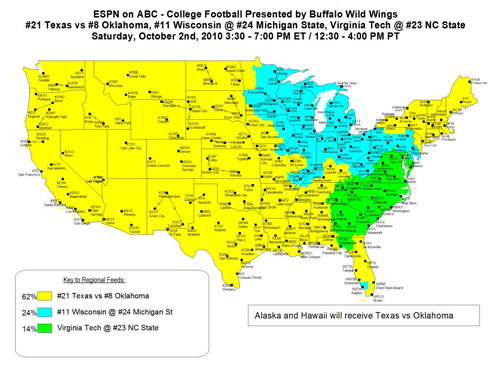
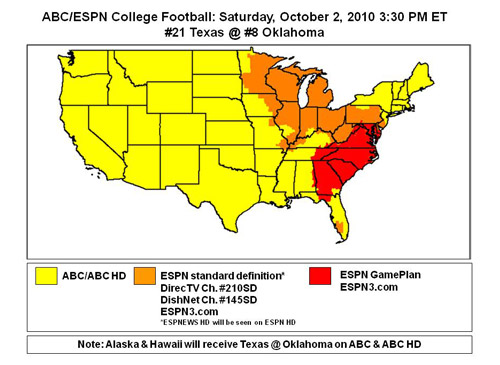
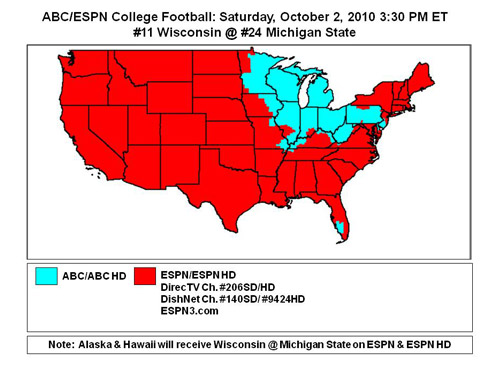
— ABC/ESPN coverage maps for the 3:30 pm ET games.  Texas-Nebraska is the national game, so viewers in areas receiving that game on ABC will get Iowa-Michigan on ESPN in HD:  Link

— Big Ten Network “gamefinder” for this Saturday (for the third week in a row, not relevant because there is only one game on the network):  Link

— USA Today Poll:  Link

— FCS Coaches Poll:  Link

A lot of the information I used in putting this together came courtesy of Matt Sarzyniak’s great website (College Sports on TV) and the fine folks over at the 506.com.  I am also assisted on occasion by helpful athletic media relations officials at various schools and conferences; this week, I would like to particularly thank staffers at Penn and Gardner-Webb.

College Football TV Listings 2010, Week 6

This is a list of every game played during week 6 of the college football season involving at least one FBS or FCS school.  All games are listed, televised or not.  For the televised games, I include the announcers and sideline reporters (where applicable).  I put all of it on a Google Documents spreadsheet that can be accessed at the following link:

College Football TV Listings 2010, Week 6

Additional notes:

— I include the ESPN3com games, even though technically they aren’t “televised”.

— I’ve listed the satellite affiliates for the SEC game of the week (Tennessee-Georgia) in a comment on the document.  There are numerous local affiliates, a listing of which can be found here:  Link

— The local affiliates for the Raycom production (now branded as the “ACC Network”) of the ACC game of the week (Boston College-North Carolina State) can be found here:  Link

— I’ve listed the satellite affiliates for the Big East game of the week (Syracuse-South Florida) in a comment on the document.  The local affiliates can be found here:  [Link when available]

— Local affiliates for the WAC game of the week (Toledo-Boise State) can be found here:  Link

— There are two MAC games with regional coverage via local affiliates (Temple-Northern Illinois and Western Michigan-Ball State, with a noon ET kickoff for both contests).  Those affiliate listings can be found here:  Link

The MAC affiliates in Wisconsin, Illinois, Pennsylvania, Florida (Bright House), and New York will carry Temple-Northern Illinois, as will the affiliates in Cleveland, Ohio, and Charleston, West Virginia.  Cox-NE (based in Providence) will also carry that game.  The non-Cleveland affiliates in Ohio will carry Western Michigan-Ball State, as will affiliates in Indiana, Michigan, and Wheeling, West Virginia.

— The local affiliates for the Southland Conference game of the week (Texas State-Southeastern Louisiana) can be found here:  Link

— The local affiliates for the OVC game of the week (Eastern Illinois-Eastern Kentucky) can be found here:  Link

— Also listed on the document as a comment are the regional nets carrying the following games:  Texas Tech-Baylor, UCLA-California, and Colorado-Missouri.

— There are comments in the document with additional information for several other games.

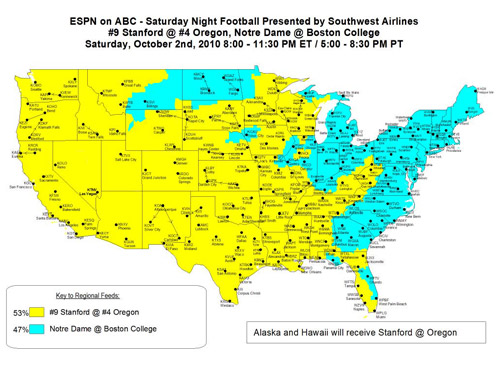
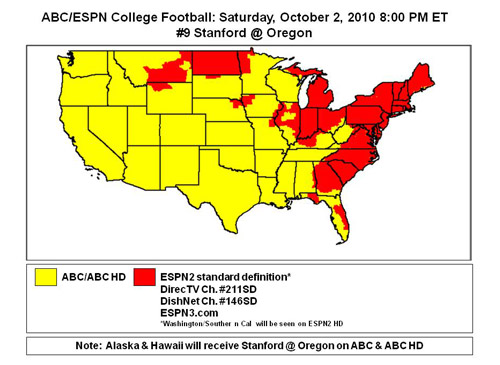
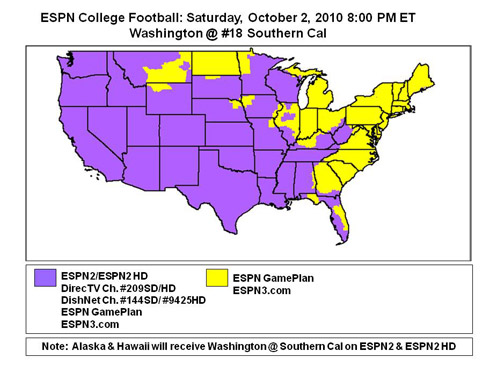
— ABC/ESPN coverage maps for the 3:30 pm ET games and the 8:00 pm ET games:  Link

— Big Ten Network “gamefinder” for this Saturday (since the two games on BTN this week aren’t on at the same time, it’s admittedly not particularly relevant):  Link

— USA Today Poll:  Link

— FCS Coaches Poll:  Link

A lot of the information I used in putting this together came courtesy of Matt Sarzyniak’s great website (College Sports on TV) and the fine folks over at the 506.com.  I am also assisted on occasion by helpful athletic media relations officials at various schools and conferences; this week, I would like to particularly thank staffers at New Hampshire and Indiana State.

Complaint to ESPN, c/o The Sports Arsenal

From time to time I get e-mail responses to things I’ve written on the blog.  They tend to run the gamut, from words of encouragement to criticism to spam (plenty of spam).  However, I got an e-mail on Saturday that I think is worth sharing.  I won’t include the name of the lady who wrote it, because I don’t think that would be fair.  

First, some background.  On Saturday afternoon Michigan played Indiana in a game televised on ESPNU.  The announcers for the game were Pam Ward (play-by-play) and Danny Kanell (analyst).  I didn’t see it, as I was at Johnson Hagood Stadium watching The Citadel’s game, but apparently the matchup in Bloomington was an exciting contest that featured very little defense.  The Wolverines prevailed, 42-35.  Shortly after the game ended, the following e-mail was sent to me:

If Pam Ward was the announcer for the U of M game today (Saturday, 10/2/2010) at 3:30 p.m., you should be ashamed of yourselves.  Aside from the mispronounciation of Denard “Dernard???!!!” Robinson’s name, could you please find an announcer who’s excited about the game?  She’s boring and uninformed, maybe why she falls back on the criticism she’s ridiculed everywhere for?  There are so many awesome sports broadcasters in the industry – please get creative!  We hate every game she announces and we’re sick of being forced to listen.  Not as agonizing as watching the Lions play every Thanksgiving… BUT CLOSE.  Thanks!

This is, obviously, a fantastic e-mail.  That last line about Pam Ward as an announcer not being as agonizing as watching the Lions play on Thanksgiving puts it over the top.

Some points:

— While she criticizes Ward, the e-mailer doesn’t seem entirely certain it was actually Ward doing the announcing (“If Pam Ward was the announcer…”).  However, that doesn’t stop her from blasting Ward anyway.

— More importantly, to me anyway, is the notion that I might somehow be affiliated with ESPN (“you should be ashamed of yourselves”, “could you please find an announcer who’s excited about the game?”).  I am guessing that the e-mailer googled Pam Ward’s name and found this post I wrote about ESPN’s announcers for 2010, and assumed I was a publicist for the network or something.

I found this amusing, because while I do write about things that involve ESPN on occasion, so would anyone who writes about sports in this country, given the pervasive nature of the network.  I haven’t always written favorably about ESPN, either (see this post or this post, just for a couple of examples).

— The e-mailer is apparently a Michigan fan.  She is sick of “being forced to listen” to Ward, but to be honest I don’t think Ward has done a whole lot of games featuring the Wolverines.  When she was calling the noon game on ESPN2 the past few years, she usually called Big 10 games  — but the two schools I always associate with a Ward call are Michigan State and Northwestern.  Michigan usually was televised on ESPN (or the Big Ten Network) if it drew the noon slot.  At least, that’s how I remember it.  I could be wrong about that.

Incidentally, Ward now wants to call NFL games.

— I couldn’t agree more with the e-mailer about the Lions, though.  Why should the entire country be subjected to that franchise every Thanksgiving?  Can’t they rotate host teams?  I’m tired of the Cowboys too, but at least Dallas usually has a good team.  The Lions are almost always bad and boring.  This year, turkey day at Ford Field will include the visiting New England Patriots, so at least one of the teams involved should be good.  Of course, that means the score will probably be something like 47-10 or 34-12 (the score of the last two games played on Thanksgiving in Detroit, both losses by the Lions). 

That game will be on CBS.  I suppose Phil Simms will give away a silver iron again.  It’s a lame gimmick, but not as lame as the thing Fox hands out to its game MVP.

To sum up, I’m sorry I can’t do anything about Pam Ward (or any other ESPN announcer) calling your team’s game(s), but I’m not affiliated with the four-letter.  If I’m going to field complaints about ESPN, though, the least the folks in Bristol could do is send me some free stuff. 

I’m not asking for an ESPY gift pack or anything; I would settle for a College Gameday t-shirt (size XXL – I’m fairly tall).  I would ask for a hat, but I doubt ESPN carries a lot of promotional caps in size 7 ¾.  If they did, Mark Schlereth would probably grab all of them anyway.  He looks like he’s got a large noggin.

As always, thanks to the e-mailers (and commenters) for all their feedback.

Review: Western Carolina

Western Carolina 24, The Citadel 13.

It was a dismal performance in just about every respect.  There are basically no positives that can be taken from this game.  None.

Blame will be placed on the anemic offense, and it’s certainly true there was no visible progress on that front in this game (and arguably some regression).  However, the defense was even more disappointing. particularly the secondary, which as a unit was terrible all day long.

The play that best summed up the game occurred on Western Carolina’s second possession of the contest.  The Catamounts faced a third-and-six on their own 24. Quarterback Brandon Pechloff, under some pressure, floated a pass that traveled almost 30 yards in the air, and I mean floated.  While the ball was in the air, it would have been possible to sing the national anthem in its entirety, including holding the “free” note as long as a diva could desire.

Despite the lack of sizzle on the pass, no Bulldog defender was able to make a play on the ball.  As a result Catamount wideout Josh Cockrell was able to make a 20-yard reception, cradling the ball as he fell backwards, with three Bulldogs within six yards of him (and a fourth rushing into the mix).

This happened a lot.  On the next WCU drive, the Bulldogs committed pass interference on consecutive plays, setting up a first-and-goal situation.  The Catamounts scored two plays later.  On both PIs the defender did not know the ball was headed in his direction, resulting in penalties when he made contact with the receiver (the second one was a close call, although I thought it was a correct one; a number of other people did not agree with me, however).

The Catamounts’ second TD came after a fumbled punt.  Pechloff’s pass to Jacoby Mitchell was underthrown and should have been intercepted or at least batted away, but the defender, while in good position, mistimed his jump.  Mitchell caught the ball and strolled into the end zone.

The fourth-quarter play that basically iced the game was another instance of a defensive back lacking ball awareness.  Pechloff floated a 30-yard pass that was badly underthrown (again), but the DB never saw it and the WCU receiver (Mitchell again) came back to the ball to make the catch at the Bulldog 5.  Western Carolina scored on the next play for an essentially insurmountable two-score lead.

Pechloff competed very well in this game, showing a lot of composure for a true freshman making his first career start.  However, he is slow afoot and his injury-riddled offensive line is not very good.  The Bulldogs’ defensive line probably should have sacked him more than once, although he did a good job getting rid of the ball.  In doing so, though, he threw several passes that would have been intercepted by a better defensive secondary.

As for the offense, the first half was abysmal.  There were five possessions, and they went like this:  3 yards and a punt; 8 yards and failed on 4th-and-1 (from the Bulldog 45 — I liked the decision to go for it, but not the play call); 33 yards, two first downs, and an 8-yard punt; 3 yards and a FG (this was after a WCU turnover); 42 yards, two first downs, and failed on 4th-and-10 (from the WCU 38).  If anything, it was worse than how it reads.

The offense struggled running the ball outside, a season-long problem, thanks mostly to the lack of good perimeter blocking.  No slotback had a rush longer than nine yards.  (The one good outside rush in the game, by Van Dyke Jones in the second quarter, was called back by an obvious, and pointless, holding penalty by a receiver.)

There was hope in the third quarter when a nice drive by the Bulldogs was finished by Terrell Dallas’ 45-yard touchdown, a play much like his 80-yard gallop in the PC game.  The Citadel then kicked a FG and was in a position to score again early in the fourth quarter when it faced a 4th-and-11 at the WCU 30.

Kevin Higgins elected to have Ryan Sellers attempt a 47-yard field goal.  Sellers had a good game on Saturday, stepping in for regular placekicker Sam Keeler (who was ill), but I thought attempting the FG in that situation was a mistake.  It’s a tough decision, but a field goal there still doesn’t give you the lead, and the odds of making a 47-yarder with your backup kicker probably aren’t that good.  On the other hand, it was 4th-and-11.

At any rate, Sellers narrowly missed the try, and then the defense just folded.  A missed tackle resulted in a 33-yard run, just about the only decent rush WCU had in the entire game.  That was immediately followed by Mitchell’s reception inside the 10. The Catamounts scored on the next play.  Four plays, touchdown, fans getting up and leaving.

It was a very frustrating game to watch.  Kevin Higgins was apparently frustrated as well.  I want to highlight one of Higgins’ quotes in Jeff Hartsell’s game story, though:

“In the first half, we just didn’t block like we needed to up front. They came out in a 4-3 defense, and we had been working on a (five-man front) all week, and we just didn’t make the adjustments up front and couldn’t get any first downs.”

It’s one thing to struggle on the first series of the game while trying to figure out what defense is being employed, but for an entire half?  That’s not good enough.  This has been a bit of a theme this year, with the Bulldogs allegedly being more of a “second quarter” team while spending the first quarter deciphering defenses.  The problem, of course, is that there are only a limited number of possessions in a game, especially for a triple option attack, and The Citadel can’t use one (or two) quarters as some sort of recon mission — it has to score (or at least possess the ball) early in the game, too.

I’ll have more on-the-field thoughts when I preview the UT-Chattanooga game, but for now I want to briefly discuss some off-field issues, notably attendance (or the lack thereof).

Larry Leckonby has a problem.  The attendance on Saturday (10,207) would have been embarrassing just a few short years ago, but now is almost old hat.  Leckonby finds himself in the position of presiding over the worst run of attendance at Johnson Hagood Stadium in at least four decades.

I’ve written about attendance before, and I understand there are multiple issues at play, but I am really surprised at the continued decline.  The easy answer is that The Citadel hasn’t had a good football program for a decade-plus, but there is more to it than that (although that’s a significant factor).

If The Citadel can’t stop the attendance downturn, that will undoubtedly have an impact on future scheduling.  In the upcoming years where The Citadel can schedule 12 games, perhaps the Bulldogs will wind up playing two FBS schools and not play an extra home game.  It may be that five home games will become the norm, regardless of whether the team plays 11 or 12 regular-season games.

On Saturday I had the opportunity to survey the club section for the first time during a game.  I have to say that, in general, the club setup is not meant for someone like me. During the game I am prone to glaring intently at the field, occasionally muttering to myself, and getting up and walking around if there is space available to do so.  The club section is a bit more relaxed, and that’s okay.

It’s a very nice setup.  It’s the kind of thing The Citadel is usually very good at managing, and so I wasn’t surprised at how neat it was.  It had TVs (watching Clemson commit six turnovers against Miami was sort of entertaining in itself), a bar (of course — this is The Citadel!), a buffet, seating…the works.  If you ever have a chance to go up there for a game, I would encourage you to do so.

I learned one thing on Saturday while in the club section:  sweet tea is a godsend during a college football game.  How did I not know this?

I do wonder if space in the club section might become more of an issue if game attendance (and presumably club seating attendance) was better.  Unfortunately, that’s a potential problem Larry Leckonby and Jerry Baker have yet to encounter.

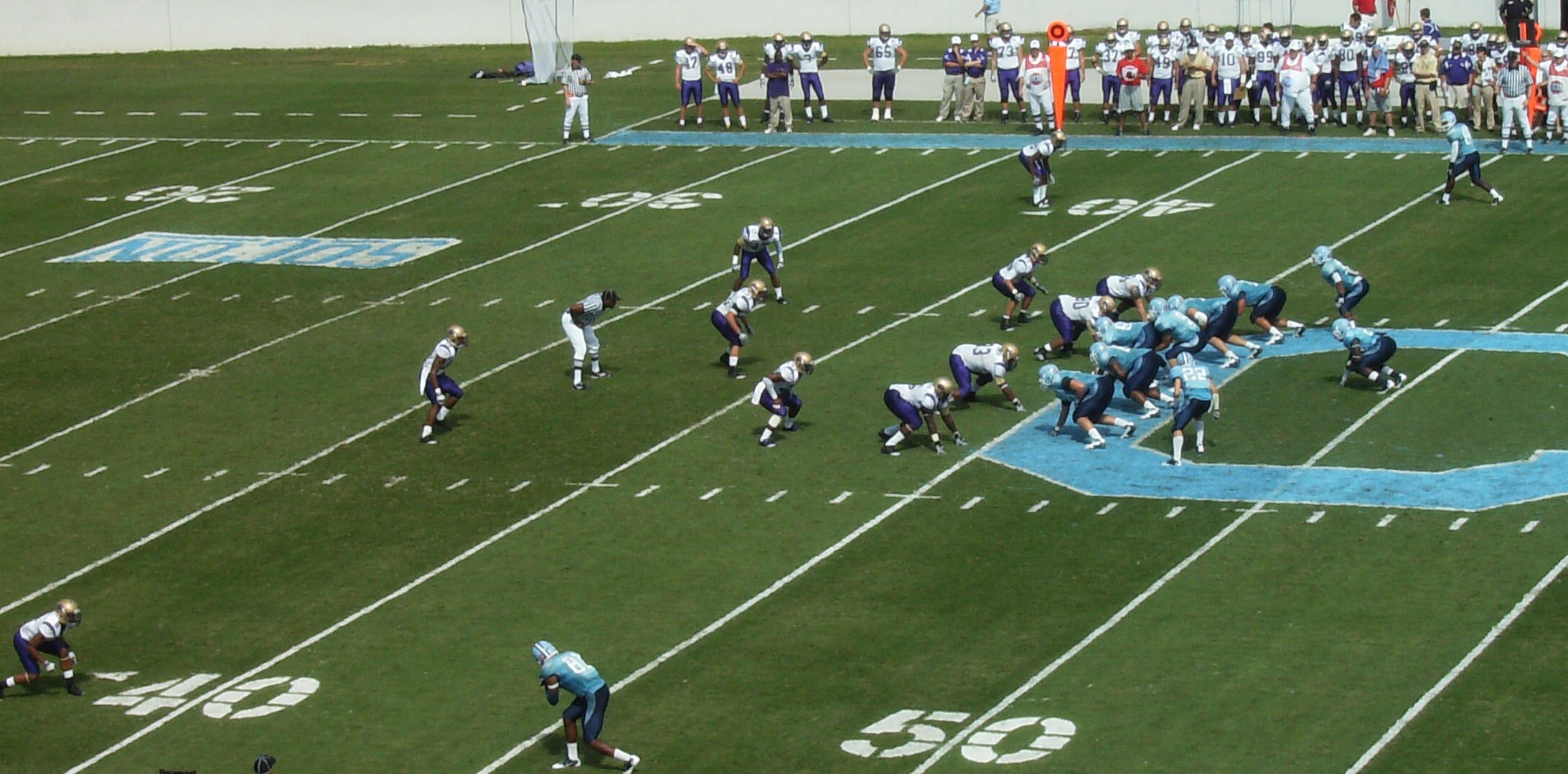
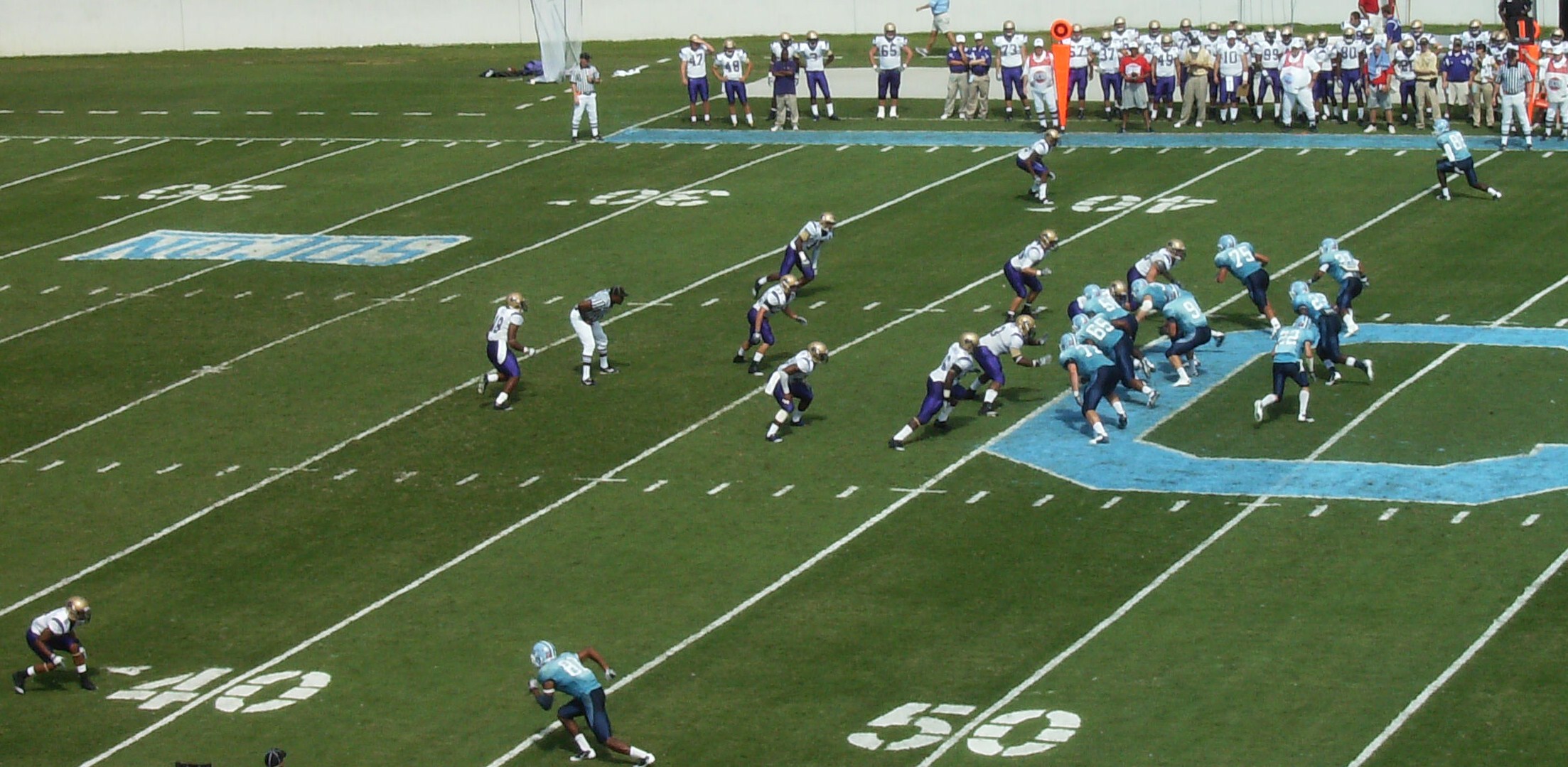
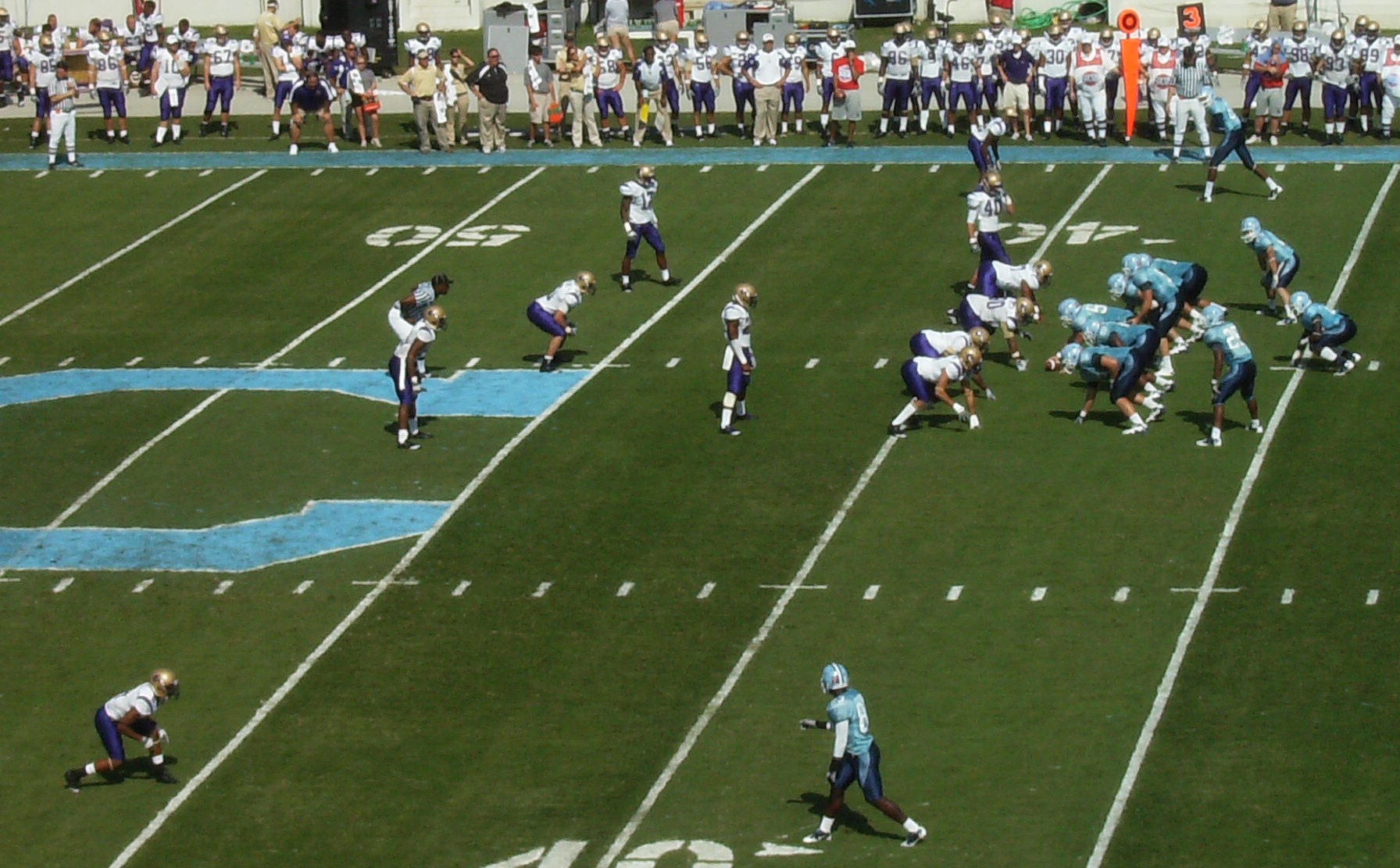
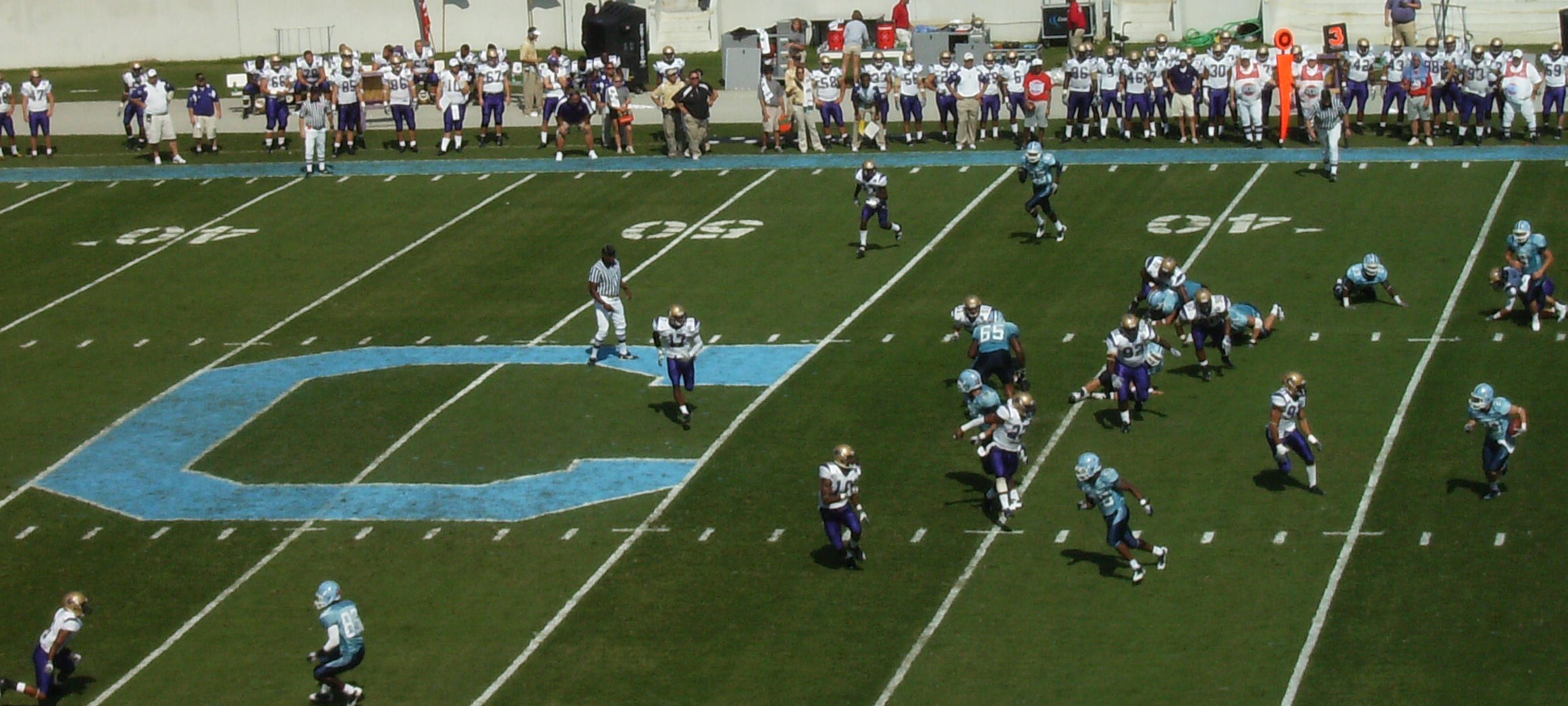
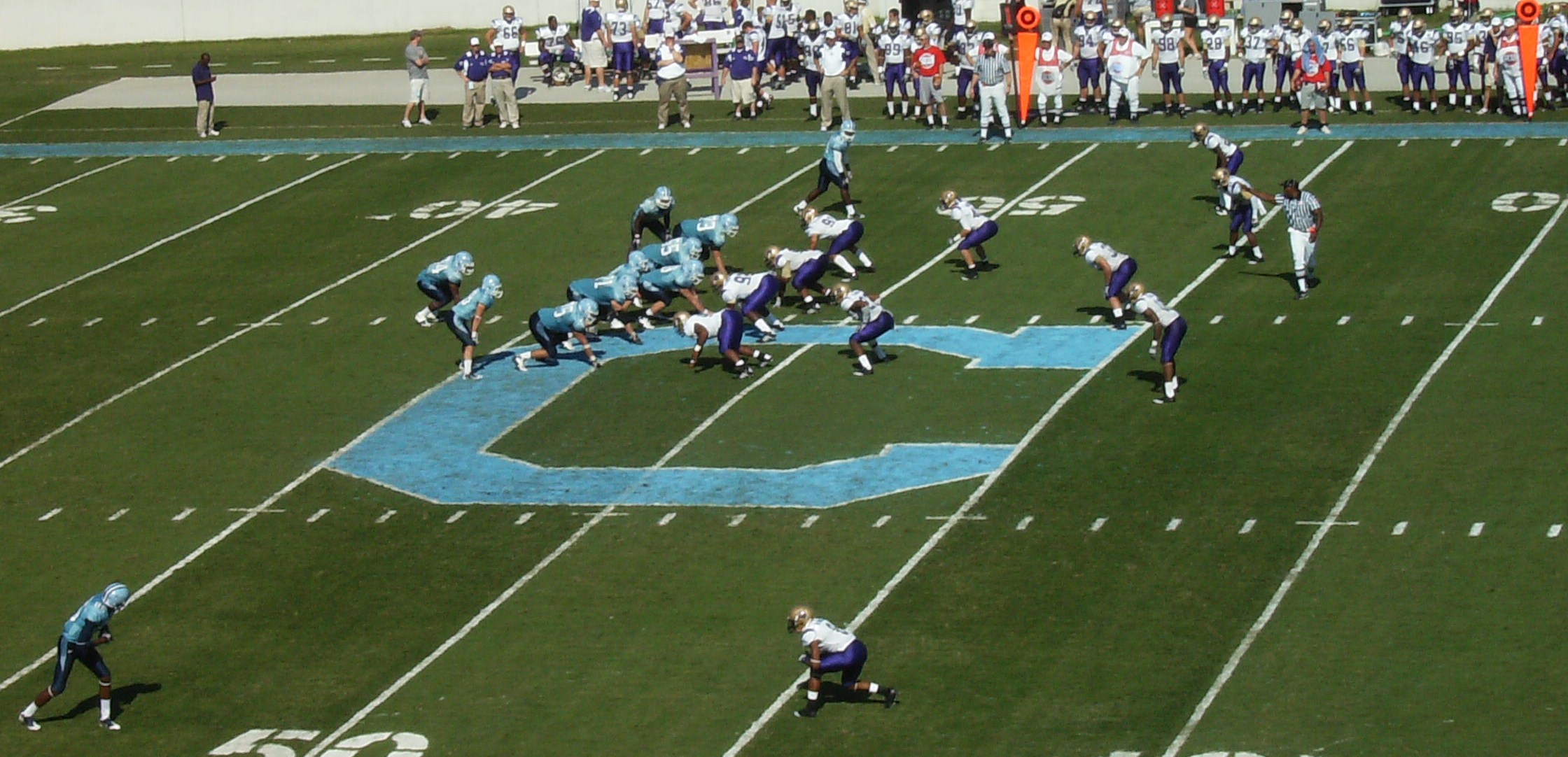
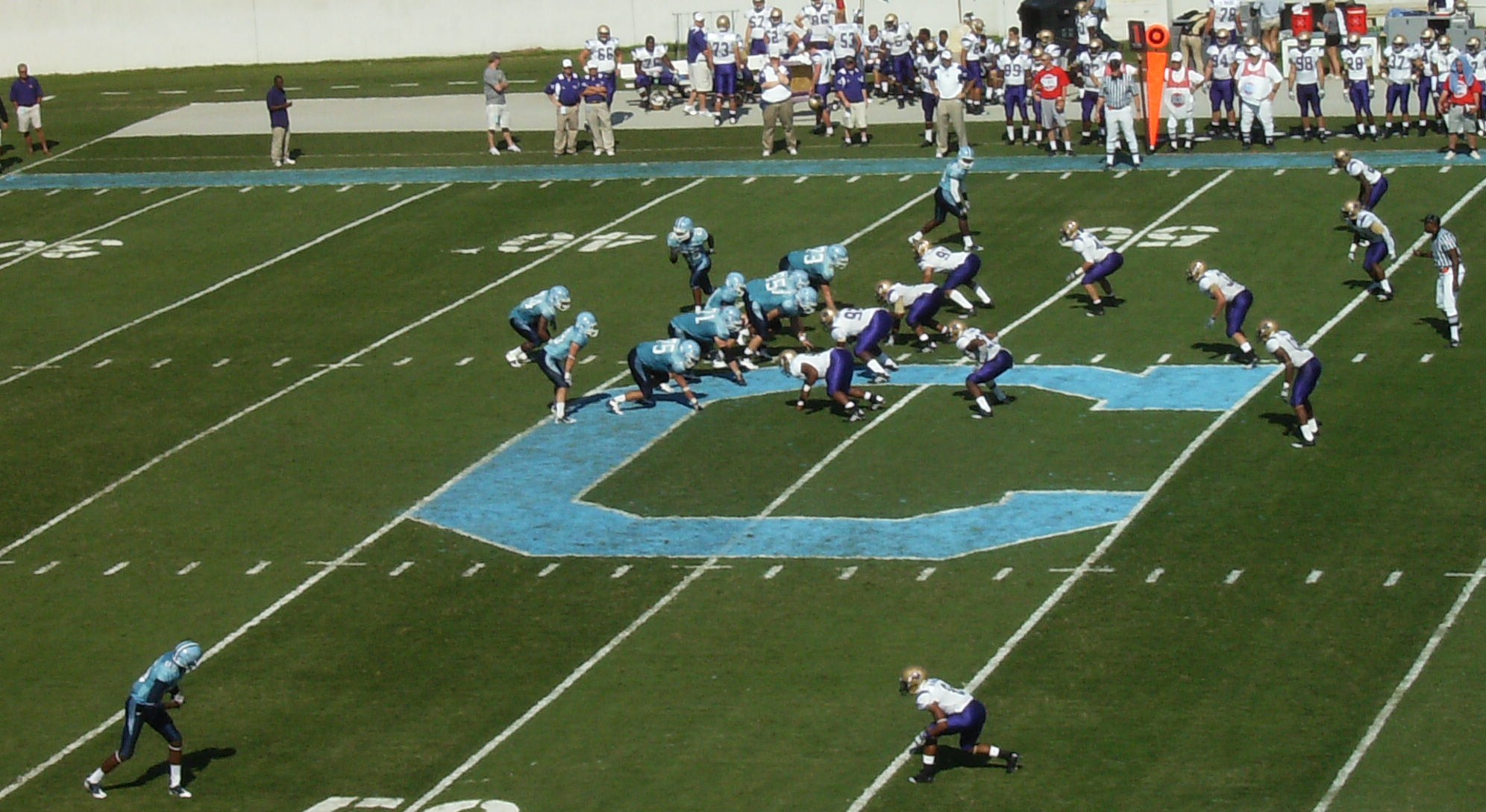
I’ll close this by including some pictures I took during the game, mostly of the offense.  Some of these are of the same play (as it is developing).  If you’re wondering why I don’t have an entire play photographed, it’s because I’m a terrible photographer with a cheap camera.  The first three pictures of the offense are of the beginning of Terrell Dallas’ touchdown run.

The first photo, though, is a shot of the corps of cadets.  I took this picture because I want interested observers who don’t get to go to the games to see just how many cadets are actually in the stands during a game.  This is an issue I would really like to see addressed by the administration.  It was even more noticeable during last year’s Homecoming game.

Football, Game 5: The Citadel vs. Western Carolina

This week’s edition of the game preview is a bit of a ramble.  I don’t know if that’s good or bad…

In last season’s preview of the Western Carolina game, I wrote (among other things) about how WCU has some built-in problems when it comes to competing successfully in football in the Southern Conference.  At the time, the Catamounts were 0-5.  It was a game The Citadel was supposed to win.

The Bulldogs lost, 14-10.

That’s the lesson to be learned when it comes to The Citadel competing in the SoCon.  The Bulldogs may face a team that is struggling and/or lacks (as a program) certain resources.  However, The Citadel will never be in a position to just show up and win while playing its “C” game.  The military school doesn’t have the capacity to do that, and never will, because of its own restrictions (note that I said restrictions, not disadvantages).

At its best as a program, The Citadel could beat any league team — and could lose to any league team.  That’s just the way it is.  In terms of physical talent, no other conference squad will ever be overmatched by the Bulldogs.

This season, Western Carolina is 1-3, including a 24-point home loss to Tusculum, a Division II school.  On Saturday, on the road at Johnson Hagood Stadium, Catamounts coach Dennis Wagner will give a true freshman quarterback his first career start.  It is a game The Citadel is supposed to win…

Western Carolina opened its season by losing 48-7 to North Carolina State, which no one could get too upset about.  Then, however, the Catamounts were embarrassed by Tusculum 54-30 (in a game that ended with 2:39 still on the clock after a lightning strike).  Plenty of Catamount fans were upset about that.

WCU followed that up with a somewhat surprising 28-14 win over Gardner-Webb, which had just upset Akron.  Last week’s 27-21 loss to UT-Chattanooga was also a bit of an eyebrow-raiser, as the game wasn’t supposed to be that close.

I decided to discount the NC State game when looking at WCU’s statistical record. Western Carolina actually scored first in that game before allowed 48 unanswered points.  Still, that was against a currently undefeated BCS school.

Against Tusculum (as mentioned above, a Division II school, and one that only won three games last season), the Catamounts gave up fumble return touchdowns of 90 and 60 yards and were also victimized by a blocked punt that resulted in a TD one play later.  Ouch.  Just before halftime, the score was 27-0.  It was just a complete debacle.

Also noteworthy:  Tusculum only had 42 net yards rushing, but threw for 410 yards without being intercepted.  The stats for this game were very different from the other WCU games in several respects — the Catamounts finished with more first downs and more time of possession, for example.

That game looks like a situation where things started terribly, and the Catamounts were simply incapable of reversing the momentum.  That may be an indication of how fragile WCU’s program is, but I think Western Carolina’s 9-40 record since 2006 is enough of an indicator.

Then came the promising performances against Gardner-Webb and UTC.

Against G-W, Western Carolina only picked up 7 first downs on offense (to the Bulldogs’ 24) and was on the short end of time of possession by almost 16 minutes. So how did the Catamounts prevail?  By taking advantage of six turnovers, that’s how. WCU intercepted five passes, returning one for a score, and also returned a fumble for a TD.  Torrez Jones had four of the five picks (although not the pick-6).

WCU’s other two scores in the game were on a 78-yard pass reception and a 60-yard run, so big plays ruled the day.  Gardner-Webb couldn’t overcome all of them, even at home.

The UT-Chattanooga game was a similar story.  The Mocs had 24 first downs to WCU’s 12 (with the Catamounts not picking up a single first down by rushing).  In this game Western Carolina committed four turnovers, all by Brandon Pechloff, the freshman who will be starting against The Citadel on Saturday (three interceptions, one fumble).

However, WCU forced four turnovers of its own, including three fumbles, one of which it returned for a TD.  WCU also scored on a trick play.  After a UTC punt gave the Catamounts great field position, WCU scored on its first play following the change in possession on a wide receiver pass.

To sum up, the Catamounts are not the type of team that sustains long scoring drives. The Catamounts have had to count on big plays, both offensively and defensively, to stay in games.    I could see The Citadel rolling up a huge edge in time of possession in this game, but it won’t mean much if the Bulldogs turn the ball over.

The big play motif is probably a key factor behind WCU coach Dennis Wagner’s decision to start Pechloff, a 6’7″ left-hander, at quarterback.  The starter for the UTC game, Zac Brindise, left that game after completing 10 of 14 passes, but for only 34 yards.  That wouldn’t be good enough for any team, and certainly not one like WCU. Pechloff may have thrown three interceptions, but his yards-per-attempt rate of 6.04 was a lot better than Brindise’s 2.43 YPA.

It’s hard to blame Wagner for taking a shot with the young QB.  It’s up to the Bulldog defense to take advantage of his inexperience and collect a few turnovers of its own.

Tangent:  Chattanooga beat writer John Frierson noted in a Tweet that “WCU coach Dennis Wagner might be the only college head coach who wears shorts on game day. I bet others wish they did.”


I don’t recall ever seeing a college head coach wear shorts during a game.  In a way it’s amazing that no one else has (or that I can’t think of anyone else, anyway). Saturday is supposed to be clear with a high of 77 degrees, so I’m guessing Wagner breaks out the long pants against The Citadel.

Frierson also noted in another tweet that Pechloff “looked good once he settled down a bit”, so this probably won’t be a case of the Bulldogs going up against an overly anxious quarterback.  Pechloff could be a find for WCU, too; he led his high school team in Illinois to the 5A championship as a senior after not starting his junior year (which according to him is the reason bigger schools did not offer him a scholarship).

Like every other high school prospect, Pechloff had a Youtube video.  You can see it here.

I would say that The Citadel needs to pressure Pechloff, but you could say that every week about every quarterback the Bulldogs defense faces.  I think another thing to do, though, is to give him different looks and force him to make reads under duress.

I also wouldn’t bet against Brindise making an appearance for WCU against the Bulldogs.

I wrote about things the Bulldogs did well/need to improve in my review of the Furman game, so I’m not going to rehash that here.  I’ll make a couple of quick points, though:

— With the triple option, there is a significant element of “take what the defense gives you” to the offense.  Terrell Dallas’ stat lines against Presbyterian and Furman the last two weeks are a good example of that.  However, I think there is still a place in the triple option to feature certain players in some situations.  The Citadel has to get the ball to its best playmakers.

It may not be that easy to free up a fullback like Dallas, but I would like to see more opportunities for Jones.  That would be Van Dyke Jones and Domonic Jones, or any other Jones on The Citadel’s campus who can be a gamebreaker.  Terrance Martin did struggle with the science of going in motion against Furman, but regardless he is another player capable of making big plays.  I hope he gets more chances to change the game.

— It’s about time for Milford Scott to block another punt.  He also has to lead all levels of football in the head-over-heels flipperama move, which is a little scary.  The special teams in general (jinx alert) have looked better this year so far, although the placekicking remains a concern.

Let’s wrap this up with a couple of sort-of-but-not-really related observations:

— One “new” tradition at Johnson Hagood Stadium that I like is the corps singing the “Olé Olé Olé” song, a la European/South American soccer matches.  In fact, I will go so far as to say that it wouldn’t be a bad idea for the corps to emulate more soccer traditions (well, maybe not the hooliganism, racism, and setting off of flares).

There is something very natural about a crowd singing/chanting without prompting or assistance from a loud, obnoxious sound system/video board.  It just felt right to me when the corps did its chant.  The best sounds to be heard at the game were that, and the band.

If the corps could throw in some large soccerstyle banners, too, that would be cool. (The “Star Wars” one [actually two] that the Toronto fans did killed me.)

— The “get fired up” shorts featuring defensive players that are repeatedly aired on the video board…well, it gets old fast, especially when the same short gets played three or four times in a row between plays.  Maybe those should be more judiciously employed.

I’m ready for Saturday.

Review: Furman

Furman 31, The Citadel 14.

From The Citadel’s perspective, the general takeaway from this game has been fairly positive, both from the point of view of the coaches and the fans.  While the Bulldogs lost, there were signs of progress.  The Citadel outgained Furman, ran 28 more plays, and had a significant edge in time of possession (by almost 14 minutes).  The Bulldogs rushed for almost 300 yards and averaged nearly five yards per carry.

All of that is well and good, but on the other hand, the team lost by 17 points.  I like to look at the bright side of things, too, but a loss is a loss.  However, it’s a transition year.  As long as the squad shows improvement, most supporters are going to be reasonably satisfied, and that’s the way it should be.

Just a few observations:

— It’s hard to win on the road in the Southern Conference when the defense does not force a turnover or sack the quarterback.  The Bulldogs’ d-line did provoke the Paladins into committing two holding penalties.  (Jon Gruden claimed during the Packers-Bears game on Monday Night Football that a holding penalty was just as good as a sack, and if Gruden said it, it must be true.)

— Here is something I haven’t seen discussed much, but I think it’s worth noting.  Of Furman’s 296 total yards, 123 came on the two drives to open each half, both resulting in touchdowns.  The Paladins only faced a third down three times during those drives (technically just two, actually, because one third down was wiped away by a Bulldog penalty).

Furman’s other three scores were a field goal at the end of the first half that came after a busted coverage in the secondary resulted in a 45-yard pass completion, and two short touchdown drives at the end of the game following an interception and failed onside kick, respectively.

It’s just one game, but the defense has to be able to adjust more quickly on opening drives.  The Citadel’s offensive and special teams units aren’t good enough to offset points given up by the defense like that.  Kevin Higgins has noted that the offense has done better following its first possession (or two) after seeing how the opposing defense is playing the triple option.  That’s understandable, but the Bulldog defense can’t be afforded the same luxury.  It has to stop the opponent right out of the gate.

— I like the idea of using both quarterbacks in each game.  My general impression (which could be wrong) is that Matt Thompson played better after re-entering the game.  Perhaps watching Sam Martin from the sidelines helped give him a greater understanding of what was happening on the field.  While as a rule I think it’s best to have one clear-cut starter at QB, this year is different — again, it’s a transition season. Let’s see what both players can bring to the table.

— I have been pleasantly surprised at the improvement of the offensive line, particularly considering those players weren’t recruited for this type of offense.  That is a credit to them and to the coaching staff.  There are still blocking issues, but that has more to do with the slotbacks and receivers than the line.

—  It was a tough day at the office for punter Cass Couey, who had been so good the first three games.  I expect him to bounce back on Saturday.

— Somebody, anybody, catch the ball…

— In the past 15 games, Bulldog placekickers are 4 for 4 converting field goals against FBS opposition, but 7 for 15 against everyone else.

Now it’s back to Johnson Hagood Stadium for consecutive games, the first on Saturday against Western Carolina, which will be starting a 6’7″, left-handed true freshman quarterback.  Here is his first-person account of his recruitment.  More on that game later.

College Football TV Listings 2010, Week 5

This is a list of every game played during week 5 of the college football season involving at least one FBS or FCS school.  All games are listed, televised or not.  For the televised games, I include the announcers and sideline reporters (where applicable).  I put all of it on a Google Documents spreadsheet that can be accessed at the following link:

College Football TV Listings 2010, Week 5

Additional notes:

— I include the ESPN3com games, even though technically they aren’t “televised”.

— I’ve listed the satellite affiliates for the SEC game of the week (Kentucky-Mississippi) in a comment on the document.  There are numerous local affiliates, a listing of which can be found here:  Link

— The local affiliates for the Raycom production (now branded as the “ACC Network”) of the ACC game of the week (Florida State-Virginia) can be found here:  Link

— I’ve listed the satellite affiliates for the Big East game of the week (Vanderbilt-Connecticut) in a comment on the document.  The local affiliates can be found here:  Link

— The WAC Network will have two games this week (Idaho-Central Michigan and Boise State-New Mexico State).  Local affiliates for the games can be found here:  Link

— The local affiliates for the MAC game of the week (Ohio-Eastern Michigan) can be found here:  Link

— The local affiliates for the Southland Conference game of the week (McNeese State-Northwestern State) can be found here:  Link

— The affiliates for the OVC game of the week (Southeast Missouri State-Eastern Illinois) can be found here:  Link

— Also listed on the document as a comment are the regional nets carrying the following games:  Kansas-Baylor, Georgia-Colorado.

— There are comments in the document with additional information for several other games.

— ABC/ESPN coverage maps for the 3:30 pm ET games:  ABC general map Texas-Oklahoma map Michigan State-Wisconsin map

— ABC/ESPN2 coverage maps for the 8:00 pm ET games:  ABC general map Stanford-Oregon map Washington-Southern Cal map

— Big Ten Network “gamefinder” for this Saturday (of course, with Ohio State-Illinois the only BTN game, this isn’t particularly relevant):  Link

— USA Today Poll:  Link

— FCS Coaches Poll:  Link

A lot of the information I used in putting this together came courtesy of Matt Sarzyniak’s great website (College Sports on TV) and the fine folks over at the 506.com.  I am also assisted on occasion by helpful athletic media relations officials at various schools and conferences; this week, I would like to particularly thank staffers at William & Mary.

College Football TV Listings 2010, Week 4

This is a list of every game played during week 4 of the college football season involving at least one FBS or FCS school.  All games are listed, televised or not.  For the televised games, I include the announcers and sideline reporters (where applicable).  I put all of it on a Google Documents spreadsheet that can be accessed at the following link:

College Football TV Listings 2010, Week 4

Additional notes:

— I include the ESPN3com games, even though technically they aren’t “televised”.

— I’ve listed the satellite affiliates for the SEC game of the week (UAB-Tennessee) in a comment on the document.  There are numerous local affiliates, a listing of which can be found here:  Link

— The local affiliates for the Raycom production (now branded as the “ACC Network”) of the ACC game of the week (Virginia Tech-Boston College) can be found here:  Link

— The local affiliates for the Big East game of the week (Buffalo-Connecticut) can be found here:  Link

— The local affiliates for the Southland Conference game of the week (Gardner-Webb  -Sam Houston State) can be found here:  Link

— The affiliates for the OVC game of the week (UT Martin-Murray State) can be found here:  Link

— Also listed on the document as a comment are the regional nets carrying the following games:  Central Florida-Kansas State, Georgia-Mississippi State, and Oregon-Arizona State.

— There are comments in the document with additional information for several other games.

— ABC/ESPN2 coverage map for the 3:30 pm ET games:  Link

— Big Ten Network “gamefinder” for this Saturday (eight different games are on BTN):  Link

A lot of the information I used in putting this together came courtesy of Matt Sarzyniak’s great website (College Sports on TV) and the fine folks over at the 506.com.  I am also assisted on occasion by helpful athletic media relations officials at various schools and conferences; this week, I would like to particularly thank staffers at North Greenville, North Dakota, Richmond, Stephen F. Austin, the Big East Conference, and the Southland Conference.

Football, Game 4: The Citadel vs. Furman

Now that all the non-conference games have been played, it’s time for Southern Conference action to begin.  The Citadel will begin the SoCon slate by going on the road to face its traditional league opening game opponent…Furman.

Uh, Furman?  As the first conference game of the season?  In September?  When has that ever happened?

It’s happened once before.  In 1976, the Bulldogs and Paladins met on September 25 (same date as this year) in Greenville (same locale as this year) to play the league opener for both schools (same situation as this year).  The Citadel edged Furman that day, 17-16 (hey, that can be the same too, as far as I’m concerned).

The other 88 gridiron meetings between the Palmetto State schools took place in October or November.  Occasionally you will hear someone (often a Paladin supporter, but sometimes a Bulldog fan) gripe about how the game should be played at the end of the season, “like it used to be,” and blame somebody (The Citadel’s former AD, Walt Nadzak, usually plays the bogeyman) for the end of “the tradition” that was the season finale.

I want to delve into this a little, because the notion that Furman and The Citadel used to always play at the end of the season is wrong, and so is the idea that there is an implied tradition with regards to end-of-season meetings for either school.

The Citadel and Furman have met 89 times.  On 19 of those occasions, the game was the last game of the (regular) season for both schools.

The Citadel and Furman met in the season finale in 1965, 1966, and 1967, and then for sixteen straight years, from 1977 through 1992.

Prior to that 16-year stretch, though, the game was generally a midseason clash, much like Clemson-South Carolina was for many years (“Big Thursday”).  The opponent that has been Furman’s season-ending opponent most often is actually Clemson, and the Paladins also have had numerous seasons end with games against Wofford and UT-Chattanooga (which replaced The Citadel in the last-game rotation for a decade).  Furman has finished campaigns with opponents as diverse as Georgia and Maryville; as recently as the 1970s, the Paladins ended seasons against Louisville and Wake Forest.

Tangent #1:  While researching Furman’s football history, I enjoyed looking through the school’s excellent media guide, which includes some cool photos.  My personal favorite is the picture of the 1927 squad, known as the “30-Mule Team”, which went 10-1 and appears to have been sponsored by Target.

The Citadel has finished its season with Furman more than any other school, but has ended its season with South Carolina almost as many times (17), and has concluded numerous campaigns with Davidson, Wofford, and VMI.  The full list of final opponents for the Bulldogs is long and includes both Florida State (during the Lee Corso era) and Florida (during the Tim Tebow era), along with Clemson, Vanderbilt, North Carolina State, Sewanee, and the Parris Island Marines, just to name a few.

Tangent #2:  The Citadel actually has finished with Furman in twenty different seasons. In 1942 the two schools played on November 2.  That would wind up being the last game of the year for The Citadel in a shortened season, as every available upperclassman was called up to serve in World War II.  The Paladins played two more games that year.  Furman also had its fair share of students who went to serve their country; neither school would field a football team again until 1946.

The argument over whether the two schools should meet at the end of the season can be looked at in two ways:  1) How important is it to play a “rival” at the end of the season, and 2) how much tradition does The Citadel-Furman have as a year-end rivalry game?  My answers would be 1) it’s of limited importance, and 2) not a whole lot.

There are great end-of-season rivalries, of course — Army-Navy, Michigan-Ohio State, Harvard-Yale.  However, there are also great midseason rivalries, like Oklahoma-Texas, or Alabama-Tennessee.  Then you have Southern Cal-Notre Dame, which is a midseason game in South Bend but is played near the end of the year in Los Angeles.

What those end-of-season games have in common, for the most part, is that they have been the final game for each school for decades.  That’s not something that can be said for The Citadel-Furman, a game that has been played more often in October (51 times) than in November (37).

Part of this, of course, is how each individual fan views the series.  For me, I have always thought of it as a midseason contest.  When the game is played in Greenville, I picture a mid-October fall day with the leaves just beginning to change color.  When it’s in Charleston, I think of gorgeous October afternoons, crisp and clear as the late-summer low country heat finally dissipates.

Okay, so maybe the weather isn’t always so nice.  Just work with me…

I also think it’s not a bad thing that it is played at a different time of year than Clemson-South Carolina.  I always felt the matchup was given short shrift from the state’s media entities when it was played on the same day.  Having it at midseason gives it a time and place of its own in the state, and some additional publicity.

I can understand why some Furman fans want the game to be the season finale. Back in that stretch during the 1980s when it was the final game of the year, Furman was at its zenith as a football program.  Alums remember those days fondly and want to revisit them in every way possible.  Homecomings on the Greenville campus usually feature men wearing Members Only jackets and women with shoulder pads bigger than those of the football players, many of them gyrating to the sound of their favorite band, Winger.  Big hair is everywhere.

The scene is very different at The Citadel, of course, as it is renowned as a forward-thinking institution, and its alums have led the way into the 21st century.

Since this is a blog that tends to focus on The Citadel, I’ll now return to the 21st century.  Let’s take a brief look at the game to be played on Saturday…

Adam Mims is good.  He already holds the Furman career record for receptions (157), and he added to that mark in a major way against a very good South Carolina defense on Saturday.  Mims had 10 catches for 202 (!) yards, which included a 72-yard TD reception.  Just for fun, he also had two rushes for 26 yards.  In his previous two games against the Bulldogs, Mims has totaled 15 receptions for 156 yards and two touchdowns.

Furman was trailing 31-19 with less than six minutes to play against the Gamecocks, but had the momentum and was driving for another score before an ill-fated pass resulted in a pick-six that iced the game.  It would have been very interesting to see what would have happened if the Paladins had scored to get within a touchdown.  I would not have bet against a 3-and-out for the Gamecock offense, and Furman then having the chance to drive down the field for a game-winning TD.

That it didn’t happen doesn’t take away from Furman’s solid performance.  The Paladins scored as many points against South Carolina as the Gamecocks’ first two opponents combined, and those opponents were Southern Mississippi and Georgia.

The bad news for the Paladins is that its two-quarterback rotation was reduced to one, as Chris Forcier (the “running” QB) suffered an injury against the Gamecocks and is out for the season.  That leaves the reigns entirely to Cody Worley, the “passing” quarterback.

This will be a blow for Furman (Forcier was averaging over 15 yards per rush, including an 85-yard TD against Colgate), but Worley seems more than capable of shouldering the load.  I’m not sure how much more of a passer Worley really is as compared to Forcier, and at any rate I would expect him to do his fair share of running too.

Furman rushed for 377 yards against Colgate, which is probably a better approximation of what to expect from the Paladins’ running attack than its numbers versus the Gamecocks.  Tersoo Uhaa rushed for 126 yards on 16 carries.  With that kind of success on the ground, the Paladins only attempted 18 passes, completing eleven — interestingly, to seven different receivers.

Furman had two tight ends each catch one pass in that game, which is about four catches less than that position seems to historically have against The Citadel on a per-game basis.  Speaking of history, starting tight end Colin Anderson is a direct descendant of the man who commanded Fort Sumter at the beginning of the Civil War.

On defense, Furman appears improved from last season, although obviously it’s hard to tell after just two games, with one of those against an FBS opponent.  The Paladins may be susceptible to the pass, but that isn’t likely to be a problem for them against the Bulldogs.  However, I do expect The Citadel to go to the air a few more times than would normally be the case.

The key man in the defensive unit is safety Max Lerner, who spends most of his time somewhere other than where the opposition wants him to be.  He’s a very good player.  How Furman chooses to employ him against The Citadel’s triple option attack will be something to watch on Saturday.

Furman has dangerous return men.  Mims handles the punt return duties, and the kickoff returners include Mike Brown, who had a 76-yard kickoff return for a TD against The Citadel in that nutty 2007 game.

Saturday’s game is going to be a “white out” for Paladin fans.  I’ve always been a little leery about the effectiveness of these types of things (with occasional exceptions).  I think it’s because I remember the time a few years ago when South Carolina had a “black out” for a night game against Florida.  The Gator QB was Rex Grossman.  After the game, an easy Florida win, someone asked Grossman about it, and he said something like “you couldn’t see any of the fans, it was like nobody was there.”

The Citadel is going to have a “red out” for Homecoming.  I’m on record (from my preview of the Presbyterian game) as being a touch dubious about that one too, especially given the opponent, but it’s all in the name of merchandising.

I don’t pretend to be an insider when it comes to The Citadel, so I certainly won’t try to suggest I know the inner workings in Paladin Land, but I have to wonder how big a year this is for Bobby Lamb.  Furman fans are getting antsy about a playoff drought, and about being an also-ran for the SoCon crown in recent years.  Losing three of four to The Citadel would not help the cause.

For The Citadel to emerge victorious in this game, it must win the battle of clichés.  By that I mean it has to win the turnover battle and control the clock and field position. The time of possession is something that I think the Bulldogs can have some success in managing, but only if the defense can prevent the Paladins from those long, 70+-yard drives that Furman has specialized in over the years.  You’ve seen the script:  the throw down the middle to an open tight end…the delayed handoff on 2nd and 7 that goes for nine yards…the quarterback keeper for six yards…etc.

The Bulldogs also need to avoid penalties.  The Citadel committed only two infractions against Arizona, but regressed against Presbyterian.  Penalties on offense are particularly costly in the triple option, as they throw the team “off schedule”.

I don’t think The Citadel’s squad has many advantages in this game.  One possible advantage is that the pressure should be on Furman, which has greater expectations this season and which excited its fan base with its excellent effort against South Carolina.  With that considered, a good start for the Bulldogs would be particularly welcome.

Regardless of how you feel about what time of year these two schools should play their annual football game, I think everyone agrees that September 25 is too early.  For that, we can all join together to blame the SoCon league office.  However, I’m sure all the fans and players will be ready to go at 2 pm this Saturday anyway.

Review: Presbyterian

The Citadel 26, Presbyterian 14.  It was a good win.  Of course, any win is a good win.

I was worried about this one, even though PC has now lost 17 in a row, because I wasn’t sure the Bulldog offense was capable of scoring a lot of points against any FCS/FBS competition, and I remembered how the Blue Hose had gashed The Citadel’s defense last season.  In last season’s game, Presbyterian had 190 yards passing and 204 yards rushing.  

On Saturday night, though, the Bulldogs held PC’s offense to 212 total yards.  The Blue Hose attempted 26 passes, but only managed 90 yards through the air, and suffered three interceptions. Of those 26 throws, 11 were completed, but 8 of the 11 went for a combined 32 yards.  (PC had a drive in the second quarter that went like this:  pass completion for -1 yard, pass completion for 1 yard, pass completion for no gain, punt.)

Trandon Dendy had another good game against The Citadel, again going over the 100-yard mark, with 103 yards on 15 carries, including a 43-yard TD run in the first quarter.  I was a bit surprised he didn’t carry the ball more often.  Sometimes I think teams try to have an “ideal” run/pass balance when they would be better off concentrating on what is actually effective. 

The play that seemed to jump-start the Bulldog defense was an ill-advised post pass by the Blue Hose that was intercepted by Demetrius Jackson (the first of two picks for Jackson).  Prior to that play, Dendy had run the ball four consecutive times, picking up a first down and then six more yards on first-and-ten.  The Citadel would eventually convert the interception into the go-ahead touchdown. 

The Bulldogs would hold Presbyterian to 73 total yards on the Blue Hose’s next eight possessions.  Other than Dendy’s first-quarter TD run and a six-play, 76-yard drive late in the game, when The Citadel’s D seemed to lose focus, PC was unable to move the ball.  A Cass Couey punt inside the five set the stage for the game’s final points, a quarterback sack in the end zone for a safety (that should have been ruled a fumble/TD, not that it mattered).

Speaking of Couey, he has arguably been The Citadel’s most effective player over the first three games of the season.  He’s been very solid.

The Bulldog offense looked better against PC than it did against Chowan, which was good to see, although there is still plenty of room for improvement.  There were six fumbles (two lost), eight penalties (one which cost the Bulldogs a touchdown), dropped passes (including an easy would-be TD), and missed blocks (particularly on the perimeter). 

Odds and ends:

— There were some good play calls in this game.  Unfortunately, two of the best ones didn’t work out.  A perfectly-timed post pass for a TD was called back by an illegal formation penalty. The Bulldogs showed good composure to overcome that disappointment and score on the drive anyway (Van Dyke Jones getting the TD he should have had three plays earlier).

Another fine call was the slotback option pass by Ben Dupree, a cinch TD that was dropped.  Those have to be caught, obviously.  Dupree looked comfortable in the slotback position and could be quite a weapon for The Citadel.  I wouldn’t mind seeing the Bulldogs try that play once per game.

— I also liked the fact The Citadel went for it on 4th-and-5 on the PC 37 on its opening drive.  Matt Thompson made the right read, gave the ball to Terrell Dallas, and 37 yards later the fullback was in the end zone.  Very nice.

—  Warning:  Xs-and-Os discussion to follow.  There is no guarantee I actually know what I’m talking about in the next two paragraphs.

Presbyterian had some interesting alignments along its defensive front.  In particular, the Blue Hose had a setup where the DL lined up directly opposite the center, left guard, and tackles, but left the space opposite the right guard empty, with no obvious (at least to me) coverage from the linebackers.

PC appeared to be keying on the quarterback, and it looked to me like the DBs were “cheating” like crazy throughout much of the game.  As a result, some of the option plays that went to the slotbacks didn’t go so well.  On the other hand, if the guy assigned to the fullback whiffed, there was no safety net.  Hence, Terrell Dallas’ 80-yard TD run where he wasn’t touched.

— I sometimes worry I’m a little negative when I write these reviews (or previews), so let me give a shout-out to the radio team for calling a fine game.  I thought Walt Nadzak had one of his better efforts in the analyst’s chair, and Darren Goldwater deserves a lot of credit for correctly identifying players, a very difficult task because of the conditions and the uniforms.

— Ah yes, the uniforms…

Putting aside for the moment that navy blue is supposed to be an accent color, not the pre-dominant one, in The Citadel’s uniforms, it appears in this photo that The Citadel had at least four different shades of blue (including the helmet) in its uniform on Saturday.  Maybe that’s just the lighting in the photo.  I would like to think so, but I suspect otherwise. 

One unaccounted-for consequence of wearing navy jerseys with medium (not light) blue numerals is that it made it harder to ID players, particularly at night, following a storm, and with cannon fire smoke hanging in the air.  I’m guessing nobody in the press box was crazy about the uniforms — at least, nobody whose job involves trying to figure out which players are in the game/making tackles/carrying the ball/etc.

As usual, the uniform fails to include the full (and correct) name of the school in the lettering on the front of the jersey.  I have no idea why it’s so difficult to do this.  Maybe it’s a Nike thing.

— 

All in all, a good night for The Citadel’s football team.  The team completes its non-conference slate with a 2-1 record, which is what was expected, but not guaranteed. 

I’ll conclude this by saying that I like the idea of playing Presbyterian on a regular basis; maybe not every season, but more often than not.  PC fits the bill of what The Citadel needs in a non-conference home opener better than just about any other alternative, particularly with the way the schedule will shake out over the next few years (including the revival of the series with VMI).

On to Furman.