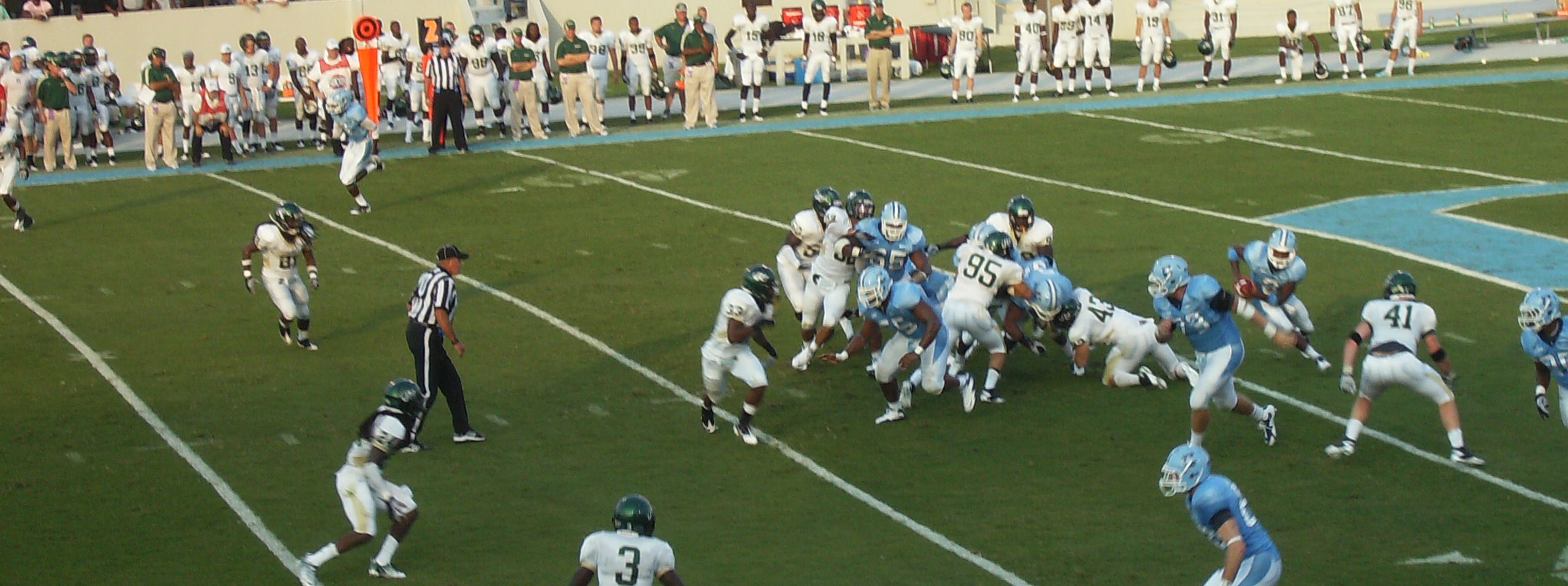
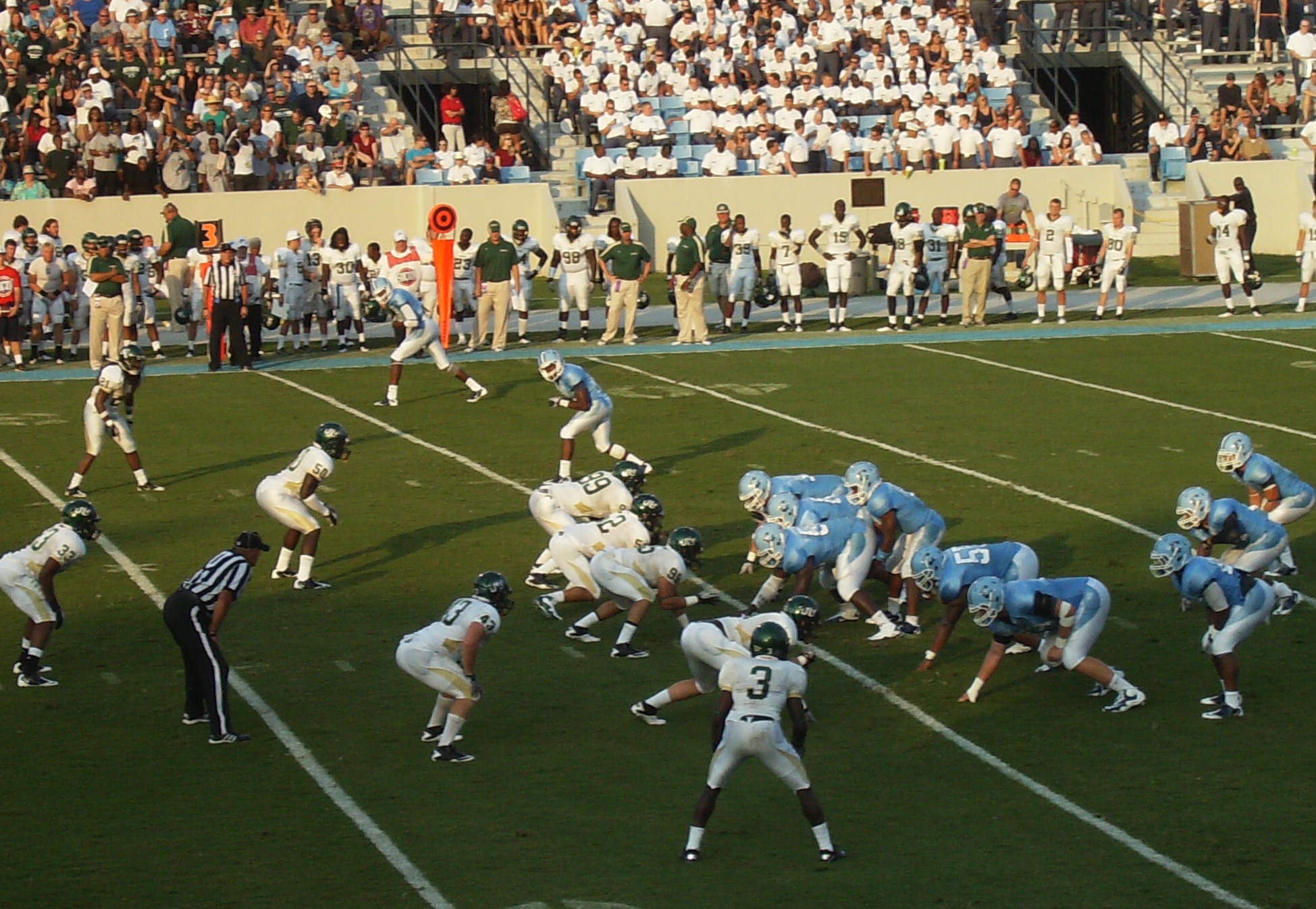
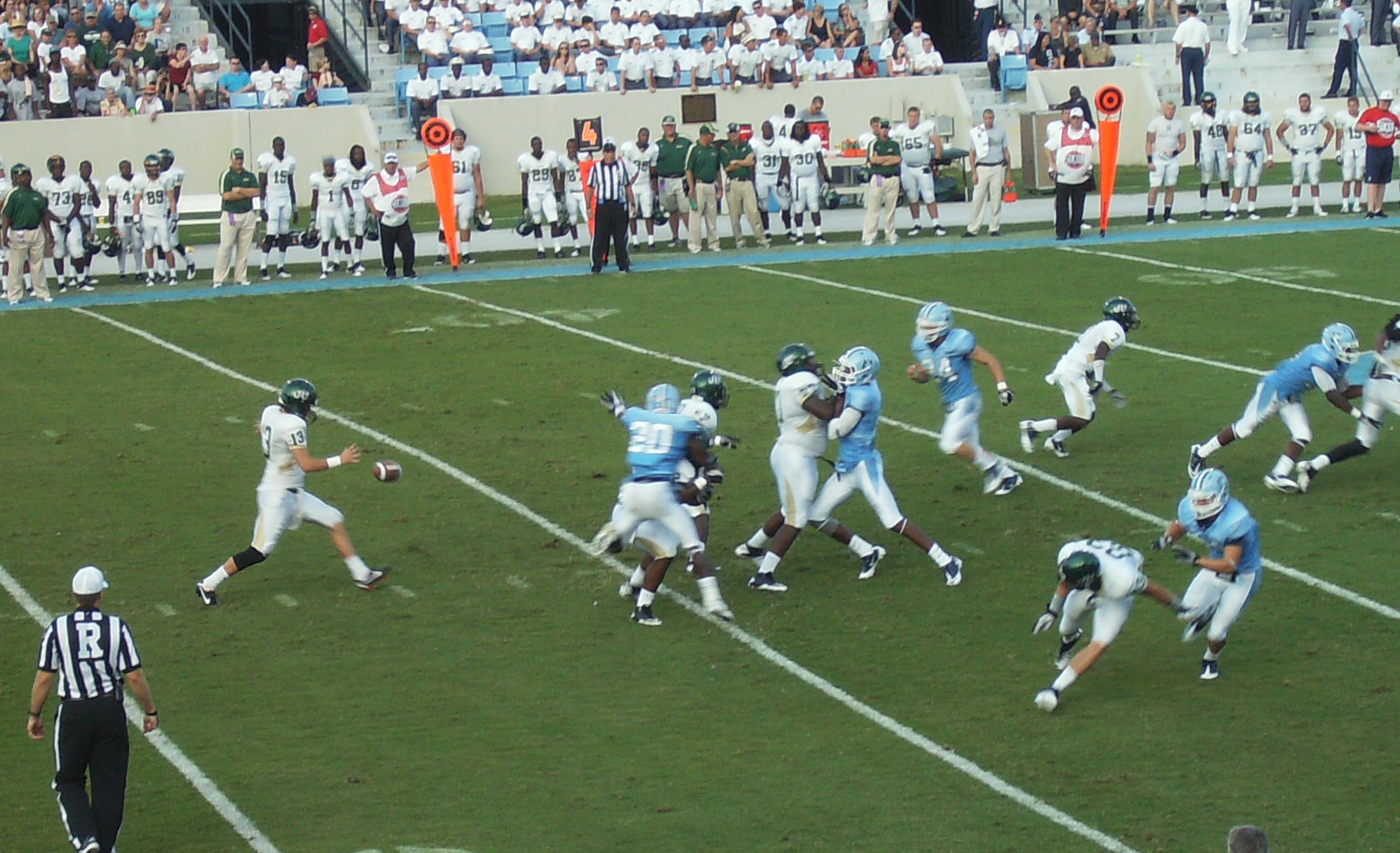
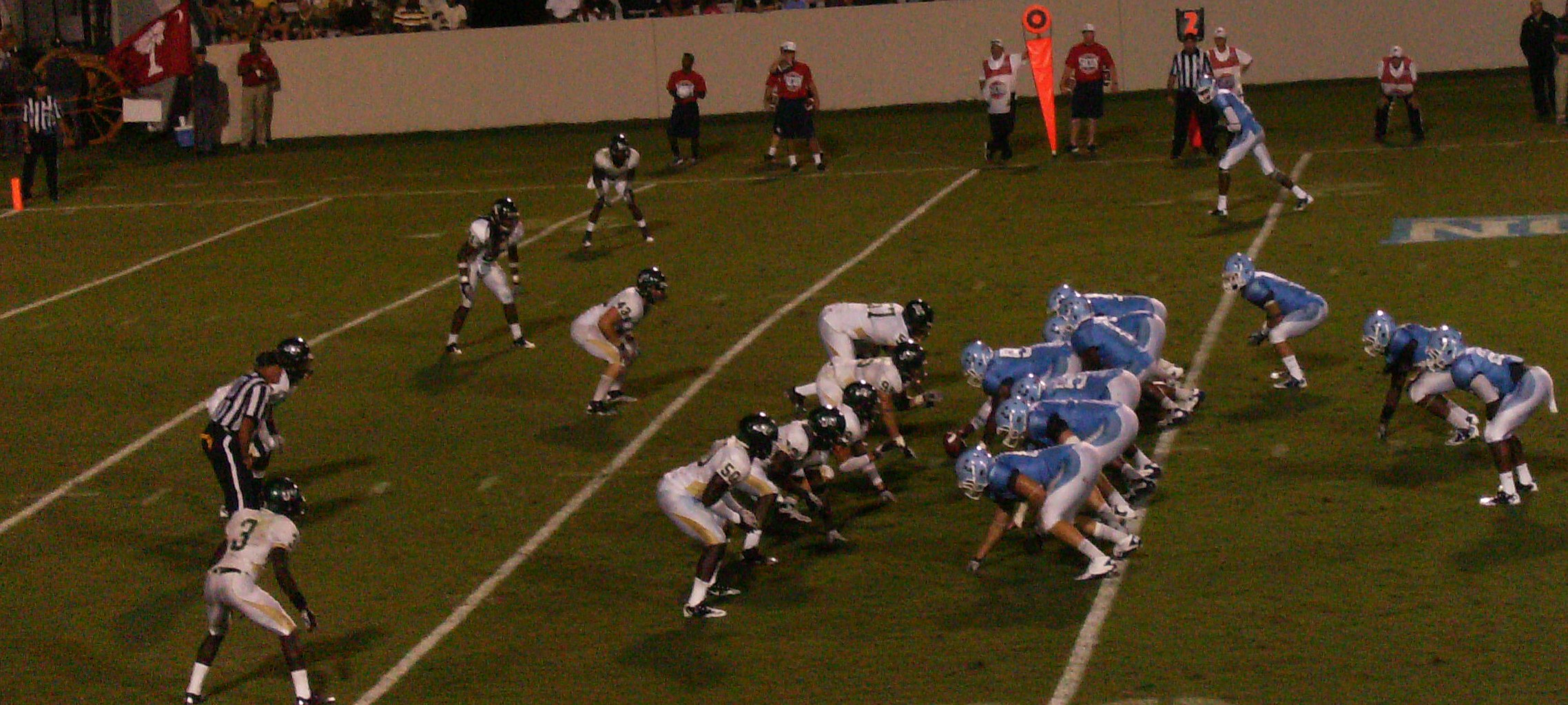
2011 Football Game 6: The Citadel vs. Appalachian State

The Citadel vs. Appalachian State, to be played at historic Johnson Hagood Stadium, with kickoff at 2:00 pm ET on Saturday, October 15.  The game will not be televised. There will be a webcast on Bulldog Insider (subscription service), and the game can be heard on radio via The Citadel Sports Network, with “Voice of the Bulldogs” Danny Reed calling the action alongside analyst Walt Nadzak.

This post will serve as a combo review of Wofford/preview of Appy.  I’m going to be having “combo posts” for at least two more weeks, if not longer.

Wofford 43, The Citadel 14.

I’m not sure there is a lot to say about this game that isn’t blindingly obvious, but I’ll try my best anyway.

— In his weekly press conference, Kevin Higgins noted that Wofford’s punt return TD “took the wind out of [the team’s] sails”.  I would say it probably just solidified things in that department; the die was cast when the Terriers moved down the field with ease on the opening possession of the game and scored their first touchdown.

— The horrendous start probably put the kibosh on any cadet corps frivolity, as it’s hard to get wound up for a game when it takes on “no hoper” status that quickly.  I’ve seen some criticism of the corps for its lack of enthusiasm on Saturday, but to be honest I’m inclined to give the cadets a mulligan.

Plus, the issues with the atmosphere at Johnson Hagood Stadium go a lot further than the corps.  The scene on Saturday was particularly jarring, as the tailgating crowd was huge, but when I turned around to survey things shortly before the game started, there just weren’t many people in the stands.  It did fill in a bit a few minutes later; I guess folks knew there was no reason to show up on time, since the Bulldogs don’t score in the first quarter anyway.

I guess a lot of people just wanted to stay in the parking lots and listen to the game on the radio, or perhaps watch/listen to the South Carolina game instead.

It’s a problem.  I’ve typed that before, and I suspect I’ll be typing it again.  Getting those people into the stands is going to be a tall order, at least until The Citadel starts winning on a consistent basis.

The game against Appalachian State will likely be a bit different, as it will be Parents’ Weekend.

— Wofford did not commit a turnover on Saturday and also did not commit a penalty, which was a story in itself, as the Terriers entered the game as the most-penalized team in the Southern Conference.  That was something of an anomaly, as Wofford is usually not a heavily-penalized outfit (much like The Citadel).

In the last four games against The Citadel, Wofford has committed a total of five penalties (for a combined 30 yards).  That includes a delay-of-game penalty the Terriers took on purpose in order to set up a short punt in the 2008 contest.  Only one of the penalties was for more than five yards (a holding penalty in that same 2008 game).

I am not a defensive coordinator, and never will be, and I’m not going to pretend to understand the intricacies involved in running a defense.  When I see a box score in which the opponent did not commit a turnover or a penalty, though, I wonder if the problem is at least partly a lack of aggression.

Wofford aggressively defended The Citadel’s option by having a man go “down hard to attack the fullback“.  The tactic led to bad reads and mistakes by the Bulldogs.  In other words, the Terriers forced the issue.

Mike Ayers was quoted after the game as saying that to “stop the triple option, [you] have to put teams in negative plays.”  Wofford did that.  The Citadel’s defense did not. That has been a theme for the Bulldogs D against Wofford for a number of years now, as the Terriers have scored at least 28 points against The Citadel in every game of the Kevin Higgins era.

— This is possibly the best team Wofford has ever had, which is one reason I wasn’t expecting The Citadel to win on Saturday.  However, I wasn’t expecting a walkover, either, and I was really disappointed by the outcome.  A lot of other alums/fans are just plain angry about the way the series with Wofford has gone in recent years, and you know what?   They have every right to be upset.  There is no excuse.

Something to think about:  there are only 11 seniors listed on Wofford’s entire roster. Eight of them are on the two-deep (The Citadel had nine seniors on the two-deep released for the game against Wofford).  Now, Wofford does not list redshirt juniors as seniors, but as juniors (including Eric Breitenstein), but the fact is that a lot of the Terriers will be back next season.

They probably won’t be as good in 2012.  The eight seniors on the two-deep include starting quarterback Mitch Allen and all three starting defensive linemen (one of whom, Ameet Pall, is Wofford’s best player).  The Terriers will continue to run their stuff on offense and defense, however, and will probably run it well.

— I felt badly for Cass Couey, who had an excellent game punting the ball, but whose efforts were almost completely wasted.  The punt that was returned for a TD was outstanding, with his coverage unit having plenty of time to get to the returner; they just didn’t get the job done.  Then he boomed a magnificent 66-yarder to the Wofford one-yard line — but the Terriers promptly went right down the field and scored.

— For Military Appreciation Day, the Bulldogs made yet another helmet change, although this one was more subtle and did not involve the logo, but rather the stripe. You can see the change in this photo of Ben Dupree:  Link

It’s a “digital camo” stripe, to match the “C” logo on the helmet.  My verdict:  an interesting idea that did not work.  It looked from some vantage points like a regular stripe decal that had been partially scraped off.

Before I get to Appalachian State, some SoCon stats…

— The Bulldogs are in last place in the league in a number of different offensive categories, including third-down conversion rate, fourth-down conversion rate, scoring, total offense, first downs, pass efficiency offense, and red zone offense (although the last one is a touch misleading; I would rate The Citadel’s red zone O ahead of Samford’s, based on TD/FG ratio).

I included pass efficiency and not passing offense in that list, because it’s not surprising The Citadel would be last in total passing, given the triple option.  Wofford is next-to-last in that category — but the Terriers are third in the league in pass efficiency.  When it does pass the ball, Wofford tends to make it count.

Defensively, the Bulldogs are solid statistically across the board, with the exception of defensive pass efficiency, which is a little puzzling.

The Citadel is also last in the league in both kickoff coverage and kickoff returns.  The Bulldogs really need to pick it up in those areas.  To me, the returners have seemed a little too tentative when moving upfield after receiving kicks.

In the SoCon media teleconference, Mountaineers coach Jerry Moore described his quarterback, DeAndre Presley, as “very questionable” for the game this Saturday after suffering an injury to his throwing shoulder against Wofford two weekends ago (Appy had a bye last week).  However, there is a chance he could play.

Not everyone remembers this, but Presley was questionable for the game against The Citadel last year, too.  He started and threw five touchdown passes in three quarters of action.

I’m guessing Presley plays this Saturday, too.

— In that teleconference, Moore was clearly annoyed by his team’s play this season, and seemed (at least to me) overly upset about the Mountaineers’ big loss to Virginia Tech in the season opener.  I realize that Appy as a program thinks it can be competitive against any team, even a traditional FBS power (and of course, the Hokies had lost the year before to James Madison, so it wasn’t exactly the impossible dream).  I was struck by how much the loss seemed to bother the veteran coach, though.

— Appalachian State starts two  freshmen on the offensive line (the center and left tackle), which may explain in part its sluggish offensive numbers (just two offensive touchdowns in its last two games).  On the other hand, there is still plenty of experienced talent on the offense, including Presley, the dangerous running back/returner Travaris Cadet, and the aptly named Brian Quick.

Fans of The Citadel may remember Quick catching a 74-yard TD pass late in the contest at Johnson Hagood two years ago, which tied a game the Mountaineers would eventually win in overtime.  That wasn’t unusual for Quick, who is the FCS active leader in reception yardage and yards per reception.

On defense, the Mountaineers are led by nosetackle Dan Wylie.  The regular starting defensive ends for Appy are “true” freshmen.  Appalachian State has a bevy of experienced linebackers and defensive backs, including Jeremy Kimbrough, who was suspended for the Wofford game after some hijinks in the Mountaineers’ win over Chattanooga.

Appalachian State’s front seven is big; the three starters on the d-line average 287 lbs. per man, and the linebackers are a solid 224 lbs. on average.

Last year, of course, the Bulldogs did not complete a pass against the Appy defense (0-6).

Placekicker/punter Sam Martin is usually reliable, although he had a tough afternoon against Wofford, missing all three of his field goal attempts (two of which were 33-yarders).

I don’t know what’s going to happen on Saturday.  I am expecting, however, a better performance from the Bulldogs than I saw against Wofford.  Not a better effort, as I don’t question last week’s effort.  I would also like to see The Citadel break its first-quarter offensive duck.  It’s time for Triple O’Higgins to get off to a quick start.

I’ll be in attendance on Saturday, along with a lot of proud parents, and a bunch of seniors with shiny new rings.  Good for them.  I must admit I treasure my diploma a bit more than my ring, but I understand the importance of that band of gold.

Speaking of diplomas…is The Citadel going to continue handing out sheepskin?  I certainly hope so.

Go Dogs!

2011 Football, Game 5: The Citadel vs. Wofford

The Citadel vs. Wofford, to be played at historic Johnson Hagood Stadium, with kickoff at 1:00 pm ET on Saturday, October 8.  The game will not be televised.  There will be a webcast on Bulldog Insider (subscription service), and the game can be heard on radio via The Citadel Sports Network, with “Voice of the Bulldogs” Danny Reed calling the action alongside analyst Walt Nadzak.

This is a combination review of the Chattanooga game and preview of the Wofford contest.  I hope to get back to separate review/preview posts following this week; we’ll see.  I’m still recovering from recent travels and a few other things, and I’m not sure I’m still up to speed after being out of the college football loop for the better part of a week (which is a scary thing, believe me).

That’s a long-winded way of saying this particular post may be all over the place. Apologies in advance.  Now, where to begin?

The Citadel 28, Chattanooga 27.

I didn’t expect to find out the final score of the game until Sunday, but I had a chance early Saturday evening to go online.  I checked the score.  It was halftime, and the Mocs were up 24-0.  Ugh.

After that, I was thinking that I could wait to find out the final score for another few hours, or a few days for that matter.  When I got another opportunity about an hour later to go online again, though, I checked the score out anyway.  Hey, I’m a glutton for punishment.  However, it was now 27-14.  Better.  Then the screen automatically refreshed.  27-21.

Chad Billingslea, reportedly a nice guy, had just very nicely blocked a punt, and Rod Harland had run it in for a touchdown (or as French-Canadian announcers would have called it, a touché; Danny Reed should try to make that part of his repertoire).  At this point all of Canada became transfixed by the dramatic events taking place in Chattanooga, as The Citadel completed the comeback via its Triple O’Higgins attack.

Well, really, it was just me who was transfixed, and I had to follow the last few minutes of the game on twitter, which wasn’t exactly optimal, but I’ll take the result.

It is still hard to believe The Citadel rallied from a 27-point deficit on the road and beat a ranked team.  It is, to be sure, one for the record books.  There seemed to be some uncertainty about whether it was the largest comeback ever, as most reports listed the game as the biggest comeback victory for the Bulldogs since a 1973 game against (naturally) Chattanooga.  However, I did a little research, and I’m fairly confident it is the new standard-bearer in the category of “biggest comebacks” for The Citadel.

Prior to Saturday, The Citadel had rallied twice from 20-point deficits to win games in its history.  One of those games was the aforementioned 1973 contest against Chattanooga; the Bulldogs were trailing 20-0 before scoring just before the end of the first half.  Led by Gene Dotson (making his first career start) and Andrew Johnson, however, The Citadel scored 28 unanswered points and beat UTC 28-20.

That game was played at Johnson Hagood Stadium, as was another 20-point comeback victory that took place 33 years later, in 2007.  The Citadel trailed Furman 27-7 midway through the second quarter before rallying to win in overtime, 54-51. Duran Lawson and Tory Cooper carried the day for the Bulldogs.

Overtime wasn’t yet a part of college football in 1989.  That year, The Citadel trailed Western Carolina 22-0 before rallying to tie the game, 22-22 (which would be the final score).  Incidentally, that game was played in Williams-Brice Stadium in Columbia, thanks to Hurricane Hugo.  The 22-point comeback was the largest deficit overcome to avoid a loss before Saturday.

I decided to check scores prior to 1973 and see if there were any possibilities for previous comebacks of an equal or greater magnitude.  This wasn’t as hard as it sounds, because there really weren’t many games in which both teams scored a lot of points.  Usually, when one team scored a lot of points, it was a blowout.  The Citadel did not play in a game in which both teams scored at least 20 points until 1951, a 27-21 loss to VMI at Johnson Hagood Stadium.

The Bulldogs’ first win in a “20-20” game came in 1958, when The Citadel upset Memphis State, 28-26.  There was no big comeback in that one, though the Bulldogs did score late to pull out the victory.  Jerry Nettles and Paul Maguire (he of the “fancy broken field running”) were key players in the win.  I don’t know if any of the current Bulldogs were as emotional on Saturday as was one of the 1958 players after the Memphis victory:

One Bulldog was so taken up with drama of the moment that he just collapsed at midfield and cried as teammates stumbled over his prostrate form.

There was also a 22-21 victory over Arkansas State in 1960 (Eddie Teague went for two and the win at the end of the game, and got it), a 27-22 win over George Washington in 1963, and a series of high-scoring affairs during the Red Parker era, but none of them involved large comeback wins for The Citadel.  The Citadel, featuring Tony Passander at quarterback, never trailed in a 40-28 win over Maine in 1969, although an account of the game states the Bulldogs lost seven fumbles.

In 1971 the Bulldogs “bombed” Bucknell 42-28, but The Citadel didn’t need any late-game heroics, thanks to three first-half TD passes by John Rosa.  I wonder whatever happened to him.  In 1972, though, The Citadel rallied from 11 points down to beat the Bison 38-35 (after blowing a 17-point lead of its own).

I checked out the other Red Parker high-scoring specials (1968: 28-21 over Davidson and 24-21 over William&Mary; 1969:  34-28 over Davidson; 1971:  44-37 over Boston University, 25-24 over VMI, 52-35 over UTC, 35-33 over Furman; 1972:  28-21 over Appalachian State), and none of them featured a big comeback for The Citadel.

I could have missed something, but I think that I looked at every possible game. Saturday’s game against Chattanooga stands alone at the top for comebacks.

Okay, that’s the historical perspective.  History, though, will mean little to nothing when Eric Breitenstein and the Wofford Terriers come to town this weekend.  What does the victory over Chattanooga mean for the team going forward?

I didn’t see the game, obviously, or even get to listen to the live radio broadcast, so I’m somewhat limited in making observations.  I did watch the highlights from The Kevin Higgins Show on Bulldog Insider, which helped a little.  That, reading the various game recaps, and a check of the statistics all lead to the following comments:

— I really appreciated Higgins stating during his show that (I’m paraphrasing) there are only eleven games, and you have to be ready to play in each and every one of them.  Coming out flat is just not acceptable.

— The Citadel still has not scored in the first quarter this season, which is obviously a problem.  The Bulldogs have found themselves in an uphill battle in all four games as a result.

— Kevin Higgins is trying to reverse a couple of trends.  Before Saturday, under Higgins The Citadel was 2-21 versus ranked opponents and 7-20 in the month of October.  He killed two birds with one stone on Saturday.  He’s going to get a chance to do the same thing against Wofford and Appalachian State.

— The Bulldogs lead all of FCS in fewest penalties per game, and least penalty yardage per game.  However, The Citadel’s opponents aren’t committing many penalties either.  While the Bulldogs commit on average only three penalties per game, their opponents are only averaging four per contest.  The penalty yardage difference is similar (24.5 ypg for The Citadel, 37.2 for its opponents).

— The Citadel is only 1 for 7 on 4th-down conversions this season, including a failed fourth down try on Saturday (that ended up being a lost fumble).  Converting on fourth downs is an occasional necessity for a triple option offense.

Wofford is 9 for 11 on 4th-down conversions this season.

— Opponents have been in the “red zone” fourteen times this season against the Bulldogs D.  Those fourteen trips have resulted in three touchdowns, two PATs, and eight field goals.  Three times opponents failed to score.

The Citadel offensively has been in the red zone eleven times, three fewer than its opponents, and like its opponents has failed to score on three occasions.  However, five of its eight scores have been touchdowns.  As a result, The Citadel has scored 44 “red zone” points.  Opponents have scored…44 red zone points.

— In the second half (and OT), the Bulldogs’ defense has allowed a total of 18 points in four games (with only one touchdown).

— The defense has forced seven turnovers in four games, three interceptions and four fumbles.  Davis Boyle has collected four of them (two INTs and two fumble recoveries).

— The Citadel has to stop fumbling.  Six more mishandles occurred on Saturday, with three resulting in turnovers.  The Bulldogs are now on pace to fumble 39 times this season, which would more than likely give The Citadel the unwanted distinction of leading FCS in that category two seasons in a row.

It is easy to see how the fumbles affected field position by just looking at the drive charts.  UTC had five scoring drives, with three of them (including two of its three TDs) coming after lost Bulldog fumbles.  The two touchdown drives started on the UTC 42-yard line and The Citadel 7-yard line.

One of the two field goals came early in the third quarter, with Chattanooga starting out with a first-and-goal on the Bulldogs’ nine-yard line.  The defense being able to hold the Mocs to a FG was critical.

— The only real negative for the defense on Saturday were two long pass plays, one for a 60-yard TD and another that set up a field goal.  That’s two long pass plays for TDs in two weeks, after Elon scored on a 41-yarder the week before.

The Citadel can’t afford to have Wofford hit one or two deep passes, which is a Terrier trademark.  Wofford only has 17 pass completions this season, but four have been for touchdowns, including a 66-yarder against Clemson (the average WC completion has gone for 23.4 yards).

— Cass Couey had a very good day punting, allowing no return yardage and downing two punts inside the 20, including one downed at the three-yard line.

— B.J. Coleman had thrown 88 passes against The Citadel at Finley Stadium over two games without being sacked before he was finally brought down by Rod Harland. Coleman threw two more passes and was then sacked again.

— White jerseys, white pants.  Appropriate.

— This game will feature two outstanding defensive lines.  Wofford’s DL includes Ameet Pall, the preseason SoCon defensive player of the year.  He is a native of Montreal who really should have gone to McGill, but perhaps he prefers South Carolina winters.  Hard to blame him.

His friends on the d-line aren’t too bad themselves.  Ask Appalachian State quarterback DeAndre Presley, who injured his shoulder against Wofford.  It could be that having what now amounts to a two-quarterback system may not be such a bad thing for The Citadel.

Pall is going to be a key figure in this game.  Will the Bulldogs option off him?  Will they be able to do so?

— Wofford is 0-1 when it wins the coin toss, 3-0 when it doesn’t.  Obviously that is an important statistic.

— This game, as stated at the top of the post, is not televised.  It’s the first time in six years the game between Wofford and The Citadel has not been on TV.

— Last year Wofford beat The Citadel 35-0.  Not only did the Bulldogs fail to score, they didn’t have a snap inside the Terriers’ 20-yard line.  The defense played well for the most part, but Wofford took advantage of great field position for the entire game (the average drive for the Terriers started at its own 44-yard line).

I am hopeful that the game against Chattanooga will propel the Bulldogs to a successful season.  That doesn’t necessarily mean there is going to be a victory for The Citadel this Saturday, however.  In looking over Wofford’s season statistics, game recaps, and other various accounts, it’s clear that this is a particularly strong Terriers squad.

Wofford has a system, and traditionally runs it well, and this year’s edition seems even more adept at running it than the norm.  The worst thing that happened to Wofford against Appalachian State was probably a ten-minute drive that resulted in no points.  If that’s the biggest negative, then there were a lot of positives.

The Citadel can’t even count on complacency, but that’s the Bulldogs’ own fault (in a good way).  Bottom line:  it will take more than great halftime speeches to win this game.

Having said that, I’m looking forward to Saturday’s game and the rest of the season. Maybe, though, it would be better not to spot the rest of our opponents a four-touchdown lead…

2011 Football, Game 4: The Citadel vs. Chattanooga

The Citadel at Chattanooga, to be played at Finley Stadium, with kickoff at 6:05 pm ET on Saturday, October 1.  The game will not be televised.  The game can be heard on radio via The Citadel Sports Network, with “Voice of the Bulldogs” Danny Reed calling the action alongside analyst Walt Nadzak.  Bulldog Insider will also provide free audio; the only video available for this game is being provided by Chattanooga as part of a subscription service.

This post will serve as a combination review of the Elon game and preview of the Chattanooga contest.  I’m combining them because A) I’ve been a little busy, and B) I’m not sure I have enough to say about the two games to justify separate posts.

I’ll have to do the same thing next week, because I definitely won’t have the chance to write a review of the UTC game, as I will be travelling.  I won’t even be able to listen to Danny Reed and Walt Nadzak call the game on the radio.

That’s what I did for the Elon game, as I had another obligation.  As a result I found myself listening to Reed and Nadzak as I drove through a series of thunderstorms (one would pop up about every five minutes; it was ridiculous) while trying to navigate I-26 on a football Saturday.  Between the rain and the Gamecock fans heading to Columbia (some of whom drove about as well as Stephen Garcia threw the ball that night), it was a bit of an adventure.

I concentrated on Reed’s call, though, and he did a solid job informing his listeners about the game.  I also learned he likes to call running backs “sidecars”.

I did go back and look at some of the game later, courtesy of Elon’s video recording, which came in handy.  It helped flesh out some of the observations that follow, though it’s not the same thing as seeing the game “live”, either in person or via an internet stream.

I want to talk about play-calling for a moment.  Specifically, I’m going to write about two play calls in the first quarter.  Now, I don’t pretend to be any kind of coach; as I have said numerous times before, I’m just a dude with a computer.  It’s obviously not an easy task to coordinate an offense or defense, or call plays and formations.  There was a good article on this subject in The Post and Courier last week that featured Clemson defensive coordinator Kevin Steele.  It was quite illuminating (I have to say part of Steele’s routine struck me as overkill, but what do I know).

Anyway…

— On the first series of the game, the Bulldogs had second and eight from their own 31-yard line.  The Citadel ran an end-around receiver pass, with wideout Luke Caldwell’s toss to Kevin Hardy falling incomplete.  The play did not appear to fool the Elon defense.

I’m not sure that’s a good play to run at the beginning of the game, when you’re trying to establish an offensive rhythm.  Having said that, a variation of that play helped The Citadel win the game against Samford last year (and worked perfectly in one of the pre-season scrimmages).

It didn’t matter much, because on the next play Ben Dupree reversed field and scampered for 36 yards, extending the drive.  That would eventually lead to the play call that really bothered me.

— The Bulldogs had third-and-goal on the Elon three-yard line.  Dupree got the snap, took a quick drop, and threw a slant pass in the general direction of Domonic Jones. The pass was not accurate, but would not have been completed even if it had been.  It was well defended.

1) The team is on the three-yard line, with two downs to score, running the triple option.  Even if the Bulldogs don’t score on third down, the opportunity is there to go for it on 4th down if The Citadel picks up a yard or two.  That’s what the offense is all about.

2) Okay, so the coaches want to mix things up with a pass — but why on third down? That’s the one down Elon might have expected a pass play.  In that sequence, I think throwing the ball on first or second down is the better plan.

3) Also, the pass itself included no play-action.

4) Jones is 6’5″.  Maybe a fade might have been a better idea than a slant.

A lot of people probably concentrated on the short field goal that was missed following that play, but to me the real missed opportunity occurred one or two plays earlier.

Speaking of the kicking game, I am on record as saying I don’t blame the kickers. One thing that anyone following The Citadel knows is that the placekicking has been inconsistent for several years.  That’s not about the kickers, the holders, or the snappers.  That’s coaching.  Either the players need to be coached better, or the coaches need to find better players.

The missed field goals are frustrating, but almost as problematic is the kick return unit, which is averaging less than 20 yards per return.  Against Elon, the Bulldogs started at their own 29-, 10-, 27-, and 30-yard lines after Phoenix kickoffs.  That needs to improve.

I thought Elon coach Jason Swepson inadvertently assisted The Citadel on Saturday with a couple of curious decisions.  After an Aaron Mellette touchdown reception gave Elon a 12-7 lead with 12:55 remaining in the third quarter, Swepson elected to go for two points, despite the fact that almost 28 minutes remained in the game.  The Phoenix didn’t make the conversion, which struck me as justice served, because nobody should start chasing points with so much time left in a game.

After a Bulldog fumble, Elon had the ball at The Citadel 38-yard line with 2:32 remaining in the fourth quarter.  After a Phoenix first down moved the ball to the 27-yard line, Elon ran the ball (and the clock) to set up a 44-yard field goal attempt, which was missed.  In my opinion, the Phoenix settled too quickly for the long FG try.

After The Citadel’s game notes indicated the Bulldogs were going to wear white jerseys and white pants against Elon, The Citadel broke out navy pants instead.  The Bulldogs wore that combo once last season, versus Wofford.  The Bulldogs lost that game 35-0.  In the two white jerseys/navy pants games, five different Bulldog passers have combined to go 3-14 for 21 yards, and the team has averaged just 7.5 points per game, which is actually worse than the 9.7 ppg the team has averaged in the ten SoCon games played since installing the triple option.

Maybe they should have worn the white pants…

I wrote this three years ago about Chattanooga’s football program, which was in the middle of a 1-11 campaign:

You know it’s been a bad season when the beat writer for the local paper notes that “punter Jeff Lloyd, who lost his starting job for three games, may be the Mocs’ most productive player.”

Later in the column he writes that Lloyd has been effective “when he has been able to get a punt off.”

UTC’s struggles have presented an opportunity for assorted anti-football advocates to step forward and call for the program’s elimination.  The loudest of these voices is a computer science professor at UTC named Joe Dumas.  From the link:

“This is a perfect time for UTC to get out of the football business for good and concentrate on academics while maintaining successful athletic programs like basketball, golf, tennis, etc.”

Well, Chattanooga didn’t drop the football program.  Instead, the school hired alumnus Russ Huesman to coach the team, and that proved to be a very good decision.  Huesman currently has a winning record in both league play (9-8) and overall (14-12), which is quite impressive when you consider the state of the program when he took over.

I did a little googling, but could not find any recent proclamations by Dr. Dumas on the subject of UTC football.  He is still at the school, but seems to be a bit more interested in politics right now, at least from what I could determine.  It is probable he still feels the football program should be eliminated, but it’s hard to make your voice heard on such matters when people are loudly celebrating victories.

Even though the Mocs lost a tough game last week at Appalachian State, you could make an argument that Chattanooga has been the most impressive SoCon team so far this season.  After a 40-7 loss to Nebraska in which the Mocs did not embarrass themselves, UTC reeled off consecutive non-conference FCS wins over Jacksonville State (38-17) and Eastern Kentucky (23-14), the latter a road victory.

Entering the game against Appy, Chattanooga had the most impressive early-season resume of any conference squad.  Against the Mountaineers, UTC did not allow an offensive touchdown, but two defensive TDs by App State did in the Mocs.

B.J. Coleman is in his third year as UTC’s starter after transferring from Tennessee, and is a major reason why the program is on the upswing.  Coleman has 48 career TD passes (against 26 interceptions).  I remember the game two years ago, when Coleman led a comeback victory over The Citadel by throwing 61 passes, somehow including no rushing attempts or sacks.

Coleman’s primary target is Joel Bradford, who was first-team all-SoCon last season and is well on his way to repeating that honor.  Bradford had 15 receptions for 162 yards in the win over Jacksonville State.

Chattanooga rushed for 212 yards against Jacksonville State, but only 32 yards at Appalachian State.  Interestingly, Huesman seemed more upset with his receivers’ blocking than that of his offensive line versus Appy.

On defense, UTC has been solid since the Nebraska game, particularly excelling on third down; its last three opponents as a group only converted 19% of the time in that situation.  Redshirt sophomore middle linebacker Wes Dothard has been the SoCon defensive player of the week for two of the last three weeks.  UTC’s strong linebacking corps also includes Ryan Consiglio, who had 13 tackles in the loss to Appalachian State, and all-name candidate Gunner Miller.

The defensive backfield is excellent, and includes 2010 SoCon freshman of the year Kadeem Wise (who had seven interceptions last season) along with veterans Chris Lewis-Harris and Jordan Tippet.

The Mocs will miss Nick Davison, as the defensive tackle is out for the season after an ACL injury.

Punter Mike Hammons is a three-year starter, but placekicker Nick Pollard is a freshman who has yet to make a field goal of longer than 30 yards.

The Citadel’s defense has been really good so far, to state the obvious.  I was really glad to see the excellent play in the red zone against Elon (after struggling in that department last season against the Phoenix), and the forced turnovers.  It was an outstanding effort from the entire unit.

In the last two years against Chattanooga, though, the D has A) let the quarterback throw the ball 61 times without being sacked, giving up a big lead in the process, and B) allowed 222 rushing yards in a game.

I don’t expect either of those things to occur on Saturday, but UTC’s offense will again pose a stiff challenge.  Obviously giving up around 30 points or so isn’t going to work for The Citadel, given the offensive issues.

At his news conference Monday, Higgins reaffirmed his belief in starter Ben Dupree, while leaving open the possibility of using backup Matt Thompson or even true freshman Aaron Miller.

“Possibly,” Higgins said when asked about using other QBs. “Ben has only started five games now, so there is still a learning curve. He obviously has to get better. Ben has to improve, but if we need to use Matt or Aaron, we will.”

The Citadel had plenty of less-than-stellar passing days last season where Dupree wasn’t involved, like the aforementioned 2-8 (11 yards, plus an interception) against Wofford, or the 0-6 performance versus Appalachian State, or the “3 for us, 3 for them” outing in the Georgia Southern debacle (3 completions, 3 interceptions), or last year’s game against UTC (2-8 for 25 yards and a pick).

I don’t think passing in and of itself would be enough to dislodge Dupree from the #1 QB spot.  If he is having trouble making the reads in the Triple O’Higgins, that would obviously be a different story.  I don’t think that’s what this is about, though.  It’s really about the passing component of the triple option in general not working, whether because of passing, blocking, receiving, play-calling, or all of the above.  Whatever it is, it’s clearly bigger than just one player.

I’ll find out sometime on Sunday how the game went.  I hope it’s worth the wait.

Go Dogs!

2011 Football, Game 3: The Citadel vs. Elon

The Citadel at Elon, to be played at Rhodes Stadium, with kickoff at 1:30 pm ET on Saturday, September 24.  The game will not be televised.  There will also be a webcast on Bulldog Insider (subscription service, and perhaps audio-only), and the game can be heard on radio via The Citadel Sports Network, with “Voice of the Bulldogs” Danny Reed calling the action.

A successful athletics program contributes to a sense of community and institutional pride, is of great interest to students and alumni, and contributes greatly to national visibility.

The above sentence is from Elon’s website; not from its athletics site, but an offshoot from its primary educational URL.  It’s part of the “Elon Commitment“,  which is Elon’s strategic plan for the next ten years — or really eight, as it was formulated in 2009.

Elon is big on long-range goals, and is also big on accomplishing those goals.  As I wrote two years ago, the school has had an amazing transformation over the past four decades.  The money that has been put into Elon is remarkable; it is surely one of the great fundraising success stories in higher education.  The administration at Elon also deserves credit for its master plan to spend that money, a plan helped considerably by a very sensible land purchase made in the early 1970s.

School president Leo Lambert noted two years ago that the Elon Commitment would require about $500 million to come to complete fruition, which is a very ambitious target, but it’s hard to bet against Elon not getting there given what has already been accomplished.

In 2001, Elon opened its new football facility, Rhodes Stadium (named in part for trustee Dusty Rhodes; I guess it’s a rule that if your last name is Rhodes, your nickname has to be “Dusty”).  Earlier this year, the Phoenix put the finishing touches on Alumni Field House, a structure that includes all the ancillary football necessities (including a “hydrotherapy area”; sounds impressive, but for all I know it’s just a shower stall).  Oh, and since this is 2011:

Alumni Field House is pursuing Leadership in Energy and Environmental Design (LEED) certification, which is the nationally recognized benchmark for the design, construction and operation of high performance green buildings…The automatic irrigation system will be part of the campus wide system, which is supplied with reclaimed stormwater collected on campus.

There is an interactive touch screen…[with] access to the campus wide electricity monitoring system, which provides real-time electricity consumption information for over 50 campus buildings and will include the Alumni Field House.

You get the idea.  Elon has money, is spending that money, plans on raising more money, and will spend that money too.  One other thing, though.  From one of the above links:

Elon’s athletic peers are fine universities such as William and Mary, Richmond, Furman and Davidson, schools that believe strongly in the student-athlete ideal and understand that the intercollegiate athletic experience is wonderful preparation for leadership in life.

I have to point out that Elon’s “athletic peers” include a school that doesn’t play scholarship football (Davidson), a school that competes in the Atlantic 10 in all sports save football and women’s golf (Richmond), and a public school with quite a few more varsity sports than Elon (William and Mary).  I am not completely sure what Elon’s ultimate goal is for its athletics program, other than fully funding athletics scholarships in all sports, a benchmark expressly stated by the school.

I was listening to the SoCon media teleconference as Jason Swepson, Elon’s new head coach, started talking about the upcoming game.  Swepson spent the last four seasons at North Carolina State under Tom O’Brien, but prior to that he had been on O’Brien’s staff at Boston College, which is Swepson’s alma mater.  Swepson is a Massachusetts native, and four years in the south haven’t made a dent in his accent.

A question about defending the triple option was posed to him by Burlington Times News sportswriter Adam Smith.  Swepson noted that Elon had allocated ten minutes to defending the option for all of its preseason practices, and had also “tweaked” its weekly in-season practice schedule for this week to be better prepared for it. Swepson also mentioned that Phoenix defensive coordinator Ed Pinkham had experience with defending the triple option against Army and Navy while working at Colgate and Rutgers (Pinkham spent five years on staff total in New Brunswick, including serving as the co-DC for the last two seasons).

That got me thinking.  What kind of defense is Pinkham likely to employ against The Citadel?  Could he take a page from his days at Rutgers?

Rutgers beat Army in both 2009 and 2010, both triple option years for the Black Knights; Rutgers won easily, 27-10, in 2009, holding the Cadets to 213 total yards.  In the second meeting, Army outgained Rutgers in yardage by over 150 yards (404-250) but lost 23-20 in OT, thanks in part to two lost fumbles (in a game marred by Eric Legrand’s injury).

The Scarlet Knights last played Navy in 2007 and 2008.  Rutgers beat the Midshipmen 41-24 in the first meeting, which won’t go down as one of Rutgers’ best moments. Navy rushed for 254 yards but passed for only 35, and had three of those throws intercepted.  In 2008, however, the Middies amassed 289 yards rushing, a further 89 passing (including a TD), and did not turn the ball over, leading to a 23-21 Navy win.

I decided to consult The Birddog, who as I have mentioned before is the world’s leading Navy football blogger and a noted devotee of the triple option.  What kind of scheme did Rutgers run against Navy’s attack?

Via tweet, he replied that “Main takeaway from Rutgers is that they like playing cover 3 w/FS taking the pitch.”

Now, I don’t understand all the “x and o” stuff about the triple option, which is one of the few things I have in common with Craig James, but from what I gather, the free safety taking the pitch man might mean that occasionally running a play more to the middle of the field could be worthwhile.  Something like, say, the midline option.

That link to The Birddog’s site is a good primer on the midline, and includes two video examples of Navy running the midline against Rutgers.  Video from the same game is also on his review of that (2008) contest:  Link

Another team that ran a similar defensive scheme was Georgia, against Georgia Tech in 2009.  It didn’t work real well.  One other thing about this particular defensive scheme is that one way to combat it is the ol’ play-action pass.  I am guessing that would be a call Kevin Higgins would be more than willing to make.

Now, I don’t know if Elon is going to run a similar defensive alignment against The Citadel.  The Phoenix might do something completely different, making all the above information meaningless.  On the other hand, I think the midline option is going to be something to watch as far as the Bulldogs’ offense is concerned anyway, whether against Elon or any other opponent.  One reason might be a certain coach now at The Citadel.  From that midline post:

Craig Candeto used to call the QB-FB midline his favorite play because he only had one read, and the DT tends to take the fullback most of the time.

Gee, I wonder what Craig Candeto is doing now.  Might he be mentoring a young quarterback?  Hmm…

Oh, one other thing:  The Birddog told me that Kansas ran a similar defensive look against Georgia Tech last week, as did Delaware against Navy three weeks ago. Combined rushing yardage for the Jackets and Midshipmen in those two games: 995.

As there can only be one Phoenix at any time, please refer to the Phoenix in the singular.

– Elon football game notes

Elon is 2-1 on the season, with victories over Division II Concord (42-10) and a new member of the MEAC, North Carolina Central (23-22).  The Phoenix lost its season opener 45-14 to Vanderbilt.

I don’t think the games against Concord and Vandy were too surprising (although it should be noted that the Phoenix actually had more total yards than the Commodores).  The contest with North Carolina Central shouldn’t have been, either. Elon, heavily favored, outgained its opponent 525-219 and had almost 15 more minutes of possession.  The Phoenix kept the Eagles in the game, though, by committing five turnovers; one of Elon’s three interceptions was returned 75 yards for a touchdown.

North Carolina Central had a chance to win the game late, but a field goal attempt went awry and Elon hung on for the victory.

I wish Elon had saved some of those turnovers for this week’s game…

Phoenix quarterback Thomas Wilson played, after some concern over whether he would be able to do so, and threw for 416 yards (albeit with those three picks).  This is Wilson’s first season as the starter, following the seemingly never-ending career of Scott Riddle.  Wilson did have one previous start at Elon, though — the game last year against The Citadel.

Riddle was unable to play in that game due to injury, but Wilson more than held his own, leading a methodical attack.  He made no big mistakes and was particularly effective on third down (9-13) and in the “red zone” (Elon scored a TD on each of its four trips inside the 20; two of those TDs were one-yard rushes by Wilson).

Wilson’s primary target is wide receiver Aaron Mellette.  Mellette caught 16 passes last week, for 237 yards and a touchdown.  The Eagles had no answers for him, but they shouldn’t feel too badly about that, as Mellette posed tough questions for teams all last season (among other highlights, he had 18 receptions against Richmond).

Mellette was named first-team all-SoCon after last season.  He gets compared a lot to former Elon star Terrell Hudgins, which could be a bit unfair (Hudgins, a former high school quarterback, may have been a better athlete), but there’s no doubt he’s a threat on any play and must be accounted for by the Bulldogs at all times.  In last year’s game, Mellette was held to just three catches, one of the few positives for the Bulldogs’ D.

Elon is averaging 130 yards per game rushing, but that number is inflated by a 199-yard performance against Concord.  The Phoenix rushing attack may have taken a hit with an injury to 6’4″, 311-lb. senior right guard Rodney Austin, who broke his foot last week and will be out for at least two months.  Austin was a preseason second-team all-SoCon selection.

The Phoenix is one for three in field goal attempts this season, after only making eight of fifteen last year.  However, placekicker Adam Shreiner was a perfect 45-45 in PATs last year and that streak has continued this season (10-10).

On defense, players to watch for Elon include middle linebacker Joshua Jones, a preseason second-team all-SoCon pick who leads the Phoenix in tackles, and free safety Blake Thompson, who had eleven tackles last year against The Citadel.  As noted above, Thompson may be a key man as Elon battles against Triple O’Higgins. Jones and Thompson are responsible for over one-quarter of the Phoenix’s tackles for loss.

Elon’s defensive line is not particularly large, with three of the starters weighing less than 250 lbs., but noseguard Tony Thompson checks in at 270 lbs. and already has two sacks this season.  A backup of interest is David Wood, who played baseball for Elon the last two seasons and is now a reserve defensive back on the football team (Wood is also a kick and punt returner).

Fashion alert:  The Citadel’s game notes this week indicate the Bulldogs will wear white jerseys and white pants at Elon.

I don’t think there are any secrets as to what The Citadel needs to do this week. Avoiding turnovers, as always, is a must.  So far this year the Bulldogs have been okay in that respect, though there are still too many fumbles.

When a big play is out there for the offense, it must take full advantage.  That didn’t happen against Furman, and the Bulldogs paid for it.

The defense needs to get off the field on third down, something it repeatedly failed to do against Elon last season.  The D also needs to force some turnovers and sack the quarterback a time or two, or six.  Jeremy Buncum has three tackles for loss this season, leading the team.  The Citadel needs more of those types of plays.

Based on early reports, there may be a very good crowd at Rhodes Stadium on Saturday, which is good (nothing worse than a dead atmosphere, at home or on the road).  The last time The Citadel played at Elon, the Bulldogs lost 43-7 in a miserable performance, one of a number of less-than-stellar road outings in recent years.  The Citadel has lost 15 of its last 17 road contests, although it is riding a one-game winning streak away from Johnson Hagood Stadium (last season’s finale at Samford).

It would be nice to add to the road winning streak on Saturday.

Game Review, 2011: Furman

Furman 16, The Citadel 6.

It wasn’t a terrible performance by the Bulldogs.  It just wasn’t good enough.  I wasn’t completely frustrated by the way things turned out, but I wasn’t overwhelmed with positive vibes either.

Links of interest:

Jeff Hartsell’s article on the game

Hartsell’s post-game notes

The Citadel’s release

Furman’s release

The Post and Courier‘s “photo gallery” of the game

Click on that last link to see photos of the Bulldogs wearing their “Big Red” jerseys.  I was disappointed with the decision to break out these uniforms for the game. This was supposed to be a special, unusual uniform set designed to commemorate the return of “Big Red” (the flag) to The Citadel.

I wrote about these uniforms last year when they were first worn, for Homecoming. What I said then:

I didn’t have a problem with breaking out the red jerseys for this game.  The original Big Red, of course, arrived on campus in March; its disappearance and rediscovery is an interesting tale.  Wearing red jerseys for the Homecoming following that development seemed reasonably appropriate (and a good way to push merchandise).

I’m not sure I would want to see them again, however.  I certainly don’t want the football team wearing red jerseys to become a yearly event.  I think doing that would make it much less special, and also detract from the school’s traditional colors for its sports teams.

Of course, it could be argued that the parade of different football uniform color combinations this season has already devalued the tradition of wearing light blue and white. In ten games, the Bulldogs have worn six different jersey/pant color combos, including four different looks for the six home games.

In fact, I think the fact The Citadel did not have a standard uniform combination this season made the red jerseys seem a little less unusual. Let’s face it, if the Bulldogs had lined up wearing silver or black, nobody would have been all that shocked, so the red jersey wasn’t that much of a departure.

I still feel that way.  If anything, I feel more strongly about it after seeing the game against Jacksonville, when the Bulldogs wore a new uniform that actually looked pretty good.  I am afraid that we are going to continue this multiple uniform combo deal throughout the season.  I also wouldn’t be all that surprised if someone in the department of athletics is trying to figure out how to justify wearing black or silver jerseys/pants/helmets.

I’ll get off my uniform soapbox for now, because I know folks are probably tired of the constant drumbeat about the unis (or at least tired of my constant drumbeat), but I want to make three more points:

— The Bulldogs wore the new helmet logo with this “Big Red” set, which made it look even weirder (and which was obviously inconsistent with the uniform as a whole).

— The game notes now actually feature a chart listing The Citadel’s uniform combinations for each contest.  While it is arguably sad that such a chart is necessary, I will give the media relations staff credit for it, because I think it’s a good idea.  The problem, of course, was that the notes for the Furman game listed the uniform combo as being “Citadel blue tops, white bottoms”.  I guess not everybody got the message.

— The light blue “side panels” on the red jerseys look even worse when compared to the no-panel look of last week’s jerseys.

I’m not going to rehash the game.  I’ll just make some observations, many of which are probably faulty…

— On The Citadel’s first drive to open the game, the Bulldogs threw two passes (both incomplete) in three plays and punted.  I know that the element of surprise is always a consideration, and that Triple O’Higgins probably features more passing than some other triple option offenses, but I would have liked to see the team try to establish an offensive rhythm early by sticking to the ground game.

— This game could have looked a lot like last year’s matchup in Greenville, when Furman scored a TD right out of the gate and the Bulldogs played from well behind for the entire day, but for a big play by Brandon McCladdie on third-and-goal from the Bulldogs 4-yard line.  Chris Forcier would have scored if McCladdie had not kept containment and made what amounted to an open-field tackle.  If The Citadel had come back and won the game, McCladdie’s play would have been huge.  It was still noteworthy.

— Furman’s coaches treated Forcier more like a freshman than a senior in terms of play-calling.  I’m not sure what to make of that.

— Jerodis Williams is a tough back.  Very impressive.  I also thought Paladins linebacker Kadarron Anderson had a good game.

— Things that are still a work in progress:  Ben Dupree’s passing, and the Bulldogs’ o-line play in general.  Both can improve, though.  I’ll take some overthrows and missed blocks now for pinpoint passing and solid line play later.

— Dupree is going to frustrate a lot of SoCon opponents with his ability to turn broken plays into positive yardage.

— On The Citadel’s sixth drive of the game, the Bulldogs chewed up just over seven minutes of possession, eventually facing a 4th-and-8 on the Paladins 35-yard line. The Citadel took a delay of game penalty and then punted.  The punt went into the end zone for a touchback, so the net was 20 yards (a de facto 15-yard net, really, considering the penalty).

I think Kevin Higgins, if he had to do it all over again, would have gone for it.  I certainly believe he should have.  The Bulldogs trailed 13-6 at the time, and there were four minutes remaining in the third quarter.

In that situation, if a field goal attempt isn’t a realistic option, going for it is the right move.  In fact, I think it’s the right move in most situations, but you definitely have to go for it in a game when the possessions are limited.  The Citadel only had eight possessions in the entire contest (and one of those was a one-play drive to end the first half, so the Bulldogs in effect only got the ball seven times).

You simply aren’t going to get that many opportunities to make a play in your opponents’ territory.  Higgins did make the correct decision on The Citadel’s next possession, however, going for it on 4th-and-6 at the Furman 49.  It didn’t work out, but it was the right call.

— The tailgaters were out in force on Saturday.  Larry Leckonby probably spends a fair amount of time wondering how to get most of the people tailgating in the lots surrounding the stadium to actually enter the stadium.  It’s a problem.

Now The Citadel has a week off before its first road game of the season, a trip to Elon. The Phoenix are playing this weekend, as they travel to Durham to face North Carolina Central.  Elon is 1-1, with a loss to Vanderbilt and a victory over Concord.

I’ll close with some photos.  My usual lack of skill in picture-taking was combined on Saturday with a dying battery in my camera, so I didn’t take quite as many as usual.  I did get a few off-field shots of note, though, including the 1961 SoCon championship trophy and the mascot for Bojangles, apparently named “Bo” (what a surprise).

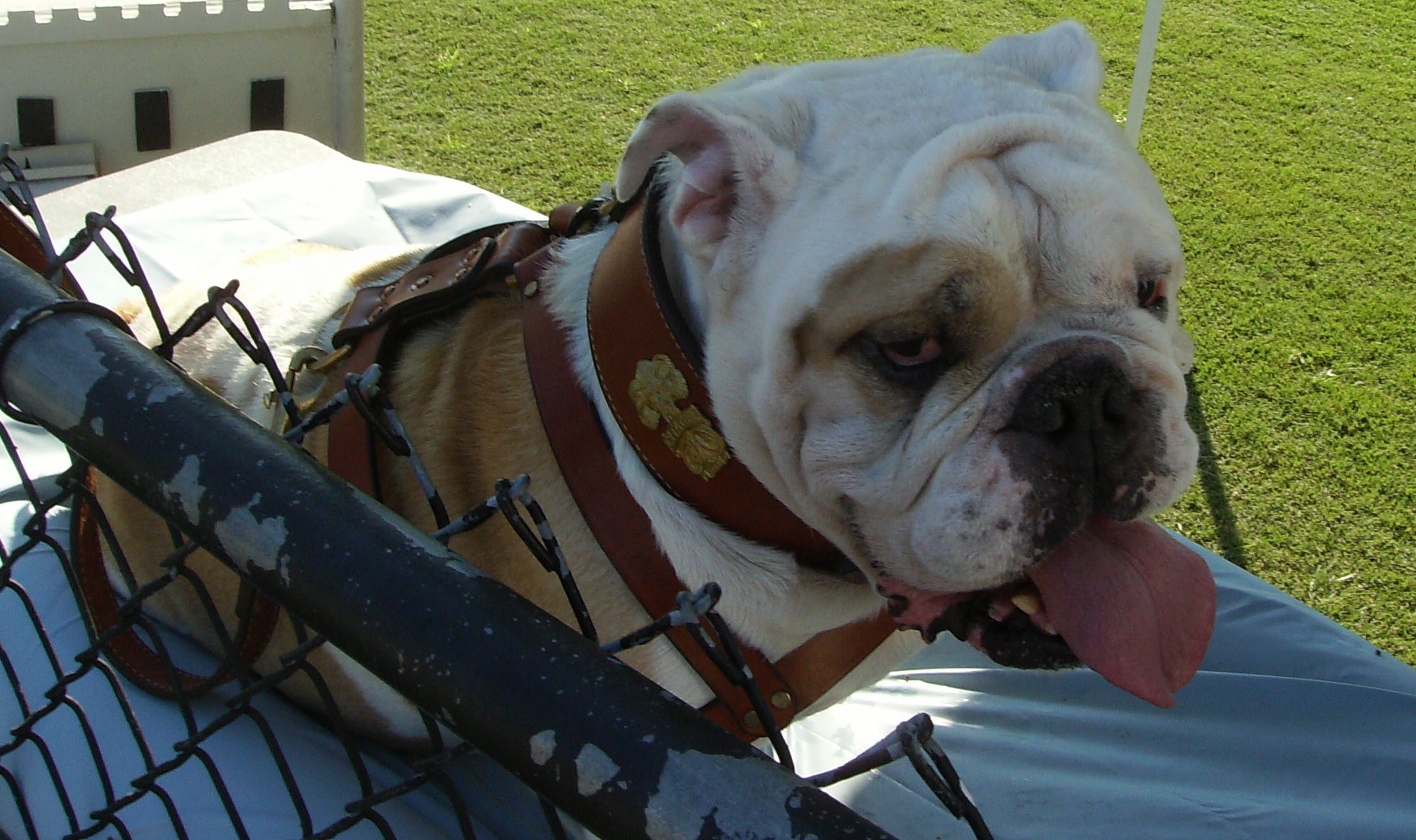
Speaking of mascots, I got a picture of General too, relaxing on a block of ice covered by a blanket.  General is a very cool dog (quite literally on Saturday, despite the late-afternoon heat).  He and his buddy Boo made a lot of new friends, including quite a few Cub Scouts.  I also appreciated Boo’s handler moving the SoCon trophy around so I could get a half-decent shot of it.  Many thanks.

2011 Football, Game 2: The Citadel vs. Furman

The Citadel vs. Furman, to be played at historic Johnson Hagood Stadium, with kickoff at 6:00 pm ET on Saturday, September 10.  The game will be televised on WYMA (Asheville, NC), and will be available on ESPN3.com.  There will also be a webcast on Bulldog Insider (subscription service), and the game can be heard on radio via The Citadel Sports Network, with new “Voice of the Bulldogs” Danny Reed calling the action.

The Citadel begins play in the Southern Conference with a game against traditional rival Furman.  It’s only the third time the two schools have ever met in a league opener, but it’s the second consecutive season that has been the case.

I’m not going to rehash the history of the series in terms of the time of year the game has been held; anyone interested can read what I wrote on the subject for last year’s game preview.  Regardless of whether you think the game should be a midseason clash (my preference) or played at the end of the year (a not-insignificant number of fans from both schools), I think everyone can agree that September 10 is too early for this game to be played.

Jeff Hartsell has reported that, per the SoCon office, next year’s meeting will come at the end of the 2012 season, on November 17.  (The conference does not make league schedules beyond one year in advance.)

I’m okay with that, as long as the Clemson-South Carolina game continues to be played the Saturday after Thanksgiving, as is now the case.  I just don’t want The Citadel and Furman to play on the same day as the matchup between the Tigers and Gamecocks.

Furman was 5-6 last season, its first losing campaign since 1998.  Bobby Lamb resigned after nine years in charge and over a quarter-century at the school as a player or coach.  The Paladins had missed the FCS playoffs for four consecutive seasons, which did not go over well among some supporters.  It was time for Furman to make a change.

The question, though, is did Furman really make a change?

The new coach is Bruce Fowler.  Fowler is a 1981 graduate of Furman who played for Dick Sheridan.  Lamb was a 1986 graduate of FU who had played for Sheridan. Fowler spent 18 years at Furman as an assistant coach.  Lamb had been an assistant coach at Furman for 16 seasons.

One difference is that Fowler wasn’t a complete Furman lifer like Lamb had been.  For the past nine years, he had been an assistant at Vanderbilt, where he was defensive coordinator for Bobby Johnson (and Robbie Caldwell in 2010).  Of course, Johnson had been the head coach at Furman before taking the Vandy job, and before that he had been an assistant under Dick Sheridan.

You may have noticed a pattern here.  Dick Sheridan left Furman after the 1985 season to take over at N.C. State, but his presence is still felt in the program.  All four of the men who have held the head coaching position since Sheridan left (including Fowler) were players and/or assistants under him.

If you were going to have your football program maintain what is in effect a 25-year tie to a former coach, you could do much worse than Sheridan, who did nothing but win throughout his coaching career (even as a 28-year-old rookie head coach at an Orangeburg high school).  It’s a type of continuity that may be worth preserving.

On the other hand, there is always the possibility that Furman risks going to the well once too often.  Fowler isn’t exactly a carbon copy of Lamb, though — for one thing, he’s 52 years old, 13 years older than Lamb was when Lamb got the job.  Also, he’s primarily a defensive coach (though he was the receivers coach at FU for seven seasons).  Lamb was mostly an offensive coach (and a former quarterback) during his time with the Paladins.

Usually when a school is in a position to make a coaching change after a run of disappointing seasons, it brings in somebody to shake things up.  That’s certainly not what Furman has done.  Besides Fowler, three of the assistant coaches played for Sheridan; another has been a Paladins assistant for 13 years.

Before I move on to the Paladins of 2011, I should note that Art Baker, who preceded Sheridan as head coach at Furman (eventually leaving to take the job at The Citadel), hired Sheridan, Jimmy Satterfield, and Bobby Johnson as assistant coaches, all of whom would later ascend to the top job at FU.  Baker had a significant impact on Furman’s coaching tree.

Furman lost 30-23 at Coastal Carolina in its opener.  The Paladins never led the contest.  The game had been tied at 16 and 23 before the Chanticleers scored the game-winning touchdown with 1:23 remaining in the fourth quarter.

Coastal Carolina gained 231 yards rushing and 195 yards passing against the Furman defense, but perhaps more interesting was that the Chanticleers had 59 rushing attempts for the game.  CCU ran 81 offensive plays from scrimmage for the game, while the Paladins had just 58.

As Bruce Fowler noted in the SoCon teleconference, Furman had trouble getting its defense off the field.  Coastal was 7-16 on 3rd-down conversion attempts and made its only 4th-down try, a major reason the Paladins trailed by over 12 minutes in time of possession.  That continued a trend from last season, when Furman finished last in the SoCon in time of possession.

The Paladins do have two impact players on defense, middle linebacker Kadarron Anderson and cornerback Ryan Steed, both of whom are on the Buck Buchanan Watch List.  Another linebacker, Chris Wiley, had fourteen tackles against Coastal Carolina.  Furman defensive end Josh Lynn is tall (6’5″) and rangy, and may be a key factor in how the Bulldogs’ triple action attack fares on Saturday.  Against Coastal, he had five tackles and a sack.

Furman’s starting quarterback against Coastal Carolina was Chris Forcier, of the Forcier Family of Quarterbacks.  I think it’s fair to say that the Forciers are, as a group, somewhat controversial.  I guess it’s a question of style.  When Chris Forcier decided to transfer from UCLA to Furman, the family issued a press release that wound up being posted on Deadspin.

His brother Tate is a former Michigan quarterback who has now transferred to San Jose State (after originally announcing he was going to Miami).  His oldest brother, Jason, also played quarterback at Michigan before transferring to Stanford.  The brothers also transferred to different high schools at various times.

Against the Chants, Forcier was solid, completing two-thirds of his passes while averaging over seven yards per attempt.  A classic “dual threat” quarterback, Forcier also rushed for 50 yards before leaving the game in the third quarter, apparently suffering from cramps.  Without him, the Furman offense sputtered, not scoring in the fourth quarter.

Assuming he is healthy (and there is no reason to believe otherwise), stopping Forcier will be a difficult task for The Citadel’s defense.

If dealing with Forcier wasn’t enough, the Bulldogs must also contend with Jerodis Williams, who rushed for 142 yards and 3 touchdowns against Coastal (including a 68-yard score).  Williams was the Southern Conference offensive player of the week, and also picked up FCS National Back of the Week honors from something called the “College Football Performance Awards“.

Furman had five different receivers catch passes against the Chanticleers (including Williams).  Tyler Maples had five receptions for 65 yards.  Colin Anderson had four catches, and presumably will have a career day against The Citadel, as has often been the case for Furman tight ends.

Along the offensive line, Furman has experienced and well-regarded tackles (one of whom, Ryan Lee, is moving from guard to tackle) and a veteran center, Daniel Spisak (who is Matt Millen’s nephew).  The guards include a first-year starter who came to Furman as a walk-on, and a sophomore who started three times last season before a season-ending foot injury.

Furman placekicker Ray Early was 11-12 on field goal attempts last season, including a long of 52 yards, and only missed one extra point all year (40-41).  Against Coastal Carolina, however, Early’s first field goal attempt of the season was blocked, and he then missed the PAT after the Paladins’ first touchdown.

After that, Early did not attempt a placekick in the game (although he did kick off), giving way to Furman punter Chas Short.  That may be something to watch on Saturday.

Short, incidentally, had a fine year for Furman in 2010.  The Paladins finished in the top 10 nationally in net punting.

With Furman having allowed a bunch of rushing yards to Coastal Carolina, and having lost the time of possession battle so decisively, there may be some hope among Bulldog fans that the Paladins’ defensive issues could play into The Citadel’s hands on Saturday.  As Jeff Hartsell wrote in The Post and Courier:

…on defense, the Paladins’ 4-3 look was blitzed for 237 rushing yards, including 105 yards and two TDs by CCU quarterbacks Aramis Hillary and Jamie Childers. That might bode well for the Bulldogs’ option attack, as QB Ben Dupree went for 141 yards and two scores in a 31-9 win over Jacksonville. Higgins said Dupree was 23 for 23 on his option reads, and The Citadel rushed for 439 yards, the most since 1994.

That does seem promising from The Citadel’s perspective.  I would make this observation, though:

The Bulldogs ran the ball well on Furman last year, dominated time of possession, and lost 31-14.  The Citadel gained 294 net yards rushing on 60 attempts, held the ball for over 36 minutes — and did not score until the fourth quarter.

Actually, The Citadel’s 359 total yards against Furman in 2010 was the most yardage gained by the Bulldogs in any Southern Conference game for the entire season.  The problem?  Three turnovers, a missed field goal, and a failed fourth-down try inside the Furman 25.  Another issue was that The Citadel started very slowly on offense, gaining only 64 total yards on its first five possessions.

Conversely, Furman got out of the blocks fast on offense in each half, scoring touchdowns on its initial drive in both the first and third quarters.  Of the Paladins’ other three scores against The Citadel, two came on drives starting in Bulldog territory after an interception and a failed onside kick.

Kevin Higgins has said in the past that sometimes it takes a triple option team a possession or two to figure out how the defense is playing.  That makes sense.  You could see it in last week’s game against Jacksonville, as the game was well into the second quarter until Triple O’Higgins got fully warmed up.

Against a SoCon opponent, though, it needs to warm up faster.  The Bulldogs can’t go an entire quarter with no offensive production, especially as running the offense generally means there are fewer possessions in the game.  Also, while obvious, The Citadel must control its fumbling problems, which cropped up against Jacksonville (albeit with only one coming on an exchange) and stay “on schedule”.

The other thing that can’t happen Saturday if The Citadel has any chance of winning is for the defense to concede relatively easy touchdown drives right out of the dressing room.  Last season, Furman’s TD drives in each half were for a total of 123 yards and featured only two third-down plays.

What the defense really needs is to force some turnovers.  Last year against Furman, the Bulldogs forced no turnovers and also did not record a sack.

The Bulldogs must also contain Forcier, who is capable of making big plays with his arm or his feet, and prevent Williams from breaking long runs, such as the one he had against Coastal Carolina.  (Also, the defense must watch the tight end.  He’ll be catching the ball over the middle for 15 yards before you know it.  Two or three times.)

I thought Ben Dupree played well against Jacksonville.  What he proved, beyond a shadow of a doubt, is that he has the ability to make big plays.  While the triple option is mostly about moving the chains, it’s important to have a breakaway aspect to the offense, and Dupree can provide that with his running ability.  He is still a work in progress as a passer.  If he continues to improve that part of his game, he will be a very dangerous weapon indeed.

Terrell Dallas’ injury against the Dolphins was not serious, thankfully, but it appears he may not play on Saturday.  That will be a loss, but Darien Robinson showed he is quite capable of handling the fullback position.

I thought the defense really came to play against Jacksonville.  Now it faces another challenge.  It won’t have the size and depth advantage against Furman that it had against the Dolphins.

Odds and ends:

— Check out the game notes to see all the different helmet logos The Citadel has had over the years (page 5).  There have been no fewer than 25 different designs since 1952 (and I think it’s likely there have been a few more that went unrecorded).

Those artist renderings/photos in the game notes came from the Helmet Archive, a good site if you want to peruse helmet histories of other teams as well.

— Has anyone else noticed that there are a lot of entities giving out “player of the week” awards these days?  It’s hard to figure out which ones to take seriously.  I can’t decide if the plethora of “recognition sites” is a boon or a curse for athletic media relations departments.

— The Summerall Guards are performing at halftime, but not at Johnson Hagood Stadium.  The Guards will be in Death Valley for the Wofford-Clemson game (it is Military Appreciation Day at Clemson).  It strikes me as a little odd that they would perform at another stadium on the same day as a home football game, but no big deal.

I’m looking forward to the game.  I am hopeful that the success of the home opener, along with Saturday’s opponent, results in a nice crowd at JHS.  As for the on-field action, I’m not quite sure what to expect.  I was pleasantly surprised by what I saw against Jacksonville.  I would like to be pleasantly surprised again.

Game Review, 2011: Jacksonville

The Citadel 31, Jacksonville 9.

I would have gladly taken a one-point victory (admittedly, that is almost always the case for me), so Saturday’s result was altogether a pleasant one, particularly if you don’t think about the first quarter too much (a stanza that Walt Nadzak referred to in the radio postgame show as “horrendous by any standard”.

First, some recaps from the press:

Jeff Hartsell’s article in The Post and Courier

Hartsell’s notes from the game

Florida Times-Union article (looks to just be the AP story)

The Citadel’s release

The Post and Courier‘s “photo gallery” of the game

That last link is worthwhile if only to check out The Citadel’s new football uniforms, which in my opinion are a vast improvement over those of recent years.  Of course, it wouldn’t be a surprise to see the team break out another set of unis for the game next week against Furman, so we’ll just see how things develop on the uniform front as the season progresses.

Last night’s football uniforms were more along the lines of a “back to basics” look, with no school name on the front (thus avoiding the whole “Citadel” vs. “The Citadel” issue) and no player names on the back of the jerseys (which was a mild surprise). Also absent: ‘TV numbers’ on the shoulder pads.

The infamous ‘side panels’ championed by Nike have been ditched, thankfully.  The weird striping on the pants remains, but it isn’t nearly as hideous without the aforementioned side panels on the jerseys.  The front of the jersey includes small logos for the SoCon and Nike, as well as a “C” on a navy-bordered neckline, which looks respectable.

The most noticeable uniform change was the new helmet logo.  Having a new helmet logo almost every year is one of The Citadel’s oldest traditions, dating back to 1861, when cadets firing on the Star of the West had to stop their assault midway through the action in order to change to a new cap badge.

The 2011 logo is a block “C”, with “navy digital camo” styling.  This picture of Brandon McCladdie in the above-linked photo gallery is a good look at it.  I’m on record as liking the block C as a helmet logo, although I prefer it to be white, but I can get used to the camo.  The only problem is that the chinstraps tend to make it harder to see at times, but I’m not sure there is much that can be done about that.

All in all, I was pleased with the uniforms, and I’m a tough grader.  Good job.

Before I get to the game itself, I want to note that the corps of cadets seemed to be mostly, if not completely, present and accounted for on Saturday night.  I have been concerned at times over the last couple of years that a significant percentage of cadets were not in the stands.  I realize that there are a lot of “duty” cadets, but still. However, on Saturday the cadet section seemed to be appropriately filled.  The corps did make its presence felt at times, and in general the noise level was good. Improvement is possible and necessary, though it was only the first game, so I’ll give the corps a solid “B”.

First, a negative. From Jeff Hartsell’s “notes” column:

[Terrell] Dallas, a senior who led the Bulldogs with 665 rushing yards last year, injured a knee on The Citadel’s first play from scrimmage. Coach Kevin Higgins said it appeared that Dallas injured his medial collateral ligament, but that more tests will be conducted [Sunday].

Losing Dallas for an extended period of time would be a tough break for the Bulldogs (and for Dallas, obviously).  We’ll have to wait and see.

I’ll examine some of the statistical information from the JU contest and try to determine what it means going forward in my preview of the Furman game later in the week.  Just some quick observations:

— Cass Couey had a solid game punting.  His first punt, in particular, was outstanding.  In general, the special teams were very hit or miss.  The Bulldogs had one missed field goal and one very poor coverage job on a kickoff (where Ryan Sellers made up for his missed FG with a touchdown-saving tackle).  Then there was the fumbled punt inside the 5 (that JU converted into a TD) and a near-disaster on another muffed punt (and what a game-changer that could have been; on the next play, Ben Dupree scored on a 58-yard TD run).

The Citadel appeared to tip two of Jacksonville’s punts and was credited with a block on a third, although from my vantage point I wasn’t sure that Domonic Jones really blocked the punt as much as it was simply lined right at him (with a “wormburner” trajectory).

— This was arguably the first game since the debut of Triple O’Higgins in which the offensive execution was good enough that all the options were readily available, so to speak.  Of the five Bulldog fumbles (two lost), only one was on an exchange.  There weren’t so many negative plays this time around, so The Citadel wasn’t constantly in third-and-forever mode and could keep things “on schedule”.

As the game progressed, the Bulldogs were able to key off JU’s defenders, eventually adjusting to what the Dolphins were doing, so after Dupree had burned JU on two long scoring plays, he was then able to pitch out when Jacksonville moved to stop him.  The relative effectiveness of the offense also allowed for things like the end-around play to Kevin Hardy.

I’m not going to pretend to be an expert on offensive line play, but even from the stands some things are easy to figure out, like the fact that Mike Sellers has tremendous potential.  How often is a team’s center considered an offensive weapon?

— I won’t go into great length about the defense, but it was very good for the entire game, as the numbers indicate.  The defensive line as a group was excellent, with Derek Douglas the standout, but the ‘backers and backs were on their game as well. Jacksonville had no big pass plays, and its running game was completely shut down. The only real negative was the lack of forced turnovers (just one).

— The Bulldogs only committed two penalties, continuing a trend from last season.  At The Citadel, the law is respected.

Part of the lack of forced turnovers for the Bulldog D can be credited to JU quarterback Josh McGregor (21-33, 208 passing yards, no interceptions), who I thought was impressive in defeat.  His team suffered from a lack of size and (to a lesser extent) speed, and also from an absence of depth.  Scanning the sidelines, I noticed that Jacksonville had dressed no more than 55 players (and that may be a generous estimate).  If you want to know the difference between scholarship and non-scholarship football, that is it in a nutshell right there.

It’s not going to be easy for Kerwin Bell to get his team to rebound from its loss on Saturday night.  JU had put a lot of eggs into a “playoffs-or-bust” basket, and if those eggs aren’t already broken, most of them are cracked.  To even draw playoff consideration, the Dolphins will have to win their remaining ten games, including Sunday’s game at Western Illinois, a 2010 playoff participant.  9-2 with a Pioneer League title (which would also include an OOC victory over Charleston Southern) would not be good enough.  10-1, quite honestly, probably wouldn’t be good enough unless A) Western Illinois has a good season, and/or B)  The Citadel has a good season.

I certainly hope option B comes to pass.  Will The Citadel have a good season? We’re about to find out.  Over the next seven weeks, the Bulldogs will play six games, all against Southern Conference competition, three at home (including next Saturday) and three on the road.

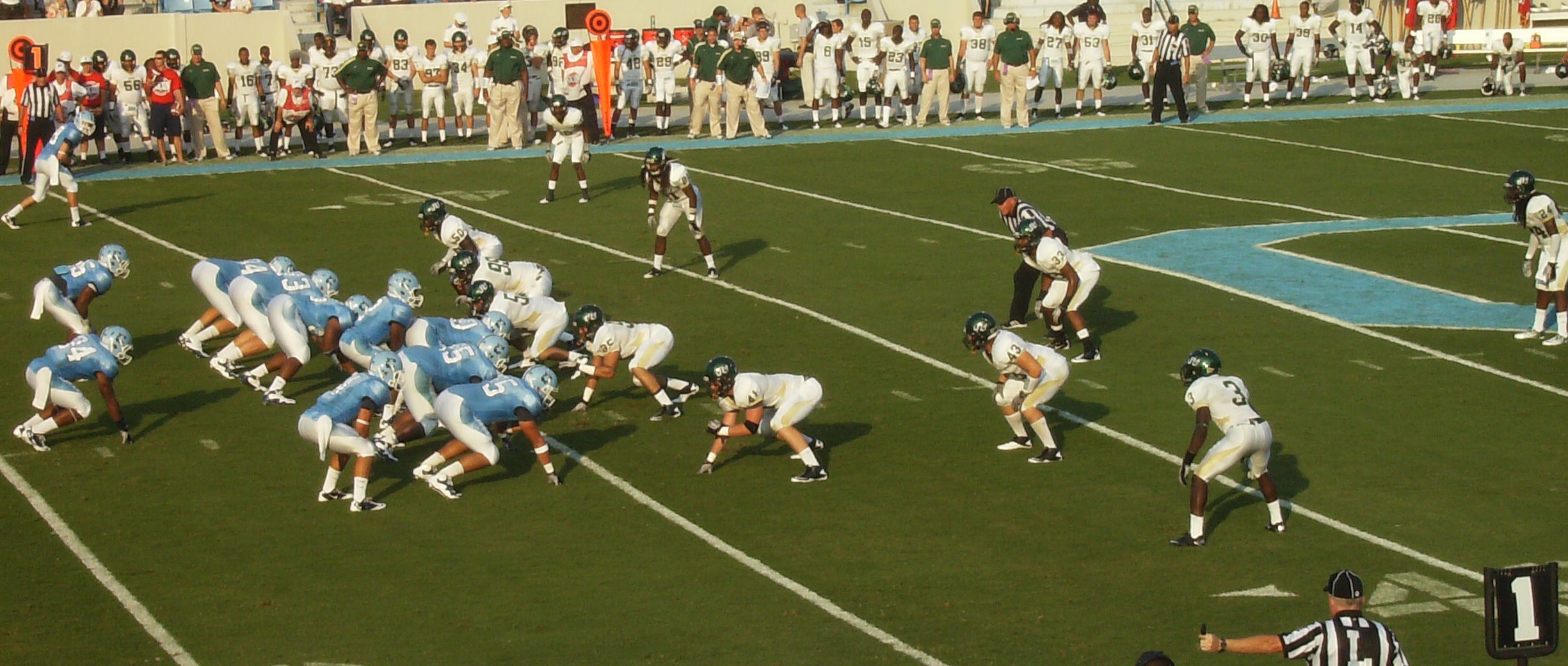
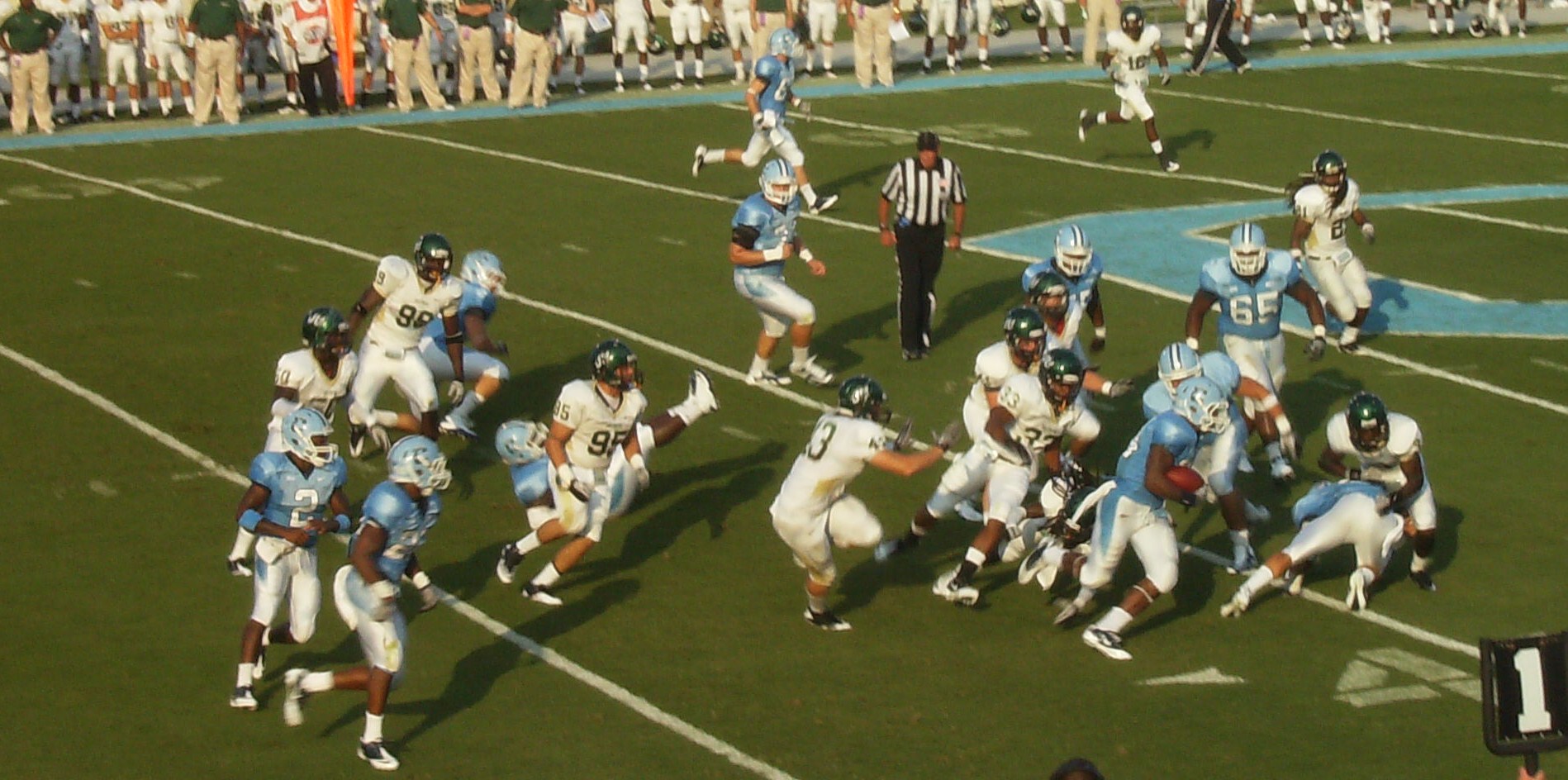
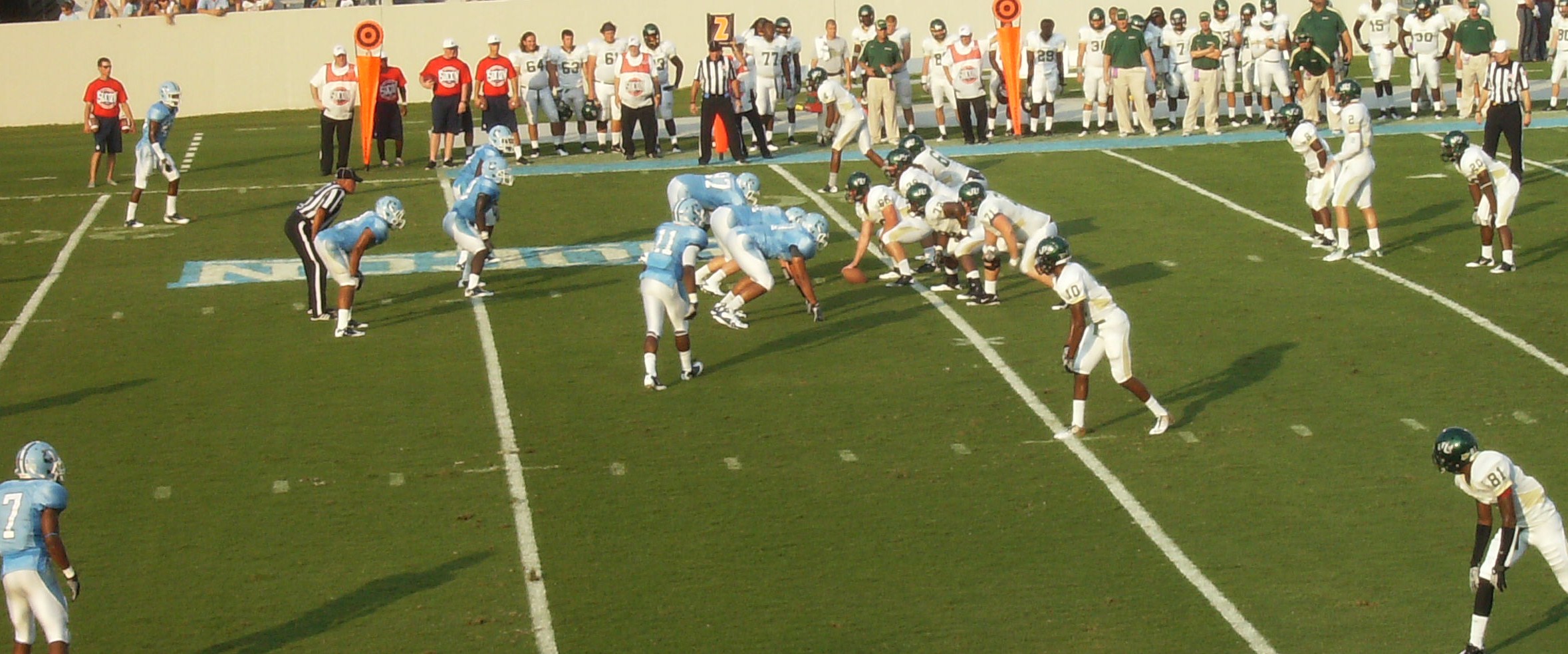
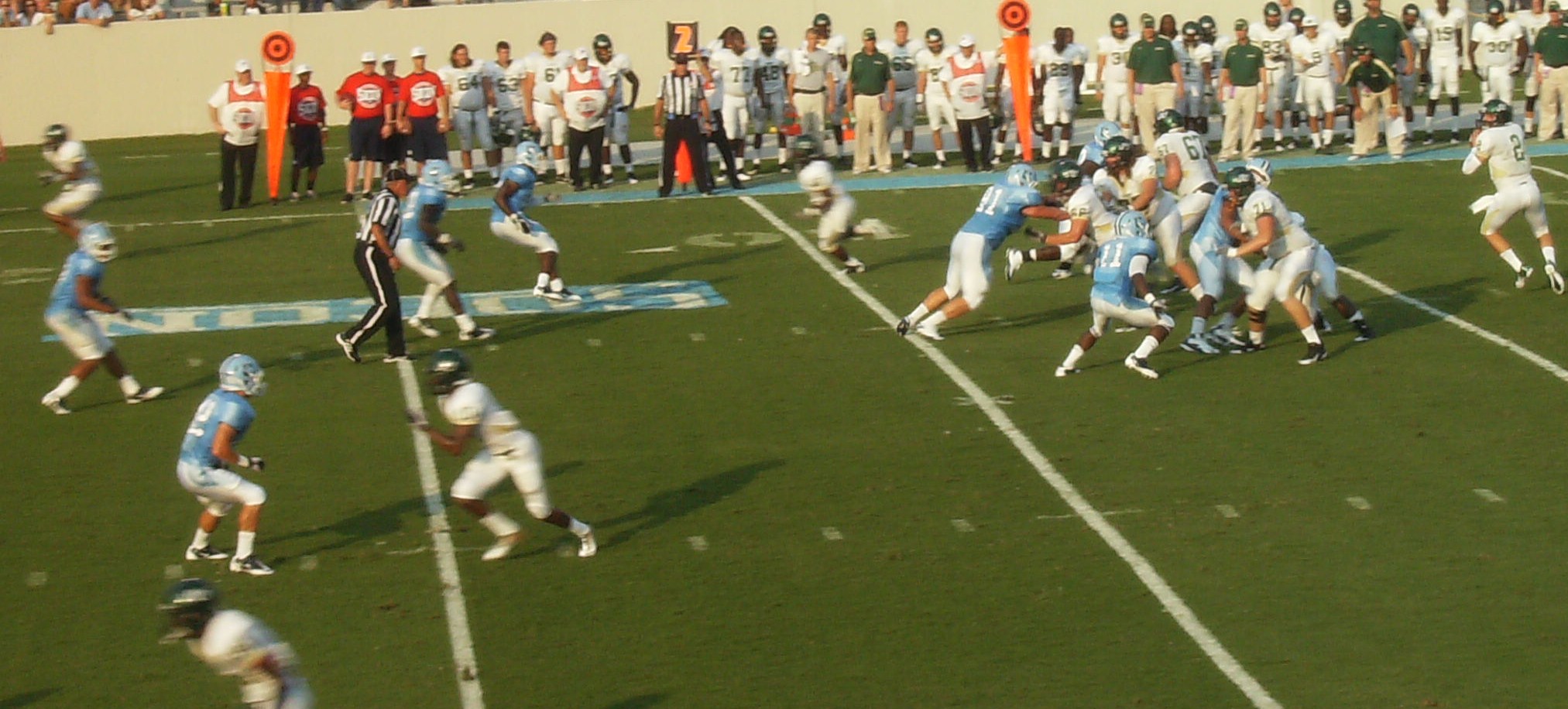
I’ll conclude this post with some pictures I took at the game.  Traditional reminder:  I’m a bad photographer with a below-average camera.  If you want to see good pictures, be sure to check out that Post and Courier gallery.  I do try to take pictures of offensive and defensive formations, because some people are interested in that (especially the triple option stuff).  I also threw in a couple of special teams photos and a shot of something called “Cosmic Dogs”, which is a new vendor under the stands.  It is, naturally, out of focus.

On to Furman…

2011 Football, Game 1: The Citadel vs. Jacksonville

The Citadel vs. Jacksonville, to be played at historic Johnson Hagood Stadium, with kickoff at 6:00 pm ET on Saturday, September 3.  The game will not be televised, although it will be webcast on Bulldog Insider (subscription service) and can be heard on radio via The Citadel Sports Network, with new “Voice of the Bulldogs” Danny Reed calling the action.

It’s that time of year! College football has arrived and not a moment too soon.  I’m tired of reading about the Summer of Ponzi and all the other scandals that have beset the sport in the off-season, and while I enjoy discussing realignment as much as anybody, the Texas A&M two-step with the SEC is starting to get old.  I’m ready to see some activity on the playing field.

This is an important season for The Citadel’s football program.  I wrote about the program’s status last November; nothing has happened since then to make me think that the 2011 campaign will be anything other than a defining one for Kevin Higgins and his coaching staff.  I’m far from the only person who thinks that success of some sort this season is paramount.   The intensity in the crowd at the recent open scrimmage was palpable.

One thing is certain:  if there ever were a year for the football team to “sneak up” on people, this is the one.  Southern Conference media members picked The Citadel to finish last.  Only one player (Tolu Akindele) made either the preseason all-conference first or second teams.  The SoCon coaches’ vote had The Citadel in next-to-last place, ahead of only Western Carolina; that’s the same verdict rendered by The Sports Network.

Last season, the Bulldogs played three non-conference games before beginning league play.  This year, though, The Citadel will play six of its first seven games against SoCon opposition.  The Bulldogs will have a good idea of where they stand before the fall harvest.

The only non-league game in that group of seven contests is the first one, and it is far from the “gimme game” that the home opener has been in recent years.  Instead of scheduling a glorified scrimmage against the likes of Webber International or Chowan, The Citadel is playing Jacksonville, which went 10-1 last season and shared the Pioneer League title (with Dayton).  The Dolphins, favored to win the PL again, will be a formidable challenge.

Jacksonville University is not to be confused with Jacksonville State University, which is located in Alabama and has a football team coached by Jack Crowe, the man who was on the wrong side of one of The Citadel’s more notable gridiron triumphs. Jacksonville University is located in Jacksonville, Florida, and its football team is coached by Kerwin Bell.  (More on him later.)

Jacksonville began in 1934 as a junior college named “William J. Porter University” after its founder; in 1958 it became a four-year school after merging with the Jacksonville School of Music.  As of today it’s a private, liberal-arts university with roughly 3,500 undergraduate students (60% of whom are women).

JU’s “Timeline” feature on its website includes a lot of concerts in the 1970s and early 1980s, perhaps an indication of the importance of the music school in relation to the rest of the university at that time.  Performers who made their way to Swisher Gym included Dionne Warwick, Neil Diamond, Duke Ellington, John Denver, and Billy Joel; K.C. and the Sunshine Band recorded a live album there.

Jacksonville awarded honorary doctorates to Bob Hope and Jack Benny on the same day in 1972.  Another same-day honorary doctorate duo for JU:  Charlton Heston and Ann Landers (who received hers less than a year after writing that Jacksonville U. was one of “the four top colleges in the nation”).

It’s also worth noting that Jacksonville University has the second-largest NROTC program in the country.

Jacksonville has twenty-one varsity sports.  Its nickname, the Dolphins, came to be in 1947 following a student contest (the original contest winner was “Green Dolphins”; another possibility had been the “Juggernauts”).  The official school mascot is an actual dolphin — 58-year-old Nellie, a Marineland mainstay.

The most famous of all JU athletes is, without a doubt, basketball Hall of Famer Artis Gilmore.  Second place on the school’s famous athlete list is probably occupied by Donnie Hammond.  (Like I said, there is no doubt about #1.)

Gilmore played two seasons at Jacksonville (he started his career at Gardner-Webb, then a junior college) and averaged more than 20 points and 20 rebounds per game, which I think can be best described as “awesome”.  In his junior season, he led the Dolphins to the NCAA title game.

Yes, you read that right.  Jacksonville played in the Final Four in 1970, just twelve years after becoming a four-year school.  We’re not talking Division II, either.  The high-scoring Dolphins beat Western Kentucky, Iowa, and No. 1 Kentucky to win the Mideast Regional.  Jacksonville averaged over 106 points per game in those three contests.

– Tangent #1:  What a weird Final Four that was.  There was nothing strange about UCLA being there (and the Bruins would beat Jacksonville in the final, 80-69), but the other three teams were Jacksonville, St. Bonaventure, and New Mexico State.  The Dolphins and the Bonnies were at the time the two smallest schools to ever make it that far, and they played each other in the semifinals.  Alas, it was a mismatch, as St. Bonaventure star Bob Lanier had injured his knee in the regional final and could not play in the Final Four.  Thus, the spectators at Cole Field House were denied the opportunity to watch two future Hall of Fame centers face each other.

After that season, Dolphins coach Joe Williams left JU and took the job at Furman.

– Tangent #2:  Artis Gilmore and his wife have been married for 39 years.  Her name is Enola Gay.  I thought that was worth mentioning.

Okay, it’s time to talk about JU football…

Jacksonville started its football program in 1998, winning its first-ever game 19-14 over Davidson.  The school’s media guide also lists Davidson as being the first ranked team (at No. 3!) the Dolphins ever played, in a 2001 contest won 45-3 by JU, but I have to seriously question that.  What poll would this have been?  Maybe it was a poll only including Southern Conference schools that don’t play scholarship football.

JU plays its home games at Milne Field, a 5,000-seat facility built specifically for the football program, which averaged 3,761 fans per game last season.  The Dolphins have won nine straight home games, but the real eye-popping numbers are from their road games — not necessarily the results on the field, but the travel involved. Jacksonville has six road games this year.  JU will bus to The Citadel for Saturday’s game.  Later in the year the Dolphins will also take the bus to Campbell, assuming the bus driver can find his way to Buies Creek.

However, the Dolphins will make four road trips by air, flying to the University of San Diego, Drake (which is in Iowa), Marist (New York), and Western Illinois (travelling to WIU on the day of the game).  That is a total of 5,575 miles in the air.

Having multiple long airplane flights is a consequence of playing in the Pioneer League, a non-scholarship FCS conference with ten members.  Jacksonville is the southernmost school in the league, which has three members in the southeast (JU, Davidson, Campbell), five in or around the midwest (Drake, Valparaiso, Dayton, Butler, Morehead State), one west coast entry (USD) and one northeastern school (Marist).

One reason for having such a far-flung league is that all of those schools choose to play football at the non-scholarship level while maintaining a NCAA Division I athletics program.  Since 1993, institutions have had to play football at the same level as their other sports, which affected schools like Dayton (a D-3 power in football during the 1980s) in particular.  There aren’t a lot of D-1 schools that offer non-scholarship football but provide schollies in other sports (which distinguishes these institutions from those in the Ivy League, for example).

Jacksonville is not likely to become a scholarship football program in the near future. That possibility was suggested to the president of the university, who responded:

[It] costs too much for us to do it right now. For us to move into scholarship football because of the rules for gender equity, we would not only have to be able to fund the scholarship program year in and year out, we would also have to fund a similar amount for women’s athletics.

And we simply can’t afford it right now. If we had some major donors that came forward and helped us, then something like that could be possible. It’s simply economics. We need a stadium, our stadium is quaint. We would need a stadium where the fan base would generate revenue.

The revenue we get right now is diminutive. With a stadium, you could start getting money back into the program. There are some positives to it, but it’s simply too expensive right now.

In 2013, two new football programs will join the Pioneer League — Stetson and Mercer.  That should help alleviate Jacksonville’s travel burden to a certain extent.

Kerwin Bell played his high school ball in the small town of Mayo, Florida, where he was known as “The Throwin’ Mayoan”.  Arriving at the University of Florida as a walk-on, in one year he managed to climb the ladder from eighth-string to starter.  In 1984, Bell and the Gators would win the SEC title, winning eight straight games to close out the season.  The SEC title was short-lived, however, as the conference rescinded it the following year due to UF being on probation.  In 1985 Florida would go 9-1-1 for a second straight season, and again was not awarded the league crown (and again could not go to a bowl game) because of NCAA violations.

Two years later Bell began his pro career, which featured multiple stops in the CFL (including a stint in the Canadian outpost of Sacramento), a tour of duty with the Orlando Thunder of the Arena Football League, and a two-year stay with the Indianapolis Colts.  Bell got into one game with the Colts, mopping up in a 1996 contest against the Philadelphia Eagles.  In that game, he threw five passes, completing all five for 75 yards and a touchdown (to Marvin Harrison).  Bell finished with a perfect 158.3 passer rating.  Contained within his Wikipedia entry is this astute observation:

[Kerwin Bell] has the highest career passer rating of any quarterback in NFL history, higher than current and future Hall of Fame members Joe Namath, Steve Young, Joe Montana, Warren Moon, Peyton Manning, Dan Marino and Brett Favre.

Bell’s coaching career actually started in 1990.  While recovering from an ACL injury he worked for one year as a graduate assistant coach for Steve Spurrier, who had taken over the Florida program.  His next coaching job came with the Toronto Argonauts in 2000, where he served as offensive coordinator (while still playing quarterback).

He then spent six years as head coach of a new football program at Trinity High School in Ocala, Florida.   He has been the head coach at JU for the last four seasons (with the upcoming campaign being his fifth).  Bell is 29-17 overall at Jacksonville, with records of 3-8, 9-4, 7-4, and 10-1. In two of the last three campaigns JU has won outright or shared the Pioneer League title, with the 2008 season documented by a “JUDolphins.com best seller”.

It seems reasonable to speculate about whether Bell is striving to follow a career path similar to that of Jim Harbaugh, who started his head coaching career at a Pioneer League school (San Diego) before moving up to Stanford, and who now is in charge of the NFL’s San Francisco 49ers.  Bell said last season that he is not “the kind of guy who needs to be on TV“, but if he continues his successful run at JU, he is likely going to get an opportunity to take a higher-profile job.

Bell’s staff at Jacksonville includes three assistant coaches who played in the NFL. Ernie Logan spent nine seasons in the league as a defensive lineman.  Not surprisingly, he is the Dolphins’ DL coach.

Ernie Mills was a wide receiver who also spent nine years in the NFL, mostly with Pittsburgh.  He caught eight TD passes in 1995, a year in which the Steelers advanced to the Super Bowl.

Jerry Crafts (aka “The Condo”) appeared in two Super Bowls for the Buffalo Bills, one of five NFL teams for which he played, along with three CFL teams, four AFL outfits, two WLAF franchises, and (inevitably) one XFL team (the Los Angeles Xtreme).  He also made an appearance on Howard Stern’s radio program.

Like Bell, Mills also played his college ball at Florida, with their careers in Gainesville overlapping slightly, along with that of Dolphins defensive coordinator Jerry Odom, the only coach the JU athletics website lists as being on Twitter.  He doesn’t appear to take full advantage of the service.

Staff meetings at JU must get confusing at times, what with two coaches named “Ernie”, two named “Jerry”, another named “Kerry” (running backs coach Kerry Webb), and a head coach called “Kerwin”.

The Dolphins have 100 players listed on their active roster.  All but six of them are from Florida.  A couple of notable names on the list who may or may not see action against The Citadel are freshman quarterback Kade Bell, son of the head coach, and freshman WR/TE Andrew Robustelli.  If Robustelli’s name sounds vaguely familiar, it’s because his grandfather was a Hall of Fame defensive end for the New York Giants in the 1950s.

Jacksonville runs a pro-style offense, and while the Dolphins like to pass, the offense is reasonably balanced.  Last season JU rushed 387 times while throwing 348 passes.  I would still describe it as a “pass-first” setup, mainly because I’m guessing a lot of the rushing attempts came at the end of blowouts.

Ah yes, blowouts.  The Dolphins had a lot of those in 2010, with an 86-7 demolition of poor Valparaiso being the biggest (check out that 38-point second quarter).  JU also pummeled Webber International (41-0), Marist (56-14), Davidson (42-15), and Morehead State (61-17).

As you can see, JU likes to put up crooked numbers.  The Dolphins lit up the scoreboard to the tune of 42.2 points per game, just one of several gaudy team offensive statistics.  Jacksonville averaged 486 yards of total offense per game (7.3 yards per play).  JU also averaged an outstanding 9.3 yards per pass attempt, with 35 of its 217 completed throws going for touchdowns (against only seven interceptions).

Leading that offense this year, as he has for the previous three, is 6’2″, 210-lb. senior quarterback Josh McGregor, who has more career passing yards than any returning QB in the nation (8,186).  He has thrown 87 touchdown passes in his 35-game run as the JU signal-caller.  McGregor threw for 300 yards or more seven times last season and is on the Payton Watch List.  A highlight package featuring some of McGregor’s 2010 exploits has been uploaded to YouTube.

His top target is senior wideout Josh Philpart, who has 29 career touchdown receptions.  Philpart averaged 16.7 yards per catch last year.  Another receiver, Larry Thompson, was only a half-step behind Philpart in most statistical categories, other than TDs.  Jacksonville likes to spread things around, as six different players caught at least 18 passes last season (including two running backs).

Incidentally, Philpart did not have a reception in the game last season against Appalachian State.  I’m guessing that the Dolphins will try to get him involved in the game early against The Citadel in order to avoid having him become a non-factor.

Jacksonville’s all-time rushing leader, Rudell Small, has graduated, but the Dolphins have a more than adequate replacement in J.J. Laster, who rushed for 830 yards last season in backup duty (8.5 yards per carry).  Laster rushed for 177 yards in the game against Marist.

JU lost both its starting left tackle and left guard off the offensive line.  Last year’s right tackle, Chad Cypher, is moving to left tackle to protect McGregor’s “blind side”; at 6’6″, 310 lbs., Cypher at least looks the part.  He has drawn some pre-season accolades.

Kevin Higgins briefly discussed Jacksonville’s offense with Jeff Hartsell after a weeknight practice:

They have a multiple offense, a little bit like we were the first couple of years. They will spread you out, the QB is a really smart player who can check at the line of scrimmage. They try to create space on the field, and the QB is experienced and one of the tops in I-AA. And the line is very experienced as well.

As for the Dolphins’ defense, Higgins stated he had no idea how Jacksonville would line up against The Citadel, as JU didn’t face an option team last season (the Dolphins normally feature a 4-3 scheme).

Jacksonville’s defensive line is relatively experienced.  It is also small.  Nose tackle Mike Mayoral weighs 210 pounds.  Defensive end Rolando Fines is a little bigger (245 lbs.) and is expected to lead the group.

As far as JU’s linebacking corps is concerned, Kerwin Bell is quoted in JU’s media guide as saying that “we’re sort of iffy there.”  Layne McCombs is a senior who would be Jacksonville’s top defensive player, except he has a knee problem (torn ACL from last season).  Whether he plays or not is apparently open to question.  The Dolphins are probably going to play some of their younger players in this unit and hope for the best.

Jacksonville is in better shape in the defensive secondary, with three starters returning and a decent amount of depth.  One concern for JU is that none of its DBs are particularly tall.

Jacksonville had an excellent punt return squad last season, averaging a sizzling 11.1 yards per return in 2010, but its top return man graduated.  Its kick return numbers were mediocre at best.  JU did a fairly good job holding down its opponents’ return yardage.

The Dolphins will have a new punter and a new placekicker this season, which could be problematic in a season opener.

The Citadel’s total offense numbers in the eight Southern Conference games in 2010 were as follows:  359, 304, 263, 197, 160, 143, 300, 203.  Those are listed in order of the games as they were played — in other words, the 359 total yards of offense came in the Bulldogs’ first league game (against Furman).  The offense continued to put up fewer yards of offense each week until “breaking through” with 300 yards against a less-than-stellar Elon defense, and then regressed back to 203 yards against a solid Samford D in the season’s final game (which The Citadel managed to win anyway).

On the bright side, the offense only committed one turnover in the final two games (combined), which was obviously a vast improvement from, say, the Georgia Southern debacle (nine turnovers).  The Citadel turned the ball over 32 times in all, which included 23 lost fumbles.  The Bulldogs actually had 44 total fumbles in eleven games, and also had an inordinate number of ball-possession miscues that did not quite result in fumbles but had the effect of ending a play before it really got started.

The lack of yardage can be directly tied to The Citadel’s ball-control woes.  Those issues must be fixed if the Bulldogs are to have a respectable 2011 campaign.  The offense’s ineptitude also had a negative impact on the defense, which had to defend a short field too many times.  Kevin Higgins admitted as much during his radio interview with Phil Kornblut on August 25 (Kornblut also talked to Tolu Akindele and Terrell Dallas).  The head coach didn’t mince words:

We really played, I think, much better defense than people give us credit for, and the reason is because our offense was so bad, the defense was on the field so much, that there was a lot of pressure on them…it was the first year with the option, the ball was on the ground…I remember going home at this time last year and going, ooh.

Fans going home after watching the Bulldogs offense struggle didn’t all say “ooh”…more like “ugh” (or perhaps something unprintable).

There is optimism among those following the team that the second year in the offense will result in significant improvement.  I sure wouldn’t mind winning four more games this season than last, like the Bulldogs did in 1987-88 running Charlie Taaffe‘s wishbone (going from 4-7 to 8-4).

There are also whispers about a special “edge” the Bulldogs now possess.  This edge is reportedly known in certain circles as The Candeto Factor.  It’s all hush-hush.

Sophomore Ben Dupree will be the starter at quarterback (and a team captain as well, which I thought was interesting), after beginning last season as the starter, moving to second string, then third string, making a cameo appearance as a running back, and then returning to the starting lineup as the quarterback for the final two games of the season.  If making the right reads, Dupree, who has shown signs of being an elusive runner, could be a big-play threat.  He is a bit on the small side and needs to improve his passing.

Dupree will be backed up by Matt Thompson and freshman Aaron Miller, who looked good (at least to me) in the Bulldogs’ last open scrimmage.  There is depth at running back, with at least four different players hoping to make an impact, including the Lazarus of the backfield, Rickey Anderson.  Terrell Dallas is the fullback, and he’s a good one.  Against Jacksonville’s smallish defensive line, he may be called upon to do some power running.  His understudy is Darien Robinson, who isn’t afraid to move a pile either.

Mike Sellers, thrown into the line of fire as the starting center as a freshman, is bigger and better.  That should be the case for the offensive line in general (including the imposing Neal Strange), although injured guard Jameson Bryant will not play in the opener.  Keith Carter moves from defense to offense to add athleticism to the o-line.  (I keep wanting to call him Kenny Carter.  Getting old is tough.)

While most triple option offenses don’t throw the ball too often, this isn’t any ordinary triple option offense — it’s the Triple O’Higgins!  Higgins told Kornblut that the ideal number of passes in the TO’H is 10-12 per game.

Several of those pass attempts will undoubtedly be thrown in the general direction of Domonic Jones, the Bulldogs’ leading receiver last season.  At 6’5″, he could prove to be a tough matchup for the short Jacksonville defensive backs.  Actually, he should prove to be a tough matchup for almost any defensive secondary he faces.  One of The Citadel’s other receivers, Luke Caldwell, may be the best passer on the team, if the Samford game last season and the recent scrimmage are any indication.

As mentioned above, the Bulldog D was solid in 2010 for the most part.  I think the only time I was really disappointed in the unit’s play was against Elon.  The defense had trouble getting off the field in that game, and also fared poorly in the “red zone”. Stopping opponents from scoring when inside the 20 should be a point of emphasis this year, as that is an area in which the Bulldogs need to do better (allowing a 64% TD rate last season).

Against Jacksonville, which converted on third down 49% of the time in 2010, it will be even more important to prevent long drives and turn the ball back over to the offense. To do that, The Citadel needs to improve incrementally in defensive statistical categories such as average per pass attempt (7.6 last year) and average per rush (4.3).

The Bulldogs also need to grab more than their fair share of turnovers.  The Citadel finished last in the Southern Conference in interceptions in 2010.  The squad needs to grab a few more and also force more fumbles.

To paraphrase Akindele in his interview with Phil Kornblut, the Bulldogs D needs its playmakers to make more big plays.  Akindele himself is one of those playmakers, having led the team in tackles last season.

He’s joined by a solid group of linemen and linebackers, including Derek Douglas, Chris Billingslea, and Rod Harland, who judging from the recent scrimmage has been ready to lace ’em up again since last season ended.  He was bringing the heat, as the kids say.  (They do say that, right?)

The defense as a whole has a lot of depth (a priority for the coaches), particularly on the line, but also in the secondary, making it easier to absorb the loss of Cortez Allen, now of the Pittsburgh Steelers.  The Bulldogs seem to be in solid shape at cornerback, which is a good thing, as Jacksonville’s group of talented receivers will provide a stern test.

Cass Couey returns for the third straight year as the Bulldogs’ dependable punter. The Citadel in general was okay in most phases of the return game.  Keith Gamble, besides starting at cornerback, is a threat to go the distance as a kick returner (he had an 87-yarder against Elon last year).  He averaged 25 yards per return in 2010.

Ryan Sellers will be the starting placekicker for The Citadel this season.  The kickoff specialist shared PK duties last year, making five of nine, including a 47-yarder against Chattanooga, the season long for a Bulldog kicker by eight yards.  As you would expect of a kicker, he wears a kicker’s number — #99.

The matchup between the Bulldogs and the Dolphins will be a big one for both teams, even though it is only the first game of the season.  In the long run, it may actually mean more to Jacksonville than it does to The Citadel, though.

JU missed out on a bid to the FCS playoffs by a narrow margin last season.  While the Dolphins were 10-1, the schedule strength just wasn’t there to justify Jacksonville receiving a berth in the postseason.  Jacksonville only played two scholarship programs, one of which (Old Dominion) had only re-started its football program the year before.  The other, of course, was Appalachian State, which throttled the Dolphins (not that there was any shame in that).

In fact, Jacksonville has only defeated three scholarship programs in its history — Old Dominion last season, Coastal Carolina (in the Chanticleers’ first season of football in 2003), and Savannah State (in 2008).  In 2011, the Dolphins will have three opportunities to beat scholarship programs, as JU will open the season against The Citadel, Western Illinois, and Charleston Southern (with the CSU game played at Milne Field).

To make its case for an at-large bid (the Pioneer League is not an automatic qualifying conference), Jacksonville needs to win at least two (if not all three) of those games.  Beating up Valparaiso and Marist isn’t going to be enough.  Moreover, if JU cannot beat a team picked to finish last in the SoCon, its case for a bid may completely dissolve.

For The Citadel, getting off to a good start this season is critically important.  The Bulldogs badly need to gain confidence in their offensive system and establish some momentum prior to a run of six consecutive Southern Conference games.  It’s also a home game, and the team must show its supporters that there is reason to believe in the upcoming campaign.

Fans gave the team some leeway last season as the new offense was installed.  It was understood that there would be trying times on occasion in 2010, although some of those times were more trying than anyone would have liked.  Now there has been a year for the coaches and players to get comfortable with the system.  There won’t be any more metaphorical mulligans handed out.

The Citadel has only had one winning season since 1997.  The game against Jacksonville could go a long way in determining whether that trend will continue, or if the Bulldogs can begin to dream of success — for this season, and for future seasons as well.

I’m looking forward to late Saturday afternoon at Johnson Hagood Stadium.

Chal Port and his legacy

Chal Port was the best coach I ever had, and his love of his boys poured out of him the way it always does with the best of the breed.

— Pat Conroy, Prologue, My Losing Season

We are not reloading; we are in a rebuilding process.  Our team is made up of reserves of past years and freshmen who will get the opportunity to play this year and hopefully be up to the challenge…Our baseball accomplishments measured by victories this year could be moderate.  From our players we need a dedication of purpose, firm self-discipline and tenacious determination.  Hard work and aggressive play must overcome our limitations.

We will be playing off the enthusiasm of youth, and that should result in some entertaining baseball.  We must judge this team on the basis of their performance, according to their individual abilities and improvement throughout the season.  We want to teach them not to beat themselves and to always play with a fighting spirit and essential mental toughness.

We need to stay out of the way of line drives and recover foul balls so that we can stay within our budget.

— Chal Port, from The Citadel’s 1990 Baseball Media Guide

That last line is one of Port’s more famous witticisms, mainly because it is one of the most publicized, as it got a lot of press after the 1990 team reached the College World Series.  It is quintessential Port, to be sure.

Port died Saturday in Charleston after a long illness.  He was 80 years old.  You can read and view stories and tributes to Port in many places, including Jeff Hartsell’s article in The Post and Courier, WCIV-TV, WCSC-TV, and this selection from the 2005 documentary DVD “Who’d a Thunk It?”.

Chal Port won 641 games and seven Southern Conference championships at The Citadel, but the opening paragraph on any story about his career at the military college always prominently includes that 1990 squad, and justifiably so.  At the time, longtime Clemson coach Bill Wilhelm said he didn’t know of “a lower-budget team to go to the College World Series,” and he wasn’t being patronizing in any way.

Port was the only fulltime coach on the staff; his two assistants were a part-timer (Tom Hatley) and a GA (Ken Creehan).  As for how many scholarships Port had available, I have heard different numbers, though all sources agree that he had far from the maximum 11.7 schollies.  He probably had half that amount at his disposal, at best.

Winning 46 games with a team that had such limited resources, including the wins over North Carolina State and East Carolina at the Atlantic Regional, becoming the only team to ever win two games against Miami at Mark Light Stadium in a regional, and then actually winning a game in Omaha…that was some kind of run.  Nothing like it had ever happened before, and it is hard to imagine it ever happening again.

Port guiding his Bulldogs to Omaha was a godsend for both the local and national media in 1990, as he gave scribes and TV commentators all the material they wanted and then some.  Just a sample:

— [From the Atlanta Journal-Constitution] “After his team beat perennial power Miami to reach the CWS, ESPN’s Tim Brando asked Port how it felt to win in the shadow of the building named for Ron Fraser, Miami’s coach.

‘No big deal,’ he said.  ‘I’ve got a building at The Citadel named after me.  It’s the Port-O-Let next to the dugout.'”

(After that comment, the AJC‘s Tom Whitfield wrote that “Chal Port of The Citadel has been named college coach of the year by The Sporting News…when it comes to down-home wisdom and one-liners, he’s the coach for the ages.”)

— Brando interviewed Port at the Atlantic Regional in Miami.  Also at that regional, a young Miami Herald sportswriter named Dan Le Batard documented an exchange with Port that went in part like this:

Le Batard: “…but Chal, your team…is an impressive 41-12 and…”

Port:  “Good scheduling, don’t you think?”

Le Batard:  “But Chal, pal, your team had a 26-game winning streak this year, the nation’s longest, and…”

Port:  “Aw, we don’t win a lot of baseball games but we do pretty good in wars.”

— Port also gave an interview to columnist William Rhoden of The New York Times:

“When we looked at the calendar last fall, our goal for June 1st was to make sure that the kids had turned in all their equipment.” …

… “‘Baseball has never been big at The Citadel,” he said. ”It’s a military school, and as a military school, football is the god, then basketball. When baseball has a good year, we’re third. When we have poor years, we drop down behind golf.”

For all of the success of this year’s team, Port realizes that The Citadel will never become a perennial baseball power.

”Most excellent baseball players are not interested in marching and wearing uniforms,” Port said.

Of course, one team and a bunch of jokes don’t really define the man.  His overall record is extremely impressive, but when put into context, the adjective “amazing” may be a more appropriate term than “impressive”.  This next section is something I wrote a couple of years ago as part of a study of the records of Port and Fred Jordan, with some minor editing.

Chal Port had to make numerous on-field adjustments during his tenure, including the change from wooden to aluminum bats, and the Southern Conference moving to divisional play (and then dropping the divisions), among other things.  Then there were the off-field adjustments, which included integration, and the fact that going to a military school wasn’t exactly the cool thing to do in the early-to-mid-1970s (not that it’s ever been the really cool thing to do).   Consider what the baseball program accomplished, especially when compared to The Citadel’s football and hoops programs of that decade:

From 1971-1979, the football team was coached by Red Parker, Bobby Ross, and Art Baker.  Ross in particular is known as having been an outstanding coach, with major success at multiple levels of the sport.  The football team had four winning seasons overall in those nine years, with no league titles and a conference mark of 26-29 (47.2%).  SoCon finishes:  3rd, 4th, 7th, 5th, 4th, 6th, 3rd, 5th, 3rd.

The basketball team was coached from 1971-79 by Dick Campbell, George Hill, and Les Robinson.  Robinson would later prove his worth as a coach with an outstanding rebuilding job at East Tennessee State, but during this period the hoops program had just two winning seasons, bookends on seven straight losing campaigns, and had an overall conference record of 43-69 (38.4%).  Conference finishes:  4th, 5th, 4th, 6th, 7th, 6th, 7th, 8th, 3rd.

Meanwhile, from 1971-1979 Port went 85-43 (66.4%) in conference play, with three championships, nine winning seasons overall, and eight winning seasons in the league (and the other was a .500 season).  His SoCon finishes during that time:  1st, 4th, 3rd, 4th, 1st, 3rd, 3rd, 3rd, 1st.  He finished in the upper half of the league all nine years.

He wasn’t done yet, either.  He had his best teams up to that time in 1982 and 1983, with the ’82 squad finishing 40-8.  At that point another power arose in the Southern Conference, as Western Carolina hired Jack Leggett to upgrade its already promising program.  The Catamounts would win five straight league titles, a stretch dovetailing almost exactly with a gradual decline in The Citadel’s fortunes on the diamond.

Port outlasted WCU’s run and (even more impressively) Hurricane Hugo, however, and orchestrated a season that won’t soon be forgotten, plus a very nice coda (the ’91 campaign).

The 1990 season was incredible, but don’t forget all those terrific teams he had in the 1970s and 1980s.  A few of those squads were just a break or two away from being DVD-worthy themselves (the 1982 team in particular).

Port is, without much doubt, the best coach The Citadel has ever had, in any sport.  He got it done off the field, too, as almost all of his players graduated.

The State of South Carolina has had more than its fair share of outstanding college baseball coaches over the years, but Chal Port was arguably better than any of them, given his resources.  I say that as someone who has a great deal of respect for the wonderful job Ray Tanner has done at South Carolina (not to mention Wilhelm, Bobby Richardson, etc.).

Port’s influence over the game continues today.  Numerous former players went on to become successful high school coaches in the state, preaching the gospel of Chal.

Some of his disciples moved on to the college ranks, including three current D-1 head coaches:  his successor at The Citadel, Fred Jordan; Tony Skole (ETSU);  and Dan McDonnell (who made a little history for himself by leading Louisville to Omaha a few years ago, joining the exclusive club of individuals to have played for and coached a CWS team).

Port’s influence can even be seen indirectly with players like Baltimore Orioles All-Star catcher Matt Wieters, whose father Richard was an outstanding pitcher-outfielder for Port in the 1970s.

Chal Port’s ability to develop and nurture leaders inside and outside the game is his real legacy, even more so than his renowned storytelling ability and his championship-winning baseball teams.

Condolences to his family and friends.

Two weeks until gameday for The Citadel: the scrimmage before the storm

I didn’t think I was going to be able to attend Saturday’s scrimmage at Willson Field, but sometimes the sun shines when you expect rain, and I am quite grateful for that. I am not going to claim to have any fantastic observations about what I saw.  That won’t stop me from typing, though…

I got to campus a little late, but that was okay.  Venturing into McAlister Field House, looking for one of the new football posters, I was almost immediately accosted by a gentleman who asked me if I wanted to eat something.  He pointed to a long table filled with hamburgers and hot dogs, and it suddenly occurred to me that I was hungry.

I was a bit dazed, to be honest, and probably looked like I was on drugs (not guilty!), but no matter.  I grabbed a burger and a cookie (which was very good) and wolfed them down.

Then I got one of the new posters (I took the glossy kind, as I didn’t need it autographed), a magnet schedule (nice), and a team roster (very handy) and made my way to the field.

Jeff Hartsell has a nice writeup on the scrimmage, with some unofficial stats (link). You can also read about it at citadelsports.com (link), which also has a lot of cool photos (link) of the scrimmage, along with the meet and greet that followed it.  (I took some pictures myself, but they are mostly awful, and even the decent ones aren’t nearly as good as the school’s offerings.)

Some quick thoughts:

— I really liked the setup for this event.  Good job all around by the department of athletics.  As always, quality cookies are an easy way to please the masses.

— There were several hundred people there, which was nice to see.  I think that if there had been many more spectators in attendance, though, the venue would have been a little too small, something for the administration to keep in mind if the team enjoys a successful season in 2011.

— The Class of 2015 (i.e. the “knobs”) surrounded the field to cheer on the players. Big fan of that move.

— Maybe for future scrimmages Spike (the cartoon mascot) could make an appearance, to entertain some of the kids.

— The officials working the scrimmage wore long black pants.  In August.  In Charleston.  Luckily for them, while it was kind of muggy it was just overcast enough to keep things from becoming truly oppressive.  I left Charleston before the inevitable thunderstorm (at least I assume it was inevitable).

— Aaron Miller, the freshman QB from Clover, had a big run and seemed to have a presence about him.  He’s a very interesting prospect; one of those guys who doesn’t seem super-fast but nobody seems able to catch him anyway.

— The best pass of the scrimmage was thrown by Luke Caldwell, who is a receiver.  It was a really nice pass, though.  Just like the Samford game last season, it went Caldwell-to-Rickey Anderson, who this time caught it in stride.  Anderson seems to be good at making those downfield catches, which can’t be said for every running back. Kevin Higgins will undoubtedly try to take advantage of that.

— There wasn’t an avalanche of turnovers, so unlike last year’s GSU game I won’t be having nightmares about fumbling for two weeks, but there are still some kinks to be worked out.

— The hitting was solid.  No over-the-top pops, although Rod Harland stood out for his enthusiasm in putting people on the ground.

— The placekicking wasn’t awful, but there is still work to do.

— I didn’t see Larry Leckonby, but I assume he was there.  If so, that would mean that every living person who has served as the director of athletics at The Citadel was at the scrimmage.  (Okay, so that’s just three guys.)  General Rosa was also there, resplendent in bermuda shorts.

One thing I found interesting was the undercurrent of intensity in the crowd watching the action.  The players acted with purpose and intent, but that is to be expected.  What struck me was you could also describe many of the spectators as watching with purpose and intent.

I live in a town where the local school’s squad has high expectations for the season to come, as preseason prognosticators have it contending for league and national honors.  Anticipation is mixed with some anxiety.  There is a lot riding on the upcoming campaign.

The Bulldogs are not expected to contend for league or national honors this year. However, in the crowd today you could feel anticipation and anxiety not unlike that present in the capital city, and for good reason.  There is a lot riding on The Citadel’s upcoming campaign, too.

Two weeks until Jacksonville comes to town.  Two long weeks.