No hoops until next year for The Citadel

Of course, next year isn’t that far off.  The Citadel’s next game is another non-conference battle, at home against Bethune-Cookman on January 3.

The Citadel lost to Michigan State by 14, and lost to South Carolina by 14.  However, the Bulldogs played a much better game against the Spartans than they did against the Gamecocks.  South Carolina managed to increase the tempo to a faster pace than The Citadel would have liked (although not quite as fast as the Gamecocks would have preferred).  The Citadel could not take advantage of the helter-skelter play to knock down more open three-point shots.  To win the game the Bulldogs had to make several more threes than USC, and a 7-6 made 3FG advantage was never going to be enough.  It didn’t help that South Carolina was unexpectedly good at shooting free throws (28-33).

The officiating favored the Gamecocks’ defensive style, which is basically a version of the “five guys press and foul, the refs can’t call ’em all” system famously run by Rick Pitino at Kentucky, only Pitino had multiple future NBA players with which to work.  The Citadel never seemed able to adjust to this (even after USC sleepwalked through the game’s opening five minutes).  I would have liked to have seen some of the Bulldogs get more aggressive (I did appreciate Cosmo Morabbi’s approach in this respect).  A poster on The  Citadel’s message board made what I thought was a good point; the Bulldogs needed to set some backcourt picks to “punish” the Gamecocks as they continued to harass the man bringing the ball up the court.

Still, it wasn’t a terrible effort by the Bulldogs, as opposed to the laughable “atmosphere” at Colonial Life Arena.  I wass amused to read that the reported attendance was 9493 (it was less than that by at least a third).  There wasn’t anything original about the Gamecocks’ pregame, from the intros (which featured a player introduced as a starter who actually didn’t start) to the band playing “Sweet Caroline” (this ongoing sports tribute to Neil Diamond must stop).  USC also cranks up Zombie Nation like every other school in North America.  It’s just so…tired.

There was nothing imaginative or innovative about any of it, the crowd was dead…that reminds me.  I honestly am not sure how many of the people at the game were rooting for either of the two schools, because I can’t believe that as much as 40% (or more) of the “crowd” was there for The Citadel, but that’s what it looked like with all the people who showed up wearing blue collared shirts.  Surely some of them were just Gamecock fans, but if you’re a Gamecock fan, shouldn’t you be wearing garnet and/or black?  It was really hard to get a read on the fan ratio because of this (along with all the empty seats).

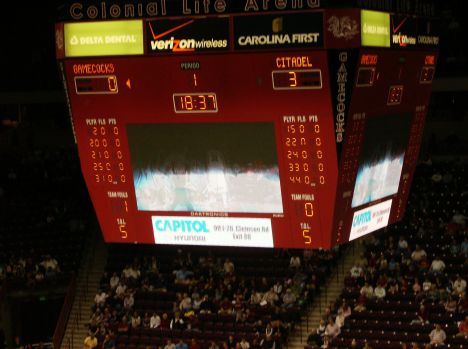
I took a picture of the scoreboard when The Citadel first took the lead, just for posterity.  I took it quickly, just in case South Carolina scored before I could snap it (as it turned out, I need not have worried).  Here it is:

0032

The Citadel plays South Carolina in hoops for the 100th time

First, I want to comment on The Citadel’s game against Michigan State.  I don’t believe in moral victories, but I do believe in moral non-embarrassments, and the Bulldogs did well in that category.  I am used to watching The Citadel get annihilated when facing a quality opponent , especially on those rare occasions when the game is on TV.  Watching the Bulldogs play a reasonably competitive game against a ranked team was somewhat disorienting.

Speaking of TV, the game against MSU was one of just three contests The Citadel will play this season that will be televised.  (The second of the three will come Saturday against the Gamecocks.)  That needs to change.  With all the games that are televised these days, I think it is critical that The Citadel gets its fair share of exposure.  Three games per season is not going to cut it.  Recruits, even those who are considering a military school, want to play TV games.  I think it would also foster more alumni interest in the program.  Plus, Vegas would get more action on our games.  Okay, maybe that last one isn’t as big a deal.

I would suggest to Ed Conroy (not that he needs my suggestions) that he do everything he can to get OOC games that will be on TV.  John Chaney did something like this years ago at Temple.  The Citadel is hindered a bit in its ability to schedule out of conference, though, by the Southern Conference’s 20-game league schedule, which is ludicrous for a league like the SoCon (16 would be a better number of conference games).

Conroy’s already off to a decent start by playing Big 10 teams.  What I like about playing the Big 10 schools is that if you play one, you will either play a game on national television (on the Big Ten Network) or play a Big 10 school at home (like Iowa earlier this season).  I think 2-for-1s (and even 3-for-1s in some situations) are well worth it if the games on the road are televised.

From what I gather, the SEC’s new mega-deal with ESPN is going to result in a huge increase in TV games for that league (including a lot of ESPNU matchups).  Hey, if playing Mississippi State or Georgia results in another TV game, I say start up the bus and tell the driver to head to Starkville or Athens.

Incidentally, have you ever noticed that a lot of SEC basketball arenas look kind of dark on TV?  It’s a strange phenomenon.  I guess the good lighting is reserved for the football practice fields.  Speaking of dimly lit buildings, that brings us to Saturday’s game against the Gamecocks…

Tomorrow the Gamecocks and Bulldogs will meet in basketball for the 100th time.  A scintillating series, it is not.  South Carolina has won 76 of the previous 99, but the greatest of the 99 meetings was without question the 1989 clash won by The Citadel.  It’s without question the greatest because this is my blog, and I say it is.  Besides, I was there, one of the 7,857 in attendance that February night.

Both teams entered the game with 15 victories on the season.  The Gamecocks were driving to a rare NCAA berth (which they got despite losing to the Bulldogs; South Carolina would lose in the first round of the NCAAs to North Carolina State).  South Carolina led throughout most of the first half and pushed the margin to 11 on a 25-foot three-pointer by Troy McKoy at the buzzer.

The Gamecocks seemed to have all the momentum, but that changed quickly in the second half as The Citadel gradually got back in the game.  The Bulldogs trailed 71-65 with 9:30 to go when they went on a 13-2 run to grab a five-point lead.  The Citadel led 82-78 with just over a minute to play when Patrick Elmore grabbed a rebound.  Two passes later, the ball was in the hands of Ryan Nesbit on the near baseline.  Nesbit (coach Randy Nesbit’s younger brother) was 3-for-4 from three-land already in the game, but the situation didn’t call for a three.  It called for holding on to the basketball.  Ryan Nesbit didn’t care; he was hot.  Up went the shot.  It was a classic “No No No Yes Yes Yes” moment, as he swished the three to give The Citadel a seven-point lead with 1:01 remaining.

The Citadel managed to overcome some nervous free throw shooting (missing the front end of two 1-and-1s) and outlasted the Gamecocks, 88-87 (South Carolina hit a three with one second left, but the Bulldogs successfully inbounded the basketball and the game ended).  South Carolina lost the game despite shooting 54% from the field, including a sizzling 9-11 from behind the arc, and a solid 74% from the foul line.  Terry Dozier scored 25 points on 10-13 shooting and Brent Price added 22.

However, the Gamecocks were outrebounded 34-31 and committed two more turnovers than the Bulldogs.  The Citadel shot almost as well from the field as USC did and made eight three-pointers of its own, and also had the edge in free throws, as South Carolina had to resort to fouling down the stretch.  Six different Bulldogs finished in double figures in scoring.  A seventh, James Stevens, added eight points, the last of which was a free throw that provided The Citadel with its 88th, clinching point.

That game would wind up being the last victory of Ed Conroy’s playing career.  If he is to beat South Carolina for his next victory as a head coach, his team will need to play even better than it did against Michigan State.  South Carolina is 7-1, although the one loss was to the College of Charleston.  As the game notes for South Carolina say (in a tone that could be construed as dismissive):

South Carolina holds a significant edge over The Citadel in nearly every statistical category. The Gamecock offense
averages nearly 20 more points per game than the Bulldogs, while also holding a dominating edge in rebounds
(+10.6), opponent turnover average (+9.1) and steals (+7.5).

Of course, the points-per-game number is a touch misleading, since The Citadel averages 12 fewer possessions per game, and one goal for the Bulldogs in this game will be to try to keep things at a slower pace.  The opponent turnover average is no joke, though.  South Carolina is second nationally in turnovers forced and in the top ten in turnover rate.  The Gamecocks’ FG% defense is an outstanding 37.7% and USC also does a good job on the boards.  On offense, South Carolina is a very good three-point shooting team (40%), although oddly it does not have a lot of assists on its made baskets.  South Carolina has had some issues with injuries and academics and may only be able to suit up nine players on Saturday.

To pull the upset, The Citadel must avoid the turnovers that have plagued previous Gamecock opponents.  Keeping the game at its preferred pace will be key to doing that.  The Bulldogs must defend well along the perimeter (Michigan State may not have been a great test in this respect).  If it can keep the game close, The Citadel has a chance, as South Carolina is not a particularly good foul shooting team.  It’s the one statistic in which the Bulldogs have a decided advantage.

I was there 20 years ago next February when the Bulldogs pulled off a stunner.  I would very much enjoy a repeat of that result.  I can’t think of a better Christmas present.  Just in case, though, I did some shopping today.

10 reasons why The Citadel will beat Michigan State

1.  The Citadel threw the UC Davis game just to make the Spartans overconfident.

I mean, let’s get serious here.  Do you really think the Bulldogs were trying to play defense in the first half?  UC Davis shot 78% from the field.  Most teams couldn’t do that if the other team didn’t show up.  UC Davis had an eFG of 69% for the game.  Clearly, The Citadel was just setting a trap for Michigan State.  Having the Spartans win their last game by 58 points (over Alcorn State) was just an added bonus.

2.  Drew Neitzel isn’t playing in this game.

Neitzel did play in the only meeting between the two schools, which came two years ago during the 10th of Neitzel’s 11 seasons in East Lansing.  Michigan State edged The Citadel 73-41 in a game marred by biased officiating, courtesy of Big 10-friendly refs.  There is no other logical way to explain how the Spartans won that game.

3.  The Citadel gives up fewer points per game than Michigan State and commits fewer turnovers per game as well.

These are true facts.  You can look them up.  The Citadel averages 61.1 possessions per game, the 15th-slowest pace in the country, but I don’t think that is particularly relevant.  Neither is the fact that Michigan State ranks in the top 40 nationally in possessions per game (at 74.9).

4.  The Citadel’s school colors are similar to those of North Carolina.

Speaking of the Tar Heels, you can’t tell me that the Spartans won’t be traumatized when a team wearing light blue and white saunters onto the court at the Breslin Center (even if the contest against the Heels was at Ford Field).  Did you watch that game?  Mercy.  You can bet that the players at Rhode Island and Columbia are upset they can’t get a shot at MSU.

You know, if you squint Demetrius Nelson looks a little like Ed Davis…

5.  Idong Ibok could start at center for the Spartans.

Ibok is a native of Lagos, Nigeria.  He’s 6’11”, 260.  According to MSU’s game notes, Ibok (a redshirt senior who has already graduated; he made the Academic All-Big 10 team last season) has started 17 games in his career.  So far this season, he has played in six games (one start) and scored two points.

That kind of starting history/stat line bears an eerie similarity to that of Augustine “Gus” Olalere, who played for The Citadel in the early 1990s and who was also from Lagos, Nigeria.  So, it looks like The Citadel was about 17 years ahead of Michigan State on the recruiting trail.  Advantage:  Bulldogs.

(Don’t forget about Love Ishie, too.)

6.  The Citadel has never lost a game that was televised by the Big Ten Network.  The Citadel has also never lost a game broadcast nationally in high-definition.  I’m quite sure Dave Revsine will mention these two facts repeatedly during the game.

Incidentally, Steve Smith (former Spartan) is going to be the analyst for this game, which reminds me that we have a serious Steve Smith problem in our country.  Not only is there the ex-Spartan hoopster Steve Smith, soon to be impressed with the greatness that is basketball at The Citadel, but on Sunday night the NFL game will feature not one but two teams with wide receivers named Steve Smith.

Then you have the Steve Smith who used to play for the Raiders and Penn State, and the Steve Smith who coached third base for the Phillies this past season (since canned), and the Steve Smith who played basketball for La Salle and for about an hour in the NBA, and a host of other sports-related Steve and Steven Smiths (not to mention ESPN screamer Stephen A. Smith and ASU fixer Stevin Smith).  Basically, we have too many Steve Smiths.  I call for a moratorium on naming your kid Steven or Stephen if your last name is Smith, especially if you are athletic and there is a risk he could inherit your genes.

7.  The Citadel is a better free-throw shooting team.

The Bulldogs are shooting a solid 72% from the line thus far, while the Spartans are a mediocre 65% from the charity stripe.  In a close game, advantage Bulldogs!

8.  Michigan State has a lot of guys afraid to shoot the ball.

You can tell this is the case just by looking at the assist statistics.  MSU ranks 7th nationally with 19 assists per game, a sign that players would rather have their teammates shoot than take the initiative themselves.  Against Alcorn State, the Spartans had a school-record 35 assists, evidence of a timid squad.

Conversely, The Citadel averages less than 10 assists per game, which is in the bottom 40 nationally.  Obviously the Bulldogs have a lot of aggressive players who aren’t afraid to take big shots.  As Bill Raftery would say, Onions!

9.  The Spartans don’t seem to have a lot of personality.

According to MSU’s game notes, senior guard Travis Walton “loves candy”.  The other factoid listed about Walton is that he’s the team’s strongest player, but c’mon.  He’s a senior, and the best tidbit they can come up with is that he “loves candy”?  Weak.  You can’t win unless your players have more personality, like Bulldog freshman guard Cosmo Morabbi.

10.  This has been a tough year for the State of Michigan.

Let’s face it.  If there is going to be a year in which The Citadel beats Michigan State in hoops, this is the one.  Talk about bad karma…

Longtime rivals UC Davis and The Citadel to play Monday night

Before writing a little bit about Monday night’s game, I just wanted to briefly comment on the results of The Citadel’s first two SoCon games.  First, it’s great to actually win a conference road game (or any road game, for that matter).  I also think it’s good that the team is probably a little disappointed it didn’t pull off the road sweep.  Expectations may be gradually increasing for this team.  This happens when in one year you go from a 30-point loss at UNC-Greensboro to a 7-point win in the same building.  Holding UNCG to 5-29 from beyond the arc was also a welcome development (struggling down the stretch from the foul line, not so much).

I will say this.  The SoCon owes The Citadel a couple of makeup calls against Elon in both football and basketball (actually, in football three or four makeup calls are in order).  I can’t say I was upset to see Elon choke away a potential FCS berth by losing to Liberty.  Elon should never have been in a position to get a bid in the first place, because it was given a win over The Citadel by hilariously inept Southern Conference officiating.  Just desserts and all that.

The hoopsters’ matchup at Elon featured a really convenient (for the Phoenix) shotclock reset situation at the end of the game.  Nice.  No telling what the umpiring will be like at Riley Park for the first SoCon series of the year.

Okay, on to the battle with the Aggies…

I’ve been trying to figure out how this matchup (the first ever between the two schools) came to be ever since the hoops schedule came out.  My best guess is that UCD was going to have to play Presbyterian in Clinton, S.C., anyway (in a return game from last season) and figured if it had to travel all the way to South Carolina, why not make it a two-game trip.  I don’t know if this means a journey to Davis is in the cards for The Citadel in the next couple of years.  If it is, I hope the team doesn’t spend too much time at the Robert Mondavi Institute for Wine and Food Science.

The institute is just part of a sprawling campus scene at UC Davis, which is one of those schools nobody on the east coast has ever heard of that just happens to have 30,000 students.  It’s part of the UC system, along with fellow Big West schools Irvine, Riverside, and Santa Barbara.  It’s located in Davis (surprise!), which is a city of about 60,000 near Sacramento.  Davis is a haven for bicyclists, and for toads.  Seriously.  From a Wikipedia entry (and remember, wiki is never wrong):

Davis’ Toad Tunnel is a wildlife crossing that was constructed in 1995…Because of the building of an overpass, animal lovers worried about toads being killed by cars commuting from South Davis to North Davis, since the toads hopped from one side of a dirt lot (which the overpass replaced) to the reservoir at the other end. After much controversy, a decision was made to build a toad tunnel, which runs beneath the Pole Line Road overpass which crosses Interstate 80. The project cost $14,000. The tunnel is 21 inches (53 cm) wide and 18 inches (46 cm) high.

The tunnel has created problems of its own. The toads originally refused to use the tunnel and so the tunnel was lit to encourage its use. The toads then died from the heat of the lamps inside the tunnel. Once through the tunnel, the toads also had to contend with birds who grew wise to the toad-producing hole in the ground. The exit to the toad tunnel has been decorated by the Post-Master to resemble a toad town.

The Wikipedia entry also refers to Davis as being “known as a strongly leftist-liberal town,” which after reading about the toad tunnel shouldn’t come as too much of a surprise.

UCD started off as a farm for UC Berkeley (basically, an extension service) and gradually morphed into a free-standing university, being officially established in 1959.  It’s still an agricultural school (hence the nickname “Aggies”) but has added several other academic disciplines.  In reading about UCD I noticed that it has an Army ROTC program, which is apparently the largest of its kind in the State of California.

UC Davis is in its sixth year as a Division I school after a successful run in NCAA Division II.  Last season the Aggies finished last in the Big West with a 1-14 record (9-22 overall).  UCD lost 13 of its last 14 games and completed the campaign sporting an RPI of 283.  Over the last three seasons the Aggies are 2-33 in road/neutral contests.  The Citadel can relate to those types of numbers.

This season, UCD is 3-6, with wins over Loyola-Marymount, Tulane, and Cal State-Bakersfield, and losses to UW-Milwaukee, Iowa State, South Alabama, Portland, Arkansas, and Sacramento State.  The Aggies are a really good free throw shooting team (81.8%, which is currently third nationally) and have a very nice assist/basket ratio (70%, also third nationally).  They have not been a strong defensive team, allowing opponents to shoot 47.5% from the field.

The Aggies average a little over 70 possessions per game.  It will be interesting to see which team controls the tempo, as The Citadel has averaged just over 60 possessions per game.  Few teams have collectively played their games at a slower pace than the Bulldogs.

UCD has three players averaging in double figures in scoring.  Joe Harden is a 6’8″ guard (!) averaging 15 points and 8 rebounds per game.  Dominic Calegari is a 6’10” forward who can shoot the three.  He’s 16-31 from beyond the arc so far this season (and a career 40% 3-point shooter).  Vince Oliver, a 6’3″ guard, is averaging 10.8 points per game.  Mark Payne is another tall guard (he’s 6’7″) who leads the team in assists, with 5.3 per game (he also boards at a 5.6 clip).  The Aggies employ a nine-man rotation.

I’m not sure what to make of UCD, a tall team that doesn’t rebound particularly well and has no shotblockers.  Defending the three could be a challenge for The Citadel, and the Bulldogs definitely don’t want to send the Aggies to the foul line.  If the Bulldogs can keep UCD from having a good night from beyond the arc, The Citadel can win this game.  The other factor to consider is the layoff.  Neither team has played a game in the past nine days.

SoCon hoops is upon us; hide the women and children

I long for a simpler time, when life’s problems were all solved in half-hour increments (allowing for an occasional one-hour special) and conference play in basketball didn’t start until January.  Those days are gone, however, and so it’s time for some SoCon hoops.  Last night Appalachian State kicked off the conference season by beating Furman.  There are two games tonight, College of Charleston-Elon and the game everyone in the nation is awaiting, The Citadel-UNC Greensboro.

This will be the seventeenth time these two non-rivals have faced off.  Sixteen of those appearances have come since UNCG attained Division I status in 1992.  The Citadel won the first four games of the series, but the Spartans have won 11 of the last 12, all of which have come since UNCG entered the Southern Conference (the Spartans began Division I existence in the Big South).  UNCG has had some good teams during that stretch, and The Citadel…has not.  The Citadel has only won at Fleming Gym in Greensboro one time, on its first visit in 1992, losing six straight at UNCG since then.  Overall the Spartans have beaten the Bulldogs eight straight times.

This season UNC-Greensboro must replace Kyle Hines, a 6’8″ bruiser who used The Citadel to enhance his All-Conference credentials, and it’s off to a tough start in doing so.  The Spartans are 1-3, with the one victory over non-Division I opponent Webber International.  UNCG has also lost non-competitive games at UNC Charlotte and North Carolina State, while also losing on the road to Central Arkansas (which beat The Citadel in Cancun last weekend, of course).

UNCG has some ugly offensive numbers so far this season.  It is shooting 39.7% from the field (44.8% eFG) and only 58.2% from the foul line.  Its turnover rate per possession is among the nation’s worst.  Its assist/turnover ratio is abysmal. 

Defensively, it is allowing opponents to shoot 2-pt. shots at a 56.9% clip, which is alarming.  Demetrius Nelson, take heed.  UNCG does appear to rebound the ball fairly well.  Again, with only three games played, warnings about small sample sizes need apply.

Individually, the Spartans are led by Mikko Koivisto, a 6’4″ guard from Finland averaging 15.8 points per game with solid stats across the board.  They employ a nine-man rotation (UNCG has only 10 scholarship players this season).  Ben Stywall, a 6’5″ forward, is the leading rebounder, pulling down 8 boards per game, but he’s not making shots, either from the field or the foul line (10-23 from the stripe). 

I don’t have a sense for how this game may turn out.  Considering how dominant UNCG has been in this series over the past decade, it would be hard to bet against them winning again tonight, but perhaps The Citadel can take advantage of some early-season struggles by the Spartans.  I like The Citadel’s recent trend of low-possession games, and I think that should continue (the Spartans’ games have mostly been played at an average tempo).  Offensively, the Bulldogs need to keep holding onto the ball, waiting for good shot opportunities, get some inside scoring, and take (and make) free throws.  Defensively, The Citadel needs to do a good job guarding the perimeter (especially against Koivisto) and hold its own on the boards.

Ballin’ in the Ballroom

The Citadel went 1-1 over the weekend in the Cancun Challenge, losing on Saturday to Central Arkansas 58-53, but then defeating Grambling State 55-41 on Sunday.  The Bulldogs are now 4-3 on the season, which is pretty good for The Citadel.  Of course, three years ago the Bulldogs started off 6-3, and then lost thirteen consecutive games…

The Citadel lost to UCA because, to put it mildly, the Bulldogs couldn’t shoot straight.  The offensive stats were brutal.  15 for 52 from the field (5-27 from beyond the arc).  18-31 from the line (4-11 in the first half), and that after having such a strong start to the season shooting free throws.  The Bulldogs only scored 19 points in the first half and never could quite catch up.  It’s hard to complete a comeback (The Citadel managed to get within two late, but UCA got it back to four almost immediately on a breakaway slam) when you’re down 10 at the break and there are only 56 possessions in the entire game.

The Citadel only committed three turnovers, and had a good rebounding effort (with lots of offensive boards; of course, you ought to get a lot of offensive rebounds when you miss that many shots).  The defensive stats weren’t great, although they weren’t terrible either.  The Citadel just couldn’t put the ball in the basket, from anywhere on the court.  Maybe the chandeliers distracted the players.

That’s right, chandeliers.  The tournament games were played in a second-floor ballroom with seats for 400 spectators (not that the place was full).  Neither of The Citadel’s games was televised, but I did watch part of another Cancun Challenge game, Drake-New Mexico, which on Sunday night was broadcast on CBS College Sports TV.  It was a rather unusual venue for a basketball game, although not quite at the level of claustrophobic hilarity that defined Deas Hall (the east coast “Thunderdome” is probably my favorite place to have witnessed college hoops, even if it was just a one-season wonder).  While watching the Drake-UNM matchup on TV, I felt strangely disappointed that there weren’t a bunch of different-colored painted lines snaking around and through the court.

The Citadel would rebound from the tough loss to Central Arkansas the next day, beating Grambling in a solid performance.  The game was close until late in the first half, when the Bulldogs went on a 14-3 run over the final 3:23 to take a 10-point lead into the break.  Grambling would not get within nine points for the remainder of the game.  Fans watching this game could have been justified in taking a nap during the second half once the Bulldogs had established their lead, considering the contest’s glacial pace (54 possessions for each team).  The Citadel had its best statistical performance of the season to date defensively, as the Tigers only shot 37% from the field, collected only two offensive rebounds, and turned the ball over 12 times.

Grambling had beaten Morehead State the night before by one point on a last-second tip-in; you have to wonder how much the Tigers had left in the tank for this game.  Of course, The Citadel had played a hard-fought game of its own on Saturday as well.

The Bulldogs got solid contributions from Zach Urbanus (15 points to lead all scorers) and Cameron Wells (the 6’1″ guard grabbed 14 of The Citadel’s 27 total rebounds, and added 10 points of his own).  The offensive efficiency wasn’t bad at all, although The Citadel only shot four free throws in the entire game.  The Bulldogs more than compensated for that by going 12-26 from 3-land, with Urbanus making five from long range and Austin Dahn adding three more.

The other interesting thing about this game from The Citadel’s perspective was that freshman Matt Roberts started instead of Demetrius Nelson.  Roberts only played eight minutes, though, while Nelson played 20, slighly under his average.  That might be something to watch, or it may have just been an experiment.  Maybe Nelson started gazing too intently at the chandeliers before the game started and got dizzy.

All in all, I think Ed Conroy and company are probably satisfied with what they got out of the Cancun Challenge — namely, a nice Thanksgiving weekend trip to a resort, and a chance to play two extra non-conference games, both of which were competitive (instead of one-sided affairs on the winning or losing side) before starting the conference season.  The Bulldogs start that conference season on Thursday night against UNC-Greensboro, the first of two road games in three days (The Citadel travels to Elon on Saturday).  The Bulldogs now have as many victories against Division I opposition as they did all of last season.  Now it’s time to see if this week they can match or exceed their number of conference wins from all of last year (one).

Cancun Challenge matchups (that are actually in Cancun!)

It’s time for the Cancun Challenge to reach its highly anticipated climax.  All the excitement moves to Mexico, where The Citadel will play two games in two days this weekend in pre-determined, non-televised matchups.  On Saturday the Bulldogs play Central Arkansas.  On Sunday, the opponent will be Grambling State.  The games will be played at the Moon Palace Resort in Cancun.  Incidentally, this tournament is run by Triple Crown Sports, the same outfit responsible for the women’s NIT (pre-season and post-season).

Central Arkansas is a school with an enrollment of about 13,000 students.  It’s located in Conway, a city with a population of around 55,000, about 25 miles north of Little Rock.  UCA was an NAIA school for many years, then moved to NCAA Division II, and four years ago began its transition to NCAA Division I.  It’s in year three of that transition, and has a year to go before becoming a full-fledged D-1 member.  Thus, it isn’t eligible for its conference tournament until next season.

That conference would be the Southland.  UCA just completed a football season in which it went 10-2, 7-1 in the league, but it wasn’t recognized as conference champion because the league feared it would lose its automatic bid to the FCS playoffs if its champion was ineligible to compete in the postseason.

There are two other facts about Central Arkansas worth mentioning.  One is that Scottie Pippen went to UCA, where he was a two-time NAIA All-American before winning six NBA titles with Michael Jordan and the Chicago Bulls.  Pippen actually started his career at UCA as a 6’1″ walk-on (with team manager responsibilities), but then he grew to 6’7″ and the rest is history.  The other thing you need to know about Central Arkansas is that while its men’s teams are called the Bears, the women’s teams are known as the Sugar Bears.

The Citadel and Central Arkansas have never met in hoops.  So far this season UCA is 2-2, with home wins over Bacone (an NAIA school in Muskogee, Oklahoma) and UNC-Greensboro, and road losses to Northwestern and Vanderbilt.  The loss to Northwestern was just horrendous (81-39).  On the other hand, beating UNCG should be more than enough to impress The Citadel, which was swept by the Spartans last season.

UCA returns three starters from last year’s 14-16 squad (which went 4-12 in the Southland) and adds a couple of key players to that mix.  6’6″ Mitch Reuter missed most of last season for the Bears with an injury.  He’s off to a nice start this season, as is Chris Brown, a 6’8″ transfer from Wichita State.  Other players of note for UCA include Marcus Pillow, a 6’0″ guard who leads the team in scoring and minutes played, and Mike Pouncy, a 6’1″ guard who exploded for 26 points against UNC-Greensboro.  Also part of the Bears eight-man regular rotation are a pair of centers, 6’9″, 260 lb. Brian Marks (leading the team in rebounding) and 6’8″ Landrell Brewer.

There is one player from South Carolina on UCA’s roster, the wonderfully named King Cannon, a 6’5″ forward and graduate of York High School who is averaging 13 minutes per game.  Not seeing much action but worth mentioning is 6’1″ sophomore guard Imad Qahwash, who went to high school in Canada but played this summer for the Jordanian national team.  That’s not Michael Jordan’s house team, by the way.

So far this year UCA has not shot the ball particularly well, a carryover from last season when the Bears were among the poorer shooting teams in the country.  Central Arkansas is currently shooting less than 40% from the field and less than 30% from beyond the arc.  UCA shoots only 65.3% from the foul line.  So far this season, UCA’s defensive FG% stats are rather hideous in four games (opponents are shooting better than 50% from the field), but that’s obviously a small sample size.  Last year the Bears were okay defensively.

After its game against The Citadel, the Bears will play on Sunday against South Dakota State.

Grambling State is famous for its football.  Basketball, not so much (although the school does have one famous hoops alum, Willis Reed).  Grambling has been in Division I since 1978 and has never qualified for the NCAA tournament.  Only eleven schools can claim a longer (continuous) drought without an initial tourney appearance.  One of those schools, of course, is The Citadel.  The game on Sunday will be the first between the Tigers and Bulldogs.

In the last 15 years, Grambling has only enjoyed two winning seasons (14-12 in 2005 and 16-12 in 1998).  The Tigers followed up that 1997-98 season with a six-win season and a three-win campaign.  Maybe even more disappointing for a Grambling fan is that over that same time period, only three times have the Tigers had a winning conference record.  Considering that the SWAC annually ranks near or at the bottom of conference RPI ratings, that doesn’t say much for GSU.  Last year Grambling finished with a 7-19 record and an RPI of 328.  In other words, when it comes to hoops, Grambling State and The Citadel are peers.

Grambling’s new coach is Rick Duckett, who has been around.  He’s a UNC grad who had successful stretches as a head coach at the Division II level, and was most recently an assistant to Dave Odom at South Carolina.  He’s probably a good get for the school, but he has his work cut out for him.  In three games so far this season Grambling has lost a close home game to Louisiana Tech and has been blown out in two road games against New Mexico (96-50) and Oklahoma State (91-60).  Duckett wants to employ an up-tempo style, but he may not have the players to do that yet (in the three games the Tigers are averaging a slightly-above-average 72.5 possessions).

Grambling lost three starters from last season and two other key contributors.  Duckett does have Andrew Prestley, a 6’5″ forward who in three games so far this season is putting up a 17-8 line, and JC transfer Ibrahim Kpaka, a 6’4″ guard who is averaging 13 points per game.  Grambling has very little size; the biggest player in its seven-man rotation is 6’7″, 240 lb. Jamal Breaux.  Breaux is the SWAC’s leading returning rebounder and came into this season averaging 52% from the field for his career, but in three games so far this season he is shooting 36% and only collecting 4.3 boards per game.  Grambling as a team is shooting just 33% from the field and an abysmal 55% from the foul line.  Conversely, its opponents are shooting 50% from the field (43% from 3-land).

The day before playing The Citadel, Grambling State takes on Morehead State, another winless team (0-5).

It will be interesting to see how the Bulldogs fare in neutral-site games against teams with at least similar talent levels.  Playing two games in two days will be a good warmup for the Southern Conference tournament (although assuming the Bulldogs might play more than one game in that tourney is always dangerous).  I will be disappointed if The Citadel doesn’t win at least one of these two games.  Central Arkansas is probably a slight favorite, but the Bulldogs likely would get the edge over Grambling.

It’s nice to be road warriors instead of road kill

On January 6, 2007, The Citadel won at Wofford, 74-71.  That was actually the Bulldogs’ second straight road win, having defeated Elon 53-50 three days before.  It would be the last time The Citadel won a road game…until last night.

The Bulldogs had lost 20 consecutive road games, but Tuesday night at the North Charleston Coliseum, The Citadel led throughout the entire second half and eventually outlasted Charleston Southern, 84-80.  The Bulldogs had a strong offensive showing, scoring those 84 points on 71 possessions, led by a superb game from Cameron Wells  (26 points, 11 rebounds, and only one turnover in 38 minutes).  The Citadel generally took good care of the basketball (with one area of exception – I’ll mention that later) and did a reasonable job of controlling the pace of the game. 

Shot selection was a major part of that, as the Bulldogs did not rely quite as heavily on the three-pointers as they have had a tendency to do (although the percentage of made threes was excellent).  The longer the offensive possession for the Bulldogs, the better off they were.  The Citadel also got to the foul line with regularity and converted those opportunities (84% FT).

Defensively, The Citadel did just enough to win, although there are still issues to address.  Down the stretch the Bulldogs committed a few silly fouls, allowing CSU to score points while the clock was stopped.  The three-point defense was actually pretty good.  With the way Jamarco Warren has been shooting so far this season, holding him to 4-9 shooting from beyond the arc isn’t that bad, and his teammates combined to go 3-11.  In general the Bucs didn’t shoot well, but almost made up for it with all those free throws (both teams did a great job shooting foul shots).    

The Citadel also struggled a bit with inbounding the basketball.  CSU put its 6’10” center, Billy Blackmon, on the baseline to guard the inbounds passer on made free throws and other dead-ball situations, and the Bulldogs seemed to have a hard time dealing with his size.  That’s something that is correctable, though, with instruction.  

I’ll say this (as I look around for a handy piece of balsa or oak):  it’s not a bad thing at all to root for a team that can actually make free throws, particularly down the stretch of a tight game.  I could get used to that.

Last year The Citadel beat Charleston Southern on November 26.  Its next (and final) win against a Division I opponent came on February 14, against Western Carolina.  Let’s hope that doesn’t happen again.  The Bulldogs’ next opportunity to win a game will be Saturday in the Cancun Challenge, with the game actually in Cancun this time.  The opponent is Central Arkansas.  No word on whether Scottie Pippen will be cheering on his old school.

Charleston Southern isn’t in Charleston

Not only is Charleston Southern not in Charleston, it’s not south of Charleston, either (unless you’re talking about the Charleston in West Virginia).  CSU is in Ladson, about 18 miles northwest of the Holy City.  Ladson is not exactly a suburb of Charleston.

That doesn’t prevent the school from emphasizing its connection to Charleston, however tenuous that connection may be.  The media guide, for example, has this fine example of glossing over the fact the school really isn’t in the city:

“the University is strategically located near Charleston, South Carolina, in the center of the modern growth patterns of the tri-county area. Students take advantage of the cultural, historical and recreational opportunities the city offers. Charleston is a city famous for its well-preserved colonial houses, famous gardens and plantations, miles of wide sandy beaches, and major fine arts events…”

CSU has been CSU since 1990.  The school was originally founded in 1964 as Baptist College, but as it got larger, the powers-that-be decided to change its name.  Part of this had to do with people confusing it for a seminary.  CSU (as Baptist) had been an NCAA Division I member for 15 years at the time of the switch, which occurred around the same time the College of Charleston became a full-fledged member of the division, leading to occasional confusion when the likes of ESPN or the AP reported scoring updates, as people mixed up the two schools regularly.  More than once a reference to “College of Charleston Southern” was made as well.  The national befuddlement has largely subsided now, however.

(I was a little amused to notice, though, that in CSU’s game notes there is a breakdown of the school’s alltime record under each of the school’s names.  The school recorded 285 wins as Baptist College, and has 207 so far as Charleston Southern.)

Charleston Southern (the school teams are nicknamed the Buccaneers, or the “Bucs”) has won the Big South tournament twice, but the first time the conference did not have an automatic bid to the NCAA tournament.  CSU did go to the tourney in 1997, when it won the league tournament for the second (and to date, last) time.  Charleston Southern lost to UCLA that year in the first round.  Probably the most well-known CSU hoopster, at least in the Lowcountry, is longtime Charleston TV personality Warren Peper, who played basketball at Baptist College in the 1970s.

Although The Citadel and Charleston Southern are less than twenty miles apart, the two schools have had stretches of not playing each other that have lasted for several years at a time.  There were no games between the Bulldogs and Bucs from 1987 through 1992, from 1999 through 2001, and again from 2003 through 2004.  Part of this has been due to personality conflicts between various individuals, and part of it has to do with CSU’s home court situation (there is a chicken-and-the-egg aspect to the conflicts/court issue).

Charleston Southern’s on-campus “arena” is the CSU Fieldhouse, which according to a Wikipedia entry (why is there a Wiki entry for the CSU Fieldhouse?) seats 790 fans, and is reportedly the smallest home gym in Division I.  Now, to be honest, I think it can seat more than 790 (the announced attendance for the Bucs’ home opener against Furman was 846), but it is a really small gym.  Thus, CSU plays select “home” games at the North Charleston Coliseum, which seats over 13,000 in its basketball configuration.

As you might imagine, the Bucs never draw close to that many people for any of their home games, no matter the opponent (Clemson played CSU at the Coliseum about a decade ago; the game drew less than 4,000 fans).  I once went to a game at the Coliseum between CSU and Furman that could not have had more than 200 spectators in attendance, and that was counting the operations staff.  Tonight’s game should be a little better than that, but I would be surprised if more than 2,500 people are at the game.

However, the Coliseum is a selling point for the Bucs when recruiting (“see, if you’re good we’ll fill this arena with thousands of screaming fans!”).  What CSU really needs is a place to play bigger than its current home gym but not as gargantuan as the North Charleston Coliseum.  An arena with around 5,000 seats would do the trick.

The Citadel leads (!) the alltime series with CSU 18-13.  The Bucs have won five of the last six games in the series, but the one loss came last year at McAlister Field House, 76-73.  That game was typical of The Citadel’s season (poor defensive statistics across the board, heavy reliance on the three, etc.) except that The Citadel shot 50% from behind the line (11-22) and attempted (and made) a lot more free throws than normal.  Those two elements contributed to one of the Bulldogs’ two wins last season against Division I competition (late in the season, The Citadel notched its only conference victory, over Western Carolina).

Zach Urbanus went 5-6 from three-land, scoring 21 points, and the Bulldogs also got good games from Cameron Wells (15 points, 7 assists) and Demetrius Nelson (12 points, 8 rebounds in one of his last games before taking a medical redshirt).  Phillip Pandak made three 3-pointers, finishing with 11 points.  For CSU, Jamarco Warren was a force, scoring a game-high 22 points while making six 3-pointers and dishing out 5 assists.  Omar Carter added 17 points.  All of those players return for Tuesday night’s game.

This season, CSU is 2-2, with losses at Iowa (by 68-48; The Citadel lost at home to the Hawkeyes 70-48) and to the College of Charleston (at the North Charleston Coliseum).  The Bucs have defeated Toccoa Falls (a non-Division I school) and Furman, both at home.  The game against the CofC was an up-and-down affair, while the Iowa and Furman games were slower-paced.  I think CSU would probably like to play a little faster against The Citadel than it did against the Hawkeyes and Paladins.  CSU takes care of the basketball and shoots fairly well from behind the arc (and was 8-12 from that distance against Toccoa Falls, so it comes into tonight’s game confident in that respect).  The Bucs are only shooting 46.7% from inside the 3-point line, though, thanks mainly to a poor night against Iowa.  CSU has not been particularly good defensively (especially inside).

Warren is averaging 23.5 points so far this season and is red-hot from outside (64.5% from 3-land).  Carter is averaging 16.8 points and 7.5 rebounds per contest.  Freshman Kelvin Martin is a 6’5″ forward pulling down 9 rebounds per game.  He’s also in double figures in points (11.5).  The Bucs also have a 6’10” center, Billy Blackmon, who is shooting 68% from the field while averaging 7.5 boards.

Charleston Southern has lost a combined 42 games the past two years and would like to reverse that trend.  Losing again to The Citadel would be a bad sign, especially considering the Bulldogs have yet to show sustained improvement on defense and (except for the game against Cincinnati Christian) have been much more turnover-prone than they were last season.  That’s not to say the Bulldogs aren’t better than they were last season.  It’s just that it may be later in the year before The Citadel starts demonstrating that overall improvement by winning games.

However, if Nelson and Wells have good games, which I think is quite possible, and at least one other Bulldog chips in offensively, The Citadel has a decent chance of making it two in a row over CSU.  For that chance to become reality, though, the Bulldogs must control the game’s pace (in part by avoiding turnovers), do a better job defending the three, and contain the Bucs (especially Martin) on the glass.  Easier said than done.

Seeing both sides of a mismatch on the same day

The bad side

Well, the football game went about as expected.  I was hoping that Florida wouldn’t get to 70, but The Citadel really didn’t make that much of an effort to shorten the game (in terms of play calling).  On the other hand, scoring three touchdowns was a pleasant surprise.  Unfortunately, the Bulldogs went 1-for-3 on extra points.  Kevin Higgins is going to have to do something about the placekicking before next season.

The placekicking was the only negative from the special teams, which were otherwise solid across the board yesterday.  The defense was completely overmatched, but the offense didn’t do all that badly.  While there were three turnovers, at least none of them were converted by Florida’s defense into touchdowns.  In that respect The Citadel fared much better than South Carolina did the previous week against Florida.  It’s also worth noting that due to injury, The Citadel actually inserted its backup quarterback, Cam Turner, into the game before Florida replaced Tim Tebow.

From the strange-but-true department (I guess I’m channeling Jayson Stark here):  South Carolina QBs Stephen Garcia and Chris Smelley both failed to throw a touchdown pass against the Gators.  The same was true for highly-touted Georgia QB Matthew Stafford.  Wide receiver and former walk-on Scott Flanagan of The Citadel, however, threw a TD pass against Florida on only one attempt.

Also, I would say that losing 70-19 is better than losing 56-6.  My reasoning is as follows:  Florida outscored South Carolina by more than an 9-1 ratio, but only outscored The Citadel by a little more than a 3.6-1 ratio.  Advantage, Bulldogs.

The good side

The basketball game also went about as expected, and this was a good thing.  The Citadel was never threatened by Cincinnati Christian and pulled away down the stretch for a convincing victory.  CCU had no answer for Cameron Wells, who had a good game not only on the stat sheet, but in terms of letting the game come to him.  Zach Urbanus had a strong first half and a solid overall game.  The Bulldogs did a good job in this game of getting to the foul line and converting.  Getting their fair share of free throw attempts has to be a priority for the Bulldogs, especially when shooting foul shots is one of The Citadel’s strengths.

Speaking of that, Phillip Pandak got into the game late, and was almost immediately fouled.  I was rooting for him to make both foul shots, and he did.  By doing so he equaled his number of made free throws from all of last season.  He only had four attempts at the line last year, which was amazing, because he attempted 101 field goals during the course of the season.  Now this year in two games he has one field goal attempt and two made free throws…

The Citadel took care of the ball in this game, a welcome change from the previous three games, and the pace of the game was in line with where the Bulldogs want to be.  The Citadel allowed CCU to grab a few more rebounds than I would have liked, and didn’t defend the three-point shot in the first half as well as it should have (the defense on the perimeter noticeably improved in the second half).

It was the second, and final, game of the season against a non-Division I opponent.  Now it’s time to try to win a game against a D-1 foe.  The Citadel’s first opportunity to do so will come on Tuesday night at the North Charleston Coliseum against Charleston Southern, one of two Division I teams the Bulldogs actually beat last season.