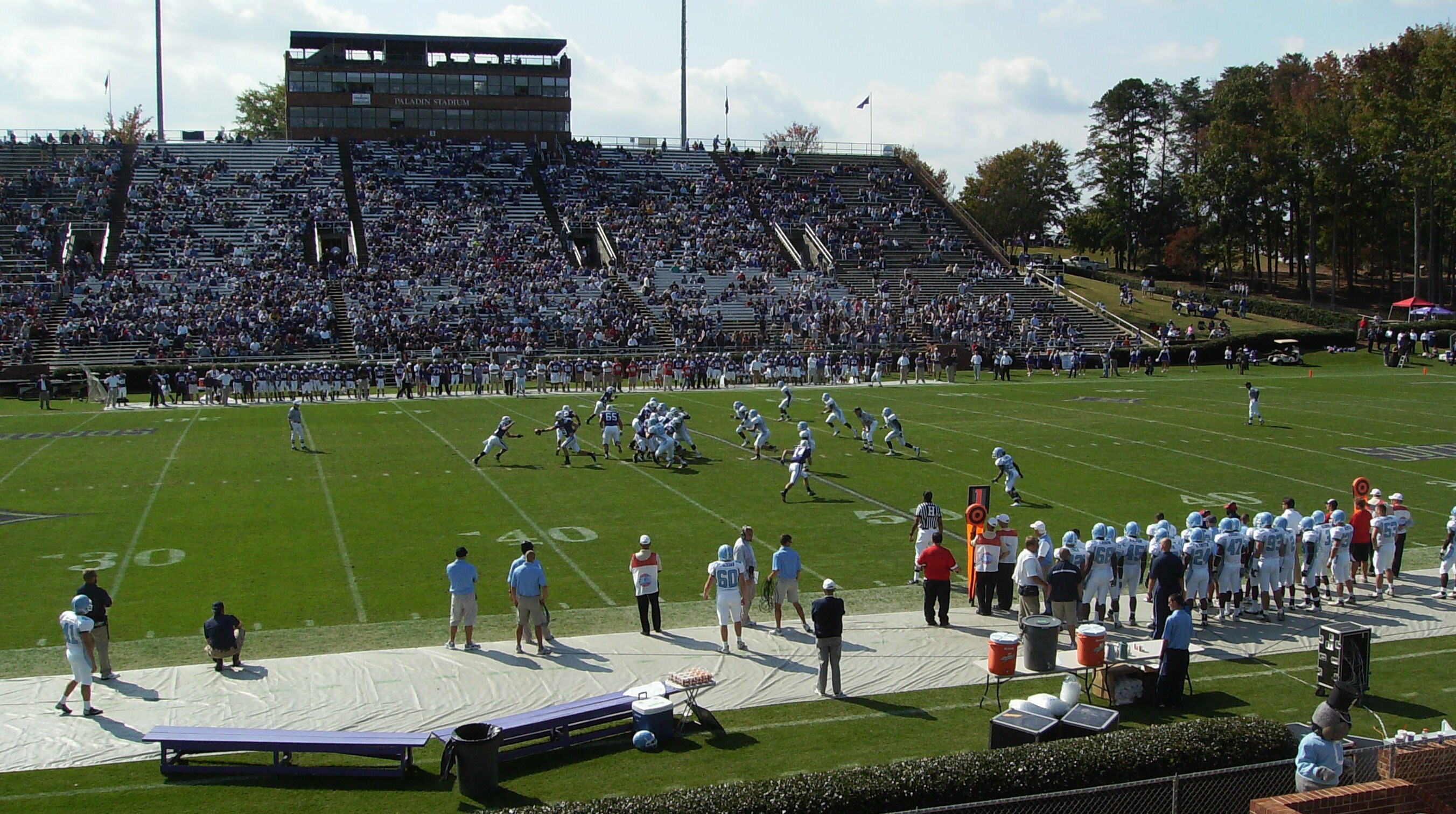
Wofford, for the sixty-first time

Well, after last week’s difficult loss, the Bulldogs get to travel to Spartanburg to take on the latest edition of Wofford football.  The Citadel has lost nine straight times to Wofford, which is not particularly surprising, since Wofford has been quite good for most of the past decade with one coach (Mike Ayers, who has been there for 21 years), while The Citadel has mostly struggled over the same time period with four different head coaches. 

It wasn’t always that way.  In fact, it usually hasn’t been that way.  The Citadel has a commanding 40-19-1 lead in the alltime series.  Many of the games have been played in Charleston, although Saturday’s game will be the fifteenth played in Spartanburg (The Citadel has won eight of the previous fourteen).  There have also been a fair amount of neutral site contests, including eight games played in Orangeburg (most of those occurred during the 1950s, with the games serving as sideshows for the Orangeburg County Fair).

One of the more notable games between Wofford and The Citadel occurred in 1987.  That was Charlie Taaffe’s first season as coach of the Bulldogs, and Wofford would be his first opponent.  The matchup was scheduled for Saturday, September 5th, but heavy rains in the days leading up to the game flooded the field at Johnson Hagood Stadium and resulted in the game being postponed until Sunday afternoon.  This made for a rather odd atmosphere (I don’t know of any other football game The Citadel has ever played on Sunday).  The conditions were still rather soggy, although the sun came out, and you had people in their Sunday best, along with people who looked like they had just rolled out of bed.  The Corps of Cadets marched over to the stadium wearing their duty uniforms, which was probably unprecedented. 

The Bulldogs won the toss and elected to receive.  On first down following the kickoff, Roger Witherspoon went up the middle for seven yards.  On the next play, Tom Frooman took the ball on a misdirection play and went to his left.  67 yards later, he was in the end zone, having not been touched.  The Citadel went on to win the game, 38-0, an auspicious debut for Taaffe’s wishbone offense.  Having an offense geared almost exclusively to the run was a complete 180-degree turn for the program, given that Taaffe’s predecessor as coach, Tom Moore, ran a pure passing attack (two years before, Kip Allen had thrown for 428 yards against Wofford, which is still the school record).  Bulldog fans learned to enjoy the finer points of the triple option, mainly (well, solely — let’s be honest here) because Taaffe’s teams were generally successful. 

Taaffe’s final victory as coach of The Citadel, in 1995, also came against Wofford.  He exited (less than auspiciously) as the winningest football coach in school history.

This year’s game features another team that runs the option, only this time it’s Wofford and its “wingbone” attack.  The Terriers lead the nation in rushing, averaging over 354 yards per game.  Wofford doesn’t pass much (which explains why the Terriers have only allowed two sacks all year), but because of the rushing dominance it still ranks second nationally in total offense.  The attack has produced points, too — Wofford is averaging 38 per game.  The Terriers usually don’t turn the ball over, although last week they coughed it up five times against Appalachian State.  Despite that debacle, Wofford still has a +10 turnover differential, which leads the conference and is fourth-best nationally.

Brief Digression:  in Appalachian State’s 70-24 beatdown of the Terriers last Friday night, near the end of the game Appy had the ball inside the Wofford 20.  The TV announcers, Bob Wischusen and Brock Huard, were talking about how the coaches were great friends, they sat together with their wives at coaches’ conventions, etc.  Instead of just taking a knee, though, the Mountaineers kept running the ball (albeit with their backup QB), and scored their 10th touchdown of the night.  Wischusen and Huard were a bit nonplussed by that.  Just imagine what App State would have done if the coaches hadn’t been such good friends…

Wofford’s defense is fourth in the nation in sacks, led by defensive end Mitch Clark, who has six in eight games.  Last week Appalachian State rolled up 620 yards of total offense (ouch) on the Terriers.  The Wofford D isn’t nearly that bad, obviously, but teams have had some success passing the ball against it.  Presbyterian had 351 yards passing, Georgia Southern 303, and then last week’s game featured 382 yards passing for Appy. 

Wofford’s net punting statistics are excellent (so are The Citadel’s).  Wofford has made seven of nine field goals this season, with a long of 43 yards (let’s not talk about The Citadel and field goals, at least not this week).

The site of Saturday’s game, Gibbs Stadium, is a very nice 13,000-seat stadium that was built in the mid-1990s.  Also built around that time was the Richardson Athletic Building, home base for Wofford athletics.  The building is named for Jerry Richardson, owner of the Carolina Panthers and a Wofford alum (and benefactor, as you might imagine).  The Panthers hold their summer training camp there.

This game will be on SportSouth.  Watching The Citadel play games on TV is still a little bit of a novelty.  Watching The Citadel win games on TV is an even bigger novelty, alas.  The announcers will be Tom Werme and Sam Wyche.  Wyche will undoubtably be in a good mood, since he was just elected to Greenville County Council.

The Summerall Guards are performing at the game, which seems only fitting, since there are 61 members of the Summerall Guards, and this is the sixty-first game between Wofford and The Citadel.

The Citadel could win this game.  After last week’s loss, though, I don’t know what kind of mindset the team will have as it travels up to Spartanburg.  I also don’t know how Wofford will react to giving up 70 points in its biggest game of the season.

We’ll find out at 3 pm on Saturday.

Kicking away a game

What a backbreaking loss.  The Citadel did so many things right yesterday.  Bart Blanchard played well, throwing for 350+ yards with no interceptions.  The Bulldogs outrushed GSU (including a 100-yard game for Asheton Jordan).  Two different players for The Citadel had 100+ yards receiving for the first time in 25 years.  The Bulldogs won the turnover battle 2-0.  Mel Capers blocked another punt.  The defense was able to pressure the quarterback for most of the afternoon (until it got worn out).  The much-maligned offensive line played well, despite having to shuffle players around due to injuries.

Then there was the placekicking…

Five missed field goals (counting the one wiped out by a really stupid GSU penalty).  A 37-yarder that was short.  A 45-yarder with a low trajectory that got blocked.  A 40-yarder that was wide right.  A 27-yarder that was also wide right (that one didn’t count, thanks to the aforementioned penalty, which was for leverage).  A potential game-winning kick with 30 seconds to play in the fourth quarter from 32 yards out which was completely shanked.

That last one was with a different kicker.  Now, I’m not going to rip the two kickers.  My philosophy on this is that if your team doesn’t have a kicker you can count on, it’s the coach’s fault.  What bothered me in this game almost as much as the missed kicks was Kevin Higgins’ decision-making in the third overtime.

The Citadel got the ball first in the third OT after both teams had scored TDs in the first two OTs.  The Citadel got down to just outside the one-yard line, fourth and goal.  Higgins decided at that point to attempt a field goal, even though The Citadel hadn’t made a FG all day.  There was also the fact that GSU was moving the ball at will in the overtime periods against the Bulldogs’ tired defense.  The Citadel needed a touchdown.

Not only did The Citadel need a TD, but I think the percentage play was to go for the TD.  The ball was just outside the 1, call it a yard-and-a-half if you want.  To me, the odds The Citadel would gain that yard-and-a-half were just about as good as making the short field goal (considering the kicking game woes), and the reward was obviously much greater (6 instead of 3 points).  Higgins saw it differently.  From the game story in The Post and Courier:

“We had run 95 plays at that point, a lot of red-zone plays,” Higgins said. “And we just didn’t have any plays where we said, ‘We can do it.’ In run situations, they were getting five guys on our front five with a linebacker over the top, and we had basically used up all our good plays. I felt it was stupid to call a play there just to call a play.”

Okay, that’s an interesting explanation, and I’ll give him credit for this:  at least he outlined his thought process.  There are plenty of coaches out there who would have gone straight to Cliche 101 when asked that question.  He didn’t duck it.

Having said that, I don’t get it.  If you don’t think you can run it in, then throw it.  Try another jump pass.  It worked once, why not twice?  Or run the new “Zebra” formation again (maybe the snap would be a little better this time).  Something, anything, other than attempt the FG, because you have to know the defense at that point is not going to stop GSU without some kind of divine intervention.

(I was shocked the field goal was good, even if it was only a 19-yarder.)

Kevin Higgins has built up a lot of positive equity over these four seasons, and deservedly so.  Alumni, by and large, appreciate what he’s done to make the program competitive (I certainly have).  There are those who are concerned he could jump to another job, based on his performance at The Citadel.  Basically, he’s a good coach, and everyone knows he’s a good coach.

I just think that going for the FG at that time was a very conservative decision, and a regrettable one.  And if he really made it because he had run out of play calls for that situation, then he needs to come up with a couple more plays.

Georgia Southern flies into town

Georgia Southern has tradition.  Six national titles.  Erk Russell.  Tracy Ham.  Adrian Peterson.   Paul Johnson.  Brian VanGorder.  Uh, wait…

Tradition gives rise to expectations, and when those expectations aren’t met, sometimes a foolish decision or two gets made.  Such was the case when Georgia Southern fired Mike Sewak after consecutive years in which GSU lost in the first round of the playoffs.  Sewak won 35 games in four seasons in Statesboro, but he had followed Paul Johnson, who in five years had won 62 games and two national titles.  Georgia Southern expected more.

Sewak was replaced by Brian VanGorder, which in retrospect certainly qualifies as a foolish decision.  VanGorder apparently decided that if there was a GSU tradition he could break, he would break it.  He did everything but drain “Beautiful Eagle Creek” (although I bet he would have if he had thought of it).  The program still hasn’t quite recovered from the VanGorder Era, even though he was only there for one season.  He finished with a 3-8 record, mostly because he scrapped Georgia Southern’s option attack and in the process made the Southern Conference’s best player, quarterback Jayson Foster, a wide receiver.  It is hard to imagine a coach doing less with more than VanGorder did in Statesboro, as Foster was just one of several very talented players on the roster.  After that season, the embattled VanGorder left to take a job with the Atlanta Falcons, and was replaced by the current coach, Chris Hatcher.

This is Hatcher’s second year in Statesboro.  In his first year, he did what any intelligent human being would do, and put Jayson Foster back in charge of the offense.  The result was a 7-4 record and the Walter Payton Award for Foster as the nation’s top FCS player.

This season Hatcher’s Eagles are 4-4, which doesn’t begin to tell the story of how crazy a year they’ve had.  Georgia Southern has had a tendency to play up to or down to the level of its opponents, which has led to the following:  an overtime win over 2-6 Northeastern, a fourth-quarter comeback victory over 1-7 Austin Peay, an overtime one-point loss to third-ranked Wofford (where Hatcher elected to go for two and the victory in the first overtime period, but the play call got horribly botched), a two-point setback at home to #10 Elon, a one-point loss at home to second-ranked (and three-time national champion) Appalachian State, and a wild road victory over a terrible Western Carolina team where GSU trailed 31-3 in the fourth quarter.

That WCU game happened last week, so you would expect Georgia Southern to be on a major high when it arrives to take on the Bulldogs at Johnson Hagood Stadium this Saturday.   Maybe that will still be the case, but Hatcher’s dismissal of three freshmen (all contributors) from the team just this past Tuesday might put a damper on things.

Georgia Southern will be favored to beat The Citadel, given that the Bulldogs have lost four in a row and can’t run the ball on offense.  Georgia Southern has had problems stopping the run, but it’s hard to see The Citadel taking advantage of that on Saturday.  The offensive line will be facing a 330-lb. nosetackle and two quality defensive ends, including South Carolina transfer Dakota Walker.

The Citadel has also struggled on defense.  That probably will continue on Saturday, as the undersized front seven for the Bulldogs face a GSU offensive line that averages 294 lbs.  What the Eagles are not good at is holding on to the ball.  GSU has committed 25 turnovers this season (13 picks, 12 lost fumbles), and has a turnover margin of -13.  Last week the Eagles won despite a seven-turnover performance that included three giveaways in the fourth quarter (two of which actually occurred during the wild comeback).  The problem for The Citadel is that the Bulldogs haven’t been inclined to force turnovers (only 10 so far this season).  Georgia Southern also had 11 penalties (for 137 yards) against Western Carolina.  The Eagles are averaging 8 penalties per game.

Georgia Southern still has hopes of a playoff bid if it can win its last three games, but I doubt that 7-4 is going to get it done.   Running the table would include a win over Furman, which would vault the Eagles over the Paladins, but I don’t think the SoCon will get more than three postseason bids unless the fourth-place team beats one of the top three, and GSU has already lost to all three of the top teams in the league.  If Furman could beat Georgia Southern and Wofford, the Paladins would likely get a fourth bid for the SoCon, but I think the Eagles’ chances of postseason play are extremely slim.

As for Saturday’s game, I think the Bulldogs will have a much better outing than they did against Samford.  Bart Blanchard will start at QB, but I would expect Cam Turner to get some snaps as well.  The best chance The Citadel has for victory is for Georgia Southern to continue its season-long habit of playing to the level of its competition.

One good thing for The Citadel is that another horrendous second quarter, such as those against Furman and Samford, appears unlikely.  GSU has been outscored 99-45 in that period this season.   On the other hand, the Eagles have dominated the scoring in the fourth quarter (95-40).

We’ll see what happens.

Retention means aggression, attrition means regression

Well, that was ugly.  I’m not shocked Samford won the game, but it wasn’t close.  Kevin Higgins made a somewhat surprising decision to start Cam Turner at quarterback, and it didn’t come close to working out.  Turner was put in the game because Higgins felt the QB position needed a better runner.  Left unsaid, in my opinion, was that Higgins’ decision was more an indictment of the play of the offensive line than Bart Blanchard’s abilities.  The fact that the team doesn’t have an established running back hasn’t helped either.

The Citadel again had a forgettable second quarter, essentially an exact copy of the Furman game, and after the first half trailed in time of possession by almost exactly 10 minutes.  That’s what happens when you get dominated on the line of scrimmage, both offensively and defensively.

It doesn’t look good for the rest of the season.  The Citadel will be favored against UT-Chattanooga but will be underdogs against an erratic Georgia Southern team (which beat Western Carolina yesterday in overtime after trailing 31-3 in the fourth quarter), Wofford (which hammered Elon and may be on the same level with Appalachian State right now) and, of course, Florida.  Considering The Citadel went 7-4 last season, including a winning record in SoCon play, and there were high hopes for at least a similar season this year, it’s hard to argue that the program has regressed a bit.  Particularly disconcerting, from my point of view, are the losses to “young” teams like Elon and (especially) Samford.

I wish Higgins would redshirt every freshman who has yet to see action this season, just to build up depth for the future, but he may elect to play more of them to see what he’s got.  What Higgins definitely needs to do is pay close attention to the lessons of attrition, something I am sure he is, but just to make it clearer, let’s look at some numbers.

This year’s freshman class is Higgins’ third at The Citadel.  The class that preceded his arrival had a brutal attrition rate (there are only six players from it still on the team).  His first two years of recruiting, per Jeff Hartsell’s research, look like this:

2006 — 20 still on the team, 8 gone

2007 — 21 still on the team, 11 gone

I don’t know how many of those players were scholarship recruits, but regardless, that’s not a good percentage either year.  One thing that the two classes have in common is the large number of recruits in general.  I am not a fan of the “bring in 30, maybe half will pan out” approach to recruiting.  Ellis Johnson did this too, and it doesn’t work.  I think it’s better to identify about 12-18 players who you think can help you and can stay in school, and recruit accordingly.  This seems to be something that takes coaches at The Citadel in all sports two or three years to understand.  Some of them never seem to understand…

This year, things look pretty good — so far.  He brought in 26 guys, which again is too many, but so far only one has left school.  I hope that the other 25 hang in there.

Just as a comparison, I looked at Charlie Taaffe’s first recruiting classes.  I don’t have information from his first year, and only partial information from his second class.  The second class must have been excellent, though, not just in terms of quantity but in quality, because there were nine 5th-year seniors on the ’92 SoCon title team, including Jack Douglas, Lester Smith, and Carey Cash.

Taaffe’s third through fifth years of recruiting break down like this:

1989 — 16 recruits; all 16 were on the team at least two years, and 15 of them completed four years of play for The Citadel.  This class was the backbone of the ’92 title team, with 14 of them on the two-deep (one missed the year with an injury).  In addition, 3 walk-ons from that year also made the ’92 two-deep (I looked at the two-deep from the playoff game against North Carolina A&T as a baseline).  When you recruit 16 players and you wind up having 18 players from that class make a contribution, I guess you can say you had a good year recruiting.

1990 — 17 recruits, 13 of whom eventually lettered.  10 of them were on the ’92 team’s two-deep.  That’s not a bad class.  Not great, but okay.

1991 — 18 recruits, only 8 of whom eventually lettered, and it may be worse than that, because I think two of the eight eventual letter-winners were actually walk-ons who weren’t among the original 18 recruits.  That’s a horrendous recruiting class, even if four of the players had significant careers at The Citadel (Travis Jervey, Micah Young, Ahren Self, Jeff Trinh).  The lack of depth created by that class surely contributed to the gradual decline in on-field success.  The win totals, starting in 1990, when that ’89 recruiting class were sophomores, were 7 wins, 7 wins, 11 wins, 5 wins, 6 wins, and 2 wins (the two -win campaign was Taaffe’s last at The Citadel).  That decline in recruiting and wins are obviously not coincidental.

It’s Samford, not Stanford

Samford (not Stanford) is the opposition for The Citadel on Saturday.  What do we know about Samford?

Well, we know that Samford is located in a Birmingham suburb.  We know the sports teams at Samford are called the Bulldogs, just like The Citadel’s.  We know that the football team plays its games at Seibert Stadium, and that it is coached by Pat Sullivan, who once won the Heisman Trophy.  We know that a long time ago, Bobby Bowden coached there, winning 31 games that count toward his career wins total, which makes a lot of Penn State fans angry.

We also know that Samford was once called Howard, but when it became a university, it changed its name in part to avoid confusion with Howard University in Washington, DC, and now everyone just gets it confused with Stanford instead.

The Citadel and Samford have met once before in football, in 1989, and apparently neither sports media relations department is sure what the score was.  The Citadel’s game notes list scores of 35-16 and 35-17 in different parts of the first page of the release, while Samford’s notes mention the score twice as well — 35-16 in one instance, and 36-16 in the other.

The score was 35-16.  Trust me, I was there…

It was the first game played in Johnson Hagood Stadium after Hurricane Hugo damaged the stadium, and decimated much of the surrounding area, in September of 1989.  A crowd of 15,214 (!) watched a reasonably entertaining game that saw The Citadel take control in the second half, outscoring Samford 14-0 in the third and fourth quarters.  The Citadel, in full wishbone mode, only attempted two passes, completing one of them for 16 yards.  The military Bulldogs rushed 69 times for 402 yards, with both Jack Douglas and Tom Frooman (three touchdowns on the day) rushing for over 100 yards.  Raymond Mazyck added 92 yards, and Kingstree legend Alfred Williams chipped in with 55 of his own.  Samford had a much more balanced attack, with 148 yards passing and 141 yards rushing, but lost the time of possession battle by almost 10 minutes and also committed both of the game’s turnovers.  Samford would go on to finish the season with a 4-7 record.

It would be the last victory of a surreal season for The Citadel.  The campaign included two games played at Williams-Brice Stadium following the hurricane.  The first one of those, against South Carolina State, was shaping up to be much-hyped contest, but wound up as almost an afterthought.  However, I believe it’s still the only football game The Citadel has ever played to have been featured in The Nation.  The other game at Williams-Brice, against Western Carolina, resulted in the final tie in the school’s football history.  The Citadel started the season 4-0, including a win at Navy in which the winning score was set up by a Middie punt that went for -5 yards (the winds from the remnants of the hurricane had something to do with that).  However, the almost inevitable slide after Hugo blew through left the Bulldogs with a final record of 5-5-1.

Back to this year’s game.  When the season began, I suspect most supporters of The Citadel were penciling in Samford as a probable win.  It’s now anything but, as the Bulldogs (Charleston version) have struggled to run the ball on offense and have struggled stopping the run or pass on defense, particularly on the road.  In three road games The Citadel has allowed an average of 42 points and 477 yards of total offense.

Samford has been surprisingly competitive in the conference so far, winning at Western Carolina easily while giving Elon (at Elon) all it wanted and acquitting itself well in an 11-point loss to Appalachian State.  Samford running back Chris Evans has rushed for over 100 yards in all three conference games, including 166 yards against Western Carolina.  He’s averaging a shade over 120 yards rushing per game.  Evans transferred to Samford from UAB.

Samford has an odd turnover statistic.  In its three wins Samford has turned the ball over eight times.  In its three losses Samford has turned the ball over only twice.

Defensively, Samford has been pretty good against the run, but has allowed significant passing yardage, including 307 yards to Armanti Edwards of Appalachian State (3 TDs) and 291 to Scott Riddle of Elon (2 TDs, one of which went for 91 yards).  Edwards had a 76% completion percentage as well.  Division II West Georgia also had success throwing the ball against Samford.

If The Citadel is to win this game, it must contain Evans.  The best way to do this is control the ball, which won’t be easy (Samford leads the SoCon in time of possession).  Bart Blanchard needs to play with confidence and authority (which he didn’t do against Furman), Andre Roberts needs to break off at least two big plays, and one of the running backs must step forward.  The defense has to get some takeaways, too.  In seven games so far, The Citadel has only forced nine turnovers (two interceptions, seven fumbles).

It’s going to be tough.  I’m not sure what’s going to happen tomorrow afternoon.

efense

That’s what The Citadel played Saturday.  There certainly was no discernible “D” to be seen, at least in blue and white…

The final stats don’t really tell the story, because the Bulldogs made them (and the score) respectable in the 4th quarter, when the game was over.  The bottom line was The Citadel couldn’t get Furman’s offense off the field, especially in the second quarter (the Paladins had the ball for over 10 minutes in that frame alone).  Bart Blanchard didn’t have a good day, the offensive line didn’t have a good day, three different running backs dropped passes…and yet the biggest problem (by far) was the defense’s inability to make a stop, any stop.  Furman ran delayed handoffs and intermediate pass plays for good yardage all day long, the Bulldogs got no pressure on the QB…it was just ugly.

Some notes, then a few pictures (and no, my photography skills aren’t the best):

— For the people behind me who kept yelling that Scott Flanagan was open on every play…no, no he wasn’t.

— During the game, the fellow in front of me handed his binoculars to a fan sitting beside him.  The other fan had some trouble initially figuring out how they worked (understandably, if you had seen them).  The first guy explained, “I got these from the Iraqi army.  They’re a Russian make.”

I bet not every school has fans using binoculars like that.

— I have finally come around to the idea that we have to do something about our cheerleaders.  I was in favor of just ignoring the situation, but yesterday I watched a tubby little 10-year-old girl in the stands mock our cheerleaders for the better part of 10 minutes, without any provocation whatsoever.

— Furman’s announced attendance of 9,644 apparently included at least 1,500 invisible fans.  I think the folks at Furman have to be disappointed with the attendance, but I suspect it’s probably just a sign of the economic times.

— Furman’s players run through one of those blow-up helmets (pictured below).  I’ve always liked those.

— The guy riding Furman’s horse took off his helmet/mask before the game started and rode around bareheaded the rest of the time.  Why?  It ruins the gimmick.  He should wear the helmet the entire time he is in public view.  Instead of a knight riding his trusty steed, we got to see a decidedly nondescript bald dude riding a horse.