Victoria procul Procer

Sing once again with me
Our strange duet
My power over you
Grows stronger yet

Final:  The Citadel 38, Princeton 7, in the second (and presumably final) act of a “strange” series.  Your humble chronicler was in attendance for this one, and was fortunate not to get sunburned on a surprisingly sunny and warm day in New Jersey.

Was the margin of victory a fair reflection of the difference between the two teams?  Princeton head coach Roger Hughes didn’t think so, and I can’t say that I blame him.  I will say that after the first quarter, I was fairly confident that The Citadel would win the game, even though the Bulldogs trailed 7-3 after the opening stanza.  The Citadel was clearly the stronger, more athletic squad, and only a lot of turnovers and/or bad luck would prevent a Bulldog victory.  It was only a question of how long Princeton could hang around.

To the Tigers’ credit, they hung around for three quarters, and yes, 38-7 is rather harsh on the Ivy League team.  Two long PU drives bogged down inside the 20 during the third quarter, and Princeton botched both of its succeeding field goal attempts.  The first hit the right upright squarely and bounced backwards, while the second, which was both low and slow (in a manner of speaking), was blocked by The Citadel’s Kyle Anderson.

Some quick takeaways from the game:

  • Princeton quarterbacks, in 46 pass attempts, were not sacked.  That’s not good, and has to change if The Citadel expects to compete in the Southern Conference.  I know that the Bulldogs concentrated on stopping Princeton’s running game, but you still have to knock the quarterback down once in a while, especially when the opponent throws the ball 46 times out of 74 plays.
  • The Bulldogs now have more interceptions this year (4) than they did all last season (3).  That’s a marked improvement, obviously.  I would have liked to have seen some turnovers forced earlier in the game, though, when the outcome was still in doubt.
  • Bart Blanchard had a solid game.  The dropped passes (at least 5) about drove me crazy, and I was just a spectator, but he shook them off and wasn’t afraid to continue throwing passes to unproven receivers.  I really liked the way he moved up in the pocket when he threw the TD pass to Alex Sellars, too.
  • Blanchard and Andre Roberts are still struggling with ankle injuries, and it shows.
  • The 34-yard pass to Roberts from Blanchard was an excellent play call, and also a key moment in the game.
  • I thought Terrell Dallas and Van Dyke Jones both ran very hard, which was particularly noteworthy considering each was coming off an injury.  They didn’t seem tentative.  I was concerned that a long layoff from game action (especially for Dallas) might result in some fumbling issues, but that didn’t happen.
  • Jonathan Glaspie…I was so hoping he was going to score.  Two more yards.  Oof.  On the bright side, with an 86-yard return, he can tell fellow Spring Valley product Andre Roberts that between the two of them, Glaspie has the longest career return/reception (Roberts’ career long play is a 78-yard catch).
  • I don’t like the navy pants.  I didn’t like them when The Citadel played UNC, either.

Some quick takeaways from the action off the field:

  • The Princeton band played it fairly close to the vest (by its own standards) and everyone was happy, I guess.  I am not sure if the band members realized playing “Dixie” was actually semi-controversial.  The halftime lampoon job was rather tame and not particularly funny, but I gather that most aspiring Ivy League comedy writers go to Harvard or Dartmouth.
  • Speaking of the Crimson, the biggest reaction by the Princeton crowd when scores of other games were announced was for Harvard losing.  Plenty of cheering for that result, which I found amusing.  I suspect Yale losing would have resulted in a similarly gleeful outburst.
  • I mentioned this before, but Princeton season tickets are only $25, with single-game tickets $7.  I arrived at the stadium to find that game programs were free.  The concessions were reasonably priced, with quality “souvenir” cups.  Most of the fans in attendance also got free magnetic schedules.  Go Princeton!

In my game preview I noted that it is unlikely that The Citadel will be playing a similar two-game home-and-home with an Ivy (or Patriot) League school in the near future, for a variety of reasons.  One thing that needs to happen, though, is that every few years the school needs to play a game in the northeast.  The contingent of alums and other supporters that came to cheer on The Citadel at Princeton was truly impressive.  Those folks deserve to see more games, and I hope that administrators at The Citadel keep that in mind.

It also doesn’t hurt to promote the school in other parts of the country.  After the game I took the train back to New York, and sat next to an intelligent young Princeton student who was very proud of her school.  She wanted to make sure I liked the campus (which I did).  She was blissfully unaware a football game had been played that day, which didn’t really surprise me that much.  She also had never heard of The Citadel, which did surprise me a bit.

Of course, there are people in South Carolina who have never heard of Princeton (and there are almost certainly people in New Jersey who have never heard of Princeton, as well as people in the Palmetto State unfamiliar with The Citadel).  I also realize that one person doesn’t make a survey.  Still, it’s a reminder that it doesn’t hurt to get the school’s name out there.

(I explained to her that The Citadel is a military school.  She was a touch dubious.  I guess my bearing isn’t martial enough.  Perhaps I should sneer more.)

I took some pictures of the campus, including a few buildings and other athletic facilities, and some inside the stadium itself.  I am not a particularly good photographer, and my camera isn’t the best, which is why there are very few “game action” shots.  My attempts at capturing action on the field tended to result in images that only Jackson Pollack would appreciate.  The pictures that aren’t completely embarrassing can be seen at the end of this post.

Finally, the top three outstanding performers that I saw this weekend:

3)  Jonathan Glaspie

2)  Bart Blanchard

1)  Jennifer Hope Wills.  Yowza.

College Football TV Listings, Week 3

This list actually includes every game involving an FBS or FCS school, whether a game is televised or not.  For the TV games, I also include the broadcast announcers and sideline reporters.  There are always a few games (usually involving locally-produced telecasts of FCS schools) where gathering information on game announcers is problematic.  I usually get almost all the information on the announcing teams eventually, however.

As I’ve done in previous weeks, I’m using Google Documents in an effort to make the listings more accessible.

College Football TV Listings, Week 3

Additional notes:

ERT-SEC (SEC Network) coverage of North Texas-Alabama can be seen on CSN-Bay Area, FSN-Detroit, CSN-Washington, MSG, CSN-Philly, and  local affiliates listed here:  Link

Raycom affiliates for Boston College-Clemson are listed here:  Link

Southland TV (Southland Conference Network) coverage of North Dakota-Northwestern State can be seen on local affiliates listed here:  Link

Rhode Island-Massachusetts can be seen on CSN Washington, CSN New England, and CSN Philadelphia.

Southeastern Louisiana-Mississippi can be seen on Cox Sports TV, CSN Philadelphia, CSN Northwest, and CSS.

Coverage maps for the ABC 3:30 pm ET games:  Link

A lot of the information I used in putting this together came courtesy of Matt Sarzyniak’s great website (College Sports on TV) and the folks over at the 506.com; there are links to both sites to the right of this page, in the “TSA  Checkpoints” section.

Football, Game 2: The Citadel vs. Princeton

Tune every heart and every voice,
Bid every care withdraw;
Let all with one accord rejoice,
In praise of Old Nassau.

In praise of Old Nassau we sing,
Hurrah! Hurrah! Hurrah!
Our hearts will give while we shall live,
Three cheers for Old Nassau.


**Quick Facts**

– The Citadel’s game against Princeton will be broadcast by Sirius/XM Radio as the “Ivy League Game of the Week”.  The game can be heard on channel 130 (the contest starts at 3 pm ET).
– FIOS1 of New Jersey will televise the game.  The telecast does not appear to be available on any other outlet.
– This will be the Tigers’ first game of the 2009 season, which will be the 141st season of Princeton football.
– The Citadel defeated Princeton at Johnson Hagood Stadium last season, 37-24.  That was not only the first time the two schools had played, it was the first time Princeton had ever faced an opponent from the Southern Conference.

Princeton, of course, played in what is considered the first college football game, losing to Rutgers 6-4 in 1869.  That game was played in New Brunswick, New Jersey.  In a return match the following week, Princeton beat Rutgers 8-0 at Princeton (the first of 33 consecutive victories for the Tigers over the Scarlet Knights), thus claiming the first of what the school’s media guide trumpets as “28 national titles”.

Princeton’s football history has a lot of historical significance, but the “28 national titles” bit is pushing it, in my opinion.  None of those titles were recognized at the time the games were played.  They are all “retro titles”, awarded by various college football historians.  Also, the game was far from “national” in the 19th century, when Princeton had most of its championship teams.

There were only two games played in 1869, so Princeton is generally considered to have shared the mythical national title with Rutgers, since the two schools split the games.  A couple of  authorities give the title to Princeton alone, probably based on point differential, and possibly the fact that Rutgers as a national title winner in football just seems instinctively wrong.

There were also only two games in 1870.  Rutgers played in both, beating Columbia but losing to Princeton.  With a 1-0 record, Princeton claimed (many years later) its second consecutive national championship.  The media guide notes this particular championship was “unanimous”.

Another 1-0 record in 1872 was enough to garner a share of the national title.  In fact, from 1869 to 1877 the Tigers would play 11 games, winning 9 (with one tie).  That 9-1-1 record over a nine-year period was enough for Princeton to retroactively claim eight national titles, either undisputed or shared, only missing out in 1871, a year in which no college football games were played.  (I am mildly surprised Princeton does not claim at least a share of the 1871 title.)

Princeton continued to have success on the gridiron in the 1880s and 1890s, as well as the early 1900s, racking up many more national titles, and actually playing more than one or two games per season.  The Tigers’ status as a “national” power began to wane when the game started to become truly national.  Princeton continued to play like-minded institutions in its home region, rarely venturing outside the east.

In fact, in 141 years of football, which includes 1197 games, Princeton has only played 82 different opponents (and that’s counting opponents like Lawrenceville Prep, Columbia Law School, and Princeton Seminary).  In contrast, The Citadel (which historically has tended to play close to home itself) has played 93 different opponents, 11 more than Princeton, despite playing 211 fewer games than the Tigers.  Princeton has never played a current member of the Big XII or Pac-10, and has played only one SEC school (Vanderbilt).

Michigan comes to mind as an example of a school that became a football power near the end of the 19th century, and maintained a national presence.  The Wolverines have played 138 different opponents in 1207 games.

So if you hear a Princeton alum boast that his team won the national title in ’89, just keep in mind that he’s talking about 1889, and that all the games took place in the east, against opponents like Stevens Tech and Wesleyan, and that the national title was not based on an 1889 poll, but rather was retroactively awarded to the Tigers in 1932 by Parke Davis.  Davis was the pre-eminent college football researcher of his day.  He was also a Princeton alum who happened to play on the 1889 team.

(Davis also determined that in 1896, Lafayette and Princeton had shared the national title.  The two teams had played a scoreless tie early in the season; each had then won the remainder of its games.  The head coach of Lafayette in 1896?  Parke Davis.)

I don’t really intend to belittle Princeton’s football history; far from it.  I just think claiming a bunch of “national titles” which are something less than national detracts from the larger point, which is that the Tigers’ football past is both long (longer than any other school save Rutgers, obviously) and fascinating.  I could write about it all day, but nobody wants that.  I will mention a few things, though:

– Princeton has been known as the “Tigers” since at least 1880, a nickname that came to be when the team played a game wearing black shirts with orange stripes.
– The Tigers’ career rushing TD record is held by Knowlton “Snake” Ames, who scored 62 times in a career that ended at the close of the 1889 season.  I’m guessing that may be the longest-held individual school football record of consequence, for any school.
– Hobey Baker, who is the namesake of college hockey’s version of the Heisman Trophy, played hockey and football at Princeton.  Baker was the captain of the 1913 gridiron squad.  He is the only person to be a member of both the College Football Hall of Fame and the Hockey Hall of Fame.
– The first non-Princeton grad to coach the football team was Fritz Crisler, who coached the Tigers from 1932-1937.  Crisler was very successful at Princeton before leaving to coach Michigan (where the basketball arena is named for him).  He is generally credited with creating the two-platoon system (different players for offense and defense), and the distinctive Michigan helmets were his design.  Crisler had originally created the “winged helmet” look at Princeton.  When he left, Princeton dropped the look, only to bring it back in 1998.
– Princeton had a great run of success from 1950-52, going 26-1 over those three years.  The coach of the Tigers during this period, Charlie Caldwell, had pitched briefly for the New York Yankees.  Caldwell would eventually be elected to the College Football Hall of Fame.
– In 1951, Dick Kazmaier would win the Heisman Trophy, the third and last player from a current Ivy League school to win that award.  His performance that year against Cornell was so good it would be the subject of a Sports Illustrated piece ten years later.  Kazmaier (who also won the Maxwell Award that season and was named the AP’s Male Athlete of the Year) was drafted by the Chicago Bears, but turned down the NFL in favor of Harvard Business School.
Charlie Gogolak, the younger of the kicking Gogolaks (older brother Pete played for Cornell), kicked for Princeton in the mid-1960s.  The Gogolaks, born in Hungary, were the first “soccer style” placekickers to make an impact on the college and pro football scene.  Charlie Gogolak was the first placekicker ever selected in the first round of the NFL draft, by the Washington Redskins.
– Dean “Superman” Cain is both the single-season (12) and career (23) record holder for interceptions at Princeton.  Cain’s 12 interceptions in 1987 came in just 10 games, an FCS record on a per-game basis.
– For 82 years, Princeton played its home games at Palmer Stadium (which had a capacity of anywhere between 45,000 and 70,000, depending on era and what source you believe).  In 1998, the Tigers began playing at the new Princeton Stadium, which has a listed capacity of 30,000.

Princeton certainly doesn’t need more than 30,000 seats anymore.  Attendance used to be much higher in the days when Ivy League football was more prominent.  An estimated crowd of 49,000 watched the 1951 Cornell-Princeton contest referenced above, and similarly-sized or larger crowds would occasionally watch league games as recently as the 1970s.  However, with the Ivy League’s “demotion” to I-AA (now FCS) status in 1981, attendance (and the quality of players in some cases) began to decline.

Last season Princeton averaged 9,384 fans in five games at Princeton Stadium.  This wasn’t a one-season blip, either.  Average attendance in 2007 was 10,215; in 2006, 12,220; and in 2005, 9,370.  When the new stadium opened in 1998, the initial attendance figures rose to a season average of 20,475, but as the draw of the stadium wore off, attendance gradually declined to its current level.

This has happened despite inexpensive ticket prices, and when I say inexpensive, I mean it:  season tickets are just $25, with single-game tickets going for $7.  There can’t be many better deals than that in all of Division I football.

Declining interest in Princeton football, and Ivy League football in general, can be traced to the aforementioned transition to I-AA in 1981.  An article in The New York Times (from 2006) details the decision by Ivy administrators to go along with the move down the gridiron ladder, which still angers a number of former players, coaches, and alumni.

The supporters argue (I believe with some merit) that the Ivies could have continued to play non-conference games against the service academies and other upper-tier private schools (like Duke or Northwestern), maintaining I-A (now FBS) status.  After more than 25 years at the lower level, however, I think the window of opportunity for the Ivy League to move back up to I-A has passed.  As it is, Princeton’s last game against Rutgers came in 1980, which is perhaps symbolic of the Ivy League’s move down the football pyramid.

Another issue that rankles some is the Ivy League’s continued refusal to participate in the FCS playoffs.  From the linked article, former Harvard president Derek Bok was quoted as saying:

“Once you start worrying about a national football championship, then you begin to worry about getting the quality of athlete, and the numbers needed, to win a national championship…that worry leads to pressure to compromise academic standards to admit those athletes. That’s how even responsible institutions end up doing things they don’t like doing.”

Sorry, but I’m not buying that.  First, the Ivies compete in championships in other sports, including basketball, lacrosse, soccer, and baseball.  Are academic standards being compromised to admit athletes in those sports?  Bok’s comment also implies that other schools that do compete in the playoffs compromise their standards.  It’s essentially an insult to leagues (and their member institutions) that do participate.  He’s looking down his nose at schools like The Citadel, or Colgate, or William & Mary.

There can be a fine line between being elite and being elitist.

Of course, I can’t write a preview of the game without at least briefly discussing the events surrounding the appearance by the Princeton band at last year’s football contest in Charleston.  From an article in The Star-Ledger of New Jersey:

In a clash of cultures that threatened to spiral into bloodshed, the Princeton University band received a harsh welcome from offended cadets at the Charleston, S.C., military college when the two schools’ football teams squared off for the first time over the weekend.

The band’s president, Princeton senior Alex Barnard, said some 80 over-aggressive cadets roughed up two people, broke a clarinet, stole members’ hats and cursed the band when it inadvertently marched along the “Avenue of Remembrance,” a campus street that honors The Citadel’s war dead.

Later, as the band performed its unusual routine during the halftime show, the crowd of 13,000 booed relentlessly, chanting “Go home, Princeton” and shouting profanities and anti-homosexual slurs. Several videos of the display have made it onto YouTube.

After the show, a group of cadets again gathered around the band members, reducing some to tears before police intervened, Barnard said.

Of course, that was one viewpoint.  There were others, like this one.

Princeton’s band is what is known as a “scramble band”.  The point of having a scramble band, from what I can tell, is…well, I’m not sure there is a point.  Princeton’s version has been banned from appearing at West Point (at least two other Ivy League schools have also suffered the same fate; the folks running the U.S.M.A. do not suffer fools gladly), and was also not allowed to play at Lafayette for many years.

Probably the most well-known example of a scramble band inadvertently hurting its own school’s cause occurred in 1982, when Stanford’s band helped archrival California win the annual “Big Game” during what is arguably the most famous play in college football history.  Another such band, the University of Virginia’s “pep band”, is no longer allowed to play at its own school’s varsity events, a ban in place since 2003.

It’s possible that such bands tend to attract students who are naturally go-against-the-grain types.  For example, last year’s Princeton bandleader was a fellow named Alex Barnard.  When not leading the band, Barnard led protests against Ugg boots (one of several animal rights protests in which he participated) and enjoyed the benefits of dumpster-diving.  (Of course, protesting Ugg boots may not be out of the mainstream.)

That’s fine and all — life would be rather boring without some different viewpoints — but there is something to be said for being respectful of others, especially when in their “home”.  Princeton’s band chose not to show such respect last year when it made its brief tour of The Citadel’s campus, and the cadets responded in emphatic fashion.  Maybe they were a bit too emphatic (and some of the, uh, “rhetoric” was not needed), but speaking as someone who is probably more mild-mannered than the average alumnus of The Citadel, I don’t have much of a problem with the overall response.  I am sorry that a wind instrument lost its life in the fracas, however.

I don’t know if The Citadel is sending its band to Princeton for Saturday’s game.  I doubt it, both for financial reasons and because administrators at both schools are undoubtedly going to strive to avoid any repeat of last year’s confrontation.

Last year Princeton led The Citadel 17-7 at halftime.  The Tigers were efficient on offense and kept the Bulldog offense at bay for much of the half.  Princeton did not look like a team playing its first game of the season.

Momentum changed early in the third quarter when Mel Capers blocked a Princeton punt that was subsequently returned for a TD.  The Citadel would score 30 unanswered points to first take the lead, then put away the game, as Princeton was unable to sustain a drive until late in the fourth quarter.  Once Princeton lost control of the game, it was simply unable to get it back.

This year Princeton returns four starters along its offensive line (although there are several changes in position along that line).  Also returning for the Tigers is running back Jordan Culbreath, who impressed many observers during the game at Johnson Hagood.  Culbreath gained 74 yards rushing that day, much of them hard-earned.  He’s a good, tough runner (who can also catch passes out of the backfield).  Culbreath was a unanimous All-Ivy selection last season.

The Tigers need to find new starters at both receiver positions, tight end, and quarterback.  The returning QBs for Princeton have a combined two career pass completions between them.  Figuring out who will start at quarterback is likely to be the Tigers’ biggest challenge.

On defense, Princeton must replace several starters along the line.  The Tigers do have an interesting candidate to play nosetackle in 6’5″, 285 lb. Matt Boyer.  Princeton (which runs a base 3-4) has solid returning starters at inside linebacker, and experience on the outside (although two of the potential regulars there have significant injury histories).

The Tigers have three regulars back in the secondary, including three-year starting cornerback Carl Kelly, who will probably draw the assignment of covering Andre Roberts (who only caught four passes in last year’s game, although he did have a 54-yard punt return).  Kelly will get plenty of help defending Roberts.  The other corner spot appears to be open, with several candidates vying for the starting role.

Princeton has an experienced placekicker but needs to find a new punter.  The Tigers’ return game last season was rather mediocre and needs to improve.

While Princeton has not played a game yet, it did scrimmage Rowan University (a Division III school with a solid football program) in an effort to be prepared for “live” game action.

It’s hard to draw many conclusions from The Citadel’s game against North Carolina.  I am going to assume (hope?) that the offensive line won’t be overmatched quite like that again this season.  In fact, it’s possible the o-line will be a team strength.

The Bulldogs need Bart Blanchard’s ankle to be fully healed.  It appears that Terrell Dallas and Van Dyke Jones may be ready to play against Princeton, which is good, although I worry a little about Dallas coming back relatively quickly from an ACL injury.

I thought the defense acquitted itself well against UNC.  Forcing turnovers should continue to be a major priority for that unit.  It will be interesting to see how the defensive front fares against Princeton’s experienced offensive line.  Mel Capers, whose play in the game against the Tigers last season was so critical to changing the game’s momentum, may not play football again, which is a shame (although a final decision has apparently not been made yet).

The Citadel’s special teams were mostly good against the Tar Heels.  Sam Keeler’s performance, in particular, was encouraging.  The kicking game will need to be just as solid against Princeton.

I like the idea of this series, which was conceived by current Princeton AD Gary Walters and Les Robinson, former director of athletics at The Citadel.  I think it would be neat if The Citadel played other schools from the Ivy League or Patriot League in home-and-home series from time to time.  However, my guess is that this will be the last such home-and-home for a while, particularly with an additional SoCon game (due to Samford joining the SoCon) and the resumption of the series with VMI in 2010.

I should note that Princeton has scheduled some other schools out of its normal “comfort zone” in recent years.  Besides The Citadel, the Tigers have played two games against the University of San Diego, and have also faced Hampton.

I look forward to seeing Old Nassau.  I just hope that the hospitality includes a Bulldog victory.  I’m not counting on it, though.

Soccer: Eleven needed for a team, more needed for a program

Note:  What follows may well be the rantings and ravings of somebody completely clueless about the women’s soccer program at The Citadel, as opposed to mostly clueless.  I apologize in advance if I’ve completely missed the boat here, which is possible.  I’m just a dude with a computer.

The Citadel’s women’s soccer team opened its 2009 season with a resounding 14-0 defeat of Alabama State at WLI Field.  I was startled to see that, even from my vantage point, which is decidedly at a distance from the soccer program.

It was just last season that The Citadel finally won its first Southern Conference match in women’s soccer, a 2-1 triumph over Georgia Southern.  Prior to that victory the Bulldogs had been 0-74-2 all-time in league play.  Now all of the sudden The Citadel had beaten a Division I opponent 14-0, and no touchdowns were involved.  This bore closer examination.

Alas, there was a catch.  It turned out that Alabama State had played the match without a full complement of players — in fact, the Lady Hornets didn’t even have eleven players.  They had eight.

It’s hard to compete, much less win, when you’re playing eleven against eight, and The Citadel also had three substitutes who played.  The Bulldogs set numerous school records, as you might expect.  To his credit, coach Bob Winch didn’t emphasize the score; instead, in his post-game interview he said rather bland things like the team had “moved the ball very well.”  I’m sure he was less than thrilled to open regular-season play against a team with just eight players.

Actually, Alabama State played two matches while in the Low Country.  With the same eight-player squad, the Lady Hornets lost by an identical 14-0 scoreline to Charleston Southern in a game shortened by a thunderstorm.  In case you were wondering, a team needs to have at least seven players on the field for a match to be viable, per NCAA rule.  Against Troy last week, Alabama State played with exactly seven players, losing 15-0 in a match called after 70 minutes.

I don’t know how you can legitimately compete as a Division I program (or call a program Division I, for that matter) in that situation.  According to its pre-season preview, the Lady Hornets were supposed to have a 13-woman squad.  Obviously things didn’t quite go according to plan.

However, it seems to me that you would be pushing your luck with even 13 players.  What about injuries, illness, etc.?  Most women’s soccer programs have a lot more than 13 players.  For example, the Southern Conference schools (not counting The Citadel) average 26.7 players per team.  Appalachian State lists 33 players on its roster; no school in the league has fewer than 23 players.  No school, that is…except The Citadel.

The Citadel has 14 players on its roster.

At first, I didn’t really think that was true.  Last season the Bulldogs had 21 listed players, which is a fairly small squad but not extraordinarily so.  Also, if there was going to be a school with a soccer roster of a lesser size, it would be The Citadel, what with its low number of female students (going back to the 2007-08 school year, the school had a total of 136 women enrolled as undergraduates).

The 14 players include no freshmen.  To be honest, when I initially saw the roster on the school’s website, I assumed that the incoming freshmen just hadn’t been listed on the school’s athletic website yet.  I decided to check by e-mailing The Citadel.  A hard-working staffer in Athletic Media Relations responded to my query almost immediately, telling me that in fact there are no freshmen on the roster.

That startled me more than the 14-0 score which had piqued my interest in this subject in the first place.

Last year The Citadel had nine freshmen on its roster.  All nine returned this year (yay!).  Given that, I would not have expected a sizable influx of freshmen for this season, particularly since last year just four seniors departed.  However, to have no entering freshmen strikes me as problematic for the program, from an immediate perspective and for the future.

Having only fourteen available players (two of whom are keepers) means that while finding playing time for everyone won’t be a problem, competing against teams able to play almost twice as many players (or more) means that the Bulldogs are probably at a disadvantage in terms of players wearing down during games.  For those more familiar with professional soccer at the club or international level than the college version of the sport, substitution is essentially unlimited (although there are certain restrictions that pertain to players re-entering the game).  It’s not like competitive professional matches, where only three substitutions are allowed (and where there is no re-entry).

I will say, though, that other teams generally aren’t playing many more players than The Citadel, so perhaps I am overselling this as a significant issue.  In The Citadel’s loss to Charleston Southern this week, CSU played 15 members of its 23-woman roster.  The Bulldogs only had one substitute during the match.  The Citadel also employed just one substitute in last season’s big win over Georgia Southern.

I also wonder a little bit about how having a small roster affects practices.  Intra-team scrimmages obviously aren’t going to be 11-on-11.  This is probably a minor point, however.

The other issue, in terms of this season, is what happens when a player is injured or becomes ill.  Nineteen regular-season matches, plus all the practices in between, is a grind.  It’s hard to imagine the Bulldogs going through the entire season unscathed from a health standpoint.  What happens when/if half the team contracts the H1N1 virus?  (Of course, that could be a problem with a 30-player roster, too.)

Tangent:  I think the H1N1 virus (swine flu) is going to be a much bigger factor in the sports world than the general public may realize (although it’s starting to draw more interest from the press).  It’s obviously been major news all over the world, but wait until late fall/early winter rolls around.  This is not your grandmother’s flu.   Last week it affected the schedules of the football team at Stillman College (which had to cancel its home opener because of the flu) and several members of Tulane’s volleyball team (which had to cancel a trip to a tournament).  There will be many, many more stories like those to come as the year rolls along (including the flu’s impact on the football teams at Mississippi and Wisconsin).

Down the road, the larger issue with having no freshmen is that there is a “hole” in the program as far as continuity is concerned.  Ideally, there would be a roughly equal number of players in each class, so that each year there is a modest amount of turnover as players graduate, to be replaced by freshmen.  That also means there would always be several seniors in the program who would be able to provide leadership and experience.

Three years from now that isn’t likely to be the case, since there won’t be any seniors from the incoming class, as there is no incoming class.  It is difficult to maintain a program’s momentum in those circumstances.

Caveat:  sometimes classes can get skewed because players stay, rather than leave.  As I mentioned earlier, all nine of last year’s freshmen returned this season.  If most or all of them are on scholarship, either full or partial (a Division I women’s soccer program is allowed up to 14 schollies), it may be that there wasn’t a lot of money available to bring in new talent.

I don’t pretend to have a great understanding of the history of women’s soccer at The Citadel, and don’t know what happened in this particular circumstance, but regardless, having a smaller roster with no freshmen is surely not the preferred method of building a program.  Bob Winch knows that, and it’s not like he didn’t try to bring in anybody (see this article on a recruit who apparently didn’t make it to campus).

Everyone associated with The Citadel knows that it is not easy to recruit male athletes who can successfully navigate all the responsibilities of being a cadet-student-athlete.  I suspect recruiting female athletes is even more difficult, perhaps exponentially so.

The coaching staff has searched far and wide for players.  There are three cadets from Ontario on the roster, which is one more than are from South Carolina.  One of those Canadians, Amy Loughran, scored a goal and had an assist when the Bulldogs beat GSU last year, so apparently going north of the border for players isn’t a bad idea at all.  The team also features players from Germany, Pennsylvania, and Nevada.

I guess the coaches will just have to cast their recruiting nets even wider.  Canada does have several other provinces…

College Football TV Listings, Week 2

As I did last week, I’m using Google Documents in an effort to make the listings more accessible.

College Football TV Listings, Week 2

Just calling this “TV Listings” is a little bit of a misnomer.  The list includes every game involving an FBS or FCS school, whether a game is televised or not.  For the TV games, I also include the broadcast announcers and sideline reporters.  There is almost always a game or two (usually involving locally-produced telecasts of FCS schools) where gathering information on game announcers is problematic.

Additional notes:

ERT-SEC (SEC Network) coverage of Troy-Florida can be seen on FSN-Detroit, MSG, and  local affiliates listed here:  Link

Raycom affiliates for Stanford-Wake Forest are listed here:  Link

There will be a special 3D telecast of the Southern California-Ohio State game.  This limited-screening production will have different crews; announcers for the 3D telecast will be Mark Jones and Bob Davie, with Ed Cunningham as the sideline reporter.  Link

A lot of the information I used in putting this together comes courtesy of Matt Sarzyniak’s great website (College Sports on TV) and the folks over at the 506.com; there are links to both sites to the right of this page, in the “TSA  Checkpoints” section.

Moving on from Chapel Hill

It could have been better.  It could have been worse.  At any rate, it’s over.

The Citadel’s 40-6 loss to UNC was about what one would expect, given the matchup and the Bulldogs’ injury situation.  I won’t recap the entire game — there are many outlets where you can find game stories, including Jeff Hartsell’s story here.  Some stories from North Carolina papers can be found here, here, and here.

Quick observations, comments, etc.:

– I thought Bart Blanchard, despite his ankle injury, did a decent job of escaping pressure and avoiding sacks.  UNC only had two sacks (although one by Robert Quinn resulted in a fumble that led to a Heel TD).

Blanchard wasn’t quite as accurate with his passing as he needed to be, but he was placed in as difficult a situation as he will have all season as a quarterback.  I suspect he will improve his passing accuracy in games to come.  It’s important that he does so, as Kevin Higgins has pointed out.

– As advertised, North Carolina’s defense is very good.  Quinn, in particular, was outstanding throughout the game.  UNC fans might want to monitor the sack statistic during the season, however.  Sacks aren’t absolutely essential in order to have a quality defense, but I find it surprising that North Carolina doesn’t create more of them (only 22 last season).

– If UNC is going to win the ACC, which isn’t out of the question (although I think the Tar Heels are playing in the tougher division of that league, at least this year), its offense needs to create more big plays.  That aspect of the game didn’t seem to be there for North Carolina on Saturday.

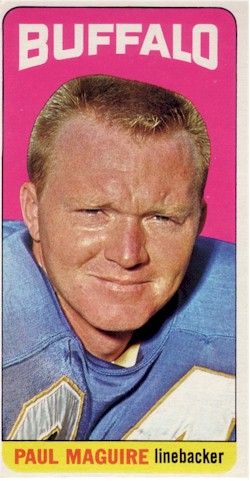
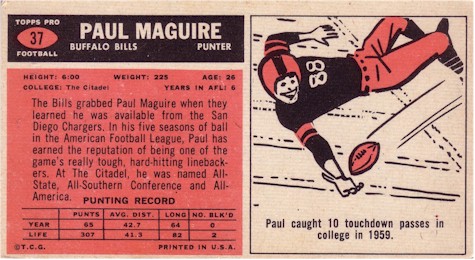
– After UNC scored to take a 23-0 lead, The Citadel took over possession with 1:51 to go in the half and went into its two-minute offense.  The Bulldogs had only amassed 18 total yards in six previous possessions, but in hurry-up mode moved the ball 30 yards down the field before Blanchard was intercepted at the 2-yard line.  Up in the TV booth, Paul Maguire wondered aloud why the Heels were playing “prevent defense”.

It was a valid point, although it occurred to me that running a hurry-up offense in an effort to establish a different tempo might not have been a bad idea regardless of the time/score.  I wish The Citadel had tried it again in the second half.

– Speaking of Maguire (who was announcing the game for ESPN360, along with Bob Picozzi), I believe Saturday was the first time he had ever announced a game involving The Citadel.  Maguire has been a TV analyst for college and pro football games since 1971.

– Does The Citadel’s starting running back on Saturday prefer to be known as Lemuel Kennedy or Bucky Kennedy?  There needs to be a ruling on this.  Various outlets are referring to him as one or the other.  (Years ago, someone had to decide — Lyvonia or Stump?)

– You know it’s probably going to be a tough night for The Citadel when one of the Bulldogs’ starting safeties (Rod Harland) is knocked out of the game before The Citadel’s first defensive snap (and another defensive starter, Mel Capers, is held out of the game, for medical reasons not yet officially released).

– I cannot remember The Citadel wearing navy pants before Saturday’s game; that may have been the first time.  I respectfully suggest that it be the last time.  It’s not a good look.  It’s yet another uniform concept I don’t like, to go along with all the others detailed previously.

– Joseph Boateng wasn’t listed on the two-deep released for the UNC game, but he wound up intercepting two passes and making seven tackles.  Boating played on the scout team last year at Eastern Michigan.  From what I understand, he’s an academic sophomore, but athletically he’s a redshirt freshman (and he’s also a freshman within the corps of cadets).

After doing some quick research, it appears that Boating is the first freshman at The Citadel to intercept two passes against an ACC team since 1986, when it happened in a game at Clemson.  The freshman who picked off two Tiger passes in that game was Anthony Jenkins, who would later decide to concentrate on another sport at The Citadel.  That worked out rather well for everybody (well, maybe not so well for Miami or Cal State-Fullerton).

– Other than the punt return TD , the special teams were solid (although that is a big “other”).  Sam Keeler’s successful field goal attempts should increase his confidence, and that could be important as the season progresses.  The second Keeler field goal would never have happened, though, without a world-class hold by Cam Turner.  Keeler also deserves credit for trusting Turner to get the ball down in time; I’ve seen some kickers stop their approach in that situation.

– Okay, so committing four turnovers wasn’t a good thing.  At least the Bulldogs also forced four turnovers.  Creating turnovers was a major problem for The Citadel last season, so Boating’s two picks (the Bulldogs only had three all last year) plus the two fumble recoveries on special teams were a welcome development.  Admittedly, the punt cover fumbles were somewhat flukish, but flukes count too.

– Memo to The Citadel Sports Network:  during the halftime show, when someone is updating scores of various games from around the country, it would be helpful if the person doing the announcing actually knew the score of the game involving The Citadel.  On Saturday night the Bulldogs apparently managed to score a touchdown between the second and third quarters.  This magic touchdown was credited to The Citadel at least three times during the intermission.

It’s now time to focus on Princeton…well, maybe not.  Not yet, anyway.

The Citadel is off next week, and the extra week should give the Bulldogs badly needed time to heal some bumps and bruises.  I hope Garland is ready to play by then; having apparently suffered a concussion, however, that may prove not to be the case.

The extra two weeks will also give the band some time to arm itself properly, in case an invasion of Old Nassau is in the offing…

College Football TV listings, Week 1

This is a bit of an experiment.  I’m using Google Documents in an effort to make the listings more accessible.  Feedback is welcomed.

College Football TV Listings, Week 1

Additional notes:

ERT-BE (Big East Network) coverage of Liberty-West Virginia can be seen on SNY, CST, Altitude, and several local affiliates in West Virginia.

ERT-SEC (SEC Network) coverage of Western Kentucky-Tennessee can be seen on CSN-Bay Area, CSN-Washington, MSG, CSN-Philly, and  local affiliates listed here:  Link

Southland TV (Southland Conference Network) coverage of Western Illinois-Sam Houston State can be seen on local affiliates listed here:  Link

ABC coverage map:  Link

A lot of the information I used in putting this together came courtesy of Matt Sarzyniak’s great website (College Sports on TV) and the folks over at the 506.com; there are links to both sites to the right of this page, in the “TSA  Checkpoints” section.

I also appreciate responses to queries on announcers/start times from athletic media relations staffers at the following schools:  Washington State, New Mexico State, Eastern Illinois, and Old Dominion.  Also providing assistance were employees at the Big Ten Network, The Mtn., BCSN, TWCS-CNY, and SWX.

Football, week 1: The Citadel vs. North Carolina

There will be a lot of blue on display in this game.  If Kenan Stadium could sing a song on Saturday, it might sound like this:

I’m blue da ba dee da ba di da ba dee da ba di da ba dee da ba di…

That’s right, an Eiffel 65 reference.  What other game preview gives you that?

The Citadel begins another football season this Saturday.  Doesn’t it seem like the anticipation increases every year?  Of course, this year part of the reason Bulldog fans want the season to hurry up and get here is so the team doesn’t lose any more running backs before the first game.

Some fast facts:

–Series:  UNC leads 3-0 (all three games played in Chapel Hill)
–Scores:  14-7 UNC (1915), 50-0 UNC (1939), 45-14 UNC (1986)
–The Citadel alltime against current ACC schools:  6-63-2
–The Citadel alltime against ACC schools (when those schools were actually members of the ACC):  0-24

The last time the Bulldogs beat a current ACC school was in 1931, when The Citadel edged Clemson, 6-0 (in a game played in Florence, of all places).  The Citadel also tied Florida State in 1960, 0-0.  The Bulldogs haven’t seriously threatened an ACC opponent on the gridiron since 1976, when Clemson slipped past a solid Bobby Ross squad, 10-7.

The 1939 UNC team that thrashed the Bulldogs 50-0 was pretty good, going 8-1-1 that season.  Alas, the loss was to Duke.  The coach of the Tar Heels at the time was Raymond “Bear” Wolf.  Yes, “Bear” Wolf.  Years before, Wolf had been a baseball player; he played in one game in the majors, for Cincinnati, getting one more at bat than Moonlight Graham did (speaking of UNC alums).  Wolf had a good run in Chapel Hill until 1941, when he went 3-7.

The new coach was Jim Tatum, who is in the College Football Hall of Fame, but mostly for his work at Maryland.  Tatum only coached at UNC (his alma mater) for one year before enlisting in the Navy; he would later have enormous success in College Park, winning a national title with the Terrapins in 1953, before returning to North Carolina in 1956.  Tatum coached three more seasons in Chapel Hill before dying suddenly of Rocky Mountain Spotted Fever in 1959.  He was only 46.

While Tatum was building a championship team at Maryland (he also coached Oklahoma for one season), UNC was having a very good run of its own, thanks in large part to the exploits of the great Charlie “Choo Choo” Justice.  Justice is surely one of the best college football players not to win the Heisman Trophy (he was the runner-up twice).  North Carolina played in three major bowl games during this period, the only three times the Heels have ever played in a major bowl.  UNC lost all three games.

After some good (and bad) seasons through the 1960s, UNC would have another outstanding streak of success in the early 1970s under Bill Dooley, including an 11-1 season in 1972, marred only by a loss to Ohio State.  Interestingly, North Carolina did not finish the year in the top 10 of either poll.  Dooley would move on to Virginia Tech (and later Wake Forest).

Dick Crum took over the program from Dooley, and had some excellent seasons of his own, including 1980, when the Tar Heels (featuring Lawrence Taylor) would again go 11-1, again go undefeated in ACC play — and again struggle against a big-name non-conference opponent, this time Oklahoma (losing 41-7).  That 1980 season marks the last time UNC won the ACC title.

The next year could arguably serve as a microcosm of North Carolina’s football history.  UNC, led by tailback Kelvin Bryant, scored 161 points in its first three games in 1981.  Bryant scored an amazing 15 touchdowns in those three matchups.  Then, against Georgia Tech, Bryant injured his knee.  He would miss the next four games.  UNC hung on for two games, but after improving its record to 6-0, the Tar Heels were soundly beaten at home by a mediocre South Carolina team, 31-13.

North Carolina rebounded to beat Maryland, and then played Clemson in a game that was essentially for the ACC title.  The Heels had won 11 straight ACC contests, and the Tigers were undefeated (and had beaten Herschel Walker and Georgia).  It was the first time two ACC schools had met in football when both were ranked in the AP top 10, and it would be a memorable encounter.  Clemson prevailed, 10-8, in a game where the intensity was palpable, even to TV viewers.

North Carolina would not lose again that season, buoyed to an extent by the return of Bryant for the final two regular-season games and the Gator Bowl (where the Tar Heels would defeat Arkansas).  There was, however, one final twist of the knife.  From the “Scorecard” section of Sports Illustrated (January 11, 1982):

They say you can prove anything with statistics, and in the case of North Carolina running back Kelvin Bryant, official NCAA figures would appear to show that he didn’t exist in 1981. NCAA rules specify that to qualify as a season statistical leader a football player must appear in at least 75% of his team’s regular-season games; for the Tar Heels, who played an 11-game schedule, that meant a minimum of eight games. Because of knee surgery, Bryant played in only seven games, but he made the most of his limited participation, to put it mildly, scoring 108 points. The NCAA determines scoring leaders on a per-game basis, and it awarded the scoring title to USC’s Marcus Allen, who averaged 12.5 points a game. Because he played too few games, Bryant, with a 15.4 average, didn’t qualify to be the scoring champion, which may be fair enough. But Bryant also was excluded from the list of 25 top scorers even though—surely there’s an injustice here—he ranked fifth in total points behind Allen (138 points), Georgia’s Herschel Walker (120), SMU’s Eric Dickerson (114) and McNeese State’s Buford Johnson (l10). Absurdly, Iowa State’s Dwayne Crutchfield, who scored just 104 points, is listed in fifth place, while Bryant and his 108 points are nowhere to be seen.

This little blurb came in the same edition of the magazine  that featured Clemson wide receiver Perry Tuttle on the cover, as the Tigers had just won the national championship by defeating Nebraska in the Orange Bowl.  Talk about a double whammy of what might have beens…

Crum never had a team that good again, and by the late 1980s the program was beginning to fade.  Mack Brown then arrived and basically decided to start over.  After consecutive 1-10 seasons, that may have looked like a mistake, but Brown gradually built things back up, and in his last two seasons in Chapel Hill the team went 10-2 and 11-1 .  He couldn’t quite get that one big win to push the program to the next level, though, as the Heels could not beat Florida State.  After that 11-1 season (in 1997), Brown left for a program that he felt he could push over the top — Texas.

As the above paragraphs illustrate, UNC has had an occasionally-close-but-no-cigar kind of history in football — sometimes good, sometimes very good, but never quite getting over the hump (at least nationally) for various reasons, and thus always remaining in the large shadow cast by the school’s basketball program.  As the years have gone by, the degree of difficulty in trying to escape that shadow seems to have increased.

After ten seasons of around .500 ball under two coaches, the folks at UNC decided to shake things up and bring in Butch Davis, who is known as somebody who can really recruit (proof:  the 2001 Miami Hurricanes, which had 16 future NFL first-round draft picks on its roster).  Whether Davis can put it all together at North Carolina is the big question.  There are high hopes in Chapel Hill this season, however, as he returns 38 lettermen (including 15 starters) from a team that won eight games last season and is ranked #20 in the USA Today Coaches’ Poll.

One of those returning starters is quarterback T.J. Yates, who presumably will have fully recovered from an injury suffered this past spring while playing Ultimate Frisbee.  I’m guessing that summer activities for the Tar Heels were restricted to checkers and backgammon in an attempt to keep everyone healthy.

Speaking of UNC quarterbacks, one of the curious things about the Heels’ football history is the lack of success of any North Carolina quarterback in the NFL (at least as a QB).  There have been 182 UNC football players who went on to the NFL (as of the conclusion of the 2008-09 season), but only two of them have been quarterbacks — and one of them, Jim Camp, never threw a pass in the league.  The other, Scott Stankavich, played in only four career games (no starts); two of those games came as a “replacement player” during the 1987 players’ strike.

Ronald Curry has had a decent career in the NFL, but as a wide receiver.  Curry has attempted four passes in the league, completing none of them.  There have actually been fifteen former Tar Heels who have attempted at least one NFL pass.  Only six of them, however, have actually completed one.  Stankavage is one of those six, but the Heel with the most yards passing in the NFL is halfback Ed Sutton, who threw for 146 yards in his career, with one TD.  Don McCauley is the only other UNC player to throw a TD pass in the NFL.

I totalled all the NFL passing statistics for former UNC players.  I also totalled the passing statistics for The Citadel’s Stump Mitchell (who threw nine passes during his career, including a TD toss to Roy Green) and Paul Maguire (who threw one pass during his career, completing it for 19 yards).  Check out the cumulative stats comparison:

UNC:  19-70, 315 yards, 2 TDs, 6 INTs, QB rating of 19.6
The Citadel:  5-10, 102 yards, 1 TD, 0 INTs, QB rating of 119.6

A 100-point difference in QB rating?!  Advantage, Bulldogs.  Of course, that won’t mean anything on Saturday.

Last season, the Bulldogs were 4-8.  This followed a 7-4 campaign in 2007 that had fans thinking a return to the FCS playoffs was not far away.  Instead, the Bulldogs lost six straight games during the course of the 2008 season, narrowly avoided a seventh straight defeat to a poor UT-Chattanooga squad, and then got pummeled by Tim Tebow and eventual BCS champion Florida in the season finale.

Some of those games were close (The Citadel lost three Southern Conference games by a total of 12 points), but on the whole the 4-8 record was a fair reflection of the Bulldogs’ play.  Comparing some league-only statistics from the 2007 and 2008 seasons is illuminating.  Ignoring the raw totals, which are a touch misleading (scoring was down in the SoCon last season as compared to 2007), and looking at league rankings:

-Scoring defense:  4th (2007), 8th (2008)
-Pass efficiency defense:  3rd (2007), 9th (2008)
-Red Zone defense:  2nd (2007), 9th (2008)
-Turnover margin:  2nd (2007), 5th (2008)
-3rd down conversion offense:  2nd (2007), 5th (2008)
-3rd down conversion defense:  2nd (2007, 5th (2008)

That’s basically the story of the 2008 season right there.  The defense had trouble getting off the field (SoCon opponents completed over 64% of their passes against The Citadel, and the Bulldogs only intercepted two passes all season in league play).  Inside the 20, The Citadel’s defense had no answers (allowing 23 touchdowns in 31 red zone situations).

Offensively, the running game struggled, as rushing yardage per game dropped by one-third.  Perhaps more ominously, the number of third downs converted via the rush fell substantially.  This also affected the offense’s red zone success rate, as the team scored only 18 touchdowns in 34 opportunities inside the 20 (the worst ratio in the league), and led to over-reliance on an erratic (I’m being kind here) placekicking game.  The Bulldogs only made 7 of 12 field goals attempted in red zone possessions.  No other conference team missed more than one such attempt all season.

After a season like that, it’s not surprising changes were made.  The Bulldogs are going to return to a 4-3 defense after last year’s attempt at a 3-4 resulted in the D getting pushed all over the gridiron.  That rather obvious lack of physicality was also addressed by an aggressive offseason conditioning program.  There are a couple of new defensive coaches, too.

There has been a good pre-season buzz about the defensive line, which is nice, but there also needs to be more playmaking from the linebackers and secondary.  In other words:  get stops and force turnovers.  The key is to corral more interceptions (fumble recoveries tend to be somewhat random).  Scoring touchdowns on defense would be a plus, too, but you have to get the turnovers first before you can think six.  The Bulldogs have recorded 13 sacks in conference play each of the last two seasons; a few more this year certainly couldn’t hurt.

The offensive line should be strong, although illness has been a problem in fall practice, what with one lineman suffering from an acid-reflux problem and another battling mononucleosis.  That’s still much better than the Bulldogs’ running back situation.  The starter for UNC may be walk-on freshman Bucky Kennedy, walk-on freshman Remi Biakabutuka, or one of the backup bagpipers.  Biakabutuka would definitely be the choice if the opening-game opponent were Ohio State rather than North Carolina, as just the name “Biakabutuka” on his jersey would be enough to unnerve the Buckeyes, thanks to his older brother Tim.

Another potential threat as a runner is backup quarterback Miguel Starks, who last year impressed many observers just by standing on the sideline during games.  However, he’s never played a down of college football.  It will be interesting to see what he can do once he gets on the field.

I’m of the opinion that the incumbent starting quarterback, Bart Blanchard, didn’t have that bad a season last year, as I don’t think he got much help from the rest of the backfield (and the offensive line seemed to lack consistency).  He is a bit limited as a runner, which is not ideal in Kevin Higgins’ offense, but that was true the year before as well and the Bulldogs managed just fine when he stepped in for Duran Lawson.  Higgins wants him to have a better completion percentage, but part of the problem Blanchard had last season trying to avoid incompletions was a limited number of passing targets — basically, his options were the tight ends and Andre Roberts.

Of course, Roberts is a nice target to have.  It would really help Roberts (and Blanchard) if a second receiver emerged this season (Kevin Hardy?), which never happened last year.  If another Bulldog wideout does develop into a threat, Roberts could wind up with fewer catches but more yards per reception.  Roberts in space is a big play waiting to happen, as anyone who has watched him return punts can attest.  I’m glad he’s not going to be returning kickoffs this year, though.  I worry about him wearing down over the course of the season.

The placekicking needs to be much improved.  Last year was just not acceptable.  The Bulldogs also must replace Mark Kasper, who was a solid punter for four seasons (second in the league in net punting last year).  The Citadel needs to improve its kickoff coverage (next-to-last in the conference in 2008).  Basically, the special teams must get better across the board (with the exception of the punt return team, which thanks to Roberts was the nation’s best unit).

As for Saturday’s game, a lot depends on whether Blanchard and Roberts have fully recovered from sprained ankles each suffered during fall practice.  If they are both good to go, I would expect the Bulldogs to be reasonably competitive against North Carolina.

While the Heels return 15 starters, they must replace some excellent wide receivers (including Hakeem Nicks) and two starters on their offensive line.  UNC’s o-line has taken a bit of a hit in the pre-season with some injuries and attrition (nothing like The Citadel’s running back situation, though).  The starting group should still be solid, however.

T.J. Yates should be okay after his frisbee ordeal.  This will be his third year starting games at QB for UNC.  Yates is good at taking care of the ball (only four interceptions last season).  UNC has a nice corps of running backs, led by Shaun Draughn, who rushed for 866 yards in 2008.  The Tar Heels will definitely need to find some new wideouts, as no returning receiver caught more than 11 passes last year.

UNC rotates a number of defensive linemen, and almost all of them are very good athletes (and most of them are huge).  Marvin Austin has first-round pick potential, Cam Thomas has all the makings of a future NFL nosetackle, and Ladson native Robert Quinn won the ACC’s Piccolo Award after recovering from a brain tumor to have an outstanding freshman campaign.

Despite this embarrassment of riches, the Tar Heels didn’t do a particularly good job creating sacks last season (only 22 all season; the d-line only had 5.5 of those).  Still, this group will be a formidable challenge for The Citadel’s offensive line.

North Carolina has a really good trio of starting linebackers, led by Bruce Carter, who doubles as a great kick-blocker (five last year).  The defensive backfield should be excellent, with several ball hawks ready to repeat last year’s success in intercepting passes (the Heels had 20 picks).

UNC did struggle defensively on third down conversions, ranking last in the ACC in that category.

North Carolina’s special teams were okay last year, although its net punting was mediocre.  The Heels will be breaking in a new punter this season, which might be good news for Andre Roberts (and Mel Capers), although first The Citadel’s defense has to actually force a punt.

Last season UNC opened with McNeese State, and struggled before finally winning the game 35-27.  It should be pointed out that the Cowboys were a solid FCS club (finishing 7-4, and featuring a quality offense), and that the game was affected by a lightning delay.  If anything, that relatively close call may make the North Carolina players more wary of FCS opposition.

The goals for this game, from The Citadel’s point of view, are for the team to be as competitive as possible, and to avoid major injuries.  It isn’t realistic to expect a victory, particularly against a pre-season Top 20 team.  The Bulldogs just want to make UNC work for a win.

To do that, avoiding turnovers on offense is a must.  I suspect that The Citadel is not going to have much of a rushing attack in this game, which is going to be a problem.  It’s also going to be a tough game to break in a new punter.  I think the Bulldog defense has a chance to establish itself to a certain extent.  However, the UNC offense is not turnover-prone and is more than capable of grinding out drives (although this may not be a bad thing for The Citadel; the fewer big plays, the better).

Obviously, the players won’t be thinking the way I’m thinking.  They’re traveling to Chapel Hill looking for a victory, which is a good thing.  That’s how they should approach this game.  Besides, you never know what might happen.  After all, my fantasy football team is called The Jack Crowes.

I’m just ready for kickoff.

The next baseball Hall of Famer and…the Pittsburgh Steelers

Neil Best of Newsday had a blog post on Monday about Luis Tiant and the new ESPN documentary about Tiant, The Lost Son of Havana.  Best asked Tiant about not being a member of the baseball Hall of Fame and got an “I don’t care, except I really care” response from the former pitcher.  This got me thinking about the Hall, but not really about Tiant (a very good pitcher in his day, but not quite Hall-worthy, although he certainly has the right to wonder how Catfish Hunter got in and he didn’t).  Of course, it doesn’t take much for me to riff about the Hall, as anyone who peruses this blog can tell (just a few examples:  here, here, and here).

Anyway, I took a quick look (not for the first time) at potential eligibles for next year’s ballot.  First, here are the returnees and the percentage of votes they got in the last election:

Andre Dawson (67.0%); Bert Blyleven (62.7%); Lee Smith (44.5%); Jack Morris (44.0%); Tim Raines (22.6%); Mark McGwire (21.9%); Alan Trammell (17.4%); Dave Parker (15.0%); Don Mattingly (11.9%); Dale Murphy (11.5%); Harold Baines (5.9%)

The list of newly eligible players likely to appear on the ballot:

Roberto Alomar, Kevin Appier, Andy Ashby, Ellis Burks, Dave Burba, Andres Galarraga, Pat Hentgen, Mike Jackson, Eric Karros, Ray Lankford, Barry Larkin, Edgar Martinez, Fred McGriff, Mark McLemore, Shane Reynolds, David Segui, Robin Ventura, Fernando Vina, Todd Zeile

Last January I wrote that “… the only one of those players with a shot [at getting elected next year] is Dawson.  He’s going to get in eventually, but I’m not sure if his support will jump from 67% to 75%+ in one year.”

Well, I still think Andre Dawson is the only one with a shot at making it next year, but I now believe that he’s got a very good chance.  Why?  Because I have come up with a theory about the baseball Hall of Fame that revolves around…Lynn Swann.

Lynn Swann was elected to the Pro Football Hall of Fame in his 14th year of eligibility.  It was (and is) a controversial selection, as there was (and is) considerable disagreement about whether or not he deserved enshrinement.  Swann was famous in his day, and played for a well-known franchise.  The casual fan probably rated Swann higher than many who followed (or studied) the sport with more intensity.  This is due in part to Swann not having A) a particularly long career, and B) an overwhelming statistical record.

Now, does that description in the preceding paragraph remind you of a certain baseball player recently elected to Cooperstown?  Jim Rice, maybe?

Rice was elected to the National Baseball Hall of Fame in his 15th year of eligibility.  It was (and is) a controversial selection.  Rice, like Swann, was famous in his day, played for a prominent club, did not have a long career, and has a Hall of Fame argument that is more about visceral reaction than bottom-line accounting.

In 2001, Lynn Swann got his bust in Canton.  The very next year, his teammate and fellow wide receiver, the outstanding (but lower-profile) John Stallworth, was elected.  Stallworth, it has been said, had to wait for his own enshrinement because Swann’s candidacy essentially stood in the way.  Once Swann finally made it over the line, however, the voters apparently came to the conclusion that you couldn’t have a Hall of Fame with Lynn Swann in it that didn’t also include John Stallworth, because Stallworth was at least as good as Swann, if not better.

In 2009, Jim Rice finally has his plaque in Cooperstown, and who do we find leading the list of returning candidates?  Andre Dawson, who like Rice was an outfielder who debuted in the mid-1970s, and who arguably was just as good a player as Rice, if not better.  Like Stallworth, Dawson was a star, but not as big a star as Rice or Swann were at their respective peaks (although Dawson did win an MVP with the Cubs, his best years were spent in Montreal, more or less hidden from many casual fans and a few sportswriters).

Now, there are good arguments to be made that Dawson is not a Hall of Fame player, with his career .323 OBP foremost among them.  This is not unlike Stallworth, whose career totals, while solid, do not scream “automatic Hall of Famer”.  However, Jim Rice is now in the Hall.  Dawson, to most observers, was at worst equal to Rice, and was probably better (particularly if you account for defense — Dawson played over 1000 games in center field and won eight Gold Gloves).

Stallworth went to Alabama A&M.  Dawson went to Florida A&M.  Both A&Ms, both HBCUs — I think my little theory should get a bonus for that…

There is a difference when it becomes time to tally Hall of Fame votes, though.  Canton’s legends are determined by a relatively small group of less than 50 voters.  Last year 539 members of the Baseball Writers Association of America (BBWAA) cast ballots for the baseball Hall.  It’s generally easier to reach a consensus among smaller groups, especially since the pro football voters actually meet and discuss candidates as a group, as opposed to the baseball voters (who mail in their ballots).

Despite this, I think the “Rice is in, so Dawson has to be in” point of view will still take hold, at least enough to sway the additional 8% of the electorate Dawson needs for enshrinement.  It helps that there is no “lock” among the new candidates, although Larkin, Alomar, and McGriff will all draw significant support (as might Edgar Martinez).

Next year will be Dawson’s ninth year on the BBWAA ballot.  Stallworth was elected to pro football’s Hall after being named a finalist for the eighth time.

I’m rooting for The Hawk to make it.

The NCAA attacks its own (again)

On Thursday afternoon the NCAA issued a press release entitled “Executive Committee adopts wagering policy”.  Included was the following statement:

“No predetermined or non-predetermined session of an NCAA championship may be conducted in a state with legal wagering that is based upon single-game betting (high school, college or professional) in a sport in which the NCAA conducts a championship.”

Single-game betting is defined as wagering that involves either a money line or point-spread wager. The recommended policy would not apply to those states that may offer parlay betting, lottery tickets or sports pools/pull tabs.

What this apparently means is that effective immediately, schools in Delaware and Nevada will no longer be able to host any postseason NCAA events.  This includes even those events for which they would have qualified to host by merit.

The policy change will result in the University of Delaware not being able to host an FCS playoff game.  Also affected in that state is Wesley College, which has an excellent football program at the Division III level.  Delaware is a perennial FCS power that has hosted 22 postseason football games, while Wesley has hosted eight Division III playoff games.  The Blue Hens and Wolverines have each hosted playoff games as recently as 2007. 

The University of Nevada-Reno hosted a skiing regional in March and has the capability of hosting other regionals in sports like volleyball, basketball, and baseball.  The opportunity to host those regionals is now off the table for that school (as it is for UNLV). 

Faring a little better than Nevada and Delaware were the state schools in Montana.  There was a fear that the NCAA’s stance would also prohibit events from being held in that state, but the new policy allows sports pools (as opposed to single-game betting), so Montana avoided getting the Nevada/Delaware “treatment”.  This led to a predictably mealy-mouthed response from the Montana state attorney general:

“I applaud the NCAA for coming to a commonsense conclusion that preserves Montana’s right to host playoff and tournament games,” Montana Attorney General Steve Bullock said in a prepared statement. “Montana wholeheartedly supports its student athletes. Along with the NCAA, we remain committed to protecting the integrity of collegiate sports.”

What he is really applauding, of course, is that part about Montana (or Montana State) still getting to host playoff games.  He surely can’t serious in supporting the NCAA’s “commonsense conclusion”, since there isn’t anything sensible about it.

Look, I understand the NCAA’s concern about this issue.  There are two points, though, that need to be made.

1)  It isn’t the fault of the schools.  The colleges and universities in Nevada and Delaware have nothing to do with the gambling laws in those states, and can’t do anything about those laws anyway.  Why punish the student-athletes and institutions for something over which they have no control?

The NCAA presumably is hoping that this new policy will cause the politicians in the state of Delaware to reverse themselves (I can’t imagine even the NCAA thinks things will change in Nevada), but the organization has to know that losing an occasional playoff game is not going to be enough to stop the state from instituting single-game betting.  The legislation passed easily in both houses of the Delaware state legislature.  The state is hoping to generate more than $50 million in revenue from sports betting in the first year of implementation alone.  I’m afraid a playoff game against Southern Illinois or Northern Iowa isn’t going to make that kind of cash.

A cynic might think that the NCAA is punishing its member schools in the states because, well, they are the only entities that the NCAA can punish.  It’s like a version of the old Jerry Tarkanian line, “The NCAA is so mad at Kentucky it gave Cleveland State two more years of probation.”

2)  There have been plenty of schools with gambling scandals from states with no state-sponsored gambling.  Toledo, Northwestern, Florida, Maryland, Rhode Island, Maine, and Arizona State  (just to name a few) all had serious gambling incidents involving student-athletes just in the last two decades.  What Delaware is going to do won’t matter a whole lot in the grand scheme of things.

That is what really upset Nevada-Reno director of athletics Cary Groth.  As she put it:

“It’s outrageous,” Groth said. “Having worked in a non-betting state, in Illinois, it was more of an issue for us to monitor betting for our student-athletes than it is here at Nevada because there’s so much more awareness (here)…All anybody has to do is get on the Internet, or pick up the phone, to place a bet (anywhere in the U.S.).”

Groth added something else, just to stir the pot a little more:

“The NCAA has become such a monopoly on so many things, it’s not right,” Groth said, adding all states affected by the ban are home to non-Bowl Championship Series schools.

You knew that would come up, didn’t you?  Again, cynicism rears its ugly (but often intelligent) head.

I think another hot-button issue (at least, hot-button to the NCAA) is going to be affected by this policy, too.  The “non-predetermined” aspect of the ban will surely come to the attention of (among others) the South Carolina chapter of the NAACP.  As Tom Yeager, commissioner of the CAA, put it in an article written three weeks ago about the Delaware situation:

[Yeager compared] the wagering policy to the NCAA’s stance on South Carolina and Mississippi still flying the Confederate flag.The NCAA allows schools in those states to earn the right to host an NCAA championship event. Clemson, in South Carolina, hosted a recent baseball playoff. But the state would not be awarded a predetermined host role for a larger event, such as an NCAA basketball tournament regional.

Yeager argued that the wagering policy should not be any more stern.

“We continue to support the stand the NCAA has taken but also recognize that member institutions really aren’t part of a fight and shouldn’t be disadvantaged when having earned the right to host [NCAA] games on their campuses,” Yeager said.

It’s hard to argue with Yeager’s last point in particular (member institutions are just bystanders when it comes to these issues).  It’s also not unreasonable to suggest that if the NCAA is going to ban hosting even when merited for the likes of Delaware State or UNLV, the same principle presumably should apply to Mississippi State or Clemson.  The fact that there are four BCS schools in those two states may or may not be a factor.

You can bet there will be more to come on that front.

There are other aspects of this issue that need to be addressed (will the NCAA continue to sanction the Las Vegas Bowl?), but the bottom line is that here again we have an NCAA policy that will mostly, if not entirely, only affect its member institutions and its student-athletes in a negative manner.  I’m not sure who in the organization thought it was a good idea.  I only hope that, like the Andy Oliver case, it comes back to bite the NCAA in a major way.