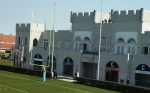
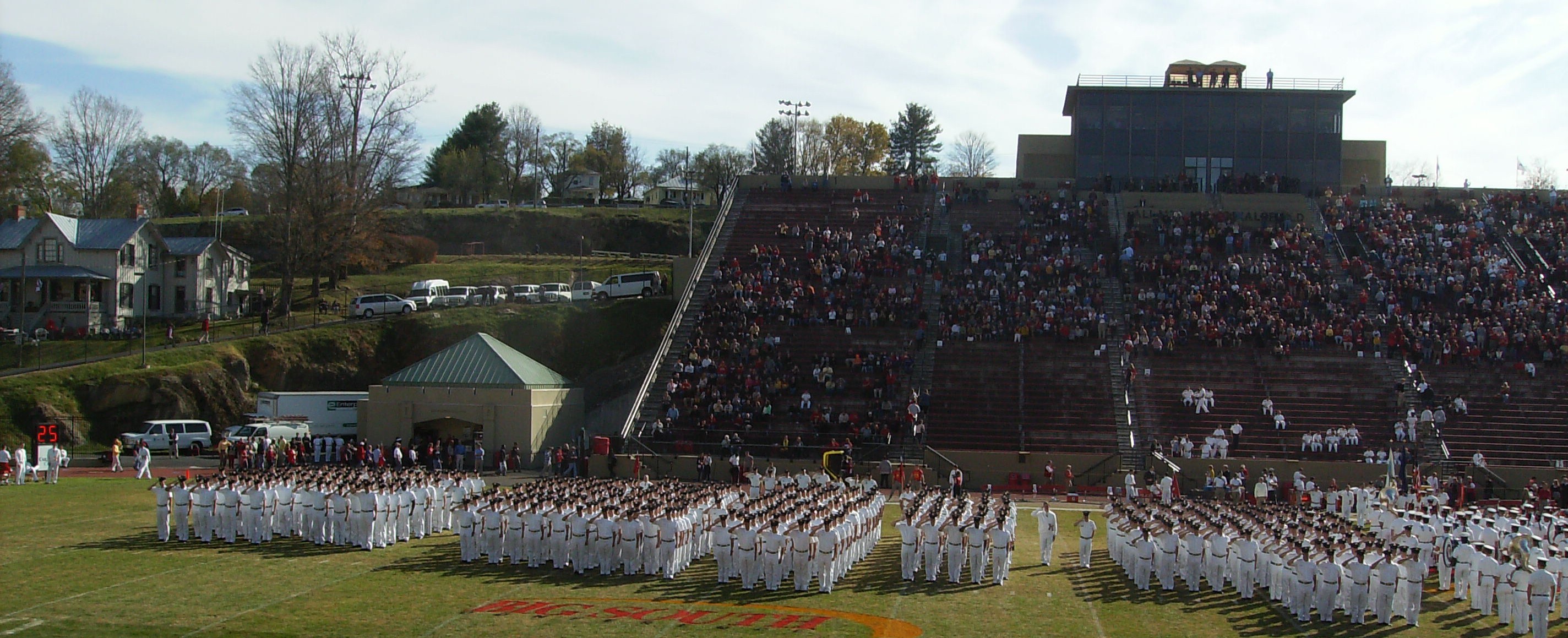
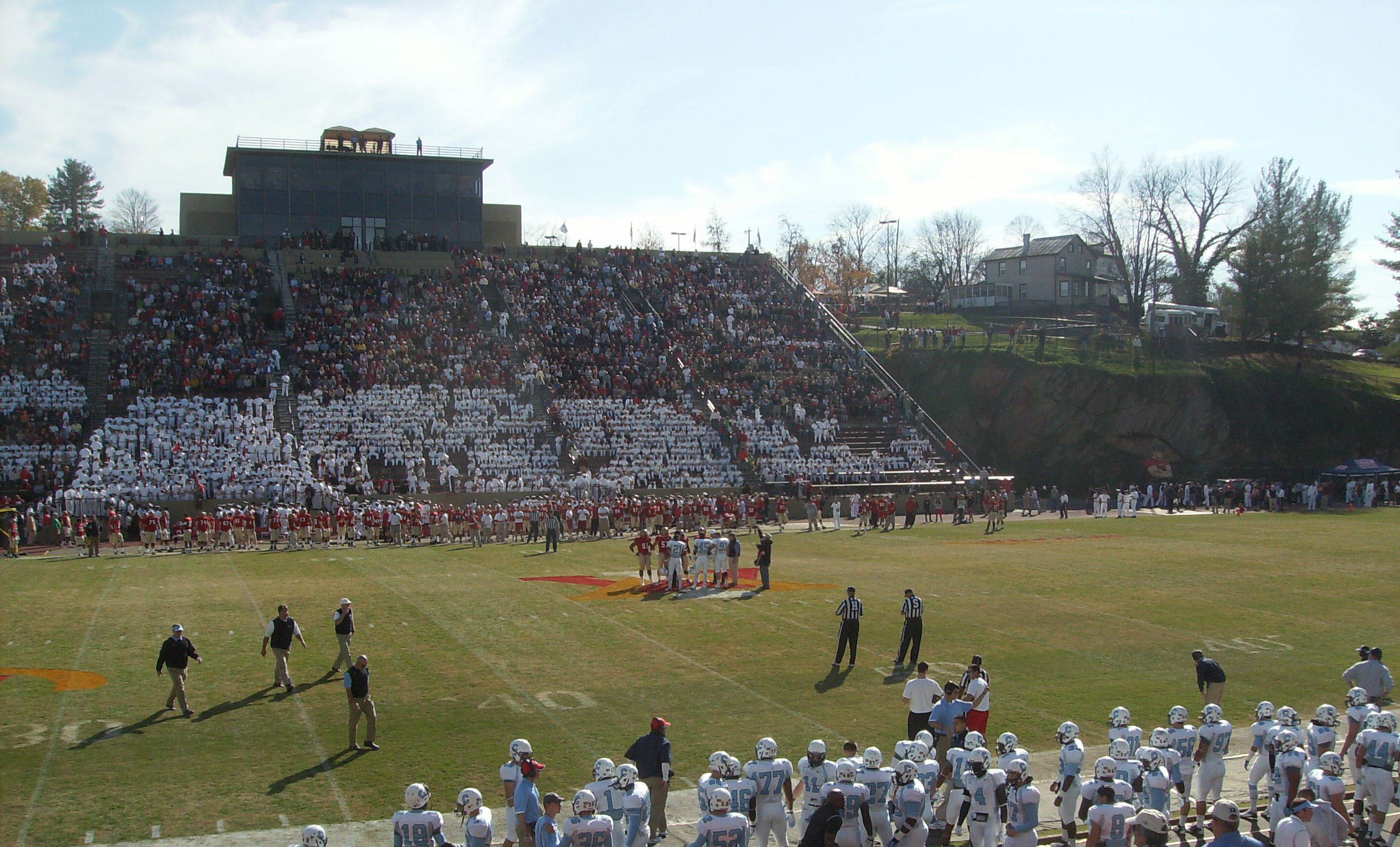
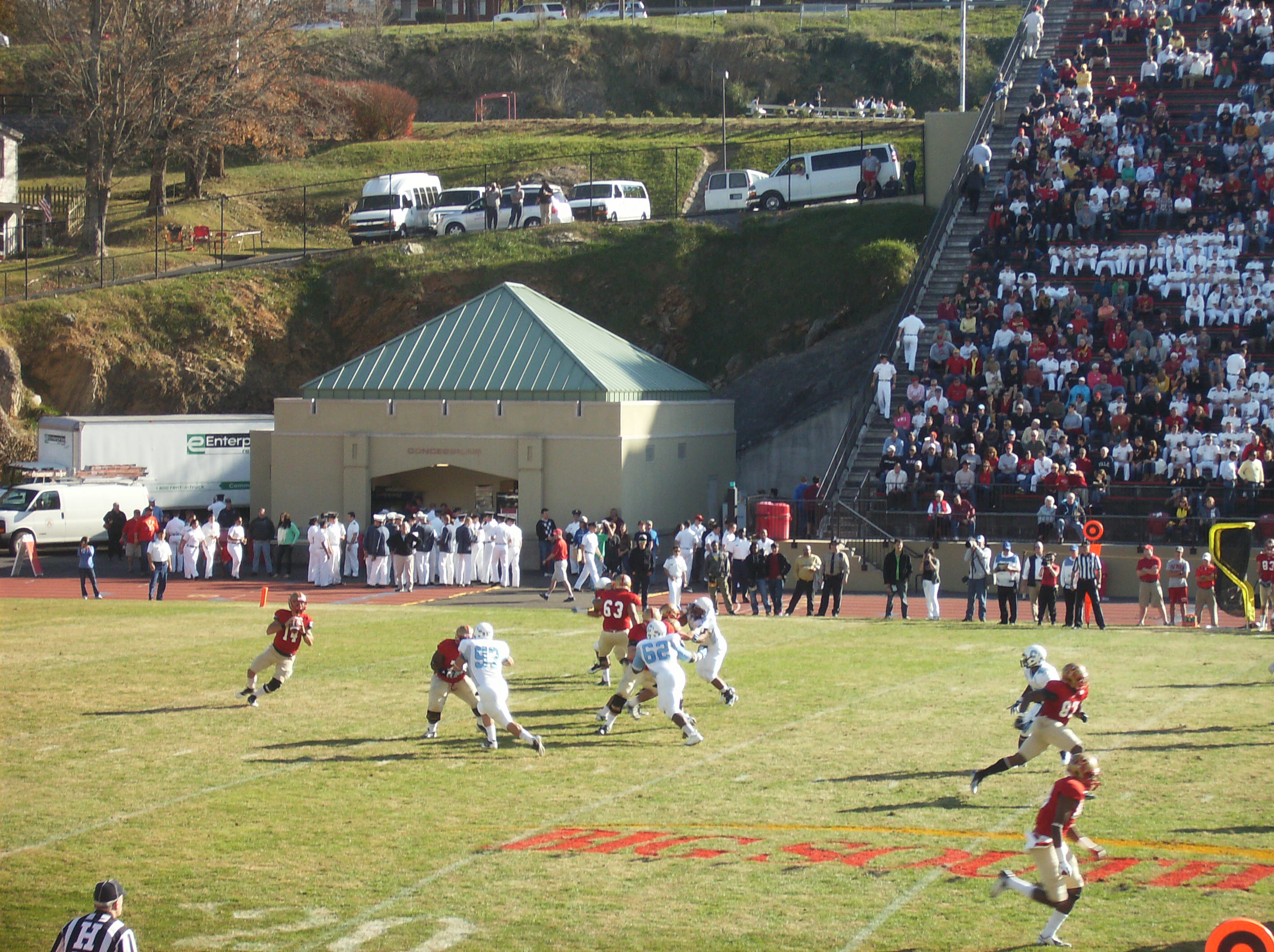
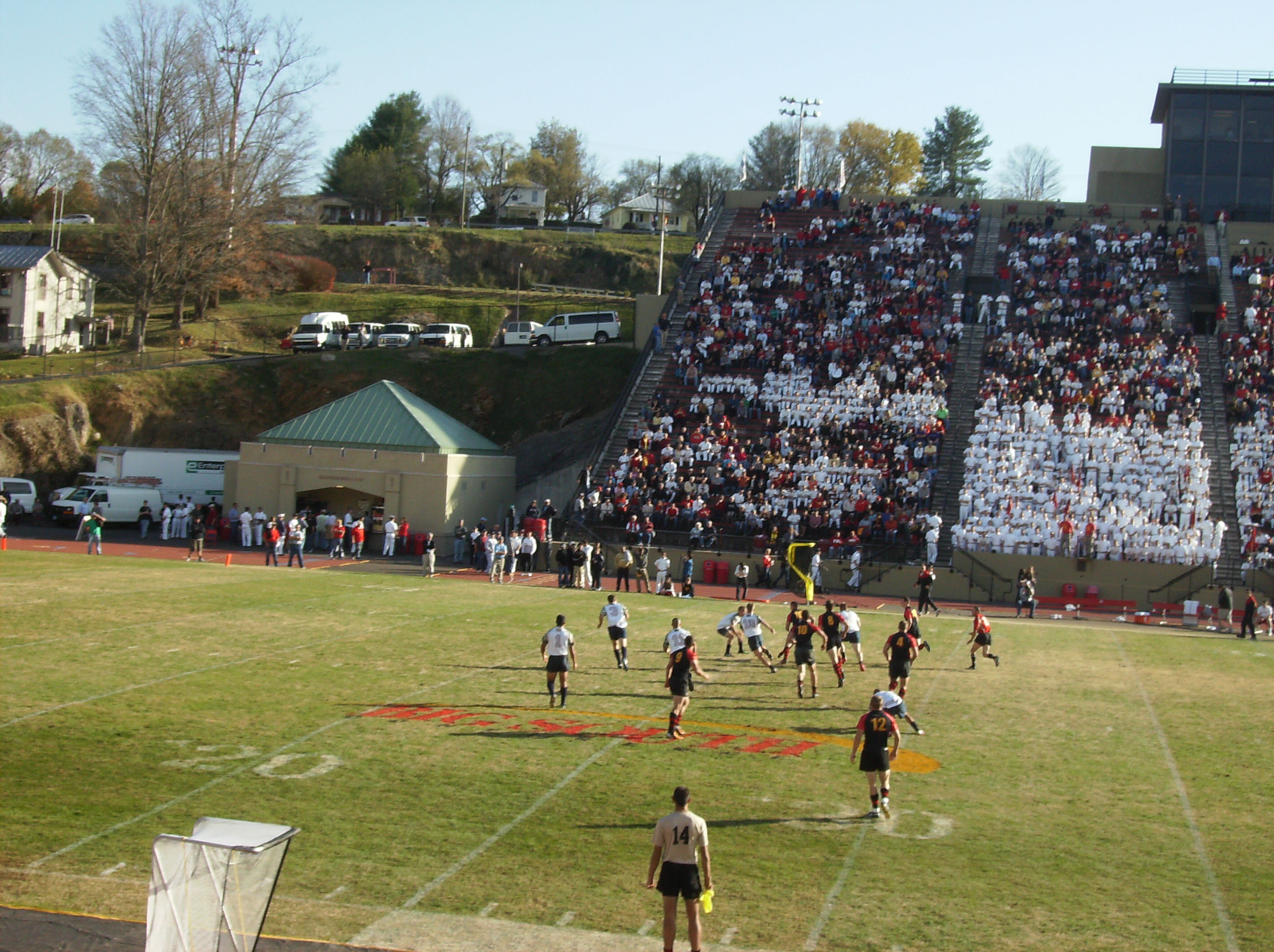
The Citadel vs. Jacksonville, to be played at historic Johnson Hagood Stadium, with kickoff at 6:00 pm ET on Saturday, September 3. The game will not be televised, although it will be webcast on Bulldog Insider (subscription service) and can be heard on radio via The Citadel Sports Network, with new “Voice of the Bulldogs” Danny Reed calling the action.
—
It’s that time of year! College football has arrived and not a moment too soon. I’m tired of reading about the Summer of Ponzi and all the other scandals that have beset the sport in the off-season, and while I enjoy discussing realignment as much as anybody, the Texas A&M two-step with the SEC is starting to get old. I’m ready to see some activity on the playing field.
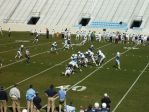
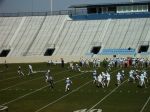
This is an important season for The Citadel’s football program. I wrote about the program’s status last November; nothing has happened since then to make me think that the 2011 campaign will be anything other than a defining one for Kevin Higgins and his coaching staff. I’m far from the only person who thinks that success of some sort this season is paramount. The intensity in the crowd at the recent open scrimmage was palpable.
One thing is certain: if there ever were a year for the football team to “sneak up” on people, this is the one. Southern Conference media members picked The Citadel to finish last. Only one player (Tolu Akindele) made either the preseason all-conference first or second teams. The SoCon coaches’ vote had The Citadel in next-to-last place, ahead of only Western Carolina; that’s the same verdict rendered by The Sports Network.
Last season, the Bulldogs played three non-conference games before beginning league play. This year, though, The Citadel will play six of its first seven games against SoCon opposition. The Bulldogs will have a good idea of where they stand before the fall harvest.
The only non-league game in that group of seven contests is the first one, and it is far from the “gimme game” that the home opener has been in recent years. Instead of scheduling a glorified scrimmage against the likes of Webber International or Chowan, The Citadel is playing Jacksonville, which went 10-1 last season and shared the Pioneer League title (with Dayton). The Dolphins, favored to win the PL again, will be a formidable challenge.
—
Jacksonville University is not to be confused with Jacksonville State University, which is located in Alabama and has a football team coached by Jack Crowe, the man who was on the wrong side of one of The Citadel’s more notable gridiron triumphs. Jacksonville University is located in Jacksonville, Florida, and its football team is coached by Kerwin Bell. (More on him later.)
Jacksonville began in 1934 as a junior college named “William J. Porter University” after its founder; in 1958 it became a four-year school after merging with the Jacksonville School of Music. As of today it’s a private, liberal-arts university with roughly 3,500 undergraduate students (60% of whom are women).
JU’s “Timeline” feature on its website includes a lot of concerts in the 1970s and early 1980s, perhaps an indication of the importance of the music school in relation to the rest of the university at that time. Performers who made their way to Swisher Gym included Dionne Warwick, Neil Diamond, Duke Ellington, John Denver, and Billy Joel; K.C. and the Sunshine Band recorded a live album there.
Jacksonville awarded honorary doctorates to Bob Hope and Jack Benny on the same day in 1972. Another same-day honorary doctorate duo for JU: Charlton Heston and Ann Landers (who received hers less than a year after writing that Jacksonville U. was one of “the four top colleges in the nation”).
It’s also worth noting that Jacksonville University has the second-largest NROTC program in the country.
—
Jacksonville has twenty-one varsity sports. Its nickname, the Dolphins, came to be in 1947 following a student contest (the original contest winner was “Green Dolphins”; another possibility had been the “Juggernauts”). The official school mascot is an actual dolphin — 58-year-old Nellie, a Marineland mainstay.
The most famous of all JU athletes is, without a doubt, basketball Hall of Famer Artis Gilmore. Second place on the school’s famous athlete list is probably occupied by Donnie Hammond. (Like I said, there is no doubt about #1.)
Gilmore played two seasons at Jacksonville (he started his career at Gardner-Webb, then a junior college) and averaged more than 20 points and 20 rebounds per game, which I think can be best described as “awesome”. In his junior season, he led the Dolphins to the NCAA title game.
Yes, you read that right. Jacksonville played in the Final Four in 1970, just twelve years after becoming a four-year school. We’re not talking Division II, either. The high-scoring Dolphins beat Western Kentucky, Iowa, and No. 1 Kentucky to win the Mideast Regional. Jacksonville averaged over 106 points per game in those three contests.
– Tangent #1: What a weird Final Four that was. There was nothing strange about UCLA being there (and the Bruins would beat Jacksonville in the final, 80-69), but the other three teams were Jacksonville, St. Bonaventure, and New Mexico State. The Dolphins and the Bonnies were at the time the two smallest schools to ever make it that far, and they played each other in the semifinals. Alas, it was a mismatch, as St. Bonaventure star Bob Lanier had injured his knee in the regional final and could not play in the Final Four. Thus, the spectators at Cole Field House were denied the opportunity to watch two future Hall of Fame centers face each other.
After that season, Dolphins coach Joe Williams left JU and took the job at Furman.
– Tangent #2: Artis Gilmore and his wife have been married for 39 years. Her name is Enola Gay. I thought that was worth mentioning.
—
Okay, it’s time to talk about JU football…
Jacksonville started its football program in 1998, winning its first-ever game 19-14 over Davidson. The school’s media guide also lists Davidson as being the first ranked team (at No. 3!) the Dolphins ever played, in a 2001 contest won 45-3 by JU, but I have to seriously question that. What poll would this have been? Maybe it was a poll only including Southern Conference schools that don’t play scholarship football.
JU plays its home games at Milne Field, a 5,000-seat facility built specifically for the football program, which averaged 3,761 fans per game last season. The Dolphins have won nine straight home games, but the real eye-popping numbers are from their road games — not necessarily the results on the field, but the travel involved. Jacksonville has six road games this year. JU will bus to The Citadel for Saturday’s game. Later in the year the Dolphins will also take the bus to Campbell, assuming the bus driver can find his way to Buies Creek.
However, the Dolphins will make four road trips by air, flying to the University of San Diego, Drake (which is in Iowa), Marist (New York), and Western Illinois (travelling to WIU on the day of the game). That is a total of 5,575 miles in the air.
Having multiple long airplane flights is a consequence of playing in the Pioneer League, a non-scholarship FCS conference with ten members. Jacksonville is the southernmost school in the league, which has three members in the southeast (JU, Davidson, Campbell), five in or around the midwest (Drake, Valparaiso, Dayton, Butler, Morehead State), one west coast entry (USD) and one northeastern school (Marist).
One reason for having such a far-flung league is that all of those schools choose to play football at the non-scholarship level while maintaining a NCAA Division I athletics program. Since 1993, institutions have had to play football at the same level as their other sports, which affected schools like Dayton (a D-3 power in football during the 1980s) in particular. There aren’t a lot of D-1 schools that offer non-scholarship football but provide schollies in other sports (which distinguishes these institutions from those in the Ivy League, for example).
Jacksonville is not likely to become a scholarship football program in the near future. That possibility was suggested to the president of the university, who responded:
[It] costs too much for us to do it right now. For us to move into scholarship football because of the rules for gender equity, we would not only have to be able to fund the scholarship program year in and year out, we would also have to fund a similar amount for women’s athletics.
And we simply can’t afford it right now. If we had some major donors that came forward and helped us, then something like that could be possible. It’s simply economics. We need a stadium, our stadium is quaint. We would need a stadium where the fan base would generate revenue.
The revenue we get right now is diminutive. With a stadium, you could start getting money back into the program. There are some positives to it, but it’s simply too expensive right now.
In 2013, two new football programs will join the Pioneer League — Stetson and Mercer. That should help alleviate Jacksonville’s travel burden to a certain extent.
—
Kerwin Bell played his high school ball in the small town of Mayo, Florida, where he was known as “The Throwin’ Mayoan”. Arriving at the University of Florida as a walk-on, in one year he managed to climb the ladder from eighth-string to starter. In 1984, Bell and the Gators would win the SEC title, winning eight straight games to close out the season. The SEC title was short-lived, however, as the conference rescinded it the following year due to UF being on probation. In 1985 Florida would go 9-1-1 for a second straight season, and again was not awarded the league crown (and again could not go to a bowl game) because of NCAA violations.
Two years later Bell began his pro career, which featured multiple stops in the CFL (including a stint in the Canadian outpost of Sacramento), a tour of duty with the Orlando Thunder of the Arena Football League, and a two-year stay with the Indianapolis Colts. Bell got into one game with the Colts, mopping up in a 1996 contest against the Philadelphia Eagles. In that game, he threw five passes, completing all five for 75 yards and a touchdown (to Marvin Harrison). Bell finished with a perfect 158.3 passer rating. Contained within his Wikipedia entry is this astute observation:
[Kerwin Bell] has the highest career passer rating of any quarterback in NFL history, higher than current and future Hall of Fame members Joe Namath, Steve Young, Joe Montana, Warren Moon, Peyton Manning, Dan Marino and Brett Favre.
Bell’s coaching career actually started in 1990. While recovering from an ACL injury he worked for one year as a graduate assistant coach for Steve Spurrier, who had taken over the Florida program. His next coaching job came with the Toronto Argonauts in 2000, where he served as offensive coordinator (while still playing quarterback).
He then spent six years as head coach of a new football program at Trinity High School in Ocala, Florida. He has been the head coach at JU for the last four seasons (with the upcoming campaign being his fifth). Bell is 29-17 overall at Jacksonville, with records of 3-8, 9-4, 7-4, and 10-1. In two of the last three campaigns JU has won outright or shared the Pioneer League title, with the 2008 season documented by a “JUDolphins.com best seller”.
It seems reasonable to speculate about whether Bell is striving to follow a career path similar to that of Jim Harbaugh, who started his head coaching career at a Pioneer League school (San Diego) before moving up to Stanford, and who now is in charge of the NFL’s San Francisco 49ers. Bell said last season that he is not “the kind of guy who needs to be on TV“, but if he continues his successful run at JU, he is likely going to get an opportunity to take a higher-profile job.
Bell’s staff at Jacksonville includes three assistant coaches who played in the NFL. Ernie Logan spent nine seasons in the league as a defensive lineman. Not surprisingly, he is the Dolphins’ DL coach.
Ernie Mills was a wide receiver who also spent nine years in the NFL, mostly with Pittsburgh. He caught eight TD passes in 1995, a year in which the Steelers advanced to the Super Bowl.
Jerry Crafts (aka “The Condo”) appeared in two Super Bowls for the Buffalo Bills, one of five NFL teams for which he played, along with three CFL teams, four AFL outfits, two WLAF franchises, and (inevitably) one XFL team (the Los Angeles Xtreme). He also made an appearance on Howard Stern’s radio program.
Like Bell, Mills also played his college ball at Florida, with their careers in Gainesville overlapping slightly, along with that of Dolphins defensive coordinator Jerry Odom, the only coach the JU athletics website lists as being on Twitter. He doesn’t appear to take full advantage of the service.
Staff meetings at JU must get confusing at times, what with two coaches named “Ernie”, two named “Jerry”, another named “Kerry” (running backs coach Kerry Webb), and a head coach called “Kerwin”.
—
The Dolphins have 100 players listed on their active roster. All but six of them are from Florida. A couple of notable names on the list who may or may not see action against The Citadel are freshman quarterback Kade Bell, son of the head coach, and freshman WR/TE Andrew Robustelli. If Robustelli’s name sounds vaguely familiar, it’s because his grandfather was a Hall of Fame defensive end for the New York Giants in the 1950s.
Jacksonville runs a pro-style offense, and while the Dolphins like to pass, the offense is reasonably balanced. Last season JU rushed 387 times while throwing 348 passes. I would still describe it as a “pass-first” setup, mainly because I’m guessing a lot of the rushing attempts came at the end of blowouts.
Ah yes, blowouts. The Dolphins had a lot of those in 2010, with an 86-7 demolition of poor Valparaiso being the biggest (check out that 38-point second quarter). JU also pummeled Webber International (41-0), Marist (56-14), Davidson (42-15), and Morehead State (61-17).
As you can see, JU likes to put up crooked numbers. The Dolphins lit up the scoreboard to the tune of 42.2 points per game, just one of several gaudy team offensive statistics. Jacksonville averaged 486 yards of total offense per game (7.3 yards per play). JU also averaged an outstanding 9.3 yards per pass attempt, with 35 of its 217 completed throws going for touchdowns (against only seven interceptions).
Leading that offense this year, as he has for the previous three, is 6’2″, 210-lb. senior quarterback Josh McGregor, who has more career passing yards than any returning QB in the nation (8,186). He has thrown 87 touchdown passes in his 35-game run as the JU signal-caller. McGregor threw for 300 yards or more seven times last season and is on the Payton Watch List. A highlight package featuring some of McGregor’s 2010 exploits has been uploaded to YouTube.
His top target is senior wideout Josh Philpart, who has 29 career touchdown receptions. Philpart averaged 16.7 yards per catch last year. Another receiver, Larry Thompson, was only a half-step behind Philpart in most statistical categories, other than TDs. Jacksonville likes to spread things around, as six different players caught at least 18 passes last season (including two running backs).
Incidentally, Philpart did not have a reception in the game last season against Appalachian State. I’m guessing that the Dolphins will try to get him involved in the game early against The Citadel in order to avoid having him become a non-factor.
Jacksonville’s all-time rushing leader, Rudell Small, has graduated, but the Dolphins have a more than adequate replacement in J.J. Laster, who rushed for 830 yards last season in backup duty (8.5 yards per carry). Laster rushed for 177 yards in the game against Marist.
JU lost both its starting left tackle and left guard off the offensive line. Last year’s right tackle, Chad Cypher, is moving to left tackle to protect McGregor’s “blind side”; at 6’6″, 310 lbs., Cypher at least looks the part. He has drawn some pre-season accolades.
Kevin Higgins briefly discussed Jacksonville’s offense with Jeff Hartsell after a weeknight practice:
They have a multiple offense, a little bit like we were the first couple of years. They will spread you out, the QB is a really smart player who can check at the line of scrimmage. They try to create space on the field, and the QB is experienced and one of the tops in I-AA. And the line is very experienced as well.
As for the Dolphins’ defense, Higgins stated he had no idea how Jacksonville would line up against The Citadel, as JU didn’t face an option team last season (the Dolphins normally feature a 4-3 scheme).
Jacksonville’s defensive line is relatively experienced. It is also small. Nose tackle Mike Mayoral weighs 210 pounds. Defensive end Rolando Fines is a little bigger (245 lbs.) and is expected to lead the group.
As far as JU’s linebacking corps is concerned, Kerwin Bell is quoted in JU’s media guide as saying that “we’re sort of iffy there.” Layne McCombs is a senior who would be Jacksonville’s top defensive player, except he has a knee problem (torn ACL from last season). Whether he plays or not is apparently open to question. The Dolphins are probably going to play some of their younger players in this unit and hope for the best.
Jacksonville is in better shape in the defensive secondary, with three starters returning and a decent amount of depth. One concern for JU is that none of its DBs are particularly tall.
Jacksonville had an excellent punt return squad last season, averaging a sizzling 11.1 yards per return in 2010, but its top return man graduated. Its kick return numbers were mediocre at best. JU did a fairly good job holding down its opponents’ return yardage.
The Dolphins will have a new punter and a new placekicker this season, which could be problematic in a season opener.
—
The Citadel’s total offense numbers in the eight Southern Conference games in 2010 were as follows: 359, 304, 263, 197, 160, 143, 300, 203. Those are listed in order of the games as they were played — in other words, the 359 total yards of offense came in the Bulldogs’ first league game (against Furman). The offense continued to put up fewer yards of offense each week until “breaking through” with 300 yards against a less-than-stellar Elon defense, and then regressed back to 203 yards against a solid Samford D in the season’s final game (which The Citadel managed to win anyway).
On the bright side, the offense only committed one turnover in the final two games (combined), which was obviously a vast improvement from, say, the Georgia Southern debacle (nine turnovers). The Citadel turned the ball over 32 times in all, which included 23 lost fumbles. The Bulldogs actually had 44 total fumbles in eleven games, and also had an inordinate number of ball-possession miscues that did not quite result in fumbles but had the effect of ending a play before it really got started.
The lack of yardage can be directly tied to The Citadel’s ball-control woes. Those issues must be fixed if the Bulldogs are to have a respectable 2011 campaign. The offense’s ineptitude also had a negative impact on the defense, which had to defend a short field too many times. Kevin Higgins admitted as much during his radio interview with Phil Kornblut on August 25 (Kornblut also talked to Tolu Akindele and Terrell Dallas). The head coach didn’t mince words:
We really played, I think, much better defense than people give us credit for, and the reason is because our offense was so bad, the defense was on the field so much, that there was a lot of pressure on them…it was the first year with the option, the ball was on the ground…I remember going home at this time last year and going, ooh.
Fans going home after watching the Bulldogs offense struggle didn’t all say “ooh”…more like “ugh” (or perhaps something unprintable).
There is optimism among those following the team that the second year in the offense will result in significant improvement. I sure wouldn’t mind winning four more games this season than last, like the Bulldogs did in 1987-88 running Charlie Taaffe‘s wishbone (going from 4-7 to 8-4).
There are also whispers about a special “edge” the Bulldogs now possess. This edge is reportedly known in certain circles as The Candeto Factor. It’s all hush-hush.
Sophomore Ben Dupree will be the starter at quarterback (and a team captain as well, which I thought was interesting), after beginning last season as the starter, moving to second string, then third string, making a cameo appearance as a running back, and then returning to the starting lineup as the quarterback for the final two games of the season. If making the right reads, Dupree, who has shown signs of being an elusive runner, could be a big-play threat. He is a bit on the small side and needs to improve his passing.
Dupree will be backed up by Matt Thompson and freshman Aaron Miller, who looked good (at least to me) in the Bulldogs’ last open scrimmage. There is depth at running back, with at least four different players hoping to make an impact, including the Lazarus of the backfield, Rickey Anderson. Terrell Dallas is the fullback, and he’s a good one. Against Jacksonville’s smallish defensive line, he may be called upon to do some power running. His understudy is Darien Robinson, who isn’t afraid to move a pile either.
Mike Sellers, thrown into the line of fire as the starting center as a freshman, is bigger and better. That should be the case for the offensive line in general (including the imposing Neal Strange), although injured guard Jameson Bryant will not play in the opener. Keith Carter moves from defense to offense to add athleticism to the o-line. (I keep wanting to call him Kenny Carter. Getting old is tough.)
While most triple option offenses don’t throw the ball too often, this isn’t any ordinary triple option offense — it’s the Triple O’Higgins! Higgins told Kornblut that the ideal number of passes in the TO’H is 10-12 per game.
Several of those pass attempts will undoubtedly be thrown in the general direction of Domonic Jones, the Bulldogs’ leading receiver last season. At 6’5″, he could prove to be a tough matchup for the short Jacksonville defensive backs. Actually, he should prove to be a tough matchup for almost any defensive secondary he faces. One of The Citadel’s other receivers, Luke Caldwell, may be the best passer on the team, if the Samford game last season and the recent scrimmage are any indication.
As mentioned above, the Bulldog D was solid in 2010 for the most part. I think the only time I was really disappointed in the unit’s play was against Elon. The defense had trouble getting off the field in that game, and also fared poorly in the “red zone”. Stopping opponents from scoring when inside the 20 should be a point of emphasis this year, as that is an area in which the Bulldogs need to do better (allowing a 64% TD rate last season).
Against Jacksonville, which converted on third down 49% of the time in 2010, it will be even more important to prevent long drives and turn the ball back over to the offense. To do that, The Citadel needs to improve incrementally in defensive statistical categories such as average per pass attempt (7.6 last year) and average per rush (4.3).
The Bulldogs also need to grab more than their fair share of turnovers. The Citadel finished last in the Southern Conference in interceptions in 2010. The squad needs to grab a few more and also force more fumbles.
To paraphrase Akindele in his interview with Phil Kornblut, the Bulldogs D needs its playmakers to make more big plays. Akindele himself is one of those playmakers, having led the team in tackles last season.
He’s joined by a solid group of linemen and linebackers, including Derek Douglas, Chris Billingslea, and Rod Harland, who judging from the recent scrimmage has been ready to lace ’em up again since last season ended. He was bringing the heat, as the kids say. (They do say that, right?)
The defense as a whole has a lot of depth (a priority for the coaches), particularly on the line, but also in the secondary, making it easier to absorb the loss of Cortez Allen, now of the Pittsburgh Steelers. The Bulldogs seem to be in solid shape at cornerback, which is a good thing, as Jacksonville’s group of talented receivers will provide a stern test.
Cass Couey returns for the third straight year as the Bulldogs’ dependable punter. The Citadel in general was okay in most phases of the return game. Keith Gamble, besides starting at cornerback, is a threat to go the distance as a kick returner (he had an 87-yarder against Elon last year). He averaged 25 yards per return in 2010.
Ryan Sellers will be the starting placekicker for The Citadel this season. The kickoff specialist shared PK duties last year, making five of nine, including a 47-yarder against Chattanooga, the season long for a Bulldog kicker by eight yards. As you would expect of a kicker, he wears a kicker’s number — #99.
—
The matchup between the Bulldogs and the Dolphins will be a big one for both teams, even though it is only the first game of the season. In the long run, it may actually mean more to Jacksonville than it does to The Citadel, though.
JU missed out on a bid to the FCS playoffs by a narrow margin last season. While the Dolphins were 10-1, the schedule strength just wasn’t there to justify Jacksonville receiving a berth in the postseason. Jacksonville only played two scholarship programs, one of which (Old Dominion) had only re-started its football program the year before. The other, of course, was Appalachian State, which throttled the Dolphins (not that there was any shame in that).
In fact, Jacksonville has only defeated three scholarship programs in its history — Old Dominion last season, Coastal Carolina (in the Chanticleers’ first season of football in 2003), and Savannah State (in 2008). In 2011, the Dolphins will have three opportunities to beat scholarship programs, as JU will open the season against The Citadel, Western Illinois, and Charleston Southern (with the CSU game played at Milne Field).
To make its case for an at-large bid (the Pioneer League is not an automatic qualifying conference), Jacksonville needs to win at least two (if not all three) of those games. Beating up Valparaiso and Marist isn’t going to be enough. Moreover, if JU cannot beat a team picked to finish last in the SoCon, its case for a bid may completely dissolve.
For The Citadel, getting off to a good start this season is critically important. The Bulldogs badly need to gain confidence in their offensive system and establish some momentum prior to a run of six consecutive Southern Conference games. It’s also a home game, and the team must show its supporters that there is reason to believe in the upcoming campaign.
Fans gave the team some leeway last season as the new offense was installed. It was understood that there would be trying times on occasion in 2010, although some of those times were more trying than anyone would have liked. Now there has been a year for the coaches and players to get comfortable with the system. There won’t be any more metaphorical mulligans handed out.
The Citadel has only had one winning season since 1997. The game against Jacksonville could go a long way in determining whether that trend will continue, or if the Bulldogs can begin to dream of success — for this season, and for future seasons as well.
I’m looking forward to late Saturday afternoon at Johnson Hagood Stadium.
Filed under: Football, The Citadel | Tagged: Aaron Miller, AFL, Artis Gilmore, Ben Dupree, Bob Lanier, Butler, Campbell, Cass Couey, CFL, Chad Cypher, Charleston Southern, Chowan, Cortez Allen, Craig Candeto, Danny Reed, Davidson, Dayton, Domonic Jones, Donnie Hammond, Drake, Ernie Logan, Ernie Mills, Furman, Indianapolis Colts, Ivy League, J.J. Laster, Jack Crowe, Jacksonville, Jacksonville State, Jameson Bryant, Jeff Hartsell, Jerry Crafts, Jerry Odom, Joe Williams, Johnson Hagood Stadium, Josh McGregor, Josh Philpart, Keith Carter, Keith Gamble, Kenny Carter, Kerwin Bell, Kevin Higgins, Larry Thompson, Layne McCombs, Luke Caldwell, Marist, Matt Thompson, Mercer, Mike Mayoral, Mike Sellers, Milne FIeld, Morehead State, Neal Strange, New Mexico State, Pioneer League, Rolando Fines, Ryan Sellers, Samford, San Diego, Southeastern Conference, Southern Conference, St. Bonaventure, Stetson, Steve Spurrier, Terrell Dallas, The Citadel, The Sports Network, Tolu Akindele, Toronto Argonauts, UCLA, Valparaiso, Webber International, Western Carolina, Western Illinois, WLAF, XFL | Leave a comment »
















































































 The Sports Arsenal