A quick look at The Citadel’s future football schedules

One of the many curious things about college football is that fans often are just as interested (if not more interested) in what will happen in the future than what is happening right now.  I’m talking mostly about recruiting and scheduling, of course.

With this post, I’m going to wildly speculate on potential scheduling options for The Citadel.  This is something Jeff Hartsell briefly mentioned Tuesday.  The Citadel will play eight Southern Conference games each season.  In 2011 and 2012, that means the Bulldogs will play three non-conference games (11-game regular season).  In 2013 and 2014, the calendar will allow for a 12-game regular season for FCS schools, meaning The Citadel can play four non-conference games.

Each year one of The Citadel’s non-conference games has to be a road “guarantee” game against a BCS opponent, for budgetary reasons.  Also returning to the Bulldogs’ schedule in 2011 is VMI.  The battle for the coveted Silver Shako will resume at Johnson Hagood Stadium, with the teams alternating home-and-home for six years. It is my understanding that those years are consecutive, although I haven’t been able to confirm that yet.

Another non-conference game each season will take place against a non-conference opponent that won’t demand a return trip — in other words, teams like Chowan and Webber International (or more preferably, Presbyterian and Newberry).  I’ll call this game the Designated Home Opener, or DHO.

The 2011 non-conference schedule will feature VMI (home), South Carolina (away), and a DHO to be determined (home).

The 2012 non-conference schedule will feature VMI (away), North Carolina State (away), and a DHO to be determined (home).  In that season, the Bulldogs will only play five games at Johnson Hagood Stadium.

Starting in 2013, things get a little interesting.  Again, assuming the VMI series is for six consecutive years (assumptions always being dangerous), The Citadel’s non-league slate would feature VMI (home), Clemson (away), a DHO (home), and another team to be determined.

The 2014 season would include a road game against VMI, a DHO, and two games to be determined (with one of them definitely having to be a guarantee game).

That leaves Larry Leckonby with important decisions to make about scheduling in 2013 and 2014.  Do you add a second BCS guarantee game in those seasons?  Or do you add a second DHO-type team?

There is another possibility, one that would be very popular with alumni, and that is to schedule a game against Army or Navy (or Air Force, I suppose, although I don’t think there is nearly as much interest in that potential matchup).

A quick scan at future schedules for Army and Navy shows that there is a spot possibly available for an FCS opponent in 2013 for Army and 2014 for Navy (in 2014, Army has scheduled Fordham, which would have been a tough ticket seven decades ago; Navy is playing Delaware in 2013).  Of course, there is a chance that none of the academies would be interested in playing The Citadel anyway.

Scheduling a service academy or a second BCS school would be more problematic in 2014, as the VMI game would be played on the road that year.  I don’t know that Leckonby wants to put the team in position to play only five home games and seven road contests, with two of those being against FBS opponents (and that’s assuming he can find two FBS opponents).

One of the things that will be a factor is attendance at Johnson Hagood Stadium.  If The Citadel continues to have disappointing numbers at the gate, Leckonby may be more likely to eschew a possible sixth (or seventh) home game to grab a more lucrative road guarantee.

Another possibility would be a series like the one The Citadel had with Princeton, a two-game home-and-home (in 2013-2014) against an FCS school from outside the SoCon.   That seems a less likely option to me, but you never know.

We’ll see what happens.  All of the above is mostly uninformed guesswork by yours truly, of course, and should be taken with a grain of salt, assuming that it even deserves the grain.

Football, Game 1: The Citadel vs. Chowan

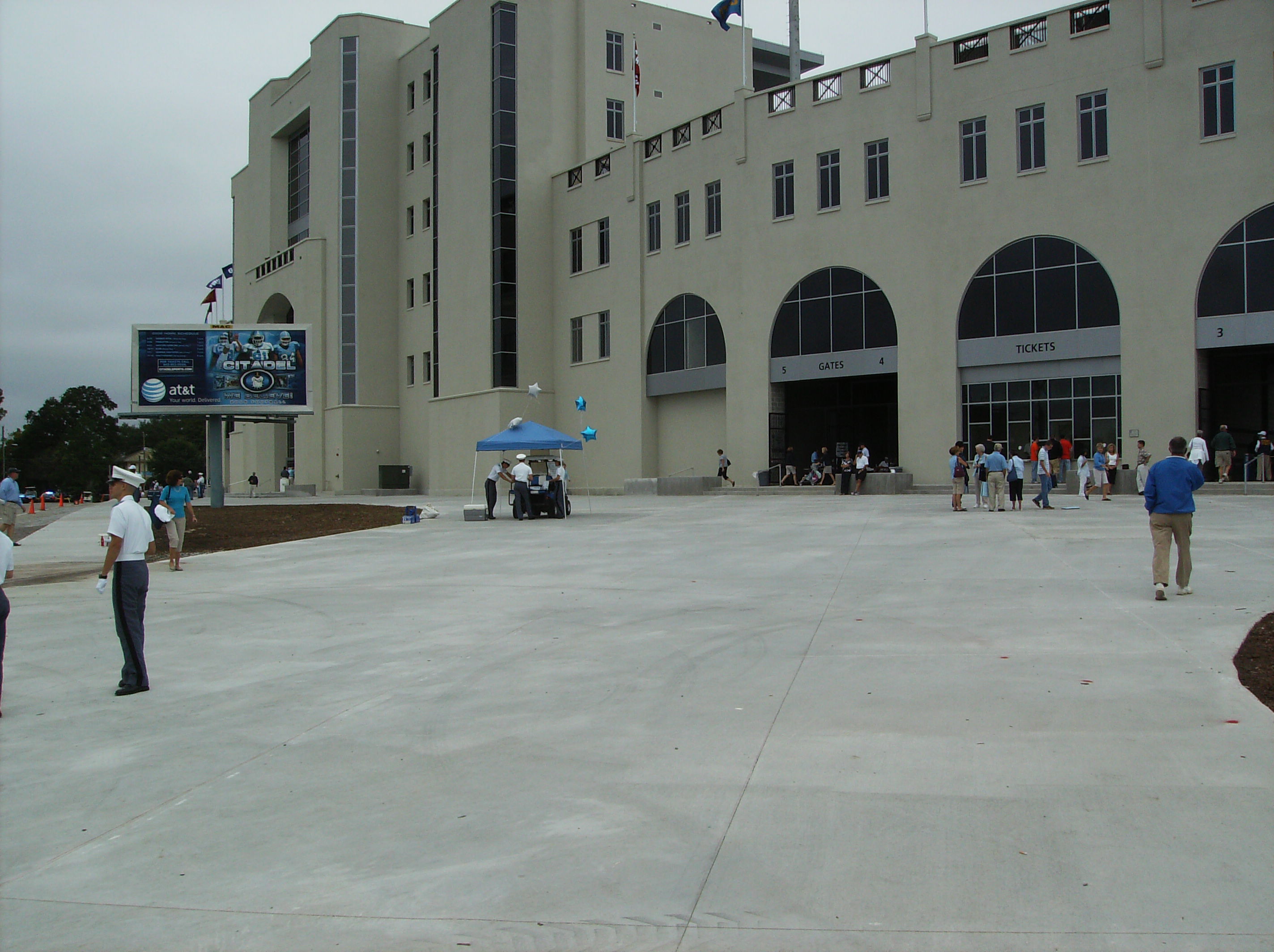
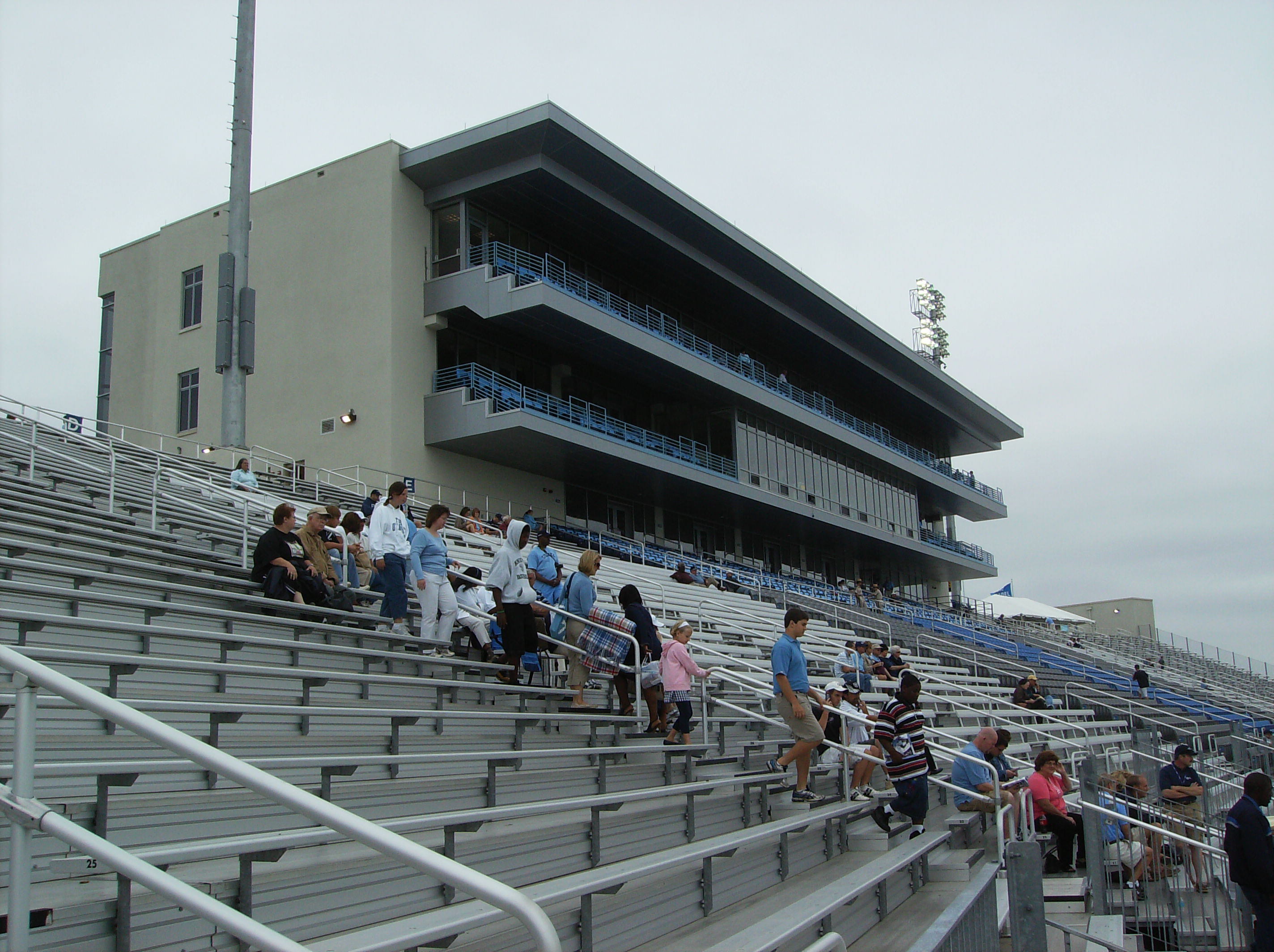
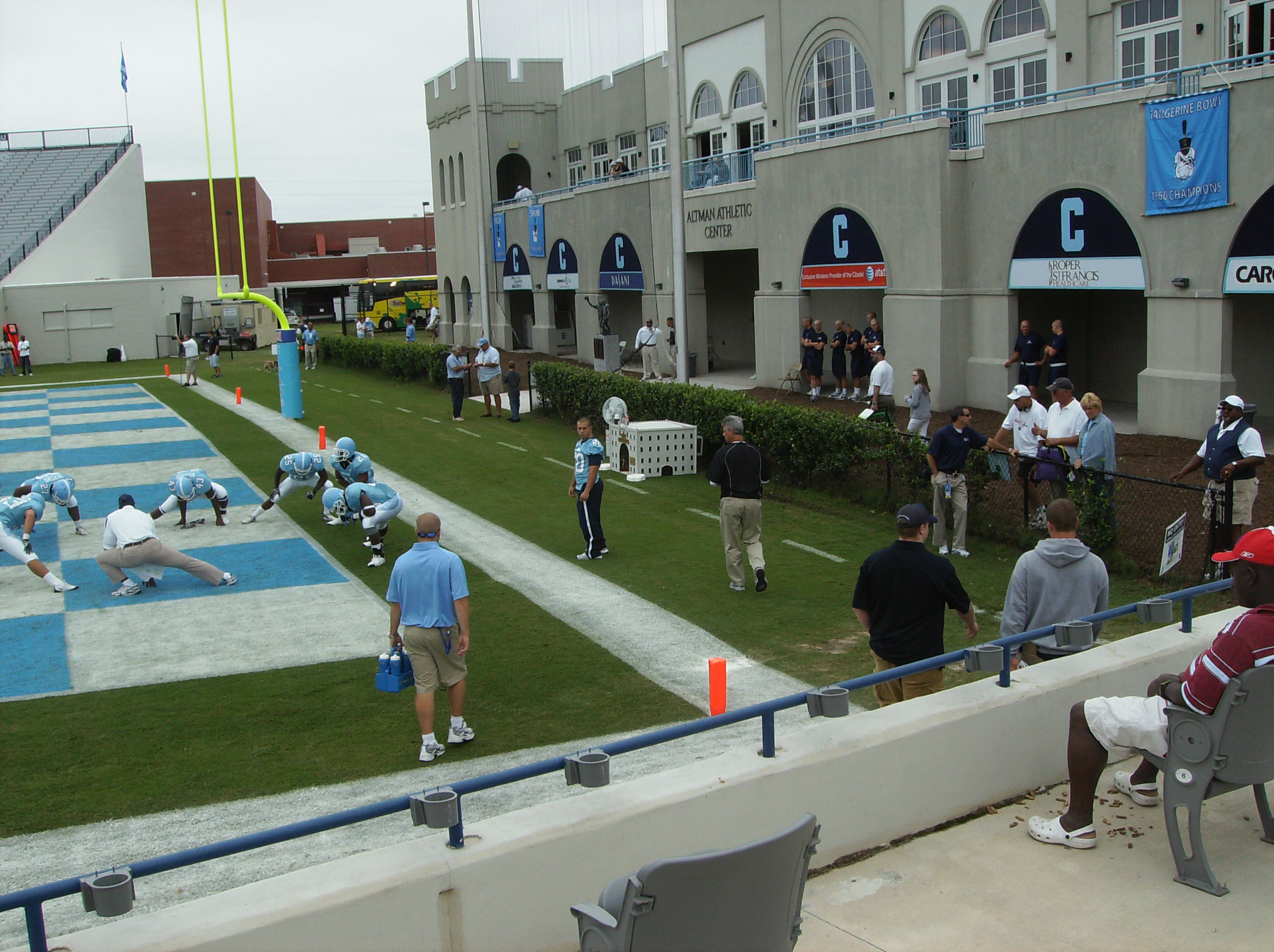
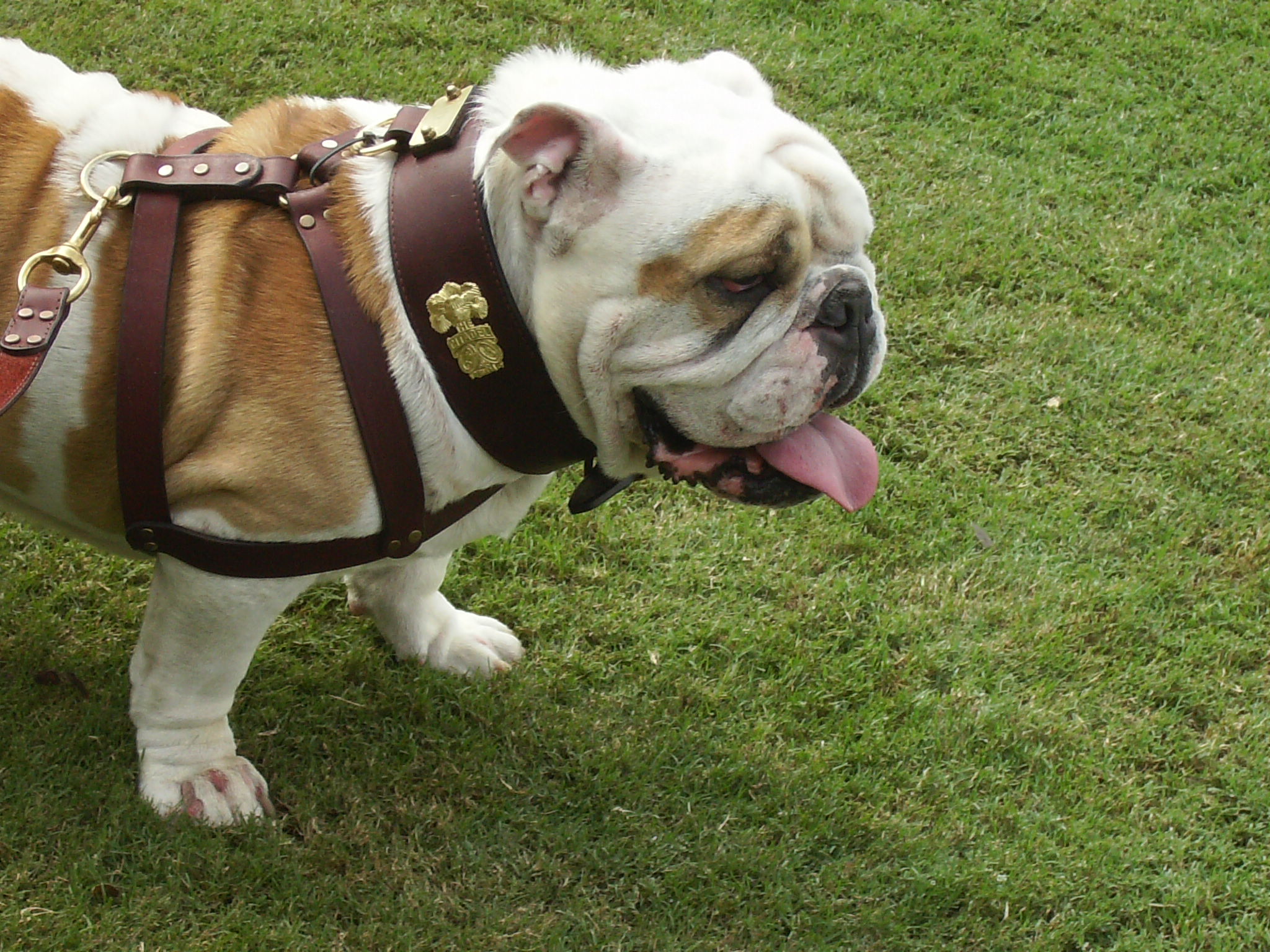
It’s time for college football!   This year the scene at Johnson Hagood Stadium should include a lot of the following:  great tailgating, photo ops with Bulldogs both live and bronze, and, uh, fumbles…

Okay, so maybe that wasn’t the sunniest intro of all time.  I have to be honest here, though.  While I am looking forward to the season, this year I am a bit apprehensive about what lies ahead for the Bulldogs on the gridiron.  The Citadel is going to the triple option on offense, with a head coach who has never run the offense (or any similar offense) before, and with players who were mostly recruited for a very different kind of system.

The players who were recruited with the triple option in mind, of course, are all true freshmen.  The quarterback position will likely be manned by one (or more) of those true freshmen. The “knob”-starting quarterback double is a rare one, and for a reason. It’s an exceedingly difficult combination.

The Southern Conference media and coaches agree that this season could be a long one for The Citadel, just as the last two seasons have been.  The media picked the Bulldogs to finish last in the league.  The coaches ranked The Citadel eighth out of nine teams, ahead of only Western Carolina.

The Catamounts finished last in 2009, with only one league win.  That one WCU victory came against The Citadel, which tied for next-to-last.  More of the same is expected by those who follow the SoCon.

Before beginning league play, though, The Citadel will play three non-conference games.  Next week’s game at Arizona should be…interesting.  The following week the Bulldogs will take on Presbyterian, a team that went 0-11 last season, including a 46-21 loss to The Citadel.  However, even the Blue Hose would be favored against the Bulldogs’ opponent on Saturday, Chowan University, a Division II school located in Murfreesboro, North Carolina.

When the Hawks were announced as the opposition for the home opener, a collective yawn could be heard from The Citadel’s less-than-thrilled fans.  It’s hard to blame anyone for not being excited about Chowan being on the schedule, with all due respect to that school.  I’m guessing this game’s not going to be a sellout.

Having said that, let’s take a look at Chowan.

I wish I could say with confidence exactly how “Chowan” should be pronounced.  This is probably something that should concern Bulldogs play-by-play announcer Darren Goldwater a lot more than me, but I like to know these things.  I even sent an e-mail to Chowan’s department of athletics asking the question, and quickly got a response:

It’s pronounced CHO-WAN with a hard CH, just like CHOKE or CHICKEN. CHO-WAN.

That’s from somebody who works at the school, so she ought to know, but two different people have insisted to me that it’s actually pronounced “Shuh-WONN”, with the “Sh” sound at the beginning and the accent on the second syllable.  Since both of them are natives of eastern North Carolina, the region of the state that actually has decent BBQ, I tend to trust them.

“Chowan” is a derivative of “Chowanoke”, the name given to the native tribe of the region by 16th-century European explorers.  My guess is that if you were French, you pronounced it with the “Sh”, and if you were English, you went with the hard “Ch” sound.  It’s kind of like Beaufort (BO-fert), North Carolina, and Beaufort (BYOO-fert), South Carolina.

You like to-ma-to, I like to-mah-to, let’s call the whole thing off…

There is also a Chowan river, and a Chowan County — but Chowan University isn’t located in that county, but in the adjoining county of Hertford.  Naturally, this school in northeastern North Carolina is named to honor a tribe whose name means “people of the south”.

Regardless of its pronunciation, the school has been around in one form or another since 1848, when it was founded as Chowan Baptist Female Institute.  The school remained all-female until 1931, but in 1937 it became a junior college.

It reverted back to four-year status in 1992, and changed its name to the current Chowan University in 2006.  This fall, it will offer its first Masters Degree program, in Elementary Education.  Chowan remains affiliated with the Baptist State Convention of North Carolina.

About 1100 students attend Chowan.  I thought the section titled “Who we serve” on the school’s website was interesting:

The Chowan University community is committed to serving average students. By “average” we mean students with a GPA from 2.25-3.25 and “average” SAT scores (around 1300 for the three part SAT). Students below these criteria may be admitted if they show a commitment to the Chowan University experience and academic potential…

Many of our students are first generation college students which means their parents did not attend college or complete a college degree. Because of Chowan’s commitment to individual attention in a Christian environment, these students thrive here.

I liked this statement.  Too many schools insist on presenting themselves as wannabe Ivies, when everyone knows better.  Here we have a school that knows exactly what its mission is, and what it wants to do, and isn’t apologetic about it in the least.  Good for Chowan.

Chowan had a fine run in football as a junior college, almost entirely under James Garrison, who was the head coach at the school for 43 years (and for whom its football stadium is named).  Quite a few Chowan alums went on to four-year schools and then the NFL, including George Koonce, Curtis Whitley, and Mark Royals.

However, Chowan has struggled on the gridiron since becoming a four-year school itself.  Since 1993, the Hawks (formerly the Braves) have a cumulative record of 39-168-1 in Division III and (since 2005) Division II.  That includes Saturday’s 59-10 loss to Lenoir-Rhyne.

Chowan has been a football member of the Central Intercollegiate Athletic Association since the 2008 season (and is now a full member of the conference). Chowan is the first non-HBCU member of the CIAA in the league’s 98-year history.

The CIAA now has 13 members, and as a result the conference’s slogan for this year is “Triskaidekaphobia: Fear the 13!”  I’m not sure what the Southern Conference’s slogan would be — “The SoCon: The Nation’s Most Transient League”?

For Chowan football, the last five years have looked like this:

2005 — 2-8, including a 56-10 loss to North Greenville (now of Willy Korn fame) and a 42-21 defeat at the hands of Allen, which dropped its program after the season

2006 — 0-10, including losses of 42-0 to Western Carolina, 52-6 to North Greenville, and 28-0 to Webber International; Webber played The Citadel the following season, with a slightly different result

2007 — 2-9, including a lot of total beatdowns:  51-0 (Coastal Carolina), 56-14 (North Greenville), Presbyterian (62-10), and Newberry (67-0)

2008 — 2-8, which featured an early-season 69-20 loss to VMI (which had concluded its 2007 campaign in memorable fashion)

2009 — 2-8, although most of the games were more competitive; the Hawks did lose 36-21 to Old Dominion, the Monarchs’ first game since restarting its program after a 68-year hiatus (ODU did finish the season 9-2, though)

Those last two seasons came under the direction of the current head coach, Tim Place.  Place is a Washington & Lee alum who was previously the head coach at Urbana, an NAIA school in Ohio.

One of the members of Place’s coaching staff is Omar Nesbit.  Nesbit was an All-SoCon lineman at The Citadel, graduating in 2002.  He is the Hawks’ offensive line coach.

According to the school’s pre-season football guide, the team runs a “multiple” offense and a “multiple” defense.  Thirteen starters are back from last year’s outfit.

Last season the Hawks scored 25.3 points per game, not bad, but allowed 35.2 ppg. While the Hawks were a respectable passing team, all 25 of its TD passes were thrown by C.J. Westler, who was the offensive player of the year in the CIAA, and who is not among the returnees.  Much like The Citadel, Chowan has to find a quarterback (it played two in the Lenoir-Rhyne game).

Chowan turned the ball over three times per game, almost double its opponents’ totals, and averaged an anemic 2.9 yards per rush.  The Hawks gave up 48 sacks.

Defensively, the Hawks allowed 4.6 yards per rush and 9.3 yards per pass attempt, which is obviously not good.  Opponents scored touchdowns 70% of the time when they entered the “red zone”.  Chowan was also not a particularly efficient punting or placekicking team.

Against Lenoir-Rhyne, Chowan allowed 513 rushing yards (6.9 per attempt).  This is noteworthy in that L-R is running the same offensive system this season it ran last year under the direction of then-offensive coordinator Tommy Laurendine — who of course is now the offensive coordinator at The Citadel.

Laurendine has his work cut out for him, based on early reports.  For example, this is how Jeff Hartsell began his recap of the August 21 scrimmage:

After watching his quarterbacks combine for six interceptions and at least five fumbled snaps in Saturday’s scrimmage, Citadel football coach Kevin Higgins stated the obvious.

“Offensively, we have a lot of work to do,” said Higgins…

You could say that, coach.  On the bright side, nine of the eighteen pass attempts in the scrimmage were caught by Bulldogs.  Alas, six of them were defenders.  At least on those plays the QB got the snap from center.  Unofficial totals from the scrimmage had the first-team offense rushing 27 times for 67 yards.

At least the defense apparently looked good, although how much of that was due to the offense’s struggles is open to question.  The kicking game again failed to impress, a problem Higgins has been unable to solve for the last two seasons.

The scrimmage on August 28 was apparently better, based on some anecdotal reports.  At this point it appears the Bulldogs will play two “true” freshman quarterbacks, Ben Dupree (from Pennsylvania) and Matt Thompson (from Florida).

Terrell “First Sergeant” Dallas will be the fullback.  There are several candidates to fill the slotback positions, led by Van Dyke Jones and injury-plagued Rickey Anderson (everyone’s crossing their fingers for you, Rickey).  The offensive line has some experience, but not at center, which in part explains the center-QB exchange problems.

We won’t know for sure exactly how the new offense will look until Saturday, but it probably will be a slightly different variation than Charlie Taaffe’s version of the wishbone.  It’s not going to be quite like Wofford’s option attack, either.

It’s probably going to most resemble the setup run by Paul Johnson at Georgia Southern, Navy, and now Georgia Tech.  With that in mind, I wouldn’t be surprised if Kevin Higgins, with a personal history of running spread passing offenses, throws the ball a little more often than you see in most triple option offenses.

He has to figure out a way to get talented tight end Alex Sellars involved in the offense. Higgins has also commented on the big-play ability of Domonic Jones, a 6’5″ redshirt freshman.  I like the idea of isolating a tall receiver on a smaller defensive back in this offense.  Of course, you have to have a quarterback capable of getting the ball to Jones.

I linked this in an earlier post, but to get up to speed on how this offense will probably operate, check out The Birddog (helmed by a grad/fan of the Naval Academy), the triple option devotee’s website of choice.  Here is a primer on the TO:  Link

While the offense is filled with question marks, the defense should have a lot of answers.  There is depth and talent on that side of the ball, particularly in the defensive backfield.  Cortez Allen has drawn pre-season accolades.  Other DBs with the potential to shine include Keith Gamble (who had an 89-yard interception return against Presbyterian last season) and Joseph Boateng (who intercepted two passes in his collegiate debut against North Carolina).

Former safety Rod Harland is now a linebacker, joining team leader Tolu Akindele and Jeremy Buncum as likely starters.  The defensive line should be solid, if a little young.  Chris Billingslea had some impressive moments last season (and made the All-SoCon freshman team as a result).  Keith Carter is a redshirt freshman who should draw notice, if only for being a defensive tackle who wears #33.

The other defensive lineman (at least that’s his roster designation) I want to mention is Milford Scott, a special teams terror who blocked three kicks last season and created havoc many other times.  He’s tall, has long arms, and describes himself as a “Charleston homeboy” from the beach.  He’s a weapon.

Unfortunately, Scott’s dynamism on special teams was an exception (not counting Andre Roberts, obviously).  While punter Cass Couey fared reasonably well, the Bulldogs continued to struggle in the placekicking department.  That’s two seasons in a row The Citadel has had sub-optimal kicking, and early returns suggest it might be three in a row.

I don’t blame the kickers.  I blame the coaching staff.  It’s the job of the staff to get that aspect of the squad fixed, either by improving the kickers on the squad or finding somebody else to kick.

The Citadel also could stand to improve its punt coverage team (Scott aside) and its kickoff return unit.  The Bulldogs will sorely miss Andre Roberts as a punt returner; look for that component of special teams to not be as effective this season.

There has been a lot of turnover in the coaching staff, not only with the new offensive scheme (where the aforementioned Laurendine is joined by offensive line coach Bob Bodine), but with the defense as well.  Higgins recruited former Wofford assistant Josh Conklin to join the staff, and later named him defensive coordinator.

Conklin will get help from another new assistant, Denny Doornbos, who was the defensive coordinator at Army during the Bob Sutton years, which were mostly good ones.  I have to gleefully point out, though, that he was the DC for this game…and for this game, too.

While all the talk in the off-season has been about the offensive scheme, and how the coaches will implement it, I think the new coaches on the defensive side of the ball will be just as important.  Generally, you would like to have more staff continuity than The Citadel has had, but in the case of the defense, I think a fresh approach may be just what was needed.

There was a sense over the last two seasons that the defense had underachieved; in particular, some observers felt the unit was not aggressive enough.  The Bulldogs’ D must be pro-active this season, and give the offense short fields with which to work. The defense will likely also have to bail the offense out on a regular basis.

This is going to be an important year for Kevin Higgins.  The off-season issues, not surprisingly, did not sit well with the alumni — and I’m not just talking about the big boosters or the message board regulars.  He also has had back-to-back disappointing seasons on the field.

The move to a new offense, and the overhaul of his coaching staff, were both bold moves made by someone who expects to stick around for a while.  They weren’t short-term stopgaps.  That is to his credit, I think.

Now, however, even with modest on-field expectations, he needs to get the fan base to buy into his program again.  After all, Larry Leckonby and company need to sell tickets and sponsorships.  Jerry Baker has Brigadier Club membership goals to obtain, whatever his methods are (high-tech, low-tech, begging, etc.).

A 1:00 pm start time against Chowan on Labor Day weekend in Charleston probably isn’t going to be a big winner as far as attendance goes.  I fully expect one of those hot-and-humid Lowcountry days that are fairly typical for this time of year. Ugh.  Of course, that’s assuming a hurricane doesn’t come into play.

I’ll be there anyway, though.  I’m ready for some football.

Longest droughts: schools that have never made the NCAA tournament

Updated: The 2016 edition

Now updated: the 2015 edition

Editor’s note:  this post is from 2010. For the 2014 update, click here.

For the 2013 update, click here.

For a 2012 update, click here. For the 2011 review, click here.

It’s almost time for the conference tournament season, and almost every year a school will celebrate its very first bid to the NCAA tournament.  Announcers will gush as the students rush the court following a dramatic victory in a league tourney final.  “They’re dancing!” is the cry.

Of course, most of the time the school in question has only been in Division I for a few years after enjoying success in Division II or the NAIA.  Occasionally the team is supplemented, if not dominated, by sketchy transfers or refugees from a local work-release center.  It doesn’t matter, though — it’s in the field of 65.  The school becomes part of the madness of March, and its supporters will cheer wildly (often televised from a local sports bar) when its name is called by James Brown on Selection Sunday.

However, every now and then a school that has spent decades in the Division I wilderness, searching in vain for the road to the tourney, finds its way out of the woods and into the promised land.  Two seasons ago it happened to American University, which had just missed in several Patriot League tourney title games before finally punching its ticket with a 52-46 victory over Colgate.  AU had been in Division I since 1967.

Another school that had a long wait end in 2008 was UT-Arlington.  The Mavericks had been members of Division I since 1969, but had never made the NCAAs until winning the Southland tournament that season (as the 7 seed in the league tourney).

These are the schools I (usually) root for come tourney time, to get that proverbial monkey off their back.  They are the 20 schools that have been in Division I the longest without making a single appearance in the NCAA tournament.  To keep what follows in perspective, just remember that George Mason University, which made the Final Four a few years ago, didn’t even exist until 1972.

“The Forgotten Five”

The NCAA’s modern classification into what we now call Division I occurred in 1948, although the hoops tourney started in 1939.  The five schools that have been in D-1 since ’48 were all technically eligible to be selected to the NCAAs since that first 1939 tourney.  Of course, it was only an 8-team tourney in those years.

Tangent:  maybe it was only an 8-team field in those days, but none other than Harvard got a bid in 1946 (losing both its tourney opener and a consolation game). Thus, Harvard has been to the NCAA tourney despite having never won the Ivy League (which has officially only been around since 1954).

The class of 1948:

  • Army:  I didn’t know this until last year, but the Black Knights actually could have gone to the NCAA tournament in the 1960s.  According to Bob Knight (in a TV interview) Army turned down an NCAA invite to instead play in the NIT, with a chance to compete at Madison Square Garden.

Another tangent:  The last school to turn down an NCAA bid was Marquette (in 1970), a decision made by the late, great Al McGuire.  McGuire was annoyed that his team (ranked 8th nationally) was going to have to travel further than he thought was right for a top 10 squad, so he thumbed his nose at the NCAA brass and accepted an NIT bid (Marquette would win that tournament).  Schools are no longer allowed to decline NCAA bids to play in the NIT.

  • Northwestern:  The Wildcats are the only school in a “power conference” to never make the tournament.  The school hosted the first NCAA tourney in 1939.
  • St. Francis of New York:  This school is not to be confused with St. Francis of Pennsylvania, fellow member of the Northeast Conference, which actually made the tournament in 1991 (and had to win a play-in game to do so).  The Terriers, on the other hand, made three NIT appearances from 1956 to 1963, but have never been particularly close to an NCAA berth, at least from what I have been able to determine.  There isn’t a great deal of SFC hoops history readily available online.  The Terriers may be the most forgotten of the Forgotten Five.
  • William and Mary:  The Tribe did make the NIT in 1983.  Thomas Jefferson and Jon Stewart demand more success than that, though.
  • The Citadel:  I wrote about the school’s painful hoops history in November of 2008.  Since I wrote that manifesto, the team has won more games over a two-season stretch than at any other time in the Bulldogs’ history.  Karma?

The chances of any of these schools making it this year are not particularly good. Northwestern, William and Mary, and Army all got off to good starts, but have faded down the stretch (the Tribe’s 16-point loss to Iona in a Bracketbusters game probably eliminating W&M from at-large consideration).  To get a bid, it’s likely that only a league tournament title (and the automatic bid that goes with it) will do.

At this point, The Citadel might have the best shot, as it will be very difficult for Northwestern and/or William & Mary to win their respective conference tourneys (I think it’s fair to say that winning the Big 10/CAA tourneys is harder than winning the SoCon crown).  The Bulldogs, while currently playing good basketball, will probably have to win four SoCon tourney games in four days, however.  Considering the school has only won two consecutive SoCon tourney games once in its entire history, that may be too tall an order.

As for Army and St. Francis of New York, both are currently in 8th place in their respective conferences, which does not exactly scream “potential tourney run”, especially for Army, since there are only eight teams in the Patriot League.

Other schools who have had to hold their tickets for too long (records listed are as of Feb. 20):

  • Centenary (D-1 member since 1960):  Well, the Gentlemen only have two more years to make the NCAAs (including this one), since the school is moving to Division III after the 2011 season.  Robert Parish’s alma mater would have to win the Summit League tourney.  Currently Centenary is in next-to-last place in the conference and has lost 19 games.
  • New Hampshire (class of 1962):  A case could be made that the Wildcats have been the worst D-1 program since joining the division.  Entering the 2009-10 campaign, the Wildcats’ all-time school record (including the years before joining D-1) is 817-1327 (38%).  New Hampshire’s record in America East play entering this season was 142-299.  Yikes.  At any rate, it doesn’t look like UNH (currently seventh in the America East with an overall record of 10-15) will break through this year.
  • Maine (class of 1962):  Now here is a promising team to watch.  Like New Hampshire, Maine is a member of the America East conference.  Unlike UNH, though, Maine is having a solid season, third in the league, and with an overall record of 17-9.  Keep a close eye on the Black Bears, which may have their best shot at making the field since 1994, when Maine lost in the conference final to Drexel.
  • Denver:  The Pioneers were in D-1 in its initial incarnation in 1948, left the classification in 1980, and then returned to D-1 in 1999.  Denver (one of several hockey-first schools on this list) is a middling Sun Belt team this year (8-7 in league play, 15-11 overall).  It wouldn’t be a complete shock to see the Pioneers make a SB tourney run, though.
  • UT-Pan American (class of 1969):  The Broncs currently compete as members of the Great West conference, a league that doesn’t send an automatic qualifier to the NCAAs.  With a current record of 4-23, I’m guessing UTPA is not in line for an at-large bid.
  • Stetson (class of 1972):  The Hatters reside in the Atlantic Sun basement right now, tied with Florida Gulf Coast in league play (if you’ve never heard of Florida Gulf Coast before, don’t feel bad — DePaul never had either). Stetson has an overall record of 6-21. This isn’t going to be the year.
  • UC Irvine (class of 1978):  Like a lot of these schools, the Anteaters are at the bottom of their league standings, tied for last in the Big West with UC Riverside.  It’s not going to be their year either.
  • Grambling State (class of 1978):  You would think a school with a football tradition as grand as Grambling’s could parlay that into an occasionally good hoops team, but no.  This season is no different, as the Tigers are only 6-15 entering weekend play.  Of course, being in the SWAC means that a team with a 6-15 overall record can’t be completely ruled out as far as winning the league tourney is concerned.
  • Maryland-Eastern Shore:  The Hawks joined D-1 in 1974, but left after just two years, and then returned in 1982.  This season UMES is 6-6 in MEAC play but only 8-18 overall.  I don’t see the Hawks getting past Delaware State or South Carolina State in the MEAC tourney, much less Todd Bozeman’s Morgan State club.
  • Youngstown State:  The Penguins were D-1 in 1948, but then dropped down and didn’t return to the division until 1982.  Jim Tressel won multiple I-AA football titles while in Youngstown, but the hoops squad hasn’t been as successful, and this year is no different.  YSU is tied for last in the Horizon League with Illinois-Chicago (the Flames have been extinguished) and has an overall record of 8-18.
  • Bethune-Cookman (class of 1981):  B-C is actually tied with UMES in the MEAC standings right now, but at 14-12 may be a better team.  I wouldn’t give the Wildcats much more of a shot of winning the league tourney, though.  Maybe they need to bring Cy McClairen back.
  • Western Illinois (class of 1982):  The Leathernecks are currently third-from-last in the Summit League, one place above Centenary.  It’s hard to see WIU making much of a run in that conference tourney.
  • Chicago State (class of 1985):  Like Texas-Pan American, Chicago State is a member of the Great West.  Like UTPA, Chicago State has no chance to make the NCAAs in the foreseeable future.
  • Hartford (class of 1985):  The Hawks, whose most notable hoops alum is Vin Baker, missed a chance to make the NCAAs when they lost in the America East finals two seasons ago to UMBC.  At 8-19 this season, the odds are not in Hartford’s favor.
  • Buffalo:  the Bulls moved up to D-1 in 1974, left D-1 in 1977, then rejoined the classification in 1992.  Buffalo has come closer than any other school on this list to breaking through in recent years, losing in the MAC title game last season and in 2005 (the latter an excruciating 80-79 loss in overtime).  The Bulls are currently 15-9.  It wouldn’t be that surprising to see them in the conference championship game again.

So there you have it.  Those are the 20 schools that have waited the longest for an NCAA bid.  Will one of them break through this year?  Maine and Buffalo look like the best bets, but you wouldn’t really want to place a wager on any of them.

It would be great if one did, though.  I think back to that American victory in 2008, and the sight of Eagles head coach Jeff Jones crying in his sideline chair.  He knew the difficulty of what his team had accomplished.  I felt so good for him and for the long-suffering AU fans.

Incidentally, that difficulty of accomplishment is just another reason why expanding the tournament would be such a mistake.  It wouldn’t mean nearly as much if it were easier to gain entry into the field.  For myself, I’m not interested in The Citadel being part of a diluted field.  Like the fans and players of all the schools still waiting for their moment, I want to enjoy the real thing.

It would be nice to enjoy it sooner rather than later…

The NCAA wants to ruin its own basketball tournament

This is a little late…okay, more than a little.  It’s the holiday season, after all.  I was busy.

You may have heard that the NCAA is considering expanding the D-1 hoops tourney to 96 teams.  The particulars:

[The NCAA] is gauging the feasibility of moving the tournament from broadcast to cable…as it decides whether to exercise an escape clause in its 11-year, $6 billion deal with CBS, the NCAA’s longtime partner…

…the NCAA has the ability to opt out [of the deal] at the close of the 2010 Final Four. One source said this is just the beginning of a process that will conclude in summer  2010, at the earliest…

…the NCAA is not committed to making any changes. It also is talking with TV networks about whether they are interested in the tournament as is. The NCAA’s current deal with CBS is heavily backloaded. More than a third of the total value — $2.13 billion — is due to the NCAA in the final three years.

But the potential expansion of the NCAA tournament has support in collegiate circles, particularly from college basketball coaches. The idea talked about with TV networks would likely take it from its current field of 65 teams to 96 teams and add another week to the competition, with the top 32 teams receiving byes. The move has been characterized as folding the NIT into the NCAA tournament.

The NCAA clearly expects that the added week of games would significantly increase the tournament’s rights fee.

If you’re wondering why college basketball coaches favor expanding the tournament, it’s about job security, primarily for major college coaches.  Now, you might think that coaches who make six figures per annum (or more) might deserve being under a bit of pressure for that kind of dough (and all the other perks that go with the job).  The coaches, though, have a different idea.

Those poor major college coaches do have it rough.  There are 72 schools in the six BCS conferences.  Of those 72, only 36 made the NCAA tournament last season.  Just 50%.  Why, there wasn’t room for 16-14 Georgetown, or 18-14 Virginia Tech, or 17-15 Washington State!  Expanding the field to 96 would surely correct those injustices.

The writer of this article in The Wall Street Journal favors expansion.  As he puts it:

Expansion would, in no particular order, give more quality teams a chance to prove themselves and fix the shamefully low percentage of bids given to lesser-known “mid-major” teams. It might also create enough of a supply of games to allow a portion of the tournament to be shown on cable (at the moment, fans can’t see every game in its entirety because CBS—the rights holder—doesn’t broadcast every game nationally).

Most important of all, adding an extra round or stage to the tournament would mean an extra helping of what fans love most about the event: the early rounds, the unpredictable festival of games that go on all day and create wild excitement all across the country.

Give more quality teams a chance to prove themselves?  Isn’t that what the regular season is supposed to be about?

The problem with his argument about expansion aiding mid-major teams is in his next sentence.  The object of this exercise is for the NCAA to extract as much money as it can from ESPN and/or CBS (or maybe Fox; after all, Chris Rose needs work).  Let’s get serious here — ESPN isn’t going to give the NCAA a zillion dollars to televise first-round matchups between Illinois State-Niagara, or Duquesne-Tulsa.

His basic idea (which mirrors Coach K’s thoughts in the earlier link) is that a 96-team field would envelop and replace the NIT, which is now owned by the NCAA and doesn’t make nearly enough money to satisfy that organization.  As a practical matter, though, it would not and could not.

For one thing, three of the teams in last season’s NIT (Jacksonville, UT-Martin, and Weber State) were regular season champions of smaller conferences that would not be given at-large bids to an expanded tournament.  Several other schools invited to the NIT would also be questionable candidates for NCAA at-large bids, including several of the C-USA squads and Duquesne, which was only 9-7 in Atlantic 10 play.

If you expanded the field to 96, last season at least 51 of the 72 BCS schools would have made the field, and as a practical matter probably five or six more would have also (Vanderbilt for UT-Martin, Seton Hall for Jacksonville, etc.).  That would mean that over 75% of all major conference schools would have received bids last season.

Do we really need that many of those power league teams in the tournament?  Georgetown (to name just one example) lost 12 league games in the Big East (counting its first-round conference tourney loss to St. John’s).  I would suggest that the Hoyas conclusively proved that they had no business playing in the NCAAs.

Another thing is that the near-monopolization by the major conference outfits would only get worse, as once the tournament expands, you can expect a different approach to scheduling in the power leagues.  Schools would know that just approaching .500 in league play would be enough to get a bid as long as the overall record was a winning one.

It wouldn’t be a total wipeout of interesting non-conference games (ESPN has to televise something in November and December, after all).  It would, however, resemble what we’re starting to see in FBS football, which is a paucity of quality non-conference games.

Once that scheduling strategy came to the fore, you would start to see even more of the major conference schools grab at-large bids, to the point where the percentage of at-large bids in a 96-team field would be the same as it is now for the 65-team field.  Last season that number was 88%.

If that percentage held for a 96-team event, then 63 of the 72 BCS teams would get in the NCAAs.  Basically, just the one or two worst teams in each of the six BCS leagues would be left out.  Every BCS school would fully expect to make the tournament every season (well, maybe not DePaul).

Another thing that would happen is that the major conference tournaments would be completely devalued.  I suppose they might affect seeding, but that’s about it.  Even a game on opening day in the ACC or Big XII, for instance, between an 8 and 9 seed wouldn’t matter much.

I am surprised that people like Doug Elgin (MVC commissioner and now a proponent of expansion) are not concerned about how this thing might ultimately evolve.  If the idea is that maybe the mid-major leagues might get a few extra at-large bids, sure they might — but they will find that eventually their place in the tournament as a whole will be further marginalized.

Of course, the mid-majors will still be in better shape than the low-majors, who will be even less of a factor in an expanded field.  For example, 90% of the time the Southern Conference will only have one team in the tournament, the automatic qualifier.  The league has never had more than one team in the field in its history, and hasn’t had a school receive an at-large bid since 1950 (North Carolina State).

There have only been a tiny handful of SoCon schools over the years left out of the 64-team bracket that might have snagged an at-large bid in a 96-team tourney.  Davidson may have received one last season, and the Wildcats might have had a chance in 1996, too.  From a small-school perspective, does that justify the diluting of the tournament?  No.

Besides, the event is already open to nearly every school in Division I.  As pointed out in this article from last season, only 47 of the 344 schools competing in Division I did not have a chance to advance to the NCAAs from conference tournaments (and several of those were schools like Presbyterian, ineligible for the big tourney because they were transitioning to Division I).

Everyone has a shot — The Citadel, William & Mary, St. Francis of New York, Army, Northwestern — everybody.

I think an expansion to the tournament would ruin the event, which is almost perfect as it now stands.  The only true flaw in the current bracket is the dreadful play-in game; the tourney would be better served to have 64 teams instead of 65, and do so by eliminating one at-large berth.

If you expanded to 96 (and then 128, which I suspect would become inevitable), just making the tourney would lose a great deal of its value.  I would like very much someday to see people filling out a bracket with The Citadel on it, even if those people weren’t picking the Bulldogs (which would be a mistake — if The Citadel ever makes the field, I guarantee we’re taking out a high seed in the first round).

However, with 96 teams what would probably happen is that all the major bracket contests you see would start after the first weekend cull from 96 to 64.  It’s like having 32 play-in games instead of one.

I’m not arguing against expanding the field just because of bracket pools.  I’m arguing against it because it is (almost) perfect the way it is now, and expanding it would signicantly lessen its charm, particularly with regards to the schools that don’t see their name in lights all that often.

I have no doubt the NCAA will decide to expand…

Charlie Brown’s favorite college basketball program

Edit (8/10/09):  I originally wrote what follows in November 2008.  The 2008-09 basketball Bulldogs then went out and won 20 games for only the second time in school history, resulting in the first appearance by The Citadel in a post-season hoops tourney (okay, so it was the CollegeInsider.com Tournament, but that still counts).  Based on this turn of events, I am hopeful that if I write another essay prior to next season detailing the program’s less-than-stellar history, the 2009-10 edition of the Bulldogs will win the SoCon NCAA tournament.


There are only five schools that have been in NCAA Division I continuously since the classification’s formation in 1948 that have never participated in the NCAA basketball tournament.  Those five schools are Northwestern, Army, William&Mary, St. Francis of New York, and The Citadel.  Of those five, only one has never participated in the NIT.  Army has played in the NIT eight times (and according to Bob Knight, actually turned down an invitation to the NCAAs in the late 1960s).  Northwestern and St. Francis have three NIT invites each.  William&Mary has made one appearance in the NIT, in 1983.

The Citadel has made no such appearances.  It has never played in a game following its conference tournament.  No NCAA trips, no NIT bids, nothing.

This is not a fluke.

The history of basketball at The Citadel can be likened to the long-running Peanuts bit where Charlie Brown tries to kick the football, only to have Lucy jerk it away from him time and time again, except in this case the ball is jerked away from him about 10 seconds before he can even swing his leg to kick it…but he keeps trying to kick it anyway.

(Yes, I know that’s an analogy based on a football play, and this is a post about basketball.  There will be a motocross analogy later, too.  Just stay with me.)

Here are some quick facts about The Citadel’s basketball program:

— NCAA bids:  0
— NIT bids:  0
— Southern Conference tournament titles:  0
— Southern Conference regular season titles (undisputed or shared):  0
— Southern Conference regular season division titles (undisputed or shared):  0
— Southern Conference tournament MVPs:  0
— NBA players, past or present, who attended The Citadel:  0
— Appearances in the Southern Conference tournament final:  1 (1959)
— Number of times winning more than one game in the Southern Conference tournament:  1 (1959)
— Southern Conference tournament semifinal appearances since 1985:  1
— 20-win seasons:  1 (1979)
— Coaches with a winning record at The Citadel since World War II:  1 (Norm Sloan)
— Best-sellers about playing basketball at The Citadel titled My Losing Season 1
— Seasons with 20 or more losses:  11 (including the last three and five of the last six)
— Seasons finishing 10 or more games under .500:  20 (19 of them since World War II)
— Winning seasons since 1962:  10
— Winning seasons since 1962 in which The Citadel finished 3 or more games over .500:  5
— Consecutive losses in the Southern Conference tournament, 1985-1997:  13
— Consecutive losses in the Southern Conference tournament, 1961-1978:  17
— Overall record in the Southern Conference tournament:  11-55
— Coaches since 1975:  4 (nobody ever said The Citadel didn’t give its coaches a chance)

Brief Digression Number OneEvery season The Citadel loses in the SoCon tourney and sets a new NCAA record for most consecutive conference tournament appearances without winning a title – and every season, the following week Clemson ties the record (which is currently 55) when the Tigers lose in the ACC tournament.  Of course, Clemson came close to breaking its string of futility last year.  Incidentally, The Citadel’s 58-56 win over Clemson in 1979 is the last victory for the Bulldogs over a current member of the Atlantic Coast Conference.  The Citadel is 24-55 against Clemson, alltime.  Seven of those wins came after the Tigers joined the ACC.  Those are the only victories The Citadel has against a school that was a member of the ACC at the time.

The Citadel actually won a few more games than it lost in the seasons leading up to World War II.  Of course, the competition in those not-so-organized times wasn’t always the best.  In 1917, for example, The Citadel defeated the Charleston Navy Yard Machinist Mates 48-11.  In 1925 the Bulldogs beat Standard Oil 46-18, and in 1932 The Citadel recorded a 42-23 victory over the Jewish Alliance.  Alas, the Bulldogs’ 62-51 loss to the Savannah Ice Service in 1941 was a sign of things to come, because after the war things turned south in a hurry.

Brief Digression Number Two:  In 1927, coach Benny Blatt’s Bulldogs finished 17-2 and actually won a postseason tourney, the Southern Intercollegiate Athletic Association tournament, the only postseason event ever won by The Citadel.  The SIAA was the ancestor of the Southern Conference.  However, by 1927 all of the current SEC/ACC schools that would eventually make up the original Southern Conference had left the SIAA, and had been replaced by mostly smaller schools, with some holdovers (like The Citadel) still remaining in the old league.  In that 1927 tournament, The Citadel beat Mercer in the final.  It was the fourth time The Citadel had played Mercer that season, with the Bulldogs winning all four games.  All nineteen games The Citadel played that season were contested in the Carolinas or Georgia.

There is an old Peanuts TV special, “You’re a Good Sport, Charlie Brown,” in which Charlie Brown (with help from Linus) competes in a motocross race, with the winner to receive tickets to the NFL Pro Bowl.  Eventually, all of the other racers (including Snoopy) drop out of the event, and Charlie Brown wins it by default.  However, he finds out after the race that the organizers were unable to get the Pro Bowl tickets; instead, he receives coupons for five free haircuts at a barbershop in Denver, Colorado.  Keep in mind that Charlie Brown is bald, doesn’t live in Denver, and his father is a barber.

The Citadel’s victory in the ’27 SIAA tournament has always struck me as comparable to Charlie Brown’s motocross triumph.

Bernard O’Neil’s first year as coach, in 1948, resulted in a respectable 8-9 record, but his 1949 squad lost its first 17 games before winning the season finale.  He coached three more seasons, finishing with a career record of 28-72.

His replacement, the immortal Leo Zack, was 5-32 in two seasons, the latter season ending with 16 straight losses.  Three of his five career victories came against Newberry.  He also lost a game to Newberry, the school that during this time was better known for being the victim of Frank Selvy’s 100-point game.

Jim Browning was a respected professor at The Citadel, and also assisted the department of athletics whenever and wherever he was needed.  In his later years he helped compile statistics at home football games.  In the fall of 1954, he agreed to serve as coach for the basketball team.  I wish I knew more about how he wound up with the job; there has to be a good story there.  I vaguely recall a writeup about that season, but I don’t remember the source, and I haven’t been able to find it, at least not yet.  Incidentally, Col. Browning would have been a young man in 1954, probably not much older than the players.  I think his main job was to avoid forfeits, to be honest.  He succeeded in that, but that was about all the success the 1954-55 squad would have, finishing with a 1-21 record.  The only win was against the Jacksonville Naval Air Station.

Brief Digression Number Three:  Some sources incorrectly don’t count that as an official victory, including the Southern Conference record book, with the league still listing The Citadel as having lost a conference record 37 straight games during this time period (the record is for consecutive losses against all opponents, not consecutive conference losses).  However, during that era schools were allowed to count games against military bases (and AAU teams) as part of their overall record.  The NCAA actually changed its record book a few years ago to take out references to the “37-game losing streak”; the mistake had been made long ago, and wasn’t fixed until 2004.  (The actual losing streak was 30 games.)  Besides, it’s not like The Citadel was catching a break playing service teams – the Bulldogs also lost that year to that same N.A.S., and dropped two lopsided games to the Parris Island Marines as well.  The Citadel also lists a loss to Gibbs AAU for that season by a score of 121-65.

That loss to Gibbs AAU wasn’t the worst loss of the season, though.  Neither was the 125-54 drubbing in the first game against the P.I. Marines.  The worst defeat would be an 87-point loss at Furman, 154-67.  That game would become part of an unusual record, for in the second meeting that year between the two teams, The Citadel elected to play stall-ball (why the Bulldogs didn’t try that strategy more often during the season, I don’t know).  I was once told by someone that at one point during the game most of the players on both teams were sitting down on the court, a few of them amiably chatting with one another.  Furman eventually won the game, 26-24.  The 85-point differential from one game to the next between the same teams is an NCAA record.  Normally, a record like that would occur when a team lost by a large margin and then came back and posted a dominant victory.  In this case, however, The Citadel (naturally) managed to lose both games.

The next year another coach, Hank Witt, who doubled as an assistant coach for the football team, led The Citadel to a 2-19 record.  Some of the losses that season were just staggering (Presbyterian beat The Citadel by 50 points – twice).  After that season, somebody at The Citadel got serious about hoops.  That somebody was presumably Mark Clark, scourge of Italy (and Texas).  The famous World War II general had become the new president of the school in 1954 and had no use for inept varsity athletic teams, or anything else inept for that matter.  The military college decided to hire a young coach named Norm Sloan.  You may have heard of him.

Sloan did a fantastic job, winning 57 games in four seasons.  In his third season, The Citadel would finish 15-5, losing to Jerry West and West Virginia in the SoCon tourney final, the only appearance The Citadel has ever made in the title game.  (West Virginia would go all the way to the NCAA championship game that year, losing 71-70 to California.)  Sloan left after the following season to coach Florida (the first of two stints with the Gators; of course, in between he would win the national title at North Carolina State).

Brief Digression Number Four:  Sloan recruited the midwest exclusively while at The Citadel.  He seemingly had no interest in local players.  In the fall following his first season as coach, he held an open practice for cadets interested in trying out for the basketball team.  Well, maybe not so open.  Sloan walked into the gym and greeted all the candidates, and then asked them to line up single-file, facing him.  He then said, “Everyone from Ohio, Indiana, or Kentucky, take one step forward.”  A few of the cadets stepped forward.  Sloan then barked, “The rest of you are cut,”  and walked out of the gym.

Sloan’s replacement, Mel Thompson, had one good year, and then the program went downhill, including a 3-20 debacle in 1963.  Thompson did manage to put together two consecutive winning campaigns after that season (with records of 11-10 and 13-11).  However, Thompson and the program then suffered two more losing years with a combined win-loss total of 15-33.  His final season eventually spawned a best-selling book in which the coach was portrayed as something less than human, or all too human, depending on your point of view.

After Thompson’s departure, the program went through a seven-year period of .445 ball under two different coaches.  Dick Campbell coached for four seasons.  Campbell came to The Citadel after an enormously successful run at Carson-Newman, where he had averaged 25 wins per season in his last seven years as coach.  At The Citadel, however, Campbell would finish with a record of 45-54.  He left the military college to take the head coaching job at Xavier.  His career as a college coach would end two years later, after a 3-23 campaign for the Cincinnati school.

George Hill took over from Campbell.  Hill had been the head coach at the U.S. Coast Guard Academy, where in two years he had won 11 games, all 11 victories coming in his second season (the USCGA was 0-21 in his first year as coach there).  He couldn’t provide any forward momentum at The Citadel, though, going 33-42 in three seasons, all losing campaigns.  Hill would later become a sportswriter and an author.

Les Robinson, who had already been an assistant coach for several years, was then promoted.  Robinson, one of three North Carolina State graduates to coach The Citadel (Sloan and Thompson had also played for the great Everett Case), would start off the first season of his eleven-year head coaching career at The Citadel by winning four of his first five games.  Three games later, his squad was still in good shape at 5-3, but it would then lose its last twelve games.  Robinson would follow that up with a 17-loss campaign and two 19-loss seasons before finally finding success, with his 1978-79 team finishing with a 20-7 record and actually winning a SoCon tourney game, the school’s first postseason victory since 1961.  After a few middling-to-bad seasons, Robinson’s final Bulldog team would win 18 games.  He then left to become head coach and AD at East Tennessee State.  Four years later, Les Robinson would finally take a team to the NCAA tournament.  He would later become famous enough to have an invitational named after him.

His replacement, Randy Nesbit, had played for Robinson, and was only 26 years old when he got the top job.  In seven years, Nesbit had more 20-loss seasons (two) then winning seasons (one).  In all fairness to Nesbit, he didn’t have a lot of luck, even by the meager karma standards of basketball at The Citadel.  Among other problems, The Citadel’s ancient basketball arena, McAlister Field House, underwent a renovation that left it unusable for two seasons during his tenure.  McAlister could occasionally be a surprisingly difficult place to play for opposing teams (it was often described in its original incarnation as resembling an airport hangar).  In Nesbit’s third season as coach, however, his squad played no games on campus, with the designated home games played at a local high school or at the College of Charleston’s gymnasium.

The following year, The Citadel elected to play its home games at its physical education building, Deas Hall, one of the more bizarre places to serve as a home court for a Division I basketball team in the modern era of college basketball.  McAlister would eventually reopen, but Nesbit’s final two teams would lose a combined 40 games anyway.  Nesbit is now the head basketball coach at Roane State Community College in Tennessee (he also teaches in the business school there).  One of the players on his current squad is 73 years old.

Brief Digression Number Five:  Nesbit did have one great moment while coaching The Citadel.  In 1989, Nesbit’s Bulldogs shocked South Carolina in Columbia, 88-87, breaking a 36-game losing streak to the Gamecocks that had dated back to 1943.  The key basket in the game was a clutch three-pointer made by Nesbit’s younger brother, Ryan (if he had missed it, the adjective “clutch” would have been changed to “reckless”).  The Gamecocks were marching to their first NCAA bid in many years when they were stunned in the late-season matchup, but George Felton’s best team actually recovered from the loss and won enough games to make the dance anyway (losing to North Carolina State in the first round).  The victory in Columbia was The Citadel’s 16th of the season, and, as it turned out, its last.  Thus it was the final win in the career of one Ed Conroy, a senior guard on that team, and now the head coach of the Bulldogs.

Nesbit was followed by Pat Dennis (also known as “the long-suffering Pat Dennis”), who had been an assistant for Dick Tarrant at Richmond.  Dennis would last for fourteen years, the longest tenure of any of The Citadel’s basketball coaches.  His sixth squad finished 15-13, the first winning season at The Citadel in a decade, and actually won a SoCon tourney game, the first in 13 years for the school.  After a few more losing years, Dennis would have consecutive winning seasons in 2001-02 and 2002-03, one of only two times The Citadel has had consecutive winning seasons in the last 42 years.  The perpetually frustrated Dennis would lose 20+ games in three of his final four seasons, however.  Dennis finished with a career record at The Citadel of 156-235.

On the bright side, Dennis had a winning record against each military school he faced while coaching The Citadel (11-7 against VMI, 2-1 against Navy, 3-0 against Army, and 1-0 against Air Force).  So he had that going for him, which was nice.

The current coach of the Bulldogs, Ed Conroy, is 13-47 in two seasons at the helm.  Conroy was hired by none other than Les Robinson, who had returned to The Citadel as AD.  Conroy had actually been recruited by Robinson when he was a high school senior, although Robinson would leave for ETSU before ever getting a chance to coach Conroy at The Citadel.  Ed Conroy is a cousin of Pat Conroy, a relationship that was well documented when Ed took over the program.

Last year, Conroy made news by playing a squad almost entirely made up of freshmen.  Some of them actually showed promise (albeit while only winning two games against Division I competition), so perhaps he can be the coach to lead the Bulldogs to the promised land – the NCAA tournament.  I’m rooting hard for him – he’s a nice guy – but it’s going to be very, very tough.  When The Citadel beat South Carolina that cold night in 1989, Conroy was quoted as saying the victory would be “the one we’ll remember all our lives.”  Winning the Southern Conference title as head coach of The Citadel would be a much more memorable moment.

I always tell people that if The Citadel were to ever advance to the NCAAs in basketball, that would probably be a sure sign of an imminent Apocalypse…

It can be difficult to be a fan of college hoops — and I really enjoy college hoops — when your school is always terrible in basketball.  Not just occasionally terrible, mind you, not just those inevitable slumps of a year or two or even a bad decade, but always.  It’s like there’s a really cool party going on, and the party never really stops, but it doesn’t matter that the party lasts forever, because you still don’t have a ticket and you may never get one, and what really irks you is that practically every other person in the free world has been to the party, even some out-and-out losers who don’t even realize how great the party really is, and you are still left out in the cold.

It would be great to even consider the possibility of turning on the tournament selection show, and watching James Brown announce something like, “in the South regional, with these games being played in Winston-Salem, North Carolina, the #2 seed is Georgetown, and the mighty Hoyas will take on the #15 seed, the Southern Conference champion, The Citadel [brief pause, as Brown shakes his head in disbelief], making its first NCAA tournament appearance in school history.”  This would be followed by a live shot of cheering cadets, possibly with no hazing involved.

It would be absolutely surreal.

It hasn’t come close to happening, though, and really, if it were to happen (and this is important), I would like it to be in a year in which The Citadel was actually good.  I don’t want it to be a year where the Bulldogs go 11-18, and then get lucky and win the SoCon tourney because all the other teams’ players came down with food poisoning or something.

Besides, in that case, The Citadel would almost certainly land in the utterly reprehensible, completely despicable play-in game.  If The Citadel were to ever make the NCAAs, and the tournament selection committee then put the team in the play-in game, I would immediately drive up to Indianapolis and just start assaulting people.

That scenario isn’t likely to happen, though (which is just as well, as the drive to Indy would probably be really boring).  The Citadel has only won two games in the conference tourney once in its history.  It’s hard to conceive of it actually winning three times in one weekend.

I fully expect more hard times on the hardwood.  I hope for the best, but you have to be realistic.  After all, it’s a small military school with no hoops tradition whatsoever.  If Charlie Brown were to have a favorite college basketball program, this would be it.

Still my team, though.