Hoops update: still searching for a second SoCon victory

Just a few quick thoughts on the losses to Wofford and Furman:

— The Citadel has a lot of issues to address, both offensively and defensively, but one noticeable problem the Bulldogs have had, particularly over the last three games, is a tendency to commit a ridiculous number of first-half turnovers. The Citadel has averaged over 11 turnovers in the first half in those three games. The Bulldogs have taken care of the basketball in the second half in two of those games, but to win consistently (or at all) they must cut down on turnovers throughout the game.

If The Citadel had not committed 12 first-half turnovers against Wofford, the Bulldogs likely would have had a decent lead at the break instead of being tied at 21. Against Furman, ten TOs in the opening stanza led to a deficit that the Bulldogs could never quite overcome.

The Citadel had 12 first-half turnovers against Georgia Southern in a game the Bulldogs lost in double overtime; in the second half and two overtime periods in that contest, The Citadel only committed seven turnovers. Just cutting down on a few of the first-half miscues would have resulted in a victory for the Bulldogs.

You just can’t throw away possessions like that. Against Furman, the Bulldogs shot the ball very well in the first half (53% FG), actually got to the foul line and made a good percentage of their free throws (9-12)…and still trailed by six points at intermission because 29% of The Citadel’s possessions ended in a turnover.

Against Wofford, 37.5% of The Citadel’s first-half possessions ended in a turnover.

Admittedly, none of this is news to the Bulldogs. As Mike Groselle said after the Wofford loss:

We’re really close, and everyone on the team knows it. It’s up to us to be more solid with the ball. That’s going to be the difference in winning and losing these games.

— Groselle is continuing to put together what is by anyone’s definition an outstanding season, despite The Citadel’s struggles. There is no telling how many points he would have scored against Furman if the Paladins had not elected to go to a sagging 2-3 zone midway through the second half; as it was, Groselle finished with 24 points on 10-12 shooting from the floor (along with 11 rebounds).

Unfortunately, the Bulldogs were unable to make Furman pay for that defensive strategy, only making three of fifteen three-point shots. Not only was The Citadel unable to hit from outside, the Bulldogs’ guards could not penetrate the zone for easier shots in the paint (or simple feeds to Groselle). Chuck Driesell’s take:

The zone bothered us, and I’m surprised about that. We worked on it, and we knew they played it some. We didn’t knock down shots. The zone keeps the ball out of the big man’s hands, but if you knock down a couple of 3-pointers, they can’t stay in it long.

Of course, it’s easy to say what the Bulldogs need to do against a zone. Executing that plan is another matter. I was reminded that it’s not the simplest of propositions when on Sunday, Rob Dauster of Ballin’ Is A Habit tweeted that “to beat a zone, you have to move the ball quickly and get the ball into the paint via pass or penetration.” The team that drew Dauster’s ire because of its inability to do that?

That team would be Connecticut — which, last time I checked, won the national title last season.

— I was able to make it to McAlister Field House on Saturday night, and happy to have been in attendance, despite the loss to Furman. The 1600 or so fans at the game were treated to a good game between two teams that played hard, if not always well.

At halftime, The Citadel honored Jake Burrows, whose accomplishments I mentioned in a previous post, by putting jersey number 3 in the rafters. Burrows is the third hoopster so honored by The Citadel; somewhat amusingly, only one numeral has been needed, as the other two honorees (Regan Truesdale and Art Musselman) both wore no. 33. Burrows spoke briefly and movingly to the crowd, better than most people could have, and most people aren’t 93 years old.

It is a shame there weren’t more cadets on hand, although it certainly is understandable, given it was Saturday night. The Southern Conference schedule doesn’t really help The Citadel on that front.

I have a suggestion to the administration that I’ve made before and that I’m going to make again. There are cadets on campus on Saturday nights (besides the hard-working pep band). I’m talking about cadets who are serving tours or confinements. It wouldn’t be a bad idea to give those cadets credit for tours/cons by letting them come to McAlister and support the team. I am betting some of them would be ideally suited for the role of cheering the Bulldogs and mocking the opponents.

Actually, I know they would be ideally suited, because the idea is not without precedent.

On a February night in 1990, conduct-restricted cadets (and a few of their “free to roam” colleagues) cheered on The Citadel’s basketball team as it battled an outstanding East Tennessee State squad, one that would win the second of four straight SoCon titles that season. The Bulldogs had played ETSU earlier that season in Johnson City and lost badly, 92-57.

However, with the support of a particularly rowdy section of the corps behind them, the Bulldogs put together what may have been their best performance of that season. Alas, it wasn’t quite enough for a win, as Ted Mosay’s last-second shot was blocked, enabling the Buccaneers to escape with an 87-86 victory. Still, it was a great game and a lot of fun.

The night at McAlister wasn’t over, though. In a decidedly unusual development, a wrestling match between The Citadel and UT-Chattanooga had been scheduled to follow the basketball game. The hoops game had tipped just after 6 pm, so by the time the first wrestling match started it was around 9 pm. UTC, the conference favorite, would eventually win, but things were tougher than expected for the Mocs, in no small part due to a vocal contingent cheering on The Citadel.

It was a great experience for the Bulldog wrestlers, and probably for the Moc grapplers as well. My lasting memory of that evening, though, was the one voice in the stands that stood out the most. Leading the crowd in cheers, needling the referee at every given opportunity, supporting the cadets on the mat throughout every match…was the assistant commandant of cadets, the one and only LTC Harvey M. Dick.

Harvey Dick died Saturday morning; there was a moment of silence before the game, and flags on campus were lowered to half-staff. It is a loss that has hit the greater community of The Citadel hard, understandably so. Few people loved The Citadel and cared more for its students than Harvey Dick. Stories about him are numerous, mostly true, and could be told for days on end. For me, I’ll always remember that night at McAlister. Condolences to his family.

Hoops update: a league victory, SoCon vs. CAA, and TV

This post is going to be split into three different topics. Before reviewing and previewing the current on-court antics, I wanted to focus on a couple of recent articles in The Post and Courier. They touch on subjects that impact The Citadel’s department of athletics in general and its basketball program in particular.

With CAA as model, SoCon bids to climb ladder

[College of Charleston] basketball coach Bobby Cremins said he was jealous of George Mason’s league, the Colonial Athletic Association.

“I’d love to see the Southern Conference become something like that,” Cremins said. “That should be the goal of our conference. We use them as a model.”

The source of Cremins’ envy? The three teams the CAA sent to the NCAA tournament last season, and the four at-large bids the Colonial has landed in the last six seasons. That’s four more at-large bids than the SoCon has earned it its entire history dating back to 1939, when the NCAA tournament started.

The SoCon has never sent more than one team — the tournament champion, who earns an automatic bid — to the Big Dance, which expanded to a field of 68 teams last year.

Tangent to make an overly nerdy comment: technically, the SoCon has actually received three at-large bids in its history. From 1939 to 1950, the field for the NCAA tournament was made up of only eight teams. Three times, teams from the SoCon played in the event; on all three occasions, those bids were invitations and not automatic selections. In 1951, the NCAA tournament expanded to 16 teams, and the SoCon champion (North Carolina State) got an automatic bid into the event. Not that it really matters.

Bobby Cremins has yet to take the College of Charleston to the NCAAs, and knows the only way to do so (at least right now) is to win the league tournament. Cremins actually had a solid record as a league tournament coach when he was at Georgia Tech (winning the ACC tourney twice), but hasn’t yet grabbed the brass ring while at the CofC.

I think the information presented in the article underscores how tough a task the SoCon has in trying to emulate the CAA. Besides having larger schools that play in bigger arenas (for the most part), most of the CAA schools don’t have to worry about football. The CAA probably also benefits to a degree from having more of its schools located in larger metro areas, although that can be a double-edged sword.

It’s good that the SoCon is trying to be more strict about its non-conference scheduling, but it’s a difficult balancing act. It should be noted that playing a non-D1 doesn’t have any impact on the RPI. What the league doesn’t want is schools overloading their schedules with gimme games against non-D1s and guarantee games against BCS schools. The SoCon needs its members to play more “in-between” schools. Otherwise, instead of competing with the CAA it risks sliding down into SWAC territory.

Having said that, John Iamarino knows that some of his schools have fewer options than others. That’s the nature of the SoCon and its disparate membership. It would be interesting to know which school drew the commissioner’s wrath for its less-than-acceptable scheduling. If I had to bet, I would put my money on Chattanooga.

Let’s talk about TV

I’ve been meaning to write more about the linked article, which was originally published in early December.

The College of Charleston Sports Network will produce 11 games this season that will be broadcast locally on WMMP or WTAT. Those games also will be available on ESPN3, a streaming Internet service that reaches more than 70 million households worldwide and is available in 85 percent of U.S. homes. Some games also might be carried on ESPN FullCourt, a pay-per-view service available on cable systems.

By season’s end, at least 23 of the team’s 30 regular-season games will be televised.

Does The Citadel need to do something like this? Absolutely.

The startup costs would not be insignificant, but I believe it would be a worthwhile investment. The potential exposure for the varsity sports teams, not to mention the school in general, makes it a no-brainer.

That includes televising home football games in a format that can be used by ESPN3.com or one of the myriad sports TV networks, many of which seem desperate for programming.

It would likely give The Citadel an edge in recruiting — and if the school doesn’t do something like this, it will probably fall behind a host of other schools. Just look at FCS football.

Some of the FCS schools that had the majority (if not all) of their football games televised in 2011: Lafayette, Lehigh, Liberty, Maine, Montana, Montana State, Murray State, Northern Arizona, and seemingly all of the Dakota schools (including, not so coincidentally, national champion North Dakota State).

That’s not even counting schools that have home games televised on public television (like Eastern Illinois) or schools with a two- or three-game deal with a local TV station/cable carrier (like Cal Poly, Colgate, Georgetown, and Holy Cross). Not all of those games wind up on a Fox sports net or ESPN3.com, but plenty of them do.

The opportunities in basketball, baseball, and perhaps soccer and wrestling are there, too.

I’ve long advocated that The Citadel’s coaches schedule non-conference games with an eye to getting on television as much as possible. Now I think it is time for the school to be even more proactive.

The Citadel finally won a league game last week, beating Samford 73-62 at McAlister Field House. It was also the first league home game for the Bulldogs, and I am hopeful that the team can add to the victory total this week. Prior to the win over Samford, it had been very tough sledding, as The Citadel had lost its previous ten games against D-1 competition, all but one by double digits.

The worst of those was a 77-45 drubbing by Furman two days before the Samford matchup, so at least the Bulldogs showed some resiliency in bouncing back from that loss. However, the fact remains that it’s been a struggle all year for Chuck Driesell’s troops, particularly on defense.

The Citadel ranks in the bottom 50 nationally in the following defensive categories: effective field goal percentage, turnover percentage, block percentage, and two-point field goal percentage. The Bulldogs are actually dead last (59.3%) in 2-point FG%, 345th out of 345 D-1 teams. The Citadel’s overall defensive efficiency rating (per Pomeroy) is 8th-worst in the country.

Driesell has focused on his team’s defensive issues each and every time he’s discussed the squad’s performances, notably on the post-game radio show. I’ll say this, he’s not one to sugarcoat things, as anyone who has listened to the show can attest.

The win against Samford was a decent (not great) defensive performance. The Citadel has proven to be a tough matchup on the hardwood for the Birmingham Bulldogs over the years, and Saturday night was no exception. Samford shoots a lot of threes by design, but you have to make a decent percentage of them for that strategy to work, and Samford was only 7-29. Some of that was good defense by The Citadel, and some of it was just really bad shooting.

The chief negative for The Citadel was that Samford dominated the offensive glass, particularly in the first half, when it had an offensive rebound rate of almost 60%. The cadets should have led at halftime by about fifteen points, but had to settle for a seven-point edge.

On the positive side of things (after all, it was a victory), Mike Groselle was outstanding (10-10 FG, 25 points) and Cosmo Morabbi had a career night, with 20 points and six assists. The Bulldogs as a whole were solid on offense.

Next up for The Citadel: two more home SoCon games, against Elon and UNC-Greensboro. Elon has been a mild surprise this season, playing about as well as any team in the muddled SoCon North. The Phoenix won at home over South Carolina earlier in the campaign, but recently has hit a slump, losing five straight games.

Losing to North Carolina and San Diego State is not exactly embarrassing, but the streak also includes losses to Dartmouth (a traditional cellar-dweller in the Ivy League), Georgia Southern, and Columbia (another Ivy opponent). Elon has struggled putting the ball in the basket in those five games, as it has not shot better than 36% from the field in any of them. The Citadel needs to make sure that trend continues.

Tough matchup alert: Elon’s Lucas Troutman is a 6’10” native of Belton, SC, who was on the SoCon’s all-freshman team last year. He scored 22 points against NC State earlier this season and will be a difficult player for the Bulldogs to handle.

On Saturday the Bulldogs host UNC-Greensboro, which is 2-14 and only has one D-1 victory, that over winless Towson. The Spartans are on their second coach of the campaign, as longtime boss Mike Dement resigned in December. It was inevitable, especially after UNCG’s 22-point loss to North Carolina A&T two weeks before.

Wes Miller is the interim coach. Miller is only 28 years old, and may have a chance to keep the job, depending on how the rest of the season plays out for the Spartans. So far he has yet to record a victory as head honcho, although UNCG played well in a 10-point loss at Miami.

As you might expect, UNCG has some really bad stats, particularly on defense. What is unique about the Spartans D is that opponents shoot well from everywhere — three-point range (bottom 15 nationally), inside the paint (ditto), even at the foul line.

UNCG’s best player is Trevis Simpson, a 6’4″ guard. Like Elon’s Troutman, he was on last year’s league all-frosh team. Simpson is a volume shooter who blows hot and cold, but when he’s hot he can get very hot (at Miami, he hit 7 of 11 three-pointers as part of a 36-point explosion). The Citadel must work hard, especially early in the game, to make sure he doesn’t get on a roll.

The Citadel will be a slight underdog in both games this week. However, it will be disappointing if the Bulldogs don’t win at least one of the two contests. That’s the short-term view. As for what these games mean for the season as a whole, I’m hoping to see some improvement on the defensive side of things for The Citadel. If that happens, more wins will follow.

Talking stats: SoCon football and turnovers

I was reading Jeff Hartsell’s review of The Citadel’s football season in The Post and Courier. In the second post of the three-part series, head coach Kevin Higgins had this to say about turnovers:

 We didn’t get as many turnovers as I would have liked. We just didn’t have that many opportunities. That’s something we’ll have to study in the off-season and address that. We need to be able to turn the ball over — one more turnover against Samford or Georgia Southern or App State could have meant the difference in any of those games.

I thought it might be an interesting idea to dig a little deeper into the statistical record to see what The Citadel could do to force more turnovers. However, that meant more than just going by the raw data.

First, I decided that it would be best to concentrate solely on Southern Conference play. Including games played against the likes of Virginia Tech and Virginia-Wise (just to name two SoCon opponents) would make the statistics something less than balanced. Besides, teams are ultimately judged on how they fare against league opponents. There is also the benefit of each team’s conference statistical summary including four home and four away games.

Another consideration was trying to account for the different types of offenses employed by SoCon teams, including three “true” triple option teams and several schools running the spread, and with varied paces of play. That is why I felt it was important to focus on certain percentage categories, rather than totals.

I compiled data (league play only) for a number of different statistics, both for offense and defense. After doing this, I put together a spreadsheet which you can access at the link below:

Southern Conference 2011 Football Statistics

I trust most of what is on the spreadsheet makes at least some sense.

Before I get to my conclusions about The Citadel’s issues with forcing turnovers (along with observations on some other SoCon schools), I want to make a few points:

– It is generally accepted that there is no real skill in recovering fumbles. Anyone who follows any of the websites that study professional football statistics/history is aware of this. Football Outsiders puts it best:

Stripping the ball is a skill. Holding onto the ball is a skill. Pouncing on the ball as it is bouncing all over the place is not a skill. There is no correlation whatsoever between the percentage of fumbles recovered by a team in one year and the percentage they recover in the next year. The odds of recovery are based solely on the type of play involved, not the teams or any of their players.

Fans like to insist that specific coaches can teach their teams to recover more fumbles by swarming to the ball. Chicago’s Lovie Smith, in particular, is supposed to have this ability. However, since Smith took over the Bears, their rate of fumble recovery on defense went from a league-best 76 percent to a league-worst 33 percent in 2005, then back to 67 percent in 2006. Last year, they recovered 57 percent of fumbles, close to the league average.

Fumble recovery is equally erratic on offense. In 2008, the Bears fumbled 12 times on offense and recovered only three of them. In 2009, the Bears fumbled 18 times on offense, but recovered 13 of them.

Fumble recovery is a major reason why the general public overestimates or underestimates certain teams. Fumbles are huge, turning-point plays that dramatically impact wins and losses in the past, while fumble recovery percentage says absolutely nothing about a team’s chances of winning games in the future.

Although this makes perfect sense, it is understandable that longtime football fans might not be so sure. I think the best way to illustrate the randomness of fumble recoveries is to highlight Pittsburgh Steelers legend Jack Lambert, who besides being a fantastic linebacker was one of my favorite players.

In the 1975 AFC championship game against the Oakland Raiders, Lambert recovered three fumbles. In the following year, 1976, he recovered an amazing eight fumbles (in fourteen games) for a remarkable Steelers defense. Lambert had a “nose for the football”, to say the least — and yet…

Those three fumble recoveries against the Raiders were the only recoveries he made in eighteen career playoff games. Those eight fumble recoveries in the ’76 regular season? They make up almost half of his career total (17).

Not everything about the NFL applies to college football, of course, particularly in FCS play, but there is no doubt that this particular observation does hold at the college level. Basically, when a ball is loose on the ground each team has a 50-50 shot at getting it. In 2011, there were 130 fumbles in Southern Conference play. The defense recovered 69 of those fumbles, or 53%. Congratulations to SoCon defenses!

No team in league play had a particularly unusual percentage when it came to recovered fumbles, either from an offensive or defensive perspective. It may be that an individual school was luckier or unluckier by a fumble or two, but that’s about it.

That isn’t to say that fumbles aren’t important, because they are. Often a fumble is more damaging to an offense than an interception (because of lost field position). However, they aren’t predictive events.

That doesn’t mean coaches shouldn’t be training their players to use the Lawrence Taylor “chop”, or continuing to have drills emphasizing fumble recoveries. It’s just that everybody does those things.

– Another thing to remember: interceptions (from a defensive perspective) tend to be random too.

This one isn’t quite as intuitive as the fumble recovery factoid, but think about it this way. Most interceptions result from a bad pass thrown by the quarterback. However, what has (normally) happened is that the QB has thrown a bad pass that was caught by a defender, instead of a bad pass that just hits the ground; there is an element of chance to this. That is why team defense interception totals can vary wildly from year to year even with similar personnel.

That isn’t to say that defenses can’t create situations where interception-prone offenses will toss the pigskin to the wrong players. I wanted to see what teams in the SoCon did the best job at pressuring the quarterback, which seemed to me to be a good way of forcing offensive errors.

I compiled sack percentage and interception percentage to see if they correlated. Again, I didn’t use raw totals, because there is a big difference when facing a team that throws the ball seven times per game (Wofford) versus forty times per game (Elon). The “pressures” statistic isn’t readily available for the SoCon; I suspect that there would have been similarities between team pressures and sacks. At least, I hope so.

You can see the numbers in the linked spreadsheet. Some observations:

– It is no accident that the three teams to make the playoffs (Appalachian State, Georgia Southern, and Wofford) are in the upper echelon when it comes to defensive sack percentage. Furman, which finished fourth in the league, finished second in the category. Leading the category was Chattanooga (more about the Mocs later).

– Defensive interception percentage does seem to at least have some correlation to defensive sack percentage. The exceptions: Samford (which intercepted more passes than it “should” have), and Wofford and UTC (each of which intercepted fewer passes than a correlation might suggest). The Terriers, in particular, seem to have been short-changed a few picks.

The Citadel’s defense finished last in interception percentage. The Bulldogs were seventh in sack percentage, ahead of only Samford and Western Carolina. I think it’s no coincidence that The Citadel didn’t intercept many passes after having less-than-stellar sack numbers. (Admittedly, that’s a rather obvious conclusion.)

– I also examined the offensive statistics for the same categories. The Citadel finished as the worst team in the league in both interceptions thrown (by percentage) and fumbles per play. The Bulldogs fumbled 23 times in SoCon action, losing ten of them. (Curiously, Georgia Southern also fumbled 23 times in league play, losing ten.)

While I tracked fumbles per play, I elected not to go through every game account to determine whether fumbles occurred on rushing or passing plays; that would have taken more hours and more days than I have, to be honest. In the NFL, the average rushing play results in a fumble 1.16% of the time, while a pass play will end with a fumble 2.04% of the time. Interestingly, 18% of all sacks in the NFL (2000-2009 time period) resulted in fumbles.

I’m not sure those numbers are quite as relevant at the college level; for one thing, there is a lot more fumbling in SoCon play than in the NFL (2.66% vs. 1.67%). There is also a lot more running than passing in the conference (almost a 2-to-1 differential).

Those sack/fumble stats are something to think about, however.

Meaningless trivia: there was only one game in the Southern Conference this season in which neither team fumbled: Georgia Southern-Appalachian State.

– The “luckiest” team, at least on the surface, appears to have been Samford, which finished eighth in defensive sack percentage but fourth in defensive interception percentage. The Birmingham Bulldogs also had the best rates for offensive interceptions thrown (with the fourth-best sacks against percentage), so it worked out both ways for Samford.

I have to wonder if Samford’s pace of play had something to do with that. Samford ran the most plays from scrimmage of any team in the league, and also faced the second-most plays on defense (Western Carolina drew the short straw in that category).

– Balance, as always, is overrated. Samford was by far the most balanced team on offense (305 runs, 301 passes) and finished 4-4 in league play. The second-most balanced team was WCU, which was 0-8. There is nothing offensively balanced about Georgia Southern and Wofford; those two playoff teams combined for a league record of 13-3.

– I don’t know what to make of Chattanooga. Usually a team that loses so many close games (including three by the same exact score, 28-27) doesn’t do itself any favors in the turnover battle, but the Mocs tied for the league lead in fumbles recovered and led the league in forced fumbles. UTC also finished second-best in the league in offensive lost fumbles.

UTC didn’t have the rate of return on defensive interceptions that might have been expected by its league-leading defensive sack percentage, but it wasn’t bad. The Mocs did have a higher average offensive interception percentage, but it wasn’t abysmal.

I think it would take a more detailed look at Chattanooga to figure out exactly how and when things went wrong for the Mocs, but I can safely say no team in the league was unluckier than UTC — just not as unlucky in the things you usually would associate with unlucky teams.

I guess my final conclusion, at least with regards to The Citadel, is that the Bulldogs must get more pressure on the quarterback if they expect to increase their defensive turnovers. However, it has to be remembered that defensive turnovers are an effect of good play, not a cause of good play.

I would also suggest the Bulldogs were a touch lucky on offense themselves when it came to turnovers, and need to continue to improve the consistency of execution on that side of the ball.

I admit my analysis of The Citadel (and some of the other teams in the league) may be flawed. That’s one reason I included the spreadsheet, in case anyone else wants to take a crack at what the numbers may mean.

2011 Football, Game 4: The Citadel vs. Chattanooga

The Citadel at Chattanooga, to be played at Finley Stadium, with kickoff at 6:05 pm ET on Saturday, October 1.  The game will not be televised.  The game can be heard on radio via The Citadel Sports Network, with “Voice of the Bulldogs” Danny Reed calling the action alongside analyst Walt Nadzak.  Bulldog Insider will also provide free audio; the only video available for this game is being provided by Chattanooga as part of a subscription service.

This post will serve as a combination review of the Elon game and preview of the Chattanooga contest.  I’m combining them because A) I’ve been a little busy, and B) I’m not sure I have enough to say about the two games to justify separate posts.

I’ll have to do the same thing next week, because I definitely won’t have the chance to write a review of the UTC game, as I will be travelling.  I won’t even be able to listen to Danny Reed and Walt Nadzak call the game on the radio.

That’s what I did for the Elon game, as I had another obligation.  As a result I found myself listening to Reed and Nadzak as I drove through a series of thunderstorms (one would pop up about every five minutes; it was ridiculous) while trying to navigate I-26 on a football Saturday.  Between the rain and the Gamecock fans heading to Columbia (some of whom drove about as well as Stephen Garcia threw the ball that night), it was a bit of an adventure.

I concentrated on Reed’s call, though, and he did a solid job informing his listeners about the game.  I also learned he likes to call running backs “sidecars”.

I did go back and look at some of the game later, courtesy of Elon’s video recording, which came in handy.  It helped flesh out some of the observations that follow, though it’s not the same thing as seeing the game “live”, either in person or via an internet stream.

I want to talk about play-calling for a moment.  Specifically, I’m going to write about two play calls in the first quarter.  Now, I don’t pretend to be any kind of coach; as I have said numerous times before, I’m just a dude with a computer.  It’s obviously not an easy task to coordinate an offense or defense, or call plays and formations.  There was a good article on this subject in The Post and Courier last week that featured Clemson defensive coordinator Kevin Steele.  It was quite illuminating (I have to say part of Steele’s routine struck me as overkill, but what do I know).

Anyway…

— On the first series of the game, the Bulldogs had second and eight from their own 31-yard line.  The Citadel ran an end-around receiver pass, with wideout Luke Caldwell’s toss to Kevin Hardy falling incomplete.  The play did not appear to fool the Elon defense.

I’m not sure that’s a good play to run at the beginning of the game, when you’re trying to establish an offensive rhythm.  Having said that, a variation of that play helped The Citadel win the game against Samford last year (and worked perfectly in one of the pre-season scrimmages).

It didn’t matter much, because on the next play Ben Dupree reversed field and scampered for 36 yards, extending the drive.  That would eventually lead to the play call that really bothered me.

— The Bulldogs had third-and-goal on the Elon three-yard line.  Dupree got the snap, took a quick drop, and threw a slant pass in the general direction of Domonic Jones. The pass was not accurate, but would not have been completed even if it had been.  It was well defended.

1) The team is on the three-yard line, with two downs to score, running the triple option.  Even if the Bulldogs don’t score on third down, the opportunity is there to go for it on 4th down if The Citadel picks up a yard or two.  That’s what the offense is all about.

2) Okay, so the coaches want to mix things up with a pass — but why on third down? That’s the one down Elon might have expected a pass play.  In that sequence, I think throwing the ball on first or second down is the better plan.

3) Also, the pass itself included no play-action.

4) Jones is 6’5″.  Maybe a fade might have been a better idea than a slant.

A lot of people probably concentrated on the short field goal that was missed following that play, but to me the real missed opportunity occurred one or two plays earlier.

Speaking of the kicking game, I am on record as saying I don’t blame the kickers. One thing that anyone following The Citadel knows is that the placekicking has been inconsistent for several years.  That’s not about the kickers, the holders, or the snappers.  That’s coaching.  Either the players need to be coached better, or the coaches need to find better players.

The missed field goals are frustrating, but almost as problematic is the kick return unit, which is averaging less than 20 yards per return.  Against Elon, the Bulldogs started at their own 29-, 10-, 27-, and 30-yard lines after Phoenix kickoffs.  That needs to improve.

I thought Elon coach Jason Swepson inadvertently assisted The Citadel on Saturday with a couple of curious decisions.  After an Aaron Mellette touchdown reception gave Elon a 12-7 lead with 12:55 remaining in the third quarter, Swepson elected to go for two points, despite the fact that almost 28 minutes remained in the game.  The Phoenix didn’t make the conversion, which struck me as justice served, because nobody should start chasing points with so much time left in a game.

After a Bulldog fumble, Elon had the ball at The Citadel 38-yard line with 2:32 remaining in the fourth quarter.  After a Phoenix first down moved the ball to the 27-yard line, Elon ran the ball (and the clock) to set up a 44-yard field goal attempt, which was missed.  In my opinion, the Phoenix settled too quickly for the long FG try.

After The Citadel’s game notes indicated the Bulldogs were going to wear white jerseys and white pants against Elon, The Citadel broke out navy pants instead.  The Bulldogs wore that combo once last season, versus Wofford.  The Bulldogs lost that game 35-0.  In the two white jerseys/navy pants games, five different Bulldog passers have combined to go 3-14 for 21 yards, and the team has averaged just 7.5 points per game, which is actually worse than the 9.7 ppg the team has averaged in the ten SoCon games played since installing the triple option.

Maybe they should have worn the white pants…

I wrote this three years ago about Chattanooga’s football program, which was in the middle of a 1-11 campaign:

You know it’s been a bad season when the beat writer for the local paper notes that “punter Jeff Lloyd, who lost his starting job for three games, may be the Mocs’ most productive player.”

Later in the column he writes that Lloyd has been effective “when he has been able to get a punt off.”

UTC’s struggles have presented an opportunity for assorted anti-football advocates to step forward and call for the program’s elimination.  The loudest of these voices is a computer science professor at UTC named Joe Dumas.  From the link:

“This is a perfect time for UTC to get out of the football business for good and concentrate on academics while maintaining successful athletic programs like basketball, golf, tennis, etc.”

Well, Chattanooga didn’t drop the football program.  Instead, the school hired alumnus Russ Huesman to coach the team, and that proved to be a very good decision.  Huesman currently has a winning record in both league play (9-8) and overall (14-12), which is quite impressive when you consider the state of the program when he took over.

I did a little googling, but could not find any recent proclamations by Dr. Dumas on the subject of UTC football.  He is still at the school, but seems to be a bit more interested in politics right now, at least from what I could determine.  It is probable he still feels the football program should be eliminated, but it’s hard to make your voice heard on such matters when people are loudly celebrating victories.

Even though the Mocs lost a tough game last week at Appalachian State, you could make an argument that Chattanooga has been the most impressive SoCon team so far this season.  After a 40-7 loss to Nebraska in which the Mocs did not embarrass themselves, UTC reeled off consecutive non-conference FCS wins over Jacksonville State (38-17) and Eastern Kentucky (23-14), the latter a road victory.

Entering the game against Appy, Chattanooga had the most impressive early-season resume of any conference squad.  Against the Mountaineers, UTC did not allow an offensive touchdown, but two defensive TDs by App State did in the Mocs.

B.J. Coleman is in his third year as UTC’s starter after transferring from Tennessee, and is a major reason why the program is on the upswing.  Coleman has 48 career TD passes (against 26 interceptions).  I remember the game two years ago, when Coleman led a comeback victory over The Citadel by throwing 61 passes, somehow including no rushing attempts or sacks.

Coleman’s primary target is Joel Bradford, who was first-team all-SoCon last season and is well on his way to repeating that honor.  Bradford had 15 receptions for 162 yards in the win over Jacksonville State.

Chattanooga rushed for 212 yards against Jacksonville State, but only 32 yards at Appalachian State.  Interestingly, Huesman seemed more upset with his receivers’ blocking than that of his offensive line versus Appy.

On defense, UTC has been solid since the Nebraska game, particularly excelling on third down; its last three opponents as a group only converted 19% of the time in that situation.  Redshirt sophomore middle linebacker Wes Dothard has been the SoCon defensive player of the week for two of the last three weeks.  UTC’s strong linebacking corps also includes Ryan Consiglio, who had 13 tackles in the loss to Appalachian State, and all-name candidate Gunner Miller.

The defensive backfield is excellent, and includes 2010 SoCon freshman of the year Kadeem Wise (who had seven interceptions last season) along with veterans Chris Lewis-Harris and Jordan Tippet.

The Mocs will miss Nick Davison, as the defensive tackle is out for the season after an ACL injury.

Punter Mike Hammons is a three-year starter, but placekicker Nick Pollard is a freshman who has yet to make a field goal of longer than 30 yards.

The Citadel’s defense has been really good so far, to state the obvious.  I was really glad to see the excellent play in the red zone against Elon (after struggling in that department last season against the Phoenix), and the forced turnovers.  It was an outstanding effort from the entire unit.

In the last two years against Chattanooga, though, the D has A) let the quarterback throw the ball 61 times without being sacked, giving up a big lead in the process, and B) allowed 222 rushing yards in a game.

I don’t expect either of those things to occur on Saturday, but UTC’s offense will again pose a stiff challenge.  Obviously giving up around 30 points or so isn’t going to work for The Citadel, given the offensive issues.

At his news conference Monday, Higgins reaffirmed his belief in starter Ben Dupree, while leaving open the possibility of using backup Matt Thompson or even true freshman Aaron Miller.

“Possibly,” Higgins said when asked about using other QBs. “Ben has only started five games now, so there is still a learning curve. He obviously has to get better. Ben has to improve, but if we need to use Matt or Aaron, we will.”

The Citadel had plenty of less-than-stellar passing days last season where Dupree wasn’t involved, like the aforementioned 2-8 (11 yards, plus an interception) against Wofford, or the 0-6 performance versus Appalachian State, or the “3 for us, 3 for them” outing in the Georgia Southern debacle (3 completions, 3 interceptions), or last year’s game against UTC (2-8 for 25 yards and a pick).

I don’t think passing in and of itself would be enough to dislodge Dupree from the #1 QB spot.  If he is having trouble making the reads in the Triple O’Higgins, that would obviously be a different story.  I don’t think that’s what this is about, though.  It’s really about the passing component of the triple option in general not working, whether because of passing, blocking, receiving, play-calling, or all of the above.  Whatever it is, it’s clearly bigger than just one player.

I’ll find out sometime on Sunday how the game went.  I hope it’s worth the wait.

Go Dogs!

2011 Football, Game 3: The Citadel vs. Elon

The Citadel at Elon, to be played at Rhodes Stadium, with kickoff at 1:30 pm ET on Saturday, September 24.  The game will not be televised.  There will also be a webcast on Bulldog Insider (subscription service, and perhaps audio-only), and the game can be heard on radio via The Citadel Sports Network, with “Voice of the Bulldogs” Danny Reed calling the action.

A successful athletics program contributes to a sense of community and institutional pride, is of great interest to students and alumni, and contributes greatly to national visibility.

The above sentence is from Elon’s website; not from its athletics site, but an offshoot from its primary educational URL.  It’s part of the “Elon Commitment“,  which is Elon’s strategic plan for the next ten years — or really eight, as it was formulated in 2009.

Elon is big on long-range goals, and is also big on accomplishing those goals.  As I wrote two years ago, the school has had an amazing transformation over the past four decades.  The money that has been put into Elon is remarkable; it is surely one of the great fundraising success stories in higher education.  The administration at Elon also deserves credit for its master plan to spend that money, a plan helped considerably by a very sensible land purchase made in the early 1970s.

School president Leo Lambert noted two years ago that the Elon Commitment would require about $500 million to come to complete fruition, which is a very ambitious target, but it’s hard to bet against Elon not getting there given what has already been accomplished.

In 2001, Elon opened its new football facility, Rhodes Stadium (named in part for trustee Dusty Rhodes; I guess it’s a rule that if your last name is Rhodes, your nickname has to be “Dusty”).  Earlier this year, the Phoenix put the finishing touches on Alumni Field House, a structure that includes all the ancillary football necessities (including a “hydrotherapy area”; sounds impressive, but for all I know it’s just a shower stall).  Oh, and since this is 2011:

Alumni Field House is pursuing Leadership in Energy and Environmental Design (LEED) certification, which is the nationally recognized benchmark for the design, construction and operation of high performance green buildings…The automatic irrigation system will be part of the campus wide system, which is supplied with reclaimed stormwater collected on campus.

There is an interactive touch screen…[with] access to the campus wide electricity monitoring system, which provides real-time electricity consumption information for over 50 campus buildings and will include the Alumni Field House.

You get the idea.  Elon has money, is spending that money, plans on raising more money, and will spend that money too.  One other thing, though.  From one of the above links:

Elon’s athletic peers are fine universities such as William and Mary, Richmond, Furman and Davidson, schools that believe strongly in the student-athlete ideal and understand that the intercollegiate athletic experience is wonderful preparation for leadership in life.

I have to point out that Elon’s “athletic peers” include a school that doesn’t play scholarship football (Davidson), a school that competes in the Atlantic 10 in all sports save football and women’s golf (Richmond), and a public school with quite a few more varsity sports than Elon (William and Mary).  I am not completely sure what Elon’s ultimate goal is for its athletics program, other than fully funding athletics scholarships in all sports, a benchmark expressly stated by the school.

I was listening to the SoCon media teleconference as Jason Swepson, Elon’s new head coach, started talking about the upcoming game.  Swepson spent the last four seasons at North Carolina State under Tom O’Brien, but prior to that he had been on O’Brien’s staff at Boston College, which is Swepson’s alma mater.  Swepson is a Massachusetts native, and four years in the south haven’t made a dent in his accent.

A question about defending the triple option was posed to him by Burlington Times News sportswriter Adam Smith.  Swepson noted that Elon had allocated ten minutes to defending the option for all of its preseason practices, and had also “tweaked” its weekly in-season practice schedule for this week to be better prepared for it. Swepson also mentioned that Phoenix defensive coordinator Ed Pinkham had experience with defending the triple option against Army and Navy while working at Colgate and Rutgers (Pinkham spent five years on staff total in New Brunswick, including serving as the co-DC for the last two seasons).

That got me thinking.  What kind of defense is Pinkham likely to employ against The Citadel?  Could he take a page from his days at Rutgers?

Rutgers beat Army in both 2009 and 2010, both triple option years for the Black Knights; Rutgers won easily, 27-10, in 2009, holding the Cadets to 213 total yards.  In the second meeting, Army outgained Rutgers in yardage by over 150 yards (404-250) but lost 23-20 in OT, thanks in part to two lost fumbles (in a game marred by Eric Legrand’s injury).

The Scarlet Knights last played Navy in 2007 and 2008.  Rutgers beat the Midshipmen 41-24 in the first meeting, which won’t go down as one of Rutgers’ best moments. Navy rushed for 254 yards but passed for only 35, and had three of those throws intercepted.  In 2008, however, the Middies amassed 289 yards rushing, a further 89 passing (including a TD), and did not turn the ball over, leading to a 23-21 Navy win.

I decided to consult The Birddog, who as I have mentioned before is the world’s leading Navy football blogger and a noted devotee of the triple option.  What kind of scheme did Rutgers run against Navy’s attack?

Via tweet, he replied that “Main takeaway from Rutgers is that they like playing cover 3 w/FS taking the pitch.”

Now, I don’t understand all the “x and o” stuff about the triple option, which is one of the few things I have in common with Craig James, but from what I gather, the free safety taking the pitch man might mean that occasionally running a play more to the middle of the field could be worthwhile.  Something like, say, the midline option.

That link to The Birddog’s site is a good primer on the midline, and includes two video examples of Navy running the midline against Rutgers.  Video from the same game is also on his review of that (2008) contest:  Link

Another team that ran a similar defensive scheme was Georgia, against Georgia Tech in 2009.  It didn’t work real well.  One other thing about this particular defensive scheme is that one way to combat it is the ol’ play-action pass.  I am guessing that would be a call Kevin Higgins would be more than willing to make.

Now, I don’t know if Elon is going to run a similar defensive alignment against The Citadel.  The Phoenix might do something completely different, making all the above information meaningless.  On the other hand, I think the midline option is going to be something to watch as far as the Bulldogs’ offense is concerned anyway, whether against Elon or any other opponent.  One reason might be a certain coach now at The Citadel.  From that midline post:

Craig Candeto used to call the QB-FB midline his favorite play because he only had one read, and the DT tends to take the fullback most of the time.

Gee, I wonder what Craig Candeto is doing now.  Might he be mentoring a young quarterback?  Hmm…

Oh, one other thing:  The Birddog told me that Kansas ran a similar defensive look against Georgia Tech last week, as did Delaware against Navy three weeks ago. Combined rushing yardage for the Jackets and Midshipmen in those two games: 995.

As there can only be one Phoenix at any time, please refer to the Phoenix in the singular.

– Elon football game notes

Elon is 2-1 on the season, with victories over Division II Concord (42-10) and a new member of the MEAC, North Carolina Central (23-22).  The Phoenix lost its season opener 45-14 to Vanderbilt.

I don’t think the games against Concord and Vandy were too surprising (although it should be noted that the Phoenix actually had more total yards than the Commodores).  The contest with North Carolina Central shouldn’t have been, either. Elon, heavily favored, outgained its opponent 525-219 and had almost 15 more minutes of possession.  The Phoenix kept the Eagles in the game, though, by committing five turnovers; one of Elon’s three interceptions was returned 75 yards for a touchdown.

North Carolina Central had a chance to win the game late, but a field goal attempt went awry and Elon hung on for the victory.

I wish Elon had saved some of those turnovers for this week’s game…

Phoenix quarterback Thomas Wilson played, after some concern over whether he would be able to do so, and threw for 416 yards (albeit with those three picks).  This is Wilson’s first season as the starter, following the seemingly never-ending career of Scott Riddle.  Wilson did have one previous start at Elon, though — the game last year against The Citadel.

Riddle was unable to play in that game due to injury, but Wilson more than held his own, leading a methodical attack.  He made no big mistakes and was particularly effective on third down (9-13) and in the “red zone” (Elon scored a TD on each of its four trips inside the 20; two of those TDs were one-yard rushes by Wilson).

Wilson’s primary target is wide receiver Aaron Mellette.  Mellette caught 16 passes last week, for 237 yards and a touchdown.  The Eagles had no answers for him, but they shouldn’t feel too badly about that, as Mellette posed tough questions for teams all last season (among other highlights, he had 18 receptions against Richmond).

Mellette was named first-team all-SoCon after last season.  He gets compared a lot to former Elon star Terrell Hudgins, which could be a bit unfair (Hudgins, a former high school quarterback, may have been a better athlete), but there’s no doubt he’s a threat on any play and must be accounted for by the Bulldogs at all times.  In last year’s game, Mellette was held to just three catches, one of the few positives for the Bulldogs’ D.

Elon is averaging 130 yards per game rushing, but that number is inflated by a 199-yard performance against Concord.  The Phoenix rushing attack may have taken a hit with an injury to 6’4″, 311-lb. senior right guard Rodney Austin, who broke his foot last week and will be out for at least two months.  Austin was a preseason second-team all-SoCon selection.

The Phoenix is one for three in field goal attempts this season, after only making eight of fifteen last year.  However, placekicker Adam Shreiner was a perfect 45-45 in PATs last year and that streak has continued this season (10-10).

On defense, players to watch for Elon include middle linebacker Joshua Jones, a preseason second-team all-SoCon pick who leads the Phoenix in tackles, and free safety Blake Thompson, who had eleven tackles last year against The Citadel.  As noted above, Thompson may be a key man as Elon battles against Triple O’Higgins. Jones and Thompson are responsible for over one-quarter of the Phoenix’s tackles for loss.

Elon’s defensive line is not particularly large, with three of the starters weighing less than 250 lbs., but noseguard Tony Thompson checks in at 270 lbs. and already has two sacks this season.  A backup of interest is David Wood, who played baseball for Elon the last two seasons and is now a reserve defensive back on the football team (Wood is also a kick and punt returner).

Fashion alert:  The Citadel’s game notes this week indicate the Bulldogs will wear white jerseys and white pants at Elon.

I don’t think there are any secrets as to what The Citadel needs to do this week. Avoiding turnovers, as always, is a must.  So far this year the Bulldogs have been okay in that respect, though there are still too many fumbles.

When a big play is out there for the offense, it must take full advantage.  That didn’t happen against Furman, and the Bulldogs paid for it.

The defense needs to get off the field on third down, something it repeatedly failed to do against Elon last season.  The D also needs to force some turnovers and sack the quarterback a time or two, or six.  Jeremy Buncum has three tackles for loss this season, leading the team.  The Citadel needs more of those types of plays.

Based on early reports, there may be a very good crowd at Rhodes Stadium on Saturday, which is good (nothing worse than a dead atmosphere, at home or on the road).  The last time The Citadel played at Elon, the Bulldogs lost 43-7 in a miserable performance, one of a number of less-than-stellar road outings in recent years.  The Citadel has lost 15 of its last 17 road contests, although it is riding a one-game winning streak away from Johnson Hagood Stadium (last season’s finale at Samford).

It would be nice to add to the road winning streak on Saturday.

Game Review, 2011: Furman

Furman 16, The Citadel 6.

It wasn’t a terrible performance by the Bulldogs.  It just wasn’t good enough.  I wasn’t completely frustrated by the way things turned out, but I wasn’t overwhelmed with positive vibes either.

Links of interest:

Jeff Hartsell’s article on the game

Hartsell’s post-game notes

The Citadel’s release

Furman’s release

The Post and Courier‘s “photo gallery” of the game

Click on that last link to see photos of the Bulldogs wearing their “Big Red” jerseys.  I was disappointed with the decision to break out these uniforms for the game. This was supposed to be a special, unusual uniform set designed to commemorate the return of “Big Red” (the flag) to The Citadel.

I wrote about these uniforms last year when they were first worn, for Homecoming. What I said then:

I didn’t have a problem with breaking out the red jerseys for this game.  The original Big Red, of course, arrived on campus in March; its disappearance and rediscovery is an interesting tale.  Wearing red jerseys for the Homecoming following that development seemed reasonably appropriate (and a good way to push merchandise).

I’m not sure I would want to see them again, however.  I certainly don’t want the football team wearing red jerseys to become a yearly event.  I think doing that would make it much less special, and also detract from the school’s traditional colors for its sports teams.

Of course, it could be argued that the parade of different football uniform color combinations this season has already devalued the tradition of wearing light blue and white. In ten games, the Bulldogs have worn six different jersey/pant color combos, including four different looks for the six home games.

In fact, I think the fact The Citadel did not have a standard uniform combination this season made the red jerseys seem a little less unusual. Let’s face it, if the Bulldogs had lined up wearing silver or black, nobody would have been all that shocked, so the red jersey wasn’t that much of a departure.

I still feel that way.  If anything, I feel more strongly about it after seeing the game against Jacksonville, when the Bulldogs wore a new uniform that actually looked pretty good.  I am afraid that we are going to continue this multiple uniform combo deal throughout the season.  I also wouldn’t be all that surprised if someone in the department of athletics is trying to figure out how to justify wearing black or silver jerseys/pants/helmets.

I’ll get off my uniform soapbox for now, because I know folks are probably tired of the constant drumbeat about the unis (or at least tired of my constant drumbeat), but I want to make three more points:

— The Bulldogs wore the new helmet logo with this “Big Red” set, which made it look even weirder (and which was obviously inconsistent with the uniform as a whole).

— The game notes now actually feature a chart listing The Citadel’s uniform combinations for each contest.  While it is arguably sad that such a chart is necessary, I will give the media relations staff credit for it, because I think it’s a good idea.  The problem, of course, was that the notes for the Furman game listed the uniform combo as being “Citadel blue tops, white bottoms”.  I guess not everybody got the message.

— The light blue “side panels” on the red jerseys look even worse when compared to the no-panel look of last week’s jerseys.

I’m not going to rehash the game.  I’ll just make some observations, many of which are probably faulty…

— On The Citadel’s first drive to open the game, the Bulldogs threw two passes (both incomplete) in three plays and punted.  I know that the element of surprise is always a consideration, and that Triple O’Higgins probably features more passing than some other triple option offenses, but I would have liked to see the team try to establish an offensive rhythm early by sticking to the ground game.

— This game could have looked a lot like last year’s matchup in Greenville, when Furman scored a TD right out of the gate and the Bulldogs played from well behind for the entire day, but for a big play by Brandon McCladdie on third-and-goal from the Bulldogs 4-yard line.  Chris Forcier would have scored if McCladdie had not kept containment and made what amounted to an open-field tackle.  If The Citadel had come back and won the game, McCladdie’s play would have been huge.  It was still noteworthy.

— Furman’s coaches treated Forcier more like a freshman than a senior in terms of play-calling.  I’m not sure what to make of that.

— Jerodis Williams is a tough back.  Very impressive.  I also thought Paladins linebacker Kadarron Anderson had a good game.

— Things that are still a work in progress:  Ben Dupree’s passing, and the Bulldogs’ o-line play in general.  Both can improve, though.  I’ll take some overthrows and missed blocks now for pinpoint passing and solid line play later.

— Dupree is going to frustrate a lot of SoCon opponents with his ability to turn broken plays into positive yardage.

— On The Citadel’s sixth drive of the game, the Bulldogs chewed up just over seven minutes of possession, eventually facing a 4th-and-8 on the Paladins 35-yard line. The Citadel took a delay of game penalty and then punted.  The punt went into the end zone for a touchback, so the net was 20 yards (a de facto 15-yard net, really, considering the penalty).

I think Kevin Higgins, if he had to do it all over again, would have gone for it.  I certainly believe he should have.  The Bulldogs trailed 13-6 at the time, and there were four minutes remaining in the third quarter.

In that situation, if a field goal attempt isn’t a realistic option, going for it is the right move.  In fact, I think it’s the right move in most situations, but you definitely have to go for it in a game when the possessions are limited.  The Citadel only had eight possessions in the entire contest (and one of those was a one-play drive to end the first half, so the Bulldogs in effect only got the ball seven times).

You simply aren’t going to get that many opportunities to make a play in your opponents’ territory.  Higgins did make the correct decision on The Citadel’s next possession, however, going for it on 4th-and-6 at the Furman 49.  It didn’t work out, but it was the right call.

— The tailgaters were out in force on Saturday.  Larry Leckonby probably spends a fair amount of time wondering how to get most of the people tailgating in the lots surrounding the stadium to actually enter the stadium.  It’s a problem.

Now The Citadel has a week off before its first road game of the season, a trip to Elon. The Phoenix are playing this weekend, as they travel to Durham to face North Carolina Central.  Elon is 1-1, with a loss to Vanderbilt and a victory over Concord.

I’ll close with some photos.  My usual lack of skill in picture-taking was combined on Saturday with a dying battery in my camera, so I didn’t take quite as many as usual.  I did get a few off-field shots of note, though, including the 1961 SoCon championship trophy and the mascot for Bojangles, apparently named “Bo” (what a surprise).

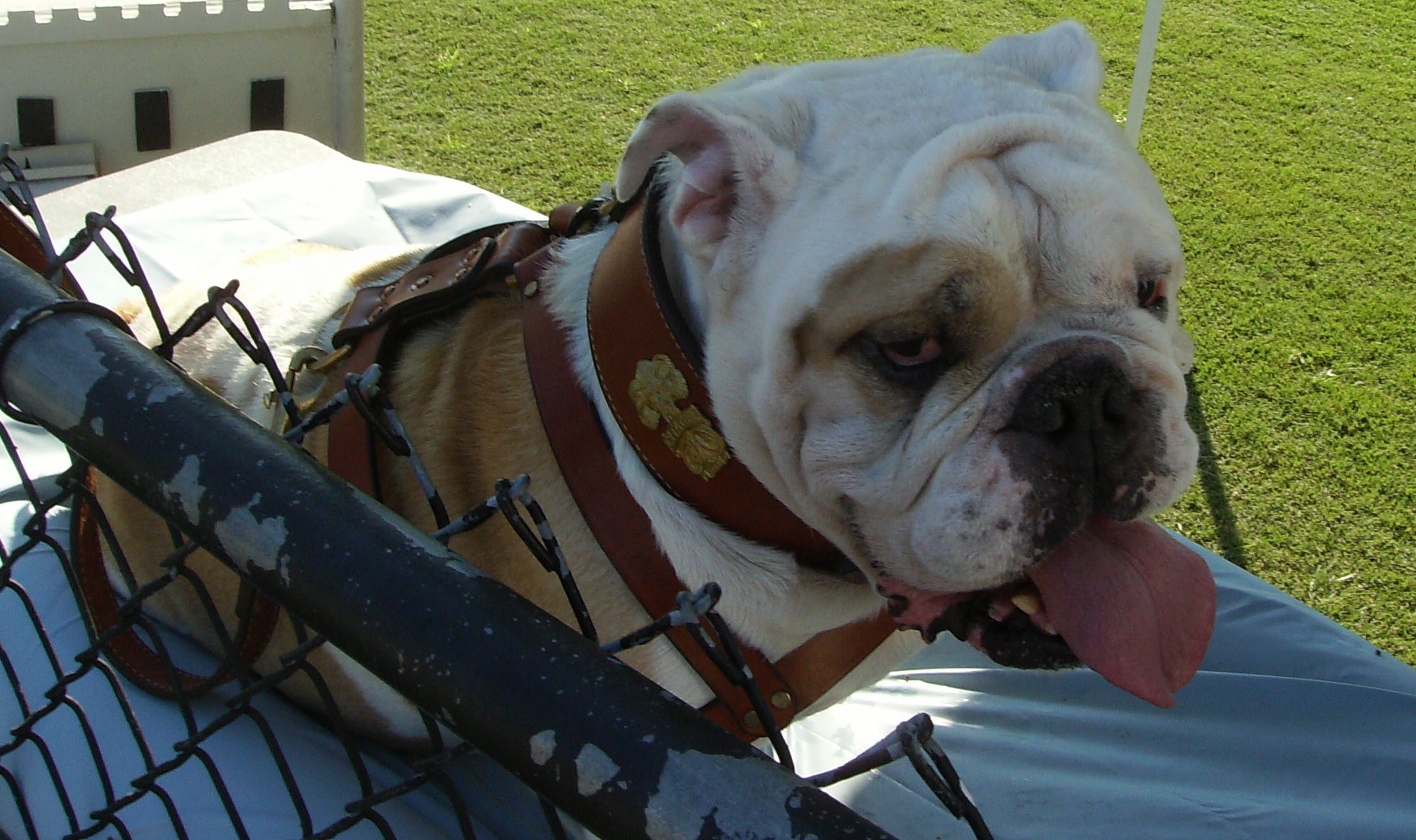
Speaking of mascots, I got a picture of General too, relaxing on a block of ice covered by a blanket.  General is a very cool dog (quite literally on Saturday, despite the late-afternoon heat).  He and his buddy Boo made a lot of new friends, including quite a few Cub Scouts.  I also appreciated Boo’s handler moving the SoCon trophy around so I could get a half-decent shot of it.  Many thanks.

Football, Game 11: The Citadel vs. Samford

Factoids:

— Gametime/location:  2:30 pm ET/Seibert Stadium, Birmingham, Alabama

— Both teams are known as the Bulldogs.  Really, one of the requirements for Samford to join the Southern Conference should have been for the school to change its nickname.

— Samford is 4-6, 2-5 in the SoCon; The Citadel is 2-8, 0-7.

The Citadel’s game notes

Samford’s game notes

I wrote this in my preview of the first game of the season (the game against Chowan):

While I am looking forward to the season, this year I am a bit apprehensive about what lies ahead for the Bulldogs on the gridiron.  The Citadel is going to the triple option on offense, with a head coach who has never run the offense (or any similar offense) before, and with players who were mostly recruited for a very different kind of system.

The players who were recruited with the triple option in mind, of course, are all true freshmen.  The quarterback position will likely be manned by one (or more) of those true freshmen. The “knob”-starting quarterback double is a rare one, and for a reason. It’s an exceedingly difficult combination.

The Southern Conference media and coaches agree that this season could be a long one for The Citadel, just as the last two seasons have been.  The media picked the Bulldogs to finish last in the league.  The coaches ranked The Citadel eighth out of nine teams, ahead of only Western Carolina.

So I guessed I called this one…

The Citadel is hoping to go out with a bang after a whimper of a season.

“Next season starts this week,” was Higgins’ message Monday at his final weekly news conference of the season, as The Citadel prepares for Saturday’s season-ender at Samford.

“We need to keep building on some of the things we’ve done and see if we can get next season off to a great start on Saturday,” Higgins said.

Higgins is using the bye week to make the Samford game the football equivalent of MayMester, which isn’t a bad idea.  Motivation is presumably an issue for both The Citadel and Samford, neither of which have a chance at a winning season, or a winning league campaign.

I would be cautious about making too much of the offense’s improvement against Elon.  I’m not sure what it says about the unit’s progress when just being able to successfully complete the center/QB exchange is considered a breakthrough.  (That said, I do think Mike Sellers shows considerable promise.)

Samford and The Citadel match up statistically in a lot of areas, including red zone offense and defense, third-down conversions, scoring defense, and rush defense. The Citadel has a better passing defense (by about 40 yards per game), but Samford is much more balanced on offense.  Of course, most teams are more balanced offensively than The Citadel.  In this case the result is Samford averaging about 80 yards more in total offense.

That said, Samford hasn’t really lit up the scoreboard in SoCon play much more than The Citadel.  While Samford hasn’t been shut out twice like the Cadets, it has only scored 20 or more points in two league games, not coincidentally the two games in the conference Samford has won.  One of those was a 38-7 rout of Western Carolina, while the other was a 20-13 upset of Georgia Southern.  Both of those games, interestingly, were on the road.  At home, Samford is averaging just 10 points per game.

The lack of point production comes despite the presence of Alabama’s all-time leading rusher.  That would be the State of Alabama’s all-time leading rusher, to be more specific.  Chris Evans will probably cross the 4,500-yard mark in Saturday’s game, which is more career rushing yards than Bo Jackson, Shaun Alexander, Mark Ingram, Sherman Williams, Johnny Musso, William Andrews, James Brooks, Lionel James, Cadillac Williams, Ronnie Brown, Major Ogilvie…etc.

That’s not bad (and a cheat of a trivia question, too).

Two years ago Evans rushed for 174 yards against The Citadel and scored two touchdowns as Samford won easily at Seibert Stadium, 28-10.  Samford’s huge offensive line dominated the line of scrimmage in that game, and Evans took full advantage.  That’s something Pat Sullivan’s crew will try to do again on Saturday, and he’s bringing another sizable o-line to the proceedings.  Samford’s offensive line starters average a meatball over 298 lbs.

Last year, though, that plan of attack didn’t work out, as The Citadel beat Samford 28-16, and the defense limited Evans to 52 yards rushing.  That game featured a freshman starting quarterback named Tommy Edwards.

Tangent:  If you want to impress your friends, ask them to name the three quarterbacks to start against Samford for The Citadel.  The three QBs in question are Edwards, Jack Douglas (in the 1989 contest that marked The Citadel’s first game back at Johnson Hagood Stadium after Hurricane Hugo) and Cam Turner.

There will be another freshman starter for The Citadel this Saturday, as Ben Dupree will make his second consecutive start (and third overall).  Dupree didn’t turn the ball over against Elon, which was probably more than enough for him to get the starting nod again.

I don’t have any idea how the game on Saturday will go.  Samford is not a particularly good team, but it is better than Western Carolina, and it is good enough to have beaten Georgia Southern.  Samford will be playing at home, which should give it an edge, although that hasn’t been born out in its league results.

A win at Samford would be a nice way to close out the season for The Citadel, and would give its players and fans some positive vibes for 2011.  Let’s hope for the best.

The Citadel: Status of the Football Program

Judging from some posts at TCISN over the last few weeks (and from some non-message board discussions I have heard), there is sentiment in some circles that it’s time to make a coaching change at The Citadel.  This is, in my opinion, definitely a minority viewpoint, but it’s out there.

It’s a position that reached its zenith in popularity following the offensive debacle against Georgia Southern, and I have to say it would be hard to blame anyone for having a knee-jerk reaction after sitting through that game.  It was embarrassing.  The improved performance against Elon last Saturday seems to have muted some of the “we need a new coach” talk, though.

That said, I seriously doubt there is going to be a coaching change after this season. Actually, I would be really, really surprised if Kevin Higgins weren’t retained.

Higgins is currently under contract through the 2013 football season.  In this economic climate, there aren’t many schools that are prepared to let a coach go with three years left on his deal, and The Citadel doesn’t have a history of doing that, anyway.  Just the opposite, in fact.  The Citadel has honored the full contracts of “lame-duck” coaches like Don Powers in football and Randy Nesbit in basketball, just to name two.

Another thing to consider is that after last season, his second straight losing campaign (and fourth in five years), Higgins decided to completely scrap his spread offense and move to the triple option.  That doesn’t strike me as the move of a man worried about job security, because he had to know when he made that decision that the 2010 season was probably going to be difficult.  Maybe he didn’t think it was going to be as difficult as it has turned out, perhaps, but he knew the potential pitfalls.

I don’t know, but I would guess that before deciding to employ a new offense Higgins had a chat with AD Larry Leckonby about the move, just to make sure his position was safe for at least a couple of years.  That also was likely the message Leckonby delivered to prospective assistant coaching candidates (Higgins brought in seven new assistants).

Tommy Laurendine, for example, was in a presumably “safe” job at his alma mater, Lenoir-Rhyne.  I doubt he would have taken the job at The Citadel if he thought there was a chance that it would only be for one year.  The same is true for Josh Conklin and Bob Bodine, among others.

Assuming Higgins is back for at least one more season, then, where does the program stand in relation to historical norms?  Is keeping a coach with his overall and league record a good idea, regardless of contract status?  What factors besides on-field performance need to be considered?

First, let’s look at some numbers (keep in mind that at the time of this post, The Citadel has yet to play its final game of the 2010 season, which is at Samford).

Kevin Higgins is 26-40 overall, 14-30 in the Southern Conference.  He has been the Bulldogs’ head coach for six full seasons.

Twenty-three men have served as head coach of The Citadel.  Eight of them coached prior to the school joining the Southern Conference.  Tatum Gressette is the transitional coach in this respect, with the last four years of his eight-year tenure marking the first four SoCon campaigns for The Citadel.

Counting Gressette, then, let’s take a look at how Higgins compares to those fifteen coaches who competed in the Southern Conference.

— Overall record:  Higgins ranks 10th out of 15 in winning percentage

— SoCon record:  Higgins ranks 8th out of 15 in winning percentage

There is more to this than just those placements, though.  Higgins may only be 10th alltime in overall winning percentage, but of the five coaches behind him, three of them were his immediate predecessors at The Citadel.  The other two, Quinn Decker and John McMillan, were the first two coaches at The Citadel following the program’s post-World War II restart.

As for the SoCon record, Higgins has a better conference winning percentage than Ellis Johnson and John Zernhelt (but not Don Powers, interestingly), and also has a better mark than Tom Moore, along with John Rowland, Gressette, Decker, and McMillan.

Starting with John Sauer, who only coached at The Citadel for two seasons, every coach who was at The Citadel between 1955 to 2000 has a better league record than Higgins, except Moore.  That includes Eddie Teague, who succeeded Sauer as head coach, and three men then-AD Teague later hired (Red Parker, Bobby Ross, and Art Baker).  Moore’s successor, Charlie Taaffe, also has a better SoCon record than Higgins.

Comparing Higgins’ SoCon record to the Gressette/Rowland/Decker/McMillan group is probably pointless, though.  For example, Gressette was 4-14 in league play over four seasons, but seven of his fourteen conference losses were to schools currently in the ACC or SEC.

Decker was 8-25-1 in conference action, which included playing either South Carolina or Clemson every season — as conference games.  (His 1950 squad was 2-3 in the league; one of the two wins came against the Gamecocks, at Johnson Hagood Stadium.)

That doesn’t even take into account the difficulties Decker (and later McMillan) had in trying to bring the program back up to the level it had been prior to the war.  It must have been hard, for the first nine seasons following the program’s return were losing campaigns.  Neither Decker nor McMillan ever had a winning season at The Citadel.

One thing to consider when evaluating a coach’s record at The Citadel would be, simply, how successful has the school been historically in football?  What should expectations be?

The Citadel has basically been a .500 program through most of its history.  At the time it joined the Southern Conference, the school’s overall football record was 115-112-24.  It had never had more than four consecutive winning seasons, or more than three straight losing campaigns.

The ten years leading up to league membership were fairly typical:  7-3, 3-6-1, 6-3-1, 4-5-1, 4-5-2, 5-4-1, 4-5, 3-5-1, 3-5-1, 4-3-1.  Even after joining the SoCon, the overall records (as opposed to conference play) continued in a similar vein.

As I mentioned, though, in the post-WWII era the football program at The Citadel struggled.  That included league play, despite the move of many of the SoCon’s bigger schools to a new confederation called the Atlantic Coast Conference.  Things finally changed with the arrival, not of a coach, but of a general.  Mark Clark wasn’t interested in losing.

After a bit of a false start with Sauer (probably best remembered at The Citadel for bringing in a young hotshot of an assistant named Al Davis), Clark’s hiring of Teague finally got the football program on a winning track.  In its nineteenth season of league play, The Citadel would finally finish with a winning record in conference action.  That was in 1957.

That’s right, it took nineteen seasons for The Citadel to have a winning league record after joining the Southern Conference.  Think about that.

Four years later, the school would win its first SoCon title.

Earlier I stated that The Citadel has “basically been a .500 program”, but of course the actual overall record is 454-518-32.  What I meant, though, is that for most of its history the school’s football program really puttered along at about a .500 clip, with two exceptions.

The first is that nine-year period following World War II.  The Citadel was 27-54-1 during that stretch.  The football program is 64 games under .500 alltime, and 27 of those 64 games can be accounted for in that near-decade of losing.

That’s arguably not the worst run in the history of the program, however (particularly if you account for the fact the program had been briefly dormant).  The longest stretch of consistent losing The Citadel has ever had has been a 13-year period where the cumulative record of the team is 50-93, 43 games under .500, with eleven losing campaigns and only one winning season in that timespan.  That includes an ugly 29-70 mark in SoCon play in those thirteen seasons.

Those thirteen years?  You guessed it.  They are the last thirteen years.  The current era is in the discussion for being the low point for the program, at least in terms of on-field competitiveness.

Was there one event, a specific turning point, that led to the football program’s slide?  I think so.  Some people might claim it to be the dismissal of Charlie Taaffe, but that wasn’t the tipping point.  No, the die was actually cast on November 23, 1999, two days before Thanksgiving that year.

Don Powers’ team had gone 2-9 that season (after a 5-6 campaign the year before). Powers was essentially a caretaker-type coach, a fill-in for Taaffe, but after four years it was clearly time for fresh blood.  Walt Nadzak made the decision to reassign Powers — and then was overruled by the school president, Major General John Grinalds.

I linked Jeff Hartsell’s article about this move above; here it is again.  It’s worth linking twice, because I think Grinalds’ decision, “honorable” as he thought it was, started the ball rolling downhill for the football program, and not in a good way.  Sure, it was just one year.  Sometimes, though, that one year matters.  This was one of those times.

Timing is everything in life, and that includes college athletics.  In 1999 Nadzak was faced with a football program with a deteriorating on-field performance and a decrepit stadium.  He also had to contend with issues over which he had little to no control, from the proliferation of college sports (especially football) on cable television to women at The Citadel.

Nadzak knew he needed a new stadium, and he also knew that with it he needed a competitive team.  He didn’t get either (although the stadium would come eventually). In a column written the following week, Ken Burger all but predicted that Grinalds’ move would signal the end of Nadzak’s tenure at The Citadel.  He was correct.

Asked if he expects the Bulldogs to have a better season next year, Grinalds said, “Yes, we do.'”

The team went 2-9 for a second straight season…

I would suspect (although I can’t say for sure) that the dead-in-the-water aspect to the program had an impact on fundraising, perhaps including the ability of the school to raise money for the new stadium.  Things went slowly, too slowly, as the world around the school kept moving faster and faster.

If you run in place, you don’t go anywhere.  The Citadel needed a decent team to continue to draw fans, particularly because the stadium was becoming more and more of a problem, whether it was archaeologists digging up gravesites underneath the stadium for reburial, or the fact that you couldn’t turn on the stadium lights and the french fry machines at the same time because it would short out the electrical system, or having so many bricks fall off the facade that eventually they were all removed for safety reasons.

Now the school finally has a quality stadium, and it’s a first-rate facility.  What it doesn’t have is a drawing card, a team good enough to bring in new fans (and revive interest from old fans).

Ellis Johnson tried to overcome the program’s malaise in part by featuring transfers and hideous uniforms, and it didn’t work.  After three seasons, he was ready to become an FBS defensive coordinator again.  John Zernhelt lasted one year, and then moved on, taking big money from the New York Jets. (Hard to blame him.)

In the ten years prior to Kevin Higgins taking over as coach, The Citadel had an overall record of 36-74.  That’s actually a worse record by percentage than the nine-year period following World War II I referenced earlier.  In addition, the school had not had a winning record in conference play since 1992, the year The Citadel won its second (and last) league title.

That’s a lot to overcome.  Higgins got off to a good start, but soon found that one year does not establish a trend, or even momentum.

Can he get over the hump?  Normally when a coach has his record after six seasons, he doesn’t get an opportunity to find out.  However, I think the evidence suggests that Higgins had a higher mountain to climb than most, and that patience may in fact be warranted.

There is an elephant in the room, however.  I’m talking about home attendance.

The Citadel now has a great facility, and (other than the on-field results) a very good atmosphere for home games, including the cadets, tailgating, etc…and attendance is declining at an alarming rate.

Average attendance at Johnson Hagood since 1997:

1997 — 12,173

1998 — 13,291

1999 — 14,543

2000 — 14,342

2001 — 15,687

2002 — 15,582

2003 — 16,759

2004 — 8,359 (the year of “half a stadium” and thus an aberration)

2005 — 11,674

2006 — 14,599

2007 — 13,757

2008 — 12,261

2009 — 13,029

2010 — 11,445

Ouch.  Ouch for the last seven years, really, but particularly for this season.

I wrote extensively about attendance at Johnson Hagood Stadium in July of last year. That post includes my theory on how television impacts attendance at The Citadel’s home games, among other things.

The Citadel cannot afford to have its home attendance continue to erode.  It’s not the only school to have concerns in that area, as anyone who has watched ACC games can attest.   Ultimately, though, attendance at Johnson Hagood Stadium has to get better.

While baseball is the most successful sport at The Citadel, and basketball is the sport with the most potential for growth, football always has been and remains the bell cow for the department of athletics.  It drives the entire department, and also has a significant impact on the school as a whole.  Sagging attendance is a major problem, one that should concern everyone.

Even if The Citadel has a breakthrough year on the field next season, I would be surprised if there is a dramatic improvement in home attendance.  There is often a one-year lag between on-field/on-court success and attendance gains.

Because of that, if the team were to turn the corner, and the triple option to start cranking out games like, say, Navy’s offense did against East Carolina last week, I don’t expect attendance to make a big jump in 2011 (although the home schedule should help, as Furman, Wofford, and VMI are all expected on the JHS slate of games).  The 2012 season is when you would see dividends from a positive 2011 campaign.

Basically, I’m fine with Kevin Higgins getting another year.   I haven’t been completely happy with his tenure at The Citadel, even excepting the wins and losses; there have been issues from the unimportant (my continued frustration with the uniforms) to the all-important (the Rice/Starks episode, which was much, much worse than multiple 0-11 seasons would ever be).

He seems to be popular with the administration, which is good.  I thought it was interesting that the Alumni Association made him an “Honorary Life Member”; that news came after consecutive games in which his team didn’t score.  I did wonder if someone was trying to make a statement to certain unhappy alums, but I suppose it was just coincidental.

After next season, though, I think Larry Leckonby has to make a move if things don’t work out.  At that time Higgins will still have two years remaining on his contract, but if the team does poorly Leckonby won’t be able to afford keeping him.  He can’t make the mistake that was made over a decade ago.

That’s the bottom line, even at The Citadel.

Review: Elon

Elon 27, The Citadel 16.

Good news: there were signs of life from the offense, and an absence of navy pants.

Bad news:  it was still a loss, and there is still no “The” on the jerseys, regardless of color

Obviously the offensive unit performed much better on Saturday than in its previous four games; the 16 points were in fact the most scored by The Citadel in league play all season.  There were no turnovers (!) and Ben Dupree was able to execute the offense well enough so that the Bulldogs actually got in a position to pitch the ball on multiple occasions.  The Citadel only punted once.

Dupree played the entire game, made some good reads and showed an ability to improvise.  The star-crossed Ricky Anderson probably had his best game as a Bulldog.  Terrell Dallas demonstrated a couple of times what we already knew, namely that he’s almost an ideal fullback for the triple option offense.

You will excuse me, however, if I point out some things on offense that weren’t so great (besides the loss):

— The Bulldogs did not turn the ball over, but did fumble three times and had several other instances of a less-than-clean center-QB exchange, which generally resulted in lost-yardage or no-yardage plays.  This area of execution did get better, but there is still quite a bit of improvement that needs to be made.

— Dupree didn’t make every read correctly, which showed in some plays that were “stuffed”, both on the inside and on the outside.

— The Bulldogs entered the “red zone” five times on Saturday, but only scored 16 points.  Elon’s red zone success vs. that of The Citadel was the difference in the game (more on that later).

— Luke Caldwell’s 26-yard pass reception in the third quarter (on a 4th-and-8 play that set up The Citadel’s first touchdown) was the only play the Bulldogs offense had that gained more than eighteen yards.  The Citadel now has only nine plays of 20+ yards in its last seven contests.

— When evaluating the offense’s play, another thing to take into consideration is that Elon is not the greatest of defensive teams.  The Phoenix are next-to-last in the Southern Conference in total defense and rushing defense, and third-from-last in scoring defense and pass defense.  Elon lacks a truly disruptive playmaker on the defensive line like Georgia Southern’s Brent Russell or Wofford’s Ameet Pall — and the Phoenix’s best lineman, Brandon Ward, did not play against The Citadel after being arrested on an assault charge earlier in the week.

All that said, it was an encouraging performance by the offense.  I admit I was worried that the Homecoming crowd would be subjected to some brutal moments of ineptitude, but for the most part those were avoided.  I wish this was the kind of game we had been getting from the offensive unit in early October rather than early November, but sometimes you have to take what you can get.

Unfortunately, after two straight weeks of solid play while getting no help from the offense, the Bulldog defense didn’t quite get it done on Saturday.  The Citadel seemed to have caught a break when Phoenix starting quarterback Scott Riddle got injured at Chattanooga, but Elon backup QB Thomas Wilson made no big mistakes and methodically led his team down the field, particularly in the second half.

What the Bulldog D couldn’t do, ultimately, was get off the field, especially in the second half.  Elon scored touchdowns on all three of its second-half drives (not counting a one-play drive that was a kneeldown to end the game).  The Phoenix consistently converted on third down (9-13 for the game) and did not commit a turnover.  Indeed, the two offenses had similar numbers; besides the lack of turnovers, there were very few big plays (Elon had two 20+ yard plays to The Citadel’s one).

The difference was how the two teams did in the red zone.  Elon moved inside The Citadel’s 20-yard line on four occasions, and scored touchdowns all four times.  That has proven to be the defense’s biggest problem this season, as the Bulldogs are last in the SoCon in red zone defense, having allowed 29 touchdowns in 41 red-zone possessions.

The Citadel got some stops in the second quarter, but other than that Elon efficiently picked up chain-moving yardage on almost every play (The Citadel only had four tackles for loss in the game), converted on third down when necessary and scored when it got its opportunities.  The few times Elon faced third-and-long, it managed to pick up the first down via the pass (including critical 19- and 14-yard third down completions late in the third quarter after The Citadel had retaken the lead).

While there were no offensive big plays, The Citadel did get an 87-yard kickoff return from Keith Gamble to set up its second TD.  Earlier in the game, the Bulldogs also converted a fourth down via a fake field goal that probably would have resulted in a touchdown if it had been a little more smoothly executed.  Alas, that first down led to a shorter field goal attempt that was blocked.

Okay, time to talk about the uniforms…

Link

I was afraid of a potential red jersey/navy pants combo, but thankfully that did not come to pass.  As for the actual jersey and helmet:

— As mentioned earlier, no “THE”; that would have been too difficult, I guess

— I liked the “Big Red” crescent/tree logo on the shoulders; very distinctive

— The color itself wasn’t overly obnoxious (in other words, it wasn’t an “electric” red)

— I don’t like the “side panels”, which are a Nike staple, and they look even worse with this combo

— The numerals were hard to read, which is also true of the navy jerseys

— I think the navy stripes on the helmet should have been red

— The helmet logo should have featured original artwork; as it is, it’s just a redo of the Tampa Bay Buccaneers’ mark

I didn’t have a problem with breaking out the red jerseys for this game.  The original Big Red, of course, arrived on campus in March; its disappearance and rediscovery is an interesting tale.  Wearing red jerseys for the Homecoming following that development seemed reasonably appropriate (and a good way to push merchandise).

I’m not sure I would want to see them again, however.  I certainly don’t want the football team wearing red jerseys to become a yearly event.  I think doing that would make it much less special, and also detract from the school’s traditional colors for its sports teams.

Of course, it could be argued that the parade of different football uniform color combinations this season has already devalued the tradition of wearing light blue and white. In ten games, the Bulldogs have worn six different jersey/pant color combos, including four different looks for the six home games.

In fact, I think the fact The Citadel did not have a standard uniform combination this season made the red jerseys seem a little less unusual.  Let’s face it, if the Bulldogs had lined up wearing silver or black, nobody would have been all that shocked, so the red jersey wasn’t that much of a departure.

Now The Citadel gets a bye week.  As bye weeks go, this one can’t be more pointless. Ten straight games, then a bye week, then a road game at Samford to finish the season.  I realize this is mostly due to the odd number of teams in the Southern Conference (nine), but it still seems dumb.

I feel a little better about the team after Saturday’s game, but the Bulldogs are still 2-8, with a seven-game losing streak, and winless in the SoCon.  It’s a transition year, to be sure, but I would like to start transitioning to victories.

Later in the week (I hope) I’m going to write about Kevin Higgins’ tenure at The Citadel and the status of the program as a whole.

Football, Game 10: The Citadel vs. Elon

Time/location:  2:00 pm ET, Johnson Hagood Stadium

Television:  None (maybe a good thing)

It’s Homecoming at The Citadel.  What can alums expect from the Bulldogs’ offense against Elon?

Well, let’s look at the trends in Southern Conference play.  The first game was against Furman.  The latest was against Wofford.  So, in order:

Furman — 359 total yards, 14 points

Western Carolina — 304 total yards, 13 points

Chattanooga — 263 total yards, 10 points

Appalachian State — 197 total yards, 10 points

Georgia Southern — 160 yards, 0 points

Wofford — 143 total yards, 0 points

Now, that’s what I call a trend…

The yards per play is very close to the same orderly negative statistical trend, but there was a minor uptick against GSU (masked by nine turnovers).  For the record, The Citadel’s yards per play in the SoCon, in order of games played:  4.6, 4.1, 4.0, 3.3, 3.4, 2.3

So, if things continue as they have in the league, The Citadel’s Homecoming will feature an offense that will accumulate less than 140 yards of total offense, average about 2 yards per play, and won’t score.

I don’t think it will be that bad, but it’s hard to find much to be encouraged about, at least offensively (the defense has played fairly well over the last month, certainly well enough for the Bulldogs to have won SoCon games if the offense had been competent).

Turnovers have been the headline problem, of course, but another issue is that the Bulldogs aren’t making big plays in the offense.  One reason The Citadel has scored only five touchdowns in six conference games is a lack of long-distance runs or passes.  The Bulldogs only have had eight plays of 20+ yards in those six contests; only two of those plays were longer than 30 yards — and one of those two plays was a 33-yard run by punter Cass Couey, obviously not a product of the option offense.

The Bulldogs have had nine drives of greater than 50 yards in league play.  Four of those nine came against Furman in the conference opener.  None came in the last two games.

Incidentally, of those nine 50+ yard drives, Matt Thompson was the quarterback for five of them, Sam Martin the QB for the other four.

I would like to think the Bulldogs will give a spirited performance for the Homecoming crowd.  That didn’t happen last season, when The Citadel lost 43-17 to Wofford in a very poor showing that greatly disappointed the alumni.

The year before, the Bulldogs narrowly averted a horrific loss at Homecoming to a terrible Chattanooga team.  The Mocs were in the process of mailing in their season under a lame-duck coach, but The Citadel needed last-minute heroics from Andre Roberts to escape with a 24-21 victory.

This year’s Homecoming game has been designated as a “Red Out”.  There are two reasons for this, in my opinion.

The official reason is to commemorate the return of “Big Red”.  The other (and this is just my opinion) is to take advantage of the largest crowd of the season and sell a bunch of “Big Red” merchandise.

That crowd size has to be the only reason the administration would have considered having a “Red Out” for a game in which the opponent is Elon, whose primary school color is…red.  At least, I hope that’s the only reason.  It still strikes me as not being a wise decision, and I know I’m not the only one.

The effort to promote Big Red apparently will also include red jerseys for the football team, if the rumors are true (and I’m sure they are).  There will also be a special Homecoming helmet design (see post #40 on this thread from TCISN), which is basically a remake of the Tampa Bay Buccaneers’ helmets.  Not bad, but not innovative or particularly interesting.

If The Citadel does indeed don red jerseys against Elon, that will mean the Bulldogs would not have worn the traditional home color combo of light blue jerseys/white pants for any home game this season.  I guess at this point our traditional colors are now alternate colors, and the alternate uniforms are the “main” uniforms.

Below I’ve listed the color combos for all nine games to date in 2010:

Chowan (home):  light blue jerseys, dark blue pants

Arizona (road):  white jerseys, white pants

Presbyterian (home):  dark blue jerseys, dark blue pants

Furman (road):  dark blue jerseys, dark blue pants

Western Carolina (home):  light blue jerseys, dark blue pants

Appalachian State (road):  white jerseys, white pants

Chattanooga (home):  dark blue jerseys, white pants

Georgia Southern (home):  dark blue jerseys, dark blue pants

Wofford (road):  white jerseys, dark blue pants

One thing I’m unfortunately fairly confident about:  if The Citadel does wear red jerseys on Saturday, the jerseys will have “CITADEL” on the front, and not “THE CITADEL”. That, of course, is true for all the other jerseys the Bulldogs have worn this year, regardless of color.  I assume it’s a cost-saving issue, as having the “THE” on the jersey would undoubtedly cost the school hundreds of thousands of dollars.

This is one of my more cynical and less positive posts, and so the fact it’s also one of my shorter game previews is probably just as well.  That said, I am hoping to be pleasantly surprised on Saturday.  For one thing, it’s time for a little payback as far as Elon is concerned.  The Phoenix’s last visit to Johnson Hagood Stadium (in 2008) was a victory for the visitors, one basically handed to Elon by inept Southern Conference officiating.

Quarterback Scott Riddle may not start for Elon due to injury.  You may remember the last time Riddle started something against The Citadel; he ran away before finishing it, though.

Riddle can talk to Fred Jordan about shoulder injuries…

I’m not expecting a brawl on Saturday.  I do want to see some fight in the Bulldogs, though.