Valentine’s Day present: nine straight wins

Now that’s a Valentine’s Day to remember:  The Citadel 72, College of Charleston 58, in the Bulldogs’ first game ever at Carolina First Arena (with 5,168 spectators in attendance).

I have to admit that I wasn’t so sure about The Citadel’s chances of winning this game, despite the solid victory at McAlister three weeks ago.  I felt the Bulldogs were perhaps due for a bad game, and that the College was on a roll after its comeback victory at Davidson and subsequent thumping of Western Carolina.

After watching the first half, though, I realized that my fears  were misguided.  The Citadel had committed nine turnovers in only twenty-seven possessions, meaning that the Bulldogs had turned the ball over every third time down the court (a terrible percentage, to say the least).  Normally that would be a recipe for disaster, but instead The Citadel only trailed by one point (29-28).

The Bulldogs were shooting the ball well, and when not committing turnovers were doing a good job running their offense, using the shotclock, making the Cougars work on defense  (which some of the CofC players did not appear to enjoy), and controlling the pace of play.  The Citadel had handled the College’s press with relative ease (which had also happened in the first meeting), and I figured that as long as the Bulldogs took care of the basketball in their normal fashion in the second half, they would be in good shape.  That is exactly what happened.  The Citadel turned over the ball over on its first possession of the second half, but then committed only two more turnovers the rest of the game.

Then there was the rebounding.

The Citadel outrebounded the CofC 13-8 in the first half, which was a marked departure from the first contest between the two teams, when for the game the Cougars had 38 rebounds to the Bulldogs’ 25.  The reason The Citadel didn’t just win on Saturday, but won going away, was that the Bulldogs completely dominated the glass in the second half, essentially reversing the board differential from the first game, and finished +17 (38 rebounds to the CofC’s 21).  The most impressive statistic in the game, to me, was that the Bulldogs got more offensive rebounds (13) than the College got defensive boards (12).

That had to have frustrated Bobby Cremins and the CofC fans, especially since the Cougars started three frontcourt players in the 6’7″-6’8″ range and brought another 6’8″ forward off the bench, and none of those guys were stringbeans, either.  Meanwhile, The Citadel countered with a starting lineup featuring one 6’8″ post player (Demetrius Nelson) and a bunch of guards, including John Brown, who is 6’4″ but essentially fills the power forward role for the Bulldogs — and it was Brown who proved to be the primary nemesis for the Cougars’ big men, gathering 12 rebounds (5 offensive), scoring 14 points on 7-10 shooting (I think every made basket was a layup), and generally being a nuisance on the defensive end of the floor.   Interestingly, Brown had the same rebounding totals (12/5 offensive) in the first matchup.

In this game, though, he had help on the boards from Nelson (7/3 offensive) and, somewhat surprisingly, Zach Urbanus (who had the same 7/3 ratio).

I would like to riff a little about an aspect of Ed Conroy’s coaching that I have gradually come to appreciate.  The Citadel runs a very disciplined offense, one that usually involves working the clock and controlling the pace of play.  The Bulldogs are generally at their best when the number of possessions in a game hovers around 60 or so.  Whenever I am watching, and things start to get a bit frenetic, or someone takes a shot with 25 seconds or more remaining on the shotclock, I’m inclined to start mumbling things like, “Slow it down!  Slow it down!  You’re playing too fast!  Work the clock!”  You get the idea.  I’m particularly prone to think this way late in games when The Citadel has a lead.

The key is, though, that while a Bulldog will occasionally force a shot, it doesn’t really happen too often — and more importantly, the players maintain a sense of aggressiveness.  There is a distinction to be made between a disciplined offense and a conservative offense.  It doesn’t do you any good to run the shotclock down to 5 on each possession if you regularly wind up hoisting a 30-foot jumper.

So while I may have wished that Cosmo Morabbi had not attempted a contested three-pointer with the Bulldogs up 14 and just over 4 minutes to play, and with 26 seconds still remaining on the shotclock, I can understand that the freedom he has in being “allowed” to attempt that shot is critical.  Maybe that time he made a mistake, but by being aggressive and not timid, he also was in a position to make two other three-pointers during the game, including the shot that signalled the game was The Citadel’s to lose, a three-pointer at the 10:20 mark that stretched the Bulldogs’ lead to nine — and a shot taken with 25 seconds still remaining on the shotclock.

That’s good coaching.

There has been some discussion about yesterday’s victory by The Citadel being “historic”, with references to “The Citadel’s first two-game series sweep since the 1932-33 season” in this column by Gene Sapakoff in The Post and Courier, as well as Jeff Hartsell’s game story (“an event that comes around every 76 years or so”).  This angle pops up in other press reports, too.

Now, with all due respect to the above chroniclers, I think the whole “first sweep since the 1930s” thing is overblown and a bit misleading. Before Saturday, the Bulldogs had not swept the Cougars in a two-game set since 1933, but following the 1937 season (a year during which the schools met three times, with The Citadel winning the latter two matchups), The Citadel and the College of Charleston did not play again until 1956.  After that one game, the series again went into hibernation, and did not resume until 1977. In addition, The Citadel and the CofC only began playing twice per year again in 1997 (except for a two-game set in 1983, which was split).  The truth is there was a 60-year period in the series during which The Citadel (or the College of Charleston, for that matter) had only one opportunity for a “sweep”.

Also, of course, technically The Citadel has not “swept” the College of Charleston this season — yet.  The two schools could meet for a third time in the Southern Conference tournament, although as things currently stand that potential matchup could only happen if both teams advanced to the championship game.  With yesterday’s win, the chances of The Citadel getting to the final improved slightly, because the Bulldogs are now in position to get a first-round bye (as a top-2 finisher in the South Division).

That would be critical, particular for The Citadel.  It would be much easier to win three straight games than have to win four games in four days in Chattanooga (no team has ever gone the “four in four” route to win the SoCon tourney).  Also, given The Citadel’s putrid history in the Southern Conference tournament, having to play one fewer game to actually win the thing would surely come as a relief.  Three tournament wins would be more victories than The Citadel has had in the last 22 tournaments combined.

To guarantee getting that bye, The Citadel has to win at least three of its remaining four games.  The win over the Cougars gave the Bulldogs a little cushion, as the game at Davidson on Wednesday is not a must-win for bye hopes.  However, there is still work to do.  The Citadel also has home games remaining against Furman, a team the Bulldogs had to go to overtime to beat in Greenville (and the Paladins appear to be improving), and Wofford, which beat The Citadel in Spartanburg — the last time the Bulldogs lost a game.  The Citadel finishes the season at Georgia Southern, which has been decimated by injuries and suspensions.  It’s still a road game, though.

The Citadel would get an additional mulligan (or more) if the College of Charleston is unable to win out.  The College has three straight road games up next on its schedule; a slip-up by the Cougars at any of those games would greatly help the Bulldogs’ cause.

As I write this the status of Stephen Curry for Wednesday’s game is uncertain, as Davidson’s all-everything player injured his ankle on Saturday night against Furman.  Even without him, though, the Wildcats would be a formidable opponent, particularly at Belk Arena.  Obviously Davidson is a much better team with him.

While awaiting updates on Curry, it’s worth taking stock in what the Bulldogs have accomplished already.  17 victories clinches a winning season for the first time in seven seasons.  The Citadel has only won more games than that in a season twice in its history (18 in 1985 and 20 in 1979).  The 12 conference victories is a school record, although past teams didn’t have a 20-game league schedule.  Still, no Bulldog squad has ever finished a season with a .750 winning percentage in conference play, which the current group is on pace to do.  The Citadel continues to add to its record for consecutive conference wins.

It’s been a great run so far, but there is still (hopefully) more fun on the horizon.

We won by HOW many points?

The Citadel 70, Samford 45.  At Samford.

Just to put that score in perspective, The Citadel last won a road game by 25+ points in 1960, against VMI (76-45).  In 1958, the Bulldogs beat the Keydets in Lexington, VA by 32 (86-54).

Other 25+ point road wins since 1940 (games are not listed by home/road in the media guide prior to that year, although it’s likely that there was no 25+ point road victory prior to 1940 anyway):  Furman in 1951 (62-36); Davidson in 1945 (60-26); and Clemson in 1943 (63-38).  All of these games were Southern Conference matchups (yes, Clemson was in the SoCon in 1943).

It’s not all that surprising that all of The Citadel’s lopsided road victories occurred in conference play, since A) most of the Bulldogs’ road games are against conference opponents, and B) a good chunk of The Citadel’s out-of-conference road games over the years have come against major-conference teams.  The Citadel isn’t going to play Piedmont, for example, on the road.

Tangent:  of all the games I’ve seen The Citadel play, Piedmont was the only opponent where I thought, “I could play for that team”.  I’m not saying I would have started or anything like that…

Let’s see, what else about this game is worth noting…Samford missed its last 10 three-pointers as part of its woeful 6-32 night from behind the arc…Samford made no field goals over the last 8:30 of the game, a stretch in which it only attempted two non-three pointers from the field…there were no fast break points for either team according to the “play analysis” stats…The Citadel scored 70 points in only 59 total possessions…John Brown had 12 rebounds despite playing only 15 minutes because of foul trouble, although part of that was having plenty of rebounding opportunities thanks to Samford’s poor shooting, not to mention Samford isn’t a good rebounding team anyway…10 of the 11 players seeing minutes for Samford had at least one three-point attempt (the one guy who didn’t only played three minutes)…Samford had an 80% assist-to-made basket ratio, which is great, except that it only had 15 made baskets…Samford was only called for nine fouls for the entire game.

So The Citadel is now 11-10 overall and 6-4 in the league.  The Bulldogs now have a reasonable chance at finishing with a winning record in league play, which hasn’t happened since the 2000-01 team finished 9-7 in the conference.  It would only be the second winning season in the league for the school since the 1984-85 team went 11-5 in the SoCon.

That 1985 team’s 11 wins is the school record for conference victories in a season, and obviously if The Citadel were to have a winning season this year in the league it would at least tie that mark for victories.  Of course, the difference is that there are 20 league games this season (which, as I’ve said before, is ridiculous).  Still, a SoCon win is a SoCon win, especially for this program.  Imagine if Ed Conroy and co. managed to go 12-8 in the league this season (which as of today is The Citadel’s projected conference record by Ken Pomeroy’s ratings system).  Those 12 wins would equal The Citadel’s total number of conference victories from 1946-56, an eleven-year stretch (the school lost 102 SoCon games over that period).

Before I get to the upcoming game, a note of caution.  The Citadel has played some good basketball over these last three games, but it’s not time to pencil the team into the Final Four just yet.  This is the same club that got thumped at home by UC-Davis, and was fortunate to escape a terrible Furman team in OT.  It’s also the same team that lost earlier this season to Elon, Thursday night’s opponent, one of only two league victories for the Phoenix so far this season.

Against Samford, the Bulldogs took advantage of a team that appeared to be leg-weary and could not throw the ball in the ocean in the second half, and while The Citadel played good defense, Samford did get some open looks.  Still, I don’t want to devalue that performance.  Cameron Wells was sensational no matter how poor Samford may have been, and it’s worth noting that it was the third straight game The Citadel had outstanding results in defending the three-point shot.  Samford, as mentioned above, was 6-32 behind the arc.  The College of Charleston was even worse (2-18), and Western Carolina was only 4-15 from three-land.  That’s an 18.5% three-point shooting percentage for Bulldog opponents over those three games.  For league games, The Citadel now leads the SoCon in defending the three (28.4%).

Last season The Citadel allowed opponents to shoot 40.0% from beyond the arc, which was in the bottom 15 nationally.  That contributed in a major way to opponents shooting an effective field goal percentage of 51.3%, worst in the entire country.  This year the Bulldogs have an OppeFG of 44.5%, a significant improvement, and that percentage is dropping even lower as the season progresses.

Okay, now to the rematch with Elon, which defeated The Citadel 56-54, a game marred in the closing seconds by a shaky shotclock operator.  Elon parlayed that win into the start of a three-game winning streak that left it 4-4, 1-1 in league play.  Apparently the Phoenix ate some bad turkey over Christmas, however, because since that third consecutive win Elon has lost eight of nine games, the only victory a one-point upset of Chattanooga last Saturday at the Koury Center.  Elon is now 5-12 overall and 2-7 in SoCon action.  Many of the losses have been competitive — the Phoenix lost at Wofford by three (same as The Citadel), by four to Samford, by four to Navy, and by seven at Western Carolina.  There isn’t any shame in losing at Davidson by 15, either.  However, Elon has also lost by 26 at Maryland (pre-Terp meltdown), by 24 at Appalachian State, and by 17 in a home game against UNC-Greensboro.

The first game between the Phoenix and Bulldogs was a very slowly paced affair (57 possessions for The Citadel) in which Elon won by shooting over 50% from the field (to The Citadel’s 42%).  The Citadel made only 5 of 21 three-point attempts and went to the foul line only eight times.  Interestingly, The Citadel outrebounded Elon 29-23 in that game, noteworthy in particular because rebounding savant John Brown did not play in that game.  (Ed Conroy waited until after the new year to unleash Brown on an unsuspecting Southern Conference.)

Elon was 10-14 from the foul line in the game, but that was an anomaly, as it is the conference’s worst free throw shooting team (just over 60% in league play).  Elon has not shot the ball well in conference action from the field, either.  Also, above I discussed The Citadel’s improvement in defending the three-ball.  Elon is just the opposite, as it has allowed its opponents to shoot a collective 38% from behind the arc, a percentage among the nation’s worst and last in the Southern Conference (and in conference games the number is even worse:  41.3%).

These two teams have gone in very different directions since December 6.  I expect The Citadel to win the rematch, but it won’t be easy.  Nothing is ever easy at The Citadel.  It will be interesting to see how the Bulldogs play as a solid favorite.  I’ll also be watching to see what the attendance figures are.  Previous attendance for home Thursday conference games:  845 against Georgia Southern on January 8, and 1133 against Western Carolina last week.

I anticipate the trend of rising attendance to continue.  I hope the level of play continues to rise as well.

The last TV appearance of the hoops season, unless…

It’s not often I get to post about a 14-point victory in SoCon play, but last night The Citadel pummelled Western Carolina in the second half en route to a 66-52 victory.  It’s easy to win games by double digits when you shoot 70% from the field in a half. 


I thought the key to the run, though, was John Brown’s spirited play.  He seemed to get every rebound and loose ball during the second half.  He also just missed on what would have been a SportsCenter-worthy jam; I suspect he’ll get teased by his teammates (and Ed Conroy) for that.  Good effort all around, though.  17 assists on 26 made baskets is a very good ratio.  The pace was solid (62 possessions), and the Bulldogs outrebounded WCU, which was a bit of a surprise.  Jonathan Brick made two three-pointers; that’s as many as he had made all season.


Congrats to Demetrius Nelson for being the 25th member of the 1000-point club at The Citadel, which is a testament to his perseverance as much as it is to his talent. 


With the win The Citadel moved to 4-4 in league play.  It’s been six years since the Bulldogs had a .500 record or better in the conference after eight games.  (It’s also been six years since The Citadel won more than four conference games in a season.) 


The one negative was the large number of turnovers (18).  Most of them came in the first half and, in retrospect, kept the Catamounts in the game.  The Bulldogs have to avoid committing turnovers.  They aren’t going to shoot that well every night.  At least in this game they avoided the first half blues that had plagued them recently.


Speaking of that, The Citadel was coming off a tough loss at Wofford where the Bulldogs had trailed by as many as 16 points in the first half before mounting a furious comeback, actually taking the lead briefly.  The Citadel could not maintain the momentum, however, and eventually lost by three.   That was another 62-possession game, which I was glad to see (although Wofford doesn’t run-and-gun at all, so it was also an expected total).  The Citadel had struggled in the first half against Furman too, but recovered to win that game in OT (it helps that the Paladins are horrendous).


Wofford’s not a bad club at all, but last night Georgia Southern clubbed them in Statesboro.  I’m not sure what to make of that, other than Junior Salters must have done too much celebrating against The Citadel, because he went 3-14 from the field against GSU.  That means that third place in the SoCon South Division is a three-way tie, with The Citadel and Georgia Southern both 4-4 in league play and Wofford at 3-3.  Davidson leads the division, of course; sitting in second place is Bobby Cremins’ crew from the College of Charleston, which is 7-1 in the league (losing only to Davidson) and 15-3 overall, including a win over South Carolina. 


As it happens, The Citadel will host the CofC at McAlister Field House on Saturday afternoon.  It’s going to be televised by SportSouth, the third and final time the Bulldogs will be featured on TV this season, unless the Bulldogs were to advance to the Southern Conference tournament semi-finals for only the second time in the last 24 seasons.  That would be…different.


The Cougars are one of the country’s better offensive squads, averaging 1.113 points per possession (17th nationally).  They shoot well from the field, whether inside or outside (38% from three-land), and take good care of the basketball.  The only thing offensively that qualifies as a weakness is their free throw shooting (65.9%).  Currently five College of Charleston players are averaging double-figure scoring, led by guard Andrew Goudelock (who is shooting 48.5% from beyond the arc).


Defensively the Cougars aren’t nearly as impressive.  CofC opponents are shooting 46% from the field.  Also, the Cougars are not a good rebounding team.  The College of Charleston is averaging over four blocked shots per game, however, and leads the SoCon in that category.


I would guess that at least 5000 people will be in attendance at McAlister on Saturday, including a goodly number of cadets.  It should be a great atmosphere.  I just hope the game is as good.

Reviewing The Citadel’s last three basketball games

Boring title for a post, but it’s the best I can do.  When the temperature drops below 25 degrees, I get less imaginative…

The Citadel is now 8-9 overall, 3-3 in the Southern Conference, after last night’s thank-God-and-Zach Urbanus-we-won 74-69 OT throwdown with the less than mighty Purple Paladins.  Furman came into the game ranked 341st in the RPI, ahead of only Alcorn State and Southern.  (Maybe there should be a SoCon-SWAC challenge next December.)  However, for a half The Citadel played like the team that hadn’t won a Division I game all season.  Furman changed defenses and forced the confused Bulldogs to commit 11 turnovers in the first half.  The Citadel finally figured out things early in the second half (and the shorthanded Paladins wore down a bit).  However, not being able to stand prosperity, The Citadel somehow blew a seven-point lead in the final four minutes.  Credit to Furman’s players for not giving up; credit to The Citadel’s players for recovering to take control in overtime.

The stats bear out that turnovers were the sole reason Furman was really even in the game.  The Citadel isn’t going to win many games when it commits 15+ turnovers (17 last night), especially when it forces less than 10 from its opponent (Furman only had 9).  The Bulldogs outshot the Paladins, outrebounded them (by 13) and did a good job both getting to the foul line and making the shots when they got there.  The pace of play was about where The Citadel wanted it to be, perhaps a little fast, but not overly so.  Speaking of pace…

My concern with the team as it continues on this long stretch of hoops (the upcoming game against Wofford will be The Citadel’s fifth in ten days; it starts another five-in-ten run on Thursday) is that the possession rate per game has increased to a level higher than where it best suits the Bulldogs.  Before the Davidson game, here were the possession totals for The Citadel’s games against D-1 competition:  72, 54, 70, 55, 53, 60, 57, 63, 70, 70, 56.   Two of the three 70-possession games came against Michigan State and South Carolina; the other was the road win at Charleston Southern, and included a lot of late-game free throw shooting.  The 72-possession game came against VCU.  In other words, in games where The Citadel could control the pace of play, 60 possessions was about where it wanted to be.

Against Davidson, in front of a large crowd, and with an aggressive opponent (and with way too many fouls being called, on both teams), The Citadel wound up with 84 possessions.  That may have been understandable, but when I watched the Chattanooga game two days later, I felt the Bulldogs weren’t patient enough on offense and played the game the way Chattanooga wanted to play it.  Ultimately, it resulted in a tough loss, and it bugged me a little because, honestly, I think The Citadel should have won the game.  That was a missed opportunity.

That missed opportunity made the Furman game that much more important.  Furman may be really bad, but The Citadel can’t count on any victories, especially conference road victories, and I was afraid the Bulldogs had blown it by playing such a poor first half.  Winning it means the Bulldogs won’t be as likely to press, as a loss would have resulted in a three-game losing streak and all the old doubts and fears and “here we go again” talk.  Now, The Citadel has a .500 record in league play heading into Saturday night’s game at Wofford.

Wofford has had an interesting season thus far.  It is currently 112th in the RPI despite a 6-7 overall record.  The Terriers lost at Dayton by three in their season opener (Dayton is currently 15-2), and then got shelled by still-undefeated Clemson.  Wofford then won a holiday tournament hosted by Air Force, beat UNC-Asheville, lost its conference opener at home to Appalachian State, waxed a non-D1 team, and then totally blew a chance at a BCS scalp, losing on a last-second OT shot to Georgia, 74-73 (the conference as a whole would have really liked that one).  In the month of January the Terriers have lost at Navy (which is now 13-4 and a serious contender in the Patriot League) and at South Carolina, won two league road games (including a win at Chattanooga), and on Thursday night lost a tough game at home to the College of Charleston, 65-63.  Wofford is 2-2 in SoCon play, with the two losses at home and the two wins on the road.

This should be a slow-paced game, since Wofford is eleventh in the conference in total possessions, both in league play and overall.  The Citadel is tenth overall, but fifth in league play (as per my point above).   The Terriers do not shoot the ball particularly well, but are one of the nation’s better defensive rebounding teams.  They also foul a lot.

Wofford has also had some injury problems.  Junior Salters was averaging 17.2 points per game through the Georgia game, but hasn’t played since.  Corey Godzinski has a broken hand and is out for four weeks.  The Terriers do have Noah Dahlman, a 6’6″ sophomore forward averaging 16.8 points per game, who despite all the injuries is still coming off the bench.  Tim Johnson is a 6’5″ junior forward avering 9.9 points per game who went for 21 against the CofC.  Dahlman and Johnson combine to average over 17 rebounds per game.

Side note for all you gambling types:  following up on a brief blurb in Jeff Hartsell’s Bulldog Bites, in games involving The Citadel in which the “over-under” has been available for betting, the “over” is now 8-1.  Last night’s OT foiled the under-wanters and resulted in another victory for the over-hopers.

Another road win in league play would be a nice way to close out this five-pack of games and would set the Bulldogs up nicely for the next five-pack.  I would say that it will be a hot time in Spartanburg on Saturday night, except that it’s going to be really, really cold…

SoCon hoops is upon us; hide the women and children

I long for a simpler time, when life’s problems were all solved in half-hour increments (allowing for an occasional one-hour special) and conference play in basketball didn’t start until January.  Those days are gone, however, and so it’s time for some SoCon hoops.  Last night Appalachian State kicked off the conference season by beating Furman.  There are two games tonight, College of Charleston-Elon and the game everyone in the nation is awaiting, The Citadel-UNC Greensboro.

This will be the seventeenth time these two non-rivals have faced off.  Sixteen of those appearances have come since UNCG attained Division I status in 1992.  The Citadel won the first four games of the series, but the Spartans have won 11 of the last 12, all of which have come since UNCG entered the Southern Conference (the Spartans began Division I existence in the Big South).  UNCG has had some good teams during that stretch, and The Citadel…has not.  The Citadel has only won at Fleming Gym in Greensboro one time, on its first visit in 1992, losing six straight at UNCG since then.  Overall the Spartans have beaten the Bulldogs eight straight times.

This season UNC-Greensboro must replace Kyle Hines, a 6’8″ bruiser who used The Citadel to enhance his All-Conference credentials, and it’s off to a tough start in doing so.  The Spartans are 1-3, with the one victory over non-Division I opponent Webber International.  UNCG has also lost non-competitive games at UNC Charlotte and North Carolina State, while also losing on the road to Central Arkansas (which beat The Citadel in Cancun last weekend, of course).

UNCG has some ugly offensive numbers so far this season.  It is shooting 39.7% from the field (44.8% eFG) and only 58.2% from the foul line.  Its turnover rate per possession is among the nation’s worst.  Its assist/turnover ratio is abysmal. 

Defensively, it is allowing opponents to shoot 2-pt. shots at a 56.9% clip, which is alarming.  Demetrius Nelson, take heed.  UNCG does appear to rebound the ball fairly well.  Again, with only three games played, warnings about small sample sizes need apply.

Individually, the Spartans are led by Mikko Koivisto, a 6’4″ guard from Finland averaging 15.8 points per game with solid stats across the board.  They employ a nine-man rotation (UNCG has only 10 scholarship players this season).  Ben Stywall, a 6’5″ forward, is the leading rebounder, pulling down 8 boards per game, but he’s not making shots, either from the field or the foul line (10-23 from the stripe). 

I don’t have a sense for how this game may turn out.  Considering how dominant UNCG has been in this series over the past decade, it would be hard to bet against them winning again tonight, but perhaps The Citadel can take advantage of some early-season struggles by the Spartans.  I like The Citadel’s recent trend of low-possession games, and I think that should continue (the Spartans’ games have mostly been played at an average tempo).  Offensively, the Bulldogs need to keep holding onto the ball, waiting for good shot opportunities, get some inside scoring, and take (and make) free throws.  Defensively, The Citadel needs to do a good job guarding the perimeter (especially against Koivisto) and hold its own on the boards.

Charleston Southern isn’t in Charleston

Not only is Charleston Southern not in Charleston, it’s not south of Charleston, either (unless you’re talking about the Charleston in West Virginia).  CSU is in Ladson, about 18 miles northwest of the Holy City.  Ladson is not exactly a suburb of Charleston.

That doesn’t prevent the school from emphasizing its connection to Charleston, however tenuous that connection may be.  The media guide, for example, has this fine example of glossing over the fact the school really isn’t in the city:

“the University is strategically located near Charleston, South Carolina, in the center of the modern growth patterns of the tri-county area. Students take advantage of the cultural, historical and recreational opportunities the city offers. Charleston is a city famous for its well-preserved colonial houses, famous gardens and plantations, miles of wide sandy beaches, and major fine arts events…”

CSU has been CSU since 1990.  The school was originally founded in 1964 as Baptist College, but as it got larger, the powers-that-be decided to change its name.  Part of this had to do with people confusing it for a seminary.  CSU (as Baptist) had been an NCAA Division I member for 15 years at the time of the switch, which occurred around the same time the College of Charleston became a full-fledged member of the division, leading to occasional confusion when the likes of ESPN or the AP reported scoring updates, as people mixed up the two schools regularly.  More than once a reference to “College of Charleston Southern” was made as well.  The national befuddlement has largely subsided now, however.

(I was a little amused to notice, though, that in CSU’s game notes there is a breakdown of the school’s alltime record under each of the school’s names.  The school recorded 285 wins as Baptist College, and has 207 so far as Charleston Southern.)

Charleston Southern (the school teams are nicknamed the Buccaneers, or the “Bucs”) has won the Big South tournament twice, but the first time the conference did not have an automatic bid to the NCAA tournament.  CSU did go to the tourney in 1997, when it won the league tournament for the second (and to date, last) time.  Charleston Southern lost to UCLA that year in the first round.  Probably the most well-known CSU hoopster, at least in the Lowcountry, is longtime Charleston TV personality Warren Peper, who played basketball at Baptist College in the 1970s.

Although The Citadel and Charleston Southern are less than twenty miles apart, the two schools have had stretches of not playing each other that have lasted for several years at a time.  There were no games between the Bulldogs and Bucs from 1987 through 1992, from 1999 through 2001, and again from 2003 through 2004.  Part of this has been due to personality conflicts between various individuals, and part of it has to do with CSU’s home court situation (there is a chicken-and-the-egg aspect to the conflicts/court issue).

Charleston Southern’s on-campus “arena” is the CSU Fieldhouse, which according to a Wikipedia entry (why is there a Wiki entry for the CSU Fieldhouse?) seats 790 fans, and is reportedly the smallest home gym in Division I.  Now, to be honest, I think it can seat more than 790 (the announced attendance for the Bucs’ home opener against Furman was 846), but it is a really small gym.  Thus, CSU plays select “home” games at the North Charleston Coliseum, which seats over 13,000 in its basketball configuration.

As you might imagine, the Bucs never draw close to that many people for any of their home games, no matter the opponent (Clemson played CSU at the Coliseum about a decade ago; the game drew less than 4,000 fans).  I once went to a game at the Coliseum between CSU and Furman that could not have had more than 200 spectators in attendance, and that was counting the operations staff.  Tonight’s game should be a little better than that, but I would be surprised if more than 2,500 people are at the game.

However, the Coliseum is a selling point for the Bucs when recruiting (“see, if you’re good we’ll fill this arena with thousands of screaming fans!”).  What CSU really needs is a place to play bigger than its current home gym but not as gargantuan as the North Charleston Coliseum.  An arena with around 5,000 seats would do the trick.

The Citadel leads (!) the alltime series with CSU 18-13.  The Bucs have won five of the last six games in the series, but the one loss came last year at McAlister Field House, 76-73.  That game was typical of The Citadel’s season (poor defensive statistics across the board, heavy reliance on the three, etc.) except that The Citadel shot 50% from behind the line (11-22) and attempted (and made) a lot more free throws than normal.  Those two elements contributed to one of the Bulldogs’ two wins last season against Division I competition (late in the season, The Citadel notched its only conference victory, over Western Carolina).

Zach Urbanus went 5-6 from three-land, scoring 21 points, and the Bulldogs also got good games from Cameron Wells (15 points, 7 assists) and Demetrius Nelson (12 points, 8 rebounds in one of his last games before taking a medical redshirt).  Phillip Pandak made three 3-pointers, finishing with 11 points.  For CSU, Jamarco Warren was a force, scoring a game-high 22 points while making six 3-pointers and dishing out 5 assists.  Omar Carter added 17 points.  All of those players return for Tuesday night’s game.

This season, CSU is 2-2, with losses at Iowa (by 68-48; The Citadel lost at home to the Hawkeyes 70-48) and to the College of Charleston (at the North Charleston Coliseum).  The Bucs have defeated Toccoa Falls (a non-Division I school) and Furman, both at home.  The game against the CofC was an up-and-down affair, while the Iowa and Furman games were slower-paced.  I think CSU would probably like to play a little faster against The Citadel than it did against the Hawkeyes and Paladins.  CSU takes care of the basketball and shoots fairly well from behind the arc (and was 8-12 from that distance against Toccoa Falls, so it comes into tonight’s game confident in that respect).  The Bucs are only shooting 46.7% from inside the 3-point line, though, thanks mainly to a poor night against Iowa.  CSU has not been particularly good defensively (especially inside).

Warren is averaging 23.5 points so far this season and is red-hot from outside (64.5% from 3-land).  Carter is averaging 16.8 points and 7.5 rebounds per contest.  Freshman Kelvin Martin is a 6’5″ forward pulling down 9 rebounds per game.  He’s also in double figures in points (11.5).  The Bucs also have a 6’10” center, Billy Blackmon, who is shooting 68% from the field while averaging 7.5 boards.

Charleston Southern has lost a combined 42 games the past two years and would like to reverse that trend.  Losing again to The Citadel would be a bad sign, especially considering the Bulldogs have yet to show sustained improvement on defense and (except for the game against Cincinnati Christian) have been much more turnover-prone than they were last season.  That’s not to say the Bulldogs aren’t better than they were last season.  It’s just that it may be later in the year before The Citadel starts demonstrating that overall improvement by winning games.

However, if Nelson and Wells have good games, which I think is quite possible, and at least one other Bulldog chips in offensively, The Citadel has a decent chance of making it two in a row over CSU.  For that chance to become reality, though, the Bulldogs must control the game’s pace (in part by avoiding turnovers), do a better job defending the three, and contain the Bucs (especially Martin) on the glass.  Easier said than done.

Charlie Brown’s favorite college basketball program

Edit (8/10/09):  I originally wrote what follows in November 2008.  The 2008-09 basketball Bulldogs then went out and won 20 games for only the second time in school history, resulting in the first appearance by The Citadel in a post-season hoops tourney (okay, so it was the CollegeInsider.com Tournament, but that still counts).  Based on this turn of events, I am hopeful that if I write another essay prior to next season detailing the program’s less-than-stellar history, the 2009-10 edition of the Bulldogs will win the SoCon NCAA tournament.


There are only five schools that have been in NCAA Division I continuously since the classification’s formation in 1948 that have never participated in the NCAA basketball tournament.  Those five schools are Northwestern, Army, William&Mary, St. Francis of New York, and The Citadel.  Of those five, only one has never participated in the NIT.  Army has played in the NIT eight times (and according to Bob Knight, actually turned down an invitation to the NCAAs in the late 1960s).  Northwestern and St. Francis have three NIT invites each.  William&Mary has made one appearance in the NIT, in 1983.

The Citadel has made no such appearances.  It has never played in a game following its conference tournament.  No NCAA trips, no NIT bids, nothing.

This is not a fluke.

The history of basketball at The Citadel can be likened to the long-running Peanuts bit where Charlie Brown tries to kick the football, only to have Lucy jerk it away from him time and time again, except in this case the ball is jerked away from him about 10 seconds before he can even swing his leg to kick it…but he keeps trying to kick it anyway.

(Yes, I know that’s an analogy based on a football play, and this is a post about basketball.  There will be a motocross analogy later, too.  Just stay with me.)

Here are some quick facts about The Citadel’s basketball program:

— NCAA bids:  0
— NIT bids:  0
— Southern Conference tournament titles:  0
— Southern Conference regular season titles (undisputed or shared):  0
— Southern Conference regular season division titles (undisputed or shared):  0
— Southern Conference tournament MVPs:  0
— NBA players, past or present, who attended The Citadel:  0
— Appearances in the Southern Conference tournament final:  1 (1959)
— Number of times winning more than one game in the Southern Conference tournament:  1 (1959)
— Southern Conference tournament semifinal appearances since 1985:  1
— 20-win seasons:  1 (1979)
— Coaches with a winning record at The Citadel since World War II:  1 (Norm Sloan)
— Best-sellers about playing basketball at The Citadel titled My Losing Season 1
— Seasons with 20 or more losses:  11 (including the last three and five of the last six)
— Seasons finishing 10 or more games under .500:  20 (19 of them since World War II)
— Winning seasons since 1962:  10
— Winning seasons since 1962 in which The Citadel finished 3 or more games over .500:  5
— Consecutive losses in the Southern Conference tournament, 1985-1997:  13
— Consecutive losses in the Southern Conference tournament, 1961-1978:  17
— Overall record in the Southern Conference tournament:  11-55
— Coaches since 1975:  4 (nobody ever said The Citadel didn’t give its coaches a chance)

Brief Digression Number OneEvery season The Citadel loses in the SoCon tourney and sets a new NCAA record for most consecutive conference tournament appearances without winning a title – and every season, the following week Clemson ties the record (which is currently 55) when the Tigers lose in the ACC tournament.  Of course, Clemson came close to breaking its string of futility last year.  Incidentally, The Citadel’s 58-56 win over Clemson in 1979 is the last victory for the Bulldogs over a current member of the Atlantic Coast Conference.  The Citadel is 24-55 against Clemson, alltime.  Seven of those wins came after the Tigers joined the ACC.  Those are the only victories The Citadel has against a school that was a member of the ACC at the time.

The Citadel actually won a few more games than it lost in the seasons leading up to World War II.  Of course, the competition in those not-so-organized times wasn’t always the best.  In 1917, for example, The Citadel defeated the Charleston Navy Yard Machinist Mates 48-11.  In 1925 the Bulldogs beat Standard Oil 46-18, and in 1932 The Citadel recorded a 42-23 victory over the Jewish Alliance.  Alas, the Bulldogs’ 62-51 loss to the Savannah Ice Service in 1941 was a sign of things to come, because after the war things turned south in a hurry.

Brief Digression Number Two:  In 1927, coach Benny Blatt’s Bulldogs finished 17-2 and actually won a postseason tourney, the Southern Intercollegiate Athletic Association tournament, the only postseason event ever won by The Citadel.  The SIAA was the ancestor of the Southern Conference.  However, by 1927 all of the current SEC/ACC schools that would eventually make up the original Southern Conference had left the SIAA, and had been replaced by mostly smaller schools, with some holdovers (like The Citadel) still remaining in the old league.  In that 1927 tournament, The Citadel beat Mercer in the final.  It was the fourth time The Citadel had played Mercer that season, with the Bulldogs winning all four games.  All nineteen games The Citadel played that season were contested in the Carolinas or Georgia.

There is an old Peanuts TV special, “You’re a Good Sport, Charlie Brown,” in which Charlie Brown (with help from Linus) competes in a motocross race, with the winner to receive tickets to the NFL Pro Bowl.  Eventually, all of the other racers (including Snoopy) drop out of the event, and Charlie Brown wins it by default.  However, he finds out after the race that the organizers were unable to get the Pro Bowl tickets; instead, he receives coupons for five free haircuts at a barbershop in Denver, Colorado.  Keep in mind that Charlie Brown is bald, doesn’t live in Denver, and his father is a barber.

The Citadel’s victory in the ’27 SIAA tournament has always struck me as comparable to Charlie Brown’s motocross triumph.

Bernard O’Neil’s first year as coach, in 1948, resulted in a respectable 8-9 record, but his 1949 squad lost its first 17 games before winning the season finale.  He coached three more seasons, finishing with a career record of 28-72.

His replacement, the immortal Leo Zack, was 5-32 in two seasons, the latter season ending with 16 straight losses.  Three of his five career victories came against Newberry.  He also lost a game to Newberry, the school that during this time was better known for being the victim of Frank Selvy’s 100-point game.

Jim Browning was a respected professor at The Citadel, and also assisted the department of athletics whenever and wherever he was needed.  In his later years he helped compile statistics at home football games.  In the fall of 1954, he agreed to serve as coach for the basketball team.  I wish I knew more about how he wound up with the job; there has to be a good story there.  I vaguely recall a writeup about that season, but I don’t remember the source, and I haven’t been able to find it, at least not yet.  Incidentally, Col. Browning would have been a young man in 1954, probably not much older than the players.  I think his main job was to avoid forfeits, to be honest.  He succeeded in that, but that was about all the success the 1954-55 squad would have, finishing with a 1-21 record.  The only win was against the Jacksonville Naval Air Station.

Brief Digression Number Three:  Some sources incorrectly don’t count that as an official victory, including the Southern Conference record book, with the league still listing The Citadel as having lost a conference record 37 straight games during this time period (the record is for consecutive losses against all opponents, not consecutive conference losses).  However, during that era schools were allowed to count games against military bases (and AAU teams) as part of their overall record.  The NCAA actually changed its record book a few years ago to take out references to the “37-game losing streak”; the mistake had been made long ago, and wasn’t fixed until 2004.  (The actual losing streak was 30 games.)  Besides, it’s not like The Citadel was catching a break playing service teams – the Bulldogs also lost that year to that same N.A.S., and dropped two lopsided games to the Parris Island Marines as well.  The Citadel also lists a loss to Gibbs AAU for that season by a score of 121-65.

That loss to Gibbs AAU wasn’t the worst loss of the season, though.  Neither was the 125-54 drubbing in the first game against the P.I. Marines.  The worst defeat would be an 87-point loss at Furman, 154-67.  That game would become part of an unusual record, for in the second meeting that year between the two teams, The Citadel elected to play stall-ball (why the Bulldogs didn’t try that strategy more often during the season, I don’t know).  I was once told by someone that at one point during the game most of the players on both teams were sitting down on the court, a few of them amiably chatting with one another.  Furman eventually won the game, 26-24.  The 85-point differential from one game to the next between the same teams is an NCAA record.  Normally, a record like that would occur when a team lost by a large margin and then came back and posted a dominant victory.  In this case, however, The Citadel (naturally) managed to lose both games.

The next year another coach, Hank Witt, who doubled as an assistant coach for the football team, led The Citadel to a 2-19 record.  Some of the losses that season were just staggering (Presbyterian beat The Citadel by 50 points – twice).  After that season, somebody at The Citadel got serious about hoops.  That somebody was presumably Mark Clark, scourge of Italy (and Texas).  The famous World War II general had become the new president of the school in 1954 and had no use for inept varsity athletic teams, or anything else inept for that matter.  The military college decided to hire a young coach named Norm Sloan.  You may have heard of him.

Sloan did a fantastic job, winning 57 games in four seasons.  In his third season, The Citadel would finish 15-5, losing to Jerry West and West Virginia in the SoCon tourney final, the only appearance The Citadel has ever made in the title game.  (West Virginia would go all the way to the NCAA championship game that year, losing 71-70 to California.)  Sloan left after the following season to coach Florida (the first of two stints with the Gators; of course, in between he would win the national title at North Carolina State).

Brief Digression Number Four:  Sloan recruited the midwest exclusively while at The Citadel.  He seemingly had no interest in local players.  In the fall following his first season as coach, he held an open practice for cadets interested in trying out for the basketball team.  Well, maybe not so open.  Sloan walked into the gym and greeted all the candidates, and then asked them to line up single-file, facing him.  He then said, “Everyone from Ohio, Indiana, or Kentucky, take one step forward.”  A few of the cadets stepped forward.  Sloan then barked, “The rest of you are cut,”  and walked out of the gym.

Sloan’s replacement, Mel Thompson, had one good year, and then the program went downhill, including a 3-20 debacle in 1963.  Thompson did manage to put together two consecutive winning campaigns after that season (with records of 11-10 and 13-11).  However, Thompson and the program then suffered two more losing years with a combined win-loss total of 15-33.  His final season eventually spawned a best-selling book in which the coach was portrayed as something less than human, or all too human, depending on your point of view.

After Thompson’s departure, the program went through a seven-year period of .445 ball under two different coaches.  Dick Campbell coached for four seasons.  Campbell came to The Citadel after an enormously successful run at Carson-Newman, where he had averaged 25 wins per season in his last seven years as coach.  At The Citadel, however, Campbell would finish with a record of 45-54.  He left the military college to take the head coaching job at Xavier.  His career as a college coach would end two years later, after a 3-23 campaign for the Cincinnati school.

George Hill took over from Campbell.  Hill had been the head coach at the U.S. Coast Guard Academy, where in two years he had won 11 games, all 11 victories coming in his second season (the USCGA was 0-21 in his first year as coach there).  He couldn’t provide any forward momentum at The Citadel, though, going 33-42 in three seasons, all losing campaigns.  Hill would later become a sportswriter and an author.

Les Robinson, who had already been an assistant coach for several years, was then promoted.  Robinson, one of three North Carolina State graduates to coach The Citadel (Sloan and Thompson had also played for the great Everett Case), would start off the first season of his eleven-year head coaching career at The Citadel by winning four of his first five games.  Three games later, his squad was still in good shape at 5-3, but it would then lose its last twelve games.  Robinson would follow that up with a 17-loss campaign and two 19-loss seasons before finally finding success, with his 1978-79 team finishing with a 20-7 record and actually winning a SoCon tourney game, the school’s first postseason victory since 1961.  After a few middling-to-bad seasons, Robinson’s final Bulldog team would win 18 games.  He then left to become head coach and AD at East Tennessee State.  Four years later, Les Robinson would finally take a team to the NCAA tournament.  He would later become famous enough to have an invitational named after him.

His replacement, Randy Nesbit, had played for Robinson, and was only 26 years old when he got the top job.  In seven years, Nesbit had more 20-loss seasons (two) then winning seasons (one).  In all fairness to Nesbit, he didn’t have a lot of luck, even by the meager karma standards of basketball at The Citadel.  Among other problems, The Citadel’s ancient basketball arena, McAlister Field House, underwent a renovation that left it unusable for two seasons during his tenure.  McAlister could occasionally be a surprisingly difficult place to play for opposing teams (it was often described in its original incarnation as resembling an airport hangar).  In Nesbit’s third season as coach, however, his squad played no games on campus, with the designated home games played at a local high school or at the College of Charleston’s gymnasium.

The following year, The Citadel elected to play its home games at its physical education building, Deas Hall, one of the more bizarre places to serve as a home court for a Division I basketball team in the modern era of college basketball.  McAlister would eventually reopen, but Nesbit’s final two teams would lose a combined 40 games anyway.  Nesbit is now the head basketball coach at Roane State Community College in Tennessee (he also teaches in the business school there).  One of the players on his current squad is 73 years old.

Brief Digression Number Five:  Nesbit did have one great moment while coaching The Citadel.  In 1989, Nesbit’s Bulldogs shocked South Carolina in Columbia, 88-87, breaking a 36-game losing streak to the Gamecocks that had dated back to 1943.  The key basket in the game was a clutch three-pointer made by Nesbit’s younger brother, Ryan (if he had missed it, the adjective “clutch” would have been changed to “reckless”).  The Gamecocks were marching to their first NCAA bid in many years when they were stunned in the late-season matchup, but George Felton’s best team actually recovered from the loss and won enough games to make the dance anyway (losing to North Carolina State in the first round).  The victory in Columbia was The Citadel’s 16th of the season, and, as it turned out, its last.  Thus it was the final win in the career of one Ed Conroy, a senior guard on that team, and now the head coach of the Bulldogs.

Nesbit was followed by Pat Dennis (also known as “the long-suffering Pat Dennis”), who had been an assistant for Dick Tarrant at Richmond.  Dennis would last for fourteen years, the longest tenure of any of The Citadel’s basketball coaches.  His sixth squad finished 15-13, the first winning season at The Citadel in a decade, and actually won a SoCon tourney game, the first in 13 years for the school.  After a few more losing years, Dennis would have consecutive winning seasons in 2001-02 and 2002-03, one of only two times The Citadel has had consecutive winning seasons in the last 42 years.  The perpetually frustrated Dennis would lose 20+ games in three of his final four seasons, however.  Dennis finished with a career record at The Citadel of 156-235.

On the bright side, Dennis had a winning record against each military school he faced while coaching The Citadel (11-7 against VMI, 2-1 against Navy, 3-0 against Army, and 1-0 against Air Force).  So he had that going for him, which was nice.

The current coach of the Bulldogs, Ed Conroy, is 13-47 in two seasons at the helm.  Conroy was hired by none other than Les Robinson, who had returned to The Citadel as AD.  Conroy had actually been recruited by Robinson when he was a high school senior, although Robinson would leave for ETSU before ever getting a chance to coach Conroy at The Citadel.  Ed Conroy is a cousin of Pat Conroy, a relationship that was well documented when Ed took over the program.

Last year, Conroy made news by playing a squad almost entirely made up of freshmen.  Some of them actually showed promise (albeit while only winning two games against Division I competition), so perhaps he can be the coach to lead the Bulldogs to the promised land – the NCAA tournament.  I’m rooting hard for him – he’s a nice guy – but it’s going to be very, very tough.  When The Citadel beat South Carolina that cold night in 1989, Conroy was quoted as saying the victory would be “the one we’ll remember all our lives.”  Winning the Southern Conference title as head coach of The Citadel would be a much more memorable moment.

I always tell people that if The Citadel were to ever advance to the NCAAs in basketball, that would probably be a sure sign of an imminent Apocalypse…

It can be difficult to be a fan of college hoops — and I really enjoy college hoops — when your school is always terrible in basketball.  Not just occasionally terrible, mind you, not just those inevitable slumps of a year or two or even a bad decade, but always.  It’s like there’s a really cool party going on, and the party never really stops, but it doesn’t matter that the party lasts forever, because you still don’t have a ticket and you may never get one, and what really irks you is that practically every other person in the free world has been to the party, even some out-and-out losers who don’t even realize how great the party really is, and you are still left out in the cold.

It would be great to even consider the possibility of turning on the tournament selection show, and watching James Brown announce something like, “in the South regional, with these games being played in Winston-Salem, North Carolina, the #2 seed is Georgetown, and the mighty Hoyas will take on the #15 seed, the Southern Conference champion, The Citadel [brief pause, as Brown shakes his head in disbelief], making its first NCAA tournament appearance in school history.”  This would be followed by a live shot of cheering cadets, possibly with no hazing involved.

It would be absolutely surreal.

It hasn’t come close to happening, though, and really, if it were to happen (and this is important), I would like it to be in a year in which The Citadel was actually good.  I don’t want it to be a year where the Bulldogs go 11-18, and then get lucky and win the SoCon tourney because all the other teams’ players came down with food poisoning or something.

Besides, in that case, The Citadel would almost certainly land in the utterly reprehensible, completely despicable play-in game.  If The Citadel were to ever make the NCAAs, and the tournament selection committee then put the team in the play-in game, I would immediately drive up to Indianapolis and just start assaulting people.

That scenario isn’t likely to happen, though (which is just as well, as the drive to Indy would probably be really boring).  The Citadel has only won two games in the conference tourney once in its history.  It’s hard to conceive of it actually winning three times in one weekend.

I fully expect more hard times on the hardwood.  I hope for the best, but you have to be realistic.  After all, it’s a small military school with no hoops tradition whatsoever.  If Charlie Brown were to have a favorite college basketball program, this would be it.

Still my team, though.

Georgia Southern flies into town

Georgia Southern has tradition.  Six national titles.  Erk Russell.  Tracy Ham.  Adrian Peterson.   Paul Johnson.  Brian VanGorder.  Uh, wait…

Tradition gives rise to expectations, and when those expectations aren’t met, sometimes a foolish decision or two gets made.  Such was the case when Georgia Southern fired Mike Sewak after consecutive years in which GSU lost in the first round of the playoffs.  Sewak won 35 games in four seasons in Statesboro, but he had followed Paul Johnson, who in five years had won 62 games and two national titles.  Georgia Southern expected more.

Sewak was replaced by Brian VanGorder, which in retrospect certainly qualifies as a foolish decision.  VanGorder apparently decided that if there was a GSU tradition he could break, he would break it.  He did everything but drain “Beautiful Eagle Creek” (although I bet he would have if he had thought of it).  The program still hasn’t quite recovered from the VanGorder Era, even though he was only there for one season.  He finished with a 3-8 record, mostly because he scrapped Georgia Southern’s option attack and in the process made the Southern Conference’s best player, quarterback Jayson Foster, a wide receiver.  It is hard to imagine a coach doing less with more than VanGorder did in Statesboro, as Foster was just one of several very talented players on the roster.  After that season, the embattled VanGorder left to take a job with the Atlanta Falcons, and was replaced by the current coach, Chris Hatcher.

This is Hatcher’s second year in Statesboro.  In his first year, he did what any intelligent human being would do, and put Jayson Foster back in charge of the offense.  The result was a 7-4 record and the Walter Payton Award for Foster as the nation’s top FCS player.

This season Hatcher’s Eagles are 4-4, which doesn’t begin to tell the story of how crazy a year they’ve had.  Georgia Southern has had a tendency to play up to or down to the level of its opponents, which has led to the following:  an overtime win over 2-6 Northeastern, a fourth-quarter comeback victory over 1-7 Austin Peay, an overtime one-point loss to third-ranked Wofford (where Hatcher elected to go for two and the victory in the first overtime period, but the play call got horribly botched), a two-point setback at home to #10 Elon, a one-point loss at home to second-ranked (and three-time national champion) Appalachian State, and a wild road victory over a terrible Western Carolina team where GSU trailed 31-3 in the fourth quarter.

That WCU game happened last week, so you would expect Georgia Southern to be on a major high when it arrives to take on the Bulldogs at Johnson Hagood Stadium this Saturday.   Maybe that will still be the case, but Hatcher’s dismissal of three freshmen (all contributors) from the team just this past Tuesday might put a damper on things.

Georgia Southern will be favored to beat The Citadel, given that the Bulldogs have lost four in a row and can’t run the ball on offense.  Georgia Southern has had problems stopping the run, but it’s hard to see The Citadel taking advantage of that on Saturday.  The offensive line will be facing a 330-lb. nosetackle and two quality defensive ends, including South Carolina transfer Dakota Walker.

The Citadel has also struggled on defense.  That probably will continue on Saturday, as the undersized front seven for the Bulldogs face a GSU offensive line that averages 294 lbs.  What the Eagles are not good at is holding on to the ball.  GSU has committed 25 turnovers this season (13 picks, 12 lost fumbles), and has a turnover margin of -13.  Last week the Eagles won despite a seven-turnover performance that included three giveaways in the fourth quarter (two of which actually occurred during the wild comeback).  The problem for The Citadel is that the Bulldogs haven’t been inclined to force turnovers (only 10 so far this season).  Georgia Southern also had 11 penalties (for 137 yards) against Western Carolina.  The Eagles are averaging 8 penalties per game.

Georgia Southern still has hopes of a playoff bid if it can win its last three games, but I doubt that 7-4 is going to get it done.   Running the table would include a win over Furman, which would vault the Eagles over the Paladins, but I don’t think the SoCon will get more than three postseason bids unless the fourth-place team beats one of the top three, and GSU has already lost to all three of the top teams in the league.  If Furman could beat Georgia Southern and Wofford, the Paladins would likely get a fourth bid for the SoCon, but I think the Eagles’ chances of postseason play are extremely slim.

As for Saturday’s game, I think the Bulldogs will have a much better outing than they did against Samford.  Bart Blanchard will start at QB, but I would expect Cam Turner to get some snaps as well.  The best chance The Citadel has for victory is for Georgia Southern to continue its season-long habit of playing to the level of its competition.

One good thing for The Citadel is that another horrendous second quarter, such as those against Furman and Samford, appears unlikely.  GSU has been outscored 99-45 in that period this season.   On the other hand, the Eagles have dominated the scoring in the fourth quarter (95-40).

We’ll see what happens.

Retention means aggression, attrition means regression

Well, that was ugly.  I’m not shocked Samford won the game, but it wasn’t close.  Kevin Higgins made a somewhat surprising decision to start Cam Turner at quarterback, and it didn’t come close to working out.  Turner was put in the game because Higgins felt the QB position needed a better runner.  Left unsaid, in my opinion, was that Higgins’ decision was more an indictment of the play of the offensive line than Bart Blanchard’s abilities.  The fact that the team doesn’t have an established running back hasn’t helped either.

The Citadel again had a forgettable second quarter, essentially an exact copy of the Furman game, and after the first half trailed in time of possession by almost exactly 10 minutes.  That’s what happens when you get dominated on the line of scrimmage, both offensively and defensively.

It doesn’t look good for the rest of the season.  The Citadel will be favored against UT-Chattanooga but will be underdogs against an erratic Georgia Southern team (which beat Western Carolina yesterday in overtime after trailing 31-3 in the fourth quarter), Wofford (which hammered Elon and may be on the same level with Appalachian State right now) and, of course, Florida.  Considering The Citadel went 7-4 last season, including a winning record in SoCon play, and there were high hopes for at least a similar season this year, it’s hard to argue that the program has regressed a bit.  Particularly disconcerting, from my point of view, are the losses to “young” teams like Elon and (especially) Samford.

I wish Higgins would redshirt every freshman who has yet to see action this season, just to build up depth for the future, but he may elect to play more of them to see what he’s got.  What Higgins definitely needs to do is pay close attention to the lessons of attrition, something I am sure he is, but just to make it clearer, let’s look at some numbers.

This year’s freshman class is Higgins’ third at The Citadel.  The class that preceded his arrival had a brutal attrition rate (there are only six players from it still on the team).  His first two years of recruiting, per Jeff Hartsell’s research, look like this:

2006 — 20 still on the team, 8 gone

2007 — 21 still on the team, 11 gone

I don’t know how many of those players were scholarship recruits, but regardless, that’s not a good percentage either year.  One thing that the two classes have in common is the large number of recruits in general.  I am not a fan of the “bring in 30, maybe half will pan out” approach to recruiting.  Ellis Johnson did this too, and it doesn’t work.  I think it’s better to identify about 12-18 players who you think can help you and can stay in school, and recruit accordingly.  This seems to be something that takes coaches at The Citadel in all sports two or three years to understand.  Some of them never seem to understand…

This year, things look pretty good — so far.  He brought in 26 guys, which again is too many, but so far only one has left school.  I hope that the other 25 hang in there.

Just as a comparison, I looked at Charlie Taaffe’s first recruiting classes.  I don’t have information from his first year, and only partial information from his second class.  The second class must have been excellent, though, not just in terms of quantity but in quality, because there were nine 5th-year seniors on the ’92 SoCon title team, including Jack Douglas, Lester Smith, and Carey Cash.

Taaffe’s third through fifth years of recruiting break down like this:

1989 — 16 recruits; all 16 were on the team at least two years, and 15 of them completed four years of play for The Citadel.  This class was the backbone of the ’92 title team, with 14 of them on the two-deep (one missed the year with an injury).  In addition, 3 walk-ons from that year also made the ’92 two-deep (I looked at the two-deep from the playoff game against North Carolina A&T as a baseline).  When you recruit 16 players and you wind up having 18 players from that class make a contribution, I guess you can say you had a good year recruiting.

1990 — 17 recruits, 13 of whom eventually lettered.  10 of them were on the ’92 team’s two-deep.  That’s not a bad class.  Not great, but okay.

1991 — 18 recruits, only 8 of whom eventually lettered, and it may be worse than that, because I think two of the eight eventual letter-winners were actually walk-ons who weren’t among the original 18 recruits.  That’s a horrendous recruiting class, even if four of the players had significant careers at The Citadel (Travis Jervey, Micah Young, Ahren Self, Jeff Trinh).  The lack of depth created by that class surely contributed to the gradual decline in on-field success.  The win totals, starting in 1990, when that ’89 recruiting class were sophomores, were 7 wins, 7 wins, 11 wins, 5 wins, 6 wins, and 2 wins (the two -win campaign was Taaffe’s last at The Citadel).  That decline in recruiting and wins are obviously not coincidental.

efense

That’s what The Citadel played Saturday.  There certainly was no discernible “D” to be seen, at least in blue and white…

The final stats don’t really tell the story, because the Bulldogs made them (and the score) respectable in the 4th quarter, when the game was over.  The bottom line was The Citadel couldn’t get Furman’s offense off the field, especially in the second quarter (the Paladins had the ball for over 10 minutes in that frame alone).  Bart Blanchard didn’t have a good day, the offensive line didn’t have a good day, three different running backs dropped passes…and yet the biggest problem (by far) was the defense’s inability to make a stop, any stop.  Furman ran delayed handoffs and intermediate pass plays for good yardage all day long, the Bulldogs got no pressure on the QB…it was just ugly.

Some notes, then a few pictures (and no, my photography skills aren’t the best):

— For the people behind me who kept yelling that Scott Flanagan was open on every play…no, no he wasn’t.

— During the game, the fellow in front of me handed his binoculars to a fan sitting beside him.  The other fan had some trouble initially figuring out how they worked (understandably, if you had seen them).  The first guy explained, “I got these from the Iraqi army.  They’re a Russian make.”

I bet not every school has fans using binoculars like that.

— I have finally come around to the idea that we have to do something about our cheerleaders.  I was in favor of just ignoring the situation, but yesterday I watched a tubby little 10-year-old girl in the stands mock our cheerleaders for the better part of 10 minutes, without any provocation whatsoever.

— Furman’s announced attendance of 9,644 apparently included at least 1,500 invisible fans.  I think the folks at Furman have to be disappointed with the attendance, but I suspect it’s probably just a sign of the economic times.

— Furman’s players run through one of those blow-up helmets (pictured below).  I’ve always liked those.

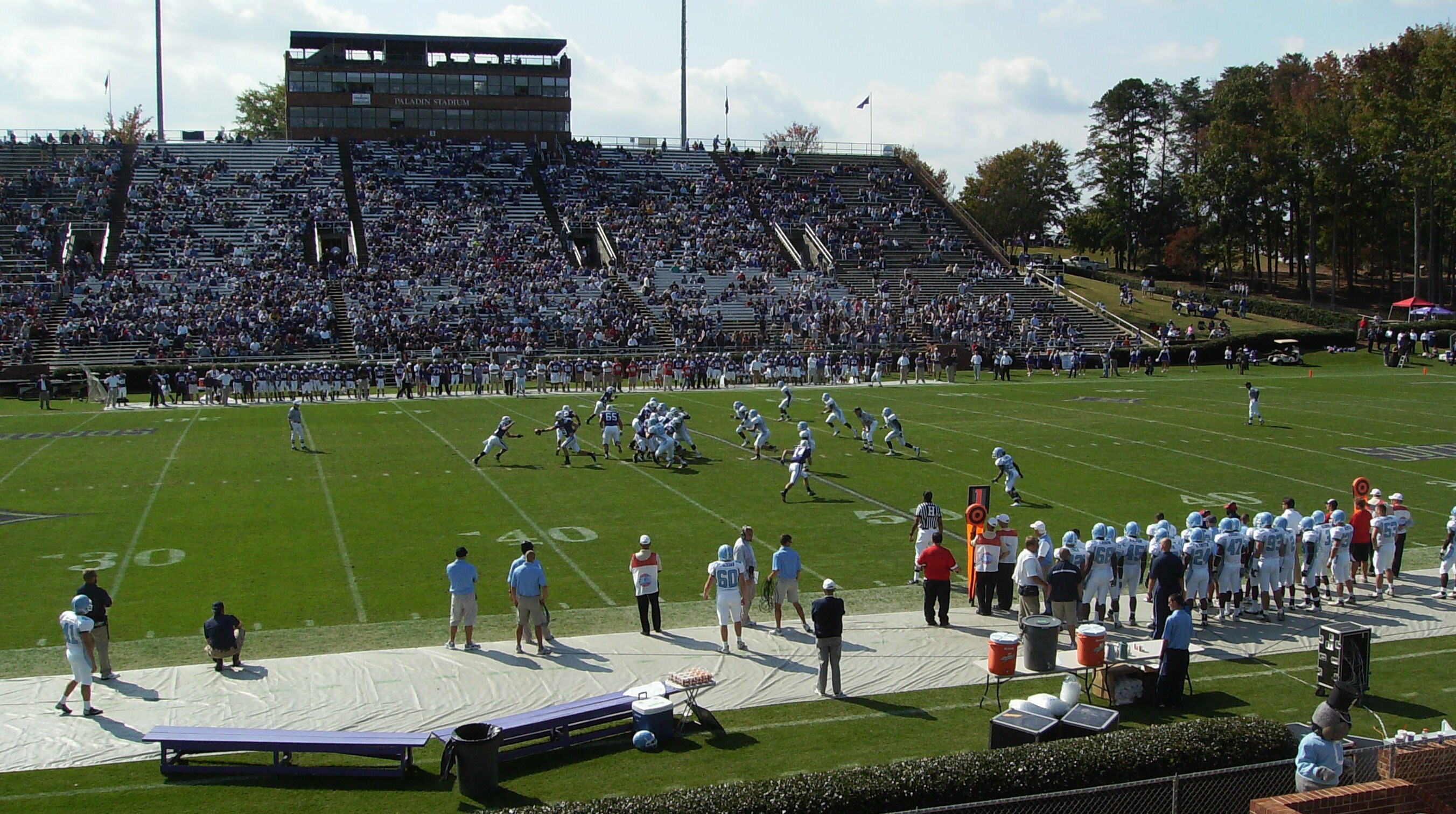
— The guy riding Furman’s horse took off his helmet/mask before the game started and rode around bareheaded the rest of the time.  Why?  It ruins the gimmick.  He should wear the helmet the entire time he is in public view.  Instead of a knight riding his trusty steed, we got to see a decidedly nondescript bald dude riding a horse.