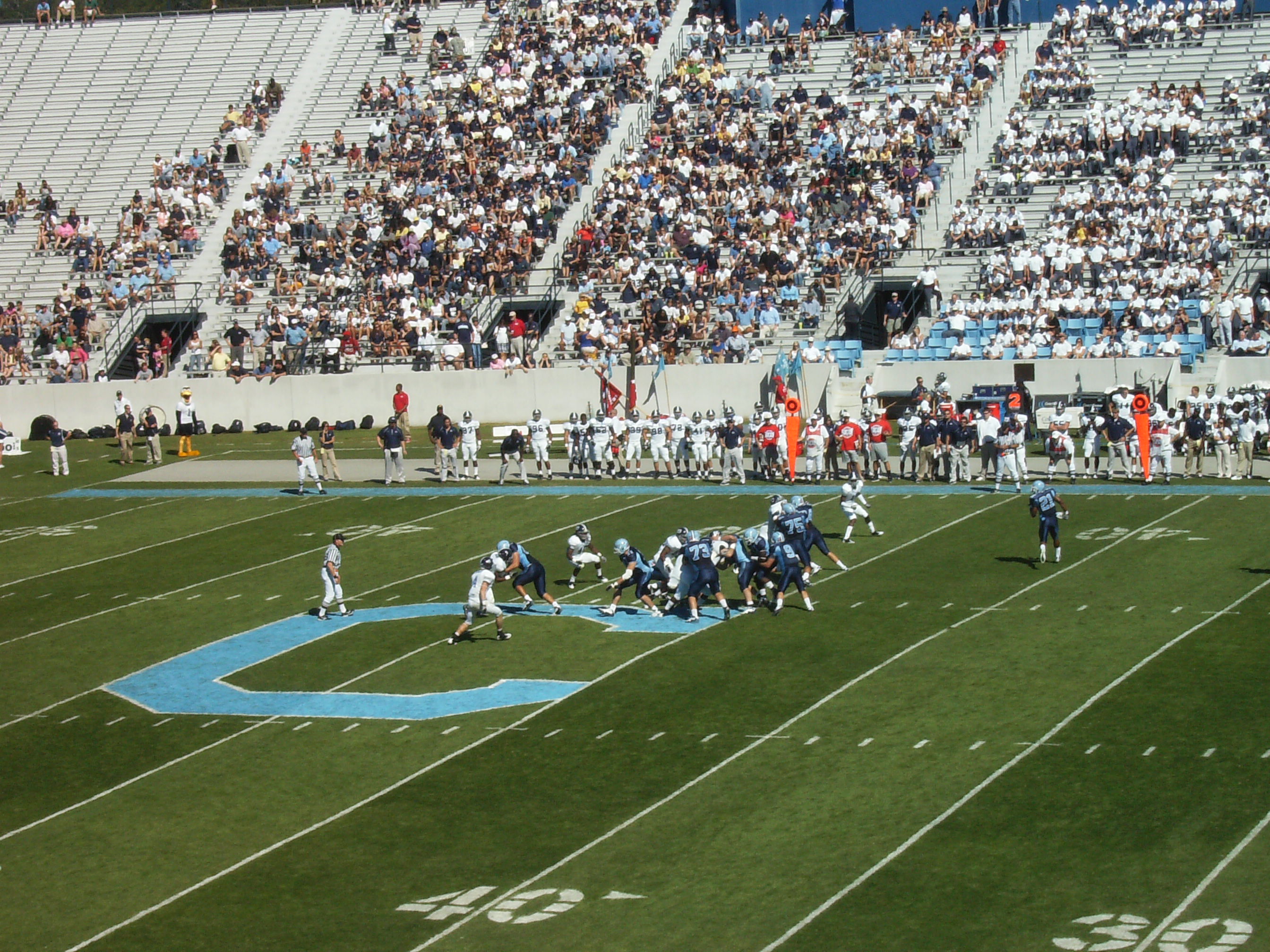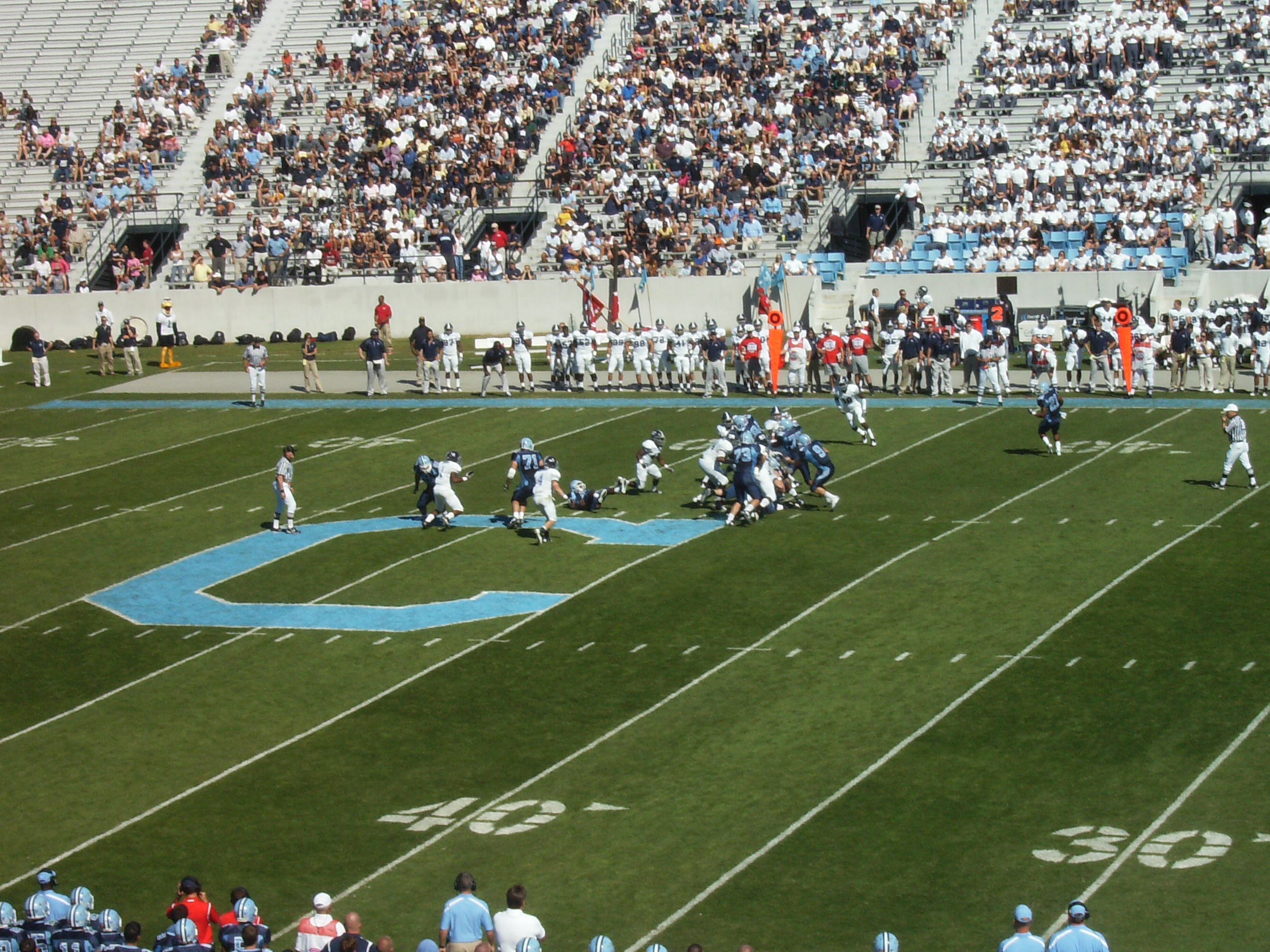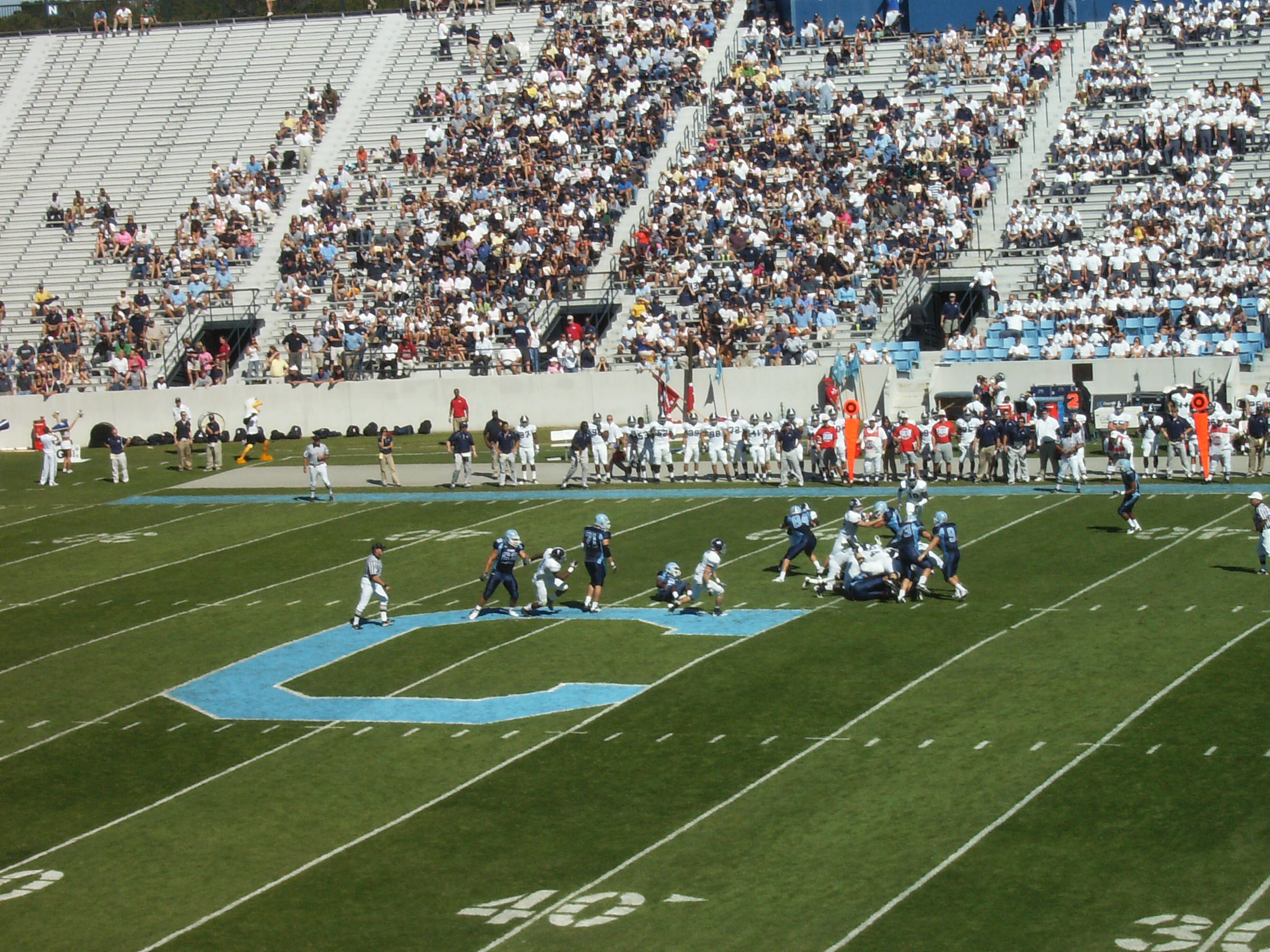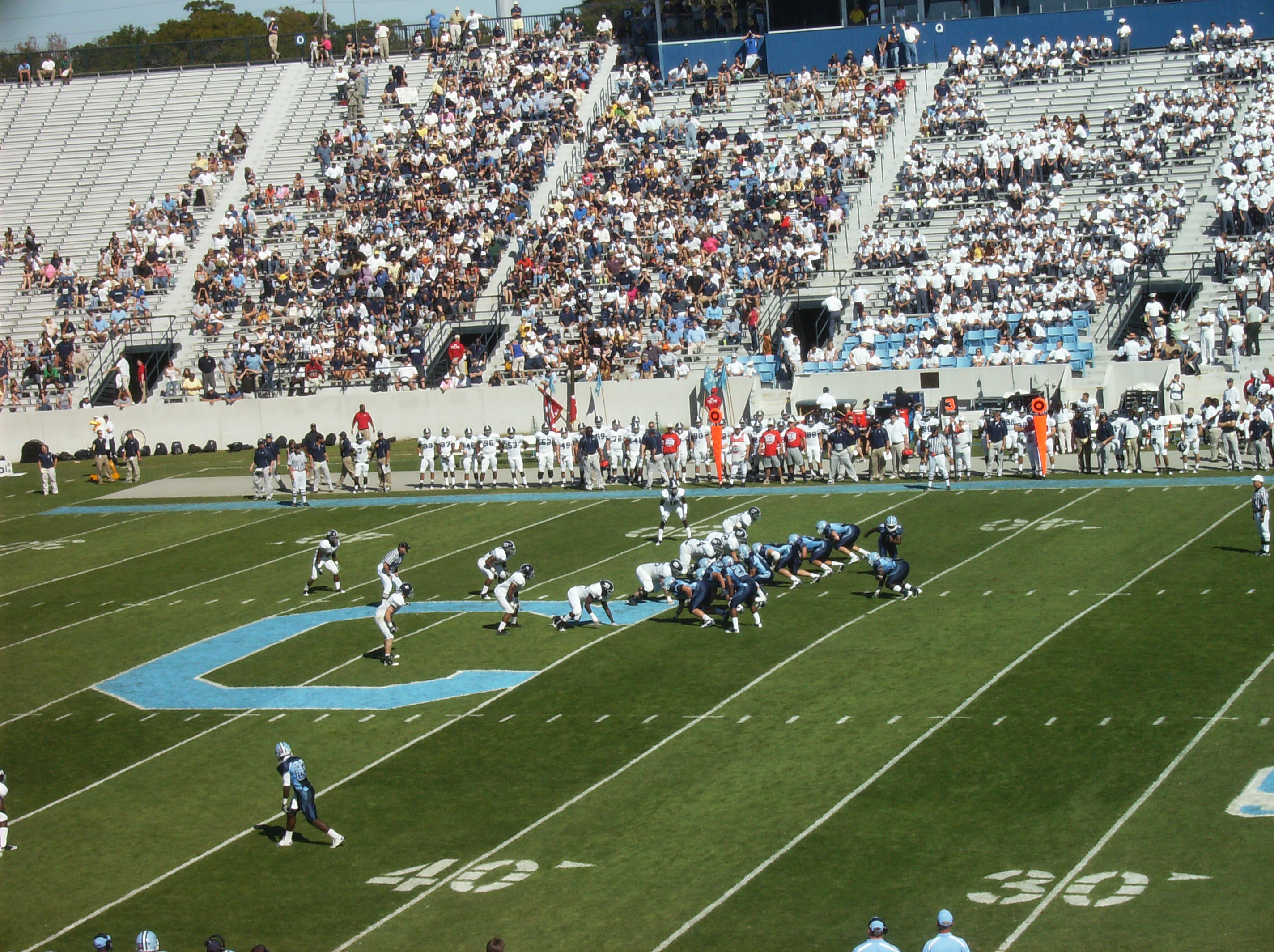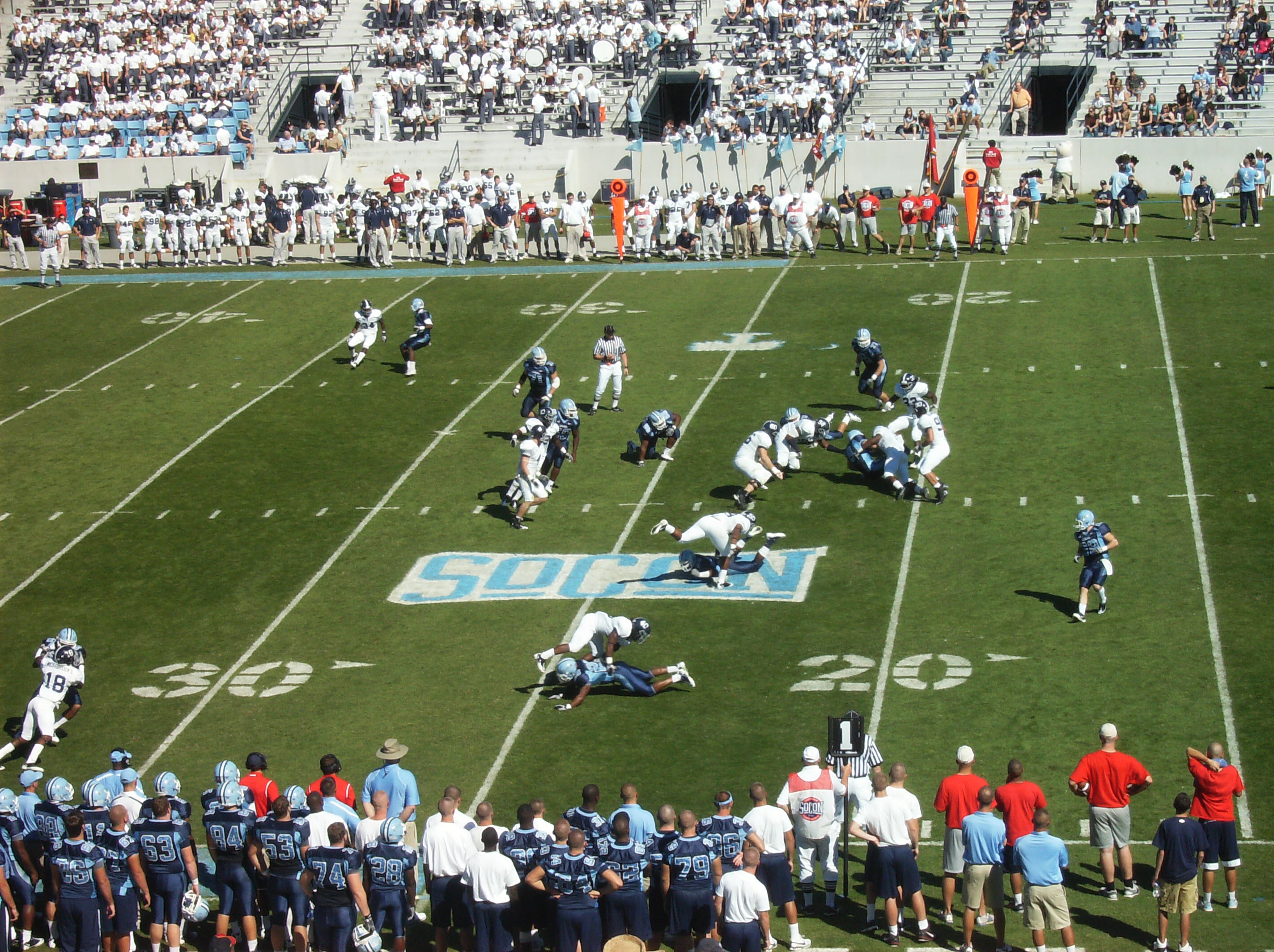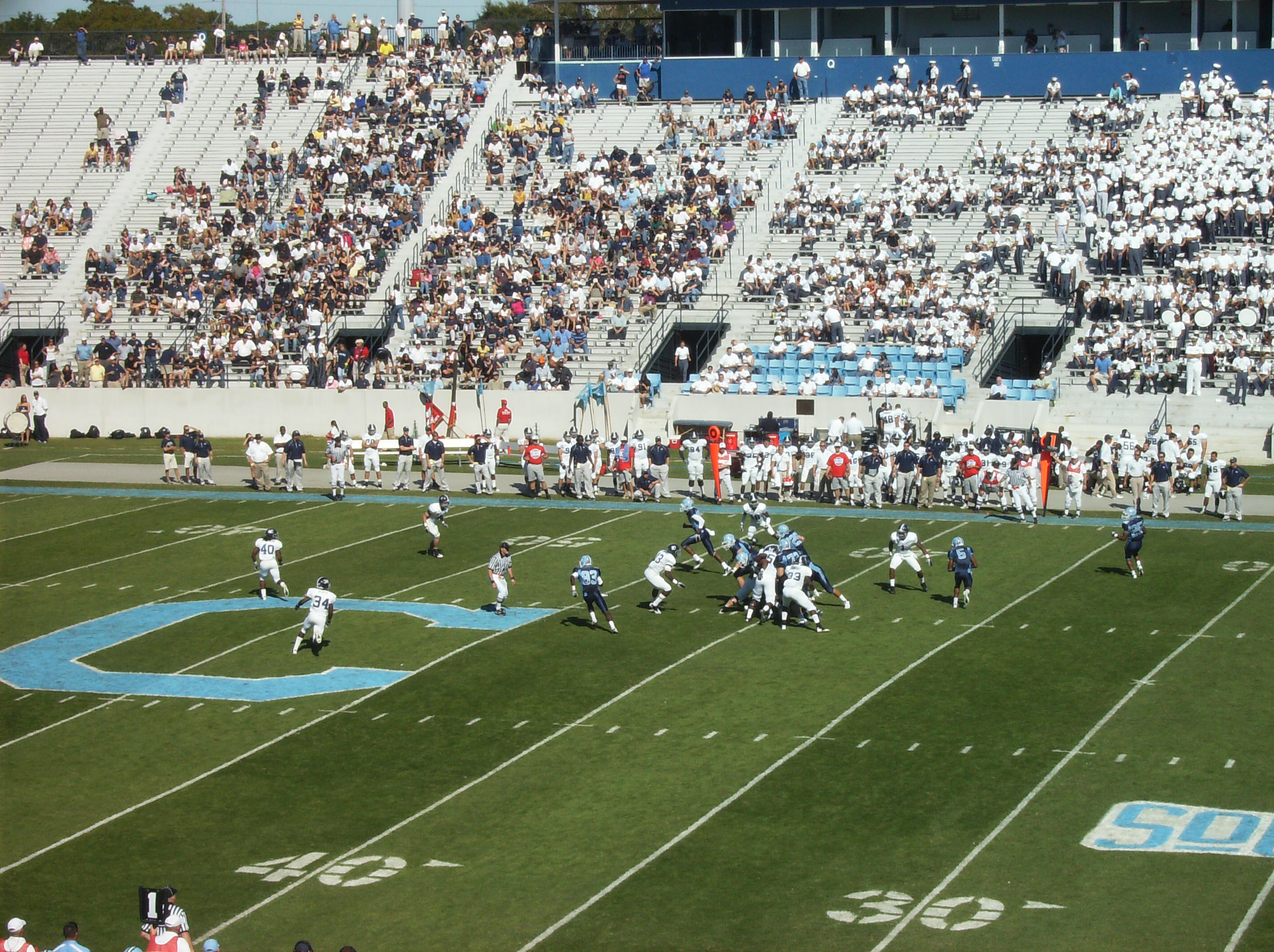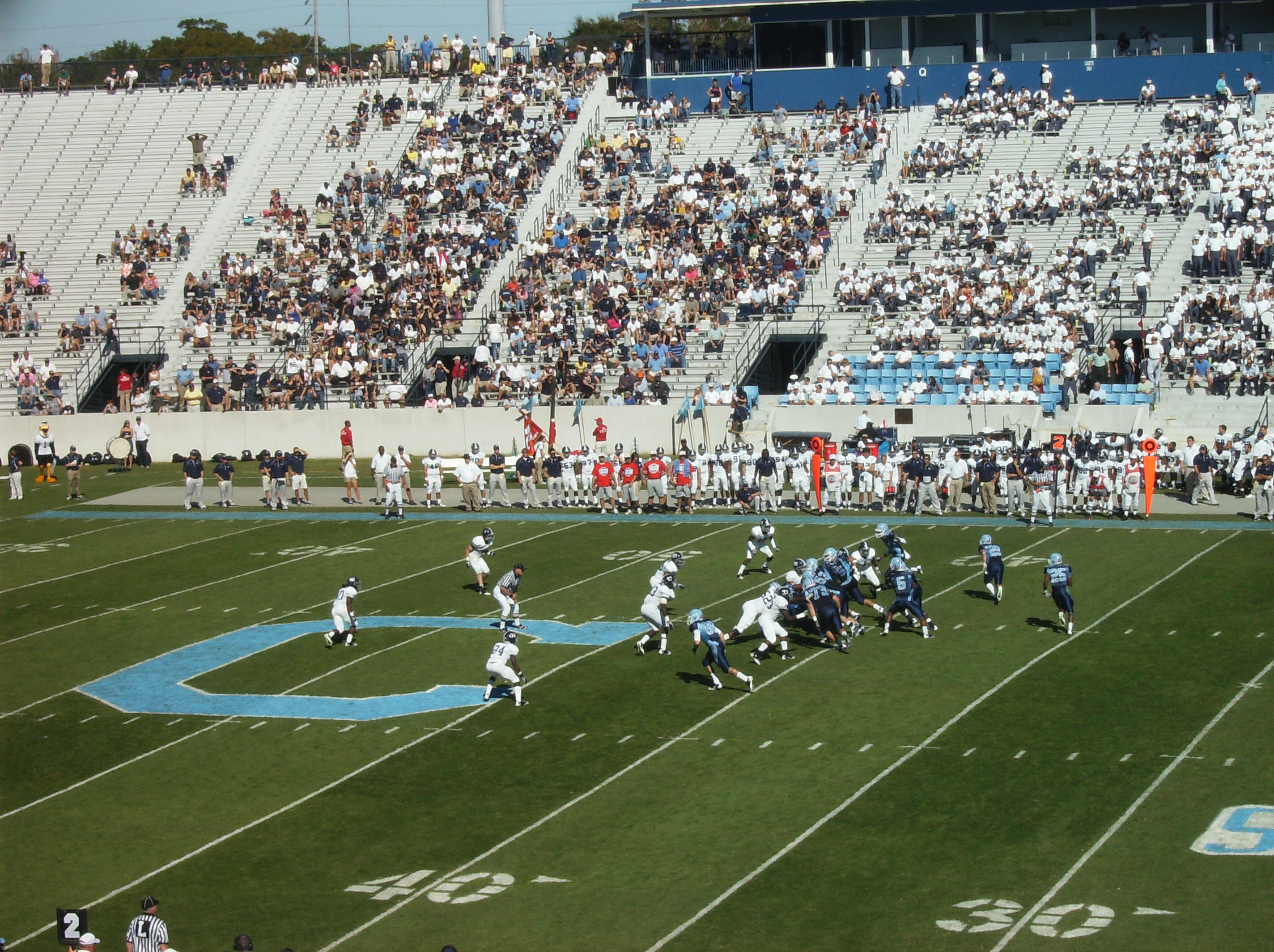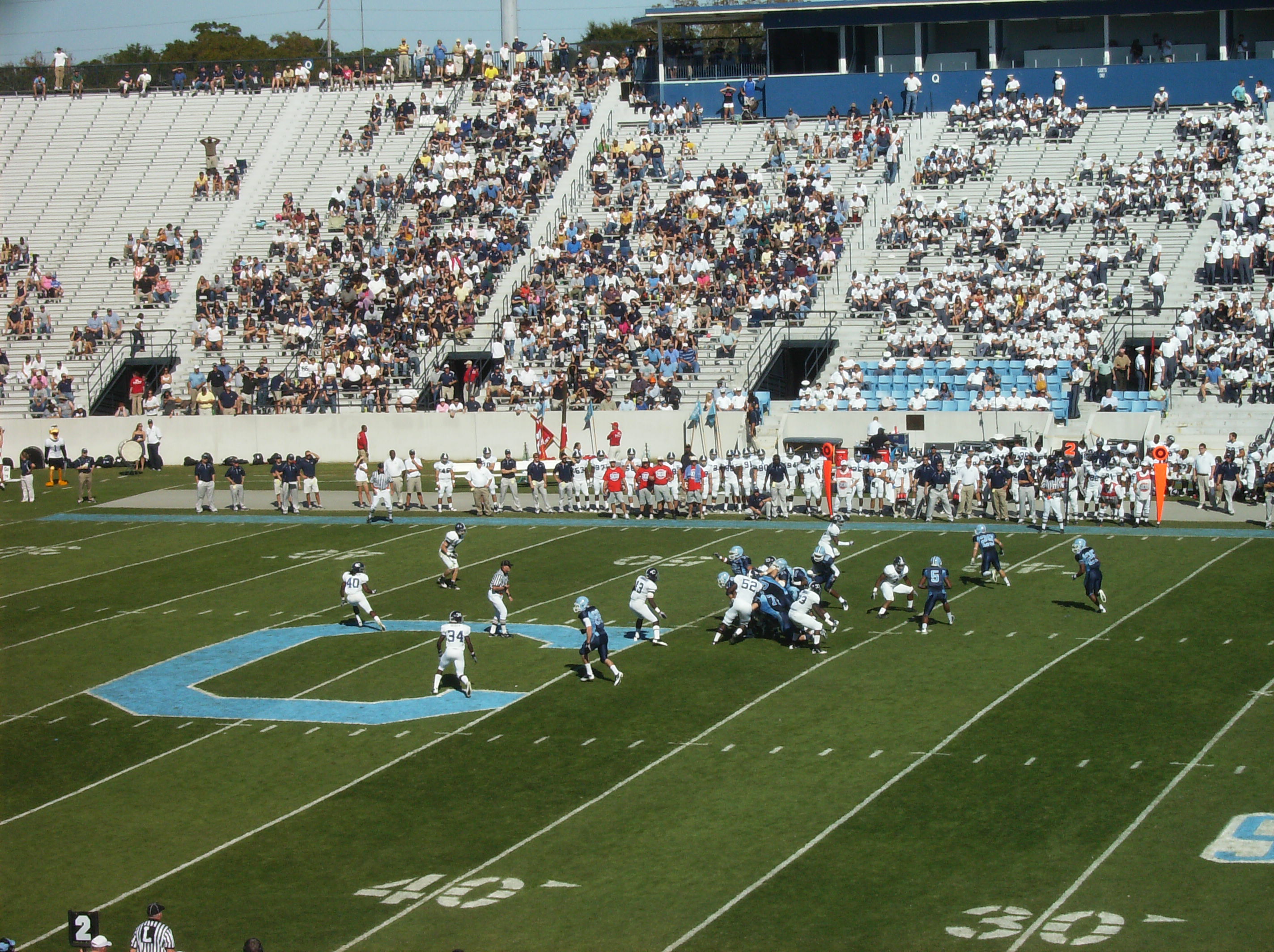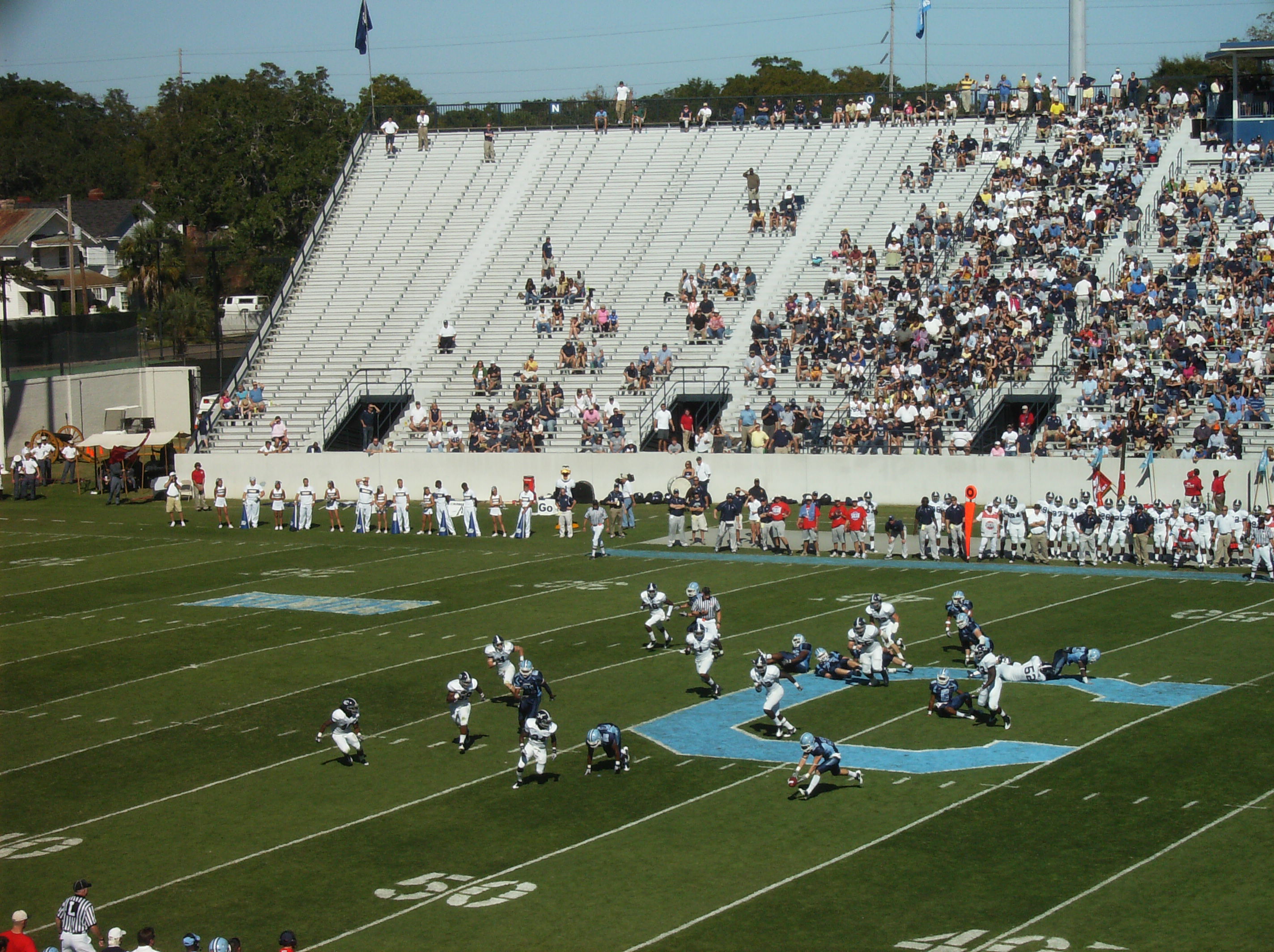
2011 Football Game 8: The Citadel vs. VMI

The Citadel vs. VMI, also known as “The Military Classic of the South”, to be played at historic Johnson Hagood Stadium, with kickoff at 1:00 pm ET on Saturday, October 29.  The game will not be televised. There will be a webcast on Bulldog Insider (subscription service), and the game can be heard on radio via The Citadel Sports Network, with “Voice of the Bulldogs” Danny Reed calling the action alongside analyst Walt Nadzak.  The two teams will battle for the coveted Silver Shako, universally regarded as the greatest trophy in all of sports.

I’ve actually written multiple posts on The Citadel’s football team this week. It’s the first time in a while I’ve done that. I reviewed the Western Carolina game, and also threw in my two cents on where the corps of cadets should be placed at Johnson Hagood Stadium.

Now it’s time for the long-awaited resumption of the Cadets vs. Keydets clash. I’m looking forward to this matchup, in part because the Bulldogs have a good chance of winning, but perhaps more so because I think it’s a shame the rivalry had to take a break in the first place. Be forewarned; I’m going to spend most of this post writing about VMI.

The fact the matchup has not taken place since 2007 is a direct result of VMI leaving the Southern Conference following the 2002 football season, which affected the ability of both schools to schedule the game. VMI had been a member of the league since 1924, so we’re not talking about a TCU situation here. Why did the school move to the Big South?

From a Jeff Hartsell article in The Post and Courier:

When VMI left the SoCon after the 2002 season, school officials claimed scheduling flexibility as one reason for the move. The Keydets were locked into eight league games in the SoCon; at the time, the Big South played only four conference games (it’s up to six games and seven teams now, including Stony Brook, which is in New York).

But there’s no doubt football futility played a role in the decision. In the six seasons before their departure, the Keydets were 4-43 in the SoCon, including three 0-8 records and two 1-7 marks, for a winning percentage of .085.

Let’s dig into this a little deeper. First, an aside: you know VMI fans (not to mention the school administration) wince when they see a headline like that one (“Nine years after VMI retreated from SoCon, Bulldogs hold fast”). Ouch.

The Keydets had occasionally slogged through tough stretches in their history on the gridiron prior to their modern-day struggles. For example, from 1968-1971 VMI compiled a cumulative record of 3-39 (in the 1969 season, the average score of a VMI game was Opposition 41, Keydets 8). The first three of those seasons came under the tutelage of Vito Ragazzo. He was replaced in 1971 by Bob Thalman, who gradually rebuilt the program after first enduring a 1-10 campaign in 1971.

Thalman was still the coach in 1981, when the Keydets went 6-3-1. For those of you reading this who don’t know, that is the last time VMI had a winning season in football. That’s right. This year the Keydets (currently 1-6) will suffer their 30th consecutive non-winning campaign. VMI has had two .500 seasons in that span, going 6-6 in 2002 and 2003 under Cal McCombs, a graduate of The Citadel.

McCombs followed up those two years (the last season in the SoCon and the first in the Big South, respectively) by going 0-11 in 2004. After a 3-8 season in 2005, he was done as the VMI coach.

That 0-11 season in 2004 is one of two winless campaigns at the Institute since 1981. Ted Cain’s 1997 squad also went 0-11. Cain was the coach at VMI for two seasons, winning one solitary game (against Lenoir-Rhyne).

With the exception of current coach Sparky Woods, every coach at VMI since 1981 has suffered through at least one winless or one-win season. Thalman was 1-9 in his final season in charge (1984). Eddie Williamson had a 1-10 ledger in 1987. Jim Schuck (a former Army assistant who was hoped to be VMI’s version of his contemporary Charlie Taaffe) went 1-10 in his final season, 1993. His replacement, Bill Stewart (later to win a BCS bowl game at West Virginia) would field a 1-10 squad the following year.

After Cain’s two seasons (the final game of the 1998 campaign was coached by AD Donny White), McCombs would coach VMI for six years, with two 1-10 seasons to go along with that 0-11 finish in 2004. Jim Reid, who had previously been the head coach at Massachusetts and Richmond,  followed McCombs, posting records of 1-10 and 2-9 before leaving to go to the Miami Dolphins (shades of John Zernhelt). He is now the defensive coordinator at Virginia.

Speaking of Donny White, who coached that one game in 1998, he is still the director of athletics at VMI. In the Hartsell article, he had this to say about scheduling:

Fewer league games have helped VMI rekindle rivalries with teams in Virginia like Richmond and William & Mary, but it hasn’t done much for the bottom line. Overall, VMI has a 21-69 record since leaving the SoCon, the highwater mark a 6-6 record in 2003.

“To be fair, I haven’t done a good job of taking advantage of that flexibility,” White said. “With more flexibility, you try to schedule more appropriately for your team, so our non-conference record should have improved. But I haven’t done a good job with that.”

Well, he probably hasn’t. On the other hand, there is a reason he is still the AD at VMI despite the football team’s struggles. It seems clear that White, despite his comments, has been hamstrung a bit in his efforts to make the schedule easier.

The Big South, as mentioned in the article, now has seven teams, so that is six league games for VMI per season. In non-league play, VMI has played William & Mary every season since World War II save one (2009). The Keydets have not beaten the Tribe since 1985, and few of the contests in recent years have been close. Richmond has been an almost yearly opponent as well, but since joining the Big South VMI is 0-9 against the Spiders, allowing on average almost 40 points per contest.

Richmond and William & Mary are traditional rivals for the Keydets (they in fact are the two schools VMI has played most often in its history), but the fact is that right now both of them are on a tier well above VMI in terms of on-field competitiveness. Between playing both of them almost every year, along with a “money” game or two (VMI played both Virginia and Army last season), it makes it hard to schedule “gimme” victories for the squad.

This year VMI’s only game against an FBS team is Akron. I can’t imagine the Keydets got a large check for that one (though I have read that check may have been at least as big, if not bigger, than one for playing Army would have been).

In a way, it is easy to see what VMI’s administration was thinking when it elected to leave the SoCon. Richmond and William & Mary had already left the league. There were some schools still in the conference with which VMI could identify (like The Citadel and Furman), but there were other institutions with which VMI had no shared history, larger state schools that the Keydets seemingly were never going to be able to successfully compete against on the field. Georgia Southern entered the SoCon in 1993. The Eagles and Keydets met ten times. GSU won all ten games by an average score of 47-6.

By the late 1990s it seemed to be getting worse for VMI, which was losing badly every year to the likes of GSU, Appalachian State, and Chattanooga. I wouldn’t be surprised if a particular stretch in 1999 may have cast the die when it came to leaving the league. VMI was 1-10 that season, winless in the league. Starting in late September, this is how things went for the Institute: Furman leveled the Keydets 58-0. The following week, Georgia Southern traveled to Lexington and blasted VMI 62-0. The week after that, Wofford crushed the Keydets 55-10. Then Chattanooga shut out VMI 27-0.

After a non-league game against William & Mary, VMI would lose 40-2 to Western Carolina and 34-7 to App State. Even the near-miss that was the season finale (a 7-6 loss to The Citadel) wouldn’t have come close to easing the pain of that season, or perhaps the sense that VMI could no longer compete in the Southern Conference.

The problem, of course, is that recruiting to play in the Big South is not the same as recruiting for the SoCon, something the administration at VMI may not have fully realized. It may be that the VMI brass thought the school would continue recruiting the same type of athlete regardless of what league VMI called home, but that’s not the way it works.

In addition, several teams in the Big South have started to show major aspirations when it comes to football, and VMI is again faced with the problem of competing against schools with different standards (because they have different missions) and more resources. VMI is 2-7 against Coastal Carolina since joining the Big South, and 1-8 versus Liberty since joining the conference. It’s likely that competing against those schools will continue to be an uphill climb for the Keydets.

VMI is also winless against Stony Brook since the Seawolves joined the league for football. I’m guessing that most VMI alums don’t know anything about Stony Brook except that it beat their alma mater 42-14 last week.

I think the long losing streak has surely cost VMI victories in individual seasons, as there is no reservoir of winning built up in the program. What the folks in Lexington need to do, more than anything, is come up with a winning season to get the proverbial monkey off their back. As such, VMI should schedule accordingly. At least three “gimme” or “near gimme” games should be scheduled, preferably early in the season in order to build confidence.

Then, with hard work and a little luck, three victories in league play would give VMI that 6-5 record and end the skid. In other words, play Lock Haven and Chowan and schools like that on a regular basis in non-conference games.

The Citadel has suffered because of a long losing run of its own, only broken by the 7-4 season in 2007. When it comes to breaking a run of losing that has lasted for a generation and a half, VMI’s difficulties are exponentially greater.

I was at the 2002 contest referenced in Jeff Hartsell’s story. It was easily the most miserable I have been at a football game, and that had nothing to do with the outcome. That game was the first of two matchups between VMI and The Citadel played in Charlotte at ancient Memorial Stadium, an interesting idea for promoting the series that definitely did not work out.

The problem was that the weather was beyond awful that day, and the field at the stadium was simply not up to par, to put it mildly. The end result was that the two teams played in a sea of mud while the supporters who actually made it to the stadium were being absolutely pelted by near-freezing rain. It was just a mess.

I’ve still got my program from that game. It is, shall we say, weatherbeaten. For the record, the 2002 game was technically a VMI home game, so the program is actually “Keydet Gameday” with VMI defensive back DeAngello Plather on the cover. It’s probably not a collector’s item.

The weather was much better for the 1980 contest at Johnson Hagood Stadium, a tour de force by Stump Mitchell. I still remember a long touchdown run in which several different VMI players were left with pieces of his jersey (they wore tearaways back then) while Mitchell galloped down the sideline, shoulder pads rhythmically bouncing as he ran.

VMI and The Citadel will be meeting later in the season over the next few years. Next year’s game in Lexington is tentatively scheduled for November 10. The game in 2013 is slated to be played November 16.

VMI will also play Navy in 2012.

Sparky Woods is the coach at VMI. It’s his fourth season in Lexington. When he was hired I thought it was a quality move for VMI, and I still do. He’s a good coach. People sometimes forget that he did a nice job at Appalachian State, which is what led to him getting the South Carolina job.

He got the gig with the Gamecocks after Joe Morrison died. I remember when Woods was first formally introduced to a South Carolina crowd; it was at the 1989 basketball game between The Citadel and South Carolina, at Frank McGuire Arena. Gamecock officials literally rolled a red carpet (it may have been garnet) to center court and led him out for a quick wave-and-leave moment. The crowd stood and gave him a standing ovation.

Of course, that night the Bulldogs beat the Gamecocks on the hardwood for the first time since 1943. Perhaps it was an omen for his worst moment as the football coach at South Carolina, the 38-35 loss to The Citadel in 1990…

This is going to be yet another game in which neither The Citadel nor its opponent is known for committing penalties. The Bulldogs have the fewest penalties (and penalty yardage) in FCS football. VMI is tied for seventh in fewest penalty yards. Amazingly, the Keydets have played four teams in the top six in this category — The Citadel, Richmond, William & Mary, and Charleston Southern (CSU being the lone victory on VMI’s schedule to date).

VMI has struggled on offense all season. It ranks very low in the FCS in several offensive categories, including total offense (112th), pass efficiency (113th), and scoring offense (115th).

Starting quarterback Eric Kordenbreck has thrown four touchdown passes while being intercepted seven times. He has only completed 48% of his passes. His backup, Adam Morgan, has posted good numbers in limited duty. I wouldn’t be surprised if he played against The Citadel.

VMI is only averaging 3.4 yards per rushing attempt. Chaz Jones is a redshirt senior who has received the bulk of the carries for the Keydets. He has seven rushing touchdowns. Jones also has thirteen pass receptions.

Another redshirt senior, Tracy Hairston, is VMI’s primary receiving threat, leading the team in receptions. He is also the Keydets’ regular kick returner.

Defensively, the Keydets are allowing slightly over 30 points per game, although that is partly a result of the problems on offense (including a time of possession differential of over five minutes versus its opponents). The one area VMI is weakest on defense, pass efficiency, is not exactly a strength for The Citadel. VMI has only intercepted one pass all season, which doesn’t help its turnover margin (-8).

Opponents are averaging a shade over 175 yards per game on the ground against the Keydets. The goal of Triple O’Higgins for the game on Saturday should be to try to double that total, at the very least.

VMI’s two top defensive players are linebacker A.J. Gross and strong safety Byron Allen, both of whom were pre-season all-league picks in the Big South. Unfortunately for the Keydets, promising defensive back Demetrius Phillips left school earlier this week.

VMI’s numbers in the punt game are not good, a major issue for a team as offensively challenged as the Keydets. VMI is not winning the battle of field position in most of its games. The Keydets have had three punts blocked this season. I bet Domonic Jones is interested in that statistic.

Last week, I called the Western Carolina game a “must-win” game for the Bulldogs, and they won it. This Saturday’s game against VMI is also a “must-win”, and not just because it’s a rivalry game.

It’s a game The Citadel is expected to win. There really aren’t a whole lot of games like that on the Bulldogs’ schedule in any given year, and when there are, the team must take full advantage.

Having said that, I don’t think it’s going to be easy. VMI is not a good team, but it’s a team that is going to play hard throughout. It will match The Citadel in that respect in a way that few other squads do.

Also, a win over The Citadel would make VMI’s season. The Bulldogs in the past have struggled with some very poor VMI teams; it’s important that The Citadel does exactly what it did last week in Cullowhee, namely start strong and not let up. The longer VMI stays in the game, the more the Keydets will start to believe they can win it.

Bobby Ross will be at Johnson Hagood on Saturday, having the honors at the pregame coin toss. I think that’s really cool.

I’ll be in the stadium too. I want to see the coveted Silver Shako in person again, and I want to see The Citadel retain the precious trophy for another year. It’s important.

Commentary on the Corps

Now entering the stadium, the South Carolina Corps of Cadets!

Ah, but on which side of Johnson Hagood Stadium will the corps wind up after entering the stadium? That is the question.  For the past few years, the answer has been the East stands at JHS, which bothers more than a few people who remember when the corps sat in the West stands (the “home” side of the stadium).

This has been the subject of considerable discussion — in the tailgating areas (from the fans who actually enter the stadium to watch the game, that is), on the online forum of choice, and even an occasional podcast.

I think the majority of those with an opinion want the corps to be moved back to the West stands, presumably in the area around sections A, B, C, and D. The theory is that it would improve the stadium’s atmosphere, and perhaps “wake up” an occasionally apathetic student section.

Since this is my little blog, I figured I would throw in my opinion on this as well, although on this subject my opinion differs from most. I think the corps should remain in the East stands.

There is the ideal, and then there is reality. The problem at Johnson Hagood Stadium, in terms of stadium atmosphere, is that the current reality is further from the ideal than it has been in recent history.

The natural tendency is to blame the corps of cadets, and that is understandable, since the corps is easily the most important part of the overall makeup of the JHS atmosphere.  It is what makes the stadium experience unique. However, assigning blame to the corps is simplistic at best.

Let’s look at the situation this way: what is different in 2011 than, say, 1992 or 1979 or 1961?

The biggest difference is the success of the team, of course.  I’m not talking specifically about the 2011 team, either — or the 2010 team, or the 2009 team.  I’m talking about the program over the last 15 years or so. The football program is currently in the worst cycle for on-field success over a sustained period of time since the early 1950s. That is the real problem.

At The Citadel, almost all of the students go to the games. That’s very unusual. A significant percentage of them (higher than at most schools, in my view, as I’ve written before) are not particularly interested in sports in general. They are at the game because they have to be.

Those cadets are expected to “perform” for three hours at every football game, of course, but the truth is that it’s easier to play the role of boisterous lunatic when you think you’re having an effect. For too long, that hasn’t been the case. Because of that, there is no reason to believe.

If a cadet is not naturally a sports fan and isn’t inclined to follow the team in the first place, he or she isn’t going to be able to relate to the notion of maintaining intensity regardless of the situation on the field.

This is what leads to stories about apathy, some of which are probably true and some of which may be exaggerated. The oft-proffered solution, of course, is to move the cadets back over the home side, next to the alums and other Bulldog fans, where those supporters can see for themselves that the corps is properly enthused about the game.

The fans in the middle section would interact with the corps, much as in years past, with good-natured ribbing going back and forth, possibly including chants from the corps directed at certain notables (most memorably a former assistant commandant).

I can understand that sentiment. Those are good memories.  There is just one problem: the people who sat in the middle section back then don’t sit there anymore.

Well, most of them don’t, anyway. If you really want to point a finger at something specifically wrong with JHS atmospherics that doesn’t involve the game itself, I wouldn’t recommend starting with the cadets. I might suggest you start with the situation in the three middle sections of the West stands, the blue-and-gray seats.

Whenever someone starts talking about how the corps can wake up the home side and vice versa, I want to ask them if the corps is going to be able to interact with the folks sitting in sections “I” and “J”, which are three sections over (I am assuming the corps would be returned to their original area). The cadets sure won’t be engaged with most of the fans in the middle sections, because they aren’t in their seats.

I’m not talking about all the fans in those areas, of course — there are some great fans who do sit there.  However, far too many fans with those seats stay in the club level, or perhaps remain in the tailgating lots (often for the entire game, it appears).

I guess it’s an unintended consequence of the PSL program. I’m not going to rip people for staying in the club area. I am disappointed in the tailgaters-for-life, but you know, they paid for those seats too. If they don’t want to use them, that is their right.

There is only one real way to ensure that those seats are filled at gametime. The team has to start winning. That’s always what it comes down to, isn’t it?

Sometimes I think alums are a little too quick to criticize the corps. I don’t think that the cadets should be immune from criticism (far from it), but I worry that we play the “old corps” card a little too often.

The current cadets I have had the pleasure to meet have been almost uniformly intelligent and personable, and full of the school spirit that we all want them to have. It’s just not that easy to express that spirit when the team is getting shelled, and you don’t really remember a time when that wasn’t a regular occurrence.

Should there be a little “tightening up” of the corps? Sure. That’s always true, I suppose. Maybe there should be a little more active supervision during games to keep a few of the slackers on their toes. There are always a few slackers, after all.

(It occasionally crosses my mind that back in the day, some crotchedly old alum might have thought I was a slacker. I wasn’t, though. I was just really awkward.)

The one thing I did wonder about when the corps was originally shifted to the East side was the sun, which depending on the time of day can be problematic for spectators in those stands. Listening to the “Grayline” program last week, I heard a tale of cadets falling asleep as a consequence of the sunfield.

Later in the show, however, Jeff Hartsell noted that cadet assistants in the press box had been known to fall asleep during games as well. I’m fairly certain that the sun is not an issue in the press box.

The Citadel plays VMI on Saturday. In perusing the VMI message boards recently, it was interesting to see that alums of that school weren’t happy with their cadet corps at football games, either.  The “apathy” word came up more than once. In other words, the “old corps” phenomenon is fairly universal, and that includes schools that don’t have an old corps or a new corps.

Brief digression from football to hoops:

I think it is true that in some eras the cadets were more “into” the games than in others. I suspect that those times dovetail almost exactly with teams that had extended runs of success.

I can understand the frustration of certain alums, though, particularly when it concerns basketball attendance, which has been poor for many years now (I’m referring specifically to cadet attendance here, although it’s been bad in general).

I know the cadets came out in force to watch the “Blitz Kids” in the late 1950s-early 1960s.  I wasn’t there, but I’ve heard all the stories. More than once. The reason people watched those games, though, was that the Blitz Kids were really good.

The Bulldogs had a surprisingly solid basketball team in 1988-89, too, and people came out to watch — and that was when the home games were being played at Deas Hall.

(Honestly, if it were financially and/or practically feasible, The Citadel should play at least one game each season at Deas Hall, just for the amusement factor alone.)

While the focus of this post is primarily on the corps and Johnson Hagood Stadium, I did want to briefly mention the hoops program, because I have always felt that attendance at basketball games was the real “elephant in the room”, all the more so because the potential for growth is so obvious.

Back to football…

In summation:  the bottom line is that when it comes to the energy one wants to see from the corps, or the fan base in general, it doesn’t matter where the corps sits (or stands). It’s about having a team that wins its fair share of games, or at least the possibility of having a team that wins its fair share of games.

If the program did turn things around, I think the majority of alums/fans would agree that having the corps on the East side would be the way to go in order to maximize the stadium experience. A full stand of home fans would get the chance to see the corps in action from across the way, and the cadets would have the chance to, uh, entertain the visiting team.

The question is whether it is worth establishing the East side as the standard section for the cadets at a time when the program is not at its best. I think it is, in part because I honestly don’t think moving the corps back to the West stands would have that great an impact.

Just my opinion.

2011 Football, Game 2: The Citadel vs. Furman

The Citadel vs. Furman, to be played at historic Johnson Hagood Stadium, with kickoff at 6:00 pm ET on Saturday, September 10.  The game will be televised on WYMA (Asheville, NC), and will be available on ESPN3.com.  There will also be a webcast on Bulldog Insider (subscription service), and the game can be heard on radio via The Citadel Sports Network, with new “Voice of the Bulldogs” Danny Reed calling the action.

The Citadel begins play in the Southern Conference with a game against traditional rival Furman.  It’s only the third time the two schools have ever met in a league opener, but it’s the second consecutive season that has been the case.

I’m not going to rehash the history of the series in terms of the time of year the game has been held; anyone interested can read what I wrote on the subject for last year’s game preview.  Regardless of whether you think the game should be a midseason clash (my preference) or played at the end of the year (a not-insignificant number of fans from both schools), I think everyone can agree that September 10 is too early for this game to be played.

Jeff Hartsell has reported that, per the SoCon office, next year’s meeting will come at the end of the 2012 season, on November 17.  (The conference does not make league schedules beyond one year in advance.)

I’m okay with that, as long as the Clemson-South Carolina game continues to be played the Saturday after Thanksgiving, as is now the case.  I just don’t want The Citadel and Furman to play on the same day as the matchup between the Tigers and Gamecocks.

Furman was 5-6 last season, its first losing campaign since 1998.  Bobby Lamb resigned after nine years in charge and over a quarter-century at the school as a player or coach.  The Paladins had missed the FCS playoffs for four consecutive seasons, which did not go over well among some supporters.  It was time for Furman to make a change.

The question, though, is did Furman really make a change?

The new coach is Bruce Fowler.  Fowler is a 1981 graduate of Furman who played for Dick Sheridan.  Lamb was a 1986 graduate of FU who had played for Sheridan. Fowler spent 18 years at Furman as an assistant coach.  Lamb had been an assistant coach at Furman for 16 seasons.

One difference is that Fowler wasn’t a complete Furman lifer like Lamb had been.  For the past nine years, he had been an assistant at Vanderbilt, where he was defensive coordinator for Bobby Johnson (and Robbie Caldwell in 2010).  Of course, Johnson had been the head coach at Furman before taking the Vandy job, and before that he had been an assistant under Dick Sheridan.

You may have noticed a pattern here.  Dick Sheridan left Furman after the 1985 season to take over at N.C. State, but his presence is still felt in the program.  All four of the men who have held the head coaching position since Sheridan left (including Fowler) were players and/or assistants under him.

If you were going to have your football program maintain what is in effect a 25-year tie to a former coach, you could do much worse than Sheridan, who did nothing but win throughout his coaching career (even as a 28-year-old rookie head coach at an Orangeburg high school).  It’s a type of continuity that may be worth preserving.

On the other hand, there is always the possibility that Furman risks going to the well once too often.  Fowler isn’t exactly a carbon copy of Lamb, though — for one thing, he’s 52 years old, 13 years older than Lamb was when Lamb got the job.  Also, he’s primarily a defensive coach (though he was the receivers coach at FU for seven seasons).  Lamb was mostly an offensive coach (and a former quarterback) during his time with the Paladins.

Usually when a school is in a position to make a coaching change after a run of disappointing seasons, it brings in somebody to shake things up.  That’s certainly not what Furman has done.  Besides Fowler, three of the assistant coaches played for Sheridan; another has been a Paladins assistant for 13 years.

Before I move on to the Paladins of 2011, I should note that Art Baker, who preceded Sheridan as head coach at Furman (eventually leaving to take the job at The Citadel), hired Sheridan, Jimmy Satterfield, and Bobby Johnson as assistant coaches, all of whom would later ascend to the top job at FU.  Baker had a significant impact on Furman’s coaching tree.

Furman lost 30-23 at Coastal Carolina in its opener.  The Paladins never led the contest.  The game had been tied at 16 and 23 before the Chanticleers scored the game-winning touchdown with 1:23 remaining in the fourth quarter.

Coastal Carolina gained 231 yards rushing and 195 yards passing against the Furman defense, but perhaps more interesting was that the Chanticleers had 59 rushing attempts for the game.  CCU ran 81 offensive plays from scrimmage for the game, while the Paladins had just 58.

As Bruce Fowler noted in the SoCon teleconference, Furman had trouble getting its defense off the field.  Coastal was 7-16 on 3rd-down conversion attempts and made its only 4th-down try, a major reason the Paladins trailed by over 12 minutes in time of possession.  That continued a trend from last season, when Furman finished last in the SoCon in time of possession.

The Paladins do have two impact players on defense, middle linebacker Kadarron Anderson and cornerback Ryan Steed, both of whom are on the Buck Buchanan Watch List.  Another linebacker, Chris Wiley, had fourteen tackles against Coastal Carolina.  Furman defensive end Josh Lynn is tall (6’5″) and rangy, and may be a key factor in how the Bulldogs’ triple action attack fares on Saturday.  Against Coastal, he had five tackles and a sack.

Furman’s starting quarterback against Coastal Carolina was Chris Forcier, of the Forcier Family of Quarterbacks.  I think it’s fair to say that the Forciers are, as a group, somewhat controversial.  I guess it’s a question of style.  When Chris Forcier decided to transfer from UCLA to Furman, the family issued a press release that wound up being posted on Deadspin.

His brother Tate is a former Michigan quarterback who has now transferred to San Jose State (after originally announcing he was going to Miami).  His oldest brother, Jason, also played quarterback at Michigan before transferring to Stanford.  The brothers also transferred to different high schools at various times.

Against the Chants, Forcier was solid, completing two-thirds of his passes while averaging over seven yards per attempt.  A classic “dual threat” quarterback, Forcier also rushed for 50 yards before leaving the game in the third quarter, apparently suffering from cramps.  Without him, the Furman offense sputtered, not scoring in the fourth quarter.

Assuming he is healthy (and there is no reason to believe otherwise), stopping Forcier will be a difficult task for The Citadel’s defense.

If dealing with Forcier wasn’t enough, the Bulldogs must also contend with Jerodis Williams, who rushed for 142 yards and 3 touchdowns against Coastal (including a 68-yard score).  Williams was the Southern Conference offensive player of the week, and also picked up FCS National Back of the Week honors from something called the “College Football Performance Awards“.

Furman had five different receivers catch passes against the Chanticleers (including Williams).  Tyler Maples had five receptions for 65 yards.  Colin Anderson had four catches, and presumably will have a career day against The Citadel, as has often been the case for Furman tight ends.

Along the offensive line, Furman has experienced and well-regarded tackles (one of whom, Ryan Lee, is moving from guard to tackle) and a veteran center, Daniel Spisak (who is Matt Millen’s nephew).  The guards include a first-year starter who came to Furman as a walk-on, and a sophomore who started three times last season before a season-ending foot injury.

Furman placekicker Ray Early was 11-12 on field goal attempts last season, including a long of 52 yards, and only missed one extra point all year (40-41).  Against Coastal Carolina, however, Early’s first field goal attempt of the season was blocked, and he then missed the PAT after the Paladins’ first touchdown.

After that, Early did not attempt a placekick in the game (although he did kick off), giving way to Furman punter Chas Short.  That may be something to watch on Saturday.

Short, incidentally, had a fine year for Furman in 2010.  The Paladins finished in the top 10 nationally in net punting.

With Furman having allowed a bunch of rushing yards to Coastal Carolina, and having lost the time of possession battle so decisively, there may be some hope among Bulldog fans that the Paladins’ defensive issues could play into The Citadel’s hands on Saturday.  As Jeff Hartsell wrote in The Post and Courier:

…on defense, the Paladins’ 4-3 look was blitzed for 237 rushing yards, including 105 yards and two TDs by CCU quarterbacks Aramis Hillary and Jamie Childers. That might bode well for the Bulldogs’ option attack, as QB Ben Dupree went for 141 yards and two scores in a 31-9 win over Jacksonville. Higgins said Dupree was 23 for 23 on his option reads, and The Citadel rushed for 439 yards, the most since 1994.

That does seem promising from The Citadel’s perspective.  I would make this observation, though:

The Bulldogs ran the ball well on Furman last year, dominated time of possession, and lost 31-14.  The Citadel gained 294 net yards rushing on 60 attempts, held the ball for over 36 minutes — and did not score until the fourth quarter.

Actually, The Citadel’s 359 total yards against Furman in 2010 was the most yardage gained by the Bulldogs in any Southern Conference game for the entire season.  The problem?  Three turnovers, a missed field goal, and a failed fourth-down try inside the Furman 25.  Another issue was that The Citadel started very slowly on offense, gaining only 64 total yards on its first five possessions.

Conversely, Furman got out of the blocks fast on offense in each half, scoring touchdowns on its initial drive in both the first and third quarters.  Of the Paladins’ other three scores against The Citadel, two came on drives starting in Bulldog territory after an interception and a failed onside kick.

Kevin Higgins has said in the past that sometimes it takes a triple option team a possession or two to figure out how the defense is playing.  That makes sense.  You could see it in last week’s game against Jacksonville, as the game was well into the second quarter until Triple O’Higgins got fully warmed up.

Against a SoCon opponent, though, it needs to warm up faster.  The Bulldogs can’t go an entire quarter with no offensive production, especially as running the offense generally means there are fewer possessions in the game.  Also, while obvious, The Citadel must control its fumbling problems, which cropped up against Jacksonville (albeit with only one coming on an exchange) and stay “on schedule”.

The other thing that can’t happen Saturday if The Citadel has any chance of winning is for the defense to concede relatively easy touchdown drives right out of the dressing room.  Last season, Furman’s TD drives in each half were for a total of 123 yards and featured only two third-down plays.

What the defense really needs is to force some turnovers.  Last year against Furman, the Bulldogs forced no turnovers and also did not record a sack.

The Bulldogs must also contain Forcier, who is capable of making big plays with his arm or his feet, and prevent Williams from breaking long runs, such as the one he had against Coastal Carolina.  (Also, the defense must watch the tight end.  He’ll be catching the ball over the middle for 15 yards before you know it.  Two or three times.)

I thought Ben Dupree played well against Jacksonville.  What he proved, beyond a shadow of a doubt, is that he has the ability to make big plays.  While the triple option is mostly about moving the chains, it’s important to have a breakaway aspect to the offense, and Dupree can provide that with his running ability.  He is still a work in progress as a passer.  If he continues to improve that part of his game, he will be a very dangerous weapon indeed.

Terrell Dallas’ injury against the Dolphins was not serious, thankfully, but it appears he may not play on Saturday.  That will be a loss, but Darien Robinson showed he is quite capable of handling the fullback position.

I thought the defense really came to play against Jacksonville.  Now it faces another challenge.  It won’t have the size and depth advantage against Furman that it had against the Dolphins.

Odds and ends:

— Check out the game notes to see all the different helmet logos The Citadel has had over the years (page 5).  There have been no fewer than 25 different designs since 1952 (and I think it’s likely there have been a few more that went unrecorded).

Those artist renderings/photos in the game notes came from the Helmet Archive, a good site if you want to peruse helmet histories of other teams as well.

— Has anyone else noticed that there are a lot of entities giving out “player of the week” awards these days?  It’s hard to figure out which ones to take seriously.  I can’t decide if the plethora of “recognition sites” is a boon or a curse for athletic media relations departments.

— The Summerall Guards are performing at halftime, but not at Johnson Hagood Stadium.  The Guards will be in Death Valley for the Wofford-Clemson game (it is Military Appreciation Day at Clemson).  It strikes me as a little odd that they would perform at another stadium on the same day as a home football game, but no big deal.

I’m looking forward to the game.  I am hopeful that the success of the home opener, along with Saturday’s opponent, results in a nice crowd at JHS.  As for the on-field action, I’m not quite sure what to expect.  I was pleasantly surprised by what I saw against Jacksonville.  I would like to be pleasantly surprised again.

2011 Football, Game 1: The Citadel vs. Jacksonville

The Citadel vs. Jacksonville, to be played at historic Johnson Hagood Stadium, with kickoff at 6:00 pm ET on Saturday, September 3.  The game will not be televised, although it will be webcast on Bulldog Insider (subscription service) and can be heard on radio via The Citadel Sports Network, with new “Voice of the Bulldogs” Danny Reed calling the action.

It’s that time of year! College football has arrived and not a moment too soon.  I’m tired of reading about the Summer of Ponzi and all the other scandals that have beset the sport in the off-season, and while I enjoy discussing realignment as much as anybody, the Texas A&M two-step with the SEC is starting to get old.  I’m ready to see some activity on the playing field.

This is an important season for The Citadel’s football program.  I wrote about the program’s status last November; nothing has happened since then to make me think that the 2011 campaign will be anything other than a defining one for Kevin Higgins and his coaching staff.  I’m far from the only person who thinks that success of some sort this season is paramount.   The intensity in the crowd at the recent open scrimmage was palpable.

One thing is certain:  if there ever were a year for the football team to “sneak up” on people, this is the one.  Southern Conference media members picked The Citadel to finish last.  Only one player (Tolu Akindele) made either the preseason all-conference first or second teams.  The SoCon coaches’ vote had The Citadel in next-to-last place, ahead of only Western Carolina; that’s the same verdict rendered by The Sports Network.

Last season, the Bulldogs played three non-conference games before beginning league play.  This year, though, The Citadel will play six of its first seven games against SoCon opposition.  The Bulldogs will have a good idea of where they stand before the fall harvest.

The only non-league game in that group of seven contests is the first one, and it is far from the “gimme game” that the home opener has been in recent years.  Instead of scheduling a glorified scrimmage against the likes of Webber International or Chowan, The Citadel is playing Jacksonville, which went 10-1 last season and shared the Pioneer League title (with Dayton).  The Dolphins, favored to win the PL again, will be a formidable challenge.

Jacksonville University is not to be confused with Jacksonville State University, which is located in Alabama and has a football team coached by Jack Crowe, the man who was on the wrong side of one of The Citadel’s more notable gridiron triumphs. Jacksonville University is located in Jacksonville, Florida, and its football team is coached by Kerwin Bell.  (More on him later.)

Jacksonville began in 1934 as a junior college named “William J. Porter University” after its founder; in 1958 it became a four-year school after merging with the Jacksonville School of Music.  As of today it’s a private, liberal-arts university with roughly 3,500 undergraduate students (60% of whom are women).

JU’s “Timeline” feature on its website includes a lot of concerts in the 1970s and early 1980s, perhaps an indication of the importance of the music school in relation to the rest of the university at that time.  Performers who made their way to Swisher Gym included Dionne Warwick, Neil Diamond, Duke Ellington, John Denver, and Billy Joel; K.C. and the Sunshine Band recorded a live album there.

Jacksonville awarded honorary doctorates to Bob Hope and Jack Benny on the same day in 1972.  Another same-day honorary doctorate duo for JU:  Charlton Heston and Ann Landers (who received hers less than a year after writing that Jacksonville U. was one of “the four top colleges in the nation”).

It’s also worth noting that Jacksonville University has the second-largest NROTC program in the country.

Jacksonville has twenty-one varsity sports.  Its nickname, the Dolphins, came to be in 1947 following a student contest (the original contest winner was “Green Dolphins”; another possibility had been the “Juggernauts”).  The official school mascot is an actual dolphin — 58-year-old Nellie, a Marineland mainstay.

The most famous of all JU athletes is, without a doubt, basketball Hall of Famer Artis Gilmore.  Second place on the school’s famous athlete list is probably occupied by Donnie Hammond.  (Like I said, there is no doubt about #1.)

Gilmore played two seasons at Jacksonville (he started his career at Gardner-Webb, then a junior college) and averaged more than 20 points and 20 rebounds per game, which I think can be best described as “awesome”.  In his junior season, he led the Dolphins to the NCAA title game.

Yes, you read that right.  Jacksonville played in the Final Four in 1970, just twelve years after becoming a four-year school.  We’re not talking Division II, either.  The high-scoring Dolphins beat Western Kentucky, Iowa, and No. 1 Kentucky to win the Mideast Regional.  Jacksonville averaged over 106 points per game in those three contests.

– Tangent #1:  What a weird Final Four that was.  There was nothing strange about UCLA being there (and the Bruins would beat Jacksonville in the final, 80-69), but the other three teams were Jacksonville, St. Bonaventure, and New Mexico State.  The Dolphins and the Bonnies were at the time the two smallest schools to ever make it that far, and they played each other in the semifinals.  Alas, it was a mismatch, as St. Bonaventure star Bob Lanier had injured his knee in the regional final and could not play in the Final Four.  Thus, the spectators at Cole Field House were denied the opportunity to watch two future Hall of Fame centers face each other.

After that season, Dolphins coach Joe Williams left JU and took the job at Furman.

– Tangent #2:  Artis Gilmore and his wife have been married for 39 years.  Her name is Enola Gay.  I thought that was worth mentioning.

Okay, it’s time to talk about JU football…

Jacksonville started its football program in 1998, winning its first-ever game 19-14 over Davidson.  The school’s media guide also lists Davidson as being the first ranked team (at No. 3!) the Dolphins ever played, in a 2001 contest won 45-3 by JU, but I have to seriously question that.  What poll would this have been?  Maybe it was a poll only including Southern Conference schools that don’t play scholarship football.

JU plays its home games at Milne Field, a 5,000-seat facility built specifically for the football program, which averaged 3,761 fans per game last season.  The Dolphins have won nine straight home games, but the real eye-popping numbers are from their road games — not necessarily the results on the field, but the travel involved. Jacksonville has six road games this year.  JU will bus to The Citadel for Saturday’s game.  Later in the year the Dolphins will also take the bus to Campbell, assuming the bus driver can find his way to Buies Creek.

However, the Dolphins will make four road trips by air, flying to the University of San Diego, Drake (which is in Iowa), Marist (New York), and Western Illinois (travelling to WIU on the day of the game).  That is a total of 5,575 miles in the air.

Having multiple long airplane flights is a consequence of playing in the Pioneer League, a non-scholarship FCS conference with ten members.  Jacksonville is the southernmost school in the league, which has three members in the southeast (JU, Davidson, Campbell), five in or around the midwest (Drake, Valparaiso, Dayton, Butler, Morehead State), one west coast entry (USD) and one northeastern school (Marist).

One reason for having such a far-flung league is that all of those schools choose to play football at the non-scholarship level while maintaining a NCAA Division I athletics program.  Since 1993, institutions have had to play football at the same level as their other sports, which affected schools like Dayton (a D-3 power in football during the 1980s) in particular.  There aren’t a lot of D-1 schools that offer non-scholarship football but provide schollies in other sports (which distinguishes these institutions from those in the Ivy League, for example).

Jacksonville is not likely to become a scholarship football program in the near future. That possibility was suggested to the president of the university, who responded:

[It] costs too much for us to do it right now. For us to move into scholarship football because of the rules for gender equity, we would not only have to be able to fund the scholarship program year in and year out, we would also have to fund a similar amount for women’s athletics.

And we simply can’t afford it right now. If we had some major donors that came forward and helped us, then something like that could be possible. It’s simply economics. We need a stadium, our stadium is quaint. We would need a stadium where the fan base would generate revenue.

The revenue we get right now is diminutive. With a stadium, you could start getting money back into the program. There are some positives to it, but it’s simply too expensive right now.

In 2013, two new football programs will join the Pioneer League — Stetson and Mercer.  That should help alleviate Jacksonville’s travel burden to a certain extent.

Kerwin Bell played his high school ball in the small town of Mayo, Florida, where he was known as “The Throwin’ Mayoan”.  Arriving at the University of Florida as a walk-on, in one year he managed to climb the ladder from eighth-string to starter.  In 1984, Bell and the Gators would win the SEC title, winning eight straight games to close out the season.  The SEC title was short-lived, however, as the conference rescinded it the following year due to UF being on probation.  In 1985 Florida would go 9-1-1 for a second straight season, and again was not awarded the league crown (and again could not go to a bowl game) because of NCAA violations.

Two years later Bell began his pro career, which featured multiple stops in the CFL (including a stint in the Canadian outpost of Sacramento), a tour of duty with the Orlando Thunder of the Arena Football League, and a two-year stay with the Indianapolis Colts.  Bell got into one game with the Colts, mopping up in a 1996 contest against the Philadelphia Eagles.  In that game, he threw five passes, completing all five for 75 yards and a touchdown (to Marvin Harrison).  Bell finished with a perfect 158.3 passer rating.  Contained within his Wikipedia entry is this astute observation:

[Kerwin Bell] has the highest career passer rating of any quarterback in NFL history, higher than current and future Hall of Fame members Joe Namath, Steve Young, Joe Montana, Warren Moon, Peyton Manning, Dan Marino and Brett Favre.

Bell’s coaching career actually started in 1990.  While recovering from an ACL injury he worked for one year as a graduate assistant coach for Steve Spurrier, who had taken over the Florida program.  His next coaching job came with the Toronto Argonauts in 2000, where he served as offensive coordinator (while still playing quarterback).

He then spent six years as head coach of a new football program at Trinity High School in Ocala, Florida.   He has been the head coach at JU for the last four seasons (with the upcoming campaign being his fifth).  Bell is 29-17 overall at Jacksonville, with records of 3-8, 9-4, 7-4, and 10-1. In two of the last three campaigns JU has won outright or shared the Pioneer League title, with the 2008 season documented by a “JUDolphins.com best seller”.

It seems reasonable to speculate about whether Bell is striving to follow a career path similar to that of Jim Harbaugh, who started his head coaching career at a Pioneer League school (San Diego) before moving up to Stanford, and who now is in charge of the NFL’s San Francisco 49ers.  Bell said last season that he is not “the kind of guy who needs to be on TV“, but if he continues his successful run at JU, he is likely going to get an opportunity to take a higher-profile job.

Bell’s staff at Jacksonville includes three assistant coaches who played in the NFL. Ernie Logan spent nine seasons in the league as a defensive lineman.  Not surprisingly, he is the Dolphins’ DL coach.

Ernie Mills was a wide receiver who also spent nine years in the NFL, mostly with Pittsburgh.  He caught eight TD passes in 1995, a year in which the Steelers advanced to the Super Bowl.

Jerry Crafts (aka “The Condo”) appeared in two Super Bowls for the Buffalo Bills, one of five NFL teams for which he played, along with three CFL teams, four AFL outfits, two WLAF franchises, and (inevitably) one XFL team (the Los Angeles Xtreme).  He also made an appearance on Howard Stern’s radio program.

Like Bell, Mills also played his college ball at Florida, with their careers in Gainesville overlapping slightly, along with that of Dolphins defensive coordinator Jerry Odom, the only coach the JU athletics website lists as being on Twitter.  He doesn’t appear to take full advantage of the service.

Staff meetings at JU must get confusing at times, what with two coaches named “Ernie”, two named “Jerry”, another named “Kerry” (running backs coach Kerry Webb), and a head coach called “Kerwin”.

The Dolphins have 100 players listed on their active roster.  All but six of them are from Florida.  A couple of notable names on the list who may or may not see action against The Citadel are freshman quarterback Kade Bell, son of the head coach, and freshman WR/TE Andrew Robustelli.  If Robustelli’s name sounds vaguely familiar, it’s because his grandfather was a Hall of Fame defensive end for the New York Giants in the 1950s.

Jacksonville runs a pro-style offense, and while the Dolphins like to pass, the offense is reasonably balanced.  Last season JU rushed 387 times while throwing 348 passes.  I would still describe it as a “pass-first” setup, mainly because I’m guessing a lot of the rushing attempts came at the end of blowouts.

Ah yes, blowouts.  The Dolphins had a lot of those in 2010, with an 86-7 demolition of poor Valparaiso being the biggest (check out that 38-point second quarter).  JU also pummeled Webber International (41-0), Marist (56-14), Davidson (42-15), and Morehead State (61-17).

As you can see, JU likes to put up crooked numbers.  The Dolphins lit up the scoreboard to the tune of 42.2 points per game, just one of several gaudy team offensive statistics.  Jacksonville averaged 486 yards of total offense per game (7.3 yards per play).  JU also averaged an outstanding 9.3 yards per pass attempt, with 35 of its 217 completed throws going for touchdowns (against only seven interceptions).

Leading that offense this year, as he has for the previous three, is 6’2″, 210-lb. senior quarterback Josh McGregor, who has more career passing yards than any returning QB in the nation (8,186).  He has thrown 87 touchdown passes in his 35-game run as the JU signal-caller.  McGregor threw for 300 yards or more seven times last season and is on the Payton Watch List.  A highlight package featuring some of McGregor’s 2010 exploits has been uploaded to YouTube.

His top target is senior wideout Josh Philpart, who has 29 career touchdown receptions.  Philpart averaged 16.7 yards per catch last year.  Another receiver, Larry Thompson, was only a half-step behind Philpart in most statistical categories, other than TDs.  Jacksonville likes to spread things around, as six different players caught at least 18 passes last season (including two running backs).

Incidentally, Philpart did not have a reception in the game last season against Appalachian State.  I’m guessing that the Dolphins will try to get him involved in the game early against The Citadel in order to avoid having him become a non-factor.

Jacksonville’s all-time rushing leader, Rudell Small, has graduated, but the Dolphins have a more than adequate replacement in J.J. Laster, who rushed for 830 yards last season in backup duty (8.5 yards per carry).  Laster rushed for 177 yards in the game against Marist.

JU lost both its starting left tackle and left guard off the offensive line.  Last year’s right tackle, Chad Cypher, is moving to left tackle to protect McGregor’s “blind side”; at 6’6″, 310 lbs., Cypher at least looks the part.  He has drawn some pre-season accolades.

Kevin Higgins briefly discussed Jacksonville’s offense with Jeff Hartsell after a weeknight practice:

They have a multiple offense, a little bit like we were the first couple of years. They will spread you out, the QB is a really smart player who can check at the line of scrimmage. They try to create space on the field, and the QB is experienced and one of the tops in I-AA. And the line is very experienced as well.

As for the Dolphins’ defense, Higgins stated he had no idea how Jacksonville would line up against The Citadel, as JU didn’t face an option team last season (the Dolphins normally feature a 4-3 scheme).

Jacksonville’s defensive line is relatively experienced.  It is also small.  Nose tackle Mike Mayoral weighs 210 pounds.  Defensive end Rolando Fines is a little bigger (245 lbs.) and is expected to lead the group.

As far as JU’s linebacking corps is concerned, Kerwin Bell is quoted in JU’s media guide as saying that “we’re sort of iffy there.”  Layne McCombs is a senior who would be Jacksonville’s top defensive player, except he has a knee problem (torn ACL from last season).  Whether he plays or not is apparently open to question.  The Dolphins are probably going to play some of their younger players in this unit and hope for the best.

Jacksonville is in better shape in the defensive secondary, with three starters returning and a decent amount of depth.  One concern for JU is that none of its DBs are particularly tall.

Jacksonville had an excellent punt return squad last season, averaging a sizzling 11.1 yards per return in 2010, but its top return man graduated.  Its kick return numbers were mediocre at best.  JU did a fairly good job holding down its opponents’ return yardage.

The Dolphins will have a new punter and a new placekicker this season, which could be problematic in a season opener.

The Citadel’s total offense numbers in the eight Southern Conference games in 2010 were as follows:  359, 304, 263, 197, 160, 143, 300, 203.  Those are listed in order of the games as they were played — in other words, the 359 total yards of offense came in the Bulldogs’ first league game (against Furman).  The offense continued to put up fewer yards of offense each week until “breaking through” with 300 yards against a less-than-stellar Elon defense, and then regressed back to 203 yards against a solid Samford D in the season’s final game (which The Citadel managed to win anyway).

On the bright side, the offense only committed one turnover in the final two games (combined), which was obviously a vast improvement from, say, the Georgia Southern debacle (nine turnovers).  The Citadel turned the ball over 32 times in all, which included 23 lost fumbles.  The Bulldogs actually had 44 total fumbles in eleven games, and also had an inordinate number of ball-possession miscues that did not quite result in fumbles but had the effect of ending a play before it really got started.

The lack of yardage can be directly tied to The Citadel’s ball-control woes.  Those issues must be fixed if the Bulldogs are to have a respectable 2011 campaign.  The offense’s ineptitude also had a negative impact on the defense, which had to defend a short field too many times.  Kevin Higgins admitted as much during his radio interview with Phil Kornblut on August 25 (Kornblut also talked to Tolu Akindele and Terrell Dallas).  The head coach didn’t mince words:

We really played, I think, much better defense than people give us credit for, and the reason is because our offense was so bad, the defense was on the field so much, that there was a lot of pressure on them…it was the first year with the option, the ball was on the ground…I remember going home at this time last year and going, ooh.

Fans going home after watching the Bulldogs offense struggle didn’t all say “ooh”…more like “ugh” (or perhaps something unprintable).

There is optimism among those following the team that the second year in the offense will result in significant improvement.  I sure wouldn’t mind winning four more games this season than last, like the Bulldogs did in 1987-88 running Charlie Taaffe‘s wishbone (going from 4-7 to 8-4).

There are also whispers about a special “edge” the Bulldogs now possess.  This edge is reportedly known in certain circles as The Candeto Factor.  It’s all hush-hush.

Sophomore Ben Dupree will be the starter at quarterback (and a team captain as well, which I thought was interesting), after beginning last season as the starter, moving to second string, then third string, making a cameo appearance as a running back, and then returning to the starting lineup as the quarterback for the final two games of the season.  If making the right reads, Dupree, who has shown signs of being an elusive runner, could be a big-play threat.  He is a bit on the small side and needs to improve his passing.

Dupree will be backed up by Matt Thompson and freshman Aaron Miller, who looked good (at least to me) in the Bulldogs’ last open scrimmage.  There is depth at running back, with at least four different players hoping to make an impact, including the Lazarus of the backfield, Rickey Anderson.  Terrell Dallas is the fullback, and he’s a good one.  Against Jacksonville’s smallish defensive line, he may be called upon to do some power running.  His understudy is Darien Robinson, who isn’t afraid to move a pile either.

Mike Sellers, thrown into the line of fire as the starting center as a freshman, is bigger and better.  That should be the case for the offensive line in general (including the imposing Neal Strange), although injured guard Jameson Bryant will not play in the opener.  Keith Carter moves from defense to offense to add athleticism to the o-line.  (I keep wanting to call him Kenny Carter.  Getting old is tough.)

While most triple option offenses don’t throw the ball too often, this isn’t any ordinary triple option offense — it’s the Triple O’Higgins!  Higgins told Kornblut that the ideal number of passes in the TO’H is 10-12 per game.

Several of those pass attempts will undoubtedly be thrown in the general direction of Domonic Jones, the Bulldogs’ leading receiver last season.  At 6’5″, he could prove to be a tough matchup for the short Jacksonville defensive backs.  Actually, he should prove to be a tough matchup for almost any defensive secondary he faces.  One of The Citadel’s other receivers, Luke Caldwell, may be the best passer on the team, if the Samford game last season and the recent scrimmage are any indication.

As mentioned above, the Bulldog D was solid in 2010 for the most part.  I think the only time I was really disappointed in the unit’s play was against Elon.  The defense had trouble getting off the field in that game, and also fared poorly in the “red zone”. Stopping opponents from scoring when inside the 20 should be a point of emphasis this year, as that is an area in which the Bulldogs need to do better (allowing a 64% TD rate last season).

Against Jacksonville, which converted on third down 49% of the time in 2010, it will be even more important to prevent long drives and turn the ball back over to the offense. To do that, The Citadel needs to improve incrementally in defensive statistical categories such as average per pass attempt (7.6 last year) and average per rush (4.3).

The Bulldogs also need to grab more than their fair share of turnovers.  The Citadel finished last in the Southern Conference in interceptions in 2010.  The squad needs to grab a few more and also force more fumbles.

To paraphrase Akindele in his interview with Phil Kornblut, the Bulldogs D needs its playmakers to make more big plays.  Akindele himself is one of those playmakers, having led the team in tackles last season.

He’s joined by a solid group of linemen and linebackers, including Derek Douglas, Chris Billingslea, and Rod Harland, who judging from the recent scrimmage has been ready to lace ’em up again since last season ended.  He was bringing the heat, as the kids say.  (They do say that, right?)

The defense as a whole has a lot of depth (a priority for the coaches), particularly on the line, but also in the secondary, making it easier to absorb the loss of Cortez Allen, now of the Pittsburgh Steelers.  The Bulldogs seem to be in solid shape at cornerback, which is a good thing, as Jacksonville’s group of talented receivers will provide a stern test.

Cass Couey returns for the third straight year as the Bulldogs’ dependable punter. The Citadel in general was okay in most phases of the return game.  Keith Gamble, besides starting at cornerback, is a threat to go the distance as a kick returner (he had an 87-yarder against Elon last year).  He averaged 25 yards per return in 2010.

Ryan Sellers will be the starting placekicker for The Citadel this season.  The kickoff specialist shared PK duties last year, making five of nine, including a 47-yarder against Chattanooga, the season long for a Bulldog kicker by eight yards.  As you would expect of a kicker, he wears a kicker’s number — #99.

The matchup between the Bulldogs and the Dolphins will be a big one for both teams, even though it is only the first game of the season.  In the long run, it may actually mean more to Jacksonville than it does to The Citadel, though.

JU missed out on a bid to the FCS playoffs by a narrow margin last season.  While the Dolphins were 10-1, the schedule strength just wasn’t there to justify Jacksonville receiving a berth in the postseason.  Jacksonville only played two scholarship programs, one of which (Old Dominion) had only re-started its football program the year before.  The other, of course, was Appalachian State, which throttled the Dolphins (not that there was any shame in that).

In fact, Jacksonville has only defeated three scholarship programs in its history — Old Dominion last season, Coastal Carolina (in the Chanticleers’ first season of football in 2003), and Savannah State (in 2008).  In 2011, the Dolphins will have three opportunities to beat scholarship programs, as JU will open the season against The Citadel, Western Illinois, and Charleston Southern (with the CSU game played at Milne Field).

To make its case for an at-large bid (the Pioneer League is not an automatic qualifying conference), Jacksonville needs to win at least two (if not all three) of those games.  Beating up Valparaiso and Marist isn’t going to be enough.  Moreover, if JU cannot beat a team picked to finish last in the SoCon, its case for a bid may completely dissolve.

For The Citadel, getting off to a good start this season is critically important.  The Bulldogs badly need to gain confidence in their offensive system and establish some momentum prior to a run of six consecutive Southern Conference games.  It’s also a home game, and the team must show its supporters that there is reason to believe in the upcoming campaign.

Fans gave the team some leeway last season as the new offense was installed.  It was understood that there would be trying times on occasion in 2010, although some of those times were more trying than anyone would have liked.  Now there has been a year for the coaches and players to get comfortable with the system.  There won’t be any more metaphorical mulligans handed out.

The Citadel has only had one winning season since 1997.  The game against Jacksonville could go a long way in determining whether that trend will continue, or if the Bulldogs can begin to dream of success — for this season, and for future seasons as well.

I’m looking forward to late Saturday afternoon at Johnson Hagood Stadium.

Review: Samford

The Citadel 13, Samford 12.

Victory!

It wasn’t a dominating performance, to say the least, but a win is a win, especially after losing seven straight games.  Almost all the numbers favored Samford except the ones on the scoreboard that actually count.

That’s why I wouldn’t put this game down as a triumph for The Citadel’s triple option offense.  In truth, Samford’s defense did a good job handling the option attack, much as it had in games against Georgia Southern and Wofford.  The Citadel was held to 119 yards rushing, and just 203 total yards.

Samford outgained The Citadel by more than two to one, had almost twice as many first downs, and did not turn the ball over.  Neither team fared well on third down (The Citadel converted just one of eleven third-down opportunities).

The Citadel won the game thanks to winning the special teams battle (courtesy of a blocked punt by Milford Scott, who you knew was going to get one eventually), and by outstanding red zone defense.  Going into the game, The Citadel’s opponents were scoring touchdowns 71% of the time when in the red zone, but in this game Samford did not get a TD, as The Citadel’s defense held the Birmingham Bulldogs to just three field goals on four trips inside the 20.

Even with the great defense and Scott’s big play, The Citadel still trailed late in the game when Kevin Higgins called for some “trickeration”.  The circle of the season was completed when Luke Caldwell, who served as quarterback for the spring game before moving back to receiver, threw a pass to Rickey Anderson for 55 yards.  Both players deserved that moment.

One play later, Ben Dupree was in the end zone, and after some anxious moments late, the Cadets had their much-needed win.

This was the last game of a trying season, one with very little to cheer about, and that makes it all the more impressive that the team was focused and motivated on Saturday.  Now, I’m on record as stating that the team should always be ready to play — after all, there are only eleven games in a season — but it would be understandable if the concentration level had not been particularly high for an end-of-season road game against a largely faceless opponent, following a bye week, and leading to the Thanksgiving break.

Instead, the defense held on and did not break, despite allowing Samford to march down the field on multiple occasions, and forced the home side to settle for those field goals.  The offense struggled, but did not give the game away, and grabbed the win when presented with the chance.

To the surprise of almost nobody, Larry Leckonby confirmed on Monday that Kevin Higgins would be back.  I am fine with this, having outlined my reasons in a prior post.

“I don’t think I would say I was satisfied (with the season),” said Leckonby, who was hired in June 2008, after The Citadel had agreed to a five-year extension for Higgins. “I had hoped the outcome would have been a little better in terms of wins and losses, and some of our performances were marred by multiple turnovers.

“I would not say I was satisfied, but I think we did improve from start to finish with the triple option, and that we’ve got a base to build on for next year.”

Leckonby’s statement that he thought the team “did improve from start to finish with the triple option” is debatable.  The lack of turnovers in the final two games (just one in those two contests) was the biggest improvement in the offense.  However, the point production and total yardage really was not much different than from the Bulldogs’ first two league games.  Of course, after the nightmarish game against Georgia Southern, anything would be an improvement.

That isn’t to say that the second season of Triple O’Higgins won’t be a smashing success.  It’s just that there aren’t any obvious markers from this year that would lead one to conclude that a breakthrough is coming.

I hope it happens, of course.  For Higgins’ sake, it needs to happen, because next year it will be now or never.  It won’t be easy, either.

The non-league slate is tougher, with Jacksonville and VMI coming to Johnson Hagood Stadium and the Bulldogs making the trip up I-26 to face the Gamecocks. There are no Chowans in that group (and I suspect that Jacksonville will be much better than some fans of The Citadel might anticipate).  The SoCon will be tough, like it always is.

Of course, it’s never easy at The Citadel.  That’s why it is important to be patient. Patience is a virtue.

Winning is a better virtue.

Football, Game 11: The Citadel vs. Samford

Factoids:

— Gametime/location:  2:30 pm ET/Seibert Stadium, Birmingham, Alabama

— Both teams are known as the Bulldogs.  Really, one of the requirements for Samford to join the Southern Conference should have been for the school to change its nickname.

— Samford is 4-6, 2-5 in the SoCon; The Citadel is 2-8, 0-7.

The Citadel’s game notes

Samford’s game notes

I wrote this in my preview of the first game of the season (the game against Chowan):

While I am looking forward to the season, this year I am a bit apprehensive about what lies ahead for the Bulldogs on the gridiron.  The Citadel is going to the triple option on offense, with a head coach who has never run the offense (or any similar offense) before, and with players who were mostly recruited for a very different kind of system.

The players who were recruited with the triple option in mind, of course, are all true freshmen.  The quarterback position will likely be manned by one (or more) of those true freshmen. The “knob”-starting quarterback double is a rare one, and for a reason. It’s an exceedingly difficult combination.

The Southern Conference media and coaches agree that this season could be a long one for The Citadel, just as the last two seasons have been.  The media picked the Bulldogs to finish last in the league.  The coaches ranked The Citadel eighth out of nine teams, ahead of only Western Carolina.

So I guessed I called this one…

The Citadel is hoping to go out with a bang after a whimper of a season.

“Next season starts this week,” was Higgins’ message Monday at his final weekly news conference of the season, as The Citadel prepares for Saturday’s season-ender at Samford.

“We need to keep building on some of the things we’ve done and see if we can get next season off to a great start on Saturday,” Higgins said.

Higgins is using the bye week to make the Samford game the football equivalent of MayMester, which isn’t a bad idea.  Motivation is presumably an issue for both The Citadel and Samford, neither of which have a chance at a winning season, or a winning league campaign.

I would be cautious about making too much of the offense’s improvement against Elon.  I’m not sure what it says about the unit’s progress when just being able to successfully complete the center/QB exchange is considered a breakthrough.  (That said, I do think Mike Sellers shows considerable promise.)

Samford and The Citadel match up statistically in a lot of areas, including red zone offense and defense, third-down conversions, scoring defense, and rush defense. The Citadel has a better passing defense (by about 40 yards per game), but Samford is much more balanced on offense.  Of course, most teams are more balanced offensively than The Citadel.  In this case the result is Samford averaging about 80 yards more in total offense.

That said, Samford hasn’t really lit up the scoreboard in SoCon play much more than The Citadel.  While Samford hasn’t been shut out twice like the Cadets, it has only scored 20 or more points in two league games, not coincidentally the two games in the conference Samford has won.  One of those was a 38-7 rout of Western Carolina, while the other was a 20-13 upset of Georgia Southern.  Both of those games, interestingly, were on the road.  At home, Samford is averaging just 10 points per game.

The lack of point production comes despite the presence of Alabama’s all-time leading rusher.  That would be the State of Alabama’s all-time leading rusher, to be more specific.  Chris Evans will probably cross the 4,500-yard mark in Saturday’s game, which is more career rushing yards than Bo Jackson, Shaun Alexander, Mark Ingram, Sherman Williams, Johnny Musso, William Andrews, James Brooks, Lionel James, Cadillac Williams, Ronnie Brown, Major Ogilvie…etc.

That’s not bad (and a cheat of a trivia question, too).

Two years ago Evans rushed for 174 yards against The Citadel and scored two touchdowns as Samford won easily at Seibert Stadium, 28-10.  Samford’s huge offensive line dominated the line of scrimmage in that game, and Evans took full advantage.  That’s something Pat Sullivan’s crew will try to do again on Saturday, and he’s bringing another sizable o-line to the proceedings.  Samford’s offensive line starters average a meatball over 298 lbs.

Last year, though, that plan of attack didn’t work out, as The Citadel beat Samford 28-16, and the defense limited Evans to 52 yards rushing.  That game featured a freshman starting quarterback named Tommy Edwards.

Tangent:  If you want to impress your friends, ask them to name the three quarterbacks to start against Samford for The Citadel.  The three QBs in question are Edwards, Jack Douglas (in the 1989 contest that marked The Citadel’s first game back at Johnson Hagood Stadium after Hurricane Hugo) and Cam Turner.

There will be another freshman starter for The Citadel this Saturday, as Ben Dupree will make his second consecutive start (and third overall).  Dupree didn’t turn the ball over against Elon, which was probably more than enough for him to get the starting nod again.

I don’t have any idea how the game on Saturday will go.  Samford is not a particularly good team, but it is better than Western Carolina, and it is good enough to have beaten Georgia Southern.  Samford will be playing at home, which should give it an edge, although that hasn’t been born out in its league results.

A win at Samford would be a nice way to close out the season for The Citadel, and would give its players and fans some positive vibes for 2011.  Let’s hope for the best.

The Citadel: Status of the Football Program

Judging from some posts at TCISN over the last few weeks (and from some non-message board discussions I have heard), there is sentiment in some circles that it’s time to make a coaching change at The Citadel.  This is, in my opinion, definitely a minority viewpoint, but it’s out there.

It’s a position that reached its zenith in popularity following the offensive debacle against Georgia Southern, and I have to say it would be hard to blame anyone for having a knee-jerk reaction after sitting through that game.  It was embarrassing.  The improved performance against Elon last Saturday seems to have muted some of the “we need a new coach” talk, though.

That said, I seriously doubt there is going to be a coaching change after this season. Actually, I would be really, really surprised if Kevin Higgins weren’t retained.

Higgins is currently under contract through the 2013 football season.  In this economic climate, there aren’t many schools that are prepared to let a coach go with three years left on his deal, and The Citadel doesn’t have a history of doing that, anyway.  Just the opposite, in fact.  The Citadel has honored the full contracts of “lame-duck” coaches like Don Powers in football and Randy Nesbit in basketball, just to name two.

Another thing to consider is that after last season, his second straight losing campaign (and fourth in five years), Higgins decided to completely scrap his spread offense and move to the triple option.  That doesn’t strike me as the move of a man worried about job security, because he had to know when he made that decision that the 2010 season was probably going to be difficult.  Maybe he didn’t think it was going to be as difficult as it has turned out, perhaps, but he knew the potential pitfalls.

I don’t know, but I would guess that before deciding to employ a new offense Higgins had a chat with AD Larry Leckonby about the move, just to make sure his position was safe for at least a couple of years.  That also was likely the message Leckonby delivered to prospective assistant coaching candidates (Higgins brought in seven new assistants).

Tommy Laurendine, for example, was in a presumably “safe” job at his alma mater, Lenoir-Rhyne.  I doubt he would have taken the job at The Citadel if he thought there was a chance that it would only be for one year.  The same is true for Josh Conklin and Bob Bodine, among others.

Assuming Higgins is back for at least one more season, then, where does the program stand in relation to historical norms?  Is keeping a coach with his overall and league record a good idea, regardless of contract status?  What factors besides on-field performance need to be considered?

First, let’s look at some numbers (keep in mind that at the time of this post, The Citadel has yet to play its final game of the 2010 season, which is at Samford).

Kevin Higgins is 26-40 overall, 14-30 in the Southern Conference.  He has been the Bulldogs’ head coach for six full seasons.

Twenty-three men have served as head coach of The Citadel.  Eight of them coached prior to the school joining the Southern Conference.  Tatum Gressette is the transitional coach in this respect, with the last four years of his eight-year tenure marking the first four SoCon campaigns for The Citadel.

Counting Gressette, then, let’s take a look at how Higgins compares to those fifteen coaches who competed in the Southern Conference.

— Overall record:  Higgins ranks 10th out of 15 in winning percentage

— SoCon record:  Higgins ranks 8th out of 15 in winning percentage

There is more to this than just those placements, though.  Higgins may only be 10th alltime in overall winning percentage, but of the five coaches behind him, three of them were his immediate predecessors at The Citadel.  The other two, Quinn Decker and John McMillan, were the first two coaches at The Citadel following the program’s post-World War II restart.

As for the SoCon record, Higgins has a better conference winning percentage than Ellis Johnson and John Zernhelt (but not Don Powers, interestingly), and also has a better mark than Tom Moore, along with John Rowland, Gressette, Decker, and McMillan.

Starting with John Sauer, who only coached at The Citadel for two seasons, every coach who was at The Citadel between 1955 to 2000 has a better league record than Higgins, except Moore.  That includes Eddie Teague, who succeeded Sauer as head coach, and three men then-AD Teague later hired (Red Parker, Bobby Ross, and Art Baker).  Moore’s successor, Charlie Taaffe, also has a better SoCon record than Higgins.

Comparing Higgins’ SoCon record to the Gressette/Rowland/Decker/McMillan group is probably pointless, though.  For example, Gressette was 4-14 in league play over four seasons, but seven of his fourteen conference losses were to schools currently in the ACC or SEC.

Decker was 8-25-1 in conference action, which included playing either South Carolina or Clemson every season — as conference games.  (His 1950 squad was 2-3 in the league; one of the two wins came against the Gamecocks, at Johnson Hagood Stadium.)

That doesn’t even take into account the difficulties Decker (and later McMillan) had in trying to bring the program back up to the level it had been prior to the war.  It must have been hard, for the first nine seasons following the program’s return were losing campaigns.  Neither Decker nor McMillan ever had a winning season at The Citadel.

One thing to consider when evaluating a coach’s record at The Citadel would be, simply, how successful has the school been historically in football?  What should expectations be?

The Citadel has basically been a .500 program through most of its history.  At the time it joined the Southern Conference, the school’s overall football record was 115-112-24.  It had never had more than four consecutive winning seasons, or more than three straight losing campaigns.

The ten years leading up to league membership were fairly typical:  7-3, 3-6-1, 6-3-1, 4-5-1, 4-5-2, 5-4-1, 4-5, 3-5-1, 3-5-1, 4-3-1.  Even after joining the SoCon, the overall records (as opposed to conference play) continued in a similar vein.

As I mentioned, though, in the post-WWII era the football program at The Citadel struggled.  That included league play, despite the move of many of the SoCon’s bigger schools to a new confederation called the Atlantic Coast Conference.  Things finally changed with the arrival, not of a coach, but of a general.  Mark Clark wasn’t interested in losing.

After a bit of a false start with Sauer (probably best remembered at The Citadel for bringing in a young hotshot of an assistant named Al Davis), Clark’s hiring of Teague finally got the football program on a winning track.  In its nineteenth season of league play, The Citadel would finally finish with a winning record in conference action.  That was in 1957.

That’s right, it took nineteen seasons for The Citadel to have a winning league record after joining the Southern Conference.  Think about that.

Four years later, the school would win its first SoCon title.

Earlier I stated that The Citadel has “basically been a .500 program”, but of course the actual overall record is 454-518-32.  What I meant, though, is that for most of its history the school’s football program really puttered along at about a .500 clip, with two exceptions.

The first is that nine-year period following World War II.  The Citadel was 27-54-1 during that stretch.  The football program is 64 games under .500 alltime, and 27 of those 64 games can be accounted for in that near-decade of losing.

That’s arguably not the worst run in the history of the program, however (particularly if you account for the fact the program had been briefly dormant).  The longest stretch of consistent losing The Citadel has ever had has been a 13-year period where the cumulative record of the team is 50-93, 43 games under .500, with eleven losing campaigns and only one winning season in that timespan.  That includes an ugly 29-70 mark in SoCon play in those thirteen seasons.

Those thirteen years?  You guessed it.  They are the last thirteen years.  The current era is in the discussion for being the low point for the program, at least in terms of on-field competitiveness.

Was there one event, a specific turning point, that led to the football program’s slide?  I think so.  Some people might claim it to be the dismissal of Charlie Taaffe, but that wasn’t the tipping point.  No, the die was actually cast on November 23, 1999, two days before Thanksgiving that year.

Don Powers’ team had gone 2-9 that season (after a 5-6 campaign the year before). Powers was essentially a caretaker-type coach, a fill-in for Taaffe, but after four years it was clearly time for fresh blood.  Walt Nadzak made the decision to reassign Powers — and then was overruled by the school president, Major General John Grinalds.

I linked Jeff Hartsell’s article about this move above; here it is again.  It’s worth linking twice, because I think Grinalds’ decision, “honorable” as he thought it was, started the ball rolling downhill for the football program, and not in a good way.  Sure, it was just one year.  Sometimes, though, that one year matters.  This was one of those times.

Timing is everything in life, and that includes college athletics.  In 1999 Nadzak was faced with a football program with a deteriorating on-field performance and a decrepit stadium.  He also had to contend with issues over which he had little to no control, from the proliferation of college sports (especially football) on cable television to women at The Citadel.

Nadzak knew he needed a new stadium, and he also knew that with it he needed a competitive team.  He didn’t get either (although the stadium would come eventually). In a column written the following week, Ken Burger all but predicted that Grinalds’ move would signal the end of Nadzak’s tenure at The Citadel.  He was correct.

Asked if he expects the Bulldogs to have a better season next year, Grinalds said, “Yes, we do.'”

The team went 2-9 for a second straight season…

I would suspect (although I can’t say for sure) that the dead-in-the-water aspect to the program had an impact on fundraising, perhaps including the ability of the school to raise money for the new stadium.  Things went slowly, too slowly, as the world around the school kept moving faster and faster.

If you run in place, you don’t go anywhere.  The Citadel needed a decent team to continue to draw fans, particularly because the stadium was becoming more and more of a problem, whether it was archaeologists digging up gravesites underneath the stadium for reburial, or the fact that you couldn’t turn on the stadium lights and the french fry machines at the same time because it would short out the electrical system, or having so many bricks fall off the facade that eventually they were all removed for safety reasons.

Now the school finally has a quality stadium, and it’s a first-rate facility.  What it doesn’t have is a drawing card, a team good enough to bring in new fans (and revive interest from old fans).

Ellis Johnson tried to overcome the program’s malaise in part by featuring transfers and hideous uniforms, and it didn’t work.  After three seasons, he was ready to become an FBS defensive coordinator again.  John Zernhelt lasted one year, and then moved on, taking big money from the New York Jets. (Hard to blame him.)

In the ten years prior to Kevin Higgins taking over as coach, The Citadel had an overall record of 36-74.  That’s actually a worse record by percentage than the nine-year period following World War II I referenced earlier.  In addition, the school had not had a winning record in conference play since 1992, the year The Citadel won its second (and last) league title.

That’s a lot to overcome.  Higgins got off to a good start, but soon found that one year does not establish a trend, or even momentum.

Can he get over the hump?  Normally when a coach has his record after six seasons, he doesn’t get an opportunity to find out.  However, I think the evidence suggests that Higgins had a higher mountain to climb than most, and that patience may in fact be warranted.

There is an elephant in the room, however.  I’m talking about home attendance.

The Citadel now has a great facility, and (other than the on-field results) a very good atmosphere for home games, including the cadets, tailgating, etc…and attendance is declining at an alarming rate.

Average attendance at Johnson Hagood since 1997:

1997 — 12,173

1998 — 13,291

1999 — 14,543

2000 — 14,342

2001 — 15,687

2002 — 15,582

2003 — 16,759

2004 — 8,359 (the year of “half a stadium” and thus an aberration)

2005 — 11,674

2006 — 14,599

2007 — 13,757

2008 — 12,261

2009 — 13,029

2010 — 11,445

Ouch.  Ouch for the last seven years, really, but particularly for this season.

I wrote extensively about attendance at Johnson Hagood Stadium in July of last year. That post includes my theory on how television impacts attendance at The Citadel’s home games, among other things.

The Citadel cannot afford to have its home attendance continue to erode.  It’s not the only school to have concerns in that area, as anyone who has watched ACC games can attest.   Ultimately, though, attendance at Johnson Hagood Stadium has to get better.

While baseball is the most successful sport at The Citadel, and basketball is the sport with the most potential for growth, football always has been and remains the bell cow for the department of athletics.  It drives the entire department, and also has a significant impact on the school as a whole.  Sagging attendance is a major problem, one that should concern everyone.

Even if The Citadel has a breakthrough year on the field next season, I would be surprised if there is a dramatic improvement in home attendance.  There is often a one-year lag between on-field/on-court success and attendance gains.

Because of that, if the team were to turn the corner, and the triple option to start cranking out games like, say, Navy’s offense did against East Carolina last week, I don’t expect attendance to make a big jump in 2011 (although the home schedule should help, as Furman, Wofford, and VMI are all expected on the JHS slate of games).  The 2012 season is when you would see dividends from a positive 2011 campaign.

Basically, I’m fine with Kevin Higgins getting another year.   I haven’t been completely happy with his tenure at The Citadel, even excepting the wins and losses; there have been issues from the unimportant (my continued frustration with the uniforms) to the all-important (the Rice/Starks episode, which was much, much worse than multiple 0-11 seasons would ever be).

He seems to be popular with the administration, which is good.  I thought it was interesting that the Alumni Association made him an “Honorary Life Member”; that news came after consecutive games in which his team didn’t score.  I did wonder if someone was trying to make a statement to certain unhappy alums, but I suppose it was just coincidental.

After next season, though, I think Larry Leckonby has to make a move if things don’t work out.  At that time Higgins will still have two years remaining on his contract, but if the team does poorly Leckonby won’t be able to afford keeping him.  He can’t make the mistake that was made over a decade ago.

That’s the bottom line, even at The Citadel.

Football, Game 9: The Citadel vs. Wofford

Date and time:  Saturday, October 30, at 1:30 pm ET

Television:  SportSouth and FCS-Central; Tom Werme and Sam Wyche on the call from Spartanburg

This, somewhat amazingly, is going to be the fifth year in a row the game between Wofford and The Citadel has been televised.  I believe it’s the third consecutive time Werme and Wyche have called the game; in 2006 the game was televised by South Carolina ETV, while the last three (and Saturday’s game) have all been carried by SportSouth.

Tangent:  The Citadel doesn’t appear on television that often, which is understandable, but this week there are two Big XII matchups that won’t be televised, which is less understandable.  One reason for this is the Big XII has a poor TV contract, and the other is that one of the matchups is a Texas A&M home game.

Aggies AD Bill Byrne is well-known for his aversion to pay-per-view telecasts, or regional broadcasts where the school doesn’t receive a payout.  He apparently believes televising home games hurts attendance.  He is almost certainly wrong about that, at least in the long term.  I actually wrote a little bit about this subject in last year’s Wofford preview.

A school with a tradition as grand as that of Texas A&M should have no trouble with home attendance in the first place.  At any rate, television is a great promotional tool for a school’s football program and the university in general, and it’s very surprising that in 2010, there is still someone in a position of authority who doesn’t believe that.

Byrne may be the final holdout, after the 2007 death of longtime Chicago Blackhawks owner “Dollar Bill” Wirtz.  As a result, Texas A&M was the last FBS team to appear on TV this season, when it finally had a game against Oklahoma State televised.

When I initially started writing this post, my idea was to use the bulk of it to discuss Kevin Higgins’ status as head coach of The Citadel.  However, I changed my mind about one-third of the way through it, for a couple of reasons.

One is that I felt I had not had time to thoroughly research a couple of points I wanted to make.  I didn’t want to write some hurried screed lacking proper foundation, particularly on this issue.  Also, I’m not sure writing about a coach’s tenure immediately after his team commits nine turnovers lends itself to treating things with proper perspective.

It’s just a blog, but I do have some standards…

What I’m going to do, I think, is wait until The Citadel’s bye week, and then in lieu of a normal preview (since there won’t be a game to write about) I’ll post my thoughts on the coaching situation.

Because of the last-minute change in approach, this preview is going to be shorter than normal.  That is probably just as well, because to be perfectly honest I’m not quite sure what to say about Saturday’s game against the Terriers, other than the Bulldogs can’t possibly play worse on offense than they did against Georgia Southern.  At least, I hope not.

Wofford was 3-8 last season, as it struggled with a lot of injuries and what was considered a bad case of fumbleitis, although not as bad as the Bulldogs’ fumbling problems this year.   The Citadel has fumbled 33 times, losing 19.  Through eight games last season, Wofford had fumbled 19 times, losing 13.

Wofford lost one fumble in its ninth game, against The Citadel, but unfortunately that didn’t keep the Terriers from scoring 43 points.

Last season one of Wofford’s key injuries was to fullback Eric Breitenstein.  He’s back this season, and leading the nation in scoring, averaging just over two touchdowns per game (he scored four times against Furman while rushing for 234 yards).  Breitenstein has scored at least two touchdowns in his last six games.

Mitch Allen struggled last year for the Terriers, but the quarterback has been much improved this season.  Allen had a season-high 178 yards rushing against Western Carolina (one of three Terriers to rush for over 100 yards in that game).  He also has a 3.9 GPA in Physics, which a professor at another Southern Conference school once told me would be the equivalent of a 2.9 GPA at The Citadel.  (Hey, I’m just reporting the facts here.)

While perusing the statistics, I was surprised to see that Wofford’s opponents actually have had a slight edge in time of possession.  Wofford is converting 43% of its third down attempts, which is a little lower than what the Terriers would like but better than last season.   Wofford as usual has not shied away from going for it on 4th down, and the Terriers are 8 for 11 in that category.

Mike Niam is a 6’3″, 245 lb. linebacker for Wofford.  He played in two games last season for the Terriers, leading the team in tackles both times, before tearing his ACL.  He returned for spring practice, then had to have surgery on his knee in the fall, when it was discovered he had torn his ACL again.  He missed the first five games of the season, but returned two weeks ago — and has led the team in tackles in both games since returning.

Wofford’s best defensive player, though, is DE Ameet Pall, a Canadian who leads the nation in sacks per game (1.5).  He has 10.5 sacks total on the season (3 of those against Furman — boy, that was a tough game for the Paladins, wasn’t it?).  Peet has 15 tackles for loss overall.  At least one observer rates him ahead of GSU defensive tackle Brent Russell, which is really saying something.

Wofford placekicker Christian Reed is 8-10 on FG attempts but has missed four PATs this season (including a stretch of three misses in a row).  The Terriers have only punted 25 times in seven games; just five of those have been returned (although for a 13-yard average that probably concerns Terrier coaches).

Wofford games don’t feature a lot of penalties.  The Terriers are being flagged about five times per game.  Wofford opponents are only averaging three penalties per contest, which I find a bit curious.

One injury of note for Wofford:  center Trey Johnson broke his arm in last week’s game against Elon.  He will be replaced by redshirt freshman Jared Singleton, who played most of that contest after Johnson got hurt.

Last season’s game against Wofford was one of the more disappointing games I’ve seen at Johnson Hagood Stadium.  (Unfortunately, this year I’ve seen two games at JHS that were even more disappointing.)  The Bulldogs played poorly in all aspects of the game, and the score reflected that.

Kevin Higgins thinks that the matchup with Wofford on Saturday will be “a great football game“.  I’m glad he thinks it will be, since he’s the head coach.  Of course, last season he thought the Bulldogs were “going to war“.  That wasn’t quite the case.

I just watch the games from a safe distance, and from what I’ve seen, I don’t think it’s going to be a great game.  Wofford has confidence, experience, and is at home.  The Citadel (at least offensively) lacks confidence, experience, and is on the road.  The Bulldogs have lost 11 straight SoCon games away from home, and most of them weren’t close losses.

I would like to be wrong on Saturday.  Very wrong.

Final note:  Jean Marshall, who for many years was the ticket manager for The Citadel’s department of athletics, died last week at the age of 80.  I was just one of many people who had the chance to interact with Ms. Marshall over the years.  As was stated in The Blue and White (probably by Andy Solomon), “She was a favorite of many and will be missed.”  Condolences to her family.

Review: Georgia Southern

Well, that game was a debacle…and when I say it was a debacle, I mean just that.  IT. WAS. A. DEBACLE.

Nine turnovers.  Nine.  Let’s look at some facts about this game:

— Nine turnovers in a game, as you may have guessed, is a school record for The Citadel.

— Among the many amazing things about the game, the Bulldogs committed nine turnovers while running only 47 plays from scrimmage.

— The Citadel committed four turnovers in nine passing attempts (three interceptions, one fumble) and five turnovers on 38 rushing plays (all fumbles, obviously).

— Georgia Southern lost its starting quarterback on its second offensive play.  GSU completed no passes in the game and did not really dominate on the ground, either (4.0 yards per rush).  Yet it still won.  On the road.  By 20 points.

— GSU and The Citadel combined to complete seven passes, three to offensive players and four to defensive players.  It was the first time I had ever seen a game, either in person or on television, where the defensive units for the two teams caught more passes than the offensive units.

— After a game in which The Citadel completed no passes (against Appalachian State), it played a game in which its opponent completed no passes.  I guess that’s like a team getting no-hit in baseball one day, then throwing a no-hitter the next day, but losing both games.

— As Jeff Hartsell pointed out, it was the first time a Bulldog opponent had failed to complete a pass since 1973.  The opposition that day was William & Mary.  That game was also at Johnson Hagood Stadium, and The Citadel lost it, too (24-12). That Bulldog squad finished the year 3-8, by the way, in Bobby Ross’ first season at The Citadel.

— The Citadel fumbled away the ball on its first three offensive possessions.  In seven first-half possessions, the Bulldogs turned the ball over five times and punted twice (three-and-outs on both those drives).

— The second half wasn’t much better, consisting of four turnovers, one punt, and failing on a fourth-down play.

— Thanks to all the turnovers, Georgia Southern’s average starting field position was The Citadel’s 40-yard line.

— The Citadel committed more turnovers against GSU at Johnson Hagood Stadium on Saturday (nine) than the basketball team committed against GSU in McAlister Field House last season (eight).

The Citadel is now in last place in all of FCS in the following categories:  fumbles lost (19, five more than the next-worst team), offensive passing yardage per game, and offensive passing efficiency.  The Bulldogs are in a three-way tie for having committed the most turnovers (27).

I went back and looked at the turnover numbers during Charlie Taaffe’s first season as head coach (1987).  The Bulldogs committed 31 turnovers that year in 11 games; 19 fumbles and 12 interceptions.  The most lost fumbles in one game that season? Four, against Army.  The season high for turnovers in one game that year was five, against Furman.

On the other hand, that team was much more productive on offense, including passing yardage (114 passing ypg. in 1987, 50 this season), total yards (363 to 274), and scoring offense (20.7 to 16.9).  The 1987 team also had a time of possession advantage over its opponents of just over eight minutes; the 2010 Bulldogs to date have a TOP edge of just over four minutes.

One other thing I’ll say that I can’t prove with statistics.  I believe (from memory) that the 1987 team’s lost fumbles were more spread out in terms of different types.  In other words, there were fumbles on bad/dropped pitches, fumbles where the ballcarrier was hit hard and fumbled, “mesh” fumbles, QB/center exchange issues, etc.

Most of the 2010 fumbles are QB/center exchange problems and “mesh” errors.  I have to say that in all honesty, the Bulldogs haven’t managed to get outside enough to have a lot of fumbles on pitch plays (although they have had a few).

Kevin Higgins, from his Monday presser:

“As we analyze each of the nine turnovers, something different happens in each of them, but the one common denominator in all of the fumbles was that a freshman player was involved. That’s not an excuse, but the young guys need to grow up and learn how to do the right thing with the football.”

Okay, so freshmen were “involved” in all nine turnovers.  That might be something to use as a crutch if this had been the first or second game of the season, but it wasn’t. It was the eighth game of the season.  Those guys are all now closer to being sophomores in terms of game experience than freshmen.

Nine turnovers in a spring game would be eye-raising.  Nine turnovers on October 23 is just embarrassing.

The defense played well.  The fact that the final score was “only” 20-0 is a credit to that unit.  I won’t say it was an A+ effort from the D; I would have liked to have seen more forced turnovers, particularly with the backup QB in the game for the Eagles, but it’s also true that GSU employed a fairly conservative game plan on offense for the most part (and why not).

The one time the Bulldog defense had a chance to swing momentum in the game, it did just that, after GSU coach Jeff Monken unaccountably started channeling Wade Phillips late in the first half.  Brandon McCladdie intercepted an ill-advised pass (ill-advised in both strategy and execution), and suddenly The Citadel had the ball in Eagle territory with under a minute to play in the half.

However, on the next play The Citadel gave Georgia Southern the ball right back, returning the Eagles’ interception with one of its own, and that was that.

One other thing from that game:  Greg Adams is apparently okay after a vicious, and illegal, hit by a GSU player who struck the defenseless Adams as he was preparing to return a punt.  I’m glad Adams is all right, but I also think the play warranted a suspension for the offender from the Southern Conference.  As it was, the player wasn’t even ejected from the game.

There are more things to discuss, related not just to this game but the season in general and the state of the football program in particular.  I want to think about them for a few more days…I’ll discuss those issues in my preview of the Wofford game. The discussion may make up the bulk of that preview, actually.

Below are a few pictures I took during the game.  There isn’t anything special about any of them.  I would note that I didn’t think it was such a good idea for the team to wear all-navy on a warm day, but then I wouldn’t like the navy uniforms on any kind of day.

Football, Game 8: The Citadel vs. Georgia Southern

The Bulldogs return to Johnson Hagood Stadium for a 1:00 pm ET game against the Eagles.  First, though, a few thoughts on the Appalachian State game, since I didn’t post a review of that contest.

First, I heard the final score — 39-10.  I later read that during the game, The Citadel:

Did not complete a pass (the first time the Bulldogs had failed to do that in 15 years)

— Committed two turnovers, one fumble and one interception

— Botched two punt snaps, the second of which led to punter Cass Couey leaving the game with an injury

— Lost the battle of time of possession, despite 53 rush attempts (in 59 total plays)

— Only averaged 18.2 yards per kickoff return

— Missed out on a defensive turnover thanks to a pass interference penalty

— Allowed TD receptions of 65 and 73 yards

Lost one of its experienced playmakers, running back Van Dyke Jones, with what was later determined to be an ACL injury; Jones’ career highlight, of course, was a 69-yard run against the Mountaineers in last year’s meeting

All of that came on the road, against the #1 ranked team in FCS football.  So how exactly did The Citadel only lose by 29 points?

Well, App State dialed it down some in the fourth quarter, but there were some positives for the Bulldogs, looking at the stat sheet:

— First, full credit to backup punter Alexander Wall for doing a nice job on short notice; he averaged 42.2 yards per punt and only allowed 10 total return yards

— While Matt Thompson started, Sam Martin did play and saw significant time, so his injury from last week apparently wasn’t serious

— The aforementioned PI aside, the Bulldogs only committed five penalties

— The Bulldog D did force two turnovers that counted, including a fumble that was returned 40 yards by Eric Clanton, setting up the game’s first score; a later interception by Brandon McCladdie was the first pick by an App State opponent this season

— The defense, despite giving up two big pass plays, allowed less than 400 yards of total offense, which against App State (and considering it was on the field longer than normal) wasn’t too bad

— App State was only 5-14 on third down conversions

— The Citadel blocked not one but two PATs

Okay, so maybe I had to stretch to come up with some of those positives, but I guess my final analysis of the game would go something like this:  it could have been worse. Hey, the Mountaineers are ranked #1; the Bulldogs are not.  It was never going to be a game for The Citadel to use in measuring its progress this season.

On the other hand, Saturday’s game against Georgia Southern is such a game.

Prior to this season, Jeff Monken had spent the past 13 years as an assistant for Paul Johnson at three different schools — Georgia Southern, Navy, and Georgia Tech. (Monken was also a grad assistant at Hawai’i when Johnson was the offensive coordinator there.)  He was hired by GSU to restore the triple option, and with it the glory days of Eagle football.

Perhaps the difference in expectations for the football programs at Georgia Southern and The Citadel can be summed up by this Monken quote:

“Who cares about transition years?  Nobody cares about that.  We want to win. I want to win, our fans want to win, our kids want to win. Nobody wants to hear about transition, or we’re young, or we’re learning. That’s a bunch of talk.

When you play a football game, you play to win. My expectation is the same for this season as it is for every season, and that’s to try and win every game. That’s what I expect.”

Contrast that with The Citadel, where most (although by no means all) fans are content to allow Kevin Higgins a “transition year” in the sixth season of his tenure at the military college.  Of course, Monken knows that he has a little more leeway than what he expressed in the above quote.  Georgia Southern fans aren’t expecting him to compete for the national title this year.

Next year, though, is a different story…

There are also those GSU supporters who aren’t that interested in the FCS national crown, because they would rather see the program move up to FBS land.  I think that would be a mistake, at least as things are currently constituted in the two sub-divisions.  I wrote about this last year, when GSU released its study on the issue.

Of course, now Appalachian State has decided it’s also going to study the pros and cons of making the move.  It’s prudent to assess the landscape of college football, and I don’t blame either school for investigating their options.  It’s my opinion, though, that unless there are major alterations in the world of FCS (or FBS), staying put is the way to go for the folks in Boone and Statesboro.

Georgia Southern is 3-3, 1-2 in the SoCon.  It looked for a while like Monken was ahead of schedule, for going into the game against Wofford the Eagles were 3-1 and ranked in the FCS Coaches Poll.  However, a home loss to the Terriers was followed by last week’s setback at Chattanooga, and it’s clear that it’s not yet smooth sailing for GSU in conference play.

The biggest advantage Georgia Southern has had over The Citadel in re-instituting the triple option has been at quarterback, where the Eagles can rely on Georgia Tech transfer Jaybo Shaw, who not only ran the offense at Tech, but also ran it in high school.  He’s not an explosive runner, but he can make all the reads and can also throw the ball fairly well (10.3 yards per pass attempt; 4 TDs, no INTs).

GSU is averaging 4.9 yards per rush.  J.J. Wilcox is a solid slotback who can also catch the ball (his eleven receptions leads the team).  Robert Brown is a freshman fullback who actually leads the Eagles in rushing, but he’s been hurt.  There is no Adrian Peterson (GSU version, not Oklahoma version) suiting up this year for GSU.

Wilcox is the only GSU player with more than 95 receiving yards (he has 302).  No other Eagle has more than six grabs, but when one does make a catch, it’s usually for a good gain.  GSU receivers are averaging 19.1 yards per reception.

Georgia Southern has a young-ish offensive line (three juniors, a sophomore, and a freshman), and it’s been a little inconsistent.  While the Eagles are fourth nationally in rushing offense, they have suffered eleven sacks, which is a lot for a team that doesn’t throw the ball too often.

On defense, the Eagles are led by Brent Russell, an interior lineman with 4.5 sacks, three other tackles for loss, and two pass breakups.  He’s a very good player.  Other than Russell, though, GSU is not particularly sack-happy, with 12 total sacks on the year.  Georgia Southern has a solid, if not dynamic, group of linebackers and an improved secondary, although one with a tendency to give up the big play (five TD passes allowed of greater than 25 yards).  Does that sound familiar?

Georgia Southern’s special teams have been outstanding. Placekicker Adrian Mora has not missed a field goal or extra point this season.  He hasn’t been asked to kick long FGs (his longest this year is 41 yards) but he has made all that he has tried. Punter Charlie Edwards is the key factor behind the Eagles’ excellent net punting average of 39 yards, fourth in the country.

Georgia Southern’s 3-1 start included a game at Navy.  GSU lost that game, but only by a 13-7 margin.  Considering it was a battle of triple option teams, both with Paul Johnson connections, I thought it was interesting that the game was low scoring.

The Citadel is also running a similar triple option system, of course.  Will the Eagles defend the same way against the Bulldogs?  And how exactly did they defend, anyway?

Well, a good person to ask would be The Birddog, chronicler of Naval Academy athletics and the unquestioned Tolstoy of the Triple Option.  I’ve mentioned his blog before; for something of an introductory primer on the offense, here are a few posts from it:

Reading Is Fundamental

The Science and the Art

The Midline Option

Other People’s Rivalries And The Futility Of Defending Against the Wishbone

I asked him a few questions about the Georgia Southern-Navy game.  Some of the Q-and-A is below:

Question:  I read that GSU defended the option in part by using its corners more aggressively (“firing the corners”) than is the norm.  Is that correct?

Answer:  The best way to defend firing corners is just to block.  It’s not an uncommon move; Air Force, Wake Forest, and SMU did it too. The difference between the wins and the losses was personnel, specifically the slotbacks. One of our junior slotbacks who was injured to start the year came back against Wake Forest, and all of a sudden it was no longer a problem.

Question:  Would the passing game be one way to combat that?  Specifically, throwing the ball to a slotback, or maybe even the fullback (on a screen pass)?

Answer:  There are ways to beat it in the passing game too.  The simplest way is to just throw to the uncovered receiver.  I think there’s a video of that in the Air Force writeup.

[Note from SS…that post can be found here:  Link ]

The cornerback blitz is as vulnerable to screen passes as any other blitz, and Navy runs a screen to the fullback in the direction of the blitz on occasion. The wheel-post works really well against blitzing corners too.

The safety has to roll over to cover the wide receiver, which leaves a linebacker to cover a slotback, which is usually a pretty favorable matchup for the offense.  I have an example toward the end of this post:  Link

Georgia Southern’s staff knew the Navy staff’s hand signals, so Navy had to stop going no-huddle early on.  Brent Russell also played a very good game.


Question:  Any thoughts on their splits?

Answer:  GSU’s splits are wider than Navy’s. There was a rule enacted last year that prohibited anyone lined up outside the tackles from blocking below the waist back inside the tackle box. That’s why Navy’s slots line up with their inside foot inside the outside foot of the tackle.  GSU doesn’t bother having their slots cut block inside anymore, preferring to keep the formation more spread.

Thanks again to The Birddog for answering my (probably simpleminded) questions.

The passing game has been a sore spot for The Citadel this year, of course, so the notion that being able to successfully throw the ball against GSU’s defense might be a key to the game probably makes Bulldog fans a little queasy.  The Bulldog slotbacks also must block well; perimeter blocking has been an issue for The Citadel all season.

Earlier in the post I linked Jeff Hartsell’s story about The Citadel’s anemic passing game.  Here is an excerpt from that piece that is worth noting:

…the Bulldogs have to get some semblance of a throwing game in shape before Georgia Southern brings its version of the double-slot option to Johnson Hagood Stadium on Saturday.

Coach Kevin Higgins said Monday that offensive coaches will simplify their passing schemes this week in order to do just that.

“One thing we talked about as a staff (Monday) morning is simplifying what we are doing,” Higgins said at his weekly news conference. “Last week, we carried in 30 to 36 passing plays that you practice on a routine basis, based on what you might see in a game. At this point, I think we have a good idea of what our opponents will be running. Now, in my mind, we’ve got to get that 36 down to 10 or 15 plays.

“We need to run those plays well in practice every day, so that the quarterback is more confident, and receivers and everybody else are on the same page. So I think we’ve got to simplify and practice those specific plays more throughout the week.”

Hartsell also pointed out later in the story that the better you are at running the ball in the TO, the easier it is to pass it.
It should be a nice day for a game on Saturday in Charleston, with sunny skies and temperatures in the mid-70s.  Let’s hope that the sun finally shines on The Citadel in conference play.