It was just one game…or was it?

Elon 43, The Citadel 7.  I blame the navy pants…

I waited a few days to post my thoughts on this game because I honestly was not sure what to make of it.  That’s because it wasn’t just a loss, it was a debacle.  The score may have been 43 to 7, but in reality it felt like 63 to -7.

The Citadel started the game deep in its own territory after a special teams miscue, then committed its first offensive penalty before its first offensive snap.  After a three-and-out (losing four yards in three plays), the Bulldogs gave up a 28-yard punt return.  Then the defense committed a penalty on its first play.

Elon picked up a first down on its first official play from scrimmage.  One play, one first down.  It took The Citadel 37 minutes to pick up its initial first down.

Elon scored on every one of its first-half possessions, and also scored to open the second half.  The Citadel scored its lone TD in the fourth quarter, which was immediately followed by a 15-play, 81-yard drive by the Phoenix that lasted for over seven minutes and resulted in the game’s final touchdown.

Some not-so-fun stats for the game included first downs (Elon 29, The Citadel 5), net rushing yardage (Elon 267, The Citadel 18), and net passing yardage (Elon 276, The Citadel 102).  The Citadel was 0-12 converting third downs, which led to the Bulldogs losing the time of possession battle by almost 17 minutes.

With the loss The Citadel is now 2-3 on the season, 0-2 in the Southern Conference.  Was what happened at Elon a fluke, mostly a fluke, or is it that the Bulldogs simply are not a good team and aren’t going to become one?

There are cumulative season statistics that do not give one confidence in the team’s chances of beginning a long winning streak.  For example:

  • Opponents are rushing for more than 200 yards per game against The Citadel, on average.  In contrast, the Bulldogs are averaging slighly over 117 yards per game. 
  • The Bulldogs’ average yards-per-play is almost a full yard less than that of its opponents.
  • Bulldog opponents are converting over half of their third down conversion attempts (52%), while The Citadel is converting less than one-third of its third downs (32%).
  • The Citadel’s defense, in five games, has four sacks.  Opponents have thrown 171 passes.  The Citadel’s offense has thrown 22 fewer passes but has been sacked eight more times.
  • The Citadel’s defense has turned opponents over ten times (six interceptions, four fumble recoveries), but arguably only two of those turnovers came when the outcome of the game was still in question.
  • The Citadel has only 17 tackles for loss in five games.  Opponents have 31.

Having noted all that, I will say that I don’t believe the Bulldogs are quite as inept as they showed against Elon.  That game reminded me a little bit of The Citadel’s basketball team at the SoCon tourney.  It seems like almost every year the Bulldogs play their first game in the league tournament, get off to a tough start, and it just snowballs, so that 10 minutes into the game the score is 31-6. 

Of course, many of those poor hoops performances were by teams that weren’t very good at all.  The football team this season was supposed to be better than that.  The Bulldogs do have two wins, but one of them came against a team that is still winless (Presbyterian), and the other against a team who in its next home game lost 38-0 to Columbia (Princeton, which this season is thankful for the existence of the Patriot League). 

There was some talk after the game by the players and Kevin Higgins that the Bulldogs had lacked an “edge” to their game when they took the field at Elon.  Really?  If true, there is no excuse for that.  There are eleven games in the season, not 162 (and there is no excuse for being listless when you play 162, either).  If you’re not ready to play, take off your helmet and give it to somebody who is.

The Citadel still has a chance to salvage its season, though.  There are still six games left to play.  A playoff bid is unlikely, unless the Bulldogs win all six games, but a winning league and overall season is still possible.  It won’t be easy, and it won’t happen unless The Citadel improves in several areas.

On offense, The Citadel must do a better job of running the ball, if only to improve its third down conversion rates.  The Bulldogs need long drives, not just to score, but to keep the defense off the field. 

Also, teams are going to continue to smother Andre Roberts until The Citadel punishes them.  Other players are going to have to make big plays, and not just once or twice.  The Bulldogs need a consistent playmaker to complement Roberts.  Of course, everyone knew that before the season started.  Five games in, and we’re still waiting for that second threat.

On defense, the front seven has to put pressure on the quarterback and create turnovers.  It must also do a much better job against the run.  I get the distinct sense that, especially on the line, The Citadel has been less than the sum of its parts. 

There were high hopes for the d-line before the campaign began, but it has been far from dominant.  Because of that, the Bulldogs have been victimized by long drives where they couldn’t get off the field.  Again, the third-down conversion rate on defense has been terrible.

On the bright side, the red zone defense has actually been pretty good.  The problem has been that opponents have been in that zone far too often.

One game doesn’t make a season.  The promise of the Appalachian State performance (despite the loss) can’t be completely washed away by the horrific play at Elon.  Maybe PC and Princeton aren’t very good, but those wins still count.  The Bulldogs can start to erase the Elon memories with a win at Western Carolina on Saturday.

However, there are a lot of questions about the team as it enters the second half of the season.  Those questions have to be answered.  I worry that the time to answer some of them has already passed.

When an easy win causes unease

The Citadel 46, Presbyterian 21.  Concerns?  Yes. 

Presbyterian rushed for 204 yards against The Citadel, averaging 4.7 yards per rush.  In its first three games this season, PC had rushed for a total of 203 yards. 

Blue Hose running back Trandon Dendy came into the game averaging 3.0 yards per rush, with a season long of 16.  Against the Bulldogs, Dendy rushed for 147 yards, averaging 6.4 yards per carry, with a 40-yard TD run included.  

Presbyterian’s previous seven games against Southern Conference opponents (all played over the last two years) included five games in which PC had 61 yards rushing or less, and none of more than 140 yards.  The 4.7 yards per rush garnered by the Blue Hose on Saturday is the best PC has done against any SoCon opponent over that period.

The Citadel’s defense occasionally got pushed around by an offensive line that included a 258-lb. left tackle and a 240-lb. center.  This is not good.  

Against Princeton I thought the defense did an excellent job against the run, particularly considering the Tigers have a fine running back in Jordan Culbreath.  Against PC there were problems, unless there was some major sandbagging taking place.  I don’t see that, though, not when it’s rush defense that’s the issue.

At one point late in the second quarter Presbyterian held a 14-13 lead and was moving the ball, combining its rushing attack with a fairly sharp mid-range passing game.  Then, the Blue Hose got a little greedy, and tried a long pass that was intercepted by Bulldog defensive back Cortez Allen.  On the ensuing drive The Citadel scored a touchdown to take a 20-14 lead into halftime, and the Bulldogs pulled away in the second half.  Allen’s pick was probably the key play in the game; it was certainly important in terms of momentum.

Offensively the Bulldogs did not have much in the way of a ground game, but I am not as worried about that as I am the defensive letdown.  That’s because there isn’t a big need to run the ball when the passing game is working like it was Saturday night. 

PC’s strategy for defending Andre Roberts was a bit curious.  Actually, I am not completely sure the Blue Hose had a strategy for defending him.  Twelve catches for 184 yards and four TDs is a good night (and that’s despite dropping a sure 70-yard TD on the first play of the game).

Then there were the special teams…

Two missed extra points.  Yuck.  (Actually, there were three missed opportunities for PATs, as Kevin Higgins went for two at 26-14 early in the third quarter, which I think was too soon to start chasing the lost point.)  I wasn’t crazy about the kickoffs, either, although I think the coaches were trying some different personnel, so that may not be as big a problem.  The punts seemed a touch slow (in terms of getting them off), as well.

Against Appalachian State, The Citadel cannot afford to give away free points like that, or put the defense in a difficult position after a kickoff/punt.  The Mountaineers will be a formidable enough challenge as it is.

A few other, even more random thoughts:

  • The team wore navy pants again, this time with the “home” tops.  Light blue over dark blue — almost indescribably ugly.  Maybe against Appalachian State we can wear gold jerseys to match the navy pants.  Gold isn’t a school color, of course, but at this point that doesn’t appear to be a serious consideration.  The Citadel should just go all out and become the Oregon of the east.  The Bulldogs could have polka dot tops and horizontally striped pants, or some other Nike-approved combination.
  • Speaking of Oregon, the Ducks wore “throwback” uniforms on Saturday (in this case, from the 1990s, which isn’t all that far back, but we are talking about Oregon here).  The Ducks won big.  Navy wore throwback unis too, and also won big.  Previously winless Colorado also wore throwbacks, and proceeded to shut out Wyoming 24-0.  Maybe The Citadel should consider its own “throwbacks” day.  There would be plenty of options.
  • Attendance wasn’t that bad, particularly considering the weather.  It wasn’t great, but it could have been worse.  I will say that it shows the difference between scheduling Presbyterian and scheduling Webber International.  I expect a very good crowd will be at Johnson Hagood this Saturday for a 1pm start against Appalachian State, which will bring plenty of its own fans.
  • The halftime interview was unintentionally amusing.  Kevin Higgins is a very patient man.  Suggestion:  just have someone give Higgins a headset, and let Darren Goldwater ask him a question or two.  SportSouth actually did this when interviewing Wofford coach Mike Ayers at halftime of its broadcast of The Citadel-Wofford game last season, with Sam Wyche asking the questions.  It turned out to be fairly informative (with Ayers spending a lot more time with the announcers than any coach I’ve ever seen interviewed at halftime).
  • It may have “just” been PC, but Keith Gamble’s interception return for a TD was very impressive.  More of that, please.

Now it’s time for the “real” season, as The Citadel begins its eight-game SoCon slate.  The Bulldogs are 2-1, exactly what everyone thought they would be at this point.  I’m still not sure just what to make of this team, but so far, so good.

Moving on from Chapel Hill

It could have been better.  It could have been worse.  At any rate, it’s over.

The Citadel’s 40-6 loss to UNC was about what one would expect, given the matchup and the Bulldogs’ injury situation.  I won’t recap the entire game — there are many outlets where you can find game stories, including Jeff Hartsell’s story here.  Some stories from North Carolina papers can be found here, here, and here.

Quick observations, comments, etc.:

– I thought Bart Blanchard, despite his ankle injury, did a decent job of escaping pressure and avoiding sacks.  UNC only had two sacks (although one by Robert Quinn resulted in a fumble that led to a Heel TD).

Blanchard wasn’t quite as accurate with his passing as he needed to be, but he was placed in as difficult a situation as he will have all season as a quarterback.  I suspect he will improve his passing accuracy in games to come.  It’s important that he does so, as Kevin Higgins has pointed out.

– As advertised, North Carolina’s defense is very good.  Quinn, in particular, was outstanding throughout the game.  UNC fans might want to monitor the sack statistic during the season, however.  Sacks aren’t absolutely essential in order to have a quality defense, but I find it surprising that North Carolina doesn’t create more of them (only 22 last season).

– If UNC is going to win the ACC, which isn’t out of the question (although I think the Tar Heels are playing in the tougher division of that league, at least this year), its offense needs to create more big plays.  That aspect of the game didn’t seem to be there for North Carolina on Saturday.

– After UNC scored to take a 23-0 lead, The Citadel took over possession with 1:51 to go in the half and went into its two-minute offense.  The Bulldogs had only amassed 18 total yards in six previous possessions, but in hurry-up mode moved the ball 30 yards down the field before Blanchard was intercepted at the 2-yard line.  Up in the TV booth, Paul Maguire wondered aloud why the Heels were playing “prevent defense”.

It was a valid point, although it occurred to me that running a hurry-up offense in an effort to establish a different tempo might not have been a bad idea regardless of the time/score.  I wish The Citadel had tried it again in the second half.

– Speaking of Maguire (who was announcing the game for ESPN360, along with Bob Picozzi), I believe Saturday was the first time he had ever announced a game involving The Citadel.  Maguire has been a TV analyst for college and pro football games since 1971.

– Does The Citadel’s starting running back on Saturday prefer to be known as Lemuel Kennedy or Bucky Kennedy?  There needs to be a ruling on this.  Various outlets are referring to him as one or the other.  (Years ago, someone had to decide — Lyvonia or Stump?)

– You know it’s probably going to be a tough night for The Citadel when one of the Bulldogs’ starting safeties (Rod Harland) is knocked out of the game before The Citadel’s first defensive snap (and another defensive starter, Mel Capers, is held out of the game, for medical reasons not yet officially released).

– I cannot remember The Citadel wearing navy pants before Saturday’s game; that may have been the first time.  I respectfully suggest that it be the last time.  It’s not a good look.  It’s yet another uniform concept I don’t like, to go along with all the others detailed previously.

– Joseph Boateng wasn’t listed on the two-deep released for the UNC game, but he wound up intercepting two passes and making seven tackles.  Boating played on the scout team last year at Eastern Michigan.  From what I understand, he’s an academic sophomore, but athletically he’s a redshirt freshman (and he’s also a freshman within the corps of cadets).

After doing some quick research, it appears that Boating is the first freshman at The Citadel to intercept two passes against an ACC team since 1986, when it happened in a game at Clemson.  The freshman who picked off two Tiger passes in that game was Anthony Jenkins, who would later decide to concentrate on another sport at The Citadel.  That worked out rather well for everybody (well, maybe not so well for Miami or Cal State-Fullerton).

– Other than the punt return TD , the special teams were solid (although that is a big “other”).  Sam Keeler’s successful field goal attempts should increase his confidence, and that could be important as the season progresses.  The second Keeler field goal would never have happened, though, without a world-class hold by Cam Turner.  Keeler also deserves credit for trusting Turner to get the ball down in time; I’ve seen some kickers stop their approach in that situation.

– Okay, so committing four turnovers wasn’t a good thing.  At least the Bulldogs also forced four turnovers.  Creating turnovers was a major problem for The Citadel last season, so Boating’s two picks (the Bulldogs only had three all last year) plus the two fumble recoveries on special teams were a welcome development.  Admittedly, the punt cover fumbles were somewhat flukish, but flukes count too.

– Memo to The Citadel Sports Network:  during the halftime show, when someone is updating scores of various games from around the country, it would be helpful if the person doing the announcing actually knew the score of the game involving The Citadel.  On Saturday night the Bulldogs apparently managed to score a touchdown between the second and third quarters.  This magic touchdown was credited to The Citadel at least three times during the intermission.

It’s now time to focus on Princeton…well, maybe not.  Not yet, anyway.

The Citadel is off next week, and the extra week should give the Bulldogs badly needed time to heal some bumps and bruises.  I hope Garland is ready to play by then; having apparently suffered a concussion, however, that may prove not to be the case.

The extra two weeks will also give the band some time to arm itself properly, in case an invasion of Old Nassau is in the offing…

Football, week 1: The Citadel vs. North Carolina

There will be a lot of blue on display in this game.  If Kenan Stadium could sing a song on Saturday, it might sound like this:

I’m blue da ba dee da ba di da ba dee da ba di da ba dee da ba di…

That’s right, an Eiffel 65 reference.  What other game preview gives you that?

The Citadel begins another football season this Saturday.  Doesn’t it seem like the anticipation increases every year?  Of course, this year part of the reason Bulldog fans want the season to hurry up and get here is so the team doesn’t lose any more running backs before the first game.

Some fast facts:

–Series:  UNC leads 3-0 (all three games played in Chapel Hill)
–Scores:  14-7 UNC (1915), 50-0 UNC (1939), 45-14 UNC (1986)
–The Citadel alltime against current ACC schools:  6-63-2
–The Citadel alltime against ACC schools (when those schools were actually members of the ACC):  0-24

The last time the Bulldogs beat a current ACC school was in 1931, when The Citadel edged Clemson, 6-0 (in a game played in Florence, of all places).  The Citadel also tied Florida State in 1960, 0-0.  The Bulldogs haven’t seriously threatened an ACC opponent on the gridiron since 1976, when Clemson slipped past a solid Bobby Ross squad, 10-7.

The 1939 UNC team that thrashed the Bulldogs 50-0 was pretty good, going 8-1-1 that season.  Alas, the loss was to Duke.  The coach of the Tar Heels at the time was Raymond “Bear” Wolf.  Yes, “Bear” Wolf.  Years before, Wolf had been a baseball player; he played in one game in the majors, for Cincinnati, getting one more at bat than Moonlight Graham did (speaking of UNC alums).  Wolf had a good run in Chapel Hill until 1941, when he went 3-7.

The new coach was Jim Tatum, who is in the College Football Hall of Fame, but mostly for his work at Maryland.  Tatum only coached at UNC (his alma mater) for one year before enlisting in the Navy; he would later have enormous success in College Park, winning a national title with the Terrapins in 1953, before returning to North Carolina in 1956.  Tatum coached three more seasons in Chapel Hill before dying suddenly of Rocky Mountain Spotted Fever in 1959.  He was only 46.

While Tatum was building a championship team at Maryland (he also coached Oklahoma for one season), UNC was having a very good run of its own, thanks in large part to the exploits of the great Charlie “Choo Choo” Justice.  Justice is surely one of the best college football players not to win the Heisman Trophy (he was the runner-up twice).  North Carolina played in three major bowl games during this period, the only three times the Heels have ever played in a major bowl.  UNC lost all three games.

After some good (and bad) seasons through the 1960s, UNC would have another outstanding streak of success in the early 1970s under Bill Dooley, including an 11-1 season in 1972, marred only by a loss to Ohio State.  Interestingly, North Carolina did not finish the year in the top 10 of either poll.  Dooley would move on to Virginia Tech (and later Wake Forest).

Dick Crum took over the program from Dooley, and had some excellent seasons of his own, including 1980, when the Tar Heels (featuring Lawrence Taylor) would again go 11-1, again go undefeated in ACC play — and again struggle against a big-name non-conference opponent, this time Oklahoma (losing 41-7).  That 1980 season marks the last time UNC won the ACC title.

The next year could arguably serve as a microcosm of North Carolina’s football history.  UNC, led by tailback Kelvin Bryant, scored 161 points in its first three games in 1981.  Bryant scored an amazing 15 touchdowns in those three matchups.  Then, against Georgia Tech, Bryant injured his knee.  He would miss the next four games.  UNC hung on for two games, but after improving its record to 6-0, the Tar Heels were soundly beaten at home by a mediocre South Carolina team, 31-13.

North Carolina rebounded to beat Maryland, and then played Clemson in a game that was essentially for the ACC title.  The Heels had won 11 straight ACC contests, and the Tigers were undefeated (and had beaten Herschel Walker and Georgia).  It was the first time two ACC schools had met in football when both were ranked in the AP top 10, and it would be a memorable encounter.  Clemson prevailed, 10-8, in a game where the intensity was palpable, even to TV viewers.

North Carolina would not lose again that season, buoyed to an extent by the return of Bryant for the final two regular-season games and the Gator Bowl (where the Tar Heels would defeat Arkansas).  There was, however, one final twist of the knife.  From the “Scorecard” section of Sports Illustrated (January 11, 1982):

They say you can prove anything with statistics, and in the case of North Carolina running back Kelvin Bryant, official NCAA figures would appear to show that he didn’t exist in 1981. NCAA rules specify that to qualify as a season statistical leader a football player must appear in at least 75% of his team’s regular-season games; for the Tar Heels, who played an 11-game schedule, that meant a minimum of eight games. Because of knee surgery, Bryant played in only seven games, but he made the most of his limited participation, to put it mildly, scoring 108 points. The NCAA determines scoring leaders on a per-game basis, and it awarded the scoring title to USC’s Marcus Allen, who averaged 12.5 points a game. Because he played too few games, Bryant, with a 15.4 average, didn’t qualify to be the scoring champion, which may be fair enough. But Bryant also was excluded from the list of 25 top scorers even though—surely there’s an injustice here—he ranked fifth in total points behind Allen (138 points), Georgia’s Herschel Walker (120), SMU’s Eric Dickerson (114) and McNeese State’s Buford Johnson (l10). Absurdly, Iowa State’s Dwayne Crutchfield, who scored just 104 points, is listed in fifth place, while Bryant and his 108 points are nowhere to be seen.

This little blurb came in the same edition of the magazine  that featured Clemson wide receiver Perry Tuttle on the cover, as the Tigers had just won the national championship by defeating Nebraska in the Orange Bowl.  Talk about a double whammy of what might have beens…

Crum never had a team that good again, and by the late 1980s the program was beginning to fade.  Mack Brown then arrived and basically decided to start over.  After consecutive 1-10 seasons, that may have looked like a mistake, but Brown gradually built things back up, and in his last two seasons in Chapel Hill the team went 10-2 and 11-1 .  He couldn’t quite get that one big win to push the program to the next level, though, as the Heels could not beat Florida State.  After that 11-1 season (in 1997), Brown left for a program that he felt he could push over the top — Texas.

As the above paragraphs illustrate, UNC has had an occasionally-close-but-no-cigar kind of history in football — sometimes good, sometimes very good, but never quite getting over the hump (at least nationally) for various reasons, and thus always remaining in the large shadow cast by the school’s basketball program.  As the years have gone by, the degree of difficulty in trying to escape that shadow seems to have increased.

After ten seasons of around .500 ball under two coaches, the folks at UNC decided to shake things up and bring in Butch Davis, who is known as somebody who can really recruit (proof:  the 2001 Miami Hurricanes, which had 16 future NFL first-round draft picks on its roster).  Whether Davis can put it all together at North Carolina is the big question.  There are high hopes in Chapel Hill this season, however, as he returns 38 lettermen (including 15 starters) from a team that won eight games last season and is ranked #20 in the USA Today Coaches’ Poll.

One of those returning starters is quarterback T.J. Yates, who presumably will have fully recovered from an injury suffered this past spring while playing Ultimate Frisbee.  I’m guessing that summer activities for the Tar Heels were restricted to checkers and backgammon in an attempt to keep everyone healthy.

Speaking of UNC quarterbacks, one of the curious things about the Heels’ football history is the lack of success of any North Carolina quarterback in the NFL (at least as a QB).  There have been 182 UNC football players who went on to the NFL (as of the conclusion of the 2008-09 season), but only two of them have been quarterbacks — and one of them, Jim Camp, never threw a pass in the league.  The other, Scott Stankavich, played in only four career games (no starts); two of those games came as a “replacement player” during the 1987 players’ strike.

Ronald Curry has had a decent career in the NFL, but as a wide receiver.  Curry has attempted four passes in the league, completing none of them.  There have actually been fifteen former Tar Heels who have attempted at least one NFL pass.  Only six of them, however, have actually completed one.  Stankavage is one of those six, but the Heel with the most yards passing in the NFL is halfback Ed Sutton, who threw for 146 yards in his career, with one TD.  Don McCauley is the only other UNC player to throw a TD pass in the NFL.

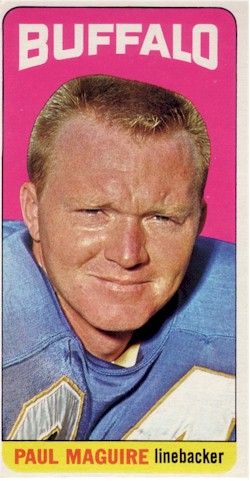
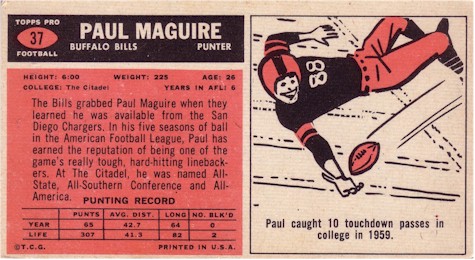
I totalled all the NFL passing statistics for former UNC players.  I also totalled the passing statistics for The Citadel’s Stump Mitchell (who threw nine passes during his career, including a TD toss to Roy Green) and Paul Maguire (who threw one pass during his career, completing it for 19 yards).  Check out the cumulative stats comparison:

UNC:  19-70, 315 yards, 2 TDs, 6 INTs, QB rating of 19.6
The Citadel:  5-10, 102 yards, 1 TD, 0 INTs, QB rating of 119.6

A 100-point difference in QB rating?!  Advantage, Bulldogs.  Of course, that won’t mean anything on Saturday.

Last season, the Bulldogs were 4-8.  This followed a 7-4 campaign in 2007 that had fans thinking a return to the FCS playoffs was not far away.  Instead, the Bulldogs lost six straight games during the course of the 2008 season, narrowly avoided a seventh straight defeat to a poor UT-Chattanooga squad, and then got pummeled by Tim Tebow and eventual BCS champion Florida in the season finale.

Some of those games were close (The Citadel lost three Southern Conference games by a total of 12 points), but on the whole the 4-8 record was a fair reflection of the Bulldogs’ play.  Comparing some league-only statistics from the 2007 and 2008 seasons is illuminating.  Ignoring the raw totals, which are a touch misleading (scoring was down in the SoCon last season as compared to 2007), and looking at league rankings:

-Scoring defense:  4th (2007), 8th (2008)
-Pass efficiency defense:  3rd (2007), 9th (2008)
-Red Zone defense:  2nd (2007), 9th (2008)
-Turnover margin:  2nd (2007), 5th (2008)
-3rd down conversion offense:  2nd (2007), 5th (2008)
-3rd down conversion defense:  2nd (2007, 5th (2008)

That’s basically the story of the 2008 season right there.  The defense had trouble getting off the field (SoCon opponents completed over 64% of their passes against The Citadel, and the Bulldogs only intercepted two passes all season in league play).  Inside the 20, The Citadel’s defense had no answers (allowing 23 touchdowns in 31 red zone situations).

Offensively, the running game struggled, as rushing yardage per game dropped by one-third.  Perhaps more ominously, the number of third downs converted via the rush fell substantially.  This also affected the offense’s red zone success rate, as the team scored only 18 touchdowns in 34 opportunities inside the 20 (the worst ratio in the league), and led to over-reliance on an erratic (I’m being kind here) placekicking game.  The Bulldogs only made 7 of 12 field goals attempted in red zone possessions.  No other conference team missed more than one such attempt all season.

After a season like that, it’s not surprising changes were made.  The Bulldogs are going to return to a 4-3 defense after last year’s attempt at a 3-4 resulted in the D getting pushed all over the gridiron.  That rather obvious lack of physicality was also addressed by an aggressive offseason conditioning program.  There are a couple of new defensive coaches, too.

There has been a good pre-season buzz about the defensive line, which is nice, but there also needs to be more playmaking from the linebackers and secondary.  In other words:  get stops and force turnovers.  The key is to corral more interceptions (fumble recoveries tend to be somewhat random).  Scoring touchdowns on defense would be a plus, too, but you have to get the turnovers first before you can think six.  The Bulldogs have recorded 13 sacks in conference play each of the last two seasons; a few more this year certainly couldn’t hurt.

The offensive line should be strong, although illness has been a problem in fall practice, what with one lineman suffering from an acid-reflux problem and another battling mononucleosis.  That’s still much better than the Bulldogs’ running back situation.  The starter for UNC may be walk-on freshman Bucky Kennedy, walk-on freshman Remi Biakabutuka, or one of the backup bagpipers.  Biakabutuka would definitely be the choice if the opening-game opponent were Ohio State rather than North Carolina, as just the name “Biakabutuka” on his jersey would be enough to unnerve the Buckeyes, thanks to his older brother Tim.

Another potential threat as a runner is backup quarterback Miguel Starks, who last year impressed many observers just by standing on the sideline during games.  However, he’s never played a down of college football.  It will be interesting to see what he can do once he gets on the field.

I’m of the opinion that the incumbent starting quarterback, Bart Blanchard, didn’t have that bad a season last year, as I don’t think he got much help from the rest of the backfield (and the offensive line seemed to lack consistency).  He is a bit limited as a runner, which is not ideal in Kevin Higgins’ offense, but that was true the year before as well and the Bulldogs managed just fine when he stepped in for Duran Lawson.  Higgins wants him to have a better completion percentage, but part of the problem Blanchard had last season trying to avoid incompletions was a limited number of passing targets — basically, his options were the tight ends and Andre Roberts.

Of course, Roberts is a nice target to have.  It would really help Roberts (and Blanchard) if a second receiver emerged this season (Kevin Hardy?), which never happened last year.  If another Bulldog wideout does develop into a threat, Roberts could wind up with fewer catches but more yards per reception.  Roberts in space is a big play waiting to happen, as anyone who has watched him return punts can attest.  I’m glad he’s not going to be returning kickoffs this year, though.  I worry about him wearing down over the course of the season.

The placekicking needs to be much improved.  Last year was just not acceptable.  The Bulldogs also must replace Mark Kasper, who was a solid punter for four seasons (second in the league in net punting last year).  The Citadel needs to improve its kickoff coverage (next-to-last in the conference in 2008).  Basically, the special teams must get better across the board (with the exception of the punt return team, which thanks to Roberts was the nation’s best unit).

As for Saturday’s game, a lot depends on whether Blanchard and Roberts have fully recovered from sprained ankles each suffered during fall practice.  If they are both good to go, I would expect the Bulldogs to be reasonably competitive against North Carolina.

While the Heels return 15 starters, they must replace some excellent wide receivers (including Hakeem Nicks) and two starters on their offensive line.  UNC’s o-line has taken a bit of a hit in the pre-season with some injuries and attrition (nothing like The Citadel’s running back situation, though).  The starting group should still be solid, however.

T.J. Yates should be okay after his frisbee ordeal.  This will be his third year starting games at QB for UNC.  Yates is good at taking care of the ball (only four interceptions last season).  UNC has a nice corps of running backs, led by Shaun Draughn, who rushed for 866 yards in 2008.  The Tar Heels will definitely need to find some new wideouts, as no returning receiver caught more than 11 passes last year.

UNC rotates a number of defensive linemen, and almost all of them are very good athletes (and most of them are huge).  Marvin Austin has first-round pick potential, Cam Thomas has all the makings of a future NFL nosetackle, and Ladson native Robert Quinn won the ACC’s Piccolo Award after recovering from a brain tumor to have an outstanding freshman campaign.

Despite this embarrassment of riches, the Tar Heels didn’t do a particularly good job creating sacks last season (only 22 all season; the d-line only had 5.5 of those).  Still, this group will be a formidable challenge for The Citadel’s offensive line.

North Carolina has a really good trio of starting linebackers, led by Bruce Carter, who doubles as a great kick-blocker (five last year).  The defensive backfield should be excellent, with several ball hawks ready to repeat last year’s success in intercepting passes (the Heels had 20 picks).

UNC did struggle defensively on third down conversions, ranking last in the ACC in that category.

North Carolina’s special teams were okay last year, although its net punting was mediocre.  The Heels will be breaking in a new punter this season, which might be good news for Andre Roberts (and Mel Capers), although first The Citadel’s defense has to actually force a punt.

Last season UNC opened with McNeese State, and struggled before finally winning the game 35-27.  It should be pointed out that the Cowboys were a solid FCS club (finishing 7-4, and featuring a quality offense), and that the game was affected by a lightning delay.  If anything, that relatively close call may make the North Carolina players more wary of FCS opposition.

The goals for this game, from The Citadel’s point of view, are for the team to be as competitive as possible, and to avoid major injuries.  It isn’t realistic to expect a victory, particularly against a pre-season Top 20 team.  The Bulldogs just want to make UNC work for a win.

To do that, avoiding turnovers on offense is a must.  I suspect that The Citadel is not going to have much of a rushing attack in this game, which is going to be a problem.  It’s also going to be a tough game to break in a new punter.  I think the Bulldog defense has a chance to establish itself to a certain extent.  However, the UNC offense is not turnover-prone and is more than capable of grinding out drives (although this may not be a bad thing for The Citadel; the fewer big plays, the better).

Obviously, the players won’t be thinking the way I’m thinking.  They’re traveling to Chapel Hill looking for a victory, which is a good thing.  That’s how they should approach this game.  Besides, you never know what might happen.  After all, my fantasy football team is called The Jack Crowes.

I’m just ready for kickoff.

Trying to fill a stadium

Note:  Yes, this is long.  It needs to be, though.  (Believe it or not, it could have been longer — I did some judicious editing.)  It can be read in stages if necessary, I suppose.  It’s one of the two longest posts I’ve made on this blog, along with my rundown of The Citadel’s brutal hoops history, which was made prior to basketball season.  After I made that post, the basketball team had one of its best campaigns ever.  If that’s the kind of karma attached to long essays, then the average attendance at Johnson Hagood Stadium will approach 20,000 fans this season.

In 2007 The Citadel went 7-4, its first winning season in a decade.  There was plenty to be optimistic about in 2008, especially since the major renovation work to Johnson Hagood Stadium had been completed in the off-season.  Lots of folks were expected to come out to see if the Bulldogs could maintain their success while enjoying the comforts of a stadium with actually decent restroom facilities.  Instead, the school averaged almost 1,500 fewer fans per game than it had in ’07 (and 2,000+ fewer than it had in 2006).  What happened?

Well, the answer to that is complicated.  I want to address some of the issues related to attendance, and attendance specifically at The Citadel’s home football games.

I want to start, though, by pointing out something that is obvious, but gets forgotten about sometimes when alums talk about attendance.  For a school of The Citadel’s size, its historical football attendance is great.  Not good, great.  Even in a disappointing year (last season the average attendance per home game was just 12,261), The Citadel had an attendance-to-undergrad ratio of 6 to 1.  Do you know how many schools out there (especially FCS schools) would kill for even a 2 to 1 ratio?  Schools with just 2,000 students and a small alumni base really shouldn’t be doing that well.  It says a lot for the school’s loyal alums and fans that the attendance is as good as it is.

Having said that, attendance has been better before, and needs to be better again.  Anyone who looked at the budget numbers presented in an article by Jeff Hartsell of The Post and Courier a few weeks ago can see the importance of having Johnson Hagood Stadium filled with fans.  If attendance doesn’t start to get better, Ed Conroy is going to have to start scheduling road games against every Big XII school, not just Texas and Missouri.  The money from football props up the entire department of athletics.

The key to increasing attendance, of course, is winning.  Win more games, get more fans.  It’s a simple concept.  The only thing you have to remember about it is that success on the field generally leads to more ticket sales in the following season; there tends to be a one-year lag.  Of course, that’s if you have just one good year at a time (like going a decade between winning seasons).  Putting together a string of successful campaigns usually (but not always) leads to a more permanent base of fans.

When I opine about issues, I tend to illustrate my points in a statistical manner.  Numbers usually don’t lie, so I use them to back my point of view.  (Also, I use them because I’m a dork.)  Now, there are plenty of stats available when it comes to attendance, and I’m going to use some of them, but with a little bit of a caveat.  Let me explain what I mean.

The Citadel has had four modern-day directors of athletics — Eddie Teague, Walt Nadzak, Les Robinson, and the current AD, Larry Leckonby.  I have no way of knowing how each of them approached counting attendance at home games.  There are different ways to add up the numbers, and there is no guarantee that the way The Citadel’s numbers were counted was consistent over time.  It may be, for example, that sometimes season ticket holders were counted whether they were at the game or not, and it may be that sometimes they were only counted if they actually showed up.

I have occasionally wondered if other schools secretly counted the folks tailgating during the game, along with the teams, on-field personnel, the working (and non-working) press, concession stand employees, and mascots.  That’s not likely to be the case at The Citadel (and in the case of the non-game attending tailgaters, you’re talking about a not insignificant number.)

I have had multiple sources suggest to me that Larry Leckonby counts people who actually show up — no more, no less.  If that is the case, I applaud his philosophy.  I would count attendance the same way, although I would also count General, because he certainly deserves to be counted.

This uncertainty about published attendance figures was brought home to me one day while I was looking at the 2006 football media guide.  I spotted game writeups for the two playoff games in 1992, the win over North Carolina A&T and the loss to Youngstown State, each played at Johnson Hagood Stadium.

I attended both of those games.  I distinctly remember there were worries about the attendance, particularly for the first game against the Aggies, which took place on the Saturday after Thanksgiving Day, while the cadets were on furlough.  The Citadel had to have at least 12,000 folks show up to A) not lose money (there was a guarantee to the NCAA involved) and B) show that it merited hosting another playoff game.

Well, everything came up roses for The Citadel.  Plenty of folks showed up on a beautiful November afternoon to watch the Bulldogs pummel the MEAC champs, 44-0.  The next day’s edition of The Post and Courier featured a column by Ken Burger in which he detailed the “drama” behind the scenes, as representatives from the NCAA seemingly kept putting up roadblocks to the Bulldogs’ chances of hosting another game, only to eventually be bullied into submission by a pushy Walt Nadzak.  Burger wrote:  “although Citadel officials cannot announce the official attendance until after an NCAA audit, crowd estimates are about 17,000 were on hand.”

I was one of those on hand, seated right next to The Man From Macon (my ears are still ringing from his delirious shouting), and that estimate of 17,000 sounds about right to me.  Even more fans attended the game the following week; I would say that slightly over 18,000 came to see that matchup.

Then I came across the box in the ’06 media guide, and there were the “official” attendance figures:  12,300 for the North Carolina A&T game; 13,021 for the Youngstown State game.  What?

The NCAA came up with those numbers, after an “audit”.  Both figures are laughable.  I’m fairly confident that 5,000 people didn’t sneak into each game for free.  At any rate, it’s just another example of how you have to be careful when evaluating historic attendance trends.

While I wouldn’t want to bet my life on the complete accuracy of the numbers, I think evaluating them under certain parameters is instructive.  Also, I’ve got a theory on attendance that needs at least something solid behind it.  Anyway, here we go…

If you take the per-season home attendance average of the last four seasons, and then average those seasons together, you get a cumulative season average of 13,073.  That’s for 2005-2008.  If you then go back exactly twenty years, to the 1985-1988 seasons, you get a cumulative season average of 14,582.  That’s a difference of 1,509.  One reason I picked those years as a comparison is that the record on the field was very similar — 20-25 (2005-08), and 20-24-1 (1985-88).  It’s not an exact match, to be sure — the ’80s record includes Tom Moore’s last two campaigns and Charlie Taaffe’s first two seasons, while the last four years are the sum total of the Kevin Higgins era — but I think it’s a pretty good comparison.

If you go back to 1975-1978, the cumulative average for that four-year period is 16,584.  However, The Citadel in those four seasons had a slightly better record (22-22).  That period marked the transition from Bobby Ross to Art Baker.  Perhaps a better comparison to the two eras in the preceding paragraph would be the first four seasons under Ross, 1973-1976, when the Bulldogs were 19-25 overall.  Attendance in those seasons averaged out at 14,902.

So basically, from two and three decades ago until now, with similar teams, there appears to be a dropoff of between 1500-2000 fans.  You will find a lot of longtime Bulldog fans who will tell you that over the years the “base” has declined by just that amount (some will say even more, but I believe they’re thinking about stretches when the school had several successful seasons in a row).  1500-2000 fans is a big deal for a school of The Citadel’s size.  That would be like South Carolina or Clemson drawing 10,000+ fewer fans per year, and we’re talking about a longterm decline, not just a one- or two-season blip.

In comparing recent attendance to that of past seasons, I had to be careful and select similar, or at least remotely similar, circumstances, both on and off the field.  For instance, you can’t compare anything to 1989, when Hurricane Hugo disrupted not just the season, but the entire Charleston area, nor can you match “apples to apples” with 2004, the year following demolition of the West Stands, when the seating capacity of JHS was listed at 12,500.

2004 also featured the cancellation of a game against Charleston Southern (thanks to another hurricane threat), a season finale against Western Carolina that took place at the same time as a televised Clemson-South Carolina game, and a Thursday night “special” against Benedict that turned out to be an attendance disaster, with only 5,127 fans showing up.  (What I remember most about that Benedict game was “voice of the Bulldogs” Sam Evans beginning his public address announcements by saying, “Welcome, ladies and gentlemen, to what’s left of historic Johnson Hagood Stadium.”)

I also didn’t want to compare the recent attendance issues to periods of consecutive winning seasons, like 1979-81 and 1990-1992, or to the malaise of the late 1990s-early 2000s.

The key to the difference in the compared eras lies in the makeup of The Citadel’s base of supporters, which can be divided into two groups:  alums and their families, and those fans without an obvious connection to The Citadel.  I believe the eroding of the base has much more to do with the second group.

First, however, I want to discuss the “alums” category, including some things on which not everyone may agree, and for which I can’t point to a specific statistic.  What I believe, though, is that by and large graduates of The Citadel are significantly less likely to be natural supporters of the school’s athletic teams than, say, alums of larger state schools.

Not only are there more students at larger schools, but a higher percentage of those students grow up rooting for that particular school.  Quite a few of them actually choose to go to school based on their lifelong support of its athletic teams.  Those students eventually graduate, and so there is a fairly sizable base of true-blue fans just from that group.

Nobody who is not on athletic scholarship chooses to go to The Citadel because of its varsity sports teams.  Because of this, I think that a smaller percentage of its students are destined to become lifelong devoted fans of college football, hoops, etc.  That’s true of most small schools, of course.  (I believe The Citadel has fewer sports fans among its students than even among other small schools, however — at least, that was my impression when I was in school.  That also applied to things tangentially related to sports.  Was there buzz on campus for Bull Durham or Hoosiers?  No.  Full Metal Jacket, yes, a thousand times yes.)

That makes the fact the athletic teams are supported as well as they are by the alumni all the more remarkable.  I think it has a lot to do with the natural camaraderie built up by four years in the corps of cadets.  Alums come back for the games, but they really come back to see each other, or just to be part of the experience that is The Citadel again, even for just a Saturday afternoon.  It’s a nice vibe, complete with the justly-celebrated tailgating scene (which may be too good a scene when it comes to trying to increase attendance inside the stadium).

One of the things I have noticed, though, is that there is a bit of a “doughnut hole”, if you will, among alums attending games.  Basically, when I go to games I see a lot of alums representing the over-50 crowd, and I see a fair number of young grads, but there is a gap between those two groups in the gameday support.  You don’t really see a lot of guys in their 30s and 40s, at least in comparison.  Some might disagree with me on that, but this has been my observation.  I could be wrong, of course.

Obviously those alums in their 30s and 40s are more likely to have school-age kids, and perhaps because of that, they don’t have as much free time (or discretionary income).  I would guess that’s not particularly unusual for a college alumni fan base.  That isn’t to say there aren’t a good number of kids at the games, because there are.  However, the lack of grads in that age group at football games is noticeable (at least to me).

Okay, that’s my riff on alumni support.  Now I want to talk about the other potential game attendees, and why there aren’t as many of them as there used to be.  Here comes my theory.  (Drum roll.)

Television.

Back in the good old days (which weren’t really all that great), the NCAA controlled regular-season college football broadcasting.  It had extremely restrictive rules on how often schools could appear on TV, and also limited the number of overall telecasts.  As late as 1978 there were a total of 58 college football games broadcast on TV during the regular season (13 of which were televised nationally).  Last season there were 58 televised games involving FBS and FCS schools just in the third week of October.

Change came as a result of a 1984 Supreme Court decision that ruled the NCAA’s way of doing things violated the Sherman Antitrust Act.  Schools (and conferences) were thus free to negotiate TV deals for themselves.  The decision also coincided with the rise of cable television, notably ESPN.  Suddenly there were outlets that needed programming, and schools and conferences that had programming to offer.  The world of college football hasn’t been the same since.

It used to be that if you lived in the Lowcountry and wanted to see some college football action, but you didn’t want to drive up I-26 to Columbia (or further up the road to Clemson/Athens/Atlanta), your one option was to head to Johnson Hagood Stadium to watch The Citadel.  The odds that you could watch one of the state’s major college teams on TV instead were not good.  Between 1969-1978, there were seven televised Clemson regular-season football games  (one national, six regional).  In that same period, South Carolina only appeared on TV during the regular season five times (all regional broadcasts; the Gamecocks did not have a nationally televised regular-season game until 1980).

Even after the Supreme Court decision opened the floodgates, South Carolina did not draw a lot of TV time; for example, in 1989, the Gamecocks appeared on television during the season just once (in a 45-0 loss at home to Clemson — ouch).  This was partly due to South Carolina still being an independent in football at the time.  Once the Gamecocks joined the SEC, appearances on the tube became a more regular occurrence.  Clemson was on TV more often during the 1980s, thanks to deals the ACC had with Raycom and ESPN, although the Tigers’ appearances on TV during the early part of the decade were mostly on tape-delay, due to Clemson being on probation.

Now, of course, you can see the Tigers and Gamecocks almost every week on TV, along with many other major college programs, at every time of day and night.  You can also see a select number of FCS teams in action, but not nearly as many, and mostly as part of regional telecasts.  The Southern Conference has a modest agreement with SportSouth to show eight league games all season (The Citadel will appear in just one of them).

The constant TV exposure for Clemson, South Carolina, and the rest of the FBS schools is great for them.  It promotes their programs, and increases their respective fan bases.  For schools like The Citadel, though, it can be a problem.  Trying to attract fans who aren’t naturally affiliated with the program means competing against a lot of other entities, especially in a city like Charleston.  The Citadel isn’t on TV enough itself to get the publicity benefits that accrue to the bigger schools, and then football fans have the option to watch those other schools on television.

As an example, let’s look at last season and what the folks selling tickets at The Citadel were up against for each home date:

  • The home opener (8/30) was a night game against Webber International.  Attendance was announced as 11,247.  Quite honestly, I think The Citadel was lucky to get that many fans for what was a de facto glorified scrimmage.  South Carolina had played on Thursday night, but Clemson played Alabama in primetime in a much-hyped affair (the lesson, as always:  don’t believe the hype).  Locally, the ticket office also had to compete against a bluegrass/BBQ festival held at Boone Hall Plantation.
  • The next game at JHS came against Princeton on 9/20.  13,120 fans attended that game, most of whom would be mystified by what went on at halftime.  This was an afternoon game.  South Carolina played Wofford at night in Columbia (that game was on PPV).  Clemson played an afternoon home game against South Carolina State.  Another game of interest in the region, Florida-Tennessee, was played that afternoon as well.  An extra local competitor was the Scottish Games and Highland Gathering, held at Boone Hall, which drew 6,000 people that Saturday.  I’m guessing bagpiper groupies were not sure which event to attend.
  • On 9/27, Western Carolina came to town for a 1pm showdown.  Clemson played Maryland that afternoon in a game televised by Raycom.  South Carolina had another PPV home night game, this time against UAB.  North Carolina played Miami at noon in the only other regional game of any consequence.  Attendance for this game was only 11,216, and I don’t think the presence in town of the MOJA Arts Festival had a whole lot to do with it.
  • Elon played at The Citadel on 10/11 in a game slightly impacted by rain (but more impacted by hideous SoCon officiating).  This day was a good example of how 21st-century college football TV choices are different from those in the ’70s and ’80s.  The Citadel hosted Elon at the same time as the all-important Texas-Oklahoma game (that ultimately wasn’t quite important enough for the Longhorns) AND a road game for South Carolina that was televised by Raycom.  Also on TV that day were Georgia-Tennessee and Notre Dame-North Carolina.  The City of Charleston also conspired against the ticket office with its Taste of Charleston weekend (although the main event was held on Sunday).  Total attendance:  12,582, on a Parents’ Day Weekend.  Oof.
  • Georgia Southern played at Johnson Hagood on 11/1, opposite the Coastal Carolina Fair and a host of locally interesting TV games:  Georgia-Florida, Tennessee-South Carolina, and Clemson-Boston College.  11,190 people made it to JHS.  Many of them probably wished Kevin Higgins had gone for two in overtime.
  • Homecoming (on 11/15) was held opposite South Carolina-Florida (on CBS) and Duke-Clemson (on Raycom).  14,213 fans watched The Citadel escape (thanks, Andre) with a win over a wretched UT-Chattanooga squad.

Another thing that wasn’t around in 1978 (or even 1988) is the Charleston Southern football program.  Heck, back then CSU wasn’t even CSU; it was Baptist College.  I’m not sure how much of an effect the Buccaneers’ home games have on Bulldog home games played the same day, to be honest.  They may not have much impact, but every potential ticket not sold counts, in a manner of speaking.  For the record, last season CSU and The Citadel played at home on the same day on 9/27 (CSU attendance:  2,541), 11/1 (3,213), and 11/15 (2,434).

In 2009, incidentally, CSU and The Citadel will again have three home games on the same day, the first three home dates on the Bulldogs’ schedule.  Clemson or South Carolina will play home games on each of The Citadel’s five home dates, although for none of them will both of those schools be at home.  Times for those USC/Clemson games won’t be known until later in the season because of television.  Those TV “windows” also mean that it’s impossible to guess what other national/regional games might have an impact on the schedule (other than Florida-Georgia, which is pencilled in for 3:30 pm on 10/31; The Citadel plays Samford at 1 pm that day).  Also, as far as special local interest events are concerned, this year’s Scottish Games will take place the week before The Citadel’s home opener, much to the relief of the bagpiper groupies.

Compare today’s options for local area sports fans to those of 1978.  South Carolina had no games televised that year.  Clemson had only two regular season games televised (despite an 11-1 season).  If one or both were on the road or playing a rather lame opponent at home, then your choices were usually limited to a sole TV game, often featuring teams of limited interest.  A big football fan might very well be inclined to watch the local team play VMI or Delaware or Marshall (all of which were on the home schedule that year).  He would probably bring his transistor radio along and listen to Bob Fulton or Jim Phillips (or perhaps Larry Munson, which might have been more fun) while watching The Citadel.

I think that’s a big deal.  It’s hard to get the casual fan to the stadium these days.  Now, once you get him to Johnson Hagood (or at least to the tailgating areas), then you stand a decent chance of keeping him.

Anyway, that’s my theory.  The non-affiliated fan who might have been a potential customer/convert twenty and thirty years ago has more sporting options on a gameday Saturday, because of television.  He is probably more inclined to become a fan of an FBS school if he wasn’t already, because it’s easier to follow those teams now even from a distance, because of television.  FCS schools like The Citadel don’t benefit from increased exposure because they simply aren’t on the tube nearly as often as the FBS schools.  They could make up lost ground if they were on at least as often, but they’re not, so they don’t.  It’s a triple whammy.

So, what to do about it?

Well, that’s the million-dollar question.  The Citadel has hard-working, competent people whose very jobs involve trying to improve its numbers at the gate.  They know what they’re doing, and I’m not going to pretend to be as expert as they are on the subject.  Having said that, I have some opinions, some of them of the macro variety, some micro…

Obviously, I think it’s most important to cater to the local “outsider” to bring up the numbers.  At this particular time, though, it also wouldn’t hurt to redouble efforts with the alumni base, which has seen a decade of poor on-field results overseen by a series of coaches, and games played in an aging stadium with facilities that were, frankly, unacceptable.  Out-of-touch alums need to be introduced to the “new” Johnson Hagood Stadium, which is clean, has a cool video board, is wheelchair-accessible and family-friendly, has an electrical system that won’t fail when the french fry machines are turned on, etc.  Plus, the current coach is entering his fifth season.  Stability!

I think it’s important to emphasize what makes going to a football game at The Citadel unique and fun.  The essential uniqueness, of course, is the corps of cadets.  That’s what The Citadel has to offer that other schools don’t.  It is key that the corps be energized for those three hours on a Saturday afternoon or early evening.  I believe the administration needs to make it worth the cadets’ while (weekend/overnight privileges, that type of thing) to be a primary source of entertainment.

The corps needs to be at least semi-organized for providing its special brand of mayhem.  I actually like that the cadets have been moved to the East Stands; it makes them more visible (and, for the visiting team, noisier).  Now it’s time to accentuate their enthusiasm, preferably in as zany a fashion as possible.  All I ask is that “Hey Baby” gets dropped.  Please?

Speaking of music, the band needs to be more incorporated into the scene than it is now.  There needs to be some coordination between promotions and the band in terms of not just when music is played, but what is played.  Note to some alums:  quit asking them to play “Dixie”.  Those days are over.

My other comment about music is that (old fogey alert!) the pre-game rap/hip-hop/heavy metal routine at about 200 decibels is extremely grating and, to me, not in keeping with the general gameday experience at The Citadel.  I know the football players like to get wound up by listening to some of that stuff, but there is too much of it right now.  I’m not asking for the current mix to be replaced by Frank Sinatra tunes (although that would cool in a retro-hip way), but there needs to be a little balance.  Also, I can go to any game and listen to somebody abuse the sound system while playing the latest in headbanging drivel.  Games at The Citadel need to be (and should be) different.

In keeping with trying to impress potential new fans, it never hurts to accentuate the military aspects of the gameday experience.  Pre-game flyovers are always good.  Guys parachuting in with the game ball, halftime shows featuring various specialty outfits (military marching bands or drill units) — those things tend to go over well.

That reminds me — what happened to the Touchdown Cannon Crew?  Now there just seems to be a Touchdown Cannon Dude.  Where are the riflemen?  There is probably a story behind their absence.  One thing this brings to mind is that, whenever possible, it’s nice to keep some continuity in the school’s gameday traditions.  The Citadel is big on tradition, although you would never know it by looking at its football uniform history.

Another thing to emphasize when trying to recruit new fans is the affordability aspect of going to games at Johnson Hagood.  In the current economy, in particular, this has to be a plus.

If you want to have decent seats at South Carolina games, for example, you have to give a lot of money to the Gamecock Club just to have the option of buying season tickets.  Then you have to pay a “premium” on those same seats.  Then after finally getting to buy the tickets the sucker customer needs to buy an expensive parking pass just to be able to park near Williams-Brice Stadium.  When you include travel costs, concessions, etc., soon (to paraphrase Everett Dirksen) you’re talking about real money.  All that for USC games, and we’re not talking about the USC that wins Rose Bowls, but the USC that has never played in a major bowl.  38-35!  Enough said.

Another thing to emphasize, or improve, is to make the games “kid-friendly”.  There are plenty of kids at games, but there needs to be a lot more.  Ticket promotions, giveaways with children in mind, the whole nine yards.  Some of this is already happening, which is good.  Another idea would be to have a specific organization just for youngsters — the Junior Bulldog Club, say.  Members could get perks, like being able to go out onto the field with the players before the game for the coin toss or some other type of ceremony, not unlike what you see at international and domestic European soccer matches.  After all, indoctrination should occur early in life.

Speaking of kid-friendly, one of the best things The Citadel has done in recent years is re-establish the live mascot program.  General and his good buddy Boo are kid magnets, as is their cartoon friend Spike.  I’ve actually heard a few gnarly old codgers grumble about Spike (some of the gnarliest codgers aren’t that old, either).  Those people are morons.  Mascots, in general, aren’t really meant to entertain somebody who is busy trying to figure out where he put his flask.  They’re largely there to keep children entertained while their father is screaming at the coach for running the ball on third-and-ten.  Just keep that in mind.

Finally, I have to say something about the cheerleading program.  Larry Leckonby needs to take a hard look at that issue and make some decisions.  It’s a part of the gameday experience that is currently a complete disaster.  Whether we outfit the cheerleaders in camo and go the gung-ho route, or revert to the days of importing them from other schools (probably not feasible), or simply not have cheerleaders at all, something needs to be done.  The current situation is not good at all.  The lack of enthusiasm for the program from the corps of cadets (and from the cheerleaders themselves) is disturbing.

In conclusion, I do think attendance should improve this season, barring something unusual happening.  The home schedule is much more interesting, with games against instate schools Presbyterian, Furman, and Wofford, along with a visit from Appalachian State.  The best way of increasing attendance going forward, of course, was best expressed by former Bulldog assistant coach Al Davis:  “Just win, baby.”  Since you can’t always count on wins, though, you have to do all the “little things” to try to fill a stadium.  Here is hoping that Johnson Hagood will be packed with fans this season and beyond.

Seeing both sides of a mismatch on the same day

The bad side

Well, the football game went about as expected.  I was hoping that Florida wouldn’t get to 70, but The Citadel really didn’t make that much of an effort to shorten the game (in terms of play calling).  On the other hand, scoring three touchdowns was a pleasant surprise.  Unfortunately, the Bulldogs went 1-for-3 on extra points.  Kevin Higgins is going to have to do something about the placekicking before next season.

The placekicking was the only negative from the special teams, which were otherwise solid across the board yesterday.  The defense was completely overmatched, but the offense didn’t do all that badly.  While there were three turnovers, at least none of them were converted by Florida’s defense into touchdowns.  In that respect The Citadel fared much better than South Carolina did the previous week against Florida.  It’s also worth noting that due to injury, The Citadel actually inserted its backup quarterback, Cam Turner, into the game before Florida replaced Tim Tebow.

From the strange-but-true department (I guess I’m channeling Jayson Stark here):  South Carolina QBs Stephen Garcia and Chris Smelley both failed to throw a touchdown pass against the Gators.  The same was true for highly-touted Georgia QB Matthew Stafford.  Wide receiver and former walk-on Scott Flanagan of The Citadel, however, threw a TD pass against Florida on only one attempt.

Also, I would say that losing 70-19 is better than losing 56-6.  My reasoning is as follows:  Florida outscored South Carolina by more than an 9-1 ratio, but only outscored The Citadel by a little more than a 3.6-1 ratio.  Advantage, Bulldogs.

The good side

The basketball game also went about as expected, and this was a good thing.  The Citadel was never threatened by Cincinnati Christian and pulled away down the stretch for a convincing victory.  CCU had no answer for Cameron Wells, who had a good game not only on the stat sheet, but in terms of letting the game come to him.  Zach Urbanus had a strong first half and a solid overall game.  The Bulldogs did a good job in this game of getting to the foul line and converting.  Getting their fair share of free throw attempts has to be a priority for the Bulldogs, especially when shooting foul shots is one of The Citadel’s strengths.

Speaking of that, Phillip Pandak got into the game late, and was almost immediately fouled.  I was rooting for him to make both foul shots, and he did.  By doing so he equaled his number of made free throws from all of last season.  He only had four attempts at the line last year, which was amazing, because he attempted 101 field goals during the course of the season.  Now this year in two games he has one field goal attempt and two made free throws…

The Citadel took care of the ball in this game, a welcome change from the previous three games, and the pace of the game was in line with where the Bulldogs want to be.  The Citadel allowed CCU to grab a few more rebounds than I would have liked, and didn’t defend the three-point shot in the first half as well as it should have (the defense on the perimeter noticeably improved in the second half).

It was the second, and final, game of the season against a non-Division I opponent.  Now it’s time to try to win a game against a D-1 foe.  The Citadel’s first opportunity to do so will come on Tuesday night at the North Charleston Coliseum against Charleston Southern, one of two Division I teams the Bulldogs actually beat last season.

Kicking away a game

What a backbreaking loss.  The Citadel did so many things right yesterday.  Bart Blanchard played well, throwing for 350+ yards with no interceptions.  The Bulldogs outrushed GSU (including a 100-yard game for Asheton Jordan).  Two different players for The Citadel had 100+ yards receiving for the first time in 25 years.  The Bulldogs won the turnover battle 2-0.  Mel Capers blocked another punt.  The defense was able to pressure the quarterback for most of the afternoon (until it got worn out).  The much-maligned offensive line played well, despite having to shuffle players around due to injuries.

Then there was the placekicking…

Five missed field goals (counting the one wiped out by a really stupid GSU penalty).  A 37-yarder that was short.  A 45-yarder with a low trajectory that got blocked.  A 40-yarder that was wide right.  A 27-yarder that was also wide right (that one didn’t count, thanks to the aforementioned penalty, which was for leverage).  A potential game-winning kick with 30 seconds to play in the fourth quarter from 32 yards out which was completely shanked.

That last one was with a different kicker.  Now, I’m not going to rip the two kickers.  My philosophy on this is that if your team doesn’t have a kicker you can count on, it’s the coach’s fault.  What bothered me in this game almost as much as the missed kicks was Kevin Higgins’ decision-making in the third overtime.

The Citadel got the ball first in the third OT after both teams had scored TDs in the first two OTs.  The Citadel got down to just outside the one-yard line, fourth and goal.  Higgins decided at that point to attempt a field goal, even though The Citadel hadn’t made a FG all day.  There was also the fact that GSU was moving the ball at will in the overtime periods against the Bulldogs’ tired defense.  The Citadel needed a touchdown.

Not only did The Citadel need a TD, but I think the percentage play was to go for the TD.  The ball was just outside the 1, call it a yard-and-a-half if you want.  To me, the odds The Citadel would gain that yard-and-a-half were just about as good as making the short field goal (considering the kicking game woes), and the reward was obviously much greater (6 instead of 3 points).  Higgins saw it differently.  From the game story in The Post and Courier:

“We had run 95 plays at that point, a lot of red-zone plays,” Higgins said. “And we just didn’t have any plays where we said, ‘We can do it.’ In run situations, they were getting five guys on our front five with a linebacker over the top, and we had basically used up all our good plays. I felt it was stupid to call a play there just to call a play.”

Okay, that’s an interesting explanation, and I’ll give him credit for this:  at least he outlined his thought process.  There are plenty of coaches out there who would have gone straight to Cliche 101 when asked that question.  He didn’t duck it.

Having said that, I don’t get it.  If you don’t think you can run it in, then throw it.  Try another jump pass.  It worked once, why not twice?  Or run the new “Zebra” formation again (maybe the snap would be a little better this time).  Something, anything, other than attempt the FG, because you have to know the defense at that point is not going to stop GSU without some kind of divine intervention.

(I was shocked the field goal was good, even if it was only a 19-yarder.)

Kevin Higgins has built up a lot of positive equity over these four seasons, and deservedly so.  Alumni, by and large, appreciate what he’s done to make the program competitive (I certainly have).  There are those who are concerned he could jump to another job, based on his performance at The Citadel.  Basically, he’s a good coach, and everyone knows he’s a good coach.

I just think that going for the FG at that time was a very conservative decision, and a regrettable one.  And if he really made it because he had run out of play calls for that situation, then he needs to come up with a couple more plays.

Retention means aggression, attrition means regression

Well, that was ugly.  I’m not shocked Samford won the game, but it wasn’t close.  Kevin Higgins made a somewhat surprising decision to start Cam Turner at quarterback, and it didn’t come close to working out.  Turner was put in the game because Higgins felt the QB position needed a better runner.  Left unsaid, in my opinion, was that Higgins’ decision was more an indictment of the play of the offensive line than Bart Blanchard’s abilities.  The fact that the team doesn’t have an established running back hasn’t helped either.

The Citadel again had a forgettable second quarter, essentially an exact copy of the Furman game, and after the first half trailed in time of possession by almost exactly 10 minutes.  That’s what happens when you get dominated on the line of scrimmage, both offensively and defensively.

It doesn’t look good for the rest of the season.  The Citadel will be favored against UT-Chattanooga but will be underdogs against an erratic Georgia Southern team (which beat Western Carolina yesterday in overtime after trailing 31-3 in the fourth quarter), Wofford (which hammered Elon and may be on the same level with Appalachian State right now) and, of course, Florida.  Considering The Citadel went 7-4 last season, including a winning record in SoCon play, and there were high hopes for at least a similar season this year, it’s hard to argue that the program has regressed a bit.  Particularly disconcerting, from my point of view, are the losses to “young” teams like Elon and (especially) Samford.

I wish Higgins would redshirt every freshman who has yet to see action this season, just to build up depth for the future, but he may elect to play more of them to see what he’s got.  What Higgins definitely needs to do is pay close attention to the lessons of attrition, something I am sure he is, but just to make it clearer, let’s look at some numbers.

This year’s freshman class is Higgins’ third at The Citadel.  The class that preceded his arrival had a brutal attrition rate (there are only six players from it still on the team).  His first two years of recruiting, per Jeff Hartsell’s research, look like this:

2006 — 20 still on the team, 8 gone

2007 — 21 still on the team, 11 gone

I don’t know how many of those players were scholarship recruits, but regardless, that’s not a good percentage either year.  One thing that the two classes have in common is the large number of recruits in general.  I am not a fan of the “bring in 30, maybe half will pan out” approach to recruiting.  Ellis Johnson did this too, and it doesn’t work.  I think it’s better to identify about 12-18 players who you think can help you and can stay in school, and recruit accordingly.  This seems to be something that takes coaches at The Citadel in all sports two or three years to understand.  Some of them never seem to understand…

This year, things look pretty good — so far.  He brought in 26 guys, which again is too many, but so far only one has left school.  I hope that the other 25 hang in there.

Just as a comparison, I looked at Charlie Taaffe’s first recruiting classes.  I don’t have information from his first year, and only partial information from his second class.  The second class must have been excellent, though, not just in terms of quantity but in quality, because there were nine 5th-year seniors on the ’92 SoCon title team, including Jack Douglas, Lester Smith, and Carey Cash.

Taaffe’s third through fifth years of recruiting break down like this:

1989 — 16 recruits; all 16 were on the team at least two years, and 15 of them completed four years of play for The Citadel.  This class was the backbone of the ’92 title team, with 14 of them on the two-deep (one missed the year with an injury).  In addition, 3 walk-ons from that year also made the ’92 two-deep (I looked at the two-deep from the playoff game against North Carolina A&T as a baseline).  When you recruit 16 players and you wind up having 18 players from that class make a contribution, I guess you can say you had a good year recruiting.

1990 — 17 recruits, 13 of whom eventually lettered.  10 of them were on the ’92 team’s two-deep.  That’s not a bad class.  Not great, but okay.

1991 — 18 recruits, only 8 of whom eventually lettered, and it may be worse than that, because I think two of the eight eventual letter-winners were actually walk-ons who weren’t among the original 18 recruits.  That’s a horrendous recruiting class, even if four of the players had significant careers at The Citadel (Travis Jervey, Micah Young, Ahren Self, Jeff Trinh).  The lack of depth created by that class surely contributed to the gradual decline in on-field success.  The win totals, starting in 1990, when that ’89 recruiting class were sophomores, were 7 wins, 7 wins, 11 wins, 5 wins, 6 wins, and 2 wins (the two -win campaign was Taaffe’s last at The Citadel).  That decline in recruiting and wins are obviously not coincidental.