Football, Game 1: The Citadel vs. Chowan

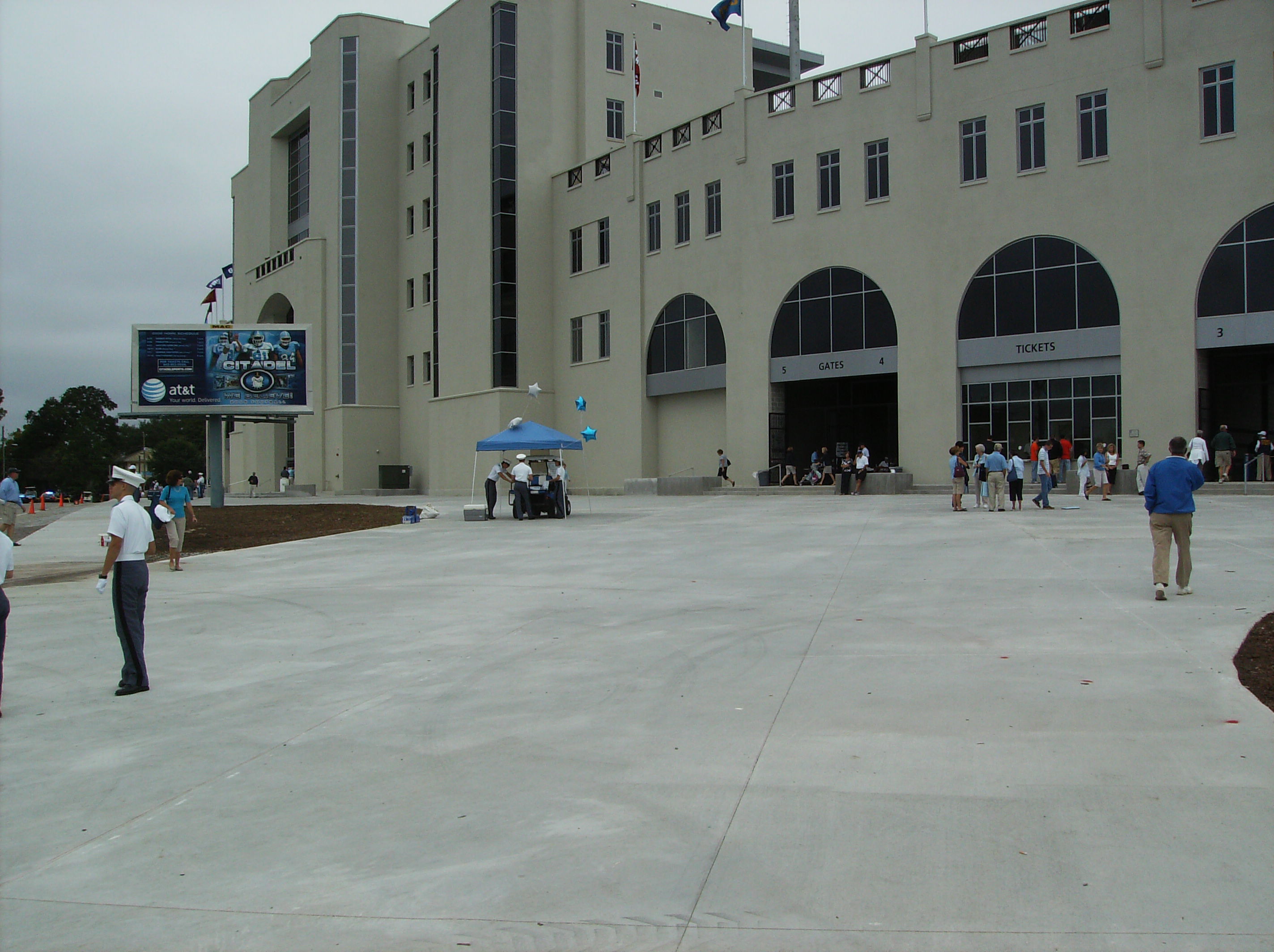
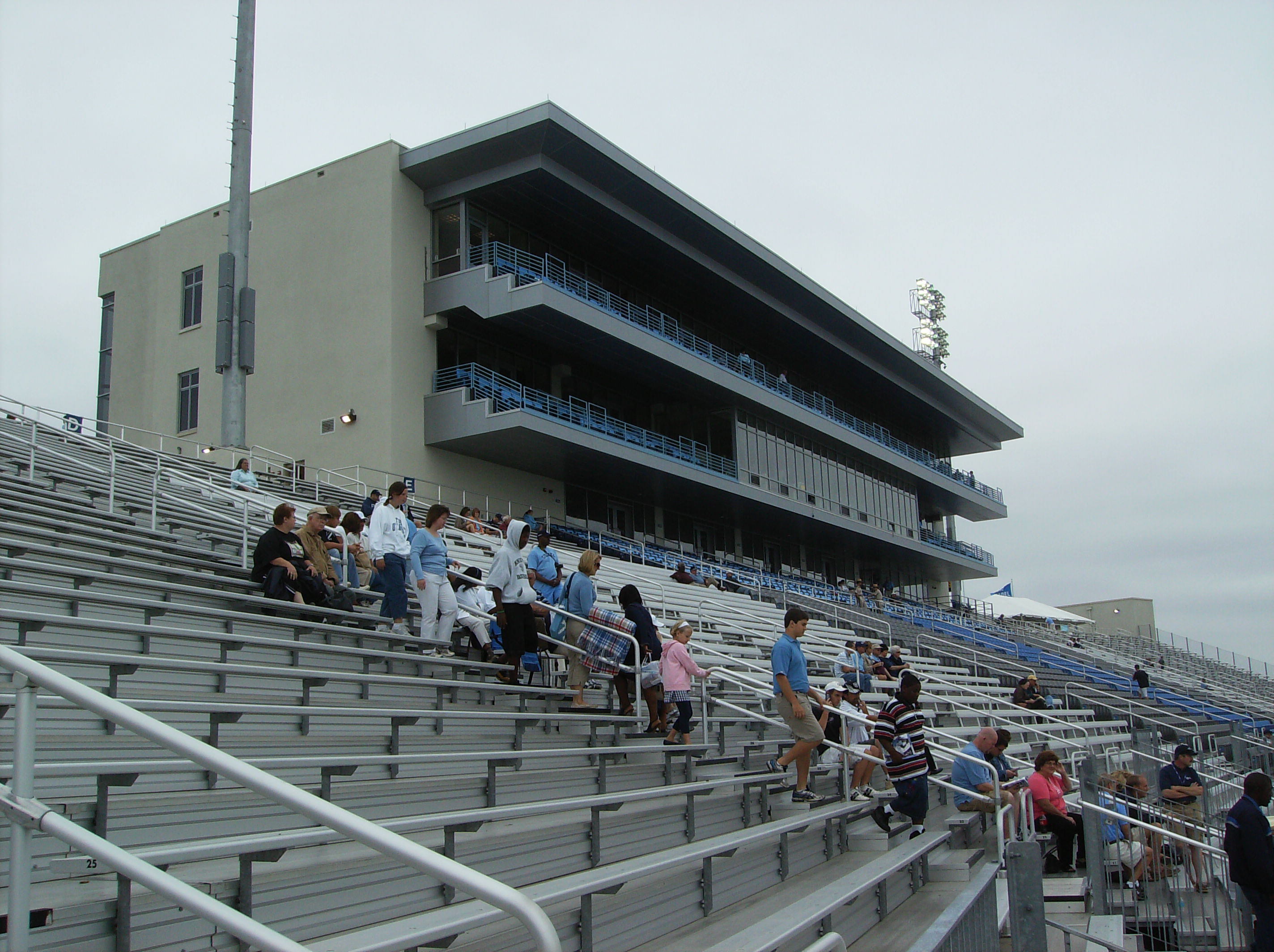
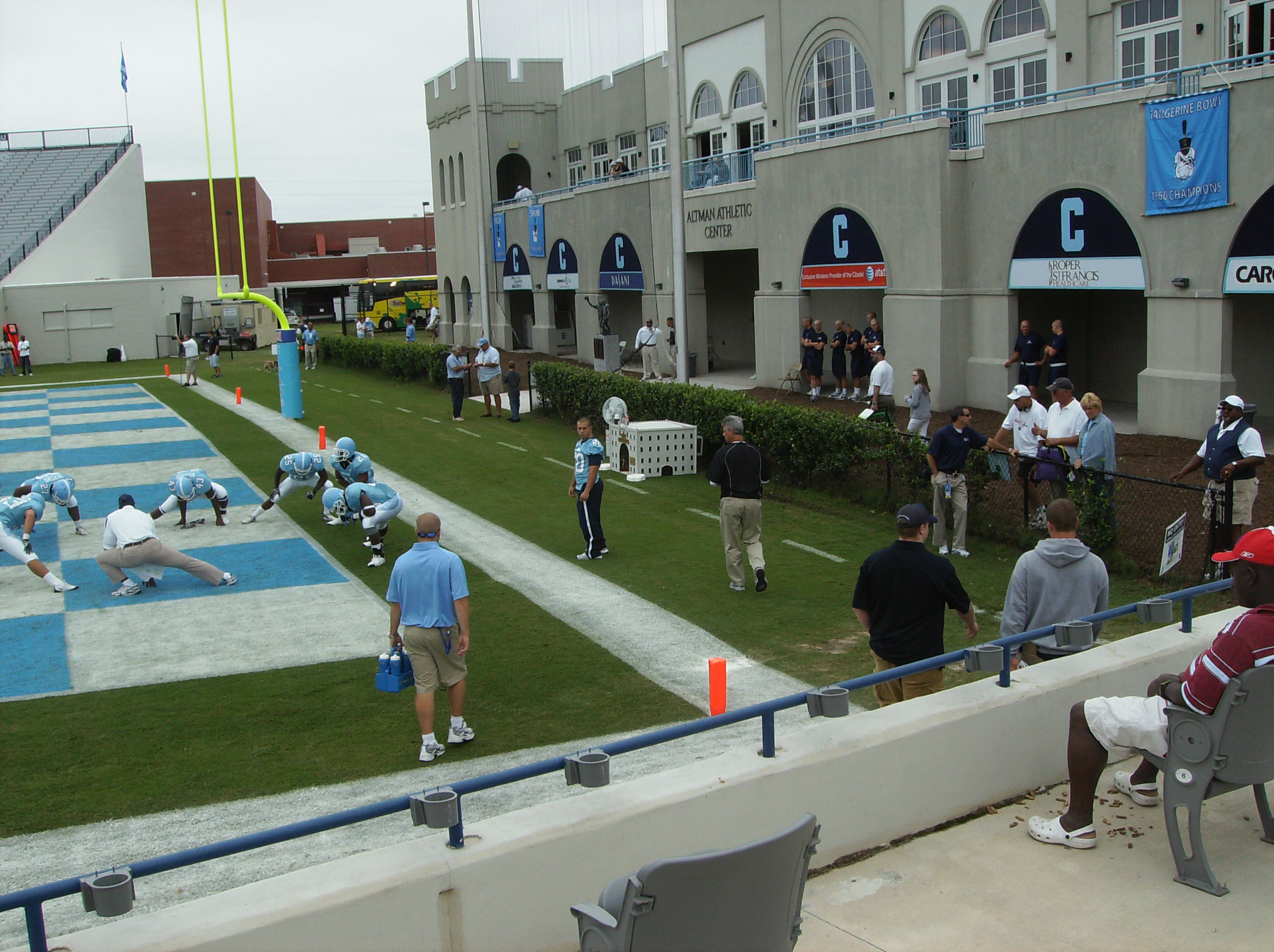
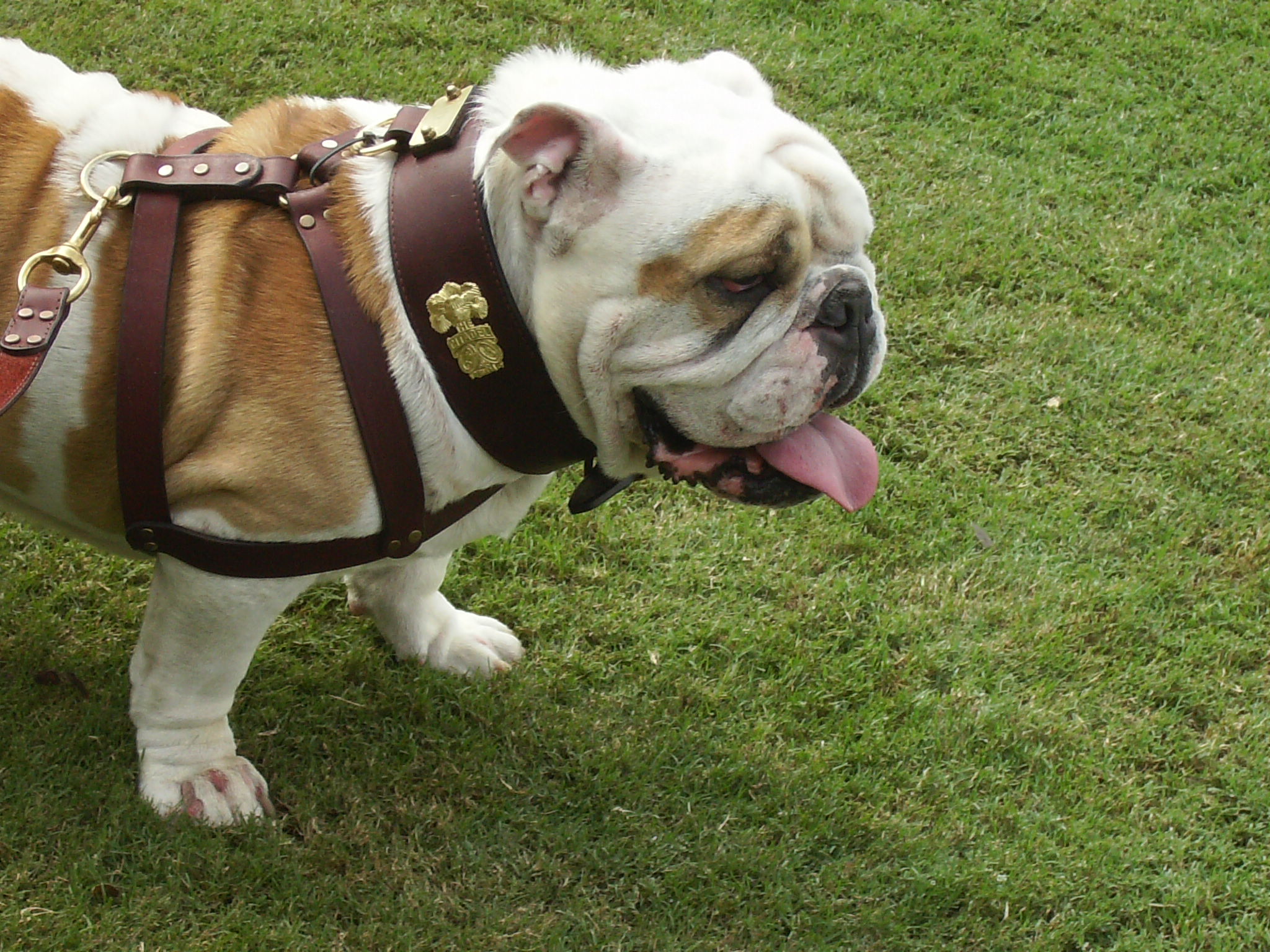
It’s time for college football!   This year the scene at Johnson Hagood Stadium should include a lot of the following:  great tailgating, photo ops with Bulldogs both live and bronze, and, uh, fumbles…

Okay, so maybe that wasn’t the sunniest intro of all time.  I have to be honest here, though.  While I am looking forward to the season, this year I am a bit apprehensive about what lies ahead for the Bulldogs on the gridiron.  The Citadel is going to the triple option on offense, with a head coach who has never run the offense (or any similar offense) before, and with players who were mostly recruited for a very different kind of system.

The players who were recruited with the triple option in mind, of course, are all true freshmen.  The quarterback position will likely be manned by one (or more) of those true freshmen. The “knob”-starting quarterback double is a rare one, and for a reason. It’s an exceedingly difficult combination.

The Southern Conference media and coaches agree that this season could be a long one for The Citadel, just as the last two seasons have been.  The media picked the Bulldogs to finish last in the league.  The coaches ranked The Citadel eighth out of nine teams, ahead of only Western Carolina.

The Catamounts finished last in 2009, with only one league win.  That one WCU victory came against The Citadel, which tied for next-to-last.  More of the same is expected by those who follow the SoCon.

Before beginning league play, though, The Citadel will play three non-conference games.  Next week’s game at Arizona should be…interesting.  The following week the Bulldogs will take on Presbyterian, a team that went 0-11 last season, including a 46-21 loss to The Citadel.  However, even the Blue Hose would be favored against the Bulldogs’ opponent on Saturday, Chowan University, a Division II school located in Murfreesboro, North Carolina.

When the Hawks were announced as the opposition for the home opener, a collective yawn could be heard from The Citadel’s less-than-thrilled fans.  It’s hard to blame anyone for not being excited about Chowan being on the schedule, with all due respect to that school.  I’m guessing this game’s not going to be a sellout.

Having said that, let’s take a look at Chowan.

I wish I could say with confidence exactly how “Chowan” should be pronounced.  This is probably something that should concern Bulldogs play-by-play announcer Darren Goldwater a lot more than me, but I like to know these things.  I even sent an e-mail to Chowan’s department of athletics asking the question, and quickly got a response:

It’s pronounced CHO-WAN with a hard CH, just like CHOKE or CHICKEN. CHO-WAN.

That’s from somebody who works at the school, so she ought to know, but two different people have insisted to me that it’s actually pronounced “Shuh-WONN”, with the “Sh” sound at the beginning and the accent on the second syllable.  Since both of them are natives of eastern North Carolina, the region of the state that actually has decent BBQ, I tend to trust them.

“Chowan” is a derivative of “Chowanoke”, the name given to the native tribe of the region by 16th-century European explorers.  My guess is that if you were French, you pronounced it with the “Sh”, and if you were English, you went with the hard “Ch” sound.  It’s kind of like Beaufort (BO-fert), North Carolina, and Beaufort (BYOO-fert), South Carolina.

You like to-ma-to, I like to-mah-to, let’s call the whole thing off…

There is also a Chowan river, and a Chowan County — but Chowan University isn’t located in that county, but in the adjoining county of Hertford.  Naturally, this school in northeastern North Carolina is named to honor a tribe whose name means “people of the south”.

Regardless of its pronunciation, the school has been around in one form or another since 1848, when it was founded as Chowan Baptist Female Institute.  The school remained all-female until 1931, but in 1937 it became a junior college.

It reverted back to four-year status in 1992, and changed its name to the current Chowan University in 2006.  This fall, it will offer its first Masters Degree program, in Elementary Education.  Chowan remains affiliated with the Baptist State Convention of North Carolina.

About 1100 students attend Chowan.  I thought the section titled “Who we serve” on the school’s website was interesting:

The Chowan University community is committed to serving average students. By “average” we mean students with a GPA from 2.25-3.25 and “average” SAT scores (around 1300 for the three part SAT). Students below these criteria may be admitted if they show a commitment to the Chowan University experience and academic potential…

Many of our students are first generation college students which means their parents did not attend college or complete a college degree. Because of Chowan’s commitment to individual attention in a Christian environment, these students thrive here.

I liked this statement.  Too many schools insist on presenting themselves as wannabe Ivies, when everyone knows better.  Here we have a school that knows exactly what its mission is, and what it wants to do, and isn’t apologetic about it in the least.  Good for Chowan.

Chowan had a fine run in football as a junior college, almost entirely under James Garrison, who was the head coach at the school for 43 years (and for whom its football stadium is named).  Quite a few Chowan alums went on to four-year schools and then the NFL, including George Koonce, Curtis Whitley, and Mark Royals.

However, Chowan has struggled on the gridiron since becoming a four-year school itself.  Since 1993, the Hawks (formerly the Braves) have a cumulative record of 39-168-1 in Division III and (since 2005) Division II.  That includes Saturday’s 59-10 loss to Lenoir-Rhyne.

Chowan has been a football member of the Central Intercollegiate Athletic Association since the 2008 season (and is now a full member of the conference). Chowan is the first non-HBCU member of the CIAA in the league’s 98-year history.

The CIAA now has 13 members, and as a result the conference’s slogan for this year is “Triskaidekaphobia: Fear the 13!”  I’m not sure what the Southern Conference’s slogan would be — “The SoCon: The Nation’s Most Transient League”?

For Chowan football, the last five years have looked like this:

2005 — 2-8, including a 56-10 loss to North Greenville (now of Willy Korn fame) and a 42-21 defeat at the hands of Allen, which dropped its program after the season

2006 — 0-10, including losses of 42-0 to Western Carolina, 52-6 to North Greenville, and 28-0 to Webber International; Webber played The Citadel the following season, with a slightly different result

2007 — 2-9, including a lot of total beatdowns:  51-0 (Coastal Carolina), 56-14 (North Greenville), Presbyterian (62-10), and Newberry (67-0)

2008 — 2-8, which featured an early-season 69-20 loss to VMI (which had concluded its 2007 campaign in memorable fashion)

2009 — 2-8, although most of the games were more competitive; the Hawks did lose 36-21 to Old Dominion, the Monarchs’ first game since restarting its program after a 68-year hiatus (ODU did finish the season 9-2, though)

Those last two seasons came under the direction of the current head coach, Tim Place.  Place is a Washington & Lee alum who was previously the head coach at Urbana, an NAIA school in Ohio.

One of the members of Place’s coaching staff is Omar Nesbit.  Nesbit was an All-SoCon lineman at The Citadel, graduating in 2002.  He is the Hawks’ offensive line coach.

According to the school’s pre-season football guide, the team runs a “multiple” offense and a “multiple” defense.  Thirteen starters are back from last year’s outfit.

Last season the Hawks scored 25.3 points per game, not bad, but allowed 35.2 ppg. While the Hawks were a respectable passing team, all 25 of its TD passes were thrown by C.J. Westler, who was the offensive player of the year in the CIAA, and who is not among the returnees.  Much like The Citadel, Chowan has to find a quarterback (it played two in the Lenoir-Rhyne game).

Chowan turned the ball over three times per game, almost double its opponents’ totals, and averaged an anemic 2.9 yards per rush.  The Hawks gave up 48 sacks.

Defensively, the Hawks allowed 4.6 yards per rush and 9.3 yards per pass attempt, which is obviously not good.  Opponents scored touchdowns 70% of the time when they entered the “red zone”.  Chowan was also not a particularly efficient punting or placekicking team.

Against Lenoir-Rhyne, Chowan allowed 513 rushing yards (6.9 per attempt).  This is noteworthy in that L-R is running the same offensive system this season it ran last year under the direction of then-offensive coordinator Tommy Laurendine — who of course is now the offensive coordinator at The Citadel.

Laurendine has his work cut out for him, based on early reports.  For example, this is how Jeff Hartsell began his recap of the August 21 scrimmage:

After watching his quarterbacks combine for six interceptions and at least five fumbled snaps in Saturday’s scrimmage, Citadel football coach Kevin Higgins stated the obvious.

“Offensively, we have a lot of work to do,” said Higgins…

You could say that, coach.  On the bright side, nine of the eighteen pass attempts in the scrimmage were caught by Bulldogs.  Alas, six of them were defenders.  At least on those plays the QB got the snap from center.  Unofficial totals from the scrimmage had the first-team offense rushing 27 times for 67 yards.

At least the defense apparently looked good, although how much of that was due to the offense’s struggles is open to question.  The kicking game again failed to impress, a problem Higgins has been unable to solve for the last two seasons.

The scrimmage on August 28 was apparently better, based on some anecdotal reports.  At this point it appears the Bulldogs will play two “true” freshman quarterbacks, Ben Dupree (from Pennsylvania) and Matt Thompson (from Florida).

Terrell “First Sergeant” Dallas will be the fullback.  There are several candidates to fill the slotback positions, led by Van Dyke Jones and injury-plagued Rickey Anderson (everyone’s crossing their fingers for you, Rickey).  The offensive line has some experience, but not at center, which in part explains the center-QB exchange problems.

We won’t know for sure exactly how the new offense will look until Saturday, but it probably will be a slightly different variation than Charlie Taaffe’s version of the wishbone.  It’s not going to be quite like Wofford’s option attack, either.

It’s probably going to most resemble the setup run by Paul Johnson at Georgia Southern, Navy, and now Georgia Tech.  With that in mind, I wouldn’t be surprised if Kevin Higgins, with a personal history of running spread passing offenses, throws the ball a little more often than you see in most triple option offenses.

He has to figure out a way to get talented tight end Alex Sellars involved in the offense. Higgins has also commented on the big-play ability of Domonic Jones, a 6’5″ redshirt freshman.  I like the idea of isolating a tall receiver on a smaller defensive back in this offense.  Of course, you have to have a quarterback capable of getting the ball to Jones.

I linked this in an earlier post, but to get up to speed on how this offense will probably operate, check out The Birddog (helmed by a grad/fan of the Naval Academy), the triple option devotee’s website of choice.  Here is a primer on the TO:  Link

While the offense is filled with question marks, the defense should have a lot of answers.  There is depth and talent on that side of the ball, particularly in the defensive backfield.  Cortez Allen has drawn pre-season accolades.  Other DBs with the potential to shine include Keith Gamble (who had an 89-yard interception return against Presbyterian last season) and Joseph Boateng (who intercepted two passes in his collegiate debut against North Carolina).

Former safety Rod Harland is now a linebacker, joining team leader Tolu Akindele and Jeremy Buncum as likely starters.  The defensive line should be solid, if a little young.  Chris Billingslea had some impressive moments last season (and made the All-SoCon freshman team as a result).  Keith Carter is a redshirt freshman who should draw notice, if only for being a defensive tackle who wears #33.

The other defensive lineman (at least that’s his roster designation) I want to mention is Milford Scott, a special teams terror who blocked three kicks last season and created havoc many other times.  He’s tall, has long arms, and describes himself as a “Charleston homeboy” from the beach.  He’s a weapon.

Unfortunately, Scott’s dynamism on special teams was an exception (not counting Andre Roberts, obviously).  While punter Cass Couey fared reasonably well, the Bulldogs continued to struggle in the placekicking department.  That’s two seasons in a row The Citadel has had sub-optimal kicking, and early returns suggest it might be three in a row.

I don’t blame the kickers.  I blame the coaching staff.  It’s the job of the staff to get that aspect of the squad fixed, either by improving the kickers on the squad or finding somebody else to kick.

The Citadel also could stand to improve its punt coverage team (Scott aside) and its kickoff return unit.  The Bulldogs will sorely miss Andre Roberts as a punt returner; look for that component of special teams to not be as effective this season.

There has been a lot of turnover in the coaching staff, not only with the new offensive scheme (where the aforementioned Laurendine is joined by offensive line coach Bob Bodine), but with the defense as well.  Higgins recruited former Wofford assistant Josh Conklin to join the staff, and later named him defensive coordinator.

Conklin will get help from another new assistant, Denny Doornbos, who was the defensive coordinator at Army during the Bob Sutton years, which were mostly good ones.  I have to gleefully point out, though, that he was the DC for this game…and for this game, too.

While all the talk in the off-season has been about the offensive scheme, and how the coaches will implement it, I think the new coaches on the defensive side of the ball will be just as important.  Generally, you would like to have more staff continuity than The Citadel has had, but in the case of the defense, I think a fresh approach may be just what was needed.

There was a sense over the last two seasons that the defense had underachieved; in particular, some observers felt the unit was not aggressive enough.  The Bulldogs’ D must be pro-active this season, and give the offense short fields with which to work. The defense will likely also have to bail the offense out on a regular basis.

This is going to be an important year for Kevin Higgins.  The off-season issues, not surprisingly, did not sit well with the alumni — and I’m not just talking about the big boosters or the message board regulars.  He also has had back-to-back disappointing seasons on the field.

The move to a new offense, and the overhaul of his coaching staff, were both bold moves made by someone who expects to stick around for a while.  They weren’t short-term stopgaps.  That is to his credit, I think.

Now, however, even with modest on-field expectations, he needs to get the fan base to buy into his program again.  After all, Larry Leckonby and company need to sell tickets and sponsorships.  Jerry Baker has Brigadier Club membership goals to obtain, whatever his methods are (high-tech, low-tech, begging, etc.).

A 1:00 pm start time against Chowan on Labor Day weekend in Charleston probably isn’t going to be a big winner as far as attendance goes.  I fully expect one of those hot-and-humid Lowcountry days that are fairly typical for this time of year. Ugh.  Of course, that’s assuming a hurricane doesn’t come into play.

I’ll be there anyway, though.  I’m ready for some football.

Variety pack: Triple Option, The Citadel on TV, college baseball on the clock, Plant of the Week

This is going to be a grab-bag type of post, a variety pack if you will.  I may do this sort of thing periodically, as I really need to blog on a more regular basis.  I look at this as a way to make shorter comments on various issues, mostly about sports (including sports at The Citadel), with a few other odds and ends that catch my eye.  Think of them as Twitter entries that are longer than 140 characters.

Speaking of Twitter, my latest tweets can be seen on the left side of this page.  If anyone hasn’t noticed and is halfway interested in following me on Twitter, the location is http://twitter.com/SandlapperSpike (my tweets feature links/comments on a lot of stuff, including up-to-the-minute updates on Bulldog sports, baseball, football, and soccer, among other things).

As The Citadel counts down to kickoff against Chowan (as of today, T-41 days!), it’s time to focus on the Bulldogs’ new offense, which may be a little like an old offense, namely Charlie Taaffe’s wishbone attack.  However, it appears that Kevin Higgins may intend to run more of a “spread” triple option than Taaffe’s offense.

With that in mind, it might be a good idea to take a look at what the folks at Navy (and Georgia Tech, with Paul Johnson’s arrival in Atlanta) have been doing, particularly since Higgins apparently told one of our quarterback recruits (Ben Dupree) that The Citadel would be running a “Navy-style triple-option offense.”

Another reason to pay attention to the triple option is that Georgia Southern is also going to start running the offense this season, in a return to its roots.

For those interested in a breakdown of the nuts and bolts of the triple option, then, I cannot recommend highly enough a visit to The Birddog, the blog of choice for Navy football (and lacrosse).  The Birddog does a great, great job of illustrating (with video!) the intricacies of the triple option attack.

I’ve picked out four posts that I think serve as a good introductory primer for what the offense is all about.  (I hope I’ve chosen correctly.)  While reading these, just in case anyone gets confused, keep in mind that Paul Johnson is the former head coach at Navy (and Georgia Southern, of course) and is now at Georgia Tech.  The current Navy head coach is Ken Niumatalolo, and his offensive coordinator is Ivin Jasper.

Reading Is Fundamental

The Science and the Art

The Midline Option

Other People’s Rivalries And The Futility Of Defending Against the Wishbone

As of today, only one of The Citadel’s football games is scheduled to be televised (at Wofford on October 30).  There is always a chance that a local station (either in Charleston or another SoCon town) will elect to broadcast a game, although that is unlikely.  Other than that scenario, there are only two other games that could be televised.

It is possible (but doubtful) that SportSouth will pick up the November 20 game at Samford as part of its “SoCon Saturday” package, as the last two weekends of the regular season are “wild card” weekends — basically, the network will televise the most attractive matchup that week, based on the teams’ records to that point in the season.  Admittedly, very few prognosticators are going to bet that a game between Samford and The Citadel will have serious repercussions in the league standings, but you never know.

However, there is a decent chance that The Citadel’s game at Arizona on September 11 will be televised by Fox Sports Net Arizona (FSN-AZ), a regional sports network received by cable subscribers in Arizona (and I believe parts of California and New Mexico), and also available as part of DirecTV’s “Sports Pack”.  Arizona has asked the Pac-10 (and the league’s TV partners) for a waiver in order for the game to be broadcast.

The reason a waiver is needed is because there are already two Pac-10 games scheduled to be televised during the same time period, and that league’s national cable partners have television exclusivity rights for those games.  In other words, a local/regional broadcast can’t take place at the same time as a nationally televised league TV game.  If another Pac-10 school wants its game on television, it has to play in another time slot.

However, Arizona and Arizona State have been given waivers in the past because home game time slots for those schools are limited, especially early in the season. You just can’t play a football game in the desert in the midday heat.

(Matt Sarzyniak was nice enough to explain the Arizona/Arizona State waiver issue to me, which I appreciate.)

We’ll see what happens.  I am cautiously optimistic that the game will be televised.

The NCAA Baseball Rules Committee passed legislation that, if approved, will establish a time clock in college baseball.  The committee is basically incorporating the rules employed by the SEC for its 2010 conference tournament.

The 20-second rule for throwing a pitch was already on the books, but now it will be enforced with a timer, as will the amount of time allocated between innings.  I’ll be interested to see how the Southern Conference handles this; will it have a visible clock, with a timekeeper in the press box monitoring it?  Or will it just have an umpire carrying a watch?  I’m guessing the latter, for financial reasons.

The committee also modified the obstruction rule, which got a lot of notoriety in the Southern Conference tournament thanks to the second-round game/brawl between The Citadel and Elon.  That was the second-wildest fight I’ve ever seen at the SoCon tourney (nothing compares to the epic Raleigh/Piepenbrink donnybrook in 1990, though).

Not about sports:  you can be assured that I will never quote from or link to the Las Vegas Review-Journal.  Why, you ask?  This is why.

Link 1

Link 2

I sincerely hope that the Review-Journal goes bankrupt sooner rather than later.  Also, the photo of the CEO in the first link — doesn’t he look like a guy who hopes you throw something at him, so that he can sue you?

I have a great deal of respect for copyright law.  I think this guy and the Review-Journal (which is funding him) are abusing copyright law.

Not about sports:  I really enjoyed this article in The New Yorker on the identification and authentication of artworks.  It’s a long piece, but worthwhile.  I won’t spoil it, but there is a major twist halfway through.  The bottom line:  if P.T. Barnum had been more familiar with the art world, he would have said “there’s a sucker born every 15 seconds.”

Finally, a new feature, the Plant of the Week.  That’s right, plants.  As I’ve said elsewhere on the blog, I consider gardening a sport.  In honor of this being the first edition of the PotW, I will honor not one but two plants in my garden.  Both are crinums. Feast your eyes on a Powelii (Cecil Houdyshel) and a Herbertii (no common name).

Until next time…

The SoCon baseball race goes to the final weekend

Just a quick breakdown of the different combinations, possibilities, and some observations…

There are four teams in the SoCon that still have NCAA regional at-large aspirations (in other words, schools that could potentially receive a bid even without winning the league tournament).  The Citadel, College of Charleston, Georgia Southern, and Elon are the squads in the mix (5th-place Samford, 29-21 overall with an RPI of 68, is not a serious candidate for an at-large bid at this point).  RPI numbers per Boyd Nation (as of 5/18):

The Citadel — 34-20 overall, 21-6 SoCon, RPI of 42
College of Charleston — 39-14 overall, 22-8 SoCon, RPI of 29
Georgia Southern — 33-19 overall, 19-8 SoCon, RPI of 53
Elon — 34-19 overall, 17-10 SoCon, RPI of 48

Realistically, two of these teams are likely to make it.  It’s possible that three get in the field of 64, although I tend to doubt that will happen.

The Citadel’s profile has slipped a bit, thanks in part to its own struggles (particularly in midweek games) and partly because of results elsewhere.  For example, the Bulldogs are currently only 1-8 against top 50 teams; thanks to Appalachian State and Western Carolina falling out of the top 50, The Citadel “lost” six top 50 wins.  Conversely, CofC is 5-5 against Top 50 opposition while Elon is 6-7.  GSU is 0-9.

With an excellent overall record, the College of Charleston would be a lock for the tourney by now if it had not dropped more than its fair share of league games, including losing a series at Furman.  Georgia Southern has won 11 straight games to get back on the at-large radar, but has been swept at CofC and lost a home series to Western Carolina.  Elon has some nice wins (including two at Clemson, one at NC State, and a home victory over UNC) but has been swept at home by The Citadel and also lost a home series to Georgia Southern.

Those league series losses at home hurt.  The Citadel is the only team in the SoCon that has avoided losing a home series this season.  The Bulldogs also have a better overall strength of schedule than the other three contenders.

Then there is this little nugget:  with the meeting this weekend at Georgia Southern, The Citadel will have played the 2nd-, 3rd-, 4th-, and 5th-place teams in the SoCon all on the road.  The Bulldogs have drawn what is easily the toughest slate of road league games, and held their own in them so far.

That’s why I believe that if The Citadel were to win the series in Statesboro and claim the regular season title in a top 10 league (the SoCon is currently rated 9th in RPI), it will be completely deserving of an NCAA bid, regardless of what happens in the Southern Conference tournament (and despite the Bulldogs’ foibles in midweek play).  If The Citadel does not win at least two games at GSU, however, then the at-large prospects for the Bulldogs become a lot dicier.

The College of Charleston is in fairly good shape for a second bid for the league.  I believe the other contenders likely have to win the league tournament, although Elon could make a case for an at-large with a strong tourney run.  What Elon would not want in that situation is for a team other than the CofC or The Citadel to win the tournament. 

(Note:  the seeding possibilities outlined below assume there are no rainouts this weekend.)

As far as SoCon tournament seeding goes, the CofC is going to be either the 1 or 2 seed.  The Cougars have completed their league schedule.

The Citadel can be the 1 seed (with two wins in Statesboro), the 2 seed (with one win), or the 3 seed (if it is swept). 

GSU is the 2 seed with a sweep and the 3 seed with 1 or 2 victories this weekend; if the Eagles are swept they could wind up as the 4 seed, but only if either Elon or Samford sweep their series against each other.

Elon and Samford will be the 4 and 5 seeds (and play each other for a fourth consecutive time in the first round of the tournament) unless the dual-sweep scenario outlined above occurs.

Western Carolina would be the 6 seed if the tournament started today, and will stay in that spot with a combination of two WCU wins/Appalachian State losses.  The Mountaineers will be the 7 seed unless they can make up ground on the Catamounts. 

There are three teams still alive for the 8th and final spot in the tournament (Davidson has been eliminated).  Wofford holds a one-game lead over Furman, but the Paladins hold the tiebreaker.  UNC-Greensboro is two games back of the Terriers, but does host Furman this weekend (Wofford has a series against Appy in Spartanburg).  UNCG would need to sweep the Paladins and hope Appalachian State sweeps Wofford; otherwise, it’s out of the running.

One more thing with regards to the SoCon tourney to keep in mind:  the teams are basically divided into two four-team pods, with the winner of each pod meeting in the title game.  One pod will have the 1, 4, 5, and 8 seeds, while the other will feature the 2, 3, 6, and 7 seeds.  That second group, in particular, will be a bloodbath (not that the first will be a walk in the park).

Southern Conference tourney time

Last year, I wrote about The Citadel’s abysmal record in the Southern Conference tournament.  The next few paragraphs are an updated version of that piece.  Feel free to ignore them if you have a weak stomach.  The preview for this year’s tournament (from The Citadel’s perspective) follows the history lesson.

One of the more curious things about The Citadel’s wretched history in the SoCon tourney is that there is no firm answer to just how many times the school has lost in the event.  That’s because the league has mutated so many times there is a dispute as to what year the first “official” conference tournament was held.

Before 1920, The Citadel was one of many schools in a rather loose confederation known as the Southern Intercollegiate Athletic Association.  (The Citadel initially joined in 1909.)  There were about 30 colleges in the SIAA by 1920, including almost every member of the current SEC and about half of the current ACC, along with schools such as Centre, Sewanee (later a member of the SEC  — seriously!), Chattanooga, Wofford, Howard (now called Samford, of course), and Millsaps, just to name a few.  As you might imagine, the large and disparate membership had some disagreements, and was just plain hard to manage, so a number of the schools left to form the Southern Conference in late 1920.

In the spring of 1921, the SIAA sponsored a basketball tournament, which would be the forerunner to all the conference hoops tourneys to follow.  Any southern college or university could travel to Atlanta to play, and fifteen schools did just that.  Kentucky beat Georgia in the final.  The Citadel did not enter the event, but several other small colleges did, including Newberry (for those unfamiliar with Newberry, it’s a tiny school located in central South Carolina).  The tournament featured teams from the new Southern Conference, the old SIAA, and squads like Newberry, which wasn’t in either league (it would join the SIAA in 1923).

In 1922 the SIAA held another tournament in Atlanta, this one won by North Carolina, which beat Mercer in the final.  The Citadel entered this time, losing in the first round to Vanderbilt.  The SIAA tournament remained all-comers until 1924, when it was restricted to Southern Conference members.

Some sources suggest that the 1921 tournament is the first “official” Southern Conference tournament, some go with the 1922 event, and others argue for 1924.  From what I can tell, the league itself is a bit wishy-washy on the issue.  On the conference website, it states:

The first Southern Conference Championship was the league basketball tournament held in Atlanta in 1922. The North Carolina Tar Heels won the tournament to become the first recognized league champion in any sport. The Southern Conference Tournament remains the oldest of its kind in college basketball.

That’s great, but the conference’s own record book lists Kentucky as having won the first tournament title in 1921 (on page 113; oddly, that year is excluded from the game-by-game tournament results that begin on page 114).  Of course, the edition of the record book on the conference website is several years old and lists The Citadel as having once lost 37 straight games, which is incorrect, so take it for what you will.

Personally, I think that the idea of having a conference tournament is to determine a league champion, and it stands to reason that such a tournament would only include league members.  So the first “real” Southern Conference tournament, in my opinion, was held in 1924.

There is a point to this, trust me.  The difference between counting the Vanderbilt loss as a SoCon tourney loss and not counting it is the difference between The Citadel’s alltime record in the event being 10-56 or 10-57.  Not that they both aren’t hideous totals, but as of now The Citadel shares the NCAA record for “most consecutive conference tournament appearances without a title” with Clemson, which is 0-for-56 in trying to win the ACC tournament.  Counting the Vanderbilt game would mean The Citadel is alone in its conference tourney infamy.  No offense to the Tigers, but I don’t believe the 1922 game should count, because it wasn’t really a Southern Conference tournament game.

By the way, you read that right.  The Citadel is 10-56 alltime in the SoCon tournament.  That’s just unbelievably bad.  It comes out to a 15% winning percentage, which is more than twice as bad as even The Citadel’s lousy alltime conference regular season winning percentage (35%).  The Citadel lost 17 straight tourney games from 1961-78, and then from 1985-97 lost 13 more in a row.

Tangent:  The single-game scoring record in the tournament is held by Marshall’s Skip Henderson, who put up 55 on The Citadel in 1988 in a game Marshall won by 43 points.  The next night the Thundering Herd, which had won the regular season title that year, lost to UT-Chattanooga by one point.  Karma.

Those long losing streaks didn’t occur in consecutive years, as The Citadel didn’t always qualify for the tournament, particularly in the years before 1953, when there were up to 17 teams in the league at any given time, and only the top squads played in the tourney.  The Citadel’s first “real” appearance, in 1938, resulted in a 42-38 loss to Maryland.

The Citadel would lose two more tourney openers before winning its first game in 1943, against South Carolina.  That would be the only time the Bulldogs and Gamecocks faced each other in the tournament, and so South Carolina is one of two teams The Citadel has a winning record against in SoCon tourney play (the Bulldogs are 2-0 against VMI).

The next time The Citadel would win a game in the tournament?  1959, when the Bulldogs actually won two games, against Furman and George Washington, and found themselves in the tourney final.  Unfortunately, the opponent in the title game was West Virginia, led by Jerry West.  West scored 27 points and the Mountaineers pulled away late for an 85-66 victory.  This would be the only time The Citadel ever made the championship game; it’s also the only time the Bulldogs won two games in the tournament.

After a 1961 quarterfinal victory over Richmond, The Citadel would not win another tournament game until 1979, when the Bulldogs defeated Davidson before losing to Furman.  The game against Davidson was played at McAlister Field House and was the final victory of a 20-win campaign, the school’s first.

The Citadel would win single games in 1982 and 1985 before going winless until 1998, when it finally broke a 13-game tourney losing streak by beating VMI.  The Keydets would be the next victim as well, in 2002, and were apparently so embarrassed they left the league.  The Citadel’s latest win in conference tournament action came in 2006 against Furman.

Twenty-one different schools have defeated The Citadel in tournament play, with Davidson’s eight victories leading the way (against one loss to the Bulldogs).  East Tennessee State went 6-0 against The Citadel while in the league.

Ed Conroy is 0-3 in the SoCon tourney as head coach of The Citadel (he was also 0-4 as a player).  If The Citadel were to win its conference tournament opener against Samford, and then lose the next day to Appalachian State, Conroy’s record would improve to 1-4.  That would be the second-highest winning percentage in the tournament for a Bulldog coach since the days of Norm Sloan.

Sloan was 2-4 in the tourney; his successor, Mel Thompson, won his first tournament game as head coach.  He would never win another, finishing with a record of 1-6.  Dick Campbell was 0-4.  George Hill was 0-3.  Les Robinson was 3-10 (a record which by winning percentage leads all of the post-Sloan coaches).  Randy Nesbit was 0-7.  Pat Dennis was 3-14.

(By the way, the best record for a Bulldog coach in SoCon tourney play is that of Bo Sherman, who went 1-1 in 1943, his lone season in charge.  Sherman’s Bulldogs defeated South Carolina before losing to Duke.)

The Citadel’s record against current SoCon teams in the tournament:  Furman 2-5, UT-Chattanooga 0-1, Elon 0-1, Samford 0-1, College of Charleston 0-1, Georgia Southern 0-2, Western Carolina 1-1, Appalachian State 1-6, Davidson 1-8.  (The Citadel has never played Wofford or UNC-Greensboro in the tournament.)

Last season The Citadel was flying high, having won 20 games for only the second time ever, and had high hopes entering the tournament.  Those hopes came crashing down against Samford, a team The Citadel had defeated by 25 points during the regular season.  Samford’s patient, Princeton-style offense scored 76 points on only 55 possessions, as the Birmingham Bulldogs got off to a great start and never really let The Citadel into the game.  It was a very disappointing finish to an otherwise outstanding season.

This season The Citadel appeared on the verge of making a nice run into the SoCon tourney, having reeled off five straight victories, and needing just one more to clinch a winning season, both overall and in  league play.  It didn’t happen, though, as the Bulldogs lost their last three games. The loss at Furman, in particular, was very poor.  The Citadel is now 15-15 for this year’s campaign, and would have to win at least two games in the tourney to garner its first back-to-back winning campaigns since 1980.

Instead of a bye into the quarterfinals, The Citadel finds itself playing in the first round on Friday, finishing as the 4th seed in the South division.  Friday’s opponent, Samford, struggled to an 11-19 record (5-13 SoCon) and is the 5th seed from the North division.  The winner will play Appalachian State, which finished first in the North, on Saturday night.

The two teams met twice during the regular season, with The Citadel winning both games.  The first game, played in Birmingham on January 16, was the definition of slow tempo, with The Citadel’s patient motion offense (61.4 possessions per game, 8th slowest nationally) outlasting Samford’s Princeton-style attack (58.1 possessions per game, slowest in the country).

The cadets had but 51 possessions in the contest, and made just enough of them count to prevail 51-50.  Cameron Wells had 19 points, while Austin Dahn had 17 (making 4 three-pointers).  For Samford, Bryan Friday and Andy King combined for 28 points.  The Citadel’s edge on the boards (26-20) proved critical.

In the rematch in Charleston, Samford led by 10 points with less than 10 minutes to play but was unable to hold on, thanks to a fine outside shooting performance in the second half by The Citadel.  Freshman Ben Cherry had his best game of the season with 3 three-pointers, including two big shots late in the game.

Austin Dahn, who had made 4 three-pointers in the first meeting, hit four more in the second game to finish with 15 points and offset a poor shooting night for Wells (2-10 FG).  Harrison DuPont added 13 points and 7 rebounds, good enough to survive an excellent game by Samford’s Josh Davis (24 points on only 11 FG attempts).  The Citadel had 54 possessions in that game.

For The Citadel, the key to beating Samford for a third time this season is confidence. Last year in the tournament game, Samford ran out to an early lead.  I think The Citadel’s players got a little nervous, especially because trying to play from behind against a team as patient as Samford can be very frustrating (just like it can be for teams playing The Citadel).  The fact that the game was an elimination game in tournament play just exacerbated the tension.

It cannot help that The Citadel has no history of success in the SoCon tourney on which to build.  That is why I think it is important for the Bulldogs to win this game. Even if The Citadel does not go on to win the tournament (winning four games in four days is extremely unlikely), enjoying just a taste of victory in the tourney may go a long way next season, when The Citadel figures to field a squad capable of contending for the SoCon title.  This current crop of players needs to know it can win games in the tournament.

One thing working in The Citadel’s favor is that while it has lost three straight games, so has Samford.  Also, while Cameron Wells did not shoot well in the latter part of the season, he was 10-16 from the field in the season finale against Wofford.  That bodes well for the Bulldogs, which will need point production from Wells in the tournament.

The Citadel needs to start well, maintain its confidence, and not spend the whole night in “here we go again” mode.

If the Bulldogs advance, the next opponent would be Appalachian State, a team The Citadel defeated 62-58 in Boone early in the season.  Appy star Donald Sims scored 22 points, but got no help from his teammates, none of whom scored more than 7 points, while Wells had 21 and Dahn 14 for the Bulldogs.  Since then, the Mountaineers have fashioned an excellent season, and if not for the draw would be my pick to win the league tournament.

Wofford won the regular season and has the best draw, and I suppose should be the favorite, but for some reason I’m not quite convinced the Terriers have what it takes to win three straight games in three days.

It should be an interesting four days in Charlotte.  It would be nice if The Citadel added to the interest.

The Citadel needs to win at least one more regular season game

The loss to UNC-Greensboro on Saturday was very disappointing, but oddly Ed Conroy wasn’t too worried about it.  At least, that’s what he told Jeff Hartsell of The Post and Courier:

“I thought we did some really good things,” said Conroy. “We shared the ball well, only had six turnovers, shot the ball well from 3-point range. We just didn’t convert a lot of shots on the interior. We got some good looks there, but they didn’t go.”

There was also a reference earlier in the article to “a touch of fatigue and illness,” so perhaps the team’s energy level wasn’t as high as it normally was.  Also less than energetic was a largely absent corps of cadets.  The corps’ apathy and/or lack of presence this season during games at McAlister Field House (not to mention the homecoming game in football) has been noticeable.  It’s an issue General Rosa and company must address.

Back to the court, The Citadel was outrebounded 41-24  by UNCG, which was basically the difference in the game, as it’s hard to overcome such a discrepancy without a huge edge in turnovers or shooting percentage, and the Bulldogs did not shoot particularly well (36%).  The loss means that to clinch an overall winning season, as well as a winning season in Southern Conference play, The Citadel needs to win one of its two final regular season games.

That won’t be easy, as they are both road contests.  Thursday the Bulldogs travel to Greenville to play an improving Furman club, followed by a Saturday game in Spartanburg against Wofford.

The Citadel beat Furman 70-60 in Charleston on January 23.  In that game, Cameron Wells had 22 points and 12 rebounds.  He was only 6-17 from the field, but went to the foul line repeatedly and converted (8-8).  Bryan Streeter also had a double-double in the contest.  The Bulldogs were a solid 8-20 from 3-point land and also won the turnover battle against the Paladins (11-8).

Furman’s Amu Saaka scored 19 points (on only 12 shots) and figures to be a problem again for the Bulldogs this time around.  The Paladins will also have Jordan Miller available for this game after he missed the first meeting.  Miller scored 31 points against UT-Chattanooga, but has followed up that great performance with two games in which he shot a combined 4-14 from the field.

Getting a win against Furman at Timmons Arena would be nice for several reasons. Assuming the two teams don’t meet in the Southern Conference tournament, it would be the first time The Citadel had swept the Paladins in consecutive seasons since the 2000-2001 campaigns.  Of course, there were only three games played in those years, as Furman screwed up in 2000 and scheduled too many games, leading to a penalty that resulted in only one game on the hardwood between the two schools that year.

The Citadel also won the second game played in the 1999 season, so it did win four straight against Furman from 1999-2001.  That was the last time the Bulldogs won four straight in the series.  The last time the Bulldogs won both home-and-away in consecutive seasons against the Paladins?  1939-1940 (part of a six-game win streak against Furman, the longest for The Citadel in the series’ history).  The Citadel hasn’t won consecutive games in Greenville since 1992-1993.

The Citadel had a late lead against Wofford in the game played on January 21, but couldn’t hold on and lost 44-42.  As the score indicates, it wasn’t an offensive masterpiece.  The Bulldogs shot 32% from the field.  Wofford shot no better (30%), but outrebounded The Citadel 38-33 and committed one fewer turnover.  The Terriers’ stated strategy of stopping Cameron Wells worked, as the rest of the Bulldog squad (save Zach Urbanus) combined for more turnovers (10) than made field goals (6).

You can bet Wofford will try to hold down Wells’ production again to win its sixth straight game over the cadets, but it may not be so easy this time, as the other Bulldogs have done a better job in recent games of shouldering the offensive load.  Of course, the Terriers are likely to be better at putting the ball in the hoop on Saturday as well.

Noah Dahlman was his usual solid self in the first meeting (15 points, 6-12 FG, five rebounds).  Odds are at least one of his teammates will provide offensive support.  I anticipate a higher-scoring game this time (but not much higher — we’re not talking about a pair of run-and-gun teams here).

Just a few stats to finish off this post…

— With one more regular season victory, The Citadel will clinch its second consecutive winning season.  The last time the Bulldogs had two straight winning campaigns? 1979-1980.  Before that, you have to go back to 1964-1965.  The Citadel had four straight winning seasons from 1958-1961.  Speaking of the 1958-61 era…

— If The Citadel beats Furman and/or Wofford, it will enjoy a second consecutive winning season in Southern Conference play.  The last time the Bulldogs had two straight winning SoCon campaigns?  1960-1961.

You read that correctly.  Actually, from 1958-1961 The Citadel had four straight winning seasons in conference play.  The first three came under the direction of Norm Sloan, who then became the head coach at Florida.  His successor at The Citadel, Mel Thompson (best known as Pat Conroy’s head coach at The Citadel, I suppose) would go 10-3 in SoCon action in his first season in charge.

Sloan took over a program that had not had a winning SoCon season since 1945. Actually, that doesn’t really tell the story.  Let’s put it this way:  from 1946 to 1956, The Citadel was 12-102 in league play.  The five years preceding Sloan’s arrival in Charleston featured a combined conference record of 2-49.

Sloan was 5-9 in the SoCon in his first season, and then had league records of 9-6, 7-4, and 8-4.

Sloan won the national championship in 1974 while coaching North Carolina State. He had proved his worth as a coach many years earlier, though, at a small military college.

Incidentally, the only other time The Citadel had back-to-back winning years in the Southern Conference came in the 1938-1939-1940 seasons, when the Bulldogs had three straight winning SoCon campaigns, mostly under head coach Rock Norman (who coached the team in 1938 and 1939, and for the first eight games in 1940 before being replaced by Ben Parker).

There is definitely potential for The Citadel to make a little history with a win in either of its two games this week.  I wouldn’t mind if instead of winning one of them, it won both.

Make it five in a row; The Citadel’s basketball team rolls along

This is going to be one of my shorter posts.  Apologies to anyone who actually follows the blog on a semi-regular basis, but it’s hard to write when under the effects of anesthesia.  I was barely able to follow Thursday night’s game against Western Carolina, in which the Bulldogs played as good a half (the second) as they have all season.  I wish I had been at full speed for that one, but I’ll take a 17-point win while groggy any day.

Anyway, Ed Conroy and company have won 5 straight games.  Ed has figured out this February basketball thing, as the Bulldogs are 11-1 in the shortest month over the last two seasons.  Last year, they lost their final game in February after winning six straight in the month (the final six games of last season’s 11-game winning streak).  This year, the Bulldogs are 5-0 in the month with three games to go — UNC-Greensboro on Saturday in the home finale at McAlister Field House, followed by road games against Furman and Wofford.

Quick hits on the Western Carolina game:

  • It’s great to see Cosmo Morabbi getting his shot back.  He made three-pointers from all over the court, setting a career high for makes (5).  Zach Urbanus has been consistent most of the year, but if Morabbi and Austin Dahn (who had a tough night, but made a three near the game’s end) are also shooting well from outside, the Bulldogs can present some serious problems for opposing defenses along the perimeter.
  • Morabbi wasn’t just shooting from outside; he had three steals in the game as well.
  • The stat line doesn’t really show it, but Bryan Streeter had a very solid game last night, particularly defensively.  He outplayed WCU’s post players all night, in my opinion.  Some of his rebounds came in heavy traffic.  He just needs to watch those elbows, especially on SoCon Saturdays when the officiating is, uh, interesting.
  • Harrison DuPont had another good game after a slow start.  I kind of like combining his numbers with those of Bo Holston.  If you do that, you get this line:  40 minutes, 17 points (5-11 FG, 6-8 FT; DuPont also made a 3), 14 rebounds (6 offensive), 2 assists, 3 turnovers.  [Also 6 fouls, so pretend the combo player is in the NBA.]  That’s very good production over the course of a game, obviously.  DuPont should be a serious candidate for the All-SoCon freshman team.
  • It wasn’t Cameron Wells’ best night, as it took him 14 FG attempts to score 13 points.  He also had four turnovers (he did have 5 assists, though).  Despite that, The Citadel won by 17.  That’s a very good sign going forward, especially after being down 11 points at one point in the first half.  Wells isn’t going to be “off” too often.
  • The Bulldogs trailed 25-14 with 5:34 remaining in the half.  For the rest of the game, The Citadel outscored WCU 59-31.  Remember, WCU has a win this season over Louisville at Freedom Hall.  It’s a team that has some talent.
  • The Bulldogs were 7-10 from beyond the arc in the second half.  You can win a lot of games shooting 70% from three-land in the second half.
  • Western Carolina’s leading scorer this season, Brandon Giles, was 0-6 from the field, committed four turnovers, and did not score against The Citadel.

Last season, UNC-Greensboro won only five games all season, four in Southern Conference play.  So far this season, UNCG has won five games, four in Southern Conference play.  The Spartans actually started their conference campaign with a 33-point win at Samford, but that was definitely an outlier.  UNCG is now 4-11 in the league and has lost five straight SoCon outings, although they’ve only been blown out in one of those five, so it’s not like the Spartans haven’t been competitive lately. They just haven’t been winning.

UNC has a fine player in 6’5″ senior Ben Stywall, who averages 14.4 points per game and 10.3 rebounds per contest.  That’s right, he averages a double-double.  Stywall scored 22 points and grabbed 11 boards in UNCG’s most recent game, a 70-65 loss to Elon.  He has had some monster games this year, most of them in losses, including 26/19 against Samford, 21/14 against the College of Charleston, and 24/14 against Western Carolina.  In that CofC game, 11 of Stywall’s rebounds came on the offensive end.

One reason Stywall gets a lot of offensive boards is because he gets a lot of chances. UNCG is the poorest shooting team in the conference in league play, shooting just 38.9% from the field.  Stywall is the only Spartan getting significant minutes who is shooting better than 41%.  Kyle Randall is a 6’2″ freshman who has taken only one fewer shot than Stywall, but he’s only shooting 33%.  The Spartans have two three-point gunners (Mikko Koivisto and Kendall Toney); neither is shooting better than 37% from the field (or better than 34% from beyond the arc).

The Citadel should win this game.  Not because it’s the last home game of the season (which the Bulldogs actually lost last year), but because it’s a much better team that is playing its best basketball of the season.  The Bulldogs need to maintain their excellent perimeter defense and control Stywall on the glass (they aren’t going to completely stop him). UNCG likes to play at a higher tempo (averaging over 70 possessions per game in league play), so as usual The Citadel must control the pace.

The game is on SportSouth, the second Saturday in a row the Bulldogs will be featured on television.  The start time is 1 pm ET; if you can’t be at the game (like me, unfortunately), you should be watching on TV.  This team has now set the all-time school record for most victories over a two-year span with 35 (breaking a record set in 1979-80).  I’m hoping they add at least seven more games to that mark…

Win one, lose one: The Citadel’s hoops team marches on

The Citadel is now 10-10 overall, 4-4 in the Southern Conference.  It’s been a .500 kind of year from the start; the Bulldogs have been 1-1, 2-2, 3-3, 6-6, 7-7, 8-8, 9-9, and the current 10-10 mark — and in league play the cadets have been 1-1, 2-2, 3-3, and now 4-4.  The Citadel hasn’t won more than two games in a row, and has lost more than two in a row just once (the three-game stretch against Michigan State, Texas A&M, and Houston).

Last week was more of the same, as the Bulldogs lost at home to Wofford on a last-second tip-in on Thursday before recovering to beat Furman on Saturday at McAlister Field House, a game in which Regan Truesdale’s jersey was honored at halftime.  The win over the Paladins (final score:  70-60) broke a six-game streak of Bulldog games decided by seven or fewer points, with three of those matchups decided by two points or less.

Brief thoughts on the two games:

– When the final score is 44-42, as it was in the game against Wofford, it’s an indication that neither team’s offense had a good day, and that was certainly the case, tempo-related adjustments aside.  Wofford won despite shooting 30% from the field (just 2-12 from 3-land).  The Citadel did not shoot much better and was outrebounded by the Terriers (including allowing 14 offensive boards).

The Bulldogs also lost the turnover battle 12-11; they are now 0-6 in games in which they commit more turnovers than the opposition.  Joe Wolfinger, in particular, struggled holding on to the ball, committing four turnovers in only twelve minutes of action.  Wasted was a fine defensive effort by The Citadel that included a surprising six blocked shots, four of them courtesy of Harrison DuPont, who is beginning to assert himself in league play.

– The win over the Paladins was a nice bounce-back game, although it took a while for the offense to get into gear.  With the Bulldogs trailing 40-32 in the second half, Ed Conroy called time.  The Citadel would proceed to score on eleven of its next twelve possessions, resulting in a 15-0 run that completely turned the game around.

That is what is known by basketball experts as a “good timeout”.

One interesting aspect of the game against Furman was Conroy’s reliance on his starting lineup (Harrison DuPont, Bryan Streeter, Cameron Wells, Zach Urbanus, and Austin Dahn).  Those five players each played over 30 minutes in the contest, which struck me as a bit unusual.  The Bulldogs committed just eight turnovers, won the rebound battle and actually shot well from beyond the arc (8-20).  It was The Citadel’s third consecutive win over Furman.

Next up is a road trip within the division, with The Citadel playing Georgia Southern in Statesboro on Thursday and traveling to Davidson on Saturday.  Like Furman, Georgia Southern has lost three games in a row against The Citadel, including earlier this season at McAlister (68-43).  The two games before that streak were Eagle victories until last week, when the wins were vacated.  GSU is now on NCAA-imposed probation for two years, thanks to serious academic irregularities.

In the game in Charleston, The Citadel shot 14-22 from 3-land, outrebounded the Eagles, and won the turnover battle 20-8.  I don’t expect all of that to happen again; Georgia Southern has been playing a little better since that December 5 matchup, and can claim home victories over Appalachian State and Western Carolina, along with a close loss to Davidson.

GSU still isn’t a good offensive team, ranking last in the conference in shooting percentage and assist/turnover ratio, and also struggles defending the three (allowing a league-worst 43.4% to its opponents).  The Eagles play a higher-tempo game than any team in the league (75.5 possessions per game in SoCon action), and it will be important for The Citadel to keep the game at its preferred slower pace.  Patience, and good work on the offensive glass, will carry the day.

Davidson beat The Citadel at McAlister in the conference opener on December 3, 74-63.  In that game, the Wildcats were an absurd 15-27 from beyond the arc.  William Archambault had a career night from outside, making 6 of 9 three-pointers.  J.P. Kuhlman was 3-4, and Jake Cohen was 4-8.  Ben Allison made his first three-pointer of the season in that game (he now has four).

The Wildcats are certainly a capable outside shooting club, but it’s hard to imagine them shooting as well as they did that night.  The Citadel needs to contain that part of Davidson’s game, and take advantage of what the Wildcats don’t do well.  So far this SoCon season, that would be playing defense, as Davidson current ranks last in league play in points allowed per possession and FG% defense.  The Wildcats are also next-to-last in 3FG% defense and tend to commit a lot of fouls (10th in that category out of 12 SoCon teams).

I would imagine that last statistic might particularly trouble a Davidson fan when considering the game against The Citadel will be played on a Saturday night, and all SoCon fans are aware of the vast disparity in officiating quality between weekday and weekend games in the conference.  Of course, that doesn’t necessarily bode well for The Citadel, either, as it has seen its own fair share of SoCon ref “issues” (including a rare technical for Ed Conroy in a Saturday matchup against Samford two weeks ago).

One final note:  for The Citadel to have a realistic chance of garnering a first-round bye in the Southern Conference tournament, it probably needs to win both games this week, in part because both are divisional games.  Davidson, of course, is also competing for a top-2 finish in the South division, which makes that game even more important.  Winning two league road games, while an achievable goal, will be a tall order.

Evaluating The Citadel’s basketball team after six SoCon games

The Citadel split its most recent four games, all in league play, which wasn’t so bad when you consider three of them were on the road, but it could have been much better — and it could have been much worse.  All four games were close, with two coming down to the final possession.  The Bulldogs were burned on a last-ditch three-pointer by UT-Chattanooga on Thursday, but recovered to outlast Samford on Saturday by one solitary point.

That Samford game, by the way, was not exactly a track meet.  The final score (51-50) reflected a game in which The Citadel had 51 possessions, while Samford had 52.  This was not a surprise, as the two teams are among the four slowest-paced outfits in Division I, both preferring an ultra-patient approach.  It’s particularly the case with Samford, which for the season is averaging just 57 possessions per game, easily the lowest number in the country.  The Citadel, at barely 60 possessions per contest, is fourth-lowest.

The slower pace definitely helps The Citadel, which is much more competitive in games in which it can control the tempo.  The importance of each possession in these types of games is something to which the Bulldogs have become accustomed, and is something not all opponents have grasped.  This has sometimes given The Citadel an advantage when playing teams that are perhaps more athletic but not as disciplined.

I know what some people are wondering about, though.  Right now The Citadel is 9-9 overall, 3-3 in the league.  This is after last season’s 20-win campaign (which included 15 SoCon victories).  What is not going right this year that went right last year?

Well, first it should be noted that the Bulldogs are almost exactly where they were last year at this time in terms of record.  Last season after 18 games The Citadel was 8-10, 3-4 in the league, coming off a loss at Wofford.  The Bulldogs then proceeded to win 11 games in a row.

I’m going to make a not-so-bold prediction now, which is that The Citadel is not about to embark on a 11-game winning streak.  Not this year, anyway.  That isn’t to say the team can’t put together a good midseason run, but there are issues that may not be easily solvable.

When looking at the team statistics, the first thing that jumps out at you is the three-point shooting, both offensively and defensively.  At first I was concerned with the defensive stats, but upon further review (stealing an NFL term) they aren’t all that bad.  Offensive output from beyond the arc, though, is another story.  The Citadel is struggling shooting the three-pointer, and I think a lot of that has to do with…interior play.

Last season in conference play, the Bulldogs only allowed opponents to shoot 28.9% from three-point land, which led the league.  This season that number has risen significantly, to 36.8%.  However, almost all of that increase  is attributable to one game, Davidson’s flukish (well, I think it was flukish) 15-27 night from beyond the arc.  If you take that game out of the equation, in five other SoCon matchups The Citadel’s defensive 3FG% is 31.1%, still a little higher than last season but acceptable.

Then there are the offensive numbers from behind the three-point line.  Last season The Citadel shot 36.7% from three-land in SoCon play; this year after six games that number is 28.5%, which is next-to-last in the league.  That includes a 10-22 shooting performance against Georgia Southern, which is the poorest team in the conference at defending the three.   The Bulldogs were solid from beyond the arc against Appalachian State (9-22) but otherwise have been mostly dreadful from deep, including 3-18 against the College of Charleston and 5-34 against UTC.

Almost as disturbing as the number of misses against the Mocs were the number of attempts, which points up another curious statistic.  The Citadel is actually averaging more points scored per game via three-pointers this season (38.7% of total points scored) than it did last year (31.1%) despite not shooting as well from outside.

Last year the Bulldogs only had four conference games (out of 20) in which they shot worse than 31% from three-point land.  This year they’ve been below that mark three times in six games.  Despite the lack of success, the Bulldogs are averaging 3 more three-point attempts per game this season than last.  So why is the three-point scoring more prominent?

The answer, I would suggest, lies in the Bulldogs’ lack of productivity inside.  The easiest way to illustrate this is The Citadel’s below-average 47.5% shooting from inside the arc (last year in league play that number was over 50%).  However, I think the real issue is the lack of made free throws.  This is where the Bulldogs really miss Demetrius Nelson.

Last season 21.2% of The Citadel’s points came at the charity stripe, which was excellent (the national average is 18%).  This year, though, the Bulldogs are only getting 13.94% of their points from the line.  That’s a big difference, especially for a team that has a limited number of possessions per game.

The Citadel averages 60.4 points per game.  13.94% of 60.4 is 8.4, so the Bulldogs are picking up a little over 8 points per game from the foul line.  Now, let’s say they were getting 21.2% of their points from free throw shooting.  That would be about 13 points per game.  Those extra 5 points make a big difference.  Last season The Citadel was 6-3 in games decided by 5 points or less.  Three of those games came during the 11-game win streak.

This year the Bulldogs are 1-2 in such games, and that doesn’t count the six-point loss to the CofC.  In that game, The Citadel shot only 8 total free throws.  In the Bulldogs’ two victories over the Cougars last season, the Citadel shot a combined 40 free throws.

The problem is that I don’t know if The Citadel can increase its free throw productivity.  Nelson averaged over 5 made free throws per game last season, which was more than every other player on the roster combined, save Cameron Wells.  This season Wells is averaging almost exactly the same number of made FTs per game as he did last year (3.3), but no one else is drawing fouls and shooting free throws.

The two primary inside players for The Citadel, Joe Wolfinger and Bryan Streeter, each are averaging one made free throw per game.  When compared to Nelson, that’s a big differential to overcome.  The essential dilemma for The Citadel is that unlike Nelson, neither is a true post threat.

Wolfinger has the size but not the strength or intuitiveness for the role.  Streeter has strength and verve, but lacks size and is not the most offensively skilled of players; he is also a poor free throw shooter.  He has made some strides this season in FT%, though, and has also improved his turnover rate by over 50%.

I’ve mentioned before that I have been impressed with Mike Groselle in his brief appearances for The Citadel, and he may be the future in the paint.  However, his development has been affected by an ankle injury, and at any rate it is probably a bit much to ask a true freshman to play major minutes in the post.

My guess is that as the season goes along Ed Conroy and his coaching staff will try to devise more ways to get players to the foul line.  Whether that means Cameron Wells (or another guard/swingman type) posting up more, I have no idea.

Without the “free” points, The Citadel is going to have to just be that much better at everything else it does offensively.  So far the Bulldogs have done a good job avoiding turnovers (the turnover rate is actually better right now than it was last season), and the rebounding, while not great, hasn’t been a major problem.  The Citadel has to continue to improve on the offensive boards, especially if it continues to struggle from outside.

There will be more missed shots, and thus more chances to grab offensive boards.  Those chances need to be taken; as I noted earlier, every possession is important.  Someone who is providing value in that respect is Harrison DuPont, who has 11 offensive rebounds in his last three games, which is outstanding.

The lack of offensive game on the interior is probably a factor in the less-than-stellar outside shooting.  Without the threat on the inside, opponents can concentrate on stopping the Bulldogs’ marksmen.

Zach Urbanus is currently in a bit of a slump from outside, shooting only 9-39 in his last seven games, including 3-19 in a two-game stretch against the CofC and UTC.  He was 1-2 against Samford, though, so perhaps becoming more selective (which is his general mode anyway) will get him back in the groove.

I’m hoping that both Urbanus and Cosmo Morabbi start shooting better from beyond the arc.  Morabbi went four straight games without a made three-pointer before hitting one against Samford.  The Bulldogs really need him to start making that 3-ball from the corner.  Conversely, Austin Dahn appears to be back on track from outside.  Dahn needs to improve his decision-making on offense just a bit, though, as of late he has been a touch turnover-prone.

Also getting time in the rotation is Daniel Eykyn, who seems to be a “glue guy” of sorts for Conroy; passes the ball, plays defense, hustles, lets other players rest, etc.  He averages one turnover every 35 minutes of play, best on the team for players with over 100 total minutes played (also taking care of the ball in limited time:  Groselle and Ben Cherry, who has no turnovers in 66 minutes of action).

As for Wells, he continues his impressive campaign, which looks a lot like last year’s impressive campaign.  He’s currently averaging almost 18 points per game, to go along with about 5 rebounds and 4 assists per contest.  He’s on the floor for 34+ minutes per game (just behind Urbanus for the team lead; both are among the national leaders in minutes played) and has close to a 2-1 assist/turnover ratio.

Wells has pilfered almost two steals per game and even leads the team in blocked shots (albeit with only five; The Citadel is tied for last in the country in blocked shots per game, sharing that less-than-ideal distinction with Nicholls State).

Next up for the Bulldogs are two home games, one on Thursday against Wofford and the second on Saturday against Furman.  After those two contests, The Citadel will have played every one of its divisional opponents at home, so the stretch run will include a lot of tough road games.  Holding serve at home is important, particularly in what I believe to be an improved Southern Conference.  The Citadel has already lost two home SoCon games and can’t afford to drop many more at McAlister Field House.

It’s not going to be easy.  First up on Thursday, as mentioned, is Wofford.  I believe Wofford may be the best team in the league, although the Terriers started 0-2 in conference play.  The loss at Western Carolina was understandable, but Wofford followed that up by losing at home to Appalachian State.  Since then, though, the Terriers have reeled off four straight SoCon victories, the most impressive of which probably being a 68-62 home win over Davidson.

It’s out of conference where Wofford has made its best impression.  The Terriers have wins over Georgia and South Carolina, not to mention a 3-point loss at Pittsburgh which looks better ever day.

The Terriers are a deep team (10 players get 10+ minutes per game; 7 of them get 17+ mpg) led by 6’6″ junior Noah Dahlman, one of the league’s best players.  Dahlman is averaging 17.7 points per game (the only Terrier averaging double figures in scoring), and shoots better than 60% from the field.  He had 20 against Pitt and 19 against South Carolina.

He’s not the only guy to watch, though, as evidenced by the win over Georgia.  Dahlman had 11 points (in only 21 minutes) in that game, but three other Terriers chipped in 10+ points to enable the Terriers to win, led by 6’8″ senior Corey Godzinski, who had 13.

Godzinski scored 12 points in last year’s game at McAlister, one of two games Wofford won over The Citadel last season (Dahlman had 17 in both contests).  The Terriers proved to be a tough matchup for the Bulldogs in 2008-09.  I suspect the same will be true this year.

Wofford isn’t a big three-point shooting team, although it is an efficient squad from closer range.  Wofford is a good passing team, leading the conference in assists per game.  The Terriers do a good job defending the outside shot, and also force more than their fair share of turnovers.  Wofford does turn the ball over itself a bit more than the norm.  The Terriers average 71.3 possessions per game in league play.

Furman looks to be much more competitive this season; after only winning 4 of 20 league games last year, the Paladins are 3-3 in the conference play entering this week’s play.  Like The Citadel, Furman has a road win against Appalachian State and a home victory over Georgia Southern.  The Paladins also have a win at Elon.

Furman is a junior-dominated team with two double-figure scorers, Amu Saaka (16.7 ppg) and Jordan Miller (15.2 ppg).  The 6’6″ Saaka, who started his career at South Florida, scored 34 points in a loss to Davidson and is also averaging 6.8 rebounds per contest.  Miller is a 6’2″ guard who had 15 points and 6 assists in the Paladins’ recent win over Georgia Southern.

Furman has been good defending the three-point shot in league play, which might trouble The Citadel.  On the other hand, the Paladins are both turnover-prone and not particularly adept at creating turnovers.  Furman averages 72+ possessions per game, so the battle to control tempo will be key.

One more thing:  at halftime of the Furman game on Saturday, The Citadel will honor the jersey of Regan Truesdale, two-time Southern Conference player of the year and the school’s all-time leading scorer.  The Citadel honored Art Musselman in similar fashion last year.  This is part of Ed Conroy’s  long-range plan for developing a hoops tradition at The Citadel, and I think it’s a really good idea.  Congratulations to Regan Truesdale, who absolutely deserves the honor.

New year, new hoops post

Conference play goes into high gear starting on Wednesday with the Bulldogs’ trip to Boone to face Appalachian State, followed by a matchup at McAlister with the College of Charleston on Saturday.  The next week will feature more road action as the Bulldogs make the western swing through the league, taking on UT-Chattanooga on the 14th and Samford on the 16th.

The Citadel is .500 right now no matter how you look at it, at 7-7 overall, 1-1 in the SoCon.  Last year at this time The Citadel was 6-7 overall, 1-1 in the league.

Facts, observations, etc.:

– The Citadel’s starting lineup against Savannah State included no players hailing from east of the Mississippi River, which is decidedly unusual (if not unprecedented).

– Zach Urbanus is averaging 35. 7 minutes per game, which is in the top 25 nationally.  I worry a little about him and Cameron Wells (34.1 mpg) wearing down over the course of the season, but they logged major minutes last season too, and it didn’t seem to bother them.

– Bulldog opponents have shot better from 40% from three-point land on four occasions.  The Citadel has lost all four of those games.

– The Citadel’s game notes for the Appalachian State game include the statistic that the Bulldogs are 14th nationally in fouls committed per game, at 15.0 per contest.  However, the flip side to that is The Citadel’s opponents have only committed two more fouls than the Bulldogs (212-210).

– The fouling statistics are really just a function of The Citadel’s pace of play.  At 62.3 possessions per game, the Bulldogs are among the ten slowest-playing teams in Division I.

– So while The Citadel is 22nd nationally in fewest turnovers per game, it is actually 103rd in D-1 in terms of turnover rate (which is still not bad; it’s about where the Bulldogs were last season).

– Let’s talk about offensive rebounding for a moment.  The Citadel has struggled at times on the boards this season, and it’s mainly attributable to the Bulldogs not getting their fair share of offensive rebounds.

Joe Wolfinger has 25 offensive boards this season.  Now, that leads the team, but on the other hand, Wolfinger has played 339 minutes so far; he’s averaging one offensive board every 13.5 minutes on the floor.  Bryan Streeter has 18 offensive rebounds in 255 minutes (one every 14.2 minutes).

Those are the guys you would expect to get the majority of the offensive caroms, and they have — but on a per-minute basis, they haven’t been as effective as Ed Conroy might like.  Nobody on the team is actually bringing in an exceptional percentage of offensive rebounds (the best per-minute performer in the category is Mike Groselle, who in limited time has grabbed one every 9.1 minutes).

This is where the Bulldogs really miss John Brown.  Last season Brown had an excellent offensive rebounding campaign, averaging one such board every 9.9 minutes (and he played 537 minutes).  At least one member of the current edition of the Bulldogs needs to repeat (or at least approach repeating) that effort — either that or The Citadel has to significantly increase its shooting percentage, which is unlikely.

– Wolfinger is shooting 44.2% from the floor, but he’s under 40% against Division I competition.  He has only had four games this season in which he has shot better than 50% from the field — against Kenyon, UVA-Wise, Missouri State, and Maryland-Eastern Shore.

Wolfinger has struggled in the two SoCon games.  Here is hoping that he gets better as the second half of the season begins, both offensively and defensively.  He could still be a key cog in the rotation, but perhaps not as an offensive focal point.

– Although Wolfinger is a 7-footer, the Bulldog who appears most comfortable as an offensive post player is Groselle, who suffered an ankle injury that limited his time on the court the last few weeks.  If healthy, I would not be surprised if Groselle’s minutes increase markedly as the season progresses.

– Another freshman, Harrison DuPont, got his first career start against Savannah State (as part of the all-Western starting lineup) and shows potential to be an impact player.  He has played 30+ minutes in each of the last two games, scoring 14 points against Houston and 11 against Savannah State.  He had six turnovers against Houston, but other than that did well in both games, shooting better than 50% from the field and picking up a few rebounds along the way.

– In nine games as a starter, Austin Dahn shot 15.6% from three-point land.  In five games coming off the bench, he is shooting 47.8% from beyond the arc.  Advantage, Ed Conroy.

– Bryan Streeter also has some improved statistics after being switched from the starting lineup.  His rebounding rates have almost doubled.  His free throw shooting has even improved (albeit that’s a very small sample size).

Streeter is shooting 58.8% from the line so far this season (and was 5-6 against Savannah State).  That may not seem impressive, but it’s a big change for the better when compared to last season, when Streeter only made 16 free throws in 44 attempts (36.4%).

The upcoming league games will be tough, considering three are on the road and the one home game is against the College of Charleston, which beat North Carolina on Monday night. Last season The Citadel was a combined 5-2 against the four teams.

The Bulldogs swept Appalachian State in two tight games (one in OT, the other by two points).  The Citadel also swept the College of Charleston in two contests, neither of which was particularly close, something the Cougars will surely remember.

The Citadel lost at home to UT-Chattanooga, and had a disappointing split with Samford — disappointing in the sense that while Charleston’s Bulldogs dominated the Birmingham Bulldogs in the regular-season matchup at Samford, in the conference tourney quarterfinals Samford put a quick end to The Citadel’s championship hopes.

The SoCon looks to be very competitive this season, with a lot of evenly-matched teams.  The Citadel’s 7-7 overall record is in line with the records of its next four opponents, which have current records of 7-6 (Appy), 8-6 (UTC), 8-6 (CofC), and 6-8 (Samford).  Other conference teams with similar records:  Davidson (7-8), Furman (7-6), and Wofford (8-7).  On the other hand,  Western Carolina  is 11-2 (with a win at Louisville) while Elon, Georgia Southern, and UNC-Greensboro are a combined 8-33.

I’m hoping for an entertaining conference race.  My definition of entertaining is one in which The Citadel is in or near the lead…

Post-turkey hoops, live from McAlister

The Citadel went 2-2 on its recent road trip, just about as expected, losing to Missouri State and West Virginia, and winning neutral-site games against Eastern Michigan and Maryland-Eastern Shore.  A few comments on the four games:

  • Against Maryland-Eastern Shore, Mike Groselle had a very active 13 minutes, scoring 14 points (4-4 FG and 6-6 FT) while pulling down 4 rebounds, and also committing 4 fouls.  Talk about an all-action player.
  • UMES reserve frontcourt player Lyvann Obame Obame grabbed 10 rebounds in only 9 minutes of play but didn’t attempt a shot from the field…kind of a strange line.  Obame Obame is a 6’6″ native of Gabon, by the way.
  • Austin Dahn was 3-5 from 3-point land in the UMES game.  Alas, in the other three games he was a combined 0-10 from beyond the arc.
  • Conversely, Zach Urbanus made 12 of 21 three-pointers over the four-game span.  Joe Wolfinger was actually even better from outside (13-21), including a 5-5 night against UMES (The Citadel made 13 three-pointers in that game).
  • Fifteen different Bulldogs played against UMES.  All of them played at least three minutes.
  • The Citadel’s win over Eastern Michigan came down to winning the rebounding battle (33-24) while committing five fewer turnovers.  Cameron Wells’ 10-12 night from the line came in handy, too (he finished with 24 points).
  • The Citadel led for much of the EMU game, but actually trailed by 2 with less than 5 minutes to play before rallying for a victory in what was in effect the “swing” game of the road trip.
  • The Bulldogs lost by 17 points to Missouri State, but it was a three-point game (55-52) at the 4:32 mark of the second half before the Bears pulled away.  That game was more competitive than the final score suggests.
  • Missouri State had a very efficient offensive game against Bulldogs, scoring 72 points in only 63 possessions, which is what happens when you shoot well from the field (including 9-18 from 3-land), the foul line, and only commit 8 turnovers.  The Citadel’s defensive stats took a hit in that game.
  • West Virginia only committed four turnovers against The Citadel (the Bulldogs suffered 19 of their own).  Three of the four WVU turnovers were steals by Cameron Wells.
  • The Citadel had 56 possessions against the Mountaineers, a very slow pace, even by the Bulldogs’ normal standards.  The 19 turnovers are an even bigger black mark in a game that with that few possessions, of course; without them, The Citadel fared well, shooting well from outside (9-16 from 3) and holding its own on the boards (30 rebounds for each school).  It’s just almost impossible to win, or even be in the game, when you turn the ball more than one of every three possessions.
  • Incidentally, the Bulldogs’ pace of play for each of the four games was as follows:  EMU (60 possessions), Mizzou State (62), UMES (65), WVU (56).  That’s a little low for the WVU game, but generally those numbers indicate the tempo that favors The Citadel’s style of play.

Before anyone gets too disappointed with the Bulldogs’ 3-3 record, a little perspective.  By the time the turkey was being carved this year, The Citadel already had two Division I victories.  Two years ago, the Bulldogs had two D-1 wins all season…

Now it’s time for the CollegeInsider.com Skip Prosser Invitational, named for the late Wake Forest coach.  The Citadel will host Savannah State (although the Bulldogs will not play the Tigers), UVA-Wise (an NAIA Division II school) and Central Connecticut State (of the Northeast Conference).  There will be two games on Saturday and two on Sunday, all held at McAlister Field House.

The Citadel is hosting the event, I gather, primarily because head coach Ed Conroy was named the 2009 Skip Prosser Man of the Year.  I suspect that attendance will not be very high, given the field, and also because it’s the weekend after Thanksgiving.  Still, it’s two more games for the Bulldogs before beginning conference play, which probably counts for something.

As I noted above, The Citadel will not play Savannah State in the event — it’s an “invitational” as opposed to a true tournament.  The Bulldogs open with UVA-Wise on Saturday and face Central Connecticut State on Sunday.

UVA-Wise (officially “The University of Virginia’s College at Wise”) has been a four-year school since 1970; it was initially a junior college, founded in 1954.  Until 1999 the school was called Clinch Valley College, so if you aren’t familiar with UVA-Wise, perhaps you have heard of it under that name.  Of course, odds are you’ve never heard of Clinch Valley College either.

UVA-Wise has a little under 2,000 students and is located in the southwestern corner of Virginia, not too far away from Big Stone Gap.  Its most notable alum, according to Wikipedia, is Holly Kiser, who appeared (and was the first-season winner) on a reality TV show called Make Me A Supermodel.  I will admit I don’t know anything about this show, which evidently airs on Bravo.  At any rate, I suppose congratulations are in order to Ms. Kiser.

As for the basketball team, the Highland Cavaliers play in the Appalachian Athletic Conference, a league that includes schools like Milligan, Montreat, and Virginia Intermont.  UVA-Wise was 8-21 last season, and has averaged 18.5 losses per season over the last four years.

The Citadel is UVA-Wise’s first NCAA Division I opponent this season, but in past years the Highland Cavaliers have played (and lost to) schools such as VMI, Wofford, and Charleston Southern.  Last season UVA-Wise dropped games to Elon (92-65), Longwood (87-44), Gardner-Webb (74-47), and Coastal Carolina (90-51).

UVA-Wise comes into Saturday’s game with a record of 3-4, having lost on Tuesday in Pippa Passes, Kentucky, to Alice Lloyd College.  The Highland Cavaliers like an up-tempo game, averaging 81.6 possessions per contest.  This has led to some high-scoring games.  UVA-Wise shoots the ball fairly well (other than free throw shooting — the H-Cavs were an atrocious 9-31 from the charity stripe in a loss to Emory & Henry), but turns the ball over a lot and is not a particularly good defensive squad.

The Highland Cavaliers employ a 9- or 10-man rotation.  No player on the squad is taller than 6’6″, which may make guarding Joe Wolfinger a bit of a problem.

Central Connecticut State will be The Citadel’s opponent on Sunday.  CCSU is located in New Britain and has slightly under 10,000 students.  It has been around in various forms since 1849, attaining university status in 1983.  Notable alums of the school include two former NFL head coaches, Dave Campo and Mike Sherman, as well as the legendary Richard Grieco.

Howie Dickenman, a former assistant to Jim Calhoun, has been at Central Connecticut State since 1996.  Dickenman has had a good run at CCSU, which is also his alma mater.  The Blue Devils have made three NCAA appearances under Dickenman, most recently in 2007.  However, CCSU has had two straight losing seasons (going 13-17 last year).  The Devils were 8-10 in NEC play; CCSU hasn’t had a record in conference worst than that since joining the league in 1998.

Dickenman has a young team this season.  Only one senior has seen playing time thus far, and that player (Joe Seymore) has only played fourteen minutes in two games.  Of the six players who are averaging more than twenty minutes per game, two are freshmen, two are sophomores, and two are juniors, including hard-nosed point guard Shemik Thompson, who was the rookie of the year in the NEC in 2008 despite having a plate put into his head following a concussion.

In contrast to UVA-Wise, the Blue Devils like to play at a slower pace.  In the past two seasons, CCSU has averaged 65.9 and 67.2 possessions per game, but this season in two games Central Connecticut State is averaging just 59.5 possessions per contest.  Of course, two games is a decidedly small sample size.

The bigger issue for CCSU is that is has lost both games, against Fairfield (in a game played in Bridgeport) and at Savannah State.  Yes, Central Connecticut State is going to play consecutive games against Savannah State, which is a little odd.  The Tigers have actually played three games since the initial meeting with the Devils, while CCSU hasn’t played a game since the 16th of November.

CCSU simply hasn’t shot well from the field in either of the two games, shooting less than 38% from the field while its opponents have shot almost 46% from the field.  The Devils have also been crushed on the glass, to the tune of a -12 rebounding margin, particularly getting whipped on the offensive boards.  It’s hard to win games when you don’t shoot well and can’t rebound effectively.

Like UVA-Wise, CCSU has a 9- or 10-man rotation, and also like UVA-Wise, the Devils lack size.  The tallest player on the roster, freshman Joe Efese, is only 6’6″.

The Bulldogs should handle UVA-Wise fairly easily and will be a slight favorite against Central Connecticut State.  It would be nice to be over .500 when Davidson comes to town on December 3.