Kurt Warner and the Curse of the Cardinals (Part 2)

The Cardinals are the oldest NFL franchise, as the club’s origins can be traced back to 1898 and the Morgan Athletic Club of Chicago. The franchise nickname came about when founder Chris O’Brien bought used jerseys for his team from the University of Chicago. The jerseys, a maroon color when new, were faded to what O’Brien called “Cardinal red”. In 1906, the club disbanded; it would re-form in 1913. It would briefly suspend operations due to World War I (and the great flu epidemic of 1918), but by 1919 it was back and in 1920, O’Brien paid the $100 entrance fee to join what would eventually become the National Football League. Initially, the team was known as the Racine Cardinals, after the street where the club was based, Racine Avenue (the club had also been known as the Normals, for Normal Park in Chicago). However, a franchise in Racine, Wisconsin, joined the NFL as well, so the team became the Chicago Cardinals. The Cardinals and the Chicago Bears are the NFL’s two “original” franchises (the Green Bay Packers joined the league in 1921).

In 1921, O’Brien signed the great John “Paddy” Driscoll to the team for $300 per game, three times what he paid to enter the league. Driscoll was a do-everything sort of player (who also coached the team). The club played its home games at Comiskey Park throughout its time in Chicago, except for a brief three-year period in the mid-1920s.

In 1925, the Cardinals were fighting for the NFL championship. At that time, there was no playoff; the team with the best record in the regular season was acknowledged as the champion. The Cardinals were 9-1-1 when they played the Pottsville Maroons on December 6. The Maroons were 8-2 and the game would almost certainly decide the champion. Pottsville upset the Cardinals at Comiskey, 21-7.

The Cardinals had completed their regularly scheduled games, but in those days schedules were, shall we say, flexible, and the team quickly scheduled two extra games. The Cardinals weren’t as much interested in winning the league just for its own sake as they were getting a guaranteed game against Red Grange and the Chicago Bears (which would have been an option for them based on existing contracts and would have been a financial bonanza). O’Brien had trouble finding teams that had not already disbanded for the season, but he managed to get a game with the Hammond Pros, which fielded a decent team, losing to the Cardinals 13-0.

It would be the game against the Milwaukee Badgers that would cause the Cardinals no end of grief. Milwaukee didn’t have nearly enough players available to field a team, so one of the Cardinal players, Art Folz, recruited some kids from a local Chicago high school to join the Badgers for the game, telling them it was a ‘practice game’ and wouldn’t affect their amateur status. The Cardinals won 59-0 in a game so farcical that O’Brien decided not to charge admission. According to a local newspaper, “Touch football would have seemed rough compared to the exhibition staged.”

NFL president Joe Carr would force the Badgers out of the league and also fined the Cardinals $1000, putting O’Brien on probation for a year. He ordered the game stricken from league records, and Folz was banned for life from the league.

Meanwhile, Pottsville had taken advantage of consecutive wins over the Frankford Yellowjackets and Cardinals to lay claim to the NFL title, setting up a big-money game at Shibe Park in Philadelphia with a team of Notre Dame All-Stars. This was a game originally set up by the Frankford owner, who at the time had anticipated his own squad playing in the game. In an effort to stop Pottsville from playing in the game, he asserted that territorial rights gave his club and only his club the right to play at Shibe. Pottsville played the game anyway (winning 9-7), noting that the territorial rights were not in writing. It didn’t matter. Carr suspended Pottsville, voiding its title. However, O’Brien apparently agreed not to claim the championship for his own club, based on its own irregularities, and in return for this the Cardinals did not have to pay the $1000 fine handed down by Carr. Basically, there was no 1925 NFL champion. If there had been, it realistically would have had to have been Pottsville, which won fair and square on the field.

O’Brien would sell the team in 1929 to a doctor named David Jones. In 1932, Jones sold the team to Charles Bidwill Sr., for $50,000, and the franchise has been in the Bidwill family ever since.

Charles Bidwill was, according to author Dan Moldea, “a bootlegger, gambler, racetrack owner, and associate of the Capone mob.” Nice. Of course, lots of NFL owners back then had connections to gambling, including Tim Mara, Art Rooney Sr., and Bert Bell (who was also an NFL commissioner). The Rooney family still does (as do the Bidwills). Bidwill had been a minority owner of the Bears before buying the Cardinals. He owned the team for 15 years, until his death in 1947, and the team was, for almost all of those years, terrible, with records of 2-6-2, 1-9-1, 5-6, 6-4-2, 3-8-1, 5-5-1, 2-9, 1-10, 2-7-2, 3-7-1, 3-8, 0-10, 0-10, 1-9, and 6-5.

(That second 0-10 season actually came as part of a ‘combo’ team, as the Steelers and Cardinals played as one team that year due to travel restrictions brought about by World War II. It was called Card-Pitt — or, more sarcastically, “Car-Pet”.)

Just before he died, though, Bidwill had signed collegiate star Charley Trippi for $100,000. Led by Trippi, the Cardinals would go 9-3 during the 1947 regular season and then beat the Philadelphia Eagles, 28-21, at Comiskey Park to win the NFL championship. That game is the only home postseason contest in Cardinals history. The Cardinals would lose to the Eagles the following season in a title-game rematch. The franchise has not managed to reach even a conference championship final since. Following those great years, however, the Cardinals would soon resume their losing ways, all under Charles Bidwill’s widow, Violet, having losing records in nine of ten seasons before eventually relocating.

Violet Bidwill Wolfner (she had remarried) moved the Cardinals to St. Louis in time for the 1960 season. Even though there was already a baseball team in St. Louis called the Cardinals, the NFL Cardinals elected to retain the franchise nickname, thus leading to the team being known as the “Football Cardinals” around town. (That’s also how receptionists for the NFL club answered the telephone.) After the 1961 season, Mrs. Wolfner died, and the club was left to Charles “Stormy” Bidwill Jr. and William “Bill” Bidwill. I have not been able to get confirmation, but apparently her will was contested by her second husband. During the fight over the family fortune, the Bidwill brothers found out for the first time that they had been adopted.

The Cardinals actually were competitive for a few years in the 1960s, just missing out of the playoffs on a couple of occasions. During this time, however, the two brothers could not agree on how to divide authority. Stormy Bidwill elected to take control of the family’s gambling interests, and ceded control of the Cardinals to his brother Bill. Some observers have suggested that the wrong brother wound up with the Cardinals.

The Cardinals have been almost uniformly bad ever since Bill Bidwill ascended to the top, other than a period in the mid-1970s when Don Coryell coached the team. Even then, the Cardinals were unable to win a playoff game in two postseason appearances. In 1982 the Cardinals made a 16-team playoff “tournament” following a players’ strike that reduced the regular season to nine games, but lost in the first round. In 1984 the Cardinals had one of the all-time great offenses, featuring Neil Lomax, Ottis Anderson, Roy Green, and Stump Mitchell, but somehow managed to miss the playoffs, going 9-7 and losing the last game of the season to the Redskins when a last-second field goal attempt went awry. The Cardinals would finally make the playoffs again in 1998, actually winning a game at Dallas, before losing to Minnesota. Since then the Cardinals have not had a winning season. In fact, that 1998 season (in which the Cardinals were 9-7) is the only winning season the franchise has had since 1984.

Oh yes, about the curse: remember all the controversy and goings-on in 1925? Well, soon after Charles Bidwill Sr. bought the club, the Cardinals began claiming that NFL title for that year as their own (although the official NFL record book would state the Cardinals had been “proclaimed” the ’25 champs until the 1985 edition, when it began listing them as official champions). Pottsville and its supporters have fought for their claim to the crown for decades, but the NFL owners have twice by vote refused to acknowledge the merits of their claim, first in 1963 and again in 2003. This was due to the influence of Bill Bidwill, who has zealously guarded the title designation for his club, basically because other than 1947, it’s all the Cardinals have – and, say those who believe in the curse, it’s all the Cardinals will ever have. It’s not like the Cardinals have come close since winning the ’47 title, either, with only five playoff appearances in the last 60 years, and that one solitary playoff victory.

Myself, I doubt the Cardinals are cursed. I think it’s more a case of the Bidwills being cheap (as opposed to thrifty) and not really caring much about winning, not as long as the cash cow known as the NFL keeps pumping out milk.

That’s the franchise for which Kurt Warner plays. It’s a tough burden. The Cardinals’ entire history is rotten, but one winning season in the last 23 years? It’s not impossible to lead the Cardinals to the playoffs – after all, Jake Plummer did it – but it’s not quite the same thing as stepping behind center for the Cowboys, either. Not by a long shot.

I think having success with the Cardinals could push Kurt Warner’s Hall of Fame candidacy over the top, even with his relatively short run of greatness, because it would be an almost unique chip to have. He would be a Super Bowl MVP and a two-time league MVP with a great story (from the Arena Football League to the National Football League, from stockboy to Super Bowl champ) AND he would have topped it off by leading the hapless Cardinals to glory.

Since it’s the Cardinals, though, good chance it never happens


A good portion of the information about the 1925 NFL season comes from David Fleming’s book about the Pottsville Maroons, Breaker Boys.

Kurt Warner and the Curse of the Cardinals (Part 1)

The next month is going to be a big one for the Arizona Cardinals.  At 4-2, and playing in the pathetic NFC West, the Cardinals will have an opportunity to all but lock up a playoff spot, with three of the games against its lackluster division opponents.  However, we’re talking about the NFL’s most historically inept franchise, so it would probably surprise no one if the Cards managed to lose at least three of those games.

The next month is also an important one for Kurt Warner, in my opinion, because I think he has a chance to greatly enhance his candidacy for the Pro Football Hall of Fame if he can lead the Cardinals to the playoffs (especially if the Cardinals were to win a game or two once they got there).   Here are some relevant numbers for Warner:

2 MVP awards

Super Bowl MVP award

3 Pro Bowls

52-39 record as a starting QB

164 TDs, 105 INTs

93.8 career passing rating

I’m not sure any quarterback has ever had a career like Warner’s.   He basically came out of nowhere at age 27 to put up three brilliant seasons in a row, winning 35 games and a Super Bowl as a starter in those three years.  However, other than that he’s really only had two other seasons as a starting quarterback in the NFL (21 combined starts in those two years), with one of those being last year, at age 36.  Generally Hall of Fame quarterbacks don’t start so late and don’t spend a significant part of their careers as backups.  52 wins as a starter doesn’t compare to most of the guys with busts in Canton, even those with delayed or interrupted careers; for example, Roger Staubach won 85 games as a starter, Steve Young 94, and Warren Moon 102.  Of the “modern era” QBs in the Hall, I think the one with the fewest starter wins is Joe Namath, with 63.

There are many fine non-Hall quarterbacks with lots of starter wins and a healthy winning percentage, like Phil Simms (95 wins), Ken Stabler (96), and Joe Theismann (77).

Among current quarterbacks with solid winning records, there are Hall of Fame locks like Brett Favre (163 career starter wins), Peyton Manning (108) and Tom Brady (86).  Donovan McNabb is plugging away with 76 career wins, and Brad Johnson (if you still count him as current, after that game against the Rams) has 71.  Matt Hasselbeck has 58.  Then there is Ben Roethlisberger, who already has 44 at age 26!  He’s younger than Warner was when Warner debuted in the league.

What I’m trying to say is that to this point Kurt Warner doesn’t have a lot to offer as part of a Hall of Fame resume other than that one three-year stretch – but that was one incredible stretch.  He’s kind of the Terrell Davis of quarterbacks.

As of right now, I don’t see him getting in the Hall.  However, a season of success with the Cardinals could change that.  Because, you see, it’s not like he would be making a run with a franchise that you might expect to win every now and then.  He would be making it with the Cardinals.

I want to delve a little deeper into Cardinals history (curses included), which I think is rather interesting, much like a train wreck can be interesting, but that would make for a very long post.   What I’m going to do is break this up into two parts, and the Cardinals history (along with some concluding thoughts about Warner) will be in Part 2.  I’ll post that either later tonight or sometime tomorrow.

Tricky Sports Logos

There was an article in The Wall Street Journal today about the guy who designed the logo for Major League Baseball.  It’s a classic logo that has been imitated by a number of other sports, including the NBA and the PGA Tour.

One of the things so appealing about the MLB logo is that it’s possible to view the batter as being either right-handed or left-handed, depending on your point of view.  This got me thinking about other logos that have more going on than might immediately meet the eye.

Consider, for example, the old Milwaukee Brewers “ball-glove” logo:

A lot of people don’t realize that this isn’t just a ball-glove picture, but “secreted” within the logo are the letters “m” and “b”, for Milwaukee Brewers.  The Montreal Expos had a similar idea:

This creation actually contains an “e”, “M”, and “b” (standing for Expos de MontrĂ©al Baseball).  To say most people didn’t catch on to that would probably be an understatement.

Here is the logo for another franchise that moved.  Here it’s a little easier to see the “H” and “W”, representing the Hartford Whalers:

Finally, this one is a visual trick of a different kind.  No logo ever confused me more than the old Atlanta Hawks logo, which to me seemed to be something out of a Pac-Man arcade game:

I “get” it now, but I still think it’s a terrible logo.

There are a lot more “hidden meaning” sports logos out there, of course.  (The Big 10 logo with the hidden “11” comes to mind.)

ESPN’s humongous 2008-09 college hoops schedule(s)

Wow.  I just looked at the release, which was published a couple of days back.  You can see it for yourself right here:  Link

That’s just for men’s college basketball.  The women will also have a significant presence on ESPN and its family of networks, as evidenced by this separate release.

Back to men’s hoops.  Awful Announcing estimated that the ESPN networks would combine to air around 1100 games this season, which is incredible.  To the surprise of nobody, however, none of those 1100 games will involve The Citadel.  When you are the worst basketball program in the history of Division I, though, you have to accept such indignities.  (From what I can tell, El Cid will be on TV three times this season, against the CofC and South Carolina on SportSouth, and against Michigan State on the Big Ten Network.)

While The Citadel may have been shut out, other small schools and low-profile programs fare better.  Just to mention a couple of them, Davidson gets four games (and probably should have more).  South Carolina State gets three games on ESPNU, which is certainly going to be the MEAC’s favorite network.  In fact, a lot of those 1100 games are going to be on the U, which is great if you have that network.  If you don’t, though…

Starting with conference play around mid-January or so, Thursday night in particular is going to be a great night for college hoops fans, with seven-game slates on a regular basis.  A typical Thursday will have ACC/Big 10/SEC/Big East doubleheaders on both ESPN and ESPN2, along with two games on ESPNU and an additional 11 pm ET game on ESPN featuring a WCC or WAC game (i.e., Thursday night is Gonzaga night!).

The ABC/ESPN group will usually feature about 12 games each Saturday (although there will be 17 games televised on the various ESPN networks on February 21).  ESPN and its varied platforms will also televise most, if not all, of the games for 10 preseason tournaments, and then there’s the much-discussed wall-to-wall hoops all day on November 18.

What is really amazing is that there is still plenty of basketball to be televised by the likes of the Big Ten Network, Fox Sports Net, Comcast SportsNet, etc.  All in all, it’s incredible how much hoops coverage is out there.  ESPN just happens to lead the way.

The Phils of ’15

I was all set to make a long post about the 1915 World Series, in which the Phillies faced the Red Sox.  Then the Rays had to go out and win Game 7 of the ALCS last night…

Philadelphia did win the NL pennant, though, and since that doesn’t happen too often, it’s probably worth looking back to the ’15 Phils, which won the franchise’s first pennant.  In fact, Grover Cleveland Alexander’s victory in Game 1 of the 1915 World Series would be the only Series game won by the Phillies in the first 90 years of the club’s history.  (The only other pennant won by Philadelphia during that time period, in 1950, resulted in a four-game Series sweep at the hands of the Yankees.)

The Phillies hadn’t been that bad in the years preceding 1915; they hadn’t been that good, either, but they were not yet the notorious sad-sack outfit they were destined to become (that slide would begin in 1918).  In the five years before 1915, the Phils had finished second in the league once, fourth twice, fifth once, and sixth once.  The runner-up finish in 1913 was marred by the sudden death of Phillies majority owner William Locke, which happened when Philadelphia was still in first place.  The Phils would eventually finish second to the Giants by 12 1/2 games.  Locke was replaced as head of the ownership group by former NYC police commissioner William Baker (for whom the Phillies’ home park, Baker Bowl, was eventually named).

By this time the Phillies had managed to acquire some fine players, including Sherry Magee (who is on the Veterans Committee ballot for the Hall of Fame this year) and Gavy Cravath, one of the outstanding power hitters of his time.  Unfortunately for Cravath, his time happened to be the Deadball Era.  If Cravath had played during any other time in baseball history, and if he had not had such a relatively late start to his career, I have no doubt he would be in the Hall of Fame.

Magee was traded prior to the 1915 season for Possum Whitted (in a somewhat puzzling move that worked out for the Phils; Magee was disappointed he had not been named manager, which was one reason for the trade), and the club picked up some other players of note, including future Hall of Famer Dave Bancroft.

Cravath had a great year in 1915, leading the NL in OBP, slugging, runs scored, RBI, homers, and walks.  He also had 28 outfield assists, which led the league.  Cravath’s 24 homers were a 20th-century record at the time.  Playing in Baker Bowl certainly helped; the park’s dimensions in 1915 included 379 feet to the left-field power alley, 388 to straightaway center, 325 to right-center, and 273 feet to right field (which also had a 40-foot wall).

The Phillies had an excellent pitching staff, which included the young Eppa Rixey (also a future Hall of Famer; 1915 wasn’t one of his better years, however), and, most importantly, Alexander the Great.  Alexander won the pitching triple crown in 1915, with 31 wins, a 1.22 ERA, and 241 strikeouts (in 376 innings).  He also led the NL in shutouts, with 12.  The Phils won the pennant by 7 games over the defending champion Boston Braves, leading the league in pitching, defense, runs scored per game, and attendance (just under 450,000 fans).

All this happened under the watch of a new manager, Pat Moran, who had been a reserve catcher for the Phillies before taking charge of the club.  Moran is one of the more underappreciated managers in baseball history.  In nine seasons Moran won two pennants and one Series title, along with four second-place finishes, all for two franchises (Philadelphia and Cincinnati) that in the fifteen seasons following his untimely death in 1924 would combine for no pennants and one second-place finish (but would combine to finish last or next-to-last eighteen times in those fifteen seasons).  Moran had a serious drinking problem, which seems not to have affected his ability to manage, but after the 1923 season he apparently completely lost control, and showed up for spring training in 1924 essentially pickled.  He died in March of that year in an Orlando hospital.

In the Series the Phillies faced the Red Sox, managed by Bill “Rough” Carrigan and featuring a great pitching staff.  Because the Phillies were known to mash left-handed pitching, Carrigan elected not to start the youthful Babe Ruth at all and limited his lefty pitching usage to Dutch Leonard, a spitball pitcher for whom it didn’t seem to matter whether a batter was a lefty or a righty.  Leonard pitched in the pivotal Game 3, beating Alexander 2-1 when Duffy Lewis singled in the winning run with two outs in the bottom of the ninth.  The entire Series featured great pitching.  Alexander beat Ernie Shore 3-1 in Game 1, and then Boston proceeded to win three consecutive games by a 2-1 score.  The Red Sox clinched the world championship with a 5-4 victory in Game 5 when Rixey was unable to hold a 4-2 lead, giving up a two-run homer to Lewis and a solo shot (in the top of the ninth) to Harry Hooper when the ball bounced into temporary stands set up in Baker Bowl’s center field section; under the rules of the day, it was a homer and not a ground-rule double.

In the following season Philadelphia actually won one more game than it had in 1915, but the Dodgers passed them in the standings and took the pennant.  The Phillies would also finish second in 1917, but in the next 32 years would only finish above .500 one time (in 1932).  Baker was a key reason for this, as his cheapness led to the de facto selling of Alexander in 1918 (for $60,000) and the eventual departure of Moran (who was forced to manage without the benefit of a coach).  Baker would continue to run the club into the ground until his death in 1930.

Umpire gives Gamecocks QB the shiver

By now I would imagine there aren’t many sports fans in the country who haven’t seen the clip of SEC official Wilbur Hackett giving a forearm shiver to Gamecocks quarterback Stephen Garcia (video).  I think it was just an instinctive move by Hackett, but I have to say it could easily be interpreted as being intentional (and has been by a lot of message board posters).

I didn’t know the identity of the umpire, and so out of curiosity I looked him up.  It turns out that Hackett is a veteran SEC official, and he has an interesting personal history.  If you thought he looked like a linebacker on that play, well, maybe it’s because he was a linebacker — for Kentucky, in the 1960s.  Hackett was one of the first black football players in the SEC.

While researching this, I discovered an old article from the Los Angeles Times about the integration of the Kentucky football program.  It recounts a tragic death that I had never read about before, and includes comments from Hackett and longtime Atlanta Falcons center Jeff Van Note, as well as an anecdote illustrating the coolness of Archie Manning.  It’s worth a read:

Link

efense

That’s what The Citadel played Saturday.  There certainly was no discernible “D” to be seen, at least in blue and white…

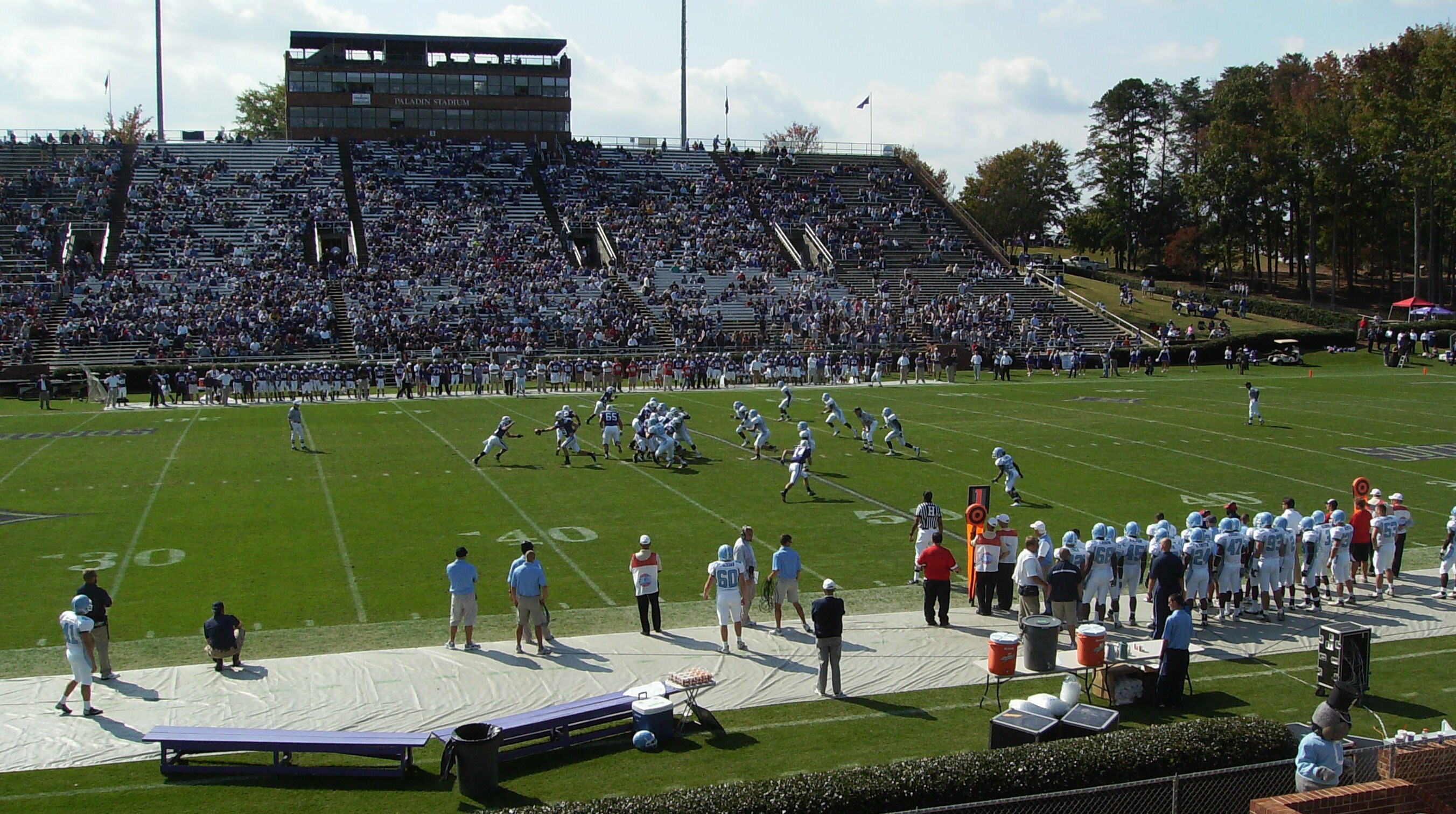
The final stats don’t really tell the story, because the Bulldogs made them (and the score) respectable in the 4th quarter, when the game was over.  The bottom line was The Citadel couldn’t get Furman’s offense off the field, especially in the second quarter (the Paladins had the ball for over 10 minutes in that frame alone).  Bart Blanchard didn’t have a good day, the offensive line didn’t have a good day, three different running backs dropped passes…and yet the biggest problem (by far) was the defense’s inability to make a stop, any stop.  Furman ran delayed handoffs and intermediate pass plays for good yardage all day long, the Bulldogs got no pressure on the QB…it was just ugly.

Some notes, then a few pictures (and no, my photography skills aren’t the best):

— For the people behind me who kept yelling that Scott Flanagan was open on every play…no, no he wasn’t.

— During the game, the fellow in front of me handed his binoculars to a fan sitting beside him.  The other fan had some trouble initially figuring out how they worked (understandably, if you had seen them).  The first guy explained, “I got these from the Iraqi army.  They’re a Russian make.”

I bet not every school has fans using binoculars like that.

— I have finally come around to the idea that we have to do something about our cheerleaders.  I was in favor of just ignoring the situation, but yesterday I watched a tubby little 10-year-old girl in the stands mock our cheerleaders for the better part of 10 minutes, without any provocation whatsoever.

— Furman’s announced attendance of 9,644 apparently included at least 1,500 invisible fans.  I think the folks at Furman have to be disappointed with the attendance, but I suspect it’s probably just a sign of the economic times.

— Furman’s players run through one of those blow-up helmets (pictured below).  I’ve always liked those.

— The guy riding Furman’s horse took off his helmet/mask before the game started and rode around bareheaded the rest of the time.  Why?  It ruins the gimmick.  He should wear the helmet the entire time he is in public view.  Instead of a knight riding his trusty steed, we got to see a decidedly nondescript bald dude riding a horse.


More HD, less people for CBS College Sports TV

Richard Sandomir of The New York Times wrote a short article about CBS College Sports TV (formerly CSTV) moving away from studio shows:

CBS College Sports said Thursday that it was laying off nearly one-quarter of its staff, or about 30 employees. The cutbacks signify the network’s shift from studio programs to increased high-definition event coverage.

I agree that it is better to have more HD programming than to have lame studio shows.  What would be better, though, would be to have more HD programming and actually good studio shows.  I guess that is a bit too high-concept, though…

Speaking of CBS College Sports TV, I am still trying to figure out what would be an appropriate acronym for the network.  When I post the weekly college football TV/announcers schedule on the Terp/Wake message boards, I have lately been employing “CCS” (standing for ‘CBS College Sports’).  I wish I could think of a better one.  “CBS-CS” doesn’t really work, at least for me.

Photo of the Day, Runner-Up

Mini-Manny?

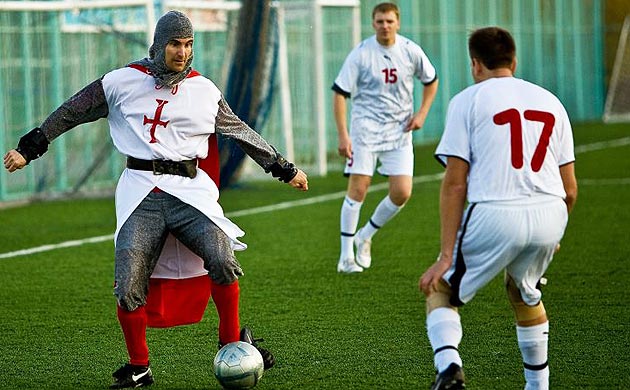
Photo of the Day

The player is obviously wearing a throwback English soccer uniform…