The SoCon baseball tourney moves to Greenville

It’s SoCon baseball tourney time, live from Riley Park in beautiful downtown Charl…

Oh.  They moved the tournament this year.

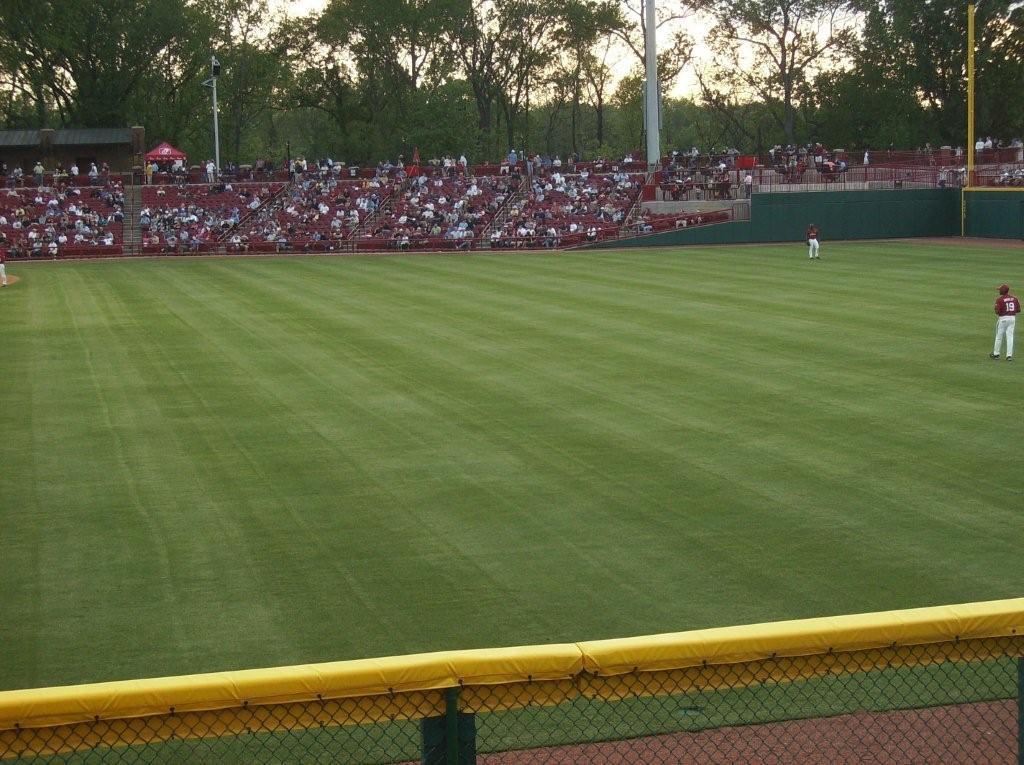
That’s right.  After 19 consecutive years in Charleston, the powers that be in the Southern Conference wilted from the non-stop complaints of a select few and moved the tournament (for at least one year) to Greenville, where it will be held at Fluor Field.  (The tourney returns to Riley Park next year.)

The tournament regularly made money (!) when it was held in Charleston.  Don’t expect it to do so in Greenville, where it will lack the kind of community support that has made it successful in the Holy City.  Of course, the conference doesn’t realy need the money.  Wait, what’s that you say?  The economic climate in the country has hit the SoCon hard?  The league is cutting costs, including not holding media days for football and basketball?  It’s going to reduce the number of teams that qualify for conference tournaments in sports like women’s soccer, men’s soccer, women’s tennis, men’s tennis, volleyball, and softball?  It’s going to force conference baseball series next year to be held over two days rather than three, with Saturday doubleheaders, to save on travel expenses?  It’s going to do all those things and then cut off its nose to spite its face by moving its baseball tourney just to please a small group of whiners?

Yes, it is.  (The league is also not printing media guides next year, although that strikes me as a good permanent move, what with being able to publish the guides online.  It would be nice if the conference updated its historical records information in hoops and baseball, which hasn’t been done in several years.)

The complaints came over a perceived home field advantage for The Citadel (and for the College of Charleston to a lesser extent).  The loudest of the voices was that of UNC Greensboro coach Mike Gaski, who campaigned to move the tournament for about a decade, or not too long after his 1998 squad had been defeated by The Citadel in the tournament championship game.  That was UNCG’s first year in the league after having lots of success in the Big South.  Gaski’s crew had won the regular season in the SoCon by a half-game over The Citadel, and by one game over Western Carolina, in a very tight three-way race.  Then the tournament rolled around.  The Spartans had actually swept the Bulldogs in Charleston earlier that season, but when the games really mattered, The Citadel prevailed twice over UNCG by a combined score of 21-1.

There really should not have been much to complain about — 21-1 strikes me as being rather decisive — but that was just the start of the drumbeat for moving the tourney.  The thing is, though, UNCG hasn’t won the league regular season title since then.  The Spartans did make it to the tourney title game in 2001, as the 5 seed, when they lost to (of course) The Citadel, which probably rankled Gaski even more.

As everyone knows, home field advantage in baseball isn’t nearly as important as it is in football or basketball.  There is no comparison between The Citadel playing tournament games at Riley Park and UT-Chattanooga getting to host the SoCon men’s hoops tourney on its home court.  That is borne out by the numbers.  While UTC has won the basketball tournament both times it has hosted it, I think some people would be surprised if they took a look at the baseball tournament history since the SoCon set up shop in Charleston.  There have been 19 tournaments held in Chucktown, and here is the breakdown over that time span:

The Citadel — 5 regular season titles, 7 tournament titles
College of Charleston — 3 regular season titles, 1 tournament title
Western Carolina — 3 regular season titles, 4 tournament titles
Georgia Southern — 5 regular season titles, 3 tournament titles
Elon — 2 regular season titles, 1 tournament title
UNC Greensboro — 1 regular season title, 0 tournament titles
Furman — 0 regular season titles, 2 tournament titles
Wofford — 0 regular season titles, 1 tournament title

The Citadel is +2 overall in 19 years of hosting the event (in terms of tourney versus regular season titles).  Meanwhile, the other local school reputed to have at least something of an edge by the tournament being held in Charleston, the CofC, is -2.  So much for a huge local advantage.

After Gaski and UNCG, the school with the most fans critical of the tournament being held in Charleston is probably Western Carolina — but the Catamounts have had their fair share of success there, and are +1.  Really, it’s Georgia Southern that logically would have the biggest complaint (-2), but its fans don’t seem to have had nearly as much of an issue with the tournament being held in the port city (it’s not an inconvenient location for them, for one thing).

The school that appears to have had the biggest benefit to playing in Charleston, as far as tourney vs. regular season success goes, is Furman, with no league regular season titles but two tourney titles since 1990.  Thus, the conference in its infinite wisdom is moving the tournament so the Paladins can be the host team…

You know what this is really about?  It’s about programs not being as successful as they once were, and not getting in the NCAA tournament, and looking for an excuse.  Western Carolina dominated the league in the mid-to-late 1980s, winning five straight tournament titles from 1985-89, all of which were held either in Cullowhee, Boone, or Asheville.  In those five years, WCU also happened to win the league regular season (or division) title four times.  The Catamounts also won a division title in 1984, but didn’t win the tournament that season.

UNC Greensboro won the Big South in 1994 and 1997, winning that conference’s tournament title both years as well.  It entered the Southern Conference following the ’97 campaign.

Western Carolina fans remember the glory days of winning the league every year.  The Catamounts have generally still been competitive, and among the better teams in the league, but they don’t win the conference title every year, and that is reflected in WCU’s tournament results.  The same can be said for UNCG, which has usually been good, but hasn’t enjoyed as much success as it had in the Big South immediately prior to joining the SoCon.

Unfortunately for Gaski and the Spartans, the year the tournament finally moves to Greenville has coincided with that of one of his worst squads, and UNCG has not qualified for this year’s tournament.  I suspect the coach finds that particularly galling.

I hope that Greenville does a decent job hosting the event.  I think it’s safe to assume that there will be a tarp at Fluor Field.  As some of us remember, that wasn’t the case when the tournament was held in Asheville.  The league can’t afford to repeat the 1989 debacle, which just screamed “Mickey Mouse conference” (and which led directly to the tournament moving to Charleston).

I suppose any of the eight teams in the tournament could win it, but I would rank them like this:

Elon — clearly the best team in the league; NCAA lock
Georgia Southern, The Citadel, Western Carolina, College of Charleston — all think they can win the tourney
Appalachian State, Davidson — dangerous, but probably not dangerous enough to win the tournament
Furman — happy to be the host

The latest projections from Baseball America, SEBaseball.com, etc., suggest that as many as three teams from the SoCon can make the NCAAs.  I am a little dubious about that.  Elon is definitely in, but if the Phoenix win the league tournament I don’t know what other team, if any, will join them as a regional participant.  That will depend on how the other teams fare in Greenville.  My best guess is that Georgia Southern is best positioned to get a bid from among the other schools.  I think The Citadel and the College of Charleston have to win the tournament (that’s probably a given for the CofC at this point), and that Western Carolina may have to at least reach the championship game.

The seedings were thus very important for the contenders, and the short straw was drawn by WCU and the CofC.  Not only do those two squads have to play each other in the first round, but the winner likely has to face Elon in the next game.  Georgia Southern’s second-place league finish means that the Eagles avoid all three of those teams until at least Friday (the same is true for The Citadel).  That said, this tournament has a history of early-round upsets, and neither Appalachian State nor Davidson are easy outs.  Even Furman has to be given a puncher’s chance.

As for The Citadel, I would like the Bulldogs’ chances a lot more if the relief pitching were a little better.  Drew Mahaffey is a quality closer, but the setup corps has left a lot to be desired.  Fred Jordan only appears to have faith in one other reliever, Raymond Copenhaver, but Copenhaver has had his ups and downs this year.

Of course, one solution to the problem with the relief pitching is to have the starters all throw complete games, similar to what happened in 2004 (when The Citadel had a tournament-record five complete games, two by Jonathan Ellis).  If a particular starter is effective, then Jordan is likely to leave him in the game as long as he possibly can.

The Bulldogs appear to be playing better defensively, and the offense is close to its peak level entering the tournament, which is good.  If the bottom of the order can be at least somewhat productive, The Citadel should score a lot of runs, because batters 1-6 have been getting the job done.

I favor Elon to win the tournament, but I am hoping the Bulldogs can have a special week.  I would also find it a bit amusing if The Citadel wins the tournament in a year when it’s not held in Charleston.

Error on the official scorer

On May 8, Howie Kendrick hit a home run off Gil Meche in a 4-1 Angels victory over the Royals — only, he really didn’t hit a homer.  Rather, he circled the bases on a poor fielding play by Kansas City right fielder Jose Guillen, a play that should have been ruled a four-base error.  You can see the play here.  (The Royals have appealed the ruling.)

This is just another example of the long trend in official scoring (at seemingly all levels) to avoid giving errors whenever possible.  It’s most noticeable at the major league level, but you see it in the minors and in college games as well.  A couple of weeks ago I was watching a game between Davidson and The Citadel.  Davidson’s shortstop failed to make two plays that should have been ruled errors, but both were ruled hits by the scorer.  Those were two of the seven hits the Bulldogs had.  There are a number of good hitters in The Citadel’s lineup, but it’s certainly easier to maintain high batting averages when the home scorer is overly generous.

It wasn’t always like this.  Years ago scorers seemingly didn’t hesitate to give errors.  Rabbit Maranville was the best defensive shortstop of his day; it’s one of the main reasons he’s in the Hall of Fame.  Maranville also committed 711 errors in his career (the most by a player whose entire career was played in the 20th century; Bill Dahlen, another outstanding defender, had 1080).

Of course, conditions have improved over time for defenders, which naturally has reduced errors.  Players in Maranville’s day didn’t have the modern gloves of today, and also played on less-than-perfect playing fields.  The original Comiskey Park, for example, was built on a city garbage dump.   Pieces of garbage would regularly rise to the surface.  Luke Appling once tripped over a piece of protruding metal near second base; the grounds crew came out and dug up the rest of a copper tea kettle.

You don’t have to worry about things like that when you play on artificial turf, and/or in domes.  When the Twins moved to Minnesota, they played home games outdoors at Metropolitan Stadium, and in those years never had a team season fielding percentage higher than .980 — but since moving to the Hubert H. Humphrey Metrodome, the team has never had a fielding percentage lower than .980 over a season.

As a result, great defensive players have committed fewer and fewer errors as time has gone by, with or without the help of friendly scoring decisions.  Luis Aparicio (who played from 1956 to 1973) had 366 errors in his career.  Ozzie Smith (1978-1996) committed 281 errors as a major leaguer.  Omar Vizquel has been in the majors since 1989.  In 100+ more games than Smith, he has only committed 183 errors.

The amount of money now in the game at the major league level has certainly had an impact on scoring decisions; I suspect that a lot of official scorers would deny that, but there is an importance to statistics in this era of baseball that wasn’t there 50 years ago.  I think it’s a key reason errors aren’t given more often.  Along those lines, another consideration for a scorer is to trying to offend the fewest number of players.

For instance, on the Howie Kendrick “homer” not giving an error is great for Kendrick, and probably doesn’t hurt Guillen’s feelings (even if he later said he should have been charged with an error).  The only player negatively affected from a statistical perspective is Meche.  Two happy players versus one not-so-happy player.  It’s an easy call for a scorer, especially when the batter is on the home team.

Of course, there are other things that come into play…

Many years ago I was scoring a minor league game.  During the game there was a pickoff at first base; the runner completely fell asleep, as he wasn’t even trying to steal a base.  He made no move to second (or first, for that matter) until the ball was in the first baseman’s glove.  The first baseman and shortstop (who was covering second base) completely botched the rundown, though, and the baserunner wound up at second.  It’s the kind of play you aren’t surprised to see in the low minors, to be honest.

Now, I didn’t believe in making things too difficult for myself, but I had no option but to rule a pickoff and then an error allowing the runner to take second base (given to the shortstop, in this case).  If the runner had been on the move to second, I could have awarded him a stolen base; heck, if he had been leaning that way I may have done so.  That’s not the easiest play in the scorebook to illustrate.  I wrote a short note in the margin for the folks at Howe Sportsdata, outlining what had happened.

After the game I was about to fax the scoresheet to Howe when the telephone rang.  It was the manager of the club for which I was scoring.  He had noticed the “E” flash up on the board and wanted to know what the ruling was (the runner was one of his players).  I explained it to him, and he then argued with me for about five minutes.  He wasn’t nasty about it, but he was very assertive.  I told him I would consider his argument (he wanted the player credited with a steal).

After I hung up, the assistant GM came over to me and told me that the front office had a pre-existing agreement with the manager that any “questionable” scoring decisions were his call, and to change it to what he wanted…

The player got a steal.  Perhaps that steal was noted from above by the powers-that-be (“hey, this kid’s aggressive”) and eventually led to a promotion.  Somehow, I doubt it.  Of course, the shortstop was presumably happy not to be charged with an error.  The pitcher and catcher were charged with allowing a steal, which was ludicrous, of course, but you can’t fight city hall.

I think about that night almost every time I see a error that is scored a hit.  It’s just another reason why basing a player’s defensive value on fielding percentage is myopic.

Postscript:   On Thursday, Major League Baseball reversed the official scorer’s ruling on the Kendrick-Guillen play, taking the homer away from Kendrick and charging Guillen with a four-base error.  This was an excellent decision by the MLB panel making the call (and apparently a fairly easy one; all five members of the panel voted to overturn the original ruling).

Counting pitches

On Friday night, Wes Wrenn started a key Southern Conference baseball game for The Citadel, at home against Georgia Southern.  Getting off to a good start in a conference series is important, and Wrenn delivered for the Bulldogs, hurling 8 innings of 2-run ball.  The Citadel won the game 6-2 and went on to win the series, two games to one.

In those eight innings, Wes Wrenn threw 143 pitches.

That is a lot of pitches, so many that a longtime poster on a message board for devotees of Bulldogs sports took notice.  I didn’t watch the game, so I have no real idea what kind of stuff Wes Wrenn had late, whether he was tiring, or showed signs of tiring (apparently not).  Sometimes a pitcher has had enough after about 70 pitches, and sometimes a pitcher is in a groove and can go a lot longer without significant risk.

I will say that the tone of the game story published by the school seemed to me to be a touch defensive when reporting the subject:

“Wrenn, who was strong from start to finish, threw 143 pitches in the game as he fanned the last two batters he faced.”

Somebody wanted to make a point of getting ahead of the argument, didn’t they?

It’s the second time this season a Bulldog pitcher has thrown more than 130 pitches in a game.  T.J. Clarkson threw 134 at South Carolina.  I was at that game.  He looked better late than he did early (at the time I wondered if he had trouble getting loose for that game; after the fifth inning he looked really good).  I still thought it was a lot to ask of a freshman with little starting experience (at least in college).  As it turns out, it was a very unusual performance.  Clarkson threw more pitches in a midweek in-season game for The Citadel than any pitcher has since at least 2002.  Other pitchers have thrown more pitches in a game, but all those games came in Southern Conference regular season or tournament play, or in an NCAA regional.

I don’t pretend to know it all when it comes to this subject.  I was never a pitcher on any level, and I’m not a doctor or a physical therapist.  I’m not a pitching coach or a scout.  I just watch games like everybody else.  What I do know, though, is there is a lot of evidence that overuse of pitchers usually leads to injuries in the long run.  Of course, it’s also true that pitchers get hurt all the time no matter how they are used (or abused).

One thing I am hesitant to do, honestly, is compare college hurlers’ workloads to those of major leaguers, if only because college pitchers get seven days off between starts (usually) as opposed to the four or five days off a major league pitcher gets.  This might make a difference.  (Another potential difference is the variance in competition.)  The starts that always worry me are the 120+ pitching performances on short rest during tournaments/regionals, not to mention the “drag the starter from two days ago/yesterday into the game in relief in an elimination game” situation.

I can’t be an expert on the subject from a medical or “baseball man” point of view, but what I can do is look at numbers.  What I decided to do was take a look back as far as I could at the recent history of pitcher usage at The Citadel and see where Wrenn’s outing on Friday night compared.

First, here is a list of game-by-game pitch counts for The Citadel’s starting pitchers this season…

Wes Wrenn — 99, 99, 95, 80, 107, 110, 103, 123, 129, 143
Asher Wojciechowski –103, 31, 125, 124,  115, 91, 121, 98, 111, 124
Matt Crim — 95, 97, 99, 81, 48, 116, 106, 102, 85, 107
Matt Talley — 110,66, 63*, 112,  69, 93, 66
T.J. Clarkson — 67, 90,94, 134
Matt Reifsnider — 98

[I put a “*” by Matt Talley’s start against Charleston Southern on March 25 (in which he pitched well), because I wanted to note that he also appeared in relief three days before, on March 22, against Western Carolina, throwing 59 pitches in 2 2/3 innings.  I believe this is the only “short rest” start for a Bulldog pitcher this season.  He followed up his victory over CSU with a solid effort against South Carolina six days later, also getting the win in that game.]

After compiling that list, I then went to Boyd Nation‘s invaluable site to check out his PAP logs over the past few seasons.  PAP stands for “Pitcher Abuse Points” and is a system Nation uses to see how overworked certain pitchers/staffs are.  A few years ago Nation got into a bit of a controversy with Ray Tanner that spilled onto local Columbia, S.C. radio and a few other media outlets (here is a reprint of an article originally published in The State, the local newspaper in Columbia).  It’s a delicate subject.  Tanner appears to have adjusted his thinking on pitch counts, after issues arose over his handling of pitcher Arik Hempy (as noted in an article reprinted here).

What is interesting (and perhaps reassuring) is that over the past three seasons, The Citadel has less PAP than about 90% of the schools in Division I baseball.  It’s a very good record over the 2006-2008 time period.  Only six times in those three years did a Bulldog pitcher throw 121 or more pitches in a game, and in none of those games did a pitcher throw more than 132 pitches.  Last season only one pitcher threw 120+ pitches in a game for The Citadel.

However, in 2004 and 2005 there were more sizable pitch-count starts.  In 2005, there were five starts in the 121-132 pitch range, and two over 132.  In 2004 there was only one start in the 121-132 pitch range, but six over 132.

If you go back a little further, though (as far back as online statistics are available), the trend is reversed again.  Only one Bulldog pitcher threw more than 121 pitches in 2002 and 2003 combined.

I was a bit puzzled at first when I looked at the PAP stats.  What was the deal in 2004 and 2005?  I looked at the box scores for every game over those two seasons.  I came to the conclusion that the numbers in 2005 were a little bit of an outlier.  2004 is a completely different story, and I’m going to get to that.  The 2005 games of 120+ pitches were as follows:

3/11 Ryan Owens 135 pitches (lost 2-1 to UNCG; complete game)
4/2  Ryan Owens 120 pitches (7 innings in 21-5 victory over Wofford) [estimated pitch count]
4/3  Ken Egleton 127 pitches (complete game victory over Wofford)
4/23 Justin Smith 133 pitches (7 1/3 innings in 10-6 victory over Charleston Southern)
4/29 Ryan Owens 122 pitches (6 innings in a 9-7 loss to Davidson)
4/30 Justin Smith 126 pitches (7 innings in a 4-3 victory over Davidson)
5/13 Ryan Owens 120 pitches (7 2/3 innings in a 9-3 victory over Furman) [estimated pitch count]

[The boxscores of most games these days list the number of pitches thrown by each pitcher, but sometimes that information is left out, and for whatever reason it happened more often in 2005 than in any other year since 2002.  For games lacking pitch counts, a “pitch count calculator” is used.]

All seven of those games were started by veteran pitchers.  The 4/3 game would mark the only time in Ken Egleton’s career at The Citadel where he would throw more than 121 pitches in a game.  This surprised me, because Egleton pitched a lot of innings while a Bulldog, but as it happens he regularly threw 100-120 pitches per game while never exceeding that general pitch count (with the exception of that Wofford game).

Owens and Smith were dependable workhorses for the most part (Smith in particular was noted for having a “rubber arm”, I seem to recall).  Owens’ 135-pitch effort against UNCG was a dominant performance in a loss; he pitched well the following week in a six-inning performance against Elon in which he threw 100 pitches.  After his 133-pitch outing against CSU, Smith took the hill a week later and pitched very well against Davidson, getting a no-decision (the Bulldogs would win the game with a run in the ninth).  After that two-game stretch, Smith would have an indifferent 6-inning effort against East Tennessee State and a decent 5-inning start versus Furman.

2004?  Well, 2004 was all about Jonathan Ellis.

Ellis threw 136 1/3 innings that season, by some distance the most innings ever pitched in one season by a Bulldog pitcher.  He threw nine complete games in eighteen starts.  As mentioned above, there were six 133+ pitching performances that season by Bulldog starters.  Five of those were by Ellis (Chip Cannon had the other).  Look at those five games:

4/9 142 pitches (complete game victory over the College of Charleston)
5/20 136 pitches (complete game victory over UNC-Greensboro)
5/26 134 pitches (complete game victory over East Tennessee State)
5/29 136 pitches (complete game victory over Western Carolina)
6/5 153 pitches (complete game victory over Coastal Carolina)

That’s right.  On five days rest after a 136-pitch effort against UNCG, Ellis threw 134 pitches in The Citadel’s opening-round game in the Southern Conference tournament.  The Bulldogs would later have to fight through the loser’s bracket of the tournament, and eventually faced Western Carolina, needing two wins over the Catamounts.  Fred Jordan started Ellis on just two days’ rest, and Ellis responded with an outstanding 136-pitch effort, with The Citadel winning the game.  (Justin Smith would start and win the next day’s game, as the Bulldogs won the tournament; Ellis would be the tourney MVP.)

Then Ellis would pitch one week later in yet another elimination game, in the NCAA regional, against Coastal Carolina.  I sat in the stands that day in Columbia (and let me tell you, it was hot) and watched him throw 153 pitches to send the Chanticleers home.  It would be the last game of Ellis’ college career.

So in terms of “pitcher abuse” over the last eight seasons at The Citadel, Jonathan Ellis would stand to be the poster boy.  Yet, he is now in AAA ball in the San Diego Padres’ organization, with what seems like a reasonable chance at making the major leagues, and his pro career seems mostly unaffected by his large workload in college.

Incidentally, I think you can make a good argument that Ellis’ 2004 season was the most valuable pitching performance in the history of Bulldog baseball.  Not the most dominant, necessarily, or the “greatest”, but the most valuable.  He pitched a ton of quality innings, obviously, and also won the had-to-win game in the SoCon tourney, as well as the regional eliminator against Coastal Carolina.

What does it all mean?  I don’t know, other than I hope Wes Wrenn can beat Samford on Friday night without having to increase his pitch count total for a fifth consecutive game.  You wonder at what point Wrenn might run out of gas (disregarding injury potential for a moment).  However, two years ago Wrenn threw 104 2/3 innings (he threw 87 last season).  He is probably capable of handling that workload.

Asher Wojciechowski needs to avoid those innings where he loses control and starts walking people.  If he does that, he won’t have to throw 125 pitches per outing.

Most importantly, the guys in the bullpen need to demonstrate to Fred Jordan that he can count on them in big games, and doesn’t have to leave the starters in as long as possible to secure a victory.  I think that’s the real  issue for this year’s team.  The high pitch totals by the starters, in my opinion, can be attributed in part to the problems in middle relief.  Not committing errors that prolong innings is also a factor.

We’ll be watching (and, I suppose, counting).

Undefeated in Carolina Stadium

The Bulldog baseball team enjoyed its first visit to the brand-new Carolina Stadium, winning 5-3 in 11 occasionally dramatic innings, and cementing a season sweep of the Gamecocks.  Admittedly, it’s only two games, but this is the first time The Citadel has beaten South Carolina on the diamond twice in one season since 1961, although it should be pointed out that the two schools didn’t meet twice annually during most of the 1960s, and for a few years in the 1970s.

(The Citadel also won its first basketball game against the College of Charleston at Carolina First Arena, so these debuts at “Carolina ______”  stadia are going rather well.)

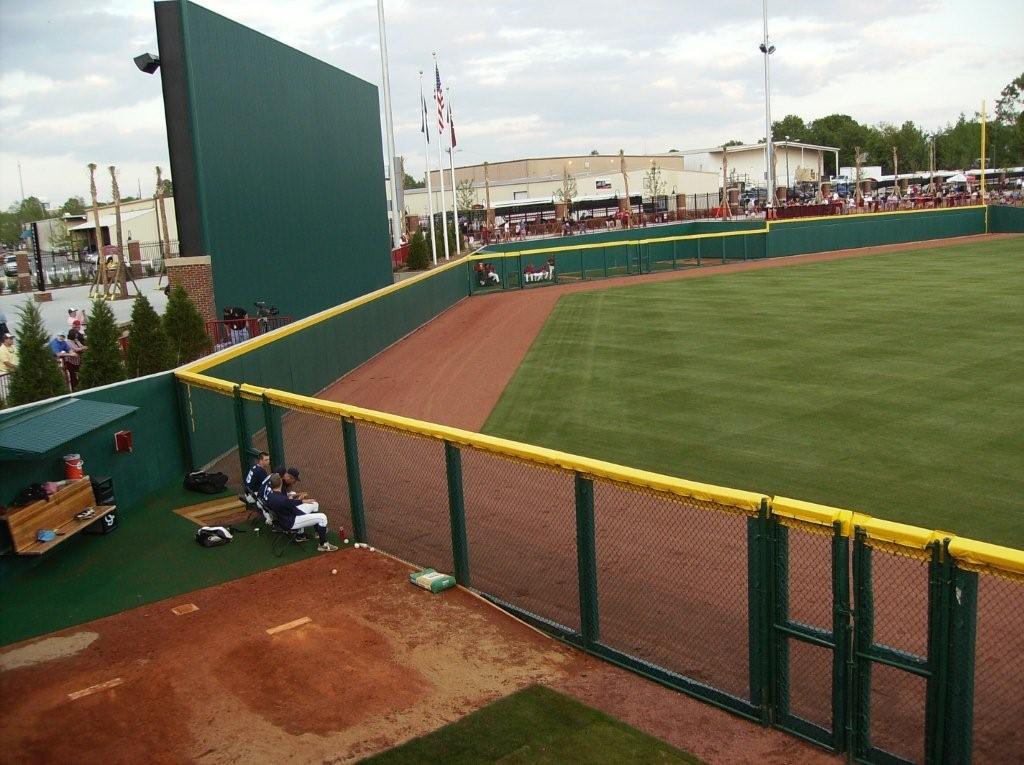
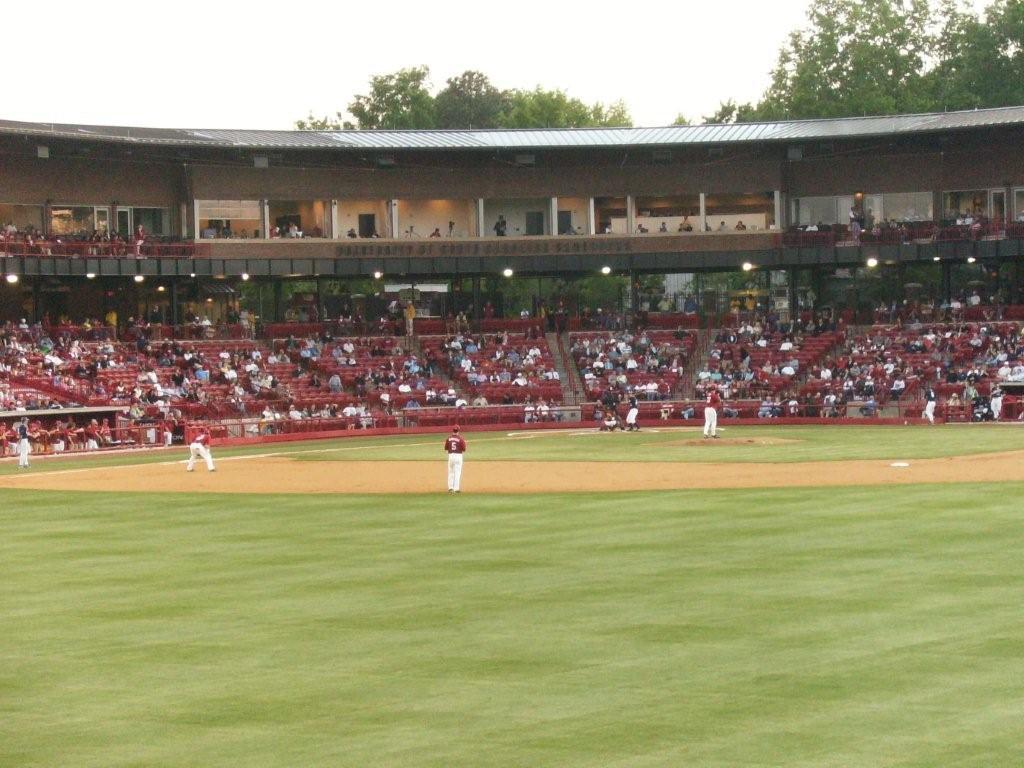
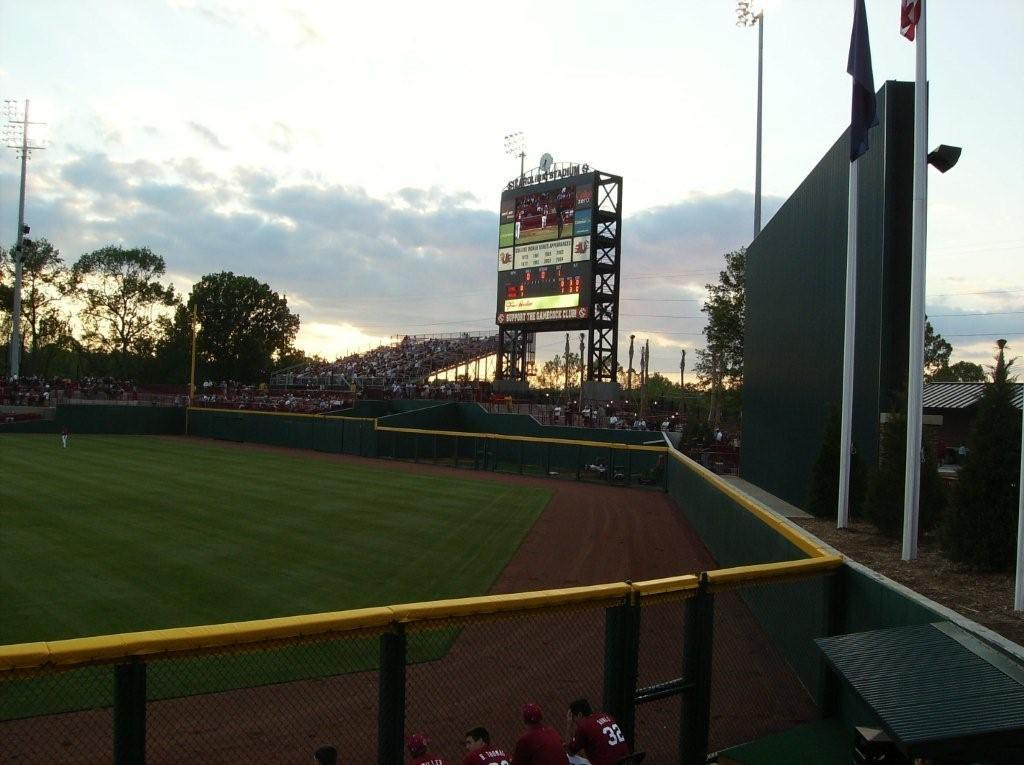
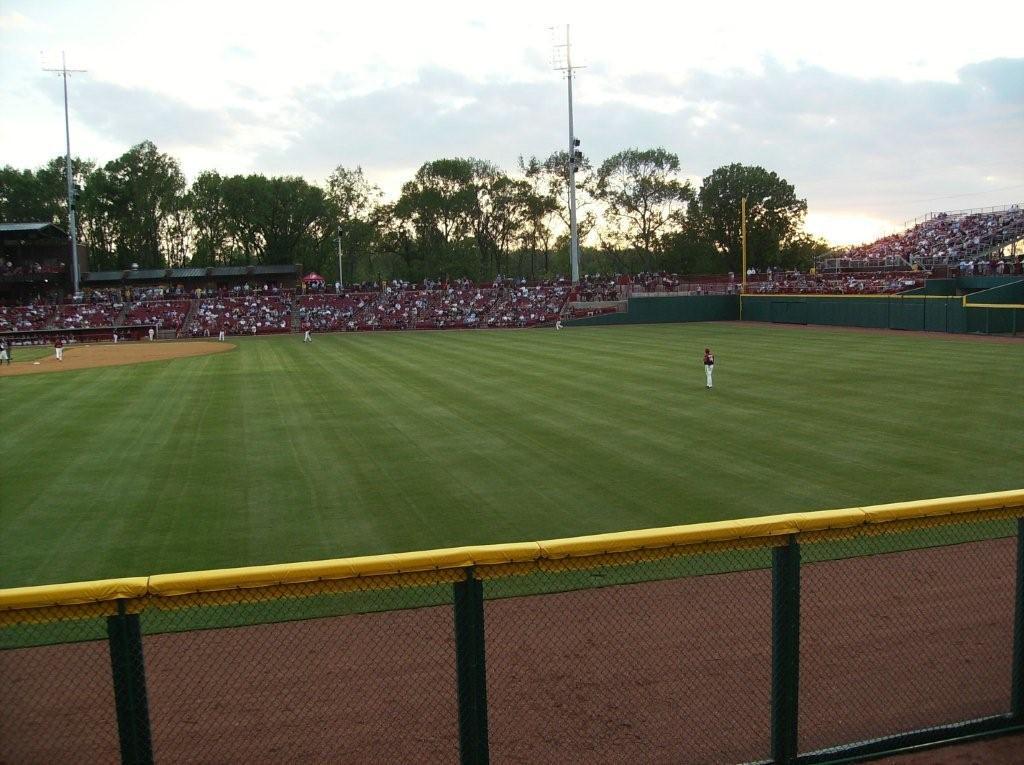
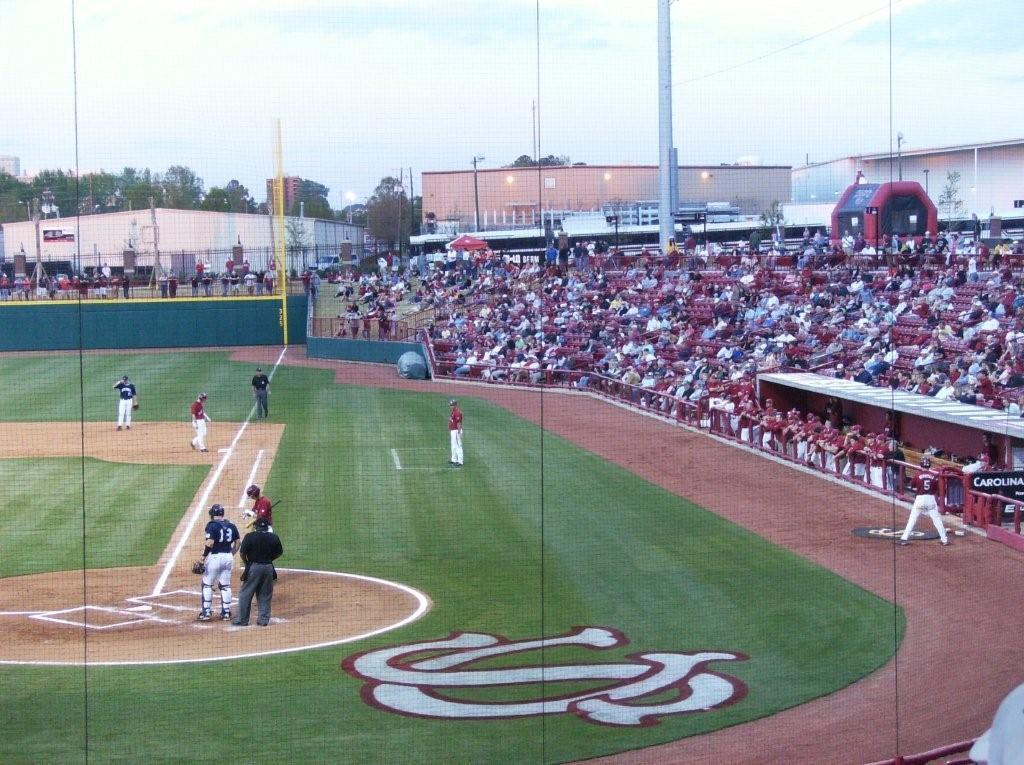
At the end of this post you can see some pictures of the new park I took during the game, from a bunch of different angles, somehow forgetting to take photos of the concourse and the concession areas until the batteries in my camera died.  I’m also not the most skilled of photographers, so they aren’t the best pictures in history.  It’s a nice stadium, definitely SEC-caliber.  Some observations about the park, and the game:

  • There was a sign noting that, in an effort to be eco-friendly, one half of the scoreboard was lit using a hydrogen fuel cell.  Why only half, I have no idea.
  • Speaking of the board, I noticed that the “Carolina Stadium” lettering was not lit.  I assume that either it wasn’t working, or more likely that the folks at USC are still looking to sell naming rights to the stadium, and didn’t want to pay for custom-designed lighting that will only be temporarily used.
  • There is a grass area down the first base line near the right field wall called the “Bi-Lo Berm”.  I have to wonder how long Bi-Lo will continue to sponsor the berm, given that the company filed for Chapter 11 bankruptcy last month.
  • The field itself looked fantastic, which was very impressive, particularly given the weather over the past few days.  I give the groundskeeper an A.
  • The parking situation is abysmal.  I’m just waiting for the first pedestrian fatality (it will probably happen after a game, after darkness).   If anything, it’s worse than it was at Sarge Frye Field, which is really saying something.  For someone like me, who would be inclined to go to USC games every now and then just to watch good baseball, it’s a reason not to go.
  • The stadium holds 9,000.  The announced crowd last night was 6,923, which is a nice crowd for a weekday game, although to be honest I didn’t think the park was at 75% capacity.  I thought it was more like 60%-65%.  The Citadel brought a fair amount of people, which wasn’t that big a surprise.
  • Having a true freshman throw 134 pitches in a game is normally asking a lot, but I can’t really fault Fred Jordan in this case, given the actual performance by T.J. Clarkson.  Clarkson didn’t exactly run out of gas, either, as he retired the last nine batters he faced.  I wondered if he had a little trouble getting loose in the early going, but he ended the game on a roll.
  • Drew Mahaffey pitched in both games this season against South Carolina.  In those two games, he faced 12 batters, retiring all 12, with 8 strikeouts (6 swinging), a foul out, a tapper back to the pitcher, and two routine fly outs.  In the first game, he entered the contest with runners on second and third and no outs.  Neither scored.
  • In two games this season against the Gamecocks, Bryan Altman had an OBP of .818, with seven hits (including a homer) , two walks, two runs batted in, and four runs scored.
  • This is a pretty good USC team, but it’s not as good as some more recent editions.  I think part of this is due to its lineup not having a true scares-you-every-time-he’s-at-bat kind of player.  Past Gamecock teams have usually had a couple of those guys.

I haven’t posted much about the baseball team.  One reason for that is I’ve been a little busy.  The other is that I was going to wait a little into the season so I could get a handle on this year’s club.  The thing is, though, that the Bulldogs have played 35 games and I still don’t have a real good handle on the team.  They have a .600 winning percentage in league play, and a .600 winning percentage out of conference  — and yet I really can’t say the Bulldogs are a consistent outfit.  Here are some of my thoughts on the team (some of which could be wildly off the mark, to be sure):

  • The lineup, from 1-6, is excellent.  Those six guys can all hit, and with some pop.  The two freshmen have both acquitted themselves very well.  I worry a little about two lefties at the 4-5 spots, where a late-game LOOGY could come into play, but that’s a minor quibble.  William Ladd is currently batting .351 (824 OPS), and looks to have locked down the seventh spot in the lineup (nice outfield assist in last night’s game, too).  That leaves the designated hitter (for games Richard Jones catches) and shortstop as question marks in the batting order.  The DH spot will likely be something of a revolving door, based on matchups, which is fine (although Sid Fallaw has received the majority of the opportunities so far).  Shortstop is another matter.
  • The Bulldogs have been erratic defensively, which makes it all the more important to have an everyday shortstop.  That would have been Kyle Jordan, of course, but you just can’t have a player with a 367 OPS as a regular.  His terrible season-long slump has been a major problem.  I’m not sold on Altman as a regular shortstop.  Johnny Dangerfield hasn’t been bad, but his bat isn’t quite big enough to make up for the defensive deficiencies in the middle infield when Altman moves over.
  • The pitching has been mediocre, even though The Citadel does lead the Southern Conference in ERA, thanks to A)  its home park, and B) the incredible lack of quality pitching in the league this year (SoCon ERA, as a conference:  6.35).  Mahaffey has been outstanding in the closer role.  The starting pitching hasn’t been that good, but it generally hasn’t been terrible, either.  The midweek starters haven’t been bad at all.  What the Bulldogs don’t have is an ace.  The middle relief/setup men have been poor.

The Citadel, right now, strikes me as a team you wouldn’t want to face in the Southern Conference tournament, but a team probably not consistent enough to win the entire tournament.  However, I can see that changing for the better.  If Raymond Copenhaver (and/or someone else) can shore things up in the 7th-8th innings, and get the game to Mahaffey, the Bulldogs have plenty of starting pitchers capable of a solid 6-inning effort.  In post-season play, having four (or five) of those kinds of pitchers will work to The Citadel’s advantage; that’s the type of depth you need to win a conference tourney.

First, though, The Citadel has to make sure it qualifies for the SoCon tournament, which means it has to finish as one of the top eight teams in the league.  The Bulldogs are well on their way to making it, but there are still 15 conference games left, starting Friday at UNC-Greensboro.  UNCG is currently 2-11 in the league, in last place, and will be desperate to win the series and climb out of the cellar.

It would be ironic if the Spartans ultimately do not qualify for the conference tournament, since UNCG coach Mike Gaski campaigned for many years to move the league tourney out of Charleston, claiming it was an unfair advantage to the two Charleston schools.  The conference brass finally buckled under his criticism (among that of others), and moved the tournament for this season to Greenville.  Now there is a decent chance the Spartans won’t even make the field.

Pictures from last night:

The hold: a useless stat 20 years ago, and still useless today

On Thursday, the Reds beat the Mets 8-6.   Cincinnati’s pitching line looked like this:

Cincinnati IP H R ER BB SO HR ERA
Arroyo (W, 1-0) 6.0 8 5 5 2 4 0 7.50
Burton (H, 1) 0.1 2 1 1 0 0 0 6.75
Rhodes (H, 1) 1.0 0 0 0 0 2 0 0.00
Weathers (H, 1) 0.2 0 0 0 0 0 0 0.00
Cordero (S, 1) 1.0 0 0 0 0 3 0 0.00

Yes, Jared Burton got a “hold” despite retiring only one of three batters he faced, giving up two hits and allowing a run (which scored after he left the game on a sacrifice fly).  The score was 8-5 Reds when Burton entered the contest.  When he left, it was still 8-5, but runners were on first and third and there was only one out.  Fortunately for the Reds, Arthur Rhodes, David Weathers, and Francisco Cordero all pitched effectively, and Cincinnati hung on for the victory.

However, Burton got that hold, just like Rhodes and Weathers (Cordero was credited with the save).  That’s because pitching effectively is not a requirement for a hold.  All you have to do is enter a game in a save situation, record at least one out, and leave the game without having given up the lead.  That’s the STATS Inc. standard, anyway; according to SportsTicker, you don’t even need to record an out.

The hold statistic was invented by John Dewan in 1986, the same year Dewan became a partner in STATS.  In 1989 the hold would be featured in an article in Sports Illustrated, which doesn’t seem to be available online.  In response to the article, a long-suffering Cubs fan named Mike Hoffman would write the following letter (published in November 1989), pointing out the absurdity in the stat:

While I agree that the middle reliever is the most overlooked player in baseball, I question the qualifications suggested for awarding a “hold” (INSIDE BASEBALL, July 24). The July 25 Cubs-Cardinals game illustrates my point.

With Chicago ahead 3-1 going into the last of the seventh, Calvin Schiraldi was summoned to protect the lead—a perfect hold opportunity if ever there was one. Schiraldi walked the first batter; the second man up sent Cub right-fielder Andre Dawson to the wall for a fly ball; Schiraldi walked the next batter. Chicago manager Don Zimmer brought in Les Lancaster. He faced one hitter, who flied out. Zimmer called in Steve Wilson, who got a strikeout to end that inning but gave up a single in the eighth. Zimmer next brought in Mitch Williams, who finished and got the save.

Schiraldi, Lancaster and Wilson all met your criteria for a hold—they did not win, lose or save the game, nor did they blow the save. But surely Schiraldi’s performance was not worthy of a hold. Give the hold a clearer definition by adding some requirement of effective performance, and you’ll have a statistic that truly recognizes the middle reliever.

That was almost 20 years ago, and it detailed a situation rather similar to the one that came up in the Mets-Reds game, and yet in those 20 years the definition of a hold has remained the same.  It’s still just as ludicrous.

In case you were wondering how I knew about that letter to the editor…

In October of 1989 I was working with Hoffman, who in addition to his Cub fandom was an ardent Miami Hurricanes apologist.  One day while Mike was out of the office, presumably sticking needles in his Lou Holtz voodoo doll, a secretary informed me that my assistance was needed.  For what, I asked?  “There’s a telephone call for Mike,” she said.

I suggested she take a message, but she told me that it was someone from Sports Illustrated, and that it had something to do with a letter.  I remembered Mike talking about writing the letter (he hated Calvin Schiraldi), and thinking it was a waste of time, but here was Sports Illustrated on the phone.  Apparently if they couldn’t get his express permission to run the letter (SI needed his permission because the letter had to be edited for length), it wasn’t going to be in the magazine.  Now, I knew that Hoffman would love to have his letter printed in the mag, so I did what any upstanding citizen would do.

I impersonated him over the telephone.

It worked out great.  The caller from SI never questioned that I was Hoffman, and I assured them that any changes they made to the letter (other than basic content) would be fine.  Mike enjoyed the story when he got back, but enjoyed seeing his name in the magazine even more.  I know that may sound a bit strange, but back then Sports Illustrated was still relevant.  (He would get another letter printed in the magazine 12 years later, when he criticized SI choosing Chris Rock as its cover subject for a “tribute to fans” issue.)

Back to the stat.  The hold still isn’t an official statistic, thankfully, but you see it everywhere, including in the box scores for MLB.com.  I’m not sure why.  Personally, I think it should go the way of the game-winning RBI, but there are some people who still value the hold as a statistic.

I’m not one of them.

Port and Jordan

In the last four baseball seasons, The Citadel’s conference record by year is as follows:  14-16, 15-12, 12-15, 12-15.  That is not exactly what Bulldog fans have come to expect from the baseball program, which has historically been the school’s strongest varsity sport.  On the other hand, what should be expected?  I decided to check some numbers in an attempt to answer that question.  I concentrated on the team’s play since 1965, Chal Port’s first year as head coach.

One thing I want to make clear is that this discussion has nothing to do with the current Bulldog squad, which as of this writing is 9-9 overall, 5-4 in the Southern Conference.  This is more about the program’s history, and the current edition of the baseball Bulldogs is just beginning to make its own mark in the historical record.

One of the difficult things in trying to compare and contrast baseball teams of the past is that there have been a lot of variables over the years — in the scheduling, in the makeup of the Southern Conference, in how the conference determines its champion, even in the equipment used.  I made some decisions on how best to make comparisons.  The biggest decision I made was to concentrate solely on league play.

Nowadays the Bulldogs play a lot more games than they did 30 years ago.  In 1975, for example, Chal Port won his second conference title with an 11-3 league record.  His overall record that season was 21-9.  Twenty years later, in 1995, Fred Jordan won his first regular season SoCon title with a conference mark of 19-5, 39-21 overall.  The Bulldogs played exactly twice as many games in 1995 as they did in 1975, and almost twice as many league contests.

Comparing by league record is hard enough, what with more games and more/different schools in the league, but it’s almost impossible to make observations based on the non-conference slate, not only because of the number of games but because of the level of the competition.  Since 1994 The Citadel has played only three games against non-Division I opponents — a game against North Florida in 1995 (in a tournament hosted by UNF), and two games against Presbyterian in 1998 (scheduled after The Citadel won the league tournament in order to prevent an 18-day layoff prior to regional play).

The lack of non-Division I games is due to a SoCon edict handed out following the 1993 season.  For the 1994 season, the conference found itself in a situation in which it didn’t want to be, namely as a “play-in” conference.  The NCAA tournament was a 48-team affair at the time, and in 1994 there were 30 automatic bids.  However, the NCAA mandated that 24 berths for the tournament were to be at-large, which meant there were 6 auto bids too many.  As a result, the 12 lowest-rated conferences from the 1993 season each had to qualify for a regional by winning a best-of-three series against one of the other low-rated leagues.

If that sounds like the NCAA basketball tournament’s “play-in” game, it’s because that’s exactly what it was, times six.  The Southern Conference was one of the 12 leagues that had to play an extra round just to get in the main tournament, and the champion was drawn to face the winner of the Ohio Valley Conference.  The Citadel won the league tournament that year and beat Middle Tennessee State, 2 games to 1, in Charleston to advance to the regional held at Clemson.

To prevent this from happening again, the league determined that its schools should play a Division I-only schedule to improve the league’s power rating.  This was a marginally risky short-term strategy (what if the league had lost an overwhelming number of those extra D-1 games?)  but proved a benefit to the conference in the long run.  However, it meant that the days of The Citadel playing the likes of Hiram or Gannon were over.

As mentioned earlier, comparing eras by conference play is no picnic either.  In 1965, league schools included West Virginia, George Washington, William & Mary, Richmond, VMI, and Virginia Tech.  None of those schools are still in the SoCon.  You also have schools like East Carolina, East Tennessee State, and Marshall, which have come and gone, Davidson (which left and then came back), and schools making their debuts in the league in the 1970s (Western Carolina and Appalachian State), 1990s (Georgia Southern, UNC-Greensboro, and the College of Charleston), and 2000s (Elon and Samford, the latter beginning conference play this season).  UT-Chattanooga competed in the sport for six league seasons before the school dropped baseball following the 1982 campaign.  The conference has had as few as seven and as many as eleven baseball schools over the past 45 years.

Let’s look at Chal Port’s career SoCon record.   Port coached for 27 years and finished with an overall league mark of 253-156-1 (.618).  Port won seven conference titles and one tournament title (it should be noted that the conference did not have a tournament until 1984; five of Port’s league titles came prior to that season).  Port had a stretch of 10 consecutive winning conference records, with that run preceded by three winning records and a 7-7 season, so he actually had 14 straight non-losing seasons in SoCon action.  Overall, Chal Port had 18 winning SoCon seasons, 7 losing seasons, and 2 at .500 in the league.  Port had a winning record in conference play in exactly two-thirds of his seasons as head coach.

Incidentally, Port’s record in the conference after his first seventeen seasons was 143-98-1 (.593), with 12 winning seasons, four losing seasons, and one at .500 in SoCon play, with three league championships.  I mention this because Fred Jordan completed his seventeenth season as head coach last year.  Jordan entered this season with a record of 285-166 (.632)  in league play, with 13 winning seasons and four losing campaigns, and with four regular season titles and six tournament championships.

Jordan, like Port, also had a stretch of 10 consecutive winning seasons in conference play (from 1995 through 2004).  The problem, from the perspective of the program’s current status, is that since 2005, he has had just one winning league season, in 2006 (when the team was 15-12).  In the last four years Jordan’s conference record is only 53-58 (48%).  Did Chal Port ever have a stretch like that?

Well, yes.  After Port’s earlier-mentioned 10-year run of success, which lasted from 1975 through 1984, he had five conference seasons that went like this:  8-10, 9-9, 6-12, 12-6, 8-9.  Overall record during that five-year period:  43-47 (48%).  You may see a pattern developing.  You would be right…

Both Port and Jordan won four regular season titles during their respective 10-year winning streaks.  During those runs, Port won 73% of his league games.  Jordan won 72% of his.

The similarities in the two coaches’ records are striking.  Of course, it’s not that simple.  After those five relatively mediocre seasons noted above, Port finished his career with a run of 29 wins in 32 league games, with two regular season titles, a tournament crown, and a completely unfathomable trip to Omaha.  It’s that finish that people understandably tend to remember, even more so than the terrific teams he fielded during a good chunk of the 1970s and early 1980s.

It’s difficult for Jordan to compete with those memories, particularly since the conference has in recent years seen an influx of schools that take their baseball seriously (Georgia Southern, College of Charleston, UNC-Greensboro, and Elon).  The competition within the league is arguably tougher than it was two decades ago.

That’s not to take away anything from Port’s record, which is lauded with good reason, and in fact is probably even more impressive than a lot of people realize.  Port had to make numerous on-field adjustments during his tenure, including the change from wooden to aluminum bats, and the conference moving to divisional play (and then dropping the divisions), among other things.  Then there were the off-field adjustments, which included integration, and the fact that going to a military school wasn’t exactly the cool thing to do in the early-to-mid-1970s (not that it’s ever been the really cool thing to do).   Consider what the baseball program accomplished, especially when compared to The Citadel’s football and hoops programs of that decade:

From 1971-1979, the football team was coached by Red Parker, Bobby Ross, and Art Baker.  Ross in particular is known as having been an outstanding coach, with major success at multiple levels of the sport.  The football team had four winning seasons overall in those nine years, with no league titles and a conference mark of 26-29 (47.2%).  SoCon finishes:  3rd, 4th, 7th, 5th, 4th, 6th, 3rd, 5th, 3rd.

Tangent alert:  Ross was really good at putting together a coaching staff.  For example, his 1973 coaching staff included Frank Beamer, Ralph Friedgen, Jimmye Laycock, Cal McCombs, Charlie Rizzo, and Rusty Hamilton, along with none other than Chal Port (who doubled as an assistant football coach during his first decade at The Citadel; Port had been a fine football and baseball player for North Carolina in the early 1950s).  The team itself also had some future coaches, like David Sollazzo and Ellis Johnson.  Despite all that coaching talent, in 1973 The Citadel was 3-8 overall, 1-6 in the conference.

The basketball team was coached from 1971-79 by Dick Campbell, George Hill, and Les Robinson.  Robinson would later prove his worth as a coach with an oustanding rebuilding job at East Tennessee State, but during this period the hoops program had just two winning seasons, bookends on seven straight losing campaigns, and had an overall conference record of 43-69 (38.4%).  Conference finishes:  4th, 5th, 4th, 6th, 7th, 6th, 7th, 8th, 3rd.

Meanwhile, from 1971-1979 Port went 85-43 (66.4%) in conference play, with three championships, nine winning seasons overall, and eight winning seasons in the league (and the other was a .500 season).  His SoCon finishes during that time:  1st, 4th, 3rd, 4th, 1st, 3rd, 3rd, 3rd, 1st.  He finished in the upper half of the league all nine years.

He wasn’t done yet, either.  He had his best teams up to that time in 1982 and 1983, with the ’82 squad finishing 40-8.  At that point another power arose in the Southern Conference, as Western Carolina hired Jack Leggett to upgrade its already promising program.  The Catamounts would win five straight league titles, a stretch dovetailing almost exactly with a gradual decline in The Citadel’s fortunes on the diamond.

Port outlasted WCU’s run and (even more impressively) Hurricane Hugo, however, and orchestrated a season that won’t soon be forgotten, plus a very nice coda (the ’91 campaign).  That’s quite a legacy, one augmented by Port’s well-deserved reputation as a jokemeister and storyteller.

Jordan should be credited with maintaining the high standard of the program throughout much of his time as head coach, as the numbers rather clearly demonstrate that he has done so.  What he needs now is a “second wind”.  Port got his after a real-life gust of wind, Hurricane Hugo, blew through Charleston.  Then, rather amusingly (and appropriately), he capped a season for the ages by beating a team called the Hurricanes to reach the College World Series, giving a then up-and-coming Miami sportswriter named Dan Le Batard enough material for several columns in the process.

Jordan doesn’t need another hurricane (let’s hope not, anyway) to re-establish momentum.  He doesn’t even need to start making appearances on Le Batard’s radio show.  He just needs better pitching and defense (don’t sleep on the need for better defense).  He’s had championship-caliber pitching and defense in the past, and I see no reason to believe he can’t get the program to that championship level again.

I certainly hope so, anyway.  I would like to make another regional trip, preferably sooner rather than later…

In defense of Rabbit Maranville’s Hall of Fame plaque

A few weeks ago I was reading a column by Chicago-based sportswriter Rick Telander, who as a longtime member of the Baseball Writers Association of America (BBWAA) gets a Hall of Fame vote every year.  This was his (presumably) annual column about his vote.  One of the benefits of being a BBWAA member is that every year you get an easy column by just writing about your ballot.

Telander’s column is a bit of a ramble.  He whines about steroids, decides he’s getting old, and also mentions the “grandeur” of the Hall.  He writes:

When you go to Cooperstown, there is not a player enshrined (other than maybe Rabbit Maranville) who doesn’t blow your socks off.

There it is again.  Somebody who doesn’t understand why Rabbit Maranville is enshrined in Cooperstown.

It’s not like Telander’s the only one.  I remember reading an article on the Hall of Fame back in 1989 by Steve Wulf, then writing for Sports Illustrated.  While leading up to a paragraph about Abner Graves (!), Wulf wrote:

Some are more deserving than others, but once you walk into the Hall of Fame Gallery—the wing that holds the famous bronze plaques—you know you are in a place of worship, and you could never begrudge a man his place there. You might wish that Phil Rizzuto, Richie Ashburn, Leo Durocher, Roger Maris, Nellie Fox, Bill Mazeroski, Ron Santo, etc., could be there too, but you wouldn’t wish to unscrew Rabbit Maranville’s plaque to make room for another, even if Maranville did hit just .258 lifetime.

Besides, there’s no sense in trying to read the minds of the baseball writers who vote for the Hall of Fame candidates (in the first election, in 1936, 11 of them left Ruth off their ballots). And there’s no benefit in chastising the veterans’ committee, which, in trying to undo past injustices, has perhaps relaxed the standards a bit; Jake Beckley may not be a household name, but that’s not to say his name doesn’t belong here. No, the overwhelming feeling you get in that splendid room is one of gratitude. Thanks, fellas, for filling up the afternoons and evenings of so many, for bringing them to their feet, for the memories.

The story was accompanied by a picture of Maranville’s plaque.  I don’t remember the caption under the photo, but I am fairly sure it was something along the lines of “he only hit .258 and shouldn’t really be in the Hall, but don’t sweat it”.

Re-reading that passage, I think it’s interesting that of Wulf’s list of players “you might wish” would also be enshrined, all of them have now been elected except for Maris and Santo.  (Poor Santo.  A quarter-century of being the woulda-coulda-shoulda guy when it comes to the Hall.)

The thing that kills me, though, is that he says that while Jake Beckley “may not be a household name” that doesn’t mean he doesn’t belong in the Hall, even though he mentions Beckley while mildly criticizing the Veterans Committee.  He says that and then talks about Maranville as something of a lesser pick than Beckley, despite the fact that Maranville wasn’t a VC pick — he was elected by the BBWAA.  It’s obvious that Wulf doesn’t know anything about Maranville either, other than his .258 career batting average.

Wulf was only three years old when Maranville was elected to the Hall (in 1954).  Still, a little research wouldn’t have hurt any.  Of course today finding out about past players is much easier than it was in 1989, so Telander has even less of an excuse.  The thing is, though, Maranville still comes up on lists of “least deserving” or “not deserving” Hall of Famers, even among people who follow the sport fairly closely.  At first glance he looks like a guy who didn’t hit for average, had little power, and just hung around a long time.  All of that is true, and yet…

Maranville debuted in the majors in 1912, for the Boston Braves.  He was 20 years old and appeared in 26 games that season.  In 1913, he became the everyday shortstop for the Braves, batting .247 in 143 games, with two homers.  His OPS+ that season was 83, right around his career average (82).  Not impressive, at first glance…but then you realize that in 1913, at the age of 21 and playing his first full season in the major leagues, Maranville finished third in the MVP voting, just ahead of the great Christy Mathewson (who won 25 games that year with a 2.06 ERA).  So how does a guy batting .247 with no power finish so high in the MVP voting?

Well, he was a great defensive shortstop, and a great defensive shortstop can be tremendously valuable, especially if he can hit just a little (and it’s arguable that such a player had more value in the Dead Ball era than at any other time in baseball history).  This was the first of several years in which Maranville fared very well in the MVP voting without obvious offensive numbers to justify it.  That in itself probably is a good indication of just how good a fielder Maranville was.

Another indication, of course, is just how long a career he had.  Maranville had a 23-year career in the majors, playing a total of 2670 games, all but four of which were as a middle infielder (80% of those appearances came as a shortstop).  Maranville held the record for chances for a shortstop for decades and still holds the record for putouts by a shortstop.  At age 41, Maranville batted .218 in 143 games, with no homers (OPS+ of 60)…and finished in a tie for 12th in the MVP voting, ahead of Frankie Frisch (who batted .303 that year with an OPS+ of 111).

Maranville was the runner-up in the MVP voting in 1914 to his middle infield partner, Johnny Evers, as the “Miracle Braves” won the pennant and swept the World Series.  Maranville batted cleanup on that team.  He also finished seventh in the voting in 1924 (OPS+ of 86) and had two other top-10 finishes.

From 1915 through 1923, there was no MVP award for the National League.  It just so happens that Maranville’s seven best offensive seasons (in terms of OPS+) came during that stretch.  I think it’s likely that he would have finished in the top 10 in the MVP voting (if not the top 5) in most, if not all, of those seasons.  If you add, say, five top 10 and two Top 20  finishes (which is probably a bit conservative) to his already impressive MVP history, you would have a player who in his career compiled ten seasons in which he finished in the Top 10 of the MVP voting and another five seasons in the Top 20.

I compared that to some of the players on his “most similar batters” list, courtesy of Baseball-Reference.com.  Ozzie Smith finished second in the ’87 MVP voting (he probably should have won it; that was a weird year) and had three other Top 20 finishes.  Luis Aparacio had two top 10 finishes and four other finishes in the top 20.  Like Smith and Maranville, Aparacio was also an MVP runner-up, in 1959.

Tangent:  the top of the 1959 AL MVP vote mirrored the top of the 1914 NL MVP vote.  For both, the top three finishers played for the pennant winner, and the order was second baseman (Nellie Fox/Evers), shortstop (Aparicio/Maranville), and pitcher (Early Wynn/”Seattle Bill” James).  Also, the fourth place finisher both times was an outfielder.  The 1959 outfielder was Rocky Colavito, who played in 1841 career games.  The 1914 outfielder was George Burns, who played in 1853 career games.

Next on Maranville’s most-similar list is Omar Vizquel, who has one Top 20 MVP finish in his entire career.  Part of why I’m posting about Maranville is that I suspect Maranville’s name is going to pop up more and more as people continue discussing the Hall of Fame candidacy of Vizquel.  They are going to be compared, and my hope is that folks are able to start understanding Maranville’s career a little better.

Nellie Fox follows Vizquel on the comp list, and here finally we have a player who shares Maranville’s propensity for getting MVP votes.  Fox finished in the top 10 six times (as mentioned above, winning in 1959) and had three other Top 20 finishes.  Fox was elected by the Veterans Committee after narrowly missing election by the BBWAA; really, the writers should have elected him.  He’s not as big a miss by them as Arky Vaughan or Johnny Mize, but it was still a mistake.

One other player on the similar-list to note:  Dave Concepcion had two Top 10 MVP finishes and another in the Top 20.

I realize that the MVP voting is not the end-all and be-all.  There is a danger that you can compound a mistake by referencing an error of the past (i.e. the 1987 AL MVP vote, which still haunts Alan Trammell).  Still, when you have a player whose statistical batting line does not immediately suggest greatness, it’s worth it to check the historical record.  In the case of Maranville, in his time he was obviously considered to be something special.  Generally speaking, the MVP voting tends to favor offensive-minded players (especially HR-RBI guys).  This is why a comparison to Maranville’s peers is appropriate; I think most people consider Ozzie Smith to have been a great player, but other than one season he never did very well in the MVP race.  Yet despite the historical tendency by MVP voters to not recognize defensive specialists, Maranville still did well.

Of course, there was another thing about him that probably is reflected in his MVP voting — he was famous, for he was a great player who also happened to be a clown of the highest order.

There are many, many Maranville stories, and a lot of them are actually true.  If you needed a player to wax another player’s bat with soap, or swallow a goldfish, or jump into a hotel pool fully clothed, or offer a pair of eyeglasses to an umpire after a bad call, Maranville was your man.  If you needed a player to go drinking with Jim Thorpe, and swing through tree branches screeching like Tarzan, or to be dangled outside the 15th floor of a Manhattan hotel by Thorpe (with one arm), Maranville was your man.  If you needed a player to paint iodine streaks on a hapless ump, or to throw buckets of ice at fellow train passengers (which he did as a player-manager), or trick a teammate into thinking he had accidentally killed him, Maranville was your man.

Maranville once got a hit off Carl Mays by making him laugh so hard he couldn’t maintain his control.  He was in the dugout during the infamous Babe Herman-three men on third base play; when Wilbert Robinson asked Maranville what had happened, Maranville said, “There’s three men on third and if they hang on long enough I’ll go down and make a quartet out of it.”

Once during a pitcher-vs.-batter fight, Maranville distracted everyone, including the fans, by going into the first base coach’s box during the fracas and pantomiming a fight against himself, pretending to knock himself out.  (Judge Landis thanked him later for that one.)  Entertaining the crowd during a slow part of the game with various pantomime activities was one of his specialties.

When Maranville caught a popup, he usually caught it by holding his glove open at his navel, allowing the ball to strike him in the chest, and having it roll down his shirt into his glove.  He called it his “vest pocket catch”.

Bill James (not the Boston Braves hurler), in his New Historical Baseball Abstract, refers to Maranville having a “Marx Brothers life”, and I think there’s a lot of truth to that.  He was probably on Chico’s level, but definitely ahead of Zeppo.

Maranville was elected by the BBWAA in 1954, shortly after his death.  The fact he had recently died had little to no impact on his election; he had risen in the balloting gradually over the preceding decade, finishing tenth in 1949, ninth in 1950 and 1951, seventh in 1952, and fifth in 1953.  Two players were elected in 1953, meaning that Maranville was in the top three of those on the ballot who had not been elected, along with Bill Dickey and Bill Terry.  All three of those players were elected in 1954.  Maranville actually jumped ahead of Dickey and Terry in the voting to finish first overall that year.  Keep in mind that the Hall had only been around for a few years and there were many outstanding players on the ballot.  Nineteen of the top 20 vote-getters from 1954 are now in the Hall (the exception is Hank Gowdy).

After his career in organized baseball was over Maranville helped run youth baseball programs in Detroit and New York.  One of the kids he taught was Whitey Ford.

Anyway, to sum up:  Maranville wasn’t a great hitter, but he was a great player.  His specialty was in preventing runs as opposed to producing them, and this was recognized by his contemporaries.  He was considered something of a clutch hitter (although I tend to find most claims of being “clutch” not involving George Brett to be somewhat dubious).  He had an incredibly long career, and he was enormously popular.  Thinking of him as just being a .258 hitter is small-minded, to say the least.

I’m not saying he was the greatest player who ever lived.  All I’m saying is that if you’re a writer and you’re trying to reference a player who doesn’t belong in the Hall, Maranville is not the right guy to name.  Look, you want suggestions?  Try Chick Hafey or George Kelly, or Rube Marquard if you need a pitcher (don’t get him confused with Rube Waddell, though).  You’ll be safe criticizing those selections — unless a member of one of their families is reading your column.

Just leave Maranville’s plaque alone…

Next year’s Hall of Fame disaster scenario: a party in Cooperstown with no guests of honor

Today, Rickey Henderson and Jim Rice were elected to the National Baseball Hall of Fame, the former with near unanimity and the latter with a fair share of controversy.  With their election, along with the earlier selection of Joe Gordon by the Veterans Committee, there will now be 289 members of the Hall, 201 of whom were elected based on their playing careers.  The wait for Hall of Fame player #202 may be a while…

First of all, there won’t be any players elected next year by the Veterans Committee, because the committee won’t vote again on players eligible for selection by the VC until 2010 (and that’s just for post-World War II eligibles; the pre-World War II players won’t be up for consideration again until 2013).  That means that the only players who can be elected next year will be those on the BBWAA ballot.  The players on this year’s ballot who will return to the ballot next year (with this year’s voting percentage in parenthesis):

Andre Dawson (67.0%); Bert Blyleven (62.7%); Lee Smith (44.5%); Jack Morris (44.0%); Tim Raines (22.6%); Mark McGwire (21.9%); Alan Trammell (17.4%); Dave Parker (15.0%); Don Mattingly (11.9%); Dale Murphy (11.5%); Harold Baines (5.9%)

Now, here is a list of players who next year will be eligible for the BBWAA ballot for the first time and are likely to be on the list (courtesy of the Hall of Fame website):

Roberto Alomar, Kevin Appier, Andy Ashby, Ellis Burks, Dave Burba, Andres Galarraga, Pat Hentgen, Mike Jackson, Eric Karros, Ray Lankford, Barry Larkin, Edgar Martinez, Fred McGriff, Mark McLemore, Shane Reynolds, David Segui, Robin Ventura, Fernando Vina, Todd Zeile

There are several serious candidates for the Hall on the list on newly-eligibles, most prominently Roberto Alomar, Barry Larkin, Edgar Martinez, and Fred McGriff.  I could also see some support (greater than 5% of the vote, at least) for Andres Galarraga and Robin Ventura.  However, none of those players is a “lock”.  I think the best candidate of the group is probably Alomar, and I would expect him to get a lot of votes — but I would be surprised if he received more than, say, 60% in his debut on the ballot.

That means that if anyone is to be elected, it has to be someone from the “holdover” group, and I think the only one of those players with a shot is Dawson.  He’s going to get in eventually, but I’m not sure if his support will jump from 67% to 75%+ in one year, especially since he’s not that close to his final year of eligibility, as was the case with Rice this year (who managed a 4% increase in his vote total from last year to this year).  At 63% of the vote, and with his support essentially unchanged from last year, Blyleven’s chances of being elected next year are remote.

Compounding the chances for the holdovers and the newly-eligible players is that there is a surplus of serious-but-not-automatic candidates who will almost certainly split up the vote.  Over the last two elections, an average BBWAA ballot has listed 5.35 names (last year) and 5.38 names (this year), historically low vote totals.  I don’t see that changing much, and so the “competition” for votes (a ludicrous concept, but unfortunately applicable in this situation) will likely depress individual vote totals across the board.  I think the only player with a shot next year is Dawson (unless I am seriously underestimating Alomar’s chances), and I don’t know if Dawson can make that big a leap in the voting.  I tend to think he won’t.

The last time the BBWAA failed to elect anyone was 1996 (Phil Niekro came closest; he was elected the following year).  However, in 1996 the Veterans Committee elected Jim Bunning, along with Negro Leagues star Bill Foster.  Earl Weaver and Ned Hanlon were also elected that year (as managers), so the traditional ceremony at Cooperstown had two living honorees (Bunning and Weaver).  At least one player has been elected by either the writers or the VC every year since 1960.

The committee that selects Hall of Fame managers, umpires, and executives does vote next year.  I think there will be some pressure on that committee to select somebody (Whitey Herzog?  Doug Harvey?) because that’s probably the avenue most likely to produce an enshrinee in 2009.  It won’t result in a player being elected, but it would be better than nothing.  Induction weekend is a boon to the local economy.  No enshrinee = no boon.

Cooperstown has already lost the annual Hall of Fame Game, which has been discontinued.  It may be time for the folks at the Hall to think of another attraction for next year (an Old-Timer’s game?) in case  its showcase event has no one to showcase.

To be a Hall of Famer — the 2008 ballots (Part 3)

In the first two parts of this series, I took a look at the pre-1942 nominees ballot and the post-1943 ballot.  Part 3 covers the BBWAA vote, which this year features only 23 players.  First, a brief summation of the results of the first two elections…

Boo.

However, in the case of the post-1943 ballot it’s a “I’m not surprised” booing situation, because it is by no means shocking that no one was elected.  The natural tendency of some of the Hall of Famers to favor exclusivity in admitting new members to their club, plus the restrictions on voting (the you-can-only-vote-for-up-to-four rule) combined to make it practically impossible for any candidate to get the required 75% of the vote.  Ron Santo came closest, with 39 of the 48 votes he needed, but that’s not really that close.  Santo’s reaction was predictable, as he would like a return to the system that elected Bill Mazeroski.  Of course, it was the election of Mazeroski that led to the current system.

At this point, it seems doubtful to me that Santo will ever get elected, at least in his lifetime.  The same is true of all the other men on the ballot, with the exception of Joe Torre, who will presumably be enshrined whenever he decides to quit managing.  As I’ve stated before, the failure of the VC to already elect Torre shows a complete disregard by the voters of the Hall’s own rules for considering nominees.

The pre-1942 committee did elect someone, Joe Gordon.  I have no problem at all with Gordon’s election, as he is a solid choice.  I am concerned that the voters came very close to electing Allie Reynolds, who in my opinion was one of the weaker choices on the ballot, and that the most qualified of the nominees, Bill Dahlen, got less than three votes.

Since it appears that the committee is not inclined to support the candidacy of any player who started his career prior to 1920, perhaps the Hall should consider a special committee (similar to the Negro Leagues Committee from 2006) for those players, to wrap up that era and make it easier on the VC to focus on post-Dead Ball era players.

On to the BBWAA ballot…

Harold Baines:  He played forever, but if I’m going to support the candidacy of a DH-type he needs to put up a little more than a career 120 OPS+.  Baines led the AL in slugging in 1984.  That’s the only time he ever led the league in a significant statistical category.

Jay Bell:  I don’t think he will get 5% of the vote (you need 5%+ to remain on the ballot), but he was a good player for quite a long time — underrated, really.  What I remember most about him was there was a two-year stretch where Jim Leyland would have Bell sac-bunt in the first inning whenever the leadoff man reached base.  I mean he did this every time.  I never understood that.

Bert Blyleven:  He’s up to almost 62% in the balloting, so he’s probably going to get elected in the next few years.  It appears that the bulk of the BBWAA membership has come around on his candidacy, which is good.  I understand the problem with trying to evaluate him (I think he has one of the more unusual pitching careers in MLB history), so I’m not going to criticize the writers for not electing him yet.  If you’re still not sold on him, just consider all those shutouts.  He’s ninth all time, and he’s going to stay in the top 10 for many, many years to come.

David Cone:  The “hired gun” is on the ballot for the first time.  He might get to 5% and hang around for another year, although he’s not going to get in the Hall unless some future Veterans Committee elects him.  I think he would be getting a lot more votes if he hadn’t moved around so much, and if he had managed to get to 200 wins.  His closest comp is Dwight Gooden, which is interesting, although I think Cone had a better overall career than Doc.  Gooden, incidentally, got 3.3% of the vote in 2006 and fell off the ballot.

Andre Dawson:  He’s up to almost 66% in the balloting and is going to get in.  I support his candidacy, despite the .323 OBP.  I think people sometimes evaluate him as a corner outfielder and forget he won four of his eight Gold Gloves as a centerfielder.  He’s a very close case, but he also gets bonus points on the character issue and for having a cool nickname.  When he was active, I think the majority of baseball fans thought of him as a future Hall of Famer.  Of course, you could also say that about Steve Garvey…

Ron Gant:  He’s not a Hall of Famer, obviously, but he did finish in the top 6 in the MVP voting twice, which I bet would surprise some people.  Gil Hodges never finished in the top 6 of the MVP voting.

Mark Grace:  It wouldn’t surprise me if some Veterans Committee of the future elected him, since Mickey Vernon got serious consideration by this year’s VC, and Grace was a similar player.  That’s not saying it would be a good decision, of course.

Rickey Henderson:  Everyone awaits with great anticipation his enshrinement speech.

Tommy John:  This is his last year on the ballot.  I go back and forth on his candidacy, to be honest…he was a very good pitcher for a long time, but for me his playing career tends to be a borderline-no situation.  Then you have the operation that bears his name, for which some people give him extra credit, while others quite reasonably suggest that the credit belongs to Frank Jobe.  However, it’s also true that the rehabilitation (obviously unprecedented at that time) came through John’s hard work (and was mostly developed by him, apparently), and that aspect of the surgery and recovery may be underappreciated.

If he were elected, it would in part be as a pioneer, which means no one else could really compare his career to John’s as a way of saying “if him then me” when it comes to the Hall.  I think that works in his favor.  He’s not going to be elected this year, but a future VC is going to seriously consider him, and rightfully so.

Don Mattingly:  Some of the people supporting his candidacy have been known to argue that if Kirby Puckett is in the Hall, so should Mattingly, because their batting statistics are similar.  Of course, they never seem to mention that Puckett was a centerfielder and Mattingly a first baseman.  Comparing a first baseman’s batting stats to those of a borderline Hall of Fame centerfielder is not the way to get your man in the Hall.

Mark McGwire:  I would vote for him.  The rules were the same for him as they were for everyone else, which is to say, there were no rules.  You have to evaluate him by the era in which he played.  In that era, he’s a Hall of Famer.

Jack Morris:  One game doesn’t make up for a career ERA+ of 105.  He was a workhorse, but he was never an elite pitcher.  Guys like Tommy John and Bert Blyleven (just to name two pitchers also on the ballot) pitched a lot longer and were more effective.

Dale Murphy:  Like Dawson, a lot of people forget that Murphy played the majority of his career as a centerfielder, including the bulk of the six-year period (1982-87) during which he was arguably the best player in baseball.  Murphy’s career was short, which hurts him, and the argument against him is that his peak wasn’t long enough to offset that.  I think it’s close.

There is something else about Murphy that doesn’t get discussed much, but I think is worth mentioning.  Murphy was a Superstation Star, perhaps the first.  Everyone around the country could follow the Braves via TBS, even when they were bad, as they were through much of Murphy’s time with the club.  Because of that, along with his reputation as an individual of high character, Murphy has to be one of the most popular players of his era, and maybe of any era.

Personally, I think it’s possible that the success (and in some cases, existence) of programs like East Cobb Baseball can be traced to kids following and being inspired by the Braves, and the main, if not only, reason to follow the Braves in the mid-to-late 1980s was Dale Murphy.  It’s worthy of study, at least.  That type of influence on the game should be recognized.

Jesse Orosco:  He was his league’s oldest player in each of his last five seasons.

Dave Parker:  There is a five-year doughnut hole in his career which is basically going to keep him out of the Hall of Fame.  It’s nobody’s fault but his, though.

Dan Plesac:  I’m not familiar with his TV work, but I understand it’s good, so I’m looking forward to seeing him on the new MLB Network.

Tim Raines:  Raines got less than 25% of the vote his first time around with the writers, in part because he played his best years in Montreal, the Witness Protection Program of baseball, and in part because he is compared to Rickey Henderson.  That’s a tough comparison for just about anybody, so Raines loses out.  Never mind the fact that Raines was better than Lou Brock, who is already in the Hall.  Raines was a truly great player, and belongs in Cooperstown.  I think he will eventually get there, but it’s going to take a while.  I’m hopeful the BBWAA votes him in sometime in the next decade.

Jim Rice:  In my opinion, he would already be in the Hall if he hadn’t annoyed enough writers (or carried a rep as being difficult) so that a significant percentage of them won’t vote for him out of spite, as opposed to not voting for him because his career is borderline for a Hall of Famer.  I am inclined to support his candidacy, because I think his peak was very high, higher than some saber-stats would suggest.  I don’t feel that strongly about it, though, which evidently differentiates me from a lot of folks in the online baseball community, some of whom think the world will end if Rice is elected.  It won’t, trust me.  Now if Mo Vaughn is elected, all bets are off…

Incidentally, I am less sure than most about Rice’s election this year being an inevitability.  I think it will be very close.

Lee Smith:  Trying to define a Hall of Fame relief pitcher is difficult.  Of the relievers already enshrined, I would rate all of them above Smith except maybe Bruce Sutter, who is a questionable selection to say the least.  On the other hand, among other eligibles and active pitchers, I would only rate Mariano Rivera as being clearly ahead of Smith.  Ultimately, I can’t support Smith’s candidacy, mainly because he never “seemed” like a Hall of Famer to me.  I reserve the right to reconsider…

Alan Trammell:  The biggest injustice in the balloting the last few years, easily, is Trammell not even being close to election.  His problems are at least twofold:  he played at the same time as Cal Ripken Jr., essentially, and then after his career ended the ARod-Nomar-Jeter triumvarite appeared on the scene, closely followed by Miguel Tejada.

He suffers in comparison to Ripken, and his batting stats don’t measure up to the new wave of shortstops that followed him.  He also got jobbed of the 1987 MVP award, which would have helped his case (he did win the World Series MVP award in 1984).  In the New Historical Baseball Abstract, Bill James rated him the 9th-best shortstop of all time, which struck me as a reasonable placement.  In the last BBWAA election, the 9th-best shortstop of all time got 18.2% of the vote.

The 10th-best shortstop, according to James, is Pee Wee Reese.  Curiously, Reese was not elected by the BBWAA, but by the Veterans Committee.  The BBWAA also failed to elect another great shortstop, Arky Vaughn.  This doesn’t bode well for Trammell’s chances on the BBWAA ballot, not to mention those of Barry Larkin, who becomes eligible for election next year.

Greg Vaughn:  What I remember most about Vaughn is in that magical year of 1998, before everyone decided 1998 didn’t really happen (although royalty checks for several books about that season were cashed anyway), he hit 50 home runs and got a place in a really good article by Gary Smith in Sports Illustrated.  Smith decided to go watch the great home run chase, and got super-lucky, because in three consecutive games he attended games in which Vaughn, McGwire (in the same game), Ken Griffey Jr., and Sammy Sosa all homered.

Mo Vaughn:  He’s not going to make the Hall of Fame, but at least he has Albert Belle’s MVP award.

Matt Williams:  Would he have hit 62 homers in 1994?  We’ll never know.  Could he have stayed at shortstop and put up similar offensive numbers?  We’ll never know.

I don’t have a vote, but if I did, my ballot:  Rickey Henderson, Tim Raines, Alan Trammell, Bert Blyleven, Andre Dawson, Dale Murphy, Mark McGwire, Jim Rice.

What I expect:  Rickey and probably Rice will make it.

To be a Hall of Famer — the 2008 ballots (Part 2)

In Part 1 of this 3-part series, I took a look at the candidates from the ballot for players who began play in 1942 or earlier.  In this post, I’m going to discuss the ballot for players who began play in 1943 or later (and who have been retired for at least 21 years).  Part 3 will concern the BBWAA ballot.

In the case of this ballot, it’s very important to understand the process of selecting (or not selecting) players for enshrinement.  The reason the procedures were changed (for the umpteenth time) after the last Veterans Committee election was due to the fact that no one was getting elected.    The powers that be at the Hall weren’t happy about that, so the process was streamlined.  Only Hall of Fame players and managers will vote for the players on this ballot (previously, Spink and Frick winners also voted).  That cuts the list of potential voters down to 64 (from 80+).

To be elected, a candidate has to be named on 75% of the returned ballots.  Assuming all 64 ballots were submitted, that would mean a candidate would have to be listed on 48 ballots.

The good news for candidates this year is that that the final ballot has been cut to 10.  In the last election, for example, voters had to choose from among 27 players.  This time a winnowing-out process by a pair of different committees reduced the field of candidates to 21, and from there the living Hall of Famers submitted preliminary ballots, resulting in further reducing that number to 10.  It would seem easier for the voters to develop a consensus resulting in at least one player being elected when the number of candidates is limited.

There is one catch, though, and it’s a significant one.

Voters can vote for up to four candidates.  They can’t vote for more than four.  That strikes me as potentially disastrous, if the goal is to elect somebody.  In last year’s election, when no candidate got 75% of the vote, the average ballot contained 5.96 names.

Let’s say, for example, that in the last election a voter cast a ballot listing Tony Oliva, Dick Allen, Jim Kaat, Maury Wills, Gil Hodges, Joe Torre, Vada Pinson, and Ron Santo.  Well, this time around all eight of those guys are on the ballot again, but the voter would only be able to vote for four of them.  If he decides that his “top four” are Oliva, Allen, Kaat, and Wills, that’s one less vote for the other four (including Santo, who came closest to election last time).  The elector’s vote would essentially count against the Hodges-Torre-Pinson-Santo group.

Ron Santo got 57 votes in the last election (out of a possible 82).  There is no guarantee that all 57 of those voters considered him to be one of their top four candidates.  The same is true for the other candidates, of course, including the three other players to receive greater than 50% of the vote in the last election (Kaat, Hodges, and Oliva).

I think by limiting the electors to four choices, the Hall risks another shutout.

All ten of the nominees appeared on the ballot for the prior election.  In fact, the top six vote-getters in that election are on this ballot, along with the 8th-place finisher (Pinson), 11th-place finisher (Tiant), 13th-place finisher (Al Oliver), and 17th-place finisher (Allen).  The most surprising omission may be Don Newcombe, who did not even make the list of 21 candidates on the preliminary ballot (Newcombe finished 7th in the last election, with just over 20% of the vote).  Other players from the ballot for the last election who did not make the “semi-finals” despite being eligible were Curt Flood, Sparky Lyle, and Bobby Bonds.

Roger Maris, Minnie Minoso, Ken Boyer, Mickey Lolich, Thurman Munson, and Rocky Colavito were on last year’s ballot and made this year’s preliminary ballot, but did not make the final 10.  The players who were on the preliminary ballot who did not appear on the ballot for the last election were Steve Garvey, Bert Campaneris, Mike Cuellar, Ted Kluszewski, and Lee May.

Okay, on to the ten candidates.  I’m going to start by stating that there is one guy on this list who absolutely should be in the Hall of Fame, more so than any of the other players, and I think the electors should draw some criticism for not already electing him.  I’m talking, of course, about Joe Torre.

Maybe you thought I was going to say Ron Santo, and I’ll get to him (he belongs in the Hall too)  — but to me, the one guy who you just have to vote for if you are an elector is Torre.  Let’s go to the rules for election for the post-1943 candidates.  Rule number 6-B, to be precise:

Those whose careers entailed involvement as both players and managers/executives/umpires will be considered for their overall contribution to the game of Baseball…

So when the electors are considering Torre, they are to take into account his complete contribution to the game, which includes his borderline Hall of Fame career as a player AND his no-questions-asked Hall of Fame career as a manager.  If the electors are supposed to vote based on his entire career in baseball, is there any doubt that they should be voting for him?

Of course, that was also true in the last election, and in the last election Joe Torre received less than 32% of the vote.  Basically, two out of every three voters disregarded his managerial career.  (For all I know, all of them did, and the guys who voted for him did so because they thought just as a player he was Hall-worthy.)

I realize there might be some hesitation from some of the voters who are unsure whether to consider his managerial career (particularly when he’s still active).  I would tell them that from a practical standpoint, it doesn’t matter if Torre goes into the Hall classified as a “player” or a “manager” — there is no real distinction, a point proven by the fact that both managers and players are voting in this election.  This is something that Joe Morgan or one of the other leaders among the Hall of Famers probably needs to emphasize to his fellow voters.

What is a bit contradictory to this is the possibility that the voters are applying managerial credit to Gil Hodges and not Torre.  At least, that could be the explanation for the continuing support for Hodges’ candidacy (61% in the last election).  It probably isn’t the full explanation, however.

Hodges is most likely getting credit as a player/manager/icon.  As a player, he is similar to a raft of non-Famer first basemen, like Boog Powell and Norm Cash (or Tino Martinez, perhaps an apt modern comparison).  The difference is Hodges’ status as a beloved symbol of the Brooklyn Dodgers.  After all, nobody ever wrote a book called Praying for Roy Sievers.

I would like to support Hodges’ candidacy.  I respect the consistent support he received from a large portion of the BBWAA during his time on that ballot (in his final year, he received 63.4% of the vote).  He was obviously an impressive man.  The facts are, though, that his playing career doesn’t measure up, and his managerial career, tragically, isn’t long enough to compensate.

Ron Santo is (at worst) one of the seven greatest third basemen of all time.  You could argue he’s as high as fifth-best.  If you go by the rankings in Bill James’ New Historical Baseball Abstract (which ranks him sixth), the seventh-best second baseman of all time is Ryne Sandberg.  The seventh-best shortstop is Ozzie Smith.  The seventh-best first baseman is Harmon Killebrew.The seventh-best catcher is Bill Dickey.  The seventh-best center fielder is Junior Griffey.  You get the idea…

Now, that doesn’t mean that the position of third base is as strong historically (in terms of number of great players) as those other positions.  Maybe it isn’t.  It’s certainly an undervalued position as far as Hall of Famers go.  Despite the relative paucity of players at that position in the Hall, however, Santo would rank in the upper half of third basemen so honored.  However, in his final year on the BBWAA ballot, Santo only received 43.1% of the vote.

He hasn’t been elected because of the era in which he played (depressing offensive stats across the board), general confusion over how to evaluate third basemen, and the fact that the Cubs never made postseason play during his career, despite having three current Hall of Famers on the roster with Santo for much of that time.  As far as the too-many-Famers-already argument, I think it’s inherently lame.  It’s not like there is a quota on how many Hall of Famers can be on a team at any given time.  The fact the Cubs could not get over the hump during that period (or any other over the last 100 years) is just a testament to the fact that having a collection of great players isn’t enough.  You generally have to be solid across the board to be a championship team.  The strength-of-the-chain-is-only-its-weakest-link concept applies in baseball, because in 162 games, that weak link is going to eventually be exploited.

Santo also played his entire career with Type 1 diabetes, which even today would be very impressive.  Perhaps he should get some consideration for that as well.  His case doesn’t really need it, though.

Vada Pinson is a guy who doesn’t really compare to any other player, which in a way is a point in his favor.  His similarity scores list Steve Finley as his best comp, but Pinson was better than Finley.  Bill James wrote in one of his books that Pinson was as a player essentially at the halfway point between Roberto Clemente and Willie Davis (who are both in his similarity score list as well).  James reported in the New Historical Abstract that Pinson was actually two years older than was believed (he was 23 in 1959, not 21).  This in part explains why he never rose to the heights expected of him after his first three seasons in the National League.  He still managed to fashion an outstanding career.  I’m not quite sure he has Hall of Fame numbers, but you could make a very good case for him.  It should be pointed out that for about two-thirds of his career, he was a center fielder.  Pinson spent 15 years on the BBWAA ballot; he never received more than 15.7% of the vote.

Pinson was probably a better player than Al Oliver, though.  Oliver could hit (.303 lifetime average) but didn’t walk much.  Oliver played centerfield for about a third of his career, first base for about a third, and left field/DH for the remainder.  He compares to Steve Garvey; Oliver was a better hitter and maybe a better all-around player (it depends on how good a fielder you think Garvey was).  Oliver was only on the BBWAA ballot once, in 1991.  He received 19 votes (4.9%) and was dropped from future ballots.

Dick Allen never received more than 18.9% of the vote from the BBWAA electorate, despite very fine career batting totals (career OPS+:  156), albeit in a relatively short career.

Of course, that doesn’t begin to tell the Dick Allen story.  I don’t think any player’s Hall of Fame case is quite as polarizing as that of Allen.  His numbers are generally outstanding, but he never seemed to improve his teams, short-term or long-term.  Despite his hitting prowess, he got traded frequently, almost always for lesser players (including Jim Essian twice).  He missed a lot of games during the heart of his career due to injuries, was suspended for following the ponies at the expense of a doubleheader in 1969, and walked out on the White Sox with two weeks to play in 1974, when Chicago was still involved in a pennant race.  He was, in short, disruptive.

My sense is that people who don’t remember Allen (the majority of baseball fans) are more supportive of Allen’s candidacy than people who were on the scene, so to speak (although there are exceptions).  Allen received 11 votes (13.4%) in the most recent Veterans Committee election.  I’m guessing that he gets a similar percentage this time.

Maury Wills isn’t the most popular guy around, either.  Wills finished fifth in the last Veterans Committee election (receiving 40.2% of the vote).  That’s a similar percentage to what Wills got in the 1981 BBWAA vote.  The next year, his vote total dropped by almost half (163 votes to 91); he never approached his high-water mark in votes again.

Wills stole 104 bases in 1962 — you may have read about it — and his Hall of Fame candidacy has fed off that one year.  That’s about all it can feed on, because once you get past 104, you’re left with a leadoff hitter who didn’t walk and had no power, and who was a decent but not great defensive shortstop.  Plus, if Gil Hodges and Joe Torre are getting credit for their managerial careers, surely Wills has to get negative credit for his.

There are two pitchers on the ballot.  Jim Kaat won 16 Gold Gloves and 283 games in a long career that was extended several years by his conversion into a reliever.  He later became a respected broadcaster.  Kaat was a very good pitcher for a long time, but here I think the expression “compiler” does apply somewhat.  I’ve seen other players saddled with that unfairly (Bert Blyleven, for example), but Kaat does seem to fit the bill.  Kaat never received as much as 30% of the vote in 15 BBWAA elections, but he received a surprising 63.4% of the vote in the last Veterans Committee election, suggesting that he may indeed have a Cooperstown plaque in his future.  If that happens, it won’t be a tragedy.  Kaat is quite close to the border, and a case could be made he crosses over it.

Luis Tiant received just over 18.3% of the vote in that particular election, in line with the vote in his final BBWAA ballot.  Tiant actually got over 30% of the BBWAA vote in his first go-round, in 1988, but the ballot was swamped with distinctly better pitchers the next year, and Tiant’s vote total crashed, never to recover to its initial level.

Tiant had a career ERA+ of 114 in just under 3500 innings.  His closest Similarity Scores comp is Catfish Hunter, only you could make a good argument that Tiant was better than Hunter.  That’s something for Tiant backers to emphasize, since Hunter was actually elected by the BBWAA, and not the Veterans Committee.  Very rarely has the BBWAA elected a borderline candidate (most of those get put in the Hall by the VC).  However, Jim Hunter is one of the exceptions to the rule.

He’s yet another guy who is quite close.  I think he’s just on the wrong side of the line, but the line is really hazy.  Being somewhat famous will help El Tiante’s cause.

Tony Oliva, on the other hand, isn’t famous.  That probably has hurt his cause a bit.  For whatever reason, I get the impression he may be the least known (to the general public and/or casual baseball fan) of the ten nominees; it’s either him or Pinson.  That’s too bad, because he was quite a player.  In his rookie season he led the league in hits; in his second season he was the runner-up for league MVP.  He was named to the All-Star team in his first eight seasons.  He led the league in batting three times, in slugging once, in doubles four times, and added another runner-up finish in the MVP voting in 1970.  For eight years, he was on a no-doubter Hall of Fame track.

He had bad knees, though, and his career went downhill after 1971.  He played in only 10 games in 1972, and finished his career as a DH.  In that role, however, he was not nearly as productive as he had been as a regular position player.  Oliva basically had eight great seasons and three other seasons as a league-average batting DH.  That’s not enough for a lot of people, including the majority of BBWAA voters (his vote totals peaked at 47.3% in 1988).  Interestingly, he seems to have a solid base of support from the Hall of Famers.  Oliva got 57.3% of the vote in the last VC election.  I have a sneaking suspicion that he could be surprisingly close to election this time around.

If I were voting, Torre and Santo would get my vote.  I would seriously consider Kaat, Tiant, Pinson, and Oliva.  As to what I think will actually happen, I think there is a decent chance that no one is elected again.  If anyone is elected, it’s going to be Santo.  We’ll find out on December 8.