Hoops update: Wofford and Furman travel to McAlister

Just some quick thoughts on the upcoming games at McAlister Field House…

The Citadel’s last three losses have been a) by one point at home to UNC-Greensboro, in as brutal a fashion as I’ve seen the Dogs lose in a while; b) a 29-point thrashing at Davidson that featured one of the worst first-half performances in the program’s recent history, which is saying something; and c) a double-OT setback at Georgia Southern in which The Citadel did a lot of things right but lost thanks to a series of first-half turnovers and a lopsided free throw disparity (the latter noted by Chuck Driesell, deservedly so).

The Bulldogs need to catch a break. First, they need to be in a position to take advantage of a break, which they were in Statesboro — it just didn’t work out. Will they be in position to pick up a win against either Wofford or Furman?

Let’s take a look at those always-critical “Four Factors” stats for The Citadel, courtesy of kenpom.com:

Four Factors                    Off  Rank        Def  Rank         D-1 avg.
Effective FG%: 48.0 199 56.7 341 49.0
Turnover %: 21.5 224 17.9 302 20.8
Off. Reb. %: 28.3 285 31.6 126 32.5
FTA/FGA: 30.1 306 30.7 57 36.5

The Bulldogs continue to struggle defensively, with the horrific eFG% more obvious than a $50 hooker outside Mark Clark Hall. Only four teams are worse than The Citadel in that category (for the record, they are Kennesaw State, Longwood, Monmouth, and Northern Arizona; those four teams plus The Citadel have a combined record of 23-79).

The Citadel also does not force enough turnovers on defense. The Bulldogs do a decent job limiting offensive rebounds, and generally don’t give opponents a lot of free throw opportunities (Georgia Southern excepted, I suppose). Conversely, those are two areas in which The Citadel’s offense has not fared as well.

Mike Groselle has been a force on the offensive glass, as his offensive rebounding rate of 13.9% is 64th-best nationally, but the problem is that he has accounted for 40% of The Citadel’s total offensive boards. He needs more help grabbing misses.

The team as a whole needs to get to the line more. The Dogs are not a terrible shooting team, but aren’t nearly good enough to get by without free points from the charity stripe. Of course, that brings up a bigger problem, which is that The Citadel isn’t converting enough of those freebies as it is. The Bulldogs must shoot much, much better than 63% from the foul line if they hope to win a few more games down the stretch.

Wofford is 12-8 overall, and has won three straight SoCon games to move to 5-3 in the league. The Terriers are aiming for a first-round SoCon tourney bye. There are still ten league games to go, but Wofford has a one-game lead over the College of Charleston for second place in the South division, behind runaway league leader Davidson. Second place in the division will be good enough for that much-wanted bye.

The Terriers have already beaten the CofC at home, and also can claim a victory over Wake Forest in Winston-Salem. Other than Davidson, Wofford has probably been the league’s most consistent team.

On December 3, Wofford beat The Citadel 82-63 in Spartanburg. The Terriers shot 55% from the field in that game, with Keith Giltner scoring 27 points and pulling down 10 rebounds. The most glaring offensive statistic for the Bulldogs had to be the lack of assists — only four (on 22 made baskets).

Furman is 9-10, 3-5 in SoCon play. The Paladins have hovered around .500 all season, never more than two games over or under the break-even mark.

The Bulldogs’ loss at Furman on January 5 featured a mind-numbing 42-16 run by the Paladins in the second half to end the game, which turned a 35-29 Furman lead into a 77-45 loss for the Bulldogs. Furman took a lot of threes (29) and made more than its fair share of them (13). Bobby Austin came off the bench for the Paladins and made five of his six attempts from beyond the arc. Like the Wofford game, The Citadel was outrebounded by a significant margin.

At halftime of Saturday’s game against the Paladins, Colonel Jake Burrows will have his jersey number (No. 3) recognized with a banner to be hung in the rafters at McAlister Field House. Burrows, now 93 years old, is a 1940 graduate of The Citadel. He had, it is fair so say, quite a career as a cadet. From the Wofford preview at citadelsports.com:

Burrows…is the lone member of the college’s [athletic] Hall of Fame who was both Regimental Commander and First Honor Graduate of his class.  As an athlete in which he competed for three years (freshmen were ineligible), Burrows earned eight total letters as he lettered in football three times, basketball three times and twice in track. He was an all-state pick in basketball three times and twice was named All-Southern Conference and during his three years of basketball, Burrows averaged 11.5 points per game which equated to 31 percent of the team’s total points.  In his three years on the hardwood, The Citadel defeated South Carolina and Furman six straight games each.

After graduating, Burrows began a career in the U.S. Army that included serving on Gen. Dwight Eisenhower’s staff during the latter part of World War II. More importantly, Burrows (in his role as Director of Cadet Activities) was the driving force behind the creation of the coveted Silver Shako, for which he probably merits an additional banner in the rafters.

Here is a recap of the Bulldogs’ season-opening 1938 victory over Furman, in which The Citadel defeated the Hurricane (!) 38-17. Burrows, a sophomore that season, led the team with eight points: Link

(Curiously, the basketball media guide records that game as a 37-17 Bulldogs victory, rather than 38-17.)

Burrows was also the leading scorer for The Citadel in its next game, a win over South Carolina. This was not an unusual occurrence. In his junior campaign, 1939, Burrows led The Citadel in scoring in all but one game all season. The Citadel won 65% of its games during Burrows’ career as a hoopster, including the “state championship” in 1939.

I am hoping that Burrows’ success on the hardwood will serve to inspire the current Bulldogs, at least for one night…

Hoops update: a league victory, SoCon vs. CAA, and TV

This post is going to be split into three different topics. Before reviewing and previewing the current on-court antics, I wanted to focus on a couple of recent articles in The Post and Courier. They touch on subjects that impact The Citadel’s department of athletics in general and its basketball program in particular.

With CAA as model, SoCon bids to climb ladder

[College of Charleston] basketball coach Bobby Cremins said he was jealous of George Mason’s league, the Colonial Athletic Association.

“I’d love to see the Southern Conference become something like that,” Cremins said. “That should be the goal of our conference. We use them as a model.”

The source of Cremins’ envy? The three teams the CAA sent to the NCAA tournament last season, and the four at-large bids the Colonial has landed in the last six seasons. That’s four more at-large bids than the SoCon has earned it its entire history dating back to 1939, when the NCAA tournament started.

The SoCon has never sent more than one team — the tournament champion, who earns an automatic bid — to the Big Dance, which expanded to a field of 68 teams last year.

Tangent to make an overly nerdy comment: technically, the SoCon has actually received three at-large bids in its history. From 1939 to 1950, the field for the NCAA tournament was made up of only eight teams. Three times, teams from the SoCon played in the event; on all three occasions, those bids were invitations and not automatic selections. In 1951, the NCAA tournament expanded to 16 teams, and the SoCon champion (North Carolina State) got an automatic bid into the event. Not that it really matters.

Bobby Cremins has yet to take the College of Charleston to the NCAAs, and knows the only way to do so (at least right now) is to win the league tournament. Cremins actually had a solid record as a league tournament coach when he was at Georgia Tech (winning the ACC tourney twice), but hasn’t yet grabbed the brass ring while at the CofC.

I think the information presented in the article underscores how tough a task the SoCon has in trying to emulate the CAA. Besides having larger schools that play in bigger arenas (for the most part), most of the CAA schools don’t have to worry about football. The CAA probably also benefits to a degree from having more of its schools located in larger metro areas, although that can be a double-edged sword.

It’s good that the SoCon is trying to be more strict about its non-conference scheduling, but it’s a difficult balancing act. It should be noted that playing a non-D1 doesn’t have any impact on the RPI. What the league doesn’t want is schools overloading their schedules with gimme games against non-D1s and guarantee games against BCS schools. The SoCon needs its members to play more “in-between” schools. Otherwise, instead of competing with the CAA it risks sliding down into SWAC territory.

Having said that, John Iamarino knows that some of his schools have fewer options than others. That’s the nature of the SoCon and its disparate membership. It would be interesting to know which school drew the commissioner’s wrath for its less-than-acceptable scheduling. If I had to bet, I would put my money on Chattanooga.

Let’s talk about TV

I’ve been meaning to write more about the linked article, which was originally published in early December.

The College of Charleston Sports Network will produce 11 games this season that will be broadcast locally on WMMP or WTAT. Those games also will be available on ESPN3, a streaming Internet service that reaches more than 70 million households worldwide and is available in 85 percent of U.S. homes. Some games also might be carried on ESPN FullCourt, a pay-per-view service available on cable systems.

By season’s end, at least 23 of the team’s 30 regular-season games will be televised.

Does The Citadel need to do something like this? Absolutely.

The startup costs would not be insignificant, but I believe it would be a worthwhile investment. The potential exposure for the varsity sports teams, not to mention the school in general, makes it a no-brainer.

That includes televising home football games in a format that can be used by ESPN3.com or one of the myriad sports TV networks, many of which seem desperate for programming.

It would likely give The Citadel an edge in recruiting — and if the school doesn’t do something like this, it will probably fall behind a host of other schools. Just look at FCS football.

Some of the FCS schools that had the majority (if not all) of their football games televised in 2011: Lafayette, Lehigh, Liberty, Maine, Montana, Montana State, Murray State, Northern Arizona, and seemingly all of the Dakota schools (including, not so coincidentally, national champion North Dakota State).

That’s not even counting schools that have home games televised on public television (like Eastern Illinois) or schools with a two- or three-game deal with a local TV station/cable carrier (like Cal Poly, Colgate, Georgetown, and Holy Cross). Not all of those games wind up on a Fox sports net or ESPN3.com, but plenty of them do.

The opportunities in basketball, baseball, and perhaps soccer and wrestling are there, too.

I’ve long advocated that The Citadel’s coaches schedule non-conference games with an eye to getting on television as much as possible. Now I think it is time for the school to be even more proactive.

The Citadel finally won a league game last week, beating Samford 73-62 at McAlister Field House. It was also the first league home game for the Bulldogs, and I am hopeful that the team can add to the victory total this week. Prior to the win over Samford, it had been very tough sledding, as The Citadel had lost its previous ten games against D-1 competition, all but one by double digits.

The worst of those was a 77-45 drubbing by Furman two days before the Samford matchup, so at least the Bulldogs showed some resiliency in bouncing back from that loss. However, the fact remains that it’s been a struggle all year for Chuck Driesell’s troops, particularly on defense.

The Citadel ranks in the bottom 50 nationally in the following defensive categories: effective field goal percentage, turnover percentage, block percentage, and two-point field goal percentage. The Bulldogs are actually dead last (59.3%) in 2-point FG%, 345th out of 345 D-1 teams. The Citadel’s overall defensive efficiency rating (per Pomeroy) is 8th-worst in the country.

Driesell has focused on his team’s defensive issues each and every time he’s discussed the squad’s performances, notably on the post-game radio show. I’ll say this, he’s not one to sugarcoat things, as anyone who has listened to the show can attest.

The win against Samford was a decent (not great) defensive performance. The Citadel has proven to be a tough matchup on the hardwood for the Birmingham Bulldogs over the years, and Saturday night was no exception. Samford shoots a lot of threes by design, but you have to make a decent percentage of them for that strategy to work, and Samford was only 7-29. Some of that was good defense by The Citadel, and some of it was just really bad shooting.

The chief negative for The Citadel was that Samford dominated the offensive glass, particularly in the first half, when it had an offensive rebound rate of almost 60%. The cadets should have led at halftime by about fifteen points, but had to settle for a seven-point edge.

On the positive side of things (after all, it was a victory), Mike Groselle was outstanding (10-10 FG, 25 points) and Cosmo Morabbi had a career night, with 20 points and six assists. The Bulldogs as a whole were solid on offense.

Next up for The Citadel: two more home SoCon games, against Elon and UNC-Greensboro. Elon has been a mild surprise this season, playing about as well as any team in the muddled SoCon North. The Phoenix won at home over South Carolina earlier in the campaign, but recently has hit a slump, losing five straight games.

Losing to North Carolina and San Diego State is not exactly embarrassing, but the streak also includes losses to Dartmouth (a traditional cellar-dweller in the Ivy League), Georgia Southern, and Columbia (another Ivy opponent). Elon has struggled putting the ball in the basket in those five games, as it has not shot better than 36% from the field in any of them. The Citadel needs to make sure that trend continues.

Tough matchup alert: Elon’s Lucas Troutman is a 6’10” native of Belton, SC, who was on the SoCon’s all-freshman team last year. He scored 22 points against NC State earlier this season and will be a difficult player for the Bulldogs to handle.

On Saturday the Bulldogs host UNC-Greensboro, which is 2-14 and only has one D-1 victory, that over winless Towson. The Spartans are on their second coach of the campaign, as longtime boss Mike Dement resigned in December. It was inevitable, especially after UNCG’s 22-point loss to North Carolina A&T two weeks before.

Wes Miller is the interim coach. Miller is only 28 years old, and may have a chance to keep the job, depending on how the rest of the season plays out for the Spartans. So far he has yet to record a victory as head honcho, although UNCG played well in a 10-point loss at Miami.

As you might expect, UNCG has some really bad stats, particularly on defense. What is unique about the Spartans D is that opponents shoot well from everywhere — three-point range (bottom 15 nationally), inside the paint (ditto), even at the foul line.

UNCG’s best player is Trevis Simpson, a 6’4″ guard. Like Elon’s Troutman, he was on last year’s league all-frosh team. Simpson is a volume shooter who blows hot and cold, but when he’s hot he can get very hot (at Miami, he hit 7 of 11 three-pointers as part of a 36-point explosion). The Citadel must work hard, especially early in the game, to make sure he doesn’t get on a roll.

The Citadel will be a slight underdog in both games this week. However, it will be disappointing if the Bulldogs don’t win at least one of the two contests. That’s the short-term view. As for what these games mean for the season as a whole, I’m hoping to see some improvement on the defensive side of things for The Citadel. If that happens, more wins will follow.

Hoops update: Defense is kind of important

Just a (very) quick post on The Citadel’s basketball team. Recent results can be summed up as follows:

“Our defense is terrible.” — Chuck Driesell on the postgame radio show, after the Bulldogs were drilled 88-69 by Charleston Southern

Yes, yes it is. Let us count the ways:

– The Bulldogs have allowed 80+ points and lost by at least 19 points in the last four games
– The Citadel’s defensive efficiency (adjusted) ranks in the bottom ten in the country (all stats per KenPom.com)
– Opponents of the Bulldogs are shooting 2-point shots (often attempts in the lane) at a 58.1% clip; only four other teams nationally are worse in that category (though The Citadel isn’t last among SoCon schools or military colleges, as two of those four teams are Georgia Southern and VMI)
– The Citadel also ranks in the bottom 25 nationally in defensive eFG%, percentage of blocked shots (defense), and defensive turnover percentage

Now the Bulldogs go on the road for three games, and are under-Bulldogs in all three contests. The first of the matchups will be against James Madison (4-3), which beat The Citadel 74-67 last season and will have the services of point guard Devon Moore for the first time this year. Moore, who had academic issues, will apparently make his 2011-12 debut on the hardwood against the Bulldogs. He scored 19 points in last year’s meeting.

Jeff Hartsell of The Post and Courier has a brief preview of The Citadel’s game at JMU:  Link

The Citadel will then face Denver, a sneaky-good Sun Belt squad (yes, Sun Belt) that has already beaten St. Mary’s and Southern Mississippi. The Pioneers are 8-2 and are led by former Princeton player and coach Joe Scott, who as you may have guessed runs the Princeton-style offense. Denver will be a formidable challenge for The Citadel.

Tennessee is 3-6 and has already lost this season to the College of Charleston and Oakland. Those are good teams, though, and both games were on the road. The Vols also lost at home to Austin Peay, though, a result much harder to fathom.

If the Bulldogs don’t pick it up defensively, these three games could wind up being downright embarrassing. As it is, The Citadel could play fairly well and still go 0-3.

Chuck Driesell has noted that this season is “a process”. It may or may not make Bulldog fans feel better that the coach seems to be as frustrated with the process as they are…

Hoops update: SoCon play begins for The Citadel

— The Citadel at the College of Charleston, 8:00 pm Thursday, December 1, 2011, at TD Arena, Charleston, South Carolina

— The Citadel at Wofford, 7:00 pm Saturday, December 3, 2011, at Benjamin Johnson Arena, Spartanburg, South Carolina

Both games can be heard on WQNT-AM 1450 in Charleston, with “voice of the Bulldogs” Danny Reed describing the action. Audio is also available online via Bulldog Insider. The game against the College of Charleston will be televised by WMMP-DT 36.1 in Charleston and is also being carried by ESPN3.com.

The Citadel is now 2-3 on the season, with a 97-44 win over Florida Christian (a non-Division I team) sandwiched by a pair of losses, 73-50 at home to Clemson and 80-72 on the road against High Point, the latter contest being decided in overtime.

The Bulldogs did what they were expected to do against Florida Christian, although it should be noted that the Suns only lost to Bethune-Cookman of the MEAC by 18 points. The game was notable for being the first start of the season for Barry Smith, who also started the game against High Point. The sophomore forward scored 19 points against Florida Christian after being inserted into the lineup for defensive reasons.

I wanted to make a few observations about the games against Division I competition. The Citadel has now played four contests against D-1 teams, winning one and losing three, with two of the losses being close games. The not-so-competitive loss, alas, came at McAlister Field House, and to a Clemson team which then lost consecutive games at Littlejohn Coliseum to the College of Charleston and Coastal Carolina. (The Tigers defeated Furman by ten points on Saturday night to avoid losing three straight home games to in-state foes.)

Chuck Driesell has used the early part of the season to give opportunities to numerous players on his roster, with eleven cadets seeing action in every game. Those aren’t just cameos by the 9th or 10th players off the bench, either; of the 57 individual appearances made by Bulldogs in five games, 50 were for at least nine minutes and two others were for eight minutes.

Offensively, the Bulldogs have played fairly well. The Citadel has taken care of the basketball and has been reasonably balanced on offense, although the Bulldogs got into a three-point shooting contest against High Point and subsequently took 43% of their field goal attempts from outside the arc, which is too many. (The Panthers shot 44 three-pointers in that game, out of 59 field goal attempts.)

The Citadel has to continue to work the ball inside to Mike Groselle, who has been unsurprisingly excellent thus far. Groselle is averaging 18 points (these stats do not count the Florida Christian game) while shooting 68% from the field. He also has a double-double in every game this season while averaging 36 minutes per contest, answering any lingering questions about his stamina.

Groselle needs more help inside, though, both offensively and defensively. He particularly needs some assistance on the offensive glass, as Groselle has almost half of the offensive boards claimed by the Bulldogs in the four D-1 games (18 of 39).

The Bulldogs have struggled on defense. The Citadel ranks in the bottom 75 nationally in several key defensive measures, including eFG%, free throws attempted per field goals attempted, and turnover rate (numbers are from kenpom.com).

The Citadel is dead last in all of Division I (345 teams) in the percentage of opponents’ shots blocked (which probably accounts in least in part for opponents of the Bulldogs having success in converting 2-point baskets). Charleston Southern is next-to-last in the category, with Army, Navy, and Presbyterian also in the bottom 11. That’s three military schools and three Palmetto State schools, so I guess it’s only natural that The Military College of South Carolina is last.

At 5-1, the College of Charleston is off to a promising start as it enters SoCon play. The Cougars’ five victories include the road win at Clemson mentioned earlier, along with two victories in the Battle 4 Atlantis holiday tournament that was recently held in the Bahamas. After losing its opening game in the tournament to Central Florida 74-63, the CofC outlasted UNC-Asheville 68-66 in the consolation bracket. The Cougars completed the tourney with an 85-61 win over Massachusetts, running away with that game in the second half.

Through six games, the CofC is shooting the ball very well, with an eFG% of 54.9, ranking in the top 25 of Division I. The Cougars get about one-third of their points via the three-point shot, which is fairly high, but you can get away with that when you have several guys shooting well from distance, including Jordan Scott, Anthony Stitt, and Andrew Lawrence (who has made 14 of 28 three-pointers).

The Cougars have at times struggled with rebounding, which was their downfall against UCF (as they were outboarded 43-21 in that contest). It was probably not a coincidence that touted freshman forward/center Adjehi Baru got in early foul trouble in that game. When playing, Baru has been a significant defensive presence. CofC opponents have an offensive rebounding percentage of 39.7, which places the Cougars in the bottom 20 of D-1 for that metric. Obviously, the sample size is a small one.

The lone senior on the CofC’s roster, Antwaine Wiggins, was named the Southern Conference player of the week last week after the Cougars’ victory over Clemson, a game in which he scored 22 points. He followed up that excellent performance with a total clunker against Central Florida, only scoring two points against the Knights. However, he scored 23 points in each of the next two games, so the UCF contest appears to have been an aberration.

I think the primary longterm concern for CofC fans will be the Cougars’ depth, a problem exacerbated by the loss in preseason of forward Willis Hall to a knee injury. Hall started all 37 of the CofC’s games in 2010-11. Without him, the Cougars have been reduced to what is essentially a seven-man rotation, with five players averaging more than 25 minutes per game. That isn’t exactly a new thing for a Bobby Cremins squad, but it’s something to watch over the grind of a long season. There are three players averaging more than 30 minutes per contest — Wiggins, Lawrence, and 6’8″ forward Trent Wiedeman.

The Cougars have won eleven straight SoCon games at home. Their last loss in league play at what is now called TD Arena came on February 8, 2010, against The Citadel.

The Citadel will face Wofford in its second game of the SoCon season, with the matchup taking place at the Benjamin Johnson Arena. That facility opened in 1981 with a game between the Bulldogs and the Terriers, won by The Citadel 65-64.

Wofford is 3-3 on the season. Like the College of Charleston, the Terriers had to replace multiple key performers from last season’s team, including a star player. The Cougars lost Andrew Goudelock, while Wofford now has to make do without Noah Dahlman. Goudelock was a first-round pick of the L.A. Lakers, but it is Dahlman who will be more difficult to replace.

Dahlman helped make Wofford one of the nation’s better offensive teams, with a team adjusted efficiency rating of 111.0, a top 50 mark in Division I. This season, that number through five D-1 contests (Wofford’s only home game to date was a victory over Emory&Henry) is 94.5, a huge differential. That is what can happen when you have to replace four starters who accounted for 66 points and 23 rebounds per game.

I should note that it doesn’t help Wofford’s offensive statistics to have played one of those five Division I games against Wisconsin. The Badgers bludgeoned the Terriers, 69-33. Wofford does have a nice win over Bradley (70-66), but that is somewhat offset by a neutral court loss to UMKC (64-58, in OT). The Terriers also struggled mightily in a win over Prairie View, which is not expected to be one of the SWAC’s better teams (in other words, it is expected to be among the nation’s worst teams). Wofford’s other loss was a respectable effort against Georgia (62-49).

The Terriers’ offensive woes are reflected in their eFG% (41.1) and their FTA/FGA, ranking in the bottom 30 nationally in both categories. Wofford has also been a bit turnover-prone (and conversely has not been particularly effective in forcing turnovers, which has hurt its defense). The Terriers have not shot the ball well from the field, either in front of or behind the three-point line.

Wofford has employed a seven-man rotation, with senior guards Kevin Giltner and Brad Loesing each averaging more than 38 minutes per contest. Yikes. Loesing, the point guard, started last season, but Giltner was more of an impact sub, shooting 42% from three-land last year. Through six games this season, Giltner is shooting 31% from beyond the arc.

Drew Crowell’s time on the court has increased by about 20 minutes per game from last season to this one; he is basically filling the Tim Johnson role for the Terriers. Two true freshmen, forward Lee Skinner and the highly regarded Karl Cochran (a 6’1″ combo guard), are also seeing plenty of time on the court, as is Domas Rinksalis, a 6’9″ forward/center who redshirted last season.

Wofford isn’t expected to contend in the Southern Conference this season, though the Terriers might prove a tough out come SoCon tourney time.

Neither of these games will be easy for The Citadel, to say the least. The Bulldogs aren’t expected to win either contest, and are a sizable underdog to the College of Charleston (kenpom.com gives the cadets only an 8% probability of winning).

I think it’s good, though, to start out league play with a pair of road games. I would like to think that by the time the return games roll around, the team will have improved substantially, with the freshmen more fully understanding their roles and gaining confidence. Then that increased understanding and confidence can be put to good use at McAlister Field House, where the Bulldogs should have a better chance of success.

Odds and ends…

– I am continuing to contribute to a roundtable discussion (more or less) about the SoCon. The latest edition for this season has been posted to a Chattanooga blog, Mocs Mania, and can be found here:  Link

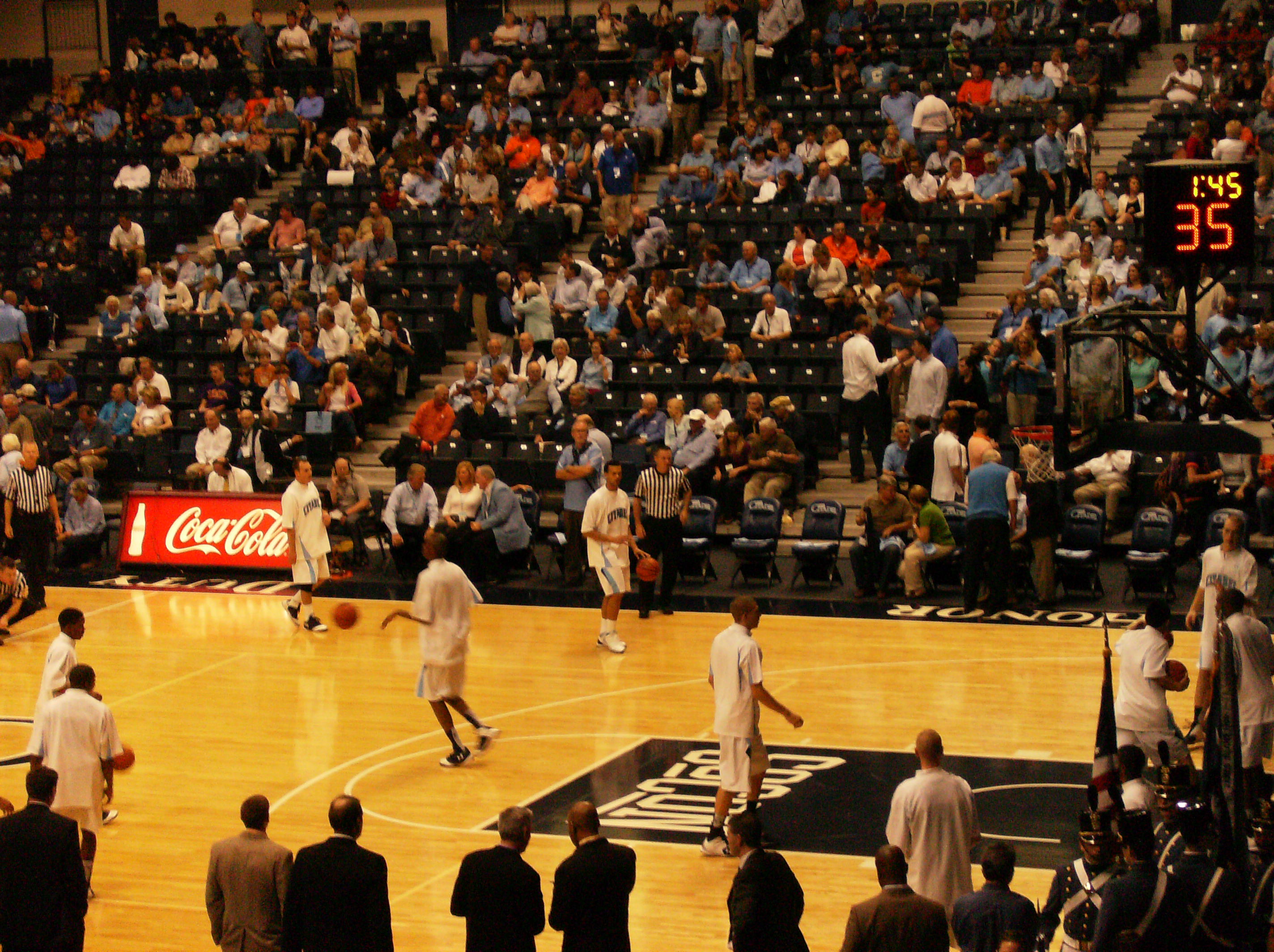
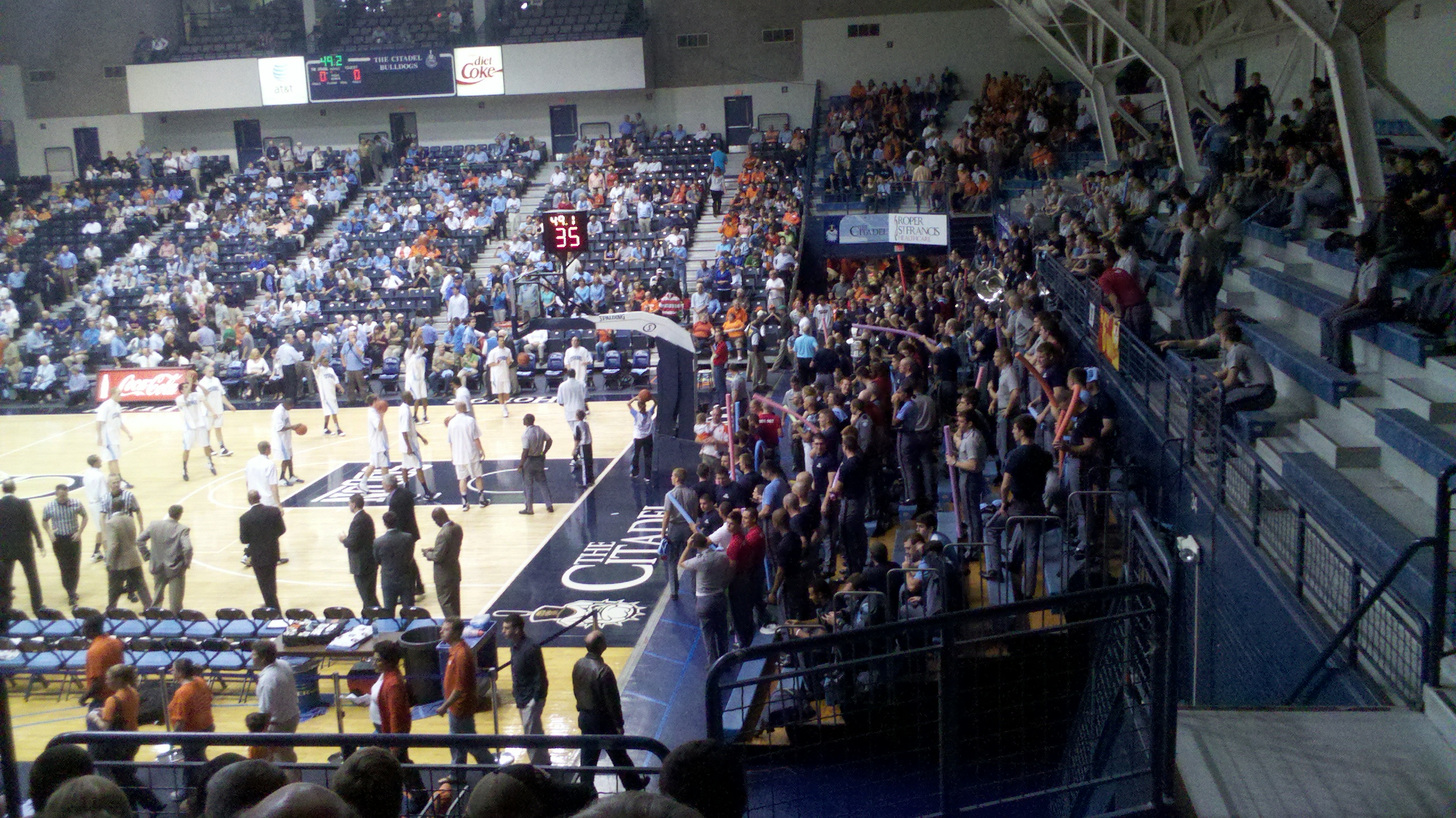
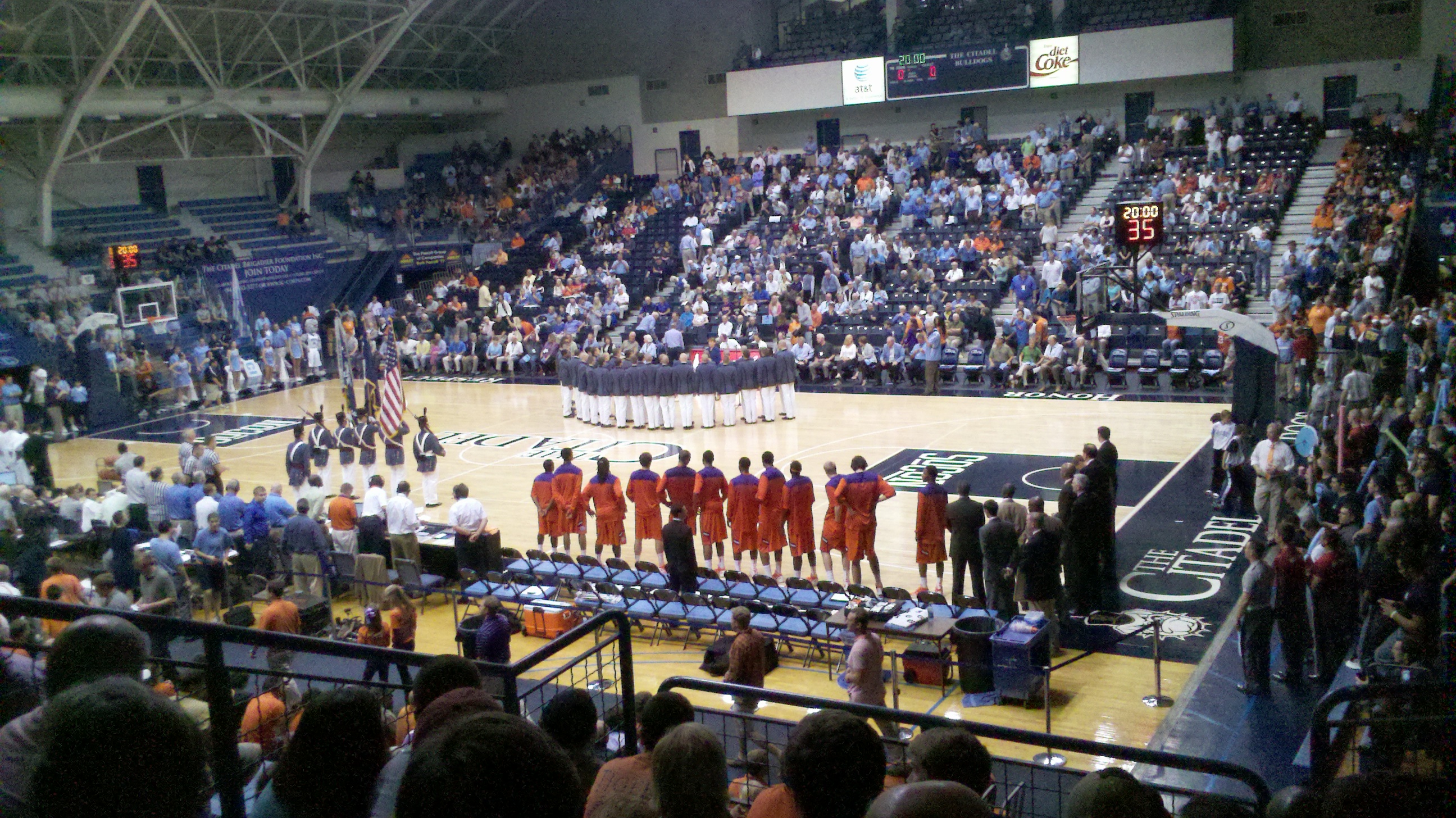
— I was at McAlister Field House for the Clemson game. So were lots of Clemson fans. I would say almost half the fans in attendance were wearing orange. That’s okay (for now), though. We’ll gladly take their money. I took a few pictures. As always, keep in mind that I’m a less-than-scintillating photographer with an iffy camera, which is one reason you won’t see any action photos. All the pictures are from the pregame scene.

Hoops update: The Citadel returns home to host Clemson

The Citadel vs. Clemson, 7:00 pm Wednesday, November 16, 2011, at McAlister Field House. The contest will be broadcast on the ESPN3.com platform, with Darren Goldwater calling the game alongside analyst Dean Keener. The game can also be heard on WQNT-AM 1450 in Charleston, with “voice of the Bulldogs” Danny Reed describing the action. That audio is also available online via Bulldog Insider.

The Citadel opened the 2011-12 campaign by splitting a pair of games at the All-Military Classic in Colorado Springs. The Bulldogs lost 103-100 to VMI in their opener before coming back from 20 points down in the first half to defeat Army, 83-72.

The two games were essentially played on the same day, at least if you were on Eastern Standard Time, which to me made the comeback against the Bulldogs of the Hudson that much more impressive. Army is not a good team (projected to finish last in the Patriot League), but any D-1 win at this point of the season with a squad as young as The Citadel’s has to qualify as a good win.

The Bulldogs had a chance to win both games, but could not overcome a bad start against VMI. The Keydets led by as many as 16 points in the first half before The Citadel made a run to cut the lead to two. VMI scored two late baskets to take a six-point lead into the break, and continued to increase its lead throughout the second half, actually leading 98-83 with less than four minutes to play. A furious rally by the Bulldogs fell just short.

Obviously, The Citadel needs to avoid falling behind by so many points early in the game. While the Bulldogs were able to rally past Army, that’s not something they will be able to do on a regular basis.

The game against VMI was televised by CBS Sports Network, with Roger Twibell calling the game alongside analyst Pete Gillen. In the first half, Lefty Driesell joined them via telephone for a five-minute interview segment.

Listening to Pete Gillen have a conversation with Lefty Driesell gave me a renewed appreciation of the versatility of the English language.

The star for the Bulldogs over the two games was, not surprisingly, Mike Groselle, who was named the Southern Conference Player of the Week for his efforts. His totals were great, and perhaps even more promising going forward, Groselle played 68 minutes over the two games. Considering that was at altitude, over a period of less than 24 hours, and that 37 of those minutes came against VMI and its racehorse style of play, any questions about his conditioning and general endurance have been answered.

Tangent: In its game release, The Citadel listed players who had three or more consecutive double-doubles (Groselle has now had three straight such games on two different occasions). I am surprised not to see Gary Daniels’ name on this list. I would have thought he had probably done that at least once during his career at The Citadel.

Groselle wasn’t the only player who excelled in Colorado. DeVontae Wright rebounded from a tough night against VMI (1-7 FG) and had an outstanding game against Army, scoring 26 points on just 12 shots from the field (he was 8-8 from the line).

Eleven Bulldogs played in each contest, and all of them scored against VMI. Ten of them got in the scoring column against Army (C.J. Bray was the exception, though he did have four rebounds in that game). Cosmo Morabbi attempted one three-pointer against Army, and made it, the first three he had made since the 2009-10 season (he had missed a number of games last year due to injury). I hope that is a sign of things to come for Morabbi. Bo Holston had 12 points and 7 rebounds in that game.

Lawrence Miller provided a spark against VMI, going 4-5 from three-land and scoring 14 points. Marshall Harris III had 11 points and 9 assists against the Keydets, and Ashton Moore added 10 points and 5 assists in the same game. The Bulldogs had four players come off the bench to score in double figures against VMI, as Barry Smith scored 12 points in 16 minutes of play.

Offensively, there wasn’t much to complain about in the first two games. The Citadel shot the ball well from the field and the line, made a decent percentage of threes (without taking too many), and did not commit an avalanche of turnovers. The assist-to-basket ratio was good, particularly against VMI. Groselle could use a little help on the offensive boards, though.

The defense needs to get better, however. The Bulldogs struggled defensively last season, and must improve on that side of the court to compete in the Southern Conference. The Citadel gave up 103 points to VMI on an estimated 85 possessions.

Thanks to a strong second-half effort, the numbers were better against Army, but the Bulldogs needed as many stops as they could get in the second half after giving up 49 first-half points. The Citadel did a much better job defending the three in that second frame; Army was 6-8 beyond the arc in the first half, but only 1-13 thereafter.

It has been a while since The Citadel defeated a “BCS team” in basketball. Indeed, the Bulldogs have lost 55 consecutive games to schools currently in a BCS conference, and 81 of their last 82. The lone victory in that run came near the end of the 1988-89 season, when The Citadel memorably defeated South Carolina in Columbia, 88-87. The Gamecocks actually made the NCAA tournament that year, so it’s not like the Bulldogs took advantage of a bad team.

The last time The Citadel beat Clemson? 1979, at McAlister Field House. The Bulldogs won 58-56, one of twenty victories for The Citadel in that particular campaign, the first time the school had ever won that many games in a season (and only matched once since then, three years ago).

Interesting note: the Bulldogs’ last two victories over BCS schools came against South Carolina and Clemson. Randy Nesbit was the head coach when The Citadel beat the Gamecocks, and a player when the Bulldogs defeated the Tigers. In fact, Nesbit hit the game-winning shot against Clemson in 1979.

Last year at Littlejohn Coliseum, Clemson defeated The Citadel 69-54. Mike Groselle had 14 points and 10 rebounds (five of them offensive boards) in that game.

Milton Jennings of Clemson, who went to Pinewood Prep in Summerville, also had a double-double in that game despite playing only 18 minutes; he’s an expected starter for Wednesday’s game. Jennings also had a double-double at Duke, on the Blue Devils’ Senior Night. The junior was a McDonald’s All-American, and he may be just starting to realize his potential.

Other Tigers who will start or see major action include sharpshooter Andre Young, who can fill it up despite being only 5’9″, freshman guard T.J. Sapp, and 6’5″ swingman Tanner Smith. Jennings will be joined in the frontcourt by Devin Booker, a decent jump shooter with nice touch around the rim. He’s a good rebounder as well. Jennings and Booker will be a formidable challenge for the Bulldogs’ big men.

The Tigers were a solid defensive club last year under first-year coach Brad Brownell. They held their opponents to an eFG% of 45.6, 25th-best nationally, and also forced turnovers at an impressive clip. Clemson occasionally struggled keeping opponents off the offensive boards.

Notable stat: the Tigers led the ACC in free throw shooting, which for many observers was disorienting.

Clemson played another group of Bulldogs, Gardner-Webb, in its opener. That game was tied at the half, 29-29, after G-W overcame a 13-point deficit. The Tigers broke out early in the second half, though, and reasserted control of the game, cruising to a 65-44 victory. Young was 7-9 from the field (3-4 3FG). Clemson also got 11 points from Sapp and a career-high 14 rebounds from Smith.

This will be the Tigers’ first visit to McAlister Field House since November 28, 1989. That was a big night for McAlister, as it was the first game played in the venerable arena since it had closed for remodeling two years earlier.

I was at that game, won by the Tigers 71-54 (the game was more competitive than the final score suggests). Clemson’s team featured both Elden Campbell and Dale Davis. On that particular evening, Campbell was average, but Davis was tremendous, impressing everyone in the building with his athleticism and skill.

It should be a fun night at McAlister Field House. I enjoyed the commercial The Citadel produced to promote the game. I hope a big crowd is there to “Pack the Mac”, as Chuck Driesell so eloquently put it.

The Citadel hoops it up: Basketball 2011-12

Yes, it’s basketball season!

Last year, there was a good deal of anticipation for Bulldogs basketball, as a senior-laden team was expected to contend for league honors, or at least compete in the upper echelon of the Southern Conference. It didn’t quite work out that way, to say the least.

The Citadel finished 10-22, 6-12 in the SoCon. The Bulldogs lost nine of their last ten games, and did not win a home game after January 22. Times were tough at McAlister Field House.

New coach Chuck Driesell wanted to play a more uptempo style, but the players seemed to have trouble adjusting after playing in Ed Conroy’s more deliberate system. In truth, though, The Citadel still played last season at a slower tempo than all but 35 schools in Division I. It wasn’t quite as slow as the year before (when the Bulldogs’ pace of play was in the bottom ten nationally), but it wasn’t exactly racehorse-style ball.

The raw numbers don’t necessarily reflect it, but once adjusting for tempo it is clear that much of The Citadel’s struggles, at least from a statistical perspective, came at the defensive end of the court. The Bulldogs allowed 1.112 points per possession, which ranked in the bottom 40 nationally (all numbers in this section per Pomeroy). The Citadel forced very few turnovers and allowed opponents to convert a way-too-easy 53.7% of all two-point baskets.

Given those statistics, it shouldn’t surprise anyone that the Bulldogs also fared poorly in categories like steals per game and blocked shots (though I can’t remember the last time The Citadel had a legitimate shot-blocker; it was probably back in the BRK days).

The team clearly suffered from the lack of a bigger presence in the post (two years after Demetrius Nelson had graduated, he had still not been effectively replaced). Another issue was a shortened rotation, as Chuck Driesell elected to go with just seven players (for the most part) over the latter part of the season. It’s my opinion (one shared by a number of other observers) that Bulldog hoops squads have a tendency to wear out over the course of a campaign, thanks to the rigors of the basketball schedule combined with the “being cadets and students too” thing.

Now most of the regulars from last year’s team are gone, and gone with them is a lot of experience (77% of the minutes played from last season). That experience provided the overwhelming majority of the team’s points (three career 1,000-point scorers, including alltime leading scorer Cameron Wells), three-point shooting (98.7% of all made threes, including career leader Zach Urbanus), and assists (83% of last year’s total).

Given all that, it’s not entirely surprising Driesell stated that “it almost feels like this is my first year.” He has had to do what Ed Conroy did four years ago, basically. Like Conroy, Driesell brought in an eight-man freshman class in his second season.

First, though, it’s worth noting the players from last season who are back, particularly 6’8″ junior forward Mike Groselle, who should be one of the SoCon’s best returnees. Groselle is a model of efficiency who shows particularly well in “advanced stats”, including effective FG% (60.1).

That would have been good enough for third in the SoCon among players who played at least 60% of their team’s minutes; Groselle narrowly missed that standard (59%). It will be important for him to play more minutes this season (he averaged just over 24 minutes per game last year).

Groselle also ranked in the top 10 in the conference in both offensive rebounding percentage and defensive rebounding percentage. With more playing time and a little more range on his shot, I think he would be a good match for Wofford’s Noah Dahlman over the last two years — in other words, a first-team all-league player and a candidate for player of the year. I’m not the only person who thinks Groselle could have a good year; College Basketball Prospectus suggested he “could be a trendy mid-major name four months from now.”

The lone senior on the Bulldogs’ roster is 6’2″ guard Cosmo Morabbi, who had an injury-plagued junior campaign after breaking his finger in the weight room. Morabbi was the player who I thought might benefit the most from a more-uptempo system, so his injury was doubly disappointing.

Before he got hurt, though, he had struggled with his shot. Morabbi is at his most effective when he is a threat from distance, especially the corner three-ball. He was 2-4 from beyond the arc in The Citadel’s exhibition victory over Tennessee Wesleyan, hopefully a good sign.

DeVontae Wright is a sophomore guard from Goose Creek who will have a chance to play more this season, provided he improves, among other things, his assists-to-turnovers ratio. He scored 13 points in 26 minutes of action in the exhibition game.

Bo Holston is a 6’4″ forward who is more of a 3-man; he was placed in the role of the 4 at times last season, a tough assignment. Holston is an “energy guy” who started 13 games last year.

There are a few other players returning from last year who may feature in the rotation. You never know when someone will suddenly get in the mix, as Holston did last season, or as John Brown did three years ago.

Driesell’s eight freshmen are a diverse lot, at least in terms of hometowns. He brought in eight players from seven different states (two are from North Carolina). The general consensus seems to be that the globe-trotting coach brought in a class with some athleticism, but which in at least a couple of cases will need time to develop.

I’m not going to pretend to know much about any of these guys. I also did not see the exhibition game (link: box score) in person, so I’m at a disadvantage in that respect as well. I’ll make a few comments anyway. Hey, it’s my blog…

C.J. Bray is a 6’7″ forward from Charleston (James Island High School) who turned down a football scholarship from Arkansas to plays hoops at The Citadel. At the very least, he should be an athletic presence down low. He started against Tennessee Wesleyan and played 19 minutes, scoring six points.

Ashton Moore is a 6’0″ guard from Virginia. He was the breakout star of the night in the exhibition game, going 6-10 from 3 and scoring 21 points. He also played 30 minutes, more than any other player.

When Moore wasn’t hitting from downtown in the exhibition, fellow freshman guard Lawrence Miller (4-7 from 3-land) was. The 6’1″ Miller is from Charlotte.

Marshall Harris is a 6’1″ point guard from San Antonio. He only played ten minutes in the game against Tennessee Wesleyan, but dished out five assists. I would not be surprised if his playing time increases once the season begins.

P.J. Horgan is a 6’8″ post player from New Mexico. The Blue Ribbon preview was high on Horgan, noting he led his high school team to the state semifinals and was second team all-state. He grabbed four rebounds in ten minutes of play against Tennessee Wesleyan.

Driesell didn’t skimp on signing size. Another example of that is 6’7″, 232 lb. Jordan Robertson, of Greensboro, NC. Robertson did not score in the exhibition game, but did reel in seven rebounds in 16 minutes of play.

Two other freshmen did not play against Tennessee Wesleyan. Dylen Setzekorn is 6’7″, but more of a swingman than a post player (at least, that’s my understanding). He’s described by Driesell as being a good shooter.

Michael Hundley is the tallest of the newcomers, at 6’9″, but only weighs 178 lbs. (according to his roster page on the school website). In the Blue Ribbon preview, Driesell said that Hundley “could be the sleeper of the bunch. He’s long and athletic and could be an excellent shot blocker. He’s got a chance, although he might need a year.” That suggests Hundley may be a redshirt candidate.

As expected, The Citadel is not expected to contend in the Southern Conference this season. The SoCon media picked the Bulldogs to finish last in the South division. College Basketball Prospectus rates The Citadel as the 10th-best team in the league (ahead of Georgia Southern and Samford). Ken Pomeroy’s preseason ratings rank the Bulldogs lower than any other team in the conference (298th in the nation). The Sagarin ratings are a little kinder, ranking The Citadel ahead of three other SoCon squads.

Blue Ribbon’s preview noted that it was “hard not to pick the Bulldogs at the bottom of the South Division because they have so little experience.” The Post and Courier also predicted a last-place division finish for the Bulldogs.

It’s hard to argue with those predictions and assessments, given The Citadel lost so much experience from a team that lost 22 games anyway. On the other hand…

One thing working in the Bulldogs’ favor is that The Citadel is not the only team that lost a lot of players. The College of Charleston lost three starters, including alltime leading scorer Andrew Goudelock and Jeremy Simmons, a key cog in the Cougars’ rotation. Wofford lost four starters, including Noah Dahlman (the best player in school history) and hardnosed rebounder Tim Johnson. Furman lost four starters too; one of them was All-SoCon forward Amu Saaka. That’s just from the South division.

The various polls and previews had a hard time trying to figure out the order of the SoCon South after the top two spots (Davidson and the CofC). While Wofford, Furman, and The Citadel all suffered heavy graduation losses, Georgia Southern only lost one starter, and also has Willie Powers III (an excellent scoring point guard) coming back after missing last season with a knee injury.

No one seems really confident in the Eagles, though. Part of that may have to do with Powers’ extensive injury history, but much of it is based on the fact that while GSU brought back a lot of players, those players only managed to win two Division I games last season (one of those, alas, was against The Citadel).

In other words, the SoCon South is wide open, other than the top spot (where Davidson seems to be a solid pick to not only win the division, but the league) and maybe second place (with the College of Charleston bringing in highly-regarded recruit Adjehi Baru).

As far as the rest of the conference is concerned, the SoCon North in general has more returning talent, and is perceived as being more settled as the season begins, with snakebitten Samford (literally!) a consensus choice to finish last (and that was before the Birmingham Bulldogs lost their starting point guard for the season with an achilles’ tendon injury).

Chattanooga is the favorite in the North, and generally considered the second- or co-favorite for the league title (with Davidson), though not everyone is on the Mocs’ bandwagon — notably the Pomeroy preseason ratings. Omar Wattad will fire from three-land all night long, sometimes forgetting the rules allow him to shoot two-pointers too. Keegan Bell is a fine point guard who will be first team all-SoCon if his field goal percentage improves.

Appalachian State lost alltime leading scorer Donald Sims, yet some observers think the Mountaineers may be better off. Ike Butts’ return is a major reason why; not every SoCon team has a viable post player who is 6’10”, 280 lbs. Omar Carter is the league’s leading returning scorer and a player of the year candidate.

Western Carolina brings back a solid squad as well and may be a nice dark horse pick. The Catamounts finished last season strong, winning 14 of their last 19 games. UNCG will play a slightly more reasonable non-league schedule this season, which should help the Spartans avoid another 0-15 start. Elon is a sleeper pick in some precincts, although the Phoenix may be a year away.

I think it’s likely The Citadel will have some hard times on the hardwood this season. However, the Bulldogs won’t be the only league team in that position, and if some of the freshmen can contribute early and provide a helping hand to Groselle and co., it wouldn’t be a surprise to see The Citadel have a better year in the league than expected.

I do believe that with more of his own players, Chuck Driesell will be able to fully implement his style of play. I am also hopeful that he will have a deeper rotation, which would help the team avoid the late-season stumbles that have habitually plagued the program.

At the very least, the defense (particularly in the paint) should improve. Offensively, besides shooting the ball well (obviously), I would like to see the Bulldogs make a concerted effort to get to the free throw line more, which has been a problem for the last three seasons.

Odds and ends:

— I’ve been asked to contribute to a kind of roundtable discussion about the league this season. This is going to be a weekly thing for the most part. The first edition for this season has been posted to a Chattanooga blog, Mocs Mania, and can be found here:  Link

— From what I can figure out, The Citadel will only appear on television once in 2011-12 during the regular season, and that will actually be in the season opener against VMI, in the All-Military Classic in Colorado Springs, Colorado. That game will start at 11:59 pm ET on Friday, November 11, and is being televised by the CBS Sports Network (not to be confused with CBS). The announcers will be Roger Twibell and Pete Gillen. With any luck, Gillen will try to call timeout at least twice.

The Citadel’s home opener against Clemson will be broadcast online, on ESPN3.com, as part of the SoCon’s season package on that platform. It appears this will be the only time the Bulldogs appear on the package.

It is possible (though not likely) that other games will be picked up for TV and/or ESPN3.com at a later date.

— The new tagline for the season is apparently “Pack the Mac”. I hope that venerable McAlister Field House is indeed packed this season (I am sure it will be for the opener). I would like to see an increased cadet presence this year as well.

I’m ready for the season. Very ready.

Schools that have never made the NCAA Tournament — the 2011 Edition

Updated: The 2016 edition

Now updated: the 2015 edition

Editor’s note: this post is from 2011. For the 2014 update, click here.

For the 2013 update, click here.

For the 2012 update, click here.

It’s conference tourney time, and that means it’s time to see if there is a chance that a longtime D-1 school with no NCAA tournament history will finally get its moment in the sun.

Last year I wrote about the twenty schools with the most years in Division I basketball without an NCAA tournament appearance.  There are other schools out there that have gone a long time waiting for a return invitation, like Harvard (which participated in the 1946 tournament) or Rice (which has made four tourney appearances, but none since 1970).

However, I’m only discussing those schools with no NCAA D-1 tourney history.  At least Harvard and Rice (and Dartmouth and Columbia, two other longtime absentees) have played in the event.  Imagine rooting for a team that has never been to the Big Dance, even before it was called the “Big Dance”.  Unfortunately, I don’t have to imagine it…

Last year I briefly outlined the chances of each of the twenty longest-waiting schools finally breaking through.  Alas, none of them did, so it’s the same group of twenty this season.  I guarantee the list will change next year, though, but only because this is going to be Centenary’s last season as a Division I school. (After this year’s tournament is over, UMKC will be the next school on the clock, unless the Kangaroos pull a stunner in the upcoming Summit League tourney.)

As always, the evaluation starts with the Forgotten Five (the five schools that have never made the NCAAs despite being members of Division I since the modern re-classification of the division in 1948).  Records listed are as of February 28:

— Northwestern:  At the beginning of the season, there was a buzz that this might be the year the Wildcats made it.  Instead, Northwestern is 16-12 and currently sits in ninth place in the Big 10.  It’s not going to happen this year.

— Army:  The Bulldogs of the Hudson have lost 18 games and are in last place in the Patriot League.  Things do not look promising.

— St. Francis (NY):  The Terriers have a winning record (15-14) and finished the regular season in fifth place in the NEC.  It’s been one of SFC’s better campaigns in recent years.  It’s unlikely the Terriers make a run in the league tourney, but it’s worth keeping a half-closed eye on the team.

— William & Mary:  With 21 losses and in next-to-last place in the CAA (behind only woeful Towson), I think the Tribe is going to have to wait another season.  William & Mary was a lot more competitive in the previous two years, but its window of opportunity for making the NCAAs appears to have closed, at least for now.

— The Citadel:  There were hopes prior to the season that the Bulldogs could make some noise in the SoCon.  Instead, new coach Chuck Driesell has presided over what is arguably the most disappointing season in school history.  Now, The Citadel has to win four straight games in the league tournament.  What are the chances of that happening?  Not good.

St. Francis looks like the best hope out of the Forgotten Five, but that’s mostly by default.  What about the rest of the schools in our group of 20?

— Centenary (NCAA Division I member since 1960):  Sadly, Centenary finished its five-decade run in D-1 with no NCAA tournament appearances.  The school is moving to Division III next season.  The Gents were 1-29 this year, with the sole win coming in the next-to-last game of the season.  There will be no Summit League tournament, so Robert Parish’s alma mater is done in D-1.

— New Hampshire (class of 1962):  The Wildcats, 12-17 overall, finished seventh in the America East after losing their last three games.  UNH is 344th in the country in field goal percentage, just additional evidence that suggests New Hampshire is not a team capable of springing a big surprise in the AE tournament.

— Maine (class of 1962):  The Black Bears may have peaked too early.  Maine won seven straight games in the month of January.  Then the team lost six straight in February.  The Black Bears are 15-14 and finished third in the America East.  It’s not inconceivable Maine could make a post-season run, but a big change in momentum would be required.

— Denver (D-1 from 1948 to 1980, then back to the division in 1999):  The Pioneers are 13-16 overall but did manage a winning record in the Sun Belt (9-7).  Denver has to rebound better to have any chance of running the table in the league tourney, though; the Pioneers are last in all of D-1 in rebounds per game (23.9).

— UT-Pan American (class of 1969):  The Broncs are 5-23 and finished last in the Great West, a conference that doesn’t even have an automatic bid.  So much for that.

— Stetson (class of 1972):  The Hatters lost 12 of their last 14 games to finish 8-23 overall.  Stetson failed to qualify for the Atlantic Sun tournament, so the dream is dead for another year.

— UC Irvine (class of 1978):  UCI is only 13-17 overall, but has won its last two games, both in double overtime.  The Anteaters feature Mike Wilder, a first team Afro All-American.  I could see UCI doing some damage in the Big West tourney.  Whether it’s capable of doing three games worth of damage is another question.

— Grambling State (class of 1978):  Hey, Doug Williams is back as head football coach again!  Good thing, too, because at 8-19, the basketball team isn’t getting a lot of positive press.  On the other hand, the Tigers do play in the SWAC, so winning the league tourney can’t be completely ruled out.

— Maryland-Eastern Shore (D-1 in 1974 and 1975, and then for good in 1982):  The Hawks are 7-21 overall and tied for last in the MEAC.  This isn’t going to be the year.

— Youngstown State (D-1 in 1948, back again in 1982):  The Penguins have lost 20 games and are tied for last in the Horizon League.  This isn’t going to be the year.

— Bethune-Cookman (class of 1981):  Whoa, a team in first place in its league?!  The Wildcats, currently 18-11, have in fact clinched the MEAC regular season title.  B-C did lose its sole meeting with Todd Bozeman’s Morgan State squad, but at the very worst an NIT bid is in the cards…and look — that’s Cy McClairen driving the bandwagon!  (Why not, he did everything else at the school.)

— Western Illinois (class of 1982):  I think the season for the Leathernecks can be summed up in eight words: “this is the team that lost to Centenary.”  Like the Gents, WIU did not qualify for the Summit League tournament.

— Chicago State (class of 1985):  Earlier in this post I noted that UT-Pan American is 5-23 and plays in the Great West, a league without an automatic bid.  The difference between Chicago State and UTPA?  The Cougars are 6-23.

— Hartford (class of 1985):  The Hawks contributed one of the season’s worst box scores in a loss to Stony Brook.  Hartford isn’t quite that bad, and actually beat Stony Brook in the rematch.  However, a team that can’t shoot (bottom 10 nationally) or rebound (bottom 50 nationally) probably isn’t going to shock the world in the league tournament.

— Buffalo (class of 1985):  The Bulls have just missed making the NCAAs a couple of times in recent years.  Buffalo is currently 16-11 with two MAC league games left before conference tourney play begins.  The Bulls likely will have to win four games in the MAC tourney, which is a tall order, but there isn’t a dominant team in the league, so you never know.

It looks like Bethune-Cookman has by far the best shot of making the big show out of the twenty schools.  Maine, Buffalo, and possibly St. Francis have not completely unreasonable chances.  For the rest, the chances are slim and none, like they are most every year.

Someday, though, that moment of triumph will come.  Uh…right?

Bulldog hoops: the most disappointing season

The Citadel’s last victory on the hardwood came at Davidson, on January 26.  As this post is going up on February 20, that is a problem.  The Bulldogs have lost seven straight games, with two regular season road games remaining before the Southern Conference tournament.

It is not out of the question that The Citadel could finish the season on a ten-game losing streak.  The last time the Bulldogs ended a season with a double-digit losing streak was 2005, when Pat Dennis’ team started 12-5 before losing its last eleven contests.

This is not what most people were expecting when the season began.  The Citadel returned many experienced players, including three mainstays (Cameron Wells, Zach Urbanus, and Austin Dahn) in its rotation.  While picked to finish fourth in the South Division of the SoCon in the preseason, many people expected at the very least a winning campaign, and possibly something more than that.

I was one of those people, as I thought The Citadel could win 17 or 18 games.  The Pomeroy Ratings also projected the Bulldogs to win 18 games.

It has been a tough season for new coach Chuck Driesell.  After a four-game winning streak pushed the Bulldogs to a still-not-great 9-13 record, the bottom seemed to fall out of the campaign.  Five of the seven losses in the recent run were at home.  Two of the defeats were particularly awful (Savannah State and the recent loss at Georgia Southern).

Driesell hasn’t had a lot go his way, but I think his decision to shorten his rotation to just seven players, which initially resulted in some impressive victories, ultimately torpedoed the season.

The Citadel has traditionally struggled at the end of basketball seasons, a phenomenon Jeff Hartsell of The Post and Courier recently called “getting heavy-legged” while speaking on the ‘Citadel Grayline’ radio program.  These end-of-year collapses are generally ascribed to the difficulties of competing in a long sport season while fulfilling the duties associated with being a cadet.

The historical numbers for the Bulldogs bear out the fact that it has been a problem. Just look at the last six years before this one, for example:

— 2010:  finished 16-16 after losing four of their last five games

— 2009:  finished 20-13 after losing three of their last four games (following an 11-game winning streak)

— 2008:  lost 18 of their last 19 games (of course, that team only won six games all year)

— 2007:  lost 12 of their last 13 games (a seven-win team)

— 2006:   lost 18 of their last 22 games (a ten-win team)

— 2005:  as mentioned above, lost 11 straight to finish 12-16

You can find more years like those, even when concentrating on some of the more respectable teams (like 1998, when the Bulldogs lost six of eight to finish 15-13).  The best evidence of “tired legs”, of course, is The Citadel’s stupefying lack of success in the Southern Conference tournament; even though the Bulldogs haven’t had that many good teams over the years, you would have thought The Citadel would have gotten lucky in the league tourney once or twice.  Nope.

Wells, Urbanus, and Dahn have combined to play over 82% of the minutes available to them over the last four years, which is amazing.  What’s not amazing is the rough finishes the team has had, perhaps as a consequence of that.  The trend has continued this season.

In conference play Urbanus has averaged over 38.5 minutes per game, tied for first in the league.  Wells is fourth in the league in minutes, with 36.5 per contest, while Dahn is 14th (32 mpg).  Early foul trouble in a couple of games is the only reason Wells and Dahn haven’t played even more (Urbanus, on the other hand, is one of two players in the entire country averaging less than one foul per forty minutes of play).

Driesell has tried expanding his rotation as the losing streak has continued, although he’s been hamstrung by Cosmo Morabbi’s injury and the general ineffectiveness of the two transfers he brought in for this season (Morakinyo Williams and Mike Dejworek).

I wish that Driesell had decided to wait a year before fully implementing his system. The current roster is obviously built for Ed Conroy’s slower-tempo style of play.  It has been frustrating to watch a team struggle so when it features seniors like the school’s alltime leading scorer and assist man (Wells), career three-point shooting leader (Urbanus), along with a versatile four-year starter (Dahn) and a handy post defender/offensive garbageman (Bryan Streeter).

Then you have the emergence of sophomore Mike Groselle, who has been a revelation in terms of offensive efficiency.  Yet with all that, the team is 9-20, and not by a fluke, either.  No, this is a team that has never put it together on either side of the court, save for that one four-game run in the middle of the season.

For most of the year, The Citadel has lacked an offensive identity and has been poor defensively.  I suspect the offensive problems have contributed to the defensive woes; that is the nature of the game.

I feel badly for the team’s seniors, who I think deserved to go out on a much better note, but at least they will always have memories of the 2009 season, one of the finest in school history.  I am glad they chose to come to The Citadel; it’s one of the best hoops classes the military college has ever had, if not the best.

As for Chuck Driesell, I certainly haven’t given up on him.  He’s got some work to do, however.  Next year’s recruiting class is supposed to be quite good, and Driesell has a well-deserved reputation as a solid talent evaluator.  Now he has to put that talent together (and keep it, never an easy thing at The Citadel).

Driesell seems to prefer outstanding athletes, which is fine, but he must also find room in his system for players like Groselle, whose eFG% in conference games is currently second in the league.  Groselle has a 66.9 FG% in SoCon play and a 3.7 GPA in Civil Engineering;  The Citadel needs as many players like that as it can get, whether they can jump or not.

Regardless, this season has to go down as the most disappointing season in the modern history of The Citadel’s basketball program.  Admittedly, that’s in part because it was the rare season where expectations were fairly high.  That doesn’t make it any less deflating, though.

Bulldog hoops: whoa, a real live winning streak

Well, in my last post I said it was time for The Citadel to go on a winning streak, and lo and behold the Bulldogs have delivered.  It’s a modest three-game stretch, to be sure, but it’s still two games longer than any previous winning streak the team has had this season.

Chuck Driesell is now employing a seven-man rotation.  He has elected to play mostly zone on defense, with a 1-2-2 as his primary look, although I guess you could call it a 3-2, or even a 2-3, depending on what the “point” defender does.  (In his postgame wrapup with Darren Goldwater after the Western Carolina game, Driesell was amusingly vague about the defense, as if he were concerned a future opponent was listening to the broadcast.)

Bo Holston or Austin Dahn seem to play that point spot the most.  They are both athletic and active, fairly long-armed defenders, so that makes sense.  My concern with the zone is that it tends to give opponents opportunities to create open three-point shots, but so far The Citadel has watched Samford, Appalachian State, and Western Carolina go a combined 15-70 (21.4%) behind the arc.  Donald Sims (of the Mountaineers) and Andy King (of the Birmingham Bulldogs) each went 4-8 from three-land; the rest of their teammates (and Catamounts) shot less than 13% from outside.

One of the things the zone has done, though, is slow the opponents down (well, Appy and WCU — Samford doesn’t need any help to slow things down).  I thought the Mountaineers and Catamounts were both lethargic on offense, especially in the first half.  To have success against the 1-2-2, you have to be patient, but you can’t be static. The players on those teams didn’t move particularly well without the ball, and the passing was less than crisp.

Sims (who was outstanding) was the only reason Appalachian State was not completely embarrassed in the first half.  Western Carolina wasn’t so lucky.

On the other side of the ball, I thought the Bulldogs played to their strengths.  There weren’t nearly as many contested shots taken early in the possession; the team usually worked the ball around until A) Mike Groselle got position inside; B) Cameron Wells saw an opening and took it; or C) Zach Urbanus got an open look for a three.

The best example of this was Austin Dahn’s game against Western Carolina.  Dahn got to 1000 points in his career at The Citadel in that game, which in my opinion was his best game of the season.  He didn’t take a single bad shot, and as a result scored 13 points on only 6 field goal attempts, an outstanding efficiency rate.

Dahn can be an effective offensive player because while he’s capable of making three-pointers, he has what I call a “semi-slash” type of game overall.  When he doesn’t take shots out of the offense’s natural rhythm, it can be tough for the opposition to account for him, what with it already having to deal with Wells and his driving ability, Groselle’s inside play, and Urbanus’ three-point shooting acumen.

Speaking of efficient play, Groselle’s breakout season has continued.  He was relatively quiet against Samford, but against Appy and WCU he was a combined 16-21 from the field.  Oddly, he only attempted three free throws in those two games, but I suspect he’ll start getting to the line more often if he keeps up his current Southern Conference shooting pace (72% FGA).  Also, Groselle’s teammates are getting better and better at finding him when he gets the little angles and creases that give him the upper hand in the paint.

Cameron Wells in the three victories:  68 points on 41 FGA (15-16 FT), 13 assists, 5 steals.  Alas, he also has 13 turnovers in those three games.  Other than that, he’s been the All-SoCon player we all know and appreciate.

The Bulldogs as a team were on their way to their best offensive performance of the season against WCU, but an alarming flood of second-half turnovers took care of that. The Citadel scored 43 points on 33 first-half possessions, but only scored 25 in the second half on 36 possessions, which is what happens when you have 14 second-half turnovers.  Luckily the Catamounts’ first-half miseries included scoring just 15 points on 33 possessions.

Against Appalachian State, on the other hand, The Citadel scored 81 points on just 64 possessions, the season’s top offensive effort.  This included shooting 62% from the field (Holston was 7-7).  Zach Urbanus was 5-8 from three-land in his best shooting performance to date.

The seven-man rotation does have a downside.  Because Cosmo Morabbi is injured and DeVontae Wright is apparently not quite ready yet for significant action, Wells and Urbanus in particular are having to log heavy minutes in the backcourt, which I think partly explains the turnover problems.  (It’s also a reason to play zone defense, as it helps keep them out of foul trouble.)

I hope Morabbi is able to come back and help out before the season ends, as an experienced guard is definitely a commodity the Bulldogs could use.

The Citadel plays Davidson at Belk Arena on Wednesday night before a break in the schedule.  Since 1961, the Bulldogs have only won at Davidson twice.  Two years ago, The Citadel turned the trick against a Wildcat team missing Stephen Curry, although even with Curry, Davidson arguably may have struggled that night (in a 64-46 Bulldog victory).  The game was the tenth of eleven straight wins for The Citadel that season.

Currently, Davidson is reeling, having lost six of its last seven games, including three in a row, but it’s still the same team that beat The Citadel 68-53 in December at McAlister Field House.  In that game, the Wildcats held the Bulldogs to 33% from the field, as the Cadets only made 13 of their 44 2-point attempts (The Citadel actually shot 43% from beyond the arc).

The Bulldogs also committed 18 turnovers and had no real answer for Davidson big man Jake Cohen, who scored 21 points (on only 8 FGA) while collecting 12 rebounds and blocking 3 shots.  Cohen can also hit the three-pointer (he made two in that game).  In other words, he’s a very difficult matchup.

I think The Citadel is playing much better basketball than it was when it played Davidson.  I also suspect Cameron Wells will score more than two points on Wednesday night (he fouled out after 19 minutes in the first game).  That being said, it’s a road game, the Wildcats are always well-coached, and Davidson usually seems to play at least one game each year against The Citadel where it shoots lights-out from outside the three-point line.

It should be interesting.  That’s a good thing.  It’s about time this season got interesting…

Bulldog hoops: time to go on a winning streak

I haven’t written about The Citadel’s hoops team in a while (then again, I haven’t had a blog post about anything in some time; I need to start cranking stuff out again). Honestly, though, there hasn’t been a good reason to write about Bulldog basketball, at least a good positive reason.

At least The Citadel won on Monday night, beating Samford 61-50 for the Bulldogs’ first road victory of the season.  A sign of things to come?  To be honest, I doubt it.

The Citadel is 6-13 overall, 2-5 in the Southern Conference, with home games against Appalachian State on Thursday and Western Carolina on Saturday.  Prior to the Samford win, the Bulldogs had lost five straight SoCon contests.

What is the difference between this year’s edition of the basketball Bulldogs and, say, last year’s squad?  I won’t compare them to the 2008-09 team that won 20 games, which included Demetrius Nelson and John Brown.  However, I think it is fair to compare the 2009-10 and 2010-11 outfits.

Last season’s team featured a rotation mainstay who is no longer in school, Harrison Dupont.  Dupont had a nice debut campaign (alas, there would be no followup season, at least in Charleston), averaging 14 points per 40 minutes of play and finishing with an eFG of 48.2%, highest of all the regulars and highest on the team overall, with one exception.

That one exception was Mike Groselle, who saw limited action due to injury/illness, but showed signs of being a very effective player when he saw action.  It really shouldn’t be a surprise that Groselle has had a fine sophomore season.  So far this year Groselle is averaging 19 points per 40 minutes of play with an eFG of 58.9%, leading the team (again).  That is good for 11th among Southern Conference players.

He is also averaging almost six rebounds per contest (Dupont was good for four boards per game).  Groselle’s FG% of 58.9 is good for sixth in the SoCon.

Groselle’s development has basically replaced the lost production of Dupont, if not surpassed it.  They aren’t really similar players, so it’s not a true like vs. like comparison (particularly from a defensive perspective), but I think it does make it easier to look at the rest of the team numbers and see where the differences lie.

One difference is the reduced contributions from Cosmo Morabbi, who played in all 33 games last season and averaged over 18 minutes per game.  Morabbi has been injured and has missed several games, but even when he was playing, his minutes had been cut in half.

Morabbi has struggled with his jumper this season.  Actually, struggle doesn’t really describe it; he hasn’t made a three-pointer yet this year (0-8) after shooting 37.9% (25-66) from beyond the arc in 2009-10.  In his previous two seasons for the Bulldogs, Morabbi was a dependable member of the rotation who wasn’t afraid to take big shots; not having his typical production has been a problem.

Then there is post play.  Last season Joe Wolfinger was the transfer hopeful who never quite fit into The Citadel’s offense.   However, Wolfinger’s offensive production compares favorably to that of “Big Mike Squared”, the duo of Williams and Dejworek.

Morakinyo Williams has missed time with injury (he has played fewer minutes than Morabbi), and Mike Dejworek hasn’t been a major factor, either.  The two have combined to score 47 points in 219 minutes of play, which per game is about half of the scoring output by Wolfinger last season.  Neither has been a force on the boards.

A few other odds and ends:

— Last season, 36.5% of The Citadel’s total points came via the three-point shot.  So far this year, that number is 23.2%.

— The Citadel’s eFG of 44.5% is in the bottom 50 nationally; last season, the Bulldogs had an eFG of 48.4% (middle of the pack nationally).

— The Bulldogs are not forcing turnovers this season.  Opponents have a turnover rate of 16%.  That puts The Citadel in the bottom 25 nationally. Last season’s opponent turnover rate was 19%. That’s a significant difference.

—  Defensively, The Citadel ranks in the bottom 50 nationally in defensive FG% and defensive 2FG%.  The Bulldogs have a defensive 3FG of 34.4%, which isn’t that bad, but not nearly as good as last season’s 32.4%, which was 80th-best in the country.

— In SoCon play, the Bulldogs currently rank last or next-to-last in defensive 2FG%, defensive turnover rate, and points allowed per possession.  The sample size is a little small, admittedly.

As noted by Jeff Hartsell, Zach Urbanus and Cameron Wells have been logging some serious minutes lately, thanks to a slender bench (Morabbi being unavailable really hurts there).

After a loss to Coastal Carolina earlier in the season, Chuck Driesell mentioned on his postgame radio show that he was worried about fatigue affecting the Bulldogs’ play.

In the SoCon teleconference this week, however, Driesell sang a slightly different tune.  He noted that the loss of Morabbi had impacted his ability to substitute players who had experience, and he also mentioned that a way to address concerns about too much game action for individual players would be to monitor (and presumably lessen) their work during practice.

However, Driesell stated during the teleconference that he saw “no signs of fatigue” and that Wells and Urbanus are “young guys [who] should be able to handle” increased minutes.

We’ll see.

— Six weeks ago, I wrote that the Bulldogs seem to lack an offensive identity.  Here is, to my mind at least, one example of that:

Last season, Zach Urbanus and Austin Dahn each averaged about one three-point attempt every five and a half minutes of playing time (5.7 for Urbanus, 5.6 for Dahn). This season, with an increased number of possessions per game (about five more), Dahn is averaging a three-point attempt every 5.1 minutes he is on the court.  And Urbanus?

He’s only averaging one three-point try every 7.5 minutes of play.

With the increase in tempo, Urbanus is averaging more total shots per contest this season than last year on a per-minute basis, as is Dahn.  Dahn, however, is taking more three-pointers than Urbanus (25 more, even while playing almost 100 minutes fewer than Zach).  Neither is shooting as well from beyond the arc as they did last season (Urbanus is at 36.7% after shooting 41.1% from three last year; Dahn is down from 34.7% to 28.6%).

That may be reflective of how other teams are playing them defensively, or it may be due to a lack of offensive cohesion, or perhaps it’s a combination of both. Regardless, it seems to me that the leading three-point shooter in The Citadel’s history needs to be leading the team in three-point attempts.

This has been a tough year so far for Chuck Driesell.  He’s learned that being the coach of The Citadel’s basketball team is not easy.  He knew that going in, obviously, but there is still a lot of on-the-job training at the military college.  He has to know that a lot of fans are disappointed in the way the season has gone.  There were high expectations for this team, and to date they haven’t been met.

It probably doesn’t help matters that his predecessor, Ed Conroy, is having a nice start to his tenure at Tulane, and recently was featured in a local article describing his salesmanship of the program.  Conroy has benefited from a relatively soft early schedule, but it’s also true that he’s already won two conference games in C-USA, only one fewer than the Green Wave won all of last season.

Tangent: in that article, the writer describes how Conroy somehow talked 80 Marquette students (in New Orleans as part of a volunteer group) into attending a weeknight game between Tulane and UTEP.  How many cadets will attend the Saturday game at McAlister Field House against Western Carolina?

There is still time, of course.  Maybe the win over Samford will be the start of something special.  The two upcoming home games are both winnable.

If Wells and Urbanus are going to play 38-40 minutes every night, it might be best for The Citadel to revert to its slow, slower, slowest style of play from the last two seasons.  Lowering the amount of possessions might serve to reduce the chances of either getting in foul trouble, and also could keep them from running out of gas, either in individual games or over the course of the season.

It also would have the potential of settling down the offense.  I don’t think it would hurt Groselle and Urbanus, in particular, if the tempo were decreased.  Wells (who had a “Cameron Wells game” against Samford, taking over the last 10 minutes of that contest) is capable of thriving in any offensive system.

Slowing the game down also increases the value of offensive rebounds and other possession-changing plays, which is to the advantage of players like Bryan Streeter and Daniel Eykyn.

I’m ready to see a long Bulldog winning streak.  How about eleven straight?  It’s happened before…