Variety Pack: The NCAA’s Seven Sinners, Gonzo’s friend Duke Rice, and the Plant of the Week

It’s the long-awaited latest edition of the Variety Pack, the celebrated TSA series that debuted earlier this year.  The idea is to write briefly (I hope) on two or three different topics without being limited to 140 characters, like my Twitter tweets.

This is one of two holiday Variety Packs; in a week or two I’ll post the other one, which will (probably) feature The Citadel’s role in the modern-day proliferation of college football on television.

Both Variety Packs are inspired by Google Books.  What  I did, basically, is type in some search terms, and see what came up.

In 1948, the NCAA crafted a statute colloquially known as the “Sanity Code”.  The Sanity Code was an attempt to end the practice of awarding athletic scholarships, something many southern institutions had been doing since the early 1930s.

The Sanity Code allowed schools to award scholarships to prospective athletes, but only on a basis of need – and even then the scholarships were limited to tuition and incidental expenses.  Most scholarship athletes would either have to qualify for academic scholarships, or pay their own way, usually by holding down jobs while in school.

This was seen by a lot of the southern schools as an attempt by the “establishment” to keep itself on top of the college athletics pyramid.  The establishment consisted mainly of the Big 10 schools, largely aligned with the Ivy League and Pac-8.  To add fuel to the fire, in those days the Big 10 commissioner also oversaw the NCAA’s daily activities; Walter Byers, later executive director of the NCAA, split time between his NCAA duties and his primary job as the Big 10’s publicity director.

There were myriad problems with the Sanity Code.  It was basically unenforceable.  It was also seen as unfair.  The southern schools had no interest in dropping athletic scholarships, especially when at the same time wealthy Big 10 alums would be giving bogus jobs to football and basketball players with no penalty.

The school most often ridiculed by Sanity Code opponents was Ohio State.  Prior to the 1950 Rose Bowl, it was revealed that at least 16 Buckeye football players had cushy jobs with the state, including a running back on the payroll of the state’s transportation department as a tire inspector.

The Sanity Code was going to allow OSU to do that, but not let SEC or Southern Conference schools offer athletic scholarships.  It’s easy to see why people got upset.

Enter the “Seven Sinners”.  No, I’m not talking about the John Wayne-Marlene Dietrich movie.

In this case, the “Seven Sinners” were seven schools that refused to live a lie, and admitted that they were not adhering to the new statute enacted by the NCAA.  The seven happened to be a very difficult group for the establishment to criticize.  Only one, Maryland, was a major college football power offering a large number of athletic scholarships.  The others were Virginia, Virginia Tech, VMI, The Citadel, Boston College, and Villanova.

For The Citadel, the notion of having athletes work jobs while at the same time go to class, play a sport, and participate in military activities was a non-starter (the same was true for VMI, and to a certain extent Virginia Tech).  The school also questioned the amateur-but-not-really idea of the Sanity Code, with The Citadel’s faculty representative stating that “The Code defines the word amateur and then promptly authorizes students to participate…who do not meet the requirements of the definition.”

At the 1950 NCAA Convention, the association moved to expel the seven schools. That’s right, the NCAA wasn’t going to put them on probation, a concept not yet considered.  It was going to expel them.

UVA president Colgate Darden made a principled argument against the statute, and stated that his school had no intention of following the Code.  Maryland president (and former football coach) Curley Byrd worked the floor at the convention, making sure there weren’t enough votes to expel the seven schools, and using Ohio State’s situation (as an example of the NCAA’s hypocrisy) in order to convince some fence-sitters to support the Sinners’ position.

The Citadel, however, had already announced it was going to resign from the NCAA, stating it refused “to lie to stay in the association”.  For The Citadel, either the Sanity Code had to go, or The Citadel would go.  After all, it’s not like the school had a history of shying away from secession-related activities.

Since all seven of the “Seven Sinners” are still members of the NCAA, you can guess that they weren’t expelled.  Expulsion required a two-thirds majority, and that didn’t happen (although more than half of the NCAA members did vote against the Sinners). This prevented a complete fracture of the NCAA, as it is likely the southern schools would have left the association otherwise.

While most of the votes supporting the seven schools came from the south, there were schools in the other parts of the country which also voted against expelling the seven, a fact not unnoticed by the NCAA leadership.  The Sanity Code was repealed the following year.

In retrospect, it’s kind of funny that The Citadel was in the position of being an NCAA malefactor.  However, it should be pointed out that 111 schools did vote to expel the military college from the NCAA on that fateful day in 1950.  In fact, when the vote was taken, NCAA president Karl Lieb announced that the motion to expel had carried, before being corrected by assorted shouts from the convention floor.  He then said, “You’re right, the motion is not carried.”  Lieb had forgotten about that two-thirds majority rule for passage; the vote to expel The Citadel and the other six schools had fallen 25 votes short.

The echoes from the Sanity Code controversy still reverberate today.  There are still notable divisions between the Big 10 and Pac-10 schools and the other “major” conference schools like the SEC.  The Ivy League has basically withdrawn from the scene.  Even today, there is some distrust of the Big 10 and its closeness (real or perceived) with the NCAA.

Below are some links that touch on this topic.  They are mostly links from Google Books, so it may take a little bit of work to get to the referenced sections.

College Football:  History, Spectacle, Controversy (starting on page 213)

The 50-Year Seduction (starting on page 18)

Unsportsmanlike Conduct:  Exploiting College Athletes (starting on page 53)

College Athletes For Hire (starting on page 43)

Sport:  What Price Football? (column in Time magazine)

Egg In Your Beer (editorial from the January 21, 1950 edition of The Harvard Crimson)

While perusing Google Books, I read a passage from a book entitled Gonzo:  The Life of Hunter S. Thompson:  An Oral Biography:

[Thompson’s] best friend from his early days was probably Duke Rice.  He was a skinny kid and not all that tall, and suddenly he shot up to six-six or six-seven and got a basketball scholarship to The Citadel, where he was the only player of the time who was able to shut down Jerry West.

Now, this little blurb interested me, for a couple of reasons:

— Thompson’s friend was named Duke Rice.  With a name like that, he shouldn’t have gone to The Citadel; he should have gone to Vanderbilt or Northwestern.

— The “Blitz Kids” were a group of players recruited by Norm Sloan to The Citadel in the late 1950s and early 1960s (which is also the time period when Jerry West played for West Virginia).  That era was the pinnacle for basketball at The Citadel.  The stars of those teams were Art Musselman, Dick Wherry, Ray Graves, and Dick Jones (and later Gary Daniels)…but not anyone named Duke Rice.

The Blitz Kids never won the Southern Conference, mostly because West Virginia was in the league at that time, and Jerry West played for the Mountaineers.  He was, of course, a fantastic player.  Very few teams shut him down, and The Citadel certainly didn’t.  West played three games in his career against The Citadel.  WVU won all three games, by scores of 89-61, 85-66, and 98-76.

That 85-66 score came in the 1959 Southern Conference tournament championship game, the only time The Citadel has ever made the league final.  West scored 27 points in that contest.  I don’t know how many points he scored against the Bulldogs in the other two games, but since the Mountaineers put up 89 and 98 points in those matchups, I’m guessing he wasn’t exactly “shut down”.

Incidentally, that 98-76 game was played during the 1959-60 season at McAlister Field House, and was arguably the most anticipated contest ever played at the ancient armory (at least for those contests not involving Ric Flair).  West Virginia had lost in the NCAA championship game the year before (to California, 71-70), and West was the most celebrated college basketball player of his time.  People came out in droves to see West play.

West was so good, both in college and in the NBA, that he had no fewer than three great nicknames — “Zeke from Cabin Creek”, “The Logo”, and “Mr. Clutch”.  There are a lot of great athletes who would love to have just one cool nickname, and West had (at least) three of them.

Going back to the book, the person who stated that Duke Rice had played for The Citadel was another friend of Thompson’s named Gerald Tyrrell.  Now, I was sure Tyrrell didn’t make up that story.  After all, there wasn’t any reason for him to do so, and I suspected that part of it was true.  It’s just that it was rather obvious that The Citadel part of it wasn’t true.

No one with the last name “Rice” is listed as having lettered for The Citadel in the school’s media guide.  I briefly considered the possibility that the last name was incorrect (and that Duke was a childhood nickname), but Hunter S. Thompson grew up in Louisville, and none of the players for The Citadel during that era were from Louisville, at least from what I was able to determine.

As it happened, it didn’t take much effort (just some additional Googling) to come up with the answer.  Duke Rice had in fact played college basketball, and had played in the Southern Conference for a school with a military component…but the school in question was Virginia Tech.

Rice is mentioned in this interview of Chris Smith, who starred for the Hokies from 1957-61.  Smith described the 1960 Southern Conference championship game:

We had great athletes.  Bobby Ayersman, Louie Mills, and Bucky Keller were each outstanding high school football quarterbacks.  Dean Blake and Duke Rice did a great job  during the game as they took turns guarding Jerry West.  They held him to 14 points.  When Jerry fouled out in the third quarter, we were tied 49 to 49. Unfortunately, the rest of the WV team responded well and they scored on several long shots during the final 10 minutes of the game.

There he is!

What’s more, it appears that Tyrrell’s comment that Rice was “the only player of his time to shut down Jerry West” has some validity to it.  Maybe it’s an overstatement, but at least it’s rooted in fact.

In the end, the Duke Rice story doesn’t really have anything to do with The Citadel.  It’s more about a slightly blurry memory (which I suspect Thompson himself would have appreciated) and a lack of fact-checking by the book’s editors.  This particular book happens to be co-authored by Rolling Stone publisher Jann Wenner.

[Edit: 12/9/2020…

Actually, this story does have something to do with The Citadel. It only took me 10 years to find out!

As it happens, Duke Rice began his college career at The Citadel — but transferred to Virginia Tech before ever appearing in a basketball game for the Bulldogs. So there was a connection. However, he never faced Jerry West while wearing light blue and white.]

It also illustrates the inherent danger of taking oral histories at face value.  Anyone who follows baseball knows this all too well.  The success of Lawrence Ritter’s classic The Glory Of Their Times has led to a number of similar books, a lot of which are a little short in the truth-telling department.

It’s time for the Plant of the Week.  For this edition, the honoree is a canna lily, the Cleopatra canna, which when it comes to coloration basically has a mind of its own.

Warm weather can’t get here fast enough…

The Citadel hoops it up in Las Vegas…and a couple other places

What happens in Vegas…stays in Vegas.

On Friday, The Citadel plays the first of four basketball games in the western half of the United States, with one game in Boulder, Colorado, another in Albuquerque, New Mexico, and two games in Las Vegas.  If you have to play four games in the week before Christmas, you could do worse in terms of locales.

The four games are all part of the IBN Las Vegas Classic, which is an in-season tournament that really isn’t a tournament.  Well, I suppose it’s a tournament for Colorado, New Mexico, Indiana, and Northern Iowa.  Those four schools host two games, then play in a four-team bracket in Las Vegas for the “tournament” title. Meanwhile, four other schools (The Citadel, South Carolina State, Longwood, and SIU Edwardsville) play two games at the “bigger” schools and then two games against each other in Vegas.

It doesn’t matter if The Citadel beats Colorado and/or New Mexico before playing in Las Vegas.  It’s still paired off with the Longwood-SIUE-SCSU group.

This kind of in-season event is a growing trend that can be blamed mostly on Gardner-Webb, which a couple of years ago upset Kentucky and replaced the Wildcats in a made-for-ESPN tournament at Madison Square Garden.  That didn’t sit well with event organizers, which missed out on the hordes of UK fans (and also presumably annoyed ESPN, which lost a big TV draw).

After that, the folks who run these types of events started the “guaranteed four” setup, so as to ensure that the four “name” teams in the tournament advance to play at the main site.  Of course, both sets of teams in the LVC are playing at Orleans Arena anyway, but I’m guessing CBS College Sports (which is televising each game of the Colorado-New Mexico-Northern Iowa-Indiana group) didn’t want to be faced with the possibility of televising Longwood-South Carolina State instead of Northern Iowa-Indiana.

In addition, the organizers want to sell as many tickets, advanced or otherwise, as possible, and it’s not as easy to do that without “heavyweight” matchups (although there is nothing particularly heavy about any of the heavies in this tourney).  If you click on the “IBN Las Vegas Classic” link above, you will notice that ticket prices for the event range from $44 to $110, and single-game tickets are not available.  (If you listen to the announcer on the streaming video advertisement, you will also notice him promoting South Carolina as playing in this event; undoubtedly the folks who put the video together got South Carolina confused with South Carolina State.)

The Citadel also played in a “tournament” with pre-determined matchups a couple of years ago, in Cancun, an event that also featured New Mexico, and which was most notable for having its games played in a ballroom (complete with chandeliers).

Just some thoughts on The Citadel’s upcoming opponents, nothing too substantial…let’s start with Chris Fowler’s alma mater:

Colorado is 5-3.  The Buffaloes are 5-0 at home and 0-3 on the road.  Luckily for Colorado, it will play The Citadel at home.

This appears to be enough of an edge for The Denver Post, and possibly Buffs coach Tad Boyle, to take the Bulldogs for granted.  Boyle plans to “substitute freely” against The Citadel, in an effort to give his benchwarmers some playing time. According to the Post, “it will be a disappointment if Colorado can’t empty its bench” against the Bulldogs.

I think that qualifies as bulletin board material…

You can understand Colorado’s confidence, what with its impressive wins over national powers Idaho State and Texas-Pan American, and its near-upset of Harvard, which only beat the Buffaloes by 16 points.

Alec Burks (20.5 PPG this season and last year’s Big XII freshman of the year) and Cory Higgins (16.9 PPG) are good players, and need to be saved for other games, like those against top-100 RPI teams.  Colorado needs to beat some of those teams to finish the year in the top 100 itself, something it hasn’t done in the past four seasons. Part of the reason for that has been its less-than-stellar defensive play; among other things, Colorado finished last in the Big XII in 2009-10 in FG% defense.

Boyle won 25 games last year at Northern Colorado, and then moved to Boulder to replace Jeff Bzdelik (currently losing games to low-major squads at an alarming rate for Wake Forest).  He wants to improve Colorado’s defense and rebounding, which is a good idea, but through eight games the Buffs are still struggling to defend (including allowing opponents to shoot 40% from three-land; Zach Urbanus, take note).

The Citadel, by my count, has now lost 51 straight games to schools currently in BCS conferences.  Its last victory over a major-conference foe came in 1989, at South Carolina.  Before that you have to go back to 1979 and a win over Clemson.  The Bulldogs have only one victory over a current Big XII school, a 62-61 decision against Texas A&M in 1971.

While beating Colorado might be considered unlikely, given that history, it’s not out of the realm of possibility, particularly since the Buffaloes are not exactly on the same level as Duke or Kansas.  I’m a bit bemused by the Post story, which appears to be assuming a walkover.

Going into this season, Steve Alford had won 76 games in three years at New Mexico, including 30 last season (a school record).  One of those 30 victories came in the NCAA tournament, which matched Alford’s total number of NCAA tourney triumphs in eight years at Iowa.  It appears Albuquerque is a better fit for Alford than Iowa City, somewhat surprising for a Big 10 legend…or a Big 10 leader…whatever.

(We’ll be mocking the new Big 10 division names for years to come.)

Alford should have a good team this year, too, although it could have been even better had MWC player of the year Darington Hobson returned.  He elected to go pro and bypass his senior season, however.  Hobson and Ramon Martinez (also departed) combined to average 30 points and 15 rebounds per game last season; now Alford has to replace that production.

The Lobos are 7-1, including back-to-back wins over New Mexico State (a scheduling oddity; the victory in Las Cruces came in OT) and victories over Arizona State and Detroit.  The one loss was a 25-point beatdown at California.

New Mexico has a lot of depth, and Alford is still in the process of figuring out how to use it, evidenced by the fact ten different players have seen action in all eight of the Lobos’ games, and that doesn’t include Phillip McDonald, who missed three early games with an elbow injury.  When Alford does get a handle on his rotation, New Mexico should be an upper-echelon Mountain West Conference outfit, albeit probably a rung below San Diego State (Steve Fisher appears to have his best team in 12 years at the helm of the Aztecs’ program).

New Mexico plays its home games in one of college basketball’s great venues, The Pit, which has undergone a $60 million renovation.  The Pit is probably best known as the site of North Carolina State’s famous victory over Houston’s “Phi Slama Jama” squad in the 1983 NCAA title game.

It’s too bad Final Fours aren’t played in true basketball arenas any more, because The Pit was a classic host site.  CBS has been using “The Road to…” tagline for years to hype the NCAA tournament, and nothing ever sounded better than “The Road to Albuquerque”.

Once The Citadel arrives in Las Vegas, it will face South Carolina State.  This is, in a word, dumb.  Two schools 77 miles apart (believe me, I am more than familiar with the distance between Orangeburg and Charleston) will travel across the country to play each other.  I don’t see why the event organizers didn’t have SCSU and The Citadel play Longwood and/or SIU Edwardsville in the first round, to lessen the chance they would play each other.

South Carolina State is 4-4, with all four victories coming against non-D1 opposition. (The Orangeburg Bulldogs will play Indiana and Northern Iowa prior to matching up with The Citadel.)  The losses include setbacks at Clemson and at Charlotte; SCSU has also lost to Furman and, perhaps most disappointingly for its fans, North Carolina Central.

Carrio Bennett, a senior who was the MEAC freshman of the year three seasons ago, scored a combined 35 points against Furman and NC-Central, but averaged just six points against Charlotte and Clemson.  Darnell Porter lit it up against the Bulldogs’ non-D1 competition, but hasn’t yet produced against the better teams on SCSU’s schedule.

All of South Carolina State’s scholarship newcomers this season are junior college players; one of them, Brandon Riley, scored 23 points against Charlotte and 12 against Furman.

Through four games against D-1 teams, SCSU has done a good job forcing turnovers and rebounding, and a poor job defending in the paint (allowing 54.1% on 2-point FG attempts).  The Bulldogs are a mixed bag when it comes to offensive efficiency; they’re a good 2-point shooting team but terrible beyond the arc (26.6%).

This will be the first meeting between The Citadel and South Carolina State since 2004.  Charleston’s Bulldogs hold a 7-3 advantage in the series.

After playing South Carolina State, The Citadel will play either Longwood or SIU Edwardsville.

Longwood is 3-8, with its lone D-1 victory over Columbia.  The Lancers share one common opponent with The Citadel, James Madison, losing at home to the Dukes 88-78 (the Bulldogs lost to JMU 74-67 at McAlister Field House).

The globetrotting Lancers have also lost at Kansas, Seton Hall, Marquette, and VMI (losing 114-82 to the run-and-gun Keydets).  When The Citadel is playing Colorado, Longwood will be playing New Mexico (and vice versa).

Longwood is a small school (a little over 4000 undergraduates) in Farmville, Virginia that has been a D-1 member since 2007.  It’s an independent in hoops, which largely explains its all-over-the-map schedule.  Its most famous hoops alum is Jerome Kersey, who was a longtime NBA player for the Portland Trail Blazers.

SIU Edwardsville started institutional life as an extension of SIU Carbondale (the school commonly referred to as Southern Illinois or SIU).  SIUE now has almost 14,000 undergraduate students.

Like Longwood, SIUE is a recent debutant in D-1.  The Cougars ply their trade in the Ohio Valley Conference, although they won’t compete in league play as a member until next season. SIUE is still transitioning to Division I.

SIUE is 2-9, with only one victory over a D-1 squad.  That win came last Saturday against Kennesaw State in 2OT.  Kennesaw State had beaten Georgia Tech earlier in the season, so beating KSU was a nice scalp for the Cougars.  Actually, any win would be a nice scalp for SIUE, which prior to the Kennesaw State win had only defeated MacMurray (the college, not the dad from ‘My Three Sons’).  Last season the Cougars were 5-23, which included two non-D1 victories.

SIUE has several notable alums from the world of sports, including the great tennis doubles team of Ken Flach and Robert Seguso, the respected baseball broadcaster Dewayne Staats, and pro wrestler Paul Wight (“The Big Show”).  Sportswriter Bill Plaschke also attended SIUE.  However, the most notable SIUE basketball alum is longtime referee Ed Hightower.

When I last wrote about the hoops team, The Citadel was about to play its first two Southern Conference games of the season, along with a game against D-3 St. Mary’s of Maryland.  I had expected the Bulldogs to go 2-1 in those three games, and that’s exactly what happened.

As for the four upcoming “tournament” games, I believe The Citadel should be 2-2 at worst.  I don’t really expect an upset on the road in Boulder or Albuquerque (although it would be nice, obviously), but I think The Citadel has a better squad than South Carolina State (and a more cohesive and experienced one as well).  The Bulldogs should be favorites against either Longwood or SIUE.

Jeff Hartsell did a nice job in a recent “Bulldog Bites” post of breaking down how the season has gone so far, although I think the Bulldogs are a little better than that current Pomeroy projection.  I certainly hope so, anyway.  The Citadel needs to continue to work out its problems on the defensive end; the Bulldogs are a bottom 50 team nationally in 2-point FG% defense and aren’t much better in defensive turnover rate.  The Citadel does have good numbers defensively against the three-point shot, however, as opponents are only shooting 31% from beyond the arc.

The Citadel is only shooting 62.9% from the line, which is actually better than I would have expected, given that the player who has shot the most free throws so far this season is Bryan Streeter.  If good foul shooters like Cameron Wells and Mike Groselle get more opportunities from the charity stripe, the FT% will go up.

One way for Groselle to get more chances is for his minutes to increase, which I think is going to happen, particularly if he can hold his own defensively.  On the offensive side of the court, he has been very impressive.

I’ve been trying to decide who Groselle reminds me of in terms of his offensive game. Maybe this is a reach, and it certainly is a blast from the past, but I’m going to say he has a game not unlike John Pinone, who was a star for Rollie Massimino at Villanova in the early 1980s.

Streeter may be a total liability at the foul line (33.3%), but he is an offensive rebounding machine, with 29 in eight games.  That is getting it done.   Even with his struggles with free throws, he has still been arguably the Bulldogs’ second-best player so far this year when you combine all the elements of the game.

Zach Urbanus appears to have located his missing outside shot, and the team has solid numbers in terms of assist/turnover ratio and assist/made basket ratio (the A/B of 64% is 20th-best in the country).  Where the Bulldogs are hurting offensively is inside.  I noted The Citadel’s poor 2-point FG% defense earlier; it’s matched by an equally poor 2-point offensive percentage.  Between that, the team’s early struggles from three-land and the free throw issues, The Citadel’s eFG% is 314th out of 345 Division I teams.

I hope the players have a good time on the trip, and come back with an extra Christmas present or two, like a win in Boulder or Albuquerque.

SoCon hoops season begins for The Citadel

On Thursday, The Citadel begins play in the Southern Conference with a home game against Georgia Southern.  Before discussing that game and the two matchups that follow, I want to take a look back at the first five games of the season.

I figured that at worst The Citadel would be 2-3 after five games.  There was only one game (Richmond) that I did not think The Citadel had a good chance of winning, and even there I thought the senior-laden Bulldogs would be competitive.

As it happens, The Citadel was blown out by Richmond in an embarrassing fashion (79-37).  The Bulldogs then lost at Charleston Southern (a very disappointing result) and dropped their home opener to James Madison (which I would have rated as a tossup game).  Chuck Driesell finally got his first career win against High Point, an “expected” win, but then The Citadel blew a second-half lead and lost at Coastal Carolina.

The Bulldogs have had serious issues on the defensive end, especially in the second half.  The Citadel led at the half against Charleston Southern, James Madison, and Coastal Carolina, and lost all three games.  The Bulldogs are allowing opponents to shoot exactly 50% from the field, which is the bottom 20 nationally.

Breaking it down a little further, The Citadel’s opponents are shooting 54.4% from 2-point range (bottom 40 nationally).  That suggests a lack of presence on the inside, which is borne out by below-average rebounding numbers and the fact the Bulldogs have blocked a grand total of two shots in five games.

In the second half, the defensive FG% numbers are beyond terrible. In The Citadel’s four losses, opponents are shooting 62% from the field after the halftime break, which is a good reason why the Bulldogs lost those leads.  For example, a five-point halftime lead over JMU dissolved when the Dukes shot 71% in the second half.  The three-point shooting numbers for opponents haven’t been that bad (not great, but reasonable), but The Citadel has just been abused in the paint.

On offense, the Bulldogs are also struggling, with an eFG of 42.1%, which is 306th out of 347 Division I teams.  Zach Urbanus, a mainstay for The Citadel for four years, is shooting just 30.9% from the field and 29.6% from 3-land (last year those numbers for Urbanus were 38.9% and 40.0%, respectively).  Cameron Wells and Austin Dahn are near their 2009-10 numbers, with Wells starting to get going (enough to be the latest SoCon Player of the Week).

Those three have scored 204 of The Citadel’s 300 points, which is 68% of the Bulldogs’ scoring offense.  Last season, they accounted for 57% of The Citadel’s points, so a little extra offensive help for them would be nice.  However, getting the defensive deficiencies straightened out has to come first.

One issue is that the “big three” are playing a lot of minutes.  They always have, but it’s even more pronounced this season.  Urbanus is averaging 38.6 mpg, an increase over his workload of 36.1 mpg last season.  Wells is averaging 35.2 mpg (34.9 in 2009-10), and Dahn 32 mpg (26.1 last season).

I believe that for The Citadel to have a successful season, those numbers have to go down a bit.  I was hoping, actually, that they wouldn’t be so high so early in the season, but Driesell’s rotation has been fairly tight so far.  Only eight players have seen action in all five games.  Going forward, the Bulldogs need to get quality minutes out of some other backcourt performers.

The Citadel also needs to get increased productivity from its big men, on both ends of the court.  So far the only frontcourt player getting the job done is Bryan Streeter, who has been basically all you could ask of an undersized “4”, except for the fact he can’t shoot free throws at all.  Being so foul from the foul line has been problematic at times, and obviously down the stretch of close games is a real liability, but aside from that he has been solid — arguably the second-best player on the team after Wells.

Streeter has had to be solid, because he hasn’t had a lot of help down low.  In particular, the much-discussed 7-foot transfers, Morakinyo Williams and Mike Dejworek, have yet to make an impact.

Dejworek did not play in the last two games, and in the games he has appeared has averaged fewer than two rebounds per contest.  He has scored two points in 32 minutes of play.  Williams is shooting only 26.3% from the field, which is remarkably poor for someone who plays so close to the basket.  He is a decent defensive rebounder, but has not shown an affinity for the offensive glass (a Streeter specialty). Williams also has more turnovers in 68 minutes of play than Wells does in 176 minutes of action.

Chuck Driesell promised a more up-tempo style this season.  The Citadel is averaging 7.6 more possessions per game so far, but seems to still be searching for an offensive identity.  The defense would be a problem regardless of the game’s pace.

While being interviewed postgame on the radio after the loss to Coastal Carolina, Driesell openly wondered if fatigue was affecting the team’s defensive play.  He may have a point, and it’s just another reason to watch individual players’ minutes, but I think post play is a bigger factor (although that doesn’t completely explain opponents’ second-half success).  I’m not watching the practices, so I’m not going to advocate for individual players to get more time, but I have to admit there are two or three players who I would like to see on the court more often.

I am a little worried this is going to turn into a true “transition” season, one in which a new coach establishes his style of play at the expense of wins and losses.  I hope that doesn’t happen, for two reasons.  The first is that this is as good a senior class as The Citadel has had in many, many years, and I want to see them succeed.  I think they have a chance to build upon the previous two seasons and win a lot of games.

The other reason is that I believe, based on what has happened so far this season, that the SoCon is there to be had.  This is not going to be a vintage year for the league (not that any year ever is).  The league has gone 21-44 in non-conference action (through November play).

That includes a 3-20 mark against major conference opponents, with the three wins coming against BCS bottom-feeders Auburn, DePaul, and Nebraska.  The league’s best OOC victory is probably Appalachian State’s 89-86 win over Tulsa.  It could be argued the SoCon’s best performance came in a loss — Wofford’s 3OT defeat at Xavier.

There is an opportunity for The Citadel to make some noise in the league.  That needs to start on Thursday.

Georgia Southern is struggling.  The Eagles’ record is 2-5, and the two wins are both over non-Division I teams.  GSU has lost consecutive neutral-site games to Chicago State and Mississippi Valley State; the other losses were drubbings by Notre Dame, South Florida, and Texas Tech.

It should be pointed out that none of GSU’s five losses came at home, but the statistics indicate that the Eagles greatly resemble last season’s squad, one that went 9-23 and played terrible defense.  That 9-23 mark included a split with The Citadel, with the Bulldogs hammering the Eagles at McAlister Field House in the first game, and then blowing a 21-point second half lead and losing the second.

Willie Powers scored 19 points to lead GSU in that matchup, but unfortunately won’t be playing this season.  The star-crossed Powers has been a fine player when healthy, but he suffered his second major knee injury in August and is out for the year.

Without him, the Eagles appear to be a similar outfit to last year’s edition.  GSU averages 77.6 possessions per game, has a turnover rate among the bottom 40 nationally and shoots poorly from beyond the arc (28.1%).  It’s hard to play racehorse basketball without the horses.

Davidson was 16-15 last year in Year 1 A.C. (After Curry).  I think the Wildcats could be a sleeper pick to win the league this year, assuming Davidson can ever be a sleeper pick in the SoCon.  I’m not sure the Wildcats were completely prepared to play without Stephen Curry last season, but this year should be a different story.

Davidson is 3-3.  None of the losses are bad, and the Wildcats do have a win over a major conference team (Big XII caboose Nebraska). Davidson has four players averaging double figures in scoring, including center Jake Cohen, who as a freshman scored 39 combined points in two games against The Citadel last season.  Cohen will again be a difficult matchup for the Bulldogs.

The Wildcats are not yet locked in from beyond the arc (28.8%), but that was true last year as well until Davidson made 15 three-pointers at McAlister Field House.  The Wildcats are holding opponents to 40.4% shooting from the field, which includes excellent interior defense (at least statistically).  Davidson does foul a lot, averaging 23 per contest.

Before playing The Citadel, Davidson will travel to the College of Charleston.  It’s the second year in a row the Wildcats have opened SoCon play by making the Low Country swing.

The Citadel’s third game in five days (and last before an 11-day break for exams) is a non-conference matchup with St. Mary’s.  That’s not the St. Mary’s in California that made last year’s Sweet 16; no, this St. Mary’s is a Division III school in Maryland.

Some fast facts about the school, for those unfamiliar with St. Mary’s:

— Like The Citadel, St. Mary’s has about 2000 undergraduates, was founded in the 1840s (1840 for St. Mary’s, 1842 for The Citadel), is a public school that is often mistaken for a private institution, and is big on history.

— The “big on history” thing is a little different, though.  St. Mary’s is located in St. Mary’s City (hence the name of the school), which was once the capital of Maryland. There is a significant archaeological site in the area; actually, the town is basically the school and that site.

St. Mary’s City was the fourth British settlement in North America, and founded as something of a test case for religious tolerance.

— St. Mary’s was a junior college for most of its existence; it has been a four-year college since 1966.

— Notable alums include professional wrestler Scott Hall (also known as Razor Ramon, and an original member of the New World Order!) and trailblazing female baseball player Julie Croteau.

— The Seahawks play in Division III and are members of the Capital Athletic Conference.

One of St. Mary’s fellow CAC schools is Marymount, which was once coached by…Chuck Driesell.  That may go a long way towards explaining how this game with St. Mary’s came to be.  Of course, it may have nothing to do with it, for all I know.

One thing Driesell will be sure to tell his players is that they can’t take St. Mary’s lightly. This is a solid Division III program.  The Seahawks were 26-4 last season and made the D-3 Sweet 16.  They are a cut above The Citadel’s normal non-Division I fare and should be respected as such.

St. Mary’s has won four of its first five games this season to date (and will play another game, against Stevenson, before facing The Citadel).  The Seahawks are led by 6’1″ guard Alex Franz, a two-time All-CAC selection who is averaging 15.5 points per game.  Statistically, St. Mary’s doesn’t have any extraordinary numbers, although the three-point differential is curious — the Seahawks are shooting 38.4% from beyond the arc, while their opponents are shooting just 22.9% from 3-land.

To get off to a good start in the league, The Citadel must improve defensively and needs contributions from a wider variety of players on its roster.  I will be disappointed if the Bulldogs do not win at least two of the three upcoming games.  Winning all three would make up for the slow start.

Hoops season has arrived, and just in time

At first, I was going to wait for a couple of games to be played before I started posting about The Citadel’s basketball team.  I like to do that because I want to see how things are going to shake out in terms of personnel (who is getting the minutes), style of play, etc.

While everyone knows who the key players will be (Cam and Zach!), and who some of the regulars will be (like Austin Dahn and Bryan Streeter), there is still uncertainty about who will be manning other positions and featuring in the rotation.  Can Cosmo Morabbi find his shot?  Is it true that Matt Clark is going to thrive in the new offensive system?  Just how quick is freshman DeVontae Wright?  Are the two European-born grad student big guys named Mike any good?

Plus, Chuck Driesell is now the coach, and apparently he wants to play at a quicker tempo than his predecessor, Ed Conroy.  In the exhibition victory over North Greenville, the Bulldogs had 71 possessions.  In 2010, The Citadel averaged 61.1 possessions per game; in 2009, 64.8 ppg.  Of course, it’s only one game, and one that doesn’t count.

However, I decided to make this ramble of a post, because I’m ready for the season to start.  If I hadn’t been excited for college hoops season already, Wednesday night’s thriller between Maryland and the College of Charleston would have done the trick anyway.  That was a fun game to watch, and also an instructive one for the Bulldogs.

In last season’s two meetings with the CofC, The Citadel did a good job keeping Andrew Goudelock from exploding from beyond the arc.  He was a combined 2-14 from 3-land in the two games.  The Bulldogs are going to have to do that again this season when they match up against the Cougars.  It won’t be easy.

The Citadel opens its season on the road at Richmond.  The Spiders, which run the “Princeton” offense, were very good last season, and are expected to be very good again this year.  In 2010 Richmond narrowly missed out on winning the Atlantic 10 regular season title, and then advanced to the league tourney final.  The Spiders received an at-large bid to the NCAAs, finishing 26-9 after a first-round loss to St. Mary’s.

Richmond features 2010 A-10 player of the year Kevin Anderson, a 6’0″ guard who averaged nearly 18 points per game last season, and 6’10” NBA prospect Justin Harper, both seniors.  They are two of eleven returning scholarship players. Richmond has a bevy of frontcourt players to complement Harper, but must find an outside shooter to replace Daniel Gonzalves, who has graduated.  There appear to be several worthy candidates, however.

The Spiders’ only real weakness is on the boards, and it cost them against St. Mary’s, as Gaels big man Omar Samhan had a field day against them.  (Of course, 2-seed Villanova couldn’t handle Samhan either.)

There is a lot of anticipation for the upcoming season for Richmond fans, who expect a banner campaign — and it’s hard to blame them for being excited.

As for the game itself, besides Richmond’s talent, I’m a little concerned about the pace of play.  If Driesell’s Dogs really are going to be significantly more uptempo this season, then this will be a case of the Spiders wanting to play “slower” than the Bulldogs.

It has been unusual in recent years, of course, for a team to play at a slower pace than The Citadel, but when it has happened it has occasionally thrown the Bulldogs off their game.  I remember a bad Iowa team beating The Citadel easily at McAlister Field House two years ago, partly because of its size, and partly because The Citadel seemed flummoxed by the Hawkeyes’ style.  The same has sometimes been true when playing Samford, another school that employs the Princeton offense (the 2009 SoCon tourney game still gives me nightmares).

If The Citadel is going to try to occasionally force the action this season, there will be times when the other team wants to slow the game down, and the Bulldogs are going to have to learn how to adjust.  Friday night’s game may provide a good test in that respect.

Earlier in the summer, it was generally believed that The Citadel would be participating in the Charleston Classic.  I was very happy about that, as it would be a chance for the Bulldogs to play good competition early in the season, and possibly on television.

However, at the last minute Wofford was substituted as the SoCon’s representative in the tournament.  I was less than thrilled about that, and am even less thrilled now, because it’s my understanding that The Citadel elected not to play in the tournament after originally agreeing to do so.  Ed Conroy was game, but Chuck Driesell was apparently not interested.

I’m sure he had a good reason, but I would like to know what that reason was.  The Charleston Classic is an ESPN tournament, and will get its fair share of promotion from the four-letter.  In addition, at least two (if not all three) of the games The Citadel would have played in the tourney would have been on television.

There is nothing more frustrating than having a billion college basketball games on television, and almost none of them featuring your team.  This season, The Citadel will apparently only appear on television three times — on SportSouth (at the College of Charleston), on FSN-Rocky Mountain against Colorado, and on KASY-TV, which will carry the game against New Mexico (but which probably won’t be on Full Court, and thus will be unavailable outside the Albuquerque area).

ESPN will televise over 1200 college basketball games this season.  None of them involve The Citadel.

The Citadel should have (at the very least) a competitive team this year, one that merits as much promotion and coverage as it can handle.  As it is, the Bulldogs are so anonymous that the mammoth College Basketball Prospectus forgot to include The Citadel in its publication, the only one of 345 Division I programs to be left out.

The Bulldogs aren’t playing in next season’s Charleston Classic either (oddly, no SoCon school is).  Maybe The Citadel is holding out for another chance to play in a ballroom in Cancun

I’ll close this post by throwing in a few links:

— Richmond game notes (.pdf):  Notice that Chuck Driesell’s name is misspelled. Also, it would have been nice if UR had referred to “The Citadel” on its cover page, but considering we can’t get the name right on our uniforms, I can’t complain about another school failing to do so.

— Richmond student newspaper, The Collegian, with a writeup:  Link

— Here is an article on Tulane’s exhibition victory over Loyola of New Orleans.  I’m only linking it because I’m a little puzzled about Ben Cherry being eligible.  More power to him.

— The “holy grail” for The Citadel’s basketball program, of course, is the NCAA Tournament.  For those unaware of how difficult this task has been for the Bulldogs, my manifesto from two seasons ago (slightly outdated but still mostly relevant):  Link

— Do you remember how a feature story on Ed Conroy and the Bulldogs almost always wound up being about Pat Conroy?  Of course you do.  Well, prepare for more of the same, as scribes writing about Chuck Driesell and The Citadel will often revert to telling stories about Lefty.

I’m ready for some hoops…

Variety Pack: The Citadel’s uniform follies, another transfer, a tough loss ESPN left out, Plant of the Week

Yes, it’s another edition of the Variety Pack, a new TSA series that debuted a couple of weeks ago.  The idea is to write briefly (I hope) on a few different topics without having to be mindful of the 140-character limit of my Twitter tweets.

Last year, I wrote what amounted to a manifesto on The Citadel’s uniform history.  I concluded the screed with this:

To sum up:  simple is best, get the name of the school right, and don’t screw up the colors.  That’s all.

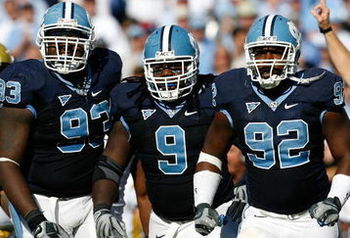
I haven’t seen pictures of this year’s jerseys/pants yet, but according to some folks in the know who post on TCISN, The Citadel will feature (at least in some games) navy jerseys this year, with light blue numerals and “CITADEL” across the front in white.  I would like to think this isn’t true, but I’m sure it is, since North Carolina wore a similar jersey last season.  (We are apparently one year behind UNC in all things Nike-related.)

Navy is an accent color for The Citadel’s athletic teams, not a primary color.  Light blue and white are our primary athletic colors.  Last season, of course, the football team broke out navy pants, wearing them with both white and (most memorably) light blue jerseys.  This season the Bulldogs will apparently have the opportunity to wear an all-navy ensemble on occasion (with a light blue helmet).

Basically, it’s the exact opposite of what I would have liked.  The Citadel will have uniforms that do not include the proper school name, and that do not feature the appropriate school colors.  I apologize in advance if I’m jumping the gun on this, but that’s the information I have at present.

Tangent:  speaking of UNC, I’m not sure why that school is so willing to move away from its traditional color combination, which is very popular. I guess there is money to be made in mixing it up a little, but I think it detracts from a classic look.

As far as the helmets go, some pictures of the new helmet design popped up earlier this spring on TCISN.  The “regular” one reminds me of The Citadel’s helmet design during the Charlie Taaffe era.  It’s not bad, and in fact is a probably a little better than the Taaffe helmets.  You could do worse (and The Citadel certainly has).

There will also be a special helmet for Homecoming featuring “Big Red”.  I like the concept and the execution isn’t terrible, but it’s basically a copy of the Tampa Bay Buccaneers helmet.  I could do without the sword (incorporating a rifle might have been a better idea).  You can see pictures of both helmets on this thread.

You know, if you wanted to design a distinctive jersey to go with the special Homecoming helmet, and you wanted to also honor the past, this photo might be a good place to start.

When I wrote about graduate student transfers a few weeks ago (and I appreciate the comments, by the way — always good to get feedback), Chuck Driesell had just signed a transfer from Belmont, Mike Dejworek.  Evidently Driesell was not satisfied with just one European-born grad student big man named Mike, because a couple of weeks later he brought in another.

Morakinyo “Mike” Williams is an Englishman who started his career at Kentucky (recruited by Tubby Smith) before transferring to Duquesne, where he played one season before moving again, this time to The Citadel.  Not everyone at Duquesne was expecting his latest move.

It will be interesting to see how Williams does.  He reportedly did not get along with former UK coach Billy Gillispie, which is probably a positive.  I think it’s safe to say that he will be the first player in Bulldog hoops history to have previously been deported from the United States (that had to have been tough).  Also, in his year at Kentucky he picked up a nickname — he was known as “The Member”.  I’m afraid to ask.

ESPN.com, setting the stage for another college football season, ran a series last week called “House of Pain”, featuring the 50 toughest losses in college football history.  It wasn’t a bad list, but there were two minor problems with it (in my opinion):

1)  It focused a little too much on recent history.  It wasn’t terribly slanted, but there was some TV-era bias.  I’m sure Beano Cook would agree (although I was glad to see that the Boston College-Holy Cross game from 1942 made it; an underappreciated game with an epilogue worthy of O. Henry).

2)  More importantly, most of the losing teams involved in the games on ESPN’s list could always take solace that on other occasions they had won the big game.  Maybe Miami and Ohio State and Alabama and Nebraska and Southern Cal have all lost tough games — but they’ve also won big games, on multiple occasions.  To me, a truly tough loss is when a school with limited success has a chance to climb the mountain, and then falls flat on its face.

West Virginia losing to Pittsburgh a few years ago was a good example, and made the list.  Another game that made the list, but which should have ranked much higher, was Missouri-Iowa State (from 2004).  How often are the Cyclones going to have a chance to play in a conference title game?

The game I immediately thought about when the list began to be released, though, is nowhere to be found….this one.

Navy 38, South Carolina 21.  November 18, 1984.

South Carolina was, incredibly, 9-0.  Black Magic!  The Gamecocks could have accepted a bid to the Sugar Bowl after beating Florida State the week before, but held out for a trip to the Orange Bowl and a potential (mythical) national title game.  All they had to do to clinch the Orange Bowl was beat a Navy team coming off a 29-0 loss to Syracuse.

It didn’t happen.  South Carolina lost the game, the chance to be ranked #1 for the first time (which would have occurred had the Gamecocks won), a shot at a national title, and a berth in a major bowl for the first time in school history.

Twenty-six years later, and Gamecock fans are still waiting for their first ticket to a major bowl.  That game is the very definition of a painful loss.

Finally, it’s time for the Plant of the Week.  This week’s honoree is the Rubrum Lily, which made its way to Europe from Japan in 1830 (or thereabouts).

Until next time…

Rubrum Lily

Thoughts on The Citadel and transfers

When I write about The Citadel and transfers, I want to first distinguish between basic types.  One of them is the three-year transfer.  It’s a little bit unusual, but not rare, for someone to spend his or her freshman year at another school, and then transfer into The Citadel.

Now, the “system” at The Citadel is designed for a four-year student.  In other words, the typical member of the corps of cadets spends four years at the school, and those four years have very specific benchmarks.  However, it is possible (and not particularly difficult) for a student to transfer in and spend three years in the corps, and have essentially the same experience as a four-year student.  Basically, the sophomore/junior years are combined.

I don’t know anyone associated with The Citadel who has a problem with a three-year transfer athlete representing the school.  I certainly don’t.  It doesn’t happen often, to be sure.  Recently Kenny Manigault, who played high school basketball in the Charleston area for Pinewood Prep, announced he was transferring from Wichita State to The Citadel. Manigault will have three years of athletic eligibility, and will presumably be spending (at least) three years in the corps of cadets.

Another athlete who will be transferring in to The Citadel is Blane Woodfin, who originally committed to Air Force, but was not admitted to the AFA (reportedly because of a physical problem).  Woodfin attended Montana State last year but did not play football, and will thus apparently have four years of athletic eligibility remaining at The Citadel, not three.

These are not transfers likely to cause any cantankerous old alum heartburn, even though Manigault called Chuck Driesell “real laid back”, which is the first time I’ve ever heard anyone call Driesell laid back.  The Citadel as an institution, as Manigault and Woodfin will soon learn (if they don’t know already), is certainly not laid back…

However, there is another type of transfer that has been popping up more and more at The Citadel in recent years, the “fifth-year” transfer.

This started in football, where a player can transfer from an FBS school to an FCS school and play immediately.  The “trailblazer” in this category for The Citadel was Jeff Klein, a quarterback who transferred from Auburn and played one year for The Citadel (2002).

He was followed the next season by former Clemson QB Willie Simmons and ex-Duke defensive back Anthony Roberts.  Those three players played for The Citadel under former coach (and alum) Ellis Johnson.  In recent years, Kevin Higgins has had two fifth-year transfers — his son, wideout Tim Higgins (who originally played for Florida), and tight end B.J. Phillips (North Carolina).

All of these guys graduated from their original schools and played one year as graduate students for The Citadel, except for Phillips (who had two years of athletic eligibility in football remaining after graduating from UNC).

As students in The Citadel Graduate College, none of these players were members of the corps of cadets (indeed, it’s possible none of them even attended classes with cadets, as graduate classes at The Citadel are held at night).

Reports vary on how seriously these graduate student athletes attempted to bond with their teammates, tried to understand/appreciate what cadets go through, etc.  My general impression, which could be wrong, is that Simmons and the younger Higgins made an effort to try and “jell” with the team and school; Klein, not so much.  Phillips, of course, still has one year left on the football team.

These one-year-only players were not a factor in basketball at The Citadel because there was no lower classification within Division I for them to transfer to without penalty (in other words, no FBS/FCS distinction).  At least, they weren’t a factor until last year, when Joe Wolfinger transferred to The Citadel after graduating from Washington.

Wolfinger had his degree and one year of athletic eligibility in basketball remaining, and he used that year to play basketball at The Citadel, thanks to a technicality.  As this article explained:

Wolfinger will be a fifth-year senior next season and is apparently eligible to play immediately at The Citadel because he has graduated from UW and will enter a Master’s program at The Citadel that is not offered at Washington.

Wolfinger is gone, and so is Ed Conroy, but Chuck Driesell has decided to bring in his own tall transfer for this upcoming season:

Mike Dejworek, a 6-11 center from Belmont University, will play one season for the Bulldogs as a graduate student, new coach Chuck Driesell confirmed…

…Dejworek, a native of Ulm, Germany, sat out last season with a shoulder injury after playing three years for Belmont. In 2008-09, he played in 24 games and started one for a 20-13 Belmont team, averaging 1.7 points and 1.6 rebounds. He was a reserve on a Belmont team that made the NCAA tournament his sophomore season.

I presume that, like Wolfinger, Dejworek will be enterering a Master’s degree program at The Citadel that is not offered by Belmont.

There are plenty of alums who are less than crazy about athletes competing on varsity teams without ever being part of the corps of cadets.  Ken Burger, then the sports editor of The Post and Courier, wrote about this as far back as 2003:

…the school’s old guard is very vocal about this troublesome trend. They say these young men never spent a single day at The Citadel and don’t deserve the privilege of wearing the school’s uniform. Even its football uniform…

…Over the next three months we will find out how this experiment works out for [Ellis] Johnson’s program and The Citadel. And, there will be plenty of people watching and judging from the sidelines…

…While it’s easy to say the old school should stick to the old ways, there’s another side of this controversy that can’t be ignored.

The Citadel’s military counterpart, VMI, recently left the SoCon and downgraded to the Big South Conference because the Keydets could no longer compete…

Ah, yes, the old “we just can’t compete” crutch.  Poor, pitiful puppies; how can our coaches ever win?

First, the obvious.  Charlie Taaffe won a Southern Conference title in football without any non-cadet help.  He beat South Carolina and Arkansas and Army and Navy, and all of his players were in the corps of cadets.

Brief tangent:  Just for clarification, Taaffe did occasionally have some fifth-year guys who had already graduated and had an extra year of eligibility remaining after redshirting, but all of them had spent four years in the corps.  That is a completely different situation than the fifth-year ‘program’ I’m discussing in this post, of course.

Eddie Teague won a SoCon title back in the day, too, with members of the corps of cadets.  It’s not easy (after all, The Citadel has just those two league titles in football), but it can be done.

Meanwhile, the fifth-year recruits have not exactly led to dramatic success on the gridiron.  Klein set lots of passing records in 2002, but the team went 3-9.  With Simmons at quarterback (and Roberts in the defensive backfield)  in 2003, the Bulldogs improved to 6-6.  Tim Higgins’ one season at The Citadel came in 2007, the only season since 1997 in which the Bulldogs have finished with a winning record (7-4).

In hoops, Wolfinger did not prove to be a difference-maker last year, as The Citadel went 16-16, a season that followed a 20-13 campaign.  Wolfinger got progressively less playing time as the year went on, as he turned out not to be a particularly good fit for The Citadel’s style of play.

There is another aspect to this, the “recruited over” concern.  If you are a promising high school football player and you are considering The Citadel, should you be worried about the possibility that down the road, when it’s finally time for you to become a regular, the coach will suddenly bring in some graduate student to take your position?  Being recruited over is something normally associated with players at big-time college basketball programs, not The Citadel.

Those are the on-field results and issues.   What about the off-the-field repercussions?

— The essence of The Citadel, the part that differentiates it from other schools, is the corps of cadets.  Our athletic teams are supposed to represent the students at the military college.  What statement is the school making when it elects to offer opportunities to varsity athletes who have never been a part of the military environment?

— For that matter, the athletic teams represent the alumni as well.  Am I supposed to identify with varsity athletes who did not go through the same experiences that I did?

— If I have misgivings as an alumnus about identifying with these athletes, just imagine how the current members of the corps of cadets must feel.

— There is also the public perception.  Many outsiders are impressed that The Citadel can compete at all with the inherent disadvantages of being a military school.  When you bring in players from outside that environment, do you know what the general public calls them?  Ringers. (So do some alums.)

At that point The Citadel becomes “just another school” in the minds of some people.  Is that something that the powers-that-be at The Citadel want?

I might add that the perception issue is magnified when the player plays a high-profile position (like quarterback) in football.  In basketball, there aren’t that many players, so almost any player is highly visible.

Having said all that, I don’t blame any of the individual coaches for bringing in graduate students.  Coaches are trying to win.  Winning is not easy to do at The Citadel, so it’s not surprising that coaches try to work the system as much as possible.

Coaches also tend to have a narrower focus; it’s hard to expect Chuck Driesell, for example, to consider how a graduate student playing basketball may affect the school, in terms of the big picture.   Driesell is just trying to find a big man who can rebound.

The administration has the responsibility of telling the coaches to focus solely on recruiting players who will be part of the corps of cadets.  It appears that, for whatever reason(s), the current administration does not share the concerns that have been expressed by some alums.

Maybe the thinking from General Rosa and company is that one or two exceptions don’t really matter.  I don’t know.  It’s also possible that the school wants to have occasional graduate student varsity athletes, in an effort to promote the Graduate College.

I tend to doubt that having an occasional hoopster or football player in the graduate school is going to raise the profile of the CGC, although I couldn’t blame the school for trying every avenue to promote it.  The CGC is an opportunity for The Citadel to make money, which the school needs to do.

Over the past few years, the military college has gradually become simply a state school, as opposed to a state-supported school.  That’s because the State of South Carolina continues to cut back on funding for higher education (in general, the state legislature believes higher education should end after the third grade).

[Sorry for the political jibe, but honestly, our state’s lack of commitment to education is embarrassing.]

In closing, one thing I want to emphasize is that I don’t have anything against the players who enter the school as graduate students.  They are taking advantage of a great opportunity, as well they should.  I wish them well, and I hope they are successful in class and on the field of play.  I will be rooting for them, as I do anyone who represents my alma mater.

I just wish the administration would revisit the current policy.  I strongly believe that varsity athletes at The Citadel should all come from the corps of cadets.  I know my opinion doesn’t really matter, but I also know that I’m not the only person who feels this way about transfers and varsity athletics.

Yes, I’m ready for football season…

The Washington Post looks at Chuck Driesell’s move to The Citadel

This is just a quick blog post, which is a little different for me, to be sure.  However, I wanted to briefly comment on this article by Steve Yanda in The Washington Post:  Link

From the story:

Those familiar with The Citadel athletics said the most daunting challenge Chuck Driesell will face is persuading quality players to commit to four years of a military environment. But sitting in a still-barren office just more than two weeks after he was hired, Driesell said he plans to confront that factor the same way he has dealt with perpetually being known as Lefty’s son — by embracing it wholeheartedly.

“I think you have to sell it,” Driesell said of The Citadel’s military component. “I don’t think it’s something you paint as a negative, because it’s not. It’s a positive. Here, they get a leadership degree in addition to their regular degree. And everyone needs leaders.”

Quick thoughts:

1)  How about Yanda actually referring to “The Citadel athletics” and not “Citadel athletics”?  Good for him.  It’s nice to see someone (or someone’s editor) paying attention.  Now if only we could get more people within our own department of athletics to do the same…

2)  Driesell again noted that he wanted to use the military aspect of the school as a positive.  As I said in a previous post, he’s talking a good game.

Further along in the story:

After Ed Conroy left last month to take the head coaching job at Tulane, calls from hopeful candidates began to flood Les Robinson’s home in nearby Sullivan’s Island. The former Citadel coach and athletic director immediately was drawn to an aspirant he had recruited to the school 29 years earlier. The other callers pried for inside information on competing applicants or their own chances for landing the gig.

“But Chuck was strictly asking me about what it is like coaching there, which is the most important question,” said Robinson, who led The Citadel from 1974 to 1985. “Now, if I was coaching at Wofford or Georgia Southern, that wouldn’t be that important a question. It wouldn’t be a lot different coaching at Appalachian State or Georgia Southern. But it’s different coaching at The Citadel.”

Robinson said he “oversold” the military aspect while recruiting players to avoid near-immediate attrition once they arrived on campus in the fall. In his first 10 years at the helm, Robinson noted, not one player transferred out because the military discipline was too intense.

1)  Okay, so Yanda didn’t use the “The” in this section, but in this case it is acceptable usage.  I would have called Les Robinson the “former Bulldog coach” instead, but no matter.  There is no question that the name of the school can be problematic for a grammarian, much less your typical sportswriter.  There is also no question that I pay too much attention to this subject.

2)  Again, we have a positive insight on Chuck Driesell, who recognized that coaching at The Citadel is not quite like coaching at other Southern Conference schools.

3)  Also, Robinson’s suggestion that he “oversold” the military aspect of the school is something all coaches at the military college would do well to emulate.  Of course, they might avoid emulating his first four seasons as head coach, as Robinson’s first four teams had a combined record of 31-70.

In his fifth year, though, he went 20-7.

Finally, while the article notes that The Citadel has never received a bid to the NCAA tournament, Chuck Driesell said that making the NCAAs would be “an annual goal” and “attainable”.  Good.  No “every four years, maybe we’ll have a decent team” line, which I’ve heard one too many times before.

There is, after all, an NCAA sub-regional next year in Charlotte.  That’s an easy trip up I-77 for me…

Open letter to Chuck Driesell

Dear Coach Driesell (mind if I call you Chuck?) —

Congrats on being named head coach at The Citadel.  I liked your choice of tie at the press conference.  You and your family will enjoy Charleston.  Whether or not you enjoy your new job will depend on how you approach it.  Here are some tips:

—  Know your history.  I assume Larry Leckonby told you all about The Citadel’s hoops past.  If not, here is a primer:  Link

I hope you’re not having second thoughts…

Now, that post in the link covers everything up to Ed Conroy’s last two years at The Citadel, which were really good by Bulldog standards.  Conroy won 20 games in 2009 and went 16-16 this past season; he parlayed that into a nice gig at Tulane.  This is good news for you, Chuck, if you have designs on moving up the D-1 coaching ladder. Imagine if you actually won the Southern Conference.  That might be worth an ACC job.

(Who am I kidding.  That would be worth an NBA job.)

—  If you want to make the NCAAs from The Citadel, you will have to win the Southern Conference tournament.  The Southern Conference is a one-bid league; there hasn’t been an at-large bid out of the SoCon since 1950.

Winning the SoCon tourney while at The Citadel will be a tall order, however.  The school’s postseason tournament history?  Ugly.

Now, you remember your father’s struggles in the ACC tournament, so you can appreciate a tourney hex — maybe not one quite on the scale of The Citadel’s foibles at the SoCon tourney, but you probably understand the frustration.  Of course, you also were on the team the year Lefty finally won the ACC tourney, so you know it’s possible to climb the mountain. Admittedly, you aren’t going to have the services of anyone as talented as Len Bias while at The Citadel.

—  Speaking of the left-hander, feel free to invite your father to show up at McAlister Field House whenever he wants.  We’re used to celebrities with connections to the program showing up at basketball games now, since Pat Conroy jumped on the bandwagon the last two seasons.  All I ask is that whenever there is an article in The New York Times about the team’s success, or if Wright Thompson writes a long, thoughtful piece on ESPN.com about the basketball program, that maybe the stories might actually mention a current player.  Just once?

It’s like the program got overshadowed by an ancillary figure.  5700 combined words, no mention of any player.  Sigh.

(By the way, there has to be a great photo op involving General (the bulldog, not Rosa) and Lefty Driesell.  Russ Pace, be ready.)

—  Learn as much as you can about The Citadel, but don’t sweat it if you don’t understand everything about the school. I’m a graduate, and I do not understand everything about the place, and never will.  If you really understand everything about The Citadel, you are certifiably insane.

One thing I will say is that you can’t quite lean on your time in the Navy, or at NAPS. There are some similarities but also some major differences.

You’re going to have to get a crash course in a new culture from somebody who was recently in your situation (Leckonby), and you should seriously consider having at least one guy on your staff with connections to the school. It’s kind of like having an interpreter.

—  You have a reputation as a solid talent evaluator.  I’m glad to hear that is the case, because I think that skill is critical to having success at The Citadel, much more so than just being a “getter” of players.  You’re going to have to look for under-the-radar types.

I’ll give you an example, Chuck.  Remember when Maryland was recruiting Jai Lucas? Of course you do, you were front and center on that recruitment.  Maryland didn’t get him, though, which must have been very disappointing, especially with his father (the great John Lucas) having played for your father at Maryland.

Jai Lucas wound up going to Florida, and then later transferred to Texas.  He was a big-time recruit.  Big-time recruits don’t go to The Citadel.

When you were watching his high school games, though, did you happen to notice the other guard for Bellaire?  Skinny kid, but a solid player.  Wasn’t getting offers from any of the high-majors, or any of the mid-majors for that matter.  I’m guessing you noticed him, at least enough to recognize him…even if you saw him now, in his cadet uniform.

His name was and is Cameron Wells, and he’s currently on pace to be the all-time leading scorer at The Citadel.  I would argue that he has had a much better college career than Jai Lucas, and that’s even taking the level of competition into consideration.  That’s the type of player you are seeking.  Wells wasn’t a McDonald’s All-American, but it’s not inconceivable he could eventually become the first alum from The Citadel to play in the NBA.

—  Besides finding “hidden” talent, Chuck, there is something else you need to keep in mind, something very important, and something quite a few coaches at The Citadel have found out the hard way.  When you recruit, you have to recruit cadets and make them players.  You can’t recruit players and make them cadets.

You have to bring in guys who are willing to embrace the challenge that is The Citadel. That’s what you’re selling, basically — a unique challenge, one that will stay with you all your life, along with a scholarship and the opportunity to play D-1 basketball.

It isn’t easy. No matter how good a salesman you are, The Citadel is never going to become the UCLA of the East.

The key to long-term success for any coach of any sport at The Citadel is to keep attrition low.  I can’t emphasize that enough.  You have to develop players over a four-year period.  It doesn’t do you any good to recruit some on-court stud if he’s only around for a year or two because he can’t handle the military system.

Also, remember to work with the system, not against it.  Don’t enable your players at the expense of the military side of things, as it will do you no good and will turn the corps of cadets (and a significant number of alumni) against you.  You need to have the corps on your side.

That line you had at the presser about players “taking that experience [of The Citadel’s military system] to the court” — that was solid, Chuck.  You at least talked a good game there.

—  Speaking of the corps of cadets, you need to confer with Leckonby and General Rosa and some of the cadet leadership to figure out how to make McAlister Field House a decided homecourt advantage again.  It wasn’t last season, and that’s a concern, because in the SoCon, you need to defend your homecourt.

The big problem is that league games are usually played on Thursdays and Saturdays.  On Saturday, the corps is generally on leave, and a leave that is both much-anticipated and much-needed.  On Thursday nights, you have a combination of things working against you, but I think you can work with the corps on that night.

See if you can arrange it so that a minimum of one-fourth (or at least one-fifth) of the corps is in attendance on Thursday nights, at least for SoCon games.  Saturday is a tough nut to crack; at the very least, make sure cadets stuck on campus are at the games.  Try to get cadets some rewards for supporting the team.

You have to understand, Chuck, that by and large cadets at The Citadel are not sports fans.  At Maryland, you could count on a large student body with a healthy number of hoops nuts.  You had a built-in student fan base.  That isn’t the case at The Citadel, with just over 2000 members of the corps of cadets, only a very small percentage of whom grew up following college basketball on any level.

—  That’s why, Chuck, you also need to reach out to the community.  In terms of selling the program to outsiders, you’re going to have to be a little bit more like your father, I think.  You’re competing with a lot of entertainment options, and Charleston is not really a sports town. However, it’s something you have to do.  The Citadel has one of the oldest fan bases in the league, if not the country.  You need to find some fresh blood.

— This is sort of an aside, Chuck, but I wanted to warn you in advance about Southern Conference officiating.  It can be, uh, inconsistent.  This is particularly true on Saturdays, when all the high-profile officials are working major-conference games.

Weekday games usually aren’t so bad, because there is sometimes a quality ref or two available for SoCon games. Saturdays, though, are often just short of an officiating debacle (actually, last season’s Davidson-Wofford game in Spartanburg was a debacle).

It’s just another reason why you need to have a good, boisterous crowd at McAlister for Saturday night games.

— Also, if you don’t mind, I would like for you to fix the uniforms.  The next time we break out new duds, please be sure that the lettering on them reads “The Citadel” and not “Citadel”.  It’s a pet peeve of mine, but still.  Get the name of the school right.  I bet General Grimsley would shake your hand if you made a point of correcting that, and it’s always good to be on the right side of the Grimmer.

—  Your predecessor, Ed Conroy, made a point of scheduling quality non-conference opposition, with occasional home games against the likes of Michigan State and Southern California.  I really liked this approach, and hope that you keep doing it.  You probably are going to have to play two or three “guarantee” games at a minimum every year, anyway.

With that in mind, Chuck, see if you can schedule games against Big 10 and/or SEC opponents.  Every Big 10 home game is televised on the Big Ten Network (BTN), and many of the SEC games are on one of the various ESPN platforms.  Even a game on ESPN3.com is worth it for The Citadel.

Last season the Bulldogs were on television a grand total of three times, once on ESPNU and twice on SportSouth.  To raise the profile of the program, and for recruiting purposes, I think it’s important to get on TV as much as possible. Besides, if we’re going to play elite teams to pay the bills, we might as well get something else out of it other than cash.

—  You are going to be in an unusual situation at The Citadel for a new coach, in that you will be inheriting a team that has the potential to be good next season.  I already mentioned Cameron Wells, but you have several other excellent players with whom to work.

At the press conference you mentioned that next season’s team could be “very special”.  I was interested in the way you described the number of returning starters. Instead of saying that “all five starters will be back,” you noted that (I’m paraphrasing slightly) “at the end of the season all five starters were coming back.”

There have been some rumblings that at least a couple of players are considering leaving the school, including two regulars in the rotation, so your first recruiting job is going to be trying to keep them from bolting.  It appears you are well aware of this, which is good.  I hope they stay, as if everyone comes back next season really could be special.

Despite the expectations for next year, you won’t really be under any pressure to win immediately, and can think long-term.  Ed Conroy left for a better job after four seasons.  The three coaches before him had a combined winning percentage of 41.2%, but despite that coached for 11 (Les Robinson), 7 (Randy Nesbit), and 14 (Pat Dennis) seasons at The Citadel.

The job isn’t a career-killer like it’s occasionally been made out to be.  Four of the last eight coaches, in fact, left to coach other Division I schools; one of them, Norm Sloan, would later win the national title.  Sloan and Robinson would actually coach two other D-1 schools after leaving The Citadel (counting Sloan’s two stops at Florida just once).

Congrats again for getting your first shot as a D-1 head coach, Coach Driesell.  Your opportunity comes at a place that is unusual and not for the faint of heart, but very special nonetheless.  Cherish the experience.

We’ll be rooting for you.

Sincerely,

SS

NCAA basketball bracket projection, 3/14/10 — noon

Everyone else posts their bracket projections, so I decided to post this here.  It’s probably not mistake-proof, and there are likely multiple rematch scenarios (including a potential Wake Forest-Purdue game in the 2nd round, although assuming either of those teams has another win left in them could be dangerous).

Thanks to the bubble being so soft, the last few in/out squads are really up in the air this year.  My last five for each category…

— Last five in:  California, Utah State, UTEP, Florida, Illinois (the Illini being the last in)
— Last five out:  Virginia Tech, Minnesota, Mississippi State, Seton Hall, William & Mary (the Hokies being the first out)

I think both Minnesota and Mississippi State have to win today to get a bid.  That’s particularly true for the Bulldogs, in my view; Minnesota may just have to “look good” against Ohio State to pass Illinois.  Of course, the Illini lost in double overtime to the Buckeyes yesterday, so the proverbial “eye test” didn’t hurt them, either.

If Illinois was ahead of Minnesota prior to the Big 10 tournament, I’m not sure what exactly has led to Minnesota moving ahead of the Illini on the S-curve.  Illinois beat Wisconsin and lost that 2OT thriller to OSU.  Minnesota beat a hapless Penn State, Michigan State in OT, and then a decimated Purdue squad.  I’m not sure there is much to differentiate between those performances.

Speaking of Purdue, I have no idea how the committee will seed the Boilermakers. (Right now the committee may not know either.)  I seeded them as a 4, but would not be surprised at anything from a 2 to a 7.

One reason I kept Purdue on the 4 line is that several other teams with a shot at a protected seed failed to produce in their respective conference tournaments. Wisconsin, Michigan State, Texas A&M, and Maryland all lost in league quarterfinals. BYU went down in the Mountain West semis.  I couldn’t quite pull the trigger on Butler for a 4 seed, although I thought about it, and I suspect the committee will too.

I think Temple could be playing for a 3 seed today in the Atlantic 10 final, and may also be playing for a spot in the Providence sub-regional.  The Owls are competing with Pittsburgh and Villanova for one of two protected seed spots in that pod (Georgetown will get the other).  I have Pitt getting it right now.

After some debate, I kept Duke as the 1 seed in the West and West Virginia as the 2 in that region.  A loss by Duke today in the ACC final would result in those two teams flipping seeds.  Ohio State isn’t going to get enough of a bump by beating Minnesota to get to the 1 line, especially with the late start today for the Big 10 final.

Anyway, my current bracket projection (Midwest vs. West and South vs. East in the national semifinals):

Midwest

Oklahoma City

1-Kansas 16-Robert Morris

8-Marquette 9-Florida State

Spokane

5-Butler 12-Wake Forest

4-Purdue 13-Oakland

Jacksonville

3-Tennessee 14-Houston

6-Xavier 11-Missouri

Providence

7-UNLV 10-Cornell

2-Georgetown 15-Morgan State

West

Jacksonville

1-Duke 16-East Tennessee State

8-Notre Dame 9-Oklahoma State

Spokane

5-Michigan State 12-UTEP

4-Vanderbilt 13-Murray State

New Orleans

3-Baylor 14-Montana

6-Richmond 11-California

Buffalo

7-Old Dominion 10-San Diego State

2-West Virginia 15-Ohio

South

Buffalo

1-Syracuse 16-Lehigh

8-Texas 9-Siena

San Jose

5-Maryland 12-Illinois

4-New Mexico 13-Wofford

New Orleans

3-Temple 14-Vermont

6-Texas A&M 11-Utah State

Milwaukee

7-St. Mary’s 10-Louisville

2-Ohio State 15-UCSB

East

Milwaukee

1-Kentucky 16-PIG (Winthrop/Arkansas-Pine Bluff)

8-Northern Iowa 9-Clemson

San Jose

5-Wisconsin 12-Washington

4-Villanova 13-New Mexico State

Providence

3-Pittsburgh 14-Sam Houston State

6-Brigham Young 11-Florida

Oklahoma City

7-Gonzaga 10-Georgia Tech

2-Kansas State 15-North Texas

Random bubble thoughts and theories, 3/8

I’m going to wait a few days before writing a post-mortem on The Citadel’s hoops season.  It was a little bit of an odd year.  Part of me is disappointed in the overall record (16-16, 9-9), but another part of me remembers that in the last two years the Bulldogs have won 24 SoCon games.  In the six previous years, The Citadel had won 15.  Total.

The past brings perspective.

Sometimes the past also helps when trying to evaluate bubble teams and seeding scenarios.  The membership of the selection committee has changed over time, of course, but that doesn’t mean you can’t look back and see what the committee did when presented with certain situations.

— Let’s face it, the Pac-10 is wretched this season.  California won the outright Pac-10 title.  Is that good enough to guarantee the Bears an at-large bid if they don’t win the Pac-10 tourney?

History says yes.  Exhibit A:  Air Force, 2004.  That season the Falcons were 22-5 during the regular season and won the Mountain West, but did almost nothing outside the league, managing to beat no one of consequence and losing games to UT-Pan American and Belmont.  However, Air Force was 12-2 in league play and won the MWC outright by two games.

Air Force lost in the quarterfinals of the MWC tournament to Colorado State (by 12 points).  Despite that, the Falcons still made the NCAAs.  When asked about it, selection committee chairman Bob Bowlsby noted AFA’s less-than-stellar profile, but pointed out that the Falcons had been the regular-season champion of a top-10 league — and that achievement, in the opinion of the committee, merited Air Force’s inclusion.

I can’t say I disagree with that argument.  (It’s certainly a better line of reasoning than the one Bowlsby’s successor as committee chair, Craig Littlepage, gave for the committee’s absurd decision to put Air Force in the field two years later.  I still have no idea how that was justified.)

If winning a top-10 league is good enough, then Cal is safe.  Admittedly, it’s not quite the same situation; Air Force won the MWC in 2004 by two games, while Cal edged Arizona State by just one game in the standings.  Also, 12-2 is better than 13-5.  Still, it’s a factor, as is the fact we’re talking about the Pac-10, and not one of the “mid-major” leagues (even if it isn’t as good as some of those leagues this season).  Cal better not lose in the Pac-10 quarterfinals, though.

Incidentally, the same argument would presumably work in the favor of Utah State.

— Could last-second seeding adjustments actually happen?

This season there will be four conference title games played on Selection Sunday.  The SEC, ACC, and Atlantic 10 title games will all tip at 1 pm ET, while the Big 10 final will start at 3:30 pm ET.

Let’s say that Duke and Ohio State are both in their respective conference finals. Would the committee wait until the end of the Big 10 game to finalize the seeding?

Someone asked Joe Lunardi about this in an ESPN “chat session” :

A lot of experts think that Ohio State has the best shot this side of Durham to collect the final 1-seed if they win the Big Ten tournament. Isn’t there a good chance though that they could get screwed by the schedule. The Big Ten final doesn’t start until 3:30 on Sunday and the ACC championship is at at 1:00 on Sunday. I know that the brackets take a long time to put together and the top seeds are placed first. If Duke lost in the Final and Ohio State won, is it possible that their fates would already be set before those games finish?

Joe Lunardi:  It has happened this way in the past…More recently, however, the Committee has built multiple brackets accounting for the various Sunday scenarios. I would be disappointed in this group if they bailed on the process and didn’t finish the job (and I do not expect they will).

Lunardi may be right, but I think most of those “various Sunday scenarios” have revolved around teams playing on Sunday who were “auto bid or bust” types — like Mississippi State last season, or Georgia the year before that.  I’m less than sure the committee is going to wait until the last moment (or prepare alternative brackets) for a question of one seeding line.  Besides, should one game really be the difference between a team getting a 1 or a 2?  What about the previous 30+ games?

This reminds me that in the past, there were occasionally conference tournaments still going on when the selections were announced.  The Big West did this several times (this was back when UNLV was in the league).  It invariably led to scenarios where the committee would have either/or bracket lines where a team would be in the field, unless the Big West had a surprise champ (in other words, if  Vegas didn’t win).

This finally ended after the committee basically decided to hose any at-large hopeful out of the Big West until it quit playing its tourney so late.  I recall Long Beach State being a bubble team that found out at halftime of the conference final that it had to win, or else.

Another league that at one time played its final after the pairings was the SWAC.  Now, with the SWAC there wasn’t any at-large issues; it was just a question of what team would advance.  However, it did pose a problem for the committee when trying to seed.  These days the SWAC is an easy 16 (if not play-in game) pick, but back then it wasn’t always the case.

One year the committee puzzled just about everyone by deciding the winner of the SWAC title game would get a 13 seed.  Nobody could believe the SWAC got so high a seed, especially because no one knew yet which team would be the league representative.

As it happened, Southern won the tournament final (televised immediately after the selection show), and the lucky 4 seed it drew as an opponent was ACC tournament champ Georgia Tech.  Well, maybe not so lucky.  Ben Jobe’s Jaguars shocked Bobby Cremins’ Yellow Jackets in the first round, 93-78.

— This season, there seem to be several “as long as they don’t lose to a really bad team, they should be okay” situations.  It’s all right if Virginia Tech loses to Wake Forest in the ACC tournament, but if Miami upsets the Demon Deacons and then beats the Hokies, VT is in trouble.  Washington might get an at-large bid if it loses to Cal in the Pac-10 final, but can’t afford to lose to another school — and it also would hurt the Huskies if their semifinal opponent wasn’t Arizona State.

As mentioned earlier, Cal can’t afford to lose in the Pac-10 quarters.  Utah State needs to avoid losing until it plays Nevada in the WAC final, because Nevada is hosting the event, and a loss then would be more acceptable.  However, Utah State couldn’t afford to lose to another school in the final, because then it would be a neutral-site loss.  Also in the same position, perhaps, is UTEP, which could face host Tulsa in the C-USA semifinals.

Conversely, Mississippi needs to beat Tennessee in the SEC quarterfinals — but it does the Rebels no good at all if the Vols are upset by LSU in the first round.  If that happened, then Mississippi would have to beat LSU and (presumably) Kentucky to get the needed big-win bounce.  Mississippi State is expected to play Florida in a “play-out” game in the SEC quarters, but if Auburn upends the Gators, then Mississippi State would have to beat the Tigers and Vanderbilt (if form holds) to reach the final — and it still would not have a strong enough at-large case.

Then there is Illinois, which is a good example of a team that would probably be better off not playing a game at all.  As it is, the Illini play Wisconsin for the second time in a week in the Big 10 quarterfinals — and for Illinois, it’s probably a win-you’re-in, lose-you’re-out situation.

— Memphis is starting to show up on some bubble watches.  I’m trying to figure out how a team that has not won a game this season against a prospective tournament team (unless Oakland wins the Summit League tourney) is a viable at-large candidate.

— If the tournament would have been expanded to 96 teams for this season, we would be discussing the bubble candidacies of North Carolina, South Carolina, Arizona, and St. John’s.  There is a good chance all four would have made the field of 96.

Expansion is such a dumb idea, it’s inevitable that it will happen…