ESPN College Football Announcers for 2010

ESPN has released its assignments for its college football game coverage, as well as its studio coverage.  As always, there are some new crews.  Highlights:

— Among the tandems that work the high-profile ESPN/ABC games, the one significant change is in the “west coast” team, where there will now be a three-man booth — Carter Blackburn, Brock Huard, and Mike Bellotti.  The former Oregon coach is in his first season as an analyst; he works with Huard, who was the analyst for the SEC ESPNU primetime game last year.  Blackburn called mostly west coast games on the U last season after moving over from CBS College Sports.

That team essentially replaces the Terry Gannon/David Norrie duo from 2009. Gannon is not listed on this year’s release; he may just have too much already on his announcing plate (Dave Lamont filled in for him a few times last season as it was). Norrie is going to ESPN Radio, replacing Dennis Franchione as Bill Rosinski’s analyst.  Norrie will also work a few midweek TV games (along with Robert Smith), teaming with Beth Mowins.

— That’s right, there is now a second woman play-by-play voice calling college football for ESPN.  Mowins will apparently have a limited schedule.

Pam Ward is still around, and presumably as intolerant of injured players as ever. However, she’s been moved from the noon ET ESPN2 slot to 3:30 pm ET on ESPNU, much to the relief of Michigan State and Northwestern fans everywhere.  Her analyst will be Danny Kanell.

— Kanell, the former FSU quarterback, also will do some studio work.  He’s the breakout star, I guess, of the multitude of game callers/analysts who worked ESPN360 (now ESPN3.com) games last season.  What does that say about the talent featured on ESPN3.com in 2009?  Well…

The release doesn’t mention anything about who will work ESPN3.com games this year; it does note that “additional commentators will contribute throughout the season”.  There will be a lot of “additional contributors” both on ESPN3.com and on the regular TV platforms.  Week 1, for example, will include 11 games that will be shown live exclusively on ESPN3.com.

— Erin Andrews will be hosting the first hour of an expanded College Gameday (that was announced last month).  She will also be the sideline reporter for the game site from which the program originates, assuming it’s on ABC/ESPN/ESPN2.

That means the other high-profile game tandems will probably flip-flop sideline reporters a bit more often than normal, although most of the time Andrews will likely work with Brent Musberger and Kirk Herbstreit.  Last year, the sideline reporter with that duo was Lisa Salters, who will not be back this year.

Quint Kessenich moves from the Big East regional game of the week to a national gig; his replacement on the sidelines for the Big East games is Eamon McAnaney.  I think there is a lacrosse announcer quota involved in that switch, but I’m not sure.

Andrews won’t be roaming the sidelines on Thursday night any more.  “The new EA” is Jenn Brown, who like Andrews is a Florida grad, blond, and destined to become a sports blog/message board favorite.

— The other change on Thursday nights is Rece Davis taking over play-by-play duties from Chris Fowler.  I like Davis, although he isn’t really a natural at play-by-play, but I’m not a fan of the Craig James/Jesse Palmer dual threat.  I find their combined analysis rather banal; at least James wears a properly sized tie.

— Fowler remains the ringleader for College Gameday, with Lee Corso (who I hope has now fully recovered from his stroke), Herbstreit, and Desmond Howard.  There was little change in personnel for the major studio shows. That’s right, another year of Dr. Lou (with Davis and Mark May) and The Bachelor (with John Saunders).  Robert Flores takes over as the new update guy on ABC.

There were some moves on the SEC-on-ESPN desk.  Dari Nowkhah will now be the syndication studio host, as Rob Stone will call games on ESPNU (he’s working the noon U game with David Pollack).  Another change of interest for SEC fans is the new primetime team for that league on ESPNU.  Clay Matvick and Herm Edwards will replace Eric Collins and Brock Huard.  Edwards may be a San Diego State alum, but he strikes me as a natural pick to analyze SEC action, as teams in that conference definitely play to win the game.

As mentioned earlier, Huard is working west coast games this season, while Collins has apparently moved to the Big 10 Network.  If I see a release listing announcers for the BTN/CBS College Sports/etc., I’ll post it here; the other BTN announcing news of note I’ve seen suggests that Tom Hart will be joining that network.

Edit (8/25/10) — Here is the BTN release, with Hart and Collins listed as announcers:  Link

Another non-ESPN announcing note:  The ACC game of the week, produced by Raycom, will have a new analyst this year, with David Archer replacing Rick “Doc” Walker.  This, if not a national tragedy, is at least a regional outrage.  I need to know which ACC players are actually cyborgs.

— Anish Shroff will take over from Charlie Neal as the play-by-play man for ESPNU’s Thursday night games.  Luckily, CitiField will not host a football game this season.

— Joe Tessitore will call the Friday night ESPN2 games with Rod Gilmore again, but Tessitore (who I find enjoyably bombastic) will also be the play-by-play voice for the ESPN-3D games, which will feature separate production teams for “regular” and 3D broadcasts.  He’ll work with new analyst Tim Brown and sideline reporter Ray Bentley (who had worked with Pam Ward for the last three seasons).

— The noon ESPN/ESPN2 games will each have Grieses in the booth.  Bob Griese returns with Chris Spielman and Dave Pasch on ESPN, while the ESPN2 game will feature Brian Griese (who had a promising debut last year) with play-by-play man Bob Wischusen.

Pasch and Wischusen are both guys who could/should work higher-profile games, but each is a radio announcer for an NFL team (the Cardinals for Pasch, the Jets for Wischusen) and are basically limited to early-afternoon Saturday games on ESPN.

— Ron Franklin, who was planning on retiring, is back and working again with Ed Cunningham.  I hope that team gets some heavy-duty games this year.

Getting closer to kickoff…

Thoughts on The Citadel and transfers

When I write about The Citadel and transfers, I want to first distinguish between basic types.  One of them is the three-year transfer.  It’s a little bit unusual, but not rare, for someone to spend his or her freshman year at another school, and then transfer into The Citadel.

Now, the “system” at The Citadel is designed for a four-year student.  In other words, the typical member of the corps of cadets spends four years at the school, and those four years have very specific benchmarks.  However, it is possible (and not particularly difficult) for a student to transfer in and spend three years in the corps, and have essentially the same experience as a four-year student.  Basically, the sophomore/junior years are combined.

I don’t know anyone associated with The Citadel who has a problem with a three-year transfer athlete representing the school.  I certainly don’t.  It doesn’t happen often, to be sure.  Recently Kenny Manigault, who played high school basketball in the Charleston area for Pinewood Prep, announced he was transferring from Wichita State to The Citadel. Manigault will have three years of athletic eligibility, and will presumably be spending (at least) three years in the corps of cadets.

Another athlete who will be transferring in to The Citadel is Blane Woodfin, who originally committed to Air Force, but was not admitted to the AFA (reportedly because of a physical problem).  Woodfin attended Montana State last year but did not play football, and will thus apparently have four years of athletic eligibility remaining at The Citadel, not three.

These are not transfers likely to cause any cantankerous old alum heartburn, even though Manigault called Chuck Driesell “real laid back”, which is the first time I’ve ever heard anyone call Driesell laid back.  The Citadel as an institution, as Manigault and Woodfin will soon learn (if they don’t know already), is certainly not laid back…

However, there is another type of transfer that has been popping up more and more at The Citadel in recent years, the “fifth-year” transfer.

This started in football, where a player can transfer from an FBS school to an FCS school and play immediately.  The “trailblazer” in this category for The Citadel was Jeff Klein, a quarterback who transferred from Auburn and played one year for The Citadel (2002).

He was followed the next season by former Clemson QB Willie Simmons and ex-Duke defensive back Anthony Roberts.  Those three players played for The Citadel under former coach (and alum) Ellis Johnson.  In recent years, Kevin Higgins has had two fifth-year transfers — his son, wideout Tim Higgins (who originally played for Florida), and tight end B.J. Phillips (North Carolina).

All of these guys graduated from their original schools and played one year as graduate students for The Citadel, except for Phillips (who had two years of athletic eligibility in football remaining after graduating from UNC).

As students in The Citadel Graduate College, none of these players were members of the corps of cadets (indeed, it’s possible none of them even attended classes with cadets, as graduate classes at The Citadel are held at night).

Reports vary on how seriously these graduate student athletes attempted to bond with their teammates, tried to understand/appreciate what cadets go through, etc.  My general impression, which could be wrong, is that Simmons and the younger Higgins made an effort to try and “jell” with the team and school; Klein, not so much.  Phillips, of course, still has one year left on the football team.

These one-year-only players were not a factor in basketball at The Citadel because there was no lower classification within Division I for them to transfer to without penalty (in other words, no FBS/FCS distinction).  At least, they weren’t a factor until last year, when Joe Wolfinger transferred to The Citadel after graduating from Washington.

Wolfinger had his degree and one year of athletic eligibility in basketball remaining, and he used that year to play basketball at The Citadel, thanks to a technicality.  As this article explained:

Wolfinger will be a fifth-year senior next season and is apparently eligible to play immediately at The Citadel because he has graduated from UW and will enter a Master’s program at The Citadel that is not offered at Washington.

Wolfinger is gone, and so is Ed Conroy, but Chuck Driesell has decided to bring in his own tall transfer for this upcoming season:

Mike Dejworek, a 6-11 center from Belmont University, will play one season for the Bulldogs as a graduate student, new coach Chuck Driesell confirmed…

…Dejworek, a native of Ulm, Germany, sat out last season with a shoulder injury after playing three years for Belmont. In 2008-09, he played in 24 games and started one for a 20-13 Belmont team, averaging 1.7 points and 1.6 rebounds. He was a reserve on a Belmont team that made the NCAA tournament his sophomore season.

I presume that, like Wolfinger, Dejworek will be enterering a Master’s degree program at The Citadel that is not offered by Belmont.

There are plenty of alums who are less than crazy about athletes competing on varsity teams without ever being part of the corps of cadets.  Ken Burger, then the sports editor of The Post and Courier, wrote about this as far back as 2003:

…the school’s old guard is very vocal about this troublesome trend. They say these young men never spent a single day at The Citadel and don’t deserve the privilege of wearing the school’s uniform. Even its football uniform…

…Over the next three months we will find out how this experiment works out for [Ellis] Johnson’s program and The Citadel. And, there will be plenty of people watching and judging from the sidelines…

…While it’s easy to say the old school should stick to the old ways, there’s another side of this controversy that can’t be ignored.

The Citadel’s military counterpart, VMI, recently left the SoCon and downgraded to the Big South Conference because the Keydets could no longer compete…

Ah, yes, the old “we just can’t compete” crutch.  Poor, pitiful puppies; how can our coaches ever win?

First, the obvious.  Charlie Taaffe won a Southern Conference title in football without any non-cadet help.  He beat South Carolina and Arkansas and Army and Navy, and all of his players were in the corps of cadets.

Brief tangent:  Just for clarification, Taaffe did occasionally have some fifth-year guys who had already graduated and had an extra year of eligibility remaining after redshirting, but all of them had spent four years in the corps.  That is a completely different situation than the fifth-year ‘program’ I’m discussing in this post, of course.

Eddie Teague won a SoCon title back in the day, too, with members of the corps of cadets.  It’s not easy (after all, The Citadel has just those two league titles in football), but it can be done.

Meanwhile, the fifth-year recruits have not exactly led to dramatic success on the gridiron.  Klein set lots of passing records in 2002, but the team went 3-9.  With Simmons at quarterback (and Roberts in the defensive backfield)  in 2003, the Bulldogs improved to 6-6.  Tim Higgins’ one season at The Citadel came in 2007, the only season since 1997 in which the Bulldogs have finished with a winning record (7-4).

In hoops, Wolfinger did not prove to be a difference-maker last year, as The Citadel went 16-16, a season that followed a 20-13 campaign.  Wolfinger got progressively less playing time as the year went on, as he turned out not to be a particularly good fit for The Citadel’s style of play.

There is another aspect to this, the “recruited over” concern.  If you are a promising high school football player and you are considering The Citadel, should you be worried about the possibility that down the road, when it’s finally time for you to become a regular, the coach will suddenly bring in some graduate student to take your position?  Being recruited over is something normally associated with players at big-time college basketball programs, not The Citadel.

Those are the on-field results and issues.   What about the off-the-field repercussions?

— The essence of The Citadel, the part that differentiates it from other schools, is the corps of cadets.  Our athletic teams are supposed to represent the students at the military college.  What statement is the school making when it elects to offer opportunities to varsity athletes who have never been a part of the military environment?

— For that matter, the athletic teams represent the alumni as well.  Am I supposed to identify with varsity athletes who did not go through the same experiences that I did?

— If I have misgivings as an alumnus about identifying with these athletes, just imagine how the current members of the corps of cadets must feel.

— There is also the public perception.  Many outsiders are impressed that The Citadel can compete at all with the inherent disadvantages of being a military school.  When you bring in players from outside that environment, do you know what the general public calls them?  Ringers. (So do some alums.)

At that point The Citadel becomes “just another school” in the minds of some people.  Is that something that the powers-that-be at The Citadel want?

I might add that the perception issue is magnified when the player plays a high-profile position (like quarterback) in football.  In basketball, there aren’t that many players, so almost any player is highly visible.

Having said all that, I don’t blame any of the individual coaches for bringing in graduate students.  Coaches are trying to win.  Winning is not easy to do at The Citadel, so it’s not surprising that coaches try to work the system as much as possible.

Coaches also tend to have a narrower focus; it’s hard to expect Chuck Driesell, for example, to consider how a graduate student playing basketball may affect the school, in terms of the big picture.   Driesell is just trying to find a big man who can rebound.

The administration has the responsibility of telling the coaches to focus solely on recruiting players who will be part of the corps of cadets.  It appears that, for whatever reason(s), the current administration does not share the concerns that have been expressed by some alums.

Maybe the thinking from General Rosa and company is that one or two exceptions don’t really matter.  I don’t know.  It’s also possible that the school wants to have occasional graduate student varsity athletes, in an effort to promote the Graduate College.

I tend to doubt that having an occasional hoopster or football player in the graduate school is going to raise the profile of the CGC, although I couldn’t blame the school for trying every avenue to promote it.  The CGC is an opportunity for The Citadel to make money, which the school needs to do.

Over the past few years, the military college has gradually become simply a state school, as opposed to a state-supported school.  That’s because the State of South Carolina continues to cut back on funding for higher education (in general, the state legislature believes higher education should end after the third grade).

[Sorry for the political jibe, but honestly, our state’s lack of commitment to education is embarrassing.]

In closing, one thing I want to emphasize is that I don’t have anything against the players who enter the school as graduate students.  They are taking advantage of a great opportunity, as well they should.  I wish them well, and I hope they are successful in class and on the field of play.  I will be rooting for them, as I do anyone who represents my alma mater.

I just wish the administration would revisit the current policy.  I strongly believe that varsity athletes at The Citadel should all come from the corps of cadets.  I know my opinion doesn’t really matter, but I also know that I’m not the only person who feels this way about transfers and varsity athletics.

Yes, I’m ready for football season…

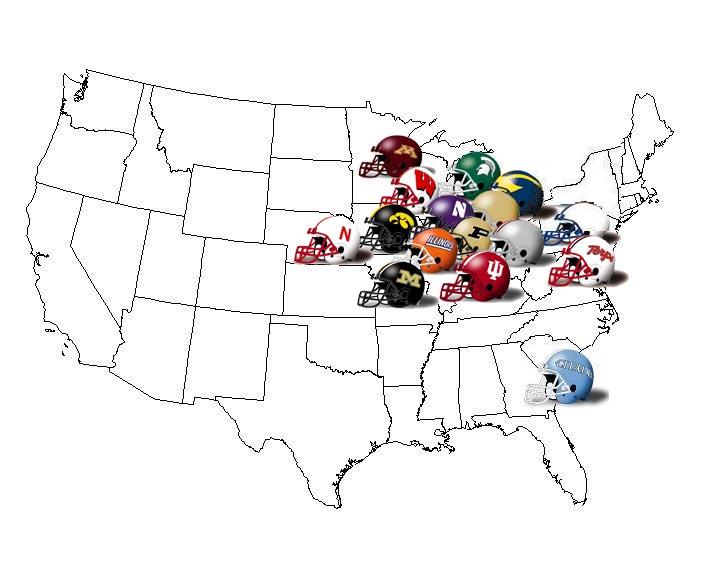
Conference expansion: should The Citadel join the Big 10?

Nebraska, Missouri, Notre Dame, Texas — it’s hard to take in all that’s (not) going on right now…

With all this expansion talk, there is a chance the Big 10 (motto:  “Just ignore the ’10’ thing”) might wind up with an odd number of teams.  Of course, it has an odd number of teams right now.  However, I’m thinking that when all the dust settles from this latest realignment, Jim Delany and company are going to want to be at 12 or 14 or 16 teams, if only to end speculation the league might expand again (and thus prevent all those late-night telephone calls from the folks at Iowa State begging for admission).

If the Big 10 needs an extra team, The Citadel would be an obvious candidate and would presumably get an invitation.  The question is, should the military college accept the Big 10’s offer and leave the Southern Conference?  What are the positives and negatives of making the move?

Positives

— There would be no controversy over where the conference baseball tournament would be hosted, as the other schools in the Big 10 would have no problem playing in Charleston every May.  Charleston versus Columbus?  No contest.  No more carping from the likes of UNC-Greensboro.  (And do you see UNCG mentioned as a candidate to join the Big 10?  No.  The Spartans should be grateful just to be in the same hemisphere with the Bulldogs, much less the same league.)

The Citadel would be a favorite to win the league in baseball every season.  Also, we could probably demand that all of our conference games would be played at Riley Park.  Fun spring trip for the guys from Minnesota and Wisconsin, and an easy three-game sweep for us.

–All home games in football and basketball would be on TV, along with a lot of televised games for the other sports.  Also, the Big 10 Network has a slightly larger distribution nationally than the SoCon TV package.

It’s important for The Citadel to increase its TV presence, as I have written many times before.  I have previously advocated playing Big 10 teams in non-conference action so as to get on TV.  Now, the opportunity could be there to play Big 10 teams as league games.

–By 2012 or 2013 or whenever we joined the league, there is a chance Indiana still wouldn’t have its act together on the hardwood and we could snag a road victory at Assembly Hall, which would be neat.  Plus, you know Nebraska won’t be any good at hoops, and Northwestern would be a promising opportunity for a road W.  So we could be competitive almost immediately.

–A new recruiting territory would open up, and with the advantage of offering recruits the best weather in the conference (unless Texas joins the league, and even then it’s a push).  The Citadel has already had some good luck recently with players from Big 10 country (Ohio is the home state for basketball’s Austin Dahn and baseball’s Justin Mackert).

If Texas winds up in the conference along with the Bulldogs, that opens up the Lone Star state even more to The Citadel’s predatory hoops recruiters (see:  Cameron Wells, Zach Urbanus, Mike Groselle).  With that type of opening, regular trips to the Final Four would be inevitable.

–The extra money from being a Big 10 member could go toward expanding Johnson Hagood Stadium.  The Big 10 could also flex its collective muscle and break the NCAA’s silly postseason ban in the Palmetto State.  That, combined with the newly expanded JHS, would result in a new bowl game for Charleston, so the community would also benefit.

Negatives

–Well, the road trips would feature a lot of snow and ice (excepting UT-Austin, which would probably be worth a mandatory travel game for the corps of cadets).  There is only so much places like East Lansing and Iowa City have to offer (not to mention Lincoln).

That’s why you can expect a lot of the league meetings to get moved to Charleston. Also, look for a lot of the Big 10 coaches to acquire beachfront property in the Low Country, a la Roy Williams, Ralph Friedgen, Les Robinson, etc.  It’s just a natural thing for them to do.

–Big 10 basketball can often be unwatchable.  Actually, you could say that about a lot of Big 10 sports…

–The Citadel probably would not be able to play schools like Chowan or Webber International in football.  Wait, that’s a positive!

–Women’s sports:  The Citadel has a limited number of women’s teams, and the ones we have would probably struggle in the Big 10.  We don’t have a women’s lacrosse program, though, which may be just as well.

–The other schools in the Big 10 would be much larger than The Citadel, which could lead to their fans trying to take over our home parks/arenas.  If we made sure the corps of cadets was fully armed before games, however, I think we would maintain our home field advantage.

–There is a possibility that a spot in the ACC or SEC could open up.  If that happens, it’s important for The Citadel to explore all its options.

All in all, I’m undecided about a potential berth in the newly constructed Big 10.  One thing I can say for sure, though, is that The Citadel will be okay wherever it lands.  Can Rutgers or Kansas say the same?

The New Big 10

Bad? Yes. How bad? We don’t know yet.

This is a post mainly to acknowledge that, yes, something is going on at The Citadel, and it’s not good.  It’s very bad, in fact.  Just how bad?  Well, that’s what I don’t know. Not yet.  I don’t think anyone — at least, not anyone outside of a very small group of people — knows for sure.

Because I don’t know, I’m not going to say much about it here right now.  There will be plenty of time (and space) for me to comment once most, if not all, of the information concerning  the arrest of Miguel Starks is made available, including any and all ancillary issues.  You can believe I will have something to say at that time, and I’m not going to be holding back, either.

For the time being, however, I’ll leave most of the commentary to those common plagues of the internet, the message board troll and the online newspaper commenter.  One of the things that happens in the immediate aftermath of an event like this is that various insects of an allegedly human origin begin to crawl out of the woodwork.  This is particularly true when it involves an institution like The Citadel.  The college has many more admirers than detractors, but the detractors tend to be both loud and remarkably angry.

Of course, comments on newspaper articles are easily ignored (and The Post and Courier has currently disabled comments for stories concerning Starks).  It can be harder sometimes to avoid the message board trolls.

For example, at http://www.thelordsofdiscipline.net/ there have been several debut posters over the last 24 hours. Some of these new posters appear to be current cadets or recent graduates who have pertinent information to disclose, but I suspect a couple of them are trolling frauds.  It’s almost impossible to say for certain who is “real”, though, at least for a short while.

That’s why it’s best not to draw conclusions from unverifiable sources, of course. Rumors are just that — rumors.

I’m going to wait and see how this situation plays out, and I would suggest others do the same.  I’ll close by saying this, though — there are recruiting mistakes, and then there are recruiting mistakes.

College Football TV Listings, Week 14

It’s the last week of the year for regular season games of any sort, with the notable exception of the Army-Navy game, which takes place on Saturday, December 12th.  This week’s listing includes all the FBS contests (including the conference title games), FCS quarterfinal matchups, and Division II playoff action (both D-2 semifinal games are nationally televised).

As I’ve done throughout the season, I’m using Google Documents in an effort to make the listings more accessible.

College Football TV Listings, Week 14

Additional notes:

  • Oregon State-Oregon will be the de facto Pac-10 championship game; the winner goes to the Rose Bowl.
  • Cincinnati-Pittsburgh will be the de facto Big East championship game; the winner goes to a BCS bowl to be determined (with the Bearcats having an outside shot at the BCS title game).
  • Ohio State has already clinched the Big 10 title and will play in the Rose Bowl.
  • Boise State has already clinched the WAC title and may play in a BCS bowl to be determined.
  • TCU has already clinched the Mountain West title and will play in a BCS bowl to be determined (if not the BCS title game).
  • Troy has already clinched the Sun Belt title and will play in a bowl game to be determined.
  • “Official” conference title games this week:  MAC (Ohio-Central Michigan), C-USA (Houston-East Carolina), SEC (Alabama-Florida), ACC (Georgia Tech-Clemson), and Big XII (Nebraska-Texas).
  • There will actually be two productions for the California-Washington game.  I have listed the TV announcers for FSN-Northwest/FCS-Pacific; Barry Tompkins and Mike Pawlawski will be calling the game for CSN-California (plus feed).

A lot of the information I used in putting this together came courtesy of Matt Sarzyniak’s great website (College Sports on TV) and the folks over at the 506.com; there are links to both sites to the right of this page, in the “TSA  Checkpoints” section.

College Football TV Listings, Week 13

This list actually includes all games involving FBS or FCS schools, whether televised or not.  For the TV games, I also list the broadcast announcers and sideline reporters.  There are usually a couple of games (often local telecasts involving FCS teams) where gathering information on announcers and sideline reporters can be difficult.  I usually get all the information on the announcing teams before the weekend begins, however.

This holiday week is a shortened slate, of course, although it does include the FCS playoff matchups.

As I’ve done throughout the season, I’m using Google Documents in an effort to make the listings more accessible.

College Football TV Listings, Week 13

Additional notes:

ABC/ESPN 3:30 pm ET and 8:00 pm ET coverage maps:  Link

  • ERT-SEC (SEC Network) coverage of Mississippi-Mississippi State can be seen on CSN-California, MSG, CSN-Washington+, ESPN GamePlan, and local affiliates listed here:  Link
  • Raycom affiliates for Wake Forest-Duke are listed here:  Link
  • ERT-BE (Big East Network) coverage of Syracuse-Connecticut can be seen on SNY, MASN, CST, Altitude, ESPN GamePlan, and local affiliates listed here:  Link
  • ERT-WAC syndication coverage of Utah State-Idaho can be seen MASN, Altitude, ESPN GamePlan, and on local affiliates listed here:  Link

A lot of the information I used in putting this together came courtesy of Matt Sarzyniak’s great website (College Sports on TV) and the folks over at the 506.com; there are links to both sites to the right of this page, in the “TSA  Checkpoints” section.

Football, Game 11: The Citadel vs. Georgia Southern

It has been a disappointing season for The Citadel, but it is likely that it has been an even more disappointing campaign for Georgia Southern.  The Eagles, like the Bulldogs, are 4-6, and losing seasons are definitely not the norm in Statesboro.

It will be only the third losing season for the Eagles since Erk Russell restarted the football program in 1982.  In 1996 Frank Ellwood went 4-7 in his only season in charge; Ellwood was a transitional coach following the firing of Tim Stowers.  In 2006, Brian VanGorder blew into town and left after one year, leaving with a 3-8 record.  He was replaced by the current coach, Chris Hatcher.

Hatcher had been very successful at Division II Valdosta State (winning a national title in 2004) but has not managed to lift GSU to its accustomed heights, with season records of 7-4, 6-5, and this year’s 4-6 to date.  When Ellwood completed his one season as head man in Statesboro, he was replaced by Paul Johnson, who proceeded to win 37 games and a national title over his first three years in command.  (Johnson won another I-AA crown in his fourth season, as well.)

Hatcher’s 17 wins pale in comparison, even when given the benefit of the doubt for having to pick up the pieces left by the hurricane that was VanGorder.  Stowers won 26 games in his first three seasons as the head coach; Mike Sewak won 27 in his first three years.  Even Erk Russell, starting from scratch in 1982, won 21 games over his first three seasons.  Small wonder there is some question about Hatcher’s job security.

After all, this is a school that has considered a move to FBS.  Struggling in the SoCon is not a good recipe for making a move up the football ladder.

The Eagles are 3-4 in the SoCon, having lost last week at home to Furman 30-22.  The Paladins jumped out to a 24-0 lead in that game and held on for the victory.  It was the third straight loss for GSU; the other two losses were a 52-16 beatdown at Appalachian State and a 31-10 loss at Samford.

GSU fans aren’t used to losing games by 30+ points, but it’s happened three times this season:  once to North Carolina (no shame in that), the aforementioned game against ASU and a 44-6 wipeout at South Dakota State earlier this season.  The Jackrabbits are ranked #21 in the FCS, but that is no consolation to Eagle fans.

Like The Citadel, Georgia Southern has allowed 28 points or more in 6 games this year.  In league play, the Eagles have struggled on pass defense, allowed 7.9 yards per pass attempt, worst in the conference, and 12 touchdowns, tied for worst with…The Citadel.

GSU’s rush defense is statistically better, although part of that is due to teams rushing fewer times against the Eagles than any other squad in the league.  The Eagles have done a good job forcing turnovers, which is why GSU is +2 in turnover margin (because the GSU offense has given the ball away quite a bit itself).

Georgia Southern likes to blitz, which can lead to big plays both ways.  Samford, nobody’s idea of a big-play team, had touchdown passes of 69 and 57 yards in its victory over the Eagles.   The Citadel will have opportunities to get its receivers in one-on-one situations.

The receiver the Bulldogs would most like to see in a one-on-one matchup, of course, is Andre Roberts.  It’s his last game for the Bulldogs; maybe he’ll have a chance to cap a memorable career in grand style.

On offense the Eagles are near the bottom in most categories in conference play, ranking seventh (out of nine teams) in scoring offense, total offense, rushing offense, pass efficiency, and third-down conversions.  Georgia Southern has, however, been efficient in the red zone.  The Eagles are also first in the league in time of possession.

The biggest problem GSU has had, statistically, is allowing sacks — 30 in league play, the most allowed by a conference team.  The Citadel needs to continue the trend of opponents putting GSU quarterbacks on the ground if the Bulldogs plan on winning this game.

Georgia Southern has committed more penalties than all but one team in league play.  However, The Citadel has had fewer penalties called against its opponents than any other school in the conference.  Something’s gotta give…

Lee Chapple started the first nine games at quarterback for the Eagles, but last week was replaced as the starter by Kyle Collins.  Chapple will probably start against The Citadel.  He has thrown 7 touchdowns this season, but has been intercepted 14 times.  GSU running back Adam Urbano is only averaging 63.3 yards per game on the ground in league play, but he’s a definite receiving threat, having caught 45 passes this season, which leads the Eagles.

This game will not be Homecoming at Paulson Stadium — that was last week, against Furman.  However, there will probably still be a good crowd urging GSU (including 16 Eagle seniors) on to victory.  The Citadel has historically not fared well in Statesboro, with only one victory (in 2003) in ten trips to Paulson.

However, perhaps Saturday will be different.  After all, it will be November 21, and strange and wondrous things have been known to happen on that date, most notably on November 21, 1978.

That day, The Citadel trailed Furman 18-0, but scored 35 unanswered points to defeat the Paladins 35-18.  The coach of the Bulldogs that day was Art Baker, and it was the first (and only) time Baker ever won a game in The Citadel-Furman series.  He had been 0-8 until then, losing games as head coach of both Furman and The Citadel.

He would also lose the next season, in his final game as a head coach in the series, but on November 21 he was golden.  Maybe that’s a good sign for the Bulldogs on Saturday against GSU.

College Football TV Listings, Week 12

This list actually includes all games involving FBS or FCS schools, whether televised or not.  For the TV games, I also list the broadcast announcers and sideline reporters.  There are usually one or two games (often local telecasts involving FCS teams) where gathering information on announcers and sideline reporters can be difficult.  I usually get all the information on the announcing teams before the weekend begins, however.

As I’ve done throughout the season, I’m using Google Documents in an effort to make the listings more accessible.

College Football TV Listings, Week 12

Additional notes:

ABC/ESPN 3:30 pm ET and 8:00 pm ET coverage maps:  Link

  • This week the SEC Network will have split telecasts.  ERT-SEC (SEC Network) coverage of Mississippi State-Arkansas can be seen on CSN-California, MSG2, ESPN GamePlan, and local affiliates listed here:  Link
  • ERT-SEC (SEC Network) coverage of UT Chattanooga-Alabama can be seen on FSN-Detroit+, ESPN GamePlan, and local affiliates listed here:  Link
  • Raycom affiliates for Maryland-Florida State are listed here:  Link
  • ERT-BE (Big East Network) coverage of Syracuse-Louisville can be seen on SNY, MASN, CST, Altitude, Bright House-Tampa, ESPN GamePlan, and local affiliates listed here:  Link
  • Southland TV coverage of Nicholls State-Southeastern Louisiana (Thursday) and Central Arkansas-McNeese State (Saturday) can be seen on local affiliates listed here:  Link
  • Montana-Montana State can be seen on Montana News Station affiliates (including flagship station KPAX) and will also be televised nationally on DirecTV and the Dish Network:  Link
  • Youngstown State-North Dakota State will be televised on the North Dakota NBC Network, including KVLY (Fargo, ND), KFYR (Bismarck, ND), KMOT (Minot, ND), KQCD (Dickinson, ND), and KUMV (Williston, ND).

Of the 108 games this weekend involving FBS and FCS schools, 59 of them will be televised live on a local, regional, or national basis.  Of the 53 games featuring FBS squads (including Alabama’s game against UT-Chattanooga of the FCS), 42 will be televised.  Only four games involving teams from BCS leagues will not be on TV — Baylor-Texas A&M, Iowa State-Missouri, Oregon State-Washington State, and Rutgers-Syracuse (although the Big East contest will be on the ESPN360 platform).

A lot of the information I used in putting this together came courtesy of Matt Sarzyniak’s great website (College Sports on TV) and the folks over at the 506.com; there are links to both sites to the right of this page, in the “TSA  Checkpoints” section.

Just make a play

““If anybody on offense, defense or special teams had just made one play at any point, it would have been a different game.” — Kevin Higgins

To review some of the plays that weren’t made:

— UTC quarterback B.J. Coleman threw 61 passes on Saturday.  He was not sacked.  Not once!  To be honest, that’s hard to do.  You would think that at least one time he would have tripped over a lineman’s foot and fallen down, or suffered a leg cramp while in the pocket, or pulled a Brett Favre-against-Michael Strahan move, but no.

What’s more, when Coleman went back to pass, he wasn’t looking to run.  Coleman threw 61 passes and had no rush attempts for the game.  The Mocs only rushed 12 times during the entire game (for 17 yards), so basically on every play, the Bulldogs knew that Coleman was going to throw the ball, and he was never going to be a threat to take off and run with it (and they also knew he was going to throw in Blue Cooper’s direction as often as possible, but Cooper still caught 14 passes).

The Bulldog D held the Mocs in check for a while, and when Chris Billingslea intercepted a fourth-down pass and returned it to the UTC 49, eventually leading to a Bulldog TD, things were looking good.  Then the Mocs went to a no-huddle attack, and from that point on, The Citadel’s defense turned to mush.  The ensuing drives for UTC were as follows:

  • 60 yards, field goal
  • 56 yards, field goal
  • 80 yards, touchdown
  • 71 yards, touchdown (plus a two-point conversion)
  • 43 yards, field goal
  • 9 yards, touchdown (after a long punt return)
  • 17 yards, turned over on downs (a clock-eating exercise that left The Citadel just 25 seconds to try to score)

You’ll notice there are no turnovers or punts listed.  That’s because there weren’t any to list once the Mocs went to the no-huddle.

— Speaking of turnovers, The Citadel’s defensive backs probably should have intercepted at least three Coleman passes in the second half.  Should have, but didn’t.  Again, someone needed to make a play, but no one did.

— Not only was Coleman not sacked, he was rarely pressured.  Higgins noted that “looking at the tape, we did have five or six hits on him”.  Five or six hits is generally not going to be enough to make an impact against a QB who threw 61 passes, but as it is the official statistics only credit The Citadel with one “hurry” for the entire game.  Of course, the official statistics also list John Synovec as having played quarterback for the Bulldogs on Saturday…

— The actual quarterback for The Citadel on Saturday was freshman walkon Tommy Edwards, who basically performed at the same level as he did against Samford — that is to say, quite well.  You really couldn’t have asked for much more from Edwards, who did a good job throwing the ball and forced the Mocs to honor him as a runner.  He also committed no turnovers.

After a gimpy Bart Blanchard struggled against Wofford, and with Miguel Starks apparently not in much better shape than Blanchard, the coaching staff’s decision to start Edwards was obviously the right call.  It probably should have been the call last week, too.

The offense did bog down in the second half (and the fourth-down playcall that resulted in Terrell Dallas losing two yards was poor), but the bottom line is that Edwards and company put 28 points on the board, including a touchdown with just over ten minutes to play that made the score 28-13.  That should have been enough to win the game, but the defense didn’t hold up its end of the bargain, and neither did the special teams.

The Bulldogs had another makeable field goal go unmade, failed to recover an onside kick, and also allowed a 53-yard punt return to set up the winning touchdown.  Teams don’t win games with special teams that are less than special.

The Citadel didn’t perform as badly against UT-Chattanooga as it did against Elon, Western Carolina, and Wofford, but it was still a crushing defeat.  Every week it seems the Bulldogs have another goal for this year go by the boards.  In the case of the UTC loss, that unmet goal is a winning season.

Of course, winning teams make key plays to clinch victories.  The Citadel hasn’t been making those plays for most of the season, and it shows in the win-loss record.

Football, Game 10: The Citadel vs. UT-Chattanooga

Note:  it can be difficult to figure out what to call the athletic teams of the University of Tennessee at Chattanooga.  Recently the school began using a ‘C’ mark, for “Chattanooga”.  The university’s teams have variously been referred to over the years as “UT-Chattanooga”, “Tennessee-Chattanooga”, “UTC”, and “Chattanooga”.

The nickname/mascot history is even more tangled.  A “moccasin” used to be a snake, then a shoe, then a cartoon Cherokee Indian called ‘Chief Moccanooga’, and now a mockingbird train conductor (and “moccasin” has morphed into “moc”, for mockingbird).

There is an explanatory page on the school’s website.  The page includes a quotation from Jimmy Fallon.  As you may have guessed, the quote is not very funny.

In the post that follows, I will call the school either “UT-Chattanooga”, or “UTC”, because that’s what I’ve always called it, and I see no particular reason to change.

Around this time last year The Citadel played UT-Chattanooga in Charleston.  It was Homecoming for the Bulldogs, and everyone expected a big win, since the Mocs were 1-9 (and would eventually finish 1-11).  At that time I wrote about how UTC had collapsed as a program after consistently challenging for league honors in its first 10-15 years in the Southern Conference.

Well, The Citadel did win that day, but barely, letting a team playing out the string with a lame-duck coach hang around and nearly steal the victory.  The Bulldogs survived thanks to Andre Roberts’ last-minute punt return TD, but despite winning the game, it was almost as poor a showing as The Citadel had for this year’s Homecoming.

UT-Chattanooga replaced Rodney Allison with Russ Huesman, who basically has the ideal background for a UTC head coach.  Huesman played high school football at famed Moeller High School in Cincinnati for Gerry Faust, who was destined to become a much-maligned coach for Notre Dame (albeit one who never lost to Navy).  Huesman then played college football for the Mocs, with his first two years under Joe Morrison and his last two under Bill “Brother” Oliver.

Huesman was a longtime assistant at William & Mary, where he coached the secondary (Huesman was a DB himself at UTC) and was later the defensive coordinator.  Players he coached while with the Tribe include longtime NFL interception magnet Darren Sharper, Pittsburgh Steelers head coach Mike Tomlin, and Philadelphia Eagles defensive coordinator Sean McDermott.  That’s not a bad list of guys to have as references.

He then moved to Memphis for several seasons, including a stretch as recruiting coordinator for the Tigers, before spending five seasons as the defensive coordinator for Richmond, the defending FCS champions.

That’s a nice resume for any prospective head coach at the FCS level; being an alum is an even bigger bonus.  Huesman seems to have given the program some much-needed enthusiasm.  Home attendance has increased significantly, with three of the ten biggest crowds in Finley Stadium history so far this season.  There was even a bonfire on Wednesday night.

Another thing Huesman did was bring in a transfer from Tennessee to play quarterback.  B.J. Coleman has had a solid season for the Mocs, nothing flashy stats-wise but generally getting the job done.

Coleman has thrown fourteen touchdowns against six interceptions, although he did throw three picks last week against Appalachian State.  Five of his six interceptions for the season, in fact, have come in the last three games.  Coleman is a sophomore who will have two more years of eligibility after this season.

The Vols transfer has spread the ball around, although his favorite target is definitely Blue Cooper, who has 68 receptions and could conceivably make the All-SoCon squad ahead of Andre Roberts (Elon’s Terrell Hudgins is a lock for the other first-team spot at wide receiver).

UTC suffered a blow when running back Bryan Fitzgerald was injured and lost for the season.  Freshman Chris Awuah is the leading rusher for the Mocs, but he is averaging just 3.2 yards per carry.  UTC is last in the league in rushing offense.

UTC has respectable, if not eye-popping, defensive statistics across the board, generally ranking in the upper half of the SoCon in most categories for conference-only games.  The Mocs have struggled, however, in defending 3rd-down conversions; the Mocs D is 7th in the league (The Citadel is 8th in the league, ahead of only Furman).  Another sore spot for the defense is red zone conversion rate; UTC is last in the SoCon, and has allowed 17 touchdowns in 25 opponents’ possessions inside the 20.

The Mocs are tied for the lead in interceptions in conference play with eight; free safety Jordan Tippet has five of his own.

One defensive stat that is very impressive for UTC:  sacks.  The Mocs have 24 sacks on the season; their 16 sacks in league play in second-best in the conference.  The primary sack-master is right defensive end Josh Beard, who has 10.5 of them so far this year.  His partner in crime on the other side of the line, freshman DE Joshua Williams, has 6.

Despite the mediocre 3rd-down defense numbers and lack of a rushing game, UTC leads the league in time of possession.  The Mocs don’t hurt themselves with penalties (second in the SoCon).  UTC is next-to-last in net punting, but features an outstanding placekicker in Craig Camay, who is 13-16 converting field goals this year, with a long of 52.  Camay is also a weapon for onside kicks; the Mocs have recovered four of five onside kick attempts in league action.

A few other odds and ends:

— I was surprised to find out that The Citadel is UT-Chattanooga’s most common opponent.  Saturday’s game will be the 43rd meeting between the two schools.  The school in second place on the Mocs most-played list?  Tennessee, which has faced UTC on 41 occasions.  The Vols are 37-2-2 in those games.

— UTC is 5-4, but if it has dreams of a winning season, it probably needs to beat The Citadel.  Next week, the Mocs play Alabama.  Yikes.

Tangent:  what is with the SEC and these late-season matchups against FCS schools?  Last week, there were four such games:  Tennessee Tech-Georgia, Furman-Auburn, Northern Arizona-Mississippi, and Eastern Kentucky-Kentucky.

Last year, of course, The Citadel closed out its season by playing Florida.  Why aren’t these games being played in the first couple of weeks of the season? I hope all of them were Homecoming games.

— UTC’s game notes reference The Citadel’s football stadium (on the same page) as “Haggod Stadium” , “Johnson Hagood Stadium”, and “Sansom Field”.

— The Citadel has never won four straight games against UT-Chattanooga.  The Bulldogs currently enjoy a three-game winning streak versus the Mocs.

It’s hard to say what The Citadel’s chances on Saturday are, since it’s hard to determine which Bulldog team will show up — the one that played Appalachian State and Furman, or the one that played Elon, Western Carolina, and Wofford?

It will be interesting to see who starts at quarterback.  If I had to guess (and it’s only a guess), I would say that Miguel Starks, even if just “85%”, will get the nod.  Just the thought of a gimpy Bart Blanchard sitting in the pocket as the two sack-happy UTC defensive ends converge on him is cringe-inducing…

I certainly hope that the Bulldogs are more competitive than they were last week.  This is a big game for UTC, which has a chance for a winning season.  Given that the Mocs won a total of six games in the previous three years, that would be a major accomplishment.  UT-Chattanooga will be ready to play on Saturday.  The Bulldogs better be ready as well.