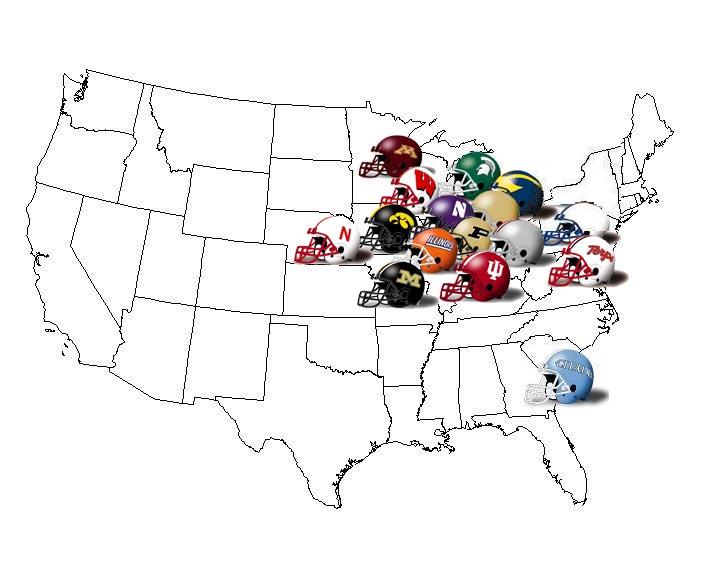
ESPN College Football Announcers for 2010

ESPN has released its assignments for its college football game coverage, as well as its studio coverage.  As always, there are some new crews.  Highlights:

— Among the tandems that work the high-profile ESPN/ABC games, the one significant change is in the “west coast” team, where there will now be a three-man booth — Carter Blackburn, Brock Huard, and Mike Bellotti.  The former Oregon coach is in his first season as an analyst; he works with Huard, who was the analyst for the SEC ESPNU primetime game last year.  Blackburn called mostly west coast games on the U last season after moving over from CBS College Sports.

That team essentially replaces the Terry Gannon/David Norrie duo from 2009. Gannon is not listed on this year’s release; he may just have too much already on his announcing plate (Dave Lamont filled in for him a few times last season as it was). Norrie is going to ESPN Radio, replacing Dennis Franchione as Bill Rosinski’s analyst.  Norrie will also work a few midweek TV games (along with Robert Smith), teaming with Beth Mowins.

— That’s right, there is now a second woman play-by-play voice calling college football for ESPN.  Mowins will apparently have a limited schedule.

Pam Ward is still around, and presumably as intolerant of injured players as ever. However, she’s been moved from the noon ET ESPN2 slot to 3:30 pm ET on ESPNU, much to the relief of Michigan State and Northwestern fans everywhere.  Her analyst will be Danny Kanell.

— Kanell, the former FSU quarterback, also will do some studio work.  He’s the breakout star, I guess, of the multitude of game callers/analysts who worked ESPN360 (now ESPN3.com) games last season.  What does that say about the talent featured on ESPN3.com in 2009?  Well…

The release doesn’t mention anything about who will work ESPN3.com games this year; it does note that “additional commentators will contribute throughout the season”.  There will be a lot of “additional contributors” both on ESPN3.com and on the regular TV platforms.  Week 1, for example, will include 11 games that will be shown live exclusively on ESPN3.com.

— Erin Andrews will be hosting the first hour of an expanded College Gameday (that was announced last month).  She will also be the sideline reporter for the game site from which the program originates, assuming it’s on ABC/ESPN/ESPN2.

That means the other high-profile game tandems will probably flip-flop sideline reporters a bit more often than normal, although most of the time Andrews will likely work with Brent Musberger and Kirk Herbstreit.  Last year, the sideline reporter with that duo was Lisa Salters, who will not be back this year.

Quint Kessenich moves from the Big East regional game of the week to a national gig; his replacement on the sidelines for the Big East games is Eamon McAnaney.  I think there is a lacrosse announcer quota involved in that switch, but I’m not sure.

Andrews won’t be roaming the sidelines on Thursday night any more.  “The new EA” is Jenn Brown, who like Andrews is a Florida grad, blond, and destined to become a sports blog/message board favorite.

— The other change on Thursday nights is Rece Davis taking over play-by-play duties from Chris Fowler.  I like Davis, although he isn’t really a natural at play-by-play, but I’m not a fan of the Craig James/Jesse Palmer dual threat.  I find their combined analysis rather banal; at least James wears a properly sized tie.

— Fowler remains the ringleader for College Gameday, with Lee Corso (who I hope has now fully recovered from his stroke), Herbstreit, and Desmond Howard.  There was little change in personnel for the major studio shows. That’s right, another year of Dr. Lou (with Davis and Mark May) and The Bachelor (with John Saunders).  Robert Flores takes over as the new update guy on ABC.

There were some moves on the SEC-on-ESPN desk.  Dari Nowkhah will now be the syndication studio host, as Rob Stone will call games on ESPNU (he’s working the noon U game with David Pollack).  Another change of interest for SEC fans is the new primetime team for that league on ESPNU.  Clay Matvick and Herm Edwards will replace Eric Collins and Brock Huard.  Edwards may be a San Diego State alum, but he strikes me as a natural pick to analyze SEC action, as teams in that conference definitely play to win the game.

As mentioned earlier, Huard is working west coast games this season, while Collins has apparently moved to the Big 10 Network.  If I see a release listing announcers for the BTN/CBS College Sports/etc., I’ll post it here; the other BTN announcing news of note I’ve seen suggests that Tom Hart will be joining that network.

Edit (8/25/10) — Here is the BTN release, with Hart and Collins listed as announcers:  Link

Another non-ESPN announcing note:  The ACC game of the week, produced by Raycom, will have a new analyst this year, with David Archer replacing Rick “Doc” Walker.  This, if not a national tragedy, is at least a regional outrage.  I need to know which ACC players are actually cyborgs.

— Anish Shroff will take over from Charlie Neal as the play-by-play man for ESPNU’s Thursday night games.  Luckily, CitiField will not host a football game this season.

— Joe Tessitore will call the Friday night ESPN2 games with Rod Gilmore again, but Tessitore (who I find enjoyably bombastic) will also be the play-by-play voice for the ESPN-3D games, which will feature separate production teams for “regular” and 3D broadcasts.  He’ll work with new analyst Tim Brown and sideline reporter Ray Bentley (who had worked with Pam Ward for the last three seasons).

— The noon ESPN/ESPN2 games will each have Grieses in the booth.  Bob Griese returns with Chris Spielman and Dave Pasch on ESPN, while the ESPN2 game will feature Brian Griese (who had a promising debut last year) with play-by-play man Bob Wischusen.

Pasch and Wischusen are both guys who could/should work higher-profile games, but each is a radio announcer for an NFL team (the Cardinals for Pasch, the Jets for Wischusen) and are basically limited to early-afternoon Saturday games on ESPN.

— Ron Franklin, who was planning on retiring, is back and working again with Ed Cunningham.  I hope that team gets some heavy-duty games this year.

Getting closer to kickoff…

Conference expansion: should The Citadel join the Big 10?

Nebraska, Missouri, Notre Dame, Texas — it’s hard to take in all that’s (not) going on right now…

With all this expansion talk, there is a chance the Big 10 (motto:  “Just ignore the ’10’ thing”) might wind up with an odd number of teams.  Of course, it has an odd number of teams right now.  However, I’m thinking that when all the dust settles from this latest realignment, Jim Delany and company are going to want to be at 12 or 14 or 16 teams, if only to end speculation the league might expand again (and thus prevent all those late-night telephone calls from the folks at Iowa State begging for admission).

If the Big 10 needs an extra team, The Citadel would be an obvious candidate and would presumably get an invitation.  The question is, should the military college accept the Big 10’s offer and leave the Southern Conference?  What are the positives and negatives of making the move?

Positives

— There would be no controversy over where the conference baseball tournament would be hosted, as the other schools in the Big 10 would have no problem playing in Charleston every May.  Charleston versus Columbus?  No contest.  No more carping from the likes of UNC-Greensboro.  (And do you see UNCG mentioned as a candidate to join the Big 10?  No.  The Spartans should be grateful just to be in the same hemisphere with the Bulldogs, much less the same league.)

The Citadel would be a favorite to win the league in baseball every season.  Also, we could probably demand that all of our conference games would be played at Riley Park.  Fun spring trip for the guys from Minnesota and Wisconsin, and an easy three-game sweep for us.

–All home games in football and basketball would be on TV, along with a lot of televised games for the other sports.  Also, the Big 10 Network has a slightly larger distribution nationally than the SoCon TV package.

It’s important for The Citadel to increase its TV presence, as I have written many times before.  I have previously advocated playing Big 10 teams in non-conference action so as to get on TV.  Now, the opportunity could be there to play Big 10 teams as league games.

–By 2012 or 2013 or whenever we joined the league, there is a chance Indiana still wouldn’t have its act together on the hardwood and we could snag a road victory at Assembly Hall, which would be neat.  Plus, you know Nebraska won’t be any good at hoops, and Northwestern would be a promising opportunity for a road W.  So we could be competitive almost immediately.

–A new recruiting territory would open up, and with the advantage of offering recruits the best weather in the conference (unless Texas joins the league, and even then it’s a push).  The Citadel has already had some good luck recently with players from Big 10 country (Ohio is the home state for basketball’s Austin Dahn and baseball’s Justin Mackert).

If Texas winds up in the conference along with the Bulldogs, that opens up the Lone Star state even more to The Citadel’s predatory hoops recruiters (see:  Cameron Wells, Zach Urbanus, Mike Groselle).  With that type of opening, regular trips to the Final Four would be inevitable.

–The extra money from being a Big 10 member could go toward expanding Johnson Hagood Stadium.  The Big 10 could also flex its collective muscle and break the NCAA’s silly postseason ban in the Palmetto State.  That, combined with the newly expanded JHS, would result in a new bowl game for Charleston, so the community would also benefit.

Negatives

–Well, the road trips would feature a lot of snow and ice (excepting UT-Austin, which would probably be worth a mandatory travel game for the corps of cadets).  There is only so much places like East Lansing and Iowa City have to offer (not to mention Lincoln).

That’s why you can expect a lot of the league meetings to get moved to Charleston. Also, look for a lot of the Big 10 coaches to acquire beachfront property in the Low Country, a la Roy Williams, Ralph Friedgen, Les Robinson, etc.  It’s just a natural thing for them to do.

–Big 10 basketball can often be unwatchable.  Actually, you could say that about a lot of Big 10 sports…

–The Citadel probably would not be able to play schools like Chowan or Webber International in football.  Wait, that’s a positive!

–Women’s sports:  The Citadel has a limited number of women’s teams, and the ones we have would probably struggle in the Big 10.  We don’t have a women’s lacrosse program, though, which may be just as well.

–The other schools in the Big 10 would be much larger than The Citadel, which could lead to their fans trying to take over our home parks/arenas.  If we made sure the corps of cadets was fully armed before games, however, I think we would maintain our home field advantage.

–There is a possibility that a spot in the ACC or SEC could open up.  If that happens, it’s important for The Citadel to explore all its options.

All in all, I’m undecided about a potential berth in the newly constructed Big 10.  One thing I can say for sure, though, is that The Citadel will be okay wherever it lands.  Can Rutgers or Kansas say the same?

The New Big 10

College baseball bubble, 5/29

Just a quick update…for the breakdown prior to conference tournament play, see this post:  Link

The Saturday morning report, with changes noted from what I wrote in midweek:

– Locks (36):  Louisville, Connecticut, Virginia, Georgia Tech, Miami, Clemson, Florida State, Virginia Tech, Texas, Oklahoma, Texas A&M, Coastal Carolina, Cal State Fullerton, Rice, TCU, Arizona State, UCLA, Washington State, Oregon, Florida, South Carolina, Auburn, Arkansas, Vanderbilt, Mississippi, Alabama, LSU, College of Charleston, Florida Atlantic, Louisiana-Lafayette, Kansas State, UC Irvine, The Citadel, New Mexico, Stanford, Baylor

Change: Six teams that were not locks earlier in the week are now:  Kansas State, UC Irvine, The Citadel, New Mexico, Stanford, and Baylor.

– Champions from “one-bid” leagues:  15

Congratulations to Stony Brook and Rider for clinching automatic bids on Friday out of the America East and MAAC, respectively.

— Champions from leagues likely to get just one bid, but that do have bubble teams (but no locks):  4 (the leagues in question are the A-Sun, Big 10, MVC, and Southland)

Change: Florida Gulf Coast did lose in its tournament.

That means 55 spots are taken, with 9 still to go.

— Florida Gulf Coast University’s loss in the Atlantic Sun tournament will hurt, but it may still draw an at-large bid, making the A-Sun a two-bid league.  Could be close for the Eagles.

— The Big 10 is not likely to be a two-bid league.  Minnesota is in the driver’s seat for the auto bid.  I won’t completely discount this league getting a second team (Michigan), only because it’s the Big 10, and not because it deserves one.

— Wichita State is in the final of the MVC tournament and plays Illinois State for the title on Saturday.  The Shockers could lose today and still get in the NCAAs, but I tend to doubt it.

— Texas State is still alive in the bloodbath that has been the Southland tournament.  Could Texas State get an at-large bid, if needed?  Possibly.  Like FGCU, it would be a close call.

— The Big East has two locks and likely will get a third team in the field.  That team would have been Pittsburgh, but the Panthers went 1-2 in the tourney.  Also, St. John’s could steal a bid.  If the Johnnies win the tournament, is this a 4-bid league?

— Results in the Pac-10 on Friday broke almost perfectly for that league getting 8 teams in the field.  Stanford locked up a bid, and there were big wins for Oregon State and California.  Washington also won, but I think the Huskies are the ninth team and will not make it.  Oregon State and Cal both probably need one more win.  Arizona is still in good shape, but the Wildcats need to beat the Beavers at least once during the weekend to feel 100% secure.

— The Big XII is going to be a five-bid league.  It also has four completely meaningless games in its tournament today, thanks to the wonder that is pool play.

— The Southern Conference will be at least a three-bid league.  Elon should be that third team, despite losing a fight and a game on Thursday.  The Phoenix can still win the SoCon tourney, but if Elon doesn’t and either Western Carolina or Appalachian State does, I’m not sure the committee is taking four teams from this league.  The Citadel and the College of Charleston will be in the field of 64.

— Southern Mississippi plays Rice in the C-USA title game on Saturday, and the Golden Eagles probably have to win that game to get a bid.

— Liberty is still alive in the Big South tournament, but with more conference tourney upsets looming, it looks like the Flames must win that tourney to snatch a bid.  That will be a tall order, as Liberty will have to beat High Point once and Coastal Carolina twice.

— The Sun Belt could become a three-bid league if a team other than Florida Atlantic wins its tournament.  Either Arkansas State or Troy will be in the final, and FAU has to beat Florida International to get to the other side of the title matchup.  It would be interesting to see Garrett Wittels continue his hit streak in the NCAAs, but I think FIU has to win the SB tourney to make it.  Of course, they may just do that.

— Boston College is probably out of the mix for an at-large after going 1-2 in the ACC tourney (a result that helps North Carolina).  North Carolina State beat Clemson in its opener and probably needs one more win to feel good about its chances.  At this point, I think the Wolfpack might need that win only to further differentiate itself from BC.

— I still think the SEC will get 8 bids.  Kentucky is still in the mix, but I just don’t see it.  I wouldn’t be shocked if Kentucky’s name popped up on the selection show, though.

So, there are nine spots to fill.  As of Saturday morning, I think they might go like this:

Arizona, North Carolina, Oregon State, FGCU, Pittsburgh, North Carolina State, California, Elon, Liberty

Still alive:  Texas State (if needed), Southern Mississippi, Washington, Michigan, Boston College, Wichita State (if needed), Kentucky

Examining the college baseball “bubble” with one week to go

This will be a huge week in the college baseball world, obviously, with conference tournament action all over the country (along with some key regular season games in the Pac-10, which does not have a league tournament).  I decided to break down the potential field and see what teams are in, what teams are out, and what teams have work to do.  Admittedly, I’m not the only person who does this — you can read fine efforts from the folks at Baseball America and Yahoo! Sports, just to name two — but I’m the only person who will do it on this blog.  So there.

I’m going to approach this from the point of view of a fan of a “bubble” team who wants to know the ideal scenario by which his team can make the field, by the way.  The Citadel, while not a true “lock”, is probably safe at this point (and well it should be). However, I would like to see any potential roadblocks to the NCAAs removed.  In other words, I’m for the chalk.

RPI numbers mentioned below are as of May 23 and are from Boyd Nation’s website.  For the uninitiated, the regionals include 64 teams, 30 automatic qualifiers (by winning their respective league bids) and 34 at-large selections.  Three leagues do not hold post-season tournaments, so their regular season champs get the auto bid. Several smaller conferences have already held their post-season events and so we know what teams will be representing those leagues.

There are 15 leagues that will definitely only have one team in the field, the so-called “one-bid leagues”.  Dartmouth, Bethune-Cookman, Bucknell, and San Diego have already qualified from four of these conferences.  The other eleven leagues are the America East, Atlantic 10, CAA, Horizon, MAAC, MAC, NEC, OVC, SWAC, Summit, and WAC.  That leaves 49 spots for the other 15 leagues.

(There are also a few independents, along with the members of the Great West, a league that does not get an automatic bid, but none of those teams are serious candidates to make a regional.)

There are several leagues that will also be “one-bid” conferences, unless the regular season champion doesn’t win the conference tournament, and even then the favorite might not be good enough to get an at-large bid anyway.  Bubble teams should definitely be rooting for the top seed in these leagues, just to make sure no spots are “stolen”.  These leagues are as follows:

— Atlantic Sun – Florida Gulf Coast University dominated this conference.  With an RPI of 40, FGCU probably stands a decent (not great) shot at getting a bid even if it loses in the A-Sun tourney.  This is unfamiliar ground for the Eagles, as the A-Sun tourney will be their first post-season experience in Division I.

If you’re wondering why you have never heard of Florida Gulf Coast University, it’s because the school (located in Fort Myers) has only existed since 1997.  The baseball team has only been around since 2003, first as a D-2 program and now at D-1.  It’s an amazing story, really; there are a few more details to be found here.  It just goes to show you how many good baseball players there are in Florida, and for that matter how many young people there are in Florida (FGCU has an enrollment of over 11,000).

— Big 10 – Michigan has an RPI of 65, which isn’t really that great, and didn’t even win the regular season title (Minnesota, with a losing overall record, did).  It’s barely possible the selection committee will throw a bone to the all-powerful Big 10 and give a “snow bid” to a second team from the league, but I doubt it.   Incidentally, the Big 10 tournament will be held in Columbus, but Ohio State did not qualify for the event.

— Big South – Coastal Carolina will almost certainly be a national seed.  If the Chanticleers win the league tourney, the Big South is probably a one-bid league. Liberty has an RPI of 51 and has beaten no one of consequence.  Bubble teams should definitely root for CCU.

— Conference USA – Rice will be in the tournament.  The only other team with a shot at a potential at-large bid is Southern Mississippi, but with an RPI of 67, it’s likely the Eagles need to win the C-USA tourney.  Otherwise, it could be bad news for the Minnesota Vikings.

— Missouri Valley – Wichita State will be the top seed at the MVC tourney, tying for the regular season title with Illinois State but holding the tiebreaker.  If the Shockers (RPI of 56) don’t win the league tournament, they could get an at-large bid, but I don’t see it. Still, you have to watch out, given the tradition of Wichita State, that the committee doesn’t give a “legacy” bid.

— Southland – There are three teams (Texas State, Southeastern Louisiana, and Northwestern State) that are semi-viable at-large candidates, but I suspect all of them really need the auto bid.  Texas State won the regular season title, has an RPI of 50, and probably would be the one best positioned for an at-large spot, but I don’t think that would happen. Bubble teams should pull for Texas State anyway, just to make sure.  Southeastern Louisiana has an RPI of 48 but dropped all three games of its final regular season series to Northwestern State, at home, and thus finished third in the league.

Let’s look at the remaining “mid-majors”:

— Big East – Louisville should be a national seed.  Connecticut has had a great year and may wind up hosting (but as a 2 seed).  Pittsburgh doesn’t have a great RPI (53), but has a fine overall record, will get the benefit of the doubt for its power rating because it is a northern school, and is probably in good shape.  The Big East appears to be a three-bid league.  St. John’s has a good record but an RPI of 74.

— Big West – Cal State Fullerton will host and could be a national seed.  UC Irvine should also make it out of this league (which does not have a post-season tournament).  I don’t see anyone else getting in.  It’s a two-bid league.

— Mountain West – TCU will probably host a regional.  I think New Mexico (RPI of 42) is getting in, too, although an 0-2 MWC tourney could make the Lobos a little nervous.  The MWC should get two bids.

— Southern – The Citadel (RPI of 37) won the regular season by two full games, winning its last seven league games (and its last eight games overall).  It was the only school in the SoCon to not lose a home conference series, and went 8-4 against the schools that finished 2nd, 3rd, 4th, and 5th in the league, with all of those games being played on the road.

What The Citadel was not good at was winning on Tuesday.  It was 0-7 on Tuesdays until winning at Winthrop in its final Tuesday matchup.  On days other than Tuesday, the Bulldogs were 37-13.

Regionals are not played on Tuesdays.  The selection committee is aware of this, and probably aware that The Citadel has a top-flight starting pitcher (potential first-round pick Asher Wojciechowski) and a very good Saturday starter (6’7″ left-hander Matt Talley) who pitch on Fridays and Saturdays.

That’s a lot of verbiage to say that, even if the Bulldogs go 0-2 in the SoCon tourney, I expect them to be in the NCAAs. They better be.

The College of Charleston should be in the NCAAs too, with an excellent record and RPI (24).  The only other team with a shot at an at-large bid out of the SoCon is Elon (RPI of 43), which tied for third in the league (but is the 4 seed in the conference tourney).  The Phoenix had a better record against the ACC (6-1) than in the SoCon (19-11).  The SoCon should get at least two bids, and possibly three.

— Sun Belt – Florida Atlantic and Louisiana-Lafayette will be in the NCAAs.  Then there is Western Kentucky, with an RPI of 36 and some nice non-conference wins (Texas A&M, Texas State, Baylor, Vanderbilt, Kentucky).  However, the Hilltoppers finished 16-14 in league play, tied for sixth, and will be the 8 seed at the Sun Belt tournament. Can an 8 seed out of the Sun Belt get an at-large bid?  I’m not sure about that.

That leaves the four leagues that will send the most teams.  The easiest of these to evaluate, in terms of at-large possibilities, is the SEC.  The other three are a bit more difficult to figure out.

— Southeastern – Alabama’s sweep of Tennessee in Knoxville locked up a berth in the SEC tourney (and the regionals) for the Tide and also knocked the Vols out of both events.  LSU took care of business against Mississippi State, and then got the benefit of Kentucky’s meltdown against cellar-dweller Georgia.  The Wildcats were eliminated from the SEC tourney (and likely the NCAAs) after a 20-0 loss in Athens on Friday night.  Ouch.  The SEC, which some were suggesting could send ten teams to the NCAAs, will send eight — the same eight teams playing in the league tournament.

— Atlantic Coast – Six teams are locks (Virginia, Clemson, Georgia Tech, Florida State, Miami, Virginia Tech).  Then there are the other two teams in the league tournament (Boston College and NC State) and one that isn’t (North Carolina).

I think it’s possible that two of those three get in, but not all three.  North Carolina didn’t even make the ACC tourney, but has a really good RPI (21) and just finished a sweep of Virginia Tech.  The Heels actually tied for 8th with BC, but the two teams did not meet during the regular season, and BC wound up prevailing in a tiebreaker, which was based on record against the top teams.  That’s also UNC’s biggest problem — it was swept by all three of the ACC heavyweights (Virginia, Georgia Tech, Miami).  It also lost a series to Duke, which is never a good idea.

On the other hand, UNC did beat NC State two out of three games (in Chapel Hill). The Wolfpack has an RPI of 49, not quite in UNC’s range, thanks to a strength of schedule of only 77 (per Warren Nolan).  By comparison, UNC has a SOS of 15 and BC 16, typical of most ACC teams (Miami has the #1 SOS in the nation; UVA is 9th, Clemson 11th).

The records for the two schools against the top 50 in the RPI are similar.  Both are better than Boston College (8-20 against the top 50).  BC, which is only 29-26 overall and has an RPI of 45, would be a marginal at-large candidate but for its quality schedule and, of course, its sweep of NC State in Raleigh.

What NC State does have to offer for its consideration is series wins against UVA and Georgia Tech.  That’s impressive, but it’s probably not enough to get the Pack an at-large berth on its own.

I suspect that UNC will get in, despite not making the ACC tournament, but it will be close.  BC and NC State both need to do some damage in the ACC tourney, which is a pool play event, meaning each team will play at least three games. The Eagles and Wolfpack each need to win at least twice.  UNC fans need to root against both of them, because even though at-large bids (supposedly) aren’t doled out by conference, a run to the ACC title game by either BC or NCSU probably would move them ahead of the Heels in the at-large pecking order.

— Big XII – Texas, Oklahoma, and Texas A&M are locks.  Kansas State (RPI of 35) is on the bubble but is in good shape.  Baylor (RPI of 41), Texas Tech (RPI of 54, and now with a .500 overall record), and Kansas (RPI of 52) are also in the running for an at-large bid, although the latter two schools hurt themselves over the weekend and are in now in serious trouble.  Both must have good runs in the Big XII tourney (which, like the ACC tournament, is a pool play event).

Baylor, Kansas, and Kansas State are all in the same “pod” for the Big XII tournament, so they may be able to separate themselves from each other (in a manner of speaking) during the tourney.  How that will affect the total number of bids for the Big XII is hard to say.  It wasn’t a banner year for the league, but I could see as many as six bids.  I think, barring some upsets in the league tournament, it’s going to be five.

— Pac-10 – Arizona State, UCLA, Washington State, and Oregon are locks.  Arizona (RPI of 19) probably is too, although the Wildcats would do well not to get swept next weekend at Oregon State.

There are nine teams in the conference still fighting to make the NCAAs.  In this league, there is only one punching bag — Southern California.  Oh, how the mighty have fallen.

Washington has the worst RPI of the contenders (55) and is only one game over .500 overall.  The Huskies play Southern Cal in their final series, which will probably help Washington’s record but may not help its NCAA case.  Oregon State, as mentioned, hosts Arizona and may need to win twice.  The Beavers (with a solid RPI of 32) did get a much-needed win on Sunday at Arizona State to improve their conference record to 10-14.

Stanford (RPI of 44) looks to be in good shape; the Cardinal host Arizona State next weekend and likely need to win just one of the three games (and may be able to withstand a sweep).  On the other side of the bay, however, things are not as promising, as California (RPI of 39) has lost seven straight and finishes the season at Oregon needing to show the selection committee a reason to believe.

At least seven teams from the Pac-10 are going to make the NCAAs, and possibly eight.  I don’t think all nine contenders are going to get the call, though.

Okay, now let’s break things down.  Just my opinion, of course.  Here we go:

— Locks (30):  Louisville, Connecticut, Virginia, Georgia Tech, Miami, Clemson, Florida State, Virginia Tech, Texas, Oklahoma, Texas A&M, Coastal Carolina, Cal State Fullerton, Rice, TCU, Arizona State, UCLA, Washington State, Oregon, Florida, South Carolina, Auburn, Arkansas, Vanderbilt, Mississippi, Alabama, LSU, College of Charleston, Florida Atlantic, Louisiana-Lafayette

— Champions from “one-bid” leagues:  15

— Champions from leagues likely to get just one bid, but that do have bubble teams (but no locks):  4 (the leagues in question are the A-Sun, Big 10, MVC, and Southland)

— Bubble teams that are in good shape (6):  Arizona, Kansas State, UC Irvine, New Mexico, The Citadel, Pittsburgh

That’s 55 teams in total.  If there are no upsets (hah!), then nine other bubble teams will make the NCAAs.  I’ve got them listed in two groups; the “decent chance” group, and the “need some help and/or no conference tourney upsets for an at-large” group.

Decent chance for an at-large:  Stanford, North Carolina, Baylor, FGCU (if needed), Oregon State, Elon, NC State

Need a lot of things to go right:  Boston College, Liberty, Wichita State, Western Kentucky, Michigan, Texas Tech, Kansas, California, Washington, Texas State, Southeastern Louisiana, Northwestern State, Southern Mississippi, Kentucky, Tennessee, St. John’s

That’s how I see things, as of Sunday night.  Most of the action this week begins on Wednesday.  Let the games begin…

Southern Conference tourney time

Last year, I wrote about The Citadel’s abysmal record in the Southern Conference tournament.  The next few paragraphs are an updated version of that piece.  Feel free to ignore them if you have a weak stomach.  The preview for this year’s tournament (from The Citadel’s perspective) follows the history lesson.

One of the more curious things about The Citadel’s wretched history in the SoCon tourney is that there is no firm answer to just how many times the school has lost in the event.  That’s because the league has mutated so many times there is a dispute as to what year the first “official” conference tournament was held.

Before 1920, The Citadel was one of many schools in a rather loose confederation known as the Southern Intercollegiate Athletic Association.  (The Citadel initially joined in 1909.)  There were about 30 colleges in the SIAA by 1920, including almost every member of the current SEC and about half of the current ACC, along with schools such as Centre, Sewanee (later a member of the SEC  — seriously!), Chattanooga, Wofford, Howard (now called Samford, of course), and Millsaps, just to name a few.  As you might imagine, the large and disparate membership had some disagreements, and was just plain hard to manage, so a number of the schools left to form the Southern Conference in late 1920.

In the spring of 1921, the SIAA sponsored a basketball tournament, which would be the forerunner to all the conference hoops tourneys to follow.  Any southern college or university could travel to Atlanta to play, and fifteen schools did just that.  Kentucky beat Georgia in the final.  The Citadel did not enter the event, but several other small colleges did, including Newberry (for those unfamiliar with Newberry, it’s a tiny school located in central South Carolina).  The tournament featured teams from the new Southern Conference, the old SIAA, and squads like Newberry, which wasn’t in either league (it would join the SIAA in 1923).

In 1922 the SIAA held another tournament in Atlanta, this one won by North Carolina, which beat Mercer in the final.  The Citadel entered this time, losing in the first round to Vanderbilt.  The SIAA tournament remained all-comers until 1924, when it was restricted to Southern Conference members.

Some sources suggest that the 1921 tournament is the first “official” Southern Conference tournament, some go with the 1922 event, and others argue for 1924.  From what I can tell, the league itself is a bit wishy-washy on the issue.  On the conference website, it states:

The first Southern Conference Championship was the league basketball tournament held in Atlanta in 1922. The North Carolina Tar Heels won the tournament to become the first recognized league champion in any sport. The Southern Conference Tournament remains the oldest of its kind in college basketball.

That’s great, but the conference’s own record book lists Kentucky as having won the first tournament title in 1921 (on page 113; oddly, that year is excluded from the game-by-game tournament results that begin on page 114).  Of course, the edition of the record book on the conference website is several years old and lists The Citadel as having once lost 37 straight games, which is incorrect, so take it for what you will.

Personally, I think that the idea of having a conference tournament is to determine a league champion, and it stands to reason that such a tournament would only include league members.  So the first “real” Southern Conference tournament, in my opinion, was held in 1924.

There is a point to this, trust me.  The difference between counting the Vanderbilt loss as a SoCon tourney loss and not counting it is the difference between The Citadel’s alltime record in the event being 10-56 or 10-57.  Not that they both aren’t hideous totals, but as of now The Citadel shares the NCAA record for “most consecutive conference tournament appearances without a title” with Clemson, which is 0-for-56 in trying to win the ACC tournament.  Counting the Vanderbilt game would mean The Citadel is alone in its conference tourney infamy.  No offense to the Tigers, but I don’t believe the 1922 game should count, because it wasn’t really a Southern Conference tournament game.

By the way, you read that right.  The Citadel is 10-56 alltime in the SoCon tournament.  That’s just unbelievably bad.  It comes out to a 15% winning percentage, which is more than twice as bad as even The Citadel’s lousy alltime conference regular season winning percentage (35%).  The Citadel lost 17 straight tourney games from 1961-78, and then from 1985-97 lost 13 more in a row.

Tangent:  The single-game scoring record in the tournament is held by Marshall’s Skip Henderson, who put up 55 on The Citadel in 1988 in a game Marshall won by 43 points.  The next night the Thundering Herd, which had won the regular season title that year, lost to UT-Chattanooga by one point.  Karma.

Those long losing streaks didn’t occur in consecutive years, as The Citadel didn’t always qualify for the tournament, particularly in the years before 1953, when there were up to 17 teams in the league at any given time, and only the top squads played in the tourney.  The Citadel’s first “real” appearance, in 1938, resulted in a 42-38 loss to Maryland.

The Citadel would lose two more tourney openers before winning its first game in 1943, against South Carolina.  That would be the only time the Bulldogs and Gamecocks faced each other in the tournament, and so South Carolina is one of two teams The Citadel has a winning record against in SoCon tourney play (the Bulldogs are 2-0 against VMI).

The next time The Citadel would win a game in the tournament?  1959, when the Bulldogs actually won two games, against Furman and George Washington, and found themselves in the tourney final.  Unfortunately, the opponent in the title game was West Virginia, led by Jerry West.  West scored 27 points and the Mountaineers pulled away late for an 85-66 victory.  This would be the only time The Citadel ever made the championship game; it’s also the only time the Bulldogs won two games in the tournament.

After a 1961 quarterfinal victory over Richmond, The Citadel would not win another tournament game until 1979, when the Bulldogs defeated Davidson before losing to Furman.  The game against Davidson was played at McAlister Field House and was the final victory of a 20-win campaign, the school’s first.

The Citadel would win single games in 1982 and 1985 before going winless until 1998, when it finally broke a 13-game tourney losing streak by beating VMI.  The Keydets would be the next victim as well, in 2002, and were apparently so embarrassed they left the league.  The Citadel’s latest win in conference tournament action came in 2006 against Furman.

Twenty-one different schools have defeated The Citadel in tournament play, with Davidson’s eight victories leading the way (against one loss to the Bulldogs).  East Tennessee State went 6-0 against The Citadel while in the league.

Ed Conroy is 0-3 in the SoCon tourney as head coach of The Citadel (he was also 0-4 as a player).  If The Citadel were to win its conference tournament opener against Samford, and then lose the next day to Appalachian State, Conroy’s record would improve to 1-4.  That would be the second-highest winning percentage in the tournament for a Bulldog coach since the days of Norm Sloan.

Sloan was 2-4 in the tourney; his successor, Mel Thompson, won his first tournament game as head coach.  He would never win another, finishing with a record of 1-6.  Dick Campbell was 0-4.  George Hill was 0-3.  Les Robinson was 3-10 (a record which by winning percentage leads all of the post-Sloan coaches).  Randy Nesbit was 0-7.  Pat Dennis was 3-14.

(By the way, the best record for a Bulldog coach in SoCon tourney play is that of Bo Sherman, who went 1-1 in 1943, his lone season in charge.  Sherman’s Bulldogs defeated South Carolina before losing to Duke.)

The Citadel’s record against current SoCon teams in the tournament:  Furman 2-5, UT-Chattanooga 0-1, Elon 0-1, Samford 0-1, College of Charleston 0-1, Georgia Southern 0-2, Western Carolina 1-1, Appalachian State 1-6, Davidson 1-8.  (The Citadel has never played Wofford or UNC-Greensboro in the tournament.)

Last season The Citadel was flying high, having won 20 games for only the second time ever, and had high hopes entering the tournament.  Those hopes came crashing down against Samford, a team The Citadel had defeated by 25 points during the regular season.  Samford’s patient, Princeton-style offense scored 76 points on only 55 possessions, as the Birmingham Bulldogs got off to a great start and never really let The Citadel into the game.  It was a very disappointing finish to an otherwise outstanding season.

This season The Citadel appeared on the verge of making a nice run into the SoCon tourney, having reeled off five straight victories, and needing just one more to clinch a winning season, both overall and in  league play.  It didn’t happen, though, as the Bulldogs lost their last three games. The loss at Furman, in particular, was very poor.  The Citadel is now 15-15 for this year’s campaign, and would have to win at least two games in the tourney to garner its first back-to-back winning campaigns since 1980.

Instead of a bye into the quarterfinals, The Citadel finds itself playing in the first round on Friday, finishing as the 4th seed in the South division.  Friday’s opponent, Samford, struggled to an 11-19 record (5-13 SoCon) and is the 5th seed from the North division.  The winner will play Appalachian State, which finished first in the North, on Saturday night.

The two teams met twice during the regular season, with The Citadel winning both games.  The first game, played in Birmingham on January 16, was the definition of slow tempo, with The Citadel’s patient motion offense (61.4 possessions per game, 8th slowest nationally) outlasting Samford’s Princeton-style attack (58.1 possessions per game, slowest in the country).

The cadets had but 51 possessions in the contest, and made just enough of them count to prevail 51-50.  Cameron Wells had 19 points, while Austin Dahn had 17 (making 4 three-pointers).  For Samford, Bryan Friday and Andy King combined for 28 points.  The Citadel’s edge on the boards (26-20) proved critical.

In the rematch in Charleston, Samford led by 10 points with less than 10 minutes to play but was unable to hold on, thanks to a fine outside shooting performance in the second half by The Citadel.  Freshman Ben Cherry had his best game of the season with 3 three-pointers, including two big shots late in the game.

Austin Dahn, who had made 4 three-pointers in the first meeting, hit four more in the second game to finish with 15 points and offset a poor shooting night for Wells (2-10 FG).  Harrison DuPont added 13 points and 7 rebounds, good enough to survive an excellent game by Samford’s Josh Davis (24 points on only 11 FG attempts).  The Citadel had 54 possessions in that game.

For The Citadel, the key to beating Samford for a third time this season is confidence. Last year in the tournament game, Samford ran out to an early lead.  I think The Citadel’s players got a little nervous, especially because trying to play from behind against a team as patient as Samford can be very frustrating (just like it can be for teams playing The Citadel).  The fact that the game was an elimination game in tournament play just exacerbated the tension.

It cannot help that The Citadel has no history of success in the SoCon tourney on which to build.  That is why I think it is important for the Bulldogs to win this game. Even if The Citadel does not go on to win the tournament (winning four games in four days is extremely unlikely), enjoying just a taste of victory in the tourney may go a long way next season, when The Citadel figures to field a squad capable of contending for the SoCon title.  This current crop of players needs to know it can win games in the tournament.

One thing working in The Citadel’s favor is that while it has lost three straight games, so has Samford.  Also, while Cameron Wells did not shoot well in the latter part of the season, he was 10-16 from the field in the season finale against Wofford.  That bodes well for the Bulldogs, which will need point production from Wells in the tournament.

The Citadel needs to start well, maintain its confidence, and not spend the whole night in “here we go again” mode.

If the Bulldogs advance, the next opponent would be Appalachian State, a team The Citadel defeated 62-58 in Boone early in the season.  Appy star Donald Sims scored 22 points, but got no help from his teammates, none of whom scored more than 7 points, while Wells had 21 and Dahn 14 for the Bulldogs.  Since then, the Mountaineers have fashioned an excellent season, and if not for the draw would be my pick to win the league tournament.

Wofford won the regular season and has the best draw, and I suppose should be the favorite, but for some reason I’m not quite convinced the Terriers have what it takes to win three straight games in three days.

It should be an interesting four days in Charlotte.  It would be nice if The Citadel added to the interest.

Breaking down the broken: Pac-10 basketball

You’ve probably read or heard that Pac-10 basketball is not exactly top-of-the-line this season.  I was looking through some stats this morning and was struck by just how poor the league has really been on the hardwood.  It’s too much information for a Tweet, obviously, or even a regular post on a message board, so I figured I would stick it on the blog…

Last season the Pac-10 was 102-37 in non-conference play, a solid record of success that led to the conference receiving six bids to the NCAA tournament.  This season, however, the Pac-10 is only 75-44 out of conference (through 1/10/10), which is a very mediocre record for a power league. 

In fact, the Pac-10’s winning percentage out of league play is exceeded by both the Missouri Valley (71-32) and the Mountain West (79-38) and is roughly the same as that of the Atlantic 10 (113-70).  Indeed, the Pac-10 is currently 8th in conference RPI, behind the MWC and A-10 and just ahead of the MVC.

As a comparison, the cumulative records of the other BCS conferences:

ACC:  129-30
Big East:  152-37
Big 10:  94-38
Big XII:  136-30
SEC:  123-46

Incidentally, when the SEC was widely (and justifiably) mocked last year for not having the usual number of NCAA-quality teams for a major conference, its non-league record was 131-51.

The Pac-10 was 16-23 last season against the other power leagues, not great but not embarrassing.  This season, the league is 9-24, with none of those nine victories occurring in a “true” road game.  Only one school in the conference, Arizona, has more than one win against BCS opponents.

The Wildcats have two, a neutral-site win over habitual Big XII cellar-dweller Colorado (by four points) and a home victory over ACC bottom-feeder North Carolina State (by two).   Arizona has not been as successful against Mountain West squads, as it is 0-3 versus teams in that league, including a 17-point loss to San Diego State and a 30-point beatdown by BYU that was played at the McHale Center (as was a defeat at the hands of UNLV).

Losing at home by 30 is embarrassing for a proud program like Arizona, but it’s far from the worst loss this season by a Pac-10 club.  That honor probably has to go to Oregon State, which last week lost 99-48 to Seattle – and that game was played in Corvallis.  The Beavers have also lost to TAMU-Corpus Christi by 24 points and dropped a home game to Sacramento State.  All three of those opponents, by the way, have losing records.

Oregon State followed up that hideous loss to Seattle by beating Oregon – in Eugene, no less.  Oregon was 2-0 in the league following a road sweep of the Washington schools, but nobody should have been too shocked to see the Ducks blow their home opener in the league, since they had already lost at home to Montana (and have also lost to solid WCC outfits Portland and St. Mary’s, the latter setback yet another loss at McArthur Court).

Meanwhile, UCLA did the heretofore unthinkable, losing to Cal State Fullerton and Long Beach State in the same season (neither Big West club currently has a winning record).  Those two games were played in Anaheim, as was the Bruins’ 27-point loss to Portland.

Southern California may be the Pac-10 school that acquitted itself the best in non-conference play, having beaten Tennessee by 22 and winning a tournament in Hawaii (which included wins over St. Mary’s and UNLV).  In keeping with the rest of its conference brethren, the Trojans did manage to lose at home to Loyola-Marymount. 

Alas, the Trojans are now ineligible for postseason play thanks to the O.J. Mayo/Tim Floyd follies.

With all that, the Pac-10 will struggle to be a three-bid league.  It doesn’t help that the league appears on its way to not having a “tiered” group of contenders and non-contenders.  Despite no team playing more than three games so far in league play, every school has at least one win and won loss in conference action.  There could be a lot of 8-10, 9-9, 10-8 conference records, and that (along with Southern Cal’s self-imposed probation) could lead to the league’s worst-case scenario. 

Could the Pac-10 only have one team advance to the NCAA Tournament?  I doubt it, but it’s certainly not out of the question.  What isn’t out of the question is that leagues like the Mountain West and Atlantic 10 (and possibly the Missouri Valley) will expect – not hope, but expect — to receive more NCAA tourney bids than the Pac-10, and deservedly so.

The NCAA wants to ruin its own basketball tournament

This is a little late…okay, more than a little.  It’s the holiday season, after all.  I was busy.

You may have heard that the NCAA is considering expanding the D-1 hoops tourney to 96 teams.  The particulars:

[The NCAA] is gauging the feasibility of moving the tournament from broadcast to cable…as it decides whether to exercise an escape clause in its 11-year, $6 billion deal with CBS, the NCAA’s longtime partner…

…the NCAA has the ability to opt out [of the deal] at the close of the 2010 Final Four. One source said this is just the beginning of a process that will conclude in summer  2010, at the earliest…

…the NCAA is not committed to making any changes. It also is talking with TV networks about whether they are interested in the tournament as is. The NCAA’s current deal with CBS is heavily backloaded. More than a third of the total value — $2.13 billion — is due to the NCAA in the final three years.

But the potential expansion of the NCAA tournament has support in collegiate circles, particularly from college basketball coaches. The idea talked about with TV networks would likely take it from its current field of 65 teams to 96 teams and add another week to the competition, with the top 32 teams receiving byes. The move has been characterized as folding the NIT into the NCAA tournament.

The NCAA clearly expects that the added week of games would significantly increase the tournament’s rights fee.

If you’re wondering why college basketball coaches favor expanding the tournament, it’s about job security, primarily for major college coaches.  Now, you might think that coaches who make six figures per annum (or more) might deserve being under a bit of pressure for that kind of dough (and all the other perks that go with the job).  The coaches, though, have a different idea.

Those poor major college coaches do have it rough.  There are 72 schools in the six BCS conferences.  Of those 72, only 36 made the NCAA tournament last season.  Just 50%.  Why, there wasn’t room for 16-14 Georgetown, or 18-14 Virginia Tech, or 17-15 Washington State!  Expanding the field to 96 would surely correct those injustices.

The writer of this article in The Wall Street Journal favors expansion.  As he puts it:

Expansion would, in no particular order, give more quality teams a chance to prove themselves and fix the shamefully low percentage of bids given to lesser-known “mid-major” teams. It might also create enough of a supply of games to allow a portion of the tournament to be shown on cable (at the moment, fans can’t see every game in its entirety because CBS—the rights holder—doesn’t broadcast every game nationally).

Most important of all, adding an extra round or stage to the tournament would mean an extra helping of what fans love most about the event: the early rounds, the unpredictable festival of games that go on all day and create wild excitement all across the country.

Give more quality teams a chance to prove themselves?  Isn’t that what the regular season is supposed to be about?

The problem with his argument about expansion aiding mid-major teams is in his next sentence.  The object of this exercise is for the NCAA to extract as much money as it can from ESPN and/or CBS (or maybe Fox; after all, Chris Rose needs work).  Let’s get serious here — ESPN isn’t going to give the NCAA a zillion dollars to televise first-round matchups between Illinois State-Niagara, or Duquesne-Tulsa.

His basic idea (which mirrors Coach K’s thoughts in the earlier link) is that a 96-team field would envelop and replace the NIT, which is now owned by the NCAA and doesn’t make nearly enough money to satisfy that organization.  As a practical matter, though, it would not and could not.

For one thing, three of the teams in last season’s NIT (Jacksonville, UT-Martin, and Weber State) were regular season champions of smaller conferences that would not be given at-large bids to an expanded tournament.  Several other schools invited to the NIT would also be questionable candidates for NCAA at-large bids, including several of the C-USA squads and Duquesne, which was only 9-7 in Atlantic 10 play.

If you expanded the field to 96, last season at least 51 of the 72 BCS schools would have made the field, and as a practical matter probably five or six more would have also (Vanderbilt for UT-Martin, Seton Hall for Jacksonville, etc.).  That would mean that over 75% of all major conference schools would have received bids last season.

Do we really need that many of those power league teams in the tournament?  Georgetown (to name just one example) lost 12 league games in the Big East (counting its first-round conference tourney loss to St. John’s).  I would suggest that the Hoyas conclusively proved that they had no business playing in the NCAAs.

Another thing is that the near-monopolization by the major conference outfits would only get worse, as once the tournament expands, you can expect a different approach to scheduling in the power leagues.  Schools would know that just approaching .500 in league play would be enough to get a bid as long as the overall record was a winning one.

It wouldn’t be a total wipeout of interesting non-conference games (ESPN has to televise something in November and December, after all).  It would, however, resemble what we’re starting to see in FBS football, which is a paucity of quality non-conference games.

Once that scheduling strategy came to the fore, you would start to see even more of the major conference schools grab at-large bids, to the point where the percentage of at-large bids in a 96-team field would be the same as it is now for the 65-team field.  Last season that number was 88%.

If that percentage held for a 96-team event, then 63 of the 72 BCS teams would get in the NCAAs.  Basically, just the one or two worst teams in each of the six BCS leagues would be left out.  Every BCS school would fully expect to make the tournament every season (well, maybe not DePaul).

Another thing that would happen is that the major conference tournaments would be completely devalued.  I suppose they might affect seeding, but that’s about it.  Even a game on opening day in the ACC or Big XII, for instance, between an 8 and 9 seed wouldn’t matter much.

I am surprised that people like Doug Elgin (MVC commissioner and now a proponent of expansion) are not concerned about how this thing might ultimately evolve.  If the idea is that maybe the mid-major leagues might get a few extra at-large bids, sure they might — but they will find that eventually their place in the tournament as a whole will be further marginalized.

Of course, the mid-majors will still be in better shape than the low-majors, who will be even less of a factor in an expanded field.  For example, 90% of the time the Southern Conference will only have one team in the tournament, the automatic qualifier.  The league has never had more than one team in the field in its history, and hasn’t had a school receive an at-large bid since 1950 (North Carolina State).

There have only been a tiny handful of SoCon schools over the years left out of the 64-team bracket that might have snagged an at-large bid in a 96-team tourney.  Davidson may have received one last season, and the Wildcats might have had a chance in 1996, too.  From a small-school perspective, does that justify the diluting of the tournament?  No.

Besides, the event is already open to nearly every school in Division I.  As pointed out in this article from last season, only 47 of the 344 schools competing in Division I did not have a chance to advance to the NCAAs from conference tournaments (and several of those were schools like Presbyterian, ineligible for the big tourney because they were transitioning to Division I).

Everyone has a shot — The Citadel, William & Mary, St. Francis of New York, Army, Northwestern — everybody.

I think an expansion to the tournament would ruin the event, which is almost perfect as it now stands.  The only true flaw in the current bracket is the dreadful play-in game; the tourney would be better served to have 64 teams instead of 65, and do so by eliminating one at-large berth.

If you expanded to 96 (and then 128, which I suspect would become inevitable), just making the tourney would lose a great deal of its value.  I would like very much someday to see people filling out a bracket with The Citadel on it, even if those people weren’t picking the Bulldogs (which would be a mistake — if The Citadel ever makes the field, I guarantee we’re taking out a high seed in the first round).

However, with 96 teams what would probably happen is that all the major bracket contests you see would start after the first weekend cull from 96 to 64.  It’s like having 32 play-in games instead of one.

I’m not arguing against expanding the field just because of bracket pools.  I’m arguing against it because it is (almost) perfect the way it is now, and expanding it would signicantly lessen its charm, particularly with regards to the schools that don’t see their name in lights all that often.

I have no doubt the NCAA will decide to expand…

Football, Game 5: The Citadel vs. Elon

In the 1880s a train depot was built at what would eventually become the town of Elon College (yes, the town was called “Elon College”).  By 1888 there was a post office, and once you’ve got a post office, well obviously the next thing you need is a college, so some local assemblymen from the United Church of Christ founded Elon College (the actual school, not the town) in 1889.  The first year there were 76 students enrolled.

By 1931, Elon had dramatically increased its enrollment, and had 87 students.

Okay, that’s a little unfair.  Elon’s enrollment was affected by the Great Depression, and there was also a fire in 1923 that devastated the school, but by the mid-1930s, Elon was in trouble, having briefly lost its accreditation and barely keeping its financial ship afloat.  Elon was barely hanging on, but then caught a break when Army Air Corps pilots trained on campus during World War II, which helped the school survive (shades of the relationship between the U.S. Navy and Notre Dame, with one difference being that Elon didn’t have a famous football team).  After the war, veterans and the G.I. Bill pushed enrollment past 700.

It was still a sleepy little college, geared towards local students commuting from their homes, until the early 1970s.  Its most notable graduate may well have been Doug Moe.  Since 1973, however, Elon has made an amazing transformation into a respected regional university under the leadership of two presidents.  Fred Young, who led the school for 25 years, made the decision on behalf of the institution to buy a lot of nearby land, which in hindsight was an excellent decision.  It increased the campus size threefold, and thus enabled the school to expand dramatically.

Young also appears to have been a pro when it came to fundraising, a tradition carried on by his successor, Leo Lambert, who developed a plan for Elon’s future even more ambitious than Young’s.  A list of all the buildings and programs added at the school in just the last 10 years (and it’s a long list) can be found in this article about Lambert:  Link

Elon has done a good (if not great job) of setting big goals and meeting those goals by raising a ton of money and having a coherent master plan.  The speed in which all of this has been done is truly remarkable.  How was it done so quickly?  In the linked article, Lambert says:

“Private schools can act quickly and can pursue their own destiny without having to deal with a state bureaucracy.  We can build architecturally cheaper, lovelier and more on time than any state university.”

Well, then.

Of course, there are limits, and Elon may be reaching them.  Lambert suggests the goals contained in the next strategic plan will cost at least $500 million, which is a lot of money, especially when you consider that 46% of Elon’s 24,000 living alums have graduated within the past 10 years.  The school has tapped a lot of old money already, but the new money won’t be coming in for quite a while, at least from alumni.

On the other hand, Elon can continue to raise money from other sources, as it is situated in the largest population area (50-mile radius) in the Southern Conference, a region that also has the highest average household income in the league.  It will be interesting to see how the school continues to progress.

Elon had two sustained periods of excellence in small-college (NAIA) football.  The first of these occurred in the 1930s, under the direction of head coach D.C. “Peahead” Walker.  In 10 seasons Walker would win four North State League championships in football, and several other titles in baseball and basketball, as he coached all three sports at the school (during the summers he played minor league baseball).

Walker was an Alabama native who was a popular speaker on the rubber chicken circuit (occasionally teaming up with his buddy Frank Howard).  He would leave Elon to coach at Wake Forest, leading that school to two bowl games (including the first Gator Bowl in 1946; the Demon Deacons defeated South Carolina 26-14).  Walker is still the alltime winningest coach at Wake Forest.  He also coached the Canadian Football League’s Montreal Alouettes.

Elon’s greatest run of success came during the 1970s and early 1980s under head coaches Shirley “Red” Wilson and Jerry Tolley.  Wilson had been a veteran North Carolina high school coach before taking the Elon job.  He would coach there for ten seasons, winning five league titles and making the NAIA playoffs in three of those years.  Wilson then left to become head coach at Duke and was replaced by Tolley, who had been his top assistant at Elon.

Tolley would only lead Elon for five seasons; he had already decided that he did not want to coach past the age of 40.  In his final two years, Elon would win consecutive NAIA national championships.  Tolley’s career record as a head coach:  49-11-2.

After winning the second title (3-0 against Pittsburg State; Elon had seven turnovers, but the Gorillas missed five field goals) Tolley walked away from coaching, but not from Elon, where he briefly became a fundraiser before taking a job at LabCorp (whose CEO was on the Elon board of trustees).

Tolley has also written several books on football drills and served two terms as mayor of Elon College (the town).  He is now the director of annual giving at the school.  One gets the sense that Tolley is one of the influential figures in Elon’s rise as an institution over the past quarter-century.

In 2001 Elon College (the school) became Elon University; Elon College (the town) became Elon; and the football program got a new stadium.  The year before, Elon had changed the nickname of its athletic teams from the “Fightin’ Christians” to the “Phoenix”.  (Kind of a boring nickname, if you ask me.)  Elon had completed its transition from the NAIA to NCAA Division I in 1999.

The coach who led the Phoenix into its new era of football was Al Seagraves, who had been a longtime assistant to Charlie Taaffe at The Citadel.  Seagraves would coach Elon for eight seasons, with his last year being Elon’s first as a Southern Conference school.

After that season (in which Elon was 2-10) Seagraves was replaced by Paul Hamilton, who would coach the Phoenix for two years.  After consecutive 3-8 seasons, Hamilton would be succeeded by current Elon coach Pete Lembo, who is now in his fourth year at the school.

Lembo had been the coach at Lehigh before taking the Elon job.  The previous coach at Lehigh?  Kevin Higgins.  Lembo replaced Higgins when the current head coach of The Citadel took a job as an assistant with the Detroit Lions.  Lembo had been an assistant under Higgins at Lehigh.

Elon has improved its record in each of Lembo’s three seasons, going 5-6, 7-4, and 8-4, narrowly missing the playoffs last season after losing its last two games of the year.  A 24-16 loss at Appalachian State probably didn’t hurt the Phoenix’s cause, but the season-ended 26-3 drubbing handed out by Liberty certainly did.  If Elon had won that game, it likely would have advanced to postseason play.  It wouldn’t have deserved to do so, however.

I normally want SoCon teams to succeed in out of conference play, and don’t like ceding potential playoff berths to other leagues (one of these years the selection committee will give every team in the CAA a bid), but I wasn’t too upset to see Elon fold in Lynchburg.  That’s because the Phoenix had won a game earlier in the season that it should have lost…to The Citadel.

Last year’s 27-23 Elon “victory” in Charleston was an end-to-end officiating debacle.  It featured (among other things) a timing mistake that led to an Elon field goal, a reversed call on a turnover that should not have been reversed (that led to another Phoenix field goal), and an unbelievably poor spot on a fourth down play that gave the ball (and the game) to Elon.

I hope the officials for Saturday’s game are better.  They could not be worse.

Note:  The referee for last year’s contest worked the game between Appalachian State and The Citadel last week without incident (not counting microphone follies), and has also called an Elon game already this year.  I’m assuming he won’t get the assignment for The Citadel-Elon, but this is the Southern Conference we’re talking about, so you never know.

Elon is 4-1 entering Saturday’s game, with wins over Davidson, Presbyterian, Georgia Southern, and Furman, and a loss to Wake Forest.

The Phoenix beat the Presbyterian 41-7 at PC, in a game in which the Blue Hose finished with just two yards net rushing.  Conversely, PC rushed for 204 yards at The Citadel two weeks ago.  Elon has held all four of its FCS opponents to 88 yards net rushing or less.

Elon needed a last-second field goal to get past Furman in Greenville, a game in which the Phoenix struggled to run the ball (49 total yards) but made up for it with passing yardage (374).  That was the 15th time in Scott Riddle’s career that he had thrown for 300+ yards in a game, a league record.

The junior had earlier established a Socon mark with 218 consecutive passes without an interception before throwing a pick against Georgia Southern.  Interestingly, Riddle is also serving as Elon’s punter this season.

Riddle has thrown for 618 yards and 5 touchdowns against The Citadel in two previous meetings.  321 of those yards and 4 of the TDs were to Terrell Hudgins (who also scored a TD against the Bulldogs the year before Riddle arrived at Elon).

Hudgins set the all-Division I record for career receptions against Furman.  He now has 330 catches after pulling in 16 of Riddle’s throws last Saturday.  He is two or three games away from breaking Jerry Rice’s FCS record for receiving yardage in a career.

Riddle and Hudgins make for a tough combo.  Last season the Phoenix also ran the ball well against The Citadel (187 yards), the kind of balance that Pete Lembo wants in his offense.  Brandon Newsome, now the third-string tailback for Elon, had 134 of those yards; he is one of three Phoenix running backs with at least one career 100-yard rushing game.

Elon’s defense has 19 sacks so far in just five games and held Georgia Southern and Furman to 14 and 12 points, respectively.  While Elon’s offense is averaging almost 460 yards total offense per game, Phoenix opponents are only averaging 216 yards per contest.  The Elon D has forced eight turnovers so far this season, with six of those being interceptions.

Elon’s defense is holding opponents to a 24% rate on third down conversions, one reason why the Phoenix have a five-minute per game time of possession advantage.

Elon placekicker Adam Shreiner is 6-8 on field goals, including the game-winner against Furman with 4 seconds to play last week.  He has missed one extra point.  The Phoenix do not have particularly impressive kick or punt return statistics so far this season.

This game is being billed in some quarters as a matchup of Andre Roberts vs. Terrell Hudgins, but I think the key to the game will be the Bulldogs’ defensive front seven versus the Elon offensive line.  The Citadel must get pressure on Riddle, which won’t be easy (in 208 pass attempts, Elon quarterbacks have been sacked 11 times).  In last year’s game Riddle was sacked once, for a two-yard loss.

The Bulldogs also must force turnovers.  Appalachian State did not turn the ball over against The Citadel.  Just one turnover may have made the difference in that game, and the matchup with Elon will be no different.  Bulldog defenders are going to have to make plays on the ball.

If The Citadel plays as well overall as it did last Saturday against the Mountaineers, then I believe the Bulldogs will win the game (SoCon officiating caveats aside).  The question, then, is whether or not The Citadel is capable of putting together two good games in a row against quality opposition.  We’ll find out on Saturday.

Football, week 1: The Citadel vs. North Carolina

There will be a lot of blue on display in this game.  If Kenan Stadium could sing a song on Saturday, it might sound like this:

I’m blue da ba dee da ba di da ba dee da ba di da ba dee da ba di…

That’s right, an Eiffel 65 reference.  What other game preview gives you that?

The Citadel begins another football season this Saturday.  Doesn’t it seem like the anticipation increases every year?  Of course, this year part of the reason Bulldog fans want the season to hurry up and get here is so the team doesn’t lose any more running backs before the first game.

Some fast facts:

–Series:  UNC leads 3-0 (all three games played in Chapel Hill)
–Scores:  14-7 UNC (1915), 50-0 UNC (1939), 45-14 UNC (1986)
–The Citadel alltime against current ACC schools:  6-63-2
–The Citadel alltime against ACC schools (when those schools were actually members of the ACC):  0-24

The last time the Bulldogs beat a current ACC school was in 1931, when The Citadel edged Clemson, 6-0 (in a game played in Florence, of all places).  The Citadel also tied Florida State in 1960, 0-0.  The Bulldogs haven’t seriously threatened an ACC opponent on the gridiron since 1976, when Clemson slipped past a solid Bobby Ross squad, 10-7.

The 1939 UNC team that thrashed the Bulldogs 50-0 was pretty good, going 8-1-1 that season.  Alas, the loss was to Duke.  The coach of the Tar Heels at the time was Raymond “Bear” Wolf.  Yes, “Bear” Wolf.  Years before, Wolf had been a baseball player; he played in one game in the majors, for Cincinnati, getting one more at bat than Moonlight Graham did (speaking of UNC alums).  Wolf had a good run in Chapel Hill until 1941, when he went 3-7.

The new coach was Jim Tatum, who is in the College Football Hall of Fame, but mostly for his work at Maryland.  Tatum only coached at UNC (his alma mater) for one year before enlisting in the Navy; he would later have enormous success in College Park, winning a national title with the Terrapins in 1953, before returning to North Carolina in 1956.  Tatum coached three more seasons in Chapel Hill before dying suddenly of Rocky Mountain Spotted Fever in 1959.  He was only 46.

While Tatum was building a championship team at Maryland (he also coached Oklahoma for one season), UNC was having a very good run of its own, thanks in large part to the exploits of the great Charlie “Choo Choo” Justice.  Justice is surely one of the best college football players not to win the Heisman Trophy (he was the runner-up twice).  North Carolina played in three major bowl games during this period, the only three times the Heels have ever played in a major bowl.  UNC lost all three games.

After some good (and bad) seasons through the 1960s, UNC would have another outstanding streak of success in the early 1970s under Bill Dooley, including an 11-1 season in 1972, marred only by a loss to Ohio State.  Interestingly, North Carolina did not finish the year in the top 10 of either poll.  Dooley would move on to Virginia Tech (and later Wake Forest).

Dick Crum took over the program from Dooley, and had some excellent seasons of his own, including 1980, when the Tar Heels (featuring Lawrence Taylor) would again go 11-1, again go undefeated in ACC play — and again struggle against a big-name non-conference opponent, this time Oklahoma (losing 41-7).  That 1980 season marks the last time UNC won the ACC title.

The next year could arguably serve as a microcosm of North Carolina’s football history.  UNC, led by tailback Kelvin Bryant, scored 161 points in its first three games in 1981.  Bryant scored an amazing 15 touchdowns in those three matchups.  Then, against Georgia Tech, Bryant injured his knee.  He would miss the next four games.  UNC hung on for two games, but after improving its record to 6-0, the Tar Heels were soundly beaten at home by a mediocre South Carolina team, 31-13.

North Carolina rebounded to beat Maryland, and then played Clemson in a game that was essentially for the ACC title.  The Heels had won 11 straight ACC contests, and the Tigers were undefeated (and had beaten Herschel Walker and Georgia).  It was the first time two ACC schools had met in football when both were ranked in the AP top 10, and it would be a memorable encounter.  Clemson prevailed, 10-8, in a game where the intensity was palpable, even to TV viewers.

North Carolina would not lose again that season, buoyed to an extent by the return of Bryant for the final two regular-season games and the Gator Bowl (where the Tar Heels would defeat Arkansas).  There was, however, one final twist of the knife.  From the “Scorecard” section of Sports Illustrated (January 11, 1982):

They say you can prove anything with statistics, and in the case of North Carolina running back Kelvin Bryant, official NCAA figures would appear to show that he didn’t exist in 1981. NCAA rules specify that to qualify as a season statistical leader a football player must appear in at least 75% of his team’s regular-season games; for the Tar Heels, who played an 11-game schedule, that meant a minimum of eight games. Because of knee surgery, Bryant played in only seven games, but he made the most of his limited participation, to put it mildly, scoring 108 points. The NCAA determines scoring leaders on a per-game basis, and it awarded the scoring title to USC’s Marcus Allen, who averaged 12.5 points a game. Because he played too few games, Bryant, with a 15.4 average, didn’t qualify to be the scoring champion, which may be fair enough. But Bryant also was excluded from the list of 25 top scorers even though—surely there’s an injustice here—he ranked fifth in total points behind Allen (138 points), Georgia’s Herschel Walker (120), SMU’s Eric Dickerson (114) and McNeese State’s Buford Johnson (l10). Absurdly, Iowa State’s Dwayne Crutchfield, who scored just 104 points, is listed in fifth place, while Bryant and his 108 points are nowhere to be seen.

This little blurb came in the same edition of the magazine  that featured Clemson wide receiver Perry Tuttle on the cover, as the Tigers had just won the national championship by defeating Nebraska in the Orange Bowl.  Talk about a double whammy of what might have beens…

Crum never had a team that good again, and by the late 1980s the program was beginning to fade.  Mack Brown then arrived and basically decided to start over.  After consecutive 1-10 seasons, that may have looked like a mistake, but Brown gradually built things back up, and in his last two seasons in Chapel Hill the team went 10-2 and 11-1 .  He couldn’t quite get that one big win to push the program to the next level, though, as the Heels could not beat Florida State.  After that 11-1 season (in 1997), Brown left for a program that he felt he could push over the top — Texas.

As the above paragraphs illustrate, UNC has had an occasionally-close-but-no-cigar kind of history in football — sometimes good, sometimes very good, but never quite getting over the hump (at least nationally) for various reasons, and thus always remaining in the large shadow cast by the school’s basketball program.  As the years have gone by, the degree of difficulty in trying to escape that shadow seems to have increased.

After ten seasons of around .500 ball under two coaches, the folks at UNC decided to shake things up and bring in Butch Davis, who is known as somebody who can really recruit (proof:  the 2001 Miami Hurricanes, which had 16 future NFL first-round draft picks on its roster).  Whether Davis can put it all together at North Carolina is the big question.  There are high hopes in Chapel Hill this season, however, as he returns 38 lettermen (including 15 starters) from a team that won eight games last season and is ranked #20 in the USA Today Coaches’ Poll.

One of those returning starters is quarterback T.J. Yates, who presumably will have fully recovered from an injury suffered this past spring while playing Ultimate Frisbee.  I’m guessing that summer activities for the Tar Heels were restricted to checkers and backgammon in an attempt to keep everyone healthy.

Speaking of UNC quarterbacks, one of the curious things about the Heels’ football history is the lack of success of any North Carolina quarterback in the NFL (at least as a QB).  There have been 182 UNC football players who went on to the NFL (as of the conclusion of the 2008-09 season), but only two of them have been quarterbacks — and one of them, Jim Camp, never threw a pass in the league.  The other, Scott Stankavich, played in only four career games (no starts); two of those games came as a “replacement player” during the 1987 players’ strike.

Ronald Curry has had a decent career in the NFL, but as a wide receiver.  Curry has attempted four passes in the league, completing none of them.  There have actually been fifteen former Tar Heels who have attempted at least one NFL pass.  Only six of them, however, have actually completed one.  Stankavage is one of those six, but the Heel with the most yards passing in the NFL is halfback Ed Sutton, who threw for 146 yards in his career, with one TD.  Don McCauley is the only other UNC player to throw a TD pass in the NFL.

I totalled all the NFL passing statistics for former UNC players.  I also totalled the passing statistics for The Citadel’s Stump Mitchell (who threw nine passes during his career, including a TD toss to Roy Green) and Paul Maguire (who threw one pass during his career, completing it for 19 yards).  Check out the cumulative stats comparison:

UNC:  19-70, 315 yards, 2 TDs, 6 INTs, QB rating of 19.6
The Citadel:  5-10, 102 yards, 1 TD, 0 INTs, QB rating of 119.6

A 100-point difference in QB rating?!  Advantage, Bulldogs.  Of course, that won’t mean anything on Saturday.

Last season, the Bulldogs were 4-8.  This followed a 7-4 campaign in 2007 that had fans thinking a return to the FCS playoffs was not far away.  Instead, the Bulldogs lost six straight games during the course of the 2008 season, narrowly avoided a seventh straight defeat to a poor UT-Chattanooga squad, and then got pummeled by Tim Tebow and eventual BCS champion Florida in the season finale.

Some of those games were close (The Citadel lost three Southern Conference games by a total of 12 points), but on the whole the 4-8 record was a fair reflection of the Bulldogs’ play.  Comparing some league-only statistics from the 2007 and 2008 seasons is illuminating.  Ignoring the raw totals, which are a touch misleading (scoring was down in the SoCon last season as compared to 2007), and looking at league rankings:

-Scoring defense:  4th (2007), 8th (2008)
-Pass efficiency defense:  3rd (2007), 9th (2008)
-Red Zone defense:  2nd (2007), 9th (2008)
-Turnover margin:  2nd (2007), 5th (2008)
-3rd down conversion offense:  2nd (2007), 5th (2008)
-3rd down conversion defense:  2nd (2007, 5th (2008)

That’s basically the story of the 2008 season right there.  The defense had trouble getting off the field (SoCon opponents completed over 64% of their passes against The Citadel, and the Bulldogs only intercepted two passes all season in league play).  Inside the 20, The Citadel’s defense had no answers (allowing 23 touchdowns in 31 red zone situations).

Offensively, the running game struggled, as rushing yardage per game dropped by one-third.  Perhaps more ominously, the number of third downs converted via the rush fell substantially.  This also affected the offense’s red zone success rate, as the team scored only 18 touchdowns in 34 opportunities inside the 20 (the worst ratio in the league), and led to over-reliance on an erratic (I’m being kind here) placekicking game.  The Bulldogs only made 7 of 12 field goals attempted in red zone possessions.  No other conference team missed more than one such attempt all season.

After a season like that, it’s not surprising changes were made.  The Bulldogs are going to return to a 4-3 defense after last year’s attempt at a 3-4 resulted in the D getting pushed all over the gridiron.  That rather obvious lack of physicality was also addressed by an aggressive offseason conditioning program.  There are a couple of new defensive coaches, too.

There has been a good pre-season buzz about the defensive line, which is nice, but there also needs to be more playmaking from the linebackers and secondary.  In other words:  get stops and force turnovers.  The key is to corral more interceptions (fumble recoveries tend to be somewhat random).  Scoring touchdowns on defense would be a plus, too, but you have to get the turnovers first before you can think six.  The Bulldogs have recorded 13 sacks in conference play each of the last two seasons; a few more this year certainly couldn’t hurt.

The offensive line should be strong, although illness has been a problem in fall practice, what with one lineman suffering from an acid-reflux problem and another battling mononucleosis.  That’s still much better than the Bulldogs’ running back situation.  The starter for UNC may be walk-on freshman Bucky Kennedy, walk-on freshman Remi Biakabutuka, or one of the backup bagpipers.  Biakabutuka would definitely be the choice if the opening-game opponent were Ohio State rather than North Carolina, as just the name “Biakabutuka” on his jersey would be enough to unnerve the Buckeyes, thanks to his older brother Tim.

Another potential threat as a runner is backup quarterback Miguel Starks, who last year impressed many observers just by standing on the sideline during games.  However, he’s never played a down of college football.  It will be interesting to see what he can do once he gets on the field.

I’m of the opinion that the incumbent starting quarterback, Bart Blanchard, didn’t have that bad a season last year, as I don’t think he got much help from the rest of the backfield (and the offensive line seemed to lack consistency).  He is a bit limited as a runner, which is not ideal in Kevin Higgins’ offense, but that was true the year before as well and the Bulldogs managed just fine when he stepped in for Duran Lawson.  Higgins wants him to have a better completion percentage, but part of the problem Blanchard had last season trying to avoid incompletions was a limited number of passing targets — basically, his options were the tight ends and Andre Roberts.

Of course, Roberts is a nice target to have.  It would really help Roberts (and Blanchard) if a second receiver emerged this season (Kevin Hardy?), which never happened last year.  If another Bulldog wideout does develop into a threat, Roberts could wind up with fewer catches but more yards per reception.  Roberts in space is a big play waiting to happen, as anyone who has watched him return punts can attest.  I’m glad he’s not going to be returning kickoffs this year, though.  I worry about him wearing down over the course of the season.

The placekicking needs to be much improved.  Last year was just not acceptable.  The Bulldogs also must replace Mark Kasper, who was a solid punter for four seasons (second in the league in net punting last year).  The Citadel needs to improve its kickoff coverage (next-to-last in the conference in 2008).  Basically, the special teams must get better across the board (with the exception of the punt return team, which thanks to Roberts was the nation’s best unit).

As for Saturday’s game, a lot depends on whether Blanchard and Roberts have fully recovered from sprained ankles each suffered during fall practice.  If they are both good to go, I would expect the Bulldogs to be reasonably competitive against North Carolina.

While the Heels return 15 starters, they must replace some excellent wide receivers (including Hakeem Nicks) and two starters on their offensive line.  UNC’s o-line has taken a bit of a hit in the pre-season with some injuries and attrition (nothing like The Citadel’s running back situation, though).  The starting group should still be solid, however.

T.J. Yates should be okay after his frisbee ordeal.  This will be his third year starting games at QB for UNC.  Yates is good at taking care of the ball (only four interceptions last season).  UNC has a nice corps of running backs, led by Shaun Draughn, who rushed for 866 yards in 2008.  The Tar Heels will definitely need to find some new wideouts, as no returning receiver caught more than 11 passes last year.

UNC rotates a number of defensive linemen, and almost all of them are very good athletes (and most of them are huge).  Marvin Austin has first-round pick potential, Cam Thomas has all the makings of a future NFL nosetackle, and Ladson native Robert Quinn won the ACC’s Piccolo Award after recovering from a brain tumor to have an outstanding freshman campaign.

Despite this embarrassment of riches, the Tar Heels didn’t do a particularly good job creating sacks last season (only 22 all season; the d-line only had 5.5 of those).  Still, this group will be a formidable challenge for The Citadel’s offensive line.

North Carolina has a really good trio of starting linebackers, led by Bruce Carter, who doubles as a great kick-blocker (five last year).  The defensive backfield should be excellent, with several ball hawks ready to repeat last year’s success in intercepting passes (the Heels had 20 picks).

UNC did struggle defensively on third down conversions, ranking last in the ACC in that category.

North Carolina’s special teams were okay last year, although its net punting was mediocre.  The Heels will be breaking in a new punter this season, which might be good news for Andre Roberts (and Mel Capers), although first The Citadel’s defense has to actually force a punt.

Last season UNC opened with McNeese State, and struggled before finally winning the game 35-27.  It should be pointed out that the Cowboys were a solid FCS club (finishing 7-4, and featuring a quality offense), and that the game was affected by a lightning delay.  If anything, that relatively close call may make the North Carolina players more wary of FCS opposition.

The goals for this game, from The Citadel’s point of view, are for the team to be as competitive as possible, and to avoid major injuries.  It isn’t realistic to expect a victory, particularly against a pre-season Top 20 team.  The Bulldogs just want to make UNC work for a win.

To do that, avoiding turnovers on offense is a must.  I suspect that The Citadel is not going to have much of a rushing attack in this game, which is going to be a problem.  It’s also going to be a tough game to break in a new punter.  I think the Bulldog defense has a chance to establish itself to a certain extent.  However, the UNC offense is not turnover-prone and is more than capable of grinding out drives (although this may not be a bad thing for The Citadel; the fewer big plays, the better).

Obviously, the players won’t be thinking the way I’m thinking.  They’re traveling to Chapel Hill looking for a victory, which is a good thing.  That’s how they should approach this game.  Besides, you never know what might happen.  After all, my fantasy football team is called The Jack Crowes.

I’m just ready for kickoff.

Thinking big can be small-minded

Georgia Southern University recently published a commissioned report entitled “Football Reclassification Analysis” (although dated June 12, 2009, it wasn’t released to the public until July 30).  You can download the full report and appendices here.  Even if you aren’t particularly interested in the specific issue of reclassification from FCS to FBS, there is still a lot of interesting information in the report.  (The report, incidentally, is 113 pages long.)

I’m going to make a few observations and comments based on some of the issues raised in this report and in other places, but first I’m going to give a brief history of Georgia Southern football, trying to show at least in part why reclassification is such a burning issue for that school.   I’m also going to do some comparing and contrasting with other schools, including The Citadel, but also larger FBS institutions from the ACC and SEC.

Georgia Southern was a sleepy little teacher’s college for most of its history (the school was founded in 1907).  Its football program had been established as a varsity sport in 1924, but was suspended during World War II.  By the early 1980s, the school had increased in size and there was a groundswell of local and institutional support for reinstating football.  To re-start the program, the school hired longtime Georgia assistant coach Erk Russell.  He was, to say the least, a great hire.

Russell took the football program from club status to I-AA, fashioning an eight-year record of 83-22-1, with three national titles, the last of which came during his final season as coach, when the Eagles were 15-0.  Those numbers, while very impressive, don’t begin to describe his impact on the school.  Stories abound about him (how ‘Beautiful Eagle Creek’ became so beautiful is my personal favorite).  He was already something of a legend before he even took the job, as this 1981 article from Sports Illustrated suggests.  Tony Barnhart put it best when he wrote that “with the possible exception of Paul ‘Bear’ Bryant in Tuscaloosa, no college campus in America still feels a stronger presence of one man than that of Erk Russell in Statesboro.”

Tangent:  amazingly and unjustifiably, Russell is not in the College Football Hall of Fame, because he was only a head coach for eight seasons, and that organization requires a minimum of ten years for eligibility.  What makes his absence worse is that just this year, former Marshall coach Jim Donnan was inducted into the Hall.

Donnan only coached six seasons at Marshall (winning one title), but was also the head coach of Georgia for five years, and was thus deemed eligible to be enshrined as a member of the Hall’s “divisional” class, for non I-A schools.  I’m not going to rip Donnan; he also was the offensive coordinator at Oklahoma in the late 1980s, and deserves credit for that, but he isn’t close to being in Russell’s league as a coach, either on or off the field.  The Hall really needs to make an exception in Russell’s case, not as much for the benefit of his memory, but for its own relevance.

The program that Russell built had staying power, too, despite a revolving door of coaches since his retirement.  GSU has won three additional titles post-Erk, including two under the leadership of the estimable Paul Johnson, the only one of the succeeding coaches to measure up to Russell in the eyes of the Eagle faithful.

Now, 20 years after Russell retired and almost 30 years after he christened a drainage ditch “Beautiful Eagle Creek”, which would become the symbol of the program’s rise, there is a significant group of fans/boosters at the school who want to leave FCS and go “bigtime”, with all the risks involved in that jump.  It’s not like the pot of gold at the end of the FBS rainbow is full, either.  Appendix 1 of the study is a report on reclassification published by the NCAA in 2007.  Included in the report is the following paragraph summing up the benefit of “moving up the ladder” in college football:

Though [there is] evidence of some increase in enrollment diversity, it is far from overwhelming. We conclude that the primary benefit of reclassifying is an unquantifiable perceived increase in prestige.

There you have it.   Prestige.  Moving up is unlikely to provide a monetary benefit (it’s much, much more likely to result in just the opposite).  Increased enrollment, or a change in the type of student enrolling, could result from the move, but there are many different (and better) ways to skin that cat, if you want to skin it.  No, moving up to the FBS ranks is about something else, something almost primal.

I should add that while the push to move to FBS has come with more urgency from some quarters in recent years, the possibility was always in the back of the minds of at least a few individuals from the beginning of the program’s resurrection. Part 6 of the report, a study of facilities, references that the current football stadium (in use since the 1984 season) could eventually be enlarged to seat 75,000 spectators.  That didn’t surprise me, because in 1993 a GSU administrator told me that Paulson Stadium had been designed with that potential level of expansion in mind.

However, the desire of a certain number of supporters to move the program to FBS status has grown in recent years, and it’s not too hard to figure out why.  There are three schools in particular that Eagle fans would probably like the program to emulate — South Florida, Boise State, and Marshall.

The University of South Florida has only existed since 1956, and its football program didn’t start until 1997.  In its first game, USF defeated Kentucky Wesleyan 80-3 before a home crowd of 49,212.  I guess the folks in Tampa were really ready to watch some local college football.  The following week USF played its first road game and suffered its first loss, falling 10-7 to none other than The Citadel.  (The Bulldogs would lose to the Bulls in Tampa the next season, 45-6.)  USF would spend four years at the I-AA level before moving up to I-A, joining Conference USA in 2003 and then the Big East in 2005.  In eight years the program went from non-existent to membership in a BCS conference.

Boise State University was a junior college until 1968, with a very successful football program at that level.  It joined the Big Sky Conference in 1970 and competed in that league until 1996, winning the I-AA national title in 1980.  In 1996 the Broncos moved up to I-A and joined the Big West Conference.  Since 2001, Boise State has been a member of the Western Athletic Conference (WAC).  Of course, the Broncos are best known for their undefeated (13-0) 2006 season, which included a famous overtime win over Oklahoma in the Fiesta Bowl.

In contrast to South Florida and Boise State, Marshall University has actually fielded football teams since the 19th century.  In 1953, the school joined the Mid-American Conference (MAC), only to be later be suspended from that league in 1969 following allegations of 144 recruiting violations in football and basketball.  Then, in 1970, tragedy struck in the form of an airplane crash that killed 75 people, including 45 football players and coaches.

The program began anew, struggling (understandably) even after joining the Southern Conference in 1976.  However, Marshall football began a long stretch of on-field success in the mid-1980s, culminating in two I-AA national titles in the 1990s before moving back to I-A in 1997, where it continued to win consistently for some time (initially as a member of the MAC; it later joined Conference USA), participating in eight bowl games.

You can see why each of these schools might make Georgia Southern fans envious.  South Florida didn’t even have a team until 1997, and it’s in a BCS league!  Boise State moved to I-A in 1996, and it’s on TV all the time, playing home games on that crazy smurf turf, and played (and beat) Oklahoma in the Fiesta Bowl!  Marshall was in the Southern Conference, just like Georgia Southern, and went big time and won!  Given all that (plus the fact GSU is located in an area rich with football talent, unlike Boise State and Marshall), why can’t Georgia Southern be like those schools?

The short answer is that it can’t be like those schools because, well, it just isn’t quite enough like them — at least in some critical facets needed for success in moving up to I-A.  Let’s look at some of the things discussed in the report:

— Student enrollment at Georgia Southern (undergraduate and graduate) is listed at 17,764.  This would be on the lower end in the FBS ranks, although not overly so.  In the Sun Belt Conference (the league the report uses most often for program comparisons), Georgia Southern’s enrollment would rank 7th out of 10 schools.

Around the region, the schools in the state of Florida lead the way in student enrollment.  The University of Florida has 51,913 students.  Central Florida has 50,254, while South Florida, Florida State, and Florida International all have 38,000+.  No other school in the southeast has as many students.

— Georgia Southern’s alumni base would be a potential problem.  While second in the Southern Conference, with an estimated 75,000 living alumni, GSU would rank at or near the bottom of almost every FBS conference in this aspect.  This is important because alums are where most of your donors come from, and it is exacerbated in GSU’s case because of the school’s history of being primarily a teacher’s college until the last 25 years or so.  Basically, a lot of those 75,000 alums don’t have that much money.  Another thing Georgia Southern doesn’t have going for it in this regard is a law school or medical school that would presumably put out some well-heeled grads.

Maryland has an estimated 480,000 living alumni, easily the most among the schools in the conferences evaluated in the report.  Florida, with 330,000, is second, ahead of Florida State (285,551).  Three other schools (North Carolina, Georgia, and South Carolina) are in the 250,000-265,000 range, almost 50,000 ahead of the school with the next largest alumni base.

Tangent:  in part to check the accuracy of the report, I asked The Citadel’s External Affairs Office for its best estimate of the military college’s number of living alumni.  As of July 30, the number was 32,961.  GSU’s report had The Citadel listed as having 32,000 living alums, good enough.  The representative from External Affairs pointed out to me that “wiggle room” was needed with these types of estimates, since it is hard to keep track of all alumni, living and dead.

She was quite correct about that, as the latest edition of The Citadel’s Alumni News magazine demonstrated.  Each edition lists the oldest living alums of the school, but the spring publication noted that the two oldest living alumni, as listed in the previous issue, were actually both deceased — one of them having died in 1988.  The actual oldest living alumnus of The Citadel is a doctor in Augusta who reportedly still practices medicine at the age of 99, having delivered over 15,000 babies during his career.  Yowza.  Okay, back to football.

— Georgia Southern’s budget for athletics in FY2008 was just over $9 million, and was actually one of the smallest budgets in the Southern Conference.  Furman had the largest budget in the league, at $15 million (just ahead of Appalachian State).  The Citadel actually had a larger budget than GSU.  Obviously a move to FBS would require a significant increase.  According to the report, to achieve a budget that would be average in the Sun Belt, Georgia Southern would have to increase its budget by $5.1 million per year (56%).  Those figures rise to an additional $15.2 million (167%) for an average C-USA budget.

There were seven schools in the SEC with FY2008 budgets in excess of $70 million, led by Florida ($106 million).  No ACC school had an athletic budget that large; Duke (at just under $68 million) came closest.  The only FBS school in the region with a smaller athletic budget than Georgia Southern is Louisiana-Monroe, a school with an identity crisis if there ever was one, having in recent times changed its school name (from Northeast Louisiana to Louisiana-Monroe) and nickname (from Indians to Warhawks).  ULM, with an athletic budget of under $8 million, has never had a winning season at the FBS level since moving up in 1994, which made its 21-14 victory in 2007 over Alabama that much more embarassing for the Crimson Tide.

— To increase its budget, GSU is going to need to expand its base of athletic donors.  We’ve already seen that’s a problem due in part to its relatively small alumni base.  Georgia Southern had 2,110 members of its booster club, and raised around $1 million, in FY2008.  How does that compare to other schools?

Well, on the bright side, GSU has more booster club members than any school in the Sun Belt.  That doesn’t say much for the Sun Belt, though, because GSU would rank last in the ACC and SEC, and close to last in C-USA.  There are two schools in the SoCon with more donors.  Appalachian State is one of them, and the other is…The Citadel.  As of 2008 there were approximately 3,000 members of The Citadel Brigadier Foundation.  Wofford and Elon have almost as many boosters as GSU.  If you combined the total number of living alumni from The Citadel, Wofford, and Elon, that number would still not equal the total living alumni from Georgia Southern.  You see the problem.

The number of athletic donors by school varies widely across the region, even at the ACC/SEC level, in part because some schools require joining a booster club as a prerequisite to buying season tickets.  That said, Clemson’s 23,000+ strong donor list is very impressive.  North Carolina State (20,256) also has a sizeable booster club.  On the SEC side of things, only the Mississippi schools and Vanderbilt have fewer than 10,000 booster club members.  None of the non-BCS schools in the region can compare, with the exception of East Carolina (13,483).  Florida Atlantic has 500 athletic donors.

— The report compared home attendance for the 2007 season, which I found puzzling (it should have been a five-year average or something of that nature).  Also, I am referring to these figures as 2007 attendance numbers because that is what they are, not from 2008 as stated in the report.  The review of attendance figures is one of the weakest sections in the document.

Based on these 2007 numbers, however, GSU would have work to do, ranking in the middle of a listing that includes Sun Belt schools and behind every institution in the ACC, SEC, and C-USA (even Duke and UAB).  It’s actually worse than that, though.

From the report:  “It is important to note that reported attendance is not paid attendance…average paid admission for Georgia Southern home football games was approximately 9,500…”

Um, wow.  Students don’t have to pay to attend GSU football games, and so when you take them out of the mix, along with gameday personnel and comps, basically only half of the people at Paulson on a given Saturday actually paid to go to the game.

— The population base around Statesboro is not a natural for revenue generation, for several reasons.  One is that there simply isn’t that big a base.  GSU has fewer people living within a 50-mile radius of its campus than any school in the Southern Conference, and would rank near the bottom of most other leagues.  That’s not necessarily a deal-breaker, though.  Many of the SEC schools, for example, are located in less-dense population areas.

A bigger problem, however, is that GSU’s market is demonstrably younger than most areas.  According to the report, the median age of the area around Georgia Southern is 31.7, which is the lowest such figure among every school surveyed for the report except UT-El Paso.  The Citadel has the second-youngest demographic area in the SoCon, but that market’s median age is 36.5, markedly higher than GSU’s.  This age differential has a lot to do with another comparison outlined in the report, Household Effective Buying Income.  Georgia Southern’s market ranks last in the SoCon in HEBI (at $32,272), and would be near the bottom of FBS conferences in the region.

In looking at the figures for this category, I noticed that the schools in the regions with the highest median age (in other words, those that skewed older) were either located in Florida or were within 50 miles of at least part of the Blue Ridge Mountains (Virginia Tech, Tennessee, Marshall, and Clemson).

— The corporate base around Georgia Southern is also small, ranking last in the SoCon (488 corporations within a 50-mile radius).  The Citadel, somewhat surprisingly, ranks next-to-last in the league (747) despite its Charleston location.  GSU would rank near the bottom of FBS in this category.  The lack of corporate entities hinders GSU’s (and The Citadel’s, for that matter) ability to sell advertising, sponsorships, PSLs and suites, naming rights, etc.

— Earlier I mentioned that Georgia Southern would have to increase its athletic budget if it moved to FBS.  One of the considerations there is that to comply with Title IX, GSU would have to add women’s scholarships to match the extra 22 scholarships allocated to football (as FCS squads can only have 63 schollies, not the 85-scholarship limit of FBS schools).  So whatever monies are spent for football essentially would have to be doubled for gender equity purposes (Georgia Southern is not in a position to cut another men’s sport).  GSU would add a women’s golf team, and increase expenditures for women’s sports across the board (presumably including the women’s swim team, which just eyeballing the numbers appears woefully underfunded).

The report concluded that the minimum yearly operating costs for Georgia Southern to operate an FBS program would be a little over $14 million, about a 40% increase over the current budget, but that’s not even taking into account the necessary capital improvements that would have to be made.  From the executive summary:

…a total capital expenditure of $84,374,391 is estimated, and, if all bonded, would represent an annual facilities cost of $5,484,154 plus $812,500 in additional annual maintenance costs.

That’s a whole lot of money that would need to be raised by a school with a relatively undersized booster club and a small alumni base, located in a region without a lot of people (and where the people that are there don’t have on average a great deal of disposable income), and with few corporations around to provide a quick influx of serious cash.

Let’s go back to South Florida, Boise State, and Marshall, and compare them to Georgia Southern.

— South Florida has a student enrollment of 42,785, and an alumni base of 180,000.  Over 40,000 people showed up to watch the football team play its first game ever (its 2007 average attendance:  53,170).  It doesn’t have that big a booster club (3,260 donors), but has a significant corporate base (3,896).  USF could probably sell most of its sponsor packages even if it were limited to the local strip clubs in Tampa.  The Bulls had an FY2008 athletic budget of over $32 million.

Georgia Southern shares a time zone with South Florida, but quite honestly there is little else the two schools have in common.

— Boise State is a school of a similar size to GSU, both in student enrollment (slightly larger) and alumni base (slightly smaller).  Boise State’s athletic budget of $26.55 million (FY2009) dwarfs Georgia Southern’s; it spends about the same amount of money on its football program as GSU spends on its entire athletic budget.  Boise has a huge advantage in its corporate base, with lots of tech, agricultural, mining, and timber companies (including Simplot, Micron, Boise Cascade, and Albertsons).  This probably helps account for its ability to spend that kind of money for athletics and its ability to raise money  for its athletic facilities.  BSU has a waiting list for football season tickets and over 4,000 members in its booster club.

It’s hard to compare a school in a part of the country so different than that of GSU, but I think it would be safe to say that Boise State has had an advantage over Georgia Southern as far as having money to spend on its program is concerned (including key capital projects).  BSU also had about a 20-year head start on GSU in terms of trying to move up to Division I-A.  The Broncos also got a little lucky, in my opinion — particularly with the expansion, and then contraction, of the original WAC.  The timing was just right for Boise State to move into the decimated WAC after the split.

The other thing going for Boise State is that, as far as FBS football is concerned, it’s the only game in town for miles around.  There is no FBS school within 300 miles of Boise State (and there is no major professional sports franchise in the area, either).  Boise, particularly with its corporate presence, is just large enough of a metro area to provide the resources needed for the school to successfully compete at the FBS level, especially given the lack of local (or even regional) competition.  In contrast, there are numerous college football programs in a 300-mile radius around Georgia Southern, including Georgia, Georgia Tech, Clemson, South Carolina, Florida, Florida State, and Auburn, plus NFL franchises in Atlanta, Charlotte, and Jacksonville.

— Marshall’s student enrollment is a bit larger than Georgia Southern’s.  Its football attendance is larger (the Thundering Herd averaged over 24,000 fans in 2007).  Its population base is larger and notably older (by about eight years in median age).  Marshall has an athletic budget of over $21 million.  MU has 2,900 booster club members; in 2008, its booster club raised $1.65 million (as compared to GSU’s $950,000).

I’ll say this, too.  Marshall had an enormous amount of success in the period in which it transitioned from I-AA to I-A, with multiple conference titles in both the Southern Conference and the MAC (although someone needs to tell the sports information department that the Thundering Herd did not win the SoCon in 1992, as stated in its media guide; Marshall won the national title that year, but The Citadel won the league crown).

My perception of Marshall is that at least at one time it had one of the more passionate fan bases around, one that “traveled well”, as the saying goes.  I often wondered, though, how sustainable its success would be as it moved further up the football ladder.  There are limitations to a football program from a non-flagship school based in Huntington, West Virginia.  Since moving to C-USA, Marshall has endured four consecutive losing seasons, and perhaps more ominously has not had a winning record to date in conference play.

This recent lack of success may have been covered up just a bit by a movie, but the school administration has to be concerned.  Marshall’s booster club donations dropped by 22% this past year.  The economy undoubtedly played a large role in that, but once things start going downhill, it can be hard to stop the rush down the tubes.  Marshall may have won a lot of games in the 1990s and early 2000s, but that won’t prevent it from ultimately becoming another who-cares FBS program with no notice on a national level if it doesn’t get back to winning, and soon.

When you digest all that information, it’s hard to come to any other conclusion other than Georgia Southern should stay right where it is, at the FCS level.  I can understand why some GSU fans would be less than satisfied with the program’s current status, though.    There are several things that feed this frustration:

— One factor is the “small time” perception of FCS football, exemplified by this rather silly piece of commentary by New York Daily News writer Filip Bondy, who is upset that his alma mater, Wisconsin, is playing Wofford this season.  Bondy is apparently unaware that Wisconsin could have (and should have) lost last season to an FCS school (Cal Poly) and was tied at halftime two years ago with one of Wofford’s fellow SoCon brethren (The Citadel).  It’s usually hard to take seriously a writer for a New York City tabloid when college football is the subject (or perhaps when anything is the subject), but that’s the kind of thing that’s out there.  (Bondy also seems annoyed at having to pay $41 for a ticket, but that isn’t too surprising a price for a BCS home game.  I tend to share his annoyance on that front, however.  North Carolina is charging $50 for single-game tickets for contests against The Citadel and Georgia Southern this season.)

— Then there is the disparity in schools within the Southern Conference itself, a historic problem for a league that has always been a grab-bag of regional colleges and universities, some of which have very little in common with each other.  If you are a Georgia Southern fan, it may be hard to get enthused about regularly playing small schools like The Citadel or Wofford as opposed to “like” institutions such as Appalachian State (or Marshall, back when it was still in the league).  There is also the complaint (groundless, in my view) that the conference has drifted more into the small and/or private school arena, particularly with the recent admission of Samford (at the expense of, say, Coastal Carolina).

I can understand some of that angst.  GSU fans want the conference to go in the direction that GSU wants to go.  The thing is, though, that the reverse is also true.  It can be very frustrating to be a supporter of a school like The Citadel and have to compete on a yearly basis in the conference with much larger schools with very different missions, and it has been that way for decades.  This is a league that as recently as the 1960s still had schools like West Virginia and Virginia Tech as members.  East Carolina was in the SoCon until 1976 (not to mention all the ACC/SEC schools that were in the league in the first half of the 20th century).

The Southern Conference was the ideal spot for Georgia Southern when it needed a place to land.  The conference hasn’t really changed.  Whether Georgia Southern’s priorities and expectations have changed or not is another matter.

— Another thing that may be causing frustration (or perhaps concern) is that in 2010 there will be another GSU playing FCS football, namely Georgia State, which has received a surprising amount of publicity for its entry into the football world (thanks to hiring Bill Curry, I believe).  Again, you have the “prestige” issue in play.  Georgia Southern fans want to be in the same galaxy with Georgia and Georgia Tech, not Georgia State.

What’s amazing (at least to me) is that Georgia State isn’t alone in starting a football program right now.  It won’t even be the only new program in the Colonial Athletic Association, as Old Dominion will begin play this fall.  Also soon to be lacing up the ol’ pigskin:  South Alabama (which plans on playing in the Sun Belt as an FBS program), UT-San Antonio (which has hired Larry Coker and also plans to eventually play at the FBS level), and UNC Charlotte.

South Alabama has already lined up games against Tennessee, Mississippi State, North Carolina State, Kent State, and Navy, according to this article by ESPN writer Ivan Maisel.

Tangent:  one part of the reclassification report I am dubious about is its estimate of how much money “guarantee” games would bring to the program.  Page 5-44 of the report outlines potential guarantees ranging between $150,000 and $500,000, but as Maisel’s article notes, much larger sums of money are being thrown around for a lot of these types of games (Tennessee will pay South Alabama $850,000 to come to Knoxville in 2013).  I think the report was a little too conservative in that section.

Given the current state of the economy, I was expecting less expansion of athletic programs and more news along the lines of Centenary dropping to Division III (the linked article comes complete with a couple of semi-nasty quotes from Tim Brando, of all people).

— You also have various conspiracy theories floating around that the current Georgia Southern administration adamantly opposes any move to FBS, and may even prefer to “dial down” athletics in general at the school.  There are some particularly strident fans who suggest that the current administrators have been less than competent.  These sentiments seep out in various ways, including message boards and, somewhat amusingly, Wikipedia.  The current wiki entry for Paulson Stadium includes the following paragraph:

Constructed at a cost of $4.7 million, the stadium was designed with two expansion phases in mind. The first would increase the capacity to approximately 35,000, while the final phase would expand seating to 50,000. However, because of the lack of effort on the part of school leadership, neither of these additions have been implemented. Permanent light fixtures were added prior to the 1994 season.

Of course, the report commissioned by GSU isn’t for these types of fans, because they wouldn’t believe anything in it anyway unless it said “GSU MUST MOVE UP TO FBS NOW!!” on the cover page.

Incidentally, The Citadel also studied whether or not it should move up to the FBS level  — in 1995.  At that time, a new rule had been enacted by the NCAA that required major-college teams to win six games against I-A competition in order to qualify for a bowl bid.  The rule meant that playing I-AA schools was counterproductive for the bigger schools.  The Citadel lost potential guarantee games against LSU and Clemson as a result, games the military college needed to balance its budget.

However, the school didn’t really want to leave I-AA, and when the NCAA changed the bowl-qualification rules to allow one victory against a I-AA school to count towards six bowl-worthy wins, The Citadel elected to stay right where it was.

So, to sum up…Georgia Southern has a winning tradition and a loyal fanbase.  That’s not enough to make a move to FBS, though.  You need to have the right resources to build and maintain an FBS program (that’s a polite way of saying you need a lot of cash, both on hand and in the future).  In 2009, Georgia Southern simply doesn’t have enough going for it to develop those resources, no matter how hard it squeezes the proverbial turnip.  Maybe down the road it will have the ability to successfully move up to that level, but for right now its fans should enjoy what they already have.