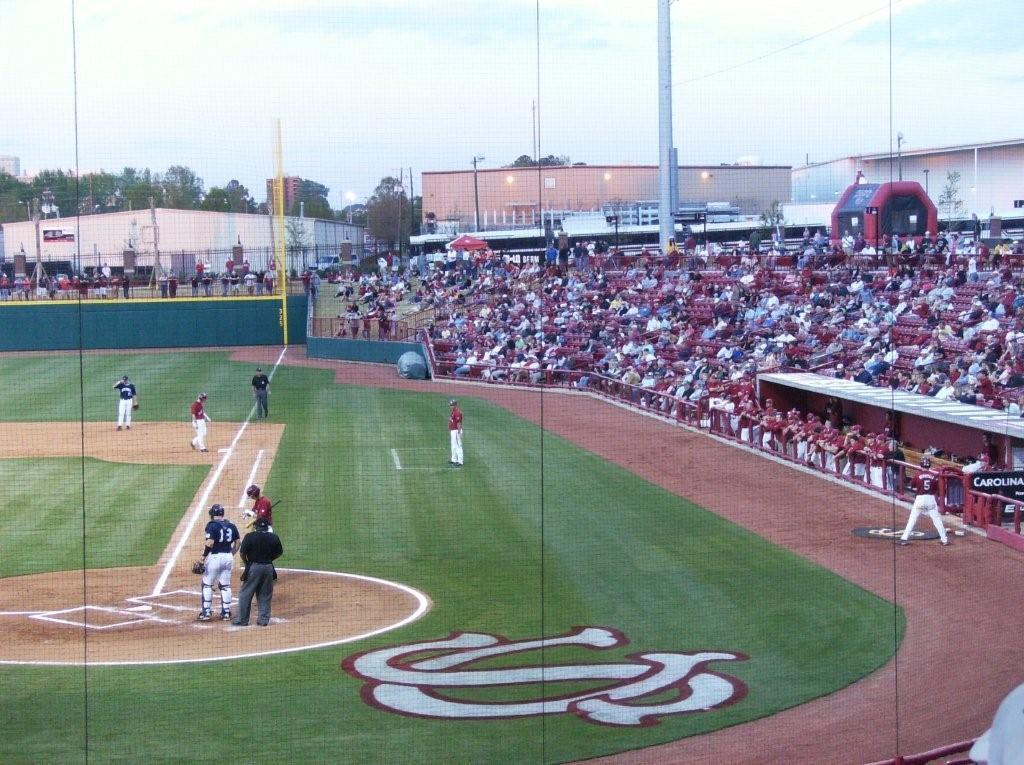
Undefeated in Carolina Stadium

The Bulldog baseball team enjoyed its first visit to the brand-new Carolina Stadium, winning 5-3 in 11 occasionally dramatic innings, and cementing a season sweep of the Gamecocks.  Admittedly, it’s only two games, but this is the first time The Citadel has beaten South Carolina on the diamond twice in one season since 1961, although it should be pointed out that the two schools didn’t meet twice annually during most of the 1960s, and for a few years in the 1970s.

(The Citadel also won its first basketball game against the College of Charleston at Carolina First Arena, so these debuts at “Carolina ______”  stadia are going rather well.)

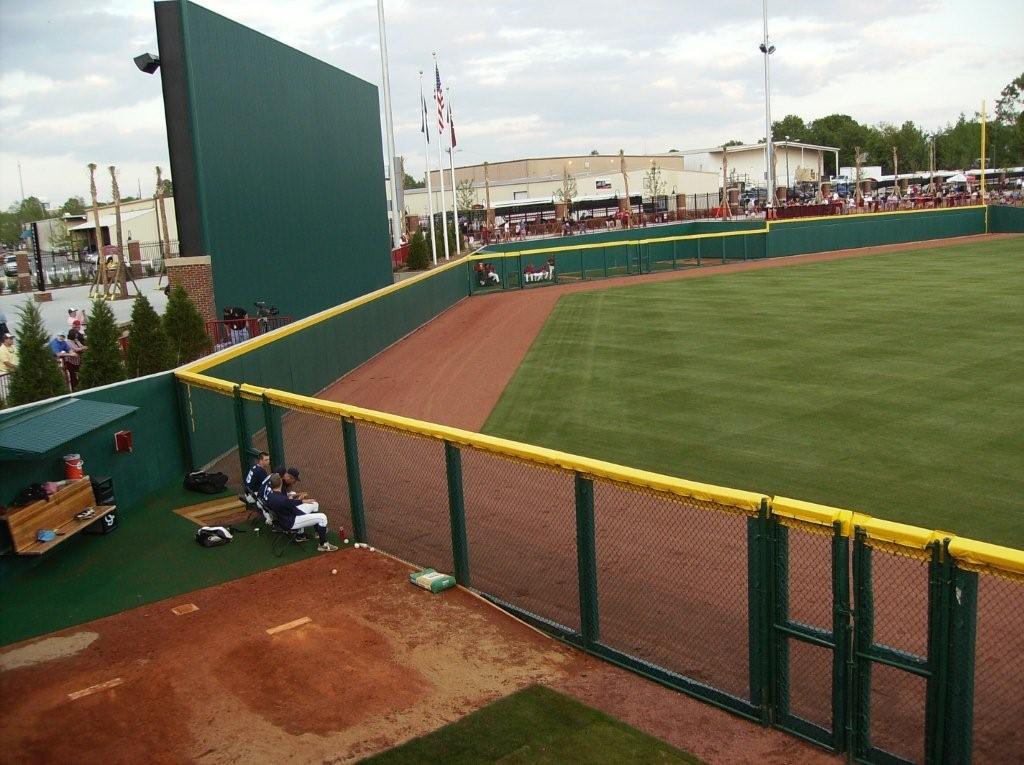
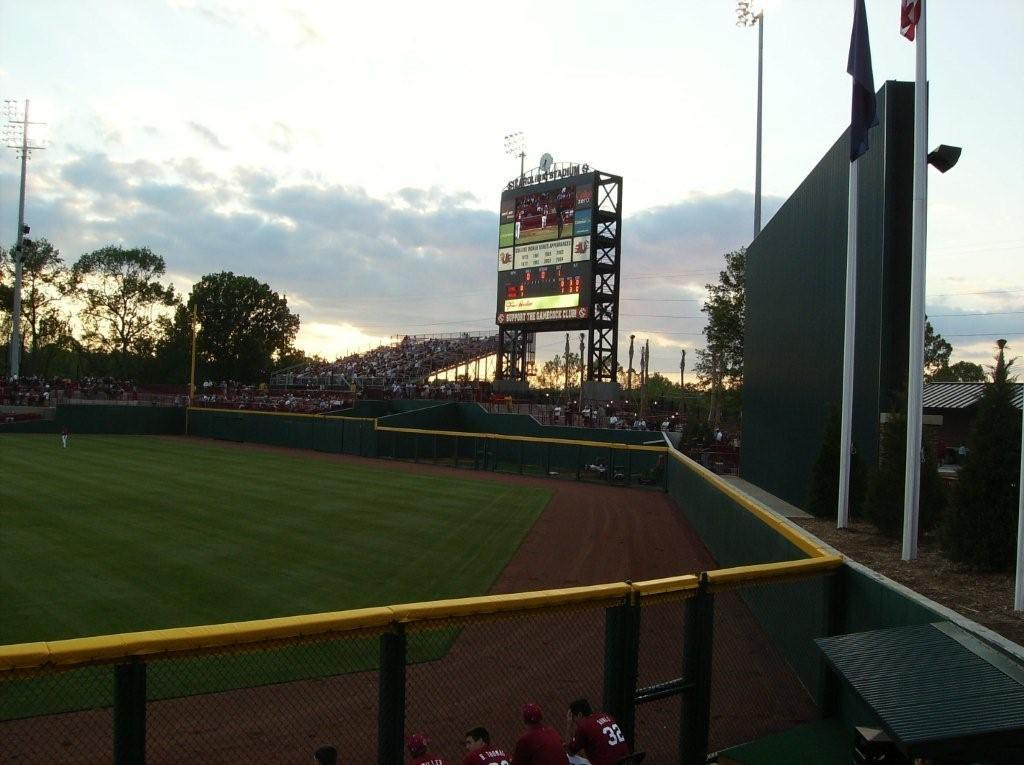
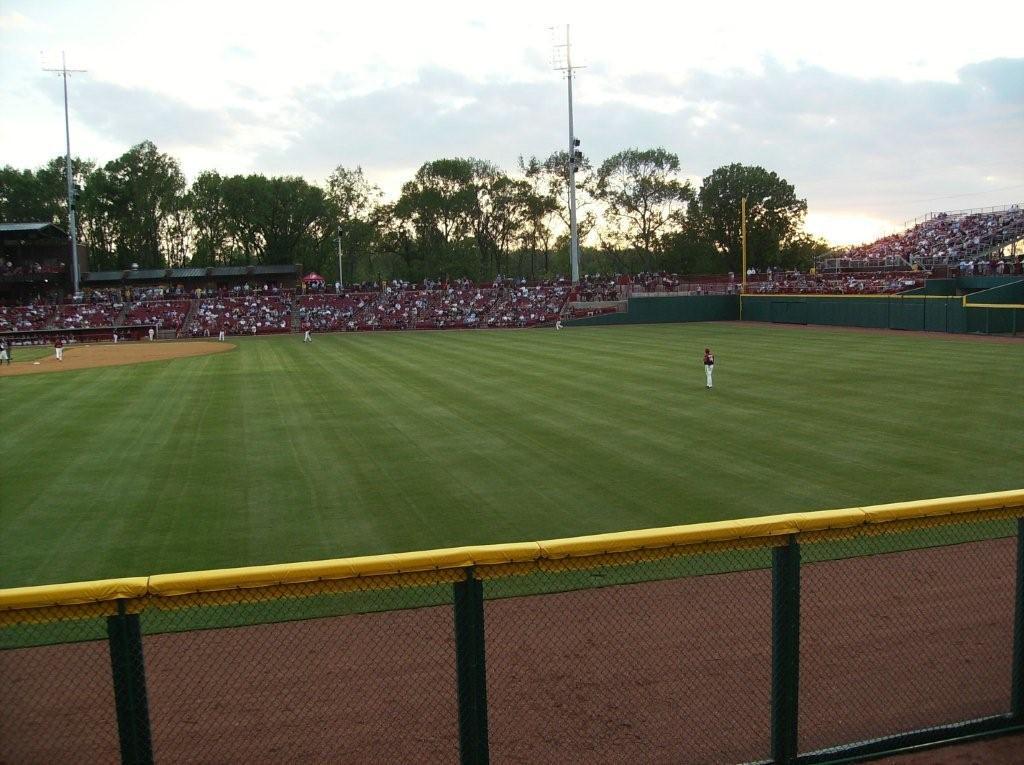
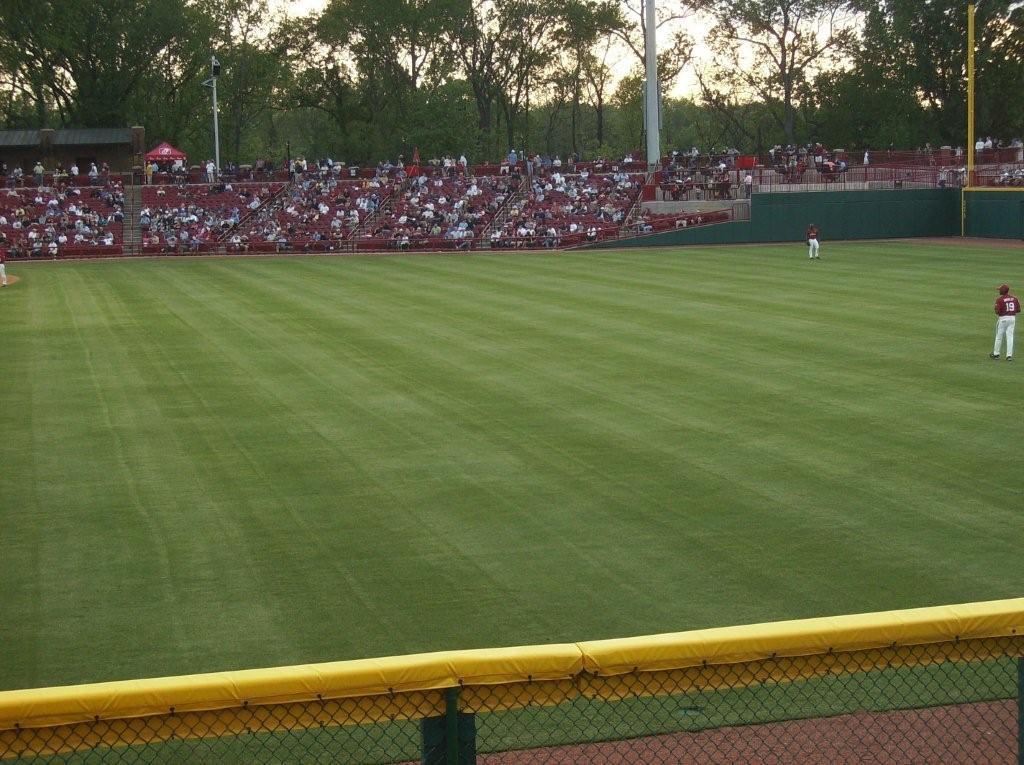
At the end of this post you can see some pictures of the new park I took during the game, from a bunch of different angles, somehow forgetting to take photos of the concourse and the concession areas until the batteries in my camera died.  I’m also not the most skilled of photographers, so they aren’t the best pictures in history.  It’s a nice stadium, definitely SEC-caliber.  Some observations about the park, and the game:

  • There was a sign noting that, in an effort to be eco-friendly, one half of the scoreboard was lit using a hydrogen fuel cell.  Why only half, I have no idea.
  • Speaking of the board, I noticed that the “Carolina Stadium” lettering was not lit.  I assume that either it wasn’t working, or more likely that the folks at USC are still looking to sell naming rights to the stadium, and didn’t want to pay for custom-designed lighting that will only be temporarily used.
  • There is a grass area down the first base line near the right field wall called the “Bi-Lo Berm”.  I have to wonder how long Bi-Lo will continue to sponsor the berm, given that the company filed for Chapter 11 bankruptcy last month.
  • The field itself looked fantastic, which was very impressive, particularly given the weather over the past few days.  I give the groundskeeper an A.
  • The parking situation is abysmal.  I’m just waiting for the first pedestrian fatality (it will probably happen after a game, after darkness).   If anything, it’s worse than it was at Sarge Frye Field, which is really saying something.  For someone like me, who would be inclined to go to USC games every now and then just to watch good baseball, it’s a reason not to go.
  • The stadium holds 9,000.  The announced crowd last night was 6,923, which is a nice crowd for a weekday game, although to be honest I didn’t think the park was at 75% capacity.  I thought it was more like 60%-65%.  The Citadel brought a fair amount of people, which wasn’t that big a surprise.
  • Having a true freshman throw 134 pitches in a game is normally asking a lot, but I can’t really fault Fred Jordan in this case, given the actual performance by T.J. Clarkson.  Clarkson didn’t exactly run out of gas, either, as he retired the last nine batters he faced.  I wondered if he had a little trouble getting loose in the early going, but he ended the game on a roll.
  • Drew Mahaffey pitched in both games this season against South Carolina.  In those two games, he faced 12 batters, retiring all 12, with 8 strikeouts (6 swinging), a foul out, a tapper back to the pitcher, and two routine fly outs.  In the first game, he entered the contest with runners on second and third and no outs.  Neither scored.
  • In two games this season against the Gamecocks, Bryan Altman had an OBP of .818, with seven hits (including a homer) , two walks, two runs batted in, and four runs scored.
  • This is a pretty good USC team, but it’s not as good as some more recent editions.  I think part of this is due to its lineup not having a true scares-you-every-time-he’s-at-bat kind of player.  Past Gamecock teams have usually had a couple of those guys.

I haven’t posted much about the baseball team.  One reason for that is I’ve been a little busy.  The other is that I was going to wait a little into the season so I could get a handle on this year’s club.  The thing is, though, that the Bulldogs have played 35 games and I still don’t have a real good handle on the team.  They have a .600 winning percentage in league play, and a .600 winning percentage out of conference  — and yet I really can’t say the Bulldogs are a consistent outfit.  Here are some of my thoughts on the team (some of which could be wildly off the mark, to be sure):

  • The lineup, from 1-6, is excellent.  Those six guys can all hit, and with some pop.  The two freshmen have both acquitted themselves very well.  I worry a little about two lefties at the 4-5 spots, where a late-game LOOGY could come into play, but that’s a minor quibble.  William Ladd is currently batting .351 (824 OPS), and looks to have locked down the seventh spot in the lineup (nice outfield assist in last night’s game, too).  That leaves the designated hitter (for games Richard Jones catches) and shortstop as question marks in the batting order.  The DH spot will likely be something of a revolving door, based on matchups, which is fine (although Sid Fallaw has received the majority of the opportunities so far).  Shortstop is another matter.
  • The Bulldogs have been erratic defensively, which makes it all the more important to have an everyday shortstop.  That would have been Kyle Jordan, of course, but you just can’t have a player with a 367 OPS as a regular.  His terrible season-long slump has been a major problem.  I’m not sold on Altman as a regular shortstop.  Johnny Dangerfield hasn’t been bad, but his bat isn’t quite big enough to make up for the defensive deficiencies in the middle infield when Altman moves over.
  • The pitching has been mediocre, even though The Citadel does lead the Southern Conference in ERA, thanks to A)  its home park, and B) the incredible lack of quality pitching in the league this year (SoCon ERA, as a conference:  6.35).  Mahaffey has been outstanding in the closer role.  The starting pitching hasn’t been that good, but it generally hasn’t been terrible, either.  The midweek starters haven’t been bad at all.  What the Bulldogs don’t have is an ace.  The middle relief/setup men have been poor.

The Citadel, right now, strikes me as a team you wouldn’t want to face in the Southern Conference tournament, but a team probably not consistent enough to win the entire tournament.  However, I can see that changing for the better.  If Raymond Copenhaver (and/or someone else) can shore things up in the 7th-8th innings, and get the game to Mahaffey, the Bulldogs have plenty of starting pitchers capable of a solid 6-inning effort.  In post-season play, having four (or five) of those kinds of pitchers will work to The Citadel’s advantage; that’s the type of depth you need to win a conference tourney.

First, though, The Citadel has to make sure it qualifies for the SoCon tournament, which means it has to finish as one of the top eight teams in the league.  The Bulldogs are well on their way to making it, but there are still 15 conference games left, starting Friday at UNC-Greensboro.  UNCG is currently 2-11 in the league, in last place, and will be desperate to win the series and climb out of the cellar.

It would be ironic if the Spartans ultimately do not qualify for the conference tournament, since UNCG coach Mike Gaski campaigned for many years to move the league tourney out of Charleston, claiming it was an unfair advantage to the two Charleston schools.  The conference brass finally buckled under his criticism (among that of others), and moved the tournament for this season to Greenville.  Now there is a decent chance the Spartans won’t even make the field.

Pictures from last night:

Port and Jordan

In the last four baseball seasons, The Citadel’s conference record by year is as follows:  14-16, 15-12, 12-15, 12-15.  That is not exactly what Bulldog fans have come to expect from the baseball program, which has historically been the school’s strongest varsity sport.  On the other hand, what should be expected?  I decided to check some numbers in an attempt to answer that question.  I concentrated on the team’s play since 1965, Chal Port’s first year as head coach.

One thing I want to make clear is that this discussion has nothing to do with the current Bulldog squad, which as of this writing is 9-9 overall, 5-4 in the Southern Conference.  This is more about the program’s history, and the current edition of the baseball Bulldogs is just beginning to make its own mark in the historical record.

One of the difficult things in trying to compare and contrast baseball teams of the past is that there have been a lot of variables over the years — in the scheduling, in the makeup of the Southern Conference, in how the conference determines its champion, even in the equipment used.  I made some decisions on how best to make comparisons.  The biggest decision I made was to concentrate solely on league play.

Nowadays the Bulldogs play a lot more games than they did 30 years ago.  In 1975, for example, Chal Port won his second conference title with an 11-3 league record.  His overall record that season was 21-9.  Twenty years later, in 1995, Fred Jordan won his first regular season SoCon title with a conference mark of 19-5, 39-21 overall.  The Bulldogs played exactly twice as many games in 1995 as they did in 1975, and almost twice as many league contests.

Comparing by league record is hard enough, what with more games and more/different schools in the league, but it’s almost impossible to make observations based on the non-conference slate, not only because of the number of games but because of the level of the competition.  Since 1994 The Citadel has played only three games against non-Division I opponents — a game against North Florida in 1995 (in a tournament hosted by UNF), and two games against Presbyterian in 1998 (scheduled after The Citadel won the league tournament in order to prevent an 18-day layoff prior to regional play).

The lack of non-Division I games is due to a SoCon edict handed out following the 1993 season.  For the 1994 season, the conference found itself in a situation in which it didn’t want to be, namely as a “play-in” conference.  The NCAA tournament was a 48-team affair at the time, and in 1994 there were 30 automatic bids.  However, the NCAA mandated that 24 berths for the tournament were to be at-large, which meant there were 6 auto bids too many.  As a result, the 12 lowest-rated conferences from the 1993 season each had to qualify for a regional by winning a best-of-three series against one of the other low-rated leagues.

If that sounds like the NCAA basketball tournament’s “play-in” game, it’s because that’s exactly what it was, times six.  The Southern Conference was one of the 12 leagues that had to play an extra round just to get in the main tournament, and the champion was drawn to face the winner of the Ohio Valley Conference.  The Citadel won the league tournament that year and beat Middle Tennessee State, 2 games to 1, in Charleston to advance to the regional held at Clemson.

To prevent this from happening again, the league determined that its schools should play a Division I-only schedule to improve the league’s power rating.  This was a marginally risky short-term strategy (what if the league had lost an overwhelming number of those extra D-1 games?)  but proved a benefit to the conference in the long run.  However, it meant that the days of The Citadel playing the likes of Hiram or Gannon were over.

As mentioned earlier, comparing eras by conference play is no picnic either.  In 1965, league schools included West Virginia, George Washington, William & Mary, Richmond, VMI, and Virginia Tech.  None of those schools are still in the SoCon.  You also have schools like East Carolina, East Tennessee State, and Marshall, which have come and gone, Davidson (which left and then came back), and schools making their debuts in the league in the 1970s (Western Carolina and Appalachian State), 1990s (Georgia Southern, UNC-Greensboro, and the College of Charleston), and 2000s (Elon and Samford, the latter beginning conference play this season).  UT-Chattanooga competed in the sport for six league seasons before the school dropped baseball following the 1982 campaign.  The conference has had as few as seven and as many as eleven baseball schools over the past 45 years.

Let’s look at Chal Port’s career SoCon record.   Port coached for 27 years and finished with an overall league mark of 253-156-1 (.618).  Port won seven conference titles and one tournament title (it should be noted that the conference did not have a tournament until 1984; five of Port’s league titles came prior to that season).  Port had a stretch of 10 consecutive winning conference records, with that run preceded by three winning records and a 7-7 season, so he actually had 14 straight non-losing seasons in SoCon action.  Overall, Chal Port had 18 winning SoCon seasons, 7 losing seasons, and 2 at .500 in the league.  Port had a winning record in conference play in exactly two-thirds of his seasons as head coach.

Incidentally, Port’s record in the conference after his first seventeen seasons was 143-98-1 (.593), with 12 winning seasons, four losing seasons, and one at .500 in SoCon play, with three league championships.  I mention this because Fred Jordan completed his seventeenth season as head coach last year.  Jordan entered this season with a record of 285-166 (.632)  in league play, with 13 winning seasons and four losing campaigns, and with four regular season titles and six tournament championships.

Jordan, like Port, also had a stretch of 10 consecutive winning seasons in conference play (from 1995 through 2004).  The problem, from the perspective of the program’s current status, is that since 2005, he has had just one winning league season, in 2006 (when the team was 15-12).  In the last four years Jordan’s conference record is only 53-58 (48%).  Did Chal Port ever have a stretch like that?

Well, yes.  After Port’s earlier-mentioned 10-year run of success, which lasted from 1975 through 1984, he had five conference seasons that went like this:  8-10, 9-9, 6-12, 12-6, 8-9.  Overall record during that five-year period:  43-47 (48%).  You may see a pattern developing.  You would be right…

Both Port and Jordan won four regular season titles during their respective 10-year winning streaks.  During those runs, Port won 73% of his league games.  Jordan won 72% of his.

The similarities in the two coaches’ records are striking.  Of course, it’s not that simple.  After those five relatively mediocre seasons noted above, Port finished his career with a run of 29 wins in 32 league games, with two regular season titles, a tournament crown, and a completely unfathomable trip to Omaha.  It’s that finish that people understandably tend to remember, even more so than the terrific teams he fielded during a good chunk of the 1970s and early 1980s.

It’s difficult for Jordan to compete with those memories, particularly since the conference has in recent years seen an influx of schools that take their baseball seriously (Georgia Southern, College of Charleston, UNC-Greensboro, and Elon).  The competition within the league is arguably tougher than it was two decades ago.

That’s not to take away anything from Port’s record, which is lauded with good reason, and in fact is probably even more impressive than a lot of people realize.  Port had to make numerous on-field adjustments during his tenure, including the change from wooden to aluminum bats, and the conference moving to divisional play (and then dropping the divisions), among other things.  Then there were the off-field adjustments, which included integration, and the fact that going to a military school wasn’t exactly the cool thing to do in the early-to-mid-1970s (not that it’s ever been the really cool thing to do).   Consider what the baseball program accomplished, especially when compared to The Citadel’s football and hoops programs of that decade:

From 1971-1979, the football team was coached by Red Parker, Bobby Ross, and Art Baker.  Ross in particular is known as having been an outstanding coach, with major success at multiple levels of the sport.  The football team had four winning seasons overall in those nine years, with no league titles and a conference mark of 26-29 (47.2%).  SoCon finishes:  3rd, 4th, 7th, 5th, 4th, 6th, 3rd, 5th, 3rd.

Tangent alert:  Ross was really good at putting together a coaching staff.  For example, his 1973 coaching staff included Frank Beamer, Ralph Friedgen, Jimmye Laycock, Cal McCombs, Charlie Rizzo, and Rusty Hamilton, along with none other than Chal Port (who doubled as an assistant football coach during his first decade at The Citadel; Port had been a fine football and baseball player for North Carolina in the early 1950s).  The team itself also had some future coaches, like David Sollazzo and Ellis Johnson.  Despite all that coaching talent, in 1973 The Citadel was 3-8 overall, 1-6 in the conference.

The basketball team was coached from 1971-79 by Dick Campbell, George Hill, and Les Robinson.  Robinson would later prove his worth as a coach with an oustanding rebuilding job at East Tennessee State, but during this period the hoops program had just two winning seasons, bookends on seven straight losing campaigns, and had an overall conference record of 43-69 (38.4%).  Conference finishes:  4th, 5th, 4th, 6th, 7th, 6th, 7th, 8th, 3rd.

Meanwhile, from 1971-1979 Port went 85-43 (66.4%) in conference play, with three championships, nine winning seasons overall, and eight winning seasons in the league (and the other was a .500 season).  His SoCon finishes during that time:  1st, 4th, 3rd, 4th, 1st, 3rd, 3rd, 3rd, 1st.  He finished in the upper half of the league all nine years.

He wasn’t done yet, either.  He had his best teams up to that time in 1982 and 1983, with the ’82 squad finishing 40-8.  At that point another power arose in the Southern Conference, as Western Carolina hired Jack Leggett to upgrade its already promising program.  The Catamounts would win five straight league titles, a stretch dovetailing almost exactly with a gradual decline in The Citadel’s fortunes on the diamond.

Port outlasted WCU’s run and (even more impressively) Hurricane Hugo, however, and orchestrated a season that won’t soon be forgotten, plus a very nice coda (the ’91 campaign).  That’s quite a legacy, one augmented by Port’s well-deserved reputation as a jokemeister and storyteller.

Jordan should be credited with maintaining the high standard of the program throughout much of his time as head coach, as the numbers rather clearly demonstrate that he has done so.  What he needs now is a “second wind”.  Port got his after a real-life gust of wind, Hurricane Hugo, blew through Charleston.  Then, rather amusingly (and appropriately), he capped a season for the ages by beating a team called the Hurricanes to reach the College World Series, giving a then up-and-coming Miami sportswriter named Dan Le Batard enough material for several columns in the process.

Jordan doesn’t need another hurricane (let’s hope not, anyway) to re-establish momentum.  He doesn’t even need to start making appearances on Le Batard’s radio show.  He just needs better pitching and defense (don’t sleep on the need for better defense).  He’s had championship-caliber pitching and defense in the past, and I see no reason to believe he can’t get the program to that championship level again.

I certainly hope so, anyway.  I would like to make another regional trip, preferably sooner rather than later…

A tradition that needs to stop

This season, The Citadel’s basketball team successfully broke a long cycle of losing, and did so in spectacular fashion, with an unprecedented number of league victories, the longest winning streak in over 80 years, and a record-tying 20 victories.  The team broke long road losing streaks at Appalachian State, Davidson, and the College of Charleston.  It got over the hump in every conceivable way except one.  Oh, but that one…

The conference tournament bugaboo struck again.

Samford became the 21st different team to beat The Citadel in the SoCon tourney (I think it’s safe to assume that’s a record), a little more than a month after The Citadel beat the Birmingham bulldogs by 25 points in a game at Samford.  It was, to say the least, a frustrating performance.  The Citadel’s defense was atrocious, as Samford scored 76 points on only 55 possessions.  The Citadel also got outrebounded by Samford, which is both terrible and amazing, given that Samford is one of the nation’s worst rebounding teams.  It was just a miserable night.

I don’t know why, no matter how good or bad the Bulldogs are in any season (and they’ve usually been bad), The Citadel comes up all thumbs every single time when the SoCon tournament gets underway.  You would think that in all those years that on occasion even one of the Bulldogs’ lesser teams would have done something to win a couple of games, even if it were just by accident.  Nope.  The Citadel is now 10-56 in the Southern Conference tournament.

Ed Conroy did a lot of things right this season, but I suspect he’s going to take a hard look at the performance of the team on Saturday night and try to figure out how to change the mindset of the squad entering tourney play.  The team has to play with purpose while remaining loose, something that never seems to happen, regardless of the year.

I don’t know if The Citadel has finished playing basketball this season.  It is possible that the Bulldogs will be invited to a post-season event, as college basketball appears to be going the way of college football, and eventually all 343 Division I teams will get to play in a post-season tournament.   Well, maybe not NJIT.  We’ll see what develops on that front.

If it does turn out to be the end of the season, I feel badly for the players that it ended so rudely, particularly the two seniors.  However, Demetrius Nelson and Jon Brick will depart knowing that in their senior year, they played on a basketball team at The Citadel that won 20 games.  That makes them members of a very, very small club.  Also, if the Bulldogs are able to maintain the positive momentum built up during this season, and parlay it into even more success, Nelson and Brick will know that they were major contributors to the building of that foundation. 

I’ve been asked by friends about two recent articles concerning The Citadel, a long and evocative piece in ESPN The Magazine (and ESPN.com) by the talented Wright Thompson, and a shorter feature in The New York Times, the latter of which could have used some editing.  However, as I have pointed out to people who have brought it up, the truth is that other than Ed Conroy, the basketball team didn’t get much publicity from either article, as both were about Pat Conroy.  The two pieces combined were over 5700 words in length, but despite all that verbiage no member of the current edition of the Bulldog basketball team was mentioned, not even once.

I was disappointed in that, because I’ve heard the Pat Conroy tale before.  While I mean no disrespect, I felt the focus should be on the current players and what they had accomplished, not just Nelson and Brick, but Zach Urbanus, Bryan Streeter, and Austin Dahn.  I wanted to read more about the terror of Beverly Hills, Cosmo Morabbi.  I was hoping someone would come up with a nickname for John Brown (besides just “JB”).

Instead, the national media turned to Pat Conroy as the story.  It’s always about Pat.

(Actually, contained within the Pat-and-Ed storyline was something that I thought was potentially much more interesting, the relationship between Ed and Don “The Great Santini” Conroy.  However, that angle would only have tangentially involved Pat Conroy, and the elder Conroy is dead, so it was just used as a way for the preferred narrative to connect Pat and Ed.  Oh well.)

Perhaps it’s just as well none of the players were mentioned, at least in the Times article.  Since that story referred to General Grinalds as the former commandant of the school, it’s possible that Urbanus would have been described as a 6’10” post player…

Finally, you have to hand it to the Southern Conference brass.  After taking the guaranteed money from Chattanooga to move the tournament to UTC’s home court, the conference leadership got exactly what it deserved.  The Mocs had the fifth-best record in the SoCon this season, but despite 20 conference games the league continued with its two-division format.  With the four best teams all in the South division, this enabled UT-Chattanooga (playing in the North division) to garner a bye in the first round while two other teams with better records had to play on Friday night. 

Then everything fell into place for the Mocs.  Not only did they survive a one-point victory over Elon in the quarterfinals (you think the home court was probably worth a few points there?), they only had to beat one of the four teams that finished ahead of UTC in the standings — and that was the third-place team, which had to play an extra game just to get to the final.

There is a good chance (better than 50%, at least) that Chattanooga becomes the first SoCon school to land in the dreaded play-in game, just one year after Davidson reached the Elite Eight.  That will do wonders for the league’s image.  However, it should have come as no surprise to anyone that Chattanooga won the tournament on its home court, since that’s exactly what happened in 2005, the last time the tournament was held at McKenzie Arena.

When the tournament was awarded to Chattanooga, SoCon commissioner John Iamarino noted that the arena would provide plenty of seating.  That’s great, except much of it wasn’t used, as even in the final, with its home team playing and a bid to the NCAA tournament on the line, the official attendance was only 5,042 (and who knows what the actual attendance was).   

It’s not surprising that a lot of the fans from other schools in the league didn’t show up, since Chattanooga isn’t a geographically ideal location to have the tournament (unless you root for UTC or Samford).  It doesn’t say much for the promotion of the event, though, when even the home team can’t put people in the stands.

Naturally, the tournament will return to Chattanooga next season…

Trying to rise above a history of misery

Yes, it’s Southern Conference tourney time.  If you’re a fan of The Citadel, you may want to cover your eyes while reading some of this.  If you’re not, you may want to cover them anyway…

First, the good news.  The Bulldogs rebounded nicely (literally and figuratively) from their loss to Wofford by beating a ragtag Georgia Southern squad 74-53 on Monday night.  The Eagles hung around a little too long for my liking, making two good runs in each half, and were down by just six points with over 13 minutes left in regulation.  In the next seven minutes of the game, however, Georgia Southern had more technical fouls (2) than made field goals (1).  It’s hard to complete a comeback when that happens.

The Citadel thus got a much-needed bye into the quarterfinals of the Southern Conference tournament.  Besides not having to play four games in four days in order to win the tourney, the extra day may also help the Bulldogs in their preparation for the event, as there are some on-court adjustments that need to be made.  Among other things, The Citadel committed 18 turnovers on Monday night, many of them unforced.

Demetrius Nelson and Cameron Wells each had five turnovers, which is too many, but they also combined for 42 points (Nelson had 11 rebounds as well).  John Brown had four, and that’s a bit more worrisome, as he isn’t in a position to handle the ball nearly as often in a scoring or closely guarded position (and thus shouldn’t have as many turnovers).  Brown forced things a bit on offense, particularly in the first half, which was a carryover from the Wofford game on Saturday.

In the Southern Conference tournament, teams are almost certainly going to employ Wofford’s strategy of doubling Nelson repeatedly while giving Brown space on the wing, because Brown is not yet an offensive threat unless he’s making layups or dunks.  How Ed Conroy and company adjust to this will go a long way to determining The Citadel’s tournament fate.

Having said that, it should be noted that despite those 18 turnovers and decent-but-not-great outside shooting, the Bulldogs went on the road and under a good deal of pressure (given the importance of winning the game) defeated a conference opponent by 21 points.  The fact it’s actually possible to be disappointed in some aspects of The Citadel’s play after a result like that speaks volumes about how good this team has been, and the expectations it now has.

Those expectations include making a serious bid at a first-ever Southern Conference tournament title.  Before casting a forward glance towards Chattanooga, however, perhaps it’s best to realize just how arduous a task the Bulldogs face.  When it comes to The Citadel and its history in the Southern Conference tourney, a few paragraphs are in order, because just a few words cannot begin to adequately describe the horror…

One of the more curious things about The Citadel’s wretched history in the SoCon tourney is that there is no firm answer to just how many times the school has lost in the event.  That’s because the league has mutated so many times there is a dispute as to what year the first “official” conference tournament was held.

Before 1920, The Citadel was one of many schools in a rather loose confederation known as the Southern Intercollegiate Athletic Association.  (The Citadel initially joined in 1909.)  There were about 30 colleges in the SIAA by 1920, including almost every member of the current SEC and about half of the current ACC, along with schools such as Centre, Sewanee (somewhat amusingly, later a member of the SEC), Chattanooga, Wofford, Howard (now called Samford, of course), and Millsaps, just to name a few.  As you might imagine, the large and disparate membership had some disagreements, and was just plain hard to manage, so a number of the schools left to form the Southern Conference in late 1920.

In the spring of 1921, the SIAA sponsored a basketball tournament, which would be the forerunner to all the conference hoops tourneys to follow.  Any southern college or university could travel to Atlanta to play, and fifteen schools did just that.  Kentucky beat Georgia in the final.  The Citadel did not enter the event, but several other small colleges did, including Newberry.  The tournament featured teams from the new Southern Conference, the old SIAA, and squads like Newberry, which wasn’t in either league (it would join the SIAA in 1923).

In 1922 the SIAA held another tournament in Atlanta, this one won by North Carolina, which beat Mercer in the final.  The Citadel entered this time, losing in the first round to Vanderbilt.  The SIAA tournament remained all-comers until 1924, when it was restricted to Southern Conference members.

Some sources suggest that the 1921 tournament is the first “official” Southern Conference tournament, some go with the 1922 event, and others argue for 1924.  From what I can tell, the league itself is a bit wishy-washy on the issue.  On the conference website, it states:

The first Southern Conference Championship was the league basketball tournament held in Atlanta in 1922. The North Carolina Tar Heels won the tournament to become the first recognized league champion in any sport. The Southern Conference Tournament remains the oldest of its kind in college basketball.

That’s great, but the conference’s own record book lists Kentucky as having won the first tournament title in 1921 (on page 113; oddly, that year is excluded from the game-by-game tournament results that begin on page 114).  Of course, the edition of the record book on the conference website is three years old and lists The Citadel as having once lost 37 straight games, which is incorrect, so take it for what you will.

Personally, I think that the idea of having a conference tournament is to determine a league champion, and it stands to reason that such a tournament would only include league members.  So the first “real” Southern Conference tournament, in my opinion, was held in 1924.

There is a point to this, trust me.  The difference between counting the Vanderbilt loss as a SoCon tourney loss and not counting it is the difference between The Citadel’s alltime record in the event being 10-55 or 10-56.  Not that they both aren’t hideous totals, but as of now The Citadel shares the NCAA record for “most consecutive conference tournament appearances without a title” with Clemson, which is 0-for-55 in trying to win the ACC tournament.  Counting the Vanderbilt game would mean The Citadel is alone in its conference tourney infamy.  No offense to the Tigers, but I don’t believe the 1922 game should count, because it wasn’t really a Southern Conference tournament game.

By the way, you read that right.  The Citadel is 10-55 alltime in the SoCon tournament.  That’s just unbelievably bad.  It comes out to a 14% winning percentage, which is more than twice as bad as even The Citadel’s lousy alltime conference regular season winning percentage (35%).  The Citadel lost 17 straight tourney games from 1961-78, and then from 1985-97 lost 13 more in a row.  Incidentally, the single-game scoring record in the tournament is held by Marshall’s Skip Henderson, who put up 55 on The Citadel in 1988 (in a game Marshall won by 43 points; karma is a you-know-what, as the next night the Thundering Herd, which had won the regular season title that year, lost to UT-Chattanooga by one point).

Those losses aren’t all in consecutive years, as The Citadel didn’t always qualify for the tournament, particularly in the years before 1953, when there were up to 17 teams in the league at any given time, and only the top squads played in the tourney.  The Citadel’s first “real” appearance, in 1938, resulted in a 42-38 loss to Maryland.  The Citadel would lose two more tourney openers before winning its first game in 1943, against South Carolina.  That would be the only time the Bulldogs and Gamecocks faced each other in the tournament, and so South Carolina is one of two teams The Citadel has a winning record against in SoCon tourney play (the Bulldogs are 2-0 against VMI).

The next time The Citadel would win a game in the tournament?  1959, when the Bulldogs actually won two games, against Furman and George Washington, and found themselves in the tourney final.  Unfortunately, the opponent in the title game was West Virginia, led by Jerry West.  West scored 27 points and the Mountaineers pulled away late for an 85-66 victory.  This would be the only time The Citadel ever made the championship game; it’s also the only time the Bulldogs won two games in the tournament.

After a 1961 quarterfinal victory over Richmond, The Citadel would not win another tournament game until 1979, when the Bulldogs defeated Davidson before losing to Furman.  The game against Davidson was played at McAlister Field House, and was the 20th victory of the season, which until Monday was the most games ever won by a Bulldog squad (now tied, of course, by the current edition of the Bulldogs).

The Citadel would win single games in 1982 and 1985 before going winless until 1998, when it finally broke a 13-game tourney losing streak by beating VMI.  The Keydets would be the next victim as well, in 2002, and were apparently so embarrassed they left the league.  The Citadel’s latest win in conference tournament action came in 2006 against Furman.

Twenty different schools have defeated The Citadel in tournament play, with Davidson’s eight victories leading the way (against one loss to the Bulldogs).  East Tennessee State went 6-0 against The Citadel while in the league.

At least ETSU won’t be around this season.  The Citadel’s first game in this year’s tournament will come against either first-year league member Samford or Furman.  The Paladins are 5-2 alltime in tourney play against The Citadel, with the Bulldogs having won the first and most recent meetings.  Records against other tourney teams:  Chattanooga 0-1, Elon 0-1, College of Charleston 0-1, Georgia Southern 0-2, Western Carolina 1-1, Appalachian State 1-6, and Davidson 1-8.  (The Citadel has never played Wofford or UNC-Greensboro in the tournament.)

The very first game worries me.  If it’s Samford, don’t look for another 25-point win.  The Citadel caught that team on a bad night.  Samford is well-coached and its slow-slower-slowest offense can give even a patient team like The Citadel fits.  I am concerned about how the team will react when the bright lights come on for the first time and suddenly everything is on the line, especially when in the unfamiliar role of favorite.  If the opponent is Furman, it would be a much more confident Paladin squad (after coming off a victory) than the one which recently lost to The Citadel, and one that would be more than happy to end a rival’s dream season.

If The Citadel survives the opener and moves to the semifinals for only the second time in 24 years, the opponent could be one of three teams, a trio against which the Bulldogs had a combined regular season record of 1-4, with the one win coming at home by two points.  Of course, one of those potential opponents, Chattanooga, is also the host school for the tournament.

It has been fifty years since The Citadel made its first and only trip to the title game, and if the Bulldogs somehow win two games (for only the second time ever), the opponent will likely either be Davidson, with a healthy Stephen Curry in tow, or a red-hot College of Charleston squad ready to avenge two regular-season defeats at the hands of the Bulldogs.

It’s easy to see that winning the tournament will be a very tall order.  Combine that difficulty with the sordid history of The Citadel in the SoCon tournament, and it’s really hard to imagine the Bulldogs cutting down the nets on Monday night.  That’s a scenario that seems unlikely to unfold.

However, there is another way to look at things.  This isn’t your typical Bulldog squad.  This is a team that has the league’s second-best record, that has won 12 of its last 13 games, that has proven it can win away from home, and has demonstrated it can win even on nights when its key players aren’t at their best.  It has won close games and blowouts, is led by the newly minted coach of the year in the conference, and features an all-conference post player along with an outstanding, versatile group of guards.  If there ever was a team from The Citadel capable of overcoming all that negative history, and making some positive history of its own, this is the one.

Saturday night can’t get here soon enough…

Time to start a new streak

Well, it wasn’t going to last forever, but it would have been nice for the winning streak to have lasted for at least one more game…

What was the difference between Saturday’s game and the previous eleven?

It was really a lot of little things.  Some of them were aberrations (like Demetrius Nelson struggling from the foul line), but some were not, and what is important is that the Bulldogs must learn from the loss and make the necessary adjustments, because other teams will study tape of this game and try to emulate Wofford.

Of course, emulating Wofford first means having a player capable of a good Noah Dahlman imitation, and that won’t be easy.  Dahlman showed why he is a serious candidate for first team All-Southern Conference with an excellent night, rarely forcing anything but taking advantage of any and every opportunity.  Dahlman scored 17 points on only 9 field goal attempts (exactly the same numbers he had against the Bulldogs in Spartanburg) and also contributed 7 rebounds to the Terriers’ cause.

Wofford’s strategy on defense was to double-team Nelson whenever possible, which they did more successfully than most SoCon outfits (the College of Charleston could learn a thing or two about how they did it), and they did this in part by leaving John Brown open on the wing throughout the game, knowing he wasn’t an offensive threat.  Brown had a frustrating evening.  For one of the few times since he burst onto the scene at the beginning of January, he seemed a half-step behind or a split second late to a number of loose balls and rebound opportunities.  His trademark frenetic style never seemed to have an impact on the game.

Ed Conroy tried a couple of different things to counter the way Wofford was playing defensively (including playing Daniel Eykyn for Brown for a brief period during the second half), but the Bulldogs never really got into an offensive rhythm.  The Citadel did not get many open looks from outside, and as a consequence went 3-15 (20%) from three-point land.

Dahlman’s going to get his points, but at least he didn’t burn The Citadel for 36, like he did Thursday night at the CofC.  The shot to break the 55-all tie was a tough one converted by a player (Brad Loesing) who came into the game shooting only 29.7% from beyond the arc (and who had missed his previous nine three-point attempts).  He made the shot, though, and you just have to give him credit for it.  The Bulldogs did force thirteen turnovers, but on the whole Wofford had an efficient night on offense.  The Bulldogs were also outrebounded by the Terriers (28-22).

Now the Bulldogs have to regroup and focus on their immediate goal, which will be to regain the momentum gathered during the eleven-game winning streak and clinch a first-round bye for the Southern Conference tournament.  The action moves to Statesboro, Georgia, where on Monday night The Citadel tangles for a second time this season with Georgia Southern.

A win in that game would be the Bulldogs’ 15th of the season in SoCon play (and 20th overall, of course) and would tie the College of Charleston for second place in the South Division, with The Citadel holding the tiebreaker by virtue of its sweep of the Cougars.  A loss would mean the Bulldogs would have to play in the opening round against UNC-Greensboro, the sixth-place team from the North Division.  The difference between having to win three or four games in order to claim the tournament title is huge.

Injuries and suspensions have left Georgia Southern ripe for the picking for most Southern Conference teams, and as a result the Eagles have lost ten of their last eleven games, with the only win a non-conference victory over Jacksonville State.  Georgia Southern’s last conference win came against Furman on January 24.

Georgia Southern is the league’s worst defensive team, and against Davidson on Saturday the Eagles allowed 99 points on only 81 possessions, as the Wildcats shot 55% from the floor.  Davidson raced to a 16-0 lead in the game, and in that stretch GSU only attempted two shots while committing seven turnovers.  The Eagles committed 25 turnovers during the game, while Stephen Curry was scoring 34 points (on only 19 FG attempts).

The Bulldogs won’t have Curry, but they should have enough to defeat a depleted and possibly demoralized Georgia Southern team.  In the first game between the two teams, The Citadel won at McAlister Field House 84-75 as Demetrius Nelson and Bryan Streeter combined for 38 points and 12 rebounds, with John Brown adding 11 boards.

Willie Powers and Julian Allen teamed up for 34 points, 15 rebounds, and 6 assists for Georgia Southern in that game, which is noteworthy because neither will play for the Eagles on Monday.  Powers was lost for the season after that game with a knee injury, while Allen was suspended at the beginning of February (along with Trumaine Pearson and Antoine Johnson, both of whom also played against The Citadel).  The Eagles are down to seven scholarship players.

Incidentally, The Citadel has not swept the Eagles in the regular season since 1998.  The Bulldogs’ last victory in Hanner Fieldhouse came in 2003.

The loss to Wofford on Saturday won’t by itself cost The Citadel a chance at achieving any of the season-long goals it would have had before the game.  However, the Bulldogs have now taken their mulligan.  The Citadel has to win on Monday night, and must do so on the road, with all the pressure associated with trying to produce a successful finish for what has been to this point a remarkable regular season.

In a way, things are now simplified for the Bulldogs.  If The Citadel is to live the big dream, a trip to the NCAA tournament for the first time, it has to start a new winning streak, and that streak must be four games in duration.  The Bulldogs can either win on Monday and then win three games in the SoCon tourney, or they will have to win four times in four days in the SoCon tourney.  The first option is by far the more manageable of the two.  Let’s hope the new streak starts on Monday night.

19 could lead to 20, and 20 means a lot

The Citadel 75, Furman 54.  This would be called “taking care of business”, except that it took the Bulldogs a half to get appropriately businesslike…

In the first half, The Citadel shot 11-34 from the field, including 0-7 from three-point land.  Clearly the eight-day layoff had left the Bulldogs’ shooters rusty, at least from the outside (and maybe from the inside too — John Brown missed not one but two dunk attempts).  The Citadel’s play was a touch sloppy, and there were several missed rebounding opportunities.  The only Bulldog seemingly unaffected by the malaise was Demetrius Nelson.  Luckily for The Citadel, he was more than up to the task of carrying the team.  Nelson scored 17 points in the half, including the last 11 for the Bulldogs, and The Citadel sneaked away with a three-point halftime lead.

The second half was a tour de force, as almost everything you would want to see as a Bulldog fan came to pass.  Nelson continued dominating in the post, Brown resumed his get-every-loose-ball-in-Charleston-County routine (and made all three of his dunk attempts), Zach Urbanus started making threes, Austin Dahn grabbed some tough rebounds and did a good job passing the ball (including a great assist to Brown out of the post), Cameron Wells drove, dished, and finished, Cosmo Morabbi knocked down a corner three on yet another well-conceived inbounds play, and Bryan Streeter contributed solid post defense, boarded with abandon and even made a free throw (now he needs to show Brown how it’s done).

The Bulldogs shot 75% from the field in the second half, including 4-7 from beyond the arc.  The defense was outstanding throughout the game, as Furman never got comfortable on offense (the Paladins had only 3 assists on 19 made baskets and were victimized by 11 Bulldog steals).  Nelson finished with 28 points on only 12 field goal attempts.  He also had 8 rebounds, a pair of assists, two steals, and did not commit a turnover.  After the game he leaped over a tall building in a single bound.  Brown had a career-high 16 points to go along with his usual disruptive ways.

With the win, the Bulldogs swept the Paladins in the regular season for the first time since 2001, and the margin of victory on Thursday was the biggest for The Citadel in a game against Furman since the 1939 team beat the Paladins 56-34 (incidentally, that game was part of a six-game winning streak for the Bulldogs against Furman, the longest winning streak The Citadel has ever had against the Paladins).  The Bulldogs also broke a five-game losing streak to Furman at McAlister Field House.

The victory also established a new standard for biggest turnaround for a Bulldog team from one season to the next (in terms of wins), as The Citadel has now gone from 6 wins last season to at least 19 victories this year.  The previous record was 12, as the 1978-79 team won 20 games following an 8-win campaign in 1977-78.  The Bulldogs continue to add to the school record for conference victories, the school record for consecutive conference victories, and the conference record for turnaround in league play (by wins).

A crowd of 4,219 enjoyed the action, with a vocal contingent of cadets leading the way (I particularly liked the giant cutouts of the heads of Nelson and Jonathan Brick).  Attendance will presumably be even better for the Saturday night game against Wofford.  The last time the home finale had this much meaning was…well, I’m not sure there has been a home finale with as much on the line:

  • A win would tie the school record for victories in a season (20).  The aforementioned 1978-79 squad is the only Bulldog team to win 20 games in a season.  As it happens, the ’79 team will be honored on Saturday, as it’s the 30th anniversary of that season.  That strikes me as poetic (well, it’s poetic if the Bulldogs win the game).
  • A win would also clinch no worse than a tie for second in the SoCon South Division, and as The Citadel swept the College of Charleston this season, the Bulldogs would be guaranteed a bye in the Southern Conference tournament.  That’s obviously critical to The Citadel’s chances of winning the SoCon tourney.  Three wins in three days will be very difficult.  Four wins in four days would be almost impossible.

Let’s examine that second-place possibility for a moment.  Obviously everyone is concentrating on the bye, and that’s understandable, but in a historic context it’s the placement that deserves notice.  Second place may not mean that much to some schools, but for The Citadel, it’s a big deal.  Why, you ask?  (I’m assuming you asked — if you didn’t, just go with the flow.)

This is The Citadel’s 73rd season as a member of the Southern Conference.  As you might have heard or read, The Citadel has never finished first in the league’s regular season standings.  It has never had the conference’s best record.  What you may not have heard or read is that The Citadel has also never finished second.

That’s right.  In its first 58 years of SoCon membership, The Citadel never finished higher than third.  For the past 14 years, league standings have been broken into two divisions, and it’s true that twice the Bulldogs have tied for second place in the South Division.  However, on neither of those occasions did The Citadel tie for second in overall record in the league.  In 1998 the Bulldogs were 6-8 in the SoCon South, tying for second in a five-team division with Wofford.  The Citadel tied for the 5th-best record in the conference that season.  In 2001, The Citadel was in a three-way tie for second in the division, which was good enough to tie for the 4th-best record in the league.

For the record, The Citadel has only enjoyed 15 seasons in its history (before this season) when it finished the year in the upper half of the conference (that includes the 1989 team that tied for 4th in an eight-team league).  There have also been 15 seasons in which the Bulldogs finished last in the conference (overall, regardless of divisional or non-divisional format), 10 campaigns when the Bulldogs finished next-to-last, and 11 seasons in which the Bulldogs wound up third-from-last in the conference.  In exactly half of the 72 Southern Conference campaigns prior to this season, The Citadel finished in the bottom three in the league.

Getting the bye is the immediate concern for The Citadel, because of what it means in terms of the SoCon tournament.  (I’ll save the stats on the Bulldogs’ tourney history for another post; there is only so much “misery history” I can write, as The Citadel’s record in the tourney is actually worse than its SoCon regular season record.)  The chance to finish second, though, is something that would have lasting meaning.  No team in the North Division can match The Citadel’s league win total, so it’s down to The Citadel and the College of Charleston for second overall.  (The Citadel also still has a mathematical chance of tying Davidson for first, but that is very unlikely to happen.)

It’s not going to be easy on Saturday (not that it should be), because Wofford will be a very tough out.  The Terriers fought back from a 15-point halftime deficit at the College of Charleston on Thursday night, and the Cougars barely survived the onslaught, hanging on for an 86-84 victory.

Of course, Wofford is also the last team to beat The Citadel, having won 66-63 in Spartanburg in January.  In that game, the Bulldogs trailed by 16 points late in the first half before making a furious comeback, taking the lead with nine minutes to play.  However, the Terriers regained the lead and held on for the victory.  This game came during a stretch of contests where The Citadel would struggle in the first half before pouring it on in the second.  The Citadel has mostly avoided first-half pitfalls since the game against Wofford, and needs to continue playing well from the opening tip if it is to win its twelth straight.

The Bulldogs also need to do a better job defending the erratic but dangerous Junior Salters (four for six behind the arc in the first game) and must somehow control Noah Dahlman, an all-conference candidate who scored 36 points last night for the Terriers against the CofC.  Dahlman has scored at least 18 points in nine of Wofford’s last ten games.  He scored 17 points against The Citadel in Spartanburg (on just nine FG attempts).  Corey Godzinski will also be a factor on Saturday after missing the first meeting between the two teams with a broken hand.  He’s 6’8″ and can shoot from outside (he made three 3-pointers against the College).

The game against Wofford isn’t a must-win for the Bulldogs in terms of getting the bye.  The backup plan would be the regular season tail-ender, a game in Statesboro on Monday night against a decimated Georgia Southern squad.  However, given the spotlight that will be on the Saturday night contest, and with all the pomp and circumstance associated with it (Senior Night, the ’79 team being honored, etc.), there will be considerable pressure on the Bulldog players to keep all the streaks going and to treat the home fans to a game to remember.

It will be interesting to see how the team performs.  In a way, it’s a warmup for what The Citadel will encounter at the Southern Conference tournament.  It’s one more challenge for Ed Conroy and company.  With the way this year is going, you wouldn’t want to bet against them.

A big win, but don’t get carried away just yet

Let’s start this column with the newest installment of the “Milestone Report”, chronicling just a few of the latest firsts, streaks, and records set by this season’s edition of the basketball Bulldogs:

  • The Citadel’s 18th win on the season tied the 1985 squad for second-most in school history, with only the 1979 team winning more games (20)
  • The Citadel continues to set a new school standard for Southern Conference victories with its 13th league win of the season, and extends its record run of SoCon road wins (the Bulldogs are now 7-2 on the road in conference play)
  • With that 13th win, the Bulldogs shattered an 82-year-old SoCon record, the mark for biggest league turnaround in consecutive seasons, which had been established by Auburn in 1927; the Tigers went from one conference victory to twelve that season, while The Citadel has gone from one win to thirteen (and counting)
  • The Citadel broke a 14-game losing streak to Davidson
  • The Citadel won for the first time at Davidson since a 1990 contest, a game played during a brief four-year period (1989-1993) when the Wildcats were not in the Southern Conference; as a result, Wednesday night’s victory was the first time The Citadel had won a league game at Davidson since 1961

Davidson entered the game with an RPI of 49.  The Wildcats have dropped out of the top 50 of the RPI following the loss to The Citadel (as of Thursday the Wildcats are at 56), but will almost certainly finish the season in the top 100.  To be honest, I am not completely sure when the Bulldogs last recorded a victory over a “Top 100 RPI” team.  I believe that it has not happened since 1989, when The Citadel beat South Carolina.

Incidentally, The Citadel’s RPI has jumped up to 148 (I’m using ESPN’s RPI numbers).  The Bulldogs are one spot ahead of none other than VMI. 

Of course, Davidson didn’t have Stephen Curry last night, and that certainly made a difference.  Whether it made enough of a difference to have changed the outcome of the game is debatable.  In the first game between the two teams, Curry put up 32 points (with only 16 FG attempts) and added five assists  — one assist more than Davidson had as a team last night.  Even if you didn’t count Curry’s shooting numbers, though, Davidson still had a good FG% as a team in the game at McAlister Field House (although obviously with teams having to concentrate on Curry, his teammates have better opportunities).

The Citadel and Davidson are 1-2 in the league in FG% defense (the Wildcats lead that category) and in 3FG% defense (with the Bulldogs ranked first).  Given that, it’s not surprising that the game featured poor shooting by both teams, and without its star, Davidson never got into a shooting rhythm.  The Wildcats could not even make free throws (9-17 for a team that averages 71% from the line).

What should concern Davidson more than the bad shooting, though, was the fact that the Wildcats were not able to contain the Bulldogs on the boards.  The Citadel had a season-high 48 rebounds last night to Davidson’s 31 (after Davidson won the rebounding battle 35-25 in the first matchup).  Demetrius Nelson had a big night scoring inside, but he had scored 18 points in the first game, so that wasn’t a major surprise.  The difference was that he also added 14 rebounds (after only having 4 against Davidson at McAlister) to the Bulldogs’ cause. 

Davidson did have 13 offensive rebounds, but when you miss 73% of your shots from the field, you’re going to get more opportunities for boards on the offensive end of the floor. 

John Brown had 12 rebounds in 22 minutes of action.  That’s the fifth time this season he’s had 12 boards in a game (he’s now hit that mark three times in a row).  Brown has played more than 20 minutes in ten games this season.  He has had double digit rebound totals in seven of them (and nine boards in of one of the others).  That’s not even counting his 12-boards-in-15-minutes performance against Samford.  Brown is averaging 13.47 rebounds per 40 minutes of play (14.75 per 40 over his last four games).  When he stays out of early foul trouble, he is a force. 

Davidson leads the league in turnovers forced, and The Citadel committed a few too many last night (13).  The Bulldogs had 19 turnovers in the first matchup, so they improved a little, but again Curry’s absence has to be considered (he had five steals in the January game).  On the flip side, despite missing its point guard, Davidson only committed seven turnovers.

Nelson missed five free throws, the only blip in an outstanding effort.  Cameron Wells was 8-8 from the charity stripe, though, which alleviated an off-shooting night for him from the field.

Everyone who has been following the Bulldogs is excited right now, and deservedly so, but I want to sound a note of caution.  I mentioned earlier in this post that the last time The Citadel won a road game against a top-100 opponent was against South Carolina in 1989.  That year had some parallels to this season. 

In 1989, The Citadel was trying to rebound from an 8-20 campaign.  The team started the year slowly, but gradually improved.  The win over the Gamecocks was the exclamation point on a run during which the Bulldogs won six out of seven games, including a beatdown of longtime hoops bully Marshall (the final game ever played at Deas Hall, the most fantastic Division I basketball arena in human history).  Earlier in the year The Citadel had also beaten the College of Charleston on the road, which would be the last win at the CofC for the Bulldogs until this season.  With two games remaining in the regular season, the Bulldogs were in a position to claim second place in the SoCon regular season, with an outside shot at first.

The Citadel wouldn’t win another game.  The Bulldogs lost a tight game on the road to Western Carolina, then lost at UT-Chattanooga, and then lost in the first round of the Southern Conference tournament to East Tennessee State (which would then proceed to win the tourney).

I’m not saying we’re in for a repeat of 1989.  For one thing, this year’s team is simply better.  You can ask Ed Conroy — after all, he played on the 1989 team.  It’s just that there is still work to be done this season, and to consolidate all the gains made on the court this year, the team needs to finish strong.  Also, while I don’t want to be perceived as being overly pessimistic, I think it’s important to acknowledge that the margin of error for the program is still small.  It’s not as small as it has been, though, and that’s a credit to Conroy and the players. 

The Southern Conference tournament is going to be tough for everybody.  If you’re The Citadel, you have to worry about Davidson (with Curry), UT-Chattanooga (a good team, and the tourney host), the College of Charleston (can the Bulldogs really beat that team three times in a row?), and a bunch of other squads that could pose matchup problems.  Drawing Elon or Appalachian State in the tourney would not be fun. 

Of course, those teams have to worry about drawing The Citadel…

That’s why getting the bye is so important.  Speaking of that, the “magic number” for The Citadel to clinch a bye in the tournament is now 2.  For those unfamiliar with the “magic number” concept (it’s a baseball expression), what that means is any combination of two Bulldog victories or College of Charleston losses will guarantee a bye for The Citadel.  Two Bulldog wins would do it, as would two CofC losses.  One Bulldog win and one Cougar loss would be enough.  The CofC has four games remaining, and The Citadel has three.

The Citadel now has eight days before its next game.  I don’t know if that’s a good thing or a bad thing.  I’m inclined to think it’s a good thing, because the Bulldogs probably need a bit of a break.  There is always the fear that the team will lose momentum, but I believe it helps that when they play again, it will be at home before what should be a very good crowd.  I can’t wait.

Quick note:  I’ve had a few more visitors to the blog than normal; I’m glad some of you have enjoyed it.  To answer a couple of questions that have been asked:

  • The photos at the top are of General, Anthony Jenkins, and Jack Douglas, as most fans of The Citadel know.  I don’t really have a lot of pictures from sporting events involving The Citadel; the shots of Jenkins and Douglas are scanned newspaper photos, and I struggled to get a decent scan of them (as you can probably tell)
  • The blog is intended to be a general sports blog with an emphasis on the mighty Bulldogs; I’ve actually focused a little more on The Citadel’s athletic teams than I had originally anticipated (mainly because of the hoopsters, although I am more than ready for Fred Jordan’s crew to take the field)

Valentine’s Day present: nine straight wins

Now that’s a Valentine’s Day to remember:  The Citadel 72, College of Charleston 58, in the Bulldogs’ first game ever at Carolina First Arena (with 5,168 spectators in attendance).

I have to admit that I wasn’t so sure about The Citadel’s chances of winning this game, despite the solid victory at McAlister three weeks ago.  I felt the Bulldogs were perhaps due for a bad game, and that the College was on a roll after its comeback victory at Davidson and subsequent thumping of Western Carolina.

After watching the first half, though, I realized that my fears  were misguided.  The Citadel had committed nine turnovers in only twenty-seven possessions, meaning that the Bulldogs had turned the ball over every third time down the court (a terrible percentage, to say the least).  Normally that would be a recipe for disaster, but instead The Citadel only trailed by one point (29-28).

The Bulldogs were shooting the ball well, and when not committing turnovers were doing a good job running their offense, using the shotclock, making the Cougars work on defense  (which some of the CofC players did not appear to enjoy), and controlling the pace of play.  The Citadel had handled the College’s press with relative ease (which had also happened in the first meeting), and I figured that as long as the Bulldogs took care of the basketball in their normal fashion in the second half, they would be in good shape.  That is exactly what happened.  The Citadel turned over the ball over on its first possession of the second half, but then committed only two more turnovers the rest of the game.

Then there was the rebounding.

The Citadel outrebounded the CofC 13-8 in the first half, which was a marked departure from the first contest between the two teams, when for the game the Cougars had 38 rebounds to the Bulldogs’ 25.  The reason The Citadel didn’t just win on Saturday, but won going away, was that the Bulldogs completely dominated the glass in the second half, essentially reversing the board differential from the first game, and finished +17 (38 rebounds to the CofC’s 21).  The most impressive statistic in the game, to me, was that the Bulldogs got more offensive rebounds (13) than the College got defensive boards (12).

That had to have frustrated Bobby Cremins and the CofC fans, especially since the Cougars started three frontcourt players in the 6’7″-6’8″ range and brought another 6’8″ forward off the bench, and none of those guys were stringbeans, either.  Meanwhile, The Citadel countered with a starting lineup featuring one 6’8″ post player (Demetrius Nelson) and a bunch of guards, including John Brown, who is 6’4″ but essentially fills the power forward role for the Bulldogs — and it was Brown who proved to be the primary nemesis for the Cougars’ big men, gathering 12 rebounds (5 offensive), scoring 14 points on 7-10 shooting (I think every made basket was a layup), and generally being a nuisance on the defensive end of the floor.   Interestingly, Brown had the same rebounding totals (12/5 offensive) in the first matchup.

In this game, though, he had help on the boards from Nelson (7/3 offensive) and, somewhat surprisingly, Zach Urbanus (who had the same 7/3 ratio).

I would like to riff a little about an aspect of Ed Conroy’s coaching that I have gradually come to appreciate.  The Citadel runs a very disciplined offense, one that usually involves working the clock and controlling the pace of play.  The Bulldogs are generally at their best when the number of possessions in a game hovers around 60 or so.  Whenever I am watching, and things start to get a bit frenetic, or someone takes a shot with 25 seconds or more remaining on the shotclock, I’m inclined to start mumbling things like, “Slow it down!  Slow it down!  You’re playing too fast!  Work the clock!”  You get the idea.  I’m particularly prone to think this way late in games when The Citadel has a lead.

The key is, though, that while a Bulldog will occasionally force a shot, it doesn’t really happen too often — and more importantly, the players maintain a sense of aggressiveness.  There is a distinction to be made between a disciplined offense and a conservative offense.  It doesn’t do you any good to run the shotclock down to 5 on each possession if you regularly wind up hoisting a 30-foot jumper.

So while I may have wished that Cosmo Morabbi had not attempted a contested three-pointer with the Bulldogs up 14 and just over 4 minutes to play, and with 26 seconds still remaining on the shotclock, I can understand that the freedom he has in being “allowed” to attempt that shot is critical.  Maybe that time he made a mistake, but by being aggressive and not timid, he also was in a position to make two other three-pointers during the game, including the shot that signalled the game was The Citadel’s to lose, a three-pointer at the 10:20 mark that stretched the Bulldogs’ lead to nine — and a shot taken with 25 seconds still remaining on the shotclock.

That’s good coaching.

There has been some discussion about yesterday’s victory by The Citadel being “historic”, with references to “The Citadel’s first two-game series sweep since the 1932-33 season” in this column by Gene Sapakoff in The Post and Courier, as well as Jeff Hartsell’s game story (“an event that comes around every 76 years or so”).  This angle pops up in other press reports, too.

Now, with all due respect to the above chroniclers, I think the whole “first sweep since the 1930s” thing is overblown and a bit misleading. Before Saturday, the Bulldogs had not swept the Cougars in a two-game set since 1933, but following the 1937 season (a year during which the schools met three times, with The Citadel winning the latter two matchups), The Citadel and the College of Charleston did not play again until 1956.  After that one game, the series again went into hibernation, and did not resume until 1977. In addition, The Citadel and the CofC only began playing twice per year again in 1997 (except for a two-game set in 1983, which was split).  The truth is there was a 60-year period in the series during which The Citadel (or the College of Charleston, for that matter) had only one opportunity for a “sweep”.

Also, of course, technically The Citadel has not “swept” the College of Charleston this season — yet.  The two schools could meet for a third time in the Southern Conference tournament, although as things currently stand that potential matchup could only happen if both teams advanced to the championship game.  With yesterday’s win, the chances of The Citadel getting to the final improved slightly, because the Bulldogs are now in position to get a first-round bye (as a top-2 finisher in the South Division).

That would be critical, particular for The Citadel.  It would be much easier to win three straight games than have to win four games in four days in Chattanooga (no team has ever gone the “four in four” route to win the SoCon tourney).  Also, given The Citadel’s putrid history in the Southern Conference tournament, having to play one fewer game to actually win the thing would surely come as a relief.  Three tournament wins would be more victories than The Citadel has had in the last 22 tournaments combined.

To guarantee getting that bye, The Citadel has to win at least three of its remaining four games.  The win over the Cougars gave the Bulldogs a little cushion, as the game at Davidson on Wednesday is not a must-win for bye hopes.  However, there is still work to do.  The Citadel also has home games remaining against Furman, a team the Bulldogs had to go to overtime to beat in Greenville (and the Paladins appear to be improving), and Wofford, which beat The Citadel in Spartanburg — the last time the Bulldogs lost a game.  The Citadel finishes the season at Georgia Southern, which has been decimated by injuries and suspensions.  It’s still a road game, though.

The Citadel would get an additional mulligan (or more) if the College of Charleston is unable to win out.  The College has three straight road games up next on its schedule; a slip-up by the Cougars at any of those games would greatly help the Bulldogs’ cause.

As I write this the status of Stephen Curry for Wednesday’s game is uncertain, as Davidson’s all-everything player injured his ankle on Saturday night against Furman.  Even without him, though, the Wildcats would be a formidable opponent, particularly at Belk Arena.  Obviously Davidson is a much better team with him.

While awaiting updates on Curry, it’s worth taking stock in what the Bulldogs have accomplished already.  17 victories clinches a winning season for the first time in seven seasons.  The Citadel has only won more games than that in a season twice in its history (18 in 1985 and 20 in 1979).  The 12 conference victories is a school record, although past teams didn’t have a 20-game league schedule.  Still, no Bulldog squad has ever finished a season with a .750 winning percentage in conference play, which the current group is on pace to do.  The Citadel continues to add to its record for consecutive conference wins.

It’s been a great run so far, but there is still (hopefully) more fun on the horizon.

Great Eight

With last night’s overtime victory over Appalachian State, The Citadel has now won eight consecutive games.  It’s been a while since the Bulldogs won eight in a row.  82 years, to be precise.

1927 was the year, Calvin Coolidge was the president, and Babe Ruth was on his way to hitting 60 home runs in a season (there was no drug testing back then, so obviously there’s no way to know if his 60 were “legitimate” or not).  The coach of The Citadel was the immortal Benny Blatt, in his first season in charge.  Blatt coached the team for four seasons and finished with an outstanding record of 51-22, but that first year was his best.  The Citadel was 17-2 that season, winning 13 games in a row at one point during the campaign and closing in style by winning the postseason tournament of the Southern Intercollegiate Athletic Association (still the only postseason tournament ever won by The Citadel).  The star player for the Bulldogs was Johnny Douglas, who would eventually succeed Blatt as head coach.

You may be wondering about the teams the Bulldogs played (and beat) that year.  Well, the victims in the 13-game winning streak were (in order) as follows:  Newberry, College of Charleston, Presbyterian, Oglethorpe, Mercer, Mercer again, Mercer yet again, Davidson, Davidson again, Wofford, Newberry, Presbyterian, and Wofford.

I guess it’s safe to say they scheduled games a little differently back then.  One thing that is interesting is that in the three-game set with Mercer, the Bulldogs started off dominant, winning the first game with the Bears 50-14, and then as each game was played the teams got closer in terms of competitiveness — in other words, either Mercer started getting better or The Citadel got worse.  The Citadel won the second game by only 14 points, 46-32, and the third game was a five-point contest (38-33).  The two teams would meet for a fourth time that season in the SIAA final, a game the Bulldogs won 42-41.

The SIAA tourney was held in Atlanta that season, which brings up another point about the scheduling in 1927.  The Citadel played 19 games, but did not play a single game outside of Georgia or the Carolinas.  To me, it’s a little strange that the Bulldogs only played the College of Charleston once that season (The Citadel also played the Parris Island Marines).  Blatt presumably would have been interested in picking up another win without having to travel, but I guess he really did like to play those games against Mercer.

Back to the 21st century…Appalachian State shot 51% from the field on Thursday night, including 9-18 from three, and made 6 of its 7 free throw attempts.  It’s not easy to lose a game when you shoot that well, especially when you jump out to a 15-2 lead, but the Mountaineers also committed 17 turnovers (to just 10 for The Citadel) and committed seven more personal fouls than did the Bulldogs.  This led to The Citadel getting 24 free throw attempts, although the Bulldogs almost blew the game by missing nine of them, including five in a row late in regulation when they could have put the game away.

Other than the free throws, The Citadel also shot the ball fairly well (Zach Urbanus and Austin Dahn combined to go 7-14 from three-land), despite getting very little inside from Demetrius Nelson.  That can’t happen against the College of Charleston on Saturday, as Cameron Wells isn’t likely to go for 30 points again.  I’m also worried about late-game situations involving John Brown now, as he has joined Bryan Streeter in the “really really struggling shooting FTs”  club.

Nelson had been coming off SoCon player-of-the-week honors for his 51 points and 18 boards in the two road victories over Western Carolina and Appy, so he was due to have a tough night.  Here’s hoping he can have a game on Saturday more like those games, or the one he had in McAlister earlier this year against the CofC (17 points, 6 rebounds).

As for the Cougars, they’re on a serious high after beating Davidson and disposing of WCU last Wednesday.

(Yes, I had to go for the cheap joke.  Why not?)

The Citadel will again be a decided underdog when it takes on the College, despite that earlier win.  It’s understandable.  One thing I hope happens in this game is that the Bulldogs slow the pace down a little.  The last few games have seen a gradual uptick in possessions per game, which is fine (after all, they’re winning), but against the CofC I think deliberate play works best, as the Cougars can be frustrated (see:  Elon) by slow play.  It’s also very important to avoid turnovers that lead to transition baskets, something The Citadel did very well in the first game between the two teams.

It’s a shame this game isn’t going to be televised.  It is supposed to be a sellout, though, which would make it one of the few times I can remember in which The Citadel was involved in a conference game that sold out.

Final note:  if The Citadel were to win on Saturday, it would be the 12th conference victory of the season, which would set a school record.  Of course, it’s easier to set a record like that in a 20-game league schedule, but it would still be extremely impressive (and 12-4 would be nothing to sneeze at).  I’ve mentioned this before, but twelve conference wins this season would equal the total number of league victories The Citadel had between 1946-1956, an eleven-year stretch during which the school lost 102 games in conference play.

Searching the sky for locusts

Last year around this time, The Citadel lost a game at Appalachian State, 75-71 in overtime.  With the loss the Bulldogs dropped to 0-13 in the Southern Conference (5-17 overall, with just one of those victories coming against a Division I team).  It was the 17th consecutive loss to Appalachian State, a school that The Citadel had not defeated in basketball since 1996 (and had not beaten in Boone since 1993).

What a difference a year makes.

On Thursday night, The Citadel defeated the Mountaineers in Boone 74-72, ending that long losing skid to Appy, and moved to 9-4 in the SoCon.  With the College of Charleston losing to Western Carolina, The Citadel currently sits in second place in the South Division.  If the season ended today (my understanding is it won’t), the Bulldogs would have a bye for the first round of the conference tournament.

There is also the small matter of last night’s win being the sixth straight conference victory for The Citadel, notable because, almost unbelievably (unless you follow Bulldog basketball), it’s the first time that the school has ever won six consecutive games in league play.  Ever.  In case you were wondering, The Citadel has been playing basketball in the Southern Conference since the 1936-37 season.

It almost didn’t happen this year, either.  The Bulldogs led 61-59 when Ed Conroy called a 30-second timeout with 5:49 left in the game.  The Citadel scored at least one point on each of its next seven possessions (including a big three-pointer by Zach Urbanus), yet with 43 seconds left the Bulldogs found themselves leading by only that same two-point margin.  With 14 seconds left, The Citadel turned it over (on what looked like a bad call, but Mountaineer fans could make a good argument that a similar call had gone The Citadel’s way three minutes earlier).  Appalachian State had a chance to tie or win the game, but good defense led to an off-balance three that never had a chance.

It was a fairly well-played game, particularly offensively.   The difference was Appalachian State’s three-point shooting, not as much the poor percentage, but the fact the Mountaineers attempted 17 shots beyond the arc when they were converting two-point attempts at a 60% clip, and also getting it done from the foul line (16-18).  I know the three-point shooting is part of their game, but when you’re having success inside and not shooting well from distance, jacking up threes just strikes me as not the way to go (although Appy did get its fair share of offensive rebounds from the missed three-pointers).

The Citadel only attempted ten three-pointers, making four of them.  I think all ten came within the “natural” flow of the offense — in other words, none of them were forced.  The Citadel did a good job of keeping things relatively simple offensively, feeding the ball to Demetrius Nelson on  a regular basis.  In the second half, Cameron Wells began creating shots for himself and taking advantage of driving opportunities.  Cosmo Morabbi added a three and also had the distinction of being identified twice by the App State radio announcer as Jonathan Brick, which I thought was amusing, although not as funny as when the announcer got Brick confused with Bryan Streeter.  (In all fairness, the announcer wasn’t bad at all; he just had a tough time with Brick for some reason.)

On Saturday, The Citadel travels to Cullowhee to take on Western Carolina, the team it beat to start this six-game streak, in what was arguably the Bulldogs’ best performance of the season (other than the free throw shooting).  It will take another good effort to complete a sweep, particularly since the Catamounts are undefeated at home.  WCU is currently tied atop the SoCon North with UT-Chattanooga, both at 7-5 in the league.

Speaking of conference standings, I’m glad that The Citadel (at least for the moment) has pushed ahead of the CofC into the #2 spot in the SoCon South.  On Saturday night the College plays at Davidson in a game televised by ESPN2, with none other than Dick Vitale as the analyst.  My guess is that he will talk about Stephen Curry for 60% of the game, Bobby Cremins for 30% of the time, and Duke when not talking about Curry or Cremins, but I am hoping that since the game features not the current first- and second-place teams in the division, but the first- and third-place teams, that he might briefly mention the team actually sitting in second place at the moment.  I’m fairly confident he has never mentioned The Citadel during a broadcast, unless it was calling us a cupcake on somebody’s schedule.

Brief non-basketball note:  The Citadel and VMI are going to resume their series in football, beginning in 2011.  I’m still annoyed the teams will go three seasons between meetings in the first place.  At least The Coveted Silver Shako remains in Charleston, where it belongs.

Speaking of non-basketball notes and VMI, congrats to the Bulldog wrestlers for beating their counterparts from Lexington.  I don’t claim to follow wrestling too much (despite having once announced a wrestling match — Jim Ross would have been impressed), but 21-9 is a good solid whuppin’.