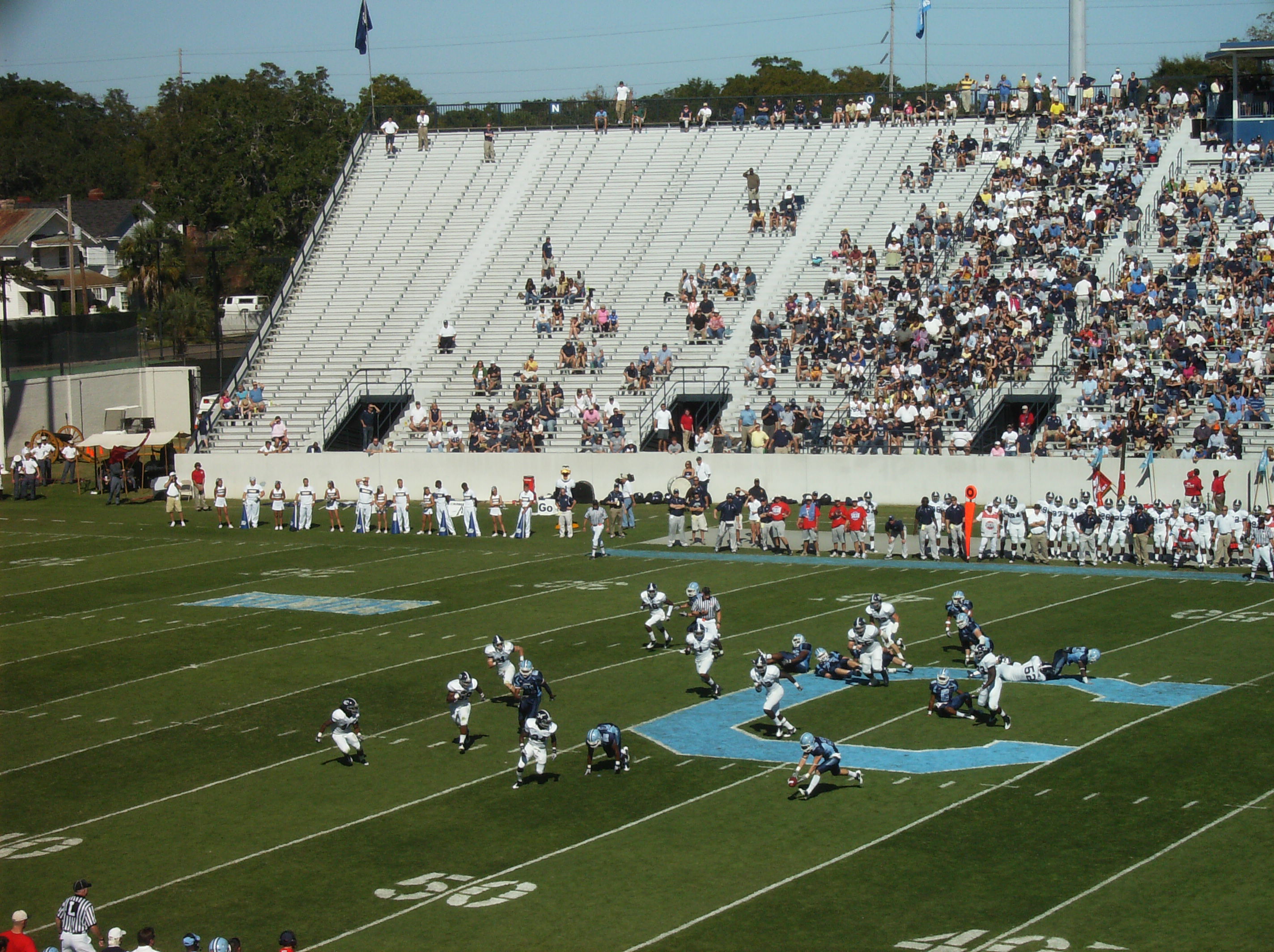
Two weeks until gameday for The Citadel: the scrimmage before the storm

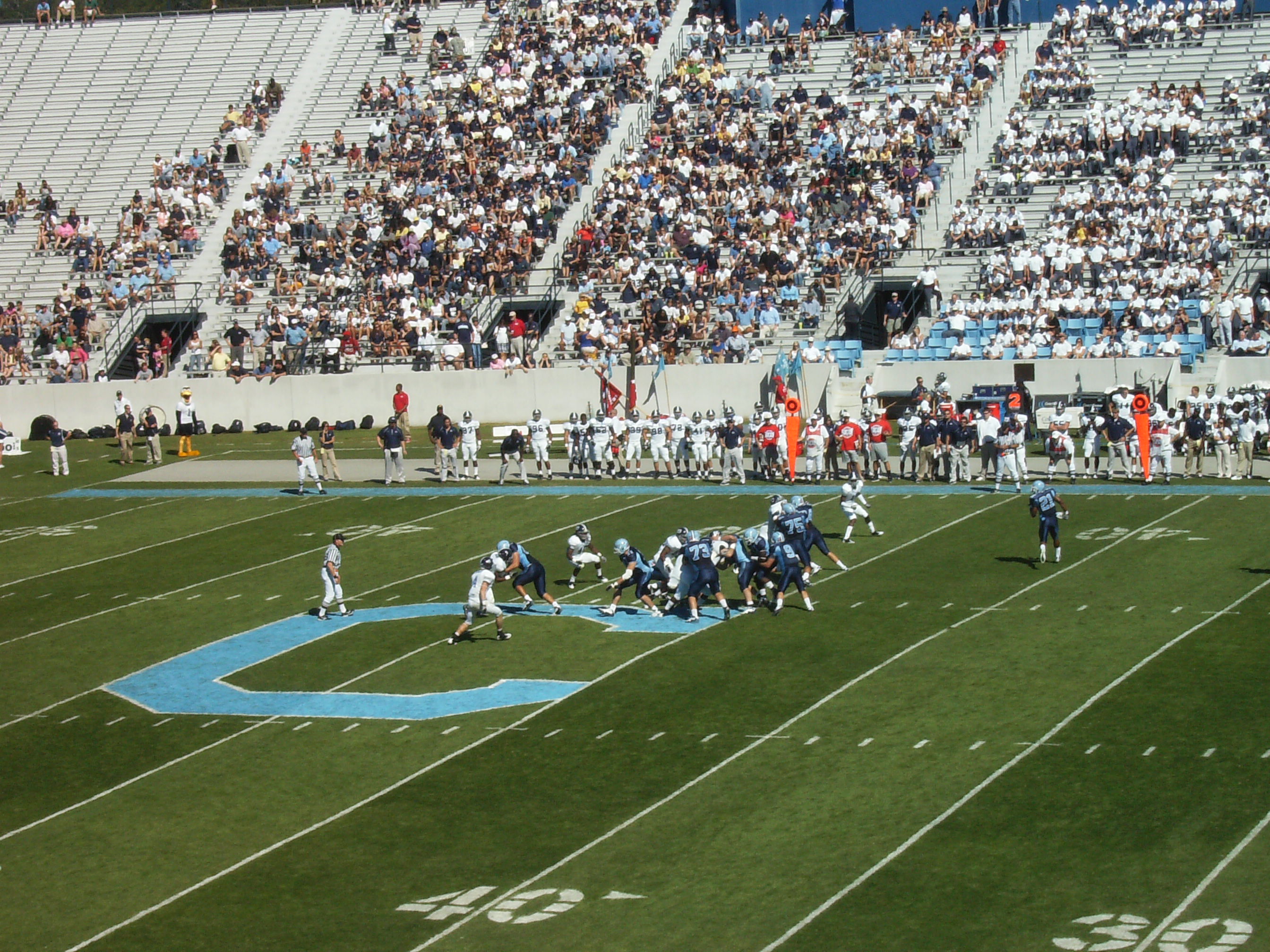
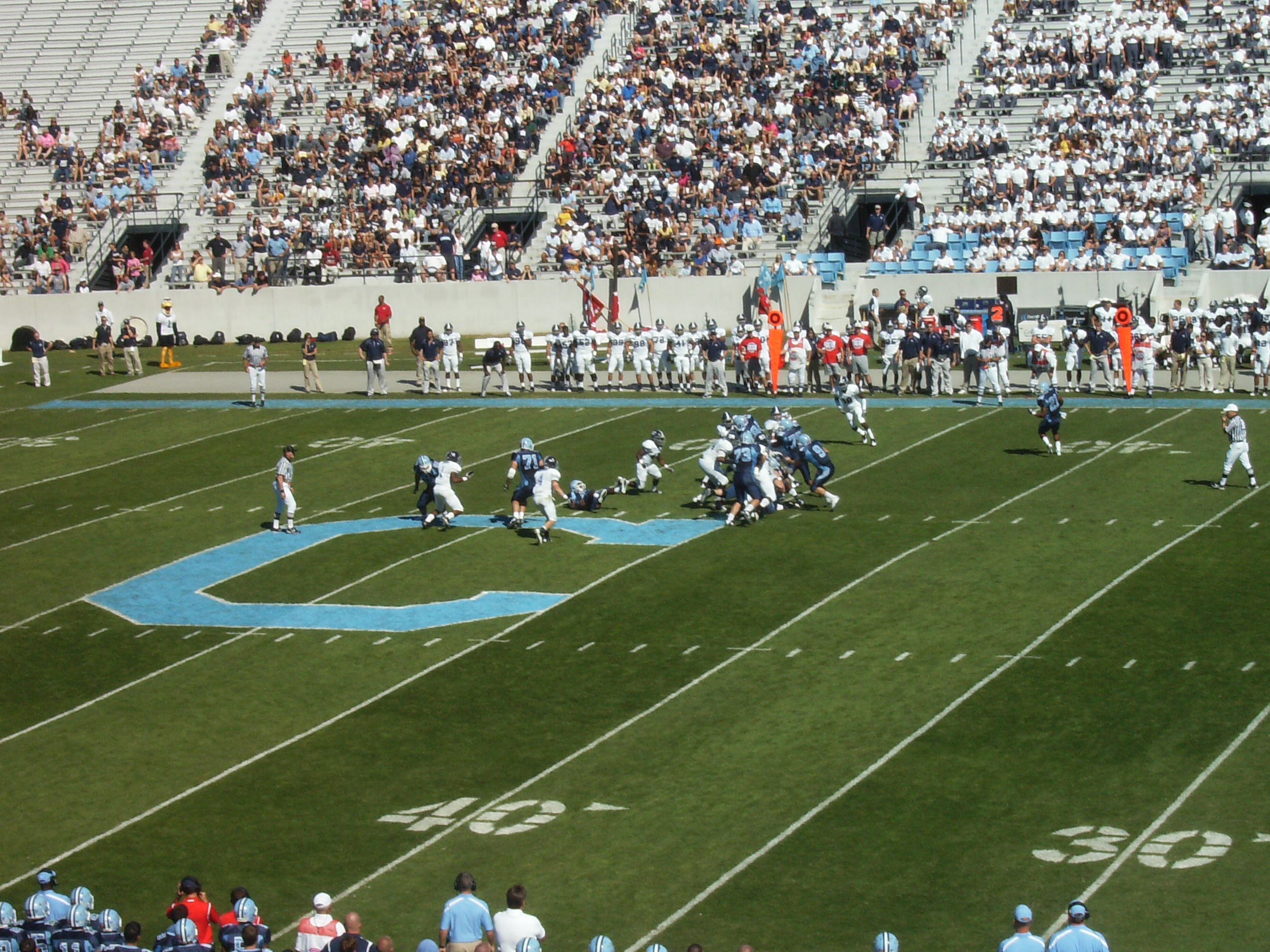
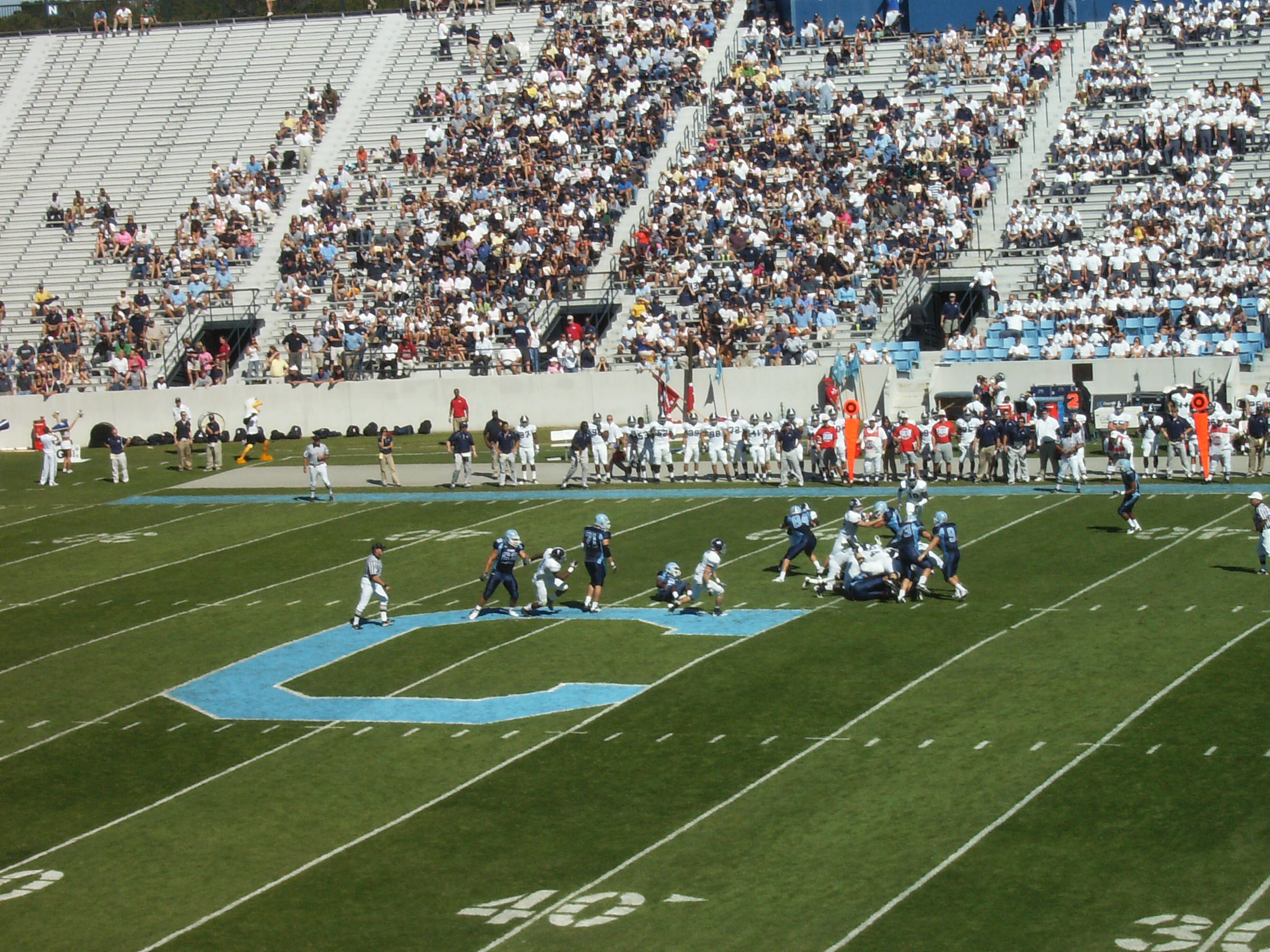
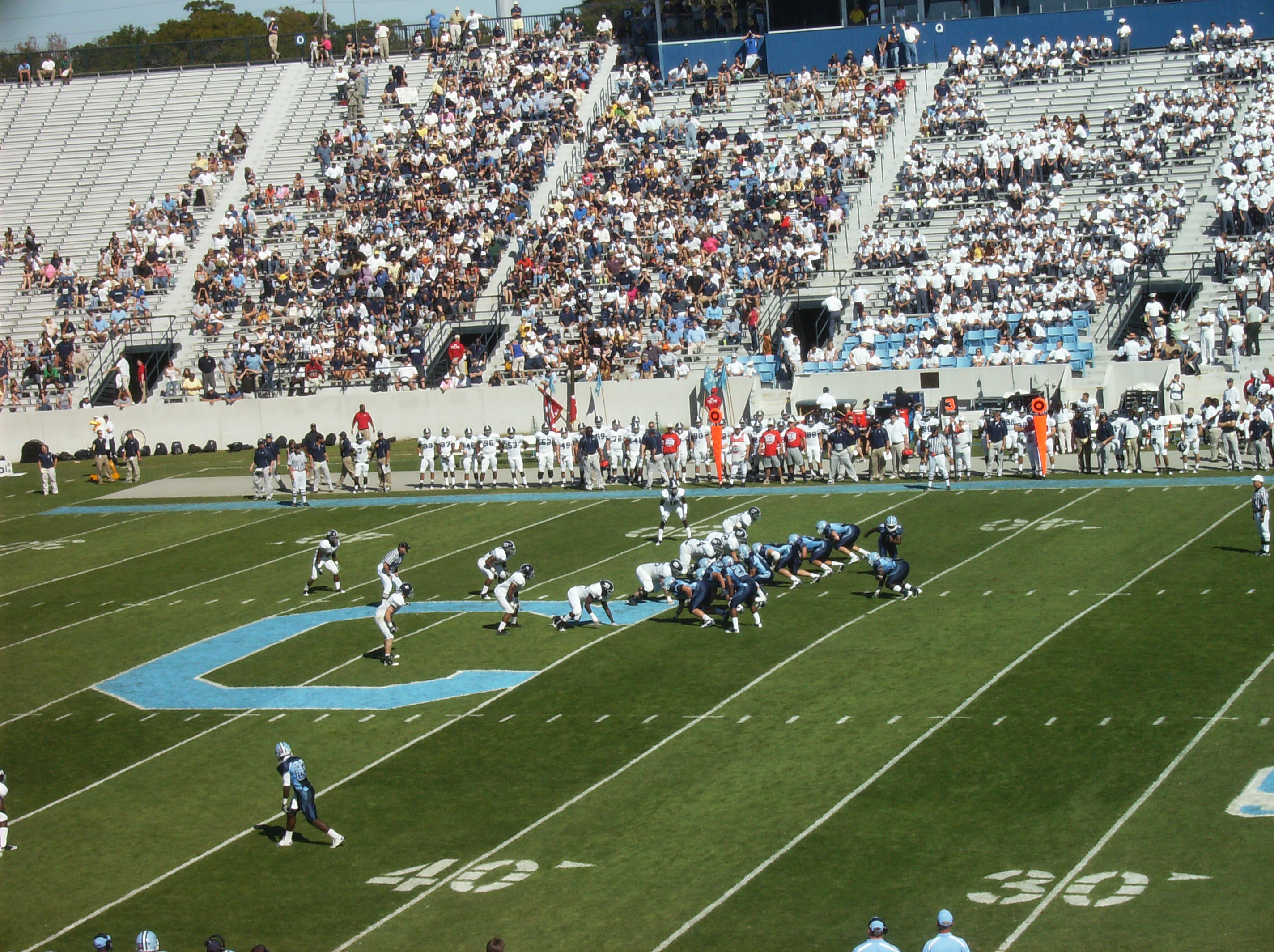
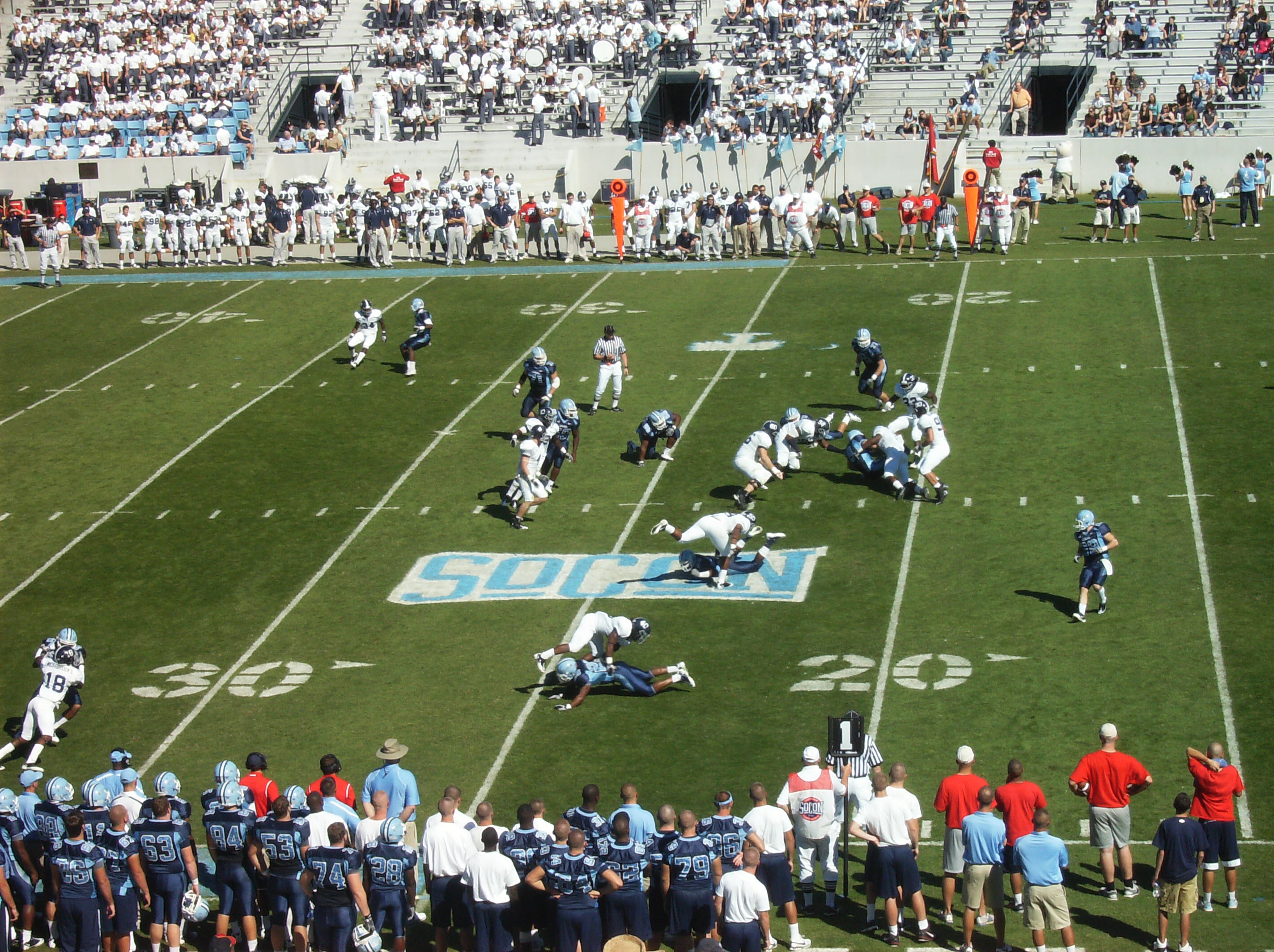
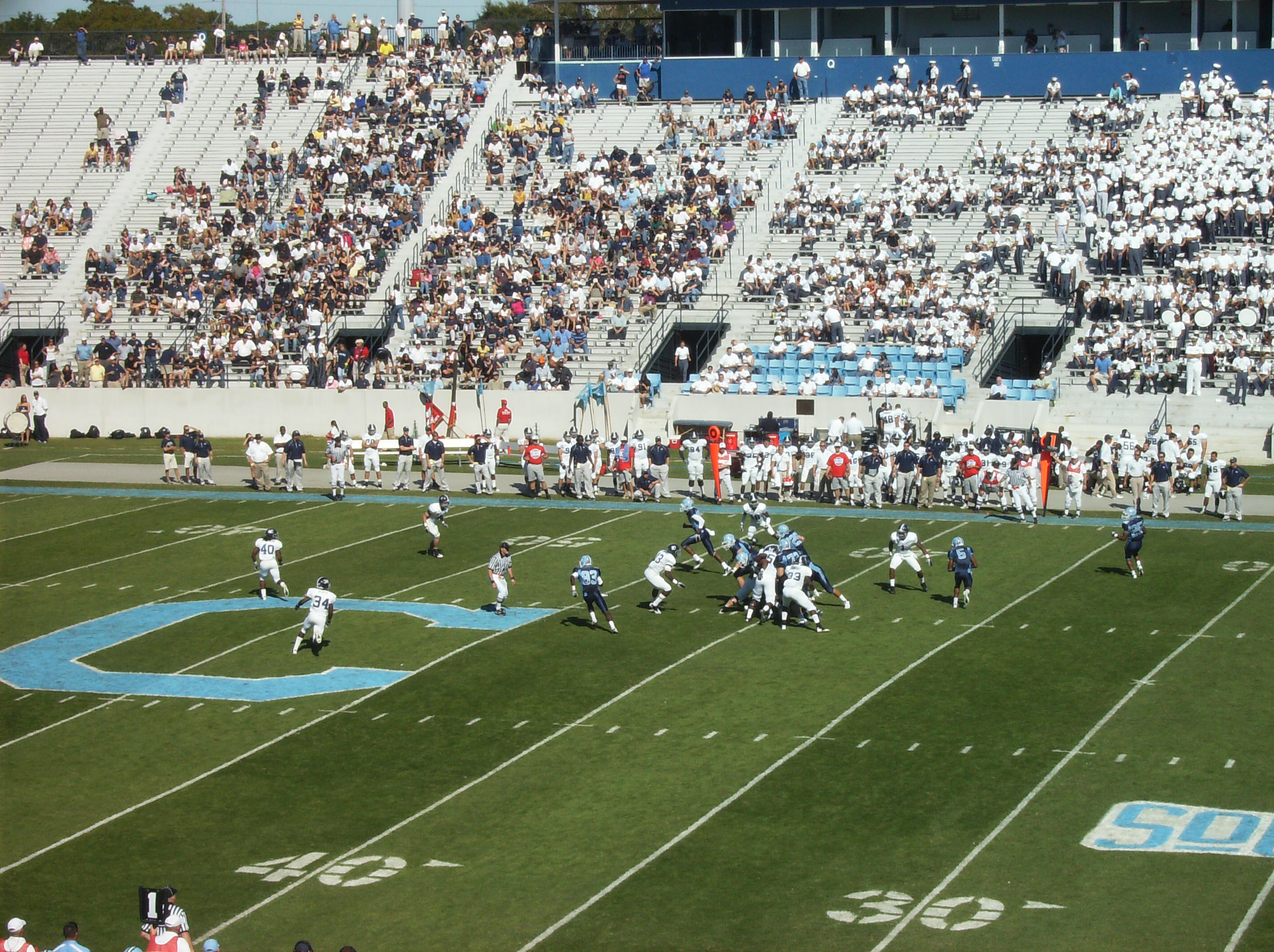
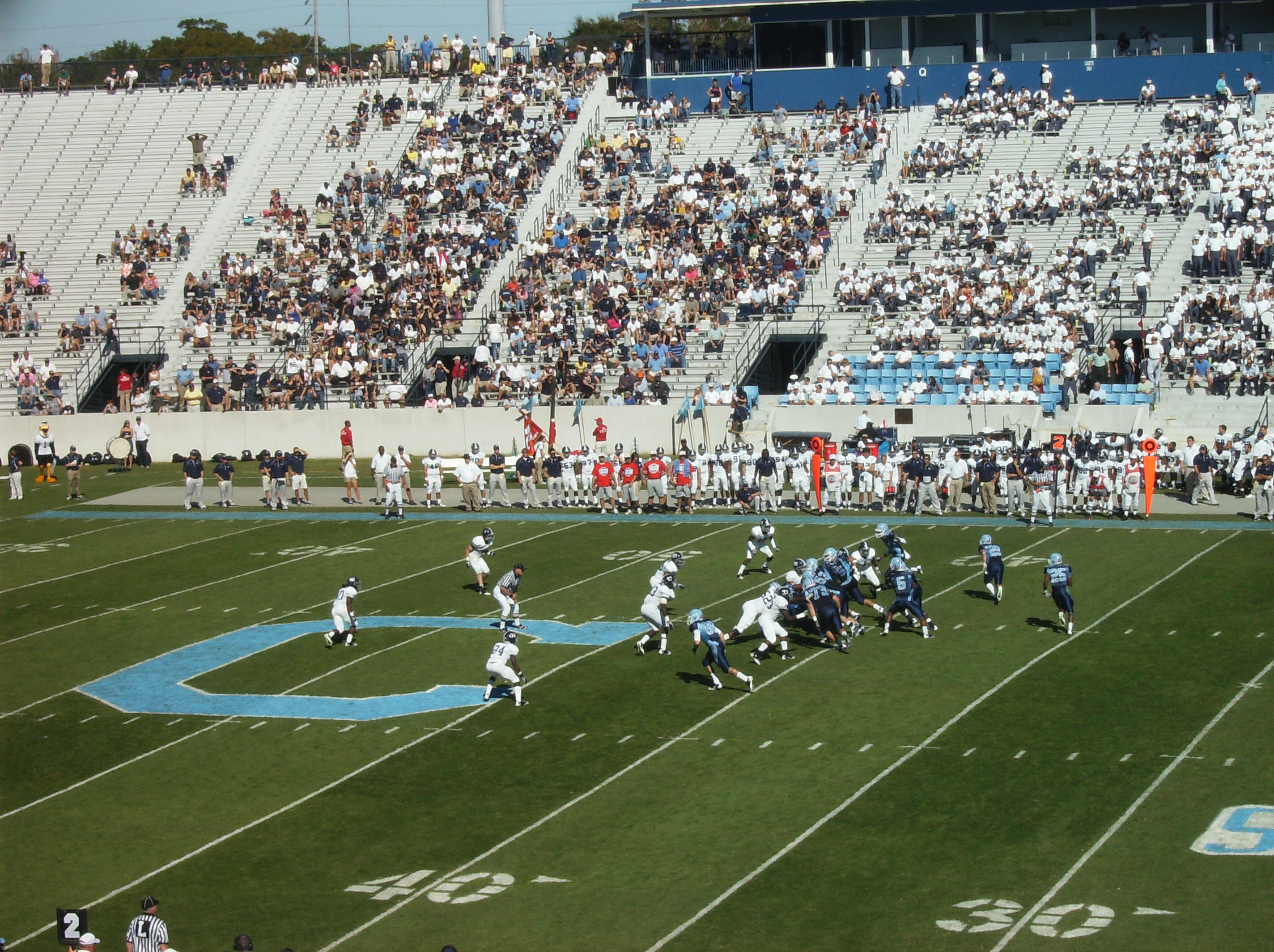
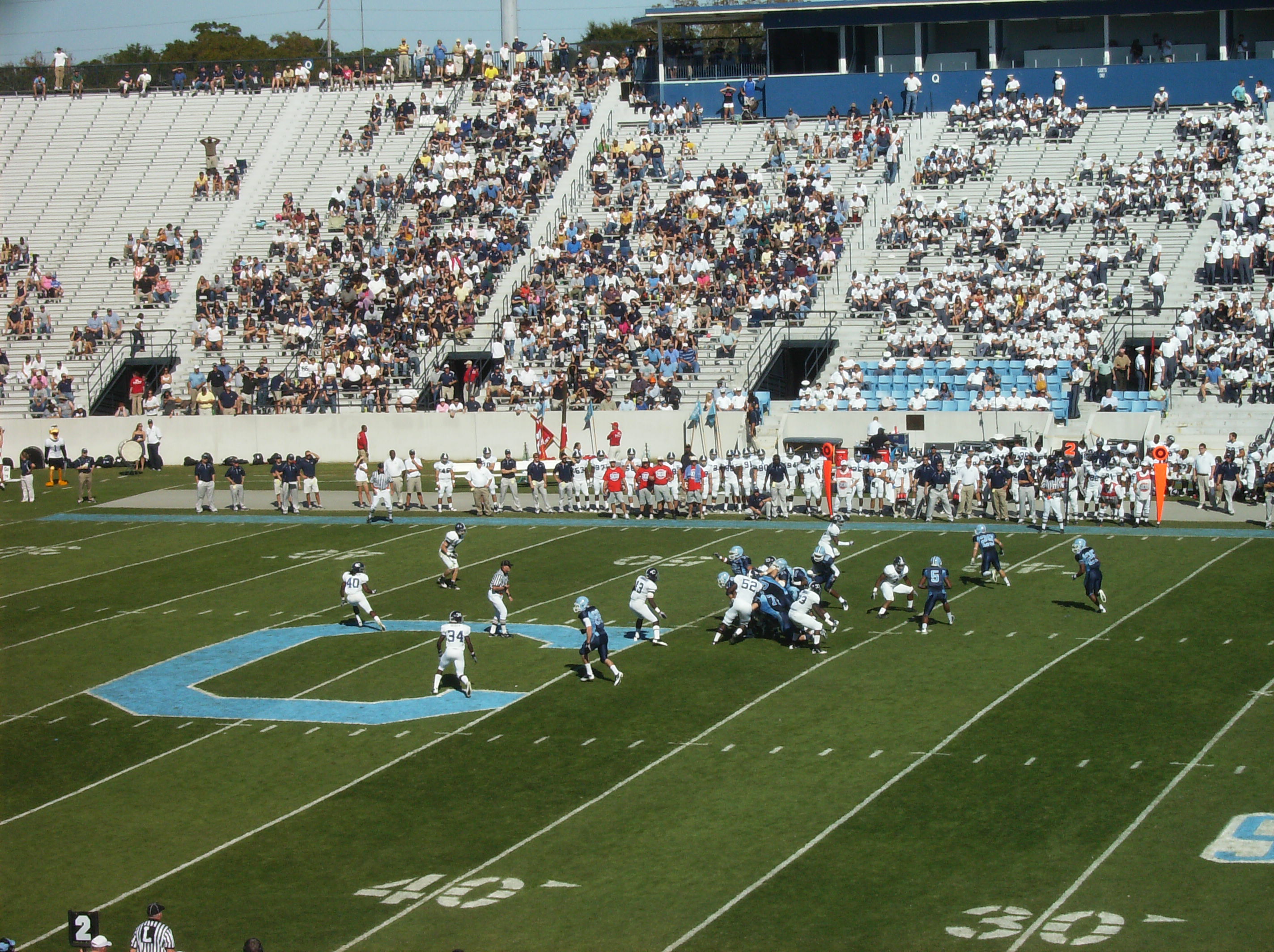
I didn’t think I was going to be able to attend Saturday’s scrimmage at Willson Field, but sometimes the sun shines when you expect rain, and I am quite grateful for that. I am not going to claim to have any fantastic observations about what I saw.  That won’t stop me from typing, though…

I got to campus a little late, but that was okay.  Venturing into McAlister Field House, looking for one of the new football posters, I was almost immediately accosted by a gentleman who asked me if I wanted to eat something.  He pointed to a long table filled with hamburgers and hot dogs, and it suddenly occurred to me that I was hungry.

I was a bit dazed, to be honest, and probably looked like I was on drugs (not guilty!), but no matter.  I grabbed a burger and a cookie (which was very good) and wolfed them down.

Then I got one of the new posters (I took the glossy kind, as I didn’t need it autographed), a magnet schedule (nice), and a team roster (very handy) and made my way to the field.

Jeff Hartsell has a nice writeup on the scrimmage, with some unofficial stats (link). You can also read about it at citadelsports.com (link), which also has a lot of cool photos (link) of the scrimmage, along with the meet and greet that followed it.  (I took some pictures myself, but they are mostly awful, and even the decent ones aren’t nearly as good as the school’s offerings.)

Some quick thoughts:

— I really liked the setup for this event.  Good job all around by the department of athletics.  As always, quality cookies are an easy way to please the masses.

— There were several hundred people there, which was nice to see.  I think that if there had been many more spectators in attendance, though, the venue would have been a little too small, something for the administration to keep in mind if the team enjoys a successful season in 2011.

— The Class of 2015 (i.e. the “knobs”) surrounded the field to cheer on the players. Big fan of that move.

— Maybe for future scrimmages Spike (the cartoon mascot) could make an appearance, to entertain some of the kids.

— The officials working the scrimmage wore long black pants.  In August.  In Charleston.  Luckily for them, while it was kind of muggy it was just overcast enough to keep things from becoming truly oppressive.  I left Charleston before the inevitable thunderstorm (at least I assume it was inevitable).

— Aaron Miller, the freshman QB from Clover, had a big run and seemed to have a presence about him.  He’s a very interesting prospect; one of those guys who doesn’t seem super-fast but nobody seems able to catch him anyway.

— The best pass of the scrimmage was thrown by Luke Caldwell, who is a receiver.  It was a really nice pass, though.  Just like the Samford game last season, it went Caldwell-to-Rickey Anderson, who this time caught it in stride.  Anderson seems to be good at making those downfield catches, which can’t be said for every running back. Kevin Higgins will undoubtedly try to take advantage of that.

— There wasn’t an avalanche of turnovers, so unlike last year’s GSU game I won’t be having nightmares about fumbling for two weeks, but there are still some kinks to be worked out.

— The hitting was solid.  No over-the-top pops, although Rod Harland stood out for his enthusiasm in putting people on the ground.

— The placekicking wasn’t awful, but there is still work to do.

— I didn’t see Larry Leckonby, but I assume he was there.  If so, that would mean that every living person who has served as the director of athletics at The Citadel was at the scrimmage.  (Okay, so that’s just three guys.)  General Rosa was also there, resplendent in bermuda shorts.

One thing I found interesting was the undercurrent of intensity in the crowd watching the action.  The players acted with purpose and intent, but that is to be expected.  What struck me was you could also describe many of the spectators as watching with purpose and intent.

I live in a town where the local school’s squad has high expectations for the season to come, as preseason prognosticators have it contending for league and national honors.  Anticipation is mixed with some anxiety.  There is a lot riding on the upcoming campaign.

The Bulldogs are not expected to contend for league or national honors this year. However, in the crowd today you could feel anticipation and anxiety not unlike that present in the capital city, and for good reason.  There is a lot riding on The Citadel’s upcoming campaign, too.

Two weeks until Jacksonville comes to town.  Two long weeks.

Bulldog hoops: the most disappointing season

The Citadel’s last victory on the hardwood came at Davidson, on January 26.  As this post is going up on February 20, that is a problem.  The Bulldogs have lost seven straight games, with two regular season road games remaining before the Southern Conference tournament.

It is not out of the question that The Citadel could finish the season on a ten-game losing streak.  The last time the Bulldogs ended a season with a double-digit losing streak was 2005, when Pat Dennis’ team started 12-5 before losing its last eleven contests.

This is not what most people were expecting when the season began.  The Citadel returned many experienced players, including three mainstays (Cameron Wells, Zach Urbanus, and Austin Dahn) in its rotation.  While picked to finish fourth in the South Division of the SoCon in the preseason, many people expected at the very least a winning campaign, and possibly something more than that.

I was one of those people, as I thought The Citadel could win 17 or 18 games.  The Pomeroy Ratings also projected the Bulldogs to win 18 games.

It has been a tough season for new coach Chuck Driesell.  After a four-game winning streak pushed the Bulldogs to a still-not-great 9-13 record, the bottom seemed to fall out of the campaign.  Five of the seven losses in the recent run were at home.  Two of the defeats were particularly awful (Savannah State and the recent loss at Georgia Southern).

Driesell hasn’t had a lot go his way, but I think his decision to shorten his rotation to just seven players, which initially resulted in some impressive victories, ultimately torpedoed the season.

The Citadel has traditionally struggled at the end of basketball seasons, a phenomenon Jeff Hartsell of The Post and Courier recently called “getting heavy-legged” while speaking on the ‘Citadel Grayline’ radio program.  These end-of-year collapses are generally ascribed to the difficulties of competing in a long sport season while fulfilling the duties associated with being a cadet.

The historical numbers for the Bulldogs bear out the fact that it has been a problem. Just look at the last six years before this one, for example:

— 2010:  finished 16-16 after losing four of their last five games

— 2009:  finished 20-13 after losing three of their last four games (following an 11-game winning streak)

— 2008:  lost 18 of their last 19 games (of course, that team only won six games all year)

— 2007:  lost 12 of their last 13 games (a seven-win team)

— 2006:   lost 18 of their last 22 games (a ten-win team)

— 2005:  as mentioned above, lost 11 straight to finish 12-16

You can find more years like those, even when concentrating on some of the more respectable teams (like 1998, when the Bulldogs lost six of eight to finish 15-13).  The best evidence of “tired legs”, of course, is The Citadel’s stupefying lack of success in the Southern Conference tournament; even though the Bulldogs haven’t had that many good teams over the years, you would have thought The Citadel would have gotten lucky in the league tourney once or twice.  Nope.

Wells, Urbanus, and Dahn have combined to play over 82% of the minutes available to them over the last four years, which is amazing.  What’s not amazing is the rough finishes the team has had, perhaps as a consequence of that.  The trend has continued this season.

In conference play Urbanus has averaged over 38.5 minutes per game, tied for first in the league.  Wells is fourth in the league in minutes, with 36.5 per contest, while Dahn is 14th (32 mpg).  Early foul trouble in a couple of games is the only reason Wells and Dahn haven’t played even more (Urbanus, on the other hand, is one of two players in the entire country averaging less than one foul per forty minutes of play).

Driesell has tried expanding his rotation as the losing streak has continued, although he’s been hamstrung by Cosmo Morabbi’s injury and the general ineffectiveness of the two transfers he brought in for this season (Morakinyo Williams and Mike Dejworek).

I wish that Driesell had decided to wait a year before fully implementing his system. The current roster is obviously built for Ed Conroy’s slower-tempo style of play.  It has been frustrating to watch a team struggle so when it features seniors like the school’s alltime leading scorer and assist man (Wells), career three-point shooting leader (Urbanus), along with a versatile four-year starter (Dahn) and a handy post defender/offensive garbageman (Bryan Streeter).

Then you have the emergence of sophomore Mike Groselle, who has been a revelation in terms of offensive efficiency.  Yet with all that, the team is 9-20, and not by a fluke, either.  No, this is a team that has never put it together on either side of the court, save for that one four-game run in the middle of the season.

For most of the year, The Citadel has lacked an offensive identity and has been poor defensively.  I suspect the offensive problems have contributed to the defensive woes; that is the nature of the game.

I feel badly for the team’s seniors, who I think deserved to go out on a much better note, but at least they will always have memories of the 2009 season, one of the finest in school history.  I am glad they chose to come to The Citadel; it’s one of the best hoops classes the military college has ever had, if not the best.

As for Chuck Driesell, I certainly haven’t given up on him.  He’s got some work to do, however.  Next year’s recruiting class is supposed to be quite good, and Driesell has a well-deserved reputation as a solid talent evaluator.  Now he has to put that talent together (and keep it, never an easy thing at The Citadel).

Driesell seems to prefer outstanding athletes, which is fine, but he must also find room in his system for players like Groselle, whose eFG% in conference games is currently second in the league.  Groselle has a 66.9 FG% in SoCon play and a 3.7 GPA in Civil Engineering;  The Citadel needs as many players like that as it can get, whether they can jump or not.

Regardless, this season has to go down as the most disappointing season in the modern history of The Citadel’s basketball program.  Admittedly, that’s in part because it was the rare season where expectations were fairly high.  That doesn’t make it any less deflating, though.

Bulldog hoops: time to go on a winning streak

I haven’t written about The Citadel’s hoops team in a while (then again, I haven’t had a blog post about anything in some time; I need to start cranking stuff out again). Honestly, though, there hasn’t been a good reason to write about Bulldog basketball, at least a good positive reason.

At least The Citadel won on Monday night, beating Samford 61-50 for the Bulldogs’ first road victory of the season.  A sign of things to come?  To be honest, I doubt it.

The Citadel is 6-13 overall, 2-5 in the Southern Conference, with home games against Appalachian State on Thursday and Western Carolina on Saturday.  Prior to the Samford win, the Bulldogs had lost five straight SoCon contests.

What is the difference between this year’s edition of the basketball Bulldogs and, say, last year’s squad?  I won’t compare them to the 2008-09 team that won 20 games, which included Demetrius Nelson and John Brown.  However, I think it is fair to compare the 2009-10 and 2010-11 outfits.

Last season’s team featured a rotation mainstay who is no longer in school, Harrison Dupont.  Dupont had a nice debut campaign (alas, there would be no followup season, at least in Charleston), averaging 14 points per 40 minutes of play and finishing with an eFG of 48.2%, highest of all the regulars and highest on the team overall, with one exception.

That one exception was Mike Groselle, who saw limited action due to injury/illness, but showed signs of being a very effective player when he saw action.  It really shouldn’t be a surprise that Groselle has had a fine sophomore season.  So far this year Groselle is averaging 19 points per 40 minutes of play with an eFG of 58.9%, leading the team (again).  That is good for 11th among Southern Conference players.

He is also averaging almost six rebounds per contest (Dupont was good for four boards per game).  Groselle’s FG% of 58.9 is good for sixth in the SoCon.

Groselle’s development has basically replaced the lost production of Dupont, if not surpassed it.  They aren’t really similar players, so it’s not a true like vs. like comparison (particularly from a defensive perspective), but I think it does make it easier to look at the rest of the team numbers and see where the differences lie.

One difference is the reduced contributions from Cosmo Morabbi, who played in all 33 games last season and averaged over 18 minutes per game.  Morabbi has been injured and has missed several games, but even when he was playing, his minutes had been cut in half.

Morabbi has struggled with his jumper this season.  Actually, struggle doesn’t really describe it; he hasn’t made a three-pointer yet this year (0-8) after shooting 37.9% (25-66) from beyond the arc in 2009-10.  In his previous two seasons for the Bulldogs, Morabbi was a dependable member of the rotation who wasn’t afraid to take big shots; not having his typical production has been a problem.

Then there is post play.  Last season Joe Wolfinger was the transfer hopeful who never quite fit into The Citadel’s offense.   However, Wolfinger’s offensive production compares favorably to that of “Big Mike Squared”, the duo of Williams and Dejworek.

Morakinyo Williams has missed time with injury (he has played fewer minutes than Morabbi), and Mike Dejworek hasn’t been a major factor, either.  The two have combined to score 47 points in 219 minutes of play, which per game is about half of the scoring output by Wolfinger last season.  Neither has been a force on the boards.

A few other odds and ends:

— Last season, 36.5% of The Citadel’s total points came via the three-point shot.  So far this year, that number is 23.2%.

— The Citadel’s eFG of 44.5% is in the bottom 50 nationally; last season, the Bulldogs had an eFG of 48.4% (middle of the pack nationally).

— The Bulldogs are not forcing turnovers this season.  Opponents have a turnover rate of 16%.  That puts The Citadel in the bottom 25 nationally. Last season’s opponent turnover rate was 19%. That’s a significant difference.

—  Defensively, The Citadel ranks in the bottom 50 nationally in defensive FG% and defensive 2FG%.  The Bulldogs have a defensive 3FG of 34.4%, which isn’t that bad, but not nearly as good as last season’s 32.4%, which was 80th-best in the country.

— In SoCon play, the Bulldogs currently rank last or next-to-last in defensive 2FG%, defensive turnover rate, and points allowed per possession.  The sample size is a little small, admittedly.

As noted by Jeff Hartsell, Zach Urbanus and Cameron Wells have been logging some serious minutes lately, thanks to a slender bench (Morabbi being unavailable really hurts there).

After a loss to Coastal Carolina earlier in the season, Chuck Driesell mentioned on his postgame radio show that he was worried about fatigue affecting the Bulldogs’ play.

In the SoCon teleconference this week, however, Driesell sang a slightly different tune.  He noted that the loss of Morabbi had impacted his ability to substitute players who had experience, and he also mentioned that a way to address concerns about too much game action for individual players would be to monitor (and presumably lessen) their work during practice.

However, Driesell stated during the teleconference that he saw “no signs of fatigue” and that Wells and Urbanus are “young guys [who] should be able to handle” increased minutes.

We’ll see.

— Six weeks ago, I wrote that the Bulldogs seem to lack an offensive identity.  Here is, to my mind at least, one example of that:

Last season, Zach Urbanus and Austin Dahn each averaged about one three-point attempt every five and a half minutes of playing time (5.7 for Urbanus, 5.6 for Dahn). This season, with an increased number of possessions per game (about five more), Dahn is averaging a three-point attempt every 5.1 minutes he is on the court.  And Urbanus?

He’s only averaging one three-point try every 7.5 minutes of play.

With the increase in tempo, Urbanus is averaging more total shots per contest this season than last year on a per-minute basis, as is Dahn.  Dahn, however, is taking more three-pointers than Urbanus (25 more, even while playing almost 100 minutes fewer than Zach).  Neither is shooting as well from beyond the arc as they did last season (Urbanus is at 36.7% after shooting 41.1% from three last year; Dahn is down from 34.7% to 28.6%).

That may be reflective of how other teams are playing them defensively, or it may be due to a lack of offensive cohesion, or perhaps it’s a combination of both. Regardless, it seems to me that the leading three-point shooter in The Citadel’s history needs to be leading the team in three-point attempts.

This has been a tough year so far for Chuck Driesell.  He’s learned that being the coach of The Citadel’s basketball team is not easy.  He knew that going in, obviously, but there is still a lot of on-the-job training at the military college.  He has to know that a lot of fans are disappointed in the way the season has gone.  There were high expectations for this team, and to date they haven’t been met.

It probably doesn’t help matters that his predecessor, Ed Conroy, is having a nice start to his tenure at Tulane, and recently was featured in a local article describing his salesmanship of the program.  Conroy has benefited from a relatively soft early schedule, but it’s also true that he’s already won two conference games in C-USA, only one fewer than the Green Wave won all of last season.

Tangent: in that article, the writer describes how Conroy somehow talked 80 Marquette students (in New Orleans as part of a volunteer group) into attending a weeknight game between Tulane and UTEP.  How many cadets will attend the Saturday game at McAlister Field House against Western Carolina?

There is still time, of course.  Maybe the win over Samford will be the start of something special.  The two upcoming home games are both winnable.

If Wells and Urbanus are going to play 38-40 minutes every night, it might be best for The Citadel to revert to its slow, slower, slowest style of play from the last two seasons.  Lowering the amount of possessions might serve to reduce the chances of either getting in foul trouble, and also could keep them from running out of gas, either in individual games or over the course of the season.

It also would have the potential of settling down the offense.  I don’t think it would hurt Groselle and Urbanus, in particular, if the tempo were decreased.  Wells (who had a “Cameron Wells game” against Samford, taking over the last 10 minutes of that contest) is capable of thriving in any offensive system.

Slowing the game down also increases the value of offensive rebounds and other possession-changing plays, which is to the advantage of players like Bryan Streeter and Daniel Eykyn.

I’m ready to see a long Bulldog winning streak.  How about eleven straight?  It’s happened before…

The Citadel hoops it up in Las Vegas…and a couple other places

What happens in Vegas…stays in Vegas.

On Friday, The Citadel plays the first of four basketball games in the western half of the United States, with one game in Boulder, Colorado, another in Albuquerque, New Mexico, and two games in Las Vegas.  If you have to play four games in the week before Christmas, you could do worse in terms of locales.

The four games are all part of the IBN Las Vegas Classic, which is an in-season tournament that really isn’t a tournament.  Well, I suppose it’s a tournament for Colorado, New Mexico, Indiana, and Northern Iowa.  Those four schools host two games, then play in a four-team bracket in Las Vegas for the “tournament” title. Meanwhile, four other schools (The Citadel, South Carolina State, Longwood, and SIU Edwardsville) play two games at the “bigger” schools and then two games against each other in Vegas.

It doesn’t matter if The Citadel beats Colorado and/or New Mexico before playing in Las Vegas.  It’s still paired off with the Longwood-SIUE-SCSU group.

This kind of in-season event is a growing trend that can be blamed mostly on Gardner-Webb, which a couple of years ago upset Kentucky and replaced the Wildcats in a made-for-ESPN tournament at Madison Square Garden.  That didn’t sit well with event organizers, which missed out on the hordes of UK fans (and also presumably annoyed ESPN, which lost a big TV draw).

After that, the folks who run these types of events started the “guaranteed four” setup, so as to ensure that the four “name” teams in the tournament advance to play at the main site.  Of course, both sets of teams in the LVC are playing at Orleans Arena anyway, but I’m guessing CBS College Sports (which is televising each game of the Colorado-New Mexico-Northern Iowa-Indiana group) didn’t want to be faced with the possibility of televising Longwood-South Carolina State instead of Northern Iowa-Indiana.

In addition, the organizers want to sell as many tickets, advanced or otherwise, as possible, and it’s not as easy to do that without “heavyweight” matchups (although there is nothing particularly heavy about any of the heavies in this tourney).  If you click on the “IBN Las Vegas Classic” link above, you will notice that ticket prices for the event range from $44 to $110, and single-game tickets are not available.  (If you listen to the announcer on the streaming video advertisement, you will also notice him promoting South Carolina as playing in this event; undoubtedly the folks who put the video together got South Carolina confused with South Carolina State.)

The Citadel also played in a “tournament” with pre-determined matchups a couple of years ago, in Cancun, an event that also featured New Mexico, and which was most notable for having its games played in a ballroom (complete with chandeliers).

Just some thoughts on The Citadel’s upcoming opponents, nothing too substantial…let’s start with Chris Fowler’s alma mater:

Colorado is 5-3.  The Buffaloes are 5-0 at home and 0-3 on the road.  Luckily for Colorado, it will play The Citadel at home.

This appears to be enough of an edge for The Denver Post, and possibly Buffs coach Tad Boyle, to take the Bulldogs for granted.  Boyle plans to “substitute freely” against The Citadel, in an effort to give his benchwarmers some playing time. According to the Post, “it will be a disappointment if Colorado can’t empty its bench” against the Bulldogs.

I think that qualifies as bulletin board material…

You can understand Colorado’s confidence, what with its impressive wins over national powers Idaho State and Texas-Pan American, and its near-upset of Harvard, which only beat the Buffaloes by 16 points.

Alec Burks (20.5 PPG this season and last year’s Big XII freshman of the year) and Cory Higgins (16.9 PPG) are good players, and need to be saved for other games, like those against top-100 RPI teams.  Colorado needs to beat some of those teams to finish the year in the top 100 itself, something it hasn’t done in the past four seasons. Part of the reason for that has been its less-than-stellar defensive play; among other things, Colorado finished last in the Big XII in 2009-10 in FG% defense.

Boyle won 25 games last year at Northern Colorado, and then moved to Boulder to replace Jeff Bzdelik (currently losing games to low-major squads at an alarming rate for Wake Forest).  He wants to improve Colorado’s defense and rebounding, which is a good idea, but through eight games the Buffs are still struggling to defend (including allowing opponents to shoot 40% from three-land; Zach Urbanus, take note).

The Citadel, by my count, has now lost 51 straight games to schools currently in BCS conferences.  Its last victory over a major-conference foe came in 1989, at South Carolina.  Before that you have to go back to 1979 and a win over Clemson.  The Bulldogs have only one victory over a current Big XII school, a 62-61 decision against Texas A&M in 1971.

While beating Colorado might be considered unlikely, given that history, it’s not out of the realm of possibility, particularly since the Buffaloes are not exactly on the same level as Duke or Kansas.  I’m a bit bemused by the Post story, which appears to be assuming a walkover.

Going into this season, Steve Alford had won 76 games in three years at New Mexico, including 30 last season (a school record).  One of those 30 victories came in the NCAA tournament, which matched Alford’s total number of NCAA tourney triumphs in eight years at Iowa.  It appears Albuquerque is a better fit for Alford than Iowa City, somewhat surprising for a Big 10 legend…or a Big 10 leader…whatever.

(We’ll be mocking the new Big 10 division names for years to come.)

Alford should have a good team this year, too, although it could have been even better had MWC player of the year Darington Hobson returned.  He elected to go pro and bypass his senior season, however.  Hobson and Ramon Martinez (also departed) combined to average 30 points and 15 rebounds per game last season; now Alford has to replace that production.

The Lobos are 7-1, including back-to-back wins over New Mexico State (a scheduling oddity; the victory in Las Cruces came in OT) and victories over Arizona State and Detroit.  The one loss was a 25-point beatdown at California.

New Mexico has a lot of depth, and Alford is still in the process of figuring out how to use it, evidenced by the fact ten different players have seen action in all eight of the Lobos’ games, and that doesn’t include Phillip McDonald, who missed three early games with an elbow injury.  When Alford does get a handle on his rotation, New Mexico should be an upper-echelon Mountain West Conference outfit, albeit probably a rung below San Diego State (Steve Fisher appears to have his best team in 12 years at the helm of the Aztecs’ program).

New Mexico plays its home games in one of college basketball’s great venues, The Pit, which has undergone a $60 million renovation.  The Pit is probably best known as the site of North Carolina State’s famous victory over Houston’s “Phi Slama Jama” squad in the 1983 NCAA title game.

It’s too bad Final Fours aren’t played in true basketball arenas any more, because The Pit was a classic host site.  CBS has been using “The Road to…” tagline for years to hype the NCAA tournament, and nothing ever sounded better than “The Road to Albuquerque”.

Once The Citadel arrives in Las Vegas, it will face South Carolina State.  This is, in a word, dumb.  Two schools 77 miles apart (believe me, I am more than familiar with the distance between Orangeburg and Charleston) will travel across the country to play each other.  I don’t see why the event organizers didn’t have SCSU and The Citadel play Longwood and/or SIU Edwardsville in the first round, to lessen the chance they would play each other.

South Carolina State is 4-4, with all four victories coming against non-D1 opposition. (The Orangeburg Bulldogs will play Indiana and Northern Iowa prior to matching up with The Citadel.)  The losses include setbacks at Clemson and at Charlotte; SCSU has also lost to Furman and, perhaps most disappointingly for its fans, North Carolina Central.

Carrio Bennett, a senior who was the MEAC freshman of the year three seasons ago, scored a combined 35 points against Furman and NC-Central, but averaged just six points against Charlotte and Clemson.  Darnell Porter lit it up against the Bulldogs’ non-D1 competition, but hasn’t yet produced against the better teams on SCSU’s schedule.

All of South Carolina State’s scholarship newcomers this season are junior college players; one of them, Brandon Riley, scored 23 points against Charlotte and 12 against Furman.

Through four games against D-1 teams, SCSU has done a good job forcing turnovers and rebounding, and a poor job defending in the paint (allowing 54.1% on 2-point FG attempts).  The Bulldogs are a mixed bag when it comes to offensive efficiency; they’re a good 2-point shooting team but terrible beyond the arc (26.6%).

This will be the first meeting between The Citadel and South Carolina State since 2004.  Charleston’s Bulldogs hold a 7-3 advantage in the series.

After playing South Carolina State, The Citadel will play either Longwood or SIU Edwardsville.

Longwood is 3-8, with its lone D-1 victory over Columbia.  The Lancers share one common opponent with The Citadel, James Madison, losing at home to the Dukes 88-78 (the Bulldogs lost to JMU 74-67 at McAlister Field House).

The globetrotting Lancers have also lost at Kansas, Seton Hall, Marquette, and VMI (losing 114-82 to the run-and-gun Keydets).  When The Citadel is playing Colorado, Longwood will be playing New Mexico (and vice versa).

Longwood is a small school (a little over 4000 undergraduates) in Farmville, Virginia that has been a D-1 member since 2007.  It’s an independent in hoops, which largely explains its all-over-the-map schedule.  Its most famous hoops alum is Jerome Kersey, who was a longtime NBA player for the Portland Trail Blazers.

SIU Edwardsville started institutional life as an extension of SIU Carbondale (the school commonly referred to as Southern Illinois or SIU).  SIUE now has almost 14,000 undergraduate students.

Like Longwood, SIUE is a recent debutant in D-1.  The Cougars ply their trade in the Ohio Valley Conference, although they won’t compete in league play as a member until next season. SIUE is still transitioning to Division I.

SIUE is 2-9, with only one victory over a D-1 squad.  That win came last Saturday against Kennesaw State in 2OT.  Kennesaw State had beaten Georgia Tech earlier in the season, so beating KSU was a nice scalp for the Cougars.  Actually, any win would be a nice scalp for SIUE, which prior to the Kennesaw State win had only defeated MacMurray (the college, not the dad from ‘My Three Sons’).  Last season the Cougars were 5-23, which included two non-D1 victories.

SIUE has several notable alums from the world of sports, including the great tennis doubles team of Ken Flach and Robert Seguso, the respected baseball broadcaster Dewayne Staats, and pro wrestler Paul Wight (“The Big Show”).  Sportswriter Bill Plaschke also attended SIUE.  However, the most notable SIUE basketball alum is longtime referee Ed Hightower.

When I last wrote about the hoops team, The Citadel was about to play its first two Southern Conference games of the season, along with a game against D-3 St. Mary’s of Maryland.  I had expected the Bulldogs to go 2-1 in those three games, and that’s exactly what happened.

As for the four upcoming “tournament” games, I believe The Citadel should be 2-2 at worst.  I don’t really expect an upset on the road in Boulder or Albuquerque (although it would be nice, obviously), but I think The Citadel has a better squad than South Carolina State (and a more cohesive and experienced one as well).  The Bulldogs should be favorites against either Longwood or SIUE.

Jeff Hartsell did a nice job in a recent “Bulldog Bites” post of breaking down how the season has gone so far, although I think the Bulldogs are a little better than that current Pomeroy projection.  I certainly hope so, anyway.  The Citadel needs to continue to work out its problems on the defensive end; the Bulldogs are a bottom 50 team nationally in 2-point FG% defense and aren’t much better in defensive turnover rate.  The Citadel does have good numbers defensively against the three-point shot, however, as opponents are only shooting 31% from beyond the arc.

The Citadel is only shooting 62.9% from the line, which is actually better than I would have expected, given that the player who has shot the most free throws so far this season is Bryan Streeter.  If good foul shooters like Cameron Wells and Mike Groselle get more opportunities from the charity stripe, the FT% will go up.

One way for Groselle to get more chances is for his minutes to increase, which I think is going to happen, particularly if he can hold his own defensively.  On the offensive side of the court, he has been very impressive.

I’ve been trying to decide who Groselle reminds me of in terms of his offensive game. Maybe this is a reach, and it certainly is a blast from the past, but I’m going to say he has a game not unlike John Pinone, who was a star for Rollie Massimino at Villanova in the early 1980s.

Streeter may be a total liability at the foul line (33.3%), but he is an offensive rebounding machine, with 29 in eight games.  That is getting it done.   Even with his struggles with free throws, he has still been arguably the Bulldogs’ second-best player so far this year when you combine all the elements of the game.

Zach Urbanus appears to have located his missing outside shot, and the team has solid numbers in terms of assist/turnover ratio and assist/made basket ratio (the A/B of 64% is 20th-best in the country).  Where the Bulldogs are hurting offensively is inside.  I noted The Citadel’s poor 2-point FG% defense earlier; it’s matched by an equally poor 2-point offensive percentage.  Between that, the team’s early struggles from three-land and the free throw issues, The Citadel’s eFG% is 314th out of 345 Division I teams.

I hope the players have a good time on the trip, and come back with an extra Christmas present or two, like a win in Boulder or Albuquerque.

The Citadel: Status of the Football Program

Judging from some posts at TCISN over the last few weeks (and from some non-message board discussions I have heard), there is sentiment in some circles that it’s time to make a coaching change at The Citadel.  This is, in my opinion, definitely a minority viewpoint, but it’s out there.

It’s a position that reached its zenith in popularity following the offensive debacle against Georgia Southern, and I have to say it would be hard to blame anyone for having a knee-jerk reaction after sitting through that game.  It was embarrassing.  The improved performance against Elon last Saturday seems to have muted some of the “we need a new coach” talk, though.

That said, I seriously doubt there is going to be a coaching change after this season. Actually, I would be really, really surprised if Kevin Higgins weren’t retained.

Higgins is currently under contract through the 2013 football season.  In this economic climate, there aren’t many schools that are prepared to let a coach go with three years left on his deal, and The Citadel doesn’t have a history of doing that, anyway.  Just the opposite, in fact.  The Citadel has honored the full contracts of “lame-duck” coaches like Don Powers in football and Randy Nesbit in basketball, just to name two.

Another thing to consider is that after last season, his second straight losing campaign (and fourth in five years), Higgins decided to completely scrap his spread offense and move to the triple option.  That doesn’t strike me as the move of a man worried about job security, because he had to know when he made that decision that the 2010 season was probably going to be difficult.  Maybe he didn’t think it was going to be as difficult as it has turned out, perhaps, but he knew the potential pitfalls.

I don’t know, but I would guess that before deciding to employ a new offense Higgins had a chat with AD Larry Leckonby about the move, just to make sure his position was safe for at least a couple of years.  That also was likely the message Leckonby delivered to prospective assistant coaching candidates (Higgins brought in seven new assistants).

Tommy Laurendine, for example, was in a presumably “safe” job at his alma mater, Lenoir-Rhyne.  I doubt he would have taken the job at The Citadel if he thought there was a chance that it would only be for one year.  The same is true for Josh Conklin and Bob Bodine, among others.

Assuming Higgins is back for at least one more season, then, where does the program stand in relation to historical norms?  Is keeping a coach with his overall and league record a good idea, regardless of contract status?  What factors besides on-field performance need to be considered?

First, let’s look at some numbers (keep in mind that at the time of this post, The Citadel has yet to play its final game of the 2010 season, which is at Samford).

Kevin Higgins is 26-40 overall, 14-30 in the Southern Conference.  He has been the Bulldogs’ head coach for six full seasons.

Twenty-three men have served as head coach of The Citadel.  Eight of them coached prior to the school joining the Southern Conference.  Tatum Gressette is the transitional coach in this respect, with the last four years of his eight-year tenure marking the first four SoCon campaigns for The Citadel.

Counting Gressette, then, let’s take a look at how Higgins compares to those fifteen coaches who competed in the Southern Conference.

— Overall record:  Higgins ranks 10th out of 15 in winning percentage

— SoCon record:  Higgins ranks 8th out of 15 in winning percentage

There is more to this than just those placements, though.  Higgins may only be 10th alltime in overall winning percentage, but of the five coaches behind him, three of them were his immediate predecessors at The Citadel.  The other two, Quinn Decker and John McMillan, were the first two coaches at The Citadel following the program’s post-World War II restart.

As for the SoCon record, Higgins has a better conference winning percentage than Ellis Johnson and John Zernhelt (but not Don Powers, interestingly), and also has a better mark than Tom Moore, along with John Rowland, Gressette, Decker, and McMillan.

Starting with John Sauer, who only coached at The Citadel for two seasons, every coach who was at The Citadel between 1955 to 2000 has a better league record than Higgins, except Moore.  That includes Eddie Teague, who succeeded Sauer as head coach, and three men then-AD Teague later hired (Red Parker, Bobby Ross, and Art Baker).  Moore’s successor, Charlie Taaffe, also has a better SoCon record than Higgins.

Comparing Higgins’ SoCon record to the Gressette/Rowland/Decker/McMillan group is probably pointless, though.  For example, Gressette was 4-14 in league play over four seasons, but seven of his fourteen conference losses were to schools currently in the ACC or SEC.

Decker was 8-25-1 in conference action, which included playing either South Carolina or Clemson every season — as conference games.  (His 1950 squad was 2-3 in the league; one of the two wins came against the Gamecocks, at Johnson Hagood Stadium.)

That doesn’t even take into account the difficulties Decker (and later McMillan) had in trying to bring the program back up to the level it had been prior to the war.  It must have been hard, for the first nine seasons following the program’s return were losing campaigns.  Neither Decker nor McMillan ever had a winning season at The Citadel.

One thing to consider when evaluating a coach’s record at The Citadel would be, simply, how successful has the school been historically in football?  What should expectations be?

The Citadel has basically been a .500 program through most of its history.  At the time it joined the Southern Conference, the school’s overall football record was 115-112-24.  It had never had more than four consecutive winning seasons, or more than three straight losing campaigns.

The ten years leading up to league membership were fairly typical:  7-3, 3-6-1, 6-3-1, 4-5-1, 4-5-2, 5-4-1, 4-5, 3-5-1, 3-5-1, 4-3-1.  Even after joining the SoCon, the overall records (as opposed to conference play) continued in a similar vein.

As I mentioned, though, in the post-WWII era the football program at The Citadel struggled.  That included league play, despite the move of many of the SoCon’s bigger schools to a new confederation called the Atlantic Coast Conference.  Things finally changed with the arrival, not of a coach, but of a general.  Mark Clark wasn’t interested in losing.

After a bit of a false start with Sauer (probably best remembered at The Citadel for bringing in a young hotshot of an assistant named Al Davis), Clark’s hiring of Teague finally got the football program on a winning track.  In its nineteenth season of league play, The Citadel would finally finish with a winning record in conference action.  That was in 1957.

That’s right, it took nineteen seasons for The Citadel to have a winning league record after joining the Southern Conference.  Think about that.

Four years later, the school would win its first SoCon title.

Earlier I stated that The Citadel has “basically been a .500 program”, but of course the actual overall record is 454-518-32.  What I meant, though, is that for most of its history the school’s football program really puttered along at about a .500 clip, with two exceptions.

The first is that nine-year period following World War II.  The Citadel was 27-54-1 during that stretch.  The football program is 64 games under .500 alltime, and 27 of those 64 games can be accounted for in that near-decade of losing.

That’s arguably not the worst run in the history of the program, however (particularly if you account for the fact the program had been briefly dormant).  The longest stretch of consistent losing The Citadel has ever had has been a 13-year period where the cumulative record of the team is 50-93, 43 games under .500, with eleven losing campaigns and only one winning season in that timespan.  That includes an ugly 29-70 mark in SoCon play in those thirteen seasons.

Those thirteen years?  You guessed it.  They are the last thirteen years.  The current era is in the discussion for being the low point for the program, at least in terms of on-field competitiveness.

Was there one event, a specific turning point, that led to the football program’s slide?  I think so.  Some people might claim it to be the dismissal of Charlie Taaffe, but that wasn’t the tipping point.  No, the die was actually cast on November 23, 1999, two days before Thanksgiving that year.

Don Powers’ team had gone 2-9 that season (after a 5-6 campaign the year before). Powers was essentially a caretaker-type coach, a fill-in for Taaffe, but after four years it was clearly time for fresh blood.  Walt Nadzak made the decision to reassign Powers — and then was overruled by the school president, Major General John Grinalds.

I linked Jeff Hartsell’s article about this move above; here it is again.  It’s worth linking twice, because I think Grinalds’ decision, “honorable” as he thought it was, started the ball rolling downhill for the football program, and not in a good way.  Sure, it was just one year.  Sometimes, though, that one year matters.  This was one of those times.

Timing is everything in life, and that includes college athletics.  In 1999 Nadzak was faced with a football program with a deteriorating on-field performance and a decrepit stadium.  He also had to contend with issues over which he had little to no control, from the proliferation of college sports (especially football) on cable television to women at The Citadel.

Nadzak knew he needed a new stadium, and he also knew that with it he needed a competitive team.  He didn’t get either (although the stadium would come eventually). In a column written the following week, Ken Burger all but predicted that Grinalds’ move would signal the end of Nadzak’s tenure at The Citadel.  He was correct.

Asked if he expects the Bulldogs to have a better season next year, Grinalds said, “Yes, we do.'”

The team went 2-9 for a second straight season…

I would suspect (although I can’t say for sure) that the dead-in-the-water aspect to the program had an impact on fundraising, perhaps including the ability of the school to raise money for the new stadium.  Things went slowly, too slowly, as the world around the school kept moving faster and faster.

If you run in place, you don’t go anywhere.  The Citadel needed a decent team to continue to draw fans, particularly because the stadium was becoming more and more of a problem, whether it was archaeologists digging up gravesites underneath the stadium for reburial, or the fact that you couldn’t turn on the stadium lights and the french fry machines at the same time because it would short out the electrical system, or having so many bricks fall off the facade that eventually they were all removed for safety reasons.

Now the school finally has a quality stadium, and it’s a first-rate facility.  What it doesn’t have is a drawing card, a team good enough to bring in new fans (and revive interest from old fans).

Ellis Johnson tried to overcome the program’s malaise in part by featuring transfers and hideous uniforms, and it didn’t work.  After three seasons, he was ready to become an FBS defensive coordinator again.  John Zernhelt lasted one year, and then moved on, taking big money from the New York Jets. (Hard to blame him.)

In the ten years prior to Kevin Higgins taking over as coach, The Citadel had an overall record of 36-74.  That’s actually a worse record by percentage than the nine-year period following World War II I referenced earlier.  In addition, the school had not had a winning record in conference play since 1992, the year The Citadel won its second (and last) league title.

That’s a lot to overcome.  Higgins got off to a good start, but soon found that one year does not establish a trend, or even momentum.

Can he get over the hump?  Normally when a coach has his record after six seasons, he doesn’t get an opportunity to find out.  However, I think the evidence suggests that Higgins had a higher mountain to climb than most, and that patience may in fact be warranted.

There is an elephant in the room, however.  I’m talking about home attendance.

The Citadel now has a great facility, and (other than the on-field results) a very good atmosphere for home games, including the cadets, tailgating, etc…and attendance is declining at an alarming rate.

Average attendance at Johnson Hagood since 1997:

1997 — 12,173

1998 — 13,291

1999 — 14,543

2000 — 14,342

2001 — 15,687

2002 — 15,582

2003 — 16,759

2004 — 8,359 (the year of “half a stadium” and thus an aberration)

2005 — 11,674

2006 — 14,599

2007 — 13,757

2008 — 12,261

2009 — 13,029

2010 — 11,445

Ouch.  Ouch for the last seven years, really, but particularly for this season.

I wrote extensively about attendance at Johnson Hagood Stadium in July of last year. That post includes my theory on how television impacts attendance at The Citadel’s home games, among other things.

The Citadel cannot afford to have its home attendance continue to erode.  It’s not the only school to have concerns in that area, as anyone who has watched ACC games can attest.   Ultimately, though, attendance at Johnson Hagood Stadium has to get better.

While baseball is the most successful sport at The Citadel, and basketball is the sport with the most potential for growth, football always has been and remains the bell cow for the department of athletics.  It drives the entire department, and also has a significant impact on the school as a whole.  Sagging attendance is a major problem, one that should concern everyone.

Even if The Citadel has a breakthrough year on the field next season, I would be surprised if there is a dramatic improvement in home attendance.  There is often a one-year lag between on-field/on-court success and attendance gains.

Because of that, if the team were to turn the corner, and the triple option to start cranking out games like, say, Navy’s offense did against East Carolina last week, I don’t expect attendance to make a big jump in 2011 (although the home schedule should help, as Furman, Wofford, and VMI are all expected on the JHS slate of games).  The 2012 season is when you would see dividends from a positive 2011 campaign.

Basically, I’m fine with Kevin Higgins getting another year.   I haven’t been completely happy with his tenure at The Citadel, even excepting the wins and losses; there have been issues from the unimportant (my continued frustration with the uniforms) to the all-important (the Rice/Starks episode, which was much, much worse than multiple 0-11 seasons would ever be).

He seems to be popular with the administration, which is good.  I thought it was interesting that the Alumni Association made him an “Honorary Life Member”; that news came after consecutive games in which his team didn’t score.  I did wonder if someone was trying to make a statement to certain unhappy alums, but I suppose it was just coincidental.

After next season, though, I think Larry Leckonby has to make a move if things don’t work out.  At that time Higgins will still have two years remaining on his contract, but if the team does poorly Leckonby won’t be able to afford keeping him.  He can’t make the mistake that was made over a decade ago.

That’s the bottom line, even at The Citadel.

Review: Wofford

During the game, SportSouth played a clip of The Citadel Regimental Band playing at the 2010 Royal Edinburgh Military Tattoo.

It was easily the highlight of the telecast for The Citadel.

Sam Wyche struggled trying to come up with a positive for the Bulldogs.  At one point, he noted that The Citadel had cut its turnovers in half from the week before.  When the best thing that can be said about your offense is that it didn’t commit nine turnovers in consecutive weeks, your offense has issues.

(Wyche also struggled with calling Kevin Higgins by his right name, at least twice referring to “Mike Higgins” before sheepishly correcting himself.  I think Wyche is a solid announcer, so I wouldn’t hold it against him.  Calling a game like that one can be difficult.)

The Citadel has been shut out in consecutive games for the first time in a decade.  In case you were wondering, the last time the Bulldogs were shut out three times in a row was 1953, when The Citadel actually suffered four straight shutout losses.  I would say that if the Bulldogs can’t put a crooked number on the board against Elon on Homecoming, it’s going to get ugly, but the fact is that it’s already ugly.

Not only have the Bulldogs been shut out twice in succession, in neither game did The Citadel snap the ball in the opponent’s “red zone”.  The closest the Bulldogs have come to the opposing end zone in the last two games?  In the Georgia Southern game, The Citadel reached the GSU 23-yard line before fumbling.  Against Wofford, the deepest penetration was the Terrier 38-yard line, which is where The Citadel was when the game ended.

I didn’t understand why the Bulldogs did not make an effort to run more plays at the game’s end, to be honest.  Why not at least try to score?  What did they have to lose?  I was disappointed in that.

I was disappointed in a lot of things…

From Jeff Hartsell’s notes column on the game:

The Bulldogs also put freshman Ben Dupree in at quarterback for the first time since the season opener against Chowan. Dupree, who had been playing at slotback, ran nine times for a net of three yards.

“Just trying to get something to jump-start the offense,” Higgins said. “In practice, when Ben’s in there, he usually breaks one or two for 50-plus yards. He did some things, but also put the ball on the ground, too.”

I’ve got to ask…if he has been breaking “one or two for 50-plus yards” in practice, why wasn’t he put in the game at quarterback in other games?  Is there any particular reason a potential big-play threat wouldn’t have been useful against Georgia Southern, or Chattanooga, or Western Carolina?

The quarterback rotation in the game against Wofford was curious.  Matt Thompson started, was replaced by Dupree, who was replaced by Thompson, who gave way to Sam Martin.

This might not be exactly right, so I apologize if I’m off by a play or two, but I think the rotation went like this:  Thompson for two series (six plays), followed by Dupree for three series (fifteen plays), followed by Thompson for seven series (twenty-five plays), followed by Martin for two series (sixteen plays).

The Citadel managed only 143 yards of total offense.  About half of that came during the last two series of the contest; Martin was in the game for both.  That’s not to say he was necessarily playing better than the other two quarterbacks (after all, Wofford wasn’t playing many of its starters by that time), but the team did move the ball a little bit when he was in the game.

The defense turned in a respectable performance.  It did allow two long scoring drives, but otherwise held up its end of the bargain.  It has to be tough to constantly defend on your side of the field.  Wofford’s average starting position on its offensive possessions was its own 44-yard line (although that’s better than last week, when GSU’s average drive started on The Citadel’s 40-yard line).

Eric Clanton and Tolu Akindele were noticeably active (Akindele forced two fumbles). Rod Harland led the team with ten tackles.

Everyone knew this wasn’t going to be the easiest of seasons, not with the transition to the triple option offense.  I think what is most frustrating, though, is that Bulldog fans really haven’t seen that much of the triple option in action.

Instead, they’ve seen constant problems with the exchanges between the quarterback and the center, and the quarterback and the fullback.  It’s as if the play never develops, and the result is the quarterback being tackled for a three-yard loss, or a fumble, or both.

In addition, when The Citadel attempts a pass it is more often than not a “cover your eyes” situation.

On to Elon.  It’s Homecoming.  My advice to alums returning for their reunions: concentrate on the tailgating.

Review: Georgia Southern

Well, that game was a debacle…and when I say it was a debacle, I mean just that.  IT. WAS. A. DEBACLE.

Nine turnovers.  Nine.  Let’s look at some facts about this game:

— Nine turnovers in a game, as you may have guessed, is a school record for The Citadel.

— Among the many amazing things about the game, the Bulldogs committed nine turnovers while running only 47 plays from scrimmage.

— The Citadel committed four turnovers in nine passing attempts (three interceptions, one fumble) and five turnovers on 38 rushing plays (all fumbles, obviously).

— Georgia Southern lost its starting quarterback on its second offensive play.  GSU completed no passes in the game and did not really dominate on the ground, either (4.0 yards per rush).  Yet it still won.  On the road.  By 20 points.

— GSU and The Citadel combined to complete seven passes, three to offensive players and four to defensive players.  It was the first time I had ever seen a game, either in person or on television, where the defensive units for the two teams caught more passes than the offensive units.

— After a game in which The Citadel completed no passes (against Appalachian State), it played a game in which its opponent completed no passes.  I guess that’s like a team getting no-hit in baseball one day, then throwing a no-hitter the next day, but losing both games.

— As Jeff Hartsell pointed out, it was the first time a Bulldog opponent had failed to complete a pass since 1973.  The opposition that day was William & Mary.  That game was also at Johnson Hagood Stadium, and The Citadel lost it, too (24-12). That Bulldog squad finished the year 3-8, by the way, in Bobby Ross’ first season at The Citadel.

— The Citadel fumbled away the ball on its first three offensive possessions.  In seven first-half possessions, the Bulldogs turned the ball over five times and punted twice (three-and-outs on both those drives).

— The second half wasn’t much better, consisting of four turnovers, one punt, and failing on a fourth-down play.

— Thanks to all the turnovers, Georgia Southern’s average starting field position was The Citadel’s 40-yard line.

— The Citadel committed more turnovers against GSU at Johnson Hagood Stadium on Saturday (nine) than the basketball team committed against GSU in McAlister Field House last season (eight).

The Citadel is now in last place in all of FCS in the following categories:  fumbles lost (19, five more than the next-worst team), offensive passing yardage per game, and offensive passing efficiency.  The Bulldogs are in a three-way tie for having committed the most turnovers (27).

I went back and looked at the turnover numbers during Charlie Taaffe’s first season as head coach (1987).  The Bulldogs committed 31 turnovers that year in 11 games; 19 fumbles and 12 interceptions.  The most lost fumbles in one game that season? Four, against Army.  The season high for turnovers in one game that year was five, against Furman.

On the other hand, that team was much more productive on offense, including passing yardage (114 passing ypg. in 1987, 50 this season), total yards (363 to 274), and scoring offense (20.7 to 16.9).  The 1987 team also had a time of possession advantage over its opponents of just over eight minutes; the 2010 Bulldogs to date have a TOP edge of just over four minutes.

One other thing I’ll say that I can’t prove with statistics.  I believe (from memory) that the 1987 team’s lost fumbles were more spread out in terms of different types.  In other words, there were fumbles on bad/dropped pitches, fumbles where the ballcarrier was hit hard and fumbled, “mesh” fumbles, QB/center exchange issues, etc.

Most of the 2010 fumbles are QB/center exchange problems and “mesh” errors.  I have to say that in all honesty, the Bulldogs haven’t managed to get outside enough to have a lot of fumbles on pitch plays (although they have had a few).

Kevin Higgins, from his Monday presser:

“As we analyze each of the nine turnovers, something different happens in each of them, but the one common denominator in all of the fumbles was that a freshman player was involved. That’s not an excuse, but the young guys need to grow up and learn how to do the right thing with the football.”

Okay, so freshmen were “involved” in all nine turnovers.  That might be something to use as a crutch if this had been the first or second game of the season, but it wasn’t. It was the eighth game of the season.  Those guys are all now closer to being sophomores in terms of game experience than freshmen.

Nine turnovers in a spring game would be eye-raising.  Nine turnovers on October 23 is just embarrassing.

The defense played well.  The fact that the final score was “only” 20-0 is a credit to that unit.  I won’t say it was an A+ effort from the D; I would have liked to have seen more forced turnovers, particularly with the backup QB in the game for the Eagles, but it’s also true that GSU employed a fairly conservative game plan on offense for the most part (and why not).

The one time the Bulldog defense had a chance to swing momentum in the game, it did just that, after GSU coach Jeff Monken unaccountably started channeling Wade Phillips late in the first half.  Brandon McCladdie intercepted an ill-advised pass (ill-advised in both strategy and execution), and suddenly The Citadel had the ball in Eagle territory with under a minute to play in the half.

However, on the next play The Citadel gave Georgia Southern the ball right back, returning the Eagles’ interception with one of its own, and that was that.

One other thing from that game:  Greg Adams is apparently okay after a vicious, and illegal, hit by a GSU player who struck the defenseless Adams as he was preparing to return a punt.  I’m glad Adams is all right, but I also think the play warranted a suspension for the offender from the Southern Conference.  As it was, the player wasn’t even ejected from the game.

There are more things to discuss, related not just to this game but the season in general and the state of the football program in particular.  I want to think about them for a few more days…I’ll discuss those issues in my preview of the Wofford game. The discussion may make up the bulk of that preview, actually.

Below are a few pictures I took during the game.  There isn’t anything special about any of them.  I would note that I didn’t think it was such a good idea for the team to wear all-navy on a warm day, but then I wouldn’t like the navy uniforms on any kind of day.

Football, Game 8: The Citadel vs. Georgia Southern

The Bulldogs return to Johnson Hagood Stadium for a 1:00 pm ET game against the Eagles.  First, though, a few thoughts on the Appalachian State game, since I didn’t post a review of that contest.

First, I heard the final score — 39-10.  I later read that during the game, The Citadel:

Did not complete a pass (the first time the Bulldogs had failed to do that in 15 years)

— Committed two turnovers, one fumble and one interception

— Botched two punt snaps, the second of which led to punter Cass Couey leaving the game with an injury

— Lost the battle of time of possession, despite 53 rush attempts (in 59 total plays)

— Only averaged 18.2 yards per kickoff return

— Missed out on a defensive turnover thanks to a pass interference penalty

— Allowed TD receptions of 65 and 73 yards

Lost one of its experienced playmakers, running back Van Dyke Jones, with what was later determined to be an ACL injury; Jones’ career highlight, of course, was a 69-yard run against the Mountaineers in last year’s meeting

All of that came on the road, against the #1 ranked team in FCS football.  So how exactly did The Citadel only lose by 29 points?

Well, App State dialed it down some in the fourth quarter, but there were some positives for the Bulldogs, looking at the stat sheet:

— First, full credit to backup punter Alexander Wall for doing a nice job on short notice; he averaged 42.2 yards per punt and only allowed 10 total return yards

— While Matt Thompson started, Sam Martin did play and saw significant time, so his injury from last week apparently wasn’t serious

— The aforementioned PI aside, the Bulldogs only committed five penalties

— The Bulldog D did force two turnovers that counted, including a fumble that was returned 40 yards by Eric Clanton, setting up the game’s first score; a later interception by Brandon McCladdie was the first pick by an App State opponent this season

— The defense, despite giving up two big pass plays, allowed less than 400 yards of total offense, which against App State (and considering it was on the field longer than normal) wasn’t too bad

— App State was only 5-14 on third down conversions

— The Citadel blocked not one but two PATs

Okay, so maybe I had to stretch to come up with some of those positives, but I guess my final analysis of the game would go something like this:  it could have been worse. Hey, the Mountaineers are ranked #1; the Bulldogs are not.  It was never going to be a game for The Citadel to use in measuring its progress this season.

On the other hand, Saturday’s game against Georgia Southern is such a game.

Prior to this season, Jeff Monken had spent the past 13 years as an assistant for Paul Johnson at three different schools — Georgia Southern, Navy, and Georgia Tech. (Monken was also a grad assistant at Hawai’i when Johnson was the offensive coordinator there.)  He was hired by GSU to restore the triple option, and with it the glory days of Eagle football.

Perhaps the difference in expectations for the football programs at Georgia Southern and The Citadel can be summed up by this Monken quote:

“Who cares about transition years?  Nobody cares about that.  We want to win. I want to win, our fans want to win, our kids want to win. Nobody wants to hear about transition, or we’re young, or we’re learning. That’s a bunch of talk.

When you play a football game, you play to win. My expectation is the same for this season as it is for every season, and that’s to try and win every game. That’s what I expect.”

Contrast that with The Citadel, where most (although by no means all) fans are content to allow Kevin Higgins a “transition year” in the sixth season of his tenure at the military college.  Of course, Monken knows that he has a little more leeway than what he expressed in the above quote.  Georgia Southern fans aren’t expecting him to compete for the national title this year.

Next year, though, is a different story…

There are also those GSU supporters who aren’t that interested in the FCS national crown, because they would rather see the program move up to FBS land.  I think that would be a mistake, at least as things are currently constituted in the two sub-divisions.  I wrote about this last year, when GSU released its study on the issue.

Of course, now Appalachian State has decided it’s also going to study the pros and cons of making the move.  It’s prudent to assess the landscape of college football, and I don’t blame either school for investigating their options.  It’s my opinion, though, that unless there are major alterations in the world of FCS (or FBS), staying put is the way to go for the folks in Boone and Statesboro.

Georgia Southern is 3-3, 1-2 in the SoCon.  It looked for a while like Monken was ahead of schedule, for going into the game against Wofford the Eagles were 3-1 and ranked in the FCS Coaches Poll.  However, a home loss to the Terriers was followed by last week’s setback at Chattanooga, and it’s clear that it’s not yet smooth sailing for GSU in conference play.

The biggest advantage Georgia Southern has had over The Citadel in re-instituting the triple option has been at quarterback, where the Eagles can rely on Georgia Tech transfer Jaybo Shaw, who not only ran the offense at Tech, but also ran it in high school.  He’s not an explosive runner, but he can make all the reads and can also throw the ball fairly well (10.3 yards per pass attempt; 4 TDs, no INTs).

GSU is averaging 4.9 yards per rush.  J.J. Wilcox is a solid slotback who can also catch the ball (his eleven receptions leads the team).  Robert Brown is a freshman fullback who actually leads the Eagles in rushing, but he’s been hurt.  There is no Adrian Peterson (GSU version, not Oklahoma version) suiting up this year for GSU.

Wilcox is the only GSU player with more than 95 receiving yards (he has 302).  No other Eagle has more than six grabs, but when one does make a catch, it’s usually for a good gain.  GSU receivers are averaging 19.1 yards per reception.

Georgia Southern has a young-ish offensive line (three juniors, a sophomore, and a freshman), and it’s been a little inconsistent.  While the Eagles are fourth nationally in rushing offense, they have suffered eleven sacks, which is a lot for a team that doesn’t throw the ball too often.

On defense, the Eagles are led by Brent Russell, an interior lineman with 4.5 sacks, three other tackles for loss, and two pass breakups.  He’s a very good player.  Other than Russell, though, GSU is not particularly sack-happy, with 12 total sacks on the year.  Georgia Southern has a solid, if not dynamic, group of linebackers and an improved secondary, although one with a tendency to give up the big play (five TD passes allowed of greater than 25 yards).  Does that sound familiar?

Georgia Southern’s special teams have been outstanding. Placekicker Adrian Mora has not missed a field goal or extra point this season.  He hasn’t been asked to kick long FGs (his longest this year is 41 yards) but he has made all that he has tried. Punter Charlie Edwards is the key factor behind the Eagles’ excellent net punting average of 39 yards, fourth in the country.

Georgia Southern’s 3-1 start included a game at Navy.  GSU lost that game, but only by a 13-7 margin.  Considering it was a battle of triple option teams, both with Paul Johnson connections, I thought it was interesting that the game was low scoring.

The Citadel is also running a similar triple option system, of course.  Will the Eagles defend the same way against the Bulldogs?  And how exactly did they defend, anyway?

Well, a good person to ask would be The Birddog, chronicler of Naval Academy athletics and the unquestioned Tolstoy of the Triple Option.  I’ve mentioned his blog before; for something of an introductory primer on the offense, here are a few posts from it:

Reading Is Fundamental

The Science and the Art

The Midline Option

Other People’s Rivalries And The Futility Of Defending Against the Wishbone

I asked him a few questions about the Georgia Southern-Navy game.  Some of the Q-and-A is below:

Question:  I read that GSU defended the option in part by using its corners more aggressively (“firing the corners”) than is the norm.  Is that correct?

Answer:  The best way to defend firing corners is just to block.  It’s not an uncommon move; Air Force, Wake Forest, and SMU did it too. The difference between the wins and the losses was personnel, specifically the slotbacks. One of our junior slotbacks who was injured to start the year came back against Wake Forest, and all of a sudden it was no longer a problem.

Question:  Would the passing game be one way to combat that?  Specifically, throwing the ball to a slotback, or maybe even the fullback (on a screen pass)?

Answer:  There are ways to beat it in the passing game too.  The simplest way is to just throw to the uncovered receiver.  I think there’s a video of that in the Air Force writeup.

[Note from SS…that post can be found here:  Link ]

The cornerback blitz is as vulnerable to screen passes as any other blitz, and Navy runs a screen to the fullback in the direction of the blitz on occasion. The wheel-post works really well against blitzing corners too.

The safety has to roll over to cover the wide receiver, which leaves a linebacker to cover a slotback, which is usually a pretty favorable matchup for the offense.  I have an example toward the end of this post:  Link

Georgia Southern’s staff knew the Navy staff’s hand signals, so Navy had to stop going no-huddle early on.  Brent Russell also played a very good game.


Question:  Any thoughts on their splits?

Answer:  GSU’s splits are wider than Navy’s. There was a rule enacted last year that prohibited anyone lined up outside the tackles from blocking below the waist back inside the tackle box. That’s why Navy’s slots line up with their inside foot inside the outside foot of the tackle.  GSU doesn’t bother having their slots cut block inside anymore, preferring to keep the formation more spread.

Thanks again to The Birddog for answering my (probably simpleminded) questions.

The passing game has been a sore spot for The Citadel this year, of course, so the notion that being able to successfully throw the ball against GSU’s defense might be a key to the game probably makes Bulldog fans a little queasy.  The Bulldog slotbacks also must block well; perimeter blocking has been an issue for The Citadel all season.

Earlier in the post I linked Jeff Hartsell’s story about The Citadel’s anemic passing game.  Here is an excerpt from that piece that is worth noting:

…the Bulldogs have to get some semblance of a throwing game in shape before Georgia Southern brings its version of the double-slot option to Johnson Hagood Stadium on Saturday.

Coach Kevin Higgins said Monday that offensive coaches will simplify their passing schemes this week in order to do just that.

“One thing we talked about as a staff (Monday) morning is simplifying what we are doing,” Higgins said at his weekly news conference. “Last week, we carried in 30 to 36 passing plays that you practice on a routine basis, based on what you might see in a game. At this point, I think we have a good idea of what our opponents will be running. Now, in my mind, we’ve got to get that 36 down to 10 or 15 plays.

“We need to run those plays well in practice every day, so that the quarterback is more confident, and receivers and everybody else are on the same page. So I think we’ve got to simplify and practice those specific plays more throughout the week.”

Hartsell also pointed out later in the story that the better you are at running the ball in the TO, the easier it is to pass it.
It should be a nice day for a game on Saturday in Charleston, with sunny skies and temperatures in the mid-70s.  Let’s hope that the sun finally shines on The Citadel in conference play.

Football, Game 7: The Citadel vs. Appalachian State

Time and Place:  6:00 pm ET, Kidd Brewer Stadium, Boone, NC

Television:  a tape-delayed broadcast on a local cable channel called MTN-18 that really needs to improve its website

This will be only the second Saturday night game played in Boone since 2001.  I gather that many of the Mountaineer fans wanted a night game; why you would want one in the mountains in mid-October, I have no idea, but their wish has been granted.  Appalachian State also played a Saturday night game against Presbyterian two years ago.

Note that I specified “Saturday night”.  In the last three seasons, the Mountaineers have played two Friday night games in Boone, one a I-AA semifinal against Richmond, the other a regular season game against Wofford televised (unfortunately for Wofford) on ESPN2.  So a night game in Boone isn’t a novelty; it’s just a little unusual.

This preview is a fairly short one, because I am in the middle of a busy stretch that includes some travel.  Among other things, that means I won’t be able to even listen to the dulcet tones of Darren Goldwater on the radio.  I won’t find out how the game went until late Saturday night.  I can probably make a decent guess as to how it will go, though.

Just a few brief observations, while I have a few minutes:

— Appalachian State is ranked #1 in both the FCS Coaches Poll and The Sports Network poll.  The last time The Citadel defeated the top-ranked I-AA team, it was 1988, and the opponent was Marshall.  That is still the most “electric” atmosphere for any game at Johnson Hagood Stadium that I have attended.

The upset on that sunny afternoon was keyed by an outstanding performance by the Bulldog defense.  To stay competitive on Saturday night, The Citadel will need a similar effort from its defensive unit.

— Sam Martin was hurt during the Chattanooga game.  This excerpt from Jeff Hartsell’s Tuesday report in The Post and Courier concerned me:

…early in the second quarter, Martin got hit by Mocs tackle Nick Davison and another player. He got to his feet and called a timeout, to Higgins’ consternation.

“I said, ‘Sam, why did you call a timeout?’ ” Higgins said at his Monday news conference. “He said, ‘Coach, I couldn’t see anything.’ So we got him off the field, and I determined it was a concussion. I’m not sure if that is what our medical staff is calling it, but we didn’t put him back in the game. He was doing fine after the game.

“We’ll keep giving him tests, but (Sunday) he was fine, (Monday) he was fine. I think he will be OK and we’ll get him practicing this week.”

Okay, a couple of things:

1)  Kevin Higgins has considerable coaching expertise, but I’ll go with the medical staff’s determination on whether or not a player has a concussion.

2)  If he really suffered a concussion, he wouldn’t be practicing.

As to what really happened to Martin during the UTC game, I have no idea.  I’m no doctor.  It sounded a little bit like what happened to Notre Dame quarterback Dayne Crist during the Irish’s game against Michigan State, though.  Crist was reportedly diagnosed with an “ocular migraine”.  He left that game, but later returned (and played very well).

I might add that we are less likely to find out these days exactly what a player’s medical condition is/was due to privacy laws, and I think that’s a good thing.  I also have full confidence in our medical/training staff.

— Alex Sellars tore his ACL and is done for the year.  It’s been a tough season for the fifth-year senior, who had previously suffered from back problems.  He had some outstanding moments for the Bulldogs during his career; it’s a shame there apparently won’t be any more on the field.

— Armanti Edwards is now a Carolina Panther, meaning that in terms of success, he’s gone from the penthouse to the outhouse.  He gets paid better to stay in the outhouse, though.

— His successor, DeAndre Presley, has already been named SoCon offensive player of the week three times this season, including last week against Elon, when he amassed 374 yards of total offense and scored three touchdowns.  Presley has yet to throw an interception this season in 118 attempts.

Presley was injured late in that game, but is expected to play on Saturday.

— The Mountaineers’ offensive line has remained intact through all five games so far this season.  Four of those five linemen also started every game last year, and the fifth (Daniel Kilgore) started on the line for every game in 2008.

— Speaking of experience, Appalachian State has three receivers (Matt Cline, CoCo Hillary, and big-play threat Brian Quick) who seem to have been playing for the Mountaineers since the late 1990s.

— As you can see, Appalachian State had lots of starters on offense coming back, save the quarterback position, and Presley obviously has made the transition from Edwards fairly seamless.  However, the Mountaineers have some new faces on defense, and that’s been a bit of a problem (at least, as big a problem as an undefeated team could have).

Appalachian State is allowing 254 passing yards per game and 381 total yards per contest, both below-average numbers.  However, its average points allowed per game (23.8) isn’t as bad as those peripheral statistics.  App State games are like track meets, and opponents find it difficult to keep up.  No lead is safe, either, as Chattanooga found out (ASU prevailing 42-41 after scoring 28 points in the fourth quarter).

— In last year’s game against the Mountaineers, the Bulldogs just missed pulling off a big upset (30-27, OT).  What The Citadel did well in that game was run the football, compiling 214 yards rushing while in a spread attack, including one of the more spectacular runs in the history of Johnson Hagood Stadium (Van Dyke Jones’ 69-yard TD).

The Bulldogs will need more than 214 yards rushing to compete with App State on Saturday, at least as long as the offense continues to average less than 60 yards passing per game.  Incidentally, The Citadel’s 247.7 ypg rushing is actually less than ASU’s (264.6 ypg).

— Appalachian State has already had ten different players score offensive touchdowns this season.  Five of those players have scored three TDs or more (Presley has eight).

— If the Mountaineers punt, don’t be confused when you hear Sam Martin’s name mentioned.  That’s the name of the ASU punter, no relation (I’m guessing) to the Bulldog quarterback.

— You may have read that Appalachian State is going to conduct a feasibility study on the possibility of moving up to FBS (I-A).  Of course, just last year fellow Southern Conference member Georgia Southern commissioned its own study on the topic, which I wrote about (probably too extensively) here.

In general, I am skeptical about schools moving up to FBS land; while fans and administrators dream of being the next Boise State, the truth is most schools are much more likely to become the next Louisiana-Monroe.  However, I can understand why App State is exploring the terrain.

It’s a strange time right now in the world of FCS.  The CAA is a good example.  Villanova is the reigning FCS champ, but has an offer to move to I-A and the Big East.  Two league schools (Hofstra and Northeastern) dropped the sport last year.  Georgia State and Old Dominion are now fielding teams and will join the league.  Rhode Island is considering a move to the Northeast Conference (motto:  we’re cheaper).

That’s just one league.  Back in the not-so-gentle world of the Southern Conference, it wasn’t that long ago the league included East Tennessee State, VMI, and Marshall.  Things change, and it’s important to evaluate things once in a while.  After all, as recently as 1995, The Citadel studied I-A as a possible option.

I think Appalachian State is marginally better positioned to move to FBS than Georgia Southern.  However, I greatly suspect that the feasibility study will show that ASU should stay right where it is, which I think would satisfy most of its fan base.  However, if “right where it is” were to no longer exist, the school should have a better idea of what its options are.

There won’t be a specific review post of the Appalachian State game on the blog next week.  Writing the preview of the Georgia Southern game is going to be enough of a struggle as it is; I’ll undoubtably take a look back at the ASU game as part of that preview.  The TV schedule post will still happen, possibly a day later than normal.

Go Dogs!

Review: Chattanooga

Chattanooga 28, The Citadel 10.

Kevin Higgins quote #1:

“The coaches talked all week about challenging our players to come out and play with more intensity than the past week, and as we watched the game and evaluated everything, they did just that.”

Kevin Higgins quote #2:

“They got off to a 14-0 start, which put us in a hole.”

No, he didn’t say those two things one right after the other (although they are the first two quotes you see when you click on the press conference notes page on the school’s athletics website).  He might as well have, however.  It’s testimony to the fact that intensity only goes so far.  Besides, the other team is likely to bring some intensity of its own to the table.

It would have been nice if the Bulldogs had decided to “play with more intensity” against Western Carolina.  Perhaps if that had been the case, The Citadel would have beaten the Catamounts.  However, Chattanooga is a better team than WCU, and it showed on Saturday.  In its second year under Russ Huesman, UTC has already passed The Citadel as a football program, something that will surely frustrate Bulldog fans already antsy about Kevin Higgins’ tenure as head coach of the Bulldogs.

I’m not one of those fans, but I’ll say this.  I don’t want to hear any more discussion about a Bulldog team being flat, or not being intense enough — whatever you want to call it — for a football game.  There are only eleven football games on the schedule. How hard can it be for the team to mentally prepare and focus for each and every one?

I realize that to a certain extent I’m still harping on the loss to the Catamounts while writing a review about the Chattanooga game, but I make no apologies.  It was an embarrassing loss, and deserves to be acknowledged as such, repeatedly if necessary.

Kevin Higgins can’t do anything about Southern Conference officiating, however.  For the second time in three years, a Parents’ Day game at Johnson Hagood Stadium featured less-than-stellar work from the men in stripes.  It wasn’t quite as bad as the Elon game two years ago (that was a very special episode of SoCon officiating ineptitude, although I don’t think Mayim Bialik was involved), but it was poor nonetheless.

Most of the trouble on Saturday had to do with spotting the ball.  I’m including in that category the missed call on UTC’s first touchdown, which was clearly a fumble that occurred before the ball crossed the goal line.  There were other issues (notably a mystery pass interference call that kept a drive alive for the Mocs), but mainly it was the spotting.

One of the neat things about Parents’ Day is that a larger number of folks than normal are seeing a football game at The Citadel for the first time.  I shudder to think what goes through the minds of people experiencing their first taste of SoCon officiating.

I know that over time things are supposed to even out, but somehow I’ve missed seeing a lot of the makeup calls…in all sports.  For example, if you peruse the league statistics for women’s soccer (through Sunday’s play), you will find that only two players have been red-carded in league matches so far this season.  Just two.

Yes, both from The Citadel.  I guess we have a bunch of Nigel de Jong wannabes on our squad.

(Of course, if they were really de Jong wannabes they wouldn’t have been sent off, as his special brand of violence seems immune from on-field censure.)

Tangent:  The women’s soccer team at The Citadel is 4-2 in the SoCon despite seeing red on occasion, and looks well-positioned to make the league tourney for the first time in school history.  That would be a tremendous accomplishment for Bob Winch and the program.  I’m hoping the team is a little greedy, though; a top-4 finish would give the Bulldogs a first-round home game at WLI Field.  At this point, it’s within reach.

I’m going to be traveling over the next couple of weeks.  I may have to make a post about that team when I get back, if I have time.

Okay, back to (American) football.

I want to emphasize the officiating didn’t cost The Citadel the game against Chattanooga.  No, the Bulldogs just weren’t good enough on Saturday.  The headline for Jeff Hartsell’s game story referred to “missed opportunities”.  I think that’s about right.

Small things hurt the Bulldogs.  A snap infraction on the Chattanooga 1-yard line.  An overthrown pass on a trick play that was going to go for a TD.  A receiver not quite strong enough to hold off a defender in the end zone, turning a potential TD into an interception.  Giving up first downs on third-and-six (or more) three times during the game’s decisive drive.  (UTC was 6-for-10 on third-down conversions.)

The Citadel was unable to create a big play on offense, other than punter Cass Couey’s 33-yard run for a first down (an outstanding call, perfectly executed).  UTC basically sat back on defense, counting on the young offense not being able to sustain a drive with a succession of positive plays.  It was a sound strategy, and it worked. Chattanooga’s D only broke down twice, on Couey’s run (which set up the Bulldogs’ lone touchdown) and on the receiver pass that could have been a a TD.

The Mocs rushed for 222 yards on 41 carries.  I was disappointed that the Bulldog defense allowed that many rush yards.  It wasn’t a terrible effort overall by the D, certainly not as frustrating as the week before, but it wasn’t anything special, either. On the fourth-quarter drive that iced the game, The Citadel needed a big play from someone on its defense.  It never got it (although the aforementioned PI call might have made a difference).

Incidentally, I suspect Chattanooga’s biggest problem in its quest for a playoff bid is going to be its special teams.  Against the upper-echelon teams in the league, I’m not sure UTC is dynamic enough to overcome some of the issues it has in that area. That said, Huesman clearly has his program moving forward.

I’m going to try to put a small preview of the Appalachian State game together over the next couple of days.  The next week or so will see a sharp drop in word count.  Of course, that may be a good thing…