Football, Game 6: The Citadel vs. Chattanooga

I’ll begin this post with what may become an annual riff on UTC nomenclature.  As I noted last year, trying to determine what to call the athletic teams of the University of Tennessee at Chattanooga isn’t the simplest thing in the world to do:

Recently the school began using a ‘C’ mark, for “Chattanooga”.  The university’s teams have variously been referred to over the years as “UT-Chattanooga”, “Tennessee-Chattanooga”, “UTC”, and “Chattanooga”.

The nickname/mascot history is even more tangled.  A “moccasin” used to be a snake, then a shoe, then a cartoon Cherokee Indian called ‘Chief Moccanooga’, and now a mockingbird train conductor (and “moccasin” has morphed into “moc”, for mockingbird).

There is an explanatory page on the school’s website detailing some of the nickname history.

I’ve actually made a change from last year in how I am referring to the school.  While the school itself is still called the University of Tennessee at Chattanooga, it is now consistently calling its athletic teams “Chattanooga” while still using the “UTC” acronym.  Therefore, I’ll drop the “UT-Chattanooga” usage.

Irrelevant but semi-interesting:  while surfing UTC’s website (the main one, not the athletics site) I found out that UTC was actually a private school until 1969, when it merged with the University of Tennessee.  Between 1889 and 1907, it was called U.S. Grant University.

Both UTC and The Citadel have had football programs that have been in the doldrums for a decade or more.  However, the Mocs appear poised to finally move up the ladder in the Southern Conference, under the direction of Russ Huesman.  Huesman inherited a program that had gone 1-11 in the year before he arrived.  In 2009, his first year at the helm, the Mocs improved to 6-5.

This season Chattanooga is 2-2, after losing its first two games to Appalachian State and Jacksonville State, both currently ranked in the FCS Top 5.  The Mocs rebounded with victories over Eastern Kentucky and Western Carolina, the latter game played in Cullowhee.

Those two losses may have excited the UTC fan base more than the two wins, as both were close games against quality opponents.  Chattanooga led Appalachian State 28-7 at halftime before the Mountaineers scored 28 fourth-quarter points to take a 7-point lead.  The Mocs scored what would have been the tying touchdown with under a minute to play, but Huesman elected to go for two.  It didn’t work, and Appalachian State escaped Finley Stadium with a victory.

Chattanooga also led Jacksonville State 17-7 entering the fourth quarter, only for the Gamecocks to respond with 14 fourth-quarter points.  JSU’s game-winning TD came on a 72-yard pass play with 1:16 remaining.  That game, played in Alabama, came one week after Jacksonville State’s stunning win over Mississippi.

UTC’s 42-24 victory over EKU included 548 yards of total offense, including 375 yards passing (4 TDs) from B.J. Coleman and 122 yards rushing from Erroll Wynn.

Against Western Carolina, the Mocs turned the ball over four times, one of those being a fumble returned for a touchdown (Chattanooga lost three fumbles overall).  UTC was also burned by a wide receiver pass for a TD, but prevailed 27-21 in part because the Mocs D forced four turnovers of its own.

Speaking of Coleman (a transfer from Tennessee), you may remember him from last year’s game, in which The Citadel blew a 15-point lead.  During the UTC rally, the Mocs went to a no-huddle offense, and the Bulldogs never stopped it, despite the fact Chattanooga could not run the ball.  Coleman somehow threw 61 passes without being sacked, and was only “hurried” once.

Obviously, The Citadel has to turn that around on Saturday, but it won’t be easy.  For one thing, UTC appears to actually have a running game now, with senior Erroll Wynn averaging exactly 100 yards per game in three games (he didn’t play against App State).  That should take a lot of pressure off Coleman, who is averaging almost nine yards per pass attempt and has thrown 10 TD passes (against only 3 interceptions).

Chattanooga doesn’t seem to be missing Coleman’s main target from last season, Blue Cooper, all that much, as Joel Bradford has already caught 30 passes and is averaging over 126 yards receiving per game (nearly 17 yards per reception). Bradford is also a fine punt returner.

Other than the fourth-quarter problems against Appy and JSU, the Mocs D has played well, holding both EKU and WCU to less than 60 yards rushing and forcing eleven turnovers in its last three games, including nine interceptions.  Four of the picks were made by freshman Kadeem Wise.

Defensive end Chris Donald is another Tennessee transfer making an impact for the Mocs.  He has 4.5 sacks so far this season.  UTC is currently ninth in the country against the run.  One reason for that is linebacker Ryan Consiglio, who is averaging almost eleven tackles per game.

You may have seen Jeff Hartsell’s breakdown of The Citadel’s recent recruiting classes on “Bulldog Bites”.  Just for comparison, here is the two-deep from The Citadel’s playoff game against North Carolina A&T in 1992.  I could be wrong about a couple of these guys, but I should have most of this right.  The number by a player’s name is the year he entered The Citadel (for instance, Jack Douglas entered in the fall of 1988, hence “88”).

QB — Jack Douglas (88) and CJ Haynes (90)

FB — Everette Sands (89) and Travis Jervey (91)

LHB — Erick Little (90) and Terrance Rivers (90)

RHB — Cedric Sims (89) and Undra Mitchem (90)

TE — Marty Fagan (88) and Greg Perry (89, and originally a walk-on)

WR — Cornell Caldwell (89) and Damond Boatwright (90)

LT — David Morelli (88) and Doug Cobarras (89)

LG — Shayne Stephens (89) and Levi Davis (90)

C — Brett Copeland (88) and Bart Hearn (91 walk-on, I think)

RG — Lance Hansen (88) and Scott Reagan (89)

RT — Carey Cash (88) and Mike Wilkerson (91)

PK — Jeff Trinh (91)

DE — Garrett Sizer (89) and Ed McFarland (89, and originally a walk-on)

DE — Judson Boehmer (89) and Brad Keeney (92)

RT — LaQuincy Powell  (89, and yet another walk-on from that class), Todd Lair (91, maybe a walkon; not sure)

LT — Jake Erhard (89) and Lenny Clark (91)

LB — Micah Young (91) and Jim Wilson (88)

LB — Rob Briggs (89) and Tracey Gamble (90)

LB — Mike Wideman (89) and Kendall McKnight (90)

LCB — Torrency Forney (89) and Chauncey Chappelle (92)

RCB — Detric Cummings (90) and Corey Gay (90)

SS — Dan Johnson (89) and Ahren Self (91)

FS — Lester Smith (88) and Speizio Stowers (89)

P — Eric Willingham (88)

The return specialists were all part of the offense-defense two-deep.  Sizer was the long snapper.

46 players —

9 fifth-year seniors (including Douglas, Smith, and Cash)

17 players from the ’89 recruiting class, including three walk-ons

10 from the ’90 recruiting class

8 from the ’91 recruiting class

2 “true” freshmen

One quick note on the above:  the 1991 recruiting class was actually rather thin; only two other scholarship members of that class would contribute in future seasons. Whether that “lost class” was a key factor in the eventual decline in The Citadel’s gridiron fortunes is hard to say, although it certainly didn’t help.

I had plenty to say about the loss to Western Carolina last week, and about some things that rather obviously need to improve.  I’ll add a little to what I already mentioned, and note a couple of other things:

— I was glad to see that Kevin Higgins acknowledged the poor play of the secondary against WCU (you can read about his press conference here and here).  Watching the lack of ball awareness was excruciating.

— He also addressed game-planning for opposing defenses, explaining what he feels the issues are.  I suspect that this wouldn’t be as big a problem if the Bulldogs were in Year 3 or Year 4 of the triple option.

Teams that have run an option attack for a long time, like Navy or Air Force or Wofford, generally force the opponents to adjust to them, not the other way around.  That’s because their players have been in the system long enough to recognize different defensive looks, and understand basically (if not always specifically) what each person’s job is when facing a certain setup.

Having said that, I was a little concerned that Higgins seemed confident in what Russ Huesman’s defense will probably do on Saturday.  He’s basing that on what Huesman has done in the past against the option, but the Mocs have had a week off and presumably a lot more time to put in new things.  What if UTC comes out in a defensive formation for which the Bulldogs aren’t prepared?  Another lost half for The Citadel’s offense?

— Amidst all the talk about changing quarterbacks, his decision to change placekickers has seemingly gone under the radar.

— About those quarterbacks…

I’ll be honest.  I don’t care which quarterback starts.  If Higgins thinks Sam Martin starting might jump-start the team in the opening quarter, then by all means run him out there.  The bottom line is that both Martin and Matt Thompson are going to play, and they’re both going to play about the same number of plays — at least, that’s the plan.

Martin has looked more comfortable in the offense than Thompson, but he hasn’t been that much better.  We’re not talking about the second coming of a healthy Jamelle Holieway here.  At this point, we don’t know if we’re talking about the second coming of a healthy Brendan Potts (which would be okay by me).

Neither Martin nor Thompson has mastered the center/QB exchange (to be fair, neither have the centers).  Thompson seems to still struggle with the “mesh”, and should also heed the advice of John Wooden — be quick but don’t hurry.  However, he’s a true freshman with some obvious talent, and he deserves a chance to show what he can do (as does Martin).  This is, as I’ve said before, a transition season, although not everyone seems to understand that.

While leaving the stadium on Saturday after the WCU game, I overheard a Bulldog fan say, in a non-ironic way, that the loss to the Catamounts meant “we won’t go to the playoffs now.”  You don’t say…

One thing both quarterbacks must improve (and for that matter, their receiving corps): the Bulldogs currently have a pass completion rate of 35.4%.  While The Citadel doesn’t throw the ball a lot in this offense, it has to do better than that.  Completing less than 36% of your pass attempts is just horrendous.  If that percentage holds up, it would be the lowest completion percentage for a Bulldog squad since 1965.  Care to guess how many games that 1965 team won?

Two.

The Bulldogs will be Underdogs on Saturday, and deservedly so.  However, I’ll close this post by pointing out that there is hope for the game against UTC:

1)  Chattanooga, while improved, hasn’t really proven that it’s made a move to the next level in the Southern Conference, at least not yet.  Those two games against Appalachian State and Jacksonville State were both impressive in a lot of ways, but they were also both losses.  Last year The Citadel also lost a close game to Appalachian State at home, in overtime.  It did not lead to a winning season.

I’m not quite ready to buy stock in a team which to this point in the season has only beaten Eastern Kentucky (which has just one win on the season) and Western Carolina.

2)  The Bulldog offense may continue to struggle, but I find it hard to believe that the defense (particularly the DBs) will have two consecutive clunkers.  I think there is a lot of talent on that side of the ball, and sometime (hopefully soon) it will begin to show. Also, there is something to be said for regression to the mean.

We’ll find out Saturday.

Review: Western Carolina

Western Carolina 24, The Citadel 13.

It was a dismal performance in just about every respect.  There are basically no positives that can be taken from this game.  None.

Blame will be placed on the anemic offense, and it’s certainly true there was no visible progress on that front in this game (and arguably some regression).  However, the defense was even more disappointing. particularly the secondary, which as a unit was terrible all day long.

The play that best summed up the game occurred on Western Carolina’s second possession of the contest.  The Catamounts faced a third-and-six on their own 24. Quarterback Brandon Pechloff, under some pressure, floated a pass that traveled almost 30 yards in the air, and I mean floated.  While the ball was in the air, it would have been possible to sing the national anthem in its entirety, including holding the “free” note as long as a diva could desire.

Despite the lack of sizzle on the pass, no Bulldog defender was able to make a play on the ball.  As a result Catamount wideout Josh Cockrell was able to make a 20-yard reception, cradling the ball as he fell backwards, with three Bulldogs within six yards of him (and a fourth rushing into the mix).

This happened a lot.  On the next WCU drive, the Bulldogs committed pass interference on consecutive plays, setting up a first-and-goal situation.  The Catamounts scored two plays later.  On both PIs the defender did not know the ball was headed in his direction, resulting in penalties when he made contact with the receiver (the second one was a close call, although I thought it was a correct one; a number of other people did not agree with me, however).

The Catamounts’ second TD came after a fumbled punt.  Pechloff’s pass to Jacoby Mitchell was underthrown and should have been intercepted or at least batted away, but the defender, while in good position, mistimed his jump.  Mitchell caught the ball and strolled into the end zone.

The fourth-quarter play that basically iced the game was another instance of a defensive back lacking ball awareness.  Pechloff floated a 30-yard pass that was badly underthrown (again), but the DB never saw it and the WCU receiver (Mitchell again) came back to the ball to make the catch at the Bulldog 5.  Western Carolina scored on the next play for an essentially insurmountable two-score lead.

Pechloff competed very well in this game, showing a lot of composure for a true freshman making his first career start.  However, he is slow afoot and his injury-riddled offensive line is not very good.  The Bulldogs’ defensive line probably should have sacked him more than once, although he did a good job getting rid of the ball.  In doing so, though, he threw several passes that would have been intercepted by a better defensive secondary.

As for the offense, the first half was abysmal.  There were five possessions, and they went like this:  3 yards and a punt; 8 yards and failed on 4th-and-1 (from the Bulldog 45 — I liked the decision to go for it, but not the play call); 33 yards, two first downs, and an 8-yard punt; 3 yards and a FG (this was after a WCU turnover); 42 yards, two first downs, and failed on 4th-and-10 (from the WCU 38).  If anything, it was worse than how it reads.

The offense struggled running the ball outside, a season-long problem, thanks mostly to the lack of good perimeter blocking.  No slotback had a rush longer than nine yards.  (The one good outside rush in the game, by Van Dyke Jones in the second quarter, was called back by an obvious, and pointless, holding penalty by a receiver.)

There was hope in the third quarter when a nice drive by the Bulldogs was finished by Terrell Dallas’ 45-yard touchdown, a play much like his 80-yard gallop in the PC game.  The Citadel then kicked a FG and was in a position to score again early in the fourth quarter when it faced a 4th-and-11 at the WCU 30.

Kevin Higgins elected to have Ryan Sellers attempt a 47-yard field goal.  Sellers had a good game on Saturday, stepping in for regular placekicker Sam Keeler (who was ill), but I thought attempting the FG in that situation was a mistake.  It’s a tough decision, but a field goal there still doesn’t give you the lead, and the odds of making a 47-yarder with your backup kicker probably aren’t that good.  On the other hand, it was 4th-and-11.

At any rate, Sellers narrowly missed the try, and then the defense just folded.  A missed tackle resulted in a 33-yard run, just about the only decent rush WCU had in the entire game.  That was immediately followed by Mitchell’s reception inside the 10. The Catamounts scored on the next play.  Four plays, touchdown, fans getting up and leaving.

It was a very frustrating game to watch.  Kevin Higgins was apparently frustrated as well.  I want to highlight one of Higgins’ quotes in Jeff Hartsell’s game story, though:

“In the first half, we just didn’t block like we needed to up front. They came out in a 4-3 defense, and we had been working on a (five-man front) all week, and we just didn’t make the adjustments up front and couldn’t get any first downs.”

It’s one thing to struggle on the first series of the game while trying to figure out what defense is being employed, but for an entire half?  That’s not good enough.  This has been a bit of a theme this year, with the Bulldogs allegedly being more of a “second quarter” team while spending the first quarter deciphering defenses.  The problem, of course, is that there are only a limited number of possessions in a game, especially for a triple option attack, and The Citadel can’t use one (or two) quarters as some sort of recon mission — it has to score (or at least possess the ball) early in the game, too.

I’ll have more on-the-field thoughts when I preview the UT-Chattanooga game, but for now I want to briefly discuss some off-field issues, notably attendance (or the lack thereof).

Larry Leckonby has a problem.  The attendance on Saturday (10,207) would have been embarrassing just a few short years ago, but now is almost old hat.  Leckonby finds himself in the position of presiding over the worst run of attendance at Johnson Hagood Stadium in at least four decades.

I’ve written about attendance before, and I understand there are multiple issues at play, but I am really surprised at the continued decline.  The easy answer is that The Citadel hasn’t had a good football program for a decade-plus, but there is more to it than that (although that’s a significant factor).

If The Citadel can’t stop the attendance downturn, that will undoubtedly have an impact on future scheduling.  In the upcoming years where The Citadel can schedule 12 games, perhaps the Bulldogs will wind up playing two FBS schools and not play an extra home game.  It may be that five home games will become the norm, regardless of whether the team plays 11 or 12 regular-season games.

On Saturday I had the opportunity to survey the club section for the first time during a game.  I have to say that, in general, the club setup is not meant for someone like me. During the game I am prone to glaring intently at the field, occasionally muttering to myself, and getting up and walking around if there is space available to do so.  The club section is a bit more relaxed, and that’s okay.

It’s a very nice setup.  It’s the kind of thing The Citadel is usually very good at managing, and so I wasn’t surprised at how neat it was.  It had TVs (watching Clemson commit six turnovers against Miami was sort of entertaining in itself), a bar (of course — this is The Citadel!), a buffet, seating…the works.  If you ever have a chance to go up there for a game, I would encourage you to do so.

I learned one thing on Saturday while in the club section:  sweet tea is a godsend during a college football game.  How did I not know this?

I do wonder if space in the club section might become more of an issue if game attendance (and presumably club seating attendance) was better.  Unfortunately, that’s a potential problem Larry Leckonby and Jerry Baker have yet to encounter.

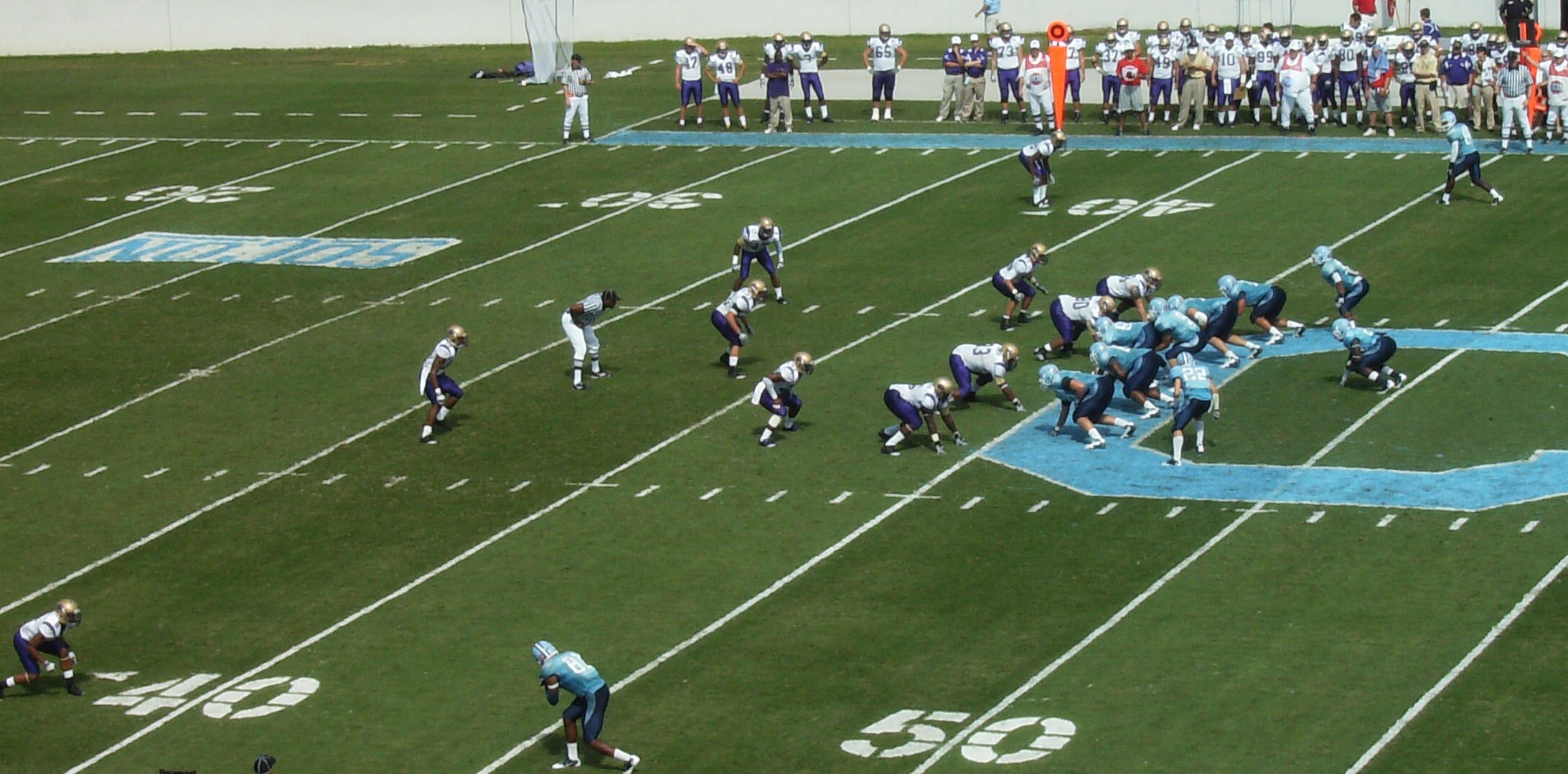
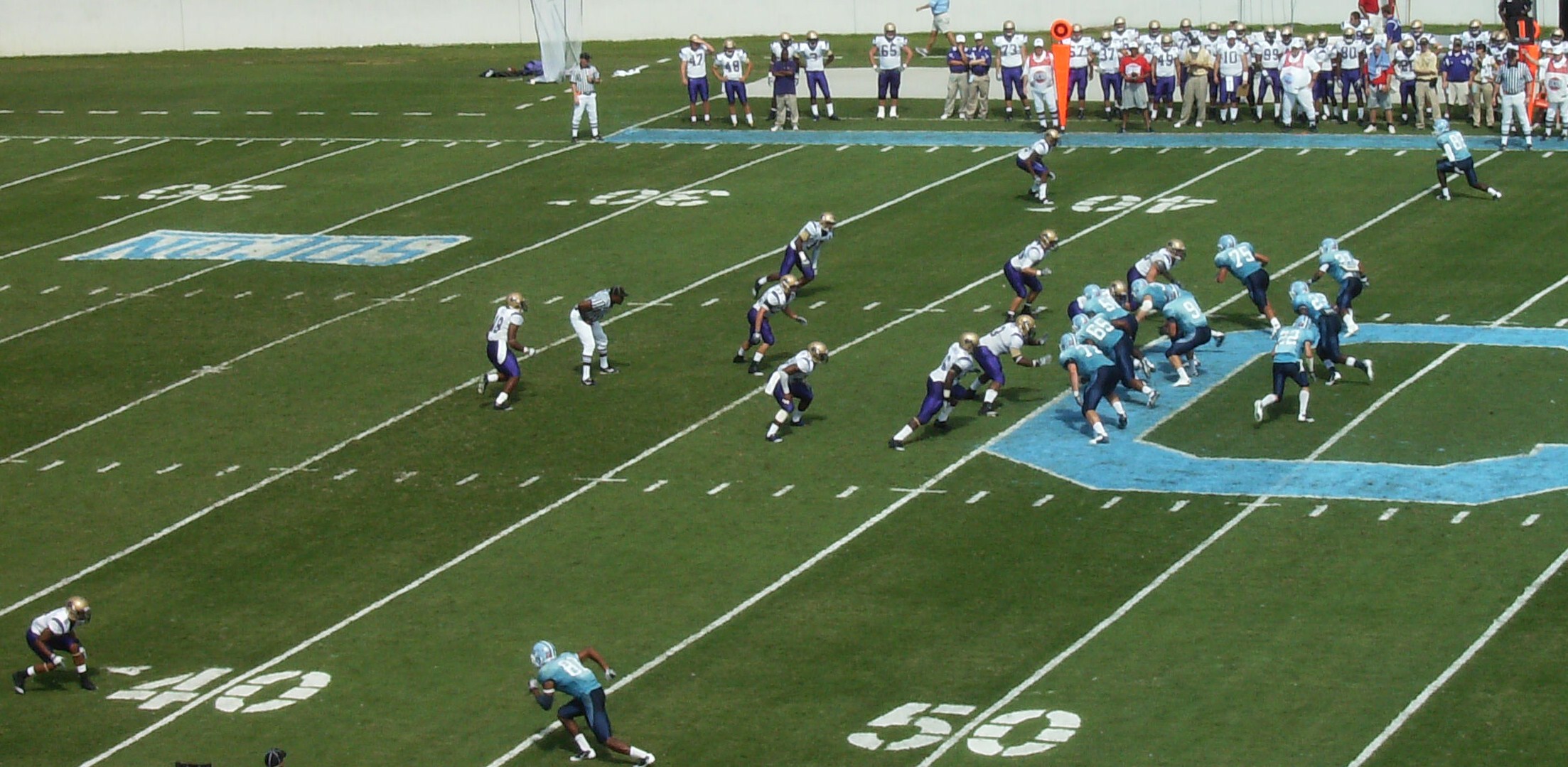
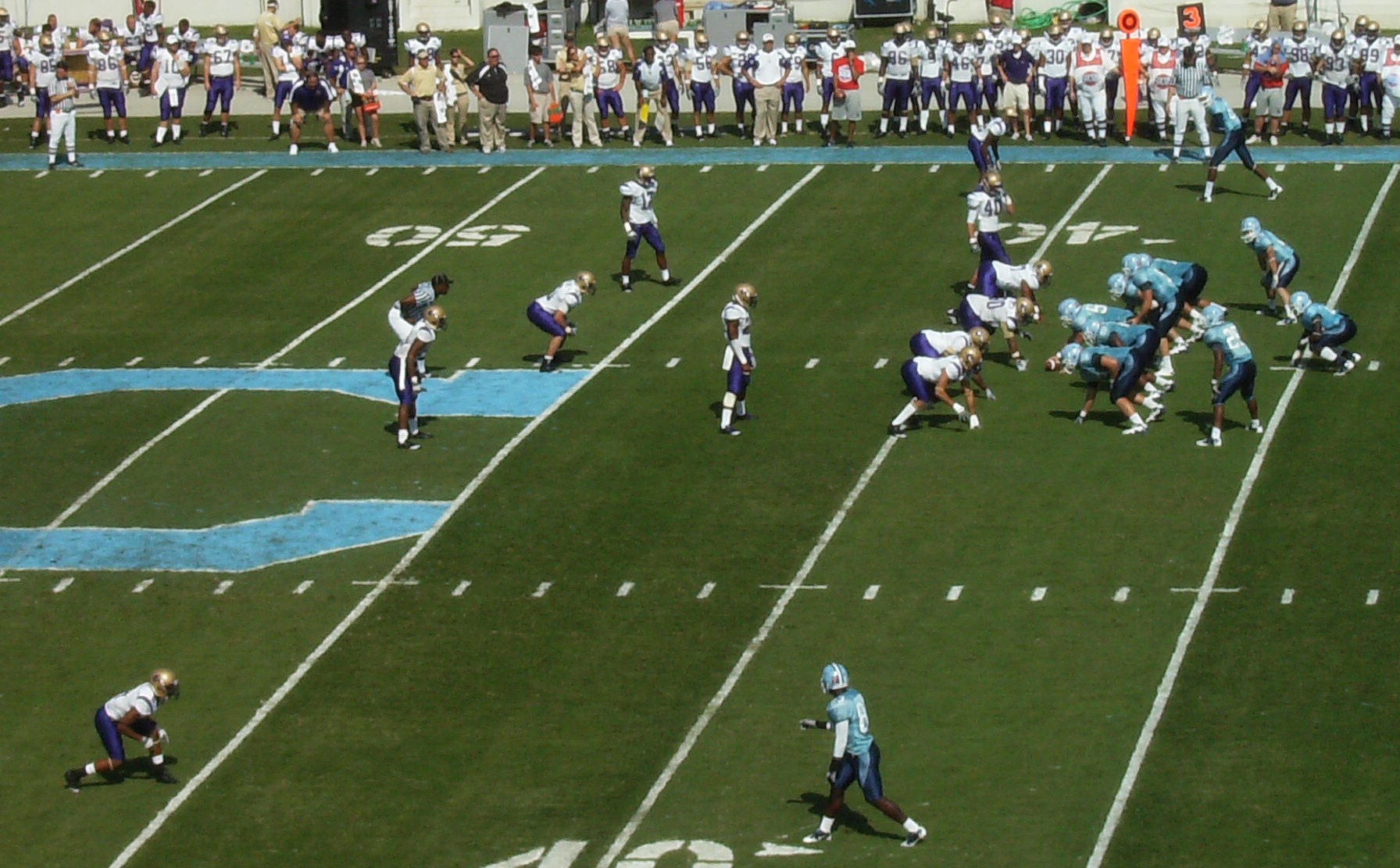
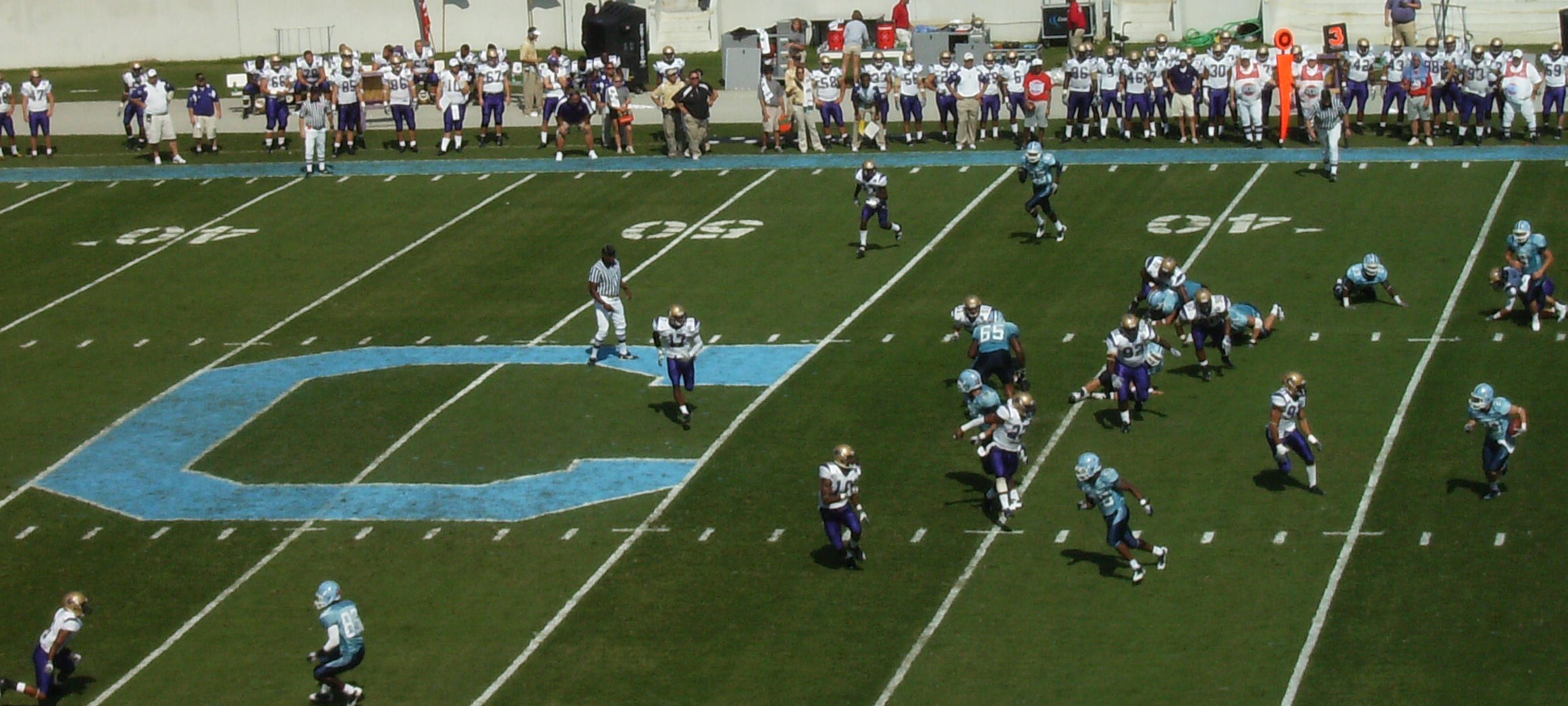
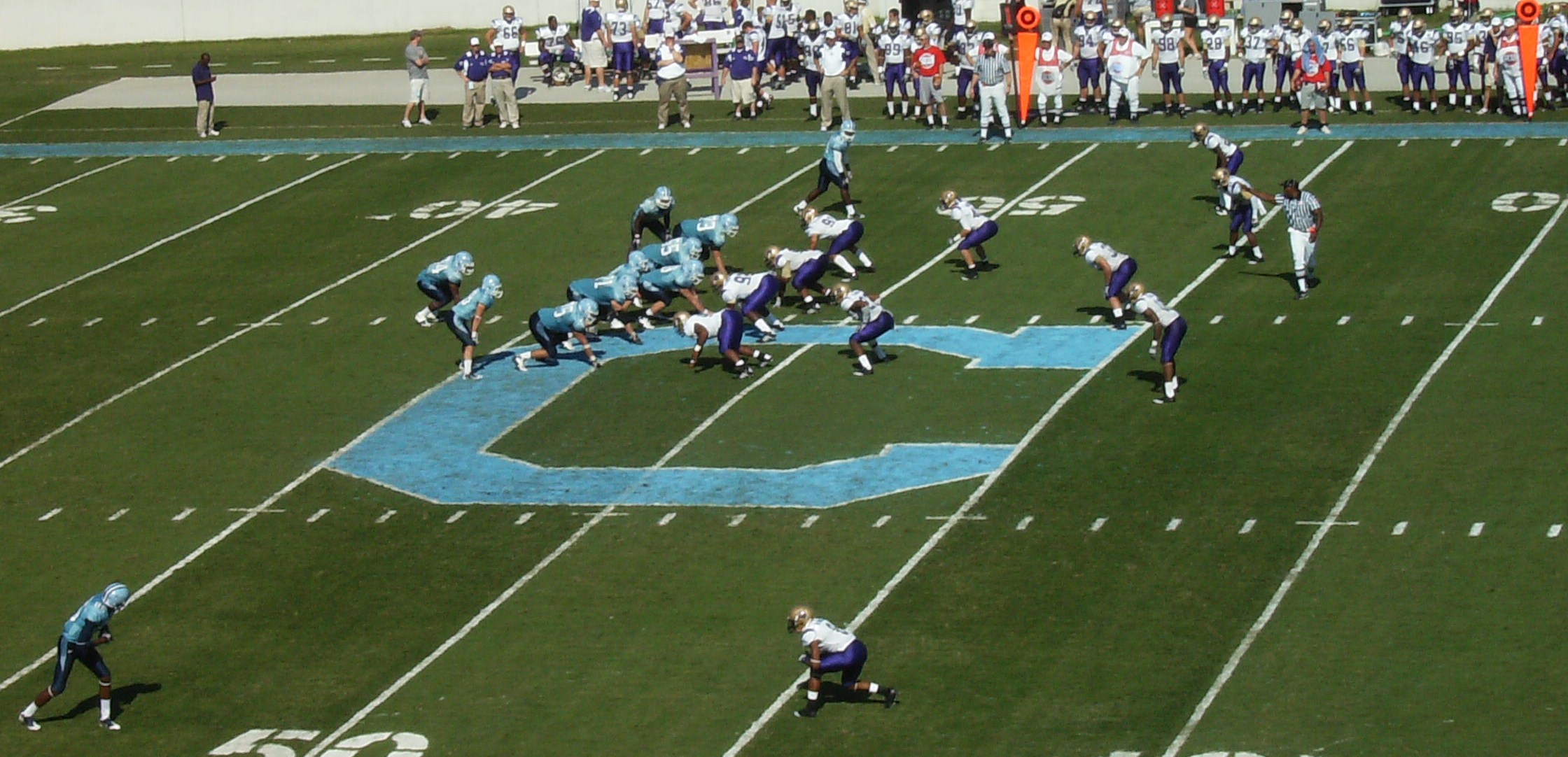
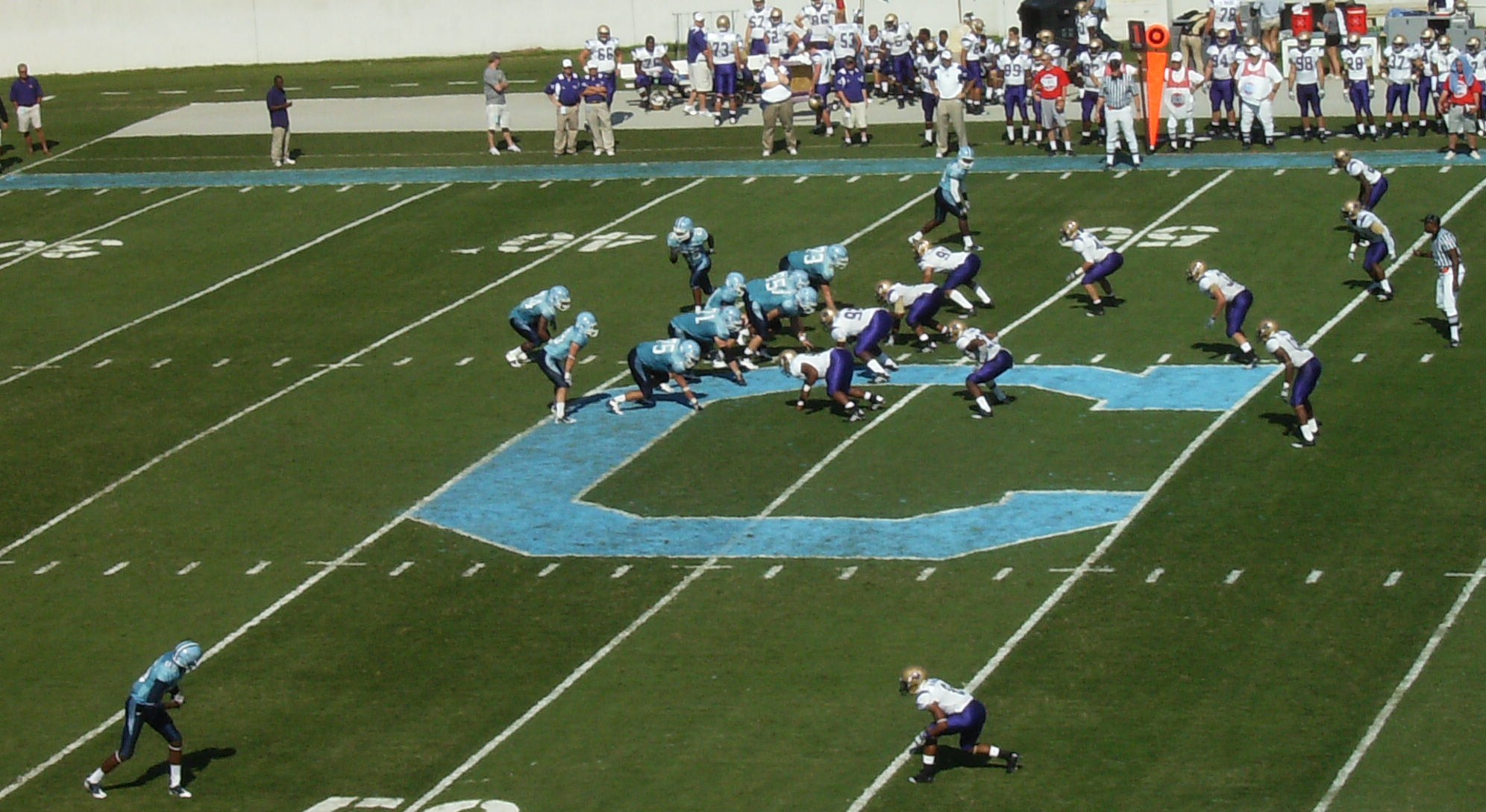
I’ll close this by including some pictures I took during the game, mostly of the offense.  Some of these are of the same play (as it is developing).  If you’re wondering why I don’t have an entire play photographed, it’s because I’m a terrible photographer with a cheap camera.  The first three pictures of the offense are of the beginning of Terrell Dallas’ touchdown run.

The first photo, though, is a shot of the corps of cadets.  I took this picture because I want interested observers who don’t get to go to the games to see just how many cadets are actually in the stands during a game.  This is an issue I would really like to see addressed by the administration.  It was even more noticeable during last year’s Homecoming game.

A quick look at The Citadel’s future football schedules

One of the many curious things about college football is that fans often are just as interested (if not more interested) in what will happen in the future than what is happening right now.  I’m talking mostly about recruiting and scheduling, of course.

With this post, I’m going to wildly speculate on potential scheduling options for The Citadel.  This is something Jeff Hartsell briefly mentioned Tuesday.  The Citadel will play eight Southern Conference games each season.  In 2011 and 2012, that means the Bulldogs will play three non-conference games (11-game regular season).  In 2013 and 2014, the calendar will allow for a 12-game regular season for FCS schools, meaning The Citadel can play four non-conference games.

Each year one of The Citadel’s non-conference games has to be a road “guarantee” game against a BCS opponent, for budgetary reasons.  Also returning to the Bulldogs’ schedule in 2011 is VMI.  The battle for the coveted Silver Shako will resume at Johnson Hagood Stadium, with the teams alternating home-and-home for six years. It is my understanding that those years are consecutive, although I haven’t been able to confirm that yet.

Another non-conference game each season will take place against a non-conference opponent that won’t demand a return trip — in other words, teams like Chowan and Webber International (or more preferably, Presbyterian and Newberry).  I’ll call this game the Designated Home Opener, or DHO.

The 2011 non-conference schedule will feature VMI (home), South Carolina (away), and a DHO to be determined (home).

The 2012 non-conference schedule will feature VMI (away), North Carolina State (away), and a DHO to be determined (home).  In that season, the Bulldogs will only play five games at Johnson Hagood Stadium.

Starting in 2013, things get a little interesting.  Again, assuming the VMI series is for six consecutive years (assumptions always being dangerous), The Citadel’s non-league slate would feature VMI (home), Clemson (away), a DHO (home), and another team to be determined.

The 2014 season would include a road game against VMI, a DHO, and two games to be determined (with one of them definitely having to be a guarantee game).

That leaves Larry Leckonby with important decisions to make about scheduling in 2013 and 2014.  Do you add a second BCS guarantee game in those seasons?  Or do you add a second DHO-type team?

There is another possibility, one that would be very popular with alumni, and that is to schedule a game against Army or Navy (or Air Force, I suppose, although I don’t think there is nearly as much interest in that potential matchup).

A quick scan at future schedules for Army and Navy shows that there is a spot possibly available for an FCS opponent in 2013 for Army and 2014 for Navy (in 2014, Army has scheduled Fordham, which would have been a tough ticket seven decades ago; Navy is playing Delaware in 2013).  Of course, there is a chance that none of the academies would be interested in playing The Citadel anyway.

Scheduling a service academy or a second BCS school would be more problematic in 2014, as the VMI game would be played on the road that year.  I don’t know that Leckonby wants to put the team in position to play only five home games and seven road contests, with two of those being against FBS opponents (and that’s assuming he can find two FBS opponents).

One of the things that will be a factor is attendance at Johnson Hagood Stadium.  If The Citadel continues to have disappointing numbers at the gate, Leckonby may be more likely to eschew a possible sixth (or seventh) home game to grab a more lucrative road guarantee.

Another possibility would be a series like the one The Citadel had with Princeton, a two-game home-and-home (in 2013-2014) against an FCS school from outside the SoCon.   That seems a less likely option to me, but you never know.

We’ll see what happens.  All of the above is mostly uninformed guesswork by yours truly, of course, and should be taken with a grain of salt, assuming that it even deserves the grain.

Football, Game 1: The Citadel vs. Chowan

It’s time for college football!   This year the scene at Johnson Hagood Stadium should include a lot of the following:  great tailgating, photo ops with Bulldogs both live and bronze, and, uh, fumbles…

Okay, so maybe that wasn’t the sunniest intro of all time.  I have to be honest here, though.  While I am looking forward to the season, this year I am a bit apprehensive about what lies ahead for the Bulldogs on the gridiron.  The Citadel is going to the triple option on offense, with a head coach who has never run the offense (or any similar offense) before, and with players who were mostly recruited for a very different kind of system.

The players who were recruited with the triple option in mind, of course, are all true freshmen.  The quarterback position will likely be manned by one (or more) of those true freshmen. The “knob”-starting quarterback double is a rare one, and for a reason. It’s an exceedingly difficult combination.

The Southern Conference media and coaches agree that this season could be a long one for The Citadel, just as the last two seasons have been.  The media picked the Bulldogs to finish last in the league.  The coaches ranked The Citadel eighth out of nine teams, ahead of only Western Carolina.

The Catamounts finished last in 2009, with only one league win.  That one WCU victory came against The Citadel, which tied for next-to-last.  More of the same is expected by those who follow the SoCon.

Before beginning league play, though, The Citadel will play three non-conference games.  Next week’s game at Arizona should be…interesting.  The following week the Bulldogs will take on Presbyterian, a team that went 0-11 last season, including a 46-21 loss to The Citadel.  However, even the Blue Hose would be favored against the Bulldogs’ opponent on Saturday, Chowan University, a Division II school located in Murfreesboro, North Carolina.

When the Hawks were announced as the opposition for the home opener, a collective yawn could be heard from The Citadel’s less-than-thrilled fans.  It’s hard to blame anyone for not being excited about Chowan being on the schedule, with all due respect to that school.  I’m guessing this game’s not going to be a sellout.

Having said that, let’s take a look at Chowan.

I wish I could say with confidence exactly how “Chowan” should be pronounced.  This is probably something that should concern Bulldogs play-by-play announcer Darren Goldwater a lot more than me, but I like to know these things.  I even sent an e-mail to Chowan’s department of athletics asking the question, and quickly got a response:

It’s pronounced CHO-WAN with a hard CH, just like CHOKE or CHICKEN. CHO-WAN.

That’s from somebody who works at the school, so she ought to know, but two different people have insisted to me that it’s actually pronounced “Shuh-WONN”, with the “Sh” sound at the beginning and the accent on the second syllable.  Since both of them are natives of eastern North Carolina, the region of the state that actually has decent BBQ, I tend to trust them.

“Chowan” is a derivative of “Chowanoke”, the name given to the native tribe of the region by 16th-century European explorers.  My guess is that if you were French, you pronounced it with the “Sh”, and if you were English, you went with the hard “Ch” sound.  It’s kind of like Beaufort (BO-fert), North Carolina, and Beaufort (BYOO-fert), South Carolina.

You like to-ma-to, I like to-mah-to, let’s call the whole thing off…

There is also a Chowan river, and a Chowan County — but Chowan University isn’t located in that county, but in the adjoining county of Hertford.  Naturally, this school in northeastern North Carolina is named to honor a tribe whose name means “people of the south”.

Regardless of its pronunciation, the school has been around in one form or another since 1848, when it was founded as Chowan Baptist Female Institute.  The school remained all-female until 1931, but in 1937 it became a junior college.

It reverted back to four-year status in 1992, and changed its name to the current Chowan University in 2006.  This fall, it will offer its first Masters Degree program, in Elementary Education.  Chowan remains affiliated with the Baptist State Convention of North Carolina.

About 1100 students attend Chowan.  I thought the section titled “Who we serve” on the school’s website was interesting:

The Chowan University community is committed to serving average students. By “average” we mean students with a GPA from 2.25-3.25 and “average” SAT scores (around 1300 for the three part SAT). Students below these criteria may be admitted if they show a commitment to the Chowan University experience and academic potential…

Many of our students are first generation college students which means their parents did not attend college or complete a college degree. Because of Chowan’s commitment to individual attention in a Christian environment, these students thrive here.

I liked this statement.  Too many schools insist on presenting themselves as wannabe Ivies, when everyone knows better.  Here we have a school that knows exactly what its mission is, and what it wants to do, and isn’t apologetic about it in the least.  Good for Chowan.

Chowan had a fine run in football as a junior college, almost entirely under James Garrison, who was the head coach at the school for 43 years (and for whom its football stadium is named).  Quite a few Chowan alums went on to four-year schools and then the NFL, including George Koonce, Curtis Whitley, and Mark Royals.

However, Chowan has struggled on the gridiron since becoming a four-year school itself.  Since 1993, the Hawks (formerly the Braves) have a cumulative record of 39-168-1 in Division III and (since 2005) Division II.  That includes Saturday’s 59-10 loss to Lenoir-Rhyne.

Chowan has been a football member of the Central Intercollegiate Athletic Association since the 2008 season (and is now a full member of the conference). Chowan is the first non-HBCU member of the CIAA in the league’s 98-year history.

The CIAA now has 13 members, and as a result the conference’s slogan for this year is “Triskaidekaphobia: Fear the 13!”  I’m not sure what the Southern Conference’s slogan would be — “The SoCon: The Nation’s Most Transient League”?

For Chowan football, the last five years have looked like this:

2005 — 2-8, including a 56-10 loss to North Greenville (now of Willy Korn fame) and a 42-21 defeat at the hands of Allen, which dropped its program after the season

2006 — 0-10, including losses of 42-0 to Western Carolina, 52-6 to North Greenville, and 28-0 to Webber International; Webber played The Citadel the following season, with a slightly different result

2007 — 2-9, including a lot of total beatdowns:  51-0 (Coastal Carolina), 56-14 (North Greenville), Presbyterian (62-10), and Newberry (67-0)

2008 — 2-8, which featured an early-season 69-20 loss to VMI (which had concluded its 2007 campaign in memorable fashion)

2009 — 2-8, although most of the games were more competitive; the Hawks did lose 36-21 to Old Dominion, the Monarchs’ first game since restarting its program after a 68-year hiatus (ODU did finish the season 9-2, though)

Those last two seasons came under the direction of the current head coach, Tim Place.  Place is a Washington & Lee alum who was previously the head coach at Urbana, an NAIA school in Ohio.

One of the members of Place’s coaching staff is Omar Nesbit.  Nesbit was an All-SoCon lineman at The Citadel, graduating in 2002.  He is the Hawks’ offensive line coach.

According to the school’s pre-season football guide, the team runs a “multiple” offense and a “multiple” defense.  Thirteen starters are back from last year’s outfit.

Last season the Hawks scored 25.3 points per game, not bad, but allowed 35.2 ppg. While the Hawks were a respectable passing team, all 25 of its TD passes were thrown by C.J. Westler, who was the offensive player of the year in the CIAA, and who is not among the returnees.  Much like The Citadel, Chowan has to find a quarterback (it played two in the Lenoir-Rhyne game).

Chowan turned the ball over three times per game, almost double its opponents’ totals, and averaged an anemic 2.9 yards per rush.  The Hawks gave up 48 sacks.

Defensively, the Hawks allowed 4.6 yards per rush and 9.3 yards per pass attempt, which is obviously not good.  Opponents scored touchdowns 70% of the time when they entered the “red zone”.  Chowan was also not a particularly efficient punting or placekicking team.

Against Lenoir-Rhyne, Chowan allowed 513 rushing yards (6.9 per attempt).  This is noteworthy in that L-R is running the same offensive system this season it ran last year under the direction of then-offensive coordinator Tommy Laurendine — who of course is now the offensive coordinator at The Citadel.

Laurendine has his work cut out for him, based on early reports.  For example, this is how Jeff Hartsell began his recap of the August 21 scrimmage:

After watching his quarterbacks combine for six interceptions and at least five fumbled snaps in Saturday’s scrimmage, Citadel football coach Kevin Higgins stated the obvious.

“Offensively, we have a lot of work to do,” said Higgins…

You could say that, coach.  On the bright side, nine of the eighteen pass attempts in the scrimmage were caught by Bulldogs.  Alas, six of them were defenders.  At least on those plays the QB got the snap from center.  Unofficial totals from the scrimmage had the first-team offense rushing 27 times for 67 yards.

At least the defense apparently looked good, although how much of that was due to the offense’s struggles is open to question.  The kicking game again failed to impress, a problem Higgins has been unable to solve for the last two seasons.

The scrimmage on August 28 was apparently better, based on some anecdotal reports.  At this point it appears the Bulldogs will play two “true” freshman quarterbacks, Ben Dupree (from Pennsylvania) and Matt Thompson (from Florida).

Terrell “First Sergeant” Dallas will be the fullback.  There are several candidates to fill the slotback positions, led by Van Dyke Jones and injury-plagued Rickey Anderson (everyone’s crossing their fingers for you, Rickey).  The offensive line has some experience, but not at center, which in part explains the center-QB exchange problems.

We won’t know for sure exactly how the new offense will look until Saturday, but it probably will be a slightly different variation than Charlie Taaffe’s version of the wishbone.  It’s not going to be quite like Wofford’s option attack, either.

It’s probably going to most resemble the setup run by Paul Johnson at Georgia Southern, Navy, and now Georgia Tech.  With that in mind, I wouldn’t be surprised if Kevin Higgins, with a personal history of running spread passing offenses, throws the ball a little more often than you see in most triple option offenses.

He has to figure out a way to get talented tight end Alex Sellars involved in the offense. Higgins has also commented on the big-play ability of Domonic Jones, a 6’5″ redshirt freshman.  I like the idea of isolating a tall receiver on a smaller defensive back in this offense.  Of course, you have to have a quarterback capable of getting the ball to Jones.

I linked this in an earlier post, but to get up to speed on how this offense will probably operate, check out The Birddog (helmed by a grad/fan of the Naval Academy), the triple option devotee’s website of choice.  Here is a primer on the TO:  Link

While the offense is filled with question marks, the defense should have a lot of answers.  There is depth and talent on that side of the ball, particularly in the defensive backfield.  Cortez Allen has drawn pre-season accolades.  Other DBs with the potential to shine include Keith Gamble (who had an 89-yard interception return against Presbyterian last season) and Joseph Boateng (who intercepted two passes in his collegiate debut against North Carolina).

Former safety Rod Harland is now a linebacker, joining team leader Tolu Akindele and Jeremy Buncum as likely starters.  The defensive line should be solid, if a little young.  Chris Billingslea had some impressive moments last season (and made the All-SoCon freshman team as a result).  Keith Carter is a redshirt freshman who should draw notice, if only for being a defensive tackle who wears #33.

The other defensive lineman (at least that’s his roster designation) I want to mention is Milford Scott, a special teams terror who blocked three kicks last season and created havoc many other times.  He’s tall, has long arms, and describes himself as a “Charleston homeboy” from the beach.  He’s a weapon.

Unfortunately, Scott’s dynamism on special teams was an exception (not counting Andre Roberts, obviously).  While punter Cass Couey fared reasonably well, the Bulldogs continued to struggle in the placekicking department.  That’s two seasons in a row The Citadel has had sub-optimal kicking, and early returns suggest it might be three in a row.

I don’t blame the kickers.  I blame the coaching staff.  It’s the job of the staff to get that aspect of the squad fixed, either by improving the kickers on the squad or finding somebody else to kick.

The Citadel also could stand to improve its punt coverage team (Scott aside) and its kickoff return unit.  The Bulldogs will sorely miss Andre Roberts as a punt returner; look for that component of special teams to not be as effective this season.

There has been a lot of turnover in the coaching staff, not only with the new offensive scheme (where the aforementioned Laurendine is joined by offensive line coach Bob Bodine), but with the defense as well.  Higgins recruited former Wofford assistant Josh Conklin to join the staff, and later named him defensive coordinator.

Conklin will get help from another new assistant, Denny Doornbos, who was the defensive coordinator at Army during the Bob Sutton years, which were mostly good ones.  I have to gleefully point out, though, that he was the DC for this game…and for this game, too.

While all the talk in the off-season has been about the offensive scheme, and how the coaches will implement it, I think the new coaches on the defensive side of the ball will be just as important.  Generally, you would like to have more staff continuity than The Citadel has had, but in the case of the defense, I think a fresh approach may be just what was needed.

There was a sense over the last two seasons that the defense had underachieved; in particular, some observers felt the unit was not aggressive enough.  The Bulldogs’ D must be pro-active this season, and give the offense short fields with which to work. The defense will likely also have to bail the offense out on a regular basis.

This is going to be an important year for Kevin Higgins.  The off-season issues, not surprisingly, did not sit well with the alumni — and I’m not just talking about the big boosters or the message board regulars.  He also has had back-to-back disappointing seasons on the field.

The move to a new offense, and the overhaul of his coaching staff, were both bold moves made by someone who expects to stick around for a while.  They weren’t short-term stopgaps.  That is to his credit, I think.

Now, however, even with modest on-field expectations, he needs to get the fan base to buy into his program again.  After all, Larry Leckonby and company need to sell tickets and sponsorships.  Jerry Baker has Brigadier Club membership goals to obtain, whatever his methods are (high-tech, low-tech, begging, etc.).

A 1:00 pm start time against Chowan on Labor Day weekend in Charleston probably isn’t going to be a big winner as far as attendance goes.  I fully expect one of those hot-and-humid Lowcountry days that are fairly typical for this time of year. Ugh.  Of course, that’s assuming a hurricane doesn’t come into play.

I’ll be there anyway, though.  I’m ready for some football.

The Citadel needs to win at least one more regular season game

The loss to UNC-Greensboro on Saturday was very disappointing, but oddly Ed Conroy wasn’t too worried about it.  At least, that’s what he told Jeff Hartsell of The Post and Courier:

“I thought we did some really good things,” said Conroy. “We shared the ball well, only had six turnovers, shot the ball well from 3-point range. We just didn’t convert a lot of shots on the interior. We got some good looks there, but they didn’t go.”

There was also a reference earlier in the article to “a touch of fatigue and illness,” so perhaps the team’s energy level wasn’t as high as it normally was.  Also less than energetic was a largely absent corps of cadets.  The corps’ apathy and/or lack of presence this season during games at McAlister Field House (not to mention the homecoming game in football) has been noticeable.  It’s an issue General Rosa and company must address.

Back to the court, The Citadel was outrebounded 41-24  by UNCG, which was basically the difference in the game, as it’s hard to overcome such a discrepancy without a huge edge in turnovers or shooting percentage, and the Bulldogs did not shoot particularly well (36%).  The loss means that to clinch an overall winning season, as well as a winning season in Southern Conference play, The Citadel needs to win one of its two final regular season games.

That won’t be easy, as they are both road contests.  Thursday the Bulldogs travel to Greenville to play an improving Furman club, followed by a Saturday game in Spartanburg against Wofford.

The Citadel beat Furman 70-60 in Charleston on January 23.  In that game, Cameron Wells had 22 points and 12 rebounds.  He was only 6-17 from the field, but went to the foul line repeatedly and converted (8-8).  Bryan Streeter also had a double-double in the contest.  The Bulldogs were a solid 8-20 from 3-point land and also won the turnover battle against the Paladins (11-8).

Furman’s Amu Saaka scored 19 points (on only 12 shots) and figures to be a problem again for the Bulldogs this time around.  The Paladins will also have Jordan Miller available for this game after he missed the first meeting.  Miller scored 31 points against UT-Chattanooga, but has followed up that great performance with two games in which he shot a combined 4-14 from the field.

Getting a win against Furman at Timmons Arena would be nice for several reasons. Assuming the two teams don’t meet in the Southern Conference tournament, it would be the first time The Citadel had swept the Paladins in consecutive seasons since the 2000-2001 campaigns.  Of course, there were only three games played in those years, as Furman screwed up in 2000 and scheduled too many games, leading to a penalty that resulted in only one game on the hardwood between the two schools that year.

The Citadel also won the second game played in the 1999 season, so it did win four straight against Furman from 1999-2001.  That was the last time the Bulldogs won four straight in the series.  The last time the Bulldogs won both home-and-away in consecutive seasons against the Paladins?  1939-1940 (part of a six-game win streak against Furman, the longest for The Citadel in the series’ history).  The Citadel hasn’t won consecutive games in Greenville since 1992-1993.

The Citadel had a late lead against Wofford in the game played on January 21, but couldn’t hold on and lost 44-42.  As the score indicates, it wasn’t an offensive masterpiece.  The Bulldogs shot 32% from the field.  Wofford shot no better (30%), but outrebounded The Citadel 38-33 and committed one fewer turnover.  The Terriers’ stated strategy of stopping Cameron Wells worked, as the rest of the Bulldog squad (save Zach Urbanus) combined for more turnovers (10) than made field goals (6).

You can bet Wofford will try to hold down Wells’ production again to win its sixth straight game over the cadets, but it may not be so easy this time, as the other Bulldogs have done a better job in recent games of shouldering the offensive load.  Of course, the Terriers are likely to be better at putting the ball in the hoop on Saturday as well.

Noah Dahlman was his usual solid self in the first meeting (15 points, 6-12 FG, five rebounds).  Odds are at least one of his teammates will provide offensive support.  I anticipate a higher-scoring game this time (but not much higher — we’re not talking about a pair of run-and-gun teams here).

Just a few stats to finish off this post…

— With one more regular season victory, The Citadel will clinch its second consecutive winning season.  The last time the Bulldogs had two straight winning campaigns? 1979-1980.  Before that, you have to go back to 1964-1965.  The Citadel had four straight winning seasons from 1958-1961.  Speaking of the 1958-61 era…

— If The Citadel beats Furman and/or Wofford, it will enjoy a second consecutive winning season in Southern Conference play.  The last time the Bulldogs had two straight winning SoCon campaigns?  1960-1961.

You read that correctly.  Actually, from 1958-1961 The Citadel had four straight winning seasons in conference play.  The first three came under the direction of Norm Sloan, who then became the head coach at Florida.  His successor at The Citadel, Mel Thompson (best known as Pat Conroy’s head coach at The Citadel, I suppose) would go 10-3 in SoCon action in his first season in charge.

Sloan took over a program that had not had a winning SoCon season since 1945. Actually, that doesn’t really tell the story.  Let’s put it this way:  from 1946 to 1956, The Citadel was 12-102 in league play.  The five years preceding Sloan’s arrival in Charleston featured a combined conference record of 2-49.

Sloan was 5-9 in the SoCon in his first season, and then had league records of 9-6, 7-4, and 8-4.

Sloan won the national championship in 1974 while coaching North Carolina State. He had proved his worth as a coach many years earlier, though, at a small military college.

Incidentally, the only other time The Citadel had back-to-back winning years in the Southern Conference came in the 1938-1939-1940 seasons, when the Bulldogs had three straight winning SoCon campaigns, mostly under head coach Rock Norman (who coached the team in 1938 and 1939, and for the first eight games in 1940 before being replaced by Ben Parker).

There is definitely potential for The Citadel to make a little history with a win in either of its two games this week.  I wouldn’t mind if instead of winning one of them, it won both.

Go East, young man

The Citadel 28, Samford 16.

There are two obvious storylines from this game, from the perspective of The Citadel.  The performance of Tommy Edwards is one; the success of the Bulldog defense is the other.  First, Tommy Edwards…

Miguel Starks started the game at quarterback after an outstanding effort against Furman, and soon discovered that the Samford defense was more than ready for him.  Starks was in the game for seven offensive drives (not counting Andre Roberts’ fumbled punt), and on those seven drives The Citadel picked up only two first downs.

It was a lot like the Elon game, except that the opposition wasn’t constantly scoring following the Bulldogs’ three-and-outs.  The Citadel was lucky not to be trailing by more than ten points at halftime.  By then, Starks was out of the game, having injured his ankle — not the ankle that was already hurt, but the other one.  This has not been a good year for ankles attached to Bulldog quarterbacks.

Edwards came into the game with just 37 seconds left in the half, and I thought that The Citadel would just run out the clock.  After all, he is a “true” freshman walk-on who admitted later that his goal entering the season was just to make the travel squad.

Instead, Edwards came out throwing, completing four passes for 30 yards (and having a long pass dropped).  The Bulldogs ran out of time and had to attempt a long field goal (53 yards), which missed, but it was still the team’s most impressive drive of the half.  During that initial drive led by Edwards, The Citadel picked up two first downs, just as many as it had made in the first 29:23 of the contest (to go with just 70 yards of total offense pre-Edwards).

At first there was some suspicion that Samford might have been playing a “prevent” defense, and would have something different in store for Edwards in the second half, but the Cadets continued to improve offensively.  The Citadel started winning the field position battle (key against a grind-it-out team like Samford), and began its second possession of the third quarter on its own 45 yard line.

On first down, Edwards rolled right, then turned around and threw across the field to an open Van Dyke Jones, who slalomed his way to a touchdown.  It was an excellent play call, perfectly executed.

After that, momentum favored The Citadel.  Two possessions later, Andre Roberts returned a punt 41 yards into Samford territory and the home team was in business, eventually taking the lead early in the fourth quarter on another TD pass from Edwards, this one to Alex Sellars.

The defense took care of the rest of the game, with Cortez Allen intercepting two passes, running the second one back for a TD.  He also returned the first one for a score, but one of the officials intervened, mysteriously ruling him out of bounds on the Samford 5 yard line (oh, those wacky SoCon officials).  Terrell Dallas scored on the next play anyway.

For any freshman quarterback to arrive on campus in August, come off the bench in a midseason game and lead a team to victory would be impressive.  It’s even more impressive for a freshman at The Citadel to do it, given what “knob” year is like, and particularly when the QB is a walk-on.  Even more unusual, at least for The Citadel, is the fact that Edwards is a native of California.

Over the years, not a lot of football players from the Golden State have plied their trade at the military college, which I suppose isn’t that big of a surprise.  No one can say for certain how many Californians have played for The Citadel, but I would guess that less than twenty football players from California have lettered for the Bulldogs over the years.  As it is, the media guide only lists five, including Valley Village’s McDonald Love (captain of the 1935 team) and North Hollywood’s Brian Baima (an all-SoCon split end in 1971).

When Edwards threw his second TD pass on Saturday, he almost certainly set the career record for TD passes thrown by a Californian at The Citadel, breaking the mark previously held by wide receiver Scott Flanagan of Camarillo, who threw a touchdown pass against Florida last season (off a trick play).  If it is any consolation to Flanagan, he still holds the road record in the category…

It was a red-letter day for the defense (or perhaps I should say a navy and light blue day, given the mismatched uniform combination The Citadel wore at Johnson Hagood).  Samford is a run-first, run-second, and then pass if necessary kind of team, and the Birmingham Bulldogs were held to 35 net rushing yards (which included four sacks).  Last season bruising running back Chris Evans rushed for 174 yards against The Citadel; this season, he was held to 52.

The defense kept The Citadel in the game after some early miscues, including a bad punt and Roberts’ uncharacteristic fumble.  Holding Samford to a field goal after the Roberts bobble was critical to the eventual victory.  The Citadel recorded ten tackles for loss, including a combined six from starting defensive tackles Terrence Reese and Kyle Anderson.  Add in the two Cortez Allen interceptions, and you couldn’t ask for much more from the D.

It was easily the most complete game of the season by The Citadel’s defense, although to be honest I thought Samford had a rather unimaginative game plan.  Even a couple of trick plays seemed halfhearted.  Samford lacked dynamism (no run plays of more than 13 yards; no pass plays for more than 20) and didn’t seem to have any answers when it struggled to run the ball, especially when field position in the second half turned against it.

Samford would wind up with 46 pass attempts.  Of those 46, there was just one recorded post route (which went for Samford’s final TD), one deep in route, and one deep out (the pass Allen intercepted and returned for a touchdown).  All three of those passes came in the fourth quarter after Samford had fallen behind by two scores.

Samford actually finished the game with more first downs than The Citadel (15 to 12).  However, other than the final drive, Samford never moved the ball more than the 30 yards it gained on its opening possession.

All in all, it was a good day for The Citadel.  As to which quarterback starts against Wofford, who knows.  Jeff Hartsell informs us that the fourth-string quarterback is Irmo’s Brian Hill; maybe he’ll get a shot.  It doesn’t matter as long as the Bulldogs can beat Wofford, which hasn’t happened in a while.  It will also be Homecoming.  The countdown to Saturday begins.

Too bad the game is football and not horseshoes

The Citadel played well on Saturday against Appalachian State.  After getting drubbed repeatedly over the past few seasons by the Mountaineers, the Bulldogs held their own for 60 minutes, which was a nice change of pace.  Alas, the game lasted longer than 60 minutes, and overtime was not kind.

Let’s make this a ramble:

— I thought that the playcalling on offense by the Bulldog coaching staff was excellent throughout the game.  Bart Blanchard and Miguel Starks were mixed-and-matched very well, a task that had to have been made more difficult by Blanchard’s ankle problem.

The TD pass to Alex Sellars was perfectly timed and executed.  I really liked the commitment to running the ball, and it paid off (214 yards rushing).

My only criticism would be about the sequence of plays called in overtime.  I am not sure about the first and second down calls, and as for third down…

When you have the ball first in overtime, you really don’t want to be in must-attempt-FG mode if you can help it.  The Citadel had a third-and-long it needed to convert.

Given the overall situation, I think it would have been best to run the play using the starting QB who had displayed a lot of composure during the game, and who has now thrown 6 TD passes in his last two games.  His first option would have been the player who is almost certainly the best wide receiver in school history.

In other words, I think the ball needed to be in the hands of Blanchard and/or Andre Roberts on that play.  I’m not a coach, though.

— There were only seven accepted penalties by the two teams combined in the game.  However, five of them came in the fourth quarter.  It was like watching a bizarro NHL game.

— Sam Keeler can’t think about the kick he missed in OT.  He needs to think about the 50-yarder and the 45-yarder he made in the first half.  His kicking was a plus for the Bulldogs on the day overall, without question.

— Defensively the Bulldogs did a fair job of bending but not breaking in the first half.  It got tougher to keep Appalachian State out of the end zone as the game went on.  The overall strategy seemed sound; the Bulldogs were hampered by a blown coverage that led to the tying TD in the fourth quarter, and by some shoddy tackling.  Poor tackling was the proximate cause of the Mountaineers’ second touchdown.  That is something which must improve.

The Bulldogs did not create a turnover on defense.  If The Citadel could have forced just one turnover, it likely would have won the game.  The Bulldogs’ D came into the game with six interceptions and three recovered fumbles, but just two of those turnovers have come while the outcome of a game was still in doubt (both against Presbyterian, with Cortez Allen accounting for each of them).

— Van Dyke Jones’ 69-yard TD run was one of the better runs I’ve seen by a Bulldog.  Maybe it wasn’t the best ever at Johnson Hagood Stadium (Stump Mitchell’s effort against VMI in 1980 comes to mind), but it was truly special.

— Attendance was announced as 14,238.  That seemed about right to me as I surveyed the stands.  However, that’s just how many people were inside Johnson Hagood Stadium.  What was truly striking was the attendance outside the stadium.  The parking lots were packed.

There are now lots of fans who tailgate but don’t go to the game itself, and I don’t mean the groups where a couple of people remain to watch over the tailgating equipment while everyone else goes to the game.  I’m talking about gatherings where almost no one goes to the game, where everyone just remains in the parking lot the entire time.

I mentioned that the tailgating scene could be perceived as “too good” when I wrote about attendance a couple of months ago.  It seems to me, though, that the tailgating-only crowd has increased exponentially as of late, thanks to the ability to incorporate the joys of satellite television (along with flat-screen TVs) into a tailgate setup.

There was an article about “TV Tailgating” in Columbia, S.C.’s The State newspaper on Sunday about this very subject.  That story focused on people watching South Carolina play on TV while stationed in one of the parking lots outside Williams-Brice Stadium.

Of course, at The Citadel the game inside the stadium is rarely on television.  Folks tailgating during the game watch other contests on TV while listening to Darren Goldwater call the Bulldogs’ games on the radio.  At least, I hope they’re listening to the Bulldogs on the radio…

Twenty years ago, if the parking lots had been as full as they were on Saturday, I believe there would have been at least 17,000 people watching the game inside JHS, perhaps more.  However, twenty years ago there weren’t portable satellite dishes, and when people talked about “plasma” they were referring to blood and not TVs.

I don’t know what The Citadel’s administration can do about that.  I don’t know if it wants or needs to do anything about it, either.

— It was Military Appreciation Day, and thus the fans who did venture inside Johnson Hagood were treated to a good show, including a flyover by a World War II-era B25 bomber, a parachutist bringing the game ball (landed on the 45 yard line — nice job!), and the Parris Island Marine Band performing at halftime.

There was a pull-up bar station in the concessions area under the stadium, so that future Marines could showcase their upper body strength in what could have been construed as an attempt to impress women, but was undoubtably meant just for recruiting purposes.

— Also underneath the stadium was a table for The Citadel’s club hockey team, which was doing a little fundraising by raffling off a motorcycle.  A cadet wearing a complete goalie outfit was part of the show.  I couldn’t decide if his uniform was terribly awesome, or awesomely terrible.  Click on the link to judge for yourself.

— Fourth game played, fourth game wearing navy pants, fourth game with a terrible-looking uniform.  Maybe The Citadel should wear orange jerseys and yellow helmets with them.

— The sound system is still a bit too loud, in my opinion.  A few other stadium music/sound observations…

1)  In the third quarter, someone thought it would be a good idea to play the “Everybody Clap Your Hands” snippet while The Citadel was punting.  I guess the fans were supposed to get excited about the home team not converting on third down.  “One hop this time; right foot let’s punt.”
2)  “Cotton Eye Joe”?  Really?  Probably made the App State fans feel right at home.  It’s also a staple at Yankee Stadium.  Why not bring in Ronan Tynan while you’re at it?
3)  I liked the NFL Films-style music, but it sounded a bit tinny over the speakers.  Maybe a better recording is needed.
4)  The referee’s microphone cutting in and out surely did wonders for sales of Advil and Tylenol.

— I spotted Jeff Hartsell of The Post and Courier hustling down to the field at the five-minute mark of the fourth quarter.  As he got about halfway down the stadium steps, Appalachian State scored the tying touchdown.  Hartsell hesitated briefly, then started to head back to the press box (as if he had forgotten something), and then turned back and went to the sideline area.  Perhaps he was saying to himself, “I really need to update Bulldog Bites!”

— App State fans in the East side stands tried to start an “ASU” chant in the third quarter, only to be drowned out by a lusty rendition of “Hey Baby” by the corps of cadets.  The Mountaineer supporters seemed confused by the choice of song (hard to blame them) and quieted down almost immediately.  I still could survive without it, but for that moment, “Hey Baby” worked.  Well played, cadets.

All in all, it was a good game, but it was still a loss.  Next for the Bulldogs is a trip to Elon.  Getting a win there will not be easy, but if The Citadel plans to contend in the conference, it will be necessary.

Moving on from Chapel Hill

It could have been better.  It could have been worse.  At any rate, it’s over.

The Citadel’s 40-6 loss to UNC was about what one would expect, given the matchup and the Bulldogs’ injury situation.  I won’t recap the entire game — there are many outlets where you can find game stories, including Jeff Hartsell’s story here.  Some stories from North Carolina papers can be found here, here, and here.

Quick observations, comments, etc.:

– I thought Bart Blanchard, despite his ankle injury, did a decent job of escaping pressure and avoiding sacks.  UNC only had two sacks (although one by Robert Quinn resulted in a fumble that led to a Heel TD).

Blanchard wasn’t quite as accurate with his passing as he needed to be, but he was placed in as difficult a situation as he will have all season as a quarterback.  I suspect he will improve his passing accuracy in games to come.  It’s important that he does so, as Kevin Higgins has pointed out.

– As advertised, North Carolina’s defense is very good.  Quinn, in particular, was outstanding throughout the game.  UNC fans might want to monitor the sack statistic during the season, however.  Sacks aren’t absolutely essential in order to have a quality defense, but I find it surprising that North Carolina doesn’t create more of them (only 22 last season).

– If UNC is going to win the ACC, which isn’t out of the question (although I think the Tar Heels are playing in the tougher division of that league, at least this year), its offense needs to create more big plays.  That aspect of the game didn’t seem to be there for North Carolina on Saturday.

– After UNC scored to take a 23-0 lead, The Citadel took over possession with 1:51 to go in the half and went into its two-minute offense.  The Bulldogs had only amassed 18 total yards in six previous possessions, but in hurry-up mode moved the ball 30 yards down the field before Blanchard was intercepted at the 2-yard line.  Up in the TV booth, Paul Maguire wondered aloud why the Heels were playing “prevent defense”.

It was a valid point, although it occurred to me that running a hurry-up offense in an effort to establish a different tempo might not have been a bad idea regardless of the time/score.  I wish The Citadel had tried it again in the second half.

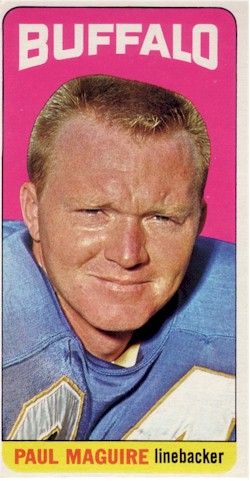
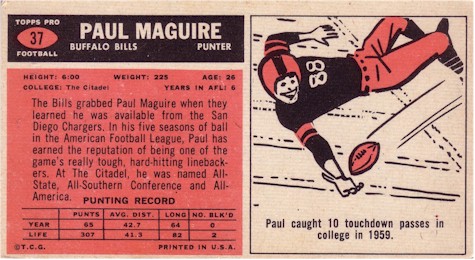
– Speaking of Maguire (who was announcing the game for ESPN360, along with Bob Picozzi), I believe Saturday was the first time he had ever announced a game involving The Citadel.  Maguire has been a TV analyst for college and pro football games since 1971.

– Does The Citadel’s starting running back on Saturday prefer to be known as Lemuel Kennedy or Bucky Kennedy?  There needs to be a ruling on this.  Various outlets are referring to him as one or the other.  (Years ago, someone had to decide — Lyvonia or Stump?)

– You know it’s probably going to be a tough night for The Citadel when one of the Bulldogs’ starting safeties (Rod Harland) is knocked out of the game before The Citadel’s first defensive snap (and another defensive starter, Mel Capers, is held out of the game, for medical reasons not yet officially released).

– I cannot remember The Citadel wearing navy pants before Saturday’s game; that may have been the first time.  I respectfully suggest that it be the last time.  It’s not a good look.  It’s yet another uniform concept I don’t like, to go along with all the others detailed previously.

– Joseph Boateng wasn’t listed on the two-deep released for the UNC game, but he wound up intercepting two passes and making seven tackles.  Boating played on the scout team last year at Eastern Michigan.  From what I understand, he’s an academic sophomore, but athletically he’s a redshirt freshman (and he’s also a freshman within the corps of cadets).

After doing some quick research, it appears that Boating is the first freshman at The Citadel to intercept two passes against an ACC team since 1986, when it happened in a game at Clemson.  The freshman who picked off two Tiger passes in that game was Anthony Jenkins, who would later decide to concentrate on another sport at The Citadel.  That worked out rather well for everybody (well, maybe not so well for Miami or Cal State-Fullerton).

– Other than the punt return TD , the special teams were solid (although that is a big “other”).  Sam Keeler’s successful field goal attempts should increase his confidence, and that could be important as the season progresses.  The second Keeler field goal would never have happened, though, without a world-class hold by Cam Turner.  Keeler also deserves credit for trusting Turner to get the ball down in time; I’ve seen some kickers stop their approach in that situation.

– Okay, so committing four turnovers wasn’t a good thing.  At least the Bulldogs also forced four turnovers.  Creating turnovers was a major problem for The Citadel last season, so Boating’s two picks (the Bulldogs only had three all last year) plus the two fumble recoveries on special teams were a welcome development.  Admittedly, the punt cover fumbles were somewhat flukish, but flukes count too.

– Memo to The Citadel Sports Network:  during the halftime show, when someone is updating scores of various games from around the country, it would be helpful if the person doing the announcing actually knew the score of the game involving The Citadel.  On Saturday night the Bulldogs apparently managed to score a touchdown between the second and third quarters.  This magic touchdown was credited to The Citadel at least three times during the intermission.

It’s now time to focus on Princeton…well, maybe not.  Not yet, anyway.

The Citadel is off next week, and the extra week should give the Bulldogs badly needed time to heal some bumps and bruises.  I hope Garland is ready to play by then; having apparently suffered a concussion, however, that may prove not to be the case.

The extra two weeks will also give the band some time to arm itself properly, in case an invasion of Old Nassau is in the offing…

Trying to fill a stadium

Note:  Yes, this is long.  It needs to be, though.  (Believe it or not, it could have been longer — I did some judicious editing.)  It can be read in stages if necessary, I suppose.  It’s one of the two longest posts I’ve made on this blog, along with my rundown of The Citadel’s brutal hoops history, which was made prior to basketball season.  After I made that post, the basketball team had one of its best campaigns ever.  If that’s the kind of karma attached to long essays, then the average attendance at Johnson Hagood Stadium will approach 20,000 fans this season.

In 2007 The Citadel went 7-4, its first winning season in a decade.  There was plenty to be optimistic about in 2008, especially since the major renovation work to Johnson Hagood Stadium had been completed in the off-season.  Lots of folks were expected to come out to see if the Bulldogs could maintain their success while enjoying the comforts of a stadium with actually decent restroom facilities.  Instead, the school averaged almost 1,500 fewer fans per game than it had in ’07 (and 2,000+ fewer than it had in 2006).  What happened?

Well, the answer to that is complicated.  I want to address some of the issues related to attendance, and attendance specifically at The Citadel’s home football games.

I want to start, though, by pointing out something that is obvious, but gets forgotten about sometimes when alums talk about attendance.  For a school of The Citadel’s size, its historical football attendance is great.  Not good, great.  Even in a disappointing year (last season the average attendance per home game was just 12,261), The Citadel had an attendance-to-undergrad ratio of 6 to 1.  Do you know how many schools out there (especially FCS schools) would kill for even a 2 to 1 ratio?  Schools with just 2,000 students and a small alumni base really shouldn’t be doing that well.  It says a lot for the school’s loyal alums and fans that the attendance is as good as it is.

Having said that, attendance has been better before, and needs to be better again.  Anyone who looked at the budget numbers presented in an article by Jeff Hartsell of The Post and Courier a few weeks ago can see the importance of having Johnson Hagood Stadium filled with fans.  If attendance doesn’t start to get better, Ed Conroy is going to have to start scheduling road games against every Big XII school, not just Texas and Missouri.  The money from football props up the entire department of athletics.

The key to increasing attendance, of course, is winning.  Win more games, get more fans.  It’s a simple concept.  The only thing you have to remember about it is that success on the field generally leads to more ticket sales in the following season; there tends to be a one-year lag.  Of course, that’s if you have just one good year at a time (like going a decade between winning seasons).  Putting together a string of successful campaigns usually (but not always) leads to a more permanent base of fans.

When I opine about issues, I tend to illustrate my points in a statistical manner.  Numbers usually don’t lie, so I use them to back my point of view.  (Also, I use them because I’m a dork.)  Now, there are plenty of stats available when it comes to attendance, and I’m going to use some of them, but with a little bit of a caveat.  Let me explain what I mean.

The Citadel has had four modern-day directors of athletics — Eddie Teague, Walt Nadzak, Les Robinson, and the current AD, Larry Leckonby.  I have no way of knowing how each of them approached counting attendance at home games.  There are different ways to add up the numbers, and there is no guarantee that the way The Citadel’s numbers were counted was consistent over time.  It may be, for example, that sometimes season ticket holders were counted whether they were at the game or not, and it may be that sometimes they were only counted if they actually showed up.

I have occasionally wondered if other schools secretly counted the folks tailgating during the game, along with the teams, on-field personnel, the working (and non-working) press, concession stand employees, and mascots.  That’s not likely to be the case at The Citadel (and in the case of the non-game attending tailgaters, you’re talking about a not insignificant number.)

I have had multiple sources suggest to me that Larry Leckonby counts people who actually show up — no more, no less.  If that is the case, I applaud his philosophy.  I would count attendance the same way, although I would also count General, because he certainly deserves to be counted.

This uncertainty about published attendance figures was brought home to me one day while I was looking at the 2006 football media guide.  I spotted game writeups for the two playoff games in 1992, the win over North Carolina A&T and the loss to Youngstown State, each played at Johnson Hagood Stadium.

I attended both of those games.  I distinctly remember there were worries about the attendance, particularly for the first game against the Aggies, which took place on the Saturday after Thanksgiving Day, while the cadets were on furlough.  The Citadel had to have at least 12,000 folks show up to A) not lose money (there was a guarantee to the NCAA involved) and B) show that it merited hosting another playoff game.

Well, everything came up roses for The Citadel.  Plenty of folks showed up on a beautiful November afternoon to watch the Bulldogs pummel the MEAC champs, 44-0.  The next day’s edition of The Post and Courier featured a column by Ken Burger in which he detailed the “drama” behind the scenes, as representatives from the NCAA seemingly kept putting up roadblocks to the Bulldogs’ chances of hosting another game, only to eventually be bullied into submission by a pushy Walt Nadzak.  Burger wrote:  “although Citadel officials cannot announce the official attendance until after an NCAA audit, crowd estimates are about 17,000 were on hand.”

I was one of those on hand, seated right next to The Man From Macon (my ears are still ringing from his delirious shouting), and that estimate of 17,000 sounds about right to me.  Even more fans attended the game the following week; I would say that slightly over 18,000 came to see that matchup.

Then I came across the box in the ’06 media guide, and there were the “official” attendance figures:  12,300 for the North Carolina A&T game; 13,021 for the Youngstown State game.  What?

The NCAA came up with those numbers, after an “audit”.  Both figures are laughable.  I’m fairly confident that 5,000 people didn’t sneak into each game for free.  At any rate, it’s just another example of how you have to be careful when evaluating historic attendance trends.

While I wouldn’t want to bet my life on the complete accuracy of the numbers, I think evaluating them under certain parameters is instructive.  Also, I’ve got a theory on attendance that needs at least something solid behind it.  Anyway, here we go…

If you take the per-season home attendance average of the last four seasons, and then average those seasons together, you get a cumulative season average of 13,073.  That’s for 2005-2008.  If you then go back exactly twenty years, to the 1985-1988 seasons, you get a cumulative season average of 14,582.  That’s a difference of 1,509.  One reason I picked those years as a comparison is that the record on the field was very similar — 20-25 (2005-08), and 20-24-1 (1985-88).  It’s not an exact match, to be sure — the ’80s record includes Tom Moore’s last two campaigns and Charlie Taaffe’s first two seasons, while the last four years are the sum total of the Kevin Higgins era — but I think it’s a pretty good comparison.

If you go back to 1975-1978, the cumulative average for that four-year period is 16,584.  However, The Citadel in those four seasons had a slightly better record (22-22).  That period marked the transition from Bobby Ross to Art Baker.  Perhaps a better comparison to the two eras in the preceding paragraph would be the first four seasons under Ross, 1973-1976, when the Bulldogs were 19-25 overall.  Attendance in those seasons averaged out at 14,902.

So basically, from two and three decades ago until now, with similar teams, there appears to be a dropoff of between 1500-2000 fans.  You will find a lot of longtime Bulldog fans who will tell you that over the years the “base” has declined by just that amount (some will say even more, but I believe they’re thinking about stretches when the school had several successful seasons in a row).  1500-2000 fans is a big deal for a school of The Citadel’s size.  That would be like South Carolina or Clemson drawing 10,000+ fewer fans per year, and we’re talking about a longterm decline, not just a one- or two-season blip.

In comparing recent attendance to that of past seasons, I had to be careful and select similar, or at least remotely similar, circumstances, both on and off the field.  For instance, you can’t compare anything to 1989, when Hurricane Hugo disrupted not just the season, but the entire Charleston area, nor can you match “apples to apples” with 2004, the year following demolition of the West Stands, when the seating capacity of JHS was listed at 12,500.

2004 also featured the cancellation of a game against Charleston Southern (thanks to another hurricane threat), a season finale against Western Carolina that took place at the same time as a televised Clemson-South Carolina game, and a Thursday night “special” against Benedict that turned out to be an attendance disaster, with only 5,127 fans showing up.  (What I remember most about that Benedict game was “voice of the Bulldogs” Sam Evans beginning his public address announcements by saying, “Welcome, ladies and gentlemen, to what’s left of historic Johnson Hagood Stadium.”)

I also didn’t want to compare the recent attendance issues to periods of consecutive winning seasons, like 1979-81 and 1990-1992, or to the malaise of the late 1990s-early 2000s.

The key to the difference in the compared eras lies in the makeup of The Citadel’s base of supporters, which can be divided into two groups:  alums and their families, and those fans without an obvious connection to The Citadel.  I believe the eroding of the base has much more to do with the second group.

First, however, I want to discuss the “alums” category, including some things on which not everyone may agree, and for which I can’t point to a specific statistic.  What I believe, though, is that by and large graduates of The Citadel are significantly less likely to be natural supporters of the school’s athletic teams than, say, alums of larger state schools.

Not only are there more students at larger schools, but a higher percentage of those students grow up rooting for that particular school.  Quite a few of them actually choose to go to school based on their lifelong support of its athletic teams.  Those students eventually graduate, and so there is a fairly sizable base of true-blue fans just from that group.

Nobody who is not on athletic scholarship chooses to go to The Citadel because of its varsity sports teams.  Because of this, I think that a smaller percentage of its students are destined to become lifelong devoted fans of college football, hoops, etc.  That’s true of most small schools, of course.  (I believe The Citadel has fewer sports fans among its students than even among other small schools, however — at least, that was my impression when I was in school.  That also applied to things tangentially related to sports.  Was there buzz on campus for Bull Durham or Hoosiers?  No.  Full Metal Jacket, yes, a thousand times yes.)

That makes the fact the athletic teams are supported as well as they are by the alumni all the more remarkable.  I think it has a lot to do with the natural camaraderie built up by four years in the corps of cadets.  Alums come back for the games, but they really come back to see each other, or just to be part of the experience that is The Citadel again, even for just a Saturday afternoon.  It’s a nice vibe, complete with the justly-celebrated tailgating scene (which may be too good a scene when it comes to trying to increase attendance inside the stadium).

One of the things I have noticed, though, is that there is a bit of a “doughnut hole”, if you will, among alums attending games.  Basically, when I go to games I see a lot of alums representing the over-50 crowd, and I see a fair number of young grads, but there is a gap between those two groups in the gameday support.  You don’t really see a lot of guys in their 30s and 40s, at least in comparison.  Some might disagree with me on that, but this has been my observation.  I could be wrong, of course.

Obviously those alums in their 30s and 40s are more likely to have school-age kids, and perhaps because of that, they don’t have as much free time (or discretionary income).  I would guess that’s not particularly unusual for a college alumni fan base.  That isn’t to say there aren’t a good number of kids at the games, because there are.  However, the lack of grads in that age group at football games is noticeable (at least to me).

Okay, that’s my riff on alumni support.  Now I want to talk about the other potential game attendees, and why there aren’t as many of them as there used to be.  Here comes my theory.  (Drum roll.)

Television.

Back in the good old days (which weren’t really all that great), the NCAA controlled regular-season college football broadcasting.  It had extremely restrictive rules on how often schools could appear on TV, and also limited the number of overall telecasts.  As late as 1978 there were a total of 58 college football games broadcast on TV during the regular season (13 of which were televised nationally).  Last season there were 58 televised games involving FBS and FCS schools just in the third week of October.

Change came as a result of a 1984 Supreme Court decision that ruled the NCAA’s way of doing things violated the Sherman Antitrust Act.  Schools (and conferences) were thus free to negotiate TV deals for themselves.  The decision also coincided with the rise of cable television, notably ESPN.  Suddenly there were outlets that needed programming, and schools and conferences that had programming to offer.  The world of college football hasn’t been the same since.

It used to be that if you lived in the Lowcountry and wanted to see some college football action, but you didn’t want to drive up I-26 to Columbia (or further up the road to Clemson/Athens/Atlanta), your one option was to head to Johnson Hagood Stadium to watch The Citadel.  The odds that you could watch one of the state’s major college teams on TV instead were not good.  Between 1969-1978, there were seven televised Clemson regular-season football games  (one national, six regional).  In that same period, South Carolina only appeared on TV during the regular season five times (all regional broadcasts; the Gamecocks did not have a nationally televised regular-season game until 1980).

Even after the Supreme Court decision opened the floodgates, South Carolina did not draw a lot of TV time; for example, in 1989, the Gamecocks appeared on television during the season just once (in a 45-0 loss at home to Clemson — ouch).  This was partly due to South Carolina still being an independent in football at the time.  Once the Gamecocks joined the SEC, appearances on the tube became a more regular occurrence.  Clemson was on TV more often during the 1980s, thanks to deals the ACC had with Raycom and ESPN, although the Tigers’ appearances on TV during the early part of the decade were mostly on tape-delay, due to Clemson being on probation.

Now, of course, you can see the Tigers and Gamecocks almost every week on TV, along with many other major college programs, at every time of day and night.  You can also see a select number of FCS teams in action, but not nearly as many, and mostly as part of regional telecasts.  The Southern Conference has a modest agreement with SportSouth to show eight league games all season (The Citadel will appear in just one of them).

The constant TV exposure for Clemson, South Carolina, and the rest of the FBS schools is great for them.  It promotes their programs, and increases their respective fan bases.  For schools like The Citadel, though, it can be a problem.  Trying to attract fans who aren’t naturally affiliated with the program means competing against a lot of other entities, especially in a city like Charleston.  The Citadel isn’t on TV enough itself to get the publicity benefits that accrue to the bigger schools, and then football fans have the option to watch those other schools on television.

As an example, let’s look at last season and what the folks selling tickets at The Citadel were up against for each home date:

  • The home opener (8/30) was a night game against Webber International.  Attendance was announced as 11,247.  Quite honestly, I think The Citadel was lucky to get that many fans for what was a de facto glorified scrimmage.  South Carolina had played on Thursday night, but Clemson played Alabama in primetime in a much-hyped affair (the lesson, as always:  don’t believe the hype).  Locally, the ticket office also had to compete against a bluegrass/BBQ festival held at Boone Hall Plantation.
  • The next game at JHS came against Princeton on 9/20.  13,120 fans attended that game, most of whom would be mystified by what went on at halftime.  This was an afternoon game.  South Carolina played Wofford at night in Columbia (that game was on PPV).  Clemson played an afternoon home game against South Carolina State.  Another game of interest in the region, Florida-Tennessee, was played that afternoon as well.  An extra local competitor was the Scottish Games and Highland Gathering, held at Boone Hall, which drew 6,000 people that Saturday.  I’m guessing bagpiper groupies were not sure which event to attend.
  • On 9/27, Western Carolina came to town for a 1pm showdown.  Clemson played Maryland that afternoon in a game televised by Raycom.  South Carolina had another PPV home night game, this time against UAB.  North Carolina played Miami at noon in the only other regional game of any consequence.  Attendance for this game was only 11,216, and I don’t think the presence in town of the MOJA Arts Festival had a whole lot to do with it.
  • Elon played at The Citadel on 10/11 in a game slightly impacted by rain (but more impacted by hideous SoCon officiating).  This day was a good example of how 21st-century college football TV choices are different from those in the ’70s and ’80s.  The Citadel hosted Elon at the same time as the all-important Texas-Oklahoma game (that ultimately wasn’t quite important enough for the Longhorns) AND a road game for South Carolina that was televised by Raycom.  Also on TV that day were Georgia-Tennessee and Notre Dame-North Carolina.  The City of Charleston also conspired against the ticket office with its Taste of Charleston weekend (although the main event was held on Sunday).  Total attendance:  12,582, on a Parents’ Day Weekend.  Oof.
  • Georgia Southern played at Johnson Hagood on 11/1, opposite the Coastal Carolina Fair and a host of locally interesting TV games:  Georgia-Florida, Tennessee-South Carolina, and Clemson-Boston College.  11,190 people made it to JHS.  Many of them probably wished Kevin Higgins had gone for two in overtime.
  • Homecoming (on 11/15) was held opposite South Carolina-Florida (on CBS) and Duke-Clemson (on Raycom).  14,213 fans watched The Citadel escape (thanks, Andre) with a win over a wretched UT-Chattanooga squad.

Another thing that wasn’t around in 1978 (or even 1988) is the Charleston Southern football program.  Heck, back then CSU wasn’t even CSU; it was Baptist College.  I’m not sure how much of an effect the Buccaneers’ home games have on Bulldog home games played the same day, to be honest.  They may not have much impact, but every potential ticket not sold counts, in a manner of speaking.  For the record, last season CSU and The Citadel played at home on the same day on 9/27 (CSU attendance:  2,541), 11/1 (3,213), and 11/15 (2,434).

In 2009, incidentally, CSU and The Citadel will again have three home games on the same day, the first three home dates on the Bulldogs’ schedule.  Clemson or South Carolina will play home games on each of The Citadel’s five home dates, although for none of them will both of those schools be at home.  Times for those USC/Clemson games won’t be known until later in the season because of television.  Those TV “windows” also mean that it’s impossible to guess what other national/regional games might have an impact on the schedule (other than Florida-Georgia, which is pencilled in for 3:30 pm on 10/31; The Citadel plays Samford at 1 pm that day).  Also, as far as special local interest events are concerned, this year’s Scottish Games will take place the week before The Citadel’s home opener, much to the relief of the bagpiper groupies.

Compare today’s options for local area sports fans to those of 1978.  South Carolina had no games televised that year.  Clemson had only two regular season games televised (despite an 11-1 season).  If one or both were on the road or playing a rather lame opponent at home, then your choices were usually limited to a sole TV game, often featuring teams of limited interest.  A big football fan might very well be inclined to watch the local team play VMI or Delaware or Marshall (all of which were on the home schedule that year).  He would probably bring his transistor radio along and listen to Bob Fulton or Jim Phillips (or perhaps Larry Munson, which might have been more fun) while watching The Citadel.

I think that’s a big deal.  It’s hard to get the casual fan to the stadium these days.  Now, once you get him to Johnson Hagood (or at least to the tailgating areas), then you stand a decent chance of keeping him.

Anyway, that’s my theory.  The non-affiliated fan who might have been a potential customer/convert twenty and thirty years ago has more sporting options on a gameday Saturday, because of television.  He is probably more inclined to become a fan of an FBS school if he wasn’t already, because it’s easier to follow those teams now even from a distance, because of television.  FCS schools like The Citadel don’t benefit from increased exposure because they simply aren’t on the tube nearly as often as the FBS schools.  They could make up lost ground if they were on at least as often, but they’re not, so they don’t.  It’s a triple whammy.

So, what to do about it?

Well, that’s the million-dollar question.  The Citadel has hard-working, competent people whose very jobs involve trying to improve its numbers at the gate.  They know what they’re doing, and I’m not going to pretend to be as expert as they are on the subject.  Having said that, I have some opinions, some of them of the macro variety, some micro…

Obviously, I think it’s most important to cater to the local “outsider” to bring up the numbers.  At this particular time, though, it also wouldn’t hurt to redouble efforts with the alumni base, which has seen a decade of poor on-field results overseen by a series of coaches, and games played in an aging stadium with facilities that were, frankly, unacceptable.  Out-of-touch alums need to be introduced to the “new” Johnson Hagood Stadium, which is clean, has a cool video board, is wheelchair-accessible and family-friendly, has an electrical system that won’t fail when the french fry machines are turned on, etc.  Plus, the current coach is entering his fifth season.  Stability!

I think it’s important to emphasize what makes going to a football game at The Citadel unique and fun.  The essential uniqueness, of course, is the corps of cadets.  That’s what The Citadel has to offer that other schools don’t.  It is key that the corps be energized for those three hours on a Saturday afternoon or early evening.  I believe the administration needs to make it worth the cadets’ while (weekend/overnight privileges, that type of thing) to be a primary source of entertainment.

The corps needs to be at least semi-organized for providing its special brand of mayhem.  I actually like that the cadets have been moved to the East Stands; it makes them more visible (and, for the visiting team, noisier).  Now it’s time to accentuate their enthusiasm, preferably in as zany a fashion as possible.  All I ask is that “Hey Baby” gets dropped.  Please?

Speaking of music, the band needs to be more incorporated into the scene than it is now.  There needs to be some coordination between promotions and the band in terms of not just when music is played, but what is played.  Note to some alums:  quit asking them to play “Dixie”.  Those days are over.

My other comment about music is that (old fogey alert!) the pre-game rap/hip-hop/heavy metal routine at about 200 decibels is extremely grating and, to me, not in keeping with the general gameday experience at The Citadel.  I know the football players like to get wound up by listening to some of that stuff, but there is too much of it right now.  I’m not asking for the current mix to be replaced by Frank Sinatra tunes (although that would cool in a retro-hip way), but there needs to be a little balance.  Also, I can go to any game and listen to somebody abuse the sound system while playing the latest in headbanging drivel.  Games at The Citadel need to be (and should be) different.

In keeping with trying to impress potential new fans, it never hurts to accentuate the military aspects of the gameday experience.  Pre-game flyovers are always good.  Guys parachuting in with the game ball, halftime shows featuring various specialty outfits (military marching bands or drill units) — those things tend to go over well.

That reminds me — what happened to the Touchdown Cannon Crew?  Now there just seems to be a Touchdown Cannon Dude.  Where are the riflemen?  There is probably a story behind their absence.  One thing this brings to mind is that, whenever possible, it’s nice to keep some continuity in the school’s gameday traditions.  The Citadel is big on tradition, although you would never know it by looking at its football uniform history.

Another thing to emphasize when trying to recruit new fans is the affordability aspect of going to games at Johnson Hagood.  In the current economy, in particular, this has to be a plus.

If you want to have decent seats at South Carolina games, for example, you have to give a lot of money to the Gamecock Club just to have the option of buying season tickets.  Then you have to pay a “premium” on those same seats.  Then after finally getting to buy the tickets the sucker customer needs to buy an expensive parking pass just to be able to park near Williams-Brice Stadium.  When you include travel costs, concessions, etc., soon (to paraphrase Everett Dirksen) you’re talking about real money.  All that for USC games, and we’re not talking about the USC that wins Rose Bowls, but the USC that has never played in a major bowl.  38-35!  Enough said.

Another thing to emphasize, or improve, is to make the games “kid-friendly”.  There are plenty of kids at games, but there needs to be a lot more.  Ticket promotions, giveaways with children in mind, the whole nine yards.  Some of this is already happening, which is good.  Another idea would be to have a specific organization just for youngsters — the Junior Bulldog Club, say.  Members could get perks, like being able to go out onto the field with the players before the game for the coin toss or some other type of ceremony, not unlike what you see at international and domestic European soccer matches.  After all, indoctrination should occur early in life.

Speaking of kid-friendly, one of the best things The Citadel has done in recent years is re-establish the live mascot program.  General and his good buddy Boo are kid magnets, as is their cartoon friend Spike.  I’ve actually heard a few gnarly old codgers grumble about Spike (some of the gnarliest codgers aren’t that old, either).  Those people are morons.  Mascots, in general, aren’t really meant to entertain somebody who is busy trying to figure out where he put his flask.  They’re largely there to keep children entertained while their father is screaming at the coach for running the ball on third-and-ten.  Just keep that in mind.

Finally, I have to say something about the cheerleading program.  Larry Leckonby needs to take a hard look at that issue and make some decisions.  It’s a part of the gameday experience that is currently a complete disaster.  Whether we outfit the cheerleaders in camo and go the gung-ho route, or revert to the days of importing them from other schools (probably not feasible), or simply not have cheerleaders at all, something needs to be done.  The current situation is not good at all.  The lack of enthusiasm for the program from the corps of cadets (and from the cheerleaders themselves) is disturbing.

In conclusion, I do think attendance should improve this season, barring something unusual happening.  The home schedule is much more interesting, with games against instate schools Presbyterian, Furman, and Wofford, along with a visit from Appalachian State.  The best way of increasing attendance going forward, of course, was best expressed by former Bulldog assistant coach Al Davis:  “Just win, baby.”  Since you can’t always count on wins, though, you have to do all the “little things” to try to fill a stadium.  Here is hoping that Johnson Hagood will be packed with fans this season and beyond.

The Citadel’s 2009-10 basketball “guarantee” games

It’s the first of July, so naturally I’m going to briefly blog about college basketball…

About a month ago Jeff Hartsell wrote an article in The Post and Courier detailing The Citadel’s budget for its department of athletics.  Among other things, he mentioned:

The two guarantee games The Citadel’s football team played at Clemson and Florida last season certainly helped with the 2009 bottom line, boosting football revenues to $1.5 million…

…By NCAA rule, the football team — the department’s largest revenue-producing program — is allowed to play only 11 games next season (the Bulldogs played 12 in 2009). Only five of those games will be at home, and only one will be a big-money guarantee game, at North Carolina on Sept. 5. There’s also a road game at Princeton that will require a $59,000 airplane flight (a bus ride was deemed too long).

All of that adds up to about $420,000 less in football revenue next year than in 2009, money that has to be made up elsewhere.

Where? The Citadel’s basketball team will play three guarantee games next year, boosting basketball revenue by more than $275,000…

Since that was written, I had wondered about those basketball guarantee games.  I know that The Citadel was still looking for at least one guarantee game as late as mid-June (and is possibly still looking for one, I suppose).  Well, on Wednesday morning Ed Conroy sent a Twitter message that read:

Schedule for next year coming together, possible trips to Texas & Missouri. It should be a very challenging but exciting schedule.

Edit (8/5):  it may be that the reference to Texas is actually about a game against Texas A&M (not UT-Austin).  The game against the Aggies has been confirmed by that school.

Edit (8/30):  Instead of Missouri, The Citadel will be playing Missouri State.  The Bulldogs are also playing West Virginia.

So those may be two of the three games (assuming there are only three).  I don’t know if a game against Clemson or South Carolina would be considered a “guarantee” game, but assuming the Bulldogs play one or the other of those schools, which is fairly typical for The Citadel in any given year, and also assuming that the expected home game against Michigan State comes to pass (part of a three-for-one deal, I believe), then The Citadel will indeed have a very challenging slate of non-conference games.

It’s not official yet, of course.  As it happens, The Citadel has never played Texas or Missouri in hoops (I’m not sure the Bulldogs have faced either school in any athletic competition, actually).  The Citadel is 1-4 alltime against current Big XII schools, with the lone victory a 62-61 decision over Texas A&M in 1971.  The Bulldogs lost three games to Nebraska in the early 1990s, and also dropped a much-closer-than-expected game to Kansas in 1987 (74-71).

That win over Texas A&M is one of two for Bulldog basketball squads against Lone Star State opponents, having also defeated Southwestern University in 2003.  The Citadel has also played Rice twice (1972 and 1973), losing both times, so all told the Bulldogs are 2-2 against teams from Texas.  As far as I can tell, The Citadel has never played a basketball game against a school from the state of Missouri.