2015 Football, Game 5: The Citadel vs. Wofford

The Citadel vs. Wofford, to be played at historic Johnson Hagood Stadium, with kickoff at 2:00 pm ET on Saturday, October 10. The game will not be televised.

The contest will be streamed on ESPN3.com, with Kevin Fitzgerald providing play-by-play and Sadath Jean-Pierre supplying the analysis.

The game can be heard on radio via the various affiliates of The Citadel Sports Network. WQNT-1450 AM [audio link], originating in Charleston, will be the flagship station. WQNT will have a two-hour pregame show prior to each home football game. 

Mike Legg (the “Voice of the Bulldogs”) will call the action alongside analyst Lee Glaze. Jay Harper will report from the sidelines; he will host the first hour of the pregame show as well.

It is also possible to listen to the action with a smartphone, using a TuneIn Radio application.

Links of interest:

Preview of Wofford-The Citadel from The Post and Courier

– Game notes from The Citadel and Wofford

SoCon weekly release

Mike Houston on the SoCon teleconference

Mike Ayers on the SoCon teleconference

Mike Houston’s 10/6 press conference (with comments from Kyle Weaver, Mitchell Jeter, Dee Delaney…and Duggar Baucom)

The Mike Houston Show (radio)

Hey, a quick hoops update: learn to embrace the pace!

Oh, and a little baseball news: the 2016 schedule is out, and the attractive home slate includes two games against Clemson — which will be the first time the Tigers have played The Citadel in Charleston since 1990.

This week has been dominated by the aftermath of the extreme flooding that has affected almost all of South Carolina. That is particularly the case in Columbia, where I live and where on Wednesday the University of South Carolina was put in the position of having to move a home football game out of the city.

The Citadel was more fortunate, as its home football game on Saturday will go on as scheduled. This is a big week at the military college, as it is Parents’ Weekend, when seniors get their rings and freshmen become official members of the corps of cadets.

I was a little undecided as to what I would write about for this preview. The Citadel is coming off of a bye week, and there really isn’t much in the way of major news, at least of the non-weather variety. Later in this post I’ll have a small statistical breakdown of the Terriers, but I’m going to take the opportunity to make this a “theme” post. That theme? Mother Nature.

Charlie Taaffe’s first game as The Citadel’s head football coach was scheduled to take place on Saturday, September 5, 1987. The opponent was Wofford; the venue, Johnson Hagood Stadium.

Well, Taaffe did eventually coach that game, but it took place one day later, on September 6, the Sunday before Labor Day. The delay was necessitated by a week of rain (sound familiar?) that left the field (and just about everything else in the area) a soggy mess.

Walt Nadzak actually made the decision to postpone the game early on Friday afternoon, with heavy rains still in the area. From an article in the local newspaper written by a young tyro named Jeff Hartsell:

“We didn’t think it would be fair to the players on either team to have to play in water over their ankles,” Nadzak said Friday. “We didn’t think it would be fair to the crowd or anybody involved. It would not have been a good game in that kind of weather, under miserable conditions. A lot of people would have stayed home, and I think there’s a batter chance of people coming out to see Charlie Taaffe’s first football team on Sunday afternoon.”

The contest was rescheduled for 3:00 pm on Sunday. The corps of cadets marched to the game wearing duty uniforms, which no one in attendance could ever recall happening before. There was still rain in the vicinity at kickoff, but a decent crowd (given the circumstances) of 11,470 was on hand for the game anyway.

By the time the second half began, the sun had made an appearance. Charlie Taaffe’s wishbone attack had made its appearance much earlier. Fourteen different Bulldogs ran with the football that day, led by Tom Frooman.

Frooman had 101 yards rushing (on only nine carries), then a career high, and scored on the second play from scrimmage, taking the ball from Tommy Burriss on a misdirection play and rumbling 67 yards for a TD. The Citadel won the game 38-0; others in the statistical record included Anthony Jenkins (who intercepted a pass and returned it 33 yards, setting up a touchdown) and Gene Brown (who scored the final TD of the game on a 16-yard keeper).

The Citadel’s offense ran 84 plays from scrimmage (compared to the Terriers’ 42) and rushed for 384 yards, controlling the clock to an enormous degree (44:16 time of possession).

Two years later, bad weather would again cause a change of plans for a home football game at The Citadel. This time, the game was played on the day it was scheduled, but not at Johnson Hagood Stadium. It was a very different (and more dire) situation, but one that featured the same player in a starring role.

Hurricane Hugo’s impact on Charleston and the rest of the Lowcountry is never too far from the minds of those who remember it. Among the footnotes to that time is the 1989 “Hugo Bowl”, a game between The Citadel and South Carolina State that was supposed to have been played in the Holy City, but was eventually contested at Williams-Brice Stadium in Columbia.

There would have been a certain kind of hype attached to the game, which explains why a reporter for The Nation was one of the 21,853 people in attendance. However, any sociopolitical context had already been effectively blown away by the winds that had done so much damage to the state the week before.

The Citadel had won its previous game at Navy, 14-10, but that victory had come at a cost. The starting quarterback for the Bulldogs, Brendon Potts, was lost for the season with a knee injury. His replacement was a redshirt freshman named Jack Douglas.

Douglas made his first career start for The Citadel against South Carolina State. He scored two touchdowns while passing for another (a 68-yard toss to Phillip Florence, one of two passes Douglas completed that afternoon).

Shannon Walker had a big game for the Bulldogs, returning a kickoff 64 yards to set up a field goal, and later intercepting a pass that, after a penalty, gave The Citadel possession at South Carolina State’s 6-yard line (Douglas scored his first TD two plays later).

Adrian Johnson scored the go-ahead touchdown in the third quarter on a 26-yard run. The Citadel had trailed South Carolina State at halftime, but held the Orangeburg Bulldogs scoreless in the second half.

The military college won the game, 31-20, and finished with 260 rushing yards — 137 of which were credited to one Tom Frooman (on 15 carries). The native of Cincinnati rushed for 118 yards in the second half, with a key 41-yard run that came on the play immediately preceding Johnson’s TD.

Frooman added 64 yards on an 80-yard drive that cemented the victory (Douglas capping that possession with a 3-yard touchdown in the game’s final minute of play).

“We were down and someone had to take control,” Frooman said. “I wanted this game bad.”

Later in that season, the Bulldogs would return to Johnson Hagood Stadium on November 4, their first game in Charleston after the hurricane. The game was attended by a crowd of 15,214.

The Citadel defeated Terry Bowden’s Samford squad, 35-16. That contest featured one completed pass by The Citadel (thrown by Speizio Stowers, a 16-yarder to Cornell Caldwell) and 402 rushing yards by the home team.

Frooman led the way again with 113 yards and 3 touchdowns, while Douglas added 105 yards and a score. Raymond Mazyck picked up 92 yards and a TD, and Kingstree legend Alfred Williams chipped in with 55 yards on the ground.

Tom Frooman had a fine career at The Citadel. He was an Academic All-American, and is still 13th on the school’s all-time rushing list.

It is interesting that some of his best performances came in weather-altered games. Perhaps that says something about his ability to adapt. Or it could just be a fluke. Either way, the yards still count.

Wofford is 3-2, 1-0 in the SoCon. The Terriers are 3-0 against FCS teams (Tennessee Tech, Gardner-Webb, Mercer) and 0-2 versus FBS squads (losing big at Clemson and close at Idaho).

I’m inclined to ignore the game against Clemson (currently a Top-10 FBS team), and am not quite sure what to make of the Idaho contest (a long-distance road game played in a small dome). I’m just going to focus on the other three matchups.

Wofford defeated Tennessee Tech 34-14 in Spartanburg on September 12, a week after playing Clemson. In a way, the game was closer than the score indicates; in another, it was not.

Tennessee Tech scored a touchdown on its opening possession of the game, and had other chances to put points on the board. However, twice the Golden Eagles turned the ball over in the red zone.

In the second quarter, Tennessee Tech advanced to the Wofford 20-yard line before Terriers safety Nick Ward intercepted a pass to thwart the drive. The opening drive of the third quarter saw the Golden Eagles march 69 yards down the field, only to fumble the ball away at the Wofford 4-yard line. A third trip to the red zone at the end of the game ended on downs.

Despite those costly mistakes, Tennessee Tech actually won the turnover battle, as Wofford lost the ball three times on fumbles. Given all that, were the Golden Eagles unlucky to lose the contest? Well, no.

Wofford dominated major portions of the game, controlling the ball (and the clock) with long, sustained drives. The Terriers scored four touchdowns and added two field goals, with each scoring possession at least nine plays in duration (Wofford’s second TD was the result of a 15-play, 73-yard drive). A seventh long drive (10 plays) ended in one of the lost fumbles.

The Terriers averaged 6.9 yards per play, including 6.2 yards per rush and 12.9 yards per pass attempt (two quarterbacks combined to go 7 for 9 through the air, including a 25-yard TD).

Wofford’s time of possession was a commanding 37:05, which is what happens when an offense has a successful ground game and converts 9 of 12 third-down opportunities; the Terriers ran 81 plays from scrimmage. Wofford finished with 562 total yards, more than twice the output of Tennessee Tech (which had 274).

Winning this game by 20 points was a solid result for Wofford. Tennessee Tech had lost badly to Houston prior to facing the Terriers (no shame in that). Following their game in Spartanburg, however, the Golden Eagles defeated Mercer and Murray State (the latter a road game) before losing last week to UT Martin.

On September 26, the Terriers shut out Gardner-Webb 16-0. That home game came one week after a 41-38 loss to Idaho in the Kibbie Dome.

The contest was affected by a near-constant rain that put a damper on both offenses. Wofford won despite producing only 224 yards of total offense (including 159 yards rushing, averaging only 3.0 yards per carry).

On defense, however, Wofford had six tackles for loss and limited the Runnin’ Bulldogs to 149 yards of total offense (and no points, obviously). Gardner-Webb averaged only 2.6 yards per play, never advancing past the Terriers’ 40-yard line.

Wofford did manage another long scoring drive in the game, a 16-play, 96-yard effort that led to the game’s only touchdown. Placekicker David Marvin added three field goals, including a 50-yarder.

Gardner-Webb is 1-3 on the season, with the lone victory coming in a squeaker against Virginia Union. The Runnin’ Bulldogs lost South Alabama by only 10 points in their season opener, but then dropped an overtime decision at home to Elon.

Last week, Wofford escaped middle Georgia with a 34-33 win over Mercer, prevailing in overtime after the Bears missed a PAT in the extra session. Mercer scored 10 points in the final three and a half minutes of regulation, but was unable to score a potential game-winning TD late after having first-and-goal on the Wofford 4-yard line in the closing seconds.

The Terriers got back to their running ways in this one, rushing for 391 yards on 52 attempts (7.5 yards per carry). The possessions weren’t as long in terms of total snaps (only one lasted more than eight plays), but they were efficient enough (five scoring drives of 64+ yards).

Wofford had three runs of more than 50 yards in the contest. The passing game wasn’t in much evidence, as the Terriers only attempted six passes (completing four for a total of 43 yards).

While Mercer’s missed PAT proved costly for the Bears, the game only went to overtime in the first place because Wofford had its own issues in the kicking game, as two of its field goals and an extra point were tipped/blocked (two by the same player, Mercer linebacker Kyle Trammell).

Wofford also fumbled four times, losing two of them.

When the dust had settled in Macon, the Terriers had won despite being outgained in total yardage (464-434) and being on the short end in terms of plays (89-58) and time of possession (a six-minute edge for the Bears).

Mercer is now 2-2 on the campaign, having lost to Tennessee Tech (as mentioned earlier) and Wofford, with victories over Austin Peay and Stetson.

Wofford passes the ball 15.3% of the time, with 21.1% of its total yardage coming through the air.

The Terriers’ depth chart lists four quarterbacks, all separated by the “OR” designation, as in “one of these guys will start, you have to guess which one”. So far this season, three different signal-callers have started for the Terriers.

Evan Jacks, who started last year’s game against The Citadel and rushed for 141 yards and two TDs, has thrown 30 of Wofford’s 48 passes this season, and is also second on the team in rushing attempts. He is averaging 5.7 yards per carry.

Brad Butler and Brandon Goodson have also made starts at QB for the Terriers and could see action on Saturday. At least one of them is likely to do so (and the fourth quarterback, senior Michael Weimer, could also make an appearance).

Wofford fullback Lorenzo Long rushed for 194 yards against Mercer, including a 60-yard TD run. Long rushed for 930 yards and 15 TDs last season.

Halfbacks Nick Colvin and Ray Smith both possess impressive yards-per-carry statistics. Colvin is also tied for the squad lead in receptions, with five. You may recall that Smith had a 92-yard touchdown run versus Georgia Tech last year, the longest run by an opponent against the Yellow Jackets in that program’s entire long and distinguished history (and as I said last year, that is just amazing).

Sophomore backup running back Hunter Windham has the Terriers’ lone TD reception. Wideout R.J. Taylor has five catches.

Will Gay, who started at halfback for two of Wofford’s first three games, is out for the season with a knee injury. Gay was also a return specialist for the Terriers.

On the offensive line, Wofford’s projected starters average 6’3″, 292 lbs.

Right tackle Anton Wahrby was a first-team preseason All-SoCon selection; the native of Sweden was a foreign exchange student at Lexington High School (just your everyday 300-lb. foreign exchange student). He is majoring in French.

Right guard T.J. Chamberlin, a preseason second-team all-conference pick, made his season debut against Mercer. Chamberlin missed the first four games of the Terriers’ campaign recovering from a knee injury.

On defense, Wofford runs what it calls the “Multiple 50”. Usually, this involves three down linemen and four linebackers.

The Terriers have had their share of injuries this season, though there is a sense that Mike Ayers and his staff can “plug and play” for most of those players missing time.

One possible exception to that is nosetackle E.J. Speller, who was injured in the opener at Clemson. His gridiron career is now over after shoulder surgery.

Replacing him in the lineup is Miles Brown, a 6’1″, 310-lb. freshman from Cheverly, Maryland, who attended Sidwell Friends School in Washington, DC. Perhaps he is pals with President Obama’s two daughters, who are also students at Sidwell Friends.

Wofford suffered a blow when linebacker Terrance Morris, a second-team preseason all-league pick, hurt his knee prior to the start of the season. He is out for the year.

Drake Michaelson, also a preseason second-team all-SoCon choice, is the league’s reigning defensive player of the week after making 11 tackles and returning a fumble 31 yards against Mercer. Michaelson and fellow inside linebacker John Patterson share the team lead in tackles, with 38.

Jaleel Green had eight tackles against The Citadel last season from his strong safety position, including two for loss. Chris Armfield, one of the starting cornerbacks, was a second-team all-league preseason pick in 2014.

Armfield has started all five games for the Terriers; indeed, every projected starter for Wofford on defense has started at least four times so far this year.

As mentioned above, Wofford has had some issues with placekicking, but that has more to do with protection than the specialists. Placekicker David Martin is 7 for 10 on the season in field goal tries, with that long of 50 yards against Gardner-Webb. He is 15 for 16 on PAT attempts.

Wofford punter Brian Sanders was the preseason all-league selection at his position. He is currently averaging less than 35 yards per punt; however, his placement statistics are good, with 7 of his 22 punts being downed inside the 20-yard line. Sanders also serves as the holder on placekicks.

Long snapper Ross Hammond is a true freshman. His father, Mark Hammond, is the South Carolina Secretary of State. Ross Hammond’s maternal grandfather played in the CFL and AFL.

Chris Armfield and Nick Colvin are Wofford’s kick returners. Colvin returned a kickoff back 100 yards for a touchdown against Idaho. Paul Nelson is the team’s punt returner; he had a 24-yard return and a 17-yard return versus Gardner-Webb.

Odds and ends:

– Parents’ Weekend at The Citadel will feature the usual assortment of on-campus activities. There is a listing of them here: Link

– This is definitely a week to check for road closures. This map may help (I hope it helps me, at least): Link

– Wofford has 38 residents of South Carolina on its roster, the most from any state. Other states represented: Georgia (21), Florida (16), Tennessee (12), Ohio (8), North Carolina (7), Kentucky (4), Virginia (2), Wisconsin (2), Minnesota (2), and one player each from Alabama, Maryland, Arizona, and Oklahoma. As previously noted, offensive lineman Anton Wahrby is a native of Sweden.

– Per one source that deals in such matters, Wofford-The Citadel is a pick’em. The over/under is 48.

– Apparently it is going to be impossible for The Citadel to play a home game at Johnson Hagood Stadium this season under pleasant weather conditions. The forecast on Saturday from the National Weather Service, as of this writing: showers and thunderstorms likely, with a 60% chance of precipitation.

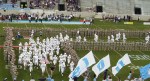
– There will be a halftime performance by the Summerall Guards.

– The Citadel is reportedly wearing its “blazer” football uniform combination for this contest. It’s an apparent effort to make sure cadet parents attending their first football game at The Citadel will have no idea what the school’s official athletic colors actually are.

I’ll be honest here. I have no idea how Saturday’s game will play out on the field. There are a lot of factors involved that only serve to confuse the situation, including potential weather concerns, personnel issues, how The Citadel will perform after a bye week, Wofford’s occasionally inconsistent play (mentioned by Mike Ayers on the SoCon teleconference)…there is a lot going on, and that’s even before you get to Parents’ Day and the hoopla associated with it.

One comment I’ve heard from a few fans that I hope the team doesn’t take to heart: “The Citadel is going to have to be 10 to 14 points better than Wofford to win, because of the officiating.”

The players and coaches can’t worry about the way the game is called. They have enough to worry about.

However, there is no question that plenty of people who follow The Citadel have little to no confidence when it comes to getting a fair shake from SoCon officials, particularly after last year’s officiating debacle in this matchup. I can’t say that I blame them.

SoCon commissioner John Iamarino may not appreciate those negative opinions about his on-field officials, but Bulldog fans have long memories.

I hope The Citadel wins. I also hope there isn’t another egregious officiating mishap that affects the outcome of the game. I’m sure everyone feels the same way.

Stay dry, and fill up the stadium on Saturday.

2015 Football, Game 4: The Citadel vs. Charleston Southern

The Citadel vs. Charleston Southern, to be played at historic Johnson Hagood Stadium, with kickoff at 6:00 pm ET on Saturday, September 26. The game will not be televised.

The contest will be streamed on ESPN3.com, with Kevin Fitzgerald providing play-by-play and Sadath Jean-Pierre supplying the analysis.

The game can be heard on radio via the various affiliates of The Citadel Sports Network. WQNT-1450 AM [audio link], originating in Charleston, will be the flagship station. WQNT will have a two-hour pregame show prior to each home football game. 

Mike Legg (the “Voice of the Bulldogs”) will call the action alongside analyst Lee Glaze. Jay Harper will report from the sidelines; he will host the first hour of the pregame show as well.

It is also possible to listen to the action with a smartphone, using a TuneIn Radio application.

Links of interest:

Preview of Charleston Southern-The Citadel from The Post and Courier

– Game notes from The Citadel and Charleston Southern

SoCon weekly release

Big South weekly release

Mike Houston on the SoCon teleconference

Jamey Chadwell on the Big South teleconference

Mike Houston’s 9/22 press conference (with comments from James Riley and Eric Goins)

The Mike Houston Show (radio)

The preview in The Post and Courier largely focused on the future of the series between The Citadel and Charleston Southern.

It is a topic that is vaguely reminiscent of last year’s kerfuffle over basketball scheduling between the two schools (along with the College of Charleston). It’s not quite the same thing, though there are obvious parallels.

Like the hoops situation, local media has seized on this issue, with carryover on Twitter. And like the hoops situation, the issue has been largely misrepresented.

There are two entities that appear to desperately want The Citadel and Charleston Southern to be an annual “rivalry” game. One is Charleston Southern. The other is the Lowcountry media.

Watching Mike Houston’s weekly press conference, I shook my head at some of the questions he was asked. I have to say I am disappointed in certain members of the press corps, who should know better. Houston did a fine job handling quite a bit of nonsense.

First, WCIV-TV’s Scott Eisberg tried to draw a reaction from Houston over the t-shirt Jamey Chadwell wore at the postgame presser after last year’s game, but the coach wouldn’t bite (“I’m not going to get into all that”).

Gene Sapakoff, sports columnist for The Post and Courier, then asked a reasonable question about recruiting, but followed that up with a “please write my column for me” query/comment about alumni interest in the matchup.

Houston correctly observed that alumni care about every game. (On his radio show the next day, Houston reinforced this point by telling a story about an alum who informed the coach in the offseason that the Bulldogs really needed to beat Western Carolina this year.)

Later, Eisberg tried another angle, one that got quickly batted away by Houston:

– Eisberg: “Not a more to lose game, but a lot of people would expect The Citadel to win this game being the bigger school and everything like that…”

– Houston: “I may be wrong, but I think their enrollment is bigger than ours [it is]. I’m pretty sure [about that], so as far as ‘bigger school’, I don’t exactly [know what you mean], because I think they are actually the larger institution.”

– Eisberg: “…[indecipherable noises] budget and stadium, and I mean…tradition of the program and stuff like that.”

– Houston: “Well, they are an FCS program that offers the same number of scholarships that we do. They do a good job coaching and recruiting…”

A couple of minutes after that, Houston concluded his portion of the press conference. James Riley then strode to the podium and (after an initial series of questions from Jeff Hartsell) got this incredible query from Sapakoff:

Jay – James, like coach was saying, um, he kinda implied that they are sort of like an equal, I mean, do you see them as kind of an equal competitor, or something beneath you as far as a smaller school?

Let’s review. In one rambling question, Sapakoff:

  • Asked a player if he flatly disagreed with a statement the player’s coach had just made about an opponent
  • Tried to get a bulletin board comment (when there had been no suggestion that the player had a particular animus against the opponent, or any opponent for that matter)
  • Made an erroneous statement while asking the question
  • Made an erroneous statement while asking the question, after another reporter had already been corrected for making an erroneous statement on the same topic less than five minutes before

Riley, to his credit, didn’t even blink, giving as respectful and polite an answer (“Uh, no, I never take an opponent lightly, no matter who we are playing…”) as could be expected under the circumstances.

Sapakoff then asked Riley to compare Charleston Southern to other SoCon schools, “particularly Furman and Wofford”. Why, I have no idea. Riley, a bit puzzled (and no wonder), noted that they ran different schemes.

The columnist then tried to bait the senior linebacker for a third time with another question about losing to Charleston Southern, and again Sapakoff did not get the answer he seemed to want.

Really, the SoCon should give a special Player of the Week Award to James Riley for handling that absurd (if not contemptible) line of questioning with considerable grace.

The media has a job to do, which is understood by all parties involved. Goading players and coaches in the hopes one of them may make an inflammatory comment is not supposed to be part of that job. It was, collectively, an embarrassing performance by the fourth estate.

Given all that, it seems the perspective of The Citadel when it comes to playing Charleston Southern isn’t likely to get equal time.

So, I’ll explain some of the issues in this post. I’ve discussed a few of these things before, but I’ll go over them again just for the sake of completeness.

Charleston Southern wants to play The Citadel on an annual basis, possibly for ease of scheduling, partly for recruiting, but mostly to escape being the Lowcountry’s “red-headed stepchild” (a comment Jamey Chadwell made prior to last year’s contest).

All of that is understandable. It is also understandable if Charleston Southern will only play The Citadel in a home-and-home series going forward.

If it is not in the best interests of CSU to play The Citadel only at Johnson Hagood Stadium, then Charleston Southern shouldn’t do so. That’s a perfectly reasonable stance to take.

However, The Citadel has to do what is best for The Citadel. Playing a home-and-home series against Charleston Southern is not what is best for The Citadel.

It is nice that CSU is finally making improvements to its football facility. It should have happened many years ago.

However, The Citadel’s future scheduling is too restrictive to have an annual home-and-home series with Charleston Southern, even if CSU finally has an acceptable stadium.

That is the real problem. Naturally, it hasn’t received enough attention, or has been discounted as a factor — when, in fact, it is a key issue.

FCS schools will play an 11-game regular season schedule every year until 2019 (when FCS teams can schedule 12 games, as was the option in 2013 and 2014). After 2019, there won’t be another 12-game schedule opportunity for FCS programs until 2024.

Beginning next season, the number of SoCon games on the slate will increase from seven to eight, as East Tennessee State begins league play. That leaves three non-conference games per season for The Citadel. One of those three contests will almost certainly always be a “money game” against FBS opposition (unless those games come to an end, but that’s another issue and at least several years down the road anyway).

In 2016, the Bulldogs play at North Carolina. In 2017, The Citadel will play at South Carolina (the second game in three years against the Gamecocks).

This leaves two games on The Citadel’s schedule each year. One of them has to be a “designated home game” — in other words, a game in which the opposing school does not get a return game at its place. That’s to ensure there are at least five home games at Johnson Hagood Stadium every season.

The other game is what I call a “flex game”. It could be a non-conference home-and-home with another FCS school, or a matchup with another FBS program. While the latter possibility may not be as likely, there are scenarios in which The Citadel would take a second FBS game (especially if it were against Army or Navy).

Charleston Southern could play The Citadel every year in the “designated home game” at Johnson Hagood Stadium. However, it would not be in the best interests of The Citadel to hamstring its future scheduling by eliminating the “flex game” to play an annual home-and-home series versus CSU.

The Citadel needs the flexibility of that spot on its schedule to pursue opportunities that could be of significant benefit to the school and its football program, whether a “bonus” money game, a matchup with a service academy, or perhaps a home-and-home with a team outside the region.

It is generally more expensive to play a home-and-home against an FCS school in another part of the country, but there are significant ancillary benefits to doing so. They include exposing the school to a wider audience, and reconnecting with certain parts of The Citadel’s widely-spread alumni base.

That is something I distinctly remember about attending The Citadel’s game at Princeton. It was an excellent public/alumni relations event for the military college. I also remember the surprisingly large contingent of Bulldog supporters who showed up for that contest.

I’ll go further, actually, and say something a lot of people aren’t going to like. The Citadel derives little benefit from playing Charleston Southern, even when the game is played at Johnson Hagood Stadium.

(There are supporters of The Citadel who would say that “little benefit” in the previous sentence could be changed to “no benefit”, and a few who would argue that the series is a net negative for The Citadel. I won’t go quite that far, but it is a point of view that is not without merit.)

If the Bulldogs win the game, it’s because they are “supposed to win”. After all, The Citadel is the “bigger school”, according to our friends in the press corps.

If they lose, it is billed as the triumph of a plucky “smaller school” over a big, hulking, undoubtedly super-evil monster of a football factory. The empire has been defeated! All the ewoks can dance!

In addition, this is not a series The Citadel’s alumni base cares about, by and large.

Yes, I know that Charleston Southern’s football program is not what it was 15 years ago, or even five years ago. Anyone who has been paying attention knows that.

When it comes to generating interest among supporters of The Citadel, though, that doesn’t really matter much, and there isn’t a whole lot CSU can do about it.

When my father graduated from The Citadel, Charleston Southern didn’t exist. When I graduated from The Citadel, it wasn’t called Charleston Southern (and did not have a football team). I think that for many of The Citadel’s alums, there is little familiarity with Charleston Southern’s football program, and next to no enthusiasm about the schools playing each other.

The Citadel has two primary rivals in football, Furman and VMI. Furman and The Citadel have been playing each other for over 100 years, and competing in the same league continuously for more than eight decades. The gridiron series with VMI is almost as long and is between two schools with a good deal in common.

Charleston Southern and The Citadel have little in common. One is a private school affiliated with the South Carolina Baptist Convention, and has existed for just over 50 years; the other is a public military college that will soon celebrate its quartoseptcentennial.

Then there is the fact that The Citadel has never received a major attendance bump when Charleston Southern comes to town, which might come as a surprise to some people.

In seven games between the two schools at Johnson Hagood Stadium, the average attendance has been 13,202. The average game attendance at Johnson Hagood Stadium in those years when the schools played? 14,153.

The games versus CSU actually lowered the average attendance numbers for The Citadel for five of the seven seasons in which they were played, including the most recent meeting in 2013.

That is perhaps less of a shock when Charleston Southern’s home attendance numbers are taken into consideration. CSU’s average home attendance through two games this season (caveat: both games were Thursday night affairs) is 3,576.

Last year CSU drew just over 4,000 for its Homecoming game against Presbyterian, the largest attendance it had for any game in 2014 aside from the one against The Citadel, when the announced attendance was 7,954 (but the actual attendance, in my opinion, was closer to 5,500).

That isn’t to say Charleston Southern has no fans. They do, and a few of them really don’t like it when you explain why playing a home-and-home doesn’t work for The Citadel. One of them told me via Twitter that the real reason The Citadel didn’t want to play had to do with an “elitist attitude & inflated self perception. You’re not what u used to be.”

His comment was ‘favorited’ by several CSU players, including starting wide receiver Colton Korn. I don’t know if the players are agreeing with the notion that current Bulldog players have an elitist attitude and aren’t as good as those from teams of the past, if they are just saying that about Bulldog supporters, or both. With Twitter, nuance can be difficult.

Okay, let’s talk about the game on Saturday…

Here is a comparison of The Citadel and Charleston Southern in select statistical categories for the 2014 season.

Incidentally, this will probably be the last post in which I use 2014 as a reference in this section; for the rest of the season, I’ll likely use up-to-date 2015 statistics, because at least by then we’ll have enough games to make those numbers at least somewhat relevant.

As usual, The Citadel’s stats in the table below are for SoCon games only (seven contests). Those opponents: Wofford, Chattanooga, Western Carolina, Mercer, Furman, Samford, and VMI.

For Charleston Southern, I included ten of the Buccaneers’ twelve games. I decided not to include statistics from CSU’s victory over Point, or its loss to Georgia. Those two games weren’t really indicative of how Charleston Southern played over the course of the 2014 campaign.

Thus, the statistics below for CSU are for ten games against the following opponents: Newberry, Campbell, The Citadel, Charlotte, Vanderbilt, Presbyterian, Coastal Carolina, Monmouth, Gardner-Webb, and Liberty.

(Note: I couldn’t come up with defensive red zone TD% numbers for Charleston Southern in 2014. If I eventually find them, I’ll include them in the table.)


Charleston Southern The Citadel
Offense yards/pass attempt 7.6 6.8
Offense yards/rush attempt 4.87 5.35
Offense yards per play 5.83 5.56
Offense points per game 27.10 24.86
Penalties per game 7.0 5.3
Offense 3rd down conv % 42.2 46.3
Offense 4th down conv % 43.8 60.0
Offense Red Zone TD% 50.0 66.7
Defense yards/pass attempt 7.4 9.1
Defense yards/rush attempt 4.10 5.69
Defense yards allowed/play 5.50 7.02
Defense points allowed/game 20.0 25.86
Defense 3rd down conv % 31.1 41.5
Defense 4th down conv % 50.0 52.9
Defense Red Zone TD%  — 60.0
Time of possession 34:24 32:40


I think that defensive 3rd-down conversion rate really stands out. CSU finished 19th in the category in FCS last year (counting all games).

Just as a point of comparison, Clemson led FBS last season in defensive third down conversion rate, at 27.4%. A rate of 31.1% would have been good enough to finish eighth nationally in that division.

Note: statistics below referencing Charleston Southern’s 2014 season are for all twelve games of that campaign.

Last season, Charleston Southern threw the ball 33.8% of the time in its spread option attack. Passing yardage accounted for 43.2% of the Buccaneers’ total offense.

Through three games this year, CSU’s passing yardage accounts for 33.1% of its total offense; the Bucs are throwing the ball on 31.1% of their offensive plays from scrimmage.

Charleston Southern has a lot of experience on offense, and that includes the quarterback position.

Austin Brown transferred from UAB two seasons ago; he started last year’s game against The Citadel and the first two games of this season. Last week, sophomore Kyle Copeland replaced an injured Brown and led the Buccaneers to a 47-7 victory over East Tennessee State.

There is a good chance both will play on Saturday. Brown is completing 46.4% of his passes, averaging 3.25 yards per attempt (the Bucs’ game against Troy hurt him in the yards/attempt category). He has one TD toss and no interceptions.

Copeland is completing a higher percentage of his throws (55.9%), averaging 8.56 yards per attempt, with 3 TDs and no picks. He has also rushed for 115 yards in three games.

However, the primary threat on the ground for Charleston Southern so far this season is running back Darius Hammond. He had 161 yards rushing against Troy (on 23 carries). Hammond is also the Bucs’ punt returner, and he took one back 74 yards for a TD last year versus The Citadel.

The other starting running back, Ben Robinson, had 127 rushing yards and 2 TDs in CSU’s opener against North Greenville. Robinson did not play last week versus ETSU, but is listed as a starter on the current two-deep.

Charleston Southern’s starting offensive line averages 6’2″, 287 lbs. It is a veteran group for the most part.

Left tackle Erik Austell was a preseason All-Big South selection. The right tackle, Benny Timmons, leads all active CSU players in career starts, with 29.

Tight end Nathan Prater is 6’8″, and caught three touchdown passes last season. Prater is from Ninety Six, South Carolina.

He could wear #96 for his hometown, or #68 for his height. Instead, he wears #81. Clearly a missed opportunity.

Prater and starting wide receivers Kevin Glears and Nathan Perera all have something in common besides being pass-catchers for the Buccaneers — they’re all sixth-year players. Perera was an all-Big South pick in 2011 before suffering knee and shoulder injuries.

Another starting wideout, Colton Korn, specializes in moving the chains, with 21 of his 27 receptions last season resulting in a first down. His brother, Willy Korn, is the wide receivers coach at Charleston Southern (and was at one time a well-known high school recruit who had a star-crossed career at Clemson).

Larry Jones III was the Big South Freshman of the Year in 2012 but missed all of last season with a knee injury. Jones has six receptions this season, second on the team to Perera (who has eight catches).

Charleston Southern usually plays a 3-4 defense. Against The Citadel, however, the Buccaneers will probably feature at least two, and probably three fronts. That was the case in both the 2013 and 2014 meetings.

Most of CSU’s experience on defense is concentrated in the secondary and in the linebacking corps.

Weakside linebacker Aaron Brown was an all-Big South choice last season after making 81 tackles. Not surprisingly, he leads the team in tackles this year, with 13 (including three for loss). Brown scored a touchdown against North Greenville in the opener, a 53-yard play that was technically a fumble return after NGU bungled a punt.

Fifth-year senior Zach Johnson is the “spur” linebacker, and no longer will be confused with former teammate (and fellow linebacker) Zac Johnston.

The Bucs have experienced cornerbacks, though preseason all-Big South pick Troy McGowens did not play in the team’s first two games. He did return against ETSU and recorded two sacks. True freshman Shadarius Hopkins has started all three games in McGowens’ stead and is listed as the starter this week as well.

The other cornerback is Malcolm Jackson, a team captain who had four interceptions last season. He is tied for second on the squad in tackles through three games this year.

Another Jackson in the CSU defensive backfield is Corbin Jackson. The free safety has 14 career starts.

Strong safety D.J. Curl has played in 24 games for Charleston Southern. His backup, Larenzo Mathis, returned an interception 87 yards for a TD against ETSU. Last year, Mathis had a blocked punt/TD return against Vanderbilt.

Caleb Batchelor was a regular in the Bucs’ d-line rotation last season. This year, he’s the starting nosetackle. Anthony Ellis, a native of Florida, has started all three games this season at defensive end after playing sparingly as a freshman.

Truett Burns is in his third year as Charleston Southern’s starting punter. He usually employs a “rugby” style of punting, and last season dropped 16 of his 54 punts inside the 20-yard line.

This year, he is averaging 35.2 yards per punt, with 5 of his 13 punts landing inside the 20.

Summerville resident Bryan Jordan is CSU’s placekicker. He is 0-2 on field goal attempts so far this season after serving primarily as a kickoff specialist last year, and also missed an extra point last week. His backup, David Kennedy, was 11-18 last season attempting field goals (including two successful kicks against The Citadel).

Jamey Chadwell expressed some concern about that aspect of the Bucs’ kicking game during the Big South media teleconference.

Long snapper Joseph Smith is from Easley. As I noted last year, Smith began his collegiate career at Delta State, where his coach was Jamey Chadwell. When the coach took the Charleston Southern job, Smith moved back to South Carolina to continue his football career with Chadwell.

As mentioned earlier, Darius Hammond is Charleston Southern’s punt returner. Hammond also returns kickoffs, as does Shadarius Hopkins.

I haven’t written anything about the Georgia Southern game to this point. Usually when I don’t have a “game review” post (which is what generally happens when I don’t attend the contest in question), I discuss the previous game early in the following preview.

I didn’t do that this week because I wanted to jump right into the issues surrounding the Charleston Southern game/series. Also, I don’t really have a lot to say about the matchup with Georgia Southern.

It was a fairly simple contest to analyze. The Citadel made several mistakes early in the game it could not afford to make, and paid for them in full, which tends to happen when facing an FBS squad. Once that ball gets rolling downhill, it’s not going to stop.

I was disappointed in the performance, but I’m also not too worried about it. My only concern is that the players don’t lose any of the confidence they gained in the first two games of the season. I trust the coaching staff to make sure that doesn’t happen.

Odds and ends:

– On Friday, The Citadel will enshrine the newest class in its athletic Hall of Fame. Baseball players Mike Pendleton and Randy Corn will be inducted, as will swimmer Milton Williams and honorary member Dr. John “Turkey” Moore.

They will be joined by Dr. Stephanie McNeill, a track and field star who will be the first woman enshrined in the Hall. Congratulations to all the honorees.

– Charleston Southern has 36 players on its roster from South Carolina, 19 from Georgia, 16 from Florida, two from North Carolina, and one each from Virginia, Texas, and California.

– This will be the second consecutive season that Charleston Southern has played a Thursday night home game in the week before it plays The Citadel.

– The front page of CSU’s game notes mentions that The Citadel and Charleston will not play next season. Just to make sure anyone reading didn’t miss that factoid, it was noted twice on the front page.

– Per one source that deals in such matters, The Citadel is a 6 1/2 point favorite over Charleston Southern this week. The over/under is 51.

That line really surprised me, to be honest. I would have guessed something like CSU -3, not that I’m a gambling expert or anything.

– Another game at Johnson Hagood Stadium, another somewhat ominous weather forecast. As of this writing, the National Weather Services is projecting a 50% chance of rain in Charleston on Saturday during the day, and 30% at night.

– Speaking of gray, the Bulldogs will be wearing all-gray uniforms for this game. I’m not excited about that, but it was inevitable.

Fans are supposed to wear light blue.

I think the game on Saturday will be competitive and close.

One thing that might be worth watching is time of possession. Both of these teams want to control the ball. Last year, Charleston Southern won that battle.

This year, The Citadel’s defense has to get off the field on third down. Conversely, the Bulldogs’ offense must sustain drives, particularly early in the game (last year on third down, The Citadel was only 4-14).

The Citadel must also avoid the turnover bug that cropped up against Georgia Southern (and to a certain extent in the Western Carolina game as well). That’s even more important in a game in which each team will probably have no more than 12 possessions (the Bulldogs had 10 in last season’s contest).

I don’t have to even discuss the special teams issues The Citadel had in last year’s matchup. That part of the game has to dramatically improve.

I hope the Bulldogs are ready to play on Saturday, rain or shine. Looks like rain, alas.

I’ll be there anyway.


2015 Football, Game 3: The Citadel vs. Georgia Southern

The Citadel at Georgia Southern, to be played at Allen E. Paulson Stadium in Statesboro, Georgia, with kickoff at 6:00 pm ET on Saturday, September 19. The game will not be televised.

The contest will be streamed on ESPN3.com, with Matt Stewart providing play-by-play and Wayne Gandy supplying the analysis.

The game can be heard on radio via the various affiliates of The Citadel Sports Network. WQNT-1450 AM [audio link], originating in Charleston, will be the flagship station. 

Mike Legg (the “Voice of the Bulldogs”) will call the action alongside analyst Lee Glaze. Jay Harper will report from the sidelines.

It is also possible to listen to the action with a smartphone, using a TuneIn Radio application.

Links of interest:

Preview of The Citadel-Georgia Southern from The Post and Courier

– Game notes from The Citadel and Georgia Southern

SoCon weekly release

Sun Belt weekly release

Mike Houston on the SoCon teleconference

Willie Fritz on the Sun Belt teleconference

Mike Houston’s 9/15 press conference (includes comments from Dondray Copeland and Jorian Jordan)

The Mike Houston Show (radio)

When I was thinking about what to write for this week’s preview, what first came to mind wasn’t as much the upcoming contest, but rather Georgia Southern’s move from the SoCon to the Sun Belt and the long-term ramifications for that program and school.

That’s because, from a programmatic perspective, the matchup with the Eagles is arguably the most meaningless game The Citadel has played since the Bulldogs made a trip to face Wyoming in 2002.

I’ll explain what I mean by that later. First, a look at Georgia Southern. I’ve written about the school’s history before, but I think it’s worth revisiting.

Georgia Southern was founded in 1907, and classes began the following year. It was originally known as the First District Agricultural & Mechanical School, but despite an initial focus on agriculture, the school would become a teacher’s college for the majority of its history.

There had been a football team at Georgia Southern as far back as 1924 (at that time the institution was called the Georgia Normal School), but the sport was dropped during World War II. By the early 1980s, the school had increased in size (it would be granted university status in 1990), and there was a groundswell of local and institutional support for reinstating football.

To re-start the program, the school hired longtime Georgia assistant coach Erk Russell, who was already a legend in the Peach State. He was, to say the least, a great hire.

Russell took the football program from club status to I-AA, fashioning an eight-year record of 83-22-1, with three national titles.  Beyond the win-loss record, the coach’s impact and influence on the school was immense.

Ludicrously, Russell is not in the College Football Hall of Fame. He is actually ineligible under current rules.

The shadow of Russell at Georgia Southern did have negative repercussions, inasmuch as he was an impossible act to follow. The redoubtable Paul Johnson was the only one of the head coaches who succeeded him to really measure up to Russell in the eyes of the fan base.

Tangent: speaking of Johnson and other former Georgia Southern head coaches, the most fascinating matchup this week in college football is the one between PJ’s Georgia Tech squad and Notre Dame, which employs Statesboro persona non grata Brian VanGorder as its defensive coordinator. The two men aren’t exactly fast friends, and that’s being polite.

The essential issue that coaches following Erk Russell faced — how do you top what he did? — could also apply, in a general sense, to Georgia Southern and the move to FBS. After a while, some supporters got restless. They had already sampled the pot of gold at the end of the FCS rainbow, and now they wanted to know if the gold at the end of the FBS rainbow was shinier, regardless of the consequences.

It took a while, but eventually the fan base started moving in the “we want FBS” direction. Those not so sure about the idea were eventually brushed aside. A new director of athletics with an “FBS or bust” attitude and mission, Tom Kleinlein, pushed things along. Eventually, Georgia Southern made the move to the Sun Belt.

Now, Georgia Southern is an FBS school. Its first season in the Sun Belt was full of success, as it won the league with an 8-0 conference record. I’m not sure the Sun Belt was anticipating that, or if its administrators were really excited about having the league won by a program that had gone 4-4 in the SoCon the year before.

Despite winning an FBS conference, though, Georgia Southern didn’t get to go to a bowl game, because it was still in transitional status. That didn’t sit well with fans.

Kleinlein asked for a waiver (which was denied by the NCAA). In asking for the waiver, I suspect he went against the wishes of the league office:

Without the waiver, Georgia Southern’s only other option to become bowl eligible this year was to hope fewer than 76 teams reached six wins…

…Last month, Sun Belt commissioner Karl Benson told USA TODAY Sports that even if Georgia Southern became bowl eligible through that route, they would be placed at the bottom of the league’s pecking order out of deference to the longstanding FBS members. Currently, the Sun Belt has four bowl eligible teams for three contracted spots.

Kleinlein is now arguing, however, that Georgia Southern (9-3) should be treated differently because it won the conference championship outright.

“If we were just a bowl eligible team, I get that argument,” he said. “But we’re conference champions, and that is what puts us ahead of everybody else. I didn’t make the argument to the NCAA when we won six games, I didn’t make it when we won seven or eight. I waited until we got at least a share of the conference title before I submitted my deal.”

Benson didn’t immediately return a call seeking comment.

Of course Benson didn’t return Dan Wolken’s telephone call. He was probably on the horn with Kleinlein, asking him to at least wait another year before burning every bridge in the league his school had just joined.

Now, about that “meaningless game” comment I made at the beginning of this missive. Mike Houston was asked about playing Georgia Southern at his weekly press conference:

The Citadel will be the first SoCon team to visit GSU since the Eagles left the SoCon, but don’t expect Georgia Southern to appear regularly on Bulldog schedules — not when games at ACC or SEC foes can bring much more money. This game was scheduled before Houston and athletic director Jim Senter were hired.

“If I’m the ones making the decisions, no,” Houston said when asked if he’d schedule games like this one in the future. “You are playing an FBS program that has more resources and scholarships than we have. And if you are playing those kinds of games, there needs to be financial restitution that matches that … It’s not ideal, especially if you are playing two FBS teams in one year.”

In other words, if Georgia Southern wants to schedule The Citadel again, the military college is going to demand a lot more cash. $175,000 isn’t going to be nearly enough; The Citadel is going to want more than twice that amount of money. Maybe more than three times that amount of money.

In a way, it illustrates a problem Georgia Southern now has as an FBS member when it comes to scheduling home games. Schools that pay FCS schools big bucks for a “guarantee game” can afford to make those payments, because they have large stadiums and huge budgets. That isn’t the case for the folks in Statesboro.

Georgia Southern may have expanded Paulson Stadium, but 25,000 seats is a far cry from the likes of the facilities at Florida State, or South Carolina, or even North Carolina (opponents of The Citadel last year, this year, and next year).

That also affects Georgia Southern’s ability to get home-and-home games (or two-for-one deals) with non-conference FBS foes, especially from major conferences. So far, GS hasn’t scheduled such a series with a P5 school.

Of course, if the Big 10 gets its way, the days of Power 5 conference schools scheduling FCS programs may be coming to an end. Even if that happened, though, it probably still wouldn’t be worth it for schools like The Citadel to play Group of 5 conference schools for less money.

The potential chain reaction that could occur if the entire P5 decided not to schedule FCS programs would likely be complicated (and a subject for another post). I think it is probable that The Citadel would simply not play any FBS schools, with the gridiron landscape possibly changing to such a degree that no FCS schools would.

All that said, the game on Saturday isn’t as unimportant to The Citadel as the 2002 game against Wyoming. For one thing, the program will make at least a little money. That Wyoming game, well

The game against Division I-A Wyoming, which plays in the Mountain West Conference, has been on the Bulldogs’ schedule for years. [Ellis] Johnson talked to Wyoming coach Vic Koenning a year ago about getting out of the game…

…After chartering a flight to Laramie and spending a night there, The Citadel will just about break even on the trip, [Les] Robinson said.”Thank goodness for LSU [another FBS game The Citadel played during the 2002 season],” Robinson said. After securing the LSU game, Robinson offered to negotiate a settlement with Wyoming.”They didn’t want to negotiate,” Robinson said. “We couldn’t offer them $100,000 or anything like that. We couldn’t make it worth their while.”As it is, the Bulldogs will play 12 games without a week off this season. Johnson said his players might not even put on pads this week in practice in an effort to stay fresh.

Also, the Bulldogs will have their fair share of fans at this game. It’s not the worst place in the world to play a game for recruiting purposes, either (Exhibit A being The Citadel’s starting quarterback, Dominique Allen, who grew up about an hour’s drive from Statesboro).

However, ultimately this matchup is unlikely to define the season for The Citadel in any way. It’s a game the Bulldogs would like to win, but it’s not a conference game, a home game, an in-state game, or a game against a high-profile opponent. It provides a limited benefit to the program from a financial standpoint.

To be honest, I’ve always been a bit dubious about Georgia Southern venturing into the land of FBS, though not for reasons of on-field competitiveness. I don’t think any veteran observer of college football was shocked the Eagles dominated the Sun Belt last year. Mildly surprised, maybe, but not shocked.

However, this is a school that, even as it has grown, still has issues to overcome when it comes to big-money athletics. Its alumni base, while growing, is still much smaller than most FBS schools; the market demo is younger than many other areas (so there is less disposable income floating around); and the surrounding region doesn’t have a huge corporate base.

Also, Georgia Southern has to compete with numerous major-conference FBS programs within a 300-mile radius, including Georgia, Georgia Tech, Clemson, South Carolina, Florida, Florida State, and Auburn.

Hey, I could be wrong. I’ve been wrong before, and I’ll be wrong again. I just happen to think there is a good chance in about ten years, there might be more than a few Georgia Southern fans wondering what the administration was thinking when it decided to chase that other rainbow.

Here is a comparison of The Citadel and Georgia Southern in select statistical categories for the 2014 season. The Citadel’s stats are for SoCon games only (seven contests). Those opponents: Wofford, Chattanooga, Western Carolina, Mercer, Furman, Samford, and VMI.

For Georgia Southern, I included eleven of the Eagles’ twelve games. After some consideration, I decided to remove the statistics from Georgia Southern’s 83-9 victory over Savannah State.

Thus, the statistics below are for the rest of the games the Eagles played last season, which came against the following opponents: North Carolina State, Georgia Tech, South Alabama, Appalachian State, New Mexico State, Idaho, Georgia State, Troy, Texas State, Navy, and ULM.


Georgia Southern The Citadel
Offense yards/pass attempt 7.8 6.8
Offense yards/rush attempt 6.81 5.35
Offense yards per play 7.00 5.56
Offense points per game 35.09 24.86
Penalties per game 4.9 5.3
Offense 3rd down conv % 47.1 46.3
Offense 4th down conv % 62.5 60.0
Offense Red Zone TD% 69.2 66.7
Defense yards/pass attempt 6.9 9.1
Defense yards/rush attempt 4.41 5.69
Defense yards allowed/play 5.62 7.02
Defense points allowed/game 24.72 25.86
Defense 3rd down conv % 40.5 41.5
Defense 4th down conv % 40.1 52.9
Defense Red Zone TD% 68.6 60.0
Time of possession 32:53 32:40

Who will start at quarterback for Georgia Southern on Saturday?

As glad as [Georgia Southern head coach Willie] Fritz is to have Ellison back, he’s staying close to the vest when discussing how big of a role Ellison will play this weekend. With a full week of film study and practice still in front of the Eagles, Fritz wasn’t yet ready to say whether Ellison or [Favian] Upshaw take the first snap against The Citadel.

“Those guys are going to be trading reps all week and they’re both going to be playing Saturday,” Fritz said. “We don’t know if we’ll go by quarter, by series, or every two series. As the week goes on, we’ll get that plan in place.”

Ellison was suspended because of an academic issue dating back to the fall semester of last season. Ellison failed to accrue enough credits to satisfy the NCAA standard and was initially handed a four-game suspension.

By taking on additional classes over the spring and summer semesters – and by earning solid grades in those classes – Ellison was able to get his suspension reduced.

“It was a learning experience for me,” Ellison said. “School has to come first. I kind of overlooked that last year.
“Now I’m just glad to play for my school and to be able to go out there on Saturday.”

Ellison is hoping that this run-in with The Citadel is as successful as the last.

In 2013, Ellison was the star of the game as the Eagles pulled out a 28-21 win. Ellison passed for 138 yards, ran for 135 more and scored the game-winning touchdown with 1:59 to play.

Regardless of who starts at QB, Willie Fritz’s offense will look the same. It isn’t the triple option offense of Paul Johnson or Jeff Monken, but it is conceptually not dissimilar.

I’ll let The Birddog, triple option maven and proprietor of the superior Navy athletics blog of the same name, explain how it works:

Run primarily out of pistol formations, Georgia Southern uses more zone blocking as opposed to the inside veer that is the foundation of past GSU offenses. For the quarterback, it’s not too much of a change; he still progresses through his reads like he did before. Zone blocking is different for the offensive line, but it still favors quicker linemen that can get to linebackers quickly. That’s what GSU’s line was already built for under Monken. Besides, it’s not like they had never used zone blocking before. It’s just a different focus. The zone read is hardly a concept unique to Georgia Southern. Everyone runs it at least a little bit. What’s unique about Georgia Southern is more how committed they are to it. They are very much an option offense as opposed to an offense that dabbles in the option once in a while.

You can read a lot more about Georgia Southern’s offense in that post. In fact, you should. Education is the surest way to get ahead in life.

In its eleven games last season against FBS competition, Georgia Southern threw the ball 20.3% of the time. Passing yardage accounted for 22.5% of the Eagles’ total offense.

Contrast that with Georgia Southern’s 2013 season (again omitting a game against Savannah State). That season, the Eagles threw the ball 14.0% of the time, and passing yardage accounted for 21.5% of Georgia Southern’s total offense.

So, despite a new coach and a different “style” of offense, there really wasn’t a big fundamental change in approach.

– Note: 2014 statistical references to follow are for all 12 games Georgia Southern played.

Kevin Ellison rushed for 1108 yards last season, averaging 6.5 yards per carry. He completed 55.5% of his passes, with five touchdowns against three interceptions, averaging 7.6 yards per attempt.

Fabian Upshaw completed 70.4% of his throws (19-27), averaging 10.6 yards per attempt, with two TDs and one pick. Upshaw rushed for 385 yards, averaging 9.6 yards per carry.

While both Ellison and Upshaw are capable of making things happen, the biggest playmaker on the Eagles offense is running back Matt Breida, who rushed for 1485 yards last season and 17 TDs. He averaged 8.7 yards per rush attempt, leading the nation in that category.

During his press conference, Mike Houston stated that Breida also led the nation in “explosive plays”, i.e. plays of over 50 yards from scrimmage. He had seven last season.

Breida had his first “explosive play” of this season last week,  a 70-yard TD run against Western Michigan. He finished that game with 176 yards rushing (on only 11 carries) and four touchdowns.

He is joined in the backfield by fellow running back L.A. Ramsby, who rushed for 691 yards and 12 TDs last season. “L.A.” stands for “Little Al”. His father is Big Al.

Wide receiver B.J. Johnson led the Eagles in receptions last season with 23, averaging 13.6 yards per catch. Three of those receptions were for touchdowns.

Houston referred to Georgia Southern as being “huge up front”, and he wasn’t kidding. The Eagles’ starting offensive linemen average 6’4″, 305 lbs.

Left guard Darien Foreman, the lone returning starter on the offensive line, was a preseason first-team All-Sun Belt pick. Right guard Roscoe Byrd is a transfer from UAB.

Georgia Southern runs a 4-3 base defense. Of course, teams often change things up when facing The Citadel’s triple option.

Last year against Navy, the Eagles started out defensively by running a 4-4 look with the safety taking the pitch, then adjusted as the game went on. If you want to see how that functioned, I again refer you to The Birddog (who also breaks down how Navy handled Georgia Southern’s offense in this post): Link

The Eagles have a great deal of size along the defensive line, including the imposing Jay Ellison (no relation to Kevin Ellison), a 6’1″, 310 lb. nose tackle. The Citadel’s offensive line will have its hands full with Ellison, a second-team preseason Sun Belt selection.

Darrius Sapp, listed as Jay Ellison’s backup on this week’s two-deep, started both of Georgia Southern’s first two games at defensive tackle. Sapp weighs 330 lbs.

Starting defensive end Lennie Richardson is 27 years old. Richardson began his collegiate career at Troy before transferring to Georgia Southern. After a year in Statesboro, Richardson enlisted in the U.S. Army and spent 3 1/2 years as a tank gunner before returning to GSU.

Linebackers Deshawntee Gallon and Antwione Williams both have fifteen tackles so far this season for the Eagles. Williams has already graduated from Georgia Southern (the same is true for Lennie Richardson).

Free safety Matt Dobson returned two interceptions for touchdowns last season. Dobson was a second-team preseason all-conference choice.

Placekicker Younghoe Koo is an athlete, as this “trick kick” demonstrates. However, he’s coming off a one-week suspension after a DUI arrest. Alex Hanks handled placekicking duties last week for the Eagles and is listed ahead of Koo on this week’s depth chart.

Georgia Southern punter Matt Flynn is in his first year as the starter. Koo is listed as his backup this week, though the depth chart describes this as an “OR” situation.

Long snapper Jake Banta is another refugee from the currently shuttered UAB program.

Derek Keaton and Montay Crockett were the primary kick returners for Georgia Southern last season, and are back this year. Keaton also returns punts.

Odds and ends:

– Georgia Southern’s “dress roster” includes 90 players from thirteen states. There are 68 natives of Georgia, 11 Floridians, five residents of South Carolina, three Texans, and one player each from Alabama, Missouri, Mississippi, Ohio, Oklahoma, Arkansas, New Jersey, California, and Nevada.

– For the second straight week, The Citadel will play in a contest designated “Military Appreciation” Day (or Night). The game ball will be brought in by the Golden Knights Army Parachute Team. Georgia Southern players will have a Department of Defense decal on the back of their helmets.

An early contender for the title of most-asked question by fans in the stands on Saturday: “Hey, what does DoD mean?”

The Citadel last played Georgia Southern in Statesboro in 2013. It was Military Appreciation Day at Paulson Stadium for that game as well.

– The ESPN3 analyst for this game, Wayne Gandy, was a consensus All-American offensive tackle at Auburn in the early 1990s. Gandy had a 15-year NFL career with four different teams, starting 205 games.

– The sideline reporter for the Georgia Southern radio network is Danny Reed, who Bulldog fans remember from his three years as the “Voice of the Bulldogs”. Reed will become the play-by-play voice this season for the Eagles’ men’s basketball and baseball teams, and will take over gamecalling duties for football in 2016.

I think Reed will become the second person to work as the play-by-play voice for both The Citadel and Georgia Southern. Longtime Charleston radio man Ted Byrne also called games for both schools (and worked College of Charleston games at one point, too).

– Lainie Fritz, sports anchor/reporter for WCBD-TV in Charleston, is the daughter of Georgia Southern head coach Willie Fritz.

– Per the SoCon weekly release, The Citadel has the top two active sack leaders in the conference. Mitchell Jeter has 13.5, most among current SoCon players, while Mark Thomas is second with 11.5 career sacks.

– Mike Houston is undefeated against schools from the state of Georgia in his head coaching career. He is 2-0, with wins over Fort Valley State and Mercer.

– As of this writing, the National Weather Service forecast for Saturday in Statesboro: high of 87 degrees and sunny, with a low that night of 67. Weather should not be a factor during the game.

– Per one source that deals in such matters, Georgia Southern is a 25 1/2 point favorite over The Citadel this week. The over/under is 56.

I think Saturday’s game will be competitive, assuming The Citadel doesn’t go into turnover mode on offense. The Bulldogs may have trouble stopping Georgia Southern’s high-powered attack, but I believe The Citadel can control the ball enough on offense to limit the total number of possessions and frustrate the Eagles.

Earlier in this post, I wrote that this game isn’t that important for The Citadel in the grand scheme of things. However, I fully expect the Bulldog players to give it everything they’ve got — and why not?

If you’re going to play the game, you might as well try to win.

Game review, 2015: Western Carolina

Links of interest:

Game story, The Post and Courier

“Notes” section, The Post and Courier

Photo gallery, The Post and Courier

School release

Video from WCSC-TV, including interviews with Mike Houston, Mitchell Jeter, Dominique Allen, and Rudder Brown

Video from WCIV-TV

Box score

The Citadel 28, Western Carolina 10.

Random thoughts and observations:

– Another day of threatening weather led to another night of disappointing attendance at Johnson Hagood Stadium. The crowd of 8,048 was into the game (and the corps of cadets had another strong performance), but Jim Senter has to hope for sunny skies when Charleston Southern comes to town in two weeks.

– The Citadel averaged 5.9 yards per play, including 4.9 yards per rush and 17.5 yards per pass attempt (on six throws). Western Carolina averaged 4.9 yards per play, including 5.1 yards per rush and a relatively anemic 4.7 yards per pass attempt (with Troy Mitchell throwing the ball 40 times).

In last season’s matchup, the Catamounts averaged 9.2 yards per rush and 10.0 yards per pass attempt. Western Carolina had ten plays from scrimmage that went for 20+ yards in that 2014 contest; on Saturday night, WCU had only three.

– At one point early in the second half, Bulldog B-backs carried the football seven straight times, including all six plays on the second series of the third quarter. There was just a bit of murmuring in the stands, but the runs up the middle had a purpose.

Of the 32 offensive snaps for The Citadel following those “seven plays of stubbornness”, the Bulldogs averaged 6.7 yards per play, including ten first downs and three touchdowns.

– It’s possible that offensive coordinator Brent Thompson may have regretted the second-and-1 pass play the Bulldogs tried near the end of the first half, the only play call I questioned on Saturday. Dominique Allen’s throw was poor, and was intercepted.

It was the third time in two games The Citadel had thrown the ball on 2nd-and-short (and the second time on Saturday). Just as a reminder, in conference play last season the Bulldogs only threw the ball in that situation four times (in seven league matchups).

– Later in the contest, Allen more than made up for his bad throw in the first half. He threw a gorgeous seam pass to Rudder Brown early in the fourth quarter that set up The Citadel’s third touchdown.

On the play, Brown essentially stiff-armed a defender for almost 25 yards. That’s a pretty fair stiff-arm.

– In general, the victory over Western Carolina reminded me of the win last season against Gardner-Webb. That was another game in which the Bulldogs were trailing midway through the third quarter, but wound up winning going away, partly because the other team’s defense was worn out with 20 minutes still to play.

Two differences: this year, it happened earlier in the season, and Western Carolina was a better opponent.

– While The Citadel was the better team on Saturday night and fully earned the victory, it didn’t hurt to catch a break or two. The biggest break of all was on the muffed pitch play that resulted in a recovered fumble-TD by Jorian Jordan.

If Western Carolina had fallen on the ball, would the resulting change of momentum (and immediate loss of seven points) have changed the game’s outcome? I don’t think so…but I’m glad we didn’t have to find out.

– Many of the fans were pleased to hear the band’s rendition of the “Hawaii 5-0” theme, complete with the obligatory surfboard.

The band needed to play a little more during the game, in my opinion. It was a tough night for the sound system operators, who received a deserved warning from the referee for playing music as Western Carolina lined up on offense. Even worse, someone slipped “Come On Eileen” by Dexy’s Midnight Runners into the music rotation. Awful.

– The game program’s recap of the victory over Davidson included a reference to the 69 points scored against the Wildcats being “the 3rd highest point total in program history”.

It is actually the fifth-highest point total in program history, but it appears that the 1909 victory over Porter (99 points scored by The Citadel) and the 1913 win against Furman (75 points) are both being disregarded.

This is wrong. Those Marion Square teams should be recognized. They are part of the fabric that makes up football at The Citadel. Plus, 75 points against Furman! That will always count, thank you very much.

– The program also includes an article on the golf team, and how it is honoring an alumnus who was killed in action.

– As mentioned earlier, the corps of cadets brought plenty of energy to the stadium. I thought the ACU look was fine, though I wouldn’t want to see it become a regular option.

I know a few of the sophomores were disappointed not to get overnights, but hey — it’s The Citadel, that’s part of the deal. (And 25 years from now, you’ll be the one telling cadets about how that’s part of the deal.)

– He didn’t have a particularly good night, but I’m glad that The Citadel has seen the last of WCU quarterback Troy Mitchell. I just automatically assumed that whenever the Catamounts faced a 3rd-and-long, Mitchell would lead the Bulldogs’ defense on a merry chase that would result in a 20-yard run or a 40-yard pass.

Mitchell has been a fine player, and worthy opponent, for four years.

– Last week’s game lasted exactly three hours. This week: three hours and four minutes. The man in the red cap controls all time and space.

– The Citadel still leads FCS in rushing offense, well ahead of Kennesaw State (!), which is in second. (Kennesaw State also runs the triple option.)

Last year’s leader in rushing offense, Cal Poly, is currently sixth. I think that is very impressive, considering the Mustangs’ two games have been at Montana (a win) and at Arizona State (a loss, but Cal Poly gave the Sun Devils all they wanted).

Next week: Georgia Southern, in Statesboro. That should be interesting. I’ll have a post previewing that game later in the week.

Below are some photos, including shots of the pregame scene and the on-field action (most of which are annotated). They aren’t necessarily good photos. Then again, when are they?

2015 Football, Game 2: The Citadel vs. Western Carolina

The Citadel vs. Western Carolina, to be played at historic Johnson Hagood Stadium, with kickoff at 6:00 pm ET on Saturday, September 12. The game will not be televised.

The contest will be streamed on ESPN3.com, with Kevin Fitzgerald providing play-by-play and Sadath Jean-Pierre supplying the analysis.

The game can be heard on radio via the various affiliates of The Citadel Sports Network. WQNT-1450 AM [audio link], originating in Charleston, will be the flagship station. WQNT will have a two-hour pregame show prior to each home football game. 

Mike Legg (the “Voice of the Bulldogs”) will call the action alongside analyst Lee Glaze. Jay Harper will report from the sidelines; he will host the first hour of the pregame show as well.

It is also possible to listen to the action with a smartphone, using a TuneIn Radio application.

Links of interest:

Preview of Western Carolina-The Citadel from The Post and Courier

Pregame “notes” from The Post and Courier

– Game notes from The Citadel and Western Carolina

SoCon weekly release

Mike Houston on the SoCon teleconference

Mark Speir on the SoCon teleconference

Mike Houston’s 9/9 press conference (includes comments from Tevin Floyd, Dominique Allen, and Mariel Cooper)

The Mike Houston Show (radio)

Game story for Mars Hill-Western Carolina from the Asheville Citizen-Times 

– Tevin Floyd was the SoCon Defensive Player of the Week after making eight tackles and returning an interception for a touchdown against Davidson. You may recall that as a freshman in 2013, Floyd recovered a fumble for a touchdown in the Bulldogs’ 28-21 victory over Western Carolina in Cullowhee.

From my preview of last season’s game:

…the Catamounts currently sport a 5-2 record that includes three SoCon victories, including two straight.

That 3-0 SoCon record is a very big deal for WCU, given that the Catamounts entered this season having only won four league games since 2006. Western Carolina had lost 29 of its last 30 conference matchups prior to 2014.

WCU hasn’t been 3-0 in the league since 1994. If the Catamounts win on Saturday, they will match their best-ever league start.

It has taken time, but Mark Speir appears to have things moving in the right direction in Cullowhee. A competitive WCU program is good for the league, in my opinion.

Western Carolina won that game against The Citadel, 29-15, and moved to 6-2 for the 2014 season. The Catamounts then hit a major roadblock, getting drilled 51-0 by Chattanooga.

WCU lost at Samford the week after that, and later lost to Alabama, but picked up a home victory over VMI in between those losses. Western Carolina finished with a 7-5 record.

The Catamounts finished the 2014 season with the program’s first winning year on the gridiron since 2005; its most wins in a campaign since 2001; and its best record in league play since 1992. It was a largely gratifying season for the Western Carolina faithful, and probably something of a relief as well.

Now the question for Mark Speir is this: what can you do for an encore?

It could be argued that one of the tougher things to do in college sports is to put together two straight good years after enduring many, many bad seasons. That is what Western Carolina is attempting to do in 2015.

More than a few people have newly-found confidence in the Catamounts. WCU was picked to finish third in the SoCon in the coach’s preseason poll; the league’s media voters thought even more of Western Carolina, ranking it second in the conference.

It’s not altogether surprising that folks like the Catamounts’ chances. The SoCon release notes that 23 players listed as starters returned from last year’s squad, including all eleven on the offensive side of the ball.

However, there are still some doubters when it comes to Western Carolina, and that’s perfectly understandable.  Like I mentioned earlier, repeating success after a long period of failure isn’t easy.

Just ask The Citadel about the 2013 season.

In 2012, the Bulldogs were 7-4, finishing off the campaign with three straight victories and a winning league record. It was the first winning season for The Citadel in five years and only the second winning year since 1997. The five SoCon triumphs were the most since 1992.

Hopes were high the following year. The Citadel returned many of its top players, and fans were ready for a great season.

Instead, the Bulldogs only won five games. It turned out not to be the start of something big; rather, it was the end of an era.

There are no guarantees.

Statistical comparisons, 2014 SoCon games only (seven contests):

– The Citadel averaged 75.4 plays per game; Western Carolina averaged 66.1 plays per game.

– The Bulldogs’ time of possession per game: 32:40. The Catamounts averaged 29:57 per game.

WCU actually held the ball longer than its opponents in five of seven games. UTC had an almost 2-to-1 edge in time of possession against Western Carolina, skewing that particular statistic to a certain degree. The other league team that out-possessed the Catamounts: The Citadel.

– The Citadel’s offense averaged 5.6 yards per play; that includes 5.4 yards per rush and 6.8 yards per pass attempt. Western Carolina’s defense gave up 5.9 yards per play in league action, including 5.3 yards per rush and 7.1 yards per pass attempt.

– Western Carolina’s offense averaged 6.1 yards per play, including 4.8 yards per rush and 8.1 yards per pass attempt. The Citadel’s defense allowed just over 7 yards per play, including 5.7 yards per rush and 9.1 yards per pass attempt.

– The Catamounts were sacked five times in league action in 2014, while the Bulldogs’ D had eight sacks in seven SoCon contests.

– The Citadel’s 3rd-down conversion rate was 46.3%, while Western Carolina’s defense allowed opponents to convert 3rd downs 50% of the time.

Conversely, WCU’s offense converted 3rd downs at a 45.2% clip, while the Bulldogs’ defense allowed SoCon opponents to a 3rd-down conversion rate of 41.5%.

– On 4th down, The Citadel’s offense converted 12 of 20 4th-down attempt (60%), while the Catamounts’ D held opponents to a 40% 4th-down conversion rate (4-10).

Western Carolina’s offense was 7-10 on 4th down in league play (70%). The Bulldogs allowed a 4th-down conversion rate of 52.9% on defense.

– In the Red Zone, The Citadel’s offensive TD rate was 67% (18-27). WCU’s defense had a red zone TD allowed rate of only 41.7% (10-24).

The Catamounts’s offense scored touchdowns on 13 of 17 red zone possessions (76.5%), while the Bulldogs allowed TDs 15 of 25 times opponents moved inside the 20 (60%).

Western Carolina’s defense close to the goal line in league play was impressive last season, and a not-insignificant factor in the team’s win-loss record.

As its league campaign progressed, WCU started allowing more and more yards on defense. After a fine effort against Wofford (273 total yards allowed), the rest of the season for the Catamounts’ D went like this: 400 yards given up versus Mercer, 443 allowed to The Citadel, 512 to Chattanooga, 461 to Samford, and 471 to VMI.

In those last three games, WCU opponents scored 112 points.

Western Carolina threw the ball 39.7% of the time in league play. Passing yardage accounted for 52.7% of the Catamounts’ total offense in SoCon action.

Troy Mitchell is Western Carolina’s alltime leader in total offense, a mark he set last week. A fair amount of that yardage has come against The Citadel:

– Troy Mitchell vs. The Citadel, 2012: 117 rushing yards, 67 passing yards (2 rushing TDs)
– Troy Mitchell vs. The Citadel, 2013: 106 rushing yards, 136 passing yards (1 passing TD)
– Troy Mitchell vs. The Citadel, 2014: 131 rushing yards, 292 passing yards (1 passing TD)

There aren’t many quarterbacks who have rushed for over 100 yards three different times against the Bulldogs. The native of Texas will have a chance to go 4-for-4 on Saturday.

Mitchell isn’t the only Catamount who has had success running the football against the Bulldogs. Halfback Darius Ramsey had two 100+ yard performance versus The Citadel as a freshman and a sophomore. Last season, Ramsey settled for 72 yards (and a TD) on nine carries. His backup, Detrez Newsome, ran for 123 yards and two TDs on only eleven rushing attempts.

The starters on Western Carolina’s offensive line average 6’2″, 288 lbs. There is a lot of experience on the o-line, though left tackle Zach Weeks is a redshirt freshman.

Spearman Robinson is a preseason all-conference wideout selection. Robinson is big (6’4″, 215 lbs.) and has good speed. He had eleven touchdown receptions last year.

His first TD catch of this season came on the first play from scrimmage against Mars Hill last week. Detrez Newsome threw a halfback pass to Robinson that went for 75 yards.

Karnorris Benson is also a talented receiver. He is a redshirt senior who caught 12 touchdown passes two seasons ago.

Western Carolina will miss Terryon Robinson, who had a huge game against The Citadel last year (10 catches, 183 yards). He reportedly broke his wrist just before the season started.

WCU will throw the ball to its tight ends as well. 6’4″, 240 lb. Tyler Sexton caught three touchdown passes last season; the sophomore had five receptions last week against Mars Hill.

The Catamounts usually feature four down linemen on defense (as part of a base 4-3), but as always, that might be adjusted against The Citadel’s triple option attack. During his radio show, Mike Houston mentioned “split fronts” as a look the Bulldogs’ offense might see on Saturday.

Though he did not play in the opener (injury precaution) and is not listed as the starter on Western Carolina’s depth chart, expect defensive tackle Helva Matungulu (6’5″, 290 lbs.) to get a lot of playing time on Saturday.

Matungula is originally from Kenya, and played Rugby 7s before arriving in Cullowhee. Mike Houston specifically referenced Matungula (“he’s an outstanding player”) during the SoCon teleconference.

DT Ezavian Dunn (6’2″, 300 lbs.) started seven games as a freshman.

Defensive ends John McBeth and Caleb Hawkins have combined to start 57 games. Hawkins, in particular, will be a very tough matchup for The Citadel’s offensive line.

Linebacker Daniel Riddle had 74 tackles last season, third-most on the squad. Another ‘backer, Tyson Dickson, missed half of the 2014 season with injury, but did play against The Citadel — and made 16 tackles in that contest.

Sertonuse Harris is a LB/DB combo type who was a second-team All-SoCon pick by the coaches last year. Cornerback Trey Morgan was a preseason all-league choice. He had six interceptions last year.

Western Carolina’s depth chart lists two possible starters at placekicker, Logan Howard and Blake Metcalf. Last week, Howard converted the PATs while Metcalf was the kickoff specialist.

According to the team’s website, Logan Howard has “a black belt in martial arts and is a three-time world champion kick boxer.”

WCU has a new starting punter this season, redshirt freshman Ian Berryman. Kickoff returns are handled by Detrez Newsome and Karnorris Benson, while C.J. Goodman is the Catamounts’ punt returner.

Chandler Addertion is in his third season as Western Carolina’s long snapper.

Odds and ends:

– The ESPN3 production will feature Kevin Fitzgerald as the play-by-play announcer and Sadath Jean-Pierre as the analyst. Fans of the Bulldogs know former defensive back Jean-Pierre, a 2013 graduate of The Citadel.

Fitzgerald is a recent graduate of Syracuse who has called games in a variety of sports, including radio play-by-play for the women’s basketball team at the University of Vermont. This summer, he was the voice of the Fort Wayne TinCaps, a class A affiliate of the San Diego Padres.

– WCU did not play a game in SoCon action last season that was decided by fewer than 12 points. However, the Catamounts were 4-1 in league games decided by two touchdowns.

Western Carolina lost two non-conference games by five points last year. The Catamounts lost 36-31 in the season opener at South Florida (a game the Catamounts led at halftime), and 19-14 at Presbyterian.

The Blue Hose had two pick-6 TDs in the latter contest, the second coming with less than two minutes remaining in the game. WCU’s offense was victimized by five turnovers, including four interceptions thrown by three different quarterbacks (Troy Mitchell got hurt midway through the third quarter).

– The Catamounts’ roster features 53 players from the state of North Carolina, by far the most from any state (as would be expected).  There are 25 natives of Georgia on the team, and 7 South Carolina residents.

I was a little surprised that there are as many Catamounts from Kenya as there are from Tennessee (one each).

The aforementioned Helva Matungulu is from Nairobi. The one native of the Volunteer State, freshman defensive back Mikey White, went to Science Hill High School in Johnson City; that’s the same school sharing a stadium this season with East Tennessee State.

– Western Carolina’s opponent last week, Mars Hill, travels to Chattanooga this Saturday to take on the Mocs. That game starts at 1:00 pm ET. Later in the afternoon, there may be some comparing of scores in the tailgating areas — or there may just be more eating and drinking.

Mars Hill, of course, is the alma mater of Mike Houston. On the CBS online college football schedule, the school is listed as “MARS”.

– WCU had a good home crowd last week, with an announced attendance of 12,348. I wouldn’t be surprised to see a sizable number of those fans make it down to Charleston on Saturday.

– Western Carolina-The Citadel is the first SoCon league game of the season, and the only one on this week’s schedule. In fact, there is only one conference matchup per week for the next four weeks.

There won’t be a full slate of conference games until October 10, when all eight SoCon teams compete in league action.

Mark Speir pointed out during the SoCon teleconference that after Saturday night, Western Carolina won’t be playing another league game for almost a month. The same is true for The Citadel.

– Per the WCU game notes, this is the earliest league road opener for the Catamounts since playing The Citadel in Week 2 in 1998.

– Western Carolina’s release also listed the three times in recent history that a matchup between the two schools has been moved or postponed: 1989 (thanks to Hurricane Hugo, with the game played at Williams-Brice Stadium in Columbia); 1999 (Hurricane Floyd); and 2001 (9/11).

– In a now-annual tradition, I want to officially criticize Western Carolina for blowing a chance at having a truly fantastic school nickname back in 1933, when “Catamounts” was chosen. The runner-up choice was “Mountain Boomers”.

Mountain Boomers! How can you not pick Mountain Boomers as your nickname when you have the opportunity? C’mon.

– Western Carolina was The Citadel’s opponent the last time the South Carolina Corps of Cadets was not in attendance for a home game at Johnson Hagood Stadium. That happened on November 20, 2004 (a 17-0 victory for the Bulldogs), while the corps was on Thanksgiving break.

After the game, a meeting of The Citadel’s Board of Visitors was held. Action was taken:

The Board of Visitors passed a resolution that The Corps be present and in uniform at all Citadel home football games in the future. The resolution passed unanimously.

That is why The Citadel now always concludes the regular season on the road.

– Saturday’s game is Military Appreciation Night. At halftime, the Parris Island Marine Band will perform. It always puts on a good show.

– This game has been designated as a “white-out”. Fans are supposed to wear white; the Bulldogs are expected to wear white jerseys and white pants with their white helmets. I’m unsure if the corps of cadets will wear their standard summer leave uniforms, or if they will be wearing “dress whites” (which I believe would be unprecedented).

– Per one source that deals in such matters, The Citadel is a 3-point favorite over Western Carolina on Saturday. The over/under is 55.

– Unfortunately, the long-range weather forecast is not promising. Showers and thunderstorms on Saturday are “likely”, according to the National Weather Service. There is a 50% chance of rain on Saturday night.

I expect this game to be close. It could go either way, though to be honest I am a bit pessimistic about the Bulldogs’ chances. Which, to be fair, is my default outlook…

Last season, Western Carolina had seven rushes of 20+ yards against the Bulldogs. There were also three pass plays of 20+ yards.

Most of WCU’s cast of characters from that game are back, most notably Troy Mitchell. The Citadel has not had much luck in recent years defending dual-threat QBs, and that certainly includes Mitchell.

He isn’t perfect, though. In three games against the Bulldogs, Mitchell has thrown four interceptions. It’s also true that The Citadel has won two of the three games in question.

While the Bulldogs did what they had to do against Davidson, I was a little concerned that The Citadel’s defense only registered one sack (plus one hurry) against nineteen pass attempts. On the other hand, having a passes defensed rate of 42% tends to alleviate that issue.

Comparing how Western Carolina did last week against Mars Hill versus how The Citadel performed against Davidson is pointless. Neither SoCon team was challenged, though Mars Hill is probably better than Davidson.

WCU more or less took most of the second quarter off against the Lions, while the Bulldogs never let up versus the Wildcats. That’s of no real consequence, though.

I think it’s going to be a high scoring game. I feel reasonably confident about that, so a 13-9 final is inevitable.

At any rate, I’ll be there on Saturday. Can’t wait.

Go Dogs!

2015 Football, Game 1: The Citadel vs. Davidson

…But one day, when across the Field of Fame the goal seemed dim,
The wise old coach, Experience, came up and spoke to him.
“Oh Boy,” he said, “the main point now before you win your bout
Is keep on bucking Failure till you’ve worn the piker out!”

“And, kid, cut out this fancy stuff — go in there, low and hard;
Just keep your eye upon the ball and plug on, yard by yard,
And more than all, when you are thrown or tumbled with a crack,
Don’t sit there whining — hustle up and keep on coming back;

“Keep coming back with all you’ve got, without an alibi,
If Competition trips you up or lands upon your eye,
Until at last above the din you hear this sentence spilled:
‘We might as well let this bird through before we all get killed.’

“You’ll find the road is long and rough, with soft spots far apart,
Where only those can make the grade who have the Uphill Heart.
And when they stop you with a thud or halt you with a crack,
Let Courage call the signals as you keep on coming back.

“Keep coming back, and though the world may romp across your spine,
Let every game’s end find you still upon the battling line;
For when the One Great Scorer comes to mark against your name,
He writes — not that you won or lost — but how you played the Game.”

– from “Alumnus Football”, by Grantland Rice

The Citadel vs. Davidson, to be played at historic Johnson Hagood Stadium, with kickoff at 6:00 pm ET on Saturday, September 5. The game will not be televised.

The contest will be streamed on ESPN3.com, with Kevin O’Rourke providing play-by-play and Sadath Jean-Pierre supplying the analysis.

The game can be heard on radio via the various affiliates of The Citadel Sports Network. WQNT-1450 AM [audio link], originating in Charleston, will be the flagship station. WQNT will have a two-hour pregame show prior to each home football game. 

Mike Legg (the “Voice of the Bulldogs”) will call the action alongside analyst Lee Glaze. Jay Harper will report from the sidelines; he will host the first hour of the pregame show as well.

It is also possible to listen to the action with a smartphone, using a TuneIn Radio application.

The Citadel Sports Network — Affiliates

Charleston: WQNT 1450AM (Flagship)
Columbia: WQXL 1470AM/95.9FM
Greenville: WLFJ 92.9FM/660AM
Orangeburg: WORG 100.3FM
Sumter: WDXY 1240AM/105.9FM

From three weeks ago: my de facto preview of the upcoming season for The Citadel, which is something of a statistical review of last year. Math is involved.

Other topics related to The Citadel’s football program that I’ve written about over the past few months:

– A post in which I somehow wrote about both FCS non-conference football schedules and “The Man in the Brown Suit”
– A brief overview of the SoCon’s 2015 football signees
My take on the school’s recent football uniform history (written before the latest “unveiling”)
– The “Gridiron Countdown” series of posts, including analysis of attendance issues, among other things

Links of interest:

Season preview from The Post and Courier

– Game-week depth chart report from The Post and Courier

STATS SoCon preview (The Citadel is picked to finish next-to-last)

– College Sports Madness SoCon preview (The Citadel is picked to finish sixth)

– SoCon media and coaches’ preseason polls (The Citadel is picked to finish next-to-last in both polls)

– Game notes from The Citadel and Davidson

SoCon weekly release

Pioneer League weekly release

Pioneer League preseason poll

FCS Coaches poll

Mike Houston on the SoCon teleconference

Mike Houston’s 9/1 press conference (includes comments from Sam Frye and Tevin Floyd)

Paul Nichols previews the game on his coach’s show

Davidson College was founded in 1837, and established on land purchased from William Lee Davidson II . The school is named for his father, a Revolutionary War general who was killed in battle in 1781.

The college was originally established as a Presbyterian institution and is still affiliated with that church, though mandatory chapel was discontinued more than four decades ago. Davidson is located just north of Charlotte, with a 665-acre main campus. Most of Davidson’s 2,000 students live on that campus.

The college has an endowment of around $650 million. The school motto is Alenda Lux Ubi Orta Libertas, which is a Latin phrase that translates as “Let Learning Be Cherished Where a Basketball Goal Has Arisen”.

Davidson played its first football game against outside opposition in 1898, losing its opener 11-0 to North Carolina but following that up with an 6-0 victory over South Carolina. The next year, five games were played; that 1899 campaign also featured a loss to UNC and a win over the Gamecocks. Indeed, Davidson’s first four seasons of football all included victories over South Carolina, three by shutout.

That is, if 1898 was actually Davidson’s first season of football. The most recent online edition (2013) of the school’s football media guide includes two games allegedly played in 1897, and the Davidson “Quick Facts” sheet also lists 1897 as being the first year in program history.

However, the college’s website references the 1897 “season” as simply consisting of matchups against area club teams. The two would-be 1897 opponents mentioned in the media guide are the same two schools that Davidson officially played in 1898 — North Carolina and South Carolina. Neither of those schools includes an 1897 game versus Davidson in their media guides.

Meanwhile, the College Football Data Warehouse lists four opponents for Davidson in 1896. It also identifies the Wildcats’ first opponent in 1897 as North Carolina State, not North Carolina (and lists a different score than the school media guide). Just to make things more interesting, NC State does list Davidson as one of its 1897 opponents.

All in all, I’m a bit undecided on the “When was Davidson’s first season?” question.

The Wildcats (a moniker acquired in 1917) continued to play regional opponents throughout the early part of the 20th century, including The Citadel. The first gridiron matchup between the two schools, in 1909, ended in a 0-0 stalemate.

In 1936, Davidson joined the Southern Conference, the same year The Citadel and Furman became members. The initial league campaign was a promising one for the Wildcats, as they finished 5-4 overall with a 4-3 record in the SoCon. However, that would be the last time Davidson finished with a winning record in conference play until 1954.

Davidson found something of a gridiron savior in the mid-1960s, with the arrival of Homer Smith as head coach. Smith, one of the more respected coaches of his generation, gradually built a title contender, thanks in part to instituting a two-platoon system that featured many more scholarship players. Everything came together in 1969.

That season, Davidson went 7-4, with a 5-1 record in the Southern Conference, sharing the league title and grabbing a berth in the Tangerine Bowl. It was the only time Davidson ever got even a piece of the conference crown. Incidentally, the Wildcats’ solitary SoCon loss in 1969 was a 34-28 setback at The Citadel.

Smith had a reputation as an offensive mastermind, and that is reflected in some of Davidson’s 1969 games. The Wildcats put 77 on the board against Furman, and 59 more versus VMI.

Entering the league finale against East Carolina, Davidson needed a win to clinch a tie for the conference title. ECU led 27-0 with less than a minute remaining in the first half, but Davidson scored six unanswered touchdowns and won, 42-27.

Things went south for the football program in a hurry, though, after that 1969 season.

It wasn’t exactly a surprise. Prior to the 1969 season, Homer Smith told reporters that football was unwanted at Davidson by “most of the faculty and staff…at least 80%. These people are working, some feverishly, to do away with subsidized college football.”

Smith also claimed the same was the case for Davidson basketball (!), but that Lefty Driesell’s teams had been successful enough to essentially pay for themselves.

(The column linked above mentions that Furman had also moved at that time to reduce its football budget. Furman eventually reversed course. Davidson did not.)

By February of 1970, Homer Smith was no longer Davidson’s football coach. Smith left (eventually taking the job at Pacific) after Davidson’s board of trustees slashed the football budget by almost half.

Over the next three seasons, Davidson won a total of six football games. Then as the 1973 season wound down, the administration at Davidson went one step further, in the process winning that year’s “Worst Communicators” award by acclimation. While the team was on the road at Air Force, a press conference was called. I’ll let John Kilgo (at that time writing for The Robesonian) describe what happened:

Davidson decided to de-emphasize football. There would be no more football scholarships. They would be distributed on a basis of “need” only.

The press was brought in and told what the decision was — but no one bothered to pick up the phone and relay the word to [head coach Dave Fagg] or Athletic Director Tom Scott. Fagg, who was aware the action might be taken, was notified officially by a newsman who called to question him.

When Fagg and his team got back to [campus on] Sunday, Davidson president Sam Spencer was out of town. He had still not bothered to inform his athletic director or head football coach that the football picture had been completely changed.

If you’re thinking that the Davidson administration couldn’t have possibly been more obtuse, you’re wrong:

The Spencer Administration did not accept [head coach Dave Fagg’s] advice about scheduling. The coach wanted to play other schools that award scholarships on a need basis. This would have taken Davidson out of the Southern Conference football picture.

Dr. Spencer obviously disagreed.

He feels Davidson can play what he calls “the less ambitious schools” in the Southern Conference. Dr. Spencer was not available for comment, but when asked to identify some of these colleges, a Davidson spokesman replied: “That’s a good question. I could not name the so-called less ambitious schools in the Southern Conference.”

Kilgo theorized that Spencer was referring to Furman, The Citadel, VMI, and Appalachian State. However, he pointed out that Davidson had struggled against those schools even with scholarship players — and that it was “not clear how [Davidson hoped] to compete against them [with] no players on football grants.”

In 1974 Davidson won two games, beating Hampden-Sydney and Defiance College (both Division III programs). A victory over D-3 Kenyon was the Wildcats’ only triumph in 1975.

In those two years, Davidson played a total of six Southern Conference games, two each against VMI, The Citadel, and Appalachian State. The Wildcats lost all six contests by an average score of 48-6.

By 1976, Davidson was ready to make a move. At least, that was the idea.

Davidson College announced Tuesday [June 22, 1976] it is dropping out of the Southern Conference, where it has been a member for 40 years, to seek “national-level” basketball competition…

…[Davidson officials] consider as a possibility joining a new conference being discussed by six Southern schools. They include East Carolina, South Carolina, the University of Richmond, William and Mary, and Virginia Military Institute.

That potential league didn’t happen. Davidson leaving the SoCon in 1977 didn’t happen either:

Davidson College announced the school will not leave the Southern Conference in July [of 1977] as previously announced.

“Being in the Southern Conference gives our minor sports a chance to compete in postseason play,” said athletic director Thom Cartmill. “There is an automatic NCAA tournament bid, and it makes scheduling easier.”

In other words, Davidson didn’t wind up in a new conference. The school thus had to decide whether to compete as an independent in basketball (and presumably most, if not all, of its other sports) or remain in the SoCon. It chose the safer route.

By this time basketball was the only varsity sport for which Davidson was offering athletic grants-in-aid. It seems rather clear that by then, Davidson had caught the “big time hoops” bug for good, and that sport has been the school’s primary (if not sole) focus for the past forty years when it comes to decision-making on the athletics front.

It is obvious (at least to me) that the most influential person in the history of Davidson athletics is Charles G. “Lefty” Driesell. Davidson had never won the Southern Conference title in hoops before Driesell’s arrival in 1960; by the time he left after the 1969 season, basketball was part of the college’s ethos.

I think it is fair to suggest that if it weren’t for Lefty Driesell, Davidson would no longer have a Division I athletics program. It is likely the school would have dropped down to Division III during the early 1970s if not for the success of his basketball teams.

Davidson did not technically compete for the SoCon title from 1974 to 1982, playing only one or two league schools (usually Furman and/or The Citadel) in most of those seasons. By 1983, though, the rest of the SoCon was ready for Davidson’s football program to participate in the league, or else the college would need to find a new conference to call home.

Since it didn’t have a lot of options at the time, Davidson agreed to play a league slate in football (a minimum of five games at first, later apparently increased to six). The immediate problem was that the Wildcats and the other conference schools already had their schedules set for the next several years, so a compromise was reached. What a compromise it was.

Davidson wound up playing in “designated league games” against the likes of Lafayette (twice), Penn (twice), James Madison (three times), and Bucknell (three times).

If you think that was bizarre, it gets better. Davidson’s games in 1985 against Bucknell, Penn, and James Madison all counted in the standings. The Wildcats’ games against Western Carolina, Furman, and The Citadel all counted in the standings that year too — but only for Davidson.

Western Carolina, Furman, and The Citadel were not credited with a league victory after each defeated Davidson, because the other league members that didn’t get to play the Wildcats were not about to let those schools get an edge in the standings by picking up what was assumed to be an easy win (and in fact, those three schools outscored Davidson that season by a combined total of 102-7).

Things didn’t get much better for the Wildcats in 1986. The squad went 0-9 overall, including a number of blowouts (63-14 versus Marshall; 63-6 against Appalachian State; 59-0 versus Furman).

In a four-year stretch between 1985 and 1988, Davidson won a combined total of two games (both against Wofford).

In the latter two of those four difficult seasons, the Wildcats were no longer playing in the Southern Conference.

A request by Davidson for an exemption from playing league football was rebuffed by the rest of the conference membership. The school’s administration had earlier elected to place its football program in the newly formed Colonial League (later renamed the Patriot League).

The decision basically put the rest of Davidson’s varsity sports in limbo, though the college actually remained in the Southern Conference for all sports except football and women’s hoops (which was dropped by Davidson in 1986) through the 1987-1988 school year.

Davidson competed as an independent in men’s basketball for two seasons, then joined the Big South for two years. The school would eventually return to the SoCon in all sports but football, starting in 1992-1993.

Of course, Davidson left the league again last year, this time for the Atlantic 10. However, from this point on in its varsity sports history I’m going to focus on Davidson’s football program.

Two years in the Colonial League were enough for Davidson, which went 0-7 in league play in those two seasons. The school’s board of trustees voted to move the program to Division III, though that stance would soon become moot; a 1991 NCAA bylaw change mandated that Division I schools would have to conduct all sports at the D-1 level (a decision occasionally referred to as the “Dayton Rule”).

The program proceeded to compete as a I-AA independent for the next decade, generally playing D-3 schools during that time. The change in schedule led to more wins; Davidson went 5-3 in 1990, won five more games in 1992, and added six victories in 1993 and 1996.

Head coach Tim Landis won eight games in both 1998 and 1999, but then departed after seven seasons. He was replaced by Joe Susan, a former Princeton assistant coach.

The new boss led the Wildcats to a perfect 10-0 season, the most wins in school history. He then immediately left Davidson to become an assistant coach at Rutgers.

Susan is now the head coach of Bucknell. The coach he replaced at Bucknell was the same coach he had replaced at Davidson — Tim Landis.

Davidson joined the Pioneer Football League for the 2001 season, and its football program has remained in that conference ever since. The Pioneer League is a football-only conference for schools that compete at the Division I level but don’t offer athletic scholarships in the sport.

For the past two years, the Pioneer League’s champion has received an automatic bid to the FCS playoffs. There are eleven current conference members: Davidson, Campbell, Stetson, Jacksonville, Morehead State, Valparaiso, Butler, Dayton, Drake, Marist, and San Diego.

Mercer, of course, played in the league for one season before joining the SoCon last year.

Davidson’s win-loss record while a Pioneer League member has ranged from decent to really bad. The “really bad” includes the last few seasons.

The program has won only eighteen games in the last seven seasons, and has only one victory over the past two years. Unfortunately for Davidson, even that lone win carries a huge asterisk.

You can watch highlights of Davidson’s 56-0 victory over College of Faith (NC), assuming CoF’s uniforms don’t give you a headache. You can also read comments from an anonymous Davidson player on Reddit that were posted soon after the contest. Here are the first two:

I play for Davidson College, the team that played CoF last week. This was the most embarrassing [] ever…We had our starters out before the end of the first quarter and barely ran our offense because we felt bad for almost putting up 50 in the first half. If we had just kept playing I don’t see how we could’ve scored less than 150. They were so bad and it sucks as a player to have to try and justify any reason why we should’ve been playing them to other people. It was embarrassing as an athlete. But I suppose it’s a win, and we’re moving on to the rest of our schedule now.

Also they didn’t have athletic trainers… A bunch of their players got hurt and our trainers had to handle it for them.

The NCAA doesn’t think College of Faith is a legitimate school, and isn’t counting statistics for any future games played against it or any other schools the NCAA doesn’t deem “countable opponents”. In fact, College of Faith was specifically referenced when the NCAA made the ruling this past May.

Davidson had provisionally scheduled a game against College of Faith for this season, too, but in March the college replaced CoF on the schedule with Kentucky Wesleyan (which was another school that had played CoF last year).

(As an aside, East Tennessee State had also scheduled College of Faith for this year, but dropped CoF and replaced it with…Kentucky Wesleyan.)

When Davidson defeated College of Faith last season, it marked the first career victory as a head coach for Paul Nichols. It is also his only career victory as a head coach after two seasons at Davidson.

That is a far cry from his career as a player. Nichols was Davidson’s starting quarterback in 2000 when the Wildcats went undefeated.

Putting aside the College of Faith game for a moment, it does appear that Davidson made progress in 2014, at least when compared to its wretched 2013 campaign, a year in which Davidson lost every game it played by at least thirteen points.

Last season, Davidson lost one game in five overtimes (against Dayton), another by one point (at Campbell; the Wildcats led until the final minute), and a third by six points (versus Stetson).

There were also some blowout losses. VMI beat Davidson 52-24, while Princeton defeated the Wildcats 56-17.

A trip to Des Moines did not go well, as Drake manhandled Davidson 51-14. The Wildcats were also thrashed on their own Senior Day, 56-0, by Jacksonville. In those two games, Davidson was outscored in the first half by a combined 72-0.

It didn’t help Davidson’s cause when starting quarterback J.P. Douglas was suspended from the team in October following an on-campus altercation. Douglas was charged with assault with a deadly weapon inflicting serious injury. The charges were later dropped, but his gridiron career with the Wildcats was already over by that point.

Here is a comparison of The Citadel and Davidson in select statistical categories for the 2014 season. The Citadel’s stats are for SoCon games only (seven contests). Those opponents: Wofford, Chattanooga, Western Carolina, Mercer, Furman, Samford, and VMI.

For Davidson, I decided to throw out the College of Faith game, so the statistics below are for the other 11 games the Wildcats played last season. Davidson’s opponents in those eleven games: Catawba, VMI, Morehead State, Princeton, Dayton, Drake, Campbell, Stetson, Jacksonville, Marist, and Valparaiso.


Davidson The Citadel
Offense yards/pass attempt 5.6 6.8
Offense yards/rush attempt 3.55 5.35
Offense yards per play 4.64 5.56
Offense points per game 20.27 24.86
Penalties per game 5.9 5.3
Offense 3rd down conv % 33.9 46.3
Offense 4th down conv % 58.6 60
Offense Red Zone TD% 62.2 66.7
Defense yards/pass attempt 9.2 9.1
Defense yards/rush attempt 4.98 5.69
Defense yards allowed/play 6.66 7.02
Defense points allowed/game 43.36 25.86
Defense 3rd down conv % 50.3 41.5
Defense 4th down conv % 61.1 52.9
Defense Red Zone TD% 70.3 60
Time of possession 29:35 32:40

The one common opponent for the two teams last season was VMI. Both games were played at Foster Stadium in Lexington, VA.

Davidson-VMI box score

The Citadel-VMI box score

Davidson describes its offensive package as “multiple”. Last season, the Wildcats threw the ball (or were sacked attempting to pass) 56.6% of the time. Passing yardage accounted for 64.6% of Davidson’s total offense. [Note: those numbers do not include the game against College of Faith.]

Taylor Mitchell will start at quarterback for the Wildcats. He started the final four games of last season following J.P. Douglas’ arrest.

Mitchell, a 6’1″, 191 lb. sophomore from Buford, Georgia, was 81-161 passing last season, with two touchdown passes against eleven interceptions, averaging 4.78 yards per attempt.

Running back Jeffrey Keil rushed for 725 yards and eight touchdowns last season, averaging 4.7 yards per carry. He was named the Pioneer League’s Offensive Freshman of the Year.

Another sophomore running back, Austin Wells, saw considerable time last season and also serves as the team’s primary kick returner.

Davidson’s best offensive player is probably senior wideout William Morris, a 6’1″, 179 lb. native of Dallas. Morris (a first-team all-Pioneer League selection in 2014) caught 98 passes last year for 1,224 yards, averaging 12.5 yards per reception.

Morris had 16 receptions for 208 yards against VMI last season. The Citadel’s defense will certainly have him on its radar.

Average size of Davidson’s presumptive starting offensive line (per its two-deep): 6’1″, 291 lbs. The five players combined to start 48 games for the Wildcats last season.

Both right tackle Josh Daryoush and right guard Matt Brantley started all 12 games for Davidson in 2014. Caleb Krause, the center, has started 31 games for the Wildcats during his career.

Last season, Davidson operated out of a 4-3 base defense (which I’ve also seen listed as a 4-2-5). The Wildcats could have a very different look on Saturday, of course, given the Bulldogs’ triple-option attack.

Defensive end Chris Woods, a senior from Burlington, North Carolina, received some preseason honors. He had 5.5 tackles for loss last season.

Woods only weighs 214 lbs., the lightest member of Davidson’s defensive line. Defensive tackles Grant Polofsky and Alex Behrend both started 11 games last year.

Linebacker Zach Popovec started nine games as a freshman. Fellow outside ‘backer Ricky Tkac is the leading returning tackler for the Wildcats.

Senior cornerback William Curran started seven games last season. The other three listed starters in the secondary combined to start just two games in 2014.

Sophomore placekicker Trevor Smith had a solid year for Davidson in 2014, making 9 of 13 field goals and 28 of 29 PATs. He made a 44-yarder against Dayton (sending that game into OT), his longest made field goal of the season.

John Cook shared punting duties in 2014. He averaged 36 yards per punt, with a long of 55.

None of his punts were blocked, while 3 of his 26 punts landed inside the 20 (with no touchbacks). Cook is also the backup quarterback for Davidson.

Long snapper Conrad Mueller is in his second year in that role for the Wildcats.

The Wildcats averaged 20.7 yards per kick return last season, slightly better than average nationally (and almost two yards per return better than The Citadel). Davidson’s kick coverage units were inconsistent from game-to-game; Princeton, in particular, dominated the special teams battle when the two teams played.

Davidson only returned one punt all season (for seven yards). I thought that was a typo at first, but it isn’t.

Odds and ends:

– Paul Nichols is only 34 years old, and the Davidson head coach also has a very young coaching staff. College graduating class years of his eleven assistants: 2005, 2008, 2012, 2011, 2007, 2001, 2012, 2010, 2013, 2014, and 2015.

– Dave Fagg was the head football coach at Davidson (his alma mater) for two separate stints, 1970-1973 and 1990-1992. He was also the head wrestling coach at The Citadel for one season, 1964-1965 (serving as an assistant football coach for the Bulldogs in 1964). There probably are not too many people who have been Division I head coaches in both football and wrestling, and at different schools.

– Davidson has 95 players on its roster (as of August 28), and they come from 24 different states. North Carolina is home to 21 of those players, while 15 are natives of Georgia. Other states with significant representation: Florida and Ohio (nine each), Texas (eight), and Maryland (five).

Nick Wheeler and Derek Jones, both sophomores for the Wildcats, were classmates at Eagle High School in Eagle, Idaho.

Junior linebacker Nate Casey (Tega Cay/Westminster Catawba Christian) and freshman offensive lineman Daniel Runck (Mt. Pleasant/Wando) are the only two South Carolina residents on the squad.

– Of those 95 players, there are 13 seniors, 19 juniors, 29 sophomores, and 34 freshmen. Last season, Davidson reportedly had 77 freshmen and sophomores on its roster.

– After playing The Citadel, Davidson will host Catawba next Saturday. The Wildcats then have a week off before beginning Pioneer League play on September 26, travelling to Kentucky to face Morehead State.

– Earlier in this post I quoted from a John Kilgo article, a stinging criticism of the actions of Davidson’s administration circa 1973. Kilgo has been an institution in the Charlotte sports community for more than 50 years.

He co-wrote Dean Smith’s as-told-to autobiography (the two were good friends) and hosted Smith’s TV show. Kilgo also enjoyed a noteworthy career as a radio commentator, and was a writer/publisher for a variety of newspapers.

In the mid-1960s, he was Davidson’s sports information director. For the past 15 years, he has been the play-by-play voice for Davidson men’s basketball.

– Per Davidson’s game notes, 34 members of the Wildcats’ 1965 squad will be in attendance on Saturday, dressed in red and seated behind the Davidson bench. According to Paul Nichols on his preview show, two assistant coaches from that year will be there as well: Dave Fagg and Dick Tomey.

After leaving Davidson following the 1966 season, Tomey would eventually have a long, successful career as a head coach at three schools: Hawai’i, Arizona (including the “Desert Swarm” years), and San Jose State.

– Famous people who attended Davidson but did not graduate include Woodrow Wilson, William Styron, and Stephen Curry.

If you’re wondering why I wrote the previous sentence in that manner, it’s because Davidson’s list of alumni athletes on Wikipedia includes Curry but notes in parenthesis that he “did not graduate”, singling him out despite the fact he is far from the only listed ex-player not to get his degree from the school. Apparently Curry’s lack of a college diploma is a cause of angst in certain quarters.

– Mike Houston has faced Davidson once as a head coach. In 2013, his Lenoir-Rhyne team defeated the Wildcats 34-18. In that game, Lenoir-Rhyne rushed for 419 yards; the Bears also scored a touchdown on a 98-yard kickoff return. Davidson’s William Morris, then a sophomore, had 119 yards receiving and a TD.

The contest was Paul Nichols’ second game in charge of the Wildcats, and his home debut.

– The Citadel leads the alltime series against Davidson 31-21-4 and has won the last eight matchups (and 14 of the last 15). The two teams’ last meeting was in 1985, a 31-0 victory for the Bulldogs.

Despite the fact the two programs haven’t met on the gridiron in 30 years, Davidson has played The Citadel more times than any other school except VMI (which has faced the Wildcats on 58 occasions).

– The Citadel’s fans are being encouraged to wear light blue to the game against Davidson (this request was also printed on the season tickets). Presumably the team will wear the traditional home uniform of light blue jerseys with white pants. At least, I hope so.

– Mike Houston’s radio show will air on Wednesday nights this season from 7-8 pm. It will originate from Fiery Ron’s Home Team BBQ in West Ashley. Mike Legg will host the show, which will be broadcast on WQNT (1450 AM) in Charleston.

– Per one source that deals in such matters, The Citadel is a 41.5 point favorite over Davidson on Saturday.

This game is not expected to be close, and I don’t really think it will be. However, I am less than comfortable with the premature enumeration of fowl.

Regardless, I’m not expecting an absolute shellacking. Davidson’s tendency to throw the football more often than not could pose problems for the Bulldogs; the program in recent years has not been noted for stellar pass D.

Offensively, The Citadel should move the ball without too much difficulty, though the Wildcats’ statistics against the run last season were not that bad. The key will be making sure all the skill position players are on the same page, which could be an issue with a new quarterback, and the fact that it is the opening game of the season.

The experience and ability of the Bulldogs’ offensive line should be a major advantage for The Citadel, however.

Assuming a victory, the final score probably won’t be the best way to evaluate the Bulldogs on Saturday. Consistency of execution on offense, playmaking on defense, success on special teams — those are the elements that will matter in the long run.

I’m looking forward to this game. I’ve been looking forward to it since last season ended.

Haven’t we all.

Gridiron Countdown: The Citadel’s 2014 run/pass tendencies, per-play averages, 4th-down decision-making, and more

Also in the “Gridiron Countdown” series:

Preseason ratings, featuring The Citadel (and the rest of the SoCon)

What teams will the Bulldogs’ opponents play before facing The Citadel?

The Citadel competes to win games — and fans

Link of interest:

Jeff Hartsell of The Post and Courier writes about The Citadel’s quarterback/slotback situation

Last year, I wrote about tendencies in playcalling by the then-new coach of the Bulldogs, Mike Houston (and his offensive coordinator, Brent Thompson), and compared what Houston had done while at Lenoir-Rhyne the year before to Kevin Higgins’ last two seasons at The Citadel. This post will be similar.

This time, I’m comparing what Houston and company did last year at The Citadel with the 2013 season for the Bulldogs, as well as the aforementioned 2013 Lenoir-Rhyne campaign. My focus, as it was last year, is on down-and-distance run/pass tendencies, fourth down decision-making, and assorted other statistical comparisons.

Most of the statistics that follow are based on conference play, and only conference play. That’s where the gridiron success or failure of The Citadel will be judged, not on games against Florida State or Charlotte.

The conference slates looked like this:

  • The Bulldogs played seven games in 2014 versus SoCon opposition. The teams in the league last year: Wofford, Western Carolina, Chattanooga, Mercer, Furman, Samford, and VMI.
  • The Citadel played eight games in 2013 against SoCon foes. As a reminder, those opponents were: Wofford, Western Carolina, Furman, Appalachian State, Georgia Southern, Chattanooga, Samford, and Elon.
  • Lenoir-Rhyne is a member of D-II’s South Atlantic Conference. In 2013, the Bears played seven league games in 2013 versus the following schools: Wingate, Tusculum, Brevard, Newberry, Mars Hill, Carson-Newman, and Catawba.

Some definitions:

– 2nd-and-short: 3 yards or less for a first down
– 2nd-and-medium: 4 to 6 yards for a first down
– 2nd-and-long: 7+ yards for a first down
– 3rd-and-short: 2 yards or less for a first down
– 3rd-and-medium: 3 to 4 yards for a first down
– 3rd-and-long: 5+ yards for a first down

The first number that will follow each down-and-distance category will be the percentage of time The Citadel ran the ball in that situation in 2014. Next to that, in parenthesis, is the run percentage for The Citadel in 2013, and that will be followed by Lenoir-Rhyne’s run percentage for that situation in 2013 (which will be in brackets).

For example, when it came to running the ball on first down, the numbers looked like this:

– 1st-and-10 (or goal to go): 88.9% (77.1%) [92.1%]

Thus, The Citadel ran the ball on first down 88.9% of the time last year, while the Bulldogs ran the ball in that situation 77.1% of the time in 2013. Lenoir-Rhyne ran the ball 92.1% of the time on first down during its 2013 campaign.

Lenoir-Rhyne went undefeated in SAC play in 2013 and had substantial leads in the second half in most of its league games, which probably explains the slightly higher percentage of first down run plays (as compared to last year’s team at The Citadel, which was coached by the same staff). I don’t think the fairly sizable difference between the Bulldogs’ 2013 and 2014 squads in this category is an accident.

Overall, The Citadel passed the ball on 15.7% of its plays last season in league action. As a comparison, Lenoir-Rhyne threw the ball only 10.8% of the time in 2013 SAC play.

Here are the rest of the down-and-distance categories:

– 2nd-and-short: 84.0% (95.8%) [90.0%]
– 2nd-and-medium: 90.2% (87.8%) [87.7%]
– 2nd-and-long: 82.2% (75.0%) [84.1%]
– 3rd-and-short: 95.5% (85.7%) [95.8%]
– 3rd-and-medium: 90.3% (90.9%) [93.1%]
– 3rd-and-long: 57.4% (54.0%) [71.1%]

A caveat to these numbers is that there were a few called pass plays that turned into runs.

There were also six would-be pass attempts in conference play that resulted in sacks. However, those six plays are considered pass attempts in terms of playcalling, even though the yardage lost in sacks is subtracted from a team’s rushing totals (this is how the NCAA does it; in the NFL, sacks go against a team’s passing yardage).

I think the bracketed percentages (from Lenoir-Rhyne’s 2013 season) probably come close to Brent Thompson’s ideal in terms of how often he wants to run the football in those down-and-distance situations. Other than 3rd-and-long, The Citadel’s playcalling last year was very similar to what the Bears did that season. Again, that reflects the difference between a team that was usually in the lead versus a team that wasn’t always so fortunate.

In 2013 conference play, Lenoir-Rhyne only attempted one pass in a 3rd-and-short situation. It fell incomplete. In 2014 league action, The Citadel only attempted one pass in a 3rd-and-short situation; however, that came on the final play of the game against Samford, and shouldn’t really count as a standard down-and-distance playcalling situation.

That 2013 Lenoir-Rhyne squad attempted three passes on 2nd-and-short. Two of them were incomplete; the third try resulted in a sack.

Last year, The Citadel attempted four passes on 2nd-and-short. The first three of them fell incomplete.

In the season finale at VMI, however, the Bulldogs did complete a 2nd-and-short toss, a Miller connection (Aaron to Vinny) that went for 26 yards and set up a field goal to close out the first half of that contest. Upstairs in the Foster Stadium press box, Brent Thompson undoubtedly heaved a sigh of relief after calling his first successful 2nd/3rd-and-short pass play in league action in almost two years.

On a serious note, The Citadel has to convert at a higher rate when it passes the ball in 2nd- and 3rd-and-short situations. The offense must take advantage of having the element of surprise in its favor.

– The Citadel’s offense in 2013 in SoCon action: 69.6 plays per game, 12.0 possessions per game
– Lenoir-Rhyne’s offense in 2013 in SAC play: 73.0 plays per game, 12.1 possessions per game
– The Citadel’s offense in 2014 in SoCon action: 75.4 plays per game, 11.0 possessions per game*

*This does not include the Bulldogs’ overtime possession against Furman

As I mentioned last year, there is occasionally a misconception that under Mike Houston, Lenoir-Rhyne ran a “hurry up” offense. In truth it ran a “no huddle” offense. Indeed, it is hard to imagine too many “hurry up” offenses that only possess the football for eleven drives per game, as The Citadel did last season.

In 2014, The Citadel had a time of possession edge over its league opponents that exceeded five minutes (32:40 – 27:20). Holding on to the football is generally good for offensive production, to be sure, but it also is greatly beneficial for the Bulldogs’ defense. Keeping the other team’s offense off the field is often the best defense.

Incidentally, in 2013 Lenoir-Rhyne had an edge in time of possession versus its SAC opponents of over seven minutes (33:38 – 26:22).

– The Citadel’s offense in 2013 in SoCon action: 5.41 yards per play, including 5.13 yards per rush and 6.4 yards per pass attempt
– Lenoir-Rhyne’s offense in 2013 in SAC play: 6.09 yards per play, including 5.81 yards per rush and 8.5 yards per pass attempt
– The Citadel’s offense in 2014 in SoCon games: 5.56 yards per play, including 5.35 yards per rush and 6.8 yards per pass attempt

Last year, the Bulldogs’ offense improved in all three per-play categories listed above. I think the goal going forward might be for yards per rush to exceed 5.75, and for yards per pass attempt to exceed 8.0 (or at least 7.5). I don’t know what the coaching staff thinks about that, of course (or if they think about it at all).

Now let’s look at yards per play numbers for the defense:

– The Citadel’s defense in 2013 in SoCon action: 5.47 yards per play, including 4.39 yards per rush and 7.2 yards per pass attempt
– Lenoir-Rhyne’s defense in 2013 in SAC play: 4.25 yards per play, including 2.37 yards per rush and 6.2 yards per pass attempt
– The Citadel’s defense in 2014 in SoCon action: 7.02 yards per play, including 5.69 yards per rush and 9.1 yards per pass attempt

Uh, yikes.

This wasn’t a situation where a one-game outlier affected the average, either. The Citadel allowed more than seven yards per play in four of seven league contests. Not coincidentally, it allowed more than nine yards per pass attempt in four of seven league games as well.

The yards per rush statistics wouldn’t be so bad if the totals for the game against Western Carolina weren’t included, but that’s like asking Mary Todd Lincoln if the rest of the play was decent.

Did the Bulldogs consistently put pressure on the quarterback last year? Well, not exactly.

– The Citadel’s defense in 2013 in SoCon action: 12 sacks, 26 passes defensed in 204 attempts (12.7% PD)
– Lenoir-Rhyne’s defense in 2013 in SAC play: 32 sacks, 31 passes defensed in 212 pass attempts (14.6% PD)
– The Citadel’s defense in 2014 in SoCon action: 8 sacks, 14 passes defensed in 176 pass attempts (8.0% PD)

Passes defensed is a statistic that combines pass breakups with interceptions. Averaging only two passes defensed per game isn’t good, especially when opponents are throwing the ball 25 times per contest.

Hard and fast statistics in passes defensed are not easy to find at the FCS level, so I don’t know for certain how The Citadel stacked up on a national basis. Cross-division comparisons aren’t perfect, but I think it’s worth mentioning that Idaho finished last in all of FBS in 2014 in passes defensed per game, with an average of…two.

That isn’t all about the secondary, either. It is very hard to defend the pass when the quarterback has plenty of time to throw the ball (in addition to a measly eight sacks in league play, the Bulldogs only had eleven “hurries” in those seven games).

In seven conference games, The Citadel’s defense allowed 47 plays from scrimmage of 20 yards or more — 21 rushes and 26 pass plays.

Western Carolina had seven of those rushes. VMI’s Al Cobb personally accounted for eight 20+ yard plays from scrimmage against the Bulldogs (seven passes and a run).

Yes, there is a great deal of room for improvement on defense.

During the 2014 campaign, The Citadel’s offensive 3rd-down conversion rate in SoCon action was 46.3%, about in line with its conversion rate for all games (47.8%, best in the league). The Bulldogs’ offensive 4th-down conversion rate was 60% (12 for 20).

On defense, The Citadel held conference opponents to a 3rd-down conversion rate of 41.5%, which is a little better than it did when including all games (45.3%). However, the Bulldogs were not as good stopping opponents on third down as the upper-echelon SoCon squads were. Counting all games and not just league contests, both Chattanooga and Samford held their opponents below 33% for the season.

In 2015, The Citadel’s defense has to do a better job of “getting off the field” on third down. It also would help to pick up a few more stops on 4th down. League opponents converted 52.9% of 4th-down attempts against the Bulldogs.

Fourth-down stops were an issue against Samford (which converted on 4th down during both of its final two possessions, with each drive resulting in a touchdown) and Wofford (which went 4 for 4 on 4th down). Of course, the key to the game against the Terriers was a successful fourth-down conversion by The Citadel that was ignored by the on-field officials.

The red zone isn’t a misbegotten region of communist influence, but instead is a reference to the area of a football field inside the 20-yard line.

In SoCon play, The Citadel’s offensive TD rate in the red zone last year was 67% (18 TDs in 27 trips inside the 20). That was an improvement over 2013 (60% TD rate). Lenoir-Rhyne’s rate in 2013 was 73%.

League opponents successfully converted red zone appearances into touchdowns 60% of the time against the Bulldogs’ defense (15 TDs in 25 trips). Last season, that number was 67%. Mike Houston’s 2013 Lenoir-Rhyne squad only allowed opponents to score TDs in the red zone 46% of the time.

A quick look at fumbles:

In 2014 league play, The Citadel’s opponents fumbled fourteen times, with the Bulldogs recovering seven of them. On offense, The Citadel fumbled ten times, losing six of those.

There wasn’t any real “fumble luck” either way for the Bulldogs last season. When the ball hits the ground, each team usually has a 50-50 shot at getting it.

While there were a few ill-timed fumbles last season, I think it could be argued that The Citadel in general did a better job of not fumbling than might be expected for a triple option team. Aaron Miller has to get a lot of credit for that.

The Citadel was called for 37 penalties in seven league contests last season, an average of 5.3 per game. That is actually a little less than the number of infractions assessed against Lenoir-Rhyne in 2013 (6.1 per league matchup).

However, it was more than fans at Johnson Hagood Stadium had seen in recent years. The program had led FCS in fewest penalties per game for three consecutive seasons. Last year, The Citadel tied for 45th nationally in the category (counting all games, the Bulldogs were whistled for 5.9 penalties per contest).

– Punts by The Citadel while in opposing territory in 2013, SoCon action: 6 (in eight games)
– Punts by Lenoir-Rhyne while in opposing territory in 2013, SAC play: 3 (in seven games)
– Punts by The Citadel while in opposing territory in 2014, SoCon action: 6 (in seven games)

One of the six punts in opposing territory came in the season finale at VMI. Leading 45-25 early in the 4th quarter, the Bulldogs faced a 4th-and-7 on the VMI 33.

The Citadel wound up taking a delay-of-game penalty, moving the ball back to the VMI 38, and punted into the end zone for a touchback. Taking a delay penalty didn’t do anything in terms of taking time off the clock, because the previous play had been an incomplete pass.

Nevertheless, I see no particular reason to question a fairly conservative decision when up 3 scores in the 4th quarter. It’s too bad the net on the punt was only 18 yards (and in effect only 13 yards, taking into account the penalty).

Interestingly, the penalty-before-punt scenario was a part of four of the six punts The Citadel had in opposing territory.

Late in the first half against Western Carolina and holding an 8-7 lead, The Citadel lined up to go for it on 4th-and-2 at the Catamounts’ 39-yard line. The Bulldogs were called for a false start penalty, and wound up punting rather than going for it on 4th-and-7 from the WCU 44.

With less than six minutes remaining in the contest and the Bulldogs trailing 21-15, The Citadel again lined up to go for it in WCU territory. This time it was 4th-and-3 from the Catamounts’ 37-yard line — and once again, the Bulldogs were foiled by a false start penalty. On 4th-and-8 from the WCU 42, The Citadel punted.

Early in the fourth quarter against Furman, the Bulldogs faced a 4th-and-4 on the Paladins’ 43-yard line. The ensuing punt was a touchback.

Three plays later, Furman scored on a 65-yard pass play to take a 35-28 lead (though the Bulldogs would ultimately win the game in overtime).

Against Samford, The Citadel moved the ball to the SU 33 with just under a minute remaining in the first half, but wound up in a 4th-and-10 situation. Like the VMI game, the clock was stopped after an incomplete pass.

The Bulldogs wound up taking a delay-of-game penalty and punted into the end zone. Samford ran out the clock to end the half (with The Citadel trailing 7-0 at the break).

The Citadel’s opening offensive possession of the third quarter in that game resulted in another punt after crossing the 50. This time, the ball was on the Samford 47, and it was 4th-and-7.

None of the decisions to punt were egregious. The issue, of course, is that The Citadel had a limited number of possessions in any given game (as noted earlier, an average of 11). It’s critical to cash in when there are opportunities on a short field.

I don’t know if Mike Houston regrets any of these six decisions. If he didn’t, I could easily understand.

The most questionable of them was arguably the second punt in opposing territory against Western Carolina. Down six points in a game in which The Citadel would likely only get one more possession (and facing an offense that had moved the ball up and down the field all day against the Bulldogs’ defense), going for it may have been worth the gamble, even after the penalty.

Speaking of whether or not to go for it on 4th down, here is a summary of what The Citadel did in those situations in 2014 when the Bulldogs were inside the opponent’s 40-yard line (and also mentioning when the Bulldogs went for it in other areas of the field).

Not included in these numbers: 4th-down “desperation” or “garbage time” situations, and “accidental” fourth down tries. Last season, there were no “accidental” attempts (dropped punts, that type of thing).

I determined there were four “desperation” 4th-down tries, and one “garbage time” attempt. For the record, these five plays were:

– Down 34-7 to Chattanooga very late in the 3rd quarter, The Citadel went for it on 4th-and-3 from its own 49
– Down 29-15 to Western Carolina late in the 4th quarter, The Citadel went for it on 4th-and-6 from the WCU 19
– Down 17-13 to Wofford late in the 4th quarter, The Citadel went for it on 4th-and-4 from the Wofford 31
– Down 17-13 to Wofford very late in the 4th quarter, The Citadel went for it on 4th-and-3 from the Wofford 3
– Down 13-10 to Samford late in the 4th quarter, The Citadel went for it on 4th-and-3 from the Samford 38

Okay, now for some terms (as defined by Football Outsiders):

– Deep Zone: from a team’s own goal line to its 20-yard line
– Back Zone: from a team’s own 21-yard line to its 39-yard line
– Mid Zone: from a team’s own 40-yard line to its opponent’s 40-yard line
– Front Zone: from an opponent’s 39-yard line to the opponent’s 21-yard line
– Red Zone: from an opponent’s 20-yard line to the opponent’s goal line

In league play, The Citadel was faced with 4th-and-short in the Red Zone twice. The Bulldogs attempted a field goal (which was missed) late in the game at VMI. The other time the 4th-and-short situation came up was in overtime against Furman, and Aaron Miller ran for a first down inside the 2-yard line (he would score two plays later).

The only two times the Bulldogs had a 4th-and-medium situation in SoCon play in the Red Zone, Eric Goins successfully converted field goals (both against Wofford). I should mention that the decision to kick one of those field goals was influenced by the fact that only 19 seconds remained in the first half of the game.

Goins also kicked a field goal on the one occasion in which The Citadel faced a 4th-and-long in the Red Zone (versus Samford).

On 4th-and-short in the Front Zone, the Bulldogs went for it three times (not counting one of the two false start/punt situations that were discussed in the previous section of this post). The Citadel ran the ball all three times, and picked up the first down twice.

On 4th-and-medium in the Front Zone, The Citadel went for it twice (again, not including one of the false start/punt situations against Western Carolina).

One of those 4th-and-medium tries was a failed rushing attempt at Mercer. The other play, however, was a 32-yard TD pass from Aaron Miller to Alex Glover against VMI.

On 4th-and-long in the Front Zone, the Bulldogs did not have a lot of luck, missing all four field goal attempts in that situation, and also failing on a rushing attempt and a pass play.

The Citadel went for it six times on 4th-and-short in the Mid Zone, and made five of them (all six attempts were rushing plays). There was also a converted first down in this situation that was the result of the defense jumping offsides (that was against Furman).

Incidentally, one of the six attempts could have been considered a “desperation” situation. That came slightly more than midway through the fourth quarter against Samford. Later in the same drive, the Bulldogs were faced with another 4th-down call, and I did consider that one a “desperation” play. Your mileage may vary.

In reviewing all 4th-and-short situations for The Citadel’s offense in league play, it appears there was only one 4th-and-short situation in the Mid Zone in which Mike Houston did not go for the first down. That happened on the Bulldogs’ opening drive of the game against Chattanooga. On 4th-and-2 from its own 49, The Citadel punted.

I think this illustrates Houston’s philosophy on 4th-down decision-making fairly well. In 4th-and-short situations in the Red, Front, and Mid zones, The Citadel lined up to go for it twelve out of fourteen times in SoCon action. The two exceptions were a late, relatively meaningless field goal attempt and an early-game punt from near midfield.

Basically, once the Bulldogs got past their own 40-yard line, they were a threat (if not outright expected) to go for it on every 4th-and-short situation.

I like that. I like that a lot.

As you can probably guess, I’m ready for the season to start. Who isn’t?

FCS school football pages and 2015 media guides

This post provides lists and links to FCS football pages/media guides for the 2015 season (I did the same thing in 2013 and 2014). SBNation also has a page with links to FBS football pages and media guides.

Included below are the schools’ football web pages, 2015 football media guides, and occasionally something extra (more often than not an additional record book that is separate from the regular media guide).

A few schools have standalone football websites that are separate from their football web pages; those are listed (as “FB website”) too.

Some of the guides are called prospectuses or supplements (or are extended “notes” packages); these usually have fewer pages.

Quite a few schools are now eschewing media guides. When that is the case, I will link to the appropriate “fact sheet” or general notes/stats packages. At times it is difficult to discern whether or not a school intends to release a media guide, to be honest.

This will be a work in progress (to say the least). I’ll link to media guides or prospectuses as they are released by the individual schools. In some cases, that won’t happen before the season actually begins.

A couple of final notes: this year, Kennesaw State and East Tennessee State join the FCS ranks as new and re-started programs, respectively. Kennesaw State will play its football in the Big South, while East Tennessee State will play this season as an independent before joining the SoCon in 2016. However, to simplify things I am still including ETSU among the SoCon schools on the list below.

One school left FCS after last season. Charlotte is now considered an FBS program.

Last update: September 11, 2015 


Big Sky 2015 Guide
Cal Poly 2015 Guide
Eastern Washington 2015 Guide
Idaho State 2015 Info Records History Video
Montana 2015 Guide
Montana State 2015 Guide Records
North Dakota 2015 Guide
Northern Arizona 2015 Guide
Northern Colorado 2015 Guide Records
Portland State 2015 Guide
Sacramento State 2015 Guide
Southern Utah 2015 Stats
UC Davis 2015 Guide
Weber State 2015 Guide
Big South 2015 Guide
Charleston Southern 2015 Guide
Coastal Carolina 2015 Guide
Gardner-Webb 2015 Guide
Kennesaw State 2015 Guide
Liberty 2015 Stats Record Book
Monmouth 2015 Guide
Presbyterian 2015 Facts
CAA 2015 Guide
Albany 2015 Guide Record Book
Delaware 2015 Guide
Elon 2015 Guide Record Book
James Madison 2015 Guide
Maine 2015 Guide
New Hampshire 2015 Guide
Rhode Island 2015 Guide Record Book
Richmond 2015 Guide Record Book
Stony Brook 2015 Guide Record Book
Towson 2015 Guide
Villanova 2015 Guide
William & Mary 2015 Notes Archival Information
Ivy League 2015 Guide
Brown 2015 Guide Records
Columbia 2015 Guide
Cornell 2015 Stats Record Book
Dartmouth 2015 Notes Records
Harvard 2015 Guide
Pennsylvania 2015 Guide
Princeton 2015 Preview Record Book
Yale 2015 Preview Record Book FB website
MEAC 2015 Guide
Bethune-Cookman 2015 Notes
Delaware State 2015 Guide
Florida A&M 2015 News
Hampton 2015 Stats
Howard 2015 Facts
Morgan State 2015 Guide
Norfolk State 2015 Guide
North Carolina A&T 2015 Stats
North Carolina Central 2015 Stats Record Book
Savannah State 2015 Guide
South Carolina State 2015 Stats
MVFC 2015 News Record Book
Illinois State 2015 Guide
Indiana State 2015 Guide Record Book
Missouri State 2015 Guide
North Dakota State 2015 Stats Records and Results
Northern Iowa 2015 Guide
South Dakota 2015 Guide
South Dakota State 2015 Guide
Southern Illinois 2015 Guide
Western Illinois 2015 Guide
Youngstown State 2015 Guide
NEC 2015 News
Bryant 2015 Notes Records
Central Connecticut State 2015 Facts Record Book
Duquesne 2015 Guide
Robert Morris 2015 Guide
Sacred Heart 2015 Stats Record Book
St. Francis (PA) 2015 News Record Book
Wagner 2015 Guide
OVC 2015 Guide
Austin Peay 2015 Guide
Eastern Illinois 2015 Guide
Eastern Kentucky 2015 Guide
Jacksonville State 2015 Guide
Murray State 2015 Guide
Southeast Missouri State 2015 Guide
Tennessee State 2015 Guide
Tennessee Tech 2015 Guide
UT Martin 2015 Guide
Patriot League 2015 Guide
Bucknell 2015 Guide
Colgate 2015 Guide Record Book
Fordham 2015 Guide
Georgetown 2015 News
Holy Cross 2015 Guide
Lafayette 2015 Guide
Lehigh 2015 Info Record Book
Pioneer League 2015 News
Butler 2015 Facts Record Book
Campbell 2015 Guide
Davidson 2015 News
Dayton 2015 Stats Record Book
Drake 2015 Guide
Jacksonville 2015 News Record Book
Marist 2015 Guide
Morehead State 2015 Guide
San Diego 2015 Facts Records and Results
Stetson 2015 Guide Historical overview
Valparaiso 2015 Stats Records and Results
SoCon 2015 Guide
Chattanooga 2015 Guide
East Tennessee State 2015 Guide Record Book
Furman 2015 Guide Record Book
Mercer 2015 Guide
Samford 2015 Guide
The Citadel 2015 News  2015 Facts Record Book
Virginia Military Institute 2015 Guide
Western Carolina 2015 Guide
Wofford 2015 Guide
Southland 2015 Guide
Abilene Christian 2015 Guide
Central Arkansas 2015 Guide
Houston Baptist 2015 Guide
Incarnate Word 2015 Guide
Lamar 2015 Guide
McNeese State 2015 Guide
Nicholls State 2015 Guide
Northwestern State 2015 Guide
Sam Houston State 2015 Guide Record Book
Southeastern Louisiana 2015 Guide
Stephen F. Austin 2015 Guide
SWAC 2015 Stats
Alabama A&M 2015 Stats
Alabama State 2015 News
Alcorn State 2015 Facts
Jackson State 2015 Guide
Mississippi Valley State 2015 News
Arkansas-Pine Bluff 2015 Stats
Grambling State 2015 Preview
Prairie View A&M 2015 Guide
Southern University 2015 Stats
Texas Southern 2015 Stats

Gridiron Countdown: The Citadel competes to win games — and fans

Also in the “Gridiron Countdown” series:

Preseason ratings, featuring The Citadel (and the rest of the SoCon)

What teams will the Bulldogs’ opponents play before facing The Citadel?

How can The Citadel can attract bigger crowds to its home football games? When it comes to that issue, almost every Bulldog fan has an opinion or two. Or three or four.

To be sure, I have shared more than a few of my own thoughts in the past about attendance issues.

The Citadel is making a concerted, sustained effort to sell season ticket packages this year. I know this firsthand, as in early June I got a call from a sales representative asking me to renew my season tickets, which I did.

Then the ticket office called me again the following week. They wouldn’t take yes for an answer!

I had no problem with that at all. From my vantage point, I am pleased that the school is leaving no stone unturned in its attempts to put more people in the seats, even those stones that have already been turned once before.

An argument could be made that an emphasis on ticket sales is also reflected in the recently updated staff directory. There has been quite a bit of updating to do as of late.

It isn’t easy to make a dent in the Charleston entertainment market. Folks who live in the Holy City have options when it comes to their discretionary income (it’s a big reason people like living there).

The idea behind this post (as it was last season) is to highlight competition The Citadel will face for each of its six home dates in 2015. Some of that competition is gridiron-related, but not all of it.

Ken Burger, the former sports columnist for The Post and Courier, noted in his columns on more than one occasion that Charleston is not really a “sports town”. Everyone working in sports in the local area knows this, and has to account for it.

Anyway, let’s get started.

September 5 — The Citadel vs. Davidson, 6:00 pm ET

South Carolina won’t be a factor on this date, as the Gamecocks play North Carolina on Thursday night in Charlotte. Clemson hosts Wofford at 12:30 pm, a game that will be televised on ACC Network affiliates and streamed on ESPN3.

Also taking place on September 5:

– “The Producers” (Dock Street Theatre)

The show starts at 7:30 pm.

– Lowcountry Jazz Festival (North Charleston Coliseum)

As always, multiple jazz performers will be featured. Saturday night’s lineup includes Jonathan Butler and Marcus Anderson. Also appearing is saxophonist Euge Groove, remembered by 1980s pop music aficionados for his solo on Exposé’s #1 smash hit, “Seasons Change“.

Seasons change, feelings change
It’s been so long since I found you
Yet it seems like yesterday-eeyay

September 12 — The Citadel vs. Western Carolina, 6:00 pm ET

At 12:30 pm, Clemson will play Appalachian State in Death Valley (another game that will be streamed on ESPN3). South Carolina has a 7:30 pm matchup with Kentucky at Williams-Brice Stadium that will be televised on the SEC Network.

Another potential game of interest will take place in Orangeburg. The kickoff for Coastal Carolina-South Carolina State is 6:00 pm.

Other events on September 12:

– Charleston Battery vs. Louisville City FC (Blackbaud Stadium)

The city’s professional soccer team has a home game scheduled to kick off at 7:30 pm on this date.

– North Charleston Pops! (North Charleston Performing Arts Center)

The night’s fare is a salute to John Williams, featuring themes from movies such as Star Wars and Jaws.

– Shaggin’ On the Cooper (Mt. Pleasant Pier)

The rug starts getting cut at 7:00 pm, with the Ocean Drive Party Band on hand to provide the music.

September 26 — The Citadel vs. Charleston Southern, 6:00 pm ET

The Gamecocks will host UCF (time to be announced later). Clemson is off this week (as is South Carolina State).

Non-football options on September 26:

– Taste of Charleston (Mount Pleasant Memorial Waterfront Park)

This is the leadup to the main event, which takes place Sunday at Boone Hall Plantation. As for the Saturday evening soirée, food is provided by caterers; entertainment includes a “singer/songwriter showcase”.

Clearly, dinner at Johnson Hagood Stadium is a much better alternative. Enjoy some boiled legumes served up by Tony the Peanut Man, and eat a couple of occasionally heated hot dogs.

– “Heist, Heist Baby!” (Church Street)

The description of this play (a production of the Black Fedora Comedy Mystery Theatre):

A Priest, a Rabbi, and a Clown walk into a Bank…and thereafter little is as it seems in this corny comic stage caper where volunteer audience actors take a crack at portraying the craziest characters yet to come out of the theatre where the audience is the star.

Uh, okay…

– Umphrey’s McGee (Music Farm)

It’s the last of three shows for this band at the Music Farm, and it begins at 9:00 pm.

October 10 — The Citadel vs. Wofford, 2:00 pm ET

Parents’ Day festivities begin early in the morning. It’s a good day to have a built-in fan base on campus. Both Clemson and South Carolina are at home, and each has a fairly high-profile opponent (Georgia Tech and LSU, respectively).

South Carolina State is on the road. Charleston Southern may wish it was on the road too, as it’s not going to be easy to draw fans on this date for a noon kickoff against Monmouth.

Also making waves in the metropolitan area:

– “Menopause The Musical” (North Charleston Performing Arts Center):

There will be two performances, at 2:00 pm and 8:00 pm. The description:

This hilarious musical parody set to classic tunes from the ‘60s, ‘70s and ‘80s will have you cheering and dancing in the aisles!

I believe this is called counter-programming.

– “Hay Fever” (Footlight Players Theatre)

Set in an English countryside home, each member of the eccentric Bliss family invites a guest to spend the weekend. Judith, a retired actress; David, a self-absorbed novelist; and their two children seem to live in a world that holds a very thin line between reality and fiction. Audiences will be laughing out loud at their self-centered behavior, which eventually drives the tortured guests out the door unnoticed.

It starts at 3:00 pm for anyone who enjoys portrayals of self-absorbed novelists.

– “Heist, Heist Baby!” is playing again, a 5:30 pm performance on this date.

– Town Mountain (The Pour House)

This act calls itself a “hard driving Carolina string band”. The music starts at 9:30 pm.

October 31 — The Citadel vs. Mercer, 2:00 pm ET

South Carolina State celebrates Homecoming with a 1:30 pm game versus Hampton. Meanwhile, Charleston Southern hosts Coastal Carolina.

Both Clemson and South Carolina are on the road. The Tigers are in Raleigh to take on North Carolina State in the Textile Bowl. South Carolina makes a visit to Kyle Field to play Texas A&M, with the historic Bonham Trophy on the line.

Also of note:

Well, it’s Halloween, so you know there will be a lot of parties that night in Charleston. There are also a few stage productions.

– “The Legend of Sleepy Hollow” (Dock Street Theatre)

The show has a 3:30 pm start time.

– “Little Shop of Horrors” (Dock Street Theatre)

Yes, it’s a doubleheader. This one begins at 7:30 pm.

– Perpetual Groove (The Pour House)

Perpetual Groove takes the stage at 9:30 pm. From what I can tell, it is a rock band from Athens, Georgia. Really, hasn’t Athens produced enough musical acts already?

November 7 — The Citadel vs. VMI, 2:00 pm ET

It’s all on the line. The Military Classic of the South. The battle for the coveted Silver Shako.

Not only that, it’s Homecoming weekend!

South Carolina is at Tennessee. Clemson hosts Florida State in a game that probably won’t be of much interest.

South Carolina State meets North Carolina A&T in Orangeburg, with kickoff at 1:30 pm.

Other events:

– North Charleston Pops! (North Charleston Performing Arts Center)

This performance features a tribute to first responders and the military. Showtime is at 7:30 pm.

– South Carolina Stingrays vs. Elmira Jackals (North Charleston Coliseum)

It is hard to imagine two communities with more in common than Charleston and Elmira, New York. If you want to watch this long-running rivalry, be in your seat by 7:05 pm.

– “Inspector NoClue’s Murder Mystery Show” (Church Street)

It’s another production from the Black Fedora Comedy Mystery Theatre. This one is “a madcap whodunit in the tradition of Clue! Mr. Body has been murdered, and while bumbling Inspector NoClue matches wits with a redneck butler, a gold-digging French maid, and a hopelessly hapless hippie…”

You get the idea.

Quick notes:

– The Scottish Games and Highland Gathering (September 19, Boone Hall Plantation) won’t interfere with any game at Johnson Hagood Stadium this season. At times, previous conflicts have been very difficult for bagpiper groupies. It is good to know those individuals won’t have to make a tough decision this year.

– The Citadel’s home football slate also avoids a conflict with the South Carolina State Fair (October 14-25).

– In the past few years, The Citadel has not been able to count on many tickets being sold to opposing fans. This year is likely to be similar in that respect, with a couple of potential caveats.

While the trip to Charleston wouldn’t be that long a trip for many Davidson fans, the school has a limited number of football supporters. Davidson averaged 3,296 fans per home game in 2014, and given the on-field struggles in recent years I’m guessing there may not be a lot of excitement surrounding the program’s opening game of the football season.

Two other opponents on the home slate, Charleston Southern and Wofford, have not really put a lot of fans in the east stands in recent meetings, at least not as many as one might expect.

The opposite has generally been true for VMI road support, however. It’s still not a lot, but it’s not bad at all considering VMI’s long, loooong slide on the gridiron, the size of the school, and the distance many of its fans have to travel.

This year, Mercer makes its first appearance at Johnson Hagood Stadium since 1931 (and of course, that was a previous iteration of the stadium). It will be interesting to see how many fans Bobby Lamb and company bring to town.

I also think that Western Carolina may have a solid showing of fan support this season, after the Catamounts had their best season in many years in 2014.

A final reminder: when it comes to increasing attendance, there is one overarching truism, that which was coined many years ago by a former assistant football coach at The Citadel:

Just win, baby.

Gridiron countdown: what teams will the Bulldogs’ opponents play before facing The Citadel?

Ah, it’s a now-annual July topic. This season, I am delving a little further into the schedules, and noting which teams The Citadel’s opponents face after playing the Bulldogs.

Here we go…

September 5: Davidson makes its first appearance at Johnson Hagood Stadium since 1985, which was also the last time the Bulldogs and Wildcats met on the gridiron. As for 2015, it is the season opener for both teams, so Davidson naturally won’t have an opponent in the week prior to its trip to Charleston. The Wildcats’ most recent game was a 27-13 setback at Valparaiso to close out the 2014 campaign.

After playing The Citadel, Davidson will face Catawba the following week in its home opener at Richardson Stadium.

September 12: Western Carolina is the opposition for the Bulldogs, and the Catamounts will come to the Holy City after opening the week before in Cullowhee against Mike Houston’s alma mater, Mars Hill.

I don’t think WCU’s players and coaches will be looking ahead, not with The Citadel being the SoCon opener for both schools. However, a few of the Catamounts’ fans may do so, as Western Carolina plays at Tennessee on September 19.

September 19: The first road game of the season for The Citadel will be a short one, as the Bulldogs travel to Statesboro to play Georgia Southern. It will be the second home game of the season for the Eagles, as GS welcomes Western Michigan to Paulson Stadium on September 12.

Georgia Southern opens its season at West Virginia in a game that has “early upset potential” written all over it. I predict lots of Red Bull will be consumed in that contest.

In terms of scheduling, playing the Eagles after they come off games against WVU and Western Michigan (which will be one of the favorites to win the MAC) may not be such a bad thing for The Citadel. Of course, if Georgia Southern is 0-2 by that point, maybe it would be a bad thing. I don’t know.

Georgia Southern goes on a classic Sun Belt conference road swing after the matchup with The Citadel, travelling to Idaho and Louisiana (to play ULM) in consecutive weeks.

September 26: Charleston Southern comes to town to play the Bulldogs. Just like last season, CSU will play a Thursday night game the week before its game against The Citadel, giving it a couple extra days for recuperation and preparation.

The opponent for Charleston Southern on September 17 is another group of Buccaneers, as CSU hosts East Tennessee State and its resurrected football program. It will be ETSU’s first football road game since a contest at Wofford on November 8, 2003.

That game against East Tennessee State comes five days after Charleston Southern travels to Alabama to face a Sun Belt outfit, Troy. CSU begins its season with a home matchup versus North Greenville.

After playing The Citadel, Charleston Southern has a week off before beginning its Big South campaign with a home game against Monmouth.

October 3: There is no game this week for The Citadel. Not coincidentally, I’ll be on vacation.

October 10: Wofford is the Parents’ Day opponent this year for The Citadel. It will be the second SoCon game for both teams, as the Terriers will travel to Mercer on October 3 for their league opener.

Wofford’s early-season non-conference slate includes games at Clemson and (bizarrely, at least to me) at Idaho. After playing The Citadel, the Terriers host Western Carolina.

October 17: The Citadel makes the trek to Alabama to tangle with another group of Bulldogs, those representing Samford. It will be SU’s second meeting with a military college in back-to-back weeks, as it plays VMI in Lexington on October 10.

Samford opens with three home games (including a matchup with Chattanooga) before going on the road to face Louisville and VMI. There is an off week in between the games versus the Cardinals and Keydets.

After returning home to play The Citadel, Samford travels to Western Carolina. The October 17 game in Birmingham is SU’s only home contest between September 19 and October 31, a situation similar to that of the next opponent on The Citadel’s schedule.

October 24: Furman hosts The Citadel for the first time since 2012, with the Paladins having a week off before facing the Bulldogs. It will be Homecoming weekend at Furman.

The Paladins are at Chattanooga on October 10, and will travel to Samford on October 31. The game against The Citadel will be Furman’s lone home game between October 3 (South Carolina State) and November 14 (Mercer).

October 31: The Citadel hosts Mercer on Halloween (a day game, thankfully). It will be the second straight week the Bears will have squared off against a military college, as Mercer plays at home versus VMI on October 24.

The Bears are back in Macon on November 7, playing Chattanooga.

November 7: The final home game of the season for the Bulldogs is a big one. It will be Homecoming weekend at The Citadel, and VMI will arrive in Charleston to battle for the coveted Silver Shako.

The Keydets are at home against Wofford the week before making the trip to face the Bulldogs, and will return to Lexington the following week for VMI’s regular-season finale, versus Western Carolina.

November 14: The last SoCon game of the season for the Bulldogs is a road matchup against Chattanooga. As mentioned above, the Mocs are at Mercer on November 7. The week after playing The Citadel, Chattanooga meets Florida State in Tallahassee.

November 21: The Citadel travels to Columbia to play South Carolina. The two programs have split their last two meetings in the Palmetto State’s capital city.

The Gamecocks will be playing the second of three consecutive home games to complete the regular season. The contest versus the Bulldogs is sandwiched between games against Florida and Clemson.

The Bulldogs face one team coming off a “bye” week (Furman), and another that will have two extra days off (Charleston Southern). Obviously, Davidson won’t have played the week before facing The Citadel, either.

There is only one “triple option preview” situation this season. VMI will play Wofford the week prior to its game versus The Citadel, which incidentally was also the case last year.

Getting closer to kickoff…