Trying to fill a stadium

Note:  Yes, this is long.  It needs to be, though.  (Believe it or not, it could have been longer — I did some judicious editing.)  It can be read in stages if necessary, I suppose.  It’s one of the two longest posts I’ve made on this blog, along with my rundown of The Citadel’s brutal hoops history, which was made prior to basketball season.  After I made that post, the basketball team had one of its best campaigns ever.  If that’s the kind of karma attached to long essays, then the average attendance at Johnson Hagood Stadium will approach 20,000 fans this season.

In 2007 The Citadel went 7-4, its first winning season in a decade.  There was plenty to be optimistic about in 2008, especially since the major renovation work to Johnson Hagood Stadium had been completed in the off-season.  Lots of folks were expected to come out to see if the Bulldogs could maintain their success while enjoying the comforts of a stadium with actually decent restroom facilities.  Instead, the school averaged almost 1,500 fewer fans per game than it had in ’07 (and 2,000+ fewer than it had in 2006).  What happened?

Well, the answer to that is complicated.  I want to address some of the issues related to attendance, and attendance specifically at The Citadel’s home football games.

I want to start, though, by pointing out something that is obvious, but gets forgotten about sometimes when alums talk about attendance.  For a school of The Citadel’s size, its historical football attendance is great.  Not good, great.  Even in a disappointing year (last season the average attendance per home game was just 12,261), The Citadel had an attendance-to-undergrad ratio of 6 to 1.  Do you know how many schools out there (especially FCS schools) would kill for even a 2 to 1 ratio?  Schools with just 2,000 students and a small alumni base really shouldn’t be doing that well.  It says a lot for the school’s loyal alums and fans that the attendance is as good as it is.

Having said that, attendance has been better before, and needs to be better again.  Anyone who looked at the budget numbers presented in an article by Jeff Hartsell of The Post and Courier a few weeks ago can see the importance of having Johnson Hagood Stadium filled with fans.  If attendance doesn’t start to get better, Ed Conroy is going to have to start scheduling road games against every Big XII school, not just Texas and Missouri.  The money from football props up the entire department of athletics.

The key to increasing attendance, of course, is winning.  Win more games, get more fans.  It’s a simple concept.  The only thing you have to remember about it is that success on the field generally leads to more ticket sales in the following season; there tends to be a one-year lag.  Of course, that’s if you have just one good year at a time (like going a decade between winning seasons).  Putting together a string of successful campaigns usually (but not always) leads to a more permanent base of fans.

When I opine about issues, I tend to illustrate my points in a statistical manner.  Numbers usually don’t lie, so I use them to back my point of view.  (Also, I use them because I’m a dork.)  Now, there are plenty of stats available when it comes to attendance, and I’m going to use some of them, but with a little bit of a caveat.  Let me explain what I mean.

The Citadel has had four modern-day directors of athletics — Eddie Teague, Walt Nadzak, Les Robinson, and the current AD, Larry Leckonby.  I have no way of knowing how each of them approached counting attendance at home games.  There are different ways to add up the numbers, and there is no guarantee that the way The Citadel’s numbers were counted was consistent over time.  It may be, for example, that sometimes season ticket holders were counted whether they were at the game or not, and it may be that sometimes they were only counted if they actually showed up.

I have occasionally wondered if other schools secretly counted the folks tailgating during the game, along with the teams, on-field personnel, the working (and non-working) press, concession stand employees, and mascots.  That’s not likely to be the case at The Citadel (and in the case of the non-game attending tailgaters, you’re talking about a not insignificant number.)

I have had multiple sources suggest to me that Larry Leckonby counts people who actually show up — no more, no less.  If that is the case, I applaud his philosophy.  I would count attendance the same way, although I would also count General, because he certainly deserves to be counted.

This uncertainty about published attendance figures was brought home to me one day while I was looking at the 2006 football media guide.  I spotted game writeups for the two playoff games in 1992, the win over North Carolina A&T and the loss to Youngstown State, each played at Johnson Hagood Stadium.

I attended both of those games.  I distinctly remember there were worries about the attendance, particularly for the first game against the Aggies, which took place on the Saturday after Thanksgiving Day, while the cadets were on furlough.  The Citadel had to have at least 12,000 folks show up to A) not lose money (there was a guarantee to the NCAA involved) and B) show that it merited hosting another playoff game.

Well, everything came up roses for The Citadel.  Plenty of folks showed up on a beautiful November afternoon to watch the Bulldogs pummel the MEAC champs, 44-0.  The next day’s edition of The Post and Courier featured a column by Ken Burger in which he detailed the “drama” behind the scenes, as representatives from the NCAA seemingly kept putting up roadblocks to the Bulldogs’ chances of hosting another game, only to eventually be bullied into submission by a pushy Walt Nadzak.  Burger wrote:  “although Citadel officials cannot announce the official attendance until after an NCAA audit, crowd estimates are about 17,000 were on hand.”

I was one of those on hand, seated right next to The Man From Macon (my ears are still ringing from his delirious shouting), and that estimate of 17,000 sounds about right to me.  Even more fans attended the game the following week; I would say that slightly over 18,000 came to see that matchup.

Then I came across the box in the ’06 media guide, and there were the “official” attendance figures:  12,300 for the North Carolina A&T game; 13,021 for the Youngstown State game.  What?

The NCAA came up with those numbers, after an “audit”.  Both figures are laughable.  I’m fairly confident that 5,000 people didn’t sneak into each game for free.  At any rate, it’s just another example of how you have to be careful when evaluating historic attendance trends.

While I wouldn’t want to bet my life on the complete accuracy of the numbers, I think evaluating them under certain parameters is instructive.  Also, I’ve got a theory on attendance that needs at least something solid behind it.  Anyway, here we go…

If you take the per-season home attendance average of the last four seasons, and then average those seasons together, you get a cumulative season average of 13,073.  That’s for 2005-2008.  If you then go back exactly twenty years, to the 1985-1988 seasons, you get a cumulative season average of 14,582.  That’s a difference of 1,509.  One reason I picked those years as a comparison is that the record on the field was very similar — 20-25 (2005-08), and 20-24-1 (1985-88).  It’s not an exact match, to be sure — the ’80s record includes Tom Moore’s last two campaigns and Charlie Taaffe’s first two seasons, while the last four years are the sum total of the Kevin Higgins era — but I think it’s a pretty good comparison.

If you go back to 1975-1978, the cumulative average for that four-year period is 16,584.  However, The Citadel in those four seasons had a slightly better record (22-22).  That period marked the transition from Bobby Ross to Art Baker.  Perhaps a better comparison to the two eras in the preceding paragraph would be the first four seasons under Ross, 1973-1976, when the Bulldogs were 19-25 overall.  Attendance in those seasons averaged out at 14,902.

So basically, from two and three decades ago until now, with similar teams, there appears to be a dropoff of between 1500-2000 fans.  You will find a lot of longtime Bulldog fans who will tell you that over the years the “base” has declined by just that amount (some will say even more, but I believe they’re thinking about stretches when the school had several successful seasons in a row).  1500-2000 fans is a big deal for a school of The Citadel’s size.  That would be like South Carolina or Clemson drawing 10,000+ fewer fans per year, and we’re talking about a longterm decline, not just a one- or two-season blip.

In comparing recent attendance to that of past seasons, I had to be careful and select similar, or at least remotely similar, circumstances, both on and off the field.  For instance, you can’t compare anything to 1989, when Hurricane Hugo disrupted not just the season, but the entire Charleston area, nor can you match “apples to apples” with 2004, the year following demolition of the West Stands, when the seating capacity of JHS was listed at 12,500.

2004 also featured the cancellation of a game against Charleston Southern (thanks to another hurricane threat), a season finale against Western Carolina that took place at the same time as a televised Clemson-South Carolina game, and a Thursday night “special” against Benedict that turned out to be an attendance disaster, with only 5,127 fans showing up.  (What I remember most about that Benedict game was “voice of the Bulldogs” Sam Evans beginning his public address announcements by saying, “Welcome, ladies and gentlemen, to what’s left of historic Johnson Hagood Stadium.”)

I also didn’t want to compare the recent attendance issues to periods of consecutive winning seasons, like 1979-81 and 1990-1992, or to the malaise of the late 1990s-early 2000s.

The key to the difference in the compared eras lies in the makeup of The Citadel’s base of supporters, which can be divided into two groups:  alums and their families, and those fans without an obvious connection to The Citadel.  I believe the eroding of the base has much more to do with the second group.

First, however, I want to discuss the “alums” category, including some things on which not everyone may agree, and for which I can’t point to a specific statistic.  What I believe, though, is that by and large graduates of The Citadel are significantly less likely to be natural supporters of the school’s athletic teams than, say, alums of larger state schools.

Not only are there more students at larger schools, but a higher percentage of those students grow up rooting for that particular school.  Quite a few of them actually choose to go to school based on their lifelong support of its athletic teams.  Those students eventually graduate, and so there is a fairly sizable base of true-blue fans just from that group.

Nobody who is not on athletic scholarship chooses to go to The Citadel because of its varsity sports teams.  Because of this, I think that a smaller percentage of its students are destined to become lifelong devoted fans of college football, hoops, etc.  That’s true of most small schools, of course.  (I believe The Citadel has fewer sports fans among its students than even among other small schools, however — at least, that was my impression when I was in school.  That also applied to things tangentially related to sports.  Was there buzz on campus for Bull Durham or Hoosiers?  No.  Full Metal Jacket, yes, a thousand times yes.)

That makes the fact the athletic teams are supported as well as they are by the alumni all the more remarkable.  I think it has a lot to do with the natural camaraderie built up by four years in the corps of cadets.  Alums come back for the games, but they really come back to see each other, or just to be part of the experience that is The Citadel again, even for just a Saturday afternoon.  It’s a nice vibe, complete with the justly-celebrated tailgating scene (which may be too good a scene when it comes to trying to increase attendance inside the stadium).

One of the things I have noticed, though, is that there is a bit of a “doughnut hole”, if you will, among alums attending games.  Basically, when I go to games I see a lot of alums representing the over-50 crowd, and I see a fair number of young grads, but there is a gap between those two groups in the gameday support.  You don’t really see a lot of guys in their 30s and 40s, at least in comparison.  Some might disagree with me on that, but this has been my observation.  I could be wrong, of course.

Obviously those alums in their 30s and 40s are more likely to have school-age kids, and perhaps because of that, they don’t have as much free time (or discretionary income).  I would guess that’s not particularly unusual for a college alumni fan base.  That isn’t to say there aren’t a good number of kids at the games, because there are.  However, the lack of grads in that age group at football games is noticeable (at least to me).

Okay, that’s my riff on alumni support.  Now I want to talk about the other potential game attendees, and why there aren’t as many of them as there used to be.  Here comes my theory.  (Drum roll.)

Television.

Back in the good old days (which weren’t really all that great), the NCAA controlled regular-season college football broadcasting.  It had extremely restrictive rules on how often schools could appear on TV, and also limited the number of overall telecasts.  As late as 1978 there were a total of 58 college football games broadcast on TV during the regular season (13 of which were televised nationally).  Last season there were 58 televised games involving FBS and FCS schools just in the third week of October.

Change came as a result of a 1984 Supreme Court decision that ruled the NCAA’s way of doing things violated the Sherman Antitrust Act.  Schools (and conferences) were thus free to negotiate TV deals for themselves.  The decision also coincided with the rise of cable television, notably ESPN.  Suddenly there were outlets that needed programming, and schools and conferences that had programming to offer.  The world of college football hasn’t been the same since.

It used to be that if you lived in the Lowcountry and wanted to see some college football action, but you didn’t want to drive up I-26 to Columbia (or further up the road to Clemson/Athens/Atlanta), your one option was to head to Johnson Hagood Stadium to watch The Citadel.  The odds that you could watch one of the state’s major college teams on TV instead were not good.  Between 1969-1978, there were seven televised Clemson regular-season football games  (one national, six regional).  In that same period, South Carolina only appeared on TV during the regular season five times (all regional broadcasts; the Gamecocks did not have a nationally televised regular-season game until 1980).

Even after the Supreme Court decision opened the floodgates, South Carolina did not draw a lot of TV time; for example, in 1989, the Gamecocks appeared on television during the season just once (in a 45-0 loss at home to Clemson — ouch).  This was partly due to South Carolina still being an independent in football at the time.  Once the Gamecocks joined the SEC, appearances on the tube became a more regular occurrence.  Clemson was on TV more often during the 1980s, thanks to deals the ACC had with Raycom and ESPN, although the Tigers’ appearances on TV during the early part of the decade were mostly on tape-delay, due to Clemson being on probation.

Now, of course, you can see the Tigers and Gamecocks almost every week on TV, along with many other major college programs, at every time of day and night.  You can also see a select number of FCS teams in action, but not nearly as many, and mostly as part of regional telecasts.  The Southern Conference has a modest agreement with SportSouth to show eight league games all season (The Citadel will appear in just one of them).

The constant TV exposure for Clemson, South Carolina, and the rest of the FBS schools is great for them.  It promotes their programs, and increases their respective fan bases.  For schools like The Citadel, though, it can be a problem.  Trying to attract fans who aren’t naturally affiliated with the program means competing against a lot of other entities, especially in a city like Charleston.  The Citadel isn’t on TV enough itself to get the publicity benefits that accrue to the bigger schools, and then football fans have the option to watch those other schools on television.

As an example, let’s look at last season and what the folks selling tickets at The Citadel were up against for each home date:

  • The home opener (8/30) was a night game against Webber International.  Attendance was announced as 11,247.  Quite honestly, I think The Citadel was lucky to get that many fans for what was a de facto glorified scrimmage.  South Carolina had played on Thursday night, but Clemson played Alabama in primetime in a much-hyped affair (the lesson, as always:  don’t believe the hype).  Locally, the ticket office also had to compete against a bluegrass/BBQ festival held at Boone Hall Plantation.
  • The next game at JHS came against Princeton on 9/20.  13,120 fans attended that game, most of whom would be mystified by what went on at halftime.  This was an afternoon game.  South Carolina played Wofford at night in Columbia (that game was on PPV).  Clemson played an afternoon home game against South Carolina State.  Another game of interest in the region, Florida-Tennessee, was played that afternoon as well.  An extra local competitor was the Scottish Games and Highland Gathering, held at Boone Hall, which drew 6,000 people that Saturday.  I’m guessing bagpiper groupies were not sure which event to attend.
  • On 9/27, Western Carolina came to town for a 1pm showdown.  Clemson played Maryland that afternoon in a game televised by Raycom.  South Carolina had another PPV home night game, this time against UAB.  North Carolina played Miami at noon in the only other regional game of any consequence.  Attendance for this game was only 11,216, and I don’t think the presence in town of the MOJA Arts Festival had a whole lot to do with it.
  • Elon played at The Citadel on 10/11 in a game slightly impacted by rain (but more impacted by hideous SoCon officiating).  This day was a good example of how 21st-century college football TV choices are different from those in the ’70s and ’80s.  The Citadel hosted Elon at the same time as the all-important Texas-Oklahoma game (that ultimately wasn’t quite important enough for the Longhorns) AND a road game for South Carolina that was televised by Raycom.  Also on TV that day were Georgia-Tennessee and Notre Dame-North Carolina.  The City of Charleston also conspired against the ticket office with its Taste of Charleston weekend (although the main event was held on Sunday).  Total attendance:  12,582, on a Parents’ Day Weekend.  Oof.
  • Georgia Southern played at Johnson Hagood on 11/1, opposite the Coastal Carolina Fair and a host of locally interesting TV games:  Georgia-Florida, Tennessee-South Carolina, and Clemson-Boston College.  11,190 people made it to JHS.  Many of them probably wished Kevin Higgins had gone for two in overtime.
  • Homecoming (on 11/15) was held opposite South Carolina-Florida (on CBS) and Duke-Clemson (on Raycom).  14,213 fans watched The Citadel escape (thanks, Andre) with a win over a wretched UT-Chattanooga squad.

Another thing that wasn’t around in 1978 (or even 1988) is the Charleston Southern football program.  Heck, back then CSU wasn’t even CSU; it was Baptist College.  I’m not sure how much of an effect the Buccaneers’ home games have on Bulldog home games played the same day, to be honest.  They may not have much impact, but every potential ticket not sold counts, in a manner of speaking.  For the record, last season CSU and The Citadel played at home on the same day on 9/27 (CSU attendance:  2,541), 11/1 (3,213), and 11/15 (2,434).

In 2009, incidentally, CSU and The Citadel will again have three home games on the same day, the first three home dates on the Bulldogs’ schedule.  Clemson or South Carolina will play home games on each of The Citadel’s five home dates, although for none of them will both of those schools be at home.  Times for those USC/Clemson games won’t be known until later in the season because of television.  Those TV “windows” also mean that it’s impossible to guess what other national/regional games might have an impact on the schedule (other than Florida-Georgia, which is pencilled in for 3:30 pm on 10/31; The Citadel plays Samford at 1 pm that day).  Also, as far as special local interest events are concerned, this year’s Scottish Games will take place the week before The Citadel’s home opener, much to the relief of the bagpiper groupies.

Compare today’s options for local area sports fans to those of 1978.  South Carolina had no games televised that year.  Clemson had only two regular season games televised (despite an 11-1 season).  If one or both were on the road or playing a rather lame opponent at home, then your choices were usually limited to a sole TV game, often featuring teams of limited interest.  A big football fan might very well be inclined to watch the local team play VMI or Delaware or Marshall (all of which were on the home schedule that year).  He would probably bring his transistor radio along and listen to Bob Fulton or Jim Phillips (or perhaps Larry Munson, which might have been more fun) while watching The Citadel.

I think that’s a big deal.  It’s hard to get the casual fan to the stadium these days.  Now, once you get him to Johnson Hagood (or at least to the tailgating areas), then you stand a decent chance of keeping him.

Anyway, that’s my theory.  The non-affiliated fan who might have been a potential customer/convert twenty and thirty years ago has more sporting options on a gameday Saturday, because of television.  He is probably more inclined to become a fan of an FBS school if he wasn’t already, because it’s easier to follow those teams now even from a distance, because of television.  FCS schools like The Citadel don’t benefit from increased exposure because they simply aren’t on the tube nearly as often as the FBS schools.  They could make up lost ground if they were on at least as often, but they’re not, so they don’t.  It’s a triple whammy.

So, what to do about it?

Well, that’s the million-dollar question.  The Citadel has hard-working, competent people whose very jobs involve trying to improve its numbers at the gate.  They know what they’re doing, and I’m not going to pretend to be as expert as they are on the subject.  Having said that, I have some opinions, some of them of the macro variety, some micro…

Obviously, I think it’s most important to cater to the local “outsider” to bring up the numbers.  At this particular time, though, it also wouldn’t hurt to redouble efforts with the alumni base, which has seen a decade of poor on-field results overseen by a series of coaches, and games played in an aging stadium with facilities that were, frankly, unacceptable.  Out-of-touch alums need to be introduced to the “new” Johnson Hagood Stadium, which is clean, has a cool video board, is wheelchair-accessible and family-friendly, has an electrical system that won’t fail when the french fry machines are turned on, etc.  Plus, the current coach is entering his fifth season.  Stability!

I think it’s important to emphasize what makes going to a football game at The Citadel unique and fun.  The essential uniqueness, of course, is the corps of cadets.  That’s what The Citadel has to offer that other schools don’t.  It is key that the corps be energized for those three hours on a Saturday afternoon or early evening.  I believe the administration needs to make it worth the cadets’ while (weekend/overnight privileges, that type of thing) to be a primary source of entertainment.

The corps needs to be at least semi-organized for providing its special brand of mayhem.  I actually like that the cadets have been moved to the East Stands; it makes them more visible (and, for the visiting team, noisier).  Now it’s time to accentuate their enthusiasm, preferably in as zany a fashion as possible.  All I ask is that “Hey Baby” gets dropped.  Please?

Speaking of music, the band needs to be more incorporated into the scene than it is now.  There needs to be some coordination between promotions and the band in terms of not just when music is played, but what is played.  Note to some alums:  quit asking them to play “Dixie”.  Those days are over.

My other comment about music is that (old fogey alert!) the pre-game rap/hip-hop/heavy metal routine at about 200 decibels is extremely grating and, to me, not in keeping with the general gameday experience at The Citadel.  I know the football players like to get wound up by listening to some of that stuff, but there is too much of it right now.  I’m not asking for the current mix to be replaced by Frank Sinatra tunes (although that would cool in a retro-hip way), but there needs to be a little balance.  Also, I can go to any game and listen to somebody abuse the sound system while playing the latest in headbanging drivel.  Games at The Citadel need to be (and should be) different.

In keeping with trying to impress potential new fans, it never hurts to accentuate the military aspects of the gameday experience.  Pre-game flyovers are always good.  Guys parachuting in with the game ball, halftime shows featuring various specialty outfits (military marching bands or drill units) — those things tend to go over well.

That reminds me — what happened to the Touchdown Cannon Crew?  Now there just seems to be a Touchdown Cannon Dude.  Where are the riflemen?  There is probably a story behind their absence.  One thing this brings to mind is that, whenever possible, it’s nice to keep some continuity in the school’s gameday traditions.  The Citadel is big on tradition, although you would never know it by looking at its football uniform history.

Another thing to emphasize when trying to recruit new fans is the affordability aspect of going to games at Johnson Hagood.  In the current economy, in particular, this has to be a plus.

If you want to have decent seats at South Carolina games, for example, you have to give a lot of money to the Gamecock Club just to have the option of buying season tickets.  Then you have to pay a “premium” on those same seats.  Then after finally getting to buy the tickets the sucker customer needs to buy an expensive parking pass just to be able to park near Williams-Brice Stadium.  When you include travel costs, concessions, etc., soon (to paraphrase Everett Dirksen) you’re talking about real money.  All that for USC games, and we’re not talking about the USC that wins Rose Bowls, but the USC that has never played in a major bowl.  38-35!  Enough said.

Another thing to emphasize, or improve, is to make the games “kid-friendly”.  There are plenty of kids at games, but there needs to be a lot more.  Ticket promotions, giveaways with children in mind, the whole nine yards.  Some of this is already happening, which is good.  Another idea would be to have a specific organization just for youngsters — the Junior Bulldog Club, say.  Members could get perks, like being able to go out onto the field with the players before the game for the coin toss or some other type of ceremony, not unlike what you see at international and domestic European soccer matches.  After all, indoctrination should occur early in life.

Speaking of kid-friendly, one of the best things The Citadel has done in recent years is re-establish the live mascot program.  General and his good buddy Boo are kid magnets, as is their cartoon friend Spike.  I’ve actually heard a few gnarly old codgers grumble about Spike (some of the gnarliest codgers aren’t that old, either).  Those people are morons.  Mascots, in general, aren’t really meant to entertain somebody who is busy trying to figure out where he put his flask.  They’re largely there to keep children entertained while their father is screaming at the coach for running the ball on third-and-ten.  Just keep that in mind.

Finally, I have to say something about the cheerleading program.  Larry Leckonby needs to take a hard look at that issue and make some decisions.  It’s a part of the gameday experience that is currently a complete disaster.  Whether we outfit the cheerleaders in camo and go the gung-ho route, or revert to the days of importing them from other schools (probably not feasible), or simply not have cheerleaders at all, something needs to be done.  The current situation is not good at all.  The lack of enthusiasm for the program from the corps of cadets (and from the cheerleaders themselves) is disturbing.

In conclusion, I do think attendance should improve this season, barring something unusual happening.  The home schedule is much more interesting, with games against instate schools Presbyterian, Furman, and Wofford, along with a visit from Appalachian State.  The best way of increasing attendance going forward, of course, was best expressed by former Bulldog assistant coach Al Davis:  “Just win, baby.”  Since you can’t always count on wins, though, you have to do all the “little things” to try to fill a stadium.  Here is hoping that Johnson Hagood will be packed with fans this season and beyond.

Counting pitches

On Friday night, Wes Wrenn started a key Southern Conference baseball game for The Citadel, at home against Georgia Southern.  Getting off to a good start in a conference series is important, and Wrenn delivered for the Bulldogs, hurling 8 innings of 2-run ball.  The Citadel won the game 6-2 and went on to win the series, two games to one.

In those eight innings, Wes Wrenn threw 143 pitches.

That is a lot of pitches, so many that a longtime poster on a message board for devotees of Bulldogs sports took notice.  I didn’t watch the game, so I have no real idea what kind of stuff Wes Wrenn had late, whether he was tiring, or showed signs of tiring (apparently not).  Sometimes a pitcher has had enough after about 70 pitches, and sometimes a pitcher is in a groove and can go a lot longer without significant risk.

I will say that the tone of the game story published by the school seemed to me to be a touch defensive when reporting the subject:

“Wrenn, who was strong from start to finish, threw 143 pitches in the game as he fanned the last two batters he faced.”

Somebody wanted to make a point of getting ahead of the argument, didn’t they?

It’s the second time this season a Bulldog pitcher has thrown more than 130 pitches in a game.  T.J. Clarkson threw 134 at South Carolina.  I was at that game.  He looked better late than he did early (at the time I wondered if he had trouble getting loose for that game; after the fifth inning he looked really good).  I still thought it was a lot to ask of a freshman with little starting experience (at least in college).  As it turns out, it was a very unusual performance.  Clarkson threw more pitches in a midweek in-season game for The Citadel than any pitcher has since at least 2002.  Other pitchers have thrown more pitches in a game, but all those games came in Southern Conference regular season or tournament play, or in an NCAA regional.

I don’t pretend to know it all when it comes to this subject.  I was never a pitcher on any level, and I’m not a doctor or a physical therapist.  I’m not a pitching coach or a scout.  I just watch games like everybody else.  What I do know, though, is there is a lot of evidence that overuse of pitchers usually leads to injuries in the long run.  Of course, it’s also true that pitchers get hurt all the time no matter how they are used (or abused).

One thing I am hesitant to do, honestly, is compare college hurlers’ workloads to those of major leaguers, if only because college pitchers get seven days off between starts (usually) as opposed to the four or five days off a major league pitcher gets.  This might make a difference.  (Another potential difference is the variance in competition.)  The starts that always worry me are the 120+ pitching performances on short rest during tournaments/regionals, not to mention the “drag the starter from two days ago/yesterday into the game in relief in an elimination game” situation.

I can’t be an expert on the subject from a medical or “baseball man” point of view, but what I can do is look at numbers.  What I decided to do was take a look back as far as I could at the recent history of pitcher usage at The Citadel and see where Wrenn’s outing on Friday night compared.

First, here is a list of game-by-game pitch counts for The Citadel’s starting pitchers this season…

Wes Wrenn — 99, 99, 95, 80, 107, 110, 103, 123, 129, 143
Asher Wojciechowski –103, 31, 125, 124,  115, 91, 121, 98, 111, 124
Matt Crim — 95, 97, 99, 81, 48, 116, 106, 102, 85, 107
Matt Talley — 110,66, 63*, 112,  69, 93, 66
T.J. Clarkson — 67, 90,94, 134
Matt Reifsnider — 98

[I put a “*” by Matt Talley’s start against Charleston Southern on March 25 (in which he pitched well), because I wanted to note that he also appeared in relief three days before, on March 22, against Western Carolina, throwing 59 pitches in 2 2/3 innings.  I believe this is the only “short rest” start for a Bulldog pitcher this season.  He followed up his victory over CSU with a solid effort against South Carolina six days later, also getting the win in that game.]

After compiling that list, I then went to Boyd Nation‘s invaluable site to check out his PAP logs over the past few seasons.  PAP stands for “Pitcher Abuse Points” and is a system Nation uses to see how overworked certain pitchers/staffs are.  A few years ago Nation got into a bit of a controversy with Ray Tanner that spilled onto local Columbia, S.C. radio and a few other media outlets (here is a reprint of an article originally published in The State, the local newspaper in Columbia).  It’s a delicate subject.  Tanner appears to have adjusted his thinking on pitch counts, after issues arose over his handling of pitcher Arik Hempy (as noted in an article reprinted here).

What is interesting (and perhaps reassuring) is that over the past three seasons, The Citadel has less PAP than about 90% of the schools in Division I baseball.  It’s a very good record over the 2006-2008 time period.  Only six times in those three years did a Bulldog pitcher throw 121 or more pitches in a game, and in none of those games did a pitcher throw more than 132 pitches.  Last season only one pitcher threw 120+ pitches in a game for The Citadel.

However, in 2004 and 2005 there were more sizable pitch-count starts.  In 2005, there were five starts in the 121-132 pitch range, and two over 132.  In 2004 there was only one start in the 121-132 pitch range, but six over 132.

If you go back a little further, though (as far back as online statistics are available), the trend is reversed again.  Only one Bulldog pitcher threw more than 121 pitches in 2002 and 2003 combined.

I was a bit puzzled at first when I looked at the PAP stats.  What was the deal in 2004 and 2005?  I looked at the box scores for every game over those two seasons.  I came to the conclusion that the numbers in 2005 were a little bit of an outlier.  2004 is a completely different story, and I’m going to get to that.  The 2005 games of 120+ pitches were as follows:

3/11 Ryan Owens 135 pitches (lost 2-1 to UNCG; complete game)
4/2  Ryan Owens 120 pitches (7 innings in 21-5 victory over Wofford) [estimated pitch count]
4/3  Ken Egleton 127 pitches (complete game victory over Wofford)
4/23 Justin Smith 133 pitches (7 1/3 innings in 10-6 victory over Charleston Southern)
4/29 Ryan Owens 122 pitches (6 innings in a 9-7 loss to Davidson)
4/30 Justin Smith 126 pitches (7 innings in a 4-3 victory over Davidson)
5/13 Ryan Owens 120 pitches (7 2/3 innings in a 9-3 victory over Furman) [estimated pitch count]

[The boxscores of most games these days list the number of pitches thrown by each pitcher, but sometimes that information is left out, and for whatever reason it happened more often in 2005 than in any other year since 2002.  For games lacking pitch counts, a “pitch count calculator” is used.]

All seven of those games were started by veteran pitchers.  The 4/3 game would mark the only time in Ken Egleton’s career at The Citadel where he would throw more than 121 pitches in a game.  This surprised me, because Egleton pitched a lot of innings while a Bulldog, but as it happens he regularly threw 100-120 pitches per game while never exceeding that general pitch count (with the exception of that Wofford game).

Owens and Smith were dependable workhorses for the most part (Smith in particular was noted for having a “rubber arm”, I seem to recall).  Owens’ 135-pitch effort against UNCG was a dominant performance in a loss; he pitched well the following week in a six-inning performance against Elon in which he threw 100 pitches.  After his 133-pitch outing against CSU, Smith took the hill a week later and pitched very well against Davidson, getting a no-decision (the Bulldogs would win the game with a run in the ninth).  After that two-game stretch, Smith would have an indifferent 6-inning effort against East Tennessee State and a decent 5-inning start versus Furman.

2004?  Well, 2004 was all about Jonathan Ellis.

Ellis threw 136 1/3 innings that season, by some distance the most innings ever pitched in one season by a Bulldog pitcher.  He threw nine complete games in eighteen starts.  As mentioned above, there were six 133+ pitching performances that season by Bulldog starters.  Five of those were by Ellis (Chip Cannon had the other).  Look at those five games:

4/9 142 pitches (complete game victory over the College of Charleston)
5/20 136 pitches (complete game victory over UNC-Greensboro)
5/26 134 pitches (complete game victory over East Tennessee State)
5/29 136 pitches (complete game victory over Western Carolina)
6/5 153 pitches (complete game victory over Coastal Carolina)

That’s right.  On five days rest after a 136-pitch effort against UNCG, Ellis threw 134 pitches in The Citadel’s opening-round game in the Southern Conference tournament.  The Bulldogs would later have to fight through the loser’s bracket of the tournament, and eventually faced Western Carolina, needing two wins over the Catamounts.  Fred Jordan started Ellis on just two days’ rest, and Ellis responded with an outstanding 136-pitch effort, with The Citadel winning the game.  (Justin Smith would start and win the next day’s game, as the Bulldogs won the tournament; Ellis would be the tourney MVP.)

Then Ellis would pitch one week later in yet another elimination game, in the NCAA regional, against Coastal Carolina.  I sat in the stands that day in Columbia (and let me tell you, it was hot) and watched him throw 153 pitches to send the Chanticleers home.  It would be the last game of Ellis’ college career.

So in terms of “pitcher abuse” over the last eight seasons at The Citadel, Jonathan Ellis would stand to be the poster boy.  Yet, he is now in AAA ball in the San Diego Padres’ organization, with what seems like a reasonable chance at making the major leagues, and his pro career seems mostly unaffected by his large workload in college.

Incidentally, I think you can make a good argument that Ellis’ 2004 season was the most valuable pitching performance in the history of Bulldog baseball.  Not the most dominant, necessarily, or the “greatest”, but the most valuable.  He pitched a ton of quality innings, obviously, and also won the had-to-win game in the SoCon tourney, as well as the regional eliminator against Coastal Carolina.

What does it all mean?  I don’t know, other than I hope Wes Wrenn can beat Samford on Friday night without having to increase his pitch count total for a fifth consecutive game.  You wonder at what point Wrenn might run out of gas (disregarding injury potential for a moment).  However, two years ago Wrenn threw 104 2/3 innings (he threw 87 last season).  He is probably capable of handling that workload.

Asher Wojciechowski needs to avoid those innings where he loses control and starts walking people.  If he does that, he won’t have to throw 125 pitches per outing.

Most importantly, the guys in the bullpen need to demonstrate to Fred Jordan that he can count on them in big games, and doesn’t have to leave the starters in as long as possible to secure a victory.  I think that’s the real  issue for this year’s team.  The high pitch totals by the starters, in my opinion, can be attributed in part to the problems in middle relief.  Not committing errors that prolong innings is also a factor.

We’ll be watching (and, I suppose, counting).

Undefeated in Carolina Stadium

The Bulldog baseball team enjoyed its first visit to the brand-new Carolina Stadium, winning 5-3 in 11 occasionally dramatic innings, and cementing a season sweep of the Gamecocks.  Admittedly, it’s only two games, but this is the first time The Citadel has beaten South Carolina on the diamond twice in one season since 1961, although it should be pointed out that the two schools didn’t meet twice annually during most of the 1960s, and for a few years in the 1970s.

(The Citadel also won its first basketball game against the College of Charleston at Carolina First Arena, so these debuts at “Carolina ______”  stadia are going rather well.)

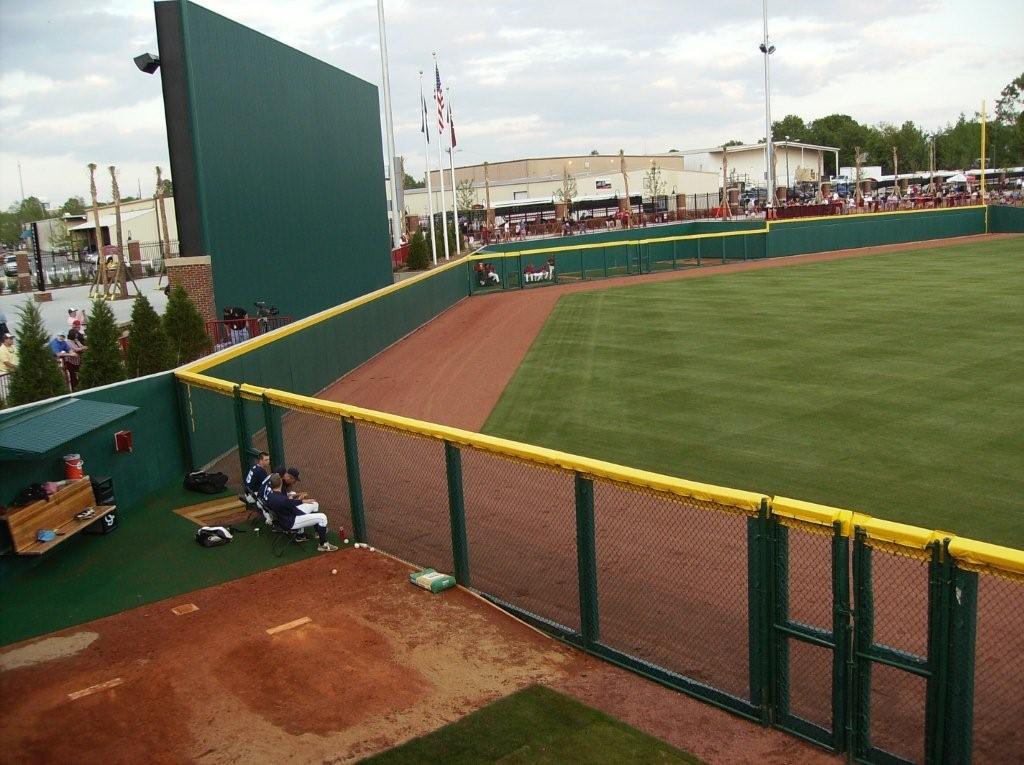
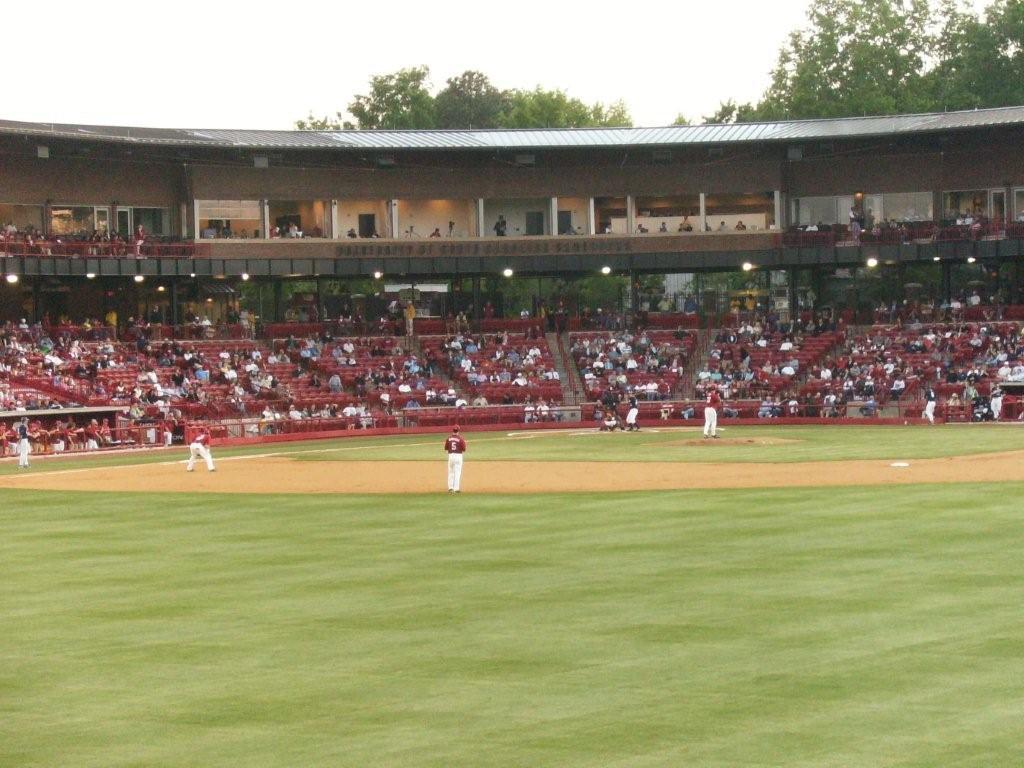
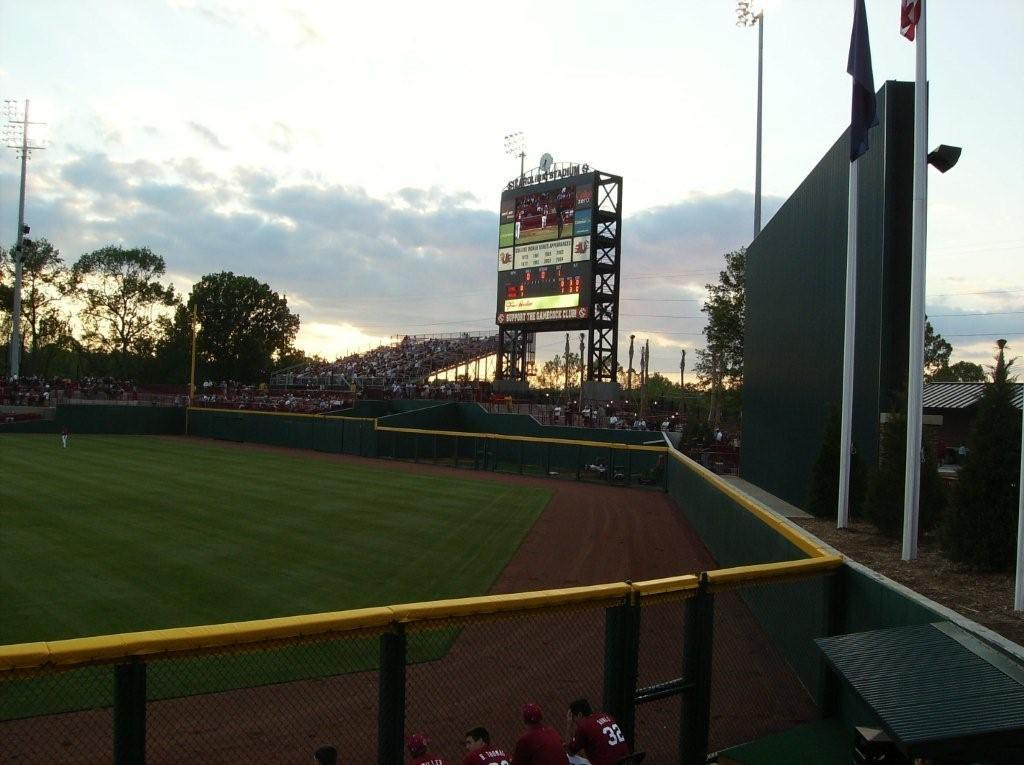
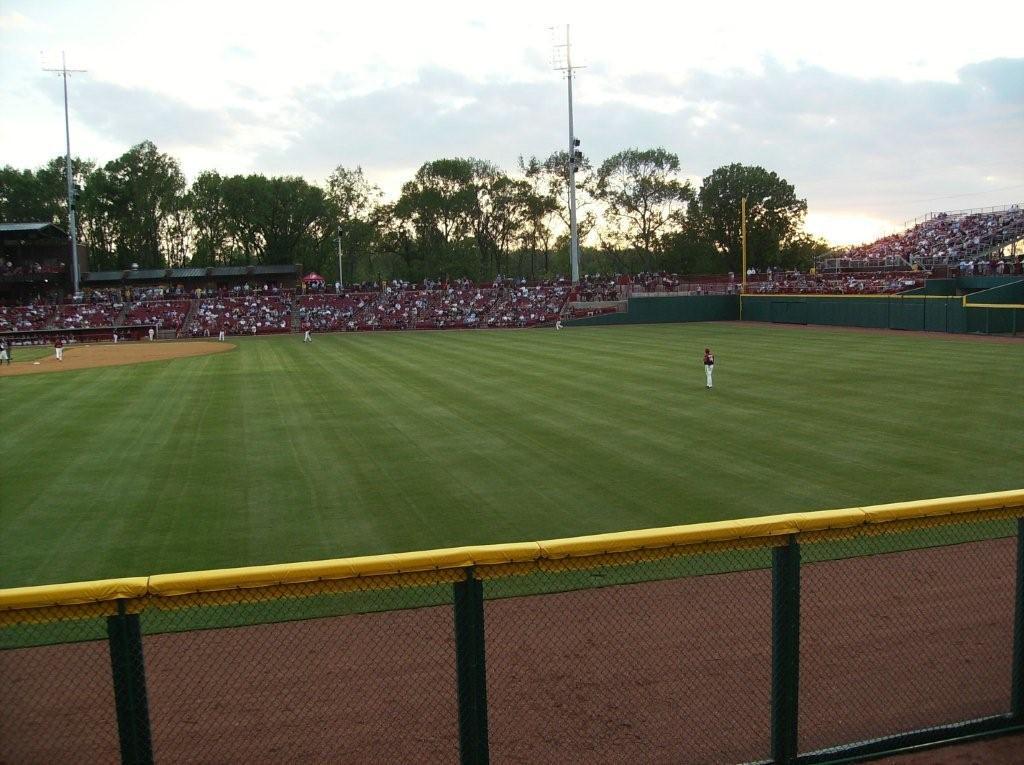
At the end of this post you can see some pictures of the new park I took during the game, from a bunch of different angles, somehow forgetting to take photos of the concourse and the concession areas until the batteries in my camera died.  I’m also not the most skilled of photographers, so they aren’t the best pictures in history.  It’s a nice stadium, definitely SEC-caliber.  Some observations about the park, and the game:

  • There was a sign noting that, in an effort to be eco-friendly, one half of the scoreboard was lit using a hydrogen fuel cell.  Why only half, I have no idea.
  • Speaking of the board, I noticed that the “Carolina Stadium” lettering was not lit.  I assume that either it wasn’t working, or more likely that the folks at USC are still looking to sell naming rights to the stadium, and didn’t want to pay for custom-designed lighting that will only be temporarily used.
  • There is a grass area down the first base line near the right field wall called the “Bi-Lo Berm”.  I have to wonder how long Bi-Lo will continue to sponsor the berm, given that the company filed for Chapter 11 bankruptcy last month.
  • The field itself looked fantastic, which was very impressive, particularly given the weather over the past few days.  I give the groundskeeper an A.
  • The parking situation is abysmal.  I’m just waiting for the first pedestrian fatality (it will probably happen after a game, after darkness).   If anything, it’s worse than it was at Sarge Frye Field, which is really saying something.  For someone like me, who would be inclined to go to USC games every now and then just to watch good baseball, it’s a reason not to go.
  • The stadium holds 9,000.  The announced crowd last night was 6,923, which is a nice crowd for a weekday game, although to be honest I didn’t think the park was at 75% capacity.  I thought it was more like 60%-65%.  The Citadel brought a fair amount of people, which wasn’t that big a surprise.
  • Having a true freshman throw 134 pitches in a game is normally asking a lot, but I can’t really fault Fred Jordan in this case, given the actual performance by T.J. Clarkson.  Clarkson didn’t exactly run out of gas, either, as he retired the last nine batters he faced.  I wondered if he had a little trouble getting loose in the early going, but he ended the game on a roll.
  • Drew Mahaffey pitched in both games this season against South Carolina.  In those two games, he faced 12 batters, retiring all 12, with 8 strikeouts (6 swinging), a foul out, a tapper back to the pitcher, and two routine fly outs.  In the first game, he entered the contest with runners on second and third and no outs.  Neither scored.
  • In two games this season against the Gamecocks, Bryan Altman had an OBP of .818, with seven hits (including a homer) , two walks, two runs batted in, and four runs scored.
  • This is a pretty good USC team, but it’s not as good as some more recent editions.  I think part of this is due to its lineup not having a true scares-you-every-time-he’s-at-bat kind of player.  Past Gamecock teams have usually had a couple of those guys.

I haven’t posted much about the baseball team.  One reason for that is I’ve been a little busy.  The other is that I was going to wait a little into the season so I could get a handle on this year’s club.  The thing is, though, that the Bulldogs have played 35 games and I still don’t have a real good handle on the team.  They have a .600 winning percentage in league play, and a .600 winning percentage out of conference  — and yet I really can’t say the Bulldogs are a consistent outfit.  Here are some of my thoughts on the team (some of which could be wildly off the mark, to be sure):

  • The lineup, from 1-6, is excellent.  Those six guys can all hit, and with some pop.  The two freshmen have both acquitted themselves very well.  I worry a little about two lefties at the 4-5 spots, where a late-game LOOGY could come into play, but that’s a minor quibble.  William Ladd is currently batting .351 (824 OPS), and looks to have locked down the seventh spot in the lineup (nice outfield assist in last night’s game, too).  That leaves the designated hitter (for games Richard Jones catches) and shortstop as question marks in the batting order.  The DH spot will likely be something of a revolving door, based on matchups, which is fine (although Sid Fallaw has received the majority of the opportunities so far).  Shortstop is another matter.
  • The Bulldogs have been erratic defensively, which makes it all the more important to have an everyday shortstop.  That would have been Kyle Jordan, of course, but you just can’t have a player with a 367 OPS as a regular.  His terrible season-long slump has been a major problem.  I’m not sold on Altman as a regular shortstop.  Johnny Dangerfield hasn’t been bad, but his bat isn’t quite big enough to make up for the defensive deficiencies in the middle infield when Altman moves over.
  • The pitching has been mediocre, even though The Citadel does lead the Southern Conference in ERA, thanks to A)  its home park, and B) the incredible lack of quality pitching in the league this year (SoCon ERA, as a conference:  6.35).  Mahaffey has been outstanding in the closer role.  The starting pitching hasn’t been that good, but it generally hasn’t been terrible, either.  The midweek starters haven’t been bad at all.  What the Bulldogs don’t have is an ace.  The middle relief/setup men have been poor.

The Citadel, right now, strikes me as a team you wouldn’t want to face in the Southern Conference tournament, but a team probably not consistent enough to win the entire tournament.  However, I can see that changing for the better.  If Raymond Copenhaver (and/or someone else) can shore things up in the 7th-8th innings, and get the game to Mahaffey, the Bulldogs have plenty of starting pitchers capable of a solid 6-inning effort.  In post-season play, having four (or five) of those kinds of pitchers will work to The Citadel’s advantage; that’s the type of depth you need to win a conference tourney.

First, though, The Citadel has to make sure it qualifies for the SoCon tournament, which means it has to finish as one of the top eight teams in the league.  The Bulldogs are well on their way to making it, but there are still 15 conference games left, starting Friday at UNC-Greensboro.  UNCG is currently 2-11 in the league, in last place, and will be desperate to win the series and climb out of the cellar.

It would be ironic if the Spartans ultimately do not qualify for the conference tournament, since UNCG coach Mike Gaski campaigned for many years to move the league tourney out of Charleston, claiming it was an unfair advantage to the two Charleston schools.  The conference brass finally buckled under his criticism (among that of others), and moved the tournament for this season to Greenville.  Now there is a decent chance the Spartans won’t even make the field.

Pictures from last night:

Bubbling Basketball, 3/14

There is a lot more uncertainty than usual on the Saturday morning before Selection Sunday.  Part of that is due to several surprise conference tournament finalists, and part of it is due to a more-mediocre-than-normal bubble.  Combine that with the traditional difficulty of evaluating mid-majors against middle-of-the-road majors and you have a bit of a mess.

Locks by conference:

ACC (6):  North Carolina, Duke, Wake Forest, Florida State, Clemson, Boston College
Pac-10 (4):  Washington, UCLA, Arizona State, California
Big East (7):  Pittsburgh, Louisville, Connecticut, Villanova, Syracuse, Marquette, West Virginia
SEC (2):  LSU, Tennessee
Big 10 (4):  Michigan State, Purdue, Illinois, Ohio State
Big XII (5)  Oklahoma, Kansas, Missouri, Texas, Oklahoma State
Mountain West (2):  Utah, Brigham Young
Other conferences (3):  Memphis, Xavier, Butler

How things shape up going into Saturday’s action…

  • The Atlantic-10 is likely a three-bid league, with today’s Temple-Duquesne winner joining Xavier and (probably) Dayton in the field.  Dayton is not quite a lock, but a lot of things would have to happen for the Flyers not to make the NCAAs.  Temple does not have enough to get an at-large bid, despite last night’s win over Xavier.  It’s a win-and-you’re-in situation for the Owls and Dukes.
  • Utah State survived New Mexico State last night and now must beat Nevada in Reno to grab the WAC’s automatic bid.  I don’t think an at-large will be available for the Aggies, although it would be tough for the committee to leave out a team with 29 wins.
  • Tulsa must beat Memphis and garner the automatic bid for C-USA if it hopes to make the NCAAs.  An at-large bid is not a realistic option for the Golden Hurricane.
  • Likewise, Baylor must beat Missouri in the Big XII final to grab a spot and steal a bid from an at-large contender.
  • Southern California will have a shot at an at-large bid if it loses the Pac-10 final to Arizona State, but I think the Trojans have to win that game.  The run to the final has probably moved Southern Cal ahead of Arizona on the committee’s S-curve, but that isn’t going to be enough.  The Pac-10 may wind up with just four bids.
  • San Diego State can guarantee a bid by winning the Mountain West tourney today, but the Aztecs are in fairly good shape now even if they don’t beat Utah.  SDSU’s chances of making the field absent a victory on Saturday are probably in the 80% range.  New Mexico tied for the MWC regular-season title but has nothing else to offer to the committee, and I don’t see four teams getting bids in the MWC.  UNLV is out after wasting a solid non-conference effort by going only 9-7 in the league and losing at home in the first round of the conference tournament to SDSU, which beat the Rebels three times this season.
  • I still think the SEC will get three bids no matter what, but the worst-case scenario for the league has unfolded.  Auburn can get that third bid with a win today over Tennessee, but a loss to the Vols leaves the Tigers in a precarious position, with several other bubble teams having better resumes.  I suppose it’s possible the SEC will just be a two-bid league, but I find it hard to believe.  Florida is almost certainly out, and so if Auburn loses the choice for a potential third SEC team in the field comes down to Auburn and South Carolina.
  • Maryland’s victory over Wake Forest in the ACC quarterfinals gives it three wins this season over teams ranked in the top 10 of the RPI, with two of those on neutral sites, plus a handy win over Michigan.  The Terps still don’t have a true road win over a top 100 team, but no other bubble team has as many high-end victories.  Barring another embarrassing loss to Duke in the ACC semis, Maryland looks to be in good shape for an at-large bid.  Beating Duke would make a trip to the dance a lock, of course.
  • The Big 10 is still hoping to get eight bids, but I think it’s going to be seven, with Penn State being left out after getting blown out by Purdue in the conference quarterfinals.  Minnesota, Wisconsin, and Michigan all have better resumes, and none of them are locks, either.

How I see the bubble as of Saturday morning:

Texas A&M
Dayton
Minnesota
San Diego State
Wisconsin
Maryland
Michigan
Auburn
Creighton
—-
St. Mary’s
Southern California
Penn State
Arizona
South Carolina
New Mexico
Providence
Tulsa
Florida

Utah State, if it were to lose tonight, would probably be slotted behind St. Mary’s but ahead of Southern Cal (assuming the Trojans don’t beat Arizona State on Saturday).  Temple would be in the New Mexico-Providence range with a loss.  Baylor is a pure bid thief, Southern Cal could be a bid thief, and Tulsa is a de facto bid thief as well.

Bubble Watch, 3/9/09

I’m posting this prior to the Portland-St. Mary’s game, for the record…

This is my first projection to include seeding and placement, and it’s possible there is an error or two mixed in, because the first go-round is always the toughest.  At any rate, here is how I see the NCAA tournament as of right now (projected automatic bids in all-caps):

South (Memphis, IN)

Greensboro sub-regional
1 North Carolina
16 Radford
8 West Virginia
9 Dayton
Boise sub-regional
4 Missouri
13 AMERICAN
5 Gonzaga
12 Michigan
Minneapolis sub-regional
2 Michigan State
15 ROBERT MORRIS
7 California
10 Oklahoma State
Philadelphia sub-regional
3 Villanova
14 BUFFALO
6 Tennessee
11 UTAH STATE

West (Glendale, AZ)

Kansas City sub-regional
1 Oklahoma
16 CAL STATE-NORTHRIDGE
8 Brigham Young
9 Wisconsin
Miami sub-regional
4 Louisiana State
13 WESTERN KENTUCKY
5 Florida State
12 Providence
Dayton sub-regional
2 Louisville
15 East Tennessee State
7 Purdue
10 St. Mary’s
Portland sub-regional
3 Washington
14 WEBER STATE
6 Butler
11 SIENA

East (Boston, MA)

Philadelphia sub-regional
1 Connecticut
16 MORGAN STATE
8 Texas
9 Ohio State
Portland sub-regional
4 Xavier
13 Northern Iowa
5 Clemson
12 VIRGINIA COMMONWEALTH
Kansas City sub-regional
2 Memphis
15 Cornell
7 Arizona State
10 Minnesota
Miami sub-regional
3 Wake Forest
14 NORTH DAKOTA STATE
6 Marquette
11 New Mexico

Midwest (Indianapolis, IN)

Dayton sub-regional
1 Pittsburgh
16 Morehead State/ALABAMA STATE (play-in game; also in Dayton)
8 Boston College
9 Texas A&M
Boise sub-regional
4 Ucla
13 STEPHEN F. AUSTIN
5 Utah
12 Penn State
Greensboro sub-regional
2 Duke
15 UT-CHATTANOOGA
7 Syracuse
10 Arizona
Minneapolis sub-regional
3 Kansas
14 BINGHAMTON
6 Illinois
11 South Carolina

Notes:

  • As of now, North Carolina has the top overall seed in my projection, based on finishing first in the ACC, while none of the other three #1 seeds won their respective conference titles.  Louisville will be probably be battling Pitt and UConn for two available #1 seeds in the Big East tournament.  I think Memphis has a shot at a #1 if it wins the C-USA tournament and Oklahoma bows out early in the Big XII tourney.
  • The brackets are set up as follows:  South vs. West, East vs. Midwest
  • I had a lot of trouble deciding how the committee would place teams.  I think they are going to want to have at least one “draw” in the Portland and Boise sub-regionals, so putting Washington/UCLA in those sites seemed logical, and Gonzaga will probably be in one of them as well.  It’s a bit of a tough draw for Missouri in particular, but after the first round nobody is protected.  I don’t like putting Villanova in Philly — that struck me as not being in the spirit of things — but if the Wildcats get a 3 seed or better I can see it happening.
  • Every team on seed lines 8 and up is safe for the tournament, and the 9 seeds are all in decent shape.  The bubble action starts on line 10 and goes through line 12, with some automatic bids interspersed here and there.
  • Last six in:  South Carolina (last in), Penn State, Providence, New Mexico, Michigan, St. Mary’s
  • Last six out:  UNLV (last out), Creighton, Florida, Miami (FL), Maryland, Auburn
  • Also considered:  San Diego State, Virginia Tech, Davidson, Rhode Island, Kansas State, Southern California

South Carolina, to be perfectly honest, is a bit of a placeholder; I have the Gamecocks in the field based on my belief that at least three SEC teams will be in the tournament, no matter what happens.  As of right now, I give South Carolina the edge over Florida and Auburn for the third bid from that decidedly mediocre league.  It is possible for the SEC to get four bids, depending on how things shake out in that league’s tourney, as well as tournaments across the country.

At this point Siena and Utah State would be advised to win their respective conference tournaments.  I don’t see either grabbing an at-large bid if it needs one.

St. Mary’s is the toughest call in terms of evaluation/figuring out what the committee will do.  If the Gaels lose to Gonzaga in the WCC final, then I think they will get an at-large bid. Otherwise, I don’t see it happening.

Trying to rise above a history of misery

Yes, it’s Southern Conference tourney time.  If you’re a fan of The Citadel, you may want to cover your eyes while reading some of this.  If you’re not, you may want to cover them anyway…

First, the good news.  The Bulldogs rebounded nicely (literally and figuratively) from their loss to Wofford by beating a ragtag Georgia Southern squad 74-53 on Monday night.  The Eagles hung around a little too long for my liking, making two good runs in each half, and were down by just six points with over 13 minutes left in regulation.  In the next seven minutes of the game, however, Georgia Southern had more technical fouls (2) than made field goals (1).  It’s hard to complete a comeback when that happens.

The Citadel thus got a much-needed bye into the quarterfinals of the Southern Conference tournament.  Besides not having to play four games in four days in order to win the tourney, the extra day may also help the Bulldogs in their preparation for the event, as there are some on-court adjustments that need to be made.  Among other things, The Citadel committed 18 turnovers on Monday night, many of them unforced.

Demetrius Nelson and Cameron Wells each had five turnovers, which is too many, but they also combined for 42 points (Nelson had 11 rebounds as well).  John Brown had four, and that’s a bit more worrisome, as he isn’t in a position to handle the ball nearly as often in a scoring or closely guarded position (and thus shouldn’t have as many turnovers).  Brown forced things a bit on offense, particularly in the first half, which was a carryover from the Wofford game on Saturday.

In the Southern Conference tournament, teams are almost certainly going to employ Wofford’s strategy of doubling Nelson repeatedly while giving Brown space on the wing, because Brown is not yet an offensive threat unless he’s making layups or dunks.  How Ed Conroy and company adjust to this will go a long way to determining The Citadel’s tournament fate.

Having said that, it should be noted that despite those 18 turnovers and decent-but-not-great outside shooting, the Bulldogs went on the road and under a good deal of pressure (given the importance of winning the game) defeated a conference opponent by 21 points.  The fact it’s actually possible to be disappointed in some aspects of The Citadel’s play after a result like that speaks volumes about how good this team has been, and the expectations it now has.

Those expectations include making a serious bid at a first-ever Southern Conference tournament title.  Before casting a forward glance towards Chattanooga, however, perhaps it’s best to realize just how arduous a task the Bulldogs face.  When it comes to The Citadel and its history in the Southern Conference tourney, a few paragraphs are in order, because just a few words cannot begin to adequately describe the horror…

One of the more curious things about The Citadel’s wretched history in the SoCon tourney is that there is no firm answer to just how many times the school has lost in the event.  That’s because the league has mutated so many times there is a dispute as to what year the first “official” conference tournament was held.

Before 1920, The Citadel was one of many schools in a rather loose confederation known as the Southern Intercollegiate Athletic Association.  (The Citadel initially joined in 1909.)  There were about 30 colleges in the SIAA by 1920, including almost every member of the current SEC and about half of the current ACC, along with schools such as Centre, Sewanee (somewhat amusingly, later a member of the SEC), Chattanooga, Wofford, Howard (now called Samford, of course), and Millsaps, just to name a few.  As you might imagine, the large and disparate membership had some disagreements, and was just plain hard to manage, so a number of the schools left to form the Southern Conference in late 1920.

In the spring of 1921, the SIAA sponsored a basketball tournament, which would be the forerunner to all the conference hoops tourneys to follow.  Any southern college or university could travel to Atlanta to play, and fifteen schools did just that.  Kentucky beat Georgia in the final.  The Citadel did not enter the event, but several other small colleges did, including Newberry.  The tournament featured teams from the new Southern Conference, the old SIAA, and squads like Newberry, which wasn’t in either league (it would join the SIAA in 1923).

In 1922 the SIAA held another tournament in Atlanta, this one won by North Carolina, which beat Mercer in the final.  The Citadel entered this time, losing in the first round to Vanderbilt.  The SIAA tournament remained all-comers until 1924, when it was restricted to Southern Conference members.

Some sources suggest that the 1921 tournament is the first “official” Southern Conference tournament, some go with the 1922 event, and others argue for 1924.  From what I can tell, the league itself is a bit wishy-washy on the issue.  On the conference website, it states:

The first Southern Conference Championship was the league basketball tournament held in Atlanta in 1922. The North Carolina Tar Heels won the tournament to become the first recognized league champion in any sport. The Southern Conference Tournament remains the oldest of its kind in college basketball.

That’s great, but the conference’s own record book lists Kentucky as having won the first tournament title in 1921 (on page 113; oddly, that year is excluded from the game-by-game tournament results that begin on page 114).  Of course, the edition of the record book on the conference website is three years old and lists The Citadel as having once lost 37 straight games, which is incorrect, so take it for what you will.

Personally, I think that the idea of having a conference tournament is to determine a league champion, and it stands to reason that such a tournament would only include league members.  So the first “real” Southern Conference tournament, in my opinion, was held in 1924.

There is a point to this, trust me.  The difference between counting the Vanderbilt loss as a SoCon tourney loss and not counting it is the difference between The Citadel’s alltime record in the event being 10-55 or 10-56.  Not that they both aren’t hideous totals, but as of now The Citadel shares the NCAA record for “most consecutive conference tournament appearances without a title” with Clemson, which is 0-for-55 in trying to win the ACC tournament.  Counting the Vanderbilt game would mean The Citadel is alone in its conference tourney infamy.  No offense to the Tigers, but I don’t believe the 1922 game should count, because it wasn’t really a Southern Conference tournament game.

By the way, you read that right.  The Citadel is 10-55 alltime in the SoCon tournament.  That’s just unbelievably bad.  It comes out to a 14% winning percentage, which is more than twice as bad as even The Citadel’s lousy alltime conference regular season winning percentage (35%).  The Citadel lost 17 straight tourney games from 1961-78, and then from 1985-97 lost 13 more in a row.  Incidentally, the single-game scoring record in the tournament is held by Marshall’s Skip Henderson, who put up 55 on The Citadel in 1988 (in a game Marshall won by 43 points; karma is a you-know-what, as the next night the Thundering Herd, which had won the regular season title that year, lost to UT-Chattanooga by one point).

Those losses aren’t all in consecutive years, as The Citadel didn’t always qualify for the tournament, particularly in the years before 1953, when there were up to 17 teams in the league at any given time, and only the top squads played in the tourney.  The Citadel’s first “real” appearance, in 1938, resulted in a 42-38 loss to Maryland.  The Citadel would lose two more tourney openers before winning its first game in 1943, against South Carolina.  That would be the only time the Bulldogs and Gamecocks faced each other in the tournament, and so South Carolina is one of two teams The Citadel has a winning record against in SoCon tourney play (the Bulldogs are 2-0 against VMI).

The next time The Citadel would win a game in the tournament?  1959, when the Bulldogs actually won two games, against Furman and George Washington, and found themselves in the tourney final.  Unfortunately, the opponent in the title game was West Virginia, led by Jerry West.  West scored 27 points and the Mountaineers pulled away late for an 85-66 victory.  This would be the only time The Citadel ever made the championship game; it’s also the only time the Bulldogs won two games in the tournament.

After a 1961 quarterfinal victory over Richmond, The Citadel would not win another tournament game until 1979, when the Bulldogs defeated Davidson before losing to Furman.  The game against Davidson was played at McAlister Field House, and was the 20th victory of the season, which until Monday was the most games ever won by a Bulldog squad (now tied, of course, by the current edition of the Bulldogs).

The Citadel would win single games in 1982 and 1985 before going winless until 1998, when it finally broke a 13-game tourney losing streak by beating VMI.  The Keydets would be the next victim as well, in 2002, and were apparently so embarrassed they left the league.  The Citadel’s latest win in conference tournament action came in 2006 against Furman.

Twenty different schools have defeated The Citadel in tournament play, with Davidson’s eight victories leading the way (against one loss to the Bulldogs).  East Tennessee State went 6-0 against The Citadel while in the league.

At least ETSU won’t be around this season.  The Citadel’s first game in this year’s tournament will come against either first-year league member Samford or Furman.  The Paladins are 5-2 alltime in tourney play against The Citadel, with the Bulldogs having won the first and most recent meetings.  Records against other tourney teams:  Chattanooga 0-1, Elon 0-1, College of Charleston 0-1, Georgia Southern 0-2, Western Carolina 1-1, Appalachian State 1-6, and Davidson 1-8.  (The Citadel has never played Wofford or UNC-Greensboro in the tournament.)

The very first game worries me.  If it’s Samford, don’t look for another 25-point win.  The Citadel caught that team on a bad night.  Samford is well-coached and its slow-slower-slowest offense can give even a patient team like The Citadel fits.  I am concerned about how the team will react when the bright lights come on for the first time and suddenly everything is on the line, especially when in the unfamiliar role of favorite.  If the opponent is Furman, it would be a much more confident Paladin squad (after coming off a victory) than the one which recently lost to The Citadel, and one that would be more than happy to end a rival’s dream season.

If The Citadel survives the opener and moves to the semifinals for only the second time in 24 years, the opponent could be one of three teams, a trio against which the Bulldogs had a combined regular season record of 1-4, with the one win coming at home by two points.  Of course, one of those potential opponents, Chattanooga, is also the host school for the tournament.

It has been fifty years since The Citadel made its first and only trip to the title game, and if the Bulldogs somehow win two games (for only the second time ever), the opponent will likely either be Davidson, with a healthy Stephen Curry in tow, or a red-hot College of Charleston squad ready to avenge two regular-season defeats at the hands of the Bulldogs.

It’s easy to see that winning the tournament will be a very tall order.  Combine that difficulty with the sordid history of The Citadel in the SoCon tournament, and it’s really hard to imagine the Bulldogs cutting down the nets on Monday night.  That’s a scenario that seems unlikely to unfold.

However, there is another way to look at things.  This isn’t your typical Bulldog squad.  This is a team that has the league’s second-best record, that has won 12 of its last 13 games, that has proven it can win away from home, and has demonstrated it can win even on nights when its key players aren’t at their best.  It has won close games and blowouts, is led by the newly minted coach of the year in the conference, and features an all-conference post player along with an outstanding, versatile group of guards.  If there ever was a team from The Citadel capable of overcoming all that negative history, and making some positive history of its own, this is the one.

Saturday night can’t get here soon enough…

Bubbling Basketball, 3/2/09

With two weeks to go until Selection Sunday, there is still a fairly large group of bubble teams, but the potential at-large pool has become more defined.  My current groups of eight:

Group 1:  Connecticut, North Carolina, Oklahoma, Pittsburgh, Louisville, Memphis, Michigan State, Duke

I have three Big East teams in the top five of my S-curve, but it is unlikely that conference winds up with three #1 seeds.  UConn and Pitt still have to play again in the regular season (at Pitt), and then the Big East tournament will have a culling effect of sorts.  Memphis is also a strong candidate for a #1 seed.  Oklahoma may not win the Big XII regular season after losing two games due to Blake Griffin’s concussion, but I don’t think that is going to cost the Sooners much, if anything, in terms of grabbing a #1.

Group 2:  Kansas, Wake Forest, Washington, Missouri, Villanova, LSU, Purdue, Marquette

Kansas and Missouri both being on the 3 line after this weekend’s blowout win for the Jayhawks gave me pause, but that’s just the way it is.  Washington has made a strong push, with nine wins in its last twelve games (six of its last seven).  LSU is going to run away with the SEC regular season title, and even in a bad year for that league, it’s hard to see the Bayou Bengals not being rewarded with a top 16 seed.  If LSU chokes in the SEC tourney, though, that could change.

Marquette stays where it is, and will continue to do so, until it is demonstrated that Marquette is significantly affected by the season-ending injury to Dominic James.  I think it’s almost certain that his injury will have a negative effect on the team’s performance over time, but losing a competitive game to Louisville doesn’t really make it obvious.

Group 3:  Xavier, Florida State, UCLA, Clemson, Illinois, Butler, Gonzaga, Utah

I think you have to rate Florida State ahead of Clemson at this point.  The Tigers are only 6-6 in their last 12 games, which includes a loss at Virginia and a home loss to Virginia Tech, in addition to the sweep at the hands of the Seminoles.  Butler has eleven “true” road wins, including a victory at Xavier.  In other respects its profile does not really scream “6 seed”, though.

Gonzaga is going to play USC Upstate and its 290 RPI before beginning play in the WCC tournament.  It will be the sixth time Mark Few’s men have played a team with a current RPI of 276 or worse.  Four of those are conference games against Loyola-Marymount and Pepperdine.  Two other teams in the WCC also have RPIs below 200.  Keep that in mind, but not to hold against Gonzaga.   Just wait until we get to the bubble teams and one league in particular…

Group 4:  Arizona State, Syracuse, West Virginia, California, Dayton, Boston College, Tennessee, Texas

Most of these teams can just about book their tournament reservations at this point.  Syracuse is essentially a lock, and the rest probably need just one more win.  You could make a good argument that ASU and the ‘Cuse should be rated ahead of Utah.  Tennessee separated itself from the other SEC bubblers with its win on Sunday against Florida (completing a sweep of the Gators), thanks in large part to separating itself from its league brethren before the season started with its strong non-conference schedule.

Group 5:  Wisconsin, Brigham Young, Ohio State, UNLV, Creighton, Minnesota, Texas A&M, South Carolina

Ah, here is where the fun really starts…

Wisconsin played a very good schedule (currently rated sixth nationally).  Its biggest non-conference scalp came at Virginia Tech, which will come in handy, along with sweeps of Michigan and Penn State and a victory over Ohio State.  The Badgers next play Minnesota, and need to win to avoid being swept by the Gophers.  A win in Minneapolis won’t be easy, but if Wisconsin gets it and beats Indiana in its home finale, it should be set.  Even a loss to Minnesota won’t be fatal, although the Badgers may want to win a game or two in the Big 10 tourney just to be safe.  The average RPI of the teams Wisconsin has defeated is 104, which is a very impressive number.

BYU is 8-3 on the road this season, and also has a neutral-site victory over Utah State.  None of the road victories was a really good one, but on the other hand, BYU played a representative schedule and only has one serious flaw on its resume, a sweep at the hands of UNLV.  There are worse teams to have been swept by, though.  I’m not overly enthused by the Cougars’ profile, but they’ve done what they needed to do, which is why the RPI is 22, and BYU will make the NCAAs unless it badly stumbles down the stretch.  I will give BYU credit for not scheduling a lot of games against 200+ RPI teams.

Ohio State beat Butler at home, Notre Dame in Indianapolis, and Miami (FL) on the road (where it got lucky, frankly).  Those results and no bad losses will go a long way to getting an at-large bid, but the Buckeyes are only 8-8 in the Big 10 (including getting thumped over the weekend by Purdue) and probably need two more wins.  As it happens, they close with games at Iowa and home to Northwestern.

UNLV has the aforementioned sweep of BYU, a win over Utah, and most importantly, a win at Louisville.  The Rebels have also lost at Colorado State and at TCU, and as a result find themselves in fifth place in the Mountain West.  I think UNLV has the profile to get an at-large bid and become team #3 ouf of the MWC, but it needs to win its last two (including at San Diego State, which would get the Rebels at least a tie for 4th in the league), and then not fall apart at the Mountain West tournament, particularly since that tournament is in Vegas this year.

Creighton has won ten straight games and heads into the Missouri Valley tournament with the #2 seed (losing a tiebreaker after tying for the regular season title).  The Blue Jays don’t have a win on their resume that will make you stand up and take notice, but one thing Creighton apparently did was try to figure out what other mid-majors might be good this season, and then proceeded to schedule them.  In addition to the Bracketbusters game against George Mason, Creighton has also played Dayton, New Mexico, Arkansas-Little Rock, Oral Roberts, and St. Joseph’s, winning all of those games with the exception of a last-second lost to UALR.  I would like the profile a little better without the losses to Wichita State and Drake, but 25 wins while playing in the nation’s ninth-rated conference is worth serious consideration when doling out at-large bids.

Minnesota has a neutral-site win over Louisville, a win at Wisconsin, and a win over Illinois in one of the Big 10’s notorious “first to 40 wins” contests.  The Gophers are only 5-7 in their last twelve and really need a couple of wins down the stretch to feel secure.  They have two home games remaining, both of serious bubble interest, as they play Wisconsin and Michigan.  The Gophers are the quintessential major-conference bubble team.

Texas A&M has excellent computer numbers (RPI of 35).  The Aggies have a neutral-site win over LSU and home wins over Texas and Arizona.  The problem for A&M is that it is only 7-7 in a Big XII that no one is favorably comparing to the ACC or Big East.  Texas A&M is building momentum, though, with four straight wins, and it figures to be five after a game at Colorado on Wednesday.  The Aggies finish the regular season with a home game against Missouri and a chance to play its way into the NCAAs.

Before getting to South Carolina, let’s review Group 6, which has six teams, and then the rest of the hopefuls which as of right now aren’t in my tournament projections:

Group 6:  Oklahoma State, Miami (FL), Arizona, Maryland, Florida, Michigan

Also hoping:  Virginia Tech, St. Mary’s, Providence, Rhode Island, Utah State, Georgetown, Penn State, Notre Dame, Cincinnati, Kentucky, Davidson, Siena, New Mexico, UAB, San Diego State

Oklahoma State is a lot like Texas A&M; I have a hard time separating them.  They split two meetings.  Oklahoma State has a one-game lead over A&M in the conference standings.  The Aggies beat LSU and Arizona; the Cowboys have neutral-site wins over Siena and Rhode Island.  Both beat Texas.  Okie State has won five straight and finishes with Kansas State at home and Oklahoma in Norman.

Miami (FL) and Arizona are similar in that they need to take care of business.  The Hurricanes have two very winnable games to get to 8-8 in the ACC; then Miami probably needs to win a game in the ACC tournament.  Arizona is 8-8 in the Pac-10 and is poised to get the fifth bid from that league, but needs to beat Stanford and either Cal or its first-round opponent in the Pac-10 tournament (which may in fact be Cal).

Maryland and Michigan have some similarities as well.  Both have played difficult schedules.  Both have major out of conference victories (North Carolina and Michigan State for the Terps; Duke and UCLA for the Wolverines).  Of course, Maryland beat Michigan earlier in the season, which is another solid OOC victory for the  Terps.  Maryland is 7-7 in ACC play; Michigan is 8-9 in the Big 10, with a game at Minnesota left to conclude its regular season.  I think Maryland needs to finish 8-8 in conference, and possibly (but not necessarily) win an ACC tourney game.  Michigan might be good to go if it can get that win against Minnesota (which would have the added benefit of hurting the chances of another bubble team).  Otherwise, the Wolverines may have to do some damage in the Big 10 tournament.

South Carolina, Florida, and Kentucky — let’s look at the SEC bubblers, shall we?

Earlier I noted that Gonzaga had played six teams with RPIs of 276 or worse.  Four of them are in the Bulldogs’ league, which means Gonzaga had no control over the scheduling of those games.  Because of these games, the average RPI of the teams Gonzaga has beaten this season is 160.

The average RPI of the teams Florida has defeated is 179.  Kentucky?  173.  South Carolina?  172.

Florida has actually played seven teams with RPIs worse than 276, all as part of its non-conference slate.  The Gators have 21 wins, but has beaten only two teams in the top 75 of the RPI — Washington (in Kansas City) and South Carolina.

The Gamecocks have not much more heft to their resume, with a sweep of Kentucky to go with a win over Florida and a victory at Baylor, all as part of a schedule not much stronger than that of the Gators.

Kentucky has swept Tennessee and beaten the Gators, and has a neutral-site win over West Virginia.  Kentucky also has six wins against teams with RPIs of 299 or worse, dragging down its computer numbers, which are also affected by home losses to Mississippi State and (especially) VMI.

Just to give you an idea of how the SEC teams compare with other teams in terms of scheduling wins, the average RPI of the teams defeated by some of their fellow major conference bubblers:

Michigan – 133, Arizona – 139, Miami (FL) – 139, Oklahoma State – 148, Texas A&M – 143, Minnesota – 142, Maryland – 146, Virginia Tech – 150, Cincinnati – 152, Georgetown – 110, Notre Dame – 167, Providence – 165, Penn State – 170

It’s rather striking when looked at that way.  It shows why Georgetown is still a bubbler despite all its losses, why Penn State has work to do (despite road wins over Michigan State and Illinois), and why Notre Dame is essentially done, especially after losing at home by 17 to Villanova.  Georgetown got its win over Villanova, and Providence still has a game to play against the Wildcats.

It also shows why the SEC resumes are less than the sum of their parts.  Florida and Kentucky face each other in what some are calling a “play-in” game; I would suggest it should be called a “play-out” game, with the winner still having work to do in the SEC tourney.

Rhode Island has played a lot of “close but no cigar” games, including a three-point loss at Duke, a one-point loss at Providence, and a two-point loss to Xavier.  The Rams have won 10 of their last 11 games and will get a look from the committee if they go deep in the A-10 tournament.  If you don’t take into account the close losses, though, URI’s profile isn’t quite good enough, and I’m not sure you should take into account close losses.

As to what the committee will do if St. Mary’s makes the WCC final and loses to Gonzaga, I really don’t know.  I suspect the Gaels, with a healthy Patty Mills, are at-large quality.  The resume doesn’t really bear that out, however.

I don’t think the remaining non-BCS candidates have much of a shot at an at-large bid.  Of the group, I like Davidson the best, but I don’t think Stephen Curry and crew can absorb another loss, even if it would be to one of the better SoCon teams, like The Citadel or the College of Charleston.  UAB had a chance to make a statement against Memphis; instead, Memphis made the statement.  The Blazers do have a win over Arizona, but have not really been dominant against the non-Memphis C-USA teams.

Siena’s loss on Friday to Niagara probably torpedoed any at-large hopes.  New Mexico, San Diego State, and Utah State all have less-than-imposing resumes with little to offer in the way of significant non-conference wins.  Utah State does have a win over Utah, and probably has the best shot of an at-large among the western non-BCS schools.

There is still a lot of action remaining in the regular season.  Not unlike the weather, if there is something you don’t like concerning the bubble picture, just wait — things will change.

Bubbling Basketball, 2/23/09

Every season about this time I start to take a look at how the NCAA Men’s Basketball Tournament is shaping up, and begin to project the bracket, just like numerous other lost souls, some of whom get paid to do so.  It’s probably a pointless exercise, because A) it’s still too early, and B) it’s not really possible to replicate the selection committee.  Kyle Whelliston at The Mid-Majority made this point in a chat about ten days ago, and he’s absolutely right.  As he says, individual projecting “involves one person trying to simulate the groupthink brain processes of ten people”.

Even if you took a bunch of projections and combined them, it’s not quite the same thing, because it doesn’t account for the interaction between people sitting together in one room and developing a consensus.  It also doesn’t account for the nuts and bolts of the process, which involves a lot of voting on teams, grouping of teams, etc.

That doesn’t mean it isn’t fun to guess at what the brackets might look like on Selection Sunday, though…

Before I get into specifics for this year’s tournament, I want to address the notion that various teams are “locks” for the tournament.  To me, a “lock” is a team that could lose every game the rest of the season and still make the NCAAs.  In other words, there aren’t a lot of locks at this point.  Nothing is more ridiculous than to assert a team is a lock in your brackets, then to take lock status away from that team and put it back in the mix of teams competing for at-large berths, all because it lost a game or two.

ESPN.com did just that this past week with Butler, which had been a “lock” in that site’s version of “Bubble Watch” for about a month.  Once Butler dropped games to Loyola of Chicago and UW-Milwaukee, though, the Bulldogs were “de-locked”.  Butler is now again a “lock” on ESPN.com after beating Davidson on Saturday.  Truthfully, Butler won’t be a lock until (or if) it wins the Horizon League tournament.

On this site, you won’t see any team called a lock unless it really is one.  Sipping on some Paul Masson somewhere in the great beyond, I think Orson Welles approves of this notion.

I’m not going to play the assign-a-team-a-regional game today.  I’m going to simply break down the prospective field by groups of eight:

Group 1:  Pittsburgh, Oklahoma, Connecticut, North Carolina, Memphis, Michigan State, Duke, Louisville

I don’t think the committee is going to penalize Oklahoma too much for losing a close game at Texas in which Blake Griffin was a non-factor due to injury.  As of right now, though, Pittsburgh almost has to be the number 1 overall seed.

Group 2:  Villanova, Kansas, Missouri, Clemson, Wake Forest, Purdue, Washington, Marquette

I think Washington will grab a top-16 seed if it wins the Pac-10 regular season title outright.  It would also help the selection committee when assigning teams to regionals.  There is a distinct lack of western options when it comes to highly seeded teams.

Group 3:  Arizona State, Xavier, UCLA, Utah, Florida State, Illinois, West Virginia, LSU

I don’t know what the committee will do with Utah or LSU in terms of seeding.  I know LSU has a gaudy SEC record, but this season that’s not the most impressive of accomplishments.  Utah has done similar work in the Mountain West — and of course, beat LSU earlier this season by 30 points.  I think LSU is a 6 seed-type, but I wouldn’t be surprised if the Tigers wind up with a 4.

Group 4:  Texas, Gonzaga, California, Syracuse, Tennessee, South Carolina, Florida, Dayton

Distinguishing between the bubblicious SEC teams is not easy.  Kentucky has swept Tennessee and may deserve to be in this group;  it can move to this level by winning at South Carolina or at Florida (the Wildcats also have a home game against LSU, so it’s all in front of them).  The Vols played a much tougher non-conference schedule than its fellow SEC East contenders and will presumably be rewarded for it.  Florida has 21 wins, but the average RPI of the teams it has beaten is 176.  Of course, South Carolina’s average RPI victory is 179, while Kentucky’s is 169.  LSU?  173.  (Tennessee’s is 125.)

You get the idea.  This is not a banner season for the SEC.  This is highlighted by Gonzaga’s average RPI win being 155, better than any of the SEC contenders save Tennessee, despite the Bulldogs playing in the WCC (and having also played a non-conference game against Texas Southern of the SWAC).  Comparing the SEC numbers with those of standard-bearers for the Big East and ACC is even more instructive.  Pittsburgh has beaten teams with an average RPI of 100; North Carolina’s number is 96.  Honestly, I think the SEC teams could each be a group below where I’ve listed them.

Group 5:  Wisconsin, Ohio State, Butler, Kentucky, Boston College, UNLV, Arizona, Minnesota

I like UNLV’s resume a little more than some people.  Vegas has some tough road losses to overcome (Colorado State, Wyoming, TCU), but also has road wins over Louisville and BYU (the latter completing a sweep).  Minnesota also has a win over Louisville, but needs to win a couple more games down the stretch. 

Group 6 (six teams):  Brigham Young, Penn State, Utah State, Maryland, Virginia Tech, Temple

The remaining 19 bids go to small-conference automatic qualifiers.  One-bid leagues, in my estimation:  MAAC, Southern, Missouri Valley, Colonial, Big South, Big West, MEAC, SWAC, Ivy, Sun Belt, Northeast, America East, Summit, Southland, Atlantic Sun, Patriot, Big West, MAC, Ohio Valley

I don’t think Davidson has enough juice to warrant an at-large bid, no matter how much Stephen Curry’s injury is taken into consideration by the selection committee.  Creighton is making a strong push late in the season, and has a win against Dayton, so the Blue Jays may have a chance at an at-large, if needed.  Siena played a great schedule, but didn’t beat anyone on it.  None of the other sixteen conferences listed has a serious at-large candidate.

Other teams still in the mix include Michigan, Cincinnati, Miami (FL), UAB, Georgetown, Oklahoma State, Kansas State, St. Mary’s, Southern California, Texas A&M, Notre Dame, Rhode Island, Nebraska, and Providence.  That doesn’t mean other schools couldn’t make last-minute runs into the at-large pool, obviously.

Starting around Group 3, you have a lot of teams that haven’t really separated themselves from the field.  It would be surprising, but not completely shocking, for a team from Group 3 to ultimately miss the tournament.  You could make good arguments against all the teams in Groups 5 and 6.  Utah State is in a bit of a tenuous position, because one loss could be enough to end its at-large chances, and of course to need an at-large bid in the first place it would have to lose at least one game (in its conference tournament).  Maryland jumped into the prospective field with its overtime win over North Carolina, giving it two wins over top-6 RPI teams.  The Terps still have work to do.   Of course, you could say that about a lot of teams.

A few other notes:

  • While I’m not overly impressed with Butler’s profile, the Bulldogs have eleven road wins this season — not eleven road/neutral wins, mind you, but eleven “true” road wins.  That currently leads the nation, and is the kind of thing that can differentiate a team (in other words, it’s easier for the committee to justify its selection/seeding).
  • Right now I have only four Big XII schools in the tournament in my projections.  I suspect when the dust settles that the Big XII will wind up with five teams in the tourney, but some team has to make a move.  The best candidate to do so is probably Oklahoma State, which has the computer numbers but not the wins. 
  • Tennessee and Georgetown rank 1-2 in strength of schedule (as of today).  The Volunteers have a slightly better record, and have performed a little better over the last twelve games (6-6 versus 4-8).  The Hoyas still have an opportunity to make the field, despite all their losses, but they have to start winning games.  Louisville comes to town on Monday night.
  • Speaking of big games for at-large consideration, Temple plays at Dayton on Saturday.   It’s possible that the Owls need to win that game to garner at-large consideration.
  • UAB has its shot to make a statement on Thursday night, at home against Memphis.  Right now the Blazers’ resume has a gift-wrapped road win over Arizona and very little else. 
  • I think the SWAC champ can be pencilled in for the play-in game, which is not exactly news, but that league is taking being the lowest-rated conference to a new level; no team has an RPI better than 206, and seven of the ten teams in the conference have RPIs of 294 or worse.  Against Division I competition, the SWAC is 5-96.
  • St. Mary’s is probably an NCAA-caliber team, but I don’t know what the selection committee will think of the Gaels, given both the injury status of Patty Mills and the fact St. Mary’s hasn’t really beaten any team of consequence other than Utah State.  My guess is that the Gaels need to win the WCC tourney.
  • Memphis has to be a serious candidate for a 1 seed; among other things, the Tigers have the longest current winning streak in the country, at 18 games.  The next longest current winning streak is 10, by none other than…The Citadel (which, alas, is not a candidate for an at-large bid).

A big win, but don’t get carried away just yet

Let’s start this column with the newest installment of the “Milestone Report”, chronicling just a few of the latest firsts, streaks, and records set by this season’s edition of the basketball Bulldogs:

  • The Citadel’s 18th win on the season tied the 1985 squad for second-most in school history, with only the 1979 team winning more games (20)
  • The Citadel continues to set a new school standard for Southern Conference victories with its 13th league win of the season, and extends its record run of SoCon road wins (the Bulldogs are now 7-2 on the road in conference play)
  • With that 13th win, the Bulldogs shattered an 82-year-old SoCon record, the mark for biggest league turnaround in consecutive seasons, which had been established by Auburn in 1927; the Tigers went from one conference victory to twelve that season, while The Citadel has gone from one win to thirteen (and counting)
  • The Citadel broke a 14-game losing streak to Davidson
  • The Citadel won for the first time at Davidson since a 1990 contest, a game played during a brief four-year period (1989-1993) when the Wildcats were not in the Southern Conference; as a result, Wednesday night’s victory was the first time The Citadel had won a league game at Davidson since 1961

Davidson entered the game with an RPI of 49.  The Wildcats have dropped out of the top 50 of the RPI following the loss to The Citadel (as of Thursday the Wildcats are at 56), but will almost certainly finish the season in the top 100.  To be honest, I am not completely sure when the Bulldogs last recorded a victory over a “Top 100 RPI” team.  I believe that it has not happened since 1989, when The Citadel beat South Carolina.

Incidentally, The Citadel’s RPI has jumped up to 148 (I’m using ESPN’s RPI numbers).  The Bulldogs are one spot ahead of none other than VMI. 

Of course, Davidson didn’t have Stephen Curry last night, and that certainly made a difference.  Whether it made enough of a difference to have changed the outcome of the game is debatable.  In the first game between the two teams, Curry put up 32 points (with only 16 FG attempts) and added five assists  — one assist more than Davidson had as a team last night.  Even if you didn’t count Curry’s shooting numbers, though, Davidson still had a good FG% as a team in the game at McAlister Field House (although obviously with teams having to concentrate on Curry, his teammates have better opportunities).

The Citadel and Davidson are 1-2 in the league in FG% defense (the Wildcats lead that category) and in 3FG% defense (with the Bulldogs ranked first).  Given that, it’s not surprising that the game featured poor shooting by both teams, and without its star, Davidson never got into a shooting rhythm.  The Wildcats could not even make free throws (9-17 for a team that averages 71% from the line).

What should concern Davidson more than the bad shooting, though, was the fact that the Wildcats were not able to contain the Bulldogs on the boards.  The Citadel had a season-high 48 rebounds last night to Davidson’s 31 (after Davidson won the rebounding battle 35-25 in the first matchup).  Demetrius Nelson had a big night scoring inside, but he had scored 18 points in the first game, so that wasn’t a major surprise.  The difference was that he also added 14 rebounds (after only having 4 against Davidson at McAlister) to the Bulldogs’ cause. 

Davidson did have 13 offensive rebounds, but when you miss 73% of your shots from the field, you’re going to get more opportunities for boards on the offensive end of the floor. 

John Brown had 12 rebounds in 22 minutes of action.  That’s the fifth time this season he’s had 12 boards in a game (he’s now hit that mark three times in a row).  Brown has played more than 20 minutes in ten games this season.  He has had double digit rebound totals in seven of them (and nine boards in of one of the others).  That’s not even counting his 12-boards-in-15-minutes performance against Samford.  Brown is averaging 13.47 rebounds per 40 minutes of play (14.75 per 40 over his last four games).  When he stays out of early foul trouble, he is a force. 

Davidson leads the league in turnovers forced, and The Citadel committed a few too many last night (13).  The Bulldogs had 19 turnovers in the first matchup, so they improved a little, but again Curry’s absence has to be considered (he had five steals in the January game).  On the flip side, despite missing its point guard, Davidson only committed seven turnovers.

Nelson missed five free throws, the only blip in an outstanding effort.  Cameron Wells was 8-8 from the charity stripe, though, which alleviated an off-shooting night for him from the field.

Everyone who has been following the Bulldogs is excited right now, and deservedly so, but I want to sound a note of caution.  I mentioned earlier in this post that the last time The Citadel won a road game against a top-100 opponent was against South Carolina in 1989.  That year had some parallels to this season. 

In 1989, The Citadel was trying to rebound from an 8-20 campaign.  The team started the year slowly, but gradually improved.  The win over the Gamecocks was the exclamation point on a run during which the Bulldogs won six out of seven games, including a beatdown of longtime hoops bully Marshall (the final game ever played at Deas Hall, the most fantastic Division I basketball arena in human history).  Earlier in the year The Citadel had also beaten the College of Charleston on the road, which would be the last win at the CofC for the Bulldogs until this season.  With two games remaining in the regular season, the Bulldogs were in a position to claim second place in the SoCon regular season, with an outside shot at first.

The Citadel wouldn’t win another game.  The Bulldogs lost a tight game on the road to Western Carolina, then lost at UT-Chattanooga, and then lost in the first round of the Southern Conference tournament to East Tennessee State (which would then proceed to win the tourney).

I’m not saying we’re in for a repeat of 1989.  For one thing, this year’s team is simply better.  You can ask Ed Conroy — after all, he played on the 1989 team.  It’s just that there is still work to be done this season, and to consolidate all the gains made on the court this year, the team needs to finish strong.  Also, while I don’t want to be perceived as being overly pessimistic, I think it’s important to acknowledge that the margin of error for the program is still small.  It’s not as small as it has been, though, and that’s a credit to Conroy and the players. 

The Southern Conference tournament is going to be tough for everybody.  If you’re The Citadel, you have to worry about Davidson (with Curry), UT-Chattanooga (a good team, and the tourney host), the College of Charleston (can the Bulldogs really beat that team three times in a row?), and a bunch of other squads that could pose matchup problems.  Drawing Elon or Appalachian State in the tourney would not be fun. 

Of course, those teams have to worry about drawing The Citadel…

That’s why getting the bye is so important.  Speaking of that, the “magic number” for The Citadel to clinch a bye in the tournament is now 2.  For those unfamiliar with the “magic number” concept (it’s a baseball expression), what that means is any combination of two Bulldog victories or College of Charleston losses will guarantee a bye for The Citadel.  Two Bulldog wins would do it, as would two CofC losses.  One Bulldog win and one Cougar loss would be enough.  The CofC has four games remaining, and The Citadel has three.

The Citadel now has eight days before its next game.  I don’t know if that’s a good thing or a bad thing.  I’m inclined to think it’s a good thing, because the Bulldogs probably need a bit of a break.  There is always the fear that the team will lose momentum, but I believe it helps that when they play again, it will be at home before what should be a very good crowd.  I can’t wait.

Quick note:  I’ve had a few more visitors to the blog than normal; I’m glad some of you have enjoyed it.  To answer a couple of questions that have been asked:

  • The photos at the top are of General, Anthony Jenkins, and Jack Douglas, as most fans of The Citadel know.  I don’t really have a lot of pictures from sporting events involving The Citadel; the shots of Jenkins and Douglas are scanned newspaper photos, and I struggled to get a decent scan of them (as you can probably tell)
  • The blog is intended to be a general sports blog with an emphasis on the mighty Bulldogs; I’ve actually focused a little more on The Citadel’s athletic teams than I had originally anticipated (mainly because of the hoopsters, although I am more than ready for Fred Jordan’s crew to take the field)

The last TV appearance of the hoops season, unless…

It’s not often I get to post about a 14-point victory in SoCon play, but last night The Citadel pummelled Western Carolina in the second half en route to a 66-52 victory.  It’s easy to win games by double digits when you shoot 70% from the field in a half. 


I thought the key to the run, though, was John Brown’s spirited play.  He seemed to get every rebound and loose ball during the second half.  He also just missed on what would have been a SportsCenter-worthy jam; I suspect he’ll get teased by his teammates (and Ed Conroy) for that.  Good effort all around, though.  17 assists on 26 made baskets is a very good ratio.  The pace was solid (62 possessions), and the Bulldogs outrebounded WCU, which was a bit of a surprise.  Jonathan Brick made two three-pointers; that’s as many as he had made all season.


Congrats to Demetrius Nelson for being the 25th member of the 1000-point club at The Citadel, which is a testament to his perseverance as much as it is to his talent. 


With the win The Citadel moved to 4-4 in league play.  It’s been six years since the Bulldogs had a .500 record or better in the conference after eight games.  (It’s also been six years since The Citadel won more than four conference games in a season.) 


The one negative was the large number of turnovers (18).  Most of them came in the first half and, in retrospect, kept the Catamounts in the game.  The Bulldogs have to avoid committing turnovers.  They aren’t going to shoot that well every night.  At least in this game they avoided the first half blues that had plagued them recently.


Speaking of that, The Citadel was coming off a tough loss at Wofford where the Bulldogs had trailed by as many as 16 points in the first half before mounting a furious comeback, actually taking the lead briefly.  The Citadel could not maintain the momentum, however, and eventually lost by three.   That was another 62-possession game, which I was glad to see (although Wofford doesn’t run-and-gun at all, so it was also an expected total).  The Citadel had struggled in the first half against Furman too, but recovered to win that game in OT (it helps that the Paladins are horrendous).


Wofford’s not a bad club at all, but last night Georgia Southern clubbed them in Statesboro.  I’m not sure what to make of that, other than Junior Salters must have done too much celebrating against The Citadel, because he went 3-14 from the field against GSU.  That means that third place in the SoCon South Division is a three-way tie, with The Citadel and Georgia Southern both 4-4 in league play and Wofford at 3-3.  Davidson leads the division, of course; sitting in second place is Bobby Cremins’ crew from the College of Charleston, which is 7-1 in the league (losing only to Davidson) and 15-3 overall, including a win over South Carolina. 


As it happens, The Citadel will host the CofC at McAlister Field House on Saturday afternoon.  It’s going to be televised by SportSouth, the third and final time the Bulldogs will be featured on TV this season, unless the Bulldogs were to advance to the Southern Conference tournament semi-finals for only the second time in the last 24 seasons.  That would be…different.


The Cougars are one of the country’s better offensive squads, averaging 1.113 points per possession (17th nationally).  They shoot well from the field, whether inside or outside (38% from three-land), and take good care of the basketball.  The only thing offensively that qualifies as a weakness is their free throw shooting (65.9%).  Currently five College of Charleston players are averaging double-figure scoring, led by guard Andrew Goudelock (who is shooting 48.5% from beyond the arc).


Defensively the Cougars aren’t nearly as impressive.  CofC opponents are shooting 46% from the field.  Also, the Cougars are not a good rebounding team.  The College of Charleston is averaging over four blocked shots per game, however, and leads the SoCon in that category.


I would guess that at least 5000 people will be in attendance at McAlister on Saturday, including a goodly number of cadets.  It should be a great atmosphere.  I just hope the game is as good.