Reviewing The Citadel’s last three basketball games

Boring title for a post, but it’s the best I can do.  When the temperature drops below 25 degrees, I get less imaginative…

The Citadel is now 8-9 overall, 3-3 in the Southern Conference, after last night’s thank-God-and-Zach Urbanus-we-won 74-69 OT throwdown with the less than mighty Purple Paladins.  Furman came into the game ranked 341st in the RPI, ahead of only Alcorn State and Southern.  (Maybe there should be a SoCon-SWAC challenge next December.)  However, for a half The Citadel played like the team that hadn’t won a Division I game all season.  Furman changed defenses and forced the confused Bulldogs to commit 11 turnovers in the first half.  The Citadel finally figured out things early in the second half (and the shorthanded Paladins wore down a bit).  However, not being able to stand prosperity, The Citadel somehow blew a seven-point lead in the final four minutes.  Credit to Furman’s players for not giving up; credit to The Citadel’s players for recovering to take control in overtime.

The stats bear out that turnovers were the sole reason Furman was really even in the game.  The Citadel isn’t going to win many games when it commits 15+ turnovers (17 last night), especially when it forces less than 10 from its opponent (Furman only had 9).  The Bulldogs outshot the Paladins, outrebounded them (by 13) and did a good job both getting to the foul line and making the shots when they got there.  The pace of play was about where The Citadel wanted it to be, perhaps a little fast, but not overly so.  Speaking of pace…

My concern with the team as it continues on this long stretch of hoops (the upcoming game against Wofford will be The Citadel’s fifth in ten days; it starts another five-in-ten run on Thursday) is that the possession rate per game has increased to a level higher than where it best suits the Bulldogs.  Before the Davidson game, here were the possession totals for The Citadel’s games against D-1 competition:  72, 54, 70, 55, 53, 60, 57, 63, 70, 70, 56.   Two of the three 70-possession games came against Michigan State and South Carolina; the other was the road win at Charleston Southern, and included a lot of late-game free throw shooting.  The 72-possession game came against VCU.  In other words, in games where The Citadel could control the pace of play, 60 possessions was about where it wanted to be.

Against Davidson, in front of a large crowd, and with an aggressive opponent (and with way too many fouls being called, on both teams), The Citadel wound up with 84 possessions.  That may have been understandable, but when I watched the Chattanooga game two days later, I felt the Bulldogs weren’t patient enough on offense and played the game the way Chattanooga wanted to play it.  Ultimately, it resulted in a tough loss, and it bugged me a little because, honestly, I think The Citadel should have won the game.  That was a missed opportunity.

That missed opportunity made the Furman game that much more important.  Furman may be really bad, but The Citadel can’t count on any victories, especially conference road victories, and I was afraid the Bulldogs had blown it by playing such a poor first half.  Winning it means the Bulldogs won’t be as likely to press, as a loss would have resulted in a three-game losing streak and all the old doubts and fears and “here we go again” talk.  Now, The Citadel has a .500 record in league play heading into Saturday night’s game at Wofford.

Wofford has had an interesting season thus far.  It is currently 112th in the RPI despite a 6-7 overall record.  The Terriers lost at Dayton by three in their season opener (Dayton is currently 15-2), and then got shelled by still-undefeated Clemson.  Wofford then won a holiday tournament hosted by Air Force, beat UNC-Asheville, lost its conference opener at home to Appalachian State, waxed a non-D1 team, and then totally blew a chance at a BCS scalp, losing on a last-second OT shot to Georgia, 74-73 (the conference as a whole would have really liked that one).  In the month of January the Terriers have lost at Navy (which is now 13-4 and a serious contender in the Patriot League) and at South Carolina, won two league road games (including a win at Chattanooga), and on Thursday night lost a tough game at home to the College of Charleston, 65-63.  Wofford is 2-2 in SoCon play, with the two losses at home and the two wins on the road.

This should be a slow-paced game, since Wofford is eleventh in the conference in total possessions, both in league play and overall.  The Citadel is tenth overall, but fifth in league play (as per my point above).   The Terriers do not shoot the ball particularly well, but are one of the nation’s better defensive rebounding teams.  They also foul a lot.

Wofford has also had some injury problems.  Junior Salters was averaging 17.2 points per game through the Georgia game, but hasn’t played since.  Corey Godzinski has a broken hand and is out for four weeks.  The Terriers do have Noah Dahlman, a 6’6″ sophomore forward averaging 16.8 points per game, who despite all the injuries is still coming off the bench.  Tim Johnson is a 6’5″ junior forward avering 9.9 points per game who went for 21 against the CofC.  Dahlman and Johnson combine to average over 17 rebounds per game.

Side note for all you gambling types:  following up on a brief blurb in Jeff Hartsell’s Bulldog Bites, in games involving The Citadel in which the “over-under” has been available for betting, the “over” is now 8-1.  Last night’s OT foiled the under-wanters and resulted in another victory for the over-hopers.

Another road win in league play would be a nice way to close out this five-pack of games and would set the Bulldogs up nicely for the next five-pack.  I would say that it will be a hot time in Spartanburg on Saturday night, except that it’s going to be really, really cold…

Verdict on the non-conference results: Not bad

After Saturday’s come-from-behind-then-almost-blowing-it-at-the-end 58-57 victory over Bethune-Cookman, The Citadel is 6-7 overall, with a 5-6 record in non-SoCon matchups.  For the rest of the year, the Bulldogs will only play Southern Conference foes, unless The Citadel receives an unprecedented bid to either the NCAAs or the NIT.  (Unprecedented doesn’t begin to describe that possibility, of course.)

Let’s compare this season’s non-conference results to non-conference games from the 2007-08 campaign…

Last season:

— Four home wins over non-D1 competition, including a near loss to Webber International (66-63); a 61-point loss at South Carolina; a televised beatdown at the hands of Washington State (67-45, and it was a lot worse than that); a 27-point home loss to Southern California (O.J. Mayo’s first college road game!); a 16-point loss in The Palestra to Penn; and a narrow home victory over Charleston Southern.  Nine non-conference games, a 5-4 record, but only 1-4 against Division I competition.

This season:

— Two home wins over non-D1 competition; a 14-point loss at South Carolina; a televised 14-point loss to Michigan State in which The Citadel held its own; a 22-point home loss to Iowa; a 23-point loss at Virginia Commonwealth; a split of two neutral site games in Cancun (loss to Central Arkansas, win over Grambling State); a dismal home loss to UC Davis; a road victory over Charleston Southern; and a one-point home win over Bethune-Cookman.  Eleven non-conference games, a 5-6 record (3-6 against Division I competition).

Not that it’s the resume of a Final Four team or anything, but this season’s non-conference results were much better than those from last year.  Only two of the games could be considered true disappointments (the home losses to Iowa and UC Davis).  Winning a road game of any kind would have bettered last season’s 0-fer away from home, and the Bulldogs already have two (one in conference play) plus a neutral-site win.  I think only having only two non-D1 games (instead of four) is also a plus.

So while last year’s team was 5-7 on this date in 2008, and this year’s team is 6-7, the improvement is obvious.  Last year’s 5-7 start included an 0-3 mark in SoCon play, while this year’s team is currently 1-1 in the league, with a win and a narrow loss, both on the road.  The Citadel is actually safely out of the 300s in the RPI right now (269).  Last year’s team, of course, would only win one more game the rest of the way and finished 6-24 (1-19), with an RPI of 334.

Total wins for The Citadel, last six seasons:  8, 6, 12, 10, 7, 6

This year the Bulldogs already have 6 wins with 18 games remaining (yes, SoCon teams are again playing 20 conference games, which is ridiculous).   According to Ken Pomeroy’s projection system, The Citadel is projected to win 7 of those 18 games.  That would result in 13 wins on the season for the Bulldogs, the most in seven years.  I wouldn’t mind if the team got a little greedier, though.

The next step in the pursuit of respectability comes Thursday at McAlister Field House, when the Bulldogs face a Georgia Southern squad that is already 2-0 in the conference, and which also has a neutral-site victory over Houston.

No hoops until next year for The Citadel

Of course, next year isn’t that far off.  The Citadel’s next game is another non-conference battle, at home against Bethune-Cookman on January 3.

The Citadel lost to Michigan State by 14, and lost to South Carolina by 14.  However, the Bulldogs played a much better game against the Spartans than they did against the Gamecocks.  South Carolina managed to increase the tempo to a faster pace than The Citadel would have liked (although not quite as fast as the Gamecocks would have preferred).  The Citadel could not take advantage of the helter-skelter play to knock down more open three-point shots.  To win the game the Bulldogs had to make several more threes than USC, and a 7-6 made 3FG advantage was never going to be enough.  It didn’t help that South Carolina was unexpectedly good at shooting free throws (28-33).

The officiating favored the Gamecocks’ defensive style, which is basically a version of the “five guys press and foul, the refs can’t call ’em all” system famously run by Rick Pitino at Kentucky, only Pitino had multiple future NBA players with which to work.  The Citadel never seemed able to adjust to this (even after USC sleepwalked through the game’s opening five minutes).  I would have liked to have seen some of the Bulldogs get more aggressive (I did appreciate Cosmo Morabbi’s approach in this respect).  A poster on The  Citadel’s message board made what I thought was a good point; the Bulldogs needed to set some backcourt picks to “punish” the Gamecocks as they continued to harass the man bringing the ball up the court.

Still, it wasn’t a terrible effort by the Bulldogs, as opposed to the laughable “atmosphere” at Colonial Life Arena.  I wass amused to read that the reported attendance was 9493 (it was less than that by at least a third).  There wasn’t anything original about the Gamecocks’ pregame, from the intros (which featured a player introduced as a starter who actually didn’t start) to the band playing “Sweet Caroline” (this ongoing sports tribute to Neil Diamond must stop).  USC also cranks up Zombie Nation like every other school in North America.  It’s just so…tired.

There was nothing imaginative or innovative about any of it, the crowd was dead…that reminds me.  I honestly am not sure how many of the people at the game were rooting for either of the two schools, because I can’t believe that as much as 40% (or more) of the “crowd” was there for The Citadel, but that’s what it looked like with all the people who showed up wearing blue collared shirts.  Surely some of them were just Gamecock fans, but if you’re a Gamecock fan, shouldn’t you be wearing garnet and/or black?  It was really hard to get a read on the fan ratio because of this (along with all the empty seats).

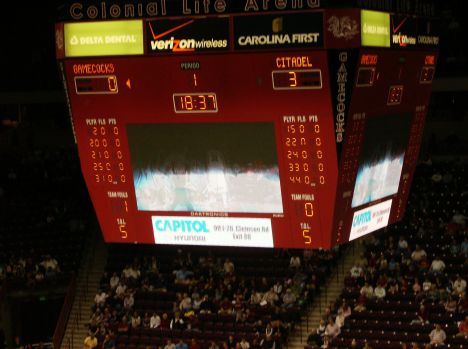
I took a picture of the scoreboard when The Citadel first took the lead, just for posterity.  I took it quickly, just in case South Carolina scored before I could snap it (as it turned out, I need not have worried).  Here it is:

0032

The Citadel plays South Carolina in hoops for the 100th time

First, I want to comment on The Citadel’s game against Michigan State.  I don’t believe in moral victories, but I do believe in moral non-embarrassments, and the Bulldogs did well in that category.  I am used to watching The Citadel get annihilated when facing a quality opponent , especially on those rare occasions when the game is on TV.  Watching the Bulldogs play a reasonably competitive game against a ranked team was somewhat disorienting.

Speaking of TV, the game against MSU was one of just three contests The Citadel will play this season that will be televised.  (The second of the three will come Saturday against the Gamecocks.)  That needs to change.  With all the games that are televised these days, I think it is critical that The Citadel gets its fair share of exposure.  Three games per season is not going to cut it.  Recruits, even those who are considering a military school, want to play TV games.  I think it would also foster more alumni interest in the program.  Plus, Vegas would get more action on our games.  Okay, maybe that last one isn’t as big a deal.

I would suggest to Ed Conroy (not that he needs my suggestions) that he do everything he can to get OOC games that will be on TV.  John Chaney did something like this years ago at Temple.  The Citadel is hindered a bit in its ability to schedule out of conference, though, by the Southern Conference’s 20-game league schedule, which is ludicrous for a league like the SoCon (16 would be a better number of conference games).

Conroy’s already off to a decent start by playing Big 10 teams.  What I like about playing the Big 10 schools is that if you play one, you will either play a game on national television (on the Big Ten Network) or play a Big 10 school at home (like Iowa earlier this season).  I think 2-for-1s (and even 3-for-1s in some situations) are well worth it if the games on the road are televised.

From what I gather, the SEC’s new mega-deal with ESPN is going to result in a huge increase in TV games for that league (including a lot of ESPNU matchups).  Hey, if playing Mississippi State or Georgia results in another TV game, I say start up the bus and tell the driver to head to Starkville or Athens.

Incidentally, have you ever noticed that a lot of SEC basketball arenas look kind of dark on TV?  It’s a strange phenomenon.  I guess the good lighting is reserved for the football practice fields.  Speaking of dimly lit buildings, that brings us to Saturday’s game against the Gamecocks…

Tomorrow the Gamecocks and Bulldogs will meet in basketball for the 100th time.  A scintillating series, it is not.  South Carolina has won 76 of the previous 99, but the greatest of the 99 meetings was without question the 1989 clash won by The Citadel.  It’s without question the greatest because this is my blog, and I say it is.  Besides, I was there, one of the 7,857 in attendance that February night.

Both teams entered the game with 15 victories on the season.  The Gamecocks were driving to a rare NCAA berth (which they got despite losing to the Bulldogs; South Carolina would lose in the first round of the NCAAs to North Carolina State).  South Carolina led throughout most of the first half and pushed the margin to 11 on a 25-foot three-pointer by Troy McKoy at the buzzer.

The Gamecocks seemed to have all the momentum, but that changed quickly in the second half as The Citadel gradually got back in the game.  The Bulldogs trailed 71-65 with 9:30 to go when they went on a 13-2 run to grab a five-point lead.  The Citadel led 82-78 with just over a minute to play when Patrick Elmore grabbed a rebound.  Two passes later, the ball was in the hands of Ryan Nesbit on the near baseline.  Nesbit (coach Randy Nesbit’s younger brother) was 3-for-4 from three-land already in the game, but the situation didn’t call for a three.  It called for holding on to the basketball.  Ryan Nesbit didn’t care; he was hot.  Up went the shot.  It was a classic “No No No Yes Yes Yes” moment, as he swished the three to give The Citadel a seven-point lead with 1:01 remaining.

The Citadel managed to overcome some nervous free throw shooting (missing the front end of two 1-and-1s) and outlasted the Gamecocks, 88-87 (South Carolina hit a three with one second left, but the Bulldogs successfully inbounded the basketball and the game ended).  South Carolina lost the game despite shooting 54% from the field, including a sizzling 9-11 from behind the arc, and a solid 74% from the foul line.  Terry Dozier scored 25 points on 10-13 shooting and Brent Price added 22.

However, the Gamecocks were outrebounded 34-31 and committed two more turnovers than the Bulldogs.  The Citadel shot almost as well from the field as USC did and made eight three-pointers of its own, and also had the edge in free throws, as South Carolina had to resort to fouling down the stretch.  Six different Bulldogs finished in double figures in scoring.  A seventh, James Stevens, added eight points, the last of which was a free throw that provided The Citadel with its 88th, clinching point.

That game would wind up being the last victory of Ed Conroy’s playing career.  If he is to beat South Carolina for his next victory as a head coach, his team will need to play even better than it did against Michigan State.  South Carolina is 7-1, although the one loss was to the College of Charleston.  As the game notes for South Carolina say (in a tone that could be construed as dismissive):

South Carolina holds a significant edge over The Citadel in nearly every statistical category. The Gamecock offense
averages nearly 20 more points per game than the Bulldogs, while also holding a dominating edge in rebounds
(+10.6), opponent turnover average (+9.1) and steals (+7.5).

Of course, the points-per-game number is a touch misleading, since The Citadel averages 12 fewer possessions per game, and one goal for the Bulldogs in this game will be to try to keep things at a slower pace.  The opponent turnover average is no joke, though.  South Carolina is second nationally in turnovers forced and in the top ten in turnover rate.  The Gamecocks’ FG% defense is an outstanding 37.7% and USC also does a good job on the boards.  On offense, South Carolina is a very good three-point shooting team (40%), although oddly it does not have a lot of assists on its made baskets.  South Carolina has had some issues with injuries and academics and may only be able to suit up nine players on Saturday.

To pull the upset, The Citadel must avoid the turnovers that have plagued previous Gamecock opponents.  Keeping the game at its preferred pace will be key to doing that.  The Bulldogs must defend well along the perimeter (Michigan State may not have been a great test in this respect).  If it can keep the game close, The Citadel has a chance, as South Carolina is not a particularly good foul shooting team.  It’s the one statistic in which the Bulldogs have a decided advantage.

I was there 20 years ago next February when the Bulldogs pulled off a stunner.  I would very much enjoy a repeat of that result.  I can’t think of a better Christmas present.  Just in case, though, I did some shopping today.

Seeing both sides of a mismatch on the same day

The bad side

Well, the football game went about as expected.  I was hoping that Florida wouldn’t get to 70, but The Citadel really didn’t make that much of an effort to shorten the game (in terms of play calling).  On the other hand, scoring three touchdowns was a pleasant surprise.  Unfortunately, the Bulldogs went 1-for-3 on extra points.  Kevin Higgins is going to have to do something about the placekicking before next season.

The placekicking was the only negative from the special teams, which were otherwise solid across the board yesterday.  The defense was completely overmatched, but the offense didn’t do all that badly.  While there were three turnovers, at least none of them were converted by Florida’s defense into touchdowns.  In that respect The Citadel fared much better than South Carolina did the previous week against Florida.  It’s also worth noting that due to injury, The Citadel actually inserted its backup quarterback, Cam Turner, into the game before Florida replaced Tim Tebow.

From the strange-but-true department (I guess I’m channeling Jayson Stark here):  South Carolina QBs Stephen Garcia and Chris Smelley both failed to throw a touchdown pass against the Gators.  The same was true for highly-touted Georgia QB Matthew Stafford.  Wide receiver and former walk-on Scott Flanagan of The Citadel, however, threw a TD pass against Florida on only one attempt.

Also, I would say that losing 70-19 is better than losing 56-6.  My reasoning is as follows:  Florida outscored South Carolina by more than an 9-1 ratio, but only outscored The Citadel by a little more than a 3.6-1 ratio.  Advantage, Bulldogs.

The good side

The basketball game also went about as expected, and this was a good thing.  The Citadel was never threatened by Cincinnati Christian and pulled away down the stretch for a convincing victory.  CCU had no answer for Cameron Wells, who had a good game not only on the stat sheet, but in terms of letting the game come to him.  Zach Urbanus had a strong first half and a solid overall game.  The Bulldogs did a good job in this game of getting to the foul line and converting.  Getting their fair share of free throw attempts has to be a priority for the Bulldogs, especially when shooting foul shots is one of The Citadel’s strengths.

Speaking of that, Phillip Pandak got into the game late, and was almost immediately fouled.  I was rooting for him to make both foul shots, and he did.  By doing so he equaled his number of made free throws from all of last season.  He only had four attempts at the line last year, which was amazing, because he attempted 101 field goals during the course of the season.  Now this year in two games he has one field goal attempt and two made free throws…

The Citadel took care of the ball in this game, a welcome change from the previous three games, and the pace of the game was in line with where the Bulldogs want to be.  The Citadel allowed CCU to grab a few more rebounds than I would have liked, and didn’t defend the three-point shot in the first half as well as it should have (the defense on the perimeter noticeably improved in the second half).

It was the second, and final, game of the season against a non-Division I opponent.  Now it’s time to try to win a game against a D-1 foe.  The Citadel’s first opportunity to do so will come on Tuesday night at the North Charleston Coliseum against Charleston Southern, one of two Division I teams the Bulldogs actually beat last season.

Avoiding trombone music

The Citadel is playing Florida this week.  In football.  This could be a tough game.  My understanding is that the Gators are pretty good.  This Tebow guy, he’s received some press.

The worst loss in football for The Citadel occurred in 1958, when Georgia and quarterback Fran Tarkenton defeated the Bulldogs in Athens, 76-0.  After the last touchdown, the UGA band played “76 Trombones” from The Music Man.  I am hoping that on Saturday, Florida’s band doesn’t have a reason to start playing Nena’s biggest hit…

Also to be avoided:  possible references to country music singer Larry Gatlin (who scored a touchdown in Houston’s 100-6 victory over Tulsa in 1968), Neil Lomax (quarterback for Portland State the night the Vikings beat Delaware State 105-0), and Cumberland College (222-0 ring a bell?).

Ideally, The Citadel will score, not suffer any catastrophic injuries, and keep the game within 50 (which would better South Carolina’s effort from last week).  I would settle for holding the Gators under 70 points, though, to be perfectly honest.

There is no reason to preview Florida, because everyone already knows everything that is necessary to know about the Gators.  Tim Tebow can cure cancer, Percy Harvin is faster than Mercury, and Urban Meyer is an outstanding coach, if seemingly a bit humorless, possibly because his parents named him Urban.

There is this guy named “Mr. Two-Bits” who does some little number that all the Gator fans like.  He’s been doing it for 60 years, and he’s doing it for the last time at this game.  He actually went to The Citadel for a couple of years, but he’s going to be all-out rooting for Florida anyway, so you will excuse me if I don’t lionize him.

In the event Florida’s team oversleeps en masse and forfeits the game to The Citadel, it would be the first victory for the Bulldogs over an SEC team since that famous (or infamous, if you’re into pig calls) 10-3 victory over Arkansas in 1992.  Jack Crowe, of course, was fired after that game as head coach of the Razorbacks.  It’s not every day a coach is fired after the season opener.

I will say this:  the players and coaches for The Citadel will take this game very seriously, and won’t like some of the snide remarks that have been made about it.  I doubt my saying that I hope the game stays within 70 would go over well with some of them, either.  They are headed to Gainesville to compete, and measure themselves against some of the best players in the country.  I just don’t want them to get embarrassed, but they obviously can’t and won’t think that way – and that’s a good thing.

One final thing…I’m not a huge fan of every article about The Citadel, even ones that are positive, but I thought this article by David Jones was excellent, so if you haven’t read it already, you might give it a look.

(Kenny, I flinch too.)

The Iowa Hawkeyes come to town

On Thursday night, the Iowa Hawkeyes will become the first Big 10 team to ever play a game at McAlister Field House.  I’m sure people will be telling their grandchildren some day about the time big bad Todd Lickliter came to town with his band of marauding hoopsters, intent on destruction.  Then again, maybe not.

Let’s delve into some of the history (or lack thereof) between the two schools…

I first want to mention Whitey Piro.  Who is Whitey Piro?  Well, he was once the head basketball coach at The Citadel.  In 1947, Piro’s Bulldogs were 5-11.  That doesn’t seem like much of a record, but keep in mind the four coaches who followed Piro all had worse overall records.  Never has a .313 winning percentage looked so good.  Piro, who was born in Germany, went to high school in New York and graduated from Syracuse in 1941.  At Syracuse he was a star wide receiver and also played one year on the basketball team as a reserve.  He did not score a point that season, which arguably made him an ideal candidate to later coach hoops at The Citadel.

Piro played one year in the NFL, for the Philadelphia Eagles, before joining the Army Air Corps during World War II.  He would eventually have a long career as an assistant coach at Iowa (and was later a pro scout).  His son is Iowa’s executive director of development for intercollegiate athletics.

Piro is still alive and resides in Iowa City.  He is 90 years old.

After that, connections between the two schools dry up a bit.  Ed Conroy, of course, is a native of Davenport, Iowa, as is his assistant Andy Fox.  Assistant Doug Novak was once the head coach at a JC in Council Bluffs.

This will only be the fifth time The Citadel has ever played a Big 10 school in basketball.  Two years ago the Bulldogs played both Iowa and Michigan State (which will be the case this season as well).  In 1974 The Citadel played Indiana in Bloomington, and in 1970 the Bulldogs faced Northwestern in a Christmas tournament in Greenville.  The Citadel lost all of those games.

The last time The Citadel defeated a school currently in a BCS conference was 1989, when the Bulldogs upset South Carolina 88-87 in Columbia.  (At the time, the Gamecocks were members of the Metro Conference.)  Since then The Citadel’s record against current BCS schools is 0-45.  Prior to that 1989 game the Bulldogs had last defeated a major conference opponent in 1979, when they beat Clemson 58-56 in Charleston.  Thus, The Citadel has lost 70 of its last 71 games against schools currently in BCS conferences.

The Big 10 is not the only major conference The Citadel is 0-for-history against; the same is true of the Pac-10.  However, there have been very few games between The Citadel and teams from those two leagues.  That is also the case with the schools making up the Big XII.  The Bulldogs do have a win against a current Big XII school, though, having defeated Texas A&M (then of the Southwest Conference) 62-61 in 1971.

Okay, enough of that.  Let’s talk about this game.  First, a little background on Iowa’s recent hoops history.  It’s not what Iowa fans would like it to be.

Iowa had made three NCAA tournament appearances before 1979.  In 1955, Iowa reached the Final Four (in a 16-team tournament) before losing to Tom Gola and La Salle.  In 1956, the Hawkeyes made it to the title game (playing the regionals in Iowa City; the national semis were in Evanston, Illinois) before running into Bill Russell, K.C. Jones, and San Francisco.  The coach for those two teams was Bucky O’Connor.  Ralph Miller was the coach of the 1970 Iowa team that won the Big 10, the next time the Hawkeyes made an NCAA tournament appearance.

Iowa hoops in the “modern” era (when the tourney began to take on bigger-than-life dimensions) started with Lute Olson and a series of appearances beginning in 1979.  After stubbing its toe a bit that year (Iowa lost in the first round to Toledo in a game, interestingly enough, played in Bloomington), the Hawkeyes made their third (and to date, last) appearance in the Final Four in 1980.  As a five seed, Iowa had to play a first-round game against Virginia Commonwealth (the tourney had 48 teams back then) and then faced fourth-seeded N.C. State, which had received a bye, in Greensboro.  The Hawkeyes won that game, and then crushed the nascent Big East conference by winning back-to-back games in Philadelphia against top-seeded Syracuse and third-seeded Georgetown.  In the national semifinals, Iowa lost to eventual national champion Louisville, and then also lost to fellow Big 10’er Purdue in the consolation game (the next-to-last time the consolation game was played).

After that season, you better believe expectations were raised in Iowa City.  Olson continued to put teams into the field, but without the success he had in 1980.  Iowa lost in the first round in 1981 and the second round in 1982.  In 1983, as a seven seed, Olson’s charges rolled Norm Stewart and Missouri in round two before getting upended by Rollie Massimino and Villanova 55-54 in the Sweet 16.

Olson moved on, and was replaced by George Raveling, who was still one coaching move away from his inevitable job at Nike.  Raveling went to the tournament twice but was one-and-done both times.  His successor, Tom Davis, brought Iowa to the brink of another Final Four in 1987, but the Hawkeyes blew an 18-point lead to UNLV in the West regional final.  The next year, Davis guided Iowa to the Sweet 16, but the Hawkeyes were thumped by old coach Olson and his new team, Arizona.  That established a pattern for Davis, whose teams always won their first round matchup, but seldom their second.  Davis took Iowa to eight NCAA tournaments in twelve seasons.

He was succeeded by Steve Alford, who was the hot name in coaching (besides being an Indiana high school and IU legend).  Alford, though, had a bit of a disappointing run in Iowa City, only making the NCAAs three times in eight seasons.  He also only had three winning seasons in conference play over his tenure as coach.  Alford won one NCAA tournament game as head coach at Iowa, which is one fewer than he had while coaching (Southwest) Missouri State.  Alford jumped at the New Mexico job two years ago in a classic “jump or be pushed” situation.

Now the coach at Iowa is Todd Lickliter, in his second year with the Hawkeyes after a great run at Butler that included two Sweet 16 appearances in six seasons.  He’s a good coach, but he has work to do.  Iowa was 13-19 in his first season (6-12 Big 10).  Iowa lost its share of close games (seven by six points or less), but also played a lot of fairly close games, which can happen when you average just over 60 possessions per game.  Iowa scored 56 points per game, low by even Big 10 standards.  The Hawkeyes scored under 50 points seven times, including once in a game Iowa actually won (a 43-36 victory over Michigan State that drew guffaws from around the country).  Iowa was not a good rebounding team and struggled to force turnovers, while committing a bunch themselves (bottom 15 nationally in turnover rate on offense).  The Hawkeyes had mediocre offensive shooting stats across the board and were not good from the foul line (64.9%).

This season Iowa is 2-0 with home wins over Charleston Southern (by 20 points) and UT-San Antonio (by 6).  One player almost certain to give The Citadel problems is Cyrus Tate, a 6’8″, 255 lb. senior who in two games is averaging 13.5 points and 8.5 rebounds.  He has also blocked five shots in two games.  He’s the type of post player The Citadel could not compete successfully against last season, and so far this season.  Tate is one of seven Hawkeyes who have played significant minutes so far this year.  Another guy to watch is 6’5″ freshman guard Matt Gatens, who was the high school player of the year in Iowa last season.

Iowa is continuing the deliberate pace it employed last season, averaging 61 possessions in the two games it has played to date.

One more thing — according to Iowa’s game notes, the game against The Citadel will probably be the only Iowa game this season that will not be televised.  All but one of the rest of the Hawkeyes’ games are guaranteed to be on TV.  (Conversely, The Citadel will only be on television three times this season.)

Iowa is picked to finish near the bottom of the Big 10, along with Northwestern and Indiana.  Due to Iowa’s rebuilding, youth (five of its top seven rotation players are freshmen or sophomores), and style of play, if you were going to pick a Big 10 team that could be beaten in McAlister, this might be the one.  However, I don’t see it happening, at least not tomorrow night.

The best chance The Citadel has is to make more than its fair share of three-pointers while somehow holding its own in the paint.  If Demetrius Nelson and company could neutralize Tate and his friends, and The Citadel could shoot well (while not repeating the somewhat out of character 21-turnover performance against VCU), maybe the Bulldogs have a shot.  The Citadel has yet to prove it can successfully defend inside (or outside, really) against a team at the Division I level, though.

Still, there is a reason they play the games…

Charlie Brown’s favorite college basketball program

Edit (8/10/09):  I originally wrote what follows in November 2008.  The 2008-09 basketball Bulldogs then went out and won 20 games for only the second time in school history, resulting in the first appearance by The Citadel in a post-season hoops tourney (okay, so it was the CollegeInsider.com Tournament, but that still counts).  Based on this turn of events, I am hopeful that if I write another essay prior to next season detailing the program’s less-than-stellar history, the 2009-10 edition of the Bulldogs will win the SoCon NCAA tournament.


There are only five schools that have been in NCAA Division I continuously since the classification’s formation in 1948 that have never participated in the NCAA basketball tournament.  Those five schools are Northwestern, Army, William&Mary, St. Francis of New York, and The Citadel.  Of those five, only one has never participated in the NIT.  Army has played in the NIT eight times (and according to Bob Knight, actually turned down an invitation to the NCAAs in the late 1960s).  Northwestern and St. Francis have three NIT invites each.  William&Mary has made one appearance in the NIT, in 1983.

The Citadel has made no such appearances.  It has never played in a game following its conference tournament.  No NCAA trips, no NIT bids, nothing.

This is not a fluke.

The history of basketball at The Citadel can be likened to the long-running Peanuts bit where Charlie Brown tries to kick the football, only to have Lucy jerk it away from him time and time again, except in this case the ball is jerked away from him about 10 seconds before he can even swing his leg to kick it…but he keeps trying to kick it anyway.

(Yes, I know that’s an analogy based on a football play, and this is a post about basketball.  There will be a motocross analogy later, too.  Just stay with me.)

Here are some quick facts about The Citadel’s basketball program:

— NCAA bids:  0
— NIT bids:  0
— Southern Conference tournament titles:  0
— Southern Conference regular season titles (undisputed or shared):  0
— Southern Conference regular season division titles (undisputed or shared):  0
— Southern Conference tournament MVPs:  0
— NBA players, past or present, who attended The Citadel:  0
— Appearances in the Southern Conference tournament final:  1 (1959)
— Number of times winning more than one game in the Southern Conference tournament:  1 (1959)
— Southern Conference tournament semifinal appearances since 1985:  1
— 20-win seasons:  1 (1979)
— Coaches with a winning record at The Citadel since World War II:  1 (Norm Sloan)
— Best-sellers about playing basketball at The Citadel titled My Losing Season 1
— Seasons with 20 or more losses:  11 (including the last three and five of the last six)
— Seasons finishing 10 or more games under .500:  20 (19 of them since World War II)
— Winning seasons since 1962:  10
— Winning seasons since 1962 in which The Citadel finished 3 or more games over .500:  5
— Consecutive losses in the Southern Conference tournament, 1985-1997:  13
— Consecutive losses in the Southern Conference tournament, 1961-1978:  17
— Overall record in the Southern Conference tournament:  11-55
— Coaches since 1975:  4 (nobody ever said The Citadel didn’t give its coaches a chance)

Brief Digression Number OneEvery season The Citadel loses in the SoCon tourney and sets a new NCAA record for most consecutive conference tournament appearances without winning a title – and every season, the following week Clemson ties the record (which is currently 55) when the Tigers lose in the ACC tournament.  Of course, Clemson came close to breaking its string of futility last year.  Incidentally, The Citadel’s 58-56 win over Clemson in 1979 is the last victory for the Bulldogs over a current member of the Atlantic Coast Conference.  The Citadel is 24-55 against Clemson, alltime.  Seven of those wins came after the Tigers joined the ACC.  Those are the only victories The Citadel has against a school that was a member of the ACC at the time.

The Citadel actually won a few more games than it lost in the seasons leading up to World War II.  Of course, the competition in those not-so-organized times wasn’t always the best.  In 1917, for example, The Citadel defeated the Charleston Navy Yard Machinist Mates 48-11.  In 1925 the Bulldogs beat Standard Oil 46-18, and in 1932 The Citadel recorded a 42-23 victory over the Jewish Alliance.  Alas, the Bulldogs’ 62-51 loss to the Savannah Ice Service in 1941 was a sign of things to come, because after the war things turned south in a hurry.

Brief Digression Number Two:  In 1927, coach Benny Blatt’s Bulldogs finished 17-2 and actually won a postseason tourney, the Southern Intercollegiate Athletic Association tournament, the only postseason event ever won by The Citadel.  The SIAA was the ancestor of the Southern Conference.  However, by 1927 all of the current SEC/ACC schools that would eventually make up the original Southern Conference had left the SIAA, and had been replaced by mostly smaller schools, with some holdovers (like The Citadel) still remaining in the old league.  In that 1927 tournament, The Citadel beat Mercer in the final.  It was the fourth time The Citadel had played Mercer that season, with the Bulldogs winning all four games.  All nineteen games The Citadel played that season were contested in the Carolinas or Georgia.

There is an old Peanuts TV special, “You’re a Good Sport, Charlie Brown,” in which Charlie Brown (with help from Linus) competes in a motocross race, with the winner to receive tickets to the NFL Pro Bowl.  Eventually, all of the other racers (including Snoopy) drop out of the event, and Charlie Brown wins it by default.  However, he finds out after the race that the organizers were unable to get the Pro Bowl tickets; instead, he receives coupons for five free haircuts at a barbershop in Denver, Colorado.  Keep in mind that Charlie Brown is bald, doesn’t live in Denver, and his father is a barber.

The Citadel’s victory in the ’27 SIAA tournament has always struck me as comparable to Charlie Brown’s motocross triumph.

Bernard O’Neil’s first year as coach, in 1948, resulted in a respectable 8-9 record, but his 1949 squad lost its first 17 games before winning the season finale.  He coached three more seasons, finishing with a career record of 28-72.

His replacement, the immortal Leo Zack, was 5-32 in two seasons, the latter season ending with 16 straight losses.  Three of his five career victories came against Newberry.  He also lost a game to Newberry, the school that during this time was better known for being the victim of Frank Selvy’s 100-point game.

Jim Browning was a respected professor at The Citadel, and also assisted the department of athletics whenever and wherever he was needed.  In his later years he helped compile statistics at home football games.  In the fall of 1954, he agreed to serve as coach for the basketball team.  I wish I knew more about how he wound up with the job; there has to be a good story there.  I vaguely recall a writeup about that season, but I don’t remember the source, and I haven’t been able to find it, at least not yet.  Incidentally, Col. Browning would have been a young man in 1954, probably not much older than the players.  I think his main job was to avoid forfeits, to be honest.  He succeeded in that, but that was about all the success the 1954-55 squad would have, finishing with a 1-21 record.  The only win was against the Jacksonville Naval Air Station.

Brief Digression Number Three:  Some sources incorrectly don’t count that as an official victory, including the Southern Conference record book, with the league still listing The Citadel as having lost a conference record 37 straight games during this time period (the record is for consecutive losses against all opponents, not consecutive conference losses).  However, during that era schools were allowed to count games against military bases (and AAU teams) as part of their overall record.  The NCAA actually changed its record book a few years ago to take out references to the “37-game losing streak”; the mistake had been made long ago, and wasn’t fixed until 2004.  (The actual losing streak was 30 games.)  Besides, it’s not like The Citadel was catching a break playing service teams – the Bulldogs also lost that year to that same N.A.S., and dropped two lopsided games to the Parris Island Marines as well.  The Citadel also lists a loss to Gibbs AAU for that season by a score of 121-65.

That loss to Gibbs AAU wasn’t the worst loss of the season, though.  Neither was the 125-54 drubbing in the first game against the P.I. Marines.  The worst defeat would be an 87-point loss at Furman, 154-67.  That game would become part of an unusual record, for in the second meeting that year between the two teams, The Citadel elected to play stall-ball (why the Bulldogs didn’t try that strategy more often during the season, I don’t know).  I was once told by someone that at one point during the game most of the players on both teams were sitting down on the court, a few of them amiably chatting with one another.  Furman eventually won the game, 26-24.  The 85-point differential from one game to the next between the same teams is an NCAA record.  Normally, a record like that would occur when a team lost by a large margin and then came back and posted a dominant victory.  In this case, however, The Citadel (naturally) managed to lose both games.

The next year another coach, Hank Witt, who doubled as an assistant coach for the football team, led The Citadel to a 2-19 record.  Some of the losses that season were just staggering (Presbyterian beat The Citadel by 50 points – twice).  After that season, somebody at The Citadel got serious about hoops.  That somebody was presumably Mark Clark, scourge of Italy (and Texas).  The famous World War II general had become the new president of the school in 1954 and had no use for inept varsity athletic teams, or anything else inept for that matter.  The military college decided to hire a young coach named Norm Sloan.  You may have heard of him.

Sloan did a fantastic job, winning 57 games in four seasons.  In his third season, The Citadel would finish 15-5, losing to Jerry West and West Virginia in the SoCon tourney final, the only appearance The Citadel has ever made in the title game.  (West Virginia would go all the way to the NCAA championship game that year, losing 71-70 to California.)  Sloan left after the following season to coach Florida (the first of two stints with the Gators; of course, in between he would win the national title at North Carolina State).

Brief Digression Number Four:  Sloan recruited the midwest exclusively while at The Citadel.  He seemingly had no interest in local players.  In the fall following his first season as coach, he held an open practice for cadets interested in trying out for the basketball team.  Well, maybe not so open.  Sloan walked into the gym and greeted all the candidates, and then asked them to line up single-file, facing him.  He then said, “Everyone from Ohio, Indiana, or Kentucky, take one step forward.”  A few of the cadets stepped forward.  Sloan then barked, “The rest of you are cut,”  and walked out of the gym.

Sloan’s replacement, Mel Thompson, had one good year, and then the program went downhill, including a 3-20 debacle in 1963.  Thompson did manage to put together two consecutive winning campaigns after that season (with records of 11-10 and 13-11).  However, Thompson and the program then suffered two more losing years with a combined win-loss total of 15-33.  His final season eventually spawned a best-selling book in which the coach was portrayed as something less than human, or all too human, depending on your point of view.

After Thompson’s departure, the program went through a seven-year period of .445 ball under two different coaches.  Dick Campbell coached for four seasons.  Campbell came to The Citadel after an enormously successful run at Carson-Newman, where he had averaged 25 wins per season in his last seven years as coach.  At The Citadel, however, Campbell would finish with a record of 45-54.  He left the military college to take the head coaching job at Xavier.  His career as a college coach would end two years later, after a 3-23 campaign for the Cincinnati school.

George Hill took over from Campbell.  Hill had been the head coach at the U.S. Coast Guard Academy, where in two years he had won 11 games, all 11 victories coming in his second season (the USCGA was 0-21 in his first year as coach there).  He couldn’t provide any forward momentum at The Citadel, though, going 33-42 in three seasons, all losing campaigns.  Hill would later become a sportswriter and an author.

Les Robinson, who had already been an assistant coach for several years, was then promoted.  Robinson, one of three North Carolina State graduates to coach The Citadel (Sloan and Thompson had also played for the great Everett Case), would start off the first season of his eleven-year head coaching career at The Citadel by winning four of his first five games.  Three games later, his squad was still in good shape at 5-3, but it would then lose its last twelve games.  Robinson would follow that up with a 17-loss campaign and two 19-loss seasons before finally finding success, with his 1978-79 team finishing with a 20-7 record and actually winning a SoCon tourney game, the school’s first postseason victory since 1961.  After a few middling-to-bad seasons, Robinson’s final Bulldog team would win 18 games.  He then left to become head coach and AD at East Tennessee State.  Four years later, Les Robinson would finally take a team to the NCAA tournament.  He would later become famous enough to have an invitational named after him.

His replacement, Randy Nesbit, had played for Robinson, and was only 26 years old when he got the top job.  In seven years, Nesbit had more 20-loss seasons (two) then winning seasons (one).  In all fairness to Nesbit, he didn’t have a lot of luck, even by the meager karma standards of basketball at The Citadel.  Among other problems, The Citadel’s ancient basketball arena, McAlister Field House, underwent a renovation that left it unusable for two seasons during his tenure.  McAlister could occasionally be a surprisingly difficult place to play for opposing teams (it was often described in its original incarnation as resembling an airport hangar).  In Nesbit’s third season as coach, however, his squad played no games on campus, with the designated home games played at a local high school or at the College of Charleston’s gymnasium.

The following year, The Citadel elected to play its home games at its physical education building, Deas Hall, one of the more bizarre places to serve as a home court for a Division I basketball team in the modern era of college basketball.  McAlister would eventually reopen, but Nesbit’s final two teams would lose a combined 40 games anyway.  Nesbit is now the head basketball coach at Roane State Community College in Tennessee (he also teaches in the business school there).  One of the players on his current squad is 73 years old.

Brief Digression Number Five:  Nesbit did have one great moment while coaching The Citadel.  In 1989, Nesbit’s Bulldogs shocked South Carolina in Columbia, 88-87, breaking a 36-game losing streak to the Gamecocks that had dated back to 1943.  The key basket in the game was a clutch three-pointer made by Nesbit’s younger brother, Ryan (if he had missed it, the adjective “clutch” would have been changed to “reckless”).  The Gamecocks were marching to their first NCAA bid in many years when they were stunned in the late-season matchup, but George Felton’s best team actually recovered from the loss and won enough games to make the dance anyway (losing to North Carolina State in the first round).  The victory in Columbia was The Citadel’s 16th of the season, and, as it turned out, its last.  Thus it was the final win in the career of one Ed Conroy, a senior guard on that team, and now the head coach of the Bulldogs.

Nesbit was followed by Pat Dennis (also known as “the long-suffering Pat Dennis”), who had been an assistant for Dick Tarrant at Richmond.  Dennis would last for fourteen years, the longest tenure of any of The Citadel’s basketball coaches.  His sixth squad finished 15-13, the first winning season at The Citadel in a decade, and actually won a SoCon tourney game, the first in 13 years for the school.  After a few more losing years, Dennis would have consecutive winning seasons in 2001-02 and 2002-03, one of only two times The Citadel has had consecutive winning seasons in the last 42 years.  The perpetually frustrated Dennis would lose 20+ games in three of his final four seasons, however.  Dennis finished with a career record at The Citadel of 156-235.

On the bright side, Dennis had a winning record against each military school he faced while coaching The Citadel (11-7 against VMI, 2-1 against Navy, 3-0 against Army, and 1-0 against Air Force).  So he had that going for him, which was nice.

The current coach of the Bulldogs, Ed Conroy, is 13-47 in two seasons at the helm.  Conroy was hired by none other than Les Robinson, who had returned to The Citadel as AD.  Conroy had actually been recruited by Robinson when he was a high school senior, although Robinson would leave for ETSU before ever getting a chance to coach Conroy at The Citadel.  Ed Conroy is a cousin of Pat Conroy, a relationship that was well documented when Ed took over the program.

Last year, Conroy made news by playing a squad almost entirely made up of freshmen.  Some of them actually showed promise (albeit while only winning two games against Division I competition), so perhaps he can be the coach to lead the Bulldogs to the promised land – the NCAA tournament.  I’m rooting hard for him – he’s a nice guy – but it’s going to be very, very tough.  When The Citadel beat South Carolina that cold night in 1989, Conroy was quoted as saying the victory would be “the one we’ll remember all our lives.”  Winning the Southern Conference title as head coach of The Citadel would be a much more memorable moment.

I always tell people that if The Citadel were to ever advance to the NCAAs in basketball, that would probably be a sure sign of an imminent Apocalypse…

It can be difficult to be a fan of college hoops — and I really enjoy college hoops — when your school is always terrible in basketball.  Not just occasionally terrible, mind you, not just those inevitable slumps of a year or two or even a bad decade, but always.  It’s like there’s a really cool party going on, and the party never really stops, but it doesn’t matter that the party lasts forever, because you still don’t have a ticket and you may never get one, and what really irks you is that practically every other person in the free world has been to the party, even some out-and-out losers who don’t even realize how great the party really is, and you are still left out in the cold.

It would be great to even consider the possibility of turning on the tournament selection show, and watching James Brown announce something like, “in the South regional, with these games being played in Winston-Salem, North Carolina, the #2 seed is Georgetown, and the mighty Hoyas will take on the #15 seed, the Southern Conference champion, The Citadel [brief pause, as Brown shakes his head in disbelief], making its first NCAA tournament appearance in school history.”  This would be followed by a live shot of cheering cadets, possibly with no hazing involved.

It would be absolutely surreal.

It hasn’t come close to happening, though, and really, if it were to happen (and this is important), I would like it to be in a year in which The Citadel was actually good.  I don’t want it to be a year where the Bulldogs go 11-18, and then get lucky and win the SoCon tourney because all the other teams’ players came down with food poisoning or something.

Besides, in that case, The Citadel would almost certainly land in the utterly reprehensible, completely despicable play-in game.  If The Citadel were to ever make the NCAAs, and the tournament selection committee then put the team in the play-in game, I would immediately drive up to Indianapolis and just start assaulting people.

That scenario isn’t likely to happen, though (which is just as well, as the drive to Indy would probably be really boring).  The Citadel has only won two games in the conference tourney once in its history.  It’s hard to conceive of it actually winning three times in one weekend.

I fully expect more hard times on the hardwood.  I hope for the best, but you have to be realistic.  After all, it’s a small military school with no hoops tradition whatsoever.  If Charlie Brown were to have a favorite college basketball program, this would be it.

Still my team, though.

A Classic in name only

Just a few notes and observations about one of this season’s exempt college basketball tournaments, the Charleston Classic

It’s the first year for this particular tournament, which is wholly owned by ESPN Regional Television, the distribution arm of the “worldwide leader”.  It will be played in Charleston at the Carolina First Arena, the new 5000-seat home for College of Charleston basketball, on November 14-16.

The Carolina First Arena was a building a long time in coming for C of C fans, but the tournament that will serve to open the arena is not part of the Cougars’ season ticket package.  If a College of Charleston fan wants to see the Cougars’ first game in their new home, he/she will have to shell out $30 to see the two-game session featuring the College.  Also, all the tickets are general admission.

I don’t know how well this tournament is going to do.  I have to say I am more than a little skeptical.  For one thing, the field is less than stellar.  The College of Charleston’s opening game is against SIU-Edwardsville.  That’s not the SIU Salukis of the Missouri Valley, regular participants in the NCAA tournament, but the SIU Cougars of the Ohio Valley, ineligible for the NCAA tournament.  (The SIU of the MVC is located in Carbondale, Illinois.)

SIU-Edwardsville is in its first year of transitioning to Division I status and won’t become a full-fledged NCAA Division I school in basketball until 2013.  I guess the tournament organizers couldn’t find another team.  I am sure fans will appreciate the Cougars vs. Cougars battle, although it’s definitely going to be a step up for SIU-Edwardsville, a program that was 10-9 in league play last season, that league being the Great Lakes Valley Conference.

Tangent:  Notable SIU-Edwardsville alums include both Ken Flach and Robert Seguso of doubles tennis fame (Seguso also of Carling Bassett fame), longtime baseball play-by-play man DeWayne Staats, and sportswriter Bill Plaschke.  The best-known SIU-E alum as far as college hoops is concerned, though, is probably the longtime official Ed Hightower.

The other teams in the Classic:  Clemson, Western Michigan, Temple, Hofstra, TCU, and East Tennessee State.  I can’t imagine a lot of people will be tuning in to see much of the action from this tourney.

Neither could ESPN, apparently.  Even though the tournament is owned by ESPN, the six games in the tournament that are going to be televised will be broadcast on CSS.

According to a recent article in The Post and Courier, sponsorship package and ticket sales have been slow.   Bobby Cremins bought a sponsorship himself (for $1,500) and has been working local business leaders in an effort to bring in more sponsors.

If the event organizers are having trouble selling tickets and bringing in sponsors for a tournament featuring both the College of Charleston and Clemson, what happens next year when neither of those schools will be in the tourney?  (It’s an exempt event, so schools can only participate once every four years.)

Reportedly next year’s tourney is going to include South Carolina.  Whether or not a basketball tournament in Charleston (not known as a great sports town) can succeed with South Carolina as its main local draw is open to question.  In future years, if The Citadel or Charleston Southern serves as the “host” school, the rest of the field better include several big-name schools.  The Western Michigans and Hofstras of the world won’t cut it.

ESPN’s humongous 2008-09 college hoops schedule(s)

Wow.  I just looked at the release, which was published a couple of days back.  You can see it for yourself right here:  Link

That’s just for men’s college basketball.  The women will also have a significant presence on ESPN and its family of networks, as evidenced by this separate release.

Back to men’s hoops.  Awful Announcing estimated that the ESPN networks would combine to air around 1100 games this season, which is incredible.  To the surprise of nobody, however, none of those 1100 games will involve The Citadel.  When you are the worst basketball program in the history of Division I, though, you have to accept such indignities.  (From what I can tell, El Cid will be on TV three times this season, against the CofC and South Carolina on SportSouth, and against Michigan State on the Big Ten Network.)

While The Citadel may have been shut out, other small schools and low-profile programs fare better.  Just to mention a couple of them, Davidson gets four games (and probably should have more).  South Carolina State gets three games on ESPNU, which is certainly going to be the MEAC’s favorite network.  In fact, a lot of those 1100 games are going to be on the U, which is great if you have that network.  If you don’t, though…

Starting with conference play around mid-January or so, Thursday night in particular is going to be a great night for college hoops fans, with seven-game slates on a regular basis.  A typical Thursday will have ACC/Big 10/SEC/Big East doubleheaders on both ESPN and ESPN2, along with two games on ESPNU and an additional 11 pm ET game on ESPN featuring a WCC or WAC game (i.e., Thursday night is Gonzaga night!).

The ABC/ESPN group will usually feature about 12 games each Saturday (although there will be 17 games televised on the various ESPN networks on February 21).  ESPN and its varied platforms will also televise most, if not all, of the games for 10 preseason tournaments, and then there’s the much-discussed wall-to-wall hoops all day on November 18.

What is really amazing is that there is still plenty of basketball to be televised by the likes of the Big Ten Network, Fox Sports Net, Comcast SportsNet, etc.  All in all, it’s incredible how much hoops coverage is out there.  ESPN just happens to lead the way.