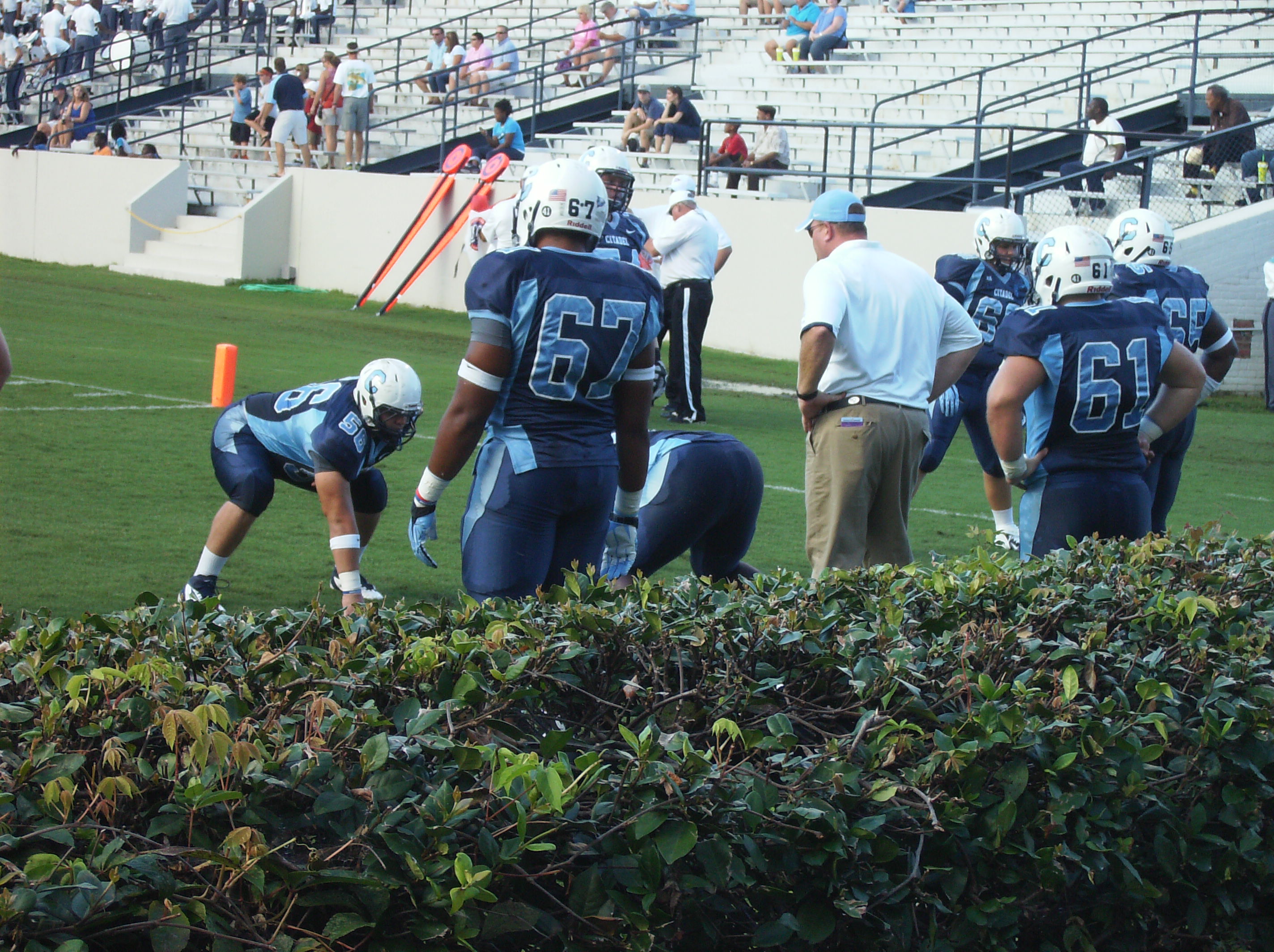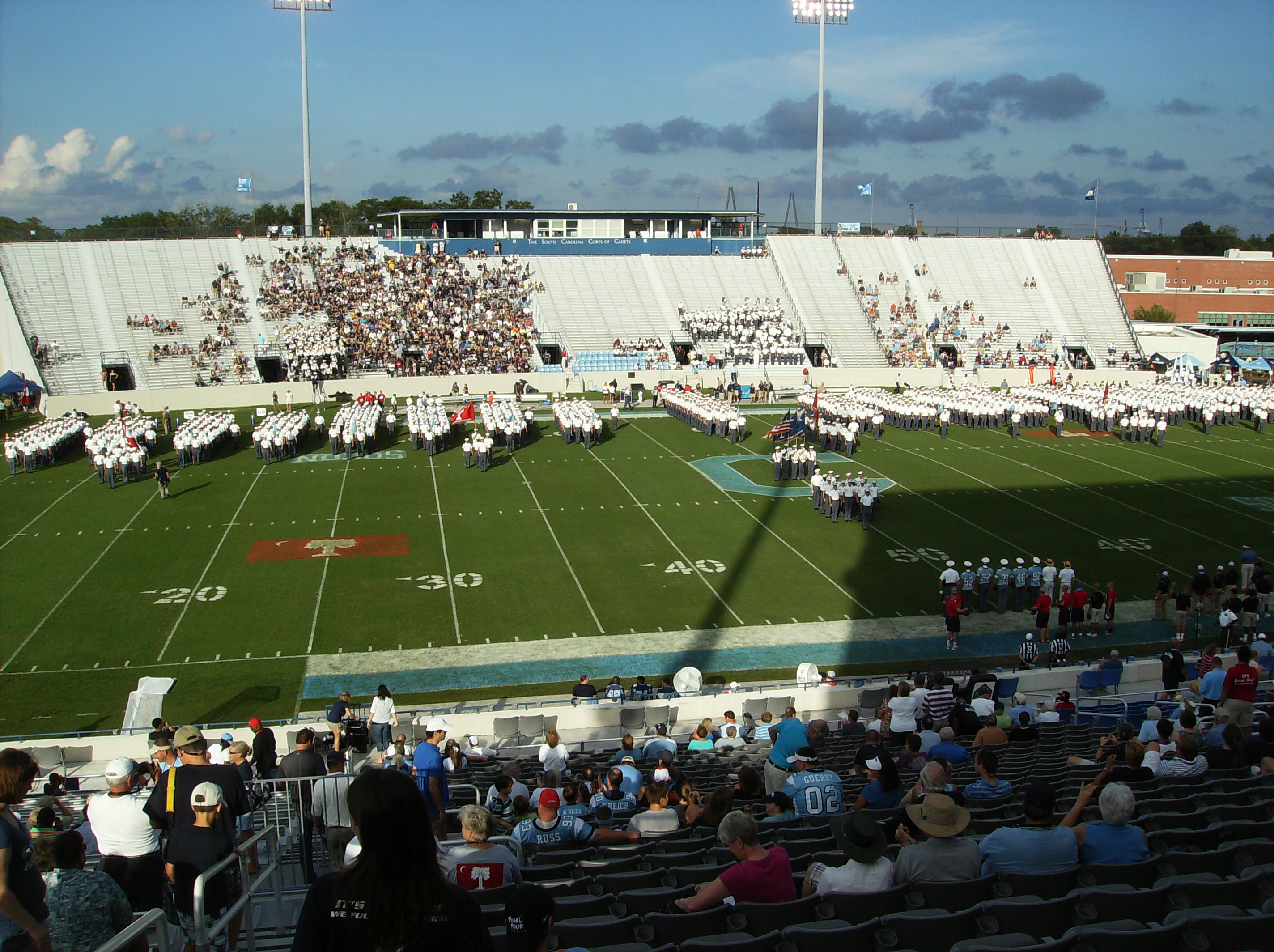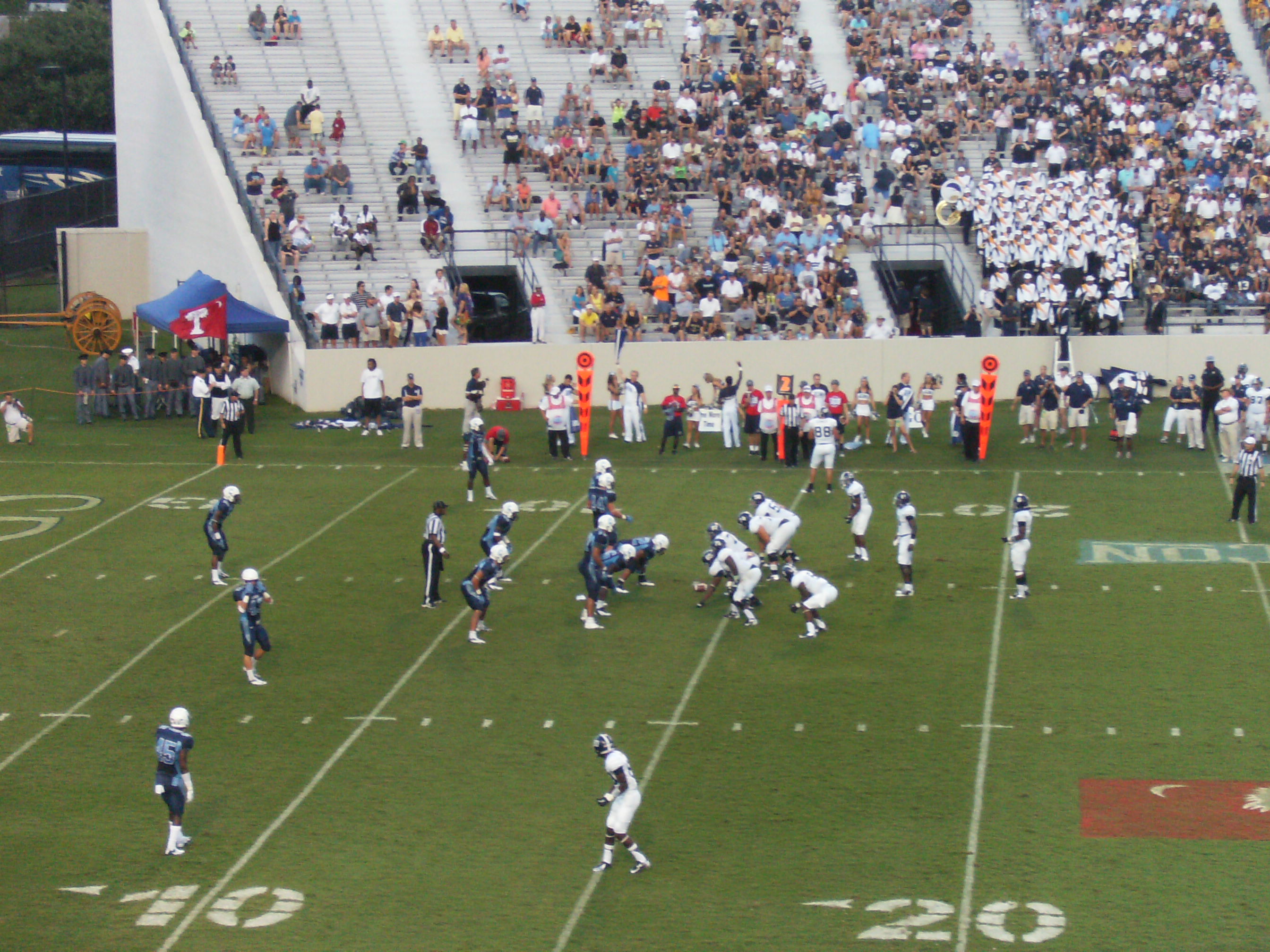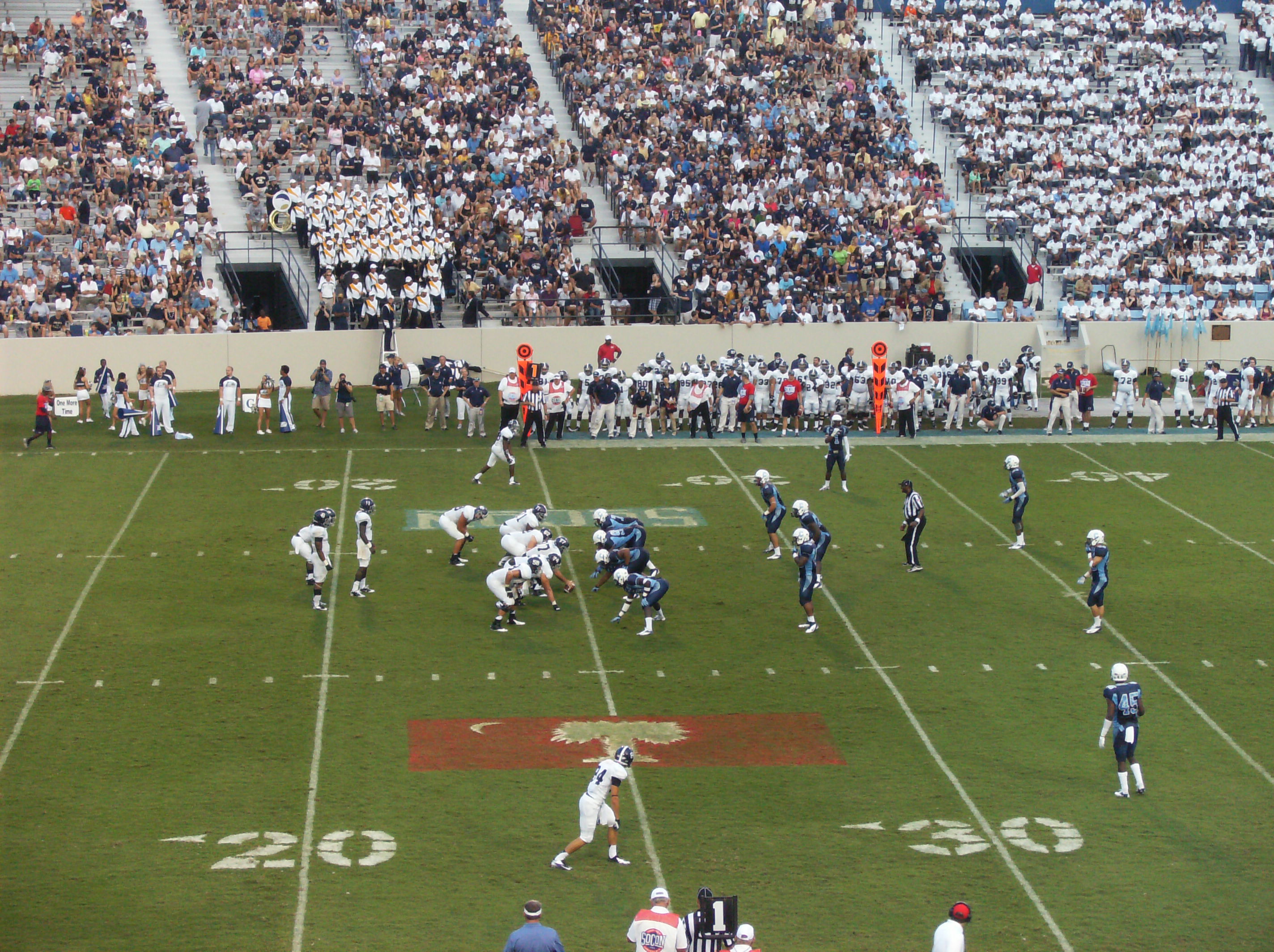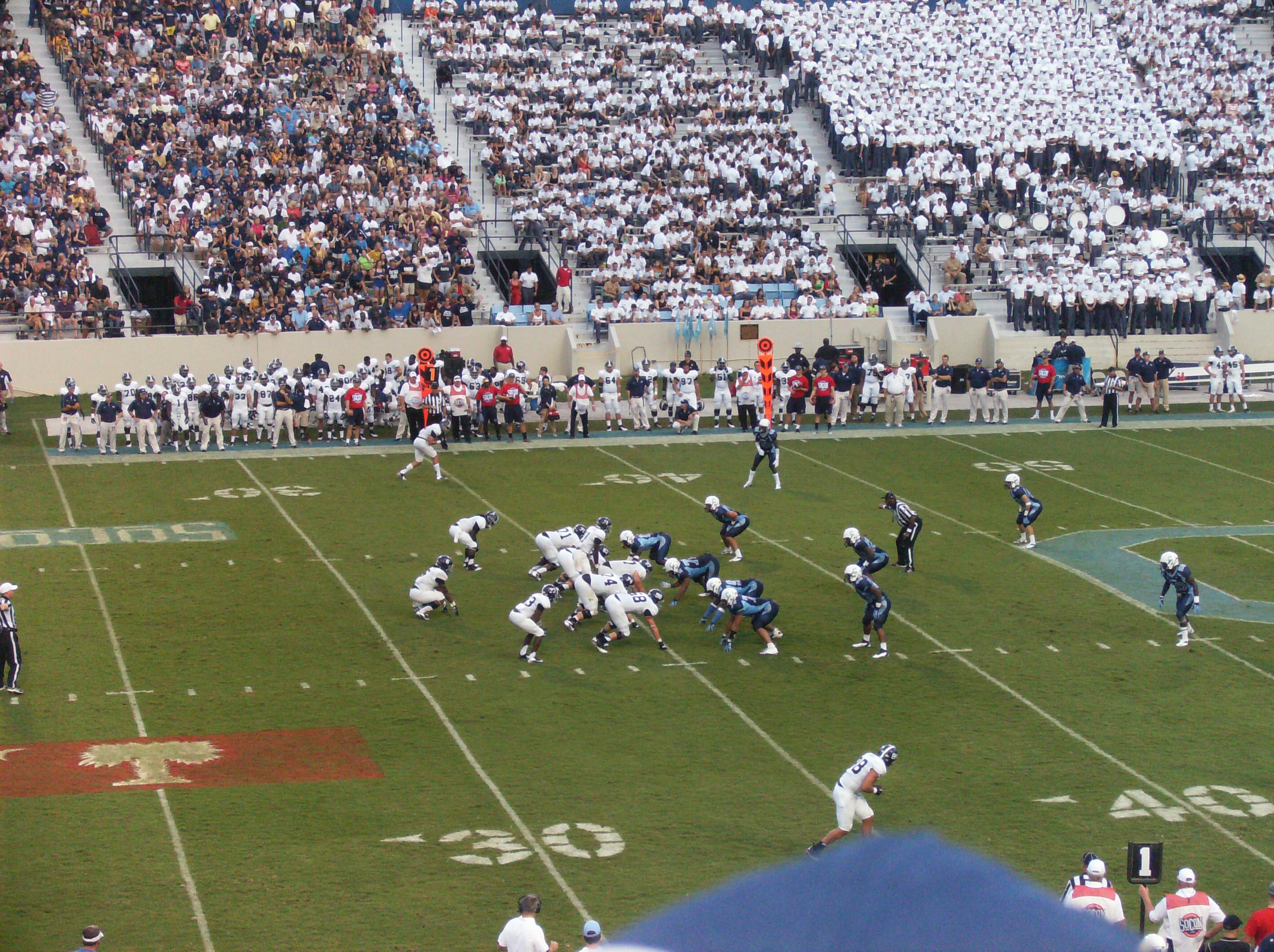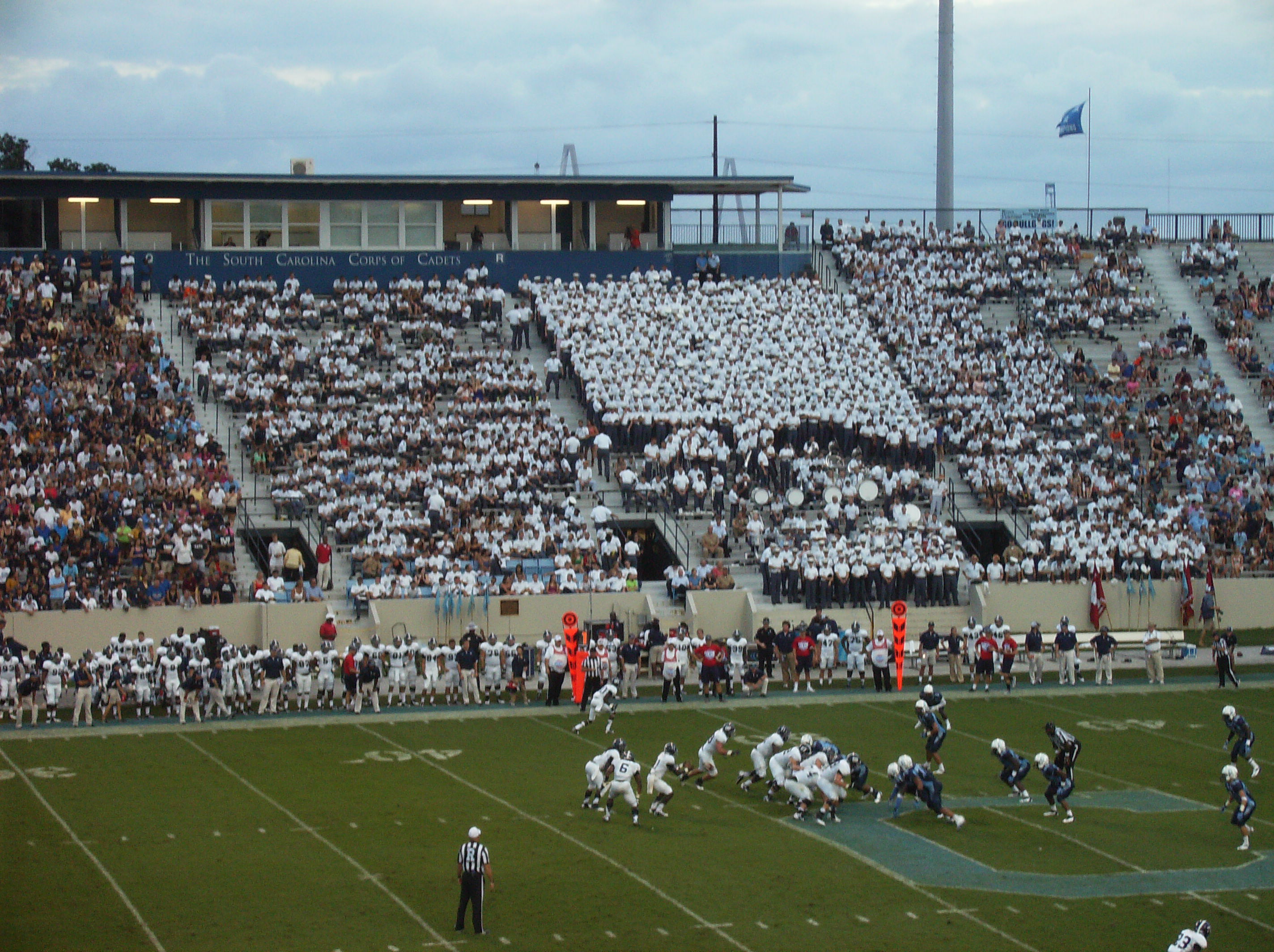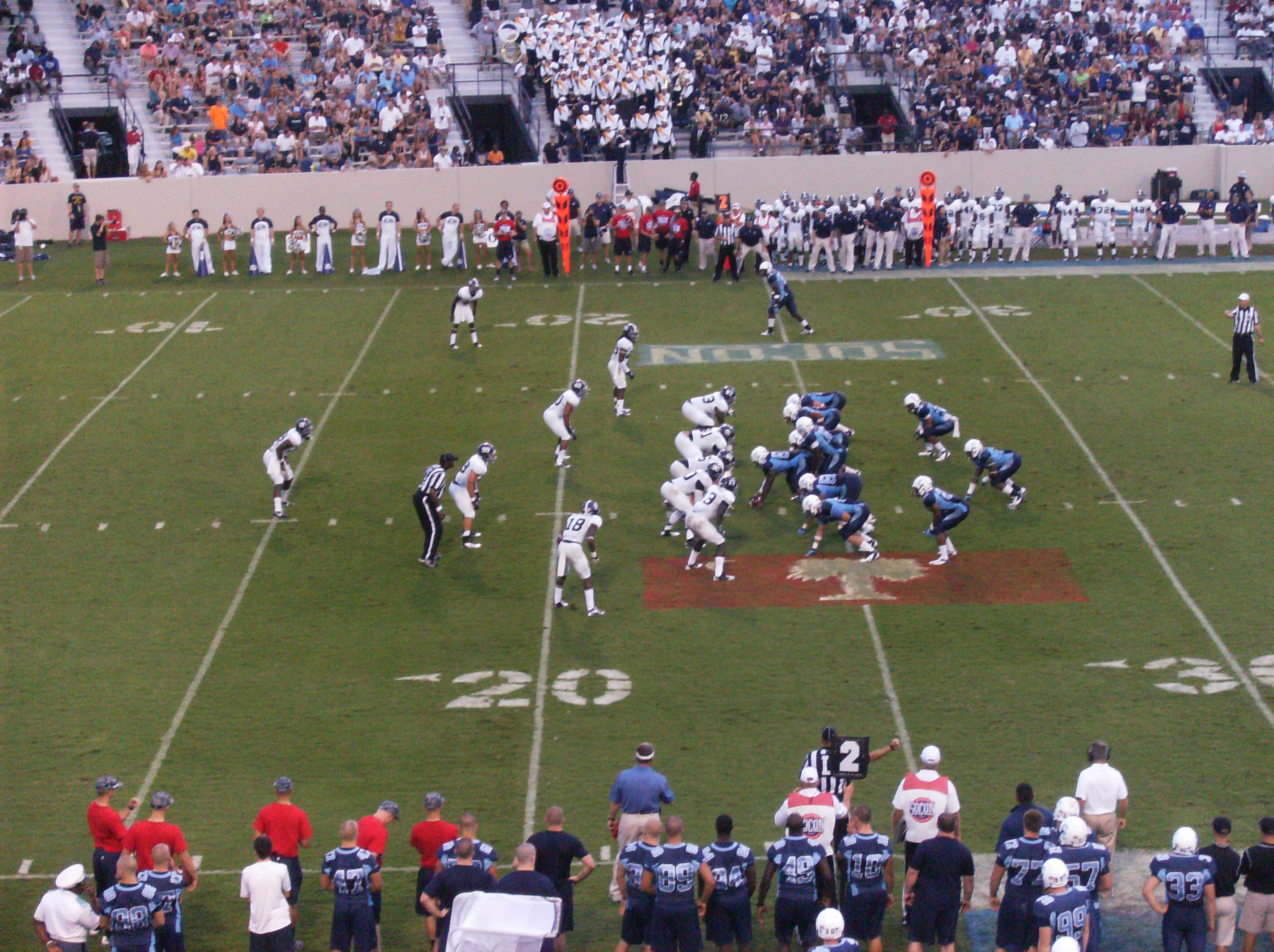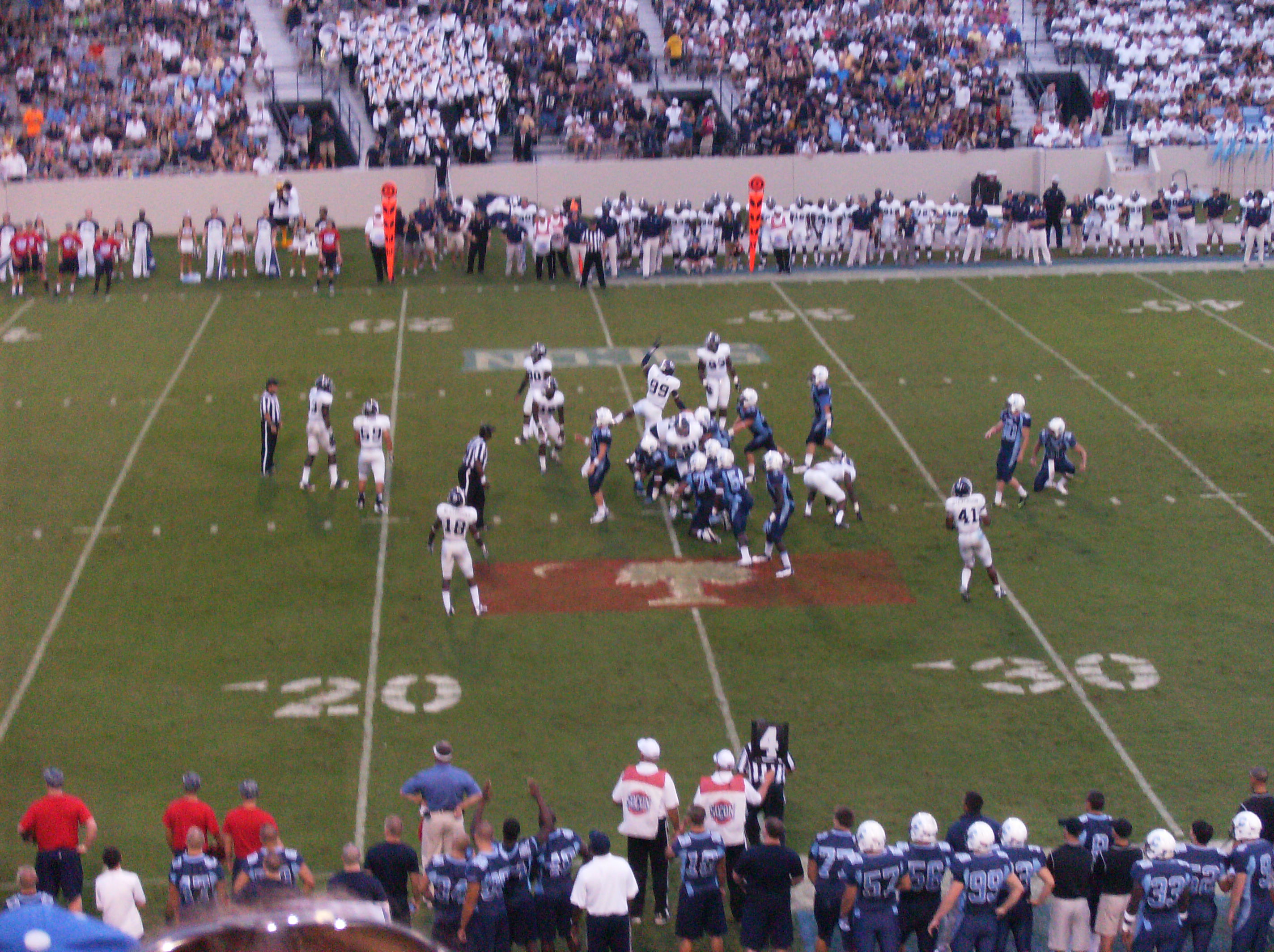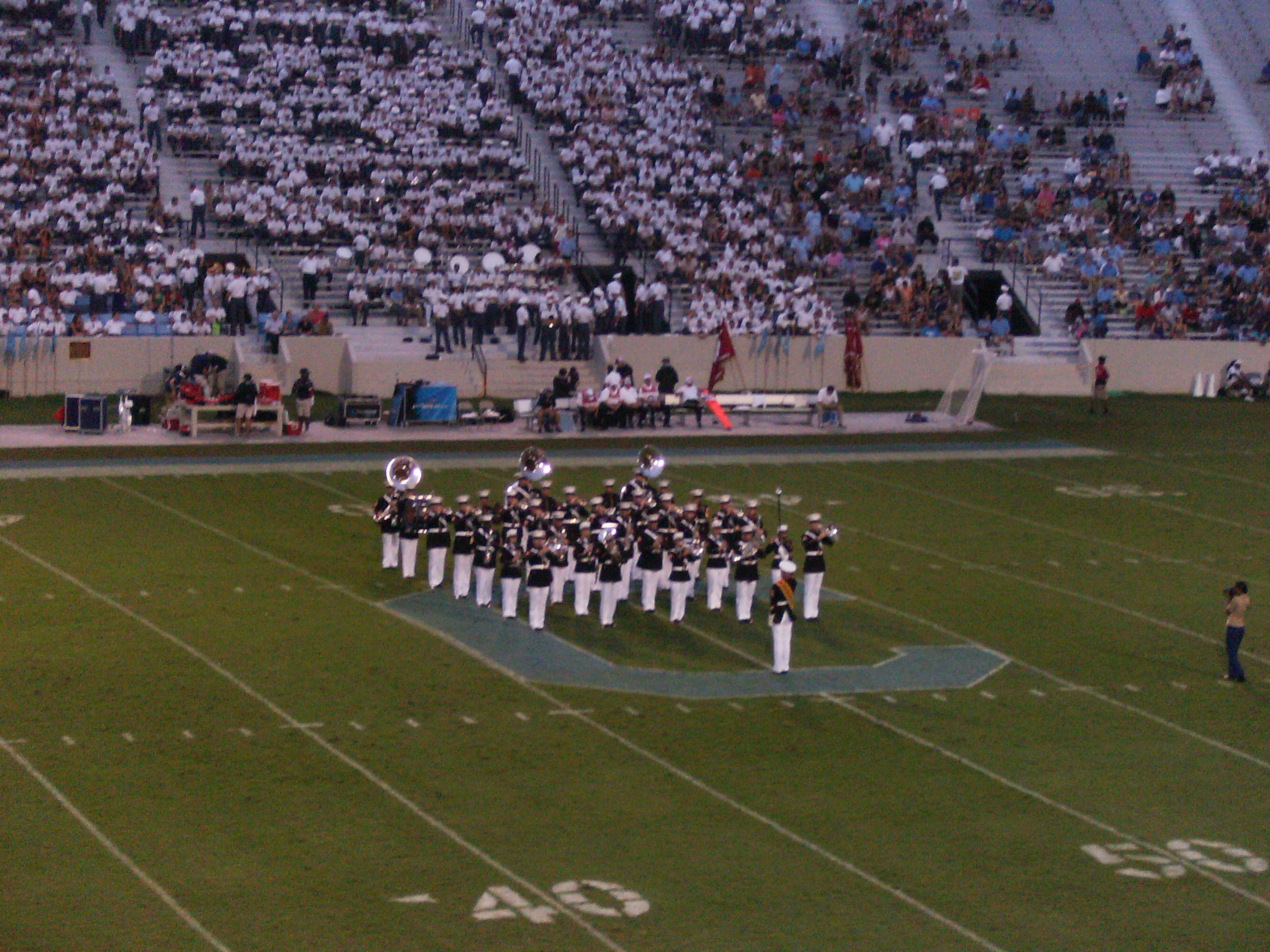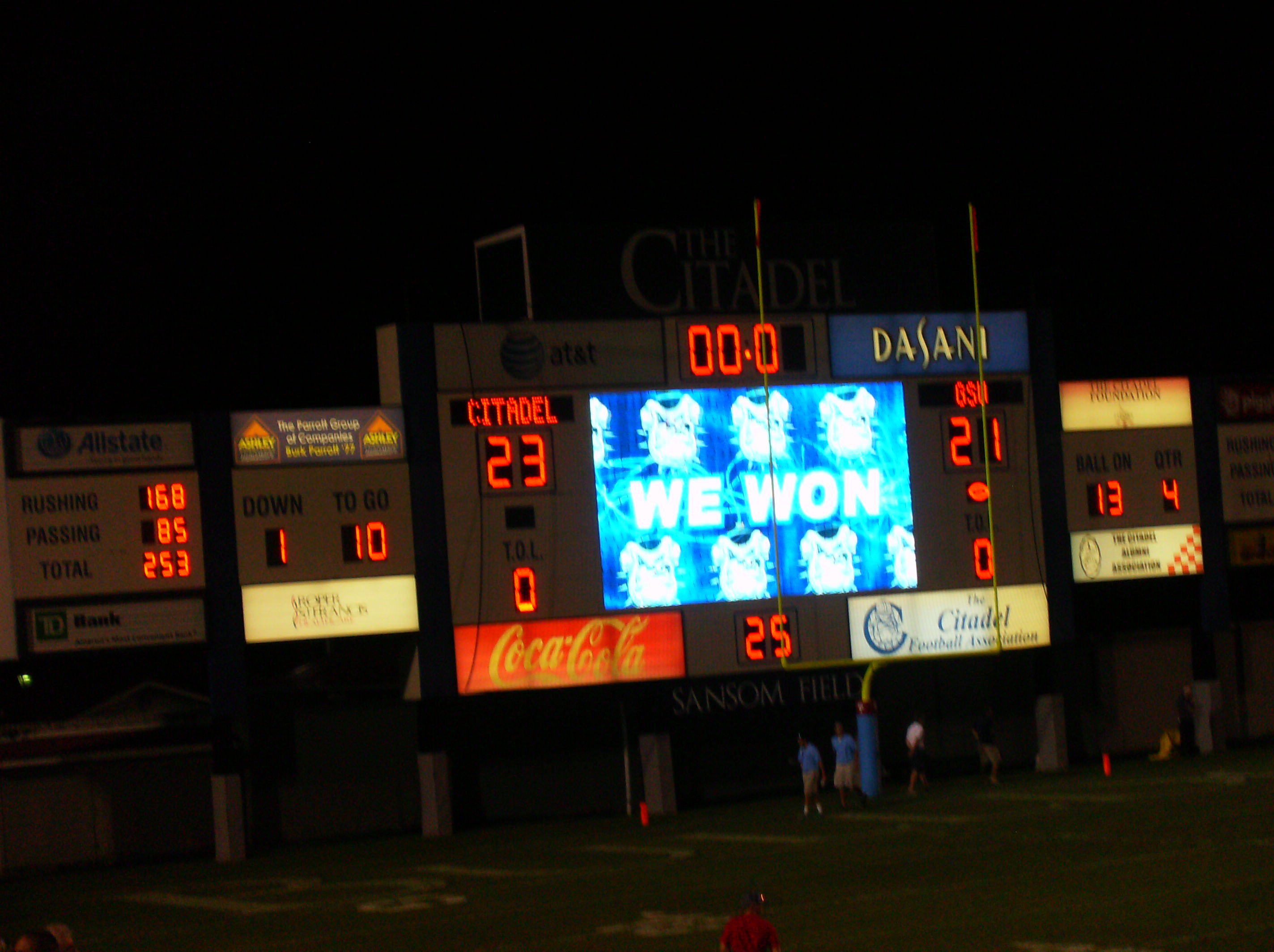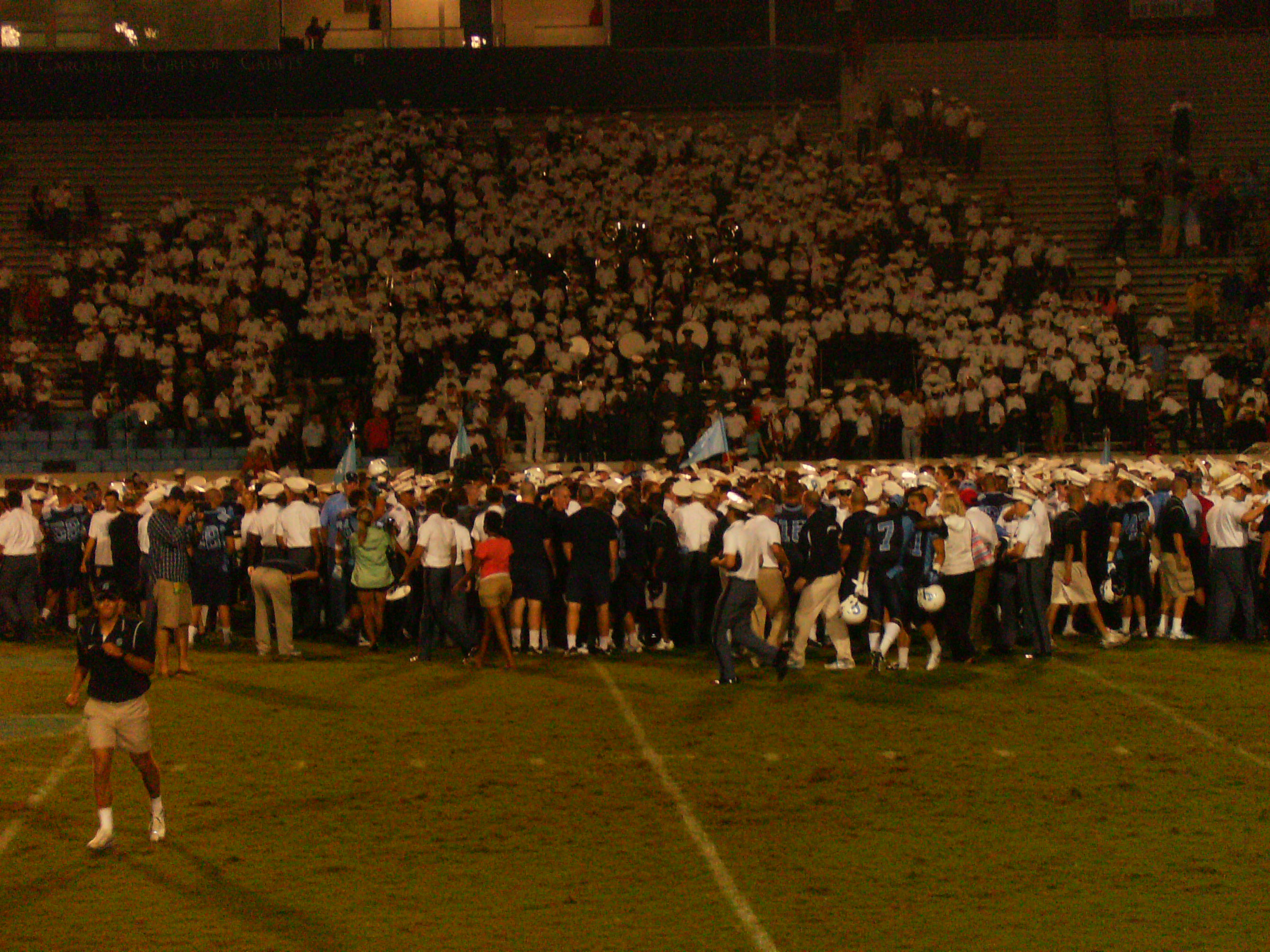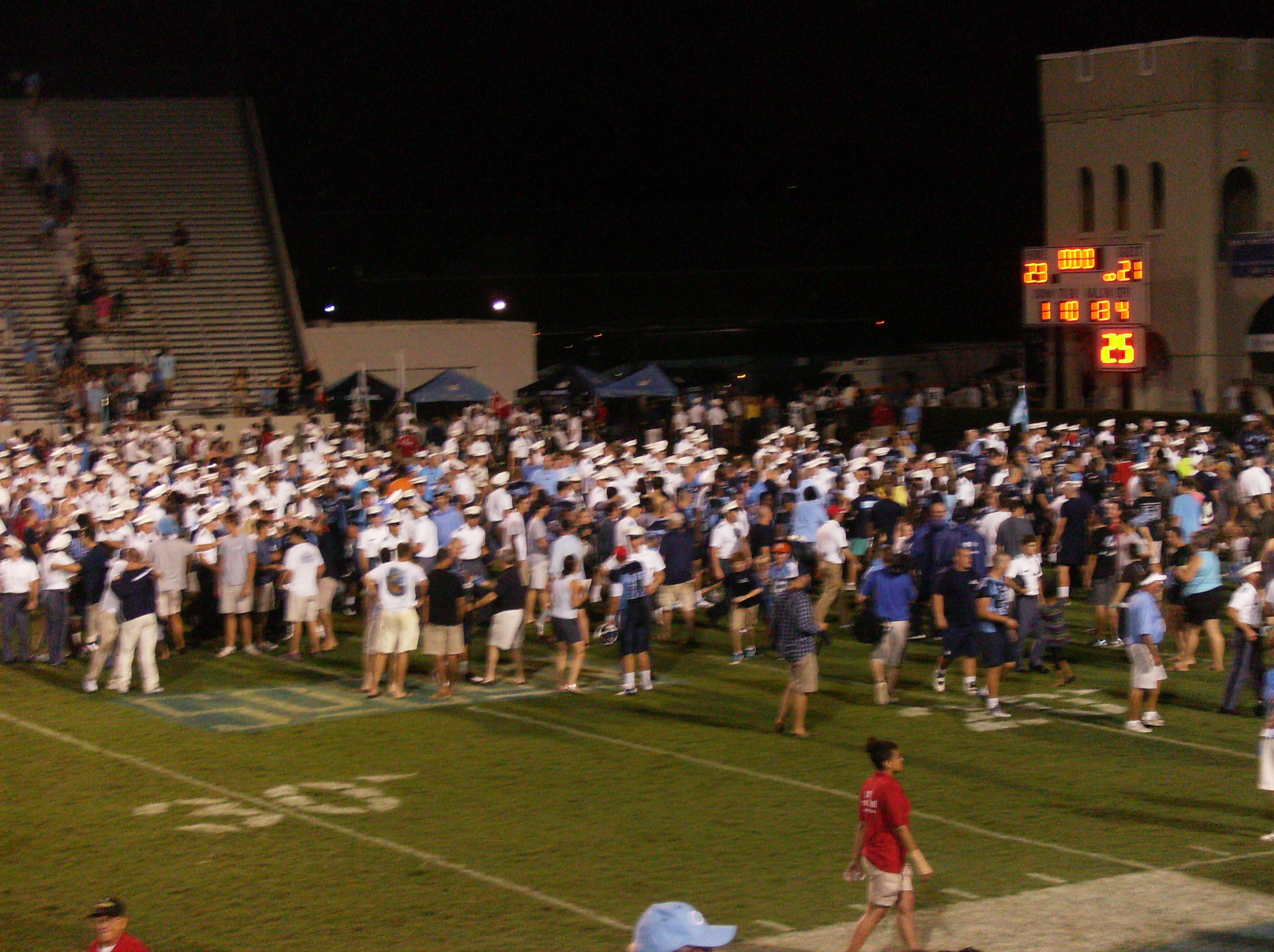
Game review, 2012: Georgia Southern

The Citadel 23, Georgia Southern 21.

Links of interest (lots of video from this one):

Game story in The Post and Courier

Photo gallery from The Post and Courier

Kevin Higgins’ postgame locker room speech

Postgame press conference (The Citadel) video

The Citadel’s release

Photos from The Citadel’s website

Box score

Video from WCSC-TV of Charleston

Video from The Statesboro Herald

Game story in the Savannah Morning News

Video from WJCL-TV of Savannah

Postgame with GSU coach Jeff Monken (you can feel his anger coming through your computer screen)

YouTube clips from the point of view of The Citadel band (including a performance of the classic standard for a football postgame sendoff, Adele’s “Rolling In The Deep”)

I talked a little bit about perspective in last week’s game recap. Sometimes, perspective can be dramatically affected by one late made or missed field goal. This game, of course, had both. Can you say rollercoaster?

After it was over, someone who had not seen the game asked me what I thought was a fair question: were the Bulldogs really that good? Or were they lucky?

Well, luck plays a role in almost any close contest, both good and bad. However, my answer was The Citadel was that good last night. It was not a fluke. The basic statistics don’t quite reflect it (Georgia Southern had 111 more yards of total offense than The Citadel), but the Bulldogs were the better team last night and deserved the victory. They weren’t better by a lot, but by enough. Just enough.

The first half was where GSU piled up its advantage in total offense, but when the dust cleared, The Citadel led 17-14 anyway. The Bulldogs struggled to tackle Eagles B-back Dominique Swope; much of his first-half rushing yardage came after contact.

Swope was very impressive, although his early fumble set up the Bulldogs’ first score. The Citadel took full advantage of the turnover, with its touchdown coming on a fourth-and-one toss sweep to Rickey Anderson (a great call by offensive coordinator Bob Bodine).

Two plays later, GSU fumbled again on an ill-advised pitch by Eagles starting quarterback Ezayi Youyoute. The Citadel faced a third-and-long, but Ben Dupree made a play, scrambling away from GSU defenders long enough to float a well-thrown ball to Domonic Jones for a TD. It was the first touchdown pass thrown by a Bulldog quarterback since Matt Thompson threw three touchdown passes in the 2010 season opener against Chowan.

Other than the two touchdown drives, The Citadel struggled offensively through much of the first half, thanks in no small part to GSU defensive tackle Brent Russell, who was outstanding all night long. However, when presented with opportunities, the Bulldogs offense capitalized. That is what matters. It’s about scoring points.

Georgia Southern’s offense piled up the yardage on three long drives following its two turnovers, with Swope getting the bulk of the work, and the Eagles scored touchdowns on two of them. A late field goal attempt by GSU to close the half was blocked by Domonic Jones (who certainly made his presence felt in this game).

That field goal would have matched a 42-yard kick made earlier by Thomas Warren following a 40-yard Bulldogs drive. The key play on that series was a 26-yard pass from Aaron Miller to Van Dyke Jones on a second-and-14, one of several long-yardage situations during the game that were successfully converted into first downs by The Citadel.

The coaching staff at The Citadel has to be credited with making solid halftime adjustments. Georgia Southern picked up two quick first downs to begin the second half, but then its offense hit a wall. The Citadel’s defense would force three consecutive three-and-outs before GSU would finally get untracked. By then the Bulldogs led 20-14 after another Warren field goal, this one made in a driving rain that lasted for much of the third quarter.

I was afraid that destiny was not shining on The Citadel after the critical play of GSU’s fourth-quarter touchdown drive. On fourth-and-six, the Eagles ran an option play where Youyoute handed the ball to fellow quarterback/occasional slotback Jerick McKinnon, who then attempted to pitch the ball.

It was a play GSU had run before in the game with some success, but this time Bulldogs cornerback Brandon McCladdie read it perfectly and anticipated the pitch, batting it into the air…where it landed in the arms of McKinnon, who turned around and ran against the grain for seven yards and a first down. Oof.

The next play would result in a Youyoute fumble, but officials ruled GSU recovered, and the Eagles would eventually score on the drive to take a 21-20 lead with a little over three minutes remaining.

The ensuing drive for the Bulldogs got off to a stuttering start, but on fourth-and-three Miller attempted a pass to Matt Thompson. GSU defensive back Lavelle Westbrooks was called for pass interference, keeping the drive alive.

In his game story in The Post and Courier, Jeff Hartsell referred to the penalty as being “iffy”, but I strongly disagree with that assessment. The play happened right in front of me. The only way you could argue it wasn’t interference is by saying the ball was uncatchable, but it was close, and the benefit of the doubt is usually given (rightfully so) to the offense in that situation. Also, Westbrooks had been forced to grab Thompson after Miller had scrambled to his right. If you didn’t think it was pass interference, it was certainly defensive  holding.

At any rate, GSU then got the benefit of a non-call, as on the next play Brent Russell anticipated the snap count a fraction too early and moved into the neutral zone before the snap. It wasn’t called, however, and he wound up blowing up the play and putting the Bulldogs into another long-yardage situation. After an incomplete pass on second down, Russell sabotaged yet another play on third down (Russell’s nickname is apparently “ManBearPig”, which seems appropriate).

That led to a fourth-and-15 which the Bulldogs converted, Miller throwing to Greg Adams, who ran a great route. Three plays later Thomas Warren made his third field goal of the day, a 37-yarder that proved to be the game-winner.

If you are a fan of The Citadel, you are probably thinking that you haven’t seen the Bulldogs prevail on a late field goal too often, at least in recent years. You would be correct. I looked this up, and I could have missed one someplace, but I think this is the list:

— Field goal made late in the fourth quarter to force a tie (and OT): Mike Adams versus Furman, 2007. This was the crazy 54-51 game, of course. The Bulldogs made a huge rally to force OT, winning on a TD run by Tory Cooper. Before that could happen, though, Adams had to make a 32-yarder with 1:19 remaining to tie the game at 48.

— Field goal made late in the fourth quarter to win a game that was tied: Travis Zobel versus Appalachian State, 2003. The Citadel tied the game late on a 44-yard run by Scooter Johnson (that had been preceded by a fake punt executed by Zobel). After an interception, Zobel connected on a 26-yarder with 1:16 remaining to give the Bulldogs a 24-21 victory.

— Field goal made late in the fourth quarter to win a game that The Citadel was trailing: Nick Haas versus Hofstra, 1998. Haas made a 32-yarder with six seconds left to give the Bulldogs a 32-30 victory. The winning kick was set up by Carlos Frank’s 37-yard run off a reverse.

So, yeah, it had been a while. For the specific circumstance Warren found himself in, fourteen years.

It almost didn’t work out, though, after J.J. Wilcox’s great return (he broke multiple tackles) set up Georgia Southern in Bulldogs territory. The Eagles almost fumbled it away late, but recovered, and things looked grim for The Citadel as GSU prepared for a 31-yard field goal attempt.

Even though they had time, though, the Eagles seemed a bit rushed to me as they got set up for the kick. There were actually a lot of things going against GSU. The earlier blocked FG attempt had to be in the thoughts of the players, and the two preceding Georgia Southern kickoffs (by a different kicker than the FG kicker) had been hooked out of bounds, with the second one almost landing in the home side stands.

The weather wasn’t conducive to placekicking, either, which made Warren’s kick (and the snap/hold) all the more impressive. For GSU, it wasn’t meant to be. The snap was very high. The holder barely got it down, and the timing for the kick was thrown off. Not surprisingly, the kick was hooked wide left.

Odds and ends:

– Besides doing a fine job holding on placekicks, Cass Couey continued to demonstrate why he is the SoCon’s best punter, averaging 47.2 yards on his four punts, with no return yardage. He can really boom ’em.

– In what is probably a testament to Brent Russell’s play as much as anything, The Citadel never established the B-back. Darien Robinson carried four times for eight yards, and that was it.

– The Citadel’s 253 yards of total offense were the fewest for the Bulldogs against a SoCon opponent since the 2010 season finale against Samford. The Citadel won that game, too.

– Georgia Southern’s offense had nine plays of at least 19 yards last week against Jacksonville. On Saturday, GSU had only one such play, a 23-yard run by Youyoute. That was a major accomplishment for the Bulldogs’ D.

– The Citadel had four illegal formation penalties on kickoffs. I don’t know what the problem was, but it’s something that needs to get cleaned up before next week.

– Attendance for the game: only 12,299. Ouch. I wasn’t expecting that. It can be explained to a large degree by the weather, as the local area was under the gun for potential thunderstorms (and generally heavy rain) for most of the afternoon.

The other point worth making is that Georgia Southern’s fan base did not show up in large numbers for the game, despite the pleas of head coach Jeff Monken. I think it’s probably time to put an end to any discussion about GSU’s fans “travelling” well to away games.

I’ve seen talk in various places (message boards, etc.) about this, but all I know is that the historical record suggests they have never been a major factor at Johnson Hagood Stadium, and if they aren’t going to make the short trip to Charleston, I find it hard to believe they are regularly going to Boone/Greenville/Spartanburg in overwhelming numbers either.

On Saturday, GSU brought about as many fans to the game as Charleston Southern had done the week before. The Eagle supporters who did attend were appropriately vocal, which is to their credit. Those were good fans. There just weren’t that many of them.

– I’m not going to complain too much about the all-navy uniforms, although I don’t like them at all. However, I really wish we wouldn’t wear navy unis at home when we’re playing opponents that have navy as their primary color.

Now the Bulldogs are 2-0 and know that they won’t be worse than 2-2 when they return to Johnson Hagood Stadium in three weeks to play Chattanooga. The road trips to Appalachian State and North Carolina State are going to be difficult, but there will be a renewed sense of confidence for the players and coaches as they get ready for those games. They won’t be thinking about being 2-2 after four games; no, they will be shooting for 3-1 or 4-0.

Saturday’s win over Georgia Southern was great, the biggest in Kevin Higgins’ tenure. What’s really good about it, though, is that The Citadel still has considerable room for improvement. It wasn’t a perfect performance by any means. The Bulldogs committed too many penalties, didn’t run the ball effectively on the ground (3.8 yards per carry), fumbled twice, and had trouble at times defensively bringing down Georgia Southern ballcarriers.

In other words, this team can get better — and if Saturday’s game is any indication, it’s already pretty good.

On to Boone, at least for the team. I won’t be there, as I will be travelling. The next two or three weeks, actually, are going to be busy for me, so there won’t be posts as long as this one, assuming anyone is still reading this post…

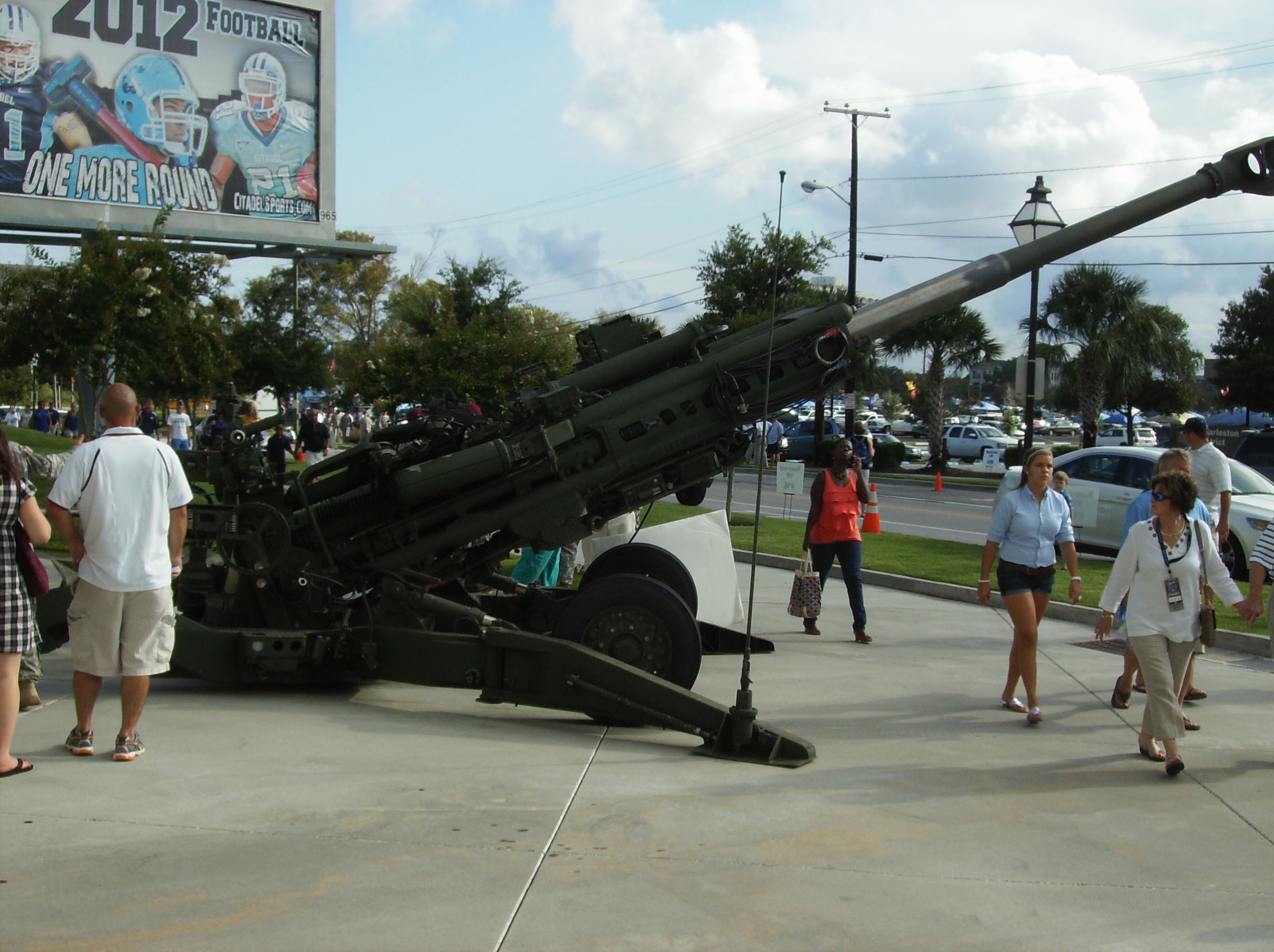
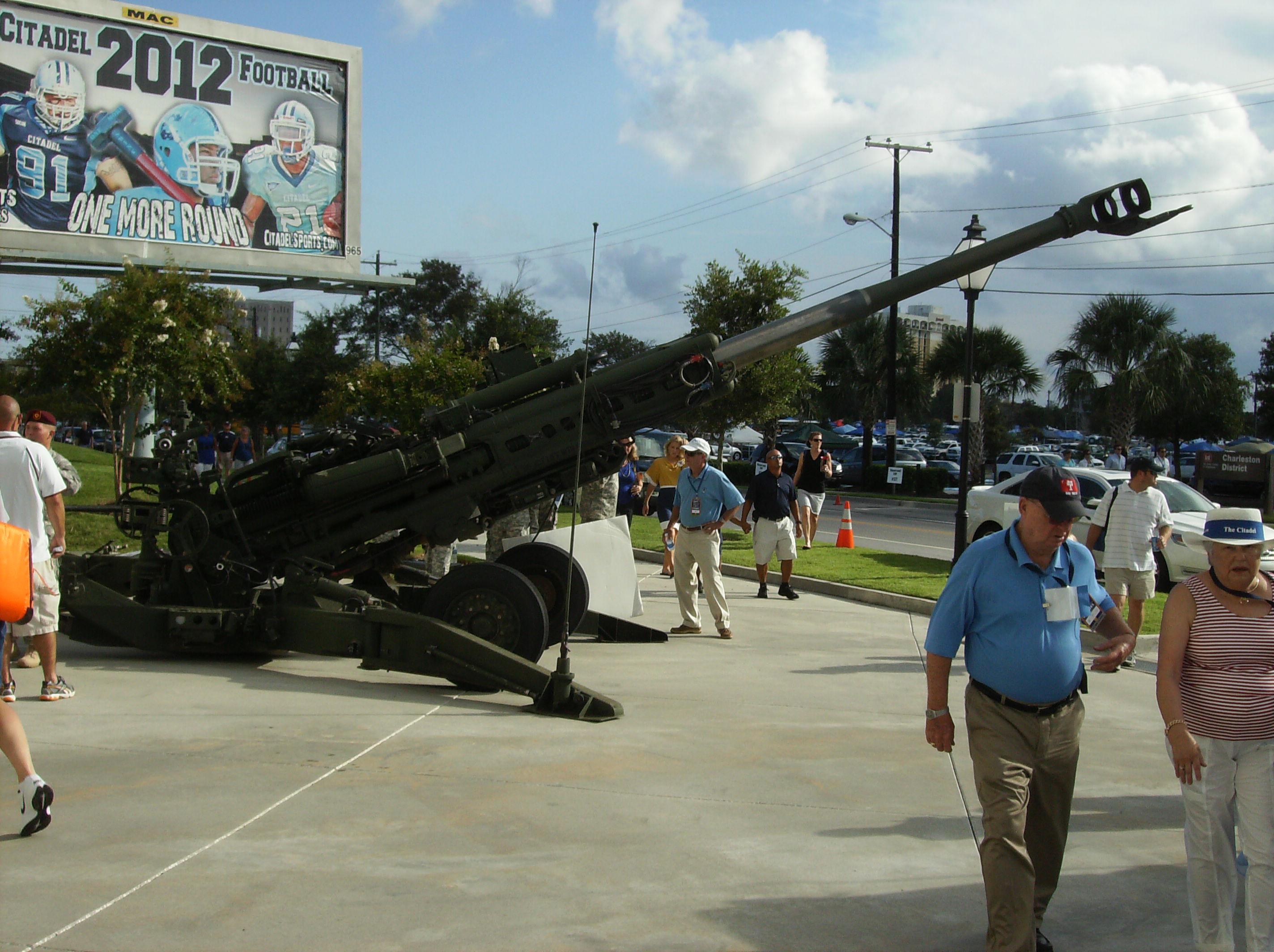
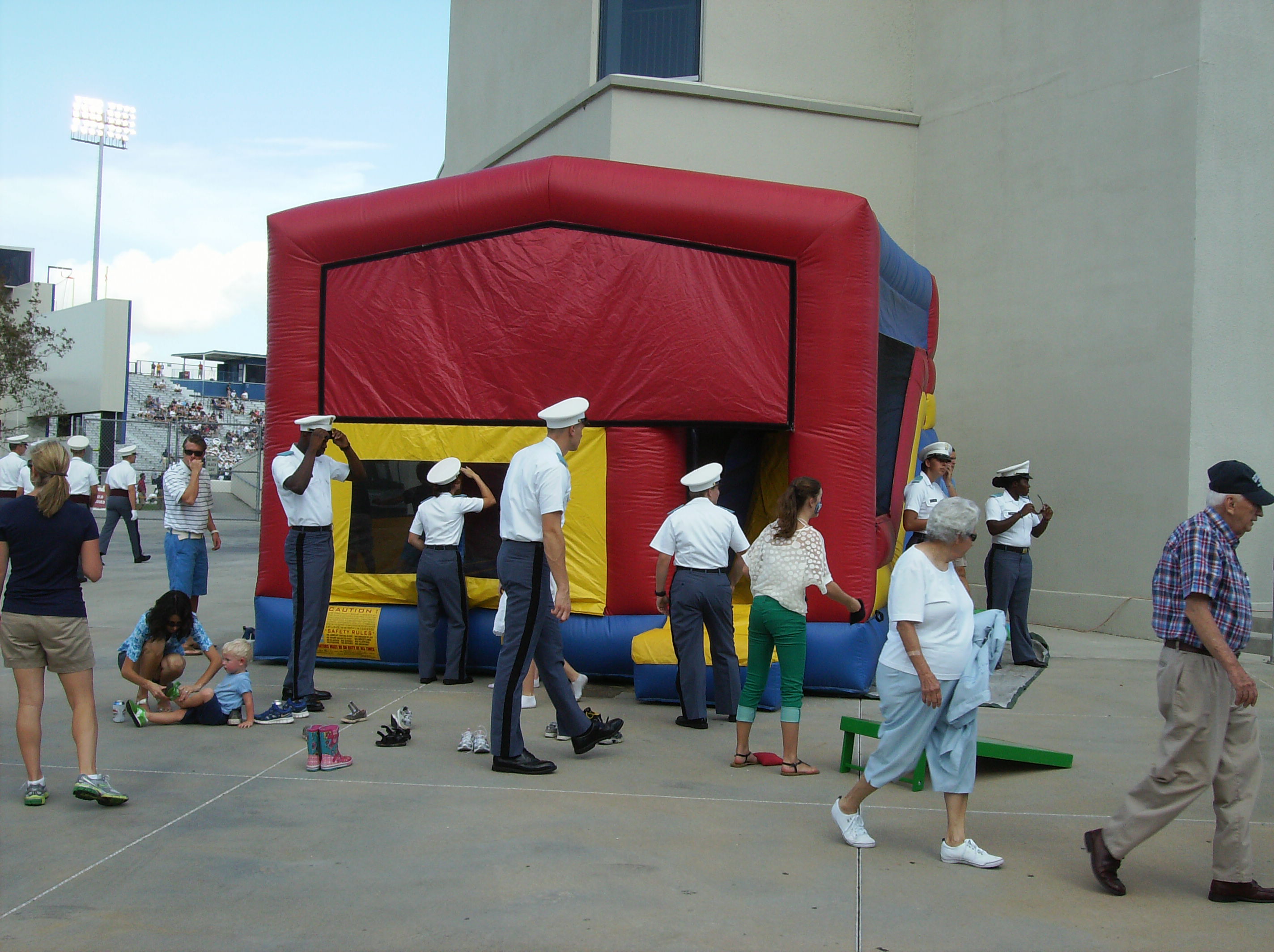
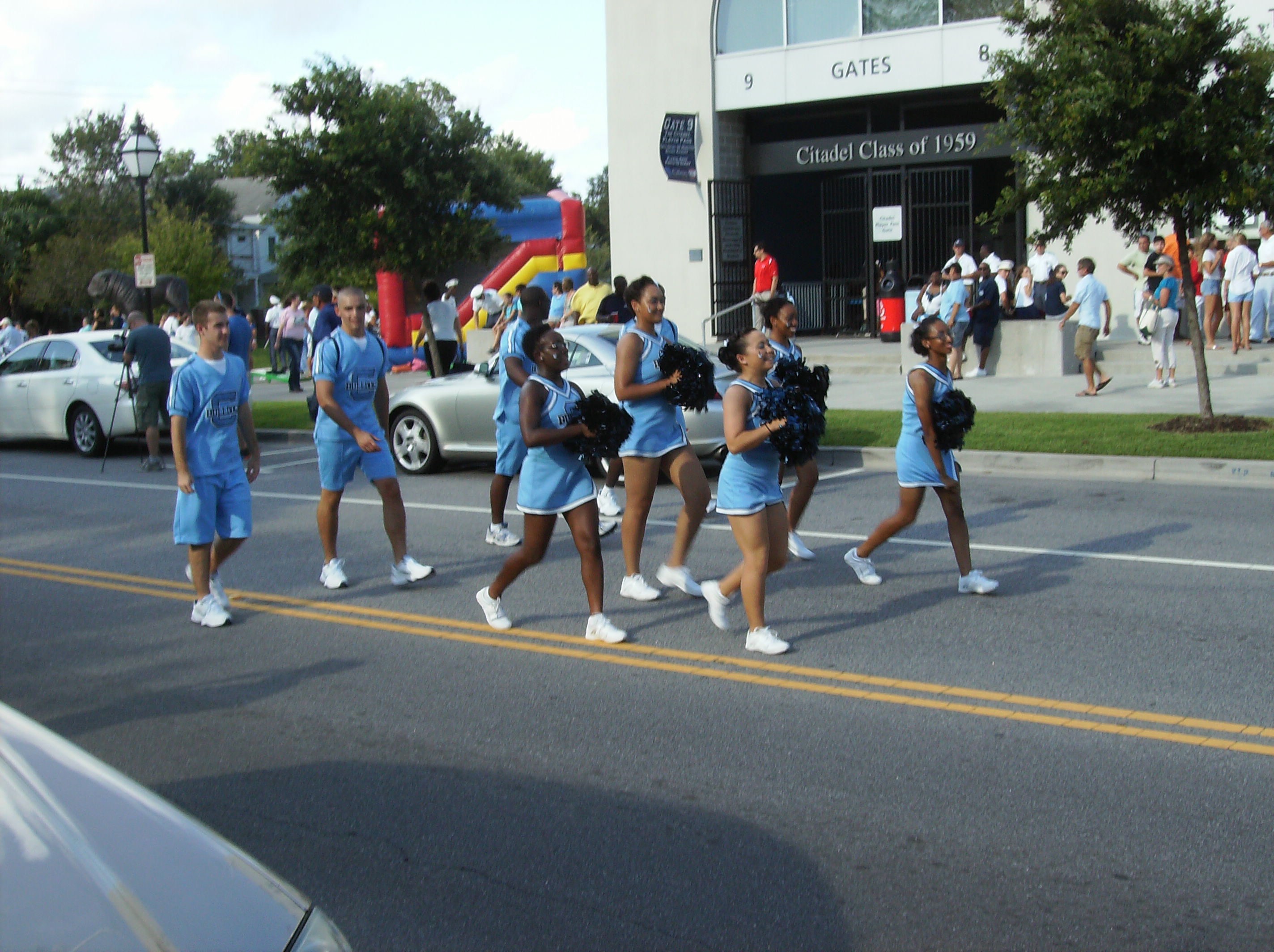
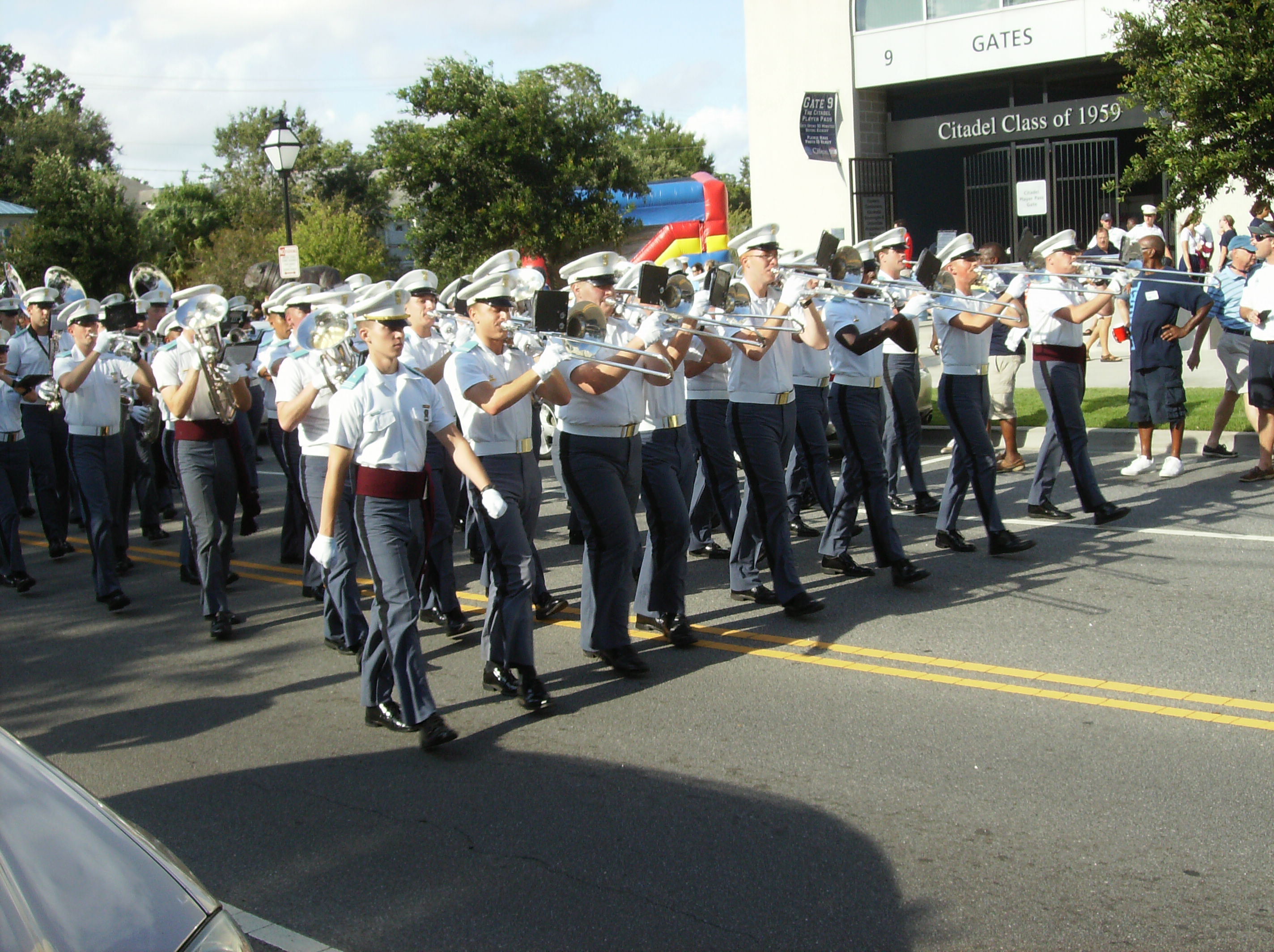
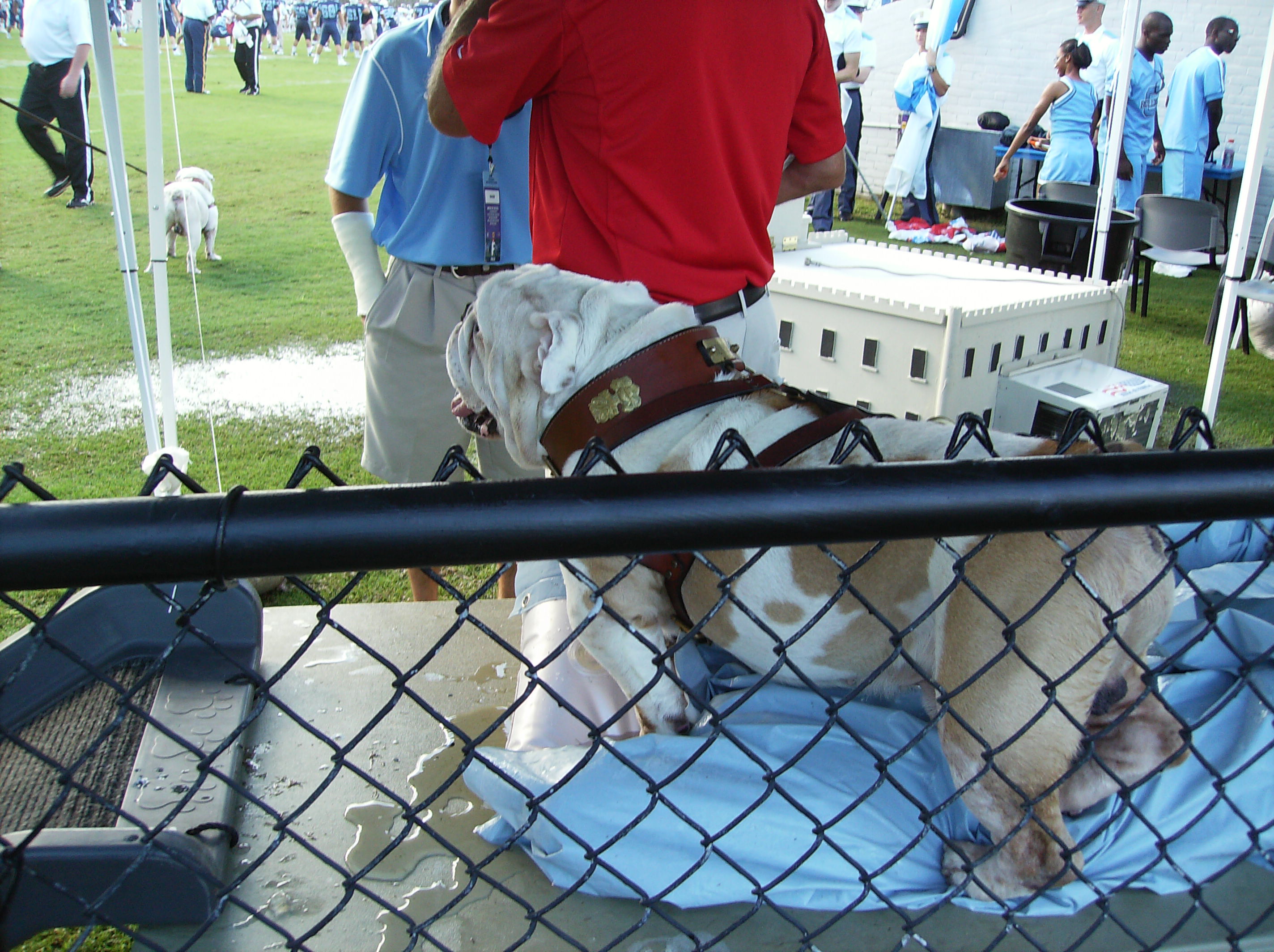
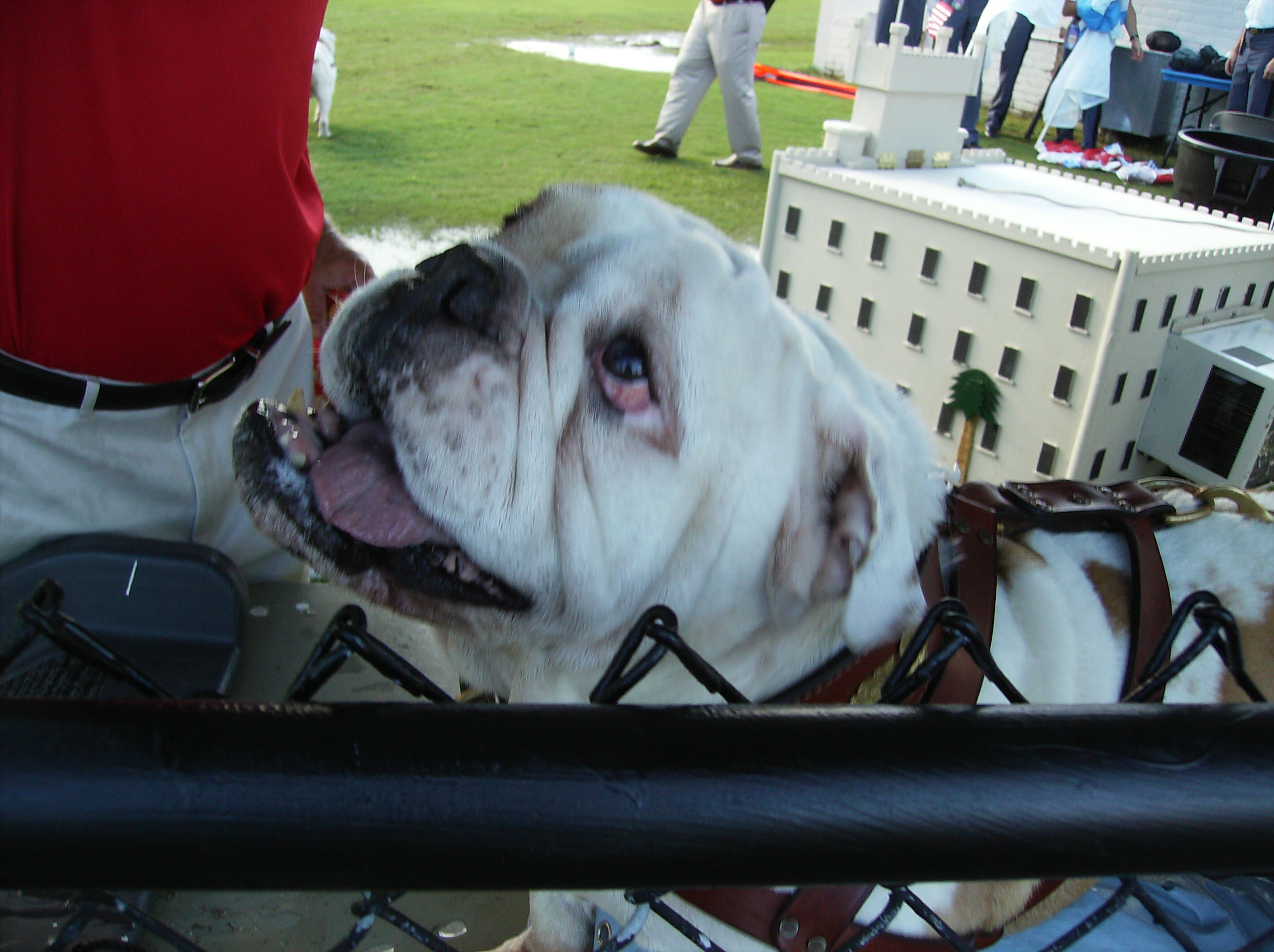
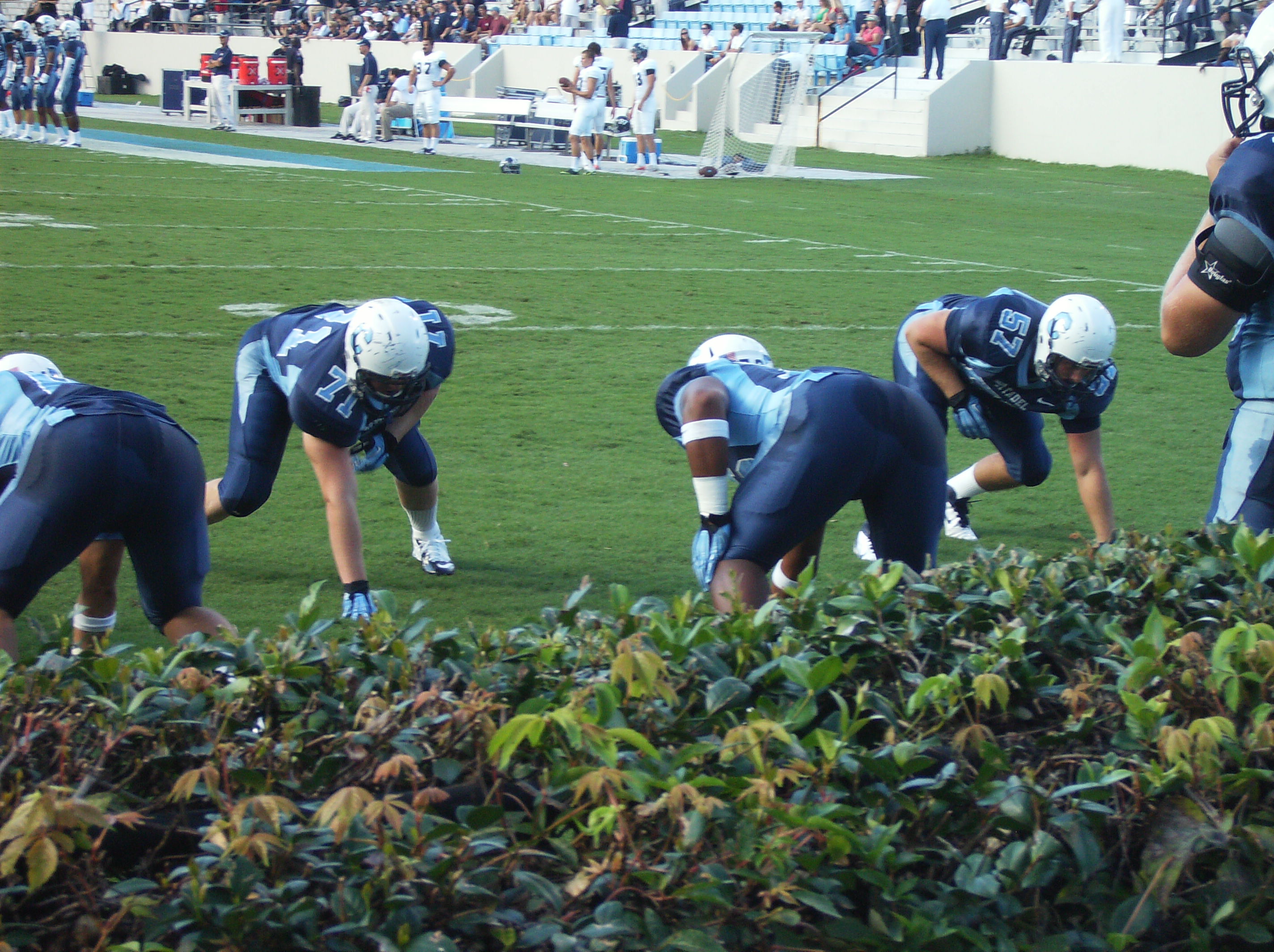
I took a bunch of pictures. Most of them weren’t very good, but then I’m not a good photographer. I tried to take a lot of pregame stuff, both around the stadium and field.

2012 Football, Game 2: The Citadel vs. Georgia Southern

The Citadel vs. Georgia Southern, to be played at historic Johnson Hagood Stadium, with kickoff at 6:00 pm ET on Saturday, September 8.  The game will not be televised, although it will be webcast on Bulldog Insider (subscription service) and can be heard on radio via the twelve affiliates of The Citadel Sports Network. Danny Reed (the “Voice of the Bulldogs”) will call the action alongside analyst Josh Baker, with Lee Glaze roaming the sidelines and Walt Nadzak providing pre-game, halftime, and post-game commentary. 

Links of interest:

The Citadel game notes                   Box score from The Citadel’s game last week

Georgia Southern game notes        Box score from GSU’s game last week

SoCon weekly release

I want to start by talking about one of my favorite topics, attendance.

A crowd of 14,264 attended the game against Charleston Southern. Even with the ticket promotions and the postgame fireworks, I was pleasantly surprised with that total. As I arrived, I could see that there were a lot of people in the area around the stadium, even if a significant portion of them were just there for the tailgating.

It was the largest crowd for a game at Johnson Hagood Stadium since 2009, and the largest crowd for a home opener since 2006.

Charleston Southern actually brought a decent number of fans, a departure from previous seasons. More power to them. Georgia Southern will bring considerably more this week, so an opportunity for a big crowd is there.

This will be only the second time the two schools have met on the gridiron in the month of September. The Citadel played Georgia Southern on September 11, 1993, in Statesboro.

That is something to keep in mind when looking at attendance figures at Johnson Hagood Stadium for previous contests against the Eagles. Somewhat surprisingly, only twice has a game at JHS against Georgia Southern drawn crowds larger than the one last Saturday against CSU. However, all of those games came later in the season.

Attendance at Johnson Hagood Stadium when Georgia Southern is the opponent:

1994 — 18,559
1996 — 9,427
1998 — 14,222
2000 — 12,391
2002 — 16,427
2004 — 12,472
2006 — 12,129
2008 — 11,190
2010 — 10,385

I think there is a good chance that attendance will get a sizable bump for this matchup. It helps that both Clemson and South Carolina are playing earlier in the day.

That makes it all the more important for the Bulldogs to play well against the Eagles, because I believe that attendance for the remaining home games may be affected by The Citadel’s “momentum”. If a large crowd sees a good game, some of those people will come back for more. The bandwagon will start to roll again.

Interestingly, The Citadel’s potential attendance surge would be going against the national tide, at least if early-season FBS crowds are any indication:

There was exactly one announced capacity crowd in eight Southeastern Conference home openers. Before the Labor Day Georgia Tech-Virginia Tech game, six out of seven Atlantic Coast Conference schools had smaller crowds than their openers last year – some of them much smaller. Attendance was down at six out of eight Big 12 home openers from 2011. Five out of eight Pac-12 schools had smaller crowds as well, and Oregon’s 13-year sellout streak was in jeopardy until game day.

The Citadel’s attendance against Charleston Southern (14,264) was greater than the average attendance for the four MAC games played last week (13,928).

Can The Citadel beat Georgia Southern? Of course. What are the Bulldogs’ chances? Probably not very good, if history is a guide.

One of the great games in the history of Johnson Hagood Stadium was The Citadel’s 20-3 upset of top-ranked Marshall in 1988. The Bulldogs would also beat a top-10 opponent at JHS in 1991 when they edged #7 Furman 10-6 in a classic defensive struggle.

However, that 1991 win over Furman is one of just three victories by the Bulldogs over top 10 opposition since 1990. Two of those wins came in 1991; Appalachian State was ranked #9 when the Bulldogs beat the Mountaineers that season.

The Citadel defeated East Tennessee State in 1997 in Johnson City when the Bucs were ranked #8 (and still played football). Other than that, nothing:

– The Citadel vs. Top 10 opposition since 1990: 3-40 (29 straight losses)
– The Citadel vs. Top 5 opposition since 1990: 0-23
– The Citadel vs. Georgia Southern since 1990 when GSU was in the top 10: 0-9

I’m not trying to be negative. I’m just trying to provide a little perspective. If The Citadel were to win on Saturday, it would be the biggest win for the football program in at least fifteen years and the signature victory for Kevin Higgins in his tenure at the school.

It would also snap a rather ignominious streak: the Bulldogs have lost nine consecutive conference home games since beating Samford in 2009. The Citadel has not won a SoCon contest at Johnson Hagood Stadium since switching to the triple option offense.

While Georgia Southern has a history of high-octane offenses and rushed for 557 yards last week in a 58-0 demolition of Jacksonville, the Eagles’ best player is defensive lineman Brent Russell. He has had any number of big games (his performance versus Navy in 2010 was particularly noteworthy). Russell didn’t have a big game against The Citadel last year, though, because he was suspended and didn’t play.

Russell is back for this season’s matchup with the Eagles, but the Bulldogs will be without his fellow All-SoCon defensive lineman, Derek Douglas. Advantage: GSU.

One of the easy storylines for this game would be Russell matching up against The Citadel’s all-league center, Mike Sellers. However, it is unlikely there will be many (if any) one-on-one battles between the two star linemen. Kevin Higgins noted this at his weekly press conference when he pointed out Russell is now a “three technique” lineman.

Georgia Southern has moved Blake Riley to nosetackle in an effort to keep Russell from being repeatedly double-teamed, and as a result it will likely be The Citadel’s guards who will have to deal with Russell more often than not. Of course, the Bulldogs will try to neutralize him whenever possible by optioning off of him. The best way to neutralize Russell, though, is to block him. That will be a difficult task.

Another key figure in GSU’s defense will be Patrick Flowe, who is starting at middle linebacker for the Eagles as a true freshman.  It is surely unusual for a team coming off back-to-back appearances in the national semifinals to immediately start a true freshman at middle linebacker.

Curiously, Flowe is listed as the backup at MLB in GSU’s game notes.

Georgia Southern’s offense did not complete a pass in eight tries against Jacksonville, not that it mattered. In my preview of the Charleston Southern game I mentioned how overrated “balance” in an offense can be. To further illustrate this, GSU is 7-0 in modern program history when it fails to gain any passing yardage. One of those games was in 2010 at Johnson Hagood Stadium against the Bulldogs.

In contrast to The Citadel’s stuttering start against Charleston Southern, GSU came out blazing against the Dolphins, scoring 27 points in the first quarter. The second play from scrimmage for the Eagles was a 79-yard touchdown run by Ezayi Youyoute, one of two quarterbacks who will see significant time for Georgia Southern.

Fifteen different players carried the ball at least once for GSU. They included B-back Dominique Swope (104 yards, 3 TDs), Youyoute (164 yards, 3 TDs), Youyoute’s fellow QB Jerick McKinnon (71 yards, some of which came as a slotback, and a TD), and Robert Brown (63 yards on three rushes).

Those who remember the 2010 game against Georgia Southern (and Bulldog fans could be excused for trying to forget it) will recognize McKinnon’s name, as the then-frosh QB had to replace regular starter Jaybo Shaw early in that contest. McKinnon rushed for 182 yards that afternoon on 35 carries, both of which remain career highs for him.

Brown played in that game too, but as the B-back. He has now been moved to slotback. The fact he will play at all on Saturday is borderline amazing (at least to me), as he had back surgery just seven weeks ago.

Georgia Southern’s offense this season is expected to be more explosive with Youyoute and McKinnon at the controls. Jaybo Shaw was efficient and effective, a solid passer who made good decisions running the triple option, but was not a breakaway threat.

Of course, that doesn’t mean the combination of Youyoute/McKinnon won’t make the right reads, or that either/or can’t throw a nice ball. It may be, however, that The Citadel is playing Georgia Southern at the right time of year, as the two QBs are still developing as signal callers.

Georgia Southern also ran a fake punt against the Dolphins, and recovered an onside kick while leading 41-0 (though I gather that may have been an accident).

GSU had excellent special teams units last year, but is breaking in a new placekicker and punter this season, and needs to find a kick returner to replace Laron Scott.

Speaking of Scott, he also blocked one of the two missed Bulldog PATs that were so critical in last season’s game (free safety Darius Eubanks blocked the other). The Citadel is going to have to do a much better job in that phase of the game.

Confusion alert: Darreion Robinson, Georgia Southern slotback/punt returner, meet Darien Robinson, The Citadel B-back. Both scored touchdowns in last year’s matchup.

Offensively, the Bulldogs face the challenge of trying to control the line of scrimmage against Russell and company. It goes without saying that fumbling six times in a half again would be a bad idea. Georgia Southern lost both of its starting cornerbacks from last season (including the ubiquitous Scott), so perhaps this is the week that Triple O’Higgins breaks out the forward pass in a major way.

I was impressed with freshman running back Vinny Miller last Saturday, as were many other observers. I wouldn’t be surprised if he assumed an expanded role in this week’s game. Miller was one of several freshmen who made significant contributions during the Bulldogs’ victory over the Buccaneers. Another who impressed in his debut was defensive tackle Colin Parsons.

The Citadel’s defense has to do its best to prevent big plays, although it is probably inevitable that GSU will break at least a couple of long gainers. Against Jacksonville, the Eagles had nine runs of 19 yards or more. To combat the Eagles’ explosiveness, The Citadel must punish the high risk/reward nature of GSU’s offense by forcing turnovers.

Last year’s game featured five Georgia Southern fumbles (two lost) and an interception. The Bulldog D needs to at least match that total on Saturday.

The Bulldogs also must win the special teams battle. It’s not just about the placekicking, either.

Georgia Southern held The Citadel’s offense to 264 yards of total offense last season, which was the second-best performance by the Eagle defense all year (only Elon had fewer yards against GSU). However, the Bulldogs matched them on the other side of the ball, as Georgia Southern’s offense produced fewer total yards against The Citadel’s defense (320) than any team it played in 2011 except Appalachian State.

I don’t see that kind of game playing out on Saturday. I think both offenses are going to move the ball and score more points. That would probably be a good outcome from The Citadel’s perspective, as the Bulldogs are less likely to win a low-scoring game.

Indeed, The Citadel is 2-35 in the Kevin Higgins era when scoring 20 or fewer points (including an 0-4 record last season). I can understand having that bad a record when scoring 10 or fewer points, or even 14, but 20? Conversely, GSU is 2-5 under Jeff Monken when scoring 20 or fewer points.

It will be Military Appreciation Day on Saturday. It should be a festive occasion, with plenty of different events happening in conjunction with the football game. It will be even more festive if the home team can pull off a big upset. I would like to see a really big fiesta at Johnson Hagood Stadium that night.

2012 Football, Game 1: The Citadel vs. Charleston Southern

Ah, football. So glad to see you again, old friend. The offseason was long and hard. The lack of a winter confused us. We’ve had to wade through conference realignment conspiracy theories again, with some of those rumors involving our own conference.

Yes, football is back, and just in time.

The Citadel vs. Charleston Southern, to be played at historic Johnson Hagood Stadium, with kickoff at 6:00 pm ET on Saturday, September 1.  The game will not be televised, although it will be webcast on Bulldog Insider (subscription service) and can be heard on radio via the twelve affiliates of The Citadel Sports Network. Danny Reed (the “Voice of the Bulldogs”) will call the action alongside analyst Josh Baker, with Lee Glaze roaming the sidelines and Walt Nadzak providing pre-game, halftime, and post-game commentary. After the game, there will be a fireworks show, which probably guarantees that a series of thunderstorms will begin to pass through Charleston during the second half.

Some links of note:

The Citadel game notes    The Citadel depth chart   SoCon weekly release

Oh, and just for fun, a few things I wrote in the spring and summer:

Why I don’t expect an overflow crowd at Saturday’s game

A brief look at returning lettermen for The Citadel and its opponents

An analysis of attendance at Johnson Hagood Stadium over the past five decades

My ridiculously long-winded manifesto on why The Citadel needs to add more varsity sports

Watching The Post and Courier‘s video preview for The Citadel’s upcoming season, I was interested to hear Jeff Hartsell state that head coach Kevin Higgins was not under any particular pressure in terms of wins and losses for this year. According to Hartsell, The Citadel administration is “all-in” on Higgins, who is now in his eighth season at the military college.

I’m not surprised school officials would take that position in public (it is, after all, the correct thing to do). I was a little curious to hear Hartsell say so without equivocation, which tells me the public position is also the private one. Higgins has one year remaining on his contract after this season, to be sure, and The Citadel is not known for terminating coaches in that situation.

Not that I’m advocating a “win this year or else” strategy with regards to Higgins; far from it. I think it’s good to have a veteran coach running things. As long as he still has the energy for the job (and that certainly appears to be the case), I like the idea of having a coach who has been at the school long  enough to know what to do and what not to do. He knows how to approach things that are unique to The Citadel, whether it be recruiting or corps squad/rest of corps relations (this tweet is evidence of the latter).

In other words, he’s made all the big mistakes he’s going to make. Now, though, I would like to see him win a few more games, which would go along nicely with his cutting-edge practice field attire.

I think it’s important to be realistic about a football program that has had just one winning season since 1997. The definition of a successful campaign this year, then, is to finish with more wins than losses. As Hartsell also said in the video preview, that’s what fans should be expecting (in terms of a breakthrough).

It won’t be easy. The schedule is not as conducive to a winning year as one would like. There are only five home games, and in addition to that the slate is front-loaded. It is not out of the question The Citadel could be 1-4 after its first five games. In fact, the football cognoscenti of the SoCon would predict exactly that. The Bulldogs were picked to finish next-to-last in the league by both the media writers and the coaches.

Therefore, a key to the season is improving upon that 1-4 expectation. That is quite possible, in my view. The Bulldogs more than held their own last season against the three league opponents they will play in that five-game stretch. The Citadel lost by seven points to Appalachian State at home, narrowly missed out on a road upset of Georgia Southern, and stunned Chattanooga (in Chattanooga!) after spotting the Mocs a 27-point lead.

The Citadel won’t be favored to be as competitive against North Carolina State, though nothing is impossible (and taking no chances, Tom O’Brien is already preparing his team for the triple option). The Bulldogs are a solid favorite against Charleston Southern. (I get a little nervous whenever I write that The Citadel is a “solid favorite” over any team.)

The Citadel total offense (in yards) vs. SoCon opponents, 2010: 359, 304, 263, 197, 160, 143, 300, 203

The Citadel total offense (in yards) vs. SoCon opponents, 2011: 301, 267, 268, 238, 361, 447, 264, 259

Triple O’Higgins was clearly better last season, yet there is plenty of room for improvement. The Citadel averaged 300.6 yards of total offense in eight league games. That number rises to 318.8 counting the non-conference contests, which was the worst total in the SoCon.

Of course, the numbers that matter are points, but total offense is generally a good indicator of points scored, and The Citadel’s 23.5 points per game finished next-to-last in the SoCon, ahead of only hapless Western Carolina.

Most of The Citadel’s total offense came in rushing, which will surprise nobody. The Bulldogs only averaged 32.2 yards passing per contest, which ranked last in the entire country. In a way, that makes The Citadel’s rushing totals all the more impressive, given every opponent could focus exclusively on the run — and I do mean exclusively.

I remember driving through a torrential thunderstorm on I-26 and listening to Danny Reed call the Bulldogs’ game against Elon. “10 men in the box for Elon,” he said about one early second-quarter play. Later on, he exclaimed, “Now the Phoenix have 11 men in the box!” As the game wound down to its conclusion, I was half-expecting him to say that Elon was putting 12 men in the box.

The lack of a passing threat was a key reason why the Bulldogs, despite finishing third in the SoCon (and the nation) in rushing, wound up finishing last in the league in total first downs.

For this season, The Citadel needs to at least make its opponents nervous about the possibility of a forward pass. To do so, a new formation has been added to the playbook:

A new feature of The Citadel offense this year will be a heavier reliance on the shotgun, a formation which will allow both returning quarterbacks to improve their accuracy and make the Bulldogs more of a productive passing team.

Kevin Higgins is not going to tell anybody what numbers he is looking for in the passing game, which is understandable, because he really isn’t looking for a specific amount of receiving yards. He just wants to make opponents honor the pass, which will in turn help the Bulldogs’ rushing attack.

While there may be no “magic number”, I believe some parameters for success can be estimated. It appears The Citadel does plan to throw the ball a bit more often this season. If the idea is to average 10-12 pass attempts per game (the Bulldogs averaged a shade under 7 attempts last season), then I think The Citadel needs to average around 8.0-8.5 yards per pass attempt at a minimum (preferably it should be above 9 yards per attempt). Last season, that number was 4.7 ypa, an awful average.

As for interceptions, I am inclined to think the goal should be no more than one per 25 attempts, though that number could fluctuate based on overall total offense production and the number of possessions per game. Last season the Bulldogs threw seven interceptions in only 75 passing attempts, which is very poor. Interestingly, Wofford tossed seven picks in 108 attempts, which isn’t much better — but the Terriers also threw eight touchdown passes. The Citadel only had one TD pass, and that was a halfback option pass by Rickey Anderson.

While the Bulldogs need to improve in the passing game, the team needs to be careful not to lose its identity as a run-first, run-second, run-as-much-as-possible offense. The Citadel needs to stick to the basics. This isn’t about “balance”. Nothing is more overrated than balance in an offense. It’s not how you score points, it’s how many points you score. Case in point: since 1990, there have been ten games in which The Citadel has had seven or fewer passing yards. The record for the Bulldogs in those ten games? 6-4.

Regardless of formation variance, I think the offense will be better this season. The Citadel has a generally solid cast of returnees, including a plethora of slotbacks, two quality B-backs, and two quarterbacks. The largely experienced offensive line is led by the offense’s best player, center Mike Sellers.

There is some concern about the wide receiver position, but to me the biggest question marks are the two tackle positions and the rotating quarterbacks. The Citadel recently made a significant move at the tackle position, inserting Cullen Brown at starting right tackle. Alex Glover will now start at tight end.

Regarding the QBs, I am not a huge believer in the notion that you must have a #1 guy at the position, at least at the college level. However, I do wonder about the timing of the offense when you combine two quarterbacks with two different B-backs. Everyone remembers the problems the Bulldogs had two years ago with the center-QB exchange and the QB/back “mesh” operation. No one at The Citadel wants to see anything resembling a repeat of those days.

I am a little worried about the defense, particularly when it comes to that four-game stretch following the opener: Georgia Southern, Appalachian State, North Carolina State, and Chattanooga. The unit must be ready to compete at a high level for those games, but lacks starting experience in key areas. The front-loaded schedule could really hurt the Bulldogs.

Four of the five leading tacklers from last season are gone, although that in itself doesn’t bother me too much. It’s the amount of experience those four players had that is the real issue (last year’s three starting linebackers played in a combined 126 career games).

Then there is the loss of Derek Douglas for at least the first part of the season due to a knee injury. Many observers felt Douglas was the team’s best all-around player last season, a force on the d-line and an all-conference selection. He had 11 tackles for loss; only one other returning SoCon player had more (Wes Dothard of UTC). Douglas can’t return fast enough for the Bulldogs.

There is more talent coming back, however, including lineman Chris Billingslea, a true playmaker on the defensive side of the ball. Billingslea’s big-play capability (he always seems to be around the football) is something The Citadel needs from more of its defensive players; while solid, last season’s defense didn’t force quite enough negative plays, particularly turnovers (eighteen in eleven games).

There are a number of candidates to feature alongside Billingslea (and Douglas, when he returns) on the defensive line. I think the Bulldogs are in reasonably good shape with this group. The Citadel just needs two or three of them to assert themselves as major contributors, and quickly. It appears that at least two freshmen will get an opportunity to make an impact.

While the linebacking corps will feature three new starters, all three played last season and showed promise, including flashes of that big-play ability the Bulldogs need. However, there has been talk that they aren’t as athletic as the previous starters. Personally, I’m not overly concerned with their athleticism, as long as they can make game-changing plays that benefit The Citadel. Depth could be an issue, however, as there are fewer obvious options for this group than there are for the defensive line.

The secondary needs to improve on its interception totals (only six all last season). The lack of picks has been an ongoing problem. The Citadel was last in the league in passes intercepted in 2010 and next-to-last in 2011. Another issue that has occasionally bedeviled The Citadel is the “killer pass” from the opposition —  not just long TD throws, but third-down conversion pickups that have allowed drives to continue.

The Citadel allowed opponents to complete 65.3% of their passes last season, the highest percentage allowed in the Higgins era. Opponents have completed at least 60% of their passes against the Bulldogs in each of the last four years, a far cry from the 52.7% completion rate allowed in 2007, The Citadel’s last winning campaign.

The Bulldogs were next-to-last in the league in defensive pass efficiency last season. To win more games, The Citadel has to do better than that in 2012.

Phil Steele recently released his FCS Special Teams rankings for the 2011 season. The Citadel, primarily thanks to its success in punting and returning (or rather, blocking) punts, finished first in the nation in his ratings. Only one other Southern Conference team finished in the top 30 (Georgia Southern was thirteenth).

The star performer for The Citadel’s special teams last season was punter Cass Couey, who was superb, leading the SoCon in punting average (43.0 yds) and net punting (38.2 yds). He’s also capable of tucking the ball under his arm and running for a first down if the opposition isn’t paying attention.

The Citadel also had a big edge when the other team punted, thanks to nine blocked punts. However, one of the NCAA’s rules changes for 2012 will force the Bulldogs to adjust at least part of their kick-blocking strategy:

There will…be a new rule prohibiting players from leaping over blockers in an attempt to block a punt. Receiving-team players trying to jump over a shield-blocking scheme has become popular for teams in punt formation. Receiving-team players try to defeat this scheme by rushing into the backfield to block a punt. In some cases, these players are contacted and end up flipping in the air and landing on their head or shoulders.

This change could be called the Domonic Jones Rule, as the rangy 6’5″ wide receiver blocked or deflected five punts last season by doing exactly what is described above. While the new rule may not favor The Citadel, in all honesty I think it’s a good change. Too many times I have watched a player land on his head or neck after leaping into a pair of shield blockers.

Kevin Higgins was on the committee that recommended the new rules changes, and he and his fellow panelists were busy. The kicking game drew special attention, and the Jones Rule wasn’t the only thing to be enacted:

[T]eams will kick off at the 35-yard line instead of the 30. Also, players on the kicking team can’t line up for the play behind the 30-yard line, which is intended to limit the running start kicking teams used to have during the play.

Also, touchbacks on free kicks will be moved to the 25-yard line instead of the 20 to encourage more touchbacks. Touchbacks on other plays (for example, punts that go into the end zone, or fumbles that go out of the end zone) will remain at the 20-yard line.

Those rule changes will affect The Citadel on kickoffs, an aspect of special teams the Bulldogs could improve upon. While the kickoff return unit was fine, The Citadel was seventh in the league in net kickoff coverage. A freshman is expected to be the Bulldogs’ kickoff specialist this fall. So far, reviews are good.

Reviews are also good for senior Thomas Warren, who becomes the starting placekicker this season. By all accounts, Warren has had an excellent preseason camp. Missed opportunities in the kicking game cost The Citadel a chance at winning both the Elon and Georgia Southern games last season, and as a result there is a lot of interest (if not angst) among fans about the placekicking unit. It should be pointed out, however, that it’s not all about the kicker. The holder, snapper, and blockers must all do their jobs too.

One thing The Citadel did very well last year was not commit penalties. In fact, the Bulldogs were the least-penalized team in the nation last season, both in terms of number (3.09 per game) and yardage (22.45 yds), which is to the credit of the players and the coaches. I like rooting for a team that doesn’t commit a lot of penalties.

Incidentally, another rules change for this season will particularly impact teams running the triple option:

Offensive players in the tackle box at the snap who are not in motion are allowed to block below the waist legally without restriction. All other players are restricted from blocking below the waist with a few exceptions (for example, straight-ahead blocks).

The Citadel’s opponent on Saturday, Charleston Southern, had a rough season last year. Actually, “rough” may be a nice way to put it, as the Buccaneers were 0-11. Charleston Southern started the season getting blitzed by two FBS opponents (Central Florida and Florida State) by a combined score of 124-10, and never really recovered.

The lowlight of the Bucs’ season was probably the 32-20 loss to Division III Wesley College, which came at CSU’s Homecoming. Charleston Southern lost close games to Jacksonville, VMI, Coastal Carolina, and Gardner-Webb, but also got bashed a few times, including a 30-point loss to Norfolk State and a 31-point defeat to Presbyterian in the season finale.

Non-FBS opponents averaged 35 points per game against the Bucs, and had success on the ground and in the air. CSU allowed 225 rushing yards per game, and 217 passing yards per contest.

Charleston Southern ranked last in the Big South in the following defensive categories: defensive pass efficiency, fumbles recovered, rushing defense, total defense, scoring defense, tackles for loss, sacks, and turnovers gained.

Offensively, CSU ranked last in the Big South in rushing offense and scoring offense. The Bucs were also the worst team in the league at returning kickoffs. On the bright side, Charleston Southern led the Big South in net punting and only lost seven fumbles.

It all added up to a winless season. CSU has now lost twelve straight and eighteen of its last nineteen games.

Charleston Southern has two quarterbacks battling for the starting spot; regardless of which player wins the job, he must improve upon last year’s pass completion percentage (45.7%). I mentioned earlier that CSU finished last in the Big South in rushing offense. In fact, the Bucs only averaged 2.6 yards per carry, and only two starters return on CSU’s offensive line. Charleston Southern quarterbacks were sacked 32 times last year.

The defense has a new coordinator, Shawn Quinn, who was Georgia Southern’s linebackers coach and recruiting coordinator last season. He has work to do. However, given his experience at GSU, he should have a very good idea of how to defend The Citadel’s triple option attack.

Charleston Southern is not completely bereft of experienced talent. Senior cornerback Charles James was selected as the preseason Big South Defensive Player of the Year. He must be an excellent player to receive that kind of accolade while playing for a team coming off an 0-11 campaign. James is a former walk-on who has ten career interceptions; he also made 66 tackles last season for the Bucs and is a fine punt returner as well, averaging just under ten yards per return last season (with one touchdown).

Junior wideout Nathan Perera caught 43 passes (four touchdowns) last season and joined James on the preseason All-Big South squad. Perera averaged over 16 yards per reception. However, he is questionable for the game against The Citadel due to injury.

The Buccaneers’ special teams were respectable in 2011, with the punting units in particular being very solid. However, CSU must replace its punter/placekicker this season.

Charleston Southern was picked to finish last in the Big South’s preseason poll. One of the eighteen voters did tip CSU to finish second, for reasons not immediately apparent.

This year’s Charleston Southern team is probably not as good as the Jacksonville squad that The Citadel faced in last year’s opener. However, the Bucs are likely better than 2010 opening-game opponent Chowan or the Presbyterian outfit the Bulldogs played in the 2009 home opener.

While CSU’s defense last year was porous, it will return seven starters, and that group doesn’t include UGA transfer Damian Dixon, who will likely start in the defensive backfield with Charles James. Add in to the mix a new defensive coordinator who is familiar with The Citadel’s offense, and the result is a unit that should be ready to compete against the Bulldogs.

On the other side of the ball, The Citadel has several players who will be starting for the first time, but the same is going to be true for CSU’s offense. It may be a good situation for the Bulldogs in that respect.

The Citadel should win this game. It probably won’t be a rout, but it ought to be decisive. Losing to the Buccaneers would be disastrous. The Bulldogs will struggle to salvage the rest of the 2012 campaign if they do not prevail on Saturday.

That is pressure. Then again, nobody goes to The Citadel to avoid pressure.

I can’t wait until Saturday.

From 1961: the SoCon rejects a radical hoops idea, and a baseball schedule

Very quick and pointless post…

For reasons not worth mentioning, I delved into some newspapers (circa 1961) from what was then called The News and Courier. While doing some research, I happened upon this story: Link

To sum up the article (remember, this is from 1961), Davidson director of athletics Tom Scott proposed that the Southern Conference change the way it awarded its automatic invite to the NCAA basketball tournament. Just as it does today, at that time the league awarded its conference tournament champion the auto-bid.

What Scott suggested was that the regular-season champion should basically get a mulligan if it didn’t win the league tourney. Under his proposal, if the team that finished first in the regular season was knocked out of the conference tournament, it would then play the team that did win the tourney in a subsequent game for all the auto-bid marbles.

The impetus for Scott’s idea came from the year before, when George Washington (at that time a SoCon school) went 6-16 during the regular season, then won three straight conference tourney games and advanced to the NCAAs.

Davidson’s Scott suggested a “playoff” between regular-season and league tourney titlists would be a big money-maker for the SoCon, but his proposal was rejected after only thirty minutes of discussion.

I found his idea very interesting. I’m not sure it could work today, but it might be a potential solution to the problem of teams in smaller conferences with great regular seasons getting knocked out of league tourneys and having to settle for the NIT.

As with all things, it would come down to TV. I don’t think ESPN would go for it, to be honest. Still, it’s something worthy of consideration. It should have been more worthy of consideration back in 1961 than a 30-minute discussion, in my opinion.

The Citadel’s baseball media guide is generally very solid. I particularly like some of the old-school pictures of baseball teams from past decades. There are some gaps, however (understandably so). For example, the 1961 baseball season lists an overall record of 11-8, which is correct, but does not have all the individual games listed.

I was going through newspaper accounts in an effort to find out whether The Citadel’s two games against Georgia Southern that year were at home or on the road. They were played at WLI Field, as it turned out. While doing that, I decided to see if I could “complete” the schedule. I think I succeeded. Here, for posterity’s sake if nothing else, are the results from the 1961 campaign.

Two quick notes: The Citadel had a home game against George Washington rained out (it had been scheduled for 3/31). Also, from what I could tell, the majority of the home games were played at WLI Field, as The Citadel shared College Park at that time with a local minor league team (a White Sox affiliate).

1961 The Citadel Baseball (11-8 overall, 5-6 SoCon)

3/24 Clemson — W, 6-4 (Home)
3/25 Clemson — L, 4-6 (Home)
4/1 West Virginia — W, 6-5 (Home) *
4/7 William & Mary — W, 6-5 (Away) [Game 1 of doubleheader] *
4/7 William & Mary — W, 1-0 (Away) [Game 2 of doubleheader] *
4/8 Richmond — L, 3-4 (Away) *
4/17 VMI — L, 1-3 (Home) [Game 1 of doubleheader] *
4/17 VMI — W, 9-3 (Home) [Game 2 of doubleheader] *
4/22 Virginia Tech — L, 2-5 (Home) *
4/26 South Carolina — W, 13-2 (Home)
4/28 Furman — W, 6-5 (Away) *
4/29 Furman — L, 14-15 (Away) *
5/2 Davidson — L, 19-20 (Away) *
5/3 Davidson — L, 2-7 (Away) *
5/6 Georgia Southern — W, 3-2 11 innings (Home) [Game 1 of doubleheader]
5/6 Georgia Southern — L, 1-5 (Home) [Game 2 of doubleheader]
5/9 South Carolina — W, 3-2 (Away)
5/13 Oglethorpe — W, 14-2 (Away) [Game 1 of doubleheader]
5/13 Oglethorpe — W, 7-0 (Away) [Game 2 of doubleheader]

* = Southern Conference game

Riley Report: midway through the SoCon campaign

The Citadel has now played fifteen Southern Conference baseball games so far this season, with fifteen more still to come. It’s a good time to take stock in where the team stands at this point. I’m going to discuss the team’s play as it relates to the league as a whole, and also some peripheral statistics associated with the action on the field.
First, though, let’s revisit Game 15 of the league campaign, which is almost certainly the most absurd comeback victory by any team this season in the entire country. For those who have been living under a rock for the past few days, the situation was as follows:

UNC- Greensboro 7, The Citadel 2. Bottom of the ninth inning at Riley Park, Bulldogs down to their last out. No one on base.

With two outs, Fred Jordan elected to give Ryne Hardwick a pinch-hit appearance. The native of Conway entered the game with only one base hit as a Bulldog, but he promptly doubled down the left field line off of UNCG pitcher Dylan Hathcock. This probably didn’t cause much concern for UNCG, although perhaps the Spartans should have been worried, as Hardwick had actually played a role in last year’s wild 17-14 victory over the College of Charleston, scoring a run in that contest.

It seems extreme baseball craziness can happen when Ryne Hardwick enters the fray…

After Nick Orvin legged out an infield single, Mason Davis doubled down the left field line, scoring Hardwick. At this point in the contest, UNCG coach Mike Gaski summoned Brennen James from the bullpen to replace Hathcock. James then proceeded to walk Justin Mackert on five pitches, loading the bases.

Joe Jackson came to the plate, representing the tying run. Jackson grounded to first, but UNCG first baseman Lloyd Enzor’s throw to a covering James was low and wide, and the pitcher couldn’t handle it.

Grant Richards was the next Bulldog to stride to the plate, and like Mackert he would walk on five pitches. Then Drew DeKerlegand would also walk on five pitches. That was it for UNCG’s James, who was replaced by Zach Furl.

After DeKerlegand reached, The Citadel trailed 7-6 and had the tying run at third base and the winning run on second. Hayden Hendry entered the game to pinch-run for Grant Richards. The batter was Calvin Orth, who had started the inning by grounding out to shortstop. Orth would again ground to shortstop — but this time UNCG shortstop Kris Richards bobbled the ball while moving to the second base bag. All hands were safe, and the game was tied.

Johnathan Stokes’ first at bat in the inning had resulted in a fly ball to left field. So would his second. Instead of being caught, though, the ball sailed over left fielder Zach Leach’s head. Hendry scored, and the Bulldogs had somehow won the game.

“You have got to be kidding me!” screamed Danny Reed over the radio.

I couldn’t believe it either. It was a great comeback for the Bulldogs, helped by UNCG’s decidedly unclutch pitching and defense. The Spartans could have ended the game several times, but were unable to make routine plays or consistently throw strikes. Credit The Citadel’s players for not giving in or giving up, though. Three other thoughts:

1) Why was the UNCG outfield playing so far in for Stokes? A left fielder at normal depth probably would have caught the eventual game-winning hit. It’s as if the Spartans thought there were less than two outs. I haven’t seen an outfielder as close to the infield in that situation since the days of Rafael Belliard.

2) The odds of winning a game when down five runs with two outs in the bottom of the ninth are…not good. You can get an idea of the mathematics involved using a win probability calculator. Of course, something designed for MLB isn’t ideal for analyzing college baseball, but it’s probably a reasonable approximation. A 0.0006 win probability for The Citadel sounds about right.

3) You can bet that Mike Gaski will support an offer from Yemen to host the Southern Conference Baseball Tournament before he does a bid from the City of Charleston.

The three-game sweep of UNC-Greensboro improved the Bulldogs’ record in SoCon play to 7-8, which is currently good enough for seventh place in the league standings. The top eight teams in the conference will advance to the league tournament, which this year (and next) is being played at Fluor Field in Greenville instead of Charleston. (Actually, the tournament may not return to Charleston, but that’s a subject for another post.)

Longtime observers of The Citadel’s baseball program may be disappointed in being in seventh place, but to be honest I think a reasonable goal for this year’s team is to simply qualify for the league tournament. My reasoning for this is as follows:

– Last year The Citadel finished last in the conference for the first time. This happened the year after a championship season, so it came as a bit of a shock. It may be almost as shocking to realize that this last-place finish came in a year in which the league was down.

In 2010, the SoCon had a conference RPI that ranked as 9th-best nationally among all leagues. In 2011, though, that ranking dropped to 15th overall. This season, the league has had a good deal of success in non-conference play, and as a result the SoCon is currently ranked 8th in RPI.

In other words, The Citadel is trying to move up in the standings from one year to the next while the league as a whole is much improved from last year. The seventh-best team this year is probably considerably better than the seventh-best team from last season — and of course, the Bulldogs weren’t seventh last year. They were eleventh.

– Jeff Hartsell wrote recently about the team’s struggles (this came prior to the sweep of UNCG). I think the key point he made was about attrition. For any varsity sport at The Citadel, keeping attrition low is critical. The baseball program has had a tough run over the last couple of years when it comes to losing players, particularly pitchers, and it was a factor (though not the only factor) in last season’s collapse.

This year’s team is quite young, with three true freshmen manning the middle infield spots and a host of frosh hurlers making contributions. There are actually more freshmen (redshirt and “true”) listed on the roster in The Citadel’s game notes (18) than sophomores, juniors, and seniors combined (17).

Everyone associated with The Citadel knows the difficulty freshmen face in adjusting to life at the military college, both on the field and off. They are not likely to be consistently excellent on the diamond.

The one thing that has to happen, though, is that this year’s crop of freshmen needs to return in force next season. When a program at The Citadel starts turning over freshmen year after year, that’s when it gets in trouble. Retention is all-important, not just for the school’s mission, but for the success of its varsity teams.

– There is one other issue that might have an impact on The Citadel’s overall record (not necessarily its record in league play). The relatively recent compression of the college baseball schedule puts The Citadel at a bit of a disadvantage, even in good years for the Bulldogs. Having to play 56 games in a 13-week period means that more midweek games are being played, and that can test a team’s overall depth, particularly in regards to pitching.

The Citadel has never really been known as a team with a great deal of pitching depth. The Bulldogs have generally had good pitching staffs, but those staffs were built for conference games played on the weekends.

In 2010, The Citadel won the Southern Conference with a league record of 24-6. The Bulldogs wound up losing fewer conference games that year than they did games played on Tuesday. The Citadel was 1-7 on Tuesday.

I remember arguing a little that season with Baseball America college baseball writer Aaron Fitt about The Citadel’s viability as an at-large candidate. He pointed to the Bulldogs’ less-than-stellar non-league record as a reason for doubt. My argument in response was that The Citadel was winning a top-10 league. I could have also noted that regional matchups are not played on Tuesdays.

Basically, what I’m saying is that given the “tighter” college baseball schedule of today, The Citadel may drop an occasional midweek game that it shouldn’t. That won’t be a problem for conference play, and will only matter in years when the team is a legitimate at-large candidate for an NCAA bid.

I think the league can be broken into two distinct groupings this season. There are six teams that will be in the league tournament unless something strange happens (Appalachian State, Elon, Western Carolina, Georgia Southern, Samford, and the College of Charleston). Then there is another group of five teams, with likely two of them making the tourney. Right now The Citadel leads that group, which also includes Furman, Davidson, UNC-Greensboro, and Wofford.

The Citadel has already played UNCG and Wofford, both at home. The Bulldogs won five of those six games, which is important. The Citadel will play Furman later in the season at Riley Park, and will play Davidson on the road.

The Bulldogs’ only other home conference series remaining is against Georgia Southern. The Citadel faces a short trip to Patriots Point for a series against the College of Charleston, and a longer trip to Elon.

In my baseball preview a couple of months ago, I noted that The Citadel’s team defense was awful last season, regressing from a respectable defensive efficiency of 66.8% in league play in 2010 (slightly better than average) to 63.2% in 2011 (worst in the league by far). That differential is even worse when you consider that the new bat standards that went into effect for the 2011 season resulted in generally higher DER across the board.

The Citadel’s defensive efficiency in 2012 stands at 67.2% through 15 conference games, a significant improvement from 2011. It is probably not quite as good as the 2010 number once the changed bat standards are taken into account, but is still respectable.

There isn’t enough readily available statistical information yet to compare The Citadel’s DER to that of its conference brethren this year, but I will hazard a guess that the Bulldogs have been an average defensive team in league action. The fielding percentage stats would indicate The Citadel is actually nearer the bottom of the pack than the top, but I think that’s slightly misleading. There is definitely still room for improvement in this area, however.

Comparing pitching ERA from 2010, 2011, and 2012 (league play only):

Year    Dogs  SoCon avg.
2010    4.26       6.15
2011    5.44       4.69
2012    5.70       4.72

As you can see, the development of the mound staff by new pitching coach Britt Reames is still a work in progress. (The conference ERA over the last two seasons reflects the impact the new bat standards have had on the formerly hitter-friendly league.)

You have to be careful with sample sizes, of course. For 2012, keep in mind that nine of The Citadel’s fifteen games have been at home, at a “pitcher’s park”. On the other hand, three of the six road games took place at Smith Stadium in Boone, which per Boyd Nation had a park factor rating of 124 for the previous four seasons.

Freshmen are responsible for more than 42% of the innings pitched by Bulldog hurlers (that’s for all games, not just league contests), so there is a reasonable likelihood of improvement as the season continues. Reames has not been afraid to use a quick hook, but he has also not hesitated to give pitchers multiple opportunities (five of the frosh pitchers have appeared in at least twelve games so far).

My own sense of Reames’ approach, which may be completely off base, is that he is being careful with the young pitchers, not just from a physical standpoint, but a psychological one. He isn’t inclined to let someone hang around on the hill too long and get absolutely crushed.

I do have one concern with the pitching going forward, and that is the K rate. The Citadel’s pitching staff averaged 8.7 strikeouts per nine innings in 2010, and had a still solid 7.8 K/9 ratio in 2011. This season, however, that number has dropped to 5.5/9 in SoCon play. That’s too low.

The Citadel’s pitching staff has traditionally had strong strikeout rates, though it is also true that one pitcher (i.e., Asher Wojciechowski) can make a big difference in the overall numbers. Ultimately, the Bulldogs’ pitchers are going to have to miss more bats in order to reach their desired level of success.

I do want to highlight two pitchers who are getting the job done this year, but neither is a freshman. Friday starter Austin Pritcher has thrown at least 5 1/3 innings in each of his nine starts, with a solid 3.42 ERA. He has been a much-needed constant in the starting rotation.

Senior sidearmer Ryan Hines has appeared in 25 of The Citadel’s 37 games, all out of the bullpen, and has proven to be the kind of reliable setup man/closer type that any good team needs. If the Bulldogs qualify for the SoCon tourney, though, Hines is going to need some help in the ‘pen if The Citadel hopes to do more than its fair share of post-season damage.

The Bulldogs are still waiting for their bats to awaken, particularly in conference action. In 2011, the team batting average of .280 was a tad subpar, but it looks great when compared to the current .250 BA that The Citadel is sporting in SoCon play. The Bulldogs had an OPS of 741 last season in league games, which tied for 7th-best in the conference. This season, that number has fallen to 701, which is somehow still better than three other league teams (UNCG, Davidson, and Wofford, with the Terriers having an anemic 600 OPS).

I think the hitting will improve, which may be an optimistic viewpoint, but one that I believe is grounded in reality. Nick Orvin is not a .266 hitter; he’s better than that, and there is still plenty of time this season to prove it.

It may be that he has been the victim of some excellent pitching. Earlier in the season, Orvin was getting in some tough counts while at the plate. I took a lot at his plate appearances through March 11, and found that he was batting .500 when the first pitch of the AB was a ball but only .063 when it was a strike (or if he put the first pitch into play). At that time, he was seeing a lot of first-pitch strikes.

Orvin is going to get his hits, eventually. So will Joe Jackson, who I am hoping will also develop some more power. Another guy who should be about ready to break out is Drew DeKerlegand, who is only batting .250 after hitting .317 in his freshman campaign.

Those players are all proven commodities with a bat in their hands. It may be that opposing pitchers are working around them, not giving them good pitches to hit, and taking their chances with the bottom of the order. One of those batters in the lower part of the lineup needs to get hot. If so, it could prove contagious (to borrow one of Fred Jordan’s pet expressions).

It’s been a bumpy road at times this season for the baseball team. There are signs, however, that the path ahead may be a bit smoother. Don’t be surprised if there are still a few potholes to navigate, though. After all, we’re talking about The Citadel.

Riley Report: The Citadel begins its 2012 baseball campaign

The Citadel will open its 2012 baseball season on Friday, February 17 at 4 pm ET, with a game against Towson, to be played at Joe Riley Park in Charleston. The contest is part of The Citadel Memorial Challenge, an event which also includes Richmond and Liberty.

So far, winter has been unexpectedly mild in the Palmetto State. February debuted with high temperatures in the 70s. Soon, however, there will be a decided chill in the air, the wind will begin to howl, and local TV meteorologists will begin to discuss the potential threat of freezing rain or possibly even snow. How do I know this will happen?

I know because college baseball season is almost here. When it comes to wintry weather, early-season college baseball is the equivalent of the White Witch from The Chronicles of Narnia.

Despite that near-inevitability, I am looking forward to the upcoming season. Before that glance forward, though, I think it might be a good idea to revisit the recent past, to see just what this season may bring in terms of success for The Citadel.

With that in mind, what follows is a somewhat statistical review of last season’s diamond debacle. It includes comparisons between the 2010 and 2011 campaigns, which were as different as night and day. To briefly recap:

2010: 43-22 overall, 24-6 SoCon (first). That included a road/neutral record of 16-12.

2011: 20-36 overall, 8-22 SoCon (11th and last). That included a road/neutral record of 3-18.

Yikes. The Bulldogs went from winning both the regular season and tournament titles in the Southern Conference to finishing last in the league for the first time ever, not even qualifying for the conference tournament. What happened?

One thing that happened, of course, was some natural turnover in personnel, but that happens every year. Maybe it’s not every season that you lose a dominant #1 starter like Asher Wojciechowski or an outstanding infield mainstay like Bryan Altman, but The Citadel has had to replace good players before.

A decline in team pitching was a major problem, which in and of itself would have made the Bulldogs also-rans in the league, but then was combined with (and affected by) a horrific drop in the quality of team defense, resulting in the horror show that was Bulldog baseball in 2011.

I’m going to start mentioning stats now, some more dorky than others, so don’t say you haven’t been warned. Unless stated otherwise, all of these statistics reflect conference play only. This makes it easier to compare schedules, teams, and home/away considerations. You don’t get anomalies, either good (Logan Cribb’s masterpiece against South Carolina) or bad (losing 9-0 at Winthrop). Besides, a season is usually judged on how the team fares in league play.

Before I go too far with this, I do want to briefly mention park effects. Players are going to put up different numbers at Riley Park than they would at Clements Stadium, just to name two of the league’s more distinctive parks, and when half their games are played at their respective home fields, that will affect team statistics accordingly. Of course, when you compare things on a year-by-year basis it’s easier to see how those statistics translate.

Incidentally, Boyd Nation’s Park Factors data for the 2008-2011 time period indicates what most observers would probably suspect: The Citadel plays in the SoCon’s most pitcher-friendly facility, by far. Most of the league parks favor hitters, particularly those at Georgia Southern, Appalachian State, and UNC-Greensboro.

Every scheduled league game save one (Furman-Davidson Game 3) was played in 2011, so every school other than the Paladins and Wildcats played 30 SoCon contests, 15 at home and 15 on the road. As it happens, the same thing occurred in 2010 (just one cancelled game in the league). There were 164 conference games played in each season. That works out well for comparative purposes.

There was one huge on-field difference that changed things in the SoCon, and in college baseball in general. That would be the new bat regulations. The easiest way to statistically demonstrate the difference in the bats from 2010 to 2011 is this: in 2010, SoCon teams averaged 7.1 runs per game in league play. In 2011, that number dropped to 5.7 runs per game. The league no longer featured hitters with slow-pitch softball numbers, with the notable exception of Georgia Southern’s Victor Roache (who had one of the more remarkable campaigns in recent conference history).

The Citadel’s batting statistics declined markedly in 2011. That can partly (not completely) be attributed to the bats. The Bulldogs had an OPS of .901 in 2010; that number dropped to .741 in 2011. However, the league as a whole also saw a decrease in OPS. In 2010, the league OPS was .855; in the 2011 campaign, .768 was the mean. The Citadel finished fourth in OPS in conference play in 2010, but tied for seventh in the same category last season.

Most of the decline in OPS for the Bulldogs was a result of batting average. After a team batting average of .321 in 2010, The Citadel only batted .280 as a club in 2011. The Bulldogs also didn’t draw as many walks in 2011 (119 vs. 96). Basically, The Citadel drew one fewer walk per league game in 2011, and had 1.4 fewer hits per contest. For comparison, the conference as a whole in 2011 had about the same number of walks per contest as in 2010, but teams averaged about a hit per game less.

The difference in the bats really showed in the league’s power numbers. In 2010, there were 1131 extra-base hits in SoCon action. That number fell to 873 last season. Even with Roache’s heroics, the total number of homers in conference play dropped from 374 to 219.

The Citadel’s extra-base hits declined at a rate similar to that of the rest of the league, although instead of hitting slightly more homers than league average, as it did in 2010, the Bulldogs’ 18 home runs in league play during the 2011 season lagged slightly behind the conference average (20). The trend held true for doubles as well.

In a recent radio interview, head coach Fred Jordan suggested that the company which makes The Citadel’s bats may have been a bit behind the curve in terms of adjusting to the new NCAA bat standards, and didn’t produce mondo-mashing metal quite as successfully as other bat manufacturers used by Bulldog opponents. That may have affected the team’s hitting (at least, in relation to other teams’ hitting). Jordan seemed to believe that any problems in that respect had been worked out for the upcoming season.

The Bulldogs’ pitching wasn’t nearly as good in 2011 as it was in 2010. After finishing first in league play in a variety of pitching categories (including ERA and strikeouts) during its championship season, The Citadel’s hurlers suffered through a disappointing 2011 campaign, one in which team ERA increased dramatically (from 4.26 to 5.44) despite the new bats generally holding down offense. The conference as a whole saw a decline in ERA from 6.15 to 4.69 (to reiterate, all these statistics reflect results from league games only).

Interestingly, Bulldog pitchers still maintained a solid K rate (7.8 per game). That isn’t quite as good as the 8.7 strikeouts per nine innings from the 2010 staff, but it was still enough to put The Citadel near the top of the league in the category. On the other hand, walks allowed increased from 3.2  to just over 4 per 9IP in conference play.

The Bulldog pitching staff gave up 9.4 hits per nine innings in 2010; in 2011, that number rose to almost 12 per 9IP. Included in that total was an increase in extra-base hits allowed, despite the nerf-like war clubs being used around the league. The Citadel allowed 28 homers in 30 SoCon games, up from 19 in 2010.

Curiously, the Bulldogs hit only 15 batters in those 30 conference games, tied with Davidson for the league low. That is something which can be interpreted in different ways — good control, lack of aggression/pitching inside, opponents getting out of the way because they want to hit, etc.

It’s hard to fully judge pitching without taking defense into consideration, and that is particularly the case with the 2011 Bulldogs, probably one of the worst fielding teams The Citadel has had in quite a while. One way to measure that pitching BABIP (batting average on balls in play).

In other words, forget about homers, strikeouts, walks, HBPs, or anything the pitcher (at least nominally) controls. What was the batting average for balls hit into the field of play? That should give one a decent idea of a team’s fielding prowess, or lack thereof.

— In 2010, The Citadel’s pitching staff had a BABIP of .345, better than the league average (.353) and fourth in the conference in that category.

— In 2011, The Citadel’s pitching staff had a BABIP of .391, much worse than the league average (.338, thanks to those new bat regs) and dead last in the conference in that category.

It’s no secret the Bulldogs struggled defensively last season. The Citadel committed the most errors in league play (58 in 30 games) and had the worst fielding percentage (by far). The reality was actually worse than the error totals, though, because (as BABIP tends to highlight) the defensive woes were as much about the plays not made as they were about errors on plays attempted. The Bulldogs also finished last in the league in total chances and double plays.

In 2010, The Citadel’s defensive efficiency (how many balls in play were turned into outs) was solid at 66.8%, a little better than the conference average. That was fourth-best in the league, more than good enough for a team with strikeout pitching and dependable hitting. Incidentally, that season South Carolina and Texas each had a DER of 72.6% to lead the country (that obviously included every game played by those two teams, not just SEC/Big XII contests).

Nationally, DER increased in 2011 (again, the bats were the key factor). However, the Bulldogs’ defensive efficiency nosedived to 63.2%, by some distance the worst in the conference. Western Carolina was the only other league team with a DER  lower than 67%.

Simply put, the Bulldogs failed to make two or three defensive plays per game in 2011 that they were able to make in 2010. Those two or three plays are extra outs for the opposition, and when you combine that with a more homer-prone pitching staff already allowing a couple more baserunners per nine innings, all in a lower-scoring environment — well, you’re just asking for trouble.

Tangent: in researching defensive efficiency, I came across a table stating that the Big 10 had a league DER of only 61.3% in 2011. If that’s the case, maybe it’s another example of why northern/midwestern baseball as a rule isn’t as good as that played by schools in the Sun Belt. 

The Citadel will play a three-game series at Minnesota this year. The Golden Gophers did lead the Big 10 in defensive efficiency (64.6%).

There were some changes made in the coaching staff, as Fred Jordan shook up things a bit after the disappointing 2011 campaign. He might have done so anyway, but going 8-22 in the SoCon one year removed from a title may have provided more incentive for trying a different approach.

Jordan hired a pitching coach, a first for The Citadel during the Port/Jordan era, and a move that was welcomed by a number of longtime observers of the baseball program. Both Chal Port and Jordan acted as their own pitching coaches, but this year the pitching coach for the Bulldogs will be Britt Reames.

Reames is extremely well qualified to be The Citadel’s pitching coach, to say the least. Reames is an alum, a former outstanding pitcher/catcher (under Jordan) who made it all the way to the major leagues and hung around for a while. Being a native of South Carolina (Seneca) won’t hurt him when he is on the recruiting trail, either.

Reames also has experience as a college coach, and in the Southern Conference, as he spent the past three years coaching at Furman. I like to think this makes The Citadel the SoCon’s version of the 1950s New York Yankees, with Furman in the role as the Kansas City Athletics.

I hope Reames helps The Citadel’s pitchers and catchers do a better job controlling the running game this season. Bulldog opponents stole 50 bases in 62 attempts during league play, the second-most stolen bases allowed by a team. The Citadel picked off six baserunners, slightly lower than average (there were 92 pickoffs in conference action).

The Bulldogs themselves stole 46 bases in 59 attempts in the SoCon, a respectable percentage (78%) marred by the nine times the Dogs were picked off (by my count). That was in keeping with what seemed to me a poor year on the basepaths for The Citadel.

It’s one thing to be aggressive. I’m not talking about stealing second on the first pitch with two outs and nobody else on base. I’m talking about things like the trail runner getting caught off second base because he didn’t know where the lead runner was going. I don’t have stats to illustrate that, only anecdotal memories (always questionable), but there is no doubt The Citadel needs to improve its baserunning.

Of course, SoCon teams in general have traditionally had a bit of a kamikaze approach when it comes to players running the bases. I am sure if Carter Blackburn called a league game, he would refer to the conference as the “Go-Go SoCo”.

The 2012 team will feature several players who were key contributors for both the 2010 and 2011 teams. Nick Orvin will be the centerfielder once again. Justin Mackert, per the aforementioned radio interview of Jordan, is moving from first base to left field. Jordan also mentioned that Grant Richards would return at catcher (and I’m guessing, perhaps wrongly, he will occasionally be a DH).

These are guys who have SoCon championship rings, and earned them. Orvin in particular has been a wonderfully consistent player for The Citadel for three seasons; he was first-team all-conference last season, despite the Bulldogs’ struggles as a team in 2011.

Richards and Mackert will perhaps be forever tied together in Bulldogs baseball lore thanks to a hit by Richards that scored Mackert in the ninth inning of the 2010 SoCon tourney against Elon. Of course, what is perhaps most remembered about that moment is how much Elon’s Scott Riddle enjoyed Mackert’s baserunning.

Two freshmen from last season were impressive in their rookie campaigns and will be expected to continue an upward track as sophomores in 2012. Drew DeKerlegand brought a solid bat to third base, and will man the hot corner again this season. Joe Jackson also knows what to do with the stick. He’ll likely split time at catcher/DH with Richards.

All of the above-mentioned players can get better. I would like to see the walk rate for each of them increase. Jackson needs to develop more power; I suspect that will come in time. DeKerlegand has to get better in the field. Richards must rebound from a tough year at the plate in 2011.
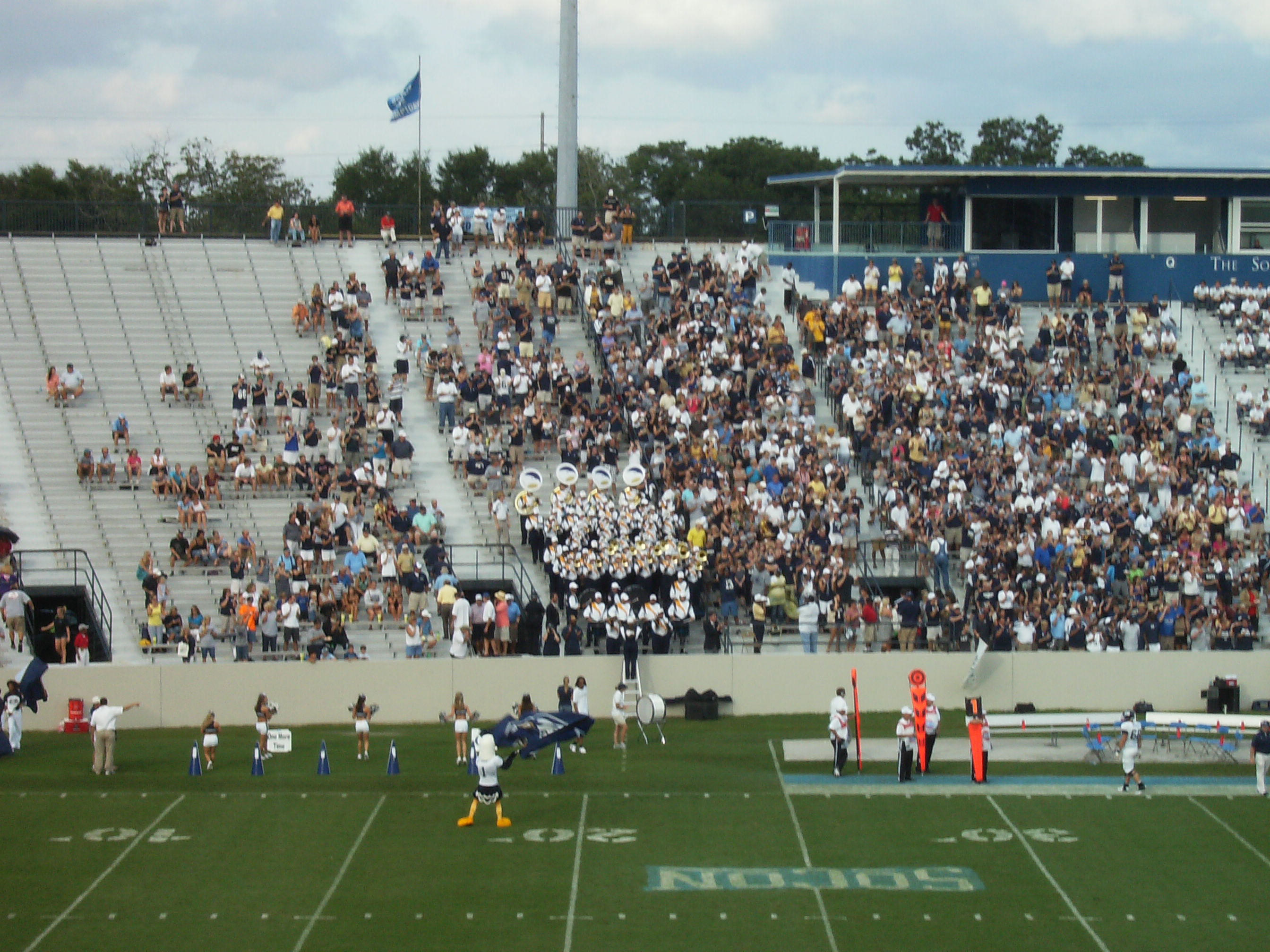
Jordan stated that there was competition for spots at right field and first base. There are freshman candidates at both positions, as well as returning players. I wouldn’t be surprised to see some platooning in those spots, at least early in the season.

The middle infield is evidently going to be made up of freshmen; there are apparently three of them who can or will see time. That shortstop-second base combo is going to be critical for The Citadel. Those players need to be able to hit, but more importantly, the middle infield has to stabilize the defense.

Austin Pritcher returns as a weekend starter for The Citadel. Pritcher had generally good peripheral statistics for the Bulldogs last season, although he did allow 107 hits in 84 innings. Again, he’s going to need help from the defense converting some of those hits into outs.

The other two spots in the weekend rotation are open to question, although Jordan seemed to indicate that freshman lefthander Kevin Connell would get one of them. Also in the mix is senior T.J. Clarkson, who pitched exclusively out of the bullpen last year.

In the running for weekday starts and/or key roles in the bullpen: sophomore Bryce Hines (battling shoulder stiffness) and his brother Ryan Hines, along with redshirt freshman Zach Brownlee. Jordan also referred to a “good lefty frosh” when discussing the bullpen. Then there is Logan Cribb, not mentioned by Fred Jordan in that radio spot, probably because Jordan did not want to upset the former Gamecock cheerleader who was conducting the interview.

I am sure that several other pitchers (and position players) will pop up as the season progresses, and surprise us all, faster than you can say “Steve Basch”.

I think one thing the 2011 season demonstrated is that there is a very fine line between success and failure when it comes to sports at The Citadel, and that includes baseball. The military college has very little margin for error on the field of play, and it doesn’t take much of a slip for a championship squad to become a cellar-dweller.

That said, I am hopeful that the program will rebound this season. It may be a bit of a transitional year, but I don’t believe the outlook is nearly as dire as some preseason prognosticators suggest. On the contrary, I think this could be a fun season. There are known quantities already in place, and then there is the chance for some younger players to emerge as regulars.

I am worried about the pitching depth, particularly in the starting rotation, and obviously I think it is critical that the defense dramatically improves. Both of those areas are probably going to need some time to develop into strengths, just one reason why it’s nice to see the Bulldogs begin their schedule with a bunch of home games against non-league opposition.

I will definitely be at some of those home games, cheering on the Bulldogs. I will probably be freezing, but I will be there…

Hoops update: a league victory, SoCon vs. CAA, and TV

This post is going to be split into three different topics. Before reviewing and previewing the current on-court antics, I wanted to focus on a couple of recent articles in The Post and Courier. They touch on subjects that impact The Citadel’s department of athletics in general and its basketball program in particular.

With CAA as model, SoCon bids to climb ladder

[College of Charleston] basketball coach Bobby Cremins said he was jealous of George Mason’s league, the Colonial Athletic Association.

“I’d love to see the Southern Conference become something like that,” Cremins said. “That should be the goal of our conference. We use them as a model.”

The source of Cremins’ envy? The three teams the CAA sent to the NCAA tournament last season, and the four at-large bids the Colonial has landed in the last six seasons. That’s four more at-large bids than the SoCon has earned it its entire history dating back to 1939, when the NCAA tournament started.

The SoCon has never sent more than one team — the tournament champion, who earns an automatic bid — to the Big Dance, which expanded to a field of 68 teams last year.

Tangent to make an overly nerdy comment: technically, the SoCon has actually received three at-large bids in its history. From 1939 to 1950, the field for the NCAA tournament was made up of only eight teams. Three times, teams from the SoCon played in the event; on all three occasions, those bids were invitations and not automatic selections. In 1951, the NCAA tournament expanded to 16 teams, and the SoCon champion (North Carolina State) got an automatic bid into the event. Not that it really matters.

Bobby Cremins has yet to take the College of Charleston to the NCAAs, and knows the only way to do so (at least right now) is to win the league tournament. Cremins actually had a solid record as a league tournament coach when he was at Georgia Tech (winning the ACC tourney twice), but hasn’t yet grabbed the brass ring while at the CofC.

I think the information presented in the article underscores how tough a task the SoCon has in trying to emulate the CAA. Besides having larger schools that play in bigger arenas (for the most part), most of the CAA schools don’t have to worry about football. The CAA probably also benefits to a degree from having more of its schools located in larger metro areas, although that can be a double-edged sword.

It’s good that the SoCon is trying to be more strict about its non-conference scheduling, but it’s a difficult balancing act. It should be noted that playing a non-D1 doesn’t have any impact on the RPI. What the league doesn’t want is schools overloading their schedules with gimme games against non-D1s and guarantee games against BCS schools. The SoCon needs its members to play more “in-between” schools. Otherwise, instead of competing with the CAA it risks sliding down into SWAC territory.

Having said that, John Iamarino knows that some of his schools have fewer options than others. That’s the nature of the SoCon and its disparate membership. It would be interesting to know which school drew the commissioner’s wrath for its less-than-acceptable scheduling. If I had to bet, I would put my money on Chattanooga.

Let’s talk about TV

I’ve been meaning to write more about the linked article, which was originally published in early December.

The College of Charleston Sports Network will produce 11 games this season that will be broadcast locally on WMMP or WTAT. Those games also will be available on ESPN3, a streaming Internet service that reaches more than 70 million households worldwide and is available in 85 percent of U.S. homes. Some games also might be carried on ESPN FullCourt, a pay-per-view service available on cable systems.

By season’s end, at least 23 of the team’s 30 regular-season games will be televised.

Does The Citadel need to do something like this? Absolutely.

The startup costs would not be insignificant, but I believe it would be a worthwhile investment. The potential exposure for the varsity sports teams, not to mention the school in general, makes it a no-brainer.

That includes televising home football games in a format that can be used by ESPN3.com or one of the myriad sports TV networks, many of which seem desperate for programming.

It would likely give The Citadel an edge in recruiting — and if the school doesn’t do something like this, it will probably fall behind a host of other schools. Just look at FCS football.

Some of the FCS schools that had the majority (if not all) of their football games televised in 2011: Lafayette, Lehigh, Liberty, Maine, Montana, Montana State, Murray State, Northern Arizona, and seemingly all of the Dakota schools (including, not so coincidentally, national champion North Dakota State).

That’s not even counting schools that have home games televised on public television (like Eastern Illinois) or schools with a two- or three-game deal with a local TV station/cable carrier (like Cal Poly, Colgate, Georgetown, and Holy Cross). Not all of those games wind up on a Fox sports net or ESPN3.com, but plenty of them do.

The opportunities in basketball, baseball, and perhaps soccer and wrestling are there, too.

I’ve long advocated that The Citadel’s coaches schedule non-conference games with an eye to getting on television as much as possible. Now I think it is time for the school to be even more proactive.

The Citadel finally won a league game last week, beating Samford 73-62 at McAlister Field House. It was also the first league home game for the Bulldogs, and I am hopeful that the team can add to the victory total this week. Prior to the win over Samford, it had been very tough sledding, as The Citadel had lost its previous ten games against D-1 competition, all but one by double digits.

The worst of those was a 77-45 drubbing by Furman two days before the Samford matchup, so at least the Bulldogs showed some resiliency in bouncing back from that loss. However, the fact remains that it’s been a struggle all year for Chuck Driesell’s troops, particularly on defense.

The Citadel ranks in the bottom 50 nationally in the following defensive categories: effective field goal percentage, turnover percentage, block percentage, and two-point field goal percentage. The Bulldogs are actually dead last (59.3%) in 2-point FG%, 345th out of 345 D-1 teams. The Citadel’s overall defensive efficiency rating (per Pomeroy) is 8th-worst in the country.

Driesell has focused on his team’s defensive issues each and every time he’s discussed the squad’s performances, notably on the post-game radio show. I’ll say this, he’s not one to sugarcoat things, as anyone who has listened to the show can attest.

The win against Samford was a decent (not great) defensive performance. The Citadel has proven to be a tough matchup on the hardwood for the Birmingham Bulldogs over the years, and Saturday night was no exception. Samford shoots a lot of threes by design, but you have to make a decent percentage of them for that strategy to work, and Samford was only 7-29. Some of that was good defense by The Citadel, and some of it was just really bad shooting.

The chief negative for The Citadel was that Samford dominated the offensive glass, particularly in the first half, when it had an offensive rebound rate of almost 60%. The cadets should have led at halftime by about fifteen points, but had to settle for a seven-point edge.

On the positive side of things (after all, it was a victory), Mike Groselle was outstanding (10-10 FG, 25 points) and Cosmo Morabbi had a career night, with 20 points and six assists. The Bulldogs as a whole were solid on offense.

Next up for The Citadel: two more home SoCon games, against Elon and UNC-Greensboro. Elon has been a mild surprise this season, playing about as well as any team in the muddled SoCon North. The Phoenix won at home over South Carolina earlier in the campaign, but recently has hit a slump, losing five straight games.

Losing to North Carolina and San Diego State is not exactly embarrassing, but the streak also includes losses to Dartmouth (a traditional cellar-dweller in the Ivy League), Georgia Southern, and Columbia (another Ivy opponent). Elon has struggled putting the ball in the basket in those five games, as it has not shot better than 36% from the field in any of them. The Citadel needs to make sure that trend continues.

Tough matchup alert: Elon’s Lucas Troutman is a 6’10” native of Belton, SC, who was on the SoCon’s all-freshman team last year. He scored 22 points against NC State earlier this season and will be a difficult player for the Bulldogs to handle.

On Saturday the Bulldogs host UNC-Greensboro, which is 2-14 and only has one D-1 victory, that over winless Towson. The Spartans are on their second coach of the campaign, as longtime boss Mike Dement resigned in December. It was inevitable, especially after UNCG’s 22-point loss to North Carolina A&T two weeks before.

Wes Miller is the interim coach. Miller is only 28 years old, and may have a chance to keep the job, depending on how the rest of the season plays out for the Spartans. So far he has yet to record a victory as head honcho, although UNCG played well in a 10-point loss at Miami.

As you might expect, UNCG has some really bad stats, particularly on defense. What is unique about the Spartans D is that opponents shoot well from everywhere — three-point range (bottom 15 nationally), inside the paint (ditto), even at the foul line.

UNCG’s best player is Trevis Simpson, a 6’4″ guard. Like Elon’s Troutman, he was on last year’s league all-frosh team. Simpson is a volume shooter who blows hot and cold, but when he’s hot he can get very hot (at Miami, he hit 7 of 11 three-pointers as part of a 36-point explosion). The Citadel must work hard, especially early in the game, to make sure he doesn’t get on a roll.

The Citadel will be a slight underdog in both games this week. However, it will be disappointing if the Bulldogs don’t win at least one of the two contests. That’s the short-term view. As for what these games mean for the season as a whole, I’m hoping to see some improvement on the defensive side of things for The Citadel. If that happens, more wins will follow.

Talking stats: SoCon football and turnovers

I was reading Jeff Hartsell’s review of The Citadel’s football season in The Post and Courier. In the second post of the three-part series, head coach Kevin Higgins had this to say about turnovers:

 We didn’t get as many turnovers as I would have liked. We just didn’t have that many opportunities. That’s something we’ll have to study in the off-season and address that. We need to be able to turn the ball over — one more turnover against Samford or Georgia Southern or App State could have meant the difference in any of those games.

I thought it might be an interesting idea to dig a little deeper into the statistical record to see what The Citadel could do to force more turnovers. However, that meant more than just going by the raw data.

First, I decided that it would be best to concentrate solely on Southern Conference play. Including games played against the likes of Virginia Tech and Virginia-Wise (just to name two SoCon opponents) would make the statistics something less than balanced. Besides, teams are ultimately judged on how they fare against league opponents. There is also the benefit of each team’s conference statistical summary including four home and four away games.

Another consideration was trying to account for the different types of offenses employed by SoCon teams, including three “true” triple option teams and several schools running the spread, and with varied paces of play. That is why I felt it was important to focus on certain percentage categories, rather than totals.

I compiled data (league play only) for a number of different statistics, both for offense and defense. After doing this, I put together a spreadsheet which you can access at the link below:

Southern Conference 2011 Football Statistics

I trust most of what is on the spreadsheet makes at least some sense.

Before I get to my conclusions about The Citadel’s issues with forcing turnovers (along with observations on some other SoCon schools), I want to make a few points:

– It is generally accepted that there is no real skill in recovering fumbles. Anyone who follows any of the websites that study professional football statistics/history is aware of this. Football Outsiders puts it best:

Stripping the ball is a skill. Holding onto the ball is a skill. Pouncing on the ball as it is bouncing all over the place is not a skill. There is no correlation whatsoever between the percentage of fumbles recovered by a team in one year and the percentage they recover in the next year. The odds of recovery are based solely on the type of play involved, not the teams or any of their players.

Fans like to insist that specific coaches can teach their teams to recover more fumbles by swarming to the ball. Chicago’s Lovie Smith, in particular, is supposed to have this ability. However, since Smith took over the Bears, their rate of fumble recovery on defense went from a league-best 76 percent to a league-worst 33 percent in 2005, then back to 67 percent in 2006. Last year, they recovered 57 percent of fumbles, close to the league average.

Fumble recovery is equally erratic on offense. In 2008, the Bears fumbled 12 times on offense and recovered only three of them. In 2009, the Bears fumbled 18 times on offense, but recovered 13 of them.

Fumble recovery is a major reason why the general public overestimates or underestimates certain teams. Fumbles are huge, turning-point plays that dramatically impact wins and losses in the past, while fumble recovery percentage says absolutely nothing about a team’s chances of winning games in the future.

Although this makes perfect sense, it is understandable that longtime football fans might not be so sure. I think the best way to illustrate the randomness of fumble recoveries is to highlight Pittsburgh Steelers legend Jack Lambert, who besides being a fantastic linebacker was one of my favorite players.

In the 1975 AFC championship game against the Oakland Raiders, Lambert recovered three fumbles. In the following year, 1976, he recovered an amazing eight fumbles (in fourteen games) for a remarkable Steelers defense. Lambert had a “nose for the football”, to say the least — and yet…

Those three fumble recoveries against the Raiders were the only recoveries he made in eighteen career playoff games. Those eight fumble recoveries in the ’76 regular season? They make up almost half of his career total (17).

Not everything about the NFL applies to college football, of course, particularly in FCS play, but there is no doubt that this particular observation does hold at the college level. Basically, when a ball is loose on the ground each team has a 50-50 shot at getting it. In 2011, there were 130 fumbles in Southern Conference play. The defense recovered 69 of those fumbles, or 53%. Congratulations to SoCon defenses!

No team in league play had a particularly unusual percentage when it came to recovered fumbles, either from an offensive or defensive perspective. It may be that an individual school was luckier or unluckier by a fumble or two, but that’s about it.

That isn’t to say that fumbles aren’t important, because they are. Often a fumble is more damaging to an offense than an interception (because of lost field position). However, they aren’t predictive events.

That doesn’t mean coaches shouldn’t be training their players to use the Lawrence Taylor “chop”, or continuing to have drills emphasizing fumble recoveries. It’s just that everybody does those things.

– Another thing to remember: interceptions (from a defensive perspective) tend to be random too.

This one isn’t quite as intuitive as the fumble recovery factoid, but think about it this way. Most interceptions result from a bad pass thrown by the quarterback. However, what has (normally) happened is that the QB has thrown a bad pass that was caught by a defender, instead of a bad pass that just hits the ground; there is an element of chance to this. That is why team defense interception totals can vary wildly from year to year even with similar personnel.

That isn’t to say that defenses can’t create situations where interception-prone offenses will toss the pigskin to the wrong players. I wanted to see what teams in the SoCon did the best job at pressuring the quarterback, which seemed to me to be a good way of forcing offensive errors.

I compiled sack percentage and interception percentage to see if they correlated. Again, I didn’t use raw totals, because there is a big difference when facing a team that throws the ball seven times per game (Wofford) versus forty times per game (Elon). The “pressures” statistic isn’t readily available for the SoCon; I suspect that there would have been similarities between team pressures and sacks. At least, I hope so.

You can see the numbers in the linked spreadsheet. Some observations:

– It is no accident that the three teams to make the playoffs (Appalachian State, Georgia Southern, and Wofford) are in the upper echelon when it comes to defensive sack percentage. Furman, which finished fourth in the league, finished second in the category. Leading the category was Chattanooga (more about the Mocs later).

– Defensive interception percentage does seem to at least have some correlation to defensive sack percentage. The exceptions: Samford (which intercepted more passes than it “should” have), and Wofford and UTC (each of which intercepted fewer passes than a correlation might suggest). The Terriers, in particular, seem to have been short-changed a few picks.

The Citadel’s defense finished last in interception percentage. The Bulldogs were seventh in sack percentage, ahead of only Samford and Western Carolina. I think it’s no coincidence that The Citadel didn’t intercept many passes after having less-than-stellar sack numbers. (Admittedly, that’s a rather obvious conclusion.)

– I also examined the offensive statistics for the same categories. The Citadel finished as the worst team in the league in both interceptions thrown (by percentage) and fumbles per play. The Bulldogs fumbled 23 times in SoCon action, losing ten of them. (Curiously, Georgia Southern also fumbled 23 times in league play, losing ten.)

While I tracked fumbles per play, I elected not to go through every game account to determine whether fumbles occurred on rushing or passing plays; that would have taken more hours and more days than I have, to be honest. In the NFL, the average rushing play results in a fumble 1.16% of the time, while a pass play will end with a fumble 2.04% of the time. Interestingly, 18% of all sacks in the NFL (2000-2009 time period) resulted in fumbles.

I’m not sure those numbers are quite as relevant at the college level; for one thing, there is a lot more fumbling in SoCon play than in the NFL (2.66% vs. 1.67%). There is also a lot more running than passing in the conference (almost a 2-to-1 differential).

Those sack/fumble stats are something to think about, however.

Meaningless trivia: there was only one game in the Southern Conference this season in which neither team fumbled: Georgia Southern-Appalachian State.

– The “luckiest” team, at least on the surface, appears to have been Samford, which finished eighth in defensive sack percentage but fourth in defensive interception percentage. The Birmingham Bulldogs also had the best rates for offensive interceptions thrown (with the fourth-best sacks against percentage), so it worked out both ways for Samford.

I have to wonder if Samford’s pace of play had something to do with that. Samford ran the most plays from scrimmage of any team in the league, and also faced the second-most plays on defense (Western Carolina drew the short straw in that category).

– Balance, as always, is overrated. Samford was by far the most balanced team on offense (305 runs, 301 passes) and finished 4-4 in league play. The second-most balanced team was WCU, which was 0-8. There is nothing offensively balanced about Georgia Southern and Wofford; those two playoff teams combined for a league record of 13-3.

– I don’t know what to make of Chattanooga. Usually a team that loses so many close games (including three by the same exact score, 28-27) doesn’t do itself any favors in the turnover battle, but the Mocs tied for the league lead in fumbles recovered and led the league in forced fumbles. UTC also finished second-best in the league in offensive lost fumbles.

UTC didn’t have the rate of return on defensive interceptions that might have been expected by its league-leading defensive sack percentage, but it wasn’t bad. The Mocs did have a higher average offensive interception percentage, but it wasn’t abysmal.

I think it would take a more detailed look at Chattanooga to figure out exactly how and when things went wrong for the Mocs, but I can safely say no team in the league was unluckier than UTC — just not as unlucky in the things you usually would associate with unlucky teams.

I guess my final conclusion, at least with regards to The Citadel, is that the Bulldogs must get more pressure on the quarterback if they expect to increase their defensive turnovers. However, it has to be remembered that defensive turnovers are an effect of good play, not a cause of good play.

I would also suggest the Bulldogs were a touch lucky on offense themselves when it came to turnovers, and need to continue to improve the consistency of execution on that side of the ball.

I admit my analysis of The Citadel (and some of the other teams in the league) may be flawed. That’s one reason I included the spreadsheet, in case anyone else wants to take a crack at what the numbers may mean.

Hoops update: SoCon play begins for The Citadel

— The Citadel at the College of Charleston, 8:00 pm Thursday, December 1, 2011, at TD Arena, Charleston, South Carolina

— The Citadel at Wofford, 7:00 pm Saturday, December 3, 2011, at Benjamin Johnson Arena, Spartanburg, South Carolina

Both games can be heard on WQNT-AM 1450 in Charleston, with “voice of the Bulldogs” Danny Reed describing the action. Audio is also available online via Bulldog Insider. The game against the College of Charleston will be televised by WMMP-DT 36.1 in Charleston and is also being carried by ESPN3.com.

The Citadel is now 2-3 on the season, with a 97-44 win over Florida Christian (a non-Division I team) sandwiched by a pair of losses, 73-50 at home to Clemson and 80-72 on the road against High Point, the latter contest being decided in overtime.

The Bulldogs did what they were expected to do against Florida Christian, although it should be noted that the Suns only lost to Bethune-Cookman of the MEAC by 18 points. The game was notable for being the first start of the season for Barry Smith, who also started the game against High Point. The sophomore forward scored 19 points against Florida Christian after being inserted into the lineup for defensive reasons.

I wanted to make a few observations about the games against Division I competition. The Citadel has now played four contests against D-1 teams, winning one and losing three, with two of the losses being close games. The not-so-competitive loss, alas, came at McAlister Field House, and to a Clemson team which then lost consecutive games at Littlejohn Coliseum to the College of Charleston and Coastal Carolina. (The Tigers defeated Furman by ten points on Saturday night to avoid losing three straight home games to in-state foes.)

Chuck Driesell has used the early part of the season to give opportunities to numerous players on his roster, with eleven cadets seeing action in every game. Those aren’t just cameos by the 9th or 10th players off the bench, either; of the 57 individual appearances made by Bulldogs in five games, 50 were for at least nine minutes and two others were for eight minutes.

Offensively, the Bulldogs have played fairly well. The Citadel has taken care of the basketball and has been reasonably balanced on offense, although the Bulldogs got into a three-point shooting contest against High Point and subsequently took 43% of their field goal attempts from outside the arc, which is too many. (The Panthers shot 44 three-pointers in that game, out of 59 field goal attempts.)

The Citadel has to continue to work the ball inside to Mike Groselle, who has been unsurprisingly excellent thus far. Groselle is averaging 18 points (these stats do not count the Florida Christian game) while shooting 68% from the field. He also has a double-double in every game this season while averaging 36 minutes per contest, answering any lingering questions about his stamina.

Groselle needs more help inside, though, both offensively and defensively. He particularly needs some assistance on the offensive glass, as Groselle has almost half of the offensive boards claimed by the Bulldogs in the four D-1 games (18 of 39).

The Bulldogs have struggled on defense. The Citadel ranks in the bottom 75 nationally in several key defensive measures, including eFG%, free throws attempted per field goals attempted, and turnover rate (numbers are from kenpom.com).

The Citadel is dead last in all of Division I (345 teams) in the percentage of opponents’ shots blocked (which probably accounts in least in part for opponents of the Bulldogs having success in converting 2-point baskets). Charleston Southern is next-to-last in the category, with Army, Navy, and Presbyterian also in the bottom 11. That’s three military schools and three Palmetto State schools, so I guess it’s only natural that The Military College of South Carolina is last.

At 5-1, the College of Charleston is off to a promising start as it enters SoCon play. The Cougars’ five victories include the road win at Clemson mentioned earlier, along with two victories in the Battle 4 Atlantis holiday tournament that was recently held in the Bahamas. After losing its opening game in the tournament to Central Florida 74-63, the CofC outlasted UNC-Asheville 68-66 in the consolation bracket. The Cougars completed the tourney with an 85-61 win over Massachusetts, running away with that game in the second half.

Through six games, the CofC is shooting the ball very well, with an eFG% of 54.9, ranking in the top 25 of Division I. The Cougars get about one-third of their points via the three-point shot, which is fairly high, but you can get away with that when you have several guys shooting well from distance, including Jordan Scott, Anthony Stitt, and Andrew Lawrence (who has made 14 of 28 three-pointers).

The Cougars have at times struggled with rebounding, which was their downfall against UCF (as they were outboarded 43-21 in that contest). It was probably not a coincidence that touted freshman forward/center Adjehi Baru got in early foul trouble in that game. When playing, Baru has been a significant defensive presence. CofC opponents have an offensive rebounding percentage of 39.7, which places the Cougars in the bottom 20 of D-1 for that metric. Obviously, the sample size is a small one.

The lone senior on the CofC’s roster, Antwaine Wiggins, was named the Southern Conference player of the week last week after the Cougars’ victory over Clemson, a game in which he scored 22 points. He followed up that excellent performance with a total clunker against Central Florida, only scoring two points against the Knights. However, he scored 23 points in each of the next two games, so the UCF contest appears to have been an aberration.

I think the primary longterm concern for CofC fans will be the Cougars’ depth, a problem exacerbated by the loss in preseason of forward Willis Hall to a knee injury. Hall started all 37 of the CofC’s games in 2010-11. Without him, the Cougars have been reduced to what is essentially a seven-man rotation, with five players averaging more than 25 minutes per game. That isn’t exactly a new thing for a Bobby Cremins squad, but it’s something to watch over the grind of a long season. There are three players averaging more than 30 minutes per contest — Wiggins, Lawrence, and 6’8″ forward Trent Wiedeman.

The Cougars have won eleven straight SoCon games at home. Their last loss in league play at what is now called TD Arena came on February 8, 2010, against The Citadel.

The Citadel will face Wofford in its second game of the SoCon season, with the matchup taking place at the Benjamin Johnson Arena. That facility opened in 1981 with a game between the Bulldogs and the Terriers, won by The Citadel 65-64.

Wofford is 3-3 on the season. Like the College of Charleston, the Terriers had to replace multiple key performers from last season’s team, including a star player. The Cougars lost Andrew Goudelock, while Wofford now has to make do without Noah Dahlman. Goudelock was a first-round pick of the L.A. Lakers, but it is Dahlman who will be more difficult to replace.

Dahlman helped make Wofford one of the nation’s better offensive teams, with a team adjusted efficiency rating of 111.0, a top 50 mark in Division I. This season, that number through five D-1 contests (Wofford’s only home game to date was a victory over Emory&Henry) is 94.5, a huge differential. That is what can happen when you have to replace four starters who accounted for 66 points and 23 rebounds per game.

I should note that it doesn’t help Wofford’s offensive statistics to have played one of those five Division I games against Wisconsin. The Badgers bludgeoned the Terriers, 69-33. Wofford does have a nice win over Bradley (70-66), but that is somewhat offset by a neutral court loss to UMKC (64-58, in OT). The Terriers also struggled mightily in a win over Prairie View, which is not expected to be one of the SWAC’s better teams (in other words, it is expected to be among the nation’s worst teams). Wofford’s other loss was a respectable effort against Georgia (62-49).

The Terriers’ offensive woes are reflected in their eFG% (41.1) and their FTA/FGA, ranking in the bottom 30 nationally in both categories. Wofford has also been a bit turnover-prone (and conversely has not been particularly effective in forcing turnovers, which has hurt its defense). The Terriers have not shot the ball well from the field, either in front of or behind the three-point line.

Wofford has employed a seven-man rotation, with senior guards Kevin Giltner and Brad Loesing each averaging more than 38 minutes per contest. Yikes. Loesing, the point guard, started last season, but Giltner was more of an impact sub, shooting 42% from three-land last year. Through six games this season, Giltner is shooting 31% from beyond the arc.

Drew Crowell’s time on the court has increased by about 20 minutes per game from last season to this one; he is basically filling the Tim Johnson role for the Terriers. Two true freshmen, forward Lee Skinner and the highly regarded Karl Cochran (a 6’1″ combo guard), are also seeing plenty of time on the court, as is Domas Rinksalis, a 6’9″ forward/center who redshirted last season.

Wofford isn’t expected to contend in the Southern Conference this season, though the Terriers might prove a tough out come SoCon tourney time.

Neither of these games will be easy for The Citadel, to say the least. The Bulldogs aren’t expected to win either contest, and are a sizable underdog to the College of Charleston (kenpom.com gives the cadets only an 8% probability of winning).

I think it’s good, though, to start out league play with a pair of road games. I would like to think that by the time the return games roll around, the team will have improved substantially, with the freshmen more fully understanding their roles and gaining confidence. Then that increased understanding and confidence can be put to good use at McAlister Field House, where the Bulldogs should have a better chance of success.

Odds and ends…

– I am continuing to contribute to a roundtable discussion (more or less) about the SoCon. The latest edition for this season has been posted to a Chattanooga blog, Mocs Mania, and can be found here:  Link

— I was at McAlister Field House for the Clemson game. So were lots of Clemson fans. I would say almost half the fans in attendance were wearing orange. That’s okay (for now), though. We’ll gladly take their money. I took a few pictures. As always, keep in mind that I’m a less-than-scintillating photographer with an iffy camera, which is one reason you won’t see any action photos. All the pictures are from the pregame scene.

2011 Football Game 11: The Citadel vs. South Carolina

The Citadel at South Carolina, to be played at Williams-Brice Stadium, with kickoff at 12:00 pm ET on Saturday, November 19.  The contest will be televised by South Carolina as a pay-per-view event. It is also available via the ESPN3.com platform and ESPN GamePlan. The game can be heard on radio via The Citadel Sports Network, with current “Voice of the Bulldogs” Danny Reed calling the action alongside analyst Walt Nadzak. 

I suspect that most of the previews for this week’s game between The Citadel and South Carolina will focus on the last time the two schools squared off at Williams-Brice Stadium. That was in 1990, and the Bulldogs famously stunned the Gamecocks, 38-35, with Jack Douglas scoring the winning touchdown in the final minute of play.

That game will be discussed in considerable detail by a number of different outlets. I’ve decided that writing about it on this blog, at least this week, is probably unnecessary. Instead of writing about that contest as part of this preview, I’m going to take a look at another game from the past, one that has been lost in the shuffle in recent years. I’m talking about an even bigger upset than the 1990 game.

November 11, 1950. Johnson Hagood Stadium. The Citadel 19, South Carolina 7.

On November 4, 1950, The  Citadel lost to Virginia at Johnson Hagood Stadium, 34-14, dropping the Bulldogs’ overall record to 3-5. The Citadel was 1-2 up to that point in SoCon play, having defeated Davidson while losing to Furman and eventual league champ Washington & Lee.

The game against UVA was, to say the least, not an impressive performance. Sportswriter Doc Baker of The News and Courier (who will be quoted extensively in this blog post) wrote that while the Cavaliers had a “strong running attack,” the Bulldogs’ own offense featured “spotty blocking”:

At…times it looked almost ridiculous as Bulldog linemen and backs got in the way of their own ball carriers.

Baker also noted that a “slim crowd” of “only 5000 (official)” had watched the game, which was “the smallest turnout to witness a collegiate football game [here] in many years, according to authorities at The Citadel.”

On the bright side, Baker did highlight the excellent play of two members of the team, linemen Jerry DeLuca and Sam Rubino, with the latter having played “almost 60” minutes of the game. Both would feature prominently against South Carolina.

The big sports news that day was the death of baseball legend Grover Cleveland Alexander, who had died of a heart attack. On the gridiron, Clemson had maintained its undefeated record with a big win over Duquesne. South Carolina had played Marquette to a 13-13 tie, the same final score of the Wofford-Furman game.

There was also a feature in the newspaper that day about The Citadel’s swim team, which was about to begin its season: “Citadel tank team loaded”.

The national news concerned General Douglas MacArthur and the situation in Korea.

The major sports story on that Tuesday was the hiring of Branch Rickey by the Pittsburgh Pirates. Alas for the Bucs, the Mahatma’s executive skills would prove to have eroded.

As the week progressed, reporting in the sports section detailed the preparation both South Carolina and The Citadel were making for the upcoming game.
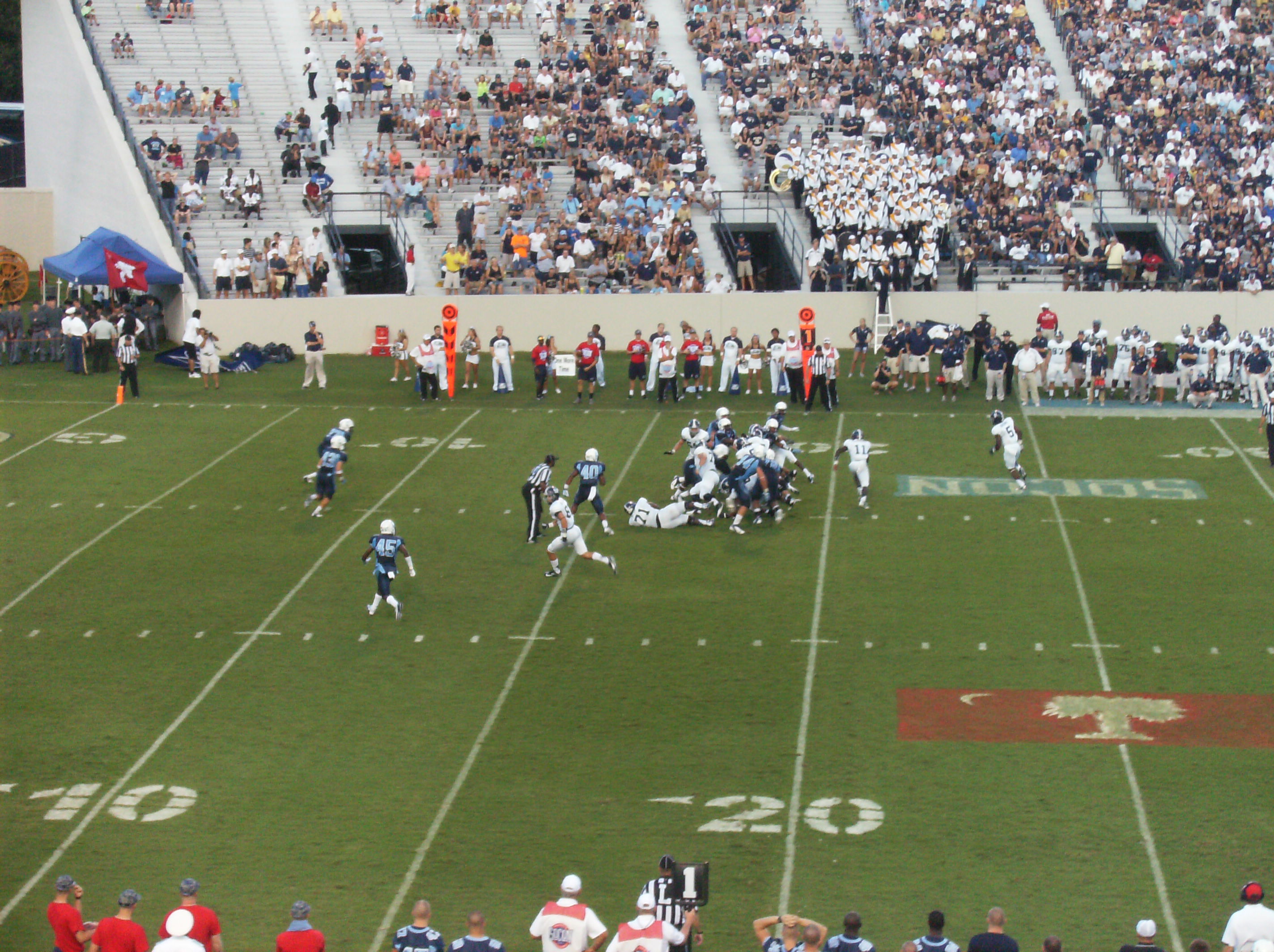
While Wednesday’s papers brought news of Republican gains in the U.S. House and Senate (off-year elections were held the day before), there was also a report that coach Quinn Decker was considering some changes for the Bulldogs, specifically going to an all-sophomore backfield.

Decker, a former fullback at Tennessee, had not been able to field an all-soph backfield unit to that point in the season due to injury, but it was easy to see why he might want to plug in those players against South Carolina. The year before, the same group had played on The Citadel’s freshman team, and the Bullpups had surprised South Carolina’s frosh squad (the “Biddies”), 26-20. Players on that squad included Buddy Friedlin, Rudy Wilcox, Paul Drews, and Johnny Mamajeck. All would eventually play key roles against the Gamecocks on Saturday.

Another reason for trying out some new players would be that The Citadel was limited in personnel. While South Carolina fielded a true “two-platoon” team, the Bulldogs had several players who played both offense and defense, including four of its linemen. It made moving the ball on offense that much tougher, particularly against the Gamecocks defensive front, which was nicknamed “The Seven Sleepers”.

However, the real concern was on the defensive side of the ball, as The Citadel had to figure out a way to stop South Carolina’s great running back, Steve Wadiak. So good that he had two nicknames, “Steamboat Steve” and “Th’ Cadillac”, Wadiak (who was from Chicago) was one of the nation’s best players. To that point in the 1950 season, Wadiak had rushed for 814 yards, averaging 6.8 yards per carry.

(Highlights of Wadiak in action against Marquette can be seen here: Link)

Wadiak wasn’t the only threat out of the Gamecocks’ backfield, as Mullins native Bishop Strickland averaged 5.3 yards per rush. What South Carolina lacked was an effective passing game, so head coach Rex Enright (who had played for Knute Rockne at Notre Dame) spent most of the week working on passing plays.

That was seen as a good move in the press, as playing The Citadel was not expected to pose a challenge. The Gamecocks had beaten The Citadel 42-0 in 1949, and a similar outcome was expected in 1950. On Thursday of that week, Doc Baker wrote:

…at the risk of being called all sorts of things we will be “bold” enough to suggest there is not doubt as to the outcome of the game here Saturday…as much as we’d like to think about The Citadel staging a terrific upset we can’t help but feel the Gamecocks will win by just about any score they want.

Baker wasn’t exactly helping advanced ticket sales with those comments, although the newspaper did report that tickets could be purchased at several locations downtown, including Wehman’s Supply on King Street and the Ashley Flower Shop.

Baker wasn’t the only person not giving The Citadel much of a chance, as various sources had the Gamecocks as being 33-point favorites.

Enright was more cautious in his outlook. He told his squad, “I’m not telling you that you shouldn’t be able to beat The Citadel, but I am warning you that they have eleven hard tacklers on their team and they can make it a long afternoon for you if you’re not careful.” He also noted that the Bulldogs had played well in losses to Florida and Miami (FL). The Gators, in particular, had struggled with The Citadel, only winning 7-3 thanks to a punt return touchdown.

The Gamecocks were 3-1-2 at that point of the season, rebounding after an opening-game loss to powerful Duke by beating Georgia Tech in Atlanta and tying Clemson, 14-14. In the game against the Tigers, Steve Wadiak had rushed for 256 yards, still one of the all-time greatest individual performances in that series.

With the contest against Clemson ending in a tie, South Carolina was poised to win the “Big 4” state title in 1950, having beaten Furman earlier in the year (21-6). By defeating The Citadel, the Gamecocks would finish 2-0-1 among the “Big 4” and edge out the Tigers, thanks to Clemson not playing the Bulldogs.

(At the time the “Big 4” was a big deal, at least in the press. There were at least three different state newspapers that carried separate standings for the Big 4, and also standings for the “Little 4” — Wofford, Presbyterian, Newberry, and Erskine.)

On Friday, the Gamecocks arrived in Charleston, with the team staying at the Francis Marion Hotel. Things were mostly quiet. The News and Courier reported that there would be nine “sponsors” for The Citadel at the game. These were girlfriends of the regimental staff or the senior football players. The afternoon edition of the paper had pictures of five of them. It was a mild surprise that all nine weren’t featured, as newspapers of that time tended to insert photographs of young women into their pages at every opportunity.

The game against South Carolina was also designated as Parents Day, which may be the latest The Citadel has ever scheduled a Parents Day game. I am not aware of any other such contest played in November, except for the 1985 game (which was played on November 2).

Also of interest that day was news from Oslo, Norway, as the Nobel Prize for Literature was announced for both 1949 and 1950. The 1950 winner was Bertrand Russell. The 1949 prize had been delayed a year, apparently because the selection committee could not decide between Italian philosopher Benedetto Croce and English statesman/historian Winston Churchill. Eventually a compromise candidate was named, a year late — William Faulkner.

By gametime on Saturday, a crowd of around 11,000 had gathered at Johnson Hagood Stadium. The weather was excellent for football, with slightly overcast skies. Jack Huddle, The Citadel’s captain, greeted South Carolina co-captains Ed Pasky and Bobby Rogers at midfield for the coin toss. The Gamecocks won the toss and elected to receive.

As the two teams took the field, observers in the stands could see the disparity in size among the players. For example, The Citadel’s linemen all weighed less than 200 lbs., while no Gamecock lineman weighed less than 205 lbs.

The kickoff was returned by South Carolina to its own 44-yard line. The Gamecocks wasted the good field position, however, going three-and-out. The Bulldogs took over after a mediocre punt on their own 33, but went nowhere in two plays. On third down, The Citadel elected to “quick kick”, and Paul Chapman boomed a 62-yard punt that rolled dead at the Gamecocks’ 10-yard line.

South Carolina picked up a first down, but then lost yardage, and on third down from its own 25 decided to try a “quick kick” of its own. It would prove to be a costly decision, as an alert Sam Rubino burst through the line and blocked Tommy Woodlee’s punt. Rubino scooped up the ball himself and raced into the end zone for a touchdown. The PAT was missed, but the Bulldogs had a shock 6-0 lead with 10:20 to play in the first quarter.

Undeterred, the Gamecocks took the ensuing kickoff and proceeded to drive from their own 35 to the Bulldogs’ 12-yard line. On fourth and two from that spot, South Carolina picked up a first down — but was called for clipping. The Gamecocks went for it again, eschewing a field goal try, and didn’t make it.

The Bulldogs did nothing offensively (a theme throughout the first half) and punted. Again, South Carolina drove down the field, and again got nothing for its effort, this time losing a fumble on the Bulldogs 24.

The Citadel thus had the ball as the second quarter began. Another fine Chapman punt put the Gamecocks back deep in their own territory. The Bulldogs’ defense held, and for the second time South Carolina would be victimized by a blocked punt — and again the culprit was Rubino.

This time, Paul Drews would pick up the loose pigskin and score for the Bulldogs. The PAT was blocked, but The Citadel led, 12-0, with 11:35 remaining in the first half.

Stunned, South Carolina could do nothing with its next offensive possession. The Citadel would respond with its only sustained drive of the half (albeit on a relatively short field). The drive ended with a missed field goal.

(So, to sum up: in the first half, The Citadel blocked two punts, had one of its own PATs blocked, and missed another PAT and a field goal. Taking the 2011 season into account, I guess it’s fair to say that some things really don’t change.)

After the missed field goal by the Bulldogs, South Carolina drove to The Citadel’s 27-yard line, but got no further before the half ended. The Citadel finished the half with -14 yards of total offense, but led 12-0 thanks to the two return TDs.

There were two halftime performances to entertain the crowd. First, the South Carolina marching band played. At one point in its routine, the band moved into a formation so as to resemble the Confederate Battle Flag. I don’t know what is less likely to ever happen again — the Gamecocks band doing that, or South Carolina playing The Citadel in football at Johnson Hagood Stadium.

The other halftime show, however, has endured largely unchanged. The Summerall Guards performed in typically faultless fashion. It’s interesting to note that in 1950, General Charles Summerall was still the president of The Citadel.

The Citadel got the ball first to open the third quarter. The Bulldogs picked up one first down and then punted. South Carolina’s first possession of the half also ended with a punt, but Woodlee’s punt was downed on The Citadel’s five-yard line. The Bulldogs went three and out, and the subsequent punt went out of bounds at The Citadel’s 30-yard line. From there the Gamecocks would drive for their first (and only) score, with quarterback Pasky running for a two-yard TD. The PAT was good, and with 3:25 remaining in the period, South Carolina had cut the lead to 12-7.

The Citadel would move the ball a little on its next possession, but ultimately had to punt again, and so as the fourth quarter began South Carolina was in its own territory, trying to drive for the winning touchdown. However, the Gamecocks were victimized by a 15-yard sack, the first of three huge sacks in the quarter. After a punt, The Citadel took over on its own 41.

Bulldogs quarterback Buddy Friedlin (a native of Jacksonville, Florida) received a lot of praise after the game, and much of that came as a result of his play on this drive. First, he connected with Charles Fabian on a big 31-yard pass to get the Bulldogs near the red zone. Three more plays netted The Citadel nine yards. On a key fourth-and-one, Rudy Wilcox picked up two yards and a first down.

The next two plays did little, but on third down Friedlin scrambled nine yards for a first-and-goal on the Gamecocks 5-yard line. On first down the Bulldogs lost four yards.

On second-and-goal from the nine, though, The Citadel pulled the old “sleeper play” on South Carolina. In a maneuver that would be illegal today, Wilcox basically hid near the sideline while remaining on the field of play. The Gamecocks didn’t account for him, so Friedlin took the snap and whipped a pass to the wide-open Wilcox. The Florence resident scampered into the end zone for a TD. This time, the PAT was successful, and the score was 19-7.

Nine minutes were still left in the game, so a comeback was still possible for the Gamecocks, but those hopes were largely dashed when Hootie Johnson (yes, Martha Burk’s Hootie) fumbled the kickoff. The Bulldogs recovered. The resulting possession lost yardage, but The Citadel did manage to drain three more minutes off the clock.

Forced to abandon the running game, the Gamecocks got as far as midfield, but were derailed by a 10-yard sack by Jerry DeLuca (his second sack of the quarter). Later in the possession the Gamecocks would lose 18 more yards on another sack. The Citadel got the ball back, ran some more clock, and then punted it back to the Gamecocks with just 25 seconds left. South Carolina ran two more plays and the game ended.

Steve Wadiak did not have a bad day, rushing for 96 yards on 17 carries, but he was unable to break off a big gainer, something the Gamecocks sorely needed that afternoon.

The Citadel had won convincingly despite picking up just eight first downs. Friedlin was 3-7 passing for only 44 yards, but with no interceptions and that big completion to Fabian. Paul Chapman hurt the Gamecocks repeatedly with his fine punting. South Carolina was held to 130 yards rushing, low by its standards. The Gamecocks were also hurt by penalties, two lost fumbles, and those critical fourth-quarter sacks.

The headline of the Sunday edition of The News and Courier said it all: “Pandemonium breaks loose as Carolina is defeated by Citadel”. The A-1 story noted that it was the first win by The Citadel over South Carolina since 1926 (there had been a tie in 1928). According to the paper, Gamecock fans had planned a victory celebration at the local Hibernian hall after the game. Instead, the streets were filled with happy cadets. A group of them pushed an ancient jalopy, sans motor, up King Street, with a sign on top that read “Wadiak’s Cadillac”. Being dragged behind the vehicle on a rope was a headless gamecock.

Jake Penland, sports editor of The State, wrote that “the balloon of South Carolina players, pride, and overconfidence was punctured with a 19-7 bang by The Citadel.” He also stated that the game was “one of the most startling upsets in the history of this part of the nation.”

Penland wasn’t inclined to give the Bulldogs too much credit, though; in the days to come, he would blame the loss on the Gamecocks’ errant aerial attack. (Penland’s refusal to acknowledge that the Bulldogs had some good players of their own could be construed as starting a tradition among sports editors of The State.)

Doc Baker, on the other hand, was effusive in his praise for the local team, saying they had “made a liar” out of him, but that he was “the happiest liar.” Said Baker of the win: “It’s The Citadel’s greatest victory of all time.”

A chastened South Carolina squad would drop its two remaining contests of the season, losing to North Carolina and Wake Forest by identical 14-7 scores. Steve Wadiak would finish with 998 rushing yards and was named player of the year in the Southern Conference.

The loss to The Citadel by the Gamecocks handed the “Big 4” title to Clemson, part of a great season for the Tigers that culminated in an Orange Bowl victory over Miami. Clemson would finish the season 9-0-1, with the only blemish that tie to the Gamecocks.

The Citadel would lose its season finale to VMI, 13-7, to finish the year with a 4-6 record (2-3 SoCon). Quinn Decker would continue to coach the team through 1953, eventually returning to Knoxville to go into private business. The victory over South Carolina would easily be the highlight of his coaching career at The Citadel.

Jerry DeLuca would receive several post-season honors.

That was 61 years ago. What about the game on Saturday?

Perhaps it would be better if the game could be played at another location. The Citadel’s last three wins over South Carolina on the gridiron have taken place in Orangeburg (1926), Charleston (1950), and Columbia (1990). Maybe this game could be moved to Greenville…

I’m not going to say The Citadel absolutely can’t win the game, but it is unlikely. It is true that South Carolina is currently a bit challenged offensively, but it should be pointed out that the Gamecocks’ offensive line, even if not an elite SEC unit, would be a top unit in the SoCon. It will be a major challenge for the Bulldogs D to contain the Gamecocks, even without Marcus Lattimore. There is also no receiver in the league that compares to Alshon Jeffery.

Then there is the Gamecocks’ defense, which is outstanding, probably among the ten best units in the country. South Carolina has only struggled defensively when facing a team with multiple outstanding receivers and a quarterback who can get them the ball — i.e., Arkansas. That obviously does not describe The Citadel’s offense. It basically describes the exact opposite.

The only units on the field where The Citadel might have an advantage are the punt return and coverage squads.

South Carolina also won’t be outcoached. Steve Spurrier has been frustrated with his offense all season, but I have noticed in watching the Gamecocks play that he is willing to do what it takes to win a game, and if that means forgetting about passing for extended periods of time, he will do just that. Spurrier has largely been fair with his talent. That’s the sign of a good coach.

Ellis Johnson is one of the better defensive coordinators at the college level. He may not have been the greatest head coach in the world, but he excels in his current role.

That said, I expect the Bulldogs to be competitive this Saturday. This is not a “throwaway” game; it’s not a game to experiment or play a ton of freshmen, or anything like that. I trust the coaching staff understands that for alums and other supporters of The Citadel, a game against South Carolina is a little different than playing Arizona or Wisconsin or Florida.

It will be the final game of a season that has been instructive, if at times frustrating. It has had its moments, though.

It’s a rare home football game for me. I’ll be there, along with friends from as far away as Connecticut and Iowa. We want to see some snarlin’ Dogs on Saturday.