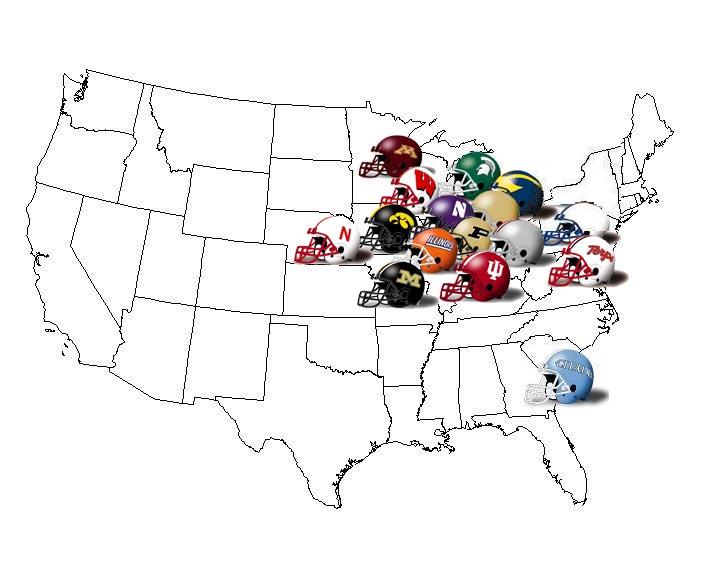
Conference expansion: should The Citadel join the Big 10?

Nebraska, Missouri, Notre Dame, Texas — it’s hard to take in all that’s (not) going on right now…

With all this expansion talk, there is a chance the Big 10 (motto:  “Just ignore the ’10’ thing”) might wind up with an odd number of teams.  Of course, it has an odd number of teams right now.  However, I’m thinking that when all the dust settles from this latest realignment, Jim Delany and company are going to want to be at 12 or 14 or 16 teams, if only to end speculation the league might expand again (and thus prevent all those late-night telephone calls from the folks at Iowa State begging for admission).

If the Big 10 needs an extra team, The Citadel would be an obvious candidate and would presumably get an invitation.  The question is, should the military college accept the Big 10’s offer and leave the Southern Conference?  What are the positives and negatives of making the move?

Positives

— There would be no controversy over where the conference baseball tournament would be hosted, as the other schools in the Big 10 would have no problem playing in Charleston every May.  Charleston versus Columbus?  No contest.  No more carping from the likes of UNC-Greensboro.  (And do you see UNCG mentioned as a candidate to join the Big 10?  No.  The Spartans should be grateful just to be in the same hemisphere with the Bulldogs, much less the same league.)

The Citadel would be a favorite to win the league in baseball every season.  Also, we could probably demand that all of our conference games would be played at Riley Park.  Fun spring trip for the guys from Minnesota and Wisconsin, and an easy three-game sweep for us.

–All home games in football and basketball would be on TV, along with a lot of televised games for the other sports.  Also, the Big 10 Network has a slightly larger distribution nationally than the SoCon TV package.

It’s important for The Citadel to increase its TV presence, as I have written many times before.  I have previously advocated playing Big 10 teams in non-conference action so as to get on TV.  Now, the opportunity could be there to play Big 10 teams as league games.

–By 2012 or 2013 or whenever we joined the league, there is a chance Indiana still wouldn’t have its act together on the hardwood and we could snag a road victory at Assembly Hall, which would be neat.  Plus, you know Nebraska won’t be any good at hoops, and Northwestern would be a promising opportunity for a road W.  So we could be competitive almost immediately.

–A new recruiting territory would open up, and with the advantage of offering recruits the best weather in the conference (unless Texas joins the league, and even then it’s a push).  The Citadel has already had some good luck recently with players from Big 10 country (Ohio is the home state for basketball’s Austin Dahn and baseball’s Justin Mackert).

If Texas winds up in the conference along with the Bulldogs, that opens up the Lone Star state even more to The Citadel’s predatory hoops recruiters (see:  Cameron Wells, Zach Urbanus, Mike Groselle).  With that type of opening, regular trips to the Final Four would be inevitable.

–The extra money from being a Big 10 member could go toward expanding Johnson Hagood Stadium.  The Big 10 could also flex its collective muscle and break the NCAA’s silly postseason ban in the Palmetto State.  That, combined with the newly expanded JHS, would result in a new bowl game for Charleston, so the community would also benefit.

Negatives

–Well, the road trips would feature a lot of snow and ice (excepting UT-Austin, which would probably be worth a mandatory travel game for the corps of cadets).  There is only so much places like East Lansing and Iowa City have to offer (not to mention Lincoln).

That’s why you can expect a lot of the league meetings to get moved to Charleston. Also, look for a lot of the Big 10 coaches to acquire beachfront property in the Low Country, a la Roy Williams, Ralph Friedgen, Les Robinson, etc.  It’s just a natural thing for them to do.

–Big 10 basketball can often be unwatchable.  Actually, you could say that about a lot of Big 10 sports…

–The Citadel probably would not be able to play schools like Chowan or Webber International in football.  Wait, that’s a positive!

–Women’s sports:  The Citadel has a limited number of women’s teams, and the ones we have would probably struggle in the Big 10.  We don’t have a women’s lacrosse program, though, which may be just as well.

–The other schools in the Big 10 would be much larger than The Citadel, which could lead to their fans trying to take over our home parks/arenas.  If we made sure the corps of cadets was fully armed before games, however, I think we would maintain our home field advantage.

–There is a possibility that a spot in the ACC or SEC could open up.  If that happens, it’s important for The Citadel to explore all its options.

All in all, I’m undecided about a potential berth in the newly constructed Big 10.  One thing I can say for sure, though, is that The Citadel will be okay wherever it lands.  Can Rutgers or Kansas say the same?

The New Big 10

College baseball bubble, 5/29

Just a quick update…for the breakdown prior to conference tournament play, see this post:  Link

The Saturday morning report, with changes noted from what I wrote in midweek:

– Locks (36):  Louisville, Connecticut, Virginia, Georgia Tech, Miami, Clemson, Florida State, Virginia Tech, Texas, Oklahoma, Texas A&M, Coastal Carolina, Cal State Fullerton, Rice, TCU, Arizona State, UCLA, Washington State, Oregon, Florida, South Carolina, Auburn, Arkansas, Vanderbilt, Mississippi, Alabama, LSU, College of Charleston, Florida Atlantic, Louisiana-Lafayette, Kansas State, UC Irvine, The Citadel, New Mexico, Stanford, Baylor

Change: Six teams that were not locks earlier in the week are now:  Kansas State, UC Irvine, The Citadel, New Mexico, Stanford, and Baylor.

– Champions from “one-bid” leagues:  15

Congratulations to Stony Brook and Rider for clinching automatic bids on Friday out of the America East and MAAC, respectively.

— Champions from leagues likely to get just one bid, but that do have bubble teams (but no locks):  4 (the leagues in question are the A-Sun, Big 10, MVC, and Southland)

Change: Florida Gulf Coast did lose in its tournament.

That means 55 spots are taken, with 9 still to go.

— Florida Gulf Coast University’s loss in the Atlantic Sun tournament will hurt, but it may still draw an at-large bid, making the A-Sun a two-bid league.  Could be close for the Eagles.

— The Big 10 is not likely to be a two-bid league.  Minnesota is in the driver’s seat for the auto bid.  I won’t completely discount this league getting a second team (Michigan), only because it’s the Big 10, and not because it deserves one.

— Wichita State is in the final of the MVC tournament and plays Illinois State for the title on Saturday.  The Shockers could lose today and still get in the NCAAs, but I tend to doubt it.

— Texas State is still alive in the bloodbath that has been the Southland tournament.  Could Texas State get an at-large bid, if needed?  Possibly.  Like FGCU, it would be a close call.

— The Big East has two locks and likely will get a third team in the field.  That team would have been Pittsburgh, but the Panthers went 1-2 in the tourney.  Also, St. John’s could steal a bid.  If the Johnnies win the tournament, is this a 4-bid league?

— Results in the Pac-10 on Friday broke almost perfectly for that league getting 8 teams in the field.  Stanford locked up a bid, and there were big wins for Oregon State and California.  Washington also won, but I think the Huskies are the ninth team and will not make it.  Oregon State and Cal both probably need one more win.  Arizona is still in good shape, but the Wildcats need to beat the Beavers at least once during the weekend to feel 100% secure.

— The Big XII is going to be a five-bid league.  It also has four completely meaningless games in its tournament today, thanks to the wonder that is pool play.

— The Southern Conference will be at least a three-bid league.  Elon should be that third team, despite losing a fight and a game on Thursday.  The Phoenix can still win the SoCon tourney, but if Elon doesn’t and either Western Carolina or Appalachian State does, I’m not sure the committee is taking four teams from this league.  The Citadel and the College of Charleston will be in the field of 64.

— Southern Mississippi plays Rice in the C-USA title game on Saturday, and the Golden Eagles probably have to win that game to get a bid.

— Liberty is still alive in the Big South tournament, but with more conference tourney upsets looming, it looks like the Flames must win that tourney to snatch a bid.  That will be a tall order, as Liberty will have to beat High Point once and Coastal Carolina twice.

— The Sun Belt could become a three-bid league if a team other than Florida Atlantic wins its tournament.  Either Arkansas State or Troy will be in the final, and FAU has to beat Florida International to get to the other side of the title matchup.  It would be interesting to see Garrett Wittels continue his hit streak in the NCAAs, but I think FIU has to win the SB tourney to make it.  Of course, they may just do that.

— Boston College is probably out of the mix for an at-large after going 1-2 in the ACC tourney (a result that helps North Carolina).  North Carolina State beat Clemson in its opener and probably needs one more win to feel good about its chances.  At this point, I think the Wolfpack might need that win only to further differentiate itself from BC.

— I still think the SEC will get 8 bids.  Kentucky is still in the mix, but I just don’t see it.  I wouldn’t be shocked if Kentucky’s name popped up on the selection show, though.

So, there are nine spots to fill.  As of Saturday morning, I think they might go like this:

Arizona, North Carolina, Oregon State, FGCU, Pittsburgh, North Carolina State, California, Elon, Liberty

Still alive:  Texas State (if needed), Southern Mississippi, Washington, Michigan, Boston College, Wichita State (if needed), Kentucky

Examining the college baseball “bubble” with one week to go

This will be a huge week in the college baseball world, obviously, with conference tournament action all over the country (along with some key regular season games in the Pac-10, which does not have a league tournament).  I decided to break down the potential field and see what teams are in, what teams are out, and what teams have work to do.  Admittedly, I’m not the only person who does this — you can read fine efforts from the folks at Baseball America and Yahoo! Sports, just to name two — but I’m the only person who will do it on this blog.  So there.

I’m going to approach this from the point of view of a fan of a “bubble” team who wants to know the ideal scenario by which his team can make the field, by the way.  The Citadel, while not a true “lock”, is probably safe at this point (and well it should be). However, I would like to see any potential roadblocks to the NCAAs removed.  In other words, I’m for the chalk.

RPI numbers mentioned below are as of May 23 and are from Boyd Nation’s website.  For the uninitiated, the regionals include 64 teams, 30 automatic qualifiers (by winning their respective league bids) and 34 at-large selections.  Three leagues do not hold post-season tournaments, so their regular season champs get the auto bid. Several smaller conferences have already held their post-season events and so we know what teams will be representing those leagues.

There are 15 leagues that will definitely only have one team in the field, the so-called “one-bid leagues”.  Dartmouth, Bethune-Cookman, Bucknell, and San Diego have already qualified from four of these conferences.  The other eleven leagues are the America East, Atlantic 10, CAA, Horizon, MAAC, MAC, NEC, OVC, SWAC, Summit, and WAC.  That leaves 49 spots for the other 15 leagues.

(There are also a few independents, along with the members of the Great West, a league that does not get an automatic bid, but none of those teams are serious candidates to make a regional.)

There are several leagues that will also be “one-bid” conferences, unless the regular season champion doesn’t win the conference tournament, and even then the favorite might not be good enough to get an at-large bid anyway.  Bubble teams should definitely be rooting for the top seed in these leagues, just to make sure no spots are “stolen”.  These leagues are as follows:

— Atlantic Sun – Florida Gulf Coast University dominated this conference.  With an RPI of 40, FGCU probably stands a decent (not great) shot at getting a bid even if it loses in the A-Sun tourney.  This is unfamiliar ground for the Eagles, as the A-Sun tourney will be their first post-season experience in Division I.

If you’re wondering why you have never heard of Florida Gulf Coast University, it’s because the school (located in Fort Myers) has only existed since 1997.  The baseball team has only been around since 2003, first as a D-2 program and now at D-1.  It’s an amazing story, really; there are a few more details to be found here.  It just goes to show you how many good baseball players there are in Florida, and for that matter how many young people there are in Florida (FGCU has an enrollment of over 11,000).

— Big 10 – Michigan has an RPI of 65, which isn’t really that great, and didn’t even win the regular season title (Minnesota, with a losing overall record, did).  It’s barely possible the selection committee will throw a bone to the all-powerful Big 10 and give a “snow bid” to a second team from the league, but I doubt it.   Incidentally, the Big 10 tournament will be held in Columbus, but Ohio State did not qualify for the event.

— Big South – Coastal Carolina will almost certainly be a national seed.  If the Chanticleers win the league tourney, the Big South is probably a one-bid league. Liberty has an RPI of 51 and has beaten no one of consequence.  Bubble teams should definitely root for CCU.

— Conference USA – Rice will be in the tournament.  The only other team with a shot at a potential at-large bid is Southern Mississippi, but with an RPI of 67, it’s likely the Eagles need to win the C-USA tourney.  Otherwise, it could be bad news for the Minnesota Vikings.

— Missouri Valley – Wichita State will be the top seed at the MVC tourney, tying for the regular season title with Illinois State but holding the tiebreaker.  If the Shockers (RPI of 56) don’t win the league tournament, they could get an at-large bid, but I don’t see it. Still, you have to watch out, given the tradition of Wichita State, that the committee doesn’t give a “legacy” bid.

— Southland – There are three teams (Texas State, Southeastern Louisiana, and Northwestern State) that are semi-viable at-large candidates, but I suspect all of them really need the auto bid.  Texas State won the regular season title, has an RPI of 50, and probably would be the one best positioned for an at-large spot, but I don’t think that would happen. Bubble teams should pull for Texas State anyway, just to make sure.  Southeastern Louisiana has an RPI of 48 but dropped all three games of its final regular season series to Northwestern State, at home, and thus finished third in the league.

Let’s look at the remaining “mid-majors”:

— Big East – Louisville should be a national seed.  Connecticut has had a great year and may wind up hosting (but as a 2 seed).  Pittsburgh doesn’t have a great RPI (53), but has a fine overall record, will get the benefit of the doubt for its power rating because it is a northern school, and is probably in good shape.  The Big East appears to be a three-bid league.  St. John’s has a good record but an RPI of 74.

— Big West – Cal State Fullerton will host and could be a national seed.  UC Irvine should also make it out of this league (which does not have a post-season tournament).  I don’t see anyone else getting in.  It’s a two-bid league.

— Mountain West – TCU will probably host a regional.  I think New Mexico (RPI of 42) is getting in, too, although an 0-2 MWC tourney could make the Lobos a little nervous.  The MWC should get two bids.

— Southern – The Citadel (RPI of 37) won the regular season by two full games, winning its last seven league games (and its last eight games overall).  It was the only school in the SoCon to not lose a home conference series, and went 8-4 against the schools that finished 2nd, 3rd, 4th, and 5th in the league, with all of those games being played on the road.

What The Citadel was not good at was winning on Tuesday.  It was 0-7 on Tuesdays until winning at Winthrop in its final Tuesday matchup.  On days other than Tuesday, the Bulldogs were 37-13.

Regionals are not played on Tuesdays.  The selection committee is aware of this, and probably aware that The Citadel has a top-flight starting pitcher (potential first-round pick Asher Wojciechowski) and a very good Saturday starter (6’7″ left-hander Matt Talley) who pitch on Fridays and Saturdays.

That’s a lot of verbiage to say that, even if the Bulldogs go 0-2 in the SoCon tourney, I expect them to be in the NCAAs. They better be.

The College of Charleston should be in the NCAAs too, with an excellent record and RPI (24).  The only other team with a shot at an at-large bid out of the SoCon is Elon (RPI of 43), which tied for third in the league (but is the 4 seed in the conference tourney).  The Phoenix had a better record against the ACC (6-1) than in the SoCon (19-11).  The SoCon should get at least two bids, and possibly three.

— Sun Belt – Florida Atlantic and Louisiana-Lafayette will be in the NCAAs.  Then there is Western Kentucky, with an RPI of 36 and some nice non-conference wins (Texas A&M, Texas State, Baylor, Vanderbilt, Kentucky).  However, the Hilltoppers finished 16-14 in league play, tied for sixth, and will be the 8 seed at the Sun Belt tournament. Can an 8 seed out of the Sun Belt get an at-large bid?  I’m not sure about that.

That leaves the four leagues that will send the most teams.  The easiest of these to evaluate, in terms of at-large possibilities, is the SEC.  The other three are a bit more difficult to figure out.

— Southeastern – Alabama’s sweep of Tennessee in Knoxville locked up a berth in the SEC tourney (and the regionals) for the Tide and also knocked the Vols out of both events.  LSU took care of business against Mississippi State, and then got the benefit of Kentucky’s meltdown against cellar-dweller Georgia.  The Wildcats were eliminated from the SEC tourney (and likely the NCAAs) after a 20-0 loss in Athens on Friday night.  Ouch.  The SEC, which some were suggesting could send ten teams to the NCAAs, will send eight — the same eight teams playing in the league tournament.

— Atlantic Coast – Six teams are locks (Virginia, Clemson, Georgia Tech, Florida State, Miami, Virginia Tech).  Then there are the other two teams in the league tournament (Boston College and NC State) and one that isn’t (North Carolina).

I think it’s possible that two of those three get in, but not all three.  North Carolina didn’t even make the ACC tourney, but has a really good RPI (21) and just finished a sweep of Virginia Tech.  The Heels actually tied for 8th with BC, but the two teams did not meet during the regular season, and BC wound up prevailing in a tiebreaker, which was based on record against the top teams.  That’s also UNC’s biggest problem — it was swept by all three of the ACC heavyweights (Virginia, Georgia Tech, Miami).  It also lost a series to Duke, which is never a good idea.

On the other hand, UNC did beat NC State two out of three games (in Chapel Hill). The Wolfpack has an RPI of 49, not quite in UNC’s range, thanks to a strength of schedule of only 77 (per Warren Nolan).  By comparison, UNC has a SOS of 15 and BC 16, typical of most ACC teams (Miami has the #1 SOS in the nation; UVA is 9th, Clemson 11th).

The records for the two schools against the top 50 in the RPI are similar.  Both are better than Boston College (8-20 against the top 50).  BC, which is only 29-26 overall and has an RPI of 45, would be a marginal at-large candidate but for its quality schedule and, of course, its sweep of NC State in Raleigh.

What NC State does have to offer for its consideration is series wins against UVA and Georgia Tech.  That’s impressive, but it’s probably not enough to get the Pack an at-large berth on its own.

I suspect that UNC will get in, despite not making the ACC tournament, but it will be close.  BC and NC State both need to do some damage in the ACC tourney, which is a pool play event, meaning each team will play at least three games. The Eagles and Wolfpack each need to win at least twice.  UNC fans need to root against both of them, because even though at-large bids (supposedly) aren’t doled out by conference, a run to the ACC title game by either BC or NCSU probably would move them ahead of the Heels in the at-large pecking order.

— Big XII – Texas, Oklahoma, and Texas A&M are locks.  Kansas State (RPI of 35) is on the bubble but is in good shape.  Baylor (RPI of 41), Texas Tech (RPI of 54, and now with a .500 overall record), and Kansas (RPI of 52) are also in the running for an at-large bid, although the latter two schools hurt themselves over the weekend and are in now in serious trouble.  Both must have good runs in the Big XII tourney (which, like the ACC tournament, is a pool play event).

Baylor, Kansas, and Kansas State are all in the same “pod” for the Big XII tournament, so they may be able to separate themselves from each other (in a manner of speaking) during the tourney.  How that will affect the total number of bids for the Big XII is hard to say.  It wasn’t a banner year for the league, but I could see as many as six bids.  I think, barring some upsets in the league tournament, it’s going to be five.

— Pac-10 – Arizona State, UCLA, Washington State, and Oregon are locks.  Arizona (RPI of 19) probably is too, although the Wildcats would do well not to get swept next weekend at Oregon State.

There are nine teams in the conference still fighting to make the NCAAs.  In this league, there is only one punching bag — Southern California.  Oh, how the mighty have fallen.

Washington has the worst RPI of the contenders (55) and is only one game over .500 overall.  The Huskies play Southern Cal in their final series, which will probably help Washington’s record but may not help its NCAA case.  Oregon State, as mentioned, hosts Arizona and may need to win twice.  The Beavers (with a solid RPI of 32) did get a much-needed win on Sunday at Arizona State to improve their conference record to 10-14.

Stanford (RPI of 44) looks to be in good shape; the Cardinal host Arizona State next weekend and likely need to win just one of the three games (and may be able to withstand a sweep).  On the other side of the bay, however, things are not as promising, as California (RPI of 39) has lost seven straight and finishes the season at Oregon needing to show the selection committee a reason to believe.

At least seven teams from the Pac-10 are going to make the NCAAs, and possibly eight.  I don’t think all nine contenders are going to get the call, though.

Okay, now let’s break things down.  Just my opinion, of course.  Here we go:

— Locks (30):  Louisville, Connecticut, Virginia, Georgia Tech, Miami, Clemson, Florida State, Virginia Tech, Texas, Oklahoma, Texas A&M, Coastal Carolina, Cal State Fullerton, Rice, TCU, Arizona State, UCLA, Washington State, Oregon, Florida, South Carolina, Auburn, Arkansas, Vanderbilt, Mississippi, Alabama, LSU, College of Charleston, Florida Atlantic, Louisiana-Lafayette

— Champions from “one-bid” leagues:  15

— Champions from leagues likely to get just one bid, but that do have bubble teams (but no locks):  4 (the leagues in question are the A-Sun, Big 10, MVC, and Southland)

— Bubble teams that are in good shape (6):  Arizona, Kansas State, UC Irvine, New Mexico, The Citadel, Pittsburgh

That’s 55 teams in total.  If there are no upsets (hah!), then nine other bubble teams will make the NCAAs.  I’ve got them listed in two groups; the “decent chance” group, and the “need some help and/or no conference tourney upsets for an at-large” group.

Decent chance for an at-large:  Stanford, North Carolina, Baylor, FGCU (if needed), Oregon State, Elon, NC State

Need a lot of things to go right:  Boston College, Liberty, Wichita State, Western Kentucky, Michigan, Texas Tech, Kansas, California, Washington, Texas State, Southeastern Louisiana, Northwestern State, Southern Mississippi, Kentucky, Tennessee, St. John’s

That’s how I see things, as of Sunday night.  Most of the action this week begins on Wednesday.  Let the games begin…

The SoCon baseball race goes to the final weekend

Just a quick breakdown of the different combinations, possibilities, and some observations…

There are four teams in the SoCon that still have NCAA regional at-large aspirations (in other words, schools that could potentially receive a bid even without winning the league tournament).  The Citadel, College of Charleston, Georgia Southern, and Elon are the squads in the mix (5th-place Samford, 29-21 overall with an RPI of 68, is not a serious candidate for an at-large bid at this point).  RPI numbers per Boyd Nation (as of 5/18):

The Citadel — 34-20 overall, 21-6 SoCon, RPI of 42
College of Charleston — 39-14 overall, 22-8 SoCon, RPI of 29
Georgia Southern — 33-19 overall, 19-8 SoCon, RPI of 53
Elon — 34-19 overall, 17-10 SoCon, RPI of 48

Realistically, two of these teams are likely to make it.  It’s possible that three get in the field of 64, although I tend to doubt that will happen.

The Citadel’s profile has slipped a bit, thanks in part to its own struggles (particularly in midweek games) and partly because of results elsewhere.  For example, the Bulldogs are currently only 1-8 against top 50 teams; thanks to Appalachian State and Western Carolina falling out of the top 50, The Citadel “lost” six top 50 wins.  Conversely, CofC is 5-5 against Top 50 opposition while Elon is 6-7.  GSU is 0-9.

With an excellent overall record, the College of Charleston would be a lock for the tourney by now if it had not dropped more than its fair share of league games, including losing a series at Furman.  Georgia Southern has won 11 straight games to get back on the at-large radar, but has been swept at CofC and lost a home series to Western Carolina.  Elon has some nice wins (including two at Clemson, one at NC State, and a home victory over UNC) but has been swept at home by The Citadel and also lost a home series to Georgia Southern.

Those league series losses at home hurt.  The Citadel is the only team in the SoCon that has avoided losing a home series this season.  The Bulldogs also have a better overall strength of schedule than the other three contenders.

Then there is this little nugget:  with the meeting this weekend at Georgia Southern, The Citadel will have played the 2nd-, 3rd-, 4th-, and 5th-place teams in the SoCon all on the road.  The Bulldogs have drawn what is easily the toughest slate of road league games, and held their own in them so far.

That’s why I believe that if The Citadel were to win the series in Statesboro and claim the regular season title in a top 10 league (the SoCon is currently rated 9th in RPI), it will be completely deserving of an NCAA bid, regardless of what happens in the Southern Conference tournament (and despite the Bulldogs’ foibles in midweek play).  If The Citadel does not win at least two games at GSU, however, then the at-large prospects for the Bulldogs become a lot dicier.

The College of Charleston is in fairly good shape for a second bid for the league.  I believe the other contenders likely have to win the league tournament, although Elon could make a case for an at-large with a strong tourney run.  What Elon would not want in that situation is for a team other than the CofC or The Citadel to win the tournament. 

(Note:  the seeding possibilities outlined below assume there are no rainouts this weekend.)

As far as SoCon tournament seeding goes, the CofC is going to be either the 1 or 2 seed.  The Cougars have completed their league schedule.

The Citadel can be the 1 seed (with two wins in Statesboro), the 2 seed (with one win), or the 3 seed (if it is swept). 

GSU is the 2 seed with a sweep and the 3 seed with 1 or 2 victories this weekend; if the Eagles are swept they could wind up as the 4 seed, but only if either Elon or Samford sweep their series against each other.

Elon and Samford will be the 4 and 5 seeds (and play each other for a fourth consecutive time in the first round of the tournament) unless the dual-sweep scenario outlined above occurs.

Western Carolina would be the 6 seed if the tournament started today, and will stay in that spot with a combination of two WCU wins/Appalachian State losses.  The Mountaineers will be the 7 seed unless they can make up ground on the Catamounts. 

There are three teams still alive for the 8th and final spot in the tournament (Davidson has been eliminated).  Wofford holds a one-game lead over Furman, but the Paladins hold the tiebreaker.  UNC-Greensboro is two games back of the Terriers, but does host Furman this weekend (Wofford has a series against Appy in Spartanburg).  UNCG would need to sweep the Paladins and hope Appalachian State sweeps Wofford; otherwise, it’s out of the running.

One more thing with regards to the SoCon tourney to keep in mind:  the teams are basically divided into two four-team pods, with the winner of each pod meeting in the title game.  One pod will have the 1, 4, 5, and 8 seeds, while the other will feature the 2, 3, 6, and 7 seeds.  That second group, in particular, will be a bloodbath (not that the first will be a walk in the park).

The Washington Post looks at Chuck Driesell’s move to The Citadel

This is just a quick blog post, which is a little different for me, to be sure.  However, I wanted to briefly comment on this article by Steve Yanda in The Washington Post:  Link

From the story:

Those familiar with The Citadel athletics said the most daunting challenge Chuck Driesell will face is persuading quality players to commit to four years of a military environment. But sitting in a still-barren office just more than two weeks after he was hired, Driesell said he plans to confront that factor the same way he has dealt with perpetually being known as Lefty’s son — by embracing it wholeheartedly.

“I think you have to sell it,” Driesell said of The Citadel’s military component. “I don’t think it’s something you paint as a negative, because it’s not. It’s a positive. Here, they get a leadership degree in addition to their regular degree. And everyone needs leaders.”

Quick thoughts:

1)  How about Yanda actually referring to “The Citadel athletics” and not “Citadel athletics”?  Good for him.  It’s nice to see someone (or someone’s editor) paying attention.  Now if only we could get more people within our own department of athletics to do the same…

2)  Driesell again noted that he wanted to use the military aspect of the school as a positive.  As I said in a previous post, he’s talking a good game.

Further along in the story:

After Ed Conroy left last month to take the head coaching job at Tulane, calls from hopeful candidates began to flood Les Robinson’s home in nearby Sullivan’s Island. The former Citadel coach and athletic director immediately was drawn to an aspirant he had recruited to the school 29 years earlier. The other callers pried for inside information on competing applicants or their own chances for landing the gig.

“But Chuck was strictly asking me about what it is like coaching there, which is the most important question,” said Robinson, who led The Citadel from 1974 to 1985. “Now, if I was coaching at Wofford or Georgia Southern, that wouldn’t be that important a question. It wouldn’t be a lot different coaching at Appalachian State or Georgia Southern. But it’s different coaching at The Citadel.”

Robinson said he “oversold” the military aspect while recruiting players to avoid near-immediate attrition once they arrived on campus in the fall. In his first 10 years at the helm, Robinson noted, not one player transferred out because the military discipline was too intense.

1)  Okay, so Yanda didn’t use the “The” in this section, but in this case it is acceptable usage.  I would have called Les Robinson the “former Bulldog coach” instead, but no matter.  There is no question that the name of the school can be problematic for a grammarian, much less your typical sportswriter.  There is also no question that I pay too much attention to this subject.

2)  Again, we have a positive insight on Chuck Driesell, who recognized that coaching at The Citadel is not quite like coaching at other Southern Conference schools.

3)  Also, Robinson’s suggestion that he “oversold” the military aspect of the school is something all coaches at the military college would do well to emulate.  Of course, they might avoid emulating his first four seasons as head coach, as Robinson’s first four teams had a combined record of 31-70.

In his fifth year, though, he went 20-7.

Finally, while the article notes that The Citadel has never received a bid to the NCAA tournament, Chuck Driesell said that making the NCAAs would be “an annual goal” and “attainable”.  Good.  No “every four years, maybe we’ll have a decent team” line, which I’ve heard one too many times before.

There is, after all, an NCAA sub-regional next year in Charlotte.  That’s an easy trip up I-77 for me…

Talkin’ Bulldog baseball

I can’t believe I haven’t filed a post yet about The Citadel’s baseball team, but then, I haven’t been posting much at all as of late.  That will change (I hope) in the ensuing months.  At any rate, let’s talk Bulldog baseball.  The Citadel is in first place in the SoCon right now, so it’s the perfect time to jump on the bandwagon!

The Citadel heads into the upcoming weekend series with Samford at 16-2 in the league (28-15 overall).  I have to say I am pleasantly surprised at the Bulldogs’ success in the conference this season, as I thought it would be hard to replace the players The Citadel lost from last year’s team (including Richard Jones, Chris McGuiness, and Sonny Meade).

The Bulldogs needed to replace a ton of offensive productivity, and I didn’t think the pitching (which I expected would be good) would be able to overcome that.  I guess Kendall Rogers, college baseball writer for Rivals.com, deserves credit for picking The Citadel to win the Southern Conference.  I hope I didn’t just jinx the team by writing that.

What follows is a look at this season’s team and how it is faring in the categories of fielding, pitching, and batting.  Some of this is probably going to come across as overly negative for a team currently leading its league, but it’s important to examine the team’s weaknesses as well as its strengths.

Fielding

Fielding is definitely the Achilles’ heel of this squad, and if the Bulldogs fail to win the league, or do not impress in any post-season play, it is likely to be the key reason why.  The numbers are not good:

  • 73 errors in 43 games (1. 7 errors per game)
  • A fielding percentage of .955 (which would be the worst for a Bulldog team in at least a decade)
  • An average of 38.09 chances per game (which would be the lowest for a Bulldog team since 2003)

The Citadel has committed two or more errors in 22 of its 43 games.  That’s 2+ errors in more than half the games.

The Bulldogs have had defensive issues at third base, second base, and catcher.  There have also been occasional lapses in the outfield, which is surprising, as all three regulars in the outfield are solid fielders with good speed.  All of them are capable of making outstanding plays.

I don’t think it’s particularly surprising that Bryan Altman, playing primarily as a catcher after spending most of his college career at second base, would not be the second coming of Johnny Bench with the glove.  From what I’ve seen, Altman actually does a lot of things well behind the plate.  The one thing he doesn’t do well, as least from anecdotal evidence, is cleanly catch pitches.

The ball seems to pop out of his glove a lot when I watch the games, which would explain his 14 passed balls.  The Citadel hasn’t had that many passed balls in a full season since 2003 (there were 8 all of last year).

At third base, David Greene has committed 18 errors.  Greene committed 14 errors all of last season.  His fielding percentage to date (.860) is substantially lower than it was last season (.903).  This may be a “he was in a slump at the plate, and it affected his fielding” kind of thing.  He’s not in a slump now, though, so maybe his fielding will improve as well.

Then there is second base, where Legare Jones has spent the most time, with Altman and Josh Pless also taking turns at the keystone position.  Jones has 10 errors and a .921 fielding percentage.  Pless, in limited duty, has an .882 fielding percentage.

Last year, the Bulldogs had 39.0 chances per game, almost a full chance more than this season.  That team committed just 1.14 errors per game, more than half an error fewer per game than this year.  This means, essentially, that Bulldog pitchers are having to get 2 and a half more outs per game this season (when you combine the increased errors with the reduced chances).

It’s hard enough to pitch in college baseball as it is, without having to get an extra out every third inning or so.

Pitching

This was supposed to be the Bulldogs’ strength this season, and it has been.  Asher Wojciechowski was supposed to be one of the nation’s outstanding pitchers this season, and he has been.  A critical reason for The Citadel’s success in conference play has been getting consistently excellent performances from Wojciechowski in the Friday night games.

Not only have the Bulldogs claimed victory in those games (save last week’s game against Davidson), Wojciechowski’s ability to pitch deep into games has allowed the bullpen to do most of its work in a two-game stretch, instead of three.  Also, winning the series opener takes the pressure off the team for the remainder of the series.

This is why Matt Talley’s performance last Saturday (a complete-game shutout) may have been the most important individual start of the season.  For the first time all year, the Bulldogs trailed in a league series after losing the Friday night game.  Talley came up big under pressure, saved the bullpen, and set things up for The Citadel to claim the series by winning the second game of the doubleheader.

Wojciechowski’s numbers are uniformly great (.211 BAA, 98/19 K-BB in 73 IP, only 4 HR, 2.47 ERA).  His BABIP (batting average on balls in play) is actually a little high (.328), suggesting he has been a tad unlucky in that area (and that also may be a reflection of the defense behind him).  Wojciechowski threw 138 pitches against Elon earlier this year, but has had only one 120+ pitching performance since then.

I suspect Wojciechowski is making himself a lot of money this season.  He certainly should be.

I’m hoping Talley’s performance last Saturday is a harbinger of things to come.  Last season Talley was 8-1 with a 3.42 ERA, but this season’s move into the weekend rotation (and against generally superior competition) has resulted in an ERA jump of over a full run (4.50) despite a better BAA (.251 this season; it was .273 in 2009).

Talley’s strikeout rate and walk rate are both better this season than last, and his BABIP is actually a touch better this year too, so he hasn’t been unlucky in that respect.   Last season, though, he only allowed 14 extra base hits in 71 innings.  This year in 60 innings he’s already allowed 19.

Also, teams have  finally figured out that Talley has a great pickoff move (only 2 pickoffs so far in 2010 after having 10 in ’09).  Eliminating the runners who were subsequently picked off would give him baserunners per inning totals almost exactly the same for ’09 and ’10.

Talley has also been hurt by the team’s defense.  He has allowed a team-high 12 unearned runs.  Talley has actually allowed two more runs than Michael Clevinger in the same amount of innings, despite having an ERA a full run and a third better than that of Clevinger.

Clevinger has done a respectable job as the Sunday starter for The Citadel, about as much as you could ask for a freshman put in that position.  He has kept the team in the game most of the time, which is the primary expectation of a #3 starter.  Clevinger has done an amazing job at preventing unearned runs (just one UER in 59 2/3 IP), a stat that jumps out at you when you read the pitching lines for The Citadel.  Curt Schilling would be proud.

The Citadel has not had a lot of luck with starting pitching beyond the three weekend starters, which partly explains the lack of success in midweek games.  T.J. Clarkson had an ERA of 3.92 last season; this year it’s 6.35, despite having very similar K/BB rates, hits allowed totals, and BAA.  Clarkson, however, has allowed 6 home runs in only 34 innings after allowing just one (in 41 1/3 IP) all last season.

Austin Pritcher is a freshman who has started six games.  He’s had a couple of bad outings which have really hurt his pitching line (6.89 ERA), but he has had his moments in relief, and could be a factor in tournament play (as could Clarkson, who has proven he’s capable of pitching well against quality opposition in the past).

The Bulldogs have had four pitchers get most of the bullpen duty this season.  Matt Reifsnider is the long man out of the ‘pen, and he’s had a fine year.  His numbers are up (in a good way) from last year in practically every category.  What he’s done best is avoid walking people.  Last season he walked 15 batters in 36 1/3 innings; this season, just 4 in 38 IP.  That, combined with a much-improved BAA (.284; in ’09 it was .398) has dramatically improved his WHIP.

The two setup men for the Bulldogs are Raymond Copenhaver and Chris Boyce.  None of Boyce’s numbers stand out as being exceptionally good, but he’s done a solid job just competing on the mound, and has managed to get some big outs along the way.  As a result he’s 5-0.  Only Asher Wojciechowski has more wins for The Citadel.

I believe Copenhaver is the pitcher most affected by the team’s defensive play.  This is perhaps reflected in his BABIP of .361 (his BAA is .286).  Last season Copenhaver’s BABIP was .327 (with a .284 BAA).  What he does best is not allow extra base hits (just 3 in 20 2/3 IP, with only one a homer).  Copenhaver struggled at times last season, but he’s been better this year, with an ERA more than a full run lower.  I have to wonder if he’s actually been a little better than his results, based on that BABIP figure.

Drew Mahaffey had a great year in ’09 as the Bulldogs’ closer.  This year he has really struggled, though, and what was a team strength now has to be considered a weakness, at least until he can put things together.  The numbers do not lie.  His BAA has gone up from .203 to .238, but more ominous are his K/BB totals.  After striking out 71 and walking just 14 in 50 innings last year, this year he has already walked 18 in just 21 1/3 IP (against 22 Ks).

If the Bulldogs have designs on a long post-season run, I think getting Mahaffey back to near where he was last season is mandatory.  I don’t know whether or not that’s possible.  I just hope it’s not an injury situation.

Batting

This is the area where I thought the Bulldogs would struggle the most, but they’ve held their own.  It’s not a deep team, with eight regulars who go to the post practically every day.  DH Brad Felder has started 41 of the 43 games, yet he’s eighth on the team in starts.

There are two players in Fred Jordan’s lineup who weren’t really there last season who have made a big difference.  One of them is Matt Simonelli, who had limited playing time last year because of injury.  He’s back full-time this year and making it count (.952 OPS).

The other player who wasn’t around last year was Kyle Jordan.  Well, at least this version of Kyle Jordan, the one with a respectable bat who can make the routine plays in the field.  Last year’s version, the one with the sub-.500 OPS who led the team in strikeouts?  Gone, and thankfully so.  The younger Jordan does need to walk more and strike out less (8 BB/39 K).

Leadoff hitter Nick Orvin leads the team in OBP and slugging, as he has improved on what was an outstanding freshman season.  He is the runaway leader on the team in walks, with 30.  Orvin should be on the all-conference team.

David Greene appears to have rebounded from an early-season slump and is starting to move his numbers closer to what they were during his excellent freshman campaign.  Greene is also walking more this year, a positive development that I’m hoping may also lead to an increase in power.

Bryan Altman’s power is not in question, as he is tied for the team lead in homers with Felder (nine each).  Like Simonelli, I wish Altman walked a bit more, but also like Simonelli, he’s a contact hitter who doesn’t strike out much.  Altman can also swipe a base (8-10 this year).

William Ladd is also having a solid year at the plate.  He really needs to walk more, though (only four BB all season so far) to take full advantage of his speed on the bases.  Ladd is surely one of the faster left fielders in the country.  Ladd does lead the team in hit-by-pitches (11).

Brad Felder is not a high-average DH, but he has good power (and I wouldn’t be surprised to see his batting average continue to rise).  He also has 10 steals, joining Simonelli and Orvin as double-digit base-stealers.  His respectable .373 OBP has been built up in part by 10 hit-by-pitches.

Justin Mackert’s first season on the field has been a good one.   He now has two home runs and looks to have the potential to hit quite a few more.  He’s also not afraid to take a walk, although not quite at Orvin levels.  He’s another Bulldog who is a threat to steal (9-11 SB).

The ninth position in the lineup has been in a state of flux.  Legare Jones has seen the most time, starting 26 games at second base.  He is only batting .235, however, and as mentioned has had his share of errors in the field.  Jones has actually been better than that .235 figure suggests, though.  He walks enough to have an OBP of .351, and 7 of his 19 hits have gone for extra bases.  In other words, he gets on base at a decent clip and he has some pop in his bat.

Fred Jordan has lately been rotating Jones, Josh Pless, and Altman at second base (with Grant Richards catching when Altman goes to second).  I would imagine this will continue, with Jones and Pless being in a platoon situation and Altman occasionally moving to second base as relief from the stress of catching every day.

Entering weekend play, The Citadel has an RPI of 31, per Boyd Nation.  According to Nation, if The Citadel goes 10-4 in its last fourteen regular season games (12 of those 14 are SoCon games), it will remain in the top 32 of the RPI.  A 7-7 mark would keep it in the top 45.

The Bulldogs’ last four SoCon opponents include the teams currently in second (College of Charleston), third (Samford), and fourth (Georgia Southern) place in the league — and all of those series will be on the road, beginning with this weekend’s trip to Birmingham to play Samford.  The Citadel has a lot of work to do to win the league.

I think a 7-5 finish in league play would be good enough to win the regular season title (8-4 would be a mathematical certainty).  6-6 might be enough, depending on other results.

If The Citadel wins the SoCon regular season crown, I think that would guarantee the Bulldogs a place in the NCAAs, as it would be hard to leave out the regular season champ of a top-10 league.  Possible, but not likely.  The Citadel’s non-conference record isn’t so hot (12-13), but its record against top-50 opponents (6-6, or 6-5, depending on source) is solid.

Of course, if the Bulldogs win the conference tourney at Riley Park next month, they won’t need an at-large berth (for the record, The Citadel has never received an at-large bid to the regionals).

I just hope The Citadel finishes strong and leaves no doubt about its NCAA-worthiness.  I’m ready to go to an NCAA regional again.  It’s been too long since the last one for my liking.

Open letter to Chuck Driesell

Dear Coach Driesell (mind if I call you Chuck?) —

Congrats on being named head coach at The Citadel.  I liked your choice of tie at the press conference.  You and your family will enjoy Charleston.  Whether or not you enjoy your new job will depend on how you approach it.  Here are some tips:

—  Know your history.  I assume Larry Leckonby told you all about The Citadel’s hoops past.  If not, here is a primer:  Link

I hope you’re not having second thoughts…

Now, that post in the link covers everything up to Ed Conroy’s last two years at The Citadel, which were really good by Bulldog standards.  Conroy won 20 games in 2009 and went 16-16 this past season; he parlayed that into a nice gig at Tulane.  This is good news for you, Chuck, if you have designs on moving up the D-1 coaching ladder. Imagine if you actually won the Southern Conference.  That might be worth an ACC job.

(Who am I kidding.  That would be worth an NBA job.)

—  If you want to make the NCAAs from The Citadel, you will have to win the Southern Conference tournament.  The Southern Conference is a one-bid league; there hasn’t been an at-large bid out of the SoCon since 1950.

Winning the SoCon tourney while at The Citadel will be a tall order, however.  The school’s postseason tournament history?  Ugly.

Now, you remember your father’s struggles in the ACC tournament, so you can appreciate a tourney hex — maybe not one quite on the scale of The Citadel’s foibles at the SoCon tourney, but you probably understand the frustration.  Of course, you also were on the team the year Lefty finally won the ACC tourney, so you know it’s possible to climb the mountain. Admittedly, you aren’t going to have the services of anyone as talented as Len Bias while at The Citadel.

—  Speaking of the left-hander, feel free to invite your father to show up at McAlister Field House whenever he wants.  We’re used to celebrities with connections to the program showing up at basketball games now, since Pat Conroy jumped on the bandwagon the last two seasons.  All I ask is that whenever there is an article in The New York Times about the team’s success, or if Wright Thompson writes a long, thoughtful piece on ESPN.com about the basketball program, that maybe the stories might actually mention a current player.  Just once?

It’s like the program got overshadowed by an ancillary figure.  5700 combined words, no mention of any player.  Sigh.

(By the way, there has to be a great photo op involving General (the bulldog, not Rosa) and Lefty Driesell.  Russ Pace, be ready.)

—  Learn as much as you can about The Citadel, but don’t sweat it if you don’t understand everything about the school. I’m a graduate, and I do not understand everything about the place, and never will.  If you really understand everything about The Citadel, you are certifiably insane.

One thing I will say is that you can’t quite lean on your time in the Navy, or at NAPS. There are some similarities but also some major differences.

You’re going to have to get a crash course in a new culture from somebody who was recently in your situation (Leckonby), and you should seriously consider having at least one guy on your staff with connections to the school. It’s kind of like having an interpreter.

—  You have a reputation as a solid talent evaluator.  I’m glad to hear that is the case, because I think that skill is critical to having success at The Citadel, much more so than just being a “getter” of players.  You’re going to have to look for under-the-radar types.

I’ll give you an example, Chuck.  Remember when Maryland was recruiting Jai Lucas? Of course you do, you were front and center on that recruitment.  Maryland didn’t get him, though, which must have been very disappointing, especially with his father (the great John Lucas) having played for your father at Maryland.

Jai Lucas wound up going to Florida, and then later transferred to Texas.  He was a big-time recruit.  Big-time recruits don’t go to The Citadel.

When you were watching his high school games, though, did you happen to notice the other guard for Bellaire?  Skinny kid, but a solid player.  Wasn’t getting offers from any of the high-majors, or any of the mid-majors for that matter.  I’m guessing you noticed him, at least enough to recognize him…even if you saw him now, in his cadet uniform.

His name was and is Cameron Wells, and he’s currently on pace to be the all-time leading scorer at The Citadel.  I would argue that he has had a much better college career than Jai Lucas, and that’s even taking the level of competition into consideration.  That’s the type of player you are seeking.  Wells wasn’t a McDonald’s All-American, but it’s not inconceivable he could eventually become the first alum from The Citadel to play in the NBA.

—  Besides finding “hidden” talent, Chuck, there is something else you need to keep in mind, something very important, and something quite a few coaches at The Citadel have found out the hard way.  When you recruit, you have to recruit cadets and make them players.  You can’t recruit players and make them cadets.

You have to bring in guys who are willing to embrace the challenge that is The Citadel. That’s what you’re selling, basically — a unique challenge, one that will stay with you all your life, along with a scholarship and the opportunity to play D-1 basketball.

It isn’t easy. No matter how good a salesman you are, The Citadel is never going to become the UCLA of the East.

The key to long-term success for any coach of any sport at The Citadel is to keep attrition low.  I can’t emphasize that enough.  You have to develop players over a four-year period.  It doesn’t do you any good to recruit some on-court stud if he’s only around for a year or two because he can’t handle the military system.

Also, remember to work with the system, not against it.  Don’t enable your players at the expense of the military side of things, as it will do you no good and will turn the corps of cadets (and a significant number of alumni) against you.  You need to have the corps on your side.

That line you had at the presser about players “taking that experience [of The Citadel’s military system] to the court” — that was solid, Chuck.  You at least talked a good game there.

—  Speaking of the corps of cadets, you need to confer with Leckonby and General Rosa and some of the cadet leadership to figure out how to make McAlister Field House a decided homecourt advantage again.  It wasn’t last season, and that’s a concern, because in the SoCon, you need to defend your homecourt.

The big problem is that league games are usually played on Thursdays and Saturdays.  On Saturday, the corps is generally on leave, and a leave that is both much-anticipated and much-needed.  On Thursday nights, you have a combination of things working against you, but I think you can work with the corps on that night.

See if you can arrange it so that a minimum of one-fourth (or at least one-fifth) of the corps is in attendance on Thursday nights, at least for SoCon games.  Saturday is a tough nut to crack; at the very least, make sure cadets stuck on campus are at the games.  Try to get cadets some rewards for supporting the team.

You have to understand, Chuck, that by and large cadets at The Citadel are not sports fans.  At Maryland, you could count on a large student body with a healthy number of hoops nuts.  You had a built-in student fan base.  That isn’t the case at The Citadel, with just over 2000 members of the corps of cadets, only a very small percentage of whom grew up following college basketball on any level.

—  That’s why, Chuck, you also need to reach out to the community.  In terms of selling the program to outsiders, you’re going to have to be a little bit more like your father, I think.  You’re competing with a lot of entertainment options, and Charleston is not really a sports town. However, it’s something you have to do.  The Citadel has one of the oldest fan bases in the league, if not the country.  You need to find some fresh blood.

— This is sort of an aside, Chuck, but I wanted to warn you in advance about Southern Conference officiating.  It can be, uh, inconsistent.  This is particularly true on Saturdays, when all the high-profile officials are working major-conference games.

Weekday games usually aren’t so bad, because there is sometimes a quality ref or two available for SoCon games. Saturdays, though, are often just short of an officiating debacle (actually, last season’s Davidson-Wofford game in Spartanburg was a debacle).

It’s just another reason why you need to have a good, boisterous crowd at McAlister for Saturday night games.

— Also, if you don’t mind, I would like for you to fix the uniforms.  The next time we break out new duds, please be sure that the lettering on them reads “The Citadel” and not “Citadel”.  It’s a pet peeve of mine, but still.  Get the name of the school right.  I bet General Grimsley would shake your hand if you made a point of correcting that, and it’s always good to be on the right side of the Grimmer.

—  Your predecessor, Ed Conroy, made a point of scheduling quality non-conference opposition, with occasional home games against the likes of Michigan State and Southern California.  I really liked this approach, and hope that you keep doing it.  You probably are going to have to play two or three “guarantee” games at a minimum every year, anyway.

With that in mind, Chuck, see if you can schedule games against Big 10 and/or SEC opponents.  Every Big 10 home game is televised on the Big Ten Network (BTN), and many of the SEC games are on one of the various ESPN platforms.  Even a game on ESPN3.com is worth it for The Citadel.

Last season the Bulldogs were on television a grand total of three times, once on ESPNU and twice on SportSouth.  To raise the profile of the program, and for recruiting purposes, I think it’s important to get on TV as much as possible. Besides, if we’re going to play elite teams to pay the bills, we might as well get something else out of it other than cash.

—  You are going to be in an unusual situation at The Citadel for a new coach, in that you will be inheriting a team that has the potential to be good next season.  I already mentioned Cameron Wells, but you have several other excellent players with whom to work.

At the press conference you mentioned that next season’s team could be “very special”.  I was interested in the way you described the number of returning starters. Instead of saying that “all five starters will be back,” you noted that (I’m paraphrasing slightly) “at the end of the season all five starters were coming back.”

There have been some rumblings that at least a couple of players are considering leaving the school, including two regulars in the rotation, so your first recruiting job is going to be trying to keep them from bolting.  It appears you are well aware of this, which is good.  I hope they stay, as if everyone comes back next season really could be special.

Despite the expectations for next year, you won’t really be under any pressure to win immediately, and can think long-term.  Ed Conroy left for a better job after four seasons.  The three coaches before him had a combined winning percentage of 41.2%, but despite that coached for 11 (Les Robinson), 7 (Randy Nesbit), and 14 (Pat Dennis) seasons at The Citadel.

The job isn’t a career-killer like it’s occasionally been made out to be.  Four of the last eight coaches, in fact, left to coach other Division I schools; one of them, Norm Sloan, would later win the national title.  Sloan and Robinson would actually coach two other D-1 schools after leaving The Citadel (counting Sloan’s two stops at Florida just once).

Congrats again for getting your first shot as a D-1 head coach, Coach Driesell.  Your opportunity comes at a place that is unusual and not for the faint of heart, but very special nonetheless.  Cherish the experience.

We’ll be rooting for you.

Sincerely,

SS

Random bubble thoughts and theories, 3/8

I’m going to wait a few days before writing a post-mortem on The Citadel’s hoops season.  It was a little bit of an odd year.  Part of me is disappointed in the overall record (16-16, 9-9), but another part of me remembers that in the last two years the Bulldogs have won 24 SoCon games.  In the six previous years, The Citadel had won 15.  Total.

The past brings perspective.

Sometimes the past also helps when trying to evaluate bubble teams and seeding scenarios.  The membership of the selection committee has changed over time, of course, but that doesn’t mean you can’t look back and see what the committee did when presented with certain situations.

— Let’s face it, the Pac-10 is wretched this season.  California won the outright Pac-10 title.  Is that good enough to guarantee the Bears an at-large bid if they don’t win the Pac-10 tourney?

History says yes.  Exhibit A:  Air Force, 2004.  That season the Falcons were 22-5 during the regular season and won the Mountain West, but did almost nothing outside the league, managing to beat no one of consequence and losing games to UT-Pan American and Belmont.  However, Air Force was 12-2 in league play and won the MWC outright by two games.

Air Force lost in the quarterfinals of the MWC tournament to Colorado State (by 12 points).  Despite that, the Falcons still made the NCAAs.  When asked about it, selection committee chairman Bob Bowlsby noted AFA’s less-than-stellar profile, but pointed out that the Falcons had been the regular-season champion of a top-10 league — and that achievement, in the opinion of the committee, merited Air Force’s inclusion.

I can’t say I disagree with that argument.  (It’s certainly a better line of reasoning than the one Bowlsby’s successor as committee chair, Craig Littlepage, gave for the committee’s absurd decision to put Air Force in the field two years later.  I still have no idea how that was justified.)

If winning a top-10 league is good enough, then Cal is safe.  Admittedly, it’s not quite the same situation; Air Force won the MWC in 2004 by two games, while Cal edged Arizona State by just one game in the standings.  Also, 12-2 is better than 13-5.  Still, it’s a factor, as is the fact we’re talking about the Pac-10, and not one of the “mid-major” leagues (even if it isn’t as good as some of those leagues this season).  Cal better not lose in the Pac-10 quarterfinals, though.

Incidentally, the same argument would presumably work in the favor of Utah State.

— Could last-second seeding adjustments actually happen?

This season there will be four conference title games played on Selection Sunday.  The SEC, ACC, and Atlantic 10 title games will all tip at 1 pm ET, while the Big 10 final will start at 3:30 pm ET.

Let’s say that Duke and Ohio State are both in their respective conference finals. Would the committee wait until the end of the Big 10 game to finalize the seeding?

Someone asked Joe Lunardi about this in an ESPN “chat session” :

A lot of experts think that Ohio State has the best shot this side of Durham to collect the final 1-seed if they win the Big Ten tournament. Isn’t there a good chance though that they could get screwed by the schedule. The Big Ten final doesn’t start until 3:30 on Sunday and the ACC championship is at at 1:00 on Sunday. I know that the brackets take a long time to put together and the top seeds are placed first. If Duke lost in the Final and Ohio State won, is it possible that their fates would already be set before those games finish?

Joe Lunardi:  It has happened this way in the past…More recently, however, the Committee has built multiple brackets accounting for the various Sunday scenarios. I would be disappointed in this group if they bailed on the process and didn’t finish the job (and I do not expect they will).

Lunardi may be right, but I think most of those “various Sunday scenarios” have revolved around teams playing on Sunday who were “auto bid or bust” types — like Mississippi State last season, or Georgia the year before that.  I’m less than sure the committee is going to wait until the last moment (or prepare alternative brackets) for a question of one seeding line.  Besides, should one game really be the difference between a team getting a 1 or a 2?  What about the previous 30+ games?

This reminds me that in the past, there were occasionally conference tournaments still going on when the selections were announced.  The Big West did this several times (this was back when UNLV was in the league).  It invariably led to scenarios where the committee would have either/or bracket lines where a team would be in the field, unless the Big West had a surprise champ (in other words, if  Vegas didn’t win).

This finally ended after the committee basically decided to hose any at-large hopeful out of the Big West until it quit playing its tourney so late.  I recall Long Beach State being a bubble team that found out at halftime of the conference final that it had to win, or else.

Another league that at one time played its final after the pairings was the SWAC.  Now, with the SWAC there wasn’t any at-large issues; it was just a question of what team would advance.  However, it did pose a problem for the committee when trying to seed.  These days the SWAC is an easy 16 (if not play-in game) pick, but back then it wasn’t always the case.

One year the committee puzzled just about everyone by deciding the winner of the SWAC title game would get a 13 seed.  Nobody could believe the SWAC got so high a seed, especially because no one knew yet which team would be the league representative.

As it happened, Southern won the tournament final (televised immediately after the selection show), and the lucky 4 seed it drew as an opponent was ACC tournament champ Georgia Tech.  Well, maybe not so lucky.  Ben Jobe’s Jaguars shocked Bobby Cremins’ Yellow Jackets in the first round, 93-78.

— This season, there seem to be several “as long as they don’t lose to a really bad team, they should be okay” situations.  It’s all right if Virginia Tech loses to Wake Forest in the ACC tournament, but if Miami upsets the Demon Deacons and then beats the Hokies, VT is in trouble.  Washington might get an at-large bid if it loses to Cal in the Pac-10 final, but can’t afford to lose to another school — and it also would hurt the Huskies if their semifinal opponent wasn’t Arizona State.

As mentioned earlier, Cal can’t afford to lose in the Pac-10 quarters.  Utah State needs to avoid losing until it plays Nevada in the WAC final, because Nevada is hosting the event, and a loss then would be more acceptable.  However, Utah State couldn’t afford to lose to another school in the final, because then it would be a neutral-site loss.  Also in the same position, perhaps, is UTEP, which could face host Tulsa in the C-USA semifinals.

Conversely, Mississippi needs to beat Tennessee in the SEC quarterfinals — but it does the Rebels no good at all if the Vols are upset by LSU in the first round.  If that happened, then Mississippi would have to beat LSU and (presumably) Kentucky to get the needed big-win bounce.  Mississippi State is expected to play Florida in a “play-out” game in the SEC quarters, but if Auburn upends the Gators, then Mississippi State would have to beat the Tigers and Vanderbilt (if form holds) to reach the final — and it still would not have a strong enough at-large case.

Then there is Illinois, which is a good example of a team that would probably be better off not playing a game at all.  As it is, the Illini play Wisconsin for the second time in a week in the Big 10 quarterfinals — and for Illinois, it’s probably a win-you’re-in, lose-you’re-out situation.

— Memphis is starting to show up on some bubble watches.  I’m trying to figure out how a team that has not won a game this season against a prospective tournament team (unless Oakland wins the Summit League tourney) is a viable at-large candidate.

— If the tournament would have been expanded to 96 teams for this season, we would be discussing the bubble candidacies of North Carolina, South Carolina, Arizona, and St. John’s.  There is a good chance all four would have made the field of 96.

Expansion is such a dumb idea, it’s inevitable that it will happen…

Southern Conference tourney time

Last year, I wrote about The Citadel’s abysmal record in the Southern Conference tournament.  The next few paragraphs are an updated version of that piece.  Feel free to ignore them if you have a weak stomach.  The preview for this year’s tournament (from The Citadel’s perspective) follows the history lesson.

One of the more curious things about The Citadel’s wretched history in the SoCon tourney is that there is no firm answer to just how many times the school has lost in the event.  That’s because the league has mutated so many times there is a dispute as to what year the first “official” conference tournament was held.

Before 1920, The Citadel was one of many schools in a rather loose confederation known as the Southern Intercollegiate Athletic Association.  (The Citadel initially joined in 1909.)  There were about 30 colleges in the SIAA by 1920, including almost every member of the current SEC and about half of the current ACC, along with schools such as Centre, Sewanee (later a member of the SEC  — seriously!), Chattanooga, Wofford, Howard (now called Samford, of course), and Millsaps, just to name a few.  As you might imagine, the large and disparate membership had some disagreements, and was just plain hard to manage, so a number of the schools left to form the Southern Conference in late 1920.

In the spring of 1921, the SIAA sponsored a basketball tournament, which would be the forerunner to all the conference hoops tourneys to follow.  Any southern college or university could travel to Atlanta to play, and fifteen schools did just that.  Kentucky beat Georgia in the final.  The Citadel did not enter the event, but several other small colleges did, including Newberry (for those unfamiliar with Newberry, it’s a tiny school located in central South Carolina).  The tournament featured teams from the new Southern Conference, the old SIAA, and squads like Newberry, which wasn’t in either league (it would join the SIAA in 1923).

In 1922 the SIAA held another tournament in Atlanta, this one won by North Carolina, which beat Mercer in the final.  The Citadel entered this time, losing in the first round to Vanderbilt.  The SIAA tournament remained all-comers until 1924, when it was restricted to Southern Conference members.

Some sources suggest that the 1921 tournament is the first “official” Southern Conference tournament, some go with the 1922 event, and others argue for 1924.  From what I can tell, the league itself is a bit wishy-washy on the issue.  On the conference website, it states:

The first Southern Conference Championship was the league basketball tournament held in Atlanta in 1922. The North Carolina Tar Heels won the tournament to become the first recognized league champion in any sport. The Southern Conference Tournament remains the oldest of its kind in college basketball.

That’s great, but the conference’s own record book lists Kentucky as having won the first tournament title in 1921 (on page 113; oddly, that year is excluded from the game-by-game tournament results that begin on page 114).  Of course, the edition of the record book on the conference website is several years old and lists The Citadel as having once lost 37 straight games, which is incorrect, so take it for what you will.

Personally, I think that the idea of having a conference tournament is to determine a league champion, and it stands to reason that such a tournament would only include league members.  So the first “real” Southern Conference tournament, in my opinion, was held in 1924.

There is a point to this, trust me.  The difference between counting the Vanderbilt loss as a SoCon tourney loss and not counting it is the difference between The Citadel’s alltime record in the event being 10-56 or 10-57.  Not that they both aren’t hideous totals, but as of now The Citadel shares the NCAA record for “most consecutive conference tournament appearances without a title” with Clemson, which is 0-for-56 in trying to win the ACC tournament.  Counting the Vanderbilt game would mean The Citadel is alone in its conference tourney infamy.  No offense to the Tigers, but I don’t believe the 1922 game should count, because it wasn’t really a Southern Conference tournament game.

By the way, you read that right.  The Citadel is 10-56 alltime in the SoCon tournament.  That’s just unbelievably bad.  It comes out to a 15% winning percentage, which is more than twice as bad as even The Citadel’s lousy alltime conference regular season winning percentage (35%).  The Citadel lost 17 straight tourney games from 1961-78, and then from 1985-97 lost 13 more in a row.

Tangent:  The single-game scoring record in the tournament is held by Marshall’s Skip Henderson, who put up 55 on The Citadel in 1988 in a game Marshall won by 43 points.  The next night the Thundering Herd, which had won the regular season title that year, lost to UT-Chattanooga by one point.  Karma.

Those long losing streaks didn’t occur in consecutive years, as The Citadel didn’t always qualify for the tournament, particularly in the years before 1953, when there were up to 17 teams in the league at any given time, and only the top squads played in the tourney.  The Citadel’s first “real” appearance, in 1938, resulted in a 42-38 loss to Maryland.

The Citadel would lose two more tourney openers before winning its first game in 1943, against South Carolina.  That would be the only time the Bulldogs and Gamecocks faced each other in the tournament, and so South Carolina is one of two teams The Citadel has a winning record against in SoCon tourney play (the Bulldogs are 2-0 against VMI).

The next time The Citadel would win a game in the tournament?  1959, when the Bulldogs actually won two games, against Furman and George Washington, and found themselves in the tourney final.  Unfortunately, the opponent in the title game was West Virginia, led by Jerry West.  West scored 27 points and the Mountaineers pulled away late for an 85-66 victory.  This would be the only time The Citadel ever made the championship game; it’s also the only time the Bulldogs won two games in the tournament.

After a 1961 quarterfinal victory over Richmond, The Citadel would not win another tournament game until 1979, when the Bulldogs defeated Davidson before losing to Furman.  The game against Davidson was played at McAlister Field House and was the final victory of a 20-win campaign, the school’s first.

The Citadel would win single games in 1982 and 1985 before going winless until 1998, when it finally broke a 13-game tourney losing streak by beating VMI.  The Keydets would be the next victim as well, in 2002, and were apparently so embarrassed they left the league.  The Citadel’s latest win in conference tournament action came in 2006 against Furman.

Twenty-one different schools have defeated The Citadel in tournament play, with Davidson’s eight victories leading the way (against one loss to the Bulldogs).  East Tennessee State went 6-0 against The Citadel while in the league.

Ed Conroy is 0-3 in the SoCon tourney as head coach of The Citadel (he was also 0-4 as a player).  If The Citadel were to win its conference tournament opener against Samford, and then lose the next day to Appalachian State, Conroy’s record would improve to 1-4.  That would be the second-highest winning percentage in the tournament for a Bulldog coach since the days of Norm Sloan.

Sloan was 2-4 in the tourney; his successor, Mel Thompson, won his first tournament game as head coach.  He would never win another, finishing with a record of 1-6.  Dick Campbell was 0-4.  George Hill was 0-3.  Les Robinson was 3-10 (a record which by winning percentage leads all of the post-Sloan coaches).  Randy Nesbit was 0-7.  Pat Dennis was 3-14.

(By the way, the best record for a Bulldog coach in SoCon tourney play is that of Bo Sherman, who went 1-1 in 1943, his lone season in charge.  Sherman’s Bulldogs defeated South Carolina before losing to Duke.)

The Citadel’s record against current SoCon teams in the tournament:  Furman 2-5, UT-Chattanooga 0-1, Elon 0-1, Samford 0-1, College of Charleston 0-1, Georgia Southern 0-2, Western Carolina 1-1, Appalachian State 1-6, Davidson 1-8.  (The Citadel has never played Wofford or UNC-Greensboro in the tournament.)

Last season The Citadel was flying high, having won 20 games for only the second time ever, and had high hopes entering the tournament.  Those hopes came crashing down against Samford, a team The Citadel had defeated by 25 points during the regular season.  Samford’s patient, Princeton-style offense scored 76 points on only 55 possessions, as the Birmingham Bulldogs got off to a great start and never really let The Citadel into the game.  It was a very disappointing finish to an otherwise outstanding season.

This season The Citadel appeared on the verge of making a nice run into the SoCon tourney, having reeled off five straight victories, and needing just one more to clinch a winning season, both overall and in  league play.  It didn’t happen, though, as the Bulldogs lost their last three games. The loss at Furman, in particular, was very poor.  The Citadel is now 15-15 for this year’s campaign, and would have to win at least two games in the tourney to garner its first back-to-back winning campaigns since 1980.

Instead of a bye into the quarterfinals, The Citadel finds itself playing in the first round on Friday, finishing as the 4th seed in the South division.  Friday’s opponent, Samford, struggled to an 11-19 record (5-13 SoCon) and is the 5th seed from the North division.  The winner will play Appalachian State, which finished first in the North, on Saturday night.

The two teams met twice during the regular season, with The Citadel winning both games.  The first game, played in Birmingham on January 16, was the definition of slow tempo, with The Citadel’s patient motion offense (61.4 possessions per game, 8th slowest nationally) outlasting Samford’s Princeton-style attack (58.1 possessions per game, slowest in the country).

The cadets had but 51 possessions in the contest, and made just enough of them count to prevail 51-50.  Cameron Wells had 19 points, while Austin Dahn had 17 (making 4 three-pointers).  For Samford, Bryan Friday and Andy King combined for 28 points.  The Citadel’s edge on the boards (26-20) proved critical.

In the rematch in Charleston, Samford led by 10 points with less than 10 minutes to play but was unable to hold on, thanks to a fine outside shooting performance in the second half by The Citadel.  Freshman Ben Cherry had his best game of the season with 3 three-pointers, including two big shots late in the game.

Austin Dahn, who had made 4 three-pointers in the first meeting, hit four more in the second game to finish with 15 points and offset a poor shooting night for Wells (2-10 FG).  Harrison DuPont added 13 points and 7 rebounds, good enough to survive an excellent game by Samford’s Josh Davis (24 points on only 11 FG attempts).  The Citadel had 54 possessions in that game.

For The Citadel, the key to beating Samford for a third time this season is confidence. Last year in the tournament game, Samford ran out to an early lead.  I think The Citadel’s players got a little nervous, especially because trying to play from behind against a team as patient as Samford can be very frustrating (just like it can be for teams playing The Citadel).  The fact that the game was an elimination game in tournament play just exacerbated the tension.

It cannot help that The Citadel has no history of success in the SoCon tourney on which to build.  That is why I think it is important for the Bulldogs to win this game. Even if The Citadel does not go on to win the tournament (winning four games in four days is extremely unlikely), enjoying just a taste of victory in the tourney may go a long way next season, when The Citadel figures to field a squad capable of contending for the SoCon title.  This current crop of players needs to know it can win games in the tournament.

One thing working in The Citadel’s favor is that while it has lost three straight games, so has Samford.  Also, while Cameron Wells did not shoot well in the latter part of the season, he was 10-16 from the field in the season finale against Wofford.  That bodes well for the Bulldogs, which will need point production from Wells in the tournament.

The Citadel needs to start well, maintain its confidence, and not spend the whole night in “here we go again” mode.

If the Bulldogs advance, the next opponent would be Appalachian State, a team The Citadel defeated 62-58 in Boone early in the season.  Appy star Donald Sims scored 22 points, but got no help from his teammates, none of whom scored more than 7 points, while Wells had 21 and Dahn 14 for the Bulldogs.  Since then, the Mountaineers have fashioned an excellent season, and if not for the draw would be my pick to win the league tournament.

Wofford won the regular season and has the best draw, and I suppose should be the favorite, but for some reason I’m not quite convinced the Terriers have what it takes to win three straight games in three days.

It should be an interesting four days in Charlotte.  It would be nice if The Citadel added to the interest.

The Citadel needs to win at least one more regular season game

The loss to UNC-Greensboro on Saturday was very disappointing, but oddly Ed Conroy wasn’t too worried about it.  At least, that’s what he told Jeff Hartsell of The Post and Courier:

“I thought we did some really good things,” said Conroy. “We shared the ball well, only had six turnovers, shot the ball well from 3-point range. We just didn’t convert a lot of shots on the interior. We got some good looks there, but they didn’t go.”

There was also a reference earlier in the article to “a touch of fatigue and illness,” so perhaps the team’s energy level wasn’t as high as it normally was.  Also less than energetic was a largely absent corps of cadets.  The corps’ apathy and/or lack of presence this season during games at McAlister Field House (not to mention the homecoming game in football) has been noticeable.  It’s an issue General Rosa and company must address.

Back to the court, The Citadel was outrebounded 41-24  by UNCG, which was basically the difference in the game, as it’s hard to overcome such a discrepancy without a huge edge in turnovers or shooting percentage, and the Bulldogs did not shoot particularly well (36%).  The loss means that to clinch an overall winning season, as well as a winning season in Southern Conference play, The Citadel needs to win one of its two final regular season games.

That won’t be easy, as they are both road contests.  Thursday the Bulldogs travel to Greenville to play an improving Furman club, followed by a Saturday game in Spartanburg against Wofford.

The Citadel beat Furman 70-60 in Charleston on January 23.  In that game, Cameron Wells had 22 points and 12 rebounds.  He was only 6-17 from the field, but went to the foul line repeatedly and converted (8-8).  Bryan Streeter also had a double-double in the contest.  The Bulldogs were a solid 8-20 from 3-point land and also won the turnover battle against the Paladins (11-8).

Furman’s Amu Saaka scored 19 points (on only 12 shots) and figures to be a problem again for the Bulldogs this time around.  The Paladins will also have Jordan Miller available for this game after he missed the first meeting.  Miller scored 31 points against UT-Chattanooga, but has followed up that great performance with two games in which he shot a combined 4-14 from the field.

Getting a win against Furman at Timmons Arena would be nice for several reasons. Assuming the two teams don’t meet in the Southern Conference tournament, it would be the first time The Citadel had swept the Paladins in consecutive seasons since the 2000-2001 campaigns.  Of course, there were only three games played in those years, as Furman screwed up in 2000 and scheduled too many games, leading to a penalty that resulted in only one game on the hardwood between the two schools that year.

The Citadel also won the second game played in the 1999 season, so it did win four straight against Furman from 1999-2001.  That was the last time the Bulldogs won four straight in the series.  The last time the Bulldogs won both home-and-away in consecutive seasons against the Paladins?  1939-1940 (part of a six-game win streak against Furman, the longest for The Citadel in the series’ history).  The Citadel hasn’t won consecutive games in Greenville since 1992-1993.

The Citadel had a late lead against Wofford in the game played on January 21, but couldn’t hold on and lost 44-42.  As the score indicates, it wasn’t an offensive masterpiece.  The Bulldogs shot 32% from the field.  Wofford shot no better (30%), but outrebounded The Citadel 38-33 and committed one fewer turnover.  The Terriers’ stated strategy of stopping Cameron Wells worked, as the rest of the Bulldog squad (save Zach Urbanus) combined for more turnovers (10) than made field goals (6).

You can bet Wofford will try to hold down Wells’ production again to win its sixth straight game over the cadets, but it may not be so easy this time, as the other Bulldogs have done a better job in recent games of shouldering the offensive load.  Of course, the Terriers are likely to be better at putting the ball in the hoop on Saturday as well.

Noah Dahlman was his usual solid self in the first meeting (15 points, 6-12 FG, five rebounds).  Odds are at least one of his teammates will provide offensive support.  I anticipate a higher-scoring game this time (but not much higher — we’re not talking about a pair of run-and-gun teams here).

Just a few stats to finish off this post…

— With one more regular season victory, The Citadel will clinch its second consecutive winning season.  The last time the Bulldogs had two straight winning campaigns? 1979-1980.  Before that, you have to go back to 1964-1965.  The Citadel had four straight winning seasons from 1958-1961.  Speaking of the 1958-61 era…

— If The Citadel beats Furman and/or Wofford, it will enjoy a second consecutive winning season in Southern Conference play.  The last time the Bulldogs had two straight winning SoCon campaigns?  1960-1961.

You read that correctly.  Actually, from 1958-1961 The Citadel had four straight winning seasons in conference play.  The first three came under the direction of Norm Sloan, who then became the head coach at Florida.  His successor at The Citadel, Mel Thompson (best known as Pat Conroy’s head coach at The Citadel, I suppose) would go 10-3 in SoCon action in his first season in charge.

Sloan took over a program that had not had a winning SoCon season since 1945. Actually, that doesn’t really tell the story.  Let’s put it this way:  from 1946 to 1956, The Citadel was 12-102 in league play.  The five years preceding Sloan’s arrival in Charleston featured a combined conference record of 2-49.

Sloan was 5-9 in the SoCon in his first season, and then had league records of 9-6, 7-4, and 8-4.

Sloan won the national championship in 1974 while coaching North Carolina State. He had proved his worth as a coach many years earlier, though, at a small military college.

Incidentally, the only other time The Citadel had back-to-back winning years in the Southern Conference came in the 1938-1939-1940 seasons, when the Bulldogs had three straight winning SoCon campaigns, mostly under head coach Rock Norman (who coached the team in 1938 and 1939, and for the first eight games in 1940 before being replaced by Ben Parker).

There is definitely potential for The Citadel to make a little history with a win in either of its two games this week.  I wouldn’t mind if instead of winning one of them, it won both.