Hoops update: still searching for a second SoCon victory

Just a few quick thoughts on the losses to Wofford and Furman:

— The Citadel has a lot of issues to address, both offensively and defensively, but one noticeable problem the Bulldogs have had, particularly over the last three games, is a tendency to commit a ridiculous number of first-half turnovers. The Citadel has averaged over 11 turnovers in the first half in those three games. The Bulldogs have taken care of the basketball in the second half in two of those games, but to win consistently (or at all) they must cut down on turnovers throughout the game.

If The Citadel had not committed 12 first-half turnovers against Wofford, the Bulldogs likely would have had a decent lead at the break instead of being tied at 21. Against Furman, ten TOs in the opening stanza led to a deficit that the Bulldogs could never quite overcome.

The Citadel had 12 first-half turnovers against Georgia Southern in a game the Bulldogs lost in double overtime; in the second half and two overtime periods in that contest, The Citadel only committed seven turnovers. Just cutting down on a few of the first-half miscues would have resulted in a victory for the Bulldogs.

You just can’t throw away possessions like that. Against Furman, the Bulldogs shot the ball very well in the first half (53% FG), actually got to the foul line and made a good percentage of their free throws (9-12)…and still trailed by six points at intermission because 29% of The Citadel’s possessions ended in a turnover.

Against Wofford, 37.5% of The Citadel’s first-half possessions ended in a turnover.

Admittedly, none of this is news to the Bulldogs. As Mike Groselle said after the Wofford loss:

We’re really close, and everyone on the team knows it. It’s up to us to be more solid with the ball. That’s going to be the difference in winning and losing these games.

— Groselle is continuing to put together what is by anyone’s definition an outstanding season, despite The Citadel’s struggles. There is no telling how many points he would have scored against Furman if the Paladins had not elected to go to a sagging 2-3 zone midway through the second half; as it was, Groselle finished with 24 points on 10-12 shooting from the floor (along with 11 rebounds).

Unfortunately, the Bulldogs were unable to make Furman pay for that defensive strategy, only making three of fifteen three-point shots. Not only was The Citadel unable to hit from outside, the Bulldogs’ guards could not penetrate the zone for easier shots in the paint (or simple feeds to Groselle). Chuck Driesell’s take:

The zone bothered us, and I’m surprised about that. We worked on it, and we knew they played it some. We didn’t knock down shots. The zone keeps the ball out of the big man’s hands, but if you knock down a couple of 3-pointers, they can’t stay in it long.

Of course, it’s easy to say what the Bulldogs need to do against a zone. Executing that plan is another matter. I was reminded that it’s not the simplest of propositions when on Sunday, Rob Dauster of Ballin’ Is A Habit tweeted that “to beat a zone, you have to move the ball quickly and get the ball into the paint via pass or penetration.” The team that drew Dauster’s ire because of its inability to do that?

That team would be Connecticut — which, last time I checked, won the national title last season.

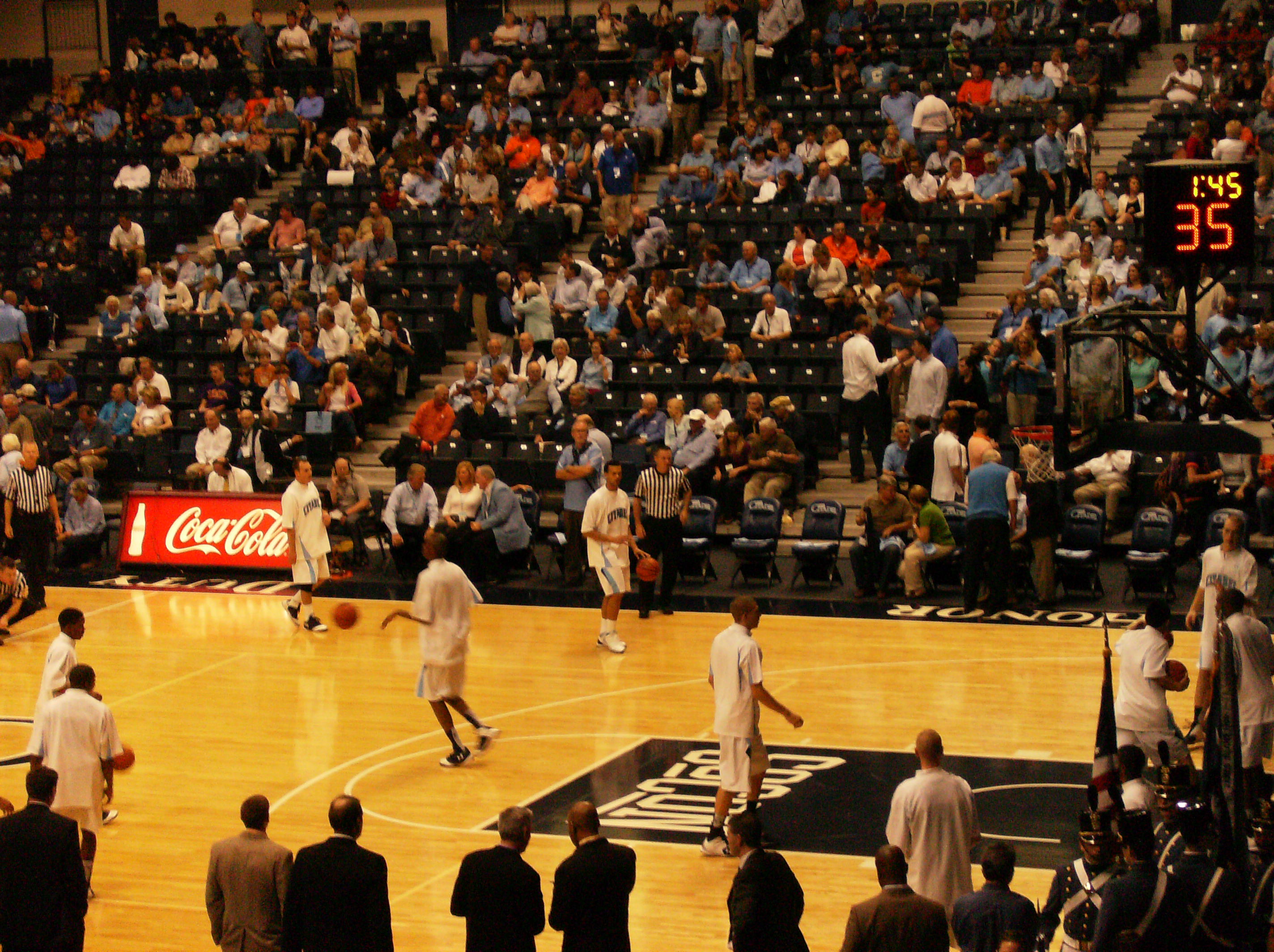
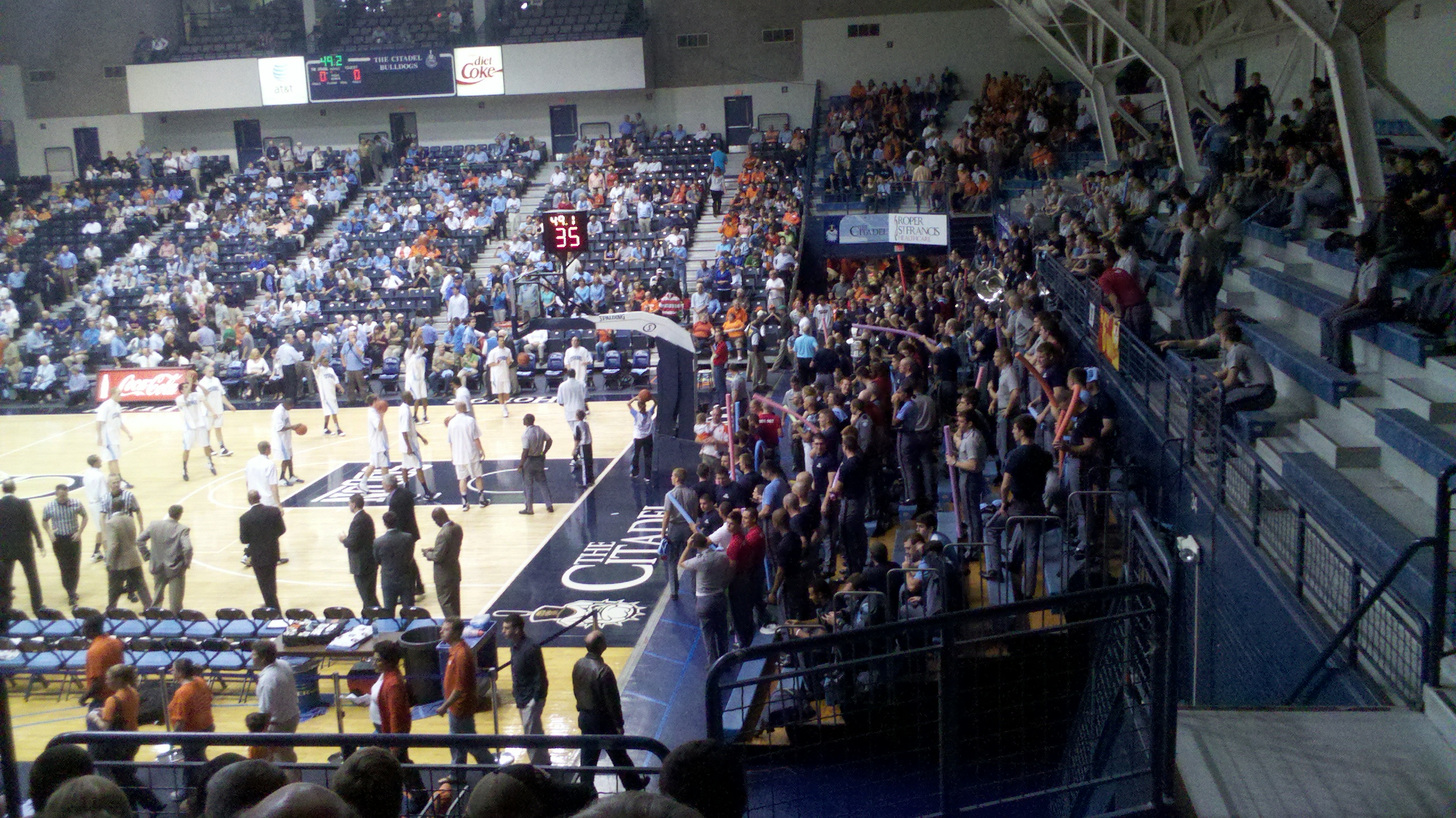
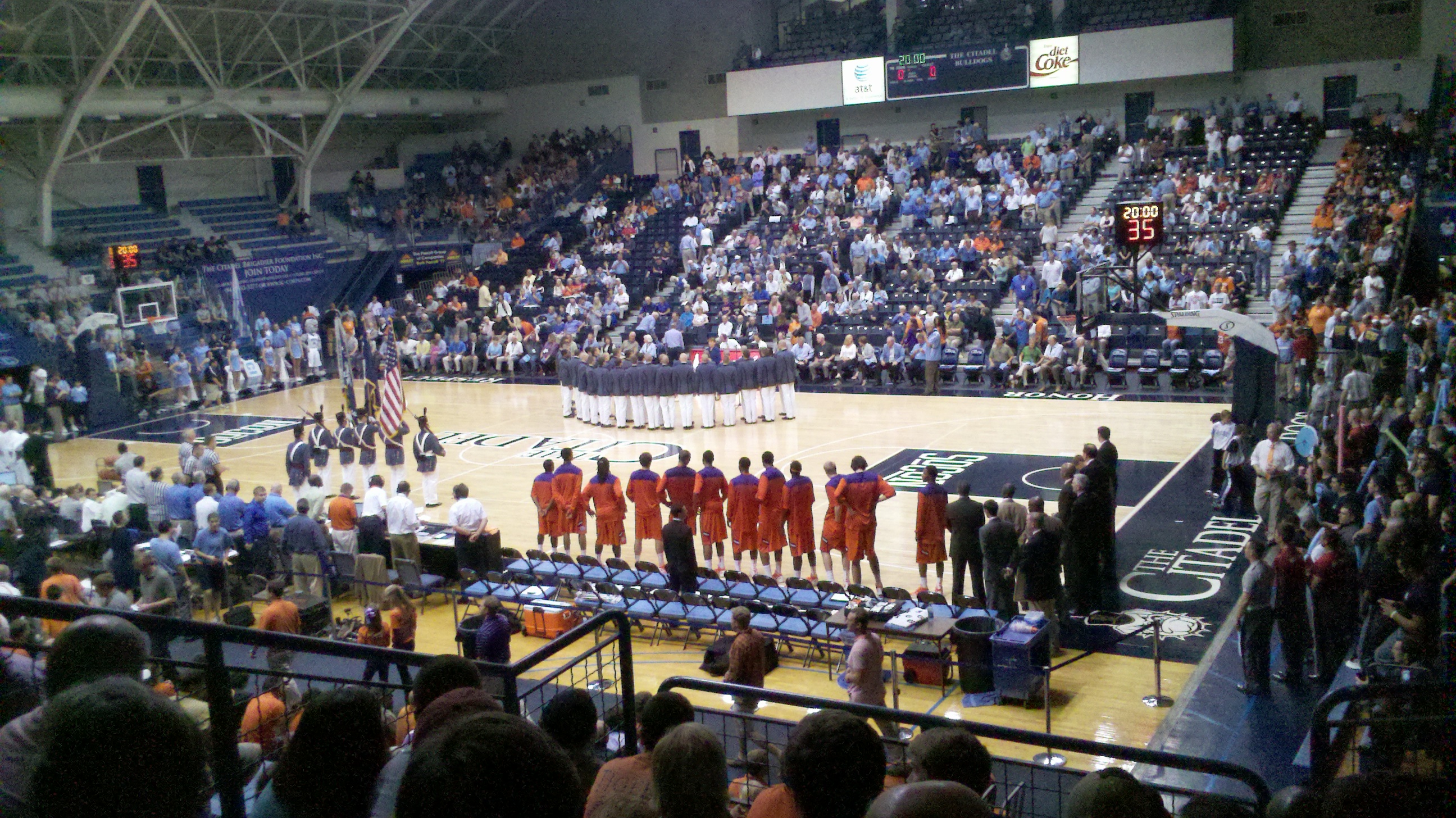
— I was able to make it to McAlister Field House on Saturday night, and happy to have been in attendance, despite the loss to Furman. The 1600 or so fans at the game were treated to a good game between two teams that played hard, if not always well.

At halftime, The Citadel honored Jake Burrows, whose accomplishments I mentioned in a previous post, by putting jersey number 3 in the rafters. Burrows is the third hoopster so honored by The Citadel; somewhat amusingly, only one numeral has been needed, as the other two honorees (Regan Truesdale and Art Musselman) both wore no. 33. Burrows spoke briefly and movingly to the crowd, better than most people could have, and most people aren’t 93 years old.

It is a shame there weren’t more cadets on hand, although it certainly is understandable, given it was Saturday night. The Southern Conference schedule doesn’t really help The Citadel on that front.

I have a suggestion to the administration that I’ve made before and that I’m going to make again. There are cadets on campus on Saturday nights (besides the hard-working pep band). I’m talking about cadets who are serving tours or confinements. It wouldn’t be a bad idea to give those cadets credit for tours/cons by letting them come to McAlister and support the team. I am betting some of them would be ideally suited for the role of cheering the Bulldogs and mocking the opponents.

Actually, I know they would be ideally suited, because the idea is not without precedent.

On a February night in 1990, conduct-restricted cadets (and a few of their “free to roam” colleagues) cheered on The Citadel’s basketball team as it battled an outstanding East Tennessee State squad, one that would win the second of four straight SoCon titles that season. The Bulldogs had played ETSU earlier that season in Johnson City and lost badly, 92-57.

However, with the support of a particularly rowdy section of the corps behind them, the Bulldogs put together what may have been their best performance of that season. Alas, it wasn’t quite enough for a win, as Ted Mosay’s last-second shot was blocked, enabling the Buccaneers to escape with an 87-86 victory. Still, it was a great game and a lot of fun.

The night at McAlister wasn’t over, though. In a decidedly unusual development, a wrestling match between The Citadel and UT-Chattanooga had been scheduled to follow the basketball game. The hoops game had tipped just after 6 pm, so by the time the first wrestling match started it was around 9 pm. UTC, the conference favorite, would eventually win, but things were tougher than expected for the Mocs, in no small part due to a vocal contingent cheering on The Citadel.

It was a great experience for the Bulldog wrestlers, and probably for the Moc grapplers as well. My lasting memory of that evening, though, was the one voice in the stands that stood out the most. Leading the crowd in cheers, needling the referee at every given opportunity, supporting the cadets on the mat throughout every match…was the assistant commandant of cadets, the one and only LTC Harvey M. Dick.

Harvey Dick died Saturday morning; there was a moment of silence before the game, and flags on campus were lowered to half-staff. It is a loss that has hit the greater community of The Citadel hard, understandably so. Few people loved The Citadel and cared more for its students than Harvey Dick. Stories about him are numerous, mostly true, and could be told for days on end. For me, I’ll always remember that night at McAlister. Condolences to his family.

Hoops update: Wofford and Furman travel to McAlister

Just some quick thoughts on the upcoming games at McAlister Field House…

The Citadel’s last three losses have been a) by one point at home to UNC-Greensboro, in as brutal a fashion as I’ve seen the Dogs lose in a while; b) a 29-point thrashing at Davidson that featured one of the worst first-half performances in the program’s recent history, which is saying something; and c) a double-OT setback at Georgia Southern in which The Citadel did a lot of things right but lost thanks to a series of first-half turnovers and a lopsided free throw disparity (the latter noted by Chuck Driesell, deservedly so).

The Bulldogs need to catch a break. First, they need to be in a position to take advantage of a break, which they were in Statesboro — it just didn’t work out. Will they be in position to pick up a win against either Wofford or Furman?

Let’s take a look at those always-critical “Four Factors” stats for The Citadel, courtesy of kenpom.com:

Four Factors                    Off  Rank        Def  Rank         D-1 avg.
Effective FG%: 48.0 199 56.7 341 49.0
Turnover %: 21.5 224 17.9 302 20.8
Off. Reb. %: 28.3 285 31.6 126 32.5
FTA/FGA: 30.1 306 30.7 57 36.5

The Bulldogs continue to struggle defensively, with the horrific eFG% more obvious than a $50 hooker outside Mark Clark Hall. Only four teams are worse than The Citadel in that category (for the record, they are Kennesaw State, Longwood, Monmouth, and Northern Arizona; those four teams plus The Citadel have a combined record of 23-79).

The Citadel also does not force enough turnovers on defense. The Bulldogs do a decent job limiting offensive rebounds, and generally don’t give opponents a lot of free throw opportunities (Georgia Southern excepted, I suppose). Conversely, those are two areas in which The Citadel’s offense has not fared as well.

Mike Groselle has been a force on the offensive glass, as his offensive rebounding rate of 13.9% is 64th-best nationally, but the problem is that he has accounted for 40% of The Citadel’s total offensive boards. He needs more help grabbing misses.

The team as a whole needs to get to the line more. The Dogs are not a terrible shooting team, but aren’t nearly good enough to get by without free points from the charity stripe. Of course, that brings up a bigger problem, which is that The Citadel isn’t converting enough of those freebies as it is. The Bulldogs must shoot much, much better than 63% from the foul line if they hope to win a few more games down the stretch.

Wofford is 12-8 overall, and has won three straight SoCon games to move to 5-3 in the league. The Terriers are aiming for a first-round SoCon tourney bye. There are still ten league games to go, but Wofford has a one-game lead over the College of Charleston for second place in the South division, behind runaway league leader Davidson. Second place in the division will be good enough for that much-wanted bye.

The Terriers have already beaten the CofC at home, and also can claim a victory over Wake Forest in Winston-Salem. Other than Davidson, Wofford has probably been the league’s most consistent team.

On December 3, Wofford beat The Citadel 82-63 in Spartanburg. The Terriers shot 55% from the field in that game, with Keith Giltner scoring 27 points and pulling down 10 rebounds. The most glaring offensive statistic for the Bulldogs had to be the lack of assists — only four (on 22 made baskets).

Furman is 9-10, 3-5 in SoCon play. The Paladins have hovered around .500 all season, never more than two games over or under the break-even mark.

The Bulldogs’ loss at Furman on January 5 featured a mind-numbing 42-16 run by the Paladins in the second half to end the game, which turned a 35-29 Furman lead into a 77-45 loss for the Bulldogs. Furman took a lot of threes (29) and made more than its fair share of them (13). Bobby Austin came off the bench for the Paladins and made five of his six attempts from beyond the arc. Like the Wofford game, The Citadel was outrebounded by a significant margin.

At halftime of Saturday’s game against the Paladins, Colonel Jake Burrows will have his jersey number (No. 3) recognized with a banner to be hung in the rafters at McAlister Field House. Burrows, now 93 years old, is a 1940 graduate of The Citadel. He had, it is fair so say, quite a career as a cadet. From the Wofford preview at citadelsports.com:

Burrows…is the lone member of the college’s [athletic] Hall of Fame who was both Regimental Commander and First Honor Graduate of his class.  As an athlete in which he competed for three years (freshmen were ineligible), Burrows earned eight total letters as he lettered in football three times, basketball three times and twice in track. He was an all-state pick in basketball three times and twice was named All-Southern Conference and during his three years of basketball, Burrows averaged 11.5 points per game which equated to 31 percent of the team’s total points.  In his three years on the hardwood, The Citadel defeated South Carolina and Furman six straight games each.

After graduating, Burrows began a career in the U.S. Army that included serving on Gen. Dwight Eisenhower’s staff during the latter part of World War II. More importantly, Burrows (in his role as Director of Cadet Activities) was the driving force behind the creation of the coveted Silver Shako, for which he probably merits an additional banner in the rafters.

Here is a recap of the Bulldogs’ season-opening 1938 victory over Furman, in which The Citadel defeated the Hurricane (!) 38-17. Burrows, a sophomore that season, led the team with eight points: Link

(Curiously, the basketball media guide records that game as a 37-17 Bulldogs victory, rather than 38-17.)

Burrows was also the leading scorer for The Citadel in its next game, a win over South Carolina. This was not an unusual occurrence. In his junior campaign, 1939, Burrows led The Citadel in scoring in all but one game all season. The Citadel won 65% of its games during Burrows’ career as a hoopster, including the “state championship” in 1939.

I am hoping that Burrows’ success on the hardwood will serve to inspire the current Bulldogs, at least for one night…

Hoops update: a league victory, SoCon vs. CAA, and TV

This post is going to be split into three different topics. Before reviewing and previewing the current on-court antics, I wanted to focus on a couple of recent articles in The Post and Courier. They touch on subjects that impact The Citadel’s department of athletics in general and its basketball program in particular.

With CAA as model, SoCon bids to climb ladder

[College of Charleston] basketball coach Bobby Cremins said he was jealous of George Mason’s league, the Colonial Athletic Association.

“I’d love to see the Southern Conference become something like that,” Cremins said. “That should be the goal of our conference. We use them as a model.”

The source of Cremins’ envy? The three teams the CAA sent to the NCAA tournament last season, and the four at-large bids the Colonial has landed in the last six seasons. That’s four more at-large bids than the SoCon has earned it its entire history dating back to 1939, when the NCAA tournament started.

The SoCon has never sent more than one team — the tournament champion, who earns an automatic bid — to the Big Dance, which expanded to a field of 68 teams last year.

Tangent to make an overly nerdy comment: technically, the SoCon has actually received three at-large bids in its history. From 1939 to 1950, the field for the NCAA tournament was made up of only eight teams. Three times, teams from the SoCon played in the event; on all three occasions, those bids were invitations and not automatic selections. In 1951, the NCAA tournament expanded to 16 teams, and the SoCon champion (North Carolina State) got an automatic bid into the event. Not that it really matters.

Bobby Cremins has yet to take the College of Charleston to the NCAAs, and knows the only way to do so (at least right now) is to win the league tournament. Cremins actually had a solid record as a league tournament coach when he was at Georgia Tech (winning the ACC tourney twice), but hasn’t yet grabbed the brass ring while at the CofC.

I think the information presented in the article underscores how tough a task the SoCon has in trying to emulate the CAA. Besides having larger schools that play in bigger arenas (for the most part), most of the CAA schools don’t have to worry about football. The CAA probably also benefits to a degree from having more of its schools located in larger metro areas, although that can be a double-edged sword.

It’s good that the SoCon is trying to be more strict about its non-conference scheduling, but it’s a difficult balancing act. It should be noted that playing a non-D1 doesn’t have any impact on the RPI. What the league doesn’t want is schools overloading their schedules with gimme games against non-D1s and guarantee games against BCS schools. The SoCon needs its members to play more “in-between” schools. Otherwise, instead of competing with the CAA it risks sliding down into SWAC territory.

Having said that, John Iamarino knows that some of his schools have fewer options than others. That’s the nature of the SoCon and its disparate membership. It would be interesting to know which school drew the commissioner’s wrath for its less-than-acceptable scheduling. If I had to bet, I would put my money on Chattanooga.

Let’s talk about TV

I’ve been meaning to write more about the linked article, which was originally published in early December.

The College of Charleston Sports Network will produce 11 games this season that will be broadcast locally on WMMP or WTAT. Those games also will be available on ESPN3, a streaming Internet service that reaches more than 70 million households worldwide and is available in 85 percent of U.S. homes. Some games also might be carried on ESPN FullCourt, a pay-per-view service available on cable systems.

By season’s end, at least 23 of the team’s 30 regular-season games will be televised.

Does The Citadel need to do something like this? Absolutely.

The startup costs would not be insignificant, but I believe it would be a worthwhile investment. The potential exposure for the varsity sports teams, not to mention the school in general, makes it a no-brainer.

That includes televising home football games in a format that can be used by ESPN3.com or one of the myriad sports TV networks, many of which seem desperate for programming.

It would likely give The Citadel an edge in recruiting — and if the school doesn’t do something like this, it will probably fall behind a host of other schools. Just look at FCS football.

Some of the FCS schools that had the majority (if not all) of their football games televised in 2011: Lafayette, Lehigh, Liberty, Maine, Montana, Montana State, Murray State, Northern Arizona, and seemingly all of the Dakota schools (including, not so coincidentally, national champion North Dakota State).

That’s not even counting schools that have home games televised on public television (like Eastern Illinois) or schools with a two- or three-game deal with a local TV station/cable carrier (like Cal Poly, Colgate, Georgetown, and Holy Cross). Not all of those games wind up on a Fox sports net or ESPN3.com, but plenty of them do.

The opportunities in basketball, baseball, and perhaps soccer and wrestling are there, too.

I’ve long advocated that The Citadel’s coaches schedule non-conference games with an eye to getting on television as much as possible. Now I think it is time for the school to be even more proactive.

The Citadel finally won a league game last week, beating Samford 73-62 at McAlister Field House. It was also the first league home game for the Bulldogs, and I am hopeful that the team can add to the victory total this week. Prior to the win over Samford, it had been very tough sledding, as The Citadel had lost its previous ten games against D-1 competition, all but one by double digits.

The worst of those was a 77-45 drubbing by Furman two days before the Samford matchup, so at least the Bulldogs showed some resiliency in bouncing back from that loss. However, the fact remains that it’s been a struggle all year for Chuck Driesell’s troops, particularly on defense.

The Citadel ranks in the bottom 50 nationally in the following defensive categories: effective field goal percentage, turnover percentage, block percentage, and two-point field goal percentage. The Bulldogs are actually dead last (59.3%) in 2-point FG%, 345th out of 345 D-1 teams. The Citadel’s overall defensive efficiency rating (per Pomeroy) is 8th-worst in the country.

Driesell has focused on his team’s defensive issues each and every time he’s discussed the squad’s performances, notably on the post-game radio show. I’ll say this, he’s not one to sugarcoat things, as anyone who has listened to the show can attest.

The win against Samford was a decent (not great) defensive performance. The Citadel has proven to be a tough matchup on the hardwood for the Birmingham Bulldogs over the years, and Saturday night was no exception. Samford shoots a lot of threes by design, but you have to make a decent percentage of them for that strategy to work, and Samford was only 7-29. Some of that was good defense by The Citadel, and some of it was just really bad shooting.

The chief negative for The Citadel was that Samford dominated the offensive glass, particularly in the first half, when it had an offensive rebound rate of almost 60%. The cadets should have led at halftime by about fifteen points, but had to settle for a seven-point edge.

On the positive side of things (after all, it was a victory), Mike Groselle was outstanding (10-10 FG, 25 points) and Cosmo Morabbi had a career night, with 20 points and six assists. The Bulldogs as a whole were solid on offense.

Next up for The Citadel: two more home SoCon games, against Elon and UNC-Greensboro. Elon has been a mild surprise this season, playing about as well as any team in the muddled SoCon North. The Phoenix won at home over South Carolina earlier in the campaign, but recently has hit a slump, losing five straight games.

Losing to North Carolina and San Diego State is not exactly embarrassing, but the streak also includes losses to Dartmouth (a traditional cellar-dweller in the Ivy League), Georgia Southern, and Columbia (another Ivy opponent). Elon has struggled putting the ball in the basket in those five games, as it has not shot better than 36% from the field in any of them. The Citadel needs to make sure that trend continues.

Tough matchup alert: Elon’s Lucas Troutman is a 6’10” native of Belton, SC, who was on the SoCon’s all-freshman team last year. He scored 22 points against NC State earlier this season and will be a difficult player for the Bulldogs to handle.

On Saturday the Bulldogs host UNC-Greensboro, which is 2-14 and only has one D-1 victory, that over winless Towson. The Spartans are on their second coach of the campaign, as longtime boss Mike Dement resigned in December. It was inevitable, especially after UNCG’s 22-point loss to North Carolina A&T two weeks before.

Wes Miller is the interim coach. Miller is only 28 years old, and may have a chance to keep the job, depending on how the rest of the season plays out for the Spartans. So far he has yet to record a victory as head honcho, although UNCG played well in a 10-point loss at Miami.

As you might expect, UNCG has some really bad stats, particularly on defense. What is unique about the Spartans D is that opponents shoot well from everywhere — three-point range (bottom 15 nationally), inside the paint (ditto), even at the foul line.

UNCG’s best player is Trevis Simpson, a 6’4″ guard. Like Elon’s Troutman, he was on last year’s league all-frosh team. Simpson is a volume shooter who blows hot and cold, but when he’s hot he can get very hot (at Miami, he hit 7 of 11 three-pointers as part of a 36-point explosion). The Citadel must work hard, especially early in the game, to make sure he doesn’t get on a roll.

The Citadel will be a slight underdog in both games this week. However, it will be disappointing if the Bulldogs don’t win at least one of the two contests. That’s the short-term view. As for what these games mean for the season as a whole, I’m hoping to see some improvement on the defensive side of things for The Citadel. If that happens, more wins will follow.

Talking stats: SoCon football and turnovers

I was reading Jeff Hartsell’s review of The Citadel’s football season in The Post and Courier. In the second post of the three-part series, head coach Kevin Higgins had this to say about turnovers:

 We didn’t get as many turnovers as I would have liked. We just didn’t have that many opportunities. That’s something we’ll have to study in the off-season and address that. We need to be able to turn the ball over — one more turnover against Samford or Georgia Southern or App State could have meant the difference in any of those games.

I thought it might be an interesting idea to dig a little deeper into the statistical record to see what The Citadel could do to force more turnovers. However, that meant more than just going by the raw data.

First, I decided that it would be best to concentrate solely on Southern Conference play. Including games played against the likes of Virginia Tech and Virginia-Wise (just to name two SoCon opponents) would make the statistics something less than balanced. Besides, teams are ultimately judged on how they fare against league opponents. There is also the benefit of each team’s conference statistical summary including four home and four away games.

Another consideration was trying to account for the different types of offenses employed by SoCon teams, including three “true” triple option teams and several schools running the spread, and with varied paces of play. That is why I felt it was important to focus on certain percentage categories, rather than totals.

I compiled data (league play only) for a number of different statistics, both for offense and defense. After doing this, I put together a spreadsheet which you can access at the link below:

Southern Conference 2011 Football Statistics

I trust most of what is on the spreadsheet makes at least some sense.

Before I get to my conclusions about The Citadel’s issues with forcing turnovers (along with observations on some other SoCon schools), I want to make a few points:

– It is generally accepted that there is no real skill in recovering fumbles. Anyone who follows any of the websites that study professional football statistics/history is aware of this. Football Outsiders puts it best:

Stripping the ball is a skill. Holding onto the ball is a skill. Pouncing on the ball as it is bouncing all over the place is not a skill. There is no correlation whatsoever between the percentage of fumbles recovered by a team in one year and the percentage they recover in the next year. The odds of recovery are based solely on the type of play involved, not the teams or any of their players.

Fans like to insist that specific coaches can teach their teams to recover more fumbles by swarming to the ball. Chicago’s Lovie Smith, in particular, is supposed to have this ability. However, since Smith took over the Bears, their rate of fumble recovery on defense went from a league-best 76 percent to a league-worst 33 percent in 2005, then back to 67 percent in 2006. Last year, they recovered 57 percent of fumbles, close to the league average.

Fumble recovery is equally erratic on offense. In 2008, the Bears fumbled 12 times on offense and recovered only three of them. In 2009, the Bears fumbled 18 times on offense, but recovered 13 of them.

Fumble recovery is a major reason why the general public overestimates or underestimates certain teams. Fumbles are huge, turning-point plays that dramatically impact wins and losses in the past, while fumble recovery percentage says absolutely nothing about a team’s chances of winning games in the future.

Although this makes perfect sense, it is understandable that longtime football fans might not be so sure. I think the best way to illustrate the randomness of fumble recoveries is to highlight Pittsburgh Steelers legend Jack Lambert, who besides being a fantastic linebacker was one of my favorite players.

In the 1975 AFC championship game against the Oakland Raiders, Lambert recovered three fumbles. In the following year, 1976, he recovered an amazing eight fumbles (in fourteen games) for a remarkable Steelers defense. Lambert had a “nose for the football”, to say the least — and yet…

Those three fumble recoveries against the Raiders were the only recoveries he made in eighteen career playoff games. Those eight fumble recoveries in the ’76 regular season? They make up almost half of his career total (17).

Not everything about the NFL applies to college football, of course, particularly in FCS play, but there is no doubt that this particular observation does hold at the college level. Basically, when a ball is loose on the ground each team has a 50-50 shot at getting it. In 2011, there were 130 fumbles in Southern Conference play. The defense recovered 69 of those fumbles, or 53%. Congratulations to SoCon defenses!

No team in league play had a particularly unusual percentage when it came to recovered fumbles, either from an offensive or defensive perspective. It may be that an individual school was luckier or unluckier by a fumble or two, but that’s about it.

That isn’t to say that fumbles aren’t important, because they are. Often a fumble is more damaging to an offense than an interception (because of lost field position). However, they aren’t predictive events.

That doesn’t mean coaches shouldn’t be training their players to use the Lawrence Taylor “chop”, or continuing to have drills emphasizing fumble recoveries. It’s just that everybody does those things.

– Another thing to remember: interceptions (from a defensive perspective) tend to be random too.

This one isn’t quite as intuitive as the fumble recovery factoid, but think about it this way. Most interceptions result from a bad pass thrown by the quarterback. However, what has (normally) happened is that the QB has thrown a bad pass that was caught by a defender, instead of a bad pass that just hits the ground; there is an element of chance to this. That is why team defense interception totals can vary wildly from year to year even with similar personnel.

That isn’t to say that defenses can’t create situations where interception-prone offenses will toss the pigskin to the wrong players. I wanted to see what teams in the SoCon did the best job at pressuring the quarterback, which seemed to me to be a good way of forcing offensive errors.

I compiled sack percentage and interception percentage to see if they correlated. Again, I didn’t use raw totals, because there is a big difference when facing a team that throws the ball seven times per game (Wofford) versus forty times per game (Elon). The “pressures” statistic isn’t readily available for the SoCon; I suspect that there would have been similarities between team pressures and sacks. At least, I hope so.

You can see the numbers in the linked spreadsheet. Some observations:

– It is no accident that the three teams to make the playoffs (Appalachian State, Georgia Southern, and Wofford) are in the upper echelon when it comes to defensive sack percentage. Furman, which finished fourth in the league, finished second in the category. Leading the category was Chattanooga (more about the Mocs later).

– Defensive interception percentage does seem to at least have some correlation to defensive sack percentage. The exceptions: Samford (which intercepted more passes than it “should” have), and Wofford and UTC (each of which intercepted fewer passes than a correlation might suggest). The Terriers, in particular, seem to have been short-changed a few picks.

The Citadel’s defense finished last in interception percentage. The Bulldogs were seventh in sack percentage, ahead of only Samford and Western Carolina. I think it’s no coincidence that The Citadel didn’t intercept many passes after having less-than-stellar sack numbers. (Admittedly, that’s a rather obvious conclusion.)

– I also examined the offensive statistics for the same categories. The Citadel finished as the worst team in the league in both interceptions thrown (by percentage) and fumbles per play. The Bulldogs fumbled 23 times in SoCon action, losing ten of them. (Curiously, Georgia Southern also fumbled 23 times in league play, losing ten.)

While I tracked fumbles per play, I elected not to go through every game account to determine whether fumbles occurred on rushing or passing plays; that would have taken more hours and more days than I have, to be honest. In the NFL, the average rushing play results in a fumble 1.16% of the time, while a pass play will end with a fumble 2.04% of the time. Interestingly, 18% of all sacks in the NFL (2000-2009 time period) resulted in fumbles.

I’m not sure those numbers are quite as relevant at the college level; for one thing, there is a lot more fumbling in SoCon play than in the NFL (2.66% vs. 1.67%). There is also a lot more running than passing in the conference (almost a 2-to-1 differential).

Those sack/fumble stats are something to think about, however.

Meaningless trivia: there was only one game in the Southern Conference this season in which neither team fumbled: Georgia Southern-Appalachian State.

– The “luckiest” team, at least on the surface, appears to have been Samford, which finished eighth in defensive sack percentage but fourth in defensive interception percentage. The Birmingham Bulldogs also had the best rates for offensive interceptions thrown (with the fourth-best sacks against percentage), so it worked out both ways for Samford.

I have to wonder if Samford’s pace of play had something to do with that. Samford ran the most plays from scrimmage of any team in the league, and also faced the second-most plays on defense (Western Carolina drew the short straw in that category).

– Balance, as always, is overrated. Samford was by far the most balanced team on offense (305 runs, 301 passes) and finished 4-4 in league play. The second-most balanced team was WCU, which was 0-8. There is nothing offensively balanced about Georgia Southern and Wofford; those two playoff teams combined for a league record of 13-3.

– I don’t know what to make of Chattanooga. Usually a team that loses so many close games (including three by the same exact score, 28-27) doesn’t do itself any favors in the turnover battle, but the Mocs tied for the league lead in fumbles recovered and led the league in forced fumbles. UTC also finished second-best in the league in offensive lost fumbles.

UTC didn’t have the rate of return on defensive interceptions that might have been expected by its league-leading defensive sack percentage, but it wasn’t bad. The Mocs did have a higher average offensive interception percentage, but it wasn’t abysmal.

I think it would take a more detailed look at Chattanooga to figure out exactly how and when things went wrong for the Mocs, but I can safely say no team in the league was unluckier than UTC — just not as unlucky in the things you usually would associate with unlucky teams.

I guess my final conclusion, at least with regards to The Citadel, is that the Bulldogs must get more pressure on the quarterback if they expect to increase their defensive turnovers. However, it has to be remembered that defensive turnovers are an effect of good play, not a cause of good play.

I would also suggest the Bulldogs were a touch lucky on offense themselves when it came to turnovers, and need to continue to improve the consistency of execution on that side of the ball.

I admit my analysis of The Citadel (and some of the other teams in the league) may be flawed. That’s one reason I included the spreadsheet, in case anyone else wants to take a crack at what the numbers may mean.

Hoops update: Defense is kind of important

Just a (very) quick post on The Citadel’s basketball team. Recent results can be summed up as follows:

“Our defense is terrible.” — Chuck Driesell on the postgame radio show, after the Bulldogs were drilled 88-69 by Charleston Southern

Yes, yes it is. Let us count the ways:

– The Bulldogs have allowed 80+ points and lost by at least 19 points in the last four games
– The Citadel’s defensive efficiency (adjusted) ranks in the bottom ten in the country (all stats per KenPom.com)
– Opponents of the Bulldogs are shooting 2-point shots (often attempts in the lane) at a 58.1% clip; only four other teams nationally are worse in that category (though The Citadel isn’t last among SoCon schools or military colleges, as two of those four teams are Georgia Southern and VMI)
– The Citadel also ranks in the bottom 25 nationally in defensive eFG%, percentage of blocked shots (defense), and defensive turnover percentage

Now the Bulldogs go on the road for three games, and are under-Bulldogs in all three contests. The first of the matchups will be against James Madison (4-3), which beat The Citadel 74-67 last season and will have the services of point guard Devon Moore for the first time this year. Moore, who had academic issues, will apparently make his 2011-12 debut on the hardwood against the Bulldogs. He scored 19 points in last year’s meeting.

Jeff Hartsell of The Post and Courier has a brief preview of The Citadel’s game at JMU:  Link

The Citadel will then face Denver, a sneaky-good Sun Belt squad (yes, Sun Belt) that has already beaten St. Mary’s and Southern Mississippi. The Pioneers are 8-2 and are led by former Princeton player and coach Joe Scott, who as you may have guessed runs the Princeton-style offense. Denver will be a formidable challenge for The Citadel.

Tennessee is 3-6 and has already lost this season to the College of Charleston and Oakland. Those are good teams, though, and both games were on the road. The Vols also lost at home to Austin Peay, though, a result much harder to fathom.

If the Bulldogs don’t pick it up defensively, these three games could wind up being downright embarrassing. As it is, The Citadel could play fairly well and still go 0-3.

Chuck Driesell has noted that this season is “a process”. It may or may not make Bulldog fans feel better that the coach seems to be as frustrated with the process as they are…

Hoops update: SoCon play begins for The Citadel

— The Citadel at the College of Charleston, 8:00 pm Thursday, December 1, 2011, at TD Arena, Charleston, South Carolina

— The Citadel at Wofford, 7:00 pm Saturday, December 3, 2011, at Benjamin Johnson Arena, Spartanburg, South Carolina

Both games can be heard on WQNT-AM 1450 in Charleston, with “voice of the Bulldogs” Danny Reed describing the action. Audio is also available online via Bulldog Insider. The game against the College of Charleston will be televised by WMMP-DT 36.1 in Charleston and is also being carried by ESPN3.com.

The Citadel is now 2-3 on the season, with a 97-44 win over Florida Christian (a non-Division I team) sandwiched by a pair of losses, 73-50 at home to Clemson and 80-72 on the road against High Point, the latter contest being decided in overtime.

The Bulldogs did what they were expected to do against Florida Christian, although it should be noted that the Suns only lost to Bethune-Cookman of the MEAC by 18 points. The game was notable for being the first start of the season for Barry Smith, who also started the game against High Point. The sophomore forward scored 19 points against Florida Christian after being inserted into the lineup for defensive reasons.

I wanted to make a few observations about the games against Division I competition. The Citadel has now played four contests against D-1 teams, winning one and losing three, with two of the losses being close games. The not-so-competitive loss, alas, came at McAlister Field House, and to a Clemson team which then lost consecutive games at Littlejohn Coliseum to the College of Charleston and Coastal Carolina. (The Tigers defeated Furman by ten points on Saturday night to avoid losing three straight home games to in-state foes.)

Chuck Driesell has used the early part of the season to give opportunities to numerous players on his roster, with eleven cadets seeing action in every game. Those aren’t just cameos by the 9th or 10th players off the bench, either; of the 57 individual appearances made by Bulldogs in five games, 50 were for at least nine minutes and two others were for eight minutes.

Offensively, the Bulldogs have played fairly well. The Citadel has taken care of the basketball and has been reasonably balanced on offense, although the Bulldogs got into a three-point shooting contest against High Point and subsequently took 43% of their field goal attempts from outside the arc, which is too many. (The Panthers shot 44 three-pointers in that game, out of 59 field goal attempts.)

The Citadel has to continue to work the ball inside to Mike Groselle, who has been unsurprisingly excellent thus far. Groselle is averaging 18 points (these stats do not count the Florida Christian game) while shooting 68% from the field. He also has a double-double in every game this season while averaging 36 minutes per contest, answering any lingering questions about his stamina.

Groselle needs more help inside, though, both offensively and defensively. He particularly needs some assistance on the offensive glass, as Groselle has almost half of the offensive boards claimed by the Bulldogs in the four D-1 games (18 of 39).

The Bulldogs have struggled on defense. The Citadel ranks in the bottom 75 nationally in several key defensive measures, including eFG%, free throws attempted per field goals attempted, and turnover rate (numbers are from kenpom.com).

The Citadel is dead last in all of Division I (345 teams) in the percentage of opponents’ shots blocked (which probably accounts in least in part for opponents of the Bulldogs having success in converting 2-point baskets). Charleston Southern is next-to-last in the category, with Army, Navy, and Presbyterian also in the bottom 11. That’s three military schools and three Palmetto State schools, so I guess it’s only natural that The Military College of South Carolina is last.

At 5-1, the College of Charleston is off to a promising start as it enters SoCon play. The Cougars’ five victories include the road win at Clemson mentioned earlier, along with two victories in the Battle 4 Atlantis holiday tournament that was recently held in the Bahamas. After losing its opening game in the tournament to Central Florida 74-63, the CofC outlasted UNC-Asheville 68-66 in the consolation bracket. The Cougars completed the tourney with an 85-61 win over Massachusetts, running away with that game in the second half.

Through six games, the CofC is shooting the ball very well, with an eFG% of 54.9, ranking in the top 25 of Division I. The Cougars get about one-third of their points via the three-point shot, which is fairly high, but you can get away with that when you have several guys shooting well from distance, including Jordan Scott, Anthony Stitt, and Andrew Lawrence (who has made 14 of 28 three-pointers).

The Cougars have at times struggled with rebounding, which was their downfall against UCF (as they were outboarded 43-21 in that contest). It was probably not a coincidence that touted freshman forward/center Adjehi Baru got in early foul trouble in that game. When playing, Baru has been a significant defensive presence. CofC opponents have an offensive rebounding percentage of 39.7, which places the Cougars in the bottom 20 of D-1 for that metric. Obviously, the sample size is a small one.

The lone senior on the CofC’s roster, Antwaine Wiggins, was named the Southern Conference player of the week last week after the Cougars’ victory over Clemson, a game in which he scored 22 points. He followed up that excellent performance with a total clunker against Central Florida, only scoring two points against the Knights. However, he scored 23 points in each of the next two games, so the UCF contest appears to have been an aberration.

I think the primary longterm concern for CofC fans will be the Cougars’ depth, a problem exacerbated by the loss in preseason of forward Willis Hall to a knee injury. Hall started all 37 of the CofC’s games in 2010-11. Without him, the Cougars have been reduced to what is essentially a seven-man rotation, with five players averaging more than 25 minutes per game. That isn’t exactly a new thing for a Bobby Cremins squad, but it’s something to watch over the grind of a long season. There are three players averaging more than 30 minutes per contest — Wiggins, Lawrence, and 6’8″ forward Trent Wiedeman.

The Cougars have won eleven straight SoCon games at home. Their last loss in league play at what is now called TD Arena came on February 8, 2010, against The Citadel.

The Citadel will face Wofford in its second game of the SoCon season, with the matchup taking place at the Benjamin Johnson Arena. That facility opened in 1981 with a game between the Bulldogs and the Terriers, won by The Citadel 65-64.

Wofford is 3-3 on the season. Like the College of Charleston, the Terriers had to replace multiple key performers from last season’s team, including a star player. The Cougars lost Andrew Goudelock, while Wofford now has to make do without Noah Dahlman. Goudelock was a first-round pick of the L.A. Lakers, but it is Dahlman who will be more difficult to replace.

Dahlman helped make Wofford one of the nation’s better offensive teams, with a team adjusted efficiency rating of 111.0, a top 50 mark in Division I. This season, that number through five D-1 contests (Wofford’s only home game to date was a victory over Emory&Henry) is 94.5, a huge differential. That is what can happen when you have to replace four starters who accounted for 66 points and 23 rebounds per game.

I should note that it doesn’t help Wofford’s offensive statistics to have played one of those five Division I games against Wisconsin. The Badgers bludgeoned the Terriers, 69-33. Wofford does have a nice win over Bradley (70-66), but that is somewhat offset by a neutral court loss to UMKC (64-58, in OT). The Terriers also struggled mightily in a win over Prairie View, which is not expected to be one of the SWAC’s better teams (in other words, it is expected to be among the nation’s worst teams). Wofford’s other loss was a respectable effort against Georgia (62-49).

The Terriers’ offensive woes are reflected in their eFG% (41.1) and their FTA/FGA, ranking in the bottom 30 nationally in both categories. Wofford has also been a bit turnover-prone (and conversely has not been particularly effective in forcing turnovers, which has hurt its defense). The Terriers have not shot the ball well from the field, either in front of or behind the three-point line.

Wofford has employed a seven-man rotation, with senior guards Kevin Giltner and Brad Loesing each averaging more than 38 minutes per contest. Yikes. Loesing, the point guard, started last season, but Giltner was more of an impact sub, shooting 42% from three-land last year. Through six games this season, Giltner is shooting 31% from beyond the arc.

Drew Crowell’s time on the court has increased by about 20 minutes per game from last season to this one; he is basically filling the Tim Johnson role for the Terriers. Two true freshmen, forward Lee Skinner and the highly regarded Karl Cochran (a 6’1″ combo guard), are also seeing plenty of time on the court, as is Domas Rinksalis, a 6’9″ forward/center who redshirted last season.

Wofford isn’t expected to contend in the Southern Conference this season, though the Terriers might prove a tough out come SoCon tourney time.

Neither of these games will be easy for The Citadel, to say the least. The Bulldogs aren’t expected to win either contest, and are a sizable underdog to the College of Charleston (kenpom.com gives the cadets only an 8% probability of winning).

I think it’s good, though, to start out league play with a pair of road games. I would like to think that by the time the return games roll around, the team will have improved substantially, with the freshmen more fully understanding their roles and gaining confidence. Then that increased understanding and confidence can be put to good use at McAlister Field House, where the Bulldogs should have a better chance of success.

Odds and ends…

– I am continuing to contribute to a roundtable discussion (more or less) about the SoCon. The latest edition for this season has been posted to a Chattanooga blog, Mocs Mania, and can be found here:  Link

— I was at McAlister Field House for the Clemson game. So were lots of Clemson fans. I would say almost half the fans in attendance were wearing orange. That’s okay (for now), though. We’ll gladly take their money. I took a few pictures. As always, keep in mind that I’m a less-than-scintillating photographer with an iffy camera, which is one reason you won’t see any action photos. All the pictures are from the pregame scene.

Hoops update: The Citadel returns home to host Clemson

The Citadel vs. Clemson, 7:00 pm Wednesday, November 16, 2011, at McAlister Field House. The contest will be broadcast on the ESPN3.com platform, with Darren Goldwater calling the game alongside analyst Dean Keener. The game can also be heard on WQNT-AM 1450 in Charleston, with “voice of the Bulldogs” Danny Reed describing the action. That audio is also available online via Bulldog Insider.

The Citadel opened the 2011-12 campaign by splitting a pair of games at the All-Military Classic in Colorado Springs. The Bulldogs lost 103-100 to VMI in their opener before coming back from 20 points down in the first half to defeat Army, 83-72.

The two games were essentially played on the same day, at least if you were on Eastern Standard Time, which to me made the comeback against the Bulldogs of the Hudson that much more impressive. Army is not a good team (projected to finish last in the Patriot League), but any D-1 win at this point of the season with a squad as young as The Citadel’s has to qualify as a good win.

The Bulldogs had a chance to win both games, but could not overcome a bad start against VMI. The Keydets led by as many as 16 points in the first half before The Citadel made a run to cut the lead to two. VMI scored two late baskets to take a six-point lead into the break, and continued to increase its lead throughout the second half, actually leading 98-83 with less than four minutes to play. A furious rally by the Bulldogs fell just short.

Obviously, The Citadel needs to avoid falling behind by so many points early in the game. While the Bulldogs were able to rally past Army, that’s not something they will be able to do on a regular basis.

The game against VMI was televised by CBS Sports Network, with Roger Twibell calling the game alongside analyst Pete Gillen. In the first half, Lefty Driesell joined them via telephone for a five-minute interview segment.

Listening to Pete Gillen have a conversation with Lefty Driesell gave me a renewed appreciation of the versatility of the English language.

The star for the Bulldogs over the two games was, not surprisingly, Mike Groselle, who was named the Southern Conference Player of the Week for his efforts. His totals were great, and perhaps even more promising going forward, Groselle played 68 minutes over the two games. Considering that was at altitude, over a period of less than 24 hours, and that 37 of those minutes came against VMI and its racehorse style of play, any questions about his conditioning and general endurance have been answered.

Tangent: In its game release, The Citadel listed players who had three or more consecutive double-doubles (Groselle has now had three straight such games on two different occasions). I am surprised not to see Gary Daniels’ name on this list. I would have thought he had probably done that at least once during his career at The Citadel.

Groselle wasn’t the only player who excelled in Colorado. DeVontae Wright rebounded from a tough night against VMI (1-7 FG) and had an outstanding game against Army, scoring 26 points on just 12 shots from the field (he was 8-8 from the line).

Eleven Bulldogs played in each contest, and all of them scored against VMI. Ten of them got in the scoring column against Army (C.J. Bray was the exception, though he did have four rebounds in that game). Cosmo Morabbi attempted one three-pointer against Army, and made it, the first three he had made since the 2009-10 season (he had missed a number of games last year due to injury). I hope that is a sign of things to come for Morabbi. Bo Holston had 12 points and 7 rebounds in that game.

Lawrence Miller provided a spark against VMI, going 4-5 from three-land and scoring 14 points. Marshall Harris III had 11 points and 9 assists against the Keydets, and Ashton Moore added 10 points and 5 assists in the same game. The Bulldogs had four players come off the bench to score in double figures against VMI, as Barry Smith scored 12 points in 16 minutes of play.

Offensively, there wasn’t much to complain about in the first two games. The Citadel shot the ball well from the field and the line, made a decent percentage of threes (without taking too many), and did not commit an avalanche of turnovers. The assist-to-basket ratio was good, particularly against VMI. Groselle could use a little help on the offensive boards, though.

The defense needs to get better, however. The Bulldogs struggled defensively last season, and must improve on that side of the court to compete in the Southern Conference. The Citadel gave up 103 points to VMI on an estimated 85 possessions.

Thanks to a strong second-half effort, the numbers were better against Army, but the Bulldogs needed as many stops as they could get in the second half after giving up 49 first-half points. The Citadel did a much better job defending the three in that second frame; Army was 6-8 beyond the arc in the first half, but only 1-13 thereafter.

It has been a while since The Citadel defeated a “BCS team” in basketball. Indeed, the Bulldogs have lost 55 consecutive games to schools currently in a BCS conference, and 81 of their last 82. The lone victory in that run came near the end of the 1988-89 season, when The Citadel memorably defeated South Carolina in Columbia, 88-87. The Gamecocks actually made the NCAA tournament that year, so it’s not like the Bulldogs took advantage of a bad team.

The last time The Citadel beat Clemson? 1979, at McAlister Field House. The Bulldogs won 58-56, one of twenty victories for The Citadel in that particular campaign, the first time the school had ever won that many games in a season (and only matched once since then, three years ago).

Interesting note: the Bulldogs’ last two victories over BCS schools came against South Carolina and Clemson. Randy Nesbit was the head coach when The Citadel beat the Gamecocks, and a player when the Bulldogs defeated the Tigers. In fact, Nesbit hit the game-winning shot against Clemson in 1979.

Last year at Littlejohn Coliseum, Clemson defeated The Citadel 69-54. Mike Groselle had 14 points and 10 rebounds (five of them offensive boards) in that game.

Milton Jennings of Clemson, who went to Pinewood Prep in Summerville, also had a double-double in that game despite playing only 18 minutes; he’s an expected starter for Wednesday’s game. Jennings also had a double-double at Duke, on the Blue Devils’ Senior Night. The junior was a McDonald’s All-American, and he may be just starting to realize his potential.

Other Tigers who will start or see major action include sharpshooter Andre Young, who can fill it up despite being only 5’9″, freshman guard T.J. Sapp, and 6’5″ swingman Tanner Smith. Jennings will be joined in the frontcourt by Devin Booker, a decent jump shooter with nice touch around the rim. He’s a good rebounder as well. Jennings and Booker will be a formidable challenge for the Bulldogs’ big men.

The Tigers were a solid defensive club last year under first-year coach Brad Brownell. They held their opponents to an eFG% of 45.6, 25th-best nationally, and also forced turnovers at an impressive clip. Clemson occasionally struggled keeping opponents off the offensive boards.

Notable stat: the Tigers led the ACC in free throw shooting, which for many observers was disorienting.

Clemson played another group of Bulldogs, Gardner-Webb, in its opener. That game was tied at the half, 29-29, after G-W overcame a 13-point deficit. The Tigers broke out early in the second half, though, and reasserted control of the game, cruising to a 65-44 victory. Young was 7-9 from the field (3-4 3FG). Clemson also got 11 points from Sapp and a career-high 14 rebounds from Smith.

This will be the Tigers’ first visit to McAlister Field House since November 28, 1989. That was a big night for McAlister, as it was the first game played in the venerable arena since it had closed for remodeling two years earlier.

I was at that game, won by the Tigers 71-54 (the game was more competitive than the final score suggests). Clemson’s team featured both Elden Campbell and Dale Davis. On that particular evening, Campbell was average, but Davis was tremendous, impressing everyone in the building with his athleticism and skill.

It should be a fun night at McAlister Field House. I enjoyed the commercial The Citadel produced to promote the game. I hope a big crowd is there to “Pack the Mac”, as Chuck Driesell so eloquently put it.

2011 Football Game 11: The Citadel vs. South Carolina

The Citadel at South Carolina, to be played at Williams-Brice Stadium, with kickoff at 12:00 pm ET on Saturday, November 19.  The contest will be televised by South Carolina as a pay-per-view event. It is also available via the ESPN3.com platform and ESPN GamePlan. The game can be heard on radio via The Citadel Sports Network, with current “Voice of the Bulldogs” Danny Reed calling the action alongside analyst Walt Nadzak. 

I suspect that most of the previews for this week’s game between The Citadel and South Carolina will focus on the last time the two schools squared off at Williams-Brice Stadium. That was in 1990, and the Bulldogs famously stunned the Gamecocks, 38-35, with Jack Douglas scoring the winning touchdown in the final minute of play.

That game will be discussed in considerable detail by a number of different outlets. I’ve decided that writing about it on this blog, at least this week, is probably unnecessary. Instead of writing about that contest as part of this preview, I’m going to take a look at another game from the past, one that has been lost in the shuffle in recent years. I’m talking about an even bigger upset than the 1990 game.

November 11, 1950. Johnson Hagood Stadium. The Citadel 19, South Carolina 7.

On November 4, 1950, The  Citadel lost to Virginia at Johnson Hagood Stadium, 34-14, dropping the Bulldogs’ overall record to 3-5. The Citadel was 1-2 up to that point in SoCon play, having defeated Davidson while losing to Furman and eventual league champ Washington & Lee.

The game against UVA was, to say the least, not an impressive performance. Sportswriter Doc Baker of The News and Courier (who will be quoted extensively in this blog post) wrote that while the Cavaliers had a “strong running attack,” the Bulldogs’ own offense featured “spotty blocking”:

At…times it looked almost ridiculous as Bulldog linemen and backs got in the way of their own ball carriers.

Baker also noted that a “slim crowd” of “only 5000 (official)” had watched the game, which was “the smallest turnout to witness a collegiate football game [here] in many years, according to authorities at The Citadel.”

On the bright side, Baker did highlight the excellent play of two members of the team, linemen Jerry DeLuca and Sam Rubino, with the latter having played “almost 60” minutes of the game. Both would feature prominently against South Carolina.

The big sports news that day was the death of baseball legend Grover Cleveland Alexander, who had died of a heart attack. On the gridiron, Clemson had maintained its undefeated record with a big win over Duquesne. South Carolina had played Marquette to a 13-13 tie, the same final score of the Wofford-Furman game.

There was also a feature in the newspaper that day about The Citadel’s swim team, which was about to begin its season: “Citadel tank team loaded”.

The national news concerned General Douglas MacArthur and the situation in Korea.

The major sports story on that Tuesday was the hiring of Branch Rickey by the Pittsburgh Pirates. Alas for the Bucs, the Mahatma’s executive skills would prove to have eroded.

As the week progressed, reporting in the sports section detailed the preparation both South Carolina and The Citadel were making for the upcoming game.

While Wednesday’s papers brought news of Republican gains in the U.S. House and Senate (off-year elections were held the day before), there was also a report that coach Quinn Decker was considering some changes for the Bulldogs, specifically going to an all-sophomore backfield.

Decker, a former fullback at Tennessee, had not been able to field an all-soph backfield unit to that point in the season due to injury, but it was easy to see why he might want to plug in those players against South Carolina. The year before, the same group had played on The Citadel’s freshman team, and the Bullpups had surprised South Carolina’s frosh squad (the “Biddies”), 26-20. Players on that squad included Buddy Friedlin, Rudy Wilcox, Paul Drews, and Johnny Mamajeck. All would eventually play key roles against the Gamecocks on Saturday.

Another reason for trying out some new players would be that The Citadel was limited in personnel. While South Carolina fielded a true “two-platoon” team, the Bulldogs had several players who played both offense and defense, including four of its linemen. It made moving the ball on offense that much tougher, particularly against the Gamecocks defensive front, which was nicknamed “The Seven Sleepers”.

However, the real concern was on the defensive side of the ball, as The Citadel had to figure out a way to stop South Carolina’s great running back, Steve Wadiak. So good that he had two nicknames, “Steamboat Steve” and “Th’ Cadillac”, Wadiak (who was from Chicago) was one of the nation’s best players. To that point in the 1950 season, Wadiak had rushed for 814 yards, averaging 6.8 yards per carry.

(Highlights of Wadiak in action against Marquette can be seen here: Link)

Wadiak wasn’t the only threat out of the Gamecocks’ backfield, as Mullins native Bishop Strickland averaged 5.3 yards per rush. What South Carolina lacked was an effective passing game, so head coach Rex Enright (who had played for Knute Rockne at Notre Dame) spent most of the week working on passing plays.

That was seen as a good move in the press, as playing The Citadel was not expected to pose a challenge. The Gamecocks had beaten The Citadel 42-0 in 1949, and a similar outcome was expected in 1950. On Thursday of that week, Doc Baker wrote:

…at the risk of being called all sorts of things we will be “bold” enough to suggest there is not doubt as to the outcome of the game here Saturday…as much as we’d like to think about The Citadel staging a terrific upset we can’t help but feel the Gamecocks will win by just about any score they want.

Baker wasn’t exactly helping advanced ticket sales with those comments, although the newspaper did report that tickets could be purchased at several locations downtown, including Wehman’s Supply on King Street and the Ashley Flower Shop.

Baker wasn’t the only person not giving The Citadel much of a chance, as various sources had the Gamecocks as being 33-point favorites.

Enright was more cautious in his outlook. He told his squad, “I’m not telling you that you shouldn’t be able to beat The Citadel, but I am warning you that they have eleven hard tacklers on their team and they can make it a long afternoon for you if you’re not careful.” He also noted that the Bulldogs had played well in losses to Florida and Miami (FL). The Gators, in particular, had struggled with The Citadel, only winning 7-3 thanks to a punt return touchdown.

The Gamecocks were 3-1-2 at that point of the season, rebounding after an opening-game loss to powerful Duke by beating Georgia Tech in Atlanta and tying Clemson, 14-14. In the game against the Tigers, Steve Wadiak had rushed for 256 yards, still one of the all-time greatest individual performances in that series.

With the contest against Clemson ending in a tie, South Carolina was poised to win the “Big 4” state title in 1950, having beaten Furman earlier in the year (21-6). By defeating The Citadel, the Gamecocks would finish 2-0-1 among the “Big 4” and edge out the Tigers, thanks to Clemson not playing the Bulldogs.

(At the time the “Big 4” was a big deal, at least in the press. There were at least three different state newspapers that carried separate standings for the Big 4, and also standings for the “Little 4” — Wofford, Presbyterian, Newberry, and Erskine.)

On Friday, the Gamecocks arrived in Charleston, with the team staying at the Francis Marion Hotel. Things were mostly quiet. The News and Courier reported that there would be nine “sponsors” for The Citadel at the game. These were girlfriends of the regimental staff or the senior football players. The afternoon edition of the paper had pictures of five of them. It was a mild surprise that all nine weren’t featured, as newspapers of that time tended to insert photographs of young women into their pages at every opportunity.

The game against South Carolina was also designated as Parents Day, which may be the latest The Citadel has ever scheduled a Parents Day game. I am not aware of any other such contest played in November, except for the 1985 game (which was played on November 2).

Also of interest that day was news from Oslo, Norway, as the Nobel Prize for Literature was announced for both 1949 and 1950. The 1950 winner was Bertrand Russell. The 1949 prize had been delayed a year, apparently because the selection committee could not decide between Italian philosopher Benedetto Croce and English statesman/historian Winston Churchill. Eventually a compromise candidate was named, a year late — William Faulkner.

By gametime on Saturday, a crowd of around 11,000 had gathered at Johnson Hagood Stadium. The weather was excellent for football, with slightly overcast skies. Jack Huddle, The Citadel’s captain, greeted South Carolina co-captains Ed Pasky and Bobby Rogers at midfield for the coin toss. The Gamecocks won the toss and elected to receive.

As the two teams took the field, observers in the stands could see the disparity in size among the players. For example, The Citadel’s linemen all weighed less than 200 lbs., while no Gamecock lineman weighed less than 205 lbs.

The kickoff was returned by South Carolina to its own 44-yard line. The Gamecocks wasted the good field position, however, going three-and-out. The Bulldogs took over after a mediocre punt on their own 33, but went nowhere in two plays. On third down, The Citadel elected to “quick kick”, and Paul Chapman boomed a 62-yard punt that rolled dead at the Gamecocks’ 10-yard line.

South Carolina picked up a first down, but then lost yardage, and on third down from its own 25 decided to try a “quick kick” of its own. It would prove to be a costly decision, as an alert Sam Rubino burst through the line and blocked Tommy Woodlee’s punt. Rubino scooped up the ball himself and raced into the end zone for a touchdown. The PAT was missed, but the Bulldogs had a shock 6-0 lead with 10:20 to play in the first quarter.

Undeterred, the Gamecocks took the ensuing kickoff and proceeded to drive from their own 35 to the Bulldogs’ 12-yard line. On fourth and two from that spot, South Carolina picked up a first down — but was called for clipping. The Gamecocks went for it again, eschewing a field goal try, and didn’t make it.

The Bulldogs did nothing offensively (a theme throughout the first half) and punted. Again, South Carolina drove down the field, and again got nothing for its effort, this time losing a fumble on the Bulldogs 24.

The Citadel thus had the ball as the second quarter began. Another fine Chapman punt put the Gamecocks back deep in their own territory. The Bulldogs’ defense held, and for the second time South Carolina would be victimized by a blocked punt — and again the culprit was Rubino.

This time, Paul Drews would pick up the loose pigskin and score for the Bulldogs. The PAT was blocked, but The Citadel led, 12-0, with 11:35 remaining in the first half.

Stunned, South Carolina could do nothing with its next offensive possession. The Citadel would respond with its only sustained drive of the half (albeit on a relatively short field). The drive ended with a missed field goal.

(So, to sum up: in the first half, The Citadel blocked two punts, had one of its own PATs blocked, and missed another PAT and a field goal. Taking the 2011 season into account, I guess it’s fair to say that some things really don’t change.)

After the missed field goal by the Bulldogs, South Carolina drove to The Citadel’s 27-yard line, but got no further before the half ended. The Citadel finished the half with -14 yards of total offense, but led 12-0 thanks to the two return TDs.

There were two halftime performances to entertain the crowd. First, the South Carolina marching band played. At one point in its routine, the band moved into a formation so as to resemble the Confederate Battle Flag. I don’t know what is less likely to ever happen again — the Gamecocks band doing that, or South Carolina playing The Citadel in football at Johnson Hagood Stadium.

The other halftime show, however, has endured largely unchanged. The Summerall Guards performed in typically faultless fashion. It’s interesting to note that in 1950, General Charles Summerall was still the president of The Citadel.

The Citadel got the ball first to open the third quarter. The Bulldogs picked up one first down and then punted. South Carolina’s first possession of the half also ended with a punt, but Woodlee’s punt was downed on The Citadel’s five-yard line. The Bulldogs went three and out, and the subsequent punt went out of bounds at The Citadel’s 30-yard line. From there the Gamecocks would drive for their first (and only) score, with quarterback Pasky running for a two-yard TD. The PAT was good, and with 3:25 remaining in the period, South Carolina had cut the lead to 12-7.

The Citadel would move the ball a little on its next possession, but ultimately had to punt again, and so as the fourth quarter began South Carolina was in its own territory, trying to drive for the winning touchdown. However, the Gamecocks were victimized by a 15-yard sack, the first of three huge sacks in the quarter. After a punt, The Citadel took over on its own 41.

Bulldogs quarterback Buddy Friedlin (a native of Jacksonville, Florida) received a lot of praise after the game, and much of that came as a result of his play on this drive. First, he connected with Charles Fabian on a big 31-yard pass to get the Bulldogs near the red zone. Three more plays netted The Citadel nine yards. On a key fourth-and-one, Rudy Wilcox picked up two yards and a first down.

The next two plays did little, but on third down Friedlin scrambled nine yards for a first-and-goal on the Gamecocks 5-yard line. On first down the Bulldogs lost four yards.

On second-and-goal from the nine, though, The Citadel pulled the old “sleeper play” on South Carolina. In a maneuver that would be illegal today, Wilcox basically hid near the sideline while remaining on the field of play. The Gamecocks didn’t account for him, so Friedlin took the snap and whipped a pass to the wide-open Wilcox. The Florence resident scampered into the end zone for a TD. This time, the PAT was successful, and the score was 19-7.

Nine minutes were still left in the game, so a comeback was still possible for the Gamecocks, but those hopes were largely dashed when Hootie Johnson (yes, Martha Burk’s Hootie) fumbled the kickoff. The Bulldogs recovered. The resulting possession lost yardage, but The Citadel did manage to drain three more minutes off the clock.

Forced to abandon the running game, the Gamecocks got as far as midfield, but were derailed by a 10-yard sack by Jerry DeLuca (his second sack of the quarter). Later in the possession the Gamecocks would lose 18 more yards on another sack. The Citadel got the ball back, ran some more clock, and then punted it back to the Gamecocks with just 25 seconds left. South Carolina ran two more plays and the game ended.

Steve Wadiak did not have a bad day, rushing for 96 yards on 17 carries, but he was unable to break off a big gainer, something the Gamecocks sorely needed that afternoon.

The Citadel had won convincingly despite picking up just eight first downs. Friedlin was 3-7 passing for only 44 yards, but with no interceptions and that big completion to Fabian. Paul Chapman hurt the Gamecocks repeatedly with his fine punting. South Carolina was held to 130 yards rushing, low by its standards. The Gamecocks were also hurt by penalties, two lost fumbles, and those critical fourth-quarter sacks.

The headline of the Sunday edition of The News and Courier said it all: “Pandemonium breaks loose as Carolina is defeated by Citadel”. The A-1 story noted that it was the first win by The Citadel over South Carolina since 1926 (there had been a tie in 1928). According to the paper, Gamecock fans had planned a victory celebration at the local Hibernian hall after the game. Instead, the streets were filled with happy cadets. A group of them pushed an ancient jalopy, sans motor, up King Street, with a sign on top that read “Wadiak’s Cadillac”. Being dragged behind the vehicle on a rope was a headless gamecock.

Jake Penland, sports editor of The State, wrote that “the balloon of South Carolina players, pride, and overconfidence was punctured with a 19-7 bang by The Citadel.” He also stated that the game was “one of the most startling upsets in the history of this part of the nation.”

Penland wasn’t inclined to give the Bulldogs too much credit, though; in the days to come, he would blame the loss on the Gamecocks’ errant aerial attack. (Penland’s refusal to acknowledge that the Bulldogs had some good players of their own could be construed as starting a tradition among sports editors of The State.)

Doc Baker, on the other hand, was effusive in his praise for the local team, saying they had “made a liar” out of him, but that he was “the happiest liar.” Said Baker of the win: “It’s The Citadel’s greatest victory of all time.”

A chastened South Carolina squad would drop its two remaining contests of the season, losing to North Carolina and Wake Forest by identical 14-7 scores. Steve Wadiak would finish with 998 rushing yards and was named player of the year in the Southern Conference.

The loss to The Citadel by the Gamecocks handed the “Big 4” title to Clemson, part of a great season for the Tigers that culminated in an Orange Bowl victory over Miami. Clemson would finish the season 9-0-1, with the only blemish that tie to the Gamecocks.

The Citadel would lose its season finale to VMI, 13-7, to finish the year with a 4-6 record (2-3 SoCon). Quinn Decker would continue to coach the team through 1953, eventually returning to Knoxville to go into private business. The victory over South Carolina would easily be the highlight of his coaching career at The Citadel.

Jerry DeLuca would receive several post-season honors.

That was 61 years ago. What about the game on Saturday?

Perhaps it would be better if the game could be played at another location. The Citadel’s last three wins over South Carolina on the gridiron have taken place in Orangeburg (1926), Charleston (1950), and Columbia (1990). Maybe this game could be moved to Greenville…

I’m not going to say The Citadel absolutely can’t win the game, but it is unlikely. It is true that South Carolina is currently a bit challenged offensively, but it should be pointed out that the Gamecocks’ offensive line, even if not an elite SEC unit, would be a top unit in the SoCon. It will be a major challenge for the Bulldogs D to contain the Gamecocks, even without Marcus Lattimore. There is also no receiver in the league that compares to Alshon Jeffery.

Then there is the Gamecocks’ defense, which is outstanding, probably among the ten best units in the country. South Carolina has only struggled defensively when facing a team with multiple outstanding receivers and a quarterback who can get them the ball — i.e., Arkansas. That obviously does not describe The Citadel’s offense. It basically describes the exact opposite.

The only units on the field where The Citadel might have an advantage are the punt return and coverage squads.

South Carolina also won’t be outcoached. Steve Spurrier has been frustrated with his offense all season, but I have noticed in watching the Gamecocks play that he is willing to do what it takes to win a game, and if that means forgetting about passing for extended periods of time, he will do just that. Spurrier has largely been fair with his talent. That’s the sign of a good coach.

Ellis Johnson is one of the better defensive coordinators at the college level. He may not have been the greatest head coach in the world, but he excels in his current role.

That said, I expect the Bulldogs to be competitive this Saturday. This is not a “throwaway” game; it’s not a game to experiment or play a ton of freshmen, or anything like that. I trust the coaching staff understands that for alums and other supporters of The Citadel, a game against South Carolina is a little different than playing Arizona or Wisconsin or Florida.

It will be the final game of a season that has been instructive, if at times frustrating. It has had its moments, though.

It’s a rare home football game for me. I’ll be there, along with friends from as far away as Connecticut and Iowa. We want to see some snarlin’ Dogs on Saturday.

Game Review 2011: Samford

Samford 19, The Citadel 14.

Ugh. I’m not sure what really needs to be said about this game, which The Citadel should have won but let get away. Just a terrible loss. I’ll just make a few haphazard comments and observations:

— Fashion update for this week: The Citadel went with the navy jerseys/white pants look for Homecoming, which I guess is its postmodern traditional look. It was the first time the Bulldogs wore that combo this season; they also wore them once last season, in the game against Chattanooga. The Citadel lost both games.

— The Citadel has now lost five consecutive “celebration weekend” games — in other words, Parents Day/Homecoming contests. It’s only the third time the Bulldogs have lost five straight PD/HC games, and the first time since the 1985-1987 seasons.

I think that’s significant because those are generally the two most highly attended games of each season. Continuing to lose those contests isn’t going to engender a lot of enthusiasm among the alums and supporters at the games. Of course, attendance on Saturday dipped below 14,000, a very disappointing crowd for a Homecoming game on a nice Saturday afternoon.

— I am the first person to say that The Citadel needs to be on television more often, but after sitting through all those interminable TV timeouts, I think I might settle for just the road games being televised. (Okay, I’m joking. Sort of.)

Then there is the “TV jinx”: The Citadel has now lost 16 of its last 17 televised games (counting ESPN.com), which is ridiculous. That total includes the last seven seasons. It could rise to 17 for 18 after this week’s game against South Carolina.

While I’m ranting, put me down as someone who hates the 3:00 pm kickoff…

— Samford ran 79 offensive plays from scrimmage, exactly what the Birmingham Bulldogs wanted to do, and those plays were not completely imbalanced in terms of run/pass. While The Citadel held the time of possession edge, Samford was able to sustain a number of drives, with five of them going for nine plays or longer. Dustin Taliferro managed to throw 45 passes without being intercepted.

Samford also rushed for 113 yards, lower than it would have liked but just enough for the victory. Of course, a lot of those yards came on the game-winning drive.

— The Citadel lost two fumbles, which hurt (particularly the second one), but the loss can be attributed in large part to the two blocked field goal attempts. The Bulldogs have now had four placekicks blocked in the last two games.

From my vantage point, the problem on Saturday was a protection issue. However, I might be wrong about that. Kevin Higgins stated after the game that “”We know our operation time is slow from the center back to the holder,” but this photo does make one wonder.

It goes without saying that it is unacceptable to have four kicks blocked over a seven-kick span. It appears that Georgia Southern exploited a flaw, and that this was not adequately addressed in the week leading up to the Samford game.

The Citadel has now lost three league games this season because of placekicking unit issues. I’ve said this before (actually, last week), but the Bulldogs do not have enough margin for error to survive continued woes in this area. The SoCon is an unforgiving league; if a team has a weakness, it will pay for that weakness more often than not.

— The playcalling at the end of the drive that resulted in the second blocked field goal was…frustrating. I realize that a lot of this is predicated on QB reads, but the sequence on first-and-ten at the Samford 11-yard line went like this: Darien Robinson up the middle for two yards, Darien Robinson up the middle for a one-yard loss, Darien Robinson up the middle for no gain. Oof.

I’m not calling the plays, and everyone should be thankful that I’m not, but a little something different had to be in order there. Toss sweep, anyone?

— I am on record as saying that alums have at times been a little hard on the corps of cadets, but I was very disappointed in the corps’ performance on Saturday. The upperclassmen did not even bother to stand for the opening kickoff.

I’m sorry to be an old fogey, but that’s simply not going to cut it. If the cadets are so tired that they lack the energy to cheer on their team for three hours, then I think they are clearly too exhausted to go out on the town after the game. My recommendation to Gen. Rosa and Col. Mercado would be to let the clearly fatigued young men and women of the corps stagger back to campus immediately after the game is over and head straight to bed. There is no need to worry about overnights/extra hours of leave, as an 8 pm lights-out would be much more appropriate.

On to game eleven. The scene shifts to Columbia. I predict a busy week is ahead for a certain ex-QB named Jack Douglas…

2011 Football Game 10: The Citadel vs. Samford

The Citadel vs. Samford, to be played at historic Johnson Hagood Stadium, with kickoff at 3:00 pm ET on Saturday, November 12.  The contest will be televised on the SoCon Network, with play-by-play by Darren Goldwater (formerly the “Voice of the Bulldogs”) and analysis by Doug Chapman. It is also available via the ESPN3.com platform. The game can be heard on radio via The Citadel Sports Network, with current “Voice of the Bulldogs” Danny Reed calling the action alongside analyst Walt Nadzak. 

This is another “combo” post, with a brief review of the Georgia Southern game and a preview of the Samford contest.

Georgia Southern 14, The Citadel 12.

There isn’t a whole lot to add to what has already been said and written about the game. I’ll just make a few points:

— In my preview of the game I devoted the better part of two paragraphs to Brent Russell, Georgia Southern’s star nosetackle. I expected him to be a major factor in the game, so news that he wasn’t going to play gave me hope that the Bulldogs could establish themselves offensively. I thought he was that important, and I think the way the game went bore that out. The Citadel rushed for a respectable 239 yards, averaging 4.6 yards per carry.

Russell’s absence surely had an impact on the Bulldogs’ ability to gain yards up the middle, as Darien Robinson had an outstanding afternoon, rushing for 92 yards and a TD on only nine carries. Good teams take advantage of opportunities, and I felt in this respect The Citadel did just that.

— While there was some focus on the missed field goal at the end of the game, that wasn’t what bothered me (especially with the wind issues). The two blocked PATs were what bothered me. It is unacceptable to have one PAT blocked in a game, much less two. Field goals are going to be missed from time to time, but PATs should be all but automatic.

The Citadel has done a lot of good things in the area of special teams this season, most notably the Bulldogs’ punt-blocking exploits. Cass Couey has had a fine year, and even the kick return teams have improved over the last three games (including Kevin Hardy’s tone-setting 50-yard return to open up the festivities in Statesboro).

The Bulldogs are still struggling with kick coverage and placekicking, however, and that isn’t all on the kickers, not by a long shot. Those struggles are also, unfortunately, not a one-year aberration. Thinking about this game, I remembered that I had written about another game against Georgia Southern that got away from The Citadel three years ago. That one also came down to placekicking problems.

The Citadel does not have much margin for error when playing football in the Southern Conference. It cannot afford to lose a game or two each season because of a recurring problem that should be correctable.

I’m not saying it’s easy, because it’s not. Alabama probably just lost a shot at making the BCS title game because Nick Saban didn’t have a placekicker on the roster capable of making long field goals under pressure — and that’s at tradition-rich Alabama, with 85 scholarships at its disposal (not even taking oversigning into account). Bobby Bowden and Florida State lost a couple of mythical crowns in the early 1990s because of an unreliable kicking game.

Despite those examples, your typical 50-year-old male thinks he can roll out of bed and make a 35-yard field goal. That’s just the way the position (and overall placekicking unit) is perceived.

— Okay, now for something tangentially related, but still worth following (at least, I think so)…

Some fans of the Bulldogs may remember that The Post and Courier elected not to send a beat writer for The Citadel’s game at Western Carolina three weeks ago. This was the first time in recent memory that the newspaper had not covered a SoCon football game involving The Citadel. The decision was reportedly not made by the sports department.

At the time, I wrote:

Obviously these are tough times for the newspaper business, so it’s not shocking the paper would cut an occasional corner.  This time it came at the expense of coverage for The Citadel’s football team, which should be a concern for any fan of the military college.

I’m hopeful it was just a one-time thing…

It appears to have been just that, for now. Jeff Hartsell was in Statesboro on Saturday.

The reason I am bringing this up again is that I noticed The Post and Courier sent two reporters to Fayetteville, Arkansas, to cover the South Carolina-Arkansas game. Both Gamecocks beat writer Darryl Slater (a recent hire by the paper) and general sports columnist Gene Sapakoff were at that contest.

It occurs to me that Cullowhee is a lot closer to Charleston than Fayetteville…

It probably doesn’t mean anything. It’s just something to watch.

Pat Sullivan knew he had to make some changes to Samford’s offense after last season, one in which a good defense could not make up for a less than dynamic offense. In 2010, the Birmingham Bulldogs averaged just over 10 points per game at home and finished 4-7 (despite an upset over Georgia Southern). The final game of the season was a 13-12 home loss to The Citadel.

Sullivan brought in several new coaches, with the key hire being 28-year-old Rhett Lashlee, a protege of Auburn offensive coordinator Gus Malzahn. Lashlee has installed the hurry-up/spread system run by Malzahn, the same offensive philosophy employed by fellow Malzahn acolyte Chad Morris of Clemson.

Thus, Samford’s meat-and-potatoes attack of years past has been replaced by an offense that spreads the field and tries to run 80 plays from scrimmage per game. It has been, for the most part, successful. Samford is averaging over 30 points per game, ranking third in the SoCon in scoring offense, total offense, and passing offense. It is also fifth in the league in rushing offense, a very respectable placement considering the three triple-option attacks in the conference tend to dominate that statistical category.

Samford has scored at least 17 points in every Southern Conference game this season, a far cry from last year. However, Sullivan’s squad has not been as strong defensively, perhaps in part because of the nature of the offense (Samford’s opponents have a time of possession advantage of close to five minutes). Samford is seventh in the league in scoring defense, next-to-last in total defense, and next-to-last in pass defense (though that is misleading, as it is second in defensive pass efficiency).

Samford has allowed at least 21 points in every SoCon game this season. The second half of games has occasionally been problematic, as the team has allowed 21 second-half points to both Furman and Wofford, and 24 to Georgia Southern.

In Samford’s five wins, the Birmingham Bulldogs have rushed for 304, 160, 181, 348 (Elon), and 303 yards. In its four losses, the rushing totals have been 61, 34 (Wofford), 84, and 92.

If that’s not a key indicator, I don’t know what is.

As far as how the Samford defense has fared against the other triple-option offenses in the league, Wofford rushed for 443 yards, while Georgia Southern’s ground attack put up 263. Both of those schools controlled the running game on both sides of the ball. I think a good goal for Triple O’Higgins would be an average of those two rush totals — 353 yards.

If you think Dustin Taliaferro has been Samford’s quarterback for a long time, you would be correct. He’s been taking snaps for Samford since 2008. The new offense seems to be to his liking (Kevin Higgins called him “much improved”). He is completing almost 62% of his passes this season, with 12 TDs against 8 interceptions. He threw three of those TDs against Furman.

Fabian Truss also had a good game against the Paladins, rushing for 136 yards. He was even better the next week against Elon, piling up 191 rushing yards in that game. Sullivan noted that Truss was hurt last week against Chattanooga, a game in which he carried the ball ten times for 46 yards. It was the fourth consecutive game in which his rush attempts from scrimmage had declined. Despite that, Truss still leads the SoCon in all-purpose yardage (he is averaging almost 30 yards per kick return).

Taliaferro’s primary receiving targets are Kelsey Pope (56 catches, five for touchdowns) and Riley Hawkins (33 receptions, two TDs). Hawkins is also Samford’s main punt returner, and he’s a very good one, leading the league in punt return average (11.7 yards). Samford has outstanding kick return teams and also has a solid placekicker in Cameron Yaw, who has made 18 of 23 field goals.

Samford will be motivated to win this game in part because a victory would clinch a winning season for the visitors from Birmingham. If Samford loses to The Citadel, it would have to win its season finale to get that elusive sixth victory. That last game, though, is at Auburn.

This is going to be a tough matchup for The Citadel. It is a winnable game, to be sure. Of course, that has been the case for the Bulldogs most of the season, which in itself is suggestive of the improvement the team has made this year.

It is also Homecoming, so a fairly sizeable crowd should be on hand. I hope that a significant portion of those in attendance actually wander into Johnson Hagood Stadium to watch the game. It should be a good one.

Congratulations to all the reunion year classes, particularly the Class of 1961, which is having its 50th-year celebration.

I’ll be at the game this Saturday. I won’t be at any of the reunions, but I’ll be in the stands, rooting on the home team. The weather forecast for Charleston is promising. I hope things are just as sunny for the Bulldogs.