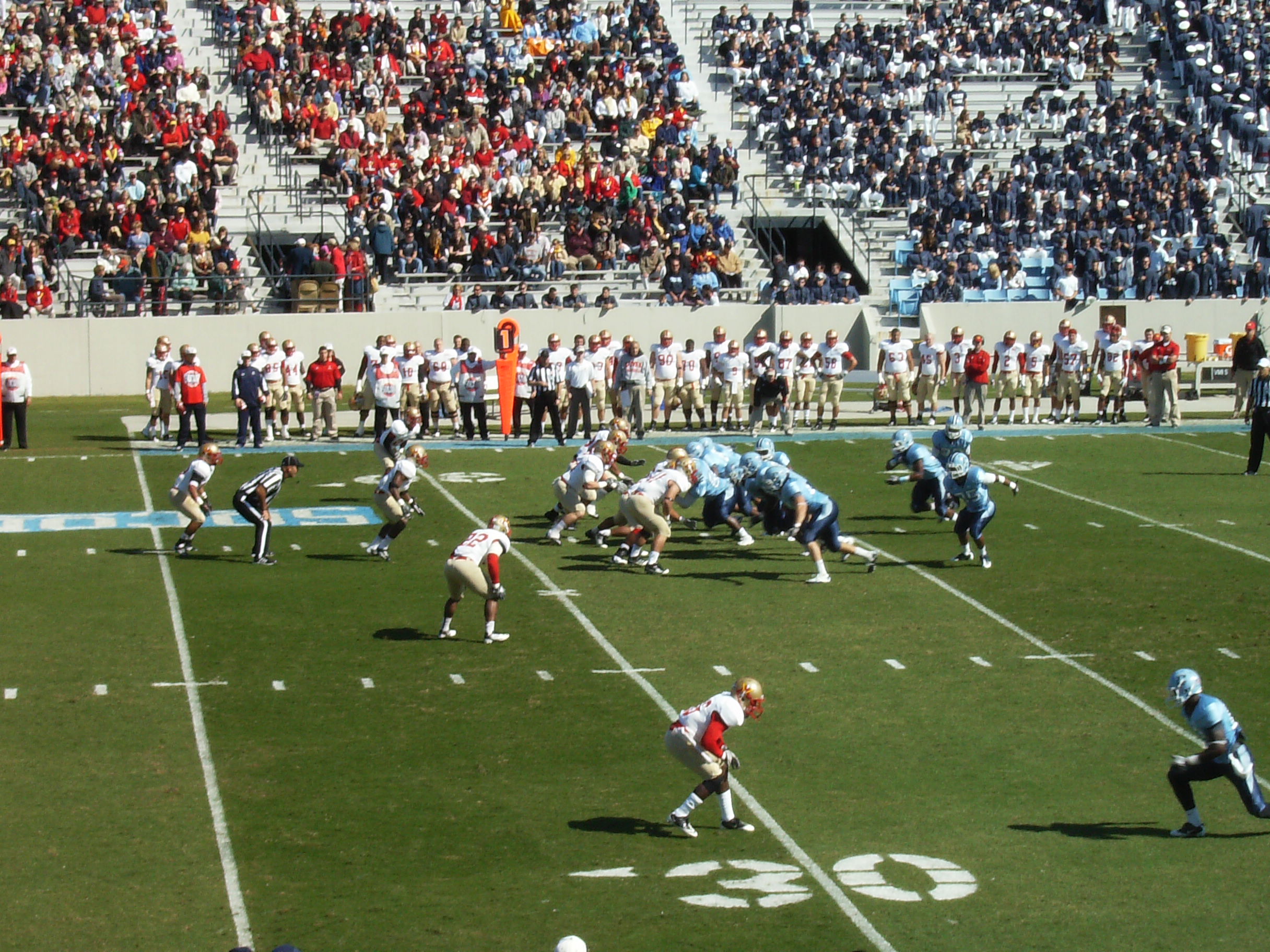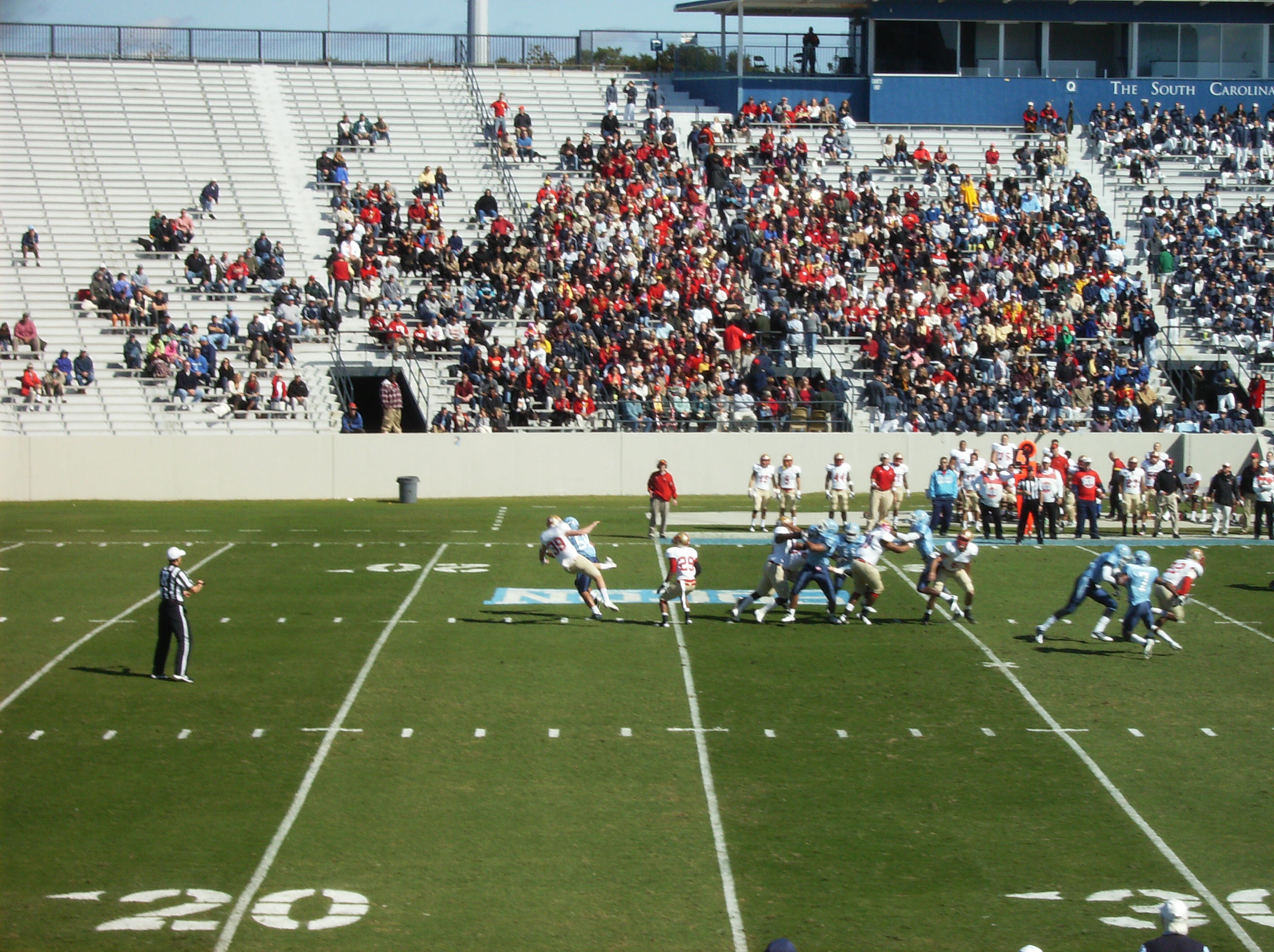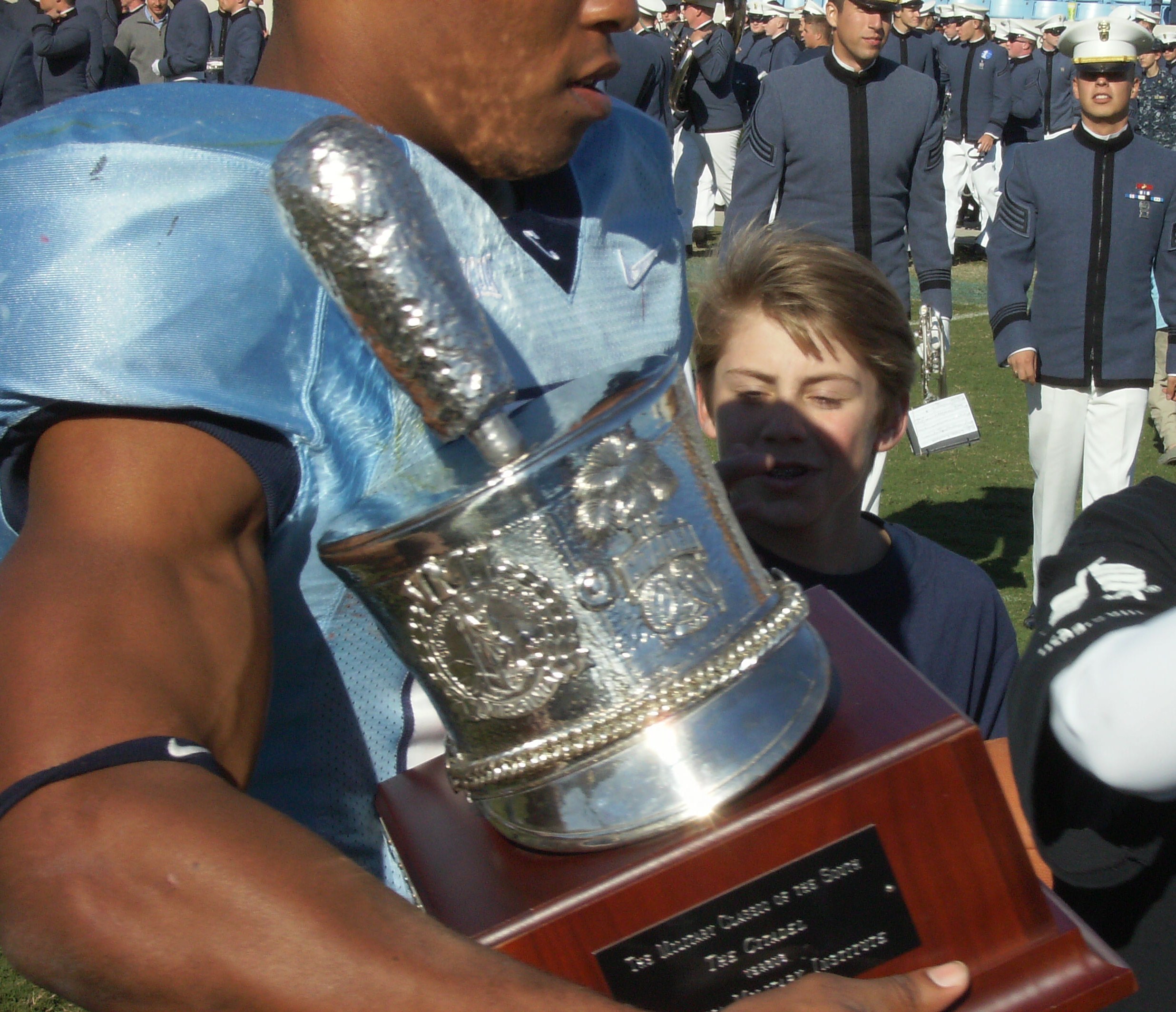
2011 Football Game 9: The Citadel vs. Georgia Southern

The Citadel at Georgia Southern, to be played at Paulson Stadium, with kickoff at 2:00 pm ET on Saturday, November 5.  The game will not be televised. The game can be heard on radio via The Citadel Sports Network, with “Voice of the Bulldogs” Danny Reed calling the action alongside analyst Walt Nadzak.   Bulldog Insider will also provide free audio; the only video available for this game is being provided by Georgia Southern as part of a subscription service.

I’ve already written about The Citadel’s victory over VMI. There isn’t much to add to that, except I did want to briefly mention VMI’s fans.  The Keydets brought more supporters to Johnson Hagood Stadium than Wofford did, and weren’t too far behind Furman in the “travel” category. That’s very impressive, given that A) it’s a long trip, and B) VMI hasn’t had a winning season in 30 years.  Full credit to VMI’s fans, a group that surely deserves better results on the gridiron.

Now the Bulldogs face what could be their biggest challenge of the season to date, a road game against Georgia Southern, which until last week was unbeaten and ranked #1 in the country in both FCS polls. The Eagles saw their perfect season go by the boards in a 24-17 loss in Boone to Appalachian State, and are likely to be a rather surly bunch right now, just in time for Homecoming in Statesboro. Beautiful Eagle Creek may seem a little less beautiful right now.

One thing Georgia Southern can’t really afford to do at this point in the season is lose to The Citadel, because it would put the Eagles in a rather difficult position. Right now GSU is 7-1 with three games remaining. After hosting the Bulldogs, Georgia Southern finishes the regular season with two road games. One of those is in Spartanburg against fellow SoCon title contender Wofford, while the finale is a matchup with BCS title contender Alabama.

If Georgia Southern were to lose all three games, it would finish at 7-4, and would have a borderline case for a postseason bid. The record wouldn’t be great, and GSU would have finished the campaign with four straight defeats. Even more problematic would be the fact that the Eagles would have only six victories against Division I teams, as one of GSU’s wins came against Division II Tusculum.

Technically, an FCS playoff at-large team doesn’t need seven D-1 wins, but historically it has been a de facto rule that at-large candidates should have at least seven such victories. (That may change if there is more postseason expansion.)

GSU definitely needs to win one of its next two games to ensure a playoff bid, and probably needs to win both to garner a national seed.

Although the odds of Georgia Southern getting left out of the FCS postseason are low, it’s important not to overlook the problem of scheduling both a “money” game and a matchup against a non-D1 squad. While a team that closes a season with four straight losses isn’t likely to get an at-large berth anyway, what if Georgia Southern had lost earlier in the season (say, to Chattanooga, a one-point victory for the Eagles), and then finished the year with a win over The Citadel but a tough loss at Wofford, and then the expected defeat to the Crimson Tide?

A SoCon team with 7 wins and a loss to Alabama would normally be at worst a marginal at-large contender, but GSU would only have six D-1 victories and would presumably be out of the running.

That’s why it is better, when looking for a no-return home game, that ADs at schools with playoff aspirations try to schedule D-1 schools rather than D-2 or NAIA teams. It’s not that easy to find FCS schools willing to make a one-way trip, at least not cheaply, but it’s something that needs to be done. Of course, there is the additional risk that the school in question may be good enough to actually win the game.

For The Citadel, Jacksonville was an excellent season-opening opponent in this respect. Presbyterian would also be a good candidate, and of course there is a long tradition of games between the Bulldogs and the Blue Hose. Newberry, on the other hand, is probably not an option, since it is still D-2.

For some fans of the Eagles, the playoffs aren’t enough. There is still a significant group of Georgia Southern supporters who believe that it is time for GSU to make the move to the land of FBS. The school published a study on the issue two years ago. At the time I wrote about whether GSU should make the leap, the latest round of conference-jumping wasn’t even on the horizon, much less a staple of hourly news reports.

I think it is even more of a risk to move to FBS now than it was two years ago, because there is major uncertainty about what that division will become in the next few years. Georgia Southern (and Appalachian State) supporters hoping to become part of the FBS club are dreaming of a chance to join a league like the Sun Belt or, in a best-case scenario, Conference USA.

Even if that were to happen, though, in the current climate there is a possibility it would amount to jumping on a treadmill. If the much-theorized breakaway by the major programs to form super-conferences comes to pass, Sun Belt and C-USA schools are not likely to be part of the chosen few. They are more likely to wind up in a larger FCS.

The Citadel has won two straight games, reason for optimism in the continuing story that is Triple O’Higgins. However, I think there is still reason to be cautious. While I’m not one to complain about any victory, Western Carolina and VMI are not exactly the Pittsburgh Steelers and Green Bay Packers when it comes to football prowess. While the Bulldog D has generally been excellent this season, The Citadel’s triple option attack is still very much a work in progress.

That isn’t to say that strides haven’t been made, because they have. It’s just that the Bulldogs haven’t really had that “eureka” moment, or game, at least not yet. It may be that it won’t happen this season.

Was there such a defining game in 1988, the second year of Charlie Taaffe’s wishbone attack? Was there a specific game when everyone realized that the Bulldogs were no longer learning how to run the offense, but were instead refining it?

Well, I’m not sure. Looking back at the seven-game winning streak in 1988, there wasn’t a true breakout game in terms of rushing yardage. It was more of a gradual increase, from 290 yards rushing (Navy) to 322 (Western Carolina), then a blip downwards (187 vs. Chattanooga), then the two games started by Tommy Burriss (278 yards rushing against Boston University and 301 vs. East Tennessee State).

Tangent: as it happens, the two games Burriss started in 1988 both came against schools that in the next few years would drop their respective football programs. I don’t think this can be blamed on Burriss, however.

The contest against ETSU could qualify as the game that truly established the offense as a force, as in addition to the rushing yardage the Bulldogs threw for 199 yards, with the 500 yards of total offense being the most in a game for the cadets since 1980. The Citadel scored 48 points against ETSU (31 in the second quarter).

The game against the Buccaneers was the eighth of the 1988 campaign. In the ninth game, Gene Brown would return from injury and lead the Bulldogs to one of their more celebrated victories, a 20-3 Homecoming triumph over #1 Marshall.

It would be nice to have a similar result in the ninth game of this season…

It won’t be easy, though, as the Eagles rank first in the SoCon in scoring defense and rush defense. One big reason why is Georgia Southern nosetackle Brent Russell, who Kevin Higgins called “the best defensive lineman in the country at our level.” It’s hard to argue the point. In last week’s loss to Appalachian State, the redshirt junior registered a career-high ten tackles.

One of the more notable performances in Russell’s career came last season against Navy, when he completely dominated the line of scrimmage, a major reason why Navy was held to 193 total yards (109 rushing). The Midshipmen managed to win the game despite Russell’s efforts, 13-7.

I found it interesting that in his weekly SoCon teleconference, GSU coach Jeff Monken was quick to praise Mike Sellers, the Bulldogs’ sophomore center. When The Citadel’s offense faces Georgia Southern’s defense, the critical matchup could be between the two players who line up closest to the ball.

Incidentally (or maybe not so incidentally), Georgia Southern’s defense has forced a punt on their opponents’ opening possession six times. Presbyterian’s opening drive against the Eagles resulted in a field goal attempt that was blocked. The only time the opposition scored on its initial possession against Georgia Southern was last week, when Appalachian State’s first drive resulted in a touchdown. Obviously, that’s also the only game GSU has lost.

Jaybo Shaw, GSU’s quarterback, was injured early in the contest last season at Johnson Hagood Stadium, so (presuming he stays healthy) this will be the first time The Citadel has seen him in extended game action. The Bulldogs will get their fill of quarterbacks named Shaw, however, as they will face Jaybo’s brother Connor in the game at South Carolina. Two Shaws in three weeks is probably a record.

Shaw’s passing numbers are reasonably solid, if modest by comparison to “normal” offenses. He has completed 54% of his throws for five touchdowns, against two interceptions. More importantly, he is averaging 11.2 yards per attempt, as the Eagles are third nationally (second in the SoCon) in pass efficiency. Shaw has rushed for 261 yards and seven touchdowns.

He has distributed the ball well in GSU’s triple option attack, with a bevy of running backs featuring for the Eagles. Robert Brown, the starting B-back, is the leading ground-gainer on the season for GSU. Included in his totals are 178 yards versus Chattanooga, 140 yards against Samford, and 116 yards versus Elon. He is averaging nearly seven yards per carry.

Georgia Southern’s offensive line has included the same five starters in every game except for last week’s contest, with the two-deep released by the school indicating the standard five-man group will return for the game against The Citadel. Three of the five are seniors.

GSU leads the nation in scoring offense (41.1 points per game) and is second in rushing offense.

The Eagles are also dangerous on special teams. Laron Scott averages 35. 5 yards per kick return, tops in FCS. As for punt returner Darreion Robinson, statistics don’t tell the whole story. This effort against Appalachian State does: Link

Saturday’s game against Georgia Southern will be a challenge, but that’s all right. The players won’t be dreading the trip to Statesboro; rather, they will be relishing it. It’s an opportunity to see how far the Bulldogs have come, and how far they still need to go.

Game Review, 2011: VMI

The Citadel 41, VMI 14. The coveted Silver Shako remains in Charleston.

Links of interest:

Game story from The Post and Courier

Jeff Hartsell’s postgame notes column

Photo gallery of VMI-The Citadel from The Post and Courier

Game writeup from VMI’s sports website

Game writeup from The Citadel’s sports website

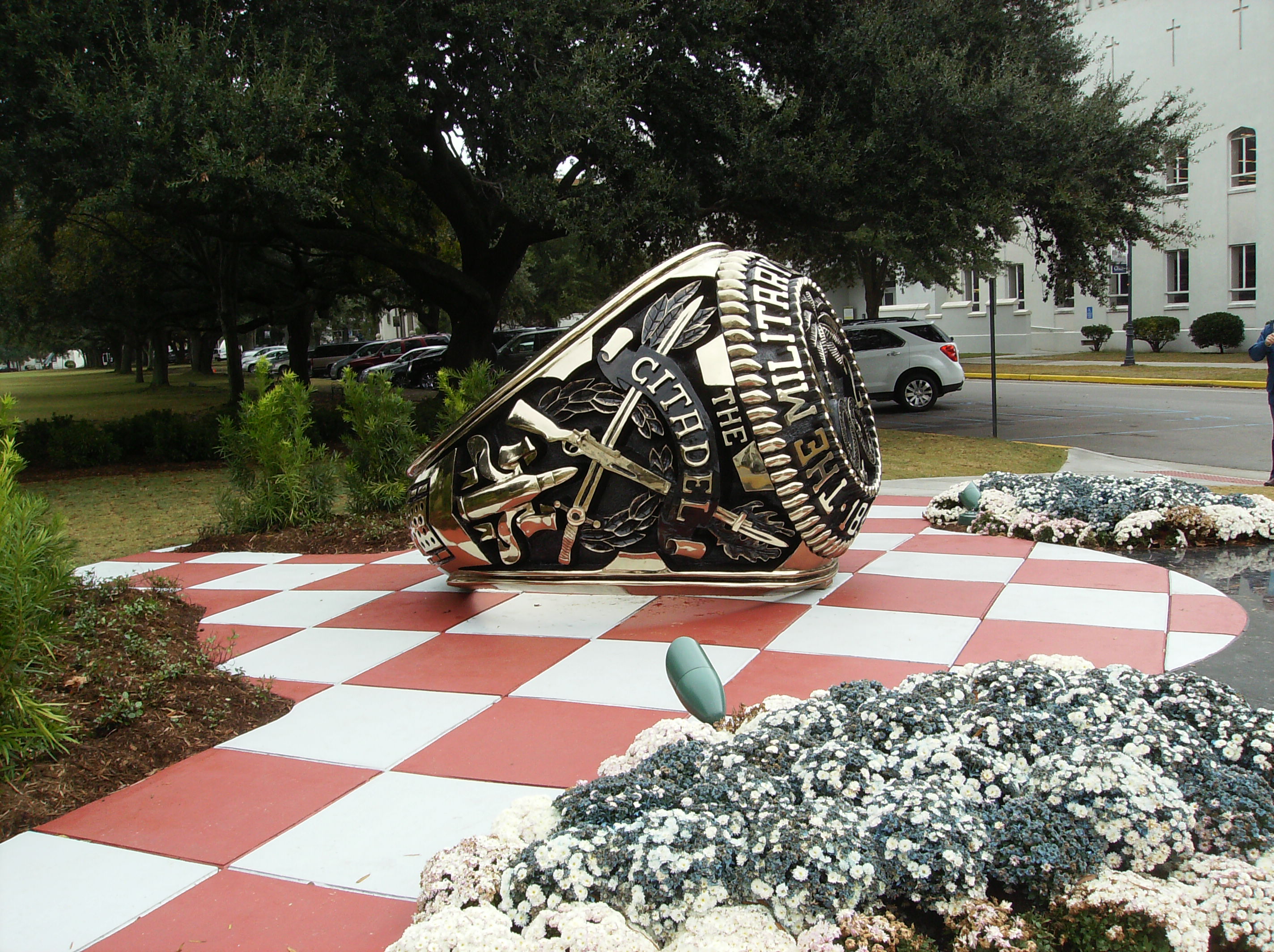
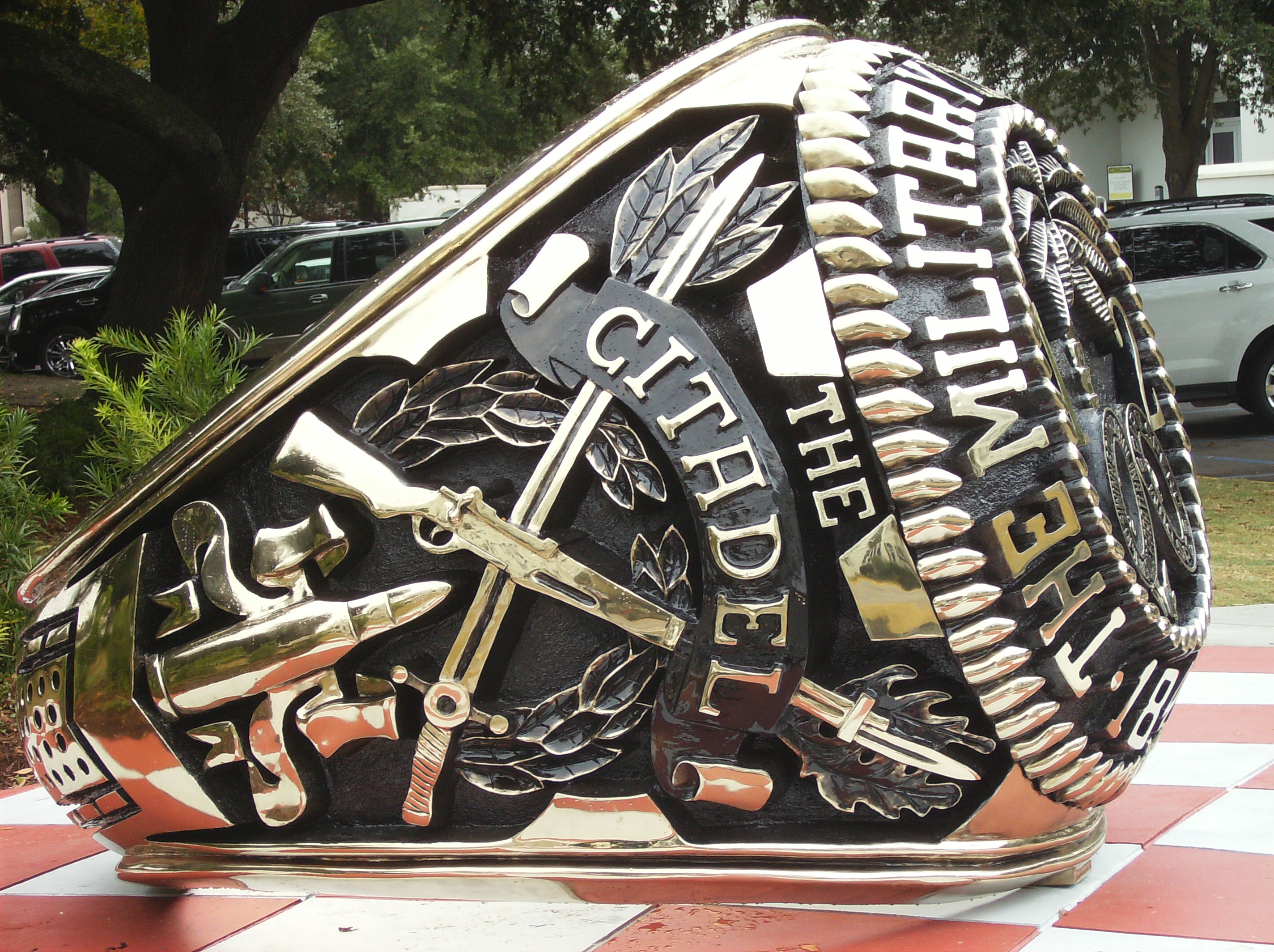
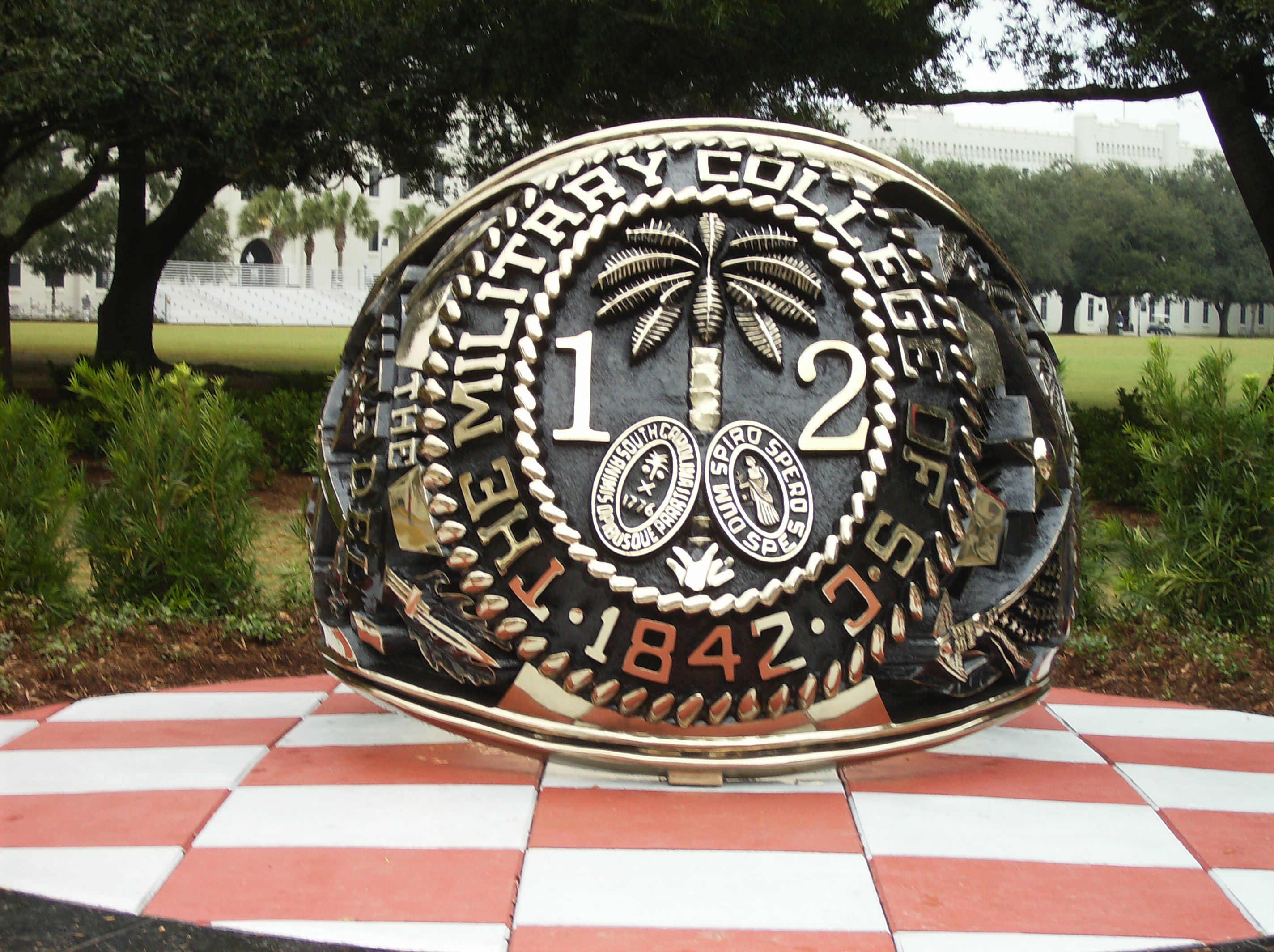
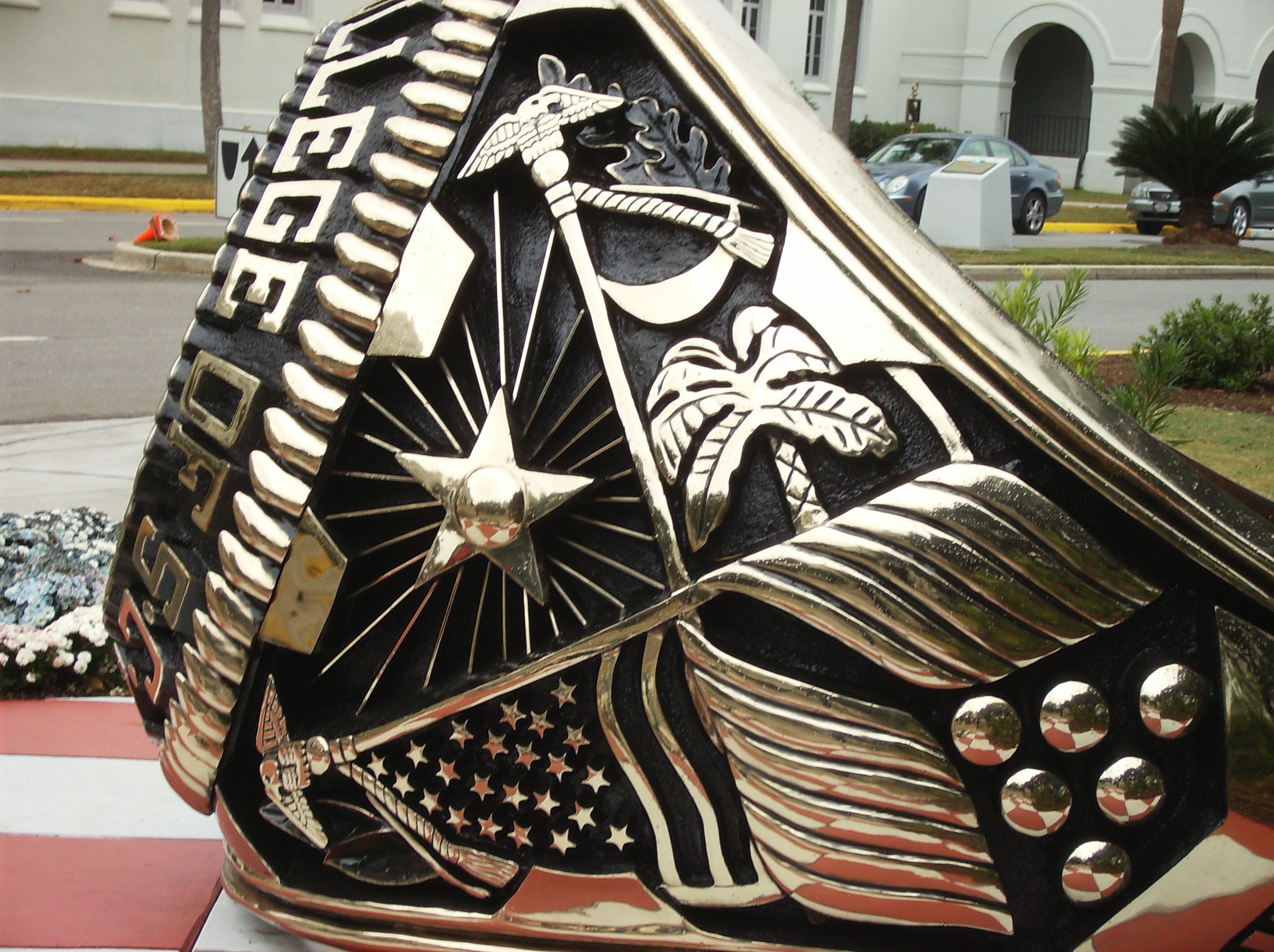
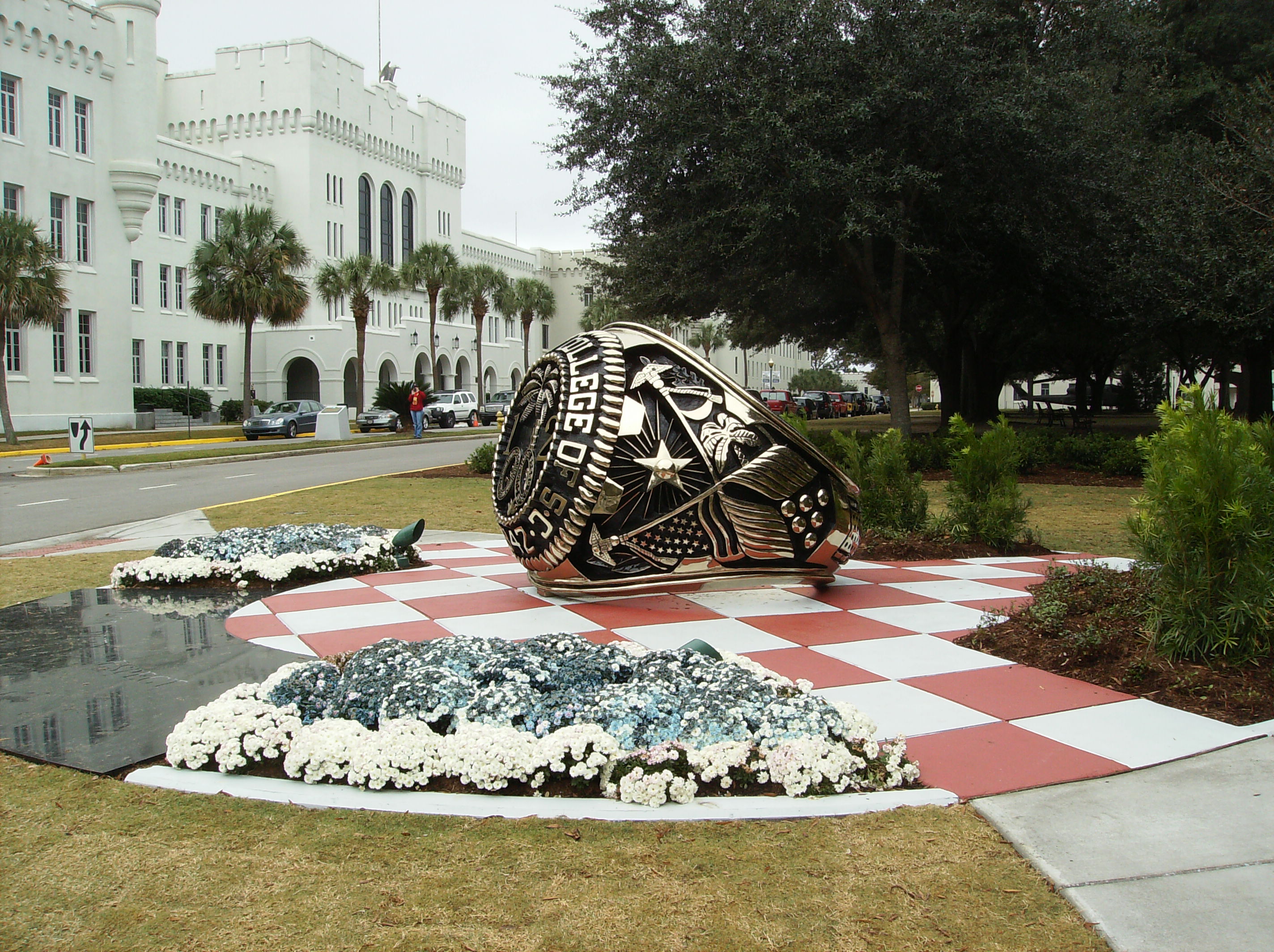
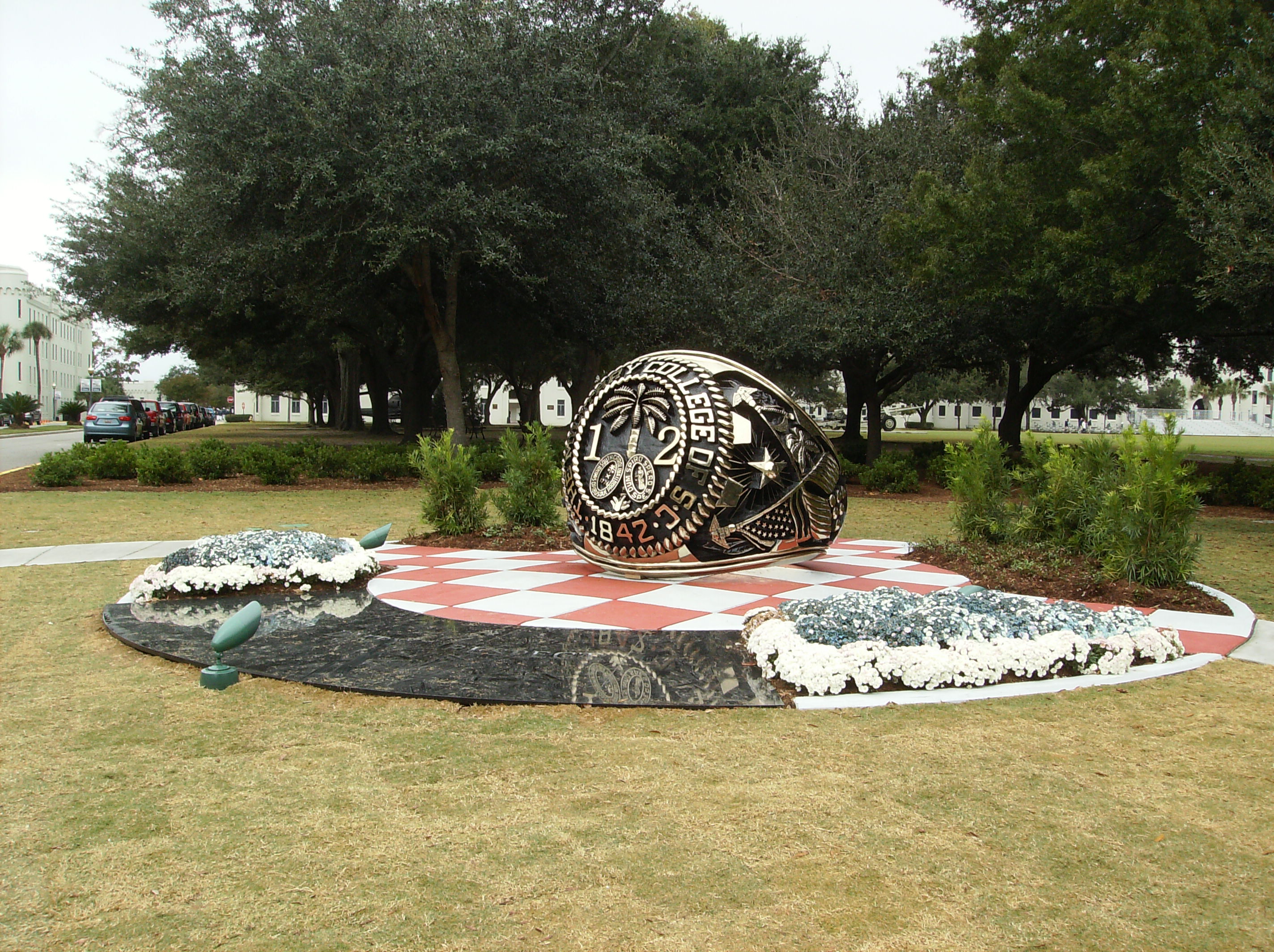
I got to the stadium early on Saturday, and decided to walk around campus. That gave me the opportunity to see the new Ring Statue (I guess that’s what it is going to be called). The statue is a great addition to the parade ground, and I like where it is stationed. It is also a magnet for photographers of all types (including me).

The campus as a whole looked good, even on a gloomy, overcast morning. Conditions improved considerably as gametime approached, and by kickoff it was nice and sunny, classic fall “jacket weather”. The only negative was a rather insistent breeze, but it wasn’t too bad.

The Hall of Fame inductions resulted in some familiar faces showing up for the game, including former hoopsters like Gus Olalere and James Stevens, just to name two. Nate Ross, Renaissance Man, was also on hand. It wasn’t surprising to see a strong basketball contingent, what with Randy Nesbit being one of the HoF inductees.

Dallas McPherson and Tony Skole were also honored, so more than a few ex-baseball players (like Anthony Jenkins and Mike Montei) were at Johnson Hagood Stadium. Phil Florence was enshrined as well. I had forgotten just how good a career he had in track, to say nothing of his abilities as a wide receiver; I was reminded of that fact during his introduction to the crowd at the half.

Charlie Taaffe wasn’t there, as Central Florida had a game on Saturday. I’m not sure the Knights really needed their offensive coordinator, as UCF shut out hapless Memphis 41-0, but Taaffe was represented at halftime by his son Brian. Tom McQueeney, one of about 300 McQueeneys to attend The Citadel, was also inducted into the Hall.

Just before I entered the stadium, I saw an older gentleman come out of the front of JHS, slip past the turnstiles, and walk over to a small group of people. They appeared to be family members. He pointed them in the direction where they were apparently supposed to go, and off they went.

After a moment, he strolled through the side gate (mysteriously open) next to the Altman Center. He then stopped briefly to take out a visitors’ pass and put it around his neck, a needless gesture if there ever was one.

If I had been a little closer when I first saw him, I probably would have greeted him. After all, Bobby Ross was the head coach for the first football game I ever attended. It was a win, too. I watched him amiably talking to one of the security workers for a minute or so, on the edge of the field. Then memories came flooding into my brain, and I turned away.

I was disappointed in the attendance. It was a good day for football (eventually), Clemson and South Carolina were both playing road night games, and there weren’t any truly interesting football games on TV in the afternoon. Just 11,184 people decided to go to the game, though.

Bobby Ross, who had the honors at the coin toss, might have been able to relate to the attendance woes. In his first two years as head coach at The Citadel the average attendance for a game at Johnson Hagood Stadium was just 11,692, not much more than the crowd on Saturday. However, in his last three seasons with the Bulldogs, the average attendance jumped to 16,718.

As for the game itself, some random thoughts:

— At halftime, The Citadel led 21-7. That was the good news, and the best kind of good news, since it was the bottom line. However, I found it worrisome that the difference in the half boiled down to two blocked punts.

After the first couple of drives the Bulldogs did not accomplish much on offense, and the defense allowed a touchdown drive by VMI that consisted of two penalties and six consecutive runs by Keydet running back Chaz Jones, most of them right up the middle. Jones finished the day with 112 yards rushing on 16 carries.

— Sparky Woods is a good coach, but if he had to do it over again, I suspect he might have done a couple of things differently on Saturday. I think Woods tried too hard to keep his offense “balanced”, as VMI finished the day with 33 rush attempts and 26 pass plays. Those numbers don’t account for sacks, so it was really more like 30 designed rushing plays and 29 throws or would-be throws.

The problem was that VMI was reasonably effective on the ground but putrid in the air. Only 9 of those 26 pass attempts were completed, for a total of just 68 yards. From my vantage point, it seemed the primary problem with VMI’s passing game was that its receivers could not get open. Meanwhile, the Keydets were averaging a respectable 4.7 yards per rush, led by Jones, who I thought probably should have received more opportunities to carry the ball.

— The decision by Woods that I found most perplexing, though, came in the third quarter. With The Citadel leading 24-7, VMI faced a fourth-and-seven on its own 29. The Keydets prepared to punt, which for their fans was a cover-your-eyes situation, as two VMI punts had already been blocked in the game, and another possible block just missed.

VMI survived yet another close call on this particular punt. The net was only 23 yards, but considering the troubles with the VMI punting game, and the fact the Keydets were going against the wind, it wasn’t the most terrible of outcomes. However, there was a penalty on the play.

It wasn’t roughing the kicker, but running into the kicker. If the penalty were accepted, it would be fourth and two on the VMI 34. VMI could go for it (after all, the Keydets had nothing to lose, down 17, and Jones was picking up good yardage on running plays). The Keydets could also decline the penalty, with The Citadel taking over at its own 48.

Woods elected to take the penalty, and punt again. I have no idea why. The result was rather predictable, as John Synovec came through the line untouched and blocked the punt.

Tangent: after Synovec blocked the punt, I noticed a Bulldog player (probably Chris Billingslea, always in the middle of The Citadel’s punt-blocking exploits) grab a Keydet in an effort to prevent the VMI player from covering the football. It didn’t matter in the end, as the ball was not advanced, but I think The Citadel could have been called for a post-possession holding penalty in that situation. Then again, I might be wrong about that.

— VMI did a good job adjusting on defense after The Citadel’s first two offensive drives. To this non-expert, it seemed the Keydets D was doing a fair bit of stunting and blitzing, blowing up plays before The Citadel could get to the perimeter.

The Bulldogs finally started to get back on track midway through the third quarter, with the offensive adjustments including the toss sweep (a play Georgia Tech would run repeatedly later that night against Clemson) and some misdirection plays. The Citadel’s wide receivers also did a better job of blocking in the second half.

— It’s not every game in which a team has eleven different players with a rushing attempt, but that was the number of Bulldogs who carried the ball on Saturday. One of those eleven was punter Cass Couey, who picked up twelve yards and a first down on a fake punt, the second time in his career he has made such a play.

I’m honestly not sure whether or not that was planned, or if he felt the pressure on his right and decided to take off on his own. It was a heady play either way by Couey, who is making a strong case to be the all-SoCon punter.

— The Citadel wore what is arguably the most aesthetically displeasing of all its uniform sets, the light blue jersey/navy pants combo. The Bulldogs had lost six consecutive games in which they wore navy pants prior to the victory over VMI.

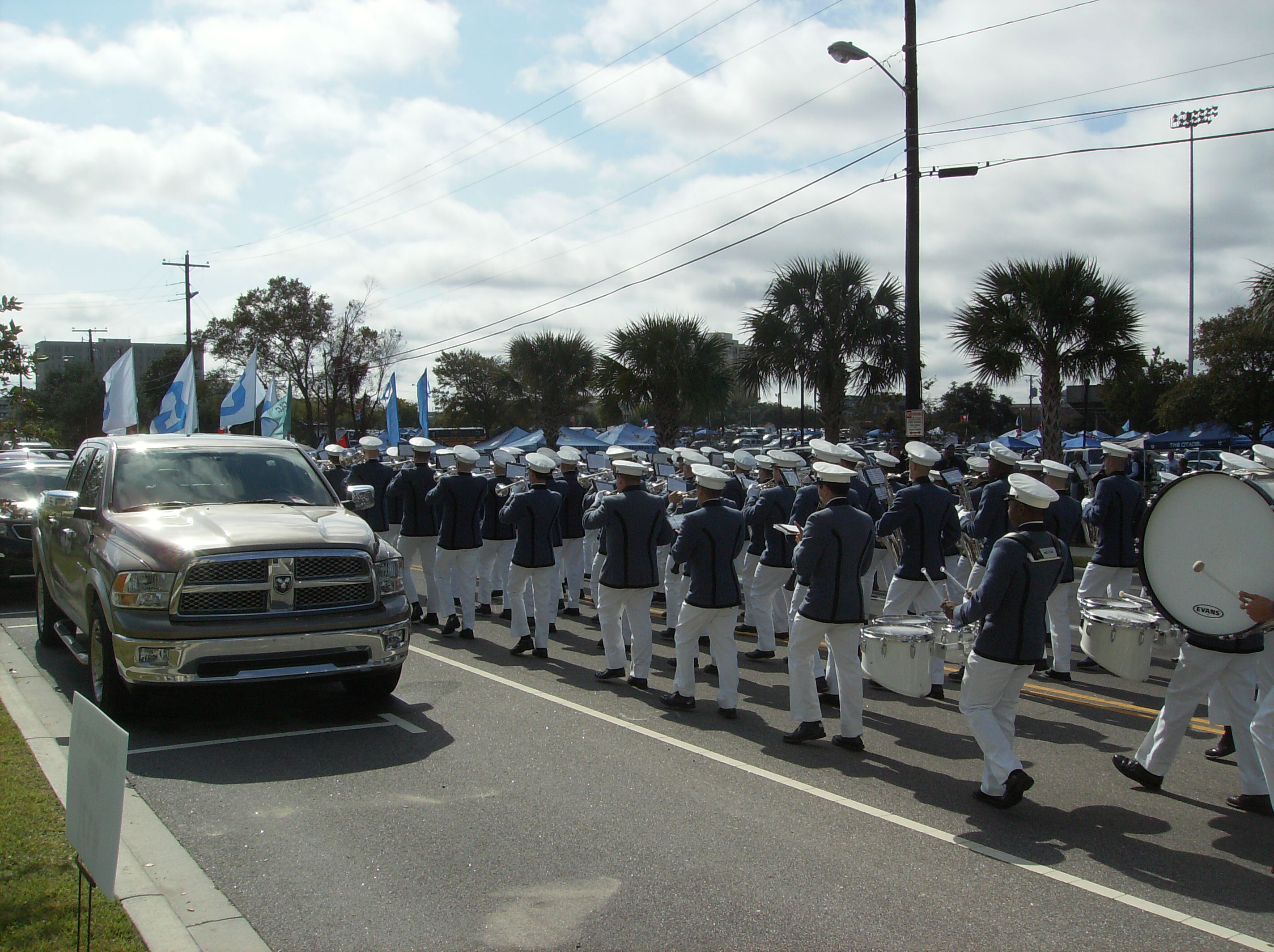
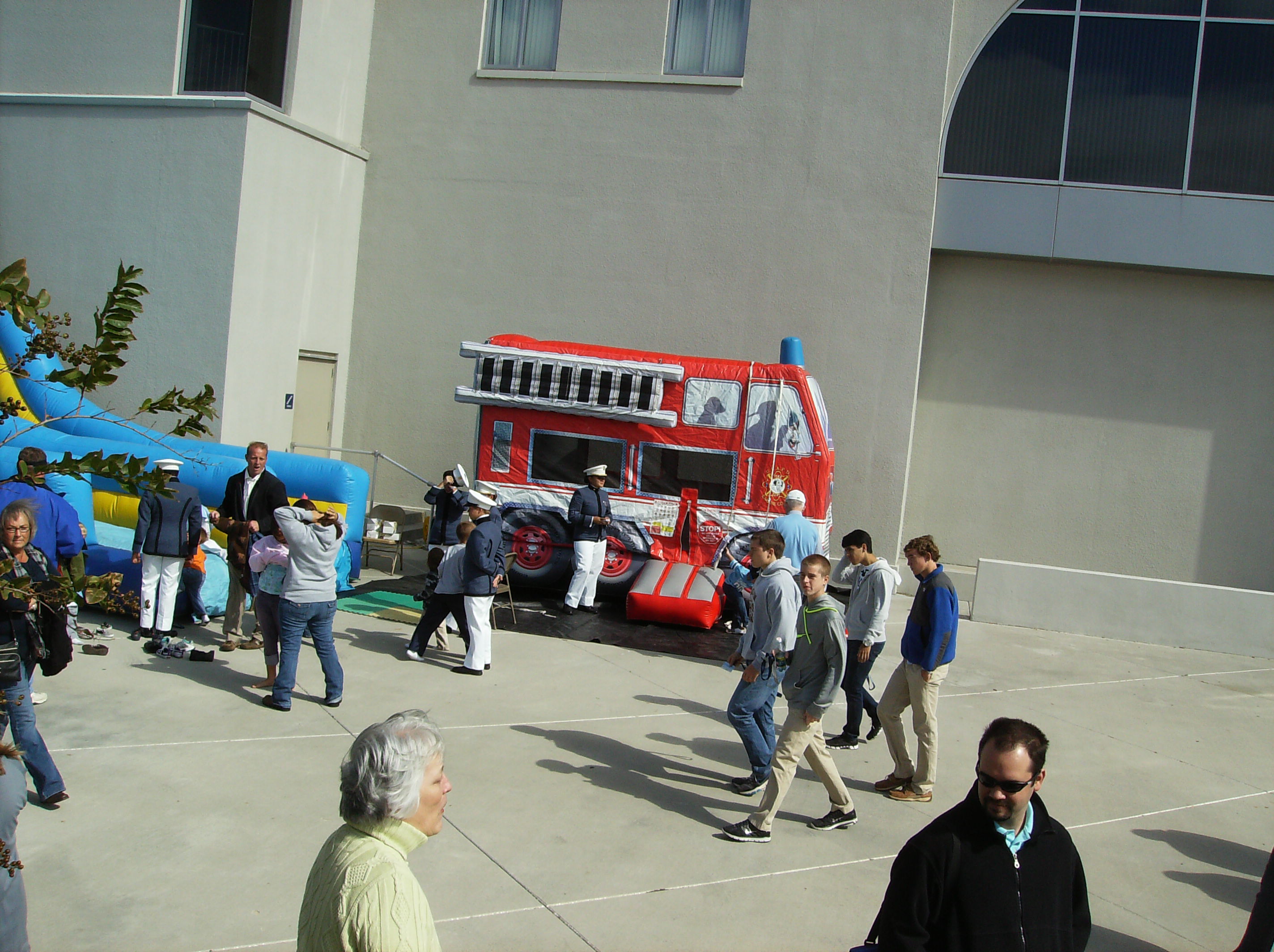
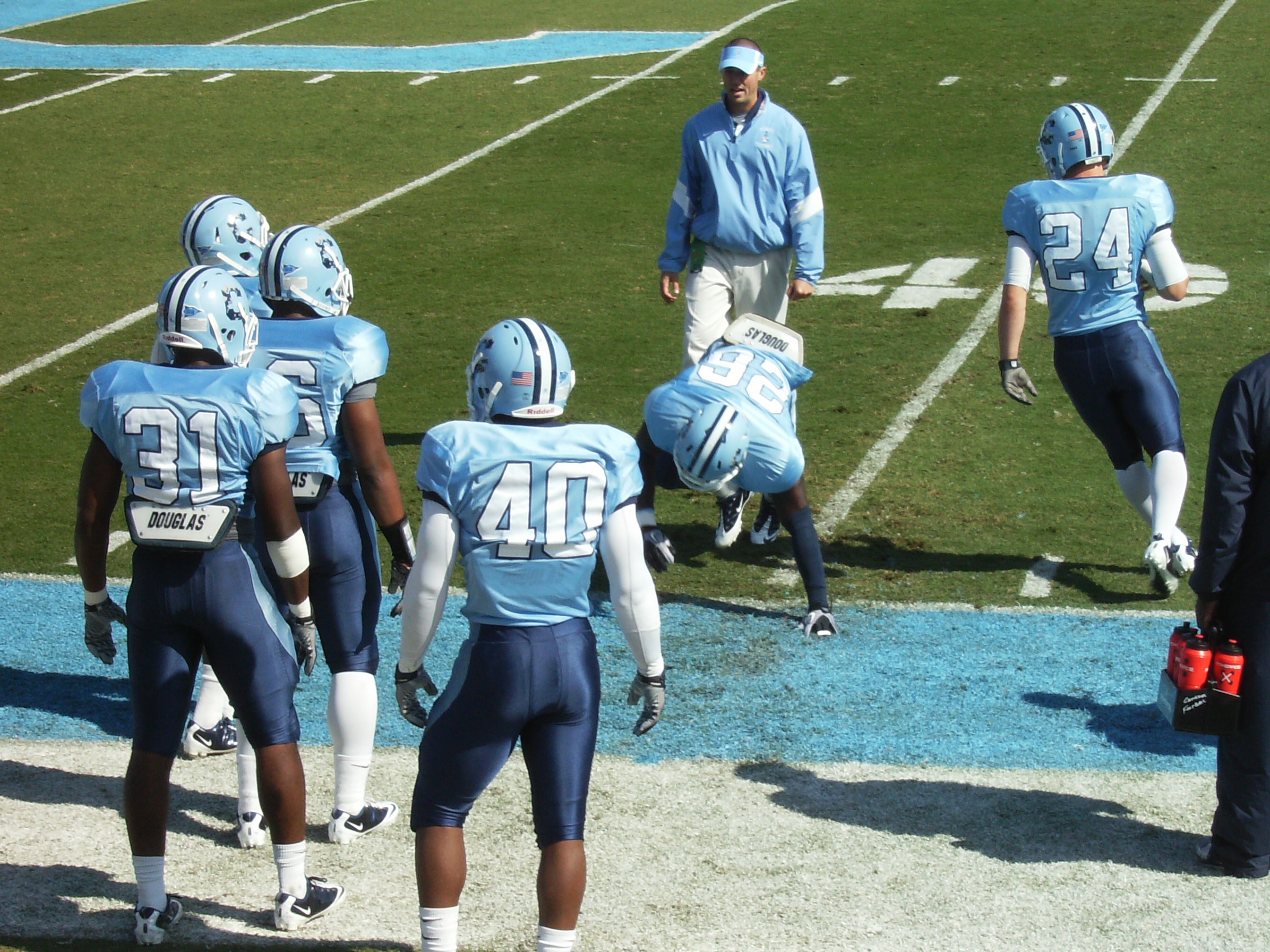
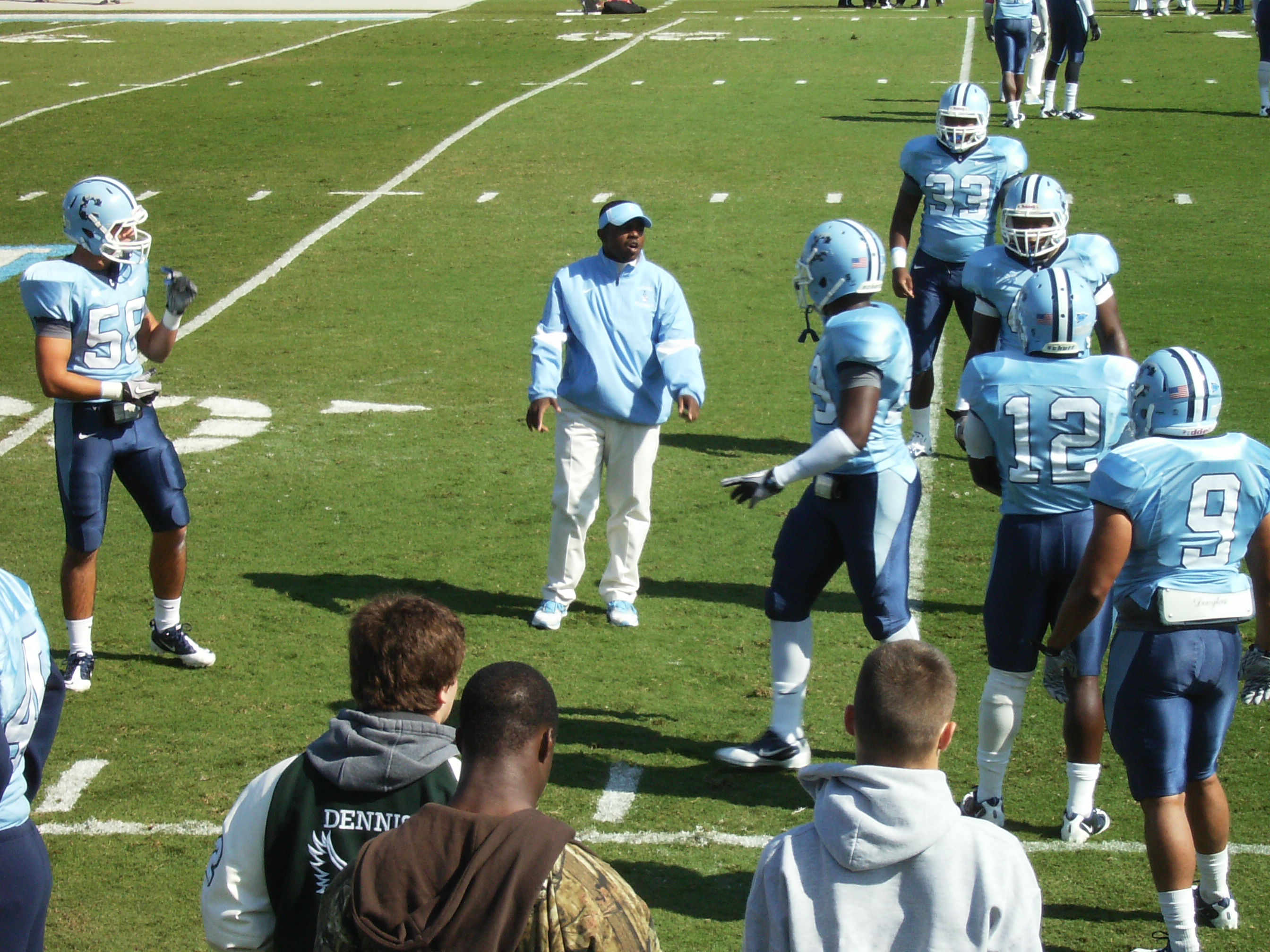
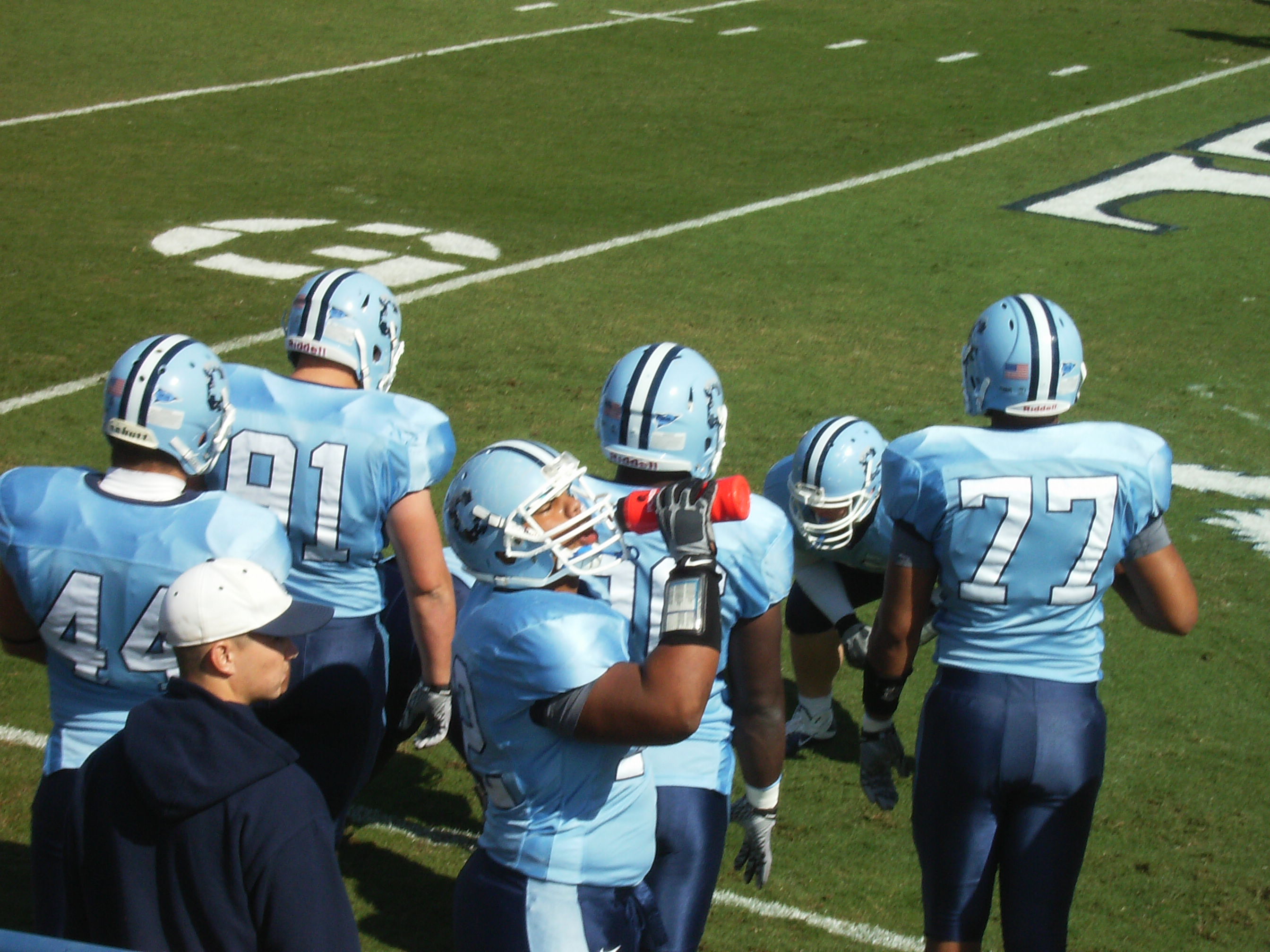
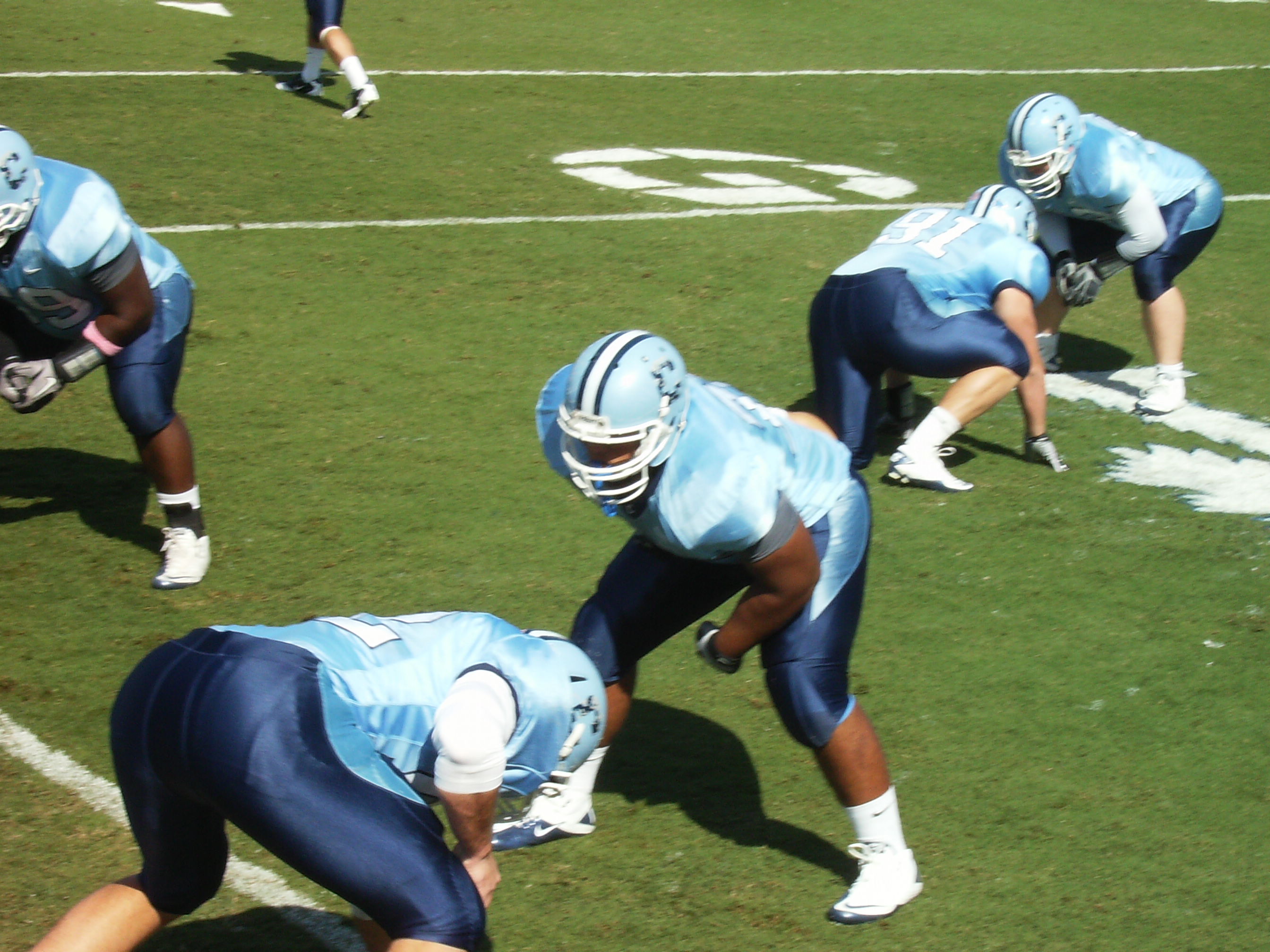
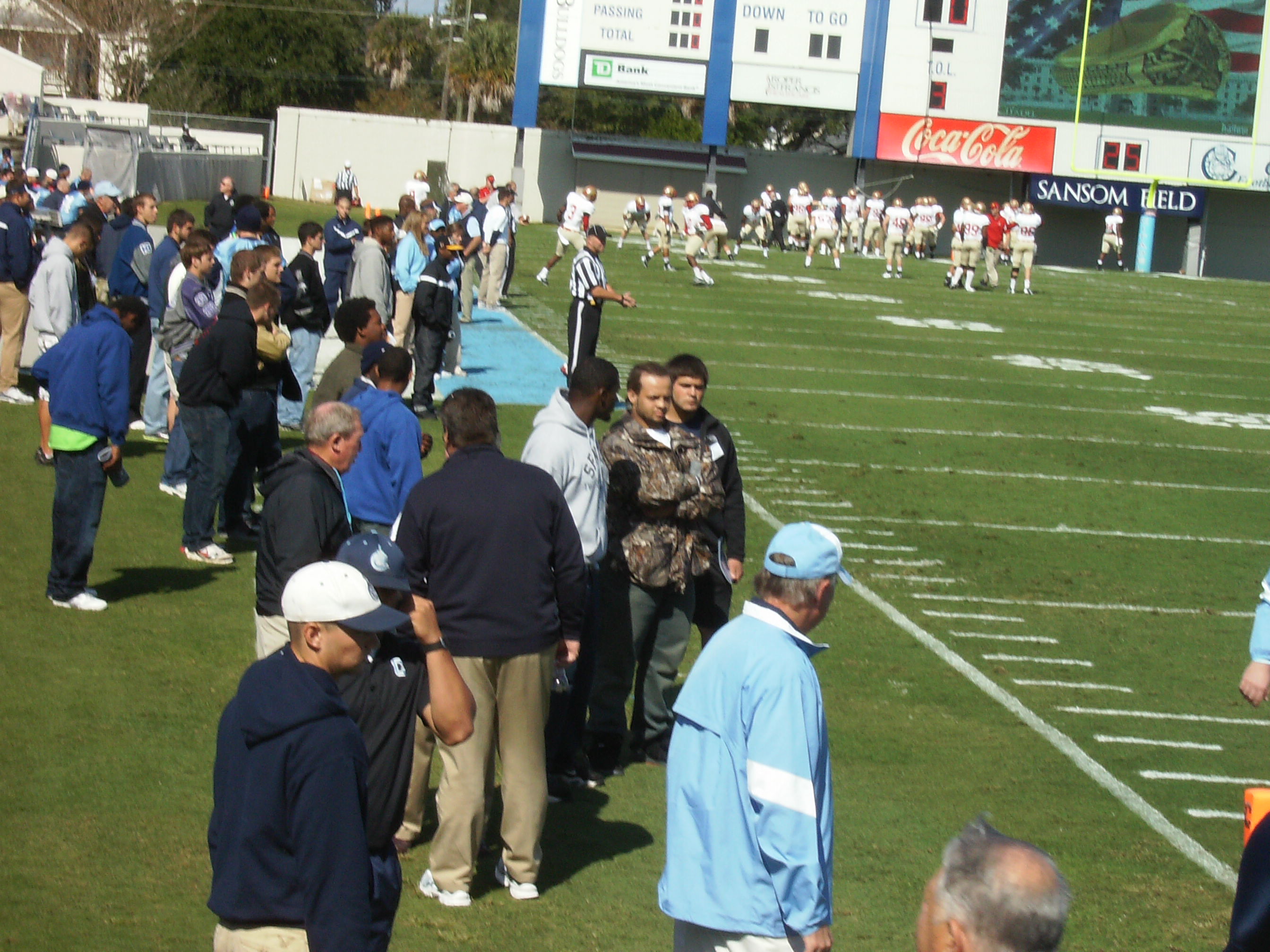
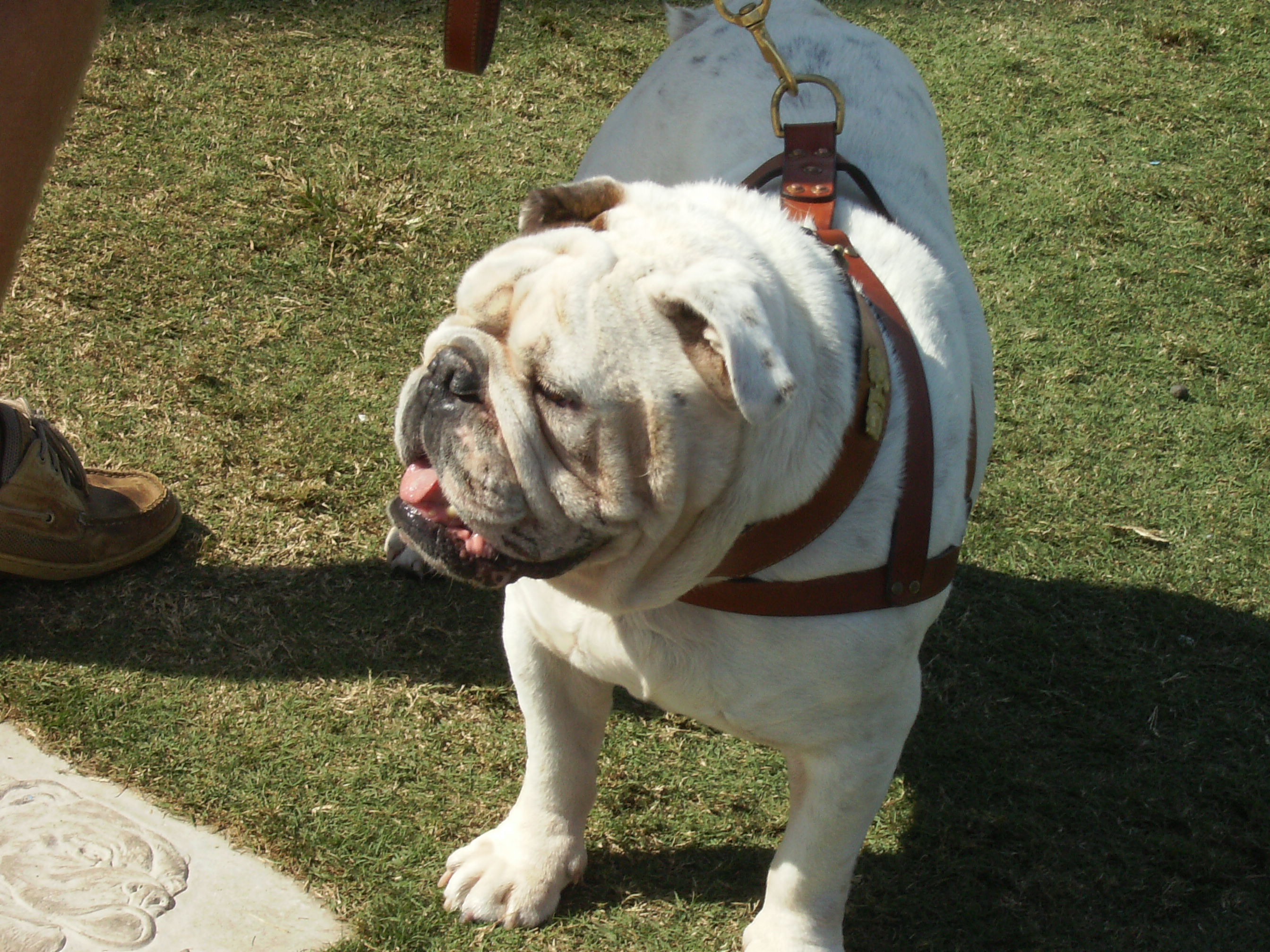
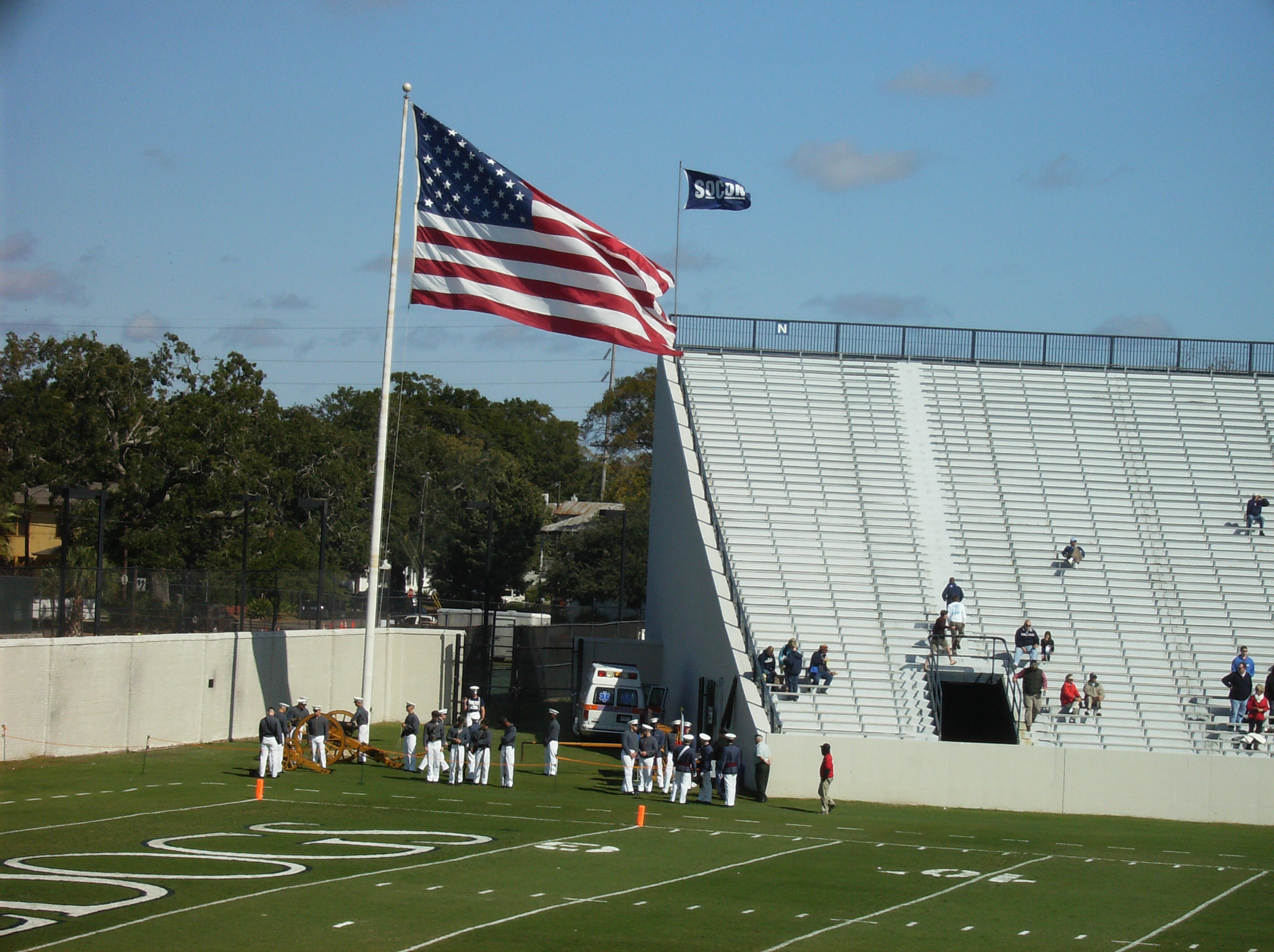
I’ll close out this post with some photos I took on Saturday. They include several shots of the new Ring Statue, some pictures of the Bulldogs warming up pregame (I saw no Schembechler-inspired activity on that front), static game shots, an actually semi-decent “action” photo of the first blocked punt, a few other “at the game” pictures, plus a photo of that which is most coveted. As always, please understand that the photographer isn’t very good and his camera isn’t much better.

On to Statesboro..

2011 Football Game 8: The Citadel vs. VMI

The Citadel vs. VMI, also known as “The Military Classic of the South”, to be played at historic Johnson Hagood Stadium, with kickoff at 1:00 pm ET on Saturday, October 29.  The game will not be televised. There will be a webcast on Bulldog Insider (subscription service), and the game can be heard on radio via The Citadel Sports Network, with “Voice of the Bulldogs” Danny Reed calling the action alongside analyst Walt Nadzak.  The two teams will battle for the coveted Silver Shako, universally regarded as the greatest trophy in all of sports.

I’ve actually written multiple posts on The Citadel’s football team this week. It’s the first time in a while I’ve done that. I reviewed the Western Carolina game, and also threw in my two cents on where the corps of cadets should be placed at Johnson Hagood Stadium.

Now it’s time for the long-awaited resumption of the Cadets vs. Keydets clash. I’m looking forward to this matchup, in part because the Bulldogs have a good chance of winning, but perhaps more so because I think it’s a shame the rivalry had to take a break in the first place. Be forewarned; I’m going to spend most of this post writing about VMI.

The fact the matchup has not taken place since 2007 is a direct result of VMI leaving the Southern Conference following the 2002 football season, which affected the ability of both schools to schedule the game. VMI had been a member of the league since 1924, so we’re not talking about a TCU situation here. Why did the school move to the Big South?

From a Jeff Hartsell article in The Post and Courier:

When VMI left the SoCon after the 2002 season, school officials claimed scheduling flexibility as one reason for the move. The Keydets were locked into eight league games in the SoCon; at the time, the Big South played only four conference games (it’s up to six games and seven teams now, including Stony Brook, which is in New York).

But there’s no doubt football futility played a role in the decision. In the six seasons before their departure, the Keydets were 4-43 in the SoCon, including three 0-8 records and two 1-7 marks, for a winning percentage of .085.

Let’s dig into this a little deeper. First, an aside: you know VMI fans (not to mention the school administration) wince when they see a headline like that one (“Nine years after VMI retreated from SoCon, Bulldogs hold fast”). Ouch.

The Keydets had occasionally slogged through tough stretches in their history on the gridiron prior to their modern-day struggles. For example, from 1968-1971 VMI compiled a cumulative record of 3-39 (in the 1969 season, the average score of a VMI game was Opposition 41, Keydets 8). The first three of those seasons came under the tutelage of Vito Ragazzo. He was replaced in 1971 by Bob Thalman, who gradually rebuilt the program after first enduring a 1-10 campaign in 1971.

Thalman was still the coach in 1981, when the Keydets went 6-3-1. For those of you reading this who don’t know, that is the last time VMI had a winning season in football. That’s right. This year the Keydets (currently 1-6) will suffer their 30th consecutive non-winning campaign. VMI has had two .500 seasons in that span, going 6-6 in 2002 and 2003 under Cal McCombs, a graduate of The Citadel.

McCombs followed up those two years (the last season in the SoCon and the first in the Big South, respectively) by going 0-11 in 2004. After a 3-8 season in 2005, he was done as the VMI coach.

That 0-11 season in 2004 is one of two winless campaigns at the Institute since 1981. Ted Cain’s 1997 squad also went 0-11. Cain was the coach at VMI for two seasons, winning one solitary game (against Lenoir-Rhyne).

With the exception of current coach Sparky Woods, every coach at VMI since 1981 has suffered through at least one winless or one-win season. Thalman was 1-9 in his final season in charge (1984). Eddie Williamson had a 1-10 ledger in 1987. Jim Schuck (a former Army assistant who was hoped to be VMI’s version of his contemporary Charlie Taaffe) went 1-10 in his final season, 1993. His replacement, Bill Stewart (later to win a BCS bowl game at West Virginia) would field a 1-10 squad the following year.

After Cain’s two seasons (the final game of the 1998 campaign was coached by AD Donny White), McCombs would coach VMI for six years, with two 1-10 seasons to go along with that 0-11 finish in 2004. Jim Reid, who had previously been the head coach at Massachusetts and Richmond,  followed McCombs, posting records of 1-10 and 2-9 before leaving to go to the Miami Dolphins (shades of John Zernhelt). He is now the defensive coordinator at Virginia.

Speaking of Donny White, who coached that one game in 1998, he is still the director of athletics at VMI. In the Hartsell article, he had this to say about scheduling:

Fewer league games have helped VMI rekindle rivalries with teams in Virginia like Richmond and William & Mary, but it hasn’t done much for the bottom line. Overall, VMI has a 21-69 record since leaving the SoCon, the highwater mark a 6-6 record in 2003.

“To be fair, I haven’t done a good job of taking advantage of that flexibility,” White said. “With more flexibility, you try to schedule more appropriately for your team, so our non-conference record should have improved. But I haven’t done a good job with that.”

Well, he probably hasn’t. On the other hand, there is a reason he is still the AD at VMI despite the football team’s struggles. It seems clear that White, despite his comments, has been hamstrung a bit in his efforts to make the schedule easier.

The Big South, as mentioned in the article, now has seven teams, so that is six league games for VMI per season. In non-league play, VMI has played William & Mary every season since World War II save one (2009). The Keydets have not beaten the Tribe since 1985, and few of the contests in recent years have been close. Richmond has been an almost yearly opponent as well, but since joining the Big South VMI is 0-9 against the Spiders, allowing on average almost 40 points per contest.

Richmond and William & Mary are traditional rivals for the Keydets (they in fact are the two schools VMI has played most often in its history), but the fact is that right now both of them are on a tier well above VMI in terms of on-field competitiveness. Between playing both of them almost every year, along with a “money” game or two (VMI played both Virginia and Army last season), it makes it hard to schedule “gimme” victories for the squad.

This year VMI’s only game against an FBS team is Akron. I can’t imagine the Keydets got a large check for that one (though I have read that check may have been at least as big, if not bigger, than one for playing Army would have been).

In a way, it is easy to see what VMI’s administration was thinking when it elected to leave the SoCon. Richmond and William & Mary had already left the league. There were some schools still in the conference with which VMI could identify (like The Citadel and Furman), but there were other institutions with which VMI had no shared history, larger state schools that the Keydets seemingly were never going to be able to successfully compete against on the field. Georgia Southern entered the SoCon in 1993. The Eagles and Keydets met ten times. GSU won all ten games by an average score of 47-6.

By the late 1990s it seemed to be getting worse for VMI, which was losing badly every year to the likes of GSU, Appalachian State, and Chattanooga. I wouldn’t be surprised if a particular stretch in 1999 may have cast the die when it came to leaving the league. VMI was 1-10 that season, winless in the league. Starting in late September, this is how things went for the Institute: Furman leveled the Keydets 58-0. The following week, Georgia Southern traveled to Lexington and blasted VMI 62-0. The week after that, Wofford crushed the Keydets 55-10. Then Chattanooga shut out VMI 27-0.

After a non-league game against William & Mary, VMI would lose 40-2 to Western Carolina and 34-7 to App State. Even the near-miss that was the season finale (a 7-6 loss to The Citadel) wouldn’t have come close to easing the pain of that season, or perhaps the sense that VMI could no longer compete in the Southern Conference.

The problem, of course, is that recruiting to play in the Big South is not the same as recruiting for the SoCon, something the administration at VMI may not have fully realized. It may be that the VMI brass thought the school would continue recruiting the same type of athlete regardless of what league VMI called home, but that’s not the way it works.

In addition, several teams in the Big South have started to show major aspirations when it comes to football, and VMI is again faced with the problem of competing against schools with different standards (because they have different missions) and more resources. VMI is 2-7 against Coastal Carolina since joining the Big South, and 1-8 versus Liberty since joining the conference. It’s likely that competing against those schools will continue to be an uphill climb for the Keydets.

VMI is also winless against Stony Brook since the Seawolves joined the league for football. I’m guessing that most VMI alums don’t know anything about Stony Brook except that it beat their alma mater 42-14 last week.

I think the long losing streak has surely cost VMI victories in individual seasons, as there is no reservoir of winning built up in the program. What the folks in Lexington need to do, more than anything, is come up with a winning season to get the proverbial monkey off their back. As such, VMI should schedule accordingly. At least three “gimme” or “near gimme” games should be scheduled, preferably early in the season in order to build confidence.

Then, with hard work and a little luck, three victories in league play would give VMI that 6-5 record and end the skid. In other words, play Lock Haven and Chowan and schools like that on a regular basis in non-conference games.

The Citadel has suffered because of a long losing run of its own, only broken by the 7-4 season in 2007. When it comes to breaking a run of losing that has lasted for a generation and a half, VMI’s difficulties are exponentially greater.

I was at the 2002 contest referenced in Jeff Hartsell’s story. It was easily the most miserable I have been at a football game, and that had nothing to do with the outcome. That game was the first of two matchups between VMI and The Citadel played in Charlotte at ancient Memorial Stadium, an interesting idea for promoting the series that definitely did not work out.

The problem was that the weather was beyond awful that day, and the field at the stadium was simply not up to par, to put it mildly. The end result was that the two teams played in a sea of mud while the supporters who actually made it to the stadium were being absolutely pelted by near-freezing rain. It was just a mess.

I’ve still got my program from that game. It is, shall we say, weatherbeaten. For the record, the 2002 game was technically a VMI home game, so the program is actually “Keydet Gameday” with VMI defensive back DeAngello Plather on the cover. It’s probably not a collector’s item.

The weather was much better for the 1980 contest at Johnson Hagood Stadium, a tour de force by Stump Mitchell. I still remember a long touchdown run in which several different VMI players were left with pieces of his jersey (they wore tearaways back then) while Mitchell galloped down the sideline, shoulder pads rhythmically bouncing as he ran.

VMI and The Citadel will be meeting later in the season over the next few years. Next year’s game in Lexington is tentatively scheduled for November 10. The game in 2013 is slated to be played November 16.

VMI will also play Navy in 2012.

Sparky Woods is the coach at VMI. It’s his fourth season in Lexington. When he was hired I thought it was a quality move for VMI, and I still do. He’s a good coach. People sometimes forget that he did a nice job at Appalachian State, which is what led to him getting the South Carolina job.

He got the gig with the Gamecocks after Joe Morrison died. I remember when Woods was first formally introduced to a South Carolina crowd; it was at the 1989 basketball game between The Citadel and South Carolina, at Frank McGuire Arena. Gamecock officials literally rolled a red carpet (it may have been garnet) to center court and led him out for a quick wave-and-leave moment. The crowd stood and gave him a standing ovation.

Of course, that night the Bulldogs beat the Gamecocks on the hardwood for the first time since 1943. Perhaps it was an omen for his worst moment as the football coach at South Carolina, the 38-35 loss to The Citadel in 1990…

This is going to be yet another game in which neither The Citadel nor its opponent is known for committing penalties. The Bulldogs have the fewest penalties (and penalty yardage) in FCS football. VMI is tied for seventh in fewest penalty yards. Amazingly, the Keydets have played four teams in the top six in this category — The Citadel, Richmond, William & Mary, and Charleston Southern (CSU being the lone victory on VMI’s schedule to date).

VMI has struggled on offense all season. It ranks very low in the FCS in several offensive categories, including total offense (112th), pass efficiency (113th), and scoring offense (115th).

Starting quarterback Eric Kordenbreck has thrown four touchdown passes while being intercepted seven times. He has only completed 48% of his passes. His backup, Adam Morgan, has posted good numbers in limited duty. I wouldn’t be surprised if he played against The Citadel.

VMI is only averaging 3.4 yards per rushing attempt. Chaz Jones is a redshirt senior who has received the bulk of the carries for the Keydets. He has seven rushing touchdowns. Jones also has thirteen pass receptions.

Another redshirt senior, Tracy Hairston, is VMI’s primary receiving threat, leading the team in receptions. He is also the Keydets’ regular kick returner.

Defensively, the Keydets are allowing slightly over 30 points per game, although that is partly a result of the problems on offense (including a time of possession differential of over five minutes versus its opponents). The one area VMI is weakest on defense, pass efficiency, is not exactly a strength for The Citadel. VMI has only intercepted one pass all season, which doesn’t help its turnover margin (-8).

Opponents are averaging a shade over 175 yards per game on the ground against the Keydets. The goal of Triple O’Higgins for the game on Saturday should be to try to double that total, at the very least.

VMI’s two top defensive players are linebacker A.J. Gross and strong safety Byron Allen, both of whom were pre-season all-league picks in the Big South. Unfortunately for the Keydets, promising defensive back Demetrius Phillips left school earlier this week.

VMI’s numbers in the punt game are not good, a major issue for a team as offensively challenged as the Keydets. VMI is not winning the battle of field position in most of its games. The Keydets have had three punts blocked this season. I bet Domonic Jones is interested in that statistic.

Last week, I called the Western Carolina game a “must-win” game for the Bulldogs, and they won it. This Saturday’s game against VMI is also a “must-win”, and not just because it’s a rivalry game.

It’s a game The Citadel is expected to win. There really aren’t a whole lot of games like that on the Bulldogs’ schedule in any given year, and when there are, the team must take full advantage.

Having said that, I don’t think it’s going to be easy. VMI is not a good team, but it’s a team that is going to play hard throughout. It will match The Citadel in that respect in a way that few other squads do.

Also, a win over The Citadel would make VMI’s season. The Bulldogs in the past have struggled with some very poor VMI teams; it’s important that The Citadel does exactly what it did last week in Cullowhee, namely start strong and not let up. The longer VMI stays in the game, the more the Keydets will start to believe they can win it.

Bobby Ross will be at Johnson Hagood on Saturday, having the honors at the pregame coin toss. I think that’s really cool.

I’ll be in the stadium too. I want to see the coveted Silver Shako in person again, and I want to see The Citadel retain the precious trophy for another year. It’s important.

Commentary on the Corps

Now entering the stadium, the South Carolina Corps of Cadets!

Ah, but on which side of Johnson Hagood Stadium will the corps wind up after entering the stadium? That is the question.  For the past few years, the answer has been the East stands at JHS, which bothers more than a few people who remember when the corps sat in the West stands (the “home” side of the stadium).

This has been the subject of considerable discussion — in the tailgating areas (from the fans who actually enter the stadium to watch the game, that is), on the online forum of choice, and even an occasional podcast.

I think the majority of those with an opinion want the corps to be moved back to the West stands, presumably in the area around sections A, B, C, and D. The theory is that it would improve the stadium’s atmosphere, and perhaps “wake up” an occasionally apathetic student section.

Since this is my little blog, I figured I would throw in my opinion on this as well, although on this subject my opinion differs from most. I think the corps should remain in the East stands.

There is the ideal, and then there is reality. The problem at Johnson Hagood Stadium, in terms of stadium atmosphere, is that the current reality is further from the ideal than it has been in recent history.

The natural tendency is to blame the corps of cadets, and that is understandable, since the corps is easily the most important part of the overall makeup of the JHS atmosphere.  It is what makes the stadium experience unique. However, assigning blame to the corps is simplistic at best.

Let’s look at the situation this way: what is different in 2011 than, say, 1992 or 1979 or 1961?

The biggest difference is the success of the team, of course.  I’m not talking specifically about the 2011 team, either — or the 2010 team, or the 2009 team.  I’m talking about the program over the last 15 years or so. The football program is currently in the worst cycle for on-field success over a sustained period of time since the early 1950s. That is the real problem.

At The Citadel, almost all of the students go to the games. That’s very unusual. A significant percentage of them (higher than at most schools, in my view, as I’ve written before) are not particularly interested in sports in general. They are at the game because they have to be.

Those cadets are expected to “perform” for three hours at every football game, of course, but the truth is that it’s easier to play the role of boisterous lunatic when you think you’re having an effect. For too long, that hasn’t been the case. Because of that, there is no reason to believe.

If a cadet is not naturally a sports fan and isn’t inclined to follow the team in the first place, he or she isn’t going to be able to relate to the notion of maintaining intensity regardless of the situation on the field.

This is what leads to stories about apathy, some of which are probably true and some of which may be exaggerated. The oft-proffered solution, of course, is to move the cadets back over the home side, next to the alums and other Bulldog fans, where those supporters can see for themselves that the corps is properly enthused about the game.

The fans in the middle section would interact with the corps, much as in years past, with good-natured ribbing going back and forth, possibly including chants from the corps directed at certain notables (most memorably a former assistant commandant).

I can understand that sentiment. Those are good memories.  There is just one problem: the people who sat in the middle section back then don’t sit there anymore.

Well, most of them don’t, anyway. If you really want to point a finger at something specifically wrong with JHS atmospherics that doesn’t involve the game itself, I wouldn’t recommend starting with the cadets. I might suggest you start with the situation in the three middle sections of the West stands, the blue-and-gray seats.

Whenever someone starts talking about how the corps can wake up the home side and vice versa, I want to ask them if the corps is going to be able to interact with the folks sitting in sections “I” and “J”, which are three sections over (I am assuming the corps would be returned to their original area). The cadets sure won’t be engaged with most of the fans in the middle sections, because they aren’t in their seats.

I’m not talking about all the fans in those areas, of course — there are some great fans who do sit there.  However, far too many fans with those seats stay in the club level, or perhaps remain in the tailgating lots (often for the entire game, it appears).

I guess it’s an unintended consequence of the PSL program. I’m not going to rip people for staying in the club area. I am disappointed in the tailgaters-for-life, but you know, they paid for those seats too. If they don’t want to use them, that is their right.

There is only one real way to ensure that those seats are filled at gametime. The team has to start winning. That’s always what it comes down to, isn’t it?

Sometimes I think alums are a little too quick to criticize the corps. I don’t think that the cadets should be immune from criticism (far from it), but I worry that we play the “old corps” card a little too often.

The current cadets I have had the pleasure to meet have been almost uniformly intelligent and personable, and full of the school spirit that we all want them to have. It’s just not that easy to express that spirit when the team is getting shelled, and you don’t really remember a time when that wasn’t a regular occurrence.

Should there be a little “tightening up” of the corps? Sure. That’s always true, I suppose. Maybe there should be a little more active supervision during games to keep a few of the slackers on their toes. There are always a few slackers, after all.

(It occasionally crosses my mind that back in the day, some crotchedly old alum might have thought I was a slacker. I wasn’t, though. I was just really awkward.)

The one thing I did wonder about when the corps was originally shifted to the East side was the sun, which depending on the time of day can be problematic for spectators in those stands. Listening to the “Grayline” program last week, I heard a tale of cadets falling asleep as a consequence of the sunfield.

Later in the show, however, Jeff Hartsell noted that cadet assistants in the press box had been known to fall asleep during games as well. I’m fairly certain that the sun is not an issue in the press box.

The Citadel plays VMI on Saturday. In perusing the VMI message boards recently, it was interesting to see that alums of that school weren’t happy with their cadet corps at football games, either.  The “apathy” word came up more than once. In other words, the “old corps” phenomenon is fairly universal, and that includes schools that don’t have an old corps or a new corps.

Brief digression from football to hoops:

I think it is true that in some eras the cadets were more “into” the games than in others. I suspect that those times dovetail almost exactly with teams that had extended runs of success.

I can understand the frustration of certain alums, though, particularly when it concerns basketball attendance, which has been poor for many years now (I’m referring specifically to cadet attendance here, although it’s been bad in general).

I know the cadets came out in force to watch the “Blitz Kids” in the late 1950s-early 1960s.  I wasn’t there, but I’ve heard all the stories. More than once. The reason people watched those games, though, was that the Blitz Kids were really good.

The Bulldogs had a surprisingly solid basketball team in 1988-89, too, and people came out to watch — and that was when the home games were being played at Deas Hall.

(Honestly, if it were financially and/or practically feasible, The Citadel should play at least one game each season at Deas Hall, just for the amusement factor alone.)

While the focus of this post is primarily on the corps and Johnson Hagood Stadium, I did want to briefly mention the hoops program, because I have always felt that attendance at basketball games was the real “elephant in the room”, all the more so because the potential for growth is so obvious.

Back to football…

In summation:  the bottom line is that when it comes to the energy one wants to see from the corps, or the fan base in general, it doesn’t matter where the corps sits (or stands). It’s about having a team that wins its fair share of games, or at least the possibility of having a team that wins its fair share of games.

If the program did turn things around, I think the majority of alums/fans would agree that having the corps on the East side would be the way to go in order to maximize the stadium experience. A full stand of home fans would get the chance to see the corps in action from across the way, and the cadets would have the chance to, uh, entertain the visiting team.

The question is whether it is worth establishing the East side as the standard section for the cadets at a time when the program is not at its best. I think it is, in part because I honestly don’t think moving the corps back to the West stands would have that great an impact.

Just my opinion.

Game Review, 2011: Western Carolina

The Citadel 35, Western Carolina 7.

The Bulldogs did exactly what they were supposed to do on Saturday. Facing an inferior opponent that was in a state approaching disarray, The Citadel started fast (!), took a commanding lead and never let Western Carolina into the game.  The game was a must-win, and the Bulldogs came through with a very solid performance.

Random thoughts:

— Kevin Hardy’s opening kickoff return, which went for 59 yards and set up the game’s first touchdown, was by far The Citadel’s best all season. Kickoff returns have been an area of concern for the Bulldogs; here is hoping Hardy’s effort will lead to more big plays in the return game.

— Six different Bulldogs rushed for at least 40 yards (Aaron Miller added 30). Eight different Bulldogs carried the ball, led by Darien Robinson’s 106 yards.

One of the more interesting aspects of the game is that while it was a “must-win” (at least from a fan perspective), a number of reserves saw significant time.  That had been the case on defense in the previous two games, but against WCU several offensive backups played a lot of snaps.

That may be one reason the offense had a bit of a lull midway through the contest, but with a three-touchdown lead that was basically unassailable, I didn’t have any problems with the coaching staff giving younger players an opportunity to get experience.

— The passing game is still a problem.  On Saturday, the Bulldogs completed 2 of 5 passes for just 12 yards, with an interception.  Speaking of the interception, I think the play call leading to it may have been a mistake.

The Citadel’s first drive of the third quarter was going rather well, with runs of 4, 6, 57, and 5 yards (the 57-yarder coming from Rickey Anderson).  On 2nd-and-5 from the WCU 25, though, Miller attempted a pass that was intercepted near the goal line.

A 21-0 lead early in the third quarter is not insurmountable (although Saturday’s game might have been the exception to the rule).  I would have liked to have seen the Bulldogs continue to run the ball against a defense which at that point seemed unable to stop the run, and grab a four-touchdown margin.  Instead, the pick ended the drive and kept Western Carolina at least nominally in the game.

Now, there are decent reasons to throw the ball in that situation (keeping the defense honest, letting Miller get comfortable making decisions when passing, etc.), but I favored a no-nonsense ground assault in that sequence.  Not a big deal, obviously, and I risk being the type of fan who complains when the team doesn’t throw it, then complains when it does.  Then again, as a fan, I have a constitutional right to be irrational.

— It would have been nice for the defense to get a shutout, but that will have to wait for another time and place.  Incidentally, The Citadel’s last road shutout in Southern Conference play came in 1992, against Appalachian State. We all know what else happened in 1992.

— I would be surprised if Western Carolina coach Dennis Wagner is back after this season; he may not last the rest of the campaign.  Included in the game story in the Asheville Citizen-Times were three paragraphs noting the lack of fans in the stadium after halftime, along with quotes from dissatisfied students.

That was coupled with an editorial (from the same writer who penned the game story) entitled “Cats Uninspiring in Homecoming Debacle”, which included the following commentary:

In 12 years of covering this program, I have never seen the Catamounts play so poorly at home as they did in a 35-7 loss to The Citadel — not even when D-II Tusculum chopped the Cats up like firewood last fall.

— The school’s release includes two video clips of post-game interviews with Kevin Higgins and Tolu Akindele.  If you want to see how a pro responds to a leading question that he has no interest in answering, check out the Higgins clip at around the 48-second mark. He doesn’t really care if WCU didn’t have an “edge”, and isn’t about to throw a fellow coach under the bus anyway.

— I believe the reporter in the video asking Higgins and Akindele those questions was Asheville Citizen-Times scribe Tyler Norris Goode, who wrote the above-linked game story and editorial.  If you had read the game story in The Post and Courier, you may have noticed that he also wrote that article.

Regular beat writer Jeff Hartsell didn’t write the game story because he wasn’t in Cullowhee, as The Post and Courier elected not to send a writer to the game, a decision apparently not made by the newspaper’s sports department.  It’s the first time I can recall the paper not sending a reporter to cover a Southern Conference game involving the local football team in…well, I can’t remember another time.

Obviously these are tough times for the newspaper business, so it’s not shocking the paper would cut an occasional corner.  This time it came at the expense of coverage for The Citadel’s football team, which should be a concern for any fan of the military college.

I’m hopeful it was just a one-time thing.  Presumably there will be no issues with coverage for the remaining four games on the schedule, which includes two home games and road games against nearby opponents Georgia Southern and South Carolina.  It’s a situation that bears watching, however.

Next up: VMI.  It’s time for the long-awaited return of the Military Classic of the South, as the two schools battle for the coveted Silver Shako.  I’m looking forward to this one.

2011 Football Game 7: The Citadel vs. Western Carolina

The Citadel at Western Carolina, to be played at E.J. Whitmire Stadium, with kickoff at 3:00 pm ET on Saturday, October 22.  The game will not be televised. The game can be heard on radio via The Citadel Sports Network, with “Voice of the Bulldogs” Danny Reed calling the action alongside analyst Walt Nadzak.   Bulldog Insider will also provide free audio; the only video available for this game is being provided by Western Carolina as part of a subscription service.

This is a post that combines a review of the Appalachian State game with a preview of the Western Carolina contest. At least, that was going to be the plan…

As it happens, I did not attend the App State game, nor did I listen to it on the radio. Without going into specifics, Saturday was a difficult day for me.

In lieu of an extensive review of the 49-42 loss to the Mountaineers, I want to make a general point about access to athletics at The Citadel. It’s really amazing how far we’ve come in the information age, isn’t it?  I didn’t get to watch the game on Saturday, but I can see the highlights on my computer (via The Kevin Higgins Show).

I can go online and read about how the game went from a number of different sources, whether it is the established press (like Jeff Hartsell of The Post and Courier) or the releases from both participating schools (plus the SoCon).

I can pull up the game statistics on that same school website, and I can even get fan reaction from a message board.

Of course, in normal circumstances, if I had not been able to see the game in person I could have listened to Danny Reed call the game. The Citadel has always had a small radio network, but now you can follow the radio play-by-play online as well, and for home games you can watch a video feed (for a not-unreasonable fee).

The access to information is particularly welcome for a small school like The Citadel. It used to be hard to follow the program from anywhere outside of the Charleston metro area. Now people all over the world have the opportunity to get at least a taste of the action.

I know I don’t take it for granted.  I just wish all this had come about sooner.

Tangent:  I do have one request, if anyone knows somebody in the athletic media relations office. When The Citadel switched to a new provider for its website, some things got lost in the shuffle, including the statistics for previous years. For example, when I was trying to figure out how many penalties Wofford had committed against The Citadel in recent seasons, I wound up having to get the information from Wofford’s website.  

I know it’s not a big deal, but it would be nice if all of those compiled stats could be uploaded again. You never know when some dweeb will want to look up pitch counts from 2003.

Quick hitters from the game against the Mountaineers:

— The Bulldogs went with the all-navy look on Saturday.  It’s the fourth time The Citadel has sported that combo.  In those four games, the Bulldogs are 1-3, 0-3 in SoCon play.  The Citadel has allowed a total of 100 points in those three league defeats.

— The Citadel finally scored in the first quarter of a game. It did take a drive sustained by a fake punt to accomplish that, but the points still count.

Speaking of the fake punt, that was well-executed. I don’t remember seeing one quite like it before, with Cass Couey actually getting the snap and then making an underhand shovel to Kevin Hardy. Statistically, it was a running play. I think you could make an argument that it was a pass attempt.  I guess it comes down to the definition/interpretation of what constitutes a forward pass.

— By this point, if teams don’t know Luke Caldwell is looking to throw the ball on the end-around, they need to fire their video coordinators.

— Domonic Jones has four punt blocks this season, although I think the one against the Mountaineers was his first “stuff” job, as I seem to recall the previous three being tips rather than complete blocks. I could be wrong about that.

At any rate, he did a great job of not only blocking the punt, but recovering very quickly to get up and run it in for the TD.  I could not quite make out on the video the Bulldog (Chris Billinglea?) who essentially occupied the entire App State protection unit; whoever it was, well done.

I’m enjoying this new era of The Citadel blocking punts on a semi-regular basis.  Now the Bulldogs just need to force more punts.

The Citadel plays Western Carolina this Saturday, in Cullowhee.

Let’s be clear about this. It doesn’t matter that it’s a road game. It doesn’t matter that the team is still going through triple option growing pains. It doesn’t matter there is uncertainty surrounding the quarterback position. It doesn’t matter that the defense has lost its mojo over the last two games and needs to regain its confidence.

The game against Western Carolina isn’t about a learning experience, or moving forward, or anything like that. There is only one goal for the matchup with the Catamounts, and only one acceptable outcome.  The Citadel must win this game.

Since the final game of the 2005 season, Western Carolina has played 43 Southern Conference games. The Catamounts have lost 40 of them. Only three times has WCU tasted victory. One of those games came in 2008 against a Chattanooga squad that went 1-11.

The other two wins came in Western Carolina’s last two meetings against The Citadel.

It’s really worse than that in some respects. WCU’s program has been just awful over the last few years, but you would never know it by its games against the Bulldogs. Not only has The Citadel lost those two games (including last year’s dreadful 24-13 setback), but the Bulldogs could very easily have lost four of the last five contests against WCU. The Citadel needed overtime to beat the Catamounts in 2006, and survived in 2007 by just a six-point margin (37-31). As I wrote last year:

The Bulldogs may face a team that is struggling and/or lacks (as a program) certain resources.  However, The Citadel will never be in a position to just show up and win while playing its “C” game.  The military school doesn’t have the capacity to do that, and never will, because of its own restrictions (note that I said restrictions, not disadvantages).

At its best as a program, The Citadel could beat any league team — and could lose to any league team.  That’s just the way it is.  In terms of physical talent, no other conference squad will ever be overmatched by the Bulldogs.

Last season, the Bulldogs came out flat and lost to a struggling team that was giving a true freshman quarterback (Brandon Pechloff) his first career start. The year before, The Citadel lost to a WCU team that could barely get out of its own way.

That’s why it is paramount that the Bulldogs start strong on Saturday. Don’t allow a downtrodden team hope — and when I say downtrodden, it is not an exaggeration. When a coach feels compelled to write an open letter to fans after a 44-point home loss, you know there is a problem.

Western Carolina ranks last in the following SoCon statistical categories: scoring defense, rush defense (allowing 319 yards per game — ouch), pass defense efficiency, total defense (shocker), defensive interceptions, sacks against the offense, sacks by the defense, penalties, time of possession, opponents’ third-down conversion rate, and opponents’ first downs.

The Catamounts do lead the league, curiously, in drawing penalties by their opponents.  I guess blowouts can get a little sloppy. The Citadel needs to stay disciplined on Saturday and maintain its status as the league’s least-penalized team.

In all fairness to Western Carolina, a lot of defenses would have less-than-stellar numbers against the rush after playing Georgia Tech and Georgia Southern. On the other hand, Furman rolled up 268 rushing yards in a 47-point outburst against the Catamounts.  Elon scored 38 (in a 38-31 game in Cullowhee that was WCU’s best SoCon performance to date). Even in Western Carolina’s lone victory, Mars Hill scored 31 points.

Pechloff, a 6’7″ left-hander, is a good passer when he has time to throw the ball. The Bulldogs need to rush him effectively and often in this game, as besides being a sack target Pechloff is turnover-prone (including nine interceptions this season). That largely explains why the Catamounts are second in the league in passing yardage per game but next-to-last in offensive pass efficiency (ahead of only, you guessed it, The Citadel).

His main aerial target is Josh Cockrell, who had two TD catches against both Elon and Furman (he added a rushing TD against the Phoenix). Cockrell only caught one pass against The Citadel last season, but I still remember it. I have rarely been as frustrated by a 20-yard catch in my life, as an under-duress Pechloff floated a pass that just sat in the air for seemingly days before settling into the arms of Cockrell. It summed up the whole game.

Western Carolina is not a strong running team, ranking seventh in the league in rush offense.  The Catamounts average just 3.8 yards per carry.

In an effort to avoid yet another slow start, Kevin Higgins is considering an old Bo Schembechler move to get the team ready for battle. Schembechler, Fritz Crisler, Fielding Yost…it doesn’t matter which ex-Michigan coach had the idea. As long as it works, I’m fine with it.

I’m also okay with Higgins’ decision (as noted in the above link) to start Ben Dupree at quarterback, at least for one more game (though I understand the argument for making a switch). I think the coach’s reasons for sticking with Dupree are solid. Besides, if Aaron Miller winds up getting close to twice as many snaps (as he did against Appalachian State), it’s not that big a deal anyway.  Both of them will play. The one who is more effective at the controls of Triple O’Higgins will play more.

I won’t be in Cullowhee on Saturday, but I’ll be following the action. I want to hear the phrase “fire those cannons” early and often. This game needs to be an Al Davis (RIP) special. Just win, baby.

2011 Football Game 6: The Citadel vs. Appalachian State

The Citadel vs. Appalachian State, to be played at historic Johnson Hagood Stadium, with kickoff at 2:00 pm ET on Saturday, October 15.  The game will not be televised. There will be a webcast on Bulldog Insider (subscription service), and the game can be heard on radio via The Citadel Sports Network, with “Voice of the Bulldogs” Danny Reed calling the action alongside analyst Walt Nadzak.

This post will serve as a combo review of Wofford/preview of Appy.  I’m going to be having “combo posts” for at least two more weeks, if not longer.

Wofford 43, The Citadel 14.

I’m not sure there is a lot to say about this game that isn’t blindingly obvious, but I’ll try my best anyway.

— In his weekly press conference, Kevin Higgins noted that Wofford’s punt return TD “took the wind out of [the team’s] sails”.  I would say it probably just solidified things in that department; the die was cast when the Terriers moved down the field with ease on the opening possession of the game and scored their first touchdown.

— The horrendous start probably put the kibosh on any cadet corps frivolity, as it’s hard to get wound up for a game when it takes on “no hoper” status that quickly.  I’ve seen some criticism of the corps for its lack of enthusiasm on Saturday, but to be honest I’m inclined to give the cadets a mulligan.

Plus, the issues with the atmosphere at Johnson Hagood Stadium go a lot further than the corps.  The scene on Saturday was particularly jarring, as the tailgating crowd was huge, but when I turned around to survey things shortly before the game started, there just weren’t many people in the stands.  It did fill in a bit a few minutes later; I guess folks knew there was no reason to show up on time, since the Bulldogs don’t score in the first quarter anyway.

I guess a lot of people just wanted to stay in the parking lots and listen to the game on the radio, or perhaps watch/listen to the South Carolina game instead.

It’s a problem.  I’ve typed that before, and I suspect I’ll be typing it again.  Getting those people into the stands is going to be a tall order, at least until The Citadel starts winning on a consistent basis.

The game against Appalachian State will likely be a bit different, as it will be Parents’ Weekend.

— Wofford did not commit a turnover on Saturday and also did not commit a penalty, which was a story in itself, as the Terriers entered the game as the most-penalized team in the Southern Conference.  That was something of an anomaly, as Wofford is usually not a heavily-penalized outfit (much like The Citadel).

In the last four games against The Citadel, Wofford has committed a total of five penalties (for a combined 30 yards).  That includes a delay-of-game penalty the Terriers took on purpose in order to set up a short punt in the 2008 contest.  Only one of the penalties was for more than five yards (a holding penalty in that same 2008 game).

I am not a defensive coordinator, and never will be, and I’m not going to pretend to understand the intricacies involved in running a defense.  When I see a box score in which the opponent did not commit a turnover or a penalty, though, I wonder if the problem is at least partly a lack of aggression.

Wofford aggressively defended The Citadel’s option by having a man go “down hard to attack the fullback“.  The tactic led to bad reads and mistakes by the Bulldogs.  In other words, the Terriers forced the issue.

Mike Ayers was quoted after the game as saying that to “stop the triple option, [you] have to put teams in negative plays.”  Wofford did that.  The Citadel’s defense did not. That has been a theme for the Bulldogs D against Wofford for a number of years now, as the Terriers have scored at least 28 points against The Citadel in every game of the Kevin Higgins era.

— This is possibly the best team Wofford has ever had, which is one reason I wasn’t expecting The Citadel to win on Saturday.  However, I wasn’t expecting a walkover, either, and I was really disappointed by the outcome.  A lot of other alums/fans are just plain angry about the way the series with Wofford has gone in recent years, and you know what?   They have every right to be upset.  There is no excuse.

Something to think about:  there are only 11 seniors listed on Wofford’s entire roster. Eight of them are on the two-deep (The Citadel had nine seniors on the two-deep released for the game against Wofford).  Now, Wofford does not list redshirt juniors as seniors, but as juniors (including Eric Breitenstein), but the fact is that a lot of the Terriers will be back next season.

They probably won’t be as good in 2012.  The eight seniors on the two-deep include starting quarterback Mitch Allen and all three starting defensive linemen (one of whom, Ameet Pall, is Wofford’s best player).  The Terriers will continue to run their stuff on offense and defense, however, and will probably run it well.

— I felt badly for Cass Couey, who had an excellent game punting the ball, but whose efforts were almost completely wasted.  The punt that was returned for a TD was outstanding, with his coverage unit having plenty of time to get to the returner; they just didn’t get the job done.  Then he boomed a magnificent 66-yarder to the Wofford one-yard line — but the Terriers promptly went right down the field and scored.

— For Military Appreciation Day, the Bulldogs made yet another helmet change, although this one was more subtle and did not involve the logo, but rather the stripe. You can see the change in this photo of Ben Dupree:  Link

It’s a “digital camo” stripe, to match the “C” logo on the helmet.  My verdict:  an interesting idea that did not work.  It looked from some vantage points like a regular stripe decal that had been partially scraped off.

Before I get to Appalachian State, some SoCon stats…

— The Bulldogs are in last place in the league in a number of different offensive categories, including third-down conversion rate, fourth-down conversion rate, scoring, total offense, first downs, pass efficiency offense, and red zone offense (although the last one is a touch misleading; I would rate The Citadel’s red zone O ahead of Samford’s, based on TD/FG ratio).

I included pass efficiency and not passing offense in that list, because it’s not surprising The Citadel would be last in total passing, given the triple option.  Wofford is next-to-last in that category — but the Terriers are third in the league in pass efficiency.  When it does pass the ball, Wofford tends to make it count.

Defensively, the Bulldogs are solid statistically across the board, with the exception of defensive pass efficiency, which is a little puzzling.

The Citadel is also last in the league in both kickoff coverage and kickoff returns.  The Bulldogs really need to pick it up in those areas.  To me, the returners have seemed a little too tentative when moving upfield after receiving kicks.

In the SoCon media teleconference, Mountaineers coach Jerry Moore described his quarterback, DeAndre Presley, as “very questionable” for the game this Saturday after suffering an injury to his throwing shoulder against Wofford two weekends ago (Appy had a bye last week).  However, there is a chance he could play.

Not everyone remembers this, but Presley was questionable for the game against The Citadel last year, too.  He started and threw five touchdown passes in three quarters of action.

I’m guessing Presley plays this Saturday, too.

— In that teleconference, Moore was clearly annoyed by his team’s play this season, and seemed (at least to me) overly upset about the Mountaineers’ big loss to Virginia Tech in the season opener.  I realize that Appy as a program thinks it can be competitive against any team, even a traditional FBS power (and of course, the Hokies had lost the year before to James Madison, so it wasn’t exactly the impossible dream).  I was struck by how much the loss seemed to bother the veteran coach, though.

— Appalachian State starts two  freshmen on the offensive line (the center and left tackle), which may explain in part its sluggish offensive numbers (just two offensive touchdowns in its last two games).  On the other hand, there is still plenty of experienced talent on the offense, including Presley, the dangerous running back/returner Travaris Cadet, and the aptly named Brian Quick.

Fans of The Citadel may remember Quick catching a 74-yard TD pass late in the contest at Johnson Hagood two years ago, which tied a game the Mountaineers would eventually win in overtime.  That wasn’t unusual for Quick, who is the FCS active leader in reception yardage and yards per reception.

On defense, the Mountaineers are led by nosetackle Dan Wylie.  The regular starting defensive ends for Appy are “true” freshmen.  Appalachian State has a bevy of experienced linebackers and defensive backs, including Jeremy Kimbrough, who was suspended for the Wofford game after some hijinks in the Mountaineers’ win over Chattanooga.

Appalachian State’s front seven is big; the three starters on the d-line average 287 lbs. per man, and the linebackers are a solid 224 lbs. on average.

Last year, of course, the Bulldogs did not complete a pass against the Appy defense (0-6).

Placekicker/punter Sam Martin is usually reliable, although he had a tough afternoon against Wofford, missing all three of his field goal attempts (two of which were 33-yarders).

I don’t know what’s going to happen on Saturday.  I am expecting, however, a better performance from the Bulldogs than I saw against Wofford.  Not a better effort, as I don’t question last week’s effort.  I would also like to see The Citadel break its first-quarter offensive duck.  It’s time for Triple O’Higgins to get off to a quick start.

I’ll be in attendance on Saturday, along with a lot of proud parents, and a bunch of seniors with shiny new rings.  Good for them.  I must admit I treasure my diploma a bit more than my ring, but I understand the importance of that band of gold.

Speaking of diplomas…is The Citadel going to continue handing out sheepskin?  I certainly hope so.

Go Dogs!

2011 Football, Game 5: The Citadel vs. Wofford

The Citadel vs. Wofford, to be played at historic Johnson Hagood Stadium, with kickoff at 1:00 pm ET on Saturday, October 8.  The game will not be televised.  There will be a webcast on Bulldog Insider (subscription service), and the game can be heard on radio via The Citadel Sports Network, with “Voice of the Bulldogs” Danny Reed calling the action alongside analyst Walt Nadzak.

This is a combination review of the Chattanooga game and preview of the Wofford contest.  I hope to get back to separate review/preview posts following this week; we’ll see.  I’m still recovering from recent travels and a few other things, and I’m not sure I’m still up to speed after being out of the college football loop for the better part of a week (which is a scary thing, believe me).

That’s a long-winded way of saying this particular post may be all over the place. Apologies in advance.  Now, where to begin?

The Citadel 28, Chattanooga 27.

I didn’t expect to find out the final score of the game until Sunday, but I had a chance early Saturday evening to go online.  I checked the score.  It was halftime, and the Mocs were up 24-0.  Ugh.

After that, I was thinking that I could wait to find out the final score for another few hours, or a few days for that matter.  When I got another opportunity about an hour later to go online again, though, I checked the score out anyway.  Hey, I’m a glutton for punishment.  However, it was now 27-14.  Better.  Then the screen automatically refreshed.  27-21.

Chad Billingslea, reportedly a nice guy, had just very nicely blocked a punt, and Rod Harland had run it in for a touchdown (or as French-Canadian announcers would have called it, a touché; Danny Reed should try to make that part of his repertoire).  At this point all of Canada became transfixed by the dramatic events taking place in Chattanooga, as The Citadel completed the comeback via its Triple O’Higgins attack.

Well, really, it was just me who was transfixed, and I had to follow the last few minutes of the game on twitter, which wasn’t exactly optimal, but I’ll take the result.

It is still hard to believe The Citadel rallied from a 27-point deficit on the road and beat a ranked team.  It is, to be sure, one for the record books.  There seemed to be some uncertainty about whether it was the largest comeback ever, as most reports listed the game as the biggest comeback victory for the Bulldogs since a 1973 game against (naturally) Chattanooga.  However, I did a little research, and I’m fairly confident it is the new standard-bearer in the category of “biggest comebacks” for The Citadel.

Prior to Saturday, The Citadel had rallied twice from 20-point deficits to win games in its history.  One of those games was the aforementioned 1973 contest against Chattanooga; the Bulldogs were trailing 20-0 before scoring just before the end of the first half.  Led by Gene Dotson (making his first career start) and Andrew Johnson, however, The Citadel scored 28 unanswered points and beat UTC 28-20.

That game was played at Johnson Hagood Stadium, as was another 20-point comeback victory that took place 33 years later, in 2007.  The Citadel trailed Furman 27-7 midway through the second quarter before rallying to win in overtime, 54-51. Duran Lawson and Tory Cooper carried the day for the Bulldogs.

Overtime wasn’t yet a part of college football in 1989.  That year, The Citadel trailed Western Carolina 22-0 before rallying to tie the game, 22-22 (which would be the final score).  Incidentally, that game was played in Williams-Brice Stadium in Columbia, thanks to Hurricane Hugo.  The 22-point comeback was the largest deficit overcome to avoid a loss before Saturday.

I decided to check scores prior to 1973 and see if there were any possibilities for previous comebacks of an equal or greater magnitude.  This wasn’t as hard as it sounds, because there really weren’t many games in which both teams scored a lot of points.  Usually, when one team scored a lot of points, it was a blowout.  The Citadel did not play in a game in which both teams scored at least 20 points until 1951, a 27-21 loss to VMI at Johnson Hagood Stadium.

The Bulldogs’ first win in a “20-20” game came in 1958, when The Citadel upset Memphis State, 28-26.  There was no big comeback in that one, though the Bulldogs did score late to pull out the victory.  Jerry Nettles and Paul Maguire (he of the “fancy broken field running”) were key players in the win.  I don’t know if any of the current Bulldogs were as emotional on Saturday as was one of the 1958 players after the Memphis victory:

One Bulldog was so taken up with drama of the moment that he just collapsed at midfield and cried as teammates stumbled over his prostrate form.

There was also a 22-21 victory over Arkansas State in 1960 (Eddie Teague went for two and the win at the end of the game, and got it), a 27-22 win over George Washington in 1963, and a series of high-scoring affairs during the Red Parker era, but none of them involved large comeback wins for The Citadel.  The Citadel, featuring Tony Passander at quarterback, never trailed in a 40-28 win over Maine in 1969, although an account of the game states the Bulldogs lost seven fumbles.

In 1971 the Bulldogs “bombed” Bucknell 42-28, but The Citadel didn’t need any late-game heroics, thanks to three first-half TD passes by John Rosa.  I wonder whatever happened to him.  In 1972, though, The Citadel rallied from 11 points down to beat the Bison 38-35 (after blowing a 17-point lead of its own).

I checked out the other Red Parker high-scoring specials (1968: 28-21 over Davidson and 24-21 over William&Mary; 1969:  34-28 over Davidson; 1971:  44-37 over Boston University, 25-24 over VMI, 52-35 over UTC, 35-33 over Furman; 1972:  28-21 over Appalachian State), and none of them featured a big comeback for The Citadel.

I could have missed something, but I think that I looked at every possible game. Saturday’s game against Chattanooga stands alone at the top for comebacks.

Okay, that’s the historical perspective.  History, though, will mean little to nothing when Eric Breitenstein and the Wofford Terriers come to town this weekend.  What does the victory over Chattanooga mean for the team going forward?

I didn’t see the game, obviously, or even get to listen to the live radio broadcast, so I’m somewhat limited in making observations.  I did watch the highlights from The Kevin Higgins Show on Bulldog Insider, which helped a little.  That, reading the various game recaps, and a check of the statistics all lead to the following comments:

— I really appreciated Higgins stating during his show that (I’m paraphrasing) there are only eleven games, and you have to be ready to play in each and every one of them.  Coming out flat is just not acceptable.

— The Citadel still has not scored in the first quarter this season, which is obviously a problem.  The Bulldogs have found themselves in an uphill battle in all four games as a result.

— Kevin Higgins is trying to reverse a couple of trends.  Before Saturday, under Higgins The Citadel was 2-21 versus ranked opponents and 7-20 in the month of October.  He killed two birds with one stone on Saturday.  He’s going to get a chance to do the same thing against Wofford and Appalachian State.

— The Bulldogs lead all of FCS in fewest penalties per game, and least penalty yardage per game.  However, The Citadel’s opponents aren’t committing many penalties either.  While the Bulldogs commit on average only three penalties per game, their opponents are only averaging four per contest.  The penalty yardage difference is similar (24.5 ypg for The Citadel, 37.2 for its opponents).

— The Citadel is only 1 for 7 on 4th-down conversions this season, including a failed fourth down try on Saturday (that ended up being a lost fumble).  Converting on fourth downs is an occasional necessity for a triple option offense.

Wofford is 9 for 11 on 4th-down conversions this season.

— Opponents have been in the “red zone” fourteen times this season against the Bulldogs D.  Those fourteen trips have resulted in three touchdowns, two PATs, and eight field goals.  Three times opponents failed to score.

The Citadel offensively has been in the red zone eleven times, three fewer than its opponents, and like its opponents has failed to score on three occasions.  However, five of its eight scores have been touchdowns.  As a result, The Citadel has scored 44 “red zone” points.  Opponents have scored…44 red zone points.

— In the second half (and OT), the Bulldogs’ defense has allowed a total of 18 points in four games (with only one touchdown).

— The defense has forced seven turnovers in four games, three interceptions and four fumbles.  Davis Boyle has collected four of them (two INTs and two fumble recoveries).

— The Citadel has to stop fumbling.  Six more mishandles occurred on Saturday, with three resulting in turnovers.  The Bulldogs are now on pace to fumble 39 times this season, which would more than likely give The Citadel the unwanted distinction of leading FCS in that category two seasons in a row.

It is easy to see how the fumbles affected field position by just looking at the drive charts.  UTC had five scoring drives, with three of them (including two of its three TDs) coming after lost Bulldog fumbles.  The two touchdown drives started on the UTC 42-yard line and The Citadel 7-yard line.

One of the two field goals came early in the third quarter, with Chattanooga starting out with a first-and-goal on the Bulldogs’ nine-yard line.  The defense being able to hold the Mocs to a FG was critical.

— The only real negative for the defense on Saturday were two long pass plays, one for a 60-yard TD and another that set up a field goal.  That’s two long pass plays for TDs in two weeks, after Elon scored on a 41-yarder the week before.

The Citadel can’t afford to have Wofford hit one or two deep passes, which is a Terrier trademark.  Wofford only has 17 pass completions this season, but four have been for touchdowns, including a 66-yarder against Clemson (the average WC completion has gone for 23.4 yards).

— Cass Couey had a very good day punting, allowing no return yardage and downing two punts inside the 20, including one downed at the three-yard line.

— B.J. Coleman had thrown 88 passes against The Citadel at Finley Stadium over two games without being sacked before he was finally brought down by Rod Harland. Coleman threw two more passes and was then sacked again.

— White jerseys, white pants.  Appropriate.

— This game will feature two outstanding defensive lines.  Wofford’s DL includes Ameet Pall, the preseason SoCon defensive player of the year.  He is a native of Montreal who really should have gone to McGill, but perhaps he prefers South Carolina winters.  Hard to blame him.

His friends on the d-line aren’t too bad themselves.  Ask Appalachian State quarterback DeAndre Presley, who injured his shoulder against Wofford.  It could be that having what now amounts to a two-quarterback system may not be such a bad thing for The Citadel.

Pall is going to be a key figure in this game.  Will the Bulldogs option off him?  Will they be able to do so?

— Wofford is 0-1 when it wins the coin toss, 3-0 when it doesn’t.  Obviously that is an important statistic.

— This game, as stated at the top of the post, is not televised.  It’s the first time in six years the game between Wofford and The Citadel has not been on TV.

— Last year Wofford beat The Citadel 35-0.  Not only did the Bulldogs fail to score, they didn’t have a snap inside the Terriers’ 20-yard line.  The defense played well for the most part, but Wofford took advantage of great field position for the entire game (the average drive for the Terriers started at its own 44-yard line).

I am hopeful that the game against Chattanooga will propel the Bulldogs to a successful season.  That doesn’t necessarily mean there is going to be a victory for The Citadel this Saturday, however.  In looking over Wofford’s season statistics, game recaps, and other various accounts, it’s clear that this is a particularly strong Terriers squad.

Wofford has a system, and traditionally runs it well, and this year’s edition seems even more adept at running it than the norm.  The worst thing that happened to Wofford against Appalachian State was probably a ten-minute drive that resulted in no points.  If that’s the biggest negative, then there were a lot of positives.

The Citadel can’t even count on complacency, but that’s the Bulldogs’ own fault (in a good way).  Bottom line:  it will take more than great halftime speeches to win this game.

Having said that, I’m looking forward to Saturday’s game and the rest of the season. Maybe, though, it would be better not to spot the rest of our opponents a four-touchdown lead…

2011 Football, Game 4: The Citadel vs. Chattanooga

The Citadel at Chattanooga, to be played at Finley Stadium, with kickoff at 6:05 pm ET on Saturday, October 1.  The game will not be televised.  The game can be heard on radio via The Citadel Sports Network, with “Voice of the Bulldogs” Danny Reed calling the action alongside analyst Walt Nadzak.  Bulldog Insider will also provide free audio; the only video available for this game is being provided by Chattanooga as part of a subscription service.

This post will serve as a combination review of the Elon game and preview of the Chattanooga contest.  I’m combining them because A) I’ve been a little busy, and B) I’m not sure I have enough to say about the two games to justify separate posts.

I’ll have to do the same thing next week, because I definitely won’t have the chance to write a review of the UTC game, as I will be travelling.  I won’t even be able to listen to Danny Reed and Walt Nadzak call the game on the radio.

That’s what I did for the Elon game, as I had another obligation.  As a result I found myself listening to Reed and Nadzak as I drove through a series of thunderstorms (one would pop up about every five minutes; it was ridiculous) while trying to navigate I-26 on a football Saturday.  Between the rain and the Gamecock fans heading to Columbia (some of whom drove about as well as Stephen Garcia threw the ball that night), it was a bit of an adventure.

I concentrated on Reed’s call, though, and he did a solid job informing his listeners about the game.  I also learned he likes to call running backs “sidecars”.

I did go back and look at some of the game later, courtesy of Elon’s video recording, which came in handy.  It helped flesh out some of the observations that follow, though it’s not the same thing as seeing the game “live”, either in person or via an internet stream.

I want to talk about play-calling for a moment.  Specifically, I’m going to write about two play calls in the first quarter.  Now, I don’t pretend to be any kind of coach; as I have said numerous times before, I’m just a dude with a computer.  It’s obviously not an easy task to coordinate an offense or defense, or call plays and formations.  There was a good article on this subject in The Post and Courier last week that featured Clemson defensive coordinator Kevin Steele.  It was quite illuminating (I have to say part of Steele’s routine struck me as overkill, but what do I know).

Anyway…

— On the first series of the game, the Bulldogs had second and eight from their own 31-yard line.  The Citadel ran an end-around receiver pass, with wideout Luke Caldwell’s toss to Kevin Hardy falling incomplete.  The play did not appear to fool the Elon defense.

I’m not sure that’s a good play to run at the beginning of the game, when you’re trying to establish an offensive rhythm.  Having said that, a variation of that play helped The Citadel win the game against Samford last year (and worked perfectly in one of the pre-season scrimmages).

It didn’t matter much, because on the next play Ben Dupree reversed field and scampered for 36 yards, extending the drive.  That would eventually lead to the play call that really bothered me.

— The Bulldogs had third-and-goal on the Elon three-yard line.  Dupree got the snap, took a quick drop, and threw a slant pass in the general direction of Domonic Jones. The pass was not accurate, but would not have been completed even if it had been.  It was well defended.

1) The team is on the three-yard line, with two downs to score, running the triple option.  Even if the Bulldogs don’t score on third down, the opportunity is there to go for it on 4th down if The Citadel picks up a yard or two.  That’s what the offense is all about.

2) Okay, so the coaches want to mix things up with a pass — but why on third down? That’s the one down Elon might have expected a pass play.  In that sequence, I think throwing the ball on first or second down is the better plan.

3) Also, the pass itself included no play-action.

4) Jones is 6’5″.  Maybe a fade might have been a better idea than a slant.

A lot of people probably concentrated on the short field goal that was missed following that play, but to me the real missed opportunity occurred one or two plays earlier.

Speaking of the kicking game, I am on record as saying I don’t blame the kickers. One thing that anyone following The Citadel knows is that the placekicking has been inconsistent for several years.  That’s not about the kickers, the holders, or the snappers.  That’s coaching.  Either the players need to be coached better, or the coaches need to find better players.

The missed field goals are frustrating, but almost as problematic is the kick return unit, which is averaging less than 20 yards per return.  Against Elon, the Bulldogs started at their own 29-, 10-, 27-, and 30-yard lines after Phoenix kickoffs.  That needs to improve.

I thought Elon coach Jason Swepson inadvertently assisted The Citadel on Saturday with a couple of curious decisions.  After an Aaron Mellette touchdown reception gave Elon a 12-7 lead with 12:55 remaining in the third quarter, Swepson elected to go for two points, despite the fact that almost 28 minutes remained in the game.  The Phoenix didn’t make the conversion, which struck me as justice served, because nobody should start chasing points with so much time left in a game.

After a Bulldog fumble, Elon had the ball at The Citadel 38-yard line with 2:32 remaining in the fourth quarter.  After a Phoenix first down moved the ball to the 27-yard line, Elon ran the ball (and the clock) to set up a 44-yard field goal attempt, which was missed.  In my opinion, the Phoenix settled too quickly for the long FG try.

After The Citadel’s game notes indicated the Bulldogs were going to wear white jerseys and white pants against Elon, The Citadel broke out navy pants instead.  The Bulldogs wore that combo once last season, versus Wofford.  The Bulldogs lost that game 35-0.  In the two white jerseys/navy pants games, five different Bulldog passers have combined to go 3-14 for 21 yards, and the team has averaged just 7.5 points per game, which is actually worse than the 9.7 ppg the team has averaged in the ten SoCon games played since installing the triple option.

Maybe they should have worn the white pants…

I wrote this three years ago about Chattanooga’s football program, which was in the middle of a 1-11 campaign:

You know it’s been a bad season when the beat writer for the local paper notes that “punter Jeff Lloyd, who lost his starting job for three games, may be the Mocs’ most productive player.”

Later in the column he writes that Lloyd has been effective “when he has been able to get a punt off.”

UTC’s struggles have presented an opportunity for assorted anti-football advocates to step forward and call for the program’s elimination.  The loudest of these voices is a computer science professor at UTC named Joe Dumas.  From the link:

“This is a perfect time for UTC to get out of the football business for good and concentrate on academics while maintaining successful athletic programs like basketball, golf, tennis, etc.”

Well, Chattanooga didn’t drop the football program.  Instead, the school hired alumnus Russ Huesman to coach the team, and that proved to be a very good decision.  Huesman currently has a winning record in both league play (9-8) and overall (14-12), which is quite impressive when you consider the state of the program when he took over.

I did a little googling, but could not find any recent proclamations by Dr. Dumas on the subject of UTC football.  He is still at the school, but seems to be a bit more interested in politics right now, at least from what I could determine.  It is probable he still feels the football program should be eliminated, but it’s hard to make your voice heard on such matters when people are loudly celebrating victories.

Even though the Mocs lost a tough game last week at Appalachian State, you could make an argument that Chattanooga has been the most impressive SoCon team so far this season.  After a 40-7 loss to Nebraska in which the Mocs did not embarrass themselves, UTC reeled off consecutive non-conference FCS wins over Jacksonville State (38-17) and Eastern Kentucky (23-14), the latter a road victory.

Entering the game against Appy, Chattanooga had the most impressive early-season resume of any conference squad.  Against the Mountaineers, UTC did not allow an offensive touchdown, but two defensive TDs by App State did in the Mocs.

B.J. Coleman is in his third year as UTC’s starter after transferring from Tennessee, and is a major reason why the program is on the upswing.  Coleman has 48 career TD passes (against 26 interceptions).  I remember the game two years ago, when Coleman led a comeback victory over The Citadel by throwing 61 passes, somehow including no rushing attempts or sacks.

Coleman’s primary target is Joel Bradford, who was first-team all-SoCon last season and is well on his way to repeating that honor.  Bradford had 15 receptions for 162 yards in the win over Jacksonville State.

Chattanooga rushed for 212 yards against Jacksonville State, but only 32 yards at Appalachian State.  Interestingly, Huesman seemed more upset with his receivers’ blocking than that of his offensive line versus Appy.

On defense, UTC has been solid since the Nebraska game, particularly excelling on third down; its last three opponents as a group only converted 19% of the time in that situation.  Redshirt sophomore middle linebacker Wes Dothard has been the SoCon defensive player of the week for two of the last three weeks.  UTC’s strong linebacking corps also includes Ryan Consiglio, who had 13 tackles in the loss to Appalachian State, and all-name candidate Gunner Miller.

The defensive backfield is excellent, and includes 2010 SoCon freshman of the year Kadeem Wise (who had seven interceptions last season) along with veterans Chris Lewis-Harris and Jordan Tippet.

The Mocs will miss Nick Davison, as the defensive tackle is out for the season after an ACL injury.

Punter Mike Hammons is a three-year starter, but placekicker Nick Pollard is a freshman who has yet to make a field goal of longer than 30 yards.

The Citadel’s defense has been really good so far, to state the obvious.  I was really glad to see the excellent play in the red zone against Elon (after struggling in that department last season against the Phoenix), and the forced turnovers.  It was an outstanding effort from the entire unit.

In the last two years against Chattanooga, though, the D has A) let the quarterback throw the ball 61 times without being sacked, giving up a big lead in the process, and B) allowed 222 rushing yards in a game.

I don’t expect either of those things to occur on Saturday, but UTC’s offense will again pose a stiff challenge.  Obviously giving up around 30 points or so isn’t going to work for The Citadel, given the offensive issues.

At his news conference Monday, Higgins reaffirmed his belief in starter Ben Dupree, while leaving open the possibility of using backup Matt Thompson or even true freshman Aaron Miller.

“Possibly,” Higgins said when asked about using other QBs. “Ben has only started five games now, so there is still a learning curve. He obviously has to get better. Ben has to improve, but if we need to use Matt or Aaron, we will.”

The Citadel had plenty of less-than-stellar passing days last season where Dupree wasn’t involved, like the aforementioned 2-8 (11 yards, plus an interception) against Wofford, or the 0-6 performance versus Appalachian State, or the “3 for us, 3 for them” outing in the Georgia Southern debacle (3 completions, 3 interceptions), or last year’s game against UTC (2-8 for 25 yards and a pick).

I don’t think passing in and of itself would be enough to dislodge Dupree from the #1 QB spot.  If he is having trouble making the reads in the Triple O’Higgins, that would obviously be a different story.  I don’t think that’s what this is about, though.  It’s really about the passing component of the triple option in general not working, whether because of passing, blocking, receiving, play-calling, or all of the above.  Whatever it is, it’s clearly bigger than just one player.

I’ll find out sometime on Sunday how the game went.  I hope it’s worth the wait.

Go Dogs!

2011 Football, Game 3: The Citadel vs. Elon

The Citadel at Elon, to be played at Rhodes Stadium, with kickoff at 1:30 pm ET on Saturday, September 24.  The game will not be televised.  There will also be a webcast on Bulldog Insider (subscription service, and perhaps audio-only), and the game can be heard on radio via The Citadel Sports Network, with “Voice of the Bulldogs” Danny Reed calling the action.

A successful athletics program contributes to a sense of community and institutional pride, is of great interest to students and alumni, and contributes greatly to national visibility.

The above sentence is from Elon’s website; not from its athletics site, but an offshoot from its primary educational URL.  It’s part of the “Elon Commitment“,  which is Elon’s strategic plan for the next ten years — or really eight, as it was formulated in 2009.

Elon is big on long-range goals, and is also big on accomplishing those goals.  As I wrote two years ago, the school has had an amazing transformation over the past four decades.  The money that has been put into Elon is remarkable; it is surely one of the great fundraising success stories in higher education.  The administration at Elon also deserves credit for its master plan to spend that money, a plan helped considerably by a very sensible land purchase made in the early 1970s.

School president Leo Lambert noted two years ago that the Elon Commitment would require about $500 million to come to complete fruition, which is a very ambitious target, but it’s hard to bet against Elon not getting there given what has already been accomplished.

In 2001, Elon opened its new football facility, Rhodes Stadium (named in part for trustee Dusty Rhodes; I guess it’s a rule that if your last name is Rhodes, your nickname has to be “Dusty”).  Earlier this year, the Phoenix put the finishing touches on Alumni Field House, a structure that includes all the ancillary football necessities (including a “hydrotherapy area”; sounds impressive, but for all I know it’s just a shower stall).  Oh, and since this is 2011:

Alumni Field House is pursuing Leadership in Energy and Environmental Design (LEED) certification, which is the nationally recognized benchmark for the design, construction and operation of high performance green buildings…The automatic irrigation system will be part of the campus wide system, which is supplied with reclaimed stormwater collected on campus.

There is an interactive touch screen…[with] access to the campus wide electricity monitoring system, which provides real-time electricity consumption information for over 50 campus buildings and will include the Alumni Field House.

You get the idea.  Elon has money, is spending that money, plans on raising more money, and will spend that money too.  One other thing, though.  From one of the above links:

Elon’s athletic peers are fine universities such as William and Mary, Richmond, Furman and Davidson, schools that believe strongly in the student-athlete ideal and understand that the intercollegiate athletic experience is wonderful preparation for leadership in life.

I have to point out that Elon’s “athletic peers” include a school that doesn’t play scholarship football (Davidson), a school that competes in the Atlantic 10 in all sports save football and women’s golf (Richmond), and a public school with quite a few more varsity sports than Elon (William and Mary).  I am not completely sure what Elon’s ultimate goal is for its athletics program, other than fully funding athletics scholarships in all sports, a benchmark expressly stated by the school.

I was listening to the SoCon media teleconference as Jason Swepson, Elon’s new head coach, started talking about the upcoming game.  Swepson spent the last four seasons at North Carolina State under Tom O’Brien, but prior to that he had been on O’Brien’s staff at Boston College, which is Swepson’s alma mater.  Swepson is a Massachusetts native, and four years in the south haven’t made a dent in his accent.

A question about defending the triple option was posed to him by Burlington Times News sportswriter Adam Smith.  Swepson noted that Elon had allocated ten minutes to defending the option for all of its preseason practices, and had also “tweaked” its weekly in-season practice schedule for this week to be better prepared for it. Swepson also mentioned that Phoenix defensive coordinator Ed Pinkham had experience with defending the triple option against Army and Navy while working at Colgate and Rutgers (Pinkham spent five years on staff total in New Brunswick, including serving as the co-DC for the last two seasons).

That got me thinking.  What kind of defense is Pinkham likely to employ against The Citadel?  Could he take a page from his days at Rutgers?

Rutgers beat Army in both 2009 and 2010, both triple option years for the Black Knights; Rutgers won easily, 27-10, in 2009, holding the Cadets to 213 total yards.  In the second meeting, Army outgained Rutgers in yardage by over 150 yards (404-250) but lost 23-20 in OT, thanks in part to two lost fumbles (in a game marred by Eric Legrand’s injury).

The Scarlet Knights last played Navy in 2007 and 2008.  Rutgers beat the Midshipmen 41-24 in the first meeting, which won’t go down as one of Rutgers’ best moments. Navy rushed for 254 yards but passed for only 35, and had three of those throws intercepted.  In 2008, however, the Middies amassed 289 yards rushing, a further 89 passing (including a TD), and did not turn the ball over, leading to a 23-21 Navy win.

I decided to consult The Birddog, who as I have mentioned before is the world’s leading Navy football blogger and a noted devotee of the triple option.  What kind of scheme did Rutgers run against Navy’s attack?

Via tweet, he replied that “Main takeaway from Rutgers is that they like playing cover 3 w/FS taking the pitch.”

Now, I don’t understand all the “x and o” stuff about the triple option, which is one of the few things I have in common with Craig James, but from what I gather, the free safety taking the pitch man might mean that occasionally running a play more to the middle of the field could be worthwhile.  Something like, say, the midline option.

That link to The Birddog’s site is a good primer on the midline, and includes two video examples of Navy running the midline against Rutgers.  Video from the same game is also on his review of that (2008) contest:  Link

Another team that ran a similar defensive scheme was Georgia, against Georgia Tech in 2009.  It didn’t work real well.  One other thing about this particular defensive scheme is that one way to combat it is the ol’ play-action pass.  I am guessing that would be a call Kevin Higgins would be more than willing to make.

Now, I don’t know if Elon is going to run a similar defensive alignment against The Citadel.  The Phoenix might do something completely different, making all the above information meaningless.  On the other hand, I think the midline option is going to be something to watch as far as the Bulldogs’ offense is concerned anyway, whether against Elon or any other opponent.  One reason might be a certain coach now at The Citadel.  From that midline post:

Craig Candeto used to call the QB-FB midline his favorite play because he only had one read, and the DT tends to take the fullback most of the time.

Gee, I wonder what Craig Candeto is doing now.  Might he be mentoring a young quarterback?  Hmm…

Oh, one other thing:  The Birddog told me that Kansas ran a similar defensive look against Georgia Tech last week, as did Delaware against Navy three weeks ago. Combined rushing yardage for the Jackets and Midshipmen in those two games: 995.

As there can only be one Phoenix at any time, please refer to the Phoenix in the singular.

– Elon football game notes

Elon is 2-1 on the season, with victories over Division II Concord (42-10) and a new member of the MEAC, North Carolina Central (23-22).  The Phoenix lost its season opener 45-14 to Vanderbilt.

I don’t think the games against Concord and Vandy were too surprising (although it should be noted that the Phoenix actually had more total yards than the Commodores).  The contest with North Carolina Central shouldn’t have been, either. Elon, heavily favored, outgained its opponent 525-219 and had almost 15 more minutes of possession.  The Phoenix kept the Eagles in the game, though, by committing five turnovers; one of Elon’s three interceptions was returned 75 yards for a touchdown.

North Carolina Central had a chance to win the game late, but a field goal attempt went awry and Elon hung on for the victory.

I wish Elon had saved some of those turnovers for this week’s game…

Phoenix quarterback Thomas Wilson played, after some concern over whether he would be able to do so, and threw for 416 yards (albeit with those three picks).  This is Wilson’s first season as the starter, following the seemingly never-ending career of Scott Riddle.  Wilson did have one previous start at Elon, though — the game last year against The Citadel.

Riddle was unable to play in that game due to injury, but Wilson more than held his own, leading a methodical attack.  He made no big mistakes and was particularly effective on third down (9-13) and in the “red zone” (Elon scored a TD on each of its four trips inside the 20; two of those TDs were one-yard rushes by Wilson).

Wilson’s primary target is wide receiver Aaron Mellette.  Mellette caught 16 passes last week, for 237 yards and a touchdown.  The Eagles had no answers for him, but they shouldn’t feel too badly about that, as Mellette posed tough questions for teams all last season (among other highlights, he had 18 receptions against Richmond).

Mellette was named first-team all-SoCon after last season.  He gets compared a lot to former Elon star Terrell Hudgins, which could be a bit unfair (Hudgins, a former high school quarterback, may have been a better athlete), but there’s no doubt he’s a threat on any play and must be accounted for by the Bulldogs at all times.  In last year’s game, Mellette was held to just three catches, one of the few positives for the Bulldogs’ D.

Elon is averaging 130 yards per game rushing, but that number is inflated by a 199-yard performance against Concord.  The Phoenix rushing attack may have taken a hit with an injury to 6’4″, 311-lb. senior right guard Rodney Austin, who broke his foot last week and will be out for at least two months.  Austin was a preseason second-team all-SoCon selection.

The Phoenix is one for three in field goal attempts this season, after only making eight of fifteen last year.  However, placekicker Adam Shreiner was a perfect 45-45 in PATs last year and that streak has continued this season (10-10).

On defense, players to watch for Elon include middle linebacker Joshua Jones, a preseason second-team all-SoCon pick who leads the Phoenix in tackles, and free safety Blake Thompson, who had eleven tackles last year against The Citadel.  As noted above, Thompson may be a key man as Elon battles against Triple O’Higgins. Jones and Thompson are responsible for over one-quarter of the Phoenix’s tackles for loss.

Elon’s defensive line is not particularly large, with three of the starters weighing less than 250 lbs., but noseguard Tony Thompson checks in at 270 lbs. and already has two sacks this season.  A backup of interest is David Wood, who played baseball for Elon the last two seasons and is now a reserve defensive back on the football team (Wood is also a kick and punt returner).

Fashion alert:  The Citadel’s game notes this week indicate the Bulldogs will wear white jerseys and white pants at Elon.

I don’t think there are any secrets as to what The Citadel needs to do this week. Avoiding turnovers, as always, is a must.  So far this year the Bulldogs have been okay in that respect, though there are still too many fumbles.

When a big play is out there for the offense, it must take full advantage.  That didn’t happen against Furman, and the Bulldogs paid for it.

The defense needs to get off the field on third down, something it repeatedly failed to do against Elon last season.  The D also needs to force some turnovers and sack the quarterback a time or two, or six.  Jeremy Buncum has three tackles for loss this season, leading the team.  The Citadel needs more of those types of plays.

Based on early reports, there may be a very good crowd at Rhodes Stadium on Saturday, which is good (nothing worse than a dead atmosphere, at home or on the road).  The last time The Citadel played at Elon, the Bulldogs lost 43-7 in a miserable performance, one of a number of less-than-stellar road outings in recent years.  The Citadel has lost 15 of its last 17 road contests, although it is riding a one-game winning streak away from Johnson Hagood Stadium (last season’s finale at Samford).

It would be nice to add to the road winning streak on Saturday.