Waiting on college football season…hurry up already!

This is a post featuring meaningless gridiron musings, and it’s not even June yet.

I saw this chart on Phil Steele’s site a couple of days ago. It’s an interesting look at the percentage of lettermen returning for each FBS team, although perhaps not really indicative of how a team may do this season. For example, I suspect that Southern California, next-to-last in the category, is still going to be really good.

North Carolina State, which will play The Citadel in late September, is also near the bottom of the list, with a lettermen return rate of 59.6%. That got me thinking, what’s The Citadel’s return rate? It turns out to be not much higher (62.9%).

I compiled a similar list of The Citadel’s opponents this year in a chart. Well, not all the opponents, for the simple reason that I couldn’t find readily available numbers. I found practically no information about Charleston Southern’s returnees, to name just one school, although I would imagine that since the Buccaneers were 0-11 last season there are going to be some changes.

I have return/loss statistics for eight of the eleven schools playing the Bulldogs. As I get more information for the others, I’ll add those numbers to the chart.

Anyway, this is what I came up with for eight opponents, plus The Citadel (excuse the less-than-stellar presentation):

Team     2011 L’men     Lost         Returning   % Returning

Appy           55                22                 33       60.0%

GSU             80                24                 56       70.0%

NCSU          52                 21                 31       59.6%

Wofford      64                 17                 44       68.8%

WCU           63                 21                42       66.7%

UTC            65                 20                 45       69.2%

Furman        62                 17                 45       72.6%

VMI          54                   19                    35       64.8%

The Citadel  62                 23                 39       62.9%

Among returning offensive and defensive starters, Chattanooga returns 16 of 22 (8 offensive/8 defensive); Georgia Southern, 15 of 22 (8/7); Appalachian State, 14 of 22 (5/9); North Carolina State, 14 of 22 (7/7); Western Carolina, 14 of 22 (8/6); VMI, 11 of 22 (5/6); and Furman, 14 of 22 (6/8).

Some links, if you’re interested or bored or both:

Appalachian State 2012 Preseason Prospectus

Georgia Southern 2012 Quick Facts

A report from Charleston Southern’s spring game

Wofford 2012 Quick Facts

Chattanooga 2012 Spring Notes

Furman 2012 Quick Facts

VMI 2012 Quick FactsNewspaper report on VMI spring footballschool report on final spring scrimmage

Western Carolina 2012 Quick Facts and A report from Western Carolina’s spring game

Samford 2012 Prospectus

A report from Elon’s spring game

North Carolina State 2012 Spring Prospectus

Phil Steele’s team page for The Citadel

Jeff Hartsell’s writeup of The Citadel’s spring game (over two months ago, sure, but in case you missed it)

Less than 100 days to go…

Hoops update: still searching for a second SoCon victory

Just a few quick thoughts on the losses to Wofford and Furman:

— The Citadel has a lot of issues to address, both offensively and defensively, but one noticeable problem the Bulldogs have had, particularly over the last three games, is a tendency to commit a ridiculous number of first-half turnovers. The Citadel has averaged over 11 turnovers in the first half in those three games. The Bulldogs have taken care of the basketball in the second half in two of those games, but to win consistently (or at all) they must cut down on turnovers throughout the game.

If The Citadel had not committed 12 first-half turnovers against Wofford, the Bulldogs likely would have had a decent lead at the break instead of being tied at 21. Against Furman, ten TOs in the opening stanza led to a deficit that the Bulldogs could never quite overcome.

The Citadel had 12 first-half turnovers against Georgia Southern in a game the Bulldogs lost in double overtime; in the second half and two overtime periods in that contest, The Citadel only committed seven turnovers. Just cutting down on a few of the first-half miscues would have resulted in a victory for the Bulldogs.

You just can’t throw away possessions like that. Against Furman, the Bulldogs shot the ball very well in the first half (53% FG), actually got to the foul line and made a good percentage of their free throws (9-12)…and still trailed by six points at intermission because 29% of The Citadel’s possessions ended in a turnover.

Against Wofford, 37.5% of The Citadel’s first-half possessions ended in a turnover.

Admittedly, none of this is news to the Bulldogs. As Mike Groselle said after the Wofford loss:

We’re really close, and everyone on the team knows it. It’s up to us to be more solid with the ball. That’s going to be the difference in winning and losing these games.

— Groselle is continuing to put together what is by anyone’s definition an outstanding season, despite The Citadel’s struggles. There is no telling how many points he would have scored against Furman if the Paladins had not elected to go to a sagging 2-3 zone midway through the second half; as it was, Groselle finished with 24 points on 10-12 shooting from the floor (along with 11 rebounds).

Unfortunately, the Bulldogs were unable to make Furman pay for that defensive strategy, only making three of fifteen three-point shots. Not only was The Citadel unable to hit from outside, the Bulldogs’ guards could not penetrate the zone for easier shots in the paint (or simple feeds to Groselle). Chuck Driesell’s take:

The zone bothered us, and I’m surprised about that. We worked on it, and we knew they played it some. We didn’t knock down shots. The zone keeps the ball out of the big man’s hands, but if you knock down a couple of 3-pointers, they can’t stay in it long.

Of course, it’s easy to say what the Bulldogs need to do against a zone. Executing that plan is another matter. I was reminded that it’s not the simplest of propositions when on Sunday, Rob Dauster of Ballin’ Is A Habit tweeted that “to beat a zone, you have to move the ball quickly and get the ball into the paint via pass or penetration.” The team that drew Dauster’s ire because of its inability to do that?

That team would be Connecticut — which, last time I checked, won the national title last season.

— I was able to make it to McAlister Field House on Saturday night, and happy to have been in attendance, despite the loss to Furman. The 1600 or so fans at the game were treated to a good game between two teams that played hard, if not always well.

At halftime, The Citadel honored Jake Burrows, whose accomplishments I mentioned in a previous post, by putting jersey number 3 in the rafters. Burrows is the third hoopster so honored by The Citadel; somewhat amusingly, only one numeral has been needed, as the other two honorees (Regan Truesdale and Art Musselman) both wore no. 33. Burrows spoke briefly and movingly to the crowd, better than most people could have, and most people aren’t 93 years old.

It is a shame there weren’t more cadets on hand, although it certainly is understandable, given it was Saturday night. The Southern Conference schedule doesn’t really help The Citadel on that front.

I have a suggestion to the administration that I’ve made before and that I’m going to make again. There are cadets on campus on Saturday nights (besides the hard-working pep band). I’m talking about cadets who are serving tours or confinements. It wouldn’t be a bad idea to give those cadets credit for tours/cons by letting them come to McAlister and support the team. I am betting some of them would be ideally suited for the role of cheering the Bulldogs and mocking the opponents.

Actually, I know they would be ideally suited, because the idea is not without precedent.

On a February night in 1990, conduct-restricted cadets (and a few of their “free to roam” colleagues) cheered on The Citadel’s basketball team as it battled an outstanding East Tennessee State squad, one that would win the second of four straight SoCon titles that season. The Bulldogs had played ETSU earlier that season in Johnson City and lost badly, 92-57.

However, with the support of a particularly rowdy section of the corps behind them, the Bulldogs put together what may have been their best performance of that season. Alas, it wasn’t quite enough for a win, as Ted Mosay’s last-second shot was blocked, enabling the Buccaneers to escape with an 87-86 victory. Still, it was a great game and a lot of fun.

The night at McAlister wasn’t over, though. In a decidedly unusual development, a wrestling match between The Citadel and UT-Chattanooga had been scheduled to follow the basketball game. The hoops game had tipped just after 6 pm, so by the time the first wrestling match started it was around 9 pm. UTC, the conference favorite, would eventually win, but things were tougher than expected for the Mocs, in no small part due to a vocal contingent cheering on The Citadel.

It was a great experience for the Bulldog wrestlers, and probably for the Moc grapplers as well. My lasting memory of that evening, though, was the one voice in the stands that stood out the most. Leading the crowd in cheers, needling the referee at every given opportunity, supporting the cadets on the mat throughout every match…was the assistant commandant of cadets, the one and only LTC Harvey M. Dick.

Harvey Dick died Saturday morning; there was a moment of silence before the game, and flags on campus were lowered to half-staff. It is a loss that has hit the greater community of The Citadel hard, understandably so. Few people loved The Citadel and cared more for its students than Harvey Dick. Stories about him are numerous, mostly true, and could be told for days on end. For me, I’ll always remember that night at McAlister. Condolences to his family.

Hoops update: Wofford and Furman travel to McAlister

Just some quick thoughts on the upcoming games at McAlister Field House…

The Citadel’s last three losses have been a) by one point at home to UNC-Greensboro, in as brutal a fashion as I’ve seen the Dogs lose in a while; b) a 29-point thrashing at Davidson that featured one of the worst first-half performances in the program’s recent history, which is saying something; and c) a double-OT setback at Georgia Southern in which The Citadel did a lot of things right but lost thanks to a series of first-half turnovers and a lopsided free throw disparity (the latter noted by Chuck Driesell, deservedly so).

The Bulldogs need to catch a break. First, they need to be in a position to take advantage of a break, which they were in Statesboro — it just didn’t work out. Will they be in position to pick up a win against either Wofford or Furman?

Let’s take a look at those always-critical “Four Factors” stats for The Citadel, courtesy of kenpom.com:

Four Factors                    Off  Rank        Def  Rank         D-1 avg.
Effective FG%: 48.0 199 56.7 341 49.0
Turnover %: 21.5 224 17.9 302 20.8
Off. Reb. %: 28.3 285 31.6 126 32.5
FTA/FGA: 30.1 306 30.7 57 36.5

The Bulldogs continue to struggle defensively, with the horrific eFG% more obvious than a $50 hooker outside Mark Clark Hall. Only four teams are worse than The Citadel in that category (for the record, they are Kennesaw State, Longwood, Monmouth, and Northern Arizona; those four teams plus The Citadel have a combined record of 23-79).

The Citadel also does not force enough turnovers on defense. The Bulldogs do a decent job limiting offensive rebounds, and generally don’t give opponents a lot of free throw opportunities (Georgia Southern excepted, I suppose). Conversely, those are two areas in which The Citadel’s offense has not fared as well.

Mike Groselle has been a force on the offensive glass, as his offensive rebounding rate of 13.9% is 64th-best nationally, but the problem is that he has accounted for 40% of The Citadel’s total offensive boards. He needs more help grabbing misses.

The team as a whole needs to get to the line more. The Dogs are not a terrible shooting team, but aren’t nearly good enough to get by without free points from the charity stripe. Of course, that brings up a bigger problem, which is that The Citadel isn’t converting enough of those freebies as it is. The Bulldogs must shoot much, much better than 63% from the foul line if they hope to win a few more games down the stretch.

Wofford is 12-8 overall, and has won three straight SoCon games to move to 5-3 in the league. The Terriers are aiming for a first-round SoCon tourney bye. There are still ten league games to go, but Wofford has a one-game lead over the College of Charleston for second place in the South division, behind runaway league leader Davidson. Second place in the division will be good enough for that much-wanted bye.

The Terriers have already beaten the CofC at home, and also can claim a victory over Wake Forest in Winston-Salem. Other than Davidson, Wofford has probably been the league’s most consistent team.

On December 3, Wofford beat The Citadel 82-63 in Spartanburg. The Terriers shot 55% from the field in that game, with Keith Giltner scoring 27 points and pulling down 10 rebounds. The most glaring offensive statistic for the Bulldogs had to be the lack of assists — only four (on 22 made baskets).

Furman is 9-10, 3-5 in SoCon play. The Paladins have hovered around .500 all season, never more than two games over or under the break-even mark.

The Bulldogs’ loss at Furman on January 5 featured a mind-numbing 42-16 run by the Paladins in the second half to end the game, which turned a 35-29 Furman lead into a 77-45 loss for the Bulldogs. Furman took a lot of threes (29) and made more than its fair share of them (13). Bobby Austin came off the bench for the Paladins and made five of his six attempts from beyond the arc. Like the Wofford game, The Citadel was outrebounded by a significant margin.

At halftime of Saturday’s game against the Paladins, Colonel Jake Burrows will have his jersey number (No. 3) recognized with a banner to be hung in the rafters at McAlister Field House. Burrows, now 93 years old, is a 1940 graduate of The Citadel. He had, it is fair so say, quite a career as a cadet. From the Wofford preview at citadelsports.com:

Burrows…is the lone member of the college’s [athletic] Hall of Fame who was both Regimental Commander and First Honor Graduate of his class.  As an athlete in which he competed for three years (freshmen were ineligible), Burrows earned eight total letters as he lettered in football three times, basketball three times and twice in track. He was an all-state pick in basketball three times and twice was named All-Southern Conference and during his three years of basketball, Burrows averaged 11.5 points per game which equated to 31 percent of the team’s total points.  In his three years on the hardwood, The Citadel defeated South Carolina and Furman six straight games each.

After graduating, Burrows began a career in the U.S. Army that included serving on Gen. Dwight Eisenhower’s staff during the latter part of World War II. More importantly, Burrows (in his role as Director of Cadet Activities) was the driving force behind the creation of the coveted Silver Shako, for which he probably merits an additional banner in the rafters.

Here is a recap of the Bulldogs’ season-opening 1938 victory over Furman, in which The Citadel defeated the Hurricane (!) 38-17. Burrows, a sophomore that season, led the team with eight points: Link

(Curiously, the basketball media guide records that game as a 37-17 Bulldogs victory, rather than 38-17.)

Burrows was also the leading scorer for The Citadel in its next game, a win over South Carolina. This was not an unusual occurrence. In his junior campaign, 1939, Burrows led The Citadel in scoring in all but one game all season. The Citadel won 65% of its games during Burrows’ career as a hoopster, including the “state championship” in 1939.

I am hoping that Burrows’ success on the hardwood will serve to inspire the current Bulldogs, at least for one night…

Talking stats: SoCon football and turnovers

I was reading Jeff Hartsell’s review of The Citadel’s football season in The Post and Courier. In the second post of the three-part series, head coach Kevin Higgins had this to say about turnovers:

 We didn’t get as many turnovers as I would have liked. We just didn’t have that many opportunities. That’s something we’ll have to study in the off-season and address that. We need to be able to turn the ball over — one more turnover against Samford or Georgia Southern or App State could have meant the difference in any of those games.

I thought it might be an interesting idea to dig a little deeper into the statistical record to see what The Citadel could do to force more turnovers. However, that meant more than just going by the raw data.

First, I decided that it would be best to concentrate solely on Southern Conference play. Including games played against the likes of Virginia Tech and Virginia-Wise (just to name two SoCon opponents) would make the statistics something less than balanced. Besides, teams are ultimately judged on how they fare against league opponents. There is also the benefit of each team’s conference statistical summary including four home and four away games.

Another consideration was trying to account for the different types of offenses employed by SoCon teams, including three “true” triple option teams and several schools running the spread, and with varied paces of play. That is why I felt it was important to focus on certain percentage categories, rather than totals.

I compiled data (league play only) for a number of different statistics, both for offense and defense. After doing this, I put together a spreadsheet which you can access at the link below:

Southern Conference 2011 Football Statistics

I trust most of what is on the spreadsheet makes at least some sense.

Before I get to my conclusions about The Citadel’s issues with forcing turnovers (along with observations on some other SoCon schools), I want to make a few points:

– It is generally accepted that there is no real skill in recovering fumbles. Anyone who follows any of the websites that study professional football statistics/history is aware of this. Football Outsiders puts it best:

Stripping the ball is a skill. Holding onto the ball is a skill. Pouncing on the ball as it is bouncing all over the place is not a skill. There is no correlation whatsoever between the percentage of fumbles recovered by a team in one year and the percentage they recover in the next year. The odds of recovery are based solely on the type of play involved, not the teams or any of their players.

Fans like to insist that specific coaches can teach their teams to recover more fumbles by swarming to the ball. Chicago’s Lovie Smith, in particular, is supposed to have this ability. However, since Smith took over the Bears, their rate of fumble recovery on defense went from a league-best 76 percent to a league-worst 33 percent in 2005, then back to 67 percent in 2006. Last year, they recovered 57 percent of fumbles, close to the league average.

Fumble recovery is equally erratic on offense. In 2008, the Bears fumbled 12 times on offense and recovered only three of them. In 2009, the Bears fumbled 18 times on offense, but recovered 13 of them.

Fumble recovery is a major reason why the general public overestimates or underestimates certain teams. Fumbles are huge, turning-point plays that dramatically impact wins and losses in the past, while fumble recovery percentage says absolutely nothing about a team’s chances of winning games in the future.

Although this makes perfect sense, it is understandable that longtime football fans might not be so sure. I think the best way to illustrate the randomness of fumble recoveries is to highlight Pittsburgh Steelers legend Jack Lambert, who besides being a fantastic linebacker was one of my favorite players.

In the 1975 AFC championship game against the Oakland Raiders, Lambert recovered three fumbles. In the following year, 1976, he recovered an amazing eight fumbles (in fourteen games) for a remarkable Steelers defense. Lambert had a “nose for the football”, to say the least — and yet…

Those three fumble recoveries against the Raiders were the only recoveries he made in eighteen career playoff games. Those eight fumble recoveries in the ’76 regular season? They make up almost half of his career total (17).

Not everything about the NFL applies to college football, of course, particularly in FCS play, but there is no doubt that this particular observation does hold at the college level. Basically, when a ball is loose on the ground each team has a 50-50 shot at getting it. In 2011, there were 130 fumbles in Southern Conference play. The defense recovered 69 of those fumbles, or 53%. Congratulations to SoCon defenses!

No team in league play had a particularly unusual percentage when it came to recovered fumbles, either from an offensive or defensive perspective. It may be that an individual school was luckier or unluckier by a fumble or two, but that’s about it.

That isn’t to say that fumbles aren’t important, because they are. Often a fumble is more damaging to an offense than an interception (because of lost field position). However, they aren’t predictive events.

That doesn’t mean coaches shouldn’t be training their players to use the Lawrence Taylor “chop”, or continuing to have drills emphasizing fumble recoveries. It’s just that everybody does those things.

– Another thing to remember: interceptions (from a defensive perspective) tend to be random too.

This one isn’t quite as intuitive as the fumble recovery factoid, but think about it this way. Most interceptions result from a bad pass thrown by the quarterback. However, what has (normally) happened is that the QB has thrown a bad pass that was caught by a defender, instead of a bad pass that just hits the ground; there is an element of chance to this. That is why team defense interception totals can vary wildly from year to year even with similar personnel.

That isn’t to say that defenses can’t create situations where interception-prone offenses will toss the pigskin to the wrong players. I wanted to see what teams in the SoCon did the best job at pressuring the quarterback, which seemed to me to be a good way of forcing offensive errors.

I compiled sack percentage and interception percentage to see if they correlated. Again, I didn’t use raw totals, because there is a big difference when facing a team that throws the ball seven times per game (Wofford) versus forty times per game (Elon). The “pressures” statistic isn’t readily available for the SoCon; I suspect that there would have been similarities between team pressures and sacks. At least, I hope so.

You can see the numbers in the linked spreadsheet. Some observations:

– It is no accident that the three teams to make the playoffs (Appalachian State, Georgia Southern, and Wofford) are in the upper echelon when it comes to defensive sack percentage. Furman, which finished fourth in the league, finished second in the category. Leading the category was Chattanooga (more about the Mocs later).

– Defensive interception percentage does seem to at least have some correlation to defensive sack percentage. The exceptions: Samford (which intercepted more passes than it “should” have), and Wofford and UTC (each of which intercepted fewer passes than a correlation might suggest). The Terriers, in particular, seem to have been short-changed a few picks.

The Citadel’s defense finished last in interception percentage. The Bulldogs were seventh in sack percentage, ahead of only Samford and Western Carolina. I think it’s no coincidence that The Citadel didn’t intercept many passes after having less-than-stellar sack numbers. (Admittedly, that’s a rather obvious conclusion.)

– I also examined the offensive statistics for the same categories. The Citadel finished as the worst team in the league in both interceptions thrown (by percentage) and fumbles per play. The Bulldogs fumbled 23 times in SoCon action, losing ten of them. (Curiously, Georgia Southern also fumbled 23 times in league play, losing ten.)

While I tracked fumbles per play, I elected not to go through every game account to determine whether fumbles occurred on rushing or passing plays; that would have taken more hours and more days than I have, to be honest. In the NFL, the average rushing play results in a fumble 1.16% of the time, while a pass play will end with a fumble 2.04% of the time. Interestingly, 18% of all sacks in the NFL (2000-2009 time period) resulted in fumbles.

I’m not sure those numbers are quite as relevant at the college level; for one thing, there is a lot more fumbling in SoCon play than in the NFL (2.66% vs. 1.67%). There is also a lot more running than passing in the conference (almost a 2-to-1 differential).

Those sack/fumble stats are something to think about, however.

Meaningless trivia: there was only one game in the Southern Conference this season in which neither team fumbled: Georgia Southern-Appalachian State.

– The “luckiest” team, at least on the surface, appears to have been Samford, which finished eighth in defensive sack percentage but fourth in defensive interception percentage. The Birmingham Bulldogs also had the best rates for offensive interceptions thrown (with the fourth-best sacks against percentage), so it worked out both ways for Samford.

I have to wonder if Samford’s pace of play had something to do with that. Samford ran the most plays from scrimmage of any team in the league, and also faced the second-most plays on defense (Western Carolina drew the short straw in that category).

– Balance, as always, is overrated. Samford was by far the most balanced team on offense (305 runs, 301 passes) and finished 4-4 in league play. The second-most balanced team was WCU, which was 0-8. There is nothing offensively balanced about Georgia Southern and Wofford; those two playoff teams combined for a league record of 13-3.

– I don’t know what to make of Chattanooga. Usually a team that loses so many close games (including three by the same exact score, 28-27) doesn’t do itself any favors in the turnover battle, but the Mocs tied for the league lead in fumbles recovered and led the league in forced fumbles. UTC also finished second-best in the league in offensive lost fumbles.

UTC didn’t have the rate of return on defensive interceptions that might have been expected by its league-leading defensive sack percentage, but it wasn’t bad. The Mocs did have a higher average offensive interception percentage, but it wasn’t abysmal.

I think it would take a more detailed look at Chattanooga to figure out exactly how and when things went wrong for the Mocs, but I can safely say no team in the league was unluckier than UTC — just not as unlucky in the things you usually would associate with unlucky teams.

I guess my final conclusion, at least with regards to The Citadel, is that the Bulldogs must get more pressure on the quarterback if they expect to increase their defensive turnovers. However, it has to be remembered that defensive turnovers are an effect of good play, not a cause of good play.

I would also suggest the Bulldogs were a touch lucky on offense themselves when it came to turnovers, and need to continue to improve the consistency of execution on that side of the ball.

I admit my analysis of The Citadel (and some of the other teams in the league) may be flawed. That’s one reason I included the spreadsheet, in case anyone else wants to take a crack at what the numbers may mean.

Hoops update: SoCon play begins for The Citadel

— The Citadel at the College of Charleston, 8:00 pm Thursday, December 1, 2011, at TD Arena, Charleston, South Carolina

— The Citadel at Wofford, 7:00 pm Saturday, December 3, 2011, at Benjamin Johnson Arena, Spartanburg, South Carolina

Both games can be heard on WQNT-AM 1450 in Charleston, with “voice of the Bulldogs” Danny Reed describing the action. Audio is also available online via Bulldog Insider. The game against the College of Charleston will be televised by WMMP-DT 36.1 in Charleston and is also being carried by ESPN3.com.

The Citadel is now 2-3 on the season, with a 97-44 win over Florida Christian (a non-Division I team) sandwiched by a pair of losses, 73-50 at home to Clemson and 80-72 on the road against High Point, the latter contest being decided in overtime.

The Bulldogs did what they were expected to do against Florida Christian, although it should be noted that the Suns only lost to Bethune-Cookman of the MEAC by 18 points. The game was notable for being the first start of the season for Barry Smith, who also started the game against High Point. The sophomore forward scored 19 points against Florida Christian after being inserted into the lineup for defensive reasons.

I wanted to make a few observations about the games against Division I competition. The Citadel has now played four contests against D-1 teams, winning one and losing three, with two of the losses being close games. The not-so-competitive loss, alas, came at McAlister Field House, and to a Clemson team which then lost consecutive games at Littlejohn Coliseum to the College of Charleston and Coastal Carolina. (The Tigers defeated Furman by ten points on Saturday night to avoid losing three straight home games to in-state foes.)

Chuck Driesell has used the early part of the season to give opportunities to numerous players on his roster, with eleven cadets seeing action in every game. Those aren’t just cameos by the 9th or 10th players off the bench, either; of the 57 individual appearances made by Bulldogs in five games, 50 were for at least nine minutes and two others were for eight minutes.

Offensively, the Bulldogs have played fairly well. The Citadel has taken care of the basketball and has been reasonably balanced on offense, although the Bulldogs got into a three-point shooting contest against High Point and subsequently took 43% of their field goal attempts from outside the arc, which is too many. (The Panthers shot 44 three-pointers in that game, out of 59 field goal attempts.)

The Citadel has to continue to work the ball inside to Mike Groselle, who has been unsurprisingly excellent thus far. Groselle is averaging 18 points (these stats do not count the Florida Christian game) while shooting 68% from the field. He also has a double-double in every game this season while averaging 36 minutes per contest, answering any lingering questions about his stamina.

Groselle needs more help inside, though, both offensively and defensively. He particularly needs some assistance on the offensive glass, as Groselle has almost half of the offensive boards claimed by the Bulldogs in the four D-1 games (18 of 39).

The Bulldogs have struggled on defense. The Citadel ranks in the bottom 75 nationally in several key defensive measures, including eFG%, free throws attempted per field goals attempted, and turnover rate (numbers are from kenpom.com).

The Citadel is dead last in all of Division I (345 teams) in the percentage of opponents’ shots blocked (which probably accounts in least in part for opponents of the Bulldogs having success in converting 2-point baskets). Charleston Southern is next-to-last in the category, with Army, Navy, and Presbyterian also in the bottom 11. That’s three military schools and three Palmetto State schools, so I guess it’s only natural that The Military College of South Carolina is last.

At 5-1, the College of Charleston is off to a promising start as it enters SoCon play. The Cougars’ five victories include the road win at Clemson mentioned earlier, along with two victories in the Battle 4 Atlantis holiday tournament that was recently held in the Bahamas. After losing its opening game in the tournament to Central Florida 74-63, the CofC outlasted UNC-Asheville 68-66 in the consolation bracket. The Cougars completed the tourney with an 85-61 win over Massachusetts, running away with that game in the second half.

Through six games, the CofC is shooting the ball very well, with an eFG% of 54.9, ranking in the top 25 of Division I. The Cougars get about one-third of their points via the three-point shot, which is fairly high, but you can get away with that when you have several guys shooting well from distance, including Jordan Scott, Anthony Stitt, and Andrew Lawrence (who has made 14 of 28 three-pointers).

The Cougars have at times struggled with rebounding, which was their downfall against UCF (as they were outboarded 43-21 in that contest). It was probably not a coincidence that touted freshman forward/center Adjehi Baru got in early foul trouble in that game. When playing, Baru has been a significant defensive presence. CofC opponents have an offensive rebounding percentage of 39.7, which places the Cougars in the bottom 20 of D-1 for that metric. Obviously, the sample size is a small one.

The lone senior on the CofC’s roster, Antwaine Wiggins, was named the Southern Conference player of the week last week after the Cougars’ victory over Clemson, a game in which he scored 22 points. He followed up that excellent performance with a total clunker against Central Florida, only scoring two points against the Knights. However, he scored 23 points in each of the next two games, so the UCF contest appears to have been an aberration.

I think the primary longterm concern for CofC fans will be the Cougars’ depth, a problem exacerbated by the loss in preseason of forward Willis Hall to a knee injury. Hall started all 37 of the CofC’s games in 2010-11. Without him, the Cougars have been reduced to what is essentially a seven-man rotation, with five players averaging more than 25 minutes per game. That isn’t exactly a new thing for a Bobby Cremins squad, but it’s something to watch over the grind of a long season. There are three players averaging more than 30 minutes per contest — Wiggins, Lawrence, and 6’8″ forward Trent Wiedeman.

The Cougars have won eleven straight SoCon games at home. Their last loss in league play at what is now called TD Arena came on February 8, 2010, against The Citadel.

The Citadel will face Wofford in its second game of the SoCon season, with the matchup taking place at the Benjamin Johnson Arena. That facility opened in 1981 with a game between the Bulldogs and the Terriers, won by The Citadel 65-64.

Wofford is 3-3 on the season. Like the College of Charleston, the Terriers had to replace multiple key performers from last season’s team, including a star player. The Cougars lost Andrew Goudelock, while Wofford now has to make do without Noah Dahlman. Goudelock was a first-round pick of the L.A. Lakers, but it is Dahlman who will be more difficult to replace.

Dahlman helped make Wofford one of the nation’s better offensive teams, with a team adjusted efficiency rating of 111.0, a top 50 mark in Division I. This season, that number through five D-1 contests (Wofford’s only home game to date was a victory over Emory&Henry) is 94.5, a huge differential. That is what can happen when you have to replace four starters who accounted for 66 points and 23 rebounds per game.

I should note that it doesn’t help Wofford’s offensive statistics to have played one of those five Division I games against Wisconsin. The Badgers bludgeoned the Terriers, 69-33. Wofford does have a nice win over Bradley (70-66), but that is somewhat offset by a neutral court loss to UMKC (64-58, in OT). The Terriers also struggled mightily in a win over Prairie View, which is not expected to be one of the SWAC’s better teams (in other words, it is expected to be among the nation’s worst teams). Wofford’s other loss was a respectable effort against Georgia (62-49).

The Terriers’ offensive woes are reflected in their eFG% (41.1) and their FTA/FGA, ranking in the bottom 30 nationally in both categories. Wofford has also been a bit turnover-prone (and conversely has not been particularly effective in forcing turnovers, which has hurt its defense). The Terriers have not shot the ball well from the field, either in front of or behind the three-point line.

Wofford has employed a seven-man rotation, with senior guards Kevin Giltner and Brad Loesing each averaging more than 38 minutes per contest. Yikes. Loesing, the point guard, started last season, but Giltner was more of an impact sub, shooting 42% from three-land last year. Through six games this season, Giltner is shooting 31% from beyond the arc.

Drew Crowell’s time on the court has increased by about 20 minutes per game from last season to this one; he is basically filling the Tim Johnson role for the Terriers. Two true freshmen, forward Lee Skinner and the highly regarded Karl Cochran (a 6’1″ combo guard), are also seeing plenty of time on the court, as is Domas Rinksalis, a 6’9″ forward/center who redshirted last season.

Wofford isn’t expected to contend in the Southern Conference this season, though the Terriers might prove a tough out come SoCon tourney time.

Neither of these games will be easy for The Citadel, to say the least. The Bulldogs aren’t expected to win either contest, and are a sizable underdog to the College of Charleston (kenpom.com gives the cadets only an 8% probability of winning).

I think it’s good, though, to start out league play with a pair of road games. I would like to think that by the time the return games roll around, the team will have improved substantially, with the freshmen more fully understanding their roles and gaining confidence. Then that increased understanding and confidence can be put to good use at McAlister Field House, where the Bulldogs should have a better chance of success.

Odds and ends…

– I am continuing to contribute to a roundtable discussion (more or less) about the SoCon. The latest edition for this season has been posted to a Chattanooga blog, Mocs Mania, and can be found here:  Link

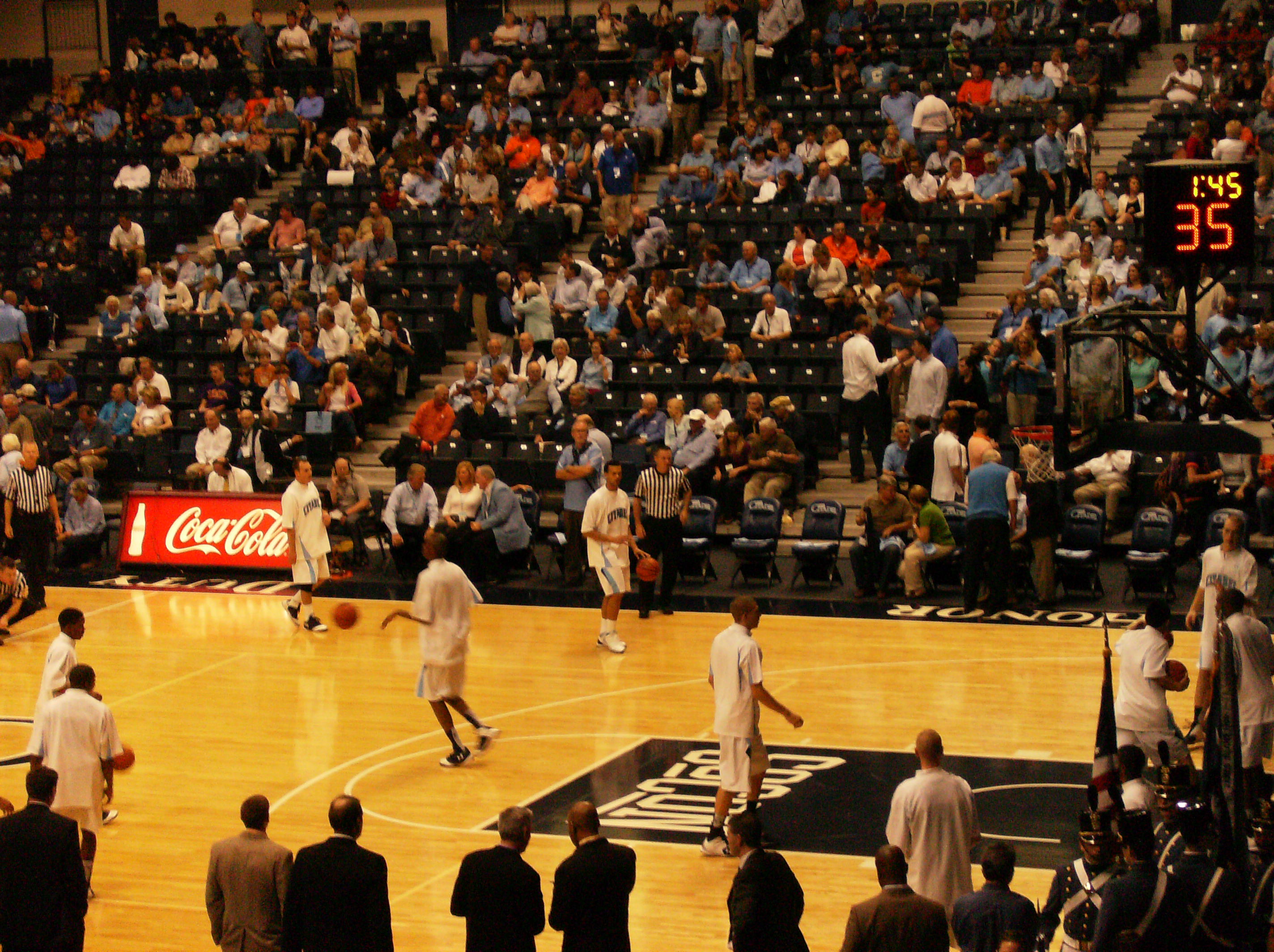
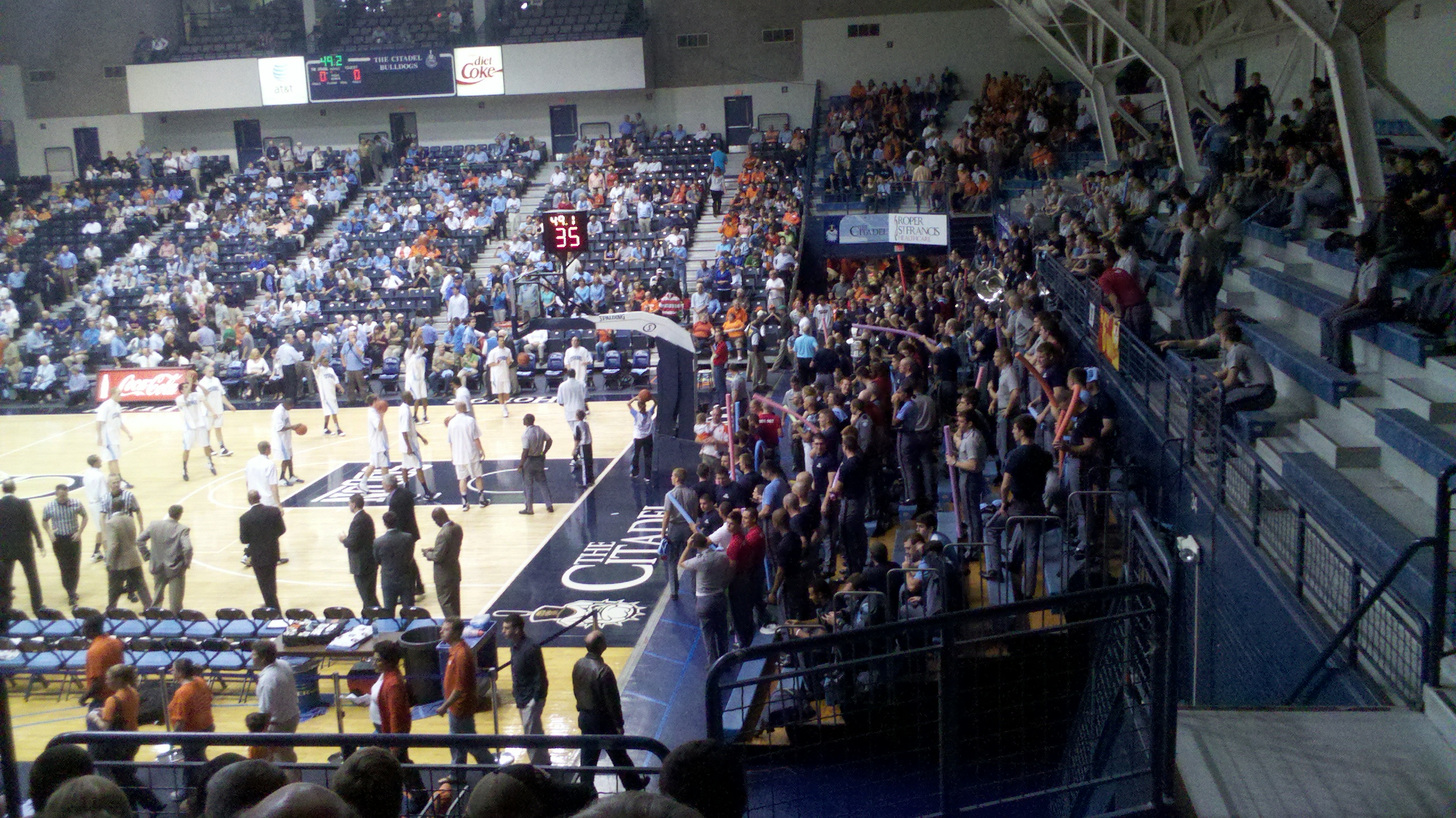
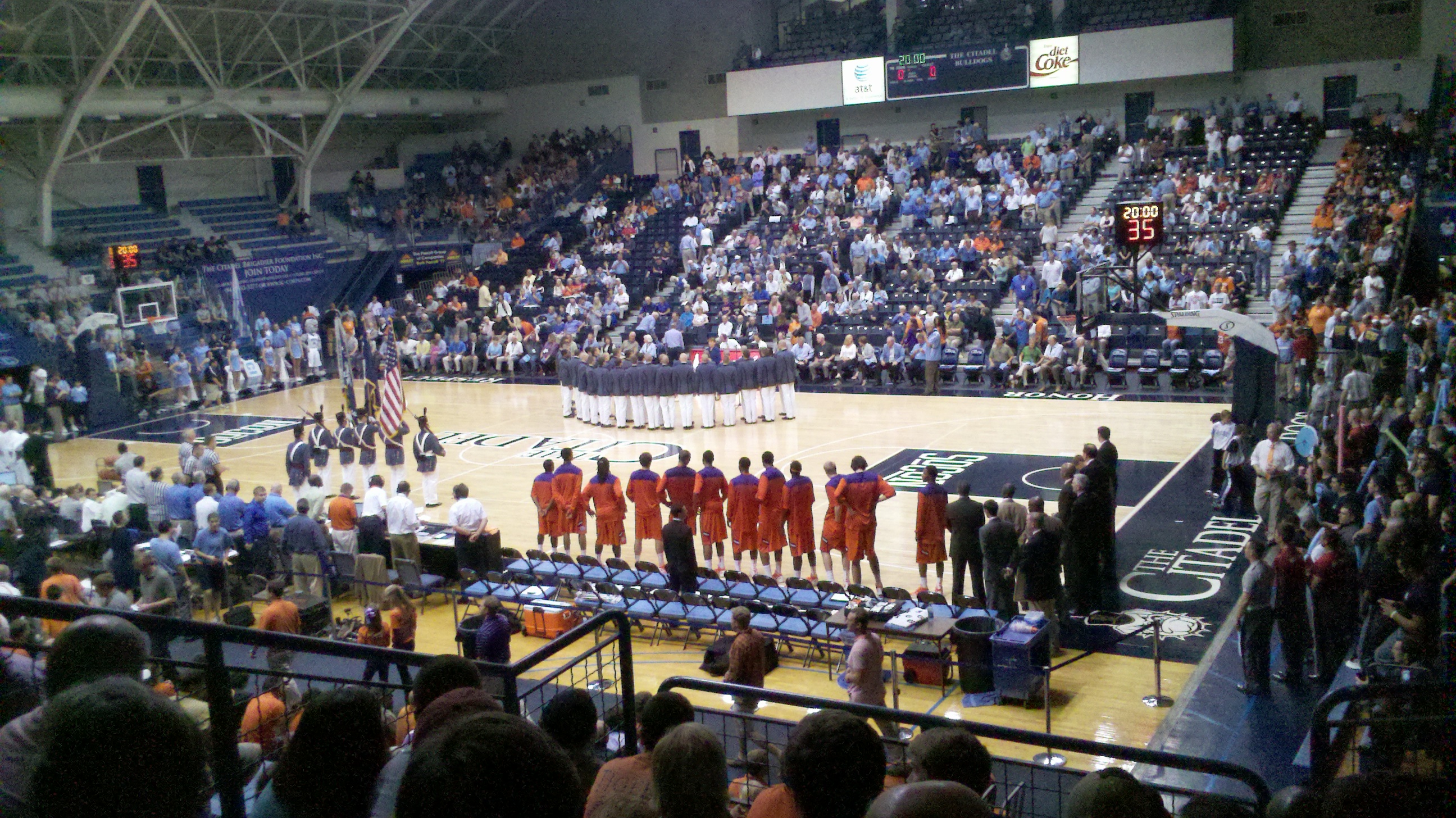
— I was at McAlister Field House for the Clemson game. So were lots of Clemson fans. I would say almost half the fans in attendance were wearing orange. That’s okay (for now), though. We’ll gladly take their money. I took a few pictures. As always, keep in mind that I’m a less-than-scintillating photographer with an iffy camera, which is one reason you won’t see any action photos. All the pictures are from the pregame scene.

2011 Football Game 6: The Citadel vs. Appalachian State

The Citadel vs. Appalachian State, to be played at historic Johnson Hagood Stadium, with kickoff at 2:00 pm ET on Saturday, October 15.  The game will not be televised. There will be a webcast on Bulldog Insider (subscription service), and the game can be heard on radio via The Citadel Sports Network, with “Voice of the Bulldogs” Danny Reed calling the action alongside analyst Walt Nadzak.

This post will serve as a combo review of Wofford/preview of Appy.  I’m going to be having “combo posts” for at least two more weeks, if not longer.

Wofford 43, The Citadel 14.

I’m not sure there is a lot to say about this game that isn’t blindingly obvious, but I’ll try my best anyway.

— In his weekly press conference, Kevin Higgins noted that Wofford’s punt return TD “took the wind out of [the team’s] sails”.  I would say it probably just solidified things in that department; the die was cast when the Terriers moved down the field with ease on the opening possession of the game and scored their first touchdown.

— The horrendous start probably put the kibosh on any cadet corps frivolity, as it’s hard to get wound up for a game when it takes on “no hoper” status that quickly.  I’ve seen some criticism of the corps for its lack of enthusiasm on Saturday, but to be honest I’m inclined to give the cadets a mulligan.

Plus, the issues with the atmosphere at Johnson Hagood Stadium go a lot further than the corps.  The scene on Saturday was particularly jarring, as the tailgating crowd was huge, but when I turned around to survey things shortly before the game started, there just weren’t many people in the stands.  It did fill in a bit a few minutes later; I guess folks knew there was no reason to show up on time, since the Bulldogs don’t score in the first quarter anyway.

I guess a lot of people just wanted to stay in the parking lots and listen to the game on the radio, or perhaps watch/listen to the South Carolina game instead.

It’s a problem.  I’ve typed that before, and I suspect I’ll be typing it again.  Getting those people into the stands is going to be a tall order, at least until The Citadel starts winning on a consistent basis.

The game against Appalachian State will likely be a bit different, as it will be Parents’ Weekend.

— Wofford did not commit a turnover on Saturday and also did not commit a penalty, which was a story in itself, as the Terriers entered the game as the most-penalized team in the Southern Conference.  That was something of an anomaly, as Wofford is usually not a heavily-penalized outfit (much like The Citadel).

In the last four games against The Citadel, Wofford has committed a total of five penalties (for a combined 30 yards).  That includes a delay-of-game penalty the Terriers took on purpose in order to set up a short punt in the 2008 contest.  Only one of the penalties was for more than five yards (a holding penalty in that same 2008 game).

I am not a defensive coordinator, and never will be, and I’m not going to pretend to understand the intricacies involved in running a defense.  When I see a box score in which the opponent did not commit a turnover or a penalty, though, I wonder if the problem is at least partly a lack of aggression.

Wofford aggressively defended The Citadel’s option by having a man go “down hard to attack the fullback“.  The tactic led to bad reads and mistakes by the Bulldogs.  In other words, the Terriers forced the issue.

Mike Ayers was quoted after the game as saying that to “stop the triple option, [you] have to put teams in negative plays.”  Wofford did that.  The Citadel’s defense did not. That has been a theme for the Bulldogs D against Wofford for a number of years now, as the Terriers have scored at least 28 points against The Citadel in every game of the Kevin Higgins era.

— This is possibly the best team Wofford has ever had, which is one reason I wasn’t expecting The Citadel to win on Saturday.  However, I wasn’t expecting a walkover, either, and I was really disappointed by the outcome.  A lot of other alums/fans are just plain angry about the way the series with Wofford has gone in recent years, and you know what?   They have every right to be upset.  There is no excuse.

Something to think about:  there are only 11 seniors listed on Wofford’s entire roster. Eight of them are on the two-deep (The Citadel had nine seniors on the two-deep released for the game against Wofford).  Now, Wofford does not list redshirt juniors as seniors, but as juniors (including Eric Breitenstein), but the fact is that a lot of the Terriers will be back next season.

They probably won’t be as good in 2012.  The eight seniors on the two-deep include starting quarterback Mitch Allen and all three starting defensive linemen (one of whom, Ameet Pall, is Wofford’s best player).  The Terriers will continue to run their stuff on offense and defense, however, and will probably run it well.

— I felt badly for Cass Couey, who had an excellent game punting the ball, but whose efforts were almost completely wasted.  The punt that was returned for a TD was outstanding, with his coverage unit having plenty of time to get to the returner; they just didn’t get the job done.  Then he boomed a magnificent 66-yarder to the Wofford one-yard line — but the Terriers promptly went right down the field and scored.

— For Military Appreciation Day, the Bulldogs made yet another helmet change, although this one was more subtle and did not involve the logo, but rather the stripe. You can see the change in this photo of Ben Dupree:  Link

It’s a “digital camo” stripe, to match the “C” logo on the helmet.  My verdict:  an interesting idea that did not work.  It looked from some vantage points like a regular stripe decal that had been partially scraped off.

Before I get to Appalachian State, some SoCon stats…

— The Bulldogs are in last place in the league in a number of different offensive categories, including third-down conversion rate, fourth-down conversion rate, scoring, total offense, first downs, pass efficiency offense, and red zone offense (although the last one is a touch misleading; I would rate The Citadel’s red zone O ahead of Samford’s, based on TD/FG ratio).

I included pass efficiency and not passing offense in that list, because it’s not surprising The Citadel would be last in total passing, given the triple option.  Wofford is next-to-last in that category — but the Terriers are third in the league in pass efficiency.  When it does pass the ball, Wofford tends to make it count.

Defensively, the Bulldogs are solid statistically across the board, with the exception of defensive pass efficiency, which is a little puzzling.

The Citadel is also last in the league in both kickoff coverage and kickoff returns.  The Bulldogs really need to pick it up in those areas.  To me, the returners have seemed a little too tentative when moving upfield after receiving kicks.

In the SoCon media teleconference, Mountaineers coach Jerry Moore described his quarterback, DeAndre Presley, as “very questionable” for the game this Saturday after suffering an injury to his throwing shoulder against Wofford two weekends ago (Appy had a bye last week).  However, there is a chance he could play.

Not everyone remembers this, but Presley was questionable for the game against The Citadel last year, too.  He started and threw five touchdown passes in three quarters of action.

I’m guessing Presley plays this Saturday, too.

— In that teleconference, Moore was clearly annoyed by his team’s play this season, and seemed (at least to me) overly upset about the Mountaineers’ big loss to Virginia Tech in the season opener.  I realize that Appy as a program thinks it can be competitive against any team, even a traditional FBS power (and of course, the Hokies had lost the year before to James Madison, so it wasn’t exactly the impossible dream).  I was struck by how much the loss seemed to bother the veteran coach, though.

— Appalachian State starts two  freshmen on the offensive line (the center and left tackle), which may explain in part its sluggish offensive numbers (just two offensive touchdowns in its last two games).  On the other hand, there is still plenty of experienced talent on the offense, including Presley, the dangerous running back/returner Travaris Cadet, and the aptly named Brian Quick.

Fans of The Citadel may remember Quick catching a 74-yard TD pass late in the contest at Johnson Hagood two years ago, which tied a game the Mountaineers would eventually win in overtime.  That wasn’t unusual for Quick, who is the FCS active leader in reception yardage and yards per reception.

On defense, the Mountaineers are led by nosetackle Dan Wylie.  The regular starting defensive ends for Appy are “true” freshmen.  Appalachian State has a bevy of experienced linebackers and defensive backs, including Jeremy Kimbrough, who was suspended for the Wofford game after some hijinks in the Mountaineers’ win over Chattanooga.

Appalachian State’s front seven is big; the three starters on the d-line average 287 lbs. per man, and the linebackers are a solid 224 lbs. on average.

Last year, of course, the Bulldogs did not complete a pass against the Appy defense (0-6).

Placekicker/punter Sam Martin is usually reliable, although he had a tough afternoon against Wofford, missing all three of his field goal attempts (two of which were 33-yarders).

I don’t know what’s going to happen on Saturday.  I am expecting, however, a better performance from the Bulldogs than I saw against Wofford.  Not a better effort, as I don’t question last week’s effort.  I would also like to see The Citadel break its first-quarter offensive duck.  It’s time for Triple O’Higgins to get off to a quick start.

I’ll be in attendance on Saturday, along with a lot of proud parents, and a bunch of seniors with shiny new rings.  Good for them.  I must admit I treasure my diploma a bit more than my ring, but I understand the importance of that band of gold.

Speaking of diplomas…is The Citadel going to continue handing out sheepskin?  I certainly hope so.

Go Dogs!

2011 Football, Game 5: The Citadel vs. Wofford

The Citadel vs. Wofford, to be played at historic Johnson Hagood Stadium, with kickoff at 1:00 pm ET on Saturday, October 8.  The game will not be televised.  There will be a webcast on Bulldog Insider (subscription service), and the game can be heard on radio via The Citadel Sports Network, with “Voice of the Bulldogs” Danny Reed calling the action alongside analyst Walt Nadzak.

This is a combination review of the Chattanooga game and preview of the Wofford contest.  I hope to get back to separate review/preview posts following this week; we’ll see.  I’m still recovering from recent travels and a few other things, and I’m not sure I’m still up to speed after being out of the college football loop for the better part of a week (which is a scary thing, believe me).

That’s a long-winded way of saying this particular post may be all over the place. Apologies in advance.  Now, where to begin?

The Citadel 28, Chattanooga 27.

I didn’t expect to find out the final score of the game until Sunday, but I had a chance early Saturday evening to go online.  I checked the score.  It was halftime, and the Mocs were up 24-0.  Ugh.

After that, I was thinking that I could wait to find out the final score for another few hours, or a few days for that matter.  When I got another opportunity about an hour later to go online again, though, I checked the score out anyway.  Hey, I’m a glutton for punishment.  However, it was now 27-14.  Better.  Then the screen automatically refreshed.  27-21.

Chad Billingslea, reportedly a nice guy, had just very nicely blocked a punt, and Rod Harland had run it in for a touchdown (or as French-Canadian announcers would have called it, a touché; Danny Reed should try to make that part of his repertoire).  At this point all of Canada became transfixed by the dramatic events taking place in Chattanooga, as The Citadel completed the comeback via its Triple O’Higgins attack.

Well, really, it was just me who was transfixed, and I had to follow the last few minutes of the game on twitter, which wasn’t exactly optimal, but I’ll take the result.

It is still hard to believe The Citadel rallied from a 27-point deficit on the road and beat a ranked team.  It is, to be sure, one for the record books.  There seemed to be some uncertainty about whether it was the largest comeback ever, as most reports listed the game as the biggest comeback victory for the Bulldogs since a 1973 game against (naturally) Chattanooga.  However, I did a little research, and I’m fairly confident it is the new standard-bearer in the category of “biggest comebacks” for The Citadel.

Prior to Saturday, The Citadel had rallied twice from 20-point deficits to win games in its history.  One of those games was the aforementioned 1973 contest against Chattanooga; the Bulldogs were trailing 20-0 before scoring just before the end of the first half.  Led by Gene Dotson (making his first career start) and Andrew Johnson, however, The Citadel scored 28 unanswered points and beat UTC 28-20.

That game was played at Johnson Hagood Stadium, as was another 20-point comeback victory that took place 33 years later, in 2007.  The Citadel trailed Furman 27-7 midway through the second quarter before rallying to win in overtime, 54-51. Duran Lawson and Tory Cooper carried the day for the Bulldogs.

Overtime wasn’t yet a part of college football in 1989.  That year, The Citadel trailed Western Carolina 22-0 before rallying to tie the game, 22-22 (which would be the final score).  Incidentally, that game was played in Williams-Brice Stadium in Columbia, thanks to Hurricane Hugo.  The 22-point comeback was the largest deficit overcome to avoid a loss before Saturday.

I decided to check scores prior to 1973 and see if there were any possibilities for previous comebacks of an equal or greater magnitude.  This wasn’t as hard as it sounds, because there really weren’t many games in which both teams scored a lot of points.  Usually, when one team scored a lot of points, it was a blowout.  The Citadel did not play in a game in which both teams scored at least 20 points until 1951, a 27-21 loss to VMI at Johnson Hagood Stadium.

The Bulldogs’ first win in a “20-20” game came in 1958, when The Citadel upset Memphis State, 28-26.  There was no big comeback in that one, though the Bulldogs did score late to pull out the victory.  Jerry Nettles and Paul Maguire (he of the “fancy broken field running”) were key players in the win.  I don’t know if any of the current Bulldogs were as emotional on Saturday as was one of the 1958 players after the Memphis victory:

One Bulldog was so taken up with drama of the moment that he just collapsed at midfield and cried as teammates stumbled over his prostrate form.

There was also a 22-21 victory over Arkansas State in 1960 (Eddie Teague went for two and the win at the end of the game, and got it), a 27-22 win over George Washington in 1963, and a series of high-scoring affairs during the Red Parker era, but none of them involved large comeback wins for The Citadel.  The Citadel, featuring Tony Passander at quarterback, never trailed in a 40-28 win over Maine in 1969, although an account of the game states the Bulldogs lost seven fumbles.

In 1971 the Bulldogs “bombed” Bucknell 42-28, but The Citadel didn’t need any late-game heroics, thanks to three first-half TD passes by John Rosa.  I wonder whatever happened to him.  In 1972, though, The Citadel rallied from 11 points down to beat the Bison 38-35 (after blowing a 17-point lead of its own).

I checked out the other Red Parker high-scoring specials (1968: 28-21 over Davidson and 24-21 over William&Mary; 1969:  34-28 over Davidson; 1971:  44-37 over Boston University, 25-24 over VMI, 52-35 over UTC, 35-33 over Furman; 1972:  28-21 over Appalachian State), and none of them featured a big comeback for The Citadel.

I could have missed something, but I think that I looked at every possible game. Saturday’s game against Chattanooga stands alone at the top for comebacks.

Okay, that’s the historical perspective.  History, though, will mean little to nothing when Eric Breitenstein and the Wofford Terriers come to town this weekend.  What does the victory over Chattanooga mean for the team going forward?

I didn’t see the game, obviously, or even get to listen to the live radio broadcast, so I’m somewhat limited in making observations.  I did watch the highlights from The Kevin Higgins Show on Bulldog Insider, which helped a little.  That, reading the various game recaps, and a check of the statistics all lead to the following comments:

— I really appreciated Higgins stating during his show that (I’m paraphrasing) there are only eleven games, and you have to be ready to play in each and every one of them.  Coming out flat is just not acceptable.

— The Citadel still has not scored in the first quarter this season, which is obviously a problem.  The Bulldogs have found themselves in an uphill battle in all four games as a result.

— Kevin Higgins is trying to reverse a couple of trends.  Before Saturday, under Higgins The Citadel was 2-21 versus ranked opponents and 7-20 in the month of October.  He killed two birds with one stone on Saturday.  He’s going to get a chance to do the same thing against Wofford and Appalachian State.

— The Bulldogs lead all of FCS in fewest penalties per game, and least penalty yardage per game.  However, The Citadel’s opponents aren’t committing many penalties either.  While the Bulldogs commit on average only three penalties per game, their opponents are only averaging four per contest.  The penalty yardage difference is similar (24.5 ypg for The Citadel, 37.2 for its opponents).

— The Citadel is only 1 for 7 on 4th-down conversions this season, including a failed fourth down try on Saturday (that ended up being a lost fumble).  Converting on fourth downs is an occasional necessity for a triple option offense.

Wofford is 9 for 11 on 4th-down conversions this season.

— Opponents have been in the “red zone” fourteen times this season against the Bulldogs D.  Those fourteen trips have resulted in three touchdowns, two PATs, and eight field goals.  Three times opponents failed to score.

The Citadel offensively has been in the red zone eleven times, three fewer than its opponents, and like its opponents has failed to score on three occasions.  However, five of its eight scores have been touchdowns.  As a result, The Citadel has scored 44 “red zone” points.  Opponents have scored…44 red zone points.

— In the second half (and OT), the Bulldogs’ defense has allowed a total of 18 points in four games (with only one touchdown).

— The defense has forced seven turnovers in four games, three interceptions and four fumbles.  Davis Boyle has collected four of them (two INTs and two fumble recoveries).

— The Citadel has to stop fumbling.  Six more mishandles occurred on Saturday, with three resulting in turnovers.  The Bulldogs are now on pace to fumble 39 times this season, which would more than likely give The Citadel the unwanted distinction of leading FCS in that category two seasons in a row.

It is easy to see how the fumbles affected field position by just looking at the drive charts.  UTC had five scoring drives, with three of them (including two of its three TDs) coming after lost Bulldog fumbles.  The two touchdown drives started on the UTC 42-yard line and The Citadel 7-yard line.

One of the two field goals came early in the third quarter, with Chattanooga starting out with a first-and-goal on the Bulldogs’ nine-yard line.  The defense being able to hold the Mocs to a FG was critical.

— The only real negative for the defense on Saturday were two long pass plays, one for a 60-yard TD and another that set up a field goal.  That’s two long pass plays for TDs in two weeks, after Elon scored on a 41-yarder the week before.

The Citadel can’t afford to have Wofford hit one or two deep passes, which is a Terrier trademark.  Wofford only has 17 pass completions this season, but four have been for touchdowns, including a 66-yarder against Clemson (the average WC completion has gone for 23.4 yards).

— Cass Couey had a very good day punting, allowing no return yardage and downing two punts inside the 20, including one downed at the three-yard line.

— B.J. Coleman had thrown 88 passes against The Citadel at Finley Stadium over two games without being sacked before he was finally brought down by Rod Harland. Coleman threw two more passes and was then sacked again.

— White jerseys, white pants.  Appropriate.

— This game will feature two outstanding defensive lines.  Wofford’s DL includes Ameet Pall, the preseason SoCon defensive player of the year.  He is a native of Montreal who really should have gone to McGill, but perhaps he prefers South Carolina winters.  Hard to blame him.

His friends on the d-line aren’t too bad themselves.  Ask Appalachian State quarterback DeAndre Presley, who injured his shoulder against Wofford.  It could be that having what now amounts to a two-quarterback system may not be such a bad thing for The Citadel.

Pall is going to be a key figure in this game.  Will the Bulldogs option off him?  Will they be able to do so?

— Wofford is 0-1 when it wins the coin toss, 3-0 when it doesn’t.  Obviously that is an important statistic.

— This game, as stated at the top of the post, is not televised.  It’s the first time in six years the game between Wofford and The Citadel has not been on TV.

— Last year Wofford beat The Citadel 35-0.  Not only did the Bulldogs fail to score, they didn’t have a snap inside the Terriers’ 20-yard line.  The defense played well for the most part, but Wofford took advantage of great field position for the entire game (the average drive for the Terriers started at its own 44-yard line).

I am hopeful that the game against Chattanooga will propel the Bulldogs to a successful season.  That doesn’t necessarily mean there is going to be a victory for The Citadel this Saturday, however.  In looking over Wofford’s season statistics, game recaps, and other various accounts, it’s clear that this is a particularly strong Terriers squad.

Wofford has a system, and traditionally runs it well, and this year’s edition seems even more adept at running it than the norm.  The worst thing that happened to Wofford against Appalachian State was probably a ten-minute drive that resulted in no points.  If that’s the biggest negative, then there were a lot of positives.

The Citadel can’t even count on complacency, but that’s the Bulldogs’ own fault (in a good way).  Bottom line:  it will take more than great halftime speeches to win this game.

Having said that, I’m looking forward to Saturday’s game and the rest of the season. Maybe, though, it would be better not to spot the rest of our opponents a four-touchdown lead…

2011 Football, Game 2: The Citadel vs. Furman

The Citadel vs. Furman, to be played at historic Johnson Hagood Stadium, with kickoff at 6:00 pm ET on Saturday, September 10.  The game will be televised on WYMA (Asheville, NC), and will be available on ESPN3.com.  There will also be a webcast on Bulldog Insider (subscription service), and the game can be heard on radio via The Citadel Sports Network, with new “Voice of the Bulldogs” Danny Reed calling the action.

The Citadel begins play in the Southern Conference with a game against traditional rival Furman.  It’s only the third time the two schools have ever met in a league opener, but it’s the second consecutive season that has been the case.

I’m not going to rehash the history of the series in terms of the time of year the game has been held; anyone interested can read what I wrote on the subject for last year’s game preview.  Regardless of whether you think the game should be a midseason clash (my preference) or played at the end of the year (a not-insignificant number of fans from both schools), I think everyone can agree that September 10 is too early for this game to be played.

Jeff Hartsell has reported that, per the SoCon office, next year’s meeting will come at the end of the 2012 season, on November 17.  (The conference does not make league schedules beyond one year in advance.)

I’m okay with that, as long as the Clemson-South Carolina game continues to be played the Saturday after Thanksgiving, as is now the case.  I just don’t want The Citadel and Furman to play on the same day as the matchup between the Tigers and Gamecocks.

Furman was 5-6 last season, its first losing campaign since 1998.  Bobby Lamb resigned after nine years in charge and over a quarter-century at the school as a player or coach.  The Paladins had missed the FCS playoffs for four consecutive seasons, which did not go over well among some supporters.  It was time for Furman to make a change.

The question, though, is did Furman really make a change?

The new coach is Bruce Fowler.  Fowler is a 1981 graduate of Furman who played for Dick Sheridan.  Lamb was a 1986 graduate of FU who had played for Sheridan. Fowler spent 18 years at Furman as an assistant coach.  Lamb had been an assistant coach at Furman for 16 seasons.

One difference is that Fowler wasn’t a complete Furman lifer like Lamb had been.  For the past nine years, he had been an assistant at Vanderbilt, where he was defensive coordinator for Bobby Johnson (and Robbie Caldwell in 2010).  Of course, Johnson had been the head coach at Furman before taking the Vandy job, and before that he had been an assistant under Dick Sheridan.

You may have noticed a pattern here.  Dick Sheridan left Furman after the 1985 season to take over at N.C. State, but his presence is still felt in the program.  All four of the men who have held the head coaching position since Sheridan left (including Fowler) were players and/or assistants under him.

If you were going to have your football program maintain what is in effect a 25-year tie to a former coach, you could do much worse than Sheridan, who did nothing but win throughout his coaching career (even as a 28-year-old rookie head coach at an Orangeburg high school).  It’s a type of continuity that may be worth preserving.

On the other hand, there is always the possibility that Furman risks going to the well once too often.  Fowler isn’t exactly a carbon copy of Lamb, though — for one thing, he’s 52 years old, 13 years older than Lamb was when Lamb got the job.  Also, he’s primarily a defensive coach (though he was the receivers coach at FU for seven seasons).  Lamb was mostly an offensive coach (and a former quarterback) during his time with the Paladins.

Usually when a school is in a position to make a coaching change after a run of disappointing seasons, it brings in somebody to shake things up.  That’s certainly not what Furman has done.  Besides Fowler, three of the assistant coaches played for Sheridan; another has been a Paladins assistant for 13 years.

Before I move on to the Paladins of 2011, I should note that Art Baker, who preceded Sheridan as head coach at Furman (eventually leaving to take the job at The Citadel), hired Sheridan, Jimmy Satterfield, and Bobby Johnson as assistant coaches, all of whom would later ascend to the top job at FU.  Baker had a significant impact on Furman’s coaching tree.

Furman lost 30-23 at Coastal Carolina in its opener.  The Paladins never led the contest.  The game had been tied at 16 and 23 before the Chanticleers scored the game-winning touchdown with 1:23 remaining in the fourth quarter.

Coastal Carolina gained 231 yards rushing and 195 yards passing against the Furman defense, but perhaps more interesting was that the Chanticleers had 59 rushing attempts for the game.  CCU ran 81 offensive plays from scrimmage for the game, while the Paladins had just 58.

As Bruce Fowler noted in the SoCon teleconference, Furman had trouble getting its defense off the field.  Coastal was 7-16 on 3rd-down conversion attempts and made its only 4th-down try, a major reason the Paladins trailed by over 12 minutes in time of possession.  That continued a trend from last season, when Furman finished last in the SoCon in time of possession.

The Paladins do have two impact players on defense, middle linebacker Kadarron Anderson and cornerback Ryan Steed, both of whom are on the Buck Buchanan Watch List.  Another linebacker, Chris Wiley, had fourteen tackles against Coastal Carolina.  Furman defensive end Josh Lynn is tall (6’5″) and rangy, and may be a key factor in how the Bulldogs’ triple action attack fares on Saturday.  Against Coastal, he had five tackles and a sack.

Furman’s starting quarterback against Coastal Carolina was Chris Forcier, of the Forcier Family of Quarterbacks.  I think it’s fair to say that the Forciers are, as a group, somewhat controversial.  I guess it’s a question of style.  When Chris Forcier decided to transfer from UCLA to Furman, the family issued a press release that wound up being posted on Deadspin.

His brother Tate is a former Michigan quarterback who has now transferred to San Jose State (after originally announcing he was going to Miami).  His oldest brother, Jason, also played quarterback at Michigan before transferring to Stanford.  The brothers also transferred to different high schools at various times.

Against the Chants, Forcier was solid, completing two-thirds of his passes while averaging over seven yards per attempt.  A classic “dual threat” quarterback, Forcier also rushed for 50 yards before leaving the game in the third quarter, apparently suffering from cramps.  Without him, the Furman offense sputtered, not scoring in the fourth quarter.

Assuming he is healthy (and there is no reason to believe otherwise), stopping Forcier will be a difficult task for The Citadel’s defense.

If dealing with Forcier wasn’t enough, the Bulldogs must also contend with Jerodis Williams, who rushed for 142 yards and 3 touchdowns against Coastal (including a 68-yard score).  Williams was the Southern Conference offensive player of the week, and also picked up FCS National Back of the Week honors from something called the “College Football Performance Awards“.

Furman had five different receivers catch passes against the Chanticleers (including Williams).  Tyler Maples had five receptions for 65 yards.  Colin Anderson had four catches, and presumably will have a career day against The Citadel, as has often been the case for Furman tight ends.

Along the offensive line, Furman has experienced and well-regarded tackles (one of whom, Ryan Lee, is moving from guard to tackle) and a veteran center, Daniel Spisak (who is Matt Millen’s nephew).  The guards include a first-year starter who came to Furman as a walk-on, and a sophomore who started three times last season before a season-ending foot injury.

Furman placekicker Ray Early was 11-12 on field goal attempts last season, including a long of 52 yards, and only missed one extra point all year (40-41).  Against Coastal Carolina, however, Early’s first field goal attempt of the season was blocked, and he then missed the PAT after the Paladins’ first touchdown.

After that, Early did not attempt a placekick in the game (although he did kick off), giving way to Furman punter Chas Short.  That may be something to watch on Saturday.

Short, incidentally, had a fine year for Furman in 2010.  The Paladins finished in the top 10 nationally in net punting.

With Furman having allowed a bunch of rushing yards to Coastal Carolina, and having lost the time of possession battle so decisively, there may be some hope among Bulldog fans that the Paladins’ defensive issues could play into The Citadel’s hands on Saturday.  As Jeff Hartsell wrote in The Post and Courier:

…on defense, the Paladins’ 4-3 look was blitzed for 237 rushing yards, including 105 yards and two TDs by CCU quarterbacks Aramis Hillary and Jamie Childers. That might bode well for the Bulldogs’ option attack, as QB Ben Dupree went for 141 yards and two scores in a 31-9 win over Jacksonville. Higgins said Dupree was 23 for 23 on his option reads, and The Citadel rushed for 439 yards, the most since 1994.

That does seem promising from The Citadel’s perspective.  I would make this observation, though:

The Bulldogs ran the ball well on Furman last year, dominated time of possession, and lost 31-14.  The Citadel gained 294 net yards rushing on 60 attempts, held the ball for over 36 minutes — and did not score until the fourth quarter.

Actually, The Citadel’s 359 total yards against Furman in 2010 was the most yardage gained by the Bulldogs in any Southern Conference game for the entire season.  The problem?  Three turnovers, a missed field goal, and a failed fourth-down try inside the Furman 25.  Another issue was that The Citadel started very slowly on offense, gaining only 64 total yards on its first five possessions.

Conversely, Furman got out of the blocks fast on offense in each half, scoring touchdowns on its initial drive in both the first and third quarters.  Of the Paladins’ other three scores against The Citadel, two came on drives starting in Bulldog territory after an interception and a failed onside kick.

Kevin Higgins has said in the past that sometimes it takes a triple option team a possession or two to figure out how the defense is playing.  That makes sense.  You could see it in last week’s game against Jacksonville, as the game was well into the second quarter until Triple O’Higgins got fully warmed up.

Against a SoCon opponent, though, it needs to warm up faster.  The Bulldogs can’t go an entire quarter with no offensive production, especially as running the offense generally means there are fewer possessions in the game.  Also, while obvious, The Citadel must control its fumbling problems, which cropped up against Jacksonville (albeit with only one coming on an exchange) and stay “on schedule”.

The other thing that can’t happen Saturday if The Citadel has any chance of winning is for the defense to concede relatively easy touchdown drives right out of the dressing room.  Last season, Furman’s TD drives in each half were for a total of 123 yards and featured only two third-down plays.

What the defense really needs is to force some turnovers.  Last year against Furman, the Bulldogs forced no turnovers and also did not record a sack.

The Bulldogs must also contain Forcier, who is capable of making big plays with his arm or his feet, and prevent Williams from breaking long runs, such as the one he had against Coastal Carolina.  (Also, the defense must watch the tight end.  He’ll be catching the ball over the middle for 15 yards before you know it.  Two or three times.)

I thought Ben Dupree played well against Jacksonville.  What he proved, beyond a shadow of a doubt, is that he has the ability to make big plays.  While the triple option is mostly about moving the chains, it’s important to have a breakaway aspect to the offense, and Dupree can provide that with his running ability.  He is still a work in progress as a passer.  If he continues to improve that part of his game, he will be a very dangerous weapon indeed.

Terrell Dallas’ injury against the Dolphins was not serious, thankfully, but it appears he may not play on Saturday.  That will be a loss, but Darien Robinson showed he is quite capable of handling the fullback position.

I thought the defense really came to play against Jacksonville.  Now it faces another challenge.  It won’t have the size and depth advantage against Furman that it had against the Dolphins.

Odds and ends:

— Check out the game notes to see all the different helmet logos The Citadel has had over the years (page 5).  There have been no fewer than 25 different designs since 1952 (and I think it’s likely there have been a few more that went unrecorded).

Those artist renderings/photos in the game notes came from the Helmet Archive, a good site if you want to peruse helmet histories of other teams as well.

— Has anyone else noticed that there are a lot of entities giving out “player of the week” awards these days?  It’s hard to figure out which ones to take seriously.  I can’t decide if the plethora of “recognition sites” is a boon or a curse for athletic media relations departments.

— The Summerall Guards are performing at halftime, but not at Johnson Hagood Stadium.  The Guards will be in Death Valley for the Wofford-Clemson game (it is Military Appreciation Day at Clemson).  It strikes me as a little odd that they would perform at another stadium on the same day as a home football game, but no big deal.

I’m looking forward to the game.  I am hopeful that the success of the home opener, along with Saturday’s opponent, results in a nice crowd at JHS.  As for the on-field action, I’m not quite sure what to expect.  I was pleasantly surprised by what I saw against Jacksonville.  I would like to be pleasantly surprised again.

SoCon hoops season begins for The Citadel

On Thursday, The Citadel begins play in the Southern Conference with a home game against Georgia Southern.  Before discussing that game and the two matchups that follow, I want to take a look back at the first five games of the season.

I figured that at worst The Citadel would be 2-3 after five games.  There was only one game (Richmond) that I did not think The Citadel had a good chance of winning, and even there I thought the senior-laden Bulldogs would be competitive.

As it happens, The Citadel was blown out by Richmond in an embarrassing fashion (79-37).  The Bulldogs then lost at Charleston Southern (a very disappointing result) and dropped their home opener to James Madison (which I would have rated as a tossup game).  Chuck Driesell finally got his first career win against High Point, an “expected” win, but then The Citadel blew a second-half lead and lost at Coastal Carolina.

The Bulldogs have had serious issues on the defensive end, especially in the second half.  The Citadel led at the half against Charleston Southern, James Madison, and Coastal Carolina, and lost all three games.  The Bulldogs are allowing opponents to shoot exactly 50% from the field, which is the bottom 20 nationally.

Breaking it down a little further, The Citadel’s opponents are shooting 54.4% from 2-point range (bottom 40 nationally).  That suggests a lack of presence on the inside, which is borne out by below-average rebounding numbers and the fact the Bulldogs have blocked a grand total of two shots in five games.

In the second half, the defensive FG% numbers are beyond terrible. In The Citadel’s four losses, opponents are shooting 62% from the field after the halftime break, which is a good reason why the Bulldogs lost those leads.  For example, a five-point halftime lead over JMU dissolved when the Dukes shot 71% in the second half.  The three-point shooting numbers for opponents haven’t been that bad (not great, but reasonable), but The Citadel has just been abused in the paint.

On offense, the Bulldogs are also struggling, with an eFG of 42.1%, which is 306th out of 347 Division I teams.  Zach Urbanus, a mainstay for The Citadel for four years, is shooting just 30.9% from the field and 29.6% from 3-land (last year those numbers for Urbanus were 38.9% and 40.0%, respectively).  Cameron Wells and Austin Dahn are near their 2009-10 numbers, with Wells starting to get going (enough to be the latest SoCon Player of the Week).

Those three have scored 204 of The Citadel’s 300 points, which is 68% of the Bulldogs’ scoring offense.  Last season, they accounted for 57% of The Citadel’s points, so a little extra offensive help for them would be nice.  However, getting the defensive deficiencies straightened out has to come first.

One issue is that the “big three” are playing a lot of minutes.  They always have, but it’s even more pronounced this season.  Urbanus is averaging 38.6 mpg, an increase over his workload of 36.1 mpg last season.  Wells is averaging 35.2 mpg (34.9 in 2009-10), and Dahn 32 mpg (26.1 last season).

I believe that for The Citadel to have a successful season, those numbers have to go down a bit.  I was hoping, actually, that they wouldn’t be so high so early in the season, but Driesell’s rotation has been fairly tight so far.  Only eight players have seen action in all five games.  Going forward, the Bulldogs need to get quality minutes out of some other backcourt performers.

The Citadel also needs to get increased productivity from its big men, on both ends of the court.  So far the only frontcourt player getting the job done is Bryan Streeter, who has been basically all you could ask of an undersized “4”, except for the fact he can’t shoot free throws at all.  Being so foul from the foul line has been problematic at times, and obviously down the stretch of close games is a real liability, but aside from that he has been solid — arguably the second-best player on the team after Wells.

Streeter has had to be solid, because he hasn’t had a lot of help down low.  In particular, the much-discussed 7-foot transfers, Morakinyo Williams and Mike Dejworek, have yet to make an impact.

Dejworek did not play in the last two games, and in the games he has appeared has averaged fewer than two rebounds per contest.  He has scored two points in 32 minutes of play.  Williams is shooting only 26.3% from the field, which is remarkably poor for someone who plays so close to the basket.  He is a decent defensive rebounder, but has not shown an affinity for the offensive glass (a Streeter specialty). Williams also has more turnovers in 68 minutes of play than Wells does in 176 minutes of action.

Chuck Driesell promised a more up-tempo style this season.  The Citadel is averaging 7.6 more possessions per game so far, but seems to still be searching for an offensive identity.  The defense would be a problem regardless of the game’s pace.

While being interviewed postgame on the radio after the loss to Coastal Carolina, Driesell openly wondered if fatigue was affecting the team’s defensive play.  He may have a point, and it’s just another reason to watch individual players’ minutes, but I think post play is a bigger factor (although that doesn’t completely explain opponents’ second-half success).  I’m not watching the practices, so I’m not going to advocate for individual players to get more time, but I have to admit there are two or three players who I would like to see on the court more often.

I am a little worried this is going to turn into a true “transition” season, one in which a new coach establishes his style of play at the expense of wins and losses.  I hope that doesn’t happen, for two reasons.  The first is that this is as good a senior class as The Citadel has had in many, many years, and I want to see them succeed.  I think they have a chance to build upon the previous two seasons and win a lot of games.

The other reason is that I believe, based on what has happened so far this season, that the SoCon is there to be had.  This is not going to be a vintage year for the league (not that any year ever is).  The league has gone 21-44 in non-conference action (through November play).

That includes a 3-20 mark against major conference opponents, with the three wins coming against BCS bottom-feeders Auburn, DePaul, and Nebraska.  The league’s best OOC victory is probably Appalachian State’s 89-86 win over Tulsa.  It could be argued the SoCon’s best performance came in a loss — Wofford’s 3OT defeat at Xavier.

There is an opportunity for The Citadel to make some noise in the league.  That needs to start on Thursday.

Georgia Southern is struggling.  The Eagles’ record is 2-5, and the two wins are both over non-Division I teams.  GSU has lost consecutive neutral-site games to Chicago State and Mississippi Valley State; the other losses were drubbings by Notre Dame, South Florida, and Texas Tech.

It should be pointed out that none of GSU’s five losses came at home, but the statistics indicate that the Eagles greatly resemble last season’s squad, one that went 9-23 and played terrible defense.  That 9-23 mark included a split with The Citadel, with the Bulldogs hammering the Eagles at McAlister Field House in the first game, and then blowing a 21-point second half lead and losing the second.

Willie Powers scored 19 points to lead GSU in that matchup, but unfortunately won’t be playing this season.  The star-crossed Powers has been a fine player when healthy, but he suffered his second major knee injury in August and is out for the year.

Without him, the Eagles appear to be a similar outfit to last year’s edition.  GSU averages 77.6 possessions per game, has a turnover rate among the bottom 40 nationally and shoots poorly from beyond the arc (28.1%).  It’s hard to play racehorse basketball without the horses.

Davidson was 16-15 last year in Year 1 A.C. (After Curry).  I think the Wildcats could be a sleeper pick to win the league this year, assuming Davidson can ever be a sleeper pick in the SoCon.  I’m not sure the Wildcats were completely prepared to play without Stephen Curry last season, but this year should be a different story.

Davidson is 3-3.  None of the losses are bad, and the Wildcats do have a win over a major conference team (Big XII caboose Nebraska). Davidson has four players averaging double figures in scoring, including center Jake Cohen, who as a freshman scored 39 combined points in two games against The Citadel last season.  Cohen will again be a difficult matchup for the Bulldogs.

The Wildcats are not yet locked in from beyond the arc (28.8%), but that was true last year as well until Davidson made 15 three-pointers at McAlister Field House.  The Wildcats are holding opponents to 40.4% shooting from the field, which includes excellent interior defense (at least statistically).  Davidson does foul a lot, averaging 23 per contest.

Before playing The Citadel, Davidson will travel to the College of Charleston.  It’s the second year in a row the Wildcats have opened SoCon play by making the Low Country swing.

The Citadel’s third game in five days (and last before an 11-day break for exams) is a non-conference matchup with St. Mary’s.  That’s not the St. Mary’s in California that made last year’s Sweet 16; no, this St. Mary’s is a Division III school in Maryland.

Some fast facts about the school, for those unfamiliar with St. Mary’s:

— Like The Citadel, St. Mary’s has about 2000 undergraduates, was founded in the 1840s (1840 for St. Mary’s, 1842 for The Citadel), is a public school that is often mistaken for a private institution, and is big on history.

— The “big on history” thing is a little different, though.  St. Mary’s is located in St. Mary’s City (hence the name of the school), which was once the capital of Maryland. There is a significant archaeological site in the area; actually, the town is basically the school and that site.

St. Mary’s City was the fourth British settlement in North America, and founded as something of a test case for religious tolerance.

— St. Mary’s was a junior college for most of its existence; it has been a four-year college since 1966.

— Notable alums include professional wrestler Scott Hall (also known as Razor Ramon, and an original member of the New World Order!) and trailblazing female baseball player Julie Croteau.

— The Seahawks play in Division III and are members of the Capital Athletic Conference.

One of St. Mary’s fellow CAC schools is Marymount, which was once coached by…Chuck Driesell.  That may go a long way towards explaining how this game with St. Mary’s came to be.  Of course, it may have nothing to do with it, for all I know.

One thing Driesell will be sure to tell his players is that they can’t take St. Mary’s lightly. This is a solid Division III program.  The Seahawks were 26-4 last season and made the D-3 Sweet 16.  They are a cut above The Citadel’s normal non-Division I fare and should be respected as such.

St. Mary’s has won four of its first five games this season to date (and will play another game, against Stevenson, before facing The Citadel).  The Seahawks are led by 6’1″ guard Alex Franz, a two-time All-CAC selection who is averaging 15.5 points per game.  Statistically, St. Mary’s doesn’t have any extraordinary numbers, although the three-point differential is curious — the Seahawks are shooting 38.4% from beyond the arc, while their opponents are shooting just 22.9% from 3-land.

To get off to a good start in the league, The Citadel must improve defensively and needs contributions from a wider variety of players on its roster.  I will be disappointed if the Bulldogs do not win at least two of the three upcoming games.  Winning all three would make up for the slow start.

Review: Samford

The Citadel 13, Samford 12.

Victory!

It wasn’t a dominating performance, to say the least, but a win is a win, especially after losing seven straight games.  Almost all the numbers favored Samford except the ones on the scoreboard that actually count.

That’s why I wouldn’t put this game down as a triumph for The Citadel’s triple option offense.  In truth, Samford’s defense did a good job handling the option attack, much as it had in games against Georgia Southern and Wofford.  The Citadel was held to 119 yards rushing, and just 203 total yards.

Samford outgained The Citadel by more than two to one, had almost twice as many first downs, and did not turn the ball over.  Neither team fared well on third down (The Citadel converted just one of eleven third-down opportunities).

The Citadel won the game thanks to winning the special teams battle (courtesy of a blocked punt by Milford Scott, who you knew was going to get one eventually), and by outstanding red zone defense.  Going into the game, The Citadel’s opponents were scoring touchdowns 71% of the time when in the red zone, but in this game Samford did not get a TD, as The Citadel’s defense held the Birmingham Bulldogs to just three field goals on four trips inside the 20.

Even with the great defense and Scott’s big play, The Citadel still trailed late in the game when Kevin Higgins called for some “trickeration”.  The circle of the season was completed when Luke Caldwell, who served as quarterback for the spring game before moving back to receiver, threw a pass to Rickey Anderson for 55 yards.  Both players deserved that moment.

One play later, Ben Dupree was in the end zone, and after some anxious moments late, the Cadets had their much-needed win.

This was the last game of a trying season, one with very little to cheer about, and that makes it all the more impressive that the team was focused and motivated on Saturday.  Now, I’m on record as stating that the team should always be ready to play — after all, there are only eleven games in a season — but it would be understandable if the concentration level had not been particularly high for an end-of-season road game against a largely faceless opponent, following a bye week, and leading to the Thanksgiving break.

Instead, the defense held on and did not break, despite allowing Samford to march down the field on multiple occasions, and forced the home side to settle for those field goals.  The offense struggled, but did not give the game away, and grabbed the win when presented with the chance.

To the surprise of almost nobody, Larry Leckonby confirmed on Monday that Kevin Higgins would be back.  I am fine with this, having outlined my reasons in a prior post.

“I don’t think I would say I was satisfied (with the season),” said Leckonby, who was hired in June 2008, after The Citadel had agreed to a five-year extension for Higgins. “I had hoped the outcome would have been a little better in terms of wins and losses, and some of our performances were marred by multiple turnovers.

“I would not say I was satisfied, but I think we did improve from start to finish with the triple option, and that we’ve got a base to build on for next year.”

Leckonby’s statement that he thought the team “did improve from start to finish with the triple option” is debatable.  The lack of turnovers in the final two games (just one in those two contests) was the biggest improvement in the offense.  However, the point production and total yardage really was not much different than from the Bulldogs’ first two league games.  Of course, after the nightmarish game against Georgia Southern, anything would be an improvement.

That isn’t to say that the second season of Triple O’Higgins won’t be a smashing success.  It’s just that there aren’t any obvious markers from this year that would lead one to conclude that a breakthrough is coming.

I hope it happens, of course.  For Higgins’ sake, it needs to happen, because next year it will be now or never.  It won’t be easy, either.

The non-league slate is tougher, with Jacksonville and VMI coming to Johnson Hagood Stadium and the Bulldogs making the trip up I-26 to face the Gamecocks. There are no Chowans in that group (and I suspect that Jacksonville will be much better than some fans of The Citadel might anticipate).  The SoCon will be tough, like it always is.

Of course, it’s never easy at The Citadel.  That’s why it is important to be patient. Patience is a virtue.

Winning is a better virtue.