The Citadel’s varsity sports teams, 2011-12: a brief review

Around this time last year I posted a review of the 2010-11 school year for varsity sports entitled “Larry Leckonby’s Lament“. I wouldn’t call this school year in the department of athletics a lament; rather, it was more a year of transition. At least I hope it was…

First, the setup, just so everyone is on the same page. As I wrote last year:

The Citadel has fifteen varsity sports, by my reckoning.  I count rifle (listed as both a men’s and women’s sport on the school’s website) as just one sport, because it is co-ed.  I consider indoor track and outdoor track to be separate entities, because the Southern Conference awards championships in both of them (and for both men and women).  The school competes in the SoCon in fourteen of the fifteen sports (the exception is rifle).

Last year the rifle team garnered The Citadel its sole conference championship of the 2010-11 school year, the SEARC title. This year, the Bulldogs finished second. Before I move on to the rest of the sports, which play under the SoCon banner, I want to make a couple of quick points/observations about the rifle team:

— Anyone interested can donate to the rifle team through this link; it’s some kind of $3-for-$1 deal. I think this particular fundraising effort may have flown under the radar. The team did get a $20,000 donation from the National Wild Turkey Foundation. Wild turkeys themselves largely approved of this donation, under the theory that the more shooting that takes place at the range, the less that goes on in the field.

— When I wrote my infamous manifesto on varsity athletics at The Citadel a few months back, I noted that increasing the budget of the rifle program, if at all possible, would be a good idea, particularly since The Citadel is a military college with a great shooting facility. This is an NCAA sport, and one in which the school can compete on a national level.

As for the remaining fourteen sports, the average finish for the varsity teams in league play was 8.6, with an average of 10.5 competing schools for each sport. In other words, the average finish was third-from-last. Reviewing the year on a sport-by-sport basis:

— Women’s soccer: After a breakthrough season in 2010, one in which The Citadel finished third in the SoCon, the soccer team regressed to a 5-11-3 overall record, finishing ninth in the league and missing the conference tournament. It was a disappointing season, but it is to Bob Winch’s credit that a year in which the women’s soccer team won three league games and tied two others could be considered a disappointment.

— Wrestling: The Citadel had three individual conference champions, and tied for second in the league tournament after a third-place finish in the regular season. This was an improvement on the prior campaign, when the Bulldogs finished fourth of six teams. All in all, a solid year for the mat men.

— The Citadel finished fourth in the SoCon (out of nine teams) in both men’s indoor and outdoor track, one spot better than last year. The women were 9th (out of twelve teams) in outdoor track, which was the same as last season, but slipped to 11th out of 12 indoors.  On the bright side, at least they scored a few points at the respective SoCon meets. Davidson managed to score just one point in the two women’s competitions combined.

One of the more interesting stories in this varsity sports year for The Citadel came in men’s outdoor track. From the school’s season recap release:

Decathlete Ellison Glenn was the team’s biggest surprise this season. Glenn, who walked on the team as a senior, improved each week and capped his short collegiate track career with a fourth place finish in the decathlon and eighth place mark in the javelin at the 2012 SoCon Outdoor Championship.

“He came in and asked to be part of the team and we debated, but he kept coming to practice and sticking with it so we gave him a shot to see how it would shake out for us and it worked out amazingly,” said Bulldog head coach Jody Huddleston. “Taking fourth and eighth place and earning points in the conference meet after competing in college track for just one year is amazing.”

— As usual, the Bulldogs struggled (at least compared to their league peers) in cross country, although the men did climb one spot, finishing ninth out of eleven competing schools after finishing next-to-last the year before. The women were also next-to-last in 2010; in 2011, alas, they were last.

Remember, Charleston is not exactly conducive to fantastic cross country training. The Citadel’s best placement in the league in school history came in 1972, when it finished third.

— Tennis: Last year the Bulldogs were 3-21, 0-10 in the SoCon. This year a new coach took over. The results were about the same, though; The Citadel was 5-18 overall, and again went winless in the league. At least this year the Bulldogs beat a fellow Division I school (Bethune-Cookman).

— Volleyball: This was another sport with a first-year head coach, and another sport with a similar-looking record from last year. This year’s team won one more match than last year’s squad while finishing with the exact same league record (1-15).

— Women’s golf: The Citadel finished last, again, but some progress appears to have been made. At the SoCon Championships, the team finished 112 shots behind league champ Chattanooga. That’s actually an improvement from 2011, when the Bulldogs were 149 shots back of the conference titlists. The Citadel also had a golfer (Erica Pellegrini) named SoCon Player of the Week for the week ending March 6, which was unprecedented.

— Baseball: The Citadel had a second consecutive losing season, the first time that’s happened since 1966-67. However, there were bright spots in a year that clearly was one of transition, and the Bulldogs did make the league tournament this year after failing to do so in 2011. The key for 2013 will be to make sure the contributing freshmen from the squad all return (not to mention the sophomores and juniors as well).

— Basketball: 6-24, 3-15. Like baseball, lots of freshmen were employed. The problem with going through a tough year with a bunch of young players wasn’t as much that the Bulldogs only won six games this season; it’s that the transition (there’s that word again) came after a terribly disappointing 2010-11 campaign.

I’m afraid the enthusiasm for the hoops program will have to be self-generated until the team starts winning. When that happens, of course, everyone will jump on the bandwagon. It is the nature of sports.

— Football: Well, 4-7 (2-6) is better than 3-8 (1-7)…by one game. That bald assessment would be a bit harsh, as the team competed well almost every week, showing a good deal of improvement, and could easily have won two or three more games. The Bulldogs could have also lost that crazy game to Chattanooga and finished with the same exact record, too. Bill Parcells (“you are what your record says you are”) is right.

Prior to the last two years, The Citadel had not had back-to-back losing seasons in the “Big 3” sports over the same two-year period since the 1965-66 and 1966-67 school years. This year wasn’t as bad as last year, but the difference, at least in terms of raw wins and losses, was marginal.

Excuse the copy-and-paste approach to blogging, but I said this last year and I’ll say it this year:

The department of athletics pivots off the success of the football team; it’s the most high-profile sport at the school, it’s where the money is made, and I also think that it sometimes establishes momentum for the other sports.

I can’t emphasize enough how important the upcoming football season is going to be, not just for Kevin Higgins’ program, but for the entire varsity sports scene at The Citadel. A “positive vibe” is badly needed.

Simply put, the team has to win. It won’t be easy, as the schedule is not particularly favorable, but there can be no excuses. Next year has to be this year.

Let’s hope there is a lot more winning in all of The Citadel’s varsity sports in 2012-13.

From the baseball wayback machine: 100 years ago, a no-hitter won a championship for The Citadel

The sinister war clouds loom to-day
High in the north, o’er Hampton Park,
Where, lined for the forthcoming fray,
A battlefield spreads grim and stark.

Maroon is glinting through the air,
The Light-Blue’s brilliant in the sky;
And hostile pennons flutter fair
as student and cadet go by.

I dare not try to dope it out,
This rapid, sharp, enthusing clash,
Where one good team goes off in rout
As one good team sees Victory flash.

Defeat must crush one fighting nine
When one attains undying fame —
But take if from me, Friend O’ Mine,
It sure will be one lovely game.

The News and Courier, May 25, 1912

The Citadel and the College of Charleston had each fielded a baseball team in the years before 1912, and had met on numerous occasions, with the CofC prevailing more often than not. In 1912, however, there was a bit more formality to the series, as for the first time a tangible goodie was on the line.  A silver cup, the Allan Trophy, would be presented to the winning side.

After a postponement due to rain, the best-of-three series began on April 27 at College Park, then home of the College of Charleston. It was apparently not ideally suited to handle large crowds.  Some overeager patrons had to occasionally be moved off the playing field, delays that resulted in a total game time of an interminable two hours and five minutes.

The game started with a bang, as in the top of the first the CofC pulled off a 5-3-4 triple play. After the cadets scored one run in the third inning, the College responded in the bottom half of the frame with a five-spot. The Citadel’s starting pitcher, Jimmy Fair, was decidedly less than fair, allowing four hits (including a double) and also issuing a walk. His defense didn’t help him any, though, as two errors were also committed in the inning.

Fair was replaced on the mound by starting second baseman and team captain C.D. Gibson, who allowed just two runs over the final six innings. The Citadel rallied late, scoring three runs in the eighth and nine innings, but fell short by a score of 7-5.

Yesterday we went up-town,
An’ the College started kickin’ our dawg aroun’.
But we caught the Bantam an’ roasted him brown,
So they better quit kickin’ our Bulldog aroun’.

Game 2 was played at Hampton Park, home diamond of The Citadel, on May 11. Hampton Park may well have been the first “regular” home park for the cadets; in its history, The Citadel has also played home baseball games at Stoney Field, WLI Field, College Park, and Riley Park, and probably a couple of other places as well.

Sumter native Wendell Levi again started on the mound for the College of Charleston. Levi was also a fine basketball player and a noted expert on pigeons. The right-hander had a rough afternoon, relatively speaking, allowing five runs, including two in the first inning that set the tone for the game. Both runs were unearned, however, as the Maroon defense was not particularly good on the day.

Gibson, after pitching well in relief in Game 1, started Game 2 for the cadets and was outstanding in what may have been his first career start as a pitcher. He allowed just one unearned run while going the distance, and also drove in two runs at the plate. The Citadel won the game 5-1, with the stage set for a decisive Game 3.

Game 3 was also played at Hampton Park, on May 25, after The Citadel won a coin toss to decide which squad would host.   The game started at 4 pm sharp before an enormous crowd of nearly two thousand people, most of whom had paid 25 or 35 cents for the privilege of watching the encounter. The large number of patrons overwhelmed the city streetcar service, so some fans had to walk long distances to the game.

Levi and Gibson again started for their respective nines. The preview in The News and Courier had stated that pitching would decide the game:

If Gibson can go the distance with the form of last game the Blue should win. Whether Levi weakens again, or whether he can repeat past performances in mystifying the Citadel batsmen probably answers the query for a Maroon triumph. Gibson is a novice, Levi is a veteran, at the pitching art. Their right wings will decide the outcome.

Both pitchers would turn in outstanding efforts. Levi, pitching in the final game of his career, struck out eight in a complete-game effort while allowing just one run on three hits and no walks. He also had to pitch around six Maroon errors.

His only mistake would prove costly, though. In the bottom of the third inning, a double error put a cadet on second base with one out. The Citadel’s shortstop, Ed Antley, then doubled to left field, scoring the game’s only run.

Meanwhile, Gibson was proving too much for the Bantam hitters. He was at times what could be termed “effectively wild”, as he hit two batters. In an amusing incident in the second inning (amusing for The Citadel, at least), another wayward pitch from Gibson caused a CofC batter to duck; the ball struck the bat and bounced back to Gibson, for an easy 1-3 putout.

Gibson walked only two batters while striking out four. He was helped by fine defensive work (the cadets only committed one error).

In the top of the ninth, after a leadoff walk and fielder’s choice, the CofC had a runner on first with one out. Gibson recorded his fourth strikeout of the game for the second out, and as the batter swung and missed, the catcher threw to first base, catching the runner napping. Jimmy Fair (now playing first base for The Citadel) threw to a covering Antley at second, who tagged the runner out to end the game.

I don’t think I’ve ever seen or heard of a no-hit game ending like that…

The post-game hijinks were, as usual, slightly over the top:

A big parade, featuring the Minstrel Ad Club, the band, the sponsors and players in four carriages, the Allan trophy cup, and the battalion, wound its vociferous way through King Street in celebration of the victory after the game.

Tomorrow, the College of Charleston and The Citadel will meet in the Southern Conference baseball tournament. It’s a big game, but it will be tough to match the drama of 1912.

I”ll let the (seemingly anonymous) sportswriter-poet who wrote so majestically for The News and Courier one hundred years ago have the final word:

The tumult and the shouting dies
As Student and Cadet depart,
The one with somewhat quiet mien,
The other with more blithesome heart

They leave the darkening park to me,
And as I watch the sun’s last flame
Fading, a voice comes distantly:
“You bet it was one lovely game.”

Will the conference realignment train make a stop at the SoCon station?

It was inevitable that the never-ending saga of conference realignment would eventually impact the Southern Conference. To recap, some recent (and related) developments in the world of college athletics have included the following:

— As part of a CAA implosion, Virginia Commonwealth is joining the football-free Atlantic 10 (which will have 14 teams for basketball after adding VCU and Butler to replace Temple and Charlotte). Old Dominion, which has had a football program for about three hours, is making a big move to Conference USA. Georgia State, with even less football history than ODU, is joining the Sun Belt.

George Mason is staying in the CAA for the moment, although that may be because there isn’t room in the A-10 for GMU…not yet, anyway.

— Georgia State isn’t alone as a new member of the Sun Belt, as that league is also adding Texas State, but Florida International and North Texas are moving out (to C-USA). Denver is another Sun Belt school on the move, as it is heading to the WAC in a month, assuming the WAC will still exist in a month.

— Denver doesn’t have football. South Alabama once didn’t have a football program either, but now it does, and it will stay in the Sun Belt for all sports. The Jaguars begin league play in football this season.

— Arkansas-Little Rock would be the only non-football school in the Sun Belt, as things stand now. That is expected to change this week with the addition of UT-Arlington, which will give the Sun Belt 12 overall members, with 10 of them playing football.

— Another football newbie, UT-San Antonio, has already managed to join multiple FBS conferences (jilting the WAC for C-USA). UTSA thus has already joined more leagues (two) than it has played football seasons (one), a historic accomplishment.

— Appalachian State wants to move up to FBS land. To do so, Appy has to be invited to join an FBS conference, which has been problematic. The folks in Boone would love to hook up with C-USA, but the feeling may not be mutual. Not only did C-USA invite ODU instead of Appy, it is also bringing in Charlotte (UNCC to you old-timers out there). Let’s review some basic gridiron facts about Appalachian State, Old Dominion, and Charlotte:

– 0 (number of football victories by Charlotte in its history)
– 68 (number of football victories by ODU in its history)
– 67 (number of football victories by Appalachian State since the beginning of the 2006 season)

Ouch. That sound you hear is Appalachian State fans collectively grinding their teeth. (Incidentally, the Mountaineers have 555 wins over the program’s entire history.)

The lesson, as always: markets matter.

— Middle Tennessee State did everything it could to wangle an invitation to C-USA, but like Appalachian State, MTSU didn’t get the call. Again, markets matter. Murfreesboro and Boone lost out to Norfolk and Charlotte.

— Georgia Southern is going to try to raise a bunch of money so that it can move to the land of milk and honey, too. It’s supposed to be an eight-year fundraising campaign, which in today’s climate may be too long a period of time. Eight weeks would be better.

Georgia Southern’s late-to-the-party approach is probably due to the fact it has taken a while for the powers-that-be in Statesboro to warm up to the idea of being an FBS school, much to the annoyance of a vocal section of its fan base. It has been almost three years since GSU released a self-study (entitled “Football Classification Analysis”) that revealed just how difficult a move up to FBS could be for Georgia Southern. I wrote an extensive (warning: VERY extensive) post about the report when it first came out: Link

— Also on the “we want FBS” list: Liberty, a school that has had big-time gridiron aspirations for decades (as a Sports Illustrated story from 1989 illustrates). Liberty is ready to go; just give it 48 hours.

— Delaware is one of several schools being mentioned in what would become an expanded (and expansive) MAC. This article states that moving to the FBS “has been discussed favorably among members of the UD board of trustees and other high-ranking officials.” Whether that discussion has been about football only (and placing its other sports in another league) is open to question.

Meanwhile, no current all-sports MAC schools are being linked to another league, which comes as a surprise to at least one writer.

— James Madison, another CAA football-playing school trying to figure out its future, has also been linked to the MAC — but wait, there’s more. JMU reportedly has also drawn interest from the WAC. That would be the WAC which is a year away from being a two-school (New Mexico State and Idaho) football league, as things stand now.

Presumably the WAC is trying to put together western and eastern divisions to keep the conference alive, or maybe try to swing a Sun Belt-WAC merger of some sort. Good luck with that.

The MAC is adding Massachusetts for football but losing Temple, so it will be at 13 teams and may want to add another one — or three. Appalachian State is a possibility for this league too. Oddly, Appy may not be a factor in the Sun Belt sweepstakes, at least not yet, which will disappoint this columnist.

Honestly, I’m not sure why the MAC would feel the need to expand, but then I thought the SEC was fine at 12 schools. In today’s climate, if your conference has “only” 12 members, then it clearly needs to add even more schools and get to at least 14 if not 16 members, because otherwise the world will end (per the Mayans and/or Mike Slive).

The SoCon is holding its spring meetings at the end of May/beginning of June. According to Chattanooga AD Rick Hart, conference expansion will be the main (if not exclusive) topic of discussion. League commissioner John Iamarino stated that he had a short list of schools to target if that became necessary. Will it become necessary?

That depends on what Appalachian State and Georgia Southern do, of course, and it will also depend on what other conferences do. The league to watch is probably the CAA, but the confusing trail of realignment for SoCon schools will also pass through the MAC, Sun Belt, Big South, Atlantic Sun, and possibly the OVC. (No, I’m not buying the WAC — at least, not yet.)

The CAA’s problem is basically twofold (see this excellent overview). It has to decide whether it should continue being a player in the world of FCS, and it has to decide what its geographic focus will be. How it makes those decisions will go a long way in determining how much the SoCon could be affected.

Brian Mull of the Wilmingon (NC) Star-News wrote a solid piece from UNC-Wilmington’s perspective. UNCW is a non-football school at the southern end of the CAA. UNCW needs travel partners, and schools like the College of Charleston and Davidson would be ideal on that front. Mull also discusses other schools in the league as well, like UNC-Greensboro and (to prop up the football side of the CAA) Furman, Elon, and Appalachian State. UNC-Asheville of the Big South gets a mention.

He isn’t the first person to connect Davidson and the CofC to the CAA. As soon as ODU announced it was jumping ship, my twitter feed started humming with tweets from the likes of Jeff Goodman and Andy Katz, among others, all with the same “CAA must go after Davidson/CofC” message.

Just how interested would those two schools really be, though? I have my doubts.

The argument that the two would benefit from a move to a multi-bid hoops league falls flat, in my opinion, because the departures of VCU and ODU lessen the “value” of CAA hoops to the point where the conference is no longer a solid bet to get multiple bids on a semi-regular basis. Heck, even this past season CAA regular-season champ Drexel didn’t get an at-large bid to the NCAAs.

Combine the loss of VCU and ODU with the realization that league hoops stalwart George Mason and FBS contenders JMU and Delaware are all far from certain to stay in the CAA, and the move would be mostly lateral from an on-court perspective.

Another reason for Davidson and the CofC to move on could be the CAA’s new TV contract with NBC Sports Network (formerly Versus), which on the surface appears to easily surpass the SoCon’s PBS arrangement. However, with the recent defections of ODU and VCU (not to mention Georgia State), that NBCSN/CAA contract will likely be renegotiated. It is hard to determine just how much exposure schools like Davidson and the College of Charleston would get with that deal.

Is it worth the increased travel costs, loss of traditional rivalries, and/or the general effect on the schools’ total sports portfolio? As far as other sports are concerned, for example, I’m thinking about CofC baseball, which would definitely be hurt by a move to the CAA.

That isn’t to say there wouldn’t be positives for a school like the College of Charleston. For one thing, this isn’t your mother’s CofC. It now has about 10,000 undergraduate students, or roughly 1,000 students for every available parking space downtown. It’s a midsize state school looking to attract good students, including those valuable out-of-state students with their out-of-state tuition payments. Moving to a league with a more northern geographic scope might be seen as beneficial, as part of an overall strategy of recruiting students from the mid-Atlantic and northeastern states.

I think Davidson would be a much tougher sell. It’s a small school that isn’t going to get bigger. It’s been in the Southern Conference since 1936, with the exception of a brief three-year fling with the Big South more than two decades ago. That Davidson/Big South dalliance could be described as one of those affairs that scares people from ever straying again. I’m not sure Davidson is ready to trade in bus trips to Furman for airplane flights to Northeastern.

When trying to analyze future league membership, the potential loss by the SoCon of Appalachian State and/or Georgia Southern should be viewed differently than if Davidson/CofC/UNCG were to leave. If Appy and GSU depart the conference, a football replacement (or two) would be needed, which would not be the case if one or more of the non-football schools left the league.

The last two schools to be admitted to the SoCon were each smaller schools (Elon and Samford, both private universities), and I suspect that trend will continue.

I don’t see Coastal Carolina having much, if any, chance of joining the Southern Conference. CCU in the SoCon is a non-starter for Furman, The Citadel, and Wofford (and probably Davidson and Samford as well). Adding Coastal Carolina to the conference is of no benefit to those schools.

I thought Coastal Carolina might have a decent shot at getting a CAA invite, but there seems to be some resistance to CCU from that league as well. The leading football-school candidate for the CAA appears to be Stony Brook.

At this point, Coastal Carolina might have a better chance of moving out of the Big South and into another league by going the FBS route. That would be a costly move, but maybe CCU could ask its new football coach for a loan. After all, he has the money.

Here are some football-playing schools that might be good SoCon fits:

– VMI: yes, a back to the future move. Would VMI accept? Probably. Leaving the SoCon was not the best decision ever made by its administration. It would help if VMI had a travel partner of sorts, though…

– William&Mary: another back to the future candidate, and a Virginia school to pair with VMI. If the CAA completely collapses, William&Mary will become a school needing a new (and appropriate) home. Truth be told, at least part of its fan base would prefer the Patriot League, and I can understand that. If the Patriot League doesn’t expand, though, and the CAA can’t get its act together, I could see the Tribe back in the SoCon.

– Richmond: not happening. Richmond basketball is in the A-10 and UR isn’t giving that up anytime soon. Richmond as a football-only member of the SoCon? Possible, I suppose, but I doubt it (and wouldn’t support it, either).

– Mercer: hired former Furman coach Bobby Lamb to start a football program; however, it’s going to be non-scholarship. If it were scholarship, Mercer would be a very strong candidate.

– Presbyterian: PC would be a decent candidate if there weren’t already three football-playing schools in the league from South Carolina. Thus, it’s not likely to be invited, although Presbyterian would certainly be more palatable to Furman/The Citadel/Wofford than would Coastal Carolina.

– Jacksonville: I wrote about JU when I previewed The Citadel’s season opener last year. JU has potential, but it’s another non-scholarship football program.

– Gardner-Webb: It would rank behind most of the other schools I mentioned as far as likely SoCon contenders are concerned.

Incidentally, I am on board with smaller schools being the focus of the Southern Conference when/if it looks for new membership. I’m biased, so I want what is best for The Citadel. What is best for The Citadel, in my opinion, is to compete in a Division I all-sports conference with “like” schools.

Of course, there really aren’t any schools like The Citadel (save maybe VMI), but ideally the other schools would be similar in terms of enrollment size, academic standards, budgets for varsity athletics, etc. If you have a couple of days and want to read more about my ideas on “peer institutions” and what The Citadel should be doing going forward, I wrote a manifesto a month or so ago that Leo Tolstoy would have considered a tad lengthy.

What do I think will happen? I think Davidson and the College of Charleston will stay in the SoCon. I suspect Appalachian State will move to FBS within twelve months. Georgia Southern may stay at the FCS level for a while longer, unless the two schools are a “package deal” for an FBS league (likely the Sun Belt). VMI will wind up back in the SoCon.

I could be wrong about all of that, of course. There are no guarantees.

It’s all speculative at this point, though. Anybody can say anything, especially on the internet. On Saturday night a couple of tweets showed up on my timeline indicating that Clemson was going to move to the Big XII — “from all indications the board of trustees will approve”. I had never heard of the original tweeter, but the information (or misinformation) spread like wildfire. More than 36 hours after the initial tweets, no other source had confirmed the story. This is fairly typical.

At least that rumor was about Clemson. I’m starting to get tired of the Florida State-Big XII angle. Hey, if anyone wants to start a fun rumor, try this one:

FSU and Clemson are staying in the ACC, because they know that Notre Dame is joining the ACC as part of a joint entry with a mystery school. While eating lunch at a Bojangle’s in suburban Greensboro, an ACC official accidentally dropped an artist’s rendering of the new 16-team league. A quick-thinking cashier took a picture of it. I’ve acquired a photo of this mock-up. Consider this a TSA exclusive. It’s a “done deal”.

Happy conference realignment, everybody!

From 1961: the SoCon rejects a radical hoops idea, and a baseball schedule

Very quick and pointless post…

For reasons not worth mentioning, I delved into some newspapers (circa 1961) from what was then called The News and Courier. While doing some research, I happened upon this story: Link

To sum up the article (remember, this is from 1961), Davidson director of athletics Tom Scott proposed that the Southern Conference change the way it awarded its automatic invite to the NCAA basketball tournament. Just as it does today, at that time the league awarded its conference tournament champion the auto-bid.

What Scott suggested was that the regular-season champion should basically get a mulligan if it didn’t win the league tourney. Under his proposal, if the team that finished first in the regular season was knocked out of the conference tournament, it would then play the team that did win the tourney in a subsequent game for all the auto-bid marbles.

The impetus for Scott’s idea came from the year before, when George Washington (at that time a SoCon school) went 6-16 during the regular season, then won three straight conference tourney games and advanced to the NCAAs.

Davidson’s Scott suggested a “playoff” between regular-season and league tourney titlists would be a big money-maker for the SoCon, but his proposal was rejected after only thirty minutes of discussion.

I found his idea very interesting. I’m not sure it could work today, but it might be a potential solution to the problem of teams in smaller conferences with great regular seasons getting knocked out of league tourneys and having to settle for the NIT.

As with all things, it would come down to TV. I don’t think ESPN would go for it, to be honest. Still, it’s something worthy of consideration. It should have been more worthy of consideration back in 1961 than a 30-minute discussion, in my opinion.

The Citadel’s baseball media guide is generally very solid. I particularly like some of the old-school pictures of baseball teams from past decades. There are some gaps, however (understandably so). For example, the 1961 baseball season lists an overall record of 11-8, which is correct, but does not have all the individual games listed.

I was going through newspaper accounts in an effort to find out whether The Citadel’s two games against Georgia Southern that year were at home or on the road. They were played at WLI Field, as it turned out. While doing that, I decided to see if I could “complete” the schedule. I think I succeeded. Here, for posterity’s sake if nothing else, are the results from the 1961 campaign.

Two quick notes: The Citadel had a home game against George Washington rained out (it had been scheduled for 3/31). Also, from what I could tell, the majority of the home games were played at WLI Field, as The Citadel shared College Park at that time with a local minor league team (a White Sox affiliate).

1961 The Citadel Baseball (11-8 overall, 5-6 SoCon)

3/24 Clemson — W, 6-4 (Home)
3/25 Clemson — L, 4-6 (Home)
4/1 West Virginia — W, 6-5 (Home) *
4/7 William & Mary — W, 6-5 (Away) [Game 1 of doubleheader] *
4/7 William & Mary — W, 1-0 (Away) [Game 2 of doubleheader] *
4/8 Richmond — L, 3-4 (Away) *
4/17 VMI — L, 1-3 (Home) [Game 1 of doubleheader] *
4/17 VMI — W, 9-3 (Home) [Game 2 of doubleheader] *
4/22 Virginia Tech — L, 2-5 (Home) *
4/26 South Carolina — W, 13-2 (Home)
4/28 Furman — W, 6-5 (Away) *
4/29 Furman — L, 14-15 (Away) *
5/2 Davidson — L, 19-20 (Away) *
5/3 Davidson — L, 2-7 (Away) *
5/6 Georgia Southern — W, 3-2 11 innings (Home) [Game 1 of doubleheader]
5/6 Georgia Southern — L, 1-5 (Home) [Game 2 of doubleheader]
5/9 South Carolina — W, 3-2 (Away)
5/13 Oglethorpe — W, 14-2 (Away) [Game 1 of doubleheader]
5/13 Oglethorpe — W, 7-0 (Away) [Game 2 of doubleheader]

* = Southern Conference game

Riley Report: midway through the SoCon campaign

The Citadel has now played fifteen Southern Conference baseball games so far this season, with fifteen more still to come. It’s a good time to take stock in where the team stands at this point. I’m going to discuss the team’s play as it relates to the league as a whole, and also some peripheral statistics associated with the action on the field.

First, though, let’s revisit Game 15 of the league campaign, which is almost certainly the most absurd comeback victory by any team this season in the entire country. For those who have been living under a rock for the past few days, the situation was as follows:

UNC- Greensboro 7, The Citadel 2. Bottom of the ninth inning at Riley Park, Bulldogs down to their last out. No one on base.

With two outs, Fred Jordan elected to give Ryne Hardwick a pinch-hit appearance. The native of Conway entered the game with only one base hit as a Bulldog, but he promptly doubled down the left field line off of UNCG pitcher Dylan Hathcock. This probably didn’t cause much concern for UNCG, although perhaps the Spartans should have been worried, as Hardwick had actually played a role in last year’s wild 17-14 victory over the College of Charleston, scoring a run in that contest.

It seems extreme baseball craziness can happen when Ryne Hardwick enters the fray…

After Nick Orvin legged out an infield single, Mason Davis doubled down the left field line, scoring Hardwick. At this point in the contest, UNCG coach Mike Gaski summoned Brennen James from the bullpen to replace Hathcock. James then proceeded to walk Justin Mackert on five pitches, loading the bases.

Joe Jackson came to the plate, representing the tying run. Jackson grounded to first, but UNCG first baseman Lloyd Enzor’s throw to a covering James was low and wide, and the pitcher couldn’t handle it.

Grant Richards was the next Bulldog to stride to the plate, and like Mackert he would walk on five pitches. Then Drew DeKerlegand would also walk on five pitches. That was it for UNCG’s James, who was replaced by Zach Furl.

After DeKerlegand reached, The Citadel trailed 7-6 and had the tying run at third base and the winning run on second. Hayden Hendry entered the game to pinch-run for Grant Richards. The batter was Calvin Orth, who had started the inning by grounding out to shortstop. Orth would again ground to shortstop — but this time UNCG shortstop Kris Richards bobbled the ball while moving to the second base bag. All hands were safe, and the game was tied.

Johnathan Stokes’ first at bat in the inning had resulted in a fly ball to left field. So would his second. Instead of being caught, though, the ball sailed over left fielder Zach Leach’s head. Hendry scored, and the Bulldogs had somehow won the game.

“You have got to be kidding me!” screamed Danny Reed over the radio.

I couldn’t believe it either. It was a great comeback for the Bulldogs, helped by UNCG’s decidedly unclutch pitching and defense. The Spartans could have ended the game several times, but were unable to make routine plays or consistently throw strikes. Credit The Citadel’s players for not giving in or giving up, though. Three other thoughts:

1) Why was the UNCG outfield playing so far in for Stokes? A left fielder at normal depth probably would have caught the eventual game-winning hit. It’s as if the Spartans thought there were less than two outs. I haven’t seen an outfielder as close to the infield in that situation since the days of Rafael Belliard.

2) The odds of winning a game when down five runs with two outs in the bottom of the ninth are…not good. You can get an idea of the mathematics involved using a win probability calculator. Of course, something designed for MLB isn’t ideal for analyzing college baseball, but it’s probably a reasonable approximation. A 0.0006 win probability for The Citadel sounds about right.

3) You can bet that Mike Gaski will support an offer from Yemen to host the Southern Conference Baseball Tournament before he does a bid from the City of Charleston.

The three-game sweep of UNC-Greensboro improved the Bulldogs’ record in SoCon play to 7-8, which is currently good enough for seventh place in the league standings. The top eight teams in the conference will advance to the league tournament, which this year (and next) is being played at Fluor Field in Greenville instead of Charleston. (Actually, the tournament may not return to Charleston, but that’s a subject for another post.)

Longtime observers of The Citadel’s baseball program may be disappointed in being in seventh place, but to be honest I think a reasonable goal for this year’s team is to simply qualify for the league tournament. My reasoning for this is as follows:

– Last year The Citadel finished last in the conference for the first time. This happened the year after a championship season, so it came as a bit of a shock. It may be almost as shocking to realize that this last-place finish came in a year in which the league was down.

In 2010, the SoCon had a conference RPI that ranked as 9th-best nationally among all leagues. In 2011, though, that ranking dropped to 15th overall. This season, the league has had a good deal of success in non-conference play, and as a result the SoCon is currently ranked 8th in RPI.

In other words, The Citadel is trying to move up in the standings from one year to the next while the league as a whole is much improved from last year. The seventh-best team this year is probably considerably better than the seventh-best team from last season — and of course, the Bulldogs weren’t seventh last year. They were eleventh.

– Jeff Hartsell wrote recently about the team’s struggles (this came prior to the sweep of UNCG). I think the key point he made was about attrition. For any varsity sport at The Citadel, keeping attrition low is critical. The baseball program has had a tough run over the last couple of years when it comes to losing players, particularly pitchers, and it was a factor (though not the only factor) in last season’s collapse.

This year’s team is quite young, with three true freshmen manning the middle infield spots and a host of frosh hurlers making contributions. There are actually more freshmen (redshirt and “true”) listed on the roster in The Citadel’s game notes (18) than sophomores, juniors, and seniors combined (17).

Everyone associated with The Citadel knows the difficulty freshmen face in adjusting to life at the military college, both on the field and off. They are not likely to be consistently excellent on the diamond.

The one thing that has to happen, though, is that this year’s crop of freshmen needs to return in force next season. When a program at The Citadel starts turning over freshmen year after year, that’s when it gets in trouble. Retention is all-important, not just for the school’s mission, but for the success of its varsity teams.

– There is one other issue that might have an impact on The Citadel’s overall record (not necessarily its record in league play). The relatively recent compression of the college baseball schedule puts The Citadel at a bit of a disadvantage, even in good years for the Bulldogs. Having to play 56 games in a 13-week period means that more midweek games are being played, and that can test a team’s overall depth, particularly in regards to pitching.

The Citadel has never really been known as a team with a great deal of pitching depth. The Bulldogs have generally had good pitching staffs, but those staffs were built for conference games played on the weekends.

In 2010, The Citadel won the Southern Conference with a league record of 24-6. The Bulldogs wound up losing fewer conference games that year than they did games played on Tuesday. The Citadel was 1-7 on Tuesday.

I remember arguing a little that season with Baseball America college baseball writer Aaron Fitt about The Citadel’s viability as an at-large candidate. He pointed to the Bulldogs’ less-than-stellar non-league record as a reason for doubt. My argument in response was that The Citadel was winning a top-10 league. I could have also noted that regional matchups are not played on Tuesdays.

Basically, what I’m saying is that given the “tighter” college baseball schedule of today, The Citadel may drop an occasional midweek game that it shouldn’t. That won’t be a problem for conference play, and will only matter in years when the team is a legitimate at-large candidate for an NCAA bid.

I think the league can be broken into two distinct groupings this season. There are six teams that will be in the league tournament unless something strange happens (Appalachian State, Elon, Western Carolina, Georgia Southern, Samford, and the College of Charleston). Then there is another group of five teams, with likely two of them making the tourney. Right now The Citadel leads that group, which also includes Furman, Davidson, UNC-Greensboro, and Wofford.

The Citadel has already played UNCG and Wofford, both at home. The Bulldogs won five of those six games, which is important. The Citadel will play Furman later in the season at Riley Park, and will play Davidson on the road.

The Bulldogs’ only other home conference series remaining is against Georgia Southern. The Citadel faces a short trip to Patriots Point for a series against the College of Charleston, and a longer trip to Elon.

In my baseball preview a couple of months ago, I noted that The Citadel’s team defense was awful last season, regressing from a respectable defensive efficiency of 66.8% in league play in 2010 (slightly better than average) to 63.2% in 2011 (worst in the league by far). That differential is even worse when you consider that the new bat standards that went into effect for the 2011 season resulted in generally higher DER across the board.

The Citadel’s defensive efficiency in 2012 stands at 67.2% through 15 conference games, a significant improvement from 2011. It is probably not quite as good as the 2010 number once the changed bat standards are taken into account, but is still respectable.

There isn’t enough readily available statistical information yet to compare The Citadel’s DER to that of its conference brethren this year, but I will hazard a guess that the Bulldogs have been an average defensive team in league action. The fielding percentage stats would indicate The Citadel is actually nearer the bottom of the pack than the top, but I think that’s slightly misleading. There is definitely still room for improvement in this area, however.

Comparing pitching ERA from 2010, 2011, and 2012 (league play only):

Year    Dogs  SoCon avg.
2010    4.26       6.15
2011    5.44       4.69
2012    5.70       4.72

As you can see, the development of the mound staff by new pitching coach Britt Reames is still a work in progress. (The conference ERA over the last two seasons reflects the impact the new bat standards have had on the formerly hitter-friendly league.)

You have to be careful with sample sizes, of course. For 2012, keep in mind that nine of The Citadel’s fifteen games have been at home, at a “pitcher’s park”. On the other hand, three of the six road games took place at Smith Stadium in Boone, which per Boyd Nation had a park factor rating of 124 for the previous four seasons.

Freshmen are responsible for more than 42% of the innings pitched by Bulldog hurlers (that’s for all games, not just league contests), so there is a reasonable likelihood of improvement as the season continues. Reames has not been afraid to use a quick hook, but he has also not hesitated to give pitchers multiple opportunities (five of the frosh pitchers have appeared in at least twelve games so far).

My own sense of Reames’ approach, which may be completely off base, is that he is being careful with the young pitchers, not just from a physical standpoint, but a psychological one. He isn’t inclined to let someone hang around on the hill too long and get absolutely crushed.

I do have one concern with the pitching going forward, and that is the K rate. The Citadel’s pitching staff averaged 8.7 strikeouts per nine innings in 2010, and had a still solid 7.8 K/9 ratio in 2011. This season, however, that number has dropped to 5.5/9 in SoCon play. That’s too low.

The Citadel’s pitching staff has traditionally had strong strikeout rates, though it is also true that one pitcher (i.e., Asher Wojciechowski) can make a big difference in the overall numbers. Ultimately, the Bulldogs’ pitchers are going to have to miss more bats in order to reach their desired level of success.

I do want to highlight two pitchers who are getting the job done this year, but neither is a freshman. Friday starter Austin Pritcher has thrown at least 5 1/3 innings in each of his nine starts, with a solid 3.42 ERA. He has been a much-needed constant in the starting rotation.

Senior sidearmer Ryan Hines has appeared in 25 of The Citadel’s 37 games, all out of the bullpen, and has proven to be the kind of reliable setup man/closer type that any good team needs. If the Bulldogs qualify for the SoCon tourney, though, Hines is going to need some help in the ‘pen if The Citadel hopes to do more than its fair share of post-season damage.

The Bulldogs are still waiting for their bats to awaken, particularly in conference action. In 2011, the team batting average of .280 was a tad subpar, but it looks great when compared to the current .250 BA that The Citadel is sporting in SoCon play. The Bulldogs had an OPS of 741 last season in league games, which tied for 7th-best in the conference. This season, that number has fallen to 701, which is somehow still better than three other league teams (UNCG, Davidson, and Wofford, with the Terriers having an anemic 600 OPS).

I think the hitting will improve, which may be an optimistic viewpoint, but one that I believe is grounded in reality. Nick Orvin is not a .266 hitter; he’s better than that, and there is still plenty of time this season to prove it.

It may be that he has been the victim of some excellent pitching. Earlier in the season, Orvin was getting in some tough counts while at the plate. I took a lot at his plate appearances through March 11, and found that he was batting .500 when the first pitch of the AB was a ball but only .063 when it was a strike (or if he put the first pitch into play). At that time, he was seeing a lot of first-pitch strikes.

Orvin is going to get his hits, eventually. So will Joe Jackson, who I am hoping will also develop some more power. Another guy who should be about ready to break out is Drew DeKerlegand, who is only batting .250 after hitting .317 in his freshman campaign.

Those players are all proven commodities with a bat in their hands. It may be that opposing pitchers are working around them, not giving them good pitches to hit, and taking their chances with the bottom of the order. One of those batters in the lower part of the lineup needs to get hot. If so, it could prove contagious (to borrow one of Fred Jordan’s pet expressions).

It’s been a bumpy road at times this season for the baseball team. There are signs, however, that the path ahead may be a bit smoother. Don’t be surprised if there are still a few potholes to navigate, though. After all, we’re talking about The Citadel.

Why The Citadel needs to sponsor more varsity sports (and a few other things)

The Citadel needs to sponsor more varsity sports. Yes, roll those eyes. I know the money isn’t there right now. It’s also true that some of our existing varsity sports could stand improvement, both on the field/court and in terms of resource allocation.

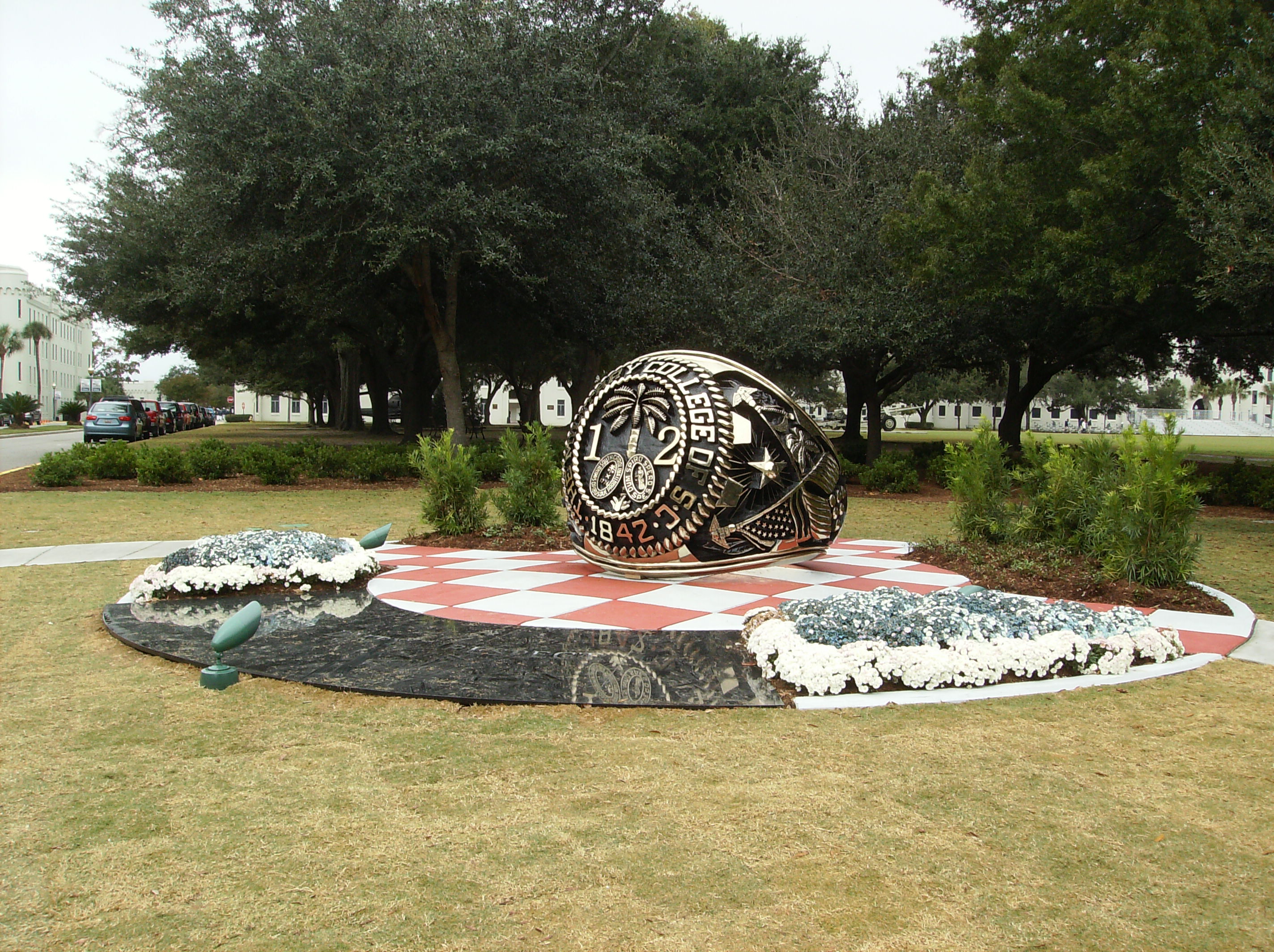
Before I get started on this ramble of a post, I want to issue a caveat bigger than the new Ring Statue, especially for people who might have accidentally wandered into the path of this little blog for the first time. There are things I know a little bit about, and can opine on with some confidence. I know that Chal Port was a great baseball coach. I can discuss how Rabbit Maranville, famous in his day, is now underappreciated. The Citadel defeated South Carolina in football in 1950; I have a fairly good grasp of the enormity of that upset. The “hold” statistic in baseball is flawed, and I can tell you why.

There are other things I don’t understand quite as well. Lots of things. It has become apparent to me in recent days that higher education is one of those things, particularly in regards to my alma mater. I remember when I was a cadet that there always seemed to be a lot going on around campus that I didn’t really understand, and never would. The same is true today.

That makes this post a bit different from my usual efforts, which I like to think are fairly precise in terms of information and analysis. Because the subject is important, though, I decided to press forward. I apologize in advance for anything outlandishly stupid. I don’t apologize for anything that is simply outlandish, though — this is something of a big-picture essay, more conceptual than specific.

Please keep that in mind. I’m not really crazy. At least, I don’t think I am…

Quick tangent before I go into blogging overdrive: speaking of resource allocation, The Citadel has the top college rifle range in the nation. This is a sport in which the school could conceivably win an NCAA title. However, The Citadel currently only offers 1.5 scholarships in rifle, while the NCAA maximum is 3.6 schollies.

I know I’m spending money that’s not mine (I’m going to be doing that throughout this post), but it seems to me that with such a great facility, and being a military school that might naturally attract people who like shooting things, it wouldn’t be a bad idea to maximize schollies — especially when that would only take a little over two more scholarships.

If The Citadel won an NCAA title, I would shortly thereafter go to the South Carolina Statehouse and take a picture of the top of the building. Since the state legislature has set a precedent with a Gamecocks flag flying atop the Statehouse following South Carolina’s CWS titles, I would very much enjoy seeing “Big Red” waving proudly above the dome.

The reasoning behind my suggestion that The Citadel needs more varsity sport options goes to the heart of where the military college is now as an institution, and where it will be in the future. I suspect some will disagree (perhaps strongly so) with my point of view, in terms of what the school is and could be. That’s okay. It’s the discussion that is most important. What follows may be a flight of fancy. Just humor me.

I have been thinking about this topic for a long time, but while a lot of this isn’t necessarily about college athletics, what actually inspired me to finally sit down and do some typing (and a fair amount of research) were two recent sports stories:

Furman received a $5 million contribution to establish men’s lacrosse and women’s lacrosse as varsity sports

VMI’s women’s water polo team played its first match ever, wearing swimsuits with supersized logos

With the addition of the two new lacrosse programs, Furman will have 20 varsity sports. VMI’s addition of women’s water polo brings its total to 17 varsity sports. The Citadel, despite having about six hundred more undergraduate students than VMI, has only 15 varsity sports.

Note: I am counting rifle as one sport, not two, as it is a co-ed sport in NCAA competition. Indoor and outdoor track are counted as separate sports, and that is the case for both the men’s and women’s teams.

Of course, you can’t directly compare the scope of a school’s varsity sports offerings simply by number of teams. Some of those sports may be fully funded, some may not. Still, it is apparent that The Citadel does not have nearly as diverse a collection of varsity sports as some of its peer institutions. A partial list:

The Citadel – 15
Elon – 17 (once women’s lacrosse is added, with possibly more to come)
VMI – 17
Samford – 17
Wofford – 18
Richmond – 19
Furman – 20 (when lacrosse programs are added)
Davidson – 21 (non-scholarship football)
Lafayette – 22 (non-scholarship football)
William & Mary – 23
Lehigh – 25 (non-scholarship football)
Colgate – 25 (non-scholarship football)
Bucknell – 27 (non-scholarship football)

While Lafayette, Lehigh, Colgate, and Bucknell currently field teams that play FCS football without offerering athletic scholarships, that will change beginning in 2013, as the Patriot League schools move to athletic financial aid awards in football. That decision has a number of ramifications, a couple of which may directly affect The Citadel.

As one of those links points out, northern schools will shortly have more options when scheduling FCS schools. A few years ago, The Citadel played Pittsburgh in a “money game”, but going forward Pittsburgh could schedule Bucknell or Lehigh instead and count the game toward its win total for bowl eligibility, something that couldn’t happen if those schools remained non-scholarship for football.

[Edit, 3/26/12: Actually, it was possible for a Patriot League school to be a “counter” in the past, depending on whether or not it averaged 56.7 or more football “equivalencies” (athletic need-based aid) over a rolling two-year period. Thanks to the first commenter for spotting that error.]

It is also true that the Patriot League schools will be able to offer athletic grants in a way they could not before, and as a result will be able to compete that much more with other colleges for recruits. Kevin Higgins is just one of many coaches who likes to recruit the Mid-Atlantic region (he is on record as preferring to bring in at least one Pennsylvania recruit in each class, for example). This will presumably be more difficult in the future.

While competing with those schools for football players is one thing, what I think is even more important to realize is that going forward, The Citadel might be competing with those institutions for other students as well. Therein lies the point of much of this post, and why I listed four private schools located north of the Mason-Dixon line as “peer institutions”.

From the November 1, 2011 minutes of a meeting of The Citadel Board of Visitors:

Chair Snyder called the meeting to order and updated the Board on The Citadel Foundation’s recent board meeting.  He reported that the Foundation anticipated falling short of its fundraising goal for the year. They expect to raise around $17 million against a “stretch” goal of $24 million.  The Foundation is finalizing its strategic plan and is working closely with the college administration to formalize plans for the next capital campaign…

…Chair Snyder expressed concern that many people external to the college are thinking that the college is looking at going private.  This is not the case, however, in light of reduced state funding we must move towards the private college fundraising model to ensure our financial sustainability.

Col. Snyder (assuming that he is the person who specifically made the comment in bold) is surely correct. Despite being a state school, this is the path the college is going to have to take in order to maintain excellence.

This is not recent news, but it is a fact that in 1994, the State of South Carolina funded 40% of The Citadel’s budget. As of FY12, state appropriations had dropped to 8.8% of the school’s $89 million budget.

Whatever your opinion is on how the Palmetto State funds higher education, the bottom line is that The Citadel cannot expect to go back to the days of 1994. It is not completely out of the question that the state will someday supply no funding at all to the military college. The school must plan with that possibility in mind.

I’m sure what I’m going to say now will have some people shaking their heads, but here goes…

If The Citadel is truly intent on moving to a “private college fundraising model”, then it has to act in ways that a private college or university might. It has to offer things that private schools offer, and provide other things that private schools don’t have. It has to compete directly with those private schools for students and for donors.

That means The Citadel will have to continue to grow as an institution. That growth won’t come cheaply. The school is operating right now on an annual budget of roughly $90 million. As a comparison, Furman’s budget in 2009 was $133 million. Furman has a slightly larger student body than The Citadel currently does, of course, but I think it’s a reasonable example — a benchmark, perhaps.

A fundraising model developed with the idea of supporting the college with a yearly budget (inflation-adjusted) of $90 million may work in the short term, but over the long run I’m not sure it’s a good idea. I think the school should prepare to raise funds as if its anticipated yearly budget going forward will be around $120 million, if not more.

You don’t have to tell me, “we don’t have the money.” I know we don’t have the money. I also know how impossibly difficult raising such an amount would be.

I just think that fresh investment in the college is likely to be achieved by expanding the scope of the college in a manner that would appeal to new donors. The school will be competing against private institutions for this type of support, and I suspect that what the military college needs to be marketing is something new and tangible — i.e. endowed faculty chairs, cutting-edge library technologies, a varsity sports program or two. On the other hand, I am not sure there is someone out there who wants a plaque in return for paying off The Citadel’s deferred maintenance costs.

(Though if there is someone out there who wants to do so, he or she could get a lot more than a plaque. In fact, I am sure a bronze bust inside Bond Hall could be arranged.)

Also, while a lot of what I’m suggesting may seem almost impossible, something not dissimilar is currently taking place at another school in the Southern Conference. I’ve written about Elon’s amazing transformation on a couple of occasions before (while previewing upcoming football games, of course; priorities and all that). Elon undoubtedly has some advantages over The Citadel when it comes to raising money, including being able to do exactly what it wants with its money, but it is still a good example of what can be done with foresight, hard work, and (probably) some luck.

That isn’t to say The Citadel can’t sell people on what it has now, of course. As an example of this, the list of marketing and community partnerships the school has with various corporate entities is impressive. It includes Under Armour, Google, and Boeing, among others.

The crux of the issue for The Citadel is that the college has to act and react in ways similar to private schools while remaining a public institution. It has needs similar to those of private schools, and standards similar to (and often greater than) private schools, but doesn’t have resources many of those schools have (such as large endowments). It also has obligations as a state institution, regardless of how much money the state actually provides the college. Chief among those is providing an education to qualified South Carolina high school graduates who want to attend The Citadel.

A further complication is that, thanks in part to the Ashley River, The Citadel can’t just raise some quick cash by dramatically expanding the size of the corps and raking in additional tuition dollars. That doesn’t mean undergraduate enrollment can’t increase, because it has in recent years, as the school administration has made strides in maximizing the physical capacity of the campus. Apparently that is continuing, with an additional new cadet company reportedly in the works for the 2012-13 school year.

I don’t know what the new “ideal” corps size is going to be. The upcoming Blueprint (the strategy planning focus for the college) will probably have more information on that front. The Office of External Affairs informed me that the Board of Visitors is scheduled to approve the next phase of the Blueprint in June. (That was one of several questions I recently asked OEA; I appreciate the staff’s patience with what must have seemed rather eccentric queries.)

I will say that I wouldn’t like the corps of cadets to get significantly larger than it is now; I think the small size of the school is part of its essence, and also helps alums continue to identify with their alma mater. I’m not sure what the tipping point for that is (maybe 2500 cadets?). Having said that, if The Citadel has to increase the size of the corps in order to remain viable in the future, then that’s what it should do.

As The Citadel moves into mega-fundraising mode (which it will regardless of its actual budgetary goals), I believe it is important for the college to expand its potential donor base. Fresh blood, if you will. Part of that expansion should be geographic in nature. I think the school should bring in as many out-of-state students as possible, much like many private institutions, such as Furman (69% of its student body being from out of state), Samford (61%), Elon (75%), Bucknell (76%), and Richmond (78%).

This is a subject not without some controversy, but before I address some specifics for the 21st century, I want to briefly note some of The Citadel’s past enrollment trends. History can be a guide.

Tough times around the nation. The Citadel in something of a financial crisis, with a state legislature more inclined to take money away from the school’s allocated budget than add to it.

I’m not talking about 2012, though. I’m talking about 1932…

By 1932 the country was in the throes of the Great Depression, and The Citadel was far from immune from its effects. In 1928, there were 722 cadets enrolled at the college, but by 1933 that number had dropped to 637 (these numbers and those in the next three paragraphs are from this book).

At that point in time, 71% of the corps hailed from South Carolina. However, the school began to attract more out-of-state students, and gradually the percentage of Palmetto State natives declined, although the raw numbers of South Carolinians were not reduced — rather, the corps increased in size primarily due to the influx of out-of-state cadets. By 1943, there were 1,980 cadets enrolled. From 1933-1943, the number of cadets at The Citadel more than tripled.

Students from outside South Carolina first outnumbered their Palmetto State counterparts in 1940, when 50.3% of the corps were out-of-state residents. It was a significant transformation in the student body’s geographic diversity that occurred over an eight-year period.

World War II had a deleterious effect on student enrollment, but once the size of the corps began to approach pre-war levels, the greater number of cadets continued to come from outside of South Carolina. Between 1955 and 1965, that majority hovered around 60%. After a while, a few politicians began to complain about this.

The bell cow for the issue in 1965 (and for much of the 1960s) was Dillon County state representative A.W. “Red” Bethea, who introduced an appropriations amendment that would have limited the number of out-of-staters at The Citadel to just 12% of the corps, which seems ludicrous today, and was probably considered ludicrous then. That said, the vote to kill his amendment was only 64-21, so 25% of his fellow House members were willing to go along with him.

Bethea was a self-styled populist (just one way to describe him). Among other things, he also campaigned against Clemson College changing its name to Clemson University. Bethea either did not understand or chose to ignore the fact that The Citadel was not exactly turning away large numbers of Palmetto State students. According to the linked article, 90% of South Carolina applicants were being accepted at the time.

Various members of the state legislature have over the years periodically echoed Bethea’s concerns over admissions policies as related to in-state vs. out-of-state students. That is understandable, as they are trying to represent their constituents. On this issue I tend to agree with the comments made by Kenneth Wingate (Chairman of the South Carolina Commission on Higher Education) and Charleston state representative Chip Limehouse in this article.

However, I am not impressed with threatening schools with enrollment caps, particularly after making large cuts in their annual appropriations. That strikes me as counter-productive, and not in the overall best interests of the state (to say nothing of the respective schools, as noted in some of the responses to this question-and-answer piece).

There is an occasionally overlooked part of The Citadel that should be considered when discussing the issue of opportunities for in-state students, namely The Citadel Graduate College. As Jeff Perez of the Office of External Affairs stated in the above-linked Q-and-A:

The CGC is deeply tied to the Lowcountry as it provides advanced education for those looking to advance their careers and contribute to the future of the region.

Another consideration is that admitting more out-of-state students may actually help in-state students in at least one respect:

[Coastal Carolina president David] DeCenzo and other college officials say there is another benefit to the influx of out-of-state students – students paying much higher out-of-state tuition rates help keep tuition from skyrocketing for in-state students.

I think that is a very good point. It used to be the case that with a little pluck and luck, a local could “shoestring” his way through The Citadel. That’s not really possible anymore, and the rise in tuition rates has made things even more difficult for South Carolina residents.  Ultimately, everyone wants qualified in-state residents from families of all income categories to have an opportunity to receive an education at The Citadel.

I believe it is important for the school to maintain its relationship with the citizens of the state. For the record, my point of view on that issue comes naturally. I was born and raised in South Carolina, graduated from The Military College of South Carolina, and have spent much of my adult life in South Carolina. The same was true for my father. I’m a Sandlapper through and through.

As far as The Citadel is concerned, every qualified South Carolina resident who applies is accepted to the military college. Some years, there are more in-state applicants than in others, leading to an occasional “yo-yo” effect in terms of in-state vs. out-of-state enrollment, as the “balance” is conditioned by the number of enrolling in-state students (again, thanks to OEA for explaining this to me). For example, in August 2010, 378 South Carolinians reported as part of the Class of 2014, the “largest S.C. population in 46 years”.

Tangent: I am wondering if that could have actually been 45 years between milestone classes, not 46. If it were 45 years, it would have been the summer after Red Bethea’s proposal was defeated and in line with the “substantial increase in Palmetto State freshmen” referenced in the 1965 newspaper article I linked earlier in the post. That would make it the entering class of 1969.

Other recent classes have had a larger percentage of out-of-state students, generally around 56% (the Class of 2011’s 60% out-of-state contingent being the highest over the past decade). However, early returns suggest the class of 2016 may be more evenly distributed. From the BOV minutes for 12/2/2011:

  • Projected enrollment is estimated to be higher than budgeted
  • In-state vs. out-of-state ratio will be approximately 50-50; we originally budgeted 46% in-state vs. 54% out-of-state.

One thing I haven’t mentioned yet is that The Citadel’s out-of-state student cohort is, by and large, southern. This is not an accident. The Citadel long had an acknowledged “five state recruiting area” of the Carolinas, Georgia, Florida, and Virginia, and that region continues to produce students for the military college. For the fall 2011 semester, 70.2% of the corps was made up of cadets from those five states. Taking out the South Carolinians, 24.3% of the corps is from either North Carolina, Georgia, Virginia, or Florida.

The numbers are similar throughout at least recent history (the link above states that 68% of incoming freshmen for the class of 1999 were from that five-state radius). When I looked at some recent enrollment figures, though, I was struck by something else — namely, a recent decline in cadets from the Mid-Atlantic and Northeast regions of the United States.

In 2006, there were 2037 cadets. Of that number, 286 (14% of the overall corps) were from the states of Maryland, Pennsylvania, Delaware, New Jersey, New York, Connecticut, Rhode Island, Massachusetts, Vermont, New Hampshire, and Maine.

In the fall of 2011, there were 2128 cadets. However, despite the increased size of the corps, only 229 students hailed from that same eleven-state grouping, which meant the percentage of cadets from that region fell to 10.8% of the overall corps.

States that dropped noticeably in enrollment totals included Maryland (from 59 cadets to 46), Massachusetts (28 to 17), and especially Pennsylvania (63 to 43). They weren’t the only states nationally to produce fewer cadets over that time span (Texas went from 73 cadets to 48), but to have an entire region decline in enrollment in a relatively short amount of time struck me as surprising. It’s not a large sample size (and it’s always possible 2006 was the high-water mark for those states), but something to think about nonetheless.

By now, if you’re still reading (and if you are, you are very patient), you know that I think The Citadel should be expanding its offerings. This should happen in a number of different areas, of course, but for the remainder of this post I’m going to focus on varsity sports. Why? Well, because this is a sports blog.

While I am postulating that The Citadel should be adding to its varsity sports portfolio, I think it’s only fair to take a quick look at some of the current issues affecting the department of athletics and The Citadel Brigadier Foundation.

In 2003 The Citadel cut two sports (men’s soccer and men’s golf) in an effort to save a little under $300,000 per year. At the time BOV member Glenn Addison (a former soccer player himself) observed:

Even though it makes sense from the standpoint of budget issues now, I think maybe stepping back is not the right thing to do.

Addison is still a BOV member (he is now the vice-chair). I would imagine that he may feel even more strongly that cutting those two sports was “not the right thing to do”. Even at the time, it struck some observers as penny-wise and pound-foolish. In my opinion, the move ultimately did little to relieve pressure on the athletics budget, even in the short term.

From the BOV minutes for 6/11/11:

Colonel Addison, Chair of the Athletics Committee, presented the following committee motions:

“That The Citadel Board of Visitors approves a 2012 Athletics operating budget of $10,201,702.”

Following discussion, the motion passed unanimously.

“That The Citadel Board of Visitors approves a budget of $350,000 from The Citadel Trust for the 2012 Athletics budget.”

Following discussion, the motion passed unanimously.

Some perspective: in 2007-08, The Citadel Trust provided almost $1.5 million to cover the remaining costs for the department. The FY2012 number reflects well on Larry Leckonby and his staff. Leckonby had a tough budget situation when he assumed the role of Director of Athletics. So far he seems to have done a good job getting costs under control. It should be noted, though, that the renovation of Johnson Hagood Stadium was still a factor in the budget boondoggle of 2007-08.

From the Blueprint, Strategic Initiative Three:

Athletic programs are an integral component of educating principled leaders, fostering institutional loyalty and spirit, and maintaining a vibrant campus community. The institution will institute the following actions designed to strengthen the athletics program specifically, and the College generally, during the next three years:

  • Create an Athletics Excellence Fund
  • Increase membership in The Citadel Brigadier Foundation (athletic foundation)

Key Performance Indicators:

  • Increase membership in The Citadel Brigadier Foundation 35% by 2012
  • Increase gifts to the Athletics Program to reach $250,000 by 2012

From the Blueprint annual report for 2011:

Goal: Increase membership in The Citadel Brigadier Foundation by 35% by 2012.

Result: 24% Progress (Behind Schedule)

When Jerry Baker was named Executive Director of The Citadel Brigadier Foundation in December of 2008, he stated that “our immediate goal is to get membership up.” Following his appointment, the TCBF had some initial success in doing just that. There were 1,599 members in 2009; that number increased to 1,729 in 2010. The meter barely moved in 2011, though (1,734 members). The TCBF appeared to hit a wall.

It may be an indication that a more expansive approach is needed. From the BOV minutes for 9/10/11:

…The Citadel Brigadier Foundation has raised $2.4 million over the past year; the memorial fund is at $9.1 million…

…Mr. Larry W. Leckonby, Athletics Director, commented that the Brigadier Foundation has changed its philosophy and is moving away from being a booster club and becoming a viable fundraising entity.

If The Citadel’s administration were to decide to add certain varsity sports, as part of an all-encompassing push to broaden the school’s profile and attract a new (or renewed) base of students/families, where would it start?

There is little doubt in my mind as to the answer. To its existing lineup, The Citadel should add men’s and women’s lacrosse.

I say that as someone who doesn’t even understand all the rules of lacrosse. I know it’s a fast-paced, exciting game in which players wield large sticks. Honestly, that sounds made-to-order for The Citadel, doesn’t it?

Actually, lacrosse is a sport the administration should take a hard look at adding very soon, even if the school’s immediate goals are more modest than what I’ve espoused here. The demographics of lacrosse are close to ideal for what The Citadel needs right now, and the timing could not be more perfect.

For the most part, the largest high school talent pools in lacrosse can be found in Maryland, New York, New Jersey, Pennsylvania, Connecticut, and Massachusetts. Many D-1 prospects play at outstanding parochial and preparatory schools; others play at quality public schools. The Citadel wants to attract students from these schools, along with drawing support from their families and associates. Combine this with the decline in cadets from that part of the country over the last few years, and you have a no-brainer in terms of recruitment strategy. Lacrosse fits the bill.

When competing for students from these schools, The Citadel actually has many advantages, from location (Charleston — it’s actually warm down here!), academics (including the well-regarded undergraduate engineering program), the cachet of the school itself and, yes, the military component. Sometimes I fall into the trap of viewing the military aspect of The Citadel as a detriment to recruiting future students, but in fact it is often viewed as a positive by recruits and their families.

The gradual increase in interest in the sport over the last two decades, particularly in the south, also means that two issues that would have come into play two decades ago are no longer problematic. First, there are enough high school lacrosse teams in South Carolina that a school like The Citadel doesn’t have to worry about total numbers within the program. The South Carolina High School League began holding championships in both boys’ and girls’ lacrosse in 2010 (in what may bode well for the sport’s future at that level in South Carolina, the first two years featured different champions for both the boys’ and girls’ divisions).

The other past issue would have been scheduling. Twenty years ago, it was rare to find a D-1 lacrosse program (like UNC) south of the state of Virginia. That is no longer the case.

Schools that have or will shortly have men’s and/or women’s lacrosse programs include Furman, Elon, Winthrop, High Point, Presbyterian, Mercer, and Jacksonville. There are also a number of Division II lacrosse programs in the Carolinas.

Jacksonville is a good example of why these schools are now offering lacrosse. JU is a relatively “young” school; I wrote about its history during my preview of The Citadel’s football game against the Dolphins last September. Jacksonville is clearly using lacrosse in an attempt to appeal to potential students outside its region. While the football program only had six players from outside the state of Florida, its lacrosse roster includes players from all across the eastern seaboard (including Canada), with just five Floridians.

The Citadel already has a vibrant men’s lacrosse club program, which would make a transition to NCAA Division I more manageable. The start-up costs would be alleviated to a degree by The Citadel already having an appropriate facility (Johnson Hagood Stadium).

I don’t believe the school needs $6 million, the total Michigan allocated toward its two new lacrosse programs. As a Big 10 school, Michigan’s department of athletics is presumably printing money; I wouldn’t be all that surprised if the Wolverines’ lacrosse sticks were gold-plated. The Citadel can have a much more modest approach and still get the job done.

What I would suggest, though, is that a decision is made fairly quickly. The Citadel has a chance to establish itself as a major player in this market, but time might be short to capitalize on that opportunity. The school probably needs to become D-1 by no later than 2015 in order to fully realize the potential of the two programs.

Oh, and make no mistake: The Citadel would in fact be starting two lacrosse programs, men’s and women’s teams.

The school doesn’t have an enrollment goal for female cadets (yet another question I had for OEA); rather, the Blueprint suggests a more general standard of “Expand[ing] student diversity by 4% each year, 12% by 2012”. Nevertheless, I am guessing that the administration would like to see a rise in qualified female applicants.

As of fall 2011 there were 141 female cadets in the corps, or 6.5% of the total. When I first looked at the numbers, I was struck by the lack of junior female cadets when compared to the other three classes (32 seniors, 22 juniors, 39 sophomores, and 48 freshmen).

Comparing The Citadel’s numbers to those of the service academies is not an apples-to-apples situation, not least because those schools have been admitting women for more than 35 years, but it is worth noting that 17% of the U.S.M.A.’s class of 2015 were women.

All of that is a long-winded way of saying that The Citadel is definitely interested in recruiting outstanding students of both genders from those generally excellent (and lacrosse-mad) high schools.

While lacrosse should be on the front burner when it comes to expanding the department of athletics, there are other sports that could prove beneficial in terms of providing more opportunities for potential recruits. In an ideal world, men’s soccer and men’s golf (the latter having been played at The Citadel for almost 70 years before it was eliminated) would return. Women’s tennis is another possibility.

Along with men’s and women’s lacrosse, though, the next varsity sport at The Citadel probably should be women’s sand volleyball, even if it is only to serve as a natural complement to the current volleyball program.  In early March the College of Charleston announced that it will be starting an NCAA sand volleyball team, and The Citadel might be well served to follow suit.

There are arguments to be made for other sports, of course. I read with interest an article about local college club teams, particularly The Citadel’s ice hockey team. The school may not be quite ready yet for a D-1 hockey program. Among other issues, scheduling could be a problem. You never know, though. There is a lot of passion for that program, and the uniforms can be distinctive.

As for why The Citadel doesn’t have a women’s basketball team, I’ll let Les Robinson speak to that:

What I’ve told the Southern Conference is that it would be an injustice for us to start basketball before we get all the other sports going. Until we get volleyball competitive and soccer. Right now, if we try to have women’s basketball it would be a disaster for the conference. It would pull down the conference RPI [Ratings Percentage Index]. It would hurt the conference in the long run as far as getting teams in the women’s NCAA Tournament and women’s NIT.

That was in 2008. Since then, the soccer program has made a remarkable turnaround and has been competitive for the past three seasons. The volleyball team continues to struggle for victories.

I suspect that given the landscape for Division I women’s basketball, which is arguably the most “mature” of D-1 women’s team sports, The Citadel needs to have a larger group of female cadets in the corps before it can seriously consider adding women’s hoops. I don’t know what that number is, but I know it isn’t less than 200. I think a more realistic “base” to draw from may be 500 cadets. It is debatable, to be sure.

One potential benefit to having an increased number of varsity athletes roaming the campus: just having more of them around might help the overall support of the school’s sports programs by the corps as a whole, an occasionally sore subject among alums (and some current cadets). Having a significant percentage of varsity athletes among the total student body would give off something of a Division III vibe, but at the Division I level, which could be rather cool.

Speaking of Division I, it is important for The Citadel to play its NCAA sports at the highest level possible, in order to attract top-quality cadets. The school wants those elite students, and many of them aspire to play at that level. That may seem obvious, but it’s a point that from time to time needs to be re-emphasized. It is the kind of issue that resonates with schools all over the country as they recruit prospective students; for example, it is one component of the U.S. Naval Academy’s decision to join the Big East for football.

Finally, I want to mention conference affiliation, which has been a regular feature of sports news for over a year now, and will continue to be as long as schools chase big money (which means it will be a regular feature of sports news for as long as college sports exist). The Citadel is a long-standing member of the Southern Conference, a league that has had schools come and go for nine decades.

With Appalachian State looking for (allegedly) greener pastures and Georgia Southern possibly not too far behind the Mountaineers in seeking FBS glory, the SoCon will be turning its membership over again, as will other FCS leagues such as the Colonial. It’s possible that The Citadel will be in a very different-looking conference in the not-too-distant future. Having a good variety of sports offerings will only help the military college become part of a league with like-minded schools that have numerous varsity teams. A potential “Cypress League” might look something like this:

The Citadel
Furman
Wofford
Davidson
Elon
VMI
William & Mary
Richmond

The odds are long that a conference will eventually form with that exact makeup of schools, but in my opinion a league with a similar grouping of schools is very possible.

I could go on, but I think this post is more than long enough. A quick wrap-up:

It takes a leap of faith to support what amounts to an institutional expansion during an era when contraction seems to be the trendy thing to do. My principal argument is based on two assumptions: that things will get better nationally over time, at least in terms of the economy, and that The Citadel is a great school that can become even greater. There may not be a lot of evidence right now in favor of that first assumption, but I have to believe that. Everyone has to believe that.

As for that second point: The Citadel has to move forward. That involves a certain element of risk. However, it’s 2012, and not trying to move forward doesn’t  have an end result of standing still. It has an end result of going in reverse.

The Citadel has never really been known for retreating…

Hoops update: the SoCon tourney moves back to Asheville

Every year about this time I post about the upcoming SoCon tourney, and The Citadel’s less-than-stellar history in the event. Actually, I didn’t last year, for reasons neither here nor there, so perhaps it would be worthwhile to simply revisit my last piece on the subject. (Besides, not that much has changed.)

Thus, the first section of this post is an updated version of what I wrote previously on the origins of the tournament, and The Citadel’s particularly poor performance in it over the years. I’ll write more specifically about the SoCon’s return to Asheville (along with the current edition of the Bulldogs, of course) afterwards.

One of the more curious things about The Citadel’s horrid history in the SoCon tourney is that there is no firm answer to just how many times the school has lost in the event.  That’s because the league has mutated so many times there is confusion as to what year the first “official” conference tournament was held.

Before 1920, The Citadel was one of many schools in a rather loose confederation known as the Southern Intercollegiate Athletic Association.  (The Citadel initially joined in 1909.)  There were about 30 colleges in the SIAA by 1920, including almost every member of the current SEC and about half of the current ACC, along with schools such as Centre, Sewanee (which was actually a founding member of the SEC), Chattanooga, Wofford, Howard (not the school in D.C., but the university now called Samford), and Millsaps, just to name a few.  As you might imagine, the large and disparate membership had some disagreements, and was just plain hard to manage, so a number of the schools left to form the Southern Conference in late 1920.

In the spring of 1921, the SIAA sponsored a basketball tournament, which would be the forerunner to all the conference hoops tourneys to follow.  Any southern college or university could travel to Atlanta to play, and fifteen schools did just that.  Kentucky beat Georgia in the final.  The Citadel did not enter the event, but several other small colleges did, including Newberry (for those unfamiliar with Newberry, it’s a small school located in central South Carolina).  The tournament featured teams from the new Southern Conference, the old SIAA, and squads like Newberry, which wasn’t in either league (it would join the SIAA in 1923).

In 1922 the SIAA held another tournament in Atlanta, this one won by North Carolina, which beat Mercer in the final.  The Citadel entered this time, losing in the first round to Vanderbilt.  The SIAA tournament remained all-comers until 1924, when it was restricted to Southern Conference members.

Some sources suggest that the 1921 tournament is the first “official” Southern Conference tournament, some go with the 1922 event, and others argue for 1924.  From what I can tell, the league itself is a bit wishy-washy on the issue.  On the conference website, it states:

The first Southern Conference Championship was the league basketball tournament held in Atlanta in 1922. The North Carolina Tar Heels won the tournament to become the first recognized league champion in any sport. The Southern Conference Tournament remains the oldest of its kind in college basketball.

However, the conference’s own media guide lists Kentucky as having won the first tournament title in 1921.  The guide doesn’t include league standings from that year, starting those for the 1921-22 season (which is appropriate, given play in the new conference didn’t begin until the fall of 1921). It specifies that the 1921, 1922, and 1923 tournament results are for the “Southern Intercollegiate Basketball Tournament” but doesn’t distinguish those tourneys in any way when it lists the year-by-year champions (and includes the all-tournament team from 1923 in the listing of SoCon all-tourney squads).

Personally, I think that the idea of having a conference tournament is to determine a league champion, and it stands to reason that such a tournament would only include league members.  So the first “real” Southern Conference tournament, in my opinion, was held in 1924.

There is a point to this, trust me.  The difference between counting the Vanderbilt loss as a SoCon tourney loss and not counting it is the difference between The Citadel’s alltime record in the event being 11-58 or 11-59.  Not that they both aren’t hideous totals, but as of now The Citadel shares the NCAA record for “most consecutive conference tournament appearances without a title” with Clemson, which is 0-for-58 in trying to win the ACC tournament.  Counting the Vanderbilt game would mean The Citadel is alone in its conference tourney infamy.  No offense to the Tigers, but I don’t believe the 1922 game should count, because it wasn’t really a Southern Conference tournament game.

Incidentally, you read that correctly.  The Citadel is 11-58 alltime in the SoCon tournament.  That’s just unbelievably bad.  It comes out to a 16% winning percentage, which is more than twice as bad as even The Citadel’s lousy alltime conference regular season winning percentage (35%).  The Citadel lost 17 straight tourney games from 1961-78, and then from 1985-97 lost 13 more in a row.

Tangent:  The single-game scoring record in the tournament is held by Marshall’s Skip Henderson, who put up 55 on The Citadel in 1988 in a game Marshall won by 43 points.  The next night the Thundering Herd, which had won the regular season title that year, lost to UT-Chattanooga by one point.  Karma.

Those long losing streaks didn’t occur in consecutive years, as The Citadel didn’t always qualify for the tournament, particularly in the years before 1953, when there were up to 17 teams in the league at any given time, and only the top squads played in the tourney.  The Citadel’s first “real” appearance, in 1938, resulted in a 42-38 loss to Maryland.

The Citadel would lose two more tourney openers before winning its first game in 1943, against South Carolina.  That would be the only time the Bulldogs and Gamecocks faced each other in the tournament, and so South Carolina is one of two teams The Citadel has a winning record against in SoCon tourney play (the Bulldogs are 2-0 against VMI).

The next time The Citadel would win a game in the tournament?  1959, when the Bulldogs actually won two games, against Furman and George Washington, and found themselves in the tourney final.  Unfortunately, the opponent in the title game was West Virginia, led by Jerry West.  West scored 27 points and the Mountaineers pulled away late for an 85-66 victory.  This would be the only time The Citadel ever made the championship game; it’s also the only time the Bulldogs won two games in the tournament.

After a 1961 quarterfinal victory over Richmond, The Citadel would not win another tournament game until 1979, when the Bulldogs defeated Davidson before losing to Furman.  The game against Davidson was played at McAlister Field House and was the final victory of a 20-win campaign, the school’s first.

The Citadel would win single games in 1982 and 1985 before going winless until 1998, when it finally broke a 13-game tourney losing streak by beating VMI.  The Keydets would be the next victim as well, in 2002, and were apparently so embarrassed they left the league.  The Citadel’s last two wins in tourney play occurred in 2006 (against Furman) and 2010 (versus Samford).

Twenty-one different schools have defeated The Citadel in tournament play, with Davidson’s eight victories leading the way (against one loss to the Bulldogs).  East Tennessee State went 6-0 against The Citadel while in the league.

Norm Sloan, who had the best record as a head coach of The Citadel since World War II, was 2-4 in the tourney; his successor, Mel Thompson, was 1-6.  Dick Campbell did not win a tourney game (0-4).  Neither did George Hill (0-3).  Les Robinson was 3-10 (a record which by winning percentage leads all of the post-Sloan coaches).  Randy Nesbit was 0-7.  Pat Dennis was 3-14. Ed Conroy was 1-4. Current coach Chuck Driesell is 0-1.

The best record for a Bulldog coach in SoCon tourney play is that of Bo Sherman, who went 1-1 in 1943, his lone season in charge.  Sherman’s Bulldogs defeated South Carolina before losing to Duke.

The Citadel’s record against current SoCon teams in the tournament:  Furman 2-5, UT-Chattanooga 0-1, Elon 0-1, Samford 1-1, College of Charleston 0-1, Georgia Southern 0-2, Western Carolina 1-1, Appalachian State 1-7, Davidson 1-8.  (The Citadel has never played Wofford or UNC-Greensboro in the tournament.)

Asheville hosted the Southern Conference tournament from 1984 to 1995. It was a generally successful venue for the league, in part because of its relatively central location. As this article states, the league was mostly dominated by UT-Chattanooga, East Tennessee State, and Marshall during that period, and their fans came out in force, leading to good attendance for the majority of the tournaments held in Asheville. Those three schools won all but one of the title games held in Asheville (Davidson won the 1986 tournament).

However, the Civic Center (now called the U.S. Cellular Arena) was starting to show its age, and other cities offered the SoCon a better financial package, so the tournament left the city. Now it is back, for both the men’s and women’s tourneys. It has a new roof, which is good, since a few years ago the old roof began leaking during an Alison Krauss concert. By law, that should have resulted in the facility being burned to the ground and a ritual stoning of its maintenance supervisor, but compassion was shown.

The Citadel does not have fond memories of Asheville. The Bulldogs were 1-12 in tourney play during that era, with the lone win a 68-62 victory over Appalachian State in 1985. That came one year after The Citadel’s first Asheville tourney, when it lost to Appy. The Citadel also lost a second tournament game in Asheville to Appalachian State, to go with losses to Marshall (twice), Furman (twice), East Tennessee State (four times), Chattanooga, and Georgia Southern.

Having said that, I think it would be all right if Asheville becomes the regular home for the Southern Conference tournament. The league probably needs a permanent location to build local interest in the tourney on a year-by-year basis, and Asheville is a reasonable trip for fans of most of the current league schools. It was once the home base for the league itself, of course, until league offices moved to Spartanburg.

Tangent: Asheville also hosted the league’s baseball tournament for a time, until the debacle that was the 1989 SoCon baseball tournament directly led to that tourney moving to Charleston. Moral of that story: when it starts raining at a baseball park, it would be really handy if a tarp were available.

It’s going to be a busy week of hoops in Asheville, that’s for sure. Not only is the city hosting both the SoCon men’s and women’s basketball tournaments, but the Big South men’s tourney is being hosted by that league’s regular season champion — which happens to be UNC-Asheville. UNCA will host the quarterfinals and semifinals, and also the Big South title game if it advances that far.

Some of you might be wondering why I am rehashing The Citadel’s tournament foibles, and I can understand that. There are two reasons. First of all, there is no reason to hide from the truth. More importantly, however, I think a large part of the program’s problem with the SoCon tourney over the years is that it has never had anything resembling sustained success, or any kind of success for that matter.

No one who has played for The Citadel has any really good memories of the tournament, with the possible exception of some of the players from the late 1950s, and I’m afraid that positive vibe has long since evaporated. I think it is hard to expect success when all anyone surrounding the program has ever known at the SoCon tourney is failure.

In 2009, when the Bulldogs had one of their best seasons ever, winning 20 games and finishing second in the conference, they had a quarterfinal matchup with Samford, a team that The Citadel had beaten easily during the regular season. As soon as Samford took an early lead, though, The Citadel’s players started pressing. It was as if the tortured history of the program started preying on everyone’s minds. Naturally, the result was a loss.

This year’s team has not had one of the school’s best seasons ever. The Bulldogs are 6-23 and finished with the worst record in the league. They did win two of their last three games, however, and because of that I think they may have the ability to accomplish something important.

The Citadel is not going to win the Southern Conference tournament this year. However, what this team can do is lay a foundation for a future squad to do so, just by winning a game or two. That could give the current players confidence that they can do well in the tourney in the next two or three seasons, and make some (positive) history.

That’s why this tournament can be important for The Citadel. Win a game or two, and set the stage for something wonderful to happen in the 2013 or 2014 tournaments.

I’m hoping the team begins play on Friday with a little “edge” to them, for a couple of reasons. The opponent in the opening game, Western Carolina, basically manhandled the Bulldogs in their regular season matchup, dominating the glass so thoroughly that the Catamounts had more offensive boards than The Citadel had total rebounds.

Chuck Driesell used that as a motivational tool over the remaining three games of the season, and it seems to have had an effect, as has his slow-the-pace tactics. While WCU is arguably the worst matchup for The Citadel among SoCon North teams, maybe it’s good that the first game is against a team with which the Bulldogs should be able to compete, but which recently embarrassed them.

Also possibly out to prove a point could be Mike Groselle, who earned first-team All-SoCon honors for his outstanding play this season, but didn’t receive those deserved honors from the SoCon media writers. This was patently absurd. Clearly a number of voters didn’t actually watch many games or pay any attention to statistics, both basic and advanced. Groselle was also probably a victim of his team’s record.

The goal this week for The Citadel’s hoops squad is to prove something to itself, and to set the table for success down the road. Let’s hope it’s a good week.

Erk Russell and Howard Schnellenberger aren’t in the College Football Hall of Fame. Why not?

The ballot for the 2012 College Football Hall of Fame was released on Tuesday. There are 76 players and eight coaches on the ballot. The players’ list includes the likes of Tommie Frazier and Danny Wuerffel, both of whom probably ought to have been elected already, but at least they are on the ballot.

I’m going to post briefly about two men who aren’t on the ballot, Erk Russell and Howard Schnellenberger. Why aren’t they on the ballot, you ask?

Because, incredibly, neither is eligible to be nominated.

From the above link:

To be eligible for the ballot…Coaches must have coached a minimum of 10 years and 100 games as a head coach; won at least 60% of their games; and be retired from coaching for at least three years. If a coach is retired and over the age of 70, there is no waiting period. If he is over the age of 75, he is eligible as an active coach. In both cases, the candidate’s post-football record as a citizen may also be weighed.

The late Erk Russell was a longtime defensive coordinator at Georgia under Vince Dooley. Russell was a significant contributor to numerous outstanding teams in Athens, culminating in the 1980 national title. He was then hired at Georgia Southern to re-start its long-dormant football program.

Russell took the GSU program from club status to I-AA (now called FCS), fashioning an eight-year record of 83-22-1 (two of those years came before GSU joined I-AA), with three national titles. The last of those championships came during his final season as coach, when the Eagles were 15-0, the first time in the 20th century a college football team played 15 games in a season without a loss or tie.

Those numbers, while remarkable enough, don’t fully describe his impact on the school.  Stories about him (including the marvelous tale about how ‘Beautiful Eagle Creek’ became so beautiful) will be told for generations.  He was already something of a legend before he even took the job, as this 1981 article from Sports Illustrated suggests.  Tony Barnhart once wrote that “with the possible exception of Paul ‘Bear’ Bryant in Tuscaloosa, no college campus in America still feels a stronger presence of one man than that of Erk Russell in Statesboro.”

Alas, Russell is not in the College Football Hall of Fame, because he was only a head coach for eight seasons, and as you can see, that makes him ineligible.  Why the National Football Foundation thinks a ten-year requirement is necessary in the first place is open to question.

What really rankles supporters of Russell is the fact that coaches like former Marshall head man Jim Donnan can be inducted into the Hall. Donnan coached six seasons at Marshall (winning one national title), but was also the head coach of Georgia for five years, and was thus deemed eligible to be enshrined as a member of the Hall’s “divisional” class, for non I-A schools, even though he didn’t last for ten years at the I-AA level (or the I-A level, for that matter).

I’m sure UGA fans are happy to know that Donnan’s tenure at their school contributed to his selection, while Russell’s history with the “Dawgs” does not matter to the Hall.

Howard Schnellenberger, who retired after last season, falls afoul of the other major eligibility requirement, that of needing to win at least 60% of one’s games to be considered. Schnellenberger was “only” 158-151-3 as a college head coach, so he doesn’t qualify.

Obviously, it’s ridiculous to judge Schnellenberger purely on wins and losses, because he is most famous for rescuing programs in dire straits (like Miami and Louisville) or starting a brand-new operation (Florida Atlantic). His records at both Louisville (54-56-2) and FAU (58-74) are actually very good, given the circumstances, and of course, he won a national title while coaching the Hurricanes.

It doesn’t seem particularly necessary to restrict eligible candidates based on their winning percentage as head coaches. The current ballot includes Darryl Rogers (.602 winning percentage) and Jim Carlen (.604), both of whom barely qualify for eligibility. With all due respect to them, no one can claim that Schnellenberger is less deserving of consideration than they are.

Like Russell, Schnellenberger was a colorful figure (so much so that he was occasionally the subject of parody) and a program builder. Both were assistant coaches for championship teams (Russell at UGA; Schnellenberger at Alabama under Bear Bryant, and under Don Shula with the Miami Dolphins).

The fact these two men aren’t eligible for the College Football Hall of Fame isn’t a reflection on their status as legends of the sport, for that was secured long ago. It’s an indictment of the institution itself, enough to make one question its relevance.

The Citadel successfully combines community relations with siege warfare

Well, it’s been a tough year for The Citadel in basketball…and it was a tough year in football…and things aren’t looking so great in baseball right now, either (although it’s still early — patience, grasshoppers). However, it’s not all gloom and doom at the military college. For one thing, The Citadel again has demonstrated its dominance in trebuchet building!

Yes, the cadet chapter of the American Society of Civil Engineers won its second straight title in the Storm The Citadel! Trebuchet Competition. It probably didn’t hurt that The Citadel hosted and co-sponsored the event.

I’m not really writing about winning as much as I am the event itself. It’s the second year The Citadel STEM Center of Excellence has teamed up with Google to sponsor the competition, which is really more about highlighting the importance of mathematics and science:

STEM Director Carolyn Kelley said the contest grew from 15 teams and 150 total participants last year to 36 teams and 350 people this year.

“In a very fun way, it engages kids in learning math and technology and science and engineering. It tricks them into enjoying STEM,” said Kelley.

While the kids had little, desktop-sized trebuchets, the big kids had big ones.

The star of Saturday’s show was Google’s giant “floating arm” trebuchet, a steel contraption that launched milk jugs filled with sand and water with amazing accuracy at a target about 75 yards away.

I was on campus last weekend, and in between watching football practice (which included some shotgun formations!) and a baseball game (The Citadel defeated Richmond, 10-7), I wandered around the parade ground, taking in the scene. The organizers were lucky, as the expected bad weather held off until late in the afternoon.

Instead, it was nice and sunny, and scores of kids and grownups watched and plotted and ate and generally had a good time. Some of them were dressed for the occasion, too, including a group of Sherwood Forest fans and a futuristic team wearing HAZMAT gear.

It’s always good when The Citadel can pull off an event like this (especially when it involves kids), one that brings the school a bit closer to the greater community, and exhibits another side to the college besides the military component, which can be intimidating to some people. The intent of this post, really, is just to say “job well done” to the folks who came up with this idea and made it work, which includes ’91 grad Jeff Stevenson, a program manager at Google.

I should add the trebuchet competition was just part of Engineering Week at The Citadel, which featured some other activities for math-inclined youngsters.

I took a few pictures. As usual, they aren’t so great (because I’m the photographer), but I’ve posted them below anyway. You can also see a slide show of photos taken by actual professionals at The Citadel’s YouTube channel.

Schools that have never made the NCAA Tournament — the 2012 edition

Updated: The 2016 edition

Now updated: the 2015 edition

The 2013 edition

Previous entries on this subject:  The 2011 edition   The 2010 edition

It’s that time of year again, as in late February teams can see the end of the regular season finish line, and the anticipation of the conference tourneys begins. It’s also that time when we see if any of the schools with many years in Division I but no NCAA tournament appearances will finally get to become debutants in the Big Dance.

I want to start this post, however, by acknowledging that there have been a few schools which have an NCAA history but  have not appeared in the tournament for a very long time (in some cases, forty years or more). Of this group, the longest drought is that of Harvard, which made its first and only tourney trip in 1946. Harvard currently leads the Ivy League, however, and is favored to win the conference and make a long-overdue return to the NCAAs this season.

Other schools not so favored: Rice (tourney-free since 1970), Bowling Green (1968), Columbia (1968), Tennessee Tech (1963), Yale (1962), and Dartmouth (1959).

I wouldn’t mind seeing any of those schools get back into the NCAAs someday, to be sure, but the focus of this post is on the twenty schools to have been in Division I the longest without making even one appearance in the NCAA tournament. Each of these schools has been in D-1 for at least 25 seasons (counting the 2011-12 campaign) with no appearances on any bracket.

Will any of these 20 schools finally break through this season? Last season, none of them did. The season before that…none of them did. The list of 20 has changed this year, however, because Centenary completed its 50-year run in D-1 last season with no tournament appearances. Since Robert Parish’s alma mater has dropped out of the division, it no longer appears on our list. Replacing Centenary this season (and #20 in terms of “seniority”) is UMKC.

Tangent: if you’re wondering how Centenary never made the NCAA tournament despite having Robert Parish in its lineup for four years, it’s because the Gents were on probation all four seasons he played for the school, thanks to the recruitment of…Robert Parish. Reading the link, it becomes clear that the NCAA hasn’t changed much over the years. This is not a good thing.

Now for this year’s review of our hopeful little group of perennial non-contenders. Please note that there are other schools in Division I that have yet to make an NCAA trip, but all of those schools are “newbies” — they all became members of D-1 after 1990. They haven’t suffered enough to be listed here.

[Note: all records listed below are for games through February 22]

The NCAA Tournament began in 1939. In 1948, the NCAA was re-classified into separate divisions (university and college). There are five schools which have continuously been in what we now call Division I since 1948 that have never made the tournament field. (That doesn’t include the aforementioned Harvard, which made its solitary appearance in 1946.) All five of those schools theoretically could have been in the tournament beginning in 1939, so for them the wait is actually longer than their history as official D-1 programs.

The five schools are known as the “Forgotten Five”. The class  of 1948 (or 1939, if you will):

— Northwestern: NU is easily the cause cĂ©lĂšbre of the Forgotten Five, as the only school in a BCS league never to have made the tournament. The Wildcats (16-11) have had a frustrating “so close, but so far away” kind of season, including Tuesday night’s overtime loss to Michigan. To break through this year and finally bring joy to the likes of Michael Wilbon or Darren Rovell, Northwestern needs to win its last three regular season games or make a big run in the Big 10 tourney. Neither is likely, particularly the former, as one of those three games is against Ohio State and the other two are on the road.

— Army: The Bulldogs of the Hudson are 12-16 overall and currently in sixth place in the eight-team Patriot League. Army would probably have to beat all three of the league heavyweights (Bucknell, Lehigh, and American) to win the conference tournament. Don’t bet on it.

— St. Francis (NY): The Terriers sport a modest 15-12 record, but are one of the better teams in the Northeast Conference, having won seven of their last nine games. SFC has to be considered a dark-horse threat to win the NEC tourney. When it comes to making the NCAAs, St. Francis is one of the more promising possibles among our group of 20.

— William and Mary: There has been some hot-and-heavy “bubble talk” about whether the CAA deserves to be a two-bid league, but none of that discussion has revolved around the Tribe (624). It’s been a long year for Jon Stewart’s alma mater.

— The Citadel: At 622,  it’s been a long year for my alma mater too (despite the recent two-game winning streak). Of course, this isn’t the first time the Bulldogs have had a long year…

Okay, that’s the Forgotten Five. What about the other schools?

— New Hampshire (which began Division I play in 1962): The Wildcats are 12-15, which is actually a better mark than their historical norm; UNH’s basketball program has a “lifetime” winning percentage of under 40%. That’s good enough for sixth in the America East. That’s not good enough to garner an NCAA bid.

— Maine (also from the class of 1962): This season Maine is matching New Hampshire win for win (12-15; both teams are also 7-9 in America East play). When you match New Hampshire win for win in basketball, that’s generally a sign that you aren’t headed for postseason glory.

— Denver (D-1 from 1948 to 1980, then back to the division in 1999): Unlike most of the teams on this list, the Pioneers are actually good. Denver already has 20 victories this season, including wins over St. Mary’s and Southern Mississippi. Another of the Pioneers’ victories came against Sun Belt rival Middle Tennessee State, but the Blue Raiders will still be solidly favored to capture the Sun Belt tourney crown. That’s important, because Denver has no realistic shot at getting an at-large bid. It must win the league tournament.

— UT-Pan American (class of 1969): It’s not like UTPA is completely devoid of hoops history; Lucious “Luke” Jackson played for the Broncs, and he later won both an Olympic gold medal in basketball and an NBA title. Abe Lemons and Lon Kruger both coached at UTPA. However, the school has not been rolling up victories in recent years. This season’s 11-17 campaign to date is a big improvement over the last two years, both 6-win debacles. Ultimately, though, that improvement doesn’t matter much; as a member of the Great West conference, a league without an automatic bid, UTPA has no shot at an NCAA berth.

— Stetson (class of 1972): The most famous hoopster in Hatters history is probably Ted Cassidy, the actor who played Lurch on The Addams Family. Alas, no amount of bell-ringing will bring an NCAA bid to Stetson this season, as the Hatters are 9-18 and in danger of not qualifying for the Atlantic Sun tournament.

— UC Irvine (class of 1978): The Anteaters are 10-17, seventh place in the Big West, and a million miles behind league leader Long Beach State in terms of basketball prowess this season. It’s too bad UCI has never made the NCAAs, as “Zot, Zot, Zot” is surely a much better chant than “Rock, Chalk, Jayhawk”.

— Grambling State (class of 1978): The Tigers are 3-21 overall and in last place in the SWAC, which makes them a strong contender for being considered the worst team in Division I. Indeed, Grambling is ranked 345th and last in the Pomeroy Ratings.

— Maryland-Eastern Shore (D-1 in 1974-1975, then back to the division in 1982):  The Hawks are 6-20 and in next-to-last place in the MEAC. I’m not forecasting a deep league tourney run this year for UMES.

— Youngstown State (D-1 in 1948, returning in 1982): The Penguins are a respectable 14-13 and a middle-of-the-pack team in the always solid Horizon League. It’s hard to see YSU getting past Valparaiso, Butler, and Cleveland State in the league tournament, however.

— Bethune-Cookman (class of 1981): B-C missed a great opportunity last season after winning the MEAC regular season title, as the Wildcats lost in the conference tourney semifinals. Bethune-Cookman isn’t as good this year (13-14) but is one of six or seven teams with a reasonable shot at winning the MEAC tournament. If it were to do so, it would probably land in one of the dreaded 16-seed play-in games.

— Western Illinois (class of 1982): The Leathernecks are 14-12 and comfortably situated in the middle of the Summit League standings, a vast improvement over last year’s seven-win squad, which lost its last 13 games (including one to Centenary, the Gents’ only win in their farewell D-1 season). It’s been a nice bounceback year for WIU, but it’s unlikely Western Illinois can get past Oral Roberts and South Dakota State in the league tournament.

— Chicago State (class of 1985): Like Texas-Pan American, Chicago State competes in the Great West conference and thus has no opportunity at snagging an automatic bid to the NCAAs. Unlike UTPA, however, the Cougars haven’t been competitive, with a record of 4-23.

— Hartford (class of 1985): The Hawks are the third America East team on our list. Hartford is ahead of UNH and Maine in the league standings but has a much worse overall record (8-20). Hartford can count singer Dionne Warwick among its alums, but you don’t need a psychic to know that the Hawks are not making their first NCAA appearance this season. You don’t even need a friend.

— Buffalo (class of 1985):  The Bulls have come closer than most of these schools to finally grabbing the brass ring. This season, Buffalo is 16-9 overall and in second place in the MAC East, the superior of that league’s two divisions. While Akron is probably the favorite to win the conference tournament, Buffalo is a team to watch, having recently gone on an eight-game winning streak (before dropping its last two contests).

— UMKC (class of 1988): The newest member of the countdown, the Kangaroos are only 10-19 overall and tied for last place in the Summit League. It’s quite possible UMKC may not qualify for the league tournament, much less the NCAAs, which would definitely upset all the sportos, motorheads, geeks, sluts, bloods, and wastoids at the school, not to mention UMKC alum Edie McClurg.

Well, that’s this year’s rundown. St. Francis (NY), Denver, Buffalo, and possibly Northwestern have not-improbable chances of finally getting the call on Selection Sunday. However, it’s more likely that once again, none of the never-beens will realize the dream. It’s too bad. However, it won’t stop fans of those programs from continuing to support them, hoping that one day they will get that moment in the sun.

For this season, though, the skies appear to be cloudy.