McAlister Musings: If you don’t let them see the 3, then they can’t be the 3

Previous editions of McAlister Musings, in reverse chronological order:

Possession is nine-tenths of a win

SoCon voting issues, preseason ratings, and corps attendance

Well, there is no other way to put this: the last three games for The Citadel have been ugly. Very ugly.

The Bulldogs were 3-1 after splitting a pair of games at the All-Military Classic and winning two glorified exhibitions against non-D1 opposition. As far as the latter two games are concerned, there isn’t a whole lot to say, other than The Citadel played much better in the second game, which gave hope that the Bulldogs would perform well in the final game of the initial five-game homestand.

The first half against Radford, however, was a complete debacle, complete with 15 turnovers, which came during the first 15 minutes of play. The Bulldogs were literally turning the ball over every minute.

Following that game, Chuck Driesell had a segment on his show (see Part 2) that included a primer on turnover prevention, which probably also served as a de facto teaser for his basketball camp. Triple threat position, indeed.

I will say that the turnover rate declined in the next game against UNCG, to an excellent 10.1%. It would slip to 17.1% when the Bulldogs played Charleston Southern, although that is still an acceptable rate. The Citadel currently has a turnover rate for the season of 22.9% (D-1 games only); that is 255th out of 347 teams. The Bulldogs need to get that number under 20%.

The problem in the games against UNCG and CSU, then, was not too many turnovers. No, it was too many three-pointers allowed — not just made, but attempted.

Ken Pomeroy had a really good blog post last week in which he noted that the key to three-point defense isn’t as much the percentage made against the D, but the number of shots beyond the arc allowed. As he pointed out:

Nobody with any knowledge of the game would talk about free throw defense using opponents’ FT% as if it was a real thing, yet we’ll hear plenty of references to three-point defense in that way from famous and respected people…With few exceptions, the best measure of three-point defense is a team’s ability to keep the opponents from taking 3’s.

Yes, The Citadel’s opponents are shooting the ball well from three-land — 42.6%, which is the 11th-worst figure in the country for defensive 3PT%. However, some of that (not all of it) is luck. Opponents are not likely to shoot that high a percentage over the course of the season.

If anything, they will revert to a success rate in the 32%-33% range (last year The Citadel’s 3PT% defense was 33.3%). There are no guarantees the percentage will decline to that level, of course (in the 24-loss season of 2007-08, the Bulldogs allowed opponents to shoot 40% from three-land).

The real problem is the number of three-pointers Bulldog opponents are attempting. Almost half (47.6%) of all shots allowed by The Citadel’s defense have been three-point tries; that is a higher percentage than any school in D-1 except for one (Southern Mississippi).

Good defensive teams stop their opponents from attempting three-point shots. Pomeroy mentions the success that the late Rick Majerus’ teams had in this respect.

There is one semi-caveat to all this: sample size. The Citadel has played only five games so far against D-1 teams. Three of those five opponents (VMI, Air Force, and Charleston Southern) rank in the top 20 nationally in percentage of three-pointers attempted per game. Now, do they rank that highly in the category because their offenses tend to take a lot of three-pointers? Or is it because one of their (relatively few) games was against The Citadel?

It’s too early to tell. Over the course of the season, VMI will certainly take more than its fair share of three-pointers, and Air Force might as well. On the other hand, UNCG’s 26 three-point attempts against the Bulldogs may have been an outlier (one that featured six different Spartans making at least one 3, including two players whose only made outside shots all season came against The Citadel).

My general impression, though, is that UNCG and Charleston Southern both purposely set up offensive game plans around hoisting as many shots from beyond the arc as possible. If that is the case, it’s even more important for Chuck Driesell and company to solve the problem.

One suggestion that I’ve seen tossed around is to get out of the 2-3 zone when teams start lighting it up from outside. That is easier said that done, obviously, and possibly not in the best interests of the Bulldogs.

This year’s squad is generally believed to be among the more athletic teams in recent history at The Citadel, which has led some to wonder why they are playing zone instead of man-to-man. That observation, while understandable, doesn’t take into account the fact that a player can be a good overall athlete and yet not equipped to handle the responsibilities inherent in a man-to-man defense. I remember reading about one particular example.

Delray Brooks was a huge high school basketball star in Indiana in the mid-1980s; he eventually signed to play for Bob Knight and IU. However, after a year and a half in Bloomington, Brooks transferred. He wasn’t getting a lot of playing time, mainly because he was a liability in Knight’s man-to-man defensive system. From John Feinstein’s famous book, A Season On The Brink:

Brooks had announced on Monday that he would transfer to Providence College. Knight was pleased about that; Providence was rebuilding and played a lot of zone. Brooks would have a chance there.

It worked out for Brooks. Providence would advance to the 1987 Final Four after upsetting Georgetown in the Elite 8, with Brooks playing a key role alongside Billy Donovan. The Friars would fall in the national semifinals to Syracuse, which would then lose in a scintillating championship game to…Indiana. I guess it worked out for everybody.

Oh, and the coach of that Providence squad, who “played a lot of zone”? His name was Rick Pitino. His teams can play some defense, zone or no zone. I’m sure fans of the College of Charleston would agree.

What I’m saying (in a long-winded way) is that a zone defense doesn’t have to be passive, or susceptible to allowing long-range shots. I mentioned Syracuse above; Jim Boeheim’s teams are famous for playing a 2-3 zone, though Boeheim says it’s not really a zone, but a “trapping, moving defense”. Whatever Boeheim’s defense is called, it has finished in the top 50 in defensive percentage of three-point attempts allowed in seven of the last eight seasons.

In the postgame presser following the CSU loss, Chuck Driesell mentioned that regardless of whether The Citadel played “zone or man, we’ve got to find a way to stay in front, get out to the shooters a little better…we’ve got to play better defense…that’s the bottom line…if we have to throw a few other things in there, we will. We can change a few things.”

Taking a brief look at The Citadel’s offensive numbers:

The Citadel is shooting the ball fairly well, and is doing a solid job of getting to the foul line. However, the offense has been blunted by the turnover rate and the Bulldogs’ inability to grab offensive rebounds. Against UNCG, The Citadel missed 38 shots, but only had 3 offensive rebounds. Games like that are why the Bulldogs are in the bottom 25 nationally in offensive rebounding percentage.

I am also a bit unsure how to evaluate the Bulldogs’ offense given the lopsided nature of the recent games. As the season progresses and there are more games to factor into the statistical record, separating “garbage” time from competitive play shouldn’t be an issue. At least, I hope not.

It may get worse for the Bulldogs before it gets better. The Citadel has four road games following exams, and all of those contests will be challenging. First up is a game at Gardner-Webb on Saturday. G-W is a respectable 6-5, a record that includes a victory at DePaul and a one-point setback to red-hot Illinois. Gardner-Webb also has a win over Austin Peay and a loss to Wofford.

After that game, the Bulldogs make a long trek to just outside Olean, New York. The Citadel will play St. Bonaventure in one of the more curious matchups on the schedule. Andrew Nicholson is now in the NBA, but the Bonnies should still be a tough opponent. To date St. Bonaventure hasn’t ventured too far outside its region. Four of its five victories are against fellow upstate New York schools Canisius, Buffalo, Siena, and Niagara.

The Citadel then plays two ACC schools, Georgia Tech (which has had a promising start to its season, featuring a victory over St. Mary’s) and Clemson (which has a 5-3 record that includes two losses to top-10 teams).

The Bulldogs could easily be 3-8 by the time they play again at McAlister Field House (against Western Carolina, on January 5). That’s the reality. What will be more important than the record is The Citadel figuring out its defensive issues by that time, and continuing to improve in other areas (like rebounding and ball security).

The season hasn’t started in quite the way Bulldog fans hoped it would. There is still time for The Citadel to recover. It’s not going to be easy, though. It never has been.

McAlister Musings: Possession is nine-tenths of a win

The previous edition of McAlister Musings

The All-Military Classic has come and gone. Everyone involved is relieved that the original plan to play two of the games on an aircraft carrier did not happen…

The Citadel split its two games, beating VMI 84-76 on Saturday and losing to Air Force 77-70 on Sunday. I was at the latter game, along with luminaries like Len Elmore, Paul Maguire, Harvey Schiller, and the biggest celebrity of them all, General. Bulldog basketball is a hot ticket this season.

Chuck Driesell on the win over VMI (video): Link

Also included in that video are brief interview segments with Mike Groselle and Marshall Harris III. The most interesting comment came from Groselle, after it was pointed out to him that the Bulldogs had played a lot of zone defense. Groselle:

Well, statistically we’ve charted it…and [determined that] it’s our most successful defense.

Indeed. That explains in part why The Citadel never gave up on the zone against Air Force, a decision I would not be inclined to criticize despite the Falcons’ hot second-half outside shooting. Considering its personnel, The Citadel probably won’t fare too well playing man-to-man defense against most opponents. If a team gets hot from outside on a given night, the Bulldogs are just going to have to live with it.

Groselle had his 23rd career double-double against VMI, scoring 21 points and corralling 15 rebounds. He was his usual efficient self, only needing 11 shots to get those 21 points and committing just two turnovers.

Against the Keydets, Groselle got help from Harris (19 points, 9 assists) and freshman Matt Van Scyoc (17 points, 7 rebounds).

The Citadel had a 25% turnover rate against VMI, a statistic that usually would result in a loss. However, the Keydets’ helter-skelter style leads to lots of turnovers and lots of points, usually for both teams, as VMI is not a strong defensive squad. VMI did not shoot well against The Citadel’s 2-3 zone, particularly from inside the three-point line (13-31), and when the Keydets aren’t shooting well, they aren’t winning.

The turnover rate for the Bulldogs against Air Force was 27%, and The Citadel paid for it. Although the Bulldogs actually led the game at halftime (30-28), in my opinion that was the half that cost The Citadel the win. Air Force was within two points at the break despite shooting 9-27 from the field and being outrebounded 20-9.

The Falcons actually led for most of the first half, thanks to eleven Bulldog turnovers. Thirty possessions, and eleven gone to waste. Some of them led to easy baskets for Air Force, too.

The Citadel averaged 1.58 points per possession in the first half when a turnover was not committed. If you just cut the actual number of TOs in half, say from eleven to five, a similar rate of offensive success would have resulted in an additional nine points (9.47, actually, but I’m rounding down).

The Bulldogs could have been up double digits at intermission, and that may have allowed them to withstand Air Force’s three-point barrage in the second half. The Falcons were 10 of 17 from beyond the arc in that stanza, including several from the left corner.

I wanted the uniformed cadet in charge of securing the baseline on that side to hit one of the shooters with her waistbelt, just to see if it would throw them off.

Lawrence Miller had a good game for the Bulldogs, making six of his nine three-point attempts for a career-high 20 points, and CJ. Bray played very well (14 points, 5 rebounds). However, after an impressive debut the day before, Van Scyoc had a nightmarish game against Air Force, one filled with turnovers. Freshmen are going to have games like that, especially early in the season.

I will say that in person, Van Scyoc looks like a player. He is a legit 6’6″ and no beanpole, either. He should be able to mix it up in the SoCon without any problems. Another freshman, Quinton Marshall, had some good moments on Sunday and also looks physically ready to play at the D-1 level.

Odds and ends:

– The Bulldogs entered the court prior to pregame introductions through a veil of smoke. At least, I think that was the idea.

– All-Military Classic t-shirts were given away at the game. After every other timeout, one of the game administrators would throw a bunch of them into the crowd. I didn’t get one, but as it appeared the t-shirts were roughly the same size as my cellphone, it was probably just as well.

– VMI coach Duggar Baucom’s “I’m really angry” walk/stalk to the locker room at halftime of the Army-VMI game was a thing of beauty.

Next up for the Bulldogs are two non-Division I teams, Montreat (on Wednesday night) and Union College of Kentucky (Saturday night). I’m not crazy about playing non-D1 schools, but I understand that the team needs to continue to develop confidence, and winning games is part of that development. It’s also a chance for Chuck Driesell to tinker with his rotation and figure out who is going to be able to help the team once SoCon play rolls around.

As for the games themselves, I’m not too worried about them. I don’t foresee a Francis Marion situation; we no longer live in Dennisian times. Montreat is coming off an 86-54 loss at Appalachian State, and I think the Bulldogs could be better than App State this season. The Cavaliers have also lost to Webber International and Ave Maria.

Union College (also called the Bulldogs) looks like it may be a little better than Montreat, as it is currently on a four-game winning streak. One of its victories came against Cincinnati Christian, a school The Citadel has faced on the hardwood before.

I fully expect The Citadel to be 3-1 when Radford comes to town on November 24. It better be 3-1.

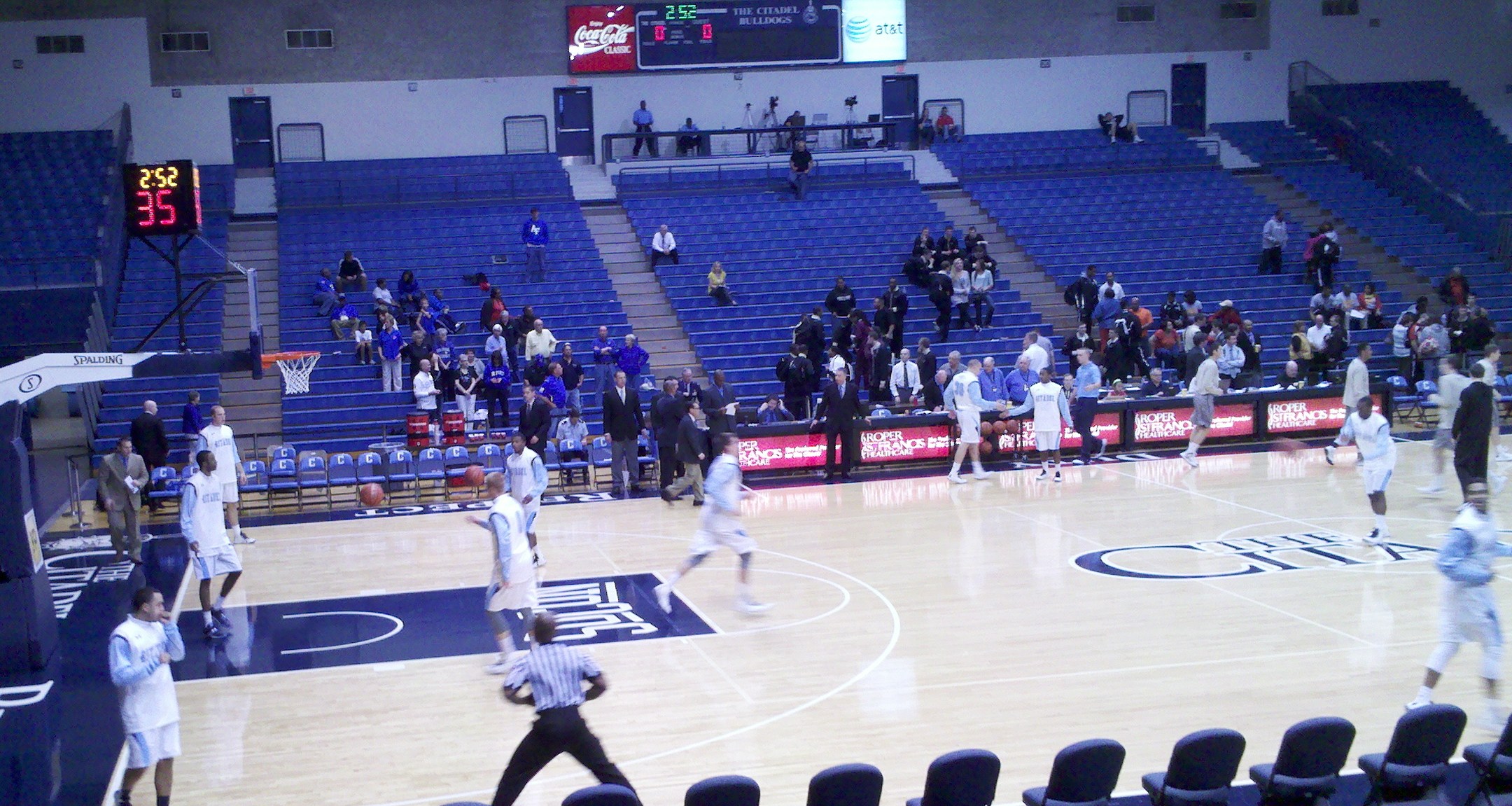
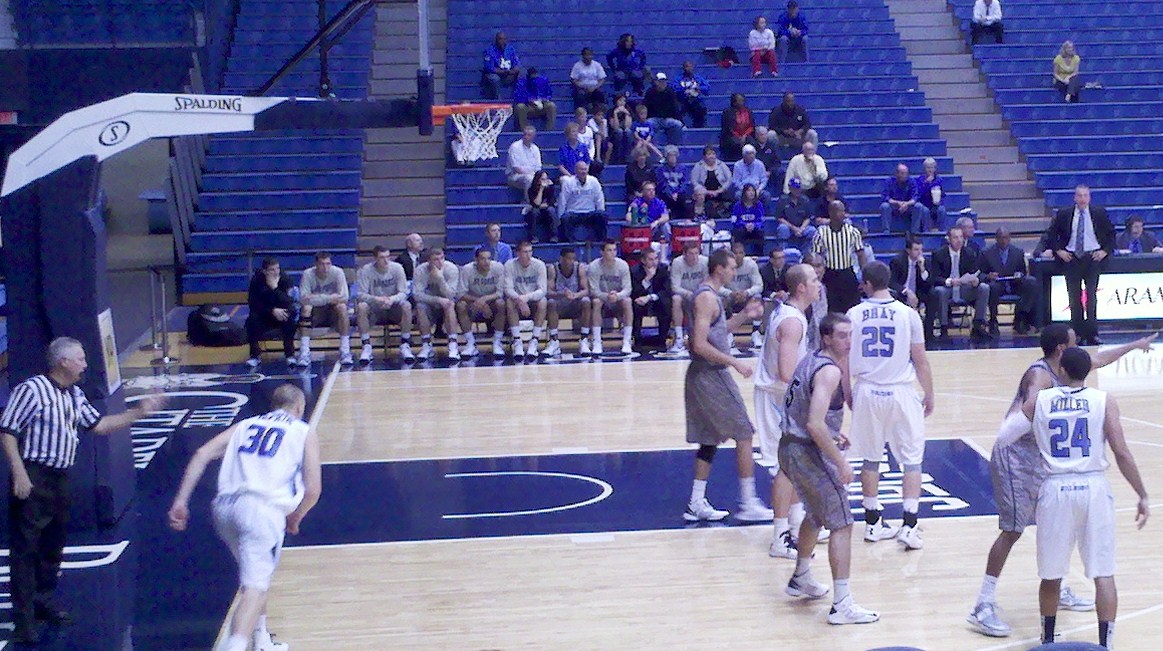
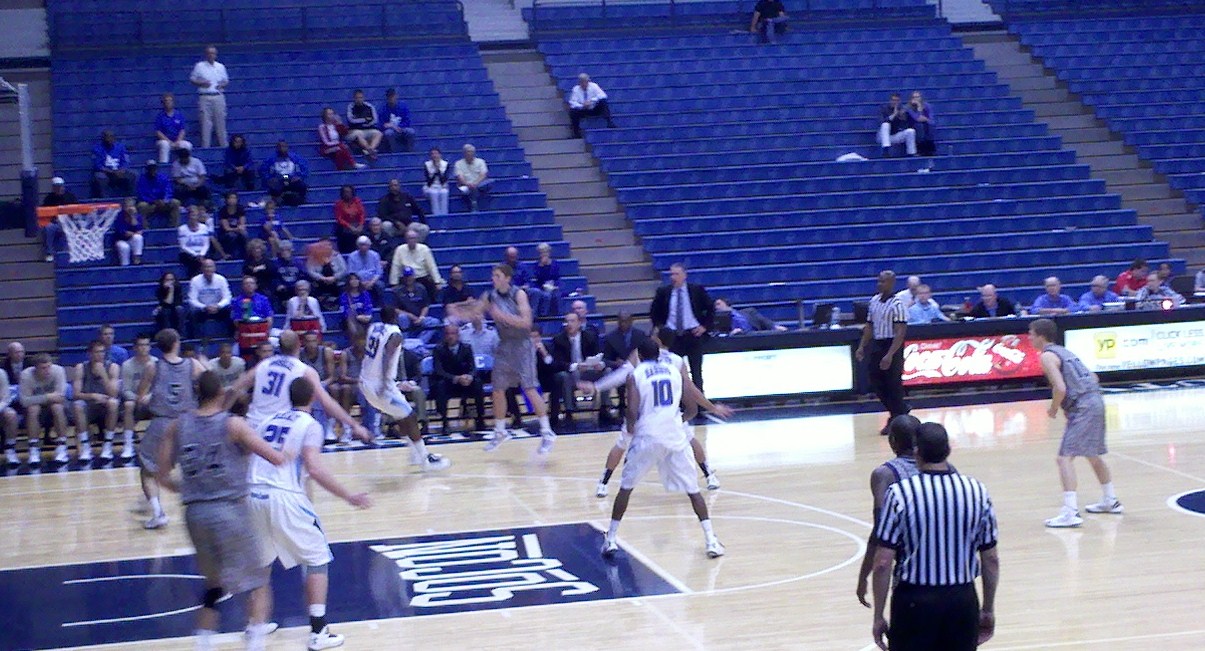
A few pictures from the Air Force game…yes, they’re terrible (though arguably not as bad as Air Force’s uniforms):

McAlister Musings: SoCon voting issues, preseason ratings, and corps attendance

Before I get to the three specific topics I am discussing in this post, some links of interest:

My preview of The Citadel’s 2012-13 basketball season

Chuck Driesell talks Bulldog hoops with Danny Reed (video)

More hoops talk with Chuck Driesell and Danny Reed (video)

Jeff Hartsell was there to Meet the Bulldogs, and was impressed with two freshmen

Mike Groselle is one of the candidates for the Senior CLASS award

Groselle is ready for the season to start (video)

Preview from The Post and Courier

Quick note: In that first Chuck Driesell interview, the coach mentions having had a bunch of his father’s old game reels converted to DVD. I bet a significant number of people (mostly Maryland fans) wouldn’t mind paying for copies of those.

Recently the Southern Conference released its annual preseason polls, both from the media and the coaches. The Citadel received the fewest votes in either poll, but that’s not what I’m writing about. My concern has to do with the way the polls were conducted.

I don’t have a major issue with the media poll, although I would like to know how the conference came up with a total of 30 voters. There are twelve schools in the league, so how were the votes apportioned?

Obviously it’s only a preseason poll and thus not a big deal, but I do have serious reservations about a media vote that did matter, namely last season’s all-conference team selections. I’ll get to that later.

However, first I want to take a look at the coaches’ poll, because it is a puzzler. All twelve coaches voted, but coaches could not vote for their own team. They also could not vote for their own players in the voting for the preseason all-conference team. I’m more interested in the breakdown for the team polling, however.

Total number of points for the teams in the North division: 246

Total number of points for the teams in the South division: 241

That makes no sense; both divisions should add up to the same number of points. Each division should have 246 points allocated to its six teams in some fashion. That is the case for the North, but the South somehow got shortchanged five points.

Because Davidson received all eleven possible first-place votes (Bob McKillop not being allowed to vote for his own team), the Wildcats should have received the maximum number of possible points, 66. Instead, Davidson got 65 points, so one of those five “missing” points belongs to Jake Cohen and company.

Conversely, the fewest possible number of points a team could get in this particular voting setup is 16. That would happen if a team were the last choice in a division by all the other coaches. The Citadel was the preseason last-place selection in the South division, and got, uh, 15 points.

The Citadel actually got fewer points in the SoCon preseason coaches’ poll than was technically possible. If that isn’t bulletin board material, I don’t know what is.

It’s only a preseason poll, though, so why should anyone care? I’ll tell you why. It is just part of a pattern of questionable polling/selection practices administered by the conference. Exhibit A in that respect is last season’s All-SoCon teams.

Last season there were four obvious choices for first-team honors in the Southern Conference: Jake Cohen, De’Mon Brooks, Mike Groselle, and Eric Ferguson. They were, by any legitimate measure, the league’s top four players. Cohen, Brooks, and Ferguson did make the first team, but Groselle was relegated to the second team in favor of Wofford’s Brad Loesing and UNCG’s Trevis Simpson.

Am I biased? Yes. However, check out this statistical comparison:

Player A Player B
Points 501 550
PPG 16.7 18.3
eFG% 59.1 44.5
Rebounds 288 127
Rb/g 9.6 4.2
Assists 54 22
A/g 1.8 0.7
Steals 43 23
S/g 1.4 0.8
Blocks 19 6
Turnovers 65 67

Player A is Mike Groselle. Player B is Trevis Simpson.

I’m not trying to knock Simpson, who is a good player, and one of the league’s better performers last season. I think you could make a decent case for him over Loesing, actually. I just find it hard to imagine how someone could vote for both of those players over Groselle.

Groselle was the league’s leading rebounder and finished second in scoring to Simpson, who took 151 more shots over the course of the season (which is reflected in his eFG%). I know that UNCG won the North division, and I suppose Simpson could get extra credit for that, but if the Spartans had been in the South they wouldn’t have finished in the top half of that division. They did lose 19 games last season, after all (The Citadel lost 24).

I can’t tell you how close the voting was, because the league didn’t provide voting totals for its all-conference teams, at least not publicly; it also didn’t release how many people voted for them. This stands in stark contrast to a conference like the ACC, which publishes that information.

I don’t really understand why the league releases point totals for the preseason polls (which are meaningless) but not for its all-conference teams (which are not meaningless). Maybe it is afraid someone will compare the number of voters to the point totals and discover a discrepancy. I don’t know.

I haven’t even discussed the qualifications of the voters. I can’t, since I don’t know who they are. I don’t know if they are actual media members or merely affiliated with one of the schools. I also don’t know if the voters are evenly distributed by region.

It would be nice to know these things.

If you have a statistical bent when it comes to college hoops, then you probably know who Ken Pomeroy is, and you may know who Dan Hanner is. Both are affiliated with Basketball Prospectus, although Pomeroy has his own site, which is very popular with the tempo-free stats crowd (Hanner writes for RealGM.com).

Anyway, both have released their preseason ratings. It is no surprise that The Citadel is not rated highly.  The Bulldogs are 297th out of 347 Division I teams in Pomeroy’s preseason ratings, and 292nd out of 345 in Hanner’s rankings (Hanner does not rank Northern Kentucky and New Orleans, which are transitioning to D-1).

The Citadel is the lowest-rated SoCon team in Pomeroy’s ratings, but is ahead of two league schools in Hanner’s rankings. Samford and Appalachian State are below the Bulldogs in the latter system.

While Hanner’s rankings are part of the just-published 2012-13 College Basketball Prospectus guide, The Citadel is still predicted to finish last in the league in the SoCon section of the annual. The writer for the SoCon section is Joey Berlin, a freelance writer from Kansas City.

In discussing last year’s Bulldogs, Berlin wrote that “Despite the school’s name, the only impenetrable fortress at Citadel games was the opposing team’s basket.”

Pomeroy rates the SoCon 20th overall among conferences, and the new-look CAA 16th. I’m not sure that will provide much comfort to the College of Charleston’s administration as that school prepares to change leagues (assuming it does eventually do so).

Another ratings system was recently released by David Hess, who is affiliated with TeamRankings.com. In Hess’ ratings, The Citadel is 314th out of 347 teams. The Bulldogs are projected to have a record of 9-18 (5-13 SoCon), with a 0.2% chance of winning 20 games and a 0.1% chance of finishing with the best record in the league.

When I looked at his list of The Citadel’s toughest and easiest games, I was mildly surprised to see that the Bulldogs’ toughest game (at least prior to the start of the season) is projected to be the game at St. Bonaventure, as opposed to the games against Georgia Tech, Clemson, or Davidson.

During the 2011-12 campaign, The Citadel averaged 1,840 fans per game over a 14-game home season. For conference games, the number was 1,813. When the Bulldogs played on the road in the Southern Conference, the average opposition attendance was 2,546.

The Citadel only outdrew two other league teams for SoCon home games, Elon and Samford. The Citadel’s numbers were very similar to those of Furman and Wofford.

That’s not a big surprise, as the Bulldogs went 6-24. However, The Citadel obviously needs to improve on that average. For one thing, I believe increased attendance can occasionally affect the results on the court, not only in terms of inspiring the team or intimidating the opponents, but in influencing SoCon officials (especially for weekend games). The Bulldogs need all the help they can get.

There is a built-in group of potential basketball attendees, though, who could really boost the totals and exponentially increase the support/intimidation factor. That would be the corps of cadets.

I have been at McAlister Field House on more than one occasion when a rowdy group of cadets managed to discombobulate the opposition. It doesn’t take a lot of them to have an impact, either.

(Incidentally, from personal experience during my cadet years, I can attest that natives of New York and New Jersey seem to be particularly good at annoying opponents.)

There are those in the corps who come to every game to support the team. Quite a few of them are athletes themselves, including members of the football and baseball teams. Then there is the pep band, which is traditionally outstanding.

The pep band and the “regulars” are great fans, and deserve credit for providing most of the atmosphere McAlister Field House has on game days.

I just wish that the basketball team got support in the same manner that the football team does for home games. Of course, attendance by the corps at football games is mandatory — which leads me to make a couple of suggestions.

I don’t know what The Citadel can do about league games played on Saturdays. I’m not about to advocate that members of the corps should be required to go to Saturday night basketball games (although of course they do attend football games on Saturday).

For Saturday games, I think it is important to make it really worthwhile for cadets to show up. Perhaps free overnights can be considered. At the very least, provide free food. That usually works.

Also, there are cadets who are stuck on campus over the weekend, serving tours or confinements. I would like to see those cadets in the stands cheering on their team, instead of walking on the quad while toting a rifle.

For weeknight contests, I advocate a rotation. The Citadel plays five league home games this season on weeknights. The “hardcore” plan would feature mandatory attendance at three of those five games (hey, it’s only a couple of hours). The “okay, we won’t bother you more than once” plan would have cadets attending at least one game.

For the one-game only plan, each battalion would attend one game. For example, on January 10th, the legendary 1st Battalion would go watch the Bulldogs battle Chattanooga. For the CofC game, 2nd Battalion would get the call. You get the idea.

I would set up the “hardcore” plan like this:

January 10 (Thursday) — Chattanooga — 3rd and 4th Battalions

January 14 (Monday) — College of Charleston — the entire Corps of Cadets

January 31 (Thursday) — Wofford — 1st and 5th Battalions

February 14 (Thursday) — Georgia Southern — 2nd Battalion

February 28 (Thursday) — Furman — the entire Corps of Cadets

Of course, any cadet who wanted to go to a game could go, even if his battalion wasn’t scheduled to attend. I think regulars would get to sit in specific sections for these games.

This setup would be worth at least two wins for The Citadel, in my opinion. I also believe it might increase attendance among the “non-cadet” crowd.

One other suggestion: I think it’s important to indoctrinate the freshmen cadets as quickly as possible. I understand that most of the freshmen were in attendance for “Meet the Bulldogs”, which was an excellent move. I would also make the November 14th contest against Montreat (a Wednesday night game) an “all knobs attend” affair.

I know I’m asking a lot here of the cadets. However, I think it’s important to help out the hoopsters, and jazz things up a bit. I also believe that the basketball program has a great deal of potential if The Citadel could ever turn the corner. The current average attendance is only about 30% of the capacity of McAlister Field House. Even doubling that (in terms of paying customers) would really do wonders for the bottom line.

The season is about to start. Saturday’s game on the hardwood against VMI will be here before you know it.

Hope on the hardwood? The Citadel begins the 2012-13 basketball season

Note: as I mentioned earlier, I’m participating in “Scanning the SoCon”, a cross-blog/forum exercise. As part of this, there will be a preview for each league school. I am writing the preview for The Citadel, which you can read below (it is being posted on Mocs Mania! as well, of course). Previews for the other conference schools can be found here: Link

There were three topics (attendance, polls, and ratings) that I wanted to discuss in more detail but couldn’t quite fit into the preview. I’ve decided to write about them next week in a followup post.

The Citadel was 6-24 last season, 3-15 in the Southern Conference. Thus, it surprised no one that in the SoCon preseason polls (media and coaches)  the Bulldogs were picked to finish last in the South division of the league. Indeed, The Citadel received fewer votes than any team in the league, in either division.

The last time The Citadel finished dead last in both preseason polls was prior to the 2008-09 season. The Bulldogs had gone 6-24 the previous year, in head coach Ed Conroy’s second season at The Citadel. More of the same was expected, but instead the Bulldogs won 20 games for only the second time in school history, 15 of them coming in league play. It was the finest season on the hardwood for The Citadel in 30 years, and one of the best in school history.

Just like Ed Conroy in 2008-09,  Chuck Driesell is entering his third season in charge of the Bulldogs after enduring a 6-24 campaign. Conroy brought in eight scholarship freshmen for his second season; so did Driesell.

However, there are differences between then and now. Conroy’s batch of freshmen included a player who would be named Freshman of the Year in the Southern Conference, Cameron Wells, and another (Zach Urbanus) who finished the year as a solid contributor. None of the freshmen who played last year for The Citadel (two were redshirted) had a season as good as Wells’ initial campaign for the Bulldogs.

That isn’t to say that significant improvement can’t be made. I suspect it will. However, the same can be said for the Southern Conference in general. I expect the league to be better than it was last year, as many of the better players from last season are returning in 2012-13.

It’s only one statistical category, but I couldn’t help but notice that ten of last season’s top thirteen SoCon performers in Ken Pomeroy’s “offensive rating” system (minimum 20% possessions used) are back this year. That group of ten doesn’t even include established performers like Trevis Simpson, Lucas Troutman, Trent Wiedeman, and a couple of Cochrans (Wofford’s Karl and Davidson’s Nik).

The league is going to be tough this year. Can the Bulldogs hang in there? If they are going to do so, they must first address some obvious shortcomings.

The Citadel was a very poor defensive team last season. Mike Groselle was the only consistent rebounder on the squad (though he was good enough to lead the league), and only three teams in all of Division I allowed opponents to shoot a higher percentage inside the arc (55.7%) than the Bulldogs.

That carried over into league action, although The Citadel wasn’t the worst defensive outfit in the conference in SoCon play, in part thanks to opponents’ three-point shooting (only 30.3%). Three league teams allowed more points per possession than did the Bulldogs in conference games.

However, the Bulldogs struggled on the offensive side of the court in conference play more than any other SoCon team, and by a wide margin, scoring only .907 points per possession in 19 league games (18 regular season matchups plus the first round of the SoCon tourney). The Citadel shot just 31% from outside the three-point line in league action and also had the worst turnover rate in the conference.

One positive: when the Bulldogs did score, it often came as a result of good team passing (The Citadel was second in the league in its ratio of assists to made baskets).

Mike Groselle had an outstanding season in 2011-12. Groselle led the league in rebounding and was second in scoring, being edged for the SoCon scoring crown by UNCG’s Trevis Simpson (who attempted 151 more shots from the field). Groselle was a very efficient performer (59.1 eFG%), and persevered despite being the focus of every opponent’s game plan.

He did everything well, basically, and made the 10-man all-conference team selected by the league coaches. However, Groselle did not make the media’s All-SoCon first team, an omission that was not easy to understand.

For the Bulldogs to improve this year, Groselle is going to need help. Will he get any?

When I watched The Citadel’s freshmen in action last year, I came to the conclusion that while several of them had promising skill sets, they just weren’t strong enough to handle the adjustment to Division I hoops. There is a chance that a year of physical maturity (and a lot of work in the weight room) will improve the Bulldogs’ rebounding numbers and alleviate some of the turnover problems that plagued the team last year.

C.J. Bray is a good example. The 6’7″ Bray is athletic enough to have been offered a football scholarship to Arkansas, and he can present matchup problems with his ability to float outside and hit the three-point shot. I thought he showed good instincts on the boards, too, but he wasn’t able to corral every rebound chance that came his way.

That may change this year. If he can also provide solid post defense, he will be a great help to Groselle. Bray started more games than any other Bulldog freshman last season (18). Another rising sophomore who goes by his initials, 6’8″ P.J. Horgan, saw limited action last year and may also be a factor in the frontcourt rotation.

Lawrence Miller shot 42% from three-point land last season, better than his overall field goal percentage (39%). He will probably get first crack at the 2-guard spot for the Bulldogs. Ashton Moore, who started 14 games last season and played more minutes than any other freshman, will also be in the mix. Moore is capable of putting the ball in the basket (30 points against UVA-Wise) but needs to be more consistent.

The point guard for The Citadel will be Marshall Harris III, who started the final 11 games last season. Harris must cut down on his turnovers to succeed in that role, and it’s key for the Bulldogs that he do so. There is no other obvious candidate to play the point, as DeVontae Wright transferred to USC-Aiken this summer. Moore could be an option, and one of the freshmen may get a look.

Wright was one of three underclassmen to transfer after last season. Jordan Robertson, a forward who showed flashes of potential last year, is now at Davidson County Community College. He was the only one of last year’s group of freshmen to leave. The third player to transfer, Barry Smith, moved on to Bethune-Cookman.

The two seniors on last year’s team, Cosmo Morabbi and Bo Holston, both graduated. Holston had one year of athletic eligibility remaining, and elected to play as a graduate student at Anderson. In all, players no longer on the roster accounted for 42% of the minutes played last season.

There are seven players on this year’s roster who have yet to appear in a Division I game — four incoming freshmen, two redshirt freshmen, and a fifth-year transfer student.

The most heralded of the “knobs” is Matt Van Scyoc, a 6’6″ wing player who led the state of Wisconsin in three-point shooting last year. Van Scyoc averaged 24.3 points and 13.3 rebounds per game his senior season and was an all-state selection in Wisconsin’s Division 5 high school classification.

His fellow classmates include 6’3″ swingman Raemond Robinson, a Goose Creek product who was also an outstanding high school football player. Robinson is used to winning, both on the gridiron and on the court; perhaps he can bring that kind of positive energy to The Citadel’s hoops squad (much like John Brown did during that aforementioned 2008-09 campaign).

Janeil Jenkins and Quinton Marshall each signed late in the spring. They are both guards, but of markedly different sizes; Jenkins is 5’10”, while Marshall is 6’5″. Chuck Driesell mentioned Marshall in a recent interview with Jeff Hartsell of The Post and Courier as someone who might get to play early.

Two of the eight freshmen from last year did not see any action in 2011-12. Dylen Setzekorn is a 6’7″ wing on the slender side (194 lbs., per The Citadel’s website). 6’9″ forward Michael Hundley is even thinner (180 lbs.). It is easy to see why both were redshirted.

Hundley has a reputation as a shotblocker. If he could get on the court with that skill, it would be a huge boon for The Citadel, which hasn’t had a true shot-swatter since Kirill Misyuchenko patrolled the lane for the Bulldogs in the late 1990s.

The final player on The Citadel’s roster is something of a wild card. Stephen Elmore is a 6’6″, 220-lb. graduate student who saw limited action at Princeton…as a baseball player. The 2012-13 campaign will be his first (and last) taste of college basketball, at least as a player.

He is the son of Len Elmore, the well-known college basketball commentator who was an outstanding college player at Maryland (and who had a solid NBA career as well). Driesell described Stephen Elmore as “a power forward who can shoot the three-pointer”. I have no idea what kind of impact (if any) he will have for the Bulldogs.

The Citadel’s non-league slate is about what you would expect for a team that only won six games a year ago and includes two games against non-Division I competition. The Bulldogs will open the season by hosting the All-Military Classic, which also features VMI, Army, and Air Force.

The Citadel squares off with VMI in its first game, on the same day the Bulldogs play the Keydets in football — in Lexington, VA. It’s a scheduling quirk that I think is unfortunate.

There are no home games in December, which is a little strange. The Citadel is playing “guarantee games” against Georgia Tech, Clemson, and…St. Bonaventure. I’m not sure why the Bulldogs are making the trip to Olean, New York, but at least Andrew Nicholson has moved on to the NBA.

In what I believe is a first, The Citadel is participating in Bracketbusters this season. Other out of conference games include a home contest against Radford and road games versus Charleston Southern and Gardner-Webb.

I will be curious to see how Chuck Driesell handles tempo this season. Driesell prefers a faster pace than that implemented at The Citadel by Ed Conroy, but he was forced to slow things down last season in an effort to stay competitive. In that respect, he succeeded. The Citadel’s two late-season victories over Chattanooga and Appalachian State featured fewer possessions than any other games the Bulldogs played during the season.

I think a slower tempo is generally what works best for The Citadel, but it’s obviously not a style Driesell really enjoys, and I don’t know what his approach will be this year. His best player (Groselle) is probably best suited for games with a more restrained pace.

It’s just one of many things that makes this season for The Citadel a very interesting one. I’m not predicting a year like the 2008-09 campaign, but I believe the Bulldogs are going to surprise some people. The team has to make the leap from being competitive to winning games. It’s a difficult transition, but I think the talent is there to make that jump.

“Scanning the SoCon”: a brief explanation

Last season, I participated in something called “Scanning the SoCon”, a multiple-school blogging exercise on Southern Conference basketball run by Mocs Mania!, a blog devoted to UTC hoops. This year, it has been expanded to include participants from all twelve SoCon schools (even the CofC).

I’ll be providing a preview of The Citadel’s 2012-13 hoops campaign in about a week. What I’ll probably do is post it here as well have Mocs Mania! post it; I haven’t quite figured that out yet, to be honest. (I also haven’t figured out when I’m going to have the time to do it, but that’s my problem.)

All twelve schools will be previewed over the next couple of weeks, as the season draws closer. Here is a link to the “preview page”: Link

Also, if you were wondering where all these preview writers are from: Link

The first preview was posted today. It’s about Elon, and was written by a writer for that school’s student newspaper.

The Citadel’s first game on the hardwood is on November 10, which is right around the corner. The Bulldogs host VMI that day, and yes, it’s the same day the football team plays at VMI. As far as scheduling quirks go, it’s not the most ideal.

I just hope the Bulldogs go 2-0 that day…

Putting together The Citadel’s 2012-13 hoops schedule

It’s that time of year when I try to figure out The Citadel’s upcoming basketball schedule before it’s been released. Why do I do this? I have no idea. Marking time until football season begins, I suppose. Anyway, some quick thoughts:

Phil Kornblut interviewed Chuck Driesell recently; you can listen to that here. In the interview, Driesell stated that The Citadel will play fourteen home basketball games this season, and that the first six of those would come in a season-opening homestand at McAlister Field House.

The first two games at McAlister will come at the All-Military Classic against VMI and either Army or Air Force. It doesn’t appear at this time that those games will be played on the U.S.S. Yorktown, as had been rumored. It is possible that the game against VMI could still take place on the carrier, but I tend to doubt it.

Those games will take place on November 10 and November 11. Yes, The Citadel will play VMI in both basketball (at home) and football (on the road) on the same day. That doesn’t strike me as ideal.

After those two games, then, The Citadel will play four more home games before its first road game, which presumably will be the December 1 game against UNC-Greensboro (which has already released its schedule).

There are eighteen games in SoCon play. Nine at home, nine on the road. If The Citadel is opening with six straight home games, then one of them has to be a conference game. That’s because if all six were out of conference, the Bulldogs would be playing 15 home games (those six, plus the nine league matchups).

Since the number of home games is 14, one of the six has to be against a fellow SoCon squad. I’m guessing the date of that game is November 28, based on the recently released Furman schedule.

The other OOC home game that is “known” is Radford. The Citadel will host the Highlanders on November 24. That leaves two more non-conference games at McAlister to be determined.

If The Citadel is playing five OOC home games, then the Bulldogs will be playing six non-conference games on the road. Three of those have already been announced via the release of opponents’ schedules.

The Citadel will play at St. Bonaventure on December 19. Three days later, on December 22, the Bulldogs will travel to Atlanta to play Georgia Tech. Then on January 1, 2013, The Citadel will travel to Clemson.

Larry Leckonby is on record as stating that for budgetary purposes the basketball team was asked to schedule at least three “guarantee games” this season. I’m not positive that the three games mentioned above fit the bill, although they probably do. I am unsure about Clemson, as that game may be part of a previously arranged deal (since the Tigers played at McAlister last season). I am a little curious about the St. Bonaventure game, to be honest.

As for the remaining three road OOC contests, I am assuming (very dangerous, assumptions) that one of them will be against Charleston Southern, which played at MFH last year. As for the other two games, I don’t really have any idea, although I wouldn’t be all that surprised if one of them is another guarantee game.

That’s all I’ve got on the schedule front right now.

Will the conference realignment train make a stop at the SoCon station?

It was inevitable that the never-ending saga of conference realignment would eventually impact the Southern Conference. To recap, some recent (and related) developments in the world of college athletics have included the following:

— As part of a CAA implosion, Virginia Commonwealth is joining the football-free Atlantic 10 (which will have 14 teams for basketball after adding VCU and Butler to replace Temple and Charlotte). Old Dominion, which has had a football program for about three hours, is making a big move to Conference USA. Georgia State, with even less football history than ODU, is joining the Sun Belt.

George Mason is staying in the CAA for the moment, although that may be because there isn’t room in the A-10 for GMU…not yet, anyway.

— Georgia State isn’t alone as a new member of the Sun Belt, as that league is also adding Texas State, but Florida International and North Texas are moving out (to C-USA). Denver is another Sun Belt school on the move, as it is heading to the WAC in a month, assuming the WAC will still exist in a month.

— Denver doesn’t have football. South Alabama once didn’t have a football program either, but now it does, and it will stay in the Sun Belt for all sports. The Jaguars begin league play in football this season.

— Arkansas-Little Rock would be the only non-football school in the Sun Belt, as things stand now. That is expected to change this week with the addition of UT-Arlington, which will give the Sun Belt 12 overall members, with 10 of them playing football.

— Another football newbie, UT-San Antonio, has already managed to join multiple FBS conferences (jilting the WAC for C-USA). UTSA thus has already joined more leagues (two) than it has played football seasons (one), a historic accomplishment.

— Appalachian State wants to move up to FBS land. To do so, Appy has to be invited to join an FBS conference, which has been problematic. The folks in Boone would love to hook up with C-USA, but the feeling may not be mutual. Not only did C-USA invite ODU instead of Appy, it is also bringing in Charlotte (UNCC to you old-timers out there). Let’s review some basic gridiron facts about Appalachian State, Old Dominion, and Charlotte:

– 0 (number of football victories by Charlotte in its history)
– 68 (number of football victories by ODU in its history)
– 67 (number of football victories by Appalachian State since the beginning of the 2006 season)

Ouch. That sound you hear is Appalachian State fans collectively grinding their teeth. (Incidentally, the Mountaineers have 555 wins over the program’s entire history.)

The lesson, as always: markets matter.

— Middle Tennessee State did everything it could to wangle an invitation to C-USA, but like Appalachian State, MTSU didn’t get the call. Again, markets matter. Murfreesboro and Boone lost out to Norfolk and Charlotte.

— Georgia Southern is going to try to raise a bunch of money so that it can move to the land of milk and honey, too. It’s supposed to be an eight-year fundraising campaign, which in today’s climate may be too long a period of time. Eight weeks would be better.

Georgia Southern’s late-to-the-party approach is probably due to the fact it has taken a while for the powers-that-be in Statesboro to warm up to the idea of being an FBS school, much to the annoyance of a vocal section of its fan base. It has been almost three years since GSU released a self-study (entitled “Football Classification Analysis”) that revealed just how difficult a move up to FBS could be for Georgia Southern. I wrote an extensive (warning: VERY extensive) post about the report when it first came out: Link

— Also on the “we want FBS” list: Liberty, a school that has had big-time gridiron aspirations for decades (as a Sports Illustrated story from 1989 illustrates). Liberty is ready to go; just give it 48 hours.

— Delaware is one of several schools being mentioned in what would become an expanded (and expansive) MAC. This article states that moving to the FBS “has been discussed favorably among members of the UD board of trustees and other high-ranking officials.” Whether that discussion has been about football only (and placing its other sports in another league) is open to question.

Meanwhile, no current all-sports MAC schools are being linked to another league, which comes as a surprise to at least one writer.

— James Madison, another CAA football-playing school trying to figure out its future, has also been linked to the MAC — but wait, there’s more. JMU reportedly has also drawn interest from the WAC. That would be the WAC which is a year away from being a two-school (New Mexico State and Idaho) football league, as things stand now.

Presumably the WAC is trying to put together western and eastern divisions to keep the conference alive, or maybe try to swing a Sun Belt-WAC merger of some sort. Good luck with that.

The MAC is adding Massachusetts for football but losing Temple, so it will be at 13 teams and may want to add another one — or three. Appalachian State is a possibility for this league too. Oddly, Appy may not be a factor in the Sun Belt sweepstakes, at least not yet, which will disappoint this columnist.

Honestly, I’m not sure why the MAC would feel the need to expand, but then I thought the SEC was fine at 12 schools. In today’s climate, if your conference has “only” 12 members, then it clearly needs to add even more schools and get to at least 14 if not 16 members, because otherwise the world will end (per the Mayans and/or Mike Slive).

The SoCon is holding its spring meetings at the end of May/beginning of June. According to Chattanooga AD Rick Hart, conference expansion will be the main (if not exclusive) topic of discussion. League commissioner John Iamarino stated that he had a short list of schools to target if that became necessary. Will it become necessary?

That depends on what Appalachian State and Georgia Southern do, of course, and it will also depend on what other conferences do. The league to watch is probably the CAA, but the confusing trail of realignment for SoCon schools will also pass through the MAC, Sun Belt, Big South, Atlantic Sun, and possibly the OVC. (No, I’m not buying the WAC — at least, not yet.)

The CAA’s problem is basically twofold (see this excellent overview). It has to decide whether it should continue being a player in the world of FCS, and it has to decide what its geographic focus will be. How it makes those decisions will go a long way in determining how much the SoCon could be affected.

Brian Mull of the Wilmingon (NC) Star-News wrote a solid piece from UNC-Wilmington’s perspective. UNCW is a non-football school at the southern end of the CAA. UNCW needs travel partners, and schools like the College of Charleston and Davidson would be ideal on that front. Mull also discusses other schools in the league as well, like UNC-Greensboro and (to prop up the football side of the CAA) Furman, Elon, and Appalachian State. UNC-Asheville of the Big South gets a mention.

He isn’t the first person to connect Davidson and the CofC to the CAA. As soon as ODU announced it was jumping ship, my twitter feed started humming with tweets from the likes of Jeff Goodman and Andy Katz, among others, all with the same “CAA must go after Davidson/CofC” message.

Just how interested would those two schools really be, though? I have my doubts.

The argument that the two would benefit from a move to a multi-bid hoops league falls flat, in my opinion, because the departures of VCU and ODU lessen the “value” of CAA hoops to the point where the conference is no longer a solid bet to get multiple bids on a semi-regular basis. Heck, even this past season CAA regular-season champ Drexel didn’t get an at-large bid to the NCAAs.

Combine the loss of VCU and ODU with the realization that league hoops stalwart George Mason and FBS contenders JMU and Delaware are all far from certain to stay in the CAA, and the move would be mostly lateral from an on-court perspective.

Another reason for Davidson and the CofC to move on could be the CAA’s new TV contract with NBC Sports Network (formerly Versus), which on the surface appears to easily surpass the SoCon’s PBS arrangement. However, with the recent defections of ODU and VCU (not to mention Georgia State), that NBCSN/CAA contract will likely be renegotiated. It is hard to determine just how much exposure schools like Davidson and the College of Charleston would get with that deal.

Is it worth the increased travel costs, loss of traditional rivalries, and/or the general effect on the schools’ total sports portfolio? As far as other sports are concerned, for example, I’m thinking about CofC baseball, which would definitely be hurt by a move to the CAA.

That isn’t to say there wouldn’t be positives for a school like the College of Charleston. For one thing, this isn’t your mother’s CofC. It now has about 10,000 undergraduate students, or roughly 1,000 students for every available parking space downtown. It’s a midsize state school looking to attract good students, including those valuable out-of-state students with their out-of-state tuition payments. Moving to a league with a more northern geographic scope might be seen as beneficial, as part of an overall strategy of recruiting students from the mid-Atlantic and northeastern states.

I think Davidson would be a much tougher sell. It’s a small school that isn’t going to get bigger. It’s been in the Southern Conference since 1936, with the exception of a brief three-year fling with the Big South more than two decades ago. That Davidson/Big South dalliance could be described as one of those affairs that scares people from ever straying again. I’m not sure Davidson is ready to trade in bus trips to Furman for airplane flights to Northeastern.

When trying to analyze future league membership, the potential loss by the SoCon of Appalachian State and/or Georgia Southern should be viewed differently than if Davidson/CofC/UNCG were to leave. If Appy and GSU depart the conference, a football replacement (or two) would be needed, which would not be the case if one or more of the non-football schools left the league.

The last two schools to be admitted to the SoCon were each smaller schools (Elon and Samford, both private universities), and I suspect that trend will continue.

I don’t see Coastal Carolina having much, if any, chance of joining the Southern Conference. CCU in the SoCon is a non-starter for Furman, The Citadel, and Wofford (and probably Davidson and Samford as well). Adding Coastal Carolina to the conference is of no benefit to those schools.

I thought Coastal Carolina might have a decent shot at getting a CAA invite, but there seems to be some resistance to CCU from that league as well. The leading football-school candidate for the CAA appears to be Stony Brook.

At this point, Coastal Carolina might have a better chance of moving out of the Big South and into another league by going the FBS route. That would be a costly move, but maybe CCU could ask its new football coach for a loan. After all, he has the money.

Here are some football-playing schools that might be good SoCon fits:

– VMI: yes, a back to the future move. Would VMI accept? Probably. Leaving the SoCon was not the best decision ever made by its administration. It would help if VMI had a travel partner of sorts, though…

– William&Mary: another back to the future candidate, and a Virginia school to pair with VMI. If the CAA completely collapses, William&Mary will become a school needing a new (and appropriate) home. Truth be told, at least part of its fan base would prefer the Patriot League, and I can understand that. If the Patriot League doesn’t expand, though, and the CAA can’t get its act together, I could see the Tribe back in the SoCon.

– Richmond: not happening. Richmond basketball is in the A-10 and UR isn’t giving that up anytime soon. Richmond as a football-only member of the SoCon? Possible, I suppose, but I doubt it (and wouldn’t support it, either).

– Mercer: hired former Furman coach Bobby Lamb to start a football program; however, it’s going to be non-scholarship. If it were scholarship, Mercer would be a very strong candidate.

– Presbyterian: PC would be a decent candidate if there weren’t already three football-playing schools in the league from South Carolina. Thus, it’s not likely to be invited, although Presbyterian would certainly be more palatable to Furman/The Citadel/Wofford than would Coastal Carolina.

– Jacksonville: I wrote about JU when I previewed The Citadel’s season opener last year. JU has potential, but it’s another non-scholarship football program.

– Gardner-Webb: It would rank behind most of the other schools I mentioned as far as likely SoCon contenders are concerned.

Incidentally, I am on board with smaller schools being the focus of the Southern Conference when/if it looks for new membership. I’m biased, so I want what is best for The Citadel. What is best for The Citadel, in my opinion, is to compete in a Division I all-sports conference with “like” schools.

Of course, there really aren’t any schools like The Citadel (save maybe VMI), but ideally the other schools would be similar in terms of enrollment size, academic standards, budgets for varsity athletics, etc. If you have a couple of days and want to read more about my ideas on “peer institutions” and what The Citadel should be doing going forward, I wrote a manifesto a month or so ago that Leo Tolstoy would have considered a tad lengthy.

What do I think will happen? I think Davidson and the College of Charleston will stay in the SoCon. I suspect Appalachian State will move to FBS within twelve months. Georgia Southern may stay at the FCS level for a while longer, unless the two schools are a “package deal” for an FBS league (likely the Sun Belt). VMI will wind up back in the SoCon.

I could be wrong about all of that, of course. There are no guarantees.

It’s all speculative at this point, though. Anybody can say anything, especially on the internet. On Saturday night a couple of tweets showed up on my timeline indicating that Clemson was going to move to the Big XII — “from all indications the board of trustees will approve”. I had never heard of the original tweeter, but the information (or misinformation) spread like wildfire. More than 36 hours after the initial tweets, no other source had confirmed the story. This is fairly typical.

At least that rumor was about Clemson. I’m starting to get tired of the Florida State-Big XII angle. Hey, if anyone wants to start a fun rumor, try this one:

FSU and Clemson are staying in the ACC, because they know that Notre Dame is joining the ACC as part of a joint entry with a mystery school. While eating lunch at a Bojangle’s in suburban Greensboro, an ACC official accidentally dropped an artist’s rendering of the new 16-team league. A quick-thinking cashier took a picture of it. I’ve acquired a photo of this mock-up. Consider this a TSA exclusive. It’s a “done deal”.

Happy conference realignment, everybody!

Hoops update: the SoCon tourney moves back to Asheville

Every year about this time I post about the upcoming SoCon tourney, and The Citadel’s less-than-stellar history in the event. Actually, I didn’t last year, for reasons neither here nor there, so perhaps it would be worthwhile to simply revisit my last piece on the subject. (Besides, not that much has changed.)

Thus, the first section of this post is an updated version of what I wrote previously on the origins of the tournament, and The Citadel’s particularly poor performance in it over the years. I’ll write more specifically about the SoCon’s return to Asheville (along with the current edition of the Bulldogs, of course) afterwards.

One of the more curious things about The Citadel’s horrid history in the SoCon tourney is that there is no firm answer to just how many times the school has lost in the event.  That’s because the league has mutated so many times there is confusion as to what year the first “official” conference tournament was held.

Before 1920, The Citadel was one of many schools in a rather loose confederation known as the Southern Intercollegiate Athletic Association.  (The Citadel initially joined in 1909.)  There were about 30 colleges in the SIAA by 1920, including almost every member of the current SEC and about half of the current ACC, along with schools such as Centre, Sewanee (which was actually a founding member of the SEC), Chattanooga, Wofford, Howard (not the school in D.C., but the university now called Samford), and Millsaps, just to name a few.  As you might imagine, the large and disparate membership had some disagreements, and was just plain hard to manage, so a number of the schools left to form the Southern Conference in late 1920.

In the spring of 1921, the SIAA sponsored a basketball tournament, which would be the forerunner to all the conference hoops tourneys to follow.  Any southern college or university could travel to Atlanta to play, and fifteen schools did just that.  Kentucky beat Georgia in the final.  The Citadel did not enter the event, but several other small colleges did, including Newberry (for those unfamiliar with Newberry, it’s a small school located in central South Carolina).  The tournament featured teams from the new Southern Conference, the old SIAA, and squads like Newberry, which wasn’t in either league (it would join the SIAA in 1923).

In 1922 the SIAA held another tournament in Atlanta, this one won by North Carolina, which beat Mercer in the final.  The Citadel entered this time, losing in the first round to Vanderbilt.  The SIAA tournament remained all-comers until 1924, when it was restricted to Southern Conference members.

Some sources suggest that the 1921 tournament is the first “official” Southern Conference tournament, some go with the 1922 event, and others argue for 1924.  From what I can tell, the league itself is a bit wishy-washy on the issue.  On the conference website, it states:

The first Southern Conference Championship was the league basketball tournament held in Atlanta in 1922. The North Carolina Tar Heels won the tournament to become the first recognized league champion in any sport. The Southern Conference Tournament remains the oldest of its kind in college basketball.

However, the conference’s own media guide lists Kentucky as having won the first tournament title in 1921.  The guide doesn’t include league standings from that year, starting those for the 1921-22 season (which is appropriate, given play in the new conference didn’t begin until the fall of 1921). It specifies that the 1921, 1922, and 1923 tournament results are for the “Southern Intercollegiate Basketball Tournament” but doesn’t distinguish those tourneys in any way when it lists the year-by-year champions (and includes the all-tournament team from 1923 in the listing of SoCon all-tourney squads).

Personally, I think that the idea of having a conference tournament is to determine a league champion, and it stands to reason that such a tournament would only include league members.  So the first “real” Southern Conference tournament, in my opinion, was held in 1924.

There is a point to this, trust me.  The difference between counting the Vanderbilt loss as a SoCon tourney loss and not counting it is the difference between The Citadel’s alltime record in the event being 11-58 or 11-59.  Not that they both aren’t hideous totals, but as of now The Citadel shares the NCAA record for “most consecutive conference tournament appearances without a title” with Clemson, which is 0-for-58 in trying to win the ACC tournament.  Counting the Vanderbilt game would mean The Citadel is alone in its conference tourney infamy.  No offense to the Tigers, but I don’t believe the 1922 game should count, because it wasn’t really a Southern Conference tournament game.

Incidentally, you read that correctly.  The Citadel is 11-58 alltime in the SoCon tournament.  That’s just unbelievably bad.  It comes out to a 16% winning percentage, which is more than twice as bad as even The Citadel’s lousy alltime conference regular season winning percentage (35%).  The Citadel lost 17 straight tourney games from 1961-78, and then from 1985-97 lost 13 more in a row.

Tangent:  The single-game scoring record in the tournament is held by Marshall’s Skip Henderson, who put up 55 on The Citadel in 1988 in a game Marshall won by 43 points.  The next night the Thundering Herd, which had won the regular season title that year, lost to UT-Chattanooga by one point.  Karma.

Those long losing streaks didn’t occur in consecutive years, as The Citadel didn’t always qualify for the tournament, particularly in the years before 1953, when there were up to 17 teams in the league at any given time, and only the top squads played in the tourney.  The Citadel’s first “real” appearance, in 1938, resulted in a 42-38 loss to Maryland.

The Citadel would lose two more tourney openers before winning its first game in 1943, against South Carolina.  That would be the only time the Bulldogs and Gamecocks faced each other in the tournament, and so South Carolina is one of two teams The Citadel has a winning record against in SoCon tourney play (the Bulldogs are 2-0 against VMI).

The next time The Citadel would win a game in the tournament?  1959, when the Bulldogs actually won two games, against Furman and George Washington, and found themselves in the tourney final.  Unfortunately, the opponent in the title game was West Virginia, led by Jerry West.  West scored 27 points and the Mountaineers pulled away late for an 85-66 victory.  This would be the only time The Citadel ever made the championship game; it’s also the only time the Bulldogs won two games in the tournament.

After a 1961 quarterfinal victory over Richmond, The Citadel would not win another tournament game until 1979, when the Bulldogs defeated Davidson before losing to Furman.  The game against Davidson was played at McAlister Field House and was the final victory of a 20-win campaign, the school’s first.

The Citadel would win single games in 1982 and 1985 before going winless until 1998, when it finally broke a 13-game tourney losing streak by beating VMI.  The Keydets would be the next victim as well, in 2002, and were apparently so embarrassed they left the league.  The Citadel’s last two wins in tourney play occurred in 2006 (against Furman) and 2010 (versus Samford).

Twenty-one different schools have defeated The Citadel in tournament play, with Davidson’s eight victories leading the way (against one loss to the Bulldogs).  East Tennessee State went 6-0 against The Citadel while in the league.

Norm Sloan, who had the best record as a head coach of The Citadel since World War II, was 2-4 in the tourney; his successor, Mel Thompson, was 1-6.  Dick Campbell did not win a tourney game (0-4).  Neither did George Hill (0-3).  Les Robinson was 3-10 (a record which by winning percentage leads all of the post-Sloan coaches).  Randy Nesbit was 0-7.  Pat Dennis was 3-14. Ed Conroy was 1-4. Current coach Chuck Driesell is 0-1.

The best record for a Bulldog coach in SoCon tourney play is that of Bo Sherman, who went 1-1 in 1943, his lone season in charge.  Sherman’s Bulldogs defeated South Carolina before losing to Duke.

The Citadel’s record against current SoCon teams in the tournament:  Furman 2-5, UT-Chattanooga 0-1, Elon 0-1, Samford 1-1, College of Charleston 0-1, Georgia Southern 0-2, Western Carolina 1-1, Appalachian State 1-7, Davidson 1-8.  (The Citadel has never played Wofford or UNC-Greensboro in the tournament.)

Asheville hosted the Southern Conference tournament from 1984 to 1995. It was a generally successful venue for the league, in part because of its relatively central location. As this article states, the league was mostly dominated by UT-Chattanooga, East Tennessee State, and Marshall during that period, and their fans came out in force, leading to good attendance for the majority of the tournaments held in Asheville. Those three schools won all but one of the title games held in Asheville (Davidson won the 1986 tournament).

However, the Civic Center (now called the U.S. Cellular Arena) was starting to show its age, and other cities offered the SoCon a better financial package, so the tournament left the city. Now it is back, for both the men’s and women’s tourneys. It has a new roof, which is good, since a few years ago the old roof began leaking during an Alison Krauss concert. By law, that should have resulted in the facility being burned to the ground and a ritual stoning of its maintenance supervisor, but compassion was shown.

The Citadel does not have fond memories of Asheville. The Bulldogs were 1-12 in tourney play during that era, with the lone win a 68-62 victory over Appalachian State in 1985. That came one year after The Citadel’s first Asheville tourney, when it lost to Appy. The Citadel also lost a second tournament game in Asheville to Appalachian State, to go with losses to Marshall (twice), Furman (twice), East Tennessee State (four times), Chattanooga, and Georgia Southern.

Having said that, I think it would be all right if Asheville becomes the regular home for the Southern Conference tournament. The league probably needs a permanent location to build local interest in the tourney on a year-by-year basis, and Asheville is a reasonable trip for fans of most of the current league schools. It was once the home base for the league itself, of course, until league offices moved to Spartanburg.

Tangent: Asheville also hosted the league’s baseball tournament for a time, until the debacle that was the 1989 SoCon baseball tournament directly led to that tourney moving to Charleston. Moral of that story: when it starts raining at a baseball park, it would be really handy if a tarp were available.

It’s going to be a busy week of hoops in Asheville, that’s for sure. Not only is the city hosting both the SoCon men’s and women’s basketball tournaments, but the Big South men’s tourney is being hosted by that league’s regular season champion — which happens to be UNC-Asheville. UNCA will host the quarterfinals and semifinals, and also the Big South title game if it advances that far.

Some of you might be wondering why I am rehashing The Citadel’s tournament foibles, and I can understand that. There are two reasons. First of all, there is no reason to hide from the truth. More importantly, however, I think a large part of the program’s problem with the SoCon tourney over the years is that it has never had anything resembling sustained success, or any kind of success for that matter.

No one who has played for The Citadel has any really good memories of the tournament, with the possible exception of some of the players from the late 1950s, and I’m afraid that positive vibe has long since evaporated. I think it is hard to expect success when all anyone surrounding the program has ever known at the SoCon tourney is failure.

In 2009, when the Bulldogs had one of their best seasons ever, winning 20 games and finishing second in the conference, they had a quarterfinal matchup with Samford, a team that The Citadel had beaten easily during the regular season. As soon as Samford took an early lead, though, The Citadel’s players started pressing. It was as if the tortured history of the program started preying on everyone’s minds. Naturally, the result was a loss.

This year’s team has not had one of the school’s best seasons ever. The Bulldogs are 6-23 and finished with the worst record in the league. They did win two of their last three games, however, and because of that I think they may have the ability to accomplish something important.

The Citadel is not going to win the Southern Conference tournament this year. However, what this team can do is lay a foundation for a future squad to do so, just by winning a game or two. That could give the current players confidence that they can do well in the tourney in the next two or three seasons, and make some (positive) history.

That’s why this tournament can be important for The Citadel. Win a game or two, and set the stage for something wonderful to happen in the 2013 or 2014 tournaments.

I’m hoping the team begins play on Friday with a little “edge” to them, for a couple of reasons. The opponent in the opening game, Western Carolina, basically manhandled the Bulldogs in their regular season matchup, dominating the glass so thoroughly that the Catamounts had more offensive boards than The Citadel had total rebounds.

Chuck Driesell used that as a motivational tool over the remaining three games of the season, and it seems to have had an effect, as has his slow-the-pace tactics. While WCU is arguably the worst matchup for The Citadel among SoCon North teams, maybe it’s good that the first game is against a team with which the Bulldogs should be able to compete, but which recently embarrassed them.

Also possibly out to prove a point could be Mike Groselle, who earned first-team All-SoCon honors for his outstanding play this season, but didn’t receive those deserved honors from the SoCon media writers. This was patently absurd. Clearly a number of voters didn’t actually watch many games or pay any attention to statistics, both basic and advanced. Groselle was also probably a victim of his team’s record.

The goal this week for The Citadel’s hoops squad is to prove something to itself, and to set the table for success down the road. Let’s hope it’s a good week.

Schools that have never made the NCAA Tournament — the 2012 edition

Updated: The 2016 edition

Now updated: the 2015 edition

The 2013 edition

Previous entries on this subject:  The 2011 edition   The 2010 edition

It’s that time of year again, as in late February teams can see the end of the regular season finish line, and the anticipation of the conference tourneys begins. It’s also that time when we see if any of the schools with many years in Division I but no NCAA tournament appearances will finally get to become debutants in the Big Dance.

I want to start this post, however, by acknowledging that there have been a few schools which have an NCAA history but  have not appeared in the tournament for a very long time (in some cases, forty years or more). Of this group, the longest drought is that of Harvard, which made its first and only tourney trip in 1946. Harvard currently leads the Ivy League, however, and is favored to win the conference and make a long-overdue return to the NCAAs this season.

Other schools not so favored: Rice (tourney-free since 1970), Bowling Green (1968), Columbia (1968), Tennessee Tech (1963), Yale (1962), and Dartmouth (1959).

I wouldn’t mind seeing any of those schools get back into the NCAAs someday, to be sure, but the focus of this post is on the twenty schools to have been in Division I the longest without making even one appearance in the NCAA tournament. Each of these schools has been in D-1 for at least 25 seasons (counting the 2011-12 campaign) with no appearances on any bracket.

Will any of these 20 schools finally break through this season? Last season, none of them did. The season before that…none of them did. The list of 20 has changed this year, however, because Centenary completed its 50-year run in D-1 last season with no tournament appearances. Since Robert Parish’s alma mater has dropped out of the division, it no longer appears on our list. Replacing Centenary this season (and #20 in terms of “seniority”) is UMKC.

Tangent: if you’re wondering how Centenary never made the NCAA tournament despite having Robert Parish in its lineup for four years, it’s because the Gents were on probation all four seasons he played for the school, thanks to the recruitment of…Robert Parish. Reading the link, it becomes clear that the NCAA hasn’t changed much over the years. This is not a good thing.

Now for this year’s review of our hopeful little group of perennial non-contenders. Please note that there are other schools in Division I that have yet to make an NCAA trip, but all of those schools are “newbies” — they all became members of D-1 after 1990. They haven’t suffered enough to be listed here.

[Note: all records listed below are for games through February 22]

The NCAA Tournament began in 1939. In 1948, the NCAA was re-classified into separate divisions (university and college). There are five schools which have continuously been in what we now call Division I since 1948 that have never made the tournament field. (That doesn’t include the aforementioned Harvard, which made its solitary appearance in 1946.) All five of those schools theoretically could have been in the tournament beginning in 1939, so for them the wait is actually longer than their history as official D-1 programs.

The five schools are known as the “Forgotten Five”. The class  of 1948 (or 1939, if you will):

— Northwestern: NU is easily the cause célèbre of the Forgotten Five, as the only school in a BCS league never to have made the tournament. The Wildcats (16-11) have had a frustrating “so close, but so far away” kind of season, including Tuesday night’s overtime loss to Michigan. To break through this year and finally bring joy to the likes of Michael Wilbon or Darren Rovell, Northwestern needs to win its last three regular season games or make a big run in the Big 10 tourney. Neither is likely, particularly the former, as one of those three games is against Ohio State and the other two are on the road.

— Army: The Bulldogs of the Hudson are 12-16 overall and currently in sixth place in the eight-team Patriot League. Army would probably have to beat all three of the league heavyweights (Bucknell, Lehigh, and American) to win the conference tournament. Don’t bet on it.

— St. Francis (NY): The Terriers sport a modest 15-12 record, but are one of the better teams in the Northeast Conference, having won seven of their last nine games. SFC has to be considered a dark-horse threat to win the NEC tourney. When it comes to making the NCAAs, St. Francis is one of the more promising possibles among our group of 20.

— William and Mary: There has been some hot-and-heavy “bubble talk” about whether the CAA deserves to be a two-bid league, but none of that discussion has revolved around the Tribe (624). It’s been a long year for Jon Stewart’s alma mater.

— The Citadel: At 622,  it’s been a long year for my alma mater too (despite the recent two-game winning streak). Of course, this isn’t the first time the Bulldogs have had a long year…

Okay, that’s the Forgotten Five. What about the other schools?

— New Hampshire (which began Division I play in 1962): The Wildcats are 12-15, which is actually a better mark than their historical norm; UNH’s basketball program has a “lifetime” winning percentage of under 40%. That’s good enough for sixth in the America East. That’s not good enough to garner an NCAA bid.

— Maine (also from the class of 1962): This season Maine is matching New Hampshire win for win (12-15; both teams are also 7-9 in America East play). When you match New Hampshire win for win in basketball, that’s generally a sign that you aren’t headed for postseason glory.

— Denver (D-1 from 1948 to 1980, then back to the division in 1999): Unlike most of the teams on this list, the Pioneers are actually good. Denver already has 20 victories this season, including wins over St. Mary’s and Southern Mississippi. Another of the Pioneers’ victories came against Sun Belt rival Middle Tennessee State, but the Blue Raiders will still be solidly favored to capture the Sun Belt tourney crown. That’s important, because Denver has no realistic shot at getting an at-large bid. It must win the league tournament.

— UT-Pan American (class of 1969): It’s not like UTPA is completely devoid of hoops history; Lucious “Luke” Jackson played for the Broncs, and he later won both an Olympic gold medal in basketball and an NBA title. Abe Lemons and Lon Kruger both coached at UTPA. However, the school has not been rolling up victories in recent years. This season’s 11-17 campaign to date is a big improvement over the last two years, both 6-win debacles. Ultimately, though, that improvement doesn’t matter much; as a member of the Great West conference, a league without an automatic bid, UTPA has no shot at an NCAA berth.

— Stetson (class of 1972): The most famous hoopster in Hatters history is probably Ted Cassidy, the actor who played Lurch on The Addams Family. Alas, no amount of bell-ringing will bring an NCAA bid to Stetson this season, as the Hatters are 9-18 and in danger of not qualifying for the Atlantic Sun tournament.

— UC Irvine (class of 1978): The Anteaters are 10-17, seventh place in the Big West, and a million miles behind league leader Long Beach State in terms of basketball prowess this season. It’s too bad UCI has never made the NCAAs, as “Zot, Zot, Zot” is surely a much better chant than “Rock, Chalk, Jayhawk”.

— Grambling State (class of 1978): The Tigers are 3-21 overall and in last place in the SWAC, which makes them a strong contender for being considered the worst team in Division I. Indeed, Grambling is ranked 345th and last in the Pomeroy Ratings.

— Maryland-Eastern Shore (D-1 in 1974-1975, then back to the division in 1982):  The Hawks are 6-20 and in next-to-last place in the MEAC. I’m not forecasting a deep league tourney run this year for UMES.

— Youngstown State (D-1 in 1948, returning in 1982): The Penguins are a respectable 14-13 and a middle-of-the-pack team in the always solid Horizon League. It’s hard to see YSU getting past Valparaiso, Butler, and Cleveland State in the league tournament, however.

— Bethune-Cookman (class of 1981): B-C missed a great opportunity last season after winning the MEAC regular season title, as the Wildcats lost in the conference tourney semifinals. Bethune-Cookman isn’t as good this year (13-14) but is one of six or seven teams with a reasonable shot at winning the MEAC tournament. If it were to do so, it would probably land in one of the dreaded 16-seed play-in games.

— Western Illinois (class of 1982): The Leathernecks are 14-12 and comfortably situated in the middle of the Summit League standings, a vast improvement over last year’s seven-win squad, which lost its last 13 games (including one to Centenary, the Gents’ only win in their farewell D-1 season). It’s been a nice bounceback year for WIU, but it’s unlikely Western Illinois can get past Oral Roberts and South Dakota State in the league tournament.

— Chicago State (class of 1985): Like Texas-Pan American, Chicago State competes in the Great West conference and thus has no opportunity at snagging an automatic bid to the NCAAs. Unlike UTPA, however, the Cougars haven’t been competitive, with a record of 4-23.

— Hartford (class of 1985): The Hawks are the third America East team on our list. Hartford is ahead of UNH and Maine in the league standings but has a much worse overall record (8-20). Hartford can count singer Dionne Warwick among its alums, but you don’t need a psychic to know that the Hawks are not making their first NCAA appearance this season. You don’t even need a friend.

— Buffalo (class of 1985):  The Bulls have come closer than most of these schools to finally grabbing the brass ring. This season, Buffalo is 16-9 overall and in second place in the MAC East, the superior of that league’s two divisions. While Akron is probably the favorite to win the conference tournament, Buffalo is a team to watch, having recently gone on an eight-game winning streak (before dropping its last two contests).

— UMKC (class of 1988): The newest member of the countdown, the Kangaroos are only 10-19 overall and tied for last place in the Summit League. It’s quite possible UMKC may not qualify for the league tournament, much less the NCAAs, which would definitely upset all the sportos, motorheads, geeks, sluts, bloods, and wastoids at the school, not to mention UMKC alum Edie McClurg.

Well, that’s this year’s rundown. St. Francis (NY), Denver, Buffalo, and possibly Northwestern have not-improbable chances of finally getting the call on Selection Sunday. However, it’s more likely that once again, none of the never-beens will realize the dream. It’s too bad. However, it won’t stop fans of those programs from continuing to support them, hoping that one day they will get that moment in the sun.

For this season, though, the skies appear to be cloudy.

Hoops update: still searching for a second SoCon victory

Just a few quick thoughts on the losses to Wofford and Furman:

— The Citadel has a lot of issues to address, both offensively and defensively, but one noticeable problem the Bulldogs have had, particularly over the last three games, is a tendency to commit a ridiculous number of first-half turnovers. The Citadel has averaged over 11 turnovers in the first half in those three games. The Bulldogs have taken care of the basketball in the second half in two of those games, but to win consistently (or at all) they must cut down on turnovers throughout the game.

If The Citadel had not committed 12 first-half turnovers against Wofford, the Bulldogs likely would have had a decent lead at the break instead of being tied at 21. Against Furman, ten TOs in the opening stanza led to a deficit that the Bulldogs could never quite overcome.

The Citadel had 12 first-half turnovers against Georgia Southern in a game the Bulldogs lost in double overtime; in the second half and two overtime periods in that contest, The Citadel only committed seven turnovers. Just cutting down on a few of the first-half miscues would have resulted in a victory for the Bulldogs.

You just can’t throw away possessions like that. Against Furman, the Bulldogs shot the ball very well in the first half (53% FG), actually got to the foul line and made a good percentage of their free throws (9-12)…and still trailed by six points at intermission because 29% of The Citadel’s possessions ended in a turnover.

Against Wofford, 37.5% of The Citadel’s first-half possessions ended in a turnover.

Admittedly, none of this is news to the Bulldogs. As Mike Groselle said after the Wofford loss:

We’re really close, and everyone on the team knows it. It’s up to us to be more solid with the ball. That’s going to be the difference in winning and losing these games.

— Groselle is continuing to put together what is by anyone’s definition an outstanding season, despite The Citadel’s struggles. There is no telling how many points he would have scored against Furman if the Paladins had not elected to go to a sagging 2-3 zone midway through the second half; as it was, Groselle finished with 24 points on 10-12 shooting from the floor (along with 11 rebounds).

Unfortunately, the Bulldogs were unable to make Furman pay for that defensive strategy, only making three of fifteen three-point shots. Not only was The Citadel unable to hit from outside, the Bulldogs’ guards could not penetrate the zone for easier shots in the paint (or simple feeds to Groselle). Chuck Driesell’s take:

The zone bothered us, and I’m surprised about that. We worked on it, and we knew they played it some. We didn’t knock down shots. The zone keeps the ball out of the big man’s hands, but if you knock down a couple of 3-pointers, they can’t stay in it long.

Of course, it’s easy to say what the Bulldogs need to do against a zone. Executing that plan is another matter. I was reminded that it’s not the simplest of propositions when on Sunday, Rob Dauster of Ballin’ Is A Habit tweeted that “to beat a zone, you have to move the ball quickly and get the ball into the paint via pass or penetration.” The team that drew Dauster’s ire because of its inability to do that?

That team would be Connecticut — which, last time I checked, won the national title last season.

— I was able to make it to McAlister Field House on Saturday night, and happy to have been in attendance, despite the loss to Furman. The 1600 or so fans at the game were treated to a good game between two teams that played hard, if not always well.

At halftime, The Citadel honored Jake Burrows, whose accomplishments I mentioned in a previous post, by putting jersey number 3 in the rafters. Burrows is the third hoopster so honored by The Citadel; somewhat amusingly, only one numeral has been needed, as the other two honorees (Regan Truesdale and Art Musselman) both wore no. 33. Burrows spoke briefly and movingly to the crowd, better than most people could have, and most people aren’t 93 years old.

It is a shame there weren’t more cadets on hand, although it certainly is understandable, given it was Saturday night. The Southern Conference schedule doesn’t really help The Citadel on that front.

I have a suggestion to the administration that I’ve made before and that I’m going to make again. There are cadets on campus on Saturday nights (besides the hard-working pep band). I’m talking about cadets who are serving tours or confinements. It wouldn’t be a bad idea to give those cadets credit for tours/cons by letting them come to McAlister and support the team. I am betting some of them would be ideally suited for the role of cheering the Bulldogs and mocking the opponents.

Actually, I know they would be ideally suited, because the idea is not without precedent.

On a February night in 1990, conduct-restricted cadets (and a few of their “free to roam” colleagues) cheered on The Citadel’s basketball team as it battled an outstanding East Tennessee State squad, one that would win the second of four straight SoCon titles that season. The Bulldogs had played ETSU earlier that season in Johnson City and lost badly, 92-57.

However, with the support of a particularly rowdy section of the corps behind them, the Bulldogs put together what may have been their best performance of that season. Alas, it wasn’t quite enough for a win, as Ted Mosay’s last-second shot was blocked, enabling the Buccaneers to escape with an 87-86 victory. Still, it was a great game and a lot of fun.

The night at McAlister wasn’t over, though. In a decidedly unusual development, a wrestling match between The Citadel and UT-Chattanooga had been scheduled to follow the basketball game. The hoops game had tipped just after 6 pm, so by the time the first wrestling match started it was around 9 pm. UTC, the conference favorite, would eventually win, but things were tougher than expected for the Mocs, in no small part due to a vocal contingent cheering on The Citadel.

It was a great experience for the Bulldog wrestlers, and probably for the Moc grapplers as well. My lasting memory of that evening, though, was the one voice in the stands that stood out the most. Leading the crowd in cheers, needling the referee at every given opportunity, supporting the cadets on the mat throughout every match…was the assistant commandant of cadets, the one and only LTC Harvey M. Dick.

Harvey Dick died Saturday morning; there was a moment of silence before the game, and flags on campus were lowered to half-staff. It is a loss that has hit the greater community of The Citadel hard, understandably so. Few people loved The Citadel and cared more for its students than Harvey Dick. Stories about him are numerous, mostly true, and could be told for days on end. For me, I’ll always remember that night at McAlister. Condolences to his family.