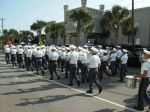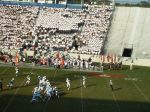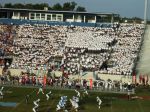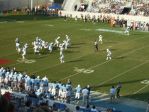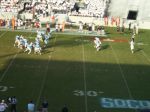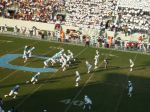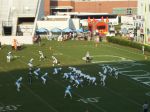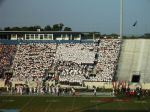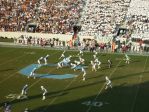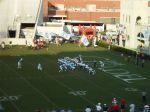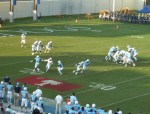
2013 Football, Game 2: The Citadel vs. Wofford

The Citadel vs. Wofford, to be played at historic Johnson Hagood Stadium, with kickoff at 6:00 pm ET on Saturday, September 7. The game will streamed on ESPN3.com, with play-by-play from Darren Goldwater and analysis by Paul Maguire. It can also be heard on radio via the thirteen affiliates of The Citadel Sports Network. Danny Reed (the “Voice of the Bulldogs”) will call the action alongside analyst Josh Baker, with Lee Glaze roaming the sidelines and Walt Nadzak providing pre-game, halftime, and post-game commentary.

WQNT-1450 AM [audio link], originating in Charleston, will be the flagship station for the network; the station will have a two-hour pregame show prior to each home football game. 

Links of interest:

My (very brief) review post from Game 1

The Citadel’s game notes

Wofford’s game notes

SoCon weekly release

SoCon media teleconference — Kevin Higgins

SoCon media teleconference — Mike Ayers

The Kevin Higgins Show (YouTube)

There are a lot of things that can be said about the season opener against Charleston Southern, almost none of them positive from The Citadel’s perspective.

First and foremost, I want to focus on the last 65 seconds of the first half.

The situation:

The Citadel led 16-7, but Charleston Southern had scored on its previous possession (a 64-yard TD pass) and then forced a three-and-out from the Bulldogs offense. After a long punt return blunted by a personal foul penalty, CSU had the ball at midfield, first-and-10, with 1:05 to play in the first half. The Buccaneers had no timeouts remaining.

On first down, a sack moved the ball back to the CSU 41-yard line. At that point, head coach Kevin Higgins called his first timeout of the half. Why?

Higgins explained later:

We’re thinking, we’ll call a timeout, go block a punt before the half. We’ve done that for the last three years, used the same kind of strategy, see if we can block a punt or get a drive at the end of the half.

Charleston Southern gained nine yards on its next play, setting up third-and-10 at the 50. The clock kept running, and The Citadel did not use a timeout.

I’m not sure why you wouldn’t call the second timeout if the idea was to have time left to block a punt or set up a return. It wasn’t like it was third-and-1. It was third-and-10.

That decision led to several things, none of which were good for The Citadel. First, CSU essentially got a “free shot” at making a big play on offense with the clock running out, and the Bulldogs were lucky that the Bucs narrowly missed connections on a pass over the middle that would have gone for big yardage (if not a TD).

That incompletion stopped the clock with less than 20 seconds to play in the half. On fourth down, CSU punted. The Citadel did not rush the punter (I went back and looked at the video to make sure). A return was not exactly set up either (a fair catch was called prior to the muff). Why anyone was even back to attempt to catch the punt strikes me as a fair question.

If the timeout had not been called after first down, the half would have ended without a punt even occurring. Instead, the Bulldogs were put in a position to fail with no realistic potential for success.

After the fumble recovery, Charleston Southern had the ball at the Bulldog 19-yard line with 12 seconds left in the half, and no timeouts. The one thing the defense can’t give up in that situation is a TD pass.

Tackle the receiver before the ball gets to him if that’s what it takes to stop the completion. In the worst-case scenario, pass interference would have put the ball at the Bulldog 4 and left the Bucs only one play (possibly two) before the half, which likely would have been a field goal attempt. The defense just can’t let a pass be completed in the end zone there.

I understand you’re asking a player to do something that would probably be against his instincts as a defender. It’s also possible the coaches discussed the strategy (The Citadel called its second timeout after the punt) and it wasn’t properly executed. For those reasons, I’m not bothered as much by the TD play as I am the game management that preceded the punt.

At any rate, the last minute of the first half was the key sequence in the game, and it was badly mishandled by The Citadel.

There were other missteps, too. The Citadel went for two points too early (though that was at least somewhat defensible). The playcalling, particularly on the final offensive series, left a lot to be desired.

The defense let CSU saunter right down the field to open the third quarter, as easy a TD drive as you could want, and gave up the aforementioned long TD pass on a badly blown coverage. There were other forgettable moments, too.

That end-of-half debacle, though…that’s a hard one to shake off.

It was nice of Kevin Higgins to talk about the “great job” Jamey Chadwell and his staff did in preparing for the game, but his comments did not exactly make Bulldog fans feel better. Also, I’m sure Chadwell is a good coach, but he’s the same guy who elected to punt on fourth-and-6 from the Bulldog 34 in the second quarter, with his team down two scores.

Punting from inside your opponent’s 35 in that situation (or almost any situation) is a decidedly sub-optimal strategy. I’m not convinced yet that Chadwell is the Albert Einstein of college football, which makes the whole ‘it was hard for our offense because they used a bunch of defensive fronts’ thing all the more galling.

With all due respect to Charleston Southern, this game wasn’t about the Buccaneers doing anything particularly exceptional. It was about The Citadel handing CSU the contest on a silver platter with fancy trimmings. It wasn’t a “disappointing loss”; it was a disastrous, unacceptable one.

I’ll wait until a later time (perhaps next week) to write about some of the ancillary elements from last Saturday, including the noticeable lack of cheerleaders and the disappointing crowd attendance. I’m very curious to see if there will be any changes in terms of off-field activities.

For example, will the band be allowed to play following the kickoff? Sometimes during the game I forget The Citadel even has a band, to be honest.

This is the seventh time in the last eight years the game between The Citadel and Wofford is being televised over the air (SportSouth, SCETV, etc.) or streamed on ESPN3.com. For the second year in the row, the game is on ESPN3.com, and for the second year in the row the announcers are Darren Goldwater and Paul Maguire.

The Citadel’s 42-20 victory in the season finale against Furman last year was only the second time in the Kevin Higgins era that the Bulldogs had won a televised/ESPN3-streamed game. Goldwater was the gamecaller for ESPN3.com that day too (with analyst Doug Chapman). It would be novel to win two in a row on ESPN3.com.

The average score between Wofford and The Citadel had been 34-14 in the seven years prior to last year’s game, which was obviously much closer. Among other items of interest, Wofford was penalized for 59 yards in that contest, almost twice as many yards as the Terriers had been penalized against the Bulldogs in the previous four games combined.

However, Wofford did not commit a turnover against the Bulldogs last year. That has been a trouble spot for The Citadel over the past few years against all opponents, one that emerged again last Saturday when the Bulldogs failed to force a turnover against Charleston Southern.

It is hard to judge anything about Wofford based on its game against Baylor, which the Terriers lost 69-3. I believe that Baylor is going to be one of the elite offensive teams in the country this year, and a serious contender for the Big XII title. Very few teams are going to be able to handle the Bears’ speed and general offensive execution; Wofford certainly couldn’t.

If you want to see the Wofford-Baylor game for yourself, you can, and in an extremely handy 50-minute package: Link

Tangent: That video is part of something the Big XII does for all its games that is called “No Huddle”, a concept that is undeniably awesome. All the plays, none of the fluff, loaded up to YouTube the Monday after the games. More of that, please.

Wofford injury report:

There were no major injuries in the Baylor game.

That is in the Wofford game notes. However, from Todd Shanesy of the Spartanburg Herald-Journal:

Wofford halfbacks Cam Flowers and Ray Smith, who suffered concussions last week in the game at Baylor, will be tested Friday to see whether they can make the trip to The Citadel…

…Flowers, a third-year sophomore from Damascus, Ga., made his second career start Saturday against Baylor and had four carries for 13 yards. Smith, a true sophomore who is Dorman High School’s all-time leading rusher, had three carries for 15 yards. He was listed as the backup to the other starting halfback, sophomore Will Gay from T.L. Hanna. Octavius Harden, a sophomore from Conover, N.C., was behind Flowers.

Flowers and Smith were two of the eight Terriers who got carries against The Citadel in last year’s game. Gay and Harden also saw action in that contest (Gay scoring a touchdown).

Wofford has plenty of fullback/halfback types, so if Flowers and/or Smith can’t go, the Terriers should still be in good shape. Wofford also returns the two wideouts who caught passes against the Bulldogs (Jeff Ashley and Will Irwin).

Starting fullback Donovan Johnson rushed for 473 yards last season as the backup to now-graduated Eric Breitenstein. A lot of that yardage came from the halfback position, as Breitenstein (understandably) saw the bulk of the time at FB.

The Terriers only returned two starting offensive linemen from last year’s squad, but they’re both good ones. Jared Singleton and Ty Gregory were each named to the SoCon’s preseason all-conference first team. There is still competition for at least one spot along the Wofford line.

Then there is the quarterback position. With one year of eligibility remaining, Brian Kass elected to transfer to Coastal Carolina. With Kass out of the picture, three players have battled for the Terriers’ starting QB spot. James Lawson started two late-season games for Wofford last season and also opened behind center against Baylor. He will likely start against The Citadel, but both Evan Jacks and Michael Weimer are expected to play.

Wofford lost six starters off its defense, but returns preseason all-league pick Alvin Scioneaux at outside linebacker. Free safety James Zotto had six tackles against the Bulldogs last season, tied for the most by a Terrier in that game. Two of Wofford’s starters along the defensive line are back, including second-team SoCon selection Tarek Odom and 6’2″, 290-lb. noseguard E.J. Speller.

Starting defensive end Hunter Thurley (a redshirt freshman) is 6’4″, but listed at just 245 lbs. In general, Wofford’s d-line is undersized (Speller is a notable exception) and the linebackers are tall and rangy.

Kasey Redfern handles all the kicking duties for the Terriers. Will Gay is Wofford’s punt returner and is usually joined on kickoffs by Cameron Flowers, though Flowers’ status will be in doubt up until gametime.

Odds and ends:

– I am not a big fan of Ben Dupree returning punts. I’ll hope for the best.

– Based on the two-deep in The Citadel’s game notes, it appears Tyler Renew may not get cleared by the NCAA in time for Saturday’s game. Shaunn Middleton is listed as Darien Robinson’s backup. Incidentally, Renew was listed in last week’s game notes as the second-team B-Back.

– Nick Jeffreys is listed as the tight end on the two-deep. No other player is listed at the position.

– Attendance at Johnson Hagood Stadium for Wofford’s past four visits: 11,290 (2005), 14,879 (2007), 15,155 (2009 — Homecoming), 12,316 (2011)

The last time Wofford entered the game against The Citadel with as many questions as the Terriers have this season, it was 2009. That wasn’t an early-season situation, though. In 2009, Wofford suffered through a series of injuries and finished with a 3-8 record.

One of those three victories was a 43-17 win over the Bulldogs, as listless a Homecoming performance from The Citadel as I’ve ever seen in person at Johnson Hagood Stadium. I am not sure what to expect from The Citadel in this year’s game, but it better not resemble anything like that.

I don’t think it will. I expect the Bulldogs to come out fired up and ready to prove something.

That doesn’t mean I expect a victory, though. A win for The Citadel on Saturday night is probably not in the cards.

Having said that: while I’m frustrated, and a little disgusted, and not all that confident the team can recover from its opening-night failure…I’m not giving up on this team. It’s my team, no matter what.

I’ll be cheering them on at Johnson Hagood Stadium this Saturday night, and I hope many other people will be doing the same.

College Football TV Listings 2013, Week 2

This is a list of every game played during week 2 of the college football season involving at least one FBS or FCS school.  All games are listed, televised or not.  For the televised games (only live broadcasts are listed), I include the announcers and sideline reporters (where applicable).  I put all of it on a Google Documents spreadsheet that can be accessed at the following link:

College Football TV Listings 2013, Week 2

Additional notes:

– I include ESPN3.com games; they are denoted as “ESPN3″.

– This season, I am also including digital network feeds provided by various conferences when they are free of charge. For some of these feeds, the audio will be a simulcast of the home team’s radio broadcast. There are also online platforms that have their own announcers (a la ESPN3.com).

For now, the digital networks I am including in the listings are those for the Mountain WestBig SkyOVCNEC, Big South, and Patriot League.

– The local affiliates for the SEC Network “national” game of the week (Western Kentucky-Tennessee) can be found here:  Link

– The local affiliates for the ACC Network “national” game of the week (Middle Tennessee State-North Carolina) can be found here:  Link

– The local affiliates for ESPN Regional’s coverage of the MAC game of the week (Bowling Green-Kent State) can be found here: [Link when available]

– The local affiliates for ESPN Regional’s coverage of the AAC game of the week (Houston-Temple) can be found here: Link

– I’ve listed the regional nets carrying SEC Network “regional” games in comments on the document. Those games are Miami (OH)-Kentucky, Alcorn State-Mississippi State, Arkansas State-Auburn, and Austin Peay-Vanderbilt.

– I’ve listed the regional nets carrying the ACC Network “regional” game of the week (South Carolina State-Clemson) in a comment on the document.

– Also listed in comments on the document are the regional nets carrying Southeastern Louisiana-TCU, Buffalo-Baylor, and Stephen F. Austin-Texas Tech.

– ABC/ESPN2 coverage map for the 3:30 pm ET games: Link

– BTN (formerly Big Ten Network) “gamefinder”:  Link

– USA Today Coaches Poll (FBS):  Link

– FCS Coaches’ Poll:  Link

A lot of the information I used in putting this together came courtesy of Matt Sarzyniak’s incredibly comprehensive and completely indispensable site College Sports on TV, which simply cannot be overpraised. It’s a must-bookmark for any fan of college sports, to say the least.

Also to be credited, as always, are the indefatigable information collectors (and in some cases sports-TV savants) at the506.com. I am also assisted on occasion by helpful athletic media relations officials at various schools and conferences.

Game Review, 2013: Charleston Southern

Well, that was ugly…

I’ll write about the game (and a few ancillary elements) as part of my preview of the matchup with Wofford. That was always going to be the plan anyway. After the ridiculousness of Saturday night, though, a few days to think things over may not be such a bad thing.

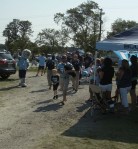
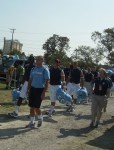
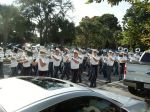
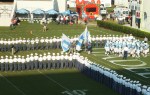
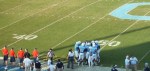
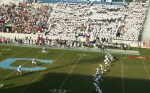
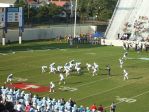
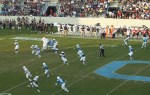
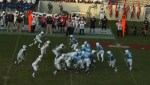
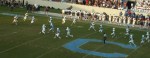
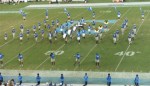
I took some pictures of the pregame scene and some of the game itself. As usual, the “action shots” aren’t the best. I decided to post them anyway. I know some folks like to look at formations, etc.

I’ll close this brief post on a somewhat positive note:

On The Citadel Foundation’s website, there is now a specific fund for The Citadel’s mascot program. As I’ve said before, the re-institution of the mascot program is arguably the best thing the school has done over the past decade or so.

I’m going to keep a link to the site on the right side of my blog for at least a little while, which isn’t something I would normally do. I’m going to make a one-time exception for this (no, I wasn’t asked). As the site says:

The cost of maintaining and transporting the Bulldog Mascots is funded solely through generous donations. The Citadel does not provide any funding for these wonderful ambassadors.

I am honestly surprised the school does not fund this program. Maybe some of the powers that be are unaware of the value it provides; I don’t know. I’m just glad there is now a donating option for supporters.

Here are the aforementioned photos. Apologies in advance for the occasionally hilarious quality, but everyone knows I’m not much of a photographer. I had an even more difficult time than usual on Saturday for some reason.

2013 Football, Game 1: The Citadel vs. Charleston Southern

FOOTBALLFOOTBALLFOOTBALLFOOTBALLFOOTBALLFOOTBALLFOOTBALL

The Citadel vs. Charleston Southern, to be played at historic Johnson Hagood Stadium, with kickoff at 6:00 pm ET on Saturday, August 31. The game will not be televised, although it will be streamed on Bulldog Insider (subscription service) and can be heard on radio via the thirteen affiliates of The Citadel Sports Network. Danny Reed (the “Voice of the Bulldogs”) will call the action alongside analyst Josh Baker, with Lee Glaze roaming the sidelines and Walt Nadzak providing pre-game, halftime, and post-game commentary.

WQNT-1450 AM [audio link], originating in Charleston, will be the flagship station for the network; the station will have a two-hour pregame show prior to each home football game. 

From last week: my preview of the upcoming season

It has numbers and stuff in it; don’t say you haven’t been warned…

Other links of note:

The Post and Courier‘s Jeff Hartsell has a story on the upcoming game, a season preview, and a look at this year’s SoCon

– SoCon weekly release and Kevin Higgins’ SoCon media teleconference

– SoCon preseason media poll (The Citadel was picked to finish 6th) and coaches’ poll (6th again), and the league’s preseason all-conference teams

– My post on the CFPA watch lists, along with preseason FCS rankings from The Sporting News, Lindy’s, and Athlon Sports

– FCS Coaches preseason Top 25 poll, and The Sports Network’s preseason Top 25 rankings (also from TSN: its preseason FCS All-America teams and its SoCon preview)

– Phil Kornblut of SportsTalk interviews Kevin Higgins and the four team captains (Keith Carter, Derek Douglas, Ben Dupree, Brandon McCladdie)

– Also worth a listen: Kornblut’s interviews with Charleston Southern head coach Jamey Chadwell and three of CSU’s players

– AP preview of the Bulldogs (predicts The Citadel will finish 6th in the SoCon)

– Hometown articles on Ben Dupree and Sadath Jean-Pierre

– Game notes from The Citadel and Charleston Southern

Let’s talk about Charleston Southern…

When The Citadel and CSU met to open the 2012 campaign, the Buccaneers were coming off an 0-11 season, and it may not have been that good. Charleston Southern had changed its offense (essentially for the third consecutive season) and brought in a new defensive coordinator.

Despite all that, CSU actually led the Bulldogs 14-7 late in the second quarter, thanks in part to an ill-timed penalty and a series of fumbles (two of which The Citadel lost). Eventually the Bulldogs asserted their superiority and rolled to a 49-14 victory, but CSU showed flashes of a competitive spirit throughout the rest of its season.

The Buccaneers finished 5-6, a five-game improvement only bettered at the FCS level by Villanova (the Wildcats went from two wins to eight). Charleston Southern won four of its last six contests.

After the season, head coach Jay Mills announced his retirement. Named as his replacement was a former CSU assistant, Jamey Chadwell, who older Bulldog fans may remember as a quarterback at East Tennessee State in the late 1990s. Chadwell was a two-year starter at ETSU in non-consecutive seasons (his playing career was affected by a serious ankle injury).

Chadwell had spent the last four seasons as a head coach at the Division II level. He was the head coach at North Greenville for three years, leaving that job for the same position at Delta State.

The Statesmen (mascot: The Fighting Okra) were only 3-7 in Chadwell’s lone season in charge; prior to that, he had fashioned a 22-14 record at North Greenville, buoyed by an 11-3 record in 2011. That year, his quarterback was celebrated high school star (and former Clemson player) Willy Korn, who is now on Chadwell’s staff at CSU.

Mark Tucker, a former offensive assistant under Charlie Taaffe and Don Powers at The Citadel, is also on Chadwell’s coaching staff. As of August 22, so is former South Carolina (and NFL) linebacker Rod Wilson.

According to Chadwell in his interview with Phil Kornblut, Charleston Southern’s offense this year will feature a spread option look “in the gun”. The Buccaneers will run the ball more than they did under Jay Mills.

Chadwell wants to have a more balanced offense and “get playmakers out in space”. His ideal is Florida circa Tim Tebow, though he acknowledged that incumbent Bucs QB Malcolm Dixon isn’t exactly the second coming of Tebow.

Dixon had his moments against The Citadel in last year’s game, throwing a TD pass and also running for a score. As Chadwell pointed out to Kornblut, Dixon is learning his fourth offense in four years as a college player.

CSU running back Teddy Allen rushed for 56 yards (on only 11 carries) against the Bulldogs last season. Allen was one of two Buccaneers to make the Big South preseason all-conference team.

Also expected to see action at running back is juco transfer Christian Reyes, an Oregon native who has gone to some schools with really cool names, like Rogue River High School and College of the Siskiyous (located in Weed, California). Despite only being on CSU’s campus since January, Reyes (who rushed for 1958 yards last season in junior college) was named one of the team captains for the Buccaneers.

Other Charleston Southern offensive players to watch include Larry Jones III (20.5 yards per reception last season) and wideout Donte Sumpter, a transfer from East Carolina. Starting tight end Nathan Prater is 6’8″; disappointingly, the native of Ninety Six wears jersey #81.

The Bucs have four starters returning on the offensive line, but Chadwell suggested on CSU’s website that some freshmen are battling for those spots.

Charleston Southern was a mediocre passing team last year, ranking 62nd out of 121 FCS teams in passing efficiency. That actually isn’t half-bad, considering CSU completed less than 50% of its pass attempts.

When the Bucs did complete a pass, it generally went for good yardage, resulting in a respectable 7.86 yards per attempt (and 12 touchdowns against 8 interceptions). The Bucs averaged 5.35 yards per play, which was middle-of-the-pack nationally (65th).

Arguably, CSU’s most ominous offensive statistic last season was its third-down conversion rate (30.34%), 11th-worst in FCS football.

Defensive back Elijah Lee was the other Buccaneer besides Allen to garner preseason all-league honors. Lee will be part of a defense that is switching to a 3-4 base after previously being a 4-3. I’m not sure how big an impact that will have on the way the Buccaneers defend the triple option, though.

The key player for CSU against the Bulldogs is likely to be 290-lb. noseguard James Smith. Other defenders of note include linebacker Calvin Bryant and defensive end Will Hunt.

Last season the Bucs’ D topped the Big South in yards per pass attempt, allowing only 6.38 per attempt. Charleston Southern was 32nd nationally in pass efficiency defense.

However, CSU was next-to-last in the league in rush yards per attempt (5.32) and rush yards per game (208.82), leading to a bottom-20 finish nationally in rushing defense. The Citadel rushed for 479 yards against Charleston Southern in last year’s contest.

Opponents averaged 5.7 yards per play against Charleston Southern; the Bucs ranked 81st out of 121 FCS teams in that category in 2012.

When considering CSU’s on-field performance, the yards per play numbers are particularly important due to pace of play considerations. Both CSU’s offense and defense were each on the field for about 62 plays per game last season, which for both units was the eighth-fewest in the entire division. By contrast, The Citadel averaged 63.7 plays per game on offense (15th-fewest nationally) and 66.5 on defense (26th).

Elijah Lee and a pair of freshmen are expected to feature as kick/punt returners for the Bucs. Kickoff returns were problematic for CSU last year, as the team finished with a KOR average of 16.67 yards, 8th-worst in FCS. Charleston Southern finished in the top 20 of FCS in kick return coverage, though the Buccaneers did allow a kick return TD against Jacksonville (on an onside kick that went awry).

Jacksonville also returned a punt for a touchdown against CSU, which finished 87th nationally in net punting. The Buccaneers only attempted five field goals last season, making three (with a long of 31 yards). Both CSU’s punter and placekicker return in 2013.

The Buccaneers were picked to finish fourth in the six-team Big South by a panel of the league’s coaches and media. Charleston Southern will open its home schedule next week against Shorter University. The game will kick off at 11:00 am, one of three CSU home games scheduled for that start time.

Jamey Chadwell told Phil Kornblut that the game versus The Citadel would be a “big challenge” and that “we know going in we’re the underdogs, and rightfully so.” Chadwell also said this:

We’re trying to take that step where we have respect in this state and this city [for our conference]…we’re hoping to go in and compete and establish our identity…if we control the things that we can, our effort and attitude, we think we can compete [with anybody].

Further evidence that Chadwell is going to play the ‘respect card’ in motivating his team for the game against The Citadel: he “favorited” a tweet about the line for the matchup (the Bulldogs opened at -25.5 points). You can bet Chadwell let his players know about that.

Things I’ll be keeping a close eye on this Saturday:

– Execution in the first half

The Bulldogs need to take charge on both sides of the ball while there is still cannon smoke wafting in the air, as opposed to a repeat of last year’s sloppy opening half. The center-QB exchange needs to be second-nature, the “mesh” should be clean, the pitches and passes accurate, the catches made, and the blocking sound.

The team mantra this season is “1-0”. I like it. I want to see the squad live up to it.

– Penalties, or a lack thereof

The Citadel led all of FCS football in the categories “fewest penalties” and “least penalty yardage” in 2011, and matched that feat in 2012 (tying for fewest penalties last year with Lehigh). In all of NCAA football, regardless of division, only Brevard committed fewer penalties per game than did The Citadel in 2012.

– Punting

The Bulldogs actually didn’t punt in last year’s opener. While it would be great to have that happen again, odds are against it. The new punter has some big shoes to fill. The punt return unit will also be under the microscope.

Also worth watching on special teams: The Citadel will have a new long snapper and a new holder (who, as it happens, was last year’s long snapper).

– Third down conversions

Last season the Bulldog offense had a third-down conversion rate of 40.44%. That rate needs to improve. While The Citadel was 50th nationally in that category, fellow SoCon triple option teams Georgia Southern and Wofford were 23rd and 26th in FCS, respectively.

It was actually more of a concern on defense, as Bulldog opponents converted third downs at a rate of 43.08%, only 85th-best in the division. That has to get better, especially when facing the likes of GSU and Wofford (and Chattanooga, which was 30th nationally in offensive third down conversion rate).

– Forced turnovers

I touched upon this topic as part of my season preview. Incidentally, stopping the run (a focus of the coaching staff this season) is a key element to both the defensive third down conversion rate and forced turnovers (because it puts opponents in obvious passing situations).

– Defensive playmakers

Last year, the key moment for the defense against CSU was a fumble forced by Chris Billingslea, who had a knack for being in the middle of game-turning plays like that one. Billingslea has graduated, and the Bulldogs need someone else to carry the big-play torch (or sledgehammer).

One of the more interesting comments from Kevin Higgins’ Monday press conference was about the defense, stating that “we have a little more depth than I anticipated, especially inside.” That was good to hear.

– Freshmen

The Citadel has quite a few freshmen (and redshirt freshmen) on the depth chart. They are going to get a chance to make a strong first impression. The wide receivers, in particular, may get multiple opportunities to shine.

– Attendance

Last year’s opener had a crowd of 14,264, a good turnout at Johnson Hagood Stadium by 21st century standards. Whether or not the team’s fine season last year will lead to improved attendance is debatable.

When I took a look at JHS attendance trends a year ago, the numbers suggested that the success of 2012 will not necessarily lead to bigger crowds for the 2013 campaign. Of course, that’s just the people who actually file into Johnson Hagood Stadium. For all I know, the tailgating scene will continue to expand.

There was an article in The Post and Courier recently that noted Clemson and South Carolina only share one home date this season, November 23. That is unusual. I am not sure how much it will impact The Citadel’s attendance.

Quite honestly, you can make an argument that there are three Saturdays this fall in which Johnson Hagood Stadium will be the site for the most interesting college football game held in the state: September 7 (the Wofford game), September 28 (Furman), and October 5 (Appalachian State).  I just hope the general public agrees.

It is also worth mentioning that the Charleston Riverdogs have a game at Riley Park on Saturday scheduled to begin at 6:00 pm ET — yes, the same time as opening kickoff at Johnson Hagood Stadium. Parking could be at a premium.

Tangent: that article in The Post and Courier also referred to The Citadel’s game at Clemson as a “tune-up” for the Tigers prior to Clemson’s game at South Carolina — not an “anticipated” or an “expected” tune-up, mind you…just a tune-up. I wasn’t very happy with the Charleston paper making a dismissive comment like that about the local team, and said so (via Twitter).

The writer did not seem to understand my point, but then he’s not really writing about Clemson from a Charleston perspective — he’s just writing about Clemson for the Charleston paper. There is a distinction, I guess.

I am reminded of the Columbia newspaper once infamously stating in its gameday feature page that the Gamecocks would win if “they show up”. That was for a game between The Citadel and South Carolina played in 1990.

I’m ready for some football. You’re ready for some football. The players are ready for some football.

Let’s play football.

College Football TV Listings 2013, Week 1

This is a list of every game played during week 1 of the college football season involving at least one FBS or FCS school.  All games are listed, televised or not.  For the televised games (only live broadcasts are listed), I include the announcers and sideline reporters (where applicable).  I put all of it on a Google Documents spreadsheet that can be accessed at the following link:

College Football TV Listings 2013, Week 1

Additional notes:

– I include ESPN3.com games; they are denoted as “ESPN3″.

– This season, I am also including digital network feeds provided by various conferences when they are free of charge. For some of these feeds, the audio will be a simulcast of the home team’s radio broadcast. There are also online platforms that have their own announcers (a la ESPN3).

For now, the digital networks I am including in the listings are those for the Mountain West, Big Sky, OVC, NEC, and Patriot League.

– The local affiliates for the SEC Network “national” game of the week (Toledo-Florida) can be found here:  Link

– The local affiliates for the ACC Network “national” game of the week (Louisiana Tech-North Carolina State) can be found here:  Link

– I’ve listed the regional nets carrying the SEC Network “regional” game of the week (ULL-Arkansas) in a comment on the document.

– I’ve listed the regional nets carrying the ACC Network “regional” game of the week (Florida International-Maryland) in a comment on the document.

– Also listed on the document in a comment are the regional nets carrying Wofford-Baylor.

– ABC/ESPN2 coverage map for the 3:30 pm ET games: Link

– BTN (formerly Big Ten Network) “gamefinder”:  Link

– USA Today Coaches Poll (FBS):  Link

– FCS Coaches’ Poll:  Link

A lot of the information I used in putting this together came courtesy of Matt Sarzyniak’s incredibly comprehensive and completely indispensable site College Sports on TV, which simply cannot be overpraised. It’s a must-bookmark for any fan of college sports, to say the least.

Also to be credited, as always, are the indefatigable information collectors (and in some cases sports-TV savants) at the506.com. I am also assisted on occasion by helpful athletic media relations officials at various schools and conferences.

2013 Football, The Citadel: some thoughts, themes, and theories before the season begins

Hey, last season ended well!

Looking back on the spring game

What teams will The Citadel’s opponents play before facing the Bulldogs?

If you know some people with a lot of money, tell them The Citadel wants to endow the head football coach position

There is always great anticipation at The Citadel when football season rolls around, but this year it is amplified by the belief that the Bulldogs could be a very good team, one capable of contending for the Southern Conference championship. The Citadel has not won a league title (or seriously challenged for one) since 1992, which arguably adds to the interest.

There are plenty of SoCon previews online; I’ll link to most (if not all) of them when I write about the season opener against Charleston Southern. What follows isn’t really intended to be a standard preview. Instead, I’m going to concentrate on a few specific elements of the Bulldogs’ play, primarily from a statistical perspective.

First, though, I want to point out that this could be a season of what-ifs rather than the big-win campaign that is the hope for Bulldog supporters. As always when it comes to the gridiron, the margin for error at The Citadel is small. To illustrate this, think of the task the team faces this year from what might be called the most negative point of view:

– The Citadel will play four opponents that are either FBS or transitioning to FBS (and thus will have more scholarship players). Three of those games will be on the road.

– The Citadel will play two other opponents that defeated the Bulldogs last season by a combined score of 66-17. Both of those teams return most of their key players.

– One opponent hasn’t lost to the Bulldogs during Kevin Higgins’ tenure as head coach of The Citadel, while another has beaten The Citadel four times in the last five meetings.

– Of the remaining four opponents, last season The Citadel trailed one of them midway through the third quarter; was in a one-point game late in the third quarter to another; barely held off a late rally from a third; and was tied at halftime with the fourth.

That is why most prognosticators, including the SoCon media and coaches, believe The Citadel will finish fourth in the league (or sixth, if like the SoCon office the organization ranking the teams made the mistake of including ineligibles Appalachian State and Georgia Southern). Personally, I think the Bulldogs have the potential to be better than that, but improvement from last season’s solid effort must be significant in order to achieve major goals, such as making the FCS playoffs and winning the league.

Before the first game of last season, I wrote the following:

 It appears The Citadel does plan to throw the ball a bit more often this season. If the idea is to average 10-12 pass attempts per game (the Bulldogs averaged a shade under 7 attempts [in 2011]), then I think The Citadel needs to average around 8.0-8.5 yards per pass attempt at a minimum (preferably it should be above 9 yards per attempt). [In 2011] that number was 4.7 ypa, an awful average.

As for interceptions, I am inclined to think the goal should be no more than one per 25 attempts, though that number could fluctuate based on overall total offense production and the number of possessions per game. [In 2011] the Bulldogs threw seven interceptions in only 75 passing attempts, which is very poor.

The Citadel, in fact, averaged 10.6 pass attempts per game in 2012, about what was expected. The Bulldogs averaged 7.7 yards per attempt, which wasn’t great but did keep defenses relatively honest.

Bulldog quarterbacks threw 117 passes, of which five were intercepted, or one every 23.4 attempts. I think that was an acceptable result. There were also four touchdown tosses, which was certainly better than 2011 (when only one touchdown pass was thrown by The Citadel all season).

The efficiency of the passing game must continue to improve. As part of that progression, the Bulldog coaching staff appears to be adding to the team’s repertoire of offensive formations:

The Bulldogs showed off an ever-evolving offense, showing I-formation and shotgun sets in addition to the bread-and-butter triple option formation. The Bulldogs could lineup with one back and four receivers on one play and the TO the next.

This seems promising, but I think that it’s important the offense doesn’t lose its identity as a run/run/run-some-more type of operation. With that in mind, I wanted to take a look at run/pass playcalling from the 2012 campaign.

I went back and compiled statistics from the eight SoCon games the Bulldogs played. Some of the numbers are interesting. Keep in mind, this is for league contests only.

First, some definitions:

– 2nd-and-short: 3 yards or less for a first down
– 2nd-and-medium: 4 to 6 yards for a first down
– 2nd-and-long: 7+ yards for a first down
– 3rd-and-short: 2 yards or less for a first down
– 3rd-and-medium: 3 to 4 yards for a first down
– 3rd-and-long: 5+ yards for a first down

On first down, The Citadel rushed 85.5% of the time. The Bulldogs ran the ball in other down-and-distance situations as follows (by percentage):

– 2nd-and-short: 86.7%
– 2nd-and-medium: 93.6%
– 2nd-and-long: 80.9%
– 3rd-and-short: 100%
– 3rd-and-medium: 86.3%
– 3rd-and-long: 49.1%

Of course, some running plays were originally pass plays that turned into running plays, and a few were run/pass options. Occasionally a would-be pass play on 3rd-and-long turned into something like this: Link

Taken as a whole, though, I think these numbers give an accurate view of how the coaches called plays in particular situations. In general, I like what the statistics show.

I have a minor quibble with the run/pass ratio on 2nd-and-medium, but it’s not a big deal. There were 47 2nd-and-medium plays in SoCon action; the Bulldogs ran the ball on 44 of them. Maybe there could have been 2 or 3 more pass plays in that group, but again, that’s very minor.

The one area of playcalling I do wonder about, however, is on 3rd-and-short. The Citadel ran the ball in all 21 of those situations in league play. I don’t think it would be a bad idea to throw the ball once or twice per season on 3rd-and-short, partly to try for a big play, and also to “loosen up” opposing defenses.

Ideally a 3rd-and-short pass play would come around midfield or so, because then the Bulldogs might have the chance to go for it on fourth down even if the pass were to be incomplete. That brings me to my next topic…

One of the things that interests me most about football is game theory, including when to go for it on fourth down. I decided to take a look at how Kevin Higgins approached things last season.

I didn’t include fourth down “desperation” situations (like those on the game-winning drive against Georgia Southern) or “accidental” fourth down tries (like the botched punt snap/catch against Chattanooga). I also tossed out a couple of “garbage time” fourth down plays (i.e. punting while up 31 points on Appalachian State in the fourth quarter). Again, all statistics are from SoCon games only.

Terms (as defined by Football Outsiders):

– Deep Zone: from a team’s own goal line to its 20-yard line
– Back Zone: from a team’s own 21-yard line to its 39-yard line
– Mid Zone: from a team’s own 40-yard line to its opponent’s 40-yard line
– Front Zone: from an opponent’s 39-yard line to the opponent’s 21-yard line
– Red Zone: from an opponent’s 20-yard line to the opponent’s goal line

– On fourth down and two yards or less to go: The Citadel went for it all four times it was in the Front Zone or the Red Zone. The Bulldogs punted all three times they were in the Mid Zone.

– On fourth down and three to five yards to go: the Bulldogs attempted four field goals in the Front and Red Zones, and went for a first down once (in the Front Zone). The Citadel punted all four times it was in the Mid Zone.

– On fourth down and six or more yards to go: The Citadel attempted two field goals in the Red Zone, two field goals in the Front Zone, and went for a first down twice in the Front Zone. The Bulldogs punted all five times they were in the Mid Zone.

It’s a relief to know that the Bulldogs did not punt on fourth down from inside the opponent’s 40-yard line. However, it is mildly surprising to see the conservatism in the Mid Zone.

It’s one thing to punt on fourth-and-10 from your own 40-yard line, as The Citadel did against Chattanooga. However, it may have been in the Bulldogs’ best interests to go for it on 4th-and-1 on their own 43 (versus Georgia Southern), or on 4th-and-2 at midfield (against Furman).

I did not track complete totals for Deep Zone/Back Zone fourth-down decisions, most of which (obviously) resulted in punts. It is worth noting, however, that The Citadel actually went for it on fourth down no fewer than five times in the Back Zone last season versus SoCon opposition in non-desperation situations.

Four of those plays were 4th-and-1 (or shorter). One was on 4th-and-4 from the 30; that was Cass Couey’s run off a fake punt against Furman.

On all five of those Back Zone fourth down conversion attempts, The Citadel was successful.

Occasionally going for it on fourth down in the Mid Zone section of the field might be worthwhile. For one thing, it may open up playcalling, as it changes third-down options if there is a chance the Bulldogs would attempt (if necessary) a fourth-down conversion.

I also believe that going for it more often on fourth down is an appropriate strategy for a run-heavy triple option team, due to the fewer number of possessions in a game. All you have to do is look at the 2007 season, the Bulldogs’ last winning campaign prior to the switch to the triple option.

In 2007, The Citadel averaged 5.9 yards per play, much like the 2012 squad (which averaged 6.0 yards per play). However, there are fewer plays in a game when one of the teams runs the ball 83% of the time, as the 2012 Bulldogs did. Despite the similar yards per play numbers, the 2007 Bulldogs ran 117 more plays over the course of the season than did their 2012 counterparts.

In 2012, the Bulldogs averaged 11.9 possessions per game, while the 2007 team averaged 13.3 possessions per contest. That’s a significant difference, and something to consider when deciding whether or not to maintain possession by going for it on fourth down.

One of the primary areas of concern for The Citadel this season, at least to me, is punting. The aforementioned Cass Couey was an outstanding performer, and will be hard to replace.

In eight SoCon games last year, only three times did an opponent even return a punt, for a total of 25 yards (24 of those on one punt return in the Samford game). Couey boomed four punts of 50+ yards in league play (averaging 42.8 yards per punt in those contests), and had eleven punts downed inside the 20-yard line in conference action (versus only two touchbacks).

However, finding Couey’s successor is far from the only thing that needs to be done when it comes to The Citadel’s punt units. One of the things that becomes apparent when going through the game summaries is that while the punt cover unit outperformed its expectations in terms of field position, the Bulldogs’ punt return unit did not.

If you go by raw yardage totals, including returns/touchbacks/penalties/etc., the Bulldogs came out ahead in the punting battle by a little over one yard per punt. That doesn’t take into account field position at the time of the punt.

By my reckoning (and I could be wrong), using field position point expectancy tables, The Citadel’s edge (combining both units) had a total value of less than half a point. That’s not per game — that’s over all eight SoCon contests.

Note: that doesn’t count two plays. One was that punt snap/catch snafu against Chattanooga, which cost the Bulldogs an expected 50 yards in field position on the ensuing Mocs drive. The other was the blocked punt/TD in the Appalachian State game.

Between those two plays The Citadel came out ahead by about 3 points in terms of average expected points per drive start. In actuality, it wound up being 7 points, since Carson Smith did pick up that blocked punt and run into the end zone for a touchdown, while the Mocs eventually missed a long field goal after getting the ball at the Bulldog 28-yard line.

Also, I used points expectancy numbers based on FBS data; it is possible the correlation to FCS games isn’t exact.

At any rate, I think it is clear that The Citadel must do a better job of creating better field position via its punt return game. In 2011, the Bulldogs blocked nine punts during the season, including one in four consecutive SoCon games. There wasn’t a major concern about the return aspect because, well, those blocked punts essentially were the returns.

If The Citadel won’t be able to rely on the punt block threat as much in the future (rule changes may have had an effect there), then it is important to pick up yardage after receiving the punt. Perhaps the insertion of Ben Dupree as a punt returner will help, though I worry about putting the starting quarterback at risk for injury (or rather, putting him at additional risk for injury).

As the Bulldogs began preseason practice, run defense was on the mind of the head coach:

The Citadel’s defense was good to average in most categories last year, ranking fifth in the SoCon in total defense and scoring defense, and second in pass defense. But the Bulldogs struggled to stop the run, ranking seventh while allowing 221.7 rushing yards per game.

During a string of four losses in five games, the run D was gashed for an average of 273 yards per game.

Those games coincided with injuries to linebackers Carl Robinson and Rah Muhammad, both of whom begin this season healthy. The emergence of sophomore linebacker James Riley also should help.

“We’re going to be more fundamental in what we do,” [Kevin] Higgins said, “and just make it a huge emphasis.”

The Citadel also allowed a considerable number of rushing yards in the two games that preceded the five-game stretch referenced by Jeff Hartsell. Beginning with the second half of the game against Wofford, the Bulldogs seemed to turn the corner on stopping the run, though they showed a bit of frailty in the season finale against Furman.

The depletion of the linebacking corps due to injury was almost certainly the reason The Citadel struggled to stop the run. That’s why the loss of Carson Smith for the season is doubly frustrating.

If the Bulldogs can make strides in their run-stuffing, that should also help in red zone defense situations. Last season, The Citadel allowed a TD rate of 70.2% in the red zone, slightly higher than the TD rate for the Bulldog offense inside the 20 (69.4%).

The other emphasis on defense is in creating turnovers. If stopping the run can force opponents to the air against The Citadel in less-than-optimal situations, perhaps the Bulldogs can finally have a year in which they intercept a lot of passes.

The Citadel had five interceptions in SoCon play in 2012, which almost matched the total number of picks for the Bulldogs in the previous two league campaigns combined (6). Despite that, The Citadel finished tied for next-to-last in overall interceptions among Southern Conference teams.

The simplest way for the Bulldogs to intercept more passes is to successfully defend a higher percentage of throws. In 2012, The Citadel was credited with 24 passes defended in SoCon games. The five picks that resulted from those passes defended meant the Bulldogs had an interception rate of 20.8% on passes defended, right at the national average (21.9%).

The Bulldogs either broke up or intercepted a pass on 12.4% of its opponents’ throws in league action. For comparison, the FBS leader in passes defended per game, Ohio State, broke up/intercepted 19.2% of its opponents’ passes.

Incidentally, The Citadel’s conference opponents had a similar interception per pass defended rate (21.4%) against the Bulldogs.

One thing I hope Kevin Higgins did during the off-season was evaluate the clock management at the end of games. Twice last year (against Western Carolina and VMI), The Citadel’s offense ran multiple plays at the end of a game when a series of kneeldowns would have ended the contest.

By repeatedly running the ball (including a pitch play in the WCU contest), the Bulldogs risked being on the wrong end of a “Miracle at the Meadowlands” situation. For the 2013 season, I would like for there to be a de facto “time management coach” who can assist Higgins in this aspect of the game.

I remember that Bill Parcells did this when he was the head coach of the New York Giants. He had an assistant, Ray Handley, specifically tasked to help with end-of-half/game clock strategy. Handley later replaced Parcells as head coach of the Giants, proving conclusively that understanding clock management does not guarantee someone will be successful as a head coach.

For anyone interested (or still reading)…for this season, I think the blog posts will work something like this:

I’ll usually post a game preview on Thursday night/Friday morning, then an occasional game review on Sunday or Monday. Not every week will include a game review. Most of them will be relatively short anyway; I’ll probably include gameday pictures with those posts, and then go into more depth about the just-played contest as part of my preview of the following game.

I’ll still be posting an FBS/FCS TV schedule on either Tuesday night or Wednesday morning. Anything else I post will depend in large part on my personal schedule, which will be somewhat challenging at times. There are at least three weeks during the season that will be problematic. I’ll figure out something, though.

I’m ready for some football.

FCS school football pages and 2013 media guides

Update: here is the link for the 2014 FCS football pages and guides

SBNation has a post listing and linking FBS football pages/media guides, so I figured I would try to do something similar for FCS.

Included are the schools’ football web pages, 2013 football media guides, and occasionally something extra (more often than not an additional record book that is separate from the regular media guide).

A few schools have standalone football websites that are separate from their football web pages; those are listed (as “FB website”) too.

Some of the guides are called prospectuses or supplements (or are extended “notes” packages); these generally have fewer pages.

A few schools may not have a media guide and/or supplement. When that is the case, I will link to the appropriate “fact sheet” or general notes/stats packages.

This is going to be a work in progress. I’ll link to media guides or prospectuses as they are released by the individual schools.


Big Sky 2013 Guide
Cal Poly 2013 Guide
Eastern Washington 2013 Guide
Idaho State 2013 Stats Records
Montana 2013 Guide
Montana State 2013 Guide Record Book
North Dakota 2013 Guide
Northern Arizona 2013 Guide
Northern Colorado 2013 Guide
Portland State 2013 Guide
Sacramento State 2013 Notes
Southern Utah 2013 Guide
UC Davis 2013 Guide
Weber State 2013 Guide
Big South 2013 Guide
Charleston Southern 2013 Notes
Coastal Carolina 2013 Guide
Gardner-Webb 2013 Guide
Liberty 2013 Guide
Presbyterian 2013 Stats
Virginia Military Institute 2013 Guide Record Book
CAA 2013 Guide
Albany 2013 Stats Record Book
Delaware 2013 Guide
James Madison 2013 Stats
Maine 2013 Guide
New Hampshire 2013 Guide
Rhode Island 2013 Guide
Richmond 2013 Guide Record Book
Stony Brook 2013 Guide Record Book
Towson 2013 Guide
Villanova 2013 Guide
William & Mary 2013 Notes Archival Information
FCS Independents
Abilene Christian 2013 Guide
Charlotte 2013 Guide FB website
Houston Baptist 2013 Stats
Incarnate Word 2013 Guide
Monmouth 2013 Guide
Ivy League 2013 Guide
Brown 2013 Guide Records
Columbia 2013 Guide
Cornell 2013 Facts Record Book FB website
Dartmouth 2013 Notes Records
Harvard 2013 Guide
Pennsylvania 2013 Guide
Princeton 2013 Guide Record Book FB website
Yale 2013 Stats FB website
MEAC 2013 Guide
Bethune-Cookman 2013 Notes
Delaware State 2013 Guide
Florida A&M 2013 Stats
Hampton 2013 Guide
Howard 2013 Stats
Morgan State 2013 Guide
Norfolk State 2013 Guide
North Carolina A&T 2013 Stats
North Carolina Central 2013 Guide Record Book
Savannah State 2013 Guide
South Carolina State 2013 Guide
MVFC 2013 News Record Book
Illinois State 2013 Notes
Indiana State 2013 Guide
Missouri State 2013 Guide
North Dakota State 2013 Guide
Northern Iowa 2013 Guide
South Dakota 2013 Guide
South Dakota State 2013 Guide
Southern Illinois 2013 Roster
Western Illinois 2013 Guide
Youngstown State 2013 Guide Record Book
NEC 2013 News
Bryant University 2013 Guide Records
Central Connecticut State 2013 Notes Record Book
Duquesne 2013 Guide
Robert Morris 2013 Guide Records
Sacred Heart 2013 Notes
St. Francis (PA) 2013 Stats
Wagner 2013 Guide
OVC 2013 Guide
Austin Peay 2013 Guide
Eastern Illinois 2013 Guide Record Book
Eastern Kentucky 2013 Guide
Jacksonville State 2013 Guide
Murray State 2013 Guide
Southeast Missouri State 2013 Guide
Tennessee State 2013 Guide
Tennessee Tech 2013 Guide
UT Martin 2013 Guide
Patriot League 2013 Preview Record Book
Bucknell 2013 Guide
Colgate 2013 Guide Record Book
Fordham 2013 Guide
Georgetown 2013 Guide
Holy Cross 2013 Guide
Lafayette 2013 Guide
Lehigh 2013 Info Record Book
Pioneer League 2013 News
Butler 2013 Stats Record Book
Campbell 2013 Guide
Davidson 2013 Guide
Dayton 2013 Guide
Drake 2013 Guide
Jacksonville 2013 Stats
Marist 2013 Guide
Mercer 2013 Guide FB website
Morehead State 2013 Guide
San Diego 2013 Facts Record Book
Stetson 2013 Guide Historical overview
Valparaiso 2013 Facts Records and Results
SoCon 2013 Guide
Appalachian State 2013 Guide
The Citadel 2013 Preview Record Book
Elon 2013 Guide Record Book
Furman 2013 Guide
Georgia Southern 2013 Guide
Samford 2013 Guide
UT-Chattanooga 2013 Guide
Western Carolina 2013 Guide
Wofford 2013 Guide
Southland 2013 Guide
Central Arkansas 2013 Guide
Lamar 2013 Guide
McNeese State 2013 Guide
Nicholls State 2013 Guide
Northwestern State 2013 Guide
Sam Houston State 2013 Guide Record Book
Southeastern Louisiana 2013 Guide
Stephen F. Austin 2013 Guide
SWAC 2013 Guide
Alabama A&M 2013 Stats
Alabama State 2013 Guide
Alcorn State 2013 Roster
Jackson State 2013 Guide
Mississippi Valley State 2013 Notes Record Book
Arkansas-Pine Bluff 2013 Guide
Grambling State 2013 Roster
Prairie View A&M 2013 Guide
Southern University 2013 Guide
Texas Southern 2013 Stats

Hagood History: The Citadel 26, Air Force 7 (1976)

I know, I know — The Citadel didn’t play Air Force at Johnson Hagood Stadium. The game was played at Falcon Stadium, in Colorado Springs. “Hagood History” is just a way to identify historical game reviews, which I may do from time to time.

Also, you can’t beat the alliteration.

I first thought about taking a closer look at the 1976 game between The Citadel and the Air Force Academy while reading a post from The Citadel’s new “Off The Collar” blog:

[The current president of The Citadel Football Association, John Carlisle] inherited a project started by former CFA president Charlie Baker to digitize and make available to Citadel fans as many football game films that he could find. That collection currently stands at almost 400 and growing.

I’m not really a connoisseur of game film, but I was intrigued at the list of games, and decided to check one out. I picked The Citadel-AFA 1976 because of its relative anonymity, at least when compared to other notable Bulldog victories.

Ben Martin was a graduate of the U.S. Naval Academy who began his head coaching career at Virginia. In two seasons in Charlottesville, his teams compiled a cumulative record of 6-13-1, but despite that Martin was hired by the Air Force Academy to take over as its football coach in 1958. He succeeded AFA’s first-ever varsity head coach, Buck Shaw, who lasted two seasons in Colorado Springs before moving on to the Philadelphia Eagles (where Shaw would win the NFL Championship in 1960).

Air Force’s 1958 campaign, which was also the senior year of the first class of academy graduates, would be high on any list of “most surprising seasons” in modern college football annals. Air Force had been 3-6-1 in 1957, but in Martin’s first year in charge the Falcons went undefeated, finishing 9-0-2.

The two ties were each rather impressive. The first was an early-season road game at Iowa, which went on to win the Big 10 and the Rose Bowl; the Hawkeyes finished the year ranked #2 in both the AP and UPI polls. The Falcons’ other tie came in the Cotton Bowl, against Southwest Conference champ TCU. Air Force’s victories that year included wins over 8-3 Oklahoma State, 8-3 Wyoming (coached by Bob Devaney), and 7-3 New Mexico (helmed by Marv Levy).

Other than that magical 1958 run, Air Force had mostly mediocre records for the next ten years, with the exception of 1963 (when the Falcons made an appearance in the Gator Bowl). Starting in 1968, however, Air Force ran off a string of six consecutive winning seasons. In 1970 the Falcons won nine games and played in the Sugar Bowl.

By 1976, though, Air Force’s fortunes on the gridiron had declined. The Falcons only won two games in both 1974 and 1975. Ben Martin began his nineteenth season at the academy probably knowing that he was close to the end of his career.

After an easy victory over Pacific to open the ’76 season, Air Force was thrashed the next two weeks by a combined score of 81-13. Admittedly, the two opponents (Iowa State and UCLA) were both very good teams. The Falcons played creditably against a solid Kent State outfit in their fourth game, but lost 24-19.

However, the following week Air Force beat Navy, 13-3. That meant the Falcons would win the Commander-in-Chief’s Trophy for the first time if they could defeat Army at West Point.

Before traveling east, though, Air Force had to play two more home games, against Colorado State and The Citadel. Colorado State whipped Air Force, 27-3, dropping AFA to 2-4 on the season.

Would the Falcons look past the Bulldogs with the game versus Army looming on the horizon? AFA quarterback Rob Shaw didn’t think so. “We can’t afford to look past them,” he said.

In 1961, The Citadel won its first Southern Conference championship. It was the culmination of a three-year stretch in which the program won 23 games. However, The Citadel would not have another winning season until 1969. The Bulldogs were 8-3 in 1971, but only won twelve games over the next three years.

In 1975, The Citadel finished 6-5, its third winning season since 1961 and first under head coach Bobby Ross, who had taken over in 1973. The Bulldogs achieved this despite the loss of all-conference running back Andrew Johnson to a knee injury in the second game of the season.

Johnson had been the SoCon’s player of the year in 1974 after rushing for 1373 yards. Without him, and with injuries throughout the season to other key players, the offense averaged only 13 points per game (10 points per game if you don’t count the 44 the Bulldogs ran up on hapless Davidson) and was shut out three times.

The team managed to win six games that year anyway, though, thanks to an amazing defensive effort, as the Bulldogs only gave up 97 points all season (8.8 points/game average). In eight of the eleven games, The Citadel allowed fewer than 10 points.

The highlight of the year was probably the Bulldogs’ 6-3 victory at VMI, which featured game-saving plays by Brian Ruff and Ralph Ferguson. Both Ruff and Ferguson made the all-conference team after the season, as did tight end Dickie Regan. Ruff was also named the league’s player of the year (and the SoCon Male Athlete of the Year).

For the 1976 season, Ferguson, Ruff, and Andrew Johnson served as team captains. Anticipation for the upcoming campaign was palpable. Despite an exorbitant price of $25, season tickets sold at a record rate. The local newspaper preached caution, however, noting that the Bulldogs faced “a grueling schedule, [with an] unproven offense and [a] lack of depth.”

Indeed, that lack of depth started to come into play before the season began, with an injury to defensive end Alan Turner. This caused some reshuffling on the two-deep, and would unfortunately be the start of an unbelievable stretch of injuries suffered by the Bulldogs, a run of bad luck that would eventually affect the team’s ability to win.

The Citadel opened with a tough loss at Clemson, falling 10-7 in a game the Bulldogs probably should have won. The second game of the season was the home opener, and a big crowd at Johnson Hagood Stadium watched the Bulldogs outlast Delaware 17-15. In that game, Andrew Johnson scored two touchdowns in a ten-second span, thanks in part due to a miscue by Delaware’s kickoff return team and an alert play by Jennings Dorn.

The Bulldogs then beat Furman for a sixth consecutive season, 17-16, taking advantage of four Paladin turnovers and a missed extra point. That game was followed by a disappointing (but not entirely surprising) 22-3 loss to East Carolina and a 14-10 victory at home over UT-Chattanooga.

The Citadel then beat Richmond, 20-7, thanks to two TD passes from Marty Crosby to Doug Johnson and some typical heroics from the Bulldogs’ D, including a fourth down stop by Ruff inside the five-yard line and an interception by Kevin White inside the 20. The Citadel moved to 4-2 on the season and prepared for the trip to Colorado Springs to play Air Force.

Most of The Citadel’s concerns for the game had to do with the ever-present injury issues. Dickie Regan had been lost for the season after suffering knee damage against Richmond. That followed season-ending injuries to Mike Riley (hurt on the last play of the game at Clemson) and Ronnie Easterby (injured while playing East Carolina). Alan Turner was back, however, after missing the first six contests.

One of the preview articles in The News and Courier centered around The Citadel’s secondary, known for its ball-hawking tendencies (a specialty of Ralph Ferguson in particular) and ferocious hitting (a specialty of seemingly every defensive back on the roster). Tony Kimbrell had this to say about the Falcons:

They do a lot of things, but some of [them] they don’t execute well. They’ll throw the ball 75%-80% of the time. [Quarterback Rob] Shaw is the best athlete on the team. He has a quick arm and quick feet…I haven’t noticed any super receivers. They try to find an opening and get someone under the coverage.

Air Force had generally featured a short, controlled passing game during Martin’s time as head coach, and the 1976 season was no exception. However, there were indications that Martin was going to change things up for the game against The Citadel. According to the Colorado Springs Gazette-Telegraph, even the Air Force players themselves weren’t going to know who was starting until just before gametime.

– Tangent: The Gazette-Telegraph newspaper was most famous for an erroneous advertisement (placed during the 1955 holiday season) that inadvertently led to the ‘NORAD Tracks Santa‘ program. I thought that was worth mentioning.

“We’re just trying to get on the right track and put our best foot forward,” said Ben Martin. The Gazette-Telegraph suggested that changes might be coming due to an “almost totally inept” Falcons running game. Bobby Ross had described the situation a bit differently, suggesting that Air Force “[did not] concentrate on running since passing was [its] game”.

Martin, according to the Gazette-Telegraph, also “indicated that he wanted to see more of freshman quarterback Dave Zeibart under fire.” Martin wasn’t kidding, as he actually started Zeibart against The Citadel, using him in a veer formation. Ziebart made history as the first freshman to ever start a game at quarterback for Air Force, but he wound up being “under fire” a lot more than Martin would have liked.

October 23 turned out to be a good day to play football, with excellent weather conditions for the players and fans (total attendance: 29,138). The game kicked off as scheduled, at 1:30 pm Mountain Time. It was Band Day at Falcon Stadium, with 53 bands from five different states in attendance.

I received two DVDs for this game. One was the actual game film, 43 minutes of action (no sound) in black-and-white. It made for a solid viewing experience. The only issue I had was trying to read the numerals on The Citadel’s white jerseys.

That problem was largely alleviated by the second DVD, which was Ben Martin’s coach’s show. This was a pleasant surprise, as I wasn’t expecting it. Even better, despite the package description of it being in black-and-white, the show actually featured highlights in color, with narration from an off-screen Martin.

The Citadel wore all-white uniforms; a white helmet with a light-blue “block C” helmet logo (very similar to the 2012 helmet logo), pants with a light blue stripe, and light blue numerals with no names on the back of the jerseys. They looked great. Air Force wore dark blue jerseys (with names on the back) and white pants, with white helmets featuring the “lightning bolt” logo.

The end zones also featured painted lightning bolts, and also some type of lettering that I’m sure meant something; I just have no idea what. Two small jets were parked on the Air Force side of the field, away from the majority of the cadet corps, which sat on the other end of the home stands. A sheet hung on the wall beneath one of the cadet sections read “Hi Mama Whitehorn – The Kids”.

The very first play from scrimmage set the tone for the rest of the game. Zeibart took the snap from center, rolled right, hesitated, and then got crushed by David Sollazzo for a ten-yard loss. It would be the first of eight sacks recorded by the Bulldogs. Sollazzo had two of them; his second sack, later in the first quarter, landed him a spot on the front page of the Gazette-Telegraph‘s Sunday sports section.

The Citadel didn’t try to do too much on offense. Marty Crosby only attempted twelve passes during the game, completing eight of them. Basically, the Bulldogs let their defense and special teams dictate the game.

The first touchdown of the game came on The Citadel’s second possession. Air Force was forced to punt deep in its own territory, and then proceeded to interfere with a fair catch attempt, leading to the Bulldogs beginning the drive on the AFA 27.

The Citadel scored in four plays, with most of the yardage coming from Andrew Johnson, including a three-yard TD run. Two different Falcon defenders had an angle on Johnson, but he brushed them aside with relative ease and cruised into the end zone.

During his coach’s show, Martin was effusive in his praise for Johnson. “He’s a very good running back. He could play for anybody,” Martin said.

On the ensuing kickoff, there was a brief delay when the ball fell off the tee as Paul Tanguay ran up to kick. On his second run-up, he boomed the ball through the end zone, a recurring theme throughout the afternoon. Tanguay and punter/linebacker Kenny Caldwell were both outstanding, and a big reason why Air Force had poor field position during much of the game.

All six of Tanguay’s kickoffs resulted in touchbacks. Meanwhile, Caldwell averaged 44 yards per punt, and Air Force wound up with more penalty yardage on its punt returns than return yardage.

Air Force picked up two first downs on its next drive but was forced to punt. The Citadel marched down the field. Marty Crosby was particularly effective on the possession, with a couple of nice throws to Doug Johnson extending the drive, but things eventually bogged down thanks in part to a penalty for illegal motion. The second quarter opened with a 47-yard field goal by Tanguay, which he made with room to spare.

Rob Shaw entered the game at quarterback for the Falcons, but there was no immediate change in Air Force’s offensive fortunes, as the Bulldog D forced consecutive three-and-outs. After yet another kick-catch interference penalty on Air Force, The Citadel took over in good field position, but that drive stalled and Tanguay’s 49-yard field goal attempt was deflected.

Air Force’s first play from scrimmage after the missed field goal was an eighteen-yard run, but any momentum for the Falcons was short-circuited on the next play by Ruff, who essentially knocked down every member of the AFA backfield. Two plays later, Randy Johnson swooped in for one of his four sacks, and the Falcons were forced to punt again.

A promising drive for the Bulldogs on the next possession ended when Crosby fumbled at the Air Force 10-yard line. The Falcons’ first sustained drive of the half was too little too late, and a 57-yard field goal attempt was well short. The Citadel led 10-0 at halftime, and if anything the score flattered Air Force.

Ben Martin’s highlight narration stopped briefly for a clip showing some of the many bands at the game playing on the field at the half, followed by a closeup shot of a stunningly beautiful white falcon. “That’s our white falcon,” the coach noted. “We don’t fly him too often, he’s just for looking at.”

After a three-and-out by The Citadel to begin the third quarter, Air Force actually had good field position. It did nothing with it, though, and had to punt. The snap was high, and the punt was blocked by Alan Turner. The Bulldogs could not take advantage, however.

The next two drives would prove decisive. Air Force drove from its own 12-yard line to the Bulldogs’ 29, but on fourth-and-two Shaw was stuffed for no gain by Tony Starks, with assistance from Ruff.

The Citadel took over on downs, and 66 yards later, the Bulldogs were at the Falcons’ 5-yard line, facing third-and-goal. The Citadel had enjoyed success throughout the afternoon throwing to tight end Al Major, and went to the well again, this time for a touchdown. Major made a nice catch while falling down in the end zone for his first career TD.

He then got up…and did the Funky Chicken TD dance, a la Billy “White Shoes” Johnson. I laughed hard when I saw that on the DVD.

Ben Martin thought it was funny, too:

That seems to be [in] vogue these days. We’ve got to get our guys to practice [that]. If we ever get in the end zone we might use that one.

I enjoyed Martin’s narration of the highlights, and not just because of the action on the field. He was relaxed, mild-mannered, almost light-hearted; not exactly what I was expecting from a veteran coach circa 1976.

With the Bulldogs ahead 17-0 late in the third quarter, Air Force was up against it. The next series didn’t help. After a 15-yard penalty for unsportsmanlike conduct (a receiver angry at The Citadel’s gang-tackling threw the ball at a Bulldog after the whistle had blown), Shaw was intercepted on his own 20-yard line by Billy Thomas. That led to another Tanguay field goal (37 yards).

Two possessions later, Shaw threw a first-down pass late and over the middle. Everyone knows what happens when a quarterback throws late and over the middle. Ralph Ferguson intercepted the pass and ran it back 31 yards for a touchdown, helped by a nice block from Bob Tillman. The PAT was blocked, but it didn’t really matter. The Citadel led 26-0 with 8:44 to play, and the game was all but over.

Ferguson’s interception was the thirteenth and last of his career at The Citadel, which at the time was tied for the most by a Bulldog. He is still tied for second all-time in career interceptions, behind only J.D. Cauthen (who picked off 18 passes from 1985-88).

After it got the ball back, Air Force tried a third quarterback, Jim Lee. The lefthander guided the Falcons to their only score of the day, though by that time both teams were playing multiple reserves. Having said that, Lee played well and made a fine throw under heavy pressure for the TD (a 22-yard pass to tight end Scott Jensen).

Air Force actually had the edge in total offensive yardage for the game, 310-240, but 147 of the Falcons’ 310 yards came after Ferguson’s TD iced the game for The Citadel.

From the Gazette-Telegraph:

The near free-for-all that cleared both benches on the game’s final play [note: this was not on either DVD] only added to the embarrassment of a beaten Falcon team annihilated by its opponent from the not-too-highly reputed Southern Conference…

The Citadel…presented its case for entrance into the [Commander-in-Chief’s Trophy] race — even though it might not want it — by thumping the Falcons.

…Brian Ruff is a 6’1″, 225 [lb.] senior, an Associated Press second-team All-America linebacker last year. He should get Air Force’s vote for the first team. Ruff finished with 19 tackles, 10 solos, and spent more time in the Air Force’s backfield than three Falcon quarterbacks…

Of course, Ruff wasn’t the only Bulldog who had a good game, particularly on defense. Sollazzo, Starks, Randy Johnson, Ferguson, Keith Allen (who had 13 tackles) — heck, I could name about 15 guys on that side of the ball who played well. They played with reckless abandon, too.

There was some serious hitting in this game from both teams, but The Citadel probably had the edge in that category, as it did in most categories on the day. As Bill Greene of The News and Courier put it, “The Bulldogs were much, much better than Air Force. They simply ruled the contest.”

A few other notes from the game:

– If you ever watch a game on TV in which one (or both) of the teams involved is a military school, you will undoubtedly hear an announcer start talking about how players at military schools have great on-field discipline. I think it’s in the broadcasters’ manual. I would hate to have had an announcer try to justify that statement for this game, though.

There were 21 combined penalties in the contest, a staggering 11 of which were “major” (the Falcons were guilty of six of those). The Citadel had 13 penalties for 115 yards, while Air Force had 8 for 96.

Air Force committed not one but two kick-catch interference penalties, an unsportsmanlike conduct penalty, a late hit, and threw in a clip for good measure. The Bulldogs had personal fouls for a late hit and a facemask, among others, and were also flagged eight times for false starts/offsides.

(Not penalized: Major’s end zone dance. It was perfectly legal to do the Funky Chicken back in those days.)

– The Citadel’s defensive formation was the old wide tackle 6, with an incredible amount of stunting and blitzing. You don’t really see that look anymore, thanks mostly to the development of modern passing attacks. There are schools that run variations of it, though, including Virginia Tech. Frank Beamer was on the staff at The Citadel in 1976, and brought a similar defensive philosophy to Blacksburg when he became the Head Hokie.

– Bobby Ross said after the game that the victory “was a prestigious win for the school and the city of Charleston.” He was far from alone in making that assessment, as approximately 400 fans greeted the team at the Charleston airport when its airplane landed shortly after midnight on Sunday.

Things didn’t get better for Air Force the following week, as the Falcons lost 24-7 at Army, and thus did not win the Commander-in-Chief’s Trophy for the first time. However, Ben Martin managed to rally his troops down the stretch, and Air Force won two of its final three games to finish the season with a 4-7 record.

The Falcons were down 15 points before storming back to beat Frank Kush’s Arizona State squad, 31-30. In its season finale, Air Force upset Wyoming 41-21 (the Cowboys, coached at that time by Fred Akers, would go on to play in the Fiesta Bowl).

Martin coached Air Force for one more year, retiring following the 1977 season. His replacement in Colorado Springs was none other than Bill Parcells, who lasted just one year at the academy before taking a coordinator’s job in the NFL. Parcells was followed by Ken Hatfield and, later, Fisher DeBerry.

During much of DeBerry’s long, successful run at Air Force, the analyst for the Falcons’ radio network was Ben Martin.

The Citadel hit a brick wall after the win over Air Force, losing three consecutive games. Injuries took their toll on the Bulldogs. Starting center Danny Eggleston joined the list of sidelined players when he dislocated his elbow in the Air Force game, and Kenny Caldwell was limited to punting duties after re-injuring his shoulder prior to the VMI contest. Sidney Wildes and Randy Johnson both got hurt against Appalachian State.

However, there was still one goal left to accomplish — a winning season. The opponent in the year’s final game was Davidson, and the Bulldogs took care of business, winning 40-6. For the first time since 1960-61, The Citadel enjoyed consecutive winning campaigns. Afterwards, Brian Ruff said:

This is the game we’ll remember, the last game. It’s nice to go out a winner, both in the game and the season.

The day after the Davidson game, WCSC-TV televised a 30-minute special called “Brian Ruff — A Study In Confidence”. Ruff would repeat as the league’s player of the year in football and as the SoCon Male Athlete of the Year. He also became the first (and only) player from The Citadel to be named a Division I-A first-team AP All-American, which got him an audience with Bob Hope.

Ruff was one of three Bulldogs to receive All-Southern Conference honors in 1976, along with Ferguson and Andrew Johnson. Those three joined Starks, Caldwell, and Regan on that season’s All-State team, as well.

Bobby Ross coached at The Citadel for one more season, and then left to become the special teams coach for the Kansas City Chiefs (under Marv Levy). Of course, Ross is now well-known for an outstanding coaching career that included ACC titles at Maryland and Georgia Tech (where he also won the national title), and a Super Bowl appearance with the San Diego Chargers. He even managed to lead the Detroit Lions to the playoffs.

1976 was a year that featured the Bicentennial celebration, along with the syndicated-TV debut of The Muppet Show. Jimmy Carter was elected president, and the Olympics were held in Montreal. A new band formed in Dublin, Ireland, that would later call itself U2.

However, without question the highlight of the year was The Citadel’s victory over Air Force in Colorado Springs. That’s why we will always remember 1976.

Watching a Watch List (from the CFPA), and some early FCS preseason polls

It’s mid-June, and we’re getting closer to actual gridiron activity. There have already been a few national preseason polls released, and a series of watch lists. I decided to take a quick look at a few of them, starting with the CFPA watch lists.

Two or three years ago, the College Football Performance Awards started to get cited by athletic media relations departments on a regular basis. This is when I first began to wonder if anybody with a pulse could come up with preseason and postseason awards and have them publicized by desperate sports information directors. Of course, the folks behind the CFPA would argue they aren’t just anybody:

The goal of College Football Performance Awards is to provide the most scientifically rigorous conferments in college football. Recipients are selected exclusively based upon objective scientific rankings of the extent to which individual players increase the overall effectiveness of their teams.

As prominent scholars from a wide variety of disciplines note, CFPA eliminates the politics and biases that vitiate balloting-based awards. Furthermore, CFPA has received praise from both Republican and Democratic White House officials for promoting objectivity and fairness in college football.

Well then.

Dennis Dodd of CBS Sports wrote about the CFPA three years ago:

Just what the world needs, more college football awards, right? It has gotten a bit silly. Every position and coach is honored to the point that, well, didn’t some group or another just announce the Petrino Award, for the coach most likely to rent?

Anyway, I clicked on the site just for giggles. Something caught my eye…

…The consultants on this project include noted economist Andrew Zimbalist…

…Former Davidson and USC kicker Brad Smith put the CFPA together.

That’s right. An ex-Davidson placekicker is responsible for the CFPA, which has an “academic review” panel that includes, well, academics. The undergraduate degrees received by members of this group include Davidson, Carleton, Kansas, Columbia, and St. Mary’s College. Very few pigskins have been bruised in recent years at any of those schools.

To be honest, at times when I was wandering through the CFPA website (which needs updating in a major way), the thought occurred to me that the whole enterprise was a giant put-on. I don’t think it is (Andrew Zimbalist isn’t going to lend his name to a joke), but it does not inspire a great deal of confidence.

I noticed that a lot of releases from various schools trumpeting one of their players being selected to a watch list included this phrase (or something very similar):

All CFPA recipients are selected exclusively based upon objective scientific rankings of the extent to which individual players increase the overall effectiveness of their teams.

That’s nice, but what exactly is the process that leads to “objective scientific rankings”? Where is the statistical summary? I couldn’t find any nuts-and-bolts description of the CFPA “methodology”, which I found disappointing (no, the overview on page 2 of its Methodology page doesn’t cut it; besides, the page itself hasn’t been updated since 2008).

Last season, CFPA named Harvard quarterback Colton Chapple its QB of the year and its National Performer of the Year. Chapple led a Crimson squad that set multiple offensive records in the Ivy League. He certainly had an outstanding season, but was it really good enough for a player of the year honor at the FCS level? It’s not like the Ivy is considered to be among the better FCS conferences, and Harvard didn’t even win the league — Penn did.

The CFPA claims to control for strength of schedule. Without more information, it’s hard to know it that is actually true.

Also, someone needs to inform the CFPA that the commissioner of the Southern Conference is John Iamarino.

At any rate, let’s take a quick look at the CFPA watch lists, at least from the perspective of The Citadel. A watch list isn’t really scientific — it’s strictly a promotional vehicle — but that’s okay. It gives people something to read during the summer, after all.

FCS Offensive Awards Watch List

– Ben Dupree is on the list of quarterbacks. Also on the list of note: Jamal Londry-Jackson (Appalachian State), Jacob Huesman (Chattanooga), Jerick McKinnon (Georgia Southern), Andy Summerlin (Samford), and Taylor Heinicke (Old Dominion). The Citadel will face a number of quality QBs this season (including Clemson’s Tajh Boyd).

– Darien Robinson is one of three SoCon players on the running backs list, joining Dominique Swope (Georgia Southern) and Fabian Truss (Samford). Tyree Lee (Old Dominion) is also on the list.

– There are no Bulldogs among the “watch list” wide receivers and tight ends, but plenty of The Citadel’s opponents are represented, including Sean Price and Andrew Peacock (Appalachian State), Kierre Brown (Elon), Larry Pinkard (Old Dominion), Kelsey Pope and Zeke Walters (Samford), and Mario Thompson (VMI).

FCS Defensive Line/Linebackers Watch List

– Derek Douglas and Carl Robinson of The Citadel are both on the watch list at their respective positions. Also on the list from the defensive side of the ball: Derrick Lott, Davis Tull, Wes Dothard, D.J. Key, and Kadeem Wise (Chattanooga), Javon Mention (Georgia Southern), Caleb Taylor (Old Dominion), Jaquiski Tartt (Samford), and Alvin Scioneaux (Wofford).

Chattanooga will undoubtedly be championing the CFPA watch list until at least the start of the season.

Several preseason magazines are already out with their predictions and polls. Here are three of them.

Sporting News Top 25

1. North Dakota State
2. Georgia Southern
3. Montana State
4. Eastern Washington
5. Appalachian State
6. Sam Houston State
7. Villanova
8. South Dakota State
9. Illinois State
10. Old Dominion
11. Central Arkansas
12. Northern Iowa
13. Towson
14. Montana
15. Richmond
16. Arkansas-Pine Bluff
17. Northern Arizona
18. Stony Brook
19. Eastern Illinois
20. Chattanooga
21. Cal Poly
22. New Hampshire
23. Colgate
24. Sacramento State
25. Bethune-Cookman

Its preseason All-American list includes Taylor Heinicke of Old Dominion at QB, Georgia Southern’s Garrett Frye and Furman’s Dakota Dozier along the offensive line, and wide receiver Sean Price of Appalachian State. Davis Tull of Chattanooga (DL) and Jaquiski Tartt of Samford (DB) are on the first-team defense.

Predicted SoCon standings:

1. Georgia Southern
2. Appalachian State
3. Chattanooga
4. Wofford
5. The Citadel
6. Samford
7. Furman
8. Elon
9. Western Carolina

Athlon Sports Top 25

Athlon has five SoCon schools in the Top 25, including The Citadel at #25. About the Bulldogs, the magazine says:

A rare sweep of Appalachian State and Georgia Southern last season could be a prelude for an even better 2013. The Bulldogs’ triple option returns quarterbacks Ben Dupree and Aaron Miller, 1,000-yard fullback Darien Robinson and a veteran offensive line.

Athlon’s first-team All-Americans include App’s Price, Chattanooga’s Tull, and Samford’s Tartt, who was one of two Samford players named (Fabian Truss made the squad as a kick returner).

The magazine projects Chattanooga and Wofford will make the playoffs out of the SoCon.

Lindy’s Top 25

1. North Dakota State
2. Georgia Southern
3. Montana State
4. South Dakota State
5. Wofford
6. Eastern Washington
7. Central Arkansas
8. Towson
9. Villanova
10. Sam Houston State
11. New Hampshire
12. Appalachian State
13. Northern Iowa
14. Stony Brook
15. Coastal Carolina
16. Northern Arizona
17. Bethune-Cookman
18. Eastern Illinois
19. Youngstown State
20. Chattanooga
21. Richmond
22. Illinois State
23. Montana
24. Wagner
25. Tennessee State

Lindy’s first-team All-Americans include Tull, Dozier, Dothard, Tartt, and Truss (again as a kick returner). It also has a preseason second-team AA roster; Price and Frye are on that team.

The magazine also makes an excellent point about the expanded 24-team FCS playoff. There will be no Ivy League or SWAC teams participating in the playoffs, and Appalachian State, Georgia Southern, and Old Dominion are all ineligible for postseason competition.

If you assume that the Pioneer League champion will be the only team from that league to receive a bid (which is likely), then essentially there are 91 schools competing for 23 spots in the playoff. Those aren’t bad odds.

Something to think about as the season draws closer…

If FBS schools no longer play FCS schools in football, what are the ramifications?

If you follow college football at all, you probably are familiar with last week’s story out of Wisconsin, where Barry Alvarez was quoted as saying that Big 10 schools would not schedule FCS opponents going forward:

“The nonconference schedule in our league is ridiculous,” Alvarez said on WIBA-AM. “It’s not very appealing…

“So we’ve made an agreement that our future games will all be Division I schools. It will not be FCS schools.”

A couple of quick points:

– Obviously, FCS schools are members of Division I. You would think the director of athletics at a D-1 institution would know that.

– Alvarez claimed that the Big 10’s non-conference schedule “is ridiculous”, yet he is the same AD who in recent years scheduled multiple FCS schools from all over the country, including The Citadel, Wofford, Northern Iowa, South Dakota, Austin Peay, and Cal Poly. The Badgers will play Tennessee Tech in 2013.

Alvarez’s comment drew a lot of attention, understandably so, although it is not a lock that the Big 10 will enforce such an edict. Northern Iowa’s AD was blunt:

I would tell you the loss of the Big Ten schools will be devastating, to UNI and to a lot of our peers. Not just because we wouldn’t play Iowa and have the guarantee, if you think this will stop at the Big Ten…I look at things happening in the equity leagues in fives, and so I have to believe this might lead to additional dominoes…It impacts our ability to generate money in football. It closes the ranks, it closes us out a little bit more.

Samford’s AD had a similar reaction:

If the SEC and ACC make the same decision, we’ve all got to sit back and reevaluate how we’re going to replace our money. If you eliminate those guarantee teams, it puts us in a tough situation at a private school where we don’t get any state funding.

Of course, not everyone is upset. Some in the media welcome the move, eager for what they perceive as “better” scheduling (though suggesting New Mexico State would be a significant improvement over a decent FCS squad strikes me as a bit puzzling). Most members of the college football press/blogosphere, however, understand the potential issues associated with such a decision and the nuances at play. Not all of them do, though — or if they do, they simply don’t care.

The best (worst?) example of this attitude is probably Yahoo! Sports columnist Frank Schwab, who couldn’t be more thrilled with the no-FCS proposal. After writing (in a headline) that “hopefully everyone follows [the Big 10’s] suit”, he added:

…hopefully other conferences (and by “other conferences” we mostly mean you, SEC) stop the practice of wasting a precious Saturday afternoon in the fall on FCS opponents. The FCS teams benefit with a large payday, and that’s great for the bean counters at those schools. It’s not good for anyone else.

It stinks for the season-ticket holders that have to pay for a sham of a game. It’s nothing worth watching on television. The FBS team has nothing to gain, because a win is expected but a loss goes down in infamy. And while the FCS team will get enough money to build a new weight room, the most common result is getting pounded by 40 or 50 points, which can’t be that enjoyable for those players.

Some Big Ten-Sun Belt game in September might not be a ratings bonanza either, but at least it’s better than a parade of FCS opponents.

I thought Schwab’s overall tone was a bit much, to be honest. I sent him a tweet, trying to be as polite as possible:

You seem to have a very flippant attitude about the FCS.

His reply:

Oh, make no mistake, no “seem” about it

Okay, then…

My first thought when I read Schwab’s piece was that it was clearly the work of someone who does not understand FCS football, or who has no connection to it at all (Schwab is a Wisconsin alum). Saying that FCS players can’t enjoy the experience suggests he has never spoken to any of them about it. Most small-school players relish the challenge of “playing up”. In fact, such games are often a recruiting tool for FCS coaches. It’s not all about the money.

Earlier in this post I listed six FCS schools Wisconsin has played in recent years. Of those matchups, the Badgers had to hang on to beat Northern Iowa by five points, were tied at halftime with The Citadel, and frankly should have lost to Cal Poly (winning in OT after the Mustangs missed three extra points). I’m not really getting the “sham of a game” vibe with those contests. Now if you want to talk about the 2012 Big 10 championship game against Nebraska in those terms, go right ahead.

Schwab singles out the SEC as the worst “offender” when it comes to playing FCS schools. I think it is only fair to point out that Big 10 schools currently have a total of 37 FCS teams on their future schedules, while SEC schools have 32. (I’m sure the SEC will eventually add a few more.)

Oh, and to quickly dispose of one canard (which in fairness to Schwab, he does not suggest): some people occasionally claim that allegedly easy FCS matchups have given the SEC a leg up on winning BCS titles, because they play fewer quality non-conference opponents. You only have to look at the Big 10 to see that isn’t the case.

The SEC has played more FCS schools in the past than has the Big 10. However, despite that, Big 10 schools have actually lost more games to FCS opposition since 2005 than has the SEC. In fact, no BCS league has lost as many such games (six) or had as many different schools lose them (four) in that time period.

Not playing FCS schools won’t hide the Big 10’s real problem, which is illustrated to a degree by this article, written in August of 2012:

Iowa has four nonconference football dates. It has chosen to fill two of them this year with games against teams from the Mid-American Conference

The reason for this: The Hawkeyes wanted two games they would have very good chances to win.

That’s not exactly a revelation. But perhaps you aren’t aware of just how pronounced Iowa’s (and the Big Ten’s) dominance over MAC teams has been.

The columnist wrote that the MAC was “the Big 10’s football piñata”, which in years past it may have been. Unfortunately for the Big 10 (and to the undoubted surprise of the writer), it would lose three games to MAC schools in 2012, and that was just part of a trend — MAC teams have beaten Big 10 squads twelve times since 2008. (MACtion, indeed.)

As for the Hawkeyes and the “two games they would have very good chances to win”…Iowa lost one of them by one point, and won the other by one point.

The truth is the Big 10 just hasn’t been that good in football in recent years, which doesn’t have anything to do with playing FCS opposition. Dropping FCS schools from Big 10 schedules won’t change things, either. SEC schools aren’t winning all those BCS titles because they play FCS teams; they’re winning them because SEC schools have the best players and (in some cases) the best coaches.

So what happens if the Big 10 follows through and has its members drop all FCS opponents? What happens if other leagues do the same thing?

You’ve seen the quotes from ADs at schools that would be affected. Then there is this take from agent/event promoter Jason Belzer:

If other conferences follow the Big Ten’s lead and stop scheduling games against FCS opponents, the institutions that compete at that level will have two options: 1) look to make up the funds elsewhere, or 2) essentially be forced to stop competing at the same level as the larger institutions. Because it is  unrealistic to believe that any institution can begin to make up the difference in loss of football guarantee revenue by playing any number of additional such games in basketball, it is more likely that the second option will occur. With the loss of revenue, the gap between schools in BCS conferences and those who are not will continue to grow ever wider, leading to what may be the eventual breakup of the approximately 340 schools that compete at the NCAA Division I level.

How soon this may occur remains to be seen, but the the additional millions in revenue the new college football playoff will provide BCS conferences, coupled with their decision to eliminate the one source in which smaller schools could obtain a piece of those funds, will almost certainly accelerate the timetable for any such  fracturing.

I think that is a distinct possibility. I also think it may be the ultimate aim of the Big 10.

Not everyone agrees that the outlook is so dire, and at least one observer believes there are other ways for smaller schools to generate revenue:

FCS schools can take steps to enhance revenue streams outside of the on-field competitions with big schools. For example, very few schools FCS schools have media rights deals. Yet there are an increasing number of regional sports networks (RSNs) and national networks that are looking for programming. In fact, NBC Sports Network signed a media rights deal with the FCS Ivy League to “broadcast football, men’s basketball. and lacrosse.” FCS schools can and should continue to pursue these deals to be less dependent on paycheck changes…
…many institutions do not lobby at the federal or state level for their athletic programs or rely the schools’ lobbyists for their athletic programs. As schools like UNI receive more state funding, it is unclear how much of that funding will go to its athletic department. Therefore, FCS can and should make larger commitments to lobby on their athletic programs’ behalf, especially if paycheck games are eliminated.

That comes from a blog by a group (or maybe just one individual) called Block Six Analytics. I’ll be honest. I don’t buy either of those options.

I think many smaller institutions already lobby on varsity sports interests, and at any rate in most cases there would be a ceiling for actual results. To use The Citadel as an example, the school has in recent years begun to play Clemson and South Carolina in football on a more regular basis, as do several other FCS schools in the Palmetto State.

This outcome was basically due to a request by the state legislature to the two larger schools, neither of which had any real problem with it. However, The Citadel can’t play Clemson and/or South Carolina every year, since there are numerous other FCS programs in the state (Furman, Wofford, South Carolina State, Coastal Carolina, Presbyterian, and Charleston Southern).

The first point, that FCS schools should have media rights deals…um, it’s not like they haven’t tried. I’m sure the Southern Conference would like to have a profitable contract with CBS or ESPN or Al-Jazeera, but that’s not likely to happen. Even the mid-major conferences that do have deals (like the CAA has with NBC Sports) usually only get the benefit of exposure. That’s great, but it’s not a big cash situation.

I’m trying to imagine what reaction SoCon commissioner John Iamarino would have if he was told that he should go right out and find a big-money media rights deal for his league. Eye-rolling? Uncontrollable laughter?

Speaking of Iamarino, he had some comments on the FCS vs. FBS situation that were fairly ominous:

The only reason to have 63 scholarships is to be eligible to play FBS teams and count toward their bowl eligibility. If those games go away, the entire subdivision would have to look at if 63 is the right number. Could we save expenses by reducing the number of scholarships? It would seem to me that’s one thing that would have to be looked at.

I disagree with Iamarino that “the only reason” to have 63 scholarships is to play FBS schools (but I digress).

I’m guessing it hasn’t occurred to some of the more FBS-focused among the media that there could be a potential loss of football scholarships if the Big 10’s big idea comes to pass. No one thinks that would be good for the health of the sport. It would also be an sizable number of lost opportunities for potential students.

Iamarino doesn’t give a number, but I could see the FCS maximum dropping to around 50, based on scholarship costs and the lost income from not playing those games. That’s not much more than the D-2 maximum of 36.

This wouldn’t be the first time a Big 10 proposal had the potential to eliminate athletic scholarships at other schools, of course. As far back as 1948 the NCAA, then largely controlled by the Big 10, enacted the Sanity Code, an attempt to get rid of all athletic scholarships. It was a rule seen by many as benefiting the Big 10 at the expense of mostly southern schools.

Famously, the Sanity Code would not last long, and it is a pleasure to note that The Citadel was one of the “Seven Sinners” at the heart of its eventual destruction. I would hate to see the school have to reduce opportunities for prospective students after all these years.

Block Six Analytics did make one good point, which is that the FCS schools do have one other string in their collective bow, namely the NCAA basketball tournament:

One may argue that it is madness to have such a seemingly large organization completely dependent on one deal. However, this deal also means the NCAA will do everything in its power to ensure that there are enough Division I basketball programs to continue “March Madness” (also known as the Division I Men’s Basketball Championship). This requires that schools outside of the BCS have basketball programs that compete at the Division I level. In addition, this dynamic may allow smaller schools to actually ask for an increased amount of subsidies from the NCAA – especially given the elimination of paycheck games.

This may be the biggest obstacle to the Big 10 (and other power leagues) breaking away from the NCAA sooner rather than later. There is a lot of money in that tournament, and the event works in part because the country is enchanted with the “David vs. Goliath” component that is traditionally the major drawing card of the first two rounds. A basketball tournament only open to 65-75 larger schools wouldn’t be nearly as valuable (whether administrators at the BCS schools all understand this point is another issue).

Having said that, I have my doubts the smaller schools could extract a larger pound of flesh for their participation in the event.

A couple of other thoughts:

– If the Big 10 eliminates games against FCS schools, it will be harder for its member institutions to become bowl-eligible. This could be even more of a problem if the league moves to a 10-game conference schedule, which is reportedly under consideration.

If dropping FCS schools from FBS schedules was done across the board, there wouldn’t be enough eligible teams for all the existing bowl spots. Either the rules would have to be changed to allow 5-7 teams to play in bowls, or a bunch of bowl games would have to be cut.

– Frank Schwab wrote that a “Big Ten-Sun Belt game in September might not be a ratings bonanza either, but at least it’s better than a parade of FCS opponents”. I believe all but one of the current Sun Belt schools were once FCS (I-AA) programs. It’s not that big a difference from playing these schools versus competing against a quality FCS squad.

In addition, if FBS-FCS matchups go by the wayside, then a bunch of FCS schools will likely move up to FBS — more than are already planning to do so.

It’s possible that Alvarez’s comments to a local radio station are just the rantings of one man. I hope so, but I’m not confident that is the case. I think this is probably going to happen (though perhaps not next year). It will have a limited impact unless leagues like the SEC and ACC do the same thing. Then it will become a problem.

When it comes to maintaining financially stable sports programs, smaller schools already have too many problems.