A brief review of The Citadel’s 2013 football season

Edit: less than 24 hours after I posted this, Kevin Higgins resigned as head coach of The Citadel to take an assistant coaching position at Wake Forest. Obviously that makes part of the review a bit dated, but I’m leaving the post unchanged from when it went up. 

In my preview of The Citadel’s 2013 football campaign, I wrote the following:

…this could be a season of what-ifs rather than the big-win campaign that is the hope for Bulldog supporters. As always when it comes to the gridiron, the margin for error at The Citadel is small. To illustrate this, think of the task the team faces this year from what might be called the most negative point of view:

– The Citadel will play four opponents that are either FBS or transitioning to FBS (and thus will have more scholarship players). Three of those games will be on the road.

– The Citadel will play two other opponents that defeated the Bulldogs last season by a combined score of 66-17. Both of those teams return most of their key players.

– One opponent hasn’t lost to the Bulldogs during Kevin Higgins’ tenure as head coach of The Citadel, while another has beaten The Citadel four times in the last five meetings.

– Of the remaining four opponents, last season The Citadel trailed one of them midway through the third quarter; was in a one-point game late in the third quarter to another; barely held off a late rally from a third; and was tied at halftime with the fourth.

I guess I could say I told you so, except I really can’t. I thought the Bulldogs would be a little better than they were, despite the seemingly difficult schedule. I was hoping that The Citadel would contend for the league title and/or a playoff berth.

That didn’t happen. It didn’t come close to happening, either.

The Bulldogs’ disappointing season was all the more frustrating by the way the season played out in the Southern Conference. The league wasn’t nearly as good as expected.

Appalachian State proved to be eminently beatable, and Georgia Southern was certainly no well-oiled machine. Wofford finished 5-6.

It was all there for The Citadel, ready for the taking…and the Bulldogs finished with a losing record.

Entering 2013 there were concerns about the defense, particularly the D’s ability to stop the run. How did the defense fare?

Comparing 2012 and 2013 (league contests only, per game average):

2012 points allowed: 26.75
2013 points allowed: 23.25

2012 total yards allowed: 395
2013 total yards allowed: 362.38

2012 rush yards allowed: 237.13
2013 rush yards allowed: 178.75

2012 pass yards allowed: 157.88
2013 pass yards allowed: 183.63

These numbers show some improvement from 2012 to 2013, which might surprise a few people. On a per-play basis, the defense improved from 5.75 yards per play (2012) to 5.47 (2013), though the yards allowed per pass attempt increased (from 6.5 in 2012 to 7.2 in 2013).

The Citadel forced twelve turnovers in league play this season, similar to 2012 (eleven). The Bulldogs recovered five fumbles in 2013, which matched 2012’s total.

The defense was credited with 28 passes defensed in eight conference games in 2013. Exactly 25% of those (seven) resulted in interceptions. That is slightly above the national average for defensed passes; basically, the Bulldogs intercepted one more pass in league play than would have been expected. That isn’t insignificant, especially if you think of the “extra” pick as, say, Mitchell Jeter’s grab in the Appalachian State game.

In all, The Citadel had breakups/interceptions on 13.7% of opponents’ passes in 2013 SoCon action. That was a slight improvement on 2012 (12.4%).

Ideally, the Bulldogs would have a higher percentage of passes defensed than 13.7%, though to be honest I suspect the benchmark for excellence in this area varies depending on defensive concepts. For example, Tulane tied for the national lead in FBS this past season in passes defended, with 84 in 12 games. The Green Wave had a breakup/pick rate of 20.7%.

However, Michigan State’s defense was arguably the most highly regarded in the entire country this year, and the Spartans’ PD rate was 14.4%. That didn’t stop MSU’s Darqueze Dennard from winning the Jim Thorpe Award as the nation’s best defensive back.

– Incidentally, Dennard was a “two-star” recruit from Dry Branch, Georgia.

The comparative per-game statistics in league play for The Citadel’s offense aren’t as positive.

2012 points: 29.75
2013 points: 24.25

2012 total yards: 382.5
2013 total yards: 350.25

2012 rush yards: 299.5
2013 rush yards: 256.63

2012 pass yards: 83.0
2013 pass yards: 93.63

The Bulldogs averaged just over six yards per play in 2012, but that number fell to 5.4 y/p in 2013. Rushing yards per play declined from 5.8 to 5.1.

While The Citadel’s passing yardage increased by over ten yards per SoCon game, that was due to an increased number of attempts (more than three per contest). The Bulldogs’ yards per pass attempt actually declined, from 7.2 (2012) to 6.4 (2013).

The Citadel threw the ball on 18.3% of its 2012 plays. That percentage increased to 22.6% in 2013.

It won’t surprise anyone reading this that in terms of total offense, The Citadel’s numbers were worse at the start of the conference season than at the end. The Bulldogs struggled out of the gate, averaging 314 yards per contest in their first three SoCon games, but by the end of the campaign seemed to have mostly put things together (404 yards per contest in the three final conference matchups).

The spring practice/preseason concentration on diversifying the offense backfired. It’s as simple as that.

The Citadel’s offense suffered a dropoff in “red zone” efficiency in 2013. When The Bulldogs advanced inside the opponents’ 20-yard line in 2012, they scored a touchdown 69% of the time. This past season, The Citadel scored TDs on only 60% of its trips inside the 20.

(Note: red zone numbers are for all games, not just Southern Conference matchups. All the other statistics I’ve mentioned above are for league games only.)

I think if the offense had performed at its 2012 levels in 2013, the Bulldogs would have finished no worse than 6-6 and probably should have been 7-5 (and maybe even 8-4). However, instead of finishing 5-3 in SoCon play (as it did in 2012), The Citadel was 4-4. That doesn’t even account for the embarrassing loss to Charleston Southern in the season opener.

The game against the Buccaneers probably didn’t help the Bulldogs’ confidence for the start of the league campaign, and so after five games The Citadel was 1-4 and the hopes and aspirations for 2013 were just about kaput. Breaking down the remaining seven games, the Bulldogs essentially performed up to preseason expectations (2-2 against App/GSU/UTC/Sam, wins over Elon and VMI, a loss to Clemson).

It was that early-season boondoggle that did in the Bulldogs. Furman played very well over the second half of 2013, but wasn’t nearly as good when the season began. The Citadel should have won that game, particularly given the Paladins’ QB issues at the time.

Against Wofford, the Bulldogs didn’t score an offensive touchdown. We all know what happened against Charleston Southern.

When Phil Kornblut asked Kevin Higgins to describe the season (prior to the game against Clemson), the coach was candid:

It was disappointing, for sure. We had much higher expectations than that. We played a lot of close football games throughout the season, [but] that’s not an excuse. We were hoping to finish a couple of those games off, but didn’t…the one positive was our guys kept fighting [and] never gave up.

Higgins is expected to still be the coach next season, and I’m okay with that. However, there are some Bulldog supporters who think a change should have been made, and I don’t think it’s ridiculous to feel that way.

There is a lot of frustration in the fan base with the struggles of the football program over the last two decades, and Kevin Higgins has now been the coach for nine seasons. He took over a program that could be reasonably described as unstable. That should be kept in mind when evaluating his time at the school. However, some aspects of his record are, well, not so good:

– He has only had a winning record twice in nine campaigns
– He has not defeated Wofford in nine seasons
– His record against Furman is 3-6
– His two losses to Charleston Southern rank among the worst in school history

That said, there are some things Higgins can’t control.

It’s not his fault the band isn’t allowed to play more often. Higgins isn’t responsible for the maddening videoboard/loudspeaker/music choices. He’s not the reason The Citadel’s video streaming setup never seems to work. He didn’t make the ludicrous (and potentially damaging) decision to play a road game at Charleston Southern next year.

I mention those things (among other issues) only because sometimes the team’s performance gets lumped in with all the other stuff that people complain about when it comes to the football program and the department of athletics in general. There is a fair amount of unease among The Citadel’s faithful fans, but a lot of it is not related to actual gridiron activity.

I am not certain what Higgins’ contract status is; there seems to be some confusion on that subject. Normally I am not a fan of retaining a coach who has just one remaining year on his contract, but I am willing to make an exception in this case (and again, I’m not sure he’s got only one year left anyway).

One reason I am amenable to giving Higgins a little more rope is that next year will be transitory in many respects, particularly with regards to the Southern Conference itself. I’m more than a little curious to see how things “play out” with the change in league membership.

Another factor is something Higgins mentioned to Phil Kornblut. This year’s team really did keep fighting. It certainly didn’t quit. I’ve said this before, but that is to the players’ credit, and it’s also a positive when discussing the coaching staff. Higgins didn’t “lose” the team in circumstances which were possibly conducive to doing just that. That’s a mark in his favor.

Next year’s slate is going to be a difficult one. It will probably be tougher than this year’s was supposed to be.

I’ll be ready for spring football, though. I may be already…

The “unofficial” 2014 SoCon football schedule

Last week the Southern Conference accidentally “leaked” the provisional 2014 composite league football schedule. It has since been removed from the conference website, but here is a .pdf of the document as it (briefly) appeared online:

2014 provisional SoCon football schedule

There are a few things on the provisional schedule that have already been changed. For example, Chattanooga will no longer be hosting Georgia State on September 6. Instead, the Mocs will open their 2014 season at Central Michigan on Thursday, August 28 and will play their home opener against Jacksonville State (apparently on September 6, essentially replacing the Georgia State game).

Not included on the provisional schedule, but announced earlier this year, is a 9/20 meeting between the Paladins and South Carolina State, to be played in Orangeburg. That will be a rematch of the first-round 2013 playoff game won by Furman, of course.

There is also a little confusion about Furman’s opponent on 10/25. Some reports suggest the Paladins will play Chattanooga on that date, but this schedule lists Samford as Furman’s homecoming opponent.

Other “holes” in the provisional schedule include the following:

– The opponent for VMI on 10/18 (a non-league matchup) is unknown. Edit 1/7/14: VMI will play Gardner-Webb on that date, in Lexington.

– Wofford will presumably add at least one more game to its schedule (if not two). As of right now, the Terriers only have four listed home games (including a non-conference game vs. Jacksonville). I’m guessing that Wofford will play another OOC matchup in Spartanburg on either 9/20 or 9/27.

– Western Carolina also will be adding another game or two to its slate. From what I understand, Brevard will almost certainly be an early-season home opponent for the Catamounts.

– Samford has reportedly bought its way out of its game at Southeastern Louisiana, which had been tentatively scheduled for 9/13. SU may want to play a home game on that date instead.

While there are still additions and changes to be made to various schedules, I suspect that the actual league games are more or less official (though the uncertainty about Furman’s home opponent on 10/25 does give one pause). Each team will play seven conference games in both 2014 and 2015, as the league waits for East Tennessee State to restart its football program.

Ultimately, this is just throwing out a little football news to talk about in the middle of December. Nothing wrong with that.

A brief look at the Knight Commission’s NCAA Division I athletic and academic spending database

On December 4, the Knight Commission unveiled a database comparing spending on academics and athletics at NCAA Division I institutions. You can access the database here: Link

The database covers the years 2005 through 2011 (and adjusts for inflation).

I wouldn’t want to make a definitive statement based on these numbers, in part because…well, I’ll let the Commission explain:

Comparisons between institutions are possible, but some institutions interpret the NCAA financial reporting rules slightly differently despite efforts by the NCAA staff working with the National Association of College and University Business Officers to standardize the definitions and reporting. NCAA legislation requires that the financial reports be subject to agreed-upon procedures conducted by a “qualified independent accountant who is not a staff member of the institution.” Each institution’s president or chancellor is required to certify the financial report before it is submitted to the NCAA.

It’s good to have this kind of information available, however.

(Note: all the schools in the database are public colleges and universities. Private school numbers are, uh, private.)

I put together a couple of spreadsheets of my own, based on this data. The first is a listing of state-supported schools that play football at the FCS level, and includes academic spending per student, athletic spending on a per-athlete basis, and coaching salaries. Link

The other spreadsheet lists state-supported D-1 schools that don’t play varsity football. Link

Some observations, mostly from The Citadel’s perspective…

– Among FCS public schools, The Citadel was one of only two schools to have had spending on a per-athlete basis decline from 2005 to 2011, falling 11%. The only other one of the 80 schools listed to have shown a decline in spending on a per-athlete basis was Morgan State (-6%). FCS schools collectively increased per-athlete spending by 47% from 2005-11.

Note: two other schools (Missouri State and Idaho State) also had declines in this category, but those numbers were clearly based on certain accounting irregularities — for instance, Missouri State’s listed spending per athlete in 2005 was over $3.5 million. Thus, I am not counting them as schools with reduced per-athlete spending.

(Other categories also had occasional obvious outliers, and there are also schools for which the database has incomplete information.)

Other schools of interest in the category of per-athlete spending include (all percentages are increases):

South Carolina State (125%)
Georgia State (116%)
James Madison (109%)
Appalachian State (90%)
North Dakota State (88%)
William and Mary (82%)
Coastal Carolina (71%)
Old Dominion (59%)
UT-Chattanooga (56%)
Georgia Southern (31%)
VMI (26%)
Western Carolina (21%)

– Among non-football Division I schools, VCU leads in increased per-athlete spending (up 178% from 2005 to 2011). Also worth mentioning (all increases):

UNC-Greensboro (63%)
College of Charleston (62%)
UNC-Wilmington (56%)
Charlotte (53%)
UNC-Asheville (44%)
Winthrop (41%)
East Tennessee State (39%)

There are a couple of things worth pointing out here. One is that because the most recent update is from 2011, obviously the move of some schools from FCS to FBS football doesn’t show in these numbers (not to mention Charlotte, which started playing football in 2013).

Also, increased spending doesn’t indicate the amount of total spending. Old Dominion spent over $67,000 per athlete in FY 2011, while Mississippi Valley State spent about $50K less on average.

The Citadel spent $31K per athlete in 2011, just behind Appalachian State ($33K) and Georgia Southern ($32K), and ahead of VMI ($26K). Coastal Carolina spent $47K per athlete; Morgan State, $36K; and South Carolina State, also $36K.

Among non-football schools, College of Charleston spent $35K per athlete in 2011; UNC-Greensboro, $51K; East Tennessee State, $54K; and Winthrop, $42K.

– SEC schools spent on average $160K per athlete in 2011 (up 65%).

The amount of money expended for coach’s salaries at The Citadel increased 68% from 2005 to 2011 (total for 2011: $2.4 million).

– Other FCS schools of interest (total amount expended on coach’s salaries in 2011, percentage increase from 2005-11):

Old Dominion ($5.1 million, 114.34%)
Delaware ($4.6 million, 58.18%)
James Madison ($4.5 million, 31.57%)
William and Mary ($3.7 million, 50.83%)
Georgia State ($3.6 million, 203.56%)
Coastal Carolina ($3.5 million, 93.51%)
Appalachian State ($3.3 million, 78.47%)
North Dakota State ($3.3 million, 88.19%)
UT-Chattanooga ($2.7 million, 26.75%)
Georgia Southern ($2.6 million, 45.42%)
South Carolina State ($2.4 million, 148.21%)
Western Carolina ($2.4 million, 148.21%)
VMI ($2.4 million, 148.21%)
Mississippi Valley State ($942K, 101.23%)

– Some of the non-football schools (total amount expended on coach’s salaries in 2011, percentage increase from 2005-11):

Charlotte ($3.8 million, 57.02%)
George Mason ($3.5 million, 71.26%)
VCU ($3.4 million, 97.46%)
UNC-Wilmington ($2.6 million, 47.77%)
College of Charleston ($2.5 million, 37.64%)
East Tennessee State ($2.3 million, 82.04%)
Winthrop ($2.0 million, 56.24%)
UNC-Greensboro ($2.0 million, 46.77%)
UNC-Asheville ($1.0 million, 36.79%)
Maryland-Eastern Shore ($695K, 5.98%)

However, The Citadel’s increase in coach’s salaries per athlete over the 2005-11 time period was only 1%, despite the jump in overall allocated funds for coaches. In contrast, the FCS average for coach’s salaries per athlete was 51%.

To address football specifically, The Citadel has increased its football spending on a per-athlete basis by 22.5% from 2007 to 2011 (the database did not have 2005-06 numbers for the school). That is in line with the FCS median average over the same time frame (20.9%). In terms of raw numbers, The Citadel spent more money per athlete in 2011 ($53,807) than the FCS median ($36,134).

If you take out scholarship expense considerations, however, The Citadel’s increase in football spending on a per-athlete basis from 2007-11 was only 2%; the FCS median was 14%. That may be telling, though the difference if you only account for scholarship players is not quite as large (7% to 16%, with The Citadel spending more than the FCS median by almost $5K per player).

Football coaching salaries on a per-scholarship player basis were higher for The Citadel than the FCS median. In 2011, the school averaged $13,243 in coach’s salary per scholly player, an increase of 68% from 2005. The FCS average over the same time period was an increase of 42%, with a median per scholarship player of $10,366 in coaching salaries.

Debt service numbers:

In 2011, The Citadel paid $2.2 million in principal/interest on athletic facilities. This was, to say the least, a whole lot more than the FCS median (which was just over $200K).

The total outstanding debt for athletic facilities in 2011 at The Citadel was $17.7 million. That is ten times the FCS median.

$17.7 million seems like a lot (actually, it is a lot). On the other hand, it pales in comparison to Appalachian State’s $49.4 million in athletic facilities debt. A few other schools in this category:

Coastal Carolina ($7.8 million)
William and Mary ($12.0 million)
Jacksonville State ($27.8 million)
James Madison ($48.6 million)
South Carolina State ($455K)
UT-Chattanooga ($1.9 million)
Old Dominion ($49.6 million)
Delaware ($17.0 million)
VMI ($0)
Western Carolina ($7.6 million)

The total outstanding debt for all facilities at The Citadel in 2011 (presumably including those designated for athletics) was $48.8 million, which was actually a decline of over $8 million from 2009.

What do all these stats mean? That’s hard to say. There are caveats on top of caveats.

I’ve written about expenses before in various contexts, but I’m still not sure how to evaluate some of these numbers. What can I say, I’m an unfrozen caveman blogger. All of these statistics frighten and confuse me.

I think that perhaps the takeaway from The Citadel’s point of view may be comparing the numbers of fellow public schools with what isn’t listed in the database — namely, the spending by private institutions. It is increasingly clear that the military college has to act as a private school does in terms of fundraising and recruiting.

The Citadel is always going to be much smaller than most other public universities (in terms of undergraduate enrollment, etc.). While I think that is a good thing, it provides unique challenges for the school as a whole and the department of athletics in particular.

Duty, honor, and respect are priceless concepts — but there are still bills to pay.

College Football TV Listings 2013, Week 15

This is a list of every game played during week 15 of the college football season involving at least one FBS or FCS school.  All games are listed, televised or not.  For the televised games (only live broadcasts are listed), I include the announcers and sideline reporters (where applicable).  I put all of it on a Google Documents spreadsheet that can be accessed at the following link:

College Football TV Listings 2013, Week 15

Additional notes:

– This week, I am also listing the Army-Navy game, which actually takes place on December 14.

– I include ESPN3.com games; they are denoted as “ESPN3″.

– There are notes on the document identifying FCS playoff games and league championship games.

– BCS Standings (FBS): Link

A lot of the information I used in putting this together came courtesy of Matt Sarzyniak’s incredibly comprehensive and completely indispensable site College Sports on TV, which simply cannot be overpraised. It’s a must-bookmark for any fan of college sports, to say the least.

Also to be credited, as always, are the indefatigable information collectors (and in some cases sports-TV savants) at the506.com. I am also assisted on occasion by helpful athletic media relations officials at various schools and conferences.

This will be the final college football TV listings post of the season.

College Football TV Listings 2013, Week 14

This is a list of every game played during week 14 of the college football season involving at least one FBS or FCS school.  All games are listed, televised or not.  For the televised games (only live broadcasts are listed), I include the announcers and sideline reporters (where applicable).  I put all of it on a Google Documents spreadsheet that can be accessed at the following link:

College Football TV Listings 2013, Week 14

Additional notes:

– I include ESPN3.com games; they are denoted as “ESPN3″.

– This season, I am also including digital network feeds provided by various conferences when they are free of charge. For some of these feeds, the audio will be a simulcast of the home team’s radio broadcast. There are also online platforms that have their own announcers (a la ESPN3.com).

For now, the digital networks I am including in the listings are those for the Mountain WestBig SkyOVCNECBig South, and Patriot League.

– The local affiliates for the SEC Network “national” game of the week (Wake Forest-Vanderbilt) can be found here: Link

– The local affiliates for the ACC Network “national” game of the week (Maryland-North Carolina State) can be found here: Link

– I’ve listed the regional nets carrying the ACC Network “regional” game (Boston College-Syracuse) in a note on the document.

– Also listed in notes on the document are the regional nets carrying Tulsa-North Texas.

– There are notes on the document identifying FCS playoff games.

– BTN (formerly Big Ten Network) “gamefinder”:  Link

– BCS Standings (FBS): Link

– FCS Coaches’ Poll:  Link

A lot of the information I used in putting this together came courtesy of Matt Sarzyniak’s incredibly comprehensive and completely indispensable site College Sports on TV, which simply cannot be overpraised. It’s a must-bookmark for any fan of college sports, to say the least.

Also to be credited, as always, are the indefatigable information collectors (and in some cases sports-TV savants) at the506.com. I am also assisted on occasion by helpful athletic media relations officials at various schools and conferences.

Game review, 2013: Clemson

Links of interest:

School release

Box score

I don’t really have a lot to say about this game. Just a few comments:

– I was disappointed in the Bulldogs’ play in the first half. Ben Dupree said after the game that the team had “started slow”, and the team did appear a bit sluggish.

Beyond that, I wondered about the lack of creativity in the playcalling. Everyone expected to see some different things from the offense in this game — unusual formations, trick plays, etc. Yet for the most part it was basic football, and basic football that went nowhere.

On The Citadel’s second offensive possession of the game, the Bulldogs faced a fourth-and-five from the Clemson 48. The call? A punt. Why not go for it there, or try a fake punt?

Clemson needed less than two minutes to score after the kick. That wasn’t particularly surprising. On Saturday, field position wasn’t nearly as important as possession. (Actually, that’s true for a lot of games.)

– I was puzzled by the decision to kick the second field goal. 52-3 or 52-6, what’s the difference? The game was almost over, and fourth-and-nine from the Clemson 12, while not the likeliest of conversion attempts in terms of being successful, represented the Bulldogs’ best (and final) chance to score a touchdown.

– Dabo Swinney’s decision to finally take Tajh Boyd out of the game almost came one play too late.

– The team broke out yet another helmet design for this game. I’m not sure why you would use the season finale (and a road game) to introduce a new helmet logo, but at this point I’m used to the ever-changing uniforms. The only thing that seems to be a constant is getting the name of the school wrong on the jersey.

– I appreciated Clemson’s all-out effort for its Military Appreciation Day, which included one of my classmates reciting the Pledge of Allegiance (via a taped segment on the videoboard). Perhaps I could have done without the Clemson band ending its halftime show with a Toby Keith number, but that’s a minor quibble.

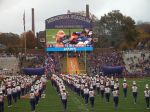
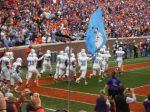
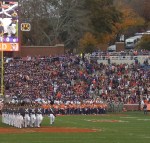
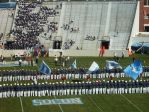
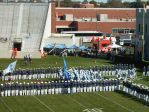
– Also excellent: the performance of the Summerall Guards. Great job. After the first half, something positive was sorely needed. The Guards came through in style.

– I sat in the end zone section on Saturday. At one point a stream of celebrities walked right by me up the stairs, including Andy Solomon, Jeff Hartsell, John Rosa, and Spike. The only one to give me a high-five as he walked by was Spike. The others made their way to seats reserved for the elite patrons.

– Speaking of Spike, he was doing work throughout the game. He must have posed for several hundred pictures while wandering all over the field, making friends wherever he went. I would give him the nod as the Bulldogs’ game MVP.

My thoughts on the season as a whole, and the future, will come later. For now, I just want to say thank you to the seniors. Now finish the job and get that diploma (unless you’re a fifth-year graduate student, of course).

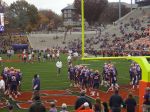
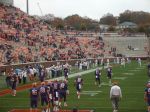
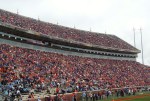
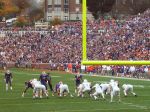
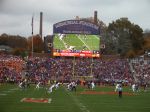
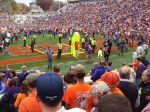
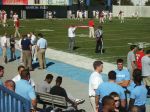
Below are a few pictures. I didn’t take as many on Saturday as I usually do, in part because my location was not really conducive to in-game photos.

2013 Football, Game 12: The Citadel vs. Clemson

The Citadel at Clemson, to be played in Clemson, South Carolina, at Memorial Stadium/Frank Howard Field, with kickoff at noon ET on Saturday, November 23. The game will be streamed on ESPN3.com, with play-by-play from Jim Barbar, analysis by John Bunting, and reporting from the sidelines by Angela Mallen.

The game can be heard on radio via the thirteen affiliates of The Citadel Sports Network. Danny Reed (the “Voice of the Bulldogs”) will call the action alongside analyst Josh Baker, with Lee Glaze roaming the sidelines.

WQNT-1450 AM [audio link], originating in Charleston, will be the flagship station for the network; the station will have a two-hour pregame show. It is also possible to listen to the game via a smartphone, using a TuneIn Radio application.

Links of interest:

The Citadel game notes

Clemson game notes

SoCon weekly release

ACC weekly release

The Kevin Higgins Show

Kevin Higgins on the SoCon media teleconference

ACC teleconference (Dabo Swinney is the first coach on the line); here is the transcript

Dabo Swinney press conference — Part 1, Part 2, Part 3

Brent Venables talks defense  — Part 1, Part 2

Clemson’s players are not believed to be aliens

Apparently really fast 6’5″, 200 lb. receivers are uncommon

It’s a big game for the Tigers, so despite injury Tajh Boyd will play

Gerald Dixon talks about Dabo Swinney

An in-depth review of Clemson’s game against Georgia Tech, play-by-play

Saturday will be Military Appreciation Day at Clemson, and the school (as usual) is going to put on quite a show. The festivities will feature a halftime performance by the Summerall Guards.

It will also be a “Purple Out”, with fans encouraged to wear purple for the game. From above, the stadium is going to look like a giant bruise.

One note on the “Purple Out”: students will be wearing purple t-shirts (and trying to stay warm). However, the original t-shirt design won’t be used:

All full-time Clemson students attending the game will receive a free Purple Out T-shirt, but it won’t include a Purple Heart symbol as originally planned. That design, chosen from more than 30 student submissions in a campuswide contest, didn’t meet licensing guidelines of the U.S. Army. Proceeds from sales of the redesigned shirt will still benefit campus ROTC units and the Student Veterans Association.

I’m not sure which team Clemson is playing next week, but Dabo Swinney was asked during his on-campus press conference if the Tigers had time to “peek ahead” to that game. Swinney was fairly emphatic:

We don’t have time to peek ahead…regardless of who we play…the objective is the win the football game…I can remember in 1992 I was a senior at Alabama and The Citadel beat Arkansas.

The reason I remember that is because [Alabama] played Arkansas the next week…it was chaos in Arkansas, and we went to Little Rock to play them…I will never forget that.

I didn’t even know who The Citadel was in 1992. Probably, literally the first time I had heard of The Citadel was because they beat Arkansas…

You better be ready each and every week…’cause if you’re not…you get beat. I don’t care who you play, what sport it is, what level it is, how much of a discrepancy it is, you get beat.

Incidentally, Swinney’s memory wasn’t perfect. Alabama actually played Arkansas two weeks after the Razorbacks lost to The Citadel. It was the first time Arkansas had returned to play a game in The Natural State after the dismissal of Jack Crowe, however.

Arkansas actually played at South Carolina the week after losing to the Bulldogs. Joe Kines led the Hogs to a 45-7 shellacking of the Gamecocks. (Dabo and his Crimson Tide beat Arkansas 38-11 the following Saturday.)

The Citadel has defeated Clemson on the gridiron in no fewer than five South Carolina towns. It’s possible no other opponent has lost to the Bulldogs at so many different locations.

The military college has wins over Clemson in Clemson (when the town was called “Calhoun”), Charleston (at the original Johnson Hagood Stadium), Anderson, Orangeburg, and Florence.

This Saturday, look for the Bulldogs to use a similar strategy to that employed in The Citadel’s 1931 victory over the Tigers in Florence:

The Citadel Bulldogs arose here today, whipped out a finely-timed, incisive and unanticipated running attack, to win their annual game with Clemson at the Pee Dee Fair, 6-0. In no previous game this season had the Cadets shown such power, speed, and brilliant elusiveness in advancing the ball…

A good, big bunch of men these Tigers were, too, but they were so much putty in the hands of a Citadel team that had a great day…

Local hero Edwin McIntosh scored the game-winning TD for the Bulldogs that afternoon. Another offensive star was “‘Leaping Larkin’ Jennings, the Columbia Comet”.

The defensive player most responsible for keeping the Tigers out of the end zone was “man-mountain, gargantuan” Delmar Rivers, also known as “Big Boy”.

Other tidbits about that game:

– The Citadel kicked off to start both halves.

– Despite that, Clemson only ran 46 offensive plays during the game, a statistic which would undoubtedly horrify Chad Morris. The lack of offensive snaps was partly due to the Tigers’ tendency to “quick kick” whenever possible. Clemson punted on third down six times, punted on second down three times, and punted on first down (?!) once.

– Clemson only picked up three first downs during the game (well, sure, with all that punting), not getting its initial first down until the fourth quarter.

– At one point during the contest, the Tigers threw incomplete passes on consecutive plays. By rule, that resulted in a five-yard penalty.

The News and Courier reported that both team captains were redheads.

– Attendance: 4000.

***Brief subject change before going back to football***

Clemson last played a football game at The Citadel in 1953, which shouldn’t be a shock to anybody. What may come as a surprise, though, is that the Tiger baseball team has not played The Citadel in Charleston during this century either.

In fact, Clemson and The Citadel have not met on a Low Country diamond since 1990, when the teams were coached by Bill Wilhelm and Chal Port. That game was played at College Park.

Now, you wouldn’t necessarily expect the two schools to play each other every year, as they are basically at opposite ends of the state.  That’s not true for the University of South Carolina, of course, and thus the Gamecocks and Bulldogs naturally meet more often.

However, South Carolina doesn’t just play The Citadel once in a while; the two schools play each other home-and-home every year. Meanwhile, Clemson…doesn’t. The last regular-season meeting of any kind between the Tigers and Bulldogs came back in 2004, at Clemson.

I think this is something that needs to be addressed, particularly because Clemson isn’t averse to playing in Charleston. The Tigers played at College of Charleston in 2008, for example.

It is facing the Bulldogs on The Citadel’s home turf that seems to have become an issue for the Tigers in recent years.

Speaking of that home turf, Clemson has actually played at Riley Park. In 2012, South Carolina and Clemson met in a game that was relentlessly hyped by sports columnist Gene Sapakoff of The Post and Courier, who apparently believed the matchup was the most important development in the history of western civilization and would be attended by hundreds of thousands of dignitaries from around the globe.

Sapakoff was highly upset at the game’s actual attendance (5,851), and was unable to accept the fact that despite the nonstop promotion (much of it by himself), the game drew about the same number of people who would attend a typical game between The Citadel and South Carolina at Riley Park. Indeed, last year’s game in Charleston between the Gamecocks and Bulldogs, played on a Tuesday night with no hype whatsoever, had an attendance of 5,838.

That said, having a crowd of 5,000+ for a regular-season college baseball game is very impressive, and not surprisingly the folks who run the Charleston Riverdogs wouldn’t mind seeing the Gamecocks and Tigers get together again at Riley Park in the near future. In a newspaper article from two years ago, the year 2015 was suggested.

However, I don’t think that game should be played. Not in 2015, anyway.

That’s because I believe the next game Clemson plays at Riley Park needs to be against the local college team that calls the stadium home. The Tigers should play The Citadel there first.

I am aware of a few reasons why Clemson and The Citadel have not met in recent years. I don’t care. People can put aside their differences, if only for one night.

Imagine how many people might attend a game at Riley Park between Clemson and The Citadel if the local media promoted it as heavily as Clemson-South Carolina 2012. That’s part of what this is about, at least to me.

I want The Citadel to receive that kind of positive attention, instead of being ignored while various entities start panting heavily at the mere sight of schools from other parts of the state.

Bringing this back to football, but in a similar vein, I find it a bit tiresome that a writer for a local newspaper (Aaron Brenner, the Clemson beat writer for The Post and Courier) has written multiple times that a local team is a “tune-up” for an opponent. It is particularly annoying that he first characterized the game as such before the season even started.

Look, I’m a realist here, but it wouldn’t hurt to show a touch more respect for a school located in your paper’s immediate area. When I first broached the subject with Brenner, back in August, I was immediately informed that Clemson had beaten The Citadel 15 straight times, and mostly by significant margins. (Tell me something I don’t know.)

Of course, I’m guessing Clemson fans wouldn’t think the 1931 loss to The Citadel is going to have any impact on Saturday’s game, and they would be correct. However, I would suggest that those 15 losses he mentioned won’t have any impact either. Do you think the 1976 game matters to the players of 2013? What about 1954? Or 1986? No, no, and no.

The real issue, I think, is that he isn’t covering Clemson from the Charleston perspective. Rather, he’s writing about the Tigers for the Charleston newspaper. There is a difference.

That’s not really the fault of Brenner, to be fair. He is doing what his employer wants him to do. You may not think there is any fault to be found at all, and I can understand that point of view.

Generally during one of my previews I start discussing a team’s statistics in relation to a comparison with those of The Citadel, but it’s pointless to do that this week since Clemson is an FBS squad. Instead, I’m just going to mention some of Clemson’s numbers. A few of them are scary.

– Clemson is averaging 41.3 points per game, 11th best nationally. The Tigers actually have a higher scoring average on the road, “only” scoring 39.8 points per game at Memorial Stadium.

– CU is ninth nationally in total offense, passing offense, and turnover margin.

– Clemson isn’t quite as dominant in a few offensive categories, ranking 50th in the nation in offensive 3rd-down conversion rate and 43rd nationally in offensive red zone TD%.

– The Tigers have had seven plays from scrimmage this season of 60+ yards, tied for third-most in FBS.

– Of course, Clemson’s raw offensive numbers are skewed by the hurry-up-no-I-mean-really-hurry-up style of offensive coordinator Chad Morris. The Tigers are averaging 82.9 plays per game on offense, fifth-most nationally. In terms of yards per play, Clemson is 32nd in FBS with a 6.18 average (Baylor leads the nation, averaging a staggering 8.5 yards per play).

– Clemson’s defensive third down conversion rate of 30.25% is 6th-best nationally. This may be the statistic that best demonstrates the influence of second-year defensive coordinator Brent Venables. In his first year at Clemson, the Tigers were 24th in FBS in this category, a substantial improvement over the 2011 season (when they were 72nd).

– Clemson’s defensive numbers are affected by its offensive style, and look better in context than in raw totals. Tiger opponents are averaging 5.25 yards per play, 42nd nationally. Getting off the field by stopping teams on third down has helped Clemson in that department (The Tigers were slightly above 5.6 y/p in both 2012 and 2011).

– On defense, the Tigers are allowing a red zone TD rate of 62.5%, which is only 69th in FBS. Venables is probably disappointed with that particular statistic.

– Clemson’s punting and kick coverage/return statistics are, in general, indifferent.

As for Clemson’s players, it’s simple: the Tigers have playmakers all over the field, particularly on offense.

Tajh Boyd has been a wonderful quarterback for Clemson. He has occasionally been labeled as a “doesn’t play well in big games” type, but anyone who believes that did not see his magnificent bowl-game performance against LSU last year.

Sammy Watkins is ridiculously good. Dabo Swinney said during his press conference this week that he thinks Watkins is the best wide receiver in the country, and you could certainly make that argument. I have no idea how the Bulldogs are going to cover him, but then almost every other team in the country would have the same problem.

It says something about Clemson’s talent level that Watkins may not even be the most difficult matchup for The Citadel on Saturday. Another wideout, Martavis Bryant, could pose even more problems.

The Tigers’ running game is keyed by the excellent Rod McDowell (who overcame a clubfoot as a child). McDowell runs behind a starting offensive line that averages 6’4″, 298 lbs.

Clemson defensive end Vic Beasley has 17 tackles for loss, fourth nationally. Ten of those TFLs are sacks. The other three starters on the Tigers’ d-line weigh more on average than The Citadel’s offensive linemen.

The Tigers have intercepted at least one pass in 13 straight games, the longest such streak in the country. Eight different players have at least one pick.

Linebackers Stephone Anthony and Spencer Shuey are 1-2 on the team in tackles.

Saturday’s game is officially a sellout, and that crowd will include a fair number of fans wearing blue and white. There will be multiple tailgating events on site for Bulldog fans, who usually know how to have a good time.

I trust the same can be said for the players. The game against Clemson should be fun.

It will be very challenging, to be sure. However, there is no pressure on the Bulldogs, and I think that will be reflected in their play.

One game is left this season. I hope it’s a memorable one for The Citadel, and in a good way.

College Football TV Listings 2013, Week 13

This is a list of every game played during week 13 of the college football season involving at least one FBS or FCS school.  All games are listed, televised or not.  For the televised games (only live broadcasts are listed), I include the announcers and sideline reporters (where applicable).  I put all of it on a Google Documents spreadsheet that can be accessed at the following link:

College Football TV Listings 2013, Week 13

Additional notes:

– I include ESPN3.com games; they are denoted as “ESPN3″.

– This season, I am also including digital network feeds provided by various conferences when they are free of charge. For some of these feeds, the audio will be a simulcast of the home team’s radio broadcast. There are also online platforms that have their own announcers (a la ESPN3.com).

For now, the digital networks I am including in the listings are those for the Mountain WestBig SkyOVCNECBig South, and Patriot League.

– The local affiliates for the SEC Network “national” game of the week (Mississippi State-Arkansas) can be found here: Link

– There are two “split” national games for the ACC this week.

Local affiliates for Pittsburgh-Syracuse can be found here:  Link

Local affiliates for East Carolina-North Carolina State can be found here: Link

– The local affiliates for the AAC Network game of the week (Memphis-Louisville) can be found here: Link

– The local affiliates for the Southland Network game of the week (Sam Houston State-Central Arkansas) can be found here: Link

– I’ve listed the regional nets carrying the ACC Network “regional” games (Boston College-Maryland and Old Dominion-North Carolina) in a note on the document.

– Also listed in notes on the document are the regional nets carrying Maine-New Hampshire.

– There are notes on the document for several other contests.

– ABC coverage maps for the 3:30 pm ET games: Link

– BTN (formerly Big Ten Network) “gamefinder”:  Link

– BCS Standings (FBS): Link

– FCS Coaches’ Poll:  Link

A lot of the information I used in putting this together came courtesy of Matt Sarzyniak’s incredibly comprehensive and completely indispensable site College Sports on TV, which simply cannot be overpraised. It’s a must-bookmark for any fan of college sports, to say the least.

Also to be credited, as always, are the indefatigable information collectors (and in some cases sports-TV savants) at the506.com. I am also assisted on occasion by helpful athletic media relations officials at various schools and conferences.

Game review, 2013: VMI

Links of interest:

Game story, The Post and Courier

School release

Box score

WCSC-TV report (video)

Postgame comments from Kevin Higgins, Ben Dupree, and Sadath Jean-Pierre (YouTube video)

Kevin Higgins’ locker room speech (YouTube video)

Radio highlights

Also worth a link: Danny Reed’s pregame interview of Brian Ruff. I thought Ruff’s comments about Bobby Ross were particularly noteworthy, but the entire interview is quite interesting. I highly recommend it.

Well, the first half wasn’t exactly the finest Bulldog performance in the history of Johnson Hagood Stadium. I couldn’t believe that VMI’s iron-deficient offense was consistently moving the ball on The Citadel’s D. Indeed, the Keydets did not punt in the entire half.

The offense wasn’t as bad, with the notable exception of the final series of the half. The playcalling on that drive was suspect at best.

However, adjustments were clearly made. Whether or not some of those adjustments were suggested with raised voices, the bottom line is that the Bulldogs played very well in the second half and took care of business, retaining the coveted Silver Shako in style.

The Citadel’s defense finished with seven sacks, some of which were quite impressive.

Derek Douglas pulling down VMI starting quarterback A.J. Augustine on a fourth-down play was memorable, though it wouldn’t have happened in the days of the tearaway jerseys. I can distinctly recall Stump Mitchell running for a long TD in a game against VMI, leaving multiple Keydet defenders in his wake, with several left holding a piece of Mitchell’s jersey…

Later in Saturday’s game, Douglas had another sack (this time of backup VMI quarterback Hayden Alford) in which he did not appear to actually put his hands on the QB; rather, he basically ran over him. From my vantage point in the stands, it was an explosive play, and also a very funny one.

VMI offensive lineman Emmanuel Cooper injured his knee late in the game, and then apparently started having heat-related issues. Best wishes to Cooper, and to his teammates, some of whom may have also struggled in the more-tropical-than-expected conditions.

From a fan’s perspective, the weather for the game was outstanding. The Citadel played six home games in 2013, and a jacket was not really necessary for any of them.

In a way, however, that makes the disappointing season attendance seem even worse. Saturday’s matchup with VMI was the least-attended contest at Johnson Hagood Stadium this year, though there wasn’t much difference in the attendance for any of the home games.

You can’t blame rain or cold for that, not this season.

I’m going to write about some of my thoughts on the attendance issues after the season, possibly in December. I want to think about it a little bit longer. There are a lot of “talking points”, if you will.

At that time, I’m also going to discuss in more detail the recent news that The Citadel is actually going to play a football game in Ladson next season, at Charleston Southern. I’ll be honest: I think it’s a terrible decision, one that provides no benefit to The Citadel at all.

After the football game, I wandered over to McAlister Field House to watch the hoopsters in person for the first time this season. The team played well against an overmatched opponent (North Greenville, a Division II school), winning 83-53.

The best thing about the Bulldogs’ play was the lack of turnovers. The Citadel’s turnover rate in the past two seasons has been horrendous, and a major reason why the program has struggled so much.

I am worried about the serious lack of depth in the squad (currently, only nine players are available).

At the end of my photo review of the football activities, I threw in a few photos of the basketball game. They won’t win any awards.

Coming up later in the week, I’ll preview the football team’s game against Clemson. Do the Tigers have a chance of winning their home finale? Maybe.

2013 Football, Game 11: The Citadel vs. VMI

The Citadel vs. VMI, the Military Classic of the South, to be played at historic Johnson Hagood Stadium, with kickoff at 1:00 pm ET on Saturday, November 16. The game will not be televised, although it will be streamed on Bulldog Insider (subscription service) and can be heard on radio via the thirteen affiliates of The Citadel Sports Network. Danny Reed (the “Voice of the Bulldogs”) will call the action alongside analyst Josh Baker, with Lee Glaze roaming the sidelines and Walt Nadzak providing pre-game, halftime, and post-game commentary.

WQNT-1450 AM [audio link], originating in Charleston, will be the flagship station for the network; the station will have a two-hour pregame show prior to each home football game. It is also possible to listen to the game via a smartphone, using a TuneIn Radio application.

Note that 1:00 pm ET start time, an hour earlier than for the past two home games. Don’t be late!

Also: The Citadel’s basketball team will be playing North Greenville at McAlister Field House on Saturday, with tipoff scheduled for 7:05 pm ET. If you have your ticket from the football game, you can watch the basketball game for free.

The hoopsters won their first game of the season on Tuesday, beating Presbyterian 82-68 in the home opener. The team shot well against PC, and held off the Blue Hose down the stretch despite a fair amount of foul trouble.

I hope a lot of Bulldog fans make Saturday a personal football/basketball doubleheader.

Links of interest:

The Citadel game notes

VMI game notes

SoCon weekly release

Big South weekly release

Kevin Higgins on the SoCon media teleconference

Sparky Woods on the Big South media teleconference (beginning at the 18:20 mark)

The Kevin Higgins Show

Advertisement for VMI-The Citadel (video)

Ben Dupree is the reigning SoCon offensive player of the week

Dupree once found out that wearing flip-flops can be problematic

Game story from The Post and Courier on The Citadel’s win over Elon

Game story from the Burlington Times-News on The Citadel’s win over Elon

This preview is going to be a little lighter on the usual historical/statistical minutiae (possibly a blessing in disguise), as I’m on the road much of this week.

Just a lot of “odds and ends” observations…

The game story from the Burlington (NC) newspaper included two quotes that I want to highlight:

Obviously, it’s a low point right now for Elon football

The above comment is from Elon head coach Jason Swepson. He is in his third season, but it may be his last if he keeps having to make pronouncements like that one. It’s not the way the school wanted to exit the SoCon before starting gridiron action in the CAA next season.

Yeah, since I’ve been on the team, it’s probably the lowest we’ve come as a Phoenix, or the Phoenixes, or whatever you want to call us

That was said by Elon’s starting quarterback, Mike Quinn. “Phoenix, or the Phoenixes, or whatever you want to call us” is so…expressive.

I missed this article that ran last week in the Chattanooga Times Free Press, but better late than never. Both Appalachian State and Georgia Southern currently have losing records against league teams, and I get the impression that doesn’t hurt the feelings of SoCon commissioner John Iamarino one bit.

VMI played its final Big South conference game last week against Gardner-Webb, and a funny thing happened. VMI won.

It wasn’t even close, as the Keydets prevailed 27-9. Gardner-Webb owns victories this season over Wofford and Furman, so yes, this was an upset.

How did it happen? Well, mostly it happened because A) VMI’s defense has been improving over the course of the season, and B) Gardner-Webb couldn’t get out of its own way.

Gardner-Webb opened the game by fumbling a snap into its own end zone, where VMI senior linebacker Weston Reber fell on the ball for a touchdown. G-W fumbled again on its next drive, setting up a Keydet field goal.

Those were two of Gardner-Webb’s five turnovers. The Runnin’ Bulldogs also committed thirteen penalties, and shanked a punt that went for just six yards. It just wasn’t G-W’s day.

Choice comments from Weston Reber:

“I just saw the ball on the ground,” said Reber, referring to G-W quarterback Lucas Beatty, who had lost the ball after having trouble fielding a low snap.

“I was on a lineman and I said, ‘I’m getting this damn ball, this thing is mine!’ It was a foot away and it kept rolling and kept rolling, and when it rolled over the [goal line] I just took off and dove on it.”

Reber laughed and jokingly added: “Hopefully, they will take away some demerits from me for the touchdown!”

I wouldn’t count on it…

Sparky Woods, discussing matters during his media teleconference:

We would like to defeat Citadel [sic] so we could continue this reign the Big South has over the Southern Conference.

He did mention that a year from now, he might feel differently about the conference dynamics, given VMI will be in the SoCon next season. Of course, it’s not a given that Woods will be in charge of the Keydets when the school returns to the league.

VMI’s victory over Gardner-Webb was only its second win of the season, and first over a Division I opponent. Woods is in his sixth season in Lexington, and has won only 15 games during that time.

A new AD, Dave Diles, has taken over at VMI, and Diles will have a decision to make about Woods’ future after the season.

VMI is last in the Big South in the following categories: scoring offense, total offense, rushing offense, offensive third down conversion rate, scoring defense, pass defense, defensive third down conversion rate, kickoff return average, kickoff coverage average, and net punting.

Keydet opponents average 6.2 yards per play. VMI is allowing an average of 35.0 points per contest.

The Keydets can point to some positives. VMI leads the Big South in passing offense (though it is next-to-last in pass efficiency), and its red zone defense is actually quite respectable (allowing 4.6 points per opponent possession inside the 20).

The negative to that red zone defense statistic is that opponents have had 47 such possessions.

VMI also has a knack for inducing penalties. I’m not sure how that happens, but VMI leads the Big South in the category, and it’s the second year in a row VMI opponents have been prone to committing infractions when facing the Keydets.

Last year, by far The Citadel’s worst game of the season in terms of penalties came at VMI. Those mistakes almost cost the Bulldogs the victory. That is something to watch on Saturday.

Redshirt senior A.J. Augustine will start at quarterback for VMI against The Citadel, the third straight start for the native of St. Petersburg. It’s too bad he’s not a native of St. Augustine.

Augustine replaced Eric Kordenbrock, who had started most of VMI’s games at the position since midway through his freshman year. He is the alltime leader in passing yardage for the Keydets.

Kordenbrock suffered a serious concussion against Presbyterian, during a play that resulted in an ejection for a Blue Hose player. As a result, Kordenbrock’s college career is over.

Running back Derrick Ziglar rushed for 94 yards and a TD against Gardner-Webb. He had rushed for 100+ yards in the previous two games, becoming the first Keydet with back-to-back 100-yard rushing games in four years.

VMI’s top receiver is Sam Patterson, who is averaging 17 yards per catch. Patterson has seven touchdown receptions and has caught at least one TD pass in four of his last five games.

Earlier in the year, Patterson had back-to-back 100-yard receiving games, the first VMI player to do that since 2005.

VMI’s starting offensive line averages 6’4″, 289 lbs. The biggest of the group is 6’8″, 325 lb. Andy Marcotte.

The starting center for the Keydets, Will Lucas, is a native of Hartsville. He was the only VMI player named to the Big South’s preseason all-conference team.

Another Keydet who turned up on a couple of preseason “watch lists” was tight end Mario Thompson. Unfortunately, three weeks ago Thompson suffered a season-ending knee injury.

Weston Reber, the player with the potentially demerit-erasing fumble recovery against Gardner-Webb, is VMI’s leading tackler. He has one more stop than free safety Alex James.

Outside linebackers Logan Staib and Chris Harper lead the team in tackles for loss and sacks, respectively. Cornerback James Fruehan has two interceptions; seven of his teammates have one each.

VMI’s defense will line up against The Citadel in a 3-4, or a “three down look”, or a five-man front…pick your terminology.

As mentioned earlier, the Keydets have shown some improvement on D in recent weeks and won’t lack confidence from last year’s game against the Bulldogs. In that contest, The Citadel did not score an offensive touchdown in the second half.

VMI placekicker Dillon Christopher was named the Big South special teams player of the week for his performance against Gardner-Webb, which included a 52-yard field goal. Earlier this season, Christopher made a 45-yarder, so he’s got a strong leg. He has been a bit inconsistent, though, and is 7-12 on field goal attempts for the season.

He is also the kickoff specialist for the Keydets. Christopher has six touchbacks in 38 kickoffs this year.

David Eberhardt is averaging 39.0 yards per punt for VMI. So far this season, only one of the Keydets’ 65 punts has been blocked, which is better than VMI’s recent history in that department.

Ripped from the pages of The Citadel’s game notes…

The Citadel is 0-5 against VMI on November 16. Saturday’s date? November 16. Uh-oh.

The Bulldogs did beat Clemson on November 16, 1918. Perhaps the department of athletics should have tried to flip the dates for the VMI and Clemson games this season.

Saturday is the “Hall of Fame Game” at Johnson Hagood Stadium. This year’s honorees: Chip Cannon, Lance Hansen, Jim McMillan, Dan McDonnell, Richard Moore, and Joe Turbeville. Congratulations to all.

Richard Moore may be the least-known of the six. He probably needs to get a little more attention. Moore (class of 1953) was the rifle coach at The Citadel from 1959-62. To quote the press release:

The Bulldogs were undefeated in shoulder-to-shoulder competition during those four seasons and regularly defeated teams from Army, Navy and Air Force.  The Bulldogs finished first in the Hearst National Rifle Match, which equated to national championships, in 1959, ’60 and ’61.

Arguably the most successful coach in Citadel history, Moore’s four teams captured Southern Conference and state championships each year and along the way, three shooters – Robert Metsker ’60, David Edgerly ’62 and Keels Dickson ’62 – all earned All-America citations, becoming the first Citadel program to showcase three All-Americans.

State, conference, and national championships. That works for me.

Moore’s tenure as the rifle coach ended when he was transferred for a tour of duty in Vietnam, which serves as a reminder that the game against VMI is also Military Appreciation Day.

A few weeks ago, I wrote that my preview of the VMI game might be just one sentence: “The Dogs better not lose to VMI.”

I decided a few more sentences wouldn’t hurt, but the bottom line is that this is a must-not-lose game for The Citadel.

That was true last year, too, and the Bulldogs hung on for a victory in a game that was a little too close for comfort. The Citadel can’t afford to let VMI hang around on Saturday, as the Keydets may have a little more confidence this time around that they can pull off the upset.

In a season that has been more of a struggle for The Citadel than was anticipated, it is now even more critical that the coveted Silver Shako is retained.

Of course, it’s always important to keep the greatest trophy in all of sports in Charleston, where it belongs.