College Football TV Listings 2013, Week 4

This is a list of every game played during week 4 of the college football season involving at least one FBS or FCS school.  All games are listed, televised or not.  For the televised games (only live broadcasts are listed), I include the announcers and sideline reporters (where applicable).  I put all of it on a Google Documents spreadsheet that can be accessed at the following link:

College Football TV Listings 2013, Week 4

Additional notes:

– I include ESPN3.com games; they are denoted as “ESPN3″.

– This season, I am also including digital network feeds provided by various conferences when they are free of charge. For some of these feeds, the audio will be a simulcast of the home team’s radio broadcast. There are also online platforms that have their own announcers (a la ESPN3.com).

For now, the digital networks I am including in the listings are those for the Mountain West, Big Sky, OVC, NEC, Big South, and Patriot League.

– The local affiliates for the SEC Network “national” game of the week (North Texas-Georgia) can be found here:  Link

– The local affiliates for the ACC Network “national” game of the week (Pittsburgh-Duke) can be found here:  Link

– I’ve listed the regional nets carrying  the SEC Network “regional” game of the week (Troy-Mississippi State) in a note on the document.

– I’ve listed the regional nets carrying the ACC Network “regional” game of the week (Tulane-Syracuse) in a note on the document.

– Also listed in notes on the document are the regional nets carrying Stony Brook-Villanova, Houston-Rice, Texas State-Texas Tech, and Rhode Island-William & Mary.

– There are notes on the document for several other contests.

– ABC/ESPN2/ESPN3 coverage maps for the 3:30 pm ET and 8:00 pm ET games: Link

– BTN (formerly Big Ten Network) “gamefinder”:  Link

– USA Today Coaches Poll (FBS):  Link

– FCS Coaches’ Poll:  Link

—

A lot of the information I used in putting this together came courtesy of Matt Sarzyniak’s incredibly comprehensive and completely indispensable site College Sports on TV, which simply cannot be overpraised. It’s a must-bookmark for any fan of college sports, to say the least.

Also to be credited, as always, are the indefatigable information collectors (and in some cases sports-TV savants) at the506.com. I am also assisted on occasion by helpful athletic media relations officials at various schools and conferences.

2013 Football, Game 3: The Citadel vs. Western Carolina

The Citadel at Western Carolina, to be played in Cullowhee, North Carolina, on the grounds of Bob Waters Field at E.J. Whitmire Stadium, with kickoff at 3:30 pm pm ET on Saturday, September 14. The game can be heard on radio via the thirteen affiliates of The Citadel Sports Network. Danny Reed (the “Voice of the Bulldogs”) will call the action alongside analyst Josh Baker, with Lee Glaze roaming the sidelines.

WQNT-1450 AM [audio link], originating in Charleston, is the flagship station for the network; audio of the game is also available at Bulldog Insider.

Links of interest:

The Citadel game notes

Western Carolina game notes

SoCon weekly release

SoCon media teleconference: The Citadel head coach Kevin Higgins

SoCon media teleconference: Western Carolina head coach Mark Speir

The Kevin Higgins Show

Kevin Higgins says the Bulldogs are going back to basics on offense

The Post and Courier “Scouting Report”

Profile of Derek Douglas on the “Off the Collar” blog

Donnell Boucher works with the first battalion non-corps squad freshmen

I don’t have a lot to add about the Wofford game that hasn’t already been said or written. Just a few observations…

– Third down conversions: Wofford 9 for 18, The Citadel 3 for 15. That summed up the game about as well as anything else.

– Carl Robinson had an outstanding game, including 16 tackles. Robinson has 30 tackles through two games, which leads the SoCon.

– Brandon McCladdie led the Bulldogs in all-purpose yards. When a defensive back who doesn’t return kicks leads the team in all-purpose yards, it’s generally not a good thing.

– I thought the defense played fairly well with the exception of allowing some big pass plays. Of course, not allowing big pass plays is a key component in good defense.

– Preseason fears about punting have largely been alleviated, thanks to the solid work by Eric Goins over two games.

Kevin Higgins, during his Monday press conference:

It’s apparent that our execution is not where it needs to be. We’re going to simplify as much as we can, maybe get back to the basics more like we did last year.

We want to make sure we are majoring in a couple of things, and do those things real well to give us a chance to be successful.

As Jeff Hartsell pointed out later, “the ‘back to basics’ theme is never a good sign.” Which is true…most of the time. I remember a notable exception.

Prior to The Citadel’s 1991 season, Charlie Taaffe decided to switch from his successful wishbone offense to the veer. Why?

The reason we’re diversifying our offense is simply because most of the teams in the Southern Conference have seen the wishbone so much now they’re getting better at defensing it. We’ve got to do some different things or they’ll be all over us. Plus, it’ll  give us a chance to throw the ball more and be more exciting to watch.

Taaffe added to this as the season drew closer:

I feel like we’ve taken our program to a level [note: this was Taaffe’s fifth season at The Citadel]. To get to the next level, we have to be more dimensional. We ran the ball 86% of the time last year. We need more balance in our offense. We need to force defenses to defend more things.

The Citadel started the 1991 season 1-1, not playing particularly well in its opener against Presbyterian and then losing to Wofford. At that point, Taaffe did something that must have been very hard for him to do.

He junked the veer and went back to the wishbone.

That decision saved the season. After losing 33-26 to Chattanooga in a game in which the offense came to life, The Citadel won four of its next five games, and six of its last eight. The victories included wins over Army (a first on the gridiron for the Bulldogs) and Furman (breaking a nine-game slide in that series).

The quotes from this article, which followed The Citadel’s 38-13 victory over Western Carolina that season, are illuminating. The offensive switch-back even had a positive impact on the defense.

In winning their final three games last year, the Bulldogs averaged almost 36 points per contest. If “back to basics” means a return to that type of offensive productivity, then it’s the right thing to do.

Western Carolina is playing what is, in my opinion, Division I’s most absurd schedule in 2013. The Catamounts have already played FBS foes Middle Tennessee State and Virginia Tech; later in the season, WCU travels to Auburn. That’s three FBS opponents to go along with two FBS-transitional teams (Georgia Southern and Appalachian State). Western Carolina will be the road team in all five contests.

This is a program that has lost 12 straight games overall, and 22 straight in the SoCon. Western Carolina’s victory over The Citadel on September 3, 2010, was its last win over a D-1 team.

I know it’s a cash grab, but it’s really unfair to the players and coaches in that situation to have to play three FBS opponents. It can’t be easy for second-year coach Mark Speir.

Having said that, if WCU is going to climb out of its gridiron hole, Speir strikes me as the man to lead the way. I think he was a very good hire (and I’m far from alone in that assessment). This season’s schedule may set him back a year, though. We’ll see.

It is hard to get any kind of read on this year’s edition of the Catamounts, since they’ve only played FBS competition thus far. Actually, going back to last season (when WCU finished with a bye and Alabama, respectively), Western Carolina hasn’t played an FCS school since November 3, 2012.

That was a game against Chattanooga, and the Catamounts led the Mocs after three quarters. The week before the UTC contest, Western Carolina gave Appalachian State a good game (losing 38-27).

The Catamounts also led The Citadel in the third quarter at Johnson Hagood Stadium last season, and were tied with the Bulldogs entering the fourth quarter before The Citadel pulled away. That matchup, you may recall, featured a game-turning special-teams play by Vinny Miller.

One of the stars for Western Carolina in that game at JHS was quarterback Troy Mitchell, who rushed for 117 yards and two TDs in the loss. Mitchell did not play in the Catamounts’ game at Virginia Tech, but is expected to start against The Citadel.

Also missing against the Hokies was running back Darius Ramsey, who has not played yet this season for WCU. Ramsey rushed for 118 yards against The Citadel in last year’s game.

Garry Lewis, a freshman, is listed as the starting running back in WCU’s one-back set. The Catamounts may start the game against the Bulldogs with four wideouts.

Western Carolina has some experience along the offensive line, but is also starting a true freshman at right guard, Tanner Poindexter. The caption besides Poindexter’s name on the two-deep in the WCU game notes reads as follows:

Played center in 2012 Shrine Bowl after all-conference at guard … Sports a very interesting hair style – “a mullet”

As usual, the Catamounts’ media relations deparment provide all the necessary information about its team.

Western Carolina has a new defensive coordinator, one who should be very familiar with the Bulldogs’ triple option attack. Last year, Shawn Quinn was the defensive coordinator at Charleston Southern; prior to that, he was at Georgia Southern.

WCU would normally be a 4-3 base D, but that is likely to be adjusted against the Bulldogs.

Quinn will not have the services of Rock Williams this year, much to the relief of Ben Dupree and company. In last year’s game, Williams had 24 tackles, the highest total recorded in the league by a player all season.

As for this year’s players, Bryson Jordan is a freshman who will start at outside linebacker for WCU. He is the son of former Brave (and Falcon) Brian Jordan.

Another freshman, Trey Morgan, is one of the Catamounts’ starting cornerbacks and is highly regarded. He was praised by ESPN3 analyst (and former UNC coach) John Bunting as “a real steal” during the game against Virginia Tech. WCU’s defensive backfield is a team strength, one that also includes preseason second-team SoCon pick Ace Clark.

Western Carolina likes to play a lot of d-linemen, generally a good strategy. There are some interesting backgrounds among the players along the line, including backup nosetackle Helva Matungulu, a native of Kenya who had never played football before arriving in Cullowhee. He is a converted rugby player.

The Catamounts return both their placekicker and punter from last year.

Western Carolina starts four “true” freshmen on its two-deep and played 20 freshmen (including seven true freshmen) in the season opener against Middle Tennessee State. This is a young team.

I don’t know what to expect from the Bulldogs on Saturday. It’s put up or shut up time, I suppose.

One thing that worries me is this has become a big game for Western Carolina. After The Citadel, WCU plays Mars Hill, and then starts a three-game road swing: Samford, Chattanooga, and Auburn. In other words, the Catamounts could really use a win against the Bulldogs, and probably have increased confidence that they have an opportunity, given The Citadel’s struggles.

Oddsmakers list The Citadel as a four-point favorite, a small spread considering WCU’s difficulties in recent years against Division I competition. It is understandable, however, when taking into account what The Citadel has done so far this season.

I am not worried about what Las Vegas thinks, though. My concern is with the mindset of the team. I hope there are still good vibes emanating from those wearing the blue and white.

To bring home a victory from Cullowhee, positive thoughts are a necessity. So are hard hits and tough runs.

I think there is still some bite to these Bulldogs. Saturday is the time to show it.

College Football TV Listings 2013, Week 3

This is a list of every game played during week 3 of the college football season involving at least one FBS or FCS school.  All games are listed, televised or not.  For the televised games (only live broadcasts are listed), I include the announcers and sideline reporters (where applicable).  I put all of it on a Google Documents spreadsheet that can be accessed at the following link:

College Football TV Listings 2013, Week 3

Additional notes:

– I include ESPN3.com games; they are denoted as “ESPN3″.

– This season, I am also including digital network feeds provided by various conferences when they are free of charge. For some of these feeds, the audio will be a simulcast of the home team’s radio broadcast. There are also online platforms that have their own announcers (a la ESPN3.com).

For now, the digital networks I am including in the listings are those for the Mountain West, Big Sky, OVC, NEC, Big South, and Patriot League.

– The local affiliates for the SEC Network “national” game of the week (Southern Mississippi-Arkansas) can be found here:  Link

– The local affiliates for the ACC Network “national” game of the week (New Mexico-Pittsburgh) can be found here:  Link

– I’ve listed the regional nets carrying the ACC Network “regional” game of the week (ULM-Wake Forest) in a comment on the document.

– Also listed in comments on the document are the regional nets carrying Ball State-North Texas and Lamar-Oklahoma State.

– BTN (formerly Big Ten Network) “gamefinder”:  Link

– USA Today Coaches Poll (FBS):  Link

– FCS Coaches’ Poll:  Link

—

A lot of the information I used in putting this together came courtesy of Matt Sarzyniak’s incredibly comprehensive and completely indispensable site College Sports on TV, which simply cannot be overpraised. It’s a must-bookmark for any fan of college sports, to say the least.

Also to be credited, as always, are the indefatigable information collectors (and in some cases sports-TV savants) at the506.com. I am also assisted on occasion by helpful athletic media relations officials at various schools and conferences.

Game Review, 2013: Wofford

Well, that was not a huge surprise…

Actually, there were some elements of the game that were not expected. I didn’t think at this point in the season there would be a discussion about the regression of the offense from last year, but here we are.

There was one Bulldog cheerleader on hand for every offensive touchdown scored by The Citadel in this game. Given that the administration quietly eliminated the cheerleading squad prior to the 2013-14 school year, that’s not good. (Neither is not having any cheerleaders, but that’s a discussion for another post.)

I’ll write more about this game when I preview the Western Carolina matchup later in the week. Right now, though, things are tough for the Bulldogs, and tough in a way that wasn’t really anticipated before the season began.

The only saving grace so far is that The Citadel isn’t the only SoCon team struggling. Furman and Appalachian State are both winless as well (App lost at home to North Carolina A&T…hello).

Wofford, in all honesty, didn’t look that great even in its victory (which unfortunately does say a lot about the Bulldogs’ performance). Chattanooga did what it was supposed to do against Georgia State after not doing what it was supposed to do versus UT-Martin.

Samford has looked decent; the loss to Arkansas was probably more impressive than its win over Georgia State. Georgia Southern basically hasn’t started its season yet, and in a way, neither Western Carolina nor Elon has either.

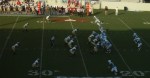
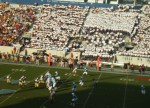
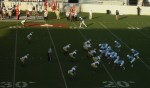
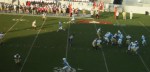
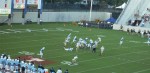
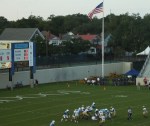
As usual, I took some pictures. As usual, they aren’t that great. However, I continue to take them anyway…

2013 Football, Game 2: The Citadel vs. Wofford

The Citadel vs. Wofford, to be played at historic Johnson Hagood Stadium, with kickoff at 6:00 pm ET on Saturday, September 7. The game will streamed on ESPN3.com, with play-by-play from Darren Goldwater and analysis by Paul Maguire. It can also be heard on radio via the thirteen affiliates of The Citadel Sports Network. Danny Reed (the “Voice of the Bulldogs”) will call the action alongside analyst Josh Baker, with Lee Glaze roaming the sidelines and Walt Nadzak providing pre-game, halftime, and post-game commentary.

WQNT-1450 AM [audio link], originating in Charleston, will be the flagship station for the network; the station will have a two-hour pregame show prior to each home football game. 

Links of interest:

My (very brief) review post from Game 1

The Citadel’s game notes

Wofford’s game notes

SoCon weekly release

SoCon media teleconference — Kevin Higgins

SoCon media teleconference — Mike Ayers

The Kevin Higgins Show (YouTube)

There are a lot of things that can be said about the season opener against Charleston Southern, almost none of them positive from The Citadel’s perspective.

First and foremost, I want to focus on the last 65 seconds of the first half.

The situation:

The Citadel led 16-7, but Charleston Southern had scored on its previous possession (a 64-yard TD pass) and then forced a three-and-out from the Bulldogs offense. After a long punt return blunted by a personal foul penalty, CSU had the ball at midfield, first-and-10, with 1:05 to play in the first half. The Buccaneers had no timeouts remaining.

On first down, a sack moved the ball back to the CSU 41-yard line. At that point, head coach Kevin Higgins called his first timeout of the half. Why?

Higgins explained later:

We’re thinking, we’ll call a timeout, go block a punt before the half. We’ve done that for the last three years, used the same kind of strategy, see if we can block a punt or get a drive at the end of the half.

Charleston Southern gained nine yards on its next play, setting up third-and-10 at the 50. The clock kept running, and The Citadel did not use a timeout.

I’m not sure why you wouldn’t call the second timeout if the idea was to have time left to block a punt or set up a return. It wasn’t like it was third-and-1. It was third-and-10.

That decision led to several things, none of which were good for The Citadel. First, CSU essentially got a “free shot” at making a big play on offense with the clock running out, and the Bulldogs were lucky that the Bucs narrowly missed connections on a pass over the middle that would have gone for big yardage (if not a TD).

That incompletion stopped the clock with less than 20 seconds to play in the half. On fourth down, CSU punted. The Citadel did not rush the punter (I went back and looked at the video to make sure). A return was not exactly set up either (a fair catch was called prior to the muff). Why anyone was even back to attempt to catch the punt strikes me as a fair question.

If the timeout had not been called after first down, the half would have ended without a punt even occurring. Instead, the Bulldogs were put in a position to fail with no realistic potential for success.

After the fumble recovery, Charleston Southern had the ball at the Bulldog 19-yard line with 12 seconds left in the half, and no timeouts. The one thing the defense can’t give up in that situation is a TD pass.

Tackle the receiver before the ball gets to him if that’s what it takes to stop the completion. In the worst-case scenario, pass interference would have put the ball at the Bulldog 4 and left the Bucs only one play (possibly two) before the half, which likely would have been a field goal attempt. The defense just can’t let a pass be completed in the end zone there.

I understand you’re asking a player to do something that would probably be against his instincts as a defender. It’s also possible the coaches discussed the strategy (The Citadel called its second timeout after the punt) and it wasn’t properly executed. For those reasons, I’m not bothered as much by the TD play as I am the game management that preceded the punt.

At any rate, the last minute of the first half was the key sequence in the game, and it was badly mishandled by The Citadel.

There were other missteps, too. The Citadel went for two points too early (though that was at least somewhat defensible). The playcalling, particularly on the final offensive series, left a lot to be desired.

The defense let CSU saunter right down the field to open the third quarter, as easy a TD drive as you could want, and gave up the aforementioned long TD pass on a badly blown coverage. There were other forgettable moments, too.

That end-of-half debacle, though…that’s a hard one to shake off.

It was nice of Kevin Higgins to talk about the “great job” Jamey Chadwell and his staff did in preparing for the game, but his comments did not exactly make Bulldog fans feel better. Also, I’m sure Chadwell is a good coach, but he’s the same guy who elected to punt on fourth-and-6 from the Bulldog 34 in the second quarter, with his team down two scores.

Punting from inside your opponent’s 35 in that situation (or almost any situation) is a decidedly sub-optimal strategy. I’m not convinced yet that Chadwell is the Albert Einstein of college football, which makes the whole ‘it was hard for our offense because they used a bunch of defensive fronts’ thing all the more galling.

With all due respect to Charleston Southern, this game wasn’t about the Buccaneers doing anything particularly exceptional. It was about The Citadel handing CSU the contest on a silver platter with fancy trimmings. It wasn’t a “disappointing loss”; it was a disastrous, unacceptable one.

I’ll wait until a later time (perhaps next week) to write about some of the ancillary elements from last Saturday, including the noticeable lack of cheerleaders and the disappointing crowd attendance. I’m very curious to see if there will be any changes in terms of off-field activities.

For example, will the band be allowed to play following the kickoff? Sometimes during the game I forget The Citadel even has a band, to be honest.

This is the seventh time in the last eight years the game between The Citadel and Wofford is being televised over the air (SportSouth, SCETV, etc.) or streamed on ESPN3.com. For the second year in the row, the game is on ESPN3.com, and for the second year in the row the announcers are Darren Goldwater and Paul Maguire.

The Citadel’s 42-20 victory in the season finale against Furman last year was only the second time in the Kevin Higgins era that the Bulldogs had won a televised/ESPN3-streamed game. Goldwater was the gamecaller for ESPN3.com that day too (with analyst Doug Chapman). It would be novel to win two in a row on ESPN3.com.

The average score between Wofford and The Citadel had been 34-14 in the seven years prior to last year’s game, which was obviously much closer. Among other items of interest, Wofford was penalized for 59 yards in that contest, almost twice as many yards as the Terriers had been penalized against the Bulldogs in the previous four games combined.

However, Wofford did not commit a turnover against the Bulldogs last year. That has been a trouble spot for The Citadel over the past few years against all opponents, one that emerged again last Saturday when the Bulldogs failed to force a turnover against Charleston Southern.

It is hard to judge anything about Wofford based on its game against Baylor, which the Terriers lost 69-3. I believe that Baylor is going to be one of the elite offensive teams in the country this year, and a serious contender for the Big XII title. Very few teams are going to be able to handle the Bears’ speed and general offensive execution; Wofford certainly couldn’t.

If you want to see the Wofford-Baylor game for yourself, you can, and in an extremely handy 50-minute package: Link

Tangent: That video is part of something the Big XII does for all its games that is called “No Huddle”, a concept that is undeniably awesome. All the plays, none of the fluff, loaded up to YouTube the Monday after the games. More of that, please.

Wofford injury report:

There were no major injuries in the Baylor game.

That is in the Wofford game notes. However, from Todd Shanesy of the Spartanburg Herald-Journal:

Wofford halfbacks Cam Flowers and Ray Smith, who suffered concussions last week in the game at Baylor, will be tested Friday to see whether they can make the trip to The Citadel…

…Flowers, a third-year sophomore from Damascus, Ga., made his second career start Saturday against Baylor and had four carries for 13 yards. Smith, a true sophomore who is Dorman High School’s all-time leading rusher, had three carries for 15 yards. He was listed as the backup to the other starting halfback, sophomore Will Gay from T.L. Hanna. Octavius Harden, a sophomore from Conover, N.C., was behind Flowers.

Flowers and Smith were two of the eight Terriers who got carries against The Citadel in last year’s game. Gay and Harden also saw action in that contest (Gay scoring a touchdown).

Wofford has plenty of fullback/halfback types, so if Flowers and/or Smith can’t go, the Terriers should still be in good shape. Wofford also returns the two wideouts who caught passes against the Bulldogs (Jeff Ashley and Will Irwin).

Starting fullback Donovan Johnson rushed for 473 yards last season as the backup to now-graduated Eric Breitenstein. A lot of that yardage came from the halfback position, as Breitenstein (understandably) saw the bulk of the time at FB.

The Terriers only returned two starting offensive linemen from last year’s squad, but they’re both good ones. Jared Singleton and Ty Gregory were each named to the SoCon’s preseason all-conference first team. There is still competition for at least one spot along the Wofford line.

Then there is the quarterback position. With one year of eligibility remaining, Brian Kass elected to transfer to Coastal Carolina. With Kass out of the picture, three players have battled for the Terriers’ starting QB spot. James Lawson started two late-season games for Wofford last season and also opened behind center against Baylor. He will likely start against The Citadel, but both Evan Jacks and Michael Weimer are expected to play.

Wofford lost six starters off its defense, but returns preseason all-league pick Alvin Scioneaux at outside linebacker. Free safety James Zotto had six tackles against the Bulldogs last season, tied for the most by a Terrier in that game. Two of Wofford’s starters along the defensive line are back, including second-team SoCon selection Tarek Odom and 6’2″, 290-lb. noseguard E.J. Speller.

Starting defensive end Hunter Thurley (a redshirt freshman) is 6’4″, but listed at just 245 lbs. In general, Wofford’s d-line is undersized (Speller is a notable exception) and the linebackers are tall and rangy.

Kasey Redfern handles all the kicking duties for the Terriers. Will Gay is Wofford’s punt returner and is usually joined on kickoffs by Cameron Flowers, though Flowers’ status will be in doubt up until gametime.

Odds and ends:

– I am not a big fan of Ben Dupree returning punts. I’ll hope for the best.

– Based on the two-deep in The Citadel’s game notes, it appears Tyler Renew may not get cleared by the NCAA in time for Saturday’s game. Shaunn Middleton is listed as Darien Robinson’s backup. Incidentally, Renew was listed in last week’s game notes as the second-team B-Back.

– Nick Jeffreys is listed as the tight end on the two-deep. No other player is listed at the position.

– Attendance at Johnson Hagood Stadium for Wofford’s past four visits: 11,290 (2005), 14,879 (2007), 15,155 (2009 — Homecoming), 12,316 (2011)

The last time Wofford entered the game against The Citadel with as many questions as the Terriers have this season, it was 2009. That wasn’t an early-season situation, though. In 2009, Wofford suffered through a series of injuries and finished with a 3-8 record.

One of those three victories was a 43-17 win over the Bulldogs, as listless a Homecoming performance from The Citadel as I’ve ever seen in person at Johnson Hagood Stadium. I am not sure what to expect from The Citadel in this year’s game, but it better not resemble anything like that.

I don’t think it will. I expect the Bulldogs to come out fired up and ready to prove something.

That doesn’t mean I expect a victory, though. A win for The Citadel on Saturday night is probably not in the cards.

Having said that: while I’m frustrated, and a little disgusted, and not all that confident the team can recover from its opening-night failure…I’m not giving up on this team. It’s my team, no matter what.

I’ll be cheering them on at Johnson Hagood Stadium this Saturday night, and I hope many other people will be doing the same.

College Football TV Listings 2013, Week 2

This is a list of every game played during week 2 of the college football season involving at least one FBS or FCS school.  All games are listed, televised or not.  For the televised games (only live broadcasts are listed), I include the announcers and sideline reporters (where applicable).  I put all of it on a Google Documents spreadsheet that can be accessed at the following link:

College Football TV Listings 2013, Week 2

Additional notes:

– I include ESPN3.com games; they are denoted as “ESPN3″.

– This season, I am also including digital network feeds provided by various conferences when they are free of charge. For some of these feeds, the audio will be a simulcast of the home team’s radio broadcast. There are also online platforms that have their own announcers (a la ESPN3.com).

For now, the digital networks I am including in the listings are those for the Mountain West, Big Sky, OVC, NEC, Big South, and Patriot League.

– The local affiliates for the SEC Network “national” game of the week (Western Kentucky-Tennessee) can be found here:  Link

– The local affiliates for the ACC Network “national” game of the week (Middle Tennessee State-North Carolina) can be found here:  Link

– The local affiliates for ESPN Regional’s coverage of the MAC game of the week (Bowling Green-Kent State) can be found here: [Link when available]

– The local affiliates for ESPN Regional’s coverage of the AAC game of the week (Houston-Temple) can be found here: Link

– I’ve listed the regional nets carrying SEC Network “regional” games in comments on the document. Those games are Miami (OH)-Kentucky, Alcorn State-Mississippi State, Arkansas State-Auburn, and Austin Peay-Vanderbilt.

– I’ve listed the regional nets carrying the ACC Network “regional” game of the week (South Carolina State-Clemson) in a comment on the document.

– Also listed in comments on the document are the regional nets carrying Southeastern Louisiana-TCU, Buffalo-Baylor, and Stephen F. Austin-Texas Tech.

– ABC/ESPN2 coverage map for the 3:30 pm ET games: Link

– BTN (formerly Big Ten Network) “gamefinder”:  Link

– USA Today Coaches Poll (FBS):  Link

– FCS Coaches’ Poll:  Link

—

A lot of the information I used in putting this together came courtesy of Matt Sarzyniak’s incredibly comprehensive and completely indispensable site College Sports on TV, which simply cannot be overpraised. It’s a must-bookmark for any fan of college sports, to say the least.

Also to be credited, as always, are the indefatigable information collectors (and in some cases sports-TV savants) at the506.com. I am also assisted on occasion by helpful athletic media relations officials at various schools and conferences.

Game Review, 2013: Charleston Southern

Well, that was ugly…

I’ll write about the game (and a few ancillary elements) as part of my preview of the matchup with Wofford. That was always going to be the plan anyway. After the ridiculousness of Saturday night, though, a few days to think things over may not be such a bad thing.

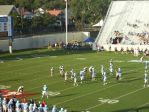
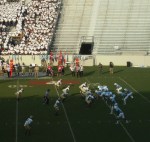
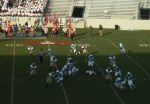
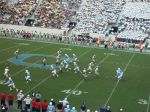
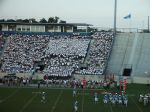
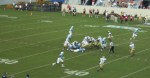
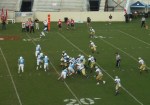
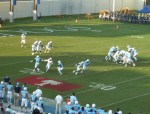
I took some pictures of the pregame scene and some of the game itself. As usual, the “action shots” aren’t the best. I decided to post them anyway. I know some folks like to look at formations, etc.

I’ll close this brief post on a somewhat positive note:

On The Citadel Foundation’s website, there is now a specific fund for The Citadel’s mascot program. As I’ve said before, the re-institution of the mascot program is arguably the best thing the school has done over the past decade or so.

I’m going to keep a link to the site on the right side of my blog for at least a little while, which isn’t something I would normally do. I’m going to make a one-time exception for this (no, I wasn’t asked). As the site says:

The cost of maintaining and transporting the Bulldog Mascots is funded solely through generous donations. The Citadel does not provide any funding for these wonderful ambassadors.

I am honestly surprised the school does not fund this program. Maybe some of the powers that be are unaware of the value it provides; I don’t know. I’m just glad there is now a donating option for supporters.

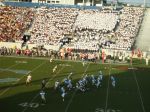
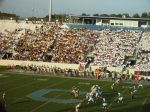
Here are the aforementioned photos. Apologies in advance for the occasionally hilarious quality, but everyone knows I’m not much of a photographer. I had an even more difficult time than usual on Saturday for some reason.

2013 Football, Game 1: The Citadel vs. Charleston Southern

FOOTBALLFOOTBALLFOOTBALLFOOTBALLFOOTBALLFOOTBALLFOOTBALL

The Citadel vs. Charleston Southern, to be played at historic Johnson Hagood Stadium, with kickoff at 6:00 pm ET on Saturday, August 31. The game will not be televised, although it will be streamed on Bulldog Insider (subscription service) and can be heard on radio via the thirteen affiliates of The Citadel Sports Network. Danny Reed (the “Voice of the Bulldogs”) will call the action alongside analyst Josh Baker, with Lee Glaze roaming the sidelines and Walt Nadzak providing pre-game, halftime, and post-game commentary.

WQNT-1450 AM [audio link], originating in Charleston, will be the flagship station for the network; the station will have a two-hour pregame show prior to each home football game. 

From last week: my preview of the upcoming season

It has numbers and stuff in it; don’t say you haven’t been warned…

Other links of note:

The Post and Courier‘s Jeff Hartsell has a story on the upcoming game, a season preview, and a look at this year’s SoCon

– SoCon weekly release and Kevin Higgins’ SoCon media teleconference

– SoCon preseason media poll (The Citadel was picked to finish 6th) and coaches’ poll (6th again), and the league’s preseason all-conference teams

– My post on the CFPA watch lists, along with preseason FCS rankings from The Sporting News, Lindy’s, and Athlon Sports

– FCS Coaches preseason Top 25 poll, and The Sports Network’s preseason Top 25 rankings (also from TSN: its preseason FCS All-America teams and its SoCon preview)

– Phil Kornblut of SportsTalk interviews Kevin Higgins and the four team captains (Keith Carter, Derek Douglas, Ben Dupree, Brandon McCladdie)

– Also worth a listen: Kornblut’s interviews with Charleston Southern head coach Jamey Chadwell and three of CSU’s players

– AP preview of the Bulldogs (predicts The Citadel will finish 6th in the SoCon)

– Hometown articles on Ben Dupree and Sadath Jean-Pierre

– Game notes from The Citadel and Charleston Southern

Let’s talk about Charleston Southern…

When The Citadel and CSU met to open the 2012 campaign, the Buccaneers were coming off an 0-11 season, and it may not have been that good. Charleston Southern had changed its offense (essentially for the third consecutive season) and brought in a new defensive coordinator.

Despite all that, CSU actually led the Bulldogs 14-7 late in the second quarter, thanks in part to an ill-timed penalty and a series of fumbles (two of which The Citadel lost). Eventually the Bulldogs asserted their superiority and rolled to a 49-14 victory, but CSU showed flashes of a competitive spirit throughout the rest of its season.

The Buccaneers finished 5-6, a five-game improvement only bettered at the FCS level by Villanova (the Wildcats went from two wins to eight). Charleston Southern won four of its last six contests.

After the season, head coach Jay Mills announced his retirement. Named as his replacement was a former CSU assistant, Jamey Chadwell, who older Bulldog fans may remember as a quarterback at East Tennessee State in the late 1990s. Chadwell was a two-year starter at ETSU in non-consecutive seasons (his playing career was affected by a serious ankle injury).

Chadwell had spent the last four seasons as a head coach at the Division II level. He was the head coach at North Greenville for three years, leaving that job for the same position at Delta State.

The Statesmen (mascot: The Fighting Okra) were only 3-7 in Chadwell’s lone season in charge; prior to that, he had fashioned a 22-14 record at North Greenville, buoyed by an 11-3 record in 2011. That year, his quarterback was celebrated high school star (and former Clemson player) Willy Korn, who is now on Chadwell’s staff at CSU.

Mark Tucker, a former offensive assistant under Charlie Taaffe and Don Powers at The Citadel, is also on Chadwell’s coaching staff. As of August 22, so is former South Carolina (and NFL) linebacker Rod Wilson.

According to Chadwell in his interview with Phil Kornblut, Charleston Southern’s offense this year will feature a spread option look “in the gun”. The Buccaneers will run the ball more than they did under Jay Mills.

Chadwell wants to have a more balanced offense and “get playmakers out in space”. His ideal is Florida circa Tim Tebow, though he acknowledged that incumbent Bucs QB Malcolm Dixon isn’t exactly the second coming of Tebow.

Dixon had his moments against The Citadel in last year’s game, throwing a TD pass and also running for a score. As Chadwell pointed out to Kornblut, Dixon is learning his fourth offense in four years as a college player.

CSU running back Teddy Allen rushed for 56 yards (on only 11 carries) against the Bulldogs last season. Allen was one of two Buccaneers to make the Big South preseason all-conference team.

Also expected to see action at running back is juco transfer Christian Reyes, an Oregon native who has gone to some schools with really cool names, like Rogue River High School and College of the Siskiyous (located in Weed, California). Despite only being on CSU’s campus since January, Reyes (who rushed for 1958 yards last season in junior college) was named one of the team captains for the Buccaneers.

Other Charleston Southern offensive players to watch include Larry Jones III (20.5 yards per reception last season) and wideout Donte Sumpter, a transfer from East Carolina. Starting tight end Nathan Prater is 6’8″; disappointingly, the native of Ninety Six wears jersey #81.

The Bucs have four starters returning on the offensive line, but Chadwell suggested on CSU’s website that some freshmen are battling for those spots.

Charleston Southern was a mediocre passing team last year, ranking 62nd out of 121 FCS teams in passing efficiency. That actually isn’t half-bad, considering CSU completed less than 50% of its pass attempts.

When the Bucs did complete a pass, it generally went for good yardage, resulting in a respectable 7.86 yards per attempt (and 12 touchdowns against 8 interceptions). The Bucs averaged 5.35 yards per play, which was middle-of-the-pack nationally (65th).

Arguably, CSU’s most ominous offensive statistic last season was its third-down conversion rate (30.34%), 11th-worst in FCS football.

Defensive back Elijah Lee was the other Buccaneer besides Allen to garner preseason all-league honors. Lee will be part of a defense that is switching to a 3-4 base after previously being a 4-3. I’m not sure how big an impact that will have on the way the Buccaneers defend the triple option, though.

The key player for CSU against the Bulldogs is likely to be 290-lb. noseguard James Smith. Other defenders of note include linebacker Calvin Bryant and defensive end Will Hunt.

Last season the Bucs’ D topped the Big South in yards per pass attempt, allowing only 6.38 per attempt. Charleston Southern was 32nd nationally in pass efficiency defense.

However, CSU was next-to-last in the league in rush yards per attempt (5.32) and rush yards per game (208.82), leading to a bottom-20 finish nationally in rushing defense. The Citadel rushed for 479 yards against Charleston Southern in last year’s contest.

Opponents averaged 5.7 yards per play against Charleston Southern; the Bucs ranked 81st out of 121 FCS teams in that category in 2012.

When considering CSU’s on-field performance, the yards per play numbers are particularly important due to pace of play considerations. Both CSU’s offense and defense were each on the field for about 62 plays per game last season, which for both units was the eighth-fewest in the entire division. By contrast, The Citadel averaged 63.7 plays per game on offense (15th-fewest nationally) and 66.5 on defense (26th).

Elijah Lee and a pair of freshmen are expected to feature as kick/punt returners for the Bucs. Kickoff returns were problematic for CSU last year, as the team finished with a KOR average of 16.67 yards, 8th-worst in FCS. Charleston Southern finished in the top 20 of FCS in kick return coverage, though the Buccaneers did allow a kick return TD against Jacksonville (on an onside kick that went awry).

Jacksonville also returned a punt for a touchdown against CSU, which finished 87th nationally in net punting. The Buccaneers only attempted five field goals last season, making three (with a long of 31 yards). Both CSU’s punter and placekicker return in 2013.

The Buccaneers were picked to finish fourth in the six-team Big South by a panel of the league’s coaches and media. Charleston Southern will open its home schedule next week against Shorter University. The game will kick off at 11:00 am, one of three CSU home games scheduled for that start time.

Jamey Chadwell told Phil Kornblut that the game versus The Citadel would be a “big challenge” and that “we know going in we’re the underdogs, and rightfully so.” Chadwell also said this:

We’re trying to take that step where we have respect in this state and this city [for our conference]…we’re hoping to go in and compete and establish our identity…if we control the things that we can, our effort and attitude, we think we can compete [with anybody].

Further evidence that Chadwell is going to play the ‘respect card’ in motivating his team for the game against The Citadel: he “favorited” a tweet about the line for the matchup (the Bulldogs opened at -25.5 points). You can bet Chadwell let his players know about that.

Things I’ll be keeping a close eye on this Saturday:

– Execution in the first half

The Bulldogs need to take charge on both sides of the ball while there is still cannon smoke wafting in the air, as opposed to a repeat of last year’s sloppy opening half. The center-QB exchange needs to be second-nature, the “mesh” should be clean, the pitches and passes accurate, the catches made, and the blocking sound.

The team mantra this season is “1-0”. I like it. I want to see the squad live up to it.

– Penalties, or a lack thereof

The Citadel led all of FCS football in the categories “fewest penalties” and “least penalty yardage” in 2011, and matched that feat in 2012 (tying for fewest penalties last year with Lehigh). In all of NCAA football, regardless of division, only Brevard committed fewer penalties per game than did The Citadel in 2012.

– Punting

The Bulldogs actually didn’t punt in last year’s opener. While it would be great to have that happen again, odds are against it. The new punter has some big shoes to fill. The punt return unit will also be under the microscope.

Also worth watching on special teams: The Citadel will have a new long snapper and a new holder (who, as it happens, was last year’s long snapper).

– Third down conversions

Last season the Bulldog offense had a third-down conversion rate of 40.44%. That rate needs to improve. While The Citadel was 50th nationally in that category, fellow SoCon triple option teams Georgia Southern and Wofford were 23rd and 26th in FCS, respectively.

It was actually more of a concern on defense, as Bulldog opponents converted third downs at a rate of 43.08%, only 85th-best in the division. That has to get better, especially when facing the likes of GSU and Wofford (and Chattanooga, which was 30th nationally in offensive third down conversion rate).

– Forced turnovers

I touched upon this topic as part of my season preview. Incidentally, stopping the run (a focus of the coaching staff this season) is a key element to both the defensive third down conversion rate and forced turnovers (because it puts opponents in obvious passing situations).

– Defensive playmakers

Last year, the key moment for the defense against CSU was a fumble forced by Chris Billingslea, who had a knack for being in the middle of game-turning plays like that one. Billingslea has graduated, and the Bulldogs need someone else to carry the big-play torch (or sledgehammer).

One of the more interesting comments from Kevin Higgins’ Monday press conference was about the defense, stating that “we have a little more depth than I anticipated, especially inside.” That was good to hear.

– Freshmen

The Citadel has quite a few freshmen (and redshirt freshmen) on the depth chart. They are going to get a chance to make a strong first impression. The wide receivers, in particular, may get multiple opportunities to shine.

– Attendance

Last year’s opener had a crowd of 14,264, a good turnout at Johnson Hagood Stadium by 21st century standards. Whether or not the team’s fine season last year will lead to improved attendance is debatable.

When I took a look at JHS attendance trends a year ago, the numbers suggested that the success of 2012 will not necessarily lead to bigger crowds for the 2013 campaign. Of course, that’s just the people who actually file into Johnson Hagood Stadium. For all I know, the tailgating scene will continue to expand.

There was an article in The Post and Courier recently that noted Clemson and South Carolina only share one home date this season, November 23. That is unusual. I am not sure how much it will impact The Citadel’s attendance.

Quite honestly, you can make an argument that there are three Saturdays this fall in which Johnson Hagood Stadium will be the site for the most interesting college football game held in the state: September 7 (the Wofford game), September 28 (Furman), and October 5 (Appalachian State).  I just hope the general public agrees.

It is also worth mentioning that the Charleston Riverdogs have a game at Riley Park on Saturday scheduled to begin at 6:00 pm ET — yes, the same time as opening kickoff at Johnson Hagood Stadium. Parking could be at a premium.

Tangent: that article in The Post and Courier also referred to The Citadel’s game at Clemson as a “tune-up” for the Tigers prior to Clemson’s game at South Carolina — not an “anticipated” or an “expected” tune-up, mind you…just a tune-up. I wasn’t very happy with the Charleston paper making a dismissive comment like that about the local team, and said so (via Twitter).

The writer did not seem to understand my point, but then he’s not really writing about Clemson from a Charleston perspective — he’s just writing about Clemson for the Charleston paper. There is a distinction, I guess.

I am reminded of the Columbia newspaper once infamously stating in its gameday feature page that the Gamecocks would win if “they show up”. That was for a game between The Citadel and South Carolina played in 1990.

I’m ready for some football. You’re ready for some football. The players are ready for some football.

Let’s play football.

College Football TV Listings 2013, Week 1

This is a list of every game played during week 1 of the college football season involving at least one FBS or FCS school.  All games are listed, televised or not.  For the televised games (only live broadcasts are listed), I include the announcers and sideline reporters (where applicable).  I put all of it on a Google Documents spreadsheet that can be accessed at the following link:

College Football TV Listings 2013, Week 1

Additional notes:

– I include ESPN3.com games; they are denoted as “ESPN3″.

– This season, I am also including digital network feeds provided by various conferences when they are free of charge. For some of these feeds, the audio will be a simulcast of the home team’s radio broadcast. There are also online platforms that have their own announcers (a la ESPN3).

For now, the digital networks I am including in the listings are those for the Mountain West, Big Sky, OVC, NEC, and Patriot League.

– The local affiliates for the SEC Network “national” game of the week (Toledo-Florida) can be found here:  Link

– The local affiliates for the ACC Network “national” game of the week (Louisiana Tech-North Carolina State) can be found here:  Link

– I’ve listed the regional nets carrying the SEC Network “regional” game of the week (ULL-Arkansas) in a comment on the document.

– I’ve listed the regional nets carrying the ACC Network “regional” game of the week (Florida International-Maryland) in a comment on the document.

– Also listed on the document in a comment are the regional nets carrying Wofford-Baylor.

– ABC/ESPN2 coverage map for the 3:30 pm ET games: Link

– BTN (formerly Big Ten Network) “gamefinder”:  Link

– USA Today Coaches Poll (FBS):  Link

– FCS Coaches’ Poll:  Link

—

A lot of the information I used in putting this together came courtesy of Matt Sarzyniak’s incredibly comprehensive and completely indispensable site College Sports on TV, which simply cannot be overpraised. It’s a must-bookmark for any fan of college sports, to say the least.

Also to be credited, as always, are the indefatigable information collectors (and in some cases sports-TV savants) at the506.com. I am also assisted on occasion by helpful athletic media relations officials at various schools and conferences.

2013 Football, The Citadel: some thoughts, themes, and theories before the season begins

Hey, last season ended well!

Looking back on the spring game

What teams will The Citadel’s opponents play before facing the Bulldogs?

If you know some people with a lot of money, tell them The Citadel wants to endow the head football coach position

There is always great anticipation at The Citadel when football season rolls around, but this year it is amplified by the belief that the Bulldogs could be a very good team, one capable of contending for the Southern Conference championship. The Citadel has not won a league title (or seriously challenged for one) since 1992, which arguably adds to the interest.

There are plenty of SoCon previews online; I’ll link to most (if not all) of them when I write about the season opener against Charleston Southern. What follows isn’t really intended to be a standard preview. Instead, I’m going to concentrate on a few specific elements of the Bulldogs’ play, primarily from a statistical perspective.

First, though, I want to point out that this could be a season of what-ifs rather than the big-win campaign that is the hope for Bulldog supporters. As always when it comes to the gridiron, the margin for error at The Citadel is small. To illustrate this, think of the task the team faces this year from what might be called the most negative point of view:

– The Citadel will play four opponents that are either FBS or transitioning to FBS (and thus will have more scholarship players). Three of those games will be on the road.

– The Citadel will play two other opponents that defeated the Bulldogs last season by a combined score of 66-17. Both of those teams return most of their key players.

– One opponent hasn’t lost to the Bulldogs during Kevin Higgins’ tenure as head coach of The Citadel, while another has beaten The Citadel four times in the last five meetings.

– Of the remaining four opponents, last season The Citadel trailed one of them midway through the third quarter; was in a one-point game late in the third quarter to another; barely held off a late rally from a third; and was tied at halftime with the fourth.

That is why most prognosticators, including the SoCon media and coaches, believe The Citadel will finish fourth in the league (or sixth, if like the SoCon office the organization ranking the teams made the mistake of including ineligibles Appalachian State and Georgia Southern). Personally, I think the Bulldogs have the potential to be better than that, but improvement from last season’s solid effort must be significant in order to achieve major goals, such as making the FCS playoffs and winning the league.

Before the first game of last season, I wrote the following:

 It appears The Citadel does plan to throw the ball a bit more often this season. If the idea is to average 10-12 pass attempts per game (the Bulldogs averaged a shade under 7 attempts [in 2011]), then I think The Citadel needs to average around 8.0-8.5 yards per pass attempt at a minimum (preferably it should be above 9 yards per attempt). [In 2011] that number was 4.7 ypa, an awful average.

As for interceptions, I am inclined to think the goal should be no more than one per 25 attempts, though that number could fluctuate based on overall total offense production and the number of possessions per game. [In 2011] the Bulldogs threw seven interceptions in only 75 passing attempts, which is very poor.

The Citadel, in fact, averaged 10.6 pass attempts per game in 2012, about what was expected. The Bulldogs averaged 7.7 yards per attempt, which wasn’t great but did keep defenses relatively honest.

Bulldog quarterbacks threw 117 passes, of which five were intercepted, or one every 23.4 attempts. I think that was an acceptable result. There were also four touchdown tosses, which was certainly better than 2011 (when only one touchdown pass was thrown by The Citadel all season).

The efficiency of the passing game must continue to improve. As part of that progression, the Bulldog coaching staff appears to be adding to the team’s repertoire of offensive formations:

The Bulldogs showed off an ever-evolving offense, showing I-formation and shotgun sets in addition to the bread-and-butter triple option formation. The Bulldogs could lineup with one back and four receivers on one play and the TO the next.

This seems promising, but I think that it’s important the offense doesn’t lose its identity as a run/run/run-some-more type of operation. With that in mind, I wanted to take a look at run/pass playcalling from the 2012 campaign.

I went back and compiled statistics from the eight SoCon games the Bulldogs played. Some of the numbers are interesting. Keep in mind, this is for league contests only.

First, some definitions:

– 2nd-and-short: 3 yards or less for a first down
– 2nd-and-medium: 4 to 6 yards for a first down
– 2nd-and-long: 7+ yards for a first down
– 3rd-and-short: 2 yards or less for a first down
– 3rd-and-medium: 3 to 4 yards for a first down
– 3rd-and-long: 5+ yards for a first down

On first down, The Citadel rushed 85.5% of the time. The Bulldogs ran the ball in other down-and-distance situations as follows (by percentage):

– 2nd-and-short: 86.7%
– 2nd-and-medium: 93.6%
– 2nd-and-long: 80.9%
– 3rd-and-short: 100%
– 3rd-and-medium: 86.3%
– 3rd-and-long: 49.1%

Of course, some running plays were originally pass plays that turned into running plays, and a few were run/pass options. Occasionally a would-be pass play on 3rd-and-long turned into something like this: Link

Taken as a whole, though, I think these numbers give an accurate view of how the coaches called plays in particular situations. In general, I like what the statistics show.

I have a minor quibble with the run/pass ratio on 2nd-and-medium, but it’s not a big deal. There were 47 2nd-and-medium plays in SoCon action; the Bulldogs ran the ball on 44 of them. Maybe there could have been 2 or 3 more pass plays in that group, but again, that’s very minor.

The one area of playcalling I do wonder about, however, is on 3rd-and-short. The Citadel ran the ball in all 21 of those situations in league play. I don’t think it would be a bad idea to throw the ball once or twice per season on 3rd-and-short, partly to try for a big play, and also to “loosen up” opposing defenses.

Ideally a 3rd-and-short pass play would come around midfield or so, because then the Bulldogs might have the chance to go for it on fourth down even if the pass were to be incomplete. That brings me to my next topic…

One of the things that interests me most about football is game theory, including when to go for it on fourth down. I decided to take a look at how Kevin Higgins approached things last season.

I didn’t include fourth down “desperation” situations (like those on the game-winning drive against Georgia Southern) or “accidental” fourth down tries (like the botched punt snap/catch against Chattanooga). I also tossed out a couple of “garbage time” fourth down plays (i.e. punting while up 31 points on Appalachian State in the fourth quarter). Again, all statistics are from SoCon games only.

Terms (as defined by Football Outsiders):

– Deep Zone: from a team’s own goal line to its 20-yard line
– Back Zone: from a team’s own 21-yard line to its 39-yard line
– Mid Zone: from a team’s own 40-yard line to its opponent’s 40-yard line
– Front Zone: from an opponent’s 39-yard line to the opponent’s 21-yard line
– Red Zone: from an opponent’s 20-yard line to the opponent’s goal line

– On fourth down and two yards or less to go: The Citadel went for it all four times it was in the Front Zone or the Red Zone. The Bulldogs punted all three times they were in the Mid Zone.

– On fourth down and three to five yards to go: the Bulldogs attempted four field goals in the Front and Red Zones, and went for a first down once (in the Front Zone). The Citadel punted all four times it was in the Mid Zone.

– On fourth down and six or more yards to go: The Citadel attempted two field goals in the Red Zone, two field goals in the Front Zone, and went for a first down twice in the Front Zone. The Bulldogs punted all five times they were in the Mid Zone.

It’s a relief to know that the Bulldogs did not punt on fourth down from inside the opponent’s 40-yard line. However, it is mildly surprising to see the conservatism in the Mid Zone.

It’s one thing to punt on fourth-and-10 from your own 40-yard line, as The Citadel did against Chattanooga. However, it may have been in the Bulldogs’ best interests to go for it on 4th-and-1 on their own 43 (versus Georgia Southern), or on 4th-and-2 at midfield (against Furman).

I did not track complete totals for Deep Zone/Back Zone fourth-down decisions, most of which (obviously) resulted in punts. It is worth noting, however, that The Citadel actually went for it on fourth down no fewer than five times in the Back Zone last season versus SoCon opposition in non-desperation situations.

Four of those plays were 4th-and-1 (or shorter). One was on 4th-and-4 from the 30; that was Cass Couey’s run off a fake punt against Furman.

On all five of those Back Zone fourth down conversion attempts, The Citadel was successful.

Occasionally going for it on fourth down in the Mid Zone section of the field might be worthwhile. For one thing, it may open up playcalling, as it changes third-down options if there is a chance the Bulldogs would attempt (if necessary) a fourth-down conversion.

I also believe that going for it more often on fourth down is an appropriate strategy for a run-heavy triple option team, due to the fewer number of possessions in a game. All you have to do is look at the 2007 season, the Bulldogs’ last winning campaign prior to the switch to the triple option.

In 2007, The Citadel averaged 5.9 yards per play, much like the 2012 squad (which averaged 6.0 yards per play). However, there are fewer plays in a game when one of the teams runs the ball 83% of the time, as the 2012 Bulldogs did. Despite the similar yards per play numbers, the 2007 Bulldogs ran 117 more plays over the course of the season than did their 2012 counterparts.

In 2012, the Bulldogs averaged 11.9 possessions per game, while the 2007 team averaged 13.3 possessions per contest. That’s a significant difference, and something to consider when deciding whether or not to maintain possession by going for it on fourth down.

One of the primary areas of concern for The Citadel this season, at least to me, is punting. The aforementioned Cass Couey was an outstanding performer, and will be hard to replace.

In eight SoCon games last year, only three times did an opponent even return a punt, for a total of 25 yards (24 of those on one punt return in the Samford game). Couey boomed four punts of 50+ yards in league play (averaging 42.8 yards per punt in those contests), and had eleven punts downed inside the 20-yard line in conference action (versus only two touchbacks).

However, finding Couey’s successor is far from the only thing that needs to be done when it comes to The Citadel’s punt units. One of the things that becomes apparent when going through the game summaries is that while the punt cover unit outperformed its expectations in terms of field position, the Bulldogs’ punt return unit did not.

If you go by raw yardage totals, including returns/touchbacks/penalties/etc., the Bulldogs came out ahead in the punting battle by a little over one yard per punt. That doesn’t take into account field position at the time of the punt.

By my reckoning (and I could be wrong), using field position point expectancy tables, The Citadel’s edge (combining both units) had a total value of less than half a point. That’s not per game — that’s over all eight SoCon contests.

Note: that doesn’t count two plays. One was that punt snap/catch snafu against Chattanooga, which cost the Bulldogs an expected 50 yards in field position on the ensuing Mocs drive. The other was the blocked punt/TD in the Appalachian State game.

Between those two plays The Citadel came out ahead by about 3 points in terms of average expected points per drive start. In actuality, it wound up being 7 points, since Carson Smith did pick up that blocked punt and run into the end zone for a touchdown, while the Mocs eventually missed a long field goal after getting the ball at the Bulldog 28-yard line.

Also, I used points expectancy numbers based on FBS data; it is possible the correlation to FCS games isn’t exact.

At any rate, I think it is clear that The Citadel must do a better job of creating better field position via its punt return game. In 2011, the Bulldogs blocked nine punts during the season, including one in four consecutive SoCon games. There wasn’t a major concern about the return aspect because, well, those blocked punts essentially were the returns.

If The Citadel won’t be able to rely on the punt block threat as much in the future (rule changes may have had an effect there), then it is important to pick up yardage after receiving the punt. Perhaps the insertion of Ben Dupree as a punt returner will help, though I worry about putting the starting quarterback at risk for injury (or rather, putting him at additional risk for injury).

As the Bulldogs began preseason practice, run defense was on the mind of the head coach:

The Citadel’s defense was good to average in most categories last year, ranking fifth in the SoCon in total defense and scoring defense, and second in pass defense. But the Bulldogs struggled to stop the run, ranking seventh while allowing 221.7 rushing yards per game.

During a string of four losses in five games, the run D was gashed for an average of 273 yards per game.

Those games coincided with injuries to linebackers Carl Robinson and Rah Muhammad, both of whom begin this season healthy. The emergence of sophomore linebacker James Riley also should help.

“We’re going to be more fundamental in what we do,” [Kevin] Higgins said, “and just make it a huge emphasis.”

The Citadel also allowed a considerable number of rushing yards in the two games that preceded the five-game stretch referenced by Jeff Hartsell. Beginning with the second half of the game against Wofford, the Bulldogs seemed to turn the corner on stopping the run, though they showed a bit of frailty in the season finale against Furman.

The depletion of the linebacking corps due to injury was almost certainly the reason The Citadel struggled to stop the run. That’s why the loss of Carson Smith for the season is doubly frustrating.

If the Bulldogs can make strides in their run-stuffing, that should also help in red zone defense situations. Last season, The Citadel allowed a TD rate of 70.2% in the red zone, slightly higher than the TD rate for the Bulldog offense inside the 20 (69.4%).

The other emphasis on defense is in creating turnovers. If stopping the run can force opponents to the air against The Citadel in less-than-optimal situations, perhaps the Bulldogs can finally have a year in which they intercept a lot of passes.

The Citadel had five interceptions in SoCon play in 2012, which almost matched the total number of picks for the Bulldogs in the previous two league campaigns combined (6). Despite that, The Citadel finished tied for next-to-last in overall interceptions among Southern Conference teams.

The simplest way for the Bulldogs to intercept more passes is to successfully defend a higher percentage of throws. In 2012, The Citadel was credited with 24 passes defended in SoCon games. The five picks that resulted from those passes defended meant the Bulldogs had an interception rate of 20.8% on passes defended, right at the national average (21.9%).

The Bulldogs either broke up or intercepted a pass on 12.4% of its opponents’ throws in league action. For comparison, the FBS leader in passes defended per game, Ohio State, broke up/intercepted 19.2% of its opponents’ passes.

Incidentally, The Citadel’s conference opponents had a similar interception per pass defended rate (21.4%) against the Bulldogs.

One thing I hope Kevin Higgins did during the off-season was evaluate the clock management at the end of games. Twice last year (against Western Carolina and VMI), The Citadel’s offense ran multiple plays at the end of a game when a series of kneeldowns would have ended the contest.

By repeatedly running the ball (including a pitch play in the WCU contest), the Bulldogs risked being on the wrong end of a “Miracle at the Meadowlands” situation. For the 2013 season, I would like for there to be a de facto “time management coach” who can assist Higgins in this aspect of the game.

I remember that Bill Parcells did this when he was the head coach of the New York Giants. He had an assistant, Ray Handley, specifically tasked to help with end-of-half/game clock strategy. Handley later replaced Parcells as head coach of the Giants, proving conclusively that understanding clock management does not guarantee someone will be successful as a head coach.

For anyone interested (or still reading)…for this season, I think the blog posts will work something like this:

I’ll usually post a game preview on Thursday night/Friday morning, then an occasional game review on Sunday or Monday. Not every week will include a game review. Most of them will be relatively short anyway; I’ll probably include gameday pictures with those posts, and then go into more depth about the just-played contest as part of my preview of the following game.

I’ll still be posting an FBS/FCS TV schedule on either Tuesday night or Wednesday morning. Anything else I post will depend in large part on my personal schedule, which will be somewhat challenging at times. There are at least three weeks during the season that will be problematic. I’ll figure out something, though.

I’m ready for some football.