Riley Report: We must defend this park

The Citadel has now played 33 games this season, including 12 SoCon contests. There is still plenty of action left on the diamond (including 18 league games to come), but I thought it would be worth taking a quick look at how things are progressing so far in the 2013 campaign. To sum up:

– Offense: Good

– Pitching: A work in progress, but the potential is there

– Defense: Ugh

When I previewed the season, I primarily concentrated on league statistics. I’m going to go back and forth between overall and SoCon stats in this post, mainly because 12 games isn’t much of a sample size.

Offensively, the Bulldogs have been solid. The breakout star has been Bo Thompson, who has established himself as one of the league’s premier power hitters, combining patience with pop — and when I say pop, I’m talking serious moonshots. Thompson has hit some of the longest home runs ever seen at Riley Park.

He also is willing to wait on his pitch, and is not easy to strike out (10 homers, 12 strikeouts). Thompson has an OPS of 1206 overall, which rises to 1478 (!) in SoCon play.

Joe Jackson is also having a nice season at the plate. Jackson has a 939 OPS overall and has been even better in league action (1167). Like Thompson, he doesn’t strike out very often (13 times in 134 plate appearances).

Drew DeKerlegand is having a fine bounce-back campaign, hitting well overall (998 OPS) and in Southern Conference games (1000 OPS). He also leads the team in getting hit by pitches, having been plunked 10 times.

Hughston Armstrong leads the team with a .383 batting average. He isn’t a power threat (only 3 of his 41 hits have gone for extra bases), but he can handle the bat (10 sac bunts, leading the squad) and knows his way around the bases (9-9 in steals).

Mason Davis continues to lead off for the Bulldogs, and has started to pick things up with the bat as of late (934 OPS in SoCon games). He is 13-16 in steal attempts and leads the team in runs scored, with 32.

Tyler Griffin has eight home runs for the Bulldogs, along with 30 runs batted in. He has been a mainstay in the batting order all season, appearing in each game, usually batting fifth. Of late he has been a bit strikeout-prone, but his overall production has been good (902 OPS).

In general, it is hard to find too much fault with the offense. At times I think the Bulldogs have been too quick to play “little ball” (The Citadel has 41 sacrifice bunts this season), but it’s hard to argue with the overall results.

The pitching hasn’t been great, but the 5.64 team ERA in SoCon play is perhaps a bit deceiving. Well, it’s deceiving in both directions…

The Citadel’s peripheral pitching statistics are actually better than last year in a couple of key categories. The K/9 rate overall is 6.85, and that rises to 7.36 in league games (it was 5.65 in SoCon action last year). The BB/9 rate is 4.01 overall, 3.33 in conference games.

Bulldog pitchers have been more homer-prone in SoCon play this year, already allowing 10 in just 12 league contests. Last season, The Citadel only allowed 17 home runs in 30 conference games.

That still doesn’t quite explain the increase in team ERA. Defensive issues could explain it, but then things get complicated. Actually, let’s talk about the defense right now.

Defensive efficiency is the rate in which balls put into play are converted into outs by a team’s defense. The Citadel’s overall defensive efficiency so far this season is .690, which is actually almost exactly the same as the overall DER last year (.687). Through 12 SoCon games (again, small sample size), the DER is .663, which isn’t great, but not too far off last season (.678).

I was puzzled at first when I ran the numbers, because they show that the Bulldogs are getting to batted balls in play at about the rate one would expect. Still, the team ERA is arguably higher than it should be, given the peripheral stats, and that doesn’t even take into account the unearned runs (22.75% of the runs scored by Bulldog opponents have been unearned). Then it dawned on me what the real problem with the defense has been, at least in league play.

The problem hasn’t been that the defense has allowed too many extra baserunners. The problem has been the defense once runners get on base.

I went back and looked at the play-by-play for all twelve SoCon games played so far this season. In those 12 games, the Bulldogs have committed 26 errors, a horrific total (their opponents have only committed 11 errors in those same contests).

However, what stands out is that twelve of those errors — almost half — were committed trying to pick off or throw out baserunners. In other words, the Bulldogs have been giving up a ton of extra bases by making bad throws. Pickoff attempts by the pitchers gone awry, overthrows from the outfield, infield singles in which the runner advances a base on a bad throw, etc.

In the Sunday game against Elon, the Bulldogs committed four errors, including three in one inning. Two of those errors in that inning were bad throws on pickoff attempts by the pitcher — and they were from two different pitchers.

I’ve heard of overaggressive baserunning, but I am starting to wonder if the Bulldogs have been guilty at times of overaggressive fielding. If The Citadel is to become a factor in the Southern Conference race down the stretch, that aspect of the team’s play must be fixed.

The Citadel also has to solidify its weekend starting rotation, which after Austin Pritcher is still a question mark. Pritcher, on the other hand, has been as dependable as ever. He has issued a few more walks than one would like, but has also managed to toss 48 2/3 innings so far this season without allowing a home run.

While the bullpen hasn’t been bad at all (and Zach Sherrill and David Rivera have done yeoman’s work, combining for 50 appearances), it is concerning that the only inning in which the Bulldogs have been outscored this season is the ninth — and that by a 16-3 count.

The Bulldogs have their work cut out for them this week, with four road games. On Tuesday, The Citadel makes its annual trip to Columbia to play South Carolina. Then the action moves to Statesboro for the weekend, with three games against Georgia Southern. The Eagles are 9-5 in league play, which is currently good enough for second place in a tightly bunched Southern Conference.

The following week features four home games. Tony Skole brings his ETSU squad to Charleston for a weekday game, and Appalachian State is the weekend opponent for a three-game conference series.

It’s the time of year when seasons begin to wax or wane. Let’s hope the Bulldogs have a lot of life left in this year’s campaign.

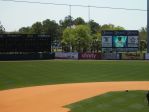
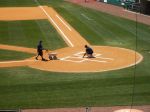
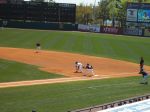
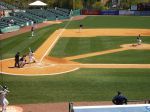
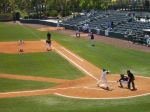
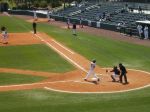
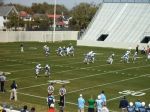
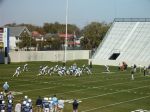
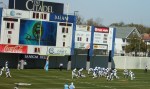
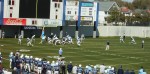
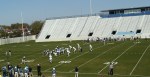
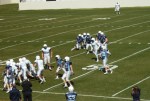
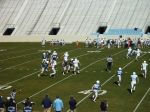
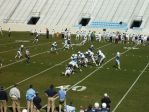
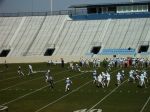
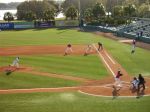
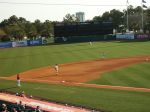
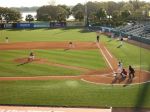
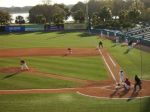
Below are some pictures I took at Riley Park on Saturday, a 14-7 victory for the Bulldogs over Elon. The day was sunny but rather windy, a nice day for a game, though I prefer baseball games that don’t take more than three hours to play…

Conference realignment, SoCon style: the football/hoops conundrum

Previously:

It is definitely nitty-gritty time now for the SoCon

A look at the varsity sports portfolios of SoCon candidate schools

After Georgia Southern and Appalachian State announced they would be leaving the Southern Conference for the Sun Belt last week, SoCon commissioner John Iamarino held a media teleconference. All in all, he did a good job, sounding reasonably confident about his league’s future. Among other things, he had this to say:

If we assume we’re adding three schools to replace the three we are losing, you don’t get that opportunity often. We could strategically look at what can help us where we need help, and I’ve said I’d like us to get better in basketball.

But we also have to look at football. We are losing two outstanding programs, and football matters in this league and in this part of the country.

This came on the heels of an interview in the Chattanooga Times Free Press in which Iamarino stated:

No matter how much success we’ve had in football, and we’ve had a lot of it, FCS football doesn’t pay off on a national level the way winning games in the NCAA tournament does for you.

Unfortunately, it’s becoming more and more evident that the one common component of the mid-majors who’ve had some of the greatest success in basketball — Gonzaga, Butler, Davidson — is that they don’t play scholarship football. It’s difficult to find a FCS program that’s also successful in basketball.

He isn’t wrong. Part of the reason for that is schools that spend the most money on their men’s basketball programs tend to be the most successful, and schools that field scholarship football teams at the FCS level generally don’t have the resources to commit to both sports (in some cases, they have the resources but not the focus).

Only one school with a full-scholarship FCS program is ranked in the Top 60 in men’s basketball expenditures. Villanova is 31st.

Note: all references to expenses are per the 2011-12 school year, as reported to the U.S. Department of Education.

It is not an accident that four of the eight schools that advanced to the NCAA regional finals in men’s basketball this season also rank in the top 8 in terms of money spent on hoops. Duke ranked first, with almost $16 million in expenses, followed by Louisville. Syracuse was fourth, and Marquette eighth. Kentucky was third; the Wildcats missed the NCAAs this season, but won the national title the previous year.

Another regional finalist, Florida, wasn’t far out of the top 8 (thirteenth). The exception, in a sense, was Wichita State (68th), but basketball is clearly a focal point for the school, as it does not field a football team.

A majority of SoCon schools don’t put that type of emphasis on men’s basketball. Southern Conference institutions averaged about $1.44 million in men’s hoops expenditures (that includes the three departing schools), while spending a total on average of $14,117,677. That means only 10.2% of expenses went towards men’s basketball.

Iamarino mentioned Gonzaga, Butler, and Davidson. Men’s basketball accounted for 28.6% of Gonzaga’s expenses and 26.6% of Butler’s. For Davidson, that number was a more modest 16.3% — but that percentage is the highest in the SoCon.

Davidson may not spend the most money on hoops in the league (in 2011-12 Samford did), but clearly it puts more emphasis on the sport than any other school in the league. In smaller leagues, that may matter almost as much as the actual gross expenses. It certainly goes a long way to explaining Davidson’s success in basketball within the conference itself.

In contrast, men’s basketball expenses for South Carolina ranked 20th nationally ($7.3 million), but only made up 8.39% of its total expenses. The Gamecocks are still searching for their first NCAA tournament victory since 1973.

Before the Southern Conference adds schools, the powers that be are probably going to have to decide whether to begin a transition to a hoops-first league, or continue as a conference that historically values football over basketball. While Davidson is clearly a “basketball school”, as is UNC-Greensboro (since it has no football program), most of the current membership savors fall Saturdays above all else. This is certainly true for The Citadel and Furman, the two schools with the longest continuous membership in the league.

The conference’s dilemma may perhaps be best demonstrated by comparing Furman and Davidson. They are fairly similar private schools, though Furman is larger and has a much bigger budget for varsity athletics.  Furman offers (or will offer) 20 varsity sports. Davidson offers 21 varsity sports. Furman plays scholarship football and treasures it; Davidson fields a team, but doesn’t offer schollies in the sport.

— Furman total athletic expenses: $20,531,292. Davidson total athletic expenses: $10,603,460.
— Furman men’s basketball expenses: $1,679,288. Davidson men’s basketball expenses: $1,727,330.

Davidson spends more money on men’s basketball despite Furman spending twice as much money on its total sports portfolio.

The major difference is football, of course. Furman’s athletic expenses in football for 2011-12 were $5,414,705. Davidson spent only $790,295 on football.

Football may be part of the reason why 45% of Furman’s expenses are for athletic aid (scholarships), while Davidson, with comparable tuition costs, spent 28% of its total expenses on athletic aid.

I put together a spreadsheet that lists various athletic expenses for a cross-section of Division I schools. Most of these schools are not candidates to join the Southern Conference, but I wanted to show (and also get an idea myself) of how schools in general spend money, at least at the non-BCS level.

There are 75 schools listed on the spreadsheet. All are in non-BCS leagues and most of them are east of the Mississippi. I included every SoCon school, and a majority of schools from the Big South, Atlantic Sun, CAA, Patriot League, and Atlantic 10. I also noted the current league affiliation for each school (through the 2012-13 school year).

The spreadsheet can be accessed at the following link:

2012 expenses, varsity athletics — selected schools

A few (okay, more than a few) caveats: I’m not an accountant, but I do know that some of these numbers could be a little…tricky. Different schools may have different ways of counting expenses, etc. Exact comparisons can be dicey, especially when you take a look at the numbers of, say, the Ivy League institutions.

Also, I try to avoid referring to budgets rather than expenses, because there is a difference.

I compiled five expense categories: total expenses, football expenses, men’s basketball expenses, athletic aid, and coaching salaries. It wasn’t hard to do, just a touch monotonous.

Observations about various schools that are in the SoCon, that are candidates for the SoCon, and a few that aren’t:

– Richmond spent $5.56 million on football, more than any Southern Conference school, and more than any FCS school on the list except James Madison ($6.6 million), Delaware ($5.6 million), and Liberty ($8.3 million). Old Dominion also spent more than Richmond, but ODU is transitioning to FBS. Richmond also spent $3.9 million on basketball.

– William & Mary spent $4.5 million on football, fitting comfortably in the middle of a group that includes Furman, Samford, Elon, and The Citadel.

– Athletic aid is a significant part of expenses for all schools, but especially private schools. Of those schools I surveyed, fifteen of the sixteen that had the largest percentage of athletic expenses allocated to athletic aid were private. The one exception: The Citadel.

Of The Citadel’s total expenses, 40.4% were for athletic aid. It is possible that is the highest percentage for a public school in all of Division I.

– Schools that had 20% or more of their expenses go for coaches’ salaries included Davidson, Georgia Southern, Western Carolina, VMI, and North Florida. Among the schools below 12% in that category: Furman, Wofford, Presbyterian, James Madison, and Tennessee Tech.

– Not referenced in the spreadsheet but of interest: UNC-Wilmington has formed a committee to review its varsity sports programs, after its chancellor said the department had been neglected for a decade.

– Unless you consider Belmont and JMU serious candidates, UNCW is the only school regularly or even semi-regularly mentioned as a possible addition to the Southern Conference that spent as much money or more on men’s basketball as did Samford, Davidson, or Furman — despite the fact that several candidate schools (Mercer, Kennesaw State, and East Tennessee State, just to name three) didn’t have football programs in 2011-12.

Of course, Florida Gulf Coast’s spending on men’s hoops would have put it in the bottom half of the SoCon, and that school seems to have done all right. It should also be pointed out that Mercer had a fine team this past season and finished ahead of FGCU in the Atlantic Sun standings. I think the real conclusion to draw is that the Mercers and the ETSUs of the world are going to have to seriously ramp up their fundraising as they add football, especially if they move to a new conference, and that additional money will be spent on other sports besides football.

– When it comes to total expenses, James Madison and Liberty probably wouldn’t have many issues in moving to FBS, as both schools compare favorably to most Sun Belt and MAC schools. Appalachian State is a little behind them, but not totally out of line (though I wonder about travel expenditures). Georgia Southern has a lot of work to do. A lot.

I wrote about GSU when if first considered making the FBS jump, back in 2009 (when it released its initial “Football Reclassification Analysis“). I thought it would be a mistake then, and I’m still a bit dubious today, even with (or perhaps because of) the changing landscape of college athletics.

– Davidson has been mentioned as a candidate for the Atlantic 10. One problem the school would have is that its current men’s hoops budget would be the lowest among all A-10 schools, and there would be a major increase in travel expenses (not unlike last year’s proposed move to the CAA that Davidson declined to make). One A-10 member, Rhode Island, spent $4.6 million on men’s basketball in 2011-12, almost $3 million more than Davidson. Of course, the Rams have a cumulative record over the last two seasons of 15-45.

There were a few expense-related items not contained in the spreadsheet I wanted to briefly mention, for no particular reason other than I thought they were interesting, if not surprising.

– When Duke lost to Lehigh in the 2012 NCAA tournament, it was a case of a men’s basketball team with $15.9 million in expenses losing to a team with $1.4 million in expenses. That may be some kind of record.

– While Texas has the largest varsity athletics budget ($129 million, including over $20 million in coaching salaries alone), it appears that Alabama spent the most on football in 2011-12: $36.9 million. Right behind Alabama in football expenses was Ohio State, with $34 million. Alabama has won three of the last four BCS titles; Ohio State was undefeated last season. I guess they got their money’s worth.

– SEC schools as a group spent $262 million on football in 2011-12. That did not include the expenses for Texas A&M or Missouri.

– Kentucky ranked fifteenth nationally in total athletic expenses. That was only the eighth-highest total for an SEC school.

There is another aspect to the football/basketball emphasis question that has to be considered. It was most recently mentioned by John Iamarino after the Barry Alvarez “we’re not playing FCS schools anymore” brouhaha in February. While being interviewed about that, Iamarino said:

The only reason to have 63 scholarships is to be eligible to play FBS teams and count toward their bowl eligibility. If those games go away, the entire subdivision would have to look at if 63 is the right number. Could we save expenses by reducing the number of scholarships? It would seem to me that’s one thing that would have to be looked at.

This may be the elephant in the room.

First, I believe Iamarino was mistaken when he said that “the only reason” to have 63 scholarships is to count to bowl eligibility for FBS opponents, but that’s not really the issue here. Saving money is the issue.

If the Southern Conference wants to become a hoops-centric league while maintaining viable scholarship football, it may be that the league will push for the division as a whole to lower scholarship limits. My guess is that the new limit would be around 50, a significant reduction but still distinguishable from the Division II maximum of 36.

The money saved from reducing scholarships and related expenses could be used to improve men’s and women’s basketball, or perhaps it could be spread around to enhance athletic programs across the board. However, I suspect the league wouldn’t make the move unless the entire division did the same. I am more than a little unsure about that, though.

There are two main problems with reducing scholarships. One is the risk of devaluing the product. At a certain point, customers (and donors) will conclude that the quality of what is being offered is not worth their time or their money.

The more immediate concern is the reduction in opportunities for potential students. One would hope that the scholarships not used in football would at least be used to fund scholarships in other varsity sports, but there is no guarantee that would happen.

I don’t know if this subject will come up when league officials and school administrators meet on April 10, but I would be mildly surprised if it doesn’t. It could be a factor in how the league approaches adding new schools, even if the potential reduction wouldn’t come to fruition for several years down the road.

In a few weeks’ time, league observers should have a very good idea of the SoCon’s strategy moving forward, both in terms of membership additions and any philosophical change in its outlook on football and basketball.

Or maybe we won’t have any idea at all…

Conference realignment, SoCon style: a look at the varsity sports portfolios of candidate schools

As a follow-up to my most recent post on conference realignment, including the SoCon, this is just a quick post on what sports various schools offer, etc…

The SoCon sponsors 19 sports (counting indoor and outdoor track separately). Ideally, a school joining the league would field teams in most of them. A rundown of the offerings for some of the schools that have been mentioned for membership:

Mercer

Mercer has teams in 14 of the SoCon’s 19 sports. The exceptions: football, men’s track and field (both indoor and outdoor), and wrestling.

It also has teams (or will soon have teams) in several sports not sponsored by the SoCon, including men’s and women’s lacrosse and sand volleyball. Mercer will begin playing football (non-scholarship) this year.

VMI

VMI has teams in 11 of the SoCon’s 19 sports. Exceptions: women’s hoops, softball, men’s and women’s tennis, women’s cross country, men’s and women’s golf, and women’s volleyball.

It also fields teams in men’s lacrosse, women’s water polo, men’s and women’s swimming, and rifle.

If VMI were to re-join the SoCon, it may have to add at least one women’s sport that is sponsored by the league.

East Tennessee State

ETSU has teams in 17 of the SoCon’s sponsored sports. It does not have teams in football and wrestling. Of course, ETSU is expected to re-start football in time for the 2015 season.

Kennesaw State

Kennesaw State fields teams in 16 of the SoCon’s 19 sports. There are no KSU teams in football, men’s soccer, and wrestling. Kennesaw State will begin playing football in 2015.

William & Mary

William & Mary has a fairly diverse sports portfolio. It fields teams in 17 SoCon-sponsored sports. W&M doesn’t have a softball team or wrestling squad. It does have men’s and women’s gymnastics, men’s and women’s swimming, women’s lacrosse, and women’s field hockey.

Belmont

I don’t really think Belmont is a serious candidate for the SoCon, but I decided to take a look at its offerings anyway. Belmont does not have a football team or a wrestling squad, but fields teams in every other SoCon-sponsored sport.

Coastal Carolina

Coastal Carolina competes in 18 of the 19 sports sponsored by the SoCon. The exception is wrestling. CCU also fields a women’s lacrosse team.

Richmond

Though I think Richmond is really only an SoCon option for football, I’ll include a rundown of its sports too. For the 2013-14 school year, it will compete in 13 of the 19 sports sponsored by the Southern Conference. Somewhat controversially, Richmond’s administration has decided to drop men’s soccer and men’s track and field while adding men’s lacrosse.

Besides men’s soccer and men’s track and field (indoor and outdoor), UR does not field teams in wrestling, softball, and women’s volleyball. In addition to men’s lacrosse, Richmond has or will have women’s lacrosse, men’s and women’s swimming, and women’s field hockey.

Delaware

Like Richmond, Delaware would almost certainly be a football-only candidate for the SoCon (and even that would be a longshot). It has teams in 15 SoCon-sponsored sports, not having teams for men’s track and field (indoor and outdoor), men’s cross-country, and wrestling. Delaware also fields squads in women’s field hockey, women’s rowing, men’s and women’s swimming, and men’s and women’s lacrosse.

James Madison

If JMU decides against a possible invitation to the Sun Belt Conference and remains in FCS, it may become a target for the SoCon. Like Delaware, James Madison competes in 15 of the 19 SoCon-sponsored sports. It does not have teams in men’s cross country, men’s track and field (indoor and outdoor), and wrestling. JMU has three women’s teams in sports not sponsored by the Southern Conference: field hockey, swimming, and lacrosse.

UNC-Wilmington

UNCW competes in every SoCon-sponsored sport except football and wrestling. It also has men’s and women’s swimming.

Jacksonville

JU fields teams in 13 of the SoCon’s 19 sports. It does not have men’s track and field (indoor and outdoor), men’s and women’s tennis, and wrestling, and its football team is non-scholarship. Jacksonville does have men’s and women’s rowing teams, men’s and women’s lacrosse, and also sponsors women’s sand volleyball (which is an “emerging” NCAA sport; in February, South Carolina became the 31st school to sponsor the sport at the varsity level).

Campbell

Campbell’s football team is non-scholarship. It competes in every other SoCon-sponsored sport, and also has women’s lacrosse and women’s swimming.

After reviewing these schools and a few others, I came to the conclusion that the Southern Conference is likely to sponsor at least two more sports in the not-too-distant future, namely men’s and women’s lacrosse. Some of the schools in the SoCon’s general geographic footprint that have or will soon have lacrosse for either men or women or both: Mercer, VMI, Kennesaw State, William & Mary, Richmond, James Madison, Furman, Elon, Presbyterian, Campbell, Jacksonville, Howard, Coastal Carolina, Stetson, Delaware, and Winthrop.

More realignment excitement will be coming our way soon, I’m sure…

Conference realignment, SoCon style: it is definitely nitty-gritty time now

On Wednesday, Georgia Southern and Appalachian State are expected to announce that they have each accepted an invitation to join the Sun Belt Conference. Both schools have been desperately trying to wangle an invite from an FBS league; it looks like it is finally going to happen.

I wrote about this possibility a few weeks ago. Now that it has come to pass, I want to revisit what it means for the Southern Conference and what schools are candidates to join the SoCon as replacements — and also what schools, if any, are candidates to leave the league.

Conference realignment analysis is complicated, to say the least. A move on one side of the country can cause repercussions on the other. No one really has a handle on the hopes and dreams of every single school out there. The difficulties in trying to see what leagues and schools will do can best be encapsulated by this quote from an AD at a Missouri Valley Conference school:

We’re just sitting here wondering if Creighton goes [to the Big East], which of the 26 schools in our footprint that make some sense should we be pursuing.

That’s right. To replace Creighton, there are more than two dozen reasonable candidates, and whichever one is chosen will set off a chain reaction all over the nation — but each different school may set off a different chain reaction. It makes long-range predictions more or less futile (as does the entire process of musical chairs in general).

Despite that, I’ll muddle through this post anyway…

With Appalachian State and Georgia Southern leaving, the SoCon will look like this:

The Citadel
Furman
Wofford
Elon
Western Carolina
Chattanooga
Samford
Davidson*
UNC-Greensboro*

* no scholarship football program

First, let’s discuss the current league schools rumored to be candidates to leave for another conference. That would be all of them.

Seriously, every school in the league has been the focus of various rumors, some with solid sourcing, some just made up. The internet is a wild and crazy place.

The most realistic contender to jump may be Davidson, which has a good hoops program with no scholarship football. If Davidson were a person, however, he would be a very cautious accountant who happens to love basketball (and not much else). This is a school that isn’t changing leagues unless it knows it’s the right decision. It’s not going to jump into a lake like the College of Charleston did and find out the level of the water has dropped eighteen feet overnight.

Elon is the league wild card, as I’ve noted before. At this point I would be surprised if it decided to move to the CAA, but who knows. Chattanooga has (somewhat curiously) been mentioned as a potential Sun Belt candidate, which I think even most of its fan base finds puzzling.

That is what the SoCon has right now. What is going on in the rest of the land that may impact the league? A brief review follows.

Big East (newly minted version)

The new league formerly known as the Catholic 7 is adding three schools. Butler and Xavier are joining from the A-10, and Creighton is moving from the Missouri Valley. For at least one year, the number of league schools will stay at 10. It is widely believed that the new Big East will add two more schools in time for the 2014-15 season, and that both additions are likely to come from the A-10. One will probably be St. Louis, and the other will come from a group that includes Dayton, Richmond, and VCU, with the Flyers being a slight favorite.

The MVC will replace Creighton, but that won’t affect the SoCon. The A-10, however, has already moved forward, will undoubtedly continue to do so, and those decisions will have a trickle-down effect that will be watched by SoCon observers.

Atlantic 10 (which actually had 16 schools this past season)

The A-10 was already losing two schools, Charlotte (which is starting a football program and moving to CUSA) and Temple.

The Owls are moving to the “old” Big East for all sports, and to avoid confusion I’m going to call that conference the Metro, which is surely a better league name than the “America 12”.

With Xavier and Butler gone (Butler having been in the league for about an hour), the A-10 decided 12 schools weren’t enough and added George Mason on Monday. It is quite possible the A-10 will add another school in the near future. Davidson has been mentioned as a candidate for this spot, but there is a catch, as there are reports that Davidson would like a fellow southern school to go with it for travel reasons. The school most often named as pairing up with Davidson is the College of Charleston.

However, Davidson is not the leading contender to be the next A-10 pickup, according to Jon Rothstein of CBS Sports. That would be Siena. Another school reportedly in the mix is Iona.

My fearless (and meaningless) prognostication: Siena joins the A-10, and Davidson becomes a more serious candidate when the A-10 loses St. Louis and one of the Dayton/Richmond/VCU trio next year.

Metro

Tulsa is expected to join this league any week now, leaving CUSA. This would lead to Western Kentucky leaving the Sun Belt and taking Tulsa’s place. Massachusetts may eventually wind up in this conference (though that is far from certain), which would presumably open up another spot in the A-10 in hoops (UMass currently competes in the MAC in football).

Sun Belt

League commissioner Karl Benson wants a conference championship game in football, and he is apparently going to get it. Georgia Southern and Appalachian State will become football members 9 and 10, so the conference needs two more schools to stage a title matchup. According to Dennis Dodd at CBS Sports, New Mexico State and Idaho are going to be added as football-only members.

Idaho has to get permission from its State Board of Education to make the move, which is probably a formality. Not everyone thinks adding New Mexico State and Idaho to the Sun Belt (even for just football) is a good idea.

However, if WKU leaves as expected, the Sun Belt would actually need one more football-playing school to get to 12, and would have to look further into the FCS ranks to find it. From the SoCon’s perspective, the most interesting candidate for that spot (other than longshot Chattanooga) is James Madison of the CAA, which has been left behind in that league by all of its fellow Virginia schools except William & Mary. Losing JMU would be a very tough blow for the CAA. Liberty is also a Sun Belt hopeful, as are a couple of Southland Conference schools (Lamar and Sam Houston State) and Jacksonville State.

CAA

Before delving into the CAA situation, I wanted to mention the press release issued by its commissioner after George Mason decided to join the A-10:

As a result of the George Mason University Board’s decision to withdraw from CAA membership…and in accordance with conference bylaws:

-George Mason’s teams in seven spring sports…will become ineligible for CAA spring 2013 championships.

-George Mason will forfeit its projected 2013 conference distribution of approximately $330,000 and future distributions (through 2017 totaling an additional $1.32 million). George Mason will also pay a minimum liquidated damages fee of at least $1,000,000. Total forfeited funds will be no less than $2.65 million…

…We are disappointed by George Mason’s decision to withdraw from the CAA after 30 years as a charter member.  We wish them well as they strive to achieve the same level of competitive success in a new conference. The CAA’s Council of Presidents will continue to aggressively pursue institutions committed to providing the finest academic and athletic opportunities for our student-athletes.

To me, that comes across as incredibly petty, especially considering GMU was (as stated) a charter member of the conference. As was the case for other schools that recently left the CAA, the athletes were punished for their (obviously huge) part in the crime of leaving the league. Imagine being a senior baseball or softball player and finding out halfway through the season that you wouldn’t be competing for the league title.

Here is the current CAA lineup (at least, as of this second):

Hofstra*
Northeastern*
Drexel*
Delaware
Towson
James Madison
William & Mary
UNC-Wilmington*
College of Charleston*
Richmond#
Rhode Island#
Stony Brook#
Albany#
Maine#
New Hampshire#
Villanova#

* no scholarship football program
# football-only member

Eleven schools for football, but only four of them are full-time members. Nine schools for basketball.

This league is a mess. In my opinion, it’s even more of a mess than the SoCon. It resembles two or three conferences unwillingly jammed into one. In addition, I think at least half of the schools in the basketball version of the league would gladly jump to the A-10 at a moment’s notice, given the opportunity. Heck, some might even consider the SoCon.

Would UNCW be able to resist an offer from the SoCon? It has “reaffirmed [its] commitment” to the CAA, but some think it needs to consider all of its options. Is the College of Charleston feeling buyer’s remorse? Supposedly not, though one suspects that any CofC return to the SoCon could only happen if the SoCon leadership were allowed to throw sharp objects at CofC AD Joe Hull.

Then there is William & Mary, which is going to be really out in the cold if JMU leaves. It would be hard for William & Mary or UNCW, though, to give up the significant amount of money currently on the table for the remaining CAA members.

I’ve written a couple of times about the possibilities for SoCon additions. A few things have changed since the last time I posted about this subject. My thoughts as of right now on a few of the schools in question, plus some off-the-wall ideas:

– Mercer is probably a lock, with the only issue being that the school has not yet committed to scholarship football. As I’ve said before, though, Mercer’s new facilities are not those of a non-scholarship program, or at least not those of one planning to stay non-scholarship. At any rate, Mercer can fill the spot left by the College of Charleston for the immediate future, with a hoops program at least as good and a fine baseball team as well.

– VMI, from a historical perspective, should be in the Southern Conference. Instinctively, VMI should be in the SoCon. However, VMI has issues, and I am not as confident in its chances of rejoining the league as I would have been a couple of months ago. A perceived lack of institutional commitment to varsity athletics may doom the hopes of those hoping to see the Keydets back in the SoCon. I’m not counting VMI out, though.

– William & Mary is possibly more of a sleeper candidate than it was before, thanks to the CAA’s crumbling edifice. I’m still not quite buying the Tribe to the SoCon, but I could be persuaded to rent.

– Richmond would be a football-only pick, and while I’m not crazy about a football-only SoCon member, the idea of grabbing UR for football in order to further attract William & Mary to join in all sports may have merit.

– If the SoCon wanted to be really aggressive and try to fully dismantle the CAA before the CAA tried to destroy the SoCon, it might consider approaching Delaware as a football-only member.

– If James Madison doesn’t wind up in the Sun Belt (or the MAC), the SoCon ought to seriously consider approaching the folks in Harrisburg, too. They might be willing to listen.

– Kennesaw State is starting a football program, and just hired its first coach. The Owls’ first season on the gridiron will be 2015. There has been marginally more chatter about KSU to the SoCon in recent weeks, although I am still a touch dubious about that. If Kennesaw State did join the league, it would help the SoCon maintain its quota of triple option teams, as new coach Brian Bohannon has worked for Paul Johnson at both Navy and Georgia Tech over the past 17 years, coaching quarterbacks and B-backs.

– East Tennessee State is also likely to start (or rather, re-start) its football program in 2015. ETSU may have to make a decision about what league it wants to join, if it has options (the OVC possibly being one of them). It won’t be in any league without a new football facility, though. (Nobody is going to play football at the Mini-Dome.)

It’s possible that ETSU may wind up in the SoCon at the expense of VMI. I wouldn’t be shocked if neither got in, though.

– Coastal Carolina, if anything, is less likely to wind up in the SoCon than before — and it wasn’t going to get in then, either. If I were in the CCU administration, I would fax an application to the CAA every day. It’s probably their best shot at moving out of the Big South.

– Campbell has been suggested as a potential candidate. Like Mercer, it’s one of several southeastern schools (including Jacksonville and Stetson) that have started or are about to start non-scholarship football programs. I’m not really sure what Campbell could bring to the table that the SoCon would want, though. Jacksonville and Stetson would add new markets but are not in the league’s geographic footprint, which I suspect will be a major factor in determining what schools are added.

– Other schools mentioned here and there that I don’t think are serious candidates for the SoCon (but you never know): Presbyterian, Winthrop, Tennessee Tech, Eastern Kentucky, North Alabama, West Georgia, Gardner-Webb, High Point, South Carolina State, and USC Upstate.

USC Upstate was suggested on Twitter by Gene Sapakoff, a columnist for The Post and Courier, who was throwing out the idea of a proposed Atlantic Sun-SoCon merger. Uh, no.

SoCon commissioner John Iamarino has preached patience and a waiting game. I haven’t had a major problem with that. It was inevitable that Appalachian State and Georgia Southern would leave, but there wasn’t anything wrong in letting a few other things shake out nationally before making a move. The league had time.

It doesn’t really have time now. Once Appalachian State and Georgia Southern are officially out, the SoCon has to act, and with decisiveness. I hope the conference has been preparing to do just that. I realize that Iamarino may be hamstrung a bit by a disparate membership, but he has to put together a consensus. He has to add new members that will improve the league.

It’s nitty-gritty time.

McAlister Musings: A review of the season

The Citadel finished the year 8-22 (6-22 vs. D-1), 5-13 in SoCon play, losing in the first round of the Southern Conference tournament for a third consecutive season.

Defensively, the Bulldogs were terrible. There is no way to sugarcoat that. Of the 347 teams in Division I, The Citadel was 346th, or next-to-last, in defensive efficiency, only ahead of historically awful Grambling State (all numbers per kenpom.com). Components of that porous D included:

— 340th in effective FG% allowed
— 326th in offensive rebound % allowed
— 305th in % of 3FG allowed
— 336th in defensive 2FG%
— 332nd in defensive 3FG%
— 324th in defensive block %
— 281st in defensive turnover rate

The Citadel only did two things well on defense. The Bulldogs did not put opponents on the foul line, and did pick up more than their fair share of steals (despite the lack of forced turnovers).

The offense was a mixed bag. The Citadel was one of the most turnover-prone teams in the country, with an excruciating 23.9% turnover rate (334th nationally). Almost one out of every four Bulldog possessions resulted in a turnover, which is obviously unacceptable. The Citadel was only marginally better in SoCon play, with a 21.8% TO rate that was second-worst in the conference.

The Citadel suffered more steals against it in league play (by percentage) than any other team, and also had more steals on defense than any other team. If you went to see the Bulldogs play in conference action, you knew that you were going to see a lot of turnovers.

Most of the other offensive numbers were okay. In fact, the Bulldogs shot well from three-point land (top 100 nationally and second in conference play), had success in the paint (hello Mike Groselle, along with good buddy P.J. Horgan), and were decent (not great) from the free throw line. The Citadel’s 65% assist rate on made baskets ranked ninth in the entire country, and the Bulldogs were even better in the SoCon (68.8%). Marshall Harris should get a lot of credit for that.

When The Citadel didn’t commit turnovers, the offense was excellent. The problem was that it committed way too many turnovers, so many that the Bulldogs ranked 295th nationally in offensive efficiency despite excellent shooting numbers. It was very frustrating to watch; I can only imagine how frustrating it was for the coaches.

Chuck Driesell opined in an interview with The Post and Courier that The Citadel has to take “baby steps” in developing its basketball program. He also said this:

I feel great about where the program is going. I’m disappointed, we all are, that we haven’t won more games. It’s a process. This is not the kind of place where you walk in and sign a bunch of McDonald All-Americans or a bunch of junior-college transfers.

You look at Towson this year, they did a great job of bringing in transfers this year and flipping their roster. We can’t do that here. We have to take baby steps, and I think we did that last year and we’ll continue to do that next year.

It is quite true that The Citadel is not Towson, and cannot “turn over” its roster like a lot of other schools. On the other hand, there are baseline expectations for the basketball program, even one with the military college’s modest history on the hardwood.

Over Driesell’s three seasons as head coach, The Citadel has only won 21% of its games against D-1 competition. The Bulldogs have won 26% of their SoCon contests over that period. Even for “developing” a program, that really isn’t good enough.

Of course, what really hurts Driesell in the opinion of some observers is that the cupboard wasn’t bare when he arrived. He took over a program that had won 36 games in the previous two seasons. Many had high hopes for the 2010-11 season, and the resulting 10-22 campaign was extremely disappointing — arguably the most disappointing season in the program’s entire history.

It was not surprising when his second Bulldogs squad went 6-24 with a very young team. After that first season, though, there was a bit more to prove in his third year, and winning only eight games did not exactly thrill the fan base.

I want Chuck Driesell to succeed, not just because he is the coach of my alma mater, but because he appears to be a nice guy, a smart guy, and a hard worker. He says all the right things, and he seems to mean them. I think several of the players he has recruited have the ability to be impact performers in the Southern Conference. He had a good reputation for talent evaluation prior to arriving in Charleston, and I’ve seen nothing in three years to suggest that reputation wasn’t deserved.

Putting everything together, though, has been a difficult problem. He isn’t the first coach at The Citadel to face that reality. As Jeff Hartsell noted in the linked article:

The last four Citadel coaches had their first winning seasons in year 4.5, on average.

Indeed, Pat Dennis didn’t have his first winning season until his sixth year in charge. I don’t think Driesell can wait until his sixth year to clear the .500 barrier, but he has two years left on his contract, and he’ll undoubtedly have the opportunity to succeed or fail over those remaining years (as he should).

There is one thing that must improve along with the win totals, something that goes hand in hand with winning — home attendance.

This past season, The Citadel averaged only 1377 fans per game for the fourteen contests played at McAlister Field House. That is the third-lowest average per game over the last twenty years.

Obviously, the Bulldogs need to win more games, but I have a couple of other suggestions for improving attendance. I’ve mentioned some of this before, so apologies in advance for being repetitive…

– Corps attendance

I don’t understand why The Citadel requires the corps of cadets to attend all home football games but none of the basketball games — and no, I’m not advocating eliminating the marchover to Johnson Hagood Stadium.

In the Southern Conference, having a serious home-court advantage is extremely important, particularly given the state of the league’s officiating. Having a bunch of rowdy cadets (and there are ways to make sure they’re extremely rowdy) would be a big help to the team.

I also think an increased corps presence would also increase the number of “regular” fans who attend games, perhaps even lowering the average age of a Bulldog fan at McAlister to below 70.

I’m not saying the full corps needs to be at every home game. There are around fourteen home games per season. About half of them are during the week, and half on weekends. Weekend games are a problem; I don’t really expect the corps to be required to attend those games in great numbers. I think the school administration and department of athletics need to get together to figure out how to make it worthwhile for cadets to attend more weekend games.

On weekdays, though, I think it wouldn’t be a bad idea to have a rotation among the battalions for attending home games. I also would like to see one or two mandatory early-season home games for all freshmen, just to fully indoctrinate them.

I should mention that there are great cadet fans, particularly in the outstanding pep band. Some of the football and baseball players are also high-quality supporters (and provocateurs).

– Scheduling

This year was a lesson in how not to schedule. No December home games, two non-D1s that no one cared about…it just didn’t work. I believe the key game in the entire season may have been the home game against Radford on November 24, which came after exams and was The Citadel’s first game against a Division I opponent in almost two weeks. In the first half, it appeared at times that the Bulldogs had never seen a basketball before.

Badly losing what was considered a “probable win” right before starting a stretch of six consecutive road games, including the league opener and three “guarantee” games, seemed to put a serious dent in the team’s collective confidence.

Next season, there will be only sixteen SoCon games rather than eighteen. That means there will be eight league games at home. There are two other expected home games, against the College of Charleston (rumored to be the season opener, and now a non-conference game as the CofC begins life in the CAA) and Presbyterian (the return game from this season’s “BracketBusters” matchup).

I suspect that Charleston Southern will also be on the home docket, although it isn’t a certainty. That would leave The Citadel with three or four more non-conference home games to schedule.

The Bulldogs will also be playing in the All-Military Classic for the third straight season. In 2013-14, the non-exempt tourney will be held at VMI. It’s also possible that The Citadel will play a third road game in the state of Virginia, assuming it plays at Radford in a return matchup.

Last year, the Bulldogs played two non-D1 opponents. That’s not terrible (better than four, which has been done before), but I would like to see that number cut back to one. I don’t think it’s a bad idea to schedule a non-D1 during/after exams, but other than that I don’t think those schools offer much value. They certainly don’t help attendance.

I realize it’s hard to fill out a home schedule at the low-major level, but the decrease in league games may make it a little easier to come up with some home-and-home arrangements that will be more appealing. It’s also up to the league (hi there, Dave Odom) to help its member schools in this area.

The Citadel will also play two or three guarantee games. My only suggestion on this front is to try to at least get on TV for these games. The game against Georgia Tech last year was on SportSouth, which was a positive. I’m not sure what the school got out of the game against St. Bonaventure, other than some money and a free tourist brochure from the Olean Chamber of Commerce.

I also would like to see The Citadel participate in exempt tournaments. Again, getting on TV (or at least ESPN3) would be nice. I have been very disappointed that The Citadel has not yet participated in the Charleston Classic.

On the other hand, it might be best to steer clear of exempt tourneys that result in the team playing South Carolina State in Las Vegas. If The Citadel is going to travel to play SCSU, it would be a lot simpler just to go up I-26 to Orangeburg, and the barbecue would be much better.

I’ll close by saying that I think The Citadel can be better in 2013-14, perhaps significantly so. The Bulldogs must replace the outstanding play of Mike Groselle, and that won’t be easy. Groselle had an outstanding (and at times unappreciated) career. It was a pleasure to watch him outfox and outwork many an opponent on the low block.

The coaches must figure out how to solve the team’s defensive woes. The returning players must get stronger and develop more confidence — and they must all return, too. Attrition is always an issue at The Citadel, and will be something to watch in the offseason.

There is talent in the program. Bulldog fans don’t really want to hear about that, however. They can see the talent. What they really want to see, though, are wins. Lots of wins.

Spring football, SoCon baseball, and some Beautiful Bulldogs

It was a busy weekend at The Citadel. Corps Day Weekend always is, of course. This year, there were also a number of varsity sporting events that took place at around the same time.

The basketball team was in Asheville for the Southern Conference tournament there, while the wrestling team was in Lexington, Virginia, for the SoCon championships in that sport. The tennis team played on campus on Sunday, and the baseball team hosted Samford in a three-game series to open league play. The football team played its spring game at Johnson Hagood Stadium on Saturday.

The wrestling team finished third in the league, and had three wrestlers win individual titles. Odie Delaney won his fourth Southern Conference title, the first time a wrestler at The Citadel has ever done so. The program appears to be in fine shape for the future as well, despite this being Delaney’s final year.

Saturday was a really nice day in Charleston, sunny and almost warm if you weren’t in the shadows. I wandered onto campus in time to see the end of the morning parade, which was very well attended. I don’t remember Corps Day being that popular, but maybe things have changed. The weather also helped, I’m sure.

After the parade, I walked over to Johnson Hagood Stadium for the spring game, although I first stopped to take a gander at the contestants for the “Most Beautiful Bulldog” competition, many of which were in costume. There were ballerina outfits, a dog dressed like a biker (complete with motorcycle goggles), a Batman-and-Robin combo…you get the idea.

The contest is a hoot, and a nice bit of PR for The Citadel. There is a short video synopsis of the event on Youtube: Link

You can also see some good pictures of the dogs/event via the school’s Facebook page: Link

I’m a big fan of the live mascot program; as I have often noted, re-instituting it is one of the better things The Citadel has done over the past decade. General and Boo were both around to see the other bulldogs put through their paces. Those two still look good, but it is also true that both dogs are now nine years old. General will turn 10 in June, and that’s a relatively advanced age for the breed. I was reminded of that while watching them “inspect” a bullpup on Saturday.

After leaving that area, I then watched the spring game, leaving late in the third quarter to get over to Riley Park for the baseball contest.

I’ll make a few comments about the football game, even though I won’t pretend to have much of an opinion on any of the action. I’ve always felt a bit ambivalent about the spring game, mainly because I don’t know who I should support. The Citadel? Or The Citadel?

(I posted that conundrum on Twitter and immediately got an appropriate answer: always root for the medical staff.)

The passing game wasn’t very good on Saturday. This was not entirely due to the quarterbacks. The receivers have to do a better job of, well, receiving. There was a very nice TD throw from Aaron Miller to Dalton Trevino, though. That was an interesting pass pattern, something to watch this fall.

Brandon McCladdie had an outstanding interception on a long pass attempt downfield. He was in midseason form.

Trey White looks like he is going to be a fine player (though he had a fumble that was returned for a TD). It’s always good to have depth at the quarterback position.

If you need something to worry about, worry about the punting. Based on what I saw on Saturday, the Bulldogs have work to do in that department. Luckily, there is still plenty of time to iron things out.

It was good to see guys like Rickey Anderson and Chris Billingslea in the stands cheering on their teammates.

Kudos to the marketing/sports information folks for getting the game sponsored (by Coke Zero), and for handing out plenty of posters, koozies, and even game programs. Nice job.

The baseball game was excellent. The Citadel beat Samford 2-1 on Saturday, and also won the series by a 2-1 count after dropping the Sunday contest. All in all, the opening conference series for 2013 was encouraging. This team has the potential to be very solid. It has not been as good defensively as it should be. If the squad continues to pitch and hit as well as it has so far, and improves its fielding to at least last season’s level, I believe the Bulldogs can contend for the league title. They have to put together all three of those elements, however.

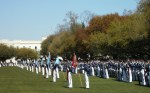
I took some pictures of some of Saturday’s festivities, including a few shots of the parade, the Beautiful Bulldogs, the spring game, and a few baseball shots. As always, please remember that my photography skills are limited.

Big Dance victory droughts: BCS schools that haven’t celebrated an NCAA tournament win in quite a while

Update: the 2014 edition

This post was partly inspired by a recent recap of a Frank Martin press conference. Now, Frank Martin pressers are often required viewing, because the South Carolina coach doesn’t mince words. What struck me, though, was this note:

Martin said he realized this year marks the 40th anniversary of USC’s last NCAA tournament victory.

You read that correctly. South Carolina hasn’t won an NCAA tournament game since 1973. That’s a long drought for a team in a major conference (even if the Gamecocks weren’t in a BCS league for part of that time).

It got me thinking…what other schools currently in BCS leagues haven’t won a game in the Big Dance in a while? Not just get a bid, mind you, but actually advance in the tournament with a victory?

After looking up some records, I was mildly surprised to discover that 13 current BCS schools have gone at least ten years without such a win. Some have gone a lot longer than that — and two of them have never won an NCAA tournament game.

That group of 13 does not include South Carolina’s fellow Palmetto State school, Clemson, although the Tigers actually haven’t advanced past the round of 64 since 1997. However, two years ago Clemson won a play-in game against UAB, which counts (more or less).

Let’s take a look at our sad list of 13, then. None of these schools has won a tournament game since 2003:

– Northwestern (no tournament appearances): Famously, NU is the only BCS school to have never played in the NCAA tournament (despite hosting the very first NCAA title game in 1939). You can read about Northwestern and all the other schools that have never made the Big Dance here: Link

– Nebraska (no NCAA victories): Here is the only other BCS school to have never won an NCAA tournament game, although the Cornhuskers have at least played in the event. Nebraska is 0-for-6, including three losses as the higher-seeded team. The Cornhuskers last made the NCAAs in 1998.

– South Carolina (last won an NCAA game in 1973): As mentioned above, the Gamecocks haven’t advanced in the NCAAs for four decades. South Carolina’s last victory was actually in a regional consolation game. Since then, the Gamecocks have suffered some particularly excruciating losses, including losing in the first round in consecutive years as a 2 and 3 seed, respectively. South Carolina’s NCAA tourney losing streak began in 1974 with a loss to Furman. Ouch.

– Oregon State (last won an NCAA game in 1982): The Beavers haven’t made the NCAA tournament since 1991, the longest such drought for a BCS school outside of Northwestern, and haven’t won a game in the tourney since 1982, when it lost in the Elite Eight to Patrick Ewing and Georgetown. Oregon State has two final fours in its history; it’s odd the Beavers haven’t been able to put things together for so long.

– Rutgers (last won an NCAA game in 1983): Of course, the Scarlet Knights haven’t always been a major-conference program, but at any rate the last time RU won a tourney game was in 1983 (as a member of the Atlantic 10). In 1976, Rutgers made the Final Four as a member of the long-gone ECAC Metro conference. The Scarlet Knights were undefeated that year until losing to Michigan in the national semis.

– TCU (last won an NCAA game in 1987): Here is another school that hasn’t been in a major conference throughout its history. However, since the Southwest Conference dissolved, the Horned Frogs have only participated in one NCAA tournament (1997, as a member of the WAC). TCU’s last victory in the Big Dance came in 1987, as an SWC team.

– Providence (last won an NCAA game in 1997): The Friars have advanced to two Final Fours and came very close to notching a third trip in 1997, when Pete Gillen’s squad lost in overtime to eventual national champion Arizona in the Elite Eight. Providence has yet to win a game in the NCAAs since then, however, and hasn’t played in the tournament at all since 2004.

– St. John’s (last won an NCAA game in 2000): SJU has only played in two NCAA tournaments since 2000, a major disappointment for a school with a hoops tradition as rich as St. John’s. The Red Storm has never won the NCAA title, but the program does have two Final Four trips and four Elite Eight appearances, including one as recently as 1999.

– Iowa (last won an NCAA game in 2001): Like St. John’s, Iowa is another school with a history of playing quality basketball. The Hawkeyes played in the 1956 NCAA title game, one of three Final Four appearances for Iowa. Since the 2001 season, however, it has only qualified for two NCAA tournaments.

– Penn State (last won an NCAA game in 2001): The Nittany Lions got to the Sweet 16 in 2001, upsetting North Carolina in the second round before losing to Temple. Since then, Penn State has only made one NCAA tournament (in 2011).

– Mississippi (last won an NCAA game in 2001): Mississippi got to the Sweet 16 in 2001, and returned to the NCAAs in 2002 (losing in the first round that year). That 2002 appearance is the Rebels’ most recent in the event. Mississippi has only played in six NCAA tournaments, and is probably most remembered for being on the wrong side of Bryce Drew and “Pacer” back in 1998.

– Georgia (last won an NCAA game in 2002): UGA has only made two NCAAs since 2002. Georgia had never played in the NCAA tournament before 1983. That year, though, the Bulldogs (led by Vern Fleming) made it all the way to the Final Four before losing to Jim Valvano’s destined North Carolina State squad. Georgia has only managed to get to the Sweet 16 once since that year.

– Auburn (last won an NCAA game in 2003): The Tigers advanced to the Sweet 16 in 2003, losing by one point in the regional semifinals to Carmelo Anthony and eventual national champ Syracuse. That was the last time Auburn made the Big Dance. Oddly, the Tigers have a winning record in NCAA tournament play (12-8), despite never advancing to the Final Four (one Elite Eight appearance).

When Auburn gets to the tournament, it’s a solid bet to win a game or two; the one time AU didn’t win its first-round tourney game, a loss to Richmond, its star was one Charles Barkley. The problem is that the Tigers don’t get there that often — which is something that can be said for several of the schools on this list.

Will any of these schools break through and win a game this year? Well, first they have to make the tournament, and there is a good chance not one of them will get a bid. Iowa and St. John’s are bubble teams (arguably on the wrong side of the bubble), while the others would have to win their respective conference tourneys to get there.

In other words, there is a good chance all of them will remain on this list next year.

If FBS schools no longer play FCS schools in football, what are the ramifications?

If you follow college football at all, you probably are familiar with last week’s story out of Wisconsin, where Barry Alvarez was quoted as saying that Big 10 schools would not schedule FCS opponents going forward:

“The nonconference schedule in our league is ridiculous,” Alvarez said on WIBA-AM. “It’s not very appealing…

“So we’ve made an agreement that our future games will all be Division I schools. It will not be FCS schools.”

A couple of quick points:

– Obviously, FCS schools are members of Division I. You would think the director of athletics at a D-1 institution would know that.

– Alvarez claimed that the Big 10’s non-conference schedule “is ridiculous”, yet he is the same AD who in recent years scheduled multiple FCS schools from all over the country, including The Citadel, Wofford, Northern Iowa, South Dakota, Austin Peay, and Cal Poly. The Badgers will play Tennessee Tech in 2013.

Alvarez’s comment drew a lot of attention, understandably so, although it is not a lock that the Big 10 will enforce such an edict. Northern Iowa’s AD was blunt:

I would tell you the loss of the Big Ten schools will be devastating, to UNI and to a lot of our peers. Not just because we wouldn’t play Iowa and have the guarantee, if you think this will stop at the Big Ten…I look at things happening in the equity leagues in fives, and so I have to believe this might lead to additional dominoes…It impacts our ability to generate money in football. It closes the ranks, it closes us out a little bit more.

Samford’s AD had a similar reaction:

If the SEC and ACC make the same decision, we’ve all got to sit back and reevaluate how we’re going to replace our money. If you eliminate those guarantee teams, it puts us in a tough situation at a private school where we don’t get any state funding.

Of course, not everyone is upset. Some in the media welcome the move, eager for what they perceive as “better” scheduling (though suggesting New Mexico State would be a significant improvement over a decent FCS squad strikes me as a bit puzzling). Most members of the college football press/blogosphere, however, understand the potential issues associated with such a decision and the nuances at play. Not all of them do, though — or if they do, they simply don’t care.

The best (worst?) example of this attitude is probably Yahoo! Sports columnist Frank Schwab, who couldn’t be more thrilled with the no-FCS proposal. After writing (in a headline) that “hopefully everyone follows [the Big 10’s] suit”, he added:

…hopefully other conferences (and by “other conferences” we mostly mean you, SEC) stop the practice of wasting a precious Saturday afternoon in the fall on FCS opponents. The FCS teams benefit with a large payday, and that’s great for the bean counters at those schools. It’s not good for anyone else.

It stinks for the season-ticket holders that have to pay for a sham of a game. It’s nothing worth watching on television. The FBS team has nothing to gain, because a win is expected but a loss goes down in infamy. And while the FCS team will get enough money to build a new weight room, the most common result is getting pounded by 40 or 50 points, which can’t be that enjoyable for those players.

Some Big Ten-Sun Belt game in September might not be a ratings bonanza either, but at least it’s better than a parade of FCS opponents.

I thought Schwab’s overall tone was a bit much, to be honest. I sent him a tweet, trying to be as polite as possible:

You seem to have a very flippant attitude about the FCS.

His reply:

Oh, make no mistake, no “seem” about it

Okay, then…

My first thought when I read Schwab’s piece was that it was clearly the work of someone who does not understand FCS football, or who has no connection to it at all (Schwab is a Wisconsin alum). Saying that FCS players can’t enjoy the experience suggests he has never spoken to any of them about it. Most small-school players relish the challenge of “playing up”. In fact, such games are often a recruiting tool for FCS coaches. It’s not all about the money.

Earlier in this post I listed six FCS schools Wisconsin has played in recent years. Of those matchups, the Badgers had to hang on to beat Northern Iowa by five points, were tied at halftime with The Citadel, and frankly should have lost to Cal Poly (winning in OT after the Mustangs missed three extra points). I’m not really getting the “sham of a game” vibe with those contests. Now if you want to talk about the 2012 Big 10 championship game against Nebraska in those terms, go right ahead.

Schwab singles out the SEC as the worst “offender” when it comes to playing FCS schools. I think it is only fair to point out that Big 10 schools currently have a total of 37 FCS teams on their future schedules, while SEC schools have 32. (I’m sure the SEC will eventually add a few more.)

Oh, and to quickly dispose of one canard (which in fairness to Schwab, he does not suggest): some people occasionally claim that allegedly easy FCS matchups have given the SEC a leg up on winning BCS titles, because they play fewer quality non-conference opponents. You only have to look at the Big 10 to see that isn’t the case.

The SEC has played more FCS schools in the past than has the Big 10. However, despite that, Big 10 schools have actually lost more games to FCS opposition since 2005 than has the SEC. In fact, no BCS league has lost as many such games (six) or had as many different schools lose them (four) in that time period.

Not playing FCS schools won’t hide the Big 10’s real problem, which is illustrated to a degree by this article, written in August of 2012:

Iowa has four nonconference football dates. It has chosen to fill two of them this year with games against teams from the Mid-American Conference

The reason for this: The Hawkeyes wanted two games they would have very good chances to win.

That’s not exactly a revelation. But perhaps you aren’t aware of just how pronounced Iowa’s (and the Big Ten’s) dominance over MAC teams has been.

The columnist wrote that the MAC was “the Big 10’s football piñata”, which in years past it may have been. Unfortunately for the Big 10 (and to the undoubted surprise of the writer), it would lose three games to MAC schools in 2012, and that was just part of a trend — MAC teams have beaten Big 10 squads twelve times since 2008. (MACtion, indeed.)

As for the Hawkeyes and the “two games they would have very good chances to win”…Iowa lost one of them by one point, and won the other by one point.

The truth is the Big 10 just hasn’t been that good in football in recent years, which doesn’t have anything to do with playing FCS opposition. Dropping FCS schools from Big 10 schedules won’t change things, either. SEC schools aren’t winning all those BCS titles because they play FCS teams; they’re winning them because SEC schools have the best players and (in some cases) the best coaches.

So what happens if the Big 10 follows through and has its members drop all FCS opponents? What happens if other leagues do the same thing?

You’ve seen the quotes from ADs at schools that would be affected. Then there is this take from agent/event promoter Jason Belzer:

If other conferences follow the Big Ten’s lead and stop scheduling games against FCS opponents, the institutions that compete at that level will have two options: 1) look to make up the funds elsewhere, or 2) essentially be forced to stop competing at the same level as the larger institutions. Because it is  unrealistic to believe that any institution can begin to make up the difference in loss of football guarantee revenue by playing any number of additional such games in basketball, it is more likely that the second option will occur. With the loss of revenue, the gap between schools in BCS conferences and those who are not will continue to grow ever wider, leading to what may be the eventual breakup of the approximately 340 schools that compete at the NCAA Division I level.

How soon this may occur remains to be seen, but the the additional millions in revenue the new college football playoff will provide BCS conferences, coupled with their decision to eliminate the one source in which smaller schools could obtain a piece of those funds, will almost certainly accelerate the timetable for any such  fracturing.

I think that is a distinct possibility. I also think it may be the ultimate aim of the Big 10.

Not everyone agrees that the outlook is so dire, and at least one observer believes there are other ways for smaller schools to generate revenue:

FCS schools can take steps to enhance revenue streams outside of the on-field competitions with big schools. For example, very few schools FCS schools have media rights deals. Yet there are an increasing number of regional sports networks (RSNs) and national networks that are looking for programming. In fact, NBC Sports Network signed a media rights deal with the FCS Ivy League to “broadcast football, men’s basketball. and lacrosse.” FCS schools can and should continue to pursue these deals to be less dependent on paycheck changes…
…many institutions do not lobby at the federal or state level for their athletic programs or rely the schools’ lobbyists for their athletic programs. As schools like UNI receive more state funding, it is unclear how much of that funding will go to its athletic department. Therefore, FCS can and should make larger commitments to lobby on their athletic programs’ behalf, especially if paycheck games are eliminated.

That comes from a blog by a group (or maybe just one individual) called Block Six Analytics. I’ll be honest. I don’t buy either of those options.

I think many smaller institutions already lobby on varsity sports interests, and at any rate in most cases there would be a ceiling for actual results. To use The Citadel as an example, the school has in recent years begun to play Clemson and South Carolina in football on a more regular basis, as do several other FCS schools in the Palmetto State.

This outcome was basically due to a request by the state legislature to the two larger schools, neither of which had any real problem with it. However, The Citadel can’t play Clemson and/or South Carolina every year, since there are numerous other FCS programs in the state (Furman, Wofford, South Carolina State, Coastal Carolina, Presbyterian, and Charleston Southern).

The first point, that FCS schools should have media rights deals…um, it’s not like they haven’t tried. I’m sure the Southern Conference would like to have a profitable contract with CBS or ESPN or Al-Jazeera, but that’s not likely to happen. Even the mid-major conferences that do have deals (like the CAA has with NBC Sports) usually only get the benefit of exposure. That’s great, but it’s not a big cash situation.

I’m trying to imagine what reaction SoCon commissioner John Iamarino would have if he was told that he should go right out and find a big-money media rights deal for his league. Eye-rolling? Uncontrollable laughter?

Speaking of Iamarino, he had some comments on the FCS vs. FBS situation that were fairly ominous:

The only reason to have 63 scholarships is to be eligible to play FBS teams and count toward their bowl eligibility. If those games go away, the entire subdivision would have to look at if 63 is the right number. Could we save expenses by reducing the number of scholarships? It would seem to me that’s one thing that would have to be looked at.

I disagree with Iamarino that “the only reason” to have 63 scholarships is to play FBS schools (but I digress).

I’m guessing it hasn’t occurred to some of the more FBS-focused among the media that there could be a potential loss of football scholarships if the Big 10’s big idea comes to pass. No one thinks that would be good for the health of the sport. It would also be an sizable number of lost opportunities for potential students.

Iamarino doesn’t give a number, but I could see the FCS maximum dropping to around 50, based on scholarship costs and the lost income from not playing those games. That’s not much more than the D-2 maximum of 36.

This wouldn’t be the first time a Big 10 proposal had the potential to eliminate athletic scholarships at other schools, of course. As far back as 1948 the NCAA, then largely controlled by the Big 10, enacted the Sanity Code, an attempt to get rid of all athletic scholarships. It was a rule seen by many as benefiting the Big 10 at the expense of mostly southern schools.

Famously, the Sanity Code would not last long, and it is a pleasure to note that The Citadel was one of the “Seven Sinners” at the heart of its eventual destruction. I would hate to see the school have to reduce opportunities for prospective students after all these years.

Block Six Analytics did make one good point, which is that the FCS schools do have one other string in their collective bow, namely the NCAA basketball tournament:

One may argue that it is madness to have such a seemingly large organization completely dependent on one deal. However, this deal also means the NCAA will do everything in its power to ensure that there are enough Division I basketball programs to continue “March Madness” (also known as the Division I Men’s Basketball Championship). This requires that schools outside of the BCS have basketball programs that compete at the Division I level. In addition, this dynamic may allow smaller schools to actually ask for an increased amount of subsidies from the NCAA – especially given the elimination of paycheck games.

This may be the biggest obstacle to the Big 10 (and other power leagues) breaking away from the NCAA sooner rather than later. There is a lot of money in that tournament, and the event works in part because the country is enchanted with the “David vs. Goliath” component that is traditionally the major drawing card of the first two rounds. A basketball tournament only open to 65-75 larger schools wouldn’t be nearly as valuable (whether administrators at the BCS schools all understand this point is another issue).

Having said that, I have my doubts the smaller schools could extract a larger pound of flesh for their participation in the event.

A couple of other thoughts:

– If the Big 10 eliminates games against FCS schools, it will be harder for its member institutions to become bowl-eligible. This could be even more of a problem if the league moves to a 10-game conference schedule, which is reportedly under consideration.

If dropping FCS schools from FBS schedules was done across the board, there wouldn’t be enough eligible teams for all the existing bowl spots. Either the rules would have to be changed to allow 5-7 teams to play in bowls, or a bunch of bowl games would have to be cut.

– Frank Schwab wrote that a “Big Ten-Sun Belt game in September might not be a ratings bonanza either, but at least it’s better than a parade of FCS opponents”. I believe all but one of the current Sun Belt schools were once FCS (I-AA) programs. It’s not that big a difference from playing these schools versus competing against a quality FCS squad.

In addition, if FBS-FCS matchups go by the wayside, then a bunch of FCS schools will likely move up to FBS — more than are already planning to do so.

It’s possible that Alvarez’s comments to a local radio station are just the rantings of one man. I hope so, but I’m not confident that is the case. I think this is probably going to happen (though perhaps not next year). It will have a limited impact unless leagues like the SEC and ACC do the same thing. Then it will become a problem.

When it comes to maintaining financially stable sports programs, smaller schools already have too many problems.

Schools that have never made the NCAA Tournament — the 2013 edition

Updated: The 2016 edition

Now updated: the 2015 edition

Previous entries on this subject:  The 2012 edition   The 2011 edition   The 2010 edition

We’ve survived the month of February, which means March Madness is right around the corner. Conference tourney time will be here before you know it. So will a longstanding tradition, that of watching as schools fail once again to reach their first NCAA tournament.

There are 30 schools that have been in Division I for at least a decade that haven’t yet made a trip to the Big Dance. Of course, it is perhaps not as crushing for fans of UC Riverside (D1 since 2002) to fail to reach the promised land as it is for supporters of Northwestern, or St. Francis-NY, or Maine, all of which have been wandering in the no-tourney wilderness for far too long.

Can any of those schools finally make their big debut? That’s the subject of this post. I’ll be honest, however — the answer is probably going to be no. I started posting about this in 2010. At that time, I highlighted the 20 schools that had waited the longest for their first NCAA bid. It’s now 2013, and 19 of those schools are still waiting. The twentieth, Centenary, has given up the ghost and is no longer in Division I.

This year I’m expanding the list of featured teams to 30 — in other words, the 30 schools that have the most years in Division I with no NCAA appearances. There are actually around 52 schools (give or take a transitional member or two) currently in D-1 that have never made the Big Dance, but I’m only highlighting those schools that have been in the division for more than 10 years without receiving a bid. For schools like Presbyterian or Kennesaw State, the angst level just isn’t high enough (yet).

Before I delve into the hopes and dreams of those 30 schools, though, I want to mention a few schools that have actually made the NCAA tourney, but haven’t been back in a long, long time. Their fans are suffering, too.

Last year, Harvard won the Ivy League for the first time in its history, and advanced to its first NCAA tournament since 1946. That ended the longest drought for a school that had previously appeared in the event at least once. It’s a distinction that now falls to fellow Ivy leaguer Dartmouth, which actually appeared in the title game twice during the 1940s but hasn’t been back to the tournament since 1959.

Dartmouth won’t be back this year either, and neither will fellow Ivy League schools Yale (no NCAAs since 1962), Columbia (1968), or Brown (1986). That’s what happens when a league is dominated for over 40 years by two teams (Penn and Princeton).

This is the 50th anniversary of Tennessee Tech’s second, and last, trip to the NCAAs. The Golden Eagles had the misfortune of opening up their 1963 tournament against eventual national champ Loyola of Chicago, losing 111-42. Ouch. Speaking of the Ramblers, they haven’t been back to the NCAAs themselves since 1985.

Other schools that have made at least one NCAA trip but haven’t been back since 1993 (or earlier) while continuously in D-1: Bowling Green (no appearances since 1968), Rice (1970), VMI (1977), Duquesne (1977), Furman (1980), Toledo (1980), Mercer (1985), Jacksonville (1986), Marshall (1987), Idaho State (1987), Marist (1987), Middle Tennessee State (1989), Oregon State (1990), Loyola Marymount (1990), Idaho (1990), Towson (1991), Northeastern (1991), St. Francis-PA (1991), Rutgers (1991), Howard (1992), Georgia Southern (1992), La Salle (1992), Campbell (1992), Fordham (1992), Coastal Carolina (1993), East Carolina (1993), and SMU (1993).

Note: Seattle (a finalist in 1958, but which last made the NCAAs in 1969) and Houston Baptist (made the tourney in 1984) both left D-1 and then later returned, so they haven’t been in the division for all the years after making their most recent NCAA tourney appearances.

Some of these teams have notable accomplishments in tournament play. Jacksonville played in the 1970 championship game. Loyola Marymount made the Elite 8 in 1990 in one of the more famous runs in the tournament’s history, but hasn’t been back since. Another school that made the Elite 8 in its most recent NCAA trip: VMI, a fact that might surprise some people.

All in all, it’s an interesting list. Of the teams on it, probably Middle Tennessee State and Mercer have the best chance of making it back to the Big Dance this season. MTSU is the only one of the teams listed with even a prayer of getting an at-large bid. Until recently, I didn’t think the Blue Raiders had a realistic shot at one, but now I think it’s possible.

Among schools in BCS conferences, Oregon State is currently suffering through the longest drought, not counting Northwestern. Speaking of the Wildcats, it’s time to talk about the schools that have never made the tournament. As always, we start with The Forgotten Five.

All records are through March 4

The NCAA Tournament began in 1939. In 1948, the NCAA reorganized itself, and established separate divisions (university and college) for its member institutions. Of the schools that since 1948 have continuously been in what we now call Division I, there are five which have never made the tournament field. All five of those schools theoretically could have been in the tournament beginning in 1939, so for them the wait is actually longer than their history as official members of Division I.

The five schools are known as the “Forgotten Five”. The class  of 1948 (or 1939, depending on how you look at it):

– Northwestern: NU actually hosted the very first NCAA championship game back in 1939. That year there was an eight-team tournament, and the concept of a “Final Four” had not yet taken hold. The first two rounds of the tournament were played in Philadelphia and San Francisco, with the final between Oregon and Ohio State taking place in Evanston.

This year, the Big 10 is generally considered to be the best hoops conference in the land, with as many as eight teams possibly making the NCAA tournament. Alas, Northwestern (13-16) is currently in 11th place in the league. Like every school on this list, the Wildcats’ only chance at an NCAA bid is to win the conference tournament.

– Army: It actually hasn’t been that bad a season on the hardwood for the Bulldogs of the Hudson. Army is 8-6 in Patriot League play (15-14 overall), but winning the conference tournament would likely require victories over both Lehigh and Bucknell. That would be a tall order.

– St. Francis-NY: Things are not looking good for the Terriers, as St. Francis (12-17) barely qualified for the NEC tournament, winning a de facto play-in game against Sacred Heart for the eighth and final spot in the league tourney.

St. Francis is actually the oldest collegiate basketball program in New York City, having fielded teams since 1896. Its most prominent hoops alum is probably the late James Luisi, a former NBA player better known for his work as an actor.

– William & Mary: While probably capable of pulling off an upset in the CAA tournament, it’s hard to see W&M running the table. The Tribe (13-16) is much improved from last season, but not quite ready yet to finally grab the brass ring. Jon Stewart will probably have to wait at least one more year to celebrate his alma mater’s initial appearance in the Big Dance.

– The Citadel: Ugh. This was supposed to be a year of improvement, after a freshman-laden team struggled mightily in 2011-12. Instead, the Bulldogs have struggled mightily in 2012-13 as well. The Citadel (8-21) has one of the Southern Conference’s best players in Mike Groselle, but that hasn’t been nearly enough for a program suffering through its third consecutive season of 20+ losses. My alma mater will not have its name called on Selection Sunday.

That’s the Forgotten Five. Next year, they are almost certainly still going to be the Forgotten Five. What about the other never-beens on our list?

Well, the odds aren’t too good for most of them.

– New Hampshire (began Division I play in 1962): The Wildcats finished the regular season in a tie for 7th place in the America East. At 9-19, UNH has actually lowered its alltime winning percentage this season, not an easy thing to do.

– Maine (also from the class of 1962): 11-18 overall, 6th-best in the America East. Maine may be good enough to win a game in the AE tournament, but that’s about it for the Black Bears. Time to focus on hockey.

– Denver (D-1 from 1948 to 1980, then back to the division in 1999): at 19-8 overall, and currently in second place in the WAC, the Pioneers have a decent chance to finally break through this year. Denver, which has won 15 of its last 16 games, runs a “Princeton-style” offense; the Pioneers are 346th out of 347 D-1 teams in pace of play. Interestingly, the team that is last nationally in that category is also on our list…and like Denver, has also had a fine season.

– UT-Pan American (class of 1969): UTPA has been gradually improving over the last couple of years, but the Broncs (15-15) will have to wait at least one more year for a shot at the NCAAs, as their conference (the Great West) doesn’t have an automatic bid. Next year, UTPA will join the WAC, which should be a boon for the program.

– Stetson (class of 1972): As I mentioned last year, the Hatters’ most famous hoops alum is Ted Cassidy, the actor who so memorably played Lurch on The Addams Family. Stetson (14-15) has had a bounce-back season of sorts in 2012-13, and could conceivably be a factor in what should be a competitive Atlantic Sun tournament.

– UC Irvine (class of 1978): This season, the Anteaters are a middle-of-the-pack team in the Big West, with Long Beach State favored to win the league’s automatic bid. However, I wouldn’t put it past UCI (17-13) to make some noise in the conference tournament, particularly with consensus Afro All-American Mike “The Beast” Wilder on the scene. Zot! Zot! Zot!

– Grambling State (class of 1978): Oh, mercy. Grambling is winless this year (0-27), and arguably one of the worst D-1 teams of the modern era (if not the worst), thanks to scholarship reductions caused by APR issues. GSU has not lost a game by fewer than 10 points. The Tigers will have one more chance to win a game this season, in the first round of the SWAC tournament.

– Maryland-Eastern Shore (D-1 in 1974-75, then back to the division for good in 1982): UMES lost its first 13 games this season and currently sports a 2-24 record.

UMES doesn’t have a football program any more (despite a gridiron alumni list that includes Art Shell, Emerson Boozer, Carl Hairston, Johnny Sample, and Clarence Clemons). Sometimes you have to wonder if the basketball program is worth having. This will be the 11th consecutive season the Hawks have lost 20 or more games.

– Youngstown State (D-1 in 1948, then returning to the division in 1982): The Penguins are a respectable 16-14, solidly in the middle of the Horizon League standings. Butler is no longer in the league, but Valparaiso and Detroit remain, and the combination of those two will make it difficult for YSU to win the league tournament.

– Bethune-Cookman (class of 1981): B-C is 12-18 overall, 7-8 in the MEAC. As usual, the league tournament schedule is an enigma, but it likely won’t matter for the Wildcats this year. It’s hard to see Bethune-Cookman outlasting Norfolk State and North Carolina Central (among others) in the MEAC tourney.

Props to the MEAC, though, for getting Aretha Franklin as the star of its tournament kickoff concert.

– Western Illinois (class of 1982): Here is the other master of slowdown play. The Leathernecks average only 58.3 possessions per game, fewest in the country. WIU is 21-7 overall, tied for first in the Summit League, and one of four teams in that league expected to contend for the conference tourney title. Two years ago, Western Illinois was the only team to lose to Centenary; the Leathernecks have come a long way since then. Will this finally be the year?

– Chicago State (class of 1985): Chicago State is 8-20, and plays in the no-bid Great West. Like UTPA, though, Chicago State is moving to the WAC, so there is hope for a future bid. Not this year, though.

– Hartford (class of 1985): The Hawks are a very decent 17-12. Perhaps alum Dionne Warwick can get one of her psychic friends to tell us whether Hartford will win the America East tournament. If not, expect even more anguished tweeting from Charleston (SC) sportscaster Kevin Bilodeau, a notorious Hartford apologist.

– UMKC (class of 1988): The Kangaroos are 8-23 and will barely qualify for the Summit League tournament, much to the displeasure of noted alum Edie McClurg. Maybe things will be better once UMKC moves to its new conference, the WAC. If you’re keeping track, that makes three schools on this list moving to the WAC.

Give the WAC your tired, your poor, your huddled masses yearning to breathe free…

– Buffalo (D-1 from 1974-77, then back to the division in 1992): After some excruciating close calls a few years back, the Bulls haven’t really been in serious contention in the MAC for the last two years. Buffalo is only 12-17 this season and clearly the road to the league title goes through Akron or Ohio U (though the Bulls just whipped the Zips).

– Sacramento State (class of 1992): It doesn’t look like this will be the year for the 13-13 Hornets. Tom Hanks’ alma mater has to compete against Big Sky heavyweights Montana and Weber State for the league’s automatic bid (and is in danger of not qualifying for the conference tournament). Incidentally, Sacramento State plays its home games at Colberg Court, which to my knowledge is the only D-1 gym named after a women’s volleyball coach.

– UT-Martin (class of 1993): In 2008-09, the Skyhawks won the regular-season OVC title, thanks in large part to Lester Hudson. However, UTM got beat in the tourney final by Morehead State and missed out on an NCAA tournament bid. Since then, UT-Martin has lost 20+ games in every season. At 9-20 so far this year, that trend will continue.

– Cal Poly (class of 1995): John Madden’s alma mater is 15-12 overall, 10-6 in the Big West, a slight improvement over last season. Like fellow never-been UCI, the Mustangs would have to get past Long Beach State (and Pacific) to win the league tourney.

– Jacksonville State (class of 1996): The Gamecocks are currently in fourth place in the OVC East, despite a solid 17-11 overall record. Even if they were 28-0, however, they wouldn’t be NCAA-bound, as Jacksonville State is banned from postseason play due to APR problems.

– Quinnipiac (class of 1999): The Bobcats’ biggest obstacle to garnering a first-ever NCAA bid has been Robert Morris, which beat Quinnipiac in the 2010 NEC title game (52-50) and in the 2009 and 2011 semifinals (the latter by a 64-62 score). This season, the Bobcats are 15-15 overall, and tied for fifth place in the NEC with an 11-7 league mark.

One of these years, Quinnipiac is going to win that league tourney. It will probably happen sooner rather than later.

– Elon (class of 2000): With an 20-10 record, Elon is enjoying its finest season since joining D-1. To throw a team party on Selection Sunday, however, Elon will have to get past Davidson and the College of Charleston in the SoCon tourney. It’s not completely out of the question.

– High Point (class of 2000): The Panthers finished first in the Big South North (heh) division with a 12-4 league record. High Point is 17-12 overall and is one of several schools capable of winning what should be a wild league tournament. Unfortunately, High Point’s chances were reduced considerably when leading scorer John Brown broke a bone in his foot.

High Point basketball has some interesting alums, including Tubby Smith, Gene Littles, and Joe Forte (the former ACC and NBA referee).

– Sacred Heart (class of 2000): The Pioneers finished the season 9-20 overall, with a 7-11 record in NEC play. Sacred Heart lost its last seven games, missing out on the NEC tournament.

Irrelevant factoid alert: despite having only around 4200 undergraduates, Sacred Heart has 31 varsity sports teams. The man who will soon be in charge of those teams: none other than Bobby Valentine.

– Stony Brook (class of 2000): After its baseball team went all the way to Omaha and the College World Series, it’s now the basketball team’s turn. The Seawolves (23-6) won the America East by three games and will be favored to win the league tournament.

– UC Riverside (class of 2002): At the beginning of this post, I wrote that it probably isn’t crushing for UCR fans that the Highlanders haven’t made the NCAAs yet, since they’ve only been in D-1 since 2002. That doesn’t mean they haven’t suffered, though. UCR is currently 6-23, in last place in the Big West, and barred from postseason play after not meeting APR requirements. Oh, and there was this game.

Well, that’s this year’s roll call. Thirty teams with a dream. Will any of those dreams come true this year? Normally, I would say no, because that’s usually the case — but this year, I’m betting at least one of these schools finally makes it. Denver, Western Illinois, and Stony Brook appear to be the top contenders.

I hope it happens. One of my favorite memories of “Championship Week” came in 2008, when American University finally qualified for the NCAA tournament. AU had been in D-1 since 1967. The head coach of the Eagles, Jeff Jones, cried in his chair on the bench after the game.

That is just another reason the committee shouldn’t expand the tournament (and why it should revert back to a 64-team field and get rid of the play-in games, which lessen the experience for automatic qualifiers). It’s an accomplishment to make the tournament. It means something. It should continue to mean something.

This year, at least, it will.

Riley Report: The Citadel’s 2013 baseball campaign begins (Part 2)

This is Part 2 of a two-part preview of the upcoming season. For Part 1, click here: Link

Note: as I mentioned in Part 1, all statistics are for Southern Conference games only unless otherwise indicated.

This chart features the 2012 offensive statistics in league play for The Citadel’s returning players:

    AB      R   HR    BB      K      AVG     OBP     SLG     OPS
 Mason Davis 127 15 2 9 23 0.244 0.304 0.354 0.658
 Joe Jackson 117 22 1 16 17 0.308 0.396 0.462 0.858
 Bo Thompson 88 7 2 15 12 0.250 0.367 0.341 0.708
 D. DeKerlegand 73 13 0 7 18 0.192 0.291 0.260 0.551
 Bailey Rush 70 8 0 6 21 0.186 0.266 0.214 0.480
 Tyler Griffin 68 8 1 10 26 0.118 0.238 0.250 0.488
 Calvin Orth 55 5 1 1 10 0.291 0.298 0.400 0.698
 H. Armstrong 50 5 0 6 7 0.220 0.304 0.300 0.604
 J. Stokes 45 8 0 5 4 0.267 0.340 0.311 0.651
 Ryne Hardwick 9 2 0 2 3 0.111 0.273 0.222 0.495
 Zach Sherrill 2 1 0 1 0 0.500 0.667 1.000 1.667
 Ryan Kilgallen 1 0 0 0 1 0 0 0 0
Totals 705 94 7 78 142 0.234 0.318 0.333 0.6517

Before I started compiling all these numbers, I would have said that one of the things The Citadel’s players needed to do was take more walks. However, I was surprised to find out that the returning Bulldogs actually had a higher percentage of  walks per at bat (11.1%) than the 2011 squad (9.1%), and a similar number to the 2010 title team (11.3%).

One thing that 2010 team did a lot was get hit by pitches, though (29 times in 30 league games).  The 2012 team was plunked 19 times (13 of those bruises were suffered by players on the current roster).

It’s also important to be careful about comparing pre- and post-BBCOR numbers. I think that in today’s game, it is even more important to take advantage of free passes, with power numbers and batting averages down throughout college baseball (though the best players can maintain high averages no matter what kind of stick is being wielded).

While there are some individual players who could stand to increase their walk totals, the bottom line is that to make a jump offensively the team as a whole needs to make more consistent hard contact, and improve those BAA/SLG categories to something approaching at least 2011 levels.

There is no question which position in the lineup needs to improve the most at the plate this season. That position would be…Designated Hitter.

I went through all 30 league games and totaled the numbers at the DH spot. The stats are not pretty. Numerous players manned the position last year, and the batting line wound up looking like this:

.186/.292/.268

That is not a typo. The Bulldogs’ DH position had a 560 OPS in conference play. Almost 22% of the ABs resulted in strikeouts. The Citadel only got six extra base hits from its designated hitters in SoCon action (five doubles and a homer). Only one of those extra base hits came at Riley Park.

Fred Jordan’s biggest challenge among his position players may be to find the individual (or platoon) capable of handling DH duties on a regular basis, and producing the kind of offense one would expect from that spot in the order.

SoCon baserunning statistics of note:

The Citadel stole 42 out of 54 bases last season, for a success rate of 77.8%. That doesn’t count the five times Bulldog baserunners were picked off in league play.

Bulldog opponents stole 47 out of 60 bases in conference action (78.3%). There were nine pickoffs by The Citadel’s pitchers in conference action, including four by Austin Pritcher.

Both The Citadel and its opponents had success rates higher than the league average of 74.5%. Elon attempted the most steals in conference play (69), while UNCG only tried to swipe 30 bags. On the defensive side of things, the range was 30 (the number of steal attempts against Elon during the season) to an incredible 85 (against Georgia Southern, of which 70 were successful).

Pitching and defense are intertwined, but it’s possible to get some idea of a team’s defensive quality independent of its pitching.

In 2011, the Bulldogs had arguably their poorest fielding squad in over a decade, with a defensive efficiency rating of 63.2%, by far the worst in the SoCon. That included leading the league in errors (58 in 30 games). The Citadel turned 17 double plays in conference action.

In 2012, the glovework got a lot better. The Citadel’s DER was 67.8%, meaning the Bulldogs were making two or three more plays per game than they did in 2011. That’s a big difference. The standard defensive measures also reflected this improvement, as The Citadel only committed 39 errors in league play, and also turned 25 double plays in SoCon games.

That isn’t to say The Citadel can’t get better in the field. The Bulldogs actually were slightly below average defensively in the SoCon, per DER (the league average was 68.4%).

Nevertheless, it was a marked difference from the season before, and there is no real reason to worry about regression. As Jordan has noted, The Citadel has solid up-the-middle performers, and some observers believe the players at the corner spots have the potential to become excellent defenders as well. This is a group that will help its pitchers more often than not.

Incidentally, while I am concentrating on league statistics here, I did notice that The Citadel’s DER for the entirety of the 2012 season (58 games) was actually better than its league DER. The overall DER last season was 68.97%.

Here are the 2012 SoCon statistics for The Citadel’s returning pitchers:

      G     GS    IP      H      R    ER    HR       ERA       K/9     BB/9
 Austin Pritcher 10 10 67.0 73 33 26 2 3.49 5.51 2.28
 Logan Cribb 10 10 47.1 54 35 32 5 6.08 6.27 4.20
 Kevin Connell 9 6 30.1 37 17 13 2 3.86 3.26 5.98
 James Reeves 11 3 22.2 31 20 20 1 7.94 5.56 3.65
 Ross White 15 0 13.1 13 12 8 1 5.40 5.40 4.12
 Zach Sherrill 11 0 12.0 19 14 13 3 9.75 5.25 5.25
 Ryan Hines 16 0 22.1 20 5 5 0 2.01 2.82 2.44
 Brett Tompkins 6 0 8.1 9 5 3 0 3.24 5.40 3.33
 Connor Walsh 3 0 2.1 3 3 3 0 11.57 3.86 12.86
Totals 91 29 226 259 144 123 14 4.91 5.38 3.83

(Actual total of league innings worked by returning pitchers: 225 2/3. My chart had some issues, hence the “226” total listed.)

Austin Pritcher and Logan Cribb were in the rotation every weekend. One thing The Citadel will need this year is for its starting pitchers to go deeper into games. Last season, starters in conference action averaged just over five innings per start. If you take the starts by the dependable Pritcher out of the equation, the average dips even further, to under 4 1/3 innings per start.

Those non-Pritcher outings featured 39 walks in 85 1/3 innings by Bulldog starters — and only 47 strikeouts.

The walk rates were obviously too high, and must be lowered. They were not completely unmanageable (and among returning pitchers were actually not that much higher than the SoCon average of 3.77 BB/9), but typical Bulldog pitching staffs do not walk people at that rate. Teams that contend for league titles do not walk people at that rate.

I am particularly concerned with the strikeout totals, however. Having a 5.38 K/9 rate as a team is problematic. Pitchers need those strikeouts.

(For clarification, the K/9 rate for the team in league play last season, including pitchers no longer on the roster, was 5.65.)

It may be that punchouts are slightly less valuable in the post-BBCOR era because “pitching to contact” is more likely to be rewarded with an out, but it’s still important to restrict the number of batters who put the ball into play. There are occasionally pitchers capable of succeeding despite relatively low strikeout rates (Tommy John comes to mind), but they are atypical.

The coaching staff knows this, of course. After all, the pitching coach had a career K/9 of 11.63 when he was at The Citadel.

Actually, from watching the games last year at a safe distance, I got the impression that the coaches were very careful with what was a very young group of hurlers. Britt Reames wasn’t afraid to pull a starter early (which contributed to the  short duration of some of the starts). I’ve used the phrase “transition season” a lot to describe the 2012 season, and nothing reflects that description more than the way the pitchers were used. There was a lot of on-the-job training on the hill.

That’s not a bad thing if it results in sizable improvement, and Fred Jordan seems very confident about the prospects for this year’s pitching staff, which includes some talented freshmen.

I linked a couple of video Q-and-A sessions in the “Links of Interest” section of Part 1. They feature Jordan answering questions posed by media relations director (and crooner extraordinaire) Mike Hoffman. In the video focusing on pitching, Jordan discusses the possibility of having a freshman closer, among other things.

In that video, Jordan also mentions that Joe Jackson will shoulder even more of the catching load this season. It sounds like Jackson will catch all three games in a weekend series, plus a weekday game, perhaps getting a day off from his receiving duties when the Bulldogs play two weekday games.

It is vitally important that Jackson not get worn down over the course of the season. He was the only Bulldog regular to bat over .300 in SoCon play. His solid work with the bat, combined with his status as a catcher, is why Baseball America pegged him as the #8 pro prospect in the conference. Jackson participated in the Cape Cod League this summer, furthering his development and gaining valuable experience playing against outstanding competition.

Jackson won’t be the only returnee with expectations. I won’t go through the entire roster, but a few other names to follow:

– Educated Bulldog fans should make sure they time their trips to the concession stand so that they don’t miss Bo Thompson’s at bats. The sophomore from Mauldin is capable of producing monstrous, tape-measure home runs. He’s not afraid to take a walk, either. With more consistent hard contact, Thompson could conceivably become one of the league’s premier power hitters.

Mason Davis had a very respectable debut season, starting (and leading off) every game as a freshman. This year, he will be expected to get on base more often, which should lead to an increase in his stolen base totals.

– After a fine freshman campaign in 2011, Drew DeKerlegand struggled at the plate last season as a sophomore. The native of Texas will move to left field this year, which may help him return to the batting form he showed two years ago.

Those players and others are discussed in some depth in the school’s video Q-and-A about position players.

Last year was a banner season for the Southern Conference, which finished the season with an RPI that ranked seventh-best in the country. Three schools advanced to regional play.

The league should still be good in 2013, but it may take a small step back. Several squads are going to have to rebuild their weekend rotations, and two schools (Appalachian State and UNC-Greensboro) will have new coaches.

Most of the nation’s baseball cognoscenti are of the opinion that at least six teams could win the league. Baseball America gave its preseason nod to the College of Charleston, as did the SoCon media. College Baseball Today favors Western Carolina. College Baseball Daily and the league’s coaches like Elon.

The experts do not think much of The Citadel’s chances. Most observers put the Bulldogs in a second tier, with at least two outlets projecting the cadets to miss the SoCon tournament, despite all the returnees from a team that did make the tourney last season.

That is not unlike 1990, when The Citadel was the preseason choice to finish sixth in a seven-team league. The Bulldogs wound up tying for fifth…in the nation.

I won’t go so far as to say that will happen this season, but I could see The Citadel having a campaign not unlike it had in 1994, when after a tough start the team put everything together and went on a huge run that ended in the NCAAs. Like that squad, the 2013 outfit may need some time to jell, but I think it has the talent to make some major noise in the SoCon. (I would prefer not to have a repeat of the 1994 team’s 5-17 start, however.)

I can’t wait for the season to begin. There isn’t anything better than a day at the ballpark, especially when you’re rooting for a winning team.

I’m ready to root for a winning team again.