A quick look at The Citadel’s future football schedules

One of the many curious things about college football is that fans often are just as interested (if not more interested) in what will happen in the future than what is happening right now.  I’m talking mostly about recruiting and scheduling, of course.

With this post, I’m going to wildly speculate on potential scheduling options for The Citadel.  This is something Jeff Hartsell briefly mentioned Tuesday.  The Citadel will play eight Southern Conference games each season.  In 2011 and 2012, that means the Bulldogs will play three non-conference games (11-game regular season).  In 2013 and 2014, the calendar will allow for a 12-game regular season for FCS schools, meaning The Citadel can play four non-conference games.

Each year one of The Citadel’s non-conference games has to be a road “guarantee” game against a BCS opponent, for budgetary reasons.  Also returning to the Bulldogs’ schedule in 2011 is VMI.  The battle for the coveted Silver Shako will resume at Johnson Hagood Stadium, with the teams alternating home-and-home for six years. It is my understanding that those years are consecutive, although I haven’t been able to confirm that yet.

Another non-conference game each season will take place against a non-conference opponent that won’t demand a return trip — in other words, teams like Chowan and Webber International (or more preferably, Presbyterian and Newberry).  I’ll call this game the Designated Home Opener, or DHO.

The 2011 non-conference schedule will feature VMI (home), South Carolina (away), and a DHO to be determined (home).

The 2012 non-conference schedule will feature VMI (away), North Carolina State (away), and a DHO to be determined (home).  In that season, the Bulldogs will only play five games at Johnson Hagood Stadium.

Starting in 2013, things get a little interesting.  Again, assuming the VMI series is for six consecutive years (assumptions always being dangerous), The Citadel’s non-league slate would feature VMI (home), Clemson (away), a DHO (home), and another team to be determined.

The 2014 season would include a road game against VMI, a DHO, and two games to be determined (with one of them definitely having to be a guarantee game).

That leaves Larry Leckonby with important decisions to make about scheduling in 2013 and 2014.  Do you add a second BCS guarantee game in those seasons?  Or do you add a second DHO-type team?

There is another possibility, one that would be very popular with alumni, and that is to schedule a game against Army or Navy (or Air Force, I suppose, although I don’t think there is nearly as much interest in that potential matchup).

A quick scan at future schedules for Army and Navy shows that there is a spot possibly available for an FCS opponent in 2013 for Army and 2014 for Navy (in 2014, Army has scheduled Fordham, which would have been a tough ticket seven decades ago; Navy is playing Delaware in 2013).  Of course, there is a chance that none of the academies would be interested in playing The Citadel anyway.

Scheduling a service academy or a second BCS school would be more problematic in 2014, as the VMI game would be played on the road that year.  I don’t know that Leckonby wants to put the team in position to play only five home games and seven road contests, with two of those being against FBS opponents (and that’s assuming he can find two FBS opponents).

One of the things that will be a factor is attendance at Johnson Hagood Stadium.  If The Citadel continues to have disappointing numbers at the gate, Leckonby may be more likely to eschew a possible sixth (or seventh) home game to grab a more lucrative road guarantee.

Another possibility would be a series like the one The Citadel had with Princeton, a two-game home-and-home (in 2013-2014) against an FCS school from outside the SoCon.   That seems a less likely option to me, but you never know.

We’ll see what happens.  All of the above is mostly uninformed guesswork by yours truly, of course, and should be taken with a grain of salt, assuming that it even deserves the grain.

Why exactly is The Citadel playing Arizona in the first place?

I didn’t touch on this in my preview of the game between The Citadel and Arizona, but I figured I could make a quick post out of the question:  why exactly is The Citadel playing Arizona in football in the first place?  I’m sure fans of both schools are a little curious about that.

Well, for money, of course.  The Citadel has to play at least one football “guarantee” game every season to balance (or attempt to balance) its budget for athletics.  On the other hand, surely The Citadel could find an FBS opponent a little closer to home, an ACC or SEC team, or even a Big East squad.  After all, the Bulldogs have played teams from all those leagues in the last few seasons, along with a Big XII team (Texas A&M), a Big 10 outfit (Wisconsin)…oh, wait a second.  I see a pattern — a pattern created by none other than Les Robinson.

That’s right, The Citadel’s national tour of BCS conferences is a result of one of former AD Les Robinson’s grand ideas.  You can read about it here:  Link

The game against the Pac-10’s Arizona is the last of the “BCS series” for The Citadel, which in the past five years has traveled to play against the aforementioned Texas A&M and Wisconsin, along with Pittsburgh of the Big East, Florida of the SEC, and North Carolina and Clemson of the ACC.

Just prior to that five-year run the Bulldogs traveled to Oxford to play Mississippi and Tallahassee to tangle with Florida State.  The coach for all these games has been Kevin Higgins, so keep that in mind when evaluating his 25-32 record at The Citadel. I think there is a good chance Higgins is the only head coach in the country to have played teams from all six BCS conferences in the last five seasons.

After this game the Bulldogs will have completed the Robinson Quest, having played teams from all six BCS leagues.  Robinson even set up a “bonus” two-game series with Princeton of the Ivy League.  I am not sure current AD Larry Leckonby is crazy about scheduling the likes of Arizona or (to a lesser extent) Wisconsin, as the travel for those games eats into the guarantee.  It was also a significant issue for the game at Princeton.

I can certainly understand that, and in the future I expect most, if not all, of The Citadel’s football guarantee games to come against SEC/ACC schools.  However, I don’t think it hurts the school to travel out of its home region on occasion.  I agree with the comment Robinson made in the linked article about such games providing needed national exposure.  Another thing they provide is an opportunity for alums living outside the southeast to attend a game.

The Citadel brought a very good crowd to the Princeton game last year.  I can attest to the number of PA/NJ/NY alums in attendance, most of whom showed up with their families, and some with friends too.  We need to play games like that once in a while, if only for those fans.

The game against Arizona will give some of our alums on the west coast a chance to see their team in action.  Admittedly, a game against UCLA or Stanford might have been a better bet in terms of Bulldog supporters showing up — I’m not sure how many alums live in Arizona — but still, it’s in the general area.

Anyway, I hope the following gives a little insight into how this game came to be.  I don’t think we’ll be seeing any other matchups on the gridiron between The Citadel and Pac-10 teams in the near future, but you never know.

Football, Game 2: The Citadel vs. Arizona

Gametime:  10 pm ET, September 11.

Telecast:  KWBA, local channel 58 in Tucson, and on Fox College Sports Pacific (FCS-Pacific), joined in progress; announcers are Dave Sitton, John Fina, and sideline reporter Glenn Howell

There won’t be many schools this season who will face in consecutive weeks opponents as different as Chowan and Arizona.  Chowan is a small Division II school in North Carolina.  Arizona is a large Division I (FBS) school, the flagship university of a populous western state.  Chowan has about 1,100 undergraduate students. Arizona has 30,000.  Indeed, Arizona has more undergraduate and graduate students than The Citadel has living alumni.

The difference is reflected in the football teams as well, of course, and thus The Citadel’s football team has its work cut out for it this week as it ventures to Tucson, the longest trip in program history.  Since The Citadel has never played Arizona (or any Pac-10 school) before, let’s take a brief look at the history of the University of Arizona’s football team.

The Wildcats (originally just known as the “Varsity”) started playing football in 1899, 14 years after the school’s founding.  Keep in mind that Arizona didn’t become a state until 1912 (it was the 48th and last of the contiguous states).  It had been a recognized U.S. territory since 1862.

The first official coach of the football team was “Pop” McKale, for whom the McKale Center (UA’s basketball arena) is named.  McHale also coached the basketball team for a time and was the school’s longtime director of athletics.

McHale was also a central figure in the story of Arizona’s great tradition, its motto “Bear Down”.  In 1926, Arizona quarterback and student body president John “Button” Salmon was critically injured in a car accident after the first game of that season. McHale regularly visited Salmon in the hospital until Salmon’s death on October 18.

During the coach’s final visit, Salmon told McHale to “tell them…tell the team to bear down.”  McHale reportedly told the team just that, repeating Salmon’s words during a game against New Mexico State which the Wildcats managed to win, 7-0.  It’s a tale not unlike Knute Rockne’s “Win one for the Gipper” speech for Notre Dame.

Ever since, “Bear Down” has been the official slogan for all of the university’s athletic teams.

Salmon is one of two players to have his jersey retired at Arizona.  The other, running back Art Luppino, led the nation in rushing twice in 1954 and 1955.

Arizona first joined a conference in 1931, becoming a charter member of the Border Conference, and remaining in that league until it disbanded in 1961.  Other schools in the league included Texas Tech, UTEP, New Mexico, New Mexico State, and Arizona State.  They were joined at various times by Hardin-Simmons, Northern Arizona, and West Texas A&M.  The Wildcats won three league titles while in the Border Conference and played in one bowl game during that time, losing the 1949 Salad Bowl (yes, Salad Bowl) to Drake (yes, Drake).

Arizona then became a founding member of the Western Athletic Conference (WAC). That league was basically a merger of the Border and Skyline Conferences, except not every school in those leagues was invited (New Mexico State, for example).  Also in the original WAC:  Arizona State, BYU, Utah, New Mexico, and Wyoming.  Arizona won two league titles in the WAC and played in one bowl game, the 1968 Sun Bowl (losing to Auburn).

Arizona and Arizona State gradually outgrew the WAC, mostly because the state of Arizona was outgrowing (by percentage) most of the other states in and around the mountain time zone.  The development of air conditioning helped produce a population boom in the state, and the increase in population/resources trickled down to the state universities.  The two schools joined the Pac-8 (renamed the Pac-10) in 1978, and have remained in that conference since then.

The hallmark of the program in that time, much to the frustration of  Arizona’s fans, has been its inability to make a trip to the Rose Bowl.  Its rival, Arizona State, has been to the big game twice (winning once), but the Wildcats have never been.  Arizona has come close on two occasions, both times under the direction of Dick Tomey.

In 1993, Arizona shared the Pac-10 title with UCLA and Southern California, but lost a tiebreaker to UCLA for the Rose Bowl berth.  This is the only time the Wildcats have claimed even a piece of the Pac-10 crown.  Arizona had lost earlier in the season to UCLA, but as late as November 14 still had a shot at Pasadena after a UCLA loss. However, the Wildcats blew a 20-point lead and lost to California, 24-20, eliminating them from Rose Bowl consideration.

The Wildcats did rebound from that disappointment, beating their rivals in Tempe and then dominating Miami 29-0 in the Fiesta Bowl to finish the season 10-2, with the bowl game arguably being the pinnacle of Arizona’s “Desert Swarm” defense, which was the national identity of the program in the mid-1990s (and personified by Tedy Bruschi).

The Fiesta Bowl victory was a major reason why Sports Illustrated ranked Arizona No. 1 in its 1994 preseason issue, but after starting the campaign 4-0 the Wildcats were upset at home by Colorado State.  Arizona also suffered road losses to Oregon and Southern California and finished with a Freedom Bowl loss to Utah and a disappointing 8-4 season.

In 1998, Arizona finished 12-1, losing only to UCLA (albeit at home by four touchdowns).  However, the Wildcats were looking good for a Rose Bowl appearance anyway, as the Bruins completed their Pac-10 schedule undefeated and were poised to play for the mythical national title at the Fiesta Bowl.  That would have sent Arizona to the Rose Bowl.

Unfortunately for Arizona (and the Bruins, as it turned out), UCLA had to play a December game originally delayed by a hurricane against the Hurricanes — and lost to Miami, 49-45.  That result meant the Bruins took the berth in the Rose and the Wildcats had to settle for the Holiday Bowl (which they won, beating Nebraska).

When I was looking at Arizona’s football history, and wondering what was preventing Arizona, a big school in a BCS conference with success in a lot of sports other than football, from grabbing the brass ring, one thing stood out.  It must have stood out to Joe Tessitore and Rod Gilmore too, because while calling the Wildcats’ 41-2 dismantling of Toledo last Friday on ESPN, they mentioned (and marvelled at) the following factoid:

Arizona hasn’t had a quarterback drafted by the NFL since 1985.

Think about that.  There can’t be that many BCS programs who have gone that long between QB draft picks.  In fact, that QB (10th-round pick John Conner, who did not throw a pass in the NFL) is the only quarterback out of Arizona drafted since 1972 (when another Wildcat signal-caller who never played in the league, Brian Linstrom, was selected in the 16th round).  It’s not like Arizona’s been running the wishbone all this time, either.

Arizona’s football program has had three different quarterbacks make a total of 29 starts in the NFL, none since 1974.  So in all the time UA has been in the Pac-10, it’s never developed an NFL quarterback.

It’s hard to win big games, or even get to big games, without a pro-caliber quarterback.  Since 1975, only one Arizona alum has thrown a TD pass in the NFL — a punter, Josh Miller, who did it for the Pittsburgh Steelers in 2003 (an 81-yard pass play, incidentally).  Here is a little chart comparing alums from Arizona, The Citadel, and a mystery school:

TD passes thrown in the NFL since 1975

Arizona — 1

The Citadel — 1

Mystery School — 0

If you’re wondering, the graduate of The Citadel with a touchdown pass is Stump Mitchell.  Now, that mystery school that hasn’t had a grad with a TD toss in the NFL in the last 35 years?  Well, it’s a school that has quite a bit in common with Arizona on the athletics front.  It’s a “basketball school” that has won multiple titles in other sports, but hasn’t been able to parlay its success in those sports into a nationally prominent football program.

Like Arizona, a good argument can be made that the reason for that has a lot to do with never having an “NFL ready” quarterback.  What school is that?  Why, it’s the BCS school The Citadel played last season.

North Carolina.

I wrote about UNC’s football history in my preview of The Citadel’s game against the Heels last year.  At the time, I noted that the overall QB rating for players from The Citadel to have thrown a pass in the NFL (which would be just two, Mitchell and Paul Maguire) was exactly 100 points better than their UNC counterparts (119.6-19.6). Arizona is a little better than North Carolina in this respect (47.7), but again the mighty Bulldogs prevail.

What will this mean on Saturday?  Not much, since it’s probable the Wildcats have finally found themselves an NFL prospect at QB in Nick Foles.  Foles is a native of Austin (went to the same high school as Drew Brees) who began his collegiate career at Michigan State before transferring to Arizona after one season.

He has NFL size (6’5″, 245 lbs.) and a good arm.  Last season he completed 63% of his passes for 19 TDs (9 interceptions).  His yards per attempt was not that high (just over 6 yards), but he was only sacked 13 times all season (so not a lot of negative plays).  His three 300-yard games included a 4-TD effort against league champion Oregon.

Foles isn’t the only impressive skill-position player on the Wildcat offense.  Nic Grigsby, when healthy, is an outstanding running back.  Grigsby averaged over seven yards per carry last season.  His problem was a bad shoulder that cost him three games and limited him in several others.  He appears to be healthy now.  Then there is Juron Criner, a rangy 6’4″ wideout who hauled in nine touchdowns last season.

Criner had a ridiculous game against Toledo on Friday, catching eleven passes for 187 yards and a touchdown.  Forty-five of those reception yards came on a one-handed, falling-down circus catch in the third quarter.  His TD grab was almost as good.

Arizona had to replace seven defensive starters from last season, but you would have never known it against Toledo, which did not score on the Wildcat defense (the Rockets’ only two points came on a safety called for offensive holding in the end zone).

Arizona is as good a bet as any team to make a run at the Pac-10 title.  Oregon, the defending champ (and coming off a 72-0 demolition of hapless New Mexico), probably has to be the favorite, but if the Ducks slip it’s possible the Wildcats could be the team to make the move to the top and claim the school’s first Rose Bowl trip.

Arizona was picked in the middle of the conference pack in most preseason polls, likely thanks to getting manhandled 33-0 in the Holiday Bowl by a certain Mr. Suh and Nebraska.  Its most recent impression among those who vote in pre-season polls was not a good one.  Otherwise, I think a team with the talent (particularly on offense) that Arizona has might have been nationally ranked to start the season.

Arizona’s coach is Mike Stoops, also known as “Bob Stoops’ brother”.  He has very slowly built the program since arriving in 2004 (wins per year:  3, 3, 6, 5, 8, 8).  Some Arizona supporters have become a bit impatient.  He needs to have a good year this year.  He’s probably going to have one, so I wouldn’t assign him “hot seat” status, but if the Wildcats were to tank this season, I think he would be out the door.

It could be a long night for The Citadel.  In fact, it would be surprising if it weren’t.  The problem is that the defense is going to have some matchup problems (particularly with Criner), and will not be likely to get much help from the offense.

Last season against BCS foe North Carolina the defense got no help from the offense either, but the UNC offense wasn’t dynamic enough to take full advantage of its field position and time of possession.  As a result, the Bulldogs lost, but only by a 40-6 score.  Arizona may not have as good a defense as UNC did, but The Citadel’s offense will be worse (as it is still in its embryonic stage in the triple option) and the Wildcat offense is considerably more talented than the Heels’ O was.

I wrote about some on-field things that concerned me in my review of the Chowan game.  I am hoping that the blocking improves, that the quarterbacks get more comfortable taking the snap and making the proper reads, and that the defense does a better job in assignments and tackling.   Against Arizona, I don’t really expect to see much visible progress from the offense, although I am willing to be pleasantly surprised.

I do think that the one player who might not be physically out of place in the game for The Citadel’s offense is Domonic Jones.  I could see him making a play or two.  First, of course, the QB has to get him the ball, or at least give him a chance to get the ball.

On the other hand, I do expect the defense, even against a squad as talented as the Wildcats, to avoid multiple mental errors and not miss tackles.  That should happen. If it doesn’t, things could get ugly.

I’ll be watching anyway…

Review: Chowan

It was hot.

That wasn’t surprising.  An early September day in Charleston is a good candidate to be hot.  I think the heat/humidity combo in Charleston at this time of year is actually worse than that of Columbia, and everyone knows how hot Columbia can get.  The game started promptly at 1 pm.  Thus, it was hot.

The heat probably was a factor in the announced attendance of 9,106.  That’s the lowest home attendance for a Bulldog home game since the 2004 game against Benedict (5,127).  I was there for that one too; that was a Thursday night “experiment” played during the period the home stands had been dismantled.

Also a factor, of course, was the anonymity of the opponent and the program’s lack of success in recent years.  I think that even if The Citadel had been playing a name opponent after coming off a winning season, though, the 1 pm start time might have turned off a lot of people.  The early afternoon start times are convenient for me, but in the main most fans (or potential fans) don’t want to be in the stands at that time during late summer.

As was pointed out to me, however, the Frosty accompanying the attendance announcement on the scoreboard filled up anyway.  Imagine if we had 15,000 or so in attendance; the cup would have overflowed.  What a waste of Frosty that would be.

As for the game itself, some quick points:

— Late in the second quarter, Chowan gave up 28 points in 1:18 of game time, which is not easy to do.  The score went from 21-0 to 49-0 while a good chunk of the crowd was underneath the stands, having left early for halftime.  I’ll say this for the Hawks, though — they didn’t quit.  It would have been easy to mail it in after such a demoralizing sequence of events, but Chowan scored on its first two possessions of the third quarter and played hard throughout the second half.

— The “triple option” offense, it seemed to me, was for the most part restricted to two options rather than three.  There weren’t a lot of plays that led to a pitch, or the chance of a pitch.  I thought the game plan was conservative, which was not inappropriate, but wasn’t all that effective either.  The blocking needs to be improved, particularly on the perimeter.

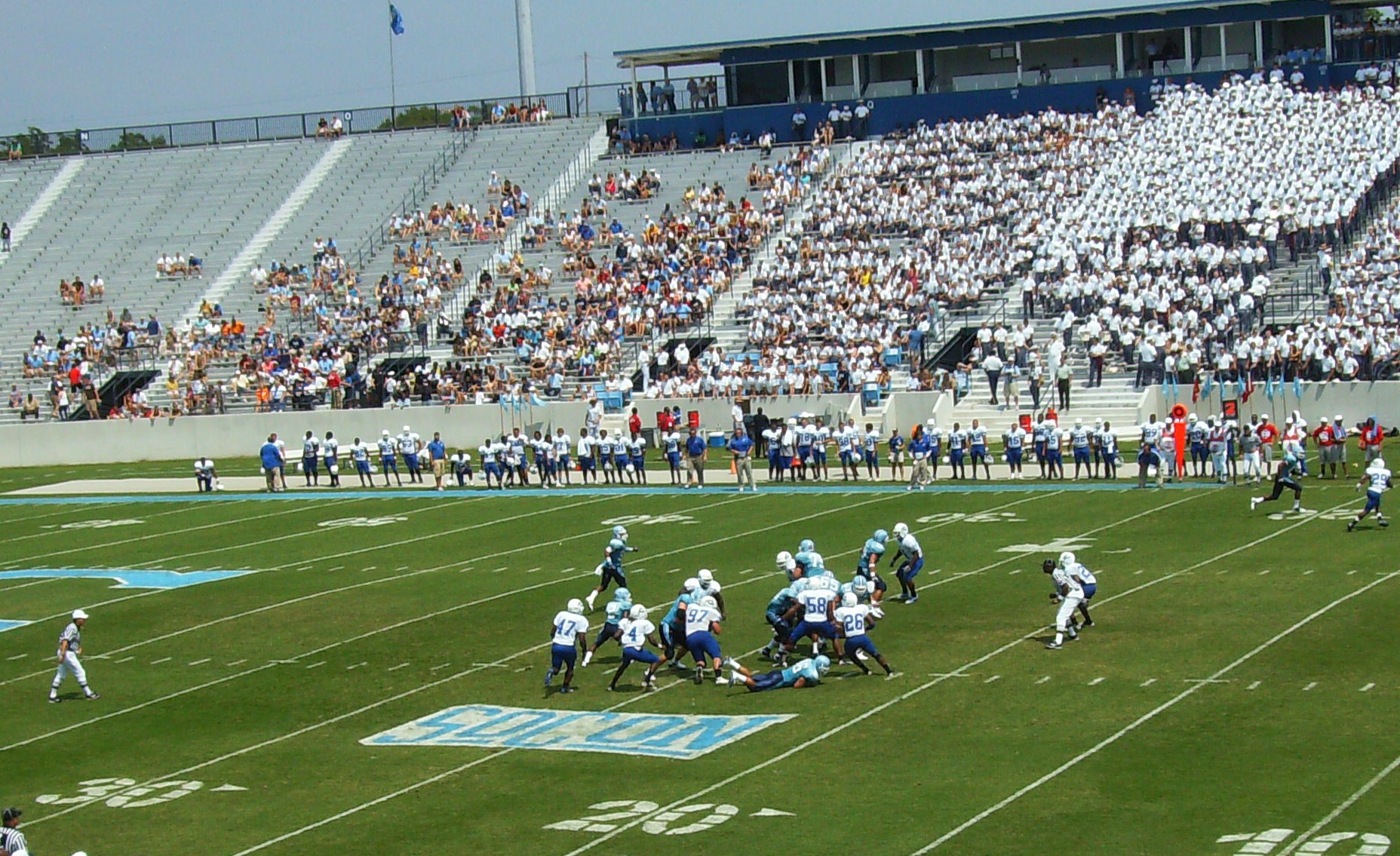
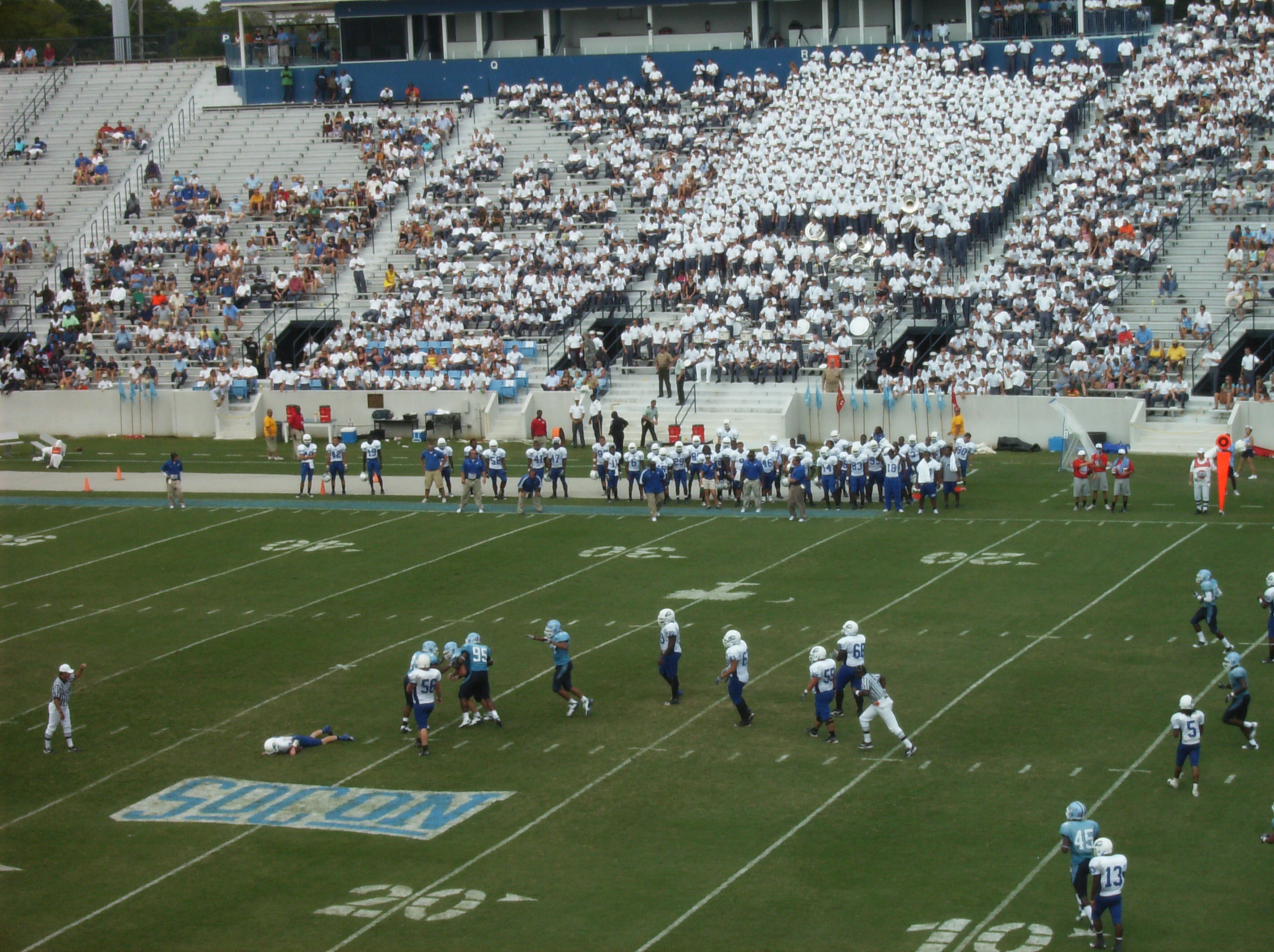
Here are some (distinctly unprofessional) pictures of the offense for anyone interested.  There is a shot of the offense in its basic formation; one with multiple wideouts; and a really bad “action” shot of the offense:

— I was a little disappointed in the defense, which allowed a number of long drives and big plays.  Twice Chowan got to the Bulldog 1-yard line in the first half and failed to score.  I guess you can credit The Citadel’s D for making the stops when it mattered, but in both cases it had more to do with Chowan shooting itself in the foot than superior defensive play.

The defense missed too many tackles, and the secondary blew some coverage assignments.  Part of the latter had to do with different personnel getting a chance to play, which is understandable.  There is no excuse for missing tackles, though.  The defensive line played well, although the second Chowan TD came on a play during which a lineman whiffed on an easy sack.

Here is a before/after shot sequence for fans of the D to enjoy, though.  Chowan is about to snap the ball on a 4th-quarter play where it has the ball on the Bulldog 12, second-and-7.  The second picture shows the aftermath of the play, thanks to Derek Douglas (Chowan would eventually miss a FG on the drive).

— I thought Matt Thompson had a good game, although I wouldn’t anoint him the permanent starter just yet.  I think Ben Dupree deserves to get some time, too, and I also think Sam Martin should continue to get some looks.  Thompson did show a good throwing arm.

It helped that he had Domonic Jones as a target.  Jones is 6’5″ and plays every inch of that.  He should be causing problems for SoCon defenses for several years to come.

— I noticed there were no names on the jerseys, which I thought was interesting.  The light blue jersey/navy pants combination still looks awful.

I’ll write about the Arizona game in my preview of that matchup, but suffice to say it’s going to be a major challenge for the Bulldogs.  I was impressed with the Wildcats when I watched them play on Friday night at Toledo.  Arizona has serious playmakers at quarterback, running back, and receiver, and a solid defense.  The one thing going for the Bulldogs is that the desert heat should not present any problems, after playing in the heat and humidity of midday Charleston.

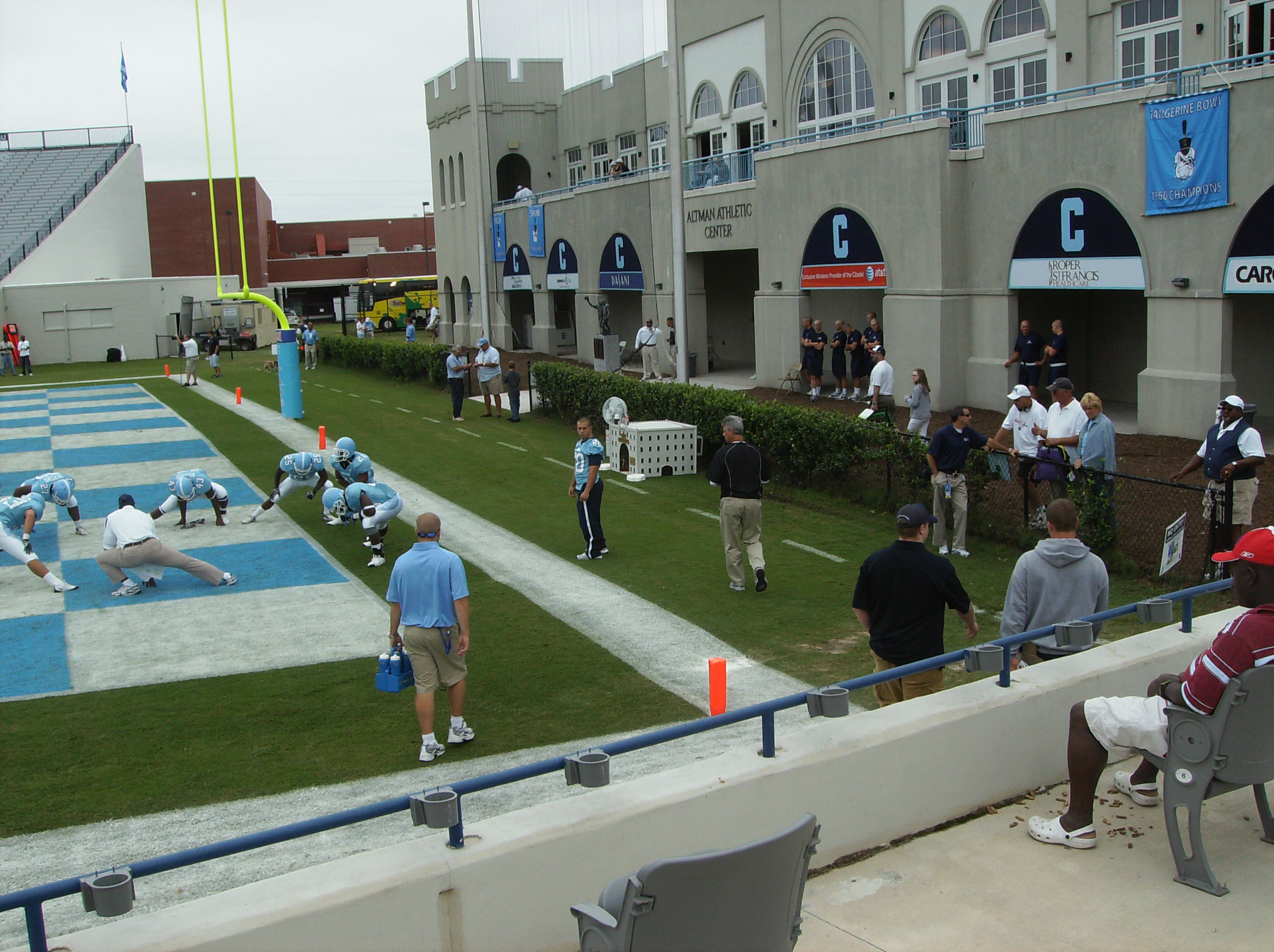
The new “Kids Zone” debuted on Saturday.  This is a good idea and I was glad to see it. I even took a couple of pictures of the KZ (in one, a cadet is staring almost directly into the camera, clearly wondering to herself why someone would be taking pictures).

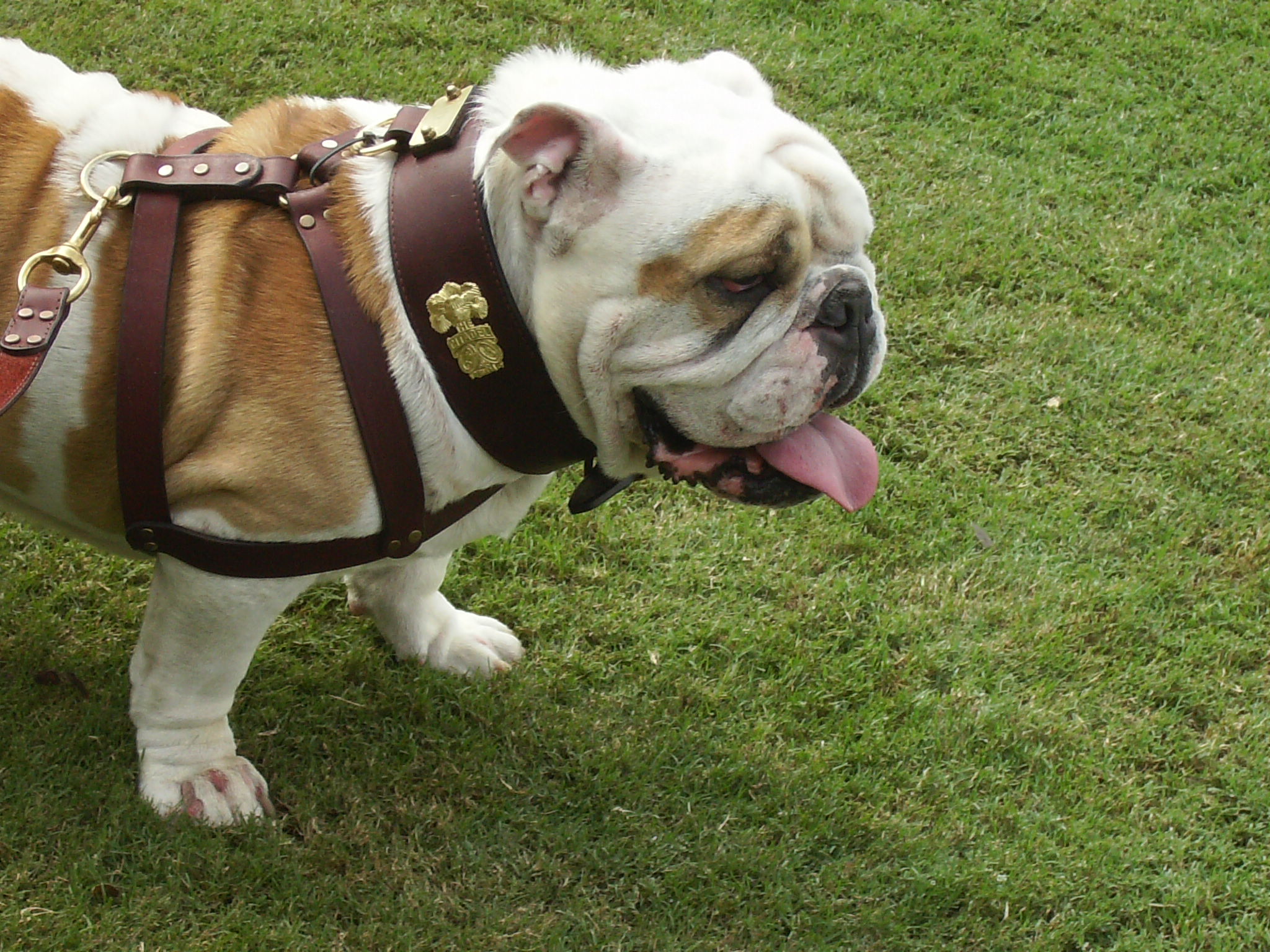
I took this picture (which includes the captains about to go onto the field for the coin toss) just to show how hot it was.  It was apparently too hot for General and Boo (note the absence of the doghouse, to say nothing of the dogs themselves).

Edit:  I just noticed that one of the dogs (probably General) is standing on top of a table near the top left of the picture, just outside a tent, being held on a leash by (I think) Mike Groshon.  So there was at least a cameo appearance by the live mascot.  You can also see the doghouse under the tent.  Looks like they were trying to keep him in the shade as much as possible, which strikes me as a very good idea.

I went to the Holliday Alumni Center to get my first in-person look at Big Red, the original.  It is actually a little smaller than I thought it would be, but it’s still arresting visually.  (For those unfamiliar with Big Red, its backstory.)

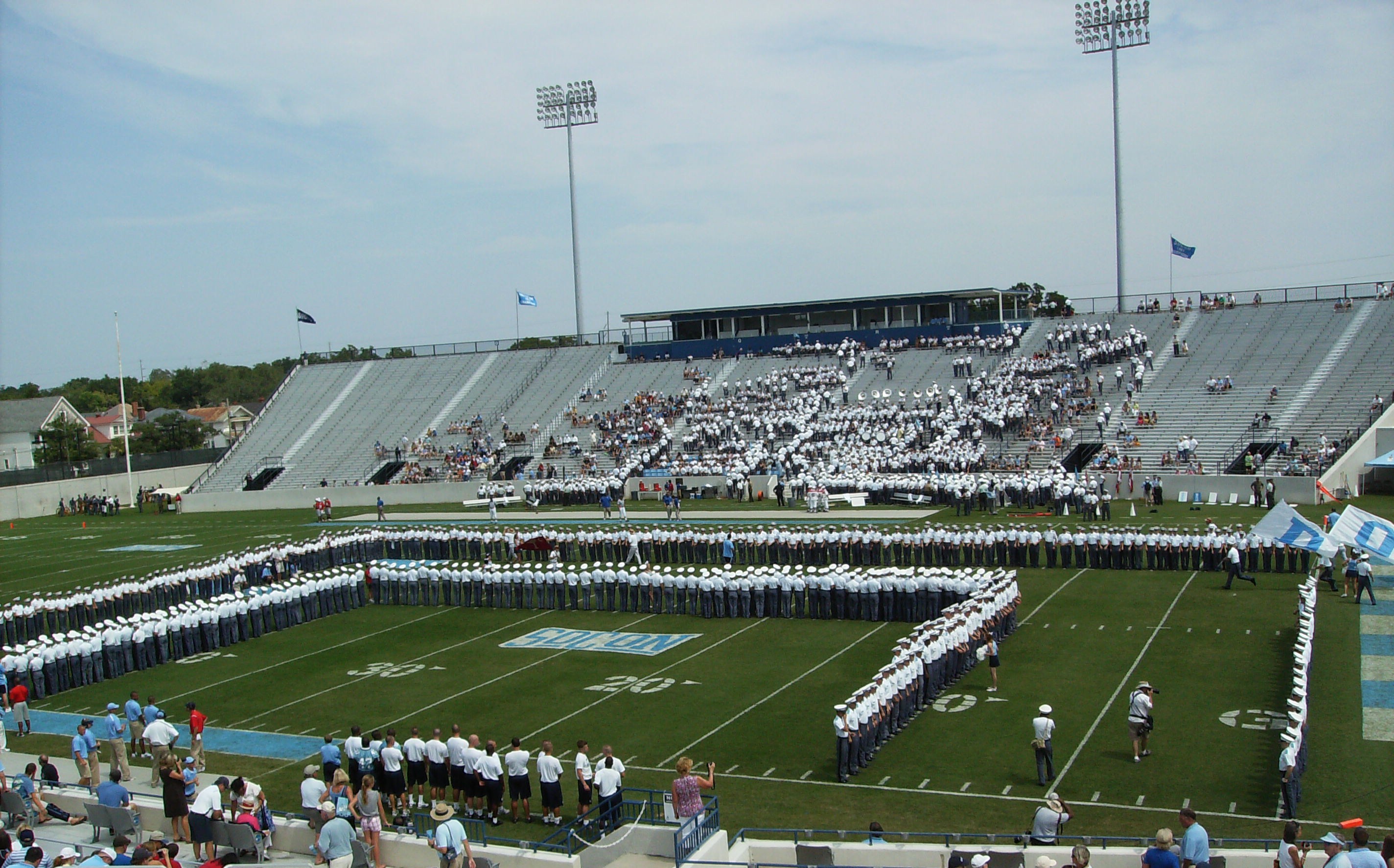
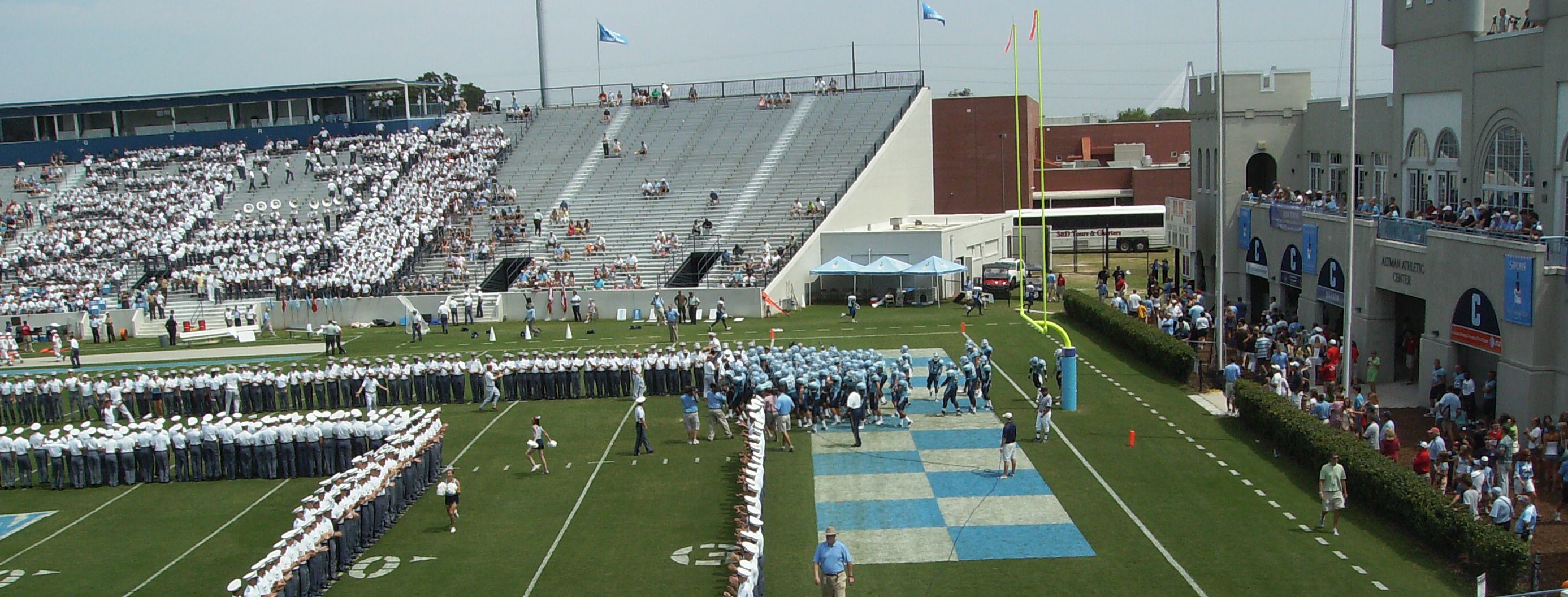
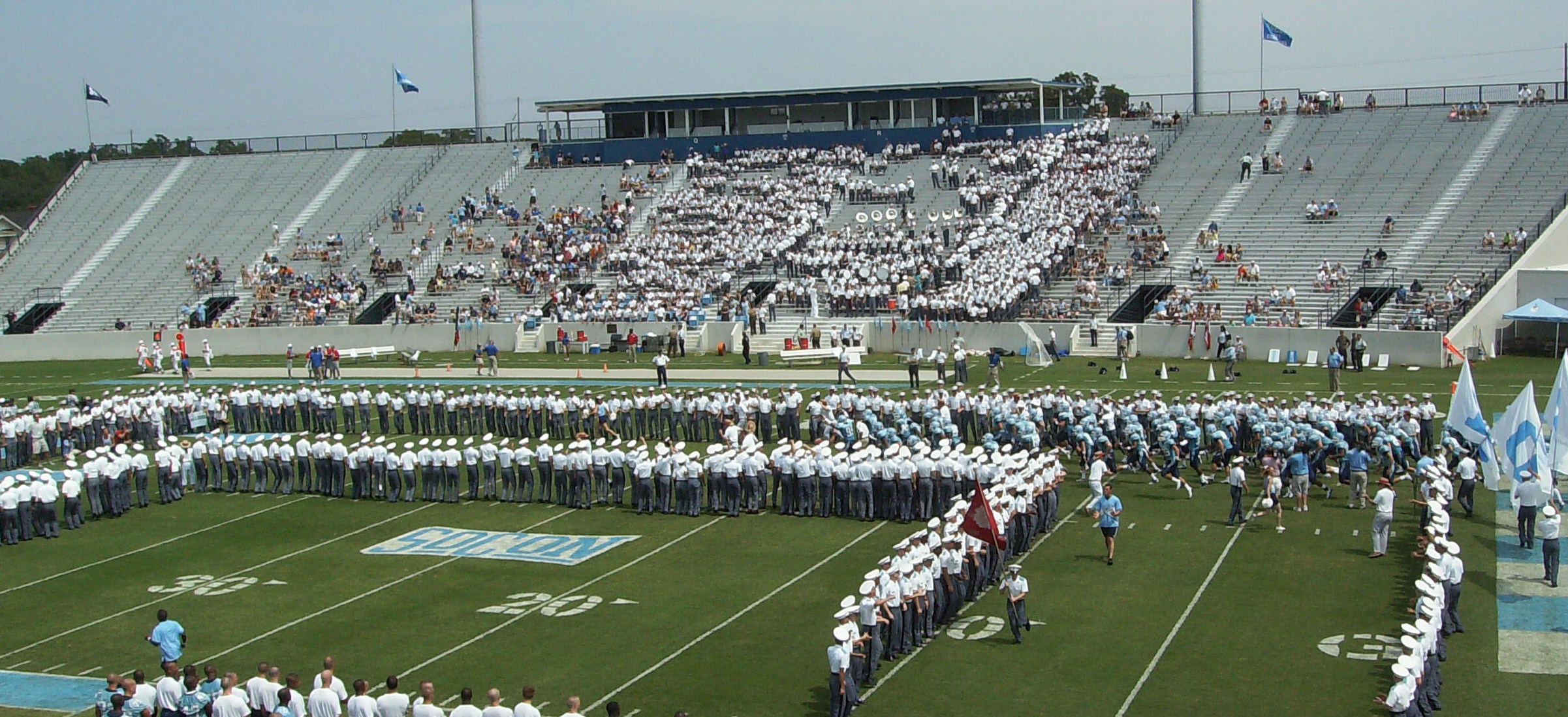
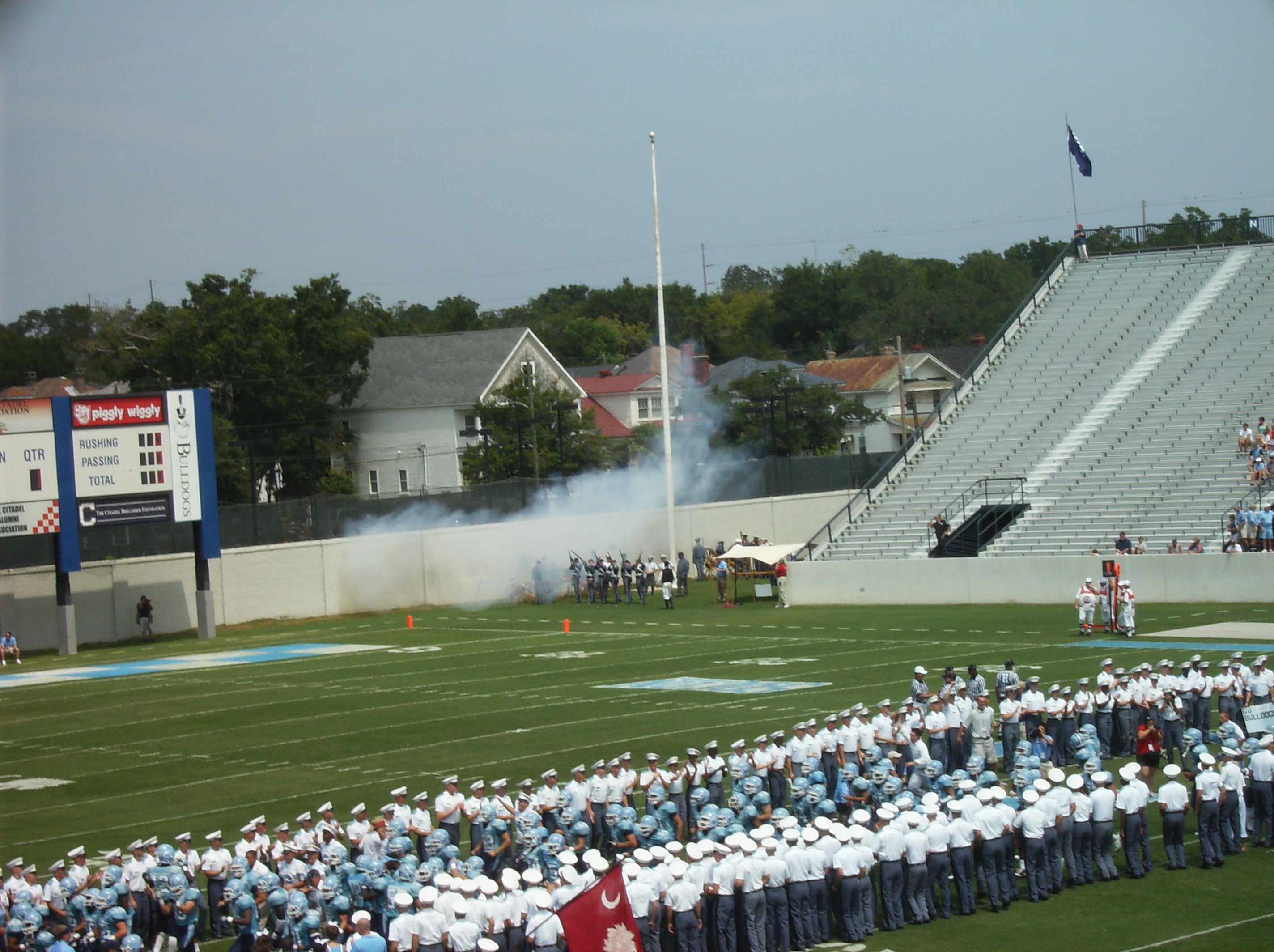
Here are a few more pictures to end this post.  These are just some shots of the field just prior and during the team’s entrance.  The last one includes some cannon fire in the background.

College Football TV Listings 2010, Week 1

It’s that time of year again!

This is a list of every game played during week 1 of the college football season involving at least one FBS or FCS school.  All games are listed, televised or not.  For the televised games, I include the announcers and sideline reporters (where applicable).  I put all of it on a Google Documents spreadsheet that can be accessed at the following link:

College Football TV Listings 2010, Week 1

Additional notes:

— I include the ESPN3com games, even though technically they aren’t “televised”.

— I’ve listed the satellite affiliates for the SEC game of the week (as a comment) on the document.  There are numerous local affiliates, a listing of which can be found here: Link

— Also listed as a comment are the regional nets carrying the following games: Northern Illinois-Iowa State (Thursday night game), Illinois-Missouri, Coastal Carolina-West Virginia, and Washington State-Oklahoma State.

— For the Coastal Carolina-West Virginia matchup, the following local affiliates in West Virginia and Pennsylvania will also carry the game:  WCHS, WOAY, WTOV, WTAP, WVFX, WPCW, WJAL

— ABC coverage map for the 3:30 pm ET games:  Link

A lot of the information I used in putting this together came courtesy of Matt Sarzyniak’s great website (College Sports on TV) and the fine folks over at the 506.com.

Football, Game 1: The Citadel vs. Chowan

It’s time for college football!   This year the scene at Johnson Hagood Stadium should include a lot of the following:  great tailgating, photo ops with Bulldogs both live and bronze, and, uh, fumbles…

Okay, so maybe that wasn’t the sunniest intro of all time.  I have to be honest here, though.  While I am looking forward to the season, this year I am a bit apprehensive about what lies ahead for the Bulldogs on the gridiron.  The Citadel is going to the triple option on offense, with a head coach who has never run the offense (or any similar offense) before, and with players who were mostly recruited for a very different kind of system.

The players who were recruited with the triple option in mind, of course, are all true freshmen.  The quarterback position will likely be manned by one (or more) of those true freshmen. The “knob”-starting quarterback double is a rare one, and for a reason. It’s an exceedingly difficult combination.

The Southern Conference media and coaches agree that this season could be a long one for The Citadel, just as the last two seasons have been.  The media picked the Bulldogs to finish last in the league.  The coaches ranked The Citadel eighth out of nine teams, ahead of only Western Carolina.

The Catamounts finished last in 2009, with only one league win.  That one WCU victory came against The Citadel, which tied for next-to-last.  More of the same is expected by those who follow the SoCon.

Before beginning league play, though, The Citadel will play three non-conference games.  Next week’s game at Arizona should be…interesting.  The following week the Bulldogs will take on Presbyterian, a team that went 0-11 last season, including a 46-21 loss to The Citadel.  However, even the Blue Hose would be favored against the Bulldogs’ opponent on Saturday, Chowan University, a Division II school located in Murfreesboro, North Carolina.

When the Hawks were announced as the opposition for the home opener, a collective yawn could be heard from The Citadel’s less-than-thrilled fans.  It’s hard to blame anyone for not being excited about Chowan being on the schedule, with all due respect to that school.  I’m guessing this game’s not going to be a sellout.

Having said that, let’s take a look at Chowan.

I wish I could say with confidence exactly how “Chowan” should be pronounced.  This is probably something that should concern Bulldogs play-by-play announcer Darren Goldwater a lot more than me, but I like to know these things.  I even sent an e-mail to Chowan’s department of athletics asking the question, and quickly got a response:

It’s pronounced CHO-WAN with a hard CH, just like CHOKE or CHICKEN. CHO-WAN.

That’s from somebody who works at the school, so she ought to know, but two different people have insisted to me that it’s actually pronounced “Shuh-WONN”, with the “Sh” sound at the beginning and the accent on the second syllable.  Since both of them are natives of eastern North Carolina, the region of the state that actually has decent BBQ, I tend to trust them.

“Chowan” is a derivative of “Chowanoke”, the name given to the native tribe of the region by 16th-century European explorers.  My guess is that if you were French, you pronounced it with the “Sh”, and if you were English, you went with the hard “Ch” sound.  It’s kind of like Beaufort (BO-fert), North Carolina, and Beaufort (BYOO-fert), South Carolina.

You like to-ma-to, I like to-mah-to, let’s call the whole thing off…

There is also a Chowan river, and a Chowan County — but Chowan University isn’t located in that county, but in the adjoining county of Hertford.  Naturally, this school in northeastern North Carolina is named to honor a tribe whose name means “people of the south”.

Regardless of its pronunciation, the school has been around in one form or another since 1848, when it was founded as Chowan Baptist Female Institute.  The school remained all-female until 1931, but in 1937 it became a junior college.

It reverted back to four-year status in 1992, and changed its name to the current Chowan University in 2006.  This fall, it will offer its first Masters Degree program, in Elementary Education.  Chowan remains affiliated with the Baptist State Convention of North Carolina.

About 1100 students attend Chowan.  I thought the section titled “Who we serve” on the school’s website was interesting:

The Chowan University community is committed to serving average students. By “average” we mean students with a GPA from 2.25-3.25 and “average” SAT scores (around 1300 for the three part SAT). Students below these criteria may be admitted if they show a commitment to the Chowan University experience and academic potential…

Many of our students are first generation college students which means their parents did not attend college or complete a college degree. Because of Chowan’s commitment to individual attention in a Christian environment, these students thrive here.

I liked this statement.  Too many schools insist on presenting themselves as wannabe Ivies, when everyone knows better.  Here we have a school that knows exactly what its mission is, and what it wants to do, and isn’t apologetic about it in the least.  Good for Chowan.

Chowan had a fine run in football as a junior college, almost entirely under James Garrison, who was the head coach at the school for 43 years (and for whom its football stadium is named).  Quite a few Chowan alums went on to four-year schools and then the NFL, including George Koonce, Curtis Whitley, and Mark Royals.

However, Chowan has struggled on the gridiron since becoming a four-year school itself.  Since 1993, the Hawks (formerly the Braves) have a cumulative record of 39-168-1 in Division III and (since 2005) Division II.  That includes Saturday’s 59-10 loss to Lenoir-Rhyne.

Chowan has been a football member of the Central Intercollegiate Athletic Association since the 2008 season (and is now a full member of the conference). Chowan is the first non-HBCU member of the CIAA in the league’s 98-year history.

The CIAA now has 13 members, and as a result the conference’s slogan for this year is “Triskaidekaphobia: Fear the 13!”  I’m not sure what the Southern Conference’s slogan would be — “The SoCon: The Nation’s Most Transient League”?

For Chowan football, the last five years have looked like this:

2005 — 2-8, including a 56-10 loss to North Greenville (now of Willy Korn fame) and a 42-21 defeat at the hands of Allen, which dropped its program after the season

2006 — 0-10, including losses of 42-0 to Western Carolina, 52-6 to North Greenville, and 28-0 to Webber International; Webber played The Citadel the following season, with a slightly different result

2007 — 2-9, including a lot of total beatdowns:  51-0 (Coastal Carolina), 56-14 (North Greenville), Presbyterian (62-10), and Newberry (67-0)

2008 — 2-8, which featured an early-season 69-20 loss to VMI (which had concluded its 2007 campaign in memorable fashion)

2009 — 2-8, although most of the games were more competitive; the Hawks did lose 36-21 to Old Dominion, the Monarchs’ first game since restarting its program after a 68-year hiatus (ODU did finish the season 9-2, though)

Those last two seasons came under the direction of the current head coach, Tim Place.  Place is a Washington & Lee alum who was previously the head coach at Urbana, an NAIA school in Ohio.

One of the members of Place’s coaching staff is Omar Nesbit.  Nesbit was an All-SoCon lineman at The Citadel, graduating in 2002.  He is the Hawks’ offensive line coach.

According to the school’s pre-season football guide, the team runs a “multiple” offense and a “multiple” defense.  Thirteen starters are back from last year’s outfit.

Last season the Hawks scored 25.3 points per game, not bad, but allowed 35.2 ppg. While the Hawks were a respectable passing team, all 25 of its TD passes were thrown by C.J. Westler, who was the offensive player of the year in the CIAA, and who is not among the returnees.  Much like The Citadel, Chowan has to find a quarterback (it played two in the Lenoir-Rhyne game).

Chowan turned the ball over three times per game, almost double its opponents’ totals, and averaged an anemic 2.9 yards per rush.  The Hawks gave up 48 sacks.

Defensively, the Hawks allowed 4.6 yards per rush and 9.3 yards per pass attempt, which is obviously not good.  Opponents scored touchdowns 70% of the time when they entered the “red zone”.  Chowan was also not a particularly efficient punting or placekicking team.

Against Lenoir-Rhyne, Chowan allowed 513 rushing yards (6.9 per attempt).  This is noteworthy in that L-R is running the same offensive system this season it ran last year under the direction of then-offensive coordinator Tommy Laurendine — who of course is now the offensive coordinator at The Citadel.

Laurendine has his work cut out for him, based on early reports.  For example, this is how Jeff Hartsell began his recap of the August 21 scrimmage:

After watching his quarterbacks combine for six interceptions and at least five fumbled snaps in Saturday’s scrimmage, Citadel football coach Kevin Higgins stated the obvious.

“Offensively, we have a lot of work to do,” said Higgins…

You could say that, coach.  On the bright side, nine of the eighteen pass attempts in the scrimmage were caught by Bulldogs.  Alas, six of them were defenders.  At least on those plays the QB got the snap from center.  Unofficial totals from the scrimmage had the first-team offense rushing 27 times for 67 yards.

At least the defense apparently looked good, although how much of that was due to the offense’s struggles is open to question.  The kicking game again failed to impress, a problem Higgins has been unable to solve for the last two seasons.

The scrimmage on August 28 was apparently better, based on some anecdotal reports.  At this point it appears the Bulldogs will play two “true” freshman quarterbacks, Ben Dupree (from Pennsylvania) and Matt Thompson (from Florida).

Terrell “First Sergeant” Dallas will be the fullback.  There are several candidates to fill the slotback positions, led by Van Dyke Jones and injury-plagued Rickey Anderson (everyone’s crossing their fingers for you, Rickey).  The offensive line has some experience, but not at center, which in part explains the center-QB exchange problems.

We won’t know for sure exactly how the new offense will look until Saturday, but it probably will be a slightly different variation than Charlie Taaffe’s version of the wishbone.  It’s not going to be quite like Wofford’s option attack, either.

It’s probably going to most resemble the setup run by Paul Johnson at Georgia Southern, Navy, and now Georgia Tech.  With that in mind, I wouldn’t be surprised if Kevin Higgins, with a personal history of running spread passing offenses, throws the ball a little more often than you see in most triple option offenses.

He has to figure out a way to get talented tight end Alex Sellars involved in the offense. Higgins has also commented on the big-play ability of Domonic Jones, a 6’5″ redshirt freshman.  I like the idea of isolating a tall receiver on a smaller defensive back in this offense.  Of course, you have to have a quarterback capable of getting the ball to Jones.

I linked this in an earlier post, but to get up to speed on how this offense will probably operate, check out The Birddog (helmed by a grad/fan of the Naval Academy), the triple option devotee’s website of choice.  Here is a primer on the TO:  Link

While the offense is filled with question marks, the defense should have a lot of answers.  There is depth and talent on that side of the ball, particularly in the defensive backfield.  Cortez Allen has drawn pre-season accolades.  Other DBs with the potential to shine include Keith Gamble (who had an 89-yard interception return against Presbyterian last season) and Joseph Boateng (who intercepted two passes in his collegiate debut against North Carolina).

Former safety Rod Harland is now a linebacker, joining team leader Tolu Akindele and Jeremy Buncum as likely starters.  The defensive line should be solid, if a little young.  Chris Billingslea had some impressive moments last season (and made the All-SoCon freshman team as a result).  Keith Carter is a redshirt freshman who should draw notice, if only for being a defensive tackle who wears #33.

The other defensive lineman (at least that’s his roster designation) I want to mention is Milford Scott, a special teams terror who blocked three kicks last season and created havoc many other times.  He’s tall, has long arms, and describes himself as a “Charleston homeboy” from the beach.  He’s a weapon.

Unfortunately, Scott’s dynamism on special teams was an exception (not counting Andre Roberts, obviously).  While punter Cass Couey fared reasonably well, the Bulldogs continued to struggle in the placekicking department.  That’s two seasons in a row The Citadel has had sub-optimal kicking, and early returns suggest it might be three in a row.

I don’t blame the kickers.  I blame the coaching staff.  It’s the job of the staff to get that aspect of the squad fixed, either by improving the kickers on the squad or finding somebody else to kick.

The Citadel also could stand to improve its punt coverage team (Scott aside) and its kickoff return unit.  The Bulldogs will sorely miss Andre Roberts as a punt returner; look for that component of special teams to not be as effective this season.

There has been a lot of turnover in the coaching staff, not only with the new offensive scheme (where the aforementioned Laurendine is joined by offensive line coach Bob Bodine), but with the defense as well.  Higgins recruited former Wofford assistant Josh Conklin to join the staff, and later named him defensive coordinator.

Conklin will get help from another new assistant, Denny Doornbos, who was the defensive coordinator at Army during the Bob Sutton years, which were mostly good ones.  I have to gleefully point out, though, that he was the DC for this game…and for this game, too.

While all the talk in the off-season has been about the offensive scheme, and how the coaches will implement it, I think the new coaches on the defensive side of the ball will be just as important.  Generally, you would like to have more staff continuity than The Citadel has had, but in the case of the defense, I think a fresh approach may be just what was needed.

There was a sense over the last two seasons that the defense had underachieved; in particular, some observers felt the unit was not aggressive enough.  The Bulldogs’ D must be pro-active this season, and give the offense short fields with which to work. The defense will likely also have to bail the offense out on a regular basis.

This is going to be an important year for Kevin Higgins.  The off-season issues, not surprisingly, did not sit well with the alumni — and I’m not just talking about the big boosters or the message board regulars.  He also has had back-to-back disappointing seasons on the field.

The move to a new offense, and the overhaul of his coaching staff, were both bold moves made by someone who expects to stick around for a while.  They weren’t short-term stopgaps.  That is to his credit, I think.

Now, however, even with modest on-field expectations, he needs to get the fan base to buy into his program again.  After all, Larry Leckonby and company need to sell tickets and sponsorships.  Jerry Baker has Brigadier Club membership goals to obtain, whatever his methods are (high-tech, low-tech, begging, etc.).

A 1:00 pm start time against Chowan on Labor Day weekend in Charleston probably isn’t going to be a big winner as far as attendance goes.  I fully expect one of those hot-and-humid Lowcountry days that are fairly typical for this time of year. Ugh.  Of course, that’s assuming a hurricane doesn’t come into play.

I’ll be there anyway, though.  I’m ready for some football.

Variety Pack: The Citadel’s uniform follies, another transfer, a tough loss ESPN left out, Plant of the Week

Yes, it’s another edition of the Variety Pack, a new TSA series that debuted a couple of weeks ago.  The idea is to write briefly (I hope) on a few different topics without having to be mindful of the 140-character limit of my Twitter tweets.

Last year, I wrote what amounted to a manifesto on The Citadel’s uniform history.  I concluded the screed with this:

To sum up:  simple is best, get the name of the school right, and don’t screw up the colors.  That’s all.

I haven’t seen pictures of this year’s jerseys/pants yet, but according to some folks in the know who post on TCISN, The Citadel will feature (at least in some games) navy jerseys this year, with light blue numerals and “CITADEL” across the front in white.  I would like to think this isn’t true, but I’m sure it is, since North Carolina wore a similar jersey last season.  (We are apparently one year behind UNC in all things Nike-related.)

Navy is an accent color for The Citadel’s athletic teams, not a primary color.  Light blue and white are our primary athletic colors.  Last season, of course, the football team broke out navy pants, wearing them with both white and (most memorably) light blue jerseys.  This season the Bulldogs will apparently have the opportunity to wear an all-navy ensemble on occasion (with a light blue helmet).

Basically, it’s the exact opposite of what I would have liked.  The Citadel will have uniforms that do not include the proper school name, and that do not feature the appropriate school colors.  I apologize in advance if I’m jumping the gun on this, but that’s the information I have at present.

Tangent:  speaking of UNC, I’m not sure why that school is so willing to move away from its traditional color combination, which is very popular. I guess there is money to be made in mixing it up a little, but I think it detracts from a classic look.

As far as the helmets go, some pictures of the new helmet design popped up earlier this spring on TCISN.  The “regular” one reminds me of The Citadel’s helmet design during the Charlie Taaffe era.  It’s not bad, and in fact is a probably a little better than the Taaffe helmets.  You could do worse (and The Citadel certainly has).

There will also be a special helmet for Homecoming featuring “Big Red”.  I like the concept and the execution isn’t terrible, but it’s basically a copy of the Tampa Bay Buccaneers helmet.  I could do without the sword (incorporating a rifle might have been a better idea).  You can see pictures of both helmets on this thread.

You know, if you wanted to design a distinctive jersey to go with the special Homecoming helmet, and you wanted to also honor the past, this photo might be a good place to start.

When I wrote about graduate student transfers a few weeks ago (and I appreciate the comments, by the way — always good to get feedback), Chuck Driesell had just signed a transfer from Belmont, Mike Dejworek.  Evidently Driesell was not satisfied with just one European-born grad student big man named Mike, because a couple of weeks later he brought in another.

Morakinyo “Mike” Williams is an Englishman who started his career at Kentucky (recruited by Tubby Smith) before transferring to Duquesne, where he played one season before moving again, this time to The Citadel.  Not everyone at Duquesne was expecting his latest move.

It will be interesting to see how Williams does.  He reportedly did not get along with former UK coach Billy Gillispie, which is probably a positive.  I think it’s safe to say that he will be the first player in Bulldog hoops history to have previously been deported from the United States (that had to have been tough).  Also, in his year at Kentucky he picked up a nickname — he was known as “The Member”.  I’m afraid to ask.

ESPN.com, setting the stage for another college football season, ran a series last week called “House of Pain”, featuring the 50 toughest losses in college football history.  It wasn’t a bad list, but there were two minor problems with it (in my opinion):

1)  It focused a little too much on recent history.  It wasn’t terribly slanted, but there was some TV-era bias.  I’m sure Beano Cook would agree (although I was glad to see that the Boston College-Holy Cross game from 1942 made it; an underappreciated game with an epilogue worthy of O. Henry).

2)  More importantly, most of the losing teams involved in the games on ESPN’s list could always take solace that on other occasions they had won the big game.  Maybe Miami and Ohio State and Alabama and Nebraska and Southern Cal have all lost tough games — but they’ve also won big games, on multiple occasions.  To me, a truly tough loss is when a school with limited success has a chance to climb the mountain, and then falls flat on its face.

West Virginia losing to Pittsburgh a few years ago was a good example, and made the list.  Another game that made the list, but which should have ranked much higher, was Missouri-Iowa State (from 2004).  How often are the Cyclones going to have a chance to play in a conference title game?

The game I immediately thought about when the list began to be released, though, is nowhere to be found….this one.

Navy 38, South Carolina 21.  November 18, 1984.

South Carolina was, incredibly, 9-0.  Black Magic!  The Gamecocks could have accepted a bid to the Sugar Bowl after beating Florida State the week before, but held out for a trip to the Orange Bowl and a potential (mythical) national title game.  All they had to do to clinch the Orange Bowl was beat a Navy team coming off a 29-0 loss to Syracuse.

It didn’t happen.  South Carolina lost the game, the chance to be ranked #1 for the first time (which would have occurred had the Gamecocks won), a shot at a national title, and a berth in a major bowl for the first time in school history.

Twenty-six years later, and Gamecock fans are still waiting for their first ticket to a major bowl.  That game is the very definition of a painful loss.

Finally, it’s time for the Plant of the Week.  This week’s honoree is the Rubrum Lily, which made its way to Europe from Japan in 1830 (or thereabouts).

Until next time…

Rubrum Lily

ESPN College Football Announcers for 2010

ESPN has released its assignments for its college football game coverage, as well as its studio coverage.  As always, there are some new crews.  Highlights:

— Among the tandems that work the high-profile ESPN/ABC games, the one significant change is in the “west coast” team, where there will now be a three-man booth — Carter Blackburn, Brock Huard, and Mike Bellotti.  The former Oregon coach is in his first season as an analyst; he works with Huard, who was the analyst for the SEC ESPNU primetime game last year.  Blackburn called mostly west coast games on the U last season after moving over from CBS College Sports.

That team essentially replaces the Terry Gannon/David Norrie duo from 2009. Gannon is not listed on this year’s release; he may just have too much already on his announcing plate (Dave Lamont filled in for him a few times last season as it was). Norrie is going to ESPN Radio, replacing Dennis Franchione as Bill Rosinski’s analyst.  Norrie will also work a few midweek TV games (along with Robert Smith), teaming with Beth Mowins.

— That’s right, there is now a second woman play-by-play voice calling college football for ESPN.  Mowins will apparently have a limited schedule.

Pam Ward is still around, and presumably as intolerant of injured players as ever. However, she’s been moved from the noon ET ESPN2 slot to 3:30 pm ET on ESPNU, much to the relief of Michigan State and Northwestern fans everywhere.  Her analyst will be Danny Kanell.

— Kanell, the former FSU quarterback, also will do some studio work.  He’s the breakout star, I guess, of the multitude of game callers/analysts who worked ESPN360 (now ESPN3.com) games last season.  What does that say about the talent featured on ESPN3.com in 2009?  Well…

The release doesn’t mention anything about who will work ESPN3.com games this year; it does note that “additional commentators will contribute throughout the season”.  There will be a lot of “additional contributors” both on ESPN3.com and on the regular TV platforms.  Week 1, for example, will include 11 games that will be shown live exclusively on ESPN3.com.

— Erin Andrews will be hosting the first hour of an expanded College Gameday (that was announced last month).  She will also be the sideline reporter for the game site from which the program originates, assuming it’s on ABC/ESPN/ESPN2.

That means the other high-profile game tandems will probably flip-flop sideline reporters a bit more often than normal, although most of the time Andrews will likely work with Brent Musberger and Kirk Herbstreit.  Last year, the sideline reporter with that duo was Lisa Salters, who will not be back this year.

Quint Kessenich moves from the Big East regional game of the week to a national gig; his replacement on the sidelines for the Big East games is Eamon McAnaney.  I think there is a lacrosse announcer quota involved in that switch, but I’m not sure.

Andrews won’t be roaming the sidelines on Thursday night any more.  “The new EA” is Jenn Brown, who like Andrews is a Florida grad, blond, and destined to become a sports blog/message board favorite.

— The other change on Thursday nights is Rece Davis taking over play-by-play duties from Chris Fowler.  I like Davis, although he isn’t really a natural at play-by-play, but I’m not a fan of the Craig James/Jesse Palmer dual threat.  I find their combined analysis rather banal; at least James wears a properly sized tie.

— Fowler remains the ringleader for College Gameday, with Lee Corso (who I hope has now fully recovered from his stroke), Herbstreit, and Desmond Howard.  There was little change in personnel for the major studio shows. That’s right, another year of Dr. Lou (with Davis and Mark May) and The Bachelor (with John Saunders).  Robert Flores takes over as the new update guy on ABC.

There were some moves on the SEC-on-ESPN desk.  Dari Nowkhah will now be the syndication studio host, as Rob Stone will call games on ESPNU (he’s working the noon U game with David Pollack).  Another change of interest for SEC fans is the new primetime team for that league on ESPNU.  Clay Matvick and Herm Edwards will replace Eric Collins and Brock Huard.  Edwards may be a San Diego State alum, but he strikes me as a natural pick to analyze SEC action, as teams in that conference definitely play to win the game.

As mentioned earlier, Huard is working west coast games this season, while Collins has apparently moved to the Big 10 Network.  If I see a release listing announcers for the BTN/CBS College Sports/etc., I’ll post it here; the other BTN announcing news of note I’ve seen suggests that Tom Hart will be joining that network.

Edit (8/25/10) — Here is the BTN release, with Hart and Collins listed as announcers:  Link

Another non-ESPN announcing note:  The ACC game of the week, produced by Raycom, will have a new analyst this year, with David Archer replacing Rick “Doc” Walker.  This, if not a national tragedy, is at least a regional outrage.  I need to know which ACC players are actually cyborgs.

— Anish Shroff will take over from Charlie Neal as the play-by-play man for ESPNU’s Thursday night games.  Luckily, CitiField will not host a football game this season.

— Joe Tessitore will call the Friday night ESPN2 games with Rod Gilmore again, but Tessitore (who I find enjoyably bombastic) will also be the play-by-play voice for the ESPN-3D games, which will feature separate production teams for “regular” and 3D broadcasts.  He’ll work with new analyst Tim Brown and sideline reporter Ray Bentley (who had worked with Pam Ward for the last three seasons).

— The noon ESPN/ESPN2 games will each have Grieses in the booth.  Bob Griese returns with Chris Spielman and Dave Pasch on ESPN, while the ESPN2 game will feature Brian Griese (who had a promising debut last year) with play-by-play man Bob Wischusen.

Pasch and Wischusen are both guys who could/should work higher-profile games, but each is a radio announcer for an NFL team (the Cardinals for Pasch, the Jets for Wischusen) and are basically limited to early-afternoon Saturday games on ESPN.

— Ron Franklin, who was planning on retiring, is back and working again with Ed Cunningham.  I hope that team gets some heavy-duty games this year.

Getting closer to kickoff…

Baseball’s Hall of Fame changes its election procedures (again)

Some observations on the revised election procedures for the Veterans Committee…

In case you were wondering why the procedures were revised, it’s fairly simple — the Hall wants more players elected.  It needs more people traveling to Cooperstown for Hall of Fame weekend.  Darren Rovell wrote about this, and that was prior to this weekend’s paltry attendance at the induction ceremony.

Since the BBWAA is struggling to elect more than one player per year (although I think both Bert Blyleven and Roberto Alomar will be elected this winter), the Hall needs the Veterans Committee to elect some players to excite fans of a certain age.  It hasn’t been easy.

The previous iteration of the VC (which Chris Jaffe refers to as the “Joe Morgan SuperFriends Committee” ) managed to elect no post-1960 players in three years of trying.  Now the VC has morphed into the following:

There will now be one composite ballot consisting of managers, umpires, executives and long-retired players divided into three eras, rather than four categories with separate electorates.

The “categories with separate electorates” voting resulted in the election by the VC of no “modern” players (courtesy of the SuperFriends, as noted above).  The only modern-day players elected were those few selected by the BBWAA.  The only player actually enshrined courtesy of any VC committee was Joe Gordon.  Gordon is one of two players elected by the VC in the last decade (Bill Mazeroski was elected in 2001).

The VC setup did produce several other Hall of Famers — two managers (Billy Southworth and Dick Williams), two owners (Barney Dreyfuss and Walter O’Malley) and former commissioner Bowie Kuhn.  Thus, the past three years of voting by the VC resulted in six new Hall of Famers, only one of whom (Williams) was still alive to accept the honor.

So what are the new divisions/categories?

The new divisions are as follows: Pre-Integration (1871-1946), Golden (1947-1972) and Expansion (1973-1989 for players; 1973-present for managers, umpires and executives)…

…One election will be held each year at the annual Winter Meetings, but the eras rotate, resulting in one era per year. The Expansion era will be first, followed by the Golden Era election in 2011 and the Pre-Integration Era election in 2012.

The new rules take effect immediately and will be put into practice at the first election at this year’s Winter Meetings, to be held on December 5, 2010, in Orlando, Fla., with the Expansion Era up first.

Oy.

First, who thought it would be a good idea to call one of the divisions the “Golden” era?  What a way to sell your current on-field product, guys.  It’s a sop to some of the baby boomers, and certain syrupy writers, I guess.

Then there is the actual dividing line between the categories.  Why does the “Expansion” era start in 1973, rather than in real expansion years like 1961 or 1968?  What is so special about 1973?  It was the first year of the DH.  Maybe that’s what it is.  Or maybe…

Maybe it’s because George Steinbrenner bought the New York Yankees in 1973.

I have to say that I’m not completely sure I’m going to buy the Big Stein Line of Demarcation theory, if only because I’m not sure Steinbrenner’s election would automatically result in overflow crowds venturing to Cooperstown next July.  However, let’s take a look at a potential ballot.  Remember, the “Expansion” era is up first, so The Boss is up for election immediately.  There will be 12 names on the expansion era ballot, made up of players, managers, umpires, and executives.

I figure that around eight of them will be players.  If I were to pick the top eight eligibles among this group of players, the list might look like this:

Tommy John
Bobby Grich
Darrell Evans
Ted Simmons
Buddy Bell
Bobby Bonds
Sal Bando
Jose Cruz, Sr.

I think it will be hard for any of these players to get 75% of the vote from a committee of 16 people.  John would have the best shot, and Grich likely would get serious consideration (at least, he should).

Then we have the non-players who would be on the ballot.  Bobby Cox and Lou Piniella would not be eligible for consideration this year.  Who would?  Steinbrenner, of course.  Charlie Finley.  Ewing Kauffman.  Marvin Miller.  John Schuerholz.  Davey Johnson.  Allan H. Selig…

That’s right.  Bud is a potential candidate.  I don’t think he’ll be on the ballot this time, but just wait three years.  Just wait.

If I had to guess at four non-players on the ballot, the spots would be taken by Steinbrenner, Miller, Kauffman…and Billy Martin.  Imagine the press if Steinbrenner and Martin are enshrined at the same time.

So will the VC elect anyone this winter?  Probably.  There is one potential hitch, though.  As Tom Tango observes, past iterations of the VC mandated that each voter could only vote for up to four candidates, making it very hard, if not impossible, for an individual to get 75% of the vote.  That will be particularly true for a 12-man ballot (as opposed to the 10-man ballot for the Golden and Pre-Integration eras).

If instead each candidate gets an “up or down” vote, with no further restrictions for those on the committee, then I think there could be three or four candidates elected.  If not?

Then it’s Steinbrenner, and nobody else.  Somewhere, Frank Constanza weeps.

Variety pack: Triple Option, The Citadel on TV, college baseball on the clock, Plant of the Week

This is going to be a grab-bag type of post, a variety pack if you will.  I may do this sort of thing periodically, as I really need to blog on a more regular basis.  I look at this as a way to make shorter comments on various issues, mostly about sports (including sports at The Citadel), with a few other odds and ends that catch my eye.  Think of them as Twitter entries that are longer than 140 characters.

Speaking of Twitter, my latest tweets can be seen on the left side of this page.  If anyone hasn’t noticed and is halfway interested in following me on Twitter, the location is http://twitter.com/SandlapperSpike (my tweets feature links/comments on a lot of stuff, including up-to-the-minute updates on Bulldog sports, baseball, football, and soccer, among other things).

As The Citadel counts down to kickoff against Chowan (as of today, T-41 days!), it’s time to focus on the Bulldogs’ new offense, which may be a little like an old offense, namely Charlie Taaffe’s wishbone attack.  However, it appears that Kevin Higgins may intend to run more of a “spread” triple option than Taaffe’s offense.

With that in mind, it might be a good idea to take a look at what the folks at Navy (and Georgia Tech, with Paul Johnson’s arrival in Atlanta) have been doing, particularly since Higgins apparently told one of our quarterback recruits (Ben Dupree) that The Citadel would be running a “Navy-style triple-option offense.”

Another reason to pay attention to the triple option is that Georgia Southern is also going to start running the offense this season, in a return to its roots.

For those interested in a breakdown of the nuts and bolts of the triple option, then, I cannot recommend highly enough a visit to The Birddog, the blog of choice for Navy football (and lacrosse).  The Birddog does a great, great job of illustrating (with video!) the intricacies of the triple option attack.

I’ve picked out four posts that I think serve as a good introductory primer for what the offense is all about.  (I hope I’ve chosen correctly.)  While reading these, just in case anyone gets confused, keep in mind that Paul Johnson is the former head coach at Navy (and Georgia Southern, of course) and is now at Georgia Tech.  The current Navy head coach is Ken Niumatalolo, and his offensive coordinator is Ivin Jasper.

Reading Is Fundamental

The Science and the Art

The Midline Option

Other People’s Rivalries And The Futility Of Defending Against the Wishbone

As of today, only one of The Citadel’s football games is scheduled to be televised (at Wofford on October 30).  There is always a chance that a local station (either in Charleston or another SoCon town) will elect to broadcast a game, although that is unlikely.  Other than that scenario, there are only two other games that could be televised.

It is possible (but doubtful) that SportSouth will pick up the November 20 game at Samford as part of its “SoCon Saturday” package, as the last two weekends of the regular season are “wild card” weekends — basically, the network will televise the most attractive matchup that week, based on the teams’ records to that point in the season.  Admittedly, very few prognosticators are going to bet that a game between Samford and The Citadel will have serious repercussions in the league standings, but you never know.

However, there is a decent chance that The Citadel’s game at Arizona on September 11 will be televised by Fox Sports Net Arizona (FSN-AZ), a regional sports network received by cable subscribers in Arizona (and I believe parts of California and New Mexico), and also available as part of DirecTV’s “Sports Pack”.  Arizona has asked the Pac-10 (and the league’s TV partners) for a waiver in order for the game to be broadcast.

The reason a waiver is needed is because there are already two Pac-10 games scheduled to be televised during the same time period, and that league’s national cable partners have television exclusivity rights for those games.  In other words, a local/regional broadcast can’t take place at the same time as a nationally televised league TV game.  If another Pac-10 school wants its game on television, it has to play in another time slot.

However, Arizona and Arizona State have been given waivers in the past because home game time slots for those schools are limited, especially early in the season. You just can’t play a football game in the desert in the midday heat.

(Matt Sarzyniak was nice enough to explain the Arizona/Arizona State waiver issue to me, which I appreciate.)

We’ll see what happens.  I am cautiously optimistic that the game will be televised.

The NCAA Baseball Rules Committee passed legislation that, if approved, will establish a time clock in college baseball.  The committee is basically incorporating the rules employed by the SEC for its 2010 conference tournament.

The 20-second rule for throwing a pitch was already on the books, but now it will be enforced with a timer, as will the amount of time allocated between innings.  I’ll be interested to see how the Southern Conference handles this; will it have a visible clock, with a timekeeper in the press box monitoring it?  Or will it just have an umpire carrying a watch?  I’m guessing the latter, for financial reasons.

The committee also modified the obstruction rule, which got a lot of notoriety in the Southern Conference tournament thanks to the second-round game/brawl between The Citadel and Elon.  That was the second-wildest fight I’ve ever seen at the SoCon tourney (nothing compares to the epic Raleigh/Piepenbrink donnybrook in 1990, though).

Not about sports:  you can be assured that I will never quote from or link to the Las Vegas Review-Journal.  Why, you ask?  This is why.

Link 1

Link 2

I sincerely hope that the Review-Journal goes bankrupt sooner rather than later.  Also, the photo of the CEO in the first link — doesn’t he look like a guy who hopes you throw something at him, so that he can sue you?

I have a great deal of respect for copyright law.  I think this guy and the Review-Journal (which is funding him) are abusing copyright law.

Not about sports:  I really enjoyed this article in The New Yorker on the identification and authentication of artworks.  It’s a long piece, but worthwhile.  I won’t spoil it, but there is a major twist halfway through.  The bottom line:  if P.T. Barnum had been more familiar with the art world, he would have said “there’s a sucker born every 15 seconds.”

Finally, a new feature, the Plant of the Week.  That’s right, plants.  As I’ve said elsewhere on the blog, I consider gardening a sport.  In honor of this being the first edition of the PotW, I will honor not one but two plants in my garden.  Both are crinums. Feast your eyes on a Powelii (Cecil Houdyshel) and a Herbertii (no common name).

Until next time…