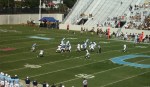
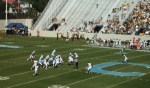
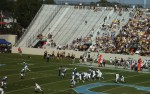
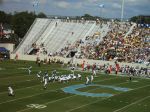
Game review, 2013: Appalachian State

Links of interest:

Game story in The Post and Courier

Game story in the Watauga Democrat

Game story in the Winston-Salem Journal

School release

Box score

WCIV-TV report (video)

Postgame video: Kevin Higgins, Ben Dupree, Thomas Warren

Kevin Higgins’ locker room speech (don’t miss the end of this clip)

Ben Dupree called it a “relief” to get the win, which I think sums it up. The Bulldogs badly needed that victory.

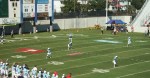
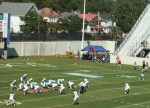
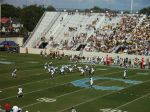
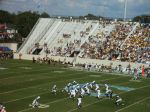
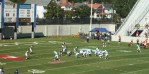
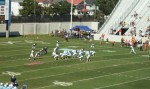
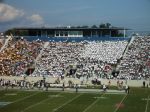
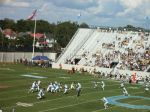
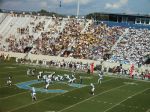
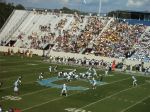
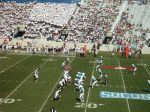
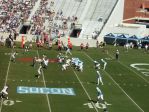
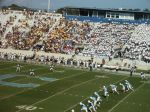
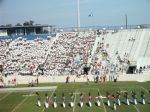
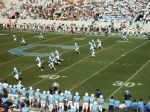
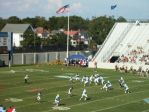
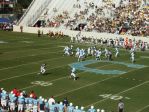
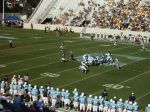
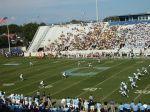
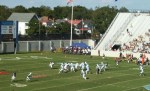
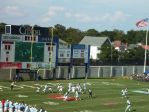
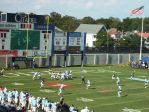
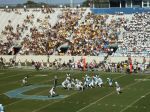
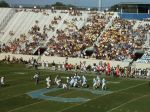
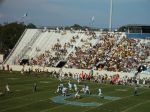
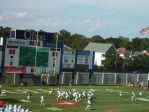
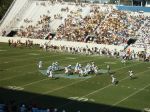
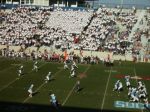
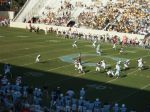
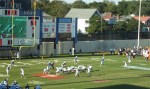
It wasn’t a perfect performance by any stretch, but good enough. It was a spirited effort on a warm afternoon at Johnson Hagood Stadium, before a largely appreciative Parents’ Day crowd.

I’ll write more about this game when I preview the Georgia Southern contest later in the week. Just a few quick thoughts:

– It was hot. Hot, hot, hot.

It was hot enough it that occurred to me The Citadel might be better off wearing white jerseys for the game (thus forcing Appalachian State to wear black jerseys). However, I am sure the SoCon officials would not have allowed that, as they clearly enjoy harassing The Citadel about uniform choices.

– Marcus Cox was very impressive for the Mountaineers. He is a very effective runner, and maybe even a better pass-catcher out of the backfield. I won’t mind him playing in the Sun Belt next season instead of the SoCon.

– Both teams weren’t afraid to deliver some big hits throughout the game. Appalachian State’s Tony Washington should get credit for hanging on to the football (for a thirty-yard completion) after getting popped by Brandon McCladdie. Another Bulldog getting his money’s worth was Jake Stenson, who had a major league block on Dupree’s 53-yard touchdown run in the third quarter.

– On which play was the ball highest in the air at its uppermost point — Mitchell Jeter’s critical interception in overtime, or Thomas Warren’s game-winning field goal? I think my vote would go to the interception.

– Saturday’s contest marked the first time The Citadel had ever ended an overtime game by converting a game-winning field goal. The program’s only other OT triumph decided by a field goal came at Chattanooga on November 3, 2001. In that game, the kick was made in the first overtime session; the Bulldogs then intercepted a pass while on defense to clinch the win, basically the reverse of what happened against Appalachian State.

The Citadel’s other OT victories all ended with touchdown runs. The two previous OT wins for the Bulldogs at Johnson Hagood Stadium (Western Carolina in 2006 and the crazy Furman game in 2007) were both finished off by Tory Cooper TD runs.

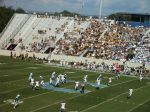
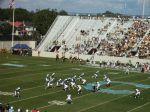
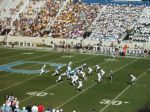
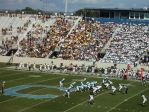
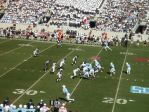
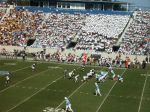
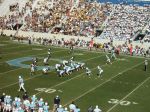
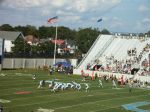
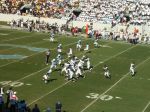
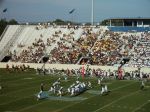
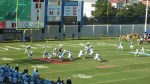
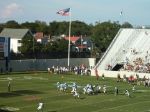
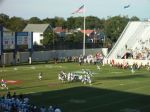
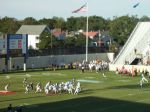
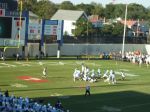
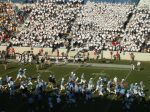
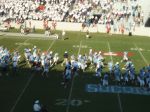
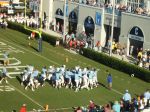
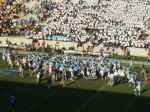
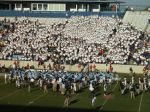
Below are some of the pictures I took on Saturday. There are a lot of them this week. Most of them are mediocre at best, although there are a few that are actually decent (I took those by accident).

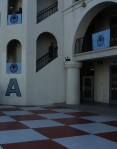
Included are a selection of photos from the Parents’ Day festivities. I had never actually been in one of the “new” barracks until Saturday. I took a few pictures of the interior of the first battalion, historically where the most elite of The Citadel’s cadets reside during the school year.

I also had the chance to talk to a few cadets from Alpha Company, traditionally the most outstanding of the companies within the corps of cadets. As usual, all of them were pleasant and intelligent, and patient enough to put up with an ancient alumnus like me.

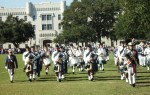
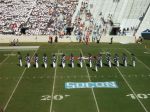
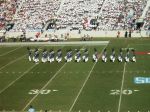
There are a few photos of the parade, and a few other odds and ends. Most of the pictures, though, are of the game itself. I tried to annotate as many of them as possible, so as to give proper context.

2013 Football, Game 6: The Citadel vs. Appalachian State

The Citadel vs. Appalachian State, to be played at historic Johnson Hagood Stadium, with kickoff at 2:00 pm ET on Saturday, October 5. The game will not be televised, although it will be streamed on Bulldog Insider (subscription service) and can be heard on radio via the thirteen affiliates of The Citadel Sports Network. Danny Reed (the “Voice of the Bulldogs”) will call the action alongside analyst Josh Baker, with Lee Glaze roaming the sidelines and Walt Nadzak providing pre-game, halftime, and post-game commentary.

WQNT-1450 AM [audio link], originating in Charleston, will be the flagship station for the network; the station will have a two-hour pregame show prior to each home football game. It is also possible to listen to the game via a smartphone, using a TuneIn Radio application.

Links of interest:

The Citadel game notes

Appalachian State game notes

SoCon weekly release

Kevin Higgins on the SoCon media teleconference

Scott Satterfield on the SoCon media teleconference

The Kevin Higgins Show

Unigate and the Unigate Update

An all-star game called the “Medal of Honor Bowl” will be played at Johnson Hagood Stadium in January 2014

Jake Stenson is having a nice season

My brief review of the Furman game, with less-than-stellar pictures, some thoughts on Unigate, and an examination of first-half playcalling

At the beginning of the season, this next group of games (Appalachian State, at Georgia Southern, at Chattanooga, Samford) was believed to be the stretch that would determine whether or not The Citadel was a legitimate contender for a playoff berth and/or a Southern Conference championship. Obviously things have changed.

Barring a complete turnaround, this is going to be a very disappointing season for the Bulldogs. Historically disappointing, even. There may have been a year with higher expectations that went south in a hurry, but I honestly don’t remember one.

What makes it particularly irksome, I think, is the wasted opportunity. This is clearly the weakest the SoCon has been in many years. There have been past teams at The Citadel with promise that had to go toe-to-toe with excellent conference opponents on a weekly basis, and had a record which suffered as a result. That isn’t the case this year.

I am hard-pressed to find any positives from the loss to Furman. I don’t think the Paladins are very good this season, which makes The Citadel’s struggles on both sides of the ball even more frustrating.

Offensively, the Bulldogs could not move the ball on a young and thin Furman defense. Meanwhile, The Citadel’s D allowed several big plays through the air and continued a recent tradition of not getting consistent pressure on the quarterback or forcing any turnovers.

Each team had the ball four times in the “red zone”. Furman scored three touchdowns and a field goal when it got close to the goal line. The Citadel only managed one TD and one field goal when it moved the ball inside the 20.

That has been part of the story of this season. The CItadel’s opponents have an 80% TD rate in the red zone. The Citadel’s offensive TD rate is only 57%.

I referenced the first-half playcalling in my prior post. I still don’t really understand it.

Darien Robinson wound up with 14 carries for 63 yards, not a great deal of yardage, but not exactly a sign that he was “bottled up” either. A lot of the postgame discussion, though, centered around Furman having “nine men in the box”, which forced The Citadel into trying other options.

I am not so sure. It seems to me the coaching staff planned on calling for first-down throws (among other things) before determining whether or not the Paladins could stop the ground attack. If they did, one wonders why they didn’t use the better passer of the two Bulldog QBs, Aaron Miller, to execute that strategy.

I’m not saying they should have started Miller, however. I’m saying I think focusing on the run game from the start of the contest was the way to go. That’s what the triple option is all about.

For whatever reason, Furman never seemed to bite hard on any play-action. It could be because the Paladins could easily read it, or it could be that Furman’s defense just didn’t respect The Citadel’s passing threat. Maybe both. I don’t know.

When I look at Appalachian State’s football profile, including statistics, I see a team that has some things in common with The Citadel.

The Citadel is 0-3 at Johnson Hagood Stadium this year, the first time the Bulldogs have lost their first three home games in a season since 1965, when The Citadel started off 0-5 at home before winning its season finale against Furman. (Two of those opening three losses in 1965 were to South Carolina and West Virginia, though.)

Appalachian State is 0-2 in Boone this year, and has lost five of its last eight games at home. One of those five losses was The Citadel’s 52-28 whipping of the Mountaineers last season, a game in which the Bulldogs amassed 618 yards of total offense.

The last time App started a season 1-3 was ten years ago, in 2003, but it closed strong that year and finished 7-4.

There is considerable angst in Mountaineer country. It’s understandable. This is a program making a leap of faith, and a tough start in its initial transition season has fans nervous.

Gone is the longtime coach. Gone after this season is the known quantity that is life in the FCS. Suddenly, the yearly string of (often easy) victories has gone as well.

However, it is a bit early to write off Appalachian State, which has lost to three teams with a combined record of 11-1. Noteworthy as well: the Mountaineers haven’t lost to an FCS team with a losing record since 2004.

I won’t pretend to have an insider’s perspective on what went down with Jerry Moore. I only know what I’ve read, and some of those accounts have been conflicting.

It reminds me vaguely of the last days at South Carolina of Frank McGuire, a legendary coach who hung on for a little too long. He was then pushed out of his job in a manner that made more than a few people uncomfortable.

Scott Satterfield was the natural choice to take over. He was a quarterback for App in the mid-1990s, and a coach with the program for many years after that, all on the offensive side of the ledger (including six years as the QB coach and last season as the offensive coordinator).

The question, of course, is if Satterfield has what it takes to successfully lead Appalachian State into FBS play as a first-time head coach. The one thing I can say is his first four games in a transition year were never going to answer that question — actually, this season as a whole won’t answer it.

Appalachian State’s last visit to Johnson Hagood Stadium, in 2011, also came on Parents’ Day. In that game, Jamal Londry-Jackson made his first career start for the Mountaineers at quarterback, and for quite a while it appeared he would never throw an incomplete pass.

He completed his first 15 throws in that contest as App State raced out to a 49-14 lead, before The Citadel made a game of it with a late flurry of TDs (the final was 49-42). The Mountaineers scored on seven of their first eight possessions that day.

Londry-Jackson was the preseason SoCon player of the year, but he has split time at quarterback this season with Kameron Bryant. Londry-Jackson is still recovering from offseason knee surgery. Whether he will return to the form that made him an all-conference performer is hard to say, though I wouldn’t bet against it.

Bryant is also returning from a knee injury, one he suffered last season against Coastal Carolina. Statistically, Bryant has been more effective so far this year than Londry-Jackson, as he has thrown five touchdown passes while only being picked off once (Londry-Jackson has two TDs and two INTs) while rushing for 56 yards on 15 carries (Londry-Jackson has only 15 yards on the same number of rushes). Bryant also has 150 more passing yards in three fewer pass attempts.

The Mountaineers have a plethora of quality wideouts, including sophomore Sean Price, an All-American candidate when he plays. Price missed the first two games of the season due to off-field issues, but he has had 99 (Elon) and 98 (Charleston Southern) yards receiving in App’s last two games. Price is an elite wide receiver and a very tough matchup for any team. There is little doubt Appalachian State will throw several deep balls his way against The Citadel, especially after seeing what Furman was able to do last week.

It only seems like Tony Washington and Andrew Peacock have been catching passes for the Mountaineers for 10 years. Both are now seniors. Washington is a big-play threat who also doubles as App’s kick returner (he had a 51-yard kick return against the Bulldogs last season). Peacock is a fine possession receiver who can also throw the ball if you’re not paying attention (he tossed two TD passes last season). These guys are good.

The Mountaineers may not look to throw to their tight end this week, as there is uncertainty at the position. Two different players have started at tight end for App in the last two games, and they are both injured.

At running back, Appalachian State features Marcus Cox, who has been the SoCon freshman of the week for the past two weeks. Against Charleston Southern, he ran effectively (87 yards) and caught passes out of the backfield (4 for 91 yards). The previous week, Cox rushed for 159 yards — and had 149 yards more receiving. Amazingly, Cox was the first player in App’s football history to have 100 yards rushing and receiving in the same game.

Last season, Appalachian State used a mix-and-match approach to its offensive line, but so far this season the same group of five players has started every game for the Mountaineers. App’s two offensive tackles are both 6’6″; one of them, right tackle Will Corbin, is the only starting lineman who weighs more than 300 lbs. (he checks in at 311 lbs.). Incidentally, Appalachian State is only averaging 4.0 yards per rush so far this season.

Satterfield brought in a defensive coordinator who is new to the Mountaineers, but not to the SoCon. Nate Woody was the DC at Wofford for 13 years before making the move to Boone. He has changed App’s scheme from a 4-3 to a 3-4 (though Kevin Higgins referred to it on his coaches’ show as a 5-2).

Ronald Blair is the starter at one of the defensive end spots on App’s two-deep, but the school’s game notes list him as “doubtful” due to a combination of injury and discipline problems. Blair is the Mountaineers’ most experienced defensive lineman. The other end, Deuce Robinson, is a tall (6’5″), active player.

Another lineman to watch is reserve Olawale Dada, a redshirt freshman who was born in Nigeria but moved with his family to the U.S. at age 2. Dada had 12 tackles last week and may be something of a late bloomer, having only started playing football as a sophomore in high school.

App’s starting inside linebackers, John Law and Karl Anderson, currently rank 1-2 in the SoCon in tackles made. Anderson is a fifth-year senior, while Law took a medical redshirt last year during what would have been his freshman campaign. He somehow suffered a serious ankle injury while getting off the team bus at Chattanooga. You’ve got to watch your step when you’re in the Scenic City.

Of the eight defensive backs on the two-deep for the Mountaineers, six are freshmen or sophomores. The lone senior is cornerback Rodger Walker, who missed time last season while coping with a blood disorder.

As mentioned earlier, Tony Washington is the primary kick returner for Appalachian State. He also returns punts for the Mountaineers, and is effective in both roles.

Sam Martin, App’s longtime punter, now does that job for the Detroit Lions. His replacement is a true freshman walkon, Bentlee Critcher.

The Mountaineers suffered a blocked punt against Montana, and had another partially blocked by North Carolina A&T.

Drew Stewart, the placekicker for parts of both 2011 and 2012, is back in the role for 2013. He is 4 for 6 in field goal attempts through four games this season.

Also worth mentioning:

– There were only nine possessions for each team in the Charleston Southern-Appalachian State game, mainly due to a couple of extraordinary drives by the Buccaneers. CSU’s second drive lasted 17 plays and over nine minutes. Its next-to-last drive lasted 16 plays and 8:50.

Only one of App’s nine drives took more than 2:30 off the clock. As a result, Charleston Southern dominated time of possession, holding the ball on offense for over 42 minutes.

The Mountaineers really struggled defensively on third down. Charleston Southern was 10 for 18 on third-down conversions, including three picked up thanks to App State penalties. Four times the Buccaneers went for it on fourth down after not converting on third down; CSU was 4-4 in that situation.

– While The Citadel has not fared well offensively or defensively in red zone situations, Appalachian State has been good on defense inside the 20 (52% TD rate), but not so much on offense (a TD rate of 56%).

I have no idea how things will play out on Saturday. App’s offense is not a good matchup for The Citadel’s defense, but that was true last year as well and the Bulldogs acquitted themselves nicely in Boone. The defense was helped a lot by the offense’s ability to make big plays, particularly on third down. Just to refresh your memory (and mine):

Four times against Appalachian State, the Bulldogs were faced with a third down needing six yards or more to move the chains. In fact, all four of those conversion attempts were 3rd-and-8 or longer. The Citadel’s average gain on the four plays? 36.25 yards, with two of them resulting in touchdowns…

That’s not really something you can count on every game. However, the defensive performance that day could be.

The Mountaineers had nine full possessions in [the first three quarters] and were limited to 239 yards of total offense. Five of the nine App drives ended in punts, one in an interception, and another on a lost fumble. Six of those non-scoring drives were over in five or fewer plays, so the defense played its role in The Citadel’s huge edge in time of possession (the Bulldogs had the ball for over 38 minutes in the contest).

The defense did an excellent job preventing [Jamal Londry-Jackson] from making big plays (his longest pass completion of the day was only 15 yards).

The Citadel put a lot of pressure on the quarterback that day and doing so again this year is an absolute must if the Bulldogs have any hope of containing the Mountaineers’ attack. App won’t make the mistake of not throwing deep this year.

Saturday is Parents’ Day at The Citadel, part of a big weekend at the military college. I’m not sure how many people will be in attendance inside Johnson Hagood Stadium when the game begins. I’m confident the tailgating tents will be overflowing, however.

Appalachian State is 1-3, but it’s not really the kind of 1-3 that makes you think the Mountaineers are about to go into the tank. It’s more a 1-3 along the lines of “haven’t quite put things together yet, but probably will”. If App State puts things together on Saturday, it could be a long day for The Citadel.

However, there is talent on the Bulldog roster too, and the poor season to date doesn’t change that. An outstanding performance like the one in Boone last season is well within The Citadel’s capabilities.

Like everyone sitting on the home side this Saturday, I hope to see it.

Social media and the SoCon: the age of Twitter and Facebook

Last week, I saw a ranking of college sports twitter feeds posted at Tennessee’s athletics website. I thought it was interesting, though I wouldn’t want to draw any immediate conclusions from the data.

I decided to see how the SoCon schools compared to each other when it comes to Twitter and Facebook presence. This proved to be difficult, because schools don’t necessarily approach Twitter and/or Facebook in similar ways.

The league is almost evenly split between schools that have football-specific twitter feeds and those that do not. Samford has nine different sports with dedicated twitter feeds; meanwhile, Wofford doesn’t have any. There is significant variance in the number of Facebook pages created by the individual schools. Those are just a few of the differences.

Part of the reason for the contrasting approaches is probably manpower, and part of it is likely philosophical. Not everyone thinks having multiple Twitter feeds and Facebook pages is such a great idea for smaller schools. Says one social media consultant:

In college sports, unlike professional sports, fans usually have an allegiance to a school, not a team. To say that fans would be annoyed by news from other school sports in their Twitter feed might be an error…

We found that the majority of…fans appreciated news from other sports, and wanted one main feed where they could get all the news. Most of the sports communicators I’ve talked with at non-BCS schools say their fans feel the same way. Their allegiance is to the school, not a particular team.

The opportunity to showcase the team across multiple channels is much more important to a school than having a sport-specific Twitter feed or Facebook page…smaller schools (non-BCS schools) need to think about scale, not volume…Their fans bases are simply too small.

Another consideration is the percentage of people who use the different social media elements. A survey taken at the end of last year suggested that usage among internet users breaks down this way: 67%, Facebook; 16%, Twitter; 15%, Pinterest; 13%, Instagram; and 6%, Tumblr.

I would say that if your school decides to have a dedicated feed for a sport on Twitter, then it should have a Facebook page for that sport as well — and vice versa. I also am of the opinion that Instagram is on the rise, and that not using YouTube to promote your school and its teams is a major mistake.

Included in my mini-survey are all current SoCon schools, the school that just left (College of Charleston), and the three schools that will enter the league next year (East Tennessee State, Mercer, and VMI). The numbers listed (“follows” and “likes”) are as of the weekend of July 13-14.

What follows are a few observations, and then some tables, with two caveats:

1) I may have missed a couple of school feeds/pages. If I did, it’s not my fault. It’s the fault of the school(s), for not making it simple for an easily confused person like myself to find their feeds/pages.

2) Twitter and Facebook are far from the only things happening in social media, of course. For example, The Citadel has done an excellent job in recent months using YouTube, and it is not alone on that front. A few schools have taken a spin with Pinterest.  Instagram has been embraced by several of the league members (as well as the SoCon office itself). However, Twitter and Facebook are the focus of this post.

– The league website has a “Social Media Directory” that needs to be updated. For one thing, CofC isn’t in the conference any more [Edit 8/16: the CofC links have now been removed from the directory]. The feeds themselves also need to be checked; some are not valid, and there are also a number of omissions.

I don’t really blame the SoCon office for this as much as I do the individual schools. It’s probably very difficult, if not impossible, for the league office to keep up with team-specific feeds.

On the other hand, someone at the conference probably ought to know that @CoachMikeDement shouldn’t be the listing next to UNCG’s “Head MBB Coach” line, since he hasn’t been the Spartans’ coach for over a year and a half. Wes Miller is clearly upset about this.

– Speaking of UNCG, its AD, Kim Record, is on Twitter, and she is listed as such in the SoCon directory…but her feed is protected.

– Furman’s most-followed feed is its general athletics feed, which is not a surprise. The second-most followed Furman feed, however, is for a coach of a program that has yet to win a game. The Paladins will start playing men’s lacrosse in 2014, and head coach Richie Meade (formerly the longtime lacrosse coach at Navy) has 1024 followers.

– The twitter feed for Furman’s baseball program is run by players.

– Davidson, a basketball-first (if not only) school if there ever was one, doesn’t have a dedicated feed for men’s hoops, and head coach Bob McKillop isn’t on Twitter.

– At least one SoCon head football coach follows two different Jenn Brown accounts.

– Chattanooga’s wrestling feed has 2574 followers, which stacks up fairly well when compared to other programs across the country. The most I found for a collegiate wrestling feed was for Oklahoma State (11857). Defending national champion Penn State has 5750.

The other two SoCon schools with wrestling feeds are Appalachian State and The Citadel, though I should mention that UNC-Greensboro has a dormant feed as well (one that became inactive when the school dropped its wrestling program).

– Several SoCon schools have twitter feeds for their equipment room/staff. They tend to be fairly well-followed, too, partly because equipment room staffs from across the country all follow each other. Equipment guys circle the wagons.

– The new head football coach at East Tennessee State, Carl Torbush, isn’t on Twitter. However, there are two different parody Carl Torbush accounts, though both are inactive. ETSU’s athletics twitter feed is following one of them.

– I only found one other fake twitter feed for a conference football coach. Western Carolina’s Mark Speir has been so honored. Also parodied: SoCon commissioner John Iamarino.

– As of this weekend, Samford only had 44 followers for its men’s hoops feed, but that’s because it only established the feed on July 2.

– VMI seems to have two different official university (non-athletic) twitter feeds. Neither has many followers; perhaps I’m just missing the “real” feed.

– Of the six SoCon schools that have dedicated twitter feeds for both baseball and men’s basketball, five of them have more baseball feed followers, which may say something about the league’s status in each sport. I didn’t include College of Charleston in that group of six since it is no longer in the league, but it also has slightly more baseball feed than hoops feed follows.

– East Tennessee State doesn’t have a football twitter feed yet, or a pigskin Facebook page, but it does have a notable fan “bring/brought back football” presence for Twitter and Facebook.

– Wofford athletics only follows one feed, that of PGA pro (and Wofford alum) William McGirt. Similarly, the Facebook page for Wofford athletics only “likes” one entity — the 2012 Southern Conference basketball tournament.

– GSU head football coach Jeff Monken takes it one step further than Wofford, however. Just like Jay Bilas, Monken doesn’t follow anybody.

– With VMI being admitted to the league, the Southern Conference facebook page made sure it “liked” VMI’s university facebook site. Unfortunately, it appears the actual “active” VMI school facebook page is this one.

– UNCG is the league school with the most sport-specific Facebook pages, having one for eleven different varsity sports.

– I found a few sport-specific facebook pages that are essentially dormant. However, they are still “official”, and since they have not been deleted I included them in the tables.

– Of the lower-profile SoCon sports, volleyball may be the most active in terms of social media. Seven conference schools feature Facebook pages for volleyball, and that doesn’t include CofC or ETSU, both of which also have pages for their volleyball teams. CofC and ETSU join six SoCon schools that also have twitter feeds for volleyball.

Some of the Twitter and Facebook statistics for follows/likes are grouped in tables below. I didn’t list all the sports feeds/pages that are on Twitter/Facebook, just some of the ones that tend to draw the most interest.

Twitter

Athletics
Appalachian State 10644
The Citadel 2292
Davidson 3970
Elon 4300
Furman 2951
Georgia Southern 8493
Samford 3131
UNC-Greensboro 3466
UT-Chattanooga 4144
Western Carolina 3773
Wofford 3171
College of Charleston 4726
East Tennessee State 2651
Mercer 1578
Virginia Military Institute 1521

Football
Appalachian State 1133
The Citadel 692
Furman 759
Samford 939
UT-Chattanooga 900
Mercer 1270
Virginia Military Institute 261

Head Football Coach
Appalachian State 2585
The Citadel 555
Furman 236
Georgia Southern 4515
Samford 1005
UT-Chattanooga 571
Western Carolina 1301
Mercer 679
Virginia Military Institute 382

Men’s Basketball
Appalachian State 700
The Citadel 190
Elon 956
Furman 149
Samford 44
UNC-Greensboro 866
UT-Chattanooga 637
College of Charleston 2135

Head Men’s Basketball Coach
The Citadel 335
Furman 675
Georgia Southern 730
Samford 370
UNC-Greensboro 7572
UT-Chattanooga 2438
Western Carolina 1418
East Tennessee State 412
Virginia Military Institute 584

Women’s Basketball
Appalachian State 1338
Davidson 102
Elon 341
Furman 416
Georgia Southern 347
Samford 398
UNC-Greensboro 505
UT-Chattanooga 827
College of Charleston 590
East Tennessee State 374

Baseball
Appalachian State 2141
The Citadel 1263
Davidson 444
Elon 1015
Furman 427
Georgia Southern 1030
Samford 1206
UNC-Greensboro 332
College of Charleston 2413
East Tennessee State 579
Mercer 561

Facebook

Athletics
Appalachian State 5946
The Citadel 2301
Davidson 4771
Elon 4426
Furman 2629
Georgia Southern 12302
Samford 3590
UNC-Greensboro 6276
UT-Chattanooga 6459
Western Carolina 13546
Wofford 4586
College of Charleston 2405
East Tennessee State 3951
Mercer 1865
Virginia Military Institute 3632

Football
Appalachian State 45948
The Citadel 2117
Elon 867
Georgia Southern 3482
Samford 256
Western Carolina 235
Mercer 2244

Men’s Basketball
Appalachian State 2474
The Citadel 74
Davidson 554
Elon 982
UNC-Greensboro 1491

Women’s Basketball
Appalachian State 61
Davidson 187
Elon 648
Furman 612
Georgia Southern 241
UNC-Greensboro 476
UT-Chattanooga 731
College of Charleston 221
East Tennessee State 552

Baseball
Appalachian State 1659
The Citadel 408
Elon 307
Furman 177
Georgia Southern 745
Samford 1282
UNC-Greensboro 170
East Tennessee State 274

Watching a Watch List (from the CFPA), and some early FCS preseason polls

It’s mid-June, and we’re getting closer to actual gridiron activity. There have already been a few national preseason polls released, and a series of watch lists. I decided to take a quick look at a few of them, starting with the CFPA watch lists.

Two or three years ago, the College Football Performance Awards started to get cited by athletic media relations departments on a regular basis. This is when I first began to wonder if anybody with a pulse could come up with preseason and postseason awards and have them publicized by desperate sports information directors. Of course, the folks behind the CFPA would argue they aren’t just anybody:

The goal of College Football Performance Awards is to provide the most scientifically rigorous conferments in college football. Recipients are selected exclusively based upon objective scientific rankings of the extent to which individual players increase the overall effectiveness of their teams.

As prominent scholars from a wide variety of disciplines note, CFPA eliminates the politics and biases that vitiate balloting-based awards. Furthermore, CFPA has received praise from both Republican and Democratic White House officials for promoting objectivity and fairness in college football.

Well then.

Dennis Dodd of CBS Sports wrote about the CFPA three years ago:

Just what the world needs, more college football awards, right? It has gotten a bit silly. Every position and coach is honored to the point that, well, didn’t some group or another just announce the Petrino Award, for the coach most likely to rent?

Anyway, I clicked on the site just for giggles. Something caught my eye…

…The consultants on this project include noted economist Andrew Zimbalist…

…Former Davidson and USC kicker Brad Smith put the CFPA together.

That’s right. An ex-Davidson placekicker is responsible for the CFPA, which has an “academic review” panel that includes, well, academics. The undergraduate degrees received by members of this group include Davidson, Carleton, Kansas, Columbia, and St. Mary’s College. Very few pigskins have been bruised in recent years at any of those schools.

To be honest, at times when I was wandering through the CFPA website (which needs updating in a major way), the thought occurred to me that the whole enterprise was a giant put-on. I don’t think it is (Andrew Zimbalist isn’t going to lend his name to a joke), but it does not inspire a great deal of confidence.

I noticed that a lot of releases from various schools trumpeting one of their players being selected to a watch list included this phrase (or something very similar):

All CFPA recipients are selected exclusively based upon objective scientific rankings of the extent to which individual players increase the overall effectiveness of their teams.

That’s nice, but what exactly is the process that leads to “objective scientific rankings”? Where is the statistical summary? I couldn’t find any nuts-and-bolts description of the CFPA “methodology”, which I found disappointing (no, the overview on page 2 of its Methodology page doesn’t cut it; besides, the page itself hasn’t been updated since 2008).

Last season, CFPA named Harvard quarterback Colton Chapple its QB of the year and its National Performer of the Year. Chapple led a Crimson squad that set multiple offensive records in the Ivy League. He certainly had an outstanding season, but was it really good enough for a player of the year honor at the FCS level? It’s not like the Ivy is considered to be among the better FCS conferences, and Harvard didn’t even win the league — Penn did.

The CFPA claims to control for strength of schedule. Without more information, it’s hard to know it that is actually true.

Also, someone needs to inform the CFPA that the commissioner of the Southern Conference is John Iamarino.

At any rate, let’s take a quick look at the CFPA watch lists, at least from the perspective of The Citadel. A watch list isn’t really scientific — it’s strictly a promotional vehicle — but that’s okay. It gives people something to read during the summer, after all.

FCS Offensive Awards Watch List

– Ben Dupree is on the list of quarterbacks. Also on the list of note: Jamal Londry-Jackson (Appalachian State), Jacob Huesman (Chattanooga), Jerick McKinnon (Georgia Southern), Andy Summerlin (Samford), and Taylor Heinicke (Old Dominion). The Citadel will face a number of quality QBs this season (including Clemson’s Tajh Boyd).

– Darien Robinson is one of three SoCon players on the running backs list, joining Dominique Swope (Georgia Southern) and Fabian Truss (Samford). Tyree Lee (Old Dominion) is also on the list.

– There are no Bulldogs among the “watch list” wide receivers and tight ends, but plenty of The Citadel’s opponents are represented, including Sean Price and Andrew Peacock (Appalachian State), Kierre Brown (Elon), Larry Pinkard (Old Dominion), Kelsey Pope and Zeke Walters (Samford), and Mario Thompson (VMI).

FCS Defensive Line/Linebackers Watch List

– Derek Douglas and Carl Robinson of The Citadel are both on the watch list at their respective positions. Also on the list from the defensive side of the ball: Derrick Lott, Davis Tull, Wes Dothard, D.J. Key, and Kadeem Wise (Chattanooga), Javon Mention (Georgia Southern), Caleb Taylor (Old Dominion), Jaquiski Tartt (Samford), and Alvin Scioneaux (Wofford).

Chattanooga will undoubtedly be championing the CFPA watch list until at least the start of the season.

Several preseason magazines are already out with their predictions and polls. Here are three of them.

Sporting News Top 25

1. North Dakota State
2. Georgia Southern
3. Montana State
4. Eastern Washington
5. Appalachian State
6. Sam Houston State
7. Villanova
8. South Dakota State
9. Illinois State
10. Old Dominion
11. Central Arkansas
12. Northern Iowa
13. Towson
14. Montana
15. Richmond
16. Arkansas-Pine Bluff
17. Northern Arizona
18. Stony Brook
19. Eastern Illinois
20. Chattanooga
21. Cal Poly
22. New Hampshire
23. Colgate
24. Sacramento State
25. Bethune-Cookman

Its preseason All-American list includes Taylor Heinicke of Old Dominion at QB, Georgia Southern’s Garrett Frye and Furman’s Dakota Dozier along the offensive line, and wide receiver Sean Price of Appalachian State. Davis Tull of Chattanooga (DL) and Jaquiski Tartt of Samford (DB) are on the first-team defense.

Predicted SoCon standings:

1. Georgia Southern
2. Appalachian State
3. Chattanooga
4. Wofford
5. The Citadel
6. Samford
7. Furman
8. Elon
9. Western Carolina

Athlon Sports Top 25

Athlon has five SoCon schools in the Top 25, including The Citadel at #25. About the Bulldogs, the magazine says:

A rare sweep of Appalachian State and Georgia Southern last season could be a prelude for an even better 2013. The Bulldogs’ triple option returns quarterbacks Ben Dupree and Aaron Miller, 1,000-yard fullback Darien Robinson and a veteran offensive line.

Athlon’s first-team All-Americans include App’s Price, Chattanooga’s Tull, and Samford’s Tartt, who was one of two Samford players named (Fabian Truss made the squad as a kick returner).

The magazine projects Chattanooga and Wofford will make the playoffs out of the SoCon.

Lindy’s Top 25

1. North Dakota State
2. Georgia Southern
3. Montana State
4. South Dakota State
5. Wofford
6. Eastern Washington
7. Central Arkansas
8. Towson
9. Villanova
10. Sam Houston State
11. New Hampshire
12. Appalachian State
13. Northern Iowa
14. Stony Brook
15. Coastal Carolina
16. Northern Arizona
17. Bethune-Cookman
18. Eastern Illinois
19. Youngstown State
20. Chattanooga
21. Richmond
22. Illinois State
23. Montana
24. Wagner
25. Tennessee State

Lindy’s first-team All-Americans include Tull, Dozier, Dothard, Tartt, and Truss (again as a kick returner). It also has a preseason second-team AA roster; Price and Frye are on that team.

The magazine also makes an excellent point about the expanded 24-team FCS playoff. There will be no Ivy League or SWAC teams participating in the playoffs, and Appalachian State, Georgia Southern, and Old Dominion are all ineligible for postseason competition.

If you assume that the Pioneer League champion will be the only team from that league to receive a bid (which is likely), then essentially there are 91 schools competing for 23 spots in the playoff. Those aren’t bad odds.

Something to think about as the season draws closer…

Conference realignment, SoCon style: finally, expansion rather than contraction

Previously in this series:

SoCon style: history repeats itself

SoCon style: some actual news and a little speculation

SoCon style: the football/hoops conundrum

SoCon style: a look at the varsity sports portfolios of candidate schools

SoCon style: it is definitely nitty-gritty time now

Links of interest (a lot of them)…

From The Post and Courier:

SoCon commish has had enough

Q-and-A with the commissioner

New members bring “stability” to SoCon

SoCon wrap, extreme makeover edition

From the Chattanooga Times Free Press:

Southern Conference adds three members

SoCon expects to hold steady at 10 schools

From the Burlington Times-News:

Southern Conference steps towards stability by adding three future members

From The Macon Telegraph:

Mercer heading to Southern Conference

Audio interview (three parts) with Mercer’s AD

From The Roanoke Times:

VMI accepts invitation to rejoin Southern Conference

From the Johnson City Press:

ETSU accepts invitation to Southern Conference

From the SoCon:

Audio of the teleconference announcing the additions

Not linked: a horrendous column on the conference’s football situation from the Asheville Citizen-Times. In the piece, factual errors were interspersed with snide and generally uninformed commentary.

Several columnists in the league’s geographic footprint decided to pen a “woe is the SoCon” story. The problem was that some of them had obviously not been paying attention to the league since around 1985.

Our nation’s long national nightmare is over…for a little while, anyway. The Southern Conference has added three schools while not losing any other schools in the same 24-hour period. Progress!

SoCon officials said their goal was to replace those schools without expanding its traditional Southern-states footprint.

“We’re not chasing dollars, we’re not chasing markets,” said Wofford [Director of Athletics Richard] Johnson. “We’re chasing what’s best for our student-athletes, and going back to why conferences exist, where athletes are an extra-curricular activity and we can minimize missed class time.”

[The] Citadel athletic director Larry Leckonby said the new league “is really solidified with 10 members who all want to be in the SoCon. They want to be in a geographic conference where we can bus our teams everywhere and give fans a chance to watch all the games if they choose to.

“Most leagues in today’s world have certainly gone beyond regional footprints for other reasons.”

This was a theme repeated throughout the league meetings. Unsaid but implied: the CAA is crazy to have a Boston-to-Charleston geographic footprint.

Time will tell if that is true or not (I tend to think it is), but at any rate the league can’t worry about the likes of Elon, Davidson, or College of Charleston. It has to move on without those schools and the FBS dreamers at Appalachian State and Georgia Southern. Did it get it right with Mercer, ETSU, and VMI?

Most observers seem to think adding Mercer was an excellent move for the SoCon, even if the Macon school is just re-starting its football program. Mercer will be a contender in baseball (38+ wins in each of the last five seasons) and men’s hoops (regular-season Atlantic Sun champs in 2013) as soon as it joins the conference, and has the resources to be competitive in football sooner rather than later.

It’s a good thing the school has those resources, as the Bears’ football program will begin conference play in the SoCon in 2014. Mercer is going to gradually phase in scholarships under Bobby Lamb, the former Furman coach now overseeing things in Macon. In an interview with The Greenville News, Lamb described the enthusiasm for football at Mercer:

We sold 4,000 season tickets, and to put that in perspective, the most I ever sold at Furman was 1,100. The interest we generated was so great that we went ahead and set up for a second level on [the stadium]. What we’ve got down here is pretty special.

Mercer already has a competitive football-specific website: Link

The school last fielded a football team in 1941. The schedule for the Bears that year:

Georgia
Georgia Southern
Wofford
Rollins
Presbyterian
Mississippi College
Newberry
Samford
UT-Chattanooga

There is just a hint of back-to-the-future with Mercer and the Southern Conference, even though Mercer (unlike ETSU and VMI) has not previously been a member of the league. Mercer will be the 44th different school to join the SoCon.

The geography of the Southern Conference will benefit Mercer. Its school president noted this in an op-ed in The Macon Telegraph:

This move will also reduce travel burdens for our student-athletes, whose first priority must always be their work in our classrooms and laboratories. The average distance from Mercer to the nine other Southern Conference member institutions will be approximately 40 miles less than the average distance to Atlantic Sun institutions.

The travel burdens will be reduced to an even greater degree for our student-athletes in football, who will move from competition in the Pioneer Football League to the more geographically compact Southern Conference.

One other thing: while The Citadel’s basketball team has never won the Southern Conference tournament, the hoops program does have one post-season tournament title to its credit. In 1927, The Citadel won the Southern Intercollegiate Athletic Association (SIAA) tournament. In the final, the Bulldogs defeated none other than Mercer (42-41).

That was the last time The Citadel beat Mercer on the hardwood, though the two schools have only played once since 1930. Now they will be competing on the same circuit again. Does that portend a tournament championship for the Bulldogs? (Please let the answer be yes.)

East Tennessee State won the A-Sun baseball tourney this season, and it wasn’t a fluke. That program is on the rise under head coach (and noted clutch hitter) Tony Skole, thanks in part to a new baseball facility. ETSU’s success or failure as a member of the Southern Conference may have a lot to do with another new facility, one for its soon-to-be-reborn football program.

ETSU is scheduled to start playing a full SoCon slate on the gridiron in 2016. By that time, a new football stadium will presumably be in place or well on its way to completion. If it is not, then the SoCon will probably be perceived as having made a mistake in issuing an invitation to the school.

No one wants to play football games in the Mountain States Health Alliance Athletics Center, better known as the “Mini-Dome”. Truth be told, playing basketball games in the building isn’t exactly anyone’s idea of a good time, either.

That may be why there has apparently been some discussion about ETSU moving its men’s and women’s basketball games to Freedom Hall — no, not the University of Louisville’s old arena, but a facility located in downtown Johnson City. The linked article also contains this passage:

But before basketball or football, ETSU has stated their new performing arts center comes first and the university does have its eyes on one piece of land in particular.

That doesn’t sound overly promising for the sports programs.

East Tennessee State was clearly invited back to the SoCon for the benefit of Chattanooga and Western Carolina (and perhaps Samford to a lesser extent). The addition of ETSU gives those schools a closer geographic match for the purposes of travel and/or rivalry.

There are other positives about ETSU. Just to name one of them, I wouldn’t be surprised if the decision by the league and the City of Asheville to extend their agreement for Asheville to host the conference’s basketball tournaments was partly influenced by the Buccaneers’ fan base. That contract will now run through 2017.

Let’s face it, though: when it comes to football, the school currently has no players, no coach, and no stadium. There seems to be no agreement on where a new stadium would be located or when work on its construction would begin.

East Tennessee State will also have to add up to three women’s sports for Title IX reasons (due to the resumption of football), or drop a similar number of men’s sports.

While VMI has been the most-critiqued new addition by the league, ETSU may actually be the biggest risk. I hope the school is ready to take this step.

I would prefer being sure about it.

Ah yes, VMI, a school with a football program one publication described thusly:

You could…say the VMI football program has an upside, in the sense that it really doesn’t have anywhere to go but up.

During the SoCon teleconference, Jeff Hartsell asked the question that had to be asked. What are VMI’s plans for improving football? Will it make an effort to improve football? John Iamarino’s response:

They’ve taken some internal steps, I think, with regard to how they fund the program, how they allocate resources. They are quite aware that football is very important at VMI and certainly to the Southern Conference. I’ve often said, and it’s true I believe, nobody joins a conference to be the doormat, and I know that’s the case with all of [the new members].

None of them are coming in wanting to be at the bottom of the league. Everybody is going to be competitive. We hope that being in the Southern Conference will aid recruiting efforts at VMI, and at Mercer, and at East Tennessee State. That’s what we’ve been told by their administrators and head coaches when we’ve visited those campuses, and we trust that will be the case.

When VMI left the SoCon and moved to the Big South, its recruiting suffered, which may have come as a surprise to certain officials in its administration. Obviously, VMI doesn’t recruit in the same way as some other schools. It has a more limited pool of candidates from which to draw. However, even within that group of potential recruits, the level of competition (to include conference affiliation) does matter.

Being in the SoCon will indeed help VMI. However, it will help all the schools in the league. VMI may get better recruiting classes, but its competition will be better too.

If VMI wants to truly be competitive on the gridiron, it has to be flexible. That doesn’t mean lowering standards. It means giving its coaches and students a fair chance to be successful on the field.

When it comes to football, a commitment has to be made by the folks running the show in Lexington. We will see if that happens.

VMI’s women’s sports were not discussed during the teleconference. I wish someone had asked about them, specifically whether or not VMI will be required to add another women’s sport sponsored by the SoCon.

The school’s varsity sports portfolio for women, while understandably limited (only 10% of Keydets are female), doesn’t quite match up with the league. VMI doesn’t have women’s teams in SoCon staples like basketball, softball, volleyball, cross country, tennis, or golf — but it does have water polo and swimming teams for women.

While it is fair to wonder if VMI can be competitive in football (and in its other varsity sports), it appears that the remaining league members were happy to welcome VMI back to the fold. One school that wasn’t too thrilled about VMI, however, was soon-to-depart Elon:

Sources have said Elon and [school president Leo] Lambert, specifically, have not supported East Tennessee State and VMI for potential Southern Conference inclusion.

That revelation raised some eyebrows, particularly in conjunction with John Iamarino’s rather curt (especially for him) statement on Elon’s move, in which he referred to “Elon’s negative view of the diversity” of the SoCon.

Did Elon’s leadership have a problem with public schools? What were Elon’s relations with the existing SoCon public schools? And which schools did Elon want to add to the league in the first place?

Lambert attempted some damage control, as described in a later article:

“It is absolutely the opposite of the truth [that Elon opposed VMI],” Lambert said. “The fact of the matter is we were active proponents of VMI. I love VMI.”

Lambert said the last vote Elon participated in regarding Southern Conference expansion was to authorize campus visits for East Tennessee State, Mercer and VMI.

“Elon voted for all of them. So that’s the record,” Lambert said. “It was unanimous across the conference. That’s the record.”

Asked about Elon’s collective comfort level with East Tennessee State, Mercer and VMI as prospective Southern Conference members, Lambert responded: “In the final analysis, we voted for all three. But as we were talking about all three, Elon was always really excited about VMI. I think the world of VMI. It’s an excellent school.”

I doubt many of the folks in Lexington really believe Lambert when he proclaims his “love” for VMI. To be honest, I don’t either. Elon’s president got backed into a corner just when he thought he was going to be in extended, full-on celebration mode. (The Burlington paper also ran a column stating in part that it was “reasonable to call Elon ungrateful and greedy.”)

Lambert is well aware that while VMI may not be so hot on the gridiron (to say the least), it has a few other things going for it. History, prestige, cachet. A lot of schools, especially those striving for upward mobility and status, would like to be associated with such an institution. Lambert and Elon apparently did not, which would probably puzzle some of his peers.

After all, a future U.S. president once portrayed a VMI baseball player in a popular movie. On the other hand, probably the most famous video associated with Elon baseball is one of its star athletes starting (and then running away from) a brawl.

Lambert didn’t bother to express any affection, real or imagined, for ETSU.

I don’t enjoy “piling on” Elon — after all, four other schools have left or are leaving the SoCon — but its decision to bolt is a curious one. It is making an arguably lateral move to a more expensive conference, one that has been even more unstable than its current league. I really would like to know what schools Elon would have preferred as new SoCon members. Duke, Vanderbilt, and Boston College weren’t really options.

I will say that the CAA has its fair share of public schools, too, either as football-only (like Maine and Stony Brook) or full members (such as Towson and UNC-Wilmington). Maybe the grassy fields on the campuses of those schools are greener than the lawns of the SoCon institutions.

Some other things from the concluded SoCon meetings worth mentioning:

– This flew under the radar, but the league decided that all eligible teams should compete in conference championship events, starting in 2014-15. What that means is that the baseball, women’s soccer, and volleyball tournaments will not be restricted to just the top eight teams. In baseball, for example, there will be nine schools competing in the SoCon in that season, and even the last-place team will play in the conference tournament.

– All the departing schools are eligible for league titles in 2013-14 with the exception of football for Appalachian State and Georgia Southern (because they will be over the FCS scholarship limit and ineligible for the playoffs as a result).

– A decision on whether or not to raise exit fees won’t be made until the three new members begin participating in league meetings.

– Chattanooga AD David Blackburn said that he expected the league to stay at ten schools:

I anticipate it will stay at 10 for a little while. I think we’re all comfortable staying at 10 and making sure that we develop some quality and further cohesiveness before we just go out and land grab.

Don’t close the door on future additions, though. Furman AD Gary Clark:

We’ve just talked about making sure we do what makes the most sense for the Southern Conference, and I think right now that’s making sure we do the best job of integrating the new members, but we’re always going to be keeping our eyes open and constantly planning and talking strategically.

Of course, when talking about additions you also have to consider potential subtractions. It is my opinion that of the “core group” of seven schools, the one most likely to move is Chattanooga — but not to the OVC, a scenario that has been occasionally mooted.

I could see UTC considering a move to FBS in a few years, though, and leaving for a league like the Sun Belt. It isn’t in position to do anything like that right now, but it is something to keep in mind.

As for future additions, I suspect the SoCon will not go back to the Big South for another school, and at this point I’m not sure any school in the Atlantic Sun is on the short list. That might change if certain schools decide to add scholarships for football.

The other league worth watching, of course, is the perpetually unsettled CAA. The key school right now in that league is James Madison, which appears ready to go the FBS route. JMU is a little picky, though; it’s hoping for a CUSA invite, and likely won’t join the MAC (or Sun Belt) until it has no other options.

That’s all for SoCon realignment news and analysis — for now. The wheel keeps on turning…

Riley Report: Missing mojo; must find immediately if not sooner

This is going to be a ramble more than a coherent essay; I’m just throwing together a few thoughts prior to the SoCon baseball tournament…

Links of interest:

Fred Jordan interview (video)

The Citadel’s tournament notes

Appalachian State’s tournament notes

Western Carolina’s tournament notes

Samford’s tournament notes

Furman’s tournament notes

Elon’s tournament notes

College of Charleston’s tournament notes

Georgia Southern’s tournament notes

SoCon release

Tournament bracket

Quick note on the bracket: The Citadel plays the early game on Wednesday (10 am ET) versus Appalachian State. If the Bulldogs win, they will play at 5 pm on Thursday unless Furman also wins on Wednesday; if both the Bulldogs and Paladins are victorious, The Citadel would play the late game on Thursday (estimated 8:30 pm ET start).

If The Citadel loses to Appalachian State, it will again play the early game (10 am ET on Thursday).

Sunday’s title game is a winner-take-all affair; it is strictly single-elimination, regardless of whether or not the teams playing in it have one loss or no losses. I dislike this format. It should be double-elimination throughout the tournament. The league does it this way for television, but A) the process of determining an automatic bid should not be so subverted by TV; and B) the game isn’t going to be on broadcast TV, anyway.

If you can’t make it to Greenville’s Fluor Field, a free (!) video stream of each game is available from the SoCon. The league championship game will be televised by ESPN3.com. It wouldn’t hurt to register at the league website beforehand, just in case.

Directions to Fluor Field

Ballpark layout

Basically, it’s a carbon copy of Fenway Park, complete with a monster-ish left field wall. The dimensions mirror Fenway.

Day Passes are available for each day of the Southern Conference Tournament, for the low price of just $10. The Day Pass allows you to attend every game for the day in which you purchase.

A Student Day Pass will be also available to students from each of the respective colleges and universities, for only $6. While regular Day Passes can be purchased online, over the phone at (864) 240-4528, or at the Fluor Field Box Office, the Student Day Pass must be purchased at the Box Office and proper school identification must be shown.

Link

To say The Citadel is not riding a hot streak as it enters tournament play is an understatement. The Bulldogs are 5-5 in their last 10 games, but perhaps more pertinent is the fact that The Citadel has lost five of its last seven league games, with four of those losses coming to teams that did not even qualify for the conference tourney. Several of those losses have been brutal, none more so than the last two games of the UNCG series.

At this point the Bulldogs have major issues with the bullpen and some uncertainty about the starting rotation beyond Austin Pritcher. The defense has remained problematic, though the offense has continued to excel. Because of that offense, I expect the Bulldogs to be competitive in this tournament. There is a big difference between competing in the tourney and winning it, though, and pitching problems and defensive foibles suggest that it is unlikely The Citadel will be celebrating a championship on Sunday.

The Bulldogs do have a few things going for them, though.

– The main reason The Citadel is a 4 seed rather than a 1 or 2 seed is its less-than-stellar record against the three schools (Davidson, UNCG, and Wofford) that did not make the tournament. The Bulldogs were only 4-5 against those teams. On the bright side, however, The Citadel won’t have to face any of those squads in Greenville. The Bulldogs are 14-7 against the rest of the conference — 7-2 at home, 7-5 on the road. That’s very solid. Western Carolina, the 1 seed, was 15-6 against tourney teams; CofC was 12-8, and Elon was 10-10. The Citadel’s opponent on Wednesday, Appalachian State, was 7-11 against the other seven teams in the field.

– I think that three of the four teams that the Bulldogs wouldn’t want to face until the championship game are on the other side of the bracket. While Western Carolina has been the best team in the league this year and will presumably be the toughest out, The Citadel is fortunate that Elon, College of Charleston, and Furman will have to get past each other to make it to Sunday. (Things got tougher for CofC with the news that its top starting pitcher, Matt Pegler, is out for the tourney with a broken hand.)

The Paladins, in particular, are a team to watch, not as much for being the host school but because they have a much higher ceiling than a typical 6 seed. Furman has multiple quality victories out of conference this season (including two wins over Coastal Carolina and another versus South Carolina), and also won two out of three against all three schools in its bracket (Elon, College of Charleston, and Georgia Southern). Furman has been inconsistent in league play (and was 4-5 against the bottom three teams, just like The Citadel), but seems to be playing fairly well right now. The Paladins enter the tournament on a five-game winning streak.

– While The Citadel struggled down the stretch, so did several other teams in the league. Georgia Southern has lost seven straight, nine of its last ten, and nineteen of its last twenty-three games. The first three losses in that 23-game downward spiral came against the Bulldogs. Appalachian State is 7-11 in its last eighteen contests. Samford has lost seven of its last nine.

Fred Jordan is going to start Austin Pritcher against Appalachian State, a decision with which I completely agree. The first game in tournament play is critical, and even more so for The Citadel following its last-season slide. The Bulldogs have to get their mojo back sooner rather than later. I don’t like The Citadel’s chances of rebounding from a loss on Wednesday.

Starting the league’s Pitcher of the Year on Wednesday also gives Jordan the option of having Pritcher on the hill on Sunday, should the Bulldogs get that far. Pritcher is probably capable of giving The Citadel some decent innings on three days’ rest. If you started him on Thursday, I have my doubts he would be too effective on only two days’ rest.

The other thing that sometimes doesn’t get taken into account is that there is no guarantee which team will win the other game in The Citadel’s bracket. The idea of “holding” Pritcher to Thursday so as to have the Bulldogs’ best pitcher face Western Carolina is based on an assumption that the Catamounts will easily handle Samford on Wednesday. Maybe they will, but I wouldn’t bet the mortgage on it. WCU swept Samford in Cullowhee earlier in the season, but the score of the first matchup was 9-8.

I’m not overly confident that the Diamond Dogs can shake off the last two weeks and run the table in Greenville, but luckily I’m not one of the people who has to be confident. That requirement falls on the players (and coaches). It will be interesting to see if they are up to the challenge.

Conference realignment, SoCon style: history repeats itself

Everyone knows that the Southern Conference has been through a lot of membership changes over the years, with two splits of particular note leading to the formation of the SEC (in 1932) and ACC (1953). However, there have been other moves of consequence since then, and a few of those are instructive when looking at the current SoCon landscape.

This post is just an overview of some of those machinations. Not all of them, though. That would take up way too much bandwidth…

Tangent: linked above is a 1953 article on the newly formed ACC, which noted that Virginia and West Virginia were “running a neck and neck race” for the eighth spot in the league. UVA won that contest, much to the displeasure of certain WVU bloggers who had been confidently tweeting about WVU’s inevitable invite, despite the fact that Twitter had not yet been created and they had not yet been born.

When it comes to movement among SoCon schools over the last four decades, there have been two major themes:

– Davidson’s skittishness

– Longtime CAA commissioner Tom Yeager’s occasional, grandiose attempts to break up the SoCon

First up, the Wildcats.

The league lost four more members in the seventeen years after the ACC schools made their exit. Washington and Lee departed in 1958, Virginia Tech left in 1965, and West Virginia finally moved out of the conference in 1968.  George Washington dropped out in 1970.

Once the Colonials had left the league, that meant Davidson and VMI were the only two schools remaining in the SoCon that had ever won the conference’s men’s basketball tournament, then and now the nation’s oldest. Perhaps Davidson took this as a sign to start making moves of its own, or maybe those moves would have happened anyway.

At any rate, from that point forward Davidson has been the league’s femme fatale, always a doubt, sometimes leaving, sometimes staying, once actually gone, then suddenly back.

In 1969, Davidson’s football team, led by the estimable Homer Smith, went 7-4 and won the Southern Conference. The Wildcats played in the Tangerine Bowl.

By February 1970, Smith was gone, resigning after the school’s board of trustees decided to cut his budget by almost half. Then in 1973, Davidson decided to de-emphasize football by eliminating football scholarships.  In a move that reporter John Kilgo described as “bush league style”, the school administration notified the press before telling the AD, football coach, or the players. (Kilgo would later become the Wildcats’ radio play-by-play announcer for basketball.)

Davidson’s decision to get out of the scholarship football business didn’t go over very well with some of the other league members, but by then there were other issues too. The looming I-A/I-AA split was one of them. It was a key factor in East Carolina and Richmond leaving the SoCon, and Richmond’s departure also led to William & Mary and VMI leaving — but then the folks in Lexington changed their minds, and VMI stayed.

Both Richmond and ECU wanted to remain at the I-A level, as did William & Mary, and those schools were concerned that the SoCon’s recent or inevitable additions of Appalachian State, Western Carolina, UT-Chattanooga, and Marshall would result in the league becoming a I-AA conference. (Another school that had been interested in joining the league, James Madison, was not seriously considered.)

The departing schools tried to form a new “Big Conference“, which would have included Richmond, East Carolina, William & Mary, VMI, Southern Mississippi, and South Carolina. They were hoping to add two or more of Virginia Tech, West Virginia, and Florida State. It didn’t work out (FSU soon wound up in another new league, the Metro).

Of those schools that left the Southern Conference, only ECU would remain in the subdivision now called FBS.

Then Davidson decided to leave the SoCon, effective July 1, 1977. The school stated that it wanted “to associate with an athletic conference offering national-level competition in basketball.” Sound familiar?

However, the school changed its mind in February of 1977 and decided to stay.

By now the league had two “established” schools (The Citadel and Furman), one recent entrant (Appalachian State), three other new schools (WCU, UTC, and Marshall), and two other schools that had been in the league for a long time but had considered leaving (Davidson and VMI).

It didn’t take that long for Davidson to shake things up again in the SoCon. In 1985, the school decided to join the new Colonial League (later renamed the Patriot League) for football. The rest of the Southern Conference schools, however, turned down Davidson’s request to remain in the SoCon for its other sports. Davidson then left the league in 1988.

Tangent: in another article around that time, it was mentioned that the Southern Conference’s constitution “limits membership to 12 institutions”. I thought that was interesting.

By the following year, though, there were Davidson-back-to-the-SoCon rumblings. That was because Marshall was already making noises about leaving the league (though that didn’t happen until 1997). Among the schools reportedly in the mix at that time: Richmond, James Madison, and William & Mary (all as football-only members, a concept the conference ultimately rejected), Eastern Kentucky (which was still on the SoCon radar six years later), and Liberty.

Eventually, Davidson would be brought back into the league (sans football) in 1992.

Now in the space of two years, Davidson has turned down the CAA and is seriously considering the Atlantic 10. There is nothing new under the sun.

Tom Yeager’s first known attempt to punch a gaping hole in the SoCon came in 1996. At the time, the CAA did not sponsor football. Yeager was intent on changing that, and in a big way. The CAA apparently tried to entice The Citadel, Furman, VMI, and Davidson (yes, despite its football situation) to join a league that would have also included Richmond, William & Mary, and James Madison.

That didn’t happen. Neither did a potential 12-team SoCon football league.

Not on the CAA wish list in 1996: Georgia Southern, which had joined the Southern Conference in 1992. Five years earlier, a SoCon spokesman had suggested that GSU was “a little bit beyond the fringe geographically” to become a league member. However, a little-known shift in a continental tectonic plate moved Statesboro significantly closer to conference headquarters, and Georgia Southern was eventually invited.

Yeager came back with a vengeance in 2000, and this time he had an even bigger idea. The CAA went after no fewer than seven Southern Conference schools: VMI, Furman, The Citadel, Davidson, Wofford (which had joined the SoCon in 1997), UNC-Greensboro (which had also joined the conference in 1997), and the College of Charleston (a SoCon member since 1998). The CAA would have been a fourteen-member league, with eight of those schools playing football.

The gambit failed when Richmond stunned the CAA in May by moving to the Atlantic 10. In the wake of UR’s departure, the SoCon invited JMU and William & Mary to join. However, those schools elected to stay in the Atlantic 10 for football. Eventually, the Atlantic 10 football schools would all fall under the CAA umbrella (though that didn’t officially happen until 2007).

At the same time the SoCon was extending invites to JMU and William & Mary, the CAA offered VMI a spot in its league. VMI (second only to Davidson in its league identity issues) decided to stay, but was out of the SoCon three years later. Now, of course, it is a leading candidate to return to the league.

Last year, Yeager and the CAA attempted to grab three SoCon members: Appalachian State (which obviously had FBS aspirations instead), the College of Charleston (which jumped) and Davidson (which said thanks but no thanks). In 2013, internet rumors continue to swirl about various SoCon-to-CAA transfers, from the prosaic (Elon and only Elon) to the fanciful (the fabled “expanded CAA southern division”).

We’ll see what happens — or doesn’t happen. With the SoCon, something usually happens.

Riley Report: From average to good to a championship — taking the next step

When I last wrote about The Citadel’s baseball team, it had an overall record of 17-16, 6-6 in SoCon play. It now has a record of 27-18, 14-7 in the league. Clearly, the squad has played very well over the past three weeks. What has gone right for the Bulldogs?

Let’s take a look at the pitching, the defense, and the offense.

On April 7, the pitching staff had an ERA of 5.64 in SoCon games. That was through twelve games. Nine league contests later, and the team ERA is 4.56, a significant improvement. I think it is also worth pointing out that six of those nine league matchups were on the road.

I thought at the time that the ERA was a bit misleading, as the Bulldogs’ peripheral statistics suggested that the pitching had been a little better than that. The staff had a K/9 rate of 7.36 through twelve SoCon games, and a BB/9 rate of 3.33 in conference action. The K/9 rate is essentially unchanged after nine more league contests (7.35), but the BB/9 rate has actually dropped to 2.88, a very pleasant trend.

Another excellent downward trend has been home runs allowed. The Citadel has only allowed one homer in its last nine league games. The Bulldogs had allowed 10 in its their first 12 SoCon matchups, but now are on a homers allowed pace similar to last year’s 17 in 30 games, which is perfectly acceptable.

—

Time to talk defensive efficiency again. Defensive Efficiency (DER) is the rate in which balls put into play are converted into outs by a team’s defense. With 21 league games played, there is a little more to work with in terms of sample size.

The Citadel has a DER in SoCon play of .688, which is a little better than last season (and which has improved slightly over the past nine league contests). It is also better than the SoCon mean of .684 in 2012 (I am not able to get the current league mean DER, at least not without spending more time than I have calculating it).

You may recall that prior to its recent 10-game winning streak, The Citadel was having an issue with what I termed overaggressive fielding — in other words, errors committed while trying to throw out baserunners who were already on base (pickoffs, steal attempts, runners trying for extra bases, etc.). Through twelve league games the Bulldogs had committed twelve such errors, averaging one per game. In the past nine SoCon contests, however, The Citadel has committed only four of those types of errors.

Perhaps not coincidentally, two of them came in the only game the Bulldogs lost during that stretch.

The offense has kept putting crooked numbers on the board. Counting all games, not just conference matchups, The Citadel ranks in the top three among SoCon teams in OBP (leads league), homers, batting average (leads league), slugging, OPS, runs, hits, and walks. The Bulldogs put the ball in play when they aren’t walked or hit by a pitch, as they are second in the league in sacrifice bunts and have the second-fewest strikeouts.

Four Bulldogs rank in the top 7 in OBP in the Southern Conference. Each of those four players — Bo Thompson, Joe Jackson, Drew DeKerlegand, and Hughston Armstrong — also rank in the top 12 in park/schedule adjusted wOBA.

Thompson, in particular, is having a season to remember at the plate. He is currently fifth nationally in park/schedule adjusted OPS, which is an outcome of being third nationally in pk/sch/adj OBP and sixth in pk/sch/adj slugging.

He has not been getting good pitches to hit lately, but Thompson has been patient enough to take a lot of walks. He only has 20 hits in his last 22 games, but has still batted .290 over that stretch because of all those bases on balls (and occasionally HBPs).

For reasons not readily apparent, Furman decided to pitch to him in the first game of Saturday’s doubleheader. Thompson proceeded to go 5-5 with two homers and a double.

Thompson has twelve home runs this season while striking out only fourteen times, which is rather remarkable, but he isn’t the only Bulldog with pop who doesn’t strike out that often in SoCon action. Joe Jackson has hit seven of his eight homers in league games while only striking out nine times in conference play.

I don’t think there is any question that The Citadel’s offense, if it keeps up its current pace, is championship-caliber. If Tyler Griffin is able to return from his injury in time for the SoCon tournament, that will add yet another quality bat to the mix.

Another thing to watch is Bo Thompson’s ability to play first base. He played in the field last week against Charleston Southern, his first game in a role other than DH since hurting his ankle early in the season. If he can return to playing first base on a semi-regular basis, that could give Fred Jordan a bit more flexibility in his lineup options (though Calvin Orth has now cemented a role as an everyday player with his fine performance this season).

Whether or not the Bulldogs can take the “next step” from being merely a good team to a title-winning squad is clearly dependent on the pitching and defense. As far as the defense is concerned, I think it is basically a known quantity at this point.

The Citadel has an average to slightly above-average Southern Conference defense, one that can probably hold up as long as it avoids “unnecessary” errors. The team is capable of making the routine plays in the field, and its overall defensive range is adequate.

I am not entirely sure about the pitching, though there are a number of positives to consider, particularly in a tournament situation. The Citadel has the all-but-required “ace” in Austin Pritcher, who while not quite in the mold of Asher Wojciechowski or Jonathan Ellis is definitely a quality No. 1 starter.

The bullpen also has the depth the Bulldogs will need at Fluor Field in late May, provided that Zach Sherrill and David Rivera don’t wear out by then. The two pitchers have combined for 65 appearances in The Citadel’s first 45 games. Having a closer who can finish off batters (Skylar Hunter has 35 strikeouts in 26 1/3 innings) will also be helpful.

Earlier I mentioned that The Citadel has a K/9 rate of 7.35 in SoCon play, which is good but not quite at the level of some of the Bulldogs’ championship teams. For example, the 2010 pitching staff had a K/9 rate of 8.72 in league play. That is not insignificant, though it is also true that with the new BBCOR bat standards, pitching to contact tends to be rewarded now more often than it was in 2010.

Three quick notes:

– I don’t think the Bulldogs have much of a shot at an at-large bid this season. Jeff Hartsell summarized The Citadel’s case; it’s just not good enough, not in a slightly down year in the Southern Conference. Now, if the Bulldogs were to beat UNC on Wednesday and win all but one or two of their remaining league games, then maybe this subject can be revisited.

It would also help if Western Carolina went into a tailspin and opened up the league title race, though that doesn’t look likely. The Catamounts are hot and only have six conference games remaining, three of which are against Wofford and all of which are in Cullowhee.

– The Citadel doubled up on last week’s SoCon awards, claiming both Pitcher of the Week (Austin Pritcher) and Player of the Week (Johnathan Stokes). Pritcher is finishing a fine career at the military college in style. He also is one of three Bulldog starting pitchers named Austin, which probably leads the nation.

Stokes has a respectable 22 hits in 21 league games — but in those 21 games, the shortstop also has 18 runs batted in. He makes his hits count. When runners get on base, Stokes is ready to bring them home.

– I tweeted about this a couple of weeks ago, but I wanted to mention it again. Appalachian State’s last scheduled appearance in Riley Park will come at the 2014 Southern Conference tournament, much to the Mountaineers’ relief. Counting the league tourney, The Citadel has an alltime record of 29-2 against Appalachian State at Riley Park. No, that’s not a typo.

29-2. Just incredible. App hasn’t always been that strong in baseball, but it has usually been decent. Fred Jordan’s combined College Park/Riley Park record against the Mountaineers is a staggering 37-3. Appalachian State’s only series win against the Bulldogs in Charleston came in 1973, when Chal Port was still an assistant on the football team (in addition to his duties as head baseball coach).

It’s stretch time for the Diamond Dogs. There are eleven regular season games remaining, including nine league games, a game at Charleston Southern, and the aforementioned contest in Chapel Hill this week versus North Carolina. After the final league series, the action moves to the league tournament in Greenville.

It’s time for the team to make its case as a championship outfit. The potential is there.

Conference realignment, SoCon style: the football/hoops conundrum

Previously:

It is definitely nitty-gritty time now for the SoCon

A look at the varsity sports portfolios of SoCon candidate schools

After Georgia Southern and Appalachian State announced they would be leaving the Southern Conference for the Sun Belt last week, SoCon commissioner John Iamarino held a media teleconference. All in all, he did a good job, sounding reasonably confident about his league’s future. Among other things, he had this to say:

If we assume we’re adding three schools to replace the three we are losing, you don’t get that opportunity often. We could strategically look at what can help us where we need help, and I’ve said I’d like us to get better in basketball.

But we also have to look at football. We are losing two outstanding programs, and football matters in this league and in this part of the country.

This came on the heels of an interview in the Chattanooga Times Free Press in which Iamarino stated:

No matter how much success we’ve had in football, and we’ve had a lot of it, FCS football doesn’t pay off on a national level the way winning games in the NCAA tournament does for you.

Unfortunately, it’s becoming more and more evident that the one common component of the mid-majors who’ve had some of the greatest success in basketball — Gonzaga, Butler, Davidson — is that they don’t play scholarship football. It’s difficult to find a FCS program that’s also successful in basketball.

He isn’t wrong. Part of the reason for that is schools that spend the most money on their men’s basketball programs tend to be the most successful, and schools that field scholarship football teams at the FCS level generally don’t have the resources to commit to both sports (in some cases, they have the resources but not the focus).

Only one school with a full-scholarship FCS program is ranked in the Top 60 in men’s basketball expenditures. Villanova is 31st.

Note: all references to expenses are per the 2011-12 school year, as reported to the U.S. Department of Education.

It is not an accident that four of the eight schools that advanced to the NCAA regional finals in men’s basketball this season also rank in the top 8 in terms of money spent on hoops. Duke ranked first, with almost $16 million in expenses, followed by Louisville. Syracuse was fourth, and Marquette eighth. Kentucky was third; the Wildcats missed the NCAAs this season, but won the national title the previous year.

Another regional finalist, Florida, wasn’t far out of the top 8 (thirteenth). The exception, in a sense, was Wichita State (68th), but basketball is clearly a focal point for the school, as it does not field a football team.

A majority of SoCon schools don’t put that type of emphasis on men’s basketball. Southern Conference institutions averaged about $1.44 million in men’s hoops expenditures (that includes the three departing schools), while spending a total on average of $14,117,677. That means only 10.2% of expenses went towards men’s basketball.

Iamarino mentioned Gonzaga, Butler, and Davidson. Men’s basketball accounted for 28.6% of Gonzaga’s expenses and 26.6% of Butler’s. For Davidson, that number was a more modest 16.3% — but that percentage is the highest in the SoCon.

Davidson may not spend the most money on hoops in the league (in 2011-12 Samford did), but clearly it puts more emphasis on the sport than any other school in the league. In smaller leagues, that may matter almost as much as the actual gross expenses. It certainly goes a long way to explaining Davidson’s success in basketball within the conference itself.

In contrast, men’s basketball expenses for South Carolina ranked 20th nationally ($7.3 million), but only made up 8.39% of its total expenses. The Gamecocks are still searching for their first NCAA tournament victory since 1973.

Before the Southern Conference adds schools, the powers that be are probably going to have to decide whether to begin a transition to a hoops-first league, or continue as a conference that historically values football over basketball. While Davidson is clearly a “basketball school”, as is UNC-Greensboro (since it has no football program), most of the current membership savors fall Saturdays above all else. This is certainly true for The Citadel and Furman, the two schools with the longest continuous membership in the league.

The conference’s dilemma may perhaps be best demonstrated by comparing Furman and Davidson. They are fairly similar private schools, though Furman is larger and has a much bigger budget for varsity athletics.  Furman offers (or will offer) 20 varsity sports. Davidson offers 21 varsity sports. Furman plays scholarship football and treasures it; Davidson fields a team, but doesn’t offer schollies in the sport.

— Furman total athletic expenses: $20,531,292. Davidson total athletic expenses: $10,603,460.
— Furman men’s basketball expenses: $1,679,288. Davidson men’s basketball expenses: $1,727,330.

Davidson spends more money on men’s basketball despite Furman spending twice as much money on its total sports portfolio.

The major difference is football, of course. Furman’s athletic expenses in football for 2011-12 were $5,414,705. Davidson spent only $790,295 on football.

Football may be part of the reason why 45% of Furman’s expenses are for athletic aid (scholarships), while Davidson, with comparable tuition costs, spent 28% of its total expenses on athletic aid.

I put together a spreadsheet that lists various athletic expenses for a cross-section of Division I schools. Most of these schools are not candidates to join the Southern Conference, but I wanted to show (and also get an idea myself) of how schools in general spend money, at least at the non-BCS level.

There are 75 schools listed on the spreadsheet. All are in non-BCS leagues and most of them are east of the Mississippi. I included every SoCon school, and a majority of schools from the Big South, Atlantic Sun, CAA, Patriot League, and Atlantic 10. I also noted the current league affiliation for each school (through the 2012-13 school year).

The spreadsheet can be accessed at the following link:

2012 expenses, varsity athletics — selected schools

A few (okay, more than a few) caveats: I’m not an accountant, but I do know that some of these numbers could be a little…tricky. Different schools may have different ways of counting expenses, etc. Exact comparisons can be dicey, especially when you take a look at the numbers of, say, the Ivy League institutions.

Also, I try to avoid referring to budgets rather than expenses, because there is a difference.

I compiled five expense categories: total expenses, football expenses, men’s basketball expenses, athletic aid, and coaching salaries. It wasn’t hard to do, just a touch monotonous.

Observations about various schools that are in the SoCon, that are candidates for the SoCon, and a few that aren’t:

– Richmond spent $5.56 million on football, more than any Southern Conference school, and more than any FCS school on the list except James Madison ($6.6 million), Delaware ($5.6 million), and Liberty ($8.3 million). Old Dominion also spent more than Richmond, but ODU is transitioning to FBS. Richmond also spent $3.9 million on basketball.

– William & Mary spent $4.5 million on football, fitting comfortably in the middle of a group that includes Furman, Samford, Elon, and The Citadel.

– Athletic aid is a significant part of expenses for all schools, but especially private schools. Of those schools I surveyed, fifteen of the sixteen that had the largest percentage of athletic expenses allocated to athletic aid were private. The one exception: The Citadel.

Of The Citadel’s total expenses, 40.4% were for athletic aid. It is possible that is the highest percentage for a public school in all of Division I.

– Schools that had 20% or more of their expenses go for coaches’ salaries included Davidson, Georgia Southern, Western Carolina, VMI, and North Florida. Among the schools below 12% in that category: Furman, Wofford, Presbyterian, James Madison, and Tennessee Tech.

– Not referenced in the spreadsheet but of interest: UNC-Wilmington has formed a committee to review its varsity sports programs, after its chancellor said the department had been neglected for a decade.

– Unless you consider Belmont and JMU serious candidates, UNCW is the only school regularly or even semi-regularly mentioned as a possible addition to the Southern Conference that spent as much money or more on men’s basketball as did Samford, Davidson, or Furman — despite the fact that several candidate schools (Mercer, Kennesaw State, and East Tennessee State, just to name three) didn’t have football programs in 2011-12.

Of course, Florida Gulf Coast’s spending on men’s hoops would have put it in the bottom half of the SoCon, and that school seems to have done all right. It should also be pointed out that Mercer had a fine team this past season and finished ahead of FGCU in the Atlantic Sun standings. I think the real conclusion to draw is that the Mercers and the ETSUs of the world are going to have to seriously ramp up their fundraising as they add football, especially if they move to a new conference, and that additional money will be spent on other sports besides football.

– When it comes to total expenses, James Madison and Liberty probably wouldn’t have many issues in moving to FBS, as both schools compare favorably to most Sun Belt and MAC schools. Appalachian State is a little behind them, but not totally out of line (though I wonder about travel expenditures). Georgia Southern has a lot of work to do. A lot.

I wrote about GSU when if first considered making the FBS jump, back in 2009 (when it released its initial “Football Reclassification Analysis“). I thought it would be a mistake then, and I’m still a bit dubious today, even with (or perhaps because of) the changing landscape of college athletics.

– Davidson has been mentioned as a candidate for the Atlantic 10. One problem the school would have is that its current men’s hoops budget would be the lowest among all A-10 schools, and there would be a major increase in travel expenses (not unlike last year’s proposed move to the CAA that Davidson declined to make). One A-10 member, Rhode Island, spent $4.6 million on men’s basketball in 2011-12, almost $3 million more than Davidson. Of course, the Rams have a cumulative record over the last two seasons of 15-45.

There were a few expense-related items not contained in the spreadsheet I wanted to briefly mention, for no particular reason other than I thought they were interesting, if not surprising.

– When Duke lost to Lehigh in the 2012 NCAA tournament, it was a case of a men’s basketball team with $15.9 million in expenses losing to a team with $1.4 million in expenses. That may be some kind of record.

– While Texas has the largest varsity athletics budget ($129 million, including over $20 million in coaching salaries alone), it appears that Alabama spent the most on football in 2011-12: $36.9 million. Right behind Alabama in football expenses was Ohio State, with $34 million. Alabama has won three of the last four BCS titles; Ohio State was undefeated last season. I guess they got their money’s worth.

– SEC schools as a group spent $262 million on football in 2011-12. That did not include the expenses for Texas A&M or Missouri.

– Kentucky ranked fifteenth nationally in total athletic expenses. That was only the eighth-highest total for an SEC school.

There is another aspect to the football/basketball emphasis question that has to be considered. It was most recently mentioned by John Iamarino after the Barry Alvarez “we’re not playing FCS schools anymore” brouhaha in February. While being interviewed about that, Iamarino said:

The only reason to have 63 scholarships is to be eligible to play FBS teams and count toward their bowl eligibility. If those games go away, the entire subdivision would have to look at if 63 is the right number. Could we save expenses by reducing the number of scholarships? It would seem to me that’s one thing that would have to be looked at.

This may be the elephant in the room.

First, I believe Iamarino was mistaken when he said that “the only reason” to have 63 scholarships is to count to bowl eligibility for FBS opponents, but that’s not really the issue here. Saving money is the issue.

If the Southern Conference wants to become a hoops-centric league while maintaining viable scholarship football, it may be that the league will push for the division as a whole to lower scholarship limits. My guess is that the new limit would be around 50, a significant reduction but still distinguishable from the Division II maximum of 36.

The money saved from reducing scholarships and related expenses could be used to improve men’s and women’s basketball, or perhaps it could be spread around to enhance athletic programs across the board. However, I suspect the league wouldn’t make the move unless the entire division did the same. I am more than a little unsure about that, though.

There are two main problems with reducing scholarships. One is the risk of devaluing the product. At a certain point, customers (and donors) will conclude that the quality of what is being offered is not worth their time or their money.

The more immediate concern is the reduction in opportunities for potential students. One would hope that the scholarships not used in football would at least be used to fund scholarships in other varsity sports, but there is no guarantee that would happen.

I don’t know if this subject will come up when league officials and school administrators meet on April 10, but I would be mildly surprised if it doesn’t. It could be a factor in how the league approaches adding new schools, even if the potential reduction wouldn’t come to fruition for several years down the road.

In a few weeks’ time, league observers should have a very good idea of the SoCon’s strategy moving forward, both in terms of membership additions and any philosophical change in its outlook on football and basketball.

Or maybe we won’t have any idea at all…

Conference realignment, SoCon style: it is definitely nitty-gritty time now

On Wednesday, Georgia Southern and Appalachian State are expected to announce that they have each accepted an invitation to join the Sun Belt Conference. Both schools have been desperately trying to wangle an invite from an FBS league; it looks like it is finally going to happen.

I wrote about this possibility a few weeks ago. Now that it has come to pass, I want to revisit what it means for the Southern Conference and what schools are candidates to join the SoCon as replacements — and also what schools, if any, are candidates to leave the league.

Conference realignment analysis is complicated, to say the least. A move on one side of the country can cause repercussions on the other. No one really has a handle on the hopes and dreams of every single school out there. The difficulties in trying to see what leagues and schools will do can best be encapsulated by this quote from an AD at a Missouri Valley Conference school:

We’re just sitting here wondering if Creighton goes [to the Big East], which of the 26 schools in our footprint that make some sense should we be pursuing.

That’s right. To replace Creighton, there are more than two dozen reasonable candidates, and whichever one is chosen will set off a chain reaction all over the nation — but each different school may set off a different chain reaction. It makes long-range predictions more or less futile (as does the entire process of musical chairs in general).

Despite that, I’ll muddle through this post anyway…

With Appalachian State and Georgia Southern leaving, the SoCon will look like this:

The Citadel
Furman
Wofford
Elon
Western Carolina
Chattanooga
Samford
Davidson*
UNC-Greensboro*

* no scholarship football program

First, let’s discuss the current league schools rumored to be candidates to leave for another conference. That would be all of them.

Seriously, every school in the league has been the focus of various rumors, some with solid sourcing, some just made up. The internet is a wild and crazy place.

The most realistic contender to jump may be Davidson, which has a good hoops program with no scholarship football. If Davidson were a person, however, he would be a very cautious accountant who happens to love basketball (and not much else). This is a school that isn’t changing leagues unless it knows it’s the right decision. It’s not going to jump into a lake like the College of Charleston did and find out the level of the water has dropped eighteen feet overnight.

Elon is the league wild card, as I’ve noted before. At this point I would be surprised if it decided to move to the CAA, but who knows. Chattanooga has (somewhat curiously) been mentioned as a potential Sun Belt candidate, which I think even most of its fan base finds puzzling.

That is what the SoCon has right now. What is going on in the rest of the land that may impact the league? A brief review follows.

Big East (newly minted version)

The new league formerly known as the Catholic 7 is adding three schools. Butler and Xavier are joining from the A-10, and Creighton is moving from the Missouri Valley. For at least one year, the number of league schools will stay at 10. It is widely believed that the new Big East will add two more schools in time for the 2014-15 season, and that both additions are likely to come from the A-10. One will probably be St. Louis, and the other will come from a group that includes Dayton, Richmond, and VCU, with the Flyers being a slight favorite.

The MVC will replace Creighton, but that won’t affect the SoCon. The A-10, however, has already moved forward, will undoubtedly continue to do so, and those decisions will have a trickle-down effect that will be watched by SoCon observers.

Atlantic 10 (which actually had 16 schools this past season)

The A-10 was already losing two schools, Charlotte (which is starting a football program and moving to CUSA) and Temple.

The Owls are moving to the “old” Big East for all sports, and to avoid confusion I’m going to call that conference the Metro, which is surely a better league name than the “America 12”.

With Xavier and Butler gone (Butler having been in the league for about an hour), the A-10 decided 12 schools weren’t enough and added George Mason on Monday. It is quite possible the A-10 will add another school in the near future. Davidson has been mentioned as a candidate for this spot, but there is a catch, as there are reports that Davidson would like a fellow southern school to go with it for travel reasons. The school most often named as pairing up with Davidson is the College of Charleston.

However, Davidson is not the leading contender to be the next A-10 pickup, according to Jon Rothstein of CBS Sports. That would be Siena. Another school reportedly in the mix is Iona.

My fearless (and meaningless) prognostication: Siena joins the A-10, and Davidson becomes a more serious candidate when the A-10 loses St. Louis and one of the Dayton/Richmond/VCU trio next year.

Metro

Tulsa is expected to join this league any week now, leaving CUSA. This would lead to Western Kentucky leaving the Sun Belt and taking Tulsa’s place. Massachusetts may eventually wind up in this conference (though that is far from certain), which would presumably open up another spot in the A-10 in hoops (UMass currently competes in the MAC in football).

Sun Belt

League commissioner Karl Benson wants a conference championship game in football, and he is apparently going to get it. Georgia Southern and Appalachian State will become football members 9 and 10, so the conference needs two more schools to stage a title matchup. According to Dennis Dodd at CBS Sports, New Mexico State and Idaho are going to be added as football-only members.

Idaho has to get permission from its State Board of Education to make the move, which is probably a formality. Not everyone thinks adding New Mexico State and Idaho to the Sun Belt (even for just football) is a good idea.

However, if WKU leaves as expected, the Sun Belt would actually need one more football-playing school to get to 12, and would have to look further into the FCS ranks to find it. From the SoCon’s perspective, the most interesting candidate for that spot (other than longshot Chattanooga) is James Madison of the CAA, which has been left behind in that league by all of its fellow Virginia schools except William & Mary. Losing JMU would be a very tough blow for the CAA. Liberty is also a Sun Belt hopeful, as are a couple of Southland Conference schools (Lamar and Sam Houston State) and Jacksonville State.

CAA

Before delving into the CAA situation, I wanted to mention the press release issued by its commissioner after George Mason decided to join the A-10:

As a result of the George Mason University Board’s decision to withdraw from CAA membership…and in accordance with conference bylaws:

-George Mason’s teams in seven spring sports…will become ineligible for CAA spring 2013 championships.

-George Mason will forfeit its projected 2013 conference distribution of approximately $330,000 and future distributions (through 2017 totaling an additional $1.32 million). George Mason will also pay a minimum liquidated damages fee of at least $1,000,000. Total forfeited funds will be no less than $2.65 million…

…We are disappointed by George Mason’s decision to withdraw from the CAA after 30 years as a charter member.  We wish them well as they strive to achieve the same level of competitive success in a new conference. The CAA’s Council of Presidents will continue to aggressively pursue institutions committed to providing the finest academic and athletic opportunities for our student-athletes.

To me, that comes across as incredibly petty, especially considering GMU was (as stated) a charter member of the conference. As was the case for other schools that recently left the CAA, the athletes were punished for their (obviously huge) part in the crime of leaving the league. Imagine being a senior baseball or softball player and finding out halfway through the season that you wouldn’t be competing for the league title.

Here is the current CAA lineup (at least, as of this second):

Hofstra*
Northeastern*
Drexel*
Delaware
Towson
James Madison
William & Mary
UNC-Wilmington*
College of Charleston*
Richmond#
Rhode Island#
Stony Brook#
Albany#
Maine#
New Hampshire#
Villanova#

* no scholarship football program
# football-only member

Eleven schools for football, but only four of them are full-time members. Nine schools for basketball.

This league is a mess. In my opinion, it’s even more of a mess than the SoCon. It resembles two or three conferences unwillingly jammed into one. In addition, I think at least half of the schools in the basketball version of the league would gladly jump to the A-10 at a moment’s notice, given the opportunity. Heck, some might even consider the SoCon.

Would UNCW be able to resist an offer from the SoCon? It has “reaffirmed [its] commitment” to the CAA, but some think it needs to consider all of its options. Is the College of Charleston feeling buyer’s remorse? Supposedly not, though one suspects that any CofC return to the SoCon could only happen if the SoCon leadership were allowed to throw sharp objects at CofC AD Joe Hull.

Then there is William & Mary, which is going to be really out in the cold if JMU leaves. It would be hard for William & Mary or UNCW, though, to give up the significant amount of money currently on the table for the remaining CAA members.

I’ve written a couple of times about the possibilities for SoCon additions. A few things have changed since the last time I posted about this subject. My thoughts as of right now on a few of the schools in question, plus some off-the-wall ideas:

– Mercer is probably a lock, with the only issue being that the school has not yet committed to scholarship football. As I’ve said before, though, Mercer’s new facilities are not those of a non-scholarship program, or at least not those of one planning to stay non-scholarship. At any rate, Mercer can fill the spot left by the College of Charleston for the immediate future, with a hoops program at least as good and a fine baseball team as well.

– VMI, from a historical perspective, should be in the Southern Conference. Instinctively, VMI should be in the SoCon. However, VMI has issues, and I am not as confident in its chances of rejoining the league as I would have been a couple of months ago. A perceived lack of institutional commitment to varsity athletics may doom the hopes of those hoping to see the Keydets back in the SoCon. I’m not counting VMI out, though.

– William & Mary is possibly more of a sleeper candidate than it was before, thanks to the CAA’s crumbling edifice. I’m still not quite buying the Tribe to the SoCon, but I could be persuaded to rent.

– Richmond would be a football-only pick, and while I’m not crazy about a football-only SoCon member, the idea of grabbing UR for football in order to further attract William & Mary to join in all sports may have merit.

– If the SoCon wanted to be really aggressive and try to fully dismantle the CAA before the CAA tried to destroy the SoCon, it might consider approaching Delaware as a football-only member.

– If James Madison doesn’t wind up in the Sun Belt (or the MAC), the SoCon ought to seriously consider approaching the folks in Harrisburg, too. They might be willing to listen.

– Kennesaw State is starting a football program, and just hired its first coach. The Owls’ first season on the gridiron will be 2015. There has been marginally more chatter about KSU to the SoCon in recent weeks, although I am still a touch dubious about that. If Kennesaw State did join the league, it would help the SoCon maintain its quota of triple option teams, as new coach Brian Bohannon has worked for Paul Johnson at both Navy and Georgia Tech over the past 17 years, coaching quarterbacks and B-backs.

– East Tennessee State is also likely to start (or rather, re-start) its football program in 2015. ETSU may have to make a decision about what league it wants to join, if it has options (the OVC possibly being one of them). It won’t be in any league without a new football facility, though. (Nobody is going to play football at the Mini-Dome.)

It’s possible that ETSU may wind up in the SoCon at the expense of VMI. I wouldn’t be shocked if neither got in, though.

– Coastal Carolina, if anything, is less likely to wind up in the SoCon than before — and it wasn’t going to get in then, either. If I were in the CCU administration, I would fax an application to the CAA every day. It’s probably their best shot at moving out of the Big South.

– Campbell has been suggested as a potential candidate. Like Mercer, it’s one of several southeastern schools (including Jacksonville and Stetson) that have started or are about to start non-scholarship football programs. I’m not really sure what Campbell could bring to the table that the SoCon would want, though. Jacksonville and Stetson would add new markets but are not in the league’s geographic footprint, which I suspect will be a major factor in determining what schools are added.

– Other schools mentioned here and there that I don’t think are serious candidates for the SoCon (but you never know): Presbyterian, Winthrop, Tennessee Tech, Eastern Kentucky, North Alabama, West Georgia, Gardner-Webb, High Point, South Carolina State, and USC Upstate.

USC Upstate was suggested on Twitter by Gene Sapakoff, a columnist for The Post and Courier, who was throwing out the idea of a proposed Atlantic Sun-SoCon merger. Uh, no.

SoCon commissioner John Iamarino has preached patience and a waiting game. I haven’t had a major problem with that. It was inevitable that Appalachian State and Georgia Southern would leave, but there wasn’t anything wrong in letting a few other things shake out nationally before making a move. The league had time.

It doesn’t really have time now. Once Appalachian State and Georgia Southern are officially out, the SoCon has to act, and with decisiveness. I hope the conference has been preparing to do just that. I realize that Iamarino may be hamstrung a bit by a disparate membership, but he has to put together a consensus. He has to add new members that will improve the league.

It’s nitty-gritty time.