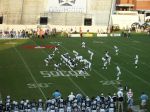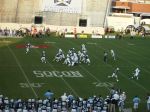
2016 Football, Game 6: The Citadel vs. Chattanooga

The Citadel vs. Chattanooga, to be played at historic Johnson Hagood Stadium, with kickoff at 3:00 pm ET on October 15. The game be televised on multiple Fox regional sports networks, including Fox Sports Southeast, Fox Sports Midwest+, Fox Sports North+, and Fox Sports San Diego. Kevin Fitzgerald will provide play-by-play, while Sadath Jean-Pierre supplies the analysis. 

The game will also be streamed on ESPN3.com and Fox Sports Go.

The contest can be heard on radio via the various affiliates of The Citadel Sports Network. WQNT-1450 AM [audio link], originating in Charleston, will be the flagship station. 

Mike Legg (the “Voice of the Bulldogs”) will call the action alongside analyst Lee Glaze.

It is also possible to listen to the action with a smartphone, using a TuneIn Radio application.

Links of interest:

Parents’ Weekend information

– Game notes for The Citadel and Chattanooga

SoCon weekly release

Brent Thompson 10/11 press conference, including comments from Tevin Floyd and Cam Jackson (video)

Brent Thompson’s 10/12 radio show (video)

Brent Thompson interviewed by Phil Korblut of SportsTalk (audio)

Russ Huesman’s 10/11 press conference (video)

UTC 10/11 press conference featuring players Taylor Reynolds and Alejandro Bennifield (video)

Inside Chattanooga Football (video)

The Citadel has four road wins, most in Division I

With the hurricane behind them, Bulldogs ready to play Chattanooga

Chattanooga eager to play The Citadel

The stress from the upcoming game gives Mocs coach Russ Huesman a sore neck

Mocs running back Derrick Craine is having a very good season (again)

Chattanooga practicing in full pads to prepare for The Citadel

Ultimately, it’s just another conference game

Hey, a little news about Bulldog Hoops!

Updated options for North Greenville tickets

Ryan Bednar has come a long way

Radio open for the game on The Citadel Sports Network

– FCS Coaches’ Poll

Additional link of interest that isn’t necessarily sports-related (although there is a little football talk):

A conversation with John Rosa

I linked the ticket options update above, but let’s take a closer look:

Fans who have tickets for last week’s rescheduled football game against North Greenville can use them for this week’s top-10 matchup against Chattanooga.

“Because The Citadel’s Parents Weekend has been rescheduled to this weekend, we felt we needed to offer fans who purchased tickets because of Parents Weekend the opportunity to still use those as originally intended,” Athletic Director Jim Senter said. “We understand many plans were changed due to the hurricane, and we want to allow those who planned to attend our football game as part of their Parents Weekend activities to still be able to do that.”

Anyone with a ticket to the North Greenville game that was not used last Thursday night at North Greenville can exchange that ticket for admission to Saturday’s home game against Chattanooga. Exchanges are required because if a ticket has already been sold in that seat for this week’s game, the North Greenville ticket holders will be reseated to the best available location. Every effort will be made to keep seat locations as close to the original location as possible.

Fans unable to attend this week’s game will have their ticket honored with an additional ticket in general admission seating at The Citadel’s home game against ETSU on Oct. 29 or can donate their ticket to the Junior Bulldog program, which benefits orphanages and foster families in the Lowcountry.

I think it may be difficult for some people who had tickets to the North Greenville game to be in attendance for the Chattanooga contest. Presumably a significant amount of tickets were purchased by families as part of the Parents’ Weekend festivities. Some of them will return, but a week’s notice is going to be tough for more than a few folks, especially those who hail from outside the southeastern United States.

I’m not sure how that will affect this week’s turnout, or general ticket availability. How much reseating will be necessary?

Earlier this week, my initial reaction to the talk about this being a sellout, or a near-sellout, was just that: it was only talk.

Chattanooga isn’t going to bring a lot of people (the Mocs rarely do; it’s a long trip, after all). No one should be expecting as many Parents’ Day attendees on short notice as there would have been for the North Greenville game. I didn’t see how attendance would make a big jump.

Now, though, I get the impression that Johnson Hagood Stadium will be close to a packed house, especially with any kind of decent walk-up crowd (and the weather on Saturday will apparently be cooperating on that front). The scene should look great on TV, too.

I know The Citadel’s players are more than ready to finally play another home game. It appears the same may be true of the Bulldogs’ fan base, as well. Eight of the last nine games played by The Citadel have been on the road; I guess absence really does make the heart grow fonder.

I will say this, though. If someone plans on exchanging a ticket from the North Greenville game for a Chattanooga ducat, getting to the stadium early should be a priority. I would imagine there may quite a line to exchange those tickets.

When it was suggested to Cam Jackson by a member of the press that the game against Chattanooga was “different from another conference game”, Jackson politely responded that in the grand scheme of things, it wasn’t.

No sir, every conference game is just as important as the next.

I don’t think Jackson anticipated having to explain basic mathematics to a reporter at the Tuesday press conference. His comment was later referred to by the same scribe as a “dreaded cliché”.

That was a remarkably poor description. Jackson’s statement wasn’t a cliché; it was the simple truth, one undoubtedly drilled into the Bulldogs by the coaching staff, but the truth nonetheless. (Incidentally, Mocs quarterback Alejandro Bennifield said almost the exact same thing at UTC’s presser.)

The Citadel’s season won’t end on Saturday. There are still five regular-season games remaining (four in SoCon play) after the Bulldogs play Chattanooga.

A win or loss won’t define the 2016 campaign. It’s just one link in a chain. It’s not to be completely discounted, of course. However, the world won’t end if the Bulldogs lose, and Johnson Hagood Stadium won’t turn into Big Rock Candy Mountain if they win.

I can even provide a relevant example to prove this.

The first time Johnson Hagood Stadium hosted a matchup of Top 10 teams came in 1992. On October 17 of that year, The Citadel played Marshall before a record crowd. Both teams were undefeated in SoCon action entering the contest.

Marshall won the game, so naturally the Southern Conference title that year was won by…uh…uh…uh…

The Citadel.

Sometimes people forget that. They shouldn’t.

As is traditional, nomenclature must be established when discussing Chattanooga. I’ve written before (more than once, to be sure) about the school’s identity/branding issues.

Chattanooga has a webpage on its varsity athletics website devoted to the one question that has bedeviled the school for many years: What is a Moc?

 The term “Moc” is short for “Mockingbird.” Mockingbirds are fiercely territorial creatures which protect their homes with courage, determination and skill…

Named after legendary football coach A.C. “Scrappy” Moore, Scrappy, the Chattanooga mascot, is a fixture for the Mocs.  A re-design in 2008 puts Scrappy in the image of the State Bird of Tennessee, a Mockingbird.  The mockingbird is known as a fierce protector of its nest and environment. It is sometimes seen swooping down on a dog, cat or predator that may be venturing too close to the bird’s protected territory.   Once described by “Late Night” host Jimmy Fallon as “a sledge-hammer wielding mockingbird with a heart of Blue & Gold,” Scrappy symbolizes that competitive passion.

Faced with politically sensitive issues and in need of a stronger core identity to help establish a strong brand as Chattanooga’s Team, the athletics department embarked on a comprehensive identity program in 1996. A new direction for the athletics identity was determined, moving away from the politically incorrect Native American Indian imagery.

The “Power C” and the “Cowcatcher logo” are also phrases that apply to branding at Chattanooga. It’s a subject that has even come to the attention of The New York Times.

In this post, I’ll refer to “Chattanooga”, “UTC”, and “Mocs” when discussing its football program.

The most memorable game played between Chattanooga and The Citadel at Johnson Hagood Stadium was probably the 1988 contest, won by the Bulldogs 23-17. As the clock wound down, UTC had a first-and-goal from the three-yard line, with a chance to win the game with a TD and subsequent PAT. However, a big defensive stand by the Bulldogs (featuring key plays by Rob Brodsky, Matt Larkin, and Terrance Young) preserved the victory.

The Citadel had won two consecutive games before that matchup with UTC; it would eventually win seven straight games that season and make the I-AA playoffs for the first time.

How far has Chattanooga come under Russ Huesman? I wrote this in 2008:

You know it’s been a bad season [for Chattanooga] when the beat writer for the local paper notes that “punter Jeff Lloyd, who lost his starting job for three games, may be the Mocs’ most productive player.”

Later in the column he writes that Lloyd has been effective “when he has been able to get a punt off.”

UTC’s struggles have presented an opportunity for assorted anti-football advocates to step forward and call for the program’s elimination. The loudest of these voices is a computer science professor at UTC named Joe Dumas.  From the link:

“This is a perfect time for UTC to get out of the football business for good and concentrate on academics while maintaining successful athletic programs like basketball, golf, tennis, etc.”

Eight years later, Chattanooga has won outright or shared the last three SoCon titles. This season, the Mocs are 6-0 and ranked third in the nation in the FCS Coaches’ poll.

UTC began its 2016 campaign by annihilating Division II Shorter University, 66-0. The following week, the Mocs beat Presbyterian 34-0.

Two games, a combined score of 100-0. Nice start.

Chattanooga has since played four Southern Conference games, winning all four. Only the first of those, a 21-14 win at Furman, was close (though even in that game, UTC led 21-0 before the Paladins made a belated fourth-quarter charge).

A very good Samford team was pushed aside 44-21, with UTC storming out to another 21-0 lead and never looking back. East Tennessee State was then mauled, 37-7 (one of two road games the Mocs have played so far this season).

Last week, Chattanooga led Mercer 38-3 at halftime and 52-10 in the third quarter before settling for a 52-31 victory. That would be the same Mercer team The Citadel beat by one point in the season opener.

UTC has yet to trail in a game this season, outscoring its opponents 148-10 in the first half.

Many of Chattanooga’s relevant statistics are eye-popping.

UTC Opp
Points Per Game 41.8 12.2
Pts Off Turnovers 59 7
Rushing yardage 1384 430
Rushing Attempts 270 185
Yds/rush 5.1 2.3
TDs Rushing 18 6
Passing yardage 1287 936
Comp-Att-Int 93-139-4 97-170-5
Average Per Pass 9.3 5.5
TDs Passing 15 4
Total Off. Plays 409 355
Average yds/play 6.5 3.8
Average yds/game 445.2 227.7
Fumbles/lost 8/2 12/6
Penalties-yards 37-358 33-331
Average/game 59.7 55.2
TOP/game 34:09:00 25:51:00
3rd-down conv. 27/74 18/82
3rd-down conv. rate 36% 22%
Sacks by-yards 16-122 5-43
Red Zone TD rate (21-28) 75% (8-10) 80%

Among other things:

  • The Mocs lead the nation in scoring defense, total defense, yards allowed per play, and defensive 3rd-down conversion rate
  • UTC is third in the nation in rushing defense, and fourth in the country in yards allowed per rush
  • The Mocs are sixth nationally in yards allowed per pass attempt
  • Chattanooga has only been sacked five times, while throwing 139 passes. Meanwhile, its opponents have been sacked 16 times while throwing 170 passes.
  • UTC has a pass completion rate of 67% and is seventh nationally in offensive pass efficiency
  • Chattanooga is also seventh nationally in scoring offense
  • UTC is tenth nationally in time of possession per game (Wofford leads the nation in that category; The Citadel is second)

Now, to be fair, The Citadel has some nice statistics of its own:

  • The Bulldogs are 12th nationally in offensive third-down conversion rate
  • The Citadel is tied for 6th in scoring defense, 12th in total defense, and 12th in turnover margin
  • The Bulldogs lead the nation in rushing offense, and are 6th in the country in yards per rush
  • The Citadel has not allowed a sack all season, the only FCS team that can make that claim
  • The Bulldogs are one of two FCS teams not to allow a successful fourth down conversion so far this season (Sacred Heart is the other). Admittedly, The Citadel’s opponents have only gone for it on 4th down on three occasions.

“We won’t be able to trick ’em.”

– Russ Huesman, describing his offense versus The Citadel’s defense at his press conference on Tuesday.

Of course, this is the same coach who called a trick play for a TD on the first play from scrimmage in last year’s game…

When Russ Huesman’s son, Jacob, finally exhausted his eligibility, there was some question as to whether or not UTC would regress offensively in 2016 with a new starting quarterback. The answer: nope.

That’s partly because the Mocs brought back most of their other offensive starters, but mainly because Alejandro Bennifield (6’2″, 220 lbs.) has seamlessly stepped in as UTC’s signal-caller.

Bennifield (who was involved in the aforementioned trick play) is completing 66.7% of his passes, averaging 9.3 yards per attempt, with fifteen TD tosses against only four interceptions. The junior from Lovejoy, Georgia, is fourth nationally in offensive pass efficiency.

Derrick Craine (5’10”, 205 lbs.) is a senior running back who was a first-team All-SoCon pick last season after rushing for 1,251 yards. His first career 100-yard performance as a Moc came the last time UTC played at Johnson Hagood Stadium, as he had 135 yards in the 2014 matchup.

UTC has at least four receivers who can make big plays. Xavier Borishade (5’10”, 180 lbs.) already has six touchdown receptions this season. The senior was the recipient of the TD toss from Bennifield on the first play of last year’s game against the Bulldogs.

Another wideout, C.J. Board (6’2″, 180 lbs.), is second on the team in receptions. Board has caught three TD passes in 2016. Last year versus The Citadel, Board had 116 receiving yards on five catches.

It should be noted that while the tight end position is not always a prominent feature of Chattanooga’s passing offense, two different Moc TEs caught touchdown passes last week against Mercer.

Chattanooga’s starting offensive line averages 6’4″, 298 lbs.

The line is led by left guard Corey Levin (6’5″, 305 lbs.), who has won the Jacobs Blocking Award the last two years in the Southern Conference. Jacob Revis (6’3″, 295 lbs.) is the Mocs’ starting center, and a preseason all-conference pick.

[Chattanooga is] expected to practice in full pads [Tuesday] and Thursday as they prepare for the Bulldogs’ rough, rugged triple-option attack.

“Most of the time we just go in shells,” coach Russ Huesman said. “You don’t see it much, but when you play option teams, you get low blocks — legal but low blocks — and we’ve got to practice against them at a great speed or we’ll be on the ground the whole game.

I thought this was an interesting approach to preparing for the triple option.

An even better approach for defending the triple option is to recruit players like Keionta Davis (6’4″, 270 lbs.), a defensive end/blunt instrument who was the preseason Defensive Player of the Year in the SoCon. Davis is a Chattanooga native who led the league in sacks last season with 13 1/2 (including two against The Citadel). He already has five sacks in 2016 (and also blocked a field goal attempt against Furman).

Middle linebacker Nakevion Leslie (5’11”, 225 lbs.) was a first-team All-SoCon choice last year. He currently leads the Mocs in tackles. Leslie had 15 stops versus the Bulldogs in last year’s contest.

Fellow linebacker Dale Warren (6’0″, 225 lbs.) is second on the team in tackles. The junior leads the Mocs in tackles for loss, with eight.

UTC has a talented, experienced secondary. Junior free safety Lucas Webb (6’1″, 205 lbs.) has been a first-team all-league pick the last two seasons. Webb, like Davis and perhaps two other Moc defenders, is a legitimate NFL prospect.

Cedric Nettles (6’0″, 205 lbs.) has also been a first-team All-SoCon choice the last two years. The senior had six tackles against The Citadel last season.

Henrique Ribeiro (6’0″, 220 lbs.) is the only Southern Conference placekicker to have been profiled in USA Today this week. The native of Brazil was first-team all-conference last year. So far this season, Ribeirois 5 for 6 on field goal tries, with a long of 52 yards (interestingly, his only miss was blocked).

Ribeiro was Chattanooga’s starting punter last season as well, and has punted 16 times for the Mocs this season, but is listed as the backup at that position this week. Redshirt freshman Colin Brewer (6’3″, 205 lbs.), who has punted ten times this year, is the projected starter.

Brewer is also the holder for UTC. Emory Norred (6’0″, 225 lbs.) is a junior in his third year as the long snapper.

C.J. Board is Chattanooga’s main punt returner, and he is averaging a stellar 8.9 yards per return. Backup running back Richardre Bagley (5’9″, 180 lbs.) is the primary kick returner for the Mocs.

Odds and ends:

– The weather forecast for Saturday in Charleston, per the National Weather Service: mostly sunny with a high of 74 degrees. The low on Saturday night is projected to be 62 degrees. That works for me.

Per one source that deals in such matters, Chattanooga is a 6-point favorite over The Citadel, with an over/under of 49.5. That’s the same over/under that was listed for the Bulldogs’ game last week versus North Greenville.

Other lines involving SoCon teams: Samford is an 18 1/2-point favorite over VMI; Mercer is a 4 1/2-point favorite against Western Carolina; and Furman (despite being winless) is a 16 1/2-point favorite at East Tennessee State. The Citadel’s next opponent, Wofford, is off this week.

Gardner-Webb is a 16 1/2-point underdog against Coastal Carolina this week in Boiling Springs. North Carolina is a 7-point underdog at Miami.

– Massey Ratings: The Citadel is ranked 9th in FCS. Chattanooga is ranked 4th.

Massey projects the Bulldogs to have an 39% chance of winning, with a predicted final score of UTC 28, The Citadel 24.

Other FCS rankings in Massey of note: Samford (12th), Wofford (20th), Mercer (40th), Gardner-Webb (55th), VMI (58th), Furman (62nd), Western Carolina (63rd), East Tennessee State (90th).

Both Samford and Wofford jumped six spots this week. VMI improved by nine positions.

– Next year’s FCS Kickoff Classic will feature Chattanooga, as the Mocs will play Jacksonville State one week before the regular season begins for most of Division I.

This year, that game was between Charleston Southern and North Dakota State. One difference next season is that the contest will be played at a neutral site — Montgomery, Alabama.

– Chattanooga’s roster is largely made up of Tennessee natives, with 49 Mocs hailing from the Volunteer State. Other states represented on UTC’s roster: Georgia (29), Alabama (13), Florida (1), New York (1), and California (1).

– The Citadel’s geographic roster breakdown (per the school’s website) is as follows: South Carolina (47 players), Georgia (23), Florida (9), North Carolina (7), Alabama (4), Pennsylvania (4), Texas (4), and one each from Louisiana, Maryland, Kansas, Oklahoma, Nevada, and West Virginia.

– There were no changes to The Citadel’s two-deep this week. The depth charts for the North Greenville and Chattanooga games are identical.

– On offense, eight Bulldogs have started each of the first five games. Nine players have started every game on defense for The Citadel.

Among active players, Tevin Floyd has the most career starts for The Citadel, with 31 (all consecutive). Offensive linemen Isaiah Pinson and Kyle Weaver have each made 30 straight starts.

After reviewing UTC’s season, it is apparent that The Citadel has a very difficult task on Saturday. The Mocs have no obvious weaknesses, and have mostly shredded their opponents (including whippings of quality teams like Samford and Mercer).

The one slight blip in Chattanooga’s march came at Furman, a contest worthy of further examination. It’s not as much that the game was nominally close (21-14), because the Paladins’ second touchdown didn’t come until 1:01 remained in the fourth quarter.

No, the real story was UTC only scoring 21 points (including just one score in the first half). How did Furman manage that?

The Paladins had a three-minute edge in time of possession. Furman also won the turnover battle 1-0.

Another key stat: Chattanooga was only 2 for 9 on third down conversion attempts, which led to the Mocs only running 53 plays from scrimmage (FU had 65).

Furman’s offense didn’t do much, but its defense kept the Paladins in the game, holding UTC to 288 yards of total offense.

Turnovers and big plays are always critical in deciding football games, and Saturday’s contest at Johnson Hagood Stadium will be no different.

However, based on that Furman game, I might suggest another category worth watching: third down conversions.

The simplest way to slow down UTC’s offense is to keep it off the field. That means the Bulldogs’ offense has to maintain long, time-consuming drives (and convert on third down), while The Citadel’s defense needs stops (especially on third down conversion attempts).

Oh, one other thing: the Bulldogs need to avoid giving up a TD on the first play from scrimmage. That has happened in both of the last two matchups against the Mocs.

Can the Bulldogs pull off the upset? I don’t know, but I’m ready to find out, and in person.

I think that will be true for a lot of people this Saturday.

2016 Football, Game 5: The Citadel vs. North Greenville

The Citadel at North Greenville, to be played to be played at Younts Stadium in Tigerville, South Carolina, with kickoff at 7:00 pm ET on Thursday, October 6. The game will not be televised.

The game will be streamed by the North Greenville Sports Network. Cole Bryson will handle play-by-play, with Brad McGuffin supplying the analysis.

The contest can be heard on radio via the various affiliates of The Citadel Sports Network. WQNT-1450 AM [audio link], originating in Charleston, is the flagship station. 

Mike Legg (the “Voice of the Bulldogs”) will call the action alongside analyst Lee Glaze.

It is also possible to listen to the action with a smartphone, using a TuneIn Radio application.

Links of interest:

– Game notes from The Citadel

SoCon weekly release

Brent Thompson’s 10/4 press conference, including comments from Joe Crochet and Reggie Williams

FCS Coaches’ Poll

– A hurricane puts The Citadel on the road

– Local talent fuels North Greenville

I had planned on writing most of this preview on Thursday night, and had blocked off time on my schedule to do so. Alas, Hurricane Matthew had other ideas.

I just hope the team is more prepared to play the game than I was to write about it…

At times on Tuesday, I wasn’t sure the game would even happen. It will, though, two days early and in another location, a first-time venue for The Citadel’s football program. Repercussions will last for a while:

Ironically, North Greenville was scheduled largely so the Bulldogs would have a fifth home game at Johnson Hagood Stadium this season. With the game now moved to North Greenville’s Younts Stadium, The Citadel will have only four regular-season home games.

That loss of revenue, and the added expense of an extra road trip, means The Citadel’s budget will take a hit this year.

“We are going to incur additional expenses that were not budgeted for,” said [The Citadel’s director of athletics, Jim Senter]. “When we get to the end of the year, we hope we can absorb that. This is not like a normal (road) game for one night. Because of the emergency situation, we are going to have additional expenses related to busing, lodging and meals. There will be an additional cost for us.”

As for how tickets will be handled:

Tickets purchased for the game will be honored Thursday night at North Greenville. Fans unable to attend will have their ticket honored with an additional ticket in general admission seating at The Citadel’s home game against ETSU on Oct. 29 or can donate their ticket to the Junior Bulldog program, which benefits orphanages and foster families in the Lowcountry.

When was the last time The Citadel’s football team played a road game against a team that was not in Division I? I’m not entirely sure, but I believe the answer to that question is 1977, when the Bulldogs played at Delaware, which at that time was in Division II. The Citadel also traveled to face the Blue Hens in 1974.

The Citadel played three other road games in the 1970s against teams that are now D-1 but were not at that time: in 1970 against Arkansas State (then in the NCAA’s College Division); in 1971 versus Bucknell (also in the NCAA’s College Division); and in 1973 against Illinois State (a D-2 school that year).

Prior to 1970, there are several instances of The Citadel playing schools away from home that were not Division I at the time, but which are now. That was even the case in the post-war period.

Some of these matchups were neutral-site affairs, including games at the Orangeburg County Fair against Wofford (the last of which took place in 1959). The Citadel also played Presbyterian in Savannah in 1963.

The last time The Citadel played a road game against a school that was not then and is not now a current D-1 member (other than those institutions that dropped football)? Well, it’s possible that there hasn’t been such a game.

In researching this topic, I discovered that several games listed in the record book as road contests, notably a series of pre-World War II matchups with Newberry, were actually played at Hampton Park. The exception was a 1921 contest played in Florence (a game that ended in a 7-7 tie).

The record book also lists the 1948 games against Presbyterian and Newberry as having been road games, when in fact both games were played at College Park. That facility was used because the “new” Johnson Hagood Stadium was not ready to open at the beginning of the season. (Incidentally, the cost of the brand-new Johnson Hagood Stadium in 1948? $600,000.)

Thus, if North Greenville never moves up to Division I, this contest will wind up being a decided anomaly.

On October 14, 1891, at the fourth annual meeting of the North Greenville Baptist Association, a momentous decision was made. A committee of nine men was appointed to determine the best location for establishing a high school in the northern region of Greenville County…

…The work of the committee led to the establishment of what is now North Greenville University. Benjamin F. Neves offered ten acres of beautiful rolling land midway between Glassy Mountain to the north and Paris Mountain to the south. By 1892 the first building was completed and ready for occupancy, and North Greenville High School began with the arrival of the first students on January 16, 1893.

The State of South Carolina chartered the institution as North Greenville High School in 1904. The next year the Home Mission Board of the Southern Baptist Convention assumed control of the school as part of its Mountain Mission School System, a relationship that lasted 25 years. In 1929, the North Greenville Baptist Association again accepted responsibility for the school which had been renamed “North Greenville Baptist Academy” in 1915.

North Greenville became a junior college in 1934; it was renamed North Greenville Junior College in 1950 (which was shortened to North Greenville College in 1972). High school courses were discontinued in 1959.

The school began offering baccalaureate degrees in 1992, and attained university status in 2006. North Greenville retains an affiliation with the South Carolina Baptist Convention and the Southern Baptist Convention.

North Greenville fielded its first football team in 1994. It had its first winning season in 1996 (7-3), though consistent gridiron success has been difficult to come by. The program went 0-10 in both 2000 and 2001, but under Mike Taylor finished 10-2 in 2006, its best season by winning percentage to date.

Jamey Chadwell was at NGU for three seasons. In his third year at NGU (2011) he led the team to an 11-3 record, the most wins in school history.

After that season, Chadwell made a somewhat curious move to Delta State for a year before taking over at Charleston Southern in 2013. He was succeeded at North Greenville by Carroll McCray, who helmed the program for one year before leaving for his alma mater, Gardner-Webb. McCray’s replacement at NGU was Jeff Farrington.

Jeff Farrington is now in his fourth season as the head coach of North Greenville. He is also a 1982 graduate of The Citadel.

I was a walk-on at The Citadel, a slow, splitback veer quarterback who couldn’t throw and didn’t have a whole lot of people who wanted me to play football. But The Citadel gave me a chance, and I’m forever grateful. It was a great experience, and I got on the field as a defensive back my last two years.

I was a guy they couldn’t run off, and Art Baker and his staff, guys like Cal McCombs, had a really good influence on me. It was a special place and always has been.

Farrington has been an assistant coach at a wide variety of schools, including several in the Southern Conference. He was a graduate assistant at The Citadel for one year, spent five seasons at East Tennessee State, and was on Bobby Lamb’s staff for nine years at Furman.

Before taking the head coaching job at North Greenville in 2013, he had been the defensive coordinator at VMI. Farrington has also coached at Florida State, East Carolina, Lenoir-Rhyne, West Georgia, and Presbyterian. He assisted Lamb in starting the football program at Mercer, too.

Farrington’s staff has plenty of SoCon connections as well. Defensive coordinator Greg Harris is a VMI graduate. Offensive line coach Nic Cardwell is an Appalachian State alumnus, while defensive backs coach Maurice Duncan played for Furman.

Kicking coach Bob Price is an App State grad who spent 16 years as an assistant coach at Furman. Graduate assistant Jeff Ashley played for Wofford.

North Greenville has been an independent in football for several years (the school competes in Conference Carolinas in its other sports). However, that will change in 2018, when the school becomes an affiliate member (football-only) of the Gulf South Conference.

Members of the Gulf South in football: North Alabama, Valdosta State, West Georgia, West Alabama, Florida Tech, Delta State, West Florida, Mississippi College, and Shorter.

This will only be the second time North Greenville has hosted an FCS school (Charleston Southern made the trip in 2007), but NGU has a lot of experience facing D-1 competition.

One thing that is rather clear when a check of the records is made: North Greenville has been very competitive in most of those matchups.

In fact, the Crusaders have four victories over FCS foes, including a 37-24 win over VMI in 2013, Jeff Farrington’s first season in charge of the program. North Greenville has also beaten Presbyterian (in 2010), Jacksonville, and Austin Peay (with both of those victories coming in 2006).

Some of the losses are almost (if not just) as impressive. Wofford outlasted NGU 42-27 in 2014; Charleston Southern won 28-14 in 2013 and 41-31 in 2010; Presbyterian survived 22-15 in 2008. That aforementioned home game against CSU in 2007 resulted in a 46-33 win for the Buccaneers.

North Greenville isn’t going to be intimidated by playing an FCS squad. If The Citadel isn’t ready to play on Thursday night, the Bulldogs could get embarrassed.

NGU opened the season in front of 3,822 fans with a 24-23 home win over future conference foe West Alabama. The Crusaders were up 10-0, but found themselves behind 23-17 late in the fourth quarter. A touchdown and subsequent PAT with 1:40 remaining gave North Greenville the lead for good.

North Greenville then traveled to Lenoir-Rhyne and crushed the Bears, 45-0. Rochar Witherspoon returned the opening kickoff for a TD, and the Crusaders never let up. Starting quarterback Will Hunter completed 9 of his first 10 passes, and NGU rushed for 179 yards and four touchdowns.

Newberry would hand NGU its first loss of the season, a 29-28 setback in Tigerville before 2,928 spectators. The Crusaders trailed 22-10 before mounting a comeback that saw them take the lead with less than five minutes remaining. However, Newberry proceeded to drive the length of the field and scored the winning touchdown/PAT with just 1:09 to play.

North Greenville fell to 2-2 after a 49-35 loss at UNC-Pembroke. The Crusaders trailed 28-7 at halftime after allowing 251 passing yards in the first two quarters. The Braves kept NGU at bay during the second half, leading by at least 14 points throughout the contest.

On Saturday, the Crusaders hammered Mars Hill at Younts Stadium, 56-21, delighting most of the 2,056 fans in attendance. A blocked punt that was recovered in the end zone for a TD gave NGU plenty of momentum early in the game, as North Greenville scored the game’s first 21 points. The Crusaders added a touchdown in the second quarter and three more TDs in the third, rolling up 518 yards of total offense in the process.

Some quick team statistics of note for North Greenville:

NGU Opponents
Points/game 37.6 24.4
Total yards rushing 1213 767
Rush attempts 200 180
Yards/rush 6.1 4.3
Rush TDs 16 9
Total yards passing 957 1200
Completion % 54.2 (144 attempts) 63.6 (187 attempts)
Yards/pass attempt 6.6 6.4
Interceptions 1 5
Pass TDs 7 8
Total offense 2170 1967
Offensive Plays 344 367
Yards/play 6.3 5.4
Fumbles/Lost 7/3 8/3
Penalties/game 9 9
Pen yds/game 81.6 71.6
TOP/game 28:59:00 31:00:00
3rd-down conversion % 40.00 38.96
Red Zone TD% 13-14 (93%) 13-17 (76%)

Things that jump out when looking at those stats:

  • Scoring touchdowns on 13 of 14 trips into the red zone is very impressive
  • NGU passes on 42% of its plays from scrimmage
  • Passing yardage accounts for 44% of the Crusaders’ total offense
  • North Greenville has only committed four turnovers in five games
  • NGU has been heavily penalized — and so has its opponents
  • The difference in rush yards per play from an offensive and defensive perspective is noteworthy

Starting quarterback Will Hunter (6’1″, 190 lbs.) is a redshirt sophomore from Lexington who operates the Crusaders’ zone-read offense out of the shotgun.

For the season, Hunter is completing 54.1% of his passes, averaging 6.56 yards per attempt, with six TD tosses against only one interception. Hunter’s father Tripp is a graduate of The Citadel (like Jeff Farrington, he is an ’82 grad).

NGU has three players who share most of the load in terms of rushing attempts. Ashton Heard (5’9″, 180 lbs.) is a native of Abbeville who rushed for 1,136 yards last season, averaging 5.7 yards per carry.

Simeon Byrd (5’10”, 205 lbs.), who went to Spartanburg High School, has 17 career touchdowns. While Heard and Byrd are seniors, Tracy Scott (6’0″, 195 lbs.) is a redshirt freshman from Greenville who currently leads the team in rushing, and is averaging  7.5 yards per carry. Scott started in the Crusaders’ most recent game, against Mars Hill.

Twelve different players have receptions for the Crusaders. The three leading receivers are a varied lot in terms of size.

Mason Sanders (6’6″, 230 lbs.) is a junior from Boiling Springs who is tied for the team lead in receptions (19). Sanders, who leads the team with 4 TD catches, is joined in the starting lineup by Javon Smith (5’9″, 170 lbs.) and Demajiay Rooks (5’10”, 160 lbs.).

Smith is a junior from Blythewood with 19 catches so far this season, while Rooks is a sophomore from Woodruff with 12 receptions, including a team long of 51 yards. Rooks had a kickoff return for a touchdown last season for the Crusaders, so he’s more than capable of making a big play.

Starting tight end Bobby Foos (6’2″, 225 lbs.) doubles as the team’s punter. The product of Chesnee High School has a touchdown reception this year for NGU.

The starters on North Greenville’s offensive line average 6’4″, 280 lbs. Tackle Casey Stewart (6’2″, 280 lbs.) is a Pickens resident who had 35 “knockdown” blocks last season.

Linebacker Sam Houston (6’1″, 220 lbs.) is an Easley native who is far and away the Crusaders’ leader in tackles this season. He is also the career tackles leader for North Greenville.

In a way, it is a shame that he didn’t attend Sam Houston State. I really hope his nickname is “Bearkat”.

Daulton Pilgrim (6’0″, 190 lbs.) is a junior linebacker who went to Daniel High School. He is second on the team in tackles.

Desmond Williams (6’2″, 255 lbs.) is a redshirt freshman defensive lineman from Piedmont. Williams already has two blocked kicks this year.

Another defensive lineman, Anthony Blair (6’3″, 245 lbs.) is the team’s designated sack artist; the junior from Georgetown has 2.5 sacks this year. He had 7.5 sacks in 2014.

Nigel Gay (5’9″, 160 lbs.) is a DB from Newnan, Georgia (not South Carolina!) and has two interceptions so far this season. The senior is also averaging an impressive 8.3 yards per punt return, something to watch on Thursday night.

Earlier, I mentioned that Rochar Witherspoon (5’8″, 160 lbs.) returned a kickoff for a TD against Lenoir-Rhyne. Witherspoon (from Manning) is also a starting defensive back for the Crusaders.

Placekicker Matt Gravely (6’2″, 180 lbs.) is a freshman from Pickens who is 4 for 5 on field goal attempts this season (long of 47 yards). He is 24 for 24 on PATs.

Odds and ends:

– The weather forecast for Thursday in Tigerville, per the National Weather Service: mostly sunny with a high of 75 degrees. There is a 20% chance of rain on Thursday night, with a low of 62 degrees.

Per one source that deals in such matters, The Citadel is a 28.5-point favorite over North Greenville, with an over/under of 49.5. However, that line was set before the game was moved to North Greenville.

Other lines involving SoCon teams: Chattanooga is an 18.5-point favorite over Mercer; Samford is a 7.5-point favorite at Furman; VMI is a 12.5-point favorite versus East Tennessee State; and Wofford is an 8.5-point favorite at Western Carolina.

Gardner-Webb is a 5.5-point favorite over Presbyterian this week in Boiling Springs. North Carolina is a 2-point favorite at home over Virginia Tech.

– Massey Ratings: The Citadel is ranked 9th in FCS. North Greenville is 72nd among Division II squads.

Massey projects The Citadel to have an 98% chance of winning, with a predicted final score of 41-10.

Other FCS rankings in Massey of note: Chattanooga (4th), Samford (18th), Wofford (26th), Mercer (42nd), Furman (60th), Western Carolina (61st), Gardner-Webb (66th), VMI (67th), East Tennessee State (86th).

– North Greenville’s roster is overwhelming made up of South Carolina natives (as you may have guessed while reading the section on individual players), with 78 Crusaders hailing from the Palmetto State. Other states represented on NGU’s roster: Georgia (9), Florida (3), North Carolina (2), and Ohio (1).

– The Citadel’s geographic roster breakdown (per the school’s website) is as follows: South Carolina (47 players), Georgia (23), Florida (9), North Carolina (7), Alabama (4), Pennsylvania (4), Texas (4), and one each from Louisiana, Maryland, Kansas, Oklahoma, Nevada, and West Virginia.

– Triple option oddity no more: through three games this season, more Bulldogs had caught passes (eight) than had rushing attempts (seven). However, the number of rushers has finally exceeded the number of pass-catchers, as Evan McField, Grant Drakeford, and Jonathan Dorogy all had rushing attempts on Saturday against Western Carolina.

– North Greenville has had one player make the NFL: Freddie Martino, a wide receiver who has been on practice squads (and occasionally on active rosters) for the Falcons, Eagles, and Buccaneers. He is currently on Tampa Bay’s active roster.

– Joseph Randolph II, a freshman from Jefferson, Georgia, is listed on The Citadel’s two-deep for this week. It is the first time he has appeared on the Bulldogs’ depth chart. Randolph is a 6’3″, 255 lb. defensive tackle.

I am worried about this game, for several reasons. One, North Greenville appears to be a very solid D-2 team, with a lot of quality players who can make a difference on any given night.

Then there is the element of the unknown. How will the Bulldogs react to having to play two days early? How will they perform away from home after anticipating playing a game at Johnson Hagood Stadium?

The Citadel has not played at home since September 10, against Furman. Sure, there was a bye week mixed in between road games, but that’s a long wait for a home game. Then not to have it after all — well, that makes it tougher.

I’m not too concerned about the Bulldogs looking ahead to the Chattanooga game. I’m just wondering about the focus for this game in general.

We’ll see. Dee Delaney seems to have the right mindset, at any rate.

It would not be surprising if a significant number of Bulldog supporters make an appearance at Younts Stadium on Thursday night. I have a feeling that a lot of light blue and white will be on hand, and that’s good.

This game is sort of a mini-bonus for some of The Citadel’s fans in the Upstate. Perhaps a few cadets will make it to the game, too.

Let’s get to 5-0.

2016 Football, Game 4: The Citadel vs. Western Carolina

The Citadel at Western Carolina, to be played to be played in Cullowhee, North Carolina, on the grounds of Bob Waters Field at E.J. Whitmire Stadium, with kickoff at 3:30 pm ET on Saturday, October 1. The game will not be televised.

The game will be streamed on ESPN3.com, with Pete Yanity providing play-by-play and Will Merritt supplying the analysis.

The contest can be heard on radio via the various affiliates of The Citadel Sports Network. WQNT-1450 AM [audio link], originating in Charleston, is the flagship station. 

Mike Legg (the “Voice of the Bulldogs”) will call the action alongside analyst Lee Glaze.

It is also possible to listen to the action with a smartphone, using a TuneIn Radio application.

Links of interest:

– Game notes from The Citadel and Western Carolina

SoCon weekly release

Brent Thompson’s 9/27 press conference, including comments from Dominique Allen and Tevin Floyd (video)

Brent Thompson 9/28 radio show (video)

Dominique Allen returns as The Citadel’s starting quarterback

– Allen is back on board

– Allen had his moments in high school, too

– Catamount Football Weekly — previewing the game versus The Citadel (video)

– Mark Speir says the Catamounts were “embarrassed” by loss to ETSU

– Catamounts face long season if they lose to The Citadel

– Radio broadcast open for Saturday’s game (audio)

FCS Coaches’ Poll

This is going to be a somewhat abbreviated (if not erratic) preview, as I mentioned it might be when I reviewed the Gardner-Webb game two weeks ago. That’s because I’ve been out of the country for a week and am just getting back to a semblance of a routine. I’ve tried to provide the typical assortment of links, and my “Odds and Ends” section is in good order, but as for the rest of it…

I’m going to hurriedly make a few points and get this posted. Please excuse the absence of some of the usual statistical comparisons, although trying to incorporate that stuff would have been tricky this week anyway. Last year’s stats aren’t particularly relevant as the calendar hits October, but as Western Carolina and The Citadel have only played three games each in 2016, the current season statistics also have evaluative limitations.

Having said that, here are some Western Carolina stats for 2016, a quick blast. WCU’s three opponents this year: East Carolina (lost 52-7), Gardner-Webb (won 44-14), East Tennessee State (lost 34-31).


WCU Opp
Points/game 27.3 33.3
1st downs/game 23.7 25
Yards/rush 4.7 5.5
Yards/pass att 8.6 8.1
Yards/play 6.7 6.5
Plays/game 72.3 77.3
Penalties/game 9.7 5.3
Pen yds/game 74 53.7
TOP/game 26:04:00 33:56:00
3rd dn conv % 39 58.8
Red Zone TD% 64.3 78.6

Putting aside the game versus ECU, let’s take a quick look at the Gardner-Webb and ETSU matchups.

Against G-W (a game played in Cullowhee), Western Carolina’s offense:

  • completed 36 of 43 passes, averaging 9.9 yards per attempt, with 5 TD tosses (two picks)
  • was not sacked on any of those 43 pass attempts
  • averaged 6.1 yards per rush (263 total rush yards), with one TD
  • scored 5 TDs in 8 trips to the Red Zone
  • had 6 TD drives of 62 yards or longer
  • scored touchdowns on its first two possessions
  • had 19 pass completions of ten yards or more; 10 of those came on first down
  • also had 6 rushing plays of ten yards or more

As a comparison, The Citadel’s offense had a total of 13 plays from scrimmage against Gardner-Webb that went for 10+ yards (12 of them were rushes). It should be noted that Western Carolina ran 86 plays from scrimmage against G-W (The Citadel had 73).

Now for the other side of the ball. Against the Runnin’ Bulldogs, the Catamounts’ defense:

  • allowed only 3.4 yards per pass attempt (25 throws)
  • gave up just 4.8 yards per play
  • allowed 5.5 yards per rush (271 total rush yards)
  • after allowing a TD on G-W’s first possession, didn’t give up more than 48 yards on any subsequent drive
  • shut G-W out over its last nine drives

The game versus ETSU (played at Bristol Motor Speedway) didn’t go quite as planned. WCU’s offense:

  • completed 26 of 39 passes, averaging 8.8 yards per attempt, with 2 TDs (no interceptions)
  • was sacked four times
  • averaged just 3.7 yards per rush (100 total rush yards), with 2 TDs
  • was in the Red Zone four times, but only scored one touchdown
  • had 5 drives of 55 yards or longer; 3 resulted in TDs

Then there was the Catamounts’ defense, which:

  • allowed 7.3 yards per pass attempt (37 passes)
  • gave up 5.4 yards per play
  • allowed 4.1 yards per rush (205 total rush yards)
  • gave up 4 TDs and a field goal on ETSU’s last five possessions (all 67 yards or longer)

East Tennessee State picked up 364 yards of total offense on those five drives (the last possession of the first half and the first four of the second), averaging 6.6 yards per play. The Bucs were 13 of 19 on third-down tries, converting nine of their last ten.

Check out this amazing third-quarter drive by East Tennessee State that gave the Bucs the lead for the first time in the game:

  • ETSU 1-10 at Etsu24 ETSU drive start at 08:46.
  • ETSU 1-10 at Etsu24 Austin Herink sacked for loss of 8 yards to the ETSU16 (Jake Helms).
  • ETSU 2-18 at Etsu16 PENALTY WCU unsportsmanlike conduct (Daniel Nash) 15 yards to the ETSU31, 1ST DOWN ETSU.
  • ETSU 1-10 at Etsu31 Jajuan Stinson rush for 2 yards to the ETSU33 (Tyler Junius).
  • ETSU 2-8 at Etsu33 D. Monroe rush for 3 yards to the ETSU36 (Tyson Dickson).
  • ETSU 3-5 at Etsu36 PENALTY WCU offside defense (Andrew Mayton) 5 yards to the ETSU41, 1ST DOWN ETSU.
  • ETSU 1-10 at Etsu41 D. Monroe rush for 2 yards to the ETSU43 (Avery Worsham).
  • ETSU 2-8 at Etsu43 Austin Herink pass complete to Vincent Lowe for 7 yards to the 50 yardline (Avery Worsham).
  • ETSU 3-1 at Etsu50 D. Monroe rush for 4 yards to the WCU46, 1ST DOWN ETSU (Jake Helms).
  • ETSU 1-10 at Wcu46 Austin Herink rush for 8 yards to the WCU38 (Fred Payne).
  • ETSU 2-2 at Wcu38 Austin Herink pass incomplete to Hank Black (Trey Morgan).
  • ETSU 3-2 at Wcu38 Jajuan Stinson rush for 3 yards to the WCU35, 1ST DOWN ETSU (Daniel Nash).
  • ETSU 1-10 at Wcu35 Jajuan Stinson rush for loss of 1 yard to the WCU36 (Daniel Nash).
  • ETSU 2-11 at Wcu36 PENALTY WCU personal foul (Daniel Nash) 15 yards to the WCU21, 1ST DOWN ETSU.
  • ETSU 1-10 at Wcu21 Falon Lee rush for no gain to the WCU21 (Ezavian Dunn; Tyson Dickson).
  • ETSU 2-10 at Wcu21 Falon Lee rush for 9 yards to the WCU12 (Keion Crossen).
  • ETSU 3-1 at Wcu12 Falon Lee rush for 5 yards to the WCU7, 1ST DOWN ETSU (Marvin Tillman; Daniel Nash).
  • ETSU 1-G at Wcu07 Falon Lee rush for 3 yards to the WCU4 (Andrew Mayton).
  • ETSU 2-G at Wcu04 Falon Lee rush for 2 yards to the WCU2 (Marvin Tillman).
  • ETSU 3-G at Wcu02 Austin Herink pass complete to Matt Thompson for 2 yards to the WCU0, TOUCHDOWN, clock 01:20.
  • JJ Jerman kick attempt good.

No play from scrimmage during that 16-play, 76-yard drive went for longer than nine yards. ETSU was five-for-five on third-down conversion attempts, and was also bailed out of two 2nd-and-long situations by personal fouls (committed by the same WCU player). Time of possession: 7:26.

That drive aside, the game arguably turned on a play near the end of the first half:

The Cats had a 21-3 lead when it appeared they were going for the kill. [Tyrie] Adams threw a long pass to Spearman Robinson, who gained 43 yards before losing a fumble that ETSU recovered at its 29. The Bucs then drove 71 yards for a touchdown before halftime to begin the comeback.

“Spearman fumbles the ball, and they  get the ball and go on a two-minute drive. Who knows what the ball game would be (if that hadn’t happened),” [WCU head coach Mark] Speir said.

Western Carolina committed 12 penalties in the loss to East Tennessee State. The Catamounts were also flagged 12 times in their 30-point win over Gardner-Webb, so your mileage may vary.

While WCU is essentially a 50-50 run-pass team, much of its yardage (64.8%) comes via the pass. That speaks to a fairly solid transition from longtime quarterback Troy Mitchell to the new starting QB, redshirt freshman Tyrie Adams.

Adams is a 6’2″, 180 lb. native of St. Petersburg, Florida. A track and field star as well (he was the indoor and outdoor SoCon high jump champion in 2016), Adams is completing an impressive 69.3% of his passes, averaging 8.8 yards per attempt, with seven touchdown tosses against three interceptions.

Running back Detrez Newsome (5’10”, 210 lbs.) was the preseason choice for offensive SoCon player of the year after being a first-team all-league selection in 2015. Newsome rushed for 1,109 yards last season and nine touchdowns (and added three more TDs on pass receptions).

Newsome rushed for 121 yards (on only 16 attempts) and a TD last year versus The Citadel. He is also the primary kick returner for the Catamounts.

WCU has several pass-catching candidates (including Newsome). Terryon Robinson (5’11”, 190 lbs.) leads the team in receptions so far this season, with 22. He is not to be confused with redshirt senior Spearman Robinson (6’4″, 215 lbs.), a Greenwood High School product who has seemingly played for the Catamounts since the late 1990s.

Jordan Mathis (5’10”, 200 lbs.) is third on the team in receptions, with 12. C.J. Goodman (5’11”, 185 lbs.) had a career-high seven receptions against The Citadel in 2015.

The Catamounts suffered a blow when preseason first-team All-SoCon tight end Tyler Sexton was lost for the season in August with a knee injury.

Western Carolina’s starting offensive line averages 6’3″, 293 lbs. The largest member of that group is right guard Nathan Dalton (6’7″, 315 lbs.), a redshirt sophomore who was a preseason second-team all-conference pick.

In its last two games, WCU has missed linebacker Daniel Riddle (6’1, 225 lbs.), a preseason first-team all-league pick who had 15 tackles against the Bulldogs last season. The injured Riddle is listed as a backup on the depth chart this week.

Tyson Dickson (6’1″, 220 lbs.) was also a preseason all-SoCon choice at linebacker. In 2014, he had 16 tackles in the Catamounts’ victory over the Bulldogs.

The aptly named Fred Payne (5’10”, 180 lbs.) is a strong safety who had a fine game versus The Citadel last year, making seven tackles and also forcing and recovering a fumble.

Cornerback Trey Morgan (6’0″, 185 lbs.) is a senior who has made 38 starts during his career. As a sophomore, he led the SoCon with six interceptions.

The Catamounts are in good shape when it comes to kickers. Redshirt sophomore Ian Berryman (6’0″, 190 lbs.) was the preseason All-SoCon punter, while Logan Howard (also 6’0″, 190 lbs.) was the second-team preseason pick at placekicker.

Howard’s bio on Western Carolina’s website states that he holds “a black belt in martial arts and is a three-time world champion kick boxer”. The website also notes that Howard hit a career long 46-yard field goal last season.

For the fourth straight season, Chandler Addertion is handling long-snapping duties for the Catamounts. His grandfather, Floyd Wicker, had a brief career in the major leagues with four different National League teams (including the original Expos). Floyd Wicker hit one career home run — off a pitcher named Floyd Weaver.

I was reading Bill Connelly’s excellent preview of the upcoming Louisville-Clemson game when I came across this passage:

Through four games, Clemson has only four gains of 30+ yards. Only four teams have fewer: Bowling Green, Buffalo, Kent State, and Texas State. Two have played only three games. And of those four big gainers [for Clemson], none came via rush…

You can survive without big plays. Navy has for years…Scoring without explosiveness requires consistent execution. Any penalty or loss virtually ends a drive.

A lack of big plays puts a lot of pressure on you to execute in the red zone; you aren’t scoring from 40 yards out, so you have to continue moving as the defense gets more packed in.

Would you care to guess how many gains of 30+ yards The Citadel’s offense has had in its first three games this season? The answer is: five.

One against Mercer (Tyler Renew’s 70-yard run on the Bulldogs’ second play from scrimmage). One against Furman (Josh LeBlanc’s amazing 50-yard reception). Three versus Gardner-Webb (including Dominique Allen’s big 41-yard run on the game-winning drive).

Last year, the Bulldogs had 16 gains of 30 yards or more in seven conference games, averaging slightly more than two such plays per contest in league play. As Connelly points out, if an offense doesn’t get those kind of “explosion” plays on at least a semi-regular basis, it has to be extremely consistent, because a bad play will usually short-circuit a possession.

The Citadel has certainly seen a few possessions end on bad plays this year (mainly drive-killing penalties). Obviously, the Bulldogs need to eliminate the major fouls as much as possible, but they also need more big plays.

Odds and ends:

– The weather forecast for Saturday in Cullowhee, per the National Weather Service: sunny and a high of 75 degrees. It should be a great day for a football game.

Per one source that deals in such matters, The Citadel is a 4.5-point favorite over Western Carolina. The over/under is 57.5.

Other lines involving SoCon teams: Chattanooga is a 33.5-point favorite at East Tennessee State; Mercer is a 5.5-point favorite at VMI; Samford is a 5.5-point favorite over Wofford; and Furman is a 14.5-point favorite over Kennesaw State.

Gardner-Webb is a 33-point favorite over Benedict this week in Boiling Springs. North Carolina is an 11-point underdog at Florida State.

– Massey Ratings: The Citadel is 13th among FCS teams. Western Carolina is ranked 47th.

Massey projects The Citadel to have an 62% chance of winning, with a predicted final score of 31-27.

Other FCS rankings in Massey of note: Chattanooga (4th), Samford (22nd), Wofford (26th), Furman (44th), Mercer (46th), VMI (53rd), Gardner-Webb (61st), East Tennessee State (85th).

– Western Carolina has 57 players on its squad from North Carolina. Other states represented on the Catamounts’ roster: Georgia (23), South Carolina (8), Tennessee (3), Florida (3), and Connecticut (1).

– The Citadel’s geographic roster breakdown (per the school’s website) is as follows: South Carolina (47 players), Georgia (23), Florida (9), North Carolina (7), Alabama (4), Pennsylvania (4), Texas (4), and one each from Louisiana, Maryland, Kansas, Oklahoma, Nevada, and West Virginia.

– Western Carolina has two FBS teams on its schedule, an annual tradition in recent years for the Catamounts. WCU has already played East Carolina this season, and will face South Carolina later in the year.

The Catamounts will have FBS bookends on their 2017 slate, travelling near (UNC in late November) and far (Hawai’i in early September). Western Carolina will also play UNC in 2018, and has scheduled two games against North Carolina State (in 2019 and 2024).

WCU has played at least two FBS opponents every season since 2012, including Tennessee, Texas A&M, and Alabama (twice).

In 2013, Western Carolina played three FBS teams — Middle Tennessee State, Virginia Tech, and Auburn. That year’s schedule for the Catamounts also included two games against schools transitioning to FBS (Appalachian State and Georgia Southern). All five contests were road games; WCU, not surprisingly, lost all five en route to a 2-10 season.

– Triple option oddity, repeat factoid edition: through three games this season, more Bulldogs have caught passes (eight) than had rushing attempts (seven). Against Gardner-Webb, Rod Johnson and Isiaha Smith got their first rushing attempts of the season, with Johnson also catching his first pass reception of the 2016 campaign.

– Saturday’s game is the second of three that The Citadel will play in the state of North Carolina this season, against opponents that compete in three different leagues — the Big South (Gardner-Webb), the SoCon (Western Carolina), and the ACC (North Carolina).

– Western Carolina has won seven straight home games, and eleven of its last twelve. The only loss during that 2014-16 stretch was a big one, admittedly — 51-0 to Chattanooga in 2014.

– There wasn’t a lot of movement on the depth chart over the bye week. One notable addition: Evan McField is now listed as the third B-back. Perhaps he could see action for the first time this year, after he suffered an injury prior to the season opener. Brent Thompson confirmed that McField would be available during his Wednesday radio show.

Which Western Carolina team will The Citadel see on Saturday? The one that dominated Gardner-Webb as the game progressed? Or the one that blew its collective gasket (and the lead, and the game) against ETSU?

My guess would be the former, particularly since the Catamounts were at home for that one, and are at home for this game as well.

Two years ago in Cullowhee, The Citadel committed three turnovers (all in WCU territory), and also had two false-start penalties in fourth-down situations. The defense didn’t fare much better, allowing 9.6 yards per play. It was a rough afternoon all the way around, although the Bulldogs were in the game for much of the contest.

If that happens again on Saturday, there won’t be any opportunity for another fourth-quarter comeback this time, much less a relatively comfortable win.

The Bulldogs have to be sharp coming off their bye week. If they are, they have a chance to go 4-0 for the first time since 1992.

Let’s hope they take that chance.

Extra point: On a strategy that wasn’t used in The Citadel’s win over Gardner-Webb

There was a situation in Saturday’s game between The Citadel and Gardner-Webb that I wanted to briefly discuss, but which did not quite fit into my game review. It’s a very small, dorky point, but because of that it is arguably perfect for a blog post.

If you watched the game, you might be thinking that I’m going to talk about Brent Thompson’s decision to bring out the field goal unit on 4th-and-2 from the Gardner-Webb 28-yard line with 32 seconds to play. The Citadel was ahead 28-24 at the time, and an argument could be made that trying to pick up the first down was a higher percentage play instead of attempting a field goal. It’s open to debate, but another situation just a few plays earlier caught my attention even more.

Gardner-Webb took over at its 15-yard line with 2:45 remaining in the fourth quarter, trailing 28-24. Three plays later, the Runnin’ Bulldogs faced a 4th-and-23 from their own 2-yard line, with less than a minute remaining in the game.

G-W head coach Carroll McCray was left with two decisions: to go for it on 4th-and-forever from the shadow of his own end zone, or to punt and use his three timeouts on defense to try to get the ball back one more time.

McCray elected to punt, and in hindsight that wasn’t a bad call. Gardner-Webb did get the ball back, still needing a touchdown, at its 37-yard line with 18 seconds remaining. Three plays later, Kevin Graham sacked Tyrell Maxwell, and the game was over.

Above, I wrote that McCray was left with only two decisions on 4th-and-23 from his own 2-yard line…or was he?

There was actually one other option available.

Gardner-Webb could have taken an intentional safety.

Yes, I typed “intentional safety”. Yes, I know Gardner-Webb was trailing.

However, a safety in that situation would have made the score 30-24 in favor of The Citadel, so the math wouldn’t have changed much for Gardner-Webb. The Runnin’ Bulldogs would have still needed a TD.

After taking the safety, G-W could have punted the ball back to The Citadel, or it could have tried an onside kick. If Gardner-Webb had elected to punt, it would have almost certainly improved its field position on defense; in the game itself, The Citadel took over on the G-W 36-yard line after Runnin’ Bulldogs punter Andrew Komornik booted the ball out of his own end zone.

I realize it seems a bit counter-intuitive to give the other team points when your team is trailing. How many coaches would have taken an intentional safety in that situation? How many coaches have ever taken an intentional safety in that situation? Well, I can think of one.

Bill Belichick.

With 2:51 remaining and the Broncos leading, 24-23, the Patriots lined up to punt from their 1. But rather than have Ken Walter kick and give Denver prime field position, Belichick and special teams coach Brad Seely had long snapper Lonie Paxton…snap the ball out of the end zone.

The intentional safety made it 26-23, Denver, and set up a Patriots free kick from the 30. Deltha O’Neal misplayed Walter’s kick, and Denver took over on its own 15. “That’s 25, 30 yards of field position,” Broncos coach Mike Shanahan said…

…After forcing the Broncos to go three and out, the Patriots took possession at their 42 with 2:15 remaining and one timeout. They wouldn’t need it. In six plays and 1:30, Brady drove his team 58 yards, 42 coming on completions to Faulk. On first down from the Denver 18, Brady intentionally threw behind Givens at the end zone, who made the adjustment and the catch just inside the left pylon.

Belichick explained afterwards why he took the safety:

We had our timeouts left, so we went ahead and took the safety. We were hoping to get some field position there with the three timeouts and the two-minute warning still outstanding, hoping we could get the ball back and then be able to at least have a shot at the field goal to tie it.

The circumstances in that 2003 Patriots-Broncos game were a little different than those on Saturday night in Boiling Springs. New England had an extra timeout (because of the two-minute warning), more time, and didn’t need a touchdown to win the game. Still, the principle is the same.

Make no mistake, I’m not being critical of Carroll McCray in the least for what he actually did. I think he made a very reasonable decision, all things considered.

I just wonder if taking the intentional safety, even while trailing, may have been the way to go.

2016 Football, Game 3: The Citadel vs. Gardner-Webb

The Citadel at Gardner-Webb, to be played at Ernest W. Spangler Stadium in Boiling Springs, North Carolina, with kickoff at 6:00 pm ET on Saturday, September 17.

The game will not be televised. It will be streamed on the Big South Network, with Fabian Fuentes providing play-by-play and Alex Guest supplying the analysis.

The contest can be heard on radio via the various affiliates of The Citadel Sports Network. WQNT-1450 AM [audio link], originating in Charleston, is the flagship station. 

Mike Legg (the “Voice of the Bulldogs”) will call the action alongside analyst Lee Glaze.

It is also possible to listen to the action with a smartphone, using a TuneIn Radio application.

Links of interest:

Game preview from The Shelby Star

– Game notes from The Citadel and Gardner-Webb

SoCon weekly release

Big South weekly release

Brent Thompson’s 9/13 press conference, including comments from Malik Diggs and DeAndre Schoultz (video)

Brent Thompson 9/14 radio show (video)

– The Citadel’s “steal” curtain defense

– Offense has yet to get going (but hey, the Bulldogs are still 2-0)

– For Dee Delaney, ascension is fueled by competition

Delaney wants to be the best

Delaney is the SoCon Defensive Player of the Week

– Radio broadcast open for Saturday’s game (audio)

FCS Coaches’ Poll

As mentioned in the post introduction, the contest will be on the radio, and also on the Big South Network. If you have a Roku player, you can stream the game on your TV, as the Big South Network now has a Roku channel.

(No, the SoCon Digital Network doesn’t have a Roku channel yet. I’ve asked the league about it. More than once.)

A quick review of Gardner-Webb’s history, some of which I originally wrote when the Runnin’ Bulldogs faced the shako-wearing Bulldogs back in 2014:

Gardner-Webb’s roots can be traced back to 1905, when it was established as Boiling Springs High School. It became a junior college in 1928, and began offering four-year degrees in 1969. It has been known as Gardner-Webb University since 1993.

The school is named for former North Carolina governor O. Max Gardner and his wife, Fay Webb Gardner, along with their families. O. Max Gardner is the only person to have ever been captain of both football teams at North Carolina and North Carolina State.

Gardner-Webb is affiliated with the Baptist State Convention of North Carolina. The 225-acre campus is located in Boiling Springs, North Carolina (as opposed to Boiling Springs, South Carolina; the two towns are about 30 miles apart).

There are around 4,900 undergraduate and graduate students at Gardner-Webb; 63% of them are women. They hail from 37 states and 21 countries.

According to the school website:

Historically the University has played significant roles in teacher education and ministerial preparation for church-related vocations. Programs of instruction and experiences designed to prepare teachers and ministers continue to be major objectives of the University.

The Runnin’ Bulldogs play their home football games in Ernest W. Spangler Stadium, a multi-purpose facility with a capacity of 8,500 for football, and an artificial turf field.

Stadium Journey positively reviewed the setup in 2012. Apparently fried Oreos are a thing at Gardner-Webb.

The previous meeting between the two schools resulted in a 37-14 victory for The Citadel at Johnson Hagood Stadium, though it should be pointed out that Gardner-Webb led 14-13 midway through the third quarter. Twenty-four unanswered points later, however, Mike Houston had his first win as The Citadel’s head coach.

The matchup on Saturday is the return game of a home-and-home series set up a few years ago by Larry Leckonby, the former AD at The Citadel. Leckonby needed a home game for the 2014 season after Appalachian State and Georgia Southern announced they were moving to FBS. Thus, the agreement with Gardner-Webb was made.

That is the main reason why The Citadel only has five home games this season. Next year, Johnson Hagood Stadium will host six games, including non-conference matchups against Newberry and Presbyterian.

The Citadel’s other non-conference game in 2017 is at Clemson, one of five in-state teams the Bulldogs will face next season.

It is decidedly an “old school” schedule. Newberry was a regular foe for The Citadel from the end of World War II until 1960, while from 1915 until the late 1980s Presbyterian was an almost annual opponent on the Bulldogs’ home slate (the two schools having met on the gridiron 62 times in all).

Carroll McCray is the head coach of Gardner-Webb, and he also played there. McCray was an offensive lineman for Tom Moore.

McCray’s coaching career has included stops at Samford, Furman, and Mercer (working under Bobby Lamb at the latter two schools), along with Appalachian State and South Carolina (he was a staffer for Sparky Woods in Boone and Columbia).

He was the head coach at Austin Peay for four seasons before leaving to take an assistant’s position at Furman. McCray later was the head coach at North Greenville for one year before taking the Gardner-Webb job; his replacement at NGU was current Charleston Southern head coach Jamey Chadwell. McCray’s record in four years at his alma mater is 16-21 (4-12 in the Big South).

Last year, Gardner-Webb was 4-7, 2-4 in the Big South. The highlight of the campaign was a 34-20 victory over Liberty, which was ranked #15 at the time.

Incidentally, G-W also beat a team ranked #15 in 2013, when Richmond came to Boiling Springs and left with a 12-10 defeat. The Citadel is currently ranked…#15.

(Dum dum dum dummmm.)

Gardner-Webb’s biggest problem last season was scoring points. The Runnin’ Bulldogs only averaged 12.8 points per game. That was fifth-worst in all of FCS. G-W’s defense was solid (only allowing 20.6 points per contest), but couldn’t overcome the lack of productivity on the offensive side of the ball.

G-W was shut out three times, all on the road (by Wofford, Coastal Carolina, and Charleston Southern) and failed to break double digits in two other games (against Kennesaw State and Monmouth). Gardner-Webb actually won two low-scoring affairs (14-10 over Presbyterian and 13-9 over Virginia Union).

Gardner-Webb struggled on the ground (averaging just 3.6 yards per rush). However, there was a reason G-W ran 66% of the time anyway. When the Runnin’ Bulldogs tried to become Passin’ Bulldogs, things didn’t always go well. Just to give you an idea:

  • 46.0% completion percentage (ranked 117th out of 123 FCS teams)
  • 98.7 yards per game passing (118th)
  • 9.44 passing yards per completion (117th) [and only 4.3 yards per pass attempt]
  • 82.93 offensive team passing efficiency (118th)

The team also finished 113th in total offense, 109th in Red Zone offense, 107th in total first downs, and 118th in 3rd-down conversion rate (25.1%).

Defensively, Gardner-Webb’s only major negative was probably not forcing enough turnovers (14 in 11 games). However, in general the numbers looked good on that side of the ball, particularly the defensive third-down conversion rate (25.9%, which was third-best nationally).

Those anemic 3rd-down conversion rates for both G-W and its opponents meant that there was a lot of punting in Gardner-Webb games, an average of 13.5 boots per contest. In contrast, The Citadel and its opponents combined for 8.3 punts per game in 2015.

One other observation: Gardner-Webb held its own in 2015 when it came to scoring in the 2nd and 4th quarters, but was outscored by a combined 121-41 in the 1st and 3rd periods.

This season, Gardner-Webb is 1-1. It opened the campaign by travelling to Elon and extinguishing the Phoenix, 31-6. Last week, the Runnin’ Bulldogs ran aground at Western Carolina, losing 44-14. The game against The Citadel will be G-W’s home opener.

Against Elon, the score was 3-3 at halftime, but the Runnin’ Bulldogs came out of the locker room on fire. As part of a 327-yard rushing day, Gardner-Webb scored on four of its first five possessions of the second half, with the shortest of those scoring drives being 65 yards.

Quarterback Tyrell Maxwell rushed for 154 yards, while running back Khalil Lewis also hit triple figures on the ground and scored three touchdowns. Gardner-Webb was 8 of 13 on third down conversion attempts, a vast improvement in that category from what it managed throughout the 2015 season.

What made the outburst even more impressive was that offensive coordinator Brett Nichols missed the game to be present at the birth of his son.

Gardner-Webb’s second game was a complete reversal of its first, at least in the second half. Western Carolina held a slim 17-14 lead as the third quarter began, but the Catamounts dominated the game from that point forward, scoring 27 unanswered points on four long scoring drives.

WCU finished with 690 yards of total offense (averaging 8.0 yards per play), including 427 passing yards. Catamounts running back Detrez Newsome rushed for 148 yards on 19 carries.

Gardner-Webb punted six times in seven second-half possessions, turning the ball over on downs the only time it didn’t punt. G-W also fumbled a kickoff.

Gardner-Webb runs a spread offense, one that features several natives of South Carolina.

Tyrell Maxwell (6’2″, 220 lbs.) is a junior from Cordova who went to Edisto High School. Maxwell was a standout quarterback and safety in high school (appearing in the Shrine Bowl), but he has strictly been a dual-threat QB at Gardner-Webb.

Maxwell is 23-46 passing for 188 yards so far this season for the Runnin’ Bulldogs, with one interception. He has 225 rushing yards (5.9 yards per carry), with two touchdowns. Maxwell is the alltime rushing leader at the quarterback position for G-W.

Khalil Lewis (5’10”, 210 lbs.) is a redshirt sophomore running back from Hilton Head Island. He rushed for over 100 yards against Elon and Western Carolina, the first Gardner-Webb running back to have back-to-back 100+yard rushing games in five years.

Redshirt senior tight end Mike Estes (6’4″, 230 lbs.)  is the primary receiving threat for the Runnin’ Bulldogs. Estes was a first-team All-Big South performer last year after catching 29 passes (five of which went for TDs). He caught four passes in each of the first two games this season.

Estes had four receptions against The Citadel two years ago, including a 17-yarder.

Average size of the projected starters along the offensive line for Gardner-Webb: 6’3″, 303 lbs.

Left guard Caleb Smith (6’3″, 330 lbs.) is the biggest member of a very large o-line. He is also a preseason first-team All-Big South selection. The redshirt senior is from Woodruff.

Defensively, Gardner-Webb normally lines up in a 3-4, although against the triple option there may be some adjustments.

Bookend outside linebackers lead the way for the defense. Chad Geter (6’2″, 253 lbs.) is a redshirt senior from Irmo who went to Dutch Fork High School. A two-time All-Big South pick, Geter had 92 tackles last season.

Aaron Cook (6’1″, 235 lbs.) is an Edgefield resident. Cook was a second-team All-Big South choice last season. Two years ago versus The Citadel, he led the Runnin’ Bulldogs with nine tackles.

Free safety Spencer Havird (6’2″, 202 lbs.) is a three-year starter. The redshirt junior, a native of San Diego, led the Big South last season in passes defended.

Gardner-Webb will rotate as many as eight players along the three down lineman spots. There is a lot of bulk in that mix, too. The projected starters average 282 lbs.; the three listed players at nosetackle weigh 293 lbs., 309 lbs., and 295 lbs.

Placekicker Paul Schumacher (5’10”, 172 lbs.) was 7-12 on field goal attempts last season, with a long of 41. The junior also handles kickoffs and PATs. Schumacher competes as a long jumper on the school’s track team.

Andrew Komornik (6’5″, 263 lbs.) is a redshirt junior and one of the larger punters around. The resident of Ft. Mill was busy last season, with 70 punts (averaging 38.1 yards per boot).

Sophomore Brody Rollins (5’11”, 176 lbs.) is a speedster, and maybe the top breakaway threat on the Gardner-Webb roster. He is averaging 29.7 yards per kick return, and is also the backup quarterback for the Runnin’ Bulldogs.

Odds and ends:

– The weather forecast for Saturday in Boiling Springs, per the National Weather Service: a chance of rain before 2:00 pm, then a chance of showers and thunderstorms between 2:00 pm and 4:00 pm, then a chance of showers after 4:00 pm. It is expected to be partly sunny, with a high near 82 degrees. On Saturday night, there is a 30% chance of showers. It will be mostly cloudy, with a low around 67 degrees.

Per one source that deals in such matters, The Citadel is a 15.5-point favorite over Gardner-Webb (the Bulldogs were also a 15.5-point favorite over Furman last week). The over/under is 37.5, one of the lower totals on the entire Division I slate.

Other lines involving SoCon teams: Chattanooga is a 13-point favorite at Furman; Wofford is a 42-point favorite over Johnson C. Smith; Mercer is a 14.5-point favorite over Tennessee Tech; and Western Carolina is a 29.5-point favorite over East Tennessee State.

The game between Western Carolina and ETSU will be played at Bristol Motor Speedway, the site for last Saturday’s Virginia Tech-Tennessee matchup. There may not be as many fans in Bristol for this week’s game.

Samford and VMI are both off this week.

Last week in non-conference action, SoCon teams were 5-1 against the spread, with only VMI failing to cover.

North Carolina, which The Citadel will play in its regular-season finale, is a 26-point favorite against James Madison.

– Massey Ratings: The Citadel is 14th among FCS teams, down two spots from last week. Gardner-Webb is ranked 72nd, dropping 16 spots after its loss to Western Carolina.

Massey projects The Citadel to have an 88% chance of winning, with a predicted final score of 24-7.

Other FCS rankings in Massey of note: Chattanooga (6th), Samford (17th), Western Carolina (21st), Wofford (26th), Furman (43rd), Mercer (46th), VMI (60th), East Tennessee State (110th).

Seven of the nine SoCon teams moved up in the rankings this week.

– According to the roster included in its game notes, Gardner-Webb has 39 players from North Carolina on its roster, the most from any state. Other states represented: South Carolina (20), Georgia (12), Florida (7), Alabama (3), Virginia (2), Tennessee (2), Illinois (2), and one each from California, Colorado, and Pennsylvania. In addition, offensive tackle Jordan Stalker is a native of Australia, and starting defensive end P.J. Fuimaono is from American Samoa.

– The Citadel’s geographic roster breakdown (per the school’s website) is as follows: South Carolina (47 players), Georgia (23), Florida (9), North Carolina (7), Alabama (4), Pennsylvania (4), Texas (4), and one each from Louisiana, Maryland, Kansas, Oklahoma, Nevada, and West Virginia.

– Gardner-Webb will play Miami (OH) later in the season. Future FBS opponents for the Runnin’ Bulldogs include Wyoming (2017), Appalachian State (2018), and Charlotte (2019). Last season, Gardner-Webb opened the season against South Alabama.

G-W has played some power-five conference schools in recent years, including Wake Forest, Pittsburgh, North Carolina State, Georgia Tech, and Mississippi State.

– Tom Moore has the distinction of having been the head football coach at both Gardner-Webb (1979-82) and The Citadel (1983-86). His records at the two schools were similar — 17-24 at Gardner-Webb, and 18-25-1 at The Citadel.

– This week in the FCS national statistical rankings: The Citadel’s national lead in the “fewest penalties” category did not last long.

Other observations: The Citadel is tied for sixth nationally in turnover margin (+5). While the rushing numbers are modest compared to the previous two seasons (currently 21st), the offensive passing statistics have been good — sixteenth in completion percentage, fourth in yards per completion (18.6), and eighth in passing efficiency.

Among individuals, Dee Delaney is third nationally in passes defensed and interceptions, while Tyler Renew is 13th nationally in rush yards per game.

– Brent Thompson is the fourth head coach in school history to begin his career with two victories. If The Citadel wins on Saturday, he will be one of two to begin his career with three wins.

Ralph Foster started his career 4-0, including a 3-0 mark in 1906. That season is notable because the TSA Matrix Ratings System recently awarded the national championship to The Citadel for that year.

It hasn’t been widely publicized as of yet, unlike The Citadel’s 1871 national title. One other difference is that the 1871 championship is undisputed (both Yale and Princeton claim the 1906 title as well).

I’ll probably write more about the 1906 championship campaign early next year.

– Triple option oddity, the sequel: through two games this season, more Bulldogs have caught passes (seven) than had rushing attempts (five).

– Saturday’s game is one of three that The Citadel will play in the state of North Carolina this season. As it happens, the Bulldogs’ three Old North State opponents compete in three different leagues — the Big South  (Gardner-Webb), the SoCon (Western Carolina), and the ACC (North Carolina).

The Citadel is favored on Saturday, and justifiably so. However, Gardner-Webb has proven to be a tough out at home in recent years, and has a history of giving good teams a hard time (as its victories over ranked opposition attest).

If the Cadets play a solid game on both sides of the ball, limiting turnovers and penalties, they should come back to Charleston with their third win of the season. It would be a great way to go into a bye week.

That said, nothing is easy at The Citadel, and that includes road football games. Any win away from home is a good win.

We’ll see if the team can get the job done on Saturday.

Game Review, 2016: Furman

Links of interest:

Game story, The Post and Courier

“Notes” column, The Post and Courier

School release

Game story, The Greenville News

“Notes” section, The Greenville News

Video from WCSC-TV, including interviews with Brent Thompson, Dominique Allen, and Jordan Black

Video from WCIV-TV

Game story, The Moultrie News

Short game story, Southern Pigskin

Game video highlights

Josh LeBlanc catch

Box score

Post-game notes

The Citadel 19, Furman 14.

It was not the most elegant of contests. Both offenses had plays they would like to have had back. The special teams weren’t all that special.

Then again, the defenses for both sides had a lot to do with the way the game was played. That, and the hard-fought nature of the matchup (which came as a surprise to no one).

Both teams ran 61 plays. Furman averaged 4.5 yards per play, The Citadel 4.9.

The Bulldogs only averaged 3.5 yards per rush, well under expectations, but the Paladins were even more anemic on the ground, averaging just 2.9 yards per carry.

It wasn’t a complete debacle for the offenses. The two teams combined to score five touchdowns on five Red Zone opportunities. The Citadel actually converted on 50% of its third down attempts (8-16).

The Bulldogs would have converted at an even better clip if not for some ill-timed penalties. One wonders if the SoCon office had a word with the officiating crew after The Citadel was only called for one penalty last week.

During the course of the game, the two teams combined for a fumbled kickoff, a muffed punt, three missed field goals, and a botched PAT. Yeesh.

The Citadel led 13-7 at the break, with each side taking advantage of special teams miscues for TDs. The difference over the first thirty minutes was the touchdown scored by Jordan Black to conclude The Citadel’s opening drive, by far the longest sustained possession of the half by either squad.

Furman would eventually take the lead late in the third quarter, driving 67 yards for the score. The key play was an outstanding 31-yard reception by Paladins receiver Andrej Suttles, setting up a first-and-goal on the 1-yard line that was converted into a TD two plays later.

The Citadel’s offense would have three opportunities to regain the lead. The first ended in a missed field goal attempt.

The second, a drive set up by Dee Delaney’s second interception of the game, ended after a 4th-and-1 run by Dominique Allen was ruled short of the line to gain by the officials. It was a very poor spotting decision in the eyes of many observers (including mine).

Brent Thompson tried very hard not to say too much when asked about that after the game:

I certainly thought we got it, and I thought we got it pretty clearly…you just hope that nobody really…changes the outcome of a game because of a decision like that.

The Bulldogs persevered, however, and four plays later Furman had to punt. The ensuing drive would be the decisive one, with the critical play a 29-yard completion from Allen to DeAndre Schoultz on 3rd-and-7 from The Citadel’s 25-yard-line.

Two plays later, Thompson and offensive coordinator Lou Conte dialed up their best play call of the night, a 1st-and-10 pass to Tyler Renew that went for 21 yards. Five rushing plays later, Allen scored what proved to be the winning TD.

Furman’s last chance was snuffed out by a Malik Diggs interception, one of three picks by the Bulldogs.

Random thoughts:

– If you’re an official and you decide to call a taunting penalty on a player for pointing at an opponent, perhaps you should also consider the action that led to the player pointing at the opponent — and penalize that individual as well. Just an idea.

– The Citadel needs to clean up its placekicking mechanics. I’m not necessarily talking about the kicker, but all the elements involved.

– The first-half injury to Furman running back Darius Morehead further exacerbated what appears to be the Paladins’ biggest problem, namely a lack of offensive playmakers.

– Dee Delaney was a preseason first-team All-American, and he had an All-American kind of game against Furman. He had two interceptions (both impressive), two pass breakups, and four tackles.

– Kailik Williams was all over the field (12 tackles), and Noah Dawkins was also a prominent on-field presence (8 tackles).

– The Citadel’s defense had no sacks, but I thought it got decent pressure on the passer for a good portion of the game. Tevin Floyd helped create the first of Dee Delaney’s two interceptions with what was recorded as a “hurry”; another hurry (by Dawkins) led to the second of Delaney’s picks.

– In the “links of interest” section above, I included a link of freshman wide receiver Josh LeBlanc’s first career reception. It was certainly a memorable one. LeBlanc is a native of Houston, Texas.

– Brent Thompson’s answers in his post-game Q-and-A sessions with the media have included some of the more quietly thoughtful, introspective comments you will hear from a coach in that type of setting. He clearly hasn’t been a head coach for long.

– It was the first home game of the season for the folks running the PA. Let’s hope things will improve by the time North Greenville comes to town.

– All things considered, it was a solid crowd for the home opener (particularly given the stadium seating situation). It was by and large a good show, too, on the field and off. That should pay dividends for attendance at home games later in the season.

Next up: a non-conference road game against Gardner-Webb. I’ll have a preview for that one later in the week (maybe by Thursday).

As usual, I took pictures, which can be seen below (most of them are annotated). As is often the case, they are mostly bad.

If you’re wondering about the paucity of action shots (such as they are) for the third and fourth quarters, my camera’s batteries died on me shortly after halftime. Then my cellphone’s battery started a downward spiral of its own late in the game. It was one of those nights.

I’ll trade all that for the victory, however.

2016 Football, Week 2: The Citadel vs. Furman

The Citadel…was expected to nose out a victory from the visiting Furman contingent, while the Baptists, being exceedingly jealous of their position in the football world, were counted on to put their last ounce of strength into the fray with a view to nothing less than copping the contest. Hence Hampton Park bade fair to be the scene this afternoon of a hotly contested battle between two well nigh evenly matched teams.

Preview article, The Evening Post, November 1, 1913


The Citadel football machine ran up the biggest score of its season yesterday, when it swamped Furman, 75-0. Although the Baptists were fully as husky as the local boys and played a hard game throughout, they were simply up against a far superior team…

…End runs, off-tackle plays, line plunges, and forward passes were all successful ground-gainers, and it is the consensus of local opinion that The Citadel has improved 100 per cent since she smothered the College of Charleston 72-0 in her previous appearance here…

…There was plenty of drive and pep in the Blue dashes, the quartet of Folger, Weeks, Holliday, and James, showing much sang-froid and elan, as they say at Furman.

…taking all this into consideration, The Citadel put up the best exhibition of offensive play in years, and it is doubtful if the famous 1909 gang had anything on Folger, Weeks, and Company in their exhibition of yesterday.

Game story, The Sunday News, November 2, 1913

The Citadel vs. Furman, to be played at historic Johnson Hagood Stadium, with kickoff at 6:00 pm ET on Saturday, September 10. The game will not be televised.

The contest will be streamed on ESPN3.com, with Kevin Fitzgerald providing play-by-play and Sadath Jean-Pierre supplying the analysis. 

The contest can be heard on radio via the various affiliates of The Citadel Sports Network. WQNT-1450 AM [audio link], originating in Charleston, will be the flagship station. 

Mike Legg (the “Voice of the Bulldogs”) will call the action alongside analyst Lee Glaze.

It is also possible to listen to the action with a smartphone, using a TuneIn Radio application.

Links of interest:

Game story for The Citadel-Mercer, The Post and Courier

– Box score from The Citadel-Mercer

– The Citadel faces a choice at quarterback

–  Johnson Hagood Stadium’s East Stands won’t be used this week

– Tyler Renew is the SoCon offensive player of the week

– Game notes from The Citadel and Furman

SoCon weekly release

Brent Thompson’s 9/6 press conference (video)

Brent Thompson 9/7 radio show (video)

– Furman set for first SoCon challenge at The Citadel

– Box score from Furman-Michigan State

– BTN highlights of Furman-Michigan State (video)

Entire Furman-Michigan State game in less than 23 minutes (video)

Promotional spot for Furman-The Citadel (video)

FCS Coaches’ Poll

A quick review of last Thursday’s opener…

For the third straight year, The Citadel eked out a win over Mercer. This time the Bulldogs built a big lead early, let it slip completely away, then retook the lead and held on.

I thought Jordan Black did a nice job in his first start. The coaching staff also should be commended for not overburdening him, but instead letting him use his strengths, including mid-range passes. The absence of turnovers was pleasing.

The offense was mostly shut down after the first quarter, but Mercer’s defense has to get some credit for that. Also, with the game on the line, the Bulldogs marched 65 yards down the field, in just over seven minutes, setting up the game-winning field goal.

The biggest play of the night, in my opinion: after a bad pitch on the aforementioned drive resulted in a 2nd-and-17 on The Citadel’s 20-yard-line, Black completed a 15-yard pass to Tyler Renew (who hurdled over a defender for the last four yards). That set up a manageable 3rd-and-2, which Black converted with a 5-yard run.

Two plays later, Black hooked up with Reggie Williams on a 25-yard completion. Then, on 3rd-and-7 from the Mercer 32-yard-line, Cam Jackson brushed aside an early challenge from a defender and used his blockers well to pick up a key first down. Shortly thereafter, Cody Clark kicked the 35-yard field goal that proved decisive.

The Citadel’s defense struggled at times during the the first half, which is indicated in Mercer’s yards-per-play statistics. The Bears averaged 6.4 yards per play. However, Mercer only had 96 yards of total offense in the second half.

The Bulldogs did a good job in the Red Zone, allowing just one touchdown in Mercer’s three trips inside the 20. The Citadel also had three sacks and forced two bookend turnovers (a strip-sack by Kevin Graham on Mercer’s first offensive play from scrimmage, and an interception by Kailik Williams to end the Bears’ last possession).

Mercer’s surfeit of offensive penalties could arguably be attributed to pressure from the Bulldogs’ D.

The Citadel’s special teams units were solid, the missed field goal aside.

I won’t miss seeing John Russ under center for the Bears against the Bulldogs. He’s a good college quarterback, a smart playmaker. I expect Russ to lead Mercer to several conference wins this season.

The Citadel won a road game in league play against a quality opponent. It’s a victory that looks good now, and could look really good in November.

Furman was supposed to be a pushover for Michigan State, but the Paladins gave the defending Big 10 champions all they wanted on Friday night. It was a one-possession game midway through the fourth quarter.

Darius Morehead, a “true” freshman running back, rushed for 83 yards on 20 carries against a normally stout Spartans defense. Furman only committed one turnover, and could have had a real chance to win if it had done a better job in the Red Zone. The Paladins had two separate drives in which they had first-and-goal from the five-yard-line or closer, only to settle for field goals.

On defense, FU forced two turnovers and held the potent Michigan State ground game to 4.3 yards per rush.

While it was a loss, it was still a very encouraging performance by a team that has struggled in each of the last two seasons. The Paladins’ coaches and players will be very confident when they arrive at Johnson Hagood Stadium on Saturday.

The next few sections include statistics for 2015 SoCon contests only, unless otherwise indicated.

Before making some statistical comparisons, a quick review of each team’s 2015 SoCon season (and yes, I’m repeating myself with regards to The Citadel’s season and stats):

Furman was 4-7 overall last season, 2-5 in conference play. After losing two of its first three games, FU opened league play in 2015 with a 24-21 victory over VMI. The Paladins trailed 14-0 midway through the second quarter before rallying past the Keydets. A blocked punt returned for a touchdown was a key play in the game. Also of note: Furman had almost a 16-minute advantage in time of possession.

FU won a non-league game against South Carolina State before resuming its SoCon campaign, but the Paladins threw up a dud at Chattanooga, losing 31-3. Furman only managed 59 rushing yards during the contest, and was also victimized by a pick-six.

After a bye week, Furman hosted The Citadel. The Bulldogs won the matchup 38-17, overcoming an early 7-0 deficit by scoring 24 straight points. The Citadel rushed for 388 yards. My review of that game can be found here: Link

Furman rebounded from that loss to The Citadel with a stirring comeback at Samford, winning on a last-second field goal 20-17. The Paladins had trailed 17-0 at halftime. FU’s rushing output of 252 yards was easily its highest of the season.

The momentum from that victory was short-lived, however, as the following week the Paladins were crushed in Cullowhee by Western Carolina, 48-10. The Catamounts led 31-3 at halftime after turning two early turnovers into touchdowns; Furman was never in the game after that.

Furman then lost at Mercer, 27-20 in overtime. FU trailed 20-0 before making another comeback, tying the game late on a touchdown run by running back Kealand Dirks. However, Dirks received an unsportsmanlike conduct penalty after spiking the football following his TD, which meant the Paladins had to attempt a 35-yard PAT. It missed, setting up the OT session won by Mercer.

In its final game of the 2015 season, Furman lost 38-28 at Wofford. The Terriers outrushed the Paladins 417-109, with 73 of Wofford’s rushing yards coming on a game-clinching fourth-quarter drive after Furman had rallied to within a field goal.

The Citadel opened its SoCon campaign in 2015 with a fine home win over Western Carolina, 28-10. The Bulldogs’ next conference game was also at Johnson Hagood Stadium, against Wofford, and The Citadel ran past the Terriers 39-12.

Following that victory, The Citadel won consecutive road games in impressive fashion, versus Samford (44-25) and Furman (by the 38-17 score mentioned earlier). The Bulldogs then edged Mercer 21-19, and retained the coveted Silver Shako with a tough 35-14 win over VMI.

Both of those games were at home. The Citadel lost its final league game of the season, 31-23 at Chattanooga; despite that setback, the Bulldogs still won a share of the Southern Conference title.

In conference play, Furman’s offense averaged 17.4 points per game. The Paladins averaged 4.8 yards per play, including 3.2 yards per rush and 6.7 yards per pass attempt.

Furman threw the football 213 times, averaging 30.4 tosses per league game. FU passed or was sacked attempting to pass on almost half (49.4%) of its offensive plays from scrimmage. Paladin quarterbacks were sacked nineteen times in seven SoCon matchups.

In terms of yardage, 63.5% of FU’s total offense came via the air. Furman scored fourteen touchdowns in conference play, six rushing and eight passing. The Paladins were intercepted eight times (twice versus the Bulldogs) and fumbled thirteen times in league contests, losing six of those fumbles.

Defensively, The Citadel allowed 18.3 ppg in SoCon action. The Bulldogs allowed 5.1 yards per play, including 3.7 yards per rush and 6.7 yards per pass attempt. As I mentioned last week, my statistical review of The Citadel’s 2015 league campaign included the tidbit that the Bulldogs’ yards per rush stat was an improvement over the corresponding 2014 average by almost exactly two yards.

The Bulldogs sacked opposing quarterbacks twenty times in league play, and intercepted thirteen passes (breaking up twenty other throws). SoCon opponents averaged 30.3 pass attempts per game versus The Citadel, with those tosses accounting for 46.1% of all offensive plays run from scrimmage against the Bulldogs. Furman attempted 26 passes against the Bulldogs in last year’s matchup, picking up 159 yards on those throws (6.1 yards per attempt).

The Citadel’s defense recovered seven fumbles in conference action.

Furman had 106 third-down attempts in SoCon play, converting 46 of them into first downs (43.4%). The Paladins went for it on fourth down eleven times in conference action, successfully picking up the first down six times (54.5%).

FU was in the Red Zone eighteen times in seven league contests, scoring nine touchdowns in that situation (for a RZ TD rate of 50%; hey, that was easy math).

Furman’s time of possession per game in conference play was 30:56. While this is close to break-even in terms of TOP, the Paladins occasionally controlled the football for major portions of individual quarters. That included the third quarter of last season’s game versus the Bulldogs, when FU had the ball for exactly 11 minutes.

Other quarters in which Furman had the football for an extended period of time: the first quarter against VMI (10:44), the fourth quarter versus Samford (11:56), and in the fourth quarter of two of the Paladins’ non-conference matchups (10:59 against UCF and 11:30 versus South Carolina State).

In games (including non-conference matchups) last season in which Furman had what I’ll call dominant possession quarters, defined as controlling the football for 10:30 or longer, the Paladins were 4-1, with the loss against The Citadel.

On Friday night, Furman had yet another dominant possession quarter, holding the ball for 11:47 of the third quarter against Michigan State. The Spartans turned that around in the fourth quarter, as MSU possessed the football for 10:41 of the final period.

FU averaged only 4.1 penalties per SoCon game. Curiously, the average yardage assessed for Paladin infractions in league play was more than 10 yards per flag, so when Furman committed a penalty, it was often a major foul.

The Citadel’s defense held conference opponents to a third-down conversion rate of 33.7%. Furman was 5 for 13 converting third downs against the Bulldogs in last season’s contest.

Against the Bulldogs, SoCon opposition was 8 for 13 on fourth-down tries (61.5%). Last year, the Paladins converted their only fourth-down attempt against the Cadets.

In Red Zone situations versus league teams, the Bulldogs allowed a TD rate of 52.2% in 2015. Furman’s offense was in the Red Zone three times in last year’s matchup. The Paladins scored two touchdowns and kicked a field goal.

As we all know, SoCon officials rarely call penalties against The Citadel’s opponents (with last week’s game against Mercer a notable exception to that rule). In 2015, the Bulldogs were called for 42 penalties in seven conference games (6.0 per contest), while the opposition was only flagged 29 times (4.1 per game).

In last year’s game, Furman and The Citadel combined for nine penalties. Naturally, six of them were against the Bulldogs.

FU allowed 31.4 points per game against conference opposition. League teams averaged 5.7 yards per play against the Paladins, including 5.5 yards per rush and 6.2 yards per pass attempt.

Furman’s defense faced 177 pass attempts in SoCon action. The Paladins’ D had only six sacks in conference action (and just eight sacks all season).  Only 37.0% of their opponents’ plays were pass attempts (or sacks while attempting to pass).

FU allowed 2,838 yards of total offense in seven SoCon games, with 38.9% of that total being passing yardage. The Paladins allowed 26 touchdowns in SoCon play, 19 via the rush (five of those rushing TDs were by the Bulldogs).

Furman intercepted five passes in league play (one was against The Citadel), and recovered three fumbles.

Offensively, The Citadel put up 32.6 points per game in conference action. The Bulldogs averaged 6.1 yards per play, including 5.6 yards per rush and 9.7 yards per pass attempt (on 63 total throws in seven SoCon contests).

League opponents intercepted two Bulldog passes (as mentioned, the Paladins got one of those), and broke up four others.

The Citadel lost eight fumbles in seven SoCon games. As I noted in last week’s preview, the Bulldogs lost twelve fumbles in their other six matchups, losing at least one fumble in every non-league contest except the matchup against South Carolina.

Holding onto the football will be a point of emphasis for The Citadel all season. The 2016 Bulldogs passed their first test on that front, with no turnovers and only one mishandled pitch (which was recovered by The Citadel).

Furman’s defense allowed a third-down conversion rate of 47.6% against league teams. On fourth down, Paladin opponents were eight for twelve (66.7%).

SoCon opposition entered the Red Zone against FU 27 times in conference play. The Paladins allowed 19 touchdowns in that situation (70.4%).

The Citadel’s third-down conversion rate on offense was exactly 50% in SoCon games. On fourth down, the Cadets were 3 for 8 (37.5%). In last year’s game between the two teams, the Bulldogs were 7 for 12 on third down and had no fourth down conversion attempts.

In 2015, The Citadel’s time of possession in SoCon play was 32:13. The Bulldogs had a Red Zone TD rate of just 56.3% in 2015 against conference opposition. The Bulldogs scored three touchdowns in five Red Zone situations against the Paladins.

For individual statistics, all games (SoCon and non-conference) are included.

A quick review of the four non-conference games Furman played last season:

Furman opened the 2015 campaign with a tough home loss to Coastal Carolina, 38-35. The Paladins had 525 yards of total offense, including 365 passing yards from Reese Hannon — a school record. The game was statistically very even, two Furman turnovers being the difference.

The next week, the Paladins were thumped 42-3 by Virginia Tech. The Hokies had 583 yards of total offense, and Furman didn’t help itself by committing three more turnovers.

Furman then upset UCF, 16-15. The winning margin came courtesy of a 55-yard fourth-quarter field goal by Jon Croft Hollingsworth, the longest in Paladins history. After not forcing a turnover in its first two games, Furman intercepted three passes and recovered a fumble against the Knights.

FU’s game versus South Carolina State was played in difficult conditions, with both rain and wind affecting the contest. The Paladins won the turnover battle, 3-0, and were never seriously threatened after halftime. The final score was 17-3.

Furman returns 15 starters (including offense/defense/specialists), including six on offense and seven on defense.

Offensively, it appears the Paladins will generally operate out of the pistol formation.

FU did not announce who its starter at quarterback would against Michigan State until shortly before kickoff in East Lansing. It turned out to be junior P.J. Blazejowski.

Blazejowski (6’0″, 193 lbs.) started three of the final five games last season for Furman, and also played last season against The Citadel after Reese Hannon was injured.

You may recall Blazejowski from his performance against the Bulldogs in the 2014 matchup, when he compiled 382 yards of total offense in a wild game The Citadel managed to win in OT. He will make his 12th career start on Saturday (if he remains the starter, which seems likely).

Entering this season, he had a career pass completion rate of 58.3%, averaging 7.5 yards per attempt, with 13 TDs and 13 interceptions. Against Michigan State, Blazejowski was 15-30 passing, for 123 yards. He threw one interception (which came after the Paladins had picked off a Michigan State pass attempt on the preceding play).

I mentioned in my brief summary of the Michigan State game that freshman running back Darius Morehead (5’9″, 171 lbs.) had a promising collegiate debut for the Paladins. Morehead was a track star in high school, winning the Tennessee D2-AA state title in the 100-meter dash.

His primary backup is Richard Hayes III (5’11”, 201 lbs.), a senior who played safety last year for Furman. Hayes actually tied for the team lead in tackles against the Bulldogs in last season’s meeting, with ten. Based on that game, I think it is safe to say that he’s not afraid of contact.

Six different receivers caught passes last week for Furman. As always with the Paladins, the tight end is a key player. Duncan Fletcher (6’4″, 234 lbs.) had four receptions last week, and also completed a 16-yard pass on a trick play; that tied for FU’s longest completion against MSU.

Last year against the Bulldogs, Fletcher was on the receiving end of a wide receiver pass, one that went for a TD. He began his collegiate career as a quarterback, and played that position versus The Citadel in 2013.

Andrej Suttles (5’11”, 187 lbs.) was a second-team All-SoCon selection last season. The redshirt senior wide receiver has 138 career receptions. He also sees action at punt returner, and had one return last week against Michigan State for five yards.

Furman’s projected starters on the offensive line average 6’3″, 293 lbs. Junior center Matthew Schmidt (6’3″, 290 lbs.) played tackle for the Paladins last year, before having his season cut short by an injury suffered in the game against the Bulldogs.

Against Michigan State, Furman started a true freshman at left tackle, Tim Coleman (6’3″, 285 lbs.). The other side of the line, however, features two experienced performers — senior right guard Jackson Buonomia (6’3″, 299 lbs.) and redshirt senior right tackle Harrison Monk (6’4″, 278 lbs.).

Starting defensive end T.J. Warren (6’2″, 233 lbs.) is a redshirt senior who has also seen time at linebacker during his career for the Paladins. According to Furman’s game notes, Warren (a native of Chattanooga) will attend Marine Corps Officers Candidate School at Quantico following graduation.

Furman’s starter at DE opposite Warren is also a redshirt senior. Brian Ross (6’4″, 246 lbs.) has made 13 straight starts. He can be a factor on special teams, too, having blocked a punt last year against VMI that he picked up and ran in for a TD.

Seven of the eleven projected starters for the Paladins are seniors, either fourth- or fifth-year players. One who isn’t is redshirt sophomore DT Jaylan Reid (5’11”, 265 lbs.), a member of last year’s SoCon all-freshman team.

Middle linebacker Carl Rider (6’2″, 232 lbs.) has seemingly been at Furman since the Truman administration. Now finally a redshirt senior (allegedly), Rider was a first-team All-SoCon selection in 2013.

Furman’s active leader in tackles with 260, Rider intercepted a pass last year versus the Bulldogs.

Safety Trey Robinson (6’2″, 220 lbs.) was a second team all-conference pick in 2015, and the senior is a preseason first-team choice this year.

Jon Croft Hollingsworth (5’11, 169 lbs.) handles all of Furman’s kicking duties — placekicking, punting, and kickoffs. The junior did the same last year.

He made two field goals last week versus Michigan State. Hollingsworth also missed a field goal against the Spartans, a 50-yarder, but he is more than capable of making a long kick (as UCF found out last season).

Hollingsworth averaged 38.9 yards per punt last season. On kickoffs, he had 18 touchbacks.

Luke Cuneo is in his second year as the Paladins’ holder. As I noted last year, Cuneo is one of the smaller football players in Division I; the Massachusetts native is 5’6″, 165 lbs.

Furman has a new long snapper this year, true freshman Evan Vaughn (6’1″, 230 lbs.) Vaughn was a Shrine Bowler at Belton-Honea Path High School.

Starting cornerback Aaquil Annoor (5’10”, 165 lbs.) returned one kickoff last week against Michigan State. The sophomore had eight returns last season, all in the final three games.

This is not the greatest ticket sales stadium graphic in the history of The Citadel: Link

Furman fans will be sitting on one end of the West Stands on Saturday, because no one will be sitting in the East Stands. To recap:

The Citadel is considering tearing down the visitors’ side at Johnson Hagood Stadium and expects to make a decision by the end of the week, athletic director Jim Senter said Monday.

Flaking lead paint, a health hazard, was discovered on the east side of the 21,000-seat stadium over the summer, and fans were not allowed to sit on that side during the Sertoma Football Classic earlier this month.

The Citadel had planned to repaint the east side stands over the summer. But a lead-testing report received on July 28 confirmed a level of lead-based paint applicable to disposal standards of the S.C. Dept. of Health and Environmental Control and the Environmental Protection Agency.

Conditions on the east side of the stadium deteriorated quickly over the summer, said Col. Tom Philipkosky, senior vice president for operations and administration.

“We have been monitoring conditions there, and it got worse very quickly this past year,” he told [The Citadel Board of Visitors’ operations and risk management committee]. “And unfortunately, we caught up to it late.”

Lead paint also is on the underside of the structure on the east side, Senter said.

“So we have to mitigate the entire east side stands,” he said. “At this point, the most important thing is, can fans be seated on the top side with safety? And then, how do we go about utilizing the underneath side, where the restrooms and concession stands are located?”

Johnson Hagood Stadium was originally built in 1948. The old home side was knocked down in 2005, with the new west side stands opened in 2006 and the West Side Tower, housing luxury suites and the press box, opened in 2008.

The fact this problem wasn’t discovered (at least, in its totality) until shortly before the beginning of the season is more than a little irksome, but that can’t be helped now. The question is, what will The Citadel do going forward?

I don’t know, but the long-term answer has to involve replacing the East Stands, and sooner rather than later. Even before the current issue arose, that section of the stadium was problematic.

The visitors’ side of the football stadium needed to be a high priority for the school, in terms of maintenance and upgrading/replacing the structure. I’m not sure that has been the case.

It is now, though, and that’s a good thing. I’m hopeful that in the long run the visitors’ side of the stadium will become a source of pride for the school and something that is appreciated by travelling supporters. That should be the goal.

Regardless, the lack of seating will be a problem this season (I’ll be curious to see what happens for the Parents’ Day and Homecoming games). I get the distinct impression, however, that Jim Senter is going to get things moving.

Part of my confidence in Senter’s ability to navigate the stadium issue is the deft way he handled the Charleston Southern situation, the other off-the-football-field event that has been in the news of late.

The Citadel will play Charleston Southern again (starting in 2018), but the scheduled four-game series will not be a home-and-home. Johnson Hagood Stadium will be the site for all four games. That should never have been in question, really. As Senter pointed out:

“The bottom line is if we draw 9,000 or 10,000 people for each of those games,” he said. “And their capacity is (4,000). Frankly, we’re leaving money on the table that both of us need. So the arrangement is that we will provide 3,000 tickets for (CSU) to monetize, so it would be pretty much like they had the game there, monetarily.”

To his credit, Charleston Southern director of athletics Hank Small saw the writing on the wall:

“At some point, you have to make a decision,” he said. “We’d love to play College of Charleston and The Citadel in basketball home-and-home, as well. But that’s not happening. So what do you do about it? Do you say, we’re just not going to play people? Or do you make the decision that we want to play?

There have always been two major issues related to The Citadel playing Charleston Southern in football. One has to do with schedule flexibility, the other CSU’s stadium. Those concerns have not received a lot of attention from the local media, though one gets the idea that perhaps the press may finally begin to cast a more critical eye on CSU’s facilities issues (after all, it’s not just about The Citadel — College of Charleston isn’t going to play any basketball games at the “Buc Dome”, either).

One thing left unsaid by both ADs is that no matter where the games are played, the overwhelming majority of fans will be supporting The Citadel. Hence, there is no philosophical or practical reason to play the games anywhere other than Johnson Hagood Stadium.

That is something that nobody seems to really want to discuss, but it is reality. Charleston Southern simply doesn’t have that many fans. This isn’t an indictment of its program; it’s just the truth.

On the heels of the program’s most successful season, and after a huge amount of publicity from its televised game at North Dakota State (a contest that was covered onsite by a columnist from The Post and Courier and at least one Charleston-area TV station), Charleston Southern’s announced attendance for its home opener last Saturday was 1,780.

1,780.

That was the lowest attendance of any of the 41 games hosted by FCS schools during the first week of the season. Even Georgetown, which plays its home games at a “stadium” that only has temporary bleachers, drew more fans for a game against Davidson.

It was the second-lowest total for a CSU home game during Jamey Chadwell’s tenure as the Buccaneers’ head coach. It was also the smallest crowd for a Bucs home opener since 2005.

For the record, The Citadel has not appeared in a game with attendance that low, home or away, since at least 1966.

I was a little surprised, but I probably shouldn’t have been. After a strong attendance boost in Chadwell’s first season in North Charleston, the crowds haven’t consistently been coming, other than for home games against Coastal Carolina and The Citadel. In fact, if you take the games against those two schools (and their respective fan bases) out of the equation, average attendance at CSU home games has declined in each of the last two seasons.

There is no doubt that Jim Senter and his staff are well aware of those facts.

The beginning of this post includes blurbs from a preview article and game story for the first matchup between The Citadel and Furman, a 1913 contest played at Hampton Park that was won by the military college 75-0.

The Citadel scored eleven touchdowns in the game, with six different players accounting for them. There were six rushing touchdowns, three passing TDs, a touchdown scored on a blocked punt, and a TD after The Citadel fumbled the ball into the end zone, where a blue-clad lineman fell on it.

Furman was held to two first downs, one in each half. One reason for that is the Baptists elected to kick off to The Citadel after most of those touchdowns, rather than receive the football (teams were allowed to do that back then, which I guess says something about the perceived value of field position in those days).

Incidentally, I called Furman’s team the “Baptists” in the preceding paragraph because that’s how it was described in the newspaper. About a decade later, the football team at Furman would be nicknamed the “Purple Hurricane”. The gridiron squad wouldn’t officially become the “Paladins” until 1963, when students voted to call all of their varsity athletic teams by that moniker (previously, it had been limited to the school’s basketball team).

Furman wasn’t done playing football in the Low Country after its game against The Citadel. Two days later, the twenty-player squad rebounded nicely from that loss by defeating College of Charleston, 30-0.

(Yes, the game against CofC was played just two days after the matchup with The Citadel. It was a different time.)

Odds and ends:

– The weather forecast for Saturday in Charleston, per the National Weather Service:  mostly sunny with a high near 88, then turning partly cloudy that night with a low around 76.

Per one source that deals in such matters, The Citadel is a 15.5-point favorite over Furman. The over/under is 46.5.

Last year, The Citadel entered this matchup as an eight-point favorite.

Other lines involving SoCon teams: Chattanooga is a 23-point favorite over Presbyterian; Samford is a 5.5-point favorite at Central Arkansas; Western Carolina is a 15-point favorite over Gardner-Webb; VMI is an 8.5-point favorite at Morehead State; Mercer is a 32.5-point underdog at Georgia Tech; and Wofford is a 40.5-point underdog at Mississippi.

East Tennessee State is off this week. ETSU will be back in action next week in the “Second Battle of Bristol” against WCU.

Last week in non-conference action, SoCon teams were 6-1 against the spread, with only Western Carolina failing to cover.

North Carolina, which The Citadel will play in its regular-season finale, is a 10-point favorite at Illinois.

– Massey Ratings: The Citadel is 12th among FCS teams, unchanged from the previous ranking. Furman is ranked 45th, a six-spot jump after its performance at Michigan State.

Massey projects The Citadel to have an 82% chance of winning, with a predicted final score of 28-14.

Other FCS rankings in Massey of note: Chattanooga (9th), Samford (21st), Western Carolina (28th), Wofford (31st), Mercer (49th), Gardner-Webb (56th), VMI (64th), East Tennessee State (109th).

Mercer’s ranking was the same this week as it was last week. Gardner-Webb leaped 25 spots after its 31-6 road rout of Elon.

ETSU moved up 11 positions following a surprising 20-17 2OT win at Kennesaw State. The Buccaneers were a 26-point underdog, having lost 56-16 to KSU in Johnson City last year.

– As noted by Jeff Hartsell of The Post and Courier, this season marks the first time The Citadel has begun its gridiron campaign with two Southern Conference games since 1963. That year, the Bulldogs lost to William & Mary in their opener before defeating Davidson in the season’s second contest.

In fact, 1963 is the only other year The Citadel has opened the season with two SoCon games. The last time the Bulldogs played two conference games to start the season, the year was 1935 and the conference was the Southern Intercollegiate Athletic Association (SIAA). That team, under the tutelage of Tatum Gressette, began the year 2-0 by defeating Erskine and Wofford in league play.

Both of those games were played in October, as the 1935 season did not begin until October 5.

– Before 2010, The Citadel and Furman had only met one time on the gridiron in the month of September (that happened in 1976). However, since 2010 the two schools have played in the ninth month no fewer than four times, counting this Saturday’s game.

The 2011 matchup was also contested on September 10, which is the earliest any game in the series has been played.

I’ve mentioned this before (actually, several times), but The Citadel-Furman can’t be an end-of-season matchup because of the military college’s academic calendar. That’s not a big deal, because historically the game has been played at midseason more than at any other time.

Having said that, it really shouldn’t be played in September, either. I wish the SoCon office would set aside the second or third Saturday in October on the league schedule every year for these two teams to play. I know it’s not that easy to set up a conference schedule, but I suspect there may be more room to maneuver in October than in September or November (due to more “guarantee games” being played in those months).

– According to the roster included in its game notes, Furman has 30 players from Georgia on its roster, the most from any state. Other states represented: South Carolina (17), North Carolina (14), Florida (12), Tennessee (12), Alabama (6), Ohio (2), and one each from Massachusetts, Missouri, New Jersey, and Pennsylvania.

The Paladin who will be closest to home on Saturday is Hilton Head resident Brad Meccariello, a redshirt sophomore. The 5’11”, 185 lb. safety went to Hilton Head Academy.

– Furman has three changes this season from its 2015 schedule. Michigan State, Kennesaw State, and East Tennessee State replace Virginia Tech, UCF, and South Carolina State as opponents, evidence the Paladins’ slate is more stately this year.

FU will play the same seven league teams it faced last year, of course, with ETSU now included as an additional conference foe. Coastal Carolina repeats as a non-conference matchup for the Paladins.

– Furman got a guarantee of $655,000 for playing Michigan State.

– After playing The Citadel, Furman will host Chattanooga next week in Greenville.

– Next season, Furman’s three non-conference games will be at North Carolina State, at Colgate, and home against Elon. In 2018, the Paladins will play Colgate, Elon, and Clemson (the latter two on the road).

In 2019 (a year in which FCS schools can schedule 12 regular-season games), three of FU’s non-league opponents are set: Georgia State, Virginia Tech, and Kennesaw State, all away from home. Presumably, Furman will add a home game against a non-conference opponent to complete its slate for that season.

Furman is also scheduled to play at North Carolina State in 2021, and will host Colgate that same season. The following year, the Paladins will travel to Hamilton, New York, to conclude the four-game series with the Raiders.

– The Citadel’s geographic roster breakdown (per the school’s website) is as follows: South Carolina (47 players), Georgia (23), Florida (9), North Carolina (7), Alabama (4), Pennsylvania (4), Texas (4), and one each from Louisiana, Maryland, Kansas, Oklahoma, Nevada, and West Virginia.

– It’s only one week, but I took a look at the FCS national statistical rankings anyway. The Citadel leads the nation in fewest penalties (1); considering the contest in question was a Southern Conference game, that has to be a borderline miracle.

Among individuals, Tyler Renew is 8th nationally in rush yards per game (after his 146-yard effort versus Mercer), while Malik Diggs is 6th nationally in solo tackles per conference (he had nine such stops against the Bears, finishing with 11 tackles overall). Quinlan Washington averaged 32 yards per kickoff return in two opportunities, which ranks 6th nationally after one week.

– The game notes factoid of the week: Reggie Williams averaged 14 yards per play last week, carrying the ball four times for 45 yards, including a 29-yard TD (that was a very nice play call, perfectly executed), and making that big 25-yard catch on the drive that set up the winning field goal.

– Triple option oddity: more players caught passes last week for The Citadel (five) than had rushing attempts (four).

– Saturday’s game will be Military Appreciation Day.

While The Citadel is opening with two league contests, after Saturday’s matchup it won’t play another SoCon game until October 1, when the Bulldogs travel to Cullowhee to face Western Carolina. The next home conference game isn’t until October 15, against Chattanooga.

That puts a little extra emphasis on this week’s game for the Bulldogs, not that more juice is really needed when Furman comes to town.

Of course, this is a big game for the Paladins as well. If it wins this matchup, Furman gets a shot at home against Chattanooga next week with the chance to go 2-0 over the 2015 conference co-champions.

There is also the fact The Citadel has won three of the last four meetings between the schools, including the last two. Furman desperately wants to get on the right side of the ledger again as far as the series is concerned. Otherwise, the Paladins are looking at a potential 0-4 start (a trip to Conway to play Coastal Carolina is Furman’s fourth game on its schedule).

Furman has only won seven games in the past two seasons. A bad start this year would not bode well for head coach Bruce Fowler.

This is a critical game for Furman, and the Paladins will treat it as such. The Bulldogs better be ready.

I think they will. It should be a fun game on Saturday.

2016 Football, Game 1: The Citadel vs. Mercer

In a swift, clean game of football of football this morning, The Citadel eleven defeated that of Mercer University by a score of ten to zero. On account of the unusual time of the game, 11 a.m., the attendance was not very large, but the crowd made up in enthusiasm what it lacked in numbers.

A very noticeable feature was the presence of a great number of ladies, who formed fully one-fourth of the spectators.

The game was an excellent exhibition of the possibilities of the new rules. While the cadets attempted a few straight bucks, the gains were, in almost every instance, made on end runs, quarterback passes, and fake or quarterback kicks.

Mercer’s gains were made mostly on a long end pass, and the old style half-around-end. The game was also characterized by frequent punting. McCathran and Hammond divided the honors. The cadets were very successful in recovering punts and fumbles…

…The Citadel back-field has shown to no greater advantage this year than in the game today. The team ran interference for them like a machine, and time after time, a blue and white jersey went around the ends for long gains.

The Evening Post, November 10, 1906

The Citadel at Mercer, to be played at Five Star Stadium in Macon, Georgia, with kickoff at 7:00 pm ET on Thursday, September 1.

The game will be televised on Fox Sports Net South, Fox Sports Net Midwest+, and Fox Sports Net West. It will be streamed on ESPN3 and Fox Sports Go, with play-by-play from Darren Goldwater, analysis by Ray Goff, and reporting from Lindsay Rowley. 

The contest can be heard on radio via the various affiliates of The Citadel Sports Network. WQNT-1450 AM [audio link], originating in Charleston, will be the flagship station. 

Mike Legg (the “Voice of the Bulldogs”) will call the action alongside analyst Lee Glaze.

It is also possible to listen to the action with a smartphone, using a TuneIn Radio application.

The Citadel Sports Network — Affiliates

Charleston: WQNT 1450AM (Flagship)
Columbia: WQXL 1470AM/95.9FM
Greenville: WLFJ 92.9FM/660AM
Sumter: WDXY 1240AM/105.9FM

A few of my recent posts revolving around football, including the upcoming season for The Citadel:

  • I broke down last season’s conference statistics, including (but not limited to) 4th-down decisions, run/pass tendencies, and…the coin toss
  • Updated to reference the 2015 numbers, I produced my latest of many posts on attendance at Johnson Hagood Stadium
  • I took a look at scheduling, in terms of which teams The Citadel’s opponents will play before (and after) facing The Citadel
  • With the past as a guide, I wrote about the difficulty the Bulldogs have had over the years in sustaining success

Links of interest:

Season preview from The Post and Courier

Brent Thompson’s “career crisis”

STATS SoCon preview (The Citadel is picked to finish second)

College Sports Madness preview (The Citadel is picked to finish second in the SoCon)

– SoCon media and coaches’ preseason polls (The Citadel is picked to finish second in both polls)

Southern Pigskin preseason poll (The Citadel is picked to finish second)

– Game notes from The Citadel and Mercer [link when available]

SoCon weekly release

FCS Coaches poll (The Citadel opens the season ranked #15)

Brent Thompson interview with Southern Pigskin (video)

Brent Thompson at The Citadel’s Media Day (video)

Brent Thompson talks to Phil Kornblut on SportsTalk, as do Cam Jackson and Joe Crochet (audio)

Brent Thompson’s 8/30 press conference (video)

The Bulldogs’ depth will be tested early

Mercer continues preparations for The Citadel

Bobby Lamb’s 8/29 press conference (video via Periscope)

Mercer student paper’s sports editor previews the Bears’ season (and picks Mercer to beat The Citadel 34-28)

FCS Coaches’ Poll

It’s time for football, everybody!

FOOTBALL!!!

FOOTBALL!!!

FOOTBALL!!!

Since this is only Mercer’s third season in the Southern Conference, I think it’s still worthwhile to briefly outline the institution’s history, including that of its football program.

The school now known as Mercer University was founded in 1833 (as a preparatory school for boys) and was originally located in Penfield, Georgia, a small town between Atlanta and Augusta. The campus relocated to Macon in 1871.

The university is named for Jesse Mercer, a Baptist leader who was the first chairman of the school’s Board of Trustees. The college was originally established by Baptists, but no longer has an affiliation with the denomination.

MU has about 4,500 undergraduate students and almost 4,000 graduate/professional students. Mercer has over 76,000 alumni.

In January of 1892, Mercer played its first-ever football game, losing 50-0 to Georgia in Athens. The contest provided the origin story for how the team came to be known as the “Bears”.

The choice of the bear as Mercer’s mascot is said to have been prompted by a University of Georgia football player. In that first football game between the two schools, one of the Georgia players saw a Mercer player burst through the line of scrimmage and exclaimed, “Whence cometh that bear?”

A school publicist (or perhaps an enterprising newspaper reporter) almost certainly invented that quote, which was undoubtedly inspired by Epicurus. There is no telling what Mercer’s mascot would be if that individual had instead been philosophically aligned with Zeno of Citium.

Mercer decided to play an easier opponent for its second game, and thus tangled with the Savannah Catholic Library Association. The Bears still lost, 20-2.

Then someone in Macon got the bright idea to schedule Georgia Tech, which had not yet played a football game. Mercer won, 12-6.

Mercer was once coached by George Stallings, who helmed both the football and baseball teams. He was a little better at coaching baseball; Stallings would later become known as “The Miracle Man” for leading the Boston Braves to the 1914 World Championship.

Cy Young served as Mercer’s baseball coach from 1903-05.

Mercer disbanded its football team following the 1941 campaign, and didn’t field a gridiron squad again until 2013. This is the fourth year for the program since the re-boot.

Incidentally, that 1892 victory over Georgia Tech was the only time the Bears ever beat the Yellow Jackets. Georgia Tech won 15 of the other 16 meetings (one ended in a tie).

Mercer’s next opponent following its game against The Citadel? Georgia Tech.

The next few sections include statistics for 2015 SoCon contests only, unless otherwise indicated.

Before making some statistical comparisons, a quick review of each team’s 2015 SoCon season:

Mercer opened last year’s conference campaign with a 34-33 OT loss to Wofford in Macon. The Bears trailed by 10 points with just three and a half minutes to play, but had a chance to win the game in regulation before settling for a short field goal and OT. In the extra session, Mercer scored a touchdown but missed the PAT, opening the door for the Terriers.

The Bears then lost a tough road game to Western Carolina, 24-21. MU led 21-3 in the second quarter, but the Catamounts scored two fourth-quarter TDs for a comeback victory.

The next SoCon contest was at home, versus VMI. The Keydets prevailed, 28-21, after controlling much of the game (VMI at one point led by 21 points).

Mercer then lost a tough game to The Citadel at Johnson Hagood Stadium, 21-19, missing a potential tying two-point conversion attempt. It was the second consecutive season that situation presented itself to Mercer, and the second consecutive time the Bears were unable to forge a tie. My review of that game is here: Link

The Bears’ first league win of 2015 was an upset, a 17-14 home victory over eventual league co-champ Chattanooga. MU held off a late comeback attempt by the Mocs, intercepting a pass deep in its own territory while maintaining a three-point lead, and then sealing the win by running out the clock with a pair of first downs.

That was Mercer’s ninth game of the season; the following week, the Bears went to Greenville and beat Furman in OT, 27-20. The Paladins scored late to tie the game at 20, but had to attempt a longer-than-usual PAT due to an unsportsmanlike conduct penalty. Furman missed the kick, the game went to overtime, and Mercer wound up winning the contest four plays later.

Mercer returned to Macon for its season finale and was beaten by Samford, 47-21. MU actually led in the third quarter but gave up multiple big plays down the stretch; Samford scored 28 points in the fourth quarter.

The Citadel opened its SoCon campaign in 2015 with a solid home win over Western Carolina, 28-10. The Bulldogs’ next league game was also at home, against Wofford, and The Citadel handled the Terriers 39-12.

Following that victory, The Citadel won consecutive road games in impressive fashion, versus Samford and Furman (by 44-25 and 38-17 scores, respectively). The Bulldogs then edged Mercer 21-19, and retained the coveted Silver Shako with a hard-fought 35-14 win over VMI.

Both of those games were at home. The Citadel lost its final conference game of the season, 31-23 at Chattanooga, though the Bulldogs still won a share of the Southern Conference title.

In league play, Mercer’s offense averaged 22.7 points per game. The Bears averaged 5.2 yards per play, including 4.4 yards per rush and 6.5 yards per pass attempt.

Mercer threw the football 185 times, averaging 26.4 tosses per conference game. MU passed or was sacked attempting to pass on just over 40% of its offensive plays from scrimmage (Mercer was sacked eight times in seven SoCon matchups).

Slightly less than half (48.1%) of MU’s offensive total yardage came via the air. Mercer scored twenty touchdowns in conference play, eleven rushing and nine passing. The Bears were intercepted three times (one each in the last three conference games of the season) and fumbled ten times in league contests, losing four of those fumbles.

Defensively, The Citadel allowed 18.3 ppg in SoCon action. The Bulldogs allowed 5.1 yards per play, including 3.7 yards per rush and 6.7 yards per pass attempt. As I noted in my statistical review of The Citadel’s 2015 league campaign, that yards per rush stat was an improvement over the corresponding 2014 numbers by almost exactly two yards.

The Bulldogs sacked opposing quarterbacks twenty times in league play, and intercepted thirteen passes (breaking up twenty other throws). SoCon opponents averaged 30.3 pass attempts per game versus The Citadel (with those tosses accounting for 46.1% of all offensive plays run from scrimmage against the Bulldogs).

The Citadel’s defense recovered seven fumbles in conference action.

Mercer had exactly 100 third-down attempts in SoCon play, converting on 39 of them. The Bears went for it on fourth down on fifteen occasions in conference action, successfully making the line to gain nine times (60%).

MU was in the Red Zone 22 times in seven league contests, scoring sixteen touchdowns in that situation (for a RZ TD rate of 72.7%).

Mercer’s time of possession per game in conference play was 31:28. The Bears averaged only 2.7 penalties per SoCon game, resulting in an average of just 20.7 penalty yards accepted against Mercer in those contests.

The Citadel’s defense held league opponents to a third-down conversion rate of 33.7%. Against the Bulldogs, SoCon opposition was 8 for 13 on fourth-down tries (61.5%).

In Red Zone situations versus conference teams, the Bulldogs allowed a TD rate of 52.2% in 2015.

As far as penalties are concerned, the SoCon traditionally is loathe to call infractions against The Citadel’s opponents, and that is reflected in last year’s numbers. While the Bulldogs were called for 42 penalties in seven conference games (6.0 per contest), the opposition was only flagged 29 times (4.1 per game).

MU allowed 26.9 points per game to league opponents. Conference teams averaged 6.4 yards per play against the Bears, including 5.6 yards per rush and 7.8 yards per pass attempt.

Mercer’s defense faced 183 pass attempts in SoCon play, just two fewer pass attempts than the Bears tried on offense. MU had eleven sacks in conference action; in a mirror image of Mercer’s offense, 40.4% of opposition plays were pass attempts (or sacks while attempting to pass).

The Bears allowed 3,087 yards of total offense in seven league games, with 46.1% of that total being passing yardage. Mercer allowed 24 touchdowns in SoCon play, 18 on the ground.

MU intercepted seven passes in conference matchups, and forced thirteen fumbles (while recovering nine opponent fumbles).

Offensively, The Citadel rung up 32.6 points per game in league action. The Bulldogs averaged 6.1 yards per play, including 5.6 yards per rush and 9.7 yards per pass attempt. While there were a limited number of passes in The Citadel’s triple option offense, that’s still a very impressive statistic.

League opponents intercepted two Bulldog passes and broke up four others, out of a total of 63 pass attempts in conference action.

The Citadel lost eight fumbles in seven SoCon games. In an illustration of the nature of variance in fumble statistics, the Bulldogs lost twelve fumbles in their other six matchups, losing at least one fumble in every non-league contest except one — the game against South Carolina.

Holding onto the football will be a point of emphasis for The Citadel this season.

Mercer’s defense allowed a third-down conversion rate of 54.5% against league teams. On fourth down, opponents of the Bears were six for twelve.

SoCon opposition entered the Red Zone against Mercer 27 times in conference play. MU allowed 18 touchdowns in that situation (66.7%).

The Citadel’s third-down conversion rate on offense was exactly 50% in SoCon games. On fourth down, the Cadets were 3 for 8 (37.5%).

In 2015, The Citadel’s time of possession in SoCon play was 32:13. The Bulldogs had a Red Zone TD rate of just 56.3% in 2015 against conference opposition, an area in which The Citadel needs to improve in 2016.

For individual statistics, all games (SoCon and non-conference) are included.

Before I get to John Russ and company, let me quickly review the four non-conference games Mercer played last season.

Mercer was 3-1 in those four games. The Bears lost at Tennessee Tech by a 29-22 score, but won by a lopsided margin in the other three contests — 28-7 at Austin Peay, 57-14 versus Stetson, and 52-0 against East Tennessee State.

Obviously, ETSU will be a league opponent for both Mercer and The Citadel this season, but last year that wasn’t the case.

The Bears could have named their score against both Stetson and East Tennessee State, to be honest. In the game against Tennessee Tech, Mercer trailed early before making a comeback, only to be foiled by a late Golden Eagles touchdown. MU only scored two TDs in five red zone trips, which was probably the difference between winning and losing the game.

I’m going to mention one other thing about Mercer’s non-conference games. I came across a statistical oddity that had me rechecking numbers two or three times to make sure I wasn’t making a mistake. Check out the net rushing totals for Mercer and its opponents in these four contests:

  • Mercer 261, Austin Peay 56
  • Mercer 256, Stetson 43
  • Mercer 261, Tennessee Tech 56 (yes, exactly the same totals as in the Austin Peay game)
  • Mercer 261, East Tennessee State 68

Mercer had 261 net rushing yards in all three of its non-conference matchups with opponents from the state of Tennessee. I don’t know what the odds are on that happening, other than they are very long indeed.

(In its one league game against a team from the Volunteer State, Mercer finished with 173 net rushing yards versus Chattanooga.)

Mercer returns 22 starters (including offense/defense/specialists), tied with East Tennessee State for the most returnees in the league. As a comparison, The Citadel returns 15 starters, second-fewest in the conference (Western Carolina has 14 starters coming back).

The Bears are led by quarterback John Russ (6’0″, 201 lbs.), a senior from Buford, Georgia. He has started all 35 games for Mercer since the program’s resumption in 2013.

Last season, Russ completed 58.2% of his passes, averaging 7.3 yards per attempt, with 18 touchdowns against just three interceptions. He did not throw an INT until the ninth game of the campaign.

Russ (a self-described “simple guy”) also rushed for 382 yards and 7 TDs, while usually operating out of a “pistol” formation. Last year against The Citadel, the QB was 13 for 25 through the air for 130 yards and a touchdown. He was sacked four times by the Bulldogs.

Junior running back Alex Lakes (5’11”, 222 lbs.) rushed for 1,107 yards in 2014, which led the SoCon. Last year, he struggled through an injury-marred season (that included a punctured lung). Lakes rushed for 51 yards and a TD versus The Citadel in the 2015 matchup.

Chandler Curtis (5’11”, 202 lbs.), a junior, was a first-team All-SoCon selection in 2014 as a freshman. Curtis returned four kicks (three punts and a kickoff) for touchdowns that year.

Curtis hurt his ankle in last year’s season opener, and never got on track afterwards. He also suffered an injury during Mercer’s game against The Citadel, after making three early catches. As a result, he only appeared in three games for the Bears in 2015.

When healthy (and he says he is ready to go this year), Curtis is a threat to go the distance any time he has the ball in his hands. Besides his kick-returning exploits, Curtis had four catches of 40+ yards in 2014.

Avery Ward (6’2″, 178 lbs.) led the Bears in receptions last season, with 40, averaging just over 12 yards per catch.  Six of his grabs went for TDs. Ward caught a 65-yard touchdown pass against The Citadel in the 2014 game between the two teams. He had three receptions for 37 yards in last year’s contest.

Sophomore Jimmie Robinson (5’8″, 179 lbs.) was a high school track star who appeared in all eleven games for Mercer last season as a wideout and kick returner. Robinson may not start, but should see plenty of action for the Bears as a stretch-the-field kind of player.

Mercer tight ends are a factor in the passing game. Robert Brown (a 6’2″, 225 lb. senior) and Sam Walker (a 6’4″, 232 lb. redshirt sophomore) combined for 42 receptions last year, including four against The Citadel (with Brown’s lone reception resulting in a touchdown). Walker was a preseason second-team all-league selection.

MU frequently uses two tight ends in its offense, sometimes employing one of them in an “H-back” role.

Mercer’s projected starters on the offensive line average 6’2″, 287 lbs.

Kirby Southard (6’0″, 271 lbs.) has started every game at center for Mercer since the beginning of the 2013 season. John Russ is the only other Mercer player who has started all 35 games for the Bears over the last three years.

Right tackle Bret Niederreither (6’3″, 296 lbs.) began his collegiate career at Temple. In 2014, Niederreither started against The Citadel, but at defensive tackle. In 2015, he started eleven games for the Bears along the offensive line. In 2016, he is a preseason all-SoCon pick.

Mercer lines up on defense in what is nominally listed as a 3-4 setup (I’ve also seen it described as a 3-3-5). Of course, the formation may change against a triple option attack.

Tripp Patterson (6’1″, 213 lbs.) is a senior linebacker who led Mercer in tackles last season (with 70), despite making only six starts. The transfer from Air Force had eleven stops versus the Bulldogs in last year’s game.

Middle linebacker Lee Bennett (6’0″, 223 lbs.) finished second on the team in tackles last season, with 67. The junior had eight tackles against The Citadel last season.

Defensive end Isaiah Buehler, a 6’3″, 258 lb. redshirt sophomore, had two tackles for loss (seven total) against The Citadel last year. Buehler was a preseason second team all-conference choice.

“Bandit” linebacker Tosin Aguebor (6’3″, 238 lbs.) was also a preseason second-team all-league selection. The senior played all eleven games for Mercer last year, after missing the entire 2014 campaign due to injury.

Macon native Tyler Ward (6’1″, 228 lbs.) had 13 tackles against The Citadel in 2014. Ward, one of Mercer’s captains, should see action as part of the linebacker rotation.

Nosetackle Austin Barrett (6’2″, 311 lbs.) had a career-high eight tackles versus the Bulldogs last year. Barrett seems to enjoy playing against military colleges, the junior having registered two sacks last season against VMI.

Free safety Zach Jackson (6’0″, 203 lbs.), a transfer from TCU, had 10 tackles versus The Citadel in 2014. The redshirt senior was injured and did not play against the Bulldogs last season.

Mercer will have to replace its punter, holder, and long snapper this season. The new punter will have big shoes to fill, as Matt Shiel was very effective for the Bears last year.

Last season, placekicker Jagger Lieb (5’9″, 194 lbs.) was 11 for 18 on field goal attempts, with a long of 43. In 2014, he made a 48-yarder against The Citadel.

The junior may face competition for the starting job from sophomore Cole Fisher (6’1, 192 lbs.), who converted the only field goal attempt he tried last season. One thing that Mercer needs to fix is its PAT issues, having missed four of them last year (including a critical one versus Wofford).

Chandler Curtis and Jimmie Robinson are expected to handle most of the return duties for the Bears. As mentioned above, Chandler could be particularly dangerous. That was certainly the case in 2014.

There was some indication that this season, The Citadel might open up the aerial attack (or at least throw the football more than nine times per game in league play). With Jordan Black getting his first start at quarterback on Thursday, however, I suspect that the Bulldogs won’t be throwing the ball all over the field in Macon.

Whether or not they would have anyway is subject to question. While it’s one thing to talk about passing more often, I’m not sure Brent Thompson is all that desperate to have a more balanced offensive approach. A quote from a recent Jeff Hartsell article on the coach was illuminating:

[Bucknell] went 4-7 in 2009 before head coach Tim Landis left for an assistant’s job at San Jose State. Thompson was left looking for a job, and unhappy with what had happened to his offense.

“We were getting into some shotgun stuff, trying to take what we did under center and put it in the shotgun,” he said. “It’s something a lot of teams do — Wofford does it well. But it was deteriorating our physicality, eroding our techniques and I was probably trying to placate too many people, trying to be sexy and more dimensional.

“So I said, if I have it to do over again, we’re going to establish blocking fundamentals, get good at something and go from there.”

Sometimes it takes a game or two for the triple option to start running smoothly. That is reflected, to a certain extent, in the records of the Lenoir-Rhyne teams that featured Brent Thompson as the offensive coordinator, and the 2014 season at The Citadel.

  • 2010: After crushing Chowan 59-10 in its opener, Lenoir-Rhyne lost its second game of that season 20-17 to Concord (a quality D2 program in West Virginia)
  • 2011: Lenoir-Rhyne opened the season with a 26-6 road victory over Concord
  • 2012: In its opener, Lenoir-Rhyne lost 24-21 at Concord
  • 2013: Lenoir-Rhyne lost 18-10 at home to Concord in the season’s first game; L-R would then reel off 13 consecutive wins
  • 2014: The Citadel lost 31-16 at home to Coastal Carolina to begin the season

Last year, the Bulldogs enjoyed an easy 69-0 home victory over Davidson, arguably the perfect lead-in to the conference campaign. This year, The Citadel won’t have that luxury, opening with a league game (and on the road).

One advantage Mercer will have is being able to prepare for a triple-option team over a longer period of time, rather than having to adapt for one week during the season. As Bobby Lamb noted:

“Any time you play [The Citadel] in the middle of the year, you’ve basically got three practice days to get out there and try to defend it, which is very difficult,” Lamb, now in his 13th year as a collegiate head coach, continued. “One of the hardest things to do is to implement it with your scout team and try to emulate what they are doing. Our scout team has had more time to work on it and I think that is going to help us with our familiarity.”

During his weekly press conference, Lamb also said that the SoCon office had called the school about potentially playing a conference game to open the season, and that when Mercer found out the opponent would be the Bulldogs, “we jumped all over it”. One further benefit for the Bears is that they will get to play two triple option teams back-to-back (The Citadel and Georgia Tech), and could concentrate even more on that style of offense in preseason camp.

Odds and ends:

– The weather forecast for Thursday night in Macon, per the National Weather Service:  a 20 percent chance of showers and thunderstorms; partly cloudy, with a low around 72 degrees (the projected high temperature for Thursday is 95 degrees).

– Per one source that deals in such matters, The Citadel is a 7-point favorite over Mercer. Earlier in the summer, that line was 8 1/2, but apparently some money has come in on Mercer. I suspect it wouldn’t take a lot of cash to swing an FCS line by a point and a half, but I could be wrong about that.

As a reminder, Mercer has played fourteen games since joining the SoCon. The Bears have only lost by more than 7 points in three of those games — twice in 2014, and in last year’s season finale versus Samford. Both of The Citadel’s games against Mercer in the last two years have been decided by two points.

– Other lines involving SoCon teams: Chattanooga is a 35-point favorite over Shorter; Samford is a 28-point favorite over Mars Hill; Wofford is a 10-point favorite at Tennessee Tech (despite the Terriers losing projected starting quarterback Evan Jacks to a season-ending injury); Western Carolina is a 17-point underdog at East Carolina; East Tennessee State is a 26-point underdog at Kennesaw State; VMI is a 30-point underdog at Akron; and Furman is a 43-point underdog at Michigan State.

Gardner-Webb, a non-conference opponent for The Citadel later in the season, is a 7-point underdog at Elon.

– Massey Ratings: As the season begins, The Citadel is ranked 12th among FCS teams. Mercer is ranked 49th.

Massey projects The Citadel to have a 77% chance of winning, with a predicted final score of 28-17.

Other FCS rankings in Massey of note: Chattanooga (8th), Western Carolina (24th), Samford (27th), Wofford (40th), Furman (51st), VMI (61st), Gardner-Webb (81st), East Tennessee State (120th).

– Per the SoCon weekly release, home teams were 13-15 in SoCon games last season. Of those 28 games, 13 were decided by one possession.

– This is the second year in a row that The Citadel has played in the first conference game of the season. In 2015, the Bulldogs hosted Western Carolina in Week 2.

– According to its media guide, Mercer has 71 players from Georgia on its roster, by far the most from any state. Only seven other states are represented: Florida (10), Tennessee (8), Alabama (5), North Carolina (2), and one each from Pennsylvania, Mississippi, and South Carolina.

The representative from the Palmetto State is Destin Guillen, a 6’5″, 294 lb. redshirt freshman from Berea High School in Greenville. He is listed as a backup defensive end on the two-deep.

– The Citadel’s geographic roster breakdown (per the school’s website) is as follows: South Carolina (47 players), Georgia (23), Florida (9), North Carolina (7), Alabama (4), Pennsylvania (4), Texas (4), and one each from Louisiana, Maryland, Kansas, Oklahoma, Nevada, and West Virginia.

– The depth chart released by The Citadel for Thursday night’s game includes eight “true” freshmen and two redshirt freshmen, including two projected starters on offense: redshirt freshman quarterback Jordan Black, and true freshman guard Drew McEntyre. Both are Georgia natives.

Most of the newcomers are on the offensive side of the ball, as the defense has considerably more experience.

– The Citadel has victories over Mercer in four different cities: Charleston, Macon, Savannah, and Augusta. The Bulldogs are 2-0 in Macon, with a 12-7 victory in 1926 and a 28-26 triumph in 2014.

– The key play in last year’s game between the two teams was Isiaha Smith’s 83-yard TD run late in the first half. Per The Citadel’s game notes, that was the longest run from scrimmage for a Bulldog since 2004.

– One more tidbit from the game notes: The Citadel is one of only two programs to rank in the top three in FCS in fewest tackles for loss allowed per game in each of the past two seasons. In my opinion, that is a reflection of both the offensive system and the general excellence of the offensive line over those two years.

– Earlier in the post, I noted that Mercer’s opponent next week is Georgia Tech. The Yellow Jackets will be the first FBS team that the Bears have played since re-starting football.

Georgia Tech is the only team Mercer will play this season that the Bears did not play last year. Essentially, the Yellow Jackets replace Stetson on MU’s schedule.

– Next season, Mercer will play two FBS opponents — Auburn and Alabama.

MU will also travel to Tuscaloosa in 2021 for another game against the Crimson Tide. Other FBS opponents on future schedules for the Bears include Memphis (2018) and Vanderbilt (2020).

Mercer also has scheduled a four-game home-and-home series against Yale, with those games to take place in 2018, 2021, 2022, and 2023.

At the beginning of this post, I quoted a game story from the first meeting between Mercer and The Citadel on the gridiron, a 1906 contest won by the Bulldogs. The subheading for the article noted that the game featured an “absence of fumbling”.

Incidentally, The Citadel’s ten points in that contest came on two touchdowns, as such scores were worth five points in those days.

It was “Gala Week” in Charleston, a festival created after the 1886 earthquake to celebrate the city’s recovery from that disaster (and also to juice up the local retail scene). Apparently that is why the game had to be played in Hampton Park at 11 a.m., and it may also explain the paltry attendance. Only an estimated 200 spectators witnessed The Citadel’s victory.

I expect quite a few more fans will be at the 2016 edition of the matchup on Thursday night. It should be a fine atmosphere for a game, and I would not be surprised if significant numbers of blue-clad supporters manage to escape their weekly duties long enough to make the trip to Macon.

Mercer’s team (and fan base) is confident that the Bears can break through this season in a big way, after two years of mostly near-misses. MU has improved depth on both sides of the ball, and more than its fair share of experience.

Bobby Lamb’s charges believe they can win. Of course, the same is true for the players who will line up for The Citadel.

The Bulldogs were a major success story last year, and brought great joy to loyal fans who had waited many years for such a season. Memories were created that will last forever, but memories don’t block and tackle.

Can they do it again? Will the team be able to maintain that forward push under a new head coach, with an untested quarterback, and on the road against an opponent that could be ready to take the next step?

Those are the questions. What are the answers?

We’ll find out at least some of them on Thursday night.

Mission for The Citadel’s football program: follow up an outstanding season with another solid campaign

Other football-related posts from recent weeks:

Inside the numbers: The Citadel’s 2015 run/pass tendencies, per-play averages, 4th-down decision-making…and more!

Updating history: Attendance at Johnson Hagood Stadium, 1964-2015

What teams will the Bulldogs’ opponents play before (and after) facing The Citadel?

Preseason football ratings and rankings, featuring The Citadel (and the rest of the SoCon)

In his fall practice preview article, Jeff Hartsell wrote about issues “the Bulldogs must address if they are to post consecutive winning seasons for the first time since The Citadel had three straight from 1990-92”. Some of those things are obvious, like avoiding injuries and, uh, suspensions.

There is something else The Citadel’s football program must overcome, and that is its own history. I want to briefly highlight what has happened in the past. It hasn’t always been pretty.

Going back to the end of World War II, The Citadel has had fifteen seasons in which it won seven or more games in a season. That includes last year’s nine-win campaign.

In the fourteen prior post-war years in which the Bulldogs won 7+ games, the following season often did not go as well. Only five of those fourteen occasions saw the program celebrate a winning season the next year.

It is not altogether surprising that big-win seasons have not always been followed by an over-.500 campaign. There are a lot of factors at hand, including players lost to graduation, injuries, differences in scheduling, coaching changes, and plain old-fashioned luck, to name but a few.

They all add up to what a sabermetrically-inclined observer might call regression to the mean. Still, five out of fourteen is not a good ratio.

[Keep in mind, I’m not talking about following up every winning season. I’m discussing the years in which the Bulldogs won more than six games. There have been other times when The Citadel has had back-to-back winning seasons (just to give one example, the consecutive 6-5 campaigns in 1975 and 1976), but my focus in this post is on those teams that won 7+ games.]

Since 1946, here are the five seasons of 7+ wins in which the Bulldogs enjoyed a winning season the next year:

1st year Record 2nd year Record
1959 8-2 1960 8-2-1
1960 8-2-1 1961 7-3
1980 7-4 1981 7-3-1
1990 7-5 1991 7-4
1991 7-4 1992 11-2

One noticeable thing about this list is its connectivity. Four of the five season duos occurred during the two best periods of modern-era football at The Citadel (and the other, the 1980-81 sequence, was preceded by a 6-5 season in 1979).

Here are the other ten years (post-WWII) in which the Bulldogs won 7+ games:

1st year Record 2nd year Record
1961 7-3 1962 3-7
1969 7-3 1970 5-6
1971 8-3 1972 5-6
1981 7-3-1 1982 5-6
1984 7-4 1985 5-5-1
1988 8-4 1989 5-5-1
1992 11-2 1993 5-6
2007 7-4 2008 4-8
2012 7-4 2013 5-7
2015 9-4 2016 ?

For completeness, here is a list of each occasion prior to World War II where The Citadel had a campaign in which the team won at least two more games than it lost:

1st year Record 2nd year Record
1906 3-0 1907 1-5-1
1908 4-1-1 1909 4-3-1
1911 5-2-2 1912 3-4
1915 5-3 1916 6-1-1
1916 6-1-1 1917 3-3
1923 5-3-1 1924 6-4
1924 6-4 1925 6-4
1925 6-4 1926 7-3
1926 7-3 1927 3-6-1
1928 6-3-1 1929 5-4-1
1937 7-4 1938 6-5
1942* 5-2 1946* 3-5

*The Citadel did not field a football team between 1943-1945

Sustaining success has not been easy at The Citadel. Of course, nothing is easy at The Citadel, so it’s not exactly a shock that consistently winning football games at the school can be kind of tricky.

What about the upcoming season, with a new head coach?

It’s the first time The Citadel has ever had to replace a head football coach following a 7+ win season. Heck, it’s the first time The Citadel has had to replace a head football coach following a winning season of any kind since 1942 (for the record, then-head coach John “Bo” Rowland left to take the job at Oklahoma City University prior to the resumption of football at The Citadel in 1946).

New head coach Brent Thompson and new defensive coordinator Blake Harrell were on the staff that led the Bulldogs to a 9-4 record, a share of the Southern Conference championship, an FCS playoff victory and an upset of SEC foe South Carolina a season ago. Offensive coordinator Lou Conte rejoins the staff after a year away.

With 15 starters back from the 2015 squad, the beginning of the Brent Thompson era — he’s the 25th coach in school history — does not feel like starting over.

“It’s more of a continuation than a new beginning,” said senior linebacker Tevin Floyd. “And that kind of ties in with what we are tying to do this year — keep the momentum going from last year.”

Historically, keeping that momentum going has been difficult. However, there is one interesting note about those past big-win seasons worth mentioning.

Of the five 7+ win years in the post-WWII era that were followed up by over-.500 seasons, all five subsequent winning campaigns resulted in at least seven wins. Three of them matched the win total of the year before, and the title-winning 1992 team upped the prior year’s victory toteboard from seven to eleven.

The only one of the five not to match or exceed the number of wins of the previous season was the 1961 squad — and that team won the Southern Conference championship.

In other words, based on past history (and to be fair, a rather small sample size), there is roughly a two-thirds chance the Bulldogs do not have a winning season in 2016. There is a one-third chance, however, that The Citadel wins at least nine games and/or the SoCon title this year.

I would greatly prefer that smaller section of the speculative statistical pie.

Football season is getting even closer…

Inside the numbers: The Citadel’s 2015 run/pass tendencies, per-play averages, 4th-down decision-making…and more!

A few other football-related posts from recent weeks:

Updating history: Attendance at Johnson Hagood Stadium, 1964-2015

What teams will the Bulldogs’ opponents play before (and after) facing The Citadel?

Preseason football ratings and rankings, featuring The Citadel (and the rest of the SoCon)

Also, of course, there are the much-discussed TSA “watch lists” for the upcoming league campaign. See if your favorite SoCon football player (or coach) made one of the lists!

TSA watch lists for the SoCon — Offense
TSA watch lists for the SoCon — Defense
TSA watch lists for the SoCon — Special Teams
TSA watch list for the SoCon — Coach of the Year

For the past two years, I have written about tendencies in playcalling by the then-coach of the Bulldogs, Mike Houston (and his offensive coordinator, Brent Thompson, who of course is now The Citadel’s head coach). I compared what Houston had done while at Lenoir-Rhyne to Kevin Higgins’ last two seasons at The Citadel, along with Houston’s initial season at The Citadel in 2014.

Now I’m going to take a look at what Houston and Thompson did last year at The Citadel, and contrast some of those statistics with those from the 2014 season for the Bulldogs, along with the 2013 campaign under Higgins. I decided not to include 2013 Lenoir-Rhyne stats in my comparison this time, though if anyone wants to see those numbers, they are contained in my previous posts on the subject.

My focus is on down-and-distance run/pass tendencies, fourth-down decision-making, situational punting, and assorted other statistical comparisons. This year, I also took a look at the coin toss (?!), after spotting a trend late last season.

Almost all of the statistics that follow are based on conference play, and only conference play. It’s easier and fairer to compare numbers in that way. Ultimately, The Citadel’s on-field success or failure will be judged on how it does in the SoCon, not against the likes of North Greenville or North Carolina (though beating South Carolina in non-conference action is always a plus).

The conference slates looked like this:

  • The Citadel played seven games in 2015 against SoCon teams. The conference schools competing on the gridiron last year: Western Carolina, Wofford, Samford, Furman, Mercer, VMI, and Chattanooga.
  • The Bulldogs played seven games in 2014 versus SoCon opposition. The teams in the league last year were the same as the 2015 opponents: Wofford, Western Carolina, Chattanooga, Mercer, Furman, Samford, and VMI.
  • The Citadel played eight games in 2013 against SoCon foes. As a reminder, those opponents were: Wofford, Western Carolina, Furman, Appalachian State, Georgia Southern, Chattanooga, Samford, and Elon.

Oh, before I forget: this year, I put most of the numbers on a spreadsheet. It’s a bit involved (there are seven different sub-sheets), but if anyone wants to peruse the numbers, go for it. Individual game statistics in various categories are included.

I’m fairly confident in the accuracy of the statistics, though I will admit that averaging the time of possession numbers gave me a bad headache. I may be off by a second or two on the quarterly TOP averages. If so, it’s too bad — no refunds are available.

Some definitions:

– 2nd-and-short: 3 yards or less for a first down
– 2nd-and-medium: 4 to 6 yards for a first down
– 2nd-and-long: 7+ yards for a first down
– 3rd-and-short: 2 yards or less for a first down
– 3rd-and-medium: 3 to 4 yards for a first down
– 3rd-and-long: 5+ yards for a first down

The first number that will follow each down-and-distance category will be the percentage of time The Citadel ran the ball in that situation in 2015. Next to that, in parenthesis, is the run percentage for The Citadel in 2014, and that will be followed by the Bulldogs’ run percentage for that situation in 2013 (which will be in brackets).

For example, when it came to running the ball on first down, the numbers looked like this:

– 1st-and-10 (or goal to go): 89.1% (88.9%) [77.1%]

Thus, The Citadel ran the ball on first down 89.1% of the time last year, while the Bulldogs ran the ball in that situation 88.9% of the time in 2014 (basically, there was no difference). The Citadel ran the ball 77.1% of the time on first down during its 2013 campaign.

Overall, the Bulldogs ran the ball 86.5% of the time, after rushing on 84.3% of all offensive plays in 2014.

Here are the rest of the down-and-distance categories (in terms of rush percentage):

– 2nd-and-short: 89.2% (84.0%) [95.8%]
– 2nd-and-medium: 89.8% (90.2%) [87.8%]
– 2nd-and-long: 89.2% (82.2%) [75.0%]
– 3rd-and-short: 93.1% (95.5%) [85.7%]
– 3rd-and-medium: 82.4% (90.3%) [90.9%]
– 3rd-and-long: 66.0% (57.4%) [54.0%]

A caveat to these numbers is that there were a few called pass plays that turned into runs. However, if the result of a play was a sack, that counted as a passing down even if a pass wasn’t thrown. There were four such plays in conference action in 2015 for The Citadel.

When compiling NCAA statistics, lost yardage on sacks counts against rushing totals, which may strike the casual observer as counter-intuitive. The NFL, on the other hand, considers sack yardage as passing yardage lost.

I don’t think there is a lot to be surprised about in those numbers, not for anyone who has watched a Brent Thompson offense over the last few years. It is true that the Bulldogs’ passing percentage on 3rd-and-medium is slightly higher than one might expect, but we’re only talking about three pass attempts on seventeen such down/distance situations; subtract one pass attempt, and the average would have been almost exactly the same as it was the previous two seasons.

There were three games in which the Bulldogs threw the ball a bit more often than normal on third-and-long: Wofford, Furman, and Chattanooga.

The Citadel was 4 for 6 passing versus Wofford on 3rd-and-long for 41 yards, including a 24-yard completion. At Furman, the Bulldogs were 1 for 2 (and also suffered a sack).

However, the one completion on third-and-long against the Paladins was a big one, a 50-yard pass from Dominique Allen to Reggie Williams that set up a TD. It was probably the biggest play of the game.

In the game versus Chattanooga, The Citadel was 2-3 for 20 yards (and a sack) on third-and-long. Trailing throughout the contest undoubtedly had an effect on the play-calling.

Prior to the 2015 season, I wrote:

[In 2014], The Citadel attempted four passes on 2nd-and-short. The first three of them fell incomplete.

In the season finale at VMI, however, the Bulldogs did complete a 2nd-and-short toss, a Miller connection (Aaron to Vinny) that went for 26 yards and set up a field goal to close out the first half of that contest. Upstairs in the Foster Stadium press box, Brent Thompson undoubtedly heaved a sigh of relief after calling his first successful 2nd/3rd-and-short pass play in league action in almost two years.

On a serious note, The Citadel has to convert at a higher rate when it passes the ball in 2nd- and 3rd-and-short situations. The offense must take advantage of having the element of surprise in its favor.

Well, The Citadel attempted four passes on 2nd-and-short in 2015, too. The results? An interception, a 36-yard gainer that led to a touchdown, a 24-yard TD strike, and a 22-yard completion.

Not bad. The pick came in the red zone, though. I guess you can’t have everything.

– The Citadel’s offense in 2013 in SoCon action: 69.6 plays per game, 12.0 possessions per game
– The Citadel’s offense in 2014 in SoCon action: 75.4 plays per game, 11.0 possessions per game*
– The Citadel’s offense in 2015 in SoCon action: 70.7 plays per game, 11.9 possessions per game**

*This does not include the Bulldogs’ overtime possession against Furman

**I don’t count a drive as an actual possession when it consists solely of a defensive TD via a return, or when it is a defensive turnover that ends the half or game (or both, like Tevin Floyd’s pick-six against VMI). I also don’t count a drive as a possession when the offensive team does not attempt to move the ball forward (such as a kneel-down situation). That’s how I interpret the statistic, regardless of how it may be listed in a game summary.

The Citadel had a time of possession edge in SoCon play of almost four and a half minutes (32:13 – 27:47). That was actually slightly less of a TOP edge than the Bulldogs had in 2014 (32:40 – 27:20).

The offense generally took control of the ball, however, as games progressed. Average time of possession for The Citadel, by period: 6:59 (1st quarter), 7:47 (2nd), 8:31 (3rd), 8:56 (4th).

– The Citadel’s offense in 2013 in SoCon action: 5.41 yards per play, including 5.13 yards per rush and 6.4 yards per pass attempt
– The Citadel’s offense in 2014 in SoCon games: 5.56 yards per play, including 5.35 yards per rush and 6.8 yards per pass attempt
– The Citadel’s offense in 2015 in SoCon games: 6.09 yards per play, including 5.57 yards per rush and 9.7 (!) yards per pass attempt

The Bulldogs’ offense improved in all three per-play categories listed above for a second consecutive season. Last year, I suggested a benchmark:

I think the goal going forward might be for yards per rush to exceed 5.75, and for yards per pass attempt to exceed 8.0 (or at least 7.5).

Mission accomplished, especially those yards per pass attempt. The Citadel threw 63 passes in seven SoCon games, and gained 609 total yards passing. Three of those tosses were intercepted, which is not a terrible ratio.

How did the yards per play numbers for the defense shake out? Quite nicely, thank you very much:

– The Citadel’s defense in 2013 in SoCon action: 5.47 yards per play, including 4.39 yards per rush and 7.2 yards per pass attempt
– The Citadel’s defense in 2014 in SoCon action: 7.02 yards per play, including 5.69 yards per rush and 9.1 yards per pass attempt
– The Citadel’s defense in 2015 in SoCon action: 5.07 yards per play, including 3.69 yards per rush and 6.7 yards per pass attempt

That will work. After a less-than-stellar 2014 campaign, the defense improved markedly last year. Check out that yards per rush allowed stat — exactly two yards less per play from one year to the next. The defense against the pass was excellent, too.

In 2014, The Citadel allowed more than seven yards per rush in four of seven league contests. In 2015, the Bulldogs allowed fewer than three yards per rush in four of seven conference games. It helped that The Citadel averaged 4.3 tackles for loss (not including sacks) per game in SoCon action.

– The Citadel’s defense in 2013 in SoCon action: 12 sacks, 26 passes defensed in 204 attempts (12.7% PD)
– The Citadel’s defense in 2014 in SoCon action: 8 sacks, 14 passes defensed in 176 pass attempts (8.0% PD)
– The Citadel’s defense in 2015 in SoCon action: 20 sacks, 33 passes defensed in 212 pass attempts (15.6% PD)

Passes defensed is a statistic that combines pass breakups with interceptions.

After a trying season in 2014, everything worked well for the defense in 2015. I don’t think it is too surprising that the PD numbers improved with an increase in sacks, and the Bulldogs were harassing opposing quarterbacks even when they weren’t sacking them (increasing their “hurries” totals in league play from eleven to seventeen).

Big plays! Big plays! Big plays! Big plays! Big plays!

In seven conference games in 2014, The Citadel’s defense allowed 47 plays from scrimmage of 20 yards or more — 21 rushes and 26 pass plays. In 2015, that number dropped to 23, nine rushes and fourteen pass plays.

That’s a huge improvement, obviously. It isn’t exactly a shock that big plays lead to points, either directly or later in the drive. Preventing those long gainers is a key to keeping teams off the scoreboard.

For example, of those 23 big plays allowed by the Bulldogs, 14 led to touchdowns (either on the play itself, or later on the same drive). That’s 60.1% of the time.

That percentage is actually lower than what SoCon opponents allowed against The Citadel’s offense on big plays, however. In league action, the Bulldogs had 30 plays of 20 yards or more on offense last year (19 on the ground, 11 in the air). Twenty of those thirty plays led directly or indirectly to touchdowns (66.7%).

– The Citadel’s offensive 3rd-down conversion rate in SoCon action, 2014: 46.3%
– The Citadel’s offensive 3rd-down conversion rate in SoCon action, 2015: 50.0%

– The Citadel’s defensive 3rd-down conversion rate in SoCon action, 2014: 41.5%
– The Citadel’s defensive 3rd-down conversion rate in SoCon action, 2015: 33.7%

In all games last season, the Bulldogs had an offensive 3rd-down conversion rate of 49.4% (second-best to Chattanooga among SoCon squads), and a defensive 3rd-down conversion rate of 36.5% (which was the best mark among league teams).

The Citadel was 3 for 8 on 4th down in conference play (37.5%). In this case, the percentage may not be as significant a story as are the total attempts. In 2014, the Bulldogs had twenty 4th-down tries in SoCon games, converting twelve (60%).

League opponents were 8 for 13 (61.5%) on 4th down against the Bulldogs last year. It’s definitely a small sample size, but it wouldn’t hurt the defense to knock that percentage down a bit in 2016.

First known football usage of “red zone” in print, per Merriam-Webster: 1983.

First known claim that the red zone does not in fact exist: 2013.

– The Citadel’s offensive Red Zone touchdown rate in SoCon action, 2013: 60.0%
– The Citadel’s offensive Red Zone touchdown rate in SoCon action, 2014: 66.7%
– The Citadel’s offensive Red Zone touchdown rate in SoCon action, 2015: 56.3%

– The Citadel’s defensive Red Zone touchdown rate in SoCon action, 2013: 66.7%
– The Citadel’s defensive Red Zone touchdown rate in SoCon action, 2014: 60.0%
– The Citadel’s defensive Red Zone touchdown rate in SoCon action, 2015: 52.2%

The Bulldogs’ offensive Red Zone TD rate would have been better if you didn’t include the VMI game, in which The Citadel somehow managed to go 0 for 5 in scoring touchdowns once inside the 20-yard line. That was a disappointing performance, though on the bright side Eric Goins got to pad his stats.

I always like to take a brief look at fumbles. There really isn’t much to say about them as far as last year was concerned, other than the defense recovering seven of eight opponent fumbles was against the odds. Usually, recovering fumbles is a 50-50 proposition.

– The Citadel’s offensive fumbles in SoCon action, 2014: 10 (lost 6)
– The Citadel’s offensive fumbles in SoCon action, 2015: 12 (lost 8)

– The Citadel’s defensive forced fumbles in SoCon action, 2014: 14 (recovered 7)
– The Citadel’s defensive forced fumbles in SoCon action, 2015: 8 (recovered 7)

When it comes to the SoCon, there are two things on which you can rely with absolute certitude: 1) The Citadel’s gridiron opponents won’t get called for many penalties, and 2) no one associated with The Citadel will ever make the league’s Hall of Fame.

– Penalties enforced against The Citadel in SoCon action, 2014: 37
– Penalties enforced against The Citadel in SoCon action, 2015: 42

– Penalties enforced against The Citadel’s opponents in SoCon action, 2014: 22
– Penalties enforced against The Citadel’s opponents in SoCon action, 2015: 29

– Punts by The Citadel while in opposing territory in 2013, SoCon action: 6 (in eight games)
– Punts by The Citadel while in opposing territory in 2014, SoCon action: 6 (in seven games)
– Punts by The Citadel while in opposing territory in 2015, SoCon action: 6 (in seven games)

In the spreadsheet I linked earlier (and located on sub-sheet 6), I described the scenarios for each of the punts by the Bulldogs in opposing territory during the 2015 season. Of the six, the most questionable was almost certainly the first of two such punts in the Mercer game.

Trailing 10-0, and facing 4th-and-1 on Mercer’s 40-yard line early in the second quarter, Mike Houston elected to punt. I’m still not sure it was the right decision, but it worked out. Mercer punted the ball back on the next drive, and The Citadel would eventually regroup and take a halftime lead it barely deserved (well, Isiaha Smith deserved it, at least).

There were also three punts by the Bulldogs on 4th down from midfield in conference play. Two of them were inconsequential, but the third (and last) was a different story. After going for a 4th-and-short on The Citadel’s 40-yard line (and making it), Houston was faced with another decision three plays later.

On 4th and 2 from midfield, trailing 24-14 early in the 4th quarter, he elected to punt. Chattanooga scored on the ensuing possession, essentially wrapping up the victory for the Mocs.

I think the coach probably should have gone for it in that situation, but I’m just a guy with a computer. I do wish the Bulldogs hadn’t burned a timeout before punting, though.

Let’s talk about 4th down…

Defining some terms (courtesy of Football Outsiders):

– Deep Zone: from a team’s own goal line to its 20-yard line
– Back Zone: from a team’s own 21-yard line to its 39-yard line
– Mid Zone: from a team’s own 40-yard line to its opponent’s 40-yard line
– Front Zone: from an opponent’s 39-yard line to the opponent’s 21-yard line
– Red Zone: from an opponent’s 20-yard line to the opponent’s goal line

On sub-sheet 7 of the aforementioned spreadsheet, I’ve categorized each fourth down situation for The Citadel in conference play.

The Bulldogs punted on 4th down every time they were in the Deep Zone or Back Zone. In the Mid Zone, The Citadel punted ten times on 4th down, and went for it three times.

Two of the three were late in the UTC game, so they were “desperation” attempts. I tend not to focus on those types of fourth down attempts (or “garbage time” tries, either). The other 4th-down attempt in the Mid Zone, however, was early in the second quarter against Samford:

  • With 14:12 remaining in the half and the game tied 7-7, The Citadel faced fourth-and-1 on the Samford 40. Mike Houston elected to go for it, and Dominique Allen kept the ball for a 13-yard gain. The Bulldogs eventually scored on the drive, taking a lead they would not relinquish.

In the Front Zone, there were two punts on 4th down (both somewhat justifiable decisions), and four field goal attempts (two were made, two were missed). Three times, Houston kept the offense on the field on 4th down in this zone. One was a “desperation” attempt. The other two occasions were as follows:

  • On The Citadel’s first drive of the game against Western Carolina, the Bulldogs faced 4th-and-2 on the WCU 22-yard line. It didn’t work out for The Citadel, as Vinny Miller was tackled for a loss of four yards.
  • Midway through the fourth quarter versus Mercer, The Citadel went for it on 4th-and-2 from the Mercer 30-yard line, clinging to a 14-13 lead. Cam Jackson gained seven yards to pick up a first down. Three plays later, the Bulldogs scored a TD.

In the Red Zone, The Citadel faced 4th down eight times. Here is a quick review of all eight situations:

  • Ahead 36-12 midway through the 4th quarter against Wofford, the Bulldogs reached the Terriers’ 6-yard line. On 4th and goal, Eric Goins made a 23-yard field goal. (This is close to a “garbage time” decision, admittedly.)
  • On 4th-and-6 at the Mercer 19-yard line, leading 14-10, The Citadel lined up for a field goal. The snap was botched, and the result of the play was an incomplete pass.
  • Early in the second quarter, with a 4th-and-goal at the VMI 16 (the Bulldogs were pushed back by a holding penalty), Eric Goins converted a 33-yard field goal.
  • With a 17-7 lead midway through the second quarter, The Citadel faced fourth-and-goal at the VMI 2-yard line. The Bulldogs went for it, but only gained one yard, turning the ball over on downs.
  • Midway through the third quarter, now leading 20-14, the Bulldogs again had the ball deep in VMI territory. They were unable to punch it in for a TD, though, and on 4th-and-goal from the Keydets’ 3 yard-line, Eric Goins trotted back on to the field to kick another field goal (of 20 yards).
  • On the Bulldogs’ next possession, ahead 23-14, they drove the ball inside the VMI 10-yard line for the umpteenth time, yet still could not get in the end zone. This time, on 4th-and-1 from the VMI 6, Goins made a 23-yarder.
  • Early in the second quarter, trailing 14-0, The Citadel faced 4th-and-2 from the Chattanooga 5-yard line. The Bulldogs went for it, but only picked up one yard.
  • Late in the game versus UTC, with a 4th-and-goal on the Mocs’ 10-yard line, Mike Houston elected to try a field goal. Eric Goins converted the try, bringing the Bulldogs to within two touchdowns (at 31-17).

I was a little surprised when I realized that the Bulldogs did not convert a Red Zone 4th down situation into a touchdown in league play all of last season. Of course, part of that has to do with the lack of opportunities. If you’re scoring touchdowns on 1st or 2nd or 3rd down, then what you do or don’t do on 4th down doesn’t matter as much.

Incidentally, in 2014 The Citadel had five Red Zone 4th down situations in conference action. On only one of those occasions did the Bulldogs convert a 4th down into a first down. That was a big one, though (and a big call to make), as it came in overtime against Furman and led to the eventual game-winning TD.

I am inclined to believe that Mike Houston was slightly more conservative (just slightly) in his 4th-down decision-making in 2015 than he had been the previous season, primarily because he could afford to be. His team was often in the lead, or within a score of being in the lead.

Houston also knew that he had a good, clutch placekicker, and a solid “directional” punter capable of consolidating field position.

Will Vanvick must have shaken his head when great punts in the Samford game went unrewarded (after having the ball downed at the 1- and 2-yard lines, Samford scored touchdowns on the ensuing drives anyway). He’ll always have the punt against South Carolina to remember, though.

Earlier in this post, I wrote that I had spotted a trend involving the coin toss. To be honest, I don’t know if I really spotted it, or if I just read or heard about it somewhere. I have a vague idea that the subject of the coin toss came up during the weekly coach’s radio show hosted by Mike Legg. It could have been a note in a Jeff Hartsell story, too. Alas, I don’t remember.

At any rate, I wanted to elaborate on the decision-making surrounding the coin toss. I’m not talking about whether or not to call “heads” or “tails”, but rather the idea of deferring the option to the second half after winning a coin toss.

Last year, The Citadel won the coin toss five times (four in SoCon play). Each time, the Bulldogs elected to defer, and wound up kicking off to open the game.

The military college also kicked off three times after losing the coin toss, as three of The Citadel’s opponents (Mercer, South Carolina, and Coastal Carolina) elected to receive the opening kickoff.

The Bulldogs did not automatically defer the option in 2014 when they won the toss, actually electing to receive the opening kickoff three out of the five times they won the flip that season. Therefore, it appears the deferral concept was instituted between the 2014 and 2015 seasons.

I don’t know if Bill Belichick was the inspiration for deferring the option whenever possible, but there are worse guys to emulate when it comes to on-field strategy. As a story in The New York Times pointed out:

Two recent New England games illustrate the advantages of deferring. On Nov. 2, on a cold and windy afternoon, the Patriots won the toss against the Broncos. The Patriots deferred and got the ball to start the second half. When the Broncos elected to receive to begin the game, the Patriots then chose the end that would guarantee the wind would be at their back in the first and fourth quarters. The Patriots won, 43-21.

Sunday against the Lions, the Patriots again deferred. New England scored 10 points in the final three minutes of the second quarter. The Patriots then got the kickoff to open the third quarter and drove deep into Detroit territory before Brady threw an interception.

In the same article, Herm Edwards noted that if “the possessions go about as you think they’re going to go, then maybe you end up with the ball at the end of the game. At the very least, you have the ball to start the second half. And that’s a critical time of the game.”

That piece was written in late November of 2014, just after the Bulldogs’ season had ended that year. I suppose it’s possible that Mike Houston read the story and altered his approach. The timing could also have been coincidental, of course.

Absent other factors, I think deferring the option is usually the right decision. It gives a team the chance to score to end the first half, and then put more points on the board in the second half before the other team gets the ball. It also prevents the opponent from having that same opportunity.

By the way, The Citadel lost six of seven coin tosses last season on the road. As a general rule, one of the visiting team’s captains calls the toss. The Bulldogs obviously need to work on their “heads” or “tails” coin-toss calling technique.

 —

Whether or not Brent Thompson will stay the course when it comes to deferring the option is an unknown at this point. He will be in a position to put his personal stamp on that, along with such matters as fourth-down decision-making. Those are just two of the many items of interest for the new gridiron boss.

I suspect that things like run/pass tendencies will not radically change, mainly because Thompson himself called the plays the past two years. If there is an adjustment in that area (for example, if The Citadel passes more often), it won’t be due to a change in philosophy, but will instead simply be a function of his personnel, both in terms of talent and experience.

Summer is crawling along, but the season is getting closer…