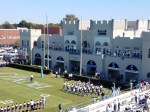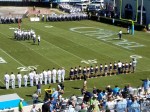
2018 Football, Game 6: The Citadel vs. VMI

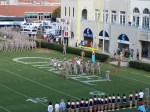
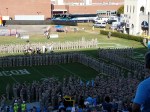
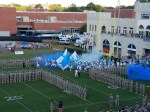
Scenes of rare color preceded the game. As the crowd filled in every gate four bands played, and sailors from the destroyer squadrons, soldiers from Fort Moultrie, and The Citadel cadet corps marched into the stadium.

The blue-clad cadets spread out in front of the stands in regiment [order] and gave cheers for The Citadel team. All the while hundreds of mere civilians were swarming into the seats on four sides of the field. As soon as the cadets were seated they began their songs and cheers.

The VMI squad could be seen outside the stadium as it waited to enter, their red jerseys glistening in the sun. The four bands vied with each other. One Citadel cheerleader led a vicious-looking bulldog along the sidelines in front of the cadets. The crowd was tense and seemingly impatient for the arrival of the teams.

The VMI team entered the field by the Sumter Street gate and was given a big hand by the crowd as it started across the field to the bench, led by the towering captain, Roy Dunn…they had the field to themselves for ten minutes before The Citadel squad arrived, and got a resounding ovation.

The News and Courier, October 12, 1930


The Citadel vs. VMI, to be played on Alumni Memorial Field at Foster Stadium in Lexington, Virginia, with kickoff at 1:30 pm ET on Saturday, October 20.

The game will be streamed on ESPN3, and is also available via ESPN College Extra. Wade Branner will handle play-by-play, while Chip Tarkenton supplies the analysis. 

The contest can be heard on radio via the various affiliates of The Citadel Sports Network. WQNT-1450 AM [audio link], originating in Charleston, will be the flagship station. 

Luke Mauro (the new “Voice of the Bulldogs”) calls the action alongside analyst Cal McCombs. The sideline reporter will be Jay Harper.

—

The Citadel Sports Network — 2018 radio affiliates

Charleston: WQNT 1450AM/92.1 FM/102.1 FM (Flagship)
Columbia: WQXL 1470AM/100.7FM
Greenville: WLFJ 92.9FM/660AM
Sumter: WDXY 1240AM/105.9FM

—

Links of interest:

– Game preview in The Post and Courier

– Game notes from The Citadel and VMI

– SoCon weekly release

– Preview on The Citadel’s website

– AFCA Coaches’ poll

– Brent Thompson’s 10/16 press conference (video)

– Brent Thompson’s 10/17 radio show (video)

– Brent Thompson would like one play back from the ETSU game

– VMI hopes “Air Raid” can outmatch the Bulldogs’ ground game

– Radio interview of VMI coach Scott Wachenheim on “The Game of the Year”

—

– My review of last year’s game between The Citadel and VMI

—

As was the case last week, Saturday’s game broadcast has been picked up as part of the ESPN College Extra set of games. What that means: if you have DirecTV, Verizon FIOS, AT&T U-Verse, or Spectrum, you may be able to watch the game on a “regular” channel, depending on the extent of the package you have with your respective provider.

On DirecTV, for example, the game will be on channel 792. If you have AT&T U-Verse, check channels 614 through 621; the matchup should be on one of those channels. For Verizon FIOS, the ESPN College Extra channels are 821 through 828. Spectrum’s ECE channels are 505 through 512.

The newspaper blurb that opened this post is from the play-by-play of the 1930 game between The Citadel and VMI, the third meeting in the series and the first to take place in Charleston. It was also Homecoming at The Citadel.

The Bulldogs won that day, 7-6, when captain “Pop” Wilson threw a fourth-quarter touchdown pass to Larkin Jennings. Wilson added the extra point (on a drop kick) to provide the winning margin. VMI had taken the lead on a touchdown earlier in the game, but the Keydets’ PAT attempt was blocked by Bulldog end John Carlisle.

A throng of 7,000 spectators watched the battle between the military colleges, the largest crowd to watch a football game in Charleston at that time.

Before moving to this week’s preview of The Citadel-VMI, I wanted to briefly discuss a couple of aspects of the ETSU game.

– The two fourth-down plays in the first half that the Bulldogs failed to convert were very reasonable calls. I agreed with going for it on both occasions. You could perhaps argue about the actual play calls, but The Citadel had been successful in previous weeks running similar stuff on fourth and short.

I might have done something differently (a pass play, for instance), but I’m not going to quibble about that kind of thing. The fourth down plays didn’t work out; that does not mean the decision to go for them was wrong.

– In one sense, “the numbers didn’t add up” in the game versus East Tennessee State. Yes, the Bulldogs had 167 more yards and ran 26 more plays. However, a closer look at the statistics shows something else.

On offense, The Citadel averaged only 4.07 yards per rush (in all the stats to follow, sacks and sack yardage are taken out). That isn’t a dominant performance, particularly when the Bulldogs only rushed for a total of 216 yards.

While the passing yardage came in handy, that’s obviously not the Bulldogs’ bread and butter.

Just as a reminder, The Citadel’s yards per rush in SoCon play over the previous three seasons:

  • 2015: 5.57 yards per rush
  • 2016: 5.28 yards per rush
  • 2017: 5.24 yards per rush

So far in 2018, the Bulldogs are averaging 4.33 yards per rush in SoCon action.

What is the difference? Well, I think a large part of the problem is the lack of “big plays” in the running game. Defining a big play as one of 20 or more yards from scrimmage, The Citadel’s totals in league games over the past three years:

  • 2015: 19
  • 2016: 15
  • 2017: 21

In four conference matchups thus far in 2018, the Bulldogs have only four rushes of 20 or more yards.

Three of them were against Mercer (and as it happens, The Citadel won that game). The other came on the last play of the first half of the Wofford game, when Lorenzo Ward picked up 43 yards while the Terriers were in “safe mode” on defense.

The Citadel has to break a long gainer in the run game more often. It is very hard to drive the field solely in 3- and 4-yard increments.

– Defensively, the Bulldogs did a lot of things right against ETSU, but they missed a few chances at sacks (one of which resulted in the Buccaneers’ biggest offensive play of the game) and, perhaps more importantly, they did not force a turnover.

The Citadel has only forced two fumbles in four SoCon games. One came on a punt against Wofford, when the ball bounced off one of the Terriers’ blocking backs (which isn’t really much of a “forced” fumble, if we’re being honest). The other was a strip sack versus Mercer that somehow wound up resulting in a first down for the Bears.

In terms of pass defense, league opponents have the following line: 60-94 (63.8% completion rate), six touchdowns, four interceptions. Taking out sacks, the Bulldogs are allowing 7.87 yards per attempt. The Citadel’s passes defensed rate is 14.9%. The PD rate is fine, but the yards per attempt number is too high. Of course, sample size has to be considered.

Simply put, the Bulldogs have to pick up a few more defensive turnovers.

At the end of this post, I’ve included photos from the ETSU game. They aren’t very good. You’ve been warned.

VMI has yet to win a game this season. The Keydets did not win a game last season.

The difference is that at least this year, VMI has occasionally been entertaining. In 2017, VMI only scored 8.0 points per game, worst in all of FCS.

Head coach Scott Wachenheim decided to do something about that — namely, switching to the “Air Raid” offense. He hired a new offensive coordinator (Brian Sheppard, who had been at Northern Arizona), and so far this season the Keydets have been unleashing flying pigskins all over an unsuspecting Shenandoah Valley.

VMI is averaging over 58 pass attempts per game. Over 72% of the Keydets’ offensive plays from scrimmage have been throws or sacks.

Has it worked? Well…sort of. VMI is averaging 25.2 points per game, which is a vast improvement over last season. However, the Keydets tend to leave their defense on the field a lot (a time of possession shortfall of over five minutes), and the defense is not nearly good enough to handle the load. VMI is allowing 54.2 points per contest.

One caveat: the defense has been slightly more respectable at home than on the road. VMI lost a tough matchup to ETSU earlier this season (27-24), so any Bulldog fan who might be overconfident about Saturday’s game might want to think again. The Keydets also competed well versus Mercer, losing 48-38.

Now, the defense has been a complete horror show away from Lexington (allowing 66, 59, 52, and 73 points, the latter coming last week against Devlin Hodges and Samford). However, this year’s edition of the Military Classic of the South is at Foster Stadium, so perhaps those results aren’t as important or revealing.

Do I think an aerial attack can work long-term at a military school? Not really. Am I going to be critical of VMI for trying it, given the way the last three decades on the gridiron have gone for the Keydets? Absolutely not.

Hey, you never know. It might work. Something has to work eventually, right?

Before I highlight a few of VMI’s key performers, I want to mention something that is actually listed below in the “odds and ends” section, as one of the regular features of that part of the weekly post.

VMI has 86 players on its roster. Of that group, 63 are from Virginia, which is 73% of the squad.

In terms of roster makeup, that is the largest instate cohort in the league, and only Mercer (69%) is even close to having a similar percentage of players from its “home” state. However, MU is in Georgia, and can pick and choose from a large number of talented high school players. Bobby Lamb recruits heavily from Georgia by choice.

Meanwhile, VMI’s emphasis on Virginia players is apparently due more to an administrative policy. If so, having roster construction limited in that fashion has to be rather difficult on the coaching staff.

Reece Udinski (6’4″, 224 lbs.) is the pilot of VMI’s “Air Raid” attack. The sophomore from North Wales, Pennsylvania has completed 55.6% of his passes, averaging 5.8 yards per attempt, with 11 TDs against 10 interceptions.

In the Keydets’ 52-50 loss at Western Carolina, Udinski was 43 for 72 for 491 passing yards, all school records. He also threw four touchdown passes in that contest. The following week, Udinski threw for 434 yards against Mercer. Two weeks, 925 passing yards. Not bad.

Quan Myers (5’10”, 200 lbs.), a redshirt junior from Altavista, Virginia, leads VMI in rushing attempts (80) and yards (228). While averaging only 2.8 yards per carry, he does have seven rushing TDs. He is also the Keydets’ third-leading receiver.

Seventeen different Keydets have caught passes this season. The two leading receivers are redshirt sophomore Kris Thornton (5’8″, 164 lbs.), who has 45 catches, and junior Javeon Lara (6’2″, 188 lbs.), who has 37 receptions. Lara is averaging over 15 yards per catch and has 5 TDs. Thornton had six receptions versus The Citadel in last season’s meeting.

If you’re a fan of offensive skill position players wearing single-digit numerals, VMI is the team for you. Udinski wears #2; Myers, #3; Thornton, #1; and Lara, #7.

Wideout Rohan Martin (5’10”, 181 lbs.), who is also VMI’s primary punt returner, wears #5, and jack-of-all-trades Jake Paladino (a backup QB, punter, tight end, and the Keydets’ holder on placekicks) sports jersey #4.

When The Citadel last appeared at Foster Stadium, in 2016, Paladino entered the game in relief at quarterback and played quite well (completing 9 of 13 passes, including one for a TD).

Average size of VMI’s projected starters on the offensive line: 6’4″, 294 lbs. Manning the left tackle spot is Marshall Gill (6’4″, 270 lbs.), a “true” freshman from West Point, Virginia. Gill has started every game for the Keydets at that position.

Gill is the youngest of a very young unit. The other starters include three redshirt sophomores and a “true” sophomore.

Strong safety A.J. Smith (6’2″, 204 lbs.) is the Keydets’ leading tackler, with 46 stops. The sophomore from Virginia Beach also has two pass breakups.

Inside linebacker Elliott Brewster (6’2″, 220 lbs.) has 45 tackles this year for VMI. Last week against Samford, Brewster had 11 tackles and an interception, which is about as good an afternoon a linebacker can have for a team that gave up 73 points.

In his bio on VMI’s website, it is stated that Uzoma Kpaduwa “will likely be a defensive back for his senior season”, understandable given his size (5’10”, 190 lbs.). However, Kpaduwa has started five games at outside linebacker for the Keydets. He is tied for third on the team in tackles.

Free safety Ethan Caselberry (6’4″, 201 lbs.), a freshman from Sparkman, Alabama, had 10 tackles versus Samford. He is tied with Kpaduwa in tackles for the season (42).

Redshirt senior Zach Baker (6’2″, 263 lbs.), a defensive end from Roanoke, leads VMI in tackles for loss, with five. Collin Loftis (5’10”, 170 lbs.), a redshirt freshman from Arlington, Texas, has three interceptions this season, tops among the Keydets.

VMI has used two placekickers this season. One of them, junior Reed King (5’9″, 168 lbs.), is also the Keydets’ punter.

Grant Clemons (6’2″, 185 lbs.) is the current incumbent at the PK spot. The junior, who began his college career at Georgia Military, has made both of his field goal tries so far this season (including a 40-yarder against Samford).

Odds and ends:

– The weather forecast for Saturday in Lexington, Virginia, per the National Weather Service:  a chance of showers, mainly before 8:00 am. It will be partly sunny, with a high of 64 degrees. Winds will be out of the west at 6-14 miles per hour.

– Per one source that deals in such matters, The Citadel is a 6-point favorite over VMI (as of Thursday night), with an over/under of 71 1/2. That is easily the largest over/under for any game played by the Bulldogs this season.

After the over hit in The Citadel’s first four games this season, last week’s total wound up as a push.

– Other lines involving SoCon teams:  Wofford is a 3-point favorite over ETSU; Samford is a 7 1/2 point favorite at Furman; and Mercer is a 10 1/2 point favorite over Western Carolina. Those lines are all as of Thursday night.

Chattanooga is off this week.

– Also of note:  Alabama is a 28 1/2 point favorite at Tennessee; Charleston Southern is a 6 1/2 point favorite over Presbyterian; and Towson is a 17-point favorite at Albany.

That CSU-PC number has really moved. On Tuesday afternoon, the Buccaneers were a 13 1/2 point favorite over the Blue Hose.

– Massey Ratings: The Citadel is ranked 61st in FCS, while VMI is ranked 111th.

Massey projects the Bulldogs to have an 83% chance of winning, with a predicted final score of The Citadel 41, VMI 28.

Other FCS rankings of note in Massey:  Towson (9th), Elon (11th), Colgate (14th), Kennesaw State (19th), Yale (28th), Wofford (30th), Furman (35th), Chattanooga (37th), East Tennessee State (39th), North Carolina A&T (42nd), Samford (44th), Mercer (46th), Western Carolina (74th), Charleston Southern (80th), South Carolina State (97th), Presbyterian (113th), Gardner-Webb (116th), Mississippi Valley State (125th and last).

Massey’s top 5 FCS squads: North Dakota State, James Madison, South Dakota State, Dartmouth, and Illinois State.

Massey’s top ten FBS teams (in order): Alabama, Ohio State, Clemson, Georgia, LSU, Notre Dame, Michigan, Oklahoma, Florida, and Iowa. Texas is 12th, UCF 13th, North Carolina State 15th, Duke 19th, West Virginia 20th, Mississippi State 24th, South Carolina 30th, Auburn 32nd, Appalachian State 34th, Missouri 35th, Army 40th, Maryland 46th, Virginia Tech 47th, Wake Forest 55th, Tennessee 56th, Virginia 57th, Florida State 63rd, Georgia Tech 64th, North Texas 71st, Toledo 81st, Air Force 84th, Georgia Southern 91st, Navy 96th, North Carolina 97th, Arkansas 104th, Liberty 105th, Coastal Carolina 110th, Old Dominion 119th, and UTEP 130th and last.

– Among VMI’s notable alumni:  rugby star Dan Lyle, movie producer Frank McCarthy, and civil rights activist Jonathan Daniels.

– VMI’s roster includes 63 players from Virginia. Other states represented on its squad:  Alabama (5 players), Maryland (3), Pennsylvania (2), North Carolina (2), Georgia (2), Tennessee (2), New York (2), Texas (2), and one each from California, New Jersey, and South Carolina (freshman defensive back Tim Smith is from Rock Hill and went to Nation Ford High School).

Thus, none of the Keydets are graduates of Orangeburg-Wilkinson High School, the internationally celebrated bastion of gridiron excellence located in the Palmetto State. The continued failure to draw talent from the unquestioned epicenter of elite pigskin performance goes a long way to explaining VMI’s struggles in the sport.

– The Citadel’s geographic roster breakdown (per the school’s website) is as follows: South Carolina (47), Georgia (28), Florida (9), North Carolina (5), Texas (5), Tennessee (4), Pennsylvania (3), Alabama (2), New York (2), and one each from Kentucky, Nebraska, New Jersey, Oklahoma, and West Virginia.

– This week’s two-deep is similar to the one released for the ETSU game. There are a few changes, however. Kyler Estes appears on the depth chart at the “KAT” position. Also, Sean-Thomas Faulkner is now officially listed as the starter in the “Bandit” role.

– The Citadel has an all-time record of 6-5 for games played on October 20. The Bulldogs are 3-4 away from home on that date, and 3-3 in SoCon play. A brief review of four of the victories, as we go into the Bulldogs’ Wayback Machine:

  • 1917:  The Citadel defeated Erskine, 18-7, in a game played at Hampton Park in Charleston. The Bulldogs opened the game by successfully recovering an onside kick, an aggressive ploy that set the tone for the contest. Three of The Citadel’s players accounted for all the home team’s scoring. “Wild John” Crouch caught two TD passes, one from Billy Dotterer and another from Archie Reynolds. The third touchdown for the Bulldogs came on a throw from Reynolds to Dotterer.
  • 1979:  In Lexington, Virginia, The Citadel walloped VMI 37-6. Stump Mitchell rushed for 188 yards and a touchdown. Other Bulldogs to dent the end zone that day: Tim Russell, Wilford Austin, Mark Hunt, and Jeff Turner. Emmer Chavez added a field goal. The defense, keyed by the likes of Scott Wages and Paul Gillis, held the Keydets to 194 total yards.
  • 1990:  The Citadel 38, South Carolina 35. You know all about this one. According to The State newspaper, all the Gamecocks had to do to win was “just show up”, arguably the laziest analysis in the history of sports journalism. I just wish I had a tape of Bob Fulton and Tommy Suggs calling the game on the radio.
  • 2007:  A high-scoring game in Cullowhee against Western Carolina resulted in a 37-31 win for the Bulldogs. Andre Roberts had 9 catches for 119 yards and a TD, while Tory Cooper added two rushing touchdowns. Mike Adams kicked three field goals for the Cadets, as The Citadel built a 17-point lead before hanging on for the victory.

– Incidentally, the 188 yards rushing by Stump Mitchell against VMI in 1979 that I referenced above was Mitchell’s career high in a game during his time at The Citadel. The following year (1980), Mitchell rushed for 173 yards versus the Keydets, including a 75-yard TD scamper that is the greatest run I’ve ever seen in person at Johnson Hagood Stadium.

Mitchell also had 157 yards rushing against VMI as a sophomore. In four games against the Keydets, The Citadel’s career rushing leader averaged 8.6 yards per carry.

The Citadel is busing most of the freshmen in the Corps of Cadets to the game. I’m very pleased about that, as I was when the freshmen made an appearance at Wofford.

I’ve said this more than once, but if you are a graduate of The Citadel, a trip to VMI is almost a must. Every alum should make the journey to “the Post” at least once, if only to watch a parade and check out the gameday experience.

I won’t be able to make it this year, which is my loss. I’ll be intently watching the game on TV, though.

I have concerns about this game from The Citadel’s perspective. VMI always brings its best to this matchup. While the Keydets don’t have any wins this season, they can remain confident in the fact they do some things well, and have been competitive in three of their five SoCon games.

The Bulldogs have been just good enough to lose four of five league contests. Sometimes, that becomes an unwanted pattern. The Citadel has to come out aggressively and put its stamp on the game; otherwise, it could be a long and difficult afternoon.

This game is important. This game matters.

The coveted Silver Shako is at stake, the greatest trophy in all of sports. The Bulldogs must do everything in their power to retain it, and keep it in Charleston, where it rightfully belongs.

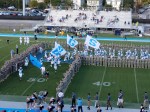
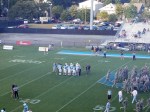
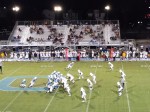
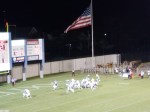
Coda: the pictures from the ETSU game. They aren’t the most stellar of photos, which is the norm.

I will say that I like the blue and white smoke as the team runs on to the field, and it shows up fairly well in the pictures.
2018 Football, Game 5: The Citadel vs. East Tennessee State

The Citadel vs. East Tennessee State, to be played at historic Johnson Hagood Stadium, with kickoff at 2:00 pm ET on October 13, 2018.

The game will be streamed on ESPN3, and is also available via ESPN College Extra. Kevin Fitzgerald will handle play-by-play, while former Bulldogs quarterback Dominique Allen supplies the analysis. Danielle Hensley is the sideline reporter. 

The contest can be heard on radio via the various affiliates of The Citadel Sports Network. WQNT-1450 AM [audio link], originating in Charleston, will be the flagship station. 

Luke Mauro (the new “Voice of the Bulldogs”) calls the action alongside analyst Cal McCombs. The sideline reporter will be Jay Harper.

The Citadel Sports Network — 2018 radio affiliates

Charleston: WQNT 1450AM/92.1 FM/102.1 FM (Flagship)
Columbia: WQXL 1470AM/100.7FM
Greenville: WLFJ 92.9FM/660AM
Sumter: WDXY 1240AM/105.9FM

—

Links of interest:

– Game preview in The Post and Courier

– Game notes from The Citadel and East Tennessee State

– SoCon weekly release

– Preview on The Citadel’s website

– AFCA Coaches’ poll

– Brent Thompson’s 10/9 press conference

– Brent Thompson’s 10/10 radio show (video)

– ETSU press conference (from 10/8)

– The Citadel offers potent rushing attack

—

– My review of last year’s game between The Citadel and East Tennessee State

Saturday’s game broadcast has been picked up as part of the ESPN College Extra set of games. What that means: if you have DirecTV, Verizon FIOS, AT&T U-Verse, or Spectrum, you may be able to watch the game on a “regular” channel, depending on the extent of the package you have with your respective provider.
On DirecTV, for example, the game will be on channel 793. If you have AT&T U-Verse, check channels 614 through 621; the matchup should be on one of those channels. For Verizon FIOS, the ESPN College Extra channels are 821 through 828. Spectrum’s ECE channels are 505 through 512.

Parents’ Day (actually, a full weekend) activities: Link

My one observation to anyone going to the game, or to any of the other events listed in the link above: it is almost always warmer (and more humid) than you think it is going to be. Keep that in mind.

That said, this is probably the happiest of The Citadel’s three primary “celebration” weekends, at least for the cadets.

The Citadel will go 35 days in between home games. That is the longest the Bulldogs have gone between home games in a season since…last year, when The Citadel also went 35 days between home games.

The Bulldogs also had a 35-day break between home games in 2016, which means that for three years in a row (all early in the season), The Citadel has had an unscheduled long stretch away from home. In all three cases, a bye week combined with a weather issue created the long break in games played at Johnson Hagood Stadium.

Note: Brent Thompson likes to refer to the breaks created due to weather systems as “hurrication”.

The Citadel is 1-3. Records of those teams through last week:

  • Wofford:  4-1, one loss was at Wyoming
  • Chattanooga:  4-2, losses to Wofford and at ETSU
  • Mercer:  3-2, losses at Memphis and to The Citadel
  • Towson:  4-1, one loss was at Wake Forest

Against non-FBS competition, the combined record is 15-3, and one of those three losses was to the Bulldogs. Next up is East Tennessee State, which is 5-1 — and the one loss was to Tennessee.

It’s been a very tough slate thus far.

As to the issue of Towson learning how to defend the triple option from Navy’s coaching staff, I have two general observations:

  • I can somewhat understand why Brent Thompson was irritated.
  • It doesn’t matter one bit.

The fact is that the Bulldogs gave up 608 yards of total offense, at a 9.5 yards per play clip, and that was why they lost. Towson scored early and often.

Sure, it would have been nice not to get down big early, and maybe Towson’s special defensive preparation had a role in that. It’s also true, though, that the Bulldogs have fallen behind in every game they’ve played this season, and usually by big margins (21-0, 14-0, 17-7, 21-3). I don’t think Wofford, Chattanooga, and Mercer went to Annapolis to study the option before playing The Citadel.

The one thing I do wonder about is whether or not Navy would have helped Towson out if Thompson had been part of the Paul Johnson “coaching tree”. Ultimately, though, it is of no real relevance.

During his presser, ETSU head coach Randy Sanders discussed the option, and (breath of fresh air alert) actually said there was nothing “dirty” about the offense:

It’s difficult obviously, because you normally don’t have a quarterback that’s doing this. The other thing that’s really difficult to replicate in practice is sometimes the amount of cutting, where the linebackers get cut and the defensive linemen get cut, and just the nature of that offense. It’s certainly legal, it’s not illegal, it’s not “dirty football” or anything like that. That’s just the way they play football with that offense. It’s the part that’s hard to replicate because obviously you have to practice it and your guys have to get used to playing those type of blocks. You don’t want to do it so much that somebody goes into the game limping.

In 2014, when I was at Florida State and we played Citadel in Tallahassee and beat them 37-7. I think a lot of the fans were disappointed, but we scored on I think seven of the nine possessions – the first seven possessions that we had the ball – we scored. We only had it nine times. The two times we didn’t score was late in the game when we were playing a lot of the backups. So, as good as that football team was at Florida State, they (The Citadel) were able to limit us to only nine possessions against our defense. It makes you execute when you get your opportunities and it makes you stay locked in from a mental standpoint. When you get the opportunities to make plays, you have to make them.

We’ll forgive Sanders for not remembering the exact score of The Citadel’s game with Florida State (37-12).

ETSU opened its season with a less-than-scintillating 28-7 victory over D-2 Mars Hill. The Buccaneers then got thumped, not unexpectedly, by Tennessee (59-3).

The SoCon campaign began for ETSU with a 27-24 win at VMI, a game won by the Bucs despite allowing a pick-6 and being called for 142 yards’ worth of penalties. I watched this game on ESPN+; it never crossed my mind that it would serve as the beginning of what is now a four-game winning streak.

The game that may define ETSU’s season was its matchup against Furman. Trailing 27-6 midway through the third quarter, the Buccaneers rallied to tie the game, with the winning points then coming on a safety (yes, really).

The key to that comeback was a change at quarterback. Austin Herink, a three-year starter relegated to a backup role as Temple transfer Logan Marchi had assumed the starting job, entered the contest against the Paladins. The passing stats from the two QBs from that game were as follows:

  • Austin Herink:  9/14, 202 yards, 1 touchdown, 0 interceptions
  • Logan Marchi:  8/17, 71 yards, 0 touchdowns, 1 interception

East Tennessee State followed that game up with a 17-14 win in Johnson City against Chattanooga. Herink played almost the entire way in that one (and started last week versus Gardner-Webb). ETSU held the Mocs to 3.9 yards per play, and that was basically an even distribution on the ground and in the air (taking out sack numbers, UTC averaged 3.8 yards per rush).

Chattanooga threw 56 passes in that game (not including five sacks) out of 83 offensive plays. Of course, UTC trailed 17-0 entering the fourth quarter, perhaps partly explaining all the passing attempts.

ETSU shut out Gardner-Webb 45-0 last week, basically taking care of business with authority against a bad team. (Incidentally, Gardner-Webb is a 46 1/2 point underdog at home this week to Kennesaw State.)

Of all those games, the Chattanooga contest stands out. ETSU controlled that game by grabbing the early lead and never letting go. To win this week, The Citadel needs to avoid falling behind (yet again).

As mentioned above, Austin Herink (6’3″, 210 lbs.) is again East Tennessee State’s starting quarterback, a role he filled for each of the last three seasons. Herink, a native of Cleveland, Tennessee, began his collegiate career at Middle Tennessee State.

Running back Quay Holmes (6’1″, 216 lbs.) is a redshirt freshman from Powder Springs, Georgia. Holmes has eight rushing touchdowns this season, and is averaging 4.4 yards per carry. He also has 15 receptions so far this year, second-most on the roster.

Wide receiver Keith Coffee (6’4″, 190 lbs.), a redshirt sophomore from Miami, leads ETSU in catches with 20.

Quan Harrison (5’10”, 182 lbs.) was a second-team all-SoCon pick last year as a return specialist. Oddly, he is not listed as a returner on ETSU’s most recent two-deep. However, Harrison is one of five Bucs with 10 or more receptions.

Brent Thompson made a point of praising the East Tennessee State offensive line, both in his press conference and on his radio show. As a collective, they are big. The average size of the projected starters: 6’4″, 306 lbs.

Matt Pyke (6’2″, 302 lbs.), the starting center, was a preseason second-team all-SoCon selection. The senior from Clinton, Tennessee has started every game in his career with the Buccaneers.

East Tennessee State normally lines up in a 3-4. There will be adjustments, to be sure, with the Bucs facing The Citadel’s triple option attack.

Defensive end Nasir Player (6’5″, 271 lbs.) is a redshirt junior from Columbia, South Carolina (he went to Ridge View High School). Player was a first-team all-conference choice after last season. He is yet another outstanding defensive lineman in a league full of them.

Besides playing football at Ridge View, Player spent one year on the school’s lacrosse team. I’m far from an expert on that sport, but he had to have been one of the larger high school lacrosse players around.

ETSU has another impact player on the other side of its d-line in Jason Maduafokwa (6’3″, 270 lbs.). He was very active in last year’s contest versus The Citadel.

Linebacker Dylan Weigel (6’0″, 221 lbs.) has led the Buccaneers in tackles in each of the last three seasons, and leads them this year. He was named the SoCon defensive player of the week last year after the Bucs’ game against The Citadel, in which he made 19 tackles.

Jeremy Lewis (5’10”, 180 lbs.) is a junior cornerback who currently ranks third on the roster in tackles. He also has one of ETSU’s seven interceptions.

J.J. Jerman (5’10”, 170 lbs.) was a second-team all-league pick after the 2017 season. The senior from Seymour, Tennessee is 7 for 10 on field goal tries this season. Last year, he made two 51-yard field goals, so he has a strong leg, and a fairly accurate one as well.

Marion Watson (6’2″, 160 lbs.) is in his fourth season as ETSU’s regular punter. His career long punt is 59 yards, which came in 2015.

Odds and ends:

– The weather forecast for Saturday in Charleston, per the National Weather Service: sunny, with a high in the upper 70s. Winds will be out of the northeast at around 5 mph.

– Per one source that deals in such matters, The Citadel is a 5-point favorite over East Tennessee State, with an over/under of 49.

The over has hit in all four of The Citadel’s games this season.

– Other lines involving SoCon teams:  Wofford is a 7-point favorite at Furman; Samford is a 19 1/2 point favorite over VMI; Chattanooga is an 8-point favorite at Western Carolina; and Yale is a 4 1/2 point favorite over Mercer.

Those lines are all as of Thursday afternoon. I emphasize this because there has been some surprising fluctuation in some of the FCS spreads this season, including games involving SoCon teams.

– Also of note:  Alabama is a 27 1/2 point favorite over Missouri. There is no line on Charleston Southern’s game against Virginia-Lynchburg (a non-D1 school; the Dragons play in the NCCAA).

– Massey Ratings: The Citadel is ranked 54th in FCS. East Tennessee State is ranked 55th, exactly one spot behind the Bulldogs.

Massey projects the Bulldogs to have an 71% chance of winning, with a predicted final score of The Citadel 28, ETSU 21.

Other FCS rankings of note in Massey:  Elon (7th), Towson (9th), Colgate (15th), Wofford (20th), Kennesaw State (22nd), Yale (32nd), North Ca rolina A&T (35th), Chattanooga (39th), Mercer (42nd), Furman (43rd), Samford (48th), Western Carolina (69th), Charleston Southern (76th), South Carolina State (97th), Presbyterian (99th), VMI (105th), Gardner-Webb (112th), Arkansas-Pine Bluff (125th and last).

Massey’s top 5 FCS squads: North Dakota State, James Madison, Eastern Washington, South Dakota State, and Illinois State.

Massey’s top ten FBS teams (in order): Alabama, Georgia, Ohio State, Clemson, Notre Dame, Penn State, Oklahoma, LSU, Michigan, and Washington. UCF is 12th, Texas 13th, Florida 15th, Kentucky 16th, North Carolina State 18th, South Carolina 20th, Texas A&M 25th, Duke 26th, Missouri 30th, Appalachian State 37th, Virginia Tech 43rd, Army 46th, Georgia Tech 49th, Wake Forest 52nd, Florida State 57th, Virginia 63rd, Tennessee 75th, Toledo 76th, North Texas 80th, Georgia Southern 82nd, Air Force 84th, North Carolina 95th, Navy 96th, Coastal Carolina 101st, Liberty 119th, Old Dominion 120th, Charlotte 127th, and UTEP 130th and last.

– Among East Tennessee State’s notable alumni:  Kenny Chesney (yes, ETSU is the school he actually attended), soldier/author R. Alan King, and Union Station bass player Barry Bales.

As I have written before (and will probably write again), Bales has one of the best jobs in the world, as he gets to listen to Alison Krauss sing on a regular basis.

– East Tennessee State’s roster includes 43 players from Tennessee. Other states represented on its squad:  Georgia (21 players), Ohio (8), Alabama (7), North Carolina (6), Virginia (6), South Carolina (5), Florida (3), and one each from Connecticut, Mississippi, Pennsylvania, and Texas.

While ETSU has five players who hail from South Carolina, none of the Buccaneers are graduates of fabled football factory Orangeburg-Wilkinson High School. This is an undeniable error in recruiting philosophy that will have an extremely negative long-term effect on East Tennessee State’s football program. Donnie Abraham is understandably shocked and upset, and may even feel betrayed.

– The Citadel’s geographic roster breakdown (per the school’s website) is as follows: South Carolina (47), Georgia (28), Florida (9), North Carolina (5), Texas (5), Tennessee (4), Pennsylvania (3), Alabama (2), New York (2), and one each from Kentucky, Nebraska, New Jersey, Oklahoma, and West Virginia.

– This week’s two-deep is similar to the one released for the Towson game. There are a few changes, however. Lane Botkin is now listed as the starting punt retuner. Dijon Profit is listed as a potential starter at wide receiver. On defense, Joshua Bowers appears on the depth chart this week, while Jay Howard is listed as a potential starter at cornerback.

One caveat to the listed depth chart: Brent Thompson said during his presser that Khafari Buffalo was “doubtful” for the ETSU game. It would be the second consecutive contest missed by the junior from Sumter, who was injured while making an outstanding interception against Mercer.

– The Citadel has an all-time record of 7-5 for games played on October 13. The Bulldogs are 5-2 at home on that date. A brief review of five of the twelve contests, as we go into the Bulldogs’ Wayback Machine:

  • 1962:  The Citadel won at Vanderbilt, 21-6, its first victory over an SEC opponent. Sid Mitchell scored a rushing TD and threw two big passes to Charlie Brendle, while Nick DeLoreto and Mike Lane added scores of their own to the final tally (with Lane rushing for a 15-yard TD one play after intercepting a Vanderbilt pass). The game turned on a huge goal-line stand by the Bulldogs, led by Gene Dice. The Citadel intercepted four passes on the day, including two by Joe Cannarella.
  • 1973:  In the first of two huge comeback victories that took place on October 13, The Citadel roared back from being down 20-0 to stun Chattanooga at Johnson Hagood Stadium, 28-20. Andrew Johnson scored three times; Gene Dotson rushed for 100 yards and scored the go-ahead two-point conversion in the fourth quarter. He also threw a 14-yard TD pass to Bob Willis. A fumble recovery by Ronnie Gibson after a muffed punt set up the Bulldogs’ first score. At the time, it was the largest deficit overcome by The Citadel for a victory in school history.
  • 1984:  Robert Hill threw two TD passes to Victor Frazier as the Bulldogs upset Western Carolina in Cullowhee, 34-33. Frazier finished with 5 catches for 133 yards, while Hill added a touchdown toss to Eric Reddish; his three TD passes made Hill the Bulldogs’ career record-holder in that category. Hill got injured during the game, though, which led to Kip Allen stepping in and throwing an 18-yard TD pass to Lee Glaze. On defense, Billy Morgan recovered two fumbles, but The Citadel’s victory wasn’t safe until Joel Thompson intercepted a would-be two-point conversion attempt with 24 seconds to play.
  • 2007:  The Citadel trailed Furman by 20 points in the second quarter, 17 points in the third quarter, and 10 points in the fourth quarter — but wound up winning in overtime, 54-51. Duran Lawson’s 486 yards of total offense set the school record. Lawson was ably assisted on the day by Tory Cooper (140 yards rushing, 83 yards receiving, 3 TDs), Andre Roberts (122 yards receiving, including a 62-yard TD), and Ta’Mar Jernigan (95 yards receiving, including a 29-yard touchdown).
  • 2012:  The most recent game played by The Citadel on October 13, a 45-31 Parents’ Day victory over Western Carolina, is probably best remembered for a special teams tackle made by Vinny Miller. I wrote about the game (and that hit).

– The Citadel first played East Tennessee State in 1966, winning 3-0. Cal McCombs was named the South Carolina State Defensive Player of the Week for his work during that contest. Now, of course, McCombs is in his first season as the radio analyst for the Bulldogs.

– Last year’s loss to Mercer broke a string of five consecutive Parents’ Day victories for The Citadel. Overall on Parents’ Day (since 1953), the military college has a 35-30 record.

The Citadel can win on Saturday. The Bulldogs must start well (for a change), avoid offensive turnovers and limit the big plays on defense.

There should be a very good crowd backing the home side. I hope the team can feed off that energy. A win could propel The Citadel to a very solid season. A loss…well, it could be a long year.

We’ll see what happens. I am vaguely hopeful.

2018 Football, Game 4: The Citadel vs. Towson

The Citadel at Towson, to be played to be played at Johnny UnitasÂź Stadium in Towson, Maryland, with kickoff at 4:00 pm ET on September 29, 2018.

The game will be streamed on CAA TV. Spiro Morekas will handle play-by-play, while Gordy Combs supplies the analysis.

The contest can be heard on radio via the various affiliates of The Citadel Sports Network. WQNT-1450 AM [audio link], originating in Charleston, will be the flagship station. 

Luke Mauro (in his first season as the “Voice of the Bulldogs”) calls the action alongside analyst Cal McCombs. The sideline reporter is Jay Harper.

—

The Citadel Sports Network — 2018 radio affiliates

Charleston: WQNT 1450AM/92.1 FM/102.1 FM (Flagship)
Columbia: WQXL 1470AM/100.7FM
Greenville: WLFJ 92.9FM/660AM
Sumter: WDXY 1240AM/105.9FM

—

Links of interest:

– Game preview from The Post and Courier 

– Feature on Rod Johnson from The Post and Courier

– The Citadel is back on the SoCon map

– Game notes from The Citadel and Towson

– SoCon weekly release

– “Game Day Central” at The Citadel’s website

– AFCA Coaches’ poll

– Brent Thompson’s 9/25 press conference, including comments from Rod Johnson and Shawn McCord

– Brent Thompson’s 9/26 radio show (video)

– The Bulldog Breakdown

– Rod Johnson is the SoCon special teams player of the week

– Boxscore from Towson-Villanova

– Towson will wear special gold jerseys on Saturday

– Whoa…basketball season is almost here!

As noted in the SoCon’s weekly release, all four conference games last week were close. The scores: 38-31 (The Citadel-Mercer), 52-50 (Western Carolina-VMI), 29-27 (East Tennessee State-Furman), and 27-20 (Chattanooga-Samford).

The league seems to be venturing into Big XII territory in terms of offensive productivity (and perhaps a corresponding lack of defensive excellence):

The SoCon’s offensive prowess was on full display on Saturday. Three backs ran for more than 100 yards, with The Citadel’s Grant Drakeford (139), Western Carolina’s Tyrie Adams (117) and ETSU’s Quay Holmes (102) all surpassing the century mark. Three quarterbacks surpassed 300 yards passing, including Mercer’s Robert Riddle (school-record 347), Samford’s Devlin Hodges (366) and VMI’s Reece Udinski (school-record 491). Four wide receivers reached at least 100 yards, including VMI’s Javeon Lara (143), Mercer’s Marquise Irvin (132), Samford’s Kelvin McKnight (128) and Chattanooga’s Bryce Nunnelly (108).

Let’s talk about TV (well, streaming video actually)…

The game will be available on CAA TV, which can be found here: Link

If you have a Roku, Apple TV, or Amazon Fire setup, you can watch the game on any of those devices.

I have a Roku. I was able to add the CAA TV channel (for free!), and from there I was able to find the upcoming contest, which is already posted on the platform.

The announcers for The Citadel-Towson on CAA TV will be the Towson radio team, which includes Spiro Morekas (voice of the Tigers for over a quarter-century) and former TU coach Gordy Combs (career record: 91-91).

There will almost certainly be a delay between the live action and the stream. You could always turn down the sound to the stream and just listen to The Citadel’s tandem of Luke Mauro and Cal McCombs call the game on the radio, then watch the action on the field unfold after they’ve called it.

That is what I did last week, and it worked well. I enjoyed the Mauro/McCombs duo. The cool and collected Mauro ably described the action, serenely side-stepping the occasionally excitable McCombs when necessary. The longtime coach, meanwhile, expertly and enthusiastically pointed out line play and other tactical nuances, while making additional sharp observations.

Of course, instead of watching the video stream, you could be at the game, which is taking place at Johnny UnitasÂź Stadium (yes, Johnny U’s name is a registered trademark).

Why is Towson’s stadium named after the legendary Colts quarterback?

Several weeks prior to his untimely passing [in 2002], “Johnny U” began serving as community liaison for Tiger Athletics. His role was to assist in obtaining a naming rights partner for the University’s new stadium. The legendary Golden Arm died suddenly, less than a week after tossing his last pass to commemorate the opening of Towson’s new stadium at ceremonies on September 5, 2002.

High spirits returned when Sandy Unitas chose to assume her husband’s role with Towson. With Johnny’s two youngest children as Towson students, Sandy sought to memorialize her husband’s legacy on campus by having the stadium named Johnny UnitasÂź Stadium.

The complex, which also hosts TU’s lacrosse, field hockey, and track teams, seats 11,198 for football. The playing surface is FieldTurf.

Towson has struggled to fill the stadium in recent years, despite occasionally fielding good-to-outstanding teams (including the 2013 squad, which made the FCS title game). TU’s average home attendance has declined in each of the last six campaigns, from 8,949 fans per game in 2011 to 5,377 supporters per contest last season.

One possible reason for the decline: a pervasive rumor that tailgating had been banned:

The idea that tailgating was banned or suspended stemmed from an incident that took place several years ago.

In September of 2014, a student injury at a tailgate along with several crowded and rowdy tailgates, led to rumors that members of the university administration were considering eliminating tailgating.

After deliberation with student leaders, rather than eradicating tailgating, the President’s Council decided to implement stricter guidelines for the rest of the year…

…Though tailgating never actually went away and some of those new guidelines only lasted for a few months, the damage had already been done. The misconception that tailgating was banned had made its way into the ether of Towson and spread like a wildfire over the following years.

Saturday’s contest is the home opener for the Tigers, and will feature a celebration of 50 years of Towson football (the program began in 1969). The game has been rather heavily promoted by the school in an effort to attract as many students and other supporters as possible. Among the promotions: a season ticket for five games only costs $50, and the first 1,000 students to arrive will each receive a free gold-colored t-shirt.

There may be competition for those t-shirts, as Towson has over 19,000 undergraduates. That is a far cry from the school’s founding in 1866, when it was known as the Maryland State Normal School and was located in downtown Baltimore. The first graduating class included 16 students.

The institution, for much of its history a college for training teachers, relocated to Towson in 1915. There were several name changes, with the school becoming Towson State University in 1976 and then Towson University in 1997. It is now part of the University System of Maryland, and offers over 500 majors in a wide range of disciplines, from accounting to elementary education to nursing. The school also has over 3,000 graduate students.

Towson’s football program began life as a Division III outfit. The Tigers had some success in that classification, including a title game appearance in 1976; Towson narrowly lost the Stagg Bowl that year to St. John’s and its famed coach, John Gagliardi.

The Tigers then spent eight years in Division II before moving up to Division I-AA (now FCS) in 1987. After a stretch as an independent, and a few years in both the Patriot League and the Atlantic 10, Towson became a charter member of the CAA football conference in 2007.

There have been only four head football coaches in the history of the program, and just three since 1972.

Rob Ambrose, who is currently at the helm, has held his position since 2009. Ambrose played quarterback and wide receiver for Towson in the early 1990s.

During Ambrose’s tenure, TU has won two CAA titles and made the aforementioned appearance in the FCS title game following the 2013 season. The playoff run included victories over Fordham, Eastern Illinois, and Eastern Washington. Towson eventually lost in the final to the buzzsaw (and buzzkill) that is North Dakota State.

Towson is the only NCAA school to have made the playoffs in football at the D-3 ,D-2, and D-1 levels.

TU’s two most notable football players are almost inarguably Sean Landeta and Dave Meggett.

Sean Landeta was one of the best punters in NFL history. He had a 22-year career in the league that included stints with five different franchises, including the New York Giants, Philadelphia Eagles, and Los Angeles/St. Louis Rams.

He was named to the NFL all-decade team for both the 1980s and 1990s, and was also named to the squads for the Giants’ all-time team, the Eagles’ 75th-anniversary team, the St. Louis Rams’ 20th-anniversary team, and the 40th-anniversary Super Bowl team.

The native of Baltimore actually began his pro career in the USFL, punting for three years for the Philadelphia/Baltimore Stars. Landeta won two championships in the USFL with that franchise, to go along with the two Super Bowl rings he acquired with the Giants.

Landeta also was mentioned in the “Page Six” section of the New York Post more than any other punter.

Dave Meggett grew up in North Charleston. After an outstanding career at Towson (he won the 1988 Walter Payton Award as the top player in I-AA football), Meggett would become one the better punt and kick returners in modern NFL annals.

Meggett won a Super Bowl ring with the Giants (Landeta was also on that team), and later played for the New England Patriots and (near the end of his career) the New York Jets. He followed head coach Bill Parcells to each of those stops.

After his career ended, Meggett started having well-documented legal problems. He is currently in prison.

Towson was picked to finish 10th in the 12-team CAA in that conference’s preseason poll, which was perhaps a reflection of the Tigers’ 2017 campaign, in which they finished 5-6 (3-5 in CAA play).

Early returns suggest that Towson is considerably better than that preseason prognostication. One caveat: the Tigers started last season 2-1 as well, with a win over Morgan State and a road victory in their third game. Unfortunately for TU, the team promptly lost its next four games.

That seems unlikely to happen this year, given the way the Tigers have played thus far.

It probably isn’t worth taking a deep dive into Towson’s season statistics, given the different kinds of opponents the Tigers have faced. TU handled Morgan State with relative ease (36-10) before getting blown out by Wake Forest (51-20).

While the game against the Demon Deacons may not be of much value in evaluating Towson, it may be worth viewing just to get an idea of how TU likes to play. You can access video of that contest here: Link

Morgan State is 1-3, but the win was a big one — a shocking 16-13 road victory over North Carolina A&T. The win over the Bears may wind up being a quality victory for Towson.

The game at Villanova, however, might be a better guide in determining A) how good Towson is, and B) what the Tigers want to do on offense (besides score a lot of points, obviously).

VU was ranked in the AFCA top 10 prior to its game versus Towson, and had also beaten an FBS squad (Temple). Villanova is clearly a more-than-credible FCS team, and Towson beat the Wildcats 45-35.

Each team in the Towson-Villanova game had 13 possessions. Towson dominated time of possession, holding the ball for 35:01 of game time), and converted 9 of 17 third-down conversion attempts (going 2-2 on fourth down as well). The Tigers ran 88 offensive plays (not counting two kneel-downs). There were 41 pass plays (38 throws, 3 sacks) and 47 rushes, with would-be pass plays that turned into runs included in that total.

Midway through the fourth quarter, nursing a 7- to 10-point lead, Towson began running down the clock. Thirteen of its last fourteen plays from scrimmage (not counting the kneel-downs) were running plays. That means in the first 3 1/2 quarters of the game, Towson threw the ball (or was sacked) on 40 of 74 plays.

My estimate of Towson’s clock usage is that the Tigers averaged just under 23 seconds per offensive play, so most of the time they got to the line in a hurry and snapped the ball as quickly as possible.

After taking out kneel-downs, moving sack yardage into the passing totals, etc., I came up with these yards-per-play numbers:

Towson averaged 6.03 yards per play. The Tigers averaged 7.19 yards per pass attempt, and 4.96 yards per rush. Towson had three passing touchdowns and two rushing TDs. The Tigers also scored a defensive touchdown off a fumble recovery.

Towson quarterback Tom Flacco (6’1″, 208 lbs.) is the younger brother of questionably elite Baltimore Ravens quarterback Joe Flacco. The younger Flacco began his college career at Western Michigan before transferring to Rutgers last season. He then moved to TU, presumably for the chance at more playing time, and possibly because he wanted to win a few games.

For the season, Flacco is completing 69.0% of his passes, with eight touchdowns against three interceptions. Taking sacks into account, he is averaging 6.62 yards per pass attempt.

Flacco is also a capable runner, averaging about 11 non-sack rushes per game, and 5.6 yards per carry.

Tailback Shane Simpson (5’9″, 200 lbs.) is from Easton, Pennsylvania. The redshirt junior is leading the Tigers in rushing, averaging 46.3 yards per game (4.1 yards per rush). Simpson also serves as Towson’s primary kick and punt returner.

Twelve different Tigers have caught passes this season. The top-two pass-catchers are redshirt junior Shane Leatherbury (5’10”, 165 lbs.) and redshirt senior Sam Gallahan (6’1″, 193 lbs.). Leatherbury leads the team in receptions with 18, averaging 16.3 yards per catch. He has 3 touchdown receptions, including a 76-yarder against Villanova.

Gallahan has 15 catches, averaging 12.1 yards per reception. He caught a 24-yard TD pass in the Wake Forest game.

Towson’s projected starters on the offensive line average 6’4″, 292 lbs. The largest of the group is 6’5″, 299 lb. right tackle Matt Kauffman, a redshirt senior from York, Pennsylvania. Kauffman has started 32 games for the Tigers during his career.

Incidentally, TU’s offensive coordinator is Jared Ambrose, younger brother of head coach Rob Ambrose.

On defense, Towson usually operates out of a 4-3. There is no telling how the Tigers will line up on Saturday, though.

Brent Thompson spoke at his press conference on the difficulties encountered in trying to figure out how Towson will defend the triple option:

“It’s been very difficult….they haven’t faced Navy in quite [some time]…we’ve done as much research as we possibly can to find out what may have been [Towson defensive coordinator Lyndon Johnson’s] background in it…who would he consider his go-to guy if he had a go-to guy on the defensive side, maybe it was coach [Randy] Edsall, who he worked for when he was at UConn and at Maryland.”

This is Lyndon Johnson‘s first year as Towson’s defensive coordinator. His previous seventeen years in coaching have come at Maryland (the past five seasons) and Connecticut. In case anyone was wondering, Robert Caro has never written a book about him and has no plans to do so.

Keon Paye (6’0″, 217 lbs.) leads Towson in tackles, with 24. The redshirt junior from Columbia, Maryland intercepted a pass versus Villanova.

Fellow linebacker Diondre Wallace (6’0″, 233 lbs.) has 23 tackles and, like Paye, an interception (against Morgan State; he also had a 14-yard sack in that game). The senior from Baltimore forced a fumble against Wake Forest.

Defensive lineman Bryce Carter (6’3″, 262 lbs.) leads the team in tackles for loss, with four. Carter is a redshirt sophomore from Steelton, Pennsylvania. Given that hometown, there is a decent chance that wearing black and gold comes naturally to him.

Troy Vincent Jr. (5’10”, 200 lbs.), a senior transfer from North Carolina State who plays defensive back, returned a fumble for a touchdown against Villanova. Vincent’s father Troy Sr. was an outstanding NFL player (five Pro Bowls), and is currently the league’s executive vice president of football operations.

Aidan O’Neill (6’1″, 199 lbs.), a junior from New Paltz, New York, is Towson’s placekicker. An excellent specialist, he is 5 for 6 on field goal tries this season, and has made all ten of his PAT attempts. O’Neill’s career long with the Tigers is 55 yards.

Towson’s punter is Pat Toomey (6’2″, 196 lbs.), who also handles kickoffs for the Tigers and holds on placements. The redshirt senior from Brick, New Jersey is in his second season as TU’s punter. Last year, he had a net punting average of 37.6 yards.

Odds and ends:

– The weather forecast for Saturday in Towson, per the National Weather Service: mostly sunny, with a high of 72 degrees. The projected low on Saturday night is about 56 degrees.

– Per one source that deals in such matters, Towson is a 7-point favorite over The Citadel, with an over/under of 57.

The over has hit in all three of The Citadel’s games this season.

– Other lines involving SoCon teams:  Furman is a 5-point favorite versus Western Carolina; Mercer is a 15 1/2 point favorite at VMI; Samford is a 5 1/2 point underdog at Kennesaw State; Wofford is a 26-point favorite at Gardner-Webb; and Chattanooga is a 14 1/2 point favorite at East Tennessee State.

– Also of note:  Charleston Southern is an 8-point favorite at Hampton, and Alabama is a 48-point favorite over Louisiana-Lafayette.

– Massey Ratings: The Citadel is ranked 45th in FCS, a 22-spot jump from last week. Towson is ranked 15th.

Massey projects the Bulldogs to have an 27% chance of winning, with a predicted final score of Towson 31, The Citadel 24. Last week, the Bulldogs were projected to have a 24% chance of victory.

Other FCS rankings of note in Massey:  Elon (18th), Wofford (21st), Chattanooga (22nd), Colgate (24th), Kennesaw State (34th), Yale (38th), Mercer (42nd), Samford (48th), UT Martin (52nd), Furman (53rd), Western Carolina (54th), East Tennessee State (68th), Charleston Southern (71st), Tennessee Tech (96th), Gardner-Webb (99th), Presbyterian (103rd), VMI (104th), South Carolina State (109th), Davidson (122nd), Mississippi Valley State (125th and last).

Massey’s top 5 FCS squads: North Dakota State, James Madison, South Dakota State, Weber State, and Illinois State.

Massey’s top ten FBS teams (in order): Alabama, Georgia, Ohio State, Oklahoma, Clemson, Penn State, LSU, Auburn, Notre Dame, and Washington. UCF is 12th, North Carolina State 15th, South Carolina 16th, Duke 19th, Kentucky 20th, Mississippi State 27th, Florida 38th, Maryland 40th, Wake Forest 46th, Virginia Tech 48th (a drop of 34 spots), Memphis 52nd, Appalachian State 54th, Virginia 55th, Army 58th, Florida State 64th, Georgia Tech 68th, North Texas 72nd, Toledo 75th, Navy 76th, North Carolina 80th, Wyoming 81st, Tennessee 85th, Air Force 86th, UCLA 92nd, Arkansas 101st, Coastal Carolina 102nd, Georgia Southern 104th, Old Dominion 120th, Charlotte 126th, Liberty 127th, and UTEP 130th and last.

– Among Towson’s notable alumni:  actor Dwight Schultz (“Murdock” from The A-Team), WWE personality Stacy Keibler, and broadcaster Joe Miller.

– Varsity teams at Towson were generally known as the Golden Knights until the early 1960s, when the tiger mascot began to gain more currency among students and alumni. One of the leading advocates for the mascot change was none other than John Schuerholz, the Hall of Fame baseball executive. Schuerholz, who graduated from Towson in 1962, has been a frequent benefactor to the school. Towson’s baseball stadium is named for him (and his father).

– Towson’s roster includes 29 players from Maryland. Other states represented on its squad:  Virginia (16 players), New Jersey (12), Pennsylvania (12), New York (6), Delaware (4), North Carolina (4), Florida (2), California (2), and one each from Connecticut, Wisconsin, Massachusetts, Georgia, and Texas. Three players are from the District of Columbia, and two Tigers are from other countries — linebacker Malik Tyne (from Canada), and defensive lineman Tibo Debaille (a native of Belgium).

TU has no players who hail from South Carolina, and that of course means there are no Tigers from internationally celebrated pigskin powerhouse Orangeburg-Wilkinson High School. It is hard to imagine Towson staying competitive in any FCS conference in the long term, much less a solid league like the CAA, if it continues to ignore the incredible talent that wears the Maroon and Orange.

– The Citadel’s geographic roster breakdown (per the school’s website) is as follows: South Carolina (47), Georgia (28), Florida (9), North Carolina (5), Texas (5), Tennessee (4), Pennsylvania (3), Alabama (2), New York (2), and one each from Kentucky, Nebraska, New Jersey, Oklahoma, and West Virginia.

– This week’s two-deep is similar to the one released for the Mercer game. Sean-Thomas Faulkner (who actually started against the Bears) is now listed on the depth chart. Khafari Buffalo is also on the two-deep, though it seems highly unlikely that he will play on Saturday, as he continues to recover from the injury he suffered versus Mercer.

– The Citadel has an all-time record of 7-6 for games played on September 29. The Bulldogs are 1-3 away from home on that date. A brief review of three of those contests, as we go into the Bulldogs’ Wayback Machine:

  • 1956:  The Citadel stunned favored Davidson, 34-7, before 12,700 startled but happy fans at Johnson Hagood Stadium. Paul Maguire caught a 45-yard TD pass from Dick Guerreri, and Joe Chefalo added two TDs — one on a pass from Guerreri, and the other on one of the longer (and more unusual) touchdowns in school history. Bobby Schwarze intercepted a Davidson pass at the Bulldogs’ 5-yard line, and then evaded several Wildcats until he reached midfield. When he was about to be tackled, Schwarze lateraled the ball to Chefalo, who took it the rest of the way for what turned out to be a 95-yard TD. Other point-scorers for John Sauer’s troops included Ray Woodworth, Connie Tuza, and Leon McLemore (the latter two kicking PATs).
  • 1962:  The Bulldogs had no trouble with Presbyterian, winning 28-9. Sid Mitchell and Wade St. John both threw TD passes (to LeRoy Brinson and Vince Petno, respectively), with Mitchell adding a rushing score as well. The Citadel’s first touchdown of the game came on a Charlie Brendle pick-6. Nick DiLoreto had a fine game on defense for the Bulldogs (as did Petno and Ed Gould).
  • 1979:  The Citadel slipped past Appalachian State, 24-23, when Kelly Curry broke up a pass on a 2-point conversion attempt with 5:13 to play in the game; later, a Mountaineers desperation pass as the game wound to its conclusion was batted away by Paul Gillis. Tim Russell ran for a TD and threw for another, with Orion Rust catching the pass that gave the Bulldogs a 24-17 lead (after some good work by Mark Slawson). Danny Miller also scored for The Citadel, after Hillery Douglas recovered a fumbled punt. Attendance: 17,150.

– Per The Citadel’s game notes, the team’s 567-mile trip to Towson is the longest made by the program since 2010, when the Bulldogs traveled to Arizona (the longest trip in school history).

I think it’s good that The Citadel plays occasional games outside the region, and Brent Thompson agrees. As he said on his radio show:

“It will be a good little trip up there…but it’ll be fun. The weather’s different up there, the environment’s different, the climate’s different up there…it’s an opportunity to get out of your conference, play somebody other than a Big South team, and get up there and hopefully come away with a win…sometimes the unknown is a lot of fun for both sides. For us, we play so many teams that have faced the triple option, [so] maybe it’s a different defense you’re going to see.”

When asked about the impact on recruiting, though, Thompson seemed to indicate it wasn’t a major factor. He did note the high interest level of the local alumni in the area, who have the relatively rare opportunity to see the Bulldogs play in their part of the country.

Thompson also said that there are no games like this on future schedules (other than Towson’s return trip next season). That is too bad, really, but somewhat understandable.

As for what will happen on the field this Saturday at Johnny UnitasÂź Stadium, your guess is as good (and probably better) than mine. I honestly have no idea.

I think Towson is a good, solid team, but the Bulldogs have improved every week and present a challenge that Towson has not faced. I remember when The Citadel played at Old Dominion back in 2013. Despite being a solid favorite, the Monarchs barely escaped with a 59-58 victory, mainly because they seemed to have no idea how to defend the triple option.

Of course, it is quite possible Towson knows exactly how to play defense versus the triple option — and the extra week of preparation the Tigers got with the bye week won’t hurt, either. There is also the issue of the Bulldogs’ D trying to stop TU’s offense, which will be a difficult task.

All in all, there are a lot of unknowns, which might make for a very fun game.

After last week’s win against Mercer, the Bulldogs have some much-needed momentum. We’ll see if that momentum carries over to Saturday.

2018 Football, Game 3: The Citadel vs. Mercer

The Citadel at Mercer, to be played to be played at Five Star Stadium in Macon, Georgia, with kickoff at 4:00 pm ET on September 22, 2018.

The game will be streamed on ESPN+. Frank Malloy will handle play-by-play, while Jason Patterson supplies the analysis and Kristin Banks patrols the sidelines.

The contest can be heard on radio via the various affiliates of The Citadel Sports Network. WQNT-1450 AM [audio link], originating in Charleston, will be the flagship station. 

Luke Mauro (the “Voice of the Bulldogs”) calls the action alongside analyst Cal McCombs. The sideline reporter is Jay Harper.

—

The Citadel Sports Network — 2018 radio affiliates

Charleston: WQNT 1450AM/92.1 FM/102.1 FM (Flagship)
Columbia: WQXL 1470AM/100.7FM
Greenville: WLFJ 92.9FM/660AM
Sumter: WDXY 1240AM/105.9FM

Links of interest:

– Game preview from The Post and Courier

– Game notes from The Citadel and Mercer

– SoCon weekly release

– “Game Day Central” at The Citadel’s website

– AFCA Coaches’ poll

– Brent Thompson’s 9/18 press conference

– Brent Thompson’s 9/19 radio show (video)

– Bulldogs dodge yet another hurricane

– The game between The Citadel and Charleston Southern has been rescheduled

– Mercer has two of the SoCon’s players of the week

– Boxscore from Mercer-Samford

– Takeaways from Mercer’s victory over Samford

– Redshirt freshman Robert Riddle is now Mercer’s starting quarterback

– Mercer press conference (from 9/17) featuring Bobby Lamb and players Eric Jackson and Tee Mitchell

I didn’t get a chance to write a separate review of the Chattanooga game, so I’m going to start by discussing that matchup. At the end of this post, I’ve added my traditionally awful photos from the contest.

First, let’s compare some stats from Game 1 (Wofford) and Game 2 (Chattanooga):

Category The Citadel Wofford
Field Position +11 -11
Success Rate 26.1% 32.0%
Explosiveness 0.719 1.745
Finishing drives 4.67 (3) 7.0 (2)
Turnovers 0 3
Possessions 12 13
Offensive Plays 66 53
Yards/rush 3.9 7.7
Yards/pass attempt 2.1 2.9
Yards/play 3.6 6.9
3rd down conversions 2/16 4/10
4th down conversions 4/6 0/0
Red Zone TD% 66.7 (2/3) 100.0 (2/2)
Net punting 42.4 35.8
Time of possession 32:38:00 27:22:00
TOP/offensive play 29.67 seconds 30.98 seconds
Penalties 2/20 yards 3/45 yards
1st down passing 0/1 3/5, 23 yards
3rd and long passing 0/5 1/1, 3 yards
4th down passing 1/2, 23 yards 0/0
1st down yards/play 3.75 4.75
3rd down average yards to go 7.9 7.4


Category The Citadel Chattanooga
Field Position 11 -11
Success Rate 45.3% 46.9%
Explosiveness 0.727 1.65
Finishing drives 3.5 (6) 2.8 (5)
Turnovers 2 1
Possessions 9 9
Offensive Plays 75 49
Yards/rush 4.3 4.7
Yards/pass attempt 7.5 12.1
Yards/play 4.7 8.8
3rd down conversions 10/18 4/11
4th down conversions 3/4 0/1
Red Zone TD% 66.7 (2/3) 50.0 (2/4)
Net punting 25.3 -1.5
Time of possession 37:07:00 22:53:00
TOP/offensive play 27.84 sec 25.60 sec
Penalties 7/78 8/47
1st down passing 2/4 44 yds 6/12 131 yds
3rd/long passing 2/2 14 yds 1 sk 5/6 149 yds 1 int
4th down passing
0/0 0/1
1st down yards/play 5.8 7.4
3rd down average yards to go 6.5 9.2

Note: Overtime statistics are not included, and the same is true for Chattanooga’s final three plays of the first half. As I mentioned in the review of the Wofford game, the stats for that contest do not include The Citadel’s last play of the first half.

One of the things that might surprise some folks is that The Citadel and Chattanooga had almost the same percentage of successful offensive plays. The Mocs, of course, had a significant edge in “explosive plays”, which was also the case for the Bulldogs against Wofford. The numbers in that category were quite similar for both games.

On the defensive side of the ledger, my primary observation was that all too often, UTC quarterback Nick Tiano had time to admire the late afternoon sky above Charleston before throwing the football. The Bulldogs obviously struggled to cover Bryce Nunnelly, but almost all of the wideout’s big gains came on slow-developing plays.

Tiano was not sacked, despite throwing 28 passes. He was pressured occasionally, as The Citadel was credited with six “hurries”. The Bulldogs also successfully defensed six passes (five breakups and a pick). While each hurry did not automatically result in a pass breakup/interception, the fact there were six of each was not coincidental.

The Citadel’s offense was better versus UTC than it was against Wofford, at least in terms of consistency. The big plays largely were absent, however, aside from Jordan Black’s nifty 25-yard TD toss to Grant Drakeford at the end of the first half. That play was the Bulldogs’ biggest “explosion” play in the first two games, one of only three plays so far in the young season with an IsoPPP number over 2.

All three of those “2+” plays were pass plays. I think that if Jordan Black has the opportunity to throw the ball more often in standard down-and-distance settings, rather than mostly airing it out in passing down situations, The Citadel could see a sizable uptick in explosive plays. One thing I was happy to see against the Mocs was Black throwing the ball on first down, which he did four times. He also passed twice on second-and-short plays.

On The Citadel’s 11 pass plays (ten throws and a sack) versus Chattanooga, the Bulldogs were in obvious passing situations five times, and in standard downs on six occasions. I think that is a solid mix. It is much better than what happened against Wofford, when all 11 of Black’s passes came in actual or de facto passing situations.

I appreciate Brent Thompson discussing his fourth-down calls from the Chattanooga game on his radio show. It is interesting to get insight on the coach’s thought process for each of those situations.

Generally, I agreed with his decision-making versus UTC. Some of his calls were very aggressive, particularly going for it on 4th-and-2 from the Bulldogs’ own 30-yard line in the first possession of the third quarter. The fake punt was also a take-no-prisoners play; alas, it got short-circuited by a fumble.

Both of those calls came in or around what I denoted as “Boo Territory” on my 4th-down decision chart, a graphic created for my August essay on creating more big plays. “Boo Territory” is actually a reference to one of The Citadel’s mascots, though it could also serve as what the reaction in the stands might be for a failed attempt in that part of the field. At any rate, I liked the pugnacious nature of the calls.

However, there was a more conservative decision made on The Citadel’s opening possession of the contest. The Bulldogs had already converted a 4th-and-2 on the UTC 38-yard line earlier in the drive. On 4th-and-10 from the Mocs’ 33-yard line, though, Thompson elected to punt. The kick went into the end zone, for a net of only 13 yards.

I wish the Bulldogs had gone for it, even on 4th-and-10. Part of my thinking is that there are usually a very limited number of possessions in The Citadel’s games (against UTC, each team only had nine).

When a drive gets inside the opposing 40, it may be that taking a chance is the way to go, simply because there will be few opportunities to get back in that area over the course of the contest.

Thompson wanted to play field position at the time. He may also have influenced by the third-down play, which gained only 3 yards, and came after a low-blocking penalty put the Bulldogs “behind the chains”.

Speaking of that low-block infraction, I was interested (and concerned) by this article in SBNation about the rule changes on blocks below the waist:

College football has seemingly figured out a way to slow down a good triple-option attack: throw flags…Army has gone from averaging 4.2 penalties per game (10th in FBS) to 6.3 this year (63rd), and Georgia Tech has gone from 4.0 (fifth) to 5.0 (22nd).

A tweet embedded in the piece noted that Army “has been called for 7 illegal blocks in [its] first 3 games [after the] Black Knights were whistled for 4 illegal blocks in 13 games last season”.

The Bulldogs have been called for a low block in each of their first two games. The 15-yard penalty assessed for each infraction all but eliminates a possession for a triple option team, as Brent Thompson pointed out on his radio show.

One suspects the powers-that-be in college football would like to see the triple option go the way of the dinosaurs, preferring the more open (and arguably more dangerous) spread offenses currently in vogue.

The rule changes for this season appear particularly specious. As Paul Johnson was quoted as saying:

Either blocking below the waist is dangerous or it’s not. It’s not any more dangerous five yards down the field than it is on the line of scrimmage. If it’s that scary, they ought to not tackle below the waist.

This is an issue that will be watched throughout the season. That includes games played in the Southern Conference.

Two quick special teams comments:

  • The Bulldogs have to start making field goals.
  • Chattanooga averaged a net of -1.5 yards (!) on two punts, but somehow did not allow any points on the subsequent possessions.

In August, Mike Capaccio was named The Citadel’s new director of athletics. Last week, he discussed several issues related to his position in a wide-ranging interview with Jeff Hartsell of The Post and Courier. You can read the article here: Link

I wish Capaccio the best of luck, but I have to shake my head at the hiring process.

Capaccio had been serving as The Citadel’s interim AD since mid-July, but says he had not put his hat in the ring for the full-time gig until he was asked to.

“I was encouraged to apply by some people in administration, and it was not something I was anticipating,” he said. “I was happy in the role I was in. It happened very quickly; it was under a three-week deal from when I applied until I was named AD.

“What I was told is that I was the guy who could come in and get this thing going, because I already knew the inner workings of the organization. The Citadel is a different school, and it takes time to get accustomed to it.”

In other words, someone came to Capaccio, said “Hey, you need to apply” — and less than three weeks later he was the AD.

That, after statements like these:

“The challenge is, we truly have an unbelievable candidate pool in front of us,” [search committee chairman Dan] Bornstein said. “It will be very difficult to narrow the field, because we have an extraordinary field, and an extraordinarily diverse field in all aspects.”

Daniel Parker of Parker Executive Search told the committee that the field of 100 interested applicants was unusually large.

“Typically, we have 60 to 70 candidates,” he said. “On this search, we’ve had more than 100 who went through the process of submitting a letter of interest and a resume, providing references and completing a questionnaire.

“We have sitting athletic directors from Divisions I, II and III, deputy ADs, senior associates, senior women’s administrators, with ethnic and gender diversity. They come from backgrounds in compliance, fund-raising and coaching.”

Parker also said there were candidates from all the “Power 5” conferences (the SEC, ACC, Big Ten, Big 12 and Pac 12).

Who are we kidding here?

First of all, why was a search firm hired (for $70,000) before potential internal candidates could be assessed?

Parker Executive Search supposedly rustled up over 100 candidates (including “sitting athletic directors from Divisions I, II, and III”). Despite that, someone (or multiple someones) in an administrative capacity at The Citadel decided, very late in the game, to call an on-campus employee and ask him to apply for the position.

Like I said, I hope Capaccio does a great job for The Citadel. He has a reputation for being an outstanding fundraiser, and the military college certainly needs someone with that skill set as its AD.

You will excuse me for thinking, however, that Parker ought to refund the school at least part of that $70,000 — or if not, explain the real purpose of the search.

With the recent postponement (and cancellation, in some cases) of numerous Division I football games due to Hurricane Florence, there has been talk that college football needs to make an adjustment in its annual calendar. Given the number of contests affected by weather problems in recent years, schools are starting to look for ways to make their respective schedules more flexible.

The easiest way to do that is to add a second bye week to the schedule. This is something that has been under discussion in recent years.

It won’t matter next year, because in 2019 there are 14 Saturdays between Labor Day weekend and the Saturday after Thanksgiving (rather than the usual 13). Every FBS team will have two byes next fall.

However, most years there are only 13 such Saturdays, and hence only one bye week.

If a change would be made, the college football season would start (for most teams) the weekend before Labor Day, meaning the schedule would start one week earlier that it does now.

This would have repercussions for FCS schools as well, because it would increase the chances of the subdivision allowing teams to schedule 12 regular-season games on an annual basis, instead of just having the option in seasons with 14 Saturdays (like in 2019).

An earlier start to the FCS regular season could be pushed again if the FBS restructures its regular season. The higher level of Division I has been considering a standardized 14-week format that would require two byes for each FBS team.

Big South commissioner Kyle Kallander, whose conference voted against the permanent 12th game in the FCS, agreed such a change on the FBS level could become a game-changer for the defeated proposal in the subdivision.

“The Big South membership was not unanimous in its opposition to the 12th game proposal,” he said. “However, we voted against it because we prefer that the (NCAA) Football Oversight Committee conclude its study of the football calendar before any further extension of the season. At the conclusion of that study, should there be a move toward a standard 14-week season, our position may change.”

I think a 12-game regular season would be quite beneficial to The Citadel. It would almost certainly mean an additional home game every season for the military college, and with the added revenue that goes along with it.

The postponement of The Citadel’s game with Charleston Southern created a bit of scheduling trivia. From The Citadel’s game notes:

The change in the schedule means the Bulldogs will open the season with three straight conference games. That has not happened since the Bulldogs opened the 1926 season with three straight Southern Intercollegiate Athletic Association games.

In 1926, The Citadel started 2-1, losing to Chattanooga but beating Stetson at home and winning…at Mercer.

The 1926 team is better known for beating both Clemson (15-6) and South Carolina (12-9) that season, each away from home (the victory over the Gamecocks came in Orangeburg). The head coach was Carl Prause, and the team was captained by Ephriam “Ephie” Seabrook, a two-time All-State guard for the Bulldogs.

Seabrook would later coach the South Carolina team in the Shrine Bowl (in 1941). He is also remembered for driving Tom Howie (the future “Major of St. Lo”) from a Rhodes Scholar candidate interview in Columbia to Charleston in 1928, arriving just before kickoff of a game versus Clemson. (Led by the irrepressible Howie, the Bulldogs beat the Tigers 12-7.)

It is hard to put much stock in Mercer’s team statistics after three games, partly because the Bears have only played one competitive game. MU opened the season with a 66-14 loss to a very good Memphis team, then followed that up with a 45-3 pasting of Jacksonville, a Pioneer League squad.

Last week, Mercer opened its SoCon campaign with a 30-24 victory at Samford, an eye-opener for a lot of people (though maybe not such a big surprise to veteran observers).

The game was fairly evenly played on the stat sheet, but the Bears dominated time of possession (35:27), consistently converting on third down (7 for 13). Mercer held a 17-7 lead at halftime and never relinquished it.

Robert Riddle (6’3″, 207 lbs.), a redshirt freshman from Lookout Mountain, Tennessee, is the new starting quarterback for the Bears. The game against Samford was Riddle’s first as the full-time starter, as he has won the job over last year’s QB, Kaelan Riley.

Riddle had a fine game versus the Birmingham Bulldogs, completing 23 of 34 passes for 316 yards, with one TD and one interception. For that effort he was named the SoCon’s offensive player of the week. He is apparently no relation to former Elon quarterback/pugilist Scott Riddle.

Senior running back Tee Mitchell (5’10”, 204 lbs.) rushed for 103 yards against Samford. Mitchell, a second-team preseason All-SoCon selection who led the Bears in rushing last season, scored two touchdowns against The Citadel in last year’s contest between the two teams. He went to high school at The Bolles School in Jacksonville before spending a year at the Air Force Academy prep school.

Nine different Mercer players caught passes in last week’s game. Marquise Irvin (6’3″, 216 lbs.), a preseason first-team all-league pick, led the Bears in receptions with six. The native of Huntsville had three catches versus the Bulldogs last season. He also serves as Mercer’s punt returner.

Sam Walker (6’4″, 242 lbs.) was the preseason first-team all-conference tight end in the SoCon. He is a redshirt senior from Cumming, Georgia.

Although listed as a backup, converted defensive back Stephen Houzah (5’9″, 161 lbs.) showed his potential as a wide receiver against Samford, catching a 73-yard TD pass in the fourth quarter.

Samford’s projected starters on the offensive line average 6’4″, 293 lbs, though that is including a 255 lb. right tackle (Dawson Ellis). Listed weights for the other four positions on the o-line: 287, 297, 305, 319.

The left tackle spot is manned by 6’3″, 287 lb. redshirt junior Austin Sanders, a preseason first-team all-SoCon selection. Sanders, from Stone Mountain, Georgia, began his collegiate career at Mississippi Valley State.

Mercer generally employs a 3-4 defense, though as must always be noted, teams often line up differently when facing a triple option opponent.

The Bears had three preseason all-conference picks on D, one for each level of the defense. One of them, redshirt senior outside linebacker LeMarkus Bailey (5’11”, 199 lbs.), was a first-team selection.

On the defensive line, Mercer features second-team all-SoCon preseason choice Isaiah Buehler (6’3″, 259 lbs.) and 6’0″, 288 lb. noseguard/bowling ball Dorian Kithcart. They are a tough duo; Kithcart in particular had an outstanding game versus The Citadel last season.

The third man on the d-line is seriously large 6’5″, 297 lb. defensive end Destin Guillen. The Greenville resident, like Kithcart a redshirt junior, is one of three South Carolinians on the Mercer roster.

Eric Jackson (5’8″, 172 lbs.), Mercer’s starting strong safety, was a preseason all-league pick. Jackson had seven tackles against the Bulldogs in last year’s contest.

Starting cornerback Harrison Poole (5’11”, 196 lbs.) had an interception last week versus Samford, and also had a pick against The Citadel last season.

Placekicker Cole Fisher (6’2″, 188 lbs.) was last week’s special teams player of the week in the SoCon. He made 3 of 4 field goal tries against Samford. Fisher also handles kickoffs for the Bears.

Matt Shiel (5’11”, 209 lbs.) is Mercer’s starting punter. Shiel is a native of Doncaster, Australia.

Shiel has one of the more unusual college backgrounds in Division I football, as he played his freshman year of football at Auburn before transferring to Mercer for the 2015 season. He subsequently went back to school in Australia for two years before transferring back to MU this year. Yes, he has actually transferred to Mercer twice.

Starting wide receiver David Durden (6’2″”, 197 lbs.), a freshman from Midville, Georgia, is listed as the primary kickoff returner for MU, while Steven Nixon (5’11”, 221 lbs.) returns as the long snapper.

Odds and ends:

– The weather forecast for Saturday in Macon, per the National Weather Service: mostly sunny, with a high of 92 degrees. The projected low on Saturday night is about 69 degrees.

– Per one source that deals in such matters, Mercer is a 7 1/2 point favorite over The Citadel, with an over/under of 48 1/2.

– Other lines involving SoCon teams:  Furman is a 17-point favorite at East Tennessee State; Western Carolina is a 24-point favorite over VMI; and Samford is a 3 1/2 point favorite at Chattanooga.

Wofford is off this week.

– Also of note:  Elon is a 13-point favorite at Charleston Southern, and Alabama is a 25 1/2 point favorite over Texas A&M. The Citadel’s opponent next week, Towson, has a bye this week.

– Massey Ratings: The Citadel is ranked 67th in FCS. Mercer is ranked 28th (a 14-spot jump from last week).

Massey projects the Bulldogs to have an 24% chance of winning, with a predicted final score of Mercer 29, The Citadel 19.

Other FCS rankings of note in Massey:  Towson (19th, a leap of 19 spots from last week), Elon (21st), Colgate (25th), Kennesaw State (27th), Wofford (31st), Samford (37th), Furman (38th), Yale (39th), Chattanooga (40th), Western Carolina (52nd), Charleston Southern (63rd), UT Martin (68th), East Tennessee State (86th), Gardner-Webb (95th), Tennessee Tech (96th), South Carolina State (97th), Presbyterian (102nd), VMI (116th), Davidson (124th), Mississippi Valley State (125th and last).

Massey’s top 5 FCS squads: North Dakota State, James Madison, South Dakota State, Weber State, and Eastern Washington.

Massey’s top ten FBS teams (in order): Alabama, Georgia, Oklahoma, Ohio State, Clemson, Penn State, LSU, Auburn, Oklahoma State, and Washington. Mississippi State is 11th, Notre Dame 12th, Virginia Tech 14th, North Carolina State 18th, Duke 20th, Boston College 21st, South Carolina 29th, Wake Forest 38th, Vanderbilt 46th, Memphis 52nd, Appalachian State 56th, Florida State 59th, Army 64th, Navy 65th, Toledo 73rd, North Texas 74th, Tennessee 75th, Air Force 78th, Wyoming 80th, North Carolina 88th, Georgia Southern 108th, Coastal Carolina 110th, Charlotte 125th, Liberty 126th, Old Dominion 128th, and UTEP 130th and last.

– Among Mercer’s notable alumni:  music promoter Phil Walden, NBA player/coach Sam Mitchell, and publisher/executive Reg Murphy.

– Mercer’s roster includes 62 players from Georgia. Other states represented on its squad:  Florida (12), Alabama (5), Tennessee (4), South Carolina (3), North Carolina (2), and Texas (1).

Mercer has one of the least geographically diverse rosters in the SoCon, though not included in the above breakdown is punter Matt Shiel, who as noted earlier is from Australia.

The three Palmetto State players on Mercer’s squad are the aforementioned Destin Guillen (a product of Berea High School), redshirt freshman quarterback Brett Burnett (who attended Airport High School), and freshman offensive lineman Tyrese Cohen (from Midland Valley High School).

However, Mercer once again has no players from legendary gridiron factory Orangeburg-Wilkinson High School, a circumstance which in the long run will result in a painfully low ceiling for the Bears’ aspirations as a program. As has been said many times, ignoring the famed Maroon and Orange is a perilous maneuver.

– The Citadel’s geographic roster breakdown (per the school’s website) is as follows: South Carolina (47), Georgia (28), Florida (9), North Carolina (5), Texas (5), Tennessee (4), Pennsylvania (3), Alabama (2), New York (2), and one each from Kentucky, Nebraska, New Jersey, Oklahoma, and West Virginia.

– This week’s two-deep is similar to the one released for the Chattanooga game. Mason Kinsey makes an appearance on the depth chart as one of the Bulldogs’ defensive tackles. Also, Rod Johnson is listed as the primary kick returner.

– The Citadel has a 3-5-1 record on games played on September 22, including a 2-1 mark in SoCon play. The three wins:

  • 1962: 19-0 over Davidson, in a game played at Johnson Hagood Stadium. Dwight Street caught a touchdown pass from Wade St. John, and the halfback also added two field goals. Sid Mitchell had the other TD for the Bulldogs, with his score following a drive set up by a Joe Cannarella fumble recovery.
  • 1979: 27-14 over Vanderbilt at Dudley Field in Nashville. Tim Russell was 7 for 12 passing for 111 yards and a TD (caught by Byron Walker), and also added 74 yards on the ground. Meanwhile, both Stump Mitchell and Danny Miller rushed for over 100 yards, with Mitchell scoring once and Miller twice. The Bulldogs rolled up 499 yards of total offense.
  • 1990: 21-10 over Marshall before 17,105 fans at Johnson Hagood Stadium. Everette Sands rushed for 135 yards and a touchdown, while Jack Douglas accounted for The Citadel’s other two TDs. Lester Smith, J.J. Davis, and Shannon Walker all had interceptions, as the Bulldogs’ defense forced six turnovers.

– The Citadel has victories over Mercer in four different cities:  Charleston, Macon, Savannah, and Augusta. The Bulldogs are 3-0 in Macon, with wins in 1926, 2014, and 2016.

– Saturday is Family Weekend at Mercer. I suspect there will be a lot of people on campus, with many of the visitors (but not all) attending the game. The parking lots open at 9 am.

It is hard to judge how The Citadel will fare this week, mainly because of the unexpected break in the season. While the Bulldogs are 0-2 so far, there are positives that can be taken from their play to go along with some obvious negatives. However, now The Citadel has to essentially re-launch its season.

Can the Bulldogs establish some momentum? Will they avoid falling behind early in the game?

Mercer is coming off what might be its most impressive victory in conference play since Bobby Lamb restarted the program, and will be at home. There is an element of the unknown about the Bears as well, however.

How will Mercer react to a big win and subsequently being a solid favorite the following week? Also, I have this nagging question running through my head — just how good is Samford, really? Do we know for sure?

I guess we’ll find out some of the answers to those questions, and more, on Saturday.

Here are the really lousy pictures from the Chattanooga game. They are not annotated, although the game shots are in order; as usual, there are more photos from the first half than the second, for a variety of reasons (but mostly operator error).


2018 Football, Game 2: The Citadel vs. Chattanooga

The Citadel vs. Chattanooga, to be played at historic Johnson Hagood Stadium, with kickoff at 6:00 pm ET on September 8, 2018.

The game will be streamed on ESPN+. Kevin Fitzgerald will handle play-by-play, while former Bulldogs quarterback Dom Allen supplies the analysis. Danielle Hensley is the sideline reporter. 

The contest can be heard on radio via the various affiliates of The Citadel Sports Network. WQNT-1450 AM [audio link], originating in Charleston, will be the flagship station. 

Luke Mauro (the new “Voice of the Bulldogs”) calls the action alongside analyst Cal McCombs. The sideline reporter will be Jay Harper.

The Citadel Sports Network — 2018 radio affiliates

Charleston: WQNT 1450AM/92.1 FM/102.1 FM (Flagship)
Columbia: WQXL 1470AM/100.7FM
Greenville: WLFJ 92.9FM/660AM
Sumter: WDXY 1240AM/105.9FM

Links of interest:

– Game preview in The Post and Courier

– Feature story on Lorenzo Ward in The Post and Courier

– Game notes from The Citadel and Chattanooga

– SoCon weekly release

– Preview on The Citadel’s website

– AFCA Coaches’ poll

– Brent Thompson’s 9/4 press conference, including comments from Lorenzo Ward

– Brent Thompson’s 9/5 radio show (video)

– Noah Dawkins is the SoCon’s defensive player of the week

– Against Tennessee Tech, the Mocs had a lot of big plays

– UTC wants its offensive running game to be consistent

– Mocs focusing on discipline against The Citadel’s triple option attack

– UTC press conference (from 9/4)

– My review of last week’s game against Wofford

– My review of The Citadel’s victory over Chattanooga last season

Heat was a bit of a theme last weekend, not just in Spartanburg, but in Clemson and Columbia and elsewhere throughout college football, especially in the southeast.

Fans of the Bulldogs were admittedly fortunate not to suffer through a noon kickoff, unlike the poor souls watching Furman-Clemson and Coastal Carolina-South Carolina. However, the weather was still oppressive on the visitors’ side of Gibbs Stadium, until the sun finally moved behind the stands at the beginning of the third quarter.

That came a bit too late for at least one supporter, who passed out about 15 feet from where I was sitting. After a while, he appeared to recover, but the entire episode was unnerving. It was a wonder there weren’t more incidents of that sort on Saturday.

(Shout out to the cadets who came over to help out, particularly the one who stayed with the fan and walked with him out of the stands.)

Back in the day, the football season didn’t always start so early.

This week’s game, the Bulldogs’ second of this year’s campaign, will take place on September 8. The Citadel’s football team first played a game on that date in 1973. At the time, it was the earliest a Bulldogs squad had ever played a season opener.

The Citadel played its 1977 lid-lifter on September 3, but did not play any other game prior to September 8 until 1985, when the Bulldogs debuted on August 31. From that point forward, the season has generally started the first week of September, although The Citadel did not play a game on September 1 until 2001 (the program has since played three more games in August).

The addition of the 12th regular season game in FBS (which became a permanent fixture in 2006) contributed to the season starting earlier, along with the rising influence of television.

Nevertheless, despite the potential hazards involved, football games in the heat of late August and early September are here to stay — and at least one media member says that fans should quit complaining about such contests.

According to (South Carolina) SportsTalk co-host Will Palaszczuk, “Any mentality that would prefer a game with no TV at night over being on the SEC Network at noon has no regard for the health of the program at large. Hydrate, maybe stay off the sauce for a week and lather up with sunscreen.”

That’s right folks, stay off the “sauce”, at least if you’re not a media member sitting in an air-conditioned press box, because “Television exposure pays the schools in the Southeastern Conference [and other Power 5 leagues] exponentially more than ticket revenue.” Never mind the fact that those fans in the stands aren’t profiting from all of that money; they’re still paying top dollar for tickets (and parking, etc.).

Listening to Palaszczuk’s rant on the subject (which opened the August 23 show in which Phil Kornblut interviewed Brent Thompson), I was struck by his lack of empathy for the fans. How dare they question kickoff times! What monsters!

Of course, as we learned last week, even a later kickoff time can occasionally be of only a limited benefit. This Saturday’s game against Chattanooga also kicks off at 6 pm ET (as do 12 other games taking place in the southeast). Let’s hope conditions are a little better in Charleston.

Now on sale in the West stands of Johnson Hagood Stadium: Beer!

The Citadel sold beer at home games for the first time in 2017, and ended up losing money on the initiative. Cadets were not allowed to buy beer at the stadium, and sales were restricted to a “beer garden” on the east (visitors’) side of the stadium.

In addition to [now] allowing cadets to buy beer, new Citadel athletic director Mike Capaccio said beer will be sold at three concession stands and a beer trailer on the west (home) side of Johnson Hagood Stadium. Hawkers also will sell beer in the stands on both sides of the stadium.

Does beer go well with boiled peanuts? I guess we’ll find out soon enough.

Selling alcohol to people sitting in the stands is not exactly a natural part of the bucolic college football experience. However, it is 2018 and The Citadel’s department of athletics has to investigate every potential revenue stream. I’m not crazy about it, but I’m not going to lose sleep over it, either.

I am glad they are selling it on the home side this season, instead of last year’s “pitch a tent on the visitors’ side and hope for the best” approach. That obviously didn’t go well. If you’re going to do it, make a commitment to the concept and do it right.

As for selling beer to cadets of age, I have mixed feelings. I would rather that it not be allowed, if I’m being honest, but I can also understand the point of view that part of demanding responsibility from an individual is granting that person the opportunity to be responsible in the first place.

My biggest gripe is that the new concessions deal will apparently result in Sierra Mist being sold instead of Sprite, which is an outrage.

Last season’s game between the Bulldogs and the Mocs was played at Finley Stadium in Chattanooga. How many more times the two schools will meet at that particular location is open to question.

Mounting frustration has led UTC to start looking into the possibility of building a new venue where it could start playing — and making money — soon. The school’s purchase of Engel Stadium in 2008 gives the school an option, and it has outlined a facilities master plan that includes the possibility of a 12,500-seat stadium that could be expanded to more than 15,000. The new facility could have as many as 25 suites with premium seating areas, and UTC would look into the possibility of moving its football building to the new site…

…UTC is charged $12,000 a month for use of the facility, where between now and the end of September it will play two football games and five home matches. In addition to the rental fee, Finley receives all of the revenue from suites, concessions and parking.

Back in April, the school was approached by Finley Stadium about a contract that would cost the school $268,000 a year over five years — nearly twice the rate of its current deal. The school declined, ultimately deciding on short-term deals with options to renew.

UTC has played at Finley Stadium since 1997, the year the facility opened. Previously, the Mocs hosted football games at 10,000-seat Chamberlain Field, which had been around since 1908.

The ability to garner all revenues from sporting events is clearly a focus for the school’s leadership, as well as not having to worry about sharing the building with multiple soccer franchises. Oh, and the director of athletics dropped this little quote too:

“If we leave, we can have our own facility at 12,500, pack it, create demand and put footings there where if we have the opportunity to go to Conference USA or the Sun Belt, let’s play.

Of the 103 players on Chattanooga’s roster, 29 are transfers from junior colleges or four-year schools. Of that group, 15 are on the two-deep, including eight expected starters (three offensive linemen, the quarterback and running back, a wide receiver, a defensive lineman, and a cornerback).

That is a lot of transfers. Part of the reason for the influx of new players is related to the change in head coaches (this is Tom Arth’s second year in charge of the Mocs). Even so, it is an unusually high number.

There are two issues at play. Well, actually, there is only one, because it shouldn’t matter in the least to its opponents how many transfers Chattanooga has on its roster, as long as they are students in good standing.

Sometimes fans get huffy about this topic, especially when they support schools for which transfers are somewhat unusual, if not rare. It isn’t a good idea to get all high and mighty about this, however, because a sense of righteousness doesn’t really mesh well with intercollegiate gridiron activity.

After all, we’re not talking about a morality play. It’s a football game.

Now, you could argue that league schools should more or less recruit in a similar fashion, and that isn’t necessarily a bad position to take — except that we’re talking about the Southern Conference. This is a league that has a 90+ year history of being a mixing bowl of disparate institutions, including the current setup (public and private schools, military colleges, a school without a football program, etc.).

These schools have vastly different missions. Being a member of the SoCon means accepting that fact, getting on the bus, and going to the next game.

The real issue with all the transfers, from Chattanooga’s point of view, is whether or not Arth can get them to mesh into a cohesive unit.

Another consideration, at least when building a program, is accounting for the constant churn on the roster. There is also the issue of “recruiting over” existing players on the squad by bringing in a transfer to take a spot (though this may be more of a problematic situation in basketball rather than football, depending on position).

Chattanooga will have two extra days to prepare for the Bulldogs, as the Mocs opened their 2018 season at home on a Thursday night, defeating Tennessee Tech 34-10. The game took almost six hours to play, thanks to a weather delay in the fourth quarter that lasted for two hours and forty-nine minutes.

While there weren’t many people in the stands when the game ended, the announced attendance was 9,020, which strikes me as a very respectable turnout for a Thursday night game.

UTC’s defense did not allow a touchdown, with Tennessee Tech’s only score coming on a pick-six that in my opinion was more of a fumble than an INT. The Mocs’ D had an interception return for a TD of its own.

Chattanooga’s offense produced 455 yards of total offense, with 318 of those yards coming through the air. The Mocs’ four touchdowns included TD passes of 89 and 63 yards.

Nick Tiano (6’5″, 240 lbs.), a transfer from Mississippi State in his second year with the Mocs’ program, had a fine opening game. The native of Chattanooga was 21 of 32 passing, with two touchdowns and the aforementioned dubious pick.

He’s a big guy, and he can run some, too, picking up a net of 33 yards on the ground last week. Tiano started the first four games of 2017 for the Mocs last year before getting hurt and missing the rest of the campaign. The Citadel did not face him in last season’s matchup.

Tyrell Price (6’0″, 220 lbs.) had 20 rushes for 98 yards against Tennessee Tech, with a long of 40 yards. He also caught five balls, so he has to be watched as a potential target out of the backfield. Price scored 24 touchdowns last season at East Mississippi Community College.

Bryce Nunnelly (6’2″, 185 lbs.) was the SoCon Offensive Player of the Week after a 7-catch, 161-yard performance against the Golden Eagles. That included an 89-yard scamper down the sidelines in the second quarter. The sophomore from Cleveland, Tennessee had two catches in last year’s game versus The Citadel.

Fellow wideout Bingo Morton (6’2″, 215 lbs.) was a preseason second-team All-SoCon selection. The senior from Atlanta had three receptions against the Bulldogs last year, for a total of 56 yards.

Chattanooga’s projected starters on the offensive line average 6’5″, 297 lbs. They include transfers from three FBS programs, along with a preseason all-league player.

Right tackle Harrison Moon (6’5″, 290 lbs.), like Nick Tiano, transferred from Mississippi State. Moon is from Sevierville, Tennessee (quite a few of UTC’s transfers grew up in the Volunteer State).

Imposing left tackle Malcolm White (6’7″, 315 lbs.) was a preseason second-team All-SoCon pick. White is a junior from Johnson City who has started all 25 games of his college career.

UTC’s defense usually lines up in a 3-4, though obviously that can change against a triple option attack.

The key to the Mocs’ D, as is the case for many SoCon teams, is its defensive line. Isaiah Mack (6’3″, 305 lbs.) was a preseason first-team all-league choice this year after being a second-team pick by the coaches after last season. The senior from Tunnell Hill, Georgia had seven tackles in last year’s game against The Citadel.

Fellow defensive end Derek Mahaffey (6’2″, 310 lbs.) was also a second-team All-SoCon selection last year. He began his 2018 season with a nine-tackle effort against Tennessee Tech. Also worth mentioning: Mahaffey wears jersey number 5.

Linebacker Marshall Cooper (6’0″, 220 lbs.) had seven tackles last week versus the Golden Eagles, including a sack. Cooper is a junior from Hixson, Tennessee.

Kareem Orr (5’11”, 195 lbs.), a senior cornerback who started his college career at Arizona State before transferring home to Chattanooga, was a preseason All-SoCon selection. Orr had an interception in last week’s game.

The other starting cornerback, C.J. Fritz (5’11”, 180 lbs.), is also a senior from Chattanooga. Fritz has more career starts (26) than another other Mocs player.

The Mocs return their starting placekicker and punter from last season. The two specialists attended the same high school in Chattanooga.

Victor Ulmo (5’8″, 200 lbs.) is originally from Sao Paulo, Brazil. The sophomore was 9 for 12 on field goal tries last season, with a long of 44 yards. Ulmo made two field goals last week versus Tennessee Tech.

Junior punter Colin Brewer (6’3″, 220 lbs.) also serves as the holder on placekicks. He is on the Mortell Holder of the Year Watch List, which proves conclusively that there is a watch list for everything in college football.

Long snapper Jared Nash (6’0″, 220 lbs.) started five games for UTC last year before suffering a season-ending injury.

Brandon Dowdell (5’10”, 195 lbs.), the Mocs’ starting safety, is Chattanooga’s primary return threat for both punts and kickoffs.

Dowdell was the preseason first team All-SoCon return specialist, which shouldn’t come as a surprise to fans of The Citadel, after his superb performance against the Bulldogs last season. Then a freshman, Dowdell had a punt return of 37 yards, and ran back three kickoffs for a total of 130 yards, including a 50-yard return.

Odds and ends:

– The weather forecast for Saturday in Charleston, per the National Weather Service: a 30% chance of thunderstorms during the day, with a high of 88 degrees. The projected low on Saturday night is about 76 degrees.

– Per one source that deals in such matters, The Citadel is a 1-point favorite over Chattanooga, with an over/under of 46.

– Other lines involving SoCon teams: Furman is a 2 1/2 point favorite at Elon; Mercer is a 26 1/2 point favorite over Jacksonville;  Wofford is a 29 1/2 point favorite over VMI; Samford is a 34 1/2 point underdog at Florida State; and East Tennessee State is a 37 1/2 point underdog at Tennessee.

Western Carolina is off this week.

– Also of note: Towson is a 30 1/2 point underdog at Wake Forest, and Alabama is a 36 1/2 point favorite over Arkansas State. The Citadel’s opponent on September 15, Charleston Southern, has a bye this week.

– Massey Ratings: The Citadel is ranked 61st in FCS (dropping four spots from last week). Chattanooga is ranked 53rd.

Massey projects the Bulldogs to have an 55% chance of winning, with a predicted final score of The Citadel 24, Chattanooga 21.

Other FCS rankings of note in Massey:  Yale (26th), Kennesaw State (27th), Furman (28th), Samford (29th), Wofford (32nd), Elon (37th), Towson (40th), Colgate (42nd), Mercer (44th), Western Carolina (47th), UT Martin (54th), Charleston Southern (58th), East Tennessee State (81st), Gardner-Webb (83rd), Presbyterian (96th), Tennessee Tech (100th), South Carolina State (102nd), VMI (117th), Davidson (123rd), Arkansas-Pine Bluff (125th and last).

Massey’s top 5 FCS squads: North Dakota State, James Madison, South Dakota State, Weber State, and Eastern Washington.

Massey’s top ten FBS teams (in order): Alabama, Georgia, Clemson, Ohio State, Oklahoma, Auburn, Wisconsin, Penn State, Notre Dame, and LSU. Virginia Tech is 11th, North Carolina State 13th, Wake Forest 25th, South Carolina 29th, Florida State 36th, Memphis 48th, Appalachian State 60th, North Carolina 65th, Toledo 68th, Wyoming 70th, Army 71st, Navy 72nd, Tennessee 76th, Air Force 79th, Georgia Southern 118th, Coastal Carolina 121st, Old Dominion 122nd, Liberty 123rd, Charlotte 126th, and UTEP 130th and last.

– Among Chattanooga’s notable alumni: actor Hugh “Ward Cleaver” Beaumont (who played football while at the school), writer and literary critic John W. Aldridge, and professional golfer Gibby Gilbert.

– Chattanooga’s game notes roster includes 49 players from Tennessee. Other states represented on its squad:  Georgia (27), Alabama (15), Florida (6), Mississippi (2), Texas (2), and one each from Colorado and Kentucky.

There are no natives of South Carolina playing for UTC, which means that for a second straight week The Citadel’s opponent has no graduates of famed football factory Orangeburg-Wilkinson High School on its team. Tom Arth surely must know that any future success for the program depends on adding stars from the Maroon and Orange to his group of Mocs.

– The Citadel’s geographic roster breakdown (per the school’s website) is as follows: South Carolina (47), Georgia (28), Florida (9), North Carolina (5), Texas (5), Tennessee (4), Pennsylvania (3), Alabama (2), New York (2), and one each from Kentucky, Nebraska, New Jersey, Oklahoma, and West Virginia.

– This week’s two-deep is similar to the one released for the Wofford game. Noah Dawkins is now listed as the starter at inside linebacker (no surprise there). Also listed as starters this week: freshman defensive back Chris Beverly, freshman “bandit” Destin Mack, and redshirt freshman Haden Haas, who started at center against the Terriers and is back in that role versus the Mocs (with Tyler Davis at right guard).

– The Citadel has a 3-3 record on games played on September 8, winning the last three such contests, all at Johnson Hagood Stadium.

  • 1990:  34-31 over William and Mary, the season opener that year. Jack Douglas got into the end zone twice; Everette Sands, Speizio Stowers, and Bill Phillips also scored touchdowns for the Bulldogs. However, The Citadel still needed a late-game interception by Derek Moore to hold off the Tribe.
  • 2007:  76-0 over Webber International, the biggest blowout victory for the Bulldogs since 1909. Duran Lawson threw three touchdown passes to Andre Roberts, while Tory Cooper added two rushing TDs. The Bulldogs’ Mel Capers blocked a punt for a score, while The Citadel’s defense contributed a fumble return TD and a pick-six.
  • 2012: 23-21 over Georgia Southern, one of the more exciting games at JHS in recent years. Thomas Warren’s late field goal (his third of the game) was the difference, though Georgia Southern got a last-second field goal try of its own (but missed). Aaron Miller and Rah Muhammad came up big in the win over the third-ranked Eagles, although the lasting memory of this game for many fans was the postgame interview of Georgia Southern coach Jeff Monken: “They whipped our fannies.

– Saturday is both Grandparents’ Day and Youth Football Day at Johnson Hagood Stadium, with ticket deals available for old and young alike.

This game features two teams that were picked to finish sixth or seventh in the SoCon standings by most prognosticators. Some had The Citadel ahead of Chattanooga, others listed the Mocs over the Bulldogs.

In other words, this is expected to be an even matchup. That is reflected in the line as well.

I can’t argue with that. I don’t have a really good sense of how this game will play out. Can the Bulldogs stop the Mocs’ passing attack? Will Chattanooga be able to run effectively against The Citadel’s defense? Can the Bulldogs throw the ball successfully at all?

Last year, The Citadel had a very good day running the football, and controlled the clock because of it. Despite that, Chattanooga had four chances to score and win the game from the Bulldogs’ 11-yard line as the contest came to its conclusion.

The Citadel managed to hold on for the victory last year. Can the Bulldogs make it three in a row over the Mocs?

Lots of questions. On Saturday, we will get the answers.

Game Review, 2018: Wofford

Links of interest:

– Game story, The Post and Courier

– “Notes” package, The Post and Courier

– Game story, Spartanburg Herald-Journal

– AP game story

– School release

– Video from WCSC-TV (postgame discussion with Brent Thompson)

– Game highlights (video)

– Boxscore

Let’s look at some stats:

Category The Citadel Wofford
Field Position* +11 -11
Success Rate* 26.1% 32.0%
Explosiveness* 0.719 1.745
Finishing drives 4.67 (3) 7.0 (2)
Turnovers 0 3
Possessions* 12 13
Offensive Plays 66 53
Yards/rush 3.9 7.7
Yards/pass attempt 2.1 2.9
Yards/play 3.6 6.9
3rd down conversions 2/16 4/10
4th down conversions 4/6 0/0
Red Zone TD% 66.7 (2/3) 100.0 (2/2)
Net punting 42.4 35.8
Time of possession 32:38:00 27:22:00
TOP/offensive play 29.67 seconds 30.98 seconds
Penalties 2/20 yards 3/45 yards
1st down passing 0/1 3/5, 23 yards
3rd and long passing 0/5 1/1, 3 yards
4th down passing 1/2, 23 yards 0/0
1st down yards/play* 3.75 4.75
3rd down average yards to go 7.9 7.4

* These statistics do not include the final play of the first half, because it wasn’t a true drive/scoring attempt (although Lorenzo Ward came surprisingly close to turning it into one).

Those first five categories are the “Five Factors”, which I’ve written about before. This season, I’ll be tabulating them on a game-by-game basis (at least for SoCon matchups).

It is not easy to win games with an offensive Success Rate south of 30%. As a comparison, in 2016 the Bulldogs had a Success Rate in league play of 45.4%.

The lack of efficiency is reflected in the abysmal third down conversion rate and the Bulldogs’ yards per play numbers.

Wofford wasn’t much better, thanks to an extended run of stops by the Bulldogs that began midway through the second quarter and continued until the end of the third period. At one point, the Terriers ran 19 offensive plays, only one of which could have been considered successful.

The coaching staff should be credited with several excellent in-game adjustments, including a three-man front and a lot of shifting prior to the snap (which reminded me of what UNC did to the Bulldogs in Chapel Hill two seasons ago).

However, before then the Terriers had already created multiple “explosive” plays (two of which went for TDs). Wofford came close to doubling up the Bulldogs in yards per play.

Why was this game close, then? Well, turnovers had a lot to do with it, obviously, but The Citadel also had a significant edge in field position, thanks mostly to a fine display of punting by freshman Matthew Campbell.

In something of an ironic twist, arguably the only one of Campbell’s eight punts that wasn’t stellar ended up being his most beneficial, as the football bounced off an unsuspecting Terrier and into the grateful arms of Keyonte Sessions. That recovery set up the tying touchdown.

Random observations:

– Jordan Black was only 1 for 11 passing on Saturday night. That is a rough line, but many of those passes came in low-percentage situations:

  • Five of them came on 3rd down and eight yards or more
  • One was on 2nd-and-17 (and was dropped)
  • One was on 4th-and-4 (that was the completion)

Those were his first seven throws. All of them came in “passing down” situations.

Brent Thompson mentioned in his Tuesday press conference that in hindsight, he wished there had been more “shots down the field”. I’m assuming he meant throwing on first down, or perhaps in 2nd-and-short (or 3rd-and-short) situations, downs in which a pass wouldn’t be an obvious call.

I would also add that The Citadel shouldn’t wait to throw until the offense is in good field position. For example, I wouldn’t mind throwing down the field even while inside the Bulldogs’ own 30-yard line. Black has demonstrated in the past that he can throw the football with accuracy; I would like to see him get a chance to do so in better down-and-distance circumstances.

I’m not an advocate of throwing more often, but I do think The Citadel needs a higher percentage of its passes to come on “standard” downs, rather than passing downs. One way to do that, as I’ve mentioned before, is to have a more aggressive fourth-down mentality, which gives a playcaller more “wiggle room”.

– Speaking of fourth down, the Bulldogs were 4 for 6 converting those downs against Wofford. I agreed with all six decisions to go for it.

I actually think there should have been a seventh, late in the second quarter on 4th-and-4 from the Wofford 40-yard line. Thompson elected to punt, which struck me as a bit conservative.

However, that decision was ultimately rewarded by a questionable playcall from the Terriers. I am not sure why, up 21-0 late in the first half and getting the ball to start the third quarter, Wofford’s coaching staff thought passing from the Terriers’ own 14-yard line was a good idea.

Well, it was a good idea from Noah Dawkins’ point of view, anyway.

– Much of the teeth-gnashing in the stands on the visitors’ side came from watching the Bulldogs try to tackle. That has to improve against Chattanooga, and every game going forward.

– I didn’t have any major issues with the late-game time management decisions (and I can be a very tough grader in that area).

The way I look at it is this: The Citadel had not had a sustained offensive drive during the entire game prior to the last possession. The Bulldogs basically had to ham-and-egg their way down the field to even get a chance at a tying touchdown.

Given that, I am satisfied with four shots from the five-yard line, whatever it took to get there. The Citadel had to throw on the first three downs because of its lack of timeouts, but I couldn’t find any real fault with how the timeouts had been employed (maybe Thompson could have called the first one on the play before he wound up using it, but that was marginal).

I’ve seen suggestions that The Citadel could have run the ball towards the sideline and gone out of bounds if it didn’t result in a TD, but I’m dubious that would have worked, especially as Wofford would have likely anticipated a boundary rush.

The only down that a run was even close to a feasible percentage play was the last one, and even then you’re talking about five yards.

Hey, they had four tries. It just didn’t work out.

– That was probably the last time Miles Brown will play against The Citadel (unless the two teams meet again in the FCS playoffs). He has been one of the best opposition players the Bulldogs have faced in the last few years of SoCon action. Brown’s stats might be relatively modest (as is often the case for a nosetackle), but there is no doubting his impact on the game.

– I mentioned this on Twitter, but I wanted to reiterate how impressed I was with the Aron Spann fan club. That was quite a turnout.

I wish I had been more impressed with the P.A. announcer, who kept pronouncing Spann’s last name as “Spahn” for some reason. C’mon, he’s local and went to Dorman High School. You’ve got to get that right.

– Another thing Wofford needs to get right is its concessions situation. This was a significant problem two years ago when The Citadel played at Gibbs Stadium, and it was a problem again on Saturday.

Long lines snaked around the area behind the visitors’ stands, as fans waited in the heat to make their respective orders. Apparently, things were just as bad on the home side.

By this time, the folks running the gameday setup at Wofford have to know that The Citadel is going to bring a big crowd (game attendance: 8,930, which included a lot of folks clad in light blue).

– Internet fun…

I was highly amused to read one unhappy Wofford fan’s reaction to several hundred members of the Corps of Cadets making an appearance in Spartanburg:

I really wish Wofford had not allowed them to bring their entire corps of cadets up to the game…it’s supposed to be a home field advantage!

Another Terriers supporter pointed out that restricting access to fans (or cadets, I guess) might not be such a great idea, which drew this reaction from the outraged Wofford partisan:

Actually, I think limiting visiting fans access to a certain amount is a GREAT idea! We are a small school and don’t have a ton of fans. But we still want to keep a home field advantage for our team in home games. So limit the number of tickets for visiting fans, both paid and comp. It’s a space thing, our stadium capacity is not huge, we don’t have a lot of space, and we’d like to reserve a large percentage of that space for our Wofford fans…

You have to admit, limiting the number of opposing fans would probably solve the issues Wofford has with concessions. Could help with parking, too.

Let’s all agree not to tell him that only about one-fourth of the Corps was actually at the game, though.

(The real takeaway: the freshman cadets in the stands did a fine job supporting the team.)

– Next for the Bulldogs: the home opener, against Chattanooga. I’ll write something about that game later in the week.

The pictures are always bad. These, however, are particularly lousy (and are not annotated). I did not take many game shots after the first quarter, partly because my cellphone battery got a little low, and partly because the sun made taking pictures on the visitors’ side a challenge.

(Also: it was really hot. I got worn out just watching the game; I can’t imagine what it was like to actually play in it.)

I’ll try to do better next week on the photo front, but no one should get their hopes up.


2018 Football, Game 1: The Citadel vs. Wofford

Spartanburg, Sept. 18 [AP] — Showing a flashy passing game and ripping the Wofford line to shreds on running plays, The Citadel Bulldogs flattened the Wofford Terriers, 38-0, in the opening tilt of the 1937 season here this afternoon for both elevens.

…Kooksie Robinson, a hip-shaking ball of fire for the Cadets, was all over the field running and passing the ball with reckless abandon…

…Employing a tricky forward passing attack well mixed with line smashes, the Bulldogs rang up 29 first downs compared to only one for Wofford.

The Bulldogs gained 390 yards to 30 by Wofford by rushing. The Citadel attempted 12 forward passes and completed 5 for a total of 63 yards, as compared to no successful aerials for the Terriers, who tried two.

…Two thousand fans attended the game.

…Bulldog coaches have promised that this season their charges will really toss the ball around and that Charleston fans will see some of the hipper-dipper stuff which has raised the annual fall madness to a hysterical pitch.

-The News and Courier, September 19, 1937

The Citadel at Wofford, to be played to be played at Gibbs Stadium in Spartanburg, South Carolina, with kickoff at 6:00 pm ET on September 1, 2018.

The game will be televised by WYCW-62 (Spartanburg, SC), and streamed on ESPN+. Jason Patterson will handle play-by-play, while Toby Cates supplies the analysis.

The contest can be heard on radio via the various affiliates of The Citadel Sports Network. WQNT-1450 AM [audio link], originating in Charleston, will be the flagship station. 

Luke Mauro (the new “Voice of the Bulldogs”) calls the action alongside analyst Cal McCombs. The sideline reporter will be Jay Harper.

—

The Citadel Sports Network — 2018 radio affiliates

Charleston: WQNT 1450AM/92.1 FM/102.1 FM (Flagship)
Columbia: WQXL 1470AM/100.7FM
Greenville: WLFJ 92.9FM/660AM
Sumter: WDXY 1240AM/105.9FM

Per The Citadel’s game notes:

Head Coach Brent Thompson joins “Voice of the Bulldogs” Luke Mauro for The Brent Thompson Radio Show each Wednesday from 7-8 p.m. at the Marina Variety Store. The show airs on ESPN Radio – 94.7 FM & 910 AM in Charleston.

At the time of this post, it was unclear whether or not the radio show would be simulcast on YouTube, as has been the case for the last three years.

A few of my recent posts revolving around The Citadel’s football program in general and the upcoming season in particular:

– Part 1 of Inside the Numbers (The Citadel’s 2017 run/pass tendencies and yards per play numbers)

– Part 2 of Inside the Numbers (The Citadel’s 2017 fourth-down decision-making and plenty of other statistics)

– A look at advanced statistics, first down/third down information, and standard/passing down data

– Last year’s conference-only statistics for the SoCon (all teams), with some additional league observations

– Preseason rankings and ratings

– Attendance at Johnson Hagood Stadium: the annual review

– Which teams will the Bulldogs’ opponents play before (and after) facing The Citadel?

– A glance at the SoCon non-conference slate

– Creating more big plays with an aggressive fourth-down philosophy

Links of interest:

– Season preview from The Post and Courier

– Preview of Saturday’s game from The Post and Courier

– STATS SoCon preview (The Citadel is picked to finish 7th in the SoCon)

– Hero Sports’ preview of the Bulldogs (The Citadel is picked to finish 6th in the SoCon)

– Season preview from the Chattanooga Times Free Press

– SoCon outlook from the Chattanooga Times Free Press

– SoConSports.com preview of the league (Part 1 and Part 2)

– Countdown to Kickoff: The Citadel (video featuring interviews of Brent Thompson, Jordan Black, and Aron Spann III)

– SoCon media and coaches’ preseason polls (The Citadel is picked to finish 7th in both polls)

– The Citadel: Quick Facts

– The Citadel’s 2018 leadoff “Hype Video”

– Wofford: Quick Facts

– Game notes from The Citadel and Wofford

– SoCon weekly release

– FCS Coaches’ poll

– Profile of Jordan Black in The Post and Courier

– Brent Thompson has a conversation with Phil Kornblut (8/23) on SportsTalk; Kornblut also talks to Jordan Black and Aron Spann III

– Brent Thompson’s 8/28 press conference (video)

– Mike Capaccio is the new director of athletics at The Citadel

– No warmup for Wofford

– Countdown to Kickoff: Wofford (video featuring interviews of Josh Conklin, Miles Brown, and Andre Stoddard)

– Wofford season preview in the Spartanburg Herald-Journal

It’s time for football!

FOOTBALL!!!

FOOTBALL!!!

FOOTBALL!!!

For those fans attending the game on Saturday, keep in mind that the “clear bag” rule which has become the norm in many stadiums across the country will apply to Gibbs Stadium beginning this season:

Wofford College will institute a clear bag policy for all events at Gibbs Stadium and Jerry Richardson Indoor Stadium starting with Wofford’s home opening game against The Citadel on September 1.

The policy will help enhance existing security measures and ensure a safe environment for all guests while making for a quicker entry into the venues. The policy will be in effect for all Wofford athletic contests as well as special events…

…Fans will be permitted to enter with a clear bag that does not exceed 12″ in height by 6″ in depth by 12″ in width. A simple one-gallon clear plastic bag, such as a Ziploc bag or similar, is acceptable.

Fans will be allowed to carry in a small clutch bag, approximately the size of a hand or 4.5″ by 6.5″, with or without a handle or strap.

An exception will be made for medically necessary items after proper inspection at the game.

For the first two home football games, Wofford will be providing 1,500 free clear bags thanks to Spartanburg Regional Healthcare System’s Sports Medicine Institute. These bags will be available at all gates, as well as at the entrances to parking lots.

Also not to be ignored: an updated Wofford campus parking map.

Saturday’s game is being promoted by Wofford as “Blackout the Bulldogs”. Fans of the Terriers are being encouraged to wear black. Other promotions for the game: schedule magnets, posters, and a $10,000 drawing.

It will be interesting to see how black contrasts with large quantities of light blue and white. The Citadel should (as usual) bring a sizable contingent of fans.

Also making an appearance: 600 freshmen from the Corps of Cadets. Don’t be surprised if quite a few upperclassmen make the trip to Spartanburg as well.

At the beginning of this post, I included an excerpt from a game story of the 1937 matchup between The Citadel and Wofford in Spartanburg, the season opener for both schools that year. That 1937 season turned out to be a good one for the Bulldogs, with Tatum Gressette’s squad finishing 7-4.

(It would have been 8-3 if not for the cheatin’ refs in Orangeburg, as the Man in the Brown Suit would say.)

The Citadel also picked up wins over Furman and Richmond during that 1937 campaign, along with a 46-7 thumping of Erskine in Charleston.

Erskine discontinued its football program 14 years later, following the 1951 season. Last week, however, the school announced that the Flying Fleet would return to the gridiron in time for the 2020 campaign.

Wofford was 2-7 in 1937, with wins over Newberry and Presbyterian, both at home. The Terriers’ other game in Spartanburg that season resulted in a loss to Oglethorpe. One must always be wary of the Stormy Petrels, as they do not know how to give up.

Last year, The Citadel and Mercer were the only two league teams that had instant replay review capability. This season, three more schools (Furman, Western Carolina, and Samford) will employ the technology.

That leaves four SoCon schools still without it: Chattanooga, East Tennessee State, VMI, and Wofford.

Allegedly, all league schools will be required to have instant replay review by 2019. Whether or not that actually happens won’t be known until next year, of course.

At any rate, Saturday’s game will be one of just two league contests this season played by The Citadel in which instant replay review won’t be used (the Bulldogs’ game at VMI is the other).

Fans of the Bulldogs will understandably be concerned about the lack of replay review, given the game’s location and the state of the SoCon’s officiating. There is nothing that can be done about it, however. The league office is apparently satisfied with the current state of affairs, in which conference matchups are contested under two sets of rules, depending on where the game is played.

Wofford has an unusual dilemma right now: The Jerry Richardson Problem.

After Sports Illustrated reported last December that the Carolina Panthers owner had made monetary settlements to multiple individuals due to “inappropriate” workplace conduct by Richardson (including sexually suggestive behavior and a racial slur), things went downhill fast for the founder of the franchise. He received a $2.75 million fine from the NFL, and was basically forced to sell the club.

Richardson’s impact on his alma mater has been enormous, which has raised questions about what (if anything) the school plans to do in response to the developments of the past nine months. It’s a tough situation; after all, just this past winter Wofford’s alumni magazine headlined a laudatory story about the school’s well-known benefactor “The Remarkable Jerry Richardson”, with a now-unconvincing subtitle: “And the core values that led to the new Jerry Richardson Indoor Stadium”.

Would Wofford consider changing the name of its new basketball arena, or its physical activities center? Will the statue of Richardson that was installed on campus just a few years ago be removed?

Don’t count on it.

Spartanburg-based Wofford College, where Richardson is an alumnus and former trustee member, also has an indoor stadium and physical activities building named after him.

Wofford did not answer questions about whether buildings will keep bearing Richardson’s name.

“Mr. Richardson’s contributions to Wofford College are extraordinary, and for that we are grateful,” spokeswoman Laura Corbin said in a statement. “It is not appropriate for us to comment further.”

I saw an online comment from a Wofford fan that “without [Richardson] we are Presbyterian and getting ready to play Division III football”, which probably sums up the feelings of many of the Terriers’ gridiron supporters.

The powers-that-be at Wofford also have to be mindful of what Richardson could potentially leave the college in his will.

A side issue (but a very important one) related to the Richardson saga is the status of Wofford as the host of the Panthers’ training camp. Could the team move its camp elsewhere in the near future?

Richard Johnson, the school’s director of athletics and inarguably Wofford’s most well-educated administrator, had this to say earlier in the summer:

“The trend is not to go off to camp anymore,” Johnson said. “We’re one of the few places that still hosts camps (away from NFL cities). That’s clearly the trend. What does that do to us? It’s too early to tell. We haven’t had those conversations.”

Johnson said the Panthers’ impact on the Upstate has been “immeasurable,” and he said that there aren’t many places like Spartanburg and Wofford that would have been able to build facilities fit for a professional football team, an hour’s drive from an NFL city.

“We thought it was kind of the perfect symmetry and everything kind of came together for us,” Johnson said. “But times change and interests change and needs change. We’re going to continue to do what we can to be helpful and to provide facilities and service that suits them for as long as they need us to. If it’s not any more, well, we’ve had a great run and we’re very appreciative and it’s been wonderful.”

Wofford has a new play-by-play voice for football, Jim Noble, after longtime radio man Mark Hauser could not come to a contractual agreement with the school. This development was a bit unsettling to a portion of the Terriers’ fanbase, particularly when combined with the departure of much of the football coaching staff (though the latter situation was a more natural occurrence with a new head coach on the scene).

Hauser, who is paid through IMG College…informed the company that he could no longer continue as play-by-play announcer for the same compensation as years past. He said his disappointment, however, is actually with the school.

…“It comes down to whether Wofford wanted to take out any more money from its budget [said Hauser]. In the end, for me, it’s Wofford’s call.”

Hauser said there was no discussion. Nobody even asked how much more money he wanted.

“That’s the most disappointing thing,” he said. “At no point did anyone ever say, ‘Well, what would it take? What are you looking for?’ They didn’t ask if I wanted $5 more a game or $50 or $100. I might have shocked them. But it never even got off the ground for a negotiation. After this many years, I feel like I should’ve gotten a phone call from somebody to at least talk about it.”

…Sports information director Brent Williamson said the school would be interested in bringing Hauser back “if he wants to work for what he worked for last year.”

Hauser began doing Wofford football games in 1992 and became an honorary letterman in the athletics department’s hall of fame in 2000.

That quote from Williamson sounds a bit abrupt, so it is only fair to note the SID also said of Hauser’s time with the school, “It was an unbelievable relationship. We’re definitely going to miss him and we know our fans are going to miss him.”

The Terriers’ audio broadcasts are online-only. I don’t know if that was a factor in Wofford’s evaluation of Hauser’s value, but Wofford does not have a radio network, and (unlike The Citadel) does not even have a station in the Greenville-Spartanburg area carrying its football games at the present time.

Wofford did use its radio broadcast team to provide the audio for its home ESPN3 games in the past. I’m not sure if that will be true going forward; it will not be the case on Saturday.

Saturday’s game will be on ESPN+ and WYCW-62, a local TV station in Spartanburg. All of Wofford’s home games except one, the matchup with East Tennessee State, will be carried by WYCW and either ESPN+ or ESPN3; the contest against the Buccaneers will be on ESPN+ but not WYCW.

Josh Conklin is the new head coach at Wofford. He replaces Mike Ayers, who retired after 30 seasons as the Terriers’ head man.

Conklin, who turned 39 years old in June, is a Wyoming native who graduated from Dakota State. He then began his coaching career at South Dakota State (no, not the same school). After several years there, he moved to Wofford for three years, then The Citadel for two seasons (serving as the defensive coordinator under Kevin Higgins).

He spent one year at Tennessee and two seasons at FIU before becoming the defensive coordinator at Pittsburgh, where he stayed for three years before taking the Wofford job.

Conklin’s brother-in-law, Al Clark III, and father-in-law, Al Clark Jr., both played football at Wofford. Each is well connected to the school, with the younger Clark a former official with the Terrier Club and a onetime assistant director of athletics, while his father is a longtime associate of Wofford trustee Jimmy I. Gibbs (for whose family the Terriers’ football stadium is named).

Also worth mentioning:  Conklin extolled the virtues of Mexican food in a Chattanooga newspaper article, specifically name-checking two local restaurants. I was dubious at first (Tex-Mex in Spartanburg?), but I’ve subsequently been informed by an unquestioned authority that ‘Willy Taco’ is legit, so there you go.

The coaching staff underwent a major makeover after Conklin got the job, though longtime assistant Wade Lang (31 years at Wofford) remains on board, also retaining his title as offensive coordinator. Other than Lang and tight ends coach B.J. Connelly, it is a fairly young staff, though Conklin also kept wide receivers coach Freddie Brown (who has been at the school for eight seasons).

While relatively youthful, it appears to be a group with some promise, though by far the most impressive résumé on the staff clearly belongs to equipment manager VanDyke Jones II.

The primary football-related issue that people are talking about with regards to Conklin:  will he change the Terriers’ offense? Is Wofford about to become a team that throws the ball all over the lot? Are the days of the triple option over in Spartanburg?

Well, probably not — at least, not right away.

That said, Wofford worked in the spring on diversifying its offense via the pass:

…the difference [from previous spring scrimmages] was that many of these passes were called at the line of scrimmage by quarterbacks Joe Newman and Miller Mosley.

“They’ve been working on their RPOs (read/pass options),” [Josh] Conklin said. “I was really pleased.”

…“I think we just have to have the ability to throw the ball,” Conklin said. “And I’m not talking down-the-field, vertical passing game. I’m talking about things that the defense is going to give because of what we do schematically as far as running the ball. They have to commit nine guys to the run. That allows us to attack the flats and do some other things.

“We need to get into second-and-5, third-and-2. Those are hard for the defense, especially when we can run the ball like we do.”

Conklin further explained his offensive philosophy in a conversation with Chattanooga sportswriter Gene Henley:

Part of who Conklin ultimately will be is a coach who adjusts the option offense the Terriers have run for decades, although it doesn’t sound like he’ll be opening it up too much. Wofford hasn’t thrown 20 passes in a game for 10 seasons, but the new leader would like to see the Terriers eventually get to “20-25 attempts” a game.

“We’re going to incorporate some run-pass option on offense,” Conklin said. “When you look at how people have defended us offensively, you have to be able to throw the ball a little more vertically and relieve some pressure off the run game.”

A few links to articles from the Spartanburg Herald-Journal on Wofford’s preseason practices:

2017 FCS national rankings (all games) in select categories for The Citadel and Wofford:

The Citadel Wofford
Scoring offense 75 54
Scoring defense 64 36
Avg rush/play – offense 18 21
Avg rush/play – defense 94 33
Avg yards/pass attempt – offense 39 11
Avg yards/pass attempt – defense 103 47
Yards per play – offense 55 48
Yards per play – defense 102 35
Tackles for loss rate – defense 20 88
Turnover margin 48T 32
Penalty yards per game 6 21
Net punt average 60 30
Time of possession/game 1 39
3rd down conversion rate – offense 24 8
3rd down conversion rate – defense 42 112
Red Zone TD rate – offense 90 16
Red Zone TD rate – defense 117 72

There was a competition to be the starting quarterback at Wofford this season. That appears to have been decided, however (even though the two-deep for the Terriers lists two potential starters at the position).

Joe Newman, a 5’11”, 181 lb. junior from Riverdale, Georgia, is a dynamic athlete capable of making big plays. He proved that during the 2016 playoffs in games against The Citadel and Youngstown State, appearing in relief in both of those contests, and scoring touchdowns in each game.

Frankly, I was surprised he wasn’t employed more often by the Terriers last season. It is hard to argue with the team’s results, of course, but Newman brings something to the table that Wofford hasn’t always had, a true breakaway threat at quarterback.

He is considered much more of a runner than a passer (for his career, he is 10 for 26 passing, with 2 interceptions). If he is going to get most of the snaps under center, it is hard to see Wofford going into passing mode much more often than it has in the past. Of course, he may have improved his skills in that area.

Andre Stoddard, Wofford’s starting fullback, received first-team All-SoCon honors last season after rushing for 825 yards and 15 touchdowns. One of the few league games in which the 5’10”, 240 lb. senior from Greenville didn’t excel came against The Citadel; Stoddard did rush for a score, but was held to ten yards on eight carries.

The Terriers have two halfbacks who can make big plays. Lennox McAfee (5’7″, 175 lbs.), a senior from Nashville, averaged 7.5 yards per rush last season. McAfee can catch the football out of the backfield, as can 5’9″, 190 lb. speedster Blake Morgan. The native of Florida caught 22 passes last season, including three against The Citadel. Morgan averaged 6.2 yards per carry.

While listed as a backup on the depth chart, Jason Hill (5’11”, 195 lbs.) is someone to watch when it comes to long gainers. Last season, the junior from Spartanburg caught two TD passes — a 59-yarder against The Citadel, and a 75-yard catch versus Presbyterian. The player who threw him the football against PC? Lennox McAfee.

Average size of Wofford’s projected starters on the offensive line: 6’3″, 292 lbs. That is in line with the average size of the Terriers’ starters on the o-line in previous seasons (6’3″, 297 lbs. in 2017; 6’3″, 296 lbs. in 2016).

Left tackle Michael Ralph (6’4″, 290 lbs.) is a preseason first-team all-conference pick. The junior from Ohio started all 13 games for the Terriers last season at right tackle.

Justus Basinger (6’4″, 305 lbs.) started all 13 games for Wofford last season at right guard, and the junior from Longwood, Florida is expected to do the same this year. Basinger is a preseason second-team all-SoCon choice on the offensive line; admittedly, no fewer than eight guys are preseason second-team all-league selections on the o-line, but he is a fine player regardless.

Wofford’s defense is keyed by its defensive line, which is both enormous and very effective.

Miles Brown, the Terriers’ 6’2″, 320 lb. nosetackle, is probably the best player on Wofford’s roster, and one of the better players in the SoCon. In a league with several truly exceptional defensive linemen, Brown is a standout.

The senior from Maryland has started on the d-line for the Terriers since his freshman campaign.

Brown’s primary tag-team partner on the defensive line is 6’1″, 300 lb. Mikel Horton. While he missed some time last season (appearing in only eight games), the native of Kentucky made an impact when on the field. Horton, a junior, was a second team all-league pick last year.

Wofford has shifted some players around on the defensive line and at linebacker. One player staying in place is inside linebacker Datavious (DT) Wilson (6’1″, 225 lbs.), a tackling machine from Hartsville. The junior was a preseason first-team All-SoCon selection.

The Terriers have an experienced secondary. Devin Watson, a 5’11”, 190 lb. senior cornerback, was a first-team all-league choice last season after making 55 tackles and intercepting four passes.

Mason Alstatt (6’0″, 210 lbs.), a junior safety from Kentucky, was a preseason second-team all-conference choice. Alstatt was the second-leading tackler on the team last year (with 76 stops).

Luke Carter (6’1″, 215 lbs.) was the all-SoCon placekicker in 2017 after finishing the season 11 for 12 on field goal tries, with a long of 44 yards, and not missing a PAT all year (41 for 41). Carter also served as the Terriers’ punter, and the junior from Florence will handle both roles for Wofford again this season (in addition to being the kickoff specialist).

Miller Mosley (5’11”, 185 lbs.) is the Terriers’ holder on placements, and (as seen above) he also may be in the game at quarterback at times. The sophomore from Alabama is obviously someone who has to be accounted for when it comes to possible fake field goal attempts.

As has been the case for the last three seasons, Ross Hammond (6’1″, 230 lbs.) is Wofford’s long snapper. Hammond is a third-generation college football player.

Lennox McAfee will be Wofford’s primary punt returner and will also be on the kickoff return team, as will starting free safety JoJo Tillery (6’2″, 210 lbs.). While McAfee is the primary threat on both return units, Tillery is a good athlete with a fair amount of speed. He has only one career kick return, however.

Odds and ends:

– Wofford, perhaps inspired by The Bronze Bulldog, has a new on-campus sculpture, one probably safe from controversy. It is a bronze rendition of a Boston Terrier.

– The weather forecast for Saturday in Spartanburg, per the National Weather Service: a 40% chance of showers during the day and into the evening. It is expected to be partly sunny, with a high near 88 degrees. The projected low on Saturday night is about 70 degrees.

– Per one source that deals in such matters, The Citadel is a 10-point underdog at Wofford, with an over/under of 48.

That is easily the biggest spread for this particular matchup in several years. The over/under is slightly higher than has been the norm in recent seasons.

– Other lines involving SoCon teams: On Thursday night, Chattanooga is a 13.5-point favorite over Tennessee Tech, while Samford is favored over Shorter by 45.5 points.

Saturday, Western Carolina is a 21.5-point favorite over Newberry; VMI is a 46-point underdog at Toledo; Mercer is a 26-point underdog at Memphis; and Furman is a 48.5-point underdog at Clemson.

There was no readily available line for the Mars Hill-East Tennessee State game.

– Also of note: Towson is a 23-point favorite at Morgan State; Charleston Southern is a 39.5-point underdog at Florida; and Alabama is a 25-point favorite over Louisville in Orlando.

– Massey Ratings: The Citadel is ranked 57th in FCS as of August 27 (the Bulldogs moved up 3 spots following Week 0 action). Wofford is ranked 33rd.

Massey projects the Bulldogs to have an 21% chance of winning, with a predicted final score of Wofford 27, The Citadel 17.

Other FCS rankings of note in Massey (as of August 27): Kennesaw State (19th), Samford (25th), Yale (28th), Furman (29th), Elon (35th), Mercer (39th), Towson (40th), Colgate (41st), Western Carolina (45th), UT Martin (55th), Charleston Southern (56th), Chattanooga (58th), East Tennessee State (81st), Gardner-Webb (84th), Tennessee Tech (92nd), South Carolina State (93rd), Presbyterian (95th), VMI (113th), Davidson (124th), Mississippi Valley State (125th and last).

Massey’s top 5 FCS squads to begin the 2018 campaign: North Dakota State, James Madison, South Dakota State, Weber State, and Western Illinois.

In case you were wondering about Massey’s preseason rankings of certain squads that participate in the Football Bowl Subdivision, the top ten (in order) in the FBS standings as of August 27: Alabama, Georgia, Clemson, Ohio State, Oklahoma, Penn State, Wisconsin, Auburn, Notre Dame, and Oklahoma State. Florida State is 25th, South Carolina 33rd, Memphis 42nd, Navy 51st, North Carolina 57th, Army 65th, Appalachian State 67th, Wyoming 72nd, Tennessee 73rd, Toledo 74th, Air Force 89th, Old Dominion 117th, Coastal Carolina 121st, Georgia Southern 122nd, Charlotte 124th, Liberty 129th, and Jim Senter’s UTEP 130th and last.

– Wofford’s roster includes 35 players from South Carolina. Other states represented on its roster: Georgia (14 players), Florida (9), North Carolina (8), Ohio (8), Tennessee (8), Kentucky (4), Maryland (3), Virginia (2), and one each from Alabama, Maine, and New Jersey. Ronnie Brooks, a junior offensive lineman listed on the Terriers’ two-deep, is from Washington, DC (and attended Maret School, where the head basketball coach is one Chuck Driesell).

Oddly, none of Wofford’s 35 players from the Palmetto State are graduates of traditional pigskin powerhouse Orangeburg-Wilkinson High School. While former coach Mike Ayers is said to have retired on his own terms, the possibility remains that the coach was gently but firmly “pushed out” due to his failure to recruit gridiron mainstays from the famed Maroon and Orange.

– The Citadel’s geographic roster breakdown (per the school’s website) is as follows: South Carolina (47), Georgia (28), Florida (9), North Carolina (5), Texas (5), Tennessee (4), Pennsylvania (3), Alabama (2), New York (2), and one each from Kentucky, Nebraska, New Jersey, Oklahoma, and West Virginia.

– Music matters at The Citadel’s practices. Surprisingly and disappointingly, though, neither Alison Krauss nor Ella Fitzgerald are featured.

– The Citadel’s game notes state that the “Block C” on the helmets is back for the 2018 season! This is very good news indeed.

It is the opening game of the 2018 campaign, and the level of excitement is high. I think the level of uncertainty is a little bit on the high side, too.

I could write a lot of sentences about my expectations for the opener, but to be honest, I’m not completely sure what my expectations are.

(Also, I’ve written way too many sentences in this post already.)

I guess the bottom line is that I think the Bulldogs are going to be good this season. How good, I don’t know.

We’ll begin to find out on Saturday.

Can’t wait…

Creating more big plays with an aggressive 4th down philosophy

Two aging raconteurs are seated at a table in a local restaurant. One is sipping a Westbrook IPA while checking his smartphone. The other looks up from a copy of Street & Smith’s college football annual, drains his bottle of Pabst Blue Ribbon, and speaks:

“What are you reading now, Beemo? I swear you’re glued to that thing, gotta look up and smell the roses once in a while.”

“There are no roses around here. Besides, I was just checking to see if anything was happening. That Sports Arsenal dude just posted again.”

His companion snorts. “That dork? What, more statistics? Somebody needs to tell him football is about HITTING people and makin’ them stay hit.”

Beemo takes another sip from his glass. “I know, J.B., I know. He’s gotta get his head outta these numbers. They don’t mean nothing. Still, sometimes it’s kind of interesting. Did you know-“

J.B. is having none of it. “Forget that nonsense. You can do anything with stats. Bobby Knight once said that these goofs use statistics like a drunk uses a lamppost, for support rather than elimination.”

“You mean illumination,” Beemo corrects mildly.

“I meant what I said, whatever that was. Anyways, has anybody called in with a practice report? I heard through the grapevine that the backup QB looks good.”

“Haven’t heard anything from practice other than the official reports and Hartsell’s stories. Kinda quiet. Nobody ever seems to have any juicy info this time of year.”

“It’s frustrating,” grumbles J.B. “I like those videos they put out on the Twitter, but that’s not telling me who’s gonna be on the two-deep for the opener.”

Beemo glances up from a menu and sighs. “Nobody in our crew ever seems to be at practice.”

After looking at his empty bottle, J.B. scowls, and then signals the waiter. “You’d think Fast Willie would let us know what’s up once in a while. Guess he’s too busy with his kids. Don’t know why, they’ll always be around.”

“That’s why I’m reading this Sports Arsenal stuff. It’s not much, though.”

J.B. nods his head, a sad look on his face. “Yeah. So what’s he going on about now?”

In August of 2017, SBNation college football statistics guru Bill Connelly wrote about how he had changed his mind about big plays, at least in terms of their essential genesis within a football game (my phrasing, not his). It was a very instructive dissection of something that is more random than has often been assumed.

Now, big plays are obviously very important. Connelly opined that “big plays are probably the single most important factor to winning football games”, and it is hard to argue with that notion. I happen to agree with it myself.

Connelly also noted that while long drives could be demoralizing, a defense that prevented big plays while allowing smaller gains could succeed because of the difficulty in maintaining a long drive without making a mistake.

However, he now has a slightly different perspective, one which may or may not seem intuitive:

…[S]uccess rate changes pretty dramatically based on down and distance. Aside from third-and-1, though, big play rates barely change at all…

…The key to explosiveness is efficiency. The key to making big plays is being able to stay on the field long enough to make one.

…Efficiency is everything in [college football]. Explosiveness is too random to rely on without efficiency.

I’ve bolded and italicized the key sentence.

Let’s think about this from The Citadel’s point of view.

Staying on the field hasn’t been a problem for the Bulldogs’ offense over the last couple of seasons. In 2016, The Citadel finished second nationally in FCS in time of possession; last season, the Bulldogs were the national leader in the category.

Offensive efficiency, though, was generally lacking in 2017. A quick glance at The Citadel’s third-down conversion rate in SoCon play (38.7%, after being at or above 50% the previous two seasons) tells a less-than-excellent story.

The advanced stats do so as well. After a Success Rate of 45.4% in 2016 league action, The Citadel slipped to a 39.0% rate last year. While FCS numbers are not readily available for Success Rate, 39.0% would be slightly below average in FBS (South Carolina, the median FBS team in the category, had an offensive Success Rate of 41.8% last year).

Holding the ball has its advantages, of course. It tends to tire out the opposing defense, and keeps the Bulldogs’ D relatively fresh. Also, if the defense isn’t on the field, it can’t give up points.

That said, The Citadel has to do more on offense than simply maintain possession. It has to score points. Most of the Bulldogs’ problems in that area last season can be traced to abysmal Red Zone offense, but that in itself is a product of inefficiency.

The Citadel simply must produce more successful plays. If it does so, the chances of creating more “big plays” will increase.

They won’t increase with a predictable progression. As noted, big plays appear to be largely random. There will inevitably be more of them, however — and the more big plays The Citadel has on offense, the more likely the Bulldogs will have a successful 2018 campaign.

How can The Citadel increase its percentage of successful offensive plays? First, let’s define what constitutes a successful play (besides a touchdown):

  • A play that results in a first down
  • A play that increases the chances of picking up a first down on the next play

That’s basically it.

Essentially, the Bulldogs want to move the chains. Keeping the chains moving means more plays, which means more chances for successful plays, which means more chances that one of those successful plays will turn into a big play.

First downs are successful plays, so the more of them, the better. Earlier, I referenced third down conversion rate. Success on third down matters.

However, it’s also possible to pick up the necessary yardage to keep a drive alive on first down, and on second down…and on fourth down.

I believe fourth down is underutilized in college football. Too many times, a team punts when going for it is the proper call.

It goes deeper than that, though. The best way to approach most offensive possessions, especially those that begin less than 70 yards from the end zone, is to assume that the offense is already in “four-down territory”.

Doing so means a team can be more creative with offensive playcalling. For a team like The Citadel, that can really open up the playbook.

Last year, 44.4% of The Citadel’s pass plays came on “passing downs” — in other words, in down-and-distance situations in which the opponent could anticipate a potential throw. The Bulldogs only had a Success Rate of 18.2% when throwing on passing downs (as I noted in my “advanced stats” post from last month).

I don’t think The Citadel necessarily needs to throw more often in its triple option offense; 8 to 12 pass plays per game strikes me as a fairly reasonable range. However, the Bulldogs have to make those pass plays count.

One way to do that is to have a higher percentage of The Citadel’s pass plays occur on “standard downs”, i.e. when the opponent is less likely to be thinking about a potential throw.

By incorporating a more aggressive “go for it” plan of attack, The Citadel could throw more often on those standard downs — on first down, for example, or on 2nd-and-medium plays between the 40s, or even on 3rd-and-short inside the 50-yard line.

It is easier to risk a throw on 2nd-and-5 from your own 47-yard line if you know that, even if it is incomplete, you still have two potential plays to pick up the first down, rather than just one.

Also, surprising a defense with a pass is a great way to create a big play.

If you’re a fan, I bet you’ve watched a lot of games where this scenario happens: the team you’re rooting for is on defense, and the opponent comes up short on third down. It’s 4th-and-1 around midfield, and they line up to punt — and you think to yourself, “Phew. Let them punt. Glad they didn’t go for it.”

I know I have.

Well, I would like The Citadel to be on the other side of that situation, and then flip it. My preference would be for the opposing team’s players (and fans) to think they’ve made a stop on third down, only to see the Bulldogs’ offense stay on the field. As a collective, the response from the opponents may often be “Uh-oh”.

Now, this might take some preseason psychological preparation, not just for the offense, but for the Bulldogs’ D. Every now and then, The Citadel won’t pick up the first down, and the defense will have to go out and defend a shorter field. It has to be ready for that, and accept it as a challenge.

Clearly, going for it on more 4th down tries is not a new concept. It is just one that has not been employed too often, or effectively. However, some coaches seem to be catching up. Advanced statistical analysis in college football has already made an impact.

Tulane head coach Willie Fritz is a solid example of this. Fritz is a very good coach, but he wants to be an even better one, as this AP article from last year suggests:

Fritz was head coach at Georgia Southern when the Eagles took a 20-10 lead in the fourth quarter of their 2014 opener against North Carolina State. The Wolfpack rallied to win 24-23 after Fritz made a fourth-down decision — a gut call he is still kicking himself about.

Fritz is no longer interested in following his gut.

“That may be the hot dog I had before the game,” Fritz said. “I want facts and numbers.”

He is now getting those facts and numbers from a firm specializing in statistical analysis for college football, one that has over 50 Division I clients (including several FCS schools, with about half of the Ivy and Patriot League programs on board). Fourth down situations are just a small part of the analytical services on offer, but that part of the game is certainly a major focus (as this 2016 company newsletter attests).

At least two “pure” triple option teams, Georgia Southern and Army, are or have been clients.

Before I get into 4th-down go-for-it specifics, one thing should be noted.

Generally speaking, in the first three quarters of a football game, a coach should make decisions that maximize his team’s total points scored. In the fourth quarter, however, a coach should instead maximize his team’s win probability, which is a distinct difference.

In other words, a team’s standard 4th-down chart changes as the end of the game draws closer, and the number of possessions shrink. The coach has to take into consideration the time and score of game, the number of potential drives remaining, and sometimes even whether or not his team is an underdog.

For a program like The Citadel, which generally has lower-possession games, it is possible that the win probability cutoff point shouldn’t be the beginning of the fourth quarter, but rather the 5:00 mark of the third quarter. Even that is arbitrary, of course.

When faced with a fourth down, in what down-and-distance situations should The Citadel go for a first down?

If you are a college football fan, you’ve probably seen a 4th-down “when to go” chart somewhere on the internet. Maybe more than one.

However, every program is different. What is the right call for one may not be for another.

That’s why I decided to create a 4th-down chart specifically for The Citadel. The chart is based on certain statistics compiled by the Bulldogs over the last two seasons in SoCon play.

Some of the components included are:

  • 3rd down and 4th down conversion rates for each additional yard to gain (for example, in the last two years The Citadel has had a 78.7% success rate on 3rd/4th and 1; 62.5% on 3rd/4th and 2; 53.3% on 3rd/4th and 3, etc.)
  • Net punting for the Bulldogs in 2016/17 (in order to determine where the other team would likely get the ball if The Citadel punted)
  • Expected points for each yard line on the field (based on a chart from Bill Connelly’s book, Study Hall)

Here it is, in all its glory:

4th down decision chart

A few explanations:

– There are six colors represented on the chart. Three of them are self-explanatory — green (go for it), yellow (field goal attempt), and red (punt).

– Another color, light green, indicates an area where the coach has to decide whether to go for it or attempt a field goal. This is dependent on game conditions, ability of the kicker, etc.

One of the more difficult aspects of creating this chart was determining the field goal parameters. Ultimately, I decided to base them on a field goal kicker (or unit, to be precise) with average accuracy and a realistic distance capability limit of 52 yards. I realize that may not strike everyone as perfect; feel free to adjust accordingly.

– You may notice that, when faced with a 4th down and either 1 or 2 yards to go, the coach should always go for it when within 58 yards of the goal line (i.e. the team’s own 42-yard line). That includes 4th-and-short situations inside the 5-yard line.

Remember, the goal is to score as many points as possible on each drive. Touchdowns are valuable enough that going for it near the goal line is almost always the percentage play, rather than kicking a field goal, because even if the team doesn’t convert, the opponent is usually stuck with terrible field position.

One exception to this: near the end of the first half, the field goal try becomes a more viable option inside the red zone, as bad field position for the opponent is no longer a factor (because the half is about to end anyway).

– Per this chart, in most circumstances the Bulldogs should either go for it or attempt a field goal when in opposing territory on any 4th down of 5 yards or less to go. That includes 4th-and-5 from the 50.

– There are two other color areas on the chart to discuss. One (light blue) is a section I am calling “General’s Choice”, after, naturally, General.

This is a section in which the Bulldogs’ two-year statistics tend to suggest that punting is probably the percentage play. However, the sample size is limited, and some of the available stats indicate that going for it may not be unreasonable.

Basically, if Brent Thompson decided to take a relatively aggressive approach, going for it in this area of the field on certain downs may be the right move.

– Then there is the gray section that I am calling “Boo Territory”, after the seemingly more hyper and aggressive of the school’s two mascots.

Most of the time, punting is the play in this section. Nonetheless, you can find a lot of analytical sources that would advocate going for it in this area.

The Citadel’s statistical profile doesn’t reflect that, which is why the section isn’t green (or even light blue). If Brent Thompson really wanted to make a statement during a game, though, he would go for it in Boo Territory (or maybe fake a punt).

Obviously, a chart like this would vary at least slightly for each game. Among the factors to consider in making adjustments to it: whether or not the team is playing at home, weather conditions, the opponent’s efficiency on offense and defense, its special teams units (both placekicking and punting), and its pace of play.

As you can probably tell, I’m ready for football season. It’s getting closer…

Other things I’ve written in the lead-up to the season:

– Part 1 of Inside the Numbers (The Citadel’s 2017 run/pass tendencies and yards per play numbers)

– Part 2 of Inside the Numbers (The Citadel’s 2017 fourth-down decision-making and plenty of other statistics)

– A look at advanced statistics, first down/third down information, and standard/passing down data

– Last year’s conference-only statistics for the SoCon (all teams), with some additional league observations

– Preseason rankings and ratings

– Attendance at Johnson Hagood Stadium: the annual review

– Which teams will the Bulldogs’ opponents play before (and after) facing The Citadel?

– A glance at the SoCon non-conference slate

Last but probably not least on the list of links: an interactive chart showing the percentage of time every FBS team has gone for it on 4th down (2009-2017)


Inside the Numbers, Part 2: The Citadel’s 2017 4th down decision-making, plus much more (Red Zone stats! 3rd down conversion info! Big plays! Coin tosses! Game length data!)

This is Part 2 of my annual “Inside the Numbers” post. This year, it is in two parts because, well, it got too cumbersome for just one post.

If you happened on this part of the writeup first, you may want to first go to Part 1 for the introduction. You can read Part 1 right here.

Referenced throughout this post will be The Spreadsheet.

Let’s start this part of the post with the Red Zone, which was a crimson-colored house of horrors for The Citadel last season:

  • The Citadel’s offensive Red Zone touchdown rate in SoCon action, 2015: 56.3%
  • The Citadel’s offensive Red Zone touchdown rate in SoCon action, 2016: 64.5%
  • The Citadel’s offensive Red Zone touchdown rate in SoCon action, 2017: 43.3%

In case anyone was wondering whether or not 43.3% was bad, the answer is yes, it was bad. Very bad. Last in the league, in fact (the Red Zone average TD rate in SoCon play was 61.7%).

The Bulldogs were throwing away points inside the 20. There was a three-game stretch (UTC, VMI, WCU) where The Citadel only scored touchdowns on 3 out of 13 trips to the Red Zone, which is abominable.

Also, while scoring rate isn’t as big a deal as TD rate in the Red Zone, the Bulldogs were last in the league in that category as well, and last by a huge margin. The Citadel only scored 50% of the time in the Red Zone (either field goals or TDs), which is simply miserable (the league average RZ scoring rate was 79.6%).

When all games are taken into account, The Citadel ranked only 90th (out of 123 FCS teams) in Red Zone TD rate, with the Bulldogs faring better in the statistic in out-of-conference play (leading to a 51.2% rate for all games).

I believe The Citadel should have a goal of converting at least 70% of its red zone opportunities into touchdowns, something that was done by fourteen FCS teams last season. I would have said 75% (in fact, that was the benchmark I suggested last year), but only five FCS teams accomplished that, so it may be a tough goal. Those five teams, incidentally, were Monmouth (which scored touchdowns on 80.9% of its Red Zone possessions), South Dakota State, Incarnate Word, Princeton, and North Dakota State.

Three of those five teams had good-to-great seasons. On the other hand, Incarnate Word was 1-10; the key to the Cardinals’ Red Zone stats wasn’t as much the TD rate, but the lack of total opportunities (24 in 11 games). Charleston Southern was sixth nationally in the category, but like UIW also struggled to drive inside the 20 (only doing so 26 times last season).

Sam Houston State and James Madison finished 1-2 in Red Zone opportunities (77 and 72, respectively). At the other end of the spectrum was VMI, which only had 13 chances inside the 20 in 11 games.

In general, Furman and Wofford fared the best in offensive Red Zone statistics among SoCon teams.

In 2016, Navy led all FBS teams in Red Zone TD rate. Last season, Army finished first in the category (at 82.4%). The Midshipmen slipped to 26th overall (at 68.6%). Air Force was 11th, Clemson 14th, and Georgia Tech 15th. Some teams that need to improve offensive Red Zone efficiency in 2018 include South Carolina (93rd), Georgia Southern (109th), and Kent State (last).

In terms of total Red Zone opportunities among FBS teams, Oklahoma State and Oklahoma ranked 1-2. UCF, Alabama, and Ohio State rounded out the top 5. South Carolina was tied for 116th, and UTEP was last (no place to go but up, Jim Senter).

—

  • The Citadel’s defensive Red Zone touchdown rate in SoCon action, 2015: 52.2%
  • The Citadel’s defensive Red Zone touchdown rate in SoCon action, 2016: 66.7%
  • The Citadel’s defensive Red Zone touchdown rate in SoCon action, 2017: 81.8%

Oof. The Bulldogs were the worst Red Zone defense in the league, and by a considerable margin. The one positive was that opposing teams didn’t get inside the 20 quite as often as the league average (about half a possession per game difference).

The best defensive team in conference play in the Red Zone was Western Carolina, though truthfully the league did not have a dominant team in this category.

Villanova topped FCS in defensive Red Zone TD rate (34.4%), with St. Francis University and South Carolina State tying for second. Towson was 35th and Charleston Southern 37th. The Citadel finished 117th.

Wisconsin led FBS in defensive Red Zone TD rate, allowing touchdowns just 31.4% of the time. Notables in the top 30: Troy (2nd), TCU (3rd), Virginia Tech (4th), Clemson (5th), Alabama (9th), Georgia (11th), South Carolina (26th). UTEP finished last.

—

Make no mistake, The Citadel’s difficulty in making positive plays in the Red Zone was a huge factor in the team’s overall struggles. In fact, I feel confident in saying that finishing drives (on both sides of the ball) was the #1 problem for the Bulldogs in 2017. That aspect of the game has to get significantly better this season if The Citadel wants to contend for a conference title.

—

  • The Citadel’s offensive 3rd-down conversion rate in SoCon play, 2015: 50.0%
  • The Citadel’s offensive 3rd-down conversion rate in SoCon play, 2016: 50.4%
  • The Citadel’s offensive 3rd-down conversion rate in SoCon play, 2017: 38.7%

For all games, The Citadel actually finished 24th in FCS in offensive third-down conversion rate (42.2%); the Bulldogs were 21 for 32 on third down attempts against Newberry and Presbyterian, upping the percentage, though a 4 for 17 performance versus Clemson had the opposite effect.

The league average in conference play was 38.8%, so the Bulldogs were fair-to-middling in the category. Obviously, you can’t be fair-to-middling in too many things (especially important things like 3rd down conversions) and still expect to compete for a championship.

Furman (51.4%) and Wofford led the SoCon. In all games, the Paladins had an offensive 3rd-down conversion rate of 48.6%, which ranked 4th nationally.

The top three in FCS were Princeton, Youngstown State, and Kennesaw State. Wofford was 8th, Towson 32nd, Western Carolina 33rd, Samford 41st, Mercer 55th, Presbyterian 59th, Charleston Southern 87th, ETSU 94th, Chattanooga 101st, South Carolina State 110th, VMI 118th, and Georgetown 123rd and last.

Army topped FBS in offensive third-down conversion rate, at 55.2%. Air Force was 3rd, Clemson 7th, Georgia Tech 13th, Navy and UCF tied for 15th, South Carolina was 85th, and Charlotte last (at just 26.0%).

—

  • The Citadel’s defensive 3rd-down conversion rate in SoCon action, 2015: 33.7%
  • The Citadel’s defensive 3rd-down conversion rate in SoCon action, 2016: 33.3%
  • The Citadel’s defensive 3rd-down conversion rate in SoCon action, 2017: 33.3%

That’s solid, and also extremely consistent. In conference play, Furman and The Citadel ranked 1-2 in this category.

The Bulldogs finished 42nd nationally in defensive 3rd-date conversion rate, with a number slightly higher (35.8%) than their league stats. McNeese State led FCS (with a very impressive 23.8%), followed by North Carolina Central and North Dakota State.

You’ll notice that NDSU, Jacksonville State (9th) and James Madison (10th) tend to rank at or near the top of many of these categories. There is a reason those teams won a lot of games.

A few others worth mentioning: Towson (17th), South Carolina State (22nd), Charleston Southern (68th), Florida A&M (last). New head coach Willie Simmons is going to have to whip the Rattlers’ D into shape; allowing a 53.4% 3rd-down conversion rate to opponents is not a recipe for success.

For the second consecutive season, Michigan led FBS in defensive 3rd-down conversion rate, at 26.1%, finishing just ahead of Virginia Tech in that category. Texas, Washington State, Wisconsin, and Clemson followed (in that order). Alabama was 30th, South Carolina 76th, and Oregon State was last (allowing third down conversions at a 53.2% clip).

—

  • The Citadel’s defense in 2015 in SoCon action: 20 sacks, 33 passes defensed in 212 pass attempts (15.6% PD)
  • The Citadel’s defense in 2016 in SoCon action: 21 sacks, 29 passes defensed in 211 pass attempts (13.7% PD)
  • The Citadel’s defense in 2017 in SoCon action: 13 sacks, 24 passes defensed in 205 pass attempts (11.7% PD)

Passes defensed is a statistic that combines pass breakups with interceptions.

The lack of sacks is noticeable, though it is also true that the Bulldogs increased their “hurries” totals in league play for a fourth consecutive season (garnering 26 last year). I’m a little leery of hurries as a statistic, though — it reminds me a little too much of trying to define errors in baseball, in the sense that one person’s idea of an error is not necessarily someone else’s.

—

The Citadel’s “havoc rate” was 19.4%. The definition of havoc rate: tackles for loss, forced fumbles, and passes defensed, all added together and then divided by total plays.

I am unaware of any site that compiles havoc rates at the FCS level, but Football Outsiders does track the statistic for FBS teams, so that can be a little bit of a measuring stick. A havoc rate of 19.4% would have been good enough to tie for 18th nationally in FBS.

To be honest, I was a little surprised The Citadel’s havoc rate would be that high, given the relatively modest totals that went into compiling the stat. Then I realized I was forgetting about the relatively low number of total plays and how that affected the numbers.

In terms of total tackles for loss, the Bulldogs were not ranked that high in FCS, tying for 50th nationally. However, The Citadel’s tackles for loss rate was 20th-best in the subdivision.

The top 5 “havoc rate” teams in FBS in 2017: Michigan, Wisconsin, Ohio State, Alabama, and Clemson.

East Carolina finished last in havoc rate, which isn’t all that surprising. Next-to-last, though: Nebraska. Scott Frost needs to find some top-shelf Blackshirts in a hurry.

—

Since I mentioned tackles for loss rate, and I’ve already gone into “overkill” mode with the numbers, here are some rankings for tackles for loss rate in FCS. As mentioned previously, The Citadel was 20th (this is for all games, not just conference matchups).

Others: North Carolina A&T (1st), McNeese State (2nd), Yale (3rd), Jacksonville State (4th), Morgan State (5th), North Dakota State (12th), Charleston Southern (17th), South Carolina State (26th), Samford (38th), James Madison (44th), Presbyterian (120th), Dayton (123rd).

—

In this section, I’m going to discuss “big plays”. There are a lot of different definitions of what constitutes a big play. My methodology is simple; I define “big plays” as offensive plays from scrimmage resulting in gains of 20+ yards, regardless of whether or not they are rushing or passing plays.

  • The Citadel’s offensive plays from scrimmage resulting in gains of 20 or more yards, 2015: 30 (19 rushing, 11 passing)
  • The Citadel’s offensive plays from scrimmage resulting in gains of 20 or more yards, 2016: 26 (15 rushing, 11 passing)
  • The Citadel’s offensive plays from scrimmage resulting in gains of 20 or more yards, 2017: 36 (21 rushing, 15 passing)

In 2015, 20 of the 30 big plays by the Bulldogs’ offense in conference play either resulted in touchdowns or led to touchdowns on the same drive. In 2016, that was the case for 19 of the 26.

In 2017? Just 17 of 36. That reflects The Citadel’s struggles in the Red Zone.

There may be a perception out there that the Bulldogs were unable to break long gainers for TDs last season. All too often, it seemed like a Bulldog would break away for a 30- or 40-yard gain, only to be stopped around the 20-yard-line, and then the team couldn’t punch the ball in for six.

The problems in the Red Zone seemed to accentuate this issue. However, the truth is a little more complicated.

In 2017, The Citadel’s offense actually had just as many touchdowns from 40+ yards out in SoCon action as it did in 2016 — four. The difference? Last year, only one of those four long scores occurred when the game was still in doubt. All four long TDs in 2016 were consequential (as were the Bulldogs’ two defensive scores in league play that season).

—

  • Plays from scrimmage of 20 yards or more allowed by The Citadel’s defense, 2015: 23 (9 rushing, 14 passing)
  • Plays from scrimmage of 20 yards or more allowed by The Citadel’s defense, 2016: 28 (9 rushing, 19 passing)
  • Plays from scrimmage of 20 yards or more allowed by The Citadel’s defense, 2017: 32 (10 rushing, 22 passing)

In 2015, 14 of the 23 big plays allowed by the Bulldogs either resulted in TDs or led to them on the same drive. In 2017, 18 of 28 big plays given up led directly or indirectly to touchdowns.

Last year, 25 of the 32 big plays allowed resulted in immediate TDs or led to touchdowns on the drive they occurred. That is a higher percentage than was the case in the prior two years.

—

  • The Citadel’s offense on 4th down in league play in 2015: 3 for 8 (37.5%)
  • The Citadel’s offense on 4th down in league play in 2016: 8 for 16 (50.0%)
  • The Citadel’s offense on 4th down in league play in 2017: 8 for 19 (42.1%)

—

  • The Citadel’s defense on 4th down in league play in 2015: 8 for 13 converted against (61.5%)
  • The Citadel’s defense on 4th down in league play in 2016: 5 for 9 converted against (55.6%)
  • The Citadel’s defense on 4th down in league play in 2017: 3 for 7 converted against (42.9%)

The 4th-down conversion rate for SoCon teams in league play was 49.5%.

I need to note here that the official league totals for The Citadel in these categories (both offense and defense) are a little different than what I have listed above. That is because I don’t count certain 4th down plays.

Against ETSU, The Citadel was officially 0-for-2 on 4th down. Those two “attempts” were A) a botched punt snap recovered by the Buccaneers, and B) the final play of the game, when Dominique Allen ran backwards before going down, in a successful effort to run out the clock.

I didn’t count either of those plays as fourth down attempts in my stats package. I also don’t count a fumbled punt by VMI as a 4th down attempt by the Keydets.

—

Whoa, nellie! Fumble!!!

When evaluating fumble stats, keep in mind that teams generally have a 50-50 chance at the recovery. The only other observation worth making about fumbles is that fumbling is bad.

  • The Citadel’s offensive fumbles in SoCon action, 2015: 12 (lost 8)
  • The Citadel’s offensive fumbles in SoCon action, 2016: 12 (lost 5)
  • The Citadel’s offensive fumbles in SoCon action, 2017: 17 (lost 7)

—

  • The Citadel’s defensive forced fumbles in SoCon action, 2015: 8 (recovered 7)
  • The Citadel’s defensive forced fumbles in SoCon action, 2016: 13 (recovered 8)
  • The Citadel’s defensive forced fumbles in SoCon action, 2017: 9 (recovered 5)

On average, SoCon teams lost 5.78 fumbles in league play.

—

  • Penalties enforced against The Citadel in SoCon action, 2015: 42
  • Penalties enforced against The Citadel in SoCon action, 2016: 45
  • Penalties enforced against The Citadel in SoCon action, 2017: 43

For a third consecutive season, the number of penalties per game against the Bulldogs declined (there was one fewer conference game in 2015). The average total number of penalties per team in SoCon play was 44.

—

  • Penalties enforced against The Citadel’s opponents in SoCon action, 2015: 29
  • Penalties enforced against The Citadel’s opponents in SoCon action, 2016: 33
  • Penalties enforced against The Citadel’s opponents in SoCon action, 2017: 26

No team had fewer penalties enforced against its opponents than The Citadel in league play, and it wasn’t particularly close. This has been an ongoing tradition in the SoCon for many years, as long-time fans of the Bulldogs are all too well aware.

—

  • Punts by The Citadel while in opposing territory in 2015, SoCon action: 6 (in seven games)
  • Punts by The Citadel while in opposing territory in 2016, SoCon action: 1 (in eight games)
  • Punts by The Citadel while in opposing territory in 2017, SoCon action: 5 (in eight games)

I think a couple of these punts were debatable decisions. Some of them were understandable (the punt near the end of the first half against Mercer, for example).

It is possible Brent Thompson may have second-guessed himself for the punt late in the fourth quarter against Chattanooga, and also the punt in the first half versus Furman. Then again, the coach really doesn’t have time to second-guess himself. He has to make a call, and move on.

  • Punts by The Citadel’s opponents while in Bulldogs territory in 2016, SoCon action: 1 (in eight games)
  • Punts by The Citadel’s opponents while in Bulldogs territory in 2017, SoCon action: 5 (in eight games)

Three of the five punts in 2017 came in one game, as UTC coach Tom Arth was quite conservative, maybe overly so. The Citadel scored 10 points on two of the ensuing drives after the Mocs punted.

ETSU’s short-range punt didn’t work out for the Buccaneers, either, as the Bulldogs put together a 66-yard touchdown drive after getting the ball back.

—

4th down is just the downiest of all downs, isn’t it?

Defining some terms (courtesy of Football Outsiders):

– Deep Zone: from a team’s own goal line to its 20-yard line
– Back Zone: from a team’s own 21-yard line to its 39-yard line
– Mid Zone: from a team’s own 40-yard line to its opponent’s 40-yard line
– Front Zone: from an opponent’s 39-yard line to the opponent’s 21-yard line
– Red Zone: from an opponent’s 20-yard line to the opponent’s goal line

On the spreadsheet I’ve categorized every fourth down situation The Citadel’s offense had in conference play (see the “4th down decisions” tab).

The Citadel punted all four times it had a fourth down in the Deep Zone. In the Back Zone, the Bulldogs punted 23 times (counting the “botched snap punt” in the ETSU game) and went for it in two late-game situations (against Wofford and Western Carolina).

In the Mid Zone, the Bulldogs punted 10 times and went for the first down six other occasions, successfully converting four times. I would characterize only one of those fourth down conversion attempts as something other than a “desperation” situation (that being the first of two attempts in the Mid Zone versus WCU).

In the Front Zone, The Citadel had two punts (both mentioned in the section above on punting), three field goal attempts (making one of those), and went for it five times. Only one of the five tries was successful, a 4th-and-1 play against Mercer in the second quarter.

Then there was the Red Zone, where all too often the Bulldogs wound up red-faced.

There were six missed (or blocked) field goal attempts, and two field goal tries that were made — but one of the made field goals came after the Bulldogs lined up to go for it on 4th down, then committed a false start.

The Citadel went for it on 4th down in the Red Zone five times, but only converted once, on the opening drive of the game against Wofford.

Over the last four seasons, The Citadel has had 32 4th-down situations in the Red Zone during SoCon regulation play. The Bulldogs have gone for the first down and/or touchdown on 4th down eight times, making it twice:

  • On the opening drive versus Wofford in 2017 (two-yard run for Brandon Rainey on 4th-and-1 from the Wofford 11-yard-line)
  • In the fourth quarter against VMI in 2016 (a 17-yard TD run by Jonathan Dorogy on 4th-and-3 from the VMI 17-yard-line)

(Note: there was a key go-for-it play that occurred in an overtime session during that four-year period, specifically the OT against Furman in 2014. In that situation, Aaron Miller picked up the first down on 4th-and-1 from the Furman 4-yard-line, and later scored what would prove to be the game-winning TD.)

—

For the second straight year, I’ve also tabulated what the Bulldogs’ league opponents did on 4th down versus The Citadel.

In the Deep Zone, conference opponents punted nine times on 4th down, but on one of those punts The Citadel committed a penalty that resulted in an automatic first down. There was also a late-game “desperation” attempt to go for it in the Deep Zone by VMI that was unsuccessful.

In the Back Zone, there were 19 punts and three fourth down tries. Wofford picked up a first down, ETSU failed to convert on its attempt, and VMI kept a drive alive after the Bulldogs jumped offsides on 4th down.

In the Mid Zone, The Citadel’s opposition punted all thirteen times a 4th down was faced. Well, there were actually 12 punts, as VMI bobbled a snap on one of its attempts to boot the ball away.

In the Front Zone, there were two punts (both by UTC, as detailed above) and four field goal attempts (two were made). Furman made both of its fourth-down attempts in the Front Zone, while VMI was 0-for-1.

There were two field goal attempts by The Citadel’s opponents in the Red Zone. Both were converted. The sole go-for-it situation faced by the Bulldogs’ D in the Red Zone came against Chattanooga, when the Mocs needed a TD late in the game. A pass attempt on 4th-and-10 was intercepted by Aron Spann III.

—

Three years ago, The Citadel began what appeared to be a policy of deferring the option to the second half every time it won the coin toss. The Bulldogs won the coin toss 4 times in SoCon play in 2015, and deferred on each occasion.

In 2016, The Citadel won the coin toss 6 times in 8 league games. In five of the six games in which the Bulldogs won the toss, they deferred, just as they had done in 2015. The exception was at Western Carolina, where The Citadel elected to receive after winning the toss.

That is the only time in the last three seasons of conference play in which the Bulldogs did not defer the option after winning the coin toss. In 2017, The Citadel was 5-3 in coin toss contests, and deferred all five times it won.

The “defer” gambit, which was undoubtedly influenced by Bill Belichick, has become a league-wide movement, with seven of the nine schools deferring on every occasion after winning the coin toss (at least in SoCon matchups). Bucking the trend are Western Carolina and VMI, both of which elected to receive every time after winning the coin toss (in conference action).

There is a tab on the spreadsheet that lists game-by-game attendance (home and away) and game length (in terms of time). Home games at Johnson Hagood Stadium took on average 11 minutes longer to play than contests the Bulldogs played on the road.

I suspect that is a direct result of The Citadel being one of two teams that have instant replay review capability. It did not benefit the Bulldogs in any way last season, of course.

Less than two months before new statistics come to life…

Inside the Numbers, Part 1: The Citadel’s 2017 run/pass tendencies and yards per play statistics

Some other links related to The Citadel’s upcoming gridiron campaign:

– Preseason rankings and ratings

– Attendance at Johnson Hagood Stadium: the annual review

– Which teams will the Bulldogs’ opponents play before (and after) facing The Citadel?

– A glance at the SoCon non-conference slate

Also of interest from around the internet:

– Hero Sports previews The Citadel’s upcoming gridiron campaign

– The Citadel’s 2018 Athletic Hall of Fame inductees include former quarterback Gene Brown

This is Part 1 of a two-part post that focuses on select statistics on the 2017 football season. I broke it down into two parts this year to make it at least slightly easier to digest.

Part 2 can be found here.

I’ve also released three other stats-oriented posts:

– A look at advanced stats (the Five Factors!), first down/third down information, and standard/passing down data

– Last year’s conference-only statistics for the SoCon (all teams), with some additional league observations

– An essay on a pet theory of mine: creating more big plays with an aggressive fourth-down philosophy

In the buildup to recent seasons, I have written about playcalling tendencies by The Citadel’s coaching staff, and I’m going to continue to do that this year. As always, I am comparing statistics over a rolling three-year period.

For this post, I’ll take a look at the 2017 season stats, and compare/contrast them with those from the 2015 and 2016 campaigns. The two most recent campaigns featured Brent Thompson as head coach, with the other (2015) the final season under Mike Houston (with Thompson serving as offensive coordinator that year).

My focus in this post will be on the following:

  • down-and-distance run/pass tendencies (for The Citadel and its opponents)
  • yards per play numbers (offense and defense, rushing and passing)
  • select defensive passing stats (including sacks, hurries, and passes defensed)
  • success in the “red zone” (mostly defined as scoring or preventing touchdowns)
  • plays from scrimmage of 20 yards or more (“big plays”)
  • fourth-down decision-making (for The Citadel and its opponents)
  • situational punting for The Citadel and its opponents (i.e. punting from inside the 50-yard line)
  • the all-important coin toss
  • attendance and time-of-game information

Some of those items will be in Part 1, and others will be in Part 2.

First things first: The Spreadsheet

One thing you will notice is that almost all of the statistics in the spreadsheet are broken down by game. In other words, if you wanted to know about The Citadel’s average yards-per-rush against VMI (good), or The Citadel’s Red Zone numbers against the Keydets (not good), or the Bulldogs’ time-of-possession for every quarter of every SoCon game this season, or any number of other things that you never dreamed you really wanted to know until you read this paragraph — well, this is the spreadsheet for you.

If you didn’t want to know about any of those things, you should keep reading anyway. After all, I’m going to keep writing.

Most of the statistics that follow are based on league play, and only league play. It’s easier and fairer to compare numbers in that way. The bottom line for The Citadel is that its on-field success or failure will primarily be judged on how it does in the Southern Conference, not against Charleston Southern, Towson, or Alabama (this year’s non-conference slate).

The league schedules over the last three years looked like this:

  • The Bulldogs played seven games in 2015 against SoCon teams. The conference schools competing on the gridiron that year were Western Carolina, Wofford, Samford, Furman, Mercer, VMI, and Chattanooga.
  • The Citadel played eight games in 2016 versus Southern Conference opponents. The league schools that year: Mercer, Furman, Western Carolina, Chattanooga, Wofford, East Tennessee State, Samford, and VMI (with ETSU joining the league for football that season).
  • In 2017, the Bulldogs played the same SoCon opponents as they had in 2016. The Citadel faced East Tennessee State, Samford, Chattanooga, and Furman on the road, while playing Mercer, Wofford, VMI, and Western Carolina at home.

One quick note before diving in to the numbers: I am fairly confident in the overall accuracy of the statistics, though I am definitely not infallible. One thing that helped this year was that the SoCon (promptly) put league-only stats on its website. That was very nice to see.

Not so nice, though, were the conference’s play-by-play data summaries for several games. I had a great deal of difficulty compiling information for most of the contests, in particular The Citadel’s games against ETSU, Chattanooga, VMI, and Mercer — especially Mercer.

The biggest problem was a glitch in the system that gave teams a first down on the 20-yard-line after touchbacks on kickoffs, instead of the 25-yard-line. That often led to a lot of down-and-distance errors, and occasionally some team identification issues as well (which led to things like defensive tackles punting for -42 yards, defensive backs rushing for 43-yard losses, and other assorted hiccups).

I could refer back to the team play-by-play summaries for the correct information, and I did. However, those summaries don’t include play breakdown categories, which is what I use for a lot of the data listed on the spreadsheet.

All that said, I think I got everything straightened out. If I didn’t, apologies in advance.

Incidentally, here is last year’s spreadsheet: Link

If someone also wants to look at the 2015 stats, that spreadsheet can be found here: Link

Some definitions:

– 2nd-and-short: 3 yards or less for a first down
– 2nd-and-medium: 4 to 6 yards for a first down
– 2nd-and-long: 7+ yards for a first down
– 3rd-and-short: 2 yards or less for a first down
– 3rd-and-medium: 3 to 4 yards for a first down
– 3rd-and-long: 5+ yards for a first down

The first number that will follow each down-and-distance category will be the percentage of time The Citadel ran the ball in that situation in 2017. Next to that, in parenthesis, is the run percentage for The Citadel in 2016, and that will be followed by the Bulldogs’ run percentage for that situation in 2015 (which will be in brackets).

For example, when it came to running the ball on first down, the numbers looked like this:

– 1st-and-10 (or goal to go): 81.1% (86.0%) [89.1%]

Thus, The Citadel ran the ball on first down 81.1% of the time last year, while the Bulldogs ran the ball in that situation 86.0% of the time in 2016. The Citadel ran the ball 89.1% of the time on first down during its 2015 campaign.

Overall, the Bulldogs ran the ball 77.9% of the time in 2017, after rushing 85.6% of the time on its 2016 plays from scrimmage, and on 86.5% of all offensive plays in 2015. The lower percentage is almost certainly an indicator of The Citadel trailing in more games in 2017 than it did in the previous two seasons.

Here are the rest of the down-and-distance categories (in terms of rush percentage):

– 2nd-and-short:  88.9% (94.1%) [89.2%]
– 2nd-and-medium:  87.2% (96.1%) [89.8%]
– 2nd-and-long:  76.9% (83.8%) [89.2%]
– 3rd-and-short:  91.7% (100.0%) [93.1%]
– 3rd-and-medium:  83.9% (88.5%) [82.4%]
– 3rd-and-long:  57.6% (68.1%) [66.0%]

Obviously, there were a few called pass plays that turned into runs. However, if the result of a play was a sack, that counted as a passing down even if a pass wasn’t thrown. For the season, Bulldog QBs were sacked 10 times in league play, for a loss of 64 total yards.

  • After running the ball on every 3rd-and-short play in 2016, the Bulldogs threw the ball twice in that down-and-distance situation last year. One attempt was in a late-game hurry-up situation against Mercer. The other throw resulted in a two-yard TD catch by Keyonte Sessions (from Dominique Allen) versus Western Carolina.
  • On 3rd-and-long, The Citadel was more inclined to run the ball against ETSU, Chattanooga, and Western Carolina, while the Bulldogs threw more often versus Mercer and Furman.
  • The Citadel passed on first down far more often against Mercer (16 times) than any other league opponent. Conversely, the Bulldogs threw on first down 5 or fewer times against six different conference teams (ETSU, Samford, Chattanooga, VMI, and Western Carolina).

In this section, I’m listing what The Citadel’s conference opponents did in down-and-distance situations over the last two seasons (2016 and 2017).

Overall, conference opponents rushed on 53.5% of their plays from scrimmage against the Bulldogs last year, after doing so on 49.7% of their plays in 2016. On first down, league teams rushed 62.5% of the time, as compared to 56.2% two years ago.

Here are the rest of the down-and-distance categories (in terms of rush percentage). The 2016 numbers are in parenthesis:

– 2nd-and-short:  81.8% (75.9%)
– 2nd-and-medium:  61.0% (47.9%)
– 2nd-and-long:  41.5% (44.8%)
– 3rd-and-short:  78.6% (66.7%)
– 3rd-and-medium:  46.7% (36.4%)
– 3rd-and-long:  22.6% (27.3%)

Again, some of these numbers reflect the fact The Citadel was trailing more often than it did in 2016. Thus, opponents were able to run the ball more. It is not a coincidence that the teams which threw the ball more than 50% of the time against the Bulldogs all lost.

  • Chattanooga did not have a rushing attempt on any of its 3rd down plays against The Citadel. The Mocs were also 0 for 7 on third down conversion attempts.
  • Mercer was the only conference opponent that did not attempt a pass versus the Bulldogs on either 2nd-and-short or 2nd-and-medium. The Bears did throw the ball 7 times on 2nd-and-long.
  • On 3rd-and-long, ETSU and VMI combined for 21 pass plays and only one rushing attempt.

In the next few sections of this post, I’m going to alternate offense and defensive numbers. Don’t get dizzy!

  • The Citadel’s offense in 2015 in SoCon action: 70.7 plays per game, 11.9 possessions per game
  • The Citadel’s offense in 2016 in SoCon action: 72.1 plays per game, 11.4 possessions per game
  • The Citadel’s offense in 2017 in SoCon action: 70.1 plays per game, 12.1 possessions per game

*Overtime possessions are not included in any of the conference-only statistics, for the sake of consistency (and avoiding statistical sample size issues).

**I don’t count a drive as an actual possession when it consists solely of a defensive TD via a return, or when it is a defensive turnover that ends the half or game. I also don’t count a drive as a possession when the offensive team does not attempt to score (such as a kneel-down situation). That’s how I interpret the statistic, regardless of how it may be listed in a game summary.

Last season, The Citadel had a time of possession edge in SoCon play of over six minutes (33:10 – 26:50). It was actually a smaller edge than the Bulldogs had enjoyed in 2016 (33:41 – 26:19), but greater than that from 2015 (32:13 – 27:47).

The Citadel held the ball longer than its opponents on average in three of the four quarters (the fourth quarter was the exception). The Bulldogs won the TOP battle in every game except two (Mercer and Furman).

Nationally (counting all games), the Bulldogs led all of FCS in total time of possession per contest. San Diego, standard-bearer of the Pioneer League, finished second in the category, meaning the two programs flip-flopped their positions from the year before (when the Toreros led the subdivision in TOP).

  • The Citadel’s defense in 2015 SoCon play: 65.7 plays per game, 12.0 possessions per game
  • The Citadel’s defense in 2016 SoCon play: 57.6 plays per game, 11.4 possessions per game
  • The Citadel’s defense in 2017 SoCon play: 58.8 plays per game, 11.8 possessions per game

Against Chattanooga, The Citadel’s defense faced only 47 offensive plays, not counting “running out the half” plays. Last year versus the Mocs, the Bulldogs’ D faced…47 plays. Two different locales, two different UTC head coaches, same number of plays.

Mercer ran 72 offensive plays against The Citadel (again, not counting drives in which no attempt to score was made). VMI ran a total of 68. The two teams had different approaches, however — the Bears threw only 23 passes, while VMI had 41 pass plays (including five would-be attempts that resulted in sacks).

—

Annual note: while NCAA statistical records count sack yardage against rushing totals, the NFL considers sack yardage as passing yardage lost. I take the NFL’s position on this, because it makes much more sense. Thus, all conference statistics included in this post count sack yardage against passing stats.

  • The Citadel’s offense in 2015 in SoCon games: 6.09 yards per play, including 5.57 yards per rush and 9.7 yards per pass attempt
  • The Citadel’s offense in 2016 in SoCon games: 5.58 yards per play, including 5.28 yards per rush and 7.4 yards per pass attempt
  • The Citadel’s offense in 2017 in SoCon games: 5.38 yards per play, including 5.24 yards per rush and 7.0 yards per pass attempt

The rushing yards per play numbers were down again, though not by a lot (as compared to 2016, anyway). The real issue, in my opinion, is the yards per pass attempt. Seven yards per attempt is not good enough.

– 2015 passing for The Citadel in seven conference games: 63 pass attempts for 609 yards (three interceptions)

– 2016 passing for The Citadel in eight conference games: 83 pass attempts for 615 yards (two interceptions)

– 2017 passing for The Citadel in eight conference games: 114 pass attempts for 797 yards (five interceptions)

You also should throw in the 10 sacks allowed (after giving up just one sack in league play in 2016). While I mentioned that seven yards per attempt is not acceptable, I have to acknowledge that the league average in 2017 was only 7.05 yards per pass attempt. Admittedly, that number is skewed by VMI only averaging 4.55 yards/pa in SoCon action while attempting the third-most passes in the league.

—

In this post, I’m also going to take a look at The Citadel’s per-play stats from a national perspective (all of FCS, and including all games, not just conference play). I’ll throw in some statistics from a few FBS teams as well, concentrating (in that subdivision) on schools that run the triple option, teams of local interest, and a few others worth mentioning.

The Bulldogs’ offense was 55th nationally in yards per play, with a 5.42 average (all games). Alcorn State’s 7.04 yards per play led FCS, closely followed by Sam Houston State (which had topped the subdivision in the category in 2016). SoCon teams in the top 50: Furman ranked 14th, Western Carolina 27th, Samford 41st, and Wofford 48th.

Presbyterian was 59th in FCS, while Charleston Southern was 62nd, South Carolina State 92nd and Towson 100th. VMI finished next-to-last, ahead of only Lafayette.

Oklahoma led FBS in yards per play (shocker, I know), with a staggering 8.29 average. Other FBS rankings in this category of interest: UCF (2nd), Louisville (3rd — Lamar Jackson will be missed), Georgia (12th), Alabama (13th), Navy (42nd), Army (46th), Georgia Tech (54th), Clemson (55th), Air Force (77th), South Carolina (85th), UTEP (129th and last — good luck, Jim Senter).

The Citadel’s overall rate of yards per rush was 18th-best in FCS, second in the SoCon to Western Carolina (which was 11th in yards/rush nationally). Also hitting the top 50: Wofford (21st), Furman (27th), Presbyterian (31st), and Charleston Southern (41st). South Carolina State was 75th, and Towson 90th.

The top two FCS teams in yards per rush were Alcorn State (6.42 yds/rush) and North Dakota State. Kennesaw State, like The Citadel a triple option outfit, finished 5th.

I should emphasize that these national numbers include sacks. That is why Mississippi Valley State, which finished last in yards per rush, ended the season with negative rushing yardage. The Delta Devils netted -103 yards rushing for the season, after suffering exactly 400 yards lost due to sacks. MVSU quarterbacks were sacked on almost one-fifth of their pass plays (18.6%).

Arizona, thanks mostly to spectacular quarterback Khalil Tate, led FBS in yards per rush, at 6.56. The top five also included Louisville, Notre Dame, Florida Atlantic, and Army. Other teams of note: Georgia (7th), Alabama (10th), Navy (14th), Georgia Tech (17th), New Mexico (18th), Air Force (36th), Clemson (43rd), Georgia Southern (78th), South Carolina (93rd), Western Kentucky (129th and last).

—

  • The Citadel’s defense in 2015 in SoCon action: 5.07 yards per play, including 3.69 yards per rush and 6.7 yards per pass attempt
  • The Citadel’s defense in 2016 in SoCon action: 4.94 yards per play, including 4.61 yards per rush and 5.3 yards per pass attempt
  • The Citadel’s defense in 2017 in SoCon action: 5.69 yards per play, including 4.87 yards per rush and 7.5 yards per pass attempt

In 2016, the Bulldogs were very good against the pass. Last year, not so much. The rushing yards against numbers were similar, but still a dropoff of over a yard per rush from 2015.

The average yards per play in the SoCon was 5.22. As mentioned above, the average yards per pass attempt in conference play was 7.05; the average yards per rush (taking out sacks) was 4.03.

—

Nationally in FCS (remember, these stats are for all games), The Citadel was 102nd in defensive yards allowed per play (6.02). Jacksonville State (3.84) led FCS, after finishing second in 2016. Also in the top 5: James Madison, North Dakota State, South Carolina State (Buddy Pough’s troops had mostly very strong defensive numbers), and North Carolina A&T.

Charleston Southern was 13th, Wofford 35th, Chattanooga 38th, and East Tennessee State 40th. Towson finished 54th overall, while Presbyterian was 101st.

Lehigh finished last in FCS, allowing 7.35 yards per play. Two things to point out here: 1) Lehigh did not play an FBS school, so there wasn’t an Oklahoma or UCF on its schedule to skew the numbers; 2) despite the porous defense, the Mountain Hawks tied for the Patriot League title and garnered that league’s automatic bid to the FCS playoffs.

Alabama led FBS in defensive yards allowed per play (3.99), the second straight season the Tide topped the charts in that category. Clemson was 2nd, followed by Wisconsin, Washington, and Ohio State.

Georgia was 10th and South Carolina 35th. The last-placed team was East Carolina, and it wasn’t close: the Pirates allowed 7.72 yards per play.

The Citadel was 94th in FCS in the national defensive yards/rush category (at 4.54, better than its league-only stats). The top 5 nationally: McNeese State (1.94 yards allowed per rush), Jacksonville State, Yale, Villanova, and South Carolina State. In the top 50: Charleston Southern (19th), Wofford (33rd), Mercer (38th), Furman (50th). Towson finished 83rd, Presbyterian 116th, and Lehigh 123rd and last.

Alabama was also the best FBS team in terms of yards allowed per rush (2.72). Washington finished 2nd, with Troy, Ohio State, and Northern Illinois rounding out the top 5. Clemson was 8th, South Carolina 38th, and Air Force last (allowing 5.93 yards per rush).

Counting all games, The Citadel allowed 7.86 yards per pass attempt, 103rd nationally in FCS. It could have been worse: Gardner-Webb finished last in this category, allowing 9.57 yards per pass attempt.

The top squad nationally in yards allowed per pass attempt was St. Francis University (5.26 yds/pa). Joining the Red Flash in the top 5 were James Madison, Tennessee State, Jacksonville State, and North Dakota State.

Top 50 teams included Western Carolina (18th), South Carolina State (21st), Towson (27th), Charleston Southern (29th), Wofford (47th), and East Tennessee State (49th). Presbyterian was 75th, just behind Chattanooga and four spots ahead of Furman.

In what should come as a surprise to nobody, Alabama finished first in FBS in yards allowed per pass attempt (5.45 yds/pa). Clemson was right behind the Tide, with Florida State in third. South Carolina was 36th. East Carolina was last, allowing 10.42 yards per pass attempt, which must have been hard to watch for ECU fans over the course of the season.

Okay, that’s enough for Part 1 of Inside The Numbers.

Part 2 will include offensive and defensive statistics for Red Zone play and 3rd down conversion rates. Also discussed: sacks, passes defensed, fumbles, penalties, punts, big plays, 4th down decision-making, a comparison of both league attendance and game length, and (of course) coin toss strategy.

Link to Part 2