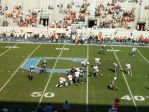
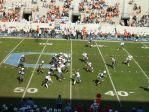
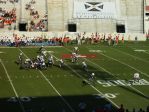
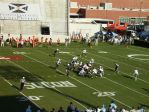
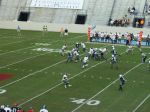
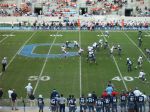
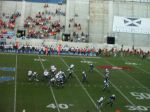
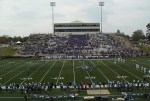
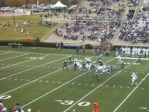
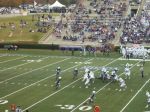
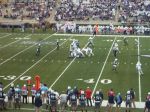
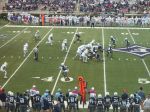
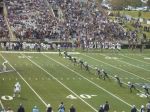
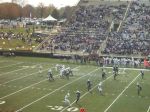
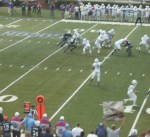
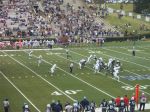
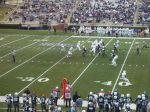
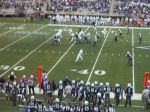
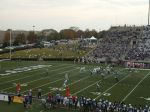
2016 Football, Game 1: The Citadel vs. Mercer

In a swift, clean game of football of football this morning, The Citadel eleven defeated that of Mercer University by a score of ten to zero. On account of the unusual time of the game, 11 a.m., the attendance was not very large, but the crowd made up in enthusiasm what it lacked in numbers.

A very noticeable feature was the presence of a great number of ladies, who formed fully one-fourth of the spectators.

The game was an excellent exhibition of the possibilities of the new rules. While the cadets attempted a few straight bucks, the gains were, in almost every instance, made on end runs, quarterback passes, and fake or quarterback kicks.

Mercer’s gains were made mostly on a long end pass, and the old style half-around-end. The game was also characterized by frequent punting. McCathran and Hammond divided the honors. The cadets were very successful in recovering punts and fumbles…

…The Citadel back-field has shown to no greater advantage this year than in the game today. The team ran interference for them like a machine, and time after time, a blue and white jersey went around the ends for long gains.

The Evening Post, November 10, 1906

The Citadel at Mercer, to be played at Five Star Stadium in Macon, Georgia, with kickoff at 7:00 pm ET on Thursday, September 1.

The game will be televised on Fox Sports Net South, Fox Sports Net Midwest+, and Fox Sports Net West. It will be streamed on ESPN3 and Fox Sports Go, with play-by-play from Darren Goldwater, analysis by Ray Goff, and reporting from Lindsay Rowley. 

The contest can be heard on radio via the various affiliates of The Citadel Sports Network. WQNT-1450 AM [audio link], originating in Charleston, will be the flagship station. 

Mike Legg (the “Voice of the Bulldogs”) will call the action alongside analyst Lee Glaze.

It is also possible to listen to the action with a smartphone, using a TuneIn Radio application.

The Citadel Sports Network — Affiliates

Charleston: WQNT 1450AM (Flagship)
Columbia: WQXL 1470AM/95.9FM
Greenville: WLFJ 92.9FM/660AM
Sumter: WDXY 1240AM/105.9FM

A few of my recent posts revolving around football, including the upcoming season for The Citadel:

  • I broke down last season’s conference statistics, including (but not limited to) 4th-down decisions, run/pass tendencies, and…the coin toss
  • Updated to reference the 2015 numbers, I produced my latest of many posts on attendance at Johnson Hagood Stadium
  • I took a look at scheduling, in terms of which teams The Citadel’s opponents will play before (and after) facing The Citadel
  • With the past as a guide, I wrote about the difficulty the Bulldogs have had over the years in sustaining success

Links of interest:

Season preview from The Post and Courier

Brent Thompson’s “career crisis”

STATS SoCon preview (The Citadel is picked to finish second)

College Sports Madness preview (The Citadel is picked to finish second in the SoCon)

– SoCon media and coaches’ preseason polls (The Citadel is picked to finish second in both polls)

Southern Pigskin preseason poll (The Citadel is picked to finish second)

– Game notes from The Citadel and Mercer [link when available]

SoCon weekly release

FCS Coaches poll (The Citadel opens the season ranked #15)

Brent Thompson interview with Southern Pigskin (video)

Brent Thompson at The Citadel’s Media Day (video)

Brent Thompson talks to Phil Kornblut on SportsTalk, as do Cam Jackson and Joe Crochet (audio)

Brent Thompson’s 8/30 press conference (video)

The Bulldogs’ depth will be tested early

Mercer continues preparations for The Citadel

Bobby Lamb’s 8/29 press conference (video via Periscope)

Mercer student paper’s sports editor previews the Bears’ season (and picks Mercer to beat The Citadel 34-28)

FCS Coaches’ Poll

It’s time for football, everybody!

FOOTBALL!!!

FOOTBALL!!!

FOOTBALL!!!

Since this is only Mercer’s third season in the Southern Conference, I think it’s still worthwhile to briefly outline the institution’s history, including that of its football program.

The school now known as Mercer University was founded in 1833 (as a preparatory school for boys) and was originally located in Penfield, Georgia, a small town between Atlanta and Augusta. The campus relocated to Macon in 1871.

The university is named for Jesse Mercer, a Baptist leader who was the first chairman of the school’s Board of Trustees. The college was originally established by Baptists, but no longer has an affiliation with the denomination.

MU has about 4,500 undergraduate students and almost 4,000 graduate/professional students. Mercer has over 76,000 alumni.

In January of 1892, Mercer played its first-ever football game, losing 50-0 to Georgia in Athens. The contest provided the origin story for how the team came to be known as the “Bears”.

The choice of the bear as Mercer’s mascot is said to have been prompted by a University of Georgia football player. In that first football game between the two schools, one of the Georgia players saw a Mercer player burst through the line of scrimmage and exclaimed, “Whence cometh that bear?”

A school publicist (or perhaps an enterprising newspaper reporter) almost certainly invented that quote, which was undoubtedly inspired by Epicurus. There is no telling what Mercer’s mascot would be if that individual had instead been philosophically aligned with Zeno of Citium.

Mercer decided to play an easier opponent for its second game, and thus tangled with the Savannah Catholic Library Association. The Bears still lost, 20-2.

Then someone in Macon got the bright idea to schedule Georgia Tech, which had not yet played a football game. Mercer won, 12-6.

Mercer was once coached by George Stallings, who helmed both the football and baseball teams. He was a little better at coaching baseball; Stallings would later become known as “The Miracle Man” for leading the Boston Braves to the 1914 World Championship.

Cy Young served as Mercer’s baseball coach from 1903-05.

Mercer disbanded its football team following the 1941 campaign, and didn’t field a gridiron squad again until 2013. This is the fourth year for the program since the re-boot.

Incidentally, that 1892 victory over Georgia Tech was the only time the Bears ever beat the Yellow Jackets. Georgia Tech won 15 of the other 16 meetings (one ended in a tie).

Mercer’s next opponent following its game against The Citadel? Georgia Tech.

The next few sections include statistics for 2015 SoCon contests only, unless otherwise indicated.

Before making some statistical comparisons, a quick review of each team’s 2015 SoCon season:

Mercer opened last year’s conference campaign with a 34-33 OT loss to Wofford in Macon. The Bears trailed by 10 points with just three and a half minutes to play, but had a chance to win the game in regulation before settling for a short field goal and OT. In the extra session, Mercer scored a touchdown but missed the PAT, opening the door for the Terriers.

The Bears then lost a tough road game to Western Carolina, 24-21. MU led 21-3 in the second quarter, but the Catamounts scored two fourth-quarter TDs for a comeback victory.

The next SoCon contest was at home, versus VMI. The Keydets prevailed, 28-21, after controlling much of the game (VMI at one point led by 21 points).

Mercer then lost a tough game to The Citadel at Johnson Hagood Stadium, 21-19, missing a potential tying two-point conversion attempt. It was the second consecutive season that situation presented itself to Mercer, and the second consecutive time the Bears were unable to forge a tie. My review of that game is here: Link

The Bears’ first league win of 2015 was an upset, a 17-14 home victory over eventual league co-champ Chattanooga. MU held off a late comeback attempt by the Mocs, intercepting a pass deep in its own territory while maintaining a three-point lead, and then sealing the win by running out the clock with a pair of first downs.

That was Mercer’s ninth game of the season; the following week, the Bears went to Greenville and beat Furman in OT, 27-20. The Paladins scored late to tie the game at 20, but had to attempt a longer-than-usual PAT due to an unsportsmanlike conduct penalty. Furman missed the kick, the game went to overtime, and Mercer wound up winning the contest four plays later.

Mercer returned to Macon for its season finale and was beaten by Samford, 47-21. MU actually led in the third quarter but gave up multiple big plays down the stretch; Samford scored 28 points in the fourth quarter.

The Citadel opened its SoCon campaign in 2015 with a solid home win over Western Carolina, 28-10. The Bulldogs’ next league game was also at home, against Wofford, and The Citadel handled the Terriers 39-12.

Following that victory, The Citadel won consecutive road games in impressive fashion, versus Samford and Furman (by 44-25 and 38-17 scores, respectively). The Bulldogs then edged Mercer 21-19, and retained the coveted Silver Shako with a hard-fought 35-14 win over VMI.

Both of those games were at home. The Citadel lost its final conference game of the season, 31-23 at Chattanooga, though the Bulldogs still won a share of the Southern Conference title.

In league play, Mercer’s offense averaged 22.7 points per game. The Bears averaged 5.2 yards per play, including 4.4 yards per rush and 6.5 yards per pass attempt.

Mercer threw the football 185 times, averaging 26.4 tosses per conference game. MU passed or was sacked attempting to pass on just over 40% of its offensive plays from scrimmage (Mercer was sacked eight times in seven SoCon matchups).

Slightly less than half (48.1%) of MU’s offensive total yardage came via the air. Mercer scored twenty touchdowns in conference play, eleven rushing and nine passing. The Bears were intercepted three times (one each in the last three conference games of the season) and fumbled ten times in league contests, losing four of those fumbles.

Defensively, The Citadel allowed 18.3 ppg in SoCon action. The Bulldogs allowed 5.1 yards per play, including 3.7 yards per rush and 6.7 yards per pass attempt. As I noted in my statistical review of The Citadel’s 2015 league campaign, that yards per rush stat was an improvement over the corresponding 2014 numbers by almost exactly two yards.

The Bulldogs sacked opposing quarterbacks twenty times in league play, and intercepted thirteen passes (breaking up twenty other throws). SoCon opponents averaged 30.3 pass attempts per game versus The Citadel (with those tosses accounting for 46.1% of all offensive plays run from scrimmage against the Bulldogs).

The Citadel’s defense recovered seven fumbles in conference action.

Mercer had exactly 100 third-down attempts in SoCon play, converting on 39 of them. The Bears went for it on fourth down on fifteen occasions in conference action, successfully making the line to gain nine times (60%).

MU was in the Red Zone 22 times in seven league contests, scoring sixteen touchdowns in that situation (for a RZ TD rate of 72.7%).

Mercer’s time of possession per game in conference play was 31:28. The Bears averaged only 2.7 penalties per SoCon game, resulting in an average of just 20.7 penalty yards accepted against Mercer in those contests.

The Citadel’s defense held league opponents to a third-down conversion rate of 33.7%. Against the Bulldogs, SoCon opposition was 8 for 13 on fourth-down tries (61.5%).

In Red Zone situations versus conference teams, the Bulldogs allowed a TD rate of 52.2% in 2015.

As far as penalties are concerned, the SoCon traditionally is loathe to call infractions against The Citadel’s opponents, and that is reflected in last year’s numbers. While the Bulldogs were called for 42 penalties in seven conference games (6.0 per contest), the opposition was only flagged 29 times (4.1 per game).

MU allowed 26.9 points per game to league opponents. Conference teams averaged 6.4 yards per play against the Bears, including 5.6 yards per rush and 7.8 yards per pass attempt.

Mercer’s defense faced 183 pass attempts in SoCon play, just two fewer pass attempts than the Bears tried on offense. MU had eleven sacks in conference action; in a mirror image of Mercer’s offense, 40.4% of opposition plays were pass attempts (or sacks while attempting to pass).

The Bears allowed 3,087 yards of total offense in seven league games, with 46.1% of that total being passing yardage. Mercer allowed 24 touchdowns in SoCon play, 18 on the ground.

MU intercepted seven passes in conference matchups, and forced thirteen fumbles (while recovering nine opponent fumbles).

Offensively, The Citadel rung up 32.6 points per game in league action. The Bulldogs averaged 6.1 yards per play, including 5.6 yards per rush and 9.7 yards per pass attempt. While there were a limited number of passes in The Citadel’s triple option offense, that’s still a very impressive statistic.

League opponents intercepted two Bulldog passes and broke up four others, out of a total of 63 pass attempts in conference action.

The Citadel lost eight fumbles in seven SoCon games. In an illustration of the nature of variance in fumble statistics, the Bulldogs lost twelve fumbles in their other six matchups, losing at least one fumble in every non-league contest except one — the game against South Carolina.

Holding onto the football will be a point of emphasis for The Citadel this season.

Mercer’s defense allowed a third-down conversion rate of 54.5% against league teams. On fourth down, opponents of the Bears were six for twelve.

SoCon opposition entered the Red Zone against Mercer 27 times in conference play. MU allowed 18 touchdowns in that situation (66.7%).

The Citadel’s third-down conversion rate on offense was exactly 50% in SoCon games. On fourth down, the Cadets were 3 for 8 (37.5%).

In 2015, The Citadel’s time of possession in SoCon play was 32:13. The Bulldogs had a Red Zone TD rate of just 56.3% in 2015 against conference opposition, an area in which The Citadel needs to improve in 2016.

For individual statistics, all games (SoCon and non-conference) are included.

Before I get to John Russ and company, let me quickly review the four non-conference games Mercer played last season.

Mercer was 3-1 in those four games. The Bears lost at Tennessee Tech by a 29-22 score, but won by a lopsided margin in the other three contests — 28-7 at Austin Peay, 57-14 versus Stetson, and 52-0 against East Tennessee State.

Obviously, ETSU will be a league opponent for both Mercer and The Citadel this season, but last year that wasn’t the case.

The Bears could have named their score against both Stetson and East Tennessee State, to be honest. In the game against Tennessee Tech, Mercer trailed early before making a comeback, only to be foiled by a late Golden Eagles touchdown. MU only scored two TDs in five red zone trips, which was probably the difference between winning and losing the game.

I’m going to mention one other thing about Mercer’s non-conference games. I came across a statistical oddity that had me rechecking numbers two or three times to make sure I wasn’t making a mistake. Check out the net rushing totals for Mercer and its opponents in these four contests:

  • Mercer 261, Austin Peay 56
  • Mercer 256, Stetson 43
  • Mercer 261, Tennessee Tech 56 (yes, exactly the same totals as in the Austin Peay game)
  • Mercer 261, East Tennessee State 68

Mercer had 261 net rushing yards in all three of its non-conference matchups with opponents from the state of Tennessee. I don’t know what the odds are on that happening, other than they are very long indeed.

(In its one league game against a team from the Volunteer State, Mercer finished with 173 net rushing yards versus Chattanooga.)

Mercer returns 22 starters (including offense/defense/specialists), tied with East Tennessee State for the most returnees in the league. As a comparison, The Citadel returns 15 starters, second-fewest in the conference (Western Carolina has 14 starters coming back).

The Bears are led by quarterback John Russ (6’0″, 201 lbs.), a senior from Buford, Georgia. He has started all 35 games for Mercer since the program’s resumption in 2013.

Last season, Russ completed 58.2% of his passes, averaging 7.3 yards per attempt, with 18 touchdowns against just three interceptions. He did not throw an INT until the ninth game of the campaign.

Russ (a self-described “simple guy”) also rushed for 382 yards and 7 TDs, while usually operating out of a “pistol” formation. Last year against The Citadel, the QB was 13 for 25 through the air for 130 yards and a touchdown. He was sacked four times by the Bulldogs.

Junior running back Alex Lakes (5’11”, 222 lbs.) rushed for 1,107 yards in 2014, which led the SoCon. Last year, he struggled through an injury-marred season (that included a punctured lung). Lakes rushed for 51 yards and a TD versus The Citadel in the 2015 matchup.

Chandler Curtis (5’11”, 202 lbs.), a junior, was a first-team All-SoCon selection in 2014 as a freshman. Curtis returned four kicks (three punts and a kickoff) for touchdowns that year.

Curtis hurt his ankle in last year’s season opener, and never got on track afterwards. He also suffered an injury during Mercer’s game against The Citadel, after making three early catches. As a result, he only appeared in three games for the Bears in 2015.

When healthy (and he says he is ready to go this year), Curtis is a threat to go the distance any time he has the ball in his hands. Besides his kick-returning exploits, Curtis had four catches of 40+ yards in 2014.

Avery Ward (6’2″, 178 lbs.) led the Bears in receptions last season, with 40, averaging just over 12 yards per catch.  Six of his grabs went for TDs. Ward caught a 65-yard touchdown pass against The Citadel in the 2014 game between the two teams. He had three receptions for 37 yards in last year’s contest.

Sophomore Jimmie Robinson (5’8″, 179 lbs.) was a high school track star who appeared in all eleven games for Mercer last season as a wideout and kick returner. Robinson may not start, but should see plenty of action for the Bears as a stretch-the-field kind of player.

Mercer tight ends are a factor in the passing game. Robert Brown (a 6’2″, 225 lb. senior) and Sam Walker (a 6’4″, 232 lb. redshirt sophomore) combined for 42 receptions last year, including four against The Citadel (with Brown’s lone reception resulting in a touchdown). Walker was a preseason second-team all-league selection.

MU frequently uses two tight ends in its offense, sometimes employing one of them in an “H-back” role.

Mercer’s projected starters on the offensive line average 6’2″, 287 lbs.

Kirby Southard (6’0″, 271 lbs.) has started every game at center for Mercer since the beginning of the 2013 season. John Russ is the only other Mercer player who has started all 35 games for the Bears over the last three years.

Right tackle Bret Niederreither (6’3″, 296 lbs.) began his collegiate career at Temple. In 2014, Niederreither started against The Citadel, but at defensive tackle. In 2015, he started eleven games for the Bears along the offensive line. In 2016, he is a preseason all-SoCon pick.

—

Mercer lines up on defense in what is nominally listed as a 3-4 setup (I’ve also seen it described as a 3-3-5). Of course, the formation may change against a triple option attack.

Tripp Patterson (6’1″, 213 lbs.) is a senior linebacker who led Mercer in tackles last season (with 70), despite making only six starts. The transfer from Air Force had eleven stops versus the Bulldogs in last year’s game.

Middle linebacker Lee Bennett (6’0″, 223 lbs.) finished second on the team in tackles last season, with 67. The junior had eight tackles against The Citadel last season.

Defensive end Isaiah Buehler, a 6’3″, 258 lb. redshirt sophomore, had two tackles for loss (seven total) against The Citadel last year. Buehler was a preseason second team all-conference choice.

“Bandit” linebacker Tosin Aguebor (6’3″, 238 lbs.) was also a preseason second-team all-league selection. The senior played all eleven games for Mercer last year, after missing the entire 2014 campaign due to injury.

Macon native Tyler Ward (6’1″, 228 lbs.) had 13 tackles against The Citadel in 2014. Ward, one of Mercer’s captains, should see action as part of the linebacker rotation.

Nosetackle Austin Barrett (6’2″, 311 lbs.) had a career-high eight tackles versus the Bulldogs last year. Barrett seems to enjoy playing against military colleges, the junior having registered two sacks last season against VMI.

Free safety Zach Jackson (6’0″, 203 lbs.), a transfer from TCU, had 10 tackles versus The Citadel in 2014. The redshirt senior was injured and did not play against the Bulldogs last season.

—

Mercer will have to replace its punter, holder, and long snapper this season. The new punter will have big shoes to fill, as Matt Shiel was very effective for the Bears last year.

Last season, placekicker Jagger Lieb (5’9″, 194 lbs.) was 11 for 18 on field goal attempts, with a long of 43. In 2014, he made a 48-yarder against The Citadel.

The junior may face competition for the starting job from sophomore Cole Fisher (6’1, 192 lbs.), who converted the only field goal attempt he tried last season. One thing that Mercer needs to fix is its PAT issues, having missed four of them last year (including a critical one versus Wofford).

Chandler Curtis and Jimmie Robinson are expected to handle most of the return duties for the Bears. As mentioned above, Chandler could be particularly dangerous. That was certainly the case in 2014.

There was some indication that this season, The Citadel might open up the aerial attack (or at least throw the football more than nine times per game in league play). With Jordan Black getting his first start at quarterback on Thursday, however, I suspect that the Bulldogs won’t be throwing the ball all over the field in Macon.

Whether or not they would have anyway is subject to question. While it’s one thing to talk about passing more often, I’m not sure Brent Thompson is all that desperate to have a more balanced offensive approach. A quote from a recent Jeff Hartsell article on the coach was illuminating:

[Bucknell] went 4-7 in 2009 before head coach Tim Landis left for an assistant’s job at San Jose State. Thompson was left looking for a job, and unhappy with what had happened to his offense.

“We were getting into some shotgun stuff, trying to take what we did under center and put it in the shotgun,” he said. “It’s something a lot of teams do — Wofford does it well. But it was deteriorating our physicality, eroding our techniques and I was probably trying to placate too many people, trying to be sexy and more dimensional.

“So I said, if I have it to do over again, we’re going to establish blocking fundamentals, get good at something and go from there.”

Sometimes it takes a game or two for the triple option to start running smoothly. That is reflected, to a certain extent, in the records of the Lenoir-Rhyne teams that featured Brent Thompson as the offensive coordinator, and the 2014 season at The Citadel.

  • 2010: After crushing Chowan 59-10 in its opener, Lenoir-Rhyne lost its second game of that season 20-17 to Concord (a quality D2 program in West Virginia)
  • 2011: Lenoir-Rhyne opened the season with a 26-6 road victory over Concord
  • 2012: In its opener, Lenoir-Rhyne lost 24-21 at Concord
  • 2013: Lenoir-Rhyne lost 18-10 at home to Concord in the season’s first game; L-R would then reel off 13 consecutive wins
  • 2014: The Citadel lost 31-16 at home to Coastal Carolina to begin the season

Last year, the Bulldogs enjoyed an easy 69-0 home victory over Davidson, arguably the perfect lead-in to the conference campaign. This year, The Citadel won’t have that luxury, opening with a league game (and on the road).

One advantage Mercer will have is being able to prepare for a triple-option team over a longer period of time, rather than having to adapt for one week during the season. As Bobby Lamb noted:

“Any time you play [The Citadel] in the middle of the year, you’ve basically got three practice days to get out there and try to defend it, which is very difficult,” Lamb, now in his 13th year as a collegiate head coach, continued. “One of the hardest things to do is to implement it with your scout team and try to emulate what they are doing. Our scout team has had more time to work on it and I think that is going to help us with our familiarity.”

During his weekly press conference, Lamb also said that the SoCon office had called the school about potentially playing a conference game to open the season, and that when Mercer found out the opponent would be the Bulldogs, “we jumped all over it”. One further benefit for the Bears is that they will get to play two triple option teams back-to-back (The Citadel and Georgia Tech), and could concentrate even more on that style of offense in preseason camp.

Odds and ends:

– The weather forecast for Thursday night in Macon, per the National Weather Service:  a 20 percent chance of showers and thunderstorms; partly cloudy, with a low around 72 degrees (the projected high temperature for Thursday is 95 degrees).

– Per one source that deals in such matters, The Citadel is a 7-point favorite over Mercer. Earlier in the summer, that line was 8 1/2, but apparently some money has come in on Mercer. I suspect it wouldn’t take a lot of cash to swing an FCS line by a point and a half, but I could be wrong about that.

As a reminder, Mercer has played fourteen games since joining the SoCon. The Bears have only lost by more than 7 points in three of those games — twice in 2014, and in last year’s season finale versus Samford. Both of The Citadel’s games against Mercer in the last two years have been decided by two points.

– Other lines involving SoCon teams: Chattanooga is a 35-point favorite over Shorter; Samford is a 28-point favorite over Mars Hill; Wofford is a 10-point favorite at Tennessee Tech (despite the Terriers losing projected starting quarterback Evan Jacks to a season-ending injury); Western Carolina is a 17-point underdog at East Carolina; East Tennessee State is a 26-point underdog at Kennesaw State; VMI is a 30-point underdog at Akron; and Furman is a 43-point underdog at Michigan State.

Gardner-Webb, a non-conference opponent for The Citadel later in the season, is a 7-point underdog at Elon.

– Massey Ratings: As the season begins, The Citadel is ranked 12th among FCS teams. Mercer is ranked 49th.

Massey projects The Citadel to have a 77% chance of winning, with a predicted final score of 28-17.

Other FCS rankings in Massey of note: Chattanooga (8th), Western Carolina (24th), Samford (27th), Wofford (40th), Furman (51st), VMI (61st), Gardner-Webb (81st), East Tennessee State (120th).

– Per the SoCon weekly release, home teams were 13-15 in SoCon games last season. Of those 28 games, 13 were decided by one possession.

– This is the second year in a row that The Citadel has played in the first conference game of the season. In 2015, the Bulldogs hosted Western Carolina in Week 2.

– According to its media guide, Mercer has 71 players from Georgia on its roster, by far the most from any state. Only seven other states are represented: Florida (10), Tennessee (8), Alabama (5), North Carolina (2), and one each from Pennsylvania, Mississippi, and South Carolina.

The representative from the Palmetto State is Destin Guillen, a 6’5″, 294 lb. redshirt freshman from Berea High School in Greenville. He is listed as a backup defensive end on the two-deep.

– The Citadel’s geographic roster breakdown (per the school’s website) is as follows: South Carolina (47 players), Georgia (23), Florida (9), North Carolina (7), Alabama (4), Pennsylvania (4), Texas (4), and one each from Louisiana, Maryland, Kansas, Oklahoma, Nevada, and West Virginia.

– The depth chart released by The Citadel for Thursday night’s game includes eight “true” freshmen and two redshirt freshmen, including two projected starters on offense: redshirt freshman quarterback Jordan Black, and true freshman guard Drew McEntyre. Both are Georgia natives.

Most of the newcomers are on the offensive side of the ball, as the defense has considerably more experience.

– The Citadel has victories over Mercer in four different cities: Charleston, Macon, Savannah, and Augusta. The Bulldogs are 2-0 in Macon, with a 12-7 victory in 1926 and a 28-26 triumph in 2014.

– The key play in last year’s game between the two teams was Isiaha Smith’s 83-yard TD run late in the first half. Per The Citadel’s game notes, that was the longest run from scrimmage for a Bulldog since 2004.

– One more tidbit from the game notes: The Citadel is one of only two programs to rank in the top three in FCS in fewest tackles for loss allowed per game in each of the past two seasons. In my opinion, that is a reflection of both the offensive system and the general excellence of the offensive line over those two years.

– Earlier in the post, I noted that Mercer’s opponent next week is Georgia Tech. The Yellow Jackets will be the first FBS team that the Bears have played since re-starting football.

Georgia Tech is the only team Mercer will play this season that the Bears did not play last year. Essentially, the Yellow Jackets replace Stetson on MU’s schedule.

– Next season, Mercer will play two FBS opponents — Auburn and Alabama.

MU will also travel to Tuscaloosa in 2021 for another game against the Crimson Tide. Other FBS opponents on future schedules for the Bears include Memphis (2018) and Vanderbilt (2020).

Mercer also has scheduled a four-game home-and-home series against Yale, with those games to take place in 2018, 2021, 2022, and 2023.

At the beginning of this post, I quoted a game story from the first meeting between Mercer and The Citadel on the gridiron, a 1906 contest won by the Bulldogs. The subheading for the article noted that the game featured an “absence of fumbling”.

Incidentally, The Citadel’s ten points in that contest came on two touchdowns, as such scores were worth five points in those days.

It was “Gala Week” in Charleston, a festival created after the 1886 earthquake to celebrate the city’s recovery from that disaster (and also to juice up the local retail scene). Apparently that is why the game had to be played in Hampton Park at 11 a.m., and it may also explain the paltry attendance. Only an estimated 200 spectators witnessed The Citadel’s victory.

I expect quite a few more fans will be at the 2016 edition of the matchup on Thursday night. It should be a fine atmosphere for a game, and I would not be surprised if significant numbers of blue-clad supporters manage to escape their weekly duties long enough to make the trip to Macon.

Mercer’s team (and fan base) is confident that the Bears can break through this season in a big way, after two years of mostly near-misses. MU has improved depth on both sides of the ball, and more than its fair share of experience.

Bobby Lamb’s charges believe they can win. Of course, the same is true for the players who will line up for The Citadel.

The Bulldogs were a major success story last year, and brought great joy to loyal fans who had waited many years for such a season. Memories were created that will last forever, but memories don’t block and tackle.

Can they do it again? Will the team be able to maintain that forward push under a new head coach, with an untested quarterback, and on the road against an opponent that could be ready to take the next step?

Those are the questions. What are the answers?

We’ll find out at least some of them on Thursday night.

Inside the numbers: The Citadel’s 2015 run/pass tendencies, per-play averages, 4th-down decision-making…and more!

A few other football-related posts from recent weeks:

Updating history: Attendance at Johnson Hagood Stadium, 1964-2015

What teams will the Bulldogs’ opponents play before (and after) facing The Citadel?

Preseason football ratings and rankings, featuring The Citadel (and the rest of the SoCon)

Also, of course, there are the much-discussed TSA “watch lists” for the upcoming league campaign. See if your favorite SoCon football player (or coach) made one of the lists!

TSA watch lists for the SoCon — Offense
TSA watch lists for the SoCon — Defense
TSA watch lists for the SoCon — Special Teams
TSA watch list for the SoCon — Coach of the Year

For the past two years, I have written about tendencies in playcalling by the then-coach of the Bulldogs, Mike Houston (and his offensive coordinator, Brent Thompson, who of course is now The Citadel’s head coach). I compared what Houston had done while at Lenoir-Rhyne to Kevin Higgins’ last two seasons at The Citadel, along with Houston’s initial season at The Citadel in 2014.

Now I’m going to take a look at what Houston and Thompson did last year at The Citadel, and contrast some of those statistics with those from the 2014 season for the Bulldogs, along with the 2013 campaign under Higgins. I decided not to include 2013 Lenoir-Rhyne stats in my comparison this time, though if anyone wants to see those numbers, they are contained in my previous posts on the subject.

My focus is on down-and-distance run/pass tendencies, fourth-down decision-making, situational punting, and assorted other statistical comparisons. This year, I also took a look at the coin toss (?!), after spotting a trend late last season.

Almost all of the statistics that follow are based on conference play, and only conference play. It’s easier and fairer to compare numbers in that way. Ultimately, The Citadel’s on-field success or failure will be judged on how it does in the SoCon, not against the likes of North Greenville or North Carolina (though beating South Carolina in non-conference action is always a plus).

The conference slates looked like this:

  • The Citadel played seven games in 2015 against SoCon teams. The conference schools competing on the gridiron last year: Western Carolina, Wofford, Samford, Furman, Mercer, VMI, and Chattanooga.
  • The Bulldogs played seven games in 2014 versus SoCon opposition. The teams in the league last year were the same as the 2015 opponents: Wofford, Western Carolina, Chattanooga, Mercer, Furman, Samford, and VMI.
  • The Citadel played eight games in 2013 against SoCon foes. As a reminder, those opponents were: Wofford, Western Carolina, Furman, Appalachian State, Georgia Southern, Chattanooga, Samford, and Elon.

Oh, before I forget: this year, I put most of the numbers on a spreadsheet. It’s a bit involved (there are seven different sub-sheets), but if anyone wants to peruse the numbers, go for it. Individual game statistics in various categories are included.

I’m fairly confident in the accuracy of the statistics, though I will admit that averaging the time of possession numbers gave me a bad headache. I may be off by a second or two on the quarterly TOP averages. If so, it’s too bad — no refunds are available.

Some definitions:

– 2nd-and-short: 3 yards or less for a first down
– 2nd-and-medium: 4 to 6 yards for a first down
– 2nd-and-long: 7+ yards for a first down
– 3rd-and-short: 2 yards or less for a first down
– 3rd-and-medium: 3 to 4 yards for a first down
– 3rd-and-long: 5+ yards for a first down

The first number that will follow each down-and-distance category will be the percentage of time The Citadel ran the ball in that situation in 2015. Next to that, in parenthesis, is the run percentage for The Citadel in 2014, and that will be followed by the Bulldogs’ run percentage for that situation in 2013 (which will be in brackets).

For example, when it came to running the ball on first down, the numbers looked like this:

– 1st-and-10 (or goal to go): 89.1% (88.9%) [77.1%]

Thus, The Citadel ran the ball on first down 89.1% of the time last year, while the Bulldogs ran the ball in that situation 88.9% of the time in 2014 (basically, there was no difference). The Citadel ran the ball 77.1% of the time on first down during its 2013 campaign.

Overall, the Bulldogs ran the ball 86.5% of the time, after rushing on 84.3% of all offensive plays in 2014.

Here are the rest of the down-and-distance categories (in terms of rush percentage):

– 2nd-and-short: 89.2% (84.0%) [95.8%]
– 2nd-and-medium: 89.8% (90.2%) [87.8%]
– 2nd-and-long: 89.2% (82.2%) [75.0%]
– 3rd-and-short: 93.1% (95.5%) [85.7%]
– 3rd-and-medium: 82.4% (90.3%) [90.9%]
– 3rd-and-long: 66.0% (57.4%) [54.0%]

A caveat to these numbers is that there were a few called pass plays that turned into runs. However, if the result of a play was a sack, that counted as a passing down even if a pass wasn’t thrown. There were four such plays in conference action in 2015 for The Citadel.

When compiling NCAA statistics, lost yardage on sacks counts against rushing totals, which may strike the casual observer as counter-intuitive. The NFL, on the other hand, considers sack yardage as passing yardage lost.

I don’t think there is a lot to be surprised about in those numbers, not for anyone who has watched a Brent Thompson offense over the last few years. It is true that the Bulldogs’ passing percentage on 3rd-and-medium is slightly higher than one might expect, but we’re only talking about three pass attempts on seventeen such down/distance situations; subtract one pass attempt, and the average would have been almost exactly the same as it was the previous two seasons.

There were three games in which the Bulldogs threw the ball a bit more often than normal on third-and-long: Wofford, Furman, and Chattanooga.

The Citadel was 4 for 6 passing versus Wofford on 3rd-and-long for 41 yards, including a 24-yard completion. At Furman, the Bulldogs were 1 for 2 (and also suffered a sack).

However, the one completion on third-and-long against the Paladins was a big one, a 50-yard pass from Dominique Allen to Reggie Williams that set up a TD. It was probably the biggest play of the game.

In the game versus Chattanooga, The Citadel was 2-3 for 20 yards (and a sack) on third-and-long. Trailing throughout the contest undoubtedly had an effect on the play-calling.

Prior to the 2015 season, I wrote:

[In 2014], The Citadel attempted four passes on 2nd-and-short. The first three of them fell incomplete.

In the season finale at VMI, however, the Bulldogs did complete a 2nd-and-short toss, a Miller connection (Aaron to Vinny) that went for 26 yards and set up a field goal to close out the first half of that contest. Upstairs in the Foster Stadium press box, Brent Thompson undoubtedly heaved a sigh of relief after calling his first successful 2nd/3rd-and-short pass play in league action in almost two years.

On a serious note, The Citadel has to convert at a higher rate when it passes the ball in 2nd- and 3rd-and-short situations. The offense must take advantage of having the element of surprise in its favor.

Well, The Citadel attempted four passes on 2nd-and-short in 2015, too. The results? An interception, a 36-yard gainer that led to a touchdown, a 24-yard TD strike, and a 22-yard completion.

Not bad. The pick came in the red zone, though. I guess you can’t have everything.

– The Citadel’s offense in 2013 in SoCon action: 69.6 plays per game, 12.0 possessions per game
– The Citadel’s offense in 2014 in SoCon action: 75.4 plays per game, 11.0 possessions per game*
– The Citadel’s offense in 2015 in SoCon action: 70.7 plays per game, 11.9 possessions per game**

*This does not include the Bulldogs’ overtime possession against Furman

**I don’t count a drive as an actual possession when it consists solely of a defensive TD via a return, or when it is a defensive turnover that ends the half or game (or both, like Tevin Floyd’s pick-six against VMI). I also don’t count a drive as a possession when the offensive team does not attempt to move the ball forward (such as a kneel-down situation). That’s how I interpret the statistic, regardless of how it may be listed in a game summary.

The Citadel had a time of possession edge in SoCon play of almost four and a half minutes (32:13 – 27:47). That was actually slightly less of a TOP edge than the Bulldogs had in 2014 (32:40 – 27:20).

The offense generally took control of the ball, however, as games progressed. Average time of possession for The Citadel, by period: 6:59 (1st quarter), 7:47 (2nd), 8:31 (3rd), 8:56 (4th).

– The Citadel’s offense in 2013 in SoCon action: 5.41 yards per play, including 5.13 yards per rush and 6.4 yards per pass attempt
– The Citadel’s offense in 2014 in SoCon games: 5.56 yards per play, including 5.35 yards per rush and 6.8 yards per pass attempt
– The Citadel’s offense in 2015 in SoCon games: 6.09 yards per play, including 5.57 yards per rush and 9.7 (!) yards per pass attempt

The Bulldogs’ offense improved in all three per-play categories listed above for a second consecutive season. Last year, I suggested a benchmark:

I think the goal going forward might be for yards per rush to exceed 5.75, and for yards per pass attempt to exceed 8.0 (or at least 7.5).

Mission accomplished, especially those yards per pass attempt. The Citadel threw 63 passes in seven SoCon games, and gained 609 total yards passing. Three of those tosses were intercepted, which is not a terrible ratio.

—

How did the yards per play numbers for the defense shake out? Quite nicely, thank you very much:

– The Citadel’s defense in 2013 in SoCon action: 5.47 yards per play, including 4.39 yards per rush and 7.2 yards per pass attempt
– The Citadel’s defense in 2014 in SoCon action: 7.02 yards per play, including 5.69 yards per rush and 9.1 yards per pass attempt
– The Citadel’s defense in 2015 in SoCon action: 5.07 yards per play, including 3.69 yards per rush and 6.7 yards per pass attempt

That will work. After a less-than-stellar 2014 campaign, the defense improved markedly last year. Check out that yards per rush allowed stat — exactly two yards less per play from one year to the next. The defense against the pass was excellent, too.

In 2014, The Citadel allowed more than seven yards per rush in four of seven league contests. In 2015, the Bulldogs allowed fewer than three yards per rush in four of seven conference games. It helped that The Citadel averaged 4.3 tackles for loss (not including sacks) per game in SoCon action.

– The Citadel’s defense in 2013 in SoCon action: 12 sacks, 26 passes defensed in 204 attempts (12.7% PD)
– The Citadel’s defense in 2014 in SoCon action: 8 sacks, 14 passes defensed in 176 pass attempts (8.0% PD)
– The Citadel’s defense in 2015 in SoCon action: 20 sacks, 33 passes defensed in 212 pass attempts (15.6% PD)

Passes defensed is a statistic that combines pass breakups with interceptions.

After a trying season in 2014, everything worked well for the defense in 2015. I don’t think it is too surprising that the PD numbers improved with an increase in sacks, and the Bulldogs were harassing opposing quarterbacks even when they weren’t sacking them (increasing their “hurries” totals in league play from eleven to seventeen).

Big plays! Big plays! Big plays! Big plays! Big plays!

In seven conference games in 2014, The Citadel’s defense allowed 47 plays from scrimmage of 20 yards or more — 21 rushes and 26 pass plays. In 2015, that number dropped to 23, nine rushes and fourteen pass plays.

That’s a huge improvement, obviously. It isn’t exactly a shock that big plays lead to points, either directly or later in the drive. Preventing those long gainers is a key to keeping teams off the scoreboard.

For example, of those 23 big plays allowed by the Bulldogs, 14 led to touchdowns (either on the play itself, or later on the same drive). That’s 60.1% of the time.

That percentage is actually lower than what SoCon opponents allowed against The Citadel’s offense on big plays, however. In league action, the Bulldogs had 30 plays of 20 yards or more on offense last year (19 on the ground, 11 in the air). Twenty of those thirty plays led directly or indirectly to touchdowns (66.7%).

– The Citadel’s offensive 3rd-down conversion rate in SoCon action, 2014: 46.3%
– The Citadel’s offensive 3rd-down conversion rate in SoCon action, 2015: 50.0%

– The Citadel’s defensive 3rd-down conversion rate in SoCon action, 2014: 41.5%
– The Citadel’s defensive 3rd-down conversion rate in SoCon action, 2015: 33.7%

In all games last season, the Bulldogs had an offensive 3rd-down conversion rate of 49.4% (second-best to Chattanooga among SoCon squads), and a defensive 3rd-down conversion rate of 36.5% (which was the best mark among league teams).

The Citadel was 3 for 8 on 4th down in conference play (37.5%). In this case, the percentage may not be as significant a story as are the total attempts. In 2014, the Bulldogs had twenty 4th-down tries in SoCon games, converting twelve (60%).

League opponents were 8 for 13 (61.5%) on 4th down against the Bulldogs last year. It’s definitely a small sample size, but it wouldn’t hurt the defense to knock that percentage down a bit in 2016.

First known football usage of “red zone” in print, per Merriam-Webster: 1983.

First known claim that the red zone does not in fact exist: 2013.

– The Citadel’s offensive Red Zone touchdown rate in SoCon action, 2013: 60.0%
– The Citadel’s offensive Red Zone touchdown rate in SoCon action, 2014: 66.7%
– The Citadel’s offensive Red Zone touchdown rate in SoCon action, 2015: 56.3%

– The Citadel’s defensive Red Zone touchdown rate in SoCon action, 2013: 66.7%
– The Citadel’s defensive Red Zone touchdown rate in SoCon action, 2014: 60.0%
– The Citadel’s defensive Red Zone touchdown rate in SoCon action, 2015: 52.2%

The Bulldogs’ offensive Red Zone TD rate would have been better if you didn’t include the VMI game, in which The Citadel somehow managed to go 0 for 5 in scoring touchdowns once inside the 20-yard line. That was a disappointing performance, though on the bright side Eric Goins got to pad his stats.

I always like to take a brief look at fumbles. There really isn’t much to say about them as far as last year was concerned, other than the defense recovering seven of eight opponent fumbles was against the odds. Usually, recovering fumbles is a 50-50 proposition.

– The Citadel’s offensive fumbles in SoCon action, 2014: 10 (lost 6)
– The Citadel’s offensive fumbles in SoCon action, 2015: 12 (lost 8)

– The Citadel’s defensive forced fumbles in SoCon action, 2014: 14 (recovered 7)
– The Citadel’s defensive forced fumbles in SoCon action, 2015: 8 (recovered 7)

When it comes to the SoCon, there are two things on which you can rely with absolute certitude: 1) The Citadel’s gridiron opponents won’t get called for many penalties, and 2) no one associated with The Citadel will ever make the league’s Hall of Fame.

– Penalties enforced against The Citadel in SoCon action, 2014: 37
– Penalties enforced against The Citadel in SoCon action, 2015: 42

– Penalties enforced against The Citadel’s opponents in SoCon action, 2014: 22
– Penalties enforced against The Citadel’s opponents in SoCon action, 2015: 29

– Punts by The Citadel while in opposing territory in 2013, SoCon action: 6 (in eight games)
– Punts by The Citadel while in opposing territory in 2014, SoCon action: 6 (in seven games)
– Punts by The Citadel while in opposing territory in 2015, SoCon action: 6 (in seven games)

In the spreadsheet I linked earlier (and located on sub-sheet 6), I described the scenarios for each of the punts by the Bulldogs in opposing territory during the 2015 season. Of the six, the most questionable was almost certainly the first of two such punts in the Mercer game.

Trailing 10-0, and facing 4th-and-1 on Mercer’s 40-yard line early in the second quarter, Mike Houston elected to punt. I’m still not sure it was the right decision, but it worked out. Mercer punted the ball back on the next drive, and The Citadel would eventually regroup and take a halftime lead it barely deserved (well, Isiaha Smith deserved it, at least).

There were also three punts by the Bulldogs on 4th down from midfield in conference play. Two of them were inconsequential, but the third (and last) was a different story. After going for a 4th-and-short on The Citadel’s 40-yard line (and making it), Houston was faced with another decision three plays later.

On 4th and 2 from midfield, trailing 24-14 early in the 4th quarter, he elected to punt. Chattanooga scored on the ensuing possession, essentially wrapping up the victory for the Mocs.

I think the coach probably should have gone for it in that situation, but I’m just a guy with a computer. I do wish the Bulldogs hadn’t burned a timeout before punting, though.

Let’s talk about 4th down…

Defining some terms (courtesy of Football Outsiders):

– Deep Zone: from a team’s own goal line to its 20-yard line
– Back Zone: from a team’s own 21-yard line to its 39-yard line
– Mid Zone: from a team’s own 40-yard line to its opponent’s 40-yard line
– Front Zone: from an opponent’s 39-yard line to the opponent’s 21-yard line
– Red Zone: from an opponent’s 20-yard line to the opponent’s goal line

On sub-sheet 7 of the aforementioned spreadsheet, I’ve categorized each fourth down situation for The Citadel in conference play.

The Bulldogs punted on 4th down every time they were in the Deep Zone or Back Zone. In the Mid Zone, The Citadel punted ten times on 4th down, and went for it three times.

Two of the three were late in the UTC game, so they were “desperation” attempts. I tend not to focus on those types of fourth down attempts (or “garbage time” tries, either). The other 4th-down attempt in the Mid Zone, however, was early in the second quarter against Samford:

  • With 14:12 remaining in the half and the game tied 7-7, The Citadel faced fourth-and-1 on the Samford 40. Mike Houston elected to go for it, and Dominique Allen kept the ball for a 13-yard gain. The Bulldogs eventually scored on the drive, taking a lead they would not relinquish.

In the Front Zone, there were two punts on 4th down (both somewhat justifiable decisions), and four field goal attempts (two were made, two were missed). Three times, Houston kept the offense on the field on 4th down in this zone. One was a “desperation” attempt. The other two occasions were as follows:

  • On The Citadel’s first drive of the game against Western Carolina, the Bulldogs faced 4th-and-2 on the WCU 22-yard line. It didn’t work out for The Citadel, as Vinny Miller was tackled for a loss of four yards.
  • Midway through the fourth quarter versus Mercer, The Citadel went for it on 4th-and-2 from the Mercer 30-yard line, clinging to a 14-13 lead. Cam Jackson gained seven yards to pick up a first down. Three plays later, the Bulldogs scored a TD.

In the Red Zone, The Citadel faced 4th down eight times. Here is a quick review of all eight situations:

  • Ahead 36-12 midway through the 4th quarter against Wofford, the Bulldogs reached the Terriers’ 6-yard line. On 4th and goal, Eric Goins made a 23-yard field goal. (This is close to a “garbage time” decision, admittedly.)
  • On 4th-and-6 at the Mercer 19-yard line, leading 14-10, The Citadel lined up for a field goal. The snap was botched, and the result of the play was an incomplete pass.
  • Early in the second quarter, with a 4th-and-goal at the VMI 16 (the Bulldogs were pushed back by a holding penalty), Eric Goins converted a 33-yard field goal.
  • With a 17-7 lead midway through the second quarter, The Citadel faced fourth-and-goal at the VMI 2-yard line. The Bulldogs went for it, but only gained one yard, turning the ball over on downs.
  • Midway through the third quarter, now leading 20-14, the Bulldogs again had the ball deep in VMI territory. They were unable to punch it in for a TD, though, and on 4th-and-goal from the Keydets’ 3 yard-line, Eric Goins trotted back on to the field to kick another field goal (of 20 yards).
  • On the Bulldogs’ next possession, ahead 23-14, they drove the ball inside the VMI 10-yard line for the umpteenth time, yet still could not get in the end zone. This time, on 4th-and-1 from the VMI 6, Goins made a 23-yarder.
  • Early in the second quarter, trailing 14-0, The Citadel faced 4th-and-2 from the Chattanooga 5-yard line. The Bulldogs went for it, but only picked up one yard.
  • Late in the game versus UTC, with a 4th-and-goal on the Mocs’ 10-yard line, Mike Houston elected to try a field goal. Eric Goins converted the try, bringing the Bulldogs to within two touchdowns (at 31-17).

I was a little surprised when I realized that the Bulldogs did not convert a Red Zone 4th down situation into a touchdown in league play all of last season. Of course, part of that has to do with the lack of opportunities. If you’re scoring touchdowns on 1st or 2nd or 3rd down, then what you do or don’t do on 4th down doesn’t matter as much.

Incidentally, in 2014 The Citadel had five Red Zone 4th down situations in conference action. On only one of those occasions did the Bulldogs convert a 4th down into a first down. That was a big one, though (and a big call to make), as it came in overtime against Furman and led to the eventual game-winning TD.

I am inclined to believe that Mike Houston was slightly more conservative (just slightly) in his 4th-down decision-making in 2015 than he had been the previous season, primarily because he could afford to be. His team was often in the lead, or within a score of being in the lead.

Houston also knew that he had a good, clutch placekicker, and a solid “directional” punter capable of consolidating field position.

Will Vanvick must have shaken his head when great punts in the Samford game went unrewarded (after having the ball downed at the 1- and 2-yard lines, Samford scored touchdowns on the ensuing drives anyway). He’ll always have the punt against South Carolina to remember, though.

Earlier in this post, I wrote that I had spotted a trend involving the coin toss. To be honest, I don’t know if I really spotted it, or if I just read or heard about it somewhere. I have a vague idea that the subject of the coin toss came up during the weekly coach’s radio show hosted by Mike Legg. It could have been a note in a Jeff Hartsell story, too. Alas, I don’t remember.

At any rate, I wanted to elaborate on the decision-making surrounding the coin toss. I’m not talking about whether or not to call “heads” or “tails”, but rather the idea of deferring the option to the second half after winning a coin toss.

Last year, The Citadel won the coin toss five times (four in SoCon play). Each time, the Bulldogs elected to defer, and wound up kicking off to open the game.

The military college also kicked off three times after losing the coin toss, as three of The Citadel’s opponents (Mercer, South Carolina, and Coastal Carolina) elected to receive the opening kickoff.

The Bulldogs did not automatically defer the option in 2014 when they won the toss, actually electing to receive the opening kickoff three out of the five times they won the flip that season. Therefore, it appears the deferral concept was instituted between the 2014 and 2015 seasons.

I don’t know if Bill Belichick was the inspiration for deferring the option whenever possible, but there are worse guys to emulate when it comes to on-field strategy. As a story in The New York Times pointed out:

Two recent New England games illustrate the advantages of deferring. On Nov. 2, on a cold and windy afternoon, the Patriots won the toss against the Broncos. The Patriots deferred and got the ball to start the second half. When the Broncos elected to receive to begin the game, the Patriots then chose the end that would guarantee the wind would be at their back in the first and fourth quarters. The Patriots won, 43-21.

Sunday against the Lions, the Patriots again deferred. New England scored 10 points in the final three minutes of the second quarter. The Patriots then got the kickoff to open the third quarter and drove deep into Detroit territory before Brady threw an interception.

In the same article, Herm Edwards noted that if “the possessions go about as you think they’re going to go, then maybe you end up with the ball at the end of the game. At the very least, you have the ball to start the second half. And that’s a critical time of the game.”

That piece was written in late November of 2014, just after the Bulldogs’ season had ended that year. I suppose it’s possible that Mike Houston read the story and altered his approach. The timing could also have been coincidental, of course.

Absent other factors, I think deferring the option is usually the right decision. It gives a team the chance to score to end the first half, and then put more points on the board in the second half before the other team gets the ball. It also prevents the opponent from having that same opportunity.

By the way, The Citadel lost six of seven coin tosses last season on the road. As a general rule, one of the visiting team’s captains calls the toss. The Bulldogs obviously need to work on their “heads” or “tails” coin-toss calling technique.

 —

Whether or not Brent Thompson will stay the course when it comes to deferring the option is an unknown at this point. He will be in a position to put his personal stamp on that, along with such matters as fourth-down decision-making. Those are just two of the many items of interest for the new gridiron boss.

I suspect that things like run/pass tendencies will not radically change, mainly because Thompson himself called the plays the past two years. If there is an adjustment in that area (for example, if The Citadel passes more often), it won’t be due to a change in philosophy, but will instead simply be a function of his personnel, both in terms of talent and experience.

Summer is crawling along, but the season is getting closer…

2015 Football, Game 9: The Citadel vs. VMI

The Citadel vs. VMI, to be played at historic Johnson Hagood Stadium, with kickoff at 2:00 pm ET on Saturday, November 7. The game will not be televised.

The contest will be streamed on ESPN3.com, with Kevin Fitzgerald providing play-by-play and Sadath Jean-Pierre supplying the analysis.

The game can be heard on radio via the various affiliates of The Citadel Sports Network. WQNT-1450 AM [audio link], originating in Charleston, will be the flagship station. WQNT will have a two-hour pregame show prior to each home football game. 

Mike Legg (the “Voice of the Bulldogs”) will call the action alongside analyst Lee Glaze. Jay Harper will report from the sidelines; he will host the first hour of the pregame show as well.

It is also possible to listen to the action with a smartphone, using a TuneIn Radio application.

—

Links of interest:

– Preview of VMI-The Citadel from The Post and Courier

– Game notes from The Citadel and VMI

– SoCon weekly release

– Mike Houston on the SoCon teleconference

– Scott Wachenheim on the SoCon teleconference

– Mike Houston’s 11/3 press conference (with comments from Sam Frye and Mitchell Jeter)

– The Mike Houston Show (radio)

– Promotional spot for VMI-The Citadel

– FCS Coaches’ Poll

– Eric Goins one of 32 kickers recognized by the Fred Mitchell Award

– Dee Delaney and Mitchell Jeter both make a CFPA Watch List

– VMI’s video preview of the game

Scott Wachenheim is in his first year at the helm of VMI football; it is the first head coaching job for the 53-year-old native of Woodland Hills, California. Wachenheim replaced Sparky Woods, who was let go after seven seasons in Lexington.

Wachenheim was an offensive lineman at Air Force who later served as an assistant coach under Ken Hatfield at Rice for twelve years (Hatfield had also been Wachenheim’s head coach when he played at Air Force). In the last five years of his tenure at Rice, Wachenheim was the Owls’ offensive coordinator; prior to that, he had been the offensive line coach.

After the Ken Hatfield era at Rice ended, Wachenheim spent three years at Liberty, then moved to the NFL for one season as the tight ends coach for the Washington Redskins. He had been an assistant at Virginia for five years before getting the VMI gig.

At his introductory press conference, Wachenheim was asked if, and how, VMI could win:

I think you win because you’re at VMI. I think that’s why you win…because of what our young men work at on post and in barracks. I think you can take those lessons that have been proven over many, many years to produce some of America’s best leaders and some of the toughest men and use that to help you build a championship football team.

That’s fine and all, but VMI players have always worked hard on post and in the barracks, and it hasn’t translated into a winning season since 1981. Until the administration at the school makes it a priority to have a more successful football program, that is likely to continue.

The next few sections include statistical team/conference comparisons for league contests only, unless otherwise indicated.

Both VMI and The Citadel have played five conference games. The Keydets are 1-4 in the SoCon. They have lost to Furman (24-21), Samford (49-13), Chattanooga (33-27), and Wofford (41-20). VMI’s lone win in the league came at Mercer (28-21).

Of those games, the Samford, Chattanooga, and Wofford matchups were played in Lexington.

The Citadel is 5-0 in the league, having defeated Western Carolina (28-10), Wofford (39-12), and Mercer (21-19) at home, while beating Samford (44-25) and Furman (38-17) on the road.

In five league games, VMI’s offense has thrown the ball 201 times, with nineteen other would-be pass play attempts resulting in sacks. Not counting those sacks, the Keydets have rushed 135 times, so VMI has passed the ball (or attempted to pass) on just under 62% of its offensive plays from scrimmage.

Passing yardage accounts for 74.1% of VMI’s total offense (with sack yardage removed from the total). The Keydets average 6.1 yards per pass attempt (again, with sacks/yardage taken into account). VMI’s average yards per pass attempt rises to 7.1 when sacks are not considered.

Among SoCon teams, VMI is seventh in scoring offense (21.8 ppg). The Keydets are fifth in total offense, but last in yards per play (5.1).

The Citadel is second in scoring defense (16.6 ppg) and total defense, allowing 4.8 yards per play. Chattanooga leads the conference in both categories.

The Keydets are second in passing offense, averaging 287 yards per game. VMI is sixth among SoCon teams in offensive pass efficiency, with seven touchdown passes against eleven interceptions.

The Citadel is sixth in the conference in pass defense, but second in pass defense efficiency. The Bulldogs are allowing 6.5 yards per pass attempt, third in the league, and have intercepted 7 passes in conference play (while giving up four TD tosses).

Last week, The Citadel did not intercept a pass against Mercer (which still has not thrown a pick all season). The Bulldogs now have a 13/4 interception/TD ratio, second-best in the FCS (behind Southern Utah, which has 14 interceptions and has only allowed 3 touchdown passes).

While VMI quarterback Al Cobb has been sacked nineteen times in conference play, The Citadel’s defense has recorded 17 sacks, tied with Chattanooga for the most in SoCon games. Mitchell Jeter picked up another sack against Mercer and now has 5.5 in league contests, more than any other player.

VMI has completed 60.8% of its passes, fourth-best among league teams. The Keydets average 40.2 pass attempts per contest, second-most in the conference (Samford is averaging a borderline incredible 47.6 passing attempts in SoCon play).

The Citadel’s defense is allowing an opponents’ completion percentage of 59.5%, third-lowest in the conference.

VMI is last in the SoCon in rushing offense, averaging 2.5 yards per carry. Not counting sacks, the Keydets average 27 rushing attempts per league contest.

In conference games, The Citadel is second in rushing defense, and is allowing 3.4 yards per rush (also placing second in that category).

VMI is converting 42.9% of its third-down attempts, fourth-best in the SoCon. The Citadel is second in the league in defensive third down conversion rate (35.2%).

The last two games for VMI have featured the highs and lows of third-down conversion attempts. Against Mercer, the Keydets converted 17 of 19 third-down tries, including 12 straight to begin the game (and six of those were 3rd-and-7 or longer).

Last week versus Wofford, however, VMI was only 1 for 12 converting third-down attempts.

The Keydets have a red zone TD rate of 57.9% (11-19). Of the Keydets’ eleven red zone touchdowns, six came via the rush. The Citadel’s red zone defensive TD rate (50%, 8-16) is tied for first in the conference with Wofford (10-20).

When going for it on fourth down this season, VMI is 6 for 12 (50%). Opponents of The Citadel have tried ten fourth-down attempts in league action, converting six times.

VMI is last among league teams in total defense, allowing 33.6 points per game. The Keydets are fifth in the league in total defense, allowing 5.6 yards per play.

The Keydets are fifth in the SoCon in rushing defense, allowing 4.9 yards per rush attempt (next-to-last in the league). VMI opponents have scored fourteen rushing touchdowns in five games.

The Citadel is first in scoring offense (34.0 ppg), second in total offense (averaging 6.2 yards per play, tops in the SoCon) and leads the league in rushing offense (a category in which the Bulldogs rank second nationally, behind only Cal Poly). The Citadel is averaging 5.6 yards per rush attempt, best in the conference.

Tangent: speaking of Cal Poly, the Mustangs had four different players rush for over 100 yards last week – but still lost by 17 points to Southern Utah, 54-37. Cal Poly lost five fumbles, three of which were returned for touchdowns by the opportunistic Thunderbird defensive unit.

You don’t see a box score like that every day.

The Bulldogs are next-to-last in the SoCon in passing yardage per game (ahead of Wofford), but average a league-best 11.1 yards per pass attempt, and are first in offensive pass efficiency among conference squads. The Citadel’s offense has two TD passes and one interception in league play.

VMI is fifth in pass defense among SoCon outfits, sixth in defensive pass efficiency, with one interception against five touchdown passes allowed. The Keydets’ D has four sacks in five games.

At 52.9%, The Citadel leads the conference in offensive third down conversion rate; overall, the Bulldogs are third nationally (behind James Madison and Kennesaw State). VMI is sixth in the SoCon in defensive third down conversion rate, at 46.2%.

The Citadel has an offensive red zone TD rate of 72.7%, second-best in the league. All 16 of the Bulldogs’ red zone touchdowns in SoCon play have been of the rushing variety.

VMI’s red zone defensive TD rate is 71.4%, which ranks next-to-last among conference teams.

The Bulldogs are 2 for 4 on fourth-down conversion attempts in league games. The Keydets’ defense has stopped SoCon opponents on fourth down on 4 of 8 occasions.

The Citadel is +5 in turnover margin (gained eleven, lost six), tied for second in the league in that category. The Keydets have the SoCon’s worst mark at -9 (gained five, lost fourteen).

For the season, VMI is -16 in turnover margin, worse than any other FCS team except Idaho State. Only one team (Mississippi Valley State) has committed more turnovers than the Keydets.

Of the fourteen turnovers VMI has given up in SoCon play, ten of them have occurred in the second half — eight interceptions, two fumbles. Both of the second-half fumbles came last week against Wofford; one of them happened after a Terrier punt hit a Keydet blocker on the foot, and was then recovered by Wofford.

VMI has committed at least one second-half turnover in all five of its conference games. In only one of those games (against Chattanooga, interestingly enough) did the Keydets commit fewer than two turnovers in the second half.

On FG attempts, the Bulldogs are 3 for 5 in the league (21-21 on PATs). The Keydets are 4 for 5 kicking field goals, and are 13-14 on extra point attempts.

The Citadel is fifth in the conference in net punting yardage (35.9), while VMI ranks seventh (31.2). As for kickoff coverage, the Bulldogs are third in the league, while the Keydets are second.

VMI is next-to-last in the SoCon in kickoff return average, though the Keydets opened last week’s game against Wofford with a 99-yard kickoff return for a TD. The Citadel is first in this category, though it should be noted that the Bulldogs have only returned six kickoffs in league contests.

The Bulldogs rank fourth in time of possession (32:16) among league teams. The Keydets are sixth (26:43).

VMI is averaging 71 plays from scrimmage per game, with a 2.66 plays-per-minute rate, which is a rapid pace. The Bulldogs are averaging 70.4 plays per game, with a 2.18 plays-per-minute rate.

In league play, VMI has been called for 3.6 penalties per game, second-fewest in the SoCon (behind Mercer); the Keydets are third nationally in this category. In addition, VMI has been the beneficiary of more penalty yardage assessed against its opponents than any other league team.

The Citadel has been called for the third-most penalties among SoCon teams. Of course, Bulldog opponents have been called for fewer penalties than opponents of any other conference school, which is becoming a tradition.

Note: statistics in the following sections are for all games.

Al Cobb (6’3″, 190 lbs.) is VMI’s outstanding second-year quarterback. Cobb is from Pulaski, Tennessee (one of ten Tennesseans on the Keydets’ roster).

So far this season, Cobb is completing 60.8% of his passes, averaging 7.02 yards per attempt, with 14 touchdowns against 18 interceptions. He is averaging almost 40 pass attempts per game.

Cobb is not afraid to throw the ball downfield. He is averaging 11.5 yards per completion, with 23 passes going for 25+ yards. Cobb also had a 29-yard reception versus Samford.

While that catch showed some versatility, Cobb much prefers to throw the ball to targets like Aaron Sanders.

Sanders (6’2″, 185 lbs.) is a junior who led the Keydets in receptions last season with 58, for 901 yards and 4 touchdowns. He had a big game against The Citadel in last year’s matchup, with 7 receptions for 165 yards and a score.

This season, Sanders already has 72 receptions, which leads the SoCon. That includes a monster outing in VMI’s victory over Mercer, in which he caught a school-record 16 passes for 218 yards.

Of those 218 yards, 146 came after the catch. That will be something to watch on Saturday, not just for Sanders but for the other Keydet pass-catchers. The Citadel’s defenders have to do a good job tackling “in space” to avoid giving up big plays.

VMI flanker Dane Forlines (5’10”, 190 lbs.) has 44 receptions, second on the team. The junior from Richmond caught a touchdown pass against The Citadel last season.

Tight end Sam Patterson (6’5″, 215 lbs.) is a big-play threat who has five touchdown receptions this season. Patterson was limited by injury last year, but he had eight TD catches in 2013.

Derrick Ziglar (5’9″, 230 lbs.) is a fifth-year senior who leads the Keydets in rushing. Ziglar, who averages 4.4 yards per carry and has seven rushing TDs, can also catch passes out of the backfield (nine receptions).

VMI has had some injury issues in the backfield, opening up an opportunity for freshman Quan Myers (5’9″, 175 lbs.).

Average size of the projected starters on the Keydets’ offensive line: 6’4″, 298 lbs. Left tackle Andrew Lewis (6’5″, 260 lbs.) was injured against Wofford last week, but the converted tight end is still listed as a starter on the two-deep.

VMI lines up in a 3-4 defense when not facing the triple option. The Keydets often featured five-man fronts during the latter years of Sparky Woods’ time on post.

It will be interesting to see how Scott Wachenheim and his defensive coordinator, Tom Clark, approach things from a schematic standpoint. Clark was a defensive coach (and former coordinator) at William & Mary prior to taking the position at VMI. Of course, Wachenheim has plenty of experience with the option from an offensive perspective, dating back to his days as a player at Air Force and as a coach at Rice.

Joe Nelson (6’3″, 265 lbs.) is an excellent defensive lineman in his third year as a starter. He had ten tackles against The Citadel in last year’s game.

In the previous two seasons, Nelson was a nosetackle, but he is starting at defensive end this year.

The Keydets’ two inside linebackers are both tackling machines. Allan Cratsenberg (6’3, 220 lbs.) leads the team in tackles, with 89. The sophomore from Pennsylvania has started every game this season, as has redshirt junior Ryan Francis (6’1″, 200 lbs.). Francis has 85 tackles, including seven tackles for loss.

Outside linebacker Tony Richardson (6’3″, 215 lbs.) leads the team in tackles for loss, with 8.5. Free safety Greg Sanders (no relation to Aaron Sanders) is a 5’10”, 170 lb. sophomore who is third on the team in tackles, with 69.

Caleb Furlow (6’2″, 195 lbs.) has started every game at cornerback for the Keydets after missing last season due to injury. In 2013, Furlow made 12 starts at strong safety.

Dillon Christopher (6’2″, 200 lbs.) is a third-year starter at placekicker for VMI. He is 9-11 on FG attempts this season, with a long of 40 yards. Christopher has a strong leg, having made two 52-yard field goals during his career. He is 21-24 on PATs this year.

Hayden Alford (6’3″, 200 lbs.) is VMI’s punter, averaging 39.5 yards per punt, with six of his forty kicks downed inside the 20-yard-line. He has had one punt blocked this season.

Alford is also VMI’s backup quarterback, and the Keydets are not afraid to take advantage of that; Mike Houston called VMI’s special teams “very aggressive” on his radio show.

That aggression includes opening the second half against Wofford with an onside kick, which was ruled to have been recovered by Wofford, though that decision was controversial.

The Citadel will have to be on its guard on Saturday; players must be mindful of the possibilities for fake punts and other special teams “tricks”.

Dane Forlines in VMI’s primary punt returner, and has also returned the most kickoffs for VMI (16). Greg Sanders is second in that category, with eight kickoff returns. One of those eight was a 99-yard kick return TD on the opening play of the game against Wofford.

Sanders was the first Keydet to return a kickoff return for a touchdown since Tim Maypray (now a VMI assistant coach) did it against The Citadel in 2007. Maypray’s return against the Bulldogs that season was also 99 yards.

Ryan Swingle (6’3″, 225 lbs.), who is VMI’s starting fullback, also snaps on punts and holds on placekicks. The snapper for placekicks is junior Walker Hays (6’1″, 265 lbs.).

Odds and ends:

– As always, there will be a lot going on at Homecoming. Here is a schedule listing some of the events: Link

– The Citadel Regimental Band will perform at halftime.

– The Bulldogs will be trying to win their sixth league game of the season on Saturday. Only once before, in 1992, has The Citadel won six SoCon football contests in a year.

– The weather forecast: as of Wednesday night, the National Weather Service was projecting a mostly sunny day in Charleston on Saturday, with a high of 80 degrees.

It is Homecoming. The Bulldogs are on a four-game winning streak, are 5-0 in the SoCon, and play for the league title next week. The weather looks good.

There is no reason not to be at this game — and it is possible that many other people share that opinion. On his radio show Wednesday night, Mike Houston mentioned that he was told by a school official that the West Stands were “sold out” for Saturday.

– Massey Ratings update: The Citadel is rated 112th in Division I, 17th among FCS teams. Chattanooga is the highest-rated SoCon team (9th in FCS).

Harvard is still rated first among FCS teams, which I consider to be an example of how playing a restricted schedule can skew a rating. The Ivy League as a whole has played a grand total of four non-conference games this season against opponents outside of the NEC and Patriot League (Rhode Island twice, Maine, and Villanova).

VMI is rated 80th among FCS teams, one spot ahead of Mercer. Other league squads: Western Carolina (30th), Furman (41st), Wofford (44th), Samford (52nd).

South Carolina is rated 67th among all D1 squads; Georgia Southern is 66th. Clemson is still 2nd.

There are 24 FBS teams currently trailing The Citadel in the ratings.

– Per one source that deals in such matters, The Citadel is a 23-point favorite over VMI. The over/under is 62.

That strikes me as a fairly ludicrous line, given that only Samford has beaten VMI by a larger margin, and The Citadel has only defeated two teams by more points all season (Davidson and Wofford).

– Other lines involving SoCon teams: Chattanooga is a 16-point favorite at Mercer; Western Carolina is favored by 8 points versus Furman; and Samford is expected to crush Clark Atlanta, as the Birmingham Bulldogs are 50-point favorites against the Division II school.

The matchup between Furman and Western Carolina is essentially the league’s third-place game and does carry some potential playoff ramifications, though that may be a longshot for either team.

Wofford is off on Saturday. The Terriers will host Furman next week.

– East Tennessee State finally got a win this season, beating Warner 42-9. The Buccaneers are now 1-7. ETSU travels to Moon Township, Pennsylvania on Saturday, to play Robert Morris. The Colonials are 24.5-point favorites in that game.

– Of the 22 starting positions on The Citadel’s offensive and defensive units, the same player has started every game for 18 of them.

That number was 20 until last week, when Vinny Miller and Alex Glover missed the Mercer game with injuries. Both are listed as starters on this week’s two-deep, however.

– VMI has 56 players from Virginia on its roster. Other states represented: Tennessee (10), Pennsylvania (6), Maryland (5), North Carolina (4), Georgia (4), West Virginia (2), New York (2), and one each from Florida, Michigan, Alabama, and South Carolina (starting right tackle Iyan Roseborough, who went to Fairfield Central High School). There is also one Keydet from Washington, DC.

– Two weeks ago, VMI won at Mercer, breaking a 30-game road losing streak. Last week was a home game for the Keydets.

VMI has not won two straight road games since 1979. The Keydets will have a chance to do so on Saturday.

– VMI last defeated The Citadel in 2002, a matchup played in Charlotte. It is a game generally remembered for being contested in miserable weather, and with horrific field conditions.

– In 2003, VMI finished 6-6, its last non-losing season. The Keydets were coached at the time by Cal McCombs, a graduate of The Citadel. Since that year, VMI’s overall record is 25-107.

– Individual leaders for The Citadel (SoCon games only): Dee Delaney has three interceptions in five league contests, one more than any other player, and is far and away the conference leader in passes defensed. Besides leading the league in sacks, Mitchell Jeter also tops the SoCon in tackles for loss.

Joe Crochet remains the only conference player to have recovered more than one fumble in league play (he has two). Eric Goins has the most converted PATs without a miss (21).

Dominique Allen leads the SoCon in offensive pass efficiency and is tied for first in points scored (48). DeAndre Schoultz is apparently the only league punt returner with enough returns (14 in conference games) to qualify for the conference leaderboard.

While none of them are leading the league, there are four Bulldogs in the top 10 of rushing (conference play only): Dominique Allen, Cam Jackson, Vinny Miller, and Tyler Renew. To highlight the number of quality runners The Citadel has on the roster, two other Bulldogs (Isiaha Smith and Evan McField) appear in the top 10 in overall rushing among league players (joined on that list by Allen and Miller).

– In the links section at the top of this post, I noted that Eric Goins has been recognized for the Fred Mitchell Award. As it happens, Mitchell (a longtime sportswriter) is leaving the Chicago Tribune next month after a 41-year career with that newspaper.

– This week, the Bulldogs will wear light blue jerseys and white pants for Homecoming. Hey, our actual school colors! Miracles do happen.

– This year’s senior class finished 4-0 in Parents’ Day games, with victories over Western Carolina, Appalachian State, Charlotte, and Wofford.

If The Citadel wins on Saturday, the seniors will also complete a perfect 4-0 set of wins on Homecoming. In the past three seasons, the Bulldogs have prevailed at Homecoming against Elon, Samford, and Furman.

Somewhat surprisingly, in the modern history of Parents’ Day/Homecoming games (since 1953), The Citadel has never had a four-year stretch in which it won all eight “celebration weekend” contests.

VMI always comes ready to play against The Citadel, and this year will be no different. The Keydets are led by a talented quarterback capable of ringing up yards and points in a hurry (that includes last year’s matchup, when Al Cobb threw for 396 yards against the Bulldogs).

Most of VMI’s games this season have been competitive, and the Keydets are probably unfortunate to only have one league victory. VMI’s win at Mercer and its near-miss against Chattanooga are two good examples of what the Keydets can do on a good day.

Even on some not-so-good days, VMI has done things that make you think. Against Richmond, a top-10 FCS team, the Keydets rushed for 202 yards. That’s not something you necessarily expect.

During his Tuesday press conference, Mike Houston made the observation that the players took the rivalry very seriously, and that for them the VMI game is “as big, or maybe even bigger” than the game against Furman. He noted the game was very important for the players, and that he had sensed this last year as well.

That was good to hear.

This is the first of three big games for The Citadel. It is the only one of the three, however, in which the coveted Silver Shako is at stake.

The greatest trophy in all of sports has resided in Charleston for quite some time now. It needs to stay in the Holy City for at least another year.

Go Dogs!

Game review, 2015: Mercer

Links of interest:

Game story, The Post and Courier

Photo gallery, The Post and Courier

School release

Video from WCSC-TV, including interviews with Mike Houston, Isiaha Smith, Cam Jackson, Tyler Renew, and Tevin Floyd

Video from WCIV-TV (starting at the 8:00 mark)

Post-game video interview with Mercer head coach Bobby Lamb

Game video highlights

Box score

The Citadel didn’t play its best game of the season on Saturday afternoon, not by a long shot. However, the end result was still a victory, and that’s what mattered.

Mike Houston, in his post-game press conference:

The big key is finding a way to win when you don’t play your best.

The Bulldogs lost two fumbles, botched a field goal attempt (and were generally unimpressive on special teams), committed a couple of ill-timed penalties, and had trouble moving the ball on offense for the first 20 minutes of the game. The game could easily have been lost, particularly because Mercer was playing solid, mistake-free football (no turnovers, only three minor penalties).

However, The Citadel played well on defense throughout the game (aside from the Bears’ final drive), and the offense eventually righted itself.

Random thoughts and observations:

– The Citadel has clinched a winning season. That matters a lot to longtime followers of the military college.

– For the first time since joining the Southern Conference in 1936, The Citadel has won its first five league contests.

Only once in program history has the Bulldogs won six conference games. That was in 1992, the last time The Citadel won the SoCon. On five other occasions, the Bulldogs have won five league matchups — in 1959, 1961, 1988, 1991, and 2012.

– October was good for The Citadel, which went 4-0 during the month. I decided to check the records to see how often the Bulldogs had gone undefeated in October while playing at least four games.

It turns out to have happened seven other times:

  • 1909: Sam Costen’s tough-minded squad didn’t begin play until October, but came out of the gates strong, going 4-0-1 during the month. Two of the wins came against College of Charleston; the tie came against Georgia (0-0). The Bulldogs also beat Porter 99-0, which is still the largest margin of victory in school history.
  • 1928: This was another team that didn’t start its season until October. Carl Prause’s men won their first four games that season by a combined score of 111-8, defeating Stetson, Newberry, Davidson, and Erskine.
  • 1959: For the only time in school history, a team won five games in October. Four of those victories by Eddie Teague’s crew were in SoCon play, the first time The Citadel won four league contests in October. The second time? That happened this past Saturday.
  • 1960: This edition of the Bulldogs went 4-0-1 in October; the tie came against Florida State, an often-referenced 0-0 battle.
  • 1961: Yes, The Citadel had a three-season stretch in which October was a very enjoyable month. This team won the league, of course; three of those SoCon victories came in the tenth month of the year.
  • 1984: Tom Moore’s best team averaged almost 27 points per game in four October victories, three of which were conference affairs. The fourth win came against Davidson, a popular opponent in this month; the 1928, 1959, and 1960 teams also beat the Wildcats in October (the ’61 squad was a little impatient, defeating Davidson on September 30 that season).
  • 1988: Four of seven consecutive wins during Charlie Taaffe’s second season in charge occurred in October, including three conference victories. The week after October that year wasn’t too bad, either; on November 5, The Citadel beat top-ranked Marshall 20-3 in one of Johnson Hagood Stadium’s most memorable games.

– Of course, Mike Houston had an astute observation about what month matters most:

Fans and alumni — they remember teams that play well in November.

– The biggest play of the game, almost without question, was Isiaha Smith’s 83-yard run right up the middle near the end of the first half. It gave the Bulldogs a lead they would never relinquish, and it came after a half in which The Citadel had mostly been on the back foot. It was a brutal play for Mercer, which had done just about everything right up until that moment.

Smith’s burst was the sixth-long rushing play in school history. In what I consider a statistical oddity, only once has a pass play by The Citadel resulted in a longer gain.

That came in 1983, when current football radio analyst Lee Glaze threw an 84-yard TD pass to John Murphy. Glaze was starting quarterback Robert Hill’s backup at the time; the future All-SoCon wide receiver came into the game briefly after a minor injury to Hill, and almost immediately threw the pass that still stands today as The Citadel’s longest completion.

It should come as no shock to anyone reading this that the Glaze-to-Murphy toss came against Davidson, and in October.

– The Citadel just missed on being ranked last week in the FCS Coaches’ poll. The Bulldogs will almost certainly be in this week’s poll, however.

Eight ranked teams lost on Saturday, including #17 Montana, #18 Montana State, #22 Dartmouth, and #23 Indiana State. At least two of those teams will probably drop out of the rankings, with The Citadel moving into the Top 25.

– For the first time this season in conference play, The Citadel did not improve its rushing yards/play numbers. The Bulldogs averaged 6.0 yards per rush against Mercer, slightly lower than the 6.2 yards per rush The Citadel had versus Furman.

Six yards per carry is still good enough.

– Occasionally you will hear some rumbling noises from the West Stands when there is a heavy dose of the fullback dive. That happened at times on Saturday, particularly in the first half.

It reminded me of the game earlier this season against Western Carolina. In that game, The Citadel gave the ball to the fullback on seven straight plays in the third quarter.

In the first half versus Mercer, Tyler Renew had a stretch in which he carried the ball on seven consecutive plays. Later in the half, Renew rushed on five straight downs.

That may seem like overkill. There is a method to the madness, however — and it is hard to argue about the effectiveness of the strategy when Isiaha Smith is racing 80 yards down the field for the go-ahead touchdown.

– While I didn’t question the usage of the B-Backs, I wasn’t quite as enthusiastic about Mike Houston’s decision in the second quarter to punt on 4th-and-1 from the Mercer 40-yard line.

The Citadel trailed 10-0, and I thought the percentage play was to go for it. It also seemed out of character, both for the head coach and the offense in general.

I can only surmise that Houston just wasn’t confident in the offense to that point in the game, and settled for changing field position.

Mercer did move the ball on the ensuing possession, gaining 52 yards of total offense before punting. The Citadel then marched 80 yards down the field and scored a touchdown to get back into the game.

– For the first time this season, The Citadel won a game but did not “cover”. No one paying attention was surprised.

– Mitchell Jeter now has 30 tackles for loss in his career. He also had a sack on Saturday, giving him 7 for the season.

– I was disappointed in the attendance. It was a beautiful afternoon, The Citadel had won three straight games, both Clemson and South Carolina were playing road games…and there were only 10,006 people in the stands at Johnson Hagood Stadium.

The crowd next week will be larger, if only because it will be Homecoming. I’m at a bit of a loss to explain what happened on Saturday, though.

Next week, The Citadel plays VMI, with the coveted Silver Shako on the line.

The following week, the Bulldogs travel to Chattanooga to face the Mocs, with the Southern Conference title at stake. The winner also receives an automatic bid to the FCS playoffs.

The week after that, The Citadel journeys to Columbia to do battle with South Carolina. This is the 25th-anniversary season of “38-35”.

What does all that mean? It means the next three weeks are going to be really intense, and just a little crazy, and maybe — just maybe — a whole lot of fun, too.

I can’t wait.

The pictures, as usual, range from mediocre to bad. The first one is a reminder that a Jedi Knight is the closest equivalent to a graduate of The Citadel in the entire galaxy.

aaa


Game review, 2015: Furman

Links of interest:

Game story, The Post and Courier

Game story, The Greenville News

Sidebar story, The Greenville News

“Notes” column, The Greenville News

School release

Video from WCSC-TV, including interviews with Mike Houston, Dominique Allen, Cam Jackson, and Tevin Floyd

Video from WCIV-TV

Video from WSPA-TV

Column from STATS FCS Football, with a mention of The Citadel as “looking more like a team capable of winning the Southern Conference title”

Box score

Random thoughts and observations from a pleasant afternoon in the Upstate of South Carolina:

– The Citadel is 4-0 in the SoCon. I realize that there are a host of long-term implications to consider, including the potential of a league title shot, but I wanted to make one immediate point.

The Bulldogs have now clinched a winning conference record — and for me, that means something. The fact The Citadel has clinched that winning record in the SoCon before Halloween is a really nice bonus.

– An interesting (and enjoyable) statistical trend…

SoCon opponent — Rush yards per play
Western Carolina — 4.9
Wofford — 5.1
Samford — 5.9
Furman — 6.2

– There were some major league hits and collisions in that game. The training staffs for Furman and The Citadel got plenty of exercise on Saturday.

Special mention in this area probably should go to Furman safety Richard Hayes III, who seemed to be in the middle of a lot of the action, taking and giving. Hayes tied for the Paladins’ team lead in tackles, with ten.

The Citadel was led in tackles by Kailik Williams, who is beginning to make a name for himself on the Bulldogs’ D.

– Mike Houston, in one of his post-game interviews:

We saw probably four or five different defensive schemes today from Furman; they were throwing everything at us…and what that ended up doing, it gave us the opportunity for a lot of big plays…a lot of those big plays were [when] we caught them in things. That goes back to Coach [Brent] Thompson and Dominique [Allen] being on the same page.

I’m certainly not an expert on formations and/or tactics, but it seemed to me the Bulldogs ran the toss play a lot more than in prior games.

I think that happened because Furman was being very aggressive in trying to stop the inside running game, and the Paladins’ strategy included blitzing a safety (or linebacker) on a regular basis. By tossing the ball outside, the Bulldogs got a numbers advantage whenever the blitzing defender was caught in the middle of the field.

– I loved everything about Brandon Eakins’ 35-yard touchdown run on an end-around. The timing of the call was fantastic (immediately after a false start penalty set the Bulldogs back from 3rd-and-short to 3rd-and-5ish). The play was well-designed and perfectly executed.

I even got a decent picture of the play just as Dominique Allen was pitching the football to Eakins.

– The critical play of the game, though, was arguably Allen’s pass to Reggie Williams on 3rd-and-7 from the Bulldogs’ 49-yard line. Furman had scored 10 points on its first two possessions of the second half, and had also controlled the ball during almost the entire third quarter (after The Citadel had rung up an 8-minute, 42-second advantage in time of possession in the first half).

It was somewhat surprising Williams could be so open on a passing down, but that can be credited to the play call itself, the execution of the play, and the fact that in the triple option offense, even 3rd-and-7 is not necessarily an automatic passing situation. Indeed, on another 3rd-and-7 situation earlier in the game, The Citadel had picked up a first down on a handoff to Isiaha Smith.

– Driving home after the game, I listened to part of Furman’s post-game radio show. At one point, Sam Wyche was interviewed. He had been the analyst for the ESPN3.com production of the contest.

Wyche commented that The Citadel’s “two guys in the middle” had dominated along the defensive line and caused Furman’s offense a lot of problems. He was presumably referring to Mitchell Jeter and Jonathan King, and his observation is a reminder that stats don’t always tell the whole story, especially those of the defensive variety.

Jeter and King combined for “just” four tackles on Saturday (including a shared sack for Jeter), but their influence on the game was undeniable.

– Speaking of Wyche: before the game, Furman prefaced a video PSA by Wyche on good sportsmanship by showing a clip of his famous/infamous “You don’t live in Cleveland” speech. I’m not sure it gets much better than that.

– This is meaningless, but Saturday’s game marked the third straight time Furman had donned white jerseys against The Citadel. Two of those games were played at Johnson Hagood Stadium, of course.

When the Bulldogs had last traveled to Greenville, in 2012, Furman wore purple jerseys.

– Definitely not meaningless: the freshmen members of the Corps of Cadets who made the trip up (in eight buses) to cheer on the Bulldogs. Their presence was felt, to say the least.

I said this in my game preview, but I wouldn’t mind at all if corps trips to select road contests became a near-annual occurrence. There is an opportunity every year for at least one “instate” away game, with The Citadel now alternating road matchups every season between Furman and Wofford.

I realize timing is a factor, as it is unlikely such trips could (or would) be undertaken prior to mid-October.

– Next up for the Bulldogs is Mercer. It will be a big game, because when you start winning, every game becomes a big game.

I hope a large crowd is on hand this Saturday at Johnson Hagood Stadium, because this team deserves as much support as it can get.

Here are a few photos from Saturday. While most of the time I take terrible pictures, I was semi-pleased with a couple of these. One was the above-referenced shot taken during Brandon Eakins’ TD run. I also got a reasonably good picture of Isiaha Smith’s 32-yard run in the first quarter.

Curiously, both the Eakins touchdown and Smith’s burst came immediately following false start penalties.

Anyway, the pics:


sss


2014 Football, Game 7: The Citadel vs. Chattanooga

The Citadel vs. Chattanooga, to be played at historic Johnson Hagood Stadium, with kickoff at 12:00 pm ET on Saturday, October 18. The game will be televised by the American Sports Network (affiliate list), with Darren Goldwater providing play-by-play and Corey Miller supplying analysis.

The contest will not be streamed on the SoCon Digital Network, the league’s new streaming platform. It will also not be available on ESPN3.com.

The game can be heard on radio via the various affiliates of The Citadel Sports Network. Mike Legg (the new “Voice of the Bulldogs”) will call the action alongside analyst Lee Glaze. It is also possible to listen to the action with a smartphone, using a TuneIn Radio application.

WQNT-1450 AM [audio link], originating in Charleston, will be the flagship station for The Citadel Sports Network. WQNT will have a two-hour pregame show that will be hosted by Ted Byrne. The pregame show and game broadcast will be produced by Jay Harper, who will also provide updates on other college football action.

Links of interest:

Game notes for The Citadel and Chattanooga

SoCon weekly release

Mike Houston 10/14 press conference

Mike Houston on the SoCon media teleconference

Russ Huesman 10/14 press conference

Russ Huesman on the SoCon media teleconference

Aaron Miller is the SoCon Offensive Player of the Week

Cam Jackson is the SoCon and (nationally) TSN Freshman of the Week

Brandon Eakins is WCIV-TV’s Athlete of the Week

Mid-season progress report for the Bulldogs

Mocs wary of The Citadel, especially its run game

Let’s talk about television coverage…

Chattanooga-The Citadel will be televised by the American Sports Network. What is the American Sports Network?

A total of 18 live SoCon events, including six football games, are scheduled for carriage by a network of regional Sinclair stations under the banner of the newly formed American Sports Network (ASN).

Sinclair Broadcast Group owns a bunch of stations around the country, including several in South Carolina. Most of the Sinclair stations are located in the southern and midwestern part of the United States.

In terms of the game on Saturday, this is what we’ve got:

– The game will not be streamed on the SoCon Digital Network (which is a fairly standard practice when a game is televised on “linear” TV).

– It’s not on ESPN3.com, either (unlike the Wofford game earlier or the matchup with VMI later in the season).

– It may be on a station near you. Or it may not.

For satellite TV subscribers, probably the best bet for seeing the game is Altitude Sports, which is carrying UTC-The Citadel for the Rocky Mountain region. Altitude is available as part of DirecTV’s Sports Pack; the game is listed in the guide as appearing on channel 681-1 (an alternate feed for Altitude). Dish Network should also have Altitude Sports.

There is always a possibility the game could be “blacked out” in one or more regions, but at this point I tend to doubt it. I think it will be televised nationwide on Altitude.

For cable subscribers, things may be a little trickier if Altitude Sports is not available. A lot of the local affiliates getting the game are actually carrying it on digital subchannels; for example, in Washington, DC, it will be on WJLA’s “MeTV” subchannel (D-2).

There are also certain areas within the SoCon footprint where the game will not be televised by a local affiliate, notably Columbia and Charlotte. It’s rather disappointing no station in either of those markets is getting Chattanooga-The Citadel.

At the same time the action in Johnson Hagood Stadium begins, Western Kentucky-Florida Atlantic will kick off in Boca Raton. That game is also part of the ASN package, and it’s being televised in Charlotte — but the SoCon matchup is not.

I am frankly puzzled that UTC-The Citadel is not being televised in Columbia, especially since Western Carolina-Furman was carried by Sinclair’s Columbia affiliate (WACH) earlier this year.

Obviously, there are a lot of graduates of The Citadel who live in Columbia and Charlotte. They are not going to be very happy about the way this game has been distributed.

It’s a double whammy for them, in the sense that not only is the game not on TV in their area, but they can’t watch it on the SoCon Digital Network either. Some of The Citadel’s far-flung alumni will have the same problem (the same is true for Chattanooga fans, of course).

I understand what the SoCon was trying to do with this arrangement, and I’m not inclined to be overly critical about it. However, at this point I suspect most fans would rather not have the ASN package at all, and simply take their chances with the SoCon Digital Network.

The good news, from The Citadel’s perspective, is that Saturday’s contest will be the only football game involving the Bulldogs carried by ASN this season.

Update, 10/17/2014: The game will also be televised by MASN, a regional network based in the Baltimore/Washington DC area.

Over the years, I’ve written about Chattanooga (a/k/a UT-Chattanooga, a/k/a University of Tennessee at Chattanooga, a/k/a UTC) and its branding difficulties. The school has a webpage on its varsity athletics website devoted to one essential question: What is a Moc?

 The term “Moc” is short for “Mockingbird.” Mockingbirds are fiercely territorial creatures which protect their homes with courage, determination and skill.

In the past, “Moc” was short for “Moccasin”, and referred to a snake, or a shoe, or an Indian (two of them, actually — Chief Chattamoc and, later, Chief Moccanooga). Now it’s a bird.

Chattanooga is similar to The Citadel’s most recent opponent, Charlotte, in that it has been striving for a number of years to establish a “standard” name for its sports teams, i.e. Chattanooga. In this post, I’ll refer to “Chattanooga”, “UTC”, and “Mocs” when discussing its football program.

I’ve mentioned this before, but I see no harm in repeating it. A lot of people think The Citadel is a private school, though it is not and has never been.

UTC, on the other hand, was a private college for much of its history (the school was founded in 1886). It did not become a public institution until 1969, when it merged with the University of Tennessee.

Last week, Chattanooga lost 45-10 to Tennessee. For playing the Vols in Knoxville, UTC’s department of athletics received $450,000.

It was the second time this season the Mocs had played an FBS opponent, as Chattanooga had opened the season with a 20-16 loss at Central Michigan, a game for which UTC got a check for $350,000. Chattanooga coach Russ Huesman agreed to play a second FBS school this season in part because most of the money received for playing CMU is going to help pay for a new athletics and training center, which has an estimated total price tag of $12-$14 million.

Although still in the planning stages, the new facility, which will be 50,000-60,000 square feet, will include a large team meeting room, academic lounge, expanded offices for the football staff, a state-of-the-art training room and locker room that would be a dramatic upgrade from the team’s current cramped facility.

“The one thing that will allow Chattanooga athletics to take the next step forward, like a Georgia Southern or Appalachian State or North Dakota State, is if we can get an athletics facility built,” [Mocs AD David] Blackburn said. “Given our city and geographical footprint, that’s the only thing we lack. The biggest benefit of having that new facility built is recruiting. This would help us sell the program to the type recruits our staff needs to take that next step.

Of course, Georgia Southern and Appalachian State have made the move to FBS. There is no indication that Chattanooga is in a hurry to join those two schools, though last year it was revealed that UTC was on a list of institutions that were “candidates” for Sun Belt expansion.

One of the results of Chattanooga playing two FBS opponents this season is that the Mocs only have five home games. It does help UTC a little that four of them are league contests (against three road conference matchups).

Next year, the Mocs will play Florida State.

Last year, Chattanooga came oh-so-close to finally making the FCS postseason party, a feat the football program has not accomplished since 1984, when UTC made the playoffs for the only time in school history.

That year (1984) was also the last time the Mocs had won the SoCon until last season, when they tied for the title with Furman and Samford. The Paladins received the league’s automatic bid to the playoffs by winning a tiebreaker, while Samford garnered the conference’s sole at-large berth.

Chattanooga was left home with an 8-4 record (the most wins for the program since 1980). The critical loss was probably an overtime setback at Samford late in the season.

The SoCon’s major postseason awards were split last season, with the media and coaches differing on most of their selections. The Mocs swept the coach’s honors, however, with Russ Huesman (Coach of the Year), Jacob Huesman (Offensive Player of the Year), and Davis Tull (Defensive Player of the Year) all collecting trophies.

Jacob Huesman and Tull both return this year, along with several other fine players from last season’s UTC squad. Given that, along with the upheaval in conference membership, it was no surprise when Chattanooga was picked to win the league by 29 of 30 voting media members.

Chattanooga is 3-3 so far this season. The Mocs opened the year with the aforementioned game at Central Michigan, a contest UTC led 16-0 late in the first half before the Chippewas made a comeback.

In its next game, the home opener, Chattanooga dropped a 26-23 overtime decision to Jacksonville State (which is currently ranked 8th in FCS). UTC didn’t score an offensive touchdown in that game; both of its TDs came on interception returns. The Mocs were held to 111 yards of total offense.

UTC picked up its first victory of the season at Austin Peay, soundly defeating the OVC school 42-6. After a bye week, the Mocs defeated Samford 38-24, winning the turnover battle 3-0 and also returning a punt for a touchdown.

Chattanooga then crushed VMI 55-7, with the Keydets avoiding a shutout by scoring with 36 seconds remaining in the game. In the loss to Tennessee on Saturday, the Mocs turned the ball over three times.

UTC employs a run-oriented offense, having passed the ball (or been sacked attempting to do so) on 37.3% of its plays. However, 46.2% of Chattanooga’s total offense has come via the air.

The Mocs are currently last in the SoCon in total offense, though that is often a misleading statistic. Obviously, UTC’s non-league schedule has included two FBS squads and a top-10 FCS opponent as well, though that is balanced somewhat by games against Austin Peay and new conference member VMI.

Perhaps of more concern to UTC fans is its 4.9 yards per offensive play, the second-lowest average in the SoCon (ahead of only Furman). The Mocs are averaging 4.1 yards per rush and 6.4 yards per pass attempt (Chattanooga is second in the league in offensive pass efficiency).

UTC is converting 35.7% of its third-down attempts, not a particularly good percentage (The Citadel leads the conference in that category, at 49.4%). Chattanooga’s red zone offense has been effective, however, with a TD rate of 70.6%.

The Citadel’s offensive red zone TD rate is 70.3%, a stat buoyed by last week’s performance against Charlotte, when the Bulldogs scored nine touchdowns in nine red zone trips. Samford’s 78.9% TD rate leads the league; Furman’s ghastly 35.3% TD rate is last.

Jacob Huesman is the coach’s son, but he’s not starting because of nepotism. He’s a fine dual-threat quarterback. Earlier this season against VMI, Huesman passed two different career milestones — 2,000 yards rushing, and 4,000 yards passing. He became the first player in program history to attain both marks.

In 2014, the junior signal-caller has completed 62.5% of his passes, averaging 6.38 yards per attempt, with eight touchdowns against five interceptions. Huesman threw a 70-yard touchdown pass against Central Michigan. Against VMI, he tossed four TDs in the first half, ran for another, then opened the third quarter with a 44-yard touchdown run.

Huesman has been sacked eight times this season, with four of those coming against Jacksonville State.

Running back Keon Williams was a preseason All-SoCon selection. He missed last week’s game versus Tennessee with a wrist injury, but is expected to play against The Citadel. In last year’s matchup against the Bulldogs, Williams was injured on the opening kickoff and did not play for the rest of the game.

Williams rushed for 131 yards (on 21 carries) against Samford, his one dominant performance so far this season.

Tangent: in the SoCon weekly release’s “superlatives” section, Williams is credited with 131 yards *receiving* against Samford. That’s a mistake, as all of his yardage in that game came on the ground.

Tommy Hudson has missed the last two games with a turf toe problem, but should be back this week. Mike Houston described him as a “playmaker”, and no wonder.

Hudson is a wideout who also returns punts, and when he returns a punt, he has a tendency to go a long way. He has two punt return TDs already this season (a third TD was called back due to a penalty) and is averaging 32.8 yards per return, albeit on only four attempts.

As a receiver, he is averaging 14 yards per catch, with three touchdowns. He was on the receiving end of that 70-yard TD against Central Michigan thrown by Huesman.

C.J. Board, a 6’2″ sophomore, leads the Mocs with 16 receptions. He is averaging 11.75 yards per catch. The other starting wideout for the Mocs, Xavier Borishade, caught a 33-yard TD pass against the Bulldogs last season.

Faysal Shafaat, UTC’s starting tight end, is a 6’5″, 250 lb. handful. He caught a touchdown pass against The Citadel last year, part of an all-conference campaign (and also scored against the Bulldogs in 2012). This year, the native of Orlando has been hampered by a shoulder injury, but Shafaat has been healthy for the last two weeks, and had three receptions against Tennessee last Saturday.

UTC’s offensive line suffered a blow prior to its opening game when preseason all-conference pick Synjen Herren injured his knee and was lost for the season. Herren has now been replaced at left guard by Corey Levin (who had been the left tackle), one of several moves on the line.

The o-line is fairly big (two-deep average size: 6’3″, 287 lbs.). Starting right guard Chris Mayes, who began his collegiate career at Navy, is a senior who was moved from the defensive line in the spring.

Hunter Townson is a redshirt freshman who has started the last three games at left tackle for the Mocs. Starting center Jacob Revis is also a redshirt freshman, while right tackle Brandon Morgan has made 27 career starts.

While UTC may be last in the SoCon in total offense, it leads the league in total and rush defense, and its average yards/play allowed of 4.2 is the best mark in the conference.

Chattanooga is only allowing opponents an average of 3.1 yards per rush. The Citadel will have to do much better than that if the Bulldogs are to have a chance at winning this week.

The Mocs have 17 sacks on the season, which leads the league. In second place are the Bulldogs with 15, though 10 of those came in one game (versus Gardner-Webb).

Chattanooga opponents have only converted 36.1% of their third-down attempts. UTC’s defense has given up TDs 55% of the time in the red zone; the league leader in that category happens to be The Citadel, at 51.7%.

UTC has forced 12 turnovers, second-best in the SoCon, and has a turnover margin of +3, also second-best in the league. Chattanooga has recovered six opponents’ fumbles and intercepted six passes, returning two of those errant tosses for TDs (both against Jacksonville State, as mentioned earlier).

Against The Citadel’s triple option attack, the Mocs will likely not deviate from their standard front of four down linemen.

Defensive end Davis Tull is the active FCS leader in sacks, with 32.5. He already has six sacks so far this season, with eleven total tackles for loss. Four of those tackles for loss (and two sacks) came against Samford, a game in which Tull also forced a fumble.

UTC has two quality players at the nosetackle position. Daniel Ring is a transfer from Navy who has started 17 consecutive games, while Derrick Lott is a major roadblock for any offense. Lott, who started his career at Georgia, is a 6’4″, 303 lb. wrecking ball with four sacks this year, his sixth as a collegian (he was injured for most of last season and did not play against The Citadel).

Josh Freeman has two sacks this season, and they came last week against Tennessee. The other starter on the d-line is end Zack Rayl. His backup at right end, Keionta Davis, has three sacks and two forced fumbles this year.

Middle linebacker Muhasabi Wakeel leads the team in tackles, with 49. Last year against The Citadel, he was named SoCon Defensive Player of the Week after a 17-tackle performance.

Nakevion Leslie had 17 tackles versus Central Michigan and has 36 stops on the season. Strong safety Cedric Nettles is averaging 6.8 tackles per game.

Redshirt freshman Lucas Webb is the starting free safety. He has three interceptions, two against Samford and a pick-six versus Jacksonville State.

The other player to return an interception for a TD against JSU, cornerback Dee Virgin, is a 5’10” sophomore from Donalsonville, Georgia. He is second in the SoCon in passes defended, with eight.

The other starter at cornerback for the Mocs, Jeremiah Hay, is also 5’10”, and the first junior college transfer to play for UTC since Russ Huesman became the head coach. Hay is a native of Miami who began his collegiate career at Mississippi before transferring to Pasadena (CA) City College.

Chattanooga has excellent special teams across the board. Hudson is clearly a threat to take any punt back to the house. The Mocs also have an outstanding kick coverage unit.

Placekicker Henrique Ribeiro is a native of Brazil who went to high school in Chattanooga, where he discovered football. He is 6-6 this season kicking field goals (with a long of 47), which means this game will feature two kickers yet to miss a FG this season (as The Citadel’s Eric Goins has made all seven of his field goal attempts).

Nick Pollard handles both the punting and kickoff duties for the Mocs. He is averaging 42.2 yards per punt, with no touchbacks. Eleven of his thirty-nine punts have been downed inside the 20-yard line.

Odds and ends:

– Last season, Chattanooga defeated The Citadel 28-24. I guess UTC was lucky that the final margin was four points, since the Mocs have lost 10 straight games decided by three points or less.

– Chattanooga has no players from South Carolina on its roster. The Mocs do have one Palmetto State connection, as linebackers coach Rusty Wright is from Petticoat Junction, SC.

– Aaron Miller’s 197 rushing yards against Charlotte were the most by any SoCon player so far this season. The 553 rushing yards the Bulldogs had as a team in that game were the most for any FCS squad in 2014.

– Per one source that deals in such matters, Chattanooga is a 7 1/2 point favorite over The Citadel. The over/under is 49 1/2.

– Earlier this week, The Citadel’s game next season against South Carolina was confirmed. The game will be played on November 21, 2015, and will be the final regular-season matchup that season for the military college.

The Bulldogs will play seven league games next season (four at home) and four non-conference contests (remember, next year the regular-season schedule reverts back to 11 games). The four games The Citadel will play outside the SoCon: at South Carolina, at Georgia Southern (provisionally scheduled for September 19), home against Charleston Southern (on September 26), home against Davidson (the season opener in 2015, on September 5).

This week, The Citadel’s defense will face an offense with a dual-threat quarterback, a quality running back, a big-play threat at wide receiver, and a fairly large offensive line. The Bulldogs encountered a similar cast of characters against Charlotte, and the result was not pretty. As an unwanted bonus, UTC also features a talented tight end who is a serious matchup problem.

The Bulldogs’ D has a major challenge on Saturday. It’s not an impossible one, but it’s difficult.

On the other side of the ball, The Citadel’s offensive line must win the battle up front with an outstanding defensive line, one with multiple playmakers. That will not be easy.

Chattanooga’s special teams units also tend to have the upper hand in most of its games. The Bulldogs must be very sharp in the kicking game on Saturday.

All that said, The Citadel can win this game. It’s an opportunity for the Bulldogs, a chance to make an impact on the conference title race.

It should be a nice, sunny day in Charleston on Saturday. I’m looking forward to an early kickoff at Johnson Hagood Stadium and an exciting, competitive game.

It will be even more exciting if it ends in a Bulldog victory.