Game review, 2012: Charleston Southern

The Citadel 49, Charleston Southern 14.

Links of interest:

Game story in The Post and Courier

Postgame notes in The Post and Courier

The Post and Courier‘s video review of the game

The Citadel’s release

Video of the postgame press conference

Charleston Southern’s release

First, an exercise in perspective…what if the second half of last night’s game had actually been the first half, and vice versa?

In the second half against Charleston Southern, the Bulldogs rushed 34 times for 255 yards. They completed both of their pass attempts. The Citadel scored five touchdowns (by four different players) in the half and did not fumble. The Bulldogs committed one penalty, for five yards.

Defensively, the Bulldogs held Charleston Southern to 113 total yards in the second half. It forced three turnovers (two fumbles and an interception). CSU did not score in the half.

In the first half, The Citadel scored twice and moved the ball with relative ease (the Bulldogs did not punt during the entire game), but the offense fumbled six times (two lost). In addition, an ill-timed penalty cost The Citadel three points.

The defense played fairly well in the first half, but allowed a long touchdown drive after the first lost fumble, and appeared to have some communication issues in the secondary.

If The Citadel had raced out to a 35-0 halftime lead, and then settled for a 49-14 victory after some sloppy second-half play, I think the fan reaction would have been almost uniformly positive. There would have been some admonitions about letting up, and maintaining focus, but the general opinion of the fan base for the game would have probably been “solid effort”.

That’s not what happened, of course, and as a result the Bulldogs played last night to mixed reviews. On the one hand, a win is a win, especially if you root for The Citadel, and the second-half effort was an encouraging response to a disappointing first-half performance.

However, that doesn’t excuse a first half that gave supporters flashbacks to two years ago, when just trying to run the offense was a major challenge. At various points in the half, I was more annoyed with the team than I had been during the Georgia Southern game in 2010, when the Bulldogs fumbled nine times in one of the all-time Johnson Hagood Stadium debacles.

Of course, it really wasn’t the same as that GSU game. For one thing, the Bulldogs did run the triple option effectively, at least in terms of yardage and possessions. Oh, those fumbles, though…and that penalty…and that long CSU drive against the defense, during which the Buccaneers converted a 3rd-and-7 from their own 5-yard-line, then added a 29-yard pass play and a 25-yard run, and capped it off with a 15-yard TD pass that came when one of the Bulldogs appeared to blow a coverage assignment.

Frustrating. Still, it was a victory, and in truth The Citadel was in control of the game throughout, with the exception of that brief window when the Bulldogs trailed 14-7. After the second of Rickey Anderson’s three touchdowns tied the game just before the half, however, it was simply a question of whether The Citadel would fumble six more times in the second half, or win the game going away. Thankfully, all the fumbling after the break came from the Buccaneers.

“The good thing is, we executed the option real well,” coach Kevin Higgins said. “The fumbles were not as much on exchanges as they were down field, the ones that hurt us. That’s a matter of protecting the ball and being smart.

“Our guys know they didn’t play as well as they could have, and that they have work to do next week. That’s probably good with a team like Georgia Southern coming in.”

Ah yes, Georgia Southern. I earlier mentioned the 2010 game with all the turnovers. That was the last time the Eagles journeyed to Johnson Hagood Stadium.

In a way, next week is part of an unintentional round-robin. Georgia Southern’s opponent on Saturday was Jacksonville, and the Dolphins will play at Charleston Southern next week while the Eagles tangle with The Citadel.

Last year, JU played at The Citadel in the home opener and played creditably, losing 31-9 to the Bulldogs. Unfortunately for the Dolphins, their starting quarterback and several other key players graduated after last season. Georgia Southern crushed JU 58-0, with 41 of those points coming in the first half. GSU had 557 total yards, all rushing (the Eagles were 0-8 passing).

Georgia Southern was ready for the season to begin. The Citadel needed a half to work out some kinks. The Bulldogs won’t be getting any mulligans next Saturday against the Eagles. More on that game later in the week.

I took a few photos last night, though not as many as I would have liked. Not unlike the Bulldogs, the first game of the season was a struggle for me at times, too.

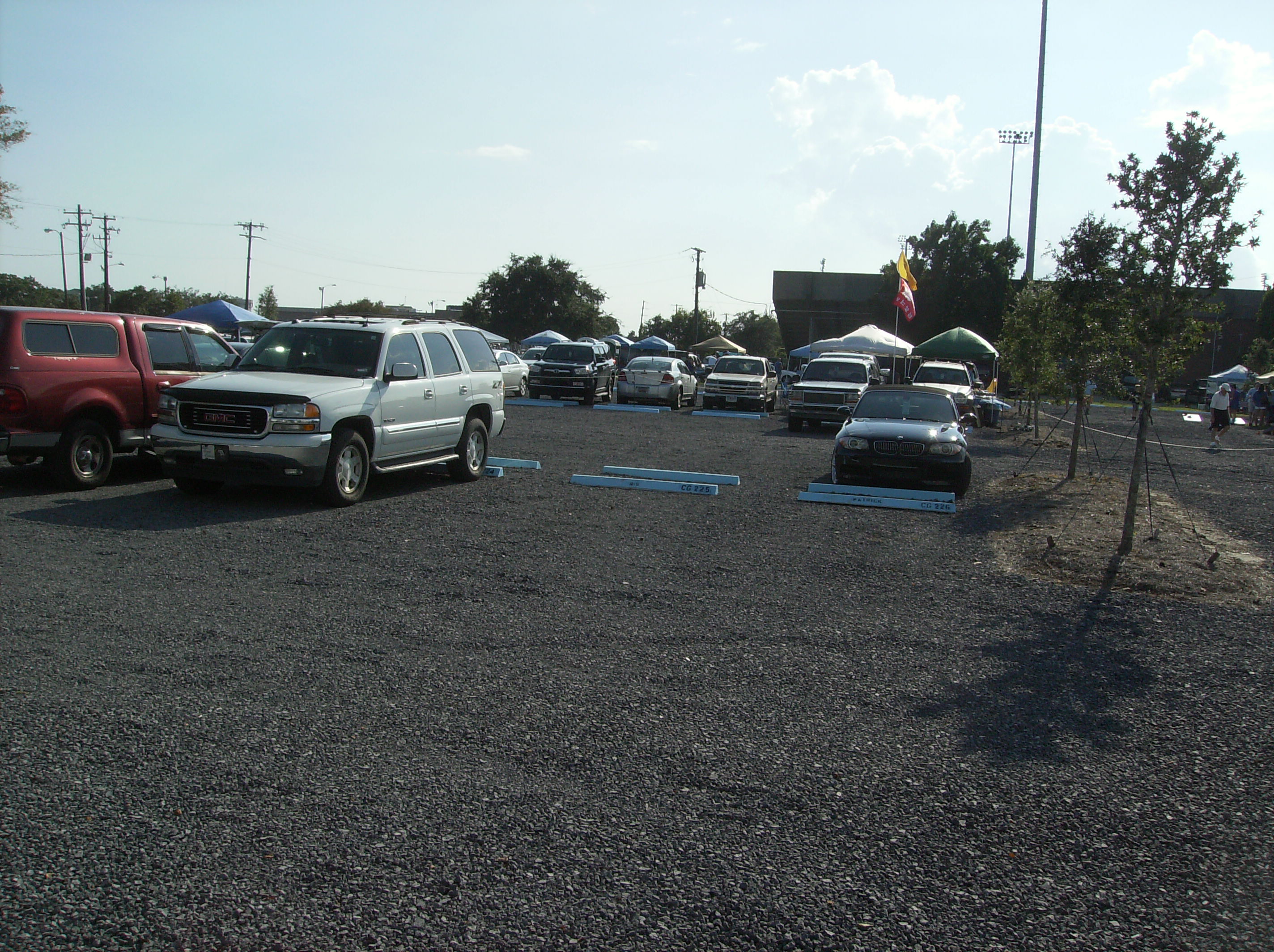
The first picture is a shot of the parking lot that replaced the old gym that used to be across the street from the stadium.


2012 Football, Game 1: The Citadel vs. Charleston Southern

Ah, football. So glad to see you again, old friend. The offseason was long and hard. The lack of a winter confused us. We’ve had to wade through conference realignment conspiracy theories again, with some of those rumors involving our own conference.

Yes, football is back, and just in time.

The Citadel vs. Charleston Southern, to be played at historic Johnson Hagood Stadium, with kickoff at 6:00 pm ET on Saturday, September 1.  The game will not be televised, although it will be webcast on Bulldog Insider (subscription service) and can be heard on radio via the twelve affiliates of The Citadel Sports Network. Danny Reed (the “Voice of the Bulldogs”) will call the action alongside analyst Josh Baker, with Lee Glaze roaming the sidelines and Walt Nadzak providing pre-game, halftime, and post-game commentary. After the game, there will be a fireworks show, which probably guarantees that a series of thunderstorms will begin to pass through Charleston during the second half.

Some links of note:

The Citadel game notes    The Citadel depth chart   SoCon weekly release

Oh, and just for fun, a few things I wrote in the spring and summer:

Why I don’t expect an overflow crowd at Saturday’s game

A brief look at returning lettermen for The Citadel and its opponents

An analysis of attendance at Johnson Hagood Stadium over the past five decades

My ridiculously long-winded manifesto on why The Citadel needs to add more varsity sports

Watching The Post and Courier‘s video preview for The Citadel’s upcoming season, I was interested to hear Jeff Hartsell state that head coach Kevin Higgins was not under any particular pressure in terms of wins and losses for this year. According to Hartsell, The Citadel administration is “all-in” on Higgins, who is now in his eighth season at the military college.

I’m not surprised school officials would take that position in public (it is, after all, the correct thing to do). I was a little curious to hear Hartsell say so without equivocation, which tells me the public position is also the private one. Higgins has one year remaining on his contract after this season, to be sure, and The Citadel is not known for terminating coaches in that situation.

Not that I’m advocating a “win this year or else” strategy with regards to Higgins; far from it. I think it’s good to have a veteran coach running things. As long as he still has the energy for the job (and that certainly appears to be the case), I like the idea of having a coach who has been at the school long  enough to know what to do and what not to do. He knows how to approach things that are unique to The Citadel, whether it be recruiting or corps squad/rest of corps relations (this tweet is evidence of the latter).

In other words, he’s made all the big mistakes he’s going to make. Now, though, I would like to see him win a few more games, which would go along nicely with his cutting-edge practice field attire.

I think it’s important to be realistic about a football program that has had just one winning season since 1997. The definition of a successful campaign this year, then, is to finish with more wins than losses. As Hartsell also said in the video preview, that’s what fans should be expecting (in terms of a breakthrough).

It won’t be easy. The schedule is not as conducive to a winning year as one would like. There are only five home games, and in addition to that the slate is front-loaded. It is not out of the question The Citadel could be 1-4 after its first five games. In fact, the football cognoscenti of the SoCon would predict exactly that. The Bulldogs were picked to finish next-to-last in the league by both the media writers and the coaches.

Therefore, a key to the season is improving upon that 1-4 expectation. That is quite possible, in my view. The Bulldogs more than held their own last season against the three league opponents they will play in that five-game stretch. The Citadel lost by seven points to Appalachian State at home, narrowly missed out on a road upset of Georgia Southern, and stunned Chattanooga (in Chattanooga!) after spotting the Mocs a 27-point lead.

The Citadel won’t be favored to be as competitive against North Carolina State, though nothing is impossible (and taking no chances, Tom O’Brien is already preparing his team for the triple option). The Bulldogs are a solid favorite against Charleston Southern. (I get a little nervous whenever I write that The Citadel is a “solid favorite” over any team.)

The Citadel total offense (in yards) vs. SoCon opponents, 2010: 359, 304, 263, 197, 160, 143, 300, 203

The Citadel total offense (in yards) vs. SoCon opponents, 2011: 301, 267, 268, 238, 361, 447, 264, 259

Triple O’Higgins was clearly better last season, yet there is plenty of room for improvement. The Citadel averaged 300.6 yards of total offense in eight league games. That number rises to 318.8 counting the non-conference contests, which was the worst total in the SoCon.

Of course, the numbers that matter are points, but total offense is generally a good indicator of points scored, and The Citadel’s 23.5 points per game finished next-to-last in the SoCon, ahead of only hapless Western Carolina.

Most of The Citadel’s total offense came in rushing, which will surprise nobody. The Bulldogs only averaged 32.2 yards passing per contest, which ranked last in the entire country. In a way, that makes The Citadel’s rushing totals all the more impressive, given every opponent could focus exclusively on the run — and I do mean exclusively.

I remember driving through a torrential thunderstorm on I-26 and listening to Danny Reed call the Bulldogs’ game against Elon. “10 men in the box for Elon,” he said about one early second-quarter play. Later on, he exclaimed, “Now the Phoenix have 11 men in the box!” As the game wound down to its conclusion, I was half-expecting him to say that Elon was putting 12 men in the box.

The lack of a passing threat was a key reason why the Bulldogs, despite finishing third in the SoCon (and the nation) in rushing, wound up finishing last in the league in total first downs.

For this season, The Citadel needs to at least make its opponents nervous about the possibility of a forward pass. To do so, a new formation has been added to the playbook:

A new feature of The Citadel offense this year will be a heavier reliance on the shotgun, a formation which will allow both returning quarterbacks to improve their accuracy and make the Bulldogs more of a productive passing team.

Kevin Higgins is not going to tell anybody what numbers he is looking for in the passing game, which is understandable, because he really isn’t looking for a specific amount of receiving yards. He just wants to make opponents honor the pass, which will in turn help the Bulldogs’ rushing attack.

While there may be no “magic number”, I believe some parameters for success can be estimated. It appears The Citadel does plan to throw the ball a bit more often this season. If the idea is to average 10-12 pass attempts per game (the Bulldogs averaged a shade under 7 attempts last season), then I think The Citadel needs to average around 8.0-8.5 yards per pass attempt at a minimum (preferably it should be above 9 yards per attempt). Last season, that number was 4.7 ypa, an awful average.

As for interceptions, I am inclined to think the goal should be no more than one per 25 attempts, though that number could fluctuate based on overall total offense production and the number of possessions per game. Last season the Bulldogs threw seven interceptions in only 75 passing attempts, which is very poor. Interestingly, Wofford tossed seven picks in 108 attempts, which isn’t much better — but the Terriers also threw eight touchdown passes. The Citadel only had one TD pass, and that was a halfback option pass by Rickey Anderson.

While the Bulldogs need to improve in the passing game, the team needs to be careful not to lose its identity as a run-first, run-second, run-as-much-as-possible offense. The Citadel needs to stick to the basics. This isn’t about “balance”. Nothing is more overrated than balance in an offense. It’s not how you score points, it’s how many points you score. Case in point: since 1990, there have been ten games in which The Citadel has had seven or fewer passing yards. The record for the Bulldogs in those ten games? 6-4.

Regardless of formation variance, I think the offense will be better this season. The Citadel has a generally solid cast of returnees, including a plethora of slotbacks, two quality B-backs, and two quarterbacks. The largely experienced offensive line is led by the offense’s best player, center Mike Sellers.

There is some concern about the wide receiver position, but to me the biggest question marks are the two tackle positions and the rotating quarterbacks. The Citadel recently made a significant move at the tackle position, inserting Cullen Brown at starting right tackle. Alex Glover will now start at tight end.

Regarding the QBs, I am not a huge believer in the notion that you must have a #1 guy at the position, at least at the college level. However, I do wonder about the timing of the offense when you combine two quarterbacks with two different B-backs. Everyone remembers the problems the Bulldogs had two years ago with the center-QB exchange and the QB/back “mesh” operation. No one at The Citadel wants to see anything resembling a repeat of those days.

I am a little worried about the defense, particularly when it comes to that four-game stretch following the opener: Georgia Southern, Appalachian State, North Carolina State, and Chattanooga. The unit must be ready to compete at a high level for those games, but lacks starting experience in key areas. The front-loaded schedule could really hurt the Bulldogs.

Four of the five leading tacklers from last season are gone, although that in itself doesn’t bother me too much. It’s the amount of experience those four players had that is the real issue (last year’s three starting linebackers played in a combined 126 career games).

Then there is the loss of Derek Douglas for at least the first part of the season due to a knee injury. Many observers felt Douglas was the team’s best all-around player last season, a force on the d-line and an all-conference selection. He had 11 tackles for loss; only one other returning SoCon player had more (Wes Dothard of UTC). Douglas can’t return fast enough for the Bulldogs.

There is more talent coming back, however, including lineman Chris Billingslea, a true playmaker on the defensive side of the ball. Billingslea’s big-play capability (he always seems to be around the football) is something The Citadel needs from more of its defensive players; while solid, last season’s defense didn’t force quite enough negative plays, particularly turnovers (eighteen in eleven games).

There are a number of candidates to feature alongside Billingslea (and Douglas, when he returns) on the defensive line. I think the Bulldogs are in reasonably good shape with this group. The Citadel just needs two or three of them to assert themselves as major contributors, and quickly. It appears that at least two freshmen will get an opportunity to make an impact.

While the linebacking corps will feature three new starters, all three played last season and showed promise, including flashes of that big-play ability the Bulldogs need. However, there has been talk that they aren’t as athletic as the previous starters. Personally, I’m not overly concerned with their athleticism, as long as they can make game-changing plays that benefit The Citadel. Depth could be an issue, however, as there are fewer obvious options for this group than there are for the defensive line.

The secondary needs to improve on its interception totals (only six all last season). The lack of picks has been an ongoing problem. The Citadel was last in the league in passes intercepted in 2010 and next-to-last in 2011. Another issue that has occasionally bedeviled The Citadel is the “killer pass” from the opposition —  not just long TD throws, but third-down conversion pickups that have allowed drives to continue.

The Citadel allowed opponents to complete 65.3% of their passes last season, the highest percentage allowed in the Higgins era. Opponents have completed at least 60% of their passes against the Bulldogs in each of the last four years, a far cry from the 52.7% completion rate allowed in 2007, The Citadel’s last winning campaign.

The Bulldogs were next-to-last in the league in defensive pass efficiency last season. To win more games, The Citadel has to do better than that in 2012.

Phil Steele recently released his FCS Special Teams rankings for the 2011 season. The Citadel, primarily thanks to its success in punting and returning (or rather, blocking) punts, finished first in the nation in his ratings. Only one other Southern Conference team finished in the top 30 (Georgia Southern was thirteenth).

The star performer for The Citadel’s special teams last season was punter Cass Couey, who was superb, leading the SoCon in punting average (43.0 yds) and net punting (38.2 yds). He’s also capable of tucking the ball under his arm and running for a first down if the opposition isn’t paying attention.

The Citadel also had a big edge when the other team punted, thanks to nine blocked punts. However, one of the NCAA’s rules changes for 2012 will force the Bulldogs to adjust at least part of their kick-blocking strategy:

There will…be a new rule prohibiting players from leaping over blockers in an attempt to block a punt. Receiving-team players trying to jump over a shield-blocking scheme has become popular for teams in punt formation. Receiving-team players try to defeat this scheme by rushing into the backfield to block a punt. In some cases, these players are contacted and end up flipping in the air and landing on their head or shoulders.

This change could be called the Domonic Jones Rule, as the rangy 6’5″ wide receiver blocked or deflected five punts last season by doing exactly what is described above. While the new rule may not favor The Citadel, in all honesty I think it’s a good change. Too many times I have watched a player land on his head or neck after leaping into a pair of shield blockers.

Kevin Higgins was on the committee that recommended the new rules changes, and he and his fellow panelists were busy. The kicking game drew special attention, and the Jones Rule wasn’t the only thing to be enacted:

[T]eams will kick off at the 35-yard line instead of the 30. Also, players on the kicking team can’t line up for the play behind the 30-yard line, which is intended to limit the running start kicking teams used to have during the play.

Also, touchbacks on free kicks will be moved to the 25-yard line instead of the 20 to encourage more touchbacks. Touchbacks on other plays (for example, punts that go into the end zone, or fumbles that go out of the end zone) will remain at the 20-yard line.

Those rule changes will affect The Citadel on kickoffs, an aspect of special teams the Bulldogs could improve upon. While the kickoff return unit was fine, The Citadel was seventh in the league in net kickoff coverage. A freshman is expected to be the Bulldogs’ kickoff specialist this fall. So far, reviews are good.

Reviews are also good for senior Thomas Warren, who becomes the starting placekicker this season. By all accounts, Warren has had an excellent preseason camp. Missed opportunities in the kicking game cost The Citadel a chance at winning both the Elon and Georgia Southern games last season, and as a result there is a lot of interest (if not angst) among fans about the placekicking unit. It should be pointed out, however, that it’s not all about the kicker. The holder, snapper, and blockers must all do their jobs too.

One thing The Citadel did very well last year was not commit penalties. In fact, the Bulldogs were the least-penalized team in the nation last season, both in terms of number (3.09 per game) and yardage (22.45 yds), which is to the credit of the players and the coaches. I like rooting for a team that doesn’t commit a lot of penalties.

Incidentally, another rules change for this season will particularly impact teams running the triple option:

Offensive players in the tackle box at the snap who are not in motion are allowed to block below the waist legally without restriction. All other players are restricted from blocking below the waist with a few exceptions (for example, straight-ahead blocks).

The Citadel’s opponent on Saturday, Charleston Southern, had a rough season last year. Actually, “rough” may be a nice way to put it, as the Buccaneers were 0-11. Charleston Southern started the season getting blitzed by two FBS opponents (Central Florida and Florida State) by a combined score of 124-10, and never really recovered.

The lowlight of the Bucs’ season was probably the 32-20 loss to Division III Wesley College, which came at CSU’s Homecoming. Charleston Southern lost close games to Jacksonville, VMI, Coastal Carolina, and Gardner-Webb, but also got bashed a few times, including a 30-point loss to Norfolk State and a 31-point defeat to Presbyterian in the season finale.

Non-FBS opponents averaged 35 points per game against the Bucs, and had success on the ground and in the air. CSU allowed 225 rushing yards per game, and 217 passing yards per contest.

Charleston Southern ranked last in the Big South in the following defensive categories: defensive pass efficiency, fumbles recovered, rushing defense, total defense, scoring defense, tackles for loss, sacks, and turnovers gained.

Offensively, CSU ranked last in the Big South in rushing offense and scoring offense. The Bucs were also the worst team in the league at returning kickoffs. On the bright side, Charleston Southern led the Big South in net punting and only lost seven fumbles.

It all added up to a winless season. CSU has now lost twelve straight and eighteen of its last nineteen games.

Charleston Southern has two quarterbacks battling for the starting spot; regardless of which player wins the job, he must improve upon last year’s pass completion percentage (45.7%). I mentioned earlier that CSU finished last in the Big South in rushing offense. In fact, the Bucs only averaged 2.6 yards per carry, and only two starters return on CSU’s offensive line. Charleston Southern quarterbacks were sacked 32 times last year.

The defense has a new coordinator, Shawn Quinn, who was Georgia Southern’s linebackers coach and recruiting coordinator last season. He has work to do. However, given his experience at GSU, he should have a very good idea of how to defend The Citadel’s triple option attack.

Charleston Southern is not completely bereft of experienced talent. Senior cornerback Charles James was selected as the preseason Big South Defensive Player of the Year. He must be an excellent player to receive that kind of accolade while playing for a team coming off an 0-11 campaign. James is a former walk-on who has ten career interceptions; he also made 66 tackles last season for the Bucs and is a fine punt returner as well, averaging just under ten yards per return last season (with one touchdown).

Junior wideout Nathan Perera caught 43 passes (four touchdowns) last season and joined James on the preseason All-Big South squad. Perera averaged over 16 yards per reception. However, he is questionable for the game against The Citadel due to injury.

The Buccaneers’ special teams were respectable in 2011, with the punting units in particular being very solid. However, CSU must replace its punter/placekicker this season.

Charleston Southern was picked to finish last in the Big South’s preseason poll. One of the eighteen voters did tip CSU to finish second, for reasons not immediately apparent.

This year’s Charleston Southern team is probably not as good as the Jacksonville squad that The Citadel faced in last year’s opener. However, the Bucs are likely better than 2010 opening-game opponent Chowan or the Presbyterian outfit the Bulldogs played in the 2009 home opener.

While CSU’s defense last year was porous, it will return seven starters, and that group doesn’t include UGA transfer Damian Dixon, who will likely start in the defensive backfield with Charles James. Add in to the mix a new defensive coordinator who is familiar with The Citadel’s offense, and the result is a unit that should be ready to compete against the Bulldogs.

On the other side of the ball, The Citadel has several players who will be starting for the first time, but the same is going to be true for CSU’s offense. It may be a good situation for the Bulldogs in that respect.

The Citadel should win this game. It probably won’t be a rout, but it ought to be decisive. Losing to the Buccaneers would be disastrous. The Bulldogs will struggle to salvage the rest of the 2012 campaign if they do not prevail on Saturday.

That is pressure. Then again, nobody goes to The Citadel to avoid pressure.

I can’t wait until Saturday.

Overflow crowd at Johnson Hagood for the season opener? Not likely

Just a quick post while I hide from the heat and humidity…football can’t get here fast enough, and that includes football weather.

Someone on the TCISN board recently expressed hope that attendance at Johnson Hagood Stadium might be excellent for the season’s first two games, against Charleston Southern and Georgia Southern. Putting aside GSU for the time being, I was less than certain about the prospects for a big turnout when The Citadel hosts CSU in the season opener.

It’s a 6:00 pm start, and won’t be played at the same time as a Clemson or South Carolina home game (though the Tigers will be on TV at around the same time). That is good news in terms of the competition on Saturday night. On the other hand, I remember that when the Bulldogs and Buccaneers first started playing, it was anticipated there would be large crowds for a game against two Lowcountry schools. That didn’t happen.

In fact, attendance for the five games between the two teams (played between 2002-2007) was somewhat disappointing. The numbers do not lie.

2002: Played in November, on a Thursday night. Attendance: 12,412. Verdict: not bad, really, given the month/day. Average attendance at Johnson Hagood Stadium that season: 15,582.

2003: A 3:30 pm start time on August 30, in Charleston. Yeesh. A crowd of 15,219 brought their sunscreen, though. Average home attendance that year: 16,759.

2004: Game postponed due to a hurricane threat, but ultimately was not rescheduled.

2005: A night game, but only 10,316 showed up. Average JHS attendance in ’05: 11,674.

2006: The only time when attendance for the CSU game exceeded average attendance for the season, with 15,121 in the stadium for the game, as opposed to season average attendance of 14,599.

2007: Another early start (2pm) resulted in a sluggish crowd of 12,885. Season average: 13,757.

– Average attendance for the five games against Charleston Southern: 13,191.

– Average attendance for games played at Johnson Hagood Stadium in those seasons (2002-07, excepting 2004): 14,489.

Note: one small caveat to those figures: When I went through the statistics, I concluded there was probably an error in the 2002 attendance totals, likely for that season’s game against Delaware. Nevertheless, I don’t think it affects the overall analysis.

So there you have it. The average crowd for a CSU game was actually only 91% the size of an average crowd for games at JHS over those seasons (and that is including the CSU attendance numbers in the overall totals; the difference is even greater if you take the CSU figures out of the average). It is thus hard for me to believe there will be a significant “bump” in attendance for this year’s contest, particularly given the fact the Buccaneers are coming off an 0-11 season.

It would be nice to see a big crowd for the opener. It’s likely going to be up to Bulldog fans to make it happen, though.

Waiting on college football season…hurry up already!

This is a post featuring meaningless gridiron musings, and it’s not even June yet.

I saw this chart on Phil Steele’s site a couple of days ago. It’s an interesting look at the percentage of lettermen returning for each FBS team, although perhaps not really indicative of how a team may do this season. For example, I suspect that Southern California, next-to-last in the category, is still going to be really good.

North Carolina State, which will play The Citadel in late September, is also near the bottom of the list, with a lettermen return rate of 59.6%. That got me thinking, what’s The Citadel’s return rate? It turns out to be not much higher (62.9%).

I compiled a similar list of The Citadel’s opponents this year in a chart. Well, not all the opponents, for the simple reason that I couldn’t find readily available numbers. I found practically no information about Charleston Southern’s returnees, to name just one school, although I would imagine that since the Buccaneers were 0-11 last season there are going to be some changes.

I have return/loss statistics for eight of the eleven schools playing the Bulldogs. As I get more information for the others, I’ll add those numbers to the chart.

Anyway, this is what I came up with for eight opponents, plus The Citadel (excuse the less-than-stellar presentation):

Team     2011 L’men     Lost         Returning   % Returning

Appy           55                22                 33       60.0%

GSU             80                24                 56       70.0%

NCSU          52                 21                 31       59.6%

Wofford      64                 17                 44       68.8%

WCU           63                 21                42       66.7%

UTC            65                 20                 45       69.2%

Furman        62                 17                 45       72.6%

VMI          54                   19                    35       64.8%

The Citadel  62                 23                 39       62.9%

Among returning offensive and defensive starters, Chattanooga returns 16 of 22 (8 offensive/8 defensive); Georgia Southern, 15 of 22 (8/7); Appalachian State, 14 of 22 (5/9); North Carolina State, 14 of 22 (7/7); Western Carolina, 14 of 22 (8/6); VMI, 11 of 22 (5/6); and Furman, 14 of 22 (6/8).

Some links, if you’re interested or bored or both:

Appalachian State 2012 Preseason Prospectus

Georgia Southern 2012 Quick Facts

A report from Charleston Southern’s spring game

Wofford 2012 Quick Facts

Chattanooga 2012 Spring Notes

Furman 2012 Quick Facts

VMI 2012 Quick FactsNewspaper report on VMI spring footballschool report on final spring scrimmage

Western Carolina 2012 Quick Facts and A report from Western Carolina’s spring game

Samford 2012 Prospectus

A report from Elon’s spring game

North Carolina State 2012 Spring Prospectus

Phil Steele’s team page for The Citadel

Jeff Hartsell’s writeup of The Citadel’s spring game (over two months ago, sure, but in case you missed it)

Less than 100 days to go…

2011 Football, Game 1: The Citadel vs. Jacksonville

The Citadel vs. Jacksonville, to be played at historic Johnson Hagood Stadium, with kickoff at 6:00 pm ET on Saturday, September 3.  The game will not be televised, although it will be webcast on Bulldog Insider (subscription service) and can be heard on radio via The Citadel Sports Network, with new “Voice of the Bulldogs” Danny Reed calling the action.

It’s that time of year! College football has arrived and not a moment too soon.  I’m tired of reading about the Summer of Ponzi and all the other scandals that have beset the sport in the off-season, and while I enjoy discussing realignment as much as anybody, the Texas A&M two-step with the SEC is starting to get old.  I’m ready to see some activity on the playing field.

This is an important season for The Citadel’s football program.  I wrote about the program’s status last November; nothing has happened since then to make me think that the 2011 campaign will be anything other than a defining one for Kevin Higgins and his coaching staff.  I’m far from the only person who thinks that success of some sort this season is paramount.   The intensity in the crowd at the recent open scrimmage was palpable.

One thing is certain:  if there ever were a year for the football team to “sneak up” on people, this is the one.  Southern Conference media members picked The Citadel to finish last.  Only one player (Tolu Akindele) made either the preseason all-conference first or second teams.  The SoCon coaches’ vote had The Citadel in next-to-last place, ahead of only Western Carolina; that’s the same verdict rendered by The Sports Network.

Last season, the Bulldogs played three non-conference games before beginning league play.  This year, though, The Citadel will play six of its first seven games against SoCon opposition.  The Bulldogs will have a good idea of where they stand before the fall harvest.

The only non-league game in that group of seven contests is the first one, and it is far from the “gimme game” that the home opener has been in recent years.  Instead of scheduling a glorified scrimmage against the likes of Webber International or Chowan, The Citadel is playing Jacksonville, which went 10-1 last season and shared the Pioneer League title (with Dayton).  The Dolphins, favored to win the PL again, will be a formidable challenge.

Jacksonville University is not to be confused with Jacksonville State University, which is located in Alabama and has a football team coached by Jack Crowe, the man who was on the wrong side of one of The Citadel’s more notable gridiron triumphs. Jacksonville University is located in Jacksonville, Florida, and its football team is coached by Kerwin Bell.  (More on him later.)

Jacksonville began in 1934 as a junior college named “William J. Porter University” after its founder; in 1958 it became a four-year school after merging with the Jacksonville School of Music.  As of today it’s a private, liberal-arts university with roughly 3,500 undergraduate students (60% of whom are women).

JU’s “Timeline” feature on its website includes a lot of concerts in the 1970s and early 1980s, perhaps an indication of the importance of the music school in relation to the rest of the university at that time.  Performers who made their way to Swisher Gym included Dionne Warwick, Neil Diamond, Duke Ellington, John Denver, and Billy Joel; K.C. and the Sunshine Band recorded a live album there.

Jacksonville awarded honorary doctorates to Bob Hope and Jack Benny on the same day in 1972.  Another same-day honorary doctorate duo for JU:  Charlton Heston and Ann Landers (who received hers less than a year after writing that Jacksonville U. was one of “the four top colleges in the nation”).

It’s also worth noting that Jacksonville University has the second-largest NROTC program in the country.

Jacksonville has twenty-one varsity sports.  Its nickname, the Dolphins, came to be in 1947 following a student contest (the original contest winner was “Green Dolphins”; another possibility had been the “Juggernauts”).  The official school mascot is an actual dolphin — 58-year-old Nellie, a Marineland mainstay.

The most famous of all JU athletes is, without a doubt, basketball Hall of Famer Artis Gilmore.  Second place on the school’s famous athlete list is probably occupied by Donnie Hammond.  (Like I said, there is no doubt about #1.)

Gilmore played two seasons at Jacksonville (he started his career at Gardner-Webb, then a junior college) and averaged more than 20 points and 20 rebounds per game, which I think can be best described as “awesome”.  In his junior season, he led the Dolphins to the NCAA title game.

Yes, you read that right.  Jacksonville played in the Final Four in 1970, just twelve years after becoming a four-year school.  We’re not talking Division II, either.  The high-scoring Dolphins beat Western Kentucky, Iowa, and No. 1 Kentucky to win the Mideast Regional.  Jacksonville averaged over 106 points per game in those three contests.

– Tangent #1:  What a weird Final Four that was.  There was nothing strange about UCLA being there (and the Bruins would beat Jacksonville in the final, 80-69), but the other three teams were Jacksonville, St. Bonaventure, and New Mexico State.  The Dolphins and the Bonnies were at the time the two smallest schools to ever make it that far, and they played each other in the semifinals.  Alas, it was a mismatch, as St. Bonaventure star Bob Lanier had injured his knee in the regional final and could not play in the Final Four.  Thus, the spectators at Cole Field House were denied the opportunity to watch two future Hall of Fame centers face each other.

After that season, Dolphins coach Joe Williams left JU and took the job at Furman.

– Tangent #2:  Artis Gilmore and his wife have been married for 39 years.  Her name is Enola Gay.  I thought that was worth mentioning.

Okay, it’s time to talk about JU football…

Jacksonville started its football program in 1998, winning its first-ever game 19-14 over Davidson.  The school’s media guide also lists Davidson as being the first ranked team (at No. 3!) the Dolphins ever played, in a 2001 contest won 45-3 by JU, but I have to seriously question that.  What poll would this have been?  Maybe it was a poll only including Southern Conference schools that don’t play scholarship football.

JU plays its home games at Milne Field, a 5,000-seat facility built specifically for the football program, which averaged 3,761 fans per game last season.  The Dolphins have won nine straight home games, but the real eye-popping numbers are from their road games — not necessarily the results on the field, but the travel involved. Jacksonville has six road games this year.  JU will bus to The Citadel for Saturday’s game.  Later in the year the Dolphins will also take the bus to Campbell, assuming the bus driver can find his way to Buies Creek.

However, the Dolphins will make four road trips by air, flying to the University of San Diego, Drake (which is in Iowa), Marist (New York), and Western Illinois (travelling to WIU on the day of the game).  That is a total of 5,575 miles in the air.

Having multiple long airplane flights is a consequence of playing in the Pioneer League, a non-scholarship FCS conference with ten members.  Jacksonville is the southernmost school in the league, which has three members in the southeast (JU, Davidson, Campbell), five in or around the midwest (Drake, Valparaiso, Dayton, Butler, Morehead State), one west coast entry (USD) and one northeastern school (Marist).

One reason for having such a far-flung league is that all of those schools choose to play football at the non-scholarship level while maintaining a NCAA Division I athletics program.  Since 1993, institutions have had to play football at the same level as their other sports, which affected schools like Dayton (a D-3 power in football during the 1980s) in particular.  There aren’t a lot of D-1 schools that offer non-scholarship football but provide schollies in other sports (which distinguishes these institutions from those in the Ivy League, for example).

Jacksonville is not likely to become a scholarship football program in the near future. That possibility was suggested to the president of the university, who responded:

[It] costs too much for us to do it right now. For us to move into scholarship football because of the rules for gender equity, we would not only have to be able to fund the scholarship program year in and year out, we would also have to fund a similar amount for women’s athletics.

And we simply can’t afford it right now. If we had some major donors that came forward and helped us, then something like that could be possible. It’s simply economics. We need a stadium, our stadium is quaint. We would need a stadium where the fan base would generate revenue.

The revenue we get right now is diminutive. With a stadium, you could start getting money back into the program. There are some positives to it, but it’s simply too expensive right now.

In 2013, two new football programs will join the Pioneer League — Stetson and Mercer.  That should help alleviate Jacksonville’s travel burden to a certain extent.

Kerwin Bell played his high school ball in the small town of Mayo, Florida, where he was known as “The Throwin’ Mayoan”.  Arriving at the University of Florida as a walk-on, in one year he managed to climb the ladder from eighth-string to starter.  In 1984, Bell and the Gators would win the SEC title, winning eight straight games to close out the season.  The SEC title was short-lived, however, as the conference rescinded it the following year due to UF being on probation.  In 1985 Florida would go 9-1-1 for a second straight season, and again was not awarded the league crown (and again could not go to a bowl game) because of NCAA violations.

Two years later Bell began his pro career, which featured multiple stops in the CFL (including a stint in the Canadian outpost of Sacramento), a tour of duty with the Orlando Thunder of the Arena Football League, and a two-year stay with the Indianapolis Colts.  Bell got into one game with the Colts, mopping up in a 1996 contest against the Philadelphia Eagles.  In that game, he threw five passes, completing all five for 75 yards and a touchdown (to Marvin Harrison).  Bell finished with a perfect 158.3 passer rating.  Contained within his Wikipedia entry is this astute observation:

[Kerwin Bell] has the highest career passer rating of any quarterback in NFL history, higher than current and future Hall of Fame members Joe Namath, Steve Young, Joe Montana, Warren Moon, Peyton Manning, Dan Marino and Brett Favre.

Bell’s coaching career actually started in 1990.  While recovering from an ACL injury he worked for one year as a graduate assistant coach for Steve Spurrier, who had taken over the Florida program.  His next coaching job came with the Toronto Argonauts in 2000, where he served as offensive coordinator (while still playing quarterback).

He then spent six years as head coach of a new football program at Trinity High School in Ocala, Florida.   He has been the head coach at JU for the last four seasons (with the upcoming campaign being his fifth).  Bell is 29-17 overall at Jacksonville, with records of 3-8, 9-4, 7-4, and 10-1. In two of the last three campaigns JU has won outright or shared the Pioneer League title, with the 2008 season documented by a “JUDolphins.com best seller”.

It seems reasonable to speculate about whether Bell is striving to follow a career path similar to that of Jim Harbaugh, who started his head coaching career at a Pioneer League school (San Diego) before moving up to Stanford, and who now is in charge of the NFL’s San Francisco 49ers.  Bell said last season that he is not “the kind of guy who needs to be on TV“, but if he continues his successful run at JU, he is likely going to get an opportunity to take a higher-profile job.

Bell’s staff at Jacksonville includes three assistant coaches who played in the NFL. Ernie Logan spent nine seasons in the league as a defensive lineman.  Not surprisingly, he is the Dolphins’ DL coach.

Ernie Mills was a wide receiver who also spent nine years in the NFL, mostly with Pittsburgh.  He caught eight TD passes in 1995, a year in which the Steelers advanced to the Super Bowl.

Jerry Crafts (aka “The Condo”) appeared in two Super Bowls for the Buffalo Bills, one of five NFL teams for which he played, along with three CFL teams, four AFL outfits, two WLAF franchises, and (inevitably) one XFL team (the Los Angeles Xtreme).  He also made an appearance on Howard Stern’s radio program.

Like Bell, Mills also played his college ball at Florida, with their careers in Gainesville overlapping slightly, along with that of Dolphins defensive coordinator Jerry Odom, the only coach the JU athletics website lists as being on Twitter.  He doesn’t appear to take full advantage of the service.

Staff meetings at JU must get confusing at times, what with two coaches named “Ernie”, two named “Jerry”, another named “Kerry” (running backs coach Kerry Webb), and a head coach called “Kerwin”.

The Dolphins have 100 players listed on their active roster.  All but six of them are from Florida.  A couple of notable names on the list who may or may not see action against The Citadel are freshman quarterback Kade Bell, son of the head coach, and freshman WR/TE Andrew Robustelli.  If Robustelli’s name sounds vaguely familiar, it’s because his grandfather was a Hall of Fame defensive end for the New York Giants in the 1950s.

Jacksonville runs a pro-style offense, and while the Dolphins like to pass, the offense is reasonably balanced.  Last season JU rushed 387 times while throwing 348 passes.  I would still describe it as a “pass-first” setup, mainly because I’m guessing a lot of the rushing attempts came at the end of blowouts.

Ah yes, blowouts.  The Dolphins had a lot of those in 2010, with an 86-7 demolition of poor Valparaiso being the biggest (check out that 38-point second quarter).  JU also pummeled Webber International (41-0), Marist (56-14), Davidson (42-15), and Morehead State (61-17).

As you can see, JU likes to put up crooked numbers.  The Dolphins lit up the scoreboard to the tune of 42.2 points per game, just one of several gaudy team offensive statistics.  Jacksonville averaged 486 yards of total offense per game (7.3 yards per play).  JU also averaged an outstanding 9.3 yards per pass attempt, with 35 of its 217 completed throws going for touchdowns (against only seven interceptions).

Leading that offense this year, as he has for the previous three, is 6’2″, 210-lb. senior quarterback Josh McGregor, who has more career passing yards than any returning QB in the nation (8,186).  He has thrown 87 touchdown passes in his 35-game run as the JU signal-caller.  McGregor threw for 300 yards or more seven times last season and is on the Payton Watch List.  A highlight package featuring some of McGregor’s 2010 exploits has been uploaded to YouTube.

His top target is senior wideout Josh Philpart, who has 29 career touchdown receptions.  Philpart averaged 16.7 yards per catch last year.  Another receiver, Larry Thompson, was only a half-step behind Philpart in most statistical categories, other than TDs.  Jacksonville likes to spread things around, as six different players caught at least 18 passes last season (including two running backs).

Incidentally, Philpart did not have a reception in the game last season against Appalachian State.  I’m guessing that the Dolphins will try to get him involved in the game early against The Citadel in order to avoid having him become a non-factor.

Jacksonville’s all-time rushing leader, Rudell Small, has graduated, but the Dolphins have a more than adequate replacement in J.J. Laster, who rushed for 830 yards last season in backup duty (8.5 yards per carry).  Laster rushed for 177 yards in the game against Marist.

JU lost both its starting left tackle and left guard off the offensive line.  Last year’s right tackle, Chad Cypher, is moving to left tackle to protect McGregor’s “blind side”; at 6’6″, 310 lbs., Cypher at least looks the part.  He has drawn some pre-season accolades.

Kevin Higgins briefly discussed Jacksonville’s offense with Jeff Hartsell after a weeknight practice:

They have a multiple offense, a little bit like we were the first couple of years. They will spread you out, the QB is a really smart player who can check at the line of scrimmage. They try to create space on the field, and the QB is experienced and one of the tops in I-AA. And the line is very experienced as well.

As for the Dolphins’ defense, Higgins stated he had no idea how Jacksonville would line up against The Citadel, as JU didn’t face an option team last season (the Dolphins normally feature a 4-3 scheme).

Jacksonville’s defensive line is relatively experienced.  It is also small.  Nose tackle Mike Mayoral weighs 210 pounds.  Defensive end Rolando Fines is a little bigger (245 lbs.) and is expected to lead the group.

As far as JU’s linebacking corps is concerned, Kerwin Bell is quoted in JU’s media guide as saying that “we’re sort of iffy there.”  Layne McCombs is a senior who would be Jacksonville’s top defensive player, except he has a knee problem (torn ACL from last season).  Whether he plays or not is apparently open to question.  The Dolphins are probably going to play some of their younger players in this unit and hope for the best.

Jacksonville is in better shape in the defensive secondary, with three starters returning and a decent amount of depth.  One concern for JU is that none of its DBs are particularly tall.

Jacksonville had an excellent punt return squad last season, averaging a sizzling 11.1 yards per return in 2010, but its top return man graduated.  Its kick return numbers were mediocre at best.  JU did a fairly good job holding down its opponents’ return yardage.

The Dolphins will have a new punter and a new placekicker this season, which could be problematic in a season opener.

The Citadel’s total offense numbers in the eight Southern Conference games in 2010 were as follows:  359, 304, 263, 197, 160, 143, 300, 203.  Those are listed in order of the games as they were played — in other words, the 359 total yards of offense came in the Bulldogs’ first league game (against Furman).  The offense continued to put up fewer yards of offense each week until “breaking through” with 300 yards against a less-than-stellar Elon defense, and then regressed back to 203 yards against a solid Samford D in the season’s final game (which The Citadel managed to win anyway).

On the bright side, the offense only committed one turnover in the final two games (combined), which was obviously a vast improvement from, say, the Georgia Southern debacle (nine turnovers).  The Citadel turned the ball over 32 times in all, which included 23 lost fumbles.  The Bulldogs actually had 44 total fumbles in eleven games, and also had an inordinate number of ball-possession miscues that did not quite result in fumbles but had the effect of ending a play before it really got started.

The lack of yardage can be directly tied to The Citadel’s ball-control woes.  Those issues must be fixed if the Bulldogs are to have a respectable 2011 campaign.  The offense’s ineptitude also had a negative impact on the defense, which had to defend a short field too many times.  Kevin Higgins admitted as much during his radio interview with Phil Kornblut on August 25 (Kornblut also talked to Tolu Akindele and Terrell Dallas).  The head coach didn’t mince words:

We really played, I think, much better defense than people give us credit for, and the reason is because our offense was so bad, the defense was on the field so much, that there was a lot of pressure on them…it was the first year with the option, the ball was on the ground…I remember going home at this time last year and going, ooh.

Fans going home after watching the Bulldogs offense struggle didn’t all say “ooh”…more like “ugh” (or perhaps something unprintable).

There is optimism among those following the team that the second year in the offense will result in significant improvement.  I sure wouldn’t mind winning four more games this season than last, like the Bulldogs did in 1987-88 running Charlie Taaffe‘s wishbone (going from 4-7 to 8-4).

There are also whispers about a special “edge” the Bulldogs now possess.  This edge is reportedly known in certain circles as The Candeto Factor.  It’s all hush-hush.

Sophomore Ben Dupree will be the starter at quarterback (and a team captain as well, which I thought was interesting), after beginning last season as the starter, moving to second string, then third string, making a cameo appearance as a running back, and then returning to the starting lineup as the quarterback for the final two games of the season.  If making the right reads, Dupree, who has shown signs of being an elusive runner, could be a big-play threat.  He is a bit on the small side and needs to improve his passing.

Dupree will be backed up by Matt Thompson and freshman Aaron Miller, who looked good (at least to me) in the Bulldogs’ last open scrimmage.  There is depth at running back, with at least four different players hoping to make an impact, including the Lazarus of the backfield, Rickey Anderson.  Terrell Dallas is the fullback, and he’s a good one.  Against Jacksonville’s smallish defensive line, he may be called upon to do some power running.  His understudy is Darien Robinson, who isn’t afraid to move a pile either.

Mike Sellers, thrown into the line of fire as the starting center as a freshman, is bigger and better.  That should be the case for the offensive line in general (including the imposing Neal Strange), although injured guard Jameson Bryant will not play in the opener.  Keith Carter moves from defense to offense to add athleticism to the o-line.  (I keep wanting to call him Kenny Carter.  Getting old is tough.)

While most triple option offenses don’t throw the ball too often, this isn’t any ordinary triple option offense — it’s the Triple O’Higgins!  Higgins told Kornblut that the ideal number of passes in the TO’H is 10-12 per game.

Several of those pass attempts will undoubtedly be thrown in the general direction of Domonic Jones, the Bulldogs’ leading receiver last season.  At 6’5″, he could prove to be a tough matchup for the short Jacksonville defensive backs.  Actually, he should prove to be a tough matchup for almost any defensive secondary he faces.  One of The Citadel’s other receivers, Luke Caldwell, may be the best passer on the team, if the Samford game last season and the recent scrimmage are any indication.

As mentioned above, the Bulldog D was solid in 2010 for the most part.  I think the only time I was really disappointed in the unit’s play was against Elon.  The defense had trouble getting off the field in that game, and also fared poorly in the “red zone”. Stopping opponents from scoring when inside the 20 should be a point of emphasis this year, as that is an area in which the Bulldogs need to do better (allowing a 64% TD rate last season).

Against Jacksonville, which converted on third down 49% of the time in 2010, it will be even more important to prevent long drives and turn the ball back over to the offense. To do that, The Citadel needs to improve incrementally in defensive statistical categories such as average per pass attempt (7.6 last year) and average per rush (4.3).

The Bulldogs also need to grab more than their fair share of turnovers.  The Citadel finished last in the Southern Conference in interceptions in 2010.  The squad needs to grab a few more and also force more fumbles.

To paraphrase Akindele in his interview with Phil Kornblut, the Bulldogs D needs its playmakers to make more big plays.  Akindele himself is one of those playmakers, having led the team in tackles last season.

He’s joined by a solid group of linemen and linebackers, including Derek Douglas, Chris Billingslea, and Rod Harland, who judging from the recent scrimmage has been ready to lace ’em up again since last season ended.  He was bringing the heat, as the kids say.  (They do say that, right?)

The defense as a whole has a lot of depth (a priority for the coaches), particularly on the line, but also in the secondary, making it easier to absorb the loss of Cortez Allen, now of the Pittsburgh Steelers.  The Bulldogs seem to be in solid shape at cornerback, which is a good thing, as Jacksonville’s group of talented receivers will provide a stern test.

Cass Couey returns for the third straight year as the Bulldogs’ dependable punter. The Citadel in general was okay in most phases of the return game.  Keith Gamble, besides starting at cornerback, is a threat to go the distance as a kick returner (he had an 87-yarder against Elon last year).  He averaged 25 yards per return in 2010.

Ryan Sellers will be the starting placekicker for The Citadel this season.  The kickoff specialist shared PK duties last year, making five of nine, including a 47-yarder against Chattanooga, the season long for a Bulldog kicker by eight yards.  As you would expect of a kicker, he wears a kicker’s number — #99.

The matchup between the Bulldogs and the Dolphins will be a big one for both teams, even though it is only the first game of the season.  In the long run, it may actually mean more to Jacksonville than it does to The Citadel, though.

JU missed out on a bid to the FCS playoffs by a narrow margin last season.  While the Dolphins were 10-1, the schedule strength just wasn’t there to justify Jacksonville receiving a berth in the postseason.  Jacksonville only played two scholarship programs, one of which (Old Dominion) had only re-started its football program the year before.  The other, of course, was Appalachian State, which throttled the Dolphins (not that there was any shame in that).

In fact, Jacksonville has only defeated three scholarship programs in its history — Old Dominion last season, Coastal Carolina (in the Chanticleers’ first season of football in 2003), and Savannah State (in 2008).  In 2011, the Dolphins will have three opportunities to beat scholarship programs, as JU will open the season against The Citadel, Western Illinois, and Charleston Southern (with the CSU game played at Milne Field).

To make its case for an at-large bid (the Pioneer League is not an automatic qualifying conference), Jacksonville needs to win at least two (if not all three) of those games.  Beating up Valparaiso and Marist isn’t going to be enough.  Moreover, if JU cannot beat a team picked to finish last in the SoCon, its case for a bid may completely dissolve.

For The Citadel, getting off to a good start this season is critically important.  The Bulldogs badly need to gain confidence in their offensive system and establish some momentum prior to a run of six consecutive Southern Conference games.  It’s also a home game, and the team must show its supporters that there is reason to believe in the upcoming campaign.

Fans gave the team some leeway last season as the new offense was installed.  It was understood that there would be trying times on occasion in 2010, although some of those times were more trying than anyone would have liked.  Now there has been a year for the coaches and players to get comfortable with the system.  There won’t be any more metaphorical mulligans handed out.

The Citadel has only had one winning season since 1997.  The game against Jacksonville could go a long way in determining whether that trend will continue, or if the Bulldogs can begin to dream of success — for this season, and for future seasons as well.

I’m looking forward to late Saturday afternoon at Johnson Hagood Stadium.

SoCon hoops season begins for The Citadel

On Thursday, The Citadel begins play in the Southern Conference with a home game against Georgia Southern.  Before discussing that game and the two matchups that follow, I want to take a look back at the first five games of the season.

I figured that at worst The Citadel would be 2-3 after five games.  There was only one game (Richmond) that I did not think The Citadel had a good chance of winning, and even there I thought the senior-laden Bulldogs would be competitive.

As it happens, The Citadel was blown out by Richmond in an embarrassing fashion (79-37).  The Bulldogs then lost at Charleston Southern (a very disappointing result) and dropped their home opener to James Madison (which I would have rated as a tossup game).  Chuck Driesell finally got his first career win against High Point, an “expected” win, but then The Citadel blew a second-half lead and lost at Coastal Carolina.

The Bulldogs have had serious issues on the defensive end, especially in the second half.  The Citadel led at the half against Charleston Southern, James Madison, and Coastal Carolina, and lost all three games.  The Bulldogs are allowing opponents to shoot exactly 50% from the field, which is the bottom 20 nationally.

Breaking it down a little further, The Citadel’s opponents are shooting 54.4% from 2-point range (bottom 40 nationally).  That suggests a lack of presence on the inside, which is borne out by below-average rebounding numbers and the fact the Bulldogs have blocked a grand total of two shots in five games.

In the second half, the defensive FG% numbers are beyond terrible. In The Citadel’s four losses, opponents are shooting 62% from the field after the halftime break, which is a good reason why the Bulldogs lost those leads.  For example, a five-point halftime lead over JMU dissolved when the Dukes shot 71% in the second half.  The three-point shooting numbers for opponents haven’t been that bad (not great, but reasonable), but The Citadel has just been abused in the paint.

On offense, the Bulldogs are also struggling, with an eFG of 42.1%, which is 306th out of 347 Division I teams.  Zach Urbanus, a mainstay for The Citadel for four years, is shooting just 30.9% from the field and 29.6% from 3-land (last year those numbers for Urbanus were 38.9% and 40.0%, respectively).  Cameron Wells and Austin Dahn are near their 2009-10 numbers, with Wells starting to get going (enough to be the latest SoCon Player of the Week).

Those three have scored 204 of The Citadel’s 300 points, which is 68% of the Bulldogs’ scoring offense.  Last season, they accounted for 57% of The Citadel’s points, so a little extra offensive help for them would be nice.  However, getting the defensive deficiencies straightened out has to come first.

One issue is that the “big three” are playing a lot of minutes.  They always have, but it’s even more pronounced this season.  Urbanus is averaging 38.6 mpg, an increase over his workload of 36.1 mpg last season.  Wells is averaging 35.2 mpg (34.9 in 2009-10), and Dahn 32 mpg (26.1 last season).

I believe that for The Citadel to have a successful season, those numbers have to go down a bit.  I was hoping, actually, that they wouldn’t be so high so early in the season, but Driesell’s rotation has been fairly tight so far.  Only eight players have seen action in all five games.  Going forward, the Bulldogs need to get quality minutes out of some other backcourt performers.

The Citadel also needs to get increased productivity from its big men, on both ends of the court.  So far the only frontcourt player getting the job done is Bryan Streeter, who has been basically all you could ask of an undersized “4”, except for the fact he can’t shoot free throws at all.  Being so foul from the foul line has been problematic at times, and obviously down the stretch of close games is a real liability, but aside from that he has been solid — arguably the second-best player on the team after Wells.

Streeter has had to be solid, because he hasn’t had a lot of help down low.  In particular, the much-discussed 7-foot transfers, Morakinyo Williams and Mike Dejworek, have yet to make an impact.

Dejworek did not play in the last two games, and in the games he has appeared has averaged fewer than two rebounds per contest.  He has scored two points in 32 minutes of play.  Williams is shooting only 26.3% from the field, which is remarkably poor for someone who plays so close to the basket.  He is a decent defensive rebounder, but has not shown an affinity for the offensive glass (a Streeter specialty). Williams also has more turnovers in 68 minutes of play than Wells does in 176 minutes of action.

Chuck Driesell promised a more up-tempo style this season.  The Citadel is averaging 7.6 more possessions per game so far, but seems to still be searching for an offensive identity.  The defense would be a problem regardless of the game’s pace.

While being interviewed postgame on the radio after the loss to Coastal Carolina, Driesell openly wondered if fatigue was affecting the team’s defensive play.  He may have a point, and it’s just another reason to watch individual players’ minutes, but I think post play is a bigger factor (although that doesn’t completely explain opponents’ second-half success).  I’m not watching the practices, so I’m not going to advocate for individual players to get more time, but I have to admit there are two or three players who I would like to see on the court more often.

I am a little worried this is going to turn into a true “transition” season, one in which a new coach establishes his style of play at the expense of wins and losses.  I hope that doesn’t happen, for two reasons.  The first is that this is as good a senior class as The Citadel has had in many, many years, and I want to see them succeed.  I think they have a chance to build upon the previous two seasons and win a lot of games.

The other reason is that I believe, based on what has happened so far this season, that the SoCon is there to be had.  This is not going to be a vintage year for the league (not that any year ever is).  The league has gone 21-44 in non-conference action (through November play).

That includes a 3-20 mark against major conference opponents, with the three wins coming against BCS bottom-feeders Auburn, DePaul, and Nebraska.  The league’s best OOC victory is probably Appalachian State’s 89-86 win over Tulsa.  It could be argued the SoCon’s best performance came in a loss — Wofford’s 3OT defeat at Xavier.

There is an opportunity for The Citadel to make some noise in the league.  That needs to start on Thursday.

Georgia Southern is struggling.  The Eagles’ record is 2-5, and the two wins are both over non-Division I teams.  GSU has lost consecutive neutral-site games to Chicago State and Mississippi Valley State; the other losses were drubbings by Notre Dame, South Florida, and Texas Tech.

It should be pointed out that none of GSU’s five losses came at home, but the statistics indicate that the Eagles greatly resemble last season’s squad, one that went 9-23 and played terrible defense.  That 9-23 mark included a split with The Citadel, with the Bulldogs hammering the Eagles at McAlister Field House in the first game, and then blowing a 21-point second half lead and losing the second.

Willie Powers scored 19 points to lead GSU in that matchup, but unfortunately won’t be playing this season.  The star-crossed Powers has been a fine player when healthy, but he suffered his second major knee injury in August and is out for the year.

Without him, the Eagles appear to be a similar outfit to last year’s edition.  GSU averages 77.6 possessions per game, has a turnover rate among the bottom 40 nationally and shoots poorly from beyond the arc (28.1%).  It’s hard to play racehorse basketball without the horses.

Davidson was 16-15 last year in Year 1 A.C. (After Curry).  I think the Wildcats could be a sleeper pick to win the league this year, assuming Davidson can ever be a sleeper pick in the SoCon.  I’m not sure the Wildcats were completely prepared to play without Stephen Curry last season, but this year should be a different story.

Davidson is 3-3.  None of the losses are bad, and the Wildcats do have a win over a major conference team (Big XII caboose Nebraska). Davidson has four players averaging double figures in scoring, including center Jake Cohen, who as a freshman scored 39 combined points in two games against The Citadel last season.  Cohen will again be a difficult matchup for the Bulldogs.

The Wildcats are not yet locked in from beyond the arc (28.8%), but that was true last year as well until Davidson made 15 three-pointers at McAlister Field House.  The Wildcats are holding opponents to 40.4% shooting from the field, which includes excellent interior defense (at least statistically).  Davidson does foul a lot, averaging 23 per contest.

Before playing The Citadel, Davidson will travel to the College of Charleston.  It’s the second year in a row the Wildcats have opened SoCon play by making the Low Country swing.

The Citadel’s third game in five days (and last before an 11-day break for exams) is a non-conference matchup with St. Mary’s.  That’s not the St. Mary’s in California that made last year’s Sweet 16; no, this St. Mary’s is a Division III school in Maryland.

Some fast facts about the school, for those unfamiliar with St. Mary’s:

— Like The Citadel, St. Mary’s has about 2000 undergraduates, was founded in the 1840s (1840 for St. Mary’s, 1842 for The Citadel), is a public school that is often mistaken for a private institution, and is big on history.

— The “big on history” thing is a little different, though.  St. Mary’s is located in St. Mary’s City (hence the name of the school), which was once the capital of Maryland. There is a significant archaeological site in the area; actually, the town is basically the school and that site.

St. Mary’s City was the fourth British settlement in North America, and founded as something of a test case for religious tolerance.

— St. Mary’s was a junior college for most of its existence; it has been a four-year college since 1966.

— Notable alums include professional wrestler Scott Hall (also known as Razor Ramon, and an original member of the New World Order!) and trailblazing female baseball player Julie Croteau.

— The Seahawks play in Division III and are members of the Capital Athletic Conference.

One of St. Mary’s fellow CAC schools is Marymount, which was once coached by…Chuck Driesell.  That may go a long way towards explaining how this game with St. Mary’s came to be.  Of course, it may have nothing to do with it, for all I know.

One thing Driesell will be sure to tell his players is that they can’t take St. Mary’s lightly. This is a solid Division III program.  The Seahawks were 26-4 last season and made the D-3 Sweet 16.  They are a cut above The Citadel’s normal non-Division I fare and should be respected as such.

St. Mary’s has won four of its first five games this season to date (and will play another game, against Stevenson, before facing The Citadel).  The Seahawks are led by 6’1″ guard Alex Franz, a two-time All-CAC selection who is averaging 15.5 points per game.  Statistically, St. Mary’s doesn’t have any extraordinary numbers, although the three-point differential is curious — the Seahawks are shooting 38.4% from beyond the arc, while their opponents are shooting just 22.9% from 3-land.

To get off to a good start in the league, The Citadel must improve defensively and needs contributions from a wider variety of players on its roster.  I will be disappointed if the Bulldogs do not win at least two of the three upcoming games.  Winning all three would make up for the slow start.

Post-turkey hoops, live from McAlister

The Citadel went 2-2 on its recent road trip, just about as expected, losing to Missouri State and West Virginia, and winning neutral-site games against Eastern Michigan and Maryland-Eastern Shore.  A few comments on the four games:

  • Against Maryland-Eastern Shore, Mike Groselle had a very active 13 minutes, scoring 14 points (4-4 FG and 6-6 FT) while pulling down 4 rebounds, and also committing 4 fouls.  Talk about an all-action player.
  • UMES reserve frontcourt player Lyvann Obame Obame grabbed 10 rebounds in only 9 minutes of play but didn’t attempt a shot from the field…kind of a strange line.  Obame Obame is a 6’6″ native of Gabon, by the way.
  • Austin Dahn was 3-5 from 3-point land in the UMES game.  Alas, in the other three games he was a combined 0-10 from beyond the arc.
  • Conversely, Zach Urbanus made 12 of 21 three-pointers over the four-game span.  Joe Wolfinger was actually even better from outside (13-21), including a 5-5 night against UMES (The Citadel made 13 three-pointers in that game).
  • Fifteen different Bulldogs played against UMES.  All of them played at least three minutes.
  • The Citadel’s win over Eastern Michigan came down to winning the rebounding battle (33-24) while committing five fewer turnovers.  Cameron Wells’ 10-12 night from the line came in handy, too (he finished with 24 points).
  • The Citadel led for much of the EMU game, but actually trailed by 2 with less than 5 minutes to play before rallying for a victory in what was in effect the “swing” game of the road trip.
  • The Bulldogs lost by 17 points to Missouri State, but it was a three-point game (55-52) at the 4:32 mark of the second half before the Bears pulled away.  That game was more competitive than the final score suggests.
  • Missouri State had a very efficient offensive game against Bulldogs, scoring 72 points in only 63 possessions, which is what happens when you shoot well from the field (including 9-18 from 3-land), the foul line, and only commit 8 turnovers.  The Citadel’s defensive stats took a hit in that game.
  • West Virginia only committed four turnovers against The Citadel (the Bulldogs suffered 19 of their own).  Three of the four WVU turnovers were steals by Cameron Wells.
  • The Citadel had 56 possessions against the Mountaineers, a very slow pace, even by the Bulldogs’ normal standards.  The 19 turnovers are an even bigger black mark in a game that with that few possessions, of course; without them, The Citadel fared well, shooting well from outside (9-16 from 3) and holding its own on the boards (30 rebounds for each school).  It’s just almost impossible to win, or even be in the game, when you turn the ball more than one of every three possessions.
  • Incidentally, the Bulldogs’ pace of play for each of the four games was as follows:  EMU (60 possessions), Mizzou State (62), UMES (65), WVU (56).  That’s a little low for the WVU game, but generally those numbers indicate the tempo that favors The Citadel’s style of play.

Before anyone gets too disappointed with the Bulldogs’ 3-3 record, a little perspective.  By the time the turkey was being carved this year, The Citadel already had two Division I victories.  Two years ago, the Bulldogs had two D-1 wins all season…

Now it’s time for the CollegeInsider.com Skip Prosser Invitational, named for the late Wake Forest coach.  The Citadel will host Savannah State (although the Bulldogs will not play the Tigers), UVA-Wise (an NAIA Division II school) and Central Connecticut State (of the Northeast Conference).  There will be two games on Saturday and two on Sunday, all held at McAlister Field House.

The Citadel is hosting the event, I gather, primarily because head coach Ed Conroy was named the 2009 Skip Prosser Man of the Year.  I suspect that attendance will not be very high, given the field, and also because it’s the weekend after Thanksgiving.  Still, it’s two more games for the Bulldogs before beginning conference play, which probably counts for something.

As I noted above, The Citadel will not play Savannah State in the event — it’s an “invitational” as opposed to a true tournament.  The Bulldogs open with UVA-Wise on Saturday and face Central Connecticut State on Sunday.

UVA-Wise (officially “The University of Virginia’s College at Wise”) has been a four-year school since 1970; it was initially a junior college, founded in 1954.  Until 1999 the school was called Clinch Valley College, so if you aren’t familiar with UVA-Wise, perhaps you have heard of it under that name.  Of course, odds are you’ve never heard of Clinch Valley College either.

UVA-Wise has a little under 2,000 students and is located in the southwestern corner of Virginia, not too far away from Big Stone Gap.  Its most notable alum, according to Wikipedia, is Holly Kiser, who appeared (and was the first-season winner) on a reality TV show called Make Me A Supermodel.  I will admit I don’t know anything about this show, which evidently airs on Bravo.  At any rate, I suppose congratulations are in order to Ms. Kiser.

As for the basketball team, the Highland Cavaliers play in the Appalachian Athletic Conference, a league that includes schools like Milligan, Montreat, and Virginia Intermont.  UVA-Wise was 8-21 last season, and has averaged 18.5 losses per season over the last four years.

The Citadel is UVA-Wise’s first NCAA Division I opponent this season, but in past years the Highland Cavaliers have played (and lost to) schools such as VMI, Wofford, and Charleston Southern.  Last season UVA-Wise dropped games to Elon (92-65), Longwood (87-44), Gardner-Webb (74-47), and Coastal Carolina (90-51).

UVA-Wise comes into Saturday’s game with a record of 3-4, having lost on Tuesday in Pippa Passes, Kentucky, to Alice Lloyd College.  The Highland Cavaliers like an up-tempo game, averaging 81.6 possessions per contest.  This has led to some high-scoring games.  UVA-Wise shoots the ball fairly well (other than free throw shooting — the H-Cavs were an atrocious 9-31 from the charity stripe in a loss to Emory & Henry), but turns the ball over a lot and is not a particularly good defensive squad.

The Highland Cavaliers employ a 9- or 10-man rotation.  No player on the squad is taller than 6’6″, which may make guarding Joe Wolfinger a bit of a problem.

Central Connecticut State will be The Citadel’s opponent on Sunday.  CCSU is located in New Britain and has slightly under 10,000 students.  It has been around in various forms since 1849, attaining university status in 1983.  Notable alums of the school include two former NFL head coaches, Dave Campo and Mike Sherman, as well as the legendary Richard Grieco.

Howie Dickenman, a former assistant to Jim Calhoun, has been at Central Connecticut State since 1996.  Dickenman has had a good run at CCSU, which is also his alma mater.  The Blue Devils have made three NCAA appearances under Dickenman, most recently in 2007.  However, CCSU has had two straight losing seasons (going 13-17 last year).  The Devils were 8-10 in NEC play; CCSU hasn’t had a record in conference worst than that since joining the league in 1998.

Dickenman has a young team this season.  Only one senior has seen playing time thus far, and that player (Joe Seymore) has only played fourteen minutes in two games.  Of the six players who are averaging more than twenty minutes per game, two are freshmen, two are sophomores, and two are juniors, including hard-nosed point guard Shemik Thompson, who was the rookie of the year in the NEC in 2008 despite having a plate put into his head following a concussion.

In contrast to UVA-Wise, the Blue Devils like to play at a slower pace.  In the past two seasons, CCSU has averaged 65.9 and 67.2 possessions per game, but this season in two games Central Connecticut State is averaging just 59.5 possessions per contest.  Of course, two games is a decidedly small sample size.

The bigger issue for CCSU is that is has lost both games, against Fairfield (in a game played in Bridgeport) and at Savannah State.  Yes, Central Connecticut State is going to play consecutive games against Savannah State, which is a little odd.  The Tigers have actually played three games since the initial meeting with the Devils, while CCSU hasn’t played a game since the 16th of November.

CCSU simply hasn’t shot well from the field in either of the two games, shooting less than 38% from the field while its opponents have shot almost 46% from the field.  The Devils have also been crushed on the glass, to the tune of a -12 rebounding margin, particularly getting whipped on the offensive boards.  It’s hard to win games when you don’t shoot well and can’t rebound effectively.

Like UVA-Wise, CCSU has a 9- or 10-man rotation, and also like UVA-Wise, the Devils lack size.  The tallest player on the roster, freshman Joe Efese, is only 6’6″.

The Bulldogs should handle UVA-Wise fairly easily and will be a slight favorite against Central Connecticut State.  It would be nice to be over .500 when Davidson comes to town on December 3.

Hoops season is upon us, ready or not

Note:  when I refer to a basketball season as “2009” I mean the 2008-09 season; “2010” is the 2009-10 season, etc.

As I did last season, I waited for The Citadel to play a couple of games before writing a season preview.  I like to see the team play a game or two just to get an idea of who is actually going to play, get minutes, that kind of thing (just glancing at the team roster isn’t enough; after all, Ed Conroy seems to have almost as many guys on his squad as the football team does).

Also, even though I love college hoops, it’s still a little early for basketball, at least for me — and that’s despite a poor year on the gridiron for The Citadel, part of the lamest college football season I can remember.

The Bulldogs have now played two regular season games, a 64-45 victory over Kenyon College and a disappointing 61-60 loss against Charleston Southern, both taking place at McAlister Field House.

Before examining this season’s team, I would like to take a brief look back at last year’s edition of the basketball Bulldogs…

Prior to last season, I wrote a long (probably too long) post detailing the incredible lack of success the basketball program at The Citadel has had over its long history.  I followed that up with a season preview which I titled “Room for Improvement”.  I think it’s safe to say The Citadel improved last year.  Just some examples:

  • 2008:  RPI of 334;  2009:  RPI of 175
  • 2008:  1 SoCon win; 2009:  15 SoCon wins (most ever by The Citadel)
  • 2008:  6 wins overall (only 2 over D-1 opponents); 2009:  20 wins (only the second team in school history to win 20)
  • 2008:  Points allowed per possession:  1.145 (last nationally); 2009:  0.999 (middle of the pack nationally)
  • 2008:  Opponents’ effective FG%:  51.3% (last nationally); 2009:  43.0% (upper half of national rankings)

The Citadel also improved significantly in offensive effective FG%, offensive points per possession, rebound percentage, and defense against the three-pointer.

Why were the two seasons so different?  Well, Demetrius Nelson, lost early in the 2008 season to injury, returned for a full season in 2009 and had an All-SoCon campaign; his presence in the post was a key factor in the offensive improvement, and also had an impact defensively.  Also, the freshmen who had been thrown into the mix in 2008 (principally Cameron Wells, Zach Urbanus, and Austin Dahn) were stronger, smarter sophomores in 2009.

They were helped out by rotation newcomers John Brown (a redshirt freshman) and Cosmo Morabbi (a true freshman) and the return of Bryan Streeter.  Those seven players got the bulk of the minutes for The Citadel in conference play, with some solid work also done on occasion by reserves Jonathan Brick, Matt Clark, Daniel Eykyn, and Tyrell McDowell.

This season, The Citadel will have to replace Nelson, Brown, Brick, and McDowell, with the contributions of Nelson and Brown obviously being the most difficult to replicate.  Nelson averaged over 16 points per game, added 6.5 rebounds per contest, and was an efficient force on offense (shooting almost 60% from the field, and often camping out at the foul line, where he shot 77%).

Brown also averaged 6.5 boards per game, along with 1.2 steals per game, not to mention numerous deflections and countless hustle plays.  His insertion into the starting lineup against Bethune-Cookman on January 3 (after only playing 14 minutes total to that point of the season) helped key the Bulldogs’ remarkable run of success in league play.  His oncourt presence will be greatly missed.

To replace that production, The Citadel has to turn to new players and hope for improvement from returning team members.  Nelson’s departure left a void in the paint that needed to be filled, and to fill it Ed Conroy is counting on 7-footer Joe Wolfinger, a graduate student who previously played at Washington.

Wolfinger, based on what I’ve seen of him so far, is more of a finesse player than Nelson was.  He can shoot the three, but needs to be more physical to succeed in SoCon play, where he will face post men not as big as he is, but generally more athletic and just as strong.  Against Charleston Southern he struggled, going 4-16 from the floor with three turnovers (although he did have nine rebounds).

He took a lot of shots against CSU, and even if he hadn’t had such a poor night shooting I would suggest that he shot too many and (more importantly) too quickly, at least in the framework of The Citadel’s offense, which relies on a moderate pace of play (fewer than 65 possessions per game last season) to create open looks and frustrate the opposition.  I’m not going to crush him for that after one game, though; he has to get accustomed to playing with his new teammates, and he also has to get used to playing a lot of minutes after being mostly a bench player for the Huskies.

Tangent:  he’s also going to have to get used to the officiating at this level of Division I, a good example of which was on display last night, as all three officials somehow missed a blatant traveling violation committed just before CSU’s game-winning basket.  However, the Bulldogs should not have been in a position to be victimized by a bad (non) call in the first place.

Incorporating Wolfinger into the offense is going to take time.  It may cost The Citadel a game or two in the early going (it could be argued that it was a key reason the Bulldogs lost to the Buccaneers).  Then again, it took The Citadel a few games last year to figure things out (which is how a 20-win team could lose  a home contest to 19-loss UC Davis by 18 points).  As long as things are running smoothly by the time league play rolls around, it’s all good.

Admittedly, that gives the Bulldogs just two weeks, as Davidson comes to town on December 3…

The task of providing the same type of energy that Brown brought to the team will likely fall to several players, including the 6’6″ Streeter (who in many respects is a bigger version of Brown, all the way down to the horrific free throw shooting) and 6’5″ Harrison Dupont, the only one of the incoming freshmen to have played in both games so far for The Citadel.

Streeter averaged a little over 14 minutes per game for the Bulldogs last year; he will probably come close to doubling his time on the hardwood this season.  He brings a lot of strength and grit to the table on both ends of the court, and is a good finisher, provided he isn’t fouled (36.4% from the line in ’09).  His problems from the charity stripe can make him a liability in late-game situations, just another reason he needs to improve in that area.

Another player to watch in the “gets the dirty work done” department is Morabbi, who appears to be stronger this year (and definitely has more hair).  Morabbi’s play in the latter stages of the contest nearly won the CSU game for the Bulldogs, both defensively and with his outside shooting (as he told Rafu Shimpo, “My specialty is shooting”).

Morabbi will occasionally freelance offensively.  This is not necessarily a bad thing, even in Ed Conroy’s disciplined attack, as it keeps opponents honest.  He can also make the corner 3, the thinking man’s favorite three-point shot.  He had a tough night from the field against Kenyon, but was back in form in the CSU game.

Someone who The Citadel would like to see return to good shooting form is Dahn, who struggled from the field last season after enjoying a solid freshman campaign, falling from a 39.7% 3-point shooter to 32.7% beyond the arc.  Now, 32.7% isn’t terrible, but most of Dahn’s shots are from 3-point land, so overall he shot just 32.6% from the field in 2009.  The 6’4″ Dahn is a good defender and a mainstay in the rotation, but his value increases markedly if he can knock down shots.

Zach Urbanus is the epitome of dependability, always in the right place, usually making the right decision, and capable of making big shots.  A comparison of his freshman and sophomore seasons shows just how consistent he is, as in both years he shot 44% from beyond the arc, had 3.3 rebounds per game, and 2.9 assists per contest.  He did improve last season, as his overall shooting percentage increased substantially, and he also cut down on his turnovers.

Cameron Wells is getting some pre-season recognition as a potential MVP candidate in the Southern Conference.  He certainly didn’t hurt his cause against CSU, scoring 23 points on 10-16 shooting and being an all-around defensive pest (including 3 steals).

The 6’1″ Wells is a vital cog in the offense.  He can bring the ball up the court against pressure, penetrate into the lane and finish.  Wells is a good free throw shooter, is able to make the occasional three-pointer, and is an outstanding perimeter defender.  He’s a very smooth performer with a complete game, and he’s still getting better.

Other returners from last season who will see action include Clark, a slender 6’8″ junior forward who is a career 35% three-point shooter, and Eykyn, a 6’4″ native of Charleston who logged double-digit minutes in 11 games last season.  While neither was a rotation regular, both had their moments last year and will be counted on again in 2010 (indeed, Clark has played at least 11 minutes in both games so far).

Some of the newcomers who may see the court include the well-regarded Dupont (a native of Oklahoma who has played 19 combined minutes in the first two games) and 6’8″ forward/center Mike Groselle, a Texan who impressed in a brief appearance against Kenyon.  Also making his debut against Kenyon was 6’2″ guard Ben Cherry, a freshman from Charlotte.

I would guess that all three of those players will be contributors to The Citadel’s cause this season.  I also wouldn’t be surprised if a couple of other players on the Bulldogs’ sizable roster eventually get a chance, as 16 different players participated in The Citadel’s exhibition game against Georgia Southwestern.

Whether Bulldog fans are ready for the season to begin, the Bulldog players and coaches have to be ready, because The Citadel is about to embark on a stretch where it will play nine games in eighteen days, including three on consecutive days this weekend.  The Bulldogs will play in the Hispanic College Fund Challenge, hosted by Missouri State (which beat Auburn on Tuesday).  The Citadel will also play Eastern Michigan and Maryland-Eastern Shore in that event.

The Bulldogs will then venture up to the “other” Charleston in a matchup with West Virginia, formerly of the Southern Conference and currently in the AP Top 10.  After tangling with the Mountaineers, The Citadel will host an in-season tournament of its own at McAlister Field House, playing UVA-Wise (an NAIA school) and Central Connecticut State (of the Northeast Conference).  That tournament honors the late Skip Prosser.

After that, The Citadel begins Southern Conference play, with the aforementioned game against Davidson followed two days later by a game against Georgia Southern.  The last game of the “nine in eighteen” run is arguably the biggest, as The Citadel will host Tom Izzo and his Michigan State Spartans on December 7.

MSU is currently ranked #2 in the nation and, of course, played in last season’s NCAA title game, losing to North Carolina.  It will be the second year in a row a Big 10 school has come to McAlister, although I suspect there will be more “juice” in the arena than there was for Iowa last year.

That’s quite a way to start a season.  It will be a challenge for the players and coaches (heck, it’s going to be a challenge for me just to keep up with it).  After the fun of last year’s campaign, I just hope that this year The Citadel doesn’t revert back to its old, lots-of-losing ways.  I don’t think it will, though, as (barring injury) the core of the team is too solid for that to happen.

Following up a debacle with a disaster

The Citadel lost to Western Carolina last Saturday, a horrific, potentially season-tanking loss if there ever was one.  I was trying to think of the last time the Bulldogs played a game like that, and then realized it had happened just last season…only The Citadel actually managed to win that contest.

Last year for Homecoming the Bulldogs entertained a UT-Chattanooga squad with a 1-9 record and a lame-duck coach.  The Mocs seemed a good bet to mail it in, but The Citadel was unable to hold onto a 14-0 lead and with less than two minutes remaining trailed UTC 21-17.  That’s when Andre Roberts returned a punt 43 yards for a touchdown to win the game.

In Saturday’s contest, Western Carolina lined up to punt with less than two minutes to play.  Roberts was ready for another potential game-winning return, but alas, the canny Catamount punter avoided punting to Roberts by kicking the ball off one of his own players, an upback trying to block for him.

Sure, that meant The Citadel got possession of the ball at the WCU 34-yard-line, but the way things were going the Bulldogs might have had a better chance of scoring a TD on special teams than on offense.  As it happened, The Citadel managed to drive to the Catamount 15 but no further.

Losing to teams you are supposed to beat is a problem, not least because for The Citadel, there aren’t too many of those types of teams on the schedule, especially in conference play.  The Bulldogs have to be ready to play 60 minutes of solid football against any opponent, because The Citadel doesn’t have the talent level to just cruise past an overmatched team.

As a former coach of The Citadel once said, “”We can lose to anybody.”  Of course, he said that after one of his (and the school’s) greatest victories, in any sport, and it was a reference to playing “loose” and without fear.  Sometimes I wonder if in games like on Saturday, or UT-Chattanooga last season, or Charleston Southern in 2006, the team plays not to lose instead of playing to win.

So in the last two weeks, The Citadel has played two of its worst games in the Kevin Higgins era.  Higgins was unable to attend Monday’s press luncheon, as he was attending the funeral for Bulldog DB Rod Harland’s father.  He was replaced for the day by defensive coordinator Isaac Collins and offensive coordinator Dave Cecchini.

I read Jeff Hartsell’s notes from the luncheon and listened to parts of it made available on The Citadel Sports Network.  Both Collins and Cecchini tried to explain why the Bulldogs were struggling, and each made some good points.  I have to take issue with one comment made by Collins, though:

I think Elon was unfortunate, we fell behind early. But as I tell people, for a long time, that game was 23-0. So it wasn’t out of hand until later on in the fourth quarter.

Well, the game wasn’t really 23-0 “for a long time”.  Elon kicked a field goal (after a drive that lasted more than eight minutes) to take a 23-0 lead in the second quarter.

After The Citadel went three-and-out (again), the Phoenix drove down the field again, taking almost six minutes off the clock, and eventually kicked another field goal near the end of the half.  Elon led 26-0 at intermission.  The Phoenix then scored on its opening drive of the third quarter.  In terms of game time, Elon led 23-0 for about eight minutes.

Collins probably just got the score wrong when he was talking, which is understandable, but the real issue is that it doesn’t matter if it was 23-0 or 29-0 when the Bulldogs finally forced a punt.  It’s way, way too late at that point; the game is (and was) essentially over.  I realize he was trying to look at positives for his defense, but to me there were no positives in the Elon game.  None.

There weren’t any positives against Western Carolina, either.

Up next is Furman, on a Parents’ Day Saturday at Johnson Hagood Stadium.  I’ll write about that game in another post.

Urban Meyer’s easy decision

You may have heard that Tim Tebow suffered a concussion against Kentucky on Saturday.  (If you hadn’t heard it, it’s probably because you suffered a concussion yourself.)  There has been a lot of debate in the media about whether Tebow should play at LSU on October 10 (the Gators don’t play this Saturday).

The discussion is likely to be amplified after the NFL released a report suggesting that:

Alzheimer’s disease or similar memory-related diseases appear to have been diagnosed in the league’s former players vastly more often than in the national population — including a rate of 19 times the normal rate for men ages 30 through 49.

Even if that doesn’t have anything to do with Tebow’s case, a connection will be made in some (if not many) quarters.

At any rate, everyone has an opinion, from professional contrarian Gregg Doyel to Orson Swindle at Every Day Should Be Saturday.  Josh Levin at Slate also opines on the matter (lots of good links in that piece).  I have a slightly different take on the Tebow situation, or at least I hope it’s a little different.

The Gators are 4-0, with wins over Charleston Southern, Troy, Tennessee, and Kentucky.  Florida’s next three games are:

  • at LSU, October 10
  • Arkansas, October 17 (Homecoming in Gainesville)
  • at Mississippi State, October 24

The goal for Florida, obviously, is to win the BCS title.  To do that, Florida has to finish #1 or #2 in the BCS standings after the conclusion of the regular season.

Let’s say Tebow doesn’t play against LSU and the Gators lose.  Does that end UF’s chances of winning the BCS title?  Of course not.  After all, last season Florida was 3-0 before losing (at home, no less) to unranked Mississippi.  After that loss, the Gators fell from #4 in both major polls to #12 (AP Poll) and #13 (USA Today Coaches’ Poll).  Florida still managed to advance to the championship game anyway.

Florida is currently ranked #1 in both polls, and would be unlikely to fall further than #5 if it lost to LSU (which is currently ranked #4) in a game played in Baton Rouge, and a game in which its All-World quarterback did not play.  There would be plenty of time for the Gators to make their way back up the rankings, particularly since two of the teams that would be above them (Alabama and LSU) play each other, and Florida would then presumably get to play the winner of that contest in the SEC Championship game.

A one-loss Florida team (with the one loss coming without Tebow) would almost certainly get the BCS title game nod over an undefeated Boise State squad or any other one-loss team from a major conference (like Southern California, Ohio State, Penn State, Virginia Tech, or Oklahoma).

Undefeated BCS teams would be a trickier proposition, but other than Texas (which is already #2 and wouldn’t have to move past the Gators in the rankings anyway), I don’t see any other team that would jump over Florida in the polls/computer rankings.  That would include teams like Iowa, Michigan, and Cincinnati.

If Tebow actually suffered a “severe concussion”, which seems possible, as he reportedly lost consciousness for about two minutes after getting hit, then he is probably better off not returning for three or four weeks.  That would mean in addition to not playing against LSU,  he could miss the Arkansas game and the Mississippi State game.  After traveling to Starkville, the Gators then play Georgia in Jacksonville.

Assuming a one-loss Florida team would play for the BCS title, it stands to reason that if the Gators can handle at least two of their next three opponents without Tebow, then there is no urgency for his return to the field, at least not until the game against UGA.  The question becomes, can Florida win those games without its talismanic quarterback?

Of course it can.  Tebow’s replacement would be backup QB John Brantley, a redshirt sophomore who was a major high school star.  Brantley originally committed to Texas before changing his mind and signing with the Gators.  His father was a quarterback at UF, and his uncle was an All-American linebacker there as well, so he has something of a pedigree.

In limited time last season, Brantley averaged over eight yards per pass attempt and threw three TDs.  Obviously almost all of that came in mop-up duty, but he definitely has potential.  Basically, there is a better than even chance that Brantley is a college quarterback stud-in-waiting.

Not only that, but I suspect a few of Florida’s players would like to prove that there is a little more to the team than just Tim Tebow.  Urban Meyer could use an extended Tebow absence to challenge his squad.

Florida without Tebow should be good enough to beat Arkansas in Gainesville, and a trip the following week to Starkville will hold no terrors, other than the incessant ringing of cowbells.  LSU in Baton Rouge is a different story, but I’m not sure how good the Bayou Bengals really are, particularly after watching them escape Mississippi State last week.  LSU will probably have its hands full with Georgia on Saturday.

(Note:  LSU may or may not be that good, but Chad Jones is that good, and at apparently just about anything, from playing the outfield to pitching to roaming the secondary to returning punts.  With or without Tebow, the Gators better keep a close watch on Mr. Jones.)

The only danger to UF in holding out Tebow that long is if the Gators A) lose two of the three games (or all three of them), or B) lose one of the three games, and then lose again later in the season.  However, even if Florida were undefeated after that stretch, losing late in the season may cost the Gators a shot at the BCS title game regardless.  A late-season loss to Vanderbilt or South Carolina (to say nothing of Florida International) would be costly no matter if UF had one loss or no losses, and losing to Florida State (in the regular-season finale) or in the SEC title game would almost certainly rule the Gators out of championship consideration.

Semi-tangent:  Another potential issue is the effect missing multiple games would have on Tebow’s Heisman candidacy.  To be honest, I think he’s playing from behind this season already as far as that award is concerned.  I get the sense that it’s Colt McCoy’s “turn” this year.

Of course, Urban Meyer technically isn’t the one making the call on Tebow’s availability; that would be the Florida medical staff (and Tebow himself).  However, he could make a statement by telling Tebow to relax for a few weeks and wait until he’s completely ready (another factor in all this is that Tebow was apparently struggling with flu-like symptoms before he suffered the concussion).  Meyer would get major kudos from just about everyone in the media for putting Tebow’s health above Florida’s title considerations, without actually risking much in the way of those considerations.

I don’t think Meyer really cares about those types of plaudits.  Meyer cares about winning; his job is to win games.  That’s fine, but I think he has an opportunity here to look good with no real downside.  Also, parents of potential recruits would probably look favorably on the decision (as in “he’ll do what’s right for my kid”), although Florida certainly has few worries when it comes to recruiting anyway.  My guess is the university’s administration would also appreciate the school being cast in a “non-troglodyte” light.

What do I think will happen?  I believe Tebow will start in Baton Rouge on October 10.  I think he’ll play well, and Florida will win, whether or not it really needs Tebow to win the game.