McAlister Musings: It is darkest before the dawn, but the dawn is running late

Well, no need to sugarcoat things. Let’s get right to the facts:

— The Citadel has lost 11 straight games, and is now 0-5 in SoCon play.

— The Bulldogs are next-to-last in Division I in Kenpom’s defensive efficiency ratings. There are 347 teams in D-1, and The Citadel is 346th.

— The Citadel’s adjusted offensive efficiency isn’t anything to write home about, either. The Bulldogs are actually a decent shooting team, but their turnover rate has been horrific all season. At 25.4%, The Citadel ranks in the bottom 10 nationally in that statistic.

— About halfway through the losing streak, The Citadel started allowing opponents to collect an alarming number of offensive rebounds, which has contributed to the defensive problems. Bulldog foes are rebounding almost two-fifths of their misses. That makes The Citadel one of the 25 worst teams in the country in defensive OR%.

— The failure to control the defensive glass has lessened the impact of a statistic that was beginning to improve. Through seven games, 47.6% of opponents’ field goal attempts were three-pointers. That percentage has declined to a still-high but much more palatable 35.9%. The Citadel has done a better job of stopping teams from taking three-point shots.

— Unfortunately, when they do take long-range shots, the opposition is still making them from beyond the arc at an extraordinary rate, 41.5%. Only three other teams allow opponents to shoot a higher percentage from three-land. Some of that (not all of it) is bad luck.

— The Citadel has had a tendency to get behind early, by scores like 11-3 (against the College of Charleston), 21-14 (Samford), 22-13 (Chattanooga), 18-11 (Western Carolina), 20-3 (Georgia Tech), 24-13 (St. Bonaventure), and 12-4 (Radford, a game that the Highlanders would lead by 22 at one point in the first half).

Five of the games I mentioned were home contests. It’s hard for the crowd (such as it is) to get enthusiastic when the team falls behind so quickly.

After the loss to Samford, I started to wonder if The Citadel would win another game this season. After thinking about it (and the subsequent game against the College of Charleston), I am a lot more confident the Bulldogs will win again this year. I base that partly on The Citadel’s improved play, but also on the less-than-scintillating status of the SoCon as a whole.

At the beginning of the season, I thought that the Southern Conference would be a stronger league than it was last year. However, the conference has been worse. The SoCon returned a lot of last year’s better players, but apparently most of them came back because they didn’t have any other place to go.

The Bulldogs still have 13 league games remaining (plus a “Bracketbusters” contest against an opponent to be determined). The Citadel is going to come out on top somewhere down the line.

That doesn’t make me feel much better about the way the season has gone, though. I am sure the coaching staff is profoundly frustrated, to say nothing about the players’ disappointment. This season wasn’t supposed to look like last year’s 6-24 campaign, but it is on pace to be just as bad from the standpoint of the overall record.

The one excuse I don’t want to hear any more is that “we have a young team”. The Citadel had a young team last year. This year it has a bunch of sophomores and a few freshmen (along with an outstanding senior, Mike Groselle), and the Bulldogs have already played half of the season schedule. Everyone understood what last season was all about. This year was supposed to be about reaping some rewards for running through that youth-infused gauntlet.

Longtime supporters of The Citadel have heard the “we have a young team” line all too often in years past. It gets old after a while. Very old.

I realize that what I wrote above is, well, rather negative. Then again, the Bulldogs have lost eleven consecutive games. Things haven’t gone well so far this season. The record reflects that.  The statistical profile reflects that.

There are positives, though. The addition of Rae Robinson and P.J. Horgan into the rotation has made the Bulldogs a better team. As I noted above, the Bulldogs are starting to defend the perimeter a little better than they were earlier in the season (though there is plenty of room for continued improvement). Offensively, The Citadel has several guys who can put the ball in the basket, and in a variety of ways. That is encouraging.

Against the College of Charleston, the Bulldogs only committed eleven turnovers, a very respectable total in a 60+ possession game. If The Citadel plays every night like it did on Monday, the team is going to start winning. However, that effort has to be constant.

The Bulldogs aren’t good enough to turn the ball over one out of every four possessions and still win. The turnover issue has been the thing that has annoyed me the most, to be honest. I hope the players keep working with the medicine ball.

The Citadel has to continue to get better on defense, and part of that is solving the problem of defending the outside shot while maintaining control of the defensive glass. The Bulldogs have yet to consistently do both at the same time.

I know the players still have hopes of making a breakthrough. Chuck Driesell has said the right things, and clearly hasn’t “lost” the team despite the losing streak. I haven’t given up on them, either. It’s just tough when you’re on the wrong side of the scoreline game after game. I guess it will make an eventual turnaround that much sweeter.

I just wish that turnaround would hurry up and get here…

McAlister Musings: If you don’t let them see the 3, then they can’t be the 3

Previous editions of McAlister Musings, in reverse chronological order:

Possession is nine-tenths of a win

SoCon voting issues, preseason ratings, and corps attendance

Well, there is no other way to put this: the last three games for The Citadel have been ugly. Very ugly.

The Bulldogs were 3-1 after splitting a pair of games at the All-Military Classic and winning two glorified exhibitions against non-D1 opposition. As far as the latter two games are concerned, there isn’t a whole lot to say, other than The Citadel played much better in the second game, which gave hope that the Bulldogs would perform well in the final game of the initial five-game homestand.

The first half against Radford, however, was a complete debacle, complete with 15 turnovers, which came during the first 15 minutes of play. The Bulldogs were literally turning the ball over every minute.

Following that game, Chuck Driesell had a segment on his show (see Part 2) that included a primer on turnover prevention, which probably also served as a de facto teaser for his basketball camp. Triple threat position, indeed.

I will say that the turnover rate declined in the next game against UNCG, to an excellent 10.1%. It would slip to 17.1% when the Bulldogs played Charleston Southern, although that is still an acceptable rate. The Citadel currently has a turnover rate for the season of 22.9% (D-1 games only); that is 255th out of 347 teams. The Bulldogs need to get that number under 20%.

The problem in the games against UNCG and CSU, then, was not too many turnovers. No, it was too many three-pointers allowed — not just made, but attempted.

Ken Pomeroy had a really good blog post last week in which he noted that the key to three-point defense isn’t as much the percentage made against the D, but the number of shots beyond the arc allowed. As he pointed out:

Nobody with any knowledge of the game would talk about free throw defense using opponents’ FT% as if it was a real thing, yet we’ll hear plenty of references to three-point defense in that way from famous and respected people…With few exceptions, the best measure of three-point defense is a team’s ability to keep the opponents from taking 3’s.

Yes, The Citadel’s opponents are shooting the ball well from three-land — 42.6%, which is the 11th-worst figure in the country for defensive 3PT%. However, some of that (not all of it) is luck. Opponents are not likely to shoot that high a percentage over the course of the season.

If anything, they will revert to a success rate in the 32%-33% range (last year The Citadel’s 3PT% defense was 33.3%). There are no guarantees the percentage will decline to that level, of course (in the 24-loss season of 2007-08, the Bulldogs allowed opponents to shoot 40% from three-land).

The real problem is the number of three-pointers Bulldog opponents are attempting. Almost half (47.6%) of all shots allowed by The Citadel’s defense have been three-point tries; that is a higher percentage than any school in D-1 except for one (Southern Mississippi).

Good defensive teams stop their opponents from attempting three-point shots. Pomeroy mentions the success that the late Rick Majerus’ teams had in this respect.

There is one semi-caveat to all this: sample size. The Citadel has played only five games so far against D-1 teams. Three of those five opponents (VMI, Air Force, and Charleston Southern) rank in the top 20 nationally in percentage of three-pointers attempted per game. Now, do they rank that highly in the category because their offenses tend to take a lot of three-pointers? Or is it because one of their (relatively few) games was against The Citadel?

It’s too early to tell. Over the course of the season, VMI will certainly take more than its fair share of three-pointers, and Air Force might as well. On the other hand, UNCG’s 26 three-point attempts against the Bulldogs may have been an outlier (one that featured six different Spartans making at least one 3, including two players whose only made outside shots all season came against The Citadel).

My general impression, though, is that UNCG and Charleston Southern both purposely set up offensive game plans around hoisting as many shots from beyond the arc as possible. If that is the case, it’s even more important for Chuck Driesell and company to solve the problem.

One suggestion that I’ve seen tossed around is to get out of the 2-3 zone when teams start lighting it up from outside. That is easier said that done, obviously, and possibly not in the best interests of the Bulldogs.

This year’s squad is generally believed to be among the more athletic teams in recent history at The Citadel, which has led some to wonder why they are playing zone instead of man-to-man. That observation, while understandable, doesn’t take into account the fact that a player can be a good overall athlete and yet not equipped to handle the responsibilities inherent in a man-to-man defense. I remember reading about one particular example.

Delray Brooks was a huge high school basketball star in Indiana in the mid-1980s; he eventually signed to play for Bob Knight and IU. However, after a year and a half in Bloomington, Brooks transferred. He wasn’t getting a lot of playing time, mainly because he was a liability in Knight’s man-to-man defensive system. From John Feinstein’s famous book, A Season On The Brink:

Brooks had announced on Monday that he would transfer to Providence College. Knight was pleased about that; Providence was rebuilding and played a lot of zone. Brooks would have a chance there.

It worked out for Brooks. Providence would advance to the 1987 Final Four after upsetting Georgetown in the Elite 8, with Brooks playing a key role alongside Billy Donovan. The Friars would fall in the national semifinals to Syracuse, which would then lose in a scintillating championship game to…Indiana. I guess it worked out for everybody.

Oh, and the coach of that Providence squad, who “played a lot of zone”? His name was Rick Pitino. His teams can play some defense, zone or no zone. I’m sure fans of the College of Charleston would agree.

What I’m saying (in a long-winded way) is that a zone defense doesn’t have to be passive, or susceptible to allowing long-range shots. I mentioned Syracuse above; Jim Boeheim’s teams are famous for playing a 2-3 zone, though Boeheim says it’s not really a zone, but a “trapping, moving defense”. Whatever Boeheim’s defense is called, it has finished in the top 50 in defensive percentage of three-point attempts allowed in seven of the last eight seasons.

In the postgame presser following the CSU loss, Chuck Driesell mentioned that regardless of whether The Citadel played “zone or man, we’ve got to find a way to stay in front, get out to the shooters a little better…we’ve got to play better defense…that’s the bottom line…if we have to throw a few other things in there, we will. We can change a few things.”

Taking a brief look at The Citadel’s offensive numbers:

The Citadel is shooting the ball fairly well, and is doing a solid job of getting to the foul line. However, the offense has been blunted by the turnover rate and the Bulldogs’ inability to grab offensive rebounds. Against UNCG, The Citadel missed 38 shots, but only had 3 offensive rebounds. Games like that are why the Bulldogs are in the bottom 25 nationally in offensive rebounding percentage.

I am also a bit unsure how to evaluate the Bulldogs’ offense given the lopsided nature of the recent games. As the season progresses and there are more games to factor into the statistical record, separating “garbage” time from competitive play shouldn’t be an issue. At least, I hope not.

It may get worse for the Bulldogs before it gets better. The Citadel has four road games following exams, and all of those contests will be challenging. First up is a game at Gardner-Webb on Saturday. G-W is a respectable 6-5, a record that includes a victory at DePaul and a one-point setback to red-hot Illinois. Gardner-Webb also has a win over Austin Peay and a loss to Wofford.

After that game, the Bulldogs make a long trek to just outside Olean, New York. The Citadel will play St. Bonaventure in one of the more curious matchups on the schedule. Andrew Nicholson is now in the NBA, but the Bonnies should still be a tough opponent. To date St. Bonaventure hasn’t ventured too far outside its region. Four of its five victories are against fellow upstate New York schools Canisius, Buffalo, Siena, and Niagara.

The Citadel then plays two ACC schools, Georgia Tech (which has had a promising start to its season, featuring a victory over St. Mary’s) and Clemson (which has a 5-3 record that includes two losses to top-10 teams).

The Bulldogs could easily be 3-8 by the time they play again at McAlister Field House (against Western Carolina, on January 5). That’s the reality. What will be more important than the record is The Citadel figuring out its defensive issues by that time, and continuing to improve in other areas (like rebounding and ball security).

The season hasn’t started in quite the way Bulldog fans hoped it would. There is still time for The Citadel to recover. It’s not going to be easy, though. It never has been.

McAlister Musings: Possession is nine-tenths of a win

The previous edition of McAlister Musings

The All-Military Classic has come and gone. Everyone involved is relieved that the original plan to play two of the games on an aircraft carrier did not happen…

The Citadel split its two games, beating VMI 84-76 on Saturday and losing to Air Force 77-70 on Sunday. I was at the latter game, along with luminaries like Len Elmore, Paul Maguire, Harvey Schiller, and the biggest celebrity of them all, General. Bulldog basketball is a hot ticket this season.

Chuck Driesell on the win over VMI (video): Link

Also included in that video are brief interview segments with Mike Groselle and Marshall Harris III. The most interesting comment came from Groselle, after it was pointed out to him that the Bulldogs had played a lot of zone defense. Groselle:

Well, statistically we’ve charted it…and [determined that] it’s our most successful defense.

Indeed. That explains in part why The Citadel never gave up on the zone against Air Force, a decision I would not be inclined to criticize despite the Falcons’ hot second-half outside shooting. Considering its personnel, The Citadel probably won’t fare too well playing man-to-man defense against most opponents. If a team gets hot from outside on a given night, the Bulldogs are just going to have to live with it.

Groselle had his 23rd career double-double against VMI, scoring 21 points and corralling 15 rebounds. He was his usual efficient self, only needing 11 shots to get those 21 points and committing just two turnovers.

Against the Keydets, Groselle got help from Harris (19 points, 9 assists) and freshman Matt Van Scyoc (17 points, 7 rebounds).

The Citadel had a 25% turnover rate against VMI, a statistic that usually would result in a loss. However, the Keydets’ helter-skelter style leads to lots of turnovers and lots of points, usually for both teams, as VMI is not a strong defensive squad. VMI did not shoot well against The Citadel’s 2-3 zone, particularly from inside the three-point line (13-31), and when the Keydets aren’t shooting well, they aren’t winning.

The turnover rate for the Bulldogs against Air Force was 27%, and The Citadel paid for it. Although the Bulldogs actually led the game at halftime (30-28), in my opinion that was the half that cost The Citadel the win. Air Force was within two points at the break despite shooting 9-27 from the field and being outrebounded 20-9.

The Falcons actually led for most of the first half, thanks to eleven Bulldog turnovers. Thirty possessions, and eleven gone to waste. Some of them led to easy baskets for Air Force, too.

The Citadel averaged 1.58 points per possession in the first half when a turnover was not committed. If you just cut the actual number of TOs in half, say from eleven to five, a similar rate of offensive success would have resulted in an additional nine points (9.47, actually, but I’m rounding down).

The Bulldogs could have been up double digits at intermission, and that may have allowed them to withstand Air Force’s three-point barrage in the second half. The Falcons were 10 of 17 from beyond the arc in that stanza, including several from the left corner.

I wanted the uniformed cadet in charge of securing the baseline on that side to hit one of the shooters with her waistbelt, just to see if it would throw them off.

Lawrence Miller had a good game for the Bulldogs, making six of his nine three-point attempts for a career-high 20 points, and CJ. Bray played very well (14 points, 5 rebounds). However, after an impressive debut the day before, Van Scyoc had a nightmarish game against Air Force, one filled with turnovers. Freshmen are going to have games like that, especially early in the season.

I will say that in person, Van Scyoc looks like a player. He is a legit 6’6″ and no beanpole, either. He should be able to mix it up in the SoCon without any problems. Another freshman, Quinton Marshall, had some good moments on Sunday and also looks physically ready to play at the D-1 level.

Odds and ends:

– The Bulldogs entered the court prior to pregame introductions through a veil of smoke. At least, I think that was the idea.

– All-Military Classic t-shirts were given away at the game. After every other timeout, one of the game administrators would throw a bunch of them into the crowd. I didn’t get one, but as it appeared the t-shirts were roughly the same size as my cellphone, it was probably just as well.

– VMI coach Duggar Baucom’s “I’m really angry” walk/stalk to the locker room at halftime of the Army-VMI game was a thing of beauty.

Next up for the Bulldogs are two non-Division I teams, Montreat (on Wednesday night) and Union College of Kentucky (Saturday night). I’m not crazy about playing non-D1 schools, but I understand that the team needs to continue to develop confidence, and winning games is part of that development. It’s also a chance for Chuck Driesell to tinker with his rotation and figure out who is going to be able to help the team once SoCon play rolls around.

As for the games themselves, I’m not too worried about them. I don’t foresee a Francis Marion situation; we no longer live in Dennisian times. Montreat is coming off an 86-54 loss at Appalachian State, and I think the Bulldogs could be better than App State this season. The Cavaliers have also lost to Webber International and Ave Maria.

Union College (also called the Bulldogs) looks like it may be a little better than Montreat, as it is currently on a four-game winning streak. One of its victories came against Cincinnati Christian, a school The Citadel has faced on the hardwood before.

I fully expect The Citadel to be 3-1 when Radford comes to town on November 24. It better be 3-1.

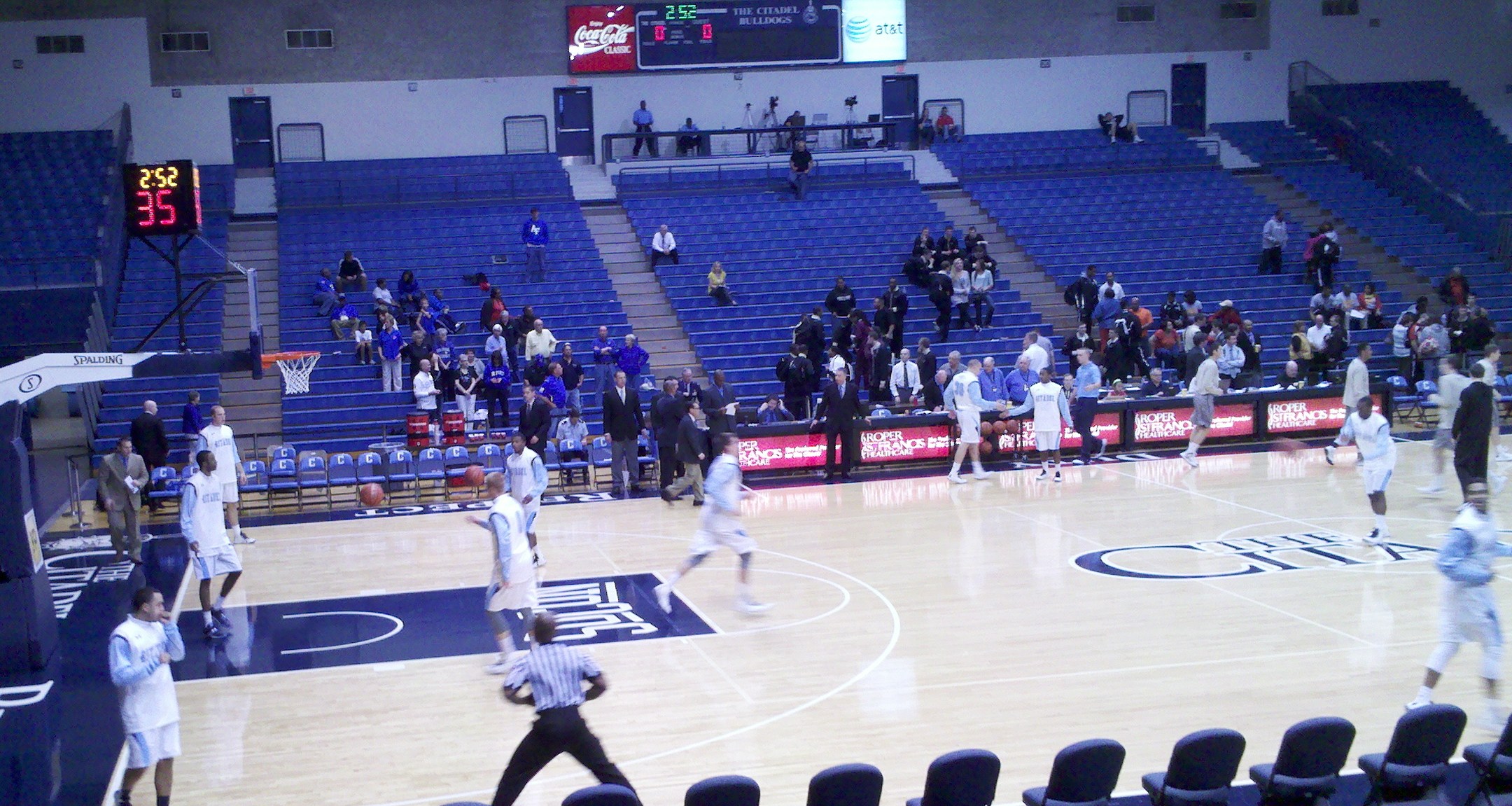
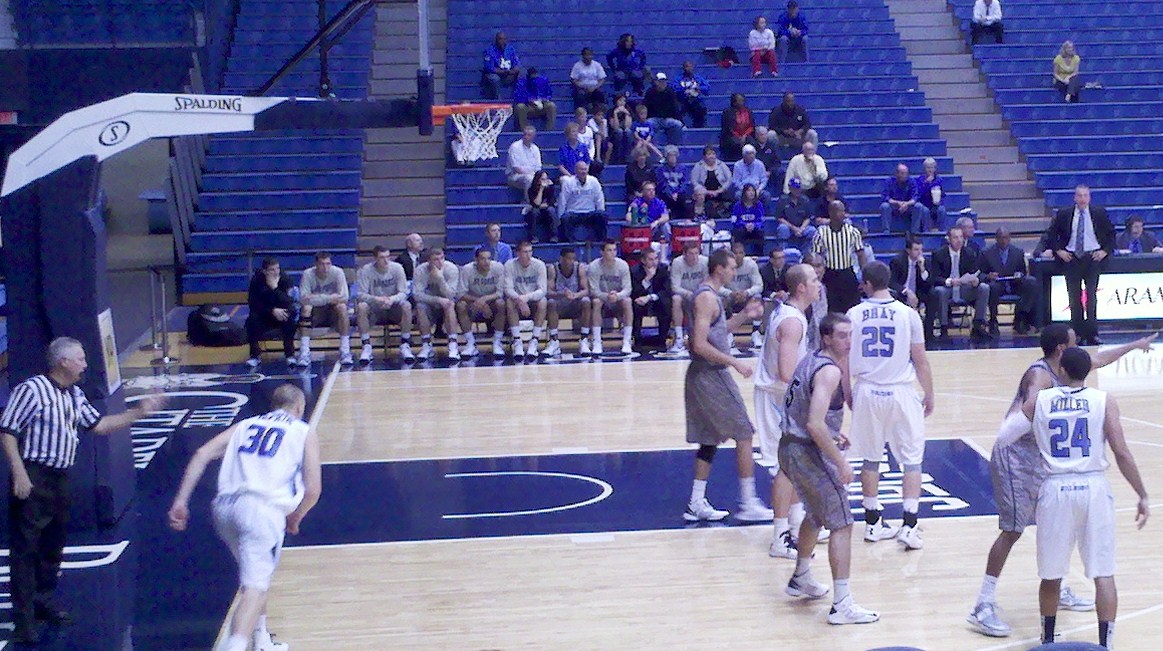
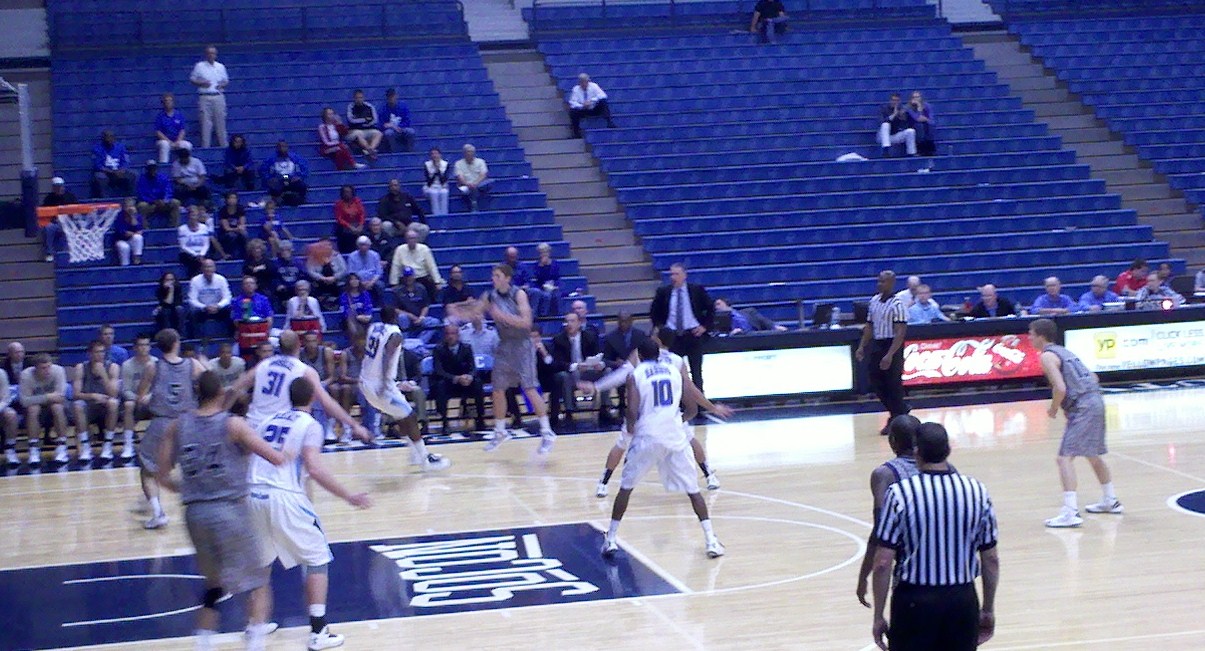
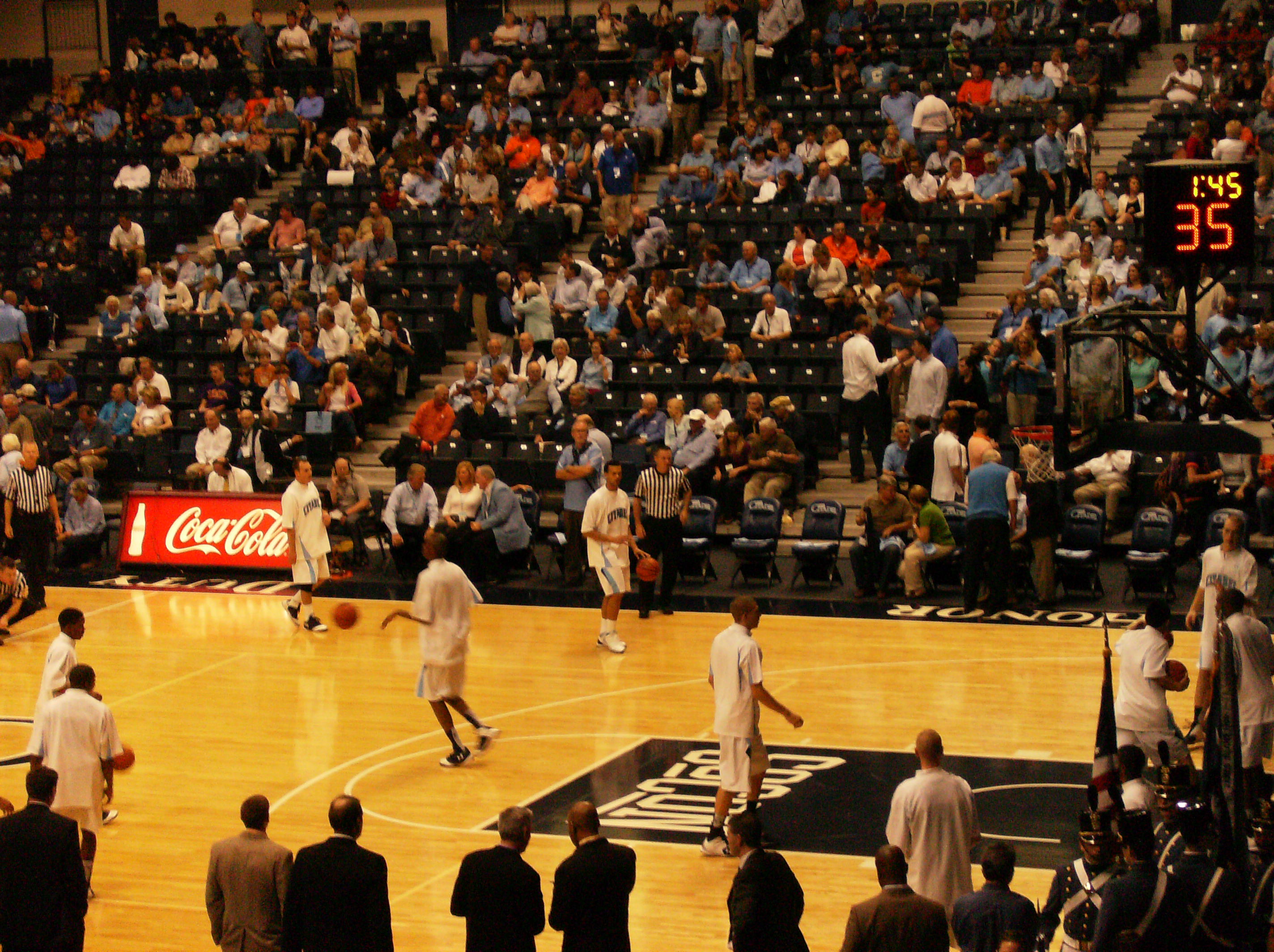
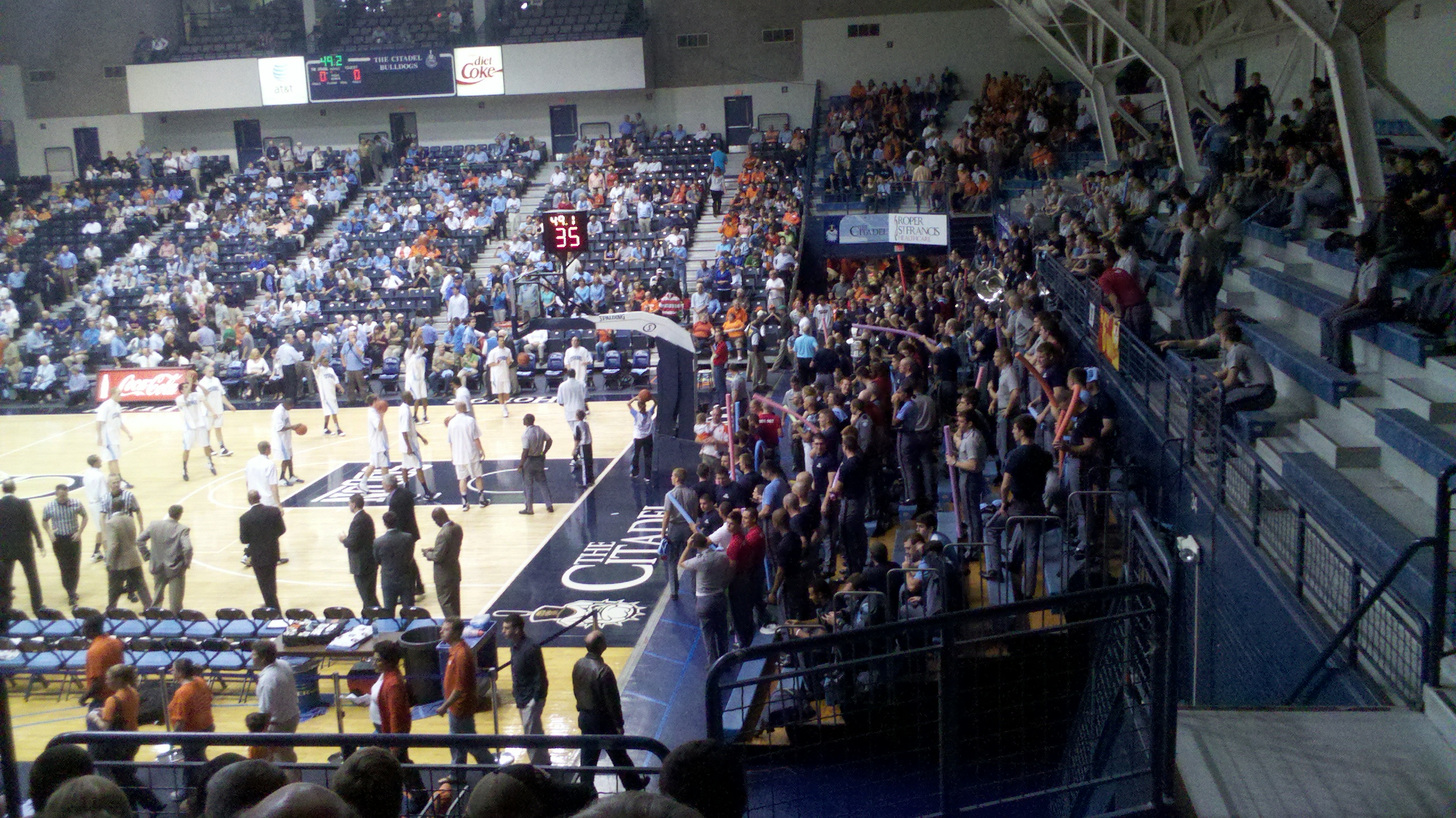
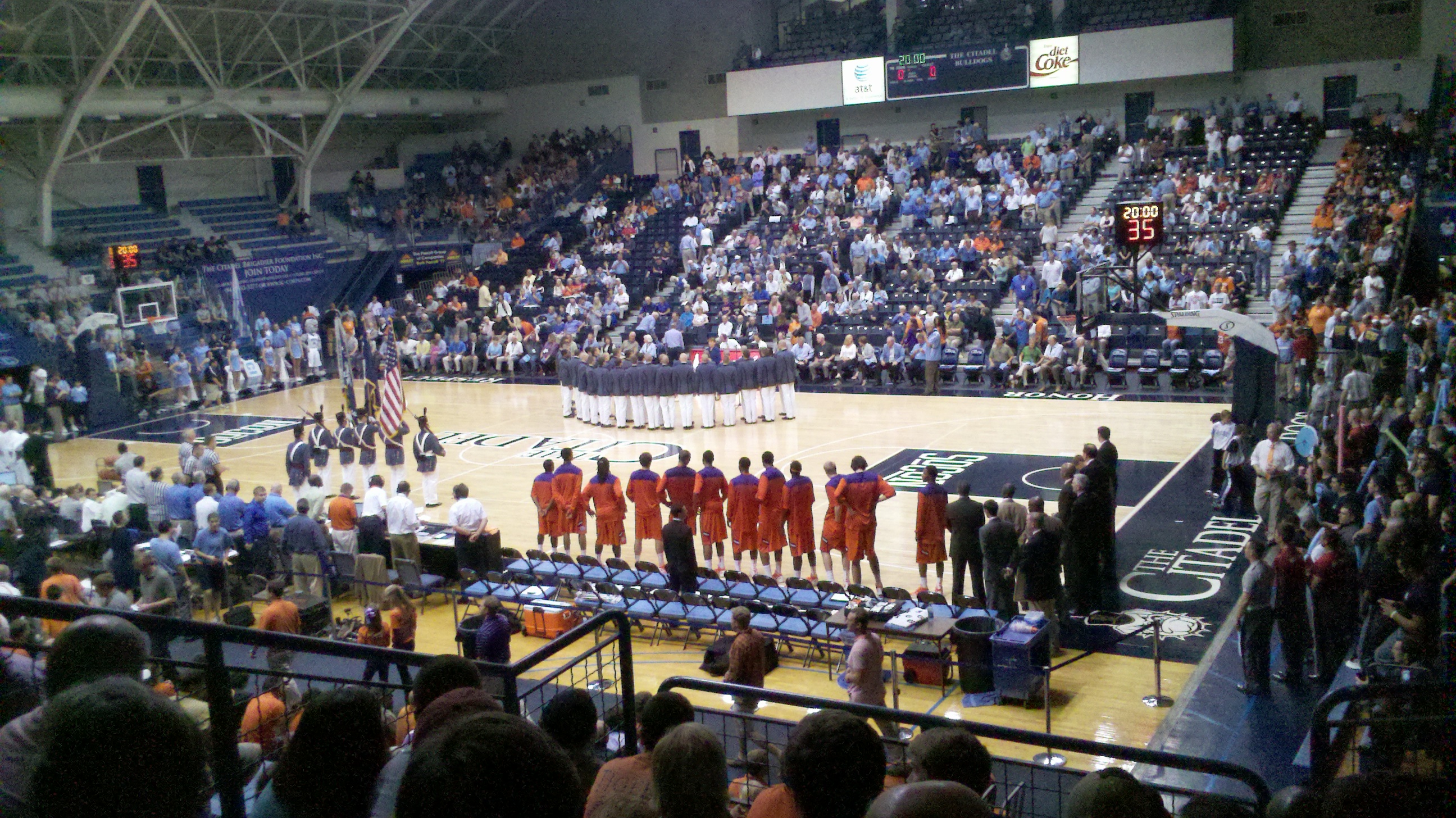
A few pictures from the Air Force game…yes, they’re terrible (though arguably not as bad as Air Force’s uniforms):

McAlister Musings: SoCon voting issues, preseason ratings, and corps attendance

Before I get to the three specific topics I am discussing in this post, some links of interest:

My preview of The Citadel’s 2012-13 basketball season

Chuck Driesell talks Bulldog hoops with Danny Reed (video)

More hoops talk with Chuck Driesell and Danny Reed (video)

Jeff Hartsell was there to Meet the Bulldogs, and was impressed with two freshmen

Mike Groselle is one of the candidates for the Senior CLASS award

Groselle is ready for the season to start (video)

Preview from The Post and Courier

Quick note: In that first Chuck Driesell interview, the coach mentions having had a bunch of his father’s old game reels converted to DVD. I bet a significant number of people (mostly Maryland fans) wouldn’t mind paying for copies of those.

Recently the Southern Conference released its annual preseason polls, both from the media and the coaches. The Citadel received the fewest votes in either poll, but that’s not what I’m writing about. My concern has to do with the way the polls were conducted.

I don’t have a major issue with the media poll, although I would like to know how the conference came up with a total of 30 voters. There are twelve schools in the league, so how were the votes apportioned?

Obviously it’s only a preseason poll and thus not a big deal, but I do have serious reservations about a media vote that did matter, namely last season’s all-conference team selections. I’ll get to that later.

However, first I want to take a look at the coaches’ poll, because it is a puzzler. All twelve coaches voted, but coaches could not vote for their own team. They also could not vote for their own players in the voting for the preseason all-conference team. I’m more interested in the breakdown for the team polling, however.

Total number of points for the teams in the North division: 246

Total number of points for the teams in the South division: 241

That makes no sense; both divisions should add up to the same number of points. Each division should have 246 points allocated to its six teams in some fashion. That is the case for the North, but the South somehow got shortchanged five points.

Because Davidson received all eleven possible first-place votes (Bob McKillop not being allowed to vote for his own team), the Wildcats should have received the maximum number of possible points, 66. Instead, Davidson got 65 points, so one of those five “missing” points belongs to Jake Cohen and company.

Conversely, the fewest possible number of points a team could get in this particular voting setup is 16. That would happen if a team were the last choice in a division by all the other coaches. The Citadel was the preseason last-place selection in the South division, and got, uh, 15 points.

The Citadel actually got fewer points in the SoCon preseason coaches’ poll than was technically possible. If that isn’t bulletin board material, I don’t know what is.

It’s only a preseason poll, though, so why should anyone care? I’ll tell you why. It is just part of a pattern of questionable polling/selection practices administered by the conference. Exhibit A in that respect is last season’s All-SoCon teams.

Last season there were four obvious choices for first-team honors in the Southern Conference: Jake Cohen, De’Mon Brooks, Mike Groselle, and Eric Ferguson. They were, by any legitimate measure, the league’s top four players. Cohen, Brooks, and Ferguson did make the first team, but Groselle was relegated to the second team in favor of Wofford’s Brad Loesing and UNCG’s Trevis Simpson.

Am I biased? Yes. However, check out this statistical comparison:

Player A Player B
Points 501 550
PPG 16.7 18.3
eFG% 59.1 44.5
Rebounds 288 127
Rb/g 9.6 4.2
Assists 54 22
A/g 1.8 0.7
Steals 43 23
S/g 1.4 0.8
Blocks 19 6
Turnovers 65 67

Player A is Mike Groselle. Player B is Trevis Simpson.

I’m not trying to knock Simpson, who is a good player, and one of the league’s better performers last season. I think you could make a decent case for him over Loesing, actually. I just find it hard to imagine how someone could vote for both of those players over Groselle.

Groselle was the league’s leading rebounder and finished second in scoring to Simpson, who took 151 more shots over the course of the season (which is reflected in his eFG%). I know that UNCG won the North division, and I suppose Simpson could get extra credit for that, but if the Spartans had been in the South they wouldn’t have finished in the top half of that division. They did lose 19 games last season, after all (The Citadel lost 24).

I can’t tell you how close the voting was, because the league didn’t provide voting totals for its all-conference teams, at least not publicly; it also didn’t release how many people voted for them. This stands in stark contrast to a conference like the ACC, which publishes that information.

I don’t really understand why the league releases point totals for the preseason polls (which are meaningless) but not for its all-conference teams (which are not meaningless). Maybe it is afraid someone will compare the number of voters to the point totals and discover a discrepancy. I don’t know.

I haven’t even discussed the qualifications of the voters. I can’t, since I don’t know who they are. I don’t know if they are actual media members or merely affiliated with one of the schools. I also don’t know if the voters are evenly distributed by region.

It would be nice to know these things.

If you have a statistical bent when it comes to college hoops, then you probably know who Ken Pomeroy is, and you may know who Dan Hanner is. Both are affiliated with Basketball Prospectus, although Pomeroy has his own site, which is very popular with the tempo-free stats crowd (Hanner writes for RealGM.com).

Anyway, both have released their preseason ratings. It is no surprise that The Citadel is not rated highly.  The Bulldogs are 297th out of 347 Division I teams in Pomeroy’s preseason ratings, and 292nd out of 345 in Hanner’s rankings (Hanner does not rank Northern Kentucky and New Orleans, which are transitioning to D-1).

The Citadel is the lowest-rated SoCon team in Pomeroy’s ratings, but is ahead of two league schools in Hanner’s rankings. Samford and Appalachian State are below the Bulldogs in the latter system.

While Hanner’s rankings are part of the just-published 2012-13 College Basketball Prospectus guide, The Citadel is still predicted to finish last in the league in the SoCon section of the annual. The writer for the SoCon section is Joey Berlin, a freelance writer from Kansas City.

In discussing last year’s Bulldogs, Berlin wrote that “Despite the school’s name, the only impenetrable fortress at Citadel games was the opposing team’s basket.”

Pomeroy rates the SoCon 20th overall among conferences, and the new-look CAA 16th. I’m not sure that will provide much comfort to the College of Charleston’s administration as that school prepares to change leagues (assuming it does eventually do so).

Another ratings system was recently released by David Hess, who is affiliated with TeamRankings.com. In Hess’ ratings, The Citadel is 314th out of 347 teams. The Bulldogs are projected to have a record of 9-18 (5-13 SoCon), with a 0.2% chance of winning 20 games and a 0.1% chance of finishing with the best record in the league.

When I looked at his list of The Citadel’s toughest and easiest games, I was mildly surprised to see that the Bulldogs’ toughest game (at least prior to the start of the season) is projected to be the game at St. Bonaventure, as opposed to the games against Georgia Tech, Clemson, or Davidson.

During the 2011-12 campaign, The Citadel averaged 1,840 fans per game over a 14-game home season. For conference games, the number was 1,813. When the Bulldogs played on the road in the Southern Conference, the average opposition attendance was 2,546.

The Citadel only outdrew two other league teams for SoCon home games, Elon and Samford. The Citadel’s numbers were very similar to those of Furman and Wofford.

That’s not a big surprise, as the Bulldogs went 6-24. However, The Citadel obviously needs to improve on that average. For one thing, I believe increased attendance can occasionally affect the results on the court, not only in terms of inspiring the team or intimidating the opponents, but in influencing SoCon officials (especially for weekend games). The Bulldogs need all the help they can get.

There is a built-in group of potential basketball attendees, though, who could really boost the totals and exponentially increase the support/intimidation factor. That would be the corps of cadets.

I have been at McAlister Field House on more than one occasion when a rowdy group of cadets managed to discombobulate the opposition. It doesn’t take a lot of them to have an impact, either.

(Incidentally, from personal experience during my cadet years, I can attest that natives of New York and New Jersey seem to be particularly good at annoying opponents.)

There are those in the corps who come to every game to support the team. Quite a few of them are athletes themselves, including members of the football and baseball teams. Then there is the pep band, which is traditionally outstanding.

The pep band and the “regulars” are great fans, and deserve credit for providing most of the atmosphere McAlister Field House has on game days.

I just wish that the basketball team got support in the same manner that the football team does for home games. Of course, attendance by the corps at football games is mandatory — which leads me to make a couple of suggestions.

I don’t know what The Citadel can do about league games played on Saturdays. I’m not about to advocate that members of the corps should be required to go to Saturday night basketball games (although of course they do attend football games on Saturday).

For Saturday games, I think it is important to make it really worthwhile for cadets to show up. Perhaps free overnights can be considered. At the very least, provide free food. That usually works.

Also, there are cadets who are stuck on campus over the weekend, serving tours or confinements. I would like to see those cadets in the stands cheering on their team, instead of walking on the quad while toting a rifle.

For weeknight contests, I advocate a rotation. The Citadel plays five league home games this season on weeknights. The “hardcore” plan would feature mandatory attendance at three of those five games (hey, it’s only a couple of hours). The “okay, we won’t bother you more than once” plan would have cadets attending at least one game.

For the one-game only plan, each battalion would attend one game. For example, on January 10th, the legendary 1st Battalion would go watch the Bulldogs battle Chattanooga. For the CofC game, 2nd Battalion would get the call. You get the idea.

I would set up the “hardcore” plan like this:

January 10 (Thursday) — Chattanooga — 3rd and 4th Battalions

January 14 (Monday) — College of Charleston — the entire Corps of Cadets

January 31 (Thursday) — Wofford — 1st and 5th Battalions

February 14 (Thursday) — Georgia Southern — 2nd Battalion

February 28 (Thursday) — Furman — the entire Corps of Cadets

Of course, any cadet who wanted to go to a game could go, even if his battalion wasn’t scheduled to attend. I think regulars would get to sit in specific sections for these games.

This setup would be worth at least two wins for The Citadel, in my opinion. I also believe it might increase attendance among the “non-cadet” crowd.

One other suggestion: I think it’s important to indoctrinate the freshmen cadets as quickly as possible. I understand that most of the freshmen were in attendance for “Meet the Bulldogs”, which was an excellent move. I would also make the November 14th contest against Montreat (a Wednesday night game) an “all knobs attend” affair.

I know I’m asking a lot here of the cadets. However, I think it’s important to help out the hoopsters, and jazz things up a bit. I also believe that the basketball program has a great deal of potential if The Citadel could ever turn the corner. The current average attendance is only about 30% of the capacity of McAlister Field House. Even doubling that (in terms of paying customers) would really do wonders for the bottom line.

The season is about to start. Saturday’s game on the hardwood against VMI will be here before you know it.

Hope on the hardwood? The Citadel begins the 2012-13 basketball season

Note: as I mentioned earlier, I’m participating in “Scanning the SoCon”, a cross-blog/forum exercise. As part of this, there will be a preview for each league school. I am writing the preview for The Citadel, which you can read below (it is being posted on Mocs Mania! as well, of course). Previews for the other conference schools can be found here: Link

There were three topics (attendance, polls, and ratings) that I wanted to discuss in more detail but couldn’t quite fit into the preview. I’ve decided to write about them next week in a followup post.

The Citadel was 6-24 last season, 3-15 in the Southern Conference. Thus, it surprised no one that in the SoCon preseason polls (media and coaches)  the Bulldogs were picked to finish last in the South division of the league. Indeed, The Citadel received fewer votes than any team in the league, in either division.

The last time The Citadel finished dead last in both preseason polls was prior to the 2008-09 season. The Bulldogs had gone 6-24 the previous year, in head coach Ed Conroy’s second season at The Citadel. More of the same was expected, but instead the Bulldogs won 20 games for only the second time in school history, 15 of them coming in league play. It was the finest season on the hardwood for The Citadel in 30 years, and one of the best in school history.

Just like Ed Conroy in 2008-09,  Chuck Driesell is entering his third season in charge of the Bulldogs after enduring a 6-24 campaign. Conroy brought in eight scholarship freshmen for his second season; so did Driesell.

However, there are differences between then and now. Conroy’s batch of freshmen included a player who would be named Freshman of the Year in the Southern Conference, Cameron Wells, and another (Zach Urbanus) who finished the year as a solid contributor. None of the freshmen who played last year for The Citadel (two were redshirted) had a season as good as Wells’ initial campaign for the Bulldogs.

That isn’t to say that significant improvement can’t be made. I suspect it will. However, the same can be said for the Southern Conference in general. I expect the league to be better than it was last year, as many of the better players from last season are returning in 2012-13.

It’s only one statistical category, but I couldn’t help but notice that ten of last season’s top thirteen SoCon performers in Ken Pomeroy’s “offensive rating” system (minimum 20% possessions used) are back this year. That group of ten doesn’t even include established performers like Trevis Simpson, Lucas Troutman, Trent Wiedeman, and a couple of Cochrans (Wofford’s Karl and Davidson’s Nik).

The league is going to be tough this year. Can the Bulldogs hang in there? If they are going to do so, they must first address some obvious shortcomings.

The Citadel was a very poor defensive team last season. Mike Groselle was the only consistent rebounder on the squad (though he was good enough to lead the league), and only three teams in all of Division I allowed opponents to shoot a higher percentage inside the arc (55.7%) than the Bulldogs.

That carried over into league action, although The Citadel wasn’t the worst defensive outfit in the conference in SoCon play, in part thanks to opponents’ three-point shooting (only 30.3%). Three league teams allowed more points per possession than did the Bulldogs in conference games.

However, the Bulldogs struggled on the offensive side of the court in conference play more than any other SoCon team, and by a wide margin, scoring only .907 points per possession in 19 league games (18 regular season matchups plus the first round of the SoCon tourney). The Citadel shot just 31% from outside the three-point line in league action and also had the worst turnover rate in the conference.

One positive: when the Bulldogs did score, it often came as a result of good team passing (The Citadel was second in the league in its ratio of assists to made baskets).

Mike Groselle had an outstanding season in 2011-12. Groselle led the league in rebounding and was second in scoring, being edged for the SoCon scoring crown by UNCG’s Trevis Simpson (who attempted 151 more shots from the field). Groselle was a very efficient performer (59.1 eFG%), and persevered despite being the focus of every opponent’s game plan.

He did everything well, basically, and made the 10-man all-conference team selected by the league coaches. However, Groselle did not make the media’s All-SoCon first team, an omission that was not easy to understand.

For the Bulldogs to improve this year, Groselle is going to need help. Will he get any?

When I watched The Citadel’s freshmen in action last year, I came to the conclusion that while several of them had promising skill sets, they just weren’t strong enough to handle the adjustment to Division I hoops. There is a chance that a year of physical maturity (and a lot of work in the weight room) will improve the Bulldogs’ rebounding numbers and alleviate some of the turnover problems that plagued the team last year.

C.J. Bray is a good example. The 6’7″ Bray is athletic enough to have been offered a football scholarship to Arkansas, and he can present matchup problems with his ability to float outside and hit the three-point shot. I thought he showed good instincts on the boards, too, but he wasn’t able to corral every rebound chance that came his way.

That may change this year. If he can also provide solid post defense, he will be a great help to Groselle. Bray started more games than any other Bulldog freshman last season (18). Another rising sophomore who goes by his initials, 6’8″ P.J. Horgan, saw limited action last year and may also be a factor in the frontcourt rotation.

Lawrence Miller shot 42% from three-point land last season, better than his overall field goal percentage (39%). He will probably get first crack at the 2-guard spot for the Bulldogs. Ashton Moore, who started 14 games last season and played more minutes than any other freshman, will also be in the mix. Moore is capable of putting the ball in the basket (30 points against UVA-Wise) but needs to be more consistent.

The point guard for The Citadel will be Marshall Harris III, who started the final 11 games last season. Harris must cut down on his turnovers to succeed in that role, and it’s key for the Bulldogs that he do so. There is no other obvious candidate to play the point, as DeVontae Wright transferred to USC-Aiken this summer. Moore could be an option, and one of the freshmen may get a look.

Wright was one of three underclassmen to transfer after last season. Jordan Robertson, a forward who showed flashes of potential last year, is now at Davidson County Community College. He was the only one of last year’s group of freshmen to leave. The third player to transfer, Barry Smith, moved on to Bethune-Cookman.

The two seniors on last year’s team, Cosmo Morabbi and Bo Holston, both graduated. Holston had one year of athletic eligibility remaining, and elected to play as a graduate student at Anderson. In all, players no longer on the roster accounted for 42% of the minutes played last season.

There are seven players on this year’s roster who have yet to appear in a Division I game — four incoming freshmen, two redshirt freshmen, and a fifth-year transfer student.

The most heralded of the “knobs” is Matt Van Scyoc, a 6’6″ wing player who led the state of Wisconsin in three-point shooting last year. Van Scyoc averaged 24.3 points and 13.3 rebounds per game his senior season and was an all-state selection in Wisconsin’s Division 5 high school classification.

His fellow classmates include 6’3″ swingman Raemond Robinson, a Goose Creek product who was also an outstanding high school football player. Robinson is used to winning, both on the gridiron and on the court; perhaps he can bring that kind of positive energy to The Citadel’s hoops squad (much like John Brown did during that aforementioned 2008-09 campaign).

Janeil Jenkins and Quinton Marshall each signed late in the spring. They are both guards, but of markedly different sizes; Jenkins is 5’10”, while Marshall is 6’5″. Chuck Driesell mentioned Marshall in a recent interview with Jeff Hartsell of The Post and Courier as someone who might get to play early.

Two of the eight freshmen from last year did not see any action in 2011-12. Dylen Setzekorn is a 6’7″ wing on the slender side (194 lbs., per The Citadel’s website). 6’9″ forward Michael Hundley is even thinner (180 lbs.). It is easy to see why both were redshirted.

Hundley has a reputation as a shotblocker. If he could get on the court with that skill, it would be a huge boon for The Citadel, which hasn’t had a true shot-swatter since Kirill Misyuchenko patrolled the lane for the Bulldogs in the late 1990s.

The final player on The Citadel’s roster is something of a wild card. Stephen Elmore is a 6’6″, 220-lb. graduate student who saw limited action at Princeton…as a baseball player. The 2012-13 campaign will be his first (and last) taste of college basketball, at least as a player.

He is the son of Len Elmore, the well-known college basketball commentator who was an outstanding college player at Maryland (and who had a solid NBA career as well). Driesell described Stephen Elmore as “a power forward who can shoot the three-pointer”. I have no idea what kind of impact (if any) he will have for the Bulldogs.

The Citadel’s non-league slate is about what you would expect for a team that only won six games a year ago and includes two games against non-Division I competition. The Bulldogs will open the season by hosting the All-Military Classic, which also features VMI, Army, and Air Force.

The Citadel squares off with VMI in its first game, on the same day the Bulldogs play the Keydets in football — in Lexington, VA. It’s a scheduling quirk that I think is unfortunate.

There are no home games in December, which is a little strange. The Citadel is playing “guarantee games” against Georgia Tech, Clemson, and…St. Bonaventure. I’m not sure why the Bulldogs are making the trip to Olean, New York, but at least Andrew Nicholson has moved on to the NBA.

In what I believe is a first, The Citadel is participating in Bracketbusters this season. Other out of conference games include a home contest against Radford and road games versus Charleston Southern and Gardner-Webb.

I will be curious to see how Chuck Driesell handles tempo this season. Driesell prefers a faster pace than that implemented at The Citadel by Ed Conroy, but he was forced to slow things down last season in an effort to stay competitive. In that respect, he succeeded. The Citadel’s two late-season victories over Chattanooga and Appalachian State featured fewer possessions than any other games the Bulldogs played during the season.

I think a slower tempo is generally what works best for The Citadel, but it’s obviously not a style Driesell really enjoys, and I don’t know what his approach will be this year. His best player (Groselle) is probably best suited for games with a more restrained pace.

It’s just one of many things that makes this season for The Citadel a very interesting one. I’m not predicting a year like the 2008-09 campaign, but I believe the Bulldogs are going to surprise some people. The team has to make the leap from being competitive to winning games. It’s a difficult transition, but I think the talent is there to make that jump.

Putting together The Citadel’s 2012-13 hoops schedule

It’s that time of year when I try to figure out The Citadel’s upcoming basketball schedule before it’s been released. Why do I do this? I have no idea. Marking time until football season begins, I suppose. Anyway, some quick thoughts:

Phil Kornblut interviewed Chuck Driesell recently; you can listen to that here. In the interview, Driesell stated that The Citadel will play fourteen home basketball games this season, and that the first six of those would come in a season-opening homestand at McAlister Field House.

The first two games at McAlister will come at the All-Military Classic against VMI and either Army or Air Force. It doesn’t appear at this time that those games will be played on the U.S.S. Yorktown, as had been rumored. It is possible that the game against VMI could still take place on the carrier, but I tend to doubt it.

Those games will take place on November 10 and November 11. Yes, The Citadel will play VMI in both basketball (at home) and football (on the road) on the same day. That doesn’t strike me as ideal.

After those two games, then, The Citadel will play four more home games before its first road game, which presumably will be the December 1 game against UNC-Greensboro (which has already released its schedule).

There are eighteen games in SoCon play. Nine at home, nine on the road. If The Citadel is opening with six straight home games, then one of them has to be a conference game. That’s because if all six were out of conference, the Bulldogs would be playing 15 home games (those six, plus the nine league matchups).

Since the number of home games is 14, one of the six has to be against a fellow SoCon squad. I’m guessing the date of that game is November 28, based on the recently released Furman schedule.

The other OOC home game that is “known” is Radford. The Citadel will host the Highlanders on November 24. That leaves two more non-conference games at McAlister to be determined.

If The Citadel is playing five OOC home games, then the Bulldogs will be playing six non-conference games on the road. Three of those have already been announced via the release of opponents’ schedules.

The Citadel will play at St. Bonaventure on December 19. Three days later, on December 22, the Bulldogs will travel to Atlanta to play Georgia Tech. Then on January 1, 2013, The Citadel will travel to Clemson.

Larry Leckonby is on record as stating that for budgetary purposes the basketball team was asked to schedule at least three “guarantee games” this season. I’m not positive that the three games mentioned above fit the bill, although they probably do. I am unsure about Clemson, as that game may be part of a previously arranged deal (since the Tigers played at McAlister last season). I am a little curious about the St. Bonaventure game, to be honest.

As for the remaining three road OOC contests, I am assuming (very dangerous, assumptions) that one of them will be against Charleston Southern, which played at MFH last year. As for the other two games, I don’t really have any idea, although I wouldn’t be all that surprised if one of them is another guarantee game.

That’s all I’ve got on the schedule front right now.

Hoops update: Defense is kind of important

Just a (very) quick post on The Citadel’s basketball team. Recent results can be summed up as follows:

“Our defense is terrible.” — Chuck Driesell on the postgame radio show, after the Bulldogs were drilled 88-69 by Charleston Southern

Yes, yes it is. Let us count the ways:

– The Bulldogs have allowed 80+ points and lost by at least 19 points in the last four games
– The Citadel’s defensive efficiency (adjusted) ranks in the bottom ten in the country (all stats per KenPom.com)
– Opponents of the Bulldogs are shooting 2-point shots (often attempts in the lane) at a 58.1% clip; only four other teams nationally are worse in that category (though The Citadel isn’t last among SoCon schools or military colleges, as two of those four teams are Georgia Southern and VMI)
– The Citadel also ranks in the bottom 25 nationally in defensive eFG%, percentage of blocked shots (defense), and defensive turnover percentage

Now the Bulldogs go on the road for three games, and are under-Bulldogs in all three contests. The first of the matchups will be against James Madison (4-3), which beat The Citadel 74-67 last season and will have the services of point guard Devon Moore for the first time this year. Moore, who had academic issues, will apparently make his 2011-12 debut on the hardwood against the Bulldogs. He scored 19 points in last year’s meeting.

Jeff Hartsell of The Post and Courier has a brief preview of The Citadel’s game at JMU:  Link

The Citadel will then face Denver, a sneaky-good Sun Belt squad (yes, Sun Belt) that has already beaten St. Mary’s and Southern Mississippi. The Pioneers are 8-2 and are led by former Princeton player and coach Joe Scott, who as you may have guessed runs the Princeton-style offense. Denver will be a formidable challenge for The Citadel.

Tennessee is 3-6 and has already lost this season to the College of Charleston and Oakland. Those are good teams, though, and both games were on the road. The Vols also lost at home to Austin Peay, though, a result much harder to fathom.

If the Bulldogs don’t pick it up defensively, these three games could wind up being downright embarrassing. As it is, The Citadel could play fairly well and still go 0-3.

Chuck Driesell has noted that this season is “a process”. It may or may not make Bulldog fans feel better that the coach seems to be as frustrated with the process as they are…

Hoops update: SoCon play begins for The Citadel

— The Citadel at the College of Charleston, 8:00 pm Thursday, December 1, 2011, at TD Arena, Charleston, South Carolina

— The Citadel at Wofford, 7:00 pm Saturday, December 3, 2011, at Benjamin Johnson Arena, Spartanburg, South Carolina

Both games can be heard on WQNT-AM 1450 in Charleston, with “voice of the Bulldogs” Danny Reed describing the action. Audio is also available online via Bulldog Insider. The game against the College of Charleston will be televised by WMMP-DT 36.1 in Charleston and is also being carried by ESPN3.com.

The Citadel is now 2-3 on the season, with a 97-44 win over Florida Christian (a non-Division I team) sandwiched by a pair of losses, 73-50 at home to Clemson and 80-72 on the road against High Point, the latter contest being decided in overtime.

The Bulldogs did what they were expected to do against Florida Christian, although it should be noted that the Suns only lost to Bethune-Cookman of the MEAC by 18 points. The game was notable for being the first start of the season for Barry Smith, who also started the game against High Point. The sophomore forward scored 19 points against Florida Christian after being inserted into the lineup for defensive reasons.

I wanted to make a few observations about the games against Division I competition. The Citadel has now played four contests against D-1 teams, winning one and losing three, with two of the losses being close games. The not-so-competitive loss, alas, came at McAlister Field House, and to a Clemson team which then lost consecutive games at Littlejohn Coliseum to the College of Charleston and Coastal Carolina. (The Tigers defeated Furman by ten points on Saturday night to avoid losing three straight home games to in-state foes.)

Chuck Driesell has used the early part of the season to give opportunities to numerous players on his roster, with eleven cadets seeing action in every game. Those aren’t just cameos by the 9th or 10th players off the bench, either; of the 57 individual appearances made by Bulldogs in five games, 50 were for at least nine minutes and two others were for eight minutes.

Offensively, the Bulldogs have played fairly well. The Citadel has taken care of the basketball and has been reasonably balanced on offense, although the Bulldogs got into a three-point shooting contest against High Point and subsequently took 43% of their field goal attempts from outside the arc, which is too many. (The Panthers shot 44 three-pointers in that game, out of 59 field goal attempts.)

The Citadel has to continue to work the ball inside to Mike Groselle, who has been unsurprisingly excellent thus far. Groselle is averaging 18 points (these stats do not count the Florida Christian game) while shooting 68% from the field. He also has a double-double in every game this season while averaging 36 minutes per contest, answering any lingering questions about his stamina.

Groselle needs more help inside, though, both offensively and defensively. He particularly needs some assistance on the offensive glass, as Groselle has almost half of the offensive boards claimed by the Bulldogs in the four D-1 games (18 of 39).

The Bulldogs have struggled on defense. The Citadel ranks in the bottom 75 nationally in several key defensive measures, including eFG%, free throws attempted per field goals attempted, and turnover rate (numbers are from kenpom.com).

The Citadel is dead last in all of Division I (345 teams) in the percentage of opponents’ shots blocked (which probably accounts in least in part for opponents of the Bulldogs having success in converting 2-point baskets). Charleston Southern is next-to-last in the category, with Army, Navy, and Presbyterian also in the bottom 11. That’s three military schools and three Palmetto State schools, so I guess it’s only natural that The Military College of South Carolina is last.

At 5-1, the College of Charleston is off to a promising start as it enters SoCon play. The Cougars’ five victories include the road win at Clemson mentioned earlier, along with two victories in the Battle 4 Atlantis holiday tournament that was recently held in the Bahamas. After losing its opening game in the tournament to Central Florida 74-63, the CofC outlasted UNC-Asheville 68-66 in the consolation bracket. The Cougars completed the tourney with an 85-61 win over Massachusetts, running away with that game in the second half.

Through six games, the CofC is shooting the ball very well, with an eFG% of 54.9, ranking in the top 25 of Division I. The Cougars get about one-third of their points via the three-point shot, which is fairly high, but you can get away with that when you have several guys shooting well from distance, including Jordan Scott, Anthony Stitt, and Andrew Lawrence (who has made 14 of 28 three-pointers).

The Cougars have at times struggled with rebounding, which was their downfall against UCF (as they were outboarded 43-21 in that contest). It was probably not a coincidence that touted freshman forward/center Adjehi Baru got in early foul trouble in that game. When playing, Baru has been a significant defensive presence. CofC opponents have an offensive rebounding percentage of 39.7, which places the Cougars in the bottom 20 of D-1 for that metric. Obviously, the sample size is a small one.

The lone senior on the CofC’s roster, Antwaine Wiggins, was named the Southern Conference player of the week last week after the Cougars’ victory over Clemson, a game in which he scored 22 points. He followed up that excellent performance with a total clunker against Central Florida, only scoring two points against the Knights. However, he scored 23 points in each of the next two games, so the UCF contest appears to have been an aberration.

I think the primary longterm concern for CofC fans will be the Cougars’ depth, a problem exacerbated by the loss in preseason of forward Willis Hall to a knee injury. Hall started all 37 of the CofC’s games in 2010-11. Without him, the Cougars have been reduced to what is essentially a seven-man rotation, with five players averaging more than 25 minutes per game. That isn’t exactly a new thing for a Bobby Cremins squad, but it’s something to watch over the grind of a long season. There are three players averaging more than 30 minutes per contest — Wiggins, Lawrence, and 6’8″ forward Trent Wiedeman.

The Cougars have won eleven straight SoCon games at home. Their last loss in league play at what is now called TD Arena came on February 8, 2010, against The Citadel.

The Citadel will face Wofford in its second game of the SoCon season, with the matchup taking place at the Benjamin Johnson Arena. That facility opened in 1981 with a game between the Bulldogs and the Terriers, won by The Citadel 65-64.

Wofford is 3-3 on the season. Like the College of Charleston, the Terriers had to replace multiple key performers from last season’s team, including a star player. The Cougars lost Andrew Goudelock, while Wofford now has to make do without Noah Dahlman. Goudelock was a first-round pick of the L.A. Lakers, but it is Dahlman who will be more difficult to replace.

Dahlman helped make Wofford one of the nation’s better offensive teams, with a team adjusted efficiency rating of 111.0, a top 50 mark in Division I. This season, that number through five D-1 contests (Wofford’s only home game to date was a victory over Emory&Henry) is 94.5, a huge differential. That is what can happen when you have to replace four starters who accounted for 66 points and 23 rebounds per game.

I should note that it doesn’t help Wofford’s offensive statistics to have played one of those five Division I games against Wisconsin. The Badgers bludgeoned the Terriers, 69-33. Wofford does have a nice win over Bradley (70-66), but that is somewhat offset by a neutral court loss to UMKC (64-58, in OT). The Terriers also struggled mightily in a win over Prairie View, which is not expected to be one of the SWAC’s better teams (in other words, it is expected to be among the nation’s worst teams). Wofford’s other loss was a respectable effort against Georgia (62-49).

The Terriers’ offensive woes are reflected in their eFG% (41.1) and their FTA/FGA, ranking in the bottom 30 nationally in both categories. Wofford has also been a bit turnover-prone (and conversely has not been particularly effective in forcing turnovers, which has hurt its defense). The Terriers have not shot the ball well from the field, either in front of or behind the three-point line.

Wofford has employed a seven-man rotation, with senior guards Kevin Giltner and Brad Loesing each averaging more than 38 minutes per contest. Yikes. Loesing, the point guard, started last season, but Giltner was more of an impact sub, shooting 42% from three-land last year. Through six games this season, Giltner is shooting 31% from beyond the arc.

Drew Crowell’s time on the court has increased by about 20 minutes per game from last season to this one; he is basically filling the Tim Johnson role for the Terriers. Two true freshmen, forward Lee Skinner and the highly regarded Karl Cochran (a 6’1″ combo guard), are also seeing plenty of time on the court, as is Domas Rinksalis, a 6’9″ forward/center who redshirted last season.

Wofford isn’t expected to contend in the Southern Conference this season, though the Terriers might prove a tough out come SoCon tourney time.

Neither of these games will be easy for The Citadel, to say the least. The Bulldogs aren’t expected to win either contest, and are a sizable underdog to the College of Charleston (kenpom.com gives the cadets only an 8% probability of winning).

I think it’s good, though, to start out league play with a pair of road games. I would like to think that by the time the return games roll around, the team will have improved substantially, with the freshmen more fully understanding their roles and gaining confidence. Then that increased understanding and confidence can be put to good use at McAlister Field House, where the Bulldogs should have a better chance of success.

Odds and ends…

– I am continuing to contribute to a roundtable discussion (more or less) about the SoCon. The latest edition for this season has been posted to a Chattanooga blog, Mocs Mania, and can be found here:  Link

— I was at McAlister Field House for the Clemson game. So were lots of Clemson fans. I would say almost half the fans in attendance were wearing orange. That’s okay (for now), though. We’ll gladly take their money. I took a few pictures. As always, keep in mind that I’m a less-than-scintillating photographer with an iffy camera, which is one reason you won’t see any action photos. All the pictures are from the pregame scene.

Hoops update: The Citadel returns home to host Clemson

The Citadel vs. Clemson, 7:00 pm Wednesday, November 16, 2011, at McAlister Field House. The contest will be broadcast on the ESPN3.com platform, with Darren Goldwater calling the game alongside analyst Dean Keener. The game can also be heard on WQNT-AM 1450 in Charleston, with “voice of the Bulldogs” Danny Reed describing the action. That audio is also available online via Bulldog Insider.

The Citadel opened the 2011-12 campaign by splitting a pair of games at the All-Military Classic in Colorado Springs. The Bulldogs lost 103-100 to VMI in their opener before coming back from 20 points down in the first half to defeat Army, 83-72.

The two games were essentially played on the same day, at least if you were on Eastern Standard Time, which to me made the comeback against the Bulldogs of the Hudson that much more impressive. Army is not a good team (projected to finish last in the Patriot League), but any D-1 win at this point of the season with a squad as young as The Citadel’s has to qualify as a good win.

The Bulldogs had a chance to win both games, but could not overcome a bad start against VMI. The Keydets led by as many as 16 points in the first half before The Citadel made a run to cut the lead to two. VMI scored two late baskets to take a six-point lead into the break, and continued to increase its lead throughout the second half, actually leading 98-83 with less than four minutes to play. A furious rally by the Bulldogs fell just short.

Obviously, The Citadel needs to avoid falling behind by so many points early in the game. While the Bulldogs were able to rally past Army, that’s not something they will be able to do on a regular basis.

The game against VMI was televised by CBS Sports Network, with Roger Twibell calling the game alongside analyst Pete Gillen. In the first half, Lefty Driesell joined them via telephone for a five-minute interview segment.

Listening to Pete Gillen have a conversation with Lefty Driesell gave me a renewed appreciation of the versatility of the English language.

The star for the Bulldogs over the two games was, not surprisingly, Mike Groselle, who was named the Southern Conference Player of the Week for his efforts. His totals were great, and perhaps even more promising going forward, Groselle played 68 minutes over the two games. Considering that was at altitude, over a period of less than 24 hours, and that 37 of those minutes came against VMI and its racehorse style of play, any questions about his conditioning and general endurance have been answered.

Tangent: In its game release, The Citadel listed players who had three or more consecutive double-doubles (Groselle has now had three straight such games on two different occasions). I am surprised not to see Gary Daniels’ name on this list. I would have thought he had probably done that at least once during his career at The Citadel.

Groselle wasn’t the only player who excelled in Colorado. DeVontae Wright rebounded from a tough night against VMI (1-7 FG) and had an outstanding game against Army, scoring 26 points on just 12 shots from the field (he was 8-8 from the line).

Eleven Bulldogs played in each contest, and all of them scored against VMI. Ten of them got in the scoring column against Army (C.J. Bray was the exception, though he did have four rebounds in that game). Cosmo Morabbi attempted one three-pointer against Army, and made it, the first three he had made since the 2009-10 season (he had missed a number of games last year due to injury). I hope that is a sign of things to come for Morabbi. Bo Holston had 12 points and 7 rebounds in that game.

Lawrence Miller provided a spark against VMI, going 4-5 from three-land and scoring 14 points. Marshall Harris III had 11 points and 9 assists against the Keydets, and Ashton Moore added 10 points and 5 assists in the same game. The Bulldogs had four players come off the bench to score in double figures against VMI, as Barry Smith scored 12 points in 16 minutes of play.

Offensively, there wasn’t much to complain about in the first two games. The Citadel shot the ball well from the field and the line, made a decent percentage of threes (without taking too many), and did not commit an avalanche of turnovers. The assist-to-basket ratio was good, particularly against VMI. Groselle could use a little help on the offensive boards, though.

The defense needs to get better, however. The Bulldogs struggled defensively last season, and must improve on that side of the court to compete in the Southern Conference. The Citadel gave up 103 points to VMI on an estimated 85 possessions.

Thanks to a strong second-half effort, the numbers were better against Army, but the Bulldogs needed as many stops as they could get in the second half after giving up 49 first-half points. The Citadel did a much better job defending the three in that second frame; Army was 6-8 beyond the arc in the first half, but only 1-13 thereafter.

It has been a while since The Citadel defeated a “BCS team” in basketball. Indeed, the Bulldogs have lost 55 consecutive games to schools currently in a BCS conference, and 81 of their last 82. The lone victory in that run came near the end of the 1988-89 season, when The Citadel memorably defeated South Carolina in Columbia, 88-87. The Gamecocks actually made the NCAA tournament that year, so it’s not like the Bulldogs took advantage of a bad team.

The last time The Citadel beat Clemson? 1979, at McAlister Field House. The Bulldogs won 58-56, one of twenty victories for The Citadel in that particular campaign, the first time the school had ever won that many games in a season (and only matched once since then, three years ago).

Interesting note: the Bulldogs’ last two victories over BCS schools came against South Carolina and Clemson. Randy Nesbit was the head coach when The Citadel beat the Gamecocks, and a player when the Bulldogs defeated the Tigers. In fact, Nesbit hit the game-winning shot against Clemson in 1979.

Last year at Littlejohn Coliseum, Clemson defeated The Citadel 69-54. Mike Groselle had 14 points and 10 rebounds (five of them offensive boards) in that game.

Milton Jennings of Clemson, who went to Pinewood Prep in Summerville, also had a double-double in that game despite playing only 18 minutes; he’s an expected starter for Wednesday’s game. Jennings also had a double-double at Duke, on the Blue Devils’ Senior Night. The junior was a McDonald’s All-American, and he may be just starting to realize his potential.

Other Tigers who will start or see major action include sharpshooter Andre Young, who can fill it up despite being only 5’9″, freshman guard T.J. Sapp, and 6’5″ swingman Tanner Smith. Jennings will be joined in the frontcourt by Devin Booker, a decent jump shooter with nice touch around the rim. He’s a good rebounder as well. Jennings and Booker will be a formidable challenge for the Bulldogs’ big men.

The Tigers were a solid defensive club last year under first-year coach Brad Brownell. They held their opponents to an eFG% of 45.6, 25th-best nationally, and also forced turnovers at an impressive clip. Clemson occasionally struggled keeping opponents off the offensive boards.

Notable stat: the Tigers led the ACC in free throw shooting, which for many observers was disorienting.

Clemson played another group of Bulldogs, Gardner-Webb, in its opener. That game was tied at the half, 29-29, after G-W overcame a 13-point deficit. The Tigers broke out early in the second half, though, and reasserted control of the game, cruising to a 65-44 victory. Young was 7-9 from the field (3-4 3FG). Clemson also got 11 points from Sapp and a career-high 14 rebounds from Smith.

This will be the Tigers’ first visit to McAlister Field House since November 28, 1989. That was a big night for McAlister, as it was the first game played in the venerable arena since it had closed for remodeling two years earlier.

I was at that game, won by the Tigers 71-54 (the game was more competitive than the final score suggests). Clemson’s team featured both Elden Campbell and Dale Davis. On that particular evening, Campbell was average, but Davis was tremendous, impressing everyone in the building with his athleticism and skill.

It should be a fun night at McAlister Field House. I enjoyed the commercial The Citadel produced to promote the game. I hope a big crowd is there to “Pack the Mac”, as Chuck Driesell so eloquently put it.

The Citadel hoops it up: Basketball 2011-12

Yes, it’s basketball season!

Last year, there was a good deal of anticipation for Bulldogs basketball, as a senior-laden team was expected to contend for league honors, or at least compete in the upper echelon of the Southern Conference. It didn’t quite work out that way, to say the least.

The Citadel finished 10-22, 6-12 in the SoCon. The Bulldogs lost nine of their last ten games, and did not win a home game after January 22. Times were tough at McAlister Field House.

New coach Chuck Driesell wanted to play a more uptempo style, but the players seemed to have trouble adjusting after playing in Ed Conroy’s more deliberate system. In truth, though, The Citadel still played last season at a slower tempo than all but 35 schools in Division I. It wasn’t quite as slow as the year before (when the Bulldogs’ pace of play was in the bottom ten nationally), but it wasn’t exactly racehorse-style ball.

The raw numbers don’t necessarily reflect it, but once adjusting for tempo it is clear that much of The Citadel’s struggles, at least from a statistical perspective, came at the defensive end of the court. The Bulldogs allowed 1.112 points per possession, which ranked in the bottom 40 nationally (all numbers in this section per Pomeroy). The Citadel forced very few turnovers and allowed opponents to convert a way-too-easy 53.7% of all two-point baskets.

Given those statistics, it shouldn’t surprise anyone that the Bulldogs also fared poorly in categories like steals per game and blocked shots (though I can’t remember the last time The Citadel had a legitimate shot-blocker; it was probably back in the BRK days).

The team clearly suffered from the lack of a bigger presence in the post (two years after Demetrius Nelson had graduated, he had still not been effectively replaced). Another issue was a shortened rotation, as Chuck Driesell elected to go with just seven players (for the most part) over the latter part of the season. It’s my opinion (one shared by a number of other observers) that Bulldog hoops squads have a tendency to wear out over the course of a campaign, thanks to the rigors of the basketball schedule combined with the “being cadets and students too” thing.

Now most of the regulars from last year’s team are gone, and gone with them is a lot of experience (77% of the minutes played from last season). That experience provided the overwhelming majority of the team’s points (three career 1,000-point scorers, including alltime leading scorer Cameron Wells), three-point shooting (98.7% of all made threes, including career leader Zach Urbanus), and assists (83% of last year’s total).

Given all that, it’s not entirely surprising Driesell stated that “it almost feels like this is my first year.” He has had to do what Ed Conroy did four years ago, basically. Like Conroy, Driesell brought in an eight-man freshman class in his second season.

First, though, it’s worth noting the players from last season who are back, particularly 6’8″ junior forward Mike Groselle, who should be one of the SoCon’s best returnees. Groselle is a model of efficiency who shows particularly well in “advanced stats”, including effective FG% (60.1).

That would have been good enough for third in the SoCon among players who played at least 60% of their team’s minutes; Groselle narrowly missed that standard (59%). It will be important for him to play more minutes this season (he averaged just over 24 minutes per game last year).

Groselle also ranked in the top 10 in the conference in both offensive rebounding percentage and defensive rebounding percentage. With more playing time and a little more range on his shot, I think he would be a good match for Wofford’s Noah Dahlman over the last two years — in other words, a first-team all-league player and a candidate for player of the year. I’m not the only person who thinks Groselle could have a good year; College Basketball Prospectus suggested he “could be a trendy mid-major name four months from now.”

The lone senior on the Bulldogs’ roster is 6’2″ guard Cosmo Morabbi, who had an injury-plagued junior campaign after breaking his finger in the weight room. Morabbi was the player who I thought might benefit the most from a more-uptempo system, so his injury was doubly disappointing.

Before he got hurt, though, he had struggled with his shot. Morabbi is at his most effective when he is a threat from distance, especially the corner three-ball. He was 2-4 from beyond the arc in The Citadel’s exhibition victory over Tennessee Wesleyan, hopefully a good sign.

DeVontae Wright is a sophomore guard from Goose Creek who will have a chance to play more this season, provided he improves, among other things, his assists-to-turnovers ratio. He scored 13 points in 26 minutes of action in the exhibition game.

Bo Holston is a 6’4″ forward who is more of a 3-man; he was placed in the role of the 4 at times last season, a tough assignment. Holston is an “energy guy” who started 13 games last year.

There are a few other players returning from last year who may feature in the rotation. You never know when someone will suddenly get in the mix, as Holston did last season, or as John Brown did three years ago.

Driesell’s eight freshmen are a diverse lot, at least in terms of hometowns. He brought in eight players from seven different states (two are from North Carolina). The general consensus seems to be that the globe-trotting coach brought in a class with some athleticism, but which in at least a couple of cases will need time to develop.

I’m not going to pretend to know much about any of these guys. I also did not see the exhibition game (link: box score) in person, so I’m at a disadvantage in that respect as well. I’ll make a few comments anyway. Hey, it’s my blog…

C.J. Bray is a 6’7″ forward from Charleston (James Island High School) who turned down a football scholarship from Arkansas to plays hoops at The Citadel. At the very least, he should be an athletic presence down low. He started against Tennessee Wesleyan and played 19 minutes, scoring six points.

Ashton Moore is a 6’0″ guard from Virginia. He was the breakout star of the night in the exhibition game, going 6-10 from 3 and scoring 21 points. He also played 30 minutes, more than any other player.

When Moore wasn’t hitting from downtown in the exhibition, fellow freshman guard Lawrence Miller (4-7 from 3-land) was. The 6’1″ Miller is from Charlotte.

Marshall Harris is a 6’1″ point guard from San Antonio. He only played ten minutes in the game against Tennessee Wesleyan, but dished out five assists. I would not be surprised if his playing time increases once the season begins.

P.J. Horgan is a 6’8″ post player from New Mexico. The Blue Ribbon preview was high on Horgan, noting he led his high school team to the state semifinals and was second team all-state. He grabbed four rebounds in ten minutes of play against Tennessee Wesleyan.

Driesell didn’t skimp on signing size. Another example of that is 6’7″, 232 lb. Jordan Robertson, of Greensboro, NC. Robertson did not score in the exhibition game, but did reel in seven rebounds in 16 minutes of play.

Two other freshmen did not play against Tennessee Wesleyan. Dylen Setzekorn is 6’7″, but more of a swingman than a post player (at least, that’s my understanding). He’s described by Driesell as being a good shooter.

Michael Hundley is the tallest of the newcomers, at 6’9″, but only weighs 178 lbs. (according to his roster page on the school website). In the Blue Ribbon preview, Driesell said that Hundley “could be the sleeper of the bunch. He’s long and athletic and could be an excellent shot blocker. He’s got a chance, although he might need a year.” That suggests Hundley may be a redshirt candidate.

As expected, The Citadel is not expected to contend in the Southern Conference this season. The SoCon media picked the Bulldogs to finish last in the South division. College Basketball Prospectus rates The Citadel as the 10th-best team in the league (ahead of Georgia Southern and Samford). Ken Pomeroy’s preseason ratings rank the Bulldogs lower than any other team in the conference (298th in the nation). The Sagarin ratings are a little kinder, ranking The Citadel ahead of three other SoCon squads.

Blue Ribbon’s preview noted that it was “hard not to pick the Bulldogs at the bottom of the South Division because they have so little experience.” The Post and Courier also predicted a last-place division finish for the Bulldogs.

It’s hard to argue with those predictions and assessments, given The Citadel lost so much experience from a team that lost 22 games anyway. On the other hand…

One thing working in the Bulldogs’ favor is that The Citadel is not the only team that lost a lot of players. The College of Charleston lost three starters, including alltime leading scorer Andrew Goudelock and Jeremy Simmons, a key cog in the Cougars’ rotation. Wofford lost four starters, including Noah Dahlman (the best player in school history) and hardnosed rebounder Tim Johnson. Furman lost four starters too; one of them was All-SoCon forward Amu Saaka. That’s just from the South division.

The various polls and previews had a hard time trying to figure out the order of the SoCon South after the top two spots (Davidson and the CofC). While Wofford, Furman, and The Citadel all suffered heavy graduation losses, Georgia Southern only lost one starter, and also has Willie Powers III (an excellent scoring point guard) coming back after missing last season with a knee injury.

No one seems really confident in the Eagles, though. Part of that may have to do with Powers’ extensive injury history, but much of it is based on the fact that while GSU brought back a lot of players, those players only managed to win two Division I games last season (one of those, alas, was against The Citadel).

In other words, the SoCon South is wide open, other than the top spot (where Davidson seems to be a solid pick to not only win the division, but the league) and maybe second place (with the College of Charleston bringing in highly-regarded recruit Adjehi Baru).

As far as the rest of the conference is concerned, the SoCon North in general has more returning talent, and is perceived as being more settled as the season begins, with snakebitten Samford (literally!) a consensus choice to finish last (and that was before the Birmingham Bulldogs lost their starting point guard for the season with an achilles’ tendon injury).

Chattanooga is the favorite in the North, and generally considered the second- or co-favorite for the league title (with Davidson), though not everyone is on the Mocs’ bandwagon — notably the Pomeroy preseason ratings. Omar Wattad will fire from three-land all night long, sometimes forgetting the rules allow him to shoot two-pointers too. Keegan Bell is a fine point guard who will be first team all-SoCon if his field goal percentage improves.

Appalachian State lost alltime leading scorer Donald Sims, yet some observers think the Mountaineers may be better off. Ike Butts’ return is a major reason why; not every SoCon team has a viable post player who is 6’10”, 280 lbs. Omar Carter is the league’s leading returning scorer and a player of the year candidate.

Western Carolina brings back a solid squad as well and may be a nice dark horse pick. The Catamounts finished last season strong, winning 14 of their last 19 games. UNCG will play a slightly more reasonable non-league schedule this season, which should help the Spartans avoid another 0-15 start. Elon is a sleeper pick in some precincts, although the Phoenix may be a year away.

I think it’s likely The Citadel will have some hard times on the hardwood this season. However, the Bulldogs won’t be the only league team in that position, and if some of the freshmen can contribute early and provide a helping hand to Groselle and co., it wouldn’t be a surprise to see The Citadel have a better year in the league than expected.

I do believe that with more of his own players, Chuck Driesell will be able to fully implement his style of play. I am also hopeful that he will have a deeper rotation, which would help the team avoid the late-season stumbles that have habitually plagued the program.

At the very least, the defense (particularly in the paint) should improve. Offensively, besides shooting the ball well (obviously), I would like to see the Bulldogs make a concerted effort to get to the free throw line more, which has been a problem for the last three seasons.

Odds and ends:

— I’ve been asked to contribute to a kind of roundtable discussion about the league this season. This is going to be a weekly thing for the most part. The first edition for this season has been posted to a Chattanooga blog, Mocs Mania, and can be found here:  Link

— From what I can figure out, The Citadel will only appear on television once in 2011-12 during the regular season, and that will actually be in the season opener against VMI, in the All-Military Classic in Colorado Springs, Colorado. That game will start at 11:59 pm ET on Friday, November 11, and is being televised by the CBS Sports Network (not to be confused with CBS). The announcers will be Roger Twibell and Pete Gillen. With any luck, Gillen will try to call timeout at least twice.

The Citadel’s home opener against Clemson will be broadcast online, on ESPN3.com, as part of the SoCon’s season package on that platform. It appears this will be the only time the Bulldogs appear on the package.

It is possible (though not likely) that other games will be picked up for TV and/or ESPN3.com at a later date.

— The new tagline for the season is apparently “Pack the Mac”. I hope that venerable McAlister Field House is indeed packed this season (I am sure it will be for the opener). I would like to see an increased cadet presence this year as well.

I’m ready for the season. Very ready.