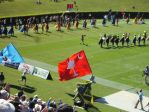
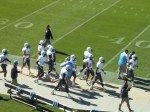
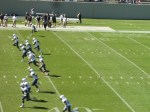
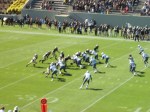
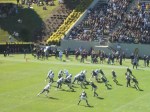
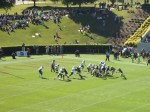
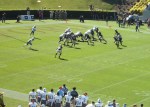
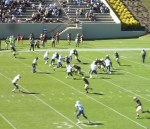
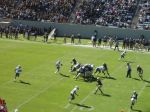
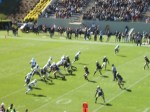
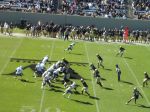
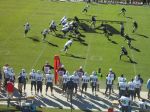
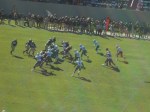
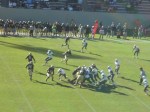
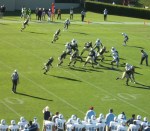
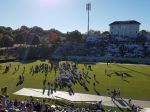
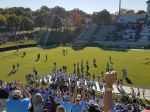
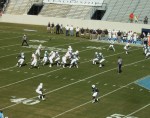
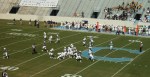
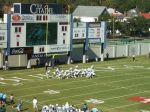
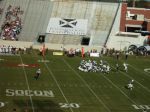
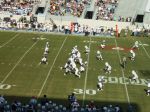
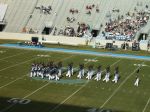
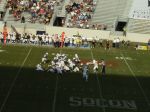
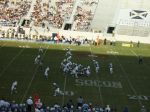
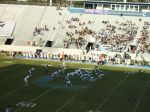
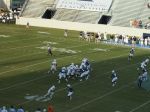
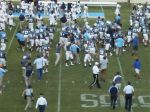
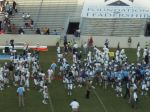
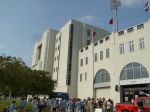
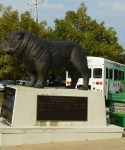
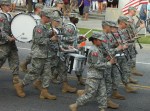
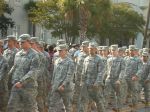
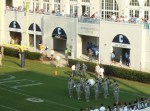
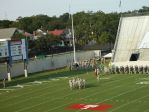
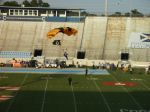
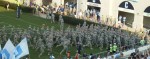
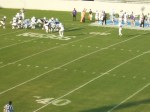
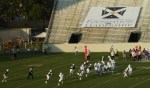
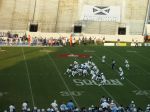
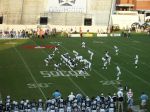
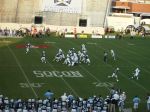
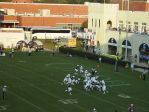
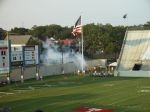
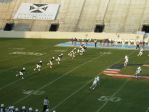
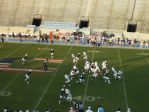
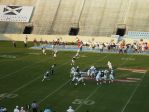
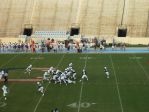
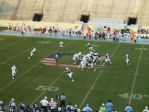
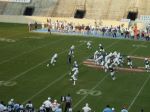
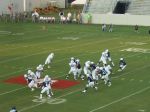
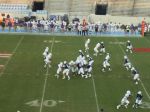
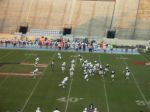
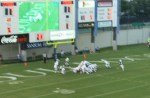
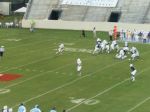
Game Review, 2016: VMI

The Citadel 30, VMI 20.

Links of interest:

– Game story, The Post and Courier

– Video from WCIV-TV, including (via Twitter) “raw” interview with Brent Thompson

– Video from WCSC-TV

– School release from The Citadel

– School release from VMI

– Game story, The Roanoke Times

– Box score

– The Citadel’s post-game notes

– Brent Thompson’s post-game speech (via Twitter)

– More video via Twitter involving the SoCon trophy and (of course) Brent Thompson crowdsurfing

– On-field end-game video via the Facebook page for The Citadel Sports, including the last two minutes and the Silver Shako presentation

– Also via the Facebook page for The Citadel Sports, sideline game video with roughly 12 minutes remaining in the 4th quarter until the 3:20 mark

– Mike Legg and Lee Glaze call Jonathan King’s strip sack/TD (audio)

– Mike Legg and Lee Glaze call Jonathan Dorogy’s fourth-quarter TD (audio)

I wasn’t able to attend the contest on Saturday, but I decided to post a short game review anyway. After all, we’re still undefeated!

Trying to follow the game from afar was a bit of an adventure, especially after ESPN3 had a system-wide failure at halftime. I listened to the radio call, which I tend to do anyway when I watch The Citadel play on ESPN3 (in part because the audio is often 30 to 45 seconds ahead of ESPN’s stream, and I like to know what is happening in the game as soon as possible).

Eventually, The Citadel put up a live video feed on its Facebook page. I’ve linked that above (they are in two segments); most of the fourth quarter was made available. It wasn’t ideal, but it was certainly better than nothing, and was greatly appreciated.

While reviewing the video feed after the game,  it was clear that many people from all over the nation followed the action on Facebook — and that was on short notice, too. I saw posts from viewers in South Carolina, North Carolina, Georgia, Florida, Virginia, Maryland, Pennsylvania, Mississippi, Texas, Oklahoma, Kentucky, Illinois, Michigan, Minnesota, Utah, Idaho, and California, and I’m sure I missed several states (and perhaps a few countries).

The folks in the department of athletics who pulled that off deserve plenty of kudos.

It also reminded me of one of my pie-in-the-sky ideas, so bear with me for a few paragraphs…

During Homecoming, there was a live video feed on Facebook of the parade. That was a great idea. However, I wonder if it is feasible to go one step further.

Every year, the Army-Navy game is televised by CBS. You knew that already. What you may not have known is that the pregame march-on by the U.S.M.A.’s corps of cadets and the U.S.N.A.’s brigade of midshipmen is also televised — by the CBS Sports Network, the cable sports affiliate of CBS.

I watched part of that show two years ago. Besides the march-on, a couple of on-field hosts/reporters interviewed cadets and officials from each academy. In a way, it came across as a more focused version of the Macy’s Thanksgiving Day parade, and was essentially a ninety-minute infomercial for the two institutions.

Given that The Citadel’s home games are now streamed by ESPN3, I’m wondering if the pregame march to the stadium by The Citadel’s corps of cadets could also be a part of a longer broadcast. For all I know, that may not be practical, but it might be worthwhile.

The game itself was a tough one for The Citadel, to the surprise of nobody. VMI was well-prepared, and took the “nothing to lose” concept to new heights with a wide variety of trick plays and gambits.

The Keydets tried an onside kick, successfully executed a wide receiver pass to the quarterback for a touchdown, added a flea flicker that set up another TD, ran multiple “wildcat” plays, attempted a fake punt (that worked due to a penalty on the Bulldogs), and generally zigged whenever zagging was expected.

The Citadel played without several of its regulars on offense (including Cam Jackson, Reggie Williams, and Jorian Jordan). That may have affected the timing of a few plays that didn’t work, though VMI’s defense also deserves credit on that front.

Inside linebacker Allan Cratsenberg was a particular standout for the Keydets. He finished with 20 tackles, the most by a VMI player in a game this century.

For only the third time all season, the Bulldogs did not have an edge in time of possession. Having said that, when The Citadel needed a put-away drive in the fourth quarter, Dominique Allen and company responded with a 16-play possession that took six minutes and forty seconds off the clock.

The Bulldogs also had a few much-needed big plays in the game that offset some of the offensive struggles. Allen’s 70-yard pass to Rudder Brown set up a touchdown, and so did Jonathan Dorogy’s 34-yard fourth-quarter run (with Dorogy finishing that drive himself by taking Allen’s pitch on 4th-and-3 for a 17-yard score).

Of course, the play that will make all the highlight reels was Jonathan King’s 54-yard mad dash to the end zone, after he ripped the ball out of the hands of VMI quarterback Austin Coulling. Someone at The Citadel might want to send the video of that TD to SB Nation for Piesman Trophy consideration.

The freshmen who made the trip to Virginia certainly made their presence felt. On the Facebook video clips, you can clearly hear the yelling and chanting from that side of the stadium, including the “I Believe That We Will Win” rallying cry and (amusingly) a few shouts of “Charleston Crab House!” whenever the Bulldogs made a first down.

As the clock wound down, another chant broke out, one that was unprecedented for cadets at The Citadel:

10 and 0! 10 and 0! 10 and 0! 10 and 0!

Ah yes, 10-0.

Parts of that 10-0 worth noting:

  • The victory at VMI was The Citadel’s sixth road win of the season, the most in school history
  • With the nine wins from last year, this is the most successful two-year stretch for the Bulldogs in program annals
  • The Citadel finished undefeated in Southern Conference play for the first time ever (the school joined the league in 1936)

It has been quite a year.

Unfortunately, there was a somber aspect to the long weekend. On Friday, assistant athletic director for facilities Mike Groshon died of complications from leukemia. He was 63 years old.

Groshon was best known in recent years as the “keeper of the dogs”, namely General and Boo. He grudgingly accepted that role about a dozen years ago, but came to enjoy it.

The 1976 graduate of The Citadel actually accepted a variety of roles in 35 years at his alma mater, including several years as the school’s tennis coach. He finished his tenure in that position with a winning record, then and now not an easy feat at The Citadel.

His main vocation was supervising maintenance and upkeep on the athletic facilities, and he was good at it.

In 2002, a high school band exhibition damaged the field at Johnson Hagood Stadium just one week prior to a home game. Groshon and his crew did such an outstanding job getting the field ready for play, then-coach Ellis Johnson said that Groshon “deserves a pay raise, a week’s vacation, a gold medal. That field was in pitiful condition, and he did a great job of getting it ready.”

His death sparked a large outpouring on social media of praise and sad reflection from people with whom he interacted over the years.

In the 1988 football media guide, Mike Groshon was described as a “vital cog in the operation of Bulldog athletics”. That was true then, and it was true for the next three decades as well.

Condolences to his family and friends.

Next up for The Citadel is another team that wears light blue and white: North Carolina. I’ll post a game preview for that contest later in the week.

It may not be one of my “standard” previews, to be honest. I’ll probably write about the upcoming playoffs as much as the Tar Heels.

In the meantime, I will conclude this post with a terrible photoshop effort, my take on the picks the CFP selection committee will be making on Tuesday…

cfp-2

Game Review, 2016: Wofford

The Citadel 24, Wofford 21 (OT).

Links of interest:

– Game story, The Post and Courier

– Game story, Spartanburg Herald-Journal

– Notes, Spartanburg Herald-Journal

– Photo gallery, Spartanburg Herald-Journal

– Game story, The Greenville News

– Video from WCSC-TV, including interviews with Brent Thompson, Dominique Allen, Kailik Williams, Cody Clark, and Joe Crochet

– Video from WCIV-TV, along with (via Twitter) some “raw” highlights and its video of Dominique Allen’s postgame interview

– Video from WSPA-TV

– Game wrapup, Southern Pigskin

– School release

– Box score

– The Citadel’s post-game notes

– Brent Thompson takes the trophy without breaking stride (video via Twitter)

– Game highlights (ground level video)

– Kailik Williams scores the tying touchdown on a “Pitch Six” (video via Twitter)

I saw the football on the ground.

Sometimes when you’re in the stands, you can’t see everything that happens in a game, especially when the two teams are near one of the end zones. However, on the final play, I had a perfect angle to see the football suddenly pop out of the mass of players along the line of scrimmage.

For what seemed like forever, the ball rolled around on the grass. Then, at last, a Bulldog covered the pigskin.

The thing is, it didn’t really take that long. Ben Roberts pounced on the football nine-tenths of a second after it first hit the turf. (Yes, I timed it.)

That last play summed up the entire game if you were a fan of the Bulldogs. It was tortuous to watch, lasted for an interminable amount of time…but in the end, The Citadel emerged with a victory.

#DogsOnTop, indeed.

One reason the game took so long was that every other series seemed to end with a two-minute (or longer) “media timeout”. With 7:30 remaining in the first quarter, there had already been three media timeouts.

It can be very frustrating to attend a game with so many stoppages. Perhaps all that extra down time led to Bulldog fans leaving their seats and getting more to eat and drink; the visitors side concession stands reportedly had to close at halftime due to running out of food. I guess Wofford made a little extra money off of all the media timeouts.

Kailik Williams’ game-changing “Pitch Six” is a play that will be remembered by Bulldog fans for quite a while. In the box score, it is listed as an interception return.

Having watched it a number of times now, I am of the opinion that it was not an interception. I think it probably should be considered a fumble return, because the pitch was a lateral. (It was certainly intended to be a lateral.)

Williams made another outstanding ball-hawking play in the first quarter, stealing the ball from Wofford quarterback Brandon Goodson after a long run. However, the SoCon officiating crew ruled that Goodson was down, an obvious mistake by the officials. It turned out to be a significant error, as Wofford would score the game’s first touchdown a few plays later.

As the game progressed, the officials continued to vex the Bulldogs. On The Citadel’s only sustained drive of the first half, a blatant pass interference penalty went uncalled. The Bulldogs would have had a first down inside the Terriers 35-yard line, but no flag was thrown.

The possession was then completely short-circuited when the Bulldogs were called for a personal foul.

Before the drive began, WCSC-TV’s Kevin Bilodeau had tweeted that “One of the refs just went to the Dogs sideline and asked the coaches for help…said it’s getting chippy out there”.

Apparently the men in stripes were only interested in the “chippy” play of one of the two teams, though. While the penalty on the Bulldogs was being enforced, Terriers linebacker Dylan Young wandered over to a couple of Bulldogs and (not for the first time) proceeded to discuss something with them that was likely not related to the weather. This went on for about 45 seconds. The officials completely ignored it.

Brent Thompson wound up having to use a timeout during the sequence; I am not certain, but that may have been because he was not told whether or not the down would count. (It is also possible the coach used the timeout to remonstrate with the officials about their many failings.)

The best offensive play call of the day for The Citadel may have been the end-around pitch to Jorian Jordan on 3rd-and-goal on the Wofford 8-yard line. Jordan wound up scoring on the play…well, let me rephrase that.

Jordan would have scored on the play if the linesman had not erroneously ruled him out of bounds. That call had Bulldog fans remembering the 2014 officiating debacle all over again.

Fortunately, Dominique Allen scored on 4th-and-goal, which with the ensuing extra point gave the Bulldogs a relatively brief lead (14-13). Allen showed good strength by remaining in the end zone long enough for the officials to see he was over the goal line, despite the Terriers’ best efforts to push him back (and you can’t blame them; that tactic has worked for Wofford before).

Allen also showed some toughness on The Citadel’s other offensive TD, waiting until the last moment to pitch the ball to Reggie Williams. Allen took a big hit, one he probably knew was coming, but the play’s timing was perfect and Williams raced into the end zone for the Bulldogs’ first touchdown.

Those plays helped make up for what was otherwise a trying afternoon for The Citadel’s starting quarterback, who struggled with his passing accuracy (the occasionally strong crosswind was undoubtedly a factor). Allen was also largely bottled up on the ground by Wofford’s excellent defense.

Of course, no one from The Citadel had too much luck running the ball on Saturday. Wofford defensive linemen Miles Brown and Mikel Horton were as advertised (very good), and linebacker Datavious Wilson (15 tackles) was outstanding. Several other Terriers had notable games, including both starting safeties (Jaleel Green and Malik Rivera).

Rudder Brown was the recipient of all three of the Bulldogs’ completed passes, including a nifty 36-yard grab and a big third-down catch on The Citadel’s lone long scoring drive. Brown made a great catch in overtime for what would have been a touchdown, but he was ruled to have been out of bounds. The replay was not conclusive, though he may have actually got a foot down in the end zone. In fairness, it would have been a very tough call for the official to make.

Defensively, the Bulldogs played well for most of the contest. Among those who had good games: Tevin Floyd (12 tackles and a fumble recovery), Kailik Williams (who had 11 tackles in addition to his spectacular TD), Myles Pierce (a career-high 12 stops), and Joe Crochet (9 tackles and the forced fumble that ended the contest).

They had to be good to keep up with Lorenzo Long, a shifty back who was not easy to tackle. Wofford’s offensive line was solid, and a major reason why the Terriers averaged 5.0 yards per rush.

Both teams had kicks blocked; a punt for The Citadel, a field goal attempt for Wofford. That is something each will work on this week.

On the Terriers’ second successful field goal, it appeared not all of the Bulldogs were convinced the football had gone between the uprights. No replay (or view from the stands) had an angle that would have been telling, though.

It was great to see the turnout of Bulldog fans. The visitors side was packed with blue-clad supporters and ACU-wearing cadets (who made their presence felt throughout the day).

The announced attendance for Wofford’s Homecoming game was 11,102, the largest crowd at Gibbs Stadium since a 2011 playoff game against Georgia Southern. I think perhaps as many as half of those in attendance on Saturday were rooting for The Citadel.

The Citadel clinched a winning conference record with the victory, something that might have gone unnoticed, but definitely not irrelevant from a historical perspective.

It will be the ninth time in the last thirty seasons The Citadel finishes with a winning record in SoCon play. It will also be only the second time since 1992 that the program has had winning league records in consecutive seasons (the Bulldogs also accomplished this in 2006 and 2007).

The seven straight wins in an individual season ties the 1988 squad for the all-time record in that category.

Those wins in 1988, for the record: Navy, at Western Carolina, Chattanooga, Boston University, East Tennessee State, Marshall, and VMI.

That win over Navy also marks the last time an FBS (I-A) school visited Johnson Hagood Stadium. The victory over Marshall was an all-timer in terms of stadium atmosphere (and a lesson in how difficult it can be to tear down goalposts).

The game versus VMI was played at the Oyster Bowl in Norfolk, Virginia. In that contest, Bulldogs quarterback Gene Brown rushed for a school-record 286 yards on only 13 carries.

The Citadel won its fifth road game of the campaign on Saturday. That ties the all-time record for most road victories in a season. The Bulldogs will have a chance to set a new standard when they play at VMI on November 12.

The only other time the program won five road games in a season was 1992. The Citadel was 5-0 on the road that year, with victories over Arkansas, Army, Appalachian State, Western Carolina, and Furman.

The 1960 squad won four road games and a neutral-site contest. The road triumphs that season came against Davidson, Richmond, Furman, and Arkansas State. The neutral-site win was, of course, The Citadel’s victory over Tennessee Tech in the Tangerine Bowl.

A lot of things didn’t go The Citadel’s way against Wofford. The offense struggled for most of the game, the defense was occasionally bedeviled by big plays, there was a special teams letdown, and the officiating gave the Bulldogs (and their fans) a major headache.

Despite all of that, the team persevered. The players didn’t fold. They played through all the obstacles for the entire game, and then into overtime. At the end, one final play was made, and the Bulldogs won.

7-0.

I’m happy to ride along with this team. At this point, everyone should be on the bus. (Well, you don’t have to ride an actual bus.)

They play hard. They play well. It’s largely a workmanlike group, though there is just a hint of flash to them as well.

There are still four regular-season games to go, including three in conference play. The season is far from over.

Things are looking good, though. The next game is this Saturday at Johnson Hagood Stadium, against East Tennessee State. It will be a big game. That’s because when you keep winning, every game becomes a big game.

I like it when The Citadel plays big games.

The pictures: not Pulitzer-worthy. Actually, they range from lousy to terrible to “why did I bother uploading this”. I’m going to have to make a change in operations, or simply drop this laughable segment of the review altogether.

(Also, this week there is no annotation of game action photos. For anyone who cares, my apologies.)

2016 Football, Game 7: The Citadel vs. Wofford

The Citadel at Wofford, to be played to be played at Gibbs Stadium in Spartanburg, South Carolina, with kickoff at 1:30 pm ET on Saturday, October 22. The game will not be televised.

The game will be streamed on ESPN3.com, with audio from the Wofford radio team (Mark Hauser calling the play-by-play, Thom Henson providing the analysis, and sideline reporting by Van Hipp).

The contest can be heard on radio via the various affiliates of The Citadel Sports Network. WQNT-1450 AM [audio link], originating in Charleston, is the flagship station. 

Mike Legg (the “Voice of the Bulldogs”) will call the action alongside analyst Lee Glaze.

It is also possible to listen to the action with a smartphone, using a TuneIn Radio application.

—

Links of interest:

– Game notes from The Citadel and Wofford

– SoCon weekly release

– The Citadel faces challenges, dishes them out

– No secrets between the teams (well, I bet there are a few)

– This week is a matchup of ground game experts

– Jeff Hartsell writes about Wofford coach Mike Ayers

– About juice, but not the kind from oranges

– Brent Thompson’s 10/18 press conference, including comments from Dominique Allen and Jonathan King (video)

– Brent Thompson 10/19 radio show (video)

– Wofford press luncheon interviews of Mike Ayers, Brandon Goodson, and Dylan Young (video)

– Highlights of Wofford’s win over Western Carolina (video)

– The Citadel poses a challenge for Wofford (and vice versa)

– First responders can get free tickets to next week’s home game 

– Leadership Day 2016

– FCS Coaches’ Poll

There is no question who is this year’s luckiest Wofford football player. That would be Michael Roach, whose gridiron career ended against Tennessee Tech:

Roach, a junior linebacker on the Wofford football team, went into cardiac arrest Thursday night as the Terriers were playing their season-opener against Tennessee Tech in Cookeville, Tenn. He stopped breathing for about 45 seconds.

He was revived on the sidelines and taken by ambulance to the Cookeville Regional Medical Center, where he stayed for two days and was diagnosed with hypertrophic cardiomyopathy, a condition in which enlarged heart muscle cells cause the walls of the ventricles to thicken and prohibit the proper flow of blood.

HCM is the leading cause of sudden cardiac arrest among athletes in the United States and only about 5 percent those who go into cardiac arrest are able to survive.


“The game of football really did save my life and give me a second chance,” Roach said. “This could’ve happened anywhere. It could’ve happened when I was out by myself doing anything, riding a bike or running or something like that. I am extremely fortunate.” He has been fitted for an implantable cardioverter defibrillator, a device that will control the beats of his heart and serve as a pacemaker, if necessary.

I can relate to a lot of that, especially the part about being in the right place/right time…

About two and a half years ago, I went into cardiac arrest on the fourth floor of a building. On the third floor of the building? A group of EMTs. They were nice enough to shock me back into the world.

When I went into cardiac arrest for a second time, later that same day, I was already in a hospital cardiac care center.

I occasionally think about how lucky I was not to go into cardiac arrest earlier in the morning, or during the just-concluded weekend, or while I was driving back from Charleston on the Friday before the weekend — but I don’t think about it for long, because that’s not healthy.

Best of luck to Roach. I suspect he’ll be fine in the long run.

Wofford is 4-2, 2-1 in the Southern Conference.

The Terriers opened with a 21-7 non-conference victory at Tennessee Tech. Wofford trailed 7-0 after one quarter of play, but then-QB Brad Butler scored a rushing touchdown in each of the next three quarters. WC outrushed the Golden Eagles 346-41, and converted eight of twelve 3rd-down tries.

Wofford’s next game was also on the road, but against much stiffer opposition. Mississippi defeated the Terriers 38-13.

It wasn’t a bad effort at all for Wofford, all things considered. The Terriers frustrated the Rebellious Bears at times with ball control, winning the time-of-possession battle by almost eleven minutes.

The next game was the home opener, and Wofford blitzed Johnson C. Smith 59-0. The Terriers outrushed their Division II opponents 330-18. For some reason, Wofford threw 17 passes.

One week later, the Terriers pitched another home shutout, taking care of East Tennessee State 31-0. Wofford had 350 yards rushing, while ETSU had -7 (four sacks by the Terriers were part of that total). The Terriers had a 19-minute edge in time of possession, running 75 plays to the Buccaneers’ 42.

It wasn’t a perfect day for Wofford, though, as quarterback Brad Butler injured his knee against ETSU. Brandon Goodson, the #3 QB when fall practice started, became the new starter when the Terriers played Samford.

Goodson and the Terriers fell 28-26 to the Birmingham Bulldogs. The game, as expected, was a clash of offensive styles; Wofford dominated time of possession and ran 21 more plays, but the two teams had similar total offense numbers. Trailing late, Wofford got a TD run from Lorenzo Long, but failed on a two-point conversion attempt that would have tied the game.

Two weeks ago, Wofford traveled to Cullowhee and defeated Western Carolina, 31-19. The Terriers were only up 5 points early in the fourth quarter, but iced the game with an 8-minute, 80-yard drive that ended in a three-yard TD from Long.

Wofford was off last week, so the Terriers have had two weeks to prepare for The Citadel.

A few Wofford statistics of note:

Wofford Opp
Points Per Game 30.2 15.3
Total yards rushing 1872 302
Yards/rush 5.3 2
Rush TDs 19 2
Total yards passing 426 1225
Comp-Att-Int 36-60-0 128-185-5
Average/pass att 7.1 6.6
TDs Passing 1 10
Total offense 2298 1527
Total Plays 411 333
Average Per Play 5.6 4.6
Fumbles/lost 9/2 4/3
Penalties-pen yards 38-330 31-260
Pen yards/game 55 43.3
Net punt average 44.5 37.7
Time of poss/game 35:37:00 24:23:00
3rd-down conv 42/88 33/77
3rd-down conv % 48% 43%
Sacks by-yards 17-122 3-23
Red Zone TD% (17-23) 74% (10-14) 71%
  • Wofford has allowed 302 rushing yards in six games; that is an average of just over 50 yards per contest, which leads the nation
  • The Terriers are also fourth in scoring defense and second in total defense
  • Wofford is second in all of FCS in time of possession (trailing only — you guessed it — The Citadel)
  • One reason for the Terriers’ healthy TOP is that they are 13th in the country in offensive 3rd-down conversion rate
  • WC is second nationally in net punting
  • The Terriers are tied for 12th in turnover margin
  • Wofford is fourth in rushing offense, 35th in scoring offense

While we’re at it, let’s take a look at some of The Citadel’s statistics:

The Citadel Opp
Points Per Game 28.5 17.2
Total yards rushing 2286 650
Yards/rush 5.5 3.9
Rush TDs 18 8
Total yards passing 334 1155
Comp-Att-Int 19-42-1 88-165-6
Average/pass att 8.0 7.0
TDs Passing 3 5
Total offense 2620 1805
Total Plays 456 330
Average Per Play 5.7 5.5
Fumbles/lost 10/4 7/4
Penalties-pen yds 33-329 27-272
Pen yards/game 54.8 45.3
Net punt average 36.7 38.2
Time of poss/game 35:44:00 24:15:00
3rd-down conv 52/100 23/69
3rd-down conv % 52% 33%
Sacks by-yards 19-138 0-0
Red Zone TD% (14-26) 54% (6-10) 60%
  • The Citadel leads the nation in time of possession and rushing offense
  • In tandem with that TOP stat, The Citadel is sixth nationally in offensive third-down conversion rate
  • The Bulldogs are sixth in scoring defense, thirteenth in rushing defense, and tenth in total defense
  • The Citadel is tied for 25th in defensive third-down conversion rate
  • The Bulldogs are tied for 20th in turnover margin
  • The Citadel has yet to suffer a sack on offense this season and leads FCS in fewest tackles for loss allowed per game

In a way, Wofford’s statistics are skewed by its wide range of opposition, from Johnson C. Smith to Mississippi. On the other hand, the Terriers tend to approach all of their games in a similar manner, so I’m not sure there would be much of a difference in things like (for example) percentage of rushing or passing attempts.

As it is, 81.4% of Wofford’s total offense has come via the rush. The Terriers have run the ball on 85.4% of their total plays.

I mentioned earlier that Wofford has had some injury issues at the quarterback position. Current starter Brandon Goodson (6’0″, 205 lbs.) is a junior from Dacula, Georgia.

It should be noted that Goodson started three games last season for the Terriers, including the game versus The Citadel. This year, Goodson is completing 46.9% of his passes, averaging 6.8 yards per attempt, with no TD tosses or interceptions. He is not a big threat as a runner, averaging 1.7 yards per carry on only 22 rushes.

Of course, one reason Goodson doesn’t do a lot of running is because he can simply give the ball to Lorenzo Long (5’9″, 205 lbs.). The senior from Pensacola was a second-team All-SoCon pick last year who narrowly missed out on a 1,000-yard season.

So far in 2016, Long is averaging almost 113 yards per game (5.9 yards per carry), with nine rushing TDs. He currently leads the SoCon in rushing.

Fellow halfback Will Gay (5’9″, 185 lbs.) is allegedly a fifth-year senior, but I’m almost positive he played for the Terriers in the previous century. Gay is averaging 7.1 yards per carry this season. He is also Wofford’s primary punt returner.

Tight end Chandler Gouger (6’2″, 230 lbs.) leads Wofford in receptions, with eight. The junior from Chattanooga is averaging eleven yards per catch.

Wofford’s projected starters on the offensive line average 6’3″, 296 lbs. Four of the five have started every game this season for the Terriers.

The only exception? Left guard Dequan Miller didn’t start Wofford’s contest against East Tennessee State. Miller had a fairly decent reason; the Columbia resident was late for the game because he was taking the LSAT.

The line is anchored by right tackle Anton Wahrby (6’5″, 300 lbs.). The senior, a native of Sweden, was a foreign exchange student at Lexington (SC) High School. He was a preseason all-conference choice.

The strength of Wofford’s defense is its line. Last year, Miles Brown (6’1″, 310 lbs.) impressed many observers with his play at nosetackle.

This season, though, the Sidwell Friends product is working at defensive end, because Wofford needed to find a spot for true freshman Mikel Horton (6’0″, 315 lbs.). The two are a tough combination.

Another defensive lineman, junior Tyler Vaughn (6’1″, 270 lbs.), has four sacks for the Terriers.

Free safety JoJo Tillery (6’2″, 205 lbs.), a sophomore, leads Wofford in tackles with 34. Datavious Wilson (6’1″, 230 lbs.), a freshman from Hartsville, is second on the squad in stops, with 30.

Wofford rotates a lot of defensive players, which is illustrated by the fact that 30 Terriers have made at least three tackles so far this season.

Junior placekicker David Marvin (6’2″, 210 lbs.) is making a serious bid to be the all-league kicker this season. He is 7 for 10 on field goal tries so far in 2016.

Against Western Carolina, he made a 57-yarder. Marvin converted a 50-yard try versus Mississippi. The Charlotte native also handles kickoffs for the Terriers.

I mentioned earlier that Wofford leads the nation in net punting. While senior Brian Sanders (6’3″, 200 lbs.) is listed on the two-deep as the starter, and has punted seven times this season, Marvin has actually punted more times (12) for the Terriers. Both have excellent punting numbers. Sanders also acts as Wofford’s holder.

Sophomore long snapper Ross Hammond (6’1, 220 lbs.) is the son of South Carolina’s Secretary of State, Mark Hammond (who played college football at Newberry).

Ostin McPherson (5’8″, 168 lbs.), a freshman from Mobile, returns kickoffs for the Terriers.

On his weekly radio show, Brent Thompson fielded a question from the audience, read aloud by Mike Legg:

“Wondering if this is something normal or something new within [the offense]…you’re running the option, you have a fake…run up the line with the potential to pitch, but the quarterback drops back to throw at that point. Has it always been that way, or is that kind of a branch [off the option], or is that why everybody is calling things now the RPO (run/pass option)?”

Thompson’s answer:

Well, anytime that we throw the ball is probably a new wrinkle in our offense, for sure.

That drew plenty of laughter from the crowd, as it should have.

Odds and ends:

– The weather forecast for Saturday in Spartanburg, per the National Weather Service: sunny with a high of 64 degrees.

– Per one source that deals in such matters, The Citadel (as of Thursday night) is a 1.5-point favorite over Wofford, with a very low over/under of 40.

Earlier in the week, the game opened as a pick’em. Incidentally, last year’s game closed as a pick’em.

– Other lines involving SoCon teams: Chattanooga is a 24-point favorite over VMI; Samford is an 17-point favorite over Western Carolina; and Mercer is a 22-point favorite at Austin Peay. Furman is off this week.

On Thursday night, East Tennessee State (which entered the game as a 17.5-point favorite) defeated West Virginia Wesleyan 38-7.

Gardner-Webb is a 6-point underdog against Kennesaw State this week in Boiling Springs. North Carolina is a 9.5-point favorite at Virginia.

– Massey Ratings: The Citadel is ranked 7th in FCS (a jump of two spots). Wofford is ranked 20th (not surprisingly after a bye, that is unchanged from last week).

Massey projects the Bulldogs to have an 53% chance of winning, with a predicted final score of The Citadel 16, Wofford 14.

Other FCS rankings in Massey of note: Chattanooga (9th), Samford (10th), Mercer (32nd), Furman (54th), Gardner-Webb (55th), VMI (67th), Western Carolina (70th), East Tennessee State (95th).

Chattanooga fell five spots after its loss to The Citadel.

– Wofford’s roster includes 29 players from South Carolina. Other states represented on its roster: Georgia (18), Florida (12), Tennessee (9), Ohio (8), Kentucky (6), North Carolina (6), Alabama (2), Wisconsin (2), and one each from Virginia, Arizona, Maryland, and Oklahoma.

The Terriers also have one player who hails from Washington, DC (freshman offensive lineman Ronnie Brooks). As previously noted, offensive lineman Anton Wahrby is from Sweden — specifically, Karlskrona.

– The Citadel’s geographic roster breakdown (per the school’s website) is as follows: South Carolina (47 players), Georgia (23), Florida (9), North Carolina (7), Alabama (4), Pennsylvania (4), Texas (4), and one each from Louisiana, Maryland, Kansas, Oklahoma, Nevada, and West Virginia.

– There were no changes to The Citadel’s two-deep this week, the third consecutive week that has been the case.

– This is the fifth straight season that the game between Wofford and The Citadel will be streamed on ESPN3. It is the tenth time in eleven years the contest will be streamed or televised.

– The SoCon’s weekly release notes that league games can be stomach-turners:

Seven of the league’s 18 conference games this season have been decided by one possession. Since the start of the 2013 season, 45 of 108 (.438) league games have been decided by one possession.

Like everyone associated with the military college, I’m very pleased that The Citadel is busing all the freshmen to the game on Saturday. The school sent cadets to two road games last season (Furman and Chattanooga); hopefully, this will become a regular occurrence.

I think the freshmen will be joined by a significant number of aging (but still vociferous) blue-clad supporters. Games in the Upstate often lead to a solid turnout of Bulldog backers, but The Citadel’s success this year is likely to bring out even more fans.

Okay, let me write a few sentences about the elephant in the room. It wears a striped shirt.

Are The Citadel’s fans still angry about the officiating debacle in this matchup two years ago? Yes, they are. Very much so. They have every right to be.

Bulldog supporters also have every right to be concerned about how the game will be officiated on Saturday. There is a decided lack of confidence on that front.

I just hope it doesn’t come down to another blown call.

Winning on Saturday is going to be a difficult challenge for The Citadel. The Bulldogs are coming off a physically demanding game against Chattanooga, and now must travel to face a team that has had two weeks to prepare for the game.

Possessions will be at a premium, which will emphasize the importance of avoiding turnovers. Field position could also be a major issue, and Wofford’s kicking game has been very good so far this season.

Last week, I wrote that third down conversions could be a key factor in the game versus the Mocs. That turned out to be the case, a rare example of me making a good prediction.

This time, I’m going to focus on something else (though third down conversions should still be important).

As I wrote in my review of the Chattanooga game, The Citadel had no offensive plays from scrimmage of more than 15 yards against the Mocs. Keep in mind, the Bulldogs ran 81 plays in that game.

There cannot be an absence of “explosion” plays on offense this Saturday. The Bulldogs need to break out several long gainers against the Terriers. For one thing, I don’t believe The Citadel is going to convert 10 straight third-down attempts two weeks in a row.

If they can create some big plays on the offensive side of the ball, I think the Bulldogs have a good chance of going 7-0. It’s going to be a tough task, to be sure.

That’s okay, though.

Game Review, 2016: Chattanooga

The Citadel 22, Chattanooga 14.

Links of interest:

Game story, The Post and Courier

Photo gallery, The Post and Courier

Game story, Chattanooga Times Free Press

Game analysis, Chattanooga Times Free Press

Video from WCSC-TV, including interviews with Brent Thompson, Dominique Allen, Cam Jackson, Dee Delaney, and Jonathan King

Video from WCIV-TV

Video from WCBD-TV

Postgame comments from Russ Huesman

Postgame comments from Mocs players Cedric Nettles, Nakevion Leslie, Keionta Davis, C.J. Board, and Alejandro Bennifield

Game story, Southern Pigskin

Box score

The Citadel’s post-game notes

Brent Thompson, crowdsurfer

Game highlights

I want to start by pointing out something that is obvious, but yet may go overlooked. With its victory on Saturday, The Citadel clinched a winning season. That matters.

The Bulldogs had a winning season last year too, of course. The last time The Citadel had consecutive winning seasons on the gridiron? 1991-1992.

The Citadel actually had three straight winning campaigns from 1990 to 1992, but the latter two years were the last time the Bulldogs had put together back-to-back over-.500 seasons until yesterday’s achievement.

It has been a long time coming.

From the post-game notes package:

Brent Thompson is the 1st head coach in The Citadel history to begin his career 6-0 and has tied Harry O’Brien for the most wins by a first-year coach in program history

Harry O’Brien’s six-win season came exactly 100 years ago, in 1916. That was arguably the most impressive season on the gridiron by the Bulldogs in the thirty years prior to World War II, as The Citadel finished 6-1-1, including season-closing victories over Clemson (a game played in Orangeburg and won by the Bulldogs 3-0) and South Carolina (a 20-2 shellacking in Columbia).

The stylish O’Brien was a Swarthmore graduate who also coached basketball and baseball at The Citadel. O’Brien later coached hoops at Drexel, too.

Saturday’s contest was a very well-played football game between two good teams. The Citadel won the game, and deservedly so, but there was very little that separated the Bulldogs from the Mocs.

The key to the game, in my opinion, was The Citadel’s offense converting its first ten third-down conversion attempts of the game. It was an amazing run which seemed to violate the rules of probability, and that’s before taking into consideration the fact that Chattanooga had entered the game leading the nation in defensive third-down conversion rate (22%).

It led to The Citadel’s enormous time of possession advantage (39:31 – 20:29), which resulted in Chattanooga’s high-powered offense being kept off the field for extended periods of time. That kept the Bulldogs’ defense fresh, and probably affected UTC’s rhythm on offense as well. The Mocs only ran 47 offensive plays from scrimmage, while the Bulldogs had 81 — a huge differential.

UTC had the edge in yards gained per play, 6.3 to 4.3, a statistic that is a bit deceiving. Not counting C.J. Board’s 75-yard TD reception (though obviously it very much counted in the game), Chattanooga’s average yards per play drops to 4.6.

In the second half, the Mocs ran 27 plays and gained a total of 74 yards, an average of just 2.7 yards per play.

On the first play from scrimmage for The Citadel’s offense, Dominique Allen rushed for a 15-yard gain. The Citadel would run 80 more offensive plays after that, but none of them would result in a gain as long as Allen’s run — a near-remarkable oddity.

In a way, that note serves to highlight an outstanding effort by UTC’s defense in not allowing any big plays. However, it also accentuates the Bulldogs’ success in converting on third down. They had to regularly convert on third down in the game to have a chance to score, much less win.

One reason the Bulldogs were so successful on third down in the first half was they were able to get outside and turn the corner. Basically, the conversions came in two categories: 3rd-and-short plays were mostly keepers by Allen, while third-and-long efforts were pitches to an A-back (usually Cam Jackson). Here are The Citadel’s third-down conversions in the first half:

  • 3rd-and-6, Cam Jackson carries for 13 yards
  • 3rd-and-6, Cam Jackson carries for 13 yards (yes, the same distance/result, and in the same drive)
  • 3rd-and-8, Cam Jackson carries for 9 yards
  • 3rd-and-2, Isiaha Smith carries for 3 yards
  • 3rd-and-4, Cam Jackson carries for 7 yards
  • 3rd-and-3, Dominique Allen carries for 3 yards
  • 3rd-and-3, Dominique Allen carries for 11 yards
  • 3rd-and-3, Rod Johnson carries for 8 yards
  • 3rd-and-3, Dominique Allen carries for 5 yards
  • 3rd-and-6, Dominique Allen carries for 7 yards

In the second half, the Mocs clearly made an adjustment, and thus the pitch to the outside was not as successful for the Bulldogs. However, The Citadel appeared to throw in a couple of new wrinkles in the fourth quarter, which resulted in key first downs picked up on outside runs by Reggie Williams and Tyler Renew.

So, to sum up: The Citadel won despite completing just one pass (for seven yards), not having a single offensive play from scrimmage result in more than a 15-yard gain, and without forcing a turnover.

It wasn’t a fluke victory, though — far from it. Heck, The Citadel even survived the almost customary hosing by the SoCon officials, who in the third quarter managed to twice deny the Bulldogs a clear first down inside the UTC 10-yard line. (It’s one thing to spot a ball poorly, but to do it on consecutive plays takes a considerable amount of talent.)

I thought the fan support was excellent. It wasn’t quite the overflow crowd that some were expecting, but it was substantial enough, and a lot of the folks in the stands were really into the game.

There were a few who weren’t, but that’s always true. Why they have to leave their seats every 15 minutes, only to return 10 minutes later, I have no idea…

After the game, I was asked by a couple of people how big a win this was for The Citadel. Where does it rank on the all-time list?

My answer, basically: “It depends on the next four games.”

The victory over Chattanooga won’t have a lot of meaning, historical or otherwise, if the Bulldogs don’t continue to win games. Beating UTC won’t matter nearly as much if the team loses two or three conference games down the stretch.

I mentioned this in my preview of the Chattanooga game, but it’s worth repeating: in 1992, Marshall and The Citadel played at Johnson Hagood Stadium in a top-10 matchup between SoCon teams undefeated in league play. Marshall won the game…but The Citadel wound up winning the conference title.

The win on Saturday afternoon was one step, a big one, but nevertheless just one step. As Cam Jackson pointed out in last week’s press conference, “Every conference game is just as important as the next.”

The next conference game is at Wofford. It’s just as important.

This week’s pictures are…well, they’re pictures.

2016 Football, Game 4: The Citadel vs. Western Carolina

The Citadel at Western Carolina, to be played to be played in Cullowhee, North Carolina, on the grounds of Bob Waters Field at E.J. Whitmire Stadium, with kickoff at 3:30 pm ET on Saturday, October 1. The game will not be televised.

The game will be streamed on ESPN3.com, with Pete Yanity providing play-by-play and Will Merritt supplying the analysis.

The contest can be heard on radio via the various affiliates of The Citadel Sports Network. WQNT-1450 AM [audio link], originating in Charleston, is the flagship station. 

Mike Legg (the “Voice of the Bulldogs”) will call the action alongside analyst Lee Glaze.

It is also possible to listen to the action with a smartphone, using a TuneIn Radio application.

Links of interest:

– Game notes from The Citadel and Western Carolina

– SoCon weekly release

– Brent Thompson’s 9/27 press conference, including comments from Dominique Allen and Tevin Floyd (video)

– Brent Thompson 9/28 radio show (video)

– Dominique Allen returns as The Citadel’s starting quarterback

– Allen is back on board

– Allen had his moments in high school, too

– Catamount Football Weekly — previewing the game versus The Citadel (video)

– Mark Speir says the Catamounts were “embarrassed” by loss to ETSU

– Catamounts face long season if they lose to The Citadel

– Radio broadcast open for Saturday’s game (audio)

– FCS Coaches’ Poll

This is going to be a somewhat abbreviated (if not erratic) preview, as I mentioned it might be when I reviewed the Gardner-Webb game two weeks ago. That’s because I’ve been out of the country for a week and am just getting back to a semblance of a routine. I’ve tried to provide the typical assortment of links, and my “Odds and Ends” section is in good order, but as for the rest of it…

I’m going to hurriedly make a few points and get this posted. Please excuse the absence of some of the usual statistical comparisons, although trying to incorporate that stuff would have been tricky this week anyway. Last year’s stats aren’t particularly relevant as the calendar hits October, but as Western Carolina and The Citadel have only played three games each in 2016, the current season statistics also have evaluative limitations.

Having said that, here are some Western Carolina stats for 2016, a quick blast. WCU’s three opponents this year: East Carolina (lost 52-7), Gardner-Webb (won 44-14), East Tennessee State (lost 34-31).


WCU Opp
Points/game 27.3 33.3
1st downs/game 23.7 25
Yards/rush 4.7 5.5
Yards/pass att 8.6 8.1
Yards/play 6.7 6.5
Plays/game 72.3 77.3
Penalties/game 9.7 5.3
Pen yds/game 74 53.7
TOP/game 26:04:00 33:56:00
3rd dn conv % 39 58.8
Red Zone TD% 64.3 78.6

Putting aside the game versus ECU, let’s take a quick look at the Gardner-Webb and ETSU matchups.

Against G-W (a game played in Cullowhee), Western Carolina’s offense:

  • completed 36 of 43 passes, averaging 9.9 yards per attempt, with 5 TD tosses (two picks)
  • was not sacked on any of those 43 pass attempts
  • averaged 6.1 yards per rush (263 total rush yards), with one TD
  • scored 5 TDs in 8 trips to the Red Zone
  • had 6 TD drives of 62 yards or longer
  • scored touchdowns on its first two possessions
  • had 19 pass completions of ten yards or more; 10 of those came on first down
  • also had 6 rushing plays of ten yards or more

As a comparison, The Citadel’s offense had a total of 13 plays from scrimmage against Gardner-Webb that went for 10+ yards (12 of them were rushes). It should be noted that Western Carolina ran 86 plays from scrimmage against G-W (The Citadel had 73).

Now for the other side of the ball. Against the Runnin’ Bulldogs, the Catamounts’ defense:

  • allowed only 3.4 yards per pass attempt (25 throws)
  • gave up just 4.8 yards per play
  • allowed 5.5 yards per rush (271 total rush yards)
  • after allowing a TD on G-W’s first possession, didn’t give up more than 48 yards on any subsequent drive
  • shut G-W out over its last nine drives

The game versus ETSU (played at Bristol Motor Speedway) didn’t go quite as planned. WCU’s offense:

  • completed 26 of 39 passes, averaging 8.8 yards per attempt, with 2 TDs (no interceptions)
  • was sacked four times
  • averaged just 3.7 yards per rush (100 total rush yards), with 2 TDs
  • was in the Red Zone four times, but only scored one touchdown
  • had 5 drives of 55 yards or longer; 3 resulted in TDs

Then there was the Catamounts’ defense, which:

  • allowed 7.3 yards per pass attempt (37 passes)
  • gave up 5.4 yards per play
  • allowed 4.1 yards per rush (205 total rush yards)
  • gave up 4 TDs and a field goal on ETSU’s last five possessions (all 67 yards or longer)

East Tennessee State picked up 364 yards of total offense on those five drives (the last possession of the first half and the first four of the second), averaging 6.6 yards per play. The Bucs were 13 of 19 on third-down tries, converting nine of their last ten.

Check out this amazing third-quarter drive by East Tennessee State that gave the Bucs the lead for the first time in the game:

  • ETSU 1-10 at Etsu24 ETSU drive start at 08:46.
  • ETSU 1-10 at Etsu24 Austin Herink sacked for loss of 8 yards to the ETSU16 (Jake Helms).
  • ETSU 2-18 at Etsu16 PENALTY WCU unsportsmanlike conduct (Daniel Nash) 15 yards to the ETSU31, 1ST DOWN ETSU.
  • ETSU 1-10 at Etsu31 Jajuan Stinson rush for 2 yards to the ETSU33 (Tyler Junius).
  • ETSU 2-8 at Etsu33 D. Monroe rush for 3 yards to the ETSU36 (Tyson Dickson).
  • ETSU 3-5 at Etsu36 PENALTY WCU offside defense (Andrew Mayton) 5 yards to the ETSU41, 1ST DOWN ETSU.
  • ETSU 1-10 at Etsu41 D. Monroe rush for 2 yards to the ETSU43 (Avery Worsham).
  • ETSU 2-8 at Etsu43 Austin Herink pass complete to Vincent Lowe for 7 yards to the 50 yardline (Avery Worsham).
  • ETSU 3-1 at Etsu50 D. Monroe rush for 4 yards to the WCU46, 1ST DOWN ETSU (Jake Helms).
  • ETSU 1-10 at Wcu46 Austin Herink rush for 8 yards to the WCU38 (Fred Payne).
  • ETSU 2-2 at Wcu38 Austin Herink pass incomplete to Hank Black (Trey Morgan).
  • ETSU 3-2 at Wcu38 Jajuan Stinson rush for 3 yards to the WCU35, 1ST DOWN ETSU (Daniel Nash).
  • ETSU 1-10 at Wcu35 Jajuan Stinson rush for loss of 1 yard to the WCU36 (Daniel Nash).
  • ETSU 2-11 at Wcu36 PENALTY WCU personal foul (Daniel Nash) 15 yards to the WCU21, 1ST DOWN ETSU.
  • ETSU 1-10 at Wcu21 Falon Lee rush for no gain to the WCU21 (Ezavian Dunn; Tyson Dickson).
  • ETSU 2-10 at Wcu21 Falon Lee rush for 9 yards to the WCU12 (Keion Crossen).
  • ETSU 3-1 at Wcu12 Falon Lee rush for 5 yards to the WCU7, 1ST DOWN ETSU (Marvin Tillman; Daniel Nash).
  • ETSU 1-G at Wcu07 Falon Lee rush for 3 yards to the WCU4 (Andrew Mayton).
  • ETSU 2-G at Wcu04 Falon Lee rush for 2 yards to the WCU2 (Marvin Tillman).
  • ETSU 3-G at Wcu02 Austin Herink pass complete to Matt Thompson for 2 yards to the WCU0, TOUCHDOWN, clock 01:20.
  • JJ Jerman kick attempt good.

No play from scrimmage during that 16-play, 76-yard drive went for longer than nine yards. ETSU was five-for-five on third-down conversion attempts, and was also bailed out of two 2nd-and-long situations by personal fouls (committed by the same WCU player). Time of possession: 7:26.

That drive aside, the game arguably turned on a play near the end of the first half:

The Cats had a 21-3 lead when it appeared they were going for the kill. [Tyrie] Adams threw a long pass to Spearman Robinson, who gained 43 yards before losing a fumble that ETSU recovered at its 29. The Bucs then drove 71 yards for a touchdown before halftime to begin the comeback.

“Spearman fumbles the ball, and they  get the ball and go on a two-minute drive. Who knows what the ball game would be (if that hadn’t happened),” [WCU head coach Mark] Speir said.

Western Carolina committed 12 penalties in the loss to East Tennessee State. The Catamounts were also flagged 12 times in their 30-point win over Gardner-Webb, so your mileage may vary.

While WCU is essentially a 50-50 run-pass team, much of its yardage (64.8%) comes via the pass. That speaks to a fairly solid transition from longtime quarterback Troy Mitchell to the new starting QB, redshirt freshman Tyrie Adams.

Adams is a 6’2″, 180 lb. native of St. Petersburg, Florida. A track and field star as well (he was the indoor and outdoor SoCon high jump champion in 2016), Adams is completing an impressive 69.3% of his passes, averaging 8.8 yards per attempt, with seven touchdown tosses against three interceptions.

Running back Detrez Newsome (5’10”, 210 lbs.) was the preseason choice for offensive SoCon player of the year after being a first-team all-league selection in 2015. Newsome rushed for 1,109 yards last season and nine touchdowns (and added three more TDs on pass receptions).

Newsome rushed for 121 yards (on only 16 attempts) and a TD last year versus The Citadel. He is also the primary kick returner for the Catamounts.

WCU has several pass-catching candidates (including Newsome). Terryon Robinson (5’11”, 190 lbs.) leads the team in receptions so far this season, with 22. He is not to be confused with redshirt senior Spearman Robinson (6’4″, 215 lbs.), a Greenwood High School product who has seemingly played for the Catamounts since the late 1990s.

Jordan Mathis (5’10”, 200 lbs.) is third on the team in receptions, with 12. C.J. Goodman (5’11”, 185 lbs.) had a career-high seven receptions against The Citadel in 2015.

The Catamounts suffered a blow when preseason first-team All-SoCon tight end Tyler Sexton was lost for the season in August with a knee injury.

Western Carolina’s starting offensive line averages 6’3″, 293 lbs. The largest member of that group is right guard Nathan Dalton (6’7″, 315 lbs.), a redshirt sophomore who was a preseason second-team all-conference pick.

In its last two games, WCU has missed linebacker Daniel Riddle (6’1, 225 lbs.), a preseason first-team all-league pick who had 15 tackles against the Bulldogs last season. The injured Riddle is listed as a backup on the depth chart this week.

Tyson Dickson (6’1″, 220 lbs.) was also a preseason all-SoCon choice at linebacker. In 2014, he had 16 tackles in the Catamounts’ victory over the Bulldogs.

The aptly named Fred Payne (5’10”, 180 lbs.) is a strong safety who had a fine game versus The Citadel last year, making seven tackles and also forcing and recovering a fumble.

Cornerback Trey Morgan (6’0″, 185 lbs.) is a senior who has made 38 starts during his career. As a sophomore, he led the SoCon with six interceptions.

The Catamounts are in good shape when it comes to kickers. Redshirt sophomore Ian Berryman (6’0″, 190 lbs.) was the preseason All-SoCon punter, while Logan Howard (also 6’0″, 190 lbs.) was the second-team preseason pick at placekicker.

Howard’s bio on Western Carolina’s website states that he holds “a black belt in martial arts and is a three-time world champion kick boxer”. The website also notes that Howard hit a career long 46-yard field goal last season.

For the fourth straight season, Chandler Addertion is handling long-snapping duties for the Catamounts. His grandfather, Floyd Wicker, had a brief career in the major leagues with four different National League teams (including the original Expos). Floyd Wicker hit one career home run — off a pitcher named Floyd Weaver.

I was reading Bill Connelly’s excellent preview of the upcoming Louisville-Clemson game when I came across this passage:

Through four games, Clemson has only four gains of 30+ yards. Only four teams have fewer: Bowling Green, Buffalo, Kent State, and Texas State. Two have played only three games. And of those four big gainers [for Clemson], none came via rush…

You can survive without big plays. Navy has for years…Scoring without explosiveness requires consistent execution. Any penalty or loss virtually ends a drive.

A lack of big plays puts a lot of pressure on you to execute in the red zone; you aren’t scoring from 40 yards out, so you have to continue moving as the defense gets more packed in.

Would you care to guess how many gains of 30+ yards The Citadel’s offense has had in its first three games this season? The answer is: five.

One against Mercer (Tyler Renew’s 70-yard run on the Bulldogs’ second play from scrimmage). One against Furman (Josh LeBlanc’s amazing 50-yard reception). Three versus Gardner-Webb (including Dominique Allen’s big 41-yard run on the game-winning drive).

Last year, the Bulldogs had 16 gains of 30 yards or more in seven conference games, averaging slightly more than two such plays per contest in league play. As Connelly points out, if an offense doesn’t get those kind of “explosion” plays on at least a semi-regular basis, it has to be extremely consistent, because a bad play will usually short-circuit a possession.

The Citadel has certainly seen a few possessions end on bad plays this year (mainly drive-killing penalties). Obviously, the Bulldogs need to eliminate the major fouls as much as possible, but they also need more big plays.

Odds and ends:

– The weather forecast for Saturday in Cullowhee, per the National Weather Service: sunny and a high of 75 degrees. It should be a great day for a football game.

– Per one source that deals in such matters, The Citadel is a 4.5-point favorite over Western Carolina. The over/under is 57.5.

– Other lines involving SoCon teams: Chattanooga is a 33.5-point favorite at East Tennessee State; Mercer is a 5.5-point favorite at VMI; Samford is a 5.5-point favorite over Wofford; and Furman is a 14.5-point favorite over Kennesaw State.

Gardner-Webb is a 33-point favorite over Benedict this week in Boiling Springs. North Carolina is an 11-point underdog at Florida State.

– Massey Ratings: The Citadel is 13th among FCS teams. Western Carolina is ranked 47th.

Massey projects The Citadel to have an 62% chance of winning, with a predicted final score of 31-27.

Other FCS rankings in Massey of note: Chattanooga (4th), Samford (22nd), Wofford (26th), Furman (44th), Mercer (46th), VMI (53rd), Gardner-Webb (61st), East Tennessee State (85th).

– Western Carolina has 57 players on its squad from North Carolina. Other states represented on the Catamounts’ roster: Georgia (23), South Carolina (8), Tennessee (3), Florida (3), and Connecticut (1).

– The Citadel’s geographic roster breakdown (per the school’s website) is as follows: South Carolina (47 players), Georgia (23), Florida (9), North Carolina (7), Alabama (4), Pennsylvania (4), Texas (4), and one each from Louisiana, Maryland, Kansas, Oklahoma, Nevada, and West Virginia.

– Western Carolina has two FBS teams on its schedule, an annual tradition in recent years for the Catamounts. WCU has already played East Carolina this season, and will face South Carolina later in the year.

The Catamounts will have FBS bookends on their 2017 slate, travelling near (UNC in late November) and far (Hawai’i in early September). Western Carolina will also play UNC in 2018, and has scheduled two games against North Carolina State (in 2019 and 2024).

WCU has played at least two FBS opponents every season since 2012, including Tennessee, Texas A&M, and Alabama (twice).

In 2013, Western Carolina played three FBS teams — Middle Tennessee State, Virginia Tech, and Auburn. That year’s schedule for the Catamounts also included two games against schools transitioning to FBS (Appalachian State and Georgia Southern). All five contests were road games; WCU, not surprisingly, lost all five en route to a 2-10 season.

– Triple option oddity, repeat factoid edition: through three games this season, more Bulldogs have caught passes (eight) than had rushing attempts (seven). Against Gardner-Webb, Rod Johnson and Isiaha Smith got their first rushing attempts of the season, with Johnson also catching his first pass reception of the 2016 campaign.

– Saturday’s game is the second of three that The Citadel will play in the state of North Carolina this season, against opponents that compete in three different leagues — the Big South (Gardner-Webb), the SoCon (Western Carolina), and the ACC (North Carolina).

– Western Carolina has won seven straight home games, and eleven of its last twelve. The only loss during that 2014-16 stretch was a big one, admittedly — 51-0 to Chattanooga in 2014.

– There wasn’t a lot of movement on the depth chart over the bye week. One notable addition: Evan McField is now listed as the third B-back. Perhaps he could see action for the first time this year, after he suffered an injury prior to the season opener. Brent Thompson confirmed that McField would be available during his Wednesday radio show.

Which Western Carolina team will The Citadel see on Saturday? The one that dominated Gardner-Webb as the game progressed? Or the one that blew its collective gasket (and the lead, and the game) against ETSU?

My guess would be the former, particularly since the Catamounts were at home for that one, and are at home for this game as well.

Two years ago in Cullowhee, The Citadel committed three turnovers (all in WCU territory), and also had two false-start penalties in fourth-down situations. The defense didn’t fare much better, allowing 9.6 yards per play. It was a rough afternoon all the way around, although the Bulldogs were in the game for much of the contest.

If that happens again on Saturday, there won’t be any opportunity for another fourth-quarter comeback this time, much less a relatively comfortable win.

The Bulldogs have to be sharp coming off their bye week. If they are, they have a chance to go 4-0 for the first time since 1992.

Let’s hope they take that chance.

Game Review, 2016: Gardner-Webb

Links of interest:

– Game story, The Post and Courier

School release

Game story, The Shelby Star

Photo gallery, The Shelby Star

Video from WCSC-TV

Box score

Post-game notes

DeAndre Schoultz’s punt return for a TD

Dominique Allen’s big fourth-quarter run

—

Normally, I don’t post a game review if I wasn’t in attendance, but as the Bulldogs are entering their bye week, I decided to make a quick post about the victory over Gardner-Webb anyway.

Once the game was over, my initial reaction was as follows: “Phewwwwwwwwwwwwww.”

The Citadel rushed for 419 yards (averaging 6.3 yards per carry), was 9 for 18 on third-down conversions, 2 for 3 on fourth-down conversions, had an edge in time of possession of over three minutes, only committed two offensive penalties…and yet, at times the offense seemed to really struggle. Why?

Well, only completing one pass (in seven attempts) was one reason. So was one of the two aforementioned penalties, a 15-yarder that took the Bulldogs from 1st-and-goal on the 2-yard line to 1st-and-goal on the 17 — followed immediately by a lost fumble.

The Citadel also was not quite as efficient on first down as it would like to be. The Bulldogs ran 31 first down plays (30 runs, 1 pass). On 13 of those plays, The Citadel gained three yards or less. It’s hard to consistently pick up first downs when faced with 2nd-and-long or 3rd-and-long (the Bulldogs had nine of those), especially when the passing game isn’t in sync.

Sure, the final number says The Citadel converted third downs at a 50% clip, but they weren’t consistently picked up throughout the game. Three of the nine conversions came on the game-winning TD drive, and another was a 33-yard scramble on 3rd-and-18 by Dominique Allen that set up the Bulldogs’ second touchdown.

The Citadel had eleven possessions in the contest. There was a five-possession sequence (last drive of the first half, all four drives of the third quarter) in which the Bulldogs ran only 20 offensive plays from scrimmage for a total of 61 yards.

That highlights just how big DeAndre Schoultz’s punt return really was. His TD scamper came after those five possessions, and basically wiped out the advantage Gardner-Webb had built up in the third quarter.

On the other hand, for a third game in a row the offense came through when it had to score. This time, it was a 10-play, 72-yard drive that decided the game, with Allen’s 41-yard run on 3rd-and-7 the key play.

The defense’s performance during the game was a bit uneven. Gardner-Webb was held to a third-down conversion rate of 35.7%, which is excellent. However, the Bulldogs allowed four scoring drives of 61 yards or more, including one for 91 yards on the possession that immediately followed Schoultz’s punt return.

The Citadel did not force a turnover, and 57 minutes into the contest had not recorded a sack. Those last three minutes, though…

Gardner-Webb’s final six plays on offense:

  • Five-yard loss on a sack by Jonathan King
  • Two-yard run, with Dee Delaney and company stopping the action right there
  • Ten-yard loss on a sack by Noah Dawkins
  • Incomplete pass
  • Incomplete pass
  • Nine-yard loss on a sack by Kevin Graham

That’s how you finish.

– Quick note: Kailik Williams has made 26 tackles in the last two games. He is starting, finishing, and doing a whole lot in between.

The Citadel has won three games by a combined 13 points. The Bulldogs trailed with less than three minutes to play in all three of them.

While it is more than fair to suggest that The Citadel must get better on both sides of the ball if it plans on adding to the win total, there is definitely something to be said for having the mental fortitude (and physical endurance) to come through when the game is on the line. Being in those situations will probably be beneficial down the road, too.

The Bulldogs haven’t been at their best so far this season, but they’ve been tough enough to win all three of their games anyway. That inner resolve is perhaps best exemplified by senior linebacker Dondray Copeland:

On Friday morning, Dondray Copeland was at his mother’s bedside as she died at the way-too-young age of 48.

On Saturday night, Copeland took the field with his Citadel teammates and played a major role in the Bulldogs’ 31-24 win at Gardner-Webb before 6,850 fans at Spangler Stadium.

Copeland had seven tackles in the game, tied for second-most on the team.

The Bulldogs now get a well-deserved bye week. The Citadel’s next game is at Western Carolina on October 1.

I’m also taking a week off — well, more like ten days off. My preview of the WCU game will probably be of the abbreviated variety (not necessarily a bad thing), and it won’t be posted until a week from Thursday, or maybe the following Friday morning.

(Hey, at least I scheduled my break for the bye week.)

Go Dogs!

Game Review, 2016: Furman

Links of interest:

Game story, The Post and Courier

“Notes” column, The Post and Courier

School release

Game story, The Greenville News

“Notes” section, The Greenville News

Video from WCSC-TV, including interviews with Brent Thompson, Dominique Allen, and Jordan Black

Video from WCIV-TV

Game story, The Moultrie News

Short game story, Southern Pigskin

Game video highlights

Josh LeBlanc catch

Box score

Post-game notes

—

The Citadel 19, Furman 14.

It was not the most elegant of contests. Both offenses had plays they would like to have had back. The special teams weren’t all that special.

Then again, the defenses for both sides had a lot to do with the way the game was played. That, and the hard-fought nature of the matchup (which came as a surprise to no one).

Both teams ran 61 plays. Furman averaged 4.5 yards per play, The Citadel 4.9.

The Bulldogs only averaged 3.5 yards per rush, well under expectations, but the Paladins were even more anemic on the ground, averaging just 2.9 yards per carry.

It wasn’t a complete debacle for the offenses. The two teams combined to score five touchdowns on five Red Zone opportunities. The Citadel actually converted on 50% of its third down attempts (8-16).

The Bulldogs would have converted at an even better clip if not for some ill-timed penalties. One wonders if the SoCon office had a word with the officiating crew after The Citadel was only called for one penalty last week.

During the course of the game, the two teams combined for a fumbled kickoff, a muffed punt, three missed field goals, and a botched PAT. Yeesh.

The Citadel led 13-7 at the break, with each side taking advantage of special teams miscues for TDs. The difference over the first thirty minutes was the touchdown scored by Jordan Black to conclude The Citadel’s opening drive, by far the longest sustained possession of the half by either squad.

Furman would eventually take the lead late in the third quarter, driving 67 yards for the score. The key play was an outstanding 31-yard reception by Paladins receiver Andrej Suttles, setting up a first-and-goal on the 1-yard line that was converted into a TD two plays later.

The Citadel’s offense would have three opportunities to regain the lead. The first ended in a missed field goal attempt.

The second, a drive set up by Dee Delaney’s second interception of the game, ended after a 4th-and-1 run by Dominique Allen was ruled short of the line to gain by the officials. It was a very poor spotting decision in the eyes of many observers (including mine).

Brent Thompson tried very hard not to say too much when asked about that after the game:

I certainly thought we got it, and I thought we got it pretty clearly…you just hope that nobody really…changes the outcome of a game because of a decision like that.

The Bulldogs persevered, however, and four plays later Furman had to punt. The ensuing drive would be the decisive one, with the critical play a 29-yard completion from Allen to DeAndre Schoultz on 3rd-and-7 from The Citadel’s 25-yard-line.

Two plays later, Thompson and offensive coordinator Lou Conte dialed up their best play call of the night, a 1st-and-10 pass to Tyler Renew that went for 21 yards. Five rushing plays later, Allen scored what proved to be the winning TD.

Furman’s last chance was snuffed out by a Malik Diggs interception, one of three picks by the Bulldogs.

Random thoughts:

– If you’re an official and you decide to call a taunting penalty on a player for pointing at an opponent, perhaps you should also consider the action that led to the player pointing at the opponent — and penalize that individual as well. Just an idea.

– The Citadel needs to clean up its placekicking mechanics. I’m not necessarily talking about the kicker, but all the elements involved.

– The first-half injury to Furman running back Darius Morehead further exacerbated what appears to be the Paladins’ biggest problem, namely a lack of offensive playmakers.

– Dee Delaney was a preseason first-team All-American, and he had an All-American kind of game against Furman. He had two interceptions (both impressive), two pass breakups, and four tackles.

– Kailik Williams was all over the field (12 tackles), and Noah Dawkins was also a prominent on-field presence (8 tackles).

– The Citadel’s defense had no sacks, but I thought it got decent pressure on the passer for a good portion of the game. Tevin Floyd helped create the first of Dee Delaney’s two interceptions with what was recorded as a “hurry”; another hurry (by Dawkins) led to the second of Delaney’s picks.

– In the “links of interest” section above, I included a link of freshman wide receiver Josh LeBlanc’s first career reception. It was certainly a memorable one. LeBlanc is a native of Houston, Texas.

– Brent Thompson’s answers in his post-game Q-and-A sessions with the media have included some of the more quietly thoughtful, introspective comments you will hear from a coach in that type of setting. He clearly hasn’t been a head coach for long.

– It was the first home game of the season for the folks running the PA. Let’s hope things will improve by the time North Greenville comes to town.

– All things considered, it was a solid crowd for the home opener (particularly given the stadium seating situation). It was by and large a good show, too, on the field and off. That should pay dividends for attendance at home games later in the season.

Next up: a non-conference road game against Gardner-Webb. I’ll have a preview for that one later in the week (maybe by Thursday).

As usual, I took pictures, which can be seen below (most of them are annotated). As is often the case, they are mostly bad.

If you’re wondering about the paucity of action shots (such as they are) for the third and fourth quarters, my camera’s batteries died on me shortly after halftime. Then my cellphone’s battery started a downward spiral of its own late in the game. It was one of those nights.

I’ll trade all that for the victory, however.

Inside the numbers: The Citadel’s 2015 run/pass tendencies, per-play averages, 4th-down decision-making…and more!

A few other football-related posts from recent weeks:

Updating history: Attendance at Johnson Hagood Stadium, 1964-2015

What teams will the Bulldogs’ opponents play before (and after) facing The Citadel?

Preseason football ratings and rankings, featuring The Citadel (and the rest of the SoCon)

Also, of course, there are the much-discussed TSA “watch lists” for the upcoming league campaign. See if your favorite SoCon football player (or coach) made one of the lists!

TSA watch lists for the SoCon — Offense
TSA watch lists for the SoCon — Defense
TSA watch lists for the SoCon — Special Teams
TSA watch list for the SoCon — Coach of the Year

For the past two years, I have written about tendencies in playcalling by the then-coach of the Bulldogs, Mike Houston (and his offensive coordinator, Brent Thompson, who of course is now The Citadel’s head coach). I compared what Houston had done while at Lenoir-Rhyne to Kevin Higgins’ last two seasons at The Citadel, along with Houston’s initial season at The Citadel in 2014.

Now I’m going to take a look at what Houston and Thompson did last year at The Citadel, and contrast some of those statistics with those from the 2014 season for the Bulldogs, along with the 2013 campaign under Higgins. I decided not to include 2013 Lenoir-Rhyne stats in my comparison this time, though if anyone wants to see those numbers, they are contained in my previous posts on the subject.

My focus is on down-and-distance run/pass tendencies, fourth-down decision-making, situational punting, and assorted other statistical comparisons. This year, I also took a look at the coin toss (?!), after spotting a trend late last season.

Almost all of the statistics that follow are based on conference play, and only conference play. It’s easier and fairer to compare numbers in that way. Ultimately, The Citadel’s on-field success or failure will be judged on how it does in the SoCon, not against the likes of North Greenville or North Carolina (though beating South Carolina in non-conference action is always a plus).

The conference slates looked like this:

  • The Citadel played seven games in 2015 against SoCon teams. The conference schools competing on the gridiron last year: Western Carolina, Wofford, Samford, Furman, Mercer, VMI, and Chattanooga.
  • The Bulldogs played seven games in 2014 versus SoCon opposition. The teams in the league last year were the same as the 2015 opponents: Wofford, Western Carolina, Chattanooga, Mercer, Furman, Samford, and VMI.
  • The Citadel played eight games in 2013 against SoCon foes. As a reminder, those opponents were: Wofford, Western Carolina, Furman, Appalachian State, Georgia Southern, Chattanooga, Samford, and Elon.

Oh, before I forget: this year, I put most of the numbers on a spreadsheet. It’s a bit involved (there are seven different sub-sheets), but if anyone wants to peruse the numbers, go for it. Individual game statistics in various categories are included.

I’m fairly confident in the accuracy of the statistics, though I will admit that averaging the time of possession numbers gave me a bad headache. I may be off by a second or two on the quarterly TOP averages. If so, it’s too bad — no refunds are available.

Some definitions:

– 2nd-and-short: 3 yards or less for a first down
– 2nd-and-medium: 4 to 6 yards for a first down
– 2nd-and-long: 7+ yards for a first down
– 3rd-and-short: 2 yards or less for a first down
– 3rd-and-medium: 3 to 4 yards for a first down
– 3rd-and-long: 5+ yards for a first down

The first number that will follow each down-and-distance category will be the percentage of time The Citadel ran the ball in that situation in 2015. Next to that, in parenthesis, is the run percentage for The Citadel in 2014, and that will be followed by the Bulldogs’ run percentage for that situation in 2013 (which will be in brackets).

For example, when it came to running the ball on first down, the numbers looked like this:

– 1st-and-10 (or goal to go): 89.1% (88.9%) [77.1%]

Thus, The Citadel ran the ball on first down 89.1% of the time last year, while the Bulldogs ran the ball in that situation 88.9% of the time in 2014 (basically, there was no difference). The Citadel ran the ball 77.1% of the time on first down during its 2013 campaign.

Overall, the Bulldogs ran the ball 86.5% of the time, after rushing on 84.3% of all offensive plays in 2014.

Here are the rest of the down-and-distance categories (in terms of rush percentage):

– 2nd-and-short: 89.2% (84.0%) [95.8%]
– 2nd-and-medium: 89.8% (90.2%) [87.8%]
– 2nd-and-long: 89.2% (82.2%) [75.0%]
– 3rd-and-short: 93.1% (95.5%) [85.7%]
– 3rd-and-medium: 82.4% (90.3%) [90.9%]
– 3rd-and-long: 66.0% (57.4%) [54.0%]

A caveat to these numbers is that there were a few called pass plays that turned into runs. However, if the result of a play was a sack, that counted as a passing down even if a pass wasn’t thrown. There were four such plays in conference action in 2015 for The Citadel.

When compiling NCAA statistics, lost yardage on sacks counts against rushing totals, which may strike the casual observer as counter-intuitive. The NFL, on the other hand, considers sack yardage as passing yardage lost.

I don’t think there is a lot to be surprised about in those numbers, not for anyone who has watched a Brent Thompson offense over the last few years. It is true that the Bulldogs’ passing percentage on 3rd-and-medium is slightly higher than one might expect, but we’re only talking about three pass attempts on seventeen such down/distance situations; subtract one pass attempt, and the average would have been almost exactly the same as it was the previous two seasons.

There were three games in which the Bulldogs threw the ball a bit more often than normal on third-and-long: Wofford, Furman, and Chattanooga.

The Citadel was 4 for 6 passing versus Wofford on 3rd-and-long for 41 yards, including a 24-yard completion. At Furman, the Bulldogs were 1 for 2 (and also suffered a sack).

However, the one completion on third-and-long against the Paladins was a big one, a 50-yard pass from Dominique Allen to Reggie Williams that set up a TD. It was probably the biggest play of the game.

In the game versus Chattanooga, The Citadel was 2-3 for 20 yards (and a sack) on third-and-long. Trailing throughout the contest undoubtedly had an effect on the play-calling.

Prior to the 2015 season, I wrote:

[In 2014], The Citadel attempted four passes on 2nd-and-short. The first three of them fell incomplete.

In the season finale at VMI, however, the Bulldogs did complete a 2nd-and-short toss, a Miller connection (Aaron to Vinny) that went for 26 yards and set up a field goal to close out the first half of that contest. Upstairs in the Foster Stadium press box, Brent Thompson undoubtedly heaved a sigh of relief after calling his first successful 2nd/3rd-and-short pass play in league action in almost two years.

On a serious note, The Citadel has to convert at a higher rate when it passes the ball in 2nd- and 3rd-and-short situations. The offense must take advantage of having the element of surprise in its favor.

Well, The Citadel attempted four passes on 2nd-and-short in 2015, too. The results? An interception, a 36-yard gainer that led to a touchdown, a 24-yard TD strike, and a 22-yard completion.

Not bad. The pick came in the red zone, though. I guess you can’t have everything.

– The Citadel’s offense in 2013 in SoCon action: 69.6 plays per game, 12.0 possessions per game
– The Citadel’s offense in 2014 in SoCon action: 75.4 plays per game, 11.0 possessions per game*
– The Citadel’s offense in 2015 in SoCon action: 70.7 plays per game, 11.9 possessions per game**

*This does not include the Bulldogs’ overtime possession against Furman

**I don’t count a drive as an actual possession when it consists solely of a defensive TD via a return, or when it is a defensive turnover that ends the half or game (or both, like Tevin Floyd’s pick-six against VMI). I also don’t count a drive as a possession when the offensive team does not attempt to move the ball forward (such as a kneel-down situation). That’s how I interpret the statistic, regardless of how it may be listed in a game summary.

The Citadel had a time of possession edge in SoCon play of almost four and a half minutes (32:13 – 27:47). That was actually slightly less of a TOP edge than the Bulldogs had in 2014 (32:40 – 27:20).

The offense generally took control of the ball, however, as games progressed. Average time of possession for The Citadel, by period: 6:59 (1st quarter), 7:47 (2nd), 8:31 (3rd), 8:56 (4th).

– The Citadel’s offense in 2013 in SoCon action: 5.41 yards per play, including 5.13 yards per rush and 6.4 yards per pass attempt
– The Citadel’s offense in 2014 in SoCon games: 5.56 yards per play, including 5.35 yards per rush and 6.8 yards per pass attempt
– The Citadel’s offense in 2015 in SoCon games: 6.09 yards per play, including 5.57 yards per rush and 9.7 (!) yards per pass attempt

The Bulldogs’ offense improved in all three per-play categories listed above for a second consecutive season. Last year, I suggested a benchmark:

I think the goal going forward might be for yards per rush to exceed 5.75, and for yards per pass attempt to exceed 8.0 (or at least 7.5).

Mission accomplished, especially those yards per pass attempt. The Citadel threw 63 passes in seven SoCon games, and gained 609 total yards passing. Three of those tosses were intercepted, which is not a terrible ratio.

—

How did the yards per play numbers for the defense shake out? Quite nicely, thank you very much:

– The Citadel’s defense in 2013 in SoCon action: 5.47 yards per play, including 4.39 yards per rush and 7.2 yards per pass attempt
– The Citadel’s defense in 2014 in SoCon action: 7.02 yards per play, including 5.69 yards per rush and 9.1 yards per pass attempt
– The Citadel’s defense in 2015 in SoCon action: 5.07 yards per play, including 3.69 yards per rush and 6.7 yards per pass attempt

That will work. After a less-than-stellar 2014 campaign, the defense improved markedly last year. Check out that yards per rush allowed stat — exactly two yards less per play from one year to the next. The defense against the pass was excellent, too.

In 2014, The Citadel allowed more than seven yards per rush in four of seven league contests. In 2015, the Bulldogs allowed fewer than three yards per rush in four of seven conference games. It helped that The Citadel averaged 4.3 tackles for loss (not including sacks) per game in SoCon action.

– The Citadel’s defense in 2013 in SoCon action: 12 sacks, 26 passes defensed in 204 attempts (12.7% PD)
– The Citadel’s defense in 2014 in SoCon action: 8 sacks, 14 passes defensed in 176 pass attempts (8.0% PD)
– The Citadel’s defense in 2015 in SoCon action: 20 sacks, 33 passes defensed in 212 pass attempts (15.6% PD)

Passes defensed is a statistic that combines pass breakups with interceptions.

After a trying season in 2014, everything worked well for the defense in 2015. I don’t think it is too surprising that the PD numbers improved with an increase in sacks, and the Bulldogs were harassing opposing quarterbacks even when they weren’t sacking them (increasing their “hurries” totals in league play from eleven to seventeen).

Big plays! Big plays! Big plays! Big plays! Big plays!

In seven conference games in 2014, The Citadel’s defense allowed 47 plays from scrimmage of 20 yards or more — 21 rushes and 26 pass plays. In 2015, that number dropped to 23, nine rushes and fourteen pass plays.

That’s a huge improvement, obviously. It isn’t exactly a shock that big plays lead to points, either directly or later in the drive. Preventing those long gainers is a key to keeping teams off the scoreboard.

For example, of those 23 big plays allowed by the Bulldogs, 14 led to touchdowns (either on the play itself, or later on the same drive). That’s 60.1% of the time.

That percentage is actually lower than what SoCon opponents allowed against The Citadel’s offense on big plays, however. In league action, the Bulldogs had 30 plays of 20 yards or more on offense last year (19 on the ground, 11 in the air). Twenty of those thirty plays led directly or indirectly to touchdowns (66.7%).

– The Citadel’s offensive 3rd-down conversion rate in SoCon action, 2014: 46.3%
– The Citadel’s offensive 3rd-down conversion rate in SoCon action, 2015: 50.0%

– The Citadel’s defensive 3rd-down conversion rate in SoCon action, 2014: 41.5%
– The Citadel’s defensive 3rd-down conversion rate in SoCon action, 2015: 33.7%

In all games last season, the Bulldogs had an offensive 3rd-down conversion rate of 49.4% (second-best to Chattanooga among SoCon squads), and a defensive 3rd-down conversion rate of 36.5% (which was the best mark among league teams).

The Citadel was 3 for 8 on 4th down in conference play (37.5%). In this case, the percentage may not be as significant a story as are the total attempts. In 2014, the Bulldogs had twenty 4th-down tries in SoCon games, converting twelve (60%).

League opponents were 8 for 13 (61.5%) on 4th down against the Bulldogs last year. It’s definitely a small sample size, but it wouldn’t hurt the defense to knock that percentage down a bit in 2016.

First known football usage of “red zone” in print, per Merriam-Webster: 1983.

First known claim that the red zone does not in fact exist: 2013.

– The Citadel’s offensive Red Zone touchdown rate in SoCon action, 2013: 60.0%
– The Citadel’s offensive Red Zone touchdown rate in SoCon action, 2014: 66.7%
– The Citadel’s offensive Red Zone touchdown rate in SoCon action, 2015: 56.3%

– The Citadel’s defensive Red Zone touchdown rate in SoCon action, 2013: 66.7%
– The Citadel’s defensive Red Zone touchdown rate in SoCon action, 2014: 60.0%
– The Citadel’s defensive Red Zone touchdown rate in SoCon action, 2015: 52.2%

The Bulldogs’ offensive Red Zone TD rate would have been better if you didn’t include the VMI game, in which The Citadel somehow managed to go 0 for 5 in scoring touchdowns once inside the 20-yard line. That was a disappointing performance, though on the bright side Eric Goins got to pad his stats.

I always like to take a brief look at fumbles. There really isn’t much to say about them as far as last year was concerned, other than the defense recovering seven of eight opponent fumbles was against the odds. Usually, recovering fumbles is a 50-50 proposition.

– The Citadel’s offensive fumbles in SoCon action, 2014: 10 (lost 6)
– The Citadel’s offensive fumbles in SoCon action, 2015: 12 (lost 8)

– The Citadel’s defensive forced fumbles in SoCon action, 2014: 14 (recovered 7)
– The Citadel’s defensive forced fumbles in SoCon action, 2015: 8 (recovered 7)

When it comes to the SoCon, there are two things on which you can rely with absolute certitude: 1) The Citadel’s gridiron opponents won’t get called for many penalties, and 2) no one associated with The Citadel will ever make the league’s Hall of Fame.

– Penalties enforced against The Citadel in SoCon action, 2014: 37
– Penalties enforced against The Citadel in SoCon action, 2015: 42

– Penalties enforced against The Citadel’s opponents in SoCon action, 2014: 22
– Penalties enforced against The Citadel’s opponents in SoCon action, 2015: 29

– Punts by The Citadel while in opposing territory in 2013, SoCon action: 6 (in eight games)
– Punts by The Citadel while in opposing territory in 2014, SoCon action: 6 (in seven games)
– Punts by The Citadel while in opposing territory in 2015, SoCon action: 6 (in seven games)

In the spreadsheet I linked earlier (and located on sub-sheet 6), I described the scenarios for each of the punts by the Bulldogs in opposing territory during the 2015 season. Of the six, the most questionable was almost certainly the first of two such punts in the Mercer game.

Trailing 10-0, and facing 4th-and-1 on Mercer’s 40-yard line early in the second quarter, Mike Houston elected to punt. I’m still not sure it was the right decision, but it worked out. Mercer punted the ball back on the next drive, and The Citadel would eventually regroup and take a halftime lead it barely deserved (well, Isiaha Smith deserved it, at least).

There were also three punts by the Bulldogs on 4th down from midfield in conference play. Two of them were inconsequential, but the third (and last) was a different story. After going for a 4th-and-short on The Citadel’s 40-yard line (and making it), Houston was faced with another decision three plays later.

On 4th and 2 from midfield, trailing 24-14 early in the 4th quarter, he elected to punt. Chattanooga scored on the ensuing possession, essentially wrapping up the victory for the Mocs.

I think the coach probably should have gone for it in that situation, but I’m just a guy with a computer. I do wish the Bulldogs hadn’t burned a timeout before punting, though.

Let’s talk about 4th down…

Defining some terms (courtesy of Football Outsiders):

– Deep Zone: from a team’s own goal line to its 20-yard line
– Back Zone: from a team’s own 21-yard line to its 39-yard line
– Mid Zone: from a team’s own 40-yard line to its opponent’s 40-yard line
– Front Zone: from an opponent’s 39-yard line to the opponent’s 21-yard line
– Red Zone: from an opponent’s 20-yard line to the opponent’s goal line

On sub-sheet 7 of the aforementioned spreadsheet, I’ve categorized each fourth down situation for The Citadel in conference play.

The Bulldogs punted on 4th down every time they were in the Deep Zone or Back Zone. In the Mid Zone, The Citadel punted ten times on 4th down, and went for it three times.

Two of the three were late in the UTC game, so they were “desperation” attempts. I tend not to focus on those types of fourth down attempts (or “garbage time” tries, either). The other 4th-down attempt in the Mid Zone, however, was early in the second quarter against Samford:

  • With 14:12 remaining in the half and the game tied 7-7, The Citadel faced fourth-and-1 on the Samford 40. Mike Houston elected to go for it, and Dominique Allen kept the ball for a 13-yard gain. The Bulldogs eventually scored on the drive, taking a lead they would not relinquish.

In the Front Zone, there were two punts on 4th down (both somewhat justifiable decisions), and four field goal attempts (two were made, two were missed). Three times, Houston kept the offense on the field on 4th down in this zone. One was a “desperation” attempt. The other two occasions were as follows:

  • On The Citadel’s first drive of the game against Western Carolina, the Bulldogs faced 4th-and-2 on the WCU 22-yard line. It didn’t work out for The Citadel, as Vinny Miller was tackled for a loss of four yards.
  • Midway through the fourth quarter versus Mercer, The Citadel went for it on 4th-and-2 from the Mercer 30-yard line, clinging to a 14-13 lead. Cam Jackson gained seven yards to pick up a first down. Three plays later, the Bulldogs scored a TD.

In the Red Zone, The Citadel faced 4th down eight times. Here is a quick review of all eight situations:

  • Ahead 36-12 midway through the 4th quarter against Wofford, the Bulldogs reached the Terriers’ 6-yard line. On 4th and goal, Eric Goins made a 23-yard field goal. (This is close to a “garbage time” decision, admittedly.)
  • On 4th-and-6 at the Mercer 19-yard line, leading 14-10, The Citadel lined up for a field goal. The snap was botched, and the result of the play was an incomplete pass.
  • Early in the second quarter, with a 4th-and-goal at the VMI 16 (the Bulldogs were pushed back by a holding penalty), Eric Goins converted a 33-yard field goal.
  • With a 17-7 lead midway through the second quarter, The Citadel faced fourth-and-goal at the VMI 2-yard line. The Bulldogs went for it, but only gained one yard, turning the ball over on downs.
  • Midway through the third quarter, now leading 20-14, the Bulldogs again had the ball deep in VMI territory. They were unable to punch it in for a TD, though, and on 4th-and-goal from the Keydets’ 3 yard-line, Eric Goins trotted back on to the field to kick another field goal (of 20 yards).
  • On the Bulldogs’ next possession, ahead 23-14, they drove the ball inside the VMI 10-yard line for the umpteenth time, yet still could not get in the end zone. This time, on 4th-and-1 from the VMI 6, Goins made a 23-yarder.
  • Early in the second quarter, trailing 14-0, The Citadel faced 4th-and-2 from the Chattanooga 5-yard line. The Bulldogs went for it, but only picked up one yard.
  • Late in the game versus UTC, with a 4th-and-goal on the Mocs’ 10-yard line, Mike Houston elected to try a field goal. Eric Goins converted the try, bringing the Bulldogs to within two touchdowns (at 31-17).

I was a little surprised when I realized that the Bulldogs did not convert a Red Zone 4th down situation into a touchdown in league play all of last season. Of course, part of that has to do with the lack of opportunities. If you’re scoring touchdowns on 1st or 2nd or 3rd down, then what you do or don’t do on 4th down doesn’t matter as much.

Incidentally, in 2014 The Citadel had five Red Zone 4th down situations in conference action. On only one of those occasions did the Bulldogs convert a 4th down into a first down. That was a big one, though (and a big call to make), as it came in overtime against Furman and led to the eventual game-winning TD.

I am inclined to believe that Mike Houston was slightly more conservative (just slightly) in his 4th-down decision-making in 2015 than he had been the previous season, primarily because he could afford to be. His team was often in the lead, or within a score of being in the lead.

Houston also knew that he had a good, clutch placekicker, and a solid “directional” punter capable of consolidating field position.

Will Vanvick must have shaken his head when great punts in the Samford game went unrewarded (after having the ball downed at the 1- and 2-yard lines, Samford scored touchdowns on the ensuing drives anyway). He’ll always have the punt against South Carolina to remember, though.

Earlier in this post, I wrote that I had spotted a trend involving the coin toss. To be honest, I don’t know if I really spotted it, or if I just read or heard about it somewhere. I have a vague idea that the subject of the coin toss came up during the weekly coach’s radio show hosted by Mike Legg. It could have been a note in a Jeff Hartsell story, too. Alas, I don’t remember.

At any rate, I wanted to elaborate on the decision-making surrounding the coin toss. I’m not talking about whether or not to call “heads” or “tails”, but rather the idea of deferring the option to the second half after winning a coin toss.

Last year, The Citadel won the coin toss five times (four in SoCon play). Each time, the Bulldogs elected to defer, and wound up kicking off to open the game.

The military college also kicked off three times after losing the coin toss, as three of The Citadel’s opponents (Mercer, South Carolina, and Coastal Carolina) elected to receive the opening kickoff.

The Bulldogs did not automatically defer the option in 2014 when they won the toss, actually electing to receive the opening kickoff three out of the five times they won the flip that season. Therefore, it appears the deferral concept was instituted between the 2014 and 2015 seasons.

I don’t know if Bill Belichick was the inspiration for deferring the option whenever possible, but there are worse guys to emulate when it comes to on-field strategy. As a story in The New York Times pointed out:

Two recent New England games illustrate the advantages of deferring. On Nov. 2, on a cold and windy afternoon, the Patriots won the toss against the Broncos. The Patriots deferred and got the ball to start the second half. When the Broncos elected to receive to begin the game, the Patriots then chose the end that would guarantee the wind would be at their back in the first and fourth quarters. The Patriots won, 43-21.

Sunday against the Lions, the Patriots again deferred. New England scored 10 points in the final three minutes of the second quarter. The Patriots then got the kickoff to open the third quarter and drove deep into Detroit territory before Brady threw an interception.

In the same article, Herm Edwards noted that if “the possessions go about as you think they’re going to go, then maybe you end up with the ball at the end of the game. At the very least, you have the ball to start the second half. And that’s a critical time of the game.”

That piece was written in late November of 2014, just after the Bulldogs’ season had ended that year. I suppose it’s possible that Mike Houston read the story and altered his approach. The timing could also have been coincidental, of course.

Absent other factors, I think deferring the option is usually the right decision. It gives a team the chance to score to end the first half, and then put more points on the board in the second half before the other team gets the ball. It also prevents the opponent from having that same opportunity.

By the way, The Citadel lost six of seven coin tosses last season on the road. As a general rule, one of the visiting team’s captains calls the toss. The Bulldogs obviously need to work on their “heads” or “tails” coin-toss calling technique.

 —

Whether or not Brent Thompson will stay the course when it comes to deferring the option is an unknown at this point. He will be in a position to put his personal stamp on that, along with such matters as fourth-down decision-making. Those are just two of the many items of interest for the new gridiron boss.

I suspect that things like run/pass tendencies will not radically change, mainly because Thompson himself called the plays the past two years. If there is an adjustment in that area (for example, if The Citadel passes more often), it won’t be due to a change in philosophy, but will instead simply be a function of his personnel, both in terms of talent and experience.

Summer is crawling along, but the season is getting closer…

A few final thoughts on The Citadel’s 2015 football season

It was a great year for The Citadel’s football program. It was also a long year.

That was my main takeaway from the Bulldogs’ loss last Saturday, which looked a lot like a physically and/or mentally tired team hitting the proverbial wall. It wasn’t just the turnovers, but the procedure penalties, that seemed to indicate the team (at least on the offensive side of the ball) may have run out of gas.

It is easy to understand, especially when you think back to the previous eight weeks. The first of those eight games was a home game versus Wofford, a matchup the Bulldogs had probably targeted since the officiating debacle in Spartanburg last season. Of the next seven games, five were on the road. Three of those road matchups were conference games (almost by definition tough contests), and the other two were against an SEC team (South Carolina) and a first-round FCS playoff game (Coastal Carolina).

The two home games during that stretch weren’t gimmes, either. The contest against Mercer came down to a two-point conversion attempt.

Meanwhile, while the score may not reflect it, the battle for the coveted Silver Shako was a hard-hitting affair. You may recall Dominique Allen didn’t finish that game, and he wasn’t the only Bulldog to suffer a few bruises that day.

It was a very taxing two-month run of football. I got worn out just watching the team play; I can’t imagine what the players (and coaches) had to go through.

While it was a disappointing way for the season to end, that will soon be forgotten (if it hasn’t been forgotten already). Instead, the 2015 football season will have plenty of pleasant memories.

This season, The Citadel:

  • beat its two traditional rivals (Furman and VMI), both by 21 points
  • defeated Wofford to break an annoying streak against the Terriers (though only a couple of SoCon officials thought the Bulldogs didn’t beat Wofford the year before)
  • won a share of the Southern Conference title (the first league crown in football, shared or otherwise, since 1992, and only the third in school history)
  • won a road playoff game
  • won at South Carolina, a victory that will always be remembered (and savored) by multiple generations of Bulldog fans
  • won 9 games, second-most in school annals

Not bad, not bad at all…

Where does the 2015 team rank when compared to other Bulldog teams of the past? This is a topic of interest in some quarters.

One thing I don’t want to do is compare “modern” teams to those squads that played before The Citadel joined the Southern Conference. While it’s fun to look back on the exploits of the 1916 and 1926 teams (or that undefeated 1906 squad), I’m not really sure how to evaluate them.

However, I do want to note that Harry O’Brien’s 1916 team was 6-1-1, including back-to-back wins over Clemson and South Carolina to close out the season. You can bet The Citadel’s alumni were happy after that campaign.

The Evening Post, after the win over South Carolina that year:

Supporters of the military college eleven have a right to glory in the 1916 team’s record…the Bulldogs have earned the right to the state football crown, and to a place among the best teams in the South Atlantic states. Surely The Citadel could ask for no more glorious season than one which included in its list of vanquished elevens Clemson and Carolina.

That 1916 team did go about things a little differently than Mike Houston’s charges:

The Citadel has justly won renown in state football for its forward passing

I’ll give that squad the nod as the best Bulldog team of the pre-SoCon era.

As for the 2015 team, I think it’s fair to say that only one Bulldog team of the past has a clearly superior rĂ©sumĂ©; that would be the 1992 squad.

That leaves the following teams (all of which won 7+ games) in the mix for 2nd place:

  • 1937
  • 1959
  • 1960
  • 1961
  • 1969
  • 1971
  • 1980
  • 1981
  • 1984
  • 1988
  • 1990
  • 1991
  • 2007
  • 2012

I narrowed it down to 1960, 1961, and 2015, though there is something to be said for 1959 (8-2), not to mention the very entertaining 1971 (8-3) and 1988 (8-4) teams.

1960: won the Tangerine Bowl; 2nd in the SoCon; 8-2-1 overall, including the often-referenced 0-0 game versus Florida State

1961: won the SoCon; 7-3 overall, including wins over both Furman and VMI (the latter a road victory to clinch the league title)

2015: shared the SoCon title; 9-4 overall, including wins over both Furman and VMI; also beat South Carolina; one postseason victory

Hmm…

A few days ago, when I was asked where I would rank the 2015 team, I answered “4th, with an argument for 3rd”. The more I think about it, though, I tend to believe the correct answer is “possibly 2nd”.

Reasonable minds can disagree. It’s a fun thing to talk about, particularly during the winter months.

I’ve mentioned it before, but this year’s senior class was 8-0 in “celebration” games (Parents’ Day/Homecoming). As far as I know, in the modern history of Parents’ Day/Homecoming events, it is the first time a group of seniors can make that claim.

Best of luck to those seniors in their future endeavors, and thanks to them and the other players (and the coaches) for a great year.

Can’t wait ’til the 2016 season.

2015 Football, Game 13: The Citadel vs. Charleston Southern

The Citadel at Charleston Southern, to be played in North Charleston, South Carolina, at Buccaneer Field, with kickoff at 1:00 pm ET on Saturday, December. The game will not be televised.

The contest will be streamed on ESPN3.com, with Bob Picozzi providing play-by-play and Tom O’Brien supplying the analysis.

The game can be heard on radio via the various affiliates of The Citadel Sports Network. In a change, WWIK-98.9 FM [audio link] will serve as the flagship station this week (due to The Citadel’s basketball game against College of Charleston starting at 11 am), and will also have a two-hour pregame show. 

Mike Legg (the “Voice of the Bulldogs”) will call the action alongside analyst Lee Glaze. Jay Harper will report from the sidelines; he will host the first hour of the pregame show as well.

It is also possible to listen to the action with a smartphone, using a TuneIn Radio application.

Links of interest:

– Preview article in The Post and Courier

– That week off for the Bulldogs back in October came in handy

– Game notes from The Citadel and Charleston Southern

– SoCon weekly release

– Big South weekly release

– Mike Houston’s 12/1 press conference (with comments from Dominique Allen and Tevin Floyd)

– Phil Kornblut of SportsTalk interviews Mike Houston

– Jamey Chadwell’s 11/23 press conference

– Lots of political correctness in an article about Charleston Southern’s football facility

– Charleston Southern feature on WCSC-TV

– The Moultrie News on the matchup

– STATS preview of The Citadel-Charleston Southern

Earlier this season, I wrote this:

There are two entities that appear to desperately want The Citadel and Charleston Southern to be an annual “rivalry” game. One is Charleston Southern. The other is the Lowcountry media.

If you don’t believe that about the Lowcountry media, you need to watch the press conferences Mike Houston and Jamey Chadwell had this week. I’ve linked both of them in the “Links of Interest” section.

At The Citadel, Mike Houston did a good job of deflecting questions, notably about the “broom” incident from the game between the two teams earlier in the season. That subject also came up during Jamey Chadwell’s press conference (which was held the day before, on Monday).

Here is the second question that Chadwell was asked, by WCSC-TV’s Andy Pruitt:

The broom is for your players. Obviously, The Citadel fans took exception to it. It still rears its head that there’s a perceived superiority that their fans believe their program has over you guys. But do you…wish you didn’t do that because you [wouldn’t want to] rile up the players and coaches, or [do] you still like what you did as far as firing up your players and you feel like your players still have the drive to play The Citadel?

I was a little disappointed in certain aspects of this question, to be honest. The comment about Bulldog fans is a blanket statement without real foundation. Just because Jamey Chadwell constantly moans about a perceived lack of respect doesn’t mean it’s true.

Chadwell’s response, which went unchallenged, included this line:

…it was for our motivation, had nothing to do with their program.

Maybe he could have made that stick if he had played broom overlord in the locker room after the game, but that’s not what he did. Instead, Chadwell had someone bring the broom out of the locker room, then paraded it at midfield while his team did a little dance during The Citadel’s alma mater.

As I said at the time, they probably didn’t realize the alma mater was being played. I’ll give them a pass for that. However, the notion that scene was just for the benefit of the CSU players is absurd.

Of course it was aimed at The Citadel — at its players, its coaches, and its fans. There was no other reason to do it at midfield.

Well, actually there was another reason. It was a way to get more media attention. In that respect, it was an unqualified success, especially for a coach looking to make a name for himself and get in the mix for higher-profile jobs.

Did any members of the press call out Chadwell for those antics? Not really. He’s a good coach, but more importantly for the fourth estate, he’s a self-assured carnival barker, and most of the press corps is appreciative.

That part of Chadwell’s personality got weirder this week, as he went into third-person mode three separate times during a 13-minute press conference. It was a little bizarre, but still went over well with the local media, as this tweet from WCIV-TV’s Scott Eisberg suggests:

Best thing is that Coach Chadwell now speaks in 3rd person-explanation for the “Broom” vs. Citadel pretty good too

See? Go into third person, offer a half-baked explanation, get credit!

I generally don’t like to rip the press. They get unfairly criticized at times, and most of them work hard and do a good job (and that includes Pruitt and Eisberg, who are both solid). However, I’m really tired of the constant drumbeat on this CSU “we don’t get respect” non-issue, with The Citadel invariably portrayed as some sort of villainous entity.

Also, I want to know something. When is there going to be any discussion about the obvious lack of respect Charleston Southern has towards The Citadel?

All the pseudo-babble has been the other way around, but remember this: the coach who insulted the other team’s players (and coaches) after the game in September was Jamey Chadwell, the head coach at Charleston Southern. The social media account that approvingly tweeted out additional comments along those same lines? That was Charleston Southern’s official twitter account (not the sports account, but the one for the entire institution).

You didn’t hear Mike Houston say anything negative about Charleston Southern. You didn’t hear any negativity about CSU from The Citadel and its administration then or now, even concerning this week’s game site (more on that later).

Sure, there are Bulldog fans who don’t think much of CSU. There are also CSU fans who don’t like The Citadel. So what?

I couldn’t care less there are Buc fans who can’t stand my alma mater. Why on earth should they care what some alums of The Citadel think about them?

It’s the whole “rivalry” thing, of course. The media wants it, because it makes for easy storylines. CSU wants it, for validation (I guess).

It won’t happen, though, because it can’t. I’ve said this before (more than once, actually), but rivalries are organic and often develop over a long period of time.

The Citadel’s rivals in football are Furman and VMI. That has been the case for generations. Alumni of The Citadel don’t think of CSU as any kind of rival; there is no reason to do so, and it has nothing to do with anything that happens on the field of play.

The Citadel has very little in common with Charleston Southern.

One is public, the other private. One is a military school, one is affiliated with the Baptists.

One began operations in 1842, the other in 1964. One is located in downtown Charleston, the other in North Charleston.

One is significantly larger than the other in terms of student enrollment (and no, the “bigger school” isn’t the one on the peninsula).

Jamey Chadwell:

Everything that we’re trying to do is to make it a rivalry. I’ve tried my best to stoke the fire. And now, maybe it is a rivalry. I hope it is. But when I got here, there was no rivalry at all.

There still isn’t — and there won’t be if Charleston Southern wins on Saturday, or if The Citadel pulls off the upset. That’s just the way it is. That is the way it is going to be.

It is quite possible that Chadwell is a decent man. I have no idea.

However, his comments haven’t done anything to make this matchup a rivalry. All they’ve done is give many Bulldog fans a negative impression of Jamey Chadwell. That’s too bad.

He probably doesn’t care. That is his prerogative.

This game is being played at Buccaneer Field. I want to make three points about that.

– I can go along with the idea that Charleston Southern’s team earned the right to host a playoff game. However, I would specify that only the team be included in the “earned” category.

Charleston Southern’s administration certainly did nothing to earn that right with its longstanding failure to significantly improve the Bucs’ football stadium situation. The facilities issues at CSU (including the basketball gymnasium) are of the school’s own doing.

Fans of other schools (not just The Citadel) have every right to point out the problems associated with those facilities, and to complain when they are affected by them. The notion that “if it were the other way around” doesn’t apply.

When The Citadel hosts a football or basketball game, or when College of Charleston hosts a basketball game, Charleston Southern’s fans have every opportunity to attend those games and watch the action. The reverse is not true when CSU hosts the matchups.

– NCAA FCS playoff committee chairman Mark Wilson, the AD at Tennessee Tech, had this to say:

We do look at the quality of the stadium and the capacity. But if a seeded team has a venue capable of hosting regular-season games without issues and they meet the minimum guarantee, then they are the host.

We think it’s going to be a great atmosphere for an FCS playoff game.

I’m not sure it’s a great idea to assume a facility that is “capable of hosting regular-season games without issues” is also going to be able to handle a crowd like that expected on Saturday. The Citadel is going to bring a few more fans than Monmouth did.

Wilson’s remark struck me as a bit disingenuous. At any rate, it is of no concern to the NCAA. That organization is all about the Benjamins, baby, which leads directly to my third point…

– This was an eyebrow-raising article:

…the largest crowd to witness a CSU home football game came last September when The Citadel made its first-ever trek down I-26 to 4,000-seat Buccaneer Field. The listed attendance for that game was 7,934 [note: actual attendance was closer to 5,500]. That included about 3,000 fans who were left to stand or sit in lawn chairs around the end zone or along the fences in the corners.

Early projections are that Saturday’s game, which has much bigger implications and interest, will exceed that record crowd. CSU athletic director Hank Small realizes the logistics involved but feels comfortable in saying his stadium can handle the crowd…

…“Sure, it’s going to be a lot of people. We understand the numbers involved. We will have the full complement of security and safety personnel available and we are doing everything we can to make this hosting of a national playoff game go as smoothly as possible. There will be a lot of people standing. But we are doing all we can to accommodate anyone who wants to see this historic game. No one will be turned away.”

…“They requested as many tickets as they could get and we gave them all that we had for those three sections on their side of the field,” Small said. “We then started selling standing room only (SRO) tickets to any other fans who wanted to have a ticket to get in to see the game. My advice would be to arrive early, whether you have your ticket already or if you ordered online and have to pick them up at will call.”

A CSU spokesman said Monday there are about 2,000 seats on the visitors’ side, and that an “unlimited” number of SRO tickets will be sold. Citadel fans who went on-line at 10 a.m. Monday when tickets went on sale found only SRO tickets available.

I have to wonder if the conversation between the CSU administration and the NCAA went something like this:

NCAA: So, uh, you guys only have 4,000 seats. You could probably sell 12,000+ for this game. We want as big a profit as possible. Why do you think we regionalize the playoffs in the first place? Why not move it somewhere that can accommodate all those fans?

CSU: Hey, we’ll just sell SRO tickets to anyone who wants one. That way, we’ll sell plenty of tickets, make you folks lots of money, and save on the seats we didn’t have to add.

NCAA: Awesome!

When I read the comment that an “unlimited” number of SRO tickets would be sold, the first thing I thought about was a tragedy that took place in England in 1989 — the Hillsborough disaster.

I’m going to be blunt. I think selling an unlimited number of tickets to an event such as this one is irresponsible. It is also potentially dangerous.

Even if it meant fewer Bulldog fans were to gain entry, tickets should be capped at a certain point. Incidentally, is there a fire marshal anywhere near North Charleston?

On Thursday night, a representative at Charleston Southern told Jeff Hartsell of The Post and Courier that the school had sold “almost 7,000” tickets to the game. There was no immediate indication of how many SRO tickets had been sold.

That took on new meaning when, later on Thursday night, information was leaked that Charleston Southern had not yet sold all of the tickets for the seats on the home side.

In other words, CSU officials have been selling SRO tickets since 10 am Monday (remember, those were the only tickets offered to Bulldog fans by Charleston Southern). Meanwhile, tickets for at least one seated section on the home side have gone unsold for almost two weeks.

For the statistical review, I included all of The Citadel’s games and ten of the eleven games Charleston Southern has played. I threw out the Bucs’ game at Alabama.

Charleston Southern has wins over North Greenville (41-14), East Tennessee State (47-7), The Citadel (33-20), Monmouth (37-7), Presbyterian (10-7), Gardner-Webb (34-0), Coastal Carolina (33-25), Kennesaw State (28-14), and Liberty (31-24). The Buccaneers also lost to Troy (34-16), in addition to the ‘Bama defeat.

The Citadel has victories over Davidson (69-0), Western Carolina (28-10), Wofford (39-12), Mercer (21-19), VMI (35-14), Samford (44-25), Furman (38-17), South Carolina (23-22), and Coastal Carolina (41-38). The Bulldogs’ three losses came at Georgia Southern (48-13), versus Charleston Southern (33-20), and at Chattanooga (31-23).

As mentioned above, these statistics don’t include CSU’s game versus Alabama.

Charleston Southern’s offense has thrown the ball 222 times, with 13 other would-be pass play attempts resulting in sacks. Not counting those sacks, the Bucs have rushed 447 times; thus, CSU has passed the ball (or attempted to pass) on 34.5% of its offensive plays from scrimmage.

Passing yardage accounts for 39.7% of Charleston Southern’s total offense (with sack yardage removed from the total). CSU averages 6.68 yards per pass attempt (again, with sacks/yardage taken into account). That yards per attempt number is comparable to Furman among SoCon teams.

Charleston Southern averages 31.0 points and 395.9 yards per game, with an average of 5.8 yards per play. CSU would have finished 3rd in the SoCon in scoring offense, sixth in total offense, and fifth in yards per play.

Defensively, The Citadel has allowed 22.4 points and 369.3 yards per game, allowing 5.7 yards per play.

CSU is averaging 5.0 yards per rush, gaining 232.2 yards per game on the ground. The Bulldogs have allowed 156.9 yards per contest (4.5 yards per play).

The Buccaneers have completed passes at a 56.3% clip, with 14 TDs against only 5 interceptions. CSU’s pass efficiency rating would be near the top 30 of FCS if the Alabama game were not counted.

The Citadel was 24th nationally in defensive pass efficiency before last week, having allowed 7 pass TDs while intercepting 17 errant tosses prior to last Saturday. However, after the CCU game, The Citadel has dropped to 42nd nationally.

The Bulldogs allowed 3 TD passes against the Chanticleers, though they also intercepted two tosses (including a pick-6). The Citadel’s opponents have a completion percentage for the season of 59.6%.

Charleston Southern has converted 42.9% of its third-down attempts, which would rank 34th nationally save the Crimson Tide game (CSU was only 1 for 10 on third down in that contest). The Citadel has allowed opponents to pick up 37.2% of third down tries (48th in FCS).

CSU has gone for it on fourth down seventeen times, picking up a first down on ten of those attempts. On defense, The Citadel has given up fourteen conversions in twenty-two opponent tries (Coastal Carolina had no 4th-down conversion attempts last week).

—

Charleston Southern’s defense is allowing 16.2 points per game (which would easily lead the SoCon). CSU has given up 252.9 yards per game, with an average of 4.3 yards allowed per play. Both of those statistics would also lead the SoCon by a wide margin. Despite the Alabama game, the Buccaneers are still 2nd in FCS in total defense.

The Citadel is averaging 32.8 points and 434.3 yards per game, gaining 6.2 yards per play.

CSU is allowing 3.0 yards per rush (101.2 yards per game). Both of those statistics would rank in the top 10 of FCS.

The Buccaneers have allowed only 5 TDs through the air while intercepting 7 passes. CSU’s defensive pass efficiency rating would probably rank in the top 20 of FCS (possibly top 15) without the game against the Crimson Tide.

The Citadel’s rushing offense averages 359.7 yards per game (second-best nationally), gaining 5.9 yards per carry. The Bulldogs don’t throw the football that often, of course; they now rank 41st in FCS in offensive pass efficiency (5 TD passes, 4 picks).

The Bulldogs have an offensive third-down conversion rate of 50.9%, which is fourth-best in FCS (behind James Madison, Lehigh, and Chattanooga). Charleston Southern has allowed third down conversions at a 28.1% rate and ranks in the top 10 nationally in that category.

I think 3rd-down conversion rate will be a big key to the game on Saturday. CSU’s offense is good on third down, as is the Bulldogs’ D. Charleston Southern’s defense is outstanding on third down; The Citadel’s offense is stellar at moving the chains.

The Citadel is 6 for 17 on fourth-down tries, which is decidedly below average (and a bit surprising), while CSU opponents are just 7 for 22 converting fourth-down attempts (top 25 nationally).

—

Charleston Southern’s offense has a 65.1% Red Zone TD rate. The Bulldogs have a defensive Red Zone TD rate of 52.6%. Of the Buccaneers’ 28 Red Zone TDs, 20 have been via the rush.

CCU opponents have a Red Zone TD rate of 57.1%. The Citadel’s offense has a Red Zone TD rate of 61.5%. Of the 32 touchdowns the Bulldogs have scored on Red Zone possessions, 30 have been rushing TDs.

The Citadel is +9 in turnover margin (gained 29, lost 20). Charleston Southern’s turnover margin is +3 (gained 13, lost 10). CSU ranks in the FCS top 10 in fewest turnovers given up.

—

Charleston Southern is 7 for 13 on field goal attempts (33-38 on PATs). The Citadel is 14 for 18 on FG tries (44-45 PATs).

The Citadel has a net punting average of 36.1; CSU’s is 32.9.

The Bulldogs have 31 touchbacks on 74 kickoffs, while the Buccaneers have 8 touchbacks on 56 kickoffs. The Citadel has an edge of 5.2 net yards in kickoff coverage.

Charleston Southern has averaged 19.3 yards per kick return. The Citadel’s average per KO return is 23.0.

CSU has averaged 15.5 yards per punt return, which is ninth-best in FCS and tops in the Big South. The Citadel (5.0 yards per return) ranks last in the SoCon in that statistic.

Charleston Southern has averaged 34:17 in time of possession per game. The Bulldogs have also controlled the clock, but not to that same extent (31:56).

The Buccaneers are averaging 68.2 offensive plays from scrimmage per game, with a very slow 1.99 plays-per-minute rate. The Citadel is averaging 69.5 plays per game, with a plays-per-minute rate of 2.18.

Charleston Southern is averaging 6.5 penalties per game (53.0 penalty yards per contest). Opponents of the Bucs are called for slightly fewer penalties (5.2 per contest, 46.3 penalty yards/game).

The Citadel has been called for 5.8 penalties per game (50.2 penalty yards per contest). Opponents of the Bulldogs have been flagged just 4.7 times per contest (36.8 penalty yards per game).

Note: individual statistics are for all games.

Austin Brown (6’1″, 207 lbs.) has seen the lion’s share of snaps for the Bucs at quarterback. He is completing 56.5% of his passes, with 11 TD tosses against 5 interceptions.

Charleston Southern had two running backs rush for 100+ yards against The Citadel in the last matchup. Darius Hammond (5’10”, 192 lbs.) leads the team in rushing, averaging 5.9 yards per carry. He is also a threat at returning punts (having taken one back for a TD versus the Bulldogs last season).

Mike Holloway (5’8″, 195 lbs.) rushed for 172 yards and 3 TDs against The Citadel in September. A third running back, Ben Robinson (5’7″, 183 lbs.), is averaging 6.7 yards per carry.

Charleston Southern’s projected starters on the offensive line averages 6’2″, 283 lbs.

Left tackle Erik Austell (6’3″, 285 lbs.) was a first team All-Big South pick. Fellow tackle Benny Timmons (6’2″, 300 lbs.) and center Jackson Williamson (6’0″, 285 lbs.) were second-team all-league selections.

However, Austell is not listed on the current two-deep after suffering an injury late in the season against Kennesaw State. Timmons has moved from right to left tackle.

Tight end Nathan Prater is 6’8″, and is from Ninety Six, South Carolina.

It is a requirement for me to lament that he does not wear #96 (for his hometown) or #68 (for his height). Instead, he wears #81. So, so disappointing.

Prater and starting wide receivers Kevin Glears (6’0″, 185 lbs.) and Nathan Perera (6’3″, 210 lbs.) are all sixth-year players. Perera was an all-Big South pick in 2011 before suffering knee and shoulder injuries. He has been targeted a lot late in the season, and is averaging 15.1 yards per reception.

Another starting wideout, Colton Korn, is the player to watch on 3rd down. He moves the chains (and had eight receptions earlier this season against The Citadel). His brother, Willy Korn, is the wide receivers coach at CSU (and whose star-crossed career at Clemson has been well-chronicled).

Another receiver to watch is Kenny Dinkins (5’10”, 185 lbs.), a speedster who had 114 receiving yards against Liberty.

—

Charleston Southern generally plays a 3-4 defense, but will throw out multiple looks against the Bulldogs’ triple option attack.

Weakside linebacker Aaron Brown, a first-team all-conference pick, leads the Buccaneers in tackles. Brown scored a touchdown against North Greenville in the opener, a 53-yard play that was technically a fumble return after NGU bungled a punt.

Middle linebacker Zane Cruz (6’2″, 215 lbs.) is second on the team in tackles. Fifth-year senior Zack Johnson (6’0″, 200 lbs.) is the “spur” linebacker. He is third on the team in tackles for loss.

The “bandit” linebacker, Solomon Brown (6’1″, 220 lbs.) was the Big South Freshman of the Year. He is second on the team in sacks (5) and tackles for loss (10).

Defensive end Anthony Ellis (6’1″, 245 lbs.) led the team in sacks (6.5) and tackles for loss (14). He was also a first-team all-league selection.

The four starters in the secondary have combined to make 89 career starts. Thirty of those are by cornerback and All-Big South pick Malcolm Jackson (5’11”, 180 lbs.).

—

Truett Burns (6’0″, 172 lbs.) is in his third year as Charleston Southern’s starting punter. The junior usually employs a “rugby” style of punting.

This year, he is averaging 35.8 yards per punt, with 15 of his 44 punts landing inside the 20 (against one touchback).

Tyler Tekac (6’0″, 180 lbs.) is now CSU’s placekicker. The freshman is 7-11 on field goal attempts, with a long of 40 yards. He is 21-24 on PATs.

Joseph Smith (6’3″, 200 lbs.) is the all-Big South long snapper. Not every league has an all-conference place for a long snapper; good for him.

As mentioned earlier, Darius Hammond is Charleston Southern’s punt returner, and he is an all-league performer in that role. Hammond is also CSU’s primary kick returner.

Odds and ends:

– Charleston Southern has 36 players on its roster from South Carolina, 19 from Georgia, 16 from Florida, two from North Carolina, and one each from Virginia, Texas, and California.

Note: those numbers are what I compiled back in September. The current numerical roster only lists 61 players (presumably the “playoff roster”, as per NCAA rules).

– This will be the third consecutive meeting between the two schools in which Charleston Southern has had extra days to prepare. The previous two matchups came after CSU played Thursday night contests the week before.

– Per one source that deals in such matters, Charleston Southern is a 3-point favorite over The Citadel. The over/under is 52.5. For those who follow such things, the line actually opened on Monday afternoon as a pick’em, so the money is coming in on the Bucs’ side. Admittedly, I don’t think it would take a great deal of cash to swing an FCS line.

Other lines for FCS playoff games: William & Mary-Richmond is a pick’em; JMU is favored by 20.5 over Colgate; Jacksonville State is a 7-point favorite over Chattanooga; Illinois State is a 15.5-point favorite over Western Illinois; North Dakota State is a 9-point favorite over Montana; McNeese State is a 4.5-point favorite over Sam Houston State; and Northern Iowa is a 4-point road favorite at Portland State.

Portland State is 9-2, has beaten two FBS teams (including Washington State), is playing at home after getting a bye…and it’s a 4-point underdog to a four-loss team that is travelling halfway across the country.

[Lee Corso voice] Somebody knows somethin’ [/Lee Corso voice]

– Among FCS teams, The Citadel is 6th in this week’s Massey Ratings. Other FCS ratings of note: Chattanooga, 8th; Charleston Southern, 11th.

The top 5 in the Massey Ratings are (in order) Illinois State, North Dakota State, Jacksonville State, Northern Iowa, and Dartmouth. Harvard is 7th, so The Citadel is sandwiched between two Ivy League schools.

– The weather forecast for Saturday in North Charleston, according to the National Weather Service: sunny, with a high around 63 degrees.

– Do you think North Charleston mayor Keith Summey gets upset that the folks at Charleston Southern are always trying to suggest the school is located in Charleston? There are constant attempts to tie in a rivalry with The Citadel and/or College of Charleston by making references like “intra-city”, “inner city”, “cross town”, etc.

I’ve wondered about this at times. After all, he’s a Baptist College (now CSU) graduate.

– I just wanted to note that Tevin Floyd and Dominique Allen were both on point at the presser this week, particularly Allen. Excellent job, guys.

For personal reasons not related to the gridiron (or the locale), I’m not sure I’ll be at the game on Saturday. It would be the first time I haven’t seen a playoff game involving The Citadel in person.

If I’m not there, I’ll be watching it on ESPN3. I’ll almost certainly have a better view of the action if I’m not at the game, which is ridiculous, but also true.

One thing I remember from the contest The Citadel played in North Charleston last season was how poor the sightlines were on the visitors side, even for the seated areas. That’s because the bleachers are on flat ground, and fans are separated from the action by a fence, a track, and the players and coaches lining the sideline.

Of course, most of the visiting fans won’t even be lucky enough to have seats.

I have had several people I know, Bulldog fans who have each attended dozens (if not hundreds) of home and away games over the years, tell me they aren’t going to the game specifically because they want to actually watch the game.

The setting for the matchup was described earlier this week by a Bulldog supporter as a potential “mosh pit”. That particular individual was actually being positive in his assessment, but I’m too old and decrepit to enjoy what may wind up being a scene vaguely resembling the infield at the Kentucky Derby (albeit with more discreet alcohol consumption). So if I can’t make it, I’m not going to be all that upset.

I just hope nothing really bad happens.

As for the game itself, I don’t have any idea what to expect.

I was really surprised (and pleased) at how dominant The Citadel was on the ground against Coastal Carolina. I thought the Bulldogs would move the ball, but I certainly wasn’t expecting 500+ rushing yards.

Coastal Carolina isn’t that bad a defensive team. CSU has a better defense than the Chanticleers, but it is hard to imagine The Citadel struggling in this game like it did offensively back in September. I think the Bulldogs’ O has come of age since then.

I mentioned the 3rd-down conversion statistic earlier. Maintaining long drives is going to be a big factor for both teams. So are turnovers and penalties (the Bulldogs were hurt by untimely flags in the first meeting).

The Bulldogs better be extra-careful on kickoff and punt coverage on Saturday, especially punts. (Potential solution: don’t punt; embrace the Kevin Kelley school of coaching.)

Will the Bulldogs be tired after a long season and another road game? Will the Buccaneers be off their rhythm after a week off?

I don’t know, and nobody else does either.

That’s why we watch the games.