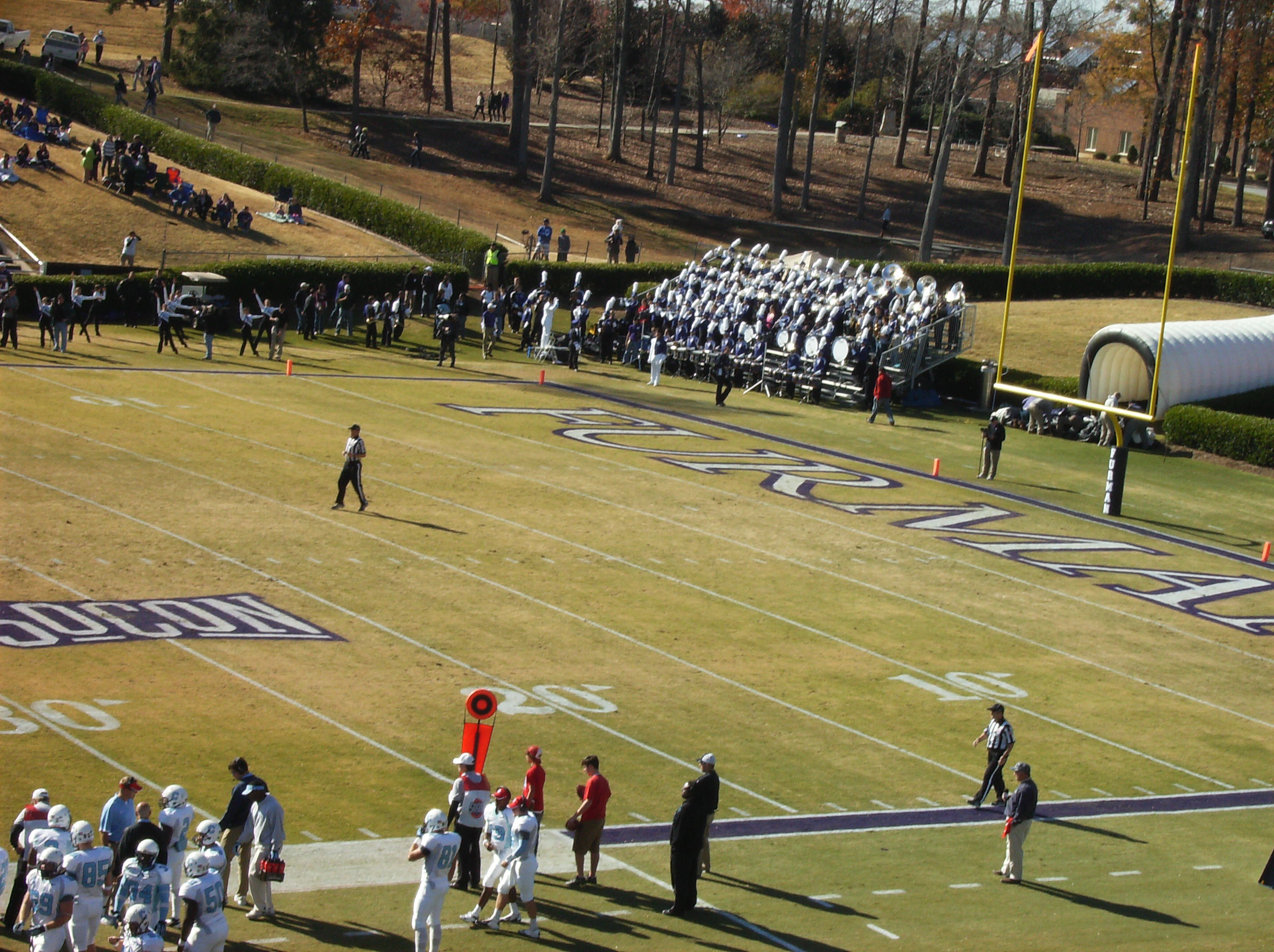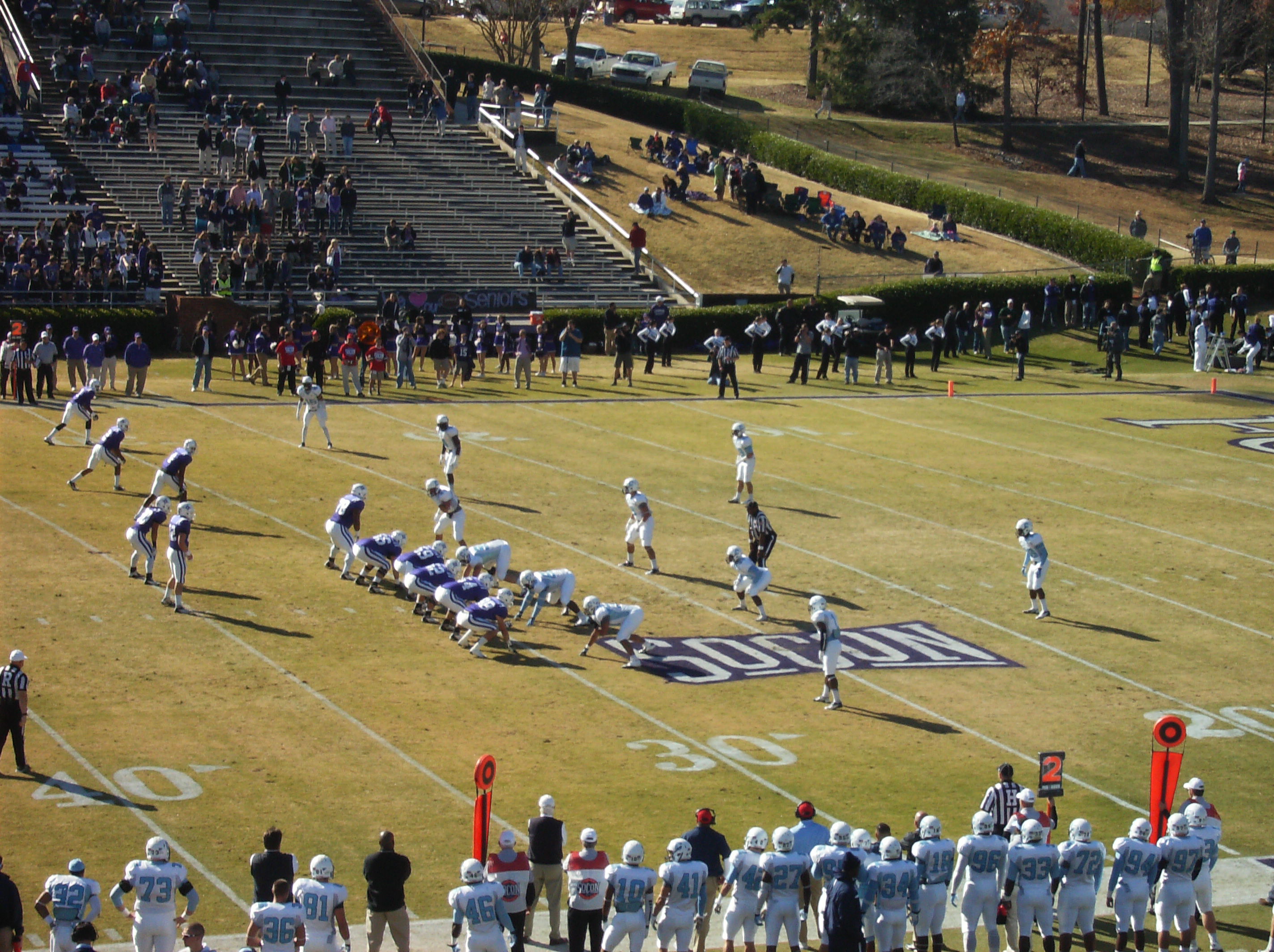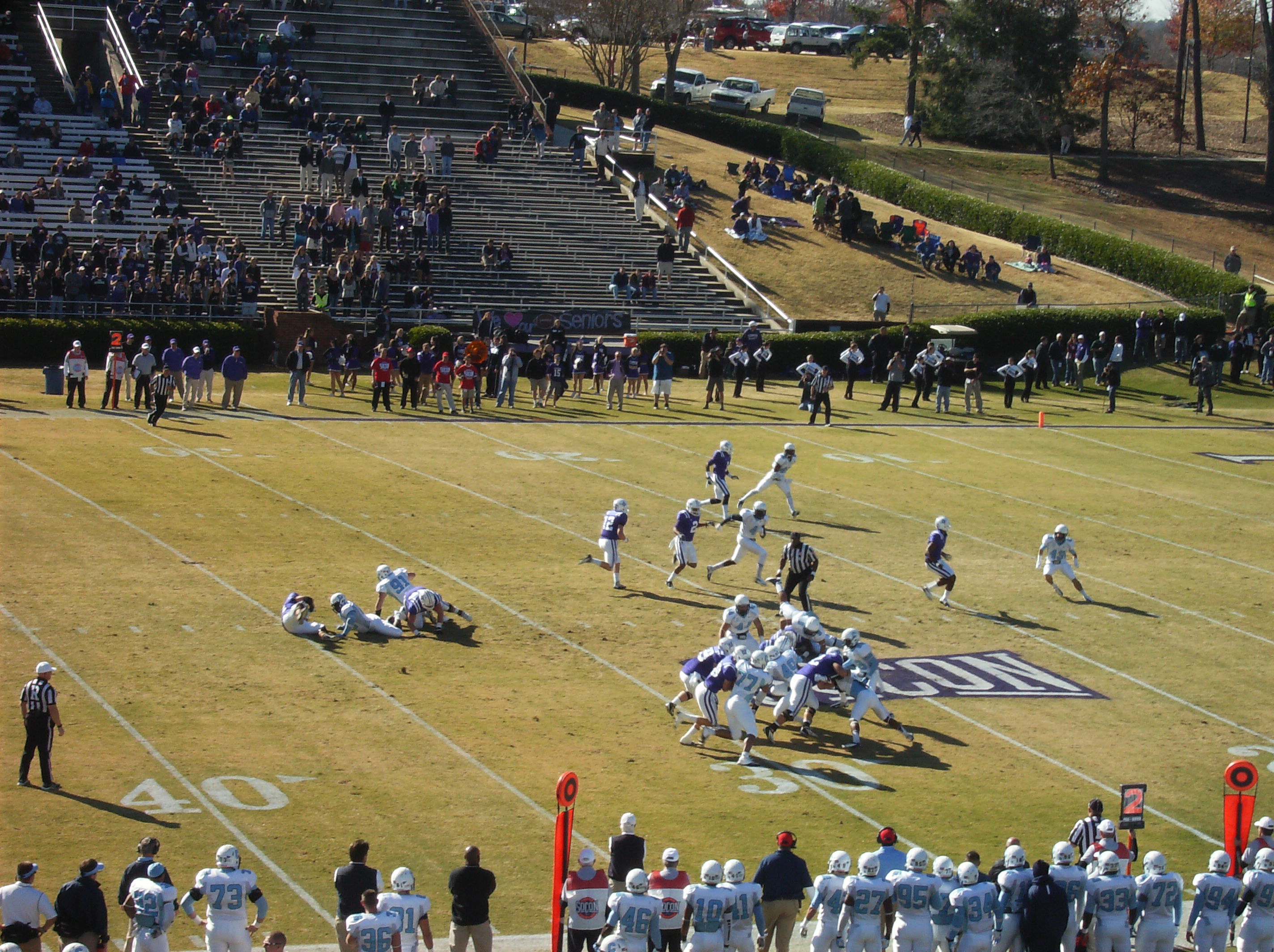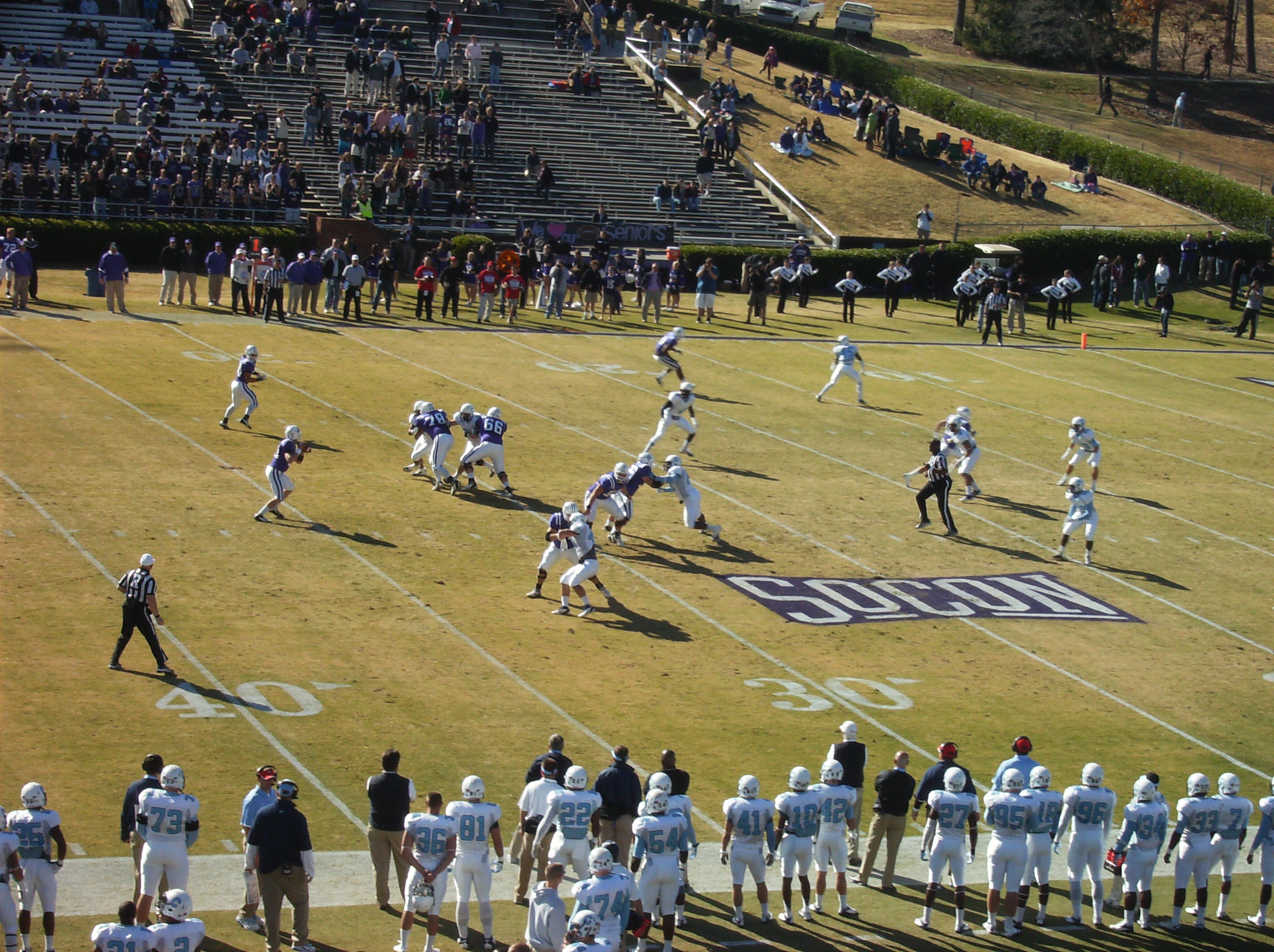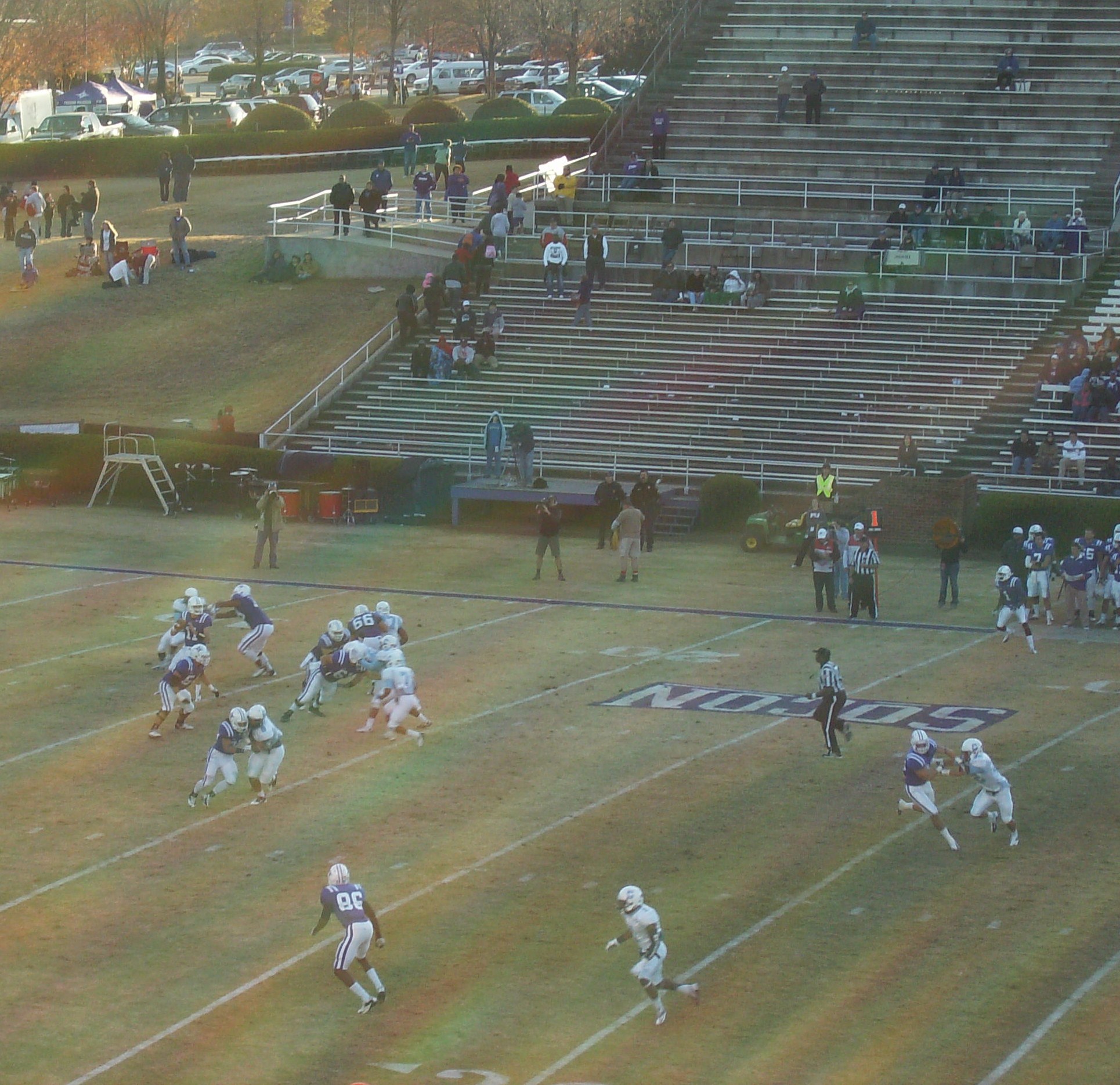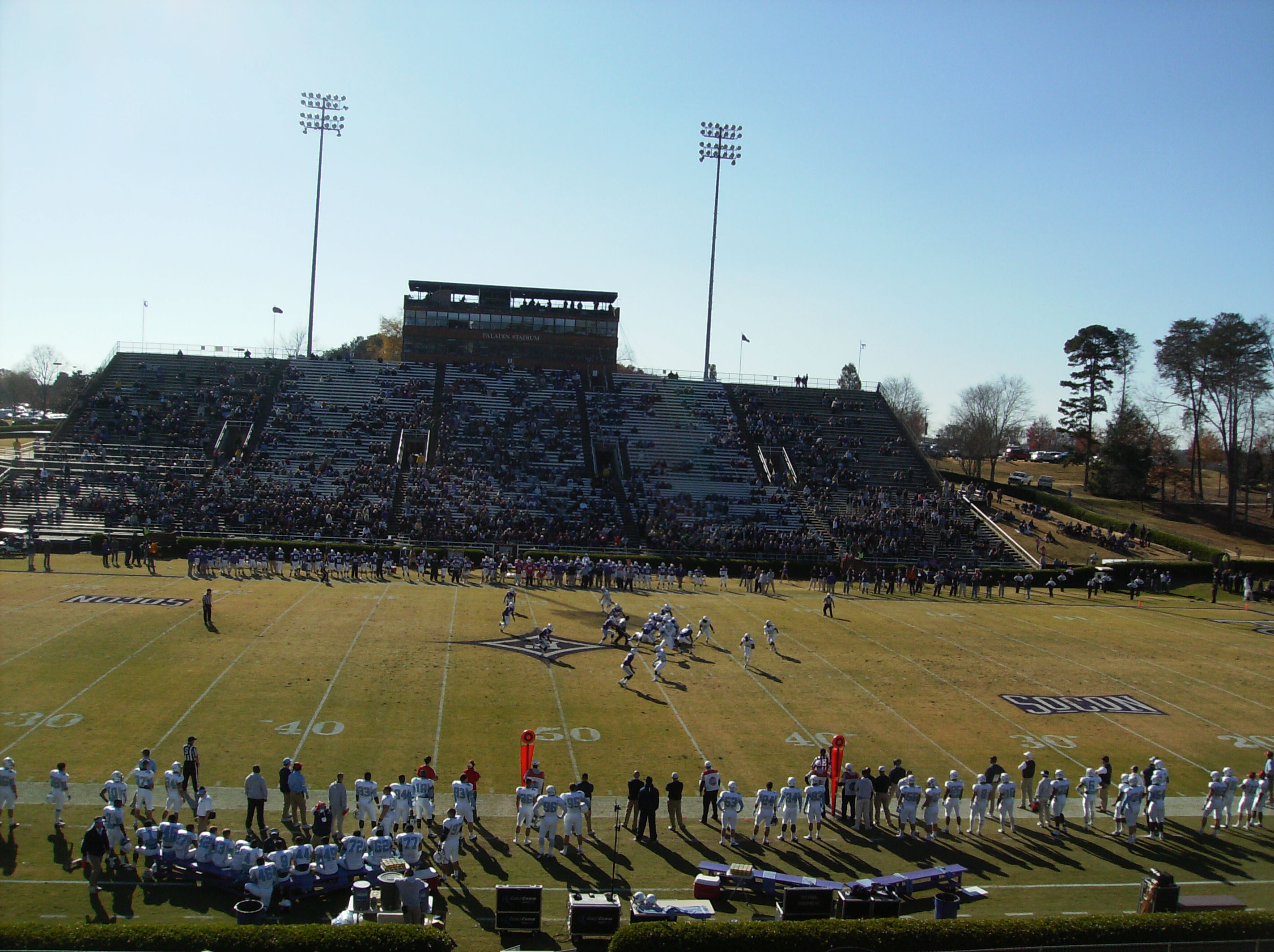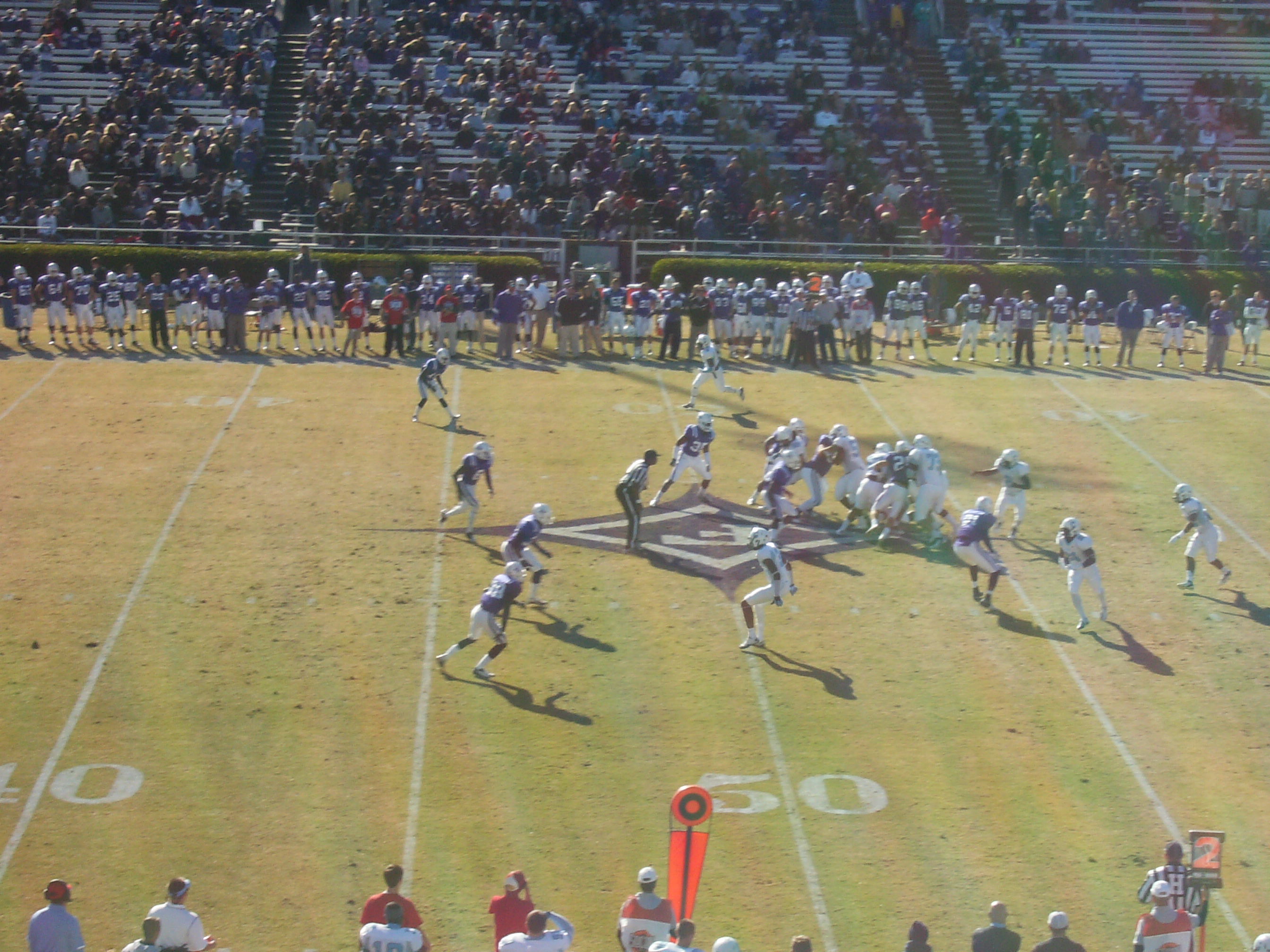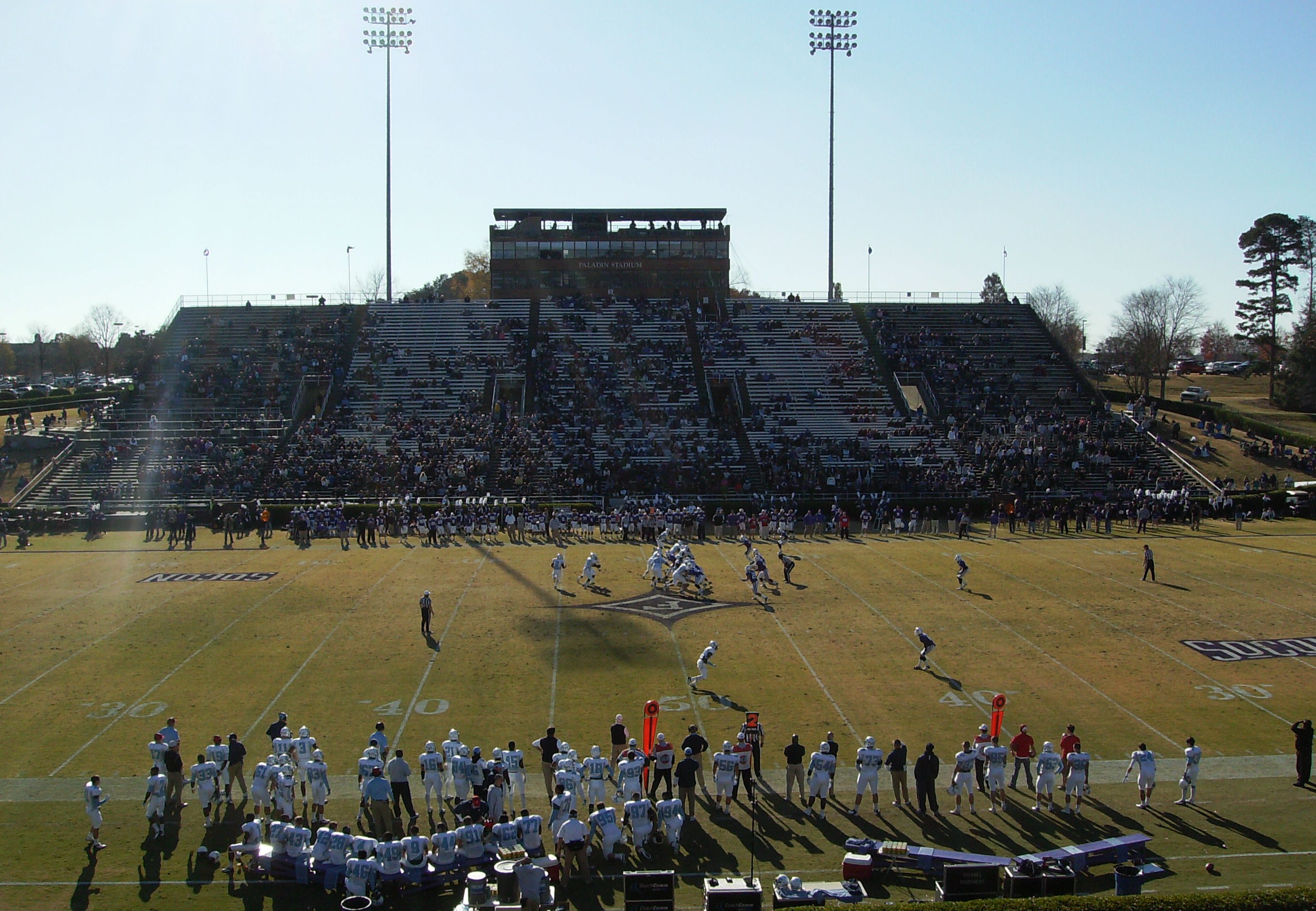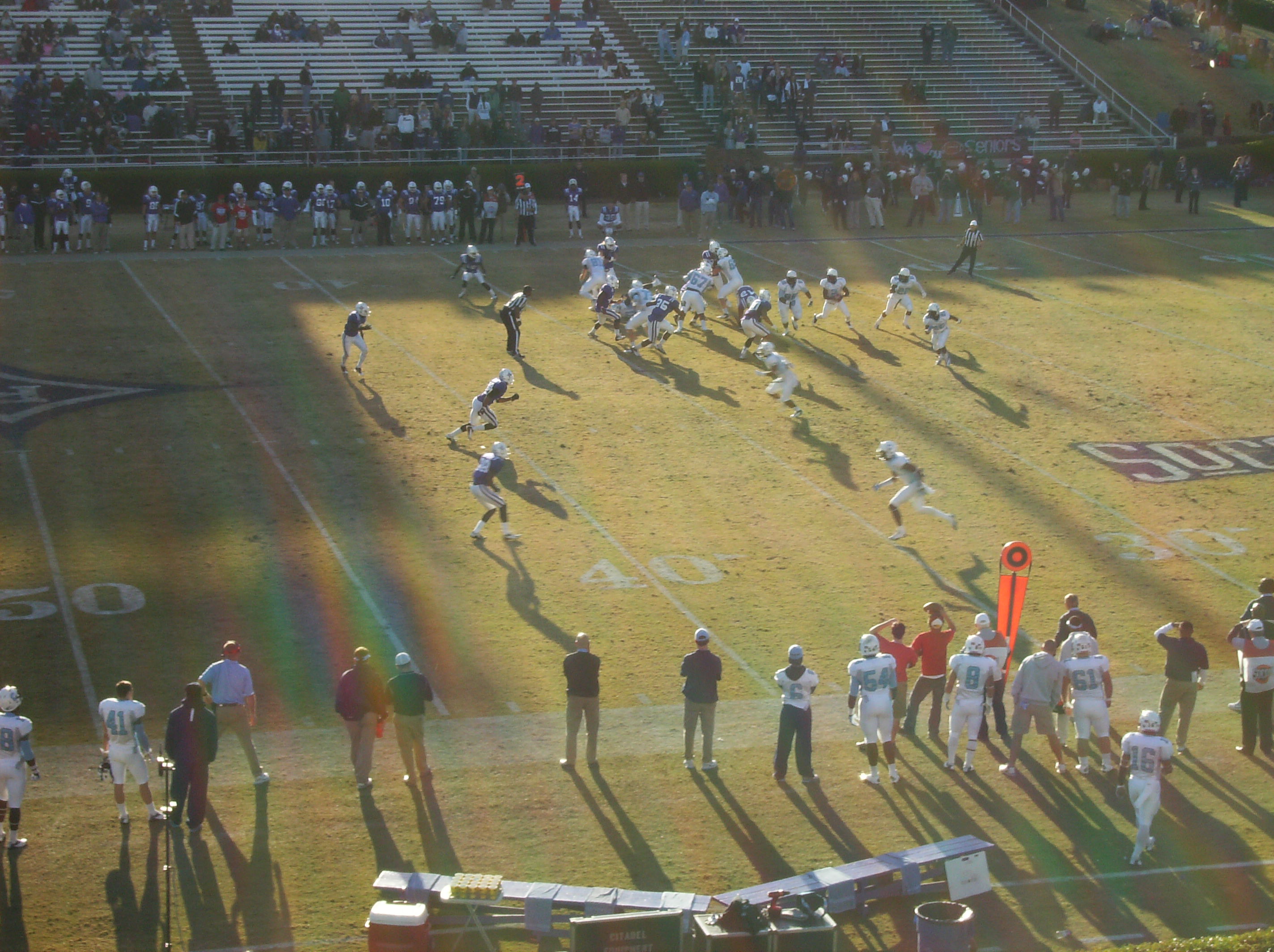
2013 Football, Game 6: The Citadel vs. Appalachian State

The Citadel vs. Appalachian State, to be played at historic Johnson Hagood Stadium, with kickoff at 2:00 pm ET on Saturday, October 5. The game will not be televised, although it will be streamed on Bulldog Insider (subscription service) and can be heard on radio via the thirteen affiliates of The Citadel Sports Network. Danny Reed (the “Voice of the Bulldogs”) will call the action alongside analyst Josh Baker, with Lee Glaze roaming the sidelines and Walt Nadzak providing pre-game, halftime, and post-game commentary.

WQNT-1450 AM [audio link], originating in Charleston, will be the flagship station for the network; the station will have a two-hour pregame show prior to each home football game. It is also possible to listen to the game via a smartphone, using a TuneIn Radio application.

Links of interest:

The Citadel game notes

Appalachian State game notes

SoCon weekly release

Kevin Higgins on the SoCon media teleconference

Scott Satterfield on the SoCon media teleconference

The Kevin Higgins Show

Unigate and the Unigate Update

An all-star game called the “Medal of Honor Bowl” will be played at Johnson Hagood Stadium in January 2014

Jake Stenson is having a nice season

My brief review of the Furman game, with less-than-stellar pictures, some thoughts on Unigate, and an examination of first-half playcalling

At the beginning of the season, this next group of games (Appalachian State, at Georgia Southern, at Chattanooga, Samford) was believed to be the stretch that would determine whether or not The Citadel was a legitimate contender for a playoff berth and/or a Southern Conference championship. Obviously things have changed.

Barring a complete turnaround, this is going to be a very disappointing season for the Bulldogs. Historically disappointing, even. There may have been a year with higher expectations that went south in a hurry, but I honestly don’t remember one.

What makes it particularly irksome, I think, is the wasted opportunity. This is clearly the weakest the SoCon has been in many years. There have been past teams at The Citadel with promise that had to go toe-to-toe with excellent conference opponents on a weekly basis, and had a record which suffered as a result. That isn’t the case this year.

I am hard-pressed to find any positives from the loss to Furman. I don’t think the Paladins are very good this season, which makes The Citadel’s struggles on both sides of the ball even more frustrating.

Offensively, the Bulldogs could not move the ball on a young and thin Furman defense. Meanwhile, The Citadel’s D allowed several big plays through the air and continued a recent tradition of not getting consistent pressure on the quarterback or forcing any turnovers.

Each team had the ball four times in the “red zone”. Furman scored three touchdowns and a field goal when it got close to the goal line. The Citadel only managed one TD and one field goal when it moved the ball inside the 20.

That has been part of the story of this season. The CItadel’s opponents have an 80% TD rate in the red zone. The Citadel’s offensive TD rate is only 57%.

I referenced the first-half playcalling in my prior post. I still don’t really understand it.

Darien Robinson wound up with 14 carries for 63 yards, not a great deal of yardage, but not exactly a sign that he was “bottled up” either. A lot of the postgame discussion, though, centered around Furman having “nine men in the box”, which forced The Citadel into trying other options.

I am not so sure. It seems to me the coaching staff planned on calling for first-down throws (among other things) before determining whether or not the Paladins could stop the ground attack. If they did, one wonders why they didn’t use the better passer of the two Bulldog QBs, Aaron Miller, to execute that strategy.

I’m not saying they should have started Miller, however. I’m saying I think focusing on the run game from the start of the contest was the way to go. That’s what the triple option is all about.

For whatever reason, Furman never seemed to bite hard on any play-action. It could be because the Paladins could easily read it, or it could be that Furman’s defense just didn’t respect The Citadel’s passing threat. Maybe both. I don’t know.

When I look at Appalachian State’s football profile, including statistics, I see a team that has some things in common with The Citadel.

The Citadel is 0-3 at Johnson Hagood Stadium this year, the first time the Bulldogs have lost their first three home games in a season since 1965, when The Citadel started off 0-5 at home before winning its season finale against Furman. (Two of those opening three losses in 1965 were to South Carolina and West Virginia, though.)

Appalachian State is 0-2 in Boone this year, and has lost five of its last eight games at home. One of those five losses was The Citadel’s 52-28 whipping of the Mountaineers last season, a game in which the Bulldogs amassed 618 yards of total offense.

The last time App started a season 1-3 was ten years ago, in 2003, but it closed strong that year and finished 7-4.

There is considerable angst in Mountaineer country. It’s understandable. This is a program making a leap of faith, and a tough start in its initial transition season has fans nervous.

Gone is the longtime coach. Gone after this season is the known quantity that is life in the FCS. Suddenly, the yearly string of (often easy) victories has gone as well.

However, it is a bit early to write off Appalachian State, which has lost to three teams with a combined record of 11-1. Noteworthy as well: the Mountaineers haven’t lost to an FCS team with a losing record since 2004.

I won’t pretend to have an insider’s perspective on what went down with Jerry Moore. I only know what I’ve read, and some of those accounts have been conflicting.

It reminds me vaguely of the last days at South Carolina of Frank McGuire, a legendary coach who hung on for a little too long. He was then pushed out of his job in a manner that made more than a few people uncomfortable.

Scott Satterfield was the natural choice to take over. He was a quarterback for App in the mid-1990s, and a coach with the program for many years after that, all on the offensive side of the ledger (including six years as the QB coach and last season as the offensive coordinator).

The question, of course, is if Satterfield has what it takes to successfully lead Appalachian State into FBS play as a first-time head coach. The one thing I can say is his first four games in a transition year were never going to answer that question — actually, this season as a whole won’t answer it.

Appalachian State’s last visit to Johnson Hagood Stadium, in 2011, also came on Parents’ Day. In that game, Jamal Londry-Jackson made his first career start for the Mountaineers at quarterback, and for quite a while it appeared he would never throw an incomplete pass.

He completed his first 15 throws in that contest as App State raced out to a 49-14 lead, before The Citadel made a game of it with a late flurry of TDs (the final was 49-42). The Mountaineers scored on seven of their first eight possessions that day.

Londry-Jackson was the preseason SoCon player of the year, but he has split time at quarterback this season with Kameron Bryant. Londry-Jackson is still recovering from offseason knee surgery. Whether he will return to the form that made him an all-conference performer is hard to say, though I wouldn’t bet against it.

Bryant is also returning from a knee injury, one he suffered last season against Coastal Carolina. Statistically, Bryant has been more effective so far this year than Londry-Jackson, as he has thrown five touchdown passes while only being picked off once (Londry-Jackson has two TDs and two INTs) while rushing for 56 yards on 15 carries (Londry-Jackson has only 15 yards on the same number of rushes). Bryant also has 150 more passing yards in three fewer pass attempts.

The Mountaineers have a plethora of quality wideouts, including sophomore Sean Price, an All-American candidate when he plays. Price missed the first two games of the season due to off-field issues, but he has had 99 (Elon) and 98 (Charleston Southern) yards receiving in App’s last two games. Price is an elite wide receiver and a very tough matchup for any team. There is little doubt Appalachian State will throw several deep balls his way against The Citadel, especially after seeing what Furman was able to do last week.

It only seems like Tony Washington and Andrew Peacock have been catching passes for the Mountaineers for 10 years. Both are now seniors. Washington is a big-play threat who also doubles as App’s kick returner (he had a 51-yard kick return against the Bulldogs last season). Peacock is a fine possession receiver who can also throw the ball if you’re not paying attention (he tossed two TD passes last season). These guys are good.

The Mountaineers may not look to throw to their tight end this week, as there is uncertainty at the position. Two different players have started at tight end for App in the last two games, and they are both injured.

At running back, Appalachian State features Marcus Cox, who has been the SoCon freshman of the week for the past two weeks. Against Charleston Southern, he ran effectively (87 yards) and caught passes out of the backfield (4 for 91 yards). The previous week, Cox rushed for 159 yards — and had 149 yards more receiving. Amazingly, Cox was the first player in App’s football history to have 100 yards rushing and receiving in the same game.

Last season, Appalachian State used a mix-and-match approach to its offensive line, but so far this season the same group of five players has started every game for the Mountaineers. App’s two offensive tackles are both 6’6″; one of them, right tackle Will Corbin, is the only starting lineman who weighs more than 300 lbs. (he checks in at 311 lbs.). Incidentally, Appalachian State is only averaging 4.0 yards per rush so far this season.

Satterfield brought in a defensive coordinator who is new to the Mountaineers, but not to the SoCon. Nate Woody was the DC at Wofford for 13 years before making the move to Boone. He has changed App’s scheme from a 4-3 to a 3-4 (though Kevin Higgins referred to it on his coaches’ show as a 5-2).

Ronald Blair is the starter at one of the defensive end spots on App’s two-deep, but the school’s game notes list him as “doubtful” due to a combination of injury and discipline problems. Blair is the Mountaineers’ most experienced defensive lineman. The other end, Deuce Robinson, is a tall (6’5″), active player.

Another lineman to watch is reserve Olawale Dada, a redshirt freshman who was born in Nigeria but moved with his family to the U.S. at age 2. Dada had 12 tackles last week and may be something of a late bloomer, having only started playing football as a sophomore in high school.

App’s starting inside linebackers, John Law and Karl Anderson, currently rank 1-2 in the SoCon in tackles made. Anderson is a fifth-year senior, while Law took a medical redshirt last year during what would have been his freshman campaign. He somehow suffered a serious ankle injury while getting off the team bus at Chattanooga. You’ve got to watch your step when you’re in the Scenic City.

Of the eight defensive backs on the two-deep for the Mountaineers, six are freshmen or sophomores. The lone senior is cornerback Rodger Walker, who missed time last season while coping with a blood disorder.

As mentioned earlier, Tony Washington is the primary kick returner for Appalachian State. He also returns punts for the Mountaineers, and is effective in both roles.

Sam Martin, App’s longtime punter, now does that job for the Detroit Lions. His replacement is a true freshman walkon, Bentlee Critcher.

The Mountaineers suffered a blocked punt against Montana, and had another partially blocked by North Carolina A&T.

Drew Stewart, the placekicker for parts of both 2011 and 2012, is back in the role for 2013. He is 4 for 6 in field goal attempts through four games this season.

Also worth mentioning:

– There were only nine possessions for each team in the Charleston Southern-Appalachian State game, mainly due to a couple of extraordinary drives by the Buccaneers. CSU’s second drive lasted 17 plays and over nine minutes. Its next-to-last drive lasted 16 plays and 8:50.

Only one of App’s nine drives took more than 2:30 off the clock. As a result, Charleston Southern dominated time of possession, holding the ball on offense for over 42 minutes.

The Mountaineers really struggled defensively on third down. Charleston Southern was 10 for 18 on third-down conversions, including three picked up thanks to App State penalties. Four times the Buccaneers went for it on fourth down after not converting on third down; CSU was 4-4 in that situation.

– While The Citadel has not fared well offensively or defensively in red zone situations, Appalachian State has been good on defense inside the 20 (52% TD rate), but not so much on offense (a TD rate of 56%).

I have no idea how things will play out on Saturday. App’s offense is not a good matchup for The Citadel’s defense, but that was true last year as well and the Bulldogs acquitted themselves nicely in Boone. The defense was helped a lot by the offense’s ability to make big plays, particularly on third down. Just to refresh your memory (and mine):

Four times against Appalachian State, the Bulldogs were faced with a third down needing six yards or more to move the chains. In fact, all four of those conversion attempts were 3rd-and-8 or longer. The Citadel’s average gain on the four plays? 36.25 yards, with two of them resulting in touchdowns…

That’s not really something you can count on every game. However, the defensive performance that day could be.

The Mountaineers had nine full possessions in [the first three quarters] and were limited to 239 yards of total offense. Five of the nine App drives ended in punts, one in an interception, and another on a lost fumble. Six of those non-scoring drives were over in five or fewer plays, so the defense played its role in The Citadel’s huge edge in time of possession (the Bulldogs had the ball for over 38 minutes in the contest).

The defense did an excellent job preventing [Jamal Londry-Jackson] from making big plays (his longest pass completion of the day was only 15 yards).

The Citadel put a lot of pressure on the quarterback that day and doing so again this year is an absolute must if the Bulldogs have any hope of containing the Mountaineers’ attack. App won’t make the mistake of not throwing deep this year.

Saturday is Parents’ Day at The Citadel, part of a big weekend at the military college. I’m not sure how many people will be in attendance inside Johnson Hagood Stadium when the game begins. I’m confident the tailgating tents will be overflowing, however.

Appalachian State is 1-3, but it’s not really the kind of 1-3 that makes you think the Mountaineers are about to go into the tank. It’s more a 1-3 along the lines of “haven’t quite put things together yet, but probably will”. If App State puts things together on Saturday, it could be a long day for The Citadel.

However, there is talent on the Bulldog roster too, and the poor season to date doesn’t change that. An outstanding performance like the one in Boone last season is well within The Citadel’s capabilities.

Like everyone sitting on the home side this Saturday, I hope to see it.

2013 Football, Game 5: The Citadel vs. Furman

The Citadel vs. Furman, to be played at historic Johnson Hagood Stadium, with kickoff at 6:00 pm ET on Saturday, September 28. The game will not be televised, although it will be streamed on Bulldog Insider (subscription service) and can be heard on radio via the thirteen affiliates of The Citadel Sports Network. Danny Reed (the “Voice of the Bulldogs”) will call the action alongside analyst Josh Baker, with Lee Glaze roaming the sidelines and Walt Nadzak providing pre-game, halftime, and post-game commentary.

WQNT-1450 AM [audio link], originating in Charleston, will be the flagship station for the network; the station will have a two-hour pregame show prior to each home football game. 

Also, as pointed out in a comment below, it’s possible to listen to the game via a smartphone, using a TuneIn Radio application.

Links of interest:

The Citadel game notes

Furman game notes

SoCon weekly release

Kevin Higgins on the SoCon media teleconference

The Kevin Higgins Show

Bruce Fowler on the SoCon media teleconference

TV promotional spot for the game

Article on Ben Dupree in The Post and Courier

Furman’s Jordan Snellings will be “back in full force” for the game against The Citadel

The Paladins will have a home-and-home series with South Carolina State in 2014-15

Furman has a new secondary logo, because its primary logo “reflects a country club mentality”

Quick thoughts on the game against Old Dominion:

— Brandon McCladdie had 14 tackles in the game, twice as many as any other Bulldog. I hope he spent some extra time in the whirlpool this week.

— The Citadel had eleven possessions; on those drives, the Bulldogs scored eight touchdowns and kicked a field goal. ODU matched both the TDs and FG in twelve possessions (not counting its final drive of the second half as a possession).

— Thanks in part to ODU’s onside kicks and its fumbled kickoff, the time of possession in the second half varied wildly from the third quarter to the fourth. The Citadel only had the football for 4:18 of the third quarter, but held the pigskin for 12:36 of the final period.

— There was considerable discussion in the press about Bobby Wilder calling for three onside kicks during the game, but to be honest both coaches may have been better off trying onside kicks after every score. We’re talking about a game in which over five points were scored per possession. An extreme rate like that has to be considered when evaluating the risk/reward of an onside kick.

— Ultimately, I’m not sure how much The Citadel can take from the Old Dominion game, either offensively or defensively. During the SoCon teleconference, Kevin Higgins referred to the game as an “anomaly” when asked a question by Chattanooga sportswriter John Frierson, and I think anomaly is a fair adjective to use in describing the events in Norfolk.

Higgins pointed out that ODU rarely sees the option, as opposed to SoCon programs like Furman, which has faced it three times each season for several years. Based on the game against the Bulldogs, and two recent playoff matchups with Georgia Southern, it seems apparent that ODU still has no real idea of how to properly defend the triple option.

Conversely, it’s hard to worry too much about the defense’s struggles against the Monarchs, because ODU’s offense has gone into overdrive against a lot of teams. New Hampshire was good enough to make the FCS playoffs last season; the Wildcats allowed 730 yards passing to Taylor Heinicke and company.

I guess what I’m saying is not to read too much into the fact that The Citadel averaged 8.3 yards per play on offense against ODU, and allowed 7.2 yards per play on defense.

— I suppose the special teams kick return unit has some things it can work on this week, though.

— Oh, one last thing: going for two was the right call. I think almost every Bulldog fan agreed with Higgins’ decision, too. It’s rare to see such near-unanimity for that situation.

The coach made an excellent observation about the decision when discussing it with Danny Reed during his coaches’ show. Higgins noted that it wasn’t an absolute end-of-game call, as there was 1:39 remaining in the contest after Jake Stenson’s TD catch drew the Bulldogs within one point. ODU was presumably going to get the ball back with a chance to win, but the pressure (and approach) would have been very different if the Monarchs were trailing, rather than tied.

This will be the third time in four years Furman and The Citadel will meet in September. This is way too early for some people (okay, maybe most people), but as I’ve noted before, the series has been moved around on the calendar throughout the years.

It has been played in October more than any other month. I hope the SoCon considers setting up the matchup for an October meeting every year going forward.

Speaking of conference scheduling, I noticed in Furman’s game notes that the Paladins will play at Mercer in the second week of next season. That will be a league game (probably Mercer’s first). The league actually hasn’t officially released its 2014 schedule yet (that is expected to happen in October).

There is going to be some home-away shifting because of the transition from App/GSU/Elon to Mercer/VMI (and later, ETSU). One thing I would like to see from The Citadel’s perspective is for the league to “split” Furman and Wofford in terms of home and away. Right now, The Citadel plays both upstate schools at home in odd-numbered years and on the road in even-numbered years.

I think it would be more beneficial to play one game in the upstate every year, and one in Charleston. In other words, in years Furman comes to Charleston, The Citadel would travel to Wofford (and vice versa). Upstate alumni could then count on one “home” game for themselves every season.

Furman fired Bobby Lamb after the 2010 season, a campaign in which the Paladins went 5-6. The school had missed the FCS playoffs in four consecutive seasons, and so a change was deemed necessary.

However, at the time it was fair to ask if Furman had actually made a change at all after it hired Bruce Fowler to replace Lamb. Fowler was yet another member of the Dick Sheridan coaching tree. While a school might do worse than grabbing a branch from that particular member of the forest, it could have been argued that Furman needed a different approach.

This is Fowler’s third season in Greenville as the head coach; he will arrive in Charleston on Saturday with a record of 10-15, including a 3-8 mark during last season’s campaign. The Paladins are 1-2 so far this season, suffering losses to Coastal Carolina and Gardner-Webb (each by 7 points). Furman’s victory came in its home opener two weeks ago against Presbyterian, a 21-20 final.

Losing to Gardner-Webb and CCU had to be disappointing for Paladin fans, particularly the setback in Boiling Springs. However, G-W later followed up its win over Furman with victories over Richmond and Wofford, so the Runnin’ Bulldogs may be better than expected.

The victory over PC, a program that hasn’t beaten Furman since 1979, did not inspire much confidence from the Paladin faithful either. It took a second-half comeback and a last-minute blocked field goal to keep Furman’s 15-game winning streak against the Blue Hose alive. The announced attendance for that game was only 6,500.

While the early results for Fowler haven’t been that great, it may be that Furman’s administration is willing to be patient during what could be described as a transitional period. The school has almost completed a major facilities upgrade for the football program. From Furman’s game notes:

This fall Furman will open the new Pearce-Horton Football Complex, a 44,000 square-foot, four-story facility that will serve as the new operational home for Furman football and include locker room, coaches’ offices, meeting rooms, sports medicine center, and “Heritage Hall.” The new building will also feature a club level and new press box…

…Furman’s Paladin Stadium sports a new playing surface this year following the installing of Shaw Sports Turf’s “PowerBlade Bolt” system, which replaces the original natural grass field that debuted with the opening of Paladin Stadium in 1981.

Furman wasn’t expected to compete for the league title this season, ranking fifth (not counting Georgia Southern or Appalachian State*) in both the SoCon media and coaches’ preseason polls (though one sportswriter gave FU a first-place vote).

*Last season, I was critical of a reference in Furman’s game notes, so I want to give the school’s sports information department credit for its approach to the league standings. Not only are those schools listed at the bottom of the league standings column put out by the school, but Furman also doesn’t credit App or GSU with any league wins or losses. The SoCon’s weekly release does list those schools with conference wins and losses (which it shouldn’t, in my opinion).

Reese Hannon, who started at quarterback for Furman in last season’s game against The Citadel, missed the opener at Gardner-Webb with a strained oblique. Dillon Woodruff became the first true freshman to start at quarterback in a season opener for the Paladins since 1956. Unfortunately, Woodruff broke his shoulder during the game and was lost for the season.

Hannon returned for the game against Coastal Carolina and is expected to start against the Bulldogs. In last year’s matchup between the two teams, Hannon did a solid job of leading the Paladin offense until he got hurt. Furman’s offense was never quite as effective after he left the contest.

At running back, Furman no longer has the services of the always-impressive Jerodis Williams, but it does return Hank McCloud, an excellent option in his own right who rushed for 100+ yards against Coastal Carolina and Presbyterian.

Last year, I thought the Paladins made a mistake by abandoning the run too early against The Citadel, not giving either of its quality running backs a carry in the entire fourth quarter. I don’t expect Furman to forget about McCloud in this game, particularly because the Paladins have not been very efficient in the passing game thus far (5.4 yards per attempt, 3 interceptions in 67 throws, and only a 51% completion percentage).

Furman’s offensive line is led by left tackle Dakota Dozier, the best player on the Paladins’ roster. Dozier, a four-year starter, is probably the league’s top offensive lineman and was named to several preseason All-American lists. According to his bio on the school website, the 6’5″, 303 lb. Dozier also plays the cello.

There is experience along the Paladin o-line at every position except right tackle, where two players have split the starts this year. Another thing worth noting (well, I think it’s worth noting) is that Dozier is also listed on Furman’s two-deep as the backup at left guard and right guard. I don’t know whether or not that says something about Furman’s depth.

At wide receiver, Jordan Snellings (who made the SoCon’s all-freshman team last season) is Furman’s big-play threat; he led the Paladins in touchdown receptions last year. Snellings has only played in one game so far in 2013 due to an ankle problem, but is supposed to back to full strength for this week’s game.

Gary Robinson, Furman’s starting flanker, caught a 70-yard touchdown pass in the Gardner-Webb game and added a 23-yard TD reception versus Coastal Carolina. His brother Terry Robinson is the Paladins’ backup QB; both brothers scored touchdowns against G-W.

The Citadel has historically struggled to contain Furman’s tight end, regardless of who was playing the position for the Paladins. My personal opinion is that your average farm animal could line up at tight end for Furman and catch 4 passes for 60 yards against the Bulldogs. This year, the starter is redshirt senior Cameron Mason, who began his college career at the U.S. Naval Academy.

Furman’s defense has been hit by a rash of injuries, particularly along the line. This week’s two-deep lists a “true” freshman starting at DT and redshirt freshmen backing up all four of the DL spots. In all, the Paladins have a redshirt or true freshman listed as the backup for all but one defensive position (middle linebacker).

The most recent injury among the starters was suffered by defensive end Shawn Boone, who tore his ACL in the week leading up to the game against Presbyterian. As a result, Furman has moved one of its starting DTs to end. The other defensive end spot is manned by preseason all-SoCon pick Gary Wilkins, formerly a linebacker. Wilkins is one of the Paladin defenders with significant experience; another is strong safety Greg Worthy, who will make his 30th career start in Saturday’s game.

Furman’s leading tackler is linebacker Cory Magwood, a sophomore who had 18 tackles against Gardner-Webb. Magwood suffered an ankle injury against PC but is slated to start against The Citadel. Fellow linebacker Carl Rider, also a sophomore, leads the Paladins in tackles for loss.

One of the things to watch will be how well the younger Paladin defensive players adapt to defending the option. Furman’s coaching staff has a lot of experience defending the offense, and the Paladins have generally fared well against it. Whether the coaches can get a large number of relatively inexperienced players up to speed on defending the option is open to question.

That’s why having the week off before playing The Citadel was a huge break for the Paladins. The bye came at a really good time for Furman.

Furman’s punter and placekicker is senior Ray Early, who made the preseason coaches’ All-SoCon team at both positions. Early converted a 52-yard field goal against The Citadel last season.

So far this year, Early is 0-3 on FG attempts.  However, his punting has been exemplary, averaging 46.4 yards per kick (42.8 net), with six of his eleven punts landing inside the 20-yard line. Eight of his thirteen kickoffs have resulted in touchbacks.

Hank McCloud and Gary Robinson are Furman’s kick returners. Starting nickel back Jairus Holloman returns punts for the Paladins. Holloman blocked the potential game-winning field goal to preserve Furman’s victory over Presbyterian.

Odds and ends:

– The Citadel is a ten-point favorite against Furman, according to various sources in Las Vegas. That strikes me as an absurdly large spread.

– On Saturday, The Citadel will wear a special “throwback” jersey/helmet combination. The jerseys will be auctioned off after the game.

This will be the second consecutive time the Bulldogs have worn an alternate jersey for a game in Johnson Hagood Stadium against Furman. In 2011, The Citadel wore its “Big Red” jerseys.

– The halftime show will feature The Citadel Pipe Band and the Charleston Police Department Pipe and Drums.

In my opinion, the key to Saturday’s contest will be if Furman’s mostly young defense can force more than its fair share of three-and-outs and/or six-and-outs against The Citadel’s offense. The longer the Bulldogs’ offense stays on the field, the more likely The Citadel will win the game.

One of the most interesting takeaways from the Bulldogs’ game against Old Dominion was the platooning of the offensive line, with the second unit getting a lot of snaps. I could see The Citadel doing that again versus a very thin Paladin defensive line, hoping for a repeat of last year’s game, when the Bulldogs scored 21 unanswered points in the third and fourth quarters.

Defensively, The Citadel must put consistent pressure on the quarterback, and force more turnovers. Sure, that’s obvious, but it’s obvious for a reason.

The Bulldogs were never able to sack ODU quarterback Taylor Heinicke, and the only turnover given up by the Monarchs came on a botched kickoff return. The defense has to do better than that against Furman.

I think it’s likely that Furman is better than its reputation. Neither of the Paladins’ losses is that bad. Furman gets one of its key difference-makers on offense back this week, has several impact defenders, and has had two weeks to get healthy and prepare for this game.

The Citadel should be more confident as a team than it was two weeks ago, but it has a tough task ahead of it. I believe this matchup is essentially a toss-up.

We’ll know for sure on Saturday.

2013 Football, Week 4: The Citadel vs. Old Dominion

The Citadel at Old Dominion, to be played in Norfolk, Virginia, on the grounds of Foreman Field at S.B. Ballard Stadium, with kickoff at 6:00 pm ET on Saturday, September 21. The game can be heard on radio via the thirteen affiliates of The Citadel Sports Network. Danny Reed (the “Voice of the Bulldogs”) will call the action alongside analyst Josh Baker, with Lee Glaze roaming the sidelines. The contest will also be televised in the Hampton Roads (VA) metropolitan area by Cox Communications, with play-by-play from Doug Ripley and analysis by John Bunting.

WQNT-1450 AM [audio link], originating in Charleston, is the flagship station for The Citadel Sports Network; audio of the game is also available at Bulldog Insider.

Links of interest:

The Citadel game notes

Old Dominion game notes

SoCon weekly release

SoCon media teleconference: The Citadel head coach Kevin Higgins

The Kevin Higgins Show

Video of ODU head coach Bobby Wilder’s Monday press conference (with a transcript)

ODU improves, now prepares for The Citadel

Kevin Higgins says that ODU is ahead of Appalachian State and Georgia Southern in its FBS transition

Catching up with…Brandon McCladdie

Strength and Conditioning video, featuring the football travel squad

A few thoughts on the game against Western Carolina:

– Each team had eight possessions in the game (not counting The Citadel’s touchdown off of a fumbled punt as a possession). With so few drives, it becomes even more important to cash in on opportunities.

You can argue about the play call that led to the Bulldogs’ only turnover of the game. I understand the notion that the play was open for a TD before the untimely deflection.

I think the decision to pass was probably a mistake, though, not as much because of the result but for the fact that 14 of The Citadel’s previous 16 plays (all rushes) had resulted in a gain of at least  five yards. There was no reason at that point in the game to believe the Catamounts were going to hold the Bulldogs to less than eight yards over the next three plays (assuming The Citadel would have gone for it on 4th down if necessary).

Then there was the sequence at the end of the first half. The Citadel probably missed a chance at either a TD or an easier field goal attempt by not calling a timeout once inside the Catamounts’ 40-yard line. I can understand the reasoning (why give the other team momentum when you’re up 21-0), but the field position definitely was in the Bulldogs’ favor. The Citadel had all three timeouts available, but elected not to use any of them until only four seconds remained in the half.

– A bunch of the “true” freshmen came to play. Devan Robbins. Tyler Renew. Tevin Floyd. Also mixing it up are guys like Jorian Jordan, Nick Jeffreys, Ryan Bednar, Rudder Brown, and DeAndre Schoultz.

All of them can and will help the Bulldogs all season long. That’s an especially good thing at The Citadel, which has historically struggled with depth. So far, so good for this year’s crop of freshmen.

– Not committing any penalties in a league road game is very impressive.

– Carl Robinson had nine more tackles in the WCU game. He is now tied for the SoCon lead in tackles for the season, with 39. James Riley led the Bulldogs in tackles against the Catamounts, with eleven.

Old Dominion was founded in 1930. It was originally an extension of the College of William & Mary, set up in Norfolk as a two-year school. The following year, Virginia Tech began offering classes at what came to be known as “The Division” (a nickname/setup that is vaguely reminiscent of “The Arsenal”).

The school would eventually become a four-year institution (first awarding bachelor’s degrees in 1956), was spun into an independent entity in 1962, and attained university status in 1969.

Incidentally, Old Dominion College was chosen as the new name of the independent school in 1962 over (among others) College of the Atlantic and Thomas Jefferson College.

The school played football from 1930 to 1941, competing as the “Braves” (the Monarchs nickname came about in 1961). As a two-year college, the Norfolk Division compiled a record of 62-19-4 in twelve seasons. One of the nineteen losses came against Miami (FL); the Hurricanes apparently thought they were scheduled to play William & Mary, and wound up competing against the Braves instead (the final was 6-2).

The football program was dropped when a rule was passed that precluded freshmen from playing. However, Foreman Field (built in 1936) remained, and served as the host of the Oyster Bowl for many years. Foreman Field was the site where The Citadel’s Gene Brown rushed for 286 yards in a 1988 game against VMI (on only 13 carries); it also was the setting for a Crosby, Stills, Nash & Young concert in 1974.

The Citadel played four times in the Oyster Bowl at Foreman Field, all matchups with VMI, winning three of those contests.

By the time the 21st century rolled around, it occurred to a few people that it might be neat for ODU to have a football team again, particularly since it was now a four-year school with almost 20,000 undergraduate students, and located in an area noted for having a lot of talented football players. In other words, it was a natural.

Bobby Wilder, then an assistant at Maine, was hired to revive the program, and in 2009 the Monarchs returned to the gridiron. Wilder has orchestrated a very successful startup.

ODU is 39-12 during his tenure, including an 11-2 record last year. The success of the team on the field, as well as the support off of it (home games at 20,068-seat Foreman Field are regularly sold out), certainly helped the school gain admission to Conference USA, where it will begin play next year as a full-fledged member of that league.

The school’s decision process for moving to FBS took about 6 1/2 weeks, which is borderline insane. Actually, forget borderline — it’s just insane. A good read on that time period can be found here: Link

There are many things to digest from that article. I’ll just mention two of them:

– Halfway through that 6 1/2 week period, ODU called fifteen of its biggest donors to gauge their interest in FBS football. The result of those calls: $3 million raised in less than two weeks.

– During that time, Old Dominion representatives talked to CUSA honchos, of course, and also had discussions with league officials from the MAC, Atlantic 10, ACC, and Big East — but never spoke to anyone from the Sun Belt.

From The Post and Courier:

ODU’s quick rise is due to three main factors: Quarterback Taylor Heinicke, a 6-1, 205-pound junior from Atlanta; a rabid fan base that has sold out all 30 of its home games to date at 20,068-seat Ballard Stadium, and bought more than 14,000 season tickets for this season; and the fertile recruiting area around its home base in Norfolk, Va.

“It’s amazing to see what they’ve done,” [Kevin] Higgins said. “You look at teams like Georgia State that have struggled making that adjustment. People don’t realize how fervent a football area Virginia Beach is. They put a team there, and now everyone is coming out to see them.

“They picked the right guy in Bobby Wilder, a guy from a solid program in Maine. And he hit right away on this guy Taylor Heinicke.”

Did he ever, coach. Did he ever.

Heinicke won the Walter Payton Award as the top player in FCS last season, passing for 5,076 yards and 44 touchdowns last season.

Heinicke threw 7 TD passes against Campbell, but that wasn’t even his best game. Nor was his 6-TD performance in the playoffs against Coastal Carolina.

No, Heinicke’s most absurd day came against New Hampshire, a come-from-behind 64-61 victory in which he threw for 730 (!) yards and five touchdowns. He also rushed for 61 yards in that game (he’s versatile enough to have rushed for 11 TDs last season).

He’s really, really good, and The Citadel’s D has its work cut out. Last week against Howard, Heinicke threw for 406 yards in a little over two quarters of action. That 406-yard effort didn’t even crack his personal best top 5.

Against East Carolina (a 52-38 loss), Heinicke was 38-51 for 338 yards, completing passes to seven different receivers. He struggled the following week versus Maryland, with only 166 passing yards and three interceptions.

In terms of style and scheme, Higgins said ODU’s spread attack most resembles that of App State, among teams The Citadel has played in recent years.

“They are going to spread it out, and there will be a lot of bubble screens on the outside, trying to get matchups there,” he said. “And as good a thrower as the quarterback is, he is deceptively fast.”

Heinicke likes to spread the wealth, as the ECU game would attest, and he has a lot of options. Antonio Vaughan only caught one pass against Howard, but it was for 76 yards and a TD. Vaughan had three 100-yard receiving days last season.

Redshirt freshman Zach Pascal caught nine passes against Howard. Another wideout, Larry Pinkard, has 18 receptions in three games. Starting tailback Colby Goodwin can also catch the ball (11 receptions this year).

ODU has a lot of experience along the offensive line, with four returning starters who all weigh at least 300 lbs. Left guard David Born is 6’8″, 328 lbs. Right tackle D.J. Morrell is 6’6″, 330 lbs. Yes, they’re big.

The Monarchs scored 49 points in the first half against Howard, and 76 for the game. Among the things that might make a Bulldog fan shudder:

– ODU scored on its first 11 possessions. Nine of those scores were touchdowns.

– Nine of those eleven scoring drives were of less than two minutes’ duration.

Defensively, ODU has struggled. Part of that probably has to do with trying to replace six starters from last year’s team. How will that impact The Citadel as it runs the triple option?

Well, Old Dominion had major problems with Georgia Southern’s triple option attack in the FCS playoffs, allowing 1200 yards of total offense in two games against the Eagles. This year, the Monarchs have a new defensive coordinator, Rich Nagy. Also of note is that backup quarterback David Washington ran the triple option during ODU’s spring practice.

Strong safety Fellonte Misher is Old Dominion’s leading tackler, with eighteen through three games. Linebacker John Darr, a 232-lb. redshirt senior, is the second-leading tackler on the squad and had nine stops against Howard.

Starting middle linebacker Richie Staton is a true freshman, one of ten such freshmen on ODU’s two-deep.

Putting aside the triple option issue and focusing purely on this year’s ODU defense, it’s not the numbers from the ECU or Maryland games that would really concern a Monarchs fan. Let’s face it, plenty of teams wouldn’t be able to cover Maryland wide receiver Stefan Diggs.

The Howard game, though…hmm. Lost in the shuffle of ODU’s 76-19 obliteration of the Bison:

– Howard ran 85 plays on offense, including a staggering 51 in the first half, for 331 total yards. That’s in one half.

– The Bison had four drives of 60+ yards in the first half, and another that went for 49.

What did Howard in? Turnovers, five of them (Old Dominion had none). The Bison also were stopped on fourth-and-goal from the eight in the first half after a 74-yard drive. Thanks to two first-half turnovers and that stoppage on downs, ODU only allowed 10 points in the half. Five different Monarchs accounted for those five turnovers, by the way.

Old Dominion’s special teams include a fine placekicker, Jarod Brown, who has not missed a FG or PAT so far this season. Jake Walsh is ODU’s punter; in keeping with recent college football trends, he’s a native of Australia.

To recap, ODU scored on its first 11 possessions, while last week The Citadel only had 8 possessions the entire game. It is in the Bulldogs’ interest to keep that possession total down for both teams. Holding on to the football, both in terms of offensive time of possession and turnover avoidance, is critical against the Monarchs.

There were 211 snaps in the Howard-Old Dominion game, according to Bobby Wilder. The Citadel needs to make sure that number is substantially lower.

Field position is something else to watch. ODU had a 76-yard kickoff return against the Bison, just one reason its average starting field position against Howard was the Monarchs’ 40-yard line. The Citadel’s special teams units must be at their best in Norfolk, or they will be punished.

Odds and ends:

– Saturday night’s game at Foreman Field has been designated a “blackout” for the home fans (the Howard game was a “whiteout”). It’s important to be color-coordinated for sporting events these days.

I’ve never quite bought into having a blackout for a night game, to be honest. I remember South Carolina having a blackout against Florida when Rex Grossman was the Gators’ quarterback. Asked about it after the game, Grossman said that it felt like no one was in the stands.

– The Citadel is getting a $250,000 guarantee for this game. Originally, the Bulldogs were supposed to play East Carolina this season, but ODU and ECU wanted to play each other, and a deal was worked out.

– ODU is a 17.5-to-18 point favorite over The Citadel, per various Las Vegas sources.

It could be argued that this is the least important game on The Citadel’s entire 2013 schedule (aside from that check for $250,000). That doesn’t mean it is meaningless.

A win would obviously go a long way to erasing the memory of a difficult start to the season, though it wouldn’t affect the SoCon race. It would be a nice chip if the Bulldogs made a late-season playoff push, to be sure.

What I want from this game (besides no injuries) is for the team to regain more of its confidence. The offense needs to continue to get back to where it was at the close of last season while incorporating some of the talented newcomers who have arrived on the scene.

The defense will get a stern test from ODU. It needs to be able to take some positives from the game, regardless of the final score. Playing ODU will at the very least be a good way to prepare for Appalachian State.

I’m not expecting a victory, though I’m not counting out the Bulldogs either.

I never do that.

2013 Football, Game 3: The Citadel vs. Western Carolina

The Citadel at Western Carolina, to be played in Cullowhee, North Carolina, on the grounds of Bob Waters Field at E.J. Whitmire Stadium, with kickoff at 3:30 pm pm ET on Saturday, September 14. The game can be heard on radio via the thirteen affiliates of The Citadel Sports Network. Danny Reed (the “Voice of the Bulldogs”) will call the action alongside analyst Josh Baker, with Lee Glaze roaming the sidelines.

WQNT-1450 AM [audio link], originating in Charleston, is the flagship station for the network; audio of the game is also available at Bulldog Insider.

Links of interest:

The Citadel game notes

Western Carolina game notes

SoCon weekly release

SoCon media teleconference: The Citadel head coach Kevin Higgins

SoCon media teleconference: Western Carolina head coach Mark Speir

The Kevin Higgins Show

Kevin Higgins says the Bulldogs are going back to basics on offense

The Post and Courier “Scouting Report”

Profile of Derek Douglas on the “Off the Collar” blog

Donnell Boucher works with the first battalion non-corps squad freshmen

I don’t have a lot to add about the Wofford game that hasn’t already been said or written. Just a few observations…

– Third down conversions: Wofford 9 for 18, The Citadel 3 for 15. That summed up the game about as well as anything else.

– Carl Robinson had an outstanding game, including 16 tackles. Robinson has 30 tackles through two games, which leads the SoCon.

– Brandon McCladdie led the Bulldogs in all-purpose yards. When a defensive back who doesn’t return kicks leads the team in all-purpose yards, it’s generally not a good thing.

– I thought the defense played fairly well with the exception of allowing some big pass plays. Of course, not allowing big pass plays is a key component in good defense.

– Preseason fears about punting have largely been alleviated, thanks to the solid work by Eric Goins over two games.

Kevin Higgins, during his Monday press conference:

It’s apparent that our execution is not where it needs to be. We’re going to simplify as much as we can, maybe get back to the basics more like we did last year.

We want to make sure we are majoring in a couple of things, and do those things real well to give us a chance to be successful.

As Jeff Hartsell pointed out later, “the ‘back to basics’ theme is never a good sign.” Which is true…most of the time. I remember a notable exception.

Prior to The Citadel’s 1991 season, Charlie Taaffe decided to switch from his successful wishbone offense to the veer. Why?

The reason we’re diversifying our offense is simply because most of the teams in the Southern Conference have seen the wishbone so much now they’re getting better at defensing it. We’ve got to do some different things or they’ll be all over us. Plus, it’ll  give us a chance to throw the ball more and be more exciting to watch.

Taaffe added to this as the season drew closer:

I feel like we’ve taken our program to a level [note: this was Taaffe’s fifth season at The Citadel]. To get to the next level, we have to be more dimensional. We ran the ball 86% of the time last year. We need more balance in our offense. We need to force defenses to defend more things.

The Citadel started the 1991 season 1-1, not playing particularly well in its opener against Presbyterian and then losing to Wofford. At that point, Taaffe did something that must have been very hard for him to do.

He junked the veer and went back to the wishbone.

That decision saved the season. After losing 33-26 to Chattanooga in a game in which the offense came to life, The Citadel won four of its next five games, and six of its last eight. The victories included wins over Army (a first on the gridiron for the Bulldogs) and Furman (breaking a nine-game slide in that series).

The quotes from this article, which followed The Citadel’s 38-13 victory over Western Carolina that season, are illuminating. The offensive switch-back even had a positive impact on the defense.

In winning their final three games last year, the Bulldogs averaged almost 36 points per contest. If “back to basics” means a return to that type of offensive productivity, then it’s the right thing to do.

Western Carolina is playing what is, in my opinion, Division I’s most absurd schedule in 2013. The Catamounts have already played FBS foes Middle Tennessee State and Virginia Tech; later in the season, WCU travels to Auburn. That’s three FBS opponents to go along with two FBS-transitional teams (Georgia Southern and Appalachian State). Western Carolina will be the road team in all five contests.

This is a program that has lost 12 straight games overall, and 22 straight in the SoCon. Western Carolina’s victory over The Citadel on September 3, 2010, was its last win over a D-1 team.

I know it’s a cash grab, but it’s really unfair to the players and coaches in that situation to have to play three FBS opponents. It can’t be easy for second-year coach Mark Speir.

Having said that, if WCU is going to climb out of its gridiron hole, Speir strikes me as the man to lead the way. I think he was a very good hire (and I’m far from alone in that assessment). This season’s schedule may set him back a year, though. We’ll see.

It is hard to get any kind of read on this year’s edition of the Catamounts, since they’ve only played FBS competition thus far. Actually, going back to last season (when WCU finished with a bye and Alabama, respectively), Western Carolina hasn’t played an FCS school since November 3, 2012.

That was a game against Chattanooga, and the Catamounts led the Mocs after three quarters. The week before the UTC contest, Western Carolina gave Appalachian State a good game (losing 38-27).

The Catamounts also led The Citadel in the third quarter at Johnson Hagood Stadium last season, and were tied with the Bulldogs entering the fourth quarter before The Citadel pulled away. That matchup, you may recall, featured a game-turning special-teams play by Vinny Miller.

One of the stars for Western Carolina in that game at JHS was quarterback Troy Mitchell, who rushed for 117 yards and two TDs in the loss. Mitchell did not play in the Catamounts’ game at Virginia Tech, but is expected to start against The Citadel.

Also missing against the Hokies was running back Darius Ramsey, who has not played yet this season for WCU. Ramsey rushed for 118 yards against The Citadel in last year’s game.

Garry Lewis, a freshman, is listed as the starting running back in WCU’s one-back set. The Catamounts may start the game against the Bulldogs with four wideouts.

Western Carolina has some experience along the offensive line, but is also starting a true freshman at right guard, Tanner Poindexter. The caption besides Poindexter’s name on the two-deep in the WCU game notes reads as follows:

Played center in 2012 Shrine Bowl after all-conference at guard … Sports a very interesting hair style – “a mullet”

As usual, the Catamounts’ media relations deparment provide all the necessary information about its team.

Western Carolina has a new defensive coordinator, one who should be very familiar with the Bulldogs’ triple option attack. Last year, Shawn Quinn was the defensive coordinator at Charleston Southern; prior to that, he was at Georgia Southern.

WCU would normally be a 4-3 base D, but that is likely to be adjusted against the Bulldogs.

Quinn will not have the services of Rock Williams this year, much to the relief of Ben Dupree and company. In last year’s game, Williams had 24 tackles, the highest total recorded in the league by a player all season.

As for this year’s players, Bryson Jordan is a freshman who will start at outside linebacker for WCU. He is the son of former Brave (and Falcon) Brian Jordan.

Another freshman, Trey Morgan, is one of the Catamounts’ starting cornerbacks and is highly regarded. He was praised by ESPN3 analyst (and former UNC coach) John Bunting as “a real steal” during the game against Virginia Tech. WCU’s defensive backfield is a team strength, one that also includes preseason second-team SoCon pick Ace Clark.

Western Carolina likes to play a lot of d-linemen, generally a good strategy. There are some interesting backgrounds among the players along the line, including backup nosetackle Helva Matungulu, a native of Kenya who had never played football before arriving in Cullowhee. He is a converted rugby player.

The Catamounts return both their placekicker and punter from last year.

Western Carolina starts four “true” freshmen on its two-deep and played 20 freshmen (including seven true freshmen) in the season opener against Middle Tennessee State. This is a young team.

I don’t know what to expect from the Bulldogs on Saturday. It’s put up or shut up time, I suppose.

One thing that worries me is this has become a big game for Western Carolina. After The Citadel, WCU plays Mars Hill, and then starts a three-game road swing: Samford, Chattanooga, and Auburn. In other words, the Catamounts could really use a win against the Bulldogs, and probably have increased confidence that they have an opportunity, given The Citadel’s struggles.

Oddsmakers list The Citadel as a four-point favorite, a small spread considering WCU’s difficulties in recent years against Division I competition. It is understandable, however, when taking into account what The Citadel has done so far this season.

I am not worried about what Las Vegas thinks, though. My concern is with the mindset of the team. I hope there are still good vibes emanating from those wearing the blue and white.

To bring home a victory from Cullowhee, positive thoughts are a necessity. So are hard hits and tough runs.

I think there is still some bite to these Bulldogs. Saturday is the time to show it.

2013 Football, Game 2: The Citadel vs. Wofford

The Citadel vs. Wofford, to be played at historic Johnson Hagood Stadium, with kickoff at 6:00 pm ET on Saturday, September 7. The game will streamed on ESPN3.com, with play-by-play from Darren Goldwater and analysis by Paul Maguire. It can also be heard on radio via the thirteen affiliates of The Citadel Sports Network. Danny Reed (the “Voice of the Bulldogs”) will call the action alongside analyst Josh Baker, with Lee Glaze roaming the sidelines and Walt Nadzak providing pre-game, halftime, and post-game commentary.

WQNT-1450 AM [audio link], originating in Charleston, will be the flagship station for the network; the station will have a two-hour pregame show prior to each home football game. 

Links of interest:

My (very brief) review post from Game 1

The Citadel’s game notes

Wofford’s game notes

SoCon weekly release

SoCon media teleconference — Kevin Higgins

SoCon media teleconference — Mike Ayers

The Kevin Higgins Show (YouTube)

There are a lot of things that can be said about the season opener against Charleston Southern, almost none of them positive from The Citadel’s perspective.

First and foremost, I want to focus on the last 65 seconds of the first half.

The situation:

The Citadel led 16-7, but Charleston Southern had scored on its previous possession (a 64-yard TD pass) and then forced a three-and-out from the Bulldogs offense. After a long punt return blunted by a personal foul penalty, CSU had the ball at midfield, first-and-10, with 1:05 to play in the first half. The Buccaneers had no timeouts remaining.

On first down, a sack moved the ball back to the CSU 41-yard line. At that point, head coach Kevin Higgins called his first timeout of the half. Why?

Higgins explained later:

We’re thinking, we’ll call a timeout, go block a punt before the half. We’ve done that for the last three years, used the same kind of strategy, see if we can block a punt or get a drive at the end of the half.

Charleston Southern gained nine yards on its next play, setting up third-and-10 at the 50. The clock kept running, and The Citadel did not use a timeout.

I’m not sure why you wouldn’t call the second timeout if the idea was to have time left to block a punt or set up a return. It wasn’t like it was third-and-1. It was third-and-10.

That decision led to several things, none of which were good for The Citadel. First, CSU essentially got a “free shot” at making a big play on offense with the clock running out, and the Bulldogs were lucky that the Bucs narrowly missed connections on a pass over the middle that would have gone for big yardage (if not a TD).

That incompletion stopped the clock with less than 20 seconds to play in the half. On fourth down, CSU punted. The Citadel did not rush the punter (I went back and looked at the video to make sure). A return was not exactly set up either (a fair catch was called prior to the muff). Why anyone was even back to attempt to catch the punt strikes me as a fair question.

If the timeout had not been called after first down, the half would have ended without a punt even occurring. Instead, the Bulldogs were put in a position to fail with no realistic potential for success.

After the fumble recovery, Charleston Southern had the ball at the Bulldog 19-yard line with 12 seconds left in the half, and no timeouts. The one thing the defense can’t give up in that situation is a TD pass.

Tackle the receiver before the ball gets to him if that’s what it takes to stop the completion. In the worst-case scenario, pass interference would have put the ball at the Bulldog 4 and left the Bucs only one play (possibly two) before the half, which likely would have been a field goal attempt. The defense just can’t let a pass be completed in the end zone there.

I understand you’re asking a player to do something that would probably be against his instincts as a defender. It’s also possible the coaches discussed the strategy (The Citadel called its second timeout after the punt) and it wasn’t properly executed. For those reasons, I’m not bothered as much by the TD play as I am the game management that preceded the punt.

At any rate, the last minute of the first half was the key sequence in the game, and it was badly mishandled by The Citadel.

There were other missteps, too. The Citadel went for two points too early (though that was at least somewhat defensible). The playcalling, particularly on the final offensive series, left a lot to be desired.

The defense let CSU saunter right down the field to open the third quarter, as easy a TD drive as you could want, and gave up the aforementioned long TD pass on a badly blown coverage. There were other forgettable moments, too.

That end-of-half debacle, though…that’s a hard one to shake off.

It was nice of Kevin Higgins to talk about the “great job” Jamey Chadwell and his staff did in preparing for the game, but his comments did not exactly make Bulldog fans feel better. Also, I’m sure Chadwell is a good coach, but he’s the same guy who elected to punt on fourth-and-6 from the Bulldog 34 in the second quarter, with his team down two scores.

Punting from inside your opponent’s 35 in that situation (or almost any situation) is a decidedly sub-optimal strategy. I’m not convinced yet that Chadwell is the Albert Einstein of college football, which makes the whole ‘it was hard for our offense because they used a bunch of defensive fronts’ thing all the more galling.

With all due respect to Charleston Southern, this game wasn’t about the Buccaneers doing anything particularly exceptional. It was about The Citadel handing CSU the contest on a silver platter with fancy trimmings. It wasn’t a “disappointing loss”; it was a disastrous, unacceptable one.

I’ll wait until a later time (perhaps next week) to write about some of the ancillary elements from last Saturday, including the noticeable lack of cheerleaders and the disappointing crowd attendance. I’m very curious to see if there will be any changes in terms of off-field activities.

For example, will the band be allowed to play following the kickoff? Sometimes during the game I forget The Citadel even has a band, to be honest.

This is the seventh time in the last eight years the game between The Citadel and Wofford is being televised over the air (SportSouth, SCETV, etc.) or streamed on ESPN3.com. For the second year in the row, the game is on ESPN3.com, and for the second year in the row the announcers are Darren Goldwater and Paul Maguire.

The Citadel’s 42-20 victory in the season finale against Furman last year was only the second time in the Kevin Higgins era that the Bulldogs had won a televised/ESPN3-streamed game. Goldwater was the gamecaller for ESPN3.com that day too (with analyst Doug Chapman). It would be novel to win two in a row on ESPN3.com.

The average score between Wofford and The Citadel had been 34-14 in the seven years prior to last year’s game, which was obviously much closer. Among other items of interest, Wofford was penalized for 59 yards in that contest, almost twice as many yards as the Terriers had been penalized against the Bulldogs in the previous four games combined.

However, Wofford did not commit a turnover against the Bulldogs last year. That has been a trouble spot for The Citadel over the past few years against all opponents, one that emerged again last Saturday when the Bulldogs failed to force a turnover against Charleston Southern.

It is hard to judge anything about Wofford based on its game against Baylor, which the Terriers lost 69-3. I believe that Baylor is going to be one of the elite offensive teams in the country this year, and a serious contender for the Big XII title. Very few teams are going to be able to handle the Bears’ speed and general offensive execution; Wofford certainly couldn’t.

If you want to see the Wofford-Baylor game for yourself, you can, and in an extremely handy 50-minute package: Link

Tangent: That video is part of something the Big XII does for all its games that is called “No Huddle”, a concept that is undeniably awesome. All the plays, none of the fluff, loaded up to YouTube the Monday after the games. More of that, please.

Wofford injury report:

There were no major injuries in the Baylor game.

That is in the Wofford game notes. However, from Todd Shanesy of the Spartanburg Herald-Journal:

Wofford halfbacks Cam Flowers and Ray Smith, who suffered concussions last week in the game at Baylor, will be tested Friday to see whether they can make the trip to The Citadel…

…Flowers, a third-year sophomore from Damascus, Ga., made his second career start Saturday against Baylor and had four carries for 13 yards. Smith, a true sophomore who is Dorman High School’s all-time leading rusher, had three carries for 15 yards. He was listed as the backup to the other starting halfback, sophomore Will Gay from T.L. Hanna. Octavius Harden, a sophomore from Conover, N.C., was behind Flowers.

Flowers and Smith were two of the eight Terriers who got carries against The Citadel in last year’s game. Gay and Harden also saw action in that contest (Gay scoring a touchdown).

Wofford has plenty of fullback/halfback types, so if Flowers and/or Smith can’t go, the Terriers should still be in good shape. Wofford also returns the two wideouts who caught passes against the Bulldogs (Jeff Ashley and Will Irwin).

Starting fullback Donovan Johnson rushed for 473 yards last season as the backup to now-graduated Eric Breitenstein. A lot of that yardage came from the halfback position, as Breitenstein (understandably) saw the bulk of the time at FB.

The Terriers only returned two starting offensive linemen from last year’s squad, but they’re both good ones. Jared Singleton and Ty Gregory were each named to the SoCon’s preseason all-conference first team. There is still competition for at least one spot along the Wofford line.

Then there is the quarterback position. With one year of eligibility remaining, Brian Kass elected to transfer to Coastal Carolina. With Kass out of the picture, three players have battled for the Terriers’ starting QB spot. James Lawson started two late-season games for Wofford last season and also opened behind center against Baylor. He will likely start against The Citadel, but both Evan Jacks and Michael Weimer are expected to play.

Wofford lost six starters off its defense, but returns preseason all-league pick Alvin Scioneaux at outside linebacker. Free safety James Zotto had six tackles against the Bulldogs last season, tied for the most by a Terrier in that game. Two of Wofford’s starters along the defensive line are back, including second-team SoCon selection Tarek Odom and 6’2″, 290-lb. noseguard E.J. Speller.

Starting defensive end Hunter Thurley (a redshirt freshman) is 6’4″, but listed at just 245 lbs. In general, Wofford’s d-line is undersized (Speller is a notable exception) and the linebackers are tall and rangy.

Kasey Redfern handles all the kicking duties for the Terriers. Will Gay is Wofford’s punt returner and is usually joined on kickoffs by Cameron Flowers, though Flowers’ status will be in doubt up until gametime.

Odds and ends:

– I am not a big fan of Ben Dupree returning punts. I’ll hope for the best.

– Based on the two-deep in The Citadel’s game notes, it appears Tyler Renew may not get cleared by the NCAA in time for Saturday’s game. Shaunn Middleton is listed as Darien Robinson’s backup. Incidentally, Renew was listed in last week’s game notes as the second-team B-Back.

– Nick Jeffreys is listed as the tight end on the two-deep. No other player is listed at the position.

– Attendance at Johnson Hagood Stadium for Wofford’s past four visits: 11,290 (2005), 14,879 (2007), 15,155 (2009 — Homecoming), 12,316 (2011)

The last time Wofford entered the game against The Citadel with as many questions as the Terriers have this season, it was 2009. That wasn’t an early-season situation, though. In 2009, Wofford suffered through a series of injuries and finished with a 3-8 record.

One of those three victories was a 43-17 win over the Bulldogs, as listless a Homecoming performance from The Citadel as I’ve ever seen in person at Johnson Hagood Stadium. I am not sure what to expect from The Citadel in this year’s game, but it better not resemble anything like that.

I don’t think it will. I expect the Bulldogs to come out fired up and ready to prove something.

That doesn’t mean I expect a victory, though. A win for The Citadel on Saturday night is probably not in the cards.

Having said that: while I’m frustrated, and a little disgusted, and not all that confident the team can recover from its opening-night failure…I’m not giving up on this team. It’s my team, no matter what.

I’ll be cheering them on at Johnson Hagood Stadium this Saturday night, and I hope many other people will be doing the same.

2013 Football, Game 1: The Citadel vs. Charleston Southern

FOOTBALLFOOTBALLFOOTBALLFOOTBALLFOOTBALLFOOTBALLFOOTBALL

The Citadel vs. Charleston Southern, to be played at historic Johnson Hagood Stadium, with kickoff at 6:00 pm ET on Saturday, August 31. The game will not be televised, although it will be streamed on Bulldog Insider (subscription service) and can be heard on radio via the thirteen affiliates of The Citadel Sports Network. Danny Reed (the “Voice of the Bulldogs”) will call the action alongside analyst Josh Baker, with Lee Glaze roaming the sidelines and Walt Nadzak providing pre-game, halftime, and post-game commentary.

WQNT-1450 AM [audio link], originating in Charleston, will be the flagship station for the network; the station will have a two-hour pregame show prior to each home football game. 

From last week: my preview of the upcoming season

It has numbers and stuff in it; don’t say you haven’t been warned…

Other links of note:

The Post and Courier‘s Jeff Hartsell has a story on the upcoming game, a season preview, and a look at this year’s SoCon

– SoCon weekly release and Kevin Higgins’ SoCon media teleconference

– SoCon preseason media poll (The Citadel was picked to finish 6th) and coaches’ poll (6th again), and the league’s preseason all-conference teams

– My post on the CFPA watch lists, along with preseason FCS rankings from The Sporting News, Lindy’s, and Athlon Sports

– FCS Coaches preseason Top 25 poll, and The Sports Network’s preseason Top 25 rankings (also from TSN: its preseason FCS All-America teams and its SoCon preview)

– Phil Kornblut of SportsTalk interviews Kevin Higgins and the four team captains (Keith Carter, Derek Douglas, Ben Dupree, Brandon McCladdie)

– Also worth a listen: Kornblut’s interviews with Charleston Southern head coach Jamey Chadwell and three of CSU’s players

– AP preview of the Bulldogs (predicts The Citadel will finish 6th in the SoCon)

– Hometown articles on Ben Dupree and Sadath Jean-Pierre

– Game notes from The Citadel and Charleston Southern

Let’s talk about Charleston Southern…

When The Citadel and CSU met to open the 2012 campaign, the Buccaneers were coming off an 0-11 season, and it may not have been that good. Charleston Southern had changed its offense (essentially for the third consecutive season) and brought in a new defensive coordinator.

Despite all that, CSU actually led the Bulldogs 14-7 late in the second quarter, thanks in part to an ill-timed penalty and a series of fumbles (two of which The Citadel lost). Eventually the Bulldogs asserted their superiority and rolled to a 49-14 victory, but CSU showed flashes of a competitive spirit throughout the rest of its season.

The Buccaneers finished 5-6, a five-game improvement only bettered at the FCS level by Villanova (the Wildcats went from two wins to eight). Charleston Southern won four of its last six contests.

After the season, head coach Jay Mills announced his retirement. Named as his replacement was a former CSU assistant, Jamey Chadwell, who older Bulldog fans may remember as a quarterback at East Tennessee State in the late 1990s. Chadwell was a two-year starter at ETSU in non-consecutive seasons (his playing career was affected by a serious ankle injury).

Chadwell had spent the last four seasons as a head coach at the Division II level. He was the head coach at North Greenville for three years, leaving that job for the same position at Delta State.

The Statesmen (mascot: The Fighting Okra) were only 3-7 in Chadwell’s lone season in charge; prior to that, he had fashioned a 22-14 record at North Greenville, buoyed by an 11-3 record in 2011. That year, his quarterback was celebrated high school star (and former Clemson player) Willy Korn, who is now on Chadwell’s staff at CSU.

Mark Tucker, a former offensive assistant under Charlie Taaffe and Don Powers at The Citadel, is also on Chadwell’s coaching staff. As of August 22, so is former South Carolina (and NFL) linebacker Rod Wilson.

According to Chadwell in his interview with Phil Kornblut, Charleston Southern’s offense this year will feature a spread option look “in the gun”. The Buccaneers will run the ball more than they did under Jay Mills.

Chadwell wants to have a more balanced offense and “get playmakers out in space”. His ideal is Florida circa Tim Tebow, though he acknowledged that incumbent Bucs QB Malcolm Dixon isn’t exactly the second coming of Tebow.

Dixon had his moments against The Citadel in last year’s game, throwing a TD pass and also running for a score. As Chadwell pointed out to Kornblut, Dixon is learning his fourth offense in four years as a college player.

CSU running back Teddy Allen rushed for 56 yards (on only 11 carries) against the Bulldogs last season. Allen was one of two Buccaneers to make the Big South preseason all-conference team.

Also expected to see action at running back is juco transfer Christian Reyes, an Oregon native who has gone to some schools with really cool names, like Rogue River High School and College of the Siskiyous (located in Weed, California). Despite only being on CSU’s campus since January, Reyes (who rushed for 1958 yards last season in junior college) was named one of the team captains for the Buccaneers.

Other Charleston Southern offensive players to watch include Larry Jones III (20.5 yards per reception last season) and wideout Donte Sumpter, a transfer from East Carolina. Starting tight end Nathan Prater is 6’8″; disappointingly, the native of Ninety Six wears jersey #81.

The Bucs have four starters returning on the offensive line, but Chadwell suggested on CSU’s website that some freshmen are battling for those spots.

Charleston Southern was a mediocre passing team last year, ranking 62nd out of 121 FCS teams in passing efficiency. That actually isn’t half-bad, considering CSU completed less than 50% of its pass attempts.

When the Bucs did complete a pass, it generally went for good yardage, resulting in a respectable 7.86 yards per attempt (and 12 touchdowns against 8 interceptions). The Bucs averaged 5.35 yards per play, which was middle-of-the-pack nationally (65th).

Arguably, CSU’s most ominous offensive statistic last season was its third-down conversion rate (30.34%), 11th-worst in FCS football.

Defensive back Elijah Lee was the other Buccaneer besides Allen to garner preseason all-league honors. Lee will be part of a defense that is switching to a 3-4 base after previously being a 4-3. I’m not sure how big an impact that will have on the way the Buccaneers defend the triple option, though.

The key player for CSU against the Bulldogs is likely to be 290-lb. noseguard James Smith. Other defenders of note include linebacker Calvin Bryant and defensive end Will Hunt.

Last season the Bucs’ D topped the Big South in yards per pass attempt, allowing only 6.38 per attempt. Charleston Southern was 32nd nationally in pass efficiency defense.

However, CSU was next-to-last in the league in rush yards per attempt (5.32) and rush yards per game (208.82), leading to a bottom-20 finish nationally in rushing defense. The Citadel rushed for 479 yards against Charleston Southern in last year’s contest.

Opponents averaged 5.7 yards per play against Charleston Southern; the Bucs ranked 81st out of 121 FCS teams in that category in 2012.

When considering CSU’s on-field performance, the yards per play numbers are particularly important due to pace of play considerations. Both CSU’s offense and defense were each on the field for about 62 plays per game last season, which for both units was the eighth-fewest in the entire division. By contrast, The Citadel averaged 63.7 plays per game on offense (15th-fewest nationally) and 66.5 on defense (26th).

Elijah Lee and a pair of freshmen are expected to feature as kick/punt returners for the Bucs. Kickoff returns were problematic for CSU last year, as the team finished with a KOR average of 16.67 yards, 8th-worst in FCS. Charleston Southern finished in the top 20 of FCS in kick return coverage, though the Buccaneers did allow a kick return TD against Jacksonville (on an onside kick that went awry).

Jacksonville also returned a punt for a touchdown against CSU, which finished 87th nationally in net punting. The Buccaneers only attempted five field goals last season, making three (with a long of 31 yards). Both CSU’s punter and placekicker return in 2013.

The Buccaneers were picked to finish fourth in the six-team Big South by a panel of the league’s coaches and media. Charleston Southern will open its home schedule next week against Shorter University. The game will kick off at 11:00 am, one of three CSU home games scheduled for that start time.

Jamey Chadwell told Phil Kornblut that the game versus The Citadel would be a “big challenge” and that “we know going in we’re the underdogs, and rightfully so.” Chadwell also said this:

We’re trying to take that step where we have respect in this state and this city [for our conference]…we’re hoping to go in and compete and establish our identity…if we control the things that we can, our effort and attitude, we think we can compete [with anybody].

Further evidence that Chadwell is going to play the ‘respect card’ in motivating his team for the game against The Citadel: he “favorited” a tweet about the line for the matchup (the Bulldogs opened at -25.5 points). You can bet Chadwell let his players know about that.

Things I’ll be keeping a close eye on this Saturday:

– Execution in the first half

The Bulldogs need to take charge on both sides of the ball while there is still cannon smoke wafting in the air, as opposed to a repeat of last year’s sloppy opening half. The center-QB exchange needs to be second-nature, the “mesh” should be clean, the pitches and passes accurate, the catches made, and the blocking sound.

The team mantra this season is “1-0”. I like it. I want to see the squad live up to it.

– Penalties, or a lack thereof

The Citadel led all of FCS football in the categories “fewest penalties” and “least penalty yardage” in 2011, and matched that feat in 2012 (tying for fewest penalties last year with Lehigh). In all of NCAA football, regardless of division, only Brevard committed fewer penalties per game than did The Citadel in 2012.

– Punting

The Bulldogs actually didn’t punt in last year’s opener. While it would be great to have that happen again, odds are against it. The new punter has some big shoes to fill. The punt return unit will also be under the microscope.

Also worth watching on special teams: The Citadel will have a new long snapper and a new holder (who, as it happens, was last year’s long snapper).

– Third down conversions

Last season the Bulldog offense had a third-down conversion rate of 40.44%. That rate needs to improve. While The Citadel was 50th nationally in that category, fellow SoCon triple option teams Georgia Southern and Wofford were 23rd and 26th in FCS, respectively.

It was actually more of a concern on defense, as Bulldog opponents converted third downs at a rate of 43.08%, only 85th-best in the division. That has to get better, especially when facing the likes of GSU and Wofford (and Chattanooga, which was 30th nationally in offensive third down conversion rate).

– Forced turnovers

I touched upon this topic as part of my season preview. Incidentally, stopping the run (a focus of the coaching staff this season) is a key element to both the defensive third down conversion rate and forced turnovers (because it puts opponents in obvious passing situations).

– Defensive playmakers

Last year, the key moment for the defense against CSU was a fumble forced by Chris Billingslea, who had a knack for being in the middle of game-turning plays like that one. Billingslea has graduated, and the Bulldogs need someone else to carry the big-play torch (or sledgehammer).

One of the more interesting comments from Kevin Higgins’ Monday press conference was about the defense, stating that “we have a little more depth than I anticipated, especially inside.” That was good to hear.

– Freshmen

The Citadel has quite a few freshmen (and redshirt freshmen) on the depth chart. They are going to get a chance to make a strong first impression. The wide receivers, in particular, may get multiple opportunities to shine.

– Attendance

Last year’s opener had a crowd of 14,264, a good turnout at Johnson Hagood Stadium by 21st century standards. Whether or not the team’s fine season last year will lead to improved attendance is debatable.

When I took a look at JHS attendance trends a year ago, the numbers suggested that the success of 2012 will not necessarily lead to bigger crowds for the 2013 campaign. Of course, that’s just the people who actually file into Johnson Hagood Stadium. For all I know, the tailgating scene will continue to expand.

There was an article in The Post and Courier recently that noted Clemson and South Carolina only share one home date this season, November 23. That is unusual. I am not sure how much it will impact The Citadel’s attendance.

Quite honestly, you can make an argument that there are three Saturdays this fall in which Johnson Hagood Stadium will be the site for the most interesting college football game held in the state: September 7 (the Wofford game), September 28 (Furman), and October 5 (Appalachian State).  I just hope the general public agrees.

It is also worth mentioning that the Charleston Riverdogs have a game at Riley Park on Saturday scheduled to begin at 6:00 pm ET — yes, the same time as opening kickoff at Johnson Hagood Stadium. Parking could be at a premium.

Tangent: that article in The Post and Courier also referred to The Citadel’s game at Clemson as a “tune-up” for the Tigers prior to Clemson’s game at South Carolina — not an “anticipated” or an “expected” tune-up, mind you…just a tune-up. I wasn’t very happy with the Charleston paper making a dismissive comment like that about the local team, and said so (via Twitter).

The writer did not seem to understand my point, but then he’s not really writing about Clemson from a Charleston perspective — he’s just writing about Clemson for the Charleston paper. There is a distinction, I guess.

I am reminded of the Columbia newspaper once infamously stating in its gameday feature page that the Gamecocks would win if “they show up”. That was for a game between The Citadel and South Carolina played in 1990.

I’m ready for some football. You’re ready for some football. The players are ready for some football.

Let’s play football.

2013 Football, The Citadel: some thoughts, themes, and theories before the season begins

Hey, last season ended well!

Looking back on the spring game

What teams will The Citadel’s opponents play before facing the Bulldogs?

If you know some people with a lot of money, tell them The Citadel wants to endow the head football coach position

There is always great anticipation at The Citadel when football season rolls around, but this year it is amplified by the belief that the Bulldogs could be a very good team, one capable of contending for the Southern Conference championship. The Citadel has not won a league title (or seriously challenged for one) since 1992, which arguably adds to the interest.

There are plenty of SoCon previews online; I’ll link to most (if not all) of them when I write about the season opener against Charleston Southern. What follows isn’t really intended to be a standard preview. Instead, I’m going to concentrate on a few specific elements of the Bulldogs’ play, primarily from a statistical perspective.

First, though, I want to point out that this could be a season of what-ifs rather than the big-win campaign that is the hope for Bulldog supporters. As always when it comes to the gridiron, the margin for error at The Citadel is small. To illustrate this, think of the task the team faces this year from what might be called the most negative point of view:

– The Citadel will play four opponents that are either FBS or transitioning to FBS (and thus will have more scholarship players). Three of those games will be on the road.

– The Citadel will play two other opponents that defeated the Bulldogs last season by a combined score of 66-17. Both of those teams return most of their key players.

– One opponent hasn’t lost to the Bulldogs during Kevin Higgins’ tenure as head coach of The Citadel, while another has beaten The Citadel four times in the last five meetings.

– Of the remaining four opponents, last season The Citadel trailed one of them midway through the third quarter; was in a one-point game late in the third quarter to another; barely held off a late rally from a third; and was tied at halftime with the fourth.

That is why most prognosticators, including the SoCon media and coaches, believe The Citadel will finish fourth in the league (or sixth, if like the SoCon office the organization ranking the teams made the mistake of including ineligibles Appalachian State and Georgia Southern). Personally, I think the Bulldogs have the potential to be better than that, but improvement from last season’s solid effort must be significant in order to achieve major goals, such as making the FCS playoffs and winning the league.

Before the first game of last season, I wrote the following:

 It appears The Citadel does plan to throw the ball a bit more often this season. If the idea is to average 10-12 pass attempts per game (the Bulldogs averaged a shade under 7 attempts [in 2011]), then I think The Citadel needs to average around 8.0-8.5 yards per pass attempt at a minimum (preferably it should be above 9 yards per attempt). [In 2011] that number was 4.7 ypa, an awful average.

As for interceptions, I am inclined to think the goal should be no more than one per 25 attempts, though that number could fluctuate based on overall total offense production and the number of possessions per game. [In 2011] the Bulldogs threw seven interceptions in only 75 passing attempts, which is very poor.

The Citadel, in fact, averaged 10.6 pass attempts per game in 2012, about what was expected. The Bulldogs averaged 7.7 yards per attempt, which wasn’t great but did keep defenses relatively honest.

Bulldog quarterbacks threw 117 passes, of which five were intercepted, or one every 23.4 attempts. I think that was an acceptable result. There were also four touchdown tosses, which was certainly better than 2011 (when only one touchdown pass was thrown by The Citadel all season).

The efficiency of the passing game must continue to improve. As part of that progression, the Bulldog coaching staff appears to be adding to the team’s repertoire of offensive formations:

The Bulldogs showed off an ever-evolving offense, showing I-formation and shotgun sets in addition to the bread-and-butter triple option formation. The Bulldogs could lineup with one back and four receivers on one play and the TO the next.

This seems promising, but I think that it’s important the offense doesn’t lose its identity as a run/run/run-some-more type of operation. With that in mind, I wanted to take a look at run/pass playcalling from the 2012 campaign.

I went back and compiled statistics from the eight SoCon games the Bulldogs played. Some of the numbers are interesting. Keep in mind, this is for league contests only.

First, some definitions:

– 2nd-and-short: 3 yards or less for a first down
– 2nd-and-medium: 4 to 6 yards for a first down
– 2nd-and-long: 7+ yards for a first down
– 3rd-and-short: 2 yards or less for a first down
– 3rd-and-medium: 3 to 4 yards for a first down
– 3rd-and-long: 5+ yards for a first down

On first down, The Citadel rushed 85.5% of the time. The Bulldogs ran the ball in other down-and-distance situations as follows (by percentage):

– 2nd-and-short: 86.7%
– 2nd-and-medium: 93.6%
– 2nd-and-long: 80.9%
– 3rd-and-short: 100%
– 3rd-and-medium: 86.3%
– 3rd-and-long: 49.1%

Of course, some running plays were originally pass plays that turned into running plays, and a few were run/pass options. Occasionally a would-be pass play on 3rd-and-long turned into something like this: Link

Taken as a whole, though, I think these numbers give an accurate view of how the coaches called plays in particular situations. In general, I like what the statistics show.

I have a minor quibble with the run/pass ratio on 2nd-and-medium, but it’s not a big deal. There were 47 2nd-and-medium plays in SoCon action; the Bulldogs ran the ball on 44 of them. Maybe there could have been 2 or 3 more pass plays in that group, but again, that’s very minor.

The one area of playcalling I do wonder about, however, is on 3rd-and-short. The Citadel ran the ball in all 21 of those situations in league play. I don’t think it would be a bad idea to throw the ball once or twice per season on 3rd-and-short, partly to try for a big play, and also to “loosen up” opposing defenses.

Ideally a 3rd-and-short pass play would come around midfield or so, because then the Bulldogs might have the chance to go for it on fourth down even if the pass were to be incomplete. That brings me to my next topic…

One of the things that interests me most about football is game theory, including when to go for it on fourth down. I decided to take a look at how Kevin Higgins approached things last season.

I didn’t include fourth down “desperation” situations (like those on the game-winning drive against Georgia Southern) or “accidental” fourth down tries (like the botched punt snap/catch against Chattanooga). I also tossed out a couple of “garbage time” fourth down plays (i.e. punting while up 31 points on Appalachian State in the fourth quarter). Again, all statistics are from SoCon games only.

Terms (as defined by Football Outsiders):

– Deep Zone: from a team’s own goal line to its 20-yard line
– Back Zone: from a team’s own 21-yard line to its 39-yard line
– Mid Zone: from a team’s own 40-yard line to its opponent’s 40-yard line
– Front Zone: from an opponent’s 39-yard line to the opponent’s 21-yard line
– Red Zone: from an opponent’s 20-yard line to the opponent’s goal line

– On fourth down and two yards or less to go: The Citadel went for it all four times it was in the Front Zone or the Red Zone. The Bulldogs punted all three times they were in the Mid Zone.

– On fourth down and three to five yards to go: the Bulldogs attempted four field goals in the Front and Red Zones, and went for a first down once (in the Front Zone). The Citadel punted all four times it was in the Mid Zone.

– On fourth down and six or more yards to go: The Citadel attempted two field goals in the Red Zone, two field goals in the Front Zone, and went for a first down twice in the Front Zone. The Bulldogs punted all five times they were in the Mid Zone.

It’s a relief to know that the Bulldogs did not punt on fourth down from inside the opponent’s 40-yard line. However, it is mildly surprising to see the conservatism in the Mid Zone.

It’s one thing to punt on fourth-and-10 from your own 40-yard line, as The Citadel did against Chattanooga. However, it may have been in the Bulldogs’ best interests to go for it on 4th-and-1 on their own 43 (versus Georgia Southern), or on 4th-and-2 at midfield (against Furman).

I did not track complete totals for Deep Zone/Back Zone fourth-down decisions, most of which (obviously) resulted in punts. It is worth noting, however, that The Citadel actually went for it on fourth down no fewer than five times in the Back Zone last season versus SoCon opposition in non-desperation situations.

Four of those plays were 4th-and-1 (or shorter). One was on 4th-and-4 from the 30; that was Cass Couey’s run off a fake punt against Furman.

On all five of those Back Zone fourth down conversion attempts, The Citadel was successful.

Occasionally going for it on fourth down in the Mid Zone section of the field might be worthwhile. For one thing, it may open up playcalling, as it changes third-down options if there is a chance the Bulldogs would attempt (if necessary) a fourth-down conversion.

I also believe that going for it more often on fourth down is an appropriate strategy for a run-heavy triple option team, due to the fewer number of possessions in a game. All you have to do is look at the 2007 season, the Bulldogs’ last winning campaign prior to the switch to the triple option.

In 2007, The Citadel averaged 5.9 yards per play, much like the 2012 squad (which averaged 6.0 yards per play). However, there are fewer plays in a game when one of the teams runs the ball 83% of the time, as the 2012 Bulldogs did. Despite the similar yards per play numbers, the 2007 Bulldogs ran 117 more plays over the course of the season than did their 2012 counterparts.

In 2012, the Bulldogs averaged 11.9 possessions per game, while the 2007 team averaged 13.3 possessions per contest. That’s a significant difference, and something to consider when deciding whether or not to maintain possession by going for it on fourth down.

One of the primary areas of concern for The Citadel this season, at least to me, is punting. The aforementioned Cass Couey was an outstanding performer, and will be hard to replace.

In eight SoCon games last year, only three times did an opponent even return a punt, for a total of 25 yards (24 of those on one punt return in the Samford game). Couey boomed four punts of 50+ yards in league play (averaging 42.8 yards per punt in those contests), and had eleven punts downed inside the 20-yard line in conference action (versus only two touchbacks).

However, finding Couey’s successor is far from the only thing that needs to be done when it comes to The Citadel’s punt units. One of the things that becomes apparent when going through the game summaries is that while the punt cover unit outperformed its expectations in terms of field position, the Bulldogs’ punt return unit did not.

If you go by raw yardage totals, including returns/touchbacks/penalties/etc., the Bulldogs came out ahead in the punting battle by a little over one yard per punt. That doesn’t take into account field position at the time of the punt.

By my reckoning (and I could be wrong), using field position point expectancy tables, The Citadel’s edge (combining both units) had a total value of less than half a point. That’s not per game — that’s over all eight SoCon contests.

Note: that doesn’t count two plays. One was that punt snap/catch snafu against Chattanooga, which cost the Bulldogs an expected 50 yards in field position on the ensuing Mocs drive. The other was the blocked punt/TD in the Appalachian State game.

Between those two plays The Citadel came out ahead by about 3 points in terms of average expected points per drive start. In actuality, it wound up being 7 points, since Carson Smith did pick up that blocked punt and run into the end zone for a touchdown, while the Mocs eventually missed a long field goal after getting the ball at the Bulldog 28-yard line.

Also, I used points expectancy numbers based on FBS data; it is possible the correlation to FCS games isn’t exact.

At any rate, I think it is clear that The Citadel must do a better job of creating better field position via its punt return game. In 2011, the Bulldogs blocked nine punts during the season, including one in four consecutive SoCon games. There wasn’t a major concern about the return aspect because, well, those blocked punts essentially were the returns.

If The Citadel won’t be able to rely on the punt block threat as much in the future (rule changes may have had an effect there), then it is important to pick up yardage after receiving the punt. Perhaps the insertion of Ben Dupree as a punt returner will help, though I worry about putting the starting quarterback at risk for injury (or rather, putting him at additional risk for injury).

As the Bulldogs began preseason practice, run defense was on the mind of the head coach:

The Citadel’s defense was good to average in most categories last year, ranking fifth in the SoCon in total defense and scoring defense, and second in pass defense. But the Bulldogs struggled to stop the run, ranking seventh while allowing 221.7 rushing yards per game.

During a string of four losses in five games, the run D was gashed for an average of 273 yards per game.

Those games coincided with injuries to linebackers Carl Robinson and Rah Muhammad, both of whom begin this season healthy. The emergence of sophomore linebacker James Riley also should help.

“We’re going to be more fundamental in what we do,” [Kevin] Higgins said, “and just make it a huge emphasis.”

The Citadel also allowed a considerable number of rushing yards in the two games that preceded the five-game stretch referenced by Jeff Hartsell. Beginning with the second half of the game against Wofford, the Bulldogs seemed to turn the corner on stopping the run, though they showed a bit of frailty in the season finale against Furman.

The depletion of the linebacking corps due to injury was almost certainly the reason The Citadel struggled to stop the run. That’s why the loss of Carson Smith for the season is doubly frustrating.

If the Bulldogs can make strides in their run-stuffing, that should also help in red zone defense situations. Last season, The Citadel allowed a TD rate of 70.2% in the red zone, slightly higher than the TD rate for the Bulldog offense inside the 20 (69.4%).

The other emphasis on defense is in creating turnovers. If stopping the run can force opponents to the air against The Citadel in less-than-optimal situations, perhaps the Bulldogs can finally have a year in which they intercept a lot of passes.

The Citadel had five interceptions in SoCon play in 2012, which almost matched the total number of picks for the Bulldogs in the previous two league campaigns combined (6). Despite that, The Citadel finished tied for next-to-last in overall interceptions among Southern Conference teams.

The simplest way for the Bulldogs to intercept more passes is to successfully defend a higher percentage of throws. In 2012, The Citadel was credited with 24 passes defended in SoCon games. The five picks that resulted from those passes defended meant the Bulldogs had an interception rate of 20.8% on passes defended, right at the national average (21.9%).

The Bulldogs either broke up or intercepted a pass on 12.4% of its opponents’ throws in league action. For comparison, the FBS leader in passes defended per game, Ohio State, broke up/intercepted 19.2% of its opponents’ passes.

Incidentally, The Citadel’s conference opponents had a similar interception per pass defended rate (21.4%) against the Bulldogs.

One thing I hope Kevin Higgins did during the off-season was evaluate the clock management at the end of games. Twice last year (against Western Carolina and VMI), The Citadel’s offense ran multiple plays at the end of a game when a series of kneeldowns would have ended the contest.

By repeatedly running the ball (including a pitch play in the WCU contest), the Bulldogs risked being on the wrong end of a “Miracle at the Meadowlands” situation. For the 2013 season, I would like for there to be a de facto “time management coach” who can assist Higgins in this aspect of the game.

I remember that Bill Parcells did this when he was the head coach of the New York Giants. He had an assistant, Ray Handley, specifically tasked to help with end-of-half/game clock strategy. Handley later replaced Parcells as head coach of the Giants, proving conclusively that understanding clock management does not guarantee someone will be successful as a head coach.

For anyone interested (or still reading)…for this season, I think the blog posts will work something like this:

I’ll usually post a game preview on Thursday night/Friday morning, then an occasional game review on Sunday or Monday. Not every week will include a game review. Most of them will be relatively short anyway; I’ll probably include gameday pictures with those posts, and then go into more depth about the just-played contest as part of my preview of the following game.

I’ll still be posting an FBS/FCS TV schedule on either Tuesday night or Wednesday morning. Anything else I post will depend in large part on my personal schedule, which will be somewhat challenging at times. There are at least three weeks during the season that will be problematic. I’ll figure out something, though.

I’m ready for some football.

Game Review, 2012: Furman

The Citadel 42, Furman 20.

Links of interest:

Game story, The Post and Courier

Notes, The Post and Courier

Game story, The Greenville News

The Citadel’s release

Furman’s release

Postgame interview of Kevin Higgins (video)

WCSC-TV story (with video)

WCIV-TV story (with video)

Boxscore

Well, that was an enjoyable afternoon in the Upstate…

The Citadel spotted Furman a touchdown, came roaring back with some big (and entertaining) plays, hung in there while the contest was still in doubt, took a risk and was richly rewarded for it, and then finished the game in style.

A fake punt was the key play in the game. Furman’s offense had held the ball for the first seven minutes of the third quarter, settling for a field goal after a couple of outstanding plays by Mitchell Jeter (including a 13-yard sack).

The Bulldogs’ D needed to stay off the field for a while, which is why Kevin Higgins elected to roll the dice on 4th-and-5 from The Citadel’s 30-yard-line. Cass Couey has executed fake punts before, though not in a while, but he did his part very well, and eighteen yards later the Bulldogs were near midfield with a fresh set of downs.

Eight plays after Couey’s mad dash, Dalton Trevino took a pitch and raced around the left corner and into the end zone, taking out an official in the process (who was fortunate not to get hurt). Trevino’s TD run was particularly well blocked on the outside.

That made the score 28-20. On the Paladins’ next possession, The Citadel forced a three-and-out. After Furman punted, the Bulldogs scored on an 85-yard drive that featured two outstanding plays by Ben Dupree. The first was a 23-yard pass completion to Terrance Martin on 3rd-and-18. Both the throw and catch were of high quality.

While some observers were mildly surprised by the precise, powerful throw Dupree made to Martin, the 28-yard TD toss he made to Domonic Jones three plays later was exactly the kind of improvisational maneuver that Bulldog fans have come to expect from the Pennsylvania native, only with a twist at the end. He was going to throw, then he was going to run, then he was going to run the other way, then he suddenly pulled up and lobbed the ball into the waiting arms of Jones for an easy touchdown.

That was a fun play. At least, it was fun if you were rooting for The Citadel. For Furman, it was more of the same, as the Paladins struggled in the fourth quarter all season. VanDyke Jones completed the day with his third touchdown of the game on The Citadel’s next series.

Odds and ends:

— Jerodis Williams and Hank McCloud combined to rush for 195 yards on 30 carries. The Bulldogs had trouble all day stopping the run. On the other hand, Furman’s passing game was ineffective, particularly after starting quarterback Reese Hannon left the game with an injury.

That made the Paladins’ occasional deviation from its rushing attack all the more puzzling. Furman had a couple of promising first-half drives that were short-circuited by pass plays gone bad.

I realize that you have to mix things up once in a while, but in my opinion the Paladins should have continued to feed the ball to Williams and McCloud until the Bulldogs actually stopped them. Instead, Furman seemed determined to add to Chris Billingslea’s personal highlights collection.

I also thought Furman gave up on its running game way too early. Neither Williams nor McCloud had a rushing attempt in the fourth quarter; all twelve of the Paladins’ plays in the last period (counting a play wiped out by penalty) were passing attempts or sacks by The Citadel on would-be pass plays.

— While The Citadel has had its own issues with home attendance, the Bulldogs enjoyed a lot more support this year than did the Paladins. Furman averaged just over 9,000 fans per game this season, with Saturday’s finale drawing a crowd of 8,127. A significant number of those in attendance were wearing blue and white, and they made themselves heard all afternoon.

— Furman is building a new football complex. As part of that effort, the current press box is being demolished.

The lower two levels of the complex will be devoted to the football program. The plans include rooms that will accommodate all eight position groups (only four rooms are available now, forcing some groups to meet in locker rooms), and an office for each coach. The training room will be expanded and modernized…

…The complex’s top level will serve as home to working press and feature a spacious television broadcast booth, home and visiting radio booths, coaches boxes, and twin photo decks, as well as public address and ultra-modern video production room…

…[The building is] essential…in terms of Furman’s efforts to be competitive in Division I and the Southern Conference. In recent years, every other conference member has upgraded its athletic facilities.

The facility is scheduled for completion in late 2013.

— The last three times the game between Furman and The Citadel has ended the regular season, the Bulldogs have won, which could be a annoying fact for some members of Furman’s sports information department. As I outlined in my preview, the matchup cannot be the final game of any season in which The Citadel is the home team. As it happens, the Bulldogs will close their 2013 regular-season campaign at Clemson (which, by the way, is the opponent Furman has ended its season against the most times).

I would not put a lot of money on Furman vs. The Citadel being the season finale in 2014, either, but we’ll see what happens.

There was some hope that the Bulldogs could garner an at-large bid to the FCS playoffs. That didn’t happen.

Looking over the bracket, I don’t have an issue with The Citadel not making the field. I would have been disappointed if the Bulldogs were left out at the expense of a team like Lehigh (the Mountain Hawks fashioned a 10-1 record against a tissue-soft schedule), but the teams that did get selected all brought something to the table.

The last two at-large teams in the field were South Dakota State and Stony Brook. The latter school is one of two Big South entrants into the field, which does raise a question, since the Big South is not a strong league (and there are only seven teams in it).

However, I understand why the selection committee took the Seawolves. Stony Brook played two FBS schools this season, and won one of those games, beating Army. Admittedly, the Bulldogs of the Hudson are not a good team, but SBU won the game by twenty points.

Stony Brook also played very credibly in a loss at Syracuse (28-17). I suspect that the Seawolves are a very good team that had one bad afternoon (at Liberty).

I thought the only curious decision the committee made was taking New Hampshire (and giving it a bye) instead of Towson. I think that was probably a mistake, but it doesn’t really affect The Citadel, since the CAA was going to get at least three teams into the field one way or another.

Next year, the playoff field will increase from 20 to 24 teams. I am not sure the Bulldogs would have landed in a 24-team bracket this season. It would have been very close.

I’m sure the players are mildly disappointed at not making the playoffs, but they shouldn’t be. This was a successful season for The Citadel, and having it end with a 22-point victory over Furman in Greenville seems more than appropriate.

Next year appears to hold a lot of promise on the gridiron for The Citadel, but there will be plenty of time to discuss that. Too much time for a lot of people, I’m sure.

For those players who have completed their football careers at The Citadel, many thanks for providing a lot of good memories, especially this season, even if it were at times a bit of a rollercoaster ride.

One more round wound up having a good taste to it.

As usual, I’ll close with a few photos. I had a tough afternoon taking pictures, thanks mostly to a rather insistent beam of sunlight that kept coming over the press box and into my line of sight. The quality of these shots is even worse than normal, which is really saying something…

2012 Football, Week 11: The Citadel vs. Furman

The Citadel at Furman, to be played at Paladin Stadium in Greenville, South Carolina, with kickoff at 1:30 pm ET on Saturday, November 17.  The game will be streamed on ESPN3.com, with Darren Goldwater providing play-by-play and Doug Chapman supplying the analysis. It can also be heard on radio via the twelve affiliates of The Citadel Sports Network. Danny Reed (the “Voice of the Bulldogs”) will call the action alongside analyst Josh Baker, with Lee Glaze roaming the sidelines and Walt Nadzak providing pre-game, halftime, and post-game commentary. 

Links of interest:

The Citadel game notes

Furman game notes

SoCon weekly release

The Kevin Higgins Show (following the game against VMI), Part 1 and Part 2

Kevin Higgins’ 11/11 press conference quotes

Bruce Fowler’s SoCon teleconference for 11/12

According to legend, the game between The Citadel and Furman had been each school’s regular-season finale for as long as the sun had heated the earth.

One dismal day, however, an evil wizard arrived. Certain seers from the Upstate claimed he had come from the land of Denison, but no one was sure. The wizard cast a terrible spell that moved the game to a non-November month. This horrible event happened two long decades ago.

Finally, after an incantation from the Magician of Monsey, the spell was broken. The game was shifted to its rightful place on the calendar. Surely, it will stay there forevermore.

— Excerpt from The Golden Book of Tall Football Tales, 2012 edition

The Citadel and Furman will close their respective 2012 campaigns on the gridiron this Saturday. There are people who believe the game should always be the season finale, and more than a few of them think that it always was until the last twenty years.

They are wrong about that, of course. I’ve pointed this out before, but it seems to be a very hard thing for some fans to grasp.

It’s not just fans, though. Furman’s sports information department has a blurb in its game notes that is titled “Back Where It Belongs” and includes this comment:

This year arch-rivals Furman and The Citadel will meet for the first time in the regular season finale since 1992, when The Citadel passed on a SoCon scheduling option for year-end traditional rival games. The option was put in place by the SoCon, which at the time was adjusting future schedules to accommodate the addition of Georgia Southern to the league.

I am less than impressed with this attempt by Furman’s SID to suggest that the series was usually played at season’s end until The Citadel ruined everything. The paragraph in Furman’s release is more than a little obnoxious. At any rate, the facts are simple:

— The Citadel and Furman have played 91 times; the two schools have faced each other every season since 1919 with the exception of three years during World War II.

— The game has been the regular-season finale for both schools 19 times.

That’s it. Those nineteen games were the sixteen games played between 1977 and 1992, and a three-year stretch in the mid-1960s (1965-67).

The matchup has actually been played more often in October (51 times) than in November (37 times). Three times it has been played in September, including the last two seasons.

Do I think playing this game in September is too early? Yes. However, I don’t think it needs to end the season, either. There isn’t a long tradition of it doing so.

Besides, these days it can’t end the season — not every year, anyway.

The Citadel is not going to host any game on the last weekend of the regular season (regardless of the opponent) as long as the current school academic calendar is in effect. The corps of cadets goes on Thanksgiving break on the Friday before the holiday. That wasn’t always the case, but it is now, and I suspect it will be for the foreseeable future.

There won’t be any regular-season home games scheduled without the presence of the corps of cadets. Next year’s pre-Thanksgiving weekend game is at Clemson; the week before, the last weekend the corps will be on campus, The Citadel is hosting VMI.

That doesn’t mean the game can’t be the season-ender when it is played at Furman, and maybe a good way to set up the series would be to have the matchup as the last game of the season in Greenville, and a midseason clash in Charleston.

That would be similar to the Notre Dame-Southern California series, which is traditionally played at midseason in South Bend and late in the year in Los Angeles.

I never liked having the game played at the end of the year because it was generally ignored by the state media in favor of the Clemson-South Carolina contest, which was played on the same day.

However, with the Clemson-South Carolina series moving to the Saturday after Thanksgiving, there is less chance of the game between The Citadel and Furman being lost in the shuffle, so I don’t have an issue with the game ending the season when it is hosted by the Paladins.

There is one other thing I would like to see adjusted, in terms of Furman and scheduling. Right now The Citadel plays Furman and Wofford at home in odd-numbered years and on the road in even-numbered years. I think that ideally the Bulldogs would make just one trip to the Upstate every year, and play one of those two schools at home each season.

Of course, all of those potential moves are subject to the whims of the SoCon office, which is just as likely to schedule Furman-The Citadel on September 14 next year as it is October 19.

Furman is 3-7, 2-5 in the SoCon. The Paladins have not had a lot of luck in close games, leading Kevin Higgins to state in his Monday press conference that “they are the best FCS team in the country with their record.”

There is a snakebit quality to Furman’s losses. The Paladins opened with a 24-21 loss at Samford when the Birmingham Bulldogs converted a last-minute field goal. Furman lost the next week at home to Coastal Carolina in triple overtime, 47-45.

Wofford beat Furman 20-17, with the winning points coming on a long TD pass in the third quarter. Last week, Appalachian State slipped past the Paladins 33-28, with the difference being two second-half Mountaineer field goals.

Furman hasn’t been very lucky. Truthfully, though, it hasn’t been all that good either.

The Paladins are next-to-last in scoring offense in the SoCon, and seventh in the league in scoring defense. That’s not a combination that generally leads to winning seasons.

Furman is balanced on offense , perhaps more so than any SoCon team other than Chattanooga, but it is not a particularly efficient passing team (seventh in the league) and does not pick up a lot of first downs (also seventh). FU is last in the conference in third down conversion rate and red zone offense.

The Paladins are next-to-last in the league in defensive pass efficiency, allowing more passing yards than any team in the conference. How much that really matters against The Citadel is open to question. Furman’s games against the other triple option teams in the league may provide an answer.

Against Wofford, Furman did a good job containing the Terriers’ run game (303 rushing yards, 364 total yards) but allowed that aforementioned touchdown pass (52 yards).

That solid effort came on the road. At home against Georgia Southern, Furman gave up only 275 rushing yards, but got burned through the air on a couple of occasions, including a 75-yard TD strike.

Furman is the league’s best team when it comes to returning kickoffs, but is last in the conference in punt return average. FU is next-to-last in net punting (though well ahead of last-place Elon in that department).

The Paladins are -5 for the year in turnover margin, the worst mark in the SoCon.

Perhaps the statistic that best defines why Furman is 3-7 is fourth quarter scoring. The Paladins have been outscored 91-26 in that period. Furman’s opponents have a slight advantage in the third quarter as well, offsetting the Paladins 110-64 edge in the second quarter.

I haven’t seen any of Furman’s games, but it makes me wonder if the Paladins have issues with line play as the game progresses. It suggests a lack of depth. I could be completely misreading that, of course.

Furman’s best player is running back Jerodis Williams, who was impressive in last year’s game against The Citadel and will be a major problem for the Bulldogs’ D this year as well. Williams is tough, hard to tackle, and has good speed too.

He is the reason Furman leads the SoCon in kickoff return average, as he has taken two kicks back for touchdowns this year (each for 100 yards). One of those TD returns came last week against Appalachian State. Williams’ understudy at running back, Hank McCloud, is also a talented player.

Reese Hannon is a true freshman from Greer who has started most of the season for the Paladins. He has completed 61.6% of his passes this season, with seven touchdowns and seven interceptions. He is not a running threat in the Paladins’ offense.

Kevin Higgins mentioned Furman had “excellent speed” at the wide receiver position, but the Paladins will miss their leading receiver, Will King, who is out for the season due to injury. Furman does have an outstanding tight end, Colin Anderson, and that position has traditionally posed a problem for The Citadel in this series.

Furman’s best offensive lineman is left tackle Dakota Dozier, not to be confused with backup quarterback Dakota Derrick.

The Paladins have some fine players on the defensive side of the ball. Sophomore linebacker Gary Wilkins leads the team in tackles. Other players of note include defensive end Josh Lynn, safety Nathan Wade, linebacker Mitch McGrath, and backup lineman Ricky Lang (who has five sacks).

Backup safety Marcus McMorris has two return TDs this season, including a 95-yard fumble return that was the key play in the Paladins’ victory over Elon.

Placekicker Ray Early is 8 for 14 on field goal attempts this season, with a long of 48 yards. He has also done the majority of the punting for the Paladins this year.

I don’t think The Citadel has much of a chance at a playoff berth even if the Bulldogs are fortunate enough to win in Greenville on Saturday. However, just in case the Mayans were right, I’ve made a checklist of sorts. It features games that would affect the Bulldogs’ (admittedly remote) chances of postseason play.

Obviously The Citadel must finish 7-4. The other “must” game, from the Bulldogs’ perspective, is Samford-Kentucky. The Wildcats have to win that game. I wouldn’t bet on it.

Here are the remaining games to watch. The teams Bulldog fans want to win are listed first:

VMI over Liberty
New Hampshire over Towson
Lafayette over Lehigh
Old Dominion over James Madison
William & Mary over Richmond
Delaware over Villanova
Cal Poly over Northern Arizona
South Dakota over South Dakota State
UC Davis over Sacramento State
Charleston Southern over Coastal Carolina

I’m listing the CSU-CCU game even though it technically won’t affect the number of at-large bids available (don’t ask why, that would take three paragraphs) because a win by the Buccaneers would result in CSU finishing 6-5 (a really good achievement after going 0-11 last year).

That would result in The Citadel having a non-conference victory over a team with a winning record. Those aren’t always easy to come by. For example, of the six CAA teams battling for a playoff bid, only Villanova has beaten a team out of conference with more wins than losses. The Wildcats actually have two such victories (over Fordham and Penn).

It should be a nice day for a game in Greenville on Saturday. The preliminary forecast calls for sunny skies and a high of 60 degrees, perfectly acceptable late-season football weather.

I don’t have any idea how the Bulldogs will play on Saturday, not that I ever really do. The Citadel has accomplished its major goal, a winning season. A playoff bid is a longshot. Finishing with a winning record in the SoCon (something Derek Douglas mentioned in the Monday presser) is something to shoot for, but not exactly a huge prize either.

Playing Furman means something, and I’m not trying to soft-pedal that (despite what the first part of this post may suggest). However, I’m not completely sure how much it means to the players. It may be a big deal to them; I don’t know.

I’m sure the game would be World War III if some of the alums on both sides had anything to say about it, but they aren’t the ones putting on the pads.

My guess is that the game will be spirited and intense on both sides, and close. It’s the last game of the year between two proud teams. There won’t be a lack of effort.

I’m looking forward to one more Saturday of gridiron action. One more round, you might say.

2012 Football, Week 10: The Citadel vs. VMI

The Citadel at VMI, to be played at Foster Stadium in Lexington, Virginia, with kickoff at 1:30 pm ET on Saturday, November 10.  The game can be heard on radio via the twelve affiliates of The Citadel Sports Network. Danny Reed (the “Voice of the Bulldogs”) will call the action alongside analyst Josh Baker, with Lee Glaze roaming the sidelines and Walt Nadzak providing pre-game, halftime, and post-game commentary. Live video of the game will be available for a fee from the Big South Network.

Links of interest:

The Citadel game notes

VMI game notes

SoCon weekly release

FCS Coaches Poll

The Kevin Higgins Show (following the game against Elon), Part 1 and Part 2

Kevin Higgins’ 11/5 press conference quotes

Catching up with…Sadath Jean-Pierre

Sparky Woods at VMI’s Quarterback Club luncheon (with a guest appearance by VMI hoops coach Duggar Baucom)

Map of VMI campus

Saturday is going to be a busy day when it comes to athletic contests between The Citadel and VMI. Most of this post will focus on the football game, of course, but around the time the fourth quarter begins in Virginia, the Bulldog hoopsters will take on the Keydet cagers in McAlister Field House as part of the All-Military Classic.

That’s not all, though. Actually, most of the Dog vs. Roo action will occur on VMI’s campus, much of it prior to the football game.

At 10 am, there will be simultaneous competitions, both at the recently renamed Saunders Fields, a/k/a the North Post complex. On one field, there will be a women’s rugby game. On another, a men’s lacrosse match. Later in the day, following the football game, there will be a men’s rugby game at the North Post.

Admission to those matches is free, with donations going to the Special Operations Warrior Foundation. Anyone who is heading to VMI for the football game ought to check out these contests as well, particularly the lacrosse match, which should be a spirited affair. An additional way to support the teams and the SOWF: buying t-shirts and hats.

Another benefit to watching the Bulldogs’ lacrosse team is getting to see their snazzy uniforms in person, as they know how to wear camo. This includes the helmets.

I wrote extensively about VMI’s gridiron struggles last year. This season for the Keydets has been more of the same, and I’m not inclined to repeat what I wrote before. Some quick observations:

– VMI is 2-7, 1-4 in the Big South. The two victories have come against Chowan and Presbyterian. Both of those wins came at Foster Stadium; on the road, the Keydets are 0-5. Average score of those five losses: 35-8. VMI will be more than happy to host The Citadel this Saturday.

– Through nine games this season, VMI has only had 20 offensive plays that resulted in a gain of 20+ yards. By way of comparison, The Citadel has had 38 such plays. The Keydets have only had one rushing play of more than 20 yards all year.

Of those 20 “big plays” for VMI, only six have gone for 30 or more yards, the same number of 30-yard+ plays The Citadel had in its victory over Appalachian State.

– VMI is 0-7 when trailing at halftime, despite the fact that the Keydets have only suffered two early blowouts (against Coastal Carolina and Stony Brook). VMI has hung around in most of its losses, generally trailing by about ten points at the break.

The reason the Keydets haven’t been able to mount a few successful comebacks is simple: VMI can’t score (10.6 ppg).

– Sparky Woods spoke at VMI’s Quarterback Club luncheon about the Keydets’ most recent game, the 45-7 loss at Stony Brook (you can see that at one of the above links). He also discussed the matchup during the Big South teleconference, but Woods was speaking to a different audience in Lexington and his comments reflected that.

He seemed to emphasize the transient nature of Stony Brook’s roster when talking to the QC, saying something to the effect that VMI did not face many players actually recruited out of high school by the Seawolves, but rather a squad made up largely of transfers, including a former Iowa running back and refugees from Hofstra’s now-disbanded program.

I don’t think Woods was being defensive; rather, he appeared to be matter-of-factly explaining the way of the world to his audience. Stony Brook’s football program is leaving the Big South after this season, and because of that it may have been easier for Woods to outline the differences between the two squads.

– Since Stony Brook is leaving the Big South, I have a suggestion for the VMI administration: go ahead and take advantage of the extra non-conference game created by the Seawolves’ departure by scheduling an easy win.

VMI desperately needs to get that “no winning seasons since 1981” monkey off its back. The simplest way to do that is to schedule as many sure-thing victories as possible.

If the Big South is going to be a six-member league in football for a while, that means the Keydets will play five conference games each season. I’m assuming VMI needs to schedule a “guarantee” game each year. The remaining five contests, though, ought to include The Citadel and four teams the Keydets should expect to beat.

I realize VMI has long-cherished rivalries with Richmond and William & Mary (although the Tribe is not on the schedule this season), but I think it is more important long-term for Keydet football to develop some momentum, and to do that VMI needs to win some games. Right now, VMI is not going to pick up victories against those two schools (the Spiders won this year’s meeting in Lexington 47-6, the tenth straight win for UR in the series since VMI joined the Big South).

I think VMI should try to get four out-of-conference “gimmes” on the slate. Win those, pick off a couple of Big South opponents (more than manageable), and suddenly the Keydets wind up with a winning season.

– VMI has a new defensive coordinator this year, Jeff Farrington. He is a 1982 graduate of The Citadel, and is thus part of a semi-tradition of sort: grads from one of the military colleges coaching at the other (like Bobby Ross and Cal McCombs).

– This will be the second time VMI has faced a triple option team this season. The Keydets played Navy earlier in the year, losing 41-3. VMI trailed by just ten points (13-3) at halftime of that game, partly because Navy shot itself in the foot on multiple occasions, but also because the Keydet D played fairly well in the first half.

Considering that fifteen of the twenty-two players on VMI’s defensive two-deep are freshmen, sophomores, or redshirt sophomores, that wasn’t a bad effort. Nosetackle Charlie Jones and left end Shawn Chapman are the only seniors on VMI’s depth chart for defense.

VMI lined up against Navy in a five-man front, just as it did against The Citadel last season. For an extensive and excellent explanation of how the Keydets defended the triple option, and what Navy did to combat what they were doing, I highly recommend The Birddog’s post about the game, complete with video analysis:

VMI spent the game in a 5-man front, which meant that we saw a lot of zone dives and zone options. The coaches like to run the zone dive against odd fronts– or any front where the defense has someone lined up directly across from the center– because it’s an easy read for the fullback. The fullback reads the DT and runs to the opposite side of the center that the DT plays.

Navy actually didn’t run a lot of “true” triple option plays in that game, because of how VMI was playing defense.

– VMI has had the same starting eleven on defense in all but one game this season. One of those starters, free safety Adam Morgan, saw action against The Citadel last season as a quarterback, backing up Eric Kordenbrock.

Morgan was the Big South defensive player of the week on October 8 after intercepting two passes against Presbyterian. He is the only Keydet to receive league player of the week honors this season.

– At Kevin Higgins’ weekly press conference, the two Bulldog football players who spoke to the media were defensive lineman Bay Amrhein and offensive guard Jim Knowles. I was reminded again that there is a significant element of educational/life experience in intercollegiate athletics when Knowles (a native of Florida) said the trip to VMI would be the first time he had ever been that far north.

– Higgins noted that the Keydets lead the Big South in pass attempts. What he was polite enough not to say was that while VMI does lead that league in pass attempts, it is only fourth in the Big South in completed passes.

VMI is last in the Big South in scoring offense, total offense, rushing offense, and red zone offense. It is next-to-last in offensive pass efficiency, first downs made, turnover margin, and penalties committed.

Kevin Higgins singled out Keydet wide receiver James Rogers as someone to watch. Rogers is actually listed as a backup on the two-deep, but leads the team with 32 receptions, including an 80-yard TD grab against Gardner-Webb.

– The Keydets are not strong in special teams play. VMI is last in the Big South in kickoff return average and net punting, and next-to-last in kickoff coverage. The Keydets have only converted four of nine field goal attempts. What VMI is fairly good at is returning punts.

Fans who attended last year’s game at Johnson Hagood Stadium between these two teams will remember that VMI’s punt unit was — well, it was terrible, to be honest. The Citadel blocked three punts in that game.

This year VMI has tightened things up, only allowing one blocked punt all season.

– Conference opponents have committed more penalties against VMI than any other Big South team, which suggests that sloppy play can be viral. The Bulldogs have to be careful on that front after committing a higher-than-normal number of penalties against Elon.

Should The Citadel win this game on Saturday? Yes. Is it a lock? Absolutely not.

I can recall a few VMI teams a lot worse than this year’s edition giving The Citadel a hard time. I remember 1986 and 1989 all too well (especially 1986, the game that sealed Tom Moore’s fate as head coach of the Bulldogs).

That’s the nature of a true rivalry. People remember plays that happened decades ago, like Brian Ruff’s stop to clinch the 1975 game, or the back-to-back TD runs by Gene Brown in 1988.

I won’t be surprised at all if Triple O’Higgins struggles in the first half against VMI’s defense, which is probably better than its statistics suggest. The Bulldogs need to remain patient on both sides of the ball. The Citadel also must take advantage of its solid edge in the kicking game.

This is a big game, not just because the coveted Silver Shako is on the line, but because a victory would clinch a winning season for The Citadel. If the Bulldogs finish with at least six wins, they will have accomplished their primary goal.

I think it’s going to be tougher than expected on Saturday for the Bulldogs. VMI will be ready to play. A win over The Citadel will make the Keydets’ season.

It will be a challenge. The Citadel must meet that challenge.