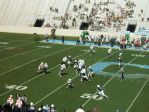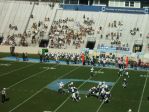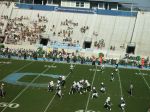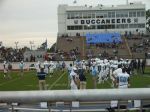
2014 Football, Game 8: The Citadel vs. Western Carolina

The Citadel vs. Western Carolina, to be played to be played in Cullowhee, North Carolina, on the grounds of Bob Waters Field at E.J. Whitmire Stadium, with kickoff at 2:00 pm ET on Saturday, October 25. The game will not be televised. 

The contest will be streamed for free on the SoCon Digital Network, the league’s new streaming platform.

The game can be heard on radio via the various affiliates of The Citadel Sports Network. Mike Legg (the new “Voice of the Bulldogs”) will call the action alongside analyst Lee Glaze. It is also possible to listen to the action with a smartphone, using a TuneIn Radio application.

WQNT-1450 AM [audio link], originating in Charleston, will be the flagship station for The Citadel Sports Network. The pregame show and game broadcast will be produced by Jay Harper, who will also provide updates on other college football action.

Links of interest:

Game notes from The Citadel and Western Carolina

SoCon weekly release

Mike Houston at his 10/21 press conference

Mike Houston on the SoCon teleconference

Mark Speir on the SoCon teleconference

Great starts key great start for WCU football

Carson Smith was reinstated by the SoCon on Wednesday, following an appeal by The Citadel to the league’s executive committee. This will allow Smith to participate in Saturday’s game against Western Carolina.

I’m glad the executive committee made the right decision. Obviously, it would have been nice if the call on the field had not been botched in the first place, but you can’t have everything. Smith will presumably be more than ready to go against the Catamounts after missing almost the entire Chattanooga contest following the errant ejection.

The league’s press release was rather perfunctory, consisting of only eight sentences. It wouldn’t have been a bad idea for the SoCon to include an explanation from the committee as to why it overturned the suspension, but to be honest I wasn’t expecting an angry screed from the conference about the injustice of the situation.

That’s my job.

You may recall that last year, Western Carolina played what I called “Division I’s most absurd schedule”, as it faced three FBS squads (Middle Tennessee State, Virginia Tech, and Auburn) and two transitional FBS schools (Appalachian State and Georgia Southern), all on the road. This, after having not beaten a Division I team of any kind (FBS or FCS) since September of 2010.

That was last year. WCU eventually did pick up that elusive D1 victory later in 2013 (beating Elon in OT at Homecoming), but finished with a 2-10 record.

In 2014, things have changed. Western Carolina is still loading up on FBS opponents, with two this season (South Florida in the opener, Alabama in the finale), but the Catamounts currently sport a 5-2 record that includes three SoCon victories, including two straight.

That 3-0 SoCon record is a very big deal for WCU, given that the Catamounts entered this season having only won four league games since 2006. Western Carolina had lost 29 of its last 30 conference matchups prior to 2014.

WCU hasn’t been 3-0 in the league since 1994. If the Catamounts win on Saturday, they will match their best-ever league start.

It has taken time, but Mark Speir appears to have things moving in the right direction in Cullowhee. A competitive WCU program is good for the league, in my opinion.

The Citadel has won eight of its last ten meetings with the Catamounts, but clearly is going to have to get better going forward to continue having the upper hand in this series. That’s okay, though; the military college has to get better on the gridiron anyway.

While there is no question that Western Carolina has improved, I’m a little uncertain as to the level of improvement. WCU has defeated two non-D1 schools (Brevard and Catawba), a team with QB injury problems (Furman), and a conference debutant (Mercer).

However, the Catamounts can also claim a 26-14 home victory over Wofford. In that game, WCU ran back the opening kickoff for a touchdown, blocked a 24-yard field goal attempt, forced a fumble when the Terriers had 2nd-and-goal on the 1, and picked up a safety on another Wofford miscue.

Western Carolina actually had fewer total yards than the Terriers. On the other hand, Wofford had averaged 430 rushing yards in its previous eight games against the Catamounts, but was held to 270 yards on the ground this time. Wofford also had no aerial attack in that contest, completing just one pass for three yards.

That is an impressive defensive performance.

WCU’s season opener was a loss to South Florida in which the Catamounts led at halftime and only lost by five points (36-31). Western Carolina quarterback Troy Mitchell was 46-66 (not a typo) passing for 374 yards against the Bulls.

Mark Speir had a notable quote after that game, which after all was a very solid effort against an FBS program:

There will be no more moral victories in Cullowhee. You either win or you lose. We lost.

The Catamounts’ other defeat came at Presbyterian by a 19-14 score. PC won that game thanks mostly to a pair of pick-sixes, including one in the last two minutes of the game. Western Carolina outgained the Blue Hose 359-222, but couldn’t overcome five turnovers (including four interceptions).

The dynamics of the reshuffled SoCon and the loss to Presbyterian combine to make it difficult to assess just how good Western Carolina is this year. In all fairness, though, PC is 3-1 against FCS opposition so far this season. The Blue Hose spoiled Charleston Southern’s homecoming last week, suggesting Harold Nichols has turned the corner in Clinton.

Some general statistics for consideration:

Western Carolina has passed (or been sacked attempting to throw the ball) on 42.9% of its plays. It should be noted, though, that 53.5% of WCU’s total offense has come via the air; the Catamounts are second in the SoCon in offensive pass efficiency.

WCU is third in the SoCon in scoring offense and (perhaps more surprisingly) second in the league in scoring defense. Western Carolina is third in both total offense and defense in the conference.

The Catamounts are averaging 4.5 yards per rush and 7.4 yards per pass attempt; those numbers combine for  a 5.7 yards/play average. As a comparison, The Citadel’s offense has a 5.4 yards/play average, while the Bulldogs’ D is allowing 6.1 yards per snap.

WCU’s defense leads the league in defensive pass efficiency, but is only sixth-best in rush D. The Catamounts are allowing 4.5 yards per rush, a higher average than any SoCon squad except VMI and (sigh) The Citadel.

Western Carolina leads the SoCon in kickoff return average and is second in interceptions (conversely, The Citadel’s defense has yet to pick off a pass in 2014). WCU’s kickoff coverage unit isn’t nearly as good as its return team, as it’s next-to-last in the league.

WCU is the second-most penalized team in the league. However, The Citadel is last in the league in opponents’ penalty yardage.

The Bulldogs simply don’t force the opposition to make mistakes that result in penalties. Either that, or officials are simply less inclined to flag teams playing The Citadel; you be the judge.*

The Citadel and Western Carolina are 1-2 in the conference in third-down conversion rate (47.5% for the Bulldogs, 44.9% for the Catamounts). While Western Carolina’s D is middle-of-the-pack in third-down conversion rate against (39.6%), The Citadel is dead last in that category (a very poor 49.5%).

The Catamounts have dominated fourth down in 2014, converting 8 of 11 tries on offense and only allowing 4 of 12 conversions on defense. Both marks lead the conference.

Western Carolina’s offensive red zone touchdown rate is 73.9%, tied for the second-highest mark in the league (The Citadel’s offensive RZ TD rate: 72.4%). Defensively, WCU has a red zone TD rate of 52.4%; The Citadel’s 50% defensive TD rate in the red zone is the SoCon’s best.

*I threw that last line in for the commish.

Troy Mitchell is the starting quarterback for the Catamounts, and the key to WCU’s offense. He has been playing hurt in recent weeks, but Mark Speir downplayed that in the SoCon media teleconference:

“He’s a lot better. He threw the ball well last week, had the zip back on his passes. He gets a little bit sore, but is having no pain. I would say he was about 90-to-95-percent last week. With our athletic trainers, he’s done a great job in rehabbing. He’s back to 100-percent, Troy’s at full speed.”

Mitchell (6’0″, 205 lbs.) is a dual-threat quarterback, especially against The Citadel. The native of Houston has two career 100-yard rushing games; both have come versus the Bulldogs. In last season’s game, Mitchell was also 16-22 passing against The Citadel for 136 yards and a TD (with one interception).

This season, he is completing 65.4% of his passes, averaging 7.3 yards per attempt. Mitchell has thrown eleven touchdown passes while only being intercepted three times.

His rushing numbers in 2014 are relatively modest, averaging 4.0 yards per attempt, and 43 rush yards per game. That’s still the third-highest rush yardage total for the Catamounts.

Backup QB Garrett Brown has appeared in all seven games thus far for Western Carolina, and will likely see action on Saturday as well. Brown has changed roles a couple of times during his career in Cullowhee, having played running back and receiver as well as quarterback. As a freshman in 2011, he caught a 61-yard TD pass against The Citadel (and like this week’s contest, that was WCU’s homecoming game).

Darius Ramsey is the primary running back for WCU. Like Mitchell, Ramsey is a junior, one of many third-year players who have “grown up” in Mark Speir’s program. Also like Mitchell, Ramsey has two 100-yard rushing games on his résumé against The Citadel, having run for 118 yards in 2012 versus the Bulldogs and 102 yards in last season’s matchup (scoring two touchdowns).

Western Carolina has experience and productivity at the wide receiver position. Spearman Robinson (6’4″, 215 lbs.) has eight touchdown receptions this season. He had 120 yards receiving and two touchdowns against Furman, and added three more scores (and 102 receiving yards) last week versus Mercer. He’s a major threat.

Spearman Robinson (who is from Greenwood, SC) is one of two wideouts named Robinson who start for WCU, with sophomore Terryon Robinson being the other. Terryon Robinson and Spearman Robinson (not related) both have 28 receptions for the Catamounts so far this season.

Despite not having the surname Robinson, Karnorris Benson is still allowed to start at wide receiver for Western Carolina. That’s probably because Benson caught 12 touchdown passes last season, tying a school record. He’s missed some time this season, but was back for the Mercer game, catching his first TD pass of the campaign.

Western Carolina’s starting offensive line averages 6’2″, 281 lbs. It is made up primarily of third- and fourth-year players, though left guard Ethan James is a sophomore.

Right tackle Josh Wineberg is the tallest of the group, at 6’6″. He was a preseason second-team All-SoCon selection. Starting center Jake Thornton is the grandson of former Buffalo Bills guard Billy Shaw, a Pro Football Hall of Famer.

Tangent: Billy Shaw is the only player in the Hall to have never played in the NFL, having spent his entire career (1960-1969) in the AFL.

Western Carolina’s defense normally operates out of the 4-3, though as always that is subject to change given The Citadel’s triple option attack.

Defensive end Caleb Hawkins (6’3″ 255 lbs.) leads the team in tackles for loss, with 6 1/2. Rapidly improving defensive tackle Helva Matungulu (6’5″, 280 lbs.) is a native of Kenya who played Rugby 7s before trying American football at Western Carolina.

Noseguard Ezavian Dunn is a 6’2″ 315 lb. true freshman who has started three games this season for the Catamounts, including the last two. He blocked a field goal attempt against Wofford.

Linebacker Christon Gill has 63 tackles, most on the squad. He also leads WCU in sacks with three (two of which came versus Mercer last week).

Daniel Riddle is the Catamounts’ second-leading tackler. The linebacker is a question mark for the game on Saturday after suffering a shoulder injury against Mercer (though he is listed on WCU’s depth chart as a potential starter).

Sertonuse Harris was a safety in 2013; this year, he’s an impact linebacker. So far this season, Harris has six tackles for loss, two sacks, an interception, three pass breakups, and two fumble recoveries.

The Catamounts have a fine secondary, led by sophomore cornerback Trey Morgan (who has four interceptions to lead the conference). Morgan is from North Augusta, and is one of seven South Carolinians on Western Carolina’s roster.

Strong safety Ace Clark has good size (6’3″, 220 lbs.) and athleticism (he blocked a field goal attempt against The Citadel last year). Clark was a second-team all-SoCon pick by the league’s coaches following last season.

Sophomore safety Bryson Jordan is the son of former Falcon/Brave Brian Jordan.

Placekicker Richard Sigmon has only attempted three field goals this season, making all three (with a long of 33). He is also perfect on PATs. Last season, Sigmon was 10-13 on field goal attempts, and did not miss from inside 39 yards (8-8).

Sigmon has shared kickoff duties this season with Mark Powell.

Destry Barnwell is a true freshman from Charlotte who has done all the punting for Western Carolina this season. Barnwell is averaging 40.0 yards per punt, with eight of his thirty-three punts landing inside the 20-yard line (he also has four touchbacks).

Backup running back Detrez Newsome is the primary kick returner, and he’s a good one. He is averaging over 30 yards per return and took one back 100 yards for a TD to open the game against Wofford.

Terryon Robinson or Garrett Brown will serve as WCU’s punt returner on Saturday, as regular return man C.J. Goodman is out.

Odds and ends:

– Next season, Western Carolina will again play multiple FBS opponents. WCU will square off against Texas A&M and Tennessee in 2015.

– The game against The Citadel on Saturday will be Western Carolina’s Homecoming. The Catamounts and Bulldogs have met six times during Homecoming in Cullowhee; The Citadel is 5-1 in those games, with WCU’s sole victory coming in 2009.

Western Carolina was 0-5 entering that 2009 game, but defeated the Bulldogs 14-10 in one of the more inept offensive performances of the Kevin Higgins era.

– The Citadel also lost to WCU the following season, in 2010, which was the last time the Catamounts had beaten a Division I program until last year’s game against Elon.

– Bob Waters Field is an artificial surface. The most recent change in the field came in 2008, with the installation of Desso Challenge Pro 2 turf, a “nylon-like, woven base interlaced with synthetic ‘blades of grass’ that are approximately two inches in length.”

– Western Carolina’s nickname (“Catamounts”) was chosen in 1933. The second choice was “Mountain Boomers”. How great a nickname would “Mountain Boomers” have been? Oh, WCU, you missed a chance there.

Before adopting the “Catamounts” moniker, Western Carolina’s teams were known as the “Teachers” and also (according to some reports) the “Yodelers”.

– Per one source that deals in such matters, WCU is a 7-point favorite over The Citadel on Saturday. The over/under is 56.

– Spike The Bulldog is 6-2 so far in the Capital One Mascot Challenge. This week, his opponent is Boise State’s Buster Bronco.

Vote for Spike!

This is going to be a tough game for the Bulldogs. Western Carolina’s program has been imbued with a confidence that hasn’t really existed in Cullowhee in about a decade.

The players expect to win, and so does the fan base. My understanding is that Whitmire Stadium will be filled close to capacity on Saturday, so the atmosphere should be excellent.

I expect a fair number of blue-clad fans will be in attendance on what promises to be a beautiful day in the mountains. I can’t be among them this week, alas.

That’s okay, though. What is much more important is that the team comes ready to play.

When I watch the game on the SoCon Digital Network (hopefully figuring out a way to “simulcast” it with Mike Legg and Lee Glaze on the radio call), I expect to see spirit and commitment, things that appeared to be absent during the Chattanooga game. That is imperative.

I also want to see crisp play on both sides of the ball. For each and every game, I expect to see improvement in the team’s play. That obviously didn’t happen last week.

If things don’t get better, the Bulldogs won’t have much of a chance. However, I suspect The Citadel will rebound this week. If it does, I think there is an opportunity to pull off a road victory on Saturday.

Go Dogs!

Game review, 2014: Chattanooga

Links of interest:

Game story, The Post and Courier

“Notes” section, The Post and Courier

Box score

This isn’t going to be lengthy, because it doesn’t have to be…

I do not understand why a team is not ready to play a football game. There aren’t that many of them in a season. Shouldn’t players have the required intensity for each and every game?

The lack of fire in the Bulldogs on Saturday was striking, and deeply disappointing. I’ve seen The Citadel lose many games over the years, but rarely have I been as disgusted in the team’s play.

This egg-laying type of performance happened occasionally in Kevin Higgins’ tenure, too, and it was just as infuriating when it happened then. I was hoping that with a new coaching staff, there would never be a question as to the Bulldogs’ effort, or desire.

When the game story in the local newspaper uses the words “sleep-walking” and “drowsy” to describe the home team (and the URL for the webpage includes “sluggish”), you know the team didn’t go about its business in an enthusiastic manner. Spirit and passion are mandatory for players when The Citadel plays a football game. Those qualities did not appear to be present on Saturday.

The lack of sharpness was most evident in the number of missed tackles by The Citadel’s defense. I’m not sure I’ve ever seen so many missed tackles by the Bulldogs’ D in a game.

Chattanooga ran 67 offensive plays from scrimmage. Based on that, I would guesstimate the Bulldogs missed about 100 tackles, as they seemed to miss 1 or 2 tackles on every play.

The Mocs averaged 7.13 yards per play. There is no telling how many extra yards UTC running backs and receivers picked up after the initial hit.

The entire contest, from The Citadel’s perspective, was bad. Offense, defense, special teams — everything. The missed tackles, though, stood out.

The best on-field performance by a member of the corps on Saturday didn’t come from one of the football players, but by a cadet who was invited to compete in a contest after the third quarter. Cadet Patton (I think that was his name) successfully threw a 25-yard pass through the goalposts, winning $100. Congratulations to him. (Nice toss, too. Good, tight spiral.)

It’s been a tough year for Mike Houston and The Citadel when it comes to officiating, and Saturday’s game brought more of the same.

(Just to make myself clear: officiating had nothing to do with the outcome of the game in any way.)

Carson Smith was ejected from the contest against Chattanooga with a little over nine minutes remaining in the first quarter. He was dismissed for throwing a punch. It was not a good call.

I’ve watched the video numerous times. I have no idea why the umpire (who threw the flag) thought Smith was throwing a punch. It was rather obviously a “football play”, to use a trite (but true) phrase. I would hate to think how many players would be ejected from games for making similar plays during a typical contest.

I’m not even sure Smith could have been called for unnecessary roughness (or a late hit), because I don’t think the whistle had blown and ended the play while he was attempting to punch the ball out of the running back’s hands. Maybe you could argue that.

I doubt anyone is going to claim that an ejection was the correct course of action on that play, because it wasn’t.

Smith, a junior, was hit with an unsportsmanlike conduct penalty on the Mocs’ second possession of the game. That resulted in an ejection, which means Smith will have to sit out all of next week’s game at Western Carolina.

Smith appeared to be trying to punch the ball away from Mocs running back Richardre Bagley when he was penalized.

“The deal with Carson really bothers me,” Houston said. “He was trying to strip the ball out, trying to punch it out and everybody in the stadium could see that. That’s deemed a punch at a player and an ejection? I don’t know … I don’t know.”

SoCon commissioner John Iamarino, on hand for the game, said there’s no review of the call unless the officials mistakenly ejected the wrong player.

Houston and SoCon coordinator of officials Jack Childress had a lengthy conversation after the Wofford game. I’m guessing any conversation the two men had on Monday would have been much shorter. There isn’t a whole lot Childress can say.

If you are an official, you have to be very, very sure of what you’ve seen to throw a player out of a game. It’s not the same as calling holding or a false start.

John Iamarino stated that there is no review of the play. I’m assuming he meant during the game itself, which is true. Targeting penalties can be reviewed at halftime in FCS football, and possibly overturned, but that’s a recent NCAA rule change and there is no provision for other kinds of ejections.

However, the additional one-game suspension is not an NCAA stipulation, from what I understand. That’s a league rule.

As such, I see no reason why the league can’t acknowledge an error by a game official and waive the additional one-game penalty. It strikes me as the fair thing to do. Otherwise, Carson Smith will miss almost two full games because an official made a mistake.

We’ll see what the conference does as the game against Western Carolina draws nearer.

This week’s pictures, taken by a bad (and glum) photographer:


2014 Football, Game 7: The Citadel vs. Chattanooga

The Citadel vs. Chattanooga, to be played at historic Johnson Hagood Stadium, with kickoff at 12:00 pm ET on Saturday, October 18. The game will be televised by the American Sports Network (affiliate list), with Darren Goldwater providing play-by-play and Corey Miller supplying analysis.

The contest will not be streamed on the SoCon Digital Network, the league’s new streaming platform. It will also not be available on ESPN3.com.

The game can be heard on radio via the various affiliates of The Citadel Sports Network. Mike Legg (the new “Voice of the Bulldogs”) will call the action alongside analyst Lee Glaze. It is also possible to listen to the action with a smartphone, using a TuneIn Radio application.

WQNT-1450 AM [audio link], originating in Charleston, will be the flagship station for The Citadel Sports Network. WQNT will have a two-hour pregame show that will be hosted by Ted Byrne. The pregame show and game broadcast will be produced by Jay Harper, who will also provide updates on other college football action.

Links of interest:

Game notes for The Citadel and Chattanooga

SoCon weekly release

Mike Houston 10/14 press conference

Mike Houston on the SoCon media teleconference

Russ Huesman 10/14 press conference

Russ Huesman on the SoCon media teleconference

Aaron Miller is the SoCon Offensive Player of the Week

Cam Jackson is the SoCon and (nationally) TSN Freshman of the Week

Brandon Eakins is WCIV-TV’s Athlete of the Week

Mid-season progress report for the Bulldogs

Mocs wary of The Citadel, especially its run game

Let’s talk about television coverage…

Chattanooga-The Citadel will be televised by the American Sports Network. What is the American Sports Network?

A total of 18 live SoCon events, including six football games, are scheduled for carriage by a network of regional Sinclair stations under the banner of the newly formed American Sports Network (ASN).

Sinclair Broadcast Group owns a bunch of stations around the country, including several in South Carolina. Most of the Sinclair stations are located in the southern and midwestern part of the United States.

In terms of the game on Saturday, this is what we’ve got:

– The game will not be streamed on the SoCon Digital Network (which is a fairly standard practice when a game is televised on “linear” TV).

– It’s not on ESPN3.com, either (unlike the Wofford game earlier or the matchup with VMI later in the season).

– It may be on a station near you. Or it may not.

For satellite TV subscribers, probably the best bet for seeing the game is Altitude Sports, which is carrying UTC-The Citadel for the Rocky Mountain region. Altitude is available as part of DirecTV’s Sports Pack; the game is listed in the guide as appearing on channel 681-1 (an alternate feed for Altitude). Dish Network should also have Altitude Sports.

There is always a possibility the game could be “blacked out” in one or more regions, but at this point I tend to doubt it. I think it will be televised nationwide on Altitude.

For cable subscribers, things may be a little trickier if Altitude Sports is not available. A lot of the local affiliates getting the game are actually carrying it on digital subchannels; for example, in Washington, DC, it will be on WJLA’s “MeTV” subchannel (D-2).

There are also certain areas within the SoCon footprint where the game will not be televised by a local affiliate, notably Columbia and Charlotte. It’s rather disappointing no station in either of those markets is getting Chattanooga-The Citadel.

At the same time the action in Johnson Hagood Stadium begins, Western Kentucky-Florida Atlantic will kick off in Boca Raton. That game is also part of the ASN package, and it’s being televised in Charlotte — but the SoCon matchup is not.

I am frankly puzzled that UTC-The Citadel is not being televised in Columbia, especially since Western Carolina-Furman was carried by Sinclair’s Columbia affiliate (WACH) earlier this year.

Obviously, there are a lot of graduates of The Citadel who live in Columbia and Charlotte. They are not going to be very happy about the way this game has been distributed.

It’s a double whammy for them, in the sense that not only is the game not on TV in their area, but they can’t watch it on the SoCon Digital Network either. Some of The Citadel’s far-flung alumni will have the same problem (the same is true for Chattanooga fans, of course).

I understand what the SoCon was trying to do with this arrangement, and I’m not inclined to be overly critical about it. However, at this point I suspect most fans would rather not have the ASN package at all, and simply take their chances with the SoCon Digital Network.

The good news, from The Citadel’s perspective, is that Saturday’s contest will be the only football game involving the Bulldogs carried by ASN this season.

Update, 10/17/2014: The game will also be televised by MASN, a regional network based in the Baltimore/Washington DC area.

Over the years, I’ve written about Chattanooga (a/k/a UT-Chattanooga, a/k/a University of Tennessee at Chattanooga, a/k/a UTC) and its branding difficulties. The school has a webpage on its varsity athletics website devoted to one essential question: What is a Moc?

 The term “Moc” is short for “Mockingbird.” Mockingbirds are fiercely territorial creatures which protect their homes with courage, determination and skill.

In the past, “Moc” was short for “Moccasin”, and referred to a snake, or a shoe, or an Indian (two of them, actually — Chief Chattamoc and, later, Chief Moccanooga). Now it’s a bird.

Chattanooga is similar to The Citadel’s most recent opponent, Charlotte, in that it has been striving for a number of years to establish a “standard” name for its sports teams, i.e. Chattanooga. In this post, I’ll refer to “Chattanooga”, “UTC”, and “Mocs” when discussing its football program.

I’ve mentioned this before, but I see no harm in repeating it. A lot of people think The Citadel is a private school, though it is not and has never been.

UTC, on the other hand, was a private college for much of its history (the school was founded in 1886). It did not become a public institution until 1969, when it merged with the University of Tennessee.

Last week, Chattanooga lost 45-10 to Tennessee. For playing the Vols in Knoxville, UTC’s department of athletics received $450,000.

It was the second time this season the Mocs had played an FBS opponent, as Chattanooga had opened the season with a 20-16 loss at Central Michigan, a game for which UTC got a check for $350,000. Chattanooga coach Russ Huesman agreed to play a second FBS school this season in part because most of the money received for playing CMU is going to help pay for a new athletics and training center, which has an estimated total price tag of $12-$14 million.

Although still in the planning stages, the new facility, which will be 50,000-60,000 square feet, will include a large team meeting room, academic lounge, expanded offices for the football staff, a state-of-the-art training room and locker room that would be a dramatic upgrade from the team’s current cramped facility.

“The one thing that will allow Chattanooga athletics to take the next step forward, like a Georgia Southern or Appalachian State or North Dakota State, is if we can get an athletics facility built,” [Mocs AD David] Blackburn said. “Given our city and geographical footprint, that’s the only thing we lack. The biggest benefit of having that new facility built is recruiting. This would help us sell the program to the type recruits our staff needs to take that next step.

Of course, Georgia Southern and Appalachian State have made the move to FBS. There is no indication that Chattanooga is in a hurry to join those two schools, though last year it was revealed that UTC was on a list of institutions that were “candidates” for Sun Belt expansion.

One of the results of Chattanooga playing two FBS opponents this season is that the Mocs only have five home games. It does help UTC a little that four of them are league contests (against three road conference matchups).

Next year, the Mocs will play Florida State.

Last year, Chattanooga came oh-so-close to finally making the FCS postseason party, a feat the football program has not accomplished since 1984, when UTC made the playoffs for the only time in school history.

That year (1984) was also the last time the Mocs had won the SoCon until last season, when they tied for the title with Furman and Samford. The Paladins received the league’s automatic bid to the playoffs by winning a tiebreaker, while Samford garnered the conference’s sole at-large berth.

Chattanooga was left home with an 8-4 record (the most wins for the program since 1980). The critical loss was probably an overtime setback at Samford late in the season.

The SoCon’s major postseason awards were split last season, with the media and coaches differing on most of their selections. The Mocs swept the coach’s honors, however, with Russ Huesman (Coach of the Year), Jacob Huesman (Offensive Player of the Year), and Davis Tull (Defensive Player of the Year) all collecting trophies.

Jacob Huesman and Tull both return this year, along with several other fine players from last season’s UTC squad. Given that, along with the upheaval in conference membership, it was no surprise when Chattanooga was picked to win the league by 29 of 30 voting media members.

Chattanooga is 3-3 so far this season. The Mocs opened the year with the aforementioned game at Central Michigan, a contest UTC led 16-0 late in the first half before the Chippewas made a comeback.

In its next game, the home opener, Chattanooga dropped a 26-23 overtime decision to Jacksonville State (which is currently ranked 8th in FCS). UTC didn’t score an offensive touchdown in that game; both of its TDs came on interception returns. The Mocs were held to 111 yards of total offense.

UTC picked up its first victory of the season at Austin Peay, soundly defeating the OVC school 42-6. After a bye week, the Mocs defeated Samford 38-24, winning the turnover battle 3-0 and also returning a punt for a touchdown.

Chattanooga then crushed VMI 55-7, with the Keydets avoiding a shutout by scoring with 36 seconds remaining in the game. In the loss to Tennessee on Saturday, the Mocs turned the ball over three times.

UTC employs a run-oriented offense, having passed the ball (or been sacked attempting to do so) on 37.3% of its plays. However, 46.2% of Chattanooga’s total offense has come via the air.

The Mocs are currently last in the SoCon in total offense, though that is often a misleading statistic. Obviously, UTC’s non-league schedule has included two FBS squads and a top-10 FCS opponent as well, though that is balanced somewhat by games against Austin Peay and new conference member VMI.

Perhaps of more concern to UTC fans is its 4.9 yards per offensive play, the second-lowest average in the SoCon (ahead of only Furman). The Mocs are averaging 4.1 yards per rush and 6.4 yards per pass attempt (Chattanooga is second in the league in offensive pass efficiency).

UTC is converting 35.7% of its third-down attempts, not a particularly good percentage (The Citadel leads the conference in that category, at 49.4%). Chattanooga’s red zone offense has been effective, however, with a TD rate of 70.6%.

The Citadel’s offensive red zone TD rate is 70.3%, a stat buoyed by last week’s performance against Charlotte, when the Bulldogs scored nine touchdowns in nine red zone trips. Samford’s 78.9% TD rate leads the league; Furman’s ghastly 35.3% TD rate is last.

Jacob Huesman is the coach’s son, but he’s not starting because of nepotism. He’s a fine dual-threat quarterback. Earlier this season against VMI, Huesman passed two different career milestones — 2,000 yards rushing, and 4,000 yards passing. He became the first player in program history to attain both marks.

In 2014, the junior signal-caller has completed 62.5% of his passes, averaging 6.38 yards per attempt, with eight touchdowns against five interceptions. Huesman threw a 70-yard touchdown pass against Central Michigan. Against VMI, he tossed four TDs in the first half, ran for another, then opened the third quarter with a 44-yard touchdown run.

Huesman has been sacked eight times this season, with four of those coming against Jacksonville State.

Running back Keon Williams was a preseason All-SoCon selection. He missed last week’s game versus Tennessee with a wrist injury, but is expected to play against The Citadel. In last year’s matchup against the Bulldogs, Williams was injured on the opening kickoff and did not play for the rest of the game.

Williams rushed for 131 yards (on 21 carries) against Samford, his one dominant performance so far this season.

Tangent: in the SoCon weekly release’s “superlatives” section, Williams is credited with 131 yards *receiving* against Samford. That’s a mistake, as all of his yardage in that game came on the ground.

Tommy Hudson has missed the last two games with a turf toe problem, but should be back this week. Mike Houston described him as a “playmaker”, and no wonder.

Hudson is a wideout who also returns punts, and when he returns a punt, he has a tendency to go a long way. He has two punt return TDs already this season (a third TD was called back due to a penalty) and is averaging 32.8 yards per return, albeit on only four attempts.

As a receiver, he is averaging 14 yards per catch, with three touchdowns. He was on the receiving end of that 70-yard TD against Central Michigan thrown by Huesman.

C.J. Board, a 6’2″ sophomore, leads the Mocs with 16 receptions. He is averaging 11.75 yards per catch. The other starting wideout for the Mocs, Xavier Borishade, caught a 33-yard TD pass against the Bulldogs last season.

Faysal Shafaat, UTC’s starting tight end, is a 6’5″, 250 lb. handful. He caught a touchdown pass against The Citadel last year, part of an all-conference campaign (and also scored against the Bulldogs in 2012). This year, the native of Orlando has been hampered by a shoulder injury, but Shafaat has been healthy for the last two weeks, and had three receptions against Tennessee last Saturday.

UTC’s offensive line suffered a blow prior to its opening game when preseason all-conference pick Synjen Herren injured his knee and was lost for the season. Herren has now been replaced at left guard by Corey Levin (who had been the left tackle), one of several moves on the line.

The o-line is fairly big (two-deep average size: 6’3″, 287 lbs.). Starting right guard Chris Mayes, who began his collegiate career at Navy, is a senior who was moved from the defensive line in the spring.

Hunter Townson is a redshirt freshman who has started the last three games at left tackle for the Mocs. Starting center Jacob Revis is also a redshirt freshman, while right tackle Brandon Morgan has made 27 career starts.

While UTC may be last in the SoCon in total offense, it leads the league in total and rush defense, and its average yards/play allowed of 4.2 is the best mark in the conference.

Chattanooga is only allowing opponents an average of 3.1 yards per rush. The Citadel will have to do much better than that if the Bulldogs are to have a chance at winning this week.

The Mocs have 17 sacks on the season, which leads the league. In second place are the Bulldogs with 15, though 10 of those came in one game (versus Gardner-Webb).

Chattanooga opponents have only converted 36.1% of their third-down attempts. UTC’s defense has given up TDs 55% of the time in the red zone; the league leader in that category happens to be The Citadel, at 51.7%.

UTC has forced 12 turnovers, second-best in the SoCon, and has a turnover margin of +3, also second-best in the league. Chattanooga has recovered six opponents’ fumbles and intercepted six passes, returning two of those errant tosses for TDs (both against Jacksonville State, as mentioned earlier).

Against The Citadel’s triple option attack, the Mocs will likely not deviate from their standard front of four down linemen.

Defensive end Davis Tull is the active FCS leader in sacks, with 32.5. He already has six sacks so far this season, with eleven total tackles for loss. Four of those tackles for loss (and two sacks) came against Samford, a game in which Tull also forced a fumble.

UTC has two quality players at the nosetackle position. Daniel Ring is a transfer from Navy who has started 17 consecutive games, while Derrick Lott is a major roadblock for any offense. Lott, who started his career at Georgia, is a 6’4″, 303 lb. wrecking ball with four sacks this year, his sixth as a collegian (he was injured for most of last season and did not play against The Citadel).

Josh Freeman has two sacks this season, and they came last week against Tennessee. The other starter on the d-line is end Zack Rayl. His backup at right end, Keionta Davis, has three sacks and two forced fumbles this year.

Middle linebacker Muhasabi Wakeel leads the team in tackles, with 49. Last year against The Citadel, he was named SoCon Defensive Player of the Week after a 17-tackle performance.

Nakevion Leslie had 17 tackles versus Central Michigan and has 36 stops on the season. Strong safety Cedric Nettles is averaging 6.8 tackles per game.

Redshirt freshman Lucas Webb is the starting free safety. He has three interceptions, two against Samford and a pick-six versus Jacksonville State.

The other player to return an interception for a TD against JSU, cornerback Dee Virgin, is a 5’10” sophomore from Donalsonville, Georgia. He is second in the SoCon in passes defended, with eight.

The other starter at cornerback for the Mocs, Jeremiah Hay, is also 5’10”, and the first junior college transfer to play for UTC since Russ Huesman became the head coach. Hay is a native of Miami who began his collegiate career at Mississippi before transferring to Pasadena (CA) City College.

Chattanooga has excellent special teams across the board. Hudson is clearly a threat to take any punt back to the house. The Mocs also have an outstanding kick coverage unit.

Placekicker Henrique Ribeiro is a native of Brazil who went to high school in Chattanooga, where he discovered football. He is 6-6 this season kicking field goals (with a long of 47), which means this game will feature two kickers yet to miss a FG this season (as The Citadel’s Eric Goins has made all seven of his field goal attempts).

Nick Pollard handles both the punting and kickoff duties for the Mocs. He is averaging 42.2 yards per punt, with no touchbacks. Eleven of his thirty-nine punts have been downed inside the 20-yard line.

Odds and ends:

– Last season, Chattanooga defeated The Citadel 28-24. I guess UTC was lucky that the final margin was four points, since the Mocs have lost 10 straight games decided by three points or less.

– Chattanooga has no players from South Carolina on its roster. The Mocs do have one Palmetto State connection, as linebackers coach Rusty Wright is from Petticoat Junction, SC.

– Aaron Miller’s 197 rushing yards against Charlotte were the most by any SoCon player so far this season. The 553 rushing yards the Bulldogs had as a team in that game were the most for any FCS squad in 2014.

– Per one source that deals in such matters, Chattanooga is a 7 1/2 point favorite over The Citadel. The over/under is 49 1/2.

– Earlier this week, The Citadel’s game next season against South Carolina was confirmed. The game will be played on November 21, 2015, and will be the final regular-season matchup that season for the military college.

The Bulldogs will play seven league games next season (four at home) and four non-conference contests (remember, next year the regular-season schedule reverts back to 11 games). The four games The Citadel will play outside the SoCon: at South Carolina, at Georgia Southern (provisionally scheduled for September 19), home against Charleston Southern (on September 26), home against Davidson (the season opener in 2015, on September 5).

This week, The Citadel’s defense will face an offense with a dual-threat quarterback, a quality running back, a big-play threat at wide receiver, and a fairly large offensive line. The Bulldogs encountered a similar cast of characters against Charlotte, and the result was not pretty. As an unwanted bonus, UTC also features a talented tight end who is a serious matchup problem.

The Bulldogs’ D has a major challenge on Saturday. It’s not an impossible one, but it’s difficult.

On the other side of the ball, The Citadel’s offensive line must win the battle up front with an outstanding defensive line, one with multiple playmakers. That will not be easy.

Chattanooga’s special teams units also tend to have the upper hand in most of its games. The Bulldogs must be very sharp in the kicking game on Saturday.

All that said, The Citadel can win this game. It’s an opportunity for the Bulldogs, a chance to make an impact on the conference title race.

It should be a nice, sunny day in Charleston on Saturday. I’m looking forward to an early kickoff at Johnson Hagood Stadium and an exciting, competitive game.

It will be even more exciting if it ends in a Bulldog victory.


Game review, 2014: Charlotte

Links of interest:

Game story, The Post and Courier

“Notes” section, The Post and Courier

Game story, The Charlotte Observer

WCSC-TV highlights; also, extended interviews with Mike Houston, Aaron Miller, Rah Muhammad, Cody Richardson, Dalton Trevino, and Cam Jackson

WCIV-TV highlights

Box score

When it was finally over, after Cody Richardson had preserved the victory for The Citadel by batting away Charlotte’s last-gasp pass, I didn’t immediately celebrate. I didn’t shout or jump for joy or high-five everyone around me.

I just sat back down, and put my head in my hands.

That game wore me out. I can’t imagine what it did to the players who played in the game, or the coaches who coached in it.

Someone asked me later how long my game review was going to be. My initial reaction was that the review would be two sentences. “We won. Thank God.”

A complete breakdown of the back and forth of this contest would be so long as to make Tolstoy throw up his hands in despair. I am certainly not going to try.

I do have a few thoughts on the game, though…

– The Citadel ran 100 plays from scrimmage on Saturday, a school record, although the two overtime periods are responsible for it being a record. The old regulation mark of 93 plays still stands, as the Bulldogs ran 92 plays from scrimmage against Charlotte before OT began (and then ran eight plays in overtime action).

Actually, The Citadel ran 102 plays from scrimmage, but two of them didn’t count because of penalties.

Of those 100 plays, twenty-five of them went for ten yards or more. Yes, one-fourth of The Citadel’s offensive plays resulted in a gain of at least ten yards.

That’s almost twice as many as the total number of plays the Bulldogs ran that went for no yardage, or lost yardage. The Citadel had thirteen of those — nine incomplete passes, two running plays for no gain, and two running plays that lost one and two yards, respectively.

The Bulldogs had twenty running plays of 10+ yards, and six other rushes that gained nine yards. That means exactly one-third of The Citadel’s 78 running plays wound up as gains of 9+ yards.

In a way, it makes you wonder why The Citadel threw as often as it did, but I’m not going to question any of Brent Thompson’s playcalling. Why should I? His offense finished with 36 first downs, 689 yards of total offense, an average gain of almost seven yards per play, and nine TDs.

That’s good enough for me. It’s good enough for anybody. I’m just glad it was (barely) good enough to win the game on Saturday.

– Attention, slick coaching move alert: this alert went off late in the fourth quarter, when a trick punt formation by The Citadel forced Charlotte to call its remaining timeout. That lost timeout for the 49ers was arguably crucial in helping the Bulldogs survive until overtime. Nicely done, Mike Houston.

– In my game preview, I referred to Charlotte wide receiver Austin Duke as “very good, and very dangerous.” He was all of that and more against the Bulldogs, despite dropping two potential TD passes during the game.

The 49ers’ season-long propensity for big plays continued unabated on Saturday. Six of Charlotte’s seven touchdowns were thirteen yards or longer; 83- and 71-yard TDs for Duke, a 13-yard reception for Trent Bostick, and touchdown runs by Duke (15 yards), Kalif Phillips (26 yards) and Maetron Thomas (25 yards to open the first overtime period).

In addition to those touchdowns, the 49ers had five other runs of 15+ yards and pass completions of 15, 21, and 28 yards.

– The one thing Charlotte struggled with at times on offense was finishing drives when it got close to the goal line. The 49ers only scored three touchdowns in seven red zone trips (conversely, The Citadel’s nine offensive trips inside the 20 all resulted in TDs).

Charlotte had trouble punching the ball into the end zone the closer it got to it. Duke scored from 15 yards out on the 49ers’ first possession, but UNCC’s third drive bogged down after having first-and-goal from the Bulldogs’ 8-yard line, and Charlotte settled for a field goal.

The 49ers subsequently scored from 13 yards out on a pass to Bostick, and Duke later had a 7-yard TD catch, but Charlotte wasted other opportunities deep in Bulldog territory. The Citadel stopped Charlotte on downs at the 10-yard line on a 4th-and-2 play in the third quarter (when the 49ers were in position to take their first lead of the game). Charlotte was held to another field goal later in the game after having 2nd-and-goal on the Bulldogs’ 4-yard line.

Of course, the 49ers’ other goal-to-go failure came in the second overtime period, with eight plays from inside the 11-yard line (including one that resulted in a Bulldog penalty which gave Charlotte a fresh set of downs at the 3-yard line).

The game’s final sequence may have illustrated the difference between the two teams. If it’s possible to say there was a decisive factor in a 63-56 2OT game, red zone offense and defense might have been it.

– Matt Johnson has been inconsistent at times for the 49ers this season (he entered the game against the Bulldogs with 7 TDs and 8 interceptions), but the Charlotte quarterback hardly put a foot wrong on Saturday. He threw an excellent deep ball and showed good accuracy on short- and mid-range passes.

His decision-making was also good, as he made very few mistakes, none of any real consequence. His most impressive move may have actually been an incomplete pass on the next-to-last play of the game, imaginatively throwing the ball away to avoid a sack by Mitchell Jeter.

– Speaking of people who had a good game, Aaron Miller was exceptional. His performance was essentially a “how-to” guide for playing quarterback in an option offense. He made excellent reads, put the ball exactly where it needed to be on pitches, and threw the ball well all day long.

Miller was at his best when running with the football. I particularly liked how he finished runs, regularly falling forward for extra yardage while maintaining good ball security. All in all, it was a tour-de-force for #12.

– I just wanted to note here that I thought the scattered booing for Kalif Phillips when he got hurt near the end of regulation was unwarranted. Booing an injured player is always wrong, of course.

I understand that some people thought he was faking an injury to stop the clock, but it wouldn’t have affected the game anyway, since the 49ers had picked up a first down on the previous play and the clock had stopped to move the chains. As it happened, any advantage Charlotte may have gained by saving time was lost when the 49ers didn’t immediately snap the ball after the clock was re-started.

Some of the crowd’s ire may have been a result of Charlotte having several players go down (mostly on defense) as the game progressed. Phillips got “blamed” for being the last 49er to leave the field, if you will.

Phillips may have just been worn out. It would be understandable, as he took a lot of hits while toting the ball 22 times. Phillips didn’t return for the overtime periods, though I don’t think his absence affected the game’s outcome. Charlotte’s failure to score in the second OT was (as mentioned above) another example of its game-long difficulties inside the 10-yard line.

– The attendance (10,467) was both unsurprising and disappointing. Jim Senter has work to do.

I thought the amount of people on campus for Parents’ Day was fairly typical. I didn’t think it was possible for that many individuals to be in the campus bookstore at the same time, though.

The number of people tailgating didn’t seem to me to be quite as high as normal, but I could be very wrong about that. I would be willing to listen to other opinions on the subject.

– I don’t know if the coaches were a little disappointed in the limited number of fans cheering on the team during the Dogwalk. I could understand if they were, but it’s a direct reflection of the morning parade ending just prior to the players arriving at the stadium. The timing just isn’t ideal for the big weekends (Parents’ Day, Homecoming).

This week’s photo gallery (seen below) features a smattering of Saturday’s non-football activity, including some shots inside Murray Barracks, the parade, etc. You know the drill by now — the photos are not going to win any Pulitzers, there is an element of randomness, the photographer is beyond hopeless, etc. This time, there are quite a few pictures. Quantity over quality, I guess.

Mike Houston greeted the media after the game by quietly exclaiming, “Holy Cow!”

You said it, coach.


2014 Football, Game 6: The Citadel vs. Charlotte

Edit 10/12/2014 — The followup post: Game review, 2014: Charlotte

The Citadel vs. Charlotte, to be played at historic Johnson Hagood Stadium, with kickoff at 2:00 pm ET on Saturday, October 11. The game will not be televised.

The contest will be streamed for free on the SoCon Digital Network, the league’s new streaming platform.

The game can be heard on radio via the various affiliates of The Citadel Sports Network. Mike Legg (the new “Voice of the Bulldogs”) will call the action alongside analyst Lee Glaze. It is also possible to listen to the action with a smartphone, using a TuneIn Radio application.

WQNT-1450 AM [audio link], originating in Charleston, will be the flagship station for The Citadel Sports Network. WQNT will have a two-hour pregame show prior to each home football game that will be hosted by Ted Byrne. The pregame show and game broadcast will be produced by Jay Harper, who will also provide updates on other college football action.

Links of interest:

Game notes for The Citadel and Charlotte

SoCon weekly release

Mike Houston 10/7 press conference

Mike Houston on the SoCon media teleconference

Video clip of Brad Lambert’s 10/7 press conference

49ers face undesirable option

Mitchell Jeter is the SoCon Defensive Player of the Week

Profile of DeAndre Schoultz by The Aiken Standard

Mike Houston said of his team and the game against Wofford that “we’re moving on“, and that’s fine with me. That’s not to say the ruling on the game’s final play will be forgotten. There will always be a giant asterisk associated with that contest.

This week’s opponent is Charlotte. I grew up referring to the school as “UNC Charlotte” or “UNCC”.

Now, however, the school wishes to be referred to simply as “Charlotte”, at least for its sports teams. The actual name of the institution remains the University of North Carolina at Charlotte.

It might surprise some people to know that the change to “Charlotte” for varsity athletics was actually made in 2000. I think it’s fair to say that it’s taken a while to catch on as the default name. Of course, continuing to call the school “UNC Charlotte” in other arenas has probably made it harder to get everyone on board with the move.

In this post, I’ll mostly call the football team “Charlotte” or the “49ers”. I’ll throw in an occasional “UNCC”, though, in honor of the great Cedric “Cornbread” Maxwell.

The city of Charlotte had wanted a public school to call its own since the end of the Civil War, but it had to wait a while. When the State of North Carolina decided to establish a land-grant college in 1887 (after an argument over the terms of the Morrill Land-Grant Act), the location of the new school was in play.

However, Charlotte lost out to Raleigh, which became the home of the North Carolina College of Agriculture and Mechanic Arts. That school is now known, of course, as North Carolina State University.

In 1946, North Carolina opened fourteen evening college centers across the state in an attempt to meet the educational demand created by returning World War II veterans. One of the fourteen centers was in Charlotte.

Three years later, the state closed the schools, but the Charlotte Center was taken over by the city and renamed Charlotte College, operating as a two-year program. That takeover-and-survival happened in 1949, and is the primary reason the university’s sports teams are now called the 49ers.

The college moved to its current campus in 1961, became a four-year school in 1964, and was made part of the UNC university system in 1965. It is now the fourth-largest school in the system and has over 27,000 students, including 21,500 undergraduates.

While this is the second year of Charlotte’s modern-day football program, the school actually fielded teams in 1946, 1947, and 1948. They were known as the “Owls” (due to the students attending classes at night) and played other schools’ JV squads.

In 1947, the Owls played a Thanksgiving Day game against a team called the “Brookland-Cayce All-Stars” in Columbia. The coach that season was a former guard at Clemson named Marion “Footsie” Woods.

Why did the school decide to start (or technically, re-start) a football program? Chancellor Philip Dubois:

This is a long-term strategic plan that will pay huge dividends for students, alumni, faculty and staff at this vibrant university. It will foster a full university experience that many students crave as undergraduates.

It also will help build closer relationships with our growing ranks of UNC Charlotte alumni and the greater Charlotte community. Despite the economic challenges facing us all, this university is growing by leaps and bounds. We expect to have 35,000 students on campus by 2020 and we have strong support for football. We expect that will grow even stronger as we get closer to making it a reality.

Another factor may have been trying to create a common bond among students at what is still in many respects a commuter school (only 24% of undergraduates live on campus). Then there was the sentiment expressed by at least one alumnus:

For us to be a real school, and for us to have a college community that schools with football have, we had to have football.

Originally, Charlotte was going to be an FCS program, with no real designs (at least officially) on moving up to FBS. That changed in a hurry. From May of 2012:

A source with knowledge of the football-driven situation confirmed to the Observer on Tuesday afternoon that the 49ers will return to the league they played in from 1995-2005…

…The timing of Charlotte’s move is not known. The 49ers begin playing football in 2013 as an FCS (formerly I-AA) independent and must stay at that level for at least two years before moving up to FBS. Charlotte’s other sports programs could conceivably join CUSA earlier than that.

That is exactly what happened. (Another move mentioned in the linked blog post that didn’t happen: a CUSA-Mountain West merger. Uh, no.)

Next season Charlotte’s football program will begin competing in CUSA. Is it ready for that jump?

So far, the 49ers’ progress on the gridiron has arguably been a little slower than fellow CUSA startups Old Dominion and UTSA. ODU won seven games against scholarship D-1 programs in its second season, while UTSA won eight games in its second campaign, including five against FBS teams.

To be fair, it’s still early. The rest of Year 2, and the following seasons to come, will tell the tale.

Charlotte was 5-6 in 2013. The 49ers made their debut at Jerry Richardson Stadium with a 52-7 thrashing of Campbell, part of a 4-2 start to the season that included a a 42-21 win at Presbyterian and a dramatic, come-from-way-behind 53-51 victory over Gardner-Webb. In the latter contest, Charlotte trailed by 21 points entering the fourth quarter, but scored 29 points in the final period (including touchdowns on three consecutive offensive plays) to get the win.

The rest of the year was a bit of a struggle, however. Charlotte lost four straight games, including sizable defeats to UNC-Pembroke, Charleston Southern, and Coastal Carolina. The 49ers also lost to Division III Wesley College before closing their initial campaign with a resounding 61-17 victory over Morehead State.

UNCC opened this year by winning at Campbell 33-9, then hammering Johnson C. Smith 56-0. The 49ers followed that up with a 40-28 victory over North Carolina Central, though there were warning signs despite the triumph.

In that game, Charlotte led 40-0 after three quarters, but had to put its starters back on the field later in the fourth quarter to ensure its large lead wouldn’t be completely blown.

The next game was a matchup at Elon, and the 49ers lost their first game of the season 20-13. Charleston Southern then came to town and left with a 47-41 OT victory, a contest that Charlotte trailed 34-17 before making a valiant comeback.

Last week, the 49ers went to Gardner-Webb and lost 27-24, scoring a late TD to pull within three points, but never getting the ball back after the Runnin’ Bulldogs recovered an onside kick. Charlotte is now 3-3 on the season.

The head coach of the 49ers is Brad Lambert, who was a defensive back at Kansas State in the mid-1980s before beginning a career as a college coach. Lambert was on Jim Donnan’s staffs at Marshall and Georgia before taking a job as Jim Grobe’s linebackers coach at Wake Forest in 2000.

Six years later, Wake Forest would win an improbable ACC title and play in the Orange Bowl. The following season, Lambert would become the Demon Deacons’ defensive coordinator. The job with the 49ers is Lambert’s first head coaching position.

On offense, Charlotte runs a no-huddle, hurry-up spread offense. The 49ers run the ball 58% of the time, but 54% of their total yardage has come via the pass.

The pass completion rate is 51%, averaging 8.7 yards per attempt. Charlotte has thrown seven touchdown passes, but has been intercepted ten times. The 49ers are averaging 5.4 yards per rush.

In its last three games (all losses), Charlotte really struggled on third down. The 49ers were 5-15 against Elon, 2-9 against Charleston Southern, and 2-14 against Gardner-Webb.

One thing that stands out about Charlotte’s numbers are the number of plays from scrimmage, both for the 49ers and their opponents, particularly in relation to time of possession.

UNCC is averaging 68.3 offensive plays per game, which is not an exceptional amount. However, it’s actually a high rate when you consider that Charlotte has a time of possession average of only 24:40. Opponents have had the ball almost eleven minutes more per game than the 49ers.

Charlotte’s offense is thus running 2.77 plays per minute, which is a very high number. For comparison, Coastal Carolina (which likes to line up and go, too) averaged 2.57 plays per game in 2013.

So far this season, The Citadel’s offense is averaging 2.23 plays per minute (last year, that number was 2.03).

This has a tendency to skew both the offensive and defensive statistics for the 49ers. What it does to the defense on a practical level is open to question. It certainly hasn’t helped the D in its last three games.

Elon had the ball for 36:17 against the 49ers. Charleston Southern’s time of possession was 41:52. Gardner-Webb’s was 36:49.

That can wear out a defense. Charleston Southern ran 89 plays in regulation from the line of scrimmage (not counting plays wiped out by penalty).

Elon ran 97 offensive plays against Charlotte. The Phoenix has not run more than 76 plays in any other game this year, but may have decided to go up-tempo to take advantage of the 49ers’ lack of depth.

Charlotte is a big-play team in every respect. It gets ’em, and it gives ’em up. Offense, defense, special teams — 49er games are rollercoaster affairs.

The offense has produced twelve pass plays of 35 yards or more, including three in its last game against Gardner-Webb for 55, 59 (TD), and 80 (TD) yards. The 49ers have had six rushing plays of 40+ yards, including a 77-yard TD run versus Charleston Southern and a 70-yard rush against North Carolina Central.

That tendency to break a long gainer is a major reason why Charlotte has had 11 touchdown drives this season that lasted less than 1:30 in duration. Three of those possessions were one-play scoring drives.

The defense has chipped in with three scoring plays of its own, including a pick-six last week in the Gardner-Webb game.

Conversely, opponents have also had some moments to savor. Charleston Southern had two 45-yard plays, a run and a pass reception (with the run going for a TD).

Gardner-Webb’s scoring plays included a 71-yard reception and a 95-yard kickoff return, and the Runnin’ Bulldogs had two other pass plays of 30+ yards. North Carolina Central’s four 4th-quarter touchdowns included a fumble return by its defense and a 21-yard reception (with a 35-yard completion setting up another Eagles TD).

Charlotte and its opponents have combined to average 4.7 turnovers per game and 16 penalties per contest. Also, while the 49ers have had a solid year kicking field goals (14-18), their opponents are only 5-15.

In other words, Charlotte’s games this season have featured a lot of erratic but entertaining play.

Starting quarterback Matt Johnson has started every game for Charlotte over the past two seasons. He’s a big QB (6’3″, 230 lbs.) who can run or pass. He threw for 335 yards against Charleston Southern, and ran for 150 yards versus North Carolina Central.

Like several of the 49ers’ skill position players, he’s a big-play threat. Johnson can make it happen via the air (eight completed passes of 50+ yards) or the ground (a 70-yard run against North Carolina Central and a 49-yarder versus Gardner-Webb).

In the SoCon media teleconference, Mike Houston described Charlotte running back Kalif Phillips as “dynamic”. He’s a 5’11”, 205 lb. sophomore from Kannapolis.

Phillips is averaging 5.6 yards per carry and almost 100 yards rushing per game. He has ten rushing touchdowns, including a long of 77 yards versus Charleston Southern. Phillips can catch the ball, but has not really been asked to do so this season (only two receptions).

The most difficult individual matchup for The Citadel on Saturday might be 5’9″, 152 lb. receiver Austin Duke, a true blazer from Independence High School in Charlotte.

He caught 62 passes last season for 727 yards and six touchdowns, and is well on his way to exceeding those numbers this year. In fact, Duke is likely to surpass his 2013 reception yardage against The Citadel, as he already has 712 yards receiving through six games (on 44 receptions).

Duke is averaging over 16 yards per reception and has five TDs, including an 80-yarder against Gardner-Webb, a 65-yard score versus North Carolina Central, and touchdowns of 61 and 74 yards against Charleston Southern. His TD catch versus Elon went for a mere 19 yards. He’s very good, and very dangerous.

Fellow wideout Dmarjai Devine is more than capable of picking up the slack if teams pay too much attention to Duke (if it’s possible to pay too much attention to Duke). Devine has caught twelve passes this season, including 55- and 59-yarders just last week against Gardner-Webb.

Will Thomas, who backs up Duke at receiver, was Charlotte’s first official football signee.

The 49ers’ H-back, Justin Bolus, went to James Island High School. He has a relatively modest six catches so far this season, but Bolus bears watching — he burned Campbell for a 62-yard reception. Bolus underwent stomach surgery twice in 2012, but returned to the gridiron and played in all 11 games the following year.

Charlotte has a large offensive line, with both tackles and both guards starting every game this season for the 49ers. Average height and weight of the starters: 6’4″, 304 lbs.

Right guard Daniel Blitch, a redshirt senior, is a transfer from Wake Forest. Blitch and right tackle Danny Book (who started his career at Albany) are both 6’6″; left guard Casey Perry, at 335 lbs., is the heaviest of the starters.

The 49ers operate out of a base 3-4 defense, though how they decide to line up against The Citadel’s triple option attack is another matter. While Charlotte has already played one option team in Charleston Southern, the Bulldogs will present a slightly different look.

“This is truly a triple-option,” said Charlotte coach Brad Lambert…”It’s very similar to what they run at Navy, Georgia Tech and Georgia Southern that we’ve seen before. Over the years we’ve played against this kind of offense quite a bit. So we know what we’re getting into.”

[Mike] Houston knows what he’s doing with the triple-option. He rode it all the way to the NCAA Division II championship game at Lenoir-Rhyne last season. After three years as the Bears’ coach, he left for The Citadel in January.

“Mike’s won a truckload of games over the years,” Lambert said. “Wherever he’s been, he’s been a proven winner.”

…[Aaron] Miller “is operating the offense pretty good,” Lambert said. “He’s making better decisions the further they get into it.”…

…“We’ve got to stay fundamental against them,” Charlotte safety Desmond Cooper said. “They’ll be running, running, running, then hit you with a pass.”

Mike Houston described the 49ers’ defense as “tall, lean, and athletic”, adding that “they run very well”.

The defensive line is rangy, with no player on the two-deep shorter than 6’2″. The heaviest member of the d-line is starting nosetackle Larry Ogunjobi, a 275 lb. redshirt sophomore from Greensboro.

Charlotte has had some injury problems in its linebacking corps. The two starting inside linebackers on the season’s first depth chart are both out. Their replacements are both redshirt freshmen; one of them, Dustin Crouser, has two interceptions for UNCC.

Outside linebacker Nico Alcalde (6’2″, 205 lbs.) has started every game for the 49ers over the last two seasons. Fellow outside ‘backer Tyler DeStefani (6’4″, 220 lbs.) is a redshirt senior pursuing a masters’ degree in mathematical finance.

Safety Branden Dozier has a fumble return and an interception return for a touchdown this season. He’s a transfer from Butler County Community College who wears #3, the same number sported by 49ers running back Kalif Phillips.

Fellow safety Desmond Cooper is also a transfer, having started his career at Wake Forest. Cooper is a redshirt senior.

Cornerback Greg Cunningham Jr. has two interceptions this year, one of six Charlotte players with at least one pick. Cunningham is 6’2″, while the other starting corner, the excellently named Tank Norman, is 5’10”.

Placekicker Blake Brewer is 12-16 converting field goals this season, with a long of 50 yards. He also serves as the 49ers’ kickoff specialist.

Arthur Hart, the starting punter, is a freshman from Grafton, Wisconsin. He attended the Model Secondary School for the Deaf and Hard of Hearing in Washington, DC. Hart has been hard of hearing since birth.

He is averaging 36.6 yards per punt, not a huge number. However, only one of Hart’s 27 punts this season has been returned (for six yards).

Damarrel Alexander is Kalif Phillips’ backup at running back and also the principal kick returner for the 49ers. He has a long return this season of 30 yards. Austin Duke also returns kickoffs for Charlotte (though only one so far this year).

Ardy Holmes, a transfer from Marshall, is the starting punt returner. Holmes took over those duties against Gardner-Webb after regular return man Corey Nesmith suffered a foot injury.

Odds and ends:

– The Citadel is the first SoCon team that Charlotte has played, either this year or last. The 49ers have played six games against Big South opposition (going 2-4) and are 1-1 versus MEAC teams and 0-2 against CAA squads.

– Saturday’s game will, rather curiously, be the last road game of the season for Charlotte. The 49ers will have a bye next week and then play their final four games at home, against James Madison, Coastal Carolina, Wesley College, and Morehead State.

– Charlotte’s tight ends coach, Johnson Richardson, was a tight end at Wofford before beginning his coaching career. He is the grandson of Carolina Panthers owner Jerry Richardson, for whom the 49ers’ football stadium is named (Richardson gave the school $10 million to help it build the facility).

– For the third time this season, The Citadel will play a gridiron opponent for the first time, with Charlotte joining Coastal Carolina and Gardner-Webb in that category.

– Per one source that deals in such matters, The Citadel is a 12-point favorite over Charlotte (as of Thursday morning). As always, keep in mind that FCS odds are often…odd.

– Charlotte is transitioning to FBS status and thus is in the process of increasing its scholarship allotment for football. According to Adam Smith of the Burlington Times-News, the 49ers currently have about 75 players on scholarship. The ceiling for FBS is 85; the limit for equivalencies in FCS is 63.

– In a recent interview, Jim Senter mentioned that under his administration, facility rentals would be a key element in providing incoming funds to the department of athletics.

It is no surprise, then, that a page devoted to such rentals recently popped up on the school’s sports website.

– This weekend is Parents’ Weekend at The Citadel, and as usual there are a lot of things going on all over campus. I don’t know how many people will be in attendance at Johnson Hagood Stadium, but there is no doubt in my mind that the tailgating areas will be packed to capacity. They always are.

– Congratulations to the seniors who will get their rings this week. As always, a reminder: rings are nice, but diplomas are even nicer.

– I’m also happy for the freshmen who this week will pass the first of many benchmarks in their cadet careers. I’m sure they thought cadre would never end, but it could have been worse.

They could have been freshmen during a cadre period that lasted until November 2. [Involuntary shudder]

– Spike The Bulldog is now 5-1 in the Capitol One Mascot Challenge, having triumphed over Iowa State’s Cy The Cardinal last week. This week, our hero takes on Big Red, the nightmare-inducing mascot for Western Kentucky.

Vote for Spike!

I have two main concerns about this game:

– Charlotte has a lot of talented players. The 49ers may not be the deepest team, but you only have to play 11 at a time.

Will the Bulldogs be able to contain Austin Duke and Kalif Phillips? How does the defense prevent a dual-threat QB like Matt Johnson from having a big game?

Can the offense move the ball consistently and avoid the turnover bug? The 49ers, if nothing else, are a ball-hawking squad.

– The other consideration is more psychological. Mike Houston said “we’re moving on,” and it’s important that the players do just that.

My greatest fear is that the call at the end of the Wofford game winds up costing The Citadel not one but two wins, because of a hangover effect. The coaches must prevent that from happening.

One thing everyone learned over this past week is that The Citadel’s fan base is a passionate group. It demands effort and quality in all areas.

I’m quite sure Mike Houston already knew that, but I suspect new AD Jim Senter may now have a new appreciation for just how much the fans care about the football program (and the school). They can be a boisterous lot, too.

I’ll be in the stands on Saturday, along with a few of my occasionally rowdy friends. I have high hopes for the atmosphere at Johnson Hagood Stadium this weekend.

I also have high hopes for a victory.

2014 Football, Game 5: The Citadel vs. Wofford

The Citadel vs. Wofford, to be played at Gibbs Stadium in Spartanburg, South Carolina, with kickoff at 1:30 pm ET on Saturday, October 4. The game will not be televised. It will be streamed on ESPN3.com, with Darren Goldwater providing play-by-play and Corey Miller supplying the analysis.

The game can be heard on radio via the various affiliates of The Citadel Sports Network. Mike Legg (the new “Voice of the Bulldogs”) will call the action alongside analyst Lee Glaze. It is also possible to listen to the action with a smartphone, using a TuneIn Radio application.

WQNT-1450 AM [audio link], originating in Charleston, will be the flagship station for The Citadel Sports Network. The two-hour pregame show and game broadcast will be produced by Jay Harper, who will also provide updates on other college football action.

Note: this game will NOT be streamed on the SoCon Digital Network.

Links of interest:

Game notes from The Citadel and Wofford

SoCon weekly release

Bulldogs “break big”

Mike Houston on the SoCon teleconference

Mike Ayers on the SoCon teleconference and at his media luncheon

This is the eighth time in the last nine years the game between The Citadel and Wofford is being televised over the air (SportSouth, SCETV, etc.) or streamed on ESPN3.com. For the third year in the row, the game is on ESPN3.com, and for the third year in the row Darren Goldwater will be handling play-by-play.

Last year, Goldwater worked this game with Paul Maguire. This time, his analyst is former South Carolina linebacker Corey Miller.

Over the past ten seasons (counting this one), The Citadel has only won three times when appearing on television/ESPN3.com, though the Bulldogs did beat Samford last year in an ESPN3 game. The Citadel has to improve its winning percentage in “TV games”, if for no other reason than because the football program is going to appear on television/ESPN3.com more often going forward.

I mentioned in my review of the Gardner-Webb game that even though there were a lot of positives to be taken away from the contest, there is still a lot of room for improvement for The Citadel. I’ll mention just a few things that need to get better, or are cause for concern.

– Placekicking was, by and large, a success story last week. All three field goal attempts were converted, and they were critical to the eventual victory.

The Citadel’s Eric Goins is 5-5 on field goal attempts for the season, which is outstanding. Unfortunately, the Bulldogs are only 4-7 converting PATs (and missed one against Gardner-Webb).

One of the oldest clichés in gridiron lore is that missing a short kick or PAT will “come back to haunt ’em”. There is a lot of truth to that, though.

Admittedly, I’ll take those three-point FGs over single-point PATs every time. It’s just that in football, teams have to be greedy. They need all the points.

The Citadel has been a little lucky with a couple of deflections, too, although maybe not as lucky as Wofford was in this matchup two years ago (Domonic Jones is probably still wondering how that ball traveled so far).

– It finally happened last week. The Citadel forced a turnover, the first of the season for the defense (a fumble recovery by Joe Crochet after a Carson Smith sack).

However, the Bulldogs still lost the turnover battle to Gardner-Webb 2-1 (yes, the weird de facto onside kick in the first half counts as a lost fumble). The defense has to make those game-changing plays.

I know that’s a tough thing to say just after The Citadel’s D sets a school record for sacks, but turnovers matter. The Bulldogs need to force a lot more of them.

The Citadel only had one pass breakup (and no interceptions) on 35 Gardner-Webb passing attempts. Even given the Bulldogs’ style of secondary coverage (a “don’t give up the big play” strategy), that’s too low a number.

– Despite rushing for 323 yards against Gardner-Webb, The Citadel had a lot of rushing attempts that went for short yardage, and that can be a problem when trying to stay “on schedule”.

The Bulldogs rushed 58 times. On 34 of those occasions, The Citadel gained three or fewer yards. That’s 58.6% of the time, and strikes me as being a little problematic.

Of course, a couple of those short-yardage plays went for touchdowns. Jake Stenson can’t gain more than three yards on a three-yard TD run. That isn’t the issue.

However, 16 of the 26 first-down running plays The Citadel had against Gardner-Webb resulted in gains of three yards or less. That put more pressure on subsequent second (and third) downs.

It didn’t hurt The Citadel much last Saturday, largely because of the success the Bulldogs had on first-down passing plays. Against other defenses, though, The Citadel has to be a little better when it runs the ball on first down.

Last year against Wofford, the Bulldogs rushed the ball 15 times on first down. The Citadel gained three yards or less on ten of those plays, a big reason the Bulldogs were 3-15 on third-down conversion attempts.

For the entire game, The Citadel gained three or fewer yards on 23 of 38 rushing attempts (60.5%; that statistic does not include sacks). The Bulldogs threw the ball 22 times, often in obvious passing situations. In related news, The Citadel did not score an offensive touchdown.

Oddly, while I’ve just written a few paragraphs discussing how The Citadel needs to improve its rushing attack, I suspect the passing game may be the key element again this week…

Wofford is 2-2 entering SoCon play, but trying to figure out if it’s a good 2-2 or a bad 2-2 or even a mediocre 2-2 is not easy. It’s possible that even Wofford fans aren’t entirely sure what to make of their squad this year.

On the SoCon media teleconference, Mike Ayers said that his team could play like “superstar[s]” or like the participants for “some of those Pop Warner teams that play at halftime”.

The Terriers opened the season with a 38-19 loss to Georgia Tech in Atlanta, but only trailed 24-19 in that game with ten minutes to play. Now, the Yellow Jackets are erratic (and also currently undefeated), but the Terriers should get some credit for holding Georgia Tech to 226 yards rushing.

Wofford outrushed the Jackets and also had the edge in time of possession. Georgia Tech averaged 17.6 yards per pass attempt, however.

All in all, it was a very decent effort by Wofford against an FBS squad.

After taking a week off, Wofford hosted D-2 North Greenville, winning 42-27. This was a rather weird contest that featured two lightning delays. To cap things off, with less than two minutes to play the lights went out in Gibbs Stadium (while a punt was in midair), and everybody decided to just go home. If you include delays, by that point the game had lasted for five hours.

The Terriers piled up the rushing yards (377 on 53 attempts), but were actually outgained on the (very long) night by the Crusaders, thanks to 370 North Greenville passing yards.

Wofford then lost 43-36 at Gardner-Webb. The Terriers were leading 28-14 late in the second quarter, but gave up a TD with seven seconds remaining in the half, and were outscored 23-8 after the break.

Gardner-Webb allowed the Terriers to rush for 322 yards, exactly one yard less than The Citadel managed against the Runnin’ Bulldogs. However, Wofford only ran the ball 47 times against G-W, while The Citadel rushed 58 times.

While Gardner-Webb picked up a relatively modest 232 yards passing against Wofford, G-W was only sacked twice. That was a far cry from the ten sacks it would give up in Charleston a week later.

The passing yardage total also doesn’t account for multiple defensive pass interference calls against Wofford during the game (the Terriers finished with 91 yards in penalties). Gardner-Webb had three passing touchdowns in the game, including the winning score with 2:04 to play.

Last week, Wofford defeated UVA-Wise (a provisional Division II school) 49-15 in Spartanburg. The Terriers dominated early, let the Highland Cavaliers drift back into the game (it was 28-15 midway through the third quarter), then closed out the contest on a 21-0 run.

After the first possession of the second half, Wofford adjusted its pass defense. The Terriers eschewed their traditional man-to-man coverage for more zone, a move necessitated by UVA-Wise’s success throwing the ball.

It worked, as Wofford held UVA-Wise to 35 yards passing on its final four possessions after making the switch, with two interceptions.

Mike Ayers:

We’re not really good at playing man-to-man right now, not with the way things are being called. We just can’t do it. If we defend six times, we’ll probably get four pass-interference calls. You can’t do it that way. It keeps moving the sticks and affords them the opportunity to keep doing it.

You look at the game and it was a carbon copy of Gardner-Webb (43-36 loss in the previous game). It’s going to be that way against anyone that has the ability to throw the football and has a big guy that we don’t match up with very well. We’re not going to play a whole lot of man-to-man from now on. I promise you that.

Earlier in this post, I mentioned that The Citadel’s passing attack could be a key factor in this game. I think I’ve illustrated in the last few paragraphs why that is the case.

The Bulldogs simply have to take advantage of what appears to be a weakness in the Terriers’ defense. That is particularly true because other than pass defense, I think Wofford may actually be in good shape for its SoCon campaign.

Wofford’s offense is led by redshirt sophomore quarterback Evan Jacks, the latest in a long line of solid signal-callers for the Terriers. He will provide a major challenge for The Citadel’s defense.

Jacks has rushed 45 times for 250 yards and two touchdowns. He is averaging 8.6 yards per pass attempt and is completing just under 60% of his throws, with three TD passes and three interceptions.

Against North Greenville, Jacks threw an 85-yard touchdown pass. He had a 45-yard TD run versus Gardner-Webb.

Jacks is a third-generation college football player, as his father played for Connecticut and his grandfather was a QB at Penn.

The Terriers appear to have found their latest star fullback in the person of sophomore Lorenzo Long, who was lightly recruited out of Pensacola, Florida. It may be that prep running backs in Pensacola are given short shrift because they can’t measure up to the most celebrated high school running back to ever come out of Pensacola — Emmitt Smith.

Long has 318 yards on 51 carries, with six touchdowns. He had 151 yards rushing against Gardner-Webb, and 138 yards versus North Greenville. Long has three runs of 40+ yards this season, and has also returned kickoffs.

Wofford halfback Ray Smith had a 92-yard touchdown run against Georgia Tech, which was (rather amazingly, at least to me) the longest run against the Yellow Jackets in that program’s entire history. Smith’s future children and grandchildren will hear about that gallop many times.

The other starting halfback for the Terriers, Will Gay, rushed for 81 yards in last year’s game against the Bulldogs (on only nine carries) and also caught a TD pass. Gay is Wofford’s primary punt returner as well.

The strength of the Terriers’ offensive line is probably on the right side. Redshirt junior T.J. Chamberlin, a preseason first-team All-SoCon selection, is the right guard. Sophomore Anton Wahrby (a second-team preseason pick) is the right tackle.

Wahrby is a native of Sweden who was a foreign exchange student at Lexington High School. He presumably was one of the larger exchange students in Palmetto State history, as the 6’4″ Wahrby currently tips the scales at 290 lbs.

Will Irwin was on the receiving end of that 85-yard pass from Jacks against North Greenville, He also had a nine-yard TD run in that game on an end-around. Last season, Irwin had a 30-yard touchdown catch against The Citadel.

Wade Francis backs up Irwin at wide receiver. Francis had six receptions (including a TD) against Gardner-Webb.

The defense for the Terriers suffered a blow when starting linebacker Travis Thomas (a fifth-year senior) tore his Achilles’ tendon in the game against Gardner-Webb. He has been replaced by redshirt freshman Daryl Vining.

On the SoCon teleconference, Mike Houston said Wofford defensive end Tarek Odom was probably the best defensive lineman The Citadel will have faced (outside of Florida State’s DL group) this season. He was “all over the field” against Georgia Tech, and is explosive “with a great motor”.

Odom was a first-team All-SoCon choice after last season, and was a preseason all-league pick this year. He is joined on the line by nosetackle E.J. Speller, a tough 290 lb. junior who also drew praise from Houston.

Inside linebacker Kevin Thomas leads the Terriers in tackles through four games. He was second on the team in tackles last season, a year in which he also had 8.5 tackles for loss.

Both of Wofford’s starting cornerbacks were preseason second-team All-SoCon selections. Bernard Williams started all eleven games for the Terriers last season, forcing three fumbles and leading Wofford defenders in passes broken up.

Chris Armfield also started all eleven contests in 2013, and led the league in interceptions with three. Armfield intercepted a pass against UVA-Wise and returned it 60 yards, setting up a touchdown.

Backup cornerback Brion Anderson has two interceptions this season.

Free safety Jaleel Green has started all four games this season for Wofford, and has an interception return for a TD to his credit (versus UVA-Wise). The strong safety position has been a bit of a revolving door, with three different Terriers having started in that role.

Redshirt freshman David Marvin had a very impressive debut against Georgia Tech, converting both of his field goal attempts (one a 51-yarder) and punting four times for an average of 43.5 yards per kick. He also handled kickoff duties for the Terriers.

Unfortunately, Marvin suffered a sprained knee during the game, which led to Wofford having to scramble for a replacement (or three).

In his stead, reserve defensive back Michael Sarafianos handled extra points, while Brian Sanders punted (and continued to hold on placekicks). Also appearing for the Terriers: backup soccer goalkeeper Ben Bruggeworth, who performed the kickoff duties. When he kicked off for Wofford against North Greenville, it was the first time Bruggeworth had appeared in a high school or college football game.

Marvin is back as the team’s placekicker (resuming those duties last week), with Sanders remaining the first-team punter and Bruggeworth the kickoff specialist. Michael Comer is the Terriers’ veteran long snapper.

Odds and ends:

– Wofford doesn’t have a band, so it usually brings in a “guest band”. This week, for the first time, Gibbs Stadium will be graced by the presence of the band from Orangeburg-Wilkinson High School, a/k/a the “Orange Pride“.

The Orange Pride Marching Band is greatly renowned, and always resplendent in the O-W school colors of maroon and orange. It will easily be the smartest group of high school students to ever provide musical entertainment at Wofford.

– At halftime, Wofford will recognize its 2014 Hall of Fame honorees.

– It will be “Family Weekend” at Wofford.

– Scheduling info: Wofford will play games at Clemson and at Idaho in 2015. I have no idea what Wofford is getting out of the Idaho game, to be honest.

In 2016, the Terriers have a game at Mississippi.

– Per at least one site that deals in such matters, The Citadel is a two-point favorite on Saturday, which just goes to show how much attention is paid to FCS games by oddsmakers (and bettors in general). That is to say, almost none.

The over/under is 51.5, incidentally.

– Spike The Bulldog is 4-1 in the Capital One Challenge. This week, he is battling Cy The Cardinal, the mascot for Iowa State.

Vote for Spike!

This is a game that a lot of us upperclassmen and guys who were here last year have been waiting for. I think there is a little bit of a revenge factor.

I’m going to return to this quote. First, let’s talk about the importance of the game against Wofford on Saturday.

It’s important because The Citadel needs to win more games, establish momentum, and successfully compete in the Southern Conference. It’s not important because of what happened in 1916 or 1959 or 1987 or 1998 (and I say that as someone with a great respect for history).

Aaron Miller and Rah Muhammad shouldn’t care about any kind of losing streak. Whatever happened when John Zernhelt or Ellis Johnson or Don Powers were at The Citadel doesn’t matter. This year matters.

I know that a lot of our alums want to see us beat Wofford. Heck, I do too. I want us to beat Wofford every year. I want us to win all of our games every year.

By paying too much attention to the recent past, though, there is a risk of playing against history rather than facing the here-and-now. If prior events are overly emphasized, a team can be psyched out rather than psyched up.

Wofford is a solid, well-coached squad. It isn’t perfect, as the defensive problems I’ve outlined above suggest, but it’s fully capable of beating any team in the league. I don’t want the Bulldogs to play last year’s Wofford team, or 2004’s Wofford team, or any of the teams in between.

I want the Bulldogs to play the 2014 edition of the Terriers. I also want the Bulldogs to win.

It’s important not to get too wound up about things like a streak or some kind of “revenge factor”.

Oh, that quote above? That’s not from any of The Citadel’s players. It’s a comment made by Wofford linebacker Drake Michaelson before the Terriers’ game against Gardner-Webb.

Michaelson was talking about Wofford playing Gardner-Webb this year after losing the game to G-W last season. The Terriers may have been waiting for another shot at the Runnin’ Bulldogs, but in the end Gardner-Webb won again.

Ultimately, players should be highly motivated to play each and every game. It’s not that long a season, after all.

I plan on being in Spartanburg on Saturday, and I hope a lot of fellow blue-clad fans also make the trip. From a scheduling perspective, one thing the SoCon has done which I appreciate is stagger The Citadel’s annual games against Furman and Wofford, so that there is one game in the Upstate each season, instead of two in one season and no games in the next.

This year, that game is at Wofford. It should be a very nice day. It would be a really nice day if the Bulldogs could pull off a victory.

Game review, 2014: Gardner-Webb

Links of interest:

Game story, The Post and Courier

“Notes” section, The Post and Courier

Photo gallery, The Post and Courier

School release

Game story, The Shelby Star

Video from WCSC-TV, including interview with Mike Houston

Box score

It’s good to win, especially when the month of September is coming to a close and you haven’t won yet. The victory over Gardner-Webb was cathartic for both the team and its fans.

The Citadel did a lot of things right on Saturday night, but the Bulldogs weren’t perfect. I’m going to discuss a few things that could stand improvement when I preview the Wofford game later in the week.

Having said that, there were a lot of positives in this game, on the field and off. What follows are a few observations (and the usual assortment of motley pictures).

– I wrote this at the beginning of my preview of the Gardner-Webb game:

The Citadel is averaging 3.36 yards per pass. This is obviously not good enough. Neither is a pass completion rate of 24.2%. The Bulldogs currently rank last in FCS football in passing yards per game.

Obviously, The Citadel is not going to throw the ball all over the field in its triple option offense. However, when the Bulldogs do pass the ball, they need to make it count. Not only must they complete more passes, they have to go for more yardage. The longest completion so far this season has been 24 yards.

The Citadel turned things around in the passing game by changing its approach at the beginning of the contest, throwing the ball on the first two plays from scrimmage. Gardner-Webb was caught flat-footed by the Bulldogs’ Air Raid attack, and before all the cadets had filed into the stands, The Citadel had its first lead of the season.

The Bulldogs averaged 12.4 yards per pass attempt, which will usually get it done. Aaron Miller’s second throw of the day went to Rudder Brown, who caught the ball and then crisscrossed the field for a 47-yard gain. That almost doubled the previous long reception of the season (24 yards).

Ten of The Citadel’s fifteen pass attempts came on first down. Indeed, the Bulldogs threw the ball 28% of the time on first down versus Gardner-Webb, twice as often as the first three games (14%). Breaking tendencies, anyone?

– Aaron Miller completed eight passes during the game, while his counterpart for Gardner-Webb, Lucas Beatty, completed 29. Despite that discrepancy, each quarterback completed passes to six different receivers.

I could describe that as an oddity, but it’s not. The Citadel may not throw the ball a lot, but that doesn’t mean the Bulldogs lack capable pass-catchers. There is considerable depth in that department.

– Through three games, opponents had converted 33% of their 3rd-and-long attempts against The Citadel’s defense, which was obviously too high a percentage. The Bulldogs did a much better job on Saturday, as Gardner-Webb only picked up one first down on seven 3rd-and-long situations.

G-W was 0-6 attempting a pass on 3rd-and-long (with three of those plays resulting in sacks by The Citadel). Gardner-Webb’s only successful 3rd-and-long conversion was a run by quarterback Lucas Beatty after he broke containment.

– It isn’t often a fan can be generally satisfied with his team’s pass defense when the opposing quarterback is 29-35 through the air, averages eight yards per attempt, and is not intercepted. That was the case on Saturday, however. Of course, recording ten sacks (and the accompanying 70 yards of lost yardage for G-W) does make a difference, especially when four of those sacks come on third down. Recovering a fumble on one of those sacks helps, too.

– There was one coaching decision during the game I questioned, although not for long. During the second quarter, Gardner-Webb began a possession at The Citadel’s 35-yard line after a fumble recovery-and-return (the fumble was bogus, but whatever).

After starting the drive with an incomplete pass, Beatty was sacked by the law firm of Thomas & Jeter on second down. That left G-W with a 3rd-and-18 situation.

On third down, a completed pass returned the ball to the original line of scrimmage. However, G-W was called for holding on the play.

Mike Houston then had the option of accepting the penalty, and setting up 3rd-and-28 from the Gardner-Webb 47; or declining the penalty and taking the result of the play, which would leave G-W with 4th-and-10 from The Citadel’s 35. He chose to decline the penalty.

I would have been inclined to take the penalty, myself. It was obvious Gardner-Webb would go for it on 4th down in that situation (Carroll McCray certainly wasn’t going to have his placekicker attempt a 52-yard field goal).

It would have been tough to decline the penalty, and then have Gardner-Webb pick up the first down. Ten yards wasn’t that unmanageable, either.

At least, that’s what I thought, and then on 4th down Tevin Floyd raced through the G-W offensive line and sacked the quarterback in 0.7 seconds. I immediately shouted, “Good decision, coach!”

Score one for Mike Houston.

– The 1960 throwbacks were a hit with the crowd. Very sharp. If you want to buy one, check out the auction.

I’ve been critical of The Citadel’s constant uniform tinkering in the past, but the helmet tweaking for Military Appreciation Day was excellent. You can see the uniforms up close in The Post and Courier‘s photo gallery.

– I also appreciated the small (and not so small) touches for Military Appreciation Day, including the red-white-blue end zone motif. I thought that on the whole, the school did a very nice job on that front.

– Hey, the band played more than twice during the game! It was noticed, too.

There are still a few things to get worked out. Twice during the second quarter, the videoboard went into sound-explosion mode just as the band started to play, so a little more coordination is still needed.

I gather the band will need time to expand its repertoire, so it may be next year before the ideal is reached, but that’s okay. Baby steps.

They did play the theme from “Hawaii 5-0”, although I’m not sure everyone heard it. The acoustics at Johnson Hagood Stadium are a bit of an issue.

– I thought the freshmen were in good form on Saturday. Some (not all) of the upperclassmen weren’t quite as spirited.

One thing all the cadets (and other supporters) did like was the placekicking contest following the third quarter. There is nothing quite as enjoyable as watching a fellow member of the corps attempt a 35-yard field goal in his shined leathers.

I would advocate more cadet-oriented contests. There should be at least three such events during the game.

– In my opinion, the cheerleading squad makes a difference, and was badly missed during its hiatus. Also making a difference: the omnipresent Spike The Bulldog, surely the hardest-working anthropomorphic mascot in college athletics.

– Attendance was low, officially announced as 8,573. I think that was an accurate total.

There were a lot of factors at play: South Carolina played a home game at the same time, Clemson was on TV at the same time, the weather was threatening, Gardner-Webb didn’t bring many fans, and the home team was 0-3. That said, it was the smallest crowd at Johnson Hagood Stadium I could recall since the Thursday night game against Benedict in 2004.

Improving home football attendance is just one of the many tasks for new AD Jim Senter, but it’s an important one. Longtime fans can remember when attendance at The Citadel’s home games was significantly higher.

In the game program on Saturday was a blurb with the headline “On This Day in Citadel Football History”, which noted that on September 27, 1980, The Citadel defeated UT-Chattanooga 29-13 at Johnson Hagood Stadium. Attendance for that game was 18,345 — almost 10,000 more than showed up at Johnson Hagood Stadium for a game exactly 34 years later.

Below are some pictures I took before and during the game. Some of them are actually in focus.

2014 Football, Game 4: The Citadel vs. Gardner-Webb

The Citadel vs. Gardner-Webb, to be played at historic Johnson Hagood Stadium, with kickoff at 6:00 pm ET on Saturday, September 27. The game will not be televised.

The contest will be streamed for free on the SoCon Digital Network, the league’s new streaming platform.

The game can be heard on radio via the various affiliates of The Citadel Sports Network. Mike Legg (the new “Voice of the Bulldogs”) will call the action alongside analyst Lee Glaze. It is also possible to listen to the action with a smartphone, using a TuneIn Radio application.

WQNT-1450 AM [audio link], originating in Charleston, will be the flagship station for The Citadel Sports Network. WQNT will have a two-hour pregame show prior to each home football game that will be hosted by Ted Byrne. The pregame show and game broadcast will be produced by Jay Harper, who will also provide updates on other college football action.

Links of interest:

– Game notes from The Citadel and Gardner-Webb

The Bulldogs must “stick to their guns”

SoCon weekly release

Big South weekly release

Mike Houston 9/23 press conference

Mike Houston on the SoCon teleconference

Gardner-Webb head coach Carroll McCray previews The Citadel

– American Sports Network affiliate list for two SoCon football games, worth a look for future interest (namely Chattanooga-The Citadel on 10/18)

Some statistics of note through three games:

– The Citadel is averaging 3.36 yards per pass. This is obviously not good enough. Neither is a pass completion rate of 24.2%. The Bulldogs currently rank last in FCS football in passing yards per game.

Obviously, The Citadel is not going to throw the ball all over the field in its triple option offense. However, when the Bulldogs do pass the ball, they need to make it count. Not only must they complete more passes, they have to go for more yardage. The longest completion so far this season has been 24 yards.

– To succeed on third down, The Citadel has to be better on first and second down. The Bulldogs have faced 3rd-and-long (5 yards or more) no fewer than 26 times this season. That’s 60% of all third downs for The Citadel’s offense.

– Mike Houston was generally pleased with the defensive performance last week, and I can understand that. However (as I mentioned in my review), The Citadel did not force a turnover in that game or any other so far this season.

The defense needs to make more game-changing plays. The lack of turnovers and sacks (just three through three games) is a little troubling.

The Bulldogs’ secondary is guarding against big plays in the passing game, which I think is a good idea with this squad. That makes it all the more important for the front seven to pressure the quarterback, particularly on passing downs.

Opponents have had 21 3rd-and-long situations this year. They have successfully converted seven times. That’s too high (33.3%). Six of those seven conversions have come via the pass.

– This may surprise some people, given the number of times penalties have affected the Bulldogs this year, but The Citadel is tied for 12th nationally in the category of fewest penalties per game. The Bulldogs’ opponent on Saturday, Gardner-Webb, is tied for 10th.

It’s not as much the number of penalties that have hurt The Citadel, it’s the timing of those infractions. The Bulldogs cannot afford drive-killing penalties. The margin of error for The Citadel is not nearly big enough to overcome those.

Speaking of penalties, while Mike Houston is restricted in what he can say about officiating, I’m not. The officials did not have a good game last week.

There were multiple bad calls, and most of them didn’t favor The Citadel. From a technical perspective, probably the most egregious error by an official was the pass interference call on Walker Smith, which appeared to have been made by the field judge. I have no idea what the official was thinking on that play.

The men in stripes were ACC/SoCon officials, so Houston is likely to see them again during the season, making it even more important that he not burn any bridges. I did like that in his press conference, Houston referred to the referee as “White Hat”.

“White Hat” was in charge for the 2012 Army-Navy game, while his compatriot with the interesting theory on pass interference worked last year’s Sugar Bowl. It makes one wonder if officials such as these who are assigned games outside the ACC don’t fully concentrate when calling FCS games.

Gardner-Webb started its institutional life as a high school, in 1905. By 1928 it had become a junior college; the school began offering four-year degrees in 1969. It has been known as Gardner-Webb University since 1993.

The school is named for former North Carolina governor O. Max Gardner and his wife, Fay Webb Gardner, along with their families. O. Max Gardner is the only person to have ever been captain of both football teams at UNC and NC State.

Gardner-Webb is closely affiliated with the Baptist State Convention of North Carolina. The 200-acre campus is located in Boiling Springs, North Carolina. There are around 4,300 undergraduate and graduate students at Gardner-Webb; 63% of them are women.

The Runnin’ Bulldogs play their home football games in Spangler Stadium, which is a 9,000-seat multi-purpose stadium. I mention that because The Citadel’s football team may be making a trip to Boiling Springs in the next few years, perhaps in 2016.

Head coach Carroll McCray is a Gardner-Webb alum with a lot of coaching connections familiar to Bulldog fans. He was an assistant under Sparky Woods at both Appalachian State and South Carolina, spent seven seasons as the offensive line coach at Samford, then took over the Austin Peay football program as its head coach for four years (2003-06).

McCray then served as Bobby Lamb’s offensive line coach at both Furman and Mercer, before replacing Jamey Chadwell as North Greenville’s head coach in 2012. After one year there, his alma mater hired him as its head coach.

Gardner-Webb was 7-5 in McCray’s first season in charge, with victories over both Furman and Wofford (along with a puzzling 27-9 loss to VMI).

This season, the Runnin’ Bulldogs are 2-2. G-W has lost road games at Wake Forest and Furman (the game in which Paladins starting quarterback Reese Hannon broke his ankle). At home, Gardner-Webb has defeated Virginia-Lynchburg and Wofford. The 43-36 victory over the Terriers came last week.

In his Tuesday press conference, Mike Houston described Gardner-Webb as a “60-40” team in terms of its pass-run ratio. That’s about right in terms of yardage (56% of G-W’s total yards have come via the air), but the actual play calls have been very close to 50-50 (taking sacks into account).

Gardner-Webb rushed for 126 yards versus Wofford, but struggled on the ground against Furman (69 rush yards) and Wake Forest (77).

It is interesting (or perhaps curious) that the G-W defense was excellent against the run against the Paladins and Demon Deacons, more or less matching the opposing D, but allowed 322 rush yards to Wofford. In Gardner-Webb’s world, either both teams run the ball, or neither team runs the ball.

Gardner-Webb is led by quarterback Lucas Beatty, a fifth-year senior from Charlotte who has started 32 games for the Runnin’ Bulldogs during his career. This season, Beatty is completing 59% of his passes, averaging just over six yards per attempt, with five touchdowns versus two interceptions.

Beatty’s backup is a freshman, Tyrell Maxwell, who has seen limited action thus far for the Runnin’ Bulldogs. However, he has already rushed for 173 yards, and scored touchdowns against Virginia-Lynchburg, Wake Forest, and Wofford. A native of Cordova, Maxwell attended Edisto High School and was selected to last year’s Shrine Bowl.

The star offensive performer for G-W is senior wideout Kenny Cook, an imposing (6’4”, 218 lb.) target who caught 76 passes last season for over 1,000 yards and nine TDs. Cook, a native of Cross Hill, missed the Wake Forest and Virginia-Lynchburg games with an injured hamstring.

He returned against Wofford last week, catching six passes (one of which went for a touchdown). Cook will be a very difficult matchup for the Bulldogs.

Cook’s presence also allows more freedom for Beatty’s other passing targets. They include tight end Seth Cranfill, a 6’4”, 246 lb. redshirt senior who has two TD catches this year, and Deonte Swinton, another tall wideout (6’2”) who is also a redshirt senior.

Swinton is one of seven different Runnin’ Bulldogs with five or more receptions, as Beatty likes to spread the wealth. He’s not afraid to throw to his running backs, either.

One of those backs, Juanne Blount, was a preseason All-Big South pick after rushing for 1,040 yards during the 2013 campaign. He is yet another redshirt senior.

That is a recurring theme with Gardner-Webb. This is a team with a lot of experienced, older players, particularly on offense. Six of the offensive starters listed on the two-deep are redshirt seniors.

Another Runnin’ Bulldog trait is size. It’s a very tall, rangy team. Four of the starting offensive linemen are 6’4” or 6’5”, as are Cranfill and Kenny Cook. Juanne Blount is the only offensive starter under 6’1”. In addition to their size, the word “athletic” is thrown around a lot describing the majority of Gardner-Webb players.

The offense has 15 plays from scrimmage this season of 20 or more yards, ten passing and five rushing.

Gardner-Webb has taken a few hits on defense, including the loss due to injury of “spur” linebacker Chad Geter, who was leading the team in tackles after two games. Another injured linebacker, two-time All-Big South selection Tanner Burch, has yet to play for the Runnin’ Bulldogs this season.

Then there is defensive Shaq Riddick, who finished fifth in the voting for last year’s Buck Buchanan Award. Riddick would have been a fifth-year senior at Gardner-Webb this season, but elected to transfer to West Virginia for his final year of eligibility.

The Runnin’ Bulldogs are hardly bereft of quality defenders, however. From The Citadel’s perspective, perhaps the key player for Gardner-Webb is noseguard O.J. Mau, a 6’2”, 308 lb. rock in the G-W defensive line. Mau was a first-team All-Big South pick last year and is expected to contend for national honors this season.

He is still developing, too, as Mau will not turn 20 years old until the day after Gardner-Webb plays The Citadel. He is from American Samoa, and played in the 2012 Oceania Bowl, helping lead his team to a 93-7 victory over Australia.

Defensive end Tyler Hough-Jenkins is yet another large (6’4”, 274 lb.) redshirt senior. The other d-line starter is junior Jebrai Regan, a converted linebacker.

Aaron Cook, who plays the “bandit” position in Gardner-Webb’s 3-4 base defense, currently leads the team in tackles with 25. Cook is a sophomore. True freshman Jeffrey Pegues will start at one of the inside linebacker positions.

The Runnin’ Bulldogs do have some linebacking experience in the person of senior Donald Buie (taking over Geter’s “spur” role) and junior Azziz Higgins. Another player who should see action is redshirt freshman Quinton Patterson, a transfer from North Carolina State.

The defensive secondary is led by cornerback Ivan Toomer, who doubles as a kick returner for Gardner-Webb. He leads the team in pass breakups with four, and also had an interception return for a touchdown against Virginia-Lynchburg.

Toomer is one of seven different Gardner-Webb players with an interception (one each). The Runnin’ Bulldogs also have a fumble recovery (by yet another defender). Gardner-Webb has a +5 turnover margin for the season, and has scored 20 points off turnovers while allowing no points off its own turnovers.

It should be noted that three of those interceptions came against an overmatched Virginia-Lynchburg team (as did four of G-W’s nine sacks). Virginia-Lynchburg had a net rushing total of -21 yards versus Gardner-Webb.

The placekicker for the Runnin’ Bulldogs, Paul Schumacher, is a freshman from West Palm Beach, FL. He is 4-8 on field goal attempts, with a long of 29 yards. Redshirt sophomore Dustin Holder has been the punter, though Gardner-Webb’s two-deep suggests that South Carolina transfer Andrew Komornik is an option for the game against The Citadel.

Toomer and wideout J.J. Hubbard will handle kickoff return duties, with Hubbard also serving as the punt returner for the Runnin’ Bulldogs. Hubbard returned a kickoff for a touchdown last season against Charleston Southern.

A few miscellaneous numbers:

– Gardner-Webb has outscored its opponents in the third quarter 33-10. I guess Carroll McCray can give a good halftime speech.

– The Runnin’ Bulldogs have a red zone offensive TD rate of just 53% (8-15), but have excelled defensively in the red zone, with a TD rate of 45% (5-11).

– I’m not sure I believe this, but according to Gardner-Webb’s statistical summary, the Runnin’ Bulldogs have picked up 15 first downs via penalty, while the defense has not given up a single first down by penalty all season.

Odds and ends:

– Saturday is Military Appreciation Day at The Citadel. The halftime show should be a good one, with the Charleston Police Department Pipe and Drums on hand, to be followed by The Citadel Chorale (fresh from rave reviews in Boston) singing “God Bless America”.

Players will wear a helmet sticker bearing the number “440”, representing the number of cadets who have died serving their country.

Incidentally, last Saturday was Military Appreciation Day at Gardner-Webb.

– During the first quarter, fans can have their picture taken with the coveted Silver Shako. Don’t miss the chance to get a selfie with the greatest trophy in all of sports.

– Bags and purses will be subject to search this week as part of a new security policy at Johnson Hagood Stadium. This might cause a delay in entering the facility, so keep that in mind. This may be a response to an incident at the stadium during the Sertoma Classic in August, when a teenager brought a gun to the game, then threw it in one of the end zones as he was running from the police.

– Players will be wearing 1960 replica jerseys on Saturday, honoring the 1960 team that won eight games, including the Tangerine Bowl. The jerseys will be auctioned off to raise money for the department of athletics. Let’s hope these uniforms won’t be judged as illegal, unlike last season’s uniform debacle (“Unigate”).

The Citadel badly needs a victory. Do I think the Bulldogs can get one this week?

It’s possible, but to be honest I’m not very confident. My confidence doesn’t matter, though. It’s the team’s self-esteem that matters.

I hope the Bulldogs expect to win on Saturday. I hope even more that they actually win.

Game review, 2014: Charleston Southern

Links of interest:

Game story, The Post and Courier

“Notes” column, The Post and Courier

School release

Box score

Brief comments:

– While I wasn’t surprised the Bulldogs lost, I was disappointed in how they played. They weren’t disciplined or sharp enough on Saturday night.

Special teams play reared its ugly head again, allowing a punt return TD (and was very lucky on the field goal, as it was tipped). Defensively, The Citadel allowed too many long third down conversions, including three of nine yards or more.

On offense, the Bulldogs were just 4 of 14 on third downs, not good enough for a triple option team, and evidence of a lack of success on first and second downs. Of the fourteen 3rd-down plays, eight of them were 3rd-and-7 or longer.

There were too many penalties, including multiple drive-killers (though I thought the Bulldogs were hosed at least twice by the officials on that front). The Citadel also had two lost fumbles, both costly.

– Speaking of turnovers, through three games the Bulldog D has yet to force one. No interceptions, no recovered fumbles (and only one forced fumble).

In addition, The Citadel only has three quarterback sacks so far this season. The Bulldogs have been credited with five pass breakups in 91 opponent pass attempts (5.5%). The lack of sacks and pass breakups goes a long way to explaining why Bulldog opponents are completing 71.4% of their passes.

By contrast, The Citadel has only completed 24.2% of its passes (8-33). The Bulldogs aren’t going to complete an exceptionally high percentage of passes in the triple option, but they must be better than 24%. Much better.

– I thought Mike Houston made a mistake early in the game. On the opening drive, with 4th-and-1 on the CSU 46, he decided to punt.

That’s not the percentage play, especially for the triple option offense. He let the visiting crowd down early with that call.

I’ll delve into a few more numbers when I preview the Gardner-Webb game later in the week.

Now I’m going to talk about (well, write about) the game location and future scheduling, since this has been a topic of discussion. I suspect not everyone is going to be happy with what I’m going to say.

I will preface what follows by stating the obvious: I’m not an insider. There may be more to this subject than I know. I would be shocked if that weren’t the case.

So, massive caveats and all that…

First, here is my preview of the CSU game from last week, which has some background: Link

Apparently as part of the two-year contract, The Citadel will not pay Charleston Southern any money for playing at Johnson Hagood Stadium next year. That is not a good enough reason to have made the deal, from my vantage point.

Charleston Southern presumably wants to play The Citadel on an annual basis, and home-and-home. The announced crowd for the game on Saturday was 7,954.

I think the actual attendance was probably closer to 5,500, which is nothing to apologize about, but not really that close to the 12,000-13,000 for the previous games held at Johnson Hagood Stadium. For the attendance to have been close to 8,000 fans, that would have meant at least 3,300 people would have been lined up (or in their cars/trucks) around the fence enclosing the track.

Also, that’s assuming there were 4,700 seats available at Buccaneer Field in the first place. I suspect it was more like 4,262, based on previous information released by the school.

There weren’t 3,300 people milling about around that fence.

Charleston Southern coach Jamey Chadwell emerged from the locker room Saturday night wearing a smile and a T-shirt with a message.

“Charleston, it’s Southern’s City,” read the shirt…

…”In this city and for what we are trying to make with this rivalry, it’s big on that end,” said Chadwell.

This message was also sent in a Thursday column by The Post and Courier‘s Gene Sapakoff that might as well have been ghost-written by the CSU administration. He concluded his column by implicitly wishing for a Buccaneer victory on Saturday night, but I want to highlight this statement instead:

This is a good game for the Lowcountry and there is no reason it shouldn’t continue on an annual basis well beyond a scheduled meeting next year at The Citadel. It makes financial sense for a pair of cash-strapped programs 16 miles apart.

I think it’s debatable whether or not the matchup is a “good game for the Lowcountry”. That suggests the Lowcountry awaits the matchup with tremendous anticipation. There is nothing the Lowcountry really awaits with tremendous anticipation, with the possible exception of local school board meetings.

(It also seems at odds with Sapakoff’s insistence in recent years that what the Lowcountry is really desperate for is another Clemson-South Carolina baseball game at Riley Park, but that’s another story.)

However, let’s assume it is a good game for the Lowcountry. If that were the case, and if it “makes financial sense for a pair of cash-strapped programs”, then why would anyone want to ever play it at the much smaller stadium?

I estimate between 2,000-2,500 fans of The Citadel were at the game on Saturday. It was an exceptionally good turnout considering the circumstances (including threatening weather). If the game had been held at Johnson Hagood Stadium, there probably would have been about 9,000-10,000 Bulldog supporters.

I gather folks at CSU would prefer a regular, or at least semi-regular, home-and-home series (and if I’m wrong about that, I apologize in advance for making an incorrect assumption).

They would want it for recruiting, and also to erase the stigma of being “the red-headed stepchild” on a local level (Jamey Chadwell made that comment during the Big South teleconference).

I understand that. I also understand that if The Citadel tells CSU it only will play future games at Johnson Hagood Stadium, CSU may not be interested, especially if a much larger guarantee is not part of the equation. If it’s not in the best interests of Charleston Southern to play The Citadel only at JHS, then Charleston Southern shouldn’t play The Citadel there.

My position is simple. I care about what is best for The Citadel.

There are at least two major problems with playing at CSU, in my opinion:

1) Charleston Southern’s facility is simply not of Division I caliber

It does not benefit The Citadel’s football program to play a non-conference road game at Buccaneer Field. It is not beneficial to The Citadel in recruiting. It is not beneficial to The Citadel’s fan base.

The Citadel may have made a short-term financial gain by playing at CSU on Saturday, but school administrators should be thinking about the long-term impact on the football program.

I also want to repeat something I said on Twitter, which is that quite honestly Jamey Chadwell and his players deserve better than what they have right now in North Charleston.

2) The Citadel’s future scheduling is too restrictive to have an annual home-and-home series with Charleston Southern

This is something that doesn’t always get mentioned, so I probably need to explain it in some detail.

Next year, FCS schools will revert back to an 11-game regular season schedule. That will be the case until 2019 (when FCS teams can schedule 12 games, as was the option in 2013 and 2014). After 2019, there won’t be another 12-game schedule opportunity for FCS programs until 2024.

In 2015, The Citadel will play seven SoCon games and four non-conference games: home against Charleston Southern (the second game of the current contract), home against Davidson, and road games versus Georgia Southern and South Carolina.

Beginning in 2016, the number of SoCon games on the slate will increase from seven to eight, as East Tennessee State begins league play. That leaves three non-conference games per season. One of those three will almost certainly always be a “money game” against FBS opposition (unless those games come to an end, which I tend to doubt, but that’s another issue).

In 2016, the Bulldogs are tentatively scheduled to play at North Carolina. In 2017, The Citadel will play at South Carolina.

This leaves two games on The Citadel’s schedule each year. One of them has to be a “designated home game” — in other words, a game in which the opposing school does not get a return game at its place. That’s to ensure there are at least five home games at Johnson Hagood Stadium every season.

The other game is what I will call a “flex game”. It could be a non-conference home-and-home with another FCS school, or a matchup with another FBS program. While the latter possibility may not be as likely, there are scenarios in which The Citadel would gladly take a second FBS game (especially if it were against Army or Navy).

Charleston Southern could play The Citadel every year in the “designated home game” at Johnson Hagood Stadium. However, it would not be in the best interests of The Citadel to hamstring its future scheduling by eliminating the “flex game” to play an annual home-and-home series versus CSU.

The Citadel needs the flexibility of that game to pursue opportunities that could be of significant benefit to the school and its football program, whether a “bonus” money game, a matchup with a service academy, or perhaps a home-and-home with a team outside the region.

While it is more expensive to play a home-and-home against an FCS school in another part of the country, there are important ancillary benefits to occasionally doing so. They include exposing the school to a wider audience, and reconnecting with certain parts of The Citadel’s far-flung alumni base.

I remember attending The Citadel’s game at Princeton. It was an excellent public/alumni relations event for the military college (even with the Princeton band’s, uh, involvement). I also remember the large contingent of Bulldog supporters who showed up for that contest, probably more than attended the game at Buccaneer Field on Saturday night.

Because of those considerations, among other things, I don’t see a home-and-home with CSU going forward as practical or beneficial for The Citadel.

Again, if Charleston Southern won’t play The Citadel without a home-and-home, I get that. I wouldn’t blame CSU at all for taking that stance.

I realize scheduling can be problematic. That is why ADs get paid good money — to solve those problems, and to do so in a way that is good for students, coaches, fans, and long-term program/school interests.

I didn’t take quite as many photos on Saturday as I usually do. I had trouble getting a good angle for the “action” shots, and of course I’m not a very good photographer as it is. Nevertheless, here are some pictures, mostly of dubious quality.

2014 Football, Game 3: The Citadel vs. Charleston Southern

The Citadel at Charleston Southern, a/k/a the Larry Leckonby Bowl, to be played at Buccaneer Field, with kickoff at 6:00 pm ET on Saturday, September 20. 

The game can be heard on radio via the various affiliates of The Citadel Sports Network. Mike Legg (the new “Voice of the Bulldogs”) will call the action alongside analyst Lee Glaze. It is also possible to listen to the action with a smartphone, using a TuneIn Radio application.

WQNT-1450 AM [audio link], originating in Charleston, will be the flagship station for The Citadel Sports Network. The game broadcast will be produced by Jay Harper, who will also provide updates on other college football action.

In addition, the game will be streamed by the Big South Digital Network (link).

This preview will be broken up into two distinct parts: a review of the Florida State game, and the fallout from that contest; and a preview of the Charleston Southern game, including a discussion about the fact The Citadel is the road team on Saturday.

There won’t be as much statistical minutiae in this post as usual. There will be more commentary, though.

First, however, the links.

Links of interest:

The Citadel game notes

Charleston Southern game notes

Charleston Southern roster

SoCon weekly release

Big South weekly release

Mike Houston 9/16 press conference

Mike Houston on the weekly SoCon teleconference

Jamey Chadwell on the weekly Big South teleconference

Some observations about the Florida State game, followed by a few thoughts about the story that developed afterwards:

– Despite a rainy afternoon (and the threat of more thunderstorms to come), Doak Campbell Stadium was packed. Florida State had announced on Friday that the game was a sellout, and FSU fans (along with a hardy band of Bulldog supporters) showed up in a major way for the Seminoles’ home opener.

During an ESPN GameDay segment in which there was discussion about the day’s relatively high number of small school/big school matchups, Kirk Herbstreit moaned about FBS schools playing FCS teams, running off a list of reasons why those games should not be played. Included in his diatribe was a comment that “fans aren’t going to these games”.

Well, they went to one in Tallahassee, Kirk — just like they went to one at Clemson last season when The Citadel played the Tigers.

– Mike Houston wasn’t all that excited about facing Florida State (as I wrote about in my game preview). However, he clearly gave some thought on how to approach the matchup with the Seminoles.

The result was, in my opinion, an exceptionally well-managed game by The Citadel’s head coach.

It was always going to be a struggle for the Bulldogs to hold back FSU’s offense. However, The Citadel did a fine job of keeping Jameis Winston and company off the field, controlling the clock throughout the contest.

Florida State finished the game with only nine offensive possessions, and one of them began with only twelve seconds remaining in the game, so in effect FSU only had the ball eight times the entire night. The Citadel had the edge in time of possession by over seven minutes, which led to the Seminoles running 67 plays on offense (contrast that with, say, the South Carolina State-Clemson game, where the Tigers ran 93 plays en route to a 73-7 victory).

On Saturday night, Aaron Miller routinely let the play clock move under five seconds before receiving the snap from center. That was excellent game management.

– The Bulldogs were unafraid to run the ball on third-and-medium and third-and-long situations (a feature of Brent Thompson’s offensive philosophy for any game, not just this one), and it paid off on more than one occasion. That said, The Citadel actually passed the ball a little more often than I expected — and with some success. There may not be many teams that register two TD passes against FSU’s defense this season.

Aaron Miller threw the ball well after a couple of errant tosses at the beginning of the game. The pass to Alex Glover was of particularly high quality.

Okay, about the Victor Hill situation…

I agree with the “indefinite suspension”. Hill will not play this week against Charleston Southern, and I think that is appropriate.

Mike Houston may choose to reinstate Hill after this weekend, or he may wait another week or two. I’m on board with whatever decision Houston makes on that front.

I’ll be rooting for Hill when he comes back. He’s a good player, and is also a civil engineering major. He’s smarter than his comments made him out to be.

There are Bulldog supporters who disagree with the decision, believing that Hill should not miss any games at all. After all, he didn’t do anything. No FSU players were injured by illegal blocks (as noted by, among others, Jimbo Fisher). Hill just talked (or rather, typed).

My response to that viewpoint (which I understand) is that while Hill didn’t hurt any FSU players, he did hurt his teammates, his coaches, and his school.

The Citadel’s football program (and by extension, the college as a whole) got roasted in the days immediately following Hill’s ill-advised post. Even though it wasn’t true, the less-educated elements of the mob reached a verdict: “dirty team”.

That is the kind of thing that can have a lasting effect, possibly for an entire season. If you’re Mike Houston, and you’re trying to establish a program, you cannot afford to have your offense labeled in such a fashion two games into your tenure.

Triple option teams are constantly having to defend their reputations against “cut block/chop block” naysayers. Hill’s comments won’t help. I’m sure the Bulldogs will be called for several imaginary chop blocks during the SoCon season, just because officials will be looking for penalties, even when they aren’t there.

That’s why Hill’s suspension was justified. It was based on what is best for The Citadel.

The hysterical rantings of the much-mocked “FSU Twitter” horde were not a factor. That is a good thing.

Opinions from various members of the FSU fan base ranged from laughable (demanding an NCAA investigation and the “death penalty”) to scary (a poster on SBNation’s FSU site openly wished that Hill’s family would get killed in a car accident; that comment was quickly deleted by the moderators, along with other odious statements).

There is a reason #FSUTwitter is a frequently-used hashtag (and not a complimentary one). A few wannabe trolls even tweeted at me.

Those encounters tended to confirm that a lot of fans don’t know the difference between a cut block and a chop block. One determined Seminole supporter even produced a photo, claiming it showed an illegal block (it didn’t, of course). I have to wonder how much football some of these people actually watch.

It was amusing to watch the column on my Tweetdeck application devoted to “Citadel” mentions, as seemingly desperate FSU fans would constantly tweet the same thing over and over to various college football writers and personalities, demanding attention (or a reaction) and some sort of frontier justice. One goofball even called Tim Brando’s SiriusXM program to whine, only to be more or less eviscerated by Brando and Tony Barnhart.

Ultimately, cooler heads prevailed. Jimbo Fisher’s comments probably helped in that regard, to his credit.

This week, the shoe has been on the other foot for Florida State fans, thanks to the continuing misadventures of Jameis Winston, who seems to be an unusual combination of immense talent, charisma, and complete obliviousness.

A video of Winston appearing to punch a Bulldog during the game didn’t get much traction (despite the efforts of a bunch of Clemson fans on Twitter, basically mimicking the actions of FSU twitterers from the week before). However, Winston’s bizarre (not to mention offensive and vulgar) shouting near Florida State’s Student Union certainly did. He’ll miss the first half of the Seminoles’ game against Clemson.

That may not matter, though it should be pointed out that after Winston left the game against The Citadel, the Bulldogs scored four times as many points as FSU…

Now, about the Charleston Southern contest:

The story surrounding the game this week is as much about where it is being played as it is the action on the field.

Will The Citadel’s fans go to the game?

…there is some question as to exactly how enthusiastic Bulldog fans are about making the trip to CSU Stadium, located in North Charleston off U.S. Highway 78 near Interstate 26. The Citadel ticket office sold just 170 of the 530 tickets it received from CSU for consignment, returning 360 to Charleston Southern. The Bulldogs also received 250 complimentary tickets for the 6 p.m. game.

“I was like, ‘Wow, I’m not sure of why that is,'” [The Citadel’s director of athletics, Jim] Senter said of the returned tickets. “I’m not sure if people were not aware we had tickets to be purchased, or if people think it’s sold out, or if people think Charleston Southern’s stadium is too small to accommodate Citadel fans.”

To answer one of Jim Senter’s questions, I think it is highly likely that most Bulldog fans did not know the school had tickets available for the game. I know a few people who bought tickets from Charleston Southern as soon as they could, not knowing that The Citadel also was selling tickets for the contest.

As for Senter wondering if people think CSU’s stadium is too small to accommodate The Citadel’s fans: yes, people do think the stadium is too small. They think it is too small because it is too small.

CSU Stadium has a capacity of 4,000 seats, and Charleston Southern announced last week that it would add about 700 seats to the visitors’ side of the stadium, expanding that side to 1,628 seats and the total capacity to 4,700. CSU Stadium can also accommodate standing-room only crowds, which explains last year’s record of 6,135 fans for a game against Coastal Carolina.

CSU athletic director Hank Small said Tuesday that there is not a “sell-out” limit on the number of tickets available for Saturday’s game.

“We had very large crowds last year for our Charlotte and Coastal games and did not ‘sell out’ due to the fact that we will continue to sell general admission tickets,” Small said in an e-mail. “We have very large standing room areas that will accommodate general admission. People need to plan to arrive early to be assured of a general admission seat or to purchase a reserved seat.”

After reading Hank Small’s comments, I’m guessing a significant number of hardcore Bulldog supporters made other plans for this weekend.

The previous games between the two schools were played at Johnson Hagood Stadium, with 12,000-14,000 fans in attendance for each of those contests. Now the game is being held at a 4,000-seat facility with a less-than-optimal parking/access setup and a brutally reviewed restroom situation. No one is going to be enthused about “large standing room areas”, either.

The administration at Charleston Southern probably anticipates (if not hopes) that many Bulldog fans will pass on making the trip. If the usual number of “regulars” (8,000-9,000) were to actually show up, it is hard to imagine the general infrastructure (and game management staff) being anything other than completely overwhelmed.

Incidentally, I’m not entirely sure the 4,000-seat capacity (to be increased to 4,700 for the game against The Citadel) is the “real” number. In a recent press release, Charleston Southern officials referred to “plans to add permanent additional seating over the next five years increasing stadium capacity from 3,562 to 5,320.” So is it 4,000 or 3,562?

That leads to another question, a fairly obvious one: why is this game being played at Buccaneer Field now? Why not at least wait and attempt to host the game after the next phase of stadium expansion is completed?

There is little argument as to what benefit The Citadel gets out of playing this game away from Johnson Hagood Stadium. It gets no benefit.

This game should have been played at a stadium capable of holding the usual number of fans who would have attended it. The fact that it is not is considered by many loyal Bulldog fans to be a metaphorical slap in the face, one administered by Larry Leckonby, the former AD at The Citadel.

The fact Leckonby left his position a few months later (giving the impression he already had one foot out the door when he scheduled the game) also doesn’t sit well with some observers.

All that being said:

I would urge Bulldog fans to attend this game. The reason to go to this game is to support the players and coaches who will be representing The Citadel. They deserve our support, and our presence.

Will fans have to make some adjustments? Yes. Check out the parking situation carefully before starting your drive. Make a quick trip to a place with a restroom before arriving.

(From the linked review of the facilities, which was from last year’s heavily attended game against Coastal Carolina: “On the visitor side, there are no plumbed bathrooms. Rather, the university brings in approximately fifteen port-a-johns and one larger bathroom ‘truck’…found both the [truck] toilet and faucet to be inoperable.”)

Prepare to be as patient as possible when it comes to anything and everything, especially with the threat of bad weather (bring your poncho). Keep in mind that CSU’s campus is alcohol- and tobacco-free.

Put on your light blue clothing and gear, and go to the Larry Leckonby Bowl. Go, and bring as many friends and family members as you can, and cheer like crazy for the Bulldogs.

Charleston Southern’s starting quarterback at the end of last season was Daniel Croghan, who started the final six games of the season for the Buccaneers after Malcolm Dixon was injured. Croghan was 5-1 as a starter, including wins over Charlotte and Coastal Carolina.

This year, Croghan is the backup quarterback, with UAB transfer Austin Brown taking over as Charleston Southern’s top signal-caller. Brown started fifteen games over two seasons with the Blazers, including a win over Tulane his freshman year in which he threw for 409 yards.

Brown played the first three quarters for the Buccaneers in their season-opening romp over Point (final score: 61-9). He went the distance in CSU’s 16-10 victory against Newberry, and played all but three series in Charleston Southern’s 34-10 win versus Campbell.

In the game against the Camels, Croghan played the third series of the first half, and the sixth series of the second half.

For the season, Brown is completing 60% of his passes, averaging 10.9 yards per attempt, and has thrown six touchdown passes against one interception. Brown can also run the ball (a necessity for a QB in Jamey Chadwell’s spread option offense). He is averaging 5.5 yards per carry, and had a 50-yard run against Campbell.

Christian Reyes returns as the primary running back for the Buccaneers. Reyes had 92 yards in last season’s game at Johnson Hagood Stadium, probably more than any other native of Rogue River, Oregon has ever had against the Bulldogs.

Tangent: Rogue River is such a great name for a town/river. “Roundup at Rogue River” could be the title of a Louis L’Amour novel.

Ben Robinson is the “change of pace” back for CSU. While Reyes is a fairly big running back (218 lbs.), Robinson is 5’7″, 175 lbs.

They run behind an offensive line with a good deal of experience, led by right guard Clayton Truitt. CSU also returns last year’s starters at center and both tackle spots.

Charleston Southern has experience at slot receiver with Alex Cruz and Nathan Perera, the latter having been injured for most of the last two years. Also returning: 6’8″ tight end Nathan Prater, who already has two touchdown receptions this season.

As I did last year, I would like to complain about Prater’s jersey number (81). Prater is from Ninety Six, South Carolina. How can he not wear #96?

Talk about a missed opportunity. Bill Voiselle would be very disappointed.

The other wideouts are less experienced, but do have big-play potential (Jared Scotland has three receptions for 20+ yards, including a 52-yard TD against Newberry).

CSU normally plays a 3-4 base defense, but is liable to change things up against The Citadel’s triple option attack, as do many other defenses. Last year CSU used multiple fronts throughout the game against the Bulldogs.

The Buccaneers have experience and depth along the defensive line. Notable performers include end Dylan Black and noseguard James Smith (who is listed as a co-starter on the depth chart with Isaac Lowrance, the latter having started the first three games of the season).

The linebacking corps attempts to confuse its opponents by featuring linebackers Zac Johnston (the middle ‘backer, #25) and Zach Johnson (the “spur”, #22). I bet the sports information staff at CSU can’t wait until those guys exhaust their eligibility.

Zach Johnson is backed up by freshman Bobby Ruff, whose father Brian is arguably the greatest football player in The Citadel’s long gridiron history.

Weakside linebacker Aaron Brown had a very good game against the Bulldogs last season. He currently leads the Buccaneers in tackles through three games, with twenty.

The “bandit”, Gabe Middlebrook, went to West Ashley High School, where he was All-Region in tennis. There are not a lot of Division I starting linebackers who can claim to have been All-Region in high school tennis.

The secondary features veteran free safety Demaris Freeman, a redshirt senior. Freeman leads a group that in general is not as experienced as the other units for the Buccaneers. Starting strong safety Davion Anderson is a freshman.

Charleston Southern returns its punter from last season, Truett Burns, who did a good job last season placing kicks inside the 20. So far this season, four of his thirteen punts have been downed inside the 20, though his average yards per punt (31.9) needs to improve.

Placekicking appears to still be a work in progress for the Buccaneers, with David Kennedy now designated on the depth chart as the starting placekicker, and Bryan Jordan handling kickoffs for CSU. Both are freshmen who went to Summerville High School (though Jordan turns 22 years old in December).

Long snapper Joseph Smith is a native of Easley, but he actually started his collegiate career at Delta State, where his coach was Jamey Chadwell. When the coach took the Charleston Southern job, Smith returned to his home state to continue his football career with Chadwell.

It’s hard to get a handle on how these two teams compare with one another. A statistical summary of the season thus far is probably pointless, because Charleston Southern has yet to play a scholarship Division I program, while The Citadel has played Coastal Carolina and Florida State.

It must be said, however, that Newberry is a solid Division II team (winning nine games last season). Mike Houston suggested that Newberry could hold its own in the SoCon. At the very least, the Buccaneers have had one good test.

All of CSU’s games so far have been at home, and all at night under recently installed lights. Meanwhile, The Citadel has played one home and one road game and didn’t play at all last week (Charleston Southern played on Thursday night).

Those opening four home games, by the way, are a first for a Big South team. No other school in that conference has ever hosted its first four games of the season.

A few other odds and ends:

– Derrick Freeland Jr., a freshman from Charlotte, is expected to start at right tackle for the Bulldogs in place of Victor Hill. It will be the first time Freeland has seen action for The Citadel.

– The Citadel is tied with Wofford for the FCS national lead in rushing yards per game (304.0). However, the Terriers are averaging 6.08 yards per rush, while the Bulldogs are averaging 5.02 yards per carry.

One interesting note that ties into the rushing totals: The Citadel had 65 rush attempts against Coastal Carolina, the second-most in a game by an FCS team so far this season. The Bulldogs ran the ball 56 times versus Florida State.

– Charleston Southern currently leads all of FCS in total defense and is fifth nationally in scoring defense.

– In terms of time of possession, The Citadel is tied for 24th nationally; Charleston Southern is 30th. Last season, CSU led the nation in that category.

– The Citadel is one of five FCS programs that has yet to commit a turnover this season (please don’t let that be a jinx). Charleston Southern has only committed one turnover in three games.

– Somehow, the Bulldogs have fumbled ten times this season without losing any of those fumbles. It’s a freak statistic that won’t hold up over time. The Citadel has to do a better job of hanging on to the ball.

There are a couple of things at play for Saturday’s game.

Charleston Southern has set everything up for a showpiece victory — the home game, the ralliesthe parties, the publicity generated by a potentially large crowd (at least by Buccaneer Field standards), the inevitable bandwagon column by Gene Sapakoff, etc. School officials have been targeting this game as a major event ever since the announcement was made that CSU would be hosting it.

The Buccaneers want to dominate this game, and probably expect to do so (though the players and coaches aren’t dumb enough to publicly say so). They’ve seen the Sagarin Ratings. This is a team that by the end of last season was playing better than it was at the start of 2013, when it beat The Citadel.

Mike Houston knows that. He also knows that The Citadel could use a win.

This would be a very good week to get one.

Despite everything, I think The Citadel can pull it off. It’s time for these Bulldogs to show some bite.