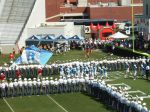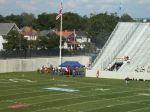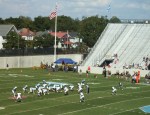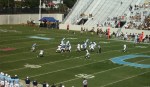
2013 Football, Game 9: The Citadel vs. Samford

The Citadel vs. Samford, to be played at historic Johnson Hagood Stadium, with kickoff at 2:00 pm ET on Saturday, November 2. The game will streamed on ESPN3.com, with play-by-play from Darren Goldwater and analysis by Paul Maguire.

It can also be heard on radio via the thirteen affiliates of The Citadel Sports Network. Danny Reed (the “Voice of the Bulldogs”) will call the action alongside analyst Josh Baker, with Lee Glaze roaming the sidelines and Walt Nadzak providing pre-game, halftime, and post-game commentary.

WQNT-1450 AM [audio link], originating in Charleston, will be the flagship station for the network; the station will have a two-hour pregame show prior to each home football game. It is also possible to listen to the game via a smartphone, using a TuneIn Radio application.

Links of interest:

The Citadel game notes

Samford game notes

SoCon weekly release

The Kevin Higgins Show

Kevin Higgins on the SoCon media teleconference

Pat Sullivan on the SoCon media teleconference

The Dogs are “down, but not out”

Jeff Hartsell’s three points about the Chattanooga game

Game story from the Chattanooga contest

—

Non-football link: my preview of the upcoming season for The Citadel’s basketball team

Hey, it’s Homecoming! Things you ought to know:

Ye olde Homecoming press release, with schedule of events

The Citadel’s freshman and sophomore wrestlers compete in The Citadel Open, beginning at 9 am on Saturday

The rifle and volleyball squads are both on the road on Saturday

Soccer’s season ended on Wednesday

Oh, and there is also a football game…

First, let me be honest here: I didn’t really follow the Chattanooga game as it was going on last week. This is the time of year when I usually take a break from my regular autumn routine, which is normally A) work and B) obsessing over sports.

Taking a respite from the fall sports season can be helpful, at least for me. As it happens [mondo nerd alert], I saw Mussel-Fishers at Berneval in person instead of watching/listening to The Citadel lose a game it led almost the whole way. I feel good about that decision.

Because I am still catching up with last week’s action in the sports world (including The Citadel’s trip to Finley Stadium), and because of other factors beyond my control, this preview may be a bit more random than usual. I apologize in advance for that.

The rest of the season is going to be tough in terms of game previews, not as much because the Bulldogs are struggling, but because I’m going to be short of time. We live in a busy world.

I have no idea how I’m going to write the VMI game preview; I might just write a one-sentence post: “The Dogs better not lose to VMI.” (It’s not like anything else needs to be said for that game.)

Anyway, below are a few comments on Saturday’s opponent, followed by some friendly advice to alums heading down to Charleston for Homecoming.

Note: “Bulldogs” refers to The Citadel, while “Birmingham Bulldogs”, “SU”, or “Baptist Tigers” will have to do for Samford.

Samford is quite formidable this year. The Birmingham Bulldogs appear to be the best team in the SoCon and would be a major challenge for The Citadel even if the Cadets were having a good season.

Last year, I wrote of Samford:

This is a team with a lot of talented players. The question, I suppose, is whether Samford has enough depth across the board to be a contender for the league title.

Samford finished 7-4 last season, not quite good enough to win the SoCon, but still a very solid campaign. SU could not get past Georgia Southern or Appalachian State last year, and also lost a tough defensive battle at Chattanooga.

In 2013, Samford still has a lot of talented players, but it has made the jump to the top of the conference. SU has already taken care of business against App and GSU, and last week won at Wofford. Only UTC seems to stand in the way of a league title for the folks from Birmingham.

Offensively, Samford has been excellent. Taking Georgia Southern and Appalachian State out of the equation (because the NCAA doesn’t count those two schools in its FCS database), the Birmingham Bulldogs lead the SoCon in total offense, passing offense, and scoring offense, and are in the top 30 nationally in all three of those categories.

Samford’s numbers are skewed slightly by its pace of play, though this season SU is only averaging 67.1 plays per game, down slightly from 71.4 in 2012 and 75.6 in 2011. However, Samford has been much more efficient this year, averaging 6.6 yards per play, a significant increase from the 4.9 yards per play it averaged in 2012.

By contrast, The Citadel is averaging 63.8 plays per game on offense, and 5.7 yards per play. Last week, Wofford ran 82 plays against Samford (with 69 rushing attempts), but only averaged 4.1 yards per play.

Oddly, Samford has had issues in the second quarter this season, being outscored 71-42 in that frame. In the other three periods, Samford has a decisive edge in points.

The Citadel has lost two straight to Samford, and that streak could easily be three; the Bulldogs’ 13-12 win in 2010 was achieved thanks mostly to special teams and inspired D inside the red zone. Samford’s defense has had all the answers for The Citadel’s triple option attack in the three years Kevin Higgins has employed the offense.

In three games against Samford’s “Bear” defensive front, The Citadel has mustered a combined total of 34 points. In those three games, the Bulldogs faced third down on 39 occasions. The Citadel only converted six of them for first downs.

Samford’s D has basically forced The Citadel to beat it by going outside or over the top, and the Bulldogs have been unable to do so with any consistency in any of those games.

In terms of yards per play, Samford defensively has not been quite as good this season (5.3 this year, after holding opponents to 4.8 y/p in 2012). One thing that will probably help Samford’s defense is that The Citadel will be the third triple option team the Birmingham Bulldogs have faced in their last four contests.

Andy Summerlin is Samford’s starting quarterback, and is enjoying his sixth (and presumably final) season of college eligibility. Yes, I said sixth.

Summerlin is 25 years old. He started his career at Memphis, although even his stint there was delayed by a semester:

He’s seven years out of high school, and is listed as a sixth-year senior after being granted an additional year of eligibility by the NCAA because of injuries. He delayed college enrollment by a semester because of a high school injury.

Though he’s been at three different schools…

To tell the truth, I’m okay with Summerlin still getting a chance to play, but then I tend to lean to the “when in doubt, give the athlete a break” side of the ledger on these matters. It does seem a bit unfair, though, that Summerlin is good to go while The Citadel’s All-American wrestler, Khishignyam Undrakhbayar (better known as “Ugi”), is out of NCAA options after just one year as a competitor. Such are the vagaries of the NCAA.

At any rate, he’s having a fine season, completing passes at a 63.8% clip for an average of over 285 yards per game, with 17 TDs (to eight different receivers) against 7 interceptions. Summerlin has made his share of big plays this year, completing 15 passes for 30+ yards.

Summerlin is joined in the backfield by the outstanding Fabian Truss, one of the elite backs in the SoCon. Truss is averaging 5.2 yards per carry this season (the same as he did last year), and he is also a threat to catch the ball, with 27 receptions, good for 9.7 yards per catch.

Truss is also a great kick returner. He already has two 100-yard TD returns this season. Truss currently leads the nation in all-purpose yardage.

The top receiver for Samford is Kelsey Pope, who has 36 receptions this year, averaging a shade over 15 yards per catch. Against Georgia Southern, Pope had receptions of 58 and 83 yards (the latter for a TD).

Samford’s offensive line is big, averaging 6’3″, 288 lbs. Left guard Kasey Morrison, a preseason second-team All-SoCon selection, has started 30 games in his career.

On defense, expect Samford to stack the middle of the line and deny the give to the B-back. Two key players to watch along the d-line in this respect are DT Jeremy Towns (like Summerlin, a sixth-year player) and noseguard Jeremy Mathis, another experienced lineman (18 starts). Both Towns and Mathis are listed at 290+ lbs.

Middle linebacker Justin Shade is a tackling machine, and he’ll put you down before or after you get to the line of scrimmage. Shade has 90 tackles so far this season; he made 19 stops against Southeastern Louisiana and 15 versus Wofford. Shade has 12.5 tackles for loss, including seven sacks.

His father, Sam Shade, is Samford’s DBs coach. If you have a good memory, you may recall the elder Shade starring at Alabama before playing eight years in the NFL.

One of Sam Shade’s pupils, Jaquiski Tartt, is Samford’s best defensive player, and one of the best defenders in the league (if not the best). So far this season he only has one interception, but Bulldog fans will remember his pick-6 against The Citadel in last year’s contest.

Samford has a solid punter in Greg Peranich, now in his third year of handling the punting duties. Peranich is averaging 43.1 yards per punt, with 16 of those landing inside the 20. Seven of his punts have gone for 50+ yards.

The placekicker for the Birmingham Bulldogs is redshirt freshman Warren Handrahan, who is 11-13 on field goal tries with a long of 48. He has only missed one PAT.

Handrahan chose to wear a bow tie for his personal team picture, however, which automatically makes him a suspicious character.

So you’re an alum about to travel to Charleston for Homecoming weekend. Maybe you’re a season-ticket holder, maybe you go to a game or two each season, or maybe you haven’t seen a game since Johnson Hagood Stadium was renovated.

You probably know that The Citadel’s football team was supposed to be good this year, but instead has a record of 2-6, and is looking at a 3-9 or 4-8 type of season. Perhaps you would like to ask some questions about this, or some other things that are related to athletics.

I’m here to help!

First, however, there is one thing you should not do. It’s hard not to do, because it’s kind of traditional, but don’t do it…

Don’t complain about or blame the corps of cadets for any shortcomings.

Is the corps perfect? No. Was it perfect when you were in school? No, it wasn’t.

There will always be a bum (or two or three) in the crowd — and as a group, they may not show a great deal of enthusiasm about the gridiron festivities. Expect this.

Also expect, though, to find almost all of the cadets to be polite, respectful, smart, and driven. Today’s corps of cadets isn’t as good as it was in your day — it is better.

When you see problems within the corps, keep in mind that those problems are usually symptoms of a larger issue with the school itself. It’s not necessarily a reflection on the student body.

I think I’m lucky in that I am around campus just enough to get a general idea of things, but not enough to become disillusioned. You can get very cynical about The Citadel in a hurry if you’re there too long, as anyone who was ever a senior at the military college can attest.

If you’re not around at all, though, then it’s possible to assume the worst.

This isn’t to say the cadets should be completely immune from criticism; it’s just that some other things need to be fixed first before worrying too much about the corps. Let Leo Mercado worry about the corps.

It also doesn’t do the school any good when it is trying to recruit the best and the brightest, and at the same time some of its alums are whining about the current crop of students. That’s just counter-productive.

The bottom line: don’t go bananas about any slacker cadets. There have always been slackers. Maybe the notion of being a slacker cadet cuts a little close to the bone…

If you’re still with me following that harangue, here are some topics that are worth discussing. I’m assuming that the average alum reading this is the biggest of big shots, someone who knows all the major players at the school in the department of athletics and within the administration in general, and who can get a personal one-on-one with any school official at any time.

Here are some questions you might consider asking:

– With last week’s loss to Chattanooga, the Bulldogs are guaranteed to finish with a non-winning record. The Citadel has not had consecutive winning seasons in football since the 1990-92 campaigns.

That stretch of futility, now at 21 years and counting, is the longest such period in the history of the school, going back to the first football season (1905).

Your question(s): is it acceptable for The Citadel to not have any stretch of consistent success on the gridiron? What are the school’s goals on that front?

– You may have noticed that The Citadel isn’t doing a lot of winning in almost any sport as of late. Even the baseball team has had losing seasons in two of the last three years (though that program appears to have rebounded). The basketball team has averaged eight wins per season over the last three years, and has a winning percentage of 26% in SoCon play during that time.

There are several varsity sports (including tennis and golf) that have been particularly non-competitive in recent years.

Your question: given that the school seems to be doing very well overall, why hasn’t that institutional success crossed over into varsity athletics?

– The Citadel’s new (as of this year) long-term strategic plan is called the LEAD Plan 2018, which I wrote about in January. I would urge anyone with an interest in The Citadel to read the plan itself.

Included in the LEAD plan are goals such as increasing membership in the Brigadier Foundation by 25%, funding full scholarships in all sports, and endowing athletic scholarship funds by an additional $5 million.

Your question: is significant progress being made towards accomplishing any of those (or other) goals?

– There is soon going to be a changing of the guard, at least of the canine variety. General and Boo IX are retiring, and will be officially replaced as the school mascots on November 15 by the relentlessly cute G2 and BX.

Donations for care and upkeep of the dogs are always appreciated. The Citadel does not provide any funding for the dogs, which strikes more than a few people as ridiculous, given the popularity of the mascots.

To be fair, I can understand why the school doesn’t allocate funds for the mascot program. What puzzles me is why the powers that be don’t publicize the need for donations more often. I’m sure it’s just an oversight.

It was suggested to me a while back that at least one administrator is afraid that people will contribute to the mascots in lieu of something else. I choose not to believe that; if it were really true, then I would happily wait in line to dump that administrator into a vat of hydrochloric acid.

Your question (if you have some spare cash): would the school be interested in starting an endowment for the mascot program?

– While you were travelling to Charleston on your private jet, you noticed while perusing your favorite college football TV listings page that all six Big South teams will either be on TV and/or ESPN3.com this Saturday. Two of those games will be on regional nets or affiliates.

Meanwhile, Samford-The Citadel will be on ESPN3.com, an online platform. This is the second ESPN3.com appearance for The Citadel this season; the football team will probably get a PPV-only TV appearance at Clemson, but other than that the Bulldogs will not appear on television in 2013.

You probably remember the days when The Citadel appeared on regional TV once or twice per season. You may wonder why the SoCon can’t do a better job of getting its teams exposure, especially when you see what similarly-sized (or even smaller) conferences are able to do in that respect.

Your question: what can The Citadel do to increase its television exposure?

The last few questions should only be asked after you enter the stadium to watch the game.

– Why don’t we have any cheerleaders?

Note: this is a trick question. No matter what answer you get to that question, it will be wrong. There is no correct answer, as The Citadel obviously should have cheerleaders.

– How come the band only plays a few times during the game?

– Is there any reason why the loudspeaker system should play the (truly horrific) pop song “Come on Eileen” instead of having the band play during that time period?

– If the band isn’t going to play, could the school make more money by renting it out for weddings and bar mitzvahs during the game?

– Is it true that prior to the Furman game, the freshmen lined up in the ‘Block C’ formation and started to chant “C-I-T-A-D-E-L”, only to be drowned out by the loudspeaker system as it played a selection from ’80s glam-rock band Poison?

– Is it possible the atmosphere at the stadium is so dominated by the ad-intensive videoboard and the ridiculously loud (and ill-used) loudspeaker system that fewer fans go to the games as a result?

– Is there anyone in the department of athletics brave enough to inform adidas that the name of the school is “The Citadel”?

Okay, I think that’s enough…for now.

Last week, The Citadel started well and Samford started poorly. The Citadel led by 10 points at halftime; meanwhile, Samford’s first offensive possession resulted in a pick-6 for Wofford, one of four turnovers SU had in that game. Ultimately, though, one group of Bulldogs could not hang on for a victory, while the other overcame an early shock to win a critical road game.

The effort in Chattanooga was very good. The team has obviously not quit, which is a credit to the players (and the coaches). Still, effort in itself is not enough, and everyone knows it.

I don’t know how the team will play on Saturday. Samford is a very difficult matchup. I cringe just thinking about the Birmingham Bulldogs’ big-play capabilities, particularly through the air (as The Citadel has been susceptible to those types of passes).

I’ll be there on Saturday, meeting a few old friends and settling in to watch some pigskin. I’m hoping for the best. I’m not counting on it.

2013 Football, Game 8: The Citadel vs. Chattanooga

The Citadel at Chattanooga, to be played in Chattanooga, Tennessee, at Finley Stadium Davenport Field, with kickoff at 2:00 pm ET on Saturday, October 26. The game can be heard on radio via the thirteen affiliates of The Citadel Sports Network. Danny Reed (the “Voice of the Bulldogs”) will call the action alongside analyst Josh Baker, with Lee Glaze roaming the sidelines.

WQNT-1450 AM [audio link], originating in Charleston, will be the flagship station for the network; the station will have a two-hour pregame show prior to each football game. It is also possible to listen to the game via a smartphone, using a TuneIn Radio application.

Links of interest:

The Citadel game notes

Chattanooga game notes

SoCon weekly release

Kevin Higgins on the SoCon media teleconference

Russ Huesman on the SoCon media teleconference

Devin Bice says it isn’t time to give up on the season

Jeff Hartsell “crunches the numbers”

Chattanooga’s red zone defense is better than superficial numbers suggest

Non-football link: my preview of the upcoming season for The Citadel’s basketball team

There are two schools of thought about how The Citadel should approach the rest of the season, in terms of on-field activity. One is that, with no real chance at the playoffs or a winning campaign, a youth movement should be accelerated.

The coaches, in that scenario, would give lots of playing time to reserves and experiment with some aspects of the offense and/or defense (like moving Ben Dupree to slotback, etc.).

Devin Bice has other ideas, however:

If we look at the rest of the season like it’s spring practice, or whatever people are saying, we will go downhill. If we keep our heads up and work hard, we can still have a winning season and still actually do something this season.

For a lot of us, this is our last time playing football, so we want to do the best we can do.

I can see both sides of the argument, to be honest. Ultimately, though, I want what is best for the program in the long term. If that means playing a lot of younger guys to prepare them for next season, so be it.

In the italicized blurb that leads off all of my football previews you may have noticed that I referred to Chattanooga’s football facility as “Finley Stadium Davenport Field”. That’s actually the official name, though it is almost universally called “Finley Stadium”.

It seems only fitting that the University of Tennessee at Chattanooga would have such a double-barreled naming setup for one of its sports facilities, given its recent history of confusing nomenclature, from its school name to its sports nickname to its mascot.

Chattanooga? UTC? UT-Chattanooga? Tennessee-Chattanooga? University of Tennessee at Chattanooga? Moccasins? Mocs? Is the mascot a bird, a shoe, or a train?

From the school’s game notes:

On ïŹrst reference, it is acceptable to refer to us as the “University of Tennessee at Chattanooga”. After that, we prefer to be called “Chattanooga” or “UTC.” Our nickname is “Mocs.”

I guess you can’t call it U.S. Grant University anymore…

When it comes to describing Chattanooga’s defense, there are no issues. It’s good. Very good.

The Mocs lead the SoCon in total defense, scoring defense, and pass defense. Chattanooga is fourth nationally* in both total and scoring defense.

UTC has a lot of good defensive players, but as Kevin Higgins pointed out this week during the SoCon media teleconference, one key is that the Mocs have a truly outstanding player at each “level” on defense. For the defensive line,  Davis Tull. Among the linebackers, Wes Dothard. In the secondary, safety D.J. Key and cornerback Kadeem Wise.

Tull was the 2012 Defensive Player of the Year in the SoCon and has 6.5 sacks so far this season. Dothard was a first-team all-SoCon pick in both 2011 and 2012 and currently leads the Mocs with 50 tackles.

In last year’s game between Chattanooga and The Citadel, Wise had eight tackles and an interception, resulting in player of the week honors from the conference. Key led the Mocs that day with twelve tackles.

Chattanooga’s red zone defense numbers look bad on the surface. Opponents are 17 for 17 in terms of scoring when in the red zone. However, only eight of those seventeen red zone trips have resulted in touchdowns for opposing teams.

That defensive red zone TD% would rank in the top 20 of FBS, and probably would be at least as good among FCS squads (there is no readily available data to confirm that). In contrast, The Citadel’s defense has allowed touchdowns on 23 of 29 red-zone possessions (the worst percentage in the SoCon).

*Quick tangent: I didn’t realize until reading the SoCon’s weekly release that Georgia Southern and Appalachian State are not listed among FCS programs in the NCAA’s statistics summary. That makes sense, though.

Chattanooga head coach Russ Huesman made a decision after last season to emphasize running the football in 2013. Early returns have been largely positive.

The Mocs are twelfth in FCS in rushing offense, fourth in the SoCon (behind the three triple option teams). UTC is third in the league in yards per carry and second in third-down conversion percentage.

The bottom line for an offense is scoring points, and UTC is third in the SoCon in scoring offense, averaging just over 31 points per game. Last season, the Mocs averaged 25.5 points per contest. Chattanooga’s yards per play has increased from 5.1 in 2012 to 5.7 this year.

A key factor to the improved running game has been the emergence of Keon Williams.The 6’0″, 225 lb. junior running back is averaging 98.1 yards per game (second in the SoCon), with five 100-yard rushing efforts this season. He’s the bellwether for UTC; in the two games he did not rush for 100 yards (against UT-Martin and Georgia Southern), the Mocs lost.

After a bit of drama last season, Jacob Huesman (son of the head coach) is now firmly established as Chattanooga’s quarterback. He is having a fine season, completing over 67% of his passes with eleven TDs and four interceptions.

He is also a threat on the ground, averaging 79 yards rushing per contest. Huesman had 148 yards rushing against Georgia Southern.

Huesman’s competitor for the starting QB spot last year, Terrell “Silk” Robinson, is playing receiver while also listed on UTC’s depth chart as the backup QB. In 2012, Robinson caught 40 passes, including five touchdowns. Against The Citadel at Johnson Hagood Stadium, he rushed for a touchdown and also threw a TD pass.

Robinson has not had as big an impact so far this season, with eighteen receptions in six games (eight of his catches came against Western Carolina). UTC has two players with nineteen receptions, and tight end Faysal Shafaat has seventeen. Shafaat and backup wideout Marquis Green have combined to catch seven TD passes.

Starting cornerback Chaz Moore is also UTC’s primary kick returner, and he is currently sixth in the FCS with a return average of over 30 yards. Moore had an 81-yard KO return versus Western Carolina. Tommy Hudson is the Mocs’ punt returner and is averaging an impressive 9.5 yards per return.

Nick Pollard handles the placekicking and punting duties for Chattanooga. He is 3 for 4 on field goal attempts (with a long of 35), and is averaging 40.6 yards per punt. Nine of his twenty-five punts have landed inside the 20-yard line.

UTC’s kickoff coverage unit is slightly below average.

Odds and ends:

– The Citadel’s players did a variety of things during the bye week. Some left campus for the first time since August, according to Kevin Higgins (we’ll excuse the coach for forgetting about the Bulldogs’ three road games).

During the SoCon teleconference, Higgins also mentioned that the coaches were focused on “changing tendencies” and trying to get the team to “execute better” on both sides of the ball, including making sure players “finish blocks” and tackle by “wrapping up”.

– Jeff Hartsell focused on a few statistics in a column that I linked earlier. Just to follow up on his comments about the offense’s struggles converting third downs, last year The Citadel averaged 5.2 third-and-long plays per game (third-and-long being defined as third and five or more yards to go for a first down).

This year, the Bulldogs are averaging 8.9 third-and-long plays per contest. That’s a significant difference.

– If Chattanooga wins on Saturday, it will be its 500th all-time football victory. UTC’s most common opponent over the years has been The Citadel, oddly enough. The schools have met on the gridiron 46 times.

The Citadel has faced six opponents more than 46 times: Davidson, Furman, Presbyterian, South Carolina, VMI, and Wofford.

– Per at least one source, Chattanooga is a 14-point favorite over The Citadel. The over/under is 51.5, which is basically what you would get if you averaged total scoring per game for each team.

Russ Huesman says that The Citadel is “the best 2-5 team in the country, bar none.”

I would much rather be the worst 7-0 team in the country…

To me, there are two questions that stand out about this game:

1) How motivated will The Citadel be? Will the team come off its bye week ready to make a statement over the second half of the season, or will we see a repeat of the general malaise that has defined the campaign so far?

There are still several games that the Bulldogs are capable of winning. I’m counting the one coming up on Saturday as one of them. Does the team have that type of mindset?

2) Just how good is Chattanooga?

The Mocs are 5-2, losing to UT-Martin and Georgia Southern. Both the Skyhawks and Eagles are good teams, with a combined eight wins between them.

UTC’s five wins have come versus teams with a combined record against Division 1 opponents of 4-31. Furman is responsible for three of those wins. The other D1 win in the group is Elon’s victory over…Furman.

Put it this way: the best win any of Chattanooga’s opponents has all season is Furman’s win over The Citadel.

That doesn’t mean the Mocs aren’t good. It does explain why a 5-2 SoCon team isn’t ranked, and why the jury is still out on this Chattanooga team.

After this game, we’ll probably have a good idea how the season will wind down. An indifferent performance will not go over well with the fan base, particularly with Homecoming looming.

Plenty of alums will be arriving in Charleston in a week’s time, and a lot of them will be asking why a potential playoff team hasn’t been winning. Some of those conversations might be rather direct.

If the team plays well in Chattanooga on Saturday, it will help keep things relatively calm. It won’t stop the questions, but the questions will be more politely phrased.

Here’s hoping for civility…

McAlister Musings: It’s time for The Citadel’s 2013-14 hoops season, ready or not

Note: this season, I am again participating in a cross-blog/forum exercise known as “Scanning the SoCon”. As part of this, there will be a preview for each league school. I am writing the preview for The Citadel, which you can read below (it is being posted on Mocs Mania! as well). Previews for the other conference schools can be found here: Link

– The Citadel’s 2012-13 record: 8-22, 5-13 in the SoCon (next-to-last)
– Chuck Driesell’s record at The Citadel (three seasons): 24-68, 14-40 in the SoCon
– Biggest positive from the 2012-13 campaign: The Citadel swept Furman!
– Possibly related development: Furman hired a new basketball coach
– Negatives from 2012-13: Horrific defense, and an offensive turnover rate that was almost as bad

After a 6-24 season in 2011-12, there was a belief that The Citadel would substantially improve on the hardwood last year. That didn’t happen.

While there was a modest two-game upswing in both The Citadel’s overall and league records, that was largely due to a slightly softer out-of-conference schedule and a down year in hoops for the Southern Conference as a whole. Make no mistake, last season was a significant disappointment for the Bulldogs.

Note: the statistics in this section do not include the two games The Citadel played last season against non-D1 opponents.

The Bulldogs had enormous defensive problems. Per KenPom, The Citadel ranked 346th in adjusted defensive efficiency last year, ahead of only one other Division I team, Grambling State (which had a historically awful season).

The numbers on defense were bad across the board. The Bulldogs could not control the defensive glass (bottom 25 nationally), had no shotblocking presence (bottom 25 nationally), and weren’t particularly good at forcing turnovers as a team, all of which led to an opponents’ eFG of 55% (bottom 10 nationally).

Teams shot well against The Citadel from inside (53.6%) or outside (38.2%). Most of the damage, though, was done in the paint.

Not surprisingly, when the Bulldogs defended fairly well, they were much more likely to win. The Citadel’s three best defensive performances against D-1 teams all resulted in victories. The Bulldogs only won once when they finished a game with well below-average defensive numbers (a ludicrous comeback victory at Furman).

The Citadel’s offensive numbers weren’t good, either, almost entirely because of an alarming tendency to throw the ball away. The cadets committed 436 turnovers last year in their 28 games against D-1 competition, averaging 15.6 per game, a particularly high number given the number of possessions involved (less than 65 per contest).

Almost one out of every four Bulldog possessions ended in a turnover. Only thirteen teams in the entire country had a worse turnover rate.

It wasn’t just about the amount of turnovers, either. The types of turnovers committed hurt the Bulldogs too. The Citadel was victimized by steals at a rate higher than all but three other teams in Division I. That clearly had an impact on the defensive end, as teams were often able to convert those steals into easy transition baskets.

The Citadel will now begin a new season without its best player over the past two years, Mike Groselle. Someone (or multiple someones) will have to replace his offensive productivity (including an eFG of 57.4% while taking almost 28% of the team’s shots).

The other senior on last year’s squad was graduate student Stephen Elmore. In spot duty (13.7 minutes per game), Elmore provided a little muscle and some defensive rebounding.

The Bulldogs suffered a very tough blow with the loss of junior forward P.J. Horgan, a solid presence in the frontcourt whose basketball career has officially ended because of back problems. Horgan would have been a sure-fire starter if he had been healthy.

There is also a possibility that The Citadel will be without the services of 6’7″ forward C.J. Bray, who missed almost all of last season with an ankle injury. Bray now has nerve damage in his arm.

If Bray is unable to recover, the Bulldogs would be essentially bereft of experienced frontcourt players. For a team that already struggled to defend the post, it could be a recipe for complete disaster.

That is what can happen when a program struggles with attrition issues. There are no seniors on the Bulldogs’ roster this year (not counting Dylen Setzekorn, an academic senior who from a varsity athletics standpoint is a redshirt sophomore). Every recruit signed by Ed Conroy as part of his last recruiting class at The Citadel is gone.

Also no longer at The Citadel are two of the four post players signed by Chuck Driesell in his first class — and of the two who stayed, one is no longer on the roster (Horgan) and the other is injured (Bray). Driesell did not sign a PF/C type for his second class.

Lawrence Miller (who had just completed his sophomore campaign) and Janeil Jenkins (a freshman last year) also left school after the 2012-13 season. Both of them were guards. While they won’t be missed as much as the frontcourt players, their absence will certainly not help. The Citadel only has eleven players on its roster this season (and that includes Bray).

As a result of those personnel losses, this year’s freshmen will be expected to contribute right away. I think it’s tough to ask true freshmen (particularly at The Citadel) to take on such a significant load, especially those who will have to match up against older, bigger players close to the basket. Driesell has no choice, however.

Let’s take a look at the players who will actually suit up for the Bulldogs this season…

Marshall Harris III returns as the starting point guard for the Bulldogs. Harris did a fine job distributing the basketball last season (a top 60 assist rate nationally) but committed too many turnovers, particularly for a pass-first PG (Harris had more assists than field goal attempts last season).

If he can cut down on the turnovers and elevate his shooting percentage (a woeful 29.9% last year), Harris could be a major plus for the Bulldogs. That possibility isn’t out of the question, as his totals improved markedly from his freshman to sophomore seasons.

Harris averaged an assist every 7.8 minutes and a turnover every 9.2 minutes in 2011-12; in 2012-13, he picked up an assist every 5.8 minutes while committing a TO every 11.9 minutes. He also managed to get to the foul line on a regular basis, one of the few Bulldogs to do so.

Raemond Robinson missed the first eleven games of his freshman season while recovering from a broken foot. That may have set him back a bit last year, but he still had his moments.

If The Citadel is going to outperform its projections this season, it will need surprising performances from several players, and Robinson is as good a breakout candidate as any. In limited action, he shot 43% from beyond the arc. The former Goose Creek High football/basketball star is a solid passer and is also capable of picking up a few steals here and there.

Like most of the Bulldogs, he needs to lower his turnover rate. I would also like to see a bit more boardwork from Robinson (and The Citadel’s guards in general, as the backcourt players did not get their fair share of rebounds last year).

Ashton Moore leads all returning Bulldogs in career points, with 394. Last season, he started exactly half of The Citadel’s 30 games, and played just over half of the minutes available. Moore and Mike Groselle were the only rotation regulars to post respectable turnover rates.

Moore is more of a scorer than a shooter, and to be successful this season he needs to get to the foul line a lot more often than he did last year. Some observers believe that Moore would be at his best providing an offensive spark in a sixth-man role, a la Vinnie “The Microwave” Johnson or Jason Terry.

One somewhat curious factoid about Moore: he had fewer fouls per forty minutes than all but five players in the country last season. He only picked up three fouls in a game once. That happened at Furman, and it was arguably Moore’s best game of the season.

Quinton Marshall was a late signee for Chuck Driesell last year. The native of Raleigh showed off his athleticism at times during his freshman season. He’s not afraid to dunk.

Marshall is a big guard with the ability to score inside. If he can develop a specialty, perhaps becoming a defensive stopper, Marshall could see more playing time (he appeared in 23 contests last season, averaging 11 minutes per game).

Dylen Setzekorn redshirted during the 2011-12 season, but that doesn’t mean he wasn’t busy. In his freshman year at The Citadel, Setzekorn took 40 hours of classes over two semesters.

Forty hours as a knob is…a lot. Last year, Setzekorn took 46 hours — and also played in 28 games for the Bulldogs, averaging 10 minutes per contest.

He’s a slender 6’7″ jump shooter who will light it up in a hurry if someone don’t get a hand in his face (11 points in 13 minutes against Furman, 13 in 18 minutes versus Wofford). He’s not an ideal one-on-one defender, but Setzekorn can help the Bulldogs in certain matchups, particularly if he can take advantage of his height and collect a few more rebounds.

Warren Sledge is one of four freshmen on the Bulldogs’ roster. A 6’3″ guard, his bio on the school website states he was “known for his solid defensive presence” in high school. If true, he could break into the rotation sooner rather than later.

One thing Sledge has going for him is that he is a native of Keller, Texas. The Citadel has had a lot of luck with players from the Lone Star state in recent years. Among the Texans to have played for the Bulldogs: Cameron Wells, Zach Urbanus, and Mike Groselle.

Matt Van Scyoc occasionally struggled last season, like a lot of freshmen. He would sometimes take bad shots. He had three games in which he committed 5+ turnovers.

When the dust cleared, though, Van Scyoc had put together an excellent first year, and was named to the SoCon’s all-freshman team. He had an eFG of 53.7%, helped by shooting 37% from three-point land. The 6’6″ swingman wasn’t afraid to hit the boards, blocked a shot every now and then, and had just a bit of an edge to his game.

This year, Van Scyoc should be the main man for the Bulldogs. The better he is, the better off the team will be.

Van Scyoc needs to shoot more free throws, avoid high-turnover games, and grab a few more offensive rebounds. There is a good chance he can, and will, do all those things and possibly more.

In the middle of last season, Van Scyoc was asked during an interview why he chose to attend The Citadel. His answer:

I really wanted to go someplace where I could make a difference. The Citadel is one of the few schools that has never been to the NCAA tournament. Winning hasn’t happened a lot here, and to be able to help them do that, that would be big for me.

I like that quote. I like it a lot.

– At this point, the status of C.J. Bray for this season is uncertain. It would be a big lift for the Bulldogs if he is able to contribute.

Two years ago, Bray started 18 games for The Citadel and was particularly effective on the defensive glass. He also showed flashes of a nice inside-outside game. Bray is athletic enough to have been offered a football scholarship by Arkansas.

– The Citadel’s basketball team traveled to Canada in August and played three exhibition games against Canadian universities. Perhaps the most intriguing performer in those three contests for the Bulldogs was freshman forward Brian White.

White is only 6’6″, 180 lbs., but early returns suggest he plays “bigger” than his size. As Van Scyoc noted, White “doesn’t look the part but he can get it in there and mix it up”.

– Another freshman post player who will get a chance to show his stuff is 6’8″ Dutchman Tom Koopman. I don’t know anything about him, but Chuck Driesell says Koopman “enjoys playing defense”, so he has that going for him, which is nice. Total consciousness for Koopman is sure to follow.

Nate Bowser is a 6’9″, 210 lb. forward/center from Fort Worth. I am not sure if the original plan was to redshirt him (or Koopman) for this season, but the loss of Horgan probably ended any chance of that happening.

Like Sledge, Bowser is from Texas, so there is decent karma potential for The Citadel. Also, “Nate Bowser” is a great name for a menacing power forward. To become truly menacing, however, he probably needs to gain some weight.

The Citadel’s non-conference schedule includes road games against BCS opponents Nebraska, Tennessee, and Wake Forest, along with two in-season tournaments. The Bulldogs will again compete in the All-Military Classic, a non-exempt tournament featuring The Citadel, VMI, Army, and Air Force. This year, VMI is hosting that event.

Towson is hosting the “mainland” portion of the Battle 4 Atlantis. That tournament struggled to find D-1 opponents to play in the side event, which means the Bulldogs will play a neutral-site game against West Alabama, a Division II team.

Other teams of note that The Citadel will play out of conference: Navy and Radford (both on the road), and College of Charleston, Presbyterian, and Gardner-Webb (with those three schools coming to McAlister Field House).

West Alabama is one of four non-D1 squads that The Citadel has on its schedule, which is at least two non-D1s too many. It should be noted, however, that the military college is far from alone in filling out its home slate with such teams.

SoCon schools are playing a total of 32 non-D1 opponents in 2013-14, averaging just under three per school. Last season there were only 18 such matchups in the league (not including the CofC).

Clearly, the increase in non-D1 scheduling is partly about trying to fill out a home schedule as a low-major, with the reduction of the SoCon’s league schedule to 16 games probably a factor. I do wonder, though, if the conference is trying to “game” the RPI to a certain extent.

The Citadel was picked to finish last in the Southern Conference by both the league’s coaches and media members. It is hard to argue with that collective assessment.

The Bulldogs lost their top scorer and rebounder from a team that finished next-to-last in the league last season. There is a possibility that the Bulldogs’ 4 and 5 spots will be manned almost exclusively by freshmen.

In addition, the defensive woes for last season weren’t just a blip, but a pattern. The Citadel has been very poor on defense throughout Chuck Driesell’s tenure at the school, ranking 314th, 294th, and 346th nationally in defensive efficiency (per KenPom) in those three seasons.

Best-case scenario for the Bulldogs: the team’s turnover rate recedes to the national average. Matt Van Scyoc becomes an elite SoCon player, and at least two of his teammates become major offensive forces as well. The freshmen prove to be tougher-than-expected interior defenders, and The Citadel’s defensive eFG declines dramatically, falling to 48%.

A raucous crowd at McAlister Field House cheers on the cadets to victory after victory. Whenever Tom Koopman scores, the Bulldogs’ radio play-by-play man Danny Reed yells, “Koop with the hoop!” as love-struck CofC co-eds throw tulips in the air to show their appreciation for the Dutch sensation.

Worst-case scenario for the Bulldogs: the team remains unable to stop opponents from scoring at will. C.J. Bray is unable to play. The Citadel struggles in and out of conference play, and its win total from last season is cut in half, from eight to four.

I think it’s fair to say that The Citadel’s fan base is skeptical that the best-case scenario outlined above will come to pass. That is completely understandable.

However, games aren’t played on paper. The Bulldogs have an opportunity to prove a lot of people wrong.

Let’s see what happens.

Game review, 2013: Appalachian State

Links of interest:

Game story in The Post and Courier

Game story in the Watauga Democrat

Game story in the Winston-Salem Journal

School release

Box score

WCIV-TV report (video)

Postgame video: Kevin Higgins, Ben Dupree, Thomas Warren

Kevin Higgins’ locker room speech (don’t miss the end of this clip)

Ben Dupree called it a “relief” to get the win, which I think sums it up. The Bulldogs badly needed that victory.

It wasn’t a perfect performance by any stretch, but good enough. It was a spirited effort on a warm afternoon at Johnson Hagood Stadium, before a largely appreciative Parents’ Day crowd.

I’ll write more about this game when I preview the Georgia Southern contest later in the week. Just a few quick thoughts:

– It was hot. Hot, hot, hot.

It was hot enough it that occurred to me The Citadel might be better off wearing white jerseys for the game (thus forcing Appalachian State to wear black jerseys). However, I am sure the SoCon officials would not have allowed that, as they clearly enjoy harassing The Citadel about uniform choices.

– Marcus Cox was very impressive for the Mountaineers. He is a very effective runner, and maybe even a better pass-catcher out of the backfield. I won’t mind him playing in the Sun Belt next season instead of the SoCon.

– Both teams weren’t afraid to deliver some big hits throughout the game. Appalachian State’s Tony Washington should get credit for hanging on to the football (for a thirty-yard completion) after getting popped by Brandon McCladdie. Another Bulldog getting his money’s worth was Jake Stenson, who had a major league block on Dupree’s 53-yard touchdown run in the third quarter.

– On which play was the ball highest in the air at its uppermost point — Mitchell Jeter’s critical interception in overtime, or Thomas Warren’s game-winning field goal? I think my vote would go to the interception.

– Saturday’s contest marked the first time The Citadel had ever ended an overtime game by converting a game-winning field goal. The program’s only other OT triumph decided by a field goal came at Chattanooga on November 3, 2001. In that game, the kick was made in the first overtime session; the Bulldogs then intercepted a pass while on defense to clinch the win, basically the reverse of what happened against Appalachian State.

The Citadel’s other OT victories all ended with touchdown runs. The two previous OT wins for the Bulldogs at Johnson Hagood Stadium (Western Carolina in 2006 and the crazy Furman game in 2007) were both finished off by Tory Cooper TD runs.

Below are some of the pictures I took on Saturday. There are a lot of them this week. Most of them are mediocre at best, although there are a few that are actually decent (I took those by accident).

Included are a selection of photos from the Parents’ Day festivities. I had never actually been in one of the “new” barracks until Saturday. I took a few pictures of the interior of the first battalion, historically where the most elite of The Citadel’s cadets reside during the school year.

I also had the chance to talk to a few cadets from Alpha Company, traditionally the most outstanding of the companies within the corps of cadets. As usual, all of them were pleasant and intelligent, and patient enough to put up with an ancient alumnus like me.

There are a few photos of the parade, and a few other odds and ends. Most of the pictures, though, are of the game itself. I tried to annotate as many of them as possible, so as to give proper context.

2013 Football, Game 6: The Citadel vs. Appalachian State

The Citadel vs. Appalachian State, to be played at historic Johnson Hagood Stadium, with kickoff at 2:00 pm ET on Saturday, October 5. The game will not be televised, although it will be streamed on Bulldog Insider (subscription service) and can be heard on radio via the thirteen affiliates of The Citadel Sports Network. Danny Reed (the “Voice of the Bulldogs”) will call the action alongside analyst Josh Baker, with Lee Glaze roaming the sidelines and Walt Nadzak providing pre-game, halftime, and post-game commentary.

WQNT-1450 AM [audio link], originating in Charleston, will be the flagship station for the network; the station will have a two-hour pregame show prior to each home football game. It is also possible to listen to the game via a smartphone, using a TuneIn Radio application.

Links of interest:

The Citadel game notes

Appalachian State game notes

SoCon weekly release

Kevin Higgins on the SoCon media teleconference

Scott Satterfield on the SoCon media teleconference

The Kevin Higgins Show

Unigate and the Unigate Update

An all-star game called the “Medal of Honor Bowl” will be played at Johnson Hagood Stadium in January 2014

Jake Stenson is having a nice season

My brief review of the Furman game, with less-than-stellar pictures, some thoughts on Unigate, and an examination of first-half playcalling

At the beginning of the season, this next group of games (Appalachian State, at Georgia Southern, at Chattanooga, Samford) was believed to be the stretch that would determine whether or not The Citadel was a legitimate contender for a playoff berth and/or a Southern Conference championship. Obviously things have changed.

Barring a complete turnaround, this is going to be a very disappointing season for the Bulldogs. Historically disappointing, even. There may have been a year with higher expectations that went south in a hurry, but I honestly don’t remember one.

What makes it particularly irksome, I think, is the wasted opportunity. This is clearly the weakest the SoCon has been in many years. There have been past teams at The Citadel with promise that had to go toe-to-toe with excellent conference opponents on a weekly basis, and had a record which suffered as a result. That isn’t the case this year.

I am hard-pressed to find any positives from the loss to Furman. I don’t think the Paladins are very good this season, which makes The Citadel’s struggles on both sides of the ball even more frustrating.

Offensively, the Bulldogs could not move the ball on a young and thin Furman defense. Meanwhile, The Citadel’s D allowed several big plays through the air and continued a recent tradition of not getting consistent pressure on the quarterback or forcing any turnovers.

Each team had the ball four times in the “red zone”. Furman scored three touchdowns and a field goal when it got close to the goal line. The Citadel only managed one TD and one field goal when it moved the ball inside the 20.

That has been part of the story of this season. The CItadel’s opponents have an 80% TD rate in the red zone. The Citadel’s offensive TD rate is only 57%.

I referenced the first-half playcalling in my prior post. I still don’t really understand it.

Darien Robinson wound up with 14 carries for 63 yards, not a great deal of yardage, but not exactly a sign that he was “bottled up” either. A lot of the postgame discussion, though, centered around Furman having “nine men in the box”, which forced The Citadel into trying other options.

I am not so sure. It seems to me the coaching staff planned on calling for first-down throws (among other things) before determining whether or not the Paladins could stop the ground attack. If they did, one wonders why they didn’t use the better passer of the two Bulldog QBs, Aaron Miller, to execute that strategy.

I’m not saying they should have started Miller, however. I’m saying I think focusing on the run game from the start of the contest was the way to go. That’s what the triple option is all about.

For whatever reason, Furman never seemed to bite hard on any play-action. It could be because the Paladins could easily read it, or it could be that Furman’s defense just didn’t respect The Citadel’s passing threat. Maybe both. I don’t know.

When I look at Appalachian State’s football profile, including statistics, I see a team that has some things in common with The Citadel.

The Citadel is 0-3 at Johnson Hagood Stadium this year, the first time the Bulldogs have lost their first three home games in a season since 1965, when The Citadel started off 0-5 at home before winning its season finale against Furman. (Two of those opening three losses in 1965 were to South Carolina and West Virginia, though.)

Appalachian State is 0-2 in Boone this year, and has lost five of its last eight games at home. One of those five losses was The Citadel’s 52-28 whipping of the Mountaineers last season, a game in which the Bulldogs amassed 618 yards of total offense.

The last time App started a season 1-3 was ten years ago, in 2003, but it closed strong that year and finished 7-4.

There is considerable angst in Mountaineer country. It’s understandable. This is a program making a leap of faith, and a tough start in its initial transition season has fans nervous.

Gone is the longtime coach. Gone after this season is the known quantity that is life in the FCS. Suddenly, the yearly string of (often easy) victories has gone as well.

However, it is a bit early to write off Appalachian State, which has lost to three teams with a combined record of 11-1. Noteworthy as well: the Mountaineers haven’t lost to an FCS team with a losing record since 2004.

I won’t pretend to have an insider’s perspective on what went down with Jerry Moore. I only know what I’ve read, and some of those accounts have been conflicting.

It reminds me vaguely of the last days at South Carolina of Frank McGuire, a legendary coach who hung on for a little too long. He was then pushed out of his job in a manner that made more than a few people uncomfortable.

Scott Satterfield was the natural choice to take over. He was a quarterback for App in the mid-1990s, and a coach with the program for many years after that, all on the offensive side of the ledger (including six years as the QB coach and last season as the offensive coordinator).

The question, of course, is if Satterfield has what it takes to successfully lead Appalachian State into FBS play as a first-time head coach. The one thing I can say is his first four games in a transition year were never going to answer that question — actually, this season as a whole won’t answer it.

Appalachian State’s last visit to Johnson Hagood Stadium, in 2011, also came on Parents’ Day. In that game, Jamal Londry-Jackson made his first career start for the Mountaineers at quarterback, and for quite a while it appeared he would never throw an incomplete pass.

He completed his first 15 throws in that contest as App State raced out to a 49-14 lead, before The Citadel made a game of it with a late flurry of TDs (the final was 49-42). The Mountaineers scored on seven of their first eight possessions that day.

Londry-Jackson was the preseason SoCon player of the year, but he has split time at quarterback this season with Kameron Bryant. Londry-Jackson is still recovering from offseason knee surgery. Whether he will return to the form that made him an all-conference performer is hard to say, though I wouldn’t bet against it.

Bryant is also returning from a knee injury, one he suffered last season against Coastal Carolina. Statistically, Bryant has been more effective so far this year than Londry-Jackson, as he has thrown five touchdown passes while only being picked off once (Londry-Jackson has two TDs and two INTs) while rushing for 56 yards on 15 carries (Londry-Jackson has only 15 yards on the same number of rushes). Bryant also has 150 more passing yards in three fewer pass attempts.

The Mountaineers have a plethora of quality wideouts, including sophomore Sean Price, an All-American candidate when he plays. Price missed the first two games of the season due to off-field issues, but he has had 99 (Elon) and 98 (Charleston Southern) yards receiving in App’s last two games. Price is an elite wide receiver and a very tough matchup for any team. There is little doubt Appalachian State will throw several deep balls his way against The Citadel, especially after seeing what Furman was able to do last week.

It only seems like Tony Washington and Andrew Peacock have been catching passes for the Mountaineers for 10 years. Both are now seniors. Washington is a big-play threat who also doubles as App’s kick returner (he had a 51-yard kick return against the Bulldogs last season). Peacock is a fine possession receiver who can also throw the ball if you’re not paying attention (he tossed two TD passes last season). These guys are good.

The Mountaineers may not look to throw to their tight end this week, as there is uncertainty at the position. Two different players have started at tight end for App in the last two games, and they are both injured.

At running back, Appalachian State features Marcus Cox, who has been the SoCon freshman of the week for the past two weeks. Against Charleston Southern, he ran effectively (87 yards) and caught passes out of the backfield (4 for 91 yards). The previous week, Cox rushed for 159 yards — and had 149 yards more receiving. Amazingly, Cox was the first player in App’s football history to have 100 yards rushing and receiving in the same game.

Last season, Appalachian State used a mix-and-match approach to its offensive line, but so far this season the same group of five players has started every game for the Mountaineers. App’s two offensive tackles are both 6’6″; one of them, right tackle Will Corbin, is the only starting lineman who weighs more than 300 lbs. (he checks in at 311 lbs.). Incidentally, Appalachian State is only averaging 4.0 yards per rush so far this season.

Satterfield brought in a defensive coordinator who is new to the Mountaineers, but not to the SoCon. Nate Woody was the DC at Wofford for 13 years before making the move to Boone. He has changed App’s scheme from a 4-3 to a 3-4 (though Kevin Higgins referred to it on his coaches’ show as a 5-2).

Ronald Blair is the starter at one of the defensive end spots on App’s two-deep, but the school’s game notes list him as “doubtful” due to a combination of injury and discipline problems. Blair is the Mountaineers’ most experienced defensive lineman. The other end, Deuce Robinson, is a tall (6’5″), active player.

Another lineman to watch is reserve Olawale Dada, a redshirt freshman who was born in Nigeria but moved with his family to the U.S. at age 2. Dada had 12 tackles last week and may be something of a late bloomer, having only started playing football as a sophomore in high school.

App’s starting inside linebackers, John Law and Karl Anderson, currently rank 1-2 in the SoCon in tackles made. Anderson is a fifth-year senior, while Law took a medical redshirt last year during what would have been his freshman campaign. He somehow suffered a serious ankle injury while getting off the team bus at Chattanooga. You’ve got to watch your step when you’re in the Scenic City.

Of the eight defensive backs on the two-deep for the Mountaineers, six are freshmen or sophomores. The lone senior is cornerback Rodger Walker, who missed time last season while coping with a blood disorder.

As mentioned earlier, Tony Washington is the primary kick returner for Appalachian State. He also returns punts for the Mountaineers, and is effective in both roles.

Sam Martin, App’s longtime punter, now does that job for the Detroit Lions. His replacement is a true freshman walkon, Bentlee Critcher.

The Mountaineers suffered a blocked punt against Montana, and had another partially blocked by North Carolina A&T.

Drew Stewart, the placekicker for parts of both 2011 and 2012, is back in the role for 2013. He is 4 for 6 in field goal attempts through four games this season.

Also worth mentioning:

– There were only nine possessions for each team in the Charleston Southern-Appalachian State game, mainly due to a couple of extraordinary drives by the Buccaneers. CSU’s second drive lasted 17 plays and over nine minutes. Its next-to-last drive lasted 16 plays and 8:50.

Only one of App’s nine drives took more than 2:30 off the clock. As a result, Charleston Southern dominated time of possession, holding the ball on offense for over 42 minutes.

The Mountaineers really struggled defensively on third down. Charleston Southern was 10 for 18 on third-down conversions, including three picked up thanks to App State penalties. Four times the Buccaneers went for it on fourth down after not converting on third down; CSU was 4-4 in that situation.

– While The Citadel has not fared well offensively or defensively in red zone situations, Appalachian State has been good on defense inside the 20 (52% TD rate), but not so much on offense (a TD rate of 56%).

I have no idea how things will play out on Saturday. App’s offense is not a good matchup for The Citadel’s defense, but that was true last year as well and the Bulldogs acquitted themselves nicely in Boone. The defense was helped a lot by the offense’s ability to make big plays, particularly on third down. Just to refresh your memory (and mine):

Four times against Appalachian State, the Bulldogs were faced with a third down needing six yards or more to move the chains. In fact, all four of those conversion attempts were 3rd-and-8 or longer. The Citadel’s average gain on the four plays? 36.25 yards, with two of them resulting in touchdowns…

That’s not really something you can count on every game. However, the defensive performance that day could be.

The Mountaineers had nine full possessions in [the first three quarters] and were limited to 239 yards of total offense. Five of the nine App drives ended in punts, one in an interception, and another on a lost fumble. Six of those non-scoring drives were over in five or fewer plays, so the defense played its role in The Citadel’s huge edge in time of possession (the Bulldogs had the ball for over 38 minutes in the contest).

The defense did an excellent job preventing [Jamal Londry-Jackson] from making big plays (his longest pass completion of the day was only 15 yards).

The Citadel put a lot of pressure on the quarterback that day and doing so again this year is an absolute must if the Bulldogs have any hope of containing the Mountaineers’ attack. App won’t make the mistake of not throwing deep this year.

Saturday is Parents’ Day at The Citadel, part of a big weekend at the military college. I’m not sure how many people will be in attendance inside Johnson Hagood Stadium when the game begins. I’m confident the tailgating tents will be overflowing, however.

Appalachian State is 1-3, but it’s not really the kind of 1-3 that makes you think the Mountaineers are about to go into the tank. It’s more a 1-3 along the lines of “haven’t quite put things together yet, but probably will”. If App State puts things together on Saturday, it could be a long day for The Citadel.

However, there is talent on the Bulldog roster too, and the poor season to date doesn’t change that. An outstanding performance like the one in Boone last season is well within The Citadel’s capabilities.

Like everyone sitting on the home side this Saturday, I hope to see it.

2013 Football, Game 5: The Citadel vs. Furman

The Citadel vs. Furman, to be played at historic Johnson Hagood Stadium, with kickoff at 6:00 pm ET on Saturday, September 28. The game will not be televised, although it will be streamed on Bulldog Insider (subscription service) and can be heard on radio via the thirteen affiliates of The Citadel Sports Network. Danny Reed (the “Voice of the Bulldogs”) will call the action alongside analyst Josh Baker, with Lee Glaze roaming the sidelines and Walt Nadzak providing pre-game, halftime, and post-game commentary.

WQNT-1450 AM [audio link], originating in Charleston, will be the flagship station for the network; the station will have a two-hour pregame show prior to each home football game. 

Also, as pointed out in a comment below, it’s possible to listen to the game via a smartphone, using a TuneIn Radio application.

Links of interest:

The Citadel game notes

Furman game notes

SoCon weekly release

Kevin Higgins on the SoCon media teleconference

The Kevin Higgins Show

Bruce Fowler on the SoCon media teleconference

TV promotional spot for the game

Article on Ben Dupree in The Post and Courier

Furman’s Jordan Snellings will be “back in full force” for the game against The Citadel

The Paladins will have a home-and-home series with South Carolina State in 2014-15

Furman has a new secondary logo, because its primary logo “reflects a country club mentality”

Quick thoughts on the game against Old Dominion:

— Brandon McCladdie had 14 tackles in the game, twice as many as any other Bulldog. I hope he spent some extra time in the whirlpool this week.

— The Citadel had eleven possessions; on those drives, the Bulldogs scored eight touchdowns and kicked a field goal. ODU matched both the TDs and FG in twelve possessions (not counting its final drive of the second half as a possession).

— Thanks in part to ODU’s onside kicks and its fumbled kickoff, the time of possession in the second half varied wildly from the third quarter to the fourth. The Citadel only had the football for 4:18 of the third quarter, but held the pigskin for 12:36 of the final period.

— There was considerable discussion in the press about Bobby Wilder calling for three onside kicks during the game, but to be honest both coaches may have been better off trying onside kicks after every score. We’re talking about a game in which over five points were scored per possession. An extreme rate like that has to be considered when evaluating the risk/reward of an onside kick.

— Ultimately, I’m not sure how much The Citadel can take from the Old Dominion game, either offensively or defensively. During the SoCon teleconference, Kevin Higgins referred to the game as an “anomaly” when asked a question by Chattanooga sportswriter John Frierson, and I think anomaly is a fair adjective to use in describing the events in Norfolk.

Higgins pointed out that ODU rarely sees the option, as opposed to SoCon programs like Furman, which has faced it three times each season for several years. Based on the game against the Bulldogs, and two recent playoff matchups with Georgia Southern, it seems apparent that ODU still has no real idea of how to properly defend the triple option.

Conversely, it’s hard to worry too much about the defense’s struggles against the Monarchs, because ODU’s offense has gone into overdrive against a lot of teams. New Hampshire was good enough to make the FCS playoffs last season; the Wildcats allowed 730 yards passing to Taylor Heinicke and company.

I guess what I’m saying is not to read too much into the fact that The Citadel averaged 8.3 yards per play on offense against ODU, and allowed 7.2 yards per play on defense.

— I suppose the special teams kick return unit has some things it can work on this week, though.

— Oh, one last thing: going for two was the right call. I think almost every Bulldog fan agreed with Higgins’ decision, too. It’s rare to see such near-unanimity for that situation.

The coach made an excellent observation about the decision when discussing it with Danny Reed during his coaches’ show. Higgins noted that it wasn’t an absolute end-of-game call, as there was 1:39 remaining in the contest after Jake Stenson’s TD catch drew the Bulldogs within one point. ODU was presumably going to get the ball back with a chance to win, but the pressure (and approach) would have been very different if the Monarchs were trailing, rather than tied.

This will be the third time in four years Furman and The Citadel will meet in September. This is way too early for some people (okay, maybe most people), but as I’ve noted before, the series has been moved around on the calendar throughout the years.

It has been played in October more than any other month. I hope the SoCon considers setting up the matchup for an October meeting every year going forward.

Speaking of conference scheduling, I noticed in Furman’s game notes that the Paladins will play at Mercer in the second week of next season. That will be a league game (probably Mercer’s first). The league actually hasn’t officially released its 2014 schedule yet (that is expected to happen in October).

There is going to be some home-away shifting because of the transition from App/GSU/Elon to Mercer/VMI (and later, ETSU). One thing I would like to see from The Citadel’s perspective is for the league to “split” Furman and Wofford in terms of home and away. Right now, The Citadel plays both upstate schools at home in odd-numbered years and on the road in even-numbered years.

I think it would be more beneficial to play one game in the upstate every year, and one in Charleston. In other words, in years Furman comes to Charleston, The Citadel would travel to Wofford (and vice versa). Upstate alumni could then count on one “home” game for themselves every season.

Furman fired Bobby Lamb after the 2010 season, a campaign in which the Paladins went 5-6. The school had missed the FCS playoffs in four consecutive seasons, and so a change was deemed necessary.

However, at the time it was fair to ask if Furman had actually made a change at all after it hired Bruce Fowler to replace Lamb. Fowler was yet another member of the Dick Sheridan coaching tree. While a school might do worse than grabbing a branch from that particular member of the forest, it could have been argued that Furman needed a different approach.

This is Fowler’s third season in Greenville as the head coach; he will arrive in Charleston on Saturday with a record of 10-15, including a 3-8 mark during last season’s campaign. The Paladins are 1-2 so far this season, suffering losses to Coastal Carolina and Gardner-Webb (each by 7 points). Furman’s victory came in its home opener two weeks ago against Presbyterian, a 21-20 final.

Losing to Gardner-Webb and CCU had to be disappointing for Paladin fans, particularly the setback in Boiling Springs. However, G-W later followed up its win over Furman with victories over Richmond and Wofford, so the Runnin’ Bulldogs may be better than expected.

The victory over PC, a program that hasn’t beaten Furman since 1979, did not inspire much confidence from the Paladin faithful either. It took a second-half comeback and a last-minute blocked field goal to keep Furman’s 15-game winning streak against the Blue Hose alive. The announced attendance for that game was only 6,500.

While the early results for Fowler haven’t been that great, it may be that Furman’s administration is willing to be patient during what could be described as a transitional period. The school has almost completed a major facilities upgrade for the football program. From Furman’s game notes:

This fall Furman will open the new Pearce-Horton Football Complex, a 44,000 square-foot, four-story facility that will serve as the new operational home for Furman football and include locker room, coaches’ offices, meeting rooms, sports medicine center, and “Heritage Hall.” The new building will also feature a club level and new press box…

…Furman’s Paladin Stadium sports a new playing surface this year following the installing of Shaw Sports Turf’s “PowerBlade Bolt” system, which replaces the original natural grass field that debuted with the opening of Paladin Stadium in 1981.

Furman wasn’t expected to compete for the league title this season, ranking fifth (not counting Georgia Southern or Appalachian State*) in both the SoCon media and coaches’ preseason polls (though one sportswriter gave FU a first-place vote).

*Last season, I was critical of a reference in Furman’s game notes, so I want to give the school’s sports information department credit for its approach to the league standings. Not only are those schools listed at the bottom of the league standings column put out by the school, but Furman also doesn’t credit App or GSU with any league wins or losses. The SoCon’s weekly release does list those schools with conference wins and losses (which it shouldn’t, in my opinion).

Reese Hannon, who started at quarterback for Furman in last season’s game against The Citadel, missed the opener at Gardner-Webb with a strained oblique. Dillon Woodruff became the first true freshman to start at quarterback in a season opener for the Paladins since 1956. Unfortunately, Woodruff broke his shoulder during the game and was lost for the season.

Hannon returned for the game against Coastal Carolina and is expected to start against the Bulldogs. In last year’s matchup between the two teams, Hannon did a solid job of leading the Paladin offense until he got hurt. Furman’s offense was never quite as effective after he left the contest.

At running back, Furman no longer has the services of the always-impressive Jerodis Williams, but it does return Hank McCloud, an excellent option in his own right who rushed for 100+ yards against Coastal Carolina and Presbyterian.

Last year, I thought the Paladins made a mistake by abandoning the run too early against The Citadel, not giving either of its quality running backs a carry in the entire fourth quarter. I don’t expect Furman to forget about McCloud in this game, particularly because the Paladins have not been very efficient in the passing game thus far (5.4 yards per attempt, 3 interceptions in 67 throws, and only a 51% completion percentage).

Furman’s offensive line is led by left tackle Dakota Dozier, the best player on the Paladins’ roster. Dozier, a four-year starter, is probably the league’s top offensive lineman and was named to several preseason All-American lists. According to his bio on the school website, the 6’5″, 303 lb. Dozier also plays the cello.

There is experience along the Paladin o-line at every position except right tackle, where two players have split the starts this year. Another thing worth noting (well, I think it’s worth noting) is that Dozier is also listed on Furman’s two-deep as the backup at left guard and right guard. I don’t know whether or not that says something about Furman’s depth.

At wide receiver, Jordan Snellings (who made the SoCon’s all-freshman team last season) is Furman’s big-play threat; he led the Paladins in touchdown receptions last year. Snellings has only played in one game so far in 2013 due to an ankle problem, but is supposed to back to full strength for this week’s game.

Gary Robinson, Furman’s starting flanker, caught a 70-yard touchdown pass in the Gardner-Webb game and added a 23-yard TD reception versus Coastal Carolina. His brother Terry Robinson is the Paladins’ backup QB; both brothers scored touchdowns against G-W.

The Citadel has historically struggled to contain Furman’s tight end, regardless of who was playing the position for the Paladins. My personal opinion is that your average farm animal could line up at tight end for Furman and catch 4 passes for 60 yards against the Bulldogs. This year, the starter is redshirt senior Cameron Mason, who began his college career at the U.S. Naval Academy.

Furman’s defense has been hit by a rash of injuries, particularly along the line. This week’s two-deep lists a “true” freshman starting at DT and redshirt freshmen backing up all four of the DL spots. In all, the Paladins have a redshirt or true freshman listed as the backup for all but one defensive position (middle linebacker).

The most recent injury among the starters was suffered by defensive end Shawn Boone, who tore his ACL in the week leading up to the game against Presbyterian. As a result, Furman has moved one of its starting DTs to end. The other defensive end spot is manned by preseason all-SoCon pick Gary Wilkins, formerly a linebacker. Wilkins is one of the Paladin defenders with significant experience; another is strong safety Greg Worthy, who will make his 30th career start in Saturday’s game.

Furman’s leading tackler is linebacker Cory Magwood, a sophomore who had 18 tackles against Gardner-Webb. Magwood suffered an ankle injury against PC but is slated to start against The Citadel. Fellow linebacker Carl Rider, also a sophomore, leads the Paladins in tackles for loss.

One of the things to watch will be how well the younger Paladin defensive players adapt to defending the option. Furman’s coaching staff has a lot of experience defending the offense, and the Paladins have generally fared well against it. Whether the coaches can get a large number of relatively inexperienced players up to speed on defending the option is open to question.

That’s why having the week off before playing The Citadel was a huge break for the Paladins. The bye came at a really good time for Furman.

Furman’s punter and placekicker is senior Ray Early, who made the preseason coaches’ All-SoCon team at both positions. Early converted a 52-yard field goal against The Citadel last season.

So far this year, Early is 0-3 on FG attempts.  However, his punting has been exemplary, averaging 46.4 yards per kick (42.8 net), with six of his eleven punts landing inside the 20-yard line. Eight of his thirteen kickoffs have resulted in touchbacks.

Hank McCloud and Gary Robinson are Furman’s kick returners. Starting nickel back Jairus Holloman returns punts for the Paladins. Holloman blocked the potential game-winning field goal to preserve Furman’s victory over Presbyterian.

Odds and ends:

– The Citadel is a ten-point favorite against Furman, according to various sources in Las Vegas. That strikes me as an absurdly large spread.

– On Saturday, The Citadel will wear a special “throwback” jersey/helmet combination. The jerseys will be auctioned off after the game.

This will be the second consecutive time the Bulldogs have worn an alternate jersey for a game in Johnson Hagood Stadium against Furman. In 2011, The Citadel wore its “Big Red” jerseys.

– The halftime show will feature The Citadel Pipe Band and the Charleston Police Department Pipe and Drums.

In my opinion, the key to Saturday’s contest will be if Furman’s mostly young defense can force more than its fair share of three-and-outs and/or six-and-outs against The Citadel’s offense. The longer the Bulldogs’ offense stays on the field, the more likely The Citadel will win the game.

One of the most interesting takeaways from the Bulldogs’ game against Old Dominion was the platooning of the offensive line, with the second unit getting a lot of snaps. I could see The Citadel doing that again versus a very thin Paladin defensive line, hoping for a repeat of last year’s game, when the Bulldogs scored 21 unanswered points in the third and fourth quarters.

Defensively, The Citadel must put consistent pressure on the quarterback, and force more turnovers. Sure, that’s obvious, but it’s obvious for a reason.

The Bulldogs were never able to sack ODU quarterback Taylor Heinicke, and the only turnover given up by the Monarchs came on a botched kickoff return. The defense has to do better than that against Furman.

I think it’s likely that Furman is better than its reputation. Neither of the Paladins’ losses is that bad. Furman gets one of its key difference-makers on offense back this week, has several impact defenders, and has had two weeks to get healthy and prepare for this game.

The Citadel should be more confident as a team than it was two weeks ago, but it has a tough task ahead of it. I believe this matchup is essentially a toss-up.

We’ll know for sure on Saturday.

2013 Football, Week 4: The Citadel vs. Old Dominion

The Citadel at Old Dominion, to be played in Norfolk, Virginia, on the grounds of Foreman Field at S.B. Ballard Stadium, with kickoff at 6:00 pm ET on Saturday, September 21. The game can be heard on radio via the thirteen affiliates of The Citadel Sports Network. Danny Reed (the “Voice of the Bulldogs”) will call the action alongside analyst Josh Baker, with Lee Glaze roaming the sidelines. The contest will also be televised in the Hampton Roads (VA) metropolitan area by Cox Communications, with play-by-play from Doug Ripley and analysis by John Bunting.

WQNT-1450 AM [audio link], originating in Charleston, is the flagship station for The Citadel Sports Network; audio of the game is also available at Bulldog Insider.

Links of interest:

The Citadel game notes

Old Dominion game notes

SoCon weekly release

SoCon media teleconference: The Citadel head coach Kevin Higgins

The Kevin Higgins Show

Video of ODU head coach Bobby Wilder’s Monday press conference (with a transcript)

ODU improves, now prepares for The Citadel

Kevin Higgins says that ODU is ahead of Appalachian State and Georgia Southern in its FBS transition

Catching up with…Brandon McCladdie

Strength and Conditioning video, featuring the football travel squad

A few thoughts on the game against Western Carolina:

– Each team had eight possessions in the game (not counting The Citadel’s touchdown off of a fumbled punt as a possession). With so few drives, it becomes even more important to cash in on opportunities.

You can argue about the play call that led to the Bulldogs’ only turnover of the game. I understand the notion that the play was open for a TD before the untimely deflection.

I think the decision to pass was probably a mistake, though, not as much because of the result but for the fact that 14 of The Citadel’s previous 16 plays (all rushes) had resulted in a gain of at least  five yards. There was no reason at that point in the game to believe the Catamounts were going to hold the Bulldogs to less than eight yards over the next three plays (assuming The Citadel would have gone for it on 4th down if necessary).

Then there was the sequence at the end of the first half. The Citadel probably missed a chance at either a TD or an easier field goal attempt by not calling a timeout once inside the Catamounts’ 40-yard line. I can understand the reasoning (why give the other team momentum when you’re up 21-0), but the field position definitely was in the Bulldogs’ favor. The Citadel had all three timeouts available, but elected not to use any of them until only four seconds remained in the half.

– A bunch of the “true” freshmen came to play. Devan Robbins. Tyler Renew. Tevin Floyd. Also mixing it up are guys like Jorian Jordan, Nick Jeffreys, Ryan Bednar, Rudder Brown, and DeAndre Schoultz.

All of them can and will help the Bulldogs all season long. That’s an especially good thing at The Citadel, which has historically struggled with depth. So far, so good for this year’s crop of freshmen.

– Not committing any penalties in a league road game is very impressive.

– Carl Robinson had nine more tackles in the WCU game. He is now tied for the SoCon lead in tackles for the season, with 39. James Riley led the Bulldogs in tackles against the Catamounts, with eleven.

Old Dominion was founded in 1930. It was originally an extension of the College of William & Mary, set up in Norfolk as a two-year school. The following year, Virginia Tech began offering classes at what came to be known as “The Division” (a nickname/setup that is vaguely reminiscent of “The Arsenal”).

The school would eventually become a four-year institution (first awarding bachelor’s degrees in 1956), was spun into an independent entity in 1962, and attained university status in 1969.

Incidentally, Old Dominion College was chosen as the new name of the independent school in 1962 over (among others) College of the Atlantic and Thomas Jefferson College.

The school played football from 1930 to 1941, competing as the “Braves” (the Monarchs nickname came about in 1961). As a two-year college, the Norfolk Division compiled a record of 62-19-4 in twelve seasons. One of the nineteen losses came against Miami (FL); the Hurricanes apparently thought they were scheduled to play William & Mary, and wound up competing against the Braves instead (the final was 6-2).

The football program was dropped when a rule was passed that precluded freshmen from playing. However, Foreman Field (built in 1936) remained, and served as the host of the Oyster Bowl for many years. Foreman Field was the site where The Citadel’s Gene Brown rushed for 286 yards in a 1988 game against VMI (on only 13 carries); it also was the setting for a Crosby, Stills, Nash & Young concert in 1974.

The Citadel played four times in the Oyster Bowl at Foreman Field, all matchups with VMI, winning three of those contests.

By the time the 21st century rolled around, it occurred to a few people that it might be neat for ODU to have a football team again, particularly since it was now a four-year school with almost 20,000 undergraduate students, and located in an area noted for having a lot of talented football players. In other words, it was a natural.

Bobby Wilder, then an assistant at Maine, was hired to revive the program, and in 2009 the Monarchs returned to the gridiron. Wilder has orchestrated a very successful startup.

ODU is 39-12 during his tenure, including an 11-2 record last year. The success of the team on the field, as well as the support off of it (home games at 20,068-seat Foreman Field are regularly sold out), certainly helped the school gain admission to Conference USA, where it will begin play next year as a full-fledged member of that league.

The school’s decision process for moving to FBS took about 6 1/2 weeks, which is borderline insane. Actually, forget borderline — it’s just insane. A good read on that time period can be found here: Link

There are many things to digest from that article. I’ll just mention two of them:

– Halfway through that 6 1/2 week period, ODU called fifteen of its biggest donors to gauge their interest in FBS football. The result of those calls: $3 million raised in less than two weeks.

– During that time, Old Dominion representatives talked to CUSA honchos, of course, and also had discussions with league officials from the MAC, Atlantic 10, ACC, and Big East — but never spoke to anyone from the Sun Belt.

From The Post and Courier:

ODU’s quick rise is due to three main factors: Quarterback Taylor Heinicke, a 6-1, 205-pound junior from Atlanta; a rabid fan base that has sold out all 30 of its home games to date at 20,068-seat Ballard Stadium, and bought more than 14,000 season tickets for this season; and the fertile recruiting area around its home base in Norfolk, Va.

“It’s amazing to see what they’ve done,” [Kevin] Higgins said. “You look at teams like Georgia State that have struggled making that adjustment. People don’t realize how fervent a football area Virginia Beach is. They put a team there, and now everyone is coming out to see them.

“They picked the right guy in Bobby Wilder, a guy from a solid program in Maine. And he hit right away on this guy Taylor Heinicke.”

Did he ever, coach. Did he ever.

Heinicke won the Walter Payton Award as the top player in FCS last season, passing for 5,076 yards and 44 touchdowns last season.

Heinicke threw 7 TD passes against Campbell, but that wasn’t even his best game. Nor was his 6-TD performance in the playoffs against Coastal Carolina.

No, Heinicke’s most absurd day came against New Hampshire, a come-from-behind 64-61 victory in which he threw for 730 (!) yards and five touchdowns. He also rushed for 61 yards in that game (he’s versatile enough to have rushed for 11 TDs last season).

He’s really, really good, and The Citadel’s D has its work cut out. Last week against Howard, Heinicke threw for 406 yards in a little over two quarters of action. That 406-yard effort didn’t even crack his personal best top 5.

Against East Carolina (a 52-38 loss), Heinicke was 38-51 for 338 yards, completing passes to seven different receivers. He struggled the following week versus Maryland, with only 166 passing yards and three interceptions.

In terms of style and scheme, Higgins said ODU’s spread attack most resembles that of App State, among teams The Citadel has played in recent years.

“They are going to spread it out, and there will be a lot of bubble screens on the outside, trying to get matchups there,” he said. “And as good a thrower as the quarterback is, he is deceptively fast.”

Heinicke likes to spread the wealth, as the ECU game would attest, and he has a lot of options. Antonio Vaughan only caught one pass against Howard, but it was for 76 yards and a TD. Vaughan had three 100-yard receiving days last season.

Redshirt freshman Zach Pascal caught nine passes against Howard. Another wideout, Larry Pinkard, has 18 receptions in three games. Starting tailback Colby Goodwin can also catch the ball (11 receptions this year).

ODU has a lot of experience along the offensive line, with four returning starters who all weigh at least 300 lbs. Left guard David Born is 6’8″, 328 lbs. Right tackle D.J. Morrell is 6’6″, 330 lbs. Yes, they’re big.

The Monarchs scored 49 points in the first half against Howard, and 76 for the game. Among the things that might make a Bulldog fan shudder:

– ODU scored on its first 11 possessions. Nine of those scores were touchdowns.

– Nine of those eleven scoring drives were of less than two minutes’ duration.

Defensively, ODU has struggled. Part of that probably has to do with trying to replace six starters from last year’s team. How will that impact The Citadel as it runs the triple option?

Well, Old Dominion had major problems with Georgia Southern’s triple option attack in the FCS playoffs, allowing 1200 yards of total offense in two games against the Eagles. This year, the Monarchs have a new defensive coordinator, Rich Nagy. Also of note is that backup quarterback David Washington ran the triple option during ODU’s spring practice.

Strong safety Fellonte Misher is Old Dominion’s leading tackler, with eighteen through three games. Linebacker John Darr, a 232-lb. redshirt senior, is the second-leading tackler on the squad and had nine stops against Howard.

Starting middle linebacker Richie Staton is a true freshman, one of ten such freshmen on ODU’s two-deep.

Putting aside the triple option issue and focusing purely on this year’s ODU defense, it’s not the numbers from the ECU or Maryland games that would really concern a Monarchs fan. Let’s face it, plenty of teams wouldn’t be able to cover Maryland wide receiver Stefan Diggs.

The Howard game, though…hmm. Lost in the shuffle of ODU’s 76-19 obliteration of the Bison:

– Howard ran 85 plays on offense, including a staggering 51 in the first half, for 331 total yards. That’s in one half.

– The Bison had four drives of 60+ yards in the first half, and another that went for 49.

What did Howard in? Turnovers, five of them (Old Dominion had none). The Bison also were stopped on fourth-and-goal from the eight in the first half after a 74-yard drive. Thanks to two first-half turnovers and that stoppage on downs, ODU only allowed 10 points in the half. Five different Monarchs accounted for those five turnovers, by the way.

Old Dominion’s special teams include a fine placekicker, Jarod Brown, who has not missed a FG or PAT so far this season. Jake Walsh is ODU’s punter; in keeping with recent college football trends, he’s a native of Australia.

To recap, ODU scored on its first 11 possessions, while last week The Citadel only had 8 possessions the entire game. It is in the Bulldogs’ interest to keep that possession total down for both teams. Holding on to the football, both in terms of offensive time of possession and turnover avoidance, is critical against the Monarchs.

There were 211 snaps in the Howard-Old Dominion game, according to Bobby Wilder. The Citadel needs to make sure that number is substantially lower.

Field position is something else to watch. ODU had a 76-yard kickoff return against the Bison, just one reason its average starting field position against Howard was the Monarchs’ 40-yard line. The Citadel’s special teams units must be at their best in Norfolk, or they will be punished.

Odds and ends:

– Saturday night’s game at Foreman Field has been designated a “blackout” for the home fans (the Howard game was a “whiteout”). It’s important to be color-coordinated for sporting events these days.

I’ve never quite bought into having a blackout for a night game, to be honest. I remember South Carolina having a blackout against Florida when Rex Grossman was the Gators’ quarterback. Asked about it after the game, Grossman said that it felt like no one was in the stands.

– The Citadel is getting a $250,000 guarantee for this game. Originally, the Bulldogs were supposed to play East Carolina this season, but ODU and ECU wanted to play each other, and a deal was worked out.

– ODU is a 17.5-to-18 point favorite over The Citadel, per various Las Vegas sources.

It could be argued that this is the least important game on The Citadel’s entire 2013 schedule (aside from that check for $250,000). That doesn’t mean it is meaningless.

A win would obviously go a long way to erasing the memory of a difficult start to the season, though it wouldn’t affect the SoCon race. It would be a nice chip if the Bulldogs made a late-season playoff push, to be sure.

What I want from this game (besides no injuries) is for the team to regain more of its confidence. The offense needs to continue to get back to where it was at the close of last season while incorporating some of the talented newcomers who have arrived on the scene.

The defense will get a stern test from ODU. It needs to be able to take some positives from the game, regardless of the final score. Playing ODU will at the very least be a good way to prepare for Appalachian State.

I’m not expecting a victory, though I’m not counting out the Bulldogs either.

I never do that.

Game Review, 2013: Wofford

Well, that was not a huge surprise…

Actually, there were some elements of the game that were not expected. I didn’t think at this point in the season there would be a discussion about the regression of the offense from last year, but here we are.

There was one Bulldog cheerleader on hand for every offensive touchdown scored by The Citadel in this game. Given that the administration quietly eliminated the cheerleading squad prior to the 2013-14 school year, that’s not good. (Neither is not having any cheerleaders, but that’s a discussion for another post.)

I’ll write more about this game when I preview the Western Carolina matchup later in the week. Right now, though, things are tough for the Bulldogs, and tough in a way that wasn’t really anticipated before the season began.

The only saving grace so far is that The Citadel isn’t the only SoCon team struggling. Furman and Appalachian State are both winless as well (App lost at home to North Carolina A&T…hello).

Wofford, in all honesty, didn’t look that great even in its victory (which unfortunately does say a lot about the Bulldogs’ performance). Chattanooga did what it was supposed to do against Georgia State after not doing what it was supposed to do versus UT-Martin.

Samford has looked decent; the loss to Arkansas was probably more impressive than its win over Georgia State. Georgia Southern basically hasn’t started its season yet, and in a way, neither Western Carolina nor Elon has either.

As usual, I took some pictures. As usual, they aren’t that great. However, I continue to take them anyway…

2013 Football, Game 1: The Citadel vs. Charleston Southern

FOOTBALLFOOTBALLFOOTBALLFOOTBALLFOOTBALLFOOTBALLFOOTBALL

The Citadel vs. Charleston Southern, to be played at historic Johnson Hagood Stadium, with kickoff at 6:00 pm ET on Saturday, August 31. The game will not be televised, although it will be streamed on Bulldog Insider (subscription service) and can be heard on radio via the thirteen affiliates of The Citadel Sports Network. Danny Reed (the “Voice of the Bulldogs”) will call the action alongside analyst Josh Baker, with Lee Glaze roaming the sidelines and Walt Nadzak providing pre-game, halftime, and post-game commentary.

WQNT-1450 AM [audio link], originating in Charleston, will be the flagship station for the network; the station will have a two-hour pregame show prior to each home football game. 

From last week: my preview of the upcoming season

It has numbers and stuff in it; don’t say you haven’t been warned…

Other links of note:

The Post and Courier‘s Jeff Hartsell has a story on the upcoming game, a season preview, and a look at this year’s SoCon

– SoCon weekly release and Kevin Higgins’ SoCon media teleconference

– SoCon preseason media poll (The Citadel was picked to finish 6th) and coaches’ poll (6th again), and the league’s preseason all-conference teams

– My post on the CFPA watch lists, along with preseason FCS rankings from The Sporting News, Lindy’s, and Athlon Sports

– FCS Coaches preseason Top 25 poll, and The Sports Network’s preseason Top 25 rankings (also from TSN: its preseason FCS All-America teams and its SoCon preview)

– Phil Kornblut of SportsTalk interviews Kevin Higgins and the four team captains (Keith Carter, Derek Douglas, Ben Dupree, Brandon McCladdie)

– Also worth a listen: Kornblut’s interviews with Charleston Southern head coach Jamey Chadwell and three of CSU’s players

– AP preview of the Bulldogs (predicts The Citadel will finish 6th in the SoCon)

– Hometown articles on Ben Dupree and Sadath Jean-Pierre

– Game notes from The Citadel and Charleston Southern

Let’s talk about Charleston Southern…

When The Citadel and CSU met to open the 2012 campaign, the Buccaneers were coming off an 0-11 season, and it may not have been that good. Charleston Southern had changed its offense (essentially for the third consecutive season) and brought in a new defensive coordinator.

Despite all that, CSU actually led the Bulldogs 14-7 late in the second quarter, thanks in part to an ill-timed penalty and a series of fumbles (two of which The Citadel lost). Eventually the Bulldogs asserted their superiority and rolled to a 49-14 victory, but CSU showed flashes of a competitive spirit throughout the rest of its season.

The Buccaneers finished 5-6, a five-game improvement only bettered at the FCS level by Villanova (the Wildcats went from two wins to eight). Charleston Southern won four of its last six contests.

After the season, head coach Jay Mills announced his retirement. Named as his replacement was a former CSU assistant, Jamey Chadwell, who older Bulldog fans may remember as a quarterback at East Tennessee State in the late 1990s. Chadwell was a two-year starter at ETSU in non-consecutive seasons (his playing career was affected by a serious ankle injury).

Chadwell had spent the last four seasons as a head coach at the Division II level. He was the head coach at North Greenville for three years, leaving that job for the same position at Delta State.

The Statesmen (mascot: The Fighting Okra) were only 3-7 in Chadwell’s lone season in charge; prior to that, he had fashioned a 22-14 record at North Greenville, buoyed by an 11-3 record in 2011. That year, his quarterback was celebrated high school star (and former Clemson player) Willy Korn, who is now on Chadwell’s staff at CSU.

Mark Tucker, a former offensive assistant under Charlie Taaffe and Don Powers at The Citadel, is also on Chadwell’s coaching staff. As of August 22, so is former South Carolina (and NFL) linebacker Rod Wilson.

According to Chadwell in his interview with Phil Kornblut, Charleston Southern’s offense this year will feature a spread option look “in the gun”. The Buccaneers will run the ball more than they did under Jay Mills.

Chadwell wants to have a more balanced offense and “get playmakers out in space”. His ideal is Florida circa Tim Tebow, though he acknowledged that incumbent Bucs QB Malcolm Dixon isn’t exactly the second coming of Tebow.

Dixon had his moments against The Citadel in last year’s game, throwing a TD pass and also running for a score. As Chadwell pointed out to Kornblut, Dixon is learning his fourth offense in four years as a college player.

CSU running back Teddy Allen rushed for 56 yards (on only 11 carries) against the Bulldogs last season. Allen was one of two Buccaneers to make the Big South preseason all-conference team.

Also expected to see action at running back is juco transfer Christian Reyes, an Oregon native who has gone to some schools with really cool names, like Rogue River High School and College of the Siskiyous (located in Weed, California). Despite only being on CSU’s campus since January, Reyes (who rushed for 1958 yards last season in junior college) was named one of the team captains for the Buccaneers.

Other Charleston Southern offensive players to watch include Larry Jones III (20.5 yards per reception last season) and wideout Donte Sumpter, a transfer from East Carolina. Starting tight end Nathan Prater is 6’8″; disappointingly, the native of Ninety Six wears jersey #81.

The Bucs have four starters returning on the offensive line, but Chadwell suggested on CSU’s website that some freshmen are battling for those spots.

Charleston Southern was a mediocre passing team last year, ranking 62nd out of 121 FCS teams in passing efficiency. That actually isn’t half-bad, considering CSU completed less than 50% of its pass attempts.

When the Bucs did complete a pass, it generally went for good yardage, resulting in a respectable 7.86 yards per attempt (and 12 touchdowns against 8 interceptions). The Bucs averaged 5.35 yards per play, which was middle-of-the-pack nationally (65th).

Arguably, CSU’s most ominous offensive statistic last season was its third-down conversion rate (30.34%), 11th-worst in FCS football.

Defensive back Elijah Lee was the other Buccaneer besides Allen to garner preseason all-league honors. Lee will be part of a defense that is switching to a 3-4 base after previously being a 4-3. I’m not sure how big an impact that will have on the way the Buccaneers defend the triple option, though.

The key player for CSU against the Bulldogs is likely to be 290-lb. noseguard James Smith. Other defenders of note include linebacker Calvin Bryant and defensive end Will Hunt.

Last season the Bucs’ D topped the Big South in yards per pass attempt, allowing only 6.38 per attempt. Charleston Southern was 32nd nationally in pass efficiency defense.

However, CSU was next-to-last in the league in rush yards per attempt (5.32) and rush yards per game (208.82), leading to a bottom-20 finish nationally in rushing defense. The Citadel rushed for 479 yards against Charleston Southern in last year’s contest.

Opponents averaged 5.7 yards per play against Charleston Southern; the Bucs ranked 81st out of 121 FCS teams in that category in 2012.

When considering CSU’s on-field performance, the yards per play numbers are particularly important due to pace of play considerations. Both CSU’s offense and defense were each on the field for about 62 plays per game last season, which for both units was the eighth-fewest in the entire division. By contrast, The Citadel averaged 63.7 plays per game on offense (15th-fewest nationally) and 66.5 on defense (26th).

Elijah Lee and a pair of freshmen are expected to feature as kick/punt returners for the Bucs. Kickoff returns were problematic for CSU last year, as the team finished with a KOR average of 16.67 yards, 8th-worst in FCS. Charleston Southern finished in the top 20 of FCS in kick return coverage, though the Buccaneers did allow a kick return TD against Jacksonville (on an onside kick that went awry).

Jacksonville also returned a punt for a touchdown against CSU, which finished 87th nationally in net punting. The Buccaneers only attempted five field goals last season, making three (with a long of 31 yards). Both CSU’s punter and placekicker return in 2013.

The Buccaneers were picked to finish fourth in the six-team Big South by a panel of the league’s coaches and media. Charleston Southern will open its home schedule next week against Shorter University. The game will kick off at 11:00 am, one of three CSU home games scheduled for that start time.

Jamey Chadwell told Phil Kornblut that the game versus The Citadel would be a “big challenge” and that “we know going in we’re the underdogs, and rightfully so.” Chadwell also said this:

We’re trying to take that step where we have respect in this state and this city [for our conference]…we’re hoping to go in and compete and establish our identity…if we control the things that we can, our effort and attitude, we think we can compete [with anybody].

Further evidence that Chadwell is going to play the ‘respect card’ in motivating his team for the game against The Citadel: he “favorited” a tweet about the line for the matchup (the Bulldogs opened at -25.5 points). You can bet Chadwell let his players know about that.

Things I’ll be keeping a close eye on this Saturday:

– Execution in the first half

The Bulldogs need to take charge on both sides of the ball while there is still cannon smoke wafting in the air, as opposed to a repeat of last year’s sloppy opening half. The center-QB exchange needs to be second-nature, the “mesh” should be clean, the pitches and passes accurate, the catches made, and the blocking sound.

The team mantra this season is “1-0”. I like it. I want to see the squad live up to it.

– Penalties, or a lack thereof

The Citadel led all of FCS football in the categories “fewest penalties” and “least penalty yardage” in 2011, and matched that feat in 2012 (tying for fewest penalties last year with Lehigh). In all of NCAA football, regardless of division, only Brevard committed fewer penalties per game than did The Citadel in 2012.

– Punting

The Bulldogs actually didn’t punt in last year’s opener. While it would be great to have that happen again, odds are against it. The new punter has some big shoes to fill. The punt return unit will also be under the microscope.

Also worth watching on special teams: The Citadel will have a new long snapper and a new holder (who, as it happens, was last year’s long snapper).

– Third down conversions

Last season the Bulldog offense had a third-down conversion rate of 40.44%. That rate needs to improve. While The Citadel was 50th nationally in that category, fellow SoCon triple option teams Georgia Southern and Wofford were 23rd and 26th in FCS, respectively.

It was actually more of a concern on defense, as Bulldog opponents converted third downs at a rate of 43.08%, only 85th-best in the division. That has to get better, especially when facing the likes of GSU and Wofford (and Chattanooga, which was 30th nationally in offensive third down conversion rate).

– Forced turnovers

I touched upon this topic as part of my season preview. Incidentally, stopping the run (a focus of the coaching staff this season) is a key element to both the defensive third down conversion rate and forced turnovers (because it puts opponents in obvious passing situations).

– Defensive playmakers

Last year, the key moment for the defense against CSU was a fumble forced by Chris Billingslea, who had a knack for being in the middle of game-turning plays like that one. Billingslea has graduated, and the Bulldogs need someone else to carry the big-play torch (or sledgehammer).

One of the more interesting comments from Kevin Higgins’ Monday press conference was about the defense, stating that “we have a little more depth than I anticipated, especially inside.” That was good to hear.

– Freshmen

The Citadel has quite a few freshmen (and redshirt freshmen) on the depth chart. They are going to get a chance to make a strong first impression. The wide receivers, in particular, may get multiple opportunities to shine.

– Attendance

Last year’s opener had a crowd of 14,264, a good turnout at Johnson Hagood Stadium by 21st century standards. Whether or not the team’s fine season last year will lead to improved attendance is debatable.

When I took a look at JHS attendance trends a year ago, the numbers suggested that the success of 2012 will not necessarily lead to bigger crowds for the 2013 campaign. Of course, that’s just the people who actually file into Johnson Hagood Stadium. For all I know, the tailgating scene will continue to expand.

There was an article in The Post and Courier recently that noted Clemson and South Carolina only share one home date this season, November 23. That is unusual. I am not sure how much it will impact The Citadel’s attendance.

Quite honestly, you can make an argument that there are three Saturdays this fall in which Johnson Hagood Stadium will be the site for the most interesting college football game held in the state: September 7 (the Wofford game), September 28 (Furman), and October 5 (Appalachian State).  I just hope the general public agrees.

It is also worth mentioning that the Charleston Riverdogs have a game at Riley Park on Saturday scheduled to begin at 6:00 pm ET — yes, the same time as opening kickoff at Johnson Hagood Stadium. Parking could be at a premium.

Tangent: that article in The Post and Courier also referred to The Citadel’s game at Clemson as a “tune-up” for the Tigers prior to Clemson’s game at South Carolina — not an “anticipated” or an “expected” tune-up, mind you…just a tune-up. I wasn’t very happy with the Charleston paper making a dismissive comment like that about the local team, and said so (via Twitter).

The writer did not seem to understand my point, but then he’s not really writing about Clemson from a Charleston perspective — he’s just writing about Clemson for the Charleston paper. There is a distinction, I guess.

I am reminded of the Columbia newspaper once infamously stating in its gameday feature page that the Gamecocks would win if “they show up”. That was for a game between The Citadel and South Carolina played in 1990.

I’m ready for some football. You’re ready for some football. The players are ready for some football.

Let’s play football.

2013 Football, The Citadel: some thoughts, themes, and theories before the season begins

Hey, last season ended well!

Looking back on the spring game

What teams will The Citadel’s opponents play before facing the Bulldogs?

If you know some people with a lot of money, tell them The Citadel wants to endow the head football coach position

There is always great anticipation at The Citadel when football season rolls around, but this year it is amplified by the belief that the Bulldogs could be a very good team, one capable of contending for the Southern Conference championship. The Citadel has not won a league title (or seriously challenged for one) since 1992, which arguably adds to the interest.

There are plenty of SoCon previews online; I’ll link to most (if not all) of them when I write about the season opener against Charleston Southern. What follows isn’t really intended to be a standard preview. Instead, I’m going to concentrate on a few specific elements of the Bulldogs’ play, primarily from a statistical perspective.

First, though, I want to point out that this could be a season of what-ifs rather than the big-win campaign that is the hope for Bulldog supporters. As always when it comes to the gridiron, the margin for error at The Citadel is small. To illustrate this, think of the task the team faces this year from what might be called the most negative point of view:

– The Citadel will play four opponents that are either FBS or transitioning to FBS (and thus will have more scholarship players). Three of those games will be on the road.

– The Citadel will play two other opponents that defeated the Bulldogs last season by a combined score of 66-17. Both of those teams return most of their key players.

– One opponent hasn’t lost to the Bulldogs during Kevin Higgins’ tenure as head coach of The Citadel, while another has beaten The Citadel four times in the last five meetings.

– Of the remaining four opponents, last season The Citadel trailed one of them midway through the third quarter; was in a one-point game late in the third quarter to another; barely held off a late rally from a third; and was tied at halftime with the fourth.

That is why most prognosticators, including the SoCon media and coaches, believe The Citadel will finish fourth in the league (or sixth, if like the SoCon office the organization ranking the teams made the mistake of including ineligibles Appalachian State and Georgia Southern). Personally, I think the Bulldogs have the potential to be better than that, but improvement from last season’s solid effort must be significant in order to achieve major goals, such as making the FCS playoffs and winning the league.

Before the first game of last season, I wrote the following:

 It appears The Citadel does plan to throw the ball a bit more often this season. If the idea is to average 10-12 pass attempts per game (the Bulldogs averaged a shade under 7 attempts [in 2011]), then I think The Citadel needs to average around 8.0-8.5 yards per pass attempt at a minimum (preferably it should be above 9 yards per attempt). [In 2011] that number was 4.7 ypa, an awful average.

As for interceptions, I am inclined to think the goal should be no more than one per 25 attempts, though that number could fluctuate based on overall total offense production and the number of possessions per game. [In 2011] the Bulldogs threw seven interceptions in only 75 passing attempts, which is very poor.

The Citadel, in fact, averaged 10.6 pass attempts per game in 2012, about what was expected. The Bulldogs averaged 7.7 yards per attempt, which wasn’t great but did keep defenses relatively honest.

Bulldog quarterbacks threw 117 passes, of which five were intercepted, or one every 23.4 attempts. I think that was an acceptable result. There were also four touchdown tosses, which was certainly better than 2011 (when only one touchdown pass was thrown by The Citadel all season).

The efficiency of the passing game must continue to improve. As part of that progression, the Bulldog coaching staff appears to be adding to the team’s repertoire of offensive formations:

The Bulldogs showed off an ever-evolving offense, showing I-formation and shotgun sets in addition to the bread-and-butter triple option formation. The Bulldogs could lineup with one back and four receivers on one play and the TO the next.

This seems promising, but I think that it’s important the offense doesn’t lose its identity as a run/run/run-some-more type of operation. With that in mind, I wanted to take a look at run/pass playcalling from the 2012 campaign.

I went back and compiled statistics from the eight SoCon games the Bulldogs played. Some of the numbers are interesting. Keep in mind, this is for league contests only.

First, some definitions:

– 2nd-and-short: 3 yards or less for a first down
– 2nd-and-medium: 4 to 6 yards for a first down
– 2nd-and-long: 7+ yards for a first down
– 3rd-and-short: 2 yards or less for a first down
– 3rd-and-medium: 3 to 4 yards for a first down
– 3rd-and-long: 5+ yards for a first down

On first down, The Citadel rushed 85.5% of the time. The Bulldogs ran the ball in other down-and-distance situations as follows (by percentage):

– 2nd-and-short: 86.7%
– 2nd-and-medium: 93.6%
– 2nd-and-long: 80.9%
– 3rd-and-short: 100%
– 3rd-and-medium: 86.3%
– 3rd-and-long: 49.1%

Of course, some running plays were originally pass plays that turned into running plays, and a few were run/pass options. Occasionally a would-be pass play on 3rd-and-long turned into something like this: Link

Taken as a whole, though, I think these numbers give an accurate view of how the coaches called plays in particular situations. In general, I like what the statistics show.

I have a minor quibble with the run/pass ratio on 2nd-and-medium, but it’s not a big deal. There were 47 2nd-and-medium plays in SoCon action; the Bulldogs ran the ball on 44 of them. Maybe there could have been 2 or 3 more pass plays in that group, but again, that’s very minor.

The one area of playcalling I do wonder about, however, is on 3rd-and-short. The Citadel ran the ball in all 21 of those situations in league play. I don’t think it would be a bad idea to throw the ball once or twice per season on 3rd-and-short, partly to try for a big play, and also to “loosen up” opposing defenses.

Ideally a 3rd-and-short pass play would come around midfield or so, because then the Bulldogs might have the chance to go for it on fourth down even if the pass were to be incomplete. That brings me to my next topic…

One of the things that interests me most about football is game theory, including when to go for it on fourth down. I decided to take a look at how Kevin Higgins approached things last season.

I didn’t include fourth down “desperation” situations (like those on the game-winning drive against Georgia Southern) or “accidental” fourth down tries (like the botched punt snap/catch against Chattanooga). I also tossed out a couple of “garbage time” fourth down plays (i.e. punting while up 31 points on Appalachian State in the fourth quarter). Again, all statistics are from SoCon games only.

Terms (as defined by Football Outsiders):

– Deep Zone: from a team’s own goal line to its 20-yard line
– Back Zone: from a team’s own 21-yard line to its 39-yard line
– Mid Zone: from a team’s own 40-yard line to its opponent’s 40-yard line
– Front Zone: from an opponent’s 39-yard line to the opponent’s 21-yard line
– Red Zone: from an opponent’s 20-yard line to the opponent’s goal line

– On fourth down and two yards or less to go: The Citadel went for it all four times it was in the Front Zone or the Red Zone. The Bulldogs punted all three times they were in the Mid Zone.

– On fourth down and three to five yards to go: the Bulldogs attempted four field goals in the Front and Red Zones, and went for a first down once (in the Front Zone). The Citadel punted all four times it was in the Mid Zone.

– On fourth down and six or more yards to go: The Citadel attempted two field goals in the Red Zone, two field goals in the Front Zone, and went for a first down twice in the Front Zone. The Bulldogs punted all five times they were in the Mid Zone.

It’s a relief to know that the Bulldogs did not punt on fourth down from inside the opponent’s 40-yard line. However, it is mildly surprising to see the conservatism in the Mid Zone.

It’s one thing to punt on fourth-and-10 from your own 40-yard line, as The Citadel did against Chattanooga. However, it may have been in the Bulldogs’ best interests to go for it on 4th-and-1 on their own 43 (versus Georgia Southern), or on 4th-and-2 at midfield (against Furman).

I did not track complete totals for Deep Zone/Back Zone fourth-down decisions, most of which (obviously) resulted in punts. It is worth noting, however, that The Citadel actually went for it on fourth down no fewer than five times in the Back Zone last season versus SoCon opposition in non-desperation situations.

Four of those plays were 4th-and-1 (or shorter). One was on 4th-and-4 from the 30; that was Cass Couey’s run off a fake punt against Furman.

On all five of those Back Zone fourth down conversion attempts, The Citadel was successful.

Occasionally going for it on fourth down in the Mid Zone section of the field might be worthwhile. For one thing, it may open up playcalling, as it changes third-down options if there is a chance the Bulldogs would attempt (if necessary) a fourth-down conversion.

I also believe that going for it more often on fourth down is an appropriate strategy for a run-heavy triple option team, due to the fewer number of possessions in a game. All you have to do is look at the 2007 season, the Bulldogs’ last winning campaign prior to the switch to the triple option.

In 2007, The Citadel averaged 5.9 yards per play, much like the 2012 squad (which averaged 6.0 yards per play). However, there are fewer plays in a game when one of the teams runs the ball 83% of the time, as the 2012 Bulldogs did. Despite the similar yards per play numbers, the 2007 Bulldogs ran 117 more plays over the course of the season than did their 2012 counterparts.

In 2012, the Bulldogs averaged 11.9 possessions per game, while the 2007 team averaged 13.3 possessions per contest. That’s a significant difference, and something to consider when deciding whether or not to maintain possession by going for it on fourth down.

One of the primary areas of concern for The Citadel this season, at least to me, is punting. The aforementioned Cass Couey was an outstanding performer, and will be hard to replace.

In eight SoCon games last year, only three times did an opponent even return a punt, for a total of 25 yards (24 of those on one punt return in the Samford game). Couey boomed four punts of 50+ yards in league play (averaging 42.8 yards per punt in those contests), and had eleven punts downed inside the 20-yard line in conference action (versus only two touchbacks).

However, finding Couey’s successor is far from the only thing that needs to be done when it comes to The Citadel’s punt units. One of the things that becomes apparent when going through the game summaries is that while the punt cover unit outperformed its expectations in terms of field position, the Bulldogs’ punt return unit did not.

If you go by raw yardage totals, including returns/touchbacks/penalties/etc., the Bulldogs came out ahead in the punting battle by a little over one yard per punt. That doesn’t take into account field position at the time of the punt.

By my reckoning (and I could be wrong), using field position point expectancy tables, The Citadel’s edge (combining both units) had a total value of less than half a point. That’s not per game — that’s over all eight SoCon contests.

Note: that doesn’t count two plays. One was that punt snap/catch snafu against Chattanooga, which cost the Bulldogs an expected 50 yards in field position on the ensuing Mocs drive. The other was the blocked punt/TD in the Appalachian State game.

Between those two plays The Citadel came out ahead by about 3 points in terms of average expected points per drive start. In actuality, it wound up being 7 points, since Carson Smith did pick up that blocked punt and run into the end zone for a touchdown, while the Mocs eventually missed a long field goal after getting the ball at the Bulldog 28-yard line.

Also, I used points expectancy numbers based on FBS data; it is possible the correlation to FCS games isn’t exact.

At any rate, I think it is clear that The Citadel must do a better job of creating better field position via its punt return game. In 2011, the Bulldogs blocked nine punts during the season, including one in four consecutive SoCon games. There wasn’t a major concern about the return aspect because, well, those blocked punts essentially were the returns.

If The Citadel won’t be able to rely on the punt block threat as much in the future (rule changes may have had an effect there), then it is important to pick up yardage after receiving the punt. Perhaps the insertion of Ben Dupree as a punt returner will help, though I worry about putting the starting quarterback at risk for injury (or rather, putting him at additional risk for injury).

As the Bulldogs began preseason practice, run defense was on the mind of the head coach:

The Citadel’s defense was good to average in most categories last year, ranking fifth in the SoCon in total defense and scoring defense, and second in pass defense. But the Bulldogs struggled to stop the run, ranking seventh while allowing 221.7 rushing yards per game.

During a string of four losses in five games, the run D was gashed for an average of 273 yards per game.

Those games coincided with injuries to linebackers Carl Robinson and Rah Muhammad, both of whom begin this season healthy. The emergence of sophomore linebacker James Riley also should help.

“We’re going to be more fundamental in what we do,” [Kevin] Higgins said, “and just make it a huge emphasis.”

The Citadel also allowed a considerable number of rushing yards in the two games that preceded the five-game stretch referenced by Jeff Hartsell. Beginning with the second half of the game against Wofford, the Bulldogs seemed to turn the corner on stopping the run, though they showed a bit of frailty in the season finale against Furman.

The depletion of the linebacking corps due to injury was almost certainly the reason The Citadel struggled to stop the run. That’s why the loss of Carson Smith for the season is doubly frustrating.

If the Bulldogs can make strides in their run-stuffing, that should also help in red zone defense situations. Last season, The Citadel allowed a TD rate of 70.2% in the red zone, slightly higher than the TD rate for the Bulldog offense inside the 20 (69.4%).

The other emphasis on defense is in creating turnovers. If stopping the run can force opponents to the air against The Citadel in less-than-optimal situations, perhaps the Bulldogs can finally have a year in which they intercept a lot of passes.

The Citadel had five interceptions in SoCon play in 2012, which almost matched the total number of picks for the Bulldogs in the previous two league campaigns combined (6). Despite that, The Citadel finished tied for next-to-last in overall interceptions among Southern Conference teams.

The simplest way for the Bulldogs to intercept more passes is to successfully defend a higher percentage of throws. In 2012, The Citadel was credited with 24 passes defended in SoCon games. The five picks that resulted from those passes defended meant the Bulldogs had an interception rate of 20.8% on passes defended, right at the national average (21.9%).

The Bulldogs either broke up or intercepted a pass on 12.4% of its opponents’ throws in league action. For comparison, the FBS leader in passes defended per game, Ohio State, broke up/intercepted 19.2% of its opponents’ passes.

Incidentally, The Citadel’s conference opponents had a similar interception per pass defended rate (21.4%) against the Bulldogs.

One thing I hope Kevin Higgins did during the off-season was evaluate the clock management at the end of games. Twice last year (against Western Carolina and VMI), The Citadel’s offense ran multiple plays at the end of a game when a series of kneeldowns would have ended the contest.

By repeatedly running the ball (including a pitch play in the WCU contest), the Bulldogs risked being on the wrong end of a “Miracle at the Meadowlands” situation. For the 2013 season, I would like for there to be a de facto “time management coach” who can assist Higgins in this aspect of the game.

I remember that Bill Parcells did this when he was the head coach of the New York Giants. He had an assistant, Ray Handley, specifically tasked to help with end-of-half/game clock strategy. Handley later replaced Parcells as head coach of the Giants, proving conclusively that understanding clock management does not guarantee someone will be successful as a head coach.

For anyone interested (or still reading)…for this season, I think the blog posts will work something like this:

I’ll usually post a game preview on Thursday night/Friday morning, then an occasional game review on Sunday or Monday. Not every week will include a game review. Most of them will be relatively short anyway; I’ll probably include gameday pictures with those posts, and then go into more depth about the just-played contest as part of my preview of the following game.

I’ll still be posting an FBS/FCS TV schedule on either Tuesday night or Wednesday morning. Anything else I post will depend in large part on my personal schedule, which will be somewhat challenging at times. There are at least three weeks during the season that will be problematic. I’ll figure out something, though.

I’m ready for some football.