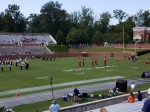
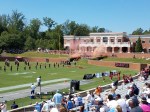
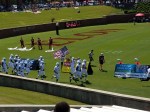
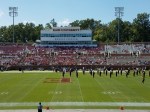
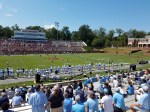
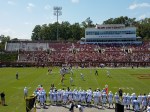
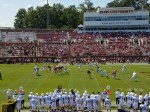
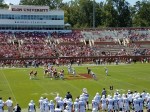
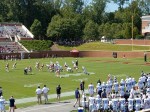
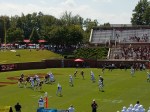
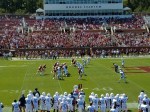
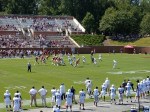
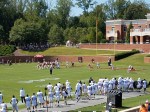
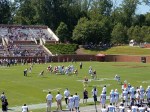
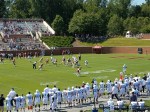
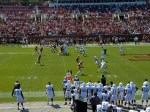
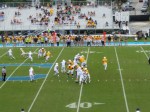
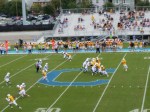
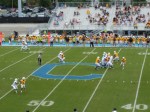
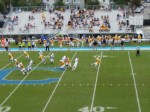
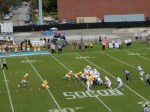
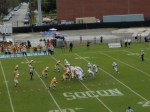
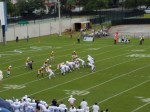
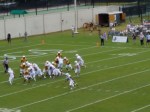
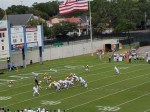
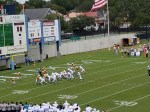
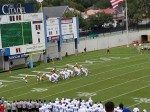
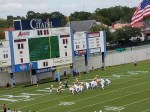
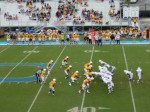
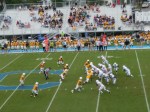
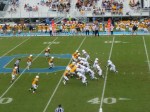
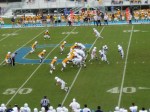
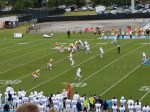
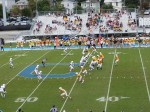
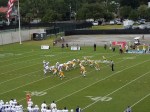
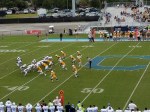
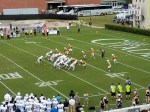
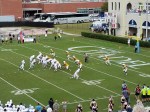
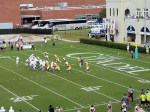
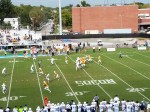
2019 Football, Game 6: The Citadel vs. VMI

The Citadel vs. VMI, The Military Classic of The South, to be played at historic Johnson Hagood Stadium, with kickoff at 2:00 pm ET on October 5, 2019.

The game will be streamed on ESPN+ and televised on four television stations in South Carolina, Georgia, and Virginia. Pete Yanity will handle play-by-play, while Jared Singleton provides the analysis.

The contest can be heard on radio via the various affiliates of The Citadel Sports Network. WQNT-1450 AM [audio link], originating in Charleston, will be the flagship station. 

Luke Mauro (the “Voice of the Bulldogs”) calls the action alongside analyst Ted Byrne.

The Citadel Sports Network — 2019 radio affiliates

Charleston: WQNT 1450 AM/92.1 FM/102.1 FM (Flagship)
Columbia: WQXL 1470 AM/100.7 FM
Sumter: WDXY 1240 AM/105.9 FM

Links of interest:

Preview from The Post and Courier

“Jeff’s Take” from The Post and Courier

– What does Raleigh Webb have in common with Cris Carter?

– Game notes from The Citadel and VMI

SoCon weekly release

“Gameday Central” on The Citadel’s website

“Gameday Central” on VMI’s website

– Bobby Ross has multiple perspectives on The Citadel-VMI

Radio interview with VMI head coach Scott Wachenheim

– Brent Thompson’s weekly radio show (10/2)

Brent Thompson’s weekly press conference (9/30)

The Dogs:  Episode 6

Willie Eubanks is the SoCon Defensive Player of the Month

The Citadel’s soccer team shuts out VMI 2-0

TV stations carrying the football game:

  • WCBD-TV (Charleston)
  • WYCW-TV (Greenville/Spartanburg)
  • WMUB (Macon, GA)
  • WWCW (Roanoke)

It is possible that in one or two cases, the game will be carried on a digital sub-channel of one of the above-mentioned stations, rather than the main channel itself. Be sure to check your local listings if you plan on watching the game on one of those stations.

This is Parents’ Weekend at The Citadel. As always, there will be a lot happening on campus, including the seniors receiving their class rings.

The key Saturday morning activities preceding the football game:

  • 8:30 am – 10:15 am: Open Barracks
  • 8:45 am: Kelly Cup
  • 9:15 am: The Citadel Rifle Legion Performance
  • 9:30 am: Regimental Band Concert
  • 10:15 am: Freshmen Promotion Ceremonies
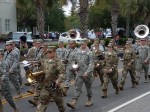
  • 11:00 am: Parade

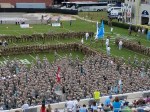
Just to add to the crowd, VMI is bringing about 500 Keydets to the game. The stadium will be packed.

It doesn’t hurt that both Clemson and South Carolina are off this week. That has led to a lot of weddings being scheduled for Saturday, but let’s face it — who wants to go to a wedding? Going to a football game is much more fun.

I’m sure the tailgating areas will be stuffed with fans as well. It should be a great scene.

I’ll briefly discuss the Samford game.

That was a tough loss. I’m not sure anything else needs to be said about it, but I’ll type a few more words anyway.

– I was disappointed in the targeting call against Sean-Thomas Faulkner. I think it was erroneously made by the replay official, who must have felt the need to insert himself into the game.

It reminded me, in a vague way, of a call made against The Citadel five years ago, when Carson Smith was ejected early in a home game against Chattanooga for trying to force a fumble. One of the on-field officials decided Smith was trying to punch someone, and tossed him.

Smith would normally have been suspended for the next game, too, but was reinstated after an appeal, as even the SoCon acknowledged the stupidity of the call.

Faulkner won’t get that chance, as there is no appeal process for targeting. He won’t be able to play the first half of this game. That will be a problem for the Bulldogs, one they will have to overcome.

– Brent Thompson made a lot of tough decisions against Samford. Some worked, some didn’t. That’s the nature of the game, especially one that winds up a four-overtime affair.

I actually questioned only two of them, and neither was that simple:

I thought he should have gone for a field goal attempt on The Citadel’s second drive of the game, but (as he noted afterwards) that call worked out, because the defense got a three-and-out and the Bulldogs scored on the ensuing possession.

After The Citadel scored in the first overtime, Thompson elected to kick the PAT rather than go for two and end the game right there. During his coach’s show, he was asked about that scenario, and said he had considered it, but that “the book” said taking the PAT was the proper play, and he essentially agreed with that (as he felt the Bulldogs were still moving the ball fairly well).

There wasn’t a right or wrong answer to the question, to be sure.

Thompson’s adherence to “analytics” has been one of the more fascinating subplots to the season. As someone who is naturally interested in the subject, it has been great to follow. The coach is clearly of an aggressive mindset when it comes to decision-making, and the mathematical approach has seemed to embolden him.

While not every call will work out, maintaining that philosophy will, in the long run, be extremely beneficial.

A very quick look at the national statistical rankings in FCS:

  • The Citadel now has a healthy lead in time of possession, ranking first nationally (at 38:00) and with more than a two-minute edge over second-ranked Yale. VMI ranks 110th out of 124 teams.
  • The Bulldogs are 34th in offensive 3rd down conversion rate; VMI is 55th. Wofford is 16th, while Furman is 20th.
  • As far as defensive 3rd down conversion rate is concerned, The Citadel is 82nd nationally. VMI is a solid 38th and leads the Socon in that category. Somewhat surprisingly, Charleston Southern is 19th.
  • The Citadel has attempted 14 fourth-down conversion attempts this season, tied for 8th-most in FCS. The Bulldogs are tied for 4th in successful conversions (10). VMI is 6 for 12 on 4th down, with the 12 attempts in a tie for 20th-most.
  • The Bulldogs are 66th in pass efficiency defense. The Keydets are 91st.

Tangent: 50 years ago…

October 18, 1969…

The Citadel rolled to a 28-2 victory at VMI. Tony Passander threw three TD passes, all to Mike Davitt, and Bob Duncan rushed for 113 yards and a touchdown. Jim Leber converted four PATs. The Bulldogs picked up 29 first downs and 498 yards of total offense. 

The statistics in the table below are from VMI’s last three games — at East Tennessee State (a 31-24 win in overtime), home against Robert Morris (a 31-21 loss), and home versus Wofford (a 51-36 setback). The Keydets’ first two contests were against Marshall and Mars Hill (and are thus not included because neither was against an FCS team).

Also not in these numbers are the overtime stats for the ETSU game, for reasons of consistency.

Opponents VMI
Rushing Attempts 127 94
Average Per Rush 6.43 5.29
Rushing Touchdowns 8 6
Pass plays 60 163
Average Per Attempt 9.57 5.02
Average Per Completion 17.35 9.62
Passing Touchdowns 5 4
Total offensive plays 187 257
Yards per play 7.43 5.12
Fumbles: Number-Lost 2-2 4-2
Penalties: Number-Yards 19-167 13-112
Net Yards Per Punt (median) 34.7 31.9
Kickoff touchbacks 4 8
Possession Time (average) 31:08 28:52
Seconds per play 29.97 20.22
Third-Down Conversions 15 of 40 (37.5%) 24 of 56 (42.9%)
Fourth-Down Conversions 2 of 4 4 of 10
Red Zone TDs-Opps 7 of 13 8 of 13
Sacks By: Number-Yards 10-57 2-16

Other thoughts on the statistics above, and the three games in general:

– Both East Tennessee State and Wofford averaged 7.1 yards per rush against VMI (taking sacks out of the equation). The Terriers, to no one’s surprise, simply kept running, as 62 of Wofford’s 70 offensive plays from scrimmage were rushes.

The Buccaneers, on the other hand, kept trying to pass for some reason; including overtime, ETSU threw 39 passes, and completed only 18 of them. This determined effort to throw the football against VMI probably cost East Tennessee State the game.

– Robert Morris is not a good team, but VMI managed to lose to the Colonials anyway, which had to be very frustrating for its fan base. Among the problems the Keydets had in that game: a botched PAT and a missed short field goal (apparently neither the fault of the placekicker); an exchange of fumbles on consecutive plays that wound up costing VMI 52 yards in field position; and a pass defense that gave up several big plays (Robert Morris averaged 12.1 yards per pass attempt).

VMI itself only had two offensive plays from scrimmage of 20 yards or more against Robert Morris, which strikes me as a surprisingly low total. The Keydets had just three such plays versus East Tennessee State, but had ten last week against Wofford — four on the ground and six through the air.

While the Keydets may operate a bit of a “dink and dunk” offense, VMI has the capability of producing a lot of explosive plays.

– Wofford had two punt returns of 39 and 21 yards. The first of those returns set up a touchdown.

VMI has not been very good on special teams in recent years, and this season does not appear to be much different in that respect. However, the Keydets did block a punt against Robert Morris, the first blocked punt for VMI in five years, when the Keydets blocked one against…The Citadel.

– Against ETSU, VMI executed a neat trick play, a throw back to quarterback Reece Udinski that went for 30 yards. Don’t be surprised to see even more trickery by VMI on Saturday. The Keydets always seem to have a few gadget plays in reserve, ready to spring upon the Bulldogs.

– VMI had a turnover margin of +2 in these three games. For the season, the Keydets have a turnover margin of +7, which ranks 9th-best in FCS. That number was helped considerably by a +4 day against Mars Hill.

The Citadel currently stands at -2, which is tied for 75th nationally.

– The three opponents combined for a Red Zone TD rate of 53.8%. That reminds me of one of the things that has bedeviled The Citadel against the Keydets in the last few seasons.

In the last four games of the series, The Citadel’s offense has entered the red zone 20 times versus VMI. However, the Bulldogs have only scored six touchdowns in those possessions.

That is a rate of just 30%. If The Citadel’s offense doesn’t improve in this area on Saturday, the Bulldogs are probably not going to win.

– Both of VMI’s Southern Conference games have been delayed by lightning. Let us hope that particular streak ends at two.

Tangent: 25 years ago…

November 12, 1994

Travis Jervey ran for a 96-yard TD on The Citadel’s first play from scrimmage as the Bulldogs hammered VMI, 58-14, in Norfolk, Virginia. The Citadel rushed for 506 yards and six touchdowns, including 224 yards and two TDs from Jervey. Terrence Rivers had three touchdown runs, and Bryan Morgan added a 41-yard TD burst. C.J. Haynes threw a 43-yard touchdown pass to Chauncey Chappelle. The Bulldogs’ other touchdown came on a 73-yard interception return by Anquan Gist.

VMI head coach Scott Wachenheim on The Citadel’s offense:

“They maintain the ball as well as any team I’ve ever watched. But they also have big-strike [passing] capability.

“That offense…what it forces defenses to do is play man coverage. So they get a lot of one-on-one matchups and they’ve got good receivers that can take advantage of it.”

In a radio interview, Wachenheim also stated that Brent Thompson is “the most patient play-caller I have seen in a long, long time.”

VMI’s “Air Raid” offense is piloted by outstanding junior quarterback Reece Udinski, a 6’4″, 224 lb. native of North Wales, Pennsylvania. For the season, Udinski is completing 59.9% of his passes, averaging 6.11 yards per attempt (sacks not included), with 10 touchdowns and no interceptions.

That’s right, no picks. Udinski will set a new SoCon record if neither of his first two passes on Saturday are intercepted, as he is just one shy of matching former Elon quarterback Scott Riddle’s record of 218 consecutive pass attempts without an interception. However, Riddle still has a substantial lead in most fights started.

Udinski had some big games last year, including three 400-yard passing efforts. Bulldog fans may recall one of them in particular, as he threw for 447 yards and 5 TDs against The Citadel last season (with 49 completions, the most in a league game in 2018).

VMI tends to throw short passes, but can go downfield on occasion. Udinski is a patient QB who is not afraid to make a simple throw.

He has had help this year from the running game, which wasn’t really the case last season.

Redshirt junior running back Alex Ramsey (6’0″, 225 lbs.) is a big back who is averaging a healthy 5.9 yards per carry. Ramsey had 153 yards rushing against Robert Morris, and then followed that up with a 207-yard performance versus Wofford (with 3 TDs). He can also catch the ball (24 receptions so far this year; 8 catches last season versus the Bulldogs).

Ramsey is one of five Keydets with more than 20 catches. Wideout Javeon Lara (6’2″, 188 lbs.), the lone Texan on the VMI roster, has four TD receptions, including the game-winner against ETSU. Lara was a preseason first-team All-SoCon selection.

Another wide receiver, Leroy Thomas (5’11”, 180 lbs.), leads the team in catches with 27. The freshman from Roanoke had 10 catches for 123 yards and a touchdown last week versus Wofford.

Jakob Herres (6’4″, 211 lbs.), like Lara and Thomas, is averaging over 11 yards per reception. The sophomore from Easton, Pennsylvania had six receptions for 117 yards and a TD last year against The Citadel.

Rohan Martin (5’10”, 181 lbs.) has 25 catches. The senior from Stafford, Virginia is also the primary punt returner for the Keydets.

VMI’s projected starters on the offensive line average 6’5″, 289 lbs. Sophomore left tackle Marshall Gill (6’4″, 270 lbs.) has been a starter for every game of his career at VMI at that position.

VMI has had a consistent lineup on defense, with ten Keydets starting every game.

Strong safety A.J. Smith (6’2″, 204 lbs.), a junior from Virginia Beach, leads the team in tackles, with 32. Smith also has two interceptions and a forced fumble. He had ten tackles against The Citadel last season.

Redshirt junior linebacker Elliott Brewster (6’2″, 220 lbs.) is tied for second on the team in stops. Brewster is not listed as a starter on the two-deep this week, which I find curious. However, he will surely see a lot of action, especially given his performance against the Bulldogs last season (a team-high 15 tackles).

Cornerback Kaleb Tucker (6’1″, 177 lbs.), a native of Hampton, Virginia, has 31 tackles this year. The senior also has two interceptions, a sack, and a fumble recovery.

Ethan Caselberry (6’4″, 201 lbs.) started ten games at free safety last season for the Keydets. This year, the sophomore from Sparkman, Alabama is starting at outside linebacker. Wherever he plays, he tends to make tackles (including nine last year as a true freshman against The Citadel).

Caselberry’s backup on the depth chart is freshman Aljareek Malry (6’0″, 173 lbs.). Despite not being a starter, the Maryland resident has played enough this year to rank 5th in tackles. Malry also blocked a punt against Robert Morris.

Grant Clemons (6’2″, 199 lbs.) is the Keydets’ placekicker. Clemons is 5 for 11 this season on field goal attempts, with a long of 37 yards. The senior is perfect on PATs (16-16). He also handles kickoffs.

Fellow senior Reed King (5’9″, 168 lbs.) is VMI’s punter (and also holds on placements). King is averaging 43.0 yards per boot, with a long of 60 yards. Seven of his 27 punts have been downed inside the 20-yard line.

Tangent: 5 years ago…

November 22, 2014

Six different Bulldogs scored touchdowns as The Citadel won at VMI, 45-25. Aaron Miller rushed for a one-yard TD and threw a 32-yard touchdown pass to Alex Glover. Other Bulldogs to score: Tyler Renew, Reggie Williams, Isiaha Smith (134 rushing yards), and Jake Stenson (120 rushing yards). Eric Goins converted all six PATs and added a 30-yard field goal. 

Odds and ends:

– The weather forecast for Saturday in Charleston, per the National Weather Service: a 20% chance of showers, with a high of 79 degrees. The low temperature on Saturday night is projected to be 69 degrees.

Per one source that deals in such matters (as of Wednesday evening), The Citadel is a 17-point favorite over VMI, with an over/under of 66. That line has not changed since it opened.

Other lines involving SoCon teams: Furman is a 4-point favorite at Samford; Western Carolina is a 6 1/2 point favorite over Gardner-Webb; Wofford is a 2-point favorite at East Tennessee State; and Chattanooga is a 1 1/2 point favorite at Mercer.

– Also of note: Elon is a 7-point underdog at New Hampshire, and Charleston Southern is an 11 1/2 point favorite over Savannah State. Towson is off this week.

Georgia Tech is a 10 1/2 point underdog at home versus North Carolina.

In games between FCS schools, the biggest spread is 26, with Harvard the favorite over Howard in the first meeting in football ever between those two institutions.

– Massey Ratings: The Citadel is ranked 39th in FCS, while VMI is 94th.

Massey projects the Bulldogs to have a 87% chance of winning, with a predicted final score of The Citadel 45, VMI 28.

The top five teams in Massey’s FCS rankings this week: North Dakota State, South Dakota State, James Madison, Montana, and Dartmouth.

Other rankings this week of varied interest: Northern Iowa is 10th, Towson 12th, Delaware 16th, Kennesaw State 21st, Idaho 27th, Furman 31st, North Carolina A&T 33rd, Elon 34th, Samford 38th, San Diego 45th, William & Mary 49th, Wofford 55th, Colgate 62nd, Chattanooga 67th, South Carolina State 74th, Campbell 77th, East Tennessee State 82nd, Mercer 85th, Charleston Southern 91st, Davidson 95th, Lehigh 99th, Gardner-Webb 103rd, Western Carolina 104th, Robert Morris 115th, Butler 122nd, and Presbyterian 126th (last).

– VMI’s notable alumni include actor Fred Willard, civil rights activist (and Anglican martyr) Jonathan Daniels, and rugby star Dan Lyle.

– Next season, VMI will play non-conference games against Robert Morris, Virginia, and Princeton. Other future non-league opponents for the Keydets include Davidson, Cornell, Kent State, Wake Forest (in 2022), Bucknell, North Carolina State (2023), Louisville (2024), and Virginia Tech (2026).

– VMI’s roster includes 65 players from Virginia. Other states represented:  North Carolina (6 players), Alabama (5), Pennsylvania (4), Maryland (4), Tennessee (2), South Carolina (2), and one each from California, Colorado, Delaware, Kentucky, New Jersey, New York, and Texas.

That means 68.4% of VMI’s squad hails from the state of Virginia. While the Old Dominion is certainly not bereft of football talent, the lack of geographic diversity on the team has probably not helped VMI in its recent struggles on the gridiron.

VMI’s class breakdown (per its game notes):

  • Freshmen: 52 (39 “true” freshmen, 13 redshirt freshmen)
  • Sophomores: 14 (five are redshirts)
  • Juniors: 22 (13 are redshirts)
  • Seniors: 8 (two are redshirts)

The two Keydets from the Palmetto State are redshirt freshman defensive back Tim Smith (who attended Nation Ford High School in Rock Hill), and freshman wide receiver Kyser Samuel (from Gray Collegiate Academy in Columbia).

That means there are no VMI players from legendary pigskin power Orangeburg-Wilkinson High School. While it is well-known to anyone with a basic awareness of the sport, it bears repeating that VMI cannot hope to return to the summit of the SoCon (or even view its apex in the distance) as long as the football program continues to ignore the amazing abilities of those who have worn the famed maroon and orange.

– The Citadel’s geographic roster breakdown (per the school’s website) is as follows: South Carolina (53 players), Georgia (29), Florida (8), Texas (5), North Carolina (3), Pennsylvania (3), Alabama (2), New York (2), and one each from Virginia, Nebraska, West Virginia, Oklahoma, Minnesota, Ohio, and Kentucky.

In addition, there are two Bulldogs with listed hometowns in other countries — junior tight end Elijah Lowe (Abaco, Bahamas), and freshman linebacker Hayden Williamson (Okinawa, Japan).

– This week’s two-deep for The Citadel is quite similar to last week’s edition. Emeka Nwanze and Logan Billings are both listed as potential starters at B-back (along with the incumbent, Clay Harris).

– The Citadel has an all-time record of 6-4-1 for games played on October 5, with the tie being the only time the Bulldogs have played VMI on that date (14-14 in 1985). Among the highlights from past contests:

  • 1929: The Citadel shut out Oglethorpe, 18-0. The Stormy Petrels had defeated Georgia the week before, but were no match for the Bulldogs. Before 3,000 spectators at the original Johnson Hagood Stadium, Edwin McIntosh, Lindsey Hobbs, and Howard “Red” Whittington all scored touchdowns, with Whittington’s one-yard run set up by a spectacular 50-yard scamper by Julius “Runt” Gray.
  • 1935: Before a home crowd of 2,000 fans, The Citadel dominated Erskine, 18-0 (yes, same score as in 1929). Claude McCredie scored twice for the Bulldogs, with Ed Hall adding a third TD. John Miller and Croswell Croft led the defensive effort; the The News and Courier sub-headline read, “The Seceders lose more than they gain and are worn to frazzle by winners”.
  • 1957: On the road at Davidson, The Citadel ran out as 21-7 victors. Barry Thomas scored two touchdowns for the Cadets. The first TD of the day came on a halfback pass from Billy Hughes to Joe Chefalo. All three PATs were successfully converted by Connie Tuza. There was a near riot at the end of the game, as some Davidson freshmen attempted to steal The Citadel’s “touchdown cannon”. They did not succeed.
  • 1968: The Citadel won at Furman, 31-12. Tony Passander threw three touchdown passes, all to Gene Hightower, and Jay Goolsby rushed for a fourth TD. Jim Gahagan kicked four extra points and added a 41-yard field goal to the tally. The Bulldogs lost four fumbles in the contest, but prevailed anyway.
  • 1991: With 13,811 fans in attendance at Johnson Hagood Stadium, The Citadel ran past Western Carolina, 38-13. Jack Douglas rushed for 134 yards and three touchdowns, while Erick Little and Cedric Sims each added TDs for the Bulldogs. Rob Avriett kicked a 37-yard field goal and converted all five of his PAT attempts. On defense, Rob Briggs and Detric Cummings both intercepted passes.
  • 2013: In overtime, Thomas Warren’s 35-yard field goal propelled the Bulldogs to a 31-28 victory over Appalachian State. Ben Dupree (136 yards rushing) and Darien Robinson (109 yards) each scored two touchdowns for The Citadel. The winning points in OT came after an interception by Mitchell Jeter stopped the Mountaineers on their drive in the extra session. Attendance at Johnson Hagood Stadium: 13,601.

I am worried about this game. Of course, I am always worried, but for Saturday I have a specific concern — namely, how the team will recover from the physical and mental toil of last week.

That will not be easy, and then the squad has to get ready for a very frisky VMI team that is ready to win this matchup. The Bulldogs have to do that while navigating all the distractions associated with Parents’ Weekend (and there are many).

The Keydets may be more confident about this game than they have been in several years. They ought to be. For one thing, VMI easily could have (and maybe should have) won last year’s contest. More to the point, this year’s team looks improved, with a more diverse offense, and a legitimate star at quarterback.

They aren’t bringing 500 members of their corps down to Charleston just to be sociable. They have expectations.

That said, The Citadel has expectations too. The Bulldogs are still a good team. They can still have an outstanding season. All of their primary goals are still on the table.

Plus, this game matters. This game is important.

The coveted Silver Shako is at stake. It is, without debate, the greatest trophy in all of sports.

The Bulldogs must do everything in their power to retain it, and keep it in Charleston, where it rightfully belongs.

2019 Football, Game 5: The Citadel vs. Samford

The Citadel vs. Samford, to be played at Seibert Stadium in Homewood, Alabama, with kickoff at 3:00 pm ET on September 28, 2019.

The game will be streamed on ESPN+. Curt Bloom will handle play-by-play, while Chad Pilcher supplies the analysis. Brad Gardner will report from the sidelines.

The contest can be heard on radio via the various affiliates of The Citadel Sports Network. WQNT-1450 AM [audio link], originating in Charleston, will be the flagship station. 

Luke Mauro (the “Voice of the Bulldogs”) calls the action alongside analyst Ted Byrne.

The Citadel Sports Network — 2019 radio affiliates

Charleston: WQNT 1450 AM/92.1 FM/102.1 FM (Flagship)
Columbia: WQXL 1470 AM/100.7 FM
Sumter: WDXY 1240 AM/105.9 FM

Links of interest:

– Preview from The Post and Courier

Internet legend Joshua Roides talks physics, finance, flood tides, and football

Will starting quarterback Brandon Rainey be back this week? Signs point to yes

– Game notes from The Citadel and Samford

– SoCon weekly release

Preview on The Citadel’s website

Chris Hatcher’s weekly press conference (9/26)

Samford strong safety Nick Barton answers questions at SU’s weekly press conference

– The Chris Hatcher Show (9/25)

Game highlights — Alabama A&M vs. Samford

– Game highlights — Samford vs. Wofford

– Brent Thompson’s weekly press conference (9/23)

The Brent Thompson Show (9/25)

The Dogs:  Episode 5 (Charleston Southern)

Game program for Saturday’s contest

This is the now-traditional section where I establish ground rules for writing about The Citadel and Samford, as both teams are nicknamed “Bulldogs”. As to why the powers that be in the Southern Conference did not insist on Samford changing its nickname as a requirement for entry into the league, your guess is as good as mine.

At any rate, in this post, “Bulldogs” refers to The Citadel. The reason for that is simple: I graduated from The Citadel, and this is my blog.

I’ll call Samford “SU”, the “Birmingham Bulldogs”, the “Crimson Bulldogs”, the “Baptist Tigers”, or the “Baptist Bears”.

For those of you reading this who are somehow unfamiliar with the Baptist Tigers/Bears, a quick look at the history of Samford football is in order:

The Howard College [later to be renamed Samford] team was known originally as the “Baptist Tigers”. However, rival Auburn also had “Tigers” as a nickname. Howard’s teams went by “Baptist Bears” until Dec. 14, 1916, when the student body voted two-to-one for the “Crimson Bulldog” over the “Baptist Bears”. Students decided that a bulldog could eat more Birmingham-Southern Panther meat than a bear could.

I’ve said this before, but I really don’t understand why the students thought bears wouldn’t eat as much meat as bulldogs. Were Alabama’s bears back then strict vegetarians? I guess we’ll never know.

Ah, the mysteries of early-20th century university life…

Birmingham-Southern, by the way, is a Division III school (which was very briefly in NCAA Division I about 15 years ago) and a former rival of Samford. The two schools played in the first football game ever contested at Legion Field, on November 19, 1927. Samford (then Howard) won, 9-0.

While Legion Field was obviously close to home, in those days the Samford football program liked to travel. During the 1920s, SU played Duquesne in Pittsburgh (at Forbes Field) and North Dakota (in Grand Forks). There were even out-of-country junkets to Cuba (playing the Havana National University). Later, Samford played games in Mexico City against the National University of Mexico (in 1954 and 1963).

Random fact of no relevance whatsoever: Samford’s law school, Cumberland, was actually purchased from Cumberland University of Tennessee in 1961. That doesn’t happen very often; in fact, in terms of moving a law school across state lines, I’m not sure it has ever happened anywhere else.

I am aware of only two other law schools that shifted to different universities (both in-state) — the University of Puget Sound School of Law, which is now part of Seattle University; and the law school at the University of Bridgeport, in Connecticut, which is now affiliated with Quinnipiac University.

As opposed to last week, for this post I won’t go through a lengthy list of FCS statistical categories, or update the status in them for other teams of interest. I’ll update those numbers every two or three weeks, though.

I will mention a few things that could have a significant bearing on this game, however.

– The first is time of possession. Not counting the Ivy League schools (each of which has only played one game so far), The Citadel still leads FCS in time of possession, at 36:58.

Samford is last in the sub-division, at 21:12. I believe the Cadet must maintain that type of advantage on Saturday to have a realistic chance of winning the game.

That said, SU is comfortable not having the ball for long stretches. Against Wofford, Samford only had the pigskin for 19:25, but still came away with a road victory.

– Among non-Ivy FCS squads, Samford is 4th in average yards per punt return. SU has returned 10 punts this season for a total of 201 yards. That 20.1 average is easily the best for any team with double digit returns.

– The Citadel is 9th overall in net punting. Samford, one of the many intercollegiate teams with an Australian punter (5’11”, 165 lb. Melbourne native Bradley Porcellato), is 26th nationally.

– Samford averages the third-fewest penalties per game in FCS. The Citadel is tied for 40th in that category.

– SU is 83rd nationally in rush yards allowed per play. The Citadel is 105th.

– As far as passing yards per attempt allowed is concerned, The Citadel is 92nd. The Baptist Tigers are 54th.

Turnover margin: The Citadel is tied for 99th, while Samford is tied for 117th. Each team has only forced two defensive turnovers so far this season (both of SU’s came last week).

A few select statistics from the last four years of Samford-The Citadel (the period in which Chris Hatcher has been the SU head coach):

Year Score Time of possession 3rd down conversions – The Citadel Big Plays – TC (20+ yards) Big Plays – SU (20+ yards) Yards/Rush – The Citadel
2015 44-25 35:15 6 of 14 5 4 5.9
2016 37-34 OT 38:17 11 for 21 6 3 6.0
2017 14-35 36:52 3 for 13 3 4 3.5
2018 42-27 35:01 9 for 16 6 2 5.9

I might argue the key stat in the table is yards per rush for The Citadel, which is inter-related with third down conversions. That also has an impact on time of possession and big plays. More possession means more plays, and more plays means an increased chance of breaking a long gainer.

In fact, The Citadel has not beaten Samford without averaging at least 5.5 yards per rush since 2010, when it won 13-12. The Cadets only averaged 2.7 yards per rush that afternoon, but prevailed in a defensive struggle. The Citadel scored its first touchdown on a blocked punt (by a noted master of the art, Milford Scott); its other TD was set up by a trick play (a pass by Luke Caldwell to Rickey Anderson that came off of a reverse).

Of note, Bill D’Ottavio has been Samford’s defensive coordinator for the last 13 years (under two different head coaches).

The statistics that follow for Samford are from its last three games. I decided not to include stats from SU’s opener against Youngstown State, because the Crimson Bulldogs started a different quarterback in that contest.

SU lost that game to the Penguins, 45-22. Four turnovers bedeviled Chris Hatcher’s squad, which was also just 2 for 9 on third down conversion attempts.

However, Samford has definitely been a different team (at least offensively) since the insertion of junior Chris Oladokun as the starting QB.

Oladokun, a 6’2″, 195 lb. transfer from South Florida (he started three games for the Bulls last season), began his SU career in the fourth quarter against Youngstown State. The Tampa native completed his first seven passes for 125 yards and a touchdown (a 64-yarder on his second throw).

The three games included in the table below:

Samford totals Samford avg. Opponent totals Opponent avg.
Rushing yards 548 182.67 828 276
Rush attempts 103 34.33 157 52.33
Avg. Per Rush 5.32 5.27
Rushing TDs 6 2 8 2.67
Passing yards 876 292.0 571 190.3
Avg./Att. 9.62 6.34
Avg./Comp. 16.8 11.3
TDs 10 3.33 4 1.33
Total yards 1424 474.67 1399 466.33
Total plays 194 64.67 247 82.33
Avg./Play 7.34 5.66
Fumbles – Lost 2-0 3-0
Penalties – Yards 7 for 67 20 for 146
Time of possession
22:07 37:53
3rd Down Conversions 15 of 33 24 of 56
4th Down Conversions 3 of 5 9 of 13
Sacks: Total – Yards 4 for 39 yards 5 for 31 yards

*sack yardage counted in passing statistics

Yes, that 16.8 yards per completion number for Samford is accurate. Oladokun has thrown four passes of 64 yards or more, and has eight other completions of at least 30 yards.

When sack yardage is taken out of his totals, Oladokun is averaging 7.46 yards per rush. Two of his runs have gone for 30 or more yards. He leads the team in rushing yards and TDs (and in passing as well, obviously).

Incidentally, Oladokun (pronounced OLAH-doe-kin, according to Samford’s game notes) was the SoCon Offensive Player of the Week after each of those three games.

For the season, Oladokun is completing 65.6% of his passes, averaging an extremely impressive 10.16 yards per attempt (and that number does include sack yardage against). He has thrown 11 TD passes and been intercepted 4 times.

Not included in that table but worth mentioning: in the three referenced contests, Samford averaged running a play from scrimmage every 21.2 seconds. The Baptist Bears have been progressively faster on offense in each of the last three games — 24.6 seconds per play versus Tennessee Tech, 21.6 seconds per snap against Wofford, and just 18.8 seconds per play versus Alabama A&M.

Also not in the table, but certainly of importance: Samford has scored touchdowns on 10 of 14 times it has been in the Red Zone (this includes all four games).

Offensive players for Samford (besides Oladokun) worth watching:

  • Montrell Washington (5’10”, 170 lbs.): A junior from Canton, Georgia, the wide receiver is averaging 23.6 yards per catch, including an 82-yard TD last week against Alabama A&M. He is also Samford’s primary punt returner, and had a 49-yard runback versus Alabama A&M.
  • Chris Shelling (5’8″, 173 lbs.): Last year against The Citadel, the Lawrenceville, Georgia native had 8 receptions for 82 yards. This season, the senior leads SU in receptions with 15. He had 185 receiving yards, including a 64-yard touchdown, against Tennessee Tech.
  • Robert Adams (6’2″, 190 lbs.): Adams ranks second on the team in receptions this season, with 14. The senior from Montgomery has made one reception of 30+ yards in three of Samford’s four games this year.
  • Nick Nixon (6’6″, 282 lbs.): Samford’s starting left tackle, Nixon was a preseason All-SoCon selection. He is a senior from Hendersonville, Tennessee.

Samford’s projected starters on the offensive line average 6’6″, 309 lbs. They are large.

Under Bill D’Ottavio, Samford has traditionally employed a “bear” front against the triple option attack. Given the linemen at his disposal, I suspect the matchup this Saturday will not be any different in that respect.

Defensive stalwarts for SU include:

  • Justin Foster (6’4″, 286 lbs.): A preseason All-SoCon choice, the defensive tackle is a senior from Anniston, Alabama. He could be a key player in the battle between The Citadel’s o-line and Samford’s defensive front.
  • Nelson Jordan (6’2″, 253 lbs.): Another lineman who was a preseason all-league pick, Jordan is a sophomore from Starkville, Mississippi. Although not listed as a starter on Samford’s two-deep, I would expect Jordan to get plenty of reps on Saturday. He had nine tackles (including a sack) versus The Citadel last season.
  • John Staton (6’1″, 215 lbs.): The middle linebacker currently leads Samford in tackles, with 46. Staton is a junior from Atlanta.
  • Nathan East (6’2″, 221 lbs.): A sophomore from McCalla, Alabama, East ranks second on the team in tackles, with 35. He plays alongside Staton as one of SU’s three starting linebackers.
  • Nick Barton (5’10”, 196 lbs.): Barton intercepted a pass last week. The senior strong safety from Brentwood, Tennessee has been credited with 17 tackles this season (tied for sixth on the squad). Barton said at Samford’s weekly presser that Saturday will be “one of the most predictable games we’ll have all year…we know what they’re going to do, and they know what we’re going to do.”
  • Ty Herring (6’2″, 203 lbs.): Herring, a junior from Fernandina, Florida, starts at free safety for the Crimson Bulldogs. He is fourth on the team in tackles. Last week against Alabama A&M, Herring returned an interception 95 yards for a touchdown.

Samford’s placekicker is preseason all-conference pick Mitchell Fineran (5’10”, 183 lbs.). The sophomore from Fort Valley, Georgia has yet to miss a kick so far this season, converting all five of his field goal attempts and going 19 for 19 on PATs.

Last season, Fineran was 13 for 17 on field goal tries, with a long of 46 yards. He did not miss an extra point. Fineran is also Samford’s kickoff specialist.

Odds and ends:

– The weather forecast for Saturday at Samford, per the National Weather Service: mostly sunny, with a high of 95 degrees.

– Per one source that deals in such matters, Samford (as of Wednesday evening) is a 2 1/2 point favorite over The Citadel, with an over/under of 63.

When the line opened on Monday night, Samford was a 4-point favorite.

– Other lines involving SoCon teams: Furman is a 17-point favorite over East Tennessee State; Wofford is an 11 1/2 point favorite at VMI; Chattanooga is a 6 1/2 point favorite versus Western Carolina; and Mercer is a 6 1/2 point favorite over Mercer.

– Also of note: James Madison is a 13-point favorite at Elon, and Towson is a 35 1/2 point underdog at Florida.

After a week off to recover from its loss to The Citadel, Georgia Tech travels to Temple, with the Yellow Jackets a 5 1/2 point underdog.

Charleston Southern is another team that is getting time to mend after a defeat at the hands of the Bulldogs. The Buccaneers are back in action next week, against Savannah State.

The biggest betting favorite in the FCS ranks is Kennesaw State, a 30 1/2 point favorite over Reinhardt, an NAIA school. Among matches between FCS teams, the biggest spread is 27 1/2, with North Carolina A&T favored over Delaware State.

– Massey Ratings: The Citadel is ranked 33rd in FCS (down four spots from last week), while Samford is 43rd.

Massey projects the Cadets to have a 46% chance of winning, with a predicted final score of Samford 34, The Citadel 31.

The top five teams in Massey’s FCS rankings this week:  North Dakota State, South Dakota State, Princeton, James Madison, Dartmouth.

Other rankings this week of varied interest: Towson is 12th, Youngstown State 13th, Kennesaw State 22nd, Jacksonville State 25th, Elon 28th, Furman 29th, North Carolina A&T 34th, William & Mary 42nd, San Diego 48th, Wofford 56th, Chattanooga 63rd, Tennessee Tech 64th, South Carolina State 71st, Mercer 75th, East Tennessee State 78th, Campbell 90th, Charleston Southern 92nd, VMI 93rd, Alabama A&M 96th, Western Carolina 97th, Davidson 107th, Gardner-Webb 108th, Robert Morris 117th, Butler 125th, and Presbyterian 126th (last).

– Samford’s notable alumni include actor Tony Hale (of Veep and Arrested Development fame, though to be honest I know him best from an episode of Psych); actress and groundbreaking television producer Gail Patrick (who helmed the Perry Mason TV series); and Pulitzer Prize-winning newspaper editor/publisher Harold E. Martin.

Martin also had an association with another SoCon school, VMI. He endowed a scholarship there in memory of his son, a student at the military school who was killed in an automobile accident his senior year.

– SU’s roster includes more players from Georgia (43) than Alabama (37). Other states represented: Florida (17 players), Tennessee (9), Mississippi (6), Louisiana (2), and one each from North Carolina, New Mexico, Ohio, Indiana, and Missouri.

As mentioned earlier, punter Bradley Porcellato is from Melbourne, Australia.

No member of Samford’s team is from South Carolina, and thus none can claim to be an alumnus of Orangeburg-Wilkinson High School. The lack of players from the fabled football factory will unquestionably come back to haunt Chris Hatcher and his cabal of coaches. Why the SU staff would continually ignore the undeniable talent that has worn the famed maroon and orange is simply beyond comprehension.

– The Citadel’s geographic roster breakdown (per the school’s website) is as follows: South Carolina (53 players), Georgia (29), Florida (8), Texas (5), North Carolina (3), Pennsylvania (3), Alabama (2), New York (2), and one each from Virginia, Nebraska, West Virginia, Oklahoma, Minnesota, Ohio, and Kentucky.

In addition, there are two Bulldogs with listed hometowns in other countries — junior tight end Elijah Lowe (Abaco, Bahamas), and freshman linebacker Hayden Williamson (Okinawa, Japan).

– This week’s two-deep includes a few changes from the previous depth chart. Sam Llewellyn is on the two-deep at A-back, while on defense Sean-Thomas Faulkner has been moved to the “Sam” linebacker spot. Destin Mack takes over as the starting strong safety.

– The Citadel has an all-time record of 5-5 for games played on September 28. Highlights include:

  • 1912: The Citadel defeated Fort Moultrie (official score: 1-0) after the soldiers forfeited the game in the fourth quarter with the score tied at 13 and a PAT for The Citadel pending. There was a suggestion that the Cadets had scored the tying TD thanks in part to fan interference. I wrote about this contest back in June, including this quote from the game story in the Charleston Evening Post:

[On] Saturday afternoon, at Hampton Park, despite the protests of the police and other officials, it proved a hard matter for bashful spectators to tell whether the enthusiastic rooters or the elevens from The Citadel and Fort Moultrie were playing the game. This deplorable state of affairs was the cause of the boys from the island forfeiting the game with a technical score of 1-0 in favor of the Cadets, in the beginning of the fourth quarter. Practically every spectator present appointed himself a field judge, and proceeded to interfere with the players throughout the game, in the meantime taxing his lungs in an endeavor to announce decisions to the State at large.

  • 1929: The Bulldogs whipped Newberry 59-0, the largest margin of victory for The Citadel in 16 years. There were 2,000 fans in attendance at (original) Johnson Hagood Stadium. A total of 36 players saw action for the victors, which is actually one more player than saw the field for The Citadel two weeks ago against Georgia Tech. Among those scoring touchdowns for the Bulldogs: Tom “Pop” Wilson, Ed McIntosh, Tom Appleby, Dalton Brasington, Cary Metz, and Julius “Runt” Gray (a 140 lb. quarterback; even social media superstar Joshua Roides weighs more than that). The Citadel had 407 total yards of offense, while Newberry finished with just 47 yards from scrimmage.
  • 1946: The first intercollegiate football game in Charleston in almost four years resulted in a 7-6 victory for The Citadel over Presbyterian. The Bulldogs trailed until midway through the fourth quarter, when Charlie Watson scored from one yard out. Bill Henderson’s PAT was true, and a crowd of 6,500 went home happy. The winning touchdown drive was set up by a punt return by Luke Dunfee; in the rematch one year later, Dunfee would return the opening kickoff 98 yards for a TD against the Blue Hose to set up another Bulldogs triumph.
  • 1963: In poor conditions on a very rainy day in North Carolina, The Citadel muddied up Davidson, 28-6. Joe Cannarella completed his first pass as a Bulldog, and it went for a touchdown to Wes Matthews. Other scorers for the Cadets: Converse Chellis, Nick DiLoreto, Dennis Vincent (all with TDs), and Pat Green (four PATs). The defense held Davidson to just five first downs.
  • 1968: The Citadel beat Lehigh, 28-12, behind 142 yards rushing and two touchdowns by Jim McMillan. The Bulldogs also scored on a TD pass from Tony Passander to tight end John Griest. All four PATs were converted by Jim Gahagan. The Bulldogs’ defense forced three turnovers, two fumbles and an interception by Jackie Zorn.

This has been a somewhat odd series in recent years. I don’t know how else to describe it. The Citadel has had a bit of the upper hand in recent meetings, though it has not always been immediately apparent as to why that was the case.

Samford has blown sizable leads in both of the last two games played at Johnson Hagood Stadium. However, any weird karma from having to play in Charleston won’t apply on Saturday, since the game is in Alabama. In the last matchup at Seibert Stadium, SU dominated the first half and coasted from there.

Four years ago, The Citadel whipped Samford so thoroughly that new SU head coach Chris Hatcher felt compelled to turn to a freshman backup quarterback named Devlin Hodges. It proved to be a good move, although a bit too late for that particular encounter.

As for this Saturday’s contest, both teams should be energized after winning their last two games. Both have good wins to look to for inspiration. In Chris Oladokun, Samford has found a potential talisman at quarterback; Brent Thompson has compared him to Tom Flacco. That is not good news for The Citadel.

However, the Cadets have improved on defense every week. The potential return of Brandon Rainey at quarterback should be a shot in the arm for the offense, too, and Rainey helped lead the comeback victory over Samford last year (with 217 rushing yards and a fine passing day as well).

It should be an intriguing game. I hope it is a productive and successful one for The Citadel.


2019 Football, Game 4: The Citadel vs. Charleston Southern

The Citadel vs. Charleston Southern, to be played at historic Johnson Hagood Stadium, with kickoff at 6:00 pm ET on September 21, 2019.

The game will be streamed on ESPN+. Kevin Fitzgerald will handle play-by-play, while former Bulldogs quarterback Dominique Allen supplies the analysis. Emily Crevani is the sideline reporter. 

The contest can be heard on radio via the various affiliates of The Citadel Sports Network. WQNT-1450 AM [audio link], originating in Charleston, will be the flagship station. 

Luke Mauro (the “Voice of the Bulldogs”) calls the action alongside analyst Ted Byrne.

The Citadel Sports Network — 2019 radio affiliates

Charleston: WQNT 1450 AM/92.1 FM/102.1 FM (Flagship)
Columbia: WQXL 1470 AM/100.7 FM
Sumter: WDXY 1240 AM/105.9 FM

Links of interest:

Preview from The Post and Courier

– Game notes from The Citadel and Charleston Southern

SoCon weekly release

Big South weekly release

Preview on The Citadel’s website

Preview on Charleston Southern’s website

Jacob Godek is the reigning SoCon Special Teams Player of the Week

– Brent Thompson’s weekly radio show (9/18)

Brent Thompson’s weekly press conference (9/16)

The Dogs:  Episode 4 — Georgia Tech

Godek launched “the perfect ball” to clinch victory in Atlanta

My review of The Citadel’s win over Georgia Tech

Highlights of another brand of football: The Citadel soccer team’s 3-2 win over Presbyterian

With Charleston Southern making the trip to Charleston this Saturday, I might as well plug this post I wrote last week about football scheduling at The Citadel. CSU is just one of many programs mentioned.

In the game preview article in The Post and Courier (linked above), the now-traditional push by Charleston Southern to get another home game against The Citadel gets a mention:

Saturday’s game is the second of a four-game deal through 2021 that has all of the games being played at The Citadel’s Johnson Hagood Stadium. The schools are working on a new contract that would extend the series into the foreseeable future.

CSU athletic director Jeff Barber said he wants to continue the series but is seeking a deal that includes games at Charleston Southern.

“There is a clear desire on both sides to keep the series going,” Barber said. “It needs to be an equitable situation and that’s where we are right now.”

The only “equitable situation” for The Citadel, however, is that it continues to host any and all games between the two schools at Johnson Hagood Stadium. Playing CSU at Buccaneer Field would not be in the best interests of the military college, for a wide variety of reasons (some of which I mention in my post).

The Citadel is ranked 25th in the STATS FCS poll, which is a media poll. In the AFCA FCS poll (coaches), the Bulldogs are not ranked, receiving the 29th-most votes in that poll this week.

This is Hall of Fame weekend at The Citadel. Congratulations to all the new Hall of Famers, including the three former football players honored: Andre Roberts, James Lee, and Wade St. John.

Here is a quick look at The Citadel in the FCS national rankings, from a statistical perspective. This is a selection of stats that I think are interesting and/or relevant.

There are currently 116 teams in the rankings, as the Ivy League schools are just beginning play this week and two other teams (North Alabama and Merrimack) are not listed in the main statistical report because they are still in “transition” phase to D-1.

Also note that in these statistics, sacks are (unfortunately) part of rushing totals, rather than subtracted from passing yards. As I’ve said many times before, when it comes to rushing/sack stats, the NCAA is wrong and the NFL is right.

Time of possession: The Citadel is 1st (37:15 per game). Wofford is 2nd, followed by Jacksonville, Kennesaw State, and Davidson. Furman is 24th, while Charleston Southern is 53rd.

Samford is last in FCS (19:45 per game).

Yards per play, offense: The Bulldogs are 45th in FCS (4.45). North Dakota State (shocker) leads the nation in yards per play, at 8.06.

Mercer is 6th, and VMI is 12th. Charleston Southern is 87th.

Yards per play, defense: The Citadel is 105th nationally (7.31). Davidson leads FCS in this category, but keep in mind two of the Wildcats’ three opponents so far this season are non-D1 squads.

Kennesaw State is 2nd. Charleston Southern is 113th (8.58), but to be fair that is partly skewed by the Buccaneers’ 72-10 loss to South Carolina. The Gamecocks averaged 11.2 yards per play in that contest.

Rushing yards per play, offense: The Cadets are currently 50th (4.19 per rush). The Citadel is 6th in rushing yards per game, but it is to be expected that the Bulldogs would be among the national leaders in that category, since the offense is so heavily geared to running the football.

Central Connecticut State currently leads FCS in yards per rush, at 7.40. The rest of the top five: Incarnate Word, North Dakota State, Villanova, and Youngstown State.

Kennesaw State is 6th in yards per rush, and also leads the nation in rushing yards per game, so the Owls are both prolific and productive. (The same can be said for Central Connecticut State, North Dakota State, and Youngstown State, all in the top five in rushing yards per game.)

Furman is 9th in yards per rush, and ETSU is 12th. Charleston Southern is 77th in yards per rush (3.47).

It should be noted that two of the Paladins’ three opponents to date have been FBS squads, so that makes Furman’s numbers all the more impressive.

Central Arkansas is last in yards per rush, at 1.16, which is a bit of an eye-opener, since the Bears are 3-0 with a win over an FBS team (Western Kentucky). Some of that can be accounted for with sack yardage, but even if you took out sacks, UCA would only average 2.12 yards per rush.

Rushing yards per play, defense: The Bulldogs are 97th overall (5.83). Davidson leads this category as well. Elon is 19th. The highest-ranked SoCon team is Mercer (27th).

Charleston Southern is next-to-last (9.54), just ahead of Texas Southern. South Carolina averaged 13.0 yards per rush against the Buccaneers.

Passing yards per attempt, offense: The Citadel is 40th (7.69). In terms of total yardage, the Bulldogs are last in passing yards per game, just behind Wofford.

The difference: the Terriers are only averaging 4.41 yards per pass attempt, which is 109th in FCS.

Two option teams, Cal Poly and Kennesaw State, rank 1-2 in yards per pass attempt, but Samford is 3rd (SU’s offense is reasonably efficient when it is actually on the field).

Furman is 34th in yards per pass attempt. ETSU is 41st. Two teams that like to throw the ball, VMI and Charleston Southern, are 92nd and 96th respectively.

Passing yards per attempt, defense: The Citadel is 102nd (9.33). That has to get better if the Bulldogs want to compete for the SoCon title.

Of course, ETSU is second nationally in this category (trailing only North Dakota), yet the Buccaneers managed to lose at home to pass-happy VMI last Saturday. Charleston Southern is 49th overall.

3rd down conversion rate, offense: The Bulldogs are 12th (51.1%). The top five: San Diego, Davidson, North Dakota State, Towson, and Kennesaw State.

Samford is 17th, while Furman is 18th. Charleston Southern is 89th.

3rd down conversion rate, defense: The Citadel is 92nd (46.9%). Illinois State tops the list in this category, followed by Sam Houston State, Hampton, James Madison, and Idaho.

VMI is 6th (!). Charleston Southern is 39th.

Net punting: The Bulldogs are 2nd nationally (43.45). Bucknell is first overall, which is a good thing for the Bison given how often that squad punts (22 in three games).

Furman is 5th, while Samford is 13th. Charleston Southern is 28th (and is tied for 7th nationally in total punts, with 23).

Penalties per game: The Citadel has been whistled for an average of 5 accepted penalties per contest, which is tied for 24th-fewest in FCS with several teams, including Charleston Southern. Holy Cross leads the nation is fewest penalties per game, at 2.5; the teams tied for second include Samford and Presbyterian.

Prairie View A&M is averaging an absurd 14 penalties per contest through three games, worst in the country. The Panthers had 18 penalties in their game versus Texas Southern.

Turnover margin: The Bulldogs are 101st (-1.33 per game). The Citadel has no interceptions and only one recovered fumble on defense through three games. The Bulldogs have to be more opportunistic.

Youngstown State’s turnover margin per game is 3.0, which not surprisingly leads the nation. This is another category VMI is faring well in so far (tied for 3rd with Towson and William & Mary).

Charleston Southern is tied for 92nd.

Samford has no defensive turnovers through three games, which has led to a -2.0 turnover margin average. The only team with a worse average than that in FCS is Marist.

Fourth down conversions and attempts: The Citadel is 6 for 7 on fourth down attempts so far in 2019. The six successful conversions is more than all but five teams in FCS. The seven attempts is tied for 18th-most in the sub-division.

The team with the most fourth down attempts (UC Davis, with 13), is also tied for the most conversions (8). The other two teams with eight conversions, Jacksonville and Tennessee Tech, have attempted 11 and 10 fourth down tries, respectively.

Among teams that have attempted more than two fourth down attempts, The Citadel has the highest success rate (85.7%). Wofford (5 for 6) is right behind the Bulldogs.

Autry Denson was an outstanding running back at Notre Dame. He is still the all-time leading rusher in Fighting Irish history, and his name pops up in the career top 10 for several other offensive categories (including points scored and all-purpose yardage).

At the time he took the CSU job, he was the running backs coach at his alma mater. When Denson was interviewed for the position with the Buccaneers, Charleston Southern AD Jeff Barber asked the obvious question.

“As a faith-based school we have unique opportunities, and a unique niche,” said [Barber]. When he first spoke with Denson, “I said, ‘I’m just going to get the elephant out of the room: Why would you leave Notre Dame to come to an FCS program?’ He said, ‘Jeff, I serve God, and I feel like God is telling me and my family to be there.’ I’m a guy who believes the same type things.”

Denson has made similar moves before, giving up a comfortable career as a financial advisor before getting into coaching at the high school level, then breaking into the college game with an unpaid position at Bethune-Cookman, all because he believed that was the direction he was supposed to take. Notre Dame’s all-time leading rusher, Denson to outsiders has always been defined by football, even though it’s clear the game doesn’t define him.

“I told our players, don’t be confused: This isn’t a football program, this is an outreach ministry that has an important football component,” Denson said prior to his first spring practice last month. “It is important, because the world speaks in wins and losses. We need that hook to get the message out. But at the end of the day, we’ll win because they know we love them. They’ll play hard for us. The good guys have to win, too.”

Just remember, coach — sometimes the players on the other team are good guys, too…

Other than one year at a Florida high school, Denson has never been a head coach. Barber ultimately decided that didn’t matter.

For Barber, any concerns about hiring a career college position coach were assuaged by a 30-minute conversation with former Clemson athletic director Terry Don Phillips.

“He did the same thing, he hired a wide receivers coach,” Barber said, referring to Phillips’ elevation of Dabo Swinney to the top job after Tommy Bowden was fired in the middle of the 2008 season. “I asked him for the traits that he saw in Dabo that made him think he could get the job done, and he listed seven or eight different things. I told Terry Don, ‘I think I’ve got that very same guy.’ … So (Denson) checked all the boxes.”

[Lou Holtz, who coached Denson at Notre Dame,] isn’t concerned by Denson’s lack of college coordinator or head coaching experience, either. “I was the same way,” said Holtz, who was defensive backs coach at Ohio State before landing his first head coaching position at William & Mary, the initial step in 249 career victories.

Denson is going to run the Air Raid offense at Charleston Southern. He hired former LaGrange College OC Felton Huggins to install it.

There will be a significant transition from CSU’s traditional option-based attack to the Air Raid, the second week in a row the Bulldogs will play a team making such a move.

Early on, though, the offense has been a little bit more balanced between rushing and passing than might be expected. Denson is presumably adjusting for the personnel he currently has at his disposal, which strikes me as a sensible decision.

Stats of interest for Charleston Southern’s two games this season versus FCS competition (sacks are counted as pass plays, with the yardage charged to passing and not rushing totals):

CSU offense

Plays Yds./play Rush att Rush Yds/play Pass plays Pass Yds/Att Fumbles Lost Int 3d conv 3d  att RZ TD conv RZ TD att
@Furman 65 5.80 34 5.94 31 5.65 1 0 5 14 1 2
N.C. A&T 66 4.26 23 2.65 43 5.12 0 2 3 14 2 3
Totals 131 57 74 1 2 8 28 3 5
Average 65.5 5.02 28.5 4.61 37 5.34 0.5 1 28.6%

CSU defense

Plays Yds./play Rush att Rush Yds/play Pass plays Pass Yds/Att Fumbles Lost Int 3d conv 3d  att RZ TD conv RZ TD att
@Furman 63 8.08 39 9.61 24 5.58 0 0 6 12 4 4
N.C. A&T 72 6.49 39 7.82 33 4.91 1 0 2 13 0 2
Totals 135 78 57 1 0 8 25 4 6
Average 67.5 7.23 39 8.72 28.5 5.19 0.5 0 32.0%

Charleston Southern did throw it a lot more last week against North Carolina A&T, but the Buccaneers actually had more runs than pass plays versus Furman. Looking at the numbers, it appears Denson may have been more conservative in his approach to the matchup with the Paladins.

In a way, the game plan versus Furman had some positive results. CSU averaged 4.24 yards on first down, which isn’t great, but the third down yards-to-go average of 5.79 was quite respectable. It didn’t really lead to more third down conversions, though. In the end, Furman won easily, 46-13.

Against North Carolina A&T, the Buccaneers only averaged 3.64 yards on first down, and on third down Charleston Southern had a yards-to-go average of 7.64, which generally isn’t going to get it done.

That said, CSU led the Aggies (a very good FCS program) in the fourth quarter. North Carolina A&T scored 21 points in the final period to pull out a 27-21 victory.

On defense, the Buccaneers have struggled against the run. CSU has given up several long gainers, including three rushes of 40+ yards by Furman and two long TD runs by North Carolina A&T running back Jah-Maine Martin. The second of Martin’s TD runs was a spectacular 76-yard effort with a little over five minutes remaining that gave the Aggies a two-score lead.

CSU also gave up six runs of 35 yards or more against South Carolina.

A few Charleston Southern offensive players to watch:

  • Jack Chambers (5’10”, 170 lbs.): The redshirt sophomore from Lilburn, Georgia has started all three games at quarterback for the Buccaneers. For the season, Chambers is completing 58.5% of his passes, averaging 5.84 yards per attempt (not including sacks), with one touchdown pass against four interceptions. He also has two rushing TDs.
  • Ross Malmgren (6’3″, 210 lbs.): A freshman, Malmgren is from the same town (Acworth, Georgia) as Brandon Rainey and Brandon Webb, but went to a different high school. He has appeared at QB in each of the Buccaneers’ last two games, completing 19 of 24 passes for 122 yards and two TDs.
  • Kameron Brown (6’3″, 220 lbs.): Brown was a preseason All-Big South pick in 2018, but was injured and missed all but three games last year. The redshirt senior went to Midland Valley High School. Against North Carolina A&T, Brown hauled in 9 catches for 110 yards and two touchdowns. He is a fine player, and could be a difficult matchup for the Bulldogs.
  • Terrence Wilson (5’8″, 200 lbs.): Though not listed as the starter on the CSU two-deep, the junior running back from Leesville is a big-play threat. He had a 52-yard TD run versus Furman in the season opener. Wilson led the Buccaneers in rushing touchdowns last year and averaged 6.2 yards per carry.
  • Zack Evans (6’2″, 285 lbs.): The starting left guard was a preseason All-Big South selection this year. Evans, a redshirt senior from Florence and a team captain, started all eleven games for CSU last year, mostly at right guard.

Average size of the projected starters on Charleston Southern’s offensive line: 6’3″, 276 lbs.

Some CSU defensive players of note:

  • Nick Salley (5’10”, 225 lbs.): The senior from Walterboro is a defensive end by trade (he lines up in the “Buc” position for CSU). He had nine tackles against The Citadel last season. Salley began his career as a walkon and is now a team captain.
  • Anton Williams (6’3″, 215 lbs.): The junior from Marianna, Florida did not play in 2018, and also did not participate in the Buccaneers’ first two games this year. However, the defensive end made his season debut last week against North Carolina A&T, finishing with 8 tackles (including 2 1/2 for loss). He was also credited with a pass breakup. Williams is not listed on this week’s two-deep, but make no mistake — he will be a presence on Saturday.
  • J.D. Sosebee (6’0″, 215 lbs.): A redshirt senior linebacker from Gainesville, Georgia, Sosebee was an all-Big South choice in 2018 and is a preseason all-league selection this year. Last week against North Carolina A&T, Sosebee had seven tackles, including a sack.
  • Cody Cline (6’1″, 185 lbs.): A native of Concord, North Carolina, Cline leads the Buccaneers in tackles after three games. The free safety is a true freshman.

Charleston Southern special teams performers include:

  • Kyle Reighard (6’2″, 197 lbs.): Last year, Reighard was a second-team all-conference pick at punter. He is a redshirt senior from Salem, Virginia who also holds on placements.
  • CSU has had three different placekickers this season: Alex Usry (5’10”, 185 lbs), who converted three PATs against North Carolina A&T; Miller Braddock (6’1″, 160 lbs.), who made a field goal and an extra point at South Carolina; and kickoff specialist Nathaniel Toole (5’10”, 170 lbs.), who also kicked PATs at Furman.
  • Ethan Ray (6’0″, 185 lbs.): A redshirt junior from Boiling Springs, Ray was the second-team All-Big South long snapper last season, and the preseason first-team choice this year. (No, the SoCon does not have an all-conference designation for long snappers.)

Odds and ends:

– The weather forecast for Saturday in Charleston, per the National Weather Service: sunny with a high of 84 degrees. The low temperature on Saturday night is projected to be 70 degrees.

Per one source that deals in such matters (as of Wednesday evening), The Citadel is an 18 1/2 point favorite over Charleston Southern, with an over/under of 53.

When that line opened this week, The Citadel was a 17 1/2 point favorite, and the over/under was 55 1/2.

Other lines involving SoCon teams:  Wofford is an 18-point favorite over Gardner-Webb; Furman is a 10-point favorite over Mercer; Samford is a 22-point favorite versus Alabama A&M; VMI is a 14-point favorite over Robert Morris; Chattanooga is a 21 1/2 point underdog versus James Madison; and East Tennessee State is a 4 1/2 point underdog against Austin Peay. Western Carolina is off this week.

– Also of note: Elon is a 27 1/2 point underdog at Wake Forest, while Towson is a 3 1/2 point favorite over Villanova. Georgia Tech is off this week.

In games between FCS schools, the biggest spread is 38 1/2, with Princeton favored over Butler.

– Massey Ratings: The Citadel is ranked 29th in FCS, while Charleston Southern is 96th. The win over Georgia Tech vaulted the Bulldogs up 37 spots in the rankings.

Massey projects the Cadets to have a 87% chance of winning, with a predicted final score of The Citadel 35, Charleston Southern 17.

The top five teams in Massey’s FCS rankings this week: North Dakota State, South Dakota State, Princeton, James Madison, and Eastern Washington.

Other rankings this week of varied interest:  Towson is 8th, Villanova 14th, Delaware 19th, Elon 24th, Jacksonville State 25th, Kennesaw State 28th, North Carolina A&T 31st, William & Mary 33rd, Furman 34th, Samford 51st, Mercer 54th, Holy Cross 56th, Chattanooga 59th, Wofford 60th, Grambling State 69th, South Carolina State 72nd, VMI 77th, East Tennessee State 82nd, Western Carolina 92nd, Campbell 98th, Gardner-Webb 104th, Davidson 107th, Bucknell 118th, Presbyterian 125th, and Robert Morris 126th and last.

– Charleston Southern’s notable alumni include U.S. senator Tim Scott, TV sports reporter Kelsey Riggs, and former major league pitcher R.J. Swindle.

– Charleston Southern’s roster includes 36 players from South Carolina. Other states represented: Florida (19 players), Georgia (16), North Carolina (14), and one each from Alabama, Kentucky, Virginia, California, Pennsylvania, Iowa, Maryland, and Ohio.

The best-educated player on CSU’s squad, without question, is offensive lineman D’Andra Thompson. The 6’3″, 250 lb. junior is an alumnus of Orangeburg-Wilkinson High School.

Thompson is listed as a backup on the Buccaneers’ two-deep; given the traditional athletic excellence of those who have worn the famed maroon and orange (regardless of sport), it can only be assumed that Autry Denson is waiting for a special moment to unleash Thompson’s talents on an unsuspecting opponent. That may not happen this week, but you never know.

– The Citadel’s geographic roster breakdown (per the school’s website) is as follows: South Carolina (53 players), Georgia (29), Florida (8), Texas (5), North Carolina (3), Pennsylvania (3), Alabama (2), New York (2), and one each from Virginia, Nebraska, West Virginia, Oklahoma, Minnesota, Ohio, and Kentucky.

In addition, there are two Bulldogs with listed hometowns in other countries — junior tight end Elijah Lowe (Abaco, Bahamas), and freshman linebacker Hayden Williamson (Okinawa, Japan).

– This week’s two-deep for The Citadel includes a new B-back listed on the depth chart, freshman Logan Billings. At kick returner, redshirt freshman Jaylan Adams is listed for the first time.

– The Citadel has an all-time record of 1-7-1 for games played on September 21, so the Bulldogs need to establish a new winning tradition for that date.

The one victory came in 1996, with The Citadel defeating Western Carolina 28-14 before 10,362 fans at Johnson Hagood Stadium. The Bulldogs rushed for 354 yards, with 80 of those coming on a Stanley Myers run just two plays into the contest.

Aaron Green also scored for the Bulldogs, and Lorenzo Jackson intercepted a fourth-quarter pass that essentially sealed the victory, which broke an eight-game conference losing streak. Jackson’s pick (which he returned 58 yards) was one of only two for The Citadel during the entire 1996 season.

This year’s Bulldogs need to intercept a few more passes than that. Right now, though, as mentioned earlier, they don’t have any. Perhaps that will change on Saturday.

I hope that fans of the Bulldogs come out in force for this contest. The team certainly deserves all the support it can muster after a great performance against Georgia Tech.

There was a lot of celebrating and congratulating after that game (on his radio show, Brent Thompson mentioned that he had received 125 text messages, including some from people he didn’t know). However, the team now has to be prepared and ready for this week’s opponent.

I think it will be. I expect the Bulldogs will be focused and alert. They need to be. Charleston Southern will not be an easy opponent.

Last year’s game was decidedly chippy — something noted by Thompson at his Monday presser, and a memory the coach clearly did not enjoy. I hope (and suspect) this year’s contest will be more cleanly played from that perspective.

Offensively, The Citadel needs to keep doing what it did against the Yellow Jackets, and keep the chains moving. I would like to see more big plays, however.

Big plays are what the Bulldogs’ defense needs to avoid. Charleston Southern will try to get its skill position players into space. The Citadel’s defenders must tackle well, and get off the field on third down.

Tackling is also something that the kick return coverage units must improve upon this week. Another thing to watch: in last year’s game, both teams blocked a punt for a TD.

The Bulldogs need to win this game, thus consolidating their victory from last week, and setting up what should be an exciting and challenging conference campaign.

We’re all ready for some fun at Johnson Hagood Stadium on Saturday night.

Game Review, 2019: Georgia Tech

The Citadel 27, Georgia Tech 24 (OT).

That happened. Yes, it did.

Links of interest (a lot of options this week):

Game story, The Post and Courier

School release from The Citadel

School release from Georgia Tech

AP game story

NCAA.com game story

Game story, Atlanta Journal-Constitution [headline over article: “Jackets Haunted and Stunned”]

Game analysis, CBS Sports

“The Citadel Adds To Illustrious History”

– Gwinnett players play role in shocker

Video highlights package from The Citadel

Postgame on-field interview of Brent Thompson (via Fox Sports South twitter)

Game highlights from the ACC Digital Network

– Postgame quotes (including those for Brent Thompson, which are at the bottom of the page)

Postgame press conference for Geoff Collins

– Postgame press conference for Georgia Tech players

“Condensed” video of The Citadel-Georgia Tech (about 23 minutes)

Box score

Key statistics:

The Citadel Georgia Tech
Field Position* 21.56 (-17.69) 39.22 (+17.69)
Success Rate* 39.72% 47.62%
Big plays (20+ yards) 3 6
Finishing drives (average points)* 4.0 4.6
Turnovers 1 0
Expected turnovers 1.72 0.66
Possessions* 9 9
Points per possession* 2.67 2.67
Offensive Plays* 72 42
Yards/rush* (sacks taken out) 4.76 7.59
Yards/pass attempts* (incl. sacks) 5.20 6.73
Yards/play* 4.79 7.29
3rd down conversions* 8 of 15 (53.3%) 3 of 8 (37.5%)
4th down conversions 1 of 1 0 of 1
Red Zone TD%** 0 for 2 (0%) 1 for 1 (100%)
Net punting 38.0 35.0
Time of possession 41:50 18:10
TOP/offensive play 34.86 seconds 25.95 seconds
Penalties 5 for 55 yards 8 for 80 yards
1st down passing* 0/1 5/7, 97 yards, sack
3rd and long passing* 0/1, interception, sack 0/3, sack
4th down passing 0/0 0/0
1st down yards/play* 5.45 9.45
3rd down average yards to go* 7.40 7.25
Defensive 3-and-outs+* 2 3

*overtime stats not included; Georgia Tech’s kneel-down at the end of the first half also not included
** Georgia Tech’s end-of-regulation drive not included in Red Zone TD rate

After I had finished compiling the above stats, I just shook my head. The Citadel finished second-best in all of the “Five Factors”, and did not fare well in many of the other categories.

Yet in actuality, the Bulldogs maintained control of the game throughout the contest. It could also be argued that if Brandon Rainey had not been injured, The Citadel probably would have won in regulation.

That time of possession advantage the Bulldogs had was incredible and ultimately decisive; essentially, the entire game turned on the basic fact that Georgia Tech couldn’t score if it didn’t have the ball — and the Yellow Jackets rarely possessed the pigskin.

A few quick notes:

– Without the 3rd-and-31 situation in the second quarter, The Citadel’s average yards-to-go on 3rd down would be 5.7, a much more palatable number.

– Besides time of possession, the other key stat was third down conversion rate (and of course those two categories are inter-related). When you include the Bulldogs converting their sole fourth down attempt, The Citadel eventually moved the chains 9 out of 15 times it faced third down in regulation play.

I don’t know what The Citadel’s record is for time of possession in a game, but I’m going to guess that 41:50 is the new standard for the Bulldogs’ contests against FBS teams.

– Georgia Tech’s first-half penalties were critical (and mostly inexcusable) mistakes, and also out of character. The Yellow Jackets had only committed four penalties *total* in their first two games.

Random thoughts:

– The Citadel became the first FCS squad this season to beat a team from a “Power Five” conference.

– I am fairly sure The Citadel is the largest underdog (26 points) to win outright so far this year in a game involving at least one FBS team.

– Georgia Tech’s decision to punt on 4th-and-5 at the Bulldogs’ 36-yard line on the Yellow Jackets’ first drive of the game set the tone for the contest, and not in a good way for the home team. That is absolutely a “go for it” situation, particularly in a game in which possessions are going to be limited.

Naturally, the punt was a touchback, and (almost as naturally) The Citadel immediately embarked on a nine-play drive that resulted in the game’s first touchdown.

That drive included two tough third-down runs from Rainey and Clay Harris.

– Conversely, Brent Thompson should receive credit for his decision to go for it on 4th-and-1 from The Citadel’s own 34-yard line, with less than six minutes remaining in a tie game and a backup quarterback at the controls.

A punt there would have handed the ball back to a Georgia Tech offense that had the momentum. It was worth the risk, and Thompson wound up with the reward after a two-yard run by Harris.

– The end-around to Raleigh Webb on the next play was also an excellent call that built off of the fourth-down conversion.

– The TD pass from Rainey to Webb was on a 2nd-and-6 down-and-distance situation, and just two plays removed from Nkem Njoku’s 25-yard run into Yellow Jackets territory. It was an excellent time to call a pass play.

– Chris Beverly managed to knock Tobias Oliver out of bounds on his long kick return, and it was a good thing, because I believe otherwise Oliver may have gone all the way.

– Geoff Collins seemed miffed at the officials for how the end of the fourth quarter played out, prior to the pseudo-TD and subsequent tying field goal.

I re-watched it. This is what happened:

  • The clock stopped with 34 seconds remaining after an injury to Bulldogs defensive tackle Dewey Greene IV (who had a huge sack two plays earlier).
  • Georgia Tech running back Jordan Mason then rushed 18 yards to The Citadel’s 12-yard line for a first down. The clock was halted with 27 seconds left to move the chains.
  • The clock re-started, and then with 23 seconds left Georgia Tech was called for a snap infraction, penalizing the Yellow Jackets five yards.
  • That necessitated a 10-second runoff, to 13 seconds. The referee announced that information, and then stated the clock would re-start on the “ready to play” signal — which it did.
  • Collins then called a timeout just before the ball was snapped, at the 6-second mark.

I think Collins was upset because he did not think the clock would re-start at the 13-second mark. That isn’t what the referee said, however.

As a result, the Yellow Jackets went from having the football at the 12-yard line with 23 seconds left and one timeout, to having it at the 17-yard line with 6 seconds left and no timeouts — and they didn’t even run a play.

Georgia Tech had used a timeout very early in the 3rd quarter when there was confusion over an offensive formation on the second play of the half. The Yellow Jackets could have used that timeout at the end of the game.

– I was always relieved when Tobias Oliver wasn’t playing quarterback for Georgia Tech. The Yellow Jackets seemed more dynamic whenever he was in the game, including as a kick returner. The stats reflect that as well.

I don’t think the flip-flopping of the QBs helped Georgia Tech much, including in the overtime session, when Lucas Jackson came in at quarterback on 3rd down and promptly got sacked by Joseph Randolph II.

– On the positive side of the ledger for Collins, his hat was nice — very clean look. I also liked the cap he wore for a game earlier this season that just had the “T” logo.

– With 1:13 remaining in the game and Georgia Tech driving, a chant of “DEFENSE!” from the crowd could clearly be heard on the TV audio feed. Major props to the fans (and cadets) in attendance.

– It was a rough-and-tumble football game, with more than a few injuries for both teams. I hope that the Bulldogs came out of it without any serious issues. Obviously, the injury to Brandon Rainey will be something to watch.

Just a few tweets to consider (I could have linked several thousand)…

https://twitter.com/NicoleAuerbach/status/1172963042059083776

https://twitter.com/PistolOptionFB/status/1173309531880742913

https://twitter.com/BannerSociety/status/1172963192559083520?s=20


Now the players and coaches have to forget about this victory, great as it was, and get ready for Charleston Southern. The Buccaneers led a good North Carolina A&T team in the fourth quarter on Saturday before losing 27-21. That one won’t be easy.

I’ll write about that game later this week.

Putting together the ideal football schedule at The Citadel

I wanted to write about this topic after some recent discourse about it, primarily in two places:

– AD Mike Capaccio’s discussion of the schedule on Lowcountry media personality Quintin Washington’s YouTube channel

– Jeff Hartsell’s column in The Post and Courier

Here are some of the relevant passages from each media piece.

Capaccio (direct quotes):

“We need to work with our schedule to be more realistic….we don’t need to be playing two ranked teams, or three ranked teams, and then an ACC team, and then go into our conference, because our conference is a monster…so, not that we [want] an easy schedule, but we need a little break…

…We want to play close to home…three to five hours [away] at the maximum…We don’t need to be taking a trip to Towson…Our philosophy is changing, and we want to play close [to home].”

Hartsell:

By the end of the 2020 season, The Citadel will have played 44 straight games against D-I teams…

…”Do you need a Division II team in there? Every couple of years, I think you do,” said [The Citadel’s head football coach, Brent] Thompson, whose 10-2 SoCon championship team in 2016 won a 38-14 game over D-II North Greenville. “But I don’t think you need one every year. I know just about everybody in our league will have one this season.

“But my emphasis is on more in-region games. Elon is a fine game, Gardner-Webb, Charleston Southern, S.C. State. Those games are a lot easier on your travel and your budget, and they mean more to the kids. I would much rather play a non-conference game in-state, or at least in-region.”

For Thompson, a guarantee game last season might have made the difference between a 5-6 season and a 6-5 season. And as any coach will tell you, that’s a big difference.

Coaches from Dabo Swinney to Nick Saban know that an occasional cupcake tastes good. The Citadel ought to try one.

Let me start off by saying that I am not overly fond of the epithet “cupcake” being thrown around when mentioning a squad from a lower classification or division. Playoff-caliber D-2 teams like Newberry and North Greenville certainly weren’t “cupcakes” when they played the Bulldogs. The term also doesn’t apply to The Citadel when it faces an FBS opponent.

Calling a team a “cupcake” is basically a way of saying it doesn’t belong on the same field with the favored opponent. I find this tiresome, as it is primarily a media creation designed to diminish programs that aren’t on national TV every week.

Now, as to The Citadel’s football schedule…

Right now, the Bulldogs play 11 regular-season games every season except in years where the calendar allows for a 12th contest. After this year, the next time FCS teams will have a chance to play a 12th game will be 2024.

I don’t believe there will be a rule change altering the current status quo in that regard, so let’s assume that The Citadel will annually play 11 regular-season games for the foreseeable future.

The Bulldogs will play eight Southern Conference games every year, four at home and four on the road. That leaves three non-conference contests to schedule.

One of those non-conference matchups has to be a “money” game against an FBS opponent. Here are the already scheduled FBS teams through 2025:

  • 2020: Clemson
  • 2021: Coastal Carolina
  • 2022: Appalachian State
  • 2023: Georgia Southern
  • 2024: Clemson
  • 2025: Mississippi

Of the two remaining out-of-league games, at least one of them almost has to be a home game; otherwise, the Bulldogs would only play four contests in a given season at Johnson Hagood Stadium. That isn’t going to work.

So far, these non-FBS games have been scheduled through the next few seasons:

  • 2020: Elon, Charleston Southern [schedule complete; six home games]
  • 2021: Charleston Southern
  • 2022: at Campbell
  • 2023: Campbell

Mike Capaccio also mentioned during the interview referenced above that Presbyterian is on a future schedule. Perhaps the Blue Hose are on more than one.

What, exactly, should be the goals of The Citadel’s non-conference football schedule? Some of them (in no particular order) might be:

  • Help the team prepare for the SoCon slate
  • Raise money for the program (and the department of athletics in general)
  • Promote the school to a wider audience
  • Give the team a better chance of making the FCS playoffs
  • Improve the win-loss record
  • Ensure there are enough home games to satisfy the season-ticket holders
  • Energize the fans by playing quality, high-profile opponents
  • Save money on travel
  • Excite the players on the team by playing quality, high-profile opponents
  • Provide an added impetus for recruiting

Random musings:

– I am okay with giving the team a better chance to make the FCS playoffs via scheduling, but only to a point.

That is because the FCS postseason, as currently constructed, is hopelessly flawed. It is structurally biased against southeastern schools (honestly, that is undeniable). Thus, it is not a true “national” tournament.

I see no reason to devalue the regular season just to participate in the playoffs. Until the tournament is fully seeded and not beholden to asinine geographical bracketing, my thoughts on that will not change.

– I’ve already mentioned that The Citadel needs to play at least five home games per season. I don’t think anyone would seriously disagree.

– While I’ve said it before, let me reiterate that limiting the distance the team travels for non-conference games is not always a good idea, at least from a larger perspective. I enjoyed the trip to Princeton in 2009, and I firmly believe the Bulldogs should occasionally make trips like that to promote the school, provide a new experience for the players, and reward our loyal fans from other parts of the country.

– I don’t want to play opponents for the sole purpose of padding the win total. That isn’t what The Citadel is all about. If it were, the school wouldn’t have joined the Southern Conference in the first place, much less stay in the league all these years.

The Citadel is about embracing challenges. That includes varsity sports.

Finally, my suggestions for non-conference games.

I am inclined to eschew D-2 and NAIA schools, because I think it is probably beneficial to the conference as a whole for its member schools to play as many D-1 teams as possible, and The Citadel should take the initiative in that respect.

I could see arguments in the other direction — and I’m not automatically opposed to teams like Newberry, North Greenville, or Benedict. I don’t believe Webber International needs to be on the schedule again, however.

– Presbyterian strikes me as almost an ideal non-conference opponent. The Citadel would not have play in Clinton (barring a hurricane, of course). The two schools have a long history on the gridiron, too.

– Charleston Southern is a reasonable choice, though I don’t think it is necessary (or particularly desirable) to play the Buccaneers on an annual basis.

Obviously, any games between CSU and The Citadel would be contested at Johnson Hagood Stadium. Playing at Buccaneer Field is a non-starter for a host of reasons, including A) the state of the facility, B) the fact that 80% (or more) of the fans at the game would be rooting for The Citadel, so forcing them to travel to another stadium would be pointless, and C) the loss of a home game would seriously affect The Citadel’s ability to schedule the rest of its non-conference slate in a given season.

That last point is one that several members of the local media have never seemed able to grasp — or are simply unwilling to accept, even knowing it is true.

A rotation of Charleston Southern and Presbyterian might not be a bad idea.

– Other teams that I think would be good opponents in the “home games only” slot: Jacksonville, Stetson, Davidson, and perhaps Gardner-Webb.

– Schools that would be appropriate “home and home” regional opponents would include South Carolina State, Elon, William & Mary, Richmond, Campbell, and possibly North Carolina A&T.

– I would advocate for an occasional home-and-home versus an out-of-region team, like an Ivy or Patriot League squad, or even one of the MVFC teams.

Yes, I know, it costs too much. I’m sure we could raise some money for a two-game series through a special campaign, though. I noticed that there are currently 38 people listed in The Citadel Development Foundation’s staff directory; perhaps one or two of them could help out.

All of the above is just my opinion. I could be wrong about just about everything!

Or maybe I could be right about a few things. Your mileage may vary.

Game Review, 2019: Elon

Links of interest:

– Game story, The Post and Courier

Game story, Burlington Times-News

– WCSC-TV game report (video)

– School release

– Game highlights (video)

– Box score

Key stats:

The Citadel Elon
Field Position* 39.82 (+13.38) 26.44 (-13.38)
Success Rate (per play)* 39.66% 53.45%
Big plays (20+ yards) 2 7
Finishing drives (average points) 7.0 7.0
Turnovers* 0 0
Expected turnovers 0.94 0.00
Possessions* 11 9
Points per possession* 2.55 3.89
Offensive Plays* 58 58
Yards/rush* (sacks taken out) 3.33 7.0
Yards/pass att* (incl. sacks) 6.89 10.27
Yards/play* 3.88 8.24
3rd down conversions* 5 of 14 5 of 10
4th down conversions* 2 of 3 1 of 1
Red Zone TD% 4 of 4 (100% 3 of 3 (100%)
Net punting 44.3 9.0
Time of possession 31:45 28:15
TOP/offensive play 32.29 sec 26.08 sec
Penalties 6 for 45 9 for 79
1st down passing* 1/2, 3 yards 7/11, 141 yards, TD
3rd and long passing 1/3, 27 yards, TD** 1/2, 6 yards
4th down passing* 0/1 1/1, 6 yards
1st down yards/play* 3.29 7.93
3rd down average yards to go* 7.14 5.00
Defensive 3-and-outs+* 2 4

*final drive for Elon in each half and last play of game for TC not included
**also sacked twice

Observations based on the above statistics:

– For the second week in a row, an opponent averaged over eight yards per play. That happened three times last season (against Chattanooga, Towson, and Alabama).

– Through two games, opponents have 13 big plays against the Bulldogs’ defense. Meanwhile, The Citadel’s offense has only three big plays of its own.

– In both games, The Citadel’s offense has had four three-and-outs (or worse). That means in 40% of the Bulldogs’ possessions, they have not picked up a first down.

– The Citadel’s 35.2% third down conversion rate on offense against Elon was lower than in all but three of the Bulldogs’ games last year (Wofford, Alabama, Charleston Southern).

– The Bulldogs are averaging 2.45 points per possession after two games. In eight SoCon contests last year, The Citadel averaged 3.18 points per possession.

It should be noted that in its first two games in 2018 (Wofford and Chattanooga), the Bulldogs averaged just 2.0 points per possession.

– This is the second week in a row an opponent has had a 50% or better success rate on third down against the Bulldogs’ defense (not counting the two third downs in end-of-half possessions). Last year, The Citadel had a defensive third down conversion rate of 35.2% (all games).

– Elon had a Success rate of 53.45%. Last year, only one team had a Success Rate against The Citadel’s defense that exceeded 50%: Alabama (66.67%).

– The Citadel did not force a turnover on Saturday, something that only happened twice in 2018 (against Furman and East Tennessee State).

– The Bulldogs have converted five 4th-down attempts (in six tries). Only three FCS teams have converted more so far this year: Tennessee Tech (7), Davidson (6), and Kennesaw State (6).

– The Citadel’s 3.33 yards per rush (taking out sacks) was the lowest for a game since last year’s season opener versus Wofford. The Bulldogs’ 3.88 yards per play was the lowest since that same contest against the Terriers.

– A positive: the Bulldogs have scored TDs in seven of their eight trips inside the Red Zone so far this season.

– A major positive: yes, Elon’s net yards punting was 9.0, which is what happens when two of four punts are blocked. Both punt blocks were by Sean-Thomas Faulkner, who also drew a rare fighting penalty from Elon on one of the two punts that he didn’t block.

Random thoughts:

– From the game story in The Post and Courier, Brent Thompson said (among other things):

“We’ve got to figure things out a little bit more on the defensive side, and get ahead of the game on offense. We haven’t been able to get a lead on these guys in the last two games.”

The Citadel would have had a much better chance of getting a lead on Elon if a fumble recovery by the Bulldogs on the Phoenix’s second possession had stood. It didn’t, because the officials ruled that the play never happened.

The reason for that ruling? An “inadvertent whistle”.

I didn’t hear the whistle, and no one around me heard it either. It did not affect the action, as in fact the play was run as if nothing happened (possibly because nothing did happen).

This is the kind of thing that sours fans on officials. At best, it was a demonstration of complete incompetence that dramatically benefited the home team, a member of the same conference that provided the men in stripes.

(Admittedly, I wouldn’t have been a bit surprised if the officials had been from the SoCon.)

– The onside kick was exquisitely timed and wonderfully executed, from Jacob Godek’s inch-perfect kick to Ryland Ayers’ recovery on the run.

– The Bulldogs were a little slow to run plays on their final (full) drive, in my opinion. It wasn’t terrible and it didn’t impact the outcome of the game, but I think The Citadel should have gone into more of hurry-up mode at about the three-minute mark.

– Announced attendance: 5,071. There was a decent contingent of Bulldog fans at the game, though not quite as many as I was expecting. The weather was warm and the sun was bright and powerful.

– Forty-eight Bulldogs played in the contest, one fewer than last week.

– Elon has a nice gameday setup, but some of the staffers working parking didn’t seem very sure of where people were allowed to park. That seemed sub-optimal.

– The new uniforms are growing on me, and I kind of liked them already. There is one issue with wearing all white, though:

I wasn’t overly disappointed after last week’s game, but Saturday’s contest was more frustrating. The Bulldogs really struggled on both sides of the ball, with the offense not really getting into gear until the fourth quarter, and the defense never establishing itself at all.

The special teams were fantastic, and it seemed a shame to “waste” that advantage in a game that The Citadel didn’t win.

There are positives — for one thing, the Bulldogs yet again showed resilience after falling behind. However, that isn’t enough to turn defeats into victories.

Hopefully, the Bulldogs will begin winning games like this when SoCon play begins. There are still two games to go before that stretch of play begins, though.

Next week: the Ramblin’ Wreck of Georgia Tech, in Atlanta. The Yellow Jackets beat South Florida 14-10 on Saturday to win their first game of the campaign.

I’ll post about that game later this week.

This week’s pictures are below. I started having battery issues with my cellphone at halftime, so there are just a few third-quarter shots and none from the final period.

Don’t worry, though — the ones I did take are still lousy.


2019 Football, Game 2: The Citadel vs. Elon

The Citadel vs. Elon, to be played on McKinnon Field at Rhodes Stadium in Elon, North Carolina, with kickoff at 2:00 pm ET on September 7, 2019. 

The game will be streamed on FloSports. Taylor Durham will handle play-by-play, while Matt Krause supplies the analysis.

The contest can be heard on radio via the various affiliates of The Citadel Sports Network. WQNT-1450 AM [audio link], originating in Charleston, will be the flagship station. 

Luke Mauro (the “Voice of the Bulldogs”) calls the action alongside analyst Ted Byrne.

The Citadel Sports Network — 2019 radio affiliates

Charleston: WQNT 1450 AM/92.1 FM/102.1 FM (Flagship)
Columbia: WQXL 1470 AM/100.7 FM
Sumter: WDXY 1240 AM/105.9 FM

Links of interest:

– Preview from The Post and Courier

– News from Camp Bulldog

– Game notes from The Citadel and Elon

– SoCon weekly release

CAA weekly release

Preview on The Citadel’s website

– Preview on Elon’s website

– Phoenix seeks fixes up front

Elon head coach Tony Trisciani on the CAA teleconference

The Dogs:  Episode 2

Well, here we go again. Another year brings us yet another hurricane that will have an impact on the Bulldogs’ preparation for a football game.

Obviously, the potential issues associated with Hurricane Dorian are about a lot more than football. In this limited context, though, it has to be very frustrating for the coaches and players to have to go through this scenario once more.

At least Brent Thompson and company know what to expect from the team’s home away from home, Look Up Lodge, a/k/a The Citadel’s branch campus in the Upstate. By now, everyone should know the routine.

This week’s game is being streamed on FloSports, which is the official streaming provider of the Colonial Athletic Association (CAA).

If you want to watch the game on FloSports, you will have to fork out $12.50 to do so. That is the cost of a monthly fee (you can’t get a per-game deal). Oh, and it automatically renews for another month if you don’t cancel.

That strikes me as a good excuse to make the trip to Elon on Saturday.

I realize not everyone can do that. The Citadel has fans all over the country (and all over the world, for that matter). For those who can’t make it to the game, I recommend listening to Luke Mauro and Ted Byrne call the action on the radio.

It is definitely the right option — and, after all, it is also free.

The agreement the CAA has with FloSports is for four years. I think it might be best if The Citadel tried to avoid scheduling road games against CAA opposition over that four-year period, just because of this contract.

The SoCon’s deal with ESPN+ is better (and cheaper).

In 1889 several Alamance County mill owners and farmers gave or sold parcels of land for the site of a new educational institution named Elon to take the place of the nearby Graham College.

Originally, there was a two-year higher education institution in the town of Graham, North Carolina, and various leaders of that school wanted to establish a four-year college. The North Carolina legislature granted a charter for the school, which was founded by followers of what is now called the United Church of Christ.

The decision was made to build the new school near a local freight depot called Mill Point. Then the founders had to figure out what to name their new college.

If they could have found a major donor, they would gladly have named it after him (or her). That didn’t happen, so eventually they settled on Elon, which means “oak tree” in Hebrew (there were a lot of oak trees in the immediate area).

Sadly, the founders did not get to use their first choice of a school name — Bon Air.

Tangent: imagine if the school actually wound up being named Bon Air. Then, over a century later, the ludicrous action movie “Con Air” would have almost certainly given the institution tons of accidental free publicity. The school’s College of Arts and Sciences could have taken full advantage of this, hosting symposiums on topics like “Was Nicolas Cage’s accent the very worst in motion picture history, or just in the top five?” and “Trisha versus LeAnn, or Live versus Liiiiiieve”.

By the mid-1930s, Elon was in serious trouble, having briefly lost its accreditation and suffering from a serious financial crisis, thanks in part to the Great Depression. In 1931, there were only 87 students, and that didn’t change much over the next several years.

During World War II, however, 672 Army Air Corps pilots trained on campus, and their enrollment helped the school survive. After the war, veterans and the G.I. Bill led to a further increase in students.

Today, Elon has over 6,000 undergraduates, and its ten graduate programs include about 800 more students.

Elon has had only six school presidents in the last hundred years. The current holder of that office is a familiar name to folks at The Citadel, as Connie Ledoux Book was previously the provost at the military college before taking the top job at Elon.

Book had previously spent 16 years at Elon as a faculty member and administrator, so she was no stranger to the school.

Elon’s varsity athletic teams used to be called the “Fightin’ Christians”, but in 2000 the institution dropped that in favor of “Phoenix”, which is a reference to the college’s rebuilding after a devastating fire in 1923.

Thus, Elon no longer features great logos like this one:

There was also a Fightin’ Christians mascot, as can be seen in the photos here: Link

Elon was a member of the Southern Conference from 2003 to 2014. While 36 different schools have left the league over the years (some more than once), Elon may have left on the worst terms with the conference than any of them.

This statement was part of an official release from then-SoCon commissioner John Iamarino:

“In recent years, it became increasingly evident that Elon’s negative view of the diversity in the Southern Conference was not shared by the majority of the membership.”

A lot of the anger seemed to be directed at the president of Elon at the time, Leo Lambert, who was reported to have opposed the re-admission into the league of East Tennessee State and VMI. Lambert later denied that he had not wanted VMI back in the SoCon (he more or less remained mum on ETSU), but it is clear there was significant conflict between the school and the rest of the conference.

Lambert and Iamarino are both now retired. Elon is presumably happy in the CAA, and the SoCon is motoring along just as it has since 1921. I think everyone has moved on.

Elon has made the FCS playoffs in each of the last two seasons. The Phoenix were not dominant in either year, to be sure, but qualified for post-season play anyway. Both times, there were somewhat unusual circumstances at play.

In 2017, Elon lost its opening game to Toledo, 47-13. The Phoenix then won eight straight games by a combined margin of 31 points, meaning that late in the season Elon was 8-1 despite being outscored by its opponents.

The Phoenix began the victory streak by edging Furman 34-31, then won seven more games by scores of 19-17, 36-33, 6-0, 25-17, 35-34, 19-14, and 33-30 (that last contest in 2OT).

A team has to be good to keep winning games in such a fashion. Eventually, however, things will begin to swing in the other direction, and Elon lost its last three games of the season, including a one-point playoff defeat to none other than Furman.

The 2018 season began with a loss to South Florida, but then Elon began winning games again, including victories over Furman (a 45-7 mauling), Charleston Southern, New Hampshire, and an extremely impressive road win over James Madison.

The Phoenix were 4-1, ranked 5th in the AFCA FCS poll, and looking like a cinch playoff team and a probable seed. Then…well, let’s look at some charts.

Statistics of note for Elon’s offense in 2018 against FCS opponents, broken down into three distinct phases of its season:

Plays Yds/play Rush att Rush Yds/play Pass plays Pass Yds/Att Lost fumbles Int. 3rd Down conv 3rd Down att RZ TD conv RZ TD att
@Fur 58 7.72 41 6.76 17 10.06 0 0 6 11 2 2
@CSU 77 5.79 50 4.47 27 7.74 1 0 6 14 4 5
UNH 79 5.71 48 4.02 31 8.32 1 0 7 18 2 5
@JMU 72 6.92 39 5.56 33 8.52 0 0 1 15 2 4
Totals 286 178 108 2 0 20 58 10 16
Average 71.5 6.44 44.5 5.11 27 8.51 34.5% 62.5%


Plays Yds/play Rush att Rush yds/play Pass plays Pass Yds/Att Lost fumbles Int. 3rd down conv 3rd down att RZ TD conv
RZ TD att
@Del. 70 4.13 37 3.49 33 4.85 0 0 5 18 1 3
Rich. 69 6.64 55 4.96 14 13.21 1 0 8 16 2 4
URI 55 6.44 47 6.78 8 4.38 0 0 3 10 1 2
Towson 59 4.03 37 6.19 22 0.41 1 0 4 14 1 2
Totals 253 176 77 2 0 20 58 5 11
Average 5.29 44 5.40 5.05 34.5% 45.5%


Plays Yds/play Rush att Rush yds/play Pass plays Pass Yds/Att Lost fumbles Int. 3rd down conv 3rd down att RZ TD conv
RZ TD att
@Maine 88 4.91 36 4.67 52 5.08 2 1 7 19 1 4
@Woff. 60 4.33 28 1.82 32 6.53 1 1 8 13 1 2
Totals 148 74.00 84.00 3 2 15 32 2 6
Avg. 4.67 37 2.96 42 5.63 46.9% 33.3%


Davis Cheek started at quarterback for Elon in all 12 games in 2017. He also started in last year’s victories over Furman, Charleston Southern, New Hampshire, and James Madison. With Cheek calling the signals, the Phoenix offense had outstanding numbers in terms of yards per play, yards per pass attempt, and Red Zone TD rate.

Then, disaster. Cheek tore his ACL early in Elon’s game against Delaware and was lost for the season.

Jalen Greene took over as QB. Greene was a capable runner, but not much of a passer. That is reflected in the statistics for the next four games, including the loss to Delaware and a 41-10 setback against Towson in which Greene was sacked three times while completing only five passes.

However, Elon was able to win the other two games during this stretch, including a crucial 24-21 Homecoming victory over Rhode Island. After the win over the Rams, Elon was 6-2 and had moved back up to #5 in the rankings.

The loss to Towson dropped the Phoenix to #12.

Greene started the regular-season finale at Maine, but in the second quarter of that game he was replaced by Daniel Thompson — who had been Elon’s starting QB in 2015 and 2016. Thompson threw 43 passes against the Black Bears in a comeback that fell just short (27-26).

Elon was 6-4, and certainly not the same team it had been with Cheek at QB, but the Phoenix made the playoffs anyway, thanks mostly to its outstanding early-season wins.

Against Wofford in the first round of the playoffs, Thompson got the start, but Elon never really got going (and also didn’t have the ball that much, as the Terriers had over a 14-minute time of possession advantage). Wofford won, 19-7.

Elon’s success in 2017 and 2018 came under the tutelage of Curt Cignetti, who had arrived after a very good run at D-2 Indiana of Pennsylvania. Cignetti, a former assistant at Alabama under Nick Saban, is now the head coach at James Madison, taking that job after Mike Houston was named head coach at East Carolina.

The new boss of the Phoenix is Tony Trisciani, who had been Cignetti’s defensive coordinator. Trisciani’s career has included being on the same staff with Chip Kelly (when Kelly was an assistant coach at New Hampshire) and two different tours of duty at Elon, with the first of those a one-year stint (in 2006) as special teams coordinator.

After five years at Villanova, where he was both the recruiting coordinator and (later) the defensive coordinator, Trisciani was hired by Cignetti as his DC. Now, two years later, Trisciani is a college head coach for the first time.

Elon began this season ranked #21 in the AFCA FCS poll, but is now unranked for the first time since September 2017 after losing at North Carolina A&T, 24-21. The Aggies won the game with a last-second, 52-yard field goal.

All three of the Phoenix’s touchdowns came on long drives of at least ten plays. The possessions were all around five minutes in game length.

Davis Cheek was back at quarterback for Elon, and he was 16 for 27 passing, with one TD. However, he was also sacked five times.

The Phoenix struggled to run the ball, averaging 2.1 yards per rush (not including sacks). Elon’s longest run from scrimmage was just 12 yards.

Defensively, the Phoenix were respectable, although North Carolina A&T quarterback Kylil Carter was only sacked once (he had 27 pass attempts), and the Aggies scored touchdowns all three times they advanced into the Red Zone.

Just a few of Elon’s offensive players to watch:

Davis Cheek (6’3″, 210 lbs.): As mentioned above, Cheek has been very successful during his career at Elon. Before his injury last season, he had completed 65.8% of his passes, averaging 8.48 yards per attempt (sacks not counted), with four touchdowns against two interceptions. A native of Matthews, North Carolina, Cheek is a redshirt junior.

Jaylan Thomas (5’9″, 195 lbs.): Thomas is a sophomore running back from Carrolton, Georgia. Last season, he was named the CAA Offensive Rookie of the Year (despite missing three games due to injury) after rushing for 761 yards and four TDs, averaging 6.6 yards per carry.

Thomas had an 86-yard touchdown run against Rhode Island, a key play in that contest. He wasn’t asked to catch the ball much, but he did have seven receptions.

Matt Foster (6’4″, 250 lbs.): A senior from Williamsville, New York, Foster has been Elon’s starting tight end since midway through the 2016 campaign. Last year, he caught 17 passes, averaging 8.8 yards per reception. In 2017, though, Foster averaged 12.7 yards per catch (19 receptions).

Kortez Weeks (6’0″, 173 lbs.): Weeks caught 36 passes last season, averaging 13.4 yards per reception. The junior from Mt. Ulla, North Carolina was a third-team all-CAA selection in 2017, when he had 60 receptions.

Cole Taylor (6’4″, 215 lbs.): Yet another tall target for the Phoenix, Taylor caught 31 passes in 2018. He averaged 16.9 yards per catch. Taylor is a senior from Marietta, Georgia.

Matt Kowalewski (6’4″, 285 lbs.): The senior right guard from Charlotte has started 27 games for Elon during his career, tied for the most (with Foster) of any offensive player for the Phoenix. Kowalewski is one of two returning starters from last season’s offensive line.

The projected starters for Elon’s o-line average 6’4″, 296 lbs.

Defensive players to watch for the Phoenix include (but are by no means limited to):

Marcus Willoughby (6’3″, 253 lbs.): A defensive end from Durham, Willoughby was a third-team all-CAA choice last year after compiling 58 tackles, including 2 1/2 sacks. The senior was the league’s defensive player of the week after a performance against New Hampshire that included 4 1/2 tackles for loss (two sacks).

Tristen Cox (6’3″, 324 lbs.): The mammoth nosetackle has 24 career starts. Cox recovered three fumbles last season, leading the team. The junior from Piqua, Ohio had seven tackles (including a sack) against Furman.

Greg Liggs, Jr. (5’11”, 198 lbs.): Last season, Elon’s free safety was a second-team all-CAA pick after making 65 tackles (second-most on the team) and intercepting four passes; he broke up nine others.

A senior from Greensboro, Liggs has started 25 games for the Phoenix.

Daniel Reid-Bennett (6’1″, 193 lbs.): Reid-Bennett has appeared in all but one game during his career at Elon, with 22 starts. The senior cornerback from Lexington, North Carolina had 55 tackles (42 solo stops) in 2018.

Jalen Greene (6’2″, 195 lbs.): As discussed above, Greene started four games at quarterback for the Phoenix last season, but has now moved to the other side of the ball. The junior from Durham is not listed as a starter on the two-deep, but as one of the team’s fastest players, I would not be surprised to see him in action on Saturday.

Elon’s kicking specialists from last season both return. Placekicker Skyler Davis (5’8″, 151 lbs.) was 17 of 22 on field goal tries, only missing once (in 15 attempts) from inside 40 yards. He did not miss a PAT.

Davis, a sophomore, went to the same high school (Allatoona, in Acworth, Georgia) as Bulldogs quarterback Brandon Rainey and wide receiver Raleigh Webb.

Hunter Stephenson (6’5″, 220 lbs.), a redshirt junior from Wake Forest, North Carolina, is in his third season as Elon’s punter. Eighteen of his 54 punts last year were downed inside the 20; he only had one touchback all season.

Elon’s primary kick returner is Shamari Wingard (6’0″, 174 lbs.), a sophomore from Charlotte who also handled kick return duties last year.

Another Charlotte sophomore, Bryson Daughtry (6’0″, 184 lbs.) is listed on the depth chart as the lead punt returner. Of note, Elon only returned nine punts all of last season, for a total of 29 yards; its average of 3.22 yards per punt return was sixth-lowest in FCS.

Odds and ends:

– The weather forecast for Saturday at Elon, per the National Weather Service: sunny, with a high of 87 degrees.

– Per one source that deals in such matters, Elon (as of Wednesday evening) is a 7 1/2 point favorite over The Citadel, with an over/under of 51 1/2.

When the line opened on Tuesday, Elon was a 5 1/2 point favorite, so the spread moved two points in the Phoenix’s direction in a 24-hour period.

– Other lines involving SoCon teams:  VMI is a 16 1/2 point favorite over Mars Hill; Chattanooga is a 6 1/2 point underdog at Jacksonville State; East Tennessee State is a 40-point favorite over Shorter; Furman is a 7-point underdog at Vols-vanquisher Georgia State; and Western Carolina is a 42 1/2 point underdog at North Carolina State.

Presumably because the game wasn’t scheduled until Monday, the Mercer-Presbyterian game has no line. Wofford and Samford are both off this week (and play each other next week).

– Also of note: Towson is a 21 1/2 point favorite over North Carolina Central; Charleston Southern is a 40 1/2 point underdog at South Carolina; and Georgia Tech is a 6 1/2 point favorite over South Florida.

Coming off its big win over Wofford, South Carolina State is a 32-point favorite over Lane College.

The biggest favorite in the FCS ranks is Abilene Christian, a 51 1/2 point favorite over Arizona Christian (an NAIA school). In matchups between FCS teams, the largest spread is 44 1/2, with Illinois State favored over Morehead State.

– Massey Ratings: The Citadel is ranked 61st in FCS (down 11 places from last week), while Elon is 41st.

Massey projects the Bulldogs to have a 30% chance of winning, with a predicted final score of Elon 28, The Citadel 21 (kind of a familiar scoreline, isn’t it?).

The top five teams in Massey’s FCS rankings this week: North Dakota State, Eastern Washington, South Dakota State, Princeton, and UC Davis.

Other rankings this week of varied interest: James Madison (6th), Towson (18th), Kennesaw State (21st), North Carolina A&T (29th), Furman (39th), Jacksonville State (46th), Wofford (49th, down 25 spots), Mercer (50th), Chattanooga (51st), South Carolina State (62nd, up 30 places and the biggest riser in the sub-division), East Tennessee State (68th), Samford (69th, down 27 spots with the largest drop this week in FCS), Western Carolina (91st), Charleston Southern (95th), VMI (102nd), Davidson (114th), Presbyterian (122nd), and Merrimack (126th and last).

– Elon’s notable alumni include broadcaster Wes Durham, actor Grant Gustin, and basketball coach Frank Haith.

– Elon’s roster includes 44 players from North Carolina. Other states represented:  Virginia (14 players), Georgia (8), Ohio (7), New Jersey (7), Florida (3), Connecticut (3), Pennsylvania (3), Maryland (3), Massachusetts (2), South Carolina (2), and one each from Kentucky, Indiana, California, Alabama, Louisiana, and New York.

No member of Elon’s team is an alumnus of Orangeburg-Wilkinson High School. This failure to recruit players who have worn the fabled maroon and orange will hover over the football program like a malignant cloud, probably for decades. Why the current or former coaching staff has not attempted to bring in stars from the celebrated gridiron powerhouse is a great mystery, unless the school is simply not interested in being competitive in football in the long term.

– The Citadel’s geographic roster breakdown (per the school’s website) is as follows: South Carolina (53 players), Georgia (29), Florida (8), Texas (5), North Carolina (3), Pennsylvania (3), Alabama (2), New York (2), and one each from Virginia, Nebraska, West Virginia, Oklahoma, Minnesota, Ohio, and Kentucky.

In addition, there are two Bulldogs with listed hometowns in other countries — junior tight end Elijah Lowe (Abaco, Bahamas), and freshman linebacker Hayden Williamson (Okinawa, Japan).

– This week’s two-deep only has two changes from the one from last week. Clay Harris is listed as one of the kick returners, and Jay Girdner makes an appearance on the depth chart at strong safety.

– The Citadel has an all-time record of 2-3 for games played on September 7. The two victories both came over Presbyterian.

  • In 1985, the Bulldogs edged the Blue Hose 14-7 before 18,000 fans at Johnson Hagood Stadium. Despite controlling the clock and having the edge in total offense, The Citadel didn’t take the lead until the fourth quarter, when Kip Allen threw a 15-yard touchdown pass to Adrian Williams. Allen also connected with Clay Morphis for a TD. Tommy French’s interception with 17 seconds to play sealed the win. Also worth noting: Greg Davis attempted a 59-yard field goal at the end of the first half; it hit the crossbar but did not go over.
  • In 1991, The Citadel beat PC 33-10 on a soggy evening before 17,660 spectators. Employing a split-back veer (a brief experiment during the Charlie Taaffe era, never to be repeated), the Bulldogs accumulated 444 yards of total offense. Jack Douglas rushed for 106 yards and threw a 76-yard TD pass to Willie Jones, while Cedric Sims added 115 yards rushing. Lester Smith intercepted a pass (returning it 66 yards) and also forced a fumble.

This is a key game for both teams, as neither wants to start the season 0-2. The major unknown, in my opinion, is how the Bulldogs will react to their unplanned relocation from campus. The fact that The Citadel was scheduled to play a road game probably alleviates some of the negatives associated with the break in routine. At least, I would like to think so.

Elon has been a very good team over the previous two years with its full complement of players, and Davis Cheek and Jaylan Adams are both back in action for the Phoenix. The loss to North Carolina A&T wasn’t a shock (the Aggies have been an outstanding program in recent years), but it may still have come as a bit of a surprise (Elon was a 3 1/2 point favorite).

Defensively, the Bulldogs need to take advantage of Elon’s relative inexperience on the offensive line (three new starters) and put pressure on Cheek. The Citadel cannot afford to give Cheek time to find open receivers, especially considering his receiving corps is a veteran group with good size.

On offense, The Citadel will have to first figure out how the Phoenix will defend the triple option. Then, the Bulldogs will have to execute properly, avoiding turnovers and other costly mistakes (like penalties). The Citadel also needs more big plays on offense this week.

It should be a good game. I’m looking forward to it.

I’m ready for Saturday. So is everyone else, I suspect…

Game Review, 2019: Towson

Links of interest:

Game story, The Post and Courier

Photo gallery, The Post and Courier

WCSC-TV game report (video)

School release

Game highlights (video)

Box score

Let’s look at some of the key stats:

The Citadel Towson
Field Position 21.78 (-15.2) 36.90 (+15.2)
Success Rate 54.05% 49.12%
Big plays (20+ yards) 1 6
Finishing drives** 4.00 5.25
Turnovers 3 1
Expected turnovers 1.72 2.10
Possessions 9 10
Points per possession** 2.33 3.11
Offensive Plays* 74 57
Yards/rush* (sacks taken out) 4.70 7.63
Yards/pass attempt (incl. sacks) 6.00 8.47
Yards/play* 4.77 8.19
3rd down conversions 11 of 17 (64.71%) 7 of 11 (63.64%)
4th down conversions 3 of 3 0 of 0
Red Zone TD% 3 for 4 (75%) 2 for 4 (50%)
Net punting 49.9 (2) 35.5 (2)
Time of possession 38:11:00 21:49:00
TOP/offensive play 30.96 seconds 22.19 seconds
Penalties 4 for 27 4 for 30
1st down passing 0/1, interception 10/13, 169 yards, 1 sack
3rd and long passing 1/1, 9 yards, TD 3/7, 34 yards
4th down passing 0/0 0/0
1st down yards/play 5.93 8.51
3rd down average yards to go 4.76 8.45
Defensive 3-and-outs+ 1 4

*kneeldowns not included in totals
**final drive for TU not included

I didn’t include the final drive for Towson in the ‘points per possession’ or ‘finishing drives’ categories because at that point in the game, Towson wasn’t trying to score, but rather keep the ball.

Some observations, based on the statistics above:

– Towson was not a particularly effective team on third down last season (38.86%). However, the Tigers were 7 for 11 on Saturday, including a stretch of four straight conversions during an 18-play drive that started in the third quarter and ended in the fourth, taking up over seven minutes of game time.

Without that possession, The Citadel’s time-of-possession edge would have been even more lopsided. The Bulldogs’ inability to get off the field on that drive led to a TU field goal.

– The Citadel’s average yards to go on third down was excellent. If you take out the 3rd-and-23 play in the first quarter (that was the end result of the TD-negating chop block penalty), the average drops to 3.62. The Bulldogs had four 3rd-and-1 situations, and five 3rd-and-2 plays.

– The lack of big plays on offense for the Bulldogs was noticeable. Brent Thompson referenced it after the game, according to the game story in The Post and Courier. The Citadel needs to break more long gainers, as grinding out every drive for a score is not realistic (even in this offense).

A few of those big plays have to come via the pass.

– As far as the ‘expected turnovers’ go, The Citadel’s number is probably artificially low, because of the lack of passing. I’m just using the standard formula, but truthfully, I think the “real” expected turnovers for the Bulldogs was 2.50, not 1.72.

– Towson’s expected turnover total is based on the Bulldogs’ five pass breakups, which on average would have led to one interception — but while there were a couple of close calls, I can’t honestly say that The Citadel should have definitely had a pick.

– I suspect Thompson is going to be disappointed with the Bulldogs’ points per possession. The coach would undoubtedly prefer it be about a point higher, on average. (Well, he would really like it to be about 5 points higher on average, of course.)

– The field position edge for Towson was strictly a result of the turnovers.

Other thoughts, mostly random:

– There were not many penalties in the game — at least, called penalties. Towson got away with several false start infractions, as the officiating crew (yes, from the Southern Conference) were apparently unable to see a 6’4″, 360 lb. tackle move early. I guess he was easy to miss out there, being so little.

– It might have been a very different game if Chris Beverly had not forced a fumble near the goal line, with Towson poised to take a 24-7 lead. That was a big defensive play, and a badly needed one.

The Bulldogs probably needed one more play like that in order to win the contest.

– The sequence at the end of the first half was confusing. I went back and watched it on the ESPN+ video, and while the officials/timekeeper didn’t necessarily cover themselves in glory, I think Rob Ambrose might have second-guessed himself with his time management.

I did appreciate the timeout he called when The Citadel had the ball, just before the Bulldogs scored their second touchdown. That was intelligent, as it saved about 40 seconds for Towson’s offense.

However, I believe TU made two mistakes on the ensuing drive, one small, one large:

  • With two timeouts left, the Tigers probably should have called timeout after their first completion of the drive. It would have saved them about three seconds. Admittedly, this situation was messy, thanks to the clock having to be corrected — and that wasn’t the big mistake, anyway.
  • Towson apparently didn’t realize the clock was going to re-start after the first down pickup on the second completion. The receiver clearly didn’t go out of bounds before being tackled, though, and the Tigers lost eight seconds before calling timeout.

It is perhaps harder to argue that a second should be put back on the clock when there is a timeout sticking out of your back pocket.

– I liked the Bulldogs’ uniforms. The slightly elongated numerals were interesting, and I’m a fan of the Block C helmet logo.

It is true that, without an outline, the ‘C’ on the helmet and the jersey numerals could be hard to read in bright sunlight, and also in some of the longer-range TV shots. Still, the overall concept looked good.

– Forty-eight Bulldogs played in the contest. Five of them were “true” freshmen, including one starter — safety Andy Davis.

– The weather obviously put a damper on the attendance (announced at 8,008). On the other hand, it was almost as large a crowd as The Citadel had at Johnson Hagood Stadium for last season’s home opener (8,076), and larger than the home opener in 2017 (7,467).

– I thought the team ran out of the Altman Center and through the Block C a little too quickly. The timing with the smoke release was off. I guess the Bulldogs were really ready to play — either that, or perhaps there was an issue with trying to start the game on time.

As I mentioned on Twitter, I am disappointed in the loss, but not overly upset. It was ultimately a missed opportunity for The Citadel to pick up an impressive non-conference victory, but the season is still young.

One way to look at it: the Bulldogs were in the game and had a chance to win despite a turnover margin of -2, a penalty that wiped out a touchdown, not getting nearly enough pressure on the opposing quarterback, and only producing one big play on offense.

There were positives to be taken from the game, and there are certainly things that need improvement. Considering it was the opening week of the season, that shouldn’t come as a surprise to anyone.

It does make the upcoming game at Elon all the more important, though. That will be a tough game, too, but The Citadel needs to win one of these difficult non-conference matchups.

As usual, I took pictures. As usual, most of them are lousy. There is a lack of focus in some of them (others actually look decent, clearly an accident). The intermittent rain/drizzle didn’t help, not that it would have mattered.


2019 Football, Game 1: The Citadel vs. Towson

The Citadel vs. Towson, to be played at historic Johnson Hagood Stadium, with kickoff at 3:00 pm ET on August 31, 2019.

The game will be streamed on ESPN+. Kevin Fitzgerald will handle play-by-play, while former Bulldogs quarterback Dominique Allen supplies the analysis. Emily Crevani is the sideline reporter. 

The contest can be heard on radio via the various affiliates of The Citadel Sports Network. WQNT-1450 AM [audio link], originating in Charleston, will be the flagship station. 

Luke Mauro (the “Voice of the Bulldogs”) calls the action alongside analyst Ted Byrne. The sideline reporter will be Jay Harper.

The Citadel Sports Network — 2019 radio affiliates

Charleston: WQNT 1450 AM/92.1 FM/102.1 FM (Flagship)
Columbia: WQXL 1470 AM/100.7 FM
Sumter: WDXY 1240 AM/105.9 FM

Links of interest:

– Preview from The Post and Courier

Notes from The Post and Courier

Willie Eubanks is the modern-day E.F. Hutton for The Citadel’s football team

– Game notes from The Citadel and Towson

SoCon weekly release

CAA weekly release

Preview on The Citadel’s website

Preview on Towson’s website

Preview from Towson’s campus newspaper, The Towerlight

– Bulldogs’ defense must do a better job against Towson QB

Brent Thompson’s opening-week press conference (8/26)

The Dogs:  Episode 1 — Camp

Football-related stuff I’ve written this summer:

– Success on 4th down brings national renown

– Ruminating about ratings: preseason numbers for The Citadel, SoCon, FCS, and more

– “Advanced” statistics from The Citadel’s 2018 football season

– Inside the Numbers, Part 1: The Citadel’s 2018 run/pass tendencies and yards per play statistics, with SoCon/FCS discussion as well

– Inside the Numbers, Part 2: The Citadel’s 2018 4th down decision-making, plus Red Zone stats, 3rd down conversion info, etc.

– Football attendance at The Citadel (and elsewhere) — an annual review

– 2019 preseason rankings and ratings, featuring The Citadel and the rest of the SoCon

– During the 2019 football season, which teams will the Bulldogs’ opponents play before (and after) facing The Citadel?

– Homecoming at The Citadel — a brief gridiron history

Although The Citadel doesn’t open until October 1, many cadets have already signified their intention to compete for places on the eleven, and manager [Frank] Eason will not lack for candidates. The soldier laddies are very enthusiastic about football, which was strictly prohibited until last session, when the Board of Visitors relented and allowed the classes to play one another.

It will be the initial season for the Citadel boys on the gridiron, and it is superfluous to add, the best wishes of many score young ladies are with the soldier laddies in their ambition to defeat other football teams.

The Evening Post, August 29, 1905

This season, The Citadel will only have radio affiliates in Charleston, Columbia, and Sumter. It will be the first time in many years that the network will not have a presence in the Upstate.

Just out of curiosity, I decided to see how that compared to other SoCon teams. As it turns out, The Citadel still has one of the larger affiliate networks in the league.

  • Western Carolina: Asheville, Sylva, Franklin, on-campus
  • Furman: Greenville, on-campus
  • UTC: Chattanooga
  • ETSU: Johnson City (“tri-cities”)
  • Mercer: Macon
  • Wofford: online only
  • VMI: online only (from what I can tell)
  • Samford: none

All of the schools (except Samford, obviously) simulcast online. VMI has had an affiliate network in the recent past, but it is not mentioned in the school’s 2019 media guide, leading me to believe it no longer exists.

Western Carolina appears to be the only school besides The Citadel to have radio affiliates in multiple markets.

Ted Byrne will serve as analyst for the football games this season. Byrne, of course, has been a radio voice in the Lowcountry for a long time, and had stints as the “Voice of the Bulldogs” (in the early 1990s) and as play-by-play man for College of Charleston hoops. He also spent several years in the radio booth at Georgia Southern.

In recent years, Byrne has co-hosted The Citadel’s tailgate show. He worked as an analyst for Bulldogs football in 2006 as well.

Byrne’s first association with The Citadel dates back to 1982, when he called baseball games at College Park. He filled in for the original “Voice of the Bulldogs”, George Norwig, for a 1984 football game against Georgia Tech, and was a sideline reporter in the mid-1980s.

Thus, he has been an on-again, off-again radio presence at school athletic events for 37 years. The only other person I can remember with a similar stretch was Norwig, who was in the booth for the Bulldogs from 1948 to 1985. Of course, Norwig’s run was mostly continuous.

(My thanks to Charleston media expert Joe Wright for the information about Byrne’s early days in the Lowcountry radio scene.)

The Citadel’s director of athletics, Mike Cappacio, sat down with Lowcountry personality Quintin Washington last month for a 15-minute interview. You can view it on YouTube.

They discussed football, baseball, basketball, and the endowment, among other things. To be honest, I wasn’t pleased at all with one of Capaccio’s comments about hoops, but I’ll put that aside for the time being. For this post, I’ll stick to his football-related observations.

– “We need to work with our schedule to be more realistic, I will say….we don’t need to be playing two ranked teams, or three ranked teams, and then an ACC team, and then go into our conference, because our conference is a monster…so, not that we [want] an easy schedule, but we need a little break…”

I understand what he is saying here, but four years ago nobody knew how good Towson and Elon were going to (potentially) be. There is an element of the unknown when it comes to college football scheduling.

Besides, going out of its way to schedule the Little Sisters of the Poor is not really how The Citadel has ever operated. After all, the military college has fought an uphill battle for over 80 years as a member of the Southern Conference. At various points in the football program’s history, Clemson, South Carolina, West Virginia, Virginia Tech, East Carolina, and Marshall have all been league opponents (just to name a few).

The Bulldogs didn’t back down from those challenges then, and they shouldn’t now. It isn’t part of the school’s ethos.

– “We want to play close to home…three to five hours [away] at the maximum…We don’t need to be taking a trip to Towson…Our philosophy is changing, and we want to play close [to home].

I think this outlook is mostly about budgeting. Capaccio also referenced the ability of fans to travel to away games, which is a legitimate consideration.

Let me present another point of view, however. In 2009, I made the trip to New Jersey to watch The Citadel play Princeton. As I wrote then (and still believe now):

One thing that needs to happen, though, is that every few years the school needs to play a game in the northeast. The contingent of alums and other supporters that came to cheer on The Citadel at Princeton was truly impressive. Those folks deserve to see more games, and I hope that administrators at The Citadel keep that in mind.

It also doesn’t hurt to promote the school in other parts of the country. After the game I took the train back to New York, and sat next to an intelligent young Princeton student who was very proud of her school. She wanted to make sure I liked the campus (which I did). She was blissfully unaware a football game had been played that day, which didn’t really surprise me that much. She also had never heard of The Citadel, which did surprise me a bit.

Of course, there are people in South Carolina who have never heard of Princeton (and there are almost certainly people in New Jersey who have never heard of Princeton, as well as people in the Palmetto State unfamiliar with The Citadel).  I also realize that one person doesn’t make a survey.  Still, it’s a reminder that it doesn’t hurt to get the school’s name out there.

That was true then, and it is still true. Also, it really isn’t that much different, logistically, to travel from The Citadel to either Towson or Samford — and the football team makes the road trip to Birmingham every other year (including this season).

– Capaccio mentioned future opponents would include Coastal Carolina, Georgia Southern, Campbell, and Presbyterian. All of those were publicly known except perhaps for Presbyterian. He did not mention other scheduled matchups that have been reported in various places — Clemson, Mississippi, and Appalachian State.

– He also named South Carolina State as a good potential opponent for The Citadel, and in that I concur. Cappacio also mentioned wanting to continue the series with Charleston Southern. I am fine with that as well, as long as those games are always played at Johnson Hagood Stadium. Otherwise, no way.

– Capaccio likes the idea of playing Coastal Carolina, Georgia Southern, and similar (Group of Five) teams in the region, because he says A) the money isn’t much different from playing an ACC/SEC school, and B) The Citadel can be more competitive against those types of schools.

Here are the guarantees The Citadel will be receiving from FBS schools over the next few years:

  • 2019: Georgia Tech — $400,000
  • 2020: Clemson — $300,000
  • 2021: Coastal Carolina — $315,000
  • 2023: Georgia Southern — $320,000
  • 2024: Clemson — $300,000
  • 2025: Mississippi — $500,000

I believe the package for the games against Clemson also includes tickets for The Citadel to sell, which is not insignificant.

I guess a case could be made that from a net revenue perspective, playing Georgia Southern and Coastal Carolina is almost as beneficial as playing the P5 schools. However, there is quite a difference between $315,000 and $500,000.

As far as being competitive is concerned, I would suggest that the Bulldogs have been quite competitive at times against certain SEC schools in recent years (one in particular).

Also, the difference in what I might call “national awareness” between P5 and G5 teams is substantial — and that carries over into recruiting, branding, recognition, etc.

When it comes to scheduling, The Citadel’s goal should be to have a non-conference slate that best positions it for a possible bid to the FCS playoffs. That means playing an all-D1 schedule, but not necessarily loading up on multiple FBS opponents per year. There has to be a balance.

I don’t think there is anything structurally wrong with this year’s schedule. It is difficult, but everyone knows that. If the Bulldogs have a successful season, they will likely make the playoffs. If they don’t, they won’t. That is how it should be.

– With regards to the East stands, “it’s all about fundraising right now”. Capaccio noted that The Citadel Real Estate Foundation is involved. He also said the school had put together “a detailed plan” to begin a $2 million fundraising campaign “to get that project off the ground”.

– The new artificial turf is supposed to be installed at Johnson Hagood Stadium in late November. I hope the installation is delayed by about a month.

– “I’ve empowered a lot of our senior staff to take different roles so I can get out and raise money…if you’re going to make a difference here, it’s going to come through fundraising.”

I wish Capaccio all the best in that endeavor.

Towson was 7-5 last season. After a 6-1 start (which included a 44-27 home victory over The Citadel), the Tigers lost four of their last five games, including a playoff loss to Duquesne.

Three of the losses were probably understandable. Towson lost a shootout at Delaware, a tough game versus Maine (a team that specialized in winning tough games), and a home contest to James Madison (which was simply a better team).

However, the home loss to Duquesne in the first round of the FCS playoffs was harder to explain. The favored Tigers lost 31-10.

One possible factor: it rained heavily during that game, and Towson’s offense struggled mightily in the wet weather. Star quarterback Tom Flacco was 10-33 passing for 127 yards, and was sacked four times.

As far as the end-of-season decline in Towson’s fortunes was concerned, head coach Rob Ambrose thinks he knows what happened.

“Last year, we set the finish line too short, and it was obvious,” Ambrose said. “They wanted to win, they wanted to get respect, they wanted to beat national competition, and we did. But we got to the playoffs and were like ‘All right, we did it.’ No, that was just the beginning.”
Ambrose says his team can no longer be so easily satisfied — it has to strive to be among the best FCS programs in the country.
“From my perspective, the big-picture goal is not to make the playoffs,” Ambrose said. “The big picture goal is to make the playoffs every year, … which is where James Madison has been. It’s where Delaware has been historically.”

He reiterated that during Monday’s CAA conference call.

It seemed like we were inadvertently pleased with crossing the finish line, one that shouldn’t have even existed. So we’ve kind of moved that finish line back a little bit. Understand that the grind is a little bit longer. We go about it with a workmanlike attitude, that we have a lot of work to do, that we want to be explosive in how we do it, we want to be composed, and we want to have fun. And these guys have…held up to that bargain pretty well.

When asked about the Bulldogs’ offense and defense, Ambrose stated:

We’re going in with a little bit of unknown, especially versus their defense, and a natural schematic challenge on how well we can be disciplined to defend the triple option.

He was also questioned about playing The Citadel in Charleston:

We’re talking more about how to prepare for the weather…football fields are football fields, fans are fans. We’re going to play as hard as we can play until they tell us we can’t play anymore.

I broke down Towson’s 2018 season from a statistical perspective in various key categories, separating the seven FCS wins from the four FCS losses.

First, the victories:

Offense Plays Yds/Play Rush attempts Rush yds/play Pass plays Pass yds/att RZ TD conv RZ TD attempts
at Morgan St 67 5.98 35 5.03 32 7.03 3 7
at Villanova 90 5.87 49 4.76 41 7.20 4 5
The Citadel 64 9.50 41 8.15 23 11.91 2 6
Stony Brook 68 6.46 35 3.43 33 9.67 4 6
Wm@Mary 68 6.71 38 7.03 30 6.30 4 6
at Albany 81 6.94 40 6.28 41 7.59 5 8
at Elon 83 5.86 34 5.85 49 5.86 5 6
7 games 521 272 249 27 44
6.68 5.81 7.63 61.36%


Defense Plays Yds/play Rush attempts Rush yds/play Pass plays Pass yds/att RZ TD conv RZ TD attempts
at Morgan St 61 2.74 35 2.23 26 3.42 0 1
at Villanova 60 8.17 23 5.08 37 10.08 4 4
The Citadel 87 4.64 71 4.80 16 3.94 1 2
Stony Brook 64 5.38 30 3.83 34 6.74 2 2
Wm&Mary 73 3.19 33 3.18 40 3.20 1 3
at Albany 57 8.18 23 5.78 34 9.79 2 2
at Elon 59 4.03 37 6.19 22 0.36 1 2
7 games 461 252 209 11 16
5.08 4.43 5.85 68.75%

Towson ran the ball 52.21% of the time in its seven wins. The Tigers averaged slightly over 74 plays per game in those contests.

Win or lose, Towson was not particularly good at converting on third down. In its victories, TU only succeeded at a 37.5% clip (which was actually a lower percentage than in the Tigers’ four FCS losses).

Now, the same statistics in those losses to Delaware, Maine, James Madison, and Duquesne.

Offense Plays Yds/Play Rush attempts Rush yds/play Pass plays Pass yds/att RZ TD conv RZ TD attempts
at Delaware 83 5.43 40 5.65 43 5.23 3 7
Maine 77 4.77 35 4.86 42 4.69 2 5
JMU 84 6.13 30 5.57 54 6.44 1 3
Duquesne 80 4.46 43 5.81 37 2.89 0 4
4 games 324 148 176 6 19
5.22 5.49 4.98 31.58%

Defense Plays Yds/play Rush attempts Rush yds/att Pass plays Pass yds/att RZ TD conv RZ TD attempts
at Delaware 63 5.40 31 1.13 32 9.53 5 6
Maine 61 6.69 27 7.11 34 6.35 3 3
JMU 69 8.35 45 9.27 24 6.63 4 6
Duquesne 70 6.09 49 6.00 21 6.29 2 3
4 games 263 152 111 14 18
6.66 6.17 7.32 77.78%

Towson’s offense really struggled in the red zone in its four losses, with a poor 31.58% TD rate. The difference in red zone success in the Tigers’ wins and losses was dramatic.

Not on these charts, but definitely worth mentioning, is Towson’s defensive third down conversion rate. In TU’s victories, opponents only made third down conversions 33.33% of the time. In these four losses, however, that rate jumped up to 46.67%. Towson’s D was less effective in the red zone, too.

TU ran the ball 45.68% of the time in those defeats.

Usually, turnovers are a big factor in a team’s wins and losses, but that wasn’t the case for Towson in 2018. Against FCS teams, TU had a turnover margin of zero (13 giveaways, 13 takeaways). The Tigers were +1 in their seven wins and -1 in the four losses.

Towson didn’t really have a lot of turnovers in its games, offensively or defensively.

Last season, Towson was picked to finish 10th in the 12-team CAA. The Tigers wound up with a 5-3 conference record, good for a tie for 3rd in the league.

This year, TU is the preseason #2 pick in the conference, behind James Madison. Clearly, there are high expectations for the program in 2019.

Towson’s offense is led by New Jersey native Tom Flacco (6’1”, 205 lbs.), a redshirt senior who spent time at both Western Michigan and Rutgers before finding his way to TU.

Last year, Flacco (the younger brother of former Ravens and current Broncos QB Joe Flacco) had an outstanding campaign, completing 61.3% of his passes, with 28 touchdowns against 11 interceptions. He averaged 7.4 yards per pass attempt, not accounting for sacks (Towson quarterbacks were sacked 35 times in 12 games).

In last season’s game against The Citadel, Flacco completed 15 of 22 passes for 253 yards and 2 TDs. He was intercepted once. However, he hurt the Bulldogs even more with his running ability, as he finished with 15 rushes for 185 yards (including a 78-yard run).

Saturday’s game will not be the first time Flacco has suited up for Towson in the Charleston metropolitan area. Flacco played baseball for Towson this past spring, serving as the Tigers’ right fielder.

In a late-season series at Patriots Point against College of Charleston, he was 3 for 9 in three games, with a stolen base, two runs scored and an error. Towson lost all three contests to the Cougars.

Versatile all-purpose back Shane Simpson (5’11”, 190 lbs.), a redshirt senior from Easton, Pennsylvania, is Towson’s first option out of the backfield. He rushed for 64 yards and a score versus the Bulldogs in last year’s game, and also caught three passes.

Simpson was the CAA’s Special Teams Player of The Year, and made several All-American teams as a kick returner. He had a 96-yard kickoff return for a TD versus Stony Brook.

Towson has a deep corps of receivers, and the top two targets from last year both return.

Redshirt senior Shane Leatherbury (5’11”, 190 lbs.) had 67 receptions for the season, with 7 of those going for touchdowns. Leatherbury, who hails from Salisbury, Maryland, previously attended Seton Hill College and Wor-Wic Community College. He was a first-team all-CAA pick in 2018.

Jabari Allen (6’4”, 205 lbs.), a junior from Spotsylvania, Virginia, had 53 catches in 2018, including 8 TDs. Allen, who became more of a factor as the season progressed, can be a very difficult matchup for opposing defensive backs.

Several other wideouts are potential gamebreakers, ranging from the small (5’7″, 160 lb. sophomore speedster D’Ago Hunter) to the large (6’3″, 205 lb. freshman Daniel Thompson IV).

TU’s projected starters on the offensive line average 6’4”, 317 lbs. The o-line will not be as experienced this season, as the Tigers lost three starting offensive linemen from last year’s squad – the center, right guard, and right tackle.

Towson thus brought in a lot of offensive linemen in the offseason. That group includes several transfers and, interestingly, two players from Europe.

Roman Wahrheit (6’6”, 335 lbs., from Germany) and Vaino Paakkonen (6’5”, 325 lbs., from Finland) are both big, and though they are a sophomore and freshman respectively, they are definitely not teenagers. According to one website that I perused which focuses on overseas football players, Paakkonen is at least 22 years old.

I should also mention that Paakkonen’s previous football team (in Finland) was the Porvoo Butchers.

While the European players could wind up being mainstays for the program down the road, I’m not sure how much Towson is going to get out of either one of them right away as they acclimate to a new level of football (and a new country). That is particularly the case for Paakkonen, who was late getting to campus because of a visa problem.

One newcomer who is expected to start on Saturday, though, is a player who may be reasonably familiar with his surroundings.

Demarcus Gilmore (6’4”, 360 lbs.) should line up at right tackle for the Tigers. Gilmore went to Newberry High School, and played in the Shrine Bowl. He has spent the last two years at Pasadena City College in California.

One other note on the offense: last year’s offensive coordinator was Rob Ambrose’s brother Jared, who is now the OC at Delaware. Rob Ambrose is assuming the offensive coordinator duties this season.

There was also a coordinator change on defense for Towson, as last year’s DC, Lyndon “No, not that one” Johnson now oversees special teams for the Tigers. The new defensive coordinator is Eric Daniels, who was at Briar Cliff College (IA) last year. Daniels was once the linebackers coach at SMU when June Jones was at the helm of that program.

Defensively, Towson used a 4-3 front last season, but (like The Citadel) it is moving to a 3-4.

There is a lot of uncertainty about the personnel the Tigers will be featuring on defense. I believe that is at least partly (if not mostly) by design.

Robert Heyward (6’0″, 235 lbs.), a redshirt senior inside linebacker from Savannah, was a preseason first-team all-CAA selection. Heyward, who had 10 tackles against The Citadel last year, was singled out for praise by Brent Thompson during the coach’s press conference on Monday.

Redshirt senior Ricky DeBerry (6’2″, 245 lbs.), who started at defensive end last year, has (apparently) moved to linebacker in the 3-4 scheme. DeBerry, a native of Richmond who began his collegiate career at Oklahoma, was an active defender versus the Bulldogs, with 9 tackles.

Jesus Gibbs (6’4″, 275 lbs.) was expected to be an impact transfer for the Tigers on the defensive line, but the redshirt freshman (who spent the 2018 fall semester at South Carolina) reportedly has been struggling with an injury and may not play on Saturday. If he does play, he could be a difference-maker. As a high school senior, he was rated the 10th-best recruit in the state of Virginia by ESPN.

It seems likely that Bryce Carter (6’1″, 265 lbs.) will start, probably on the d-line, but possibly at outside linebacker. Carter is a redshirt junior from Steelton, Pennsylvania, who started all 12 games for Towson last season, leading the team with 6 1/2 sacks.

Another player of similar size who could see plenty of time at either DE or linebacker is Marcus Bowman (6’1″, 255 lbs.), a junior college transfer. Bowman was the #29-ranked player in Maryland as a high school senior.

This is speculation, but I would not be overly surprised if Towson employed a “big body” at nosetackle against The Citadel. Two candidates to fill that role are redshirt junior Tommy Danagogo (6’3″, 305 lbs.) and 6’2″, 285 lb. Tibo Debaille, who is from Belgium. Neither played much last season, to be sure.

Troy Vincent Jr. (5’11”, 205 lbs.), who played his first two years of college football for North Carolina State, can play linebacker or defensive back. Vincent’s father, Troy Vincent Sr., was an outstanding NFL cornerback who is now an executive with that league.

Robert Topps III (6’3″, 200 lbs.), a transfer from Kansas, can play both cornerback and safety, and probably will.

According to media reports out of New Jersey, Towson will eventually have the services of former Michigan defensive lineman Ron Johnson, who was originally going to transfer to Rutgers for this season. However, Johnson will instead transfer to Towson (where he will be immediately eligible). It seems unlikely the 6’4″, 267 lb. four-star recruit could play for TU on Saturday, but you never know.

Aidan O’Neill (6’1″, 195 lbs.), a senior from New Paltz, New York, will be Towson’s regular placekicker for a fourth consecutive season. O’Neill was 22 for 29 on field goal attempts last season en route to first-team All-CAA honors. He was 42 of 43 on PATs.

O’Neill has made 53 field goals during his career, with a long of 55 yards.

Towson will have a new punter this season, Marshall transfer Shane McDonough (6’1″, 210 lbs.). McDonough will also serve as the team’s kickoff specialist.

If you’re counting, that is now three guys named Shane who start for the Tigers. Alan Ladd would be so proud.

Odds and ends:

– Per the 1905 newspaper article referenced above, cadets apparently didn’t have to report to The Citadel that year until October 1. The first football game in that very first season was played on October 14.

– The weather forecast for Saturday in Charleston, per the National Weather Service: partly sunny with a high of 86 degrees, and a 60% chance of showers and thunderstorms. Yikes.

I am a little bit worried about the chance for a lightning delay or two. The presence of Hurricane Dorian in the Atlantic is also of concern.

Per one source that deals in such matters, Towson-The Citadel is (as of Wednesday evening) a pick’em, with an over/under of 65 1/2.

When that line opened on August 6, the Tigers were only a 1 1/2 point favorite, but evidently much of the money wagered on the game for the next two weeks was on Towson, because at one point the spread moved to 4 1/2. However, it has suddenly (and substantially) moved in the other direction over the past two days.

By the time you read this, it may have moved another couple of points one way or the other.

Other lines involving SoCon teams:  Furman is a 20-point favorite over Charleston Southern, while Wofford is a 21-point favorite at South Carolina State.

Mercer is a 3-point favorite at Western Carolina; Samford is a 19 1/2 point favorite at Tennessee Tech; East Tennessee State is a 32 1/2 point underdog at Appalachian State; VMI is a 39-point underdog at Marshall; and Chattanooga is an 8-point favorite versus Eastern Illinois.

Samford is trying to rebound from a 45-22 drubbing last Saturday at the hands of Youngstown State in the FCS Kickoff Classic. None of the other league teams has played yet in 2019, obviously.

– Also of note: Elon is a 3 1/2 point favorite at North Carolina A&T, and Georgia Tech is a 36-point underdog at Clemson on Thursday night.

The biggest favorites in the FCS ranks are Kennesaw State (51 points over Point University) and North Dakota State (48 points over Butler). Incidentally, the game between NDSU and Butler is being played at Target Field in Minneapolis.

Furman will play Point University in its regular-season finale.

– Massey Ratings: The Citadel is ranked 50th in FCS, while Towson is 26th. For some reason, Samford’s loss last week cost the Bulldogs four spots in the rankings.

Massey projects the Cadets to have a 39% chance of winning, with a predicted final score of Towson 34, The Citadel 30.

The top five teams in Massey’s FCS rankings this week: North Dakota State, South Dakota State, Eastern Washington, Princeton, and UC Davis.

Other rankings this week of varied interest:  James Madison 7th, Youngstown State 10th (up four spots), Villanova 13th (up 19 places), Kennesaw State 21st, Colgate 22nd (down 11 notches), Wofford 24th, Elon 32nd, Furman 36th (down 8 places), Samford 42nd (down 18 spots after its loss), North Carolina A&T 52nd, Mercer 53rd, Chattanooga 54th, East Tennessee State 61st, Western Carolina 79th, Charleston Southern 88th, South Carolina State 92nd, VMI 94th, Davidson 114th, Presbyterian 122nd, and D-1 “transitional” school Merrimack 126th and last.

– Towson’s notable alumni include actor Charles S. Dutton, television host Mike Rowe, and sports radio broadcaster Joe Miller.

– As was mentioned in the preview for last year’s matchup, varsity teams at Towson were generally known as the Golden Knights until the early 1960s, when the tiger began to become the preferred mascot among students and alumni. A leading proponent in favor of switching to “Tigers” was John Schuerholz, the Hall of Fame baseball executive who guided both the Kansas City Royals and Atlanta Braves to World Series titles. Schuerholz, who graduated from Towson in 1962, is also a long-time benefactor to the school. Towson’s baseball stadium is named for him (and his father).

– Towson’s roster in its media guide includes 35 players from Maryland. Other states represented:  Pennsylvania (14 players), New Jersey (11), Virginia (8), New York (7), Delaware (4), North Carolina (3), California (3), Florida (2), and one each from Connecticut, Georgia, Illinois, Massachusetts, Michigan, and South Carolina. (The one product of the Palmetto State is, as previously mentioned, offensive lineman Demarcus Gilmore of Newberry.)

There are four Tigers who hail from outside the United States, representing Canada, Germany, Belgium, and Finland.

No member of Towson’s team is an alumnus of Orangeburg-Wilkinson High School. The absence of players who have worn the famed maroon and orange will undoubtedly come back to haunt Rob Ambrose. It is hard to imagine a school with designs on national honors failing to recruit anyone from one of the great pigskin powers of our time — or any other time, for that matter.

– The Citadel’s geographic roster breakdown (per the school’s website) is as follows: South Carolina (53 players), Georgia (29), Florida (8), Texas (5), North Carolina (3), Pennsylvania (3), Alabama (2), New York (2), and one each from Virginia, Nebraska, West Virginia, Oklahoma, Minnesota, Ohio, and Kentucky.

In addition, there are two Bulldogs with listed hometowns in other countries — junior tight end Elijah Lowe (Abaco, Bahamas), and freshman linebacker Hayden Williamson (Okinawa, Japan).

– This week’s two-deep includes seven Bulldogs who started all 11 games last season, five on offense and two on defense.

– The Citadel has an all-time record of 0-2 for games played on August 31. The Bulldogs have only played five games in the month of August in their gridiron history, with two of those contests resulting in victories:

  • August 30, 2003: The Citadel walloped Charleston Southern, 64-10, before 15,219 fans at Johnson Hagood Stadium. Ern Mills had 194 yards rushing (including a 90-yard scamper) and two touchdowns. The Bulldogs’ defense added two TDs of its own (Anthony Roberts’ pick-six was followed up by Julian West’s fumble return) and also picked up a safety.
  • August 30, 2008: There were 11,247 patrons were on hand to see the homestanding Bulldogs hammer Webber International, 54-7. Bart Blanchard was 12-14 passing with 2 TDs. Both touchdowns went to Andre Roberts, one for 78 yards. Roberts added a 64-yard punt return TD. The Bulldogs led 38-0 at halftime.

I think this is going to be a close game. It may be high scoring, although sometimes these early-season contests can throw a curveball when it comes to predicting how offenses will fare against defenses.

The Citadel has to control the football. It would also help if the Bulldogs could break some long gainers. In last season’s matchup, The Citadel had 87 offensive plays from scrimmage, but just four of them went for 20 yards or more. Towson had eight such plays while only snapping the ball 64 times.

Special teams play is often a key factor in season openers, and The Citadel has had some coaching turnover in that area. The Bulldogs had very good special teams units last season, and that needs to continue in 2019.

I hope Johnson Hagood Stadium is packed, though the weather could be a hindrance in that regard. The tailgating scene should be excellent anyway, as it usually is.

Is there anything more to say? No, there is not.

It’s time for football season. I’m ready, you’re ready, the players are ready, the coaches are ready, General and Boo are ready, everybody is ready.

Go Dogs!

Ruminating about ratings — 2019 preseason numbers for The Citadel, SoCon, FCS, and more

Recent posts about football at The Citadel:

“Advanced” statistics from The Citadel’s 2018 football season

– Inside the Numbers, Part 1: The Citadel’s 2018 run/pass tendencies and yards per play statistics, with SoCon/FCS discussion as well

– Inside the Numbers, Part 2: The Citadel’s 2018 4th down decision-making, plus Red Zone stats, 3rd down conversion info, etc.

– Football attendance at The Citadel (and elsewhere) — an annual review

– 2019 preseason rankings and ratings, featuring The Citadel and the rest of the SoCon

– During the 2019 football season, which teams will the Bulldogs’ opponents play before (and after) facing The Citadel?

– Homecoming at The Citadel — a brief gridiron history

Other links of interest:

– Cam Jackson, playing American football in Turkey (and enjoying dessert)

Brandon Rainey talks about the upcoming season, and about closure

Dante Smith had a very good game against Alabama; is ready to have even more very good games this season

Bulldogs hold first scrimmage in the heat of Charleston

Usually, I discuss the Massey Ratings at the same time that I write about the preseason rankings from the various college football magazines. This year, because the ratings came out a little later, I decided to have two posts, one for rankings (which can be read here) and one for ratings.

I’m going to also briefly delve into several other preseason computer ratings for FCS teams. There will be a table!

For several years now, I’ve been incorporating the Massey Ratings into my game previews. For those not entirely familiar with this ratings system, here is an explanation:

The Massey Ratings are designed to measure past performance, not necessarily to predict future outcomes…overall team rating is a merit based quantity, and is the result of applying a Bayesian win-loss correction to the power rating.

…In contrast to the overall rating, the Power is a better measure of potential and is less concerned with actual wins-losses.

…A team’s Offense power rating essentially measures the ability to score points. This does not distinguish how points are scored, so good defensive play that leads to scoring will be reflected in the Offense rating. In general, the offensive rating can be interpreted as the number of points a team would be expected to score against an average defense.

Similarly, a team’s Defense power rating reflects the ability to prevent its opponent from scoring. An average defense will be rated at zero. Positive or negative defensive ratings would respectively lower or raise the opponent’s expected score accordingly.

…the Massey model will in some sense minimize the unexplained error (noise). Upsets will occur and it is impossible (and also counter-productive) to get an exact fit to the actual game outcomes. Hence, I publish an estimated standard deviation. About 68% of observed game results will fall within one standard deviation of the expected (“average”) result.

Preseason ratings are typically derived as a weighted average of previous years’ final ratings. As the current season progresses, their effect gets damped out completely. The only purpose preseason ratings serve is to provide a reasonable starting point for the computer. Mathematically, they guarantee a unique solution to the equations early in the season when not enough data is available yet.

As I’ve mentioned before, Massey has ratings for almost every college football team — not just FBS and FCS squads, but D-2, D-3, NAIA, junior colleges, and Canadian schools. This season, there are preseason ratings for 927 colleges and universities in the United States and Canada, from Clemson (#1) to Vermilion Community College (#927).

Vermilion is located in Ely, Minnesota. The Ironmen were 1-7 last season (1-5 in the Minnesota College Athletic Conference).

This year, The Citadel is #176 overall in the preseason ratings. In previous campaigns, the Bulldogs had overall preseason rankings of 218 (in 2018), 130 (2017), 113 (2016) and 174 (2015).

The teams on The Citadel’s 2019 schedule are ranked in the ratings as follows (with the chances of a Bulldogs victory in parenthesis):

  • Towson: 151 (45%)
  • Elon: 161 (36%)
  • Georgia Tech: 54 (3%)
  • Charleston Southern: 245 (86%)
  • Samford: 148 (32%)
  • VMI: 249 (85%)
  • Western Carolina: 220 (75%)
  • Furman: 153 (34%)
  • Mercer: 181 (58%)
  • East Tennessee State: 192 (50%)
  • Chattanooga: 183 (47%)
  • Wofford: 138 (39%)

Going by the ratings, a Massey preseason poll for the SoCon would look like this:

1 – Wofford
2 – Samford
3 – Furman
4 – The Citadel
5 – Mercer
6 – Chattanooga
7 – East Tennessee State
8 – Western Carolina
9 – VMI

Massey’s FCS-only rankings (ratings) for select schools:

  • North Dakota State – 1
  • South Dakota State – 2
  • Eastern Washington – 3
  • Princeton – 4
  • Dartmouth – 5
  • UC Davis – 6
  • James Madison – 7
  • Northern Iowa – 8
  • Illinois State – 9
  • Weber State – 10
  • Colgate – 11
  • Harvard – 15
  • Kennesaw State – 19
  • Wofford – 21
  • Samford – 24
  • Towson – 26
  • Furman – 28
  • Elon – 33
  • Jacksonville State – 38
  • The Citadel – 46
  • Mercer – 49
  • Chattanooga – 51
  • North Carolina A&T – 54
  • East Tennessee State – 55
  • San Diego – 58
  • Duquesne – 59
  • Richmond – 61
  • Alcorn State – 70
  • Western Carolina – 75
  • Charleston Southern – 87
  • VMI – 91
  • South Carolina State – 94
  • Campbell – 96
  • North Alabama – 103
  • Gardner-Webb – 104
  • LIU – 110
  • Davidson – 114
  • Hampton – 117
  • Jacksonville – 118
  • Presbyterian – 122
  • Mississippi Valley State – 125
  • Merrimack -126

In the “overall” category, some schools of note:

  • Clemson – 1
  • Alabama – 2
  • Georgia – 3
  • LSU – 4
  • Oklahoma – 5
  • Ohio State – 6
  • Notre Dame – 7
  • Florida – 8
  • Texas A&M – 9
  • Auburn – 10
  • Syracuse – 15
  • Texas – 16
  • Washington – 17
  • Missouri – 18
  • Kentucky – 19
  • UCF – 20
  • Fresno State – 25
  • North Dakota State – 26 (highest-rated FCS team)
  • Stanford – 27
  • South Carolina – 34
  • North Carolina State – 35
  • Virginia – 40
  • Wake Forest – 42
  • Miami (FL) – 44
  • Appalachian State – 47
  • Vanderbilt – 49
  • Army – 50
  • Georgia Tech – 54
  • Southern California – 56
  • Florida State – 59
  • Ohio – 66
  • Marshall – 71
  • Air Force – 79
  • Georgia Southern – 85
  • Navy – 98
  • North Texas – 99
  • Rutgers – 103
  • Oregon State – 116
  • Coastal Carolina – 127
  • Liberty – 131
  • Laval – 155 (highest-rated Canadian team)
  • Connecticut – 169
  • Ferris State – 174 (highest-rated D-2 team)
  • Rice – 179
  • Laney College – 184 (highest-rated junior college team)
  • UTEP – 191
  • Mary Hardin-Baylor – 227 (highest-rated D-3 team)
  • Morningside (IA) – 237 (highest-rated NAIA team)

Of course, the Massey Ratings aren’t the only ratings out there. On his website, Massey himself lists 19 other services, some of which include FCS teams in their respective ratings. Not all of those have preseason ratings, however.

There appear to be five other ratings systems (on his list, anyway) that have updated preseason FCS ratings. I decided to create a table in order to compare the ratings (by rankings) of 17 different FCS schools — the nine SoCon institutions, along with The Citadel’s three non-conference FCS opponents this season (Towson, Elon, and Charleston Southern), two other instate schools (Presbyterian and South Carolina State), and three other solid programs in the league footprint (Jacksonville State, Kennesaw State, and North Carolina A&T).

Like any good table, there is a key:

Drum roll…

The table (remember, these are rankings only for the 126 FCS teams; i.e., VMI is the preseason #91 team among all FCS squads in the Massey Ratings):

Team A B C D E F
The Citadel 46 24 43 36 39 59
VMI 91 111 114 107 106 120
Furman 28 33 20 25 27 32
Wofford 21 22 13 17 13 13
Chattanooga 51 49 54 42 33 43
ETSU 55 56 31 65 83 19
Samford 24 23 25 24 20 52
WCU 75 82 86 78 76 99
Mercer 49 54 56 48 41 67
Towson 26 29 11 28 18 23
Elon 33 36 24 40 38 26
Ch. Southern 87 83 62 74 97 62
Presbyterian 122 115 115 112 112 114
S.C. State 94 85 88 81 71 71
Kennesaw St. 19 5 7 9 15 8
N.C. A&T 54 37 18 37 53 11
Jacksonville St. 38 26 6 12 10 16

While some teams have fairly small groupings in terms of rankings among the services (such as Furman, Wofford, and Presbyterian), others differ wildly (particularly East Tennessee State and North Carolina A&T).

I was perhaps most surprised by the generally solid rankings for Samford, which comes across as a borderline top 25 preseason pick in these ratings. That certainly isn’t how SU has been perceived in the various rankings that have been released this summer, either league or national.

A few other things I’ll mention that aren’t reflected in the table:

– Entropy System’s preseason #1 FCS team isn’t North Dakota State, but South Dakota State. Hmm…

–  CSL included Virginia University of Lynchburg in its rankings. VUL is not an FCS school, but the computer program that put together the list may have thought it was, given that the Dragons play seven FCS opponents this season (Merrimack, Davidson, Mississippi Valley State, Prairie View A&M, Hampton, Southern, and Morgan State).

All of those games are on the road — in fact, the Dragons will play ten road games in 2019. VUL, a member of the National Christian Colleges Athletic Association (NCCAA), has two home games this year.

For the purposes of this post, I removed Virginia University of Lynchburg from the CSL Ratings, so that all the teams ranked were actually FCS squads.

– LIU, which will field an FCS team for the first time (having combined varsity programs at its two branch campuses), is ranked #22 by CSL, probably because the then-Pioneers (new nickname: Sharks!) were 10-1 in D-2 last season. Considering LIU did not play a Division I team last season, that high of a preseason ranking seems a bit dubious. We’ll know rather quickly just how dubious it is, as LIU opens its season at South Dakota State.

The overall situation with LIU is quite interesting. Basically, a D-2 varsity athletics program is being folded into an existing D-1 setup. Not everyone was happy about that decision.

College basketball fans may be familiar with the LIU Blackbirds, which made the NCAA tourney a few times and once played home games in the old Paramount Theater in Brooklyn. Now there are no Blackbirds, and no Pioneers (from the LIU-Post campus). Everyone is a blue-and-gold Shark.

LIU-Brooklyn didn’t have a football team, unlike LIU-Post. Thus, the D-2 football program is simply moving up to D-1 — but because it is going to be part of an already existing D-1 athletics program, it doesn’t have to go through a “transition” period and is immediately eligible to compete for the NEC title and an NCAA playoff berth.

– Steve Pugh is the creator/publisher of the “Compughter Ratings”. He has a master’s degree from Virginia Tech, as does Ken Massey. Apparently VT grad students spend most of their waking hours coming up with sports ratings systems.

– The Laz Index also rates Florida high school football teams. It has done so since 1999.

– Along with college football, the Born Power Index rates high school football teams in Pennsylvania and New Jersey — in fact, it was used last year by the New Jersey Interscholastic Athletic Association to rank playoff teams in that state.

This didn’t go over too well:

There has been a tremendous amount of criticism heaped on the NJSIAA for the new United Power Rankings.  A complicated formula that no one is 100 percent sure is accurate at any time, it basically breaks the ranking of teams into numbers – The Born Power Index and average power points.

The Born Power Index has been around since 1962, and is a mathematical rating system which somehow, determines how good a team is. Somehow, I say, because the formula is proprietary, and William Born, its creator, is not sharing with the public. That lack of transparency has a lot of people bothered.

The index will apparently not be a part of the “power ranking” for the New Jersey high school football playoffs this season.

– Five of the six ratings systems have Princeton in the top 7. The exception is the Compughter Ratings, which has the Tigers ranked 19th. On the other hand, fellow Ivy League school Dartmouth is ranked 12th by the Compughter Ratings.

Entropy has both Princeton and Dartmouth in the top 5, and Harvard ranked 14th among FCS schools. Massey also has Princeton and Dartmouth in the top 5; Harvard is 15th in that service.

Ivy League schools with high ratings (and rankings) are the norm for most of these college football ratings services. I think this is a bug, not a feature.

Personally, I find it difficult to justify ranking Princeton and Dartmouth in the top five, or even the top 20 for that matter. That said, the Tigers and Big Green might be very good.

However, the Ivy Leaguers’ lack of schedule connectivity with the vast majority of their FCS brethren — particularly the more highly-regarded teams — makes it all but impossible to compare those squads to the elite outfits in the sub-division. For example, in 2019 none of the Ivies will face a team from the MVFC, Big Sky, SoCon, Southland, OVC, Big South, or SWAC.

Here is a list of all the non-conference games played by Ivy League schools this season against teams ranked in the STATS preseason Top 25:

  • Dartmouth hosts #13 Colgate
  • Cornell hosts #13 Colgate
  • Penn is at #22 Delaware

Princeton has been the standard-bearer for the league in recent years. The Tigers host Lafayette and Butler, and travel to Bucknell. Those three teams were a combined 8-25 last season; this year, their respective preseason Massey rankings in FCS are 100, 112, and 108.

It is very hard to say that Princeton is one of the best FCS teams in the country when there is no practical way to demonstrate the validity of such a statement.

At any rate, we’re getting even closer and closer to football season, which is all that really matters.