Football, Game 7: The Citadel vs. Appalachian State

Time and Place:  6:00 pm ET, Kidd Brewer Stadium, Boone, NC

Television:  a tape-delayed broadcast on a local cable channel called MTN-18 that really needs to improve its website

This will be only the second Saturday night game played in Boone since 2001.  I gather that many of the Mountaineer fans wanted a night game; why you would want one in the mountains in mid-October, I have no idea, but their wish has been granted.  Appalachian State also played a Saturday night game against Presbyterian two years ago.

Note that I specified “Saturday night”.  In the last three seasons, the Mountaineers have played two Friday night games in Boone, one a I-AA semifinal against Richmond, the other a regular season game against Wofford televised (unfortunately for Wofford) on ESPN2.  So a night game in Boone isn’t a novelty; it’s just a little unusual.

This preview is a fairly short one, because I am in the middle of a busy stretch that includes some travel.  Among other things, that means I won’t be able to even listen to the dulcet tones of Darren Goldwater on the radio.  I won’t find out how the game went until late Saturday night.  I can probably make a decent guess as to how it will go, though.

Just a few brief observations, while I have a few minutes:

— Appalachian State is ranked #1 in both the FCS Coaches Poll and The Sports Network poll.  The last time The Citadel defeated the top-ranked I-AA team, it was 1988, and the opponent was Marshall.  That is still the most “electric” atmosphere for any game at Johnson Hagood Stadium that I have attended.

The upset on that sunny afternoon was keyed by an outstanding performance by the Bulldog defense.  To stay competitive on Saturday night, The Citadel will need a similar effort from its defensive unit.

— Sam Martin was hurt during the Chattanooga game.  This excerpt from Jeff Hartsell’s Tuesday report in The Post and Courier concerned me:

…early in the second quarter, Martin got hit by Mocs tackle Nick Davison and another player. He got to his feet and called a timeout, to Higgins’ consternation.

“I said, ‘Sam, why did you call a timeout?’ ” Higgins said at his Monday news conference. “He said, ‘Coach, I couldn’t see anything.’ So we got him off the field, and I determined it was a concussion. I’m not sure if that is what our medical staff is calling it, but we didn’t put him back in the game. He was doing fine after the game.

“We’ll keep giving him tests, but (Sunday) he was fine, (Monday) he was fine. I think he will be OK and we’ll get him practicing this week.”

Okay, a couple of things:

1)  Kevin Higgins has considerable coaching expertise, but I’ll go with the medical staff’s determination on whether or not a player has a concussion.

2)  If he really suffered a concussion, he wouldn’t be practicing.

As to what really happened to Martin during the UTC game, I have no idea.  I’m no doctor.  It sounded a little bit like what happened to Notre Dame quarterback Dayne Crist during the Irish’s game against Michigan State, though.  Crist was reportedly diagnosed with an “ocular migraine”.  He left that game, but later returned (and played very well).

I might add that we are less likely to find out these days exactly what a player’s medical condition is/was due to privacy laws, and I think that’s a good thing.  I also have full confidence in our medical/training staff.

— Alex Sellars tore his ACL and is done for the year.  It’s been a tough season for the fifth-year senior, who had previously suffered from back problems.  He had some outstanding moments for the Bulldogs during his career; it’s a shame there apparently won’t be any more on the field.

— Armanti Edwards is now a Carolina Panther, meaning that in terms of success, he’s gone from the penthouse to the outhouse.  He gets paid better to stay in the outhouse, though.

— His successor, DeAndre Presley, has already been named SoCon offensive player of the week three times this season, including last week against Elon, when he amassed 374 yards of total offense and scored three touchdowns.  Presley has yet to throw an interception this season in 118 attempts.

Presley was injured late in that game, but is expected to play on Saturday.

— The Mountaineers’ offensive line has remained intact through all five games so far this season.  Four of those five linemen also started every game last year, and the fifth (Daniel Kilgore) started on the line for every game in 2008.

— Speaking of experience, Appalachian State has three receivers (Matt Cline, CoCo Hillary, and big-play threat Brian Quick) who seem to have been playing for the Mountaineers since the late 1990s.

— As you can see, Appalachian State had lots of starters on offense coming back, save the quarterback position, and Presley obviously has made the transition from Edwards fairly seamless.  However, the Mountaineers have some new faces on defense, and that’s been a bit of a problem (at least, as big a problem as an undefeated team could have).

Appalachian State is allowing 254 passing yards per game and 381 total yards per contest, both below-average numbers.  However, its average points allowed per game (23.8) isn’t as bad as those peripheral statistics.  App State games are like track meets, and opponents find it difficult to keep up.  No lead is safe, either, as Chattanooga found out (ASU prevailing 42-41 after scoring 28 points in the fourth quarter).

— In last year’s game against the Mountaineers, the Bulldogs just missed pulling off a big upset (30-27, OT).  What The Citadel did well in that game was run the football, compiling 214 yards rushing while in a spread attack, including one of the more spectacular runs in the history of Johnson Hagood Stadium (Van Dyke Jones’ 69-yard TD).

The Bulldogs will need more than 214 yards rushing to compete with App State on Saturday, at least as long as the offense continues to average less than 60 yards passing per game.  Incidentally, The Citadel’s 247.7 ypg rushing is actually less than ASU’s (264.6 ypg).

— Appalachian State has already had ten different players score offensive touchdowns this season.  Five of those players have scored three TDs or more (Presley has eight).

— If the Mountaineers punt, don’t be confused when you hear Sam Martin’s name mentioned.  That’s the name of the ASU punter, no relation (I’m guessing) to the Bulldog quarterback.

— You may have read that Appalachian State is going to conduct a feasibility study on the possibility of moving up to FBS (I-A).  Of course, just last year fellow Southern Conference member Georgia Southern commissioned its own study on the topic, which I wrote about (probably too extensively) here.

In general, I am skeptical about schools moving up to FBS land; while fans and administrators dream of being the next Boise State, the truth is most schools are much more likely to become the next Louisiana-Monroe.  However, I can understand why App State is exploring the terrain.

It’s a strange time right now in the world of FCS.  The CAA is a good example.  Villanova is the reigning FCS champ, but has an offer to move to I-A and the Big East.  Two league schools (Hofstra and Northeastern) dropped the sport last year.  Georgia State and Old Dominion are now fielding teams and will join the league.  Rhode Island is considering a move to the Northeast Conference (motto:  we’re cheaper).

That’s just one league.  Back in the not-so-gentle world of the Southern Conference, it wasn’t that long ago the league included East Tennessee State, VMI, and Marshall.  Things change, and it’s important to evaluate things once in a while.  After all, as recently as 1995, The Citadel studied I-A as a possible option.

I think Appalachian State is marginally better positioned to move to FBS than Georgia Southern.  However, I greatly suspect that the feasibility study will show that ASU should stay right where it is, which I think would satisfy most of its fan base.  However, if “right where it is” were to no longer exist, the school should have a better idea of what its options are.

There won’t be a specific review post of the Appalachian State game on the blog next week.  Writing the preview of the Georgia Southern game is going to be enough of a struggle as it is; I’ll undoubtably take a look back at the ASU game as part of that preview.  The TV schedule post will still happen, possibly a day later than normal.

Go Dogs!

Review: Chattanooga

Chattanooga 28, The Citadel 10.

Kevin Higgins quote #1:

“The coaches talked all week about challenging our players to come out and play with more intensity than the past week, and as we watched the game and evaluated everything, they did just that.”

Kevin Higgins quote #2:

“They got off to a 14-0 start, which put us in a hole.”

No, he didn’t say those two things one right after the other (although they are the first two quotes you see when you click on the press conference notes page on the school’s athletics website).  He might as well have, however.  It’s testimony to the fact that intensity only goes so far.  Besides, the other team is likely to bring some intensity of its own to the table.

It would have been nice if the Bulldogs had decided to “play with more intensity” against Western Carolina.  Perhaps if that had been the case, The Citadel would have beaten the Catamounts.  However, Chattanooga is a better team than WCU, and it showed on Saturday.  In its second year under Russ Huesman, UTC has already passed The Citadel as a football program, something that will surely frustrate Bulldog fans already antsy about Kevin Higgins’ tenure as head coach of the Bulldogs.

I’m not one of those fans, but I’ll say this.  I don’t want to hear any more discussion about a Bulldog team being flat, or not being intense enough — whatever you want to call it — for a football game.  There are only eleven football games on the schedule. How hard can it be for the team to mentally prepare and focus for each and every one?

I realize that to a certain extent I’m still harping on the loss to the Catamounts while writing a review about the Chattanooga game, but I make no apologies.  It was an embarrassing loss, and deserves to be acknowledged as such, repeatedly if necessary.

Kevin Higgins can’t do anything about Southern Conference officiating, however.  For the second time in three years, a Parents’ Day game at Johnson Hagood Stadium featured less-than-stellar work from the men in stripes.  It wasn’t quite as bad as the Elon game two years ago (that was a very special episode of SoCon officiating ineptitude, although I don’t think Mayim Bialik was involved), but it was poor nonetheless.

Most of the trouble on Saturday had to do with spotting the ball.  I’m including in that category the missed call on UTC’s first touchdown, which was clearly a fumble that occurred before the ball crossed the goal line.  There were other issues (notably a mystery pass interference call that kept a drive alive for the Mocs), but mainly it was the spotting.

One of the neat things about Parents’ Day is that a larger number of folks than normal are seeing a football game at The Citadel for the first time.  I shudder to think what goes through the minds of people experiencing their first taste of SoCon officiating.

I know that over time things are supposed to even out, but somehow I’ve missed seeing a lot of the makeup calls…in all sports.  For example, if you peruse the league statistics for women’s soccer (through Sunday’s play), you will find that only two players have been red-carded in league matches so far this season.  Just two.

Yes, both from The Citadel.  I guess we have a bunch of Nigel de Jong wannabes on our squad.

(Of course, if they were really de Jong wannabes they wouldn’t have been sent off, as his special brand of violence seems immune from on-field censure.)

Tangent:  The women’s soccer team at The Citadel is 4-2 in the SoCon despite seeing red on occasion, and looks well-positioned to make the league tourney for the first time in school history.  That would be a tremendous accomplishment for Bob Winch and the program.  I’m hoping the team is a little greedy, though; a top-4 finish would give the Bulldogs a first-round home game at WLI Field.  At this point, it’s within reach.

I’m going to be traveling over the next couple of weeks.  I may have to make a post about that team when I get back, if I have time.

Okay, back to (American) football.

I want to emphasize the officiating didn’t cost The Citadel the game against Chattanooga.  No, the Bulldogs just weren’t good enough on Saturday.  The headline for Jeff Hartsell’s game story referred to “missed opportunities”.  I think that’s about right.

Small things hurt the Bulldogs.  A snap infraction on the Chattanooga 1-yard line.  An overthrown pass on a trick play that was going to go for a TD.  A receiver not quite strong enough to hold off a defender in the end zone, turning a potential TD into an interception.  Giving up first downs on third-and-six (or more) three times during the game’s decisive drive.  (UTC was 6-for-10 on third-down conversions.)

The Citadel was unable to create a big play on offense, other than punter Cass Couey’s 33-yard run for a first down (an outstanding call, perfectly executed).  UTC basically sat back on defense, counting on the young offense not being able to sustain a drive with a succession of positive plays.  It was a sound strategy, and it worked. Chattanooga’s D only broke down twice, on Couey’s run (which set up the Bulldogs’ lone touchdown) and on the receiver pass that could have been a a TD.

The Mocs rushed for 222 yards on 41 carries.  I was disappointed that the Bulldog defense allowed that many rush yards.  It wasn’t a terrible effort overall by the D, certainly not as frustrating as the week before, but it wasn’t anything special, either. On the fourth-quarter drive that iced the game, The Citadel needed a big play from someone on its defense.  It never got it (although the aforementioned PI call might have made a difference).

Incidentally, I suspect Chattanooga’s biggest problem in its quest for a playoff bid is going to be its special teams.  Against the upper-echelon teams in the league, I’m not sure UTC is dynamic enough to overcome some of the issues it has in that area. That said, Huesman clearly has his program moving forward.

I’m going to try to put a small preview of the Appalachian State game together over the next couple of days.  The next week or so will see a sharp drop in word count.  Of course, that may be a good thing…

Football, Game 6: The Citadel vs. Chattanooga

I’ll begin this post with what may become an annual riff on UTC nomenclature.  As I noted last year, trying to determine what to call the athletic teams of the University of Tennessee at Chattanooga isn’t the simplest thing in the world to do:

Recently the school began using a ‘C’ mark, for “Chattanooga”.  The university’s teams have variously been referred to over the years as “UT-Chattanooga”, “Tennessee-Chattanooga”, “UTC”, and “Chattanooga”.

The nickname/mascot history is even more tangled.  A “moccasin” used to be a snake, then a shoe, then a cartoon Cherokee Indian called ‘Chief Moccanooga’, and now a mockingbird train conductor (and “moccasin” has morphed into “moc”, for mockingbird).

There is an explanatory page on the school’s website detailing some of the nickname history.

I’ve actually made a change from last year in how I am referring to the school.  While the school itself is still called the University of Tennessee at Chattanooga, it is now consistently calling its athletic teams “Chattanooga” while still using the “UTC” acronym.  Therefore, I’ll drop the “UT-Chattanooga” usage.

Irrelevant but semi-interesting:  while surfing UTC’s website (the main one, not the athletics site) I found out that UTC was actually a private school until 1969, when it merged with the University of Tennessee.  Between 1889 and 1907, it was called U.S. Grant University.

Both UTC and The Citadel have had football programs that have been in the doldrums for a decade or more.  However, the Mocs appear poised to finally move up the ladder in the Southern Conference, under the direction of Russ Huesman.  Huesman inherited a program that had gone 1-11 in the year before he arrived.  In 2009, his first year at the helm, the Mocs improved to 6-5.

This season Chattanooga is 2-2, after losing its first two games to Appalachian State and Jacksonville State, both currently ranked in the FCS Top 5.  The Mocs rebounded with victories over Eastern Kentucky and Western Carolina, the latter game played in Cullowhee.

Those two losses may have excited the UTC fan base more than the two wins, as both were close games against quality opponents.  Chattanooga led Appalachian State 28-7 at halftime before the Mountaineers scored 28 fourth-quarter points to take a 7-point lead.  The Mocs scored what would have been the tying touchdown with under a minute to play, but Huesman elected to go for two.  It didn’t work, and Appalachian State escaped Finley Stadium with a victory.

Chattanooga also led Jacksonville State 17-7 entering the fourth quarter, only for the Gamecocks to respond with 14 fourth-quarter points.  JSU’s game-winning TD came on a 72-yard pass play with 1:16 remaining.  That game, played in Alabama, came one week after Jacksonville State’s stunning win over Mississippi.

UTC’s 42-24 victory over EKU included 548 yards of total offense, including 375 yards passing (4 TDs) from B.J. Coleman and 122 yards rushing from Erroll Wynn.

Against Western Carolina, the Mocs turned the ball over four times, one of those being a fumble returned for a touchdown (Chattanooga lost three fumbles overall).  UTC was also burned by a wide receiver pass for a TD, but prevailed 27-21 in part because the Mocs D forced four turnovers of its own.

Speaking of Coleman (a transfer from Tennessee), you may remember him from last year’s game, in which The Citadel blew a 15-point lead.  During the UTC rally, the Mocs went to a no-huddle offense, and the Bulldogs never stopped it, despite the fact Chattanooga could not run the ball.  Coleman somehow threw 61 passes without being sacked, and was only “hurried” once.

Obviously, The Citadel has to turn that around on Saturday, but it won’t be easy.  For one thing, UTC appears to actually have a running game now, with senior Erroll Wynn averaging exactly 100 yards per game in three games (he didn’t play against App State).  That should take a lot of pressure off Coleman, who is averaging almost nine yards per pass attempt and has thrown 10 TD passes (against only 3 interceptions).

Chattanooga doesn’t seem to be missing Coleman’s main target from last season, Blue Cooper, all that much, as Joel Bradford has already caught 30 passes and is averaging over 126 yards receiving per game (nearly 17 yards per reception). Bradford is also a fine punt returner.

Other than the fourth-quarter problems against Appy and JSU, the Mocs D has played well, holding both EKU and WCU to less than 60 yards rushing and forcing eleven turnovers in its last three games, including nine interceptions.  Four of the picks were made by freshman Kadeem Wise.

Defensive end Chris Donald is another Tennessee transfer making an impact for the Mocs.  He has 4.5 sacks so far this season.  UTC is currently ninth in the country against the run.  One reason for that is linebacker Ryan Consiglio, who is averaging almost eleven tackles per game.

You may have seen Jeff Hartsell’s breakdown of The Citadel’s recent recruiting classes on “Bulldog Bites”.  Just for comparison, here is the two-deep from The Citadel’s playoff game against North Carolina A&T in 1992.  I could be wrong about a couple of these guys, but I should have most of this right.  The number by a player’s name is the year he entered The Citadel (for instance, Jack Douglas entered in the fall of 1988, hence “88”).

QB — Jack Douglas (88) and CJ Haynes (90)

FB — Everette Sands (89) and Travis Jervey (91)

LHB — Erick Little (90) and Terrance Rivers (90)

RHB — Cedric Sims (89) and Undra Mitchem (90)

TE — Marty Fagan (88) and Greg Perry (89, and originally a walk-on)

WR — Cornell Caldwell (89) and Damond Boatwright (90)

LT — David Morelli (88) and Doug Cobarras (89)

LG — Shayne Stephens (89) and Levi Davis (90)

C — Brett Copeland (88) and Bart Hearn (91 walk-on, I think)

RG — Lance Hansen (88) and Scott Reagan (89)

RT — Carey Cash (88) and Mike Wilkerson (91)

PK — Jeff Trinh (91)

DE — Garrett Sizer (89) and Ed McFarland (89, and originally a walk-on)

DE — Judson Boehmer (89) and Brad Keeney (92)

RT — LaQuincy Powell  (89, and yet another walk-on from that class), Todd Lair (91, maybe a walkon; not sure)

LT — Jake Erhard (89) and Lenny Clark (91)

LB — Micah Young (91) and Jim Wilson (88)

LB — Rob Briggs (89) and Tracey Gamble (90)

LB — Mike Wideman (89) and Kendall McKnight (90)

LCB — Torrency Forney (89) and Chauncey Chappelle (92)

RCB — Detric Cummings (90) and Corey Gay (90)

SS — Dan Johnson (89) and Ahren Self (91)

FS — Lester Smith (88) and Speizio Stowers (89)

P — Eric Willingham (88)

The return specialists were all part of the offense-defense two-deep.  Sizer was the long snapper.

46 players —

9 fifth-year seniors (including Douglas, Smith, and Cash)

17 players from the ’89 recruiting class, including three walk-ons

10 from the ’90 recruiting class

8 from the ’91 recruiting class

2 “true” freshmen

One quick note on the above:  the 1991 recruiting class was actually rather thin; only two other scholarship members of that class would contribute in future seasons. Whether that “lost class” was a key factor in the eventual decline in The Citadel’s gridiron fortunes is hard to say, although it certainly didn’t help.

I had plenty to say about the loss to Western Carolina last week, and about some things that rather obviously need to improve.  I’ll add a little to what I already mentioned, and note a couple of other things:

— I was glad to see that Kevin Higgins acknowledged the poor play of the secondary against WCU (you can read about his press conference here and here).  Watching the lack of ball awareness was excruciating.

— He also addressed game-planning for opposing defenses, explaining what he feels the issues are.  I suspect that this wouldn’t be as big a problem if the Bulldogs were in Year 3 or Year 4 of the triple option.

Teams that have run an option attack for a long time, like Navy or Air Force or Wofford, generally force the opponents to adjust to them, not the other way around.  That’s because their players have been in the system long enough to recognize different defensive looks, and understand basically (if not always specifically) what each person’s job is when facing a certain setup.

Having said that, I was a little concerned that Higgins seemed confident in what Russ Huesman’s defense will probably do on Saturday.  He’s basing that on what Huesman has done in the past against the option, but the Mocs have had a week off and presumably a lot more time to put in new things.  What if UTC comes out in a defensive formation for which the Bulldogs aren’t prepared?  Another lost half for The Citadel’s offense?

— Amidst all the talk about changing quarterbacks, his decision to change placekickers has seemingly gone under the radar.

— About those quarterbacks…

I’ll be honest.  I don’t care which quarterback starts.  If Higgins thinks Sam Martin starting might jump-start the team in the opening quarter, then by all means run him out there.  The bottom line is that both Martin and Matt Thompson are going to play, and they’re both going to play about the same number of plays — at least, that’s the plan.

Martin has looked more comfortable in the offense than Thompson, but he hasn’t been that much better.  We’re not talking about the second coming of a healthy Jamelle Holieway here.  At this point, we don’t know if we’re talking about the second coming of a healthy Brendan Potts (which would be okay by me).

Neither Martin nor Thompson has mastered the center/QB exchange (to be fair, neither have the centers).  Thompson seems to still struggle with the “mesh”, and should also heed the advice of John Wooden — be quick but don’t hurry.  However, he’s a true freshman with some obvious talent, and he deserves a chance to show what he can do (as does Martin).  This is, as I’ve said before, a transition season, although not everyone seems to understand that.

While leaving the stadium on Saturday after the WCU game, I overheard a Bulldog fan say, in a non-ironic way, that the loss to the Catamounts meant “we won’t go to the playoffs now.”  You don’t say…

One thing both quarterbacks must improve (and for that matter, their receiving corps): the Bulldogs currently have a pass completion rate of 35.4%.  While The Citadel doesn’t throw the ball a lot in this offense, it has to do better than that.  Completing less than 36% of your pass attempts is just horrendous.  If that percentage holds up, it would be the lowest completion percentage for a Bulldog squad since 1965.  Care to guess how many games that 1965 team won?

Two.

The Bulldogs will be Underdogs on Saturday, and deservedly so.  However, I’ll close this post by pointing out that there is hope for the game against UTC:

1)  Chattanooga, while improved, hasn’t really proven that it’s made a move to the next level in the Southern Conference, at least not yet.  Those two games against Appalachian State and Jacksonville State were both impressive in a lot of ways, but they were also both losses.  Last year The Citadel also lost a close game to Appalachian State at home, in overtime.  It did not lead to a winning season.

I’m not quite ready to buy stock in a team which to this point in the season has only beaten Eastern Kentucky (which has just one win on the season) and Western Carolina.

2)  The Bulldog offense may continue to struggle, but I find it hard to believe that the defense (particularly the DBs) will have two consecutive clunkers.  I think there is a lot of talent on that side of the ball, and sometime (hopefully soon) it will begin to show. Also, there is something to be said for regression to the mean.

We’ll find out Saturday.

Football, Game 5: The Citadel vs. Western Carolina

This week’s edition of the game preview is a bit of a ramble.  I don’t know if that’s good or bad…

In last season’s preview of the Western Carolina game, I wrote (among other things) about how WCU has some built-in problems when it comes to competing successfully in football in the Southern Conference.  At the time, the Catamounts were 0-5.  It was a game The Citadel was supposed to win.

The Bulldogs lost, 14-10.

That’s the lesson to be learned when it comes to The Citadel competing in the SoCon.  The Bulldogs may face a team that is struggling and/or lacks (as a program) certain resources.  However, The Citadel will never be in a position to just show up and win while playing its “C” game.  The military school doesn’t have the capacity to do that, and never will, because of its own restrictions (note that I said restrictions, not disadvantages).

At its best as a program, The Citadel could beat any league team — and could lose to any league team.  That’s just the way it is.  In terms of physical talent, no other conference squad will ever be overmatched by the Bulldogs.

This season, Western Carolina is 1-3, including a 24-point home loss to Tusculum, a Division II school.  On Saturday, on the road at Johnson Hagood Stadium, Catamounts coach Dennis Wagner will give a true freshman quarterback his first career start.  It is a game The Citadel is supposed to win…

Western Carolina opened its season by losing 48-7 to North Carolina State, which no one could get too upset about.  Then, however, the Catamounts were embarrassed by Tusculum 54-30 (in a game that ended with 2:39 still on the clock after a lightning strike).  Plenty of Catamount fans were upset about that.

WCU followed that up with a somewhat surprising 28-14 win over Gardner-Webb, which had just upset Akron.  Last week’s 27-21 loss to UT-Chattanooga was also a bit of an eyebrow-raiser, as the game wasn’t supposed to be that close.

I decided to discount the NC State game when looking at WCU’s statistical record. Western Carolina actually scored first in that game before allowed 48 unanswered points.  Still, that was against a currently undefeated BCS school.

Against Tusculum (as mentioned above, a Division II school, and one that only won three games last season), the Catamounts gave up fumble return touchdowns of 90 and 60 yards and were also victimized by a blocked punt that resulted in a TD one play later.  Ouch.  Just before halftime, the score was 27-0.  It was just a complete debacle.

Also noteworthy:  Tusculum only had 42 net yards rushing, but threw for 410 yards without being intercepted.  The stats for this game were very different from the other WCU games in several respects — the Catamounts finished with more first downs and more time of possession, for example.

That game looks like a situation where things started terribly, and the Catamounts were simply incapable of reversing the momentum.  That may be an indication of how fragile WCU’s program is, but I think Western Carolina’s 9-40 record since 2006 is enough of an indicator.

Then came the promising performances against Gardner-Webb and UTC.

Against G-W, Western Carolina only picked up 7 first downs on offense (to the Bulldogs’ 24) and was on the short end of time of possession by almost 16 minutes. So how did the Catamounts prevail?  By taking advantage of six turnovers, that’s how. WCU intercepted five passes, returning one for a score, and also returned a fumble for a TD.  Torrez Jones had four of the five picks (although not the pick-6).

WCU’s other two scores in the game were on a 78-yard pass reception and a 60-yard run, so big plays ruled the day.  Gardner-Webb couldn’t overcome all of them, even at home.

The UT-Chattanooga game was a similar story.  The Mocs had 24 first downs to WCU’s 12 (with the Catamounts not picking up a single first down by rushing).  In this game Western Carolina committed four turnovers, all by Brandon Pechloff, the freshman who will be starting against The Citadel on Saturday (three interceptions, one fumble).

However, WCU forced four turnovers of its own, including three fumbles, one of which it returned for a TD.  WCU also scored on a trick play.  After a UTC punt gave the Catamounts great field position, WCU scored on its first play following the change in possession on a wide receiver pass.

To sum up, the Catamounts are not the type of team that sustains long scoring drives. The Catamounts have had to count on big plays, both offensively and defensively, to stay in games.    I could see The Citadel rolling up a huge edge in time of possession in this game, but it won’t mean much if the Bulldogs turn the ball over.

The big play motif is probably a key factor behind WCU coach Dennis Wagner’s decision to start Pechloff, a 6’7″ left-hander, at quarterback.  The starter for the UTC game, Zac Brindise, left that game after completing 10 of 14 passes, but for only 34 yards.  That wouldn’t be good enough for any team, and certainly not one like WCU. Pechloff may have thrown three interceptions, but his yards-per-attempt rate of 6.04 was a lot better than Brindise’s 2.43 YPA.

It’s hard to blame Wagner for taking a shot with the young QB.  It’s up to the Bulldog defense to take advantage of his inexperience and collect a few turnovers of its own.

Tangent:  Chattanooga beat writer John Frierson noted in a Tweet that “WCU coach Dennis Wagner might be the only college head coach who wears shorts on game day. I bet others wish they did.”


I don’t recall ever seeing a college head coach wear shorts during a game.  In a way it’s amazing that no one else has (or that I can’t think of anyone else, anyway). Saturday is supposed to be clear with a high of 77 degrees, so I’m guessing Wagner breaks out the long pants against The Citadel.

Frierson also noted in another tweet that Pechloff “looked good once he settled down a bit”, so this probably won’t be a case of the Bulldogs going up against an overly anxious quarterback.  Pechloff could be a find for WCU, too; he led his high school team in Illinois to the 5A championship as a senior after not starting his junior year (which according to him is the reason bigger schools did not offer him a scholarship).

Like every other high school prospect, Pechloff had a Youtube video.  You can see it here.

I would say that The Citadel needs to pressure Pechloff, but you could say that every week about every quarterback the Bulldogs defense faces.  I think another thing to do, though, is to give him different looks and force him to make reads under duress.

I also wouldn’t bet against Brindise making an appearance for WCU against the Bulldogs.

I wrote about things the Bulldogs did well/need to improve in my review of the Furman game, so I’m not going to rehash that here.  I’ll make a couple of quick points, though:

— With the triple option, there is a significant element of “take what the defense gives you” to the offense.  Terrell Dallas’ stat lines against Presbyterian and Furman the last two weeks are a good example of that.  However, I think there is still a place in the triple option to feature certain players in some situations.  The Citadel has to get the ball to its best playmakers.

It may not be that easy to free up a fullback like Dallas, but I would like to see more opportunities for Jones.  That would be Van Dyke Jones and Domonic Jones, or any other Jones on The Citadel’s campus who can be a gamebreaker.  Terrance Martin did struggle with the science of going in motion against Furman, but regardless he is another player capable of making big plays.  I hope he gets more chances to change the game.

— It’s about time for Milford Scott to block another punt.  He also has to lead all levels of football in the head-over-heels flipperama move, which is a little scary.  The special teams in general (jinx alert) have looked better this year so far, although the placekicking remains a concern.

Let’s wrap this up with a couple of sort-of-but-not-really related observations:

— One “new” tradition at Johnson Hagood Stadium that I like is the corps singing the “Olé Olé Olé” song, a la European/South American soccer matches.  In fact, I will go so far as to say that it wouldn’t be a bad idea for the corps to emulate more soccer traditions (well, maybe not the hooliganism, racism, and setting off of flares).

There is something very natural about a crowd singing/chanting without prompting or assistance from a loud, obnoxious sound system/video board.  It just felt right to me when the corps did its chant.  The best sounds to be heard at the game were that, and the band.

If the corps could throw in some large soccerstyle banners, too, that would be cool. (The “Star Wars” one [actually two] that the Toronto fans did killed me.)

— The “get fired up” shorts featuring defensive players that are repeatedly aired on the video board…well, it gets old fast, especially when the same short gets played three or four times in a row between plays.  Maybe those should be more judiciously employed.

I’m ready for Saturday.

Football, Game 4: The Citadel vs. Furman

Now that all the non-conference games have been played, it’s time for Southern Conference action to begin.  The Citadel will begin the SoCon slate by going on the road to face its traditional league opening game opponent…Furman.

Uh, Furman?  As the first conference game of the season?  In September?  When has that ever happened?

It’s happened once before.  In 1976, the Bulldogs and Paladins met on September 25 (same date as this year) in Greenville (same locale as this year) to play the league opener for both schools (same situation as this year).  The Citadel edged Furman that day, 17-16 (hey, that can be the same too, as far as I’m concerned).

The other 88 gridiron meetings between the Palmetto State schools took place in October or November.  Occasionally you will hear someone (often a Paladin supporter, but sometimes a Bulldog fan) gripe about how the game should be played at the end of the season, “like it used to be,” and blame somebody (The Citadel’s former AD, Walt Nadzak, usually plays the bogeyman) for the end of “the tradition” that was the season finale.

I want to delve into this a little, because the notion that Furman and The Citadel used to always play at the end of the season is wrong, and so is the idea that there is an implied tradition with regards to end-of-season meetings for either school.

The Citadel and Furman have met 89 times.  On 19 of those occasions, the game was the last game of the (regular) season for both schools.

The Citadel and Furman met in the season finale in 1965, 1966, and 1967, and then for sixteen straight years, from 1977 through 1992.

Prior to that 16-year stretch, though, the game was generally a midseason clash, much like Clemson-South Carolina was for many years (“Big Thursday”).  The opponent that has been Furman’s season-ending opponent most often is actually Clemson, and the Paladins also have had numerous seasons end with games against Wofford and UT-Chattanooga (which replaced The Citadel in the last-game rotation for a decade).  Furman has finished campaigns with opponents as diverse as Georgia and Maryville; as recently as the 1970s, the Paladins ended seasons against Louisville and Wake Forest.

Tangent #1:  While researching Furman’s football history, I enjoyed looking through the school’s excellent media guide, which includes some cool photos.  My personal favorite is the picture of the 1927 squad, known as the “30-Mule Team”, which went 10-1 and appears to have been sponsored by Target.

The Citadel has finished its season with Furman more than any other school, but has ended its season with South Carolina almost as many times (17), and has concluded numerous campaigns with Davidson, Wofford, and VMI.  The full list of final opponents for the Bulldogs is long and includes both Florida State (during the Lee Corso era) and Florida (during the Tim Tebow era), along with Clemson, Vanderbilt, North Carolina State, Sewanee, and the Parris Island Marines, just to name a few.

Tangent #2:  The Citadel actually has finished with Furman in twenty different seasons. In 1942 the two schools played on November 2.  That would wind up being the last game of the year for The Citadel in a shortened season, as every available upperclassman was called up to serve in World War II.  The Paladins played two more games that year.  Furman also had its fair share of students who went to serve their country; neither school would field a football team again until 1946.

The argument over whether the two schools should meet at the end of the season can be looked at in two ways:  1) How important is it to play a “rival” at the end of the season, and 2) how much tradition does The Citadel-Furman have as a year-end rivalry game?  My answers would be 1) it’s of limited importance, and 2) not a whole lot.

There are great end-of-season rivalries, of course — Army-Navy, Michigan-Ohio State, Harvard-Yale.  However, there are also great midseason rivalries, like Oklahoma-Texas, or Alabama-Tennessee.  Then you have Southern Cal-Notre Dame, which is a midseason game in South Bend but is played near the end of the year in Los Angeles.

What those end-of-season games have in common, for the most part, is that they have been the final game for each school for decades.  That’s not something that can be said for The Citadel-Furman, a game that has been played more often in October (51 times) than in November (37).

Part of this, of course, is how each individual fan views the series.  For me, I have always thought of it as a midseason contest.  When the game is played in Greenville, I picture a mid-October fall day with the leaves just beginning to change color.  When it’s in Charleston, I think of gorgeous October afternoons, crisp and clear as the late-summer low country heat finally dissipates.

Okay, so maybe the weather isn’t always so nice.  Just work with me…

I also think it’s not a bad thing that it is played at a different time of year than Clemson-South Carolina.  I always felt the matchup was given short shrift from the state’s media entities when it was played on the same day.  Having it at midseason gives it a time and place of its own in the state, and some additional publicity.

I can understand why some Furman fans want the game to be the season finale. Back in that stretch during the 1980s when it was the final game of the year, Furman was at its zenith as a football program.  Alums remember those days fondly and want to revisit them in every way possible.  Homecomings on the Greenville campus usually feature men wearing Members Only jackets and women with shoulder pads bigger than those of the football players, many of them gyrating to the sound of their favorite band, Winger.  Big hair is everywhere.

The scene is very different at The Citadel, of course, as it is renowned as a forward-thinking institution, and its alums have led the way into the 21st century.

Since this is a blog that tends to focus on The Citadel, I’ll now return to the 21st century.  Let’s take a brief look at the game to be played on Saturday…

Adam Mims is good.  He already holds the Furman career record for receptions (157), and he added to that mark in a major way against a very good South Carolina defense on Saturday.  Mims had 10 catches for 202 (!) yards, which included a 72-yard TD reception.  Just for fun, he also had two rushes for 26 yards.  In his previous two games against the Bulldogs, Mims has totaled 15 receptions for 156 yards and two touchdowns.

Furman was trailing 31-19 with less than six minutes to play against the Gamecocks, but had the momentum and was driving for another score before an ill-fated pass resulted in a pick-six that iced the game.  It would have been very interesting to see what would have happened if the Paladins had scored to get within a touchdown.  I would not have bet against a 3-and-out for the Gamecock offense, and Furman then having the chance to drive down the field for a game-winning TD.

That it didn’t happen doesn’t take away from Furman’s solid performance.  The Paladins scored as many points against South Carolina as the Gamecocks’ first two opponents combined, and those opponents were Southern Mississippi and Georgia.

The bad news for the Paladins is that its two-quarterback rotation was reduced to one, as Chris Forcier (the “running” QB) suffered an injury against the Gamecocks and is out for the season.  That leaves the reigns entirely to Cody Worley, the “passing” quarterback.

This will be a blow for Furman (Forcier was averaging over 15 yards per rush, including an 85-yard TD against Colgate), but Worley seems more than capable of shouldering the load.  I’m not sure how much more of a passer Worley really is as compared to Forcier, and at any rate I would expect him to do his fair share of running too.

Furman rushed for 377 yards against Colgate, which is probably a better approximation of what to expect from the Paladins’ running attack than its numbers versus the Gamecocks.  Tersoo Uhaa rushed for 126 yards on 16 carries.  With that kind of success on the ground, the Paladins only attempted 18 passes, completing eleven — interestingly, to seven different receivers.

Furman had two tight ends each catch one pass in that game, which is about four catches less than that position seems to historically have against The Citadel on a per-game basis.  Speaking of history, starting tight end Colin Anderson is a direct descendant of the man who commanded Fort Sumter at the beginning of the Civil War.

On defense, Furman appears improved from last season, although obviously it’s hard to tell after just two games, with one of those against an FBS opponent.  The Paladins may be susceptible to the pass, but that isn’t likely to be a problem for them against the Bulldogs.  However, I do expect The Citadel to go to the air a few more times than would normally be the case.

The key man in the defensive unit is safety Max Lerner, who spends most of his time somewhere other than where the opposition wants him to be.  He’s a very good player.  How Furman chooses to employ him against The Citadel’s triple option attack will be something to watch on Saturday.

Furman has dangerous return men.  Mims handles the punt return duties, and the kickoff returners include Mike Brown, who had a 76-yard kickoff return for a TD against The Citadel in that nutty 2007 game.

Saturday’s game is going to be a “white out” for Paladin fans.  I’ve always been a little leery about the effectiveness of these types of things (with occasional exceptions).  I think it’s because I remember the time a few years ago when South Carolina had a “black out” for a night game against Florida.  The Gator QB was Rex Grossman.  After the game, an easy Florida win, someone asked Grossman about it, and he said something like “you couldn’t see any of the fans, it was like nobody was there.”

The Citadel is going to have a “red out” for Homecoming.  I’m on record (from my preview of the Presbyterian game) as being a touch dubious about that one too, especially given the opponent, but it’s all in the name of merchandising.

I don’t pretend to be an insider when it comes to The Citadel, so I certainly won’t try to suggest I know the inner workings in Paladin Land, but I have to wonder how big a year this is for Bobby Lamb.  Furman fans are getting antsy about a playoff drought, and about being an also-ran for the SoCon crown in recent years.  Losing three of four to The Citadel would not help the cause.

For The Citadel to emerge victorious in this game, it must win the battle of clichés.  By that I mean it has to win the turnover battle and control the clock and field position. The time of possession is something that I think the Bulldogs can have some success in managing, but only if the defense can prevent the Paladins from those long, 70+-yard drives that Furman has specialized in over the years.  You’ve seen the script:  the throw down the middle to an open tight end…the delayed handoff on 2nd and 7 that goes for nine yards…the quarterback keeper for six yards…etc.

The Bulldogs also need to avoid penalties.  The Citadel committed only two infractions against Arizona, but regressed against Presbyterian.  Penalties on offense are particularly costly in the triple option, as they throw the team “off schedule”.

I don’t think The Citadel’s squad has many advantages in this game.  One possible advantage is that the pressure should be on Furman, which has greater expectations this season and which excited its fan base with its excellent effort against South Carolina.  With that considered, a good start for the Bulldogs would be particularly welcome.

Regardless of how you feel about what time of year these two schools should play their annual football game, I think everyone agrees that September 25 is too early.  For that, we can all join together to blame the SoCon league office.  However, I’m sure all the fans and players will be ready to go at 2 pm this Saturday anyway.

A quick look at The Citadel’s future football schedules

One of the many curious things about college football is that fans often are just as interested (if not more interested) in what will happen in the future than what is happening right now.  I’m talking mostly about recruiting and scheduling, of course.

With this post, I’m going to wildly speculate on potential scheduling options for The Citadel.  This is something Jeff Hartsell briefly mentioned Tuesday.  The Citadel will play eight Southern Conference games each season.  In 2011 and 2012, that means the Bulldogs will play three non-conference games (11-game regular season).  In 2013 and 2014, the calendar will allow for a 12-game regular season for FCS schools, meaning The Citadel can play four non-conference games.

Each year one of The Citadel’s non-conference games has to be a road “guarantee” game against a BCS opponent, for budgetary reasons.  Also returning to the Bulldogs’ schedule in 2011 is VMI.  The battle for the coveted Silver Shako will resume at Johnson Hagood Stadium, with the teams alternating home-and-home for six years. It is my understanding that those years are consecutive, although I haven’t been able to confirm that yet.

Another non-conference game each season will take place against a non-conference opponent that won’t demand a return trip — in other words, teams like Chowan and Webber International (or more preferably, Presbyterian and Newberry).  I’ll call this game the Designated Home Opener, or DHO.

The 2011 non-conference schedule will feature VMI (home), South Carolina (away), and a DHO to be determined (home).

The 2012 non-conference schedule will feature VMI (away), North Carolina State (away), and a DHO to be determined (home).  In that season, the Bulldogs will only play five games at Johnson Hagood Stadium.

Starting in 2013, things get a little interesting.  Again, assuming the VMI series is for six consecutive years (assumptions always being dangerous), The Citadel’s non-league slate would feature VMI (home), Clemson (away), a DHO (home), and another team to be determined.

The 2014 season would include a road game against VMI, a DHO, and two games to be determined (with one of them definitely having to be a guarantee game).

That leaves Larry Leckonby with important decisions to make about scheduling in 2013 and 2014.  Do you add a second BCS guarantee game in those seasons?  Or do you add a second DHO-type team?

There is another possibility, one that would be very popular with alumni, and that is to schedule a game against Army or Navy (or Air Force, I suppose, although I don’t think there is nearly as much interest in that potential matchup).

A quick scan at future schedules for Army and Navy shows that there is a spot possibly available for an FCS opponent in 2013 for Army and 2014 for Navy (in 2014, Army has scheduled Fordham, which would have been a tough ticket seven decades ago; Navy is playing Delaware in 2013).  Of course, there is a chance that none of the academies would be interested in playing The Citadel anyway.

Scheduling a service academy or a second BCS school would be more problematic in 2014, as the VMI game would be played on the road that year.  I don’t know that Leckonby wants to put the team in position to play only five home games and seven road contests, with two of those being against FBS opponents (and that’s assuming he can find two FBS opponents).

One of the things that will be a factor is attendance at Johnson Hagood Stadium.  If The Citadel continues to have disappointing numbers at the gate, Leckonby may be more likely to eschew a possible sixth (or seventh) home game to grab a more lucrative road guarantee.

Another possibility would be a series like the one The Citadel had with Princeton, a two-game home-and-home (in 2013-2014) against an FCS school from outside the SoCon.   That seems a less likely option to me, but you never know.

We’ll see what happens.  All of the above is mostly uninformed guesswork by yours truly, of course, and should be taken with a grain of salt, assuming that it even deserves the grain.

Review: Chowan

It was hot.

That wasn’t surprising.  An early September day in Charleston is a good candidate to be hot.  I think the heat/humidity combo in Charleston at this time of year is actually worse than that of Columbia, and everyone knows how hot Columbia can get.  The game started promptly at 1 pm.  Thus, it was hot.

The heat probably was a factor in the announced attendance of 9,106.  That’s the lowest home attendance for a Bulldog home game since the 2004 game against Benedict (5,127).  I was there for that one too; that was a Thursday night “experiment” played during the period the home stands had been dismantled.

Also a factor, of course, was the anonymity of the opponent and the program’s lack of success in recent years.  I think that even if The Citadel had been playing a name opponent after coming off a winning season, though, the 1 pm start time might have turned off a lot of people.  The early afternoon start times are convenient for me, but in the main most fans (or potential fans) don’t want to be in the stands at that time during late summer.

As was pointed out to me, however, the Frosty accompanying the attendance announcement on the scoreboard filled up anyway.  Imagine if we had 15,000 or so in attendance; the cup would have overflowed.  What a waste of Frosty that would be.

As for the game itself, some quick points:

— Late in the second quarter, Chowan gave up 28 points in 1:18 of game time, which is not easy to do.  The score went from 21-0 to 49-0 while a good chunk of the crowd was underneath the stands, having left early for halftime.  I’ll say this for the Hawks, though — they didn’t quit.  It would have been easy to mail it in after such a demoralizing sequence of events, but Chowan scored on its first two possessions of the third quarter and played hard throughout the second half.

— The “triple option” offense, it seemed to me, was for the most part restricted to two options rather than three.  There weren’t a lot of plays that led to a pitch, or the chance of a pitch.  I thought the game plan was conservative, which was not inappropriate, but wasn’t all that effective either.  The blocking needs to be improved, particularly on the perimeter.

Here are some (distinctly unprofessional) pictures of the offense for anyone interested.  There is a shot of the offense in its basic formation; one with multiple wideouts; and a really bad “action” shot of the offense:

— I was a little disappointed in the defense, which allowed a number of long drives and big plays.  Twice Chowan got to the Bulldog 1-yard line in the first half and failed to score.  I guess you can credit The Citadel’s D for making the stops when it mattered, but in both cases it had more to do with Chowan shooting itself in the foot than superior defensive play.

The defense missed too many tackles, and the secondary blew some coverage assignments.  Part of the latter had to do with different personnel getting a chance to play, which is understandable.  There is no excuse for missing tackles, though.  The defensive line played well, although the second Chowan TD came on a play during which a lineman whiffed on an easy sack.

Here is a before/after shot sequence for fans of the D to enjoy, though.  Chowan is about to snap the ball on a 4th-quarter play where it has the ball on the Bulldog 12, second-and-7.  The second picture shows the aftermath of the play, thanks to Derek Douglas (Chowan would eventually miss a FG on the drive).

— I thought Matt Thompson had a good game, although I wouldn’t anoint him the permanent starter just yet.  I think Ben Dupree deserves to get some time, too, and I also think Sam Martin should continue to get some looks.  Thompson did show a good throwing arm.

It helped that he had Domonic Jones as a target.  Jones is 6’5″ and plays every inch of that.  He should be causing problems for SoCon defenses for several years to come.

— I noticed there were no names on the jerseys, which I thought was interesting.  The light blue jersey/navy pants combination still looks awful.

I’ll write about the Arizona game in my preview of that matchup, but suffice to say it’s going to be a major challenge for the Bulldogs.  I was impressed with the Wildcats when I watched them play on Friday night at Toledo.  Arizona has serious playmakers at quarterback, running back, and receiver, and a solid defense.  The one thing going for the Bulldogs is that the desert heat should not present any problems, after playing in the heat and humidity of midday Charleston.

The new “Kids Zone” debuted on Saturday.  This is a good idea and I was glad to see it. I even took a couple of pictures of the KZ (in one, a cadet is staring almost directly into the camera, clearly wondering to herself why someone would be taking pictures).

I took this picture (which includes the captains about to go onto the field for the coin toss) just to show how hot it was.  It was apparently too hot for General and Boo (note the absence of the doghouse, to say nothing of the dogs themselves).

Edit:  I just noticed that one of the dogs (probably General) is standing on top of a table near the top left of the picture, just outside a tent, being held on a leash by (I think) Mike Groshon.  So there was at least a cameo appearance by the live mascot.  You can also see the doghouse under the tent.  Looks like they were trying to keep him in the shade as much as possible, which strikes me as a very good idea.

I went to the Holliday Alumni Center to get my first in-person look at Big Red, the original.  It is actually a little smaller than I thought it would be, but it’s still arresting visually.  (For those unfamiliar with Big Red, its backstory.)

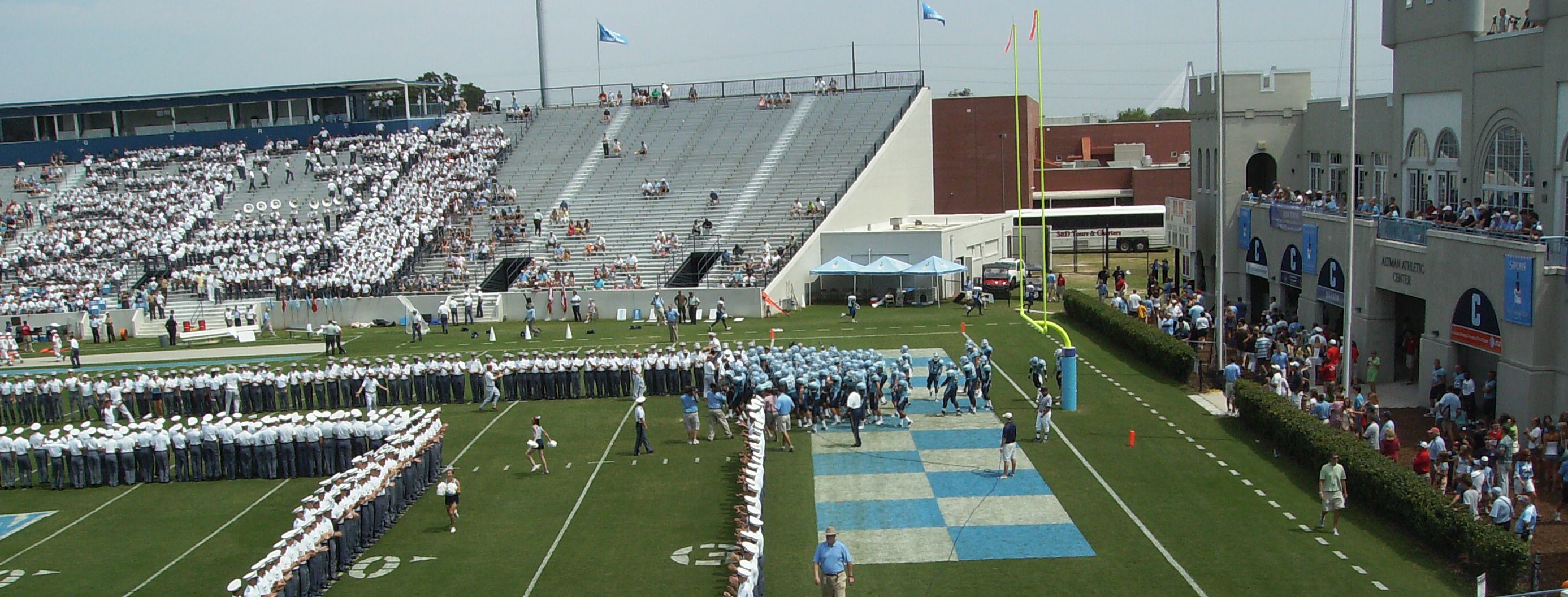
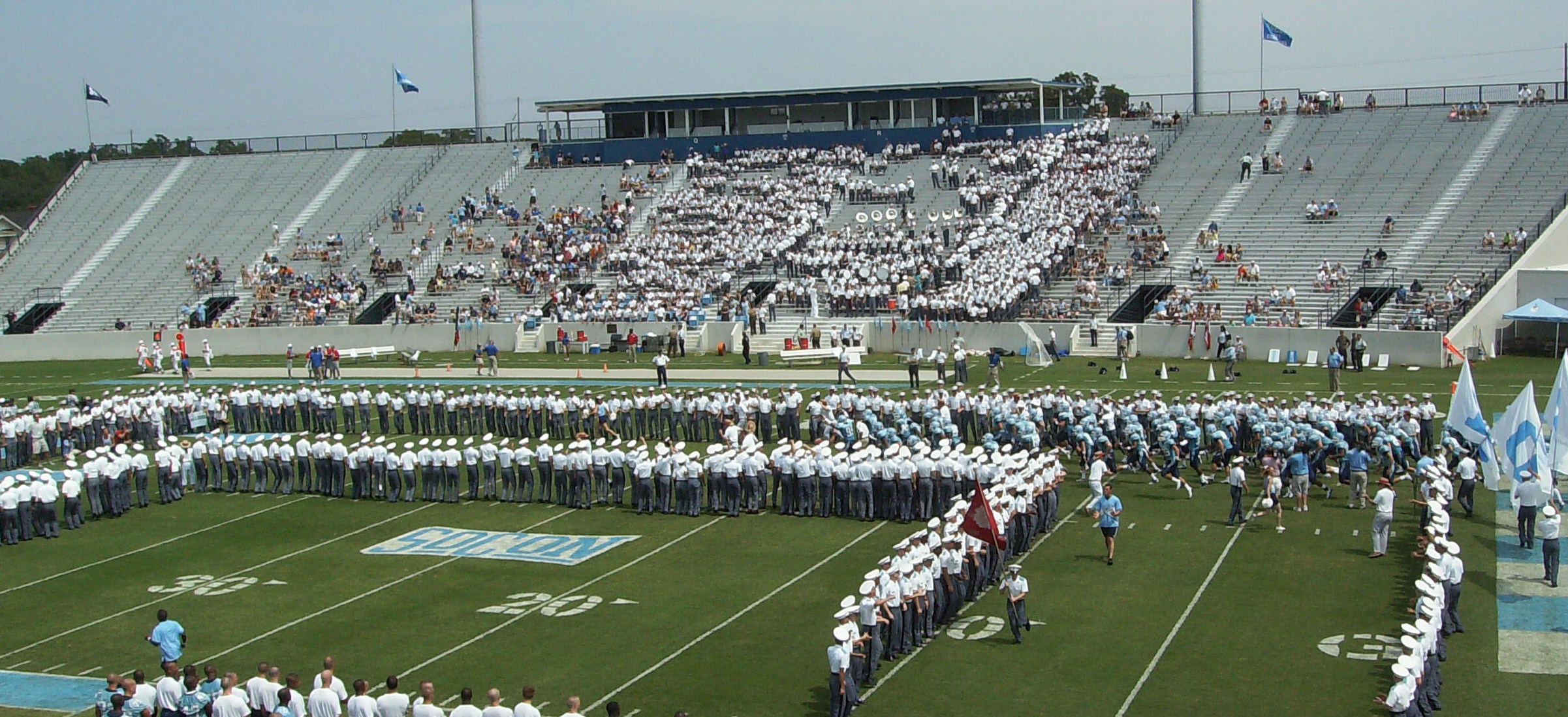
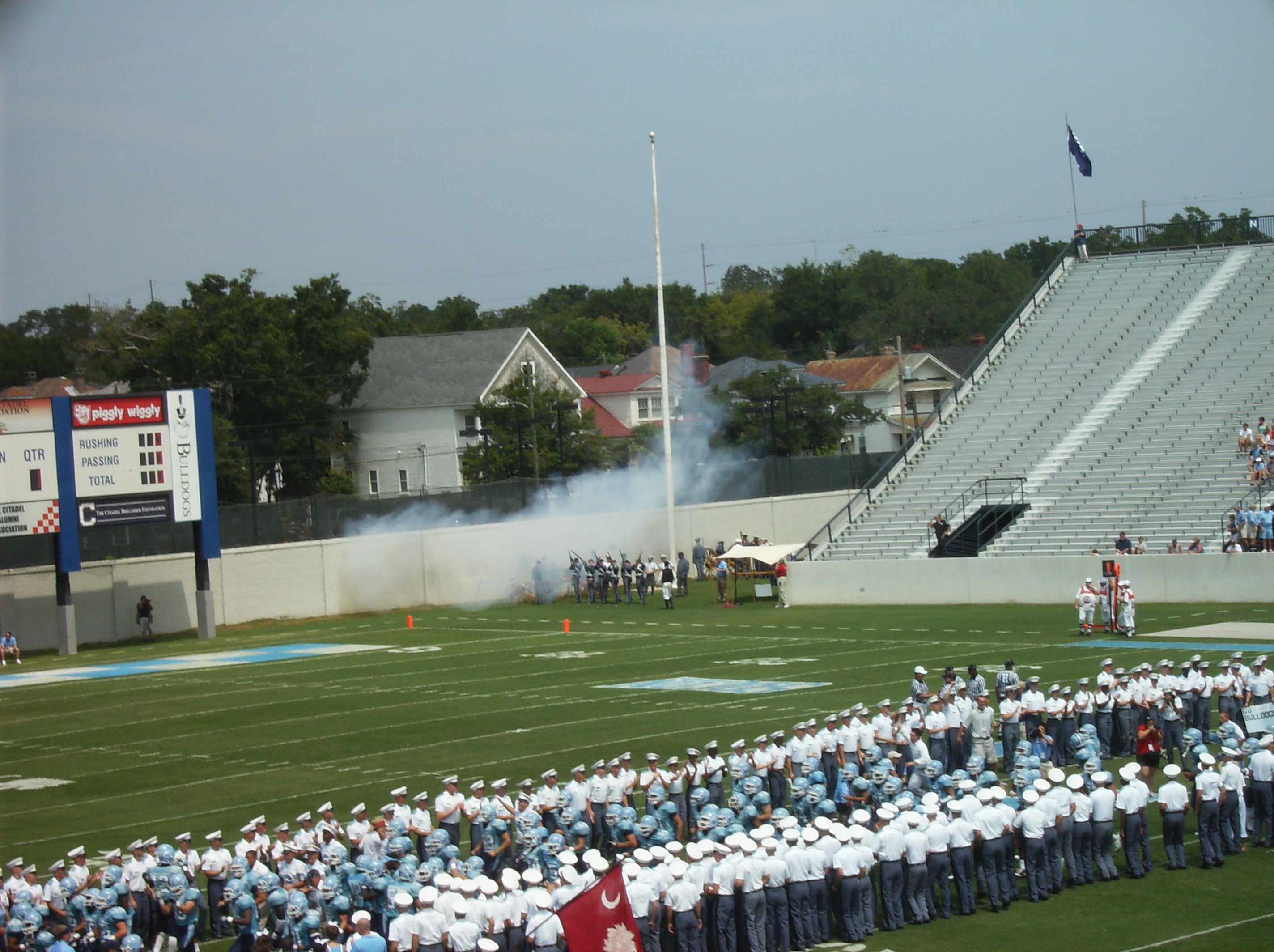
Here are a few more pictures to end this post.  These are just some shots of the field just prior and during the team’s entrance.  The last one includes some cannon fire in the background.

Football, Game 1: The Citadel vs. Chowan

It’s time for college football!   This year the scene at Johnson Hagood Stadium should include a lot of the following:  great tailgating, photo ops with Bulldogs both live and bronze, and, uh, fumbles…

Okay, so maybe that wasn’t the sunniest intro of all time.  I have to be honest here, though.  While I am looking forward to the season, this year I am a bit apprehensive about what lies ahead for the Bulldogs on the gridiron.  The Citadel is going to the triple option on offense, with a head coach who has never run the offense (or any similar offense) before, and with players who were mostly recruited for a very different kind of system.

The players who were recruited with the triple option in mind, of course, are all true freshmen.  The quarterback position will likely be manned by one (or more) of those true freshmen. The “knob”-starting quarterback double is a rare one, and for a reason. It’s an exceedingly difficult combination.

The Southern Conference media and coaches agree that this season could be a long one for The Citadel, just as the last two seasons have been.  The media picked the Bulldogs to finish last in the league.  The coaches ranked The Citadel eighth out of nine teams, ahead of only Western Carolina.

The Catamounts finished last in 2009, with only one league win.  That one WCU victory came against The Citadel, which tied for next-to-last.  More of the same is expected by those who follow the SoCon.

Before beginning league play, though, The Citadel will play three non-conference games.  Next week’s game at Arizona should be…interesting.  The following week the Bulldogs will take on Presbyterian, a team that went 0-11 last season, including a 46-21 loss to The Citadel.  However, even the Blue Hose would be favored against the Bulldogs’ opponent on Saturday, Chowan University, a Division II school located in Murfreesboro, North Carolina.

When the Hawks were announced as the opposition for the home opener, a collective yawn could be heard from The Citadel’s less-than-thrilled fans.  It’s hard to blame anyone for not being excited about Chowan being on the schedule, with all due respect to that school.  I’m guessing this game’s not going to be a sellout.

Having said that, let’s take a look at Chowan.

I wish I could say with confidence exactly how “Chowan” should be pronounced.  This is probably something that should concern Bulldogs play-by-play announcer Darren Goldwater a lot more than me, but I like to know these things.  I even sent an e-mail to Chowan’s department of athletics asking the question, and quickly got a response:

It’s pronounced CHO-WAN with a hard CH, just like CHOKE or CHICKEN. CHO-WAN.

That’s from somebody who works at the school, so she ought to know, but two different people have insisted to me that it’s actually pronounced “Shuh-WONN”, with the “Sh” sound at the beginning and the accent on the second syllable.  Since both of them are natives of eastern North Carolina, the region of the state that actually has decent BBQ, I tend to trust them.

“Chowan” is a derivative of “Chowanoke”, the name given to the native tribe of the region by 16th-century European explorers.  My guess is that if you were French, you pronounced it with the “Sh”, and if you were English, you went with the hard “Ch” sound.  It’s kind of like Beaufort (BO-fert), North Carolina, and Beaufort (BYOO-fert), South Carolina.

You like to-ma-to, I like to-mah-to, let’s call the whole thing off…

There is also a Chowan river, and a Chowan County — but Chowan University isn’t located in that county, but in the adjoining county of Hertford.  Naturally, this school in northeastern North Carolina is named to honor a tribe whose name means “people of the south”.

Regardless of its pronunciation, the school has been around in one form or another since 1848, when it was founded as Chowan Baptist Female Institute.  The school remained all-female until 1931, but in 1937 it became a junior college.

It reverted back to four-year status in 1992, and changed its name to the current Chowan University in 2006.  This fall, it will offer its first Masters Degree program, in Elementary Education.  Chowan remains affiliated with the Baptist State Convention of North Carolina.

About 1100 students attend Chowan.  I thought the section titled “Who we serve” on the school’s website was interesting:

The Chowan University community is committed to serving average students. By “average” we mean students with a GPA from 2.25-3.25 and “average” SAT scores (around 1300 for the three part SAT). Students below these criteria may be admitted if they show a commitment to the Chowan University experience and academic potential…

Many of our students are first generation college students which means their parents did not attend college or complete a college degree. Because of Chowan’s commitment to individual attention in a Christian environment, these students thrive here.

I liked this statement.  Too many schools insist on presenting themselves as wannabe Ivies, when everyone knows better.  Here we have a school that knows exactly what its mission is, and what it wants to do, and isn’t apologetic about it in the least.  Good for Chowan.

Chowan had a fine run in football as a junior college, almost entirely under James Garrison, who was the head coach at the school for 43 years (and for whom its football stadium is named).  Quite a few Chowan alums went on to four-year schools and then the NFL, including George Koonce, Curtis Whitley, and Mark Royals.

However, Chowan has struggled on the gridiron since becoming a four-year school itself.  Since 1993, the Hawks (formerly the Braves) have a cumulative record of 39-168-1 in Division III and (since 2005) Division II.  That includes Saturday’s 59-10 loss to Lenoir-Rhyne.

Chowan has been a football member of the Central Intercollegiate Athletic Association since the 2008 season (and is now a full member of the conference). Chowan is the first non-HBCU member of the CIAA in the league’s 98-year history.

The CIAA now has 13 members, and as a result the conference’s slogan for this year is “Triskaidekaphobia: Fear the 13!”  I’m not sure what the Southern Conference’s slogan would be — “The SoCon: The Nation’s Most Transient League”?

For Chowan football, the last five years have looked like this:

2005 — 2-8, including a 56-10 loss to North Greenville (now of Willy Korn fame) and a 42-21 defeat at the hands of Allen, which dropped its program after the season

2006 — 0-10, including losses of 42-0 to Western Carolina, 52-6 to North Greenville, and 28-0 to Webber International; Webber played The Citadel the following season, with a slightly different result

2007 — 2-9, including a lot of total beatdowns:  51-0 (Coastal Carolina), 56-14 (North Greenville), Presbyterian (62-10), and Newberry (67-0)

2008 — 2-8, which featured an early-season 69-20 loss to VMI (which had concluded its 2007 campaign in memorable fashion)

2009 — 2-8, although most of the games were more competitive; the Hawks did lose 36-21 to Old Dominion, the Monarchs’ first game since restarting its program after a 68-year hiatus (ODU did finish the season 9-2, though)

Those last two seasons came under the direction of the current head coach, Tim Place.  Place is a Washington & Lee alum who was previously the head coach at Urbana, an NAIA school in Ohio.

One of the members of Place’s coaching staff is Omar Nesbit.  Nesbit was an All-SoCon lineman at The Citadel, graduating in 2002.  He is the Hawks’ offensive line coach.

According to the school’s pre-season football guide, the team runs a “multiple” offense and a “multiple” defense.  Thirteen starters are back from last year’s outfit.

Last season the Hawks scored 25.3 points per game, not bad, but allowed 35.2 ppg. While the Hawks were a respectable passing team, all 25 of its TD passes were thrown by C.J. Westler, who was the offensive player of the year in the CIAA, and who is not among the returnees.  Much like The Citadel, Chowan has to find a quarterback (it played two in the Lenoir-Rhyne game).

Chowan turned the ball over three times per game, almost double its opponents’ totals, and averaged an anemic 2.9 yards per rush.  The Hawks gave up 48 sacks.

Defensively, the Hawks allowed 4.6 yards per rush and 9.3 yards per pass attempt, which is obviously not good.  Opponents scored touchdowns 70% of the time when they entered the “red zone”.  Chowan was also not a particularly efficient punting or placekicking team.

Against Lenoir-Rhyne, Chowan allowed 513 rushing yards (6.9 per attempt).  This is noteworthy in that L-R is running the same offensive system this season it ran last year under the direction of then-offensive coordinator Tommy Laurendine — who of course is now the offensive coordinator at The Citadel.

Laurendine has his work cut out for him, based on early reports.  For example, this is how Jeff Hartsell began his recap of the August 21 scrimmage:

After watching his quarterbacks combine for six interceptions and at least five fumbled snaps in Saturday’s scrimmage, Citadel football coach Kevin Higgins stated the obvious.

“Offensively, we have a lot of work to do,” said Higgins…

You could say that, coach.  On the bright side, nine of the eighteen pass attempts in the scrimmage were caught by Bulldogs.  Alas, six of them were defenders.  At least on those plays the QB got the snap from center.  Unofficial totals from the scrimmage had the first-team offense rushing 27 times for 67 yards.

At least the defense apparently looked good, although how much of that was due to the offense’s struggles is open to question.  The kicking game again failed to impress, a problem Higgins has been unable to solve for the last two seasons.

The scrimmage on August 28 was apparently better, based on some anecdotal reports.  At this point it appears the Bulldogs will play two “true” freshman quarterbacks, Ben Dupree (from Pennsylvania) and Matt Thompson (from Florida).

Terrell “First Sergeant” Dallas will be the fullback.  There are several candidates to fill the slotback positions, led by Van Dyke Jones and injury-plagued Rickey Anderson (everyone’s crossing their fingers for you, Rickey).  The offensive line has some experience, but not at center, which in part explains the center-QB exchange problems.

We won’t know for sure exactly how the new offense will look until Saturday, but it probably will be a slightly different variation than Charlie Taaffe’s version of the wishbone.  It’s not going to be quite like Wofford’s option attack, either.

It’s probably going to most resemble the setup run by Paul Johnson at Georgia Southern, Navy, and now Georgia Tech.  With that in mind, I wouldn’t be surprised if Kevin Higgins, with a personal history of running spread passing offenses, throws the ball a little more often than you see in most triple option offenses.

He has to figure out a way to get talented tight end Alex Sellars involved in the offense. Higgins has also commented on the big-play ability of Domonic Jones, a 6’5″ redshirt freshman.  I like the idea of isolating a tall receiver on a smaller defensive back in this offense.  Of course, you have to have a quarterback capable of getting the ball to Jones.

I linked this in an earlier post, but to get up to speed on how this offense will probably operate, check out The Birddog (helmed by a grad/fan of the Naval Academy), the triple option devotee’s website of choice.  Here is a primer on the TO:  Link

While the offense is filled with question marks, the defense should have a lot of answers.  There is depth and talent on that side of the ball, particularly in the defensive backfield.  Cortez Allen has drawn pre-season accolades.  Other DBs with the potential to shine include Keith Gamble (who had an 89-yard interception return against Presbyterian last season) and Joseph Boateng (who intercepted two passes in his collegiate debut against North Carolina).

Former safety Rod Harland is now a linebacker, joining team leader Tolu Akindele and Jeremy Buncum as likely starters.  The defensive line should be solid, if a little young.  Chris Billingslea had some impressive moments last season (and made the All-SoCon freshman team as a result).  Keith Carter is a redshirt freshman who should draw notice, if only for being a defensive tackle who wears #33.

The other defensive lineman (at least that’s his roster designation) I want to mention is Milford Scott, a special teams terror who blocked three kicks last season and created havoc many other times.  He’s tall, has long arms, and describes himself as a “Charleston homeboy” from the beach.  He’s a weapon.

Unfortunately, Scott’s dynamism on special teams was an exception (not counting Andre Roberts, obviously).  While punter Cass Couey fared reasonably well, the Bulldogs continued to struggle in the placekicking department.  That’s two seasons in a row The Citadel has had sub-optimal kicking, and early returns suggest it might be three in a row.

I don’t blame the kickers.  I blame the coaching staff.  It’s the job of the staff to get that aspect of the squad fixed, either by improving the kickers on the squad or finding somebody else to kick.

The Citadel also could stand to improve its punt coverage team (Scott aside) and its kickoff return unit.  The Bulldogs will sorely miss Andre Roberts as a punt returner; look for that component of special teams to not be as effective this season.

There has been a lot of turnover in the coaching staff, not only with the new offensive scheme (where the aforementioned Laurendine is joined by offensive line coach Bob Bodine), but with the defense as well.  Higgins recruited former Wofford assistant Josh Conklin to join the staff, and later named him defensive coordinator.

Conklin will get help from another new assistant, Denny Doornbos, who was the defensive coordinator at Army during the Bob Sutton years, which were mostly good ones.  I have to gleefully point out, though, that he was the DC for this game…and for this game, too.

While all the talk in the off-season has been about the offensive scheme, and how the coaches will implement it, I think the new coaches on the defensive side of the ball will be just as important.  Generally, you would like to have more staff continuity than The Citadel has had, but in the case of the defense, I think a fresh approach may be just what was needed.

There was a sense over the last two seasons that the defense had underachieved; in particular, some observers felt the unit was not aggressive enough.  The Bulldogs’ D must be pro-active this season, and give the offense short fields with which to work. The defense will likely also have to bail the offense out on a regular basis.

This is going to be an important year for Kevin Higgins.  The off-season issues, not surprisingly, did not sit well with the alumni — and I’m not just talking about the big boosters or the message board regulars.  He also has had back-to-back disappointing seasons on the field.

The move to a new offense, and the overhaul of his coaching staff, were both bold moves made by someone who expects to stick around for a while.  They weren’t short-term stopgaps.  That is to his credit, I think.

Now, however, even with modest on-field expectations, he needs to get the fan base to buy into his program again.  After all, Larry Leckonby and company need to sell tickets and sponsorships.  Jerry Baker has Brigadier Club membership goals to obtain, whatever his methods are (high-tech, low-tech, begging, etc.).

A 1:00 pm start time against Chowan on Labor Day weekend in Charleston probably isn’t going to be a big winner as far as attendance goes.  I fully expect one of those hot-and-humid Lowcountry days that are fairly typical for this time of year. Ugh.  Of course, that’s assuming a hurricane doesn’t come into play.

I’ll be there anyway, though.  I’m ready for some football.

Variety pack: Triple Option, The Citadel on TV, college baseball on the clock, Plant of the Week

This is going to be a grab-bag type of post, a variety pack if you will.  I may do this sort of thing periodically, as I really need to blog on a more regular basis.  I look at this as a way to make shorter comments on various issues, mostly about sports (including sports at The Citadel), with a few other odds and ends that catch my eye.  Think of them as Twitter entries that are longer than 140 characters.

Speaking of Twitter, my latest tweets can be seen on the left side of this page.  If anyone hasn’t noticed and is halfway interested in following me on Twitter, the location is http://twitter.com/SandlapperSpike (my tweets feature links/comments on a lot of stuff, including up-to-the-minute updates on Bulldog sports, baseball, football, and soccer, among other things).

As The Citadel counts down to kickoff against Chowan (as of today, T-41 days!), it’s time to focus on the Bulldogs’ new offense, which may be a little like an old offense, namely Charlie Taaffe’s wishbone attack.  However, it appears that Kevin Higgins may intend to run more of a “spread” triple option than Taaffe’s offense.

With that in mind, it might be a good idea to take a look at what the folks at Navy (and Georgia Tech, with Paul Johnson’s arrival in Atlanta) have been doing, particularly since Higgins apparently told one of our quarterback recruits (Ben Dupree) that The Citadel would be running a “Navy-style triple-option offense.”

Another reason to pay attention to the triple option is that Georgia Southern is also going to start running the offense this season, in a return to its roots.

For those interested in a breakdown of the nuts and bolts of the triple option, then, I cannot recommend highly enough a visit to The Birddog, the blog of choice for Navy football (and lacrosse).  The Birddog does a great, great job of illustrating (with video!) the intricacies of the triple option attack.

I’ve picked out four posts that I think serve as a good introductory primer for what the offense is all about.  (I hope I’ve chosen correctly.)  While reading these, just in case anyone gets confused, keep in mind that Paul Johnson is the former head coach at Navy (and Georgia Southern, of course) and is now at Georgia Tech.  The current Navy head coach is Ken Niumatalolo, and his offensive coordinator is Ivin Jasper.

Reading Is Fundamental

The Science and the Art

The Midline Option

Other People’s Rivalries And The Futility Of Defending Against the Wishbone

As of today, only one of The Citadel’s football games is scheduled to be televised (at Wofford on October 30).  There is always a chance that a local station (either in Charleston or another SoCon town) will elect to broadcast a game, although that is unlikely.  Other than that scenario, there are only two other games that could be televised.

It is possible (but doubtful) that SportSouth will pick up the November 20 game at Samford as part of its “SoCon Saturday” package, as the last two weekends of the regular season are “wild card” weekends — basically, the network will televise the most attractive matchup that week, based on the teams’ records to that point in the season.  Admittedly, very few prognosticators are going to bet that a game between Samford and The Citadel will have serious repercussions in the league standings, but you never know.

However, there is a decent chance that The Citadel’s game at Arizona on September 11 will be televised by Fox Sports Net Arizona (FSN-AZ), a regional sports network received by cable subscribers in Arizona (and I believe parts of California and New Mexico), and also available as part of DirecTV’s “Sports Pack”.  Arizona has asked the Pac-10 (and the league’s TV partners) for a waiver in order for the game to be broadcast.

The reason a waiver is needed is because there are already two Pac-10 games scheduled to be televised during the same time period, and that league’s national cable partners have television exclusivity rights for those games.  In other words, a local/regional broadcast can’t take place at the same time as a nationally televised league TV game.  If another Pac-10 school wants its game on television, it has to play in another time slot.

However, Arizona and Arizona State have been given waivers in the past because home game time slots for those schools are limited, especially early in the season. You just can’t play a football game in the desert in the midday heat.

(Matt Sarzyniak was nice enough to explain the Arizona/Arizona State waiver issue to me, which I appreciate.)

We’ll see what happens.  I am cautiously optimistic that the game will be televised.

The NCAA Baseball Rules Committee passed legislation that, if approved, will establish a time clock in college baseball.  The committee is basically incorporating the rules employed by the SEC for its 2010 conference tournament.

The 20-second rule for throwing a pitch was already on the books, but now it will be enforced with a timer, as will the amount of time allocated between innings.  I’ll be interested to see how the Southern Conference handles this; will it have a visible clock, with a timekeeper in the press box monitoring it?  Or will it just have an umpire carrying a watch?  I’m guessing the latter, for financial reasons.

The committee also modified the obstruction rule, which got a lot of notoriety in the Southern Conference tournament thanks to the second-round game/brawl between The Citadel and Elon.  That was the second-wildest fight I’ve ever seen at the SoCon tourney (nothing compares to the epic Raleigh/Piepenbrink donnybrook in 1990, though).

Not about sports:  you can be assured that I will never quote from or link to the Las Vegas Review-Journal.  Why, you ask?  This is why.

Link 1

Link 2

I sincerely hope that the Review-Journal goes bankrupt sooner rather than later.  Also, the photo of the CEO in the first link — doesn’t he look like a guy who hopes you throw something at him, so that he can sue you?

I have a great deal of respect for copyright law.  I think this guy and the Review-Journal (which is funding him) are abusing copyright law.

Not about sports:  I really enjoyed this article in The New Yorker on the identification and authentication of artworks.  It’s a long piece, but worthwhile.  I won’t spoil it, but there is a major twist halfway through.  The bottom line:  if P.T. Barnum had been more familiar with the art world, he would have said “there’s a sucker born every 15 seconds.”

Finally, a new feature, the Plant of the Week.  That’s right, plants.  As I’ve said elsewhere on the blog, I consider gardening a sport.  In honor of this being the first edition of the PotW, I will honor not one but two plants in my garden.  Both are crinums. Feast your eyes on a Powelii (Cecil Houdyshel) and a Herbertii (no common name).

Until next time…

Thoughts on The Citadel and transfers

When I write about The Citadel and transfers, I want to first distinguish between basic types.  One of them is the three-year transfer.  It’s a little bit unusual, but not rare, for someone to spend his or her freshman year at another school, and then transfer into The Citadel.

Now, the “system” at The Citadel is designed for a four-year student.  In other words, the typical member of the corps of cadets spends four years at the school, and those four years have very specific benchmarks.  However, it is possible (and not particularly difficult) for a student to transfer in and spend three years in the corps, and have essentially the same experience as a four-year student.  Basically, the sophomore/junior years are combined.

I don’t know anyone associated with The Citadel who has a problem with a three-year transfer athlete representing the school.  I certainly don’t.  It doesn’t happen often, to be sure.  Recently Kenny Manigault, who played high school basketball in the Charleston area for Pinewood Prep, announced he was transferring from Wichita State to The Citadel. Manigault will have three years of athletic eligibility, and will presumably be spending (at least) three years in the corps of cadets.

Another athlete who will be transferring in to The Citadel is Blane Woodfin, who originally committed to Air Force, but was not admitted to the AFA (reportedly because of a physical problem).  Woodfin attended Montana State last year but did not play football, and will thus apparently have four years of athletic eligibility remaining at The Citadel, not three.

These are not transfers likely to cause any cantankerous old alum heartburn, even though Manigault called Chuck Driesell “real laid back”, which is the first time I’ve ever heard anyone call Driesell laid back.  The Citadel as an institution, as Manigault and Woodfin will soon learn (if they don’t know already), is certainly not laid back…

However, there is another type of transfer that has been popping up more and more at The Citadel in recent years, the “fifth-year” transfer.

This started in football, where a player can transfer from an FBS school to an FCS school and play immediately.  The “trailblazer” in this category for The Citadel was Jeff Klein, a quarterback who transferred from Auburn and played one year for The Citadel (2002).

He was followed the next season by former Clemson QB Willie Simmons and ex-Duke defensive back Anthony Roberts.  Those three players played for The Citadel under former coach (and alum) Ellis Johnson.  In recent years, Kevin Higgins has had two fifth-year transfers — his son, wideout Tim Higgins (who originally played for Florida), and tight end B.J. Phillips (North Carolina).

All of these guys graduated from their original schools and played one year as graduate students for The Citadel, except for Phillips (who had two years of athletic eligibility in football remaining after graduating from UNC).

As students in The Citadel Graduate College, none of these players were members of the corps of cadets (indeed, it’s possible none of them even attended classes with cadets, as graduate classes at The Citadel are held at night).

Reports vary on how seriously these graduate student athletes attempted to bond with their teammates, tried to understand/appreciate what cadets go through, etc.  My general impression, which could be wrong, is that Simmons and the younger Higgins made an effort to try and “jell” with the team and school; Klein, not so much.  Phillips, of course, still has one year left on the football team.

These one-year-only players were not a factor in basketball at The Citadel because there was no lower classification within Division I for them to transfer to without penalty (in other words, no FBS/FCS distinction).  At least, they weren’t a factor until last year, when Joe Wolfinger transferred to The Citadel after graduating from Washington.

Wolfinger had his degree and one year of athletic eligibility in basketball remaining, and he used that year to play basketball at The Citadel, thanks to a technicality.  As this article explained:

Wolfinger will be a fifth-year senior next season and is apparently eligible to play immediately at The Citadel because he has graduated from UW and will enter a Master’s program at The Citadel that is not offered at Washington.

Wolfinger is gone, and so is Ed Conroy, but Chuck Driesell has decided to bring in his own tall transfer for this upcoming season:

Mike Dejworek, a 6-11 center from Belmont University, will play one season for the Bulldogs as a graduate student, new coach Chuck Driesell confirmed…

…Dejworek, a native of Ulm, Germany, sat out last season with a shoulder injury after playing three years for Belmont. In 2008-09, he played in 24 games and started one for a 20-13 Belmont team, averaging 1.7 points and 1.6 rebounds. He was a reserve on a Belmont team that made the NCAA tournament his sophomore season.

I presume that, like Wolfinger, Dejworek will be enterering a Master’s degree program at The Citadel that is not offered by Belmont.

There are plenty of alums who are less than crazy about athletes competing on varsity teams without ever being part of the corps of cadets.  Ken Burger, then the sports editor of The Post and Courier, wrote about this as far back as 2003:

…the school’s old guard is very vocal about this troublesome trend. They say these young men never spent a single day at The Citadel and don’t deserve the privilege of wearing the school’s uniform. Even its football uniform…

…Over the next three months we will find out how this experiment works out for [Ellis] Johnson’s program and The Citadel. And, there will be plenty of people watching and judging from the sidelines…

…While it’s easy to say the old school should stick to the old ways, there’s another side of this controversy that can’t be ignored.

The Citadel’s military counterpart, VMI, recently left the SoCon and downgraded to the Big South Conference because the Keydets could no longer compete…

Ah, yes, the old “we just can’t compete” crutch.  Poor, pitiful puppies; how can our coaches ever win?

First, the obvious.  Charlie Taaffe won a Southern Conference title in football without any non-cadet help.  He beat South Carolina and Arkansas and Army and Navy, and all of his players were in the corps of cadets.

Brief tangent:  Just for clarification, Taaffe did occasionally have some fifth-year guys who had already graduated and had an extra year of eligibility remaining after redshirting, but all of them had spent four years in the corps.  That is a completely different situation than the fifth-year ‘program’ I’m discussing in this post, of course.

Eddie Teague won a SoCon title back in the day, too, with members of the corps of cadets.  It’s not easy (after all, The Citadel has just those two league titles in football), but it can be done.

Meanwhile, the fifth-year recruits have not exactly led to dramatic success on the gridiron.  Klein set lots of passing records in 2002, but the team went 3-9.  With Simmons at quarterback (and Roberts in the defensive backfield)  in 2003, the Bulldogs improved to 6-6.  Tim Higgins’ one season at The Citadel came in 2007, the only season since 1997 in which the Bulldogs have finished with a winning record (7-4).

In hoops, Wolfinger did not prove to be a difference-maker last year, as The Citadel went 16-16, a season that followed a 20-13 campaign.  Wolfinger got progressively less playing time as the year went on, as he turned out not to be a particularly good fit for The Citadel’s style of play.

There is another aspect to this, the “recruited over” concern.  If you are a promising high school football player and you are considering The Citadel, should you be worried about the possibility that down the road, when it’s finally time for you to become a regular, the coach will suddenly bring in some graduate student to take your position?  Being recruited over is something normally associated with players at big-time college basketball programs, not The Citadel.

Those are the on-field results and issues.   What about the off-the-field repercussions?

— The essence of The Citadel, the part that differentiates it from other schools, is the corps of cadets.  Our athletic teams are supposed to represent the students at the military college.  What statement is the school making when it elects to offer opportunities to varsity athletes who have never been a part of the military environment?

— For that matter, the athletic teams represent the alumni as well.  Am I supposed to identify with varsity athletes who did not go through the same experiences that I did?

— If I have misgivings as an alumnus about identifying with these athletes, just imagine how the current members of the corps of cadets must feel.

— There is also the public perception.  Many outsiders are impressed that The Citadel can compete at all with the inherent disadvantages of being a military school.  When you bring in players from outside that environment, do you know what the general public calls them?  Ringers. (So do some alums.)

At that point The Citadel becomes “just another school” in the minds of some people.  Is that something that the powers-that-be at The Citadel want?

I might add that the perception issue is magnified when the player plays a high-profile position (like quarterback) in football.  In basketball, there aren’t that many players, so almost any player is highly visible.

Having said all that, I don’t blame any of the individual coaches for bringing in graduate students.  Coaches are trying to win.  Winning is not easy to do at The Citadel, so it’s not surprising that coaches try to work the system as much as possible.

Coaches also tend to have a narrower focus; it’s hard to expect Chuck Driesell, for example, to consider how a graduate student playing basketball may affect the school, in terms of the big picture.   Driesell is just trying to find a big man who can rebound.

The administration has the responsibility of telling the coaches to focus solely on recruiting players who will be part of the corps of cadets.  It appears that, for whatever reason(s), the current administration does not share the concerns that have been expressed by some alums.

Maybe the thinking from General Rosa and company is that one or two exceptions don’t really matter.  I don’t know.  It’s also possible that the school wants to have occasional graduate student varsity athletes, in an effort to promote the Graduate College.

I tend to doubt that having an occasional hoopster or football player in the graduate school is going to raise the profile of the CGC, although I couldn’t blame the school for trying every avenue to promote it.  The CGC is an opportunity for The Citadel to make money, which the school needs to do.

Over the past few years, the military college has gradually become simply a state school, as opposed to a state-supported school.  That’s because the State of South Carolina continues to cut back on funding for higher education (in general, the state legislature believes higher education should end after the third grade).

[Sorry for the political jibe, but honestly, our state’s lack of commitment to education is embarrassing.]

In closing, one thing I want to emphasize is that I don’t have anything against the players who enter the school as graduate students.  They are taking advantage of a great opportunity, as well they should.  I wish them well, and I hope they are successful in class and on the field of play.  I will be rooting for them, as I do anyone who represents my alma mater.

I just wish the administration would revisit the current policy.  I strongly believe that varsity athletes at The Citadel should all come from the corps of cadets.  I know my opinion doesn’t really matter, but I also know that I’m not the only person who feels this way about transfers and varsity athletics.

Yes, I’m ready for football season…