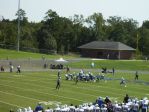
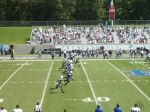
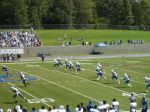
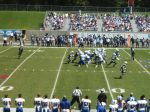
Game review, 2017: Presbyterian

Before getting to the review of Saturday’s game, I have to note the passing of Mitchell Jeter, a former defensive lineman for the Bulldogs.

Jeter was the SoCon’s defensive player of the year in 2015, a year in which The Citadel won the Southern Conference title for only the third time in school history. He was arguably the best player on that team.

At this time, there is not much information about the automobile accident that claimed the lives of Jeter and three others (including a child) Saturday night.

Brent Thompson called Jeter’s death a “tragic and immeasurable loss”, and that basically sums it up. Obviously, everyone’s thoughts are with his family and his friends, which include many current players on the football team.

There is no real way to properly segue from that news to a football game, so I’m just going to follow with the standard game review. My apologies for any perceived abruptness on that front.

Links of interest:

– Game story, The Post and Courier

– “Notes” package, The Post and Courier

– AP game story

– School release

Video from WLTX-TV

– Game highlights (video)

– Boxscore

Replay of the Big South Network’s streaming of the game

Before the season, the general consensus among most knowledgeable observers was that Newberry, despite being a D-2 program, would probably be a sterner test for the Bulldogs than Presbyterian. In this case, the consensus was quite correct.

Even the sudden change of venue could not stop The Citadel from asserting its clear superiority on the gridiron over the outmatched Blue Hose. An early thunderbolt of a run by PC’s Torrance Marable, the most impressive player on Presbyterian’s roster, only served to delay the inevitable result.

Ten different cadets had rushing attempts on Saturday, and two others caught passes, as the coaching staff took advantage of the opportunity to develop some more depth. While 46 different Bulldogs played against Newberry, 58 saw action versus Presbyterian.

A glance at the statistics for the game shows just how dominant The Citadel was on Saturday:

The Citadel Presbyterian
Starting field position TC 28 PC 24
Efficiency 63.6% (28/44) 8.33% (1/12)
Explosiveness 1.100 7.410
Finishing drives 6.8/poss 0.0/poss
Turnover margin +2 -2
Yards per play on 1st down 6.92 8.22
Avg. yards to gain on 3rd down 3.0 6.5
Passing down success rate 33.3% (4/12) 33.3% (3/9)
Time of possession 40:21 19:39
Off. plays from scrimmage 81 40
Yards per play 6.7 5.7
Yards per play (rush) 5.6 6.4
Yards per play (pass attempt) 26.0 5.1
Off. 3rd down conversion rate 81.3% (13-16) 50.0% (4-8)
Off. plays of 20+ yards 4 2
Penalties 3 for 39 yards 2 for 25 yards


  • Not counted in the efficiency and explosiveness categories: the entire second half. At 35-7, the third and fourth quarters were considered “garbage time” for statistical purposes (in those categories, at least)
  • Not counted in the field position category: Presbyterian’s last drive of the first half, and The Citadel’s final drive of the game
  • The Citadel advanced inside the 40-yard-line six times, and scored a touchdown on each of those possessions; Presbyterian did so twice, but did not score a point on either possession
  • Presbyterian threw one interception on first down; on passing downs, the Blue Hose offense threw one interception and also was sacked once
  • Successful plays from scrimmage by quarter (first half only): 1st – The Citadel 15, Presbyterian 1; 2nd – The Citadel 13, Presbyterian 0

Presbyterian’s average in the “explosiveness” category is reflective of the fact that the Blue Hose only had one successful first-half play, but it happened to be a 76-yard TD run. That one play also skewers PC’s yards per play on first down (as it came on first down) and yards per rush.

If you take out Marable’s run (which you can’t, but whatever), and also remove the one sack from the rushing statistics, Presbyterian averaged 2.9 yards per rush. Doing the same thing for first downs would leave the Blue Hose averaging 4.24 yards per play on first down.

The Citadel’s 1.1 explosiveness average is actually better than what the Bulldogs did against Newberry last week.

Odds and ends:

– I was concerned about traffic being a problem between Columbia and Clinton, but I-26 was relatively clear both coming and going.

– While it is obviously not ideal that The Citadel had to move a home football game (and for a second consecutive season), the shift to Clinton was a boon to Bulldog fans in the midlands and the upstate, who arrived early and in good numbers.

I was a little surprised that only 2,586 people made it to the game. A solid majority of them were wearing light blue and white, however.

– There are benefits to a noon kickoff for a game that takes only 2:26 to play, including getting at home in time to watch the late-afternoon and evening college football action. I enjoyed that.

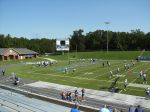
– PC’s setup is nice, about all that you would want for a small-school college football stadium/tailgating experience. For the sake of Blue Hose fans, I hope the football program can be revitalized.

– Gastronomic experts in the stands heartily approved of the chili dogs. I also noticed that a significant amount of pizza was consumed.

Among those in attendance at the game, per Jeff Hartsell: Dee Delaney, Tyler Renew, Keith Carter, and Mariel Cooper.

– A few of the Bulldog fans who were tailgating also got some publicity. Shrimp and grits, indeed.

Next week’s opponent: East Tennessee State, now 1-1 on the season after losing to James Madison 52-10 on Saturday. The Bulldogs will travel to Johnson City, Tennessee, for a 1pm kickoff. It will be the second contest (and first SoCon game) played at ETSU’s new football stadium.

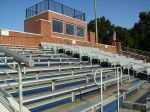
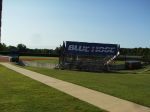
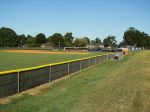
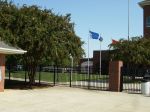
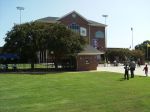
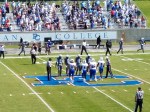
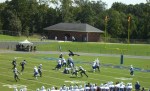
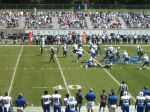
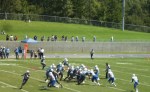
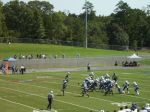
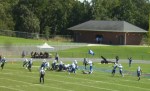
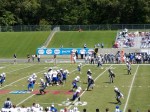
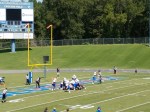
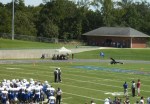
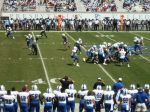
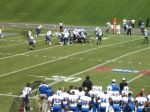
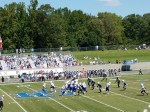
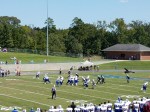
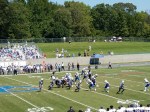
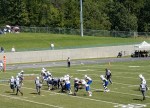
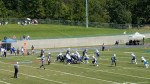
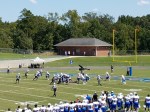
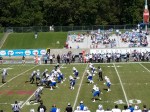
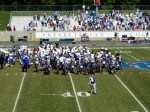
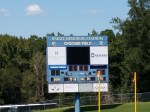
For this week’s pictures, I included shots of Presbyterian’s soccer stadium and baseball field. Both of those facilities are near the football stadium.

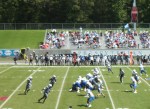
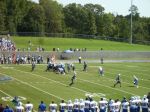
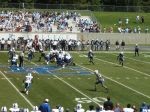
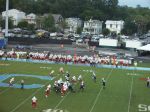
Most of the action shots are annotated.

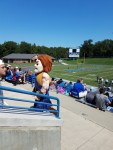
I’ll lead off the photo parade with a picture of Scotty the Scotsman, a rather amiable sort.


2017 Football, Game 2: The Citadel vs. Presbyterian

Columbia, October 27 — Special: The Citadel struck a tartar in the light but aggressive Presbyterian College eleven when they met on the gridiron at the State Fairgrounds to-day, and could only manage to carry off the victory by a score of 14 to 0.

The entire Citadel team seemed to be experiencing an off day. The backfield was slow in getting into action and the heavy Blue line failed time and time again to break through the stubborn defense of their lighter opponents.

The cadets made their initial touch-down in the first quarter. After a forward pass had failed, [Johnny] Weeks punted out of bounds and the ball was put into play at Presbyterian’s 20-yard line. [Presbyterian quarterback] Galloway took one yard around left end. On the next play [Henry] Switzer pulled down a Presbyterian forward pass and sprinted twenty-five yards for a touch-down. Weeks kicked goal…

…Citadel scored her final touch-down in the third quarter…Galloway punted to Weeks, who gained forty yards. Weeks made 10 around left end. [Chesnee Cogswell] took 6 through centre, Bolton smashed the line for three more, and Weeks and Switzer got 5 yards over tackle in two bucks.

On the next play, Bolton was thrown for a loss of two yards, but Weeks carried the ball across for a touch-down and then kicked goal.

– The News and Courier, October 28, 1915

The Citadel vs. Presbyterian, to be played in Bailey Memorial Stadium at Claude Crocker Field in Clinton, South Carolina, with kickoff at noon ET on September 9, 2017.

The game will be streamed on the Big South Network. Presbyterian’s radio team of Ryan Clary and John Orck will provide the audio for the stream.

The contest can be heard on radio via the various affiliates of The Citadel Sports Network. WQNT-1450 AM [audio link], originating in Charleston, will be the flagship station. 

Mike Legg (the “Voice of the Bulldogs”) will call the action alongside analyst Lee Glaze

The Citadel Sports Network — 2017 Affiliates

Charleston: WQNT 1450 AM/92.1 FM/102.1 FM (Flagship)
Columbia: WQXL 1470 AM/100.7 FM
Greenville: WLFJ 92.9 FM/660 AM
Sumter: WDXY 1240 AM/105.9 FM

More TV/streaming information: the contest will be not streamed on ESPN3, though it will be available on the Big South Network (as noted above).

Scott Eisberg of WCIV-TV in Charleston tweeted that the game would be televised on WCIV’s “MeTV”, which is one of that station’s digital subchannels. As of Saturday morning, the game does not appear in any online TV listings, though it is quite possible (if not likely) that those listings could not be updated in time.

I’m going to guess that the game will be televised on MeTV in Charleston (WCIV’s digital subchannel 3) and that the production is via the Big South Network feed.

Links of interest:

Game moved from Charleston to Clinton and rescheduled for noon on Saturday (school release)

Back to Lookup Lodge

Grant Drakeford is profiled after an excellent performance against Newberry

Solid debut for some new Bulldog starters

– Game notes from The Citadel and Presbyterian

– SoCon weekly release

– Big South Conference weekly release

Presbyterian “quick facts”

– FCS Coaches’ poll (The Citadel is ranked #13)

– STATS FCS poll (The Citadel is ranked #14)

– Brent Thompson’s 9/5 press conference, with comments from Grant Drakeford and Aron Spann (video)

– Brent Thompson’s 9/6 radio show (video)

Presbyterian preview in The Post and Courier

Presbyterian preview from the Big South (video)

Another year, another game moved out of Johnson Hagood Stadium. In 2016, The Citadel played a “home” game at North Greenville.

This time, due to the impending threat of Hurricane Irma, the Bulldogs will travel to Clinton, South Carolina, and face Presbyterian at Bailey Memorial Stadium. PC’s home facility seats 6,500 and is fairly new, having made its debut during the 2002 season.

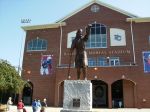
In front of the stadium is a 15-foot bronze statue called “Cyrus”. He seems to be rather moody.

In the next section, I’ll reference an unrelated “Cyrus”; they are two of the three times that name has appeared in the entire history of The Sports Arsenal.

The game referenced in the blurb at the beginning of the post was the first meeting on the gridiron between Presbyterian and The Citadel. It was played during the State Fair in Columbia, at the central fairgrounds.

The Bulldogs were not at their best, possibly due to the hot weather, but managed to prevail anyway. Presbyterian’s offense never advanced the football past The Citadel’s 40-yard-line.

A few other notes on that 1915 contest:

  • The game was played on Wednesday, October 28 (not the 23rd, as listed in The Citadel’s record book)
  • The first and third quarters were 15 minutes long, while the second and fourth quarters were 12 minutes long
  • Each team used 14 players during the game
  • The Citadel’s players were back at the barracks by 8:00 am the following morning, having taken a 3:00 am train back to Charleston

Other attractions at the fairgrounds on that Wednesday: horseracing, a “Lady high diver”, a bicyclist named “Dare Devil Doherty”, and “Cyrus and Mandy and their hay rack”.

Presbyterian was one of three Palmetto State colleges The Citadel defeated in 1915. In addition to wins over Newberry and South Carolina, the team also beat Porter Military Academy and the Charleston 6th Naval District squad en route to laying a claim to the state championship

Incidentally, for anyone who thinks the current trend of coaches not allowing fans/media to observe practice is something new, this tidbit was mentioned in the newspaper during a preview article on the game:

Secret practice has been the rule at Hampton Park this season. No one but those on the squad and those directly interested in the team have been allowed within the grounds during practice hours. Would-be visitors were politely informed that the cadets could not be seen.

This rule will be waived a little after this week. Coach Rogers announced yesterday that vistors would be welcomed at the park on Wednesday afternoons to the scrimmages. On other days the grounds will not be open to anyone.

How long has it been since The Citadel played a football game at Clinton?

1937.

That year, the Bulldogs defeated the Blue Hose (called the “Hosemen” in The News and Courier) 19-0, with the game taking place at Johnson Field. Two of the three touchdowns scored that day by The Citadel came off of blocked punts.

Both of those punt blocks came courtesy of the team captain, Francis King. The native of Georgetown was hailed by the newspaper for playing “superlative ball”.

King scored one of the two punt-block TDs himself; Tom Huguenin fell on the ball in the end zone for the second. The Bulldogs’ third touchdown was scored on a run by Clough “Mutt” Gee.

Gee went to The Citadel for three years, and then transferred to the United States Military Academy. He was killed in action during World War II when his airplane crashed in Lisieux, France. Gee is buried in the Normandy American Cemetery.

A few other notes on game locations in the series between The Citadel and Presbyterian:

– The last time The Citadel played PC somewhere other than Johnson Hagood Stadium was on October 12, 1963, when the contest was held in Savannah; the matchup was called the “Georgia Peach Shrine Game”, and was a benefit for the Greenville Shriners Hospital.

The Bulldogs won 24-0 behind 121 yards rushing from Jim Parker (on only 7 carries). Parker, Bruce Whitney, and Vince Petno all scored touchdowns for the Bulldogs, with Petno’s TD coming on a 5-yard pass from Wade St. John. Attendance: 7,000.

– The 1950 game between the two schools was played at the Orangeburg County Fair.

The Citadel won 7-0, scoring the game’s only touchdown in the first quarter. Deep in its own territory, Presbyterian tried a “quick kick” on third down. It was not successful, as Bulldogs safety Bobby Carter corralled the pigskin at the PC 25-yard line and returned it 20 yards.

Rudy Willcox raced around the right side of the line for 5 yards and a TD on the next play, with Don Davis adding the PAT. Jerry DeLuca was the defensive star that afternoon for the Bulldogs.

As was the case for the 1963 game, estimated attendance was 7,000.

– In 1948, The Citadel played PC at College Park, as the “new” Johnson Hagood Stadium was not quite ready to open. The Blue Hose won that game 7-0, as The Citadel did not run an offensive play from scrimmage in PC territory during the entire contest.

– Presbyterian and The Citadel played at the Sumter County Fair in 1940 and 1941, splitting the two matchups. In the 1941 game, won by the Bulldogs 21-13, PC’s entire student body traveled to the game, only to see the Bulldogs rally from a 13-7 halftime deficit to win the game 21-13.

Team captain Mike Newell scored two touchdowns for The Citadel, with Andy Victor adding a third and also successfully converting all three PAT attempts.

In 1955, The Citadel played Presbyterian at Johnson Hagood Stadium. It was Homecoming, and that week was chronicled by Life magazine as part of a profile of Mark Clark.

The photos taken by the magazine (specifically, photographer Robert W. Kelley) are now part of an archive created by Google. I’ve linked to them before, and I’m going to link to them again, because A) The Citadel is playing PC again, and B) they are endlessly fascinating.

Many of these pictures are football-related, but I’ve also linked to some “general” shots (pun intended). The first few linked photos are in color, but the vast majority of pictures in the archive are black-and-white. This is just a small sampling of what is available for viewing; try this link to get started if you want to see more of them.

If you haven’t seen color photos of The Citadel’s 1955 uniforms before, you’re in for a surprise.

Why are Presbyterian College’s varsity athletic teams nicknamed the “Blue Hose”?

…probably the true story lies in a letter dated June 15, 1935, written by then athletic director Walter Johnson to an inquiring English professor in Virginia…[quoting from Walter Johnson’s letter] ‘It was about the second or third year, 1915, if I remember right, Stockings. I think it happened this way: I changed uniform colors to blue, wearing blue stockings and jerseys, and some sports writer started calling in his articles the Presbyterian College teams the Blue Stockings.’ …In later years “Stocking” became abbreviated to “the Hose,” particularly in newspaper headlines, and was more or less officially adopted by the student body in the late 50’s.

…“Johnson always insisted on the fact that his players wore long blue socks similar to stockings (after all, there were White Sox and Red Sox in baseball). Coach Johnson’s explanation may simply be coincidental to the fact that the phrase “Blue Stocking Presbyterian” goes back informally quite a few years in the denomination’s history.”

This particular Walter Johnson was not the great pitcher of the same name, but a former football player at Michigan who was a coach and administrator for many years at Presbyterian. He was the head football coach at the school from 1915 to 1918, and then from 1920 to 1940.

Johnson finished his football coaching career with 102 victories, more than any other PC coach except Cally Gault (who won 127 games between 1963 and 1984). Both Johnson and Gault are enshrined in the NAIA Hall of Fame.

In 2005, Presbyterian won the Division II South Atlantic Conference title, finishing with a 10-2 overall record. It was the first conference title for PC since winning the SAC in 1979.

The following year, the Blue Hose went a solid 7-4. However, as Presbyterian began the transition from D-2 to D-1, wins became a lot tougher to come by. The first all-D1 slate for the Blue Hose, in 2009, resulted in an 0-11 record.

Under former head coach Harold Nichols, Presbyterian won just 11 games over the next four seasons, but then pulled off a surprising 6-5 campaign in 2014 (despite playing three FBS teams).

The Blue Hose had a truly outstanding defense that year. PC beat Furman 10-7, Charleston Southern 7-3, Western Carolina 19-14 (with two defensive touchdowns), Monmouth 18-12, and Gardner-Webb 14-7 (Presbyterian’s first score coming on a blocked field goal). The sixth victory was an early-season walkover against Bluefield of the NAIA.

Unfortunately for Presbyterian, the next two years ended in identical 2-9 records, and Nichols elected to resign. His replacement is the man who was the head coach of that 2005 team and the defensive coordinator for that 2014 squad.

Tommy Spangler is a Georgia alum who compiled a 42-24 record as PC’s head coach from 2001 to 2006. He left to become the defensive coordinator at Louisiana Tech, but returned to Clinton as the Blue Hose defensive coordinator in 2013.

His mission is to guide Presbyterian to consistent respectability in FCS. It won’t be an easy task, but Spangler’s prior success at the school has to be encouraging to PC supporters.

Spangler’s first game back at the helm of the Blue Hose was last week’s 51-7 loss at Wake Forest. It was not pretty for PC. On the other hand, it wasn’t really supposed to be.

Presbyterian did have the edge in time of possession by almost five minutes, in part because only nine of the Blue Hose’s 54 offensive plays from scrimmage were pass attempts. Two were completed; one was intercepted.

On the other side of the ball, Wake Forest rushed for 248 yards and passed for 239, averaging 6.8 yards per play.

The bright spot for PC was freshman running back Torrance Marable, who gained 162 yards rushing on 16 carries, including one scamper for 58 yards.

Statistics of note for Presbyterian’s 2016 season (11 games):

PC Opp
Points/game 8.9 30.9
Rushing yardage 1105 2670
Yards/rush 2.9 5.9
Rush TDs 4 28
Passing yardage 1551 2077
Comp-Att-Int 168-302-11 126-277-7
Average/pass att 5.1 9.1
Passing TDs 6 15
Total offense 2656 4747
Total plays 682 678
Yards/play 3.9 7.0
Fumbles/lost 18/7 13/7
Penalties-pen yds 66-551 71-686
Pen yards/game 50.1 62.4
Net punt average 39.1 39.7
Time of poss/game 30:43 29:17
3rd-down conv 42/159 42/121
3rd-down conv % 26.4% 34.7%
Sacks by-yards 13-86 23-125
Red Zone TD% 7-25 (28%) 23-35 (66%)


Um, ouch. There is not a lot to say about those numbers. PC obviously had trouble putting up points in 2016, being shut out twice (by Chattanooga and Liberty) and scoring 10 points or less in six other contests.

The Blue Hose finished last in all of FCS in scoring offense, and also finished in the bottom 10 of the following categories: offensive first downs, offensive 3rd down conversion rate, passing offense, total offense, yards per rush, yards per pass attempt, yards per pass completion, red zone offense, rushing defense, tackles for loss (last nationally), and punt returns (also last in FCS).

I guess there is nowhere to go but up.

Presbyterian returned seven starters from last year’s offense.

Ben Cheek (6’0″, 190 lbs.), a redshirt junior from Franklin, Georgia, started eight games for the Blue Hose last season at quarterback. Cheek completed 54.9% of his passes, averaging 4.8 yards per attempt, with two touchdowns and eight interceptions.

Against Wake Forest, Cheek carried the ball 22 times (though 3 of those were sacks credited in the rushing statistics).

As mentioned above, freshman Torrance Marable (5’10”, 185 lbs.) had a good game versus the Demon Deacons. Marable originally signed with Arkansas State out of high school. The native of Decatur, Georgia enrolled at PC in January of this year.

Although he did not return a kickoff last week, Marable is listed on PC’s two-deep as one of the starting kick returners for the game against The Citadel.

Wide receiver DaShawn Davis (5’9″, 155 lbs.) was a second-team All-Big South selection last season. The junior from Inman caught 42 passes last season, averaging 10.8 yards per reception. Davis also handled the majority of punt and kick return duties for the Blue Hose in 2016.

Presbyterian’s projected starters on the offensive line average 6’2″, 282 lbs. Right guard Thomas Hughes (6’3″, 275 lbs.), a senior from Cordova who went to Edisto High School, has 17 career starts, most on the team.

PC’s defense normally lines up in a 4-3, but that obviously could change against the triple option.

Linebacker Grant Beidel (6’1″, 230 lbs.) led Presbyterian in tackles last season, with 75. The former walkon from Roswell, Georgia also intercepted two passes and had two sacks.

Fellow linebacker Nick Moss (6’0″, 225 lbs.) mans the middle for the Blue Hose. The sophomore finished second in tackles last season.

Starting DT Michael Branch (6’3″, 285 lbs.) is the largest defensive player on the two-deep. The native of Pleasant Garden, North Carolina is a sophomore.

Junior cornerback Rock Ya-Sin (6’1″, 190 lbs.) has more career starts than any other defensive player, with 14. His 61-yard fumble return for a TD against South Alabama was PC’s only defensive score last season.

Brett Norton (6’0″, 185 lbs.), a junior from Walhalla, serves as both the placekicker and punter for Presbyterian. He was 7 for 13 last season on field goal attempts, with a long of 36 yards. Three of his tries were blocked.

Norton had an impressive season punting the football, with 23 punts being downed inside the 20-yard line, and only one touchback.

Worth noting: Norton made a 57-yard field goal in high school, a game-winner. He is not the kickoff specialist for PC, however. That would be Tim Hartshorn (6’1″, 170 lbs.), a redshirt junior from Cumming, Georgia.

Brandt Cameron (6’3″, 195 lbs.), a native of Suwanee, Georgia, is in his third season as the Blue Hose long snapper.

In last week’s game program, five current Bulldogs were asked the following question: “What if your favorite day of the week?”

Here are their responses.

In related news, all of them are college football players.

Odds and ends:

– The weather forecast for Saturday in Clinton, per the National Weather Service: sunny, with a high of 79 degrees.

– Per one source that deals in such matters, The Citadel is a 24-point favorite over Presbyterian. The over/under is 38.5.

– Other lines involving SoCon teams: Furman is a 17-point favorite over Elon; Wofford is a 7-point favorite at Mercer; VMI is a 24-point favorite over Catawba; Samford is a 23-point favorite over West Alabama; East Tennessee State is a 40-point underdog at James Madison; Western Carolina is a 35-point favorite over Davidson; and Chattanooga is a 42-point underdog at LSU.

Around the Palmetto State, South Carolina is a 2.5-point underdog at Missouri, while Clemson is a 5-point favorite over Auburn. Coastal Carolina is off this week.

– Massey Ratings: The Citadel is ranked 18th in FCS, a drop of two spots from last week. Presbyterian is ranked 96th. Overall (all college teams ranked), The Citadel is 130th, while Presbyterian is 292nd.

Massey projects a final score of The Citadel 31, Presbyterian 7. The Bulldogs are given a 96% chance of victory.

Other FCS rankings in Massey of note: Wofford is 10th, Chattanooga is 14th, Charleston Southern is 15th, Samford is 21st, Furman is 31st, Mercer is 35th, Western Carolina is 66th, VMI is 70th, South Carolina State is 81st, and East Tennessee State is 87th.

The FCS top five in Massey’s rankings, in order: James Madison, North Dakota State, Jacksonville State, Youngstown State, and South Dakota State.

– Among Presbyterian’s notable graduates are three well-known football coaches: Art Baker, John McKissick, and Bob Waters. PC’s other alums include Medal of Honor recipient George L. Mabry, Jr. (who played football for the Blue Hose), author/journalist and Peabody award winner Douglas Kiker, and influential political strategist Harry Dent, Sr.

– Former Bulldog tight end Taylor Cornett is the tight ends coach at Presbyterian. Cornett is in his second year at PC, and his first as a full-time assistant coach.

– The game notes roster for Presbyterian includes 42 players from South Carolina. Other states represented on its roster: Georgia (32 players), Florida (10), North Carolina (9), Alabama (4), and one each from Maryland and Minnesota.

– There are Blue Hose players from 37 different South Carolina high schools, including three from Strom Thurmond High School, and two each from Silver Bluff, Greer, Richland Northeast, Seneca, and Lewisville. However, no players from historic power Orangeburg-Wilkinson are on the Presbyterian roster, which is clearly a major recruiting misstep for the program.

– The Citadel’s geographic roster breakdown (per the school’s website) is as follows: South Carolina (47 players), Georgia (29), Florida (6), North Carolina (5), Alabama (4), Texas (4), Pennsylvania (3), Tennessee (2), New York (2), and one each from Louisiana, Michigan, Virginia, and West Virginia.

The Citadel is favored to win this game, and rightly so. However, the change of venue (and time) will add a degree of difficulty for the Bulldogs, particularly in their game preparations.

The good news is that the coaching staff and players went through almost the same situation last year with the game against North Greenville. They will know how to maintain focus.

I’m mainly rooting for three things this week: a decent number of Bulldog supporters to make their way to Clinton; a victory for The Citadel; and that Hurricane Irma suddenly veers to the northeast and stays away from shore.

I’m reasonably confident that two of those three things will happen…

Game Review, 2017: Newberry

Links of interest:

Game story, The Post and Courier

“Notes” package, The Post and Courier

Photo gallery, The Post and Courier

AP game story

School release

– Video from WCSC-TV, including postgame discussion with Brent Thompson, Dominique Allen, and Cam Jackson

– Video from WLTX-TV

Game highlights (video)

Boxscore

It wasn’t the easiest of season openers, but it wasn’t supposed to be. Newberry is an experienced D-2 squad that won 10 games last season. The game wasn’t meant to be a walkover, but a test.

The Bulldogs received that test, and they passed it. The grade won’t be perfect (Brent Thompson said the marks for the offense would be “about a C-“), but the end result was a win, and a good one.

During Todd Knight’s tenure as head coach, Newberry had played four other FCS programs. Three of those contests were one-score affairs, and the fourth was decided by 11 points. When that recent history is taken into consideration, The Citadel’s 31-14 victory on Saturday night looks even better.

A quick glance at the statistics shows that the Bulldogs largely controlled the game from start to finish, even though it took a while for the scoreboard to reflect that.

The Citadel Newberry
Starting field position TC 29 NC 25
Efficiency 45.3% (34/75) 39.6% (21/53)
Explosiveness 1.064 1.024
Finishing drives 4.8/poss 4.7/poss
Turnover margin +2 -2
Yards per play on 1st down 8.09 6.34
Avg. yards to gain on 3rd down 5.13 7.00
Passing down success rate 26.1% (6/23) 18.8% (3/16)
Time of possession 35:24 24:36
Off. plays from scrimmage 76 55
Yards per play 6.0 5.0
Yards per play (rush) 5.9 2.5
Yards per play (pass attempt) 6.2 7.2
Off. 3rd down conversion rate 50.0% (8/16) 30.0% (3/10)
Off. plays of 20+ yards 5 5
Penalties 2 for 12 yards 2 for 20 yards

Notes on the numbers:

  • Not counted in the field position, efficiency, and explosiveness categories: Newberry’s last drives of the both the first and second halves (two plays each), and The Citadel’s last drive of the second half (one play)
  • In the category for yards per play on first down, Newberry also had two interceptions
  • The Citadel advanced inside the 40-yard-line five times; Newberry did so three times (of course, on one of those the Wolves’ drive originated inside the 10)
  • Successful plays from scrimmage by quarter: 1st – The Citadel 9, Newberry 1; 2nd – The Citadel 13, Newberry 2 (one via penalty); 3rd – The Citadel 2, Newberry 10; 4th – The Citadel 10, Newberry 8

While The Citadel only had two “successful” offensive plays from scrimmage in the third quarter, one of them was decisive. That would be Cam Jackson’s 74-yard TD burst.

The play featured a subtle but important move by Dominique Allen; as described by Jackson, Allen managed to prevent the linebackers from “skating” outside before the pitch. There were two key blocks as well, one by wide receiver Raleigh Webb, and another by left tackle Prince Howard-Whitaker.

The rest of the run consisted of Jackson hitting the seam, brushing aside a would-be tackler with an almost nonchalant stiff-arm, then racing down the sidelines for six points.

Odds and ends:

– Both teams should get credit for the lack of penalties in an opener. That was particularly impressive (and/or surprising) for Newberry, which even in its successful 2016 campaign had a tendency to be flagged at a higher-than-average rate.

– The attendance (7,467) was disappointing. Part of it can probably be attributed to the weather, although the ominous forecasts in the middle of the week did not come to pass. Perhaps the opponent wasn’t enticing enough for some, though Newberry did bring its fair share of fans.

Also possible factors: a home game for Clemson, and a game in Charlotte for South Carolina. The absence of the East stands (beer garden excepted) certainly doesn’t help, either.

– Speaking of the beer garden, it was hard to tell from across the field how much action was taking place in the tent. One observer told me that the area did fill up over the course of the game.

– Many complaints were made by fans during and after the game about the scoreboard, mostly concerning the yardage numbers not being updated. Apparently that section is inoperable. Is it already time for a new scoreboard?

– There were also complaints about the uniforms. At this point I’m not even sure why I write about the uniforms, since it is clearly a waste of time to do so. I’ll throw a few words together about this topic anyway, however.

The “new” navy/navy combo was announced on Friday, so it wasn’t a shock. It isn’t really a new color combination, as The Citadel wore all-navy a couple of times several years ago, when Nike supplied the uniforms and the Bulldogs essentially wore UNC designer hand-me-downs.

What was not expected: that the Bulldogs would ditch the “Block C” helmets in favor of numbers (in navy) a la Alabama or Georgia Southern. After decades of changing the helmet logo on a yearly (if not weekly) basis, the program finally settled on an appropriate and simple design that almost everyone likes…and now it’s been dropped (at least for the moment) once again.

Perhaps it will be back next week. Who knows at this point.

Alumni can complain about the absence of light blue jerseys at home games, but no one is really listening.

The fact is that light blue is no longer one of the school’s primary athletic colors. There hasn’t been an official announcement to that effect, but there doesn’t have to be.

It’s reality, and reality that has been noticed by anyone who has attended games at Johnson Hagood Stadium over the past eight years. These days, fans are just as likely (actually more likely) to see the Bulldogs wearing almost any other color.

I fully expect black home jerseys (and helmets) this season or next, along with the now-commonplace navy and gray jerseys, and wouldn’t be surprised to see the team in red or chartreuse.

I know, I know — “Who cares as long as they win?” Well, I don’t see why they can’t win while wearing the traditional colors too.

As I said earlier, however, light blue is no longer one of the school colors, so it really doesn’t matter.

Next week’s opponent: Presbyterian, which lost 51-7 to Wake Forest last Thursday night. I’ll post my preview of the game against the Blue Hose later this week.

As is tradition, I took bad pictures. The action shots are actionable.

I hope to improve on this front in the weeks to come, but there are no guarantees.

2017 Football, Game 1: The Citadel vs. Newberry

Nothing remained today but to remove all pebbles and other noxious substances from the Hampton Park playing field…

…The cause of all this commotion in The Citadel camp, the Newberry Indians, are expected to reach Charleston tonight, and they will need no urging to remain over for the game tomorrow, for if the intentions laid at their door are correct, they expect to give the local cadets a bad time, and return to Newberry with an attractive Citadel defeat towing behind them. In short, the Lutherans are not coming here for a trouncing or even a tie game, but are keenly desirous of utterly squelching their hardy opponents.

Coach Rogers’ pupils are not worrying about the strength of the enemy, but are striving to increase their own prowess, for they haven’t even a tiny intention of submitting to any drubbing by those pretentious Newberrians, comparative upstarts in the pigskin world. The latter’s work this season has been enough to cause a scare, but the cadets have faced danger before now, and expect to walk over the top of their guests if they insist on staying in their way.

The Charleston Evening Post, Friday, November 6, 1914


Battling bitterly The Citadel barely nosed out a victory over the Newberry Indians in one of the fiercest contests on a Charleston gridiron, the final score being The Citadel 14, Newberry 13. The contest was a terrific struggle between the two teams, which were as nearly evenly matched as two elevens could be.

The individual honors of the afternoon were about evenly divided between Weeks of the Bull Dogs, and MacLean of the Indians. Sheppard roamed all over the field and smothered play after play of the Lutherans. Baker, Renken, and Ashbaugh showed considerable fondness in clinging on to the aerial messages of MacLean.

…In the last few minutes of play, with the Cadets one point in the lead, the play was fast, sharp, and hard, every inch being stubbornly contested. Ashbaugh made two attempts at field goals. The first was wide, but the second, a beautiful kick of about 45 yards, missed the post by about a foot. It was Newberry’s last chance.

Weeks was again the backbone of the Cadets and almost individually won the game. His offensive work was superb, his defensive playing great, and his grit and nerve some of the best ever shown at Hampton Park. Knocked out of the game with a bum shoulder, he came back and literally played on his nerve. It was Weeks who made one of the touchdowns and Weeks who kicked both goals.

MacLean, although weighing about 150 pounds, piloted his team in an able manner. His passing of the ball, tackling, and running in the open field stamps him as the best quarter in the State. Bumped and hammered about, he was as cool as the proverbial cucumber and tossed the pigskin with unerring accuracy on all the forward passes.

The Sunday News, November 8, 1914

The Citadel vs. Newberry, to be played at historic Johnson Hagood Stadium, with kickoff at 6:00 pm ET on September 2, 2017.

The game will be televised by 7 Communications, and streamed on ESPN3.com. Kendall Lewis will handle play-by-play, while former Bulldogs linebacker James Riley supplies the analysis. Erin Summers will report from the sidelines.

The contest can be heard on radio via the various affiliates of The Citadel Sports Network. WQNT-1450 AM [audio link], originating in Charleston, will be the flagship station. 

Mike Legg (the “Voice of the Bulldogs”) will call the action alongside analyst Lee Glaze. The sideline reporter on the radio broadcasts is Jay Harper.

The Citadel Sports Network — 2017 Affiliates

Charleston: WQNT 1450AM/92.1 FM/102.1 FM (Flagship)
Columbia: WQXL 1470AM/95.9FM
Greenville: WLFJ 92.9FM/660AM
Sumter: WDXY 1240AM/105.9FM

According to the Southern Conference, the following television stations/cable outlets will be carrying the game:

WCIV-3 — Charleston, SC (this is the “MeTV” subchannel)
WYFF-2  — Greenville, SC (this is the “This” subchannel)
WITN-2 — Greenville, NC (this it the “MyTV” subchannel)
WILM — Wilmington, NC (could be a “joined in progress” situation)
WDWW- 7  — Atlanta, GA (yes, digital subchannel 7)
WHKY — Charlotte, NC
Cox Cable — Roanoke, VA
Cox Cable — Norfolk, VA
WFXB-4 — Myrtle Beach, SC (digital subchannel 4)
KPMF — Memphis, TN

Now, a warning. It is possible, if not likely, that all of the stations that carry the matchup will have it on a digital subchannel. For instance, the game will be seen in Charleston on WCIV’s “MeTV” subchannel — not “regular” WCIV or even “MyTV” WCIV, but WCIV-DT3.

If you live in one of the areas listed above and you don’t get ESPN3, turn on your TV at 6pm, and if the game isn’t on the listed channel, try the subchannels for each of these stations before giving up. Then and only then should you throw your remote control device into a nearby lake.

Newberry’s website states that the game will also be televised in Raleigh and Greensboro. We shall see. If it is, it may be on a subchannel for one of the CW affiliates in each of those cities.

If you live in Macon, you apparently will able to watch the game on WMUB, Mercer’s student TV station. MASN (a mid-Atlantic sports network) is also listed by Newberry as carrying the contest, but I suspect that is on a tape-delay basis.

My apologies if anyone is confused by any or all of that information. In my defense, I’m probably more confused than anyone else…

A few of my recent posts revolving around football, including the upcoming season for The Citadel:

Links of interest:

– Season preview from The Post and Courier

SoCon preview from The Post and Courier

– STATS SoCon preview (The Citadel is picked to finish third)

– College Sports Madness preview of the Bulldogs (The Citadel is picked to finish fourth in the SoCon)

SoConSports.com preview of The Citadel

– SoCon media and coaches’ preseason polls (The Citadel is picked to finish second in both polls)

The Citadel: Quick Facts

– Game notes from The Citadel and Newberry

– SoCon weekly release

South Atlantic Conference weekly release

Kailik Williams counts his blessings

Tyler Davis is an aging veteran

Dominique Allen is profiled in the Savannah Morning News

Bulldogs from the Houston area are keeping an eye on Hurricane Harvey

Freshmen have to be ready to play on Saturday

– FCS Coaches’ poll (The Citadel opens the season ranked #12)

STATS FCS poll (The Citadel opens the season ranked #16)

– Brent Thompson at The Citadel’s Media Day (video)

– Brent Thompson has a brief conversation with Phil Kornblut (8/18) on SportsTalk (audio)

– Brent Thompson’s 8/29 press conference, including comments from Dominique Allen and Myles Pierce (video)

Brent Thompson’s 8/30 radio show (video)

Newberry season preview from The Post and Courier

Interview (8/17) of Newberry head coach Todd Knight on WKNT-FM 107.5 in Columbia (audio)

Interview (8/3) of Newberry head coach Todd Knight on ESPN Upstate [begins at 9:45 mark] (audio)

Newberry picked to repeat as South Atlantic Conference champions

Seven players from Newberry received preseason first-team all-SAC recognition

Newberry hopes to spring the upset; this clip includes the much-discussed “The Citadel is arguably the second-best team in South Carolina” comment (video)

This article in The Post and Courier includes the two-deep for both schools

It’s time for football!

FOOTBALL!

FOOTBALL!!

FOOTBALL!!!

The Citadel has won 19 games and consecutive SoCon titles over the last two years. The upcoming gridiron campaign has been highly anticipated by Bulldog supporters, but there are on-field questions that must be answered, and in a decidedly positive manner, if The Citadel is to win the league and advance to postseason play for a third straight season.

There is also the issue of Johnson Hagood Stadium — or more precisely, what is left of Johnson Hagood Stadium:

The east side of Johnson Hagood Stadium has been reduced to piles of rubble as demolition work at the home of Citadel football continues.

The east side of the stadium contained about 9,300 seats, and demolition of the aging structure was approved by the city’s Board of Architectural Review in February.


On [August 6], The Citadel’s Board of Visitors approved a plan that would add 3,800 seats to the east side of the stadium, which was demolished earlier this year. The plan also calls for about 40,000 square feet of “office, education and/or residential space” on the east side.

The motion, approved unanimously by the BOV, requests that The Citadel Real Estate Foundation “develop detailed specifications, pricing and recommendations to finance and fund the cost of the new East Side facility” and update the board at its September meeting…

…The new plan also includes possible future addition of 2,400 seats on the east side, if needed. The Citadel averaged 12,987 fans for five games at Johnson Hagood in 2016, when the Bulldogs went 10-2 and won a second straight Southern Conference title.

The goal is to have the “new” East stands ready to go in time for the 2019 season. (If anything, that needs to be a requirement.)

There will be temporary bleachers on that side for this season, but they won’t be in place until The Citadel plays Mercer on October 7. Thus, for the home games against Newberry and Presbyterian, only the West stands will have seating, and the stadium capacity will be 11,700 (well, not counting the beer garden — more on that later).

The lack of seating isn’t great, but at least things appear to be moving forward. Of course, there is still the question of funding.

The non-conference football schedule for The Citadel is now set through the 2020 season.

  • 2017: Newberry, Presbyterian, at Clemson
  • 2018: Charleston Southern, at Towson, at Alabama
  • 2019: Towson, Charleston Southern, at Elon, at Georgia Tech (12-game season)
  • 2020: Elon, Charleston Southern, at Clemson

As a result, Newberry is the last D-2 school the Bulldogs will meet on the gridiron until at least the 2021 season.

The Citadel released its complete 2018 schedule last Thursday. There will be five home games next season, while the 2019 and 2020 seasons will have six home contests each.

By 2019 the “new” East stands will hopefully be ready to go. I don’t have any problem with only having five home games next year, given the stadium situation. Establishing home-and-home series with Towson and Elon in order to ensure six home games in the following two seasons was a good move by Jim Senter.

The Citadel’s new instant replay system for officials got a run-through during Saturday’s scrimmage. There are new goal-line cameras at each end of the field as part of the new system. The Citadel and Mercer will be the only SoCon teams with replay capability for referees this season.

Replay review will be in effect for every home game this season, including Saturday’s matchup with Newberry. Conversely, none of the Bulldogs’ road games will feature a replay review system, with the exception of the game at Clemson.

The league will not require teams to have replay review at their respective home facilities until 2019. Essentially, conference games will be played under different rules, depending on the location of the game. That strikes me as problematic at best.

Last week, The Citadel announced that it would be selling beer at home football games this season:

Beer sales will be limited to a 500-person “beer garden” tent inside Johnson Hagood Stadium.

The tent will be located in the southeast corner of the stadium, where aging stands were demolished this summer. There will be a three-beer limit per patron, and Citadel cadets of legal age (21) will not be able to buy beer in the tent…

…The beer garden will feature two TVs for fans to watch games, and bartenders to serve beer.

A friend of mine suggested that in addition to setting up a beer garden, The Citadel should establish a separate entry fee for the entire section, and incorporate food trucks into the mix. I like that idea.

I’m more of a “watching the game with a great deal of intensity” fan than a “casually downing a beer or two while eating a burrito and occasionally glancing at the field” fan, but I understand that the school has to appeal to a wide variety of supporters. In a way, this is an effort to bring part of the tailgating scene into the stadium.

Beer sales or no beer sales, hopefully Johnson Hagood Stadium will be packed with fans when Newberry comes to town on Saturday. Speaking of Newberry…

The Lutheran intellectual tradition creatively engages the dialectic tensions inherent in the dynamic nature of human life.

– Newberry College website

In 1854, the Lutheran Synod in South Carolina voted to make its seminary (which had existed for 23 years) a degree-granting college. At the time, the seminary was located in Lexington, South Carolina; the institution was moved to Newberry, where it was chartered in 1856 and named Newberry College.

The timing wasn’t ideal. As a result of the Civil War, most of the faculty and students went into military service. By 1868, the college was in financial trouble. For a while, the school was relocated to Walhalla; it returned to Newberry in 1877.

The seminary side of the setup was reopened after the war in 1866, and then it moved around a bit — to Walhalla in 1868; to Salem, Virginia in 1872; then back to Newberry in 1884; in 1898 to Mt. Pleasant; and, finally, to Columbia in 1911.

It is now known as the Lutheran Theological Southern Seminary (LTSS). In 2012, it merged with Lenoir-Rhyne University, and now operates as a satellite campus of that Hickory, North Carolina-based school. Therefore, LTSS actually has a connection to two different schools in the South Atlantic Conference — Newberry and Lenoir-Rhyne.

Today, Newberry has an enrollment of 1,064 students (54% male). Four-fifths of its students live in on-campus housing. The college is situated on 94 acres of land.

Newberry began fielding a football team in 1913. Its first game was a 16-7 victory over Furman.

In 1914, the Indians played The Citadel for the first time; that is the contest referenced in the two newspaper blurbs at the beginning of this post. The record books for Newberry and The Citadel both list the 1914 gridiron clash between the two schools as having been played in Newberry, but it was actually played at Hampton Park in Charleston.

The Citadel was 0-7 passing in that contest, with one interception, while the radical passing attack of Newberry was 9-16 for one TD and a pick. Also worth mentioning: gentlemen had to cough up 75 cents to receive admission to the game, while ladies only had to pay 50 cents.

Prior to that game, Newberry had already defeated Furman and Wofford during the 1914 season, and tied South Carolina.

The Indians had also beaten Porter Military Academy 20-0 in Newberry, though the school’s record book lists that game as having taken place on September 26; it actually occurred on October 3. Newberry also lists a 20-7 victory in Charleston over Porter on October 17; the score and location are correct, but the game was played on November 9 (yes, just two days after Newberry played The Citadel; they did stuff like that back in those days).

Newberry no longer goes by the “Indians” moniker. As of 2010, the school’s varsity athletic teams are known as the “Wolves”. From the school website:

In August 2005, Newberry College was placed on a watch list by the National Collegiate Athletic Association (NCAA) along with 17 other schools which deemed the use of “Indians” as hostile and abusive, and prohibited the use of Native American nicknames, mascots and imagery in postseason competition.

In September 2005, Newberry College appealed to be removed from the list of schools which were declared unable to host postseason play on the basis that none of the institutions uses of “Indians” were hostile and/or abusive toward Native Americans.

The next month, the NCAA rejected Newberry’s appeal.

A later agreement with the NCAA allowed the college to use the nickname for two more years. However, Newberry eventually went two school years (2008-09, 2009-10) without a nickname.

As you might imagine, not everyone at the school was thrilled about that, including then-sophomore Derek Bley, a baseball player:

Quite a tragedy. Here we are in the middle of nowhere, and we have no name.

…We are the notorious Block N’s. It carries no fear.

Former head football coach Zak Willis had another gripe, specifically with the NCAA: “I don’t know how a group in Indianapolis, Indiana, gets to tell us we can’t be the Indians.”

Back in the day, Newberry had occasionally been referred to as the “Lutheran Lads” by the sporting press, but that probably wasn’t going to fly in the 21st century, either. The decision by the school’s Board of Trustees to eventually pick “Wolves” as the new nickname/mascot mirrored the preference of the student body.

Todd Knight is entering his ninth season as Newberry’s head football coach. He was the school’s defensive coordinator for six years before getting the top job.

Prior to moving to Newberry,Knight served as the defensive coordinator at Charleston Southern (under David Dowd). He was also the DC at Lees-McRae, and a secondary coach at his alma mater, Gardner-Webb (Knight is a 1989 graduate of that school).

Newberry has had four seasons in its football history in which it won nine or more games. Knight has been the head coach for two of those years, and was the defensive coordinator for the other two.

He has a 50-38 record as the head coach. Over the last four years, the Wolves are 31-16, including a 19-9 mark in the South Atlantic Conference (SAC). Last October, the school extended Knight’s contract through the 2020 season.

During Knight’s tenure as head coach of Newberry, the Wolves have played four FCS opponents. While Newberry has lost all four of those matchups, each has been competitive (and three were one-score games).

In 2009, Austin Peay defeated Newberry, 34-23. The following season, Samford outlasted the Wolves 38-35. In 2014, Charleston Southern edged Newberry 16-10.

The next year (2015), Newberry actually hosted an FCS team — Jacksonville. The Dolphins prevailed 17-14.

In 2016, Newberry finished with a 10-2 record, 7-0 in the SAC (and 5-0 on the road). After losing the opener to Florida Tech, the Wolves won 10 straight games and the league title. Newberry then lost in the first round of the D-2 playoffs to Tuskegee.

The Wolves had been ranked No. 14 in D-2 prior to that game. Newberry finished with a final ranking of No. 16.

Newberry’s schedule and results, 2016:

  • Florida Tech (home): lost 42-28
  • Virginia Union (home): won 42-22
  • North Greenville (road): won 29-28
  • Tusculum (road): won 37-10
  • Catawba (home): won 35-14
  • Mars Hill (road): won 35-21
  • Carson-Newman (home): won 34-19
  • Brevard (road): won 34-7
  • Lenoir-Rhyne (home): won 53-14
  • Limestone (road): won 49-7
  • Wingate (home): won 27-22
  • Tuskegee (home): lost 35-33
 —

Newberry video from 2016:

Highlights package

Highlights of Newberry’s 29-28 victory over North Greenville

Most of the first three quarters of Newberry’s 37-10 win over Tusculum

Highlights of Newberry’s 34-19 victory over Carson-Newman

Highlights of Newberry’s 27-22 win over Wingate

You can also watch video replays of Newberry’s 2016 home games — for instance, the Wolves’ 53-14 demolition of Lenoir-Rhyne: Link

Statistics of note for Newberry’s 2016 season (all 12 games):

Newberry Opponents
Points/game 36.3 20.1
Rushing yardage 1926 1794
Yards/rush 4.13 3.82
Rush TDs 29 12
Passing yardage 3536 1999
Comp-Att-Int 287-423-16 158-330-13
Average/pass att 8.4 6.1
Passing TDs 30 18
Total offense 5462 3793
Total plays 889 800
Yards/play 6.1 4.7
Fumbles/lost 19/9 12/5
Penalties-pen yds 91-795 95-858
Pen yards/game 66.2 71.5
Net punt average 35.5 33.9
Time of poss/game 30:27 29:33
3rd-down conv 78/163 53/171
3rd-down conv % 47.9% 31.0%
Sacks by-yards 34-211 20-128
Red Zone TD% (47-63) 74.6% (18-34) 52.9%

Newberry finished 29th in D-2 in scoring offense, and 22nd in scoring defense. NC was 35th nationally in offensive yards per play and 25th in yards allowed per play.

The Wolves were 21st nationally in both offensive and defensive pass efficiency. Newberry’s pass completion rate of 67.8% was fourth-best in the division.

Another category Newberry fared well in was 3rd down conversion rate, both offensively (16th in D-2) and defensively (24th).

The Wolves rolled up some very impressive total offense numbers, including a 729-yard effort against Lenoir-Rhyne.

On special teams, Newberry finished 13th nationally in kick return defense and topped the division in punt return defense, allowing a total of 1 net punt return yard for the season. No, that is not a typo.

I’m guessing that the lack of punt return yardage is based on a coaching philosophy of simply not giving an opponent any chance of returning a punt. If so, it certainly worked in 2016.

On the other hand, the strategy must not have always been employed in previous years, as Newberry’s yearly total punt return yardage allowed has yo-yoed from 35 to 97 to 212 to 1 in the past four seasons.

Last season, Newberry’s pass-run ratio was very close to 50-50. The Wolves threw 423 passes while being sacked 20 times, for a total of 443 assumed passing plays, while rushing 446 times (excluding sacks). Obviously, some plays that were would-be passes turned into runs.

Despite the even distribution of rushes and passes, almost 65% of the Wolves’ total offense came through the air. Newberry averaged more than twice as many yards per passing play as by rushing attempt.

Many of the players responsible for that production are gone, including last year’s starting quarterback, lead running back, and two quality wide receivers (one of whom operated at times as a “wildcat” QB). The Wolves also lost two starters on the offensive line, the left tackle and left guard.

The starting quarterback this season for Newberry will be Nick Jones (6’0″, 220 lbs.). A redshirt sophomore from Florence, Jones appeared in six games last season, starting late in the season against Wingate when regular QB Raleigh Yeldell was suspended.

In the game versus Wingate, Jones was 16-21 passing for 242 yards and two touchdowns, but he also threw three interceptions and was sacked three times.

During the spring, the Newberry coaching staff moved reserve wideout Darius Clark (6’1″, 205 lbs.) to tailback. At the SAC Media Day, Todd Knight suggested that the junior “could be poised for a breakout season”. Clark is a product of St. John’s High School. He also served as a kick returner last season.

Average size of Newberry’s projected starters on the offensive line, as per the school’s 8/25 two-deep: 6’2″, 297 lbs. Four of the five listed starters weigh 300+ lbs.

Starting center Dakota Mozingo (6’0″, 260 lbs.), a Rock Hill native, was a preseason SAC all-conference pick. Fellow senior Austin Turner (6’3″, 320 lbs.) was a second-team selection. Turner, a senior from Lexington, is the Wolves’ right guard.

Tyler Anderson (6’3″, 300 lbs.) started five games last season for Newberry. The redshirt sophomore was a preseason second-team All-SAC choice and is slated to start at left tackle this year.

On the other side of the line is none other than Tyler’s twin brother, Austin Anderson (also 6’3″, 300 lbs.). The brothers went to Wren High School.

Left guard Wade Rouse (6’1″, 305 lbs.) is a redshirt freshman who went to West Ashley High School in Charleston, where he also threw the shotput and discus for the track team.

Backup right tackle Sam Hall (6’2″, 260 lbs.) was named a first-team Academic All-American at the end of last season. The biology major is a senior from Conway.

Markell Castle (5’8″, 165 lbs.) is a slot receiver who caught 67 passes last year for 976 yards and seven touchdowns. A case could be made that the junior from York is Newberry’s best returning player.

You can bet that the Bulldogs will be paying attention to #13 on Saturday, especially after watching video like this: Link

Another 5’9″ wideout, J.T. Waters (listed at 175 lbs.) is holding down the “W” receiving spot on the Wolves’ two-deep. The junior has seven career receptions. Waters went to Palmetto Christian Academy in Mt. Pleasant, where he put up big numbers as a quarterback at the small school.

Tight end Baptiste Staggers (6’4″, 230 lbs.), like Mozingo and Castle, was named to the preseason first team SAC all-conference team. Unlike those two players, however, Staggers (who went to Fort Dorchester High School) may be challenged for playing time this fall.

During an appearance on WYRD (ESPN Upstate) earlier this month, Todd Knight stated that “we’ve got a really good tight end in Baptiste Staggers who I think is the best tight end in the league, [but] we’ve got a kid who transferred in here, who’s pushing him to the point where he’s almost beating him out — so we’re probably looking at playing a lot of two tight end sets this year, which we’ve never done before, but we’ve got to put the best 11 out there.”

Knight was presumably referring to 6’7″, 250 lb. junior Sean Smith, a transfer from Middle Tennessee State. As a senior at Summerville High School, Smith was rated as a 3-star prospect by Scout.com and received offers from Georgia State and Florida Atlantic, as well as MTSU.

Newberry returns most of its starting defense from last season, including its three leading tacklers, all of whom were preseason all-league choices.

Jamarcus Henderson (5’10”, 230 lbs.) was a destructive force last season at defensive end. The second-team All-American had 22 tackles for loss, including 9 1/2 sacks.

Now a redshirt junior, Henderson was a star at Union County High School, where he played for former South Carolina quarterback Steve Taneyhill. He was named the Spartanburg Herald Journal‘s defensive player of the year as a senior, despite playing for a 2-8 team.

Backup DE Keito Jordon started three games as a freshman at Hampton in 2014. Newberry’s roster lists the Hopkins resident as a sophomore.

Defensive tackle Josh Spigner (6’0″, 265 lbs.) is a senior who went to Ashley Ridge High School in Summerville. He started one game last season for the Wolves.

Inside linebacker Joe Blue (5’10”, 225 lbs.) is a junior from Dillon. Last year, Blue led Newberry in tackles with 91, including 68 solo stops.

Will Elm (6’3″, 215 lbs.) finished third on the team in tackles, behind Henderson and Blue. Elm is a senior from Irmo.

Elm’s fellow outside linebacker, Rameak Smith (6’3″, 195 lbs.) recorded 48 tackles last year. Defensive back LaQuan White (6’1″, 185 lbs.) only started three games last season, but led the Wolves in interceptions, with four (against Catawba, he returned one pick for 55 yards). Smith and White both went to Woodland High School in Ridgeville.

Devin Dexter, a 6’0″, 250 lb. “true” freshman from Byrnes High School, may be another Newberry defender to watch, despite not being listed on the two-deep. One veteran observer of the S.C. high school scene told me that Dexter, a defensive lineman, has a “high motor” and is very strong.

Last year, he was the Spartanburg Herald-Journal‘s defensive player of the year, just as Henderson was in 2013. Dexter also played in the North-South All-Star game at the end of last season.

Shea Rodgers (6’0″, 175 lbs.), a redshirt sophomore from Indian Land, handled most of the placekicking, punting, and kickoff duties for Newberry last season. He has been named to the watch list for the Fred Mitchell award.

Rodgers only attempted five field goals, but made them all, with a long of 32 yards. He was 42-48 on PAT attempts. Rodgers was a second-team All-SAC preseason selection.

The kicker-holder duo is an all-Indian Land affair, as junior holder Manny McCord (5’11”, 185 lbs.) and Rodgers were high school classmates. McCord is also a reserve wide receiver.

Perry Able (5’11”, 170 lbs.), a Newberry native, will return as the Wolves’ long snapper.

As mentioned above, Darius Clark served as a kick returner last season, as did 5’10”, 185 lb. senior running back Rondreas Truesdale.

However, Newberry’s two-deep lists Keinan Lewis (6’2″, 205 lbs.) as the primary kick returner. The senior from Belton, who began his collegiate career at Georgia Military, also starts at wide receiver (and scored four touchdowns last season).

The two-deep indicates that Markell Castle will be the Wolves’ punt returner. He returned two punts last season.

The Citadel and Newberry had one common opponent last season, North Greenville. Both played NGU in Tigerville.

Let’s look at some stats from those games, starting with Newberry-North Greenville. The Wolves prevailed 29-28, scoring a touchdown (and converting the PAT) with 1:04 to play in the contest.

Newberry NGU
Points 29 28
Rushing yardage 192 275
Yards/rush 4.8 7.6
Rush TDs 3 2
Passing yardage 215 96
Comp-Att-Int 21-38-0 14-34-0
Average/pass att 5.7 2.8
Passing TDs 1 1
Total offense 407 371
Total plays 78 70
Yards/play 5.2 5.3
Fumbles/lost 1/0 0/0
Penalties 14 13
Penalty yards 120 120
Net punt average 35.3 34.6
Time of possession 31:47 28:13
3rd-down conv 7-17 4-14
3rd-down conv % 41.2% 28.6%
Sacks by-yards 0-0 1-1
Red Zone TD% (4-5) 80% (2-2) 100%

Phew, look at all those penalties! The elapsed game time was 3:19; at least 35 minutes of that must have been used by the officials just to march off penalty yardage.

Now, those same categories for The Citadel-North Greenville:

TC NGU
Points 38 14
Rushing yardage 559 56
Yards/rush 7 2.4
Rush TDs 4 0
Passing yardage 40 316
Comp-Att-Int 3-6-2000 14-32-1
Average/pass att 6.7 9.9
Passing TDs 1 2
Total offense 599 372
Total plays 86 55
Yards/play 7 6.8
Fumbles/lost 3/1 0/0
Penalties 3 6
Penalty yards 40 71
Net punt average 34.7 38.9
Time of possession 39:08 20:52
3rd-down conv 7-15 2-12
3rd-down conv % 46.7% 16.7%
Sacks by-yards 3-27 0-0
Red Zone TD% (2-6) 33% (0-0) 0%

The Citadel didn’t do a great job in the Red Zone, but with 559 rushing yards, it didn’t matter. The Bulldogs also got burned on two big pass plays (which is reflected in the yards/attempt category).

North Greenville’s completions/attempts were very similar in the two games, but thanks to those big gainers the Crusaders put up much better offensive passing numbers against the Bulldogs than they did versus the Wolves.

I also took a quick glance at Newberry’s games against Lenoir-Rhyne from 2010 through 2013, when Brent Thompson was the offensive coordinator for L-R. Newberry still has the same head coach (Todd Knight) and defensive coordinator (Stephen Flynn) it had for those four contests.

  • 2010: Newberry won 40-36; Lenoir-Rhyne rushed 47 times for 376 yards and 4 TDs (one lost fumble) while going 6-15 through the air for 92 yards and a TD (against two interceptions)
  • 2011:  Lenoir-Rhyne won 54-42; L-R rushed 52 times for 346 yards and 4 TDs (one lost fumble), and also completed 3 of 6 passes for 133 yards and two TDs
  • 2012: Lenoir-Rhyne won 44-21; the Bears rushed 59 times for 395 yards and 4 TDs while completing 3 of 6 passes for 77 yards and a TD
  • 2013: Lenoir-Rhyne won 35-14; L-R rushed 74 times for 428 yards and 5 TDs (one lost fumble), and completed 3 of 5 passes for 80 yards

Lenoir-Rhyne rushed for 1545 yards in four games, which comes out to 386.25 yards per contest. The Bears averaged 6.66 (ooh, spooky) yards per rush and scored a total of 17 rushing touchdowns.

As far as the passing statistics were concerned, L-R was 15-32 through the air (46.9%) for an average of 11.9 yards (!) per attempt.

The Bears’ 3 completions in the 2011 contest included a 70-yard TD and a 42-yard reception, while the 2012 game featured a 50-yard TD reception by a Lenoir-Rhyne receiver named Artis Gilmore. (How he didn’t wind up playing for Gardner-Webb or Jacksonville, I’ll never know.)

With those results in mind, I thought it was a bit curious that Newberry waited until very late in its preseason to make an adjustment to its practice schedule. Instead of an anticipated scrimmage, the Wolves’ coaching staff elected to “[alter] its practice schedule to focus on preparing for The Citadel’s unique ground-based scheme.”

Newberry’s football team has an honor council known as “The Order of the Gray Stripe”. Among other things, the Wolves’ game captains are chosen from this group.

During the game, these individuals can be identified by their helmets, which have a gray stripe down the center. Other players will have solid white helmets with no striping. Newberry’s helmets also feature a stylized red “N” that incorporates a wolf in the logo.

The Wolves are one of many schools that have mix-and-match uniforms, with their togs provided by adidas. Expect either an all-white or white jerseys/scarlet pants look on Saturday for Newberry, which is 6-2 since 2015 wearing those two combinations, while the Wolves are only 1-1 wearing gray pants with the white jerseys.

At the SAC’s Media Day, Todd Knight discussed the advantages of playing a game at The Citadel:

Charleston has always been a hotbed of recruiting for us. I think just getting our face out there in Charleston that day will be beneficial for us. I just hope we have a good show. We’ve got so many players already on the team from Charleston, Baptiste Staggers being one of the main ones. Darius Clark, LaQuan White, Rameak Smith are all from there and are key guys for us. Josh Spigner too. And three of our NFL guys came from that area as well.

Last week, the Newberry coach told Columbia radio station WGCV that “I’m not gonna have to do a whole lot to get our kids fired up for The Citadel. We’ve got one kid whose family has already bought up 100 tickets.”

Newberry’s abundance of Lowcountry players earned the program an article in The Post and Courier last November.

Odds and ends:

– The weather forecast for Saturday in Charleston, per the National Weather Service: mostly cloudy, with showers and thunderstorms likely during the day; expected high temperature of 87 degrees and a 60% chance of precipitation. The low temperature Saturday night is projected to be 75 degrees, with evening thunderstorms a possibility (40%). Not ideal.

– Per one source that deals in such matters, The Citadel is a 30-point favorite over Newberry. The over/under is 50.5.

– Other lines involving SoCon teams: Wofford is a 13-point favorite against Furman; Mercer is a 20-point favorite versus Jacksonville; Samford is am 8.5-point favorite against Kennesaw State; East Tennessee State is a 28.5-point favorite versus Limestone; and VMI is a 31.5-point underdog at Air Force.

While the Kennesaw State-Samford game is expected to be high-scoring (over/under of 67), the same cannot be said for Furman-Wofford (over/under of 45.5).

Around the Palmetto State, Presbyterian is a 40-point underdog at Wake Forest; Clemson is a 40-point favorite versus Kent State; South Carolina State is a 2-point favorite at Southern; Charleston Southern is a 21-point underdog at Mississippi State; Coastal Carolina is a 1.5-point underdog at home versus Massachusetts; and South Carolina is a 4.5-point underdog against North Carolina State, with that game being played in Charlotte.

After losing 27-13 to Jacksonville State in Week 0, Chattanooga is off this week.

– Massey Ratings: The Citadel is ranked 16th in FCS as Week 1 approaches. Newberry is ranked 66th in D-2. Overall (all college teams ranked), The Citadel is 130th, while Newberry is 344th.

Massey projects a final score of The Citadel 42, Newberry 13. The Bulldogs are given a 97% chance of victory.

Other FCS rankings in Massey of note: Wofford (8th), Chattanooga (9th), Charleston Southern (10th), Chattanooga (15th, down six spots after losing last weekend), Samford (21st), Furman (34th), Mercer (43rd), Kennesaw State (51st), Gardner-Webb (52nd), Western Carolina (58th), VMI (64th), ETSU (91st), South Carolina State (89th), Presbyterian (95th).

The FCS top five in Massey’s rankings, in order: North Dakota State, James Madison, Eastern Washington, Youngstown State, and Jacksonville State (which jumped two spots after beating UTC).

– In the 2017 preseason AFCA D-2 poll, Newberry was in the “receiving votes” category. It would have ranked 30th if the rankings had been listed to that placement.

– Newberry offensive coordinator Bennett Swygert is a former quarterback at Western Carolina and Summerville High School. This is his fifth season as the Wolves’ OC.

His wife, Lyndsey Swygert, is the cheerleading coach at Newberry. She also oversees the school’s other spirit programs, including the Wolves’ dance team (a group known as the Scarlet Poms).

– C.J. Frye was recently hired as Newberry’s tight ends coach, a position he also held in 2012-13. Frye played football at South Carolina (he is the son of longtime Gamecocks track coach Curtis Frye) and for the past two years was the head football coach at Andrew Jackson High School, until he unexpectedly resigned in July.

– The Wolves play their home football games at Setzler Field, which has the distinction of being the oldest on-campus football stadium in South Carolina. It has a seating capacity of 4,000.

The school averaged 3,502 fans per home game last season, which was 58th-best in Division II (out of 172 institutions). That average was better than 22 FCS programs, including two in South Carolina — Presbyterian (which averaged 3,299 patrons per home contest) and Charleston Southern (2,712).

– Setzler Field is also the home of Newberry’s women’s lacrosse team — and as of the spring of 2018, the new men’s lacrosse program. Nine of the eleven schools in the SAC sponsor men’s lacrosse.

– Newberry started a major fundraising campaign in late 2014. Part of the campaign includes a “stadium renovation and athletic village construction project” with the objective of modernizing and upgrading the football stadium (including the scoreboard and press box), locker rooms, and coaches’ offices. The monetary goal for that project is $8 million.

– Earlier in this post, I mentioned Newberry’s connection to Lenoir-Rhyne. The two Lutheran schools play every year for the “Bishops’ Trophy”, which was created in 1987 by the Evangelical Lutheran Church in America.

Newberry and Lenoir-Rhyne have played 83 times, including every season since 1946.

– For many years, Newberry’s chief gridiron rival was Presbyterian (95 meetings), with the annual game between the two schools often taking place on Thanksgiving Day. They played for one of the better trophies in college football, the Bronze Derby. It didn’t have the grandeur and mystique of the coveted Silver Shako, but it was a fine bauble.

Alas, the Newberry-Presbyterian series has been dormant since 2006, due to the Blue Hose moving to FCS.

– Newberry’s most famous alum is probably the late political strategist Lee Atwater. The current Secretary of State for South Carolina, Mark Hammond, is also a Newberry graduate (and a former football player as well). Hammond’s son Ross is Wofford’s long snapper.

– The game notes roster for Newberry includes 89 players from South Carolina. Other states represented on its roster: Georgia (3 players), Florida (3), Alabama (2), and North Carolina (1).

There are Wolves from 64 different S.C. high schools, including three each from Summerville, South Florence, Byrnes, Lexington, Indian Land, Marlboro County, Fairfield Central, and South Pointe. However, no players from traditional power Orangeburg-Wilkinson are on the Newberry roster, a glaring oversight which will undoubtedly prove costly to the program over the course of the 2017 campaign.

– The Citadel’s geographic roster breakdown (per the school’s website) is as follows: South Carolina (47 players), Georgia (29), Florida (6), North Carolina (5), Alabama (4), Texas (4), Pennsylvania (3), Tennessee (2), New York (2), and one each from Louisiana, Michigan, Virginia, and West Virginia.

This is the first time The Citadel and Newberry have met since 1997, a 33-13 win for the Bulldogs. In that matchup, Carlos Frank had two punt return touchdowns (of 53 and 80 yards, respectively).

His game total of 177 punt return yards remains a Southern Conference record. Frank also caught a 51-yard touchdown pass from Stanley Myers during the contest.

However, I remember the previous meeting between the two schools even more, a game played in 1995.

Like this Saturday’s contest, that game was played on September 2. It was also the season opener for both teams. The Citadel had won 36 games over the previous five years, while Newberry was coming off a 4-7 campaign.

The Citadel raced out to a 13-0 lead thanks to touchdown runs by Myers and Kenyatta Spruill in the game’s first seven minutes, but the offense would not score again until the fourth quarter. By that time, the Indians led 14-13.

The Bulldogs regained the lead, but Newberry had a chance to win the game late, scoring a touchdown with 3:17 left to get within 21-20. However, Indians head coach Mike Taylor decided to kick a PAT rather than go for two (this was before the college game had overtime). The debatable decision backfired when Scott Belcher blocked the extra point, and the Bulldogs escaped with a one-point win.

Belcher had 29 tackles in the game, a school record, but the narrow victory foreshadowed a difficult year ahead. The Citadel finished 2-9 that season.

I don’t think the 2017 Bulldogs are in danger of going 2-9, but this week’s game is not going to be a walk in the park. Newberry is a quality D-2 program coming off a great season. It must replace a lot of offensive talent, but does return several impact players on that side of the ball. Defensively, the Wolves should be solid, with plenty of experience.

I suspect that Newberry head coach Todd Knight believes his team has a decent chance of winning on Saturday. It seems to me that he has put a slightly more public emphasis on the game than might have ordinarily been expected, even for a season opener.

When he called The Citadel “arguably the second-best team in South Carolina” while talking to a local TV station in Columbia, it was not an offhand or impulsive remark. Knight had said the exact same thing in an earlier interview with a Greenville radio station. He was laying the groundwork, so to speak.

Of course, I may be (and probably am) reading too much into that. Knight is nothing if not media-friendly, as can be noted by his barrage of TV/radio appearances around the state. He also opens his practices to the press, with a uniquely descriptive “Don’t Get Concussed” media policy.

At any rate, the Bulldogs better be ready to play on Saturday. If they aren’t, it could be a very long night for the home team.

I’m confident they will be ready, though. I know The Citadel’s fans will be.

Heck, I’m ready now…

Attendance at Johnson Hagood Stadium, 1964-2016: an annual review

Other links related to The Citadel’s upcoming gridiron campaign:

– A quick glance at the 2017 SoCon non-conference football slate

– Inside the Numbers: The Citadel’s run/pass tendencies, 4th-down decision-making, and various per-play statistics, along with the highly anticipated coin-toss data

– A look at “advanced statistics” from the Bulldogs’ 2016 league campaign

– Preseason rankings and ratings

Attendance is a popular topic of discussion among fans of The Citadel. In February I wrote about how well Bulldog supporters “travel”. This post will cover home attendance, a subject I’ve written about several times before.

Attendance at Johnson Hagood Stadium, 1964-2016

The above link is to a spreadsheet that tracks attendance for The Citadel’s home football games, and which has now been updated to include the 2016 season.

For anyone curious about why the time period in question begins in 1964, that year marks the earliest season in which reliable attendance figures for all home games can be reasonably determined. Individual game totals prior to 1964 are sometimes available, but not for a complete season.

I’ve mentioned this before, but attendance numbers prior to the mid-1960s tended to be released as “round” numbers, and that’s when there was an official attendance announcement at all. The News and Courier‘s game reports back in the day routinely questioned the accuracy of the official totals provided by the school. That led to newspaper estimates like these for the 1962 home schedule:

  • Davidson: 10,200
  • Presbyterian: 10,500
  • William and Mary: 10,300
  • VMI: 10,100
  • Memphis State: 10,600

Sure…

Thus, years like 1959 (eight wins), 1960 (bowl victory), and 1961 (SoCon championship) cannot be included in this review, or any of the other years from 1948 (when the “modern” Johnson Hagood Stadium opened) through the 1963 season. For that matter, attendance figures prior to 1948 are just as sketchy.

The spreadsheet lists year-by-year total and average game attendance, and the win/loss record for the team in each season. There is also a category ranking the years by average attendance.

Other columns refer to the program’s winning percentage over a two-year, three-year, five-year, and ten-year period, with the “current” season being the final year in each category. For example, the three-year winning percentage for 1992 (69.44%, the highest percentage for that category since 1964) is made up of the 1990, 1991, and 1992 seasons.

I include those categories primarily to see what impact constant winning (or losing) has on long-term attendance trends.

In previous years, I’ve noted that walk-up sales appear to have had an impact on yearly totals; in other words, if the team is good, it is reflected in that season’s attendance. This is not exactly surprising, but the numbers for The Citadel seem to be higher than expected when compared to attendance for the following season (when you might naturally expect a “bump” in attendance as a result of the previous year’s successful campaign).

Last year, I began comparing averaging attendance for the first two games of a season to the last two contests of the same campaign. Of course, there are plenty of opportunities for discrepancies when making such a comparison (weather, opponent fan base, etc.), but I thought it was interesting. This time, I’ve added the 2016 numbers, so now there is a six-year period to check:

  • 2011 [4-7 overall record]: First two home games, average attendance of 12,756; final two home games, average attendance of 12,387 (including Homecoming)
  • 2012 [7-4 overall record]: First two home games, average attendance of 13,281; final two home games, average attendance of 13,715 (including Homecoming)
  • 2013 [5-7 overall record]: First two home games, average attendance of 13,370; final two home games, average attendance of 12,948 (including Homecoming)
  • 2014 [5-7 overall record]: First two home games, average attendance of 9,700; final two home games, average attendance of 9,563 (including Homecoming)
  • 2015 [9-4 overall record]: First two home games, average attendance of 8,356; final two home games, average attendance of 12,465 (including Homecoming)
  • 2016 [10-2 overall record]: First two home games, average attendance of 13,299; final two home games, average attendance of 13,996 (including Homecoming)

Of course, The Citadel only played four regular-season home games in 2016 (I’m not counting the playoff contest as the final home game, because postseason attendance numbers skew everything). You also had a game moved for weather reasons (North Greenville); that game was originally scheduled to be the second home contest of the 2016 campaign.

Incidentally, the official home attendance average for 2016 was 11,727. That includes the contest played at North Greenville, which was technically a home game for The Citadel.

Personally, I don’t count that as a home game; after all, it wasn’t played at Johnson Hagood Stadium. The two games played at Williams-Brice Stadium in 1989 are not considered home games (nor should they be). Therefore, I think it is much more consistent not to include the matchup with NGU as a home game.

The average attendance for the five home contests played at JHS last season (including the playoff game) was 12,986.

Since 1964, the Bulldogs’ record at Johnson Hagood Stadium is 185-111 (62.5%). The average home attendance over that time period is 14,140. However, there has not been a season in which home attendance averaged more than 14,140 since 2006.

That streak will almost certainly continue this season, given that the stadium capacity for 2017 is currently around 11,700 after the demolition of the East stands.

Now let’s look at FCS attendance as a whole.

2016 NCAA football attendance (all divisions)

Montana easily led the division in average home attendance again, with 25,377 (six games). That was higher than 45 FBS programs, and higher than the average home attendance for four FBS conferences (Sun Belt, MAC, C-USA, Mountain West).

James Madison was second overall, averaging 19,844. That included eight games, two of which were playoff contests (all of these numbers include playoff games).

Without the attendance-sapping postseason matchups, JMU would have averaged 21,646 fans per home game.

Five FCS schools averaged more than 18,000 fans per game. Last season, eight FCS schools hit that mark.

The Citadel ranked 20th overall, and that is counting the North Greenville game. Not including the NGU contest would move the military college up to 17th.

Even with the North Greenville game mixed in as part of the average, The Citadel had the highest attendance in the SoCon, just ahead of Mercer (11,237, which was 21st overall). Last season, it was Mercer that was slightly ahead of The Citadel in home attendance.

Western Carolina finished 23rd overall (10,465) despite a 2-9 record, which may be a tribute to the Pride of the Mountains Marching Band.

Others of varying interest among the 124 FCS squads (counting Abilene Christian and Incarnate Word, which are transitioning to the division, but not Coastal Carolina, which is moving to FBS):

  • North Dakota State: 5th (18,556 per game)
  • Jacksonville State: 7th (17,576)
  • Liberty: 9th (16,478)
  • Harvard: 11th (14,742)
  • North Carolina A&T: 12th (14,472)
  • William and Mary: 24th (10,168)
  • South Carolina State: 26th (10,148)
  • Princeton: 32nd (8,990)
  • Chattanooga: 33rd (8,886)
  • Yale: 35th (8,795)
  • North Carolina Central: 39th (8,242)
  • Sam Houston State: 42nd (7,940)
  • Richmond: 44th (7,926)
  • Kennesaw State: 48th (7,768)
  • East Tennessee State: 50th (7,668)
  • Elon: 58th (7,146)
  • Wofford: 61st (6,789)
  • Lehigh: 64th (6,527)
  • VMI: 68th (6,191)
  • Samford: 73rd (5,897)
  • Furman: 76th (5,771)
  • Towson: 78th (5,703)
  • Campbell: 82nd (5,523)
  • Gardner-Webb: 97th (4,295)
  • Davidson: 102nd (3,529)
  • Presbyterian: 105th (3,299)
  • Monmouth: 107th (3,172)
  • Charleston Southern: 112th (2,712)
  • Georgetown: 120th (2,005)
  • Delaware State: 121st (1,975)
  • Jacksonville: 122nd (1,849)
  • St. Francis (PA): 123rd (1,617)
  • Duquesne: 124th (1,554)

Odds and ends:

– Yale dropped from 3rd overall in attendance in 2015 (20,547) to 35th last season (8,795). Most of that differential can be attributed to the location of the Harvard-Yale game.

The Elis hosted the game in 2015, and drew 52,126 fans to the Yale Bowl. The average home attendance for Yale in its other three home games that year: 10,021.

– Duquesne ranked last in the division in home attendance, as it did in 2015 when it made the FCS playoffs.

– St. Francis (PA), a playoff team last year, ranked next-to-last in the division in home attendance.

– Over the past four seasons, Montana has averaged 24,418 fans per home contest, while fellow Treasure State school Montana State has averaged 18,460. No other Big Sky team has averaged as much as 10,000 per home game for any of those four years.

– Furman finished last in average home attendance among SoCon schools, which meant that for a third consecutive season, FU finished behind Wofford in home attendance. I think it is safe to say that part of new Paladins head coach Clay Hendrix’s mission is to change that trend.

– Coastal Carolina averaged 8,392 fans per home contest last season. The Chanticleers played eight games at Brooks Stadium in 2016; they will play six games there this season, the second of two FBS transition years.

– A few “FYI” numbers from Division II: Benedict was 16th overall in D-2 home attendance (6,490 fans per home game); Newberry was 57th (3,502); and North Greenville was 76th (3,051).

NGU’s home attendance does not include its game versus The Citadel, despite the fact the game was played in Tigerville. That contest drew a record 5,435 fans to Younts Stadium.

– The Citadel had a higher home attendance average than six FBS schools — Akron, Ball State, Florida Atlantic, Kent State, Northern Illinois, and New Mexico State. I have to point out that Northern Illinois played in the Orange Bowl just five years ago.

Undergraduate enrollment for those six institutions:

  • Akron: 22,619
  • Ball State: 17,011
  • Florida Atlantic: 24,687
  • Kent State: 23,684
  • Northern Illinois: 15,079
  • New Mexico State: 14,698

The Citadel has finished in the Top 30 of FCS attendance in each of the last eleven seasons. All in all, that’s quite good for a small military college.

As I’ve said before (and will undoubtedly say again), no matter what you think of the attendance at Johnson Hagood Stadium in recent years, The Citadel still enjoys a significantly greater level of support than would normally be expected for a school of its size — both in terms of undergraduate enrollment and alumni base.

Sometimes, people forget that.

A quick glance at the 2017 SoCon non-conference football slate

Some other links related to the upcoming season for The Citadel:

Inside the Numbers: The Citadel’s run/pass tendencies, 4th-down decision-making, and various per-play statistics, along with the highly anticipated coin-toss data

A look at “advanced statistics” from the Bulldogs’ 2016 league campaign

Preseason rankings and ratings

The Citadel’s fans aren’t afraid to travel

This year, the SoCon cohort will have its usual share of games against major conference teams, along with several intriguing matchups with FCS squads in other leagues. While there are four games against Division II schools, at least two of those D-2 teams (possibly three) are of playoff caliber in that division.

That said, I think contests against non-D1 teams should be avoided by SoCon schools (the same is true for basketball). I realize that putting together a schedule can be a challenge, but from a playoff perspective, it’s important for league teams to have as many opportunities as possible to accumulate victories against D-1 opposition. From that standpoint, playing an FBS team and a D-2 squad in the same season is less than ideal.

Every SoCon team will play three non-league games, with the exception of Western Carolina. The Catamounts have four matchups against out-of-conference opponents, because one of those four games is at Hawai’i. Thus, with the “Hawai’i Exemption” in effect, WCU is playing a 12-game regular-season schedule.

East Tennessee State is the only conference team that will not face at least one FBS opponent. The Buccaneers are only in their third year since re-starting their football program. However, ETSU will play at Tennessee in 2018.

Of the eight schools that are playing FBS squads, seven of them have matchups with teams from Power-5 conferences. The only one that doesn’t is VMI, which has Air Force as its FBS opponent.

Which SoCon outfit has the toughest non-conference schedule? That’s an easy question to answer — it’s Mercer. The Bears tangle with two SEC teams this season.

Around the league:

– Chattanooga:

The Mocs open the season in “Week 0” with a nominally neutral-site matchup in Alabama against OVC kingpin Jacksonville State, with the contest billed as the “Montgomery Kickoff Classic” and televised on ESPN. Chattanooga has lost four games to JSU since 2012; all were close, with two going to OT (including a playoff meeting in 2015).

UTC plays all three of its non-league opponents in the first four weeks of the season. After the Jacksonville State game, Chattanooga has a week off before facing LSU in Baton Rouge. The Mocs then host UT Martin, which won 7 games last season and has finished in the top 3 of the OVC in each of the last five seasons.

– Mercer:

Uh, yikes. After a Thursday night home opener versus Jacksonville that shouldn’t be too treacherous, the Bears will travel to Auburn (September 16) and Alabama (November 18). Good luck with that.

An argument could be made that Mercer has the toughest non-conference schedule in all of FCS. There are arguably three other contenders for that “honor”: Northern Colorado (which plays at Florida and at Colorado), Delaware State (at West Virginia, at Florida State) and Alabama A&M (the only FCS squad to play three FBS opponents this year).

My vote goes to Delaware State, in part because the Hornets were winless last season. Kenny Carter has a tough row to hoe in Dover.

– Samford:

This may be one of the trickier out-of-conference slates in the SoCon, at least in terms of being more difficult than it appears on the surface.

Samford opens the season at home on Thursday night versus Kennesaw State, which you may recall beat Furman last year (though KSU also lost to ETSU in 2016). I think Kennesaw State may be a “sleeper” team this season in the Big South. At least one preseason publication ranked the Owls in its Top 25.

The Birmingham Bulldogs keep the home-on-Thursday thing going in Week 2, playing a weeknight contest against Division II West Alabama. The Tigers are a solid D-2 program, having averaged almost 7 1/2 wins per season since 2009.

Like UTC, Samford wraps up its non-conference campaign early, as SU goes between the hedges to play Georgia on September 16.

– Western Carolina:

As mentioned above, the Catamounts are playing four non-league teams this year as part of a 12-game slate. The game at Hawai’i is the season opener.

WCU’s other three out-of-conference opponents are all from the state of North Carolina. Western Carolina hosts Davidson on September 9, and then travels to Boiling Springs (the N.C. version) to face Gardner-Webb the following week.

The Catamounts conclude regular-season play with a game in Chapel Hill against North Carolina on November 18, the first football game ever between those two programs.

– VMI:

The Keydets’ meeting with Air Force (September 2) is the first of its kind on the gridiron between those two military schools.

VMI returns to the post the following week to play D-2 Catawba, which went 5-6 last year but was 9-3 the season before. That 2015 campaign for Catawba included a two-touchdown victory over Davidson, the last time the Indians faced a D-1 opponent.

On September 16, VMI travels to Moon Township, PA, to play Robert Morris. The Keydets are one of two Southern Conference teams to have scheduled the Colonials this season; those are the only two NEC-SoCon meetings this year.

RMU was 2-9 last season, with one of the losses coming to another Virginia squad, Liberty (41-7). VMI and Robert Morris last played in 2013, a 37-31 2OT victory for the Colonials in Lexington.

– The Citadel:

The Bulldogs open with two home games against familiar non-conference opposition. The Citadel has played Newberry and Presbyterian a combined 102 times in its football history.

Newberry was 10-2 last year, and made the D-2 playoffs for a second consecutive season. The Wolves have played two D-1 schools in the last three years (Jacksonville and Charleston Southern), losing the two games by a total of nine points.

Presbyterian was 2-9 last season, with just one win in Big South action (versus Monmouth). PC opens at Wake Forest on Thursday night before travelling to Charleston to face the Bulldogs for the first time since 2010.

The Citadel ends the regular season with a game at Clemson, which has been a fairly decent FBS program over the past couple of years.

– East Tennessee State:

ETSU opens at home against Limestone, a Division II school entering its fourth year of playing varsity football. The Saints were 5-6 last season. Limestone’s only D-1 opponent to date was a home game against Jacksonville in 2014; the Dolphins won 61-10.

The Bucs then play the defending national champion, James Madison. That game will take place in Harrisonburg, Virginia.

East Tennessee State closes out its non-conference action with a home game versus Robert Morris, three weeks after the Colonials host VMI.

– Furman:

The Paladins open the season with a conference game, travelling to Spartanburg to face Wofford. Furman’s first non-league opponent is actually a former conference foe, as Elon will be in Greenville on September 9.

The following Saturday, Furman will play North Carolina State in Raleigh. FU leads the all-time series between the two programs, 8-4-4. The two teams last met in 1985, a 42-20 Furman victory. In related news, N.C. State hired then-Paladins head coach Dick Sheridan after that season.

Furman’s next game will be in Hamilton, New York, as Colgate will host the Paladins. It’s a relatively unusual Patriot League-Southern Conference gridiron battle. Personally, I wouldn’t mind seeing a few more meetings between teams in those leagues.

– Wofford:

As noted above, Wofford will open at home against Furman in a SoCon matchup. In fact, Wofford’s first two games are in conference play (the second is at Mercer), and then the Terriers have a bye week.

Wofford’s initial non-conference game of the season isn’t until September 23, when it faces Gardner-Webb in Spartanburg. The following Saturday, the Terriers make the short trip down the road to Clinton to play Presbyterian.

On November 18, Wofford will play its last regular-season game of the year at South Carolina, the third consecutive year the Gamecocks have hosted a SoCon team the week before South Carolina plays Clemson. Last year, the Gamecocks beat Western Carolina 44-31; in 2015, The Citadel defeated South Carolina 23-22.

As a whole, the SoCon’s non-league schedule compares favorably to other conferences in FCS.

Only the Big Sky has more matchups against Power-5 conference teams than the SoCon (11* to 8), and the western league has 4 more teams in its conference for football. All 13 of those Big Sky teams will play at least one FBS team this year, however, with three of the schools facing two FBS opponents.

*I’m counting BYU as a “Power-5” program.

Several of the Big Sky teams expected to contend for the league title are playing opponents from the Pac-12, including Weber State (California), North Dakota (Utah), and Northern Arizona (Arizona). I wouldn’t be surprised if one of those teams pulls an upset (Weber State having the best shot, in my opinion).

Another Big Sky power, Eastern Washington, plays at Texas Tech in its season opener. I hope there is enough electrical power available in Lubbock to run the scoreboard for that one.

EWU also has non-conference games against North Dakota State and Fordham, the latter on the road in the Bronx.

While teams in the CAA have a combined total of 12 meetings with FBS squads this season, only three of those are against Power-5 teams (Towson-Maryland, Delaware-Virginia Tech, and William & Mary-Virginia).

James Madison has to like its chances against an East Carolina team that was defensively challenged last season. In fact, one offshore site currently lists the Dukes as a 4 1/2 point favorite.

Maine is playing two FBS teams. One of the games, versus Massachusetts, will be at Fenway Park (box seats above the 30-yard line can be yours for just $99 each).

The MEAC has six games against Power-5 squads (including the aforementioned two for Delaware State), the OVC has five (one of which is Jacksonville State-Georgia Tech), the MVFC has four, the Big South has two (not counting Liberty’s game at Baylor), and the Southland and SWAC also have two. The NEC has one (Central Connecticut State-Syracuse).

While it doesn’t feature any games against Power-5 opposition, the Patriot League does have three games against FBS teams (Colgate-Buffalo, Fordham-Army, Holy Cross-Connecticut).

Incidentally, I’m a fan of the non-conference schedule Colgate put together this year — games against Furman and Cal Poly (the latter on the road), and then stepping outside the division to play a MAC school. Well done, Raiders. Rob Stone must be very proud.

None of the Ivies will play an FBS team this season, and the same is true for the teams in the Pioneer League.

Of the teams ranked in the Street & Smith’s preseason Top 25, only eight are not playing at least one FBS opponent this season. Those eight squads include three MVFC teams (North Dakota State, South Dakota State, and Illinois State); two Southland outfits (preseason #1 Sam Houston State and McNeese State); CAA power Richmond; Patriot League favorite Lehigh; and defending Pioneer League champ San Diego.

It should be pointed out that at least in the case of North Dakota State, the absence of an FBS team on the schedule certainly isn’t about an unwillingness to play teams in the bowl subdivision; rather, it more likely reflects the fact that fewer and fewer FBS programs are interested in playing NDSU.

In addition, two of the eight teams play each other this season. Sam Houston State hosts Richmond on Sunday, August 27, an attractive matchup that will be televised on ESPNU. It will also be the sideline debut for new Richmond coach (and former UTC boss) Russ Huesman.

On September 9, South Dakota State travels to Montana State in an MVFC-Big Sky intersectional affair. Another non-conference matchup featuring teams from those two conferences is Illinois State-Northern Arizona, which kicks off in Flagstaff on October 7.

Lehigh hosts Villanova in what could be the Mountain Hawks’ toughest non-conference test. It is also the season opener for both teams. Lehigh also has a potentially difficult game against Penn; like the Villanova contest, it will be played at Goodman Stadium.

San Diego’s non-conference slate includes a long road trip to Princeton. The Tigers are expected to compete with Penn and Harvard for the Ivy League title this season, after sharing the crown with the Quakers last year.

We are now less than two months away from the start of football season for almost every FBS and FCS team (Ivy League excepted). Can’t wait…

2017 preseason rankings and ratings, featuring The Citadel (and the rest of the SoCon)

Previous posts on The Citadel’s upcoming football campaign:

Inside the numbers: run/pass tendencies, 4th-down decision-making, and more (including coin-toss data!)

A look at “advanced stats” from The Citadel’s most recent SoCon season

The Citadel’s fans aren’t afraid to travel

I think it’s time to take a gander at some preseason rankings and ratings. After all, what’s the purpose of even having a month of July otherwise?

First up, some rankings…

This year, the Street & Smith’s college football annual returns, after several years of being usurped by the byline of The Sporting News (which had been acquired by the same company that owned Street & Smith’s about a decade ago). Now, the magazine is going by the Street & Smith’s name again, a return to a tradition that began in 1940.

On a personal level, I was pleased to see this. For years, it was a somewhat of a tradition for my father to buy the Street & Smith’s annual in July (usually after we made a trip to the barber shop). I would voraciously read the magazine cover-to-cover, even the section on the “Little Three” (yes, back in the day S&S would routinely have a page dedicated to the preseason prospects for Amherst, Williams, and Wesleyan).

Anyway, the SoCon preview for this year’s annual was written by S&S assistant editor Will Long (who also wrote the FCS preview article in the magazine). Long is a resident of Charlotte who graduated from Clemson, so presumably he has some familiarity with the conference.

Long wrote that the SoCon “is as wide-open as it has been in recent memory.” His preseason predictions:

1 – Wofford (#9 in the S&S preseason Top 25 of the FCS)
2 – The Citadel (#12)
3 – Chattanooga (#18)
4 – Samford (#20)
5 – Mercer
6 – Furman
7 – Western Carolina
8 – East Tennessee State
9 – VMI

Sam Houston State is the magazine’s #1 team in its preseason top 25, followed by North Dakota State and defending FCS champion James Madison. Big South favorite Charleston Southern is #13, while MEAC standard-bearer North Carolina Central is #22.

The preseason FCS All-America team for Street & Smith’s includes Wofford defensive lineman Tyler Vaughn, South Carolina State linebacker Darius Leonard, and Western Carolina running back Detrez Newsome (on the team as a return specialist).

Other preseason magazines tend not to have specific previews for FCS conferences, but stick to national previews and Top 25 rankings.

Athlon ranks The Citadel #25 in its preseason list. North Dakota State is #1 in its rankings, ahead of James Madison, South Dakota State, and Sam Houston State. Wofford is ranked #10, Chattanooga #15, and Samford #18.

Wofford is projected to win the SoCon, with Chattanooga and Samford receiving at-large bids to the FCS playoffs. Based on the rankings, The Citadel is one of the “last two teams out” for making the playoffs, according to Athlon. 

Incidentally, the magazine’s online site posted an article that mentions Wofford as a “dark horse” candidate to win the national title.

The annual’s preseason FCS All-America team includes Charleston Southern defensive lineman Anthony Ellis, South Carolina State linebacker Darius Leonard, Western Carolina punter Ian Berryman, and two North Carolina A&T players — offensive lineman Brandon Parker and punt returner Khris Gardin.

Lindy’s ranks James Madison #1 in its FCS preseason poll. The rest of its top 5: North Dakota State, Sam Houston State, Jacksonville State, and Eastern Washington. Wofford is ranked #10, Chattanooga #11, The Citadel #18, and Samford #22. Other teams of note include Richmond (#9 here, and in the top 10 of all three rankings for the magazines mentioned in this post), Charleston Southern (#12), and Kennesaw State (#25).

The Lindy’s preseason first team All-America squad for the FCS includes Charleston Southern defensive lineman Anthony Ellis and teammate Solomon Brown (a linebacker), South Carolina State’s Darius Leonard (who may have the most preseason accolades of any FCS player in the Palmetto State), and Western Carolina’s Ian Berryman at punter.

Lindy’s also has a preseason second team, and that features Chattanooga offensive lineman Jacob Revis, Western Carolina return specialist Detrez Newsome, and The Citadel’s Kailik Williams (listed as a safety).

For a couple of years now, I’ve been incorporating the Massey Ratings into my weekly game previews. For those not entirely familiar with this ratings system, a quick explanation:

Kenneth Massey (complete with bow tie) is an assistant professor of Mathematics at Carson-Newman University. His college football ratings system was used (with several others) for fifteen years by the BCS, the predecessor to the CFP. Massey has ratings for a wide variety of sports, but the lion’s share of the attention surrounding his work has been focused on college football.

Massey’s bio on the school website notes that he is “likely the most famous of C-N’s faculty” as a result of his ratings systems.

From the ratings website:

The Massey Ratings are designed to measure past performance, not necessarily to predict future outcomes…overall team rating is a merit based quantity, and is the result of applying a Bayesian win-loss correction to the power rating.

…In contrast to the overall rating, the Power is a better measure of potential and is less concerned with actual wins-losses.

…A team’s Offense power rating essentially measures the ability to score points. This does not distinguish how points are scored, so good defensive play that leads to scoring will be reflected in the Offense rating. In general, the offensive rating can be interpreted as the number of points a team would be expected to score against an average defense.

Similarly, a team’s Defense power rating reflects the ability to prevent its opponent from scoring. An average defense will be rated at zero. Positive or negative defensive ratings would respectively lower or raise the opponent’s expected score accordingly.

…the Massey model will in some sense minimize the unexplained error (noise). Upsets will occur and it is impossible (and also counter-productive) to get an exact fit to the actual game outcomes. Hence, I publish an estimated standard deviation. About 68% of observed game results will fall within one standard deviation of the expected (“average”) result.

Preseason ratings are typically derived as a weighted average of previous years’ final ratings. As the current season progresses, their effect gets damped out completely. The only purpose preseason ratings serve is to provide a reasonable starting point for the computer. Mathematically, they guarantee a unique solution to the equations early in the season when not enough data is available yet.

That lack of data won’t stop us from discussing the rankings, though!

Massey rates every single college football team — not just FBS and FCS squads, but D-2, D-3, NAIA, junior colleges, even Canadian and Mexican schools. This season, there are preseason ratings for 959 colleges and universities (Zorros ITQ, the football team at the Technological Institute at Querétaro, is the preseason #959 squad).

This year, The Citadel is #130 overall in the preseason ratings. As a comparison, the Bulldogs were the preseason #113 team last year and were #174 in the 2015 preseason.

The teams on The Citadel’s 2017 schedule are rated as follows (with the chances of a Bulldogs victory in parenthesis):

  • Newberry – #341 (98%)
  • Presbyterian – #296 (96%)
  • East Tennessee State – #279 (92%)
  • Samford – #143 (50%)
  • Mercer – #178 (74%)
  • Wofford – #110 (43%)
  • Chattanooga – #117 (36%)
  • VMI – #228 (87%)
  • Western Carolina – #208 (83%)
  • Furman – #169 (62%)
  • Clemson – #2 (0%)

The Citadel is favored in 7 of 11 matchups, with one tossup.

Don’t worry about that 0% number for the Clemson game, though. When I began simulating the game, on just my fourth try The Citadel beat the Tigers 31-20. Never bet against the Bulldogs.

There are matchup simulations for each game. Feel free to waste a few minutes of your time toying around with them.

Based on the ratings, here are the projected overall season records for The Citadel’s Division I opponents (there aren’t simulations for teams below D-1, so Newberry is not listed):

  • Presbyterian (2-9)
  • East Tennessee State (2-9)
  • Samford (7-3, not including a tossup game versus The Citadel)
  • Mercer (4-7)
  • Wofford (10-1)
  • Chattanooga (8-3)
  • VMI (3-7, not including a tossup game against Western Carolina)
  • Western Carolina (2-9, not including a tossup game versus VMI)
  • Furman (5-6)
  • Clemson (12-0)

Note: Western Carolina plays 12 regular-season games this season, because it opens at Hawai’i.

Let’s look at the FCS-only ratings for a list of select schools:

  • North Dakota State – 1
  • James Madison – 2
  • Eastern Washington – 3
  • Youngstown State – 4
  • South Dakota State – 5
  • Northern Iowa – 6
  • Jacksonville State – 7
  • Wofford – 8
  • Chattanooga – 9
  • Sam Houston State – 10
  • Charleston Southern – 11
  • Villanova – 12
  • Illinois State – 13
  • Central Arkansas – 14
  • Richmond – 15
  • The Citadel – 16
  • South Dakota – 17
  • Western Illinois – 18
  • New Hampshire – 19
  • Samford – 20
  • Lehigh – 26
  • Cal Poly – 28
  • Princeton – 30
  • Furman – 32
  • William and Mary – 33
  • San Diego – 34
  • Liberty – 35 (ranked here despite it being a “transition” year for LU)
  • Colgate – 36
  • Mercer – 38
  • Stony Brook – 41
  • Delaware – 45
  • Fordham – 47
  • Kennesaw State – 50
  • Gardner-Webb – 52
  • Towson – 54
  • Grambling State – 58
  • Western Carolina – 59
  • Harvard – 61
  • VMI – 64
  • Dartmouth – 67
  • North Carolina A&T – 70
  • Monmouth – 71
  • Yale – 77
  • Holy Cross – 78
  • Elon – 79
  • North Carolina Central – 80
  • East Tennessee State – 90
  • Presbyterian – 94
  • South Carolina State – 96
  • Campbell – 110
  • Delaware State – 121
  • Davidson – 122
  • Mississippi Valley State – 123
  • Arkansas-Pine Bluff – 124 (of 124 FCS teams)

North Dakota State is the preseason #1-rated FCS school, as it was last year. NDSU checks in at #58 overall. Other schools on the “overall list” that may be of interest:

  • Alabama – 1
  • Clemson – 2
  • LSU – 3
  • Florida State – 4
  • Oklahoma – 5
  • Michigan – 6
  • Washington – 7
  • Ohio State – 8
  • Miami (FL) – 9
  • Southern California – 10
  • Florida – 14
  • Virginia Tech – 15
  • North Carolina – 16
  • Louisville – 19
  • Tennessee – 20
  • North Carolina State – 23
  • Georgia Tech – 24
  • Notre Dame – 30
  • Georgia – 34
  • Appalachian State – 40
  • Northwest Missouri State – 46 (highest-rated Division II team, and I can’t believe it either)
  • Texas – 49
  • Wake Forest – 53
  • Vanderbilt – 59
  • Duke – 61
  • James Madison – 62
  • UCLA – 64
  • Kentucky – 65
  • Navy – 66
  • Air Force – 73
  • South Carolina – 74
  • Maryland – 78
  • Missouri – 81
  • Virginia – 83
  • New Mexico – 92
  • Georgia Southern – 93
  • Army – 99
  • Kansas – 104
  • Wofford – 110
  • Rutgers – 113
  • East Carolina – 115
  • Chattanooga – 117
  • Charleston Southern – 120
  • Coastal Carolina – 125
  • Massachusetts – 131
  • Ferris State – 136 (rated second-highest in Division II)
  • Marshall – 148
  • Charlotte – 152
  • Laval – 156 (highest-rated Canadian team)
  • Buffalo – 164
  • Texas State – 190
  • Butte College – 197 (highest-rated junior college team)
  • Trinity (CT) – 270 (highest-rated Division III team)
  • St. Francis (IN) – 280 (highest-rated NAIA team)
  • UAB – 285
  • North Greenville – 305
  • UDLA Puebla – 465 (highest-rated Mexican team)

Less than two months until actual official pigskin activity…

A brief look at “advanced” statistics from The Citadel’s 2016 SoCon campaign

This is a post primarily about the “Five Factors” of college football.

What are the Five Factors? I’ll let Bill Connelly of SB Nation explain:

…I’ve come to realize that the sport comes down to five basic things, four of which you can mostly control. You make more big plays than your opponent, you stay on schedule, you tilt the field, you finish drives, and you fall on the ball. Explosiveness, efficiency, field position, finishing drives, and turnovers are the five factors to winning football games.

  • If you win the explosiveness battle (using PPP), you win 86 percent of the time.

  • If you win the efficiency battle (using Success Rate), you win 83 percent of the time.

  • If you win the drive-finishing battle (using points per trip inside the 40), you win 75 percent of the time.

  • If you win the field position battle (using average starting field position), you win 72 percent of the time.

  • If you win the turnover battle (using turnover margin), you win 73 percent of the time.

Those percentages were based on 2013 FBS data. It’s now 2017, but they probably still apply. Connelly has made adjustments to some of the formulas that go into the five factors, but the basic principles remain the same.

What I wanted to do was see how The Citadel’s 2016 SoCon season looked when the Five Factors were taken into account. I’ve already gone over a bunch of stats in my annual post on per-play numbers, conversion rates, etc., but this is something I haven’t tried to calculate before.

It wasn’t easy, either. FCS statistics for the categories mentioned above basically don’t exist online (at least, I certainly didn’t find any of consequence). The fact the Southern Conference does not have league-only online stats didn’t help.

However, I put together a small package for The Citadel’s season. It is far from perfect, and may not mean much to some people (perhaps for good reason).

There are still almost two months before the opening kickoff, though. So at the very least, it’s better than not talking about football at all.

I’m going to go over the Five Factors now. Afterwards, there are three other statistical categories of note I wanted to briefly discuss. One of them in particular struck me as worth mentioning.

First things first: a spreadsheet! The spreadsheet includes individual game statistics for all of these categories.

Again, a reminder — these stats are for SoCon games only. Also, overtime statistics are not included.

Also, I’m going to use FBS numbers for comparison purposes throughout this post, mainly because there are no FCS equivalent stats online. I’m guessing that if FCS stats were available, they would be similar to those from FBS. At least, I hope so…

Field position

I think field position is possibly the easiest of the Five Factors to understand. The one thing to think about with field position is this: you measure an offense’s effectiveness (in terms of field position) by the starting field position of its defense (and vice versa).

Also, special teams play is obviously important. Net punting, kickoff coverage, the return game — all of that matters.

The FBS national average for starting field position in 2016 was the 29.7 yard line.

-Average starting yard line of offensive drives-

The Citadel Opponent Margin
(Home) 32 26.5 5.5
(Road) 32.25 29 3.25
Total 32.125 27.75 4.375

The Citadel won the field position battle in five of eight games. One of the things that helped the Bulldogs the most in this aspect of the game was the “three-and-out” differential.

Simply put, The Citadel’s defense did a good job of forcing the other team off the field in three plays or less (the “less” occurring when the Bulldogs’ D created a turnover). The offense tended to have longer drives than its opponents, and that usually tilted the playing field in The Citadel’s favor.

The Citadel’s offense had a “3-and-out+” rate of 27.5%, while Bulldogs opponents had a rate of 35.2%. That 7.7% differential was substantial. It would have ranked in the top 35 in FBS, for example.

The top 3 defenses in FBS in 3-and-out+ differential in 2016 were Temple, Clemson, and Ohio State; each had a differential of more than 17%. Those three teams had a combined record of 35-7, with two league titles and two CFP bids (including the playoff winner).

The Bulldogs also benefited from good special teams, particularly kickoffs.

The net punting does not show up quite as well; I find that frankly puzzling, because The Citadel had a generally solid performance from its punt team all season (with the exception of a blocked punt against Wofford).

My guess is that because there wasn’t as much field to work with a lot of the time (as the Bulldogs often had a territorial advantage in individual contests), that there were only so many net punting yards to be had.

Also of note, The Citadel had significantly better net punt/kickoff numbers at home.

Efficiency

With efficiency, we’re talking about a statistic called “Success Rate”. Here is its definition, via Football Outsiders:

A common Football Outsiders tool used to measure efficiency by determining whether every play of a given game was successful or not. The terms of success in college football: 50 percent of necessary yardage on first down, 70 percent on second down, and 100 percent on third and fourth down.

The FBS national average for Success Rate in 2016 was 40.9%.

-Success Rate-

The Citadel Opponent Margin
(Home) 48.20% 43.60% 4.60%
(Road) 42.10% 36.20% 5.90%
Total 45.40% 39.90% 5.50%

As was the case with field position, The Citadel won the efficiency “contest” five out of eight times in 2016 league play.

Incidentally, for the Western Carolina and ETSU games, only first-half statistics were calculated for Efficiency and the next category (Explosiveness). That is because both games were essentially over at halftime.

Bill Connelly, in his book Study Hall, expounds on this line of reasoning:

…The goal of the game for one team has changed from winning to making the game end as quickly as possible…the game is, in effect, over, and what happens after ‘garbage time’ begins is no longer truly evaluative of the teams at hand.

Defining when a game is no longer competitive can be tricky. After all, we’ve all seen big comebacks (The Citadel’s 2011 victory over Chattanooga comes to mind). Still, I think it is fair to consider the WCU and ETSU contests as no longer being in doubt after the first half.

The most efficient opposing offense against The Citadel in 2016 was Samford, which ran a successful play 50% of the time against the Bulldogs’ D. Then there was the game at Wofford, where The Citadel’s offense was only successful on 25% of its plays, by far the lowest percentage for the team all season in league action.

Explosiveness

How is this category defined? Well, with something called “IsoPPP”, and believe me, I had no idea what that was myself until I started researching this topic.

IsoPPP is the Equivalent Points Per Play (PPP) average on only successful plays. This allows us to look at offense in two steps: How consistently successful were you, and when you were successful, how potent were you?

This definition doesn’t really benefit The Citadel, because a lot of the Bulldogs’ successful plays last season were of the “move the chains” variety — five yards on first down, two yards on 3rd-and-1, etc. Every now and then, someone would bust a big play, but that was counterbalanced by all the “smaller” good plays The Citadel had.

This is reflected in the numbers, as the Bulldogs only came out ahead in this category in one of eight league games. Even ETSU had slightly higher “explosiveness” despite being out of the game at halftime.

That doesn’t mean this statistic doesn’t matter as far as The Citadel is concerned. Of course it does.

The Bulldogs need more big plays on offense. They can win without them (as they did in the Chattanooga game, when The Citadel’s longest play from scrimmage was Dominique Allen’s 15-yard gain on the offense’s first play of the game), but it’s much easier to move down the field in large chunks.

The FBS national average for Explosiveness was 1.27.

-Explosiveness (IsoPPP)-

The Citadel Opponent Margin
(Home) 0.924 1.109 -0.185
(Road) 1.068 1.132 -0.064
Total 0.985 1.119 -0.134

Finishing Drives

This category calculates points per trip inside the opponent’s 40-yard line. It’s more or less an elongated version of the “Red Zone” concept.

The FBS national average for points per trip inside the opponent’s 40-yard line in 2016 was 4.47.

-Finishing Drives-

The Citadel Opponent Margin
(Home) 4.5 4.1 0.4
(Road) 4.5 4.7 -0.2
Total 4.525 4.407 0.118

The Citadel had the edge in this category in six of its eight SoCon games. Of course, the Bulldogs also had many more opportunities to add to their “finishing drives” totals than their opponents; The Citadel had 40 such drives in league play, while their opposition had 27.

Turnovers

First, a table of the actual turnovers:

The Citadel Opponent Margin
(Home) 3 5 2
(Road) 4 9 5
Total 7 14 7

A net margin of 1.0 turnover per league contest is a good way to win a lot of games. In FBS, Washington and Western Michigan tied for the national best in turnover margin per game, at 1.29. Only six FBS squads had a net of 1.0 turnover per game or higher.

This next table is the “adjusted” or “expected” turnovers:

The Citadel Opponent Margin
(Home) 5.82 6.9 1.08
(Road) 3.58 6.7 3.12
Total 9.4 13.6 4.2

The difference is that The Citadel had a bit more “turnover luck” than its opponents. The expected turnovers stat is based on A) the idea that recovering fumbles is a 50-50 proposition, and B) that a little over 1/5 of passes that are “defensed” are intercepted. In other words, if a defensive back breaks up four passes, the fifth one he get his hands on probably should be a pick.

In case anyone is interested, I calculated the “passes defensed” interception rate at 22%.

Just because the Bulldogs may have had a bit of good fortune in the turnover department last season, that doesn’t mean a regression is imminent. They start on the same playing field as everyone else this year.

Now, let’s see how The Citadel did in the Five Factors on a game-by-game basis in league play:

  • at Mercer: The Citadel won 3 of the 5
  • Furman: The Citadel won 4 of the 5
  • at Western Carolina: The Citadel won all 5
  • Chattanooga: The Citadel won 2, UTC won 2, and there were no turnovers
  • at Wofford: The Citadel won 2 out of 5
  • ETSU: The Citadel won 3 out of 5, but 4 of 5 in the decisive first half
  • Samford: The Citadel won 0, Samford won 4, and there were no turnovers
  • at VMI: The Citadel won 2, VMI won 2, and each team had one turnover

As for the “what happened?” results, a few explanations:

– Chattanooga: a close game, obviously, that The Citadel won at home

– Wofford: went to OT; field position doesn’t account for the “Pitch 6”

– at VMI: the Keydets’ turnover resulted in a defensive TD; also, The Citadel crushed the “Efficiency” category

– Samford: went to OT, and, uh…

Two of the four categories that favored Samford were very close (Efficiency and Explosiveness). I think one takeaway from that game might be that when one team runs a lot more plays from scrimmage (86-64), it could have a “hidden” edge in efficiency no matter the numbers.

As it was, Samford was up 10 points with six minutes to play in the game. Then the tide suddenly turned on a Cam Jackson run on third-and-long. One TD later, one three-and-out later, one quick field goal drive later, and the game was headed to OT.

We move on from the “Five Factors” (well, at least I’m moving on) and wrap this up with three other statistical categories that I think could be of some interest.

-First down yardage gained per play-

The Citadel Opponent Margin
(Home) 6.69 6.06 0.63
(Road) 5.68 5.11 0.57
Total 6.21 5.59 0.62

To be honest, I was inspired to look these numbers up while perusing Athlon’s 2016 college football annual, which included statistical tidbits for all 128 FBS teams. Some highlights:

  • Western Kentucky’s offense led FBS in average yards gained on first down, with 8.9. That was well ahead of second-place South Florida (8.1).
  • The worst FBS squad in this category was Fresno State (just 4.4 yards gained on first down on average).
  • Minnesota’s defense topped FBS in allowing first down yardage, with its opponents averaging 4.3 yards.
  • I don’t know which team was worst in FBS, but FIU’s defense was 126th out of 128, allowing 7.5 yards per opponent first down. Butch Davis needs to bring in some players.

I also went back and took a look at The Citadel’s 2015 conference numbers in this area, for comparison.

  • The Citadel’s defense allowed an average of 6.09 yards on first down in 2015, including 5.47 yards per rush on first down and 6.80 yards per pass attempt on first down
  • The Citadel’s defense allowed an average of 5.59 yards on first down in 2016, including 3.29 yards per rush on first down and 7.98 yards per pass attempt on first down

The Bulldogs’ D just shut down the running game on first down in 2016. It allowed a bit more per pass attempt, but not enough to prevent an improvement from the year before of a full half-yard.

Okay, we’re leading up to something that is not on the spreadsheet, but which is important.

  • The Citadel’s offense averaged 6.49 yards on first down in 2015, including 5.94 yards per rush on first down and 11.04 yards per pass attempt on first down
  • The Citadel’s offense averaged 6.21 yards on first down in 2016, including 6.14 yards per rush on first down and 6.65 yards per pass attempt on first down

This is something that needs to change in 2017. The Citadel doesn’t throw often, but when it does, it has to make it count. That is especially true on a “standard down”, i.e. a down in which the opponent would not normally expect the Bulldogs to pass. First-and-10 is definitely one of those downs.

Averaging 11 yards per attempt is outstanding, but it is also something that you would almost expect to see in a well-oiled triple option offense. In a typical game, the Bulldogs may throw the ball on first down 2 or 3 times. With the element of surprise, at least one of those passes needs to go for long yardage.

-3rd down distance to gain (in yards)-

The Citadel Opponent Margin
(Home) 5.54 6.32 0.78
(Road) 5.85 10.33 4.48
Total 5.68 8.17 2.49

Air Force’s offense led FBS in yards to go on 3rd down, needing on average 5.5 yards to move the chains. I don’t have the complete list (or even a partial list), but I would suspect that 5.68 would put a team somewhere in the top 15 range, maybe the top 10.

Massachusetts had the worst offensive numbers in this category, needing on average 8.4 yards to make a first down.

Definition of passing downs: 2nd down and 8 yards or more to go for a first down, 3rd/4th down and 5 yards or more to go for a first down

-Passing down success rate: offense-

Rushes Pass Attempts Success rate
(Home) 64 17 40.74%
(Road) 57 22 36.71%
Total 121 39 38.75%

I think it is safe to say that not many teams in D-1 ran the ball 76% of the time on “passing downs”. That success rate may not look good, but it combines fairly well with the Bulldogs’ effort on defense.

-Passing down success rate: defense-

Rushes Pass Attempts Success rate
(Home) 17 60 35.06%
(Road) 42 45 25.29%
Total 59 105 29.88%

The Citadel’s defense was very good at stopping a receiver from picking up the first down after the catch, assuming he was still short of the sticks when he received the ball. This explains why opponents only had a success rate of 45% even on completed passes.

I’m not going to pretend to be an expert on any of what I just posted. This is the first time I’ve tried to perform some of these calculations; it’s possible I may not be 100% correct on everything.

However, if I thought it was all a bunch of garbage, I wouldn’t have posted it. I do have some standards, mediocre as they may be.

Any comments, suggestions, or corrections are appreciated. Also, if someone could hit the fast-forward button to football season, that would be nice.

Inside the numbers: The Citadel’s 2016 run/pass tendencies, 4th-down decision-making, and more (including coin toss data!)

In the past, I have written about tendencies in playcalling by the then-coach of the Bulldogs, Mike Houston (and his offensive coordinator, Brent Thompson, who took over as The Citadel’s head coach last season). I compared statistics over a rolling three-year period. Last year, for example, included numbers from Kevin Higgins’ last season in charge and the two years Houston helmed the program.

Now I’m going to take a look at what Thompson did in his first year running the show, and contrast those statistics with those from the 2015 and 2016 seasons for the Bulldogs (with a few exceptions where I don’t have readily available data for the previous campaigns).

My focus in this post will be on the following:

  • down-and-distance run/pass tendencies (for The Citadel and its opponents)
  • yards per play numbers (offense and defense, rushing and passing)
  • certain defensive passing stats (including sacks, hurries, and passes defensed)
  • success in the “red zone” (defined as scoring or preventing touchdowns)
  • plays from scrimmage of 20 yards or more (“big” plays)
  • fourth-down decision-making (for The Citadel and its opponents)
  • situational punting (i.e. punting from inside the opponents’ 40-yard line)
  • the coin toss (of course)

I have another post that focuses on assorted “advanced stats”, including success rate, explosiveness, field position, finishing drives, and turnovers — the “five factors” of college football. In that post, I’m also listing some stats related to success on first down and third down, some of which are particularly illuminating with regards to The Citadel.

I decided to split those numbers into a separate post for reasons of clarity, and because I didn’t want this post to rival War and Peace for length. It might be best to read what is to come in sections; I can’t imagine getting through all this in one sitting. I certainly didn’t write it all at once.

Most of the statistics that follow are based on conference play, and only conference play. It’s easier and fairer to compare numbers in that way. The bottom line for The Citadel is that its on-field success or failure will be judged on how it does in the Southern Conference, not against Newberry, Presbyterian, or Clemson (this year’s non-league slate).

The conference schedules over the last three years looked like this:

  • The Citadel played seven games in 2014 versus SoCon opposition. The teams in the league that year: Wofford, Western Carolina, Chattanooga, Mercer, Furman, Samford, and VMI.
  • The Bulldogs played seven games in 2015 against SoCon teams. The conference schools competing on the gridiron that year were the same as in 2014: Western Carolina, Wofford, Samford, Furman, Mercer, VMI, and Chattanooga.
  • The Citadel played eight games in 2016 versus Southern Conference opponents. The league schools last year: Mercer, Furman, Western Carolina, Chattanooga, Wofford, East Tennessee State, Samford, and VMI (the additional opponent being ETSU).

As I did last year, I’ve put most of the conference-only numbers on a spreadsheet. It may be headache-inducing (there are nine different sub-sheets), but the stats are all there. Individual game statistics in each category are included.

I am reasonably confident in the overall accuracy of the statistics, though I am far from infallible. It would have been much easier if the SoCon had league-only online football statistics, but it doesn’t. C’est la vie.

If someone wants to look at the 2015 stats as well, here is last year’s spreadsheet: Link

Some definitions:

– 2nd-and-short: 3 yards or less for a first down
– 2nd-and-medium: 4 to 6 yards for a first down
– 2nd-and-long: 7+ yards for a first down
– 3rd-and-short: 2 yards or less for a first down
– 3rd-and-medium: 3 to 4 yards for a first down
– 3rd-and-long: 5+ yards for a first down

The first number that will follow each down-and-distance category will be the percentage of time The Citadel ran the ball in that situation in 2016. Next to that, in parenthesis, is the run percentage for The Citadel in 2015, and that will be followed by the Bulldogs’ run percentage for that situation in 2014 (which will be in brackets).

For example, when it came to running the ball on first down, the numbers looked like this:

– 1st-and-10 (or goal to go): 86.0% (89.1%) [88.9%]

Thus, The Citadel ran the ball on first down 86.0% of the time last year, while the Bulldogs ran the ball in that situation 89.1% of the time in 2015. The Citadel ran the ball 88.9% of the time on first down during its 2014 campaign.

Overall, the Bulldogs ran the ball 85.6% of the time in 2016, after rushing 86.5% of the time on its 2015 plays from scrimmage, and on 84.3% of all offensive plays in 2014.

Here are the rest of the down-and-distance categories (in terms of rush percentage):

– 2nd-and-short: 94.1% (89.2%) [84.0%]
– 2nd-and-medium: 96.1% (89.8%) [90.2%]
– 2nd-and-long: 83.8% (89.2%) [82.2%]
– 3rd-and-short: 100% (93.1%) [95.5%]
– 3rd-and-medium: 88.5% (82.4%) [90.3%]
– 3rd-and-long: 68.1% (66.0%) [57.4%]

It should be noted that there were a few called pass plays that turned into runs. However, if the result of a play was a sack, that counted as a passing down even if a pass wasn’t thrown. Of course, The Citadel’s offense only suffered one sack all season in league play (at VMI, for six yards).

  • Yes, The Citadel ran the ball on all 28 third-and-short situations in SoCon action last year. In 2015, the Bulldogs ran 27 out of 29 times on third-and-short.
  • The Citadel threw the ball a bit more often on first down against East Tennessee State and VMI. The Bulldogs passed slightly more than normal on second-and-long versus Wofford.
  • Against Chattanooga, The Citadel faced a third-and-long on eleven occasions, but only passed once in that situation (it fell incomplete).
  • After attempting only four passes on second-in-short in conference action in both 2014 and 2015, the Bulldogs only aired it out twice in that situation last season. Both were incomplete. That means over the last three years, The Citadel is 4-10 passing on second-and-short, for 108 yards, with one touchdown and one interception.

I’m going to alternate between offensive and defensive statistics in this post. I hope that doesn’t prove too confusing. In this section, therefore, I’m listing what The Citadel’s conference opponents did in down-and-distance situations (but just for the 2016 season). This is information I had not previously compiled, but I thought might prove interesting to a few folks out there.

Overall, league opponents rushed on 49.7% of their plays against The Citadel last year. On first down, conference foes rushed 56.2% of the time. Here are the rest of the down-and-distance categories (in terms of rush percentage):

– 2nd-and-short: 75.9%
– 2nd-and-medium: 47.9%
– 2nd-and-long: 44.8%
– 3rd-and-short: 66.7%
– 3rd-and-medium: 36.4%
– 3rd-and-long: 27.3%

There was quite a bit of variance in these numbers.

Samford, for example, passed on 75% of its plays. The only down-and-distance category in which SU ran more than it passed against The Citadel was on 3rd-and-short. Conversely, Wofford threw the ball just seven times in 65 offensive plays from scrimmage.

All four of The Citadel’s home opponents passed the ball (or attempted to pass) more than they ran it. On the other hand, three of the Bulldogs’ road opponents rushed more than passed (Western Carolina was the exception).

  • The Citadel’s offense in 2014 in SoCon action: 75.4 plays per game, 11.0 possessions per game
  • The Citadel’s offense in 2015 in SoCon action: 70.7 plays per game, 11.9 possessions per game
  • The Citadel’s offense in 2016 in SoCon action: 72.1 plays per game, 11.4 possessions per game

*Overtime possessions are not included in any of the conference-only statistics, for the sake of consistency (and avoiding statistical sample size issues).

**I don’t count a drive as an actual possession when it consists solely of a defensive TD via a return, or when it is a defensive turnover that ends the half or game. I also don’t count a drive as a possession when the offensive team does not attempt to move the ball forward (such as a kneel-down situation). That’s how I interpret the statistic, regardless of how it may be listed in a game summary.

Last season, The Citadel had a time of possession edge in SoCon play of over seven minutes (33:41 – 26:19), an increase of almost three minutes from 2015 (32:13 – 27:47), and a two-minute edge over 2014 (32:40 – 27:20).

The Citadel held the ball longer than its opponents on average in three of the four quarters (the second quarter was the exception). The Bulldogs won the TOP battle in the fourth quarter in every game except one (at Wofford).

Nationally (counting all games), the Bulldogs finished second in total time of possession per contest, just behind San Diego (which won the Pioneer League and made the round of 16 in the FCS playoffs).

  • The Citadel’s defense in 2015 SoCon play: 65.7 plays per game, 12.0 possessions per game
  • The Citadel’s defense in 2016 Socon play: 57.6 plays per game, 11.4 possessions per game

Against Western Carolina, the Bulldogs’ D was only on the field for 44 plays from scrimmage. The Citadel controlled the ball in a similar fashion versus Chattanooga, only facing 47 offensive plays by the Mocs.

Wofford’s 65 offensive plays from scrimmage (in regulation) were the most run against the Bulldogs’ defense last season, just one more than the 64 by Samford’s offense — perhaps a bit curious, given the diametrically opposite styles of those two teams.

Note: while NCAA statistical records count sack yardage against rushing totals, the NFL considers sack yardage as passing yardage lost. I take the NFL’s position on this, so all conference statistics included in this post count sack yardage against passing stats.

  • The Citadel’s offense in 2014 in SoCon games: 5.56 yards per play, including 5.35 yards per rush and 6.8 yards per pass attempt
  • The Citadel’s offense in 2015 in SoCon games: 6.09 yards per play, including 5.57 yards per rush and 9.7 yards per pass attempt
  • The Citadel’s offense in 2016 in SoCon games: 5.58 yards per play, including 5.28 yards per rush and 7.4 yards per pass attempt

The numbers were not as good as the season before, though they do match up well with the 2014 season. While the rushing yards per play may have been down, that wasn’t really the issue.

– 2015 passing for The Citadel in seven conference games: 63 pass attempts for 609 yards (three interceptions)

– 2016 passing for The Citadel in eight conference games: 83 pass attempts for 615 yards (two interceptions)

Twenty more pass attempts, just six more yards receiving. That has to improve in 2017.

In this post, I’m also going to take a look at The Citadel’s per-play stats from a national perspective (all of FCS, and including all games, not just conference play). I’ll throw in some statistics from a few FBS teams as well (concentrating on teams of local interest and schools that run the triple option).

The Bulldogs’ offense was just 52nd nationally in yards per play, with a 5.53 average (all games). Sam Houston State’s 7.17 yards per play topped FCS. Samford and Chattanooga were 1-2 in the SoCon.

Western Kentucky led FBS in yards per play, with a 7.65 average. Other FBS teams of interest: Oklahoma (2nd), New Mexico (8th), Navy (11th), Clemson (34th), Air Force (tied for 47th), Army (59th), South Carolina (109th), Rutgers (128th and last).

However, The Citadel’s overall rate of 5.37 yards per rush was 10th-best in FCS (and led the SoCon).

The top two FCS teams in yards per rush were both Big South squads — Charleston Southern (6.02 yards per rush) and Kennesaw State (5.91 yards per rush). Others worth mentioning: Cal Poly (3rd), North Dakota State (4th), James Madison (5th), Gardner-Webb (17th), Chattanooga (21st), Wofford (24th), Western Carolina (38th), Mercer (52nd), Towson (53rd), Lehigh (59th), Furman (60th), Elon (69th), South Carolina State (74th), Samford (87th), ETSU (103rd), VMI (112th out of 122 teams).

New Mexico’s offense led FBS in yards per rush, at 6.61. Navy was 6th, Alabama 8th, Army 12th, Georgia Tech 16th, Air Force 41st, Clemson 73rd, South Carolina 107th, and Texas State 128th and last. That statistical category, and thus the subsequent rankings, counts yardage lost from sacks in its totals, however (this is true for both the FBS and FCS offensive and defensive national statistics/rankings).

  • The Citadel’s defense in 2014 in SoCon action: 7.02 yards per play, including 5.69 yards per rush and 9.1 yards per pass attempt
  • The Citadel’s defense in 2015 in SoCon action: 5.07 yards per play, including 3.69 yards per rush and 6.7 yards per pass attempt
  • The Citadel’s defense in 2016 in SoCon action: 4.94 yards per play, including 4.61 yards per rush and 5.3 yards per pass attempt

While yards per rush for opponents was up almost a full yard over 2015, the pass defense more than made up for it. The highlight may have been the game at Western Carolina; once sacks are taken into consideration, the Bulldogs allowed less than one yard per pass attempt in Cullowhee (30 pass attempts/sacks, 26 net yards passing).

Nationally in FCS, The Citadel was 49th in defensive yards per play (5.34). Stony Brook (4.18) was tops nationally. Also in the top 10: Jacksonville State (2nd), Charleston Southern (6th), Wofford (7th), and Chattanooga (9th). Western Carolina finished in the bottom 10.

To the shock of nobody, Alabama led all of D-1 in defensive yards per play (3.99). The rest of the FBS top 5 in that category included Michigan, Ohio State, Washington, and Clemson. Others of note: Army (25th, a major reason for its winning season), South Carolina (59th), Air Force (72nd), New Mexico (105th), Navy (109th), and Rice (128th and last).

The Citadel was 53rd in FCS in the national defensive yards/rush category (at 4.15, actually better than its league stats). Central Arkansas (2.29) led the nation, with Colgate, Princeton, Jacksonville State, and Stony Brook rounding out the top 5. Wofford was 9th, Chattanooga 21st, South Carolina State 25th, Charleston Southern 27th, Mercer 38th, Towson 49th, James Madison 51st, Samford 55th, Furman 81st, VMI 84th, ETSU 87th, Liberty 107th, Elon 108th, Western Carolina 115th, and Presbyterian 117th (out of 122 teams).

I think knowing how league (and non-league) opponents rate in this category is instructive, not just in terms of comparing defenses, but in comparing them to how they might succeed (or fail) against The Citadel’s run-heavy offense. Of course, these were last year’s statistics; programs obviously change from year to year.

Alabama only allowed opponents an average of 2.01 yards per rush, far and away the best in FBS (Houston was 2nd, at 2.91). Air Force was 15th, Clemson 24th, Army 34th, Navy 77th, Georgia Tech 86th, New Mexico 88th, and South Carolina 92nd.

California was 128th and last, at 6.15 yards allowed per rush. In related news, Cal now has a new head coach who was formerly a defensive coordinator.

Counting all games, The Citadel allowed 6.9 yards per pass attempt, 52nd nationally in FCS. Before you think “well, take the UNC game away and the average would go way down”, keep in mind that the team that averaged the most yards per pass attempt versus The Citadel last season was…North Greenville (9.9 yards per attempt). That is what happens when your opponent throws two TD passes of 90+ yards.

San Diego ranked first in this particular category (5.31). The teams in the SoCon were ranked as follows: Chattanooga (14th), Wofford (16th), Samford (77th), VMI (85th), East Tennessee State (91st), Mercer (115th), Western Carolina (116th), Furman (117th).

Presbyterian, which travels to Johnson Hagood Stadium in 2017, was 121st overall, only ahead of Arkansas-Pine Bluff.

Ohio State, Michigan, and Clemson ranked 1-2-3 in yards per pass attempt (defense) in FBS. South Carolina tied for 30th, while Navy was in the bottom 10. Rice was last, just as it was in yards per play.

  • The Citadel’s offensive Red Zone touchdown rate in SoCon action, 2014: 66.7%
  • The Citadel’s offensive Red Zone touchdown rate in SoCon action, 2015: 56.3%
  • The Citadel’s offensive Red Zone touchdown rate in SoCon action, 2016: 64.5%

The 2016 campaign proved to be slightly better for the Bulldogs’ offense in this area than in the previous season, though it should be noted the 2015 squad had one more opportunity in the red zone during conference play (32 to 31) despite playing one fewer league game.

The national FCS leader in this category was Idaho State, at 84.6%. When all games are taken into account, The Citadel ranked only 97th (out of 122 FCS teams). The Bulldogs did not fare nearly as well in offensive red zone TD rate outside of league play, only converting 5 of 14 red zone chances into touchdowns in those contests. Thus, the season rate was just 52.1% (though that total includes two “kneel downs” in the red zone that I did not count in the Bulldogs’ league stats).

I think The Citadel should have a goal of converting at least 75% of its red zone opportunities into touchdowns, something that was done by only ten FCS teams last season.

National champion James Madison finished 14th overall in the category, with a 73.1% red zone TD rate. You will probably not be surprised to learn that the Dukes led all of FCS in red zone opportunities. Part of the reason for that is because JMU played 15 games; on the other hand, the Dukes’ 93 trips to the red zone were 22 more than any other team. James Madison had 44 rushing TDs from the red zone, which may be even more impressive.

The top 3 SoCon teams in red zone TD rate were Furman, Samford, and Chattanooga (with the Paladins pacing the league at 72.1%, 17th nationally).

Incidentally, three of the top ten teams in red zone TD% in FBS last year were triple-option teams — Navy, Army, and New Mexico (the Midshipmen led FBS with a 79.7% TD conversion rate).

  • The Citadel’s defensive Red Zone touchdown rate in SoCon action, 2014: 60.0%
  • The Citadel’s defensive Red Zone touchdown rate in SoCon action, 2015: 52.2%
  • The Citadel’s defensive Red Zone touchdown rate in SoCon action, 2016: 66.7%

This is one of the very few defensive stats that wasn’t outstanding. However, it is also true the Bulldogs faced fewer trips inside the 20 by their opponents in 2016 than in 2015 (35 to 30) while playing one more conference game (mirroring The Citadel’s offense to a certain extent).

The Citadel’s defense had slightly better numbers when all games are considered; for the complete season, the Bulldogs’ D had a red zone TD rate of 58.3%, tied for 42nd nationally. Another group of Bulldogs, the bunch from Samford, also tied for 42nd overall. That was the best mark among SoCon teams (again, including league and non-league contests in the totals).

As mentioned above, Furman’s offense did a good job converting red zone chances into touchdowns last year. Unfortunately for the Paladins, the same was not true on defense. Furman’s D allowed opponents to score touchdowns in the red zone on 27 of 34 opportunities in 2016, the worse mark (by percentage) in the country.

Grambling State led FCS in the category, with an impressive defensive red zone TD rate of 34.4%. LSU’s defense was the standard-bearer for FBS, with an amazing rate of just 24.3%.

  • The Citadel’s offensive 3rd-down conversion rate in SoCon play, 2014: 46.3%
  • The Citadel’s offensive 3rd-down conversion rate in SoCon play, 2015: 50.0%
  • The Citadel’s offensive 3rd-down conversion rate in SoCon play, 2016: 50.4%

In all games last season (not just conference action), the Bulldogs had an offensive 3rd-down conversion rate of 47.7%, which led the SoCon and was ninth nationally. Cal Poly, another triple option playoff team, was the overall leader in that category at 53.6%.

Other FCS teams of interest: James Madison (4th overall), North Dakota State (12th), Mercer (17th), Wofford (31st), Gardner-Webb (34th), Charleston Southern (39th), East Tennessee State (44th), Furman (45th), Chattanooga (47th), Western Carolina (50th), Towson (54th), Liberty (77th), Samford (78th), VMI (94th), South Carolina State (109th), Presbyterian (118th).

Navy led FBS in offensive 3rd-down conversion rate, at 54.5%. P.J. Fleck’s Western Michigan squad was second overall. Air Force was 6th, Clemson 8th, Army 10th, New Mexico 19th, Georgia Tech 51st (and won nine games despite that), South Carolina 109th, and Tulane 128th and last.

  • The Citadel’s defensive 3rd-down conversion rate in SoCon action, 2014: 41.5%
  • The Citadel’s defensive 3rd-down conversion rate in SoCon action, 2015: 33.7%
  • The Citadel’s defensive 3rd-down conversion rate in SoCon action, 2016: 33.3%

The Bulldogs had even better stats in this category when non-league contests are included. The all-games rate of 30.1% ranked 9th nationally in FCS, and led the Southern Conference.

That isn’t a typo, by the way. The Citadel finished 9th overall in both offensive and defensive 3rd-down conversion rate. That helps you tilt the playing field, which helps you win games.

Jacksonville State led FCS in defensive 3rd-down conversion rate. Montana, Grambling State, Campbell, and Columbia were the other teams in the top 5. South Carolina State was 20th, Chattanooga 25th, James Madison 26th, Presbyterian 30th, Liberty 37th, VMI 45th, ETSU 51st, Charleston Southern 61st, Furman 81st, Mercer 85th, Gardner-Webb 88th, Wofford 95th, Samford 100th, Elon 105th, Towson 119th, and Western Carolina 122nd (last).

Michigan led FBS in defensive 3rd-down conversion rate, at 21.0%. Clemson ranked 4th, Alabama 8th, Army 46th, South Carolina 95th, Air Force 102nd, Georgia Tech 126th, and Navy 128th.

The Midshipmen managed to lead FBS in offensive 3rd-down conversion rate (54.5%, as mentioned above) while finishing last in defensive 3rd-down conversion rate (53.5%). There were a lot of successful drives in Navy games last season.

  • The Citadel’s defense in 2014 in SoCon action: 8 sacks, 14 passes defensed in 176 pass attempts (8.0% PD)
  • The Citadel’s defense in 2015 in SoCon action: 20 sacks, 33 passes defensed in 212 pass attempts (15.6% PD)
  • The Citadel’s defense in 2016 in SoCon action: 21 sacks, 29 passes defensed in 211 pass attempts (13.7% PD)

Passes defensed is a statistic that combines pass breakups with interceptions.

Also of interest: the Bulldogs have increased their “hurries” totals in league play from eleven (2014) to seventeen (2015) to twenty-one last season. That helps create a little more havoc.

The Citadel averaged 2.63 sacks per game in conference play. Taking all games into account, the Bulldogs averaged 2.33 sacks per contest, which tied for 36th nationally. Grambling State averaged 3.42 sacks per game to lead FCS.

Chattanooga ranked 12th overall (2.92 sacks per game). Other sack rankings among SoCon teams: Samford (47th), Wofford (48th), Mercer (49th), VMI (tied for 102nd), ETSU (also tied for 102nd), Furman (115th), Western Carolina (122nd and last).

Florida State led FBS teams in sacks per game (3.92). Apparently the ACC Atlantic was a sackfest, because three other teams in that division (Boston College, Clemson, and Wake Forest) finished in the top 11. South Carolina tied for 97th, while East Carolina finished 128th and last in the category.

Big plays! Big plays! Big plays! Big plays!

Just for clarification, I am defining “big plays” as offensive plays from scrimmage resulting in gains of 20+ yards, regardless of whether or not they are rushing or passing plays.

  • The Citadel’s offensive plays from scrimmage resulting in gains of 20 or more yards, 2015: 30 (19 rushing, 11 passing)
  • The Citadel’s offensive plays from scrimmage resulting in gains of 20 or more yards, 2016: 26 (15 rushing, 11 passing)

In 2015, 20 of the 30 big plays by the Bulldogs’ offense in conference play either resulted in touchdowns or led to touchdowns on the same drive. Last season, that was the case for 19 of the 26 long gainers.

That is an average of 3.25 big plays per game in league matchups. For all games, the Bulldogs averaged 3.58 big plays per game (seven such plays against North Greenville helped the average).

Just as a comparison to the offenses of a few other SoCon outfits:

– Wofford averaged 3.36 big plays from scrimmage per game (counting all 14 of its contests)

– Chattanooga averaged 4.62 big plays from scrimmage per game (counting all 13 of its contests)

– Furman averaged 4.27 big plays from scrimmage per game (counting all 11 of its contests)

– Mercer averaged 3.45 big plays from scrimmage per game (counting all 11 of its contests)

– Samford averaged 5.00 big plays from scrimmage per game (counting all 12 of its contests)

  • Plays from scrimmage of 20 yards or more allowed by The Citadel’s defense, 2014: 47 (21 rushing, 26 passing)
  • Plays from scrimmage of 20 yards or more allowed by The Citadel’s defense, 2015: 23 (9 rushing, 14 passing)
  • Plays from scrimmage of 20 yards or more allowed by The Citadel’s defense, 2016: 28 (9 rushing, 19 passing)

In 2015, 14 of the 23 big plays allowed by the Bulldogs either resulted in TDs or led to them on the same drive. Last year, 18 of 28 long gainers given up led directly or indirectly to touchdowns.

I want to reiterate that the last two sections are about offensive plays from scrimmage in league action. Obviously, the defense can produce a “big play” of its own (like Jonathan King’s 54-yard sack/strip/fumble return for a TD against VMI), and the same is true for the special teams units (such as DeAndre Schoultz’s critical 81-yard punt return for a touchdown versus Gardner-Webb).

  • The Citadel’s offense on 4th down in league play in 2014: 12 for 20 (60.0%)
  • The Citadel’s offense on 4th down in league play in 2015: 3 for 8 (37.5%)
  • The Citadel’s offense on 4th down in league play in 2016: 8 for 16 (50.0%)

  • The Citadel’s defense on 4th down in league play in 2015: 8 for 13 converted against (61.5%)
  • The Citadel’s defense on 4th down in league play in 2016: 5 for 9 converted against (55.6%)

The 4th-down conversion rate for all SoCon teams (counting both conference and non-conference games) in 2016 was 54.5%, so the Bulldogs were basically league average on both sides of the ball. Ideally, The Citadel would be better than average on both offense and defense on 4th-down attempts.

Bumbling rumbling stumbling fumbling…

When evaluating fumble stats, keep in mind that recovering them is usually a 50-50 proposition (which makes perfect sense, if you think about it). There isn’t really much to evaluate beyond that, other than if a team is really loose with the football.

  • The Citadel’s offensive fumbles in SoCon action, 2014: 10 (lost 6)
  • The Citadel’s offensive fumbles in SoCon action, 2015: 12 (lost 8)
  • The Citadel’s offensive fumbles in SoCon action, 2016: 12 (lost 5)

For all games, the Bulldogs fumbled 22 times, losing 10 of those.

Please note that the official statistical record does not include a fumble against Mercer, which the Bulldogs recovered. That was apparently the result of an error by Mercer’s stats crew. (Hey, it happens.)

  • The Citadel’s defensive forced fumbles in SoCon action, 2014: 14 (recovered 7)
  • The Citadel’s defensive forced fumbles in SoCon action, 2015: 8 (recovered 7)
  • The Citadel’s defensive forced fumbles in SoCon action, 2016: 13 (recovered 8)

The Bulldogs only forced two fumbles in non-conference play, recovering neither.

  • Penalties enforced against The Citadel in SoCon action, 2014: 37
  • Penalties enforced against The Citadel in SoCon action, 2015: 42
  • Penalties enforced against The Citadel in SoCon action, 2016: 45

Well, at least the average number of penalties per game went down last year. However, penalty yardage per game went up over eight yards per contest, which is somewhat worrisome.

  • Penalties enforced against The Citadel’s opponents in SoCon action, 2014: 22
  • Penalties enforced against The Citadel’s opponents in SoCon action, 2015: 29
  • Penalties enforced against The Citadel’s opponents in SoCon action, 2016: 33

Penalty yardage against the Bulldogs’ opponents went up about 4 1/2 yards per game from 2015 to 2016.

  • Punts by The Citadel while in opposing territory in 2014, SoCon action: 6 (in seven games)
  • Punts by The Citadel while in opposing territory in 2015, SoCon action: 6 (in seven games)
  • Punts by The Citadel while in opposing territory in 2016, SoCon action: 1 (in eight games)

I almost didn’t bother adding this category to my spreadsheet, thanks to Brent Thompson. The coach only ordered one punt in opposing territory last season. That came on the opening drive of the game against Western Carolina, on a 4th-and-3 from the Catamounts’ 38-yard line.

In retrospect, it was a curious move, but it more or less worked out. Will Vanvick’s punt was downed on the WCU 3-yard line, and Western Carolina proceeded to go 3-and-out.

This year, I also checked to see how many times opponents punted while in Bulldog territory. As it happens, that only happened one time as well.

Late in the first half, Mercer faced a 4th-and-18 from The Citadel’s 43-yard line. Bobby Lamb elected to punt, which was eminently sensible. The ball was downed on the Bulldogs’ 3-yard line; The Citadel picked up one first down, ran three more plays, and then the half ended.

Let’s talk about 4th down…

Defining some terms (courtesy of Football Outsiders):

– Deep Zone: from a team’s own goal line to its 20-yard line
– Back Zone: from a team’s own 21-yard line to its 39-yard line
– Mid Zone: from a team’s own 40-yard line to its opponent’s 40-yard line
– Front Zone: from an opponent’s 39-yard line to the opponent’s 21-yard line
– Red Zone: from an opponent’s 20-yard line to the opponent’s goal line

Just as I did last season, on the spreadsheet I’ve categorized every fourth down situation The Citadel’s offense had in conference play (see the “4th down decisions” tab).

The Citadel punted all 18 teams it faced 4th down in the Deep Zone or the Back Zone.

In the Mid Zone, the Bulldogs punted 12 times and went for the first down 3 other times, successfully converting twice (the unsuccessful attempt came against Samford).

The Citadel didn’t have the mojo working in the Front Zone, at least on 4th down. The Bulldogs went for the first down 10 times in the Mid Zone, but only picked it up 4 times. Admittedly, one of those successful conversions was a key 34-yard TD run versus Wofford.

There were four field goal attempts from that zone, only one of which was made. As noted above, The Citadel also had one punt in this area.

The Bulldogs had five 4th-down situations in the Red Zone. Four times, The Citadel elected to attempt a field goal (all were successful). The other 4th-down play in the Red Zone resulted in a 17-yard TD run for Jonathan Dorogy against VMI.

Over the last three seasons, The Citadel has had 17 4th-down situations in the Red Zone during SoCon regulation play. Dorogy’s touchdown run is the only time the Bulldogs picked up a first down.

This season, I also tabulated what the Bulldogs’ league opponents did on 4th down against The Citadel.

In the Deep and Back zones, conference opponents punted all 27 times they faced 4th down versus the Bulldogs.

In the Mid Zone, The Citadel’s opposition punted 12 times on 4th and went for a first down on five other occasions. All five attempts to keep the drive alive were successful (two of them were by VMI).

Opponents were 5 for 9 on field goal attempts in the Front Zone (two of the four missed were by Furman). Chattanooga went for a first down on 4th down twice, and went 1-for-2. VMI was 0-for-1 trying for a first down from this distance.

In the Red Zone, opponents were 1-2 trying to pick up a first down, and 3 for 4 on field goal tries.

Two seasons ago, The Citadel began what appeared to be a policy of deferring the option to the second half every time it won the coin toss. The Bulldogs won the coin toss 4 times in SoCon play in 2015, and deferred on each occasion.

Last year, The Citadel won the coin toss 6 times in 8 league games, going 3-1 both at home and on the road, a tribute to a consistent skill set. In five of the six games in which the Bulldogs won the toss, they deferred, just as they had done in 2015.

The exception was at Western Carolina, where The Citadel elected to receive after winning the toss. I’m not sure what to make of that.

There are two possibilities: one, that the box score mistakenly credited The Citadel for winning the coin toss when in fact the Catamounts actually won it (and deferred); or, for some specific reason related solely to that game, Brent Thompson decided he wanted the ball first.

I wouldn’t mind if someone asked the coach that very question some time. Of course, he may not remember.

As a reminder, this is the first of two statistically-oriented posts I’m making about the previous football season, with an eye to the upcoming campaign. Here is the link to the other one: Link

The season is getting closer. Aren’t you glad?

The search is on for The Citadel’s new baseball coach

Media interest in the position of baseball coach at The Citadel was once a bit on the light side.

The first mention of Chal Port in The News and Courier came in a column by sports editor Evan Bussey on August 30, 1964:

…Chal Port joined The Citadel staff this summer. Port will be head baseball coach as well as serve as a football assistant.

He’s a graduate of the University of North Carolina, and played two years of professional baseball. For the past six years he served as head [football and baseball] coach at Titusville, Pa., High School.

“As long as he gets us some of those big Pennsylvania linemen, he won’t have to do any coaching,” quipped Jack Hall, another Cadet assistant yesterday. “We’ll set a quota of four tackles and four guards a year.”

Those spare paragraphs on Port came after Bussey devoted most of his column to The Citadel’s new wrestling coach, Dave Fagg (who was also hired to be a football assistant). Both Port and Fagg were also mentioned near the end of a long article on fall football practice, a blink-and-you’ll-miss-it throwaway line.

I’m guessing there will be a little more local media coverage when Fred Jordan’s replacement is named…

“Raw” feed of Fred Jordan’s retirement presser at Riley Park (via WCSC-TV)

WCIV-TV report

I enjoyed Fred Jordan’s comments during his press conference. Of particular interest were his thoughts on the SoCon tournament, where he got right to the point:

…unfortunately, when the league moved it for the first time, just for that two-year span, it destroyed that momentum. And it left a sour taste in a lot of people’s mouths, because it went afar for less money. And that’s not good business. [And the] thing about it, people got tired of The Citadel winning. No brag, just fact.”

(Those last two sentences were presumably for the benefit of former UNCG coach Mike Gaski.)

Jordan is the winningest coach in the history of the Southern Conference, but the league’s honchos probably didn’t enjoy his observations about the fate of the conference tournament. Sometimes, the truth is hurtful.

I would say Jordan’s remarks might hurt his chances of being enshrined in the SoCon Hall of Fame, but his chances of induction are probably close to nil anyway. After all, Chal Port has never been elected — or any other player or coach from The Citadel, for that matter.

I would respectfully disagree with the coach, though, about the idea that The Citadel’s sustained success between 1994-2013 will “never be done again”.

This notion has been pushed by P+C columnist Gene Sapakoff. When mentioning Fred Jordan’s seven NCAA tourney appearances, Sapakoff tweeted that “We’ll be dead before there are another 7” NCAA bids for The Citadel, an idea he doubled down on in a later newspaper column.

Sorry, but I’m not buying the suggestion that The Citadel is incapable of that kind of run in the future. (Also, when it comes to personal days left on the planet, Sapakoff can manage his own timetable, thank you very much.)

It’s not an easy job, and times have certainly changed, but there is still opportunity at The Citadel. It should be pointed out that in one 15-year span, Chal Port’s squads played in five NCAA tournaments, which strikes me as not dissimilar.

I expect the next head coach at The Citadel to have high expectations for the program. The fan base certainly will — and deservedly so.

The Citadel’s last two hires to run the baseball program were:

  • a high school football/baseball coach from Pennsylvania who had no connection to the military college (but who had served in the Air Force)
  • a local high school baseball coach who had played for the previous coach

Both of them wound up spending more than a quarter-century in charge. If the new coach stays at The Citadel until the school’s bicentennial in 2042, he will still have had a shorter career in Charleston than either Port or Jordan.

That is a selling point, by the way.

Will the job “stay in the family”, or will there be a new relative in town wearing light blue and white?

Among possible candidates who played at The Citadel are current assistant coaches David Beckley and Britt Reames; Kyle Bunn, associate head coach and pitching coach for ex-Bulldog Chris Lemonis at Indiana; Chris Swauger, manager of high Class A Peoria in the St. Louis Cardinals’ organization; and ETSU coach Tony Skole, a member of The Citadel’s College World Series team in 1990.

Each committee member listed the qualities they wanted to see in the next Citadel coach. Among Senter’s six bullet points are “demonstrated experience in turning programs around as a head coach or an assistant coach” and “preferred candidate with head coach experience.”

The “preferred candidate with head coach experience” line would tend to eliminate most of the realistic alumni candidates, with the exception of Tony Skole — and in the case of Skole, you’re talking about someone who A) already has a job in the SoCon, and B) has been in his current position for 18 years. Would he be interested?

Another potential candidate being bandied about in the press is current North Greenville coach Landon Powell, who is also a former star player at South Carolina (and an ex-major leaguer). As is the case with Skole, I don’t know how interested Powell might be in the job, though he hasn’t exactly taken his name out of consideration yet. There are at least two major questions to be asked about Powell:

  • Would he be able to cope with the unique environment at The Citadel?
  • Would the job be a “stepping-stone” position for him?

The first question, of course, is something that applies to any prospective coach at The Citadel (including alums). The second question is arguably more interesting.

There have only been two head baseball coaches at The Citadel since 1965. The position hasn’t been just another rung on the D-1 ladder for upwardly mobile coaches.

This is 2017, though. What if the best candidates for the job right now are likely to consider it as a way to audition for a post in the SEC or ACC?

That could be the case, and if it is, that opens up the field to a significant degree. There are undoubtedly a bevy of aggressive coaches (including some current D-1 head coaches) who would like the chance to get noticed at a place like The Citadel, a school in the SEC/ACC footprint with a tradition of success and a loyal fan base.

That particular dynamic is definitely something the selection committee will have to consider.

Members of that committee:

  • AD Jim Senter
  • Jay Dowd, CEO of The Citadel Foundation
  • Anthony Jenkins, author of the most famous slide in The Citadel’s baseball history
  • Gene Pinson of the Board of Visitors
  • Col. Jim Scott, president of the Diamond Dogs Club
  • Senior associate AD Geoff Van Dollen.
  • Baseball supporters Jimmy Reed and Wade St. John

Included on Jim Senter’s list of qualifications for the new coach: “Someone who can reengage Citadel alumni and baseball supporters to maximize fundraising, season ticket sales and attendance at Citadel baseball games”. This item has received a little bit of scrutiny (as has Jay Dowd’s inclusion on the selection committee).

Personally, I have no issues with this. After all, Fred Jordan’s second comment at his retirement presser concerned fundraising. I don’t think it’s a knock on the Diamond Dogs Club at all (which has done very good work over the years), but simply a reflection of what it takes to compete at the D-1 level.

You have to be more than just a coach these days. Admittedly, that was always the case. It’s even more of a requirement now, though.

Fred Jordan on recruiting:

On The Citadel’s struggles in recent years: “AAU (travel) baseball really affects the mid-major, and the mid-major that’s a little different…that’s probably the biggest difference from a recruiting standpoint…The Citadel doesn’t get a guy like Terrance Smalls in today’s times…Brian Wiley, I can remember watching Wiley strike out 15 [batters], and [I] was recruiting a guy off his team, that was two years older than him, a hitter…and we ended up getting [Wiley]…It’s a different world, and it’s difficult for everybody. You look around the state, it’s not just The Citadel.

Later, in that same article:

Committee members also emphasized recruiting in a changing college baseball landscape. One member pointed out that Southern Conference Tournament champion UNC Greensboro had as many as 12 transfer players on its roster.

“I don’t know how we do this, but whoever the new coach is, he has to figure out how to compete with that,” the committee member said.

The Citadel has always had to compete with a few schools that featured a heavy dose of transfers, though the transfer phenomenon seems to have accelerated in recent years.

It is just another reason why retention is so important to success at the military college. A coach just can’t fill multiple holes on the roster by bringing in a bunch of transfers.

When it comes to recruiting at The Citadel, football coach Brent Thompson made some comments (in response to a question) at one of his press conferences last season that are well worth repeating:

…really, a lot of it is more the development and retention of those players. I think over the past three years, since I’ve been here, we’ve lost very few players. We’re going to naturally be a better football team when we’ve got fourth- and fifth-year players, rather than those first- and second-year players. We’ve got a veteran ball club at this point, and that’s what we attribute a lot of [our success].

…When it comes to recruiting, the first thing that we really look for are good football players. We know that we can win and we can train good football players. They’ve got to have it inside of them first…

We’ve got to do our research. It takes a long time for us to figure out the players [out there] we want to recruit here. It comes down to the academics, it comes down to the corps of cadets, it comes down to being a good football player.

Sometimes it’s just not a good fit for us, and we understand that, and we can move on from that. [Basketball coach] Duggar Baucom has a great saying: “The next ‘No’ gets me closer to the next ‘Yes’.”

…We know that there are plenty of good football players out there for The Citadel, that fit what we do.

Thompson’s comments ring true for recruiting at any sport at The Citadel. You have to identify players who can compete on the field, in the classroom, and in the corps of cadets. You have to retain those athletes, and you have to develop them into better players.

Someone who is a non-factor as a freshman on the baseball team may turn out to be a key cog in the lineup or a weekend starter three years later, but he won’t be if he is no longer on the roster, or if he hasn’t further enhanced his skill set.

The next coach of The Citadel has to understand that from his first day on the job.

The hiring process will be interesting to watch, even if there won’t be a lot to see. Plenty of folks will be trolling for any and all tidbits until the new coach is named.

It’s an important hire for the military college. Baseball means something at The Citadel. Fred Jordan’s work over the last 26 years is a major reason why it does.

Best of luck to the selection committee.